

Submitted:
23 August 2026
Posted:
25 August 2026
You are already at the latest version
Abstract
Jaynes’ maximum entropy (MaxEnt) principle selects, from all probability distributions consistent with a set of constraints, the one that maximises the Shannon entropy. The principle is well-defined for classical, real-valued probabilities, but extending it to complex-valued probability theories requires care. Youssef’s complex probability framework, in which quantum mechanics is reformulated as a Bayesian theory with complex amplitudes and the observable probability is the squared modulus (Born rule), does not admit a natural MaxEnt extension: the L2 normalization of that framework is incompatible with the L1 normalization assumed by Shannon entropy, and the resulting complex-valued entropy functional cannot be maximized without additional structure absent from Youssef’s axioms. The present paper proposes a different extension of Kolmogorov’s axioms to the complex domain, replacing non-negativity with the condition that the real part of every probability be non-negative. This framework, which retains L1 normalization and recovers classical probability when the imaginary part vanishes, admits a natural MaxEnt principle: the real part of the complex Shannon entropy is a well-posed real functional, its Euler–Lagrange equations produce an explicit complex Gibbs distribution with complex Lagrange multipliers, and the classical Gibbs distribution is recovered as the special case of real multipliers. The die problem (Jaynes’ Brandeis dice example) is worked out in detail for both the fair and the loaded cases, illustrating how imaginary constraints redistribute the observable probability mass in a way that has no counterpart in classical MaxEnt.
Keywords:
complex probability
; maximum entropy
; Jaynes
; Gibbs distribution
; complex Lagrange multipliers
; Kolmogorov axioms
1. Introduction
1.1. Classical Maximum Entropy
The principle of maximum entropy, introduced by Jaynes [1,2] and grounded in Shannon’s information theory [3], provides a principled method for selecting a probability distribution from among all those consistent with a set of constraints. The selected distribution maximises the Shannon entropy
subject to normalization and moment constraints . The solution is the exponential family, or Gibbs distribution, , where the are Lagrange multipliers determined by the constraints. This framework, together with its Bayesian interpretation [4], is the standard approach to inference under incomplete information.
The scope of MaxEnt in physics has broadened substantially since Jaynes’ original formulation. Shore and Johnson [5] placed the principle on an axiomatic foundation by showing that it is the unique updating procedure consistent with a set of consistency axioms, removing its dependence on the particular motivation of entropy as a measure of uncertainty. The review of Pressé et al. [6] surveys the range of applications across equilibrium and non-equilibrium statistical physics, from standard Boltzmann–Gibbs thermodynamics through to maximum caliber, the path-entropy counterpart of MaxEnt for dynamical trajectories. Quantum applications continue to be studied (e.g. [7]).
Among specific applications, MaxEnt has been used to derive fluctuation relations in non-equilibrium systems, to reconstruct spectral functions from imaginary-time quantum Monte Carlo data, and to infer interaction networks in complex systems from marginal distribution data. Recent work illustrates both directions: Caticha and Golan [8] developed an entropic inference framework for economic modeling using MaxEnt as the governing principle, with Lagrange multipliers emerging as prices in a statistical equilibrium, and Ghavasieh and De Domenico [9] proposed a maximum entropy principle for network states that characterises systems with heterogeneous, correlated connectivity patterns, using von Neumann entropy of network density matrices as the objective functional. The method has also been applied in the environmental sciences [10,11]. Indeed, new MaxEnt methods and refinements continue to appear; representative recent examples include [12,13,14,15].
The present paper develops the MaxEnt principle for complex probabilities independently and in full, deriving the complex Gibbs distribution with complex Lagrange multipliers from first principles, connecting it to the axiomatic structure of the complex probability framework, and illustrating its consequences through the die problem (the infamous Jaynes’ Brandeis dice example; note that the singular “die” is used throughout).
1.2. Prior Approaches to Complex Probability
Extending probability to complex-valued functions has been proposed in several directions, which differ sharply in their relationship to MaxEnt.
1.2.1. Youssef’s Approach
Youssef [16,17] proposes retaining Cox’s Bayesian axioms [18] for probability, extending the range of the probability function from to . No non-negativity condition is imposed on the complex probabilities themselves; the observable, classical probability of an event A is recovered as , the Born rule. Normalization in Youssef’s framework is therefore , an condition. Youssef shows that this framework recovers the Schrödinger equation, the superposition principle, and the path-integral representation of quantum mechanics from probabilistic axioms alone.
1.2.2. Rodriguez’s Clifford Extension
Rodriguez [19] generalises Youssef’s programme by replacing with an arbitrary finite-dimensional Clifford algebra G. A Clifford-algebra-valued conditional measure is introduced, and it is shown that the resulting spaces of such measures are Hilbert spaces. The real numbers, complex numbers, quaternions, and spinors all appear as special cases of the Clifford structure, so the framework subsumes both classical probability (real-valued) and quantum mechanics (complex-valued) in a single algebraic setting. Rodriguez derives the Born rule and the Schrödinger equation from the Markov property, demonstrating that the Clifford extension retains the essential properties of Youssef’s framework while broadening its algebraic scope. The paper was presented at the MaxEnt 1998 workshop in Garching, showing awareness of the Bayesian MaxEnt community, yet the framework does not develop a MaxEnt principle within Clifford-valued probability for the same structural reasons that prevent MaxEnt from extending to Youssef’s complex-valued version.
1.2.3. Why MaxEnt Does Not Extend Naturally to These Frameworks
Three obstacles arise when one attempts to apply MaxEnt within either Youssef’s or Rodriguez’s framework.
First, the normalization condition is , an condition in both Youssef’s and Rodriguez’s frameworks, whereas the Shannon entropy is naturally adapted to an normalization . A probability distribution satisfying normalization and a complex amplitude satisfying normalization are different objects. Maximizing Shannon entropy over subject to amounts to maximizing it over the observable Born probabilities , leaving the phases of entirely unconstrained. The imaginary part of the complex probability plays no role in the entropy and carries no MaxEnt content.
Second, if one instead defines a complex entropy functional and attempts to maximise it, the result is complex-valued, and carries no total order. Maximising a complex-valued functional requires specifying what “maximum” means in , a specification absent from Youssef’s axioms.
Third, the constraints in Youssef’s framework are naturally stated as expectations of the Born probabilities, , which are real. But the MaxEnt solution would then be the classical Gibbs distribution for , with the phases of freely choosable. Maximising entropy over the phases would require a separate principle, which Youssef does not provide. The last sentence of Youssef’s 1994 paper acknowledges this gap explicitly, noting that a suitable maximum entropy principle has already been proposed and successfully used in many-body problems, with a citation to nuclear physics work by Canosa, Rossignoli and Plastino [20,21]. Those papers apply the von Neumann entropy to density matrices satisfying and , a formalism entirely within standard quantum mechanics and unrelated to Youssef’s complex probability amplitudes. The MaxEnt principle Youssef acknowledges is one that operates on density matrices with the Born-rule normalization and the positive-semidefiniteness condition, not on the complex-valued probabilities his axioms define. No MaxEnt principle is derived from those axioms in his paper.
1.3. The Present Framework
The Kolmogorov–Jaynes programme of extending MaxEnt while preserving the measure-theoretic foundations has an earlier precedent in [22], which applied Jaynes’ MaxEnt principle in an applied remote sensing setting. That doctoral dissertation established MaxEnt as a practical inference tool for satellite image data fusion, but did not develop a complex-valued probability framework. The present paper provides the fully fledged formalism and derives consequences beyond the original realm. The key to the formalism is the replacement of Kolmogorov’s non-negativity axiom with the weaker condition , retaining normalization . The change is not trivial and has profound consequences.
The observable classical probability of A is , recovered by a linear operation. This has three consequences that are relevant for MaxEnt.
First, the normalization remains , so Shannon entropy is immediately applicable to the complex density.
Second, the entropy is complex-valued, but its real part is a well-defined real functional that reduces to the classical Shannon entropy when . The MaxEnt problem becomes: maximise subject to the constraints.
Third, the Euler–Lagrange equations for this real functional produce an explicit solution: the complex Gibbs distribution with complex Lagrange multipliers , whose real parts reproduce the classical Gibbs distribution when the imaginary parts vanish.
The rest of the paper develops the formalism that extends MaxEnt to the complex domain. Section 2 states the axioms and their immediate consequences. Section 3 derives the MaxEnt principle and the complex Gibbs distribution. Section 4 works out the classical die example in detail. Section 5 summarises and states open questions.
2. The Complex Probability Framework
2.1. Axioms
Let be a measurable space. The classical Kolmogorov probability measure [23] satisfies non-negativity , normalization , and countable additivity. The present framework retains normalization and countable additivity but replaces non-negativity with a condition compatible with the field structure of .
Definition 1 (Complex probability measure).
Acomplex probability measureon is a function satisfying:
- for all ;
- ;
- For pairwise disjoint , , convergence in .
Condition (CP1) is the unique extension of non-negativity that is meaningful in , for admits no total order compatible with its field structure. The classical axioms are recovered by setting .
Proposition 1 (Structural consequences).
Let P be a complex probability measure. For any :
- 1.
- ;
- 2.
- , so and ;
- 3.
- The total imaginary mass vanishes: .
Proof.
All three items follow from (CP2), (CP3), and the decomposition . □
2.2. Complex Probability Density Functions
Definition 2 (Complex PDF).
A function is a complex probability density function (CPDF) if:
- for all x;
- ;
- , i.e., and .
Writing , conditions (D1)–(D3) require , , and : the real part u is a classical PDF, and the imaginary part v is a zero-mean signed density.
Remark 1
(Relation to Youssef’s and Rodriguez’s frameworks). The normalization here differs fundamentally from Youssef’s Born-rule normalization and from Rodriguez’s Clifford-algebra norm. In the present framework, is the observable classical probability. In Youssef’s and Rodriguez’s frameworks, the observable probability is . These are different operations on f, and they lead to different entropy functionals, as the introduction establishes.
2.3. Comparison of Frameworks and Non-Triviality of the Extension
The present framework occupies a position between classical Kolmogorov probability (the special case ) and Youssef’s framework (which imposes no non-negativity condition at all). Table 1 summarises the three frameworks side by side.
The modification from to may appear minor, but its mathematical and inferential consequences are substantial, as follows.
2.3.1. The Sample Space of Probability Values Changes Topology
Classical probability takes values in the compact interval . Complex probability takes values in the closed right half-plane , which is unbounded. The characteristic function of a classical probability measure is positive definite (Bochner’s theorem), a statement that fails for complex probability measures, as the Fourier transform of the imaginary component is a signed measure. The entire theory of characteristic functions must therefore be rebuilt for the complex case, with Bochner’s theorem replaced by a pair of separate conditions on the real and imaginary Fourier components.
2.3.2. Derived Quantities Need Not Satisfy CP1
Although CP1 is an axiom for the measure itself, it is not inherited automatically by derived objects. Conditional complex probabilities can have negative real part even when P satisfies CP1, as the following argument shows. The classical conditional probability is always non-negative when , since . For complex P, the division involves complex arithmetic. Writing and with , the real part of the quotient is , which can be negative when and . Independence and conditional independence therefore require more care in the complex framework than in the classical one.
2.3.3. The Moment Problem Splits
In classical probability, the Hamburger moment problem asks: given a sequence of real numbers , does a non-negative measure with those moments exist? The answer is governed by positive semidefiniteness of the Hankel matrix. For complex probability, the moment problem decomposes into a classical sub-problem for the real moments (with the same Hankel condition) and a signed-measure sub-problem for the imaginary moments , for which no positivity condition applies. The imaginary moments can therefore take arbitrary values subject only to the zero-total-mass condition . This decoupling means that the imaginary part of the distribution carries genuinely new information, unconstrained by the classical moment conditions that govern the real part.
2.3.4. The MaxEnt Solution Requires a New Admissibility Condition
For classical MaxEnt, the Gibbs distribution is always non-negative for real , so no additional condition is needed. For complex MaxEnt, the complex Gibbs distribution with is not automatically a valid CPDF: condition (D1) imposes a geometric constraint on the imaginary multipliers . This constraint, which we call the admissibility condition, is the central new ingredient of complex MaxEnt and has no counterpart in the classical theory. Its content and consequences are developed in detail in Section 3.6.
3. Maximum Entropy with Complex Probabilities
This section formalizes the maximum entropy method with complex probabilities. Let us first recall the classical MaxEnt: for a PDF p on with and , Jaynes’ MaxEnt problem with K constraint functions and prescribed moments is
The solution, obtained by Lagrange multipliers , is
with .
3.1. The Complex Entropy Functional
The new framework is as follows. For a CPDF , we extend the Shannon entropy to
where log denotes the principal branch of the complex logarithm. Writing with and , the real part of is
When , this reduces to , the classical Shannon entropy. The imaginary part v contributes through the phase : a non-trivial imaginary part can increase the real entropy relative to the purely real case.
Since carries no total order, maximising directly is ill-posed. The natural resolution is to maximise , which is a well-defined real functional, reduces to Shannon entropy in the classical limit, and is the only component of accessible to observation, since observable probability is .
3.2. The Complex MaxEnt Problem
Given constraint functions and prescribed complex moments , the complex MaxEnt problem is
The constraint decomposes into a real part and an imaginary part . Treating u and v as independent real functions, the Lagrangian is
with real multipliers .
3.3. Functional Derivatives
The Lagrangian (6) is stationary when its variations with respect to u and v vanish independently. Obtaining those variations requires the functional derivatives of , which are derived here in full because the complex case differs from the classical one in two respects: the entropy density is a function of two real fields rather than one, and the phase contributes a term that has no classical counterpart.
3.3.1. The Real Entropy Density
Write in polar form, , with
On the principal branch, , so
and taking real parts gives the entropy density
so that , which is equation (4).
Two conditions delimit the domain of validity. The principal branch requires , which (CP1) guarantees away from since confines to . The representation of by additionally requires , so the derivation below holds pointwise wherever the observable density is strictly positive. The set is precisely the boundary at which the admissibility condition becomes active, and it is treated in Section 3.6 rather than here.
3.3.2. Reduction to Partial Derivatives
The density depends on u and v pointwise and contains no derivatives of either field. The Euler–Lagrange operator therefore reduces to a partial derivative,
and consequently and . The constraint terms in (6) are linear in u and v, so their variations are and 1 multiplied by the corresponding multipliers, which is why the whole difficulty resides in .
It is worth noting why u and v must be varied separately instead of differentiating with respect to f directly. The functional is real-valued and therefore not holomorphic in f, so no complex derivative exists in the ordinary sense. The pair supplies the two independent real coordinates that the variational problem requires.
3.3.3. Derivative with Respect to the Real Part
Differentiate the two terms of (9) in turn. For the first, apply the product rule together with :
For the second, note that v is held fixed and that
whence
Adding (11) and (13), the two fractions combine into unity because their numerators sum to the common denominator:
The functional derivative of the entropy is the negative of this quantity, which establishes
3.3.4. Derivative with Respect to the Imaginary Part
The second term requires the product rule, since both factors depend on v. Using
one obtains
Changing sign gives the second functional derivative,
The cancellation in (19) is the structural reason why the stationarity condition for the phase is algebraically simple. Whatever the amplitude of f, the variation of the real entropy with respect to the imaginary part is the phase itself, so setting produces a phase that is linear in the constraint functions.
3.3.5. Consistency Checks
First, the classical limit. Setting gives and , so (15) becomes , the familiar variation of the Shannon entropy that yields the classical Gibbs distribution, while (20) vanishes identically. The imaginary channel therefore contributes nothing when it is empty, as it must.
Second, the two real derivatives reassemble into a single complex expression. Combining (14) and (19),
so that
The right-hand side of (22) is the classical expression with p replaced by f. This explains why Theorem 1 returns a distribution of exponential form despite the entropy functional being built from two separate real fields.
Third, the same result follows from Wirtinger calculus. With and , one finds , and multiplying by two recovers (21). The agreement of the two routes is a check on the algebra rather than an independent derivation, since both rest on the same branch conventions.
3.4. The Complex Gibbs Distribution
Theorem 1
(Complex Gibbs distribution). A stationary point of the Lagrangian (6) satisfies
Defining complex Lagrange multipliers and the complex partition function
the optimal CPDF is
The classical Gibbs distribution (2) is recovered when for all k, which occurs precisely when all imaginary constraints vanish () and .
Proof.
Remark 2
(Phase modulation). The complex Gibbs distribution (25) factorises as
The imaginary multipliers introduce a spatially varying phase, modulating the classical Gibbs distribution without altering its functional form. For the phase modulation is trivial and the classical distribution is recovered.
3.5. Dual Relations and Free Energy
Proposition 2
(Dual relations). The complex partition function generates the prescribed moments via
The complex entropy at the optimal distribution satisfies
so .
3.6. The CP1 Admissibility Condition
A major difference from the classical approach is that not every choice of produces a valid CPDF. Writing , the real part of is
Since the exponential factor is positive, CP1 requires
This is the admissibility condition on the imaginary multipliers . It defines a convex region in the space of imaginary multipliers whenever the constraint functions are bounded on the support.
The admissibility condition is the central structural difference between classical and complex MaxEnt, as Table 2 makes explicit. In the classical row of that table, the column “admissibility” reads “always satisfied”: since and , the density is manifestly non-negative. In the complex row, the imaginary multipliers must be chosen so that the total phase stays within everywhere on the support. This is a constraint on how large the imaginary Lagrange multipliers can be relative to the range of the constraint functions. For bounded on a compact support, the condition defines an open convex set in the -space, and the classical solution ( for all k) always lies at its centre, so the complex extension is a neighbourhood of the classical solution in the space of valid multipliers.
When the admissibility condition fails, on some region of the support, meaning the proposed solution is not a CPDF. The interpretation is that the prescribed imaginary constraint is too large to be consistent with a non-negative-real-part density given the constraint functions and the real multipliers . This failure has no analogue in classical MaxEnt, where the Gibbs distribution always exists for any finite .
The admissibility condition is therefore the boundary of the new inferential territory that complex MaxEnt opens: inside the boundary, the complex Gibbs distribution is a valid CPDF and the extra imaginary information can be incorporated; outside, the information is inconsistent with the CP1 axiom and cannot be represented within the framework.
4. The Die Problem (Jaynes’ Brandeis Dice)
The classical die problem is the standard textbook application of Jaynes’ MaxEnt [1]. In the new formalism, a six-sided die assigns probabilities to face . The complex probability measure on satisfies with , , and . The single constraint function is (face value), and the prescribed complex moment is :
4.1. Case 1: The Classical Die (Kolmogorov–Jaynes Baseline)
A classical six-sided die produces face values . The only information available is the mean face value, . Applying MaxEnt with the single real constraint and the normalization gives the exponential family
where is the Lagrange multiplier determined by .
For a fair die, the natural mean is , which carries no information beyond the range of possible values. MaxEnt returns the uniform distribution: gives for all k and . This is the unique distribution that is maximally non-committal about the face value given only that the mean is 3.5.
For a loaded die (), the sign of the Gibbs parameter is determined entirely by the direction of loading: when and when . The case gives , producing the monotonically increasing distribution , in which face 6 carries approximately times the probability of face 1. The mode is at the boundary face 6 in consequence. What is less immediately obvious is that this boundary-mode property holds for any mean strictly greater than , no matter how small the excess. A die with , whose mean is barely distinguishable from the symmetric value, nonetheless produces a distribution that places its entire maximum at , well away from the mean. This is not a numerical accident but a structural consequence of the exponential family on a bounded integer support: any non-zero renders the distribution strictly monotone, so the mode cannot be interior. The result is formally correct, but it exposes a genuine limitation of classical MaxEnt as a tool for encoding distributional shape, since no mechanism exists within the framework to place the mode near the mean without prescribing additional moment constraints.
In both cases, fair and loaded, all probabilities are real, non-negative, and sum to one. The imaginary part of every is zero by construction; there is no additional degree of freedom. The following two cases show what changes when complex constraints are admitted.
4.2. Case 2: Complex MaxEnt, Fair Real Mean
Retain , the same real constraint as the classical fair die, but add an imaginary constraint . Set and , so . The complex Gibbs distribution is
and the partition function is the geometric sum
Since for all k, every face carries the same modulus , and the arguments advance by per face:
The admissibility condition (29) is satisfied: for all k. The explicit values are given in Table 3.
Two consequences of the imaginary constraint are worth noting explicitly.
First, the real distribution is not uniform, even though the real constraint is the same as for a fair die. The imaginary constraint has redistributed the observable probability mass toward the central faces (3 and 4), producing , while the extreme faces are suppressed: . This is the fundamental departure from classical MaxEnt: additional information, encoded in the imaginary part, changes the observable distribution.
Second, the complex mean is
so , the real mean is preserved, and , the imaginary moment being the prescribed constraint fixed by the choice .
4.3. Case 3: Loaded Die
Load the die by choosing in the real part, so that the classical Gibbs distribution assigns monotonically more probability to higher faces. The classical mean at and is , reflecting a bias toward faces 5 and 6. Adding the same imaginary multiplier as in Case 2 gives and the complex Gibbs distribution
The factor is the classical loading, increasing with face value; the factor is the same phase modulation as in Case 2. Because , the equal-modulus property of Case 2 is broken: now varies with k, ranging from at face 1 to at face 6. Table 4 gives all values.
A quick verification shows that and to machine precision. All , so CP1 holds. The complex mean is , so , the real mean biased high as intended, and , the imaginary constraint produced by .
The admissibility condition also holds. The argument of is . The total phase ranges from at face 1 to at face 6, all strictly within . The distribution is admissible.
4.4. Mode Structure and the Imaginary Constraint
A principal advantage of the complex MaxEnt framework is that it provides, through the imaginary Lagrange multiplier , control over the mode of the resulting distribution without adding any classical moment constraint. Classical MaxEnt seeks the most non-committal probability distribution consistent with the prescribed constraints; the present extension preserves that goal while enlarging the family of achievable distributions to include those whose mode lies in the interior of the support, a property that the classical exponential family cannot exhibit for any mean other than the symmetric point.
4.4.1. The Classical Mode Problem
For the classical Gibbs distribution on , the function is strictly monotone for any : decreasing for and increasing for . The mode is therefore always at a boundary face, when (mean below ) and when (mean above ). The only non-boundary mode is the uniform distribution at , which has no unique mode. For any prescribed mean , the classical MaxEnt solution concentrates its maximum at an extreme face regardless of how close is to .
This is not a deficiency of the MaxEnt principle itself, for the exponential family is the correct solution to the variational problem as stated. It is rather a structural consequence of the linear constraint function combined with the exponential form. Unfortunately, there is no additional freedom in the classical framework to shape the mode position independently of the mean.
4.4.2. Mode Formula for Complex MaxEnt
In contrast, write the complex Gibbs distribution as where and , with . The observable probability is . Treating k as continuous and differentiating,
at the mode , which gives and therefore
The mode depends on both the real multiplier , through and the arctangent term, and the imaginary multiplier , directly in the denominator and through . When , equation (37) simplifies to .
4.4.3. Exact Result for the Fair Die
The simplest case is the fair die.
Proposition 3 (Mode equals mean for the unloaded die).
For and any , the complex Gibbs distribution with multiplier satisfies the admissibility condition and has mode exactly.
Proof.
Applying the geometric series to ,
Proposition 3 establishes that the imaginary constraint corrects the boundary-mode limitation of classical MaxEnt for the unloaded die: for any admissible , the mode of the observable distribution is exactly at the midpoint of the support, coinciding with the real mean . The result is independent of the size of within the admissible range, holding equally at and . The die example with (Case 2) is one instance of this family.
4.4.4. The Loaded Die and the Role of CP1
For , equation (37) no longer simplifies, and the mode location depends on both and . For the loaded die with and , equation (37) gives , outside the support , so the mode remains at . The imaginary constraint is insufficient to overcome the loading. A natural question is whether a larger could shift the mode to an interior location.
Numerical computation shows that the mode of leaves at . At that value, however, the phase at is , violating the admissibility condition . The loaded die with therefore admits no admissible imaginary constraint that produces an interior mode. CP1 is precisely the constraint that prevents mode correction when the loading is too strong.
This is a strong structural result. The admissibility condition (29), which arose from requiring everywhere, acts as a barrier that limits how much the imaginary multiplier can reshape the observable distribution. For the fair die, this barrier is wide enough to permit full mode correction across the entire admissible range. For the loaded die with large enough, the barrier is too tight: the phase rotation needed to create an interior mode pushes some faces below the real axis, violating CP1.
The two cases together reveal the role of as a constrained shape parameter: it can redistribute observable probability mass from the boundaries toward the interior, but only within the region permitted by the non-negativity axiom. Classical MaxEnt has no such parameter. The complex framework not only provides it but also determines its range through CP1.
4.5. Mode Specification: The Impossible Classical Problem
The results above suggest a problem that classical MaxEnt cannot solve but complex MaxEnt can: prescribing simultaneously the mean and the mode of the distribution. The mean is a linear functional of p and can be encoded as a classical constraint. The mode is the argmax of p, a nonlinear functional that cannot be expressed as any expectation for any g.
Setting the mean and mode simultaneously in the complex MaxEnt framework reduces to solving the two-equation system
in two unknowns . The admissibility condition (29) constrains the solution to lie within the right half-plane .
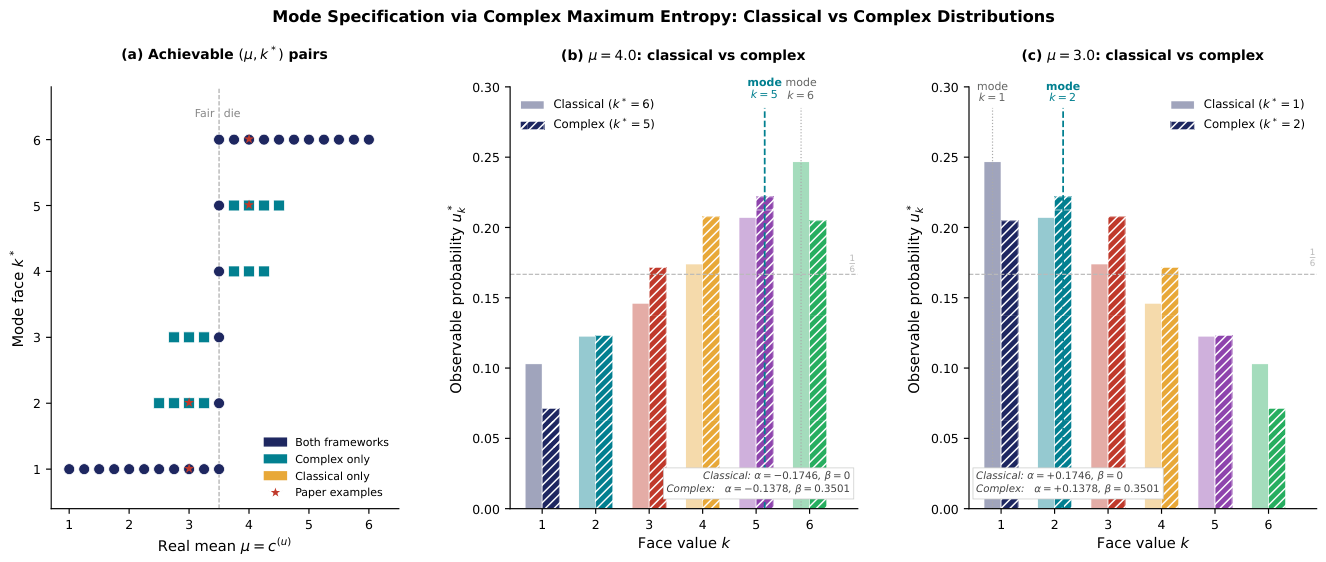
The die example illustrates how this formalism can be applied. Table 5 summarises, from exhaustive numerical search over the admissible parameter space of the case, which pairs are accessible to classical MaxEnt (only boundary modes), to complex MaxEnt only (interior modes, marked †), or to both frameworks. Figure 2 provides the visual counterpart.
An illustrative example is with mode at . Classical MaxEnt at gives , , and , with mode at . Solving system (39) for and yields and
with mode at and real mean . The admissibility condition is satisfied, all phases lying within . The imaginary constraint is , encoding directional information about the sub-population structure.
Note that the classical Shannon entropy of the complex solution (1.734) is slightly below that of the classical Gibbs (1.749), reflecting the additional information encoded in the imaginary constraint. The complex entropy exceeds the classical maximum, because it optimises over a strictly larger family of distributions.
4.6. Geometric Representation in the Complex Plane
Figure 1 displays the six complex probabilities for both Case 2 (fair die) and Case 3 (loaded die) as vectors in the complex plane, with the argument of each vector marked explicitly.
In Case 2, panel b, all six vectors have the same modulus , so their tips lie on the dashed circle. The arguments advance by exactly per face, from to . The observable classical probability is thus largest for the central faces, where is smallest, and smallest for the extreme faces. The imaginary part is antisymmetric, encoding the imaginary constraint .
In Case 3, panel c, the loading breaks the equal-modulus property: the vectors grow in length from to , reflecting the real bias toward higher faces. The imaginary constraint still rotates each vector, but by an angle that now interacts with the variable moduli: face 1 has the largest negative angle, , because its small modulus amplifies the relative effect of the rotation. All vectors lie in the open right half-plane, consistent with CP1.
Two structural observations emerge from the three cases. In Case 2, the same real constraint that classically forces the uniform distribution produces a bell-shaped real distribution when combined with . The imaginary information acts on the observable probabilities, concentrating mass toward the central faces. The mechanism is algebraic: the phase modulation in the numerator of (32), after normalization by the complex partition function , rotates the real parts of the away from the uniform distribution. In other words, the imaginary constraint changes the observable distribution.
In both Cases 2 and 3, the imaginary parts are antisymmetric: negative for small face values, positive for large ones. The imaginary constraint prescribes that there is more imaginary probability mass at high faces than at low faces, a form of directional information with no counterpart in classical probability. This information is not accessible to a classical observer, who measures only , but it shapes the observable distribution in a measurable way. That is, the imaginary part encodes a directional signal.
Figure 1.
Three cases of the MaxEnt die problem. (a) Case 1, classical MaxEnt with real-valued probabilities (, for all k). The x-axis gives the face value, the y-axis the classical probability . Solid, lighter bars show the unloaded (fair) die, where MaxEnt returns the uniform distribution for all k, matching the dashed reference line. Hatched bars show the loaded die (), where the exponential family assigns monotonically increasing probabilities from to . In both classical cases, all probability mass lies on the positive real axis of the complex plane. (b) Case 2, fair die with imaginary constraint (). All six complex probabilities lie on the dashed circle of radius ; their arguments advance linearly at per face. The horizontal projection of each vector, , is the observable probability and differs from the uniform distribution despite the same real constraint. (c) Case 3, loaded die with imaginary constraint (). The real loading breaks the equal-modulus property while the imaginary multiplier rotates each vector off the real axis; the three smallest arrows are annotated in the inset. In panels (b) and (c), all vectors lie in the open right half-plane, confirming CP1.
Figure 1.
Three cases of the MaxEnt die problem. (a) Case 1, classical MaxEnt with real-valued probabilities (, for all k). The x-axis gives the face value, the y-axis the classical probability . Solid, lighter bars show the unloaded (fair) die, where MaxEnt returns the uniform distribution for all k, matching the dashed reference line. Hatched bars show the loaded die (), where the exponential family assigns monotonically increasing probabilities from to . In both classical cases, all probability mass lies on the positive real axis of the complex plane. (b) Case 2, fair die with imaginary constraint (). All six complex probabilities lie on the dashed circle of radius ; their arguments advance linearly at per face. The horizontal projection of each vector, , is the observable probability and differs from the uniform distribution despite the same real constraint. (c) Case 3, loaded die with imaginary constraint (). The real loading breaks the equal-modulus property while the imaginary multiplier rotates each vector off the real axis; the three smallest arrows are annotated in the inset. In panels (b) and (c), all vectors lie in the open right half-plane, confirming CP1.
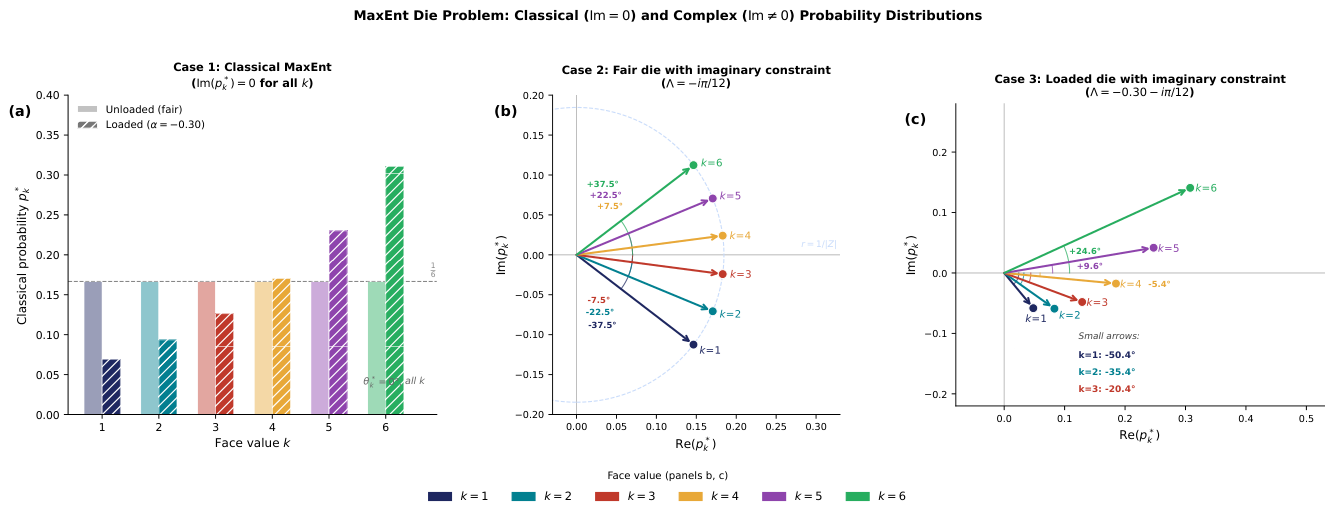
Figure 2.
Mode specification via complex maximum entropy. (a) Achievable pairs on a six-sided die. Navy circles: accessible to both frameworks. Teal squares: accessible to the complex framework only (interior modes). Gold triangles: classical boundary modes. Stars mark the two paper examples. (b) Distributions at ; classical Gibbs, monotone with mode , versus complex MaxEnt (, mode ), both at the same real mean. (c) Symmetric counterpart at ; classical mode versus complex mode . The symmetric Lagrange multiplier pair produces exact reflections.
Figure 2.
Mode specification via complex maximum entropy. (a) Achievable pairs on a six-sided die. Navy circles: accessible to both frameworks. Teal squares: accessible to the complex framework only (interior modes). Gold triangles: classical boundary modes. Stars mark the two paper examples. (b) Distributions at ; classical Gibbs, monotone with mode , versus complex MaxEnt (, mode ), both at the same real mean. (c) Symmetric counterpart at ; classical mode versus complex mode . The symmetric Lagrange multiplier pair produces exact reflections.
5. Conclusions
The paper has proposed and developed a maximum entropy principle for complex probability measures. The key steps were the following.
Youssef’s framework, while sufficient to derive quantum mechanics from probabilistic axioms, does not admit a natural MaxEnt extension. Rodriguez’s Clifford extension [19] broadens Youssef’s framework to all Clifford algebras, recovering quaternionic and spinorial quantum mechanics as special cases, but inherits the same structural obstacle: the (Born-rule) normalization is incompatible with the normalization assumed by Shannon entropy, so no canonical MaxEnt principle exists within either framework.
The new framework, which replaces non-negativity with the real-part condition and retains the linear normalization of an density, admits a natural MaxEnt principle. The real part of the complex Shannon entropy is a well-posed real functional. Its Euler–Lagrange equations, derived by treating the real and imaginary parts of the density as independent variational variables, produce the complex Gibbs distribution with complex Lagrange multipliers . The classical Gibbs distribution is recovered when the imaginary parts of the multipliers vanish.
The die examples demonstrate the central qualitative consequence: adding an imaginary constraint to a classical constraint changes the observable real-part distribution, concentrating mass toward the central faces in the fair-die case and modifying the loading profile in the loaded-die case. The imaginary constraint carries directional information, invisible to classical measurement, that reshapes the observable distribution in a systematic way determined by the admissibility condition and the structure of the constraint functions.
Two questions remain open. The first, and the more fundamental one, is the operational meaning of the imaginary constraint . No sequence of classical observations on the die can distinguish two distributions with the same real mean but different imaginary moments , yet the imaginary constraint shapes the observable distribution through the complex Gibbs formula. Three candidate interpretations point in different directions.
The first is a Hahn–Jordan decomposition: the imaginary part decomposes into two non-negative parts corresponding to two latent sub-populations, and is proportional to the difference in expected face value between them. For the canonical case (, mode ), the high sub-population concentrates on faces 5 and 6 () and the low sub-population on faces 1 to 3 (), with .
The second is an orthogonal measurement interpretation: classical measurements access only the simplex of real distributions; the imaginary part lies in the orthogonal complement of the constant function in , inaccessible to any frequency-based observation. The imaginary constraint is a coordinate in this orthogonal complement, representing prior knowledge about the system’s internal structure that has no observable footprint. As increases from 0 to at fixed , the pair traces a curve from the classical point to , with the mode shifting from to .
The third connects to temporal antisymmetry: for a stationary Markov chain with marginal , the probability current between adjacent states vanishes at equilibrium (detailed balance) and is non-zero out of equilibrium. The bond-averaged imaginary density is proportional to : a positive imaginary constraint corresponds to a net probability current flowing from low to high faces, encoding the observer’s prior knowledge that the system is not at equilibrium and has a preferred direction of dynamics.
These three interpretations will be developed in a subsequent paper, together with three speculative directions: linear response, entropic Bayesian updating, and the connection to hidden variables.
The second open question is one of convexity: is the complex Gibbs distribution the unique maximum of , or could there be other stationary points? This is a question about the functional (4) under the CP1 constraint (D1), and it has not been addressed here.
Author Contributions
Conceptualization, formal analysis, methodology, software, and writing, F.J.T. The author has read and agreed to the published version of the manuscript.
Funding
This research was funded by the Spanish Ministerio de Ciencia e Innovación and Agencia Estatal de Investigación, MCIN/AEI/10.13039/501100011033, ERDF A way of making Europe, and the European Union Next Generation EU/PRTR, projects TED2021-131526B-I00, PDC2022-133834-C21, PID2022-138298OB-C22 and PID2019-108470RB-C21; by the University of Castilla-La Mancha, grant 2022-GRIN-34329; and by the Regional Government of Castilla-La Mancha / Agencia de Investigación e Innovación CLM, project SBPLY/24/180225/000166.
Institutional Review Board Statement
Not applicable.
Informed Consent Statement
Not applicable.
Data Availability Statement
The Python script maxent_complex.py implementing the numerical examples of Appendix A is provided. No new data were created in this study.
Acknowledgments
The author is grateful to Prof. José Carlos Cobos Hernández for introducing him to the maximum entropy formalism when the author began the degree in Mathematics and during his PhD.
Conflicts of Interest
The author declares no conflicts of interest.
Abbreviations
The following abbreviations are used in this manuscript:
| MaxEnt | Maximum entropy |
| CPDF | Complex probability density function |
| Probability density function | |
| KDE | Kernel density estimation |
| QM | Quantum Mechanics |
Appendix A. Numerical Implementation: Python Code
Appendix A.1. The Continuous Setting and the Example
The purpose of this appendix is to show the extension of the framework to a continuous support and to illustrate the mode-correction advantage of complex MaxEnt on synthetic data. The numerical implementation is provided in the accompanying script maxent_complex.py.
The worked example uses a synthetic sample of observations from a Gamma distribution with shape and scale . This distribution has mean , mode , and variance . It is right-skewed and has positive support, properties that make it representative of a broad class of physical and environmental data. Indeed, it is a classical illustration of modeling drop size distributions in the microphysics of precipitation for weather and climate models [24].
The classical MaxEnt with constraint, the prescribed mean , is the exponential distribution, whose mode is at the left boundary of the support rather than at the interior mode of the generating distribution. The example demonstrates that the complex extension, with the same single constraint on the real mean, can recover the interior mode by using the imaginary Lagrange multipliers as free parameters, rather than prescribing them from external knowledge.
Appendix A.2. The Mode-Relaxation Formulation
The standard complex MaxEnt problem requires the imaginary moments to be prescribed as inputs alongside the classical moments . As established in Section 1, the imaginary moments cannot be estimated from a real sample and must come from prior structural knowledge. When such knowledge is not available but a target mode location is known or estimated, for instance from the sample mode via kernel density estimation, the imaginary multipliers can instead be determined by solving the mode-relaxation problem: find such that the observable distribution has its maximum at a prescribed location , while the real moments remain fixed at their estimated values .
Concretely, with determined by the real moment conditions at each candidate via an inner fixed-point solve, the mode-relaxation objective is
where is the mode of the observable density at the current , is the integrated negative part of , that is the CP1 defect, is a user-supplied tolerance, and , are regularisation weights. The first term drives the mode toward the target; the second penalises CP1 violations, whose square-root growth makes the boundary soft, allowing a deliberate partial relaxation of the admissibility condition when the target mode is not achievable under strict CP1; and the third is a Tikhonov term that prevents the phase multipliers from growing without bound on large supports. Setting enforces strict admissibility throughout the search.
Appendix A.3. Why Complex MaxEnt Improves on the Classical Solution
Figure A1 illustrates the improvement for power-moment constraints .
Figure A1.
Classical and complex maximum entropy distributions fitted to a synthetic sample of observations from a Gamma distribution with shape and scale (mean , mode , variance ), shown for (left), (centre), and (right) power-moment constraints , . The grey histogram shows the empirical density. The solid navy curve is the classical MaxEnt distribution , with real multipliers determined by the sample moments. The dashed orange curve is the observable complex MaxEnt distribution , with complex multipliers obtained by the mode-relaxation routine fit_mode: the imaginary multipliers are searched so that coincides with the KDE-estimated sample mode, the dash-dot vertical line at . The dotted teal curve is the imaginary part , shown on the same density axis; it integrates to zero by the normalization axiom CP2 and encodes the sub-population structure of the imaginary constraint. For , the classical exponential distribution places its mode at the left boundary of the support (), far from the sample mode; the complex solution, with the same prescribed real mean, recovers an interior mode at the correct location. The imaginary part has the expected oscillatory profile: negative in the lower-probability region near and increasing toward positive values near the mode, indicating a net probability current from low to high x in the underlying Markov picture. For , the classical Gaussian-like solution has an interior mode but displaced from the sample mode by the simultaneous constraint on mean and variance; the complex solution aligns the mode more accurately at . For , the two solutions are close: with three moment constraints the classical exponential family is flexible enough to approximate the generating distribution well, and the imaginary part is small. The convergence of classical and complex solutions with increasing K confirms that the mode-correction advantage of the complex framework is concentrated at low constraint orders, where the classical exponential family lacks the shape freedom to place its mode independently of the prescribed moments.
Figure A1.
Classical and complex maximum entropy distributions fitted to a synthetic sample of observations from a Gamma distribution with shape and scale (mean , mode , variance ), shown for (left), (centre), and (right) power-moment constraints , . The grey histogram shows the empirical density. The solid navy curve is the classical MaxEnt distribution , with real multipliers determined by the sample moments. The dashed orange curve is the observable complex MaxEnt distribution , with complex multipliers obtained by the mode-relaxation routine fit_mode: the imaginary multipliers are searched so that coincides with the KDE-estimated sample mode, the dash-dot vertical line at . The dotted teal curve is the imaginary part , shown on the same density axis; it integrates to zero by the normalization axiom CP2 and encodes the sub-population structure of the imaginary constraint. For , the classical exponential distribution places its mode at the left boundary of the support (), far from the sample mode; the complex solution, with the same prescribed real mean, recovers an interior mode at the correct location. The imaginary part has the expected oscillatory profile: negative in the lower-probability region near and increasing toward positive values near the mode, indicating a net probability current from low to high x in the underlying Markov picture. For , the classical Gaussian-like solution has an interior mode but displaced from the sample mode by the simultaneous constraint on mean and variance; the complex solution aligns the mode more accurately at . For , the two solutions are close: with three moment constraints the classical exponential family is flexible enough to approximate the generating distribution well, and the imaginary part is small. The convergence of classical and complex solutions with increasing K confirms that the mode-correction advantage of the complex framework is concentrated at low constraint orders, where the classical exponential family lacks the shape freedom to place its mode independently of the prescribed moments.
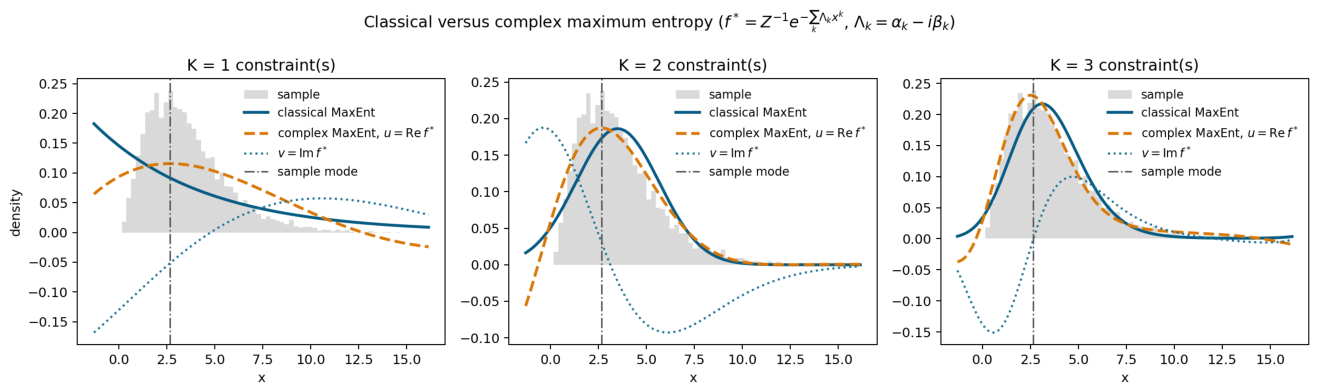
For , the classical solution is the exponential distribution , which is monotonically decreasing on the positive real line and places its mode at the left boundary of the support, far from the sample mode at . The complex solution has the same real mean but a bell-shaped observable density whose maximum is placed at the sample mode. This is the continuous-support counterpart of the discrete result in Section 4.5: the imaginary multiplier introduces a phase modulation in the Gibbs exponent, which tilts the real part of the distribution away from the monotone form of the exponential family without changing the prescribed mean.
For , both the classical and complex solutions can produce interior modes, because the Gaussian-like classical distribution already has a free parameter, the variance, that locates its peak. The classical MaxEnt places the mode at a position determined jointly by the prescribed mean and variance; the complex MaxEnt, with an additional imaginary multiplier, can align the mode more precisely with the sample mode while simultaneously matching both classical moments. The advantage is reduced but still visible in Figure A1b.
For , the classical solution is flexible enough to produce a near-perfect fit to the sample histogram with three moment constraints, and the complex solution is close to it. The remaining difference is in the imaginary part , which oscillates around zero and encodes the sub-population structure of the imaginary constraint, rather than contributing substantially to the mode location. This convergence shows that, as K grows, the classical and complex families approach the same distribution from different directions: classical MaxEnt gains shape flexibility through additional real constraints, while complex MaxEnt achieves a similar effect at smaller K by using the imaginary multipliers as shape parameters.
The key advantage of the complex approach is therefore most pronounced at small K: when the data are consistent with a small number of moment constraints but the classical exponential family cannot produce the correct mode, the complex extension provides that capability at no cost in terms of the classical constraints and without requiring additional moment measurements.
Appendix A.4. Code Structure and Usage
The script maxent_complex.py implements the following workflow.
- 1.
- Data ingestion. A one-column text file is read via --data, or a synthetic Gamma sample is generated via --synthetic. The classical moments are estimated directly from the sample for ;
- 2.
- Grid construction. A bounded support is built by make_grid, extending the data range by a user-controlled fraction on each side. Boundedness of the support guarantees existence of the Gibbs solution for (exponential) and , since a bounded Gibbs distribution always exists for odd-order polynomial exponents. For even K alone, the support must be explicitly bounded;
- 3.
- Classical MaxEnt.classical_maxent minimises the convex dual via BFGS with analytic gradient, to tolerance on the moment residual;
- 4.
- Complex MaxEnt. When imaginary moments are prescribed via --imag, complex_maxent solves the stacked real and imaginary moment residualsvia the MINPACK hybr (modified Powell) root finder, to tolerance . The complex entropy is computed from the solution and compared with the classical entropy;
- 5.
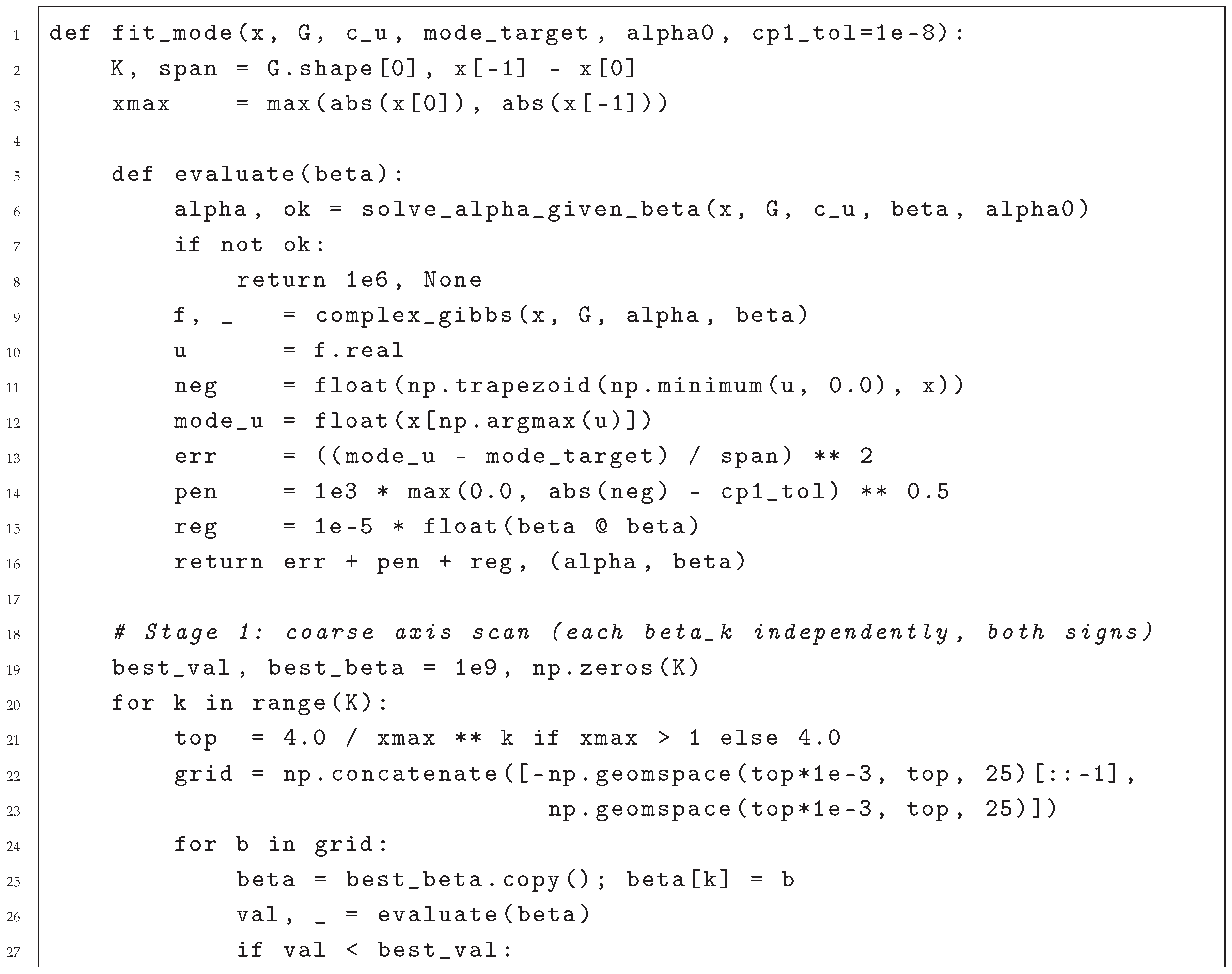
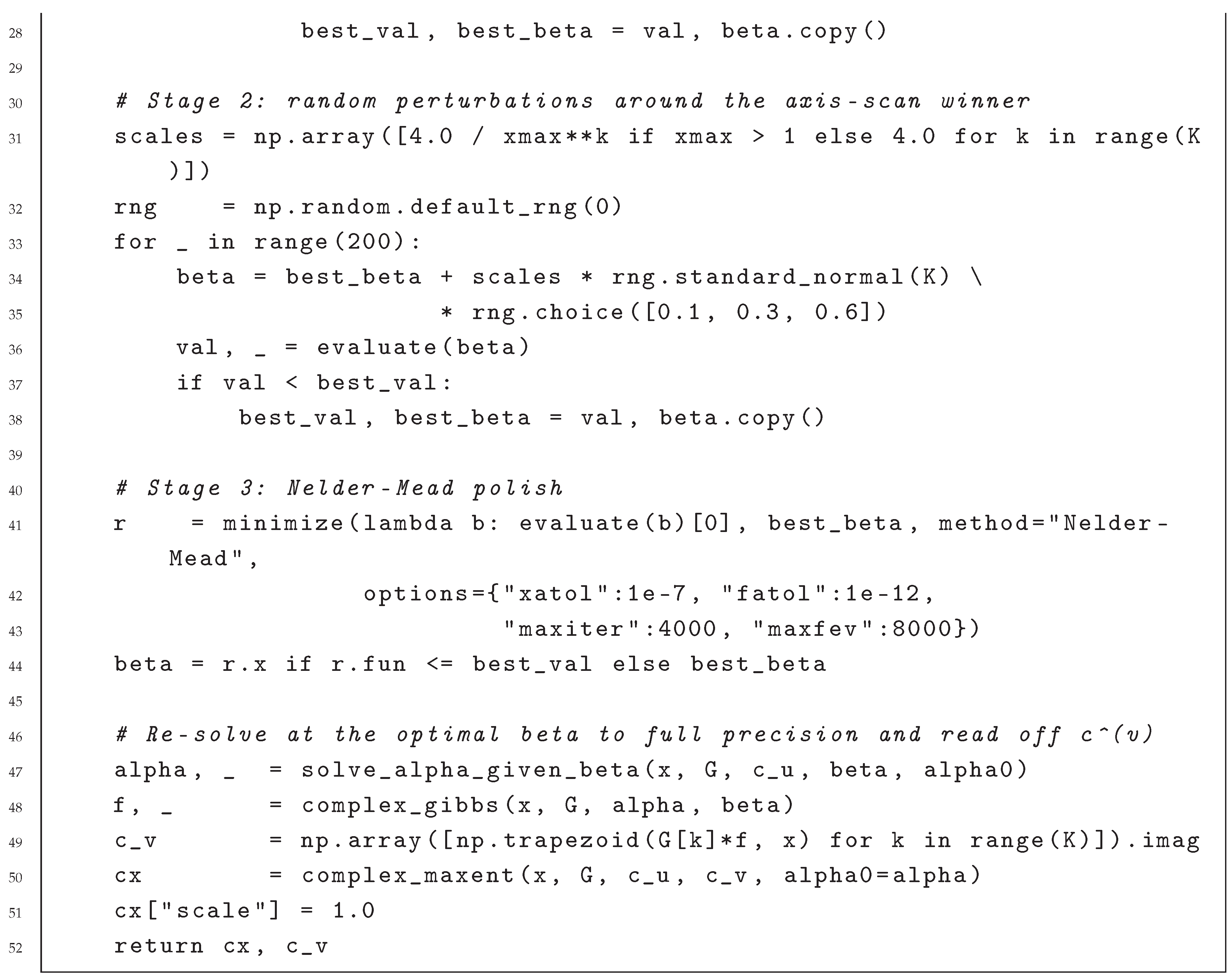
- Mode-relaxation. When --fitmode is specified, the classical solution is used to warm-start the inner -solve, and the outer search over proceeds in three stages: a coarse axis scan along each independently, a randomised perturbation phase, and a Nelder–Mead polish. The resulting determines the imaginary constraints via , which are then passed to complex_maxent for the final solution at full precision;
- 6.
- CP1 enforcement. When --enforce-cp1 is specified, solve_admissible bisects the scale on the imaginary moments until , reporting the largest admissible fraction. This identifies the achievability boundary for the prescribed imaginary moments on the given support, analogous to the discrete achievability table of Section 4.5.
Invocation examples:
python maxent_complex.py --data sample.txt --imag 0.15 0.0 0.0
python maxent_complex.py --synthetic --fitmode
python maxent_complex.py --data sample.txt --fitmode --cp1-tol 1e-4
python maxent_complex.py --data sample.txt --imag 0.5 0.0 0.0 --enforce-cp1
The first call prescribes the imaginary moments directly; the second runs the mode relaxation on synthetic Gamma data and produces Figure A1; the third relaxes the CP1 tolerance during the search; the fourth reports the achievability boundary for prescribed imaginary moments. All runs write a structured text report to maxent_results.txt, containing moments, multipliers, entropy, CP1 diagnostics, and a tabulated distribution on the grid, together with a three-panel figure in maxent_pdfs.png.
Appendix A.5. Key Functions
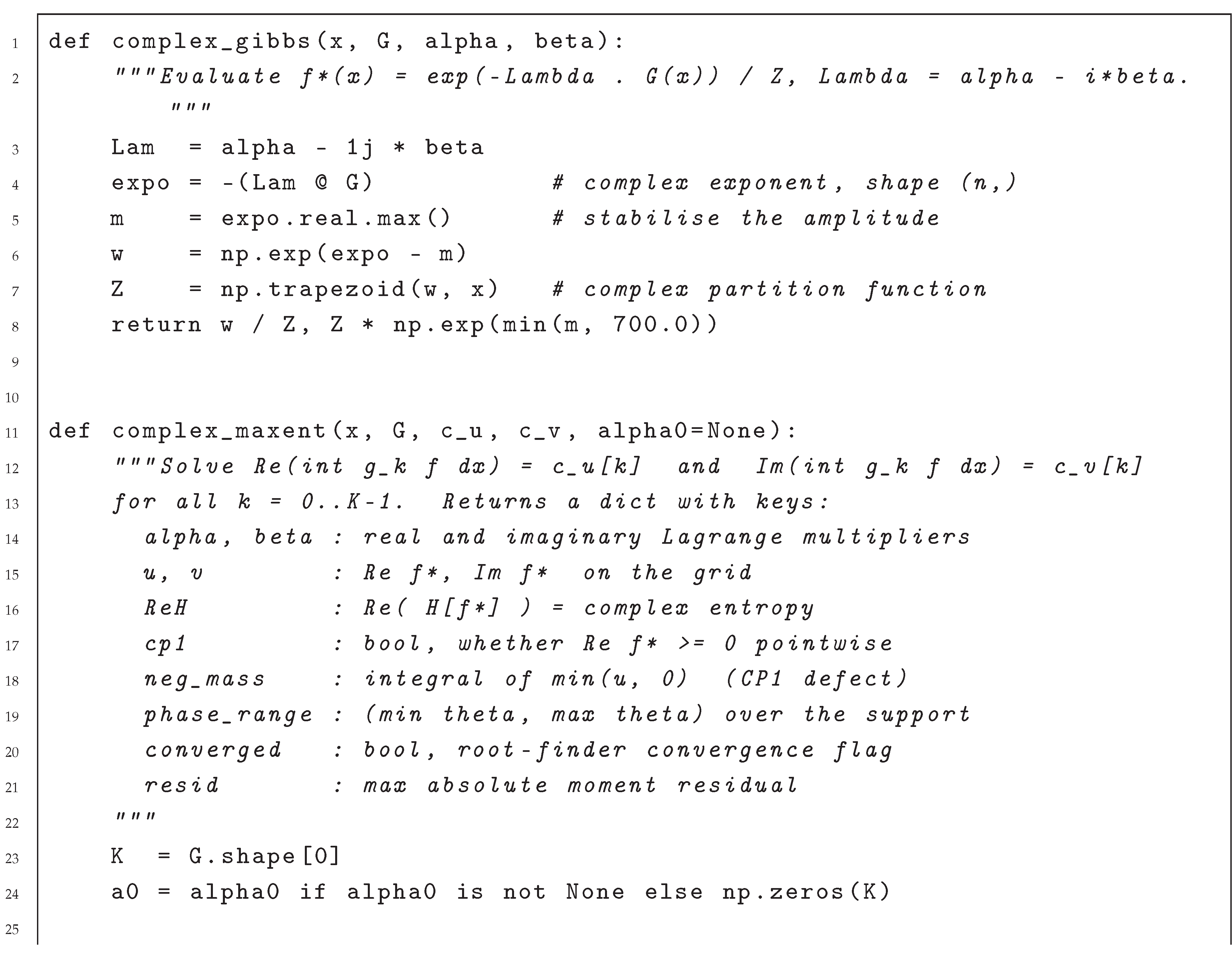
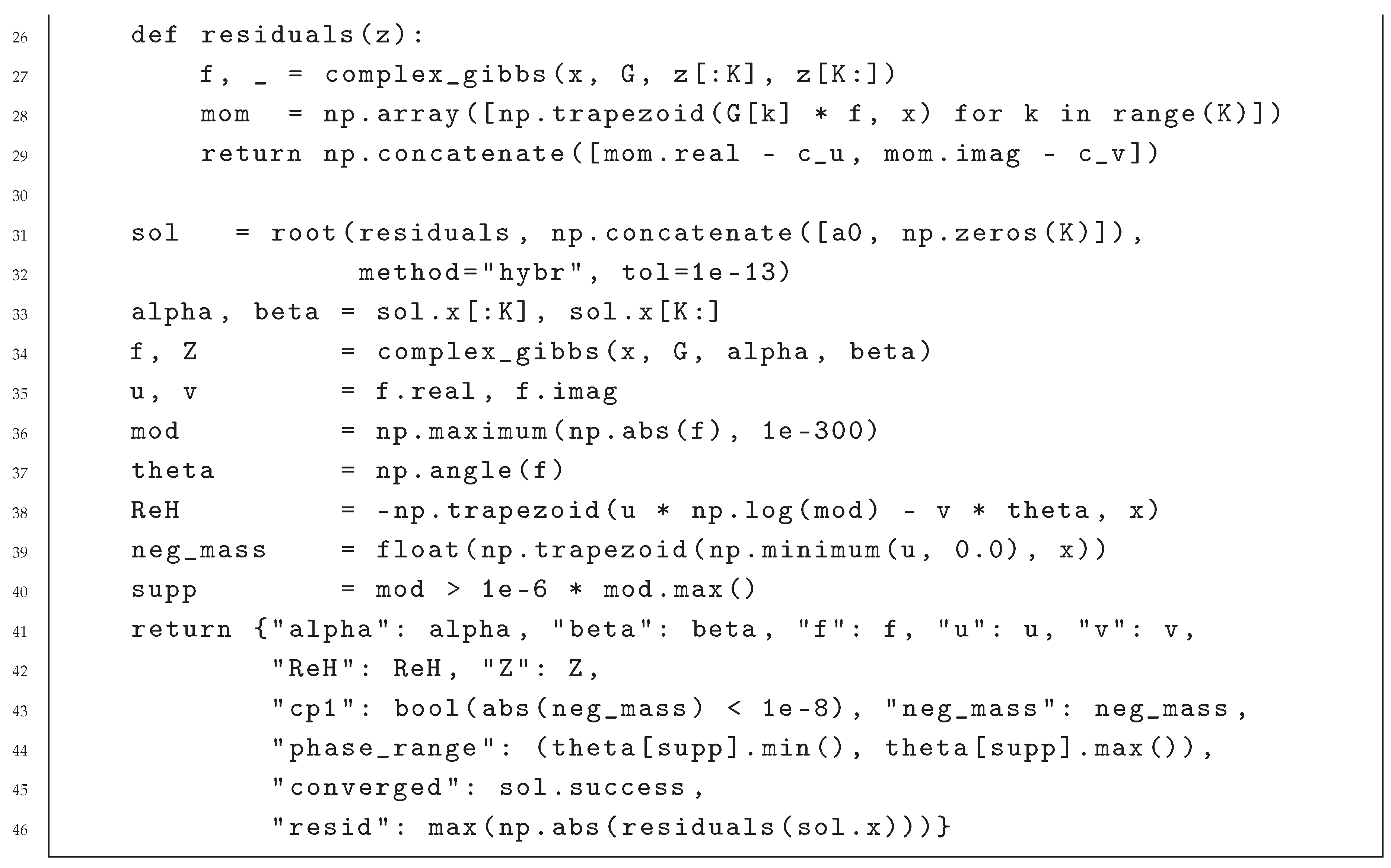
Listing gives the two core numerical functions. All integrals are evaluated by the trapezoidal rule on the grid, which is adequate for smooth densities on a bounded support; finer quadrature could be substituted without changing the interface.
Listing gives the mode-relaxation routine fit_mode, which implements the three-stage search described above. The inner function evaluate calls solve_alpha_given_beta, not shown, which solves the real moment equations for at fixed via a separate root find, and computes the objective (A1).
| Listing 1. Core functions of maxent_complex.py: complex_gibbs evaluates the complex Gibbs distribution at given multipliers and complex_maxent solves the full moment system, returning the observable density, imaginary part, complex entropy, and CP1 diagnostics. Integrals are computed by the trapezoidal rule on a uniform grid. |
|
| Listing 2. Mode-relaxation routine fit_mode. The function searches over the imaginary multipliers so that the mode of the observable density coincides with a prescribed target, while the real moments remain fixed. The three-stage search, axis scan followed by random perturbation and a Nelder–Mead polish, handles the discontinuity of the argmax and the plateau around zero phase. The cp1_tol parameter controls strictness of the admissibility condition during the search.. |
|
References
- Jaynes, E.T. Information theory and statistical mechanics. Phys. Rev. 1957, 106, 620–630. [Google Scholar] [CrossRef]
- Jaynes, E.T. Information theory and statistical mechanics. II. Phys. Rev. 1957, 108, 171–190. [Google Scholar] [CrossRef]
- Shannon, C.E. A mathematical theory of communication. Bell Syst. Tech. J. 1948, 27, 379–423. [Google Scholar] [CrossRef]
- Jaynes, E.T. Probability Theory: The Logic of Science; Cambridge University Press: Cambridge, 2003. [Google Scholar]
- Shore, J.E.; Johnson, R.W. Axiomatic derivation of the principle of maximum entropy and the principle of minimum cross-entropy. IEEE Trans. Inf. Theory 1980, 26, 26–37. [Google Scholar] [CrossRef]
- Pressé, S.; Ghosh, K.; Lee, J.; Dill, K.A. Principles of maximum entropy and maximum caliber in statistical physics. Rev. Mod. Phys. 2013, 85, 1115–1141. [Google Scholar] [CrossRef]
- Anza, F.; Crutchfield, J.P. Maximum Geometric Quantum Entropy. Entropy 2024, 26, 225. [Google Scholar] [CrossRef]
- Caticha, A.; Golan, A. An entropic framework for modeling economies. Phys. A 2014, 408, 149–163. [Google Scholar] [CrossRef]
- Ghavasieh, A.; De Domenico, M. Maximum entropy network states for coalescence processes. Phys. A 2022, 608, 128276. [Google Scholar]
- Fox, S.; Heikkilä, T.; Halbach, E.; Soutukorva, S. Bio-Inspired Intelligent Systems: Negotiations between Minimum Manifest Task Entropy and Maximum Latent System Entropy in Changing Environments. Entropy 2023, 25, 1541. [Google Scholar] [CrossRef]
- Sawada, Y.; Daigaku, Y.; Toma, K. Maximum Entropy Production Principle of Thermodynamics for the Birth and Evolution of Life. Entropy 2025, 27, 449. [Google Scholar] [CrossRef]
- Korbel, J. Calibration Invariance of the MaxEnt Distribution in the Maximum Entropy Principle. Entropy 2021, 23, 96. [Google Scholar] [CrossRef]
- Stoyanov, J.M.; Tagliani, A.; Novi Inverardi, P.L. Maximum Entropy Criterion for Moment Indeterminacy of Probability Densities. Entropy 2024, 26, 121. [Google Scholar] [CrossRef]
- Nghiem, T.L.; Maréchal, P. On Maximum Entropy Density Estimation with Relaxed Moment Constraints. Entropy 2026, 28, 282. [Google Scholar] [CrossRef]
- Tang, Q.Y.; Lin, Y.X. Maximum Entropy–Minimum Residual Model: An Optimum Solution to Comprehensive Evaluation and Multiple Attribute Decision Making. Entropy 2025, 27, 203. [Google Scholar] [CrossRef]
- Youssef, S. A reformulation of quantum mechanics. Mod. Phys. Lett. A 1991, 6, 225–236. [Google Scholar] [CrossRef]
- Youssef, S. Quantum mechanics as Bayesian complex probability theory. Mod. Phys. Lett. A 1994, 9, 2571–2586. [Google Scholar] [CrossRef]
- Cox, R.T. Probability, frequency and reasonable expectation. Am. J. Phys. 1946, 14, 1–13. [Google Scholar] [CrossRef]
- Rodriguez, C.C. Unreal probabilities: partial truth with Clifford numbers. In Maximum Entropy and Bayesian Methods, Garching 1998;Fundamental Theories of Physics; von der Linden, W., Dose, V., Fischer, R., Preuss, R., Eds.; Springer: Dordrecht, 1999; Vol. 105, pp. 247–270. [Google Scholar]
- Canosa, N.; Rossignoli, R.; Plastino, A. Maximum entropy approach to nuclear structure. Nucl. Phys. A 1990, 512, 492–508. [Google Scholar]
- Canosa, N.; Rossignoli, R.; Plastino, A.; Miller, H.G. Maximum entropy principle and correlations in many-body systems. Phys. Rev. C 1992, 45, 1162–1170. [Google Scholar]
- Tapiador, F.J. Data Fusion of Satellite Images through Jaynes’ Maximum Entropy Method. PhD thesis, Department of Applied Physics, University of Valladolid, Valladolid, Spain, 2000. [Google Scholar]
- Kolmogorov, A.N. Grundbegriffe der Wahrscheinlichkeitsrechnung; Springer: Berlin, 1933. [Google Scholar]
- Tapiador, F.J.; Shin, K.; Leganés, L.J.; Lim, K.S.; Juárez, G.; Bang, W.; Navarro, A.; Martín, R.; Park, S.Y.; Lee, G. A Physically Consistent Particle Size Distribution Modeling of the Microphysics of Precipitation for Weather and Climate Models. Geophys. Res. Lett. 2026, 53. [Google Scholar] [CrossRef]

Table 1.
Comparison of the three probability frameworks. The new framework is intermediate: strictly more general than Kolmogorov (complex values) and strictly more constrained than Youssef or Rodriguez ( normalization, real-part positivity). MaxEnt is naturally defined only in the first two columns; the third column has no canonical entropy functional compatible with its normalization.
Table 1.
Comparison of the three probability frameworks. The new framework is intermediate: strictly more general than Kolmogorov (complex values) and strictly more constrained than Youssef or Rodriguez ( normalization, real-part positivity). MaxEnt is naturally defined only in the first two columns; the third column has no canonical entropy functional compatible with its normalization.
| Property | Kolmogorov | This Work | Youssef (1994)/Rodriguez (1998) |
|---|---|---|---|
| Axiom system | Measure theory | Measure theory, extended | Cox’s Bayesian axioms |
| Range of P | , | (Youssef) or Clifford algebra G (Rodriguez); unconstrained | |
| Non-negativity | None | ||
| Normalization | () | () | (, Born norm) |
| Observable prob. | (Born rule) | ||
| Shannon entropy | well-posed | Not naturally defined | |
| MaxEnt solution | Classical Gibbs | Complex Gibbs | No canonical solution |
| Recovers QM | No | Boundary limit () | Yes, interior (Youssef); all signatures (Rodriguez) |
Table 2.
Classical Jaynes MaxEnt versus its complex extension. The complex formulation strictly generalises the classical one: setting and for all k recovers the classical Gibbs distribution and all classical relations exactly.
Table 2.
Classical Jaynes MaxEnt versus its complex extension. The complex formulation strictly generalises the classical one: setting and for all k recovers the classical Gibbs distribution and all classical relations exactly.
| Quantity | Classical MaxEnt | Complex MaxEnt |
|---|---|---|
| Density | , | , , |
| Entropy | ||
| Constraints | ||
| Multipliers | ||
| Gibbs density | ||
| Partition function | ||
| Dual relation | ||
| Admissibility | Always satisfied | Condition (29) |
| Recovery | and give the classical case | |
Table 3.
Classical MaxEnt () versus complex MaxEnt () for , with the same real constraint . All faces share the same modulus; the distribution of probability in is encoded in the linearly spaced phases .
Table 3.
Classical MaxEnt () versus complex MaxEnt () for , with the same real constraint . All faces share the same modulus; the distribution of probability in is encoded in the linearly spaced phases .
| k | |||||
|---|---|---|---|---|---|
| 1 | |||||
| 2 | |||||
| 3 | |||||
| 4 | |||||
| 5 | |||||
| 6 |
Table 4.
Complex MaxEnt distribution for the loaded die (). The column gives the classical Gibbs distribution for , , that is, the same real loading with no imaginary constraint. The imaginary constraint shifts observable probability from the extreme faces to the intermediate ones and introduces antisymmetric imaginary parts.
Table 4.
Complex MaxEnt distribution for the loaded die (). The column gives the classical Gibbs distribution for , , that is, the same real loading with no imaginary constraint. The imaginary constraint shifts observable probability from the extreme faces to the intermediate ones and introduces antisymmetric imaginary parts.
| k | |||||
|---|---|---|---|---|---|
| 1 | |||||
| 2 | |||||
| 3 | |||||
| 4 | |||||
| 5 | |||||
| 6 |
Table 5.
Achievable mode faces at each mean for classical and complex MaxEnt on with constraint . Pairs marked † are accessible only to the complex framework within the admissible region. Classical MaxEnt achieves only the boundary modes (for ) and (for ), or the entire set trivially for (uniform distribution, no unique mode).
Table 5.
Achievable mode faces at each mean for classical and complex MaxEnt on with constraint . Pairs marked † are accessible only to the complex framework within the admissible region. Classical MaxEnt achieves only the boundary modes (for ) and (for ), or the entire set trivially for (uniform distribution, no unique mode).
| Classical | Complex (Admissible) | |
|---|---|---|
| – | 1 | 1 |
| – | 1 | |
| 1 | ||
| all (uniform) | ||
| – | 6 | |
| – | 6 | |
| – | 6 | 6 |
Disclaimer/Publisher’s Note: The statements, opinions and data contained in all publications are solely those of the individual author(s) and contributor(s) and not of MDPI and/or the editor(s). MDPI and/or the editor(s) disclaim responsibility for any injury to people or property resulting from any ideas, methods, instructions or products referred to in the content. |
© 2026 by the authors. Licensee MDPI, Basel, Switzerland. This article is an open access article distributed under the terms and conditions of the Creative Commons Attribution (CC BY) license (http://creativecommons.org/licenses/by/4.0/).
Copyright: This open access article is published under a Creative Commons CC BY 4.0 license, which permit the free download, distribution, and reuse, provided that the author and preprint are cited in any reuse.