

Submitted:
24 August 2026
Posted:
24 August 2026
You are already at the latest version
Abstract
Transportation network disruptions can abruptly alter travel costs and trigger day-to-day route-choice adjustments. Conventional day-to-day dynamic traffic assignment models, however, often rely on fixed-weight or uniformly decaying memory structures, limiting their ability to represent traveller learning under non-stationary conditions. This study develops a Bayes with Adaptive Memory (BAM)-based framework that selectively retains, down-weights, or discounts past travel-cost experiences according to recency and statistical significance. The BAM mechanism is integrated into a link-based day-to-day traffic assignment model to examine how adaptive memory influences perceived costs, route-choice adjustment, and post-disruption traffic-flow evolution. Numerical experiments on a hypothetical network show smoother flow trajectories, faster stabilisation, and a 41.2% reduction in mean absolute perception-tracking error compared with a conventional fixed-weight model. Under a link-removal scenario, the framework captures immediate traffic redistribution followed by gradual stabilisation toward a new post-disruption state. Sensitivity analysis reveals a trade-off between responsiveness and stability: shorter memory improves cost tracking, whereas longer memory and stronger significance weighting promote smoother adjustment and earlier convergence. Within the tested setting, the results suggest that adaptive memory provides a behaviourally plausible mechanism for representing traveller learning and may support disruption-management assessments of adjustment periods, congestion redistribution, and information provision.
Keywords:
day-to-day dynamic traffic assignment
; bayes with adaptive memory
; post-disruption traffic dynamics
; traveller perception updating
; transportation network disruption
1. Introduction
Transportation systems are vital lifelines that support social, economic, and everyday activities by enabling the movement of people, goods, and services across regions and communities [1]. As these systems have become increasingly interconnected and complex, they have also become more vulnerable to both natural and human-made disruptions [2]. Network failures, severe congestion, natural disasters, and other disruptive events can cause abrupt losses in serviceability, reduce accessibility, and generate substantial social and economic costs [3]. Therefore, understanding how travellers respond to disruptions, how quickly traffic conditions recover, and what behavioural mechanisms shape post-disruption traffic-flow evolution is central to transport resilience analysis and recovery planning.
Following a disruption, traffic conditions generally do not return immediately to equilibrium. Instead, disruption-induced changes in capacity, travel costs, and route-choice behaviour can produce a transient recovery process in which traffic flows progressively adjust toward a restored or new equilibrium state [4,5]. During this process, travellers revise their route choices from day to day based on newly experienced travel costs, prior expectations, uncertainty, and memories of previous conditions. These perception-updating processes can strongly influence whether the network recovers smoothly or experiences prolonged oscillations, overreactions, or inefficient route-switching [6]. In this context, day-to-day dynamic traffic assignment (DTDTA) models provide an important modelling framework because they can represent temporal adjustment processes, traveller perception updating, and route-choice adaptation over successive days [7,8,9]. However, the ability of DTDTA models to explain post-disruption recovery depends critically on how traveller perceptions are updated, particularly how perceived travel costs are revised in response to new experiences and changing network conditions [10]. Existing DTDTA models have improved the representation of traveller learning and route-choice adjustment, but many still rely on simplified perception-updating mechanisms that are not well suited to disruption-induced, non-stationary environments, and consequently often struggle to distinguish routine traffic variability from disruption-related changes and to represent selective memory during post-disruption recovery [1,11,12].
To address these gaps, this study adapts the Bayes with Adaptive Memory (BAM) framework, originally developed in the machine-learning literature by Nassar, Brennan, Evans, and Lowrey [13], to a transport-specific DTDTA context. Rather than introducing BAM itself, this study extends and operationalises the framework for post-disruption traffic-flow modelling through three transport-specific developments: a recency-weighted z-score (RWZ) readout scheme, integration into a link-based DTDTA structure, and coupling with a post-disruption prediction module. In the proposed framework, travellers’ perceived link costs are updated through a Bayesian adaptive-memory process that regulates the influence of previous experiences according to their recency and statistical significance. This allows past cost observations to be selectively retained, down-weighted, or progressively discounted rather than being preserved indiscriminately or forgotten uniformly. The resulting framework provides a transport-specific mechanism for representing perception updating, route-choice adaptation, and traffic-flow adjustment under non-stationary post-disruption conditions.
The main contributions of this study are as follows:
- 1.
- A transport-specific adaptation of BAM is developed for perceived-cost updating within a post-disruption DTDTA framework, enabling adaptive memory to be incorporated directly into day-to-day traffic-flow modelling.
- 2.
- A recency-weighted z-score (RWZ) readout scheme is developed to weight historical travel-cost observations according to both recency and statistical significance, allowing recent information to receive greater influence while retaining unusually salient past experiences.
- 3.
- The BAM-based perception-updating mechanism is integrated into a link-based DTDTA structure, linking adaptive memory and Bayesian perceived-cost estimation with route-choice adjustment and day-to-day traffic-flow evolution.
- 4.
- The BAM mechanism is coupled with a post-disruption prediction module that represents anticipated congestion immediately after a network change, allowing topology-induced changes to influence perceived costs before new post-disruption experience becomes available.
The remainder of this paper is organised as follows. Section 2 reviews the relevant literature and identifies the research gap. Section 3 presents the proposed BAM-based modelling framework and its mathematical formulation. Section 4 reports the numerical experiments and results. Section 5 discusses the behavioural interpretation, practical implications, and limitations of the findings. Section 6 concludes the study and outlines directions for future research.
2. Literature Review
2.1. Day-to-Day Dynamic Traffic Assignment under Disruptive Conditions
Day-to-day dynamic traffic assignment (DTDTA) models have received considerable attention because of their ability to represent temporal adjustment processes, perception updating, and route-choice adaptation over successive days [7,8,9]. Unlike within-day dynamic traffic assignment models, which describe traffic-flow variations over the course of a single day, DTDTA models examine how travellers revise their decisions between days based on previously experienced or perceived travel conditions, providing a suitable framework for analysing the temporal adjustment of traffic flows toward equilibrium. Early studies established the theoretical foundations for this progressive adjustment: Cascetta and Cantarella [7] formulated day-to-day traffic evolution as a stochastic process driven by perception and route-choice updating; Smith and Wisten [4] examined route-swapping dynamics through which travellers gradually shift toward less costly alternatives; Watling [8] investigated the stability and convergence properties of DTD adjustment processes; and Watling and Hazelton [9] demonstrated that DTDTA frameworks can accommodate different behavioural assumptions, aggregation levels, and perception-updating mechanisms.
DTDTA models are particularly relevant to disruption-affected networks because disruptions can abruptly change network capacity, connectivity, and travel costs, invalidating previously established perceptions and route-choice patterns. Following such changes, traffic flows evolve through a transient adjustment process as travellers explore alternative routes and revise their perceived costs; depending on the learning and route-choice mechanisms adopted, the network may gradually approach a restored equilibrium, converge toward a new post-disruption equilibrium, or exhibit oscillatory and inefficient adjustment [4,5]. Despite this suitability, relatively few studies have explicitly examined how disruption-induced changes in traveller perceptions shape post-disruption traffic-flow evolution and recovery [1,14], and existing models differ substantially in how they represent travellers’ memory of previous conditions, response to new experiences, and uncertainty regarding altered network conditions [11]. The ability of DTDTA models to explain post-disruption recovery therefore depends critically on the perception-updating mechanisms used to revise perceived travel costs.
2.2. Perception Updating and Traveller Learning
As illustrated in Figure 1, conventional DTDTA frameworks typically update perceived costs through a correction-only process that combines the most recently experienced travel cost with previously formed perceptions [11]. Existing formulations fall broadly into infinite-memory learning, which retains information from all previous experiences, and finite-memory learning, which considers only a specified set of recent observations, commonly through deterministic weighted averages such as exponential moving averages that assign progressively lower weights to older observations [11,14,15,16]. While tractable under relatively stable conditions, these formulations impose predetermined memory windows or fixed decay patterns that become restrictive once a disruption abruptly alters capacity, connectivity, and travel costs and renders previously established perceptions less representative of current conditions [17]. Because conventional fixed-weight mechanisms apply the same updating structure before and after a disruption, they are generally unable to distinguish routine day-to-day variability from disruption-induced change or to determine which past experiences remain relevant under altered conditions; even exponential moving average methods, though weighted toward recent observations, still discount older experiences uniformly and cannot explicitly preserve a significant past experience that remains informative.
Traveller learning under disruptive conditions is instead likely to be more selective and context-dependent: travellers may emphasise recent observations, retain memories of salient events such as severe congestion or network failures, discount outdated information, and adjust their reliance on prior knowledge according to uncertainty and perceived risk [18,19,20], drawing on relevant prior experience, intuition, and contextual judgement when conditions are unfamiliar or rapidly changing [21,22]. This is consistent with cognitive psychology evidence that memory does not decay at a constant rate, and that an experience’s influence depends on both recency and significance, so that high-impact events can remain influential long after they occur [23]. A key limitation of conventional perception-updating methods is therefore the absence of an adaptive memory mechanism capable of evaluating past observations according to their changing relevance, distinguishing routine variability from disruption-induced anomalies, and selectively retaining, down-weighting, or discarding past experiences according to both recency and significance.
2.3. Bayesian Learning and Adaptive Memory in Non-Stationary Environments
Bayesian approaches have been applied to traffic assignment and traveller-learning problems because they provide a probabilistic framework for representing uncertainty and sequential belief updating, in which newly observed travel experiences are combined with prior beliefs to produce posterior perceptions that subsequently inform route-choice decisions [24,25]; this recursive structure suits day-to-day traffic systems, in which travellers repeatedly revise perceived costs in response to experienced conditions [26,27]. Within the Bayesian DTDTA literature, Parry and Hazelton [28] and Nakayama [29] established probabilistic approaches for representing uncertainty, belief updating, and route-choice adjustment over successive days, while studies of Advanced Traveller Information Systems (ATIS) have examined how travellers revise beliefs and choices in response to travel-time information, route guidance, and discrepancies between expected and experienced conditions [30,31,32]. Both streams demonstrate the value of Bayesian learning for modelling uncertainty and information-based responses, but their emphasis remains on probabilistic belief updating and responses to supplied information rather than on adaptive memory selection under disruption-induced non-stationarity: neither explicitly determines which historical experiences should be retained, down-weighted, or discarded by recency and significance within a link-based post-disruption DTDTA framework.
This gap matters because conventional recursive Bayesian updating, applied without accounting for structural change, allows observations accumulated before a disruption to continue influencing posterior perceptions even after they no longer represent current conditions [33]. Treating repeated observations as arising from an unchanged process causes posterior beliefs to concentrate around outdated conditions and reduces responsiveness precisely when rapid adaptation is needed, which reflects the sense in which a naive recursive Bayesian learner effectively “never forgets” [34]. Forgetting mechanisms such as changepoint detection and exponentially decaying weights have been introduced to improve adaptation in non-stationary environments [35,36,37,38], but these approaches tend to discount historical observations too uniformly. This can be problematic when past experiences, such as severe congestion or network failures, remain informative when similar conditions recur. The Bayes with Adaptive Memory (BAM) framework developed by Nassar et al. [13] addresses this broader problem by allowing past observations to be selectively retained or discounted according to their relevance. However, BAM originated in the machine-learning literature and, to the authors’ knowledge, has not yet been operationalised for perceived-cost updating within a link-based post-disruption DTDTA framework.
2.4. Research Gap and Analytical Framework
The reviewed literature reveals three connected gaps. First, conventional DTDTA models represent day-to-day learning and route-choice adjustment but commonly rely on fixed-weight, deterministic, or uniformly decaying perception-updating mechanisms, limiting their ability to distinguish routine variability from statistically salient changes or to selectively retain important past experiences.
Second, Bayesian DTDTA and ATIS studies improve the representation of uncertainty and probabilistic belief updating, but generally lack an explicit adaptive memory-selection mechanism that evaluates historical observations according to both recency and statistical significance. This limitation is particularly relevant under non-stationary post-disruption conditions, where previously accumulated experience may become less representative of the altered network state.
Third, adaptive-memory approaches such as BAM provide mechanisms for selectively retaining or discounting historical observations, but BAM was originally developed in the machine-learning literature and has not been operationalised within a transport-specific, link-based DTDTA framework. Consequently, the connection between adaptive Bayesian memory, travellers’ perceived-cost formation, route-choice adjustment, and post-disruption traffic-flow evolution remains insufficiently explored.
To address these gaps, this study develops a transport-specific BAM-based DTDTA framework for analysing traveller perception updating under disruptive network conditions. Rather than introducing BAM itself, the study adapts and operationalises the framework through a Recency-Weighted z-Score (RWZ) readout mechanism, integration with a link-based DTDTA structure, and coupling with a post-disruption prediction process. The proposed framework evaluates historical travel-cost observations according to their recency and statistical significance and links selective memory directly to Bayesian perceived-cost updating, route-choice adjustment, and day-to-day traffic-flow evolution. The analytical framework and its mathematical formulation are presented in Section 3.
3. BAM-Based Day-to-Day Traffic Modelling Framework
3.1. Network Representation and Preliminary Notation
Consider a transportation network represented by a directed graph , where denotes the set of nodes and denotes the set of directed links. Let denote the set of origin–destination (OD) pairs, and let denote the set of paths connecting OD pair . The complete set of paths is defined as , and the discrete day index is denoted by t.
Let denote the fixed travel demand associated with OD pair , and let denote the corresponding demand vector for all OD pairs. In this study, travel demand is assumed to remain constant throughout the day-to-day adjustment process. The flow on path on day t is denoted by , and the corresponding path-flow vector is denoted by . Similarly, the flow on link on day t is denoted by , and the corresponding link-flow vector is denoted by .
Let denote the link–path incidence matrix corresponding to the network topology on day t, where if path r uses link a, and otherwise. The link-flow vector is therefore expressed as . Similarly, let denote the OD–path incidence matrix, where if path r connects OD pair w, and otherwise. The demand-conservation relationship is therefore given by .
Accordingly, the feasible set of link and path flows on day t is defined as
The corresponding feasible link-flow set is defined as
Let denote the experienced link-cost vector on day t, with representing the experienced cost on link a. The link-cost vector is assumed to be a deterministic function of the link-flow vector, such that , where denotes the deterministic link-cost function. Let denote the predicted link-flow vector on day t. The corresponding predicted link-cost vector is then given by .
Finally, let denote the pre-trip perceived link-cost vector used by travellers when making route-choice decisions on day t. The notation introduced in this section provides the basis for the proposed day-to-day dynamic traffic assignment framework, while additional notation is introduced where required in the following sections.
3.2. Link-Based Day-to-Day Dynamic Traffic Assignment
A discrete-time, link-based DTDTA formulation is adopted, in which the link-flow vector serves as the system state. Link-based formulations avoid several difficulties associated with path-based models, including path-flow non-uniqueness and overlapping paths, while providing an efficient representation of network dynamics []. The generic day-to-day link-flow adjustment process is expressed as
where is the adjustment parameter that controls the rate at which the current link-flow pattern, , moves towards the target link-flow pattern, . Under normal operating conditions, determines the gradual adjustment of traffic flows. Following a network disruption, however, is set to 1 to ensure that no traffic remains assigned to removed or unavailable links under the modified network topology.
Following He and Liu [14], the target link-flow pattern is obtained by solving the following optimisation problem:
where denotes the feasible link-flow set on day , is the perceived link-cost vector used for route-choice decisions, and is the inertia parameter that balances perceived-cost minimisation and travellers’ reluctance to change routes. The first term represents travellers’ tendency to select routes with lower perceived travel costs, whereas the second term penalises deviations from the current link-flow pattern, thereby capturing behavioural inertia in day-to-day route adjustment.
3.3. Post-Disruption Link-Flow Prediction
To represent travellers’ anticipatory beliefs immediately following a network disruption, the prediction process proposed by He and Liu [14] is adopted. Let the disruption occur at the end of day , such that the disrupted network becomes available on day . Immediately after the disruption, the predicted link-flow pattern is estimated by reassigning the flows directly affected by the network-topology change to the shortest available paths under the disrupted network using an all-or-nothing assignment, while flows on unaffected paths remain unchanged. The resulting initial predicted link-flow pattern, , is obtained by solving the following minimisation problem:
where denotes the free-flow link-cost vector, represents the predicted link-flow pattern following the reassignment of flows affected by the network-topology change, and denotes the feasible link-flow set under the disrupted network topology.
For subsequent days, the predicted link-flow pattern is updated as a weighted average of the previously predicted link-flow pattern and the most recently experienced link-flow pattern:
where is the prediction damping parameter, defined as , with controlling the rate at which reliance on the predicted flow pattern diminishes. This formulation ensures that as , reflecting the gradual decline in travellers’ reliance on anticipatory predictions as direct post-disruption experience accumulates. If another disruption occurs, the prediction process is reinitialised to reflect the new network configuration.
Finally, the predicted link-cost vector is obtained from the predicted link-flow pattern as , where denotes the deterministic link-cost function introduced in Section 3.1.
3.4. Bayes with Adaptive Memory Framework for Perceived-Cost Updating
This study adapts the Bayes with Adaptive Memory (BAM) framework to update travellers’ perceived link costs within a day-to-day dynamic traffic assignment context under disruptive traffic conditions. The BAM framework updates perceived link costs through an adaptive memory process that selectively emphasises relevant past observations while down-weighting less informative ones. This enables the model to provide a behaviourally plausible representation of travellers’ perception updating by dynamically modulating the influence of past experiences in response to evolving traffic conditions. Specifically, the proposed model explicitly represents memory, responds to the statistical salience of observed travel costs, preserves significant past experiences while progressively discounting older observations to prioritise more recent information, and dynamically updates confidence in perceived travel costs. The BAM framework replaces only the conventional perceived-cost updating rule, while the prediction process, target-flow optimisation, and day-to-day flow-adjustment structure remain unchanged.
For notational clarity, the Bayesian formulation is first presented for an individual link and is subsequently applied independently to all links in the network. Let denote the travel-cost observation obtained on day t, and let denote the set of observations from all previous days. Let represent the latent parameter governing the traveller’s perceived travel-cost state on day t.
BAM introduces a time-dependent readout-weight vector, , where each readout weight determines the contribution of historical observation to the current posterior distribution. Larger values correspond to greater influence of the historical observation, whereas smaller values reduce its contribution.
Given the current observation , the historical observations , and the readout-weight vector , the BAM posterior is defined as
where denotes the initial prior distribution. The likelihood of the current observation, , is incorporated without weighting, ensuring that new information contributes fully to the posterior, whereas the influence of historical observations is regulated through the readout weights .
The adaptive prior formed from the historical observations is given by
Accordingly, the BAM posterior can equivalently be expressed through Bayes’ rule as
The corresponding marginal likelihood is
For a given historical observation , setting removes its likelihood contribution from the current posterior, whereas setting retains its full likelihood contribution. Consequently, if all historical weights are zero, the posterior depends only on the initial prior and the current observation. Conversely, if all historical weights are equal to one, the formulation reduces to conventional recursive Bayesian updating using all available observations.
For each link , the posterior distribution is estimated independently, and the maximum a posteriori (MAP) estimate is obtained as
The corresponding perceived link cost is obtained from the estimated latent state as , where denotes the mapping from the latent perception state to the perceived link cost. Repeating this procedure for all links yields the perceived link-cost vector , which is subsequently used in the target-flow optimisation problem defined in Equation (4).
3.5. Recency-Weighted z-Score (RWZ) Readout Weights
To operationalise the BAM framework for disruption-affected traffic environments, this study proposes a Recency-Weighted z-Score (RWZ) readout scheme to determine the memory-readout weights. The RWZ scheme combines temporal recency with the statistical significance of historical travel-cost observations, allowing recent observations to receive greater influence while preserving the contribution of statistically salient past experiences.
Let denote the experienced link cost associated with observation . The statistical significance of each observation is measured using its standardised z-score, defined as , where and denote the exponentially weighted mean and standard deviation of the historical travel-cost observations, respectively.
The corresponding RWZ readout weight assigned to observation when updating perceptions on day t is defined as
where controls the recency-decay rate and controls the additional influence assigned to statistically significant observations. Consequently, larger values of produce slower memory decay, whereas larger values of increase the contribution of observations that deviate substantially from the historical travel-cost distribution. The RWZ formulation reflects the behavioural assumption that travellers do not rely solely on the recency of past experiences. Instead, statistically salient past experiences can retain greater influence, while routine experiences are progressively discounted over time.
Substituting the RWZ readout weights into the BAM posterior yields
where recent and statistically significant observations contribute more strongly to the posterior distribution, while the influence of routine or outdated observations gradually diminishes. Consequently, statistically salient disruption-related experiences can retain influence in subsequent perception updating while their contribution continues to decay with time.
The proposed RWZ formulation also encompasses several conventional memory-updating mechanisms as special cases. When and , all historical observations receive equal weights, , and the formulation reduces to standard recursive Bayesian updating. When and , the readout weights simplify to , corresponding to conventional exponential forgetting [35,36,37]. For , the RWZ scheme extends exponential forgetting by additionally accounting for the statistical significance of historical observations. This enables statistically salient past experiences to retain greater influence than routine observations of the same age while both are progressively discounted as they become more temporally distant.
3.6. Maximum a Posteriori Estimation for the BAM Framework
Building on the BAM posterior formulation in Section 3.5 and the RWZ readout scheme in Section 3.6, this section describes how travellers’ perceived travel costs are estimated sequentially within the proposed DTD framework. The purpose is not to estimate fixed behavioural or structural parameters; rather, perceived travel cost is treated as a time-varying latent state that evolves as new travel experiences become available.
For a given link, the latent perception state on day t is defined as , where denotes the perceived unit travel cost and represents short-term perceived uncertainty. These quantities represent travellers’ evolving perceptions of travel costs and are therefore treated as state variables rather than constant parameters calibrated across the population.
The daily latent state is estimated using maximum a posteriori (MAP) estimation. The current travel-cost observation contributes fully to the posterior, whereas historical observations contribute according to the RWZ memory weights introduced in Section 3.6. The MAP estimate is obtained as
Accordingly, recent and statistically significant past experiences exert greater influence on the estimated perception state, while less relevant historical observations are progressively discounted. A Gaussian observation model with weakly informative heavy-tailed priors is adopted to provide robust sequential estimation. The complete statistical specification and derivation of the MAP objective are provided in Appendix A.
In this study, the MAP problem is solved numerically using PyMC. The resulting estimate is used to determine the perceived link cost, while provides an accompanying measure of uncertainty in that estimate. Applying the same procedure independently to all links yields the perceived link-cost vector , which subsequently determines the target-flow pattern through the optimisation problem in Equation (4). In this way, the BAM inference procedure links adaptive memory-based perception updating directly to route-choice adjustment and day-to-day traffic-flow evolution.
Figure 2 summarises the integrated modelling process. Immediately following a network disruption, the prediction module estimates anticipated link flows and costs under the altered network topology. Travellers’ experienced link costs are then processed through the BAM posterior, with the RWZ scheme determining the contribution of each historical observation. The resulting BAM-based perceived costs are combined with the predicted costs and used in the target-flow optimisation problem. The target link-flow pattern subsequently determines the next day’s realised flow pattern through the day-to-day adjustment equation. Accordingly, the proposed framework links three transport-specific components: disruption-responsive link-flow prediction, BAM-based perceived-cost updating within a link-based DTDTA structure, and the RWZ readout scheme for recency- and significance-sensitive memory selection. Together, these components enable the proposed BAM–RWZ DTDTA framework to represent travellers’ perception updating and to examine how these perception changes influence post-disruption traffic-flow evolution.
4. Numerical Examples
This section presents numerical experiments using a hypothetical transportation network to demonstrate the performance and modelling flexibility of the proposed BAM-based day-to-day dynamic traffic assignment framework under undisrupted and disrupted conditions. The analysis examines traffic-flow evolution, perception-tracking performance, perceived total system travel cost, post-disruption adjustment, and sensitivity to the BAM memory parameters.
4.1. Experimental Network and Model Settings
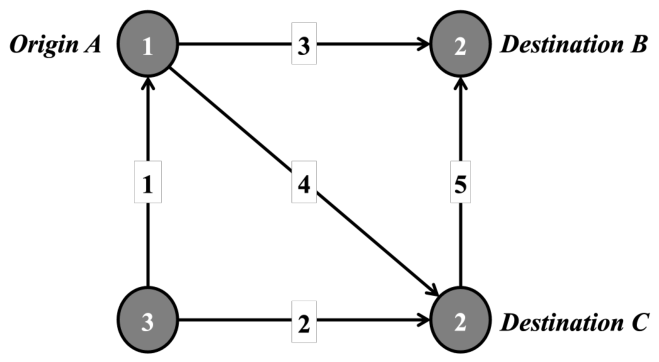
The test network shown in Figure 1 consists of four nodes, five links, and five routes connecting two origin–destination (OD) pairs, and . Each OD pair has a fixed demand of 100 trips. All links have a capacity of 20 and follow the Bureau of Public Roads (BPR) travel-time function, , where denotes the free-flow travel time of link a, denotes the corresponding link flow, and denotes the link capacity. For simplicity, the free-flow travel time of every link is set to .
Figure 3.
Small hypothetical test network.
4.2. Comparison of Traffic-Flow Evolution between Conventional and BAM-Based DTDTA Models
The first numerical experiment compares the proposed BAM-based model with a conventional DTDTA model to examine how different perceived-cost updating mechanisms affect day-to-day traffic-flow evolution. The benchmark model adopts the fixed-weight correction rule proposed by Davis and Nihan [39], , which updates perceived travel costs through exponential smoothing. This formulation is widely used as a baseline representation of perception correction and traveller learning in DTDTA studies [9,11].
Both models use the same network configuration, OD demands, initial conditions, loading procedure, target-flow optimisation, and flow-adjustment mechanism. They differ in their perceived-cost updating mechanisms and associated parameter settings. The BAM-based model uses , , and , whereas the conventional model uses and . Figure 4 presents the 30-day link-flow evolution under undisrupted conditions.
As shown in Figure 4, both models ultimately converge to stable flow patterns, but their adjustment trajectories differ. The BAM-based model stabilises within approximately 14 days and exhibits a relatively smooth and monotonic evolution of link flows. In comparison, the conventional model requires approximately 23 days to stabilise and exhibits more pronounced oscillations during the early adjustment period.
4.3. Perception-Tracking Performance of Conventional and BAM-Based Models
To evaluate how perception-updating mechanisms influence post-disruption traffic-flow evolution, perception-tracking performance is assessed by comparing perceived and experienced link costs over time. Let denote the perceived cost of link a on day t, and let denote the corresponding experienced cost. The tracking error is defined as
where represents the perception-tracking error for link a on day t.
To examine learning behaviour, the evaluation is performed over the complete 30-day adjustment period, with , starting from the initial assignment. To summarise perception-tracking performance, the mean absolute error (MAE) and root mean squared error (RMSE) for link a are calculated as
and
respectively. Bias is calculated as the average signed difference between perceived and experienced costs, with a negative bias indicating systematic underestimation of experienced travel costs.
Although the initial link-flow pattern is hypothetically specified and does not satisfy user equilibrium, the resulting transient period provides a common adjustment setting in which the two perception-updating mechanisms can be compared. Figure 5 presents the link-level perception-tracking errors, while Table 1 summarises the aggregate perception-tracking performance of the two models.
The BAM-based model achieves an overall MAE of 1.96 and RMSE of 4.55, compared with 3.34 and 10.10 for the conventional model. These values correspond to reductions of 41.2% in MAE and 55.0% in RMSE. The BAM-based model also produces a smaller negative bias of , compared with for the conventional model.
At the link level, the BAM-based model reduces tracking errors across all five links. The largest errors occur on Links 1 and 2 under both models. Nevertheless, BAM reduces MAE from 5.51 to 3.53 on Link 1 and from 7.67 to 5.04 on Link 2.
4.4. Comparison of Perceived Total System Travel Cost Evolution
To further assess how differences in travellers’ perception updating shape traffic-flow evolution between the two models, the perceived total system travel cost (TSTC) is adopted as a performance indicator. The perceived TSTC provides a network-level measure of the interaction between link flows and perceived link costs. The perceived TSTC on day t is defined as
where denotes the flow on link a on day t, and denotes the corresponding perceived link cost. For the BAM-based model, is obtained from the daily MAP estimate of the latent perceived-cost state. For the conventional model, it is obtained from the fixed-weight correction rule. Figure 6 presents the perceived TSTC trajectories under undisrupted conditions.
The two models produce different perceived system-cost trajectories. During Days 1–5, the mean perceived TSTC is 14,373.39 for the conventional model and 9,002.95 for the BAM-based model. After the initial adjustment period, the BAM-based model approaches a steady perceived TSTC of approximately 18,858.63, whereas the conventional model approaches approximately 19,907.68.
4.5. Assessing BAM-Based Model Performance under Post-Disruption Traffic-Flow Evolution
To assess post-disruption traffic-flow evolution using the BAM-based model, a hypothetical network disruption is introduced by removing Link 5 at the end of Day 29, after the network has reached an approximately stable state. The disruption remains in effect from Day 30 to Day 60 and is represented by updating the link–path incidence matrix and feasible flow set. Immediately after the disruption, the affected flows are reassigned through an all-or-nothing assignment based on free-flow travel times, producing the initial predicted flow pattern . The resulting travel-cost observation is incorporated into the BAM updating process, and the updated perceived-cost vector is subsequently used to determine the target-flow pattern. The link-flow adjustment rate is set to following the disruption to ensure that no flow remains assigned to the removed link. Figure 7 presents the resulting post-disruption link-flow evolution.
4.6. Assessing Perceived Total System Travel Cost under Disrupted Conditions
To examine differences in flow-assignment behaviour and system-level recovery under disruptive conditions, the perceived TSTC is also evaluated under the disrupted condition. Figure 8 presents the perceived TSTC generated by the BAM-based model before and after the removal of Link 5.
Before the disruption, the perceived TSTC stabilises at approximately 18,800. Immediately after Link 5 is removed, it increases sharply to approximately 123,900 on Day 30. Pronounced fluctuations occur during Days 31–35. From approximately Day 36 onward, the perceived TSTC declines and approaches a new steady-state value of approximately 19,800 by Day 60. The post-disruption steady-state value remains higher than the pre-disruption value, which is consistent with the permanent reduction in network capacity caused by the removal of Link 5.
4.7. Sensitivity Analysis of BAM Memory Parameters
A two-parameter sensitivity analysis is conducted to assess how the BAM memory-decay parameter and significance-weighting parameter affect perception tracking and system-level adjustment. The tested values are and , producing 16 parameter combinations. Each combination is evaluated over 30 days under the undisrupted baseline condition. The remaining model parameters are fixed at , , and . Performance is evaluated using MAE, RMSE, bias, convergence day, and final perceived TSTC. Figure 9 presents the sensitivity of MAE, RMSE, bias, and final perceived total system travel cost to the BAM memory parameters.
Perception-tracking performance varies with both and . The lowest MAE of 1.17 is obtained with and , whereas the lowest RMSE of 3.51 is obtained with and . Larger values of generally produce lower final perceived TSTC and earlier convergence but higher perception-tracking errors. The combination and produces the lowest final perceived TSTC of 17,814.86 and convergence by Day 12. However, this combination also produces an MAE of 4.19, RMSE of 6.90, and bias of . Figure 10 illustrates this trade-off between perception-tracking accuracy and final perceived TSTC across the tested parameter combinations.
Shorter-memory settings generally produce smaller negative bias, whereas longer-memory settings produce increasingly negative bias. Thus, the parameter combinations associated with faster convergence and lower final perceived TSTC are not necessarily those associated with the most accurate perception tracking.
5. Discussion
The discussion of the results is carried out under three aspetcs: the behavioural interpretation of the model’s findings, the practical implications for disruption management and recovery planning, and the theoretical and practical limitations of the proposed framework.
5.1. Behavioural Interpretation of the Findings
As shown in Figure 4, Figure 5 and Figure 6, the BAM-based model converges more rapidly, exhibits fewer early oscillations, and produces lower MAE, RMSE, and negative bias than the conventional fixed-weight model under undisrupted conditions. The behavioural distinction lies in how historical information is processed. The conventional model applies uniform exponential decay, meaning that the influence of an experience depends only on its recency. In contrast, BAM combines recency with statistical significance, allowing recent experiences to exert greater influence while retaining unusually salient past observations. This provides a behavioural explanation for the smoother trajectories and smaller perception errors observed under BAM.
The post-disruption results in Figure 7 and Figure 8 show an immediate redistribution of traffic following the removal of Link 5, followed by several days of oscillatory adjustment. The larger deviations on Links 1 and 2 indicate spatially heterogeneous impacts, with links absorbing displaced demand experiencing greater and more persistent congestion. The post-disruption perceived TSTC trajectory similarly distinguishes the immediate perception shock from the subsequent learning process. The sharp increase in perceived TSTC on Day 30 reflects the combined effects of capacity loss and abrupt rerouting, whereas the subsequent decline reflects travellers’ gradual revision of perceived costs. The higher post-disruption steady state does not indicate incomplete convergence but instead reflects the permanent loss of network capacity. Recovery in this study therefore refers to stabilisation under the modified network configuration rather than a complete return to pre-disruption performance.
The sensitivity analysis in Figure 9 and Figure 10 reveals a trade-off between responsiveness and stability. Lower values of , which place greater emphasis on recent experiences, improve perception-tracking accuracy under undisrupted conditions. Conversely, higher values of , particularly when combined with a larger significance-weighting parameter , produce smoother evolution and earlier convergence at the cost of greater negative bias. Excessive memory retention may therefore create perception stickiness, whereby outdated experiences continue to influence perceived costs after conditions have changed. This trade-off may be particularly relevant under disruptive conditions: excessive reliance on recent observations could produce overreaction to short-term fluctuations, whereas excessive reliance on long-term memory could delay adaptation to the altered network state. BAM provides an intermediate mechanism between these extremes, although the appropriate balance is likely to depend on disruption severity, duration, and volatility.
5.2. Practical Implications for Disruption Management and Recovery Planning
The findings have several practical implications for transportation agencies and network operators. They highlight the importance of providing timely and continuously updated travel information immediately after a disruption. Because travellers revise perceived costs using both current information and previous experience, outdated or inconsistent guidance may prolong perception errors and contribute to unstable route switching. Agencies should therefore communicate link closures, expected congestion, available alternative routes, and changes in travel times as early as possible, followed by regular updates as observed conditions evolve. During the initial stage, when travellers have limited experience of the altered network, agencies should provide clear anticipatory guidance while avoiding excessive confidence in early travel-time forecasts. As more observations become available, information systems should progressively place greater emphasis on observed route performance and revise previous predictions accordingly.
The framework may also support the estimation of traffic-adjustment and recovery periods. In the numerical experiment, the largest fluctuations occurred during approximately the first five post-disruption days, while link flows approached a stable pattern within approximately 15 days. Although these values are specific to the hypothetical network and should not be generalised directly, an empirically calibrated application could estimate stabilisation periods for different links and disruption scenarios. Such estimates could help agencies sequence immediate response, intermediate adjustment, and longer-term recovery measures, including temporary traffic control, signal retiming, public transport substitution, emergency lane management, and targeted route guidance during periods of high uncertainty.
The heterogeneous link-level responses further suggest that disruption management should not focus only on the failed link but also on corridors receiving displaced traffic. Model outputs could be used to identify congestion spillovers, prioritise temporary control measures, and provide route-specific guidance. Perception-tracking indicators may also help evaluate the effectiveness of information strategies, since a persistent difference between expected and experienced travel costs may indicate inaccurate guidance or outdated traveller beliefs. Finally, rapid convergence alone should not be interpreted as successful recovery, because the system may stabilise while substantial perception errors or cost underestimation remain. Recovery assessment should therefore consider multiple indicators, including convergence time, perception error, bias, network cost, and the spatial distribution of disruption impacts.
5.3. Theoretical and Practical Limitations
Several limitations should be considered when interpreting the findings. The practical implications should be interpreted as model-based propositions requiring empirical calibration and validation before operational application. The numerical experiments use a small hypothetical network with fixed demand, uniform link capacities, and a homogeneous traveller population, whereas actual travellers may differ in memory retention, information access, risk attitudes, network familiarity, and route-switching ability. The findings therefore do not provide direct empirical evidence of real-world traveller learning and memory processes.
The disruption scenario is also simplified through a single permanent link removal, fixed demand, and between-day rather than within-day adjustment. Consequently, the model does not represent departure-time changes, trip cancellation, destination changes, induced demand, queue propagation, or within-day congestion dissipation. The initial prediction process further assumes that affected travellers are reassigned through an all-or-nothing assignment based on free-flow travel times. Although this provides a transparent representation of anticipatory rerouting, it simplifies actual responses to incomplete information, congestion expectations, and route familiarity. Similarly, setting ensures that no flow remains assigned to the removed link but assumes complete adjustment of the daily flow state.
The RWZ parameters are selected numerically rather than estimated from observed behaviour, and the sensitivity analysis is conducted only under undisrupted conditions. The identified relationships may therefore differ across disruptions of varying severity, duration, and spatial extent. In addition, MAP estimation provides an efficient point estimate but does not fully propagate posterior uncertainty through route choice and traffic assignment, while the Gaussian observation model may be restrictive for skewed, multimodal, or heterogeneous travel-cost data.
Finally, the study does not establish formal convergence conditions for the integrated BAM–RWZ DTDTA framework; the observed convergence is numerical and scenario-specific. Future work should examine theoretical stability and convergence, apply the model to larger and more realistic networks, incorporate traveller heterogeneity and adaptive demand, conduct disruption-specific sensitivity analyses, and validate the framework using empirical disruption and route-choice data.
6. Conclusions
This study developed a Bayes with Adaptive Memory (BAM)-based day-to-day dynamic traffic assignment framework to explain how travellers update perceived travel costs under disruptive network conditions and how these perception changes shape post-disruption traffic-flow evolution. The framework extends conventional fixed-weight perception correction by incorporating an adaptive Bayesian memory mechanism that selectively retains, down-weights, or discards past experiences according to their recency and statistical significance. By linking memory updating, perceived-cost formation, route-choice adjustment, and traffic-flow evolution, the framework provides a probabilistic and behaviourally grounded approach for analysing post-disruption traffic dynamics.
The numerical experiments demonstrate the modelling flexibility of the proposed framework under both undisrupted and disrupted conditions. Compared with the conventional model, the BAM-based framework produces smoother link-flow evolution, faster stabilisation, lower perception-tracking errors, and a lower perceived system-cost trajectory. Under the disruption scenario, the framework captures the immediate redistribution of traffic following link removal and the subsequent stabilisation process as travellers revise their perceived costs through repeated experience. The sensitivity analysis further reveals a trade-off between perception accuracy and system stability: shorter-memory settings improve the tracking of experienced costs, whereas longer memory and stronger significance weighting produce smoother evolution and earlier convergence, although with greater negative bias.
Overall, the findings support the central behavioural claim that travellers’ memory and significance-weighted experiences influence perception updating and, consequently, day-to-day traffic-flow evolution. Short-term responsiveness appears particularly important for accurate perception tracking under stable conditions, whereas selective retention of longer-term and significant experiences may help moderate excessive responses to volatile post-disruption conditions. From a practical perspective, the framework can support behaviourally informed assessments of disruption impacts, congestion redistribution, recovery trajectories, network resilience, and the timing and effectiveness of traffic-management and information-provision strategies. Future research should validate the framework using empirical traveller and network data and extend it to larger networks, heterogeneous travellers, adaptive demand, and more complex disruption scenarios.
Author Contributions
Conceptualization, K.L. and T.K.; methodology, K.L. and T.K.; software, K.L.; validation, K.L. and T.K.; formal analysis, K.L.; investigation, K.L., T.K. and K.S.; data curation, K.L.; writing—original draft preparation, K.L.; writing—review and editing, K.L. and T.K.; visualization, K.L.; supervision, T.K. and K.S.; project administration, T.K. and K.S.; funding acquisition, K.S. All authors have read and agreed to the published version of the manuscript.
Funding
This research was funded by the Japan Society for the Promotion of Science (JSPS) KAKENHI, Grant Number JP24K17369, and the Japan Science and Technology Agency (JST) SPRING, Grant Number JPMJSP2189.
Institutional Review Board Statement
Not applicable.
Informed Consent Statement
Not applicable.
Data Availability Statement
The data supporting the findings of this study are available from the corresponding author upon reasonable request. No external empirical datasets were used in this study.
Acknowledgments
During the preparation of this manuscript, the authors used ChatGPT (OpenAI, GPT-5.6 Sol) for language editing and improving the clarity of the English text. The authors reviewed and edited all AI-assisted content and take full responsibility for the final content of the manuscript.
Conflicts of Interest
Regarding this paper and the research, the authors state that they have no conflicts of interest.
Abbreviations
The following abbreviations are used in this manuscript:
| ATIS | Advanced Traveller Information Systems |
| BAM | Bayes with Adaptive Memory |
| BPR | Bureau of Public Roads |
| DTDTA | Day-to-Day Dynamic Traffic Assignment |
| MAE | Mean Absolute Error |
| MAP | Maximum a Posteriori |
| OD | Origin–Destination |
| RMSE | Root Mean Squared Error |
| RWZ | Recency-Weighted z-Score |
| TSTC | Total System Travel Cost |
Appendix A. Statistical Specification and MAP Estimation of the BAM Framework
Appendix A.1. Observation Model and Prior Distributions
For each link, the latent perception state on day t is represented by
where denotes the perceived link travel cost and represents short-term perceived uncertainty. The travel-cost observation on day t is assumed to follow a Gaussian distribution,
with weakly informative heavy-tailed prior distributions specified as
and
The heavy-tailed priors provide robustness to unusually large travel-cost observations and help stabilise inference when the effective contribution of historical observations is reduced through memory discounting.
Appendix A.2. Weighted BAM Posterior and MAP Objective
Using the RWZ memory weights , the posterior distribution for the latent perception state can be written as
where the current observation contributes with unit likelihood strength, while each historical observation is tempered according to its RWZ readout weight.
Taking logarithms gives the weighted log-posterior:
where C is a normalising constant independent of .
Equivalently, the MAP problem can be expressed through the negative log-posterior objective
such that
Appendix A.3. Approximate Weighted Maximum-Likelihood Interpretation
Under weakly informative prior distributions, the MAP estimator admits an approximate weighted maximum-likelihood interpretation. This provides an intuitive representation of how the RWZ memory weights influence perception updating. The perceived mean can be approximately expressed as
while the perceived variance can be approximately represented as
These expressions are provided only to clarify the interpretation of the RWZ weighting mechanism; they are not the optimisation equations used in the numerical implementation. The current observation enters with unit weight, whereas historical observations are adaptively discounted or amplified according to their recency and statistical significance. The actual perception state is obtained by solving the MAP optimisation problem in Equation (A8).
References
- Xu, X.; Qu, K.; Chen, A.; Yang, C. A new day-to-day dynamic network vulnerability analysis approach with Weibit-based route adjustment process. Transp. Res. Part E-Logist. Transp. Rev. 2021, 153, 102421. [Google Scholar] [CrossRef]
- Lu, Z.; Yan, D.; Jiang, H.; Xue, H.; Xu, Z.D. Cascading Failures in Urban Infrastructure Systems: A Comprehensive Review of Disaster Chain Mechanisms. J. Infrastruct. Intell. Resil. 2025. [Google Scholar] [CrossRef]
- Zhou, Y.; Wang, J.; Yang, H. Resilience of Transportation Systems: Concepts and Comprehensive Review. IEEE Trans. Intell. Transp. Syst. 2019, 20, 4262–4276. [Google Scholar] [CrossRef]
- Smith, M.J.; Wisten, M.B. A continuous day-to-day traffic assignment model and the existence of a continuous dynamic user equilibrium. Ann. Oper. Res. 1995, 60, 59–79. [Google Scholar] [CrossRef]
- Folsom, L.; Park, H.; Pandey, V. Dynamic Routing of Heterogeneous Users After Traffic Disruptions Under a Mixed Information Framework. In Proceedings of the Frontiers in Future Transportation, 2022. [Google Scholar] [CrossRef]
- Chen, R.B.; Mahmassani, H.S. Travel Time Perception and Learning Mechanisms in Traffic Networks. Transp. Res. Rec. 2004, 1894, 209–221. [Google Scholar] [CrossRef]
- Cascetta, E.; Cantarella, G.E. A DAY-TO-DAY AND WITHIN-DAY DYNAMIC STOCHASTIC ASSIGNMENT MODEL. Transp. Res. Part A General. 1991, 25, 277–291. [Google Scholar] [CrossRef]
- Watling, D.P. STABILITY OF THE STOCHASTIC EQUILIBRIUM ASSIGNMENT PROBLEM: A DYNAMICAL SYSTEMS APPROACH. Transp. Res. Part B-Methodol. 1999, 33, 281–312. [Google Scholar] [CrossRef]
- Watling, D.P.; Hazelton, M.L. The Dynamics and Equilibria of Day-to-Day Assignment Models. Netw. Spat. Econ. 2003, 3, 349–370. [Google Scholar] [CrossRef]
- Ermagun, A.; Janatabadi, F.; Safarloo, Z.; Kremer, P.; Lindley, S. Urban Flooding Restructures Mobility Through Coupled Behavioral and Network Disruption: A Systematic Review of Evidence. Sustain. Cities Soc. 2026. [Google Scholar] [CrossRef]
- Cantarella, G.E.; Watling, D.P. A general stochastic process for day-to-day dynamic traffic assignment: Formulation, asymptotic behaviour, and stability analysis. Transp. Res. Part B-Methodol. 2016, 92, 3–21. [Google Scholar] [CrossRef]
- Wang, Y.; Gao, S.; Zhang, R.; Yan, X.; Bai, W. Stranded Passenger Mode Choice Under Metro Disruptions: A Cumulative Prospect Theory Model with Stated-Preference Evidence. Urban Rail Transit 2026, 12, 266–284. [Google Scholar] [CrossRef]
- Nassar, J.; Brennan, J.S.; Evans, B.; Lowrey, K. BAM: Bayes with Adaptive Memory. ArXiv 2022, abs/2202.02405. [Google Scholar]
- He, X.S.; Liu, H.X. Modeling the day-to-day traffic evolution process after an unexpected network disruption. Transp. Res. Part B-Methodol. 2012, 46, 50–71. [Google Scholar] [CrossRef]
- Nagurney, A.; Zhang, D. Projected Dynamical Systems in the Formulation, Stability Analysis, and Computation of Fixed-Demand Traffic Network Equilibria. Transp. Sci. 1997, 31, 147–158. [Google Scholar] [CrossRef]
- Yang, F.; Liu, H.X. A New Modeling Framework for Travelers’ Day-to-Day Route Choice Adjustment Processes. 2007. [Google Scholar] [PubMed]
- Cheng, Q.; Wang, S.; Liu, Z.; Yuan, Y. Surrogate-based simulation optimization approach for day-to-day dynamics model calibration with real data. In Transportation Research Part C: Emerging Technologies; 2019. [Google Scholar] [CrossRef]
- Zhu, Z.; Xiong, C.; Chen, X.M.; He, X.; Zhang, L. Agent-Based Microsimulation Approach for Design and Evaluation of Flexible Work Schedules. Transp. Res. Rec. 2015, 2537, 167–176. [Google Scholar] [CrossRef]
- Zhu, Z.; Xiong, C.; Chen, X.M.; He, X.; Zhang, L. Integrating mesoscopic dynamic traffic assignment with agent-based travel behavior models for cumulative land development impact analysis. In Transportation Research Part C: Emerging Technologies; 2018. [Google Scholar] [CrossRef]
- Zhu, Z.; Zhu, S.; Zheng, Z.; Yang, H. A generalized Bayesian traffic model. In Transportation Research Part C: Emerging Technologies; 2019. [Google Scholar] [CrossRef]
- Mahmassani, H.S. Dynamic Network Traffic Assignment and Simulation Methodology for Advanced System Management Applications. Netw. Spat. Econ. 2001, 1, 267–292. [Google Scholar] [CrossRef]
- Gao, S.; Frejinger, E.; Ben-Akiva, M.E. Adaptive route choices in risky traffic networks: A prospect theory approach. Transp. Res. Part C-Emerg. Technol. 2010, 18, 727–740. [Google Scholar] [CrossRef]
- Murre, J.M.J.; Dros, J. Replication and Analysis of Ebbinghaus’ Forgetting Curve. PLoS ONE 2015, 10. [Google Scholar] [CrossRef] [PubMed]
- Jaynes, E.T.; Grandy, T.B.; Smith, R.; Loredo, T.; Tribus, M.; Skilling, J.; Bretthorst, G.L. Probability theory: the logic of science. Math. Intell. 2005, 27, 83. [Google Scholar] [CrossRef]
- Gelman, A.; Carlin, J.B.; Stern, H.S.; Dunson, D.B.; Vehtari, A.; Rubin, D.B. Bayesian Data Analysis. Technometrics 2004, 46, 363–364. [Google Scholar] [CrossRef]
- Särkkä, S. Bayesian Filtering and Smoothing. In Proceedings of the Institute of Mathematical Statistics textbooks, 2013. [Google Scholar] [CrossRef]
- Wakefield, J. Bayesian and Frequentist Regression Methods; 2013. [Google Scholar] [CrossRef]
- Parry, K.; Hazelton, M.L. Bayesian inference for day-to-day dynamic traffic models. Transp. Res. Part B-Methodol. 2013, 50, 104–115. [Google Scholar] [CrossRef]
- Nakayama, S. Effect of providing traffic information estimated by a stochastic network equilibrium model with stochastic demand. Transp. Res. Part C-Emerg. Technol. 2016, 70, 238–251. [Google Scholar] [CrossRef]
- Jha, M.; Madanat, S.M.; Peeta, S. Perception updating and day-to-day travel choice dynamics in traffic networks with information provision. Transp. Res. Part C-Emerg. Technol. 1998, 6, 189–212. [Google Scholar] [CrossRef]
- Ben-Elia, E.; Pace, R.D.; Bifulco, G.N.; Shiftan, Y. The impact of travel information’s accuracy on route-choice. Transp. Res. Part C-Emerg. Technol. 2013, 26, 146–159. [Google Scholar] [CrossRef]
- Ma, T.Y.; Pace, R.D. Comparing paradigms for strategy learning of route choice with traffic information under uncertainty. Expert Syst. Appl. 2017, 88, 352–367. [Google Scholar] [CrossRef]
- Gama, J.; Žliobaitė, I.; Bifet, A.; Pechenizkiy, M.; Bouchachia, A. A survey on concept drift adaptation. ACM Comput. Surv. (CSUR) 2014, 46, 1–37. [Google Scholar] [CrossRef] [PubMed]
- Monton, B. Sleeping Beauty and the forgetful Bayesian. Analysis 2002, 62, 47–53. [Google Scholar] [CrossRef]
- Moens, V. The Hierarchical Adaptive Forgetting Variational Filter. In Proceedings of the International Conference on Machine Learning, 2018. [Google Scholar]
- Moens, V.; Zénon, A. Learning and forgetting using reinforced Bayesian change detection. PLoS Comput. Biol. 2018, 15. [Google Scholar] [CrossRef]
- Masegosa, A.R.; Ramos-López, D.; Salmerón, A.; Langseth, H.; Nielsen, T.D. Variational Inference over Nonstationary Data Streams for Exponential Family Models. Mathematics 2020. [Google Scholar] [CrossRef]
- Li, A.; Boyd, A.; Smyth, P.; Mandt, S. Detecting and Adapting to Irregular Distribution Shifts in Bayesian Online Learning. In Proceedings of the Neural Information Processing Systems, 2020. [Google Scholar]
- Davis, G.A.; Nihan, N.L. Large Population Approximations of a General Stochastic Traffic Assignment Model. Oper. Res. 1993, 41, 169–178. [Google Scholar] [CrossRef]
Figure 1.
Conventional perception-updating process in a day-to-day traffic assignment framework.
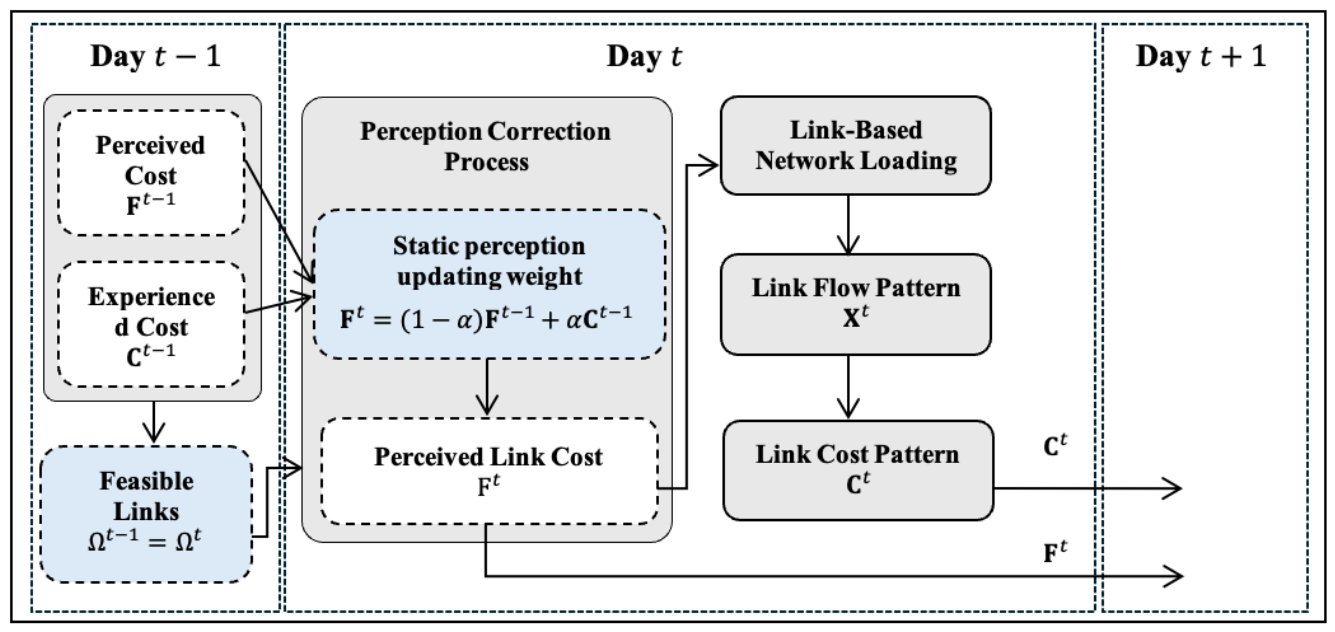
Figure 2.
Proposed BAM–RWZ-based day-to-day dynamic traffic assignment framework.
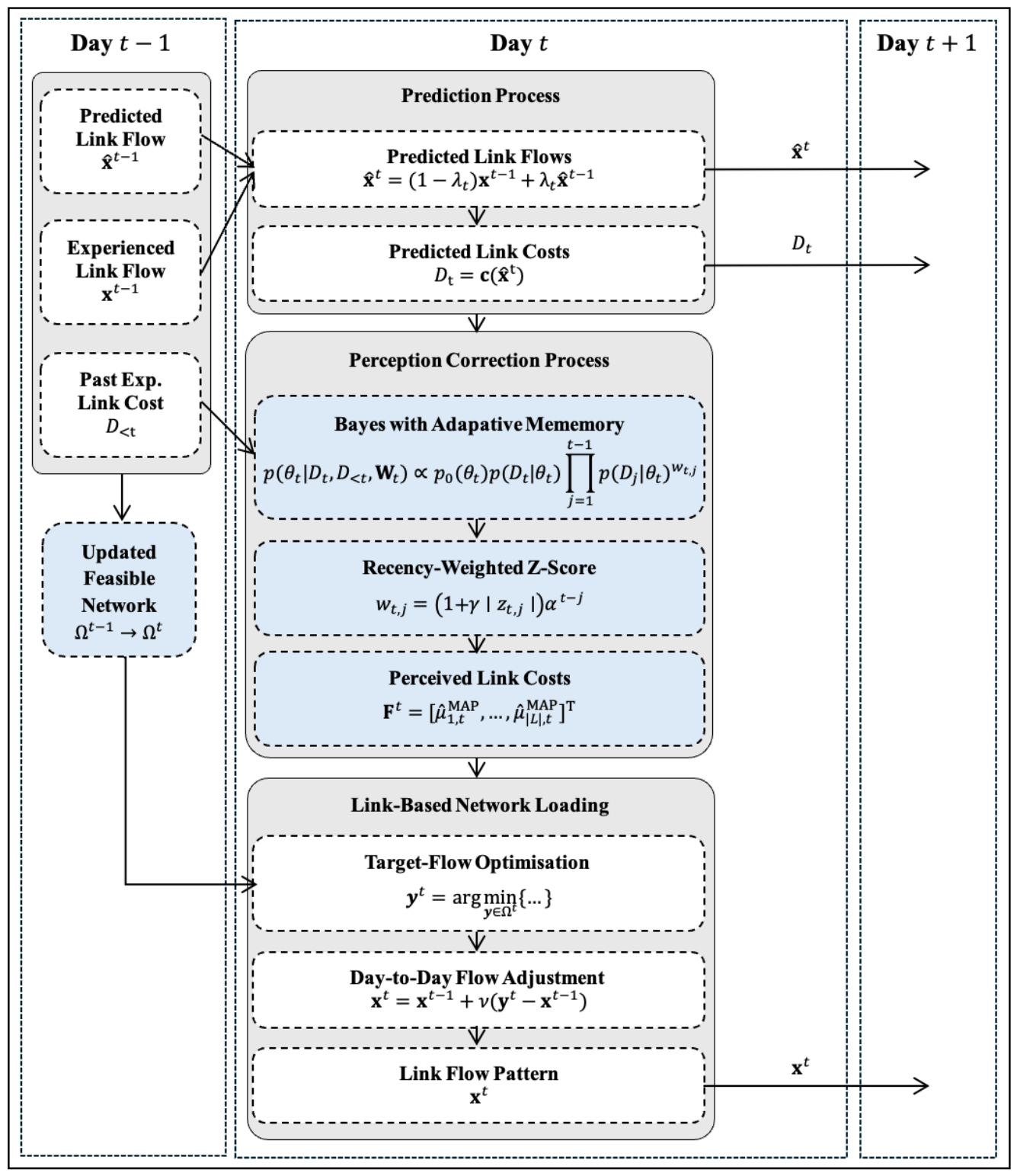
Figure 4.
Link-flow evolution under undisrupted conditions: conventional model (top) and BAM-based model (bottom).
Figure 4.
Link-flow evolution under undisrupted conditions: conventional model (top) and BAM-based model (bottom).
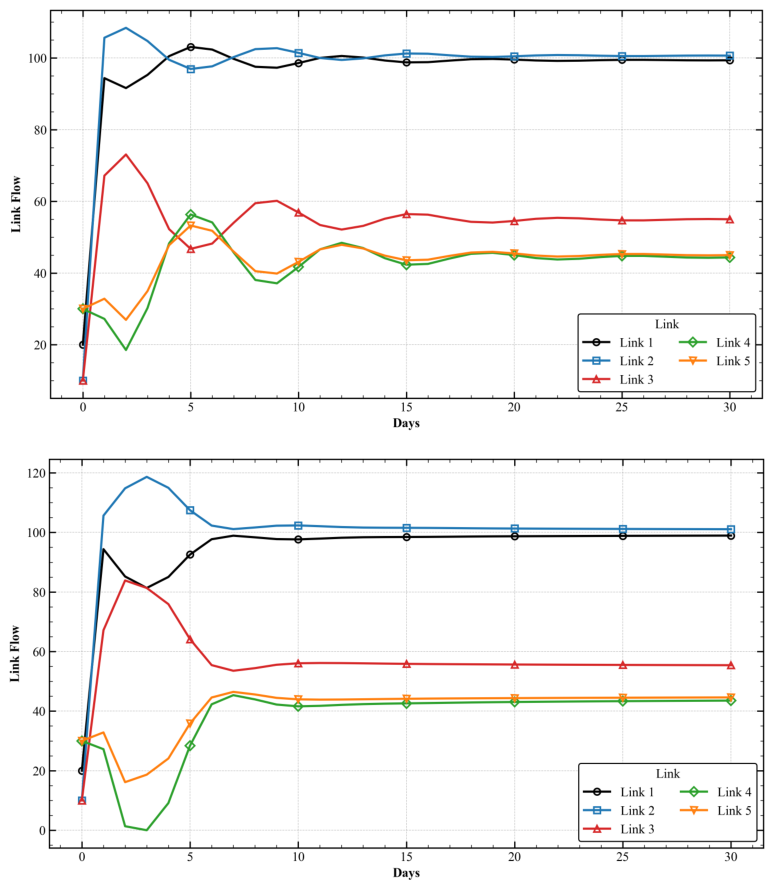
Figure 5.
Link-level perception-tracking errors for the BAM-based and conventional models.
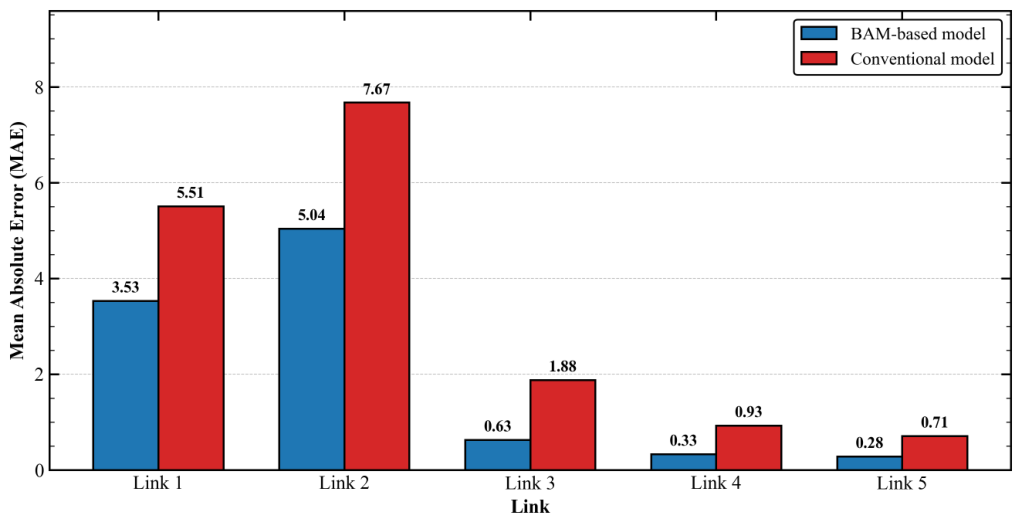
Figure 6.
Perceived total system travel cost under undisrupted conditions.
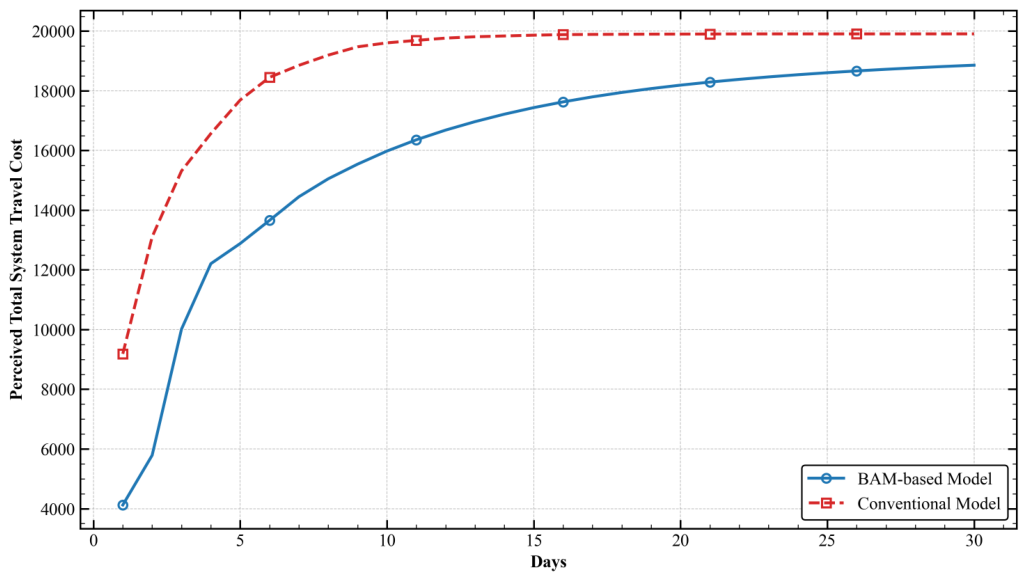
Figure 7.
Post-disruption link-flow evolution generated by the BAM-based DTDTA model.
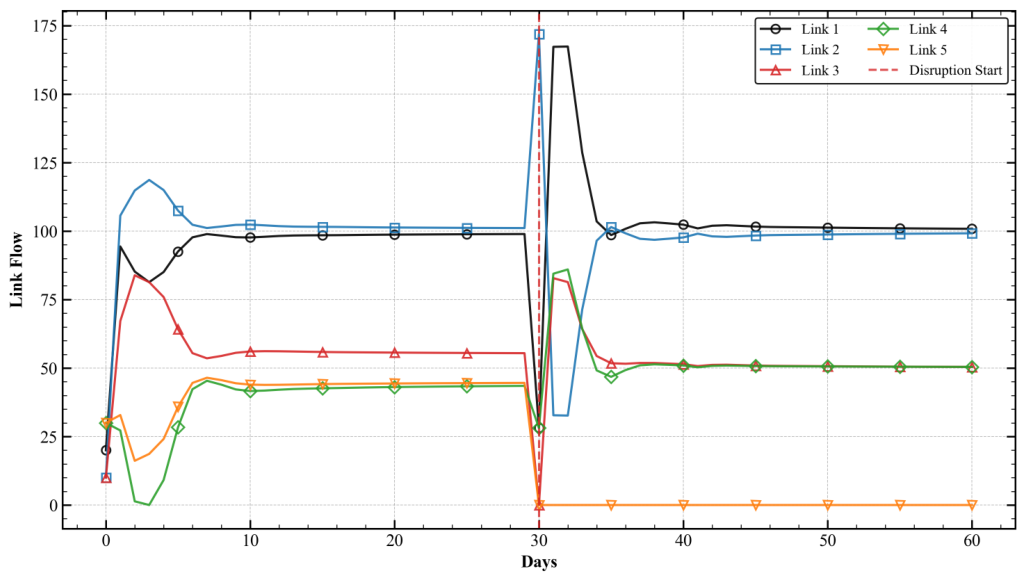
Figure 8.
Perceived total system travel cost under disrupted conditions.
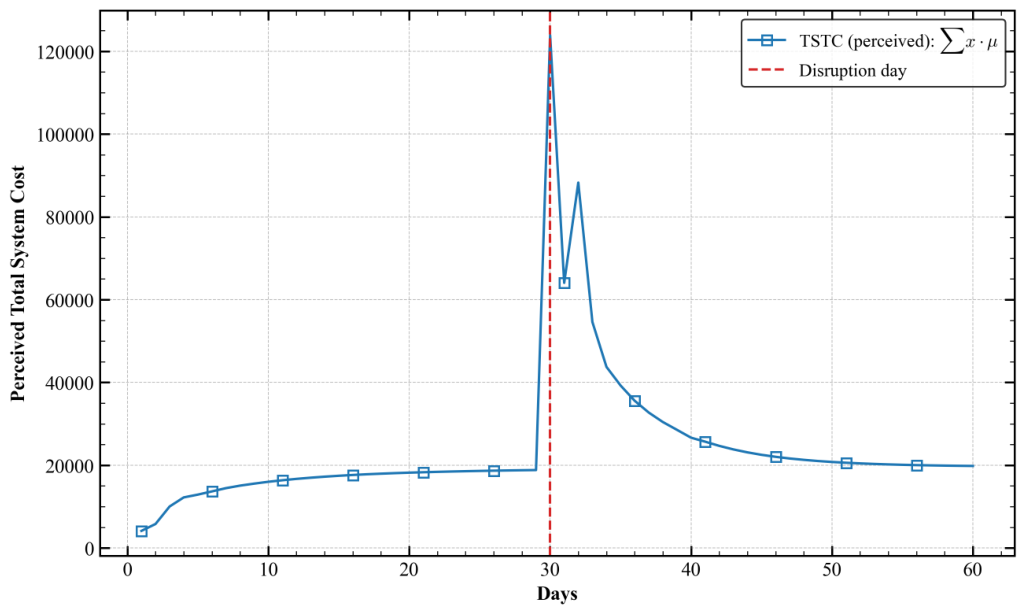
Figure 9.
Sensitivity of BAM memory parameters.
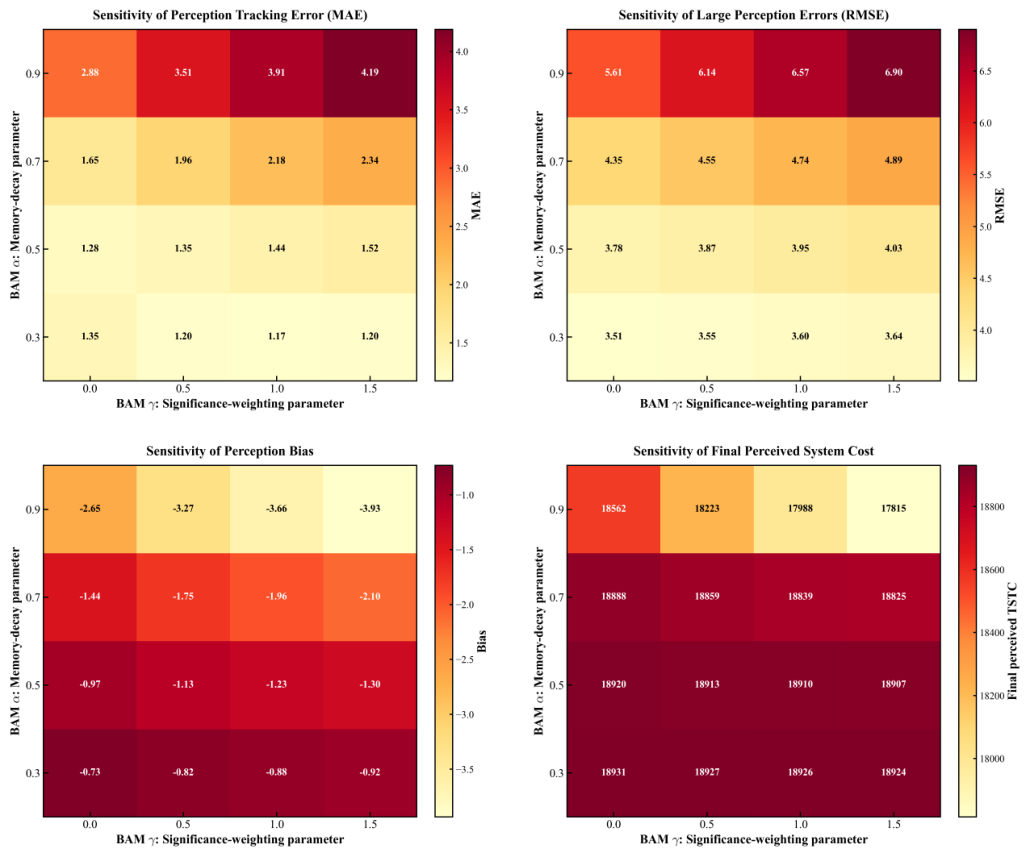
Figure 10.
Trade-off between perception-tracking accuracy and final perceived TSTC.
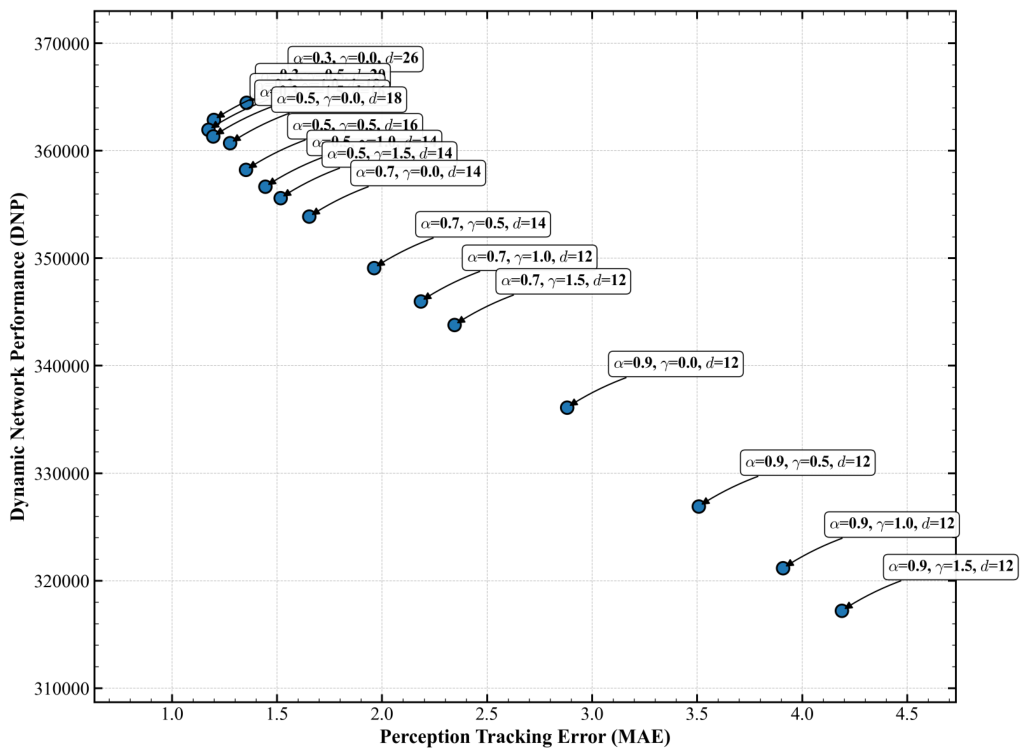

Table 1.
Perception-tracking performance of the BAM-based and conventional models.
| Model | MAE | RMSE | Bias |
|---|---|---|---|
| BAM-based model | 1.9618 | 4.5469 | -1.7482 |
| Conventional model | 3.3388 | 10.0991 | -2.4266 |
| Improvement under BAM | 41.2% | 55.0% | 28.0% bias reduction |
Disclaimer/Publisher’s Note: The statements, opinions and data contained in all publications are solely those of the individual author(s) and contributor(s) and not of MDPI and/or the editor(s). MDPI and/or the editor(s) disclaim responsibility for any injury to people or property resulting from any ideas, methods, instructions or products referred to in the content. |
© 2026 by the authors. Licensee MDPI, Basel, Switzerland. This article is an open access article distributed under the terms and conditions of the Creative Commons Attribution (CC BY) license (http://creativecommons.org/licenses/by/4.0/).
Copyright: This open access article is published under a Creative Commons CC BY 4.0 license, which permit the free download, distribution, and reuse, provided that the author and preprint are cited in any reuse.