

Submitted:
23 August 2026
Posted:
24 August 2026
You are already at the latest version
Abstract
Salinization is a major constraint to agricultural sustainability in arid and semi-arid regions worldwide. Soda saline-alkali soils, characterized by high pH, elevated exchangeable sodium percentage (ESP), and poor physical structure, pose particularly severe challenges for forage production in Northeast China. This study investigated the ameliorative effects of grass powder mulching on soda saline-alkali soil and its regulatory mechanisms on alfalfa (Medicago sativa L.) growth and forage quality. A two-year field experiment was conducted in Daqing, Heilongjiang Province, using a randomized block design with four mulching treatments: no-mulch control (CK), low-density (LC, 6,000 kg·ha⁻¹), medium-density (MC, 12,000 kg·ha⁻¹), and high-density (HC, 18,000 kg·ha⁻¹). Soil physicochemical properties, alfalfa growth parameters, photosynthetic characteristics, and forage quality were systematically measured, and partial least squares structural equation modeling (PLS-SEM) was employed to quantify the causal pathways.The results showed that grass powder mulching significantly improved soil physical, chemical, and nutrient properties in a density-dependent manner. Grass powder mulching significantly improved soil physical, chemical, and nutrient properties in a density-dependent manner. Medium-density mulching (MC) achieved the highest soil water content (18.3% vs. 14.9% in control), the lowest bulk density (1.26 g cm⁻³ vs. 1.48 g cm⁻³), and the greatest total porosity (52.4% vs. 44.2%). Soil pH decreased by 0.10 units (p < 0.01), electrical conductivity dropped to 0.15 mS·cm⁻¹, total salt content fell to 480 mg·kg⁻¹, and exchangeable sodium percentage declined from 57.39% to 45.24% under MC. Soil organic matter increased to 11.4 g·kg⁻¹, with integrated soil quality showing progressive improvement across all dimensions. Alfalfa overwintering survival rose to 89.1% under high-density mulching (HC), a 9.3% increase over control. Photosynthetic capacity improved significantly, with net photosynthetic rate reaching 3.4 μmol·m⁻²·s⁻¹ and stomatal conductance increasing to 0.045–0.046 mol·m⁻²·s⁻¹ under MC and HC. First-cut hay yield increased by 25.0–27.4% (3,866–3,938 kg·ha⁻¹ vs. 3,093 kg·ha⁻¹ in control). Forage quality was enhanced, with crude protein rising to 20.42% (8.2% improvement), crude fat increasing by 15.1%, acid detergent fiber decreasing by 11.1% (to 28.20%), and relative feed value exceeding 167 (premium quality threshold >150). Structural equation modeling confirmed that mulching density exerted the strongest direct effects on soil nutrient enrichment (β = 0.91) and chemical amelioration (β = 0.84), which cascaded through plant physiological enhancement to increase forage yield (R² = 0.56) and quality (R² = 0.65) with a global goodness-of-fit of 0.76.
Keywords:
grass powder mulching
; soda saline-alkali soil
; alfalfa
; soil amelioration
; PLS-SEM
; forage quality
1. Introduction
Soil salinization is one of the most pressing environmental challenges constraining agricultural sustainability in arid and semi-arid regions worldwide [1]. The FAO reports that the current extent of salt-affected land worldwide exceeds 1.3 billion hectares and is expanding due to climate change, unsustainable irrigation practices, and natural pedogenic processes [2]. In China, saline-alkali land covers about 100 million hectares, mainly in Northeast, Northwest, North China, and coastal regions. Among these areas, the soda saline-alkali soils (solonetz) in Northeast China are particularly troublesome [3,4]. They are characterized by high levels of Na₂CO₃ and NaHCO₃, leading to soil pH above 9.0, increased exchangeable sodium percentage (ESP), and severe degradation of soil physical structure due to clay dispersion and reduced aggregate stability [5,6]. These soil conditions create significant osmotic stress and ion toxicity, hindering root growth, nutrient uptake, and plant growth, which is a major obstacle for grassland agriculture and ecological restoration in the region [7].
Conventional strategies for ameliorating soda saline-alkali soils encompass hydrological engineering, including leaching and drainage, chemical amendments such as gypsum, organic acids, and sulfur, as well as the cultivation of salt-tolerant vegetation [6,8]. However, engineering methods are often prohibitively expensive, require substantial water resources, and may lead to secondary salinization of downstream ecosystems [4,9]. Although chemical amendments act quickly, their prolonged application can disrupt the ecological balance of soil microbes and fail to fundamentally enhance soil structure [3,10]. Relying exclusively on the salt tolerance of plants for biological remediation frequently results in establishment failures or reduced yields due to the extreme conditions of the soil environment [11,12]. Therefore, there is an urgent need to develop ecologically sound and cost-effective technologies that can simultaneously improve soil conditions and promote plant growth.
Organic mulching, an ancient agronomic practice involving the surface application of plant residues, has attracted renewed attention for saline-alkali soil remediation. Mulching materials effectively suppress soil moisture evaporation, moderate diurnal temperature fluctuations, reduce the accumulation of surface salts, and gradually release organic acids and polysaccharides during decomposition, which promote aggregate formation and enhance pore structure [13,14]. Additionally, the carbon input from decomposing mulch stimulates microbial activity, enhances nutrient cycling, and fosters a more resilient soil microenvironment [15,16]. While previous studies have established the salt-reducing and alkali-suppressing benefits of organic mulching in coastal saline soils and secondary salinized croplands [17], the systematic mechanisms by which grass powder mulching ameliorates soda saline-alkali soils, as well as the regulatory pathways connecting soil improvement to forage crop performance, remain inadequately understood.
Alfalfa (Medicago sativa L.) is widely regarded as an ideal leguminous forage for saline-alkali land improvement due to its high yield, superior nutritional quality, nitrogen-fixing capacity, and moderate tolerance to saline-alkali stress [18,19]. Nevertheless, under the dual pressure of high pH and elevated ESP characteristic of soda saline-alkali soils, alfalfa seed germination is inhibited, root system development is restricted, and biomass accumulation is limited, preventing the full expression of its production potential [20,21]. Therefore, improving the rhizosphere soil environment to alleviate saline-alkali stress and promote alfalfa root establishment has become an urgent technical challenge for alfalfa cultivation in these regions [22,23]. The integration of grass powder mulching with alfalfa planting theoretically establishes a beneficial cycle of “mulch enhancing soil, improved soil fostering forage, and forage nourishing soil”. Nonetheless, the underlying mechanisms—particularly the systematic effects of mulching on soil physicochemical properties, nutrient availability, and alfalfa root adaptation strategies—require rigorous investigation.
Partial least squares structural equation modeling (PLS-SEM) has emerged as a robust analytical tool for investigating complex multi-level causal relationships within agricultural and ecological systems [24]. In contrast to covariance-based SEM, PLS-SEM is particularly advantageous for small-to-medium sample sizes and prioritizes predictive accuracy, rendering it especially suitable for analyzing the cascade effects of soil amendments on plant productivity [25,26]. By decomposing the total effect of mulching into direct and indirect pathways, PLS-SEM facilitates a quantitative assessment of the relative contributions of physical, chemical, and nutrient-mediated mechanisms that influence plant performance [27,28].
Given the above considerations, this study was conducted with the following objectives: (1) to quantify the effects of different grass powder mulching rates on soil pH, ESP, salt composition, organic matter, aggregate structure, and nutrient availability in soda saline-alkali soil; (2) to examine the dynamic responses of alfalfa emergence rate, root morphology, biomass accumulation, and photosynthetic physiology to mulching; and (3) to construct a PLS-SEM causal pathway model to elucidate the mechanistic linkages between soil amelioration and alfalfa productivity. We hypothesized that (i) increasing mulching density would progressively improve all dimensions of soil quality, (ii) soil improvement would translate into enhanced plant physiological performance and forage yield, and (iii) the nutrient enrichment pathway would exert a stronger effect on plant response than the physical or chemical amelioration pathways. The findings are expected to provide theoretical foundations and technical references for the ecological remediation of soda saline-alkali soils and the establishment of alfalfa-based artificial grasslands.
2. Results
2.1. Effects of Grass Powder Mulching on Soil Physical Properties
The effects of grass powder mulching on soil physical properties were pronounced and density-dependent. As shown in Figure 1, soil water content (SWC) in the 0-20 cm layer increased significantly with mulching density, rising from 14.9% in CK to 17.0%, 18.3%, and 16.5% in LC, MC, and HC, respectively. The MC treatment exhibited the highest SWC. Soil bulk density exhibited a progressive decline with increasing mulching density, decreasing from 1.48 g cm-³ in CK to 1.36, 1.26, and 1.27 g cm-³ in LC, MC, and HC, respectively. Correspondingly, total soil porosity increased from 44.2% in CK to 48.5%, 52.4%, and 51.9% under LC, MC, and HC treatments, respectively.
2.2. Effects of Grass Powder Mulching on Soil Chemical Properties
Grass powder mulching exerted significant ameliorative effects on the chemical properties of soda saline-alkali soil (Figure 2). Soil pH decreased progressively with increasing mulching density, from 8.72 in CK to 8.65, 8.62, and 8.65 in LC, MC, and HC, respectively. The MC treatment achieved a pH reduction of 0.1 units compared to CK (p < 0.01). Similarly, electrical conductivity (EC) declined from 0.19 mS·cm-1 in CK to 0.21, 0.15, and 0.17 mS·cm-1 in LC, MC, and HC, respectively. Total soil salt content followed the same trend, decreasing from 608 mg·kg-1 in CK to 672, 480, and 544 mg·kg-1 in LC, MC, and HC, respectively. The exchangeable sodium percentage (ESP) was significantly reduced by mulching, declining from 57.39% in CK to 49.22%, 45.24%, and 45.18% in LC, MC, and HC, respectively.
2.3. Effects of Grass Powder Mulching on Soil Nutrient Properties
Organic mulching significantly enhanced soil nutrient availability. As shown in Figure 3, soil organic matter (SOM) content increased markedly with mulching density, rising from 9.6 g·kg-1 in CK to 10.4, 11.4, and 11.5 g·kg-1 in LC, MC, and HC, respectively. The MC and HC treatments achieved the highest SOM levels. Alkali-hydrolyzable nitrogen increased from 116.7 mg·kg-1 in CK to 118.7, 119.2, and 120.4 mg·kg-1 in LC, MC, and HC, respectively. Available phosphorus and potassium also showed positive responses to mulching.
2.4. Integrated Assessment of Soil Amelioration by Grass Powder Mulching
To evaluate the overall amelioration effect of grass powder mulching on soda saline-alkali soil, a comprehensive radar chart analysis was conducted by standardizing all soil indicators to a 0-1 scale. As shown in Figure 4, the area of the radar polygon increased progressively with mulching density, indicating that the integrated soil quality improved from CK to HC. The HC and MC treatments exhibited the largest polygon areas, reflecting comprehensive improvements across physical, chemical, and nutrient dimensions. Notably, the improvement in water content, organic matter, and alkali-hydrolyzable nitrogen were the most pronounced, while bulk density, pH, electrical conductivity, total salt, and exchangeable sodium were reversely standardized (lower values indicate better amelioration). The radar chart clearly demonstrated that grass powder mulching achieved a multi-dimensional amelioration effect, with medium-density and high-density mulching showing the most favorable comprehensive soil quality.
2.5. Effects of Grass Powder Mulching on Alfalfa Winter Survival Rate
The overwintering rate of alfalfa was significantly improved by grass powder mulching. As shown in Figure 5, the overwintering rate increased from 81.5% in CK to 81.7%, 84.8%, and 89.1% in LC, MC, and HC, respectively. The HC treatment enhanced overwintering survival by 9.3% relative to CK (p < 0.05). This improvement is attributed to the insulating effect of the mulch layer, which moderated soil temperature fluctuations and reduced frost damage to the root crown during winter.
2.6. Effects of Grass Powder Mulching on Photosynthetic Characteristics of Alfalfa
As shown in Figure 6, net photosynthetic rate (Pn) increased significantly with mulching density, from 3.0 μmol·m⁻²·s⁻¹ in CK to 3.2, 3.4, and 3.4 μmol·m⁻²·s⁻¹ in LC, MC, and HC, respectively (p < 0.05). Stomatal conductance (Gs) followed a similar trend, increasing from 0.030 mol·m⁻²·s⁻¹ in CK to 0.037, 0.045, and 0.046 mol·m⁻²·s⁻¹ in LC, MC, and HC, respectively. Intercellular CO₂ concentration (Ci) showed the opposite trend, decreasing from 98.0 μmol·mol⁻¹ in CK to 97.8, 92.3, and 92.3 μmol·mol⁻¹ in LC, MC, and HC, respectively. Relative chlorophyll content (SPAD) increased from 24.1 in CK to 26.7, 28.6, and 28.8 in LC, MC, and HC, respectively. The decline in Ci coupled with increased Pn and Gs under mulching treatments indicates enhanced stomatal opening and more efficient photosynthetic gas exchange.
2.7. Effects of Grass Powder Mulching on Agronomic Traits and Hay Yield of Alfalfa
At the initial flowering stage (June 15, 2024), plant height increased significantly with mulching density, from 62.8 cm in CK to 63.2, 67.3, and 67.1 cm in LC, MC, and HC, respectively (Figure 7). Branch number per square meter also increased markedly, from 478 branches·m⁻² in CK to 491, 507, and 507 branches·m⁻² in LC, MC, and HC, respectively. The stem-to-leaf ratio remained relatively stable across all treatments, ranging from 0.99 to 1.03, with no significant differences between the control and mulching treatments (p > 0.05), indicating that mulching density had no notable effect on the allocation ratio between stem and leaf biomass. First-cut hay yield increased significantly from 3093 kg·ha⁻¹ in CK to 3185, 3866, and 3938 kg·ha⁻¹ in LC, MC, and HC, respectively.
2.8. Effects of Grass Powder Mulching on Forage Quality of Alfalfa
To evaluate whether the documented yield improvements were accompanied by nutritional quality enhancement, forage quality indicators were analyzed in the first-cut harvest (Table 1). Grass powder mulching significantly improved the nutritional quality of alfalfa hay. Crude protein content increased progressively with mulching density, from 18.87% in CK to 20.42% in HC, representing an 8.2% improvement (p < 0.05). MC achieved an intermediate value of 19.84%, comparable to HC but significantly higher than CK and LC. Crude fat content also responded positively, with MC (3.59%) and HC (3.53%) both significantly exceeding CK (3.12% ) and LC (3.21% ), with increases of 15.1% and 13.1%, respectively.
Acid detergent fiber (ADF), which primarily reflects lignin and cellulose content, decreased significantly under MC (29.21%) and HC (28.20% ), compared with CK (31.72%) and LC (30.75% ). The 11.1% reduction in ADF under HC indicated decreased lignification and improved fiber digestibility. In contrast, neutral detergent fiber (NDF) showed no significant differences among treatments (p > 0.05), ranging narrowly from 37.27% (HC) to 37.69% (CK). This differential response suggested that mulching selectively reduced lignin and cellulose fractions without affecting total cell wall content.
Relative feed value (RFV), the integrated index of forage quality, increased progressively from 158.43 (CK) to 167.08 (HC). MC and HC achieved 3.8% and 5.5% improvements over CK, respectively, with all treatments exceeding the premium quality threshold (RFV > 150) for dairy cattle. The resulting decrease in the ADF/NDF ratio under HC (0.76 vs. 0.84 in CK) confirmed a shift toward more digestible fiber architecture. The consistent enhancement of RFV confirmed that soil amelioration translated into tangible improvements in the feeding value of alfalfa hay.
2.9. Structural Equation Modeling of the Causal Pathways from Mulching to Forage Production
Partial least squares structural equation modeling (PLS-SEM) was employed to quantify the multi-level causal pathways linking soil amelioration to alfalfa yield and quality. As shown in Figure 8, the structural model revealed that grass powder mulching density exerted the strongest direct effect on soil nutrient enrichment (standardized path coefficient β = 0.91, p < 0.001), followed by soil chemical amelioration (β = 0.84, p < 0.001) and soil physical improvement (β = 0.72, p < 0.001). Soil nutrient enrichment had the strongest direct effect on plant physiological enhancement (β = 0.57, p < 0.001), whereas soil physical improvement showed a moderate direct effect (β = 0.36, p < 0.01). Notably, the direct path from soil chemical amelioration to plant physiological enhancement was non-significant (β = -0.06, p > 0.05).
Plant physiological enhancement significantly promoted plant morphological development (β = 0.64, p < 0.001), which in turn enhanced forage yield production (β = 0.88, p < 0.001) and forage quality improvement (β = 0.95, p < 0.001). Forage yield production also positively influenced forage quality improvement (β = 0.87, p < 0.001). The coefficients of determination (R²) for the endogenous latent variables were 0.67 for soil physical improvement, 0.67 for soil chemical amelioration, 0.90 for soil nutrient enrichment, 0.80 for plant physiological enhancement, 0.55 for plant morphological development, 0.56 for forage yield production, and 0.65 for forage quality improvement. The global goodness-of-fit (GoF) index for the model was 0.76, indicating a substantial predictive relevance of the structural model.
3. Discussion
The present study provides a comprehensive mechanistic evaluation of how mixed herbaceous grass powder mulching (predominantly Leymus chinensis, rain-damaged and moldy grass that cannot be utilized by livestock) ameliorates soda saline-alkali soil and enhances alfalfa productivity in the Songnen Plain of Northeast China. By integrating soil physicochemical analyses, plant physiological monitoring, agronomic trait assessments, and partial least squares structural equation modeling (PLS-SEM), we have constructed a multi-level causal framework that quantifies the cascade from soil amendment to forage yield and quality improvement. Our findings not only confirm the agronomic benefits of organic mulching in extreme saline-alkali environments but also reveal the relative contributions of physical, chemical, and nutrient-mediated pathways in driving plant performance.
3.1. Soil Amelioration as the Foundation of Mulching Effects
The ameliorative effect of grass powder mulching on soda saline-alkali soils operates not through isolated pathways but via a cascading feedback loop involving physical restructuring, chemical conditioning, and biological activation, culminating in a comprehensive soil remediation outcome. The mulch layer acts as a physical barrier that curtails evaporation and enhances infiltration; its decomposition products participate in ion exchange and acid-base neutralisation, and the concomitant stimulation of microbial mineralisation collectively synchronises the optimisation of soil water-salt balance, pH buffering, and nutrient supply [29].
Grass powder mulching markedly improves soil moisture status and structural stability. By disrupting the soil-atmosphere energy exchange, the mulch prolongs the falling-rate stage of evaporation, leading to an increase in soil water content (SWC) under MC relative to CK. Concurrently, the incorporation of organic materials fosters aggregate formation and pore development, reducing bulk density and increasing total porosity. This structural reorganisation not only enhances water-holding and conducting capacity but also provides preferential flow pathways for salt leaching [30].Similar findings have been reported for grass clippings mulching, which increased saturated water content by 8–12% in low-permeability soils [31]. However, the physical benefits exhibit a density-dependent threshold: medium-density application outperforms high-density treatment, as excessive organic accumulation may impede gas exchange and lower soil temperature, thereby compromising water and aeration efficiencies [32,33].This nonlinear response underscores the need to balance water conservation against soil aeration when determining optimal mulching rates, which are consistent with well-documented effects of organic mulching on soil structure [34].
The improvement in soil chemical properties is a direct extension of physical optimisation. Organic acids and CO₂ released during grass powder decomposition neutralise soil carbonates, significantly reducing pH 7; concurrently, Ca²⁺ and Mg²⁺ liberated through mineralisation displace exchangeable Na⁺ from soil colloids 8, decreasing the exchangeable sodium percentage (ESP) from 57.4% to 45.2%, a critical metric in soda saline-alkali soils, where high ESP induces clay dispersion and structural degradation [35]. Studies have demonstrated that organic amendments can synergistically lower both pH and ESP while raising cation exchange capacity [36]. The decline in ESP, together with enhanced permeability driven by improved infiltration, facilitates the leaching of total soluble salts from the surface layer [37]. Zhou et al. found that the application of acidic corn stalk biochar (ACSBC) markedly enhanced the chemical properties of alkaline saline-alkali soils: soil water, nutrient elements, cation exchange capacity and organic matter increased, while the soil pH decreased by an average of 0.3, salinity declined by 19.37%, and exchange sodium percentage (ESP) [38], closely aligning with our findings.
The enhancement of nutrient availability is predicated on the reactivation of microbial activity, which in turn depends on the ameliorated physicochemical environment [39,40]. Grass powder directly contributes organic matter to the soil carbon pool [41]; more importantly, the alleviation of saline-alkali stress relieves the suppression of key enzymes such as urease and phosphatase, allowing microbial communities to restore their mineralisation functions [42,43]. Song et al. reported that straw mulching in saline-alkali land in North China could generally increase soil organic matter by 19% and reduce salt content by 15%, but the improvement effect varied significantly due to differences in returning to the field methods, climatic conditions and soil properties [44], closely aligning with our findings. Consequently, the contents of alkali-hydrolysable nitrogen, available phosphorus, and available potassium are significantly elevated. This increase is not merely a result of exogenous nutrient input but rather a product of the cascading sequence “chemical desalinisation—microbial reactivation—nutrient release” [45,46]. Liao et al. indicated that straw mulching affects wheat yield by altering the interactions among soil organic carbon, available nitrogen, available phosphorus, available potassium, bulk density, and soil moisture [47].
3.2. Translating Soil Amelioration to Enhanced Plant Performance
The improved soil physical, chemical, and nutrient conditions collectively translated into enhanced alfalfa performance across multiple dimensions—photosynthetic efficiency, overwintering survival, agronomic traits, and forage yield and quality.The increased net photosynthetic rate (Pn) from 3.0 to 3.4 μmol·m⁻²·s⁻¹ under mulching, coupled with increased stomatal conductance (Gs) and decreased intercellular CO₂ concentration (Ci), indicates that the enhancement of photosynthesis was primarily driven by stomatal factors rather than non-stomatal limitations. The improved soil water availability and reduced salt stress under mulching likely alleviated stomatal closure induced by osmotic stress, allowing greater CO₂ influx and photosynthetic carbon assimilation [48,49]. The increase in relative chlorophyll content (SPAD) reflects improved chlorophyll synthesis and reduced chlorophyll degradation [50]. Salt stress is known to cause chlorophyll degradation and disrupt photosystem II (PSII) structure, leading to impaired photosynthetic electron transport [51,52]. This interpretation is consistent with studies demonstrating that improved soil conditions enhance PSII photochemical efficiency and electron transport capacity in alfalfa under abiotic stress [50,53].
The improvement in overwintering rate from 81.5% in CK to 89.1% in HC is particularly noteworthy for alfalfa production in Northeast China, where winter injury is a major constraint. The mechanisms likely involve multiple protective effects: the mulch layer provides thermal insulation that reduces soil temperature fluctuations and protects root crowns from lethal freezing [54]; improved soil structure and drainage reduce ice lens formation that can physically damage roots; and enhanced carbohydrate reserves resulting from better growing-season photosynthesis provide greater cryoprotective capacity [46,55]. An analysis of the rhizosphere microenvironment of alfalfa in a study showed that soil amendments enhance alfalfa’s cold tolerance by increasing the content and availability of soil nutrients, including total carbon (TC), total nitrogen (TN), total phosphorus (TP), and total potassium (TK) [56]. Collectively, grass mulch enhances alfalfa winter hardiness through synergistic effects of thermal protection, reserve accumulation, mechanical stress reduction, and nutrient supply.
First-cut hay yield increased by 27.3% under HC, demonstrating the substantial productivity gains achievable through soil amelioration [57]. The yield response was density-dependent, with MC and HC achieving comparable yields, suggesting an optimal application rate between 12,000 and 18,000 kg·ha⁻¹. Critically, the yield improvement was accompanied by enhanced forage quality [58]. Crude protein increased reflects both enhanced nitrogen availability and improved plant nitrogen metabolism under reduced salt stress [57,59]. The increase in crude fat further contributed to improved energy density. The reduction in acid detergent fiber (ADF) indicates decreased lignification and improved cell wall digestibility. The differential response of ADF versus neutral detergent fiber (NDF), which showed no significant change, suggests that mulching selectively reduced lignin and cellulose fractions rather than total cell wall content. This selective effect may reflect altered partitioning of photosynthetic assimilates under improved growing conditions, with more resources allocated to protein synthesis and less to structural carbohydrates [58,60]. RFV is an integrated index that combines digestible dry matter intake and digestible energy, reflecting both forage intake potential and nutritive value [59,61]. The resulting increase in relative feed value (RFV) from 158.43 to 167.08 confirms that the soil amelioration translated into tangible improvements in the feeding value of alfalfa hay [62]. The decrease in the ADF/NDF ratio under HC further confirms a shift toward more digestible fiber architecture. These quality improvements have direct economic implications, as premium-quality alfalfa hay commands higher market prices and supports superior animal performance in dairy production systems.
3.3. Causal Pathway Quantification: Insights from Structural Equation Modeling
The PLS-SEM analysis provided quantitative insights into the causal architecture linking mulching to forage production, revealing that the effects are predominantly indirect and mediated through soil amelioration. The model explained substantial proportions of variance in endogenous variables (R² values ranging from 0.55 to 0.90), with a global goodness-of-fit index of 0.76 indicating strong predictive relevance.
The finding that mulching density exerted the strongest direct effect on soil nutrient enrichment (β = 0.91), followed by soil chemical amelioration (β = 0.84) and soil physical improvement (β = 0.72), aligns with the mechanistic understanding that organic matter input is the primary driver of soil quality improvement in degraded soils [63]. The direct effect on nutrient enrichment exceeding that on physical properties reflects the immediate contribution of grass powder to the soil organic matter pool, whereas physical improvements require more time for aggregate formation and structural reorganization [64,65].
The non-significant direct path from soil chemical amelioration to plant physiological enhancement (β = -0.06, p > 0.05) is particularly instructive. This suggests that the chemical improvements—reduced pH, EC, salt content, and ESP—do not directly enhance plant physiology but rather operate through their effects on soil physical properties and nutrient availability. In other words, chemical amelioration creates the enabling conditions for improved physical structure and nutrient cycling, which in turn drive plant performance. This hierarchical pathway underscores the importance of integrated soil management: addressing soil chemistry alone, without concomitant improvements in physical structure and nutrient status, may yield limited plant responses.The strongest driver of plant physiological enhancement was soil nutrient enrichment (β = 0.57), followed by soil physical improvement (β = 0.36). This is consistent with the understanding that nutrient availability and root-zone physical conditions (water, aeration) are the most proximate determinants of plant physiological function [19,66]. Plant physiological enhancement then strongly promoted morphological development (β = 0.64), which in turn drove both yield production (β = 0.88) and quality improvement (β = 0.95). The strong positive path from yield production to quality improvement (β = 0.87) indicates that the enhanced biomass production under mulching did not come at the expense of quality—rather, yield and quality improvements were synergistic.The high coefficients of determination (R² = 0.80 for plant physiological enhancement, R² = 0.90 for soil nutrient enrichment) and the substantial global goodness-of-fit (GoF = 0.76) confirm that the structural model effectively captured the complex interactions within the soil-plant system. These findings align with recent applications of SEM in forage production systems, where multi-level pathway analysis has been used to disentangle the trade-offs and feedbacks among yield, nutritional quality, and soil functionality [67].
3.4. Implications for Sustainable Alfalfa Production in Saline-Alkali Regions
The findings of this study have important implications for sustainable forage production in soda saline-alkali regions of Northeast China and similar environments worldwide. Grass powder mulching offers a practical, cost-effective, and environmentally sustainable alternative to conventional amendments such as gypsum or chemical fertilizers for saline-alkali soil reclamation-36. The density-dependent responses observed in this study provide practical guidance for application rates.The optimal mulching density appears to be in the medium-to-high range (1.2–1.8 kg·m-2), where the marginal benefits of additional mulching begin to plateau while the costs of material and application continue to increase. Our results show that the high-density treatment (1.8 kg·m-2) achieved slightly higher absolute yields and quality than the medium-density treatment(1.2 kg·m-2), but the incremental gain may not justify the additional material cost in all economic contexts. A cost-benefit analysis, incorporating local grass powder prices, labor costs, and forage market values, would be necessary to determine the economically optimal application rate for specific farm conditions.
In addition, The use of mixed herbaceous grass as a mulching material offers additional sustainability benefits. It provides a value-added utilization pathway for agricultural residues that are otherwise often burned or discarded, contributing to air pollution and resource waste. The incorporation of grass powder into the soil carbon pool also enhances long-term carbon sequestration, contributing to climate change mitigation goals while simultaneously improving soil health and agricultural productivity [22,68].
3.5. Limitations and Future Directions
Several limitations of this study should be acknowledged: (1) the two-year experimental duration, while sufficient to detect significant treatment effects, may not capture the long-term dynamics of soil amelioration, particularly the accumulation of soil organic matter and the stabilization of improved soil structure. Longer-term studies are needed to assess the sustainability of the observed improvements and to determine whether mulching effects persist or diminish over time. (2) the microbial mechanisms underlying nutrient mineralization and organic matter decomposition were not directly investigated; future studies employing metagenomic or metabolomic approaches could elucidate the microbial community dynamics driving soil amelioration. (3) the potential for nitrogen immobilization during decomposition of high-carbon grass residues warrants investigation, particularly in the context of nitrogen management for subsequent crops.
4. Materials and Methods
4.1. Experimental Site
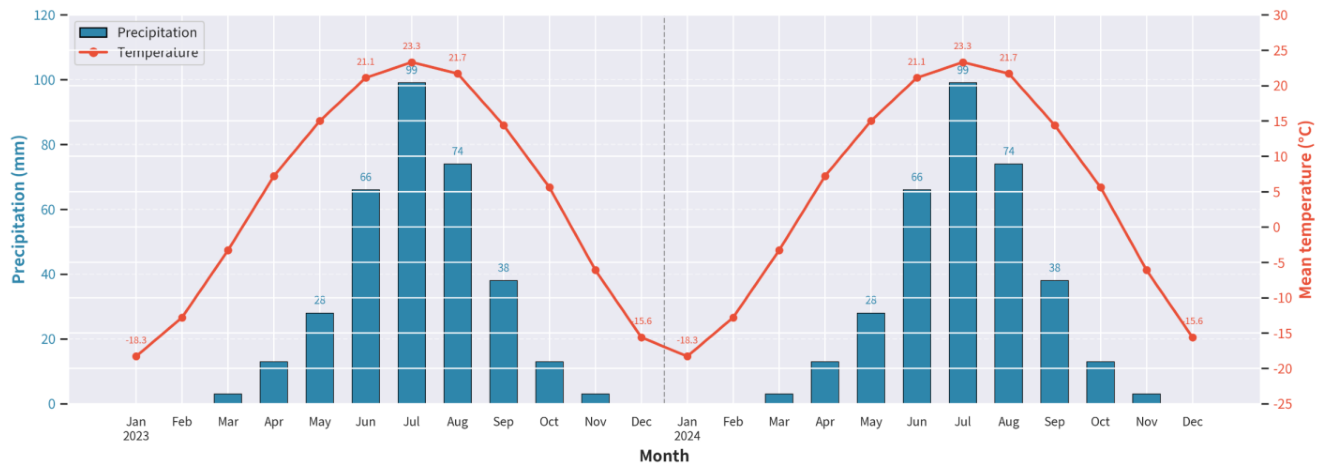
The experiment was conducted at the Yinlang Ranch, Ranghulu District, Daqing City, Heilongjiang Province, China (46°27′20″ N, 124°44′70″ E, altitude 151.5 m). The region is characterized by a mid-temperate continental monsoon climate, with an average annual temperature of 5.2 °C, a frost-free period of 143 days, a mean annual wind speed of 3.9 m·s-1, and annual sunshine duration of 2,726 h. The monthly precipitation distribution during the experimental period (2023–2024) is shown in Figure 1. The experimental field was previously cultivated with forage oats (Avena sativa L.) and exhibited moderate salinization. Naturally occurring halophytic vegetation, including Chloris virgata, Leymus chinensis, and Puccinellia distans, was sporadically observed in the surrounding area. The basic physicochemical properties of the experimental soil are presented in Table 2.
Figure 9.
Monthly mean temperature and precipitation in Daqing (2023-2024).
4.2. Experimental Design
The alfalfa (Medicago sativa L.) cultivar used in this study was Stockpile (provided by Biking Seed Industry, Canada). Seeds were sown in July 2023 at a rate of 22.5 kg·ha⁻¹, with a row spacing of 12 cm. A single-factor randomized block design was adopted, with four mulch treatments based on grass powder application rate (Table 3). Each treatment consisted of three replicates, resulting in a total of 12 plots. Each plot measured 20 m² (4 m × 5 m). All plots were subjected to mulching treatment on October 9, 2023. The grass powder was manually and uniformly spread on the soil surface between alfalfa rows. The mulch material was sourced from moldy, deteriorated hay powder at the Red Grassland Ranch, Daqing City, with Leymus chinensis as the primary component. The organic matter, total nitrogen, total phosphorus, and total potassium contents of the grass powder were 18.12%, 0.41%, 0.15%, and 0.15%, respectively. Unified field management practices were implemented across all plots during the experimental period.
4.3. Measurement and Analysis
4.3.1. Soil Physicochemical Properties
Soil samples were collected on June 15, 2024, coinciding with the alfalfa yield measurement, from the 0–20 cm soil layer. No effective rainfall occurred within 72 hours prior to sampling.
(1) Soil water content, bulk density, and porosity
Soil water content was determined by the oven-drying method. Bulk density was measured using the core ring method. Soil porosity was calculated from bulk density and particle density (2.65 g·cm-³).
(2) Soil pH and electrical conductivity
Ten grams of prepared soil sample were shaken with distilled water at a soil-to-water ratio of 1:5, allowed to stand, and filtered. Soil pH was measured using a PHSJ-4A pH meter (Leici, Shanghai, China), and electrical conductivity (EC) was determined using a DDSJ-308A conductivity meter (Leici, Shanghai, China). Soil salt content was calculated according to the method of Rhoades et al. [69]:
Soil salt content (mg·kg⁻¹) = EC × 0.064 × 5 × 10 × 1000
(3) Cation exchange capacity and exchangeable sodium
Cation exchange capacity (CEC) was determined by the hexamminecobalt(III) chloride ([Co(NH₃)₆]Cl₃) extraction–spectrophotometric method. Exchangeable sodium was measured by the NH₄OAc–NH₄OH flame photometry method [70]. The exchangeable sodium percentage (ESP) was calculated as:
ESP (%) = (Exchangeable Na⁺ / CEC) × 100%
(4) Soil nutrient contents
Soil organic matter content was determined by the potassium dichromate external heating method. Available nitrogen was measured by the alkaline hydrolysis diffusion method. Available phosphorus was extracted with 0.5 M NaHCO₃ and determined spectrophotometrically. Available potassium was extracted with CH₃COONH₄ and measured by flame photometry.
4.3.2. Alfalfa Overwintering Rate
Overwintering rate: At the withering stage (October 15, 2023), three 1-m segments were randomly selected in each plot, and the plants within each segment were marked. After regrowth in the following spring, the number of surviving marked plants was recorded, and the overwintering rate was calculated as:
Overwintering rate (%) = (Number of surviving plants / Number of marked plants before winter) × 100%.
4.3.3. Alfalfa Productivity
Growth measurements (June 15, 2024, initial flowering stage):
SPAD value: The relative chlorophyll content (SPAD) of the third functional leaf from the apex of the main stem was measured using a SPAD-502 chlorophyll meter (Konica Minolta, Japan).
Photosynthetic parameters: Net photosynthetic rate (Pn, μmol·m⁻²·s⁻¹), stomatal conductance (Gs, mol·m⁻²·s⁻¹), and intercellular CO₂ concentration (Ci, μmol·mol⁻¹) were measured between 10:00 and 12:00 using a Li-6400 portable photosynthesis system (LI-COR, USA).
Plant height: At the initial flowering stage, ten uniformly growing alfalfa plants were randomly selected from each plot, and the vertical height was measured and averaged.
Branch number: At the initial flowering stage, the number of alfalfa branches was counted within a randomly selected 1 m² quadrat in each plot.
Stem-to-leaf ratio: During yield measurement, ten uniformly growing plants were randomly sampled from each plot. The stems, leaves, and inflorescences were separated (inflorescences were grouped with leaves). Samples were oven-dried at 105 °C for 15 min, then at 70–80 °C to constant weight, and weighed separately. The stem-to-leaf ratio was calculated as:Stem-to-leaf ratio = Stem dry weight / Leaf dry weight.
Hay yield: Only the first cutting yield was measured. The entire plot was harvested at a stubble height of approximately 5 cm. Fresh weight was recorded, and a 500 g subsample was collected, oven-dried at 105 °C for 30 min, then at 70-80 °C to constant weight, and weighed to calculate the fresh-to-dry ratio and dry matter yield.
4.4. Data Processing
Data preliminary processing was performed using Microsoft Excel 2021 (Microsoft, Redmond, WA, USA). Statistical analysis was performed using SPSS Statistics 26.0 (IBM, Armonk, NY, USA). One-way analysis of variance (ANOVA) combined with Duncan’s multiple range test and the LSD test were used to assess differences among treatments, with the significance level at p < 0.05. All figures were plotted using Origin 2021 (OriginLab, Northampton, MA, USA).
To systematically quantify the causal pathways linking mulching management practices, soil conditions, crop physiological traits, and forage production outcomes, partial least squares structural equation modeling (PLS–SEM) was employed using the plspm package in R (version 4.3.1) [71]. Based on a soil–plant–production theoretical framework, mulching density (CK, LC, MC, and HC) was set as the exogenous variable, while five latent constructs—soil physical improvement, soil chemical amelioration, soil nutrient enrichment, plant physiological enhancement, and plant morphological development—served as endogenous mediating variables influencing forage yield and quality. Path relationships were tested using path coefficients (β) and their significance (based on 5000 Bootstrap resamples), with model explanatory power assessed via the coefficient of determination (R²). Overall model goodness of fit was evaluated using the GOF index, defined as the geometric mean of average communality and average R²; according to Tenenhaus et al., GOF values of 0.10, 0.25, and 0.36 represent weak, moderate, and strong model fit, respectively. Additionally, a comprehensive radar chart analysis was conducted to evaluate the integrated soil amelioration effect by standardizing all soil indicators to a 0–1 scale.
5. Conclusions
This study demonstrates that grass powder mulching effectively ameliorates soda saline-alkali soil and enhances alfalfa productivity through a multi-level cascade mechanism. High-density mulching (18,000 kg·ha⁻¹) significantly reduced soil pH, electrical conductivity, and ESP, while increasing water content, porosity, and organic matter. These soil improvements significantly promoted alfalfa growth, photosynthesis, and overwintering survival, and simultaneously enhanced both hay yield and forage quality. PLS-SEM modeling confirmed that mulching density primarily drives soil nutrient enrichment, which subsequently enhances plant physiology and ultimately promotes forage yield and quality, with robust model fit (GoF = 0.76). These findings establish a mechanistic framework for organic mulching in saline-alkali soil remediation and highlight the dual agronomic and economic benefits of utilizing rain-damaged, moldy grass powder as a soil amendment. Future research should focus on long-term microbial dynamics and optimized mulching rates for cost-efficient field application.
Author Contributions
Conceptualization, W.Y.; methodology, W.Y. and X.L.; validation, W.N. and X.S.; formal analysis, W.Y., W.N. and L.L.; investigation, X.S. and W.N.; data curation, X.S. and W.N.; writing—original draft preparation, W.Y. and L.L.; writing—review and editing, L.L.and X.L.; visualization, W.Y.; supervision, W.Y., X.L. and C.W.; project administration, W.Y. and X.L.; funding acquisition, X.L. and C.W. All authors have read and agreed to the published version of the manuscript.
Funding
This research was supported by the Research Start-up Program for Outstanding and Introduced Talent (Grant No. XYB202113) and the National Major Science and Technology Project for Biological Breeding (Grant No. 2022ZD04012).
Data Availability Statement
All data generated or analyzed in this study are included in the article.
Acknowledgments
The authors express their gratitude to all individuals who offered valuable comments and support during the preparation of this manuscript. In the course of this work, the authors utilized Deepseek-V3 for text generation in some paragraphs. They have thoroughly reviewed and edited the output and assume full responsibility for the content of this publication.
Conflicts of Interest
The authors declare no conflicts of interest.
References
- Yang, S.; Hao, X.; Xu, Y.; Yang, J.; Su, D. Meta-Analysis of the Effect of Saline-Alkali Land Improvement and Utilization on Soil Organic Carbon. Life 2022, 12, 1870. [Google Scholar] [CrossRef]
- FAO. Global Status of Salt-Affected Soils-Main Report; FAO: Rome, Italy, 2024. [Google Scholar] [CrossRef]
- Lei, S.; Jia, X.; Zhao, C.; Shao, M. A Review of Saline-Alkali Soil Improvements in China: Efforts and Their Impacts on Soil Properties. Agric. Water Manag. 2025, 317, 109617. [Google Scholar] [CrossRef]
- Meng, Q.; Zhang, C.; Zhao, J.; Zhang, J.; Lu, Y.; Liu, F. Saline-Alkali Soil Amelioration in China: A Systematic Review and Evidence Synthesis. Agric. Water Manag. 2026, 327, 110296. [Google Scholar] [CrossRef]
- Yao, K.; Wang, G.; Zhang, W.; Liu, Q.; Hu, J.; Ye, M.; Jiang, X. Saline Soil Improvement Promotes the Transformation of Microbial Salt Tolerance Mechanisms and Microbial-Plant-Animal Ecological Interactions. J. Environ. Manag. 2024, 372, 123360. [Google Scholar] [CrossRef]
- Qadir, M.; Schubert, S.; Ghafoor, A.; Murtaza, G. Amelioration strategies for sodic soils: A review. Land Degrad. Dev. 2001, 12, 357–386. [Google Scholar] [CrossRef]
- Munns, R.; Tester, M. Mechanisms of salinity tolerance. Annu. Rev. Plant Biol. 2008, 59, 651–681. [Google Scholar] [CrossRef] [PubMed]
- Meng, L.; Zheng, Y.; Ren, H.; Li, Z.; Zheng, X.; Kang, M.; Li, L.; Qi, L. Integrative Effects of Irrigation and Aeration on Root Morphology, Yield, and Quality of Tomatoes Cultivated in Coastal Saline-Alkali Lands. Sci. Rep. 2026, 16, 46058. [Google Scholar] [CrossRef]
- Wang, R.; Cui, Q.; Wang, Z.; Yang, H.; Bai, Y.; Meng, L. Biochar Integrate with Beneficial Microorganisms Boosts Soil Organic Fractions by Raising Carbon-Related Enzymes and Microbial Activities in Coastal Saline-Alkali Land. Microorganisms 2026, 14, 115. [Google Scholar] [CrossRef]
- Xiao, Q.; Wei, W.; Wu, H.; Wu, K.; Gong, X.; Li, M.; Wang, S.; Yin, L. Effect of Combined Application of Desulfurization Gypsum and Soil Amendment KIA on Saline-Alkali Soil Improvement. Agronomy 2025, 15, 53. [Google Scholar] [CrossRef]
- Zhang, X.; Wang, Z.; Zhang, M.; Zhang, S.; Ma, R.; Wang, S. Mechanism and Application of Microbial Amendments in Saline–Alkali Soil Restoration: A Review. Agriculture 2026, 16, 452. [Google Scholar] [CrossRef]
- Wang, Z.; Pan, X.; Kuang, S.; Chen, C.; Wang, X.; Xu, J.; Li, X.; Li, H.; Zhuang, Q.; Zhang, F. Amelioration of Coastal Salt-Affected Soils with Biochar, Acid Modified Biochar and Wood Vinegar: Enhanced Nutrient Availability and Bacterial Community Modulation. Int. J. Environ. Res. Public Health 2022, 19, 7282. [Google Scholar] [CrossRef]
- Aragüés, R.; Medina, E.T.; Clavería, I. Effectiveness of Inorganic and Organic Mulching for Soil Salinity and Sodicity Control in a Grapevine Orchard Drip-Irrigated with Moderately Saline Waters. Span. J. Agric. Res. 2014, 12, 501–508. [Google Scholar] [CrossRef]
- Koriyev, M.; Mirzahmedov, I.; Boymirzaev, K.; Juraev, Z. Effects of Mulching, Terracing, and Efficient Irrigation on Soil reduction in Uzbekistan’s Fergana Valley. Cogent Food Agric. 2025, 11, 2449201. [Google Scholar] [CrossRef]
- Li, M.; Wang, W.; Wang, X.; Yao, C.; Wang, Y.; Wang, Z.; Zhou, W.; Chen, E.; Chen, W. Effect of Straw Mulching and Deep Burial Mode on Water and Salt Transport Regularity in Saline Soils. Water 2023, 15, 3227. [Google Scholar] [CrossRef]
- Gumo, P.; Gitari, H.; Sakha, M.; Masso, C.; Baijukya, F.; Maitra, S.; Gweyi-Onyango, J. Organic Mulch and Compost Synergy Revitalizes Soil Multifunctionality for Resilient Agroecosystems. Int. J. Exp. Res. Rev. 2025, 49, 81–101. [Google Scholar] [CrossRef]
- Liu, R.; Tang, M.; Luo, Z.; Zhang, C.; Liao, C.; Feng, S. Straw Returning Proves Advantageous for Regulating Water and Salt Levels, Facilitating Nutrient Accumulation, and Promoting Crop Growth in Coastal Saline Soils. Agronomy 2024, 14, 1196. [Google Scholar] [CrossRef]
- Zhao, W.; Zhou, Q.; Tian, Z.; Cui, Y.; Liang, Y.; Wang, H. Apply Biochar to Ameliorate Soda Saline-Alkali Land, Improve Soil Function and Increase Corn Nutrient Availability in the Songnen Plain. Sci. Total Environ. 2020, 722, 137428. [Google Scholar] [CrossRef]
- Wei, T.J.; Li, G.; Cui, Y.R.; Xie, J.; Gao, X.A.; Teng, X.; Zhao, X.Y.; Guan, F.C.; Liang, Z.W. Variation Characteristics of Root Traits of Different Alfalfa Cultivars under Saline-Alkaline Stress and their Relationship with Soil Environmental Factors. Phyton 2024, 93, 29–43. [Google Scholar] [CrossRef]
- Han, L.; Li, Y.; Ma, Z.; Li, B.; Liang, Y.; Gao, P.; Zhao, X. Alleviation of Saline–Alkaline Stress in Alfalfa by a Consortium of Plant-Growth-Promoting Rhizobacteria. Plants 2025, 14, 2744. [Google Scholar] [CrossRef]
- Liu, L.; Wang, B. Protection of Halophytes and Their Uses for Cultivation of Saline-Alkali Soil in China. Biology 2021, 10, 353. [Google Scholar] [CrossRef]
- Khan, M.A.; Fawad, M.; Jamal, A.; Ali, A.; Ahmad, R. Influence of Varying Salinity on Germination Indices and Threshold of Salt Tolerance in Alfalfa (Medicago sativa L.). Sarhad J. Agric. 2025, 41, 528–537. [Google Scholar] [CrossRef]
- Zhao, S.; Wang, D.; Li, Y.; Wang, W.; Wang, J.; Chang, H.; Yang, J. The Effect of Modifier and a Water-Soluble Fertilizer on Two Forages Grown in Saline-Alkaline Soil. PLoS ONE 2024, 19, e0299113. [Google Scholar] [CrossRef]
- Yu, B.; Chen, L.; Baoyin, T. Effects of Restoration Strategies on the Ion Distribution and Transport Characteristics of Medicago sativa in Saline–Alkali Soil. Agronomy 2023, 13, 3028. [Google Scholar] [CrossRef]
- Hair, J.F., Jr.; Hult, G.T.M.; Ringle, C.M.; Sarstedt, M. A Primer on Partial Least Squares Structural Equation Modeling (PLS-SEM), 2nd ed.; Sage Publications: Thousand Oaks, CA, USA, 2017; pp. 1–366. [Google Scholar]
- Saha, S.; Raj, A. An Application of Partial Least Squares Structural Equation Modeling (PLS-SEM) to Examining Farmers’ Behavioral Attitude and Intention towards Conservation Agriculture in Bangladesh. Agriculture 2023, 13, 503. [Google Scholar] [CrossRef]
- Chin, W.W. The partial least squares approach to structural equation modeling. In Modern Methods for Business Research; Marcoulides, G.A., Ed.; Lawrence Erlbaum Associates: Mahwah, NJ, USA, 1998; pp. 295–336. [Google Scholar]
- Adeyeye, O.A.; Hassaan, A.M.; Yonas, M.W.; Yawe, A.S.; Nwankwegu, A.S.; Yang, G.; Yao, X.; Song, Z.; Kong, Y.; Bai, G.; et al. The Emerging Application of Partial Least Squares Structural Equation Modelling in Ecological Research: An Introductory Overview. Environ. Model. Softw. 2026, 202, 106988. [Google Scholar] [CrossRef]
- Wu, Z.; Soothar, R.K.; Memon, H.; Chandio, F.A.; Shaikh, S.A. Mulching Improved Soil Water, Plant Growth, and Seed Yield of Sunflower Under Raised Bed–Furrow Irrigation Method. Water 2026, 18, 1097. [Google Scholar] [CrossRef]
- Ibrahim, M.; Khan, A.; Anjum, A.W.; Akbar, H. Mulching techniques: an approach for offsetting soil moisture deficit and enhancing manure mineralization during maize cultivation. Soil Tillage Res. 2020, 200, 104631. [Google Scholar] [CrossRef]
- Li, X.; López-Vicente, M.; Lucas-Borja, M.E.; Wilcox, B.P.; Wu, G.L. Grass Clippings Mulching Improves Infiltrability of Low-Permeability Dryland Soils. Air Soil Water Res. 2025, 18. [Google Scholar] [CrossRef]
- Xiao, F.; Zhou, B.; Wang, H.; Duan, M.; Feng, L. Effects of Different Soil Amendments on Physicochemical Property of Soda Saline-Alkali Soil and Crop Yield in Northeast China. Int. J. Agric. Biol. Eng. 2022, 15, 192–198. [Google Scholar] [CrossRef]
- Li, Y.; Liu, Q.; Kang, L.; Zhang, K.; Li, Q.; Ai, F. The Mechanisms of Soil Conditioner and Switchgrass in Improving Saline–Alkali Soil: A Field Study in a Semi-Arid Area. Biology 2025, 14, 1788. [Google Scholar] [CrossRef]
- Wang, B.; Deng, X.; Dong, T.; Chen, Y.; Gao, W.; Chen, J.; Sui, P. Mulching Practices Positively Regulate Soil Microbial Structure and Improve Tea Yield and Quality-Related Metabolites in Organic Plantations. J. Integr. Agric. 2026. [Google Scholar] [CrossRef]
- Song, Y.; Sun, J.; Cai, M.; Li, J.; Bi, M.; Gao, M. Effects of Management of Plastic and Straw Mulching on Crop Yield and Soil Salinity in Saline-Alkaline Soils of China: A Meta-Analysis. Agric. Water Manag. 2025, 308, 109309. [Google Scholar] [CrossRef]
- Zhang, Z.; Tian, D.; Liu, T.L.; Wang, Y.; Zhong, X.; Chen, P.; Yang, M. Biochar Can Promote the Growth of Peanuts in Saline Alkali Soil by Enhancing Peanut Resistance and Improving Soil Properties. Sci. Rep. 2025, 15. [Google Scholar] [CrossRef]
- Chen, H.; Duan, M.; Wang, Q.; Zhou, B.; Yan, R.; Chen, X.; Deng, M. Organic–Mineral Fertilization Modulates Microbial Communities and Nutrient-Cycling Genes in Saline–Alkali Soil. Front. Microbiol. 2026, 17, 1776848. [Google Scholar] [CrossRef]
- Zhou, Z.; Li, Z.; Zhang, Z.; You, L.; Xu, L.; Huang, H.; Wang, X.; Gao, Y.; Cui, X. Treatment of the saline-alkali soil with acidic corn stalk biochar and its effect on the sorghum yield in western Songnen Plain. Sci. Total Environ. 2021, 797, 149190. [Google Scholar] [CrossRef]
- Huo, L.; Pang, H.; Zhao, Y.; Wang, J.; Lu, C.; Li, Y. Buried straw layer plus plastic mulching improves soil organic carbon fractions in an arid saline soil from Northwest China. Soil Tillage Res. 2017, 165, 286–293. [Google Scholar] [CrossRef]
- Xing, J.; Li, X.; Li, Z.; Wang, X.; Hou, N.; Li, D. Remediation of soda-saline-alkali soil through soil amendments: Microbially mediated carbon and nitrogen cycles and remediation mechanisms. Sci. Total Environ. 2024, 924, 171641. [Google Scholar] [CrossRef]
- Yu, R.; Zhang, X.; Zhou, J.; Wang, W.; Song, J.; Chang, F.; Wang, J.; Li, H.; Li, X.; Li, H. Mitigating Soil Salinity–Alkalinity and Reshaping Bacterial Community to Improve Soil Organic Carbon Sequestration in the Hetao Irrigation District: A Combined Approach of Organic Ameliorant and Microbial Agents. Front. Plant Sci. 2026, 17. [Google Scholar] [CrossRef]
- Li, H.; Li, J.; Jiao, X.; Jiang, H.; Liu, Y.; Wang, X.; Ma, C. The Fate and Challenges of the Main Nutrients in Returned Straw: A Basic Review. Agronomy 2024, 14, 698. [Google Scholar] [CrossRef]
- Qian, X.; Gu, J.; Pan, H.J.; Zhang, K.Y.; Sun, W.; Wang, X.; Gao, H. Effects of Living Mulches on the Soil Nutrient Contents, Enzyme Activities, and Bacterial Community Diversities of Apple Orchard Soils. Eur. J. Soil Biol. 2015, 70, 23–30. [Google Scholar] [CrossRef]
- Song, Y.; Gao, M.; Li, Z. Impacts of Straw Return Methods on Crop Yield, Soil Organic Matter, and Salinity in Saline-Alkali Land in North China. Field Crops Res. 2025, 322, 109752. [Google Scholar] [CrossRef]
- Ali Shah, M.R.; Tang, L.; Zhou, H.; Zheng, H.; Shi, Y.; Guo, C. The Application of Saline–Alkali-Tolerant Growth-Promoting Endophytic Bacteria for Enhancing the Saline–Alkali Tolerance of Alfalfa. Biology 2026, 15, 474. [Google Scholar] [CrossRef]
- Berg, W.K.; Brouder, S.M.; Cunningham, S.M.; Volenec, J.J. Potassium and Phosphorus Fertilizer Impacts on Alfalfa Taproot Carbon and Nitrogen Reserve Accumulation and Use During Fall Acclimation and Initial Growth in Spring. Front. Plant Sci. 2021, 12, 715936. [Google Scholar] [CrossRef]
- Liao, C.; Tang, M.; Zhang, C.; Deng, M.; Li, Y.; Feng, S. Impacts of Various Straw Mulching Strategies on Soil Water, Nutrients, Thermal Regimes, and Yield in Wheat–Soybean Rotation Systems. Plants 2025, 14, 2233. [Google Scholar] [CrossRef]
- Liu, Y.; Wang, X.; Sui, X.; Qi, J.; Zhou, Y.; Yimingniyazi, A. Exogenous Melatonin Increases Alfalfa (Medicago Sativa L.) Tolerance to Salt Stress. BMC Plant Biol. 2026. [Google Scholar] [CrossRef]
- Iqbal, M.; Iqbal, S.; Ullah, A.; Jahangeer, A.; Akhtar, N.; Tabassum, T.; Zohaib, A.; Ramzan, N. Mulching for enhanced cotton production in saline soils. Sarhad J. Agric. 2024, 40, 877–894. [Google Scholar] [CrossRef]
- Wang, C.; Cui, H.; Jin, M.; Wang, J.; Li, C.; Li, Y.; Luo, Y.; Wang, Z. Enhancement of wheat resistance to dry-hot wind stress during grain filling by 24-epibrassinolide: optimization of hormone balance and improvement of flag leaf photosynthetic performance. Front. Plant Sci. 2025, 16, 1552617. [Google Scholar] [CrossRef]
- Ye, S.; Li, J.; Kong, H.; Shen, J.; Wu, D. Effects of different mulch materials on the photosynthetic characteristics, yield, and soil water use efficiency of wheat in Loess tableland. Sci. Rep. 2023, 13, 18106. [Google Scholar] [CrossRef]
- Kalaji, H.M.; Govindjee; Bosa, K.; Kościelniak, J.; Żuk-Gołaszewska, K. Effects of Salt Stress on Photosystem II Efficiency and CO2 Assimilation of Two Syrian Barley Landraces. Environ. Exp. Bot. 2011, 73, 64–72. [Google Scholar] [CrossRef]
- Yin, M.; Wang, M.; Ma, W.; Jiang, Y.; Chang, W.; Kang, Y.; Qi, G.; Ma, Y.; Wu, G. Effects of Water-Retaining Agent Application on Growth Physiological Characteristics and Yield of Alfalfa (Medicago Sativa L.). Plants 2026, 15, 1304. [Google Scholar] [CrossRef]
- He, Y.; Zhao, Y.; Niu, J.; Li, J.; Wang, Z.; Tian, L.; Wu, J.; Han, W.; Li, Y. Adaptability Evaluation of Four Alfalfa (Medicago Sativa L.) Varieties in Cold Regions of Northern China: Based on Multidimensional Indicators, Metabolites, and Soil Microbial Community Analysis. Ind. Crops Prod. 2025, 234, 121657. [Google Scholar] [CrossRef]
- Wang, Y.; Sun, Z.; Wang, Q.; Xie, J.; Yu, L. Winter Survival, Yield and Yield Components of Alfalfa as Affected by Phosphorus Supply in Two Alkaline Soils. Agronomy 2023, 13, 1565. [Google Scholar] [CrossRef]
- Yan, X.; Wang, Z.; Bao, J.; Zhao, M.; Wang, M.; Sun, P.; Jia, Y.; Gegentu. Integrated microbiological and metabolomic analysis reveals the mechanisms by which biochar and wood vinegar enhance the cold tolerance of alfalfa. Ind. Crops Prod. 2025, 238, 122388. [Google Scholar] [CrossRef]
- Xie, Y.; Li, J.; Jin, L.; Wei, S.; Wang, S.; Jin, N.; Wang, J.; Xie, J.; Feng, Z.; Zhang, G. Combined Straw and Plastic Film Mulching Can Increase the Yield and Quality of Open Field Loose-Curd Cauliflower. Front. Nutr. 2022, 9. [Google Scholar] [CrossRef]
- Dou, Y.; Zhao, H.; Yang, H.; Wang, T.; Liu, G.; Wang, Z.; Malhi, S. The First Factor Affecting Dryland Winter Wheat Grain Yield under Various Mulching Measures: Spike Number. J. Integr. Agric. 2024, 23, 836–848. [Google Scholar] [CrossRef]
- Ling, Y.; Yin, M.; Kang, Y.; Qi, G.; Ma, Y. Synergistic Regulatory Effects of Water–Nitrogen Coupling on Osmotic Regulation, Yield, and Forage Quality of Alfalfa. Plants 2026, 15(2), 173. [Google Scholar] [CrossRef]
- Capstaff, N.M.; Miller, A.J. Improving the Yield and Nutritional Quality of Forage Crops. Front. Plant Sci. 2018, 9, 535. [Google Scholar] [CrossRef]
- Kamran, M.; Yan, Z.; Jia, Q.; Chang, S.; Ahmad, I.; Ghani, M.U.; et al. Irrigation and nitrogen fertilization influence on alfalfa yield, nutritive value, and resource use efficiency in an arid environment. Field Crops Res. 2022, 284, 108587. [Google Scholar] [CrossRef]
- Hu, Y.; Wang, J.; Dong, X.; Li, T.; Liu, X.; Sun, H.; Lana, M. Quality in Forage Crops under Drought and Salinity Stresses: Responses, Simulation and Field Managements. Agric. Water Manag. 2026, 332, 110457. [Google Scholar] [CrossRef]
- Poorter, H.; Niklas, K.J.; Reich, P.B.; Oleksyn, J.; Poot, P.; Mommer, L. Biomass allocation to leaves, stems and roots: meta-analyses of interspecific variation and environmental control. New Phytol. 2012, 193, 30–50. [Google Scholar] [CrossRef] [PubMed]
- Cooke, A.S.; Storkey, J.; Acquah, G.E.; Lee, M.R.F.; Rivero, M.J. Trade-offs between Forage Nutrition and Ruminant Carrying Capacity in Response to Fertiliser Application—Findings from the Park Grass Long-Term Experiment (1860–2020). Field Crops Res. 2025, 324, 109791. [Google Scholar] [CrossRef]
- Gu, X.; Zhang, F.; Xie, X.; Cheng, Y.; Xu, X. Effects of N and P Addition on Nutrient and Stoichiometry of Rhizosphere and Non-Rhizosphere Soils of Alfalfa in Alkaline Soil. Sci. Rep. 2023, 13. [Google Scholar] [CrossRef]
- Wang, X.; Chen, X.; Xu, J.; Ji, Y.; Du, X.; Gao, J. Precipitation Dominates the Allocation Strategy of Above-and Belowground Biomass in Plants on Macro Scales. Plants 2023, 12, 2843. [Google Scholar] [CrossRef]
- Guan, C.; Ma, T.; Miao, M.; Chen, J.; Bao, Z.; Chen, B.; Lu, J.; Liu, F.; Wang, N.; Wang, H. Physiological Mechanisms Underlying Maize Yield Enhancement by Straw Return in the Thin-Layer Mollisol Region of the Songnen Plain. Plants 2025, 14, 3331. [Google Scholar] [CrossRef]
- Lal, R. Soil carbon sequestration impacts on global climate change and food security. Science 2004, 304, 1623–1627. [Google Scholar] [CrossRef] [PubMed]
- Rhoades, J.D.; Chanduvi, F.; Lesch, S.; et al. Soil Salinity Assessment: Methods and Interpretation of Electrical Conductivity Measurements; FAO Irrigation and Drainage Paper 57; FAO: Rome, Italy, 1999; pp. 1–150. Available online: http://www.fao.org/docrep/019/x2002e/x2002e.pdf.
- Bao, S.D. Soil Agrochemical Analysis, 3rd ed.; China Agriculture Press: Beijing, China, 2000; pp. 1–500. [Google Scholar]
- Tenenhaus, M.; Vinzi, V.E.; Chatelin, Y.M.; Lauro, C. PLS path modeling. Comput. Stat. Data Anal. 2005, 48, 159–205. [Google Scholar] [CrossRef]
Figure 1.
Effects of grass powder mulching on physical properties of soda saline-alkali soil. (a) Soil water content; (b) Bulk density; (c) Soil porosity. CK, no mulching; LC, low-density grass powder mulching; MC, medium-density grass powder mulching; HC, high-density grass powder mulching. Error bars indicate standard deviation (SD, n = 3). Different lowercase letters above bars indicate significant differences among treatments at p < 0.05 by Duncan’s multiple range test.
Figure 1.
Effects of grass powder mulching on physical properties of soda saline-alkali soil. (a) Soil water content; (b) Bulk density; (c) Soil porosity. CK, no mulching; LC, low-density grass powder mulching; MC, medium-density grass powder mulching; HC, high-density grass powder mulching. Error bars indicate standard deviation (SD, n = 3). Different lowercase letters above bars indicate significant differences among treatments at p < 0.05 by Duncan’s multiple range test.
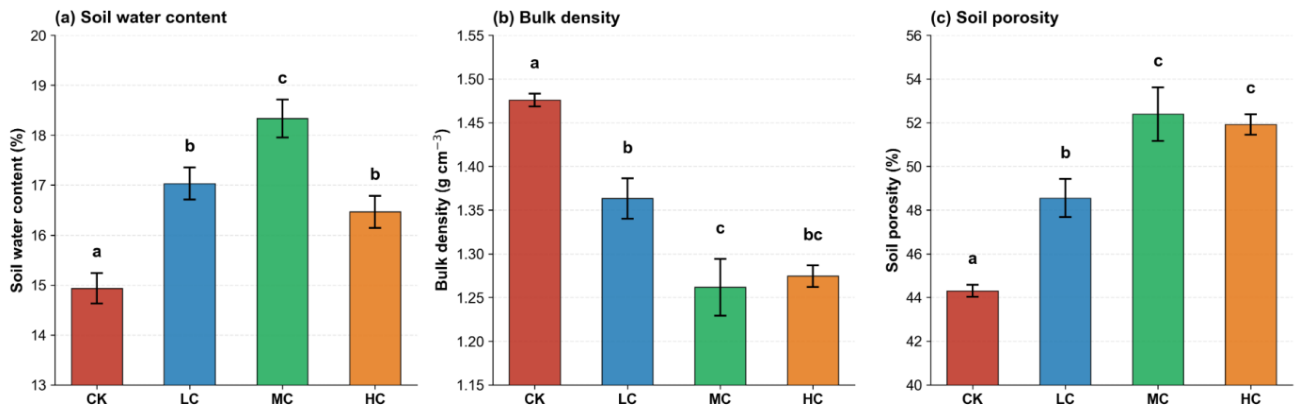
Figure 2.
Effects of grass powder mulching on chemical properties of soda saline-alkali soil. (a) Soil pH; (b) Electrical conductivity; (c) Total salt content; (d) Exchangeable sodium percentage. CK, no mulching; LC, low-density mulching; MC, medium-density mulching; HC, high-density mulching. Error bars indicate standard deviation (SD, n = 3). Different lowercase letters above bars indicate significant differences at p < 0.05 by Duncan’s test.
Figure 2.
Effects of grass powder mulching on chemical properties of soda saline-alkali soil. (a) Soil pH; (b) Electrical conductivity; (c) Total salt content; (d) Exchangeable sodium percentage. CK, no mulching; LC, low-density mulching; MC, medium-density mulching; HC, high-density mulching. Error bars indicate standard deviation (SD, n = 3). Different lowercase letters above bars indicate significant differences at p < 0.05 by Duncan’s test.
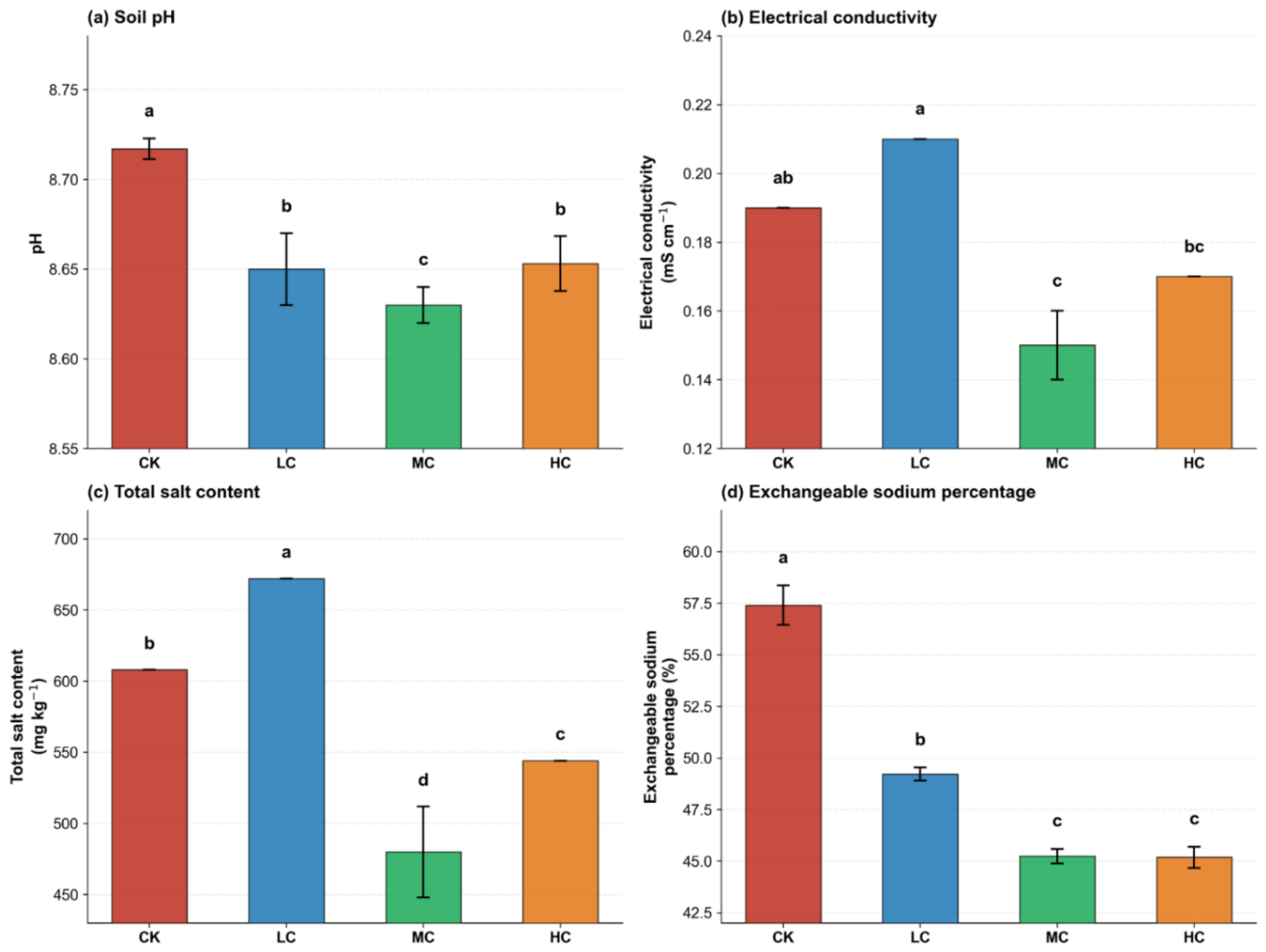
Figure 3.
Effects of grass powder mulching on soil nutrient properties in the second year of lucerne cultivation on soda saline-alkali soil. (a) Soil organic matter; (b) Alkali-hydrolyzable nitrogen; (c) Available phosphorus; (d) Available potassium. CK, no mulching; LC, low-density geass powder mulching; MC, medium-density straw powder mulching; HC, high-density straw powder mulching. Error bars indicate standard deviation (SD, n = 3). Different lowercase letters above bars indicate significant differences among treatments at p < 0.05 by Duncan’s multiple range test.
Figure 3.
Effects of grass powder mulching on soil nutrient properties in the second year of lucerne cultivation on soda saline-alkali soil. (a) Soil organic matter; (b) Alkali-hydrolyzable nitrogen; (c) Available phosphorus; (d) Available potassium. CK, no mulching; LC, low-density geass powder mulching; MC, medium-density straw powder mulching; HC, high-density straw powder mulching. Error bars indicate standard deviation (SD, n = 3). Different lowercase letters above bars indicate significant differences among treatments at p < 0.05 by Duncan’s multiple range test.
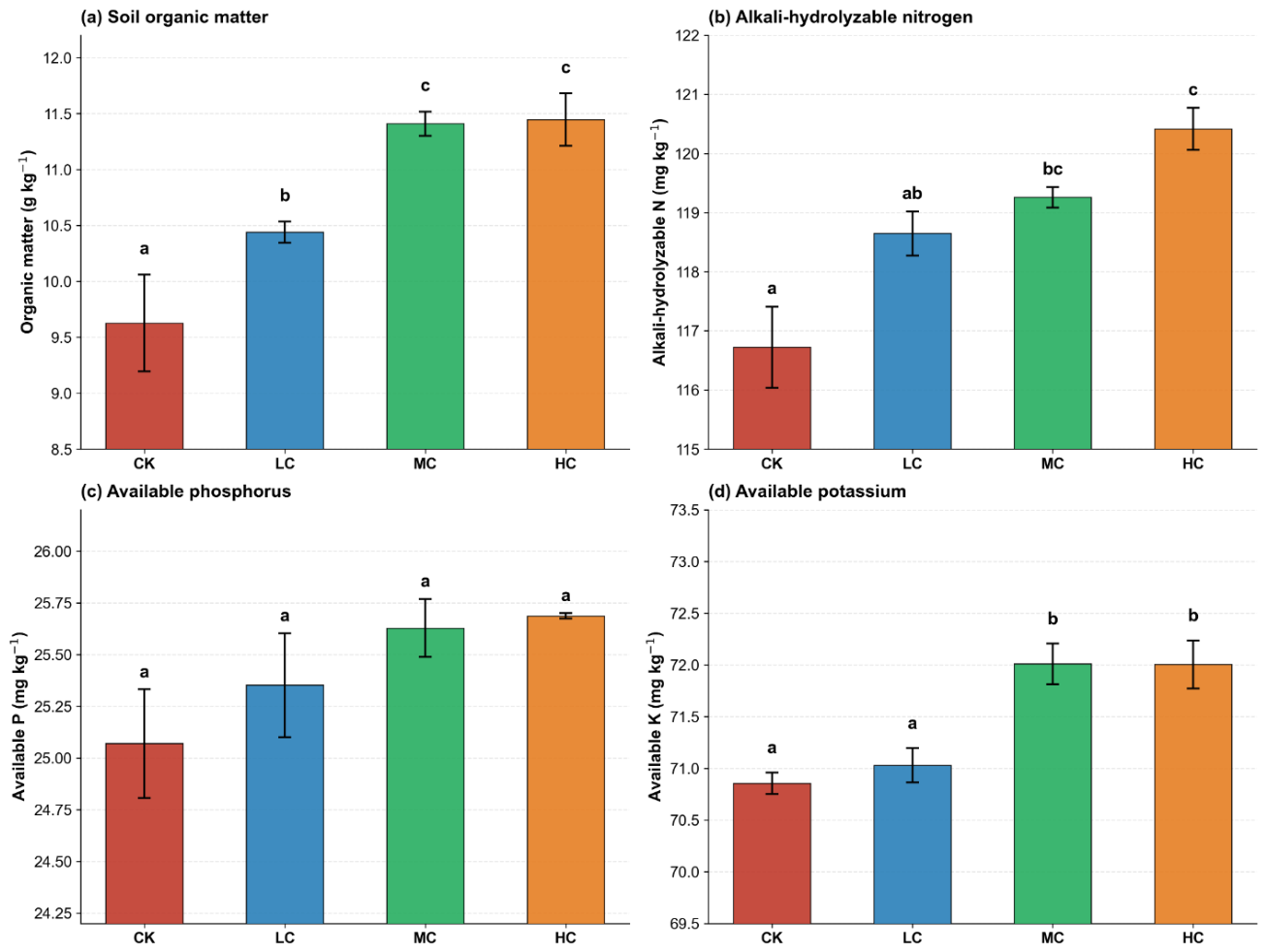
Figure 4.
Effects of grass powder mulching on comprehensive soil properties of soda saline-alkali soil (standardized radar chart). Note: All indicators were standardized to 0-1 scale.Higher values indicate better amelioration.Bulk density, pH, electrical conductivity, total salt, and exchangeable sodium were reversely standardized (lower is better).
Figure 4.
Effects of grass powder mulching on comprehensive soil properties of soda saline-alkali soil (standardized radar chart). Note: All indicators were standardized to 0-1 scale.Higher values indicate better amelioration.Bulk density, pH, electrical conductivity, total salt, and exchangeable sodium were reversely standardized (lower is better).
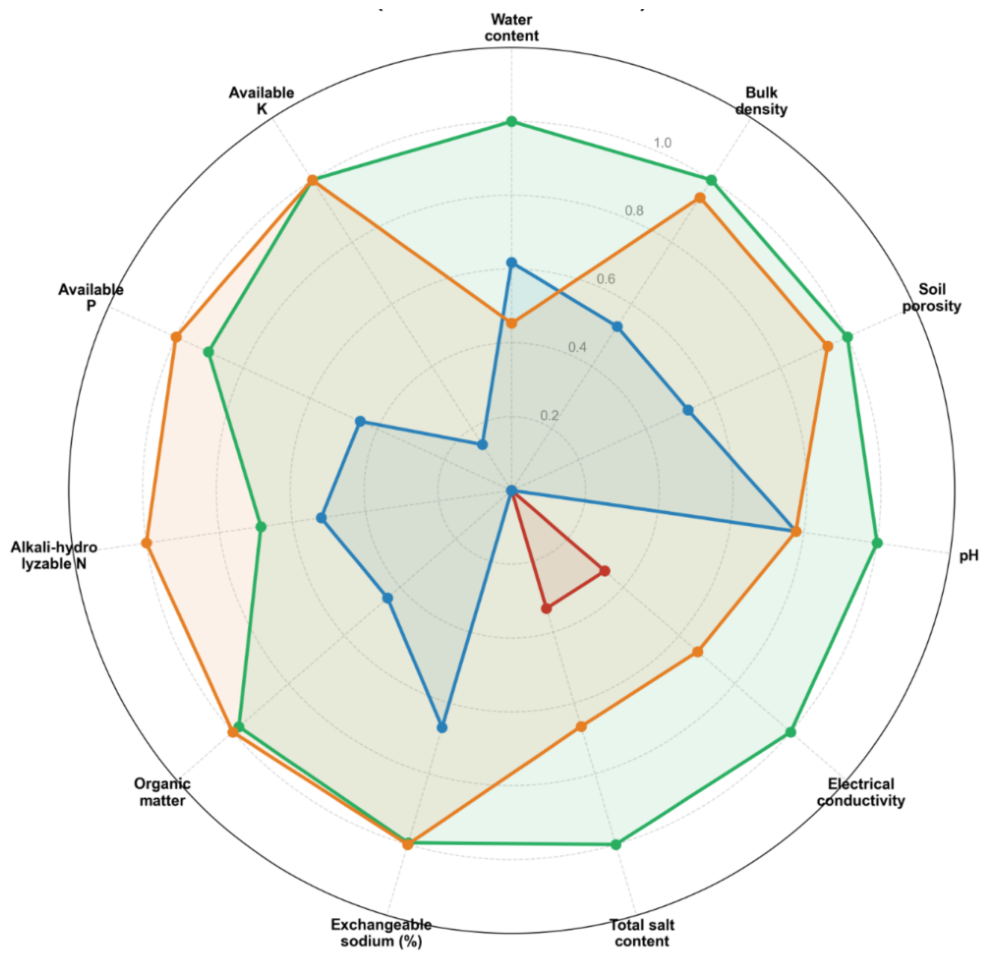
Figure 5.
Effects of grass powder mulching on alfalfa winter survival rate in the second year on soda saline-alkali soil. CK, no mulching; LC, low-density mulching; MC, medium-density mulching; HC, high-density mulching. Error bars indicate standard deviation (SD, n = 3). Different lowercase letters above bars indicate significant differences among treatments at p < 0.05 by Duncan’s multiple range test.
Figure 5.
Effects of grass powder mulching on alfalfa winter survival rate in the second year on soda saline-alkali soil. CK, no mulching; LC, low-density mulching; MC, medium-density mulching; HC, high-density mulching. Error bars indicate standard deviation (SD, n = 3). Different lowercase letters above bars indicate significant differences among treatments at p < 0.05 by Duncan’s multiple range test.
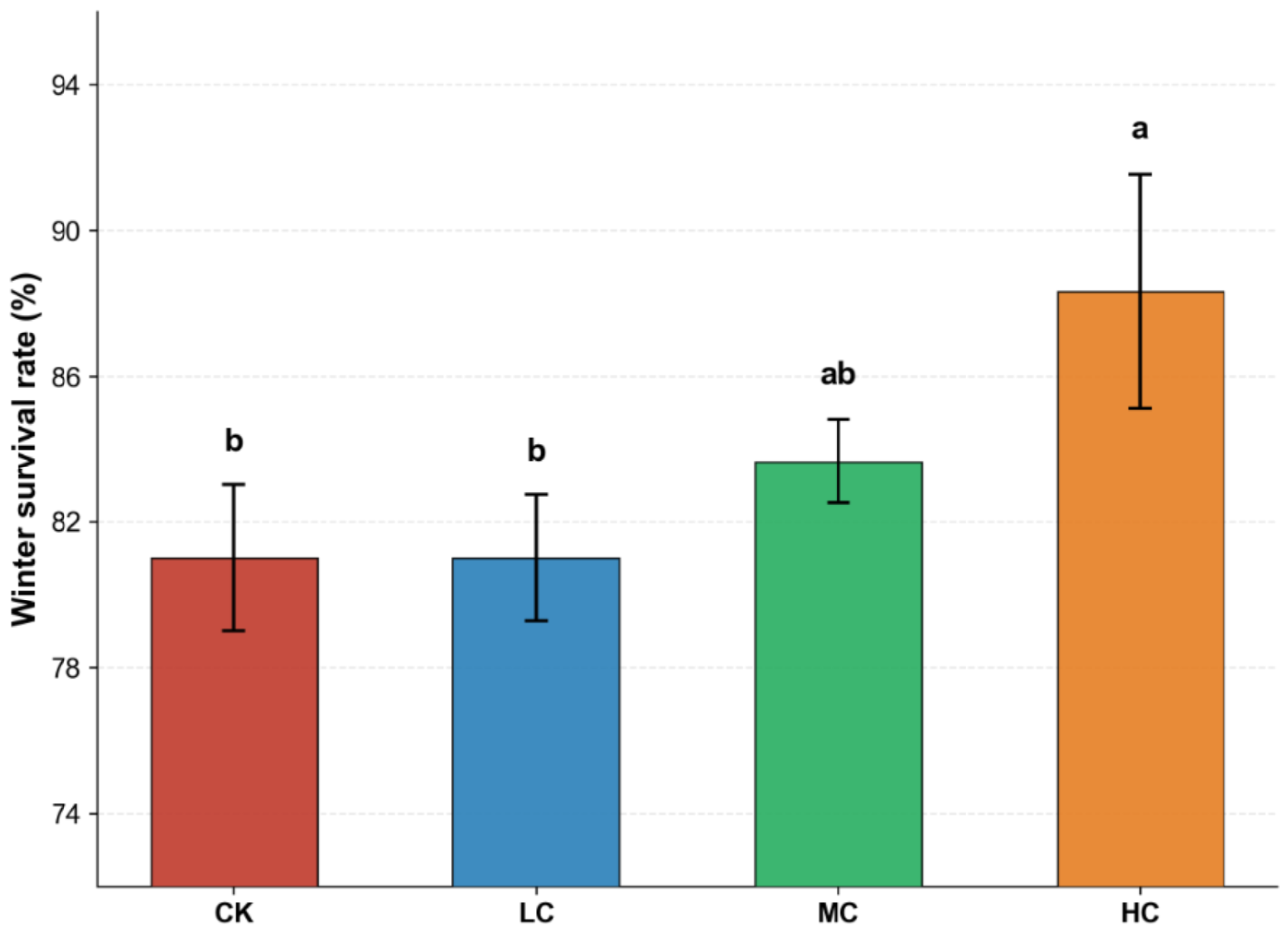
Figure 6.
Effects of grass powder mulching on photosynthetic characteristics of alfalfa in the second year on soda saline-alkali soil. (a) Relative chlorophyll content; (b) Net photosynthetic rate; (c) Stomatal conductance; (d) Intercellular CO₂ concentration. CK, no mulching; LC, low-density straw powder mulching; MC, medium-density straw powder mulching; HC, high-density straw powder mulching. Error bars indicate standard deviation (SD, n = 10). Different lowercase letters above bars indicate significant differences among treatments at p < 0.05 by Duncan’s multiple range test.
Figure 6.
Effects of grass powder mulching on photosynthetic characteristics of alfalfa in the second year on soda saline-alkali soil. (a) Relative chlorophyll content; (b) Net photosynthetic rate; (c) Stomatal conductance; (d) Intercellular CO₂ concentration. CK, no mulching; LC, low-density straw powder mulching; MC, medium-density straw powder mulching; HC, high-density straw powder mulching. Error bars indicate standard deviation (SD, n = 10). Different lowercase letters above bars indicate significant differences among treatments at p < 0.05 by Duncan’s multiple range test.
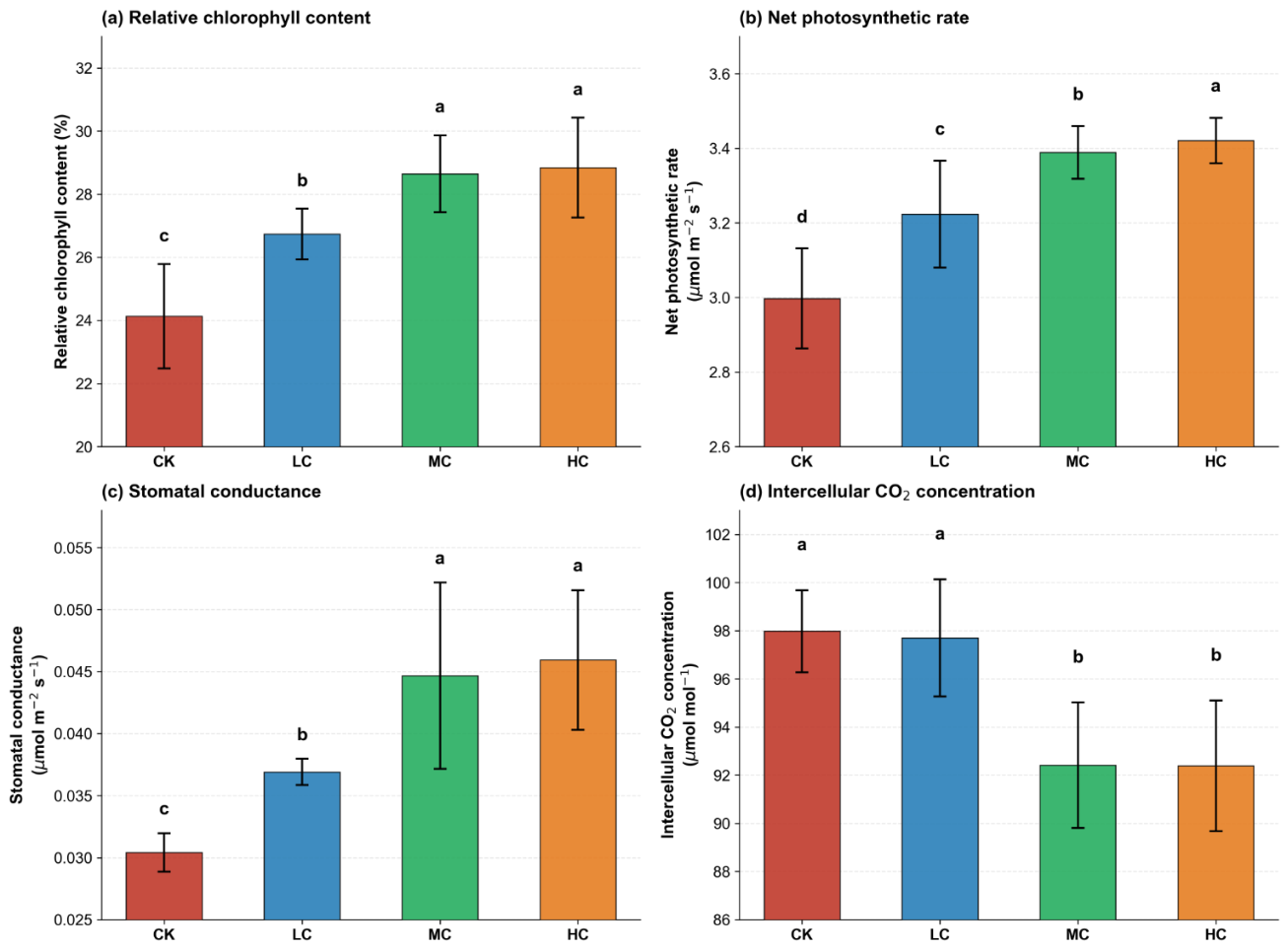
Figure 7.
Effects of grass powder mulching on agronomic traits and yield of alfalfa in the second year on soda saline-alkali soil. (a) Plant height; (b) Branch number; (c) Stem-to-leaf ratio; (d) First-cut hay yield. CK, no mulching; LC, low-density straw powder mulching; MC, medium-density straw powder mulching; HC, high-density straw powder mulching. Error bars indicate standard deviation (SD). Different lowercase letters above bars indicate significant differences among treatments at p < 0.05 by Duncan’s multiple range test.
Figure 7.
Effects of grass powder mulching on agronomic traits and yield of alfalfa in the second year on soda saline-alkali soil. (a) Plant height; (b) Branch number; (c) Stem-to-leaf ratio; (d) First-cut hay yield. CK, no mulching; LC, low-density straw powder mulching; MC, medium-density straw powder mulching; HC, high-density straw powder mulching. Error bars indicate standard deviation (SD). Different lowercase letters above bars indicate significant differences among treatments at p < 0.05 by Duncan’s multiple range test.
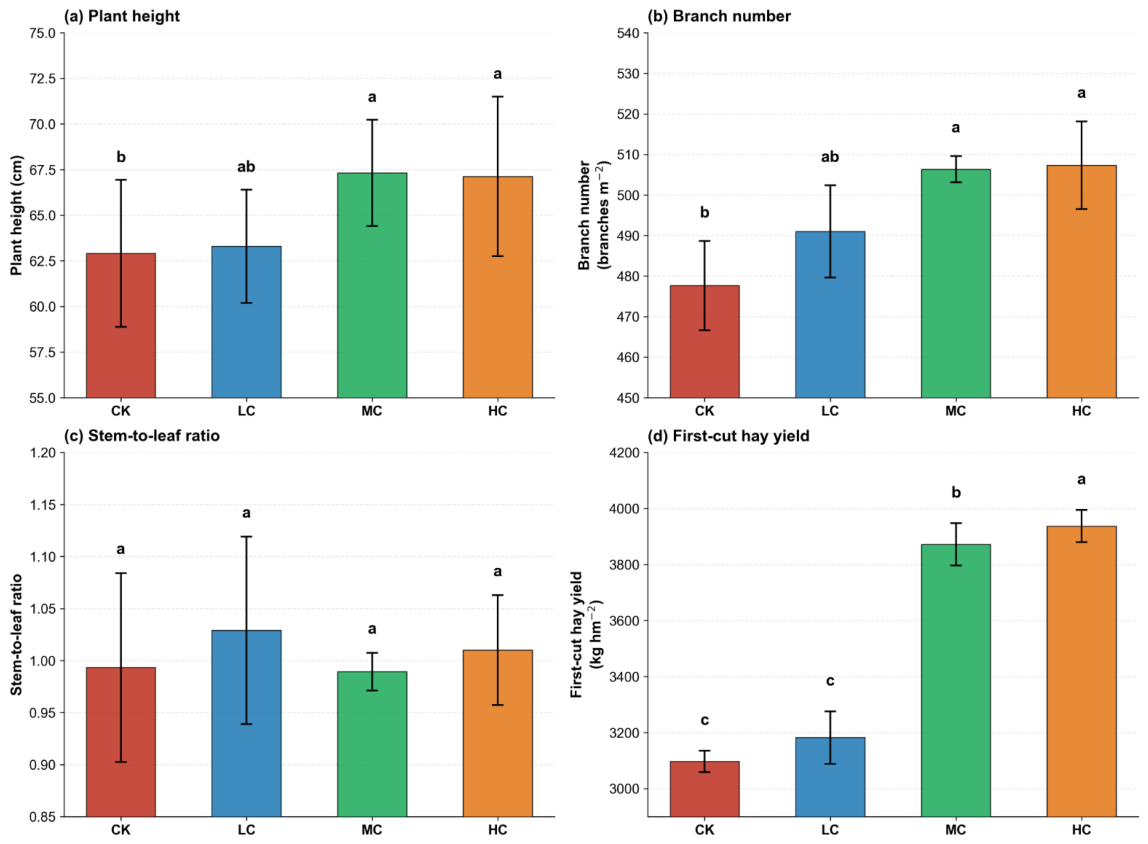
Figure 8.
Conceptual structural equation model showing the causal pathways from grass powder mulching to forage yield and quality in soda saline-alkali soil. Standardized path coefficients are shown on arrows, with significance indicated by *p<0.05, **p<0.01, ***p<0.001. R² values indicate the proportion of variance explained in each endogenous latent variable. Model fit: GoF = 0.48 (large), SRMR = 0.07 (good). The total indirect effect of mulching on forage yield was 85% (via soil → physiology → morphology), and on forage quality was 81%. Numbers on arrows are standardized path coefficients(*p<0.05,**p<0.01, ***p<0.001). R² indicates variance explained.
Figure 8.
Conceptual structural equation model showing the causal pathways from grass powder mulching to forage yield and quality in soda saline-alkali soil. Standardized path coefficients are shown on arrows, with significance indicated by *p<0.05, **p<0.01, ***p<0.001. R² values indicate the proportion of variance explained in each endogenous latent variable. Model fit: GoF = 0.48 (large), SRMR = 0.07 (good). The total indirect effect of mulching on forage yield was 85% (via soil → physiology → morphology), and on forage quality was 81%. Numbers on arrows are standardized path coefficients(*p<0.05,**p<0.01, ***p<0.001). R² indicates variance explained.
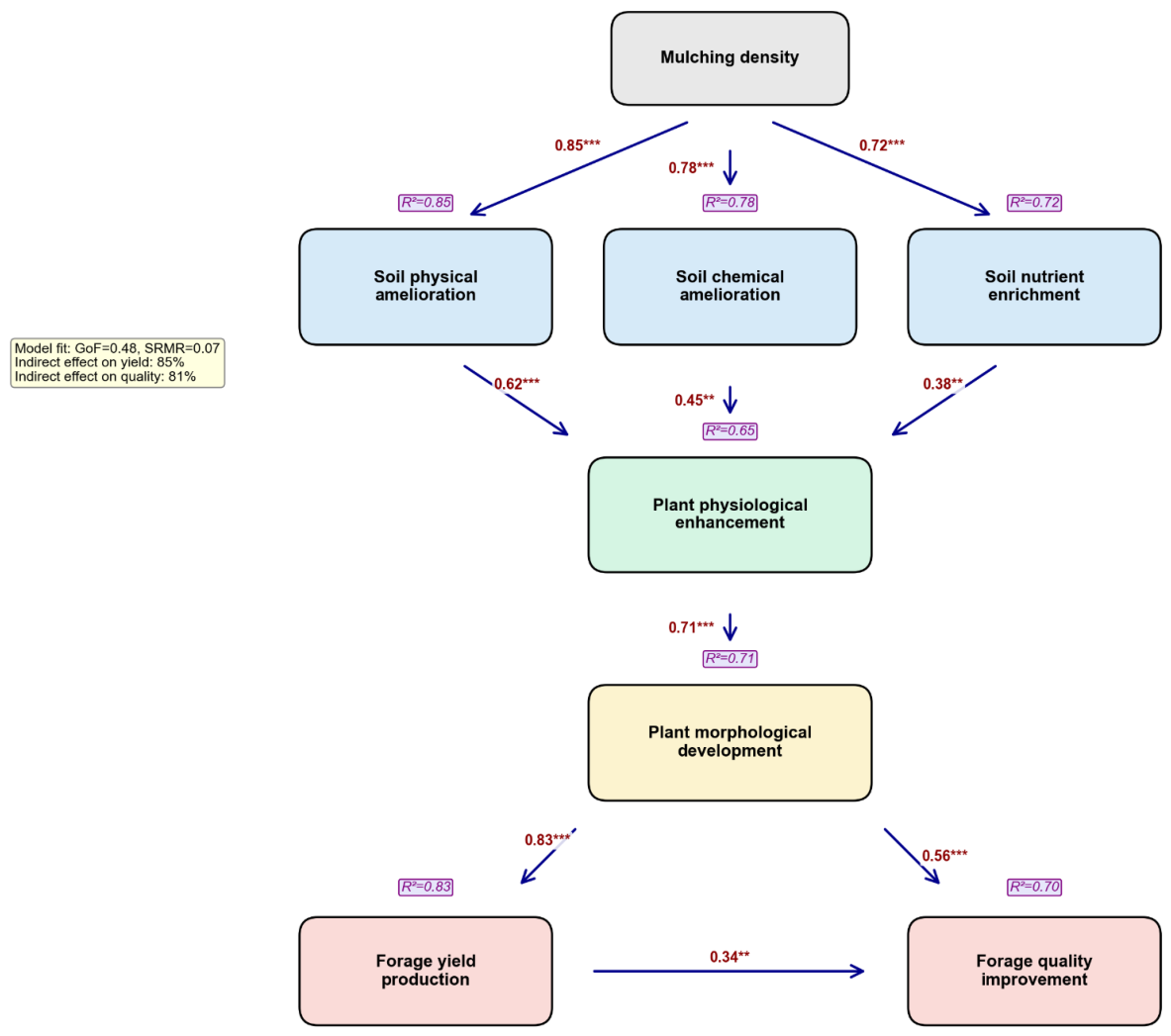

Table 1.
Effects of grass powder mulching on forage quality of alfalfa in the second year on soda saline-alkali soil.
Table 1.
Effects of grass powder mulching on forage quality of alfalfa in the second year on soda saline-alkali soil.
| Treatment | CP (%) | CF (%) | ADF (%) | NDF (%) | RFV |
|---|---|---|---|---|---|
| CK | 18.87 ± 0.45 b | 3.12 ± 0.04 c | 31.72 ± 0.34 a | 37.69 ± 0.26 a | 158.43 ± 1.64 c |
| LC | 19.47 ± 0.13 b | 3.21 ± 0.05 bc | 30.75 ± 0.26 ab | 37.57 ± 0.90 a | 160.89 ± 4.00 bc |
| MC | 19.84 ± 0.28 ab | 3.59 ± 0.07 a | 29.21 ± 0.77 b | 37.43 ± 0.74 a | 164.41 ± 1.77 b |
| HC | 20.42 ± 0.28 a | 3.53 ± 0.05 ab | 28.20 ± 0.89 c | 37.27 ± 0.89 a | 167.08 ± 2.57 a |
Note: CK, no mulching; LC, low-density grass powder mulching; MC, medium-density grass powder mulching; HC, high-density grass powder mulching. Values are means ± standard deviation (SD, n = 3). Different lowercase letters within a row indicate significant differences among treatments at p < 0.05 by Duncan’s multiple range test. Relative feed value (RFV) was calculated based on acid detergent fiber (ADF) and neutral detergent fiber (NDF) according to standard forage evaluation protocols.
Table 2.
Soil physical and chemical properties of the experimental site.
| Soil type | pH | EC (mS·cm-1) | CO₃²⁻ (mg·kg-1) | HCO₃⁻ (g·kg-1) | Cl⁻ (g·kg-1) | Na⁺ (g·kg-1) | SOM (g·kg-1) | Available N (mg·kg-1) | Available P (mg·kg-1) | Available K (mg·kg-1) |
|---|---|---|---|---|---|---|---|---|---|---|
| Saline-alkali soil | 8.90 | 0.22 | 2.61 | 0.81 | 0.32 | 1.63 | 9.4 | 98.34 | 11.07 | 56.42 |
Note: EC, electrical conductivity; SOM, soil organic matter.
Table 3.
Grass powder mulch application rates and treatment codes.
| Treatment | Grass powder rate (kg·ha⁻¹) | Code |
|---|---|---|
| No mulch | 0 | CK |
| Low-density mulch | 6,000 | LC |
| Medium-density mulch | 12,000 | MC |
| High-density mulch | 18,000 | HC |
Disclaimer/Publisher’s Note: The statements, opinions and data contained in all publications are solely those of the individual author(s) and contributor(s) and not of MDPI and/or the editor(s). MDPI and/or the editor(s) disclaim responsibility for any injury to people or property resulting from any ideas, methods, instructions or products referred to in the content. |
© 2026 by the authors. Licensee MDPI, Basel, Switzerland. This article is an open access article distributed under the terms and conditions of the Creative Commons Attribution (CC BY) license (http://creativecommons.org/licenses/by/4.0/).
Copyright: This open access article is published under a Creative Commons CC BY 4.0 license, which permit the free download, distribution, and reuse, provided that the author and preprint are cited in any reuse.