

Submitted:
21 August 2026
Posted:
24 August 2026
You are already at the latest version
Abstract
Influenza viruses constantly evolve due to sporadic antigenic shifts and point mutations, which undermine vaccine effectiveness. Newly drifted pathogenic variants make current vaccines inadequate against circulating strains, requiring frequent updates to vaccine formulations. On the other hand, hepatitis viruses such as HAV, HBV, and HCV can cause acute and chronic infection of the liver, leading to liver cirrhosis and cancer. Currently, there is no vaccination for HCV, and access to vaccines for HAV and HBV is also limited in developing countries. Plant-derived vaccines against influenza virus afford many advantages over egg-derived conventional methods. Plant virus-like particles (pVLPs) are non-infectious, contain virus structural features with high flexibility, and can be tailored to meet specific biotechnological needs. pVLPs are preferable for vaccine development due to being economically viable and can be produced more rapidly and with fewer complications. Recombinant antigens contained within the plant tissues (particularly in seeds) show better stability and can be transported and stored at ambient temperatures, without the requirement of a cold chain framework. Edible plant-derived oral vaccines offer needle-free vaccine administration. By simply cultivating more plants, vaccine production can be scaled up while transient plant expression systems speed up production within a few weeks, which is critical for quick response to emerging new disease outbreaks. By genetic modification, plants can be used to express several antigens, facilitating the development of multi-component vaccines against many diseases at a single shot. Nicotiana benthamiana has been extensively utilized as a plant-based expression platform to generate recombinant influenza vaccine antigens, including hemagglutinin (HA). Plant-derived hepatitis vaccines, principally targeting HBV, have been shown to elicit robust immune responses in preclinical studies and early clinical trials through the expression of HBV surface antigen in plants such as lettuce, potato, and tobacco. However, challenges such as achieving consistent dosing, obtaining sufficiently high, reproducible, and stable expression levels, and circumventing regulatory hurdles for the use of plant-based pharmaceuticals remain. The current review focuses on recent developments in the production of plant-based influenza and hepatitis vaccines, and explores the advantages, challenges, and application of such vaccines in combating these infections.
Keywords:
plant-made vaccines
; influenza virus
; hepatitis virus
; VLPs
; plant molecular pharming
; immune responses
; murine models
; clinical trials
1. Introduction
Plants are increasingly being proven to be a powerful platform for producing biologicals, including vaccines, antibodies and therapeutic agents. This technology has been under development for over a quarter of a century; both transgenic and transient technologies have been used to produce pharmaceuticals of this type. These include the use of nuclear as well as transplastomic transgenic plants, as well as plant virus expression vectors and virus like particles to temporally express vaccines. These technologies are relatively inexpensive when compared to conventional pharmaceuticals, are highly scalable and do not require cold chain storage, making them amenable for Low-to-Middle-Income countries. While much of the research and development has so far remained in academia, a few companies are beginning to commercialize plant-based biologics. Here, we discuss in detail the use of plant-made vaccines to combat infectious diseases based on influenza and hepatitis viruses.
The World Health Organization (WHO) evaluated that influenza viruses kill nearly 250,000 – 500, 000 people per year [1]. There is a shortfall of influenza vaccines worldwide and hence there is dire requirement for “rapid response” vaccines against the pandemic influenza virus strains [2]. The technology of plant molecular farming can address there requirements as it enables rapid development and manufacture of vaccines in addition to scalable production. Recombinant influenza subunit proteins induce poor immune response [3,4,5]. Whereas VLPs imitate the structure of the influenza virus while being bereft of the inner nucleic acid. This makes VLPs non-infectious and safe in addition to stimulating both humoral and cellular immunity [6,7]. VLPs possess assembled repeats of the influenza structural proteins towards optimal presentation and display to antigen-presenting cells [8]. Plant-derived quadrivalent influenza VLP vaccine (QVLP) vaccine reached phase III clinical trials, that authenticated the safety and immunogenicity of this vaccine [9]. This demonstrated that the Medicago-generated plant-based influenza vaccine can be produced in a time span of a few weeks that is more favorable when compared to cell-based and egg-based expression platforms that need nearly 4-6 months for production [10].
During the year 2009, four companies including Kentucky Bioprocessing, Medicago Inc., Fraunhofer USA and the Center of Molecular Biotechnology at Delaware produced 100 million plant-derived influenza vaccines within a span of 1 month [11]. Medicago generated 10 million doses of the influenza H1N1 vaccine within a single month “rapid fire test” [12]. Particularly, they employed transient antigen expression vectors [13]enabling the synthesis and accretion of large amounts of recombinant antigens in plants within short one-week period. Medicago Inc. has gainfully passed phase III clinical trials of its plant-made quadrivalent flu VLP vaccine (NCT03739112, NCT03301051, NCT03321968) [14]. This proven high efficacy of plant-derived flu vaccines is a major milestone in the advancement of plant molecular farming.
Hepatitis viruses are a category of viruses principally affecting the liver [15,16]. Hepatitis poses a health challenge on a global scale due to factors including lack of public awareness, asymptomatic infections and circumscribed availability of vaccinations and therapy in developing countries. Recently, plant-derived vaccinations using plant transformation and genetic engineering technologies have been developed to prevent hepatitis A infections. These vaccinations are better than conventional vaccinations in terms of lowered costs, high scalability and increased stability.
Recent developments have been witnessed in the expression of hepatitis and influenza antigens in various plant systems such as rice and potatoes, which afford facile scalability and promise for edible vaccines, thus streamlining the process of vaccine administration and augmenting accessibility. Nevertheless, in spite of these favorable developments, transition of success at the laboratory level to that of clinical trials and the commercial approval and use of these vaccinations has been slow. Challenges like poor yields, the requirement of stable and consistent antigen expression in plants and the accompanying regulatory hurdles still remain major obstacles. Additionally, the efficacy and immunogenicity of these plant-made vaccines need validation in human clinical trials that are still circumscribed. The current review addresses major developments in the development of plant-based vaccines against influenza and hepatitis viruses and serves as a good theoretical source of recent information on plant-made vaccines to combat these emerging viruses.
2. Influenza and Hepatitis Viruses
Viral infections are the most considerable threats to global public health with imposing socio-economic pressures [17]. The most common among them are the infections caused by Influenza and Hepatitis viruses with their high morbidity and mortality rates. Influenza viruses from the family Orthomyxoviridae, are enveloped viruses with segmented, negative sense single stranded RNA genomes [18]. Influenza viruses are classified into by four types A, B, C and D. Influenza A and B viruses are primarily responsible for seasonal influenza outbreaks in humans [19]. Influenza viruses also possess pandemic potential due to gradual mutations (antigenic drift) and major genetic reassortment events (antigenic shift)[20,21]. These mechanisms enable influenza viruses to escape host immune systems, and lead to the emergence of new viral variants [20,21,22]. The genome structure of Influenza viruses contain negative-sense, single-stranded viral RNA (vRNA) segments (A and B with eight and C and D with seven segments [23]. The Influenza A viruses are further classified into subtypes according to their surface glycoproteins, hemagglutinin (HA) and neuraminidase (NA) [23]. HA mediates viral attachment to epithelial cells in the upper respiratory tract, while NA facilitates cleaves progeny viruses and prevent virion aggregation. So far, 18 HA and 11 NA subtypes have been identified. Influenza B viruses are categorized into two B/Victoria and B/Yamagata distinct lineages.
Hepatitis viruses comprise a diverse group of hepatotropic viruses that primarily infect liver cells and cause inflammatory liver diseases [24]. The hepatitis viruses are enveloped, positive-sense, ss-RNA or ds-DNA viruses.[25] The hepatitis viruses (Hepatitis A, B, C, D, E, and G) belong to different viral families, have unique morphology, genomic organization and replication strategy [26]. They are responsible for the majority of the world’s cases of acute and chronic hepatitis. HAV and HEV cause only acute disease with no chronic sequelae, HBV, HCV and HDV cause varying degrees of chronicity and liver injury, which can progress to cirrhosis and liver cancers [26]. HAV and HEV are typically transmitted via the fecal–oral route, and HBV and HCV are mainly transmitted through blood and bodily fluids.
The persistent global burden of influenza and viral hepatitis underscores the need for improved prevention, diagnostic, and therapeutic strategies. Advances in molecular virology, immunology, and biomedical technologies have facilitated the development of innovative antiviral approaches, including nanoparticle-based vaccines, targeted drug delivery systems, and advanced biosensing platforms for early detection. These emerging strategies aim to overcome limitations associated with conventional antiviral therapies, such as drug resistance, limited bioavailability, and suboptimal immune responses. Vaccination plays a crucial role in preventing viral infections, particularly for diseases like hepatitis A and influenza.
3. Virus like Particles (Vlps) -Based Vaccines Against Influenza and Hepatitis Viruses
Vaccines are the most cost-effective strategy to combat viral infections. Vaccines can prevent the morbidity and occasional mortality, and reduce outbreaks associated with viruses. They can significantly reduce disease burden worldwide of influenza and hepatitis viruses. However, they are still facing huge issues for some infectious diseases and starting vaccination campaigns [27]. Conventional vaccines were often produced as inactivated virus and live attenuated with adjuvant or non-adjuvant using egg technology [28,29,30]. The current egg-based system cannot be flexible in the amount of doses that can lead to vaccine shortages, especially during pandemic situations [31]. Furthermore, local or systemic allergic reactions to egg-derived vaccine components, kill the embryos to hamper virus production, human safety concerns, and the supply of eggs for vaccine manufacturing [32]. Traditional subunit vaccines with a small antigenic parts of the infectious microorganism could receive a particular interest for immunization. They are composed of an immuno-dominant peptide that is the lack of any risk due to the absence of the pathogen and, elicit a counter response [33]. However, poor immunogenicity, and need to the multiple doses and nontoxic adjuvant formulations can limit the application of them [34,35,36]. The typical examples of subunit vaccines were developed against influenza and hepatitis. However, the high mutation rate of the virus, particularly through antigenic drift and antigenic shift in influenza, and the protective immune response strain-specific, frequently reduce vaccine efficacy [37]. Key challenges remain, including overcoming immune subdominance of conserved regions, ensuring long-lasting immunity, and establishing robust correlates of protection [38]. In the case of hepatitis viruses, A and B have effective vaccines, but there is no licensed vaccine for hepatitis C due to its genetic variability and immune evasion mechanisms [39]. Furthermore, they also bring an inherent issue of poor immunogenicity, short half-life, and strain-specific protection. Thus, researchers have tremendously focused on solving these issues. Recently, virus -derived proteinous nanoparticles, called virus like particles (VLPs), have introduced as a versatile strategy [40]. VLPs mimic the conformational and structural properties of viruses, without genetic material. They are non-infectious particles with antigenic properties for vaccine development. VLPs can self-assemble as the multimer particles with more than one protein or protein chimeras (cVLPs). They can be produced by the heterologous expression systems such as bacteria, insects, animals, and plants. VLP can be generated via two platforms: i) VLPs produced by cloning of gene sequences of influenza and hepatitis antigens into expression vectors followed by transfection into heterologous expression systems wherein their co-expression allows self-assembly of the VLPs ii) the antigen encoding genes are inserted into the carrier virus vectors to express antigens on the VLP surface (Figure 1).
3.1. Vlps Derived from Influenza and Hepatitis Viruses
VLPs -based vaccines have been developed using virus proteins to protect against derived of influenza and hepatitis viruses (Table 1). VLPs are derived from the envelope protein, the capsid protein, or both of them such as Hemagglutinin (HA), matrix protein 1 (M1), neuraminidase (NA) of influenza viruses, and small surface antigen (HBsAgs), or capsid proteins of hepatitis viruses. These recombinant proteins are widely expressed by the various vector systems in cultured cells [41]. Upon expression, structural proteins can oligomerize and self-assemble into VLPs mimicking the structure of the native virus [42]. The baculovirus and lentivirus are the best vector systems for producing VLPs-based vaccines against viruses such as Zika, Chikungunya, Yellow fever and Japanese encephalitis viruses [43,44]. For example, lentiviral-based vectors were constructed and employed to integrate the full-length sequence of core, E1, E2, and P7 genes of HCV genotype 4 into the genome of Human Embryonic Kidney cells (HEK293T). Upon the expression, HCV structural proteins can oligomerize and self-assemble into VLPs mimicking the structure of HCV native virus [42].
3.2. Chimeric Vlps Derived from Influenza and Hepatitis Viruses
The development of VLPs as platforms for foreign antigen display (chimeric VLPs) has further broadened their potential applicability both as vaccines in protection against diseases [53]. Different virus candidates, including animal, insect, plant and bacterial viruses have been used as platforms to develop chimeric VLP vaccines against viral infections [42]. Chimeric VLP vaccines can be produced via a genetic fusion technique for co-expression of epitope on the VLP particles into expression systems [54]. Furthermore, the epitopes can be conjugated on the surface of the VLP via addressable groups (e.g. lysine (Lys) residues) by using chemical techniques [55]. In this regard, the foreign antigen of influenza and hepatitis viruses can use other viruses as scaffolds to display antigens for producing chimeric VLPs vaccines [44]. For example, truncated hepatitis E virus coat protein was used as a carrier to display four tandem copies of influenza A M2e, and the resulting particles formed VLPs in plants [56]. The long alpha helix (LAH) domain from H3N2 strain has been incorporated into VLPs derived from hepatitis B virus core protein (HBc) using recently developed tandem core technology. Immunologic data indicate that HBc VLPs carrying the LAH antigen represent a promising universal influenza vaccine component [57].
4. Vlp Derived from Plant Virus (Pvlps) -Based Vaccines Against Influenza and Hepatitis Viruses
Plant viral virus-like particles (pVLPs) are self-assembled protein particles from the plant virus coat proteins (CPs) [40,58]. These pVLPs lack the functional genome, and they are not infectious and not replicate in its host and animal cells [59]. CPs of various plant viruses have been extensively investigated for the generation of pVLPs [60]. The pVLPs derived from them have gained attention as biomimetic platforms for encapsulating or displaying therapeutic and imaging agents [60]. The pVLPs possesses slightly different structural and functional properties, even among members of the same genus [61,62]. The preference of pVLPs largely depends on the availability and effort required to obtain sufficient quantities of pure, high-quality VLPs with the desired properties. The pVLPs can self-assemble in the form of icosahedral, spherical, or rod-like structures based on type of virus [63]. The pVLPs can be successfully expressed in plants and various systems, including yeast, mammalian, and insect cell cultures [62]. pVLPs can be produced in some plants when they are infected with viruses, especially CPMV (Figure 2a) [64]. Furthermore, the pVLPs can be used as carriers for foreign sequences to display immunological epitopes (Figure 2b)[65]. The epitope sequences inserted or replaced into the CP gene of plant viruses, are cloned and expressed in a heterologous expression system [66]. Another approach to creating multivalent vaccines is chemical conjugation of epitopes on the pVLP[67]. Several plant virus vectors including, the small geminivirus bean yellow dwarf virus (BeYDV), tobamovirus (TMV)-based deconstructed viral system (magnICON) and Cowpea mosaic virus hypertranslatable (CPMV-HT) systems have been introduced for vaccine development [63,68]. For example, the CPMV-HT platform, which is based on the rapid transient expression of recombinant proteins in plants through Agrobacterium-mediated infiltration, has been used to produce 10 million doses of VLP H1N1 (swine flu) vaccine in just 30 days compared to the 9–12 months required for more common approaches in current use [69,70].
Several recombinant pVLPs of influenza (Table 2) and hepatitis viruses (Table 3) with displaying antigens are investigated in medicine as vaccines. For example, the rod-shaped Tobacco mosaic virus (TMV) has been engineered to display conserved influenza and hepatitis epitopes, such as the extracellular domain of the matrix protein 2 (M2e), 5B19 epitope [71]. These chimeric pVLPs elicited strong, cross-reactive antibody responses in animal models, offering a path toward a universal influenza vaccine. Chimeric VLPs utilizing Cowpea mosaic virus (CPMV) or Alfalfa mosaic virus (AIMV) genomes have been engineered to present antigenic loops of influenza HA.
4.1. Plant Expression Systems for Pvlps Vaccines
Plants are efficient bioreactors for the production of important pharmaceutical proteins such as vaccines and monoclonal antibodies [92,93]. These systems have been proposed due to low production cost, high scalability, possibility of suitable post-translational modifications, and low risk of contaminations [94,95]. Plant expression systems can allow the production of chimeric agents in a short period of time (within 1–2 weeks) that can employ for rapid and scalable applications [96]. The most common host plants for transient expression of proteins are tobacco and related Nicotiana benthamiana and lettuce (Lactuca sativa) with robust-growing plant, cultivated readily and produces large quantities of biomass rapidly[94,97]. Plant systems have been used to produce virus-like particles of human and animal viruses, including Norwalk, Ebolavirus, and hepatitis B core antigen [63,98,99] These VLPs were produced in tomato, potato, tobacco, and lettuce with a structure similar to natural particles. For example, small HBs surface antigen (S-HBsAg) molecules were assembled into VLPs, successfully expressed in plants (lettuce, potato and lupine) and administered as an edible vaccine. These VLPs were structurally similar to the licensed yeast-derived vaccine and were strongly immunogenic [100,101] A plant-derived quadrivalent VLP candidate as an influenza vaccine was able to induce both strong antibody and cellular responses in the first phase III efficacy study and is currently being finalized by Health Canada [63,102]. One of the most successful examples is Medicago’s Plant-Derived Influenza VLPs for expressing the hemagglutinin (HA) protein in Nicotiana benthamiana. The plant expression system allowed for high-yield production of clinical-grade VLPs in less than a month, showing broad-spectrum immunogenicity and a favorable safety profile in humans [102].
The milestones of plant expression systems in the development of recombinant plant vaccines were the use of plant virus and pVLPs. Recently, various plant viruses have been used to create a platform for antigen expression on their surface, including TMV, cucumber mosaic virus (CMV), alfalfa mosaic virus (AIMV), cowpea mosaic virus (CPMV), papaya mosaic virus (PapMV), and the potato X virus (PVX). They are more stable at hard environments (temperatures, pH) with the expression in large quantities in native plant hosts. [63,103]. For example, a malaria transmission-blocking vaccine consisting of the Pfs25 surface protein from Plasmodium falciparum parasite conjugated to the AIMV has been generated. This plant-based VLP, Pfs25 VLP-FhCMB, was produced by transient expression in N. bentamiana and its safety and immunogenicity in phase I clinical study was successfully evaluated. [104].
4.2. Immune Activation of Pvlp Vaccines
VLPs due to their multimeric structures and conformations resembling wild type viruses can act as pathogen associated molecular patterns (PAMPs) [105,106].Therefore, VLPs can be recognized by pathogen recognition receptors (PRRs) on the cell surface or endosomes of antigen-presenting complexes (APCs) [106]. VLP internalization trigger APC maturation, and present vaccine antigens into major histocompatibility complex (MHC) class I for priming CD8+ cell responses or MHC class II for priming CD4+ T cell responses [106]. CD4+ T cells help B cells to produce antibodies (Th2 cells) [106]. The multimeric epitopes on VLP surface can induce cross-linking of B cell receptors (BCRs), and induce the production of antibodies even without the help of CD4+ T cells [106]. B cells can act as APCs, taking up VLPs, processing and presenting them to T cells [106]. Therefore, VLP-based vaccines are capable of inducing both humoral and cellular immune responses, and due to their multimeric nature, adjuvant co-administration is not needed in most cases, but the use of adjuvant improves their immunogenicity.
It demonstrated that some pVLPs (e.g. CPMV), or plant virions (CMPV, AMV) can induce strong immune responses [107]. The repetitive and highly ordered surface structure of pVLPs can facilitate crosslinking of B cell receptors, leading to potent B cell activation and antibody production [58]. Moreover, pVLPs are readily taken up by APCs, which process and present VLP-derived antigens to T cells, further enhancing the immune response [58,108] (Figure 3). Thus, antigens displayed on the pVLP surface undergo interaction with APCs that can trigger innate and adaptive immune responses [63]. For example TMV, CPMV chimeric VLPs, while displaying the foreign antigens can elicit a robust immune responses in animal models, underscoring their potential as vaccine candidates [109,110].
Plant-Derived VLPs Targeting Influenza Virus
Plant-derived VLP vaccines against influenza can be generated from Agrobacterium-enabled transient expression of the HA proteins of influenza virus in Nicotiana benthamiana. Plant-based H5 or H1 VLPs mimic the structure of the virions of influenza to a certain extent while being immunogenic and eliciting both cellular and humoral immune responses [111,112,113]. Each VLP particle contains only HA occurring as 30-50 homotrimers embedded in an envelope of the lipid bilayer derived from the plant cell [114]. A plant-made VLP vaccine was derived from only the HA protein of H7N9 A/Hangzhou/1/2013 influenza virus [115]. Single immunization with this H7-only adjuvanted vaccine triggered potent humoral reactions and protected murine models against lethal challenge of the virus. A double dose of the unadjuvanted vaccine markedly augmented humoral response and led to 100% protection with major decrease in clinical symptoms, resulting in almost asymptomatic infections. In ferret models, a single round of immunization with this H7 VLP vaccine adjuvanted with alum elicited robust humoral and cell-mediated immune responses involving CD3+ T cell antigen-specific immune activation. Therefore, this plant-derived H7 vaccine elicited protective immune responses following inoculation with either two unadjuvanted doses or a single adjuvanted doses of this vaccine [115]. Conceivably, the plant-made transient expression system enables generation of VLP structures containing only the HA antigen without the presence of other influenza-derived proteins. Plant-based seasonal quadrivalent VLP vaccine has been studied and triggered cross-reactive T cell and antibody responses in healthy adults [102]. The proven safety of this VLP vaccine in humans propounds that it is a favorable alternative production methodology for generating efficacious and HA-strain corresponding influenza vaccines.
Makarkov et al., 2019 report plant-based VLP vaccines generated through Agrobacterium-enabled transient expression of the hemagglutinin (HA) protein of influenza in Nicotiana benthamiana plants[116]. HA-bearing influenza VLPs spontaneously self-assemble and do not need accessory proteins for their budding from within the plant cells. These plant-based HA-VLPs measure ~100 nm in size [117]. Every VLP has 30-50 HA spike homotrimers introduced into a plant cell-derived lipid bilayer envelope [69,113]. The HA monomers presented on these VLPs measure ~72 kDa in size that correspond to the uncleaved precursor HA0 form [117]. The plant-based H1 proteins possess 6 N-glycosylation sites, present in the HA1 globular head or in the region of the HA2 stem that harbor hybrid or complex glycans containing epitopes with core α(1,3)-fucose or β(1,2)-xylose [114]. This plant-derived transient expression methodology enables large-scale, rapid generation of influenza vaccine based on HA at comparatively low cost, that address many of the hurdles (scalability and pace) for production of influenza vaccines in the event of a pandemic and therefore serving as a good alternative to the presently available production schemes for seasonal vaccines [117]. Plant-based VLPs reiterate the vital aspects of native influenza virions like sialic acid-enabled adherence as well as internalization by the target cells, in addition to VLP envelope fusion with endosomal membranes and quick elicitation of innate immune reactions [112,113,118]. These plant-derived vaccines have been demonstrated to trigger strong, cross-reactive antibody reactions against both pandemic and seasonal strains of influenza in human trials and animal models [102,119,120]. Further, they elicit cross-reactive and polyfunctional HA-specific CD4+ T cell reactions [102,119,121]. The plant-based VLPs harboring the influenza HA protein are pleomorphic particulate molecules analogous in size to the native virions of influenza. The HA molecules present on the H1 VLPs organize into supramolecular complexes, while the soluble H1 protein comparator molecule is monomeric.
The health hazards of influenza rise gradually with age wherein >70% of the fatality related to seasonal influenza outbreaks happens in individuals over age 65 years [122]. Regrettably, the efficiency of the present influenza split-virion vaccines commonly decreases as people get older. Despite vaccines devised for this populace (MF59-adjuvanted, high dose), their efficacy can still be negligible [123]. One parameter that possibly contributes to diminished vaccine efficacy in older individuals is that vaccines utilized in the elderly and adults have all been maximized for antibody generation, and particularly antibodies reacting in the hemagglutination inhibition assay. Recently, it has been found that in older adults, protection for influenza is afforded principally by cellular responses rather than antibody reactions [124,125,126]. Despite the sub-optimal protection provided by the existing vaccines, elderly individuals can derive advantage from the seasonal influenza vaccines wherein poor antibody response occurs [127,128,129]. Other elements contributing to the poor vaccine efficacy in those who are elderly, is the accretion of comorbidities and chronic inflammatory conditions progressively with age in addition to immunosenescence which manifests as gradual debilitation of several arms of the immune system [130,131]. The comorbidities in the elderly include ailments such as diabetes, degenerative diseases, arthritis and cancer. There is an obvious necessity to generate influenza vaccines that afford greater protection in the increasing elderly populace on a global scale.
In this context, VLPs are appealing as favorable vaccine candidates as they are rapidly transported to lymphatic tissues, in addition to delivering antigen infusion to antigen-presenting cells (APCs) and subsequent APC activation that result in triggering of both cellular and humoral immune responses [102,132,133,134]. Landry et al., 2014 report that several of the above advantages are featured in plant-derived VLPs that bear HA proteins of both seasonal and pandemic influenza viruses[121]. These VLPs were studied at the preclinical level in young animals as well as in clinical trials involving healthy young adults wherein, they elicited potent, cross-reactive antibody reactions in addition to inducing prolonged, multifunctional CD4+ T cell reactions [102,121]. Hodgins et al., 2019 compared the cellular and humoral responses to H1N1 A/California/07/2009 H1-VLP vaccine with those of the split influenza vaccine in aged mice having natural comorbidities [122]. The elderly are at increased risk due to influenza, partly as their immunity diminishes with age in addition to the accretion of comorbidities. A novel plant-based VLP vaccine harboring influenza HA antigen can elicit a balanced cellular and humoral immune responses in old mice (between 16-18 months of age), whereas split influenza virion vaccines trigger mostly antibodies. As mice also accrue comorbidities and undergo loss of immune competence with increasing age, similar to humans, the efficacy of plant-based VLPs was tested in mice nearing the final stages of their lifespan. This revealed that even in mice that are very old with comorbidities, the plant-derived H1-VLP vaccine triggered more potent and balanced immune reactions compared to the inactivated influenza vaccine. Further, mice with lesser comorbidities were observed to have better cellular and humoral responses. Taken together, these novel plant-based H1-VLP vaccines are propitious in addressing the drawbacks of current influenza vaccines in aged adults. Inactivated vaccines of influenza virus have struggled to furnish dependable protection in aged individuals [135]. Bypassing immune senescence involving senescent immune response typified by weak humoral immune reactions to vaccines, and unbridled inflammation at the time of infection call for the development of novel immunization regimens. Plant-derived VLPs harboring recombinant HA proteins of influenza have been proven to afford protection in aged animals in studies involving preclinical challenge, in spite of triggering comparatively poor or absent humoral immune responses. Alvarez et al., 2022 report that 3 mg of a plant-based VLP bearing the hemagglutinin of H1N1/California 07/2009 (H1-VLP) when administered as two intramuscular doses 21 days apart produced H1-specific Th2 and Th1 cells accompanied by preclusion of protracted pulmonary inflammation and fatality in both aged and adult mice[135]. In this process, Alvarez et al., 2022 recognized a novel IL-1R1+ tissue-adapted population of regulatory T cells in the lungs of both adult and older mice vaccinated with H1-VLP, propounding elicitation of an inimitable regulatory T cell population related to vaccine-associated protection[135]. This investigation offers preclinical evidence wherein the plant-derived H1-VLP vaccine could function in part, by precluding aggravated immune reactions against influenza A.
The trimeric H7 expressed transiently in N. benthamiana was successfully conjugated onto nanodiamond particle surface [136]. Following 2-3 immunizations in murine models, the mixture of nanodiamond and trimeric H7 protein triggered statistically significant robust H7-specific-IgG immune response proven by the increased quantities of H7N9-specific IgG.
Avian influenza virus (AIV) causes highly infectious viral disease in which some of the subtypes (such as H9 and H5) elicit elevated mortality in fowls in addition to functioning as zoonotic agents with potential to be disseminated to humans [3]. AIV continues to incur major losses in spite of the availableness of commercial vaccines. The principal antigen of influenza is haemagglutinin wherein neutralizing antibodies are triggered against this protein upon infection. VLPs imitate the shape of the influenza virus while being devoid of the internal genetic material, therefore are non-infectious but trigger a potent immune response. The H5 VLPs when administered as a single dose in chickens elicited antibody responses capable of neutralizing virus infectivity. This study showed that plant-made vaccines are a propitious alternative to conventional vaccines, particularly in developing nations. For instance, the highly pathogenic avian influenza (HPAI) viruses belonging to the H5 subtype have been disseminating in Egypt for nearly two decades. Over the past ten years, H5N1 viruses of the clade 2.2.1 have been followed by the antigenically different H5N8 viruses of clade 2.3.4.4 [3]. Additionally, the H9N2 avian influenza viruses co-circulate along with H5N8 viruses among Egyptian poultry. It is by and large recognized that efficacious vaccination against inactivated avian influenza viruses necessitates a close match of antigens between the vaccine and the respective viruses that circulate in the field. Hence, strategies to generate cost-effective vaccines capable of rapid adaptability to local strains of the virus are needed for developing nations such as Egypt. The HA proteins of Egyptian H9 and H5 viruses were generated by transient transfection of Nicotiana benthamiana plants [3]. Mice were administered with 4 doses of H9 or H5 VLPs along with adjuvant which led to cellular and antibody responses. Chicken administered with a single dose of H5 VLPs elicited HA-specific antibodies. This proved that plant-derived VLP vaccines have the capability to function as efficacious vaccine candidates within a brief time period at comparatively low cost.
Plant-Derived VLPs Targeting Hepatitis Viruses and VLPs of hepatitis viruses as antigen carriers
Plant-based VLPs are appealing production platforms for cost-efficient, scalable expression of vaccines against several human diseases while being bereft of mammalian pathogens. Employing “humanized” plants has enabled circumvention of the challenges of post-translational modifications [137,138]. Plant expression platforms are typified by increased yields of proteins, facile protein purification and rapid production of recombinant proteins [139,140,141,142,143]. Whole plants function as biofactories that can be grown in substantial quantities inside greenhouses without the requirement of fermentation methods based on bioreactors [144]. For plant-based platforms, it is only essential to increase the cultivation area to produce increased amounts of antigens [145]. Also, plants have brief growth cycles in addition to maturing quickly, thereby decreasing production costs in comparison to other systems. Plant viral nanoparticles are also employed as carrier particles for the delivery of drugs as well as imaging [146]. Plant-based expression systems dispense with contamination issues due to endogenous mammalian pathogens and toxins typical of mammalian cell-derived and bacterial systems respectively [147,148,149]. Dissimilar to prokaryotic systems, plants exhibit the same secretory pathway as their human counterparts [150] Additionally, plant expression platforms afford simplicity of storage of recombinant proteins [151,152].
Plants including rice, carrots, soybeans, corn, tomatoes and potatoes have been explored to study immunogenicity, specifically that of oral vaccines triggering mucosal immune responses [153,154,155]. Nevertheless, Nicotiana benthamiana plants are the most dependable plant expression systems affording several advantages such as high growth rate, cultivability in greenhouses that decrease the risk of contamination spread, availability of appropriate and efficient vectors for augmented gene expression and by virtue of their non-food crop status [156,157,158,159].Transient expression in plants enables quick, low-cost and high-volume vaccine production [148]while transgenic expression affords stability but however, yields low expression levels in comparison to transient expression [160].Transient expression renders screening and generation of selected proteins within a few days that is particularly significant for vaccine development during epidemics. Also, the expression of heterologous proteins is circumscribed to the infiltrated tissue precluding the risk of foreign gene transfer to the plant gametes, thus impeding unintended cross-pollination and dissemination. Further, plant cell culture serves as an alternate bioproduction platform for expression of recombinant pharmaceuticals.
HCV-VLPs have been successfully produced in N. benthamiana. The HCV core protein has been expressed in tobacco plants utilizing a vector based on TMV [161]. Tobacco plants that expressed the epitope for HCV E2 hypervariable region 1 elicited distinct neutralizing antibodies upon immunization of mice [162]. The capsid protein of papaya mosaic virus was used as a carrier by fusion to a C-terminal epitope of the HCV E2 protein that triggered enduring humoral response (over 120 days) [163]. Tobacco plants were used as expression platforms of the HCV core protein through a PVX-based viral replicative vector and a non-replicative, binary vector, namely pBI121 [164]. The PVX-based vector afforded high expression levels that were augmented by co-expressing the P19 gene silencing suppressor (up to total soluble protein level of 0.022%). Mohammadzadeh et al. (2015) used a PVX-derived viral replicative vector to express a HCV polytope in fusion with the Hep B surface antigen [165]. Transiently expressed HCV E1-E2 heterodimer in lettuce induced mucosal and systemic immune reactions in BALB/c female mice upon administration of plant extracts through intramuscular immunization succeeded by two oral booster doses as proved by the detection of secretory anti-HCV IgA in the feces of immunized mice [166].
López-Castillo et al., 2026 reported for the first time the fruitful expression of complete VLPs derived from HCV in Nicotiana benthamiana plants. The HCV structural proteins were expressed by means of both a binary vector system and a deconstructed viral vector wherein co-expression of the HCV core, E1 and E2 proteins in plants was shown to be essential and adequate for self-assembly into VLPs closely resembling the morphology of authentic viral particles. These VLP structures were found to be highly immunogenic which represents a significant advancement owing to their capability to mimic the conformations of the viral surface proteins without harboring infectious genetic material [167].
Hepatitis B surface antigen (HBsAg) particles were the first VLP-based vaccines and are still commercially manufactured due to being compatible with a wide range of expression systems. Another commercially used VLP is the HBV core particle (HBc), which has been used to produce vaccines against HBV and other infectious diseases. HBc is capable of eliciting strong immune responses, and HBc-VLP can present various foreign antigens, making HBc-VLP a promising platform for vaccine manufacturing [139]. VLP-based vaccines are similar to traditional vaccines in eliciting humoral and immune responses and also preserve the native structure of the virus. The generation of HBc VLP-derived vaccines using plants is a favorable option in developing nations where execution of more advanced technologies is often difficult. VLPs displaying H5N1 influenza antigens have been expressed in plants and have been proven to be safe in Phase II clinical trials [121,168]. VLP vaccine expressing the HBcAg as well as PreS1 and PreS2 proteins were shown to trigger a potent antibody response [169]. High level expression of immunogenic HBcAg has been demonstrated using plants [170]. Many recombinant VLPs inclusive of HBcAg VLPs that display the influenza A epitope and HBcAg VLPs presenting malaria epitopes have been assessed. Further, the expression and formation of VLPs containing HBcAg-HPV16 L2 epitope was reported in tobacco plants which upon administration in mice elicited antibody response that was antigen-specific [170].
Mardanova et al., 2024 reported plant-based transient expression of VLPs by using a PVX-derived self-replicating vector. In the HEV capsid protein at the Tyr485 position, GFP and four M2e peptides from influenza A virus were inserted, and the results indicated that both HEV/GFP and HEV/4M2e were successfully expressed and formed VLPs[56]. The GFP and M2e showed evidence of being present on the outer surface of the VLPs, as they were recognizable by their respective antibodies. Earlier studies demonstrated high level expression of the truncated HEV coat protein in plants wherein they successfully assembled into VLPs [171,172]. Additionally, this version of the HEV capsid can be employed as a carrier for antigens in plant-based expression systems [173]. Importantly, HEV is better than another renowned antigen carrier for display of foreign peptides, the HBc antigen in terms of foreign peptide presentation as well as expression levels [174]. In N. benthamiana plants, expression of the HBc and HBc-M2e fusion proteins was reported to be up to 5-10% of plant total protein [175], that is several times lesser than that of the HEV [172]. Mardanova et al., 2020 demonstrated the display of a single copy of the influenza virus M2e peptide on VLPs derived from HEV coat protein (110-610 amino acids) wherein the recombinant protein was efficaciously biosynthesized in plants and successfully assembled into VLPs[175]. Nevertheless, when mice were immunized with these particles, only low-level elicitation of M2e-specific antibodies was reported. On the other hand, upon linkage of many copies of the M2e protein to the carrier, increase of M2e-specific immune reaction as well as augmented protective properties of the candidate vaccine were reported [176,177,178,179]. Also, VLP-based expression of M2e peptides in multiple copies expanded the strain specificity of this vaccine. When HEV alone was expressed in plants without any foreign peptides, its expression level was as high as 10-20% of the total soluble protein [172], whereas the level of the HEV/M2e protein containing a single M2e copy was about 10% of the TSP [173]. Following purification, the HEV/4M2e protein was expressed at a final yield of 60–80 µg in 1 g of leaf biomass which is high enough for protein expression using a plant-based expression system [56,180].
Advantages of Plant-Based VLP Vaccines
The importance of plants to humans goes beyond them just being food. Plants provide us with medicinal herbs and different raw materials such as wood. They can also be used to manufacture pharmaceuticals such as vaccines. The advantages of using plants as an expression system for vaccine production is that they are safe and cheap to use and can be scaled up with relative ease. Additionally, plant cells have the ability to perform several post-translational modifications that are found in animals and people, and this is especially pivotal for immunogenicity [181]. There are several plant-expressed viral capsid proteins that can self-assemble into virus-like particles (VLPs). These VLPs do not have the viral genome but possess a size and structural resemblance to natural virus and this makes them ideal for stimulating strong immune responses in hosts [182].
Traditionally, inactivated pathogens have been shown to produce effective vaccines with very high potency. However, the use of these inactivated pathogens comes with associated safety risks. The primary concern is that if the pathogens are not completely inactivated, they become a danger to humans. In addition, currently, there are a lot of pathogens which do not have safely attenuated strains. Plant VLPs have been shown to have multiple advantages over native virus which has encouraged their research and clinical trials. Because plants provide post transcriptional modifications and are highly scalable and cheap, they provide a very fast and cost-effective alternative to developing virus-like particle (VLP) vaccines.
Some VLP vaccines such as the hepatitis B virus (HBV) vaccine have been previously approved by regulatory medical bodies and commercially licensed. Examples of these are Energix® which was produced by the company GlaxoSmithKline (GSK) and the Merck and Co., Inc produced vaccine called Recombivax®. The efficacy of these hepatitis B vaccines has been reported. They have also been shown to induce durable antibody responses in human beings [183]
Plant-based virus-like particles (VLPs) afford several advantages because they mimic natural virus although they do not have the viral genome. Additionally, because VLPs do not have the viral genome, this eliminates the possibility of viral nucleic acid being inserted into the genome in humans. VLPS also eliminate the risk of cancer and prevent unwanted host responses that are commonly associated with vaccines produced by viral vectors [184].
VLPs have been shown to be more stable than subunit vaccines. They can be produced without the need for viral expression using recombinant technology [185]. One of the advantages of VLPs is safety. VLPs are safe because they do not have viral genome and therefore cannot replicate. This consequently means that there can never be virulence reversion allowing VLPs to offer a great deal of protection [170]. Additionally, it is very safe to work with VLPs because, since they do not have any genetic material, people handling them are never at risk of any infection. Because the structure of plant VLPS mimics that of native infectious virus, VLPs can stimulate strong immune responses (both humoral and cellular) without adjuvants [183].
Another advantage of plant-based VLPs is their immunogenicity. The immunogenicity of VLPs is a result of their repetitive surface units that induce B cells and the fact that they are particulate ([186]. Because they are particulate, VLPs can stimulate T-cell mediated immune responses by interaction with antigen-presenting cells (APCs) [185] VLPs can be substitutes for both live and inactivated vaccines. Generally, VLPs make vaccines that are more effective than recombinant antigens.
Unlike other expression systems, the use of plants in the production of VLP vaccines does not need costly equipment such as fermentation facilities which are requisite for biomass production. Additionally, using plants for VLP vaccine production eliminates the need for facilities that are used for scale-up production. In this fashion, the production of plant biomass is less financially intensive [187].
Several clinical trials have shown the immunogenicity of plant made VLPs for diseases such as hepatitis B virus and influenza. It has been reported that when people are immunized with the HBV VLP vaccine, there is an induction of an antibody response that lasts for a very long time such that even after 10 years of vaccination, that response will still be present [188].
Challenges and Technical Limitations
There are challenges that affect the use of plant VLPs in vaccine development. These challenges are responsible for the low commercialization rates of VLP based vaccines. Technical limitations have also impacted progress in the development of VLP vaccines. In order for VLP vaccines to be manufactured successfully at a commercial scale, there ought to be an appropriate culture platform that can permit large scale manufacturing.
Even though plants such as tobacco have been used in the production of plant-based vaccines, they possess high levels of toxic alkaloids and phenolics. This makes downstream processing difficult due to technical difficulties [187]. This is partly the reason why lettuce is often preferred because it possesses lower levels of secondary metabolites. One of the challenges in recombinant protein expression in plants is yield. Most often, expression levels of recombinant proteins in plants are variable or low [180]. The purification of recombinant proteins from plants is also a challenge.
Plant-specific glycans provide an advantage during the production of engineered VLPs with high immunogenicity [189]. Even though there is high conservation of protein synthesis and folding pathway between plants and animals, the glycosylation of proteins in plants has some differences to that in animals. The improper glycoforms may therefore have an adverse effect of efficacy [189]. Proper folding and glycosylation are critical for the efficacy of VLP based vaccines because they are important for pathogenicity, stability and immune recognition [190] The storage of VLP based vaccines is itself a technical challenge.
Regulatory issues also affect VLP based vaccine production. This is because the manufacturing of VLP based vaccines involves environmental and safety concerns. Because this involves the production of recombinant proteins, there are concerns about recombinant material entering the ecosystem or the food chain. In countries such as the USA, the manufacturing of pharmaceutical proteins is highly regulated. For example, Food and Drug Administration (FDA) is heavily focused on the production process itself for vaccine and drug manufacturing while the Food and Drug Administration (FDA) is more focused on the containment of recombinant material [145]. There are regular risk assessments that are done to ensure that humans, and the environment, are not adversely impacted by plant made proteins and pharmaceuticals.
Conclusions
The 21st century has witnessed extraordinary advancements in the development of plant-made vaccines against several viral diseases. Although an overwhelming preponderance of these developments are still at the laboratory stage while some are at the level of preclinical studies in animal models, the world is also witnessing major achievements of companies such as Kentucky Bioprocessing Inc., and Medicago Inc., whose candidate vaccines against SARS-CoV and influenza have advanced to the stage of immunizing humans. Many factors contribute to the observed developments in plant-made vaccines. There is a transformation from the stable expression of viral antigens in transgenic plants to transiently expressed plant-based platforms. Transient expression is favorable as it is more rapid and yields viral proteins within one week following infiltration of plant leaves with an Agrobacterium suspension carrying the target gene of the viral antigen, affording rapid response to the yearly emergence of antigens belonging to novel influenza strains or unprecedented pandemics. Yet another significant factor for the present advancements in plant-made vaccines is the latest achievement in plant-based systems that not just express the target viral antigens but also enable the assembly of VLPs. Plant-based VLPs are more favorable compared to simple recombinant protein expression in plants as VLPs present antigenic epitopes in their respective native conformations, that leads to increased immunogenicity and superior efficacy as candidate vaccines. Besides these factors, the viability of the plant-based SARS-CoV-2 vaccine manufactured by Medicago will expedite the generation of other plant-made vaccines in the near future. Time-to-commercialization, the time required for research and vaccine development, scalability, public awareness and regulatory approval influence the choice of plant-based expression systems, wherein time-to-market elements are the major determinants of the recruitment process [191].
Plant-based vaccines have been developed targeting global diseases such as influenza and hepatitis. A majority of influenza and hepatitis viruses described in this review disproportionately impact developing nations. The advancement of new vaccines comes at a cost that is challenging for resource-poor regions that are most in need for these vaccines. Additionally, plant-made vaccines are efficacious in precluding zoonotic diseases in addition to being low-cost and affordable vaccine options. Further, these vaccines are facile to scaleup and can be stored at ambient temperatures. Sustainable enduring cooperation and collaborations with global organizations including governments, the WHO and World Bank and others need to be established to ensure the success of plant molecular farming and to become a productive mainstream system for vaccine development and production. The studies presented in this manuscript have explored the current status of plant-based vaccines against influenza and hepatitis viruses, even to the point of commercialization. While some work is certainly required in this area of focus, it seems that the employment of plants as production factories for the large-scale combat of these global diseases is only a matter of time.
Author Contributions
MS wrote, reviewed and revised this manuscript; KH, AY, GG, KM, MF, AM wrote, revised this manuscript; SV conceived, wrote, reviewed and revised this manuscript.
Funding
This work received no external funding.
Conflicts of Interest
The authors declare no conflicts of interest.
References
- Paget, J.; Spreeuwenberg, P.; Charu, V.; Taylor, R.J.; Iuliano, A.D.; Bresee, J.; Simonsen, L.; Viboud, C. Global Seasonal Influenza-Associated Mortality Collaborator Network and GLaMOR Collaborating Teams. Global mortality associated with seasonal influenza epidemics: New burden estimates and predictors from the GLaMOR Project. J. Glob. Health 2019, 9, 020421. [Google Scholar] [CrossRef]
- Rybicki, E.P. Plant-based vaccines against viruses. Virol. J. 2014, 11(1), 205. [Google Scholar]
- Elbohy, O.A.; Iqbal, M.; Daly, J.M.; Dunham, S.P. Development of Virus-like Particle Plant-Based Vaccines against Avian H5 and H9 Influenza A Viruses. Veter-Sci. 2024, 11, 93. [Google Scholar] [CrossRef]
- Treanor, J.J.; Wilkinson, B.E.; Masseoud, F.; Hu-Primmer, J.; Battaglia, R.; O'Brien, D.; Wolff, M.; Rabinovich, G.; Blackwelder, W.; Katz, J.M. Safety and immunogenicity of a recombinant hemagglutinin vaccine for H5 influenza in humans. Vaccine 2001, 19, 1732–1737. [Google Scholar] [CrossRef]
- Phan, H.T.; Pham, V.T.; Ho, T.T.; Pham, N.B.; Chu, H.H.; Vu, T.H.; Abdelwhab, E.M.; Scheibner, D.; Mettenleiter, T.C.; Hanh, T.X.; et al. Immunization with Plant-Derived Multimeric H5 Hemagglutinins Protect Chicken against Highly Pathogenic Avian Influenza Virus H5N1. Vaccines 2020, 8, 593. [Google Scholar] [CrossRef]
- Mohsen, M.O.; Zha, L.; Cabral-Miranda, G.; Bachmann, M.F. Major findings and recent advances in virus–like particle (VLP)-based vaccines. Semin. Immunol. 2017, 34, 123–132. [Google Scholar] [CrossRef]
- Monreal-Escalante, E.; Ramos-Vega, A.; Angulo, C.; Bañuelos-Hernández, B. Plant-Based Vaccines: Antigen Design, Diversity, and Strategies for High Level Production. Vaccines 2022, 10, 100. [Google Scholar] [CrossRef]
- Fifis, T.; Gamvrellis, A.; Crimeen-Irwin, B.; A Pietersz, G.; Li, J.; Mottram, P.L.; McKenzie, I.F.C.; Plebanski, M. Size-Dependent Immunogenicity: Therapeutic and Protective Properties of Nano-Vaccines against Tumors. J. Immunol. 2004, 173, 3148–3154. [Google Scholar] [CrossRef]
- Ward, B.J.; Séguin, A.; Couillard, J.; Trépanier, S.; Landry, N. Phase III: Randomized observer-blind trial to evaluate lot-to-lot consistency of a new plant-derived quadrivalent virus like particle influenza vaccine in adults 18–49 years of age. Vaccine 2021, 39, 1528–1533. [Google Scholar] [CrossRef]
- Medicago, I. Plant-Derived Vaccines. Biopharma Dealmakers (Biopharm Deal), 2018. Available online: https://www.nature.com/articles/d43747-020-00537-y (accessed on 19 November 2021).
- Pellerin, C. DARPA Effort Speeds Bio-Threat Response. Available online: https://www.army.mil/article/47617/darpa_effort_ (accessed on 19 November 2021).
- Medicago, I. Final Short Form Prospectus. Available online: https://sec.report/otc/financial (accessed on 19 November 2021).
- Sainsbury, F.; Thuenemann, E.C.; Lomonossoff, G.P. pEAQ: versatile expression vectors for easy and quick transient expression of heterologous proteins in plants. Plant Biotechnol. J. 2009, 7, 682–693. [Google Scholar] [CrossRef]
- Tripathy, S.; Dassarma, B.; Bhattacharya, M.; Matsabisa, M.G. Plant-based vaccine research development against viral diseases with emphasis on Ebola virus disease: A review study. Curr. Opin. Pharmacol. 2021, 60, 261–267. [Google Scholar] [CrossRef]
- Reka, D.; Girish, C. Plant-based vaccines against viral hepatitis: A panoptic review. World J. Virol. 2024, 13, 97162. [Google Scholar] [CrossRef]
- Then, E.; Gayam, V.; Are, V.S.; Sunkara, T.; Gaduputi, V. Herpes Simplex Virus Hepatitis: A Brief Review of an Oft-overlooked Pathology. Cureus 2019, 11, e4313. [Google Scholar] [CrossRef]
- Li, X.-C.; Zhang, Y.-Y.; Zhang, Q.-Y.; Liu, J.-S.; Ran, J.-J.; Han, L.-F.; Zhang, X.-X. Global burden of viral infectious diseases of poverty based on Global Burden of Diseases Study 2021. Infect. Dis. Poverty 2024, 13, 1–15. [Google Scholar] [CrossRef]
- Bouvier, N.M.; Palese, P. The biology of influenza viruses. Vaccine 2008, 26, D49–D53. [Google Scholar]
- Bhalerao, U.; Mavi, A.K.; Manglic, S.; Sakshi; Chowdhury, S.; Kumar, U.; Rohil.
- Amin, D.M.; Bapir, D.; Abdarahman, B.; Khdr, H.; Sidiq, S.; Amin, A.; Ahmed, S.; Qadir, R. From antigenic drift to algorithmic prediction: Emerging paradigms in influenza vaccine design and global effectiveness (Review). World Acad. Sci. J. 2026, 8, 1–14. [Google Scholar] [CrossRef]
- Good, M.R.; Lemus-Reyes, J.I.; Guthmiller, J.J. Influenza Virus Antigenic Drift: Balancing Fitness and Immune Evasion. Annu. Rev. Virol. 2026. [Google Scholar] [CrossRef]
- Van de Sandt, C.E.; Kreijtz, J.H.C.M.; Rimmelzwaan, G.F. Evasion of Influenza A Viruses from Innate and Adaptive Immune Responses. Viruses 2012, 4, 1438–1476. [Google Scholar] [CrossRef]
- Bouvier, N.M.; Palese, P. The biology of influenza viruses. Vaccine 2008, 26 Suppl 4(Suppl 4), D49–53. [Google Scholar]
- Azeez, D.D.; Aziz, N.D.; Al-Juhaishi, A.M.R. Viral Hepatitis: Types, Symptoms, Treatment and Prevention: A Review. Karbala J. Pharm. Sci. 2025, 16, 221–229. [Google Scholar] [CrossRef]
- Bimrew, S.; Abera, M. Review on Classification and Nomenclature of Viruses. Am. J. Life Sci. 2023, 11, 11–23. [Google Scholar] [CrossRef]
- Kumar, V.; Das, S.; Jameel, S. The biology and pathogenesis of hepatitis viruses. Curr. Sci. 2010, 312–325. [Google Scholar]
- Yuan, F.; Bluth, M.H. Novel Strategies for Developing Next-Generation Vaccines to Combat Infectious Viral Diseases. Vaccines 2025, 13, 979. [Google Scholar] [CrossRef]
- Girard, M.P.; Tam, J.S.; Assossou, O.M.; Kieny, M.P. The 2009 A (H1N1) influenza virus pandemic: A review. Vaccine 2010, 28, 4895–4902. [Google Scholar] [CrossRef]
- López-Macías, C. Virus-like particle (VLP)-based vaccines for pandemic influenza: performance of a VLP vaccine during the 2009 influenza pandemic. Hum. Vaccines Immunother. 2012, 8(3), 411–414. [Google Scholar]
- Kusters, I.; Almond, J. Vaccine strategies. In Encyclopedia of Virology; 2008; p. 235. [Google Scholar]
- Soema, P.C.; Kompier, R.; Amorij, J.-P.; Kersten, G.F. Current and next generation influenza vaccines: Formulation and production strategies. Eur. J. Pharm. Biopharm. 2015, 94, 251–263. [Google Scholar] [CrossRef]
- Quan, F.S.; Steinhauer, D.; Huang, C.; Ross, T.M.; Compans, R.W.; Kang, S.-M. A bivalent influenza VLP vaccine confers complete inhibition of virus replication in lungs. Vaccine 2008, 26, 3352–3361. [Google Scholar] [CrossRef]
- Chen, Q.; Lai, H. Plant-derived virus-like particles as vaccines. Hum. Vaccines Immunother. 2013, 9(1), 26–49. [Google Scholar]
- Hansson, M.; Nygren, P.A.k.; Sta˚ hl, S. Design and production of recombinant subunit vaccines. Biotechnol. Appl. Biochem. 2000, 32(2), 95–107. [Google Scholar]
- Hassani-Mehraban, A.; Creutzburg, S.; van Heereveld, L.; Kormelink, R. Feasibility of Cowpea chlorotic mottle virus-like particles as scaffold for epitope presentations. BMC Biotechnol. 2015, 15, 1–17. [Google Scholar] [CrossRef]
- Liang, Q.; Jin, Y.; Ji, H.; Yan, X.; Fan, K. Optimizing Subunit Vaccine Efficacy through Ferritin-Based Nanocarriers. ACS Nano Med. 2025, 1, 129–148. [Google Scholar] [CrossRef]
- Mokalla, V.R.; Gundarapu, S.; Kaushik, R.S.; Rajput, M.; Tummala, H. Influenza Vaccines: Current Status, Adjuvant Strategies, and Efficacy. Vaccines 2025, 13, 962. [Google Scholar] [CrossRef]
- Chai, S.; Ye, C.; Fan, C.; Jiang, H. Brief Comparison of Novel Influenza Vaccine Design Strategies. Vaccines 2025, 13, 1164. [Google Scholar] [CrossRef]
- Thomas, E.; Liang, T.J. Experimental models of hepatitis B and C — new insights and progress. Nat. Rev. Gastroenterol. Hepatol. 2016, 13, 362–374. [Google Scholar] [CrossRef]
- Kumar, A.; Meldgaard, T.S.; Bertholet, S. Novel Platforms for the Development of a Universal Influenza Vaccine. Front. Immunol. 2018, 9, 600. [Google Scholar] [CrossRef]
- Qiao, Y.; Tang, M.; Du, M.; Zhao, C.; Lv, Y.; Zhou, J.; Liu, Y.; Wang, Y.; Li, S.; Wu, Y. H5N1 influenza virus-like particles based on BEVS induce robust functional antibodies and immune responses. Virology 2025, 612, 110672. [Google Scholar] [CrossRef]
- Ali, A.A.; Azouz, R.A.M.; Hussein, N.A.; El-Shenawy, R.; Helmy, N.M.; El-Abd, Y.S.; Tabll, A.A. Development of Virus-Like Particles (VLPs) for Hepatitis C Virus genotype 4: a novel approach for vaccine development in Egypt. BMC Biotechnol. 2025, 25, 1–21. [Google Scholar] [CrossRef]
- Sominskaya, I.; Skrastina, D.; Dislers, A.; Vasiljev, D.; Mihailova, M.; Ose, V.; Dreilina, D.; Pumpens, P. Construction and Immunological Evaluation of Multivalent Hepatitis B Virus (HBV) Core Virus-Like Particles Carrying HBV and HCV Epitopes. Clin. Vaccine Immunol. 2010, 17, 1027–1033. [Google Scholar] [CrossRef]
- Kheirvari, M.; Liu, H.; Tumban, E. Virus-like Particle Vaccines and Platforms for Vaccine Development. Viruses 2023, 15, 1109. [Google Scholar] [CrossRef]
- Smith, T.; O'KEnnedy, M.M.; Wandrag, D.B.; Adeyemi, M.; Abolnik, C. Efficacy of a plant-produced virus-like particle vaccine in chickens challenged with Influenza A H6N2 virus. Plant Biotechnol. J. 2019, 18, 502–512. [Google Scholar] [CrossRef]
- Pushko, P.; Tretyakova, I.; Hidajat, R.; Zsak, A.; Chrzastek, K.; Tumpey, T.M.; Kapczynski, D.R. Virus-like particles displaying H5, H7, H9 hemagglutinins and N1 neuraminidase elicit protective immunity to heterologous avian influenza viruses in chickens. Virology 2017, 501, 176–182. [Google Scholar] [CrossRef]
- Mao, J.; Chu, K.B.; Eom, G.-D.; Yoon, K.-W.; Heo, S.I.; Kang, H.-J.; Kim, S.S.; Quan, F.-S. Influenza A hemagglutinin virus-like particles confer protection against influenza B virus infection. Emerg. Microbes Infect. 2025, 14, 2494702. [Google Scholar] [CrossRef]
- Zhao, T.; Liu, X.; Huang, X.; Wang, L.; Lei, Y.; Luo, C.; Liu, J.; Fang, S.; Zou, X.; Yan, H.; et al. Development and evaluation of mosaic VLPs vaccine for enhanced broad-Spectrum immunity against influenza B virus lineages in mice. Vaccine 2025, 51, 126882. [Google Scholar] [CrossRef]
- Eom, G.-D.; Chu, K.B.; Yoon, K.-W.; Mao, J.; Heo, S.I.; Nam, H.-W.; Lee, J.-H.; Kang, H.-J.; Park, K.-H.; Yang, Z.-S.; et al. Self-assembled influenza a neuraminidase virus-like particle vaccination confers protection against influenza B virus. Nanomedicine 2026, 21, 1235–1245. [Google Scholar] [CrossRef]
- Khanefard, N.; Trianti, I.; Akeprathumchai, S.; Mekvichitsaeng, P.; Roshorm, Y.M.; Poomputsa, K. Influenza Neuraminidase Virus-Like Particle-Based Nanocarriers as a New Platform for the Delivery of Small-Peptide Antigens. Mol. Biotechnol. 2025, 68, 723–734. [Google Scholar] [CrossRef]
- Jungers, P.; Chauveau, P.; Couroucé, A.-M.; Devillier, P.; Excler, J.L.; Bailleux, F.; Saliou, P. Immunogenicity of the Recombinant GenHevac B Pasteur Vaccine against Hepatitis B in Chronic Uremic Patients. J. Infect. Dis. 1994, 169, 399–402. [Google Scholar] [CrossRef]
- Hamada-Tsutsumi, S.; Iio, E.; Watanabe, T.; Murakami, S.; Isogawa, M.; Iijima, S.; Inoue, T.; Matsunami, K.; Tajiri, K.; Ozawa, T.; et al. Validation of Cross-Genotype Neutralization by Hepatitis B Virus-Specific Monoclonal Antibodies by In Vitro and In Vivo Infection. PLoS ONE 2015, 10, e0118062–e0118062. [Google Scholar] [CrossRef]
- Bárcena, J.; Blanco.
- Li, Y.; Zeng, W.; Niu, X.; Yuan, Z.; Li, S.; Lin, J.; Xie, K.; Zhu, Z.; Yi, L.; Ding, H.; et al. Foot-and-mouth disease virus-like particle vaccine incorporating dominant T and B cell epitopes: enhanced immune response in piglets with CD154 molecules. Front. Veter-Sci. 2025, 12, 1540102. [Google Scholar] [CrossRef]
- Strable, E.; Finn.
- Mardanova, E.S.; Vasyagin, E.A.; Kotova, K.G.; Zahmanova, G.G.; Ravin, N.V. Plant-Produced Chimeric Hepatitis E Virus-like Particles as Carriers for Antigen Presentation. Viruses 2024, 16, 1093. [Google Scholar] [CrossRef]
- Kazaks, A.; Lu, I.-N.; Farinelle, S.; Ramirez, A.; Crescente, V.; Blaha, B.; Ogonah, O.; Mukhopadhyay, T.; de Obanos, M.P.; Krimer, A.; et al. Production and purification of chimeric HBc virus-like particles carrying influenza virus LAH domain as vaccine candidates. BMC Biotechnol. 2017, 17, 79. [Google Scholar] [CrossRef]
- Peralta-Cuevas, E.; Garcia-Atutxa, I.; Huerta-Saquero, A.; Villanueva-Flores, F. The Role of Plant Virus-like Particles in Advanced Drug Delivery and Vaccine Development: Structural Attributes and Application Potential. Viruses 2025, 17, 148. [Google Scholar] [CrossRef]
- Lico, C.; Mancini, C.; Italiani, P.; Betti, C.; Boraschi, D.; Benvenuto, E.; Baschieri, S. Plant-produced potato virus X chimeric particles displaying an influenza virus-derived peptide activate specific CD8+ T cells in mice. Vaccine 2009, 27, 5069–5076. [Google Scholar] [CrossRef]
- Kim, D.; Duoto, B.; Varanasi, M.; Goldenfeld, G.; Steinmetz, N.F. Virus-like particles based on plant viruses and bacteriophages: emerging strategies for the delivery of nucleic acid therapeutics. Chem. Sci. 2026, 17, 3908–3935. [Google Scholar] [CrossRef]
- Chase, O.; Javed, A.; Byrne, M.J.; Thuenemann, E.C.; Lomonossoff, G.P.; Ranson, N.A.; López-Moya, J.J. CryoEM and stability analysis of virus-like particles of potyvirus and ipomovirus infecting a common host. Commun. Biol. 2023, 6, 1–14. [Google Scholar] [CrossRef]
- Balke, I.; Resevica, G.; Zeltina, V.; Silamikelis, I.; Liepa, E.; Liepa, R.; Kalnciema, I.; Radovica-Spalvina, I.; Gudra, D.; Pjalkovskis, J.; et al. Investigation of plant virus-like particle formation in bacterial and yeast expression systems. Surf. Interfaces 2025, 76. [Google Scholar] [CrossRef]
- Nooraei, S.; Bahrulolum, H.; Hoseini, Z.S.; Katalani, C.; Hajizade, A.; Easton, A.J.; Ahmadian, G. Virus-like particles: preparation, immunogenicity and their roles as nanovaccines and drug nanocarriers. J. Nanobiotechnology 2021, 19, 1–27. [Google Scholar] [CrossRef]
- Hesketh, E.L.; Meshcheriakova, Y.; Thompson, R.F.; Lomonossoff, G.P.; Ranson, N.A. The structures of a naturally empty cowpea mosaic virus particle and its genome-containing counterpart by cryo-electron microscopy. Sci. Rep. 2017, 7, 1–10. [Google Scholar] [CrossRef]
- Kalnciema, I.; Skrastina, D.; Ose, V.; Pumpens, P.; Zeltins, A. Potato Virus Y-Like Particles as a New Carrier for the Presentation of Foreign Protein Stretches. Mol. Biotechnol. 2011, 52, 129–139. [Google Scholar] [CrossRef]
- Shahgolzari, M.; Yavari, A.; Venkataraman, S.; Faija, M.; Hefferon, K. Plant Viral Vectors for Vaccine Development. Vaccines 2026, 14, 81. [Google Scholar] [CrossRef]
- Shahgolzari, M.; Pazhouhandeh, M.; Milani, M.; Khosroushahi, A.Y.; Fiering, S. Plant viral nanoparticles for packaging and in vivo delivery of bioactive cargos. WIREs Nanomed. Nanobiotechnology 2020, 12, e1629. [Google Scholar] [CrossRef]
- Santi, L.; Batchelor, L.; Huang, Z.; Hjelm, B.; Kilbourne, J.; Arntzen, C.J.; Chen, Q.; Mason, H.S. An efficient plant viral expression system generating orally immunogenic Norwalk virus-like particles. Vaccine 2008, 26, 1846–1854. [Google Scholar] [CrossRef]
- D’aOust, M.; Couture, M.M.; Charland, N.; Trépanier, S.; Landry, N.; Ors, F.; Vézina, L. The production of hemagglutinin-based virus-like particles in plants: a rapid, efficient and safe response to pandemic influenza. Plant Biotechnol. J. 2010, 8, 607–619. [Google Scholar] [CrossRef]
- Charland, N. Plant-Made Influenza Virus-Like Particles: for Pandemic and Beyond. 2012. [Google Scholar]
- Koo, M.; Bendahmane, M.; Lettieri, G.A.; Paoletti, A.D.; Lane, T.E.; Fitchen, J.H.; Buchmeier, M.J.; Beachy, R.N. Protective immunity against murine hepatitis virus (MHV) induced by intranasal or subcutaneous administration of hybrids of tobacco mosaic virus that carries an MHV epitope. Proc. Natl. Acad. Sci. 1999, 96, 7774–7779. [Google Scholar] [CrossRef]
- Petukhova, N.V.; Gasanova, T.V.; Ivanov, P.A.; Atabekov, J.G. High-Level Systemic Expression of Conserved Influenza Epitope in Plants on the Surface of Rod-Shaped Chimeric Particles. Viruses 2014, 6, 1789–1800. [Google Scholar] [CrossRef]
- V Petukhova, N.; et al. Immunogenicity and protective efficacy of candidate universal influenza A nanovaccines produced in plants by Tobacco mosaic virus-based vectors. Curr. Pharm. Des. 2013, 19(31), 5587–5600. [Google Scholar]
- Chandler, G.L. Influenza hemagglutinin expression in Nicotiana tabacum and Nicotiana benthamiana. 2007. [Google Scholar]
- Madapong, A.; Petro-Turnquist, E.M.; Webby, R.J.; McCormick, A.A.; Weaver, E.A. Immunity and Protective Efficacy of a Plant-Based Tobacco Mosaic Virus-like Nanoparticle Vaccine against Influenza a Virus in Mice. Vaccines 2024, 12, 1100. [Google Scholar] [CrossRef]
- Blokhina, E.A.; Mardanova, E.S.; Zykova, A.A.; Shuklina, M.A.; Stepanova, L.A.; Tsybalova, L.M.; Ravin, N.V. Chimeric Virus-like Particles of Physalis Mottle Virus as Carriers of M2e Peptides of Influenza a Virus. Viruses 2024, 16, 1802. [Google Scholar] [CrossRef]
- Mardanova, E.S.; Kotlyarov, R.Y.; Ravin, N.V. Rapid Transient Expression of Receptor-Binding Domain of SARS-CoV-2 and the Conserved M2e Peptide of Influenza A Virus Linked to Flagellin in Nicotiana benthamiana Plants Using Self-Replicating Viral Vector. Plants 2022, 11, 3425. [Google Scholar] [CrossRef]
- Blokhina, E.A.; Mardanova, E.S.; Zykova, A.A.; Stepanova, L.A.; Shuklina, M.A.; Tsybalova, L.M.; Ravin, N.V. Plant-Produced Nanoparticles Based on Artificial Self-Assembling Peptide Bearing the Influenza M2e Epitope. Plants 2023, 12, 2228. [Google Scholar] [CrossRef]
- Mardanova, E.S.; Kotlyarov, R.Y.; Kuprianov, V.V.; Stepanova, L.A.; Tsybalova, L.M.; Lomonosoff, G.P.; Ravin, N.V. Rapid high-yield expression of a candidate influenza vaccine based on the ectodomain of M2 protein linked to flagellin in plants using viral vectors. BMC Biotechnol. 2015, 15, 1–10. [Google Scholar] [CrossRef]
- Mardanova, E.S.; Vasyagin, E.A.; Kotova, K.G.; Zahmanova, G.G.; Ravin, N.V. Plant-Produced Chimeric Hepatitis E Virus-like Particles as Carriers for Antigen Presentation. Viruses 2024, 16, 1093. [Google Scholar] [CrossRef]
- Hendin, H.E.; Lavoie, P.-O.; Gravett, J.M.; Pillet, S.; Saxena, P.; Landry, N.; D’aoust, M.-A.; Ward, B.J. Elimination of receptor binding by influenza hemagglutinin improves vaccine-induced immunity. npj Vaccines 2022, 7, 1–13. [Google Scholar] [CrossRef]
- Leclerc, D.; Rivest, M.; Babin, C.; López-Macias, C.; Savard, P. A Novel M2e Based Flu Vaccine Formulation for Dogs. PLoS ONE 2013, 8, e77084. [Google Scholar] [CrossRef]
- Bendahmane, M.; Koo, M.; Karrera, E.; Beachy, R.N. Display of epitopes on the surface of tobacco mosaic virus: impact of charge and isoelectric point of the epitope on virus-host interactions 1 1Edited by N-H Chua. J. Mol. Biol. 1999, 290, 9–20. [Google Scholar] [CrossRef]
- Denis, J.; Majeau, N.; Acosta-Ramirez, E.; Savard, C.; Bedard, M.-C.; Simard, S.; Lecours, K.; Bolduc, M.; Pare, C.; Willems, B.; et al. Immunogenicity of papaya mosaic virus-like particles fused to a hepatitis C virus epitope: Evidence for the critical function of multimerization. Virology 2007, 363, 59–68. [Google Scholar] [CrossRef]
- Uhde-Holzem, K.; Schlösser, V.; Viazov, S.; Fischer, R.; Commandeur, U. Immunogenic properties of chimeric potato virus X particles displaying the hepatitis C virus hypervariable region I peptide R9. J. Virol. Methods 2010, 166, 12–20. [Google Scholar] [CrossRef]
- Mohammadzadeh, S.; Roohvand, F.; Memarnejadian, A.; Jafari, A.; Ajdary, S.; Salmanian, A.-H.; Ehsani, P. Co-expression of hepatitis C virus polytope–HBsAg and p19-silencing suppressor protein in tobacco leaves. Pharm. Biol. 2015, 54, 465–473. [Google Scholar] [CrossRef]
- Mechtcheriakova, I.; Eldarov, M.; Nicholson, L.; Shanks, M.; Skryabin, K.; Lomonossoff, G. The use of viral vectors to produce hepatitis B virus core particles in plants. J. Virol. Methods 2006, 131, 10–15. [Google Scholar] [CrossRef]
- Piazzolla, G.; Nuzzaci, M.; Tortorella, C.; Panella, E.; Natilla, A.; Boscia, D.; De Stradis, A.; Piazzolla, P.; Antonaci, S. Immunogenic Properties of a Chimeric Plant Virus Expressing a Hepatitis C Virus (HCV)-Derived Epitope: New Prospects for an HCV Vaccine. J. Clin. Immunol. 2005, 25, 142–152. [Google Scholar] [CrossRef]
- Natilla, A.; Piazzolla, G.; Nuzzaci, M.; Saldarelli, P.; Tortorella, C.; Antonaci, S.; Piazzolla, P. Cucumber mosaic virus as carrier of a hepatitis C virus-derived epitope. Arch. Virol. 2003, 149, 137–154. [Google Scholar] [CrossRef]
- El Attar, A.; et al. Expression of chimeric HCV peptide in transgenic tobacco plants infected with recombinant alfalfa mosaic virus for development of a plant-derived vaccine against HCV. Afr. J. Biotechnol. 2004, 3(11), 588–594. [Google Scholar]
- Wang, L.; Zhang, G.; Bu, S.; Lin, Z.; Wu, J.; Yan, F.; Peng, J. Development of a pod pepper vein yellows virus-based expression vector for the production of heterologous protein or virus like particles in Nicotiana benthamiana. Virus Res. 2025, 355, 199559. [Google Scholar] [CrossRef]
- De Muynck, B.; Navarre, C.; Boutry, M. Production of antibodies in plants: status after twenty years. Plant Biotechnol. J. 2010, 8, 529–563. [Google Scholar] [CrossRef]
- Rybicki, E.P. Plant-made vaccines for humans and animals. Plant Biotechnol. J. 2010, 8, 620–637. [Google Scholar] [CrossRef]
- Chen, Q. Expression and manufacture of pharmaceutical proteins in genetically engineered horticultural plants, in Transgenic horticultural crops: challenges and opportunities; CRC Press, 2011; pp. 83–124. [Google Scholar]
- Castilho, A.; Neumann, L.; Daskalova, S.; Mason, H.S.; Steinkellner, H.; Altmann, F.; Strasser, R. Engineering of Sialylated Mucin-type O-Glycosylation in Plants. J. Biol. Chem. 2012, 287, 36518–36526. [Google Scholar] [CrossRef]
- Komarova, T.V.; Baschieri, S.; Donini, M.; Marusic, C.; Benvenuto, E.; Dorokhov, Y.L. Transient expression systems for plant-derived biopharmaceuticals. Expert Rev. Vaccines 2010, 9, 859–876. [Google Scholar] [CrossRef]
- Lai, H.; He, J.; Engle, M.; Diamond, M.S.; Chen, Q. Robust production of virus-like particles and monoclonal antibodies with geminiviral replicon vectors in lettuce. Plant Biotechnol. J. 2011, 10, 95–104. [Google Scholar] [CrossRef]
- Diamos, A.G.; Mason, H.S. High-level expression and enrichment of norovirus virus-like particles in plants using modified geminiviral vectors. Protein Expr. Purif. 2018, 151, 86–92. [Google Scholar] [CrossRef]
- Qiu, X.; Wong, G.; Audet, J.; Bello, A.; Fernando, L.; Alimonti, J.B.; Fausther-Bovendo, H.; Wei, H.; Aviles, J.; Hiatt, E.; et al. Reversion of advanced Ebola virus disease in nonhuman primates with ZMapp. Nature 2014, 514, 47–53. [Google Scholar] [CrossRef]
- Pniewski, T.; Kapusta, J.; Bociąg, P.; Wojciechowicz, J.; Kostrzak, A.; Gdula, M.; Fedorowicz-Strońska, O.; Wójcik, P.; Otta, H.; Samardakiewicz, S.; et al. Low-dose oral immunization with lyophilized tissue of herbicide-resistant lettuce expressing hepatitis B surface antigen for prototype plant-derived vaccine tablet formulation. J. Appl. Genet. 2010, 52, 125–136. [Google Scholar] [CrossRef]
- Joung, Y.H.; Park, S.H.; Moon, K.-B.; Jeon, J.-H.; Cho, H.S.; Kim, H.-S. The Last Ten Years of Advancements in Plant-Derived Recombinant Vaccines against Hepatitis B. Int. J. Mol. Sci. 2016, 17, 1715. [Google Scholar] [CrossRef]
- Pillet, S.; Aubin, É.; Trépanier, S.; Bussière, D.; Dargis, M.; Poulin, J.-F.; Yassine-Diab, B.; Ward, B.J.; Landry, N. A plant-derived quadrivalent virus like particle influenza vaccine induces cross-reactive antibody and T cell response in healthy adults. Clin. Immunol. 2016, 168, 72–87. [Google Scholar] [CrossRef]
- Rybicki, E.P. Plant molecular farming of virus-like nanoparticles as vaccines and reagents. WIREs Nanomed. Nanobiotechnol. 2020, 12, e1587. [Google Scholar] [CrossRef]
- Chichester, J.A.; Green, B.J.; Jones, R.M.; Shoji, Y.; Miura, K.; Long, C.A.; Lee, C.K.; Ockenhouse, C.F.; Morin, M.J.; Streatfield, S.J.; et al. Safety and immunogenicity of a plant-produced Pfs25 virus-like particle as a transmission blocking vaccine against malaria: A Phase 1 dose-escalation study in healthy adults. Vaccine 2018, 36, 5865–5871. [Google Scholar] [CrossRef]
- Akira, S.; Uematsu, S.; Takeuchi, O. Pathogen recognition and innate immunity. Cell 2006, 124, 783–801. [Google Scholar] [CrossRef]
- Zepeda-Cervantes, J.; Ramírez-Jarquín, J.O.; Vaca, L. Interaction Between Virus-Like Particles (VLPs) and Pattern Recognition Receptors (PRRs) From Dendritic Cells (DCs): Toward Better Engineering of VLPs. Front. Immunol. 2020, 11, 1100. [Google Scholar] [CrossRef]
- Wang, C.; Beiss, V.; Steinmetz, N.F. Cowpea Mosaic Virus Nanoparticles and Empty Virus-Like Particles Show Distinct but Overlapping Immunostimulatory Properties. J. Virol. 2019, 93, 00129–19. [Google Scholar] [CrossRef]
- Hassine, I.H.; Ben M'Hadheb, M.; Almalki, M.A.; Gharbi, J. Virus-like particles as powerful vaccination strategy against human viruses. Rev. Med. Virol. 2023, 34, e2498. [Google Scholar] [CrossRef]
- Koudelka, K.J.; Destito, G.; Plummer, E.M.; A Trauger, S.; Siuzdak, G.; Manchester, M. Endothelial Targeting of Cowpea Mosaic Virus (CPMV) via Surface Vimentin. PLoS Pathog. 2009, 5, e1000417. [Google Scholar] [CrossRef]
- Frolova, O.Y.; Petrunia, I.V.; Komarova, T.V.; Kosorukov, V.S.; Sheval, E.V.; Gleba, Y.Y.; Dorokhov, Y.L. Trastuzumab-binding peptide display by Tobacco mosaic virus. Virology 2010, 407, 7–13. [Google Scholar] [CrossRef]
- Pushko, P.; Tretyakova, I. Influenza Virus Like Particles (VLPs): Opportunities for H7N9 Vaccine Development. Viruses 2020, 12, 518. [Google Scholar] [CrossRef]
- Makarkov, A.I.; Chierzi, S.; Pillet, S.; Murai, K.K.; Landry, N.; Ward, B.J. Plant-made virus-like particles bearing influenza hemagglutinin (HA) recapitulate early interactions of native influenza virions with human monocytes/macrophages. Vaccine 2017, 35, 4629–4636. [Google Scholar] [CrossRef]
- Lindsay, B.J.; Bonar, M.M.; Costas-Cancelas, I.N.; Hunt, K.; Makarkov, A.I.; Chierzi, S.; Krawczyk, C.M.; Landry, N.; Ward, B.J.; Rouiller, I. Morphological characterization of a plant-made virus-like particle vaccine bearing influenza virus hemagglutinins by electron microscopy. Vaccine 2018, 36, 2147–2154. [Google Scholar] [CrossRef]
- Le Mauff, F.; et al. Biochemical composition of haemagglutinin-based influenza virus-like particle vaccine produced by transient expression in tobacco plants. Plant Biotechnol. J. 2015, 13(5), 717–725. [Google Scholar]
- Pillet, S.; Racine., T.; Nfon, C.; Di Lenardo, T.; Babiuk, S.; Ward, B.; Kobinger, G.; Landry, N. Plant-derived H7 VLP vaccine elicits protective immune response against H7N9 influenza virus in mice and ferrets. Vaccine 2015, 33, 6282–6289. [Google Scholar] [CrossRef]
- Makarkov, A.I.; Golizeh, M.; Ruiz-Lancheros, E.; Gopal, A.A.; Costas-Cancelas, I.N.; Chierzi, S.; Pillet, S.; Charland, N.; Landry, N.; Rouiller, I.; et al. Plant-derived virus-like particle vaccines drive cross-presentation of influenza A hemagglutinin peptides by human monocyte-derived macrophages. npj Vaccines 2019, 4, 1–12. [Google Scholar] [CrossRef]
- D’Aoust, M.A.; Lavoie, P.O.; Couture, M.M.; Trepanier, S.; Guay, J.M.; Dargis, M.; Mongrand, S.; Landry, N.; Ward, B.J.; Vezina, L.P. Influenza virus-like particles produced by transient expression in Nicotiana benthamiana induce a protective immune response against a lethal viral challenge in mice. Plant Biotechnol. J. 2008, 6, 930–940. [Google Scholar] [CrossRef]
- Hendin, H.E.; Pillet, S.; Lara, A.N.; Wu, C.-Y.; Charland, N.; Landry, N.; Ward, B.J. Plant-made virus-like particle vaccines bearing the hemagglutinin of either seasonal (H1) or avian (H5) influenza have distinct patterns of interaction with human immune cells in vitro. Vaccine 2017, 35, 2592–2599. [Google Scholar] [CrossRef]
- Hodgins, B.; Yam, K.K.; Winter, K.; Pillet, S.; Landry, N.; Ward, B.J. A Single Intramuscular Dose of a Plant-Made Virus-Like Particle Vaccine Elicits a Balanced Humoral and Cellular Response and Protects Young and Aged Mice from Influenza H1N1 Virus Challenge despite a Modest/Absent Humoral Response. Clin. Vaccine Immunol. 2017, 24, e00273-17. [Google Scholar] [CrossRef]
- Pillet, S.; Aubin, É.; Trépanier, S.; Poulin, J.-F.; Yassine-Diab, B.; ter Meulen, J.; Ward, B.J.; Landry, N. Humoral and cell-mediated immune responses to H5N1 plant-made virus-like particle vaccine are differentially impacted by alum and GLA-SE adjuvants in a Phase 2 clinical trial. npj Vaccines 2018, 3, 1–9. [Google Scholar] [CrossRef]
- Landry, N.; Pillet, S.; Favre, D.; Poulin, J.-F.; Trépanier, S.; Yassine-Diab, B.; Ward, B.J. Influenza virus-like particle vaccines made in Nicotiana benthamiana elicit durable, poly-functional and cross-reactive T cell responses to influenza HA antigens. Clin. Immunol. 2014, 154, 164–177. [Google Scholar] [CrossRef]
- Hodgins, B.; Pillet, S.; Landry, N.; Ward, B.J. A plant-derived VLP influenza vaccine elicits a balanced immune response even in very old mice with co-morbidities. PLoS ONE 2019, 14, e0210009. [Google Scholar] [CrossRef]
- DiazGranados, C.A.; Dunning, A.J.; Robertson, C.A.; Talbot, H.K.; Landolfi, V.; Greenberg, D.P. Efficacy and immunogenicity of high-dose influenza vaccine in older adults by age, comorbidities, and frailty. Vaccine 2015, 33, 4565–4571. [Google Scholar] [CrossRef]
- McElhaney, J.E.; Kuchel, G.A.; Zhou, X.; Swain, S.L.; Haynes, L. T-Cell Immunity to Influenza in Older Adults: A Pathophysiological Framework for Development of More Effective Vaccines. Front. Immunol. 2016, 7, 41. [Google Scholar] [CrossRef]
- Murasko, D.M.; Bernstein, E.D.; Gardner, E.M.; Gross, P.; Munk, G.; Dran, S.; Abrutyn, E. Role of humoral and cell-mediated immunity in protection from influenza disease after immunization of healthy elderly. Exp. Gerontol. 2002, 37, 427–439. [Google Scholar] [CrossRef]
- Fagiolo, U.; Amadori, A.; Cozzi, E.; Bendo, R.; Lama, M.; Douglas, A.; Palù, G. Humoral and cellular immune response to influenza virus vaccination in aged humans. Aging Clin. Exp. Res. 1993, 5, 451–458. [Google Scholar] [CrossRef]
- Goodwin, K.; Viboud, C.; Simonsen, L. Antibody response to influenza vaccination in the elderly: A quantitative review. Vaccine 2006, 24, 1159–1169. [Google Scholar] [CrossRef]
- Weinberger, B.; Grubeck-Loebenstein, B. Vaccines for the elderly. Clin. Microbiol. Infect. 2012, 18, 100–108. [Google Scholar]
- Trucchi, C.; Paganino, C.; Orsi, A.; De Florentiis, D.; Ansaldi, F. Influenza vaccination in the elderly: why are the overall benefits still hotly debated? 2015, 56, E37–43. [Google Scholar]
- Piccirillo, J.F.; Vlahiotis, A.; Barrett, L.B.; Flood, K.L.; Spitznagel, E.L.; Steyerberg, E.W. The changing prevalence of comorbidity across the age spectrum. Crit. Rev. Oncol. 2008, 67, 124–132. [Google Scholar] [CrossRef]
- Xia, S.; Zhang, X.; Zheng, S.; Khanabdali, R.; Kalionis, B.; Wu, J.; Wan, W.; Tai, X. An Update on Inflamm-Aging: Mechanisms, Prevention, and Treatment. J. Immunol. Res. 2016, 2016, 1–12. [Google Scholar] [CrossRef]
- Cai, M.; Wang, C.; Li, Y.; Gu, H.; Sun, S.; Duan, Y.; Lai, C.; Wang, K.; Yang, X.; Xing, L.; et al. Virus-like particle vaccine by intranasal vaccination elicits protective immunity against respiratory syncytial viral infection in mice. Acta Biochim. Et. Biophys. Sin. 2017, 49, 74–82. [Google Scholar] [CrossRef]
- Ren, Z.; Ji, X.; Meng, L.; Wei, Y.; Wang, T.; Feng, N.; Zheng, X.; Wang, H.; Li, N.; Gao, X.; et al. H5N1 influenza virus-like particle vaccine protects mice from heterologous virus challenge better than whole inactivated virus. Virus Res. 2015, 200, 9–18. [Google Scholar] [CrossRef]
- Landry, N.; Ward, B.J.; Trépanier, S.; Montomoli, E.; Dargis, M.; Lapini, G.; Vézina, L.-P. Preclinical and Clinical Development of Plant-Made Virus-Like Particle Vaccine against Avian H5N1 Influenza. PLoS ONE 2010, 5, e15559. [Google Scholar] [CrossRef]
- Alvarez, F.; Istomine, R.; Hendin, H.; Hodgins, B.; Pillet, S.; Fritz, J.H.; Charland, N.; Ward, B.J.; A Piccirillo, C. A Hemagglutinin 1 Carrying Plant-Based Virus-like Particle Vaccine Generates an Efficacious Cellular Response by Exploiting IL-1 Signaling in Both Adult and Aged Mice. ImmunoHorizons 2022, 6, 384–397. [Google Scholar] [CrossRef]
- Pham, N.B.; Ho, T.T.; Nguyen, G.T.; Le, T.T.; Le, N.T.; Chang, H.-C.; Pham, M.D.; Conrad, U.; Chu, H.H. Nanodiamond enhances immune responses in mice against recombinant HA/H7N9 protein. J. Nanobiotechnol. 2017, 15, 69. [Google Scholar] [CrossRef]
- López-Castillo, L.M.; Gonzalez-Castro, R.; Sánchez-Segura, L.; Aguilar-Barragán, B.A.; Lim, M.A.G. Plant-based production of virus-like particles from hepatitis C virus. Planta 2026, 263, 86. [Google Scholar] [CrossRef]
- Schoberer, J.; Strasser, R. Plant glyco-biotechnology. Semin. Cell Dev. Biol. 2018, 80, 133–141. [Google Scholar] [CrossRef]
- Vahdat, M.M.; Hemmati, F.; Ghorbani, A.; Rutkowska, D.; Afsharifar, A.; Eskandari, M.H.; Rezaei, N.; Niazi, A. Hepatitis B core-based virus-like particles: A platform for vaccine development in plants. Biotechnol. Rep. 2021, 29, e00605. [Google Scholar] [CrossRef]
- Fischer, R.; Twyman, R.M.; Schillberg, S. Production of antibodies in plants and their use for global health. Vaccine 2003, 21, 820–825. [Google Scholar] [CrossRef]
- Whitelam, G.C.; Cockburn, W.; Owen, M.R.L. Antibody production in transgenic plants. Biochem. Soc. Trans. 1994, 22, 940–944. [Google Scholar] [CrossRef]
- Daniell, H.; Streatfield, S.J.; Wycoff, K. Medical molecular farming: production of antibodies, biopharmaceuticals and edible vaccines in plants. Trends Plant Sci. 2001, 6, 219–226. [Google Scholar] [CrossRef]
- Chen, Q. Expression and Purification of Pharmaceutical Proteins in Plants. Base Ball A J. Early Game 2008, 1, 291–321. [Google Scholar] [CrossRef]
- Chen, Q.; Davis, K.R. The potential of plants as a system for the development and production of human biologics. F1000Research 2016, 5, 912. [Google Scholar] [CrossRef]
- Streatfield, S.J. Plant-based vaccines for animal health. 2005, 24, 189–99. [Google Scholar]
- Alemzadeh, E.; Dehshahri, A.; Izadpanah, K.; Ahmadi, F. Plant virus nanoparticles: Novel and robust nanocarriers for drug delivery and imaging. Colloids Surf. B Biointerfaces 2018, 167, 20–27. [Google Scholar] [CrossRef]
- Ma, J.K.-C.; Drake, P.M.W.; Christou, P. The production of recombinant pharmaceutical proteins in plants. Nat. Rev. Genet. 2003, 4, 794–805. [Google Scholar] [CrossRef]
- Twyman, R.M.; Stoger, E.; Schillberg, S.; Christou, P.; Fischer, R. Molecular farming in plants: host systems and expression technology. Trends Biotechnol. 2003, 21, 570–578. [Google Scholar] [CrossRef]
- Lico, C.; Chen, Q.; Santi, L. Viral vectors for production of recombinant proteins in plants. J. Cell. Physiol. 2008, 216, 366–377. [Google Scholar] [CrossRef]
- Jain, P.; et al. Plantibody: an overview. Asian J. Pharm. Life Sci. 2011, 1(1), 87–94. [Google Scholar]
- Yao, J.; Weng, Y.; Dickey, A.; Wang, K.Y. Plants as Factories for Human Pharmaceuticals: Applications and Challenges. Int. J. Mol. Sci. 2015, 16, 28549–28565. [Google Scholar] [CrossRef]
- Marsian, J.; Lomonossoff, G.P. Molecular pharming — VLPs made in plants. Curr. Opin. Biotechnol. 2016, 37, 201–206. [Google Scholar] [CrossRef]
- Huang, Z.; Elkin, G.; Maloney, B.J.; Beuhner, N.; Arntzen, C.J.; Thanavala, Y.; Mason, H.S. Virus-like particle expression and assembly in plants: hepatitis B and Norwalk viruses. Vaccine 2005, 23, 1851–1858. [Google Scholar] [CrossRef]
- Guerrero-Andrade, O.; Loza-Rubio, E.; Olivera-Flores, T.; Fehérvári-Bone, T.; Gómez-Lim, M.A. Expression of the Newcastle disease virus fusion protein in transgenic maize and immunological studies. Transgenic Res. 2006, 15, 455–463. [Google Scholar] [CrossRef]
- Jiang, X.-L.; He, Z.-M.; Peng, Z.-Q.; Qi, Y.; Chen, Q.; Yu, S.-Y. Cholera toxin B protein in transgenic tomato fruit induces systemic immune response in mice. Transgenic Res. 2007, 16, 169–175. [Google Scholar] [CrossRef]
- Goodin, M.M.; Zaitlin, D.; Naidu, R.A.; Lommel, S.A. Nicotiana benthamiana: Its History and Future as a Model for Plant–Pathogen Interactions. Mol. Plant-Microbe Interact. 2015, 2015, 28–39. [Google Scholar] [CrossRef]
- Moffat, A.S. Exploring Transgenic Plants as a New Vaccine Source. Science 1995, 268, 658–660. [Google Scholar] [CrossRef]
- Holler, C.; Zhang, C. Purification of an acidic recombinant protein from transgenic tobacco. Biotechnol. Bioeng. 2008, 99, 902–909. [Google Scholar] [CrossRef]
- Mason, H.S.; Arntzen, C.J. Transgenic plants as vaccine production systems. Trends Biotechnol. 1995, 13, 388–392. [Google Scholar] [CrossRef]
- Oluwayelu, D.O.; Adebiyi, A.I. Plantibodies in human and animal health: a review. Afr. Heal. Sci. 2016, 16, 640–5. [Google Scholar] [CrossRef]
- Han, A.; Liu, Y.; Xiao, L.; Kang, L.; Zhang, Y.; Li, D.; Tian, B. Expression of human hepatitis C virus core antigen in tobacco plants by tobacco mosaic virus-based vector system. Chin. Sci. Bull. 2000, 45, 44–48. [Google Scholar] [CrossRef]
- Nemchinov, L.G.; Liang, T.J.; Rifaat, M.M.; Mazyad, H.M.; Hadidi, A.; Keith, J.M. Development of a plant-derived subunit vaccine candidate against hepatitis C virus. Arch. Virol. 2000, 145, 2557–2573. [Google Scholar] [CrossRef]
- Denis, J.; Majeau, N.; Acosta-Ramirez, E.; Savard, C.; Bedard, M.-C.; Simard, S.; Lecours, K.; Bolduc, M.; Pare, C.; Willems, B.; et al. Immunogenicity of papaya mosaic virus-like particles fused to a hepatitis C virus epitope: Evidence for the critical function of multimerization. Virology 2007, 363, 59–68. [Google Scholar] [CrossRef]
- Mohammadzadeh, S.; Khabiri, A.; Roohvand, F.; Memarnejadian, A.; Salmanian, A.H.; Ajdary, S.; Ehsani, P. Enhanced-Transient Expression of Hepatitis C Virus Core Protein in Nicotiana tabacum, a Protein With Potential Clinical Applications. Hepat. Mon. 2014, 14, e20524–e20524. [Google Scholar] [CrossRef]
- Mohammadzadeh, S.; Roohvand, F.; Memarnejadian, A.; Jafari, A.; Ajdary, S.; Salmanian, A.-H.; Ehsani, P. Co-expression of hepatitis C virus polytope–HBsAg and p19-silencing suppressor protein in tobacco leaves. Pharm. Biol. 2015, 54, 465–473. [Google Scholar] [CrossRef]
- Clarke, J.L.; Paruch, L.; Dobrica, M.; Caras, I.; Tucureanu, C.; Onu, A.; Ciulean, S.; Stavaru, C.; Eerde, A.; Wang, Y.; et al. Lettuce-produced hepatitis C virus E1E2 heterodimer triggers immune responses in mice and antibody production after oral vaccination. Plant Biotechnol. J. 2017, 15, 1611–1621. [Google Scholar] [CrossRef]
- Bachmann, M.F.; van Damme, P.; Lienert, F.; Schwarz, T.F. Virus-like particles: a versatile and effective vaccine platform. Expert Rev. Vaccines 2025, 24, 444–456. [Google Scholar] [CrossRef]
- Pillet, S.; Aubin, É.; Trépanier, S.; Poulin, J.-F.; Yassine-Diab, B.; ter Meulen, J.; Ward, B.J.; Landry, N. Humoral and cell-mediated immune responses to H5N1 plant-made virus-like particle vaccine are differentially impacted by alum and GLA-SE adjuvants in a Phase 2 clinical trial. npj Vaccines 2018, 3, 1–9. [Google Scholar] [CrossRef]
- Bárcena, J.; Blanco.
- Chen, Q.; Lai, H. Plant-derived virus-like particles as vaccines. Hum. Vaccin Immunother. 2013, 9(1), 26–49. [Google Scholar]
- Zahmanova, G.G.; Mazalovska, M.; Takova, K.H.; Toneva, V.T.; Minkov, I.N.; Mardanova, E.S.; Ravin, N.V.; Lomonossoff, G.P. Rapid High-Yield Transient Expression of Swine Hepatitis E ORF2 Capsid Proteins in Nicotiana benthamiana Plants and Production of Chimeric Hepatitis E Virus-Like Particles Bearing the M2e Influenza Epitope. Plants 2019, 9, 29. [Google Scholar] [CrossRef]
- Mardanova, E.S.; Takova, K.H.; Toneva, V.T.; Zahmanova, G.G.; Tsybalova, L.M.; Ravin, N.V. A plant-based transient expression system for the rapid production of highly immunogenic Hepatitis E virus-like particles. Biotechnol. Lett. 2020, 42, 2441–2446. [Google Scholar] [CrossRef]
- Mardanova, E.S.; Kotlyarov, R.Y.; Stuchinskaya, M.D.; Nikolaeva, L.I.; Zahmanova, G.; Ravin, N.V. High-Yield Production of Chimeric Hepatitis E Virus-Like Particles Bearing the M2e Influenza Epitope and Receptor Binding Domain of SARS-CoV-2 in Plants Using Viral Vectors. Int. J. Mol. Sci. 2022, 23, 15684. [Google Scholar] [CrossRef]
- Pumpens, P.; Grens, E. HBV Core Particles as a Carrier for B Cell/T Cell Epitopes. Intervirology 2001, 44, 98–114. [Google Scholar] [CrossRef]
- Mardanova, E.S.; Blokhina, E.A.; Tsybalova, L.M.; Peyret, H.; Lomonossoff, G.P.; Ravin, N.V. Efficient Transient Expression of Recombinant Proteins in Plants by the Novel pEff Vector Based on the Genome of Potato Virus X. Front. Plant Sci. 2017, 8, 247. [Google Scholar] [CrossRef]
- Ravin, N.V.; Blokhina, E.A.; Kuprianov, V.V.; Stepanova, L.A.; Shaldjan, A.A.; Kovaleva, A.A.; Tsybalova, L.M.; Skryabin, K.G. Development of a candidate influenza vaccine based on virus-like particles displaying influenza M2e peptide into the immunodominant loop region of hepatitis B core antigen: Insertion of multiple copies of M2e increases immunogenicity and protective efficiency. Vaccine 2015, 33, 3392–3397. [Google Scholar] [CrossRef]
- Lampinen, V.; Heinimäki, S.; Laitinen, O.H.; Pesu, M.; Hankaniemi, M.M.; Blazevic, V.; Hytönen, V.P. Modular vaccine platform based on the norovirus-like particle. J. Nanobiotechnology 2021, 19, 1–14. [Google Scholar] [CrossRef]
- Zykova, A.A.; Blokhina, E.A.; Stepanova, L.A.; Shuklina, M.A.; Tsybalova, L.M.; Kuprianov, V.V.; Ravin, N.V. Nanoparticles based on artificial self-assembling peptide and displaying M2e peptide and stalk HA epitopes of influenza A virus induce potent humoral and T-cell responses and protect against the viral infection. Nanomed. Nanotechnol. Biol. Med. 2022, 39, 102463. [Google Scholar] [CrossRef]
- Chuan, Y.P.; Wibowo, N.; Connors, N.K.; Wu, Y.; Hughes, F.K.; Batzloff, M.R.; Lua, L.H.; Middelberg, A.P. Microbially synthesized modular virus-like particles and capsomeres displaying group A streptococcus hypervariable antigenic determinants. Biotechnol. Bioeng. 2013, 111, 1062–1070. [Google Scholar] [CrossRef]
- Mardanova, E.S.; Vasyagin, E.A.; Ravin, N.V. Virus-like Particles Produced in Plants: A Promising Platform for Recombinant Vaccine Development. Plants 2024, 13, 3564. [Google Scholar] [CrossRef]
- Margolin, E.; Schäfer, G.; Allen, J.D.; Gers, S.; Woodward, J.; Sutherland, A.D.; Blumenthal, M.; Meyers, A.; Shaw, M.L.; Preiser, W.; et al. A plant-produced SARS-CoV-2 spike protein elicits heterologous immunity in hamsters. Front. Plant Sci. 2023, 14, 1146234. [Google Scholar] [CrossRef]
- Nooraei, S.; Bahrulolum, H.; Hoseini, Z.S.; Katalani, C.; Hajizade, A.; Easton, A.J.; Ahmadian, G. Virus-like particles: preparation, immunogenicity and their roles as nanovaccines and drug nanocarriers. J. Nanobiotechnology 2021, 19, 1–27. [Google Scholar] [CrossRef]
- Chackerian, B. Virus-like particles: flexible platforms for vaccine development. Expert Rev. Vaccines 2007, 6, 381–390. [Google Scholar] [CrossRef]
- Yang, M.; Lai, H.; Sun, H.; Chen, Q. Virus-like particles that display Zika virus envelope protein domain III induce potent neutralizing immune responses in mice. Sci. Rep. 2017, 7, 1–12. [Google Scholar] [CrossRef]
- Roldao, A.; Mellado, M.C.M.; Castilho, L.R.; Carrondo, M.J.; Alves, P.M. Virus-like particles in vaccine development. Expert Rev. Vaccines 2010, 9, 1149–1176. [Google Scholar] [CrossRef]
- Jennings, G.T.; Bachmann, M.F. Immunodrugs: Therapeutic VLP-Based Vaccines for Chronic Diseases. Annu. Rev. Pharmacol. Toxicol. 2009, 49, 303–326. [Google Scholar] [CrossRef]
- Lai, H.; He, J.; Engle, M.; Diamond, M.S.; Chen, Q. Robust production of virus-like particles and monoclonal antibodies with geminiviral replicon vectors in lettuce. Plant Biotechnol. J. 2011, 10, 95–104. [Google Scholar] [CrossRef]
- Chang, M.-H.; Chen, C.-J.; Lai, M.-S.; Hsu, H.-M.; Wu, T.-C.; Kong, M.-S.; Liang, D.-C.; Shau, W.-Y.; Chen, D.-S. Universal Hepatitis B Vaccination in Taiwan and the Incidence of Hepatocellular Carcinoma in Children. New Engl. J. Med. 1997, 336, 1855–1859. [Google Scholar] [CrossRef]
- Deng, F.; Dai, S.; Wang, H. Advances and challenges in enveloped virus-like particle (VLP)-based vaccines. J. Immunol. Sci. 2018, 2, 36–41. [Google Scholar] [CrossRef]
- Gupta, R.; Arora, K.; Roy, S.S.; Joseph, A.; Rastogi, R.; Arora, N.M.; Kundu, P.K. Platforms, advances, and technical challenges in virus-like particles-based vaccines. Front. Immunol. 2023, 14, 1123805. [Google Scholar] [CrossRef]
- Fischer, R.; Buyel, J.F. Molecular farming – The slope of enlightenment. Biotechnol. Adv. 2020, 40, 107519. [Google Scholar] [CrossRef]
Figure 1.
(Own figure) Methods for universal VLP vaccine development. a) The production of native virions and virus like particles (VLPs). VLPs produced by cloning of gene sequences of virus antigen into the expression vector followed by transfection into host cells. b) The production of viral vector platforms. Viral vector express antigenic protein. Antigen genes are placed into the viral vector to express chimeric viral vectors and chimeric VLP.
Figure 1.
(Own figure) Methods for universal VLP vaccine development. a) The production of native virions and virus like particles (VLPs). VLPs produced by cloning of gene sequences of virus antigen into the expression vector followed by transfection into host cells. b) The production of viral vector platforms. Viral vector express antigenic protein. Antigen genes are placed into the viral vector to express chimeric viral vectors and chimeric VLP.
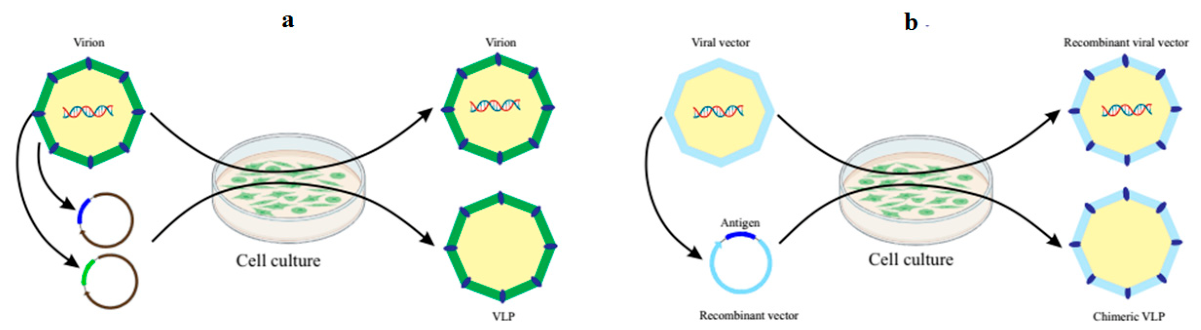
Figure 2.
(Own figure). Plant viral VLP -based vaccine development. a) The production of native plant virions and virus like particles (VLPs) in plant. b) The production of chimeric plant virus and chimeric pVLPs. Plant Viral vector express antigenic protein. Antigen genes are placed in to the viral genome to express chimeric plant virus or recombinant vector express chimeric pVLPs.
Figure 2.
(Own figure). Plant viral VLP -based vaccine development. a) The production of native plant virions and virus like particles (VLPs) in plant. b) The production of chimeric plant virus and chimeric pVLPs. Plant Viral vector express antigenic protein. Antigen genes are placed in to the viral genome to express chimeric plant virus or recombinant vector express chimeric pVLPs.
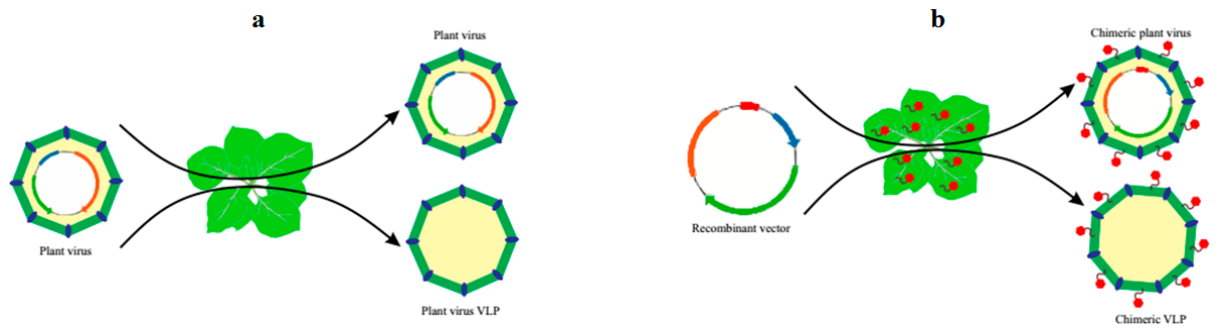
Figure 3.
(Own figure). The pVLPs can activate the innate immune system via TLRs 2, 4. The pVLPs activate and recruit innate immune cells via proinflammatory mediators. Chimeric pVLPs release antigens and generate an adaptive immune response. Potent and durable antitumor immunity is mediated by T cells and memory cells.
Figure 3.
(Own figure). The pVLPs can activate the innate immune system via TLRs 2, 4. The pVLPs activate and recruit innate immune cells via proinflammatory mediators. Chimeric pVLPs release antigens and generate an adaptive immune response. Potent and durable antitumor immunity is mediated by T cells and memory cells.
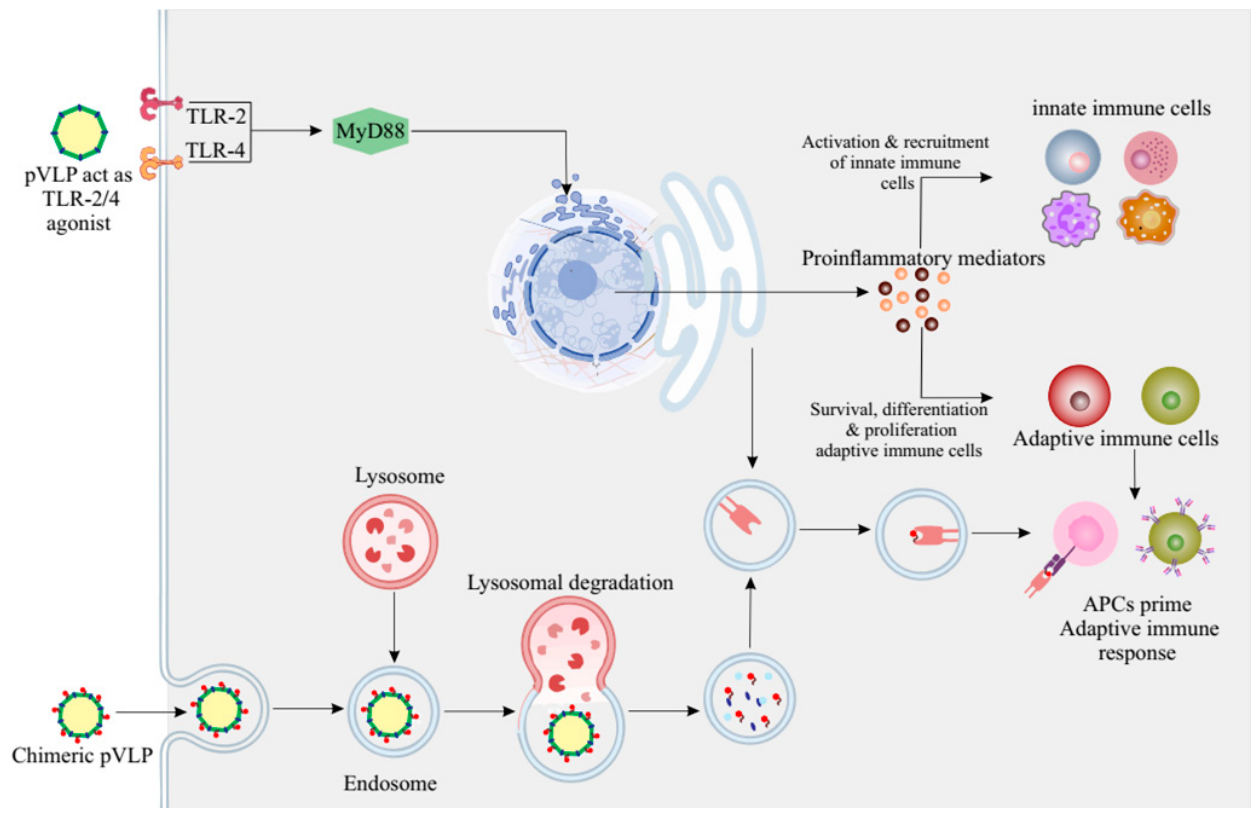

Table 1.
VLPs derived from foreign antigens for Influenza and Hepatitis viruses.
| Name of Virus | Epitope of virus | Expression system | Ref |
| Influenza viruses | hemagglutinin (HA), Neuraminidas, | Nicotiana benthamiana, Sf9 insect cells, | [41,45,46,47,48,49,50] |
| Hepatitis viruses | HBV small surface antigen (HBsAgS), Core, E1, E2, and P7 | Yeast cells, E. coli, Mammalian cells (CHO) | [42,51,52] |
Table 2.
VLPs derived from plant viruses (chimeric VLPs) displaying foreign antigens for Influenza viruses.
Table 2.
VLPs derived from plant viruses (chimeric VLPs) displaying foreign antigens for Influenza viruses.
| Plant viral vector | Target virus | Displayed antigen | Ref |
| Tobacco mosaic virus (TMV) | Influenza | M2e epitope, Hemagglutinin (HA) | [72,73,74,75] |
| Physalis mottle virus (PhMV) | Influenza | M2e epitope | [76] |
| potato virus X | Influenza | M2e epitope | [77,78,79,80] |
| Cowpea mosaic virus (CPMV) | Influenza | M2e epitope, Hemagglutinin (HA) | [79,81] |
| Cowpea chlorotic mottle virus (CCMV) | Influenza | M2e epitope | [35] |
| Maize mosaic virus (MaMV) | Influenza | M2e epitope | [82] |
Table 3.
VLPs derived from plant viruses (chimeric VLPs) displaying foreign antigens for hepatitis viruses.
Table 3.
VLPs derived from plant viruses (chimeric VLPs) displaying foreign antigens for hepatitis viruses.
| Plant viral vector | Target virus | Displayed antigen | Ref |
| Tobacco mosaic virus (TMV) | murine hepatitis virus (MHV) | 5B19 epitope | [83] |
| Papaya mosaic virus (PapMV) | Hepatitis C virus (HCV) | E2 antigenic epitope | [84] |
| Peanut yellow mosaic virus (PYV) | Hepatitis B virus (HBV) | preS1 domain | [65] |
| potato virus X (PVX) | hepatitis C virus (HCV), hepatitis E virus (HEV), | envelope protein E2 (R9 peptide), truncated HEV coat protein, HBsAg | [80,85,86,87] |
| Cucumber mosaic virus (CMV) | Hepatitis C virus (HCV) | HCV envelope protein E2 (R9 mimotope) | [88,89] |
| Alfalfa Mosaic Virus | Hepatitis C virus (HCV) | HVR1 epitope (R9) t | [90] |
| pod pepper vein yellows virus (PoPeVYV) | Hepatitis B virus (HBV) | hepatitis B surface antigen (HBsAg) | [91] |
| Cowpea mosaic virus (CPMV) | hepatitis B virus (HBV) | HBcAg | [87] |
| potato virus Y (PVY) | hepatitis B virus (HBV) | preS1 epitope | [65] |
Disclaimer/Publisher’s Note: The statements, opinions and data contained in all publications are solely those of the individual author(s) and contributor(s) and not of MDPI and/or the editor(s). MDPI and/or the editor(s) disclaim responsibility for any injury to people or property resulting from any ideas, methods, instructions or products referred to in the content. |
© 2026 by the authors. Licensee MDPI, Basel, Switzerland. This article is an open access article distributed under the terms and conditions of the Creative Commons Attribution (CC BY) license.
Copyright: This open access article is published under a Creative Commons CC BY 4.0 license, which permit the free download, distribution, and reuse, provided that the author and preprint are cited in any reuse.