
Submitted:
22 August 2026
Posted:
24 August 2026
You are already at the latest version
Abstract
Global genomic surveillance has transformed pathogen detection, but most diagnostic assays and reference databases remain optimized for known targets. Divergent, low-abundance, and uncharacterized viruses can therefore remain undetected or biologically unresolved. This limitation is particularly relevant in Africa, where complex ecosystems and rapidly changing human–animal interfaces coexist with historically uneven sampling and reference-data coverage. Here, we define African Viral Dark Matter as viral diversity that remains undetected, unresolved, or biologically uninterpretable within current surveillance systems. We distinguish three epistemic states evidence, Plausibility, and Unknowns (EPU) to separate demonstrated viral signals from ecological inferences and unresolved biological questions. We then propose an African Viral Dark Matter Atlas (AVDMA) that links viral genomes to hosts, environments, geography, and time, together with a five-dimensional Viral Relevance and Priority Score (VRPS) integrating novelty, evidentiary strength, host connectivity, geographical trajectory, and public-health relevance. The framework shifts surveillance from static viral cataloguing towards longitudinal, context-rich viral intelligence. Its objective is not to predict the next pandemic virus, but to reduce uncertainty, identify changing viral systems, and support earlier, evidence-based surveillance decisions. Successful implementation will require African leadership in sampling, sequencing, analytics, data governance, and interpretation.
Keywords:
viral dark matter
; Africa
; metagenomics
; viromics
; virus discovery
; genomic surveillance
; pandemic preparedness
; viral intelligence
1. Introduction
Pandemic preparedness remains largely organized around known pathogens. Surveillance systems typically begin with a predefined pathogen list, diagnostic target, reference genome, and epidemiological hypothesis. This model is efficient when the causative agent is recognized, but it becomes intrinsically limited when a virus is divergent, previously undescribed, or absent from reference databases.
Metagenomic sequencing offers a different starting point. Rather than testing whether a specimen contains one of a predefined set of pathogens, metagenomics interrogates its nucleic-acid content without requiring a priori knowledge of the target. This capability has expanded its use in unexplained infections, outbreak investigation, and emerging-virus surveillance [9,17].
Yet metagenomics does not eliminate the unknown. It relocates it.
The unknown becomes a problem of detection, assembly, classification, and biological interpretation. Sequences may fail to assemble, lack recognizable homologues, be misclassified as cellular DNA, derive from endogenous viral elements, reflect environmental contamination, or represent viruses whose biological significance cannot be inferred from sequence data alone. Viral dark matter therefore arises from the interaction of biological diversity, sampling, sequencing technology, computational methods, reference databases, and interpretation [1,2,3,4].
The scale of this problem is substantial. Recent viromics studies continue to identify large numbers of viral sequences with no recognizable homologues or functional annotation, while large-scale catalogues of uncultivated viral genomes demonstrate that database absence does not imply biological rarity [3,4,5]. Viral dark matter is consequently not synonymous with pathogenicity or even with novelty in the strict taxonomic sense. It is, fundamentally, an epistemic limitation in what current surveillance systems can observe and interpret.
This limitation has particular relevance in Africa. The continent encompasses tropical forests, savannahs, wetlands, deserts, coastal ecosystems, agricultural landscapes, and rapidly expanding urban centres. These environments support dynamic interactions among humans, livestock, wildlife, arthropod vectors, and environmental reservoirs. Land-use change, agricultural expansion, urbanization, wildlife trade, livestock production, and changes in vector distributions can further modify these interfaces.
At the same time, viral reference space remains uneven. Recent African metagenomic studies have identified previously uncharacterized viral diversity in patients with acute febrile illness, mosquitoes, bats, wild small mammals, and human–animal interfaces [9,10,11,12,13,14,15,16]. These findings demonstrate that conventional surveillance captures only a fraction of the viral diversity present in sampled African populations.
Crucially, these empirical signals do not demonstrate that Africa contains a disproportionate burden of dangerous unknown viruses. Instead, as visually framed by the structural gaps in Figure 6, they reveal a structural knowledge asymmetry: the viral diversity observed across African ecosystems represents a fraction of the diversity that remains unresolved by current sampling and analytical systems.
We use the term African Viral Dark Matter to denote this structural knowledge asymmetry. The term does not imply an intrinsically elevated regional biosecurity risk. It describes viral diversity that remains undetected, incompletely characterized, or biologically uninterpretable within existing surveillance boundaries.
The central analytical challenge is therefore not simply to discover more viral sequences. It is to determine which signals represent biologically meaningful viral populations, where they occur, which hosts and ecological compartments they involve, how their distribution changes over time, and whether those changes warrant intensified surveillance.
Here, we propose a conceptual framework that moves from viral discovery to viral intelligence. We distinguish demonstrated observations from ecological plausibility and unresolved biological questions using an Evidence–Plausibility–Unknowns (EPU) framework. We then propose an African Viral Dark Matter Atlas (AVDMA) and a Viral Relevance and Priority Score (VRPS) to support longitudinal, context-rich, and transparent prioritization. Importantly, we advocate for anticipatory surveillance rather than deterministic prediction. The objective is not to identify the next pandemic virus in advance, but to systematically reduce uncertainty before an outbreak, identify changes in viral systems, and shorten the interval between ecological perturbation and epidemiological recognition.
2. From Pathogen Surveillance to Viral Discovery
Conventional surveillance is optimized for recognition; viral discovery is optimized for exploration. The distinction is fundamental. A conventional diagnostic workflow may test a patient with fever for malaria, dengue, chikungunya, influenza, SARS-CoV-2, or other locally relevant pathogens. Such testing remains indispensable because it is rapid, standardized, and clinically actionable. A negative panel, however, does not establish the absence of a viral cause; it indicates only that the tested diagnostic hypotheses were not supported.
Clinical metagenomics changes this logic by allowing pathogen-agnostic interrogation of clinical specimens, as illustrated in Figure 1. Its application to unexplained acute febrile illness in Uganda illustrates this potential: metagenomic sequencing was used precisely because conventional approaches could not resolve a substantial proportion of cases [9]. More broadly, clinical metagenomics is increasingly being evaluated for diagnosis, outbreak investigation, and surveillance of viral pathogens [17].
But pathogen-agnostic sequencing should not be confused with pathogen-agnostic interpretation. A detected sequence may represent a clinically relevant virus, a passenger virus, a transient environmental signal, a contaminant, a defective genome, an endogenous viral element, or a virus replicating without causing disease. Consequently, the progression from sequence detection to virus identification, biological attribution, epidemiological significance, and public-health relevance requires progressively stronger evidence.
A divergent viral contig is therefore a scientific observation, not by itself evidence of a new pathogen. This distinction is especially important for discovery programmes in Africa. Increasing the number of viral genomes deposited in international databases is valuable, but sequence accumulation without ecological and biological context has limited capacity to inform surveillance. Viral intelligence requires information on geographic origin, host species, age and health status, ecological setting, seasonality, vector abundance, environmental conditions, longitudinal persistence, co-infections, evidence of replication, serological exposure, and, where appropriate, evidence of disease.
The conceptual transition is therefore: sequence detection → authentication → taxonomic placement → host association → ecological persistence → biological activity → transmission evidence → disease association → public-health relevance. Each step reduces uncertainty, but none can be assumed from the preceding step.
3. Why African Viral Dark Matter Remains Undercharacterized
The African Viral Dark Matter concept rests on a simple observation: the distribution of known viral sequences is shaped by the spatial and institutional distribution of sampling and analytical capacity. Three interacting asymmetries are particularly important.
3.1. Sampling Asymmetry
Sampling determines what can be observed. Human surveillance has historically focused on symptomatic patients and recognized clinical syndromes. Animal surveillance often concentrates on economically important livestock or previously recognized reservoir species. Vector surveillance is frequently organized around established arboviruses. Environmental viromes remain substantially less characterized. This creates a predictable observation bias: viral diversity in rarely sampled hosts, locations, or ecological compartments remains invisible.
Recent metagenomic investigations illustrate this principle. Studies of acute febrile illness in Uganda [9], patients in Nigeria [10,11], mosquitoes in Kenya [12] and Burkina Faso [13], mosquitoes in South Africa [14], wild small mammals in West Africa [15], and human–animal interfaces in Ghana [16] have identified viral diversity not adequately represented by conventional surveillance.
Evidence: These studies demonstrate that previously uncharacterized viral sequences and lineages can be detected across diverse African human, wildlife, and vector-associated samples. They provide direct evidence that existing surveillance does not capture the full viral diversity of sampled ecosystems.
Plausibility: Differences in sampling intensity, host selection, geographical coverage, and ecological representation plausibly generate systematic blind spots. Viral populations associated with unsampled hosts or ecological compartments are less likely to enter reference databases or surveillance systems.
Unknowns: The magnitude of this blind spot remains unresolved. Current studies cannot establish the total viral diversity present across African ecosystems, nor determine what proportion of uncharacterized sequences correspond to active, persistent, or epidemiologically relevant viruses. The implication is methodological rather than geographical: the map of viral diversity partly follows the map of sampling effort.
3.2. Reference-Database Asymmetry
A sequence without a close reference may be classified as unknown even when it represents a biologically real virus. This produces a paradox: the more divergent a virus is from characterized viruses, the less likely conventional homology-based pipelines are to recognize it. Viral dark matter can therefore become greatest precisely where reference coverage is weakest.
VirSorter2 and related tools have improved the detection of diverse viral sequences, including groups poorly represented in reference databases [18]. CheckV provides complementary assessment of completeness and contamination in metagenome-assembled viral genomes [19]. Large resources such as MetaVR and VIRE further expand the searchable viral sequence space and integrate environmental context [5,20]. Yet computational improvement cannot fully compensate for biological underrepresentation.
Evidence: Current viral resources contain millions of previously uncultivated viral genomes and genome-resolved viral populations [5,20]. Their expansion demonstrates the extent to which viral sequence space exceeds traditional reference collections.
Plausibility: Underrepresentation of particular hosts, geographic regions, and ecological systems is likely to reduce the ability of homology-based and machine-learning approaches to classify divergent sequences originating from those systems.
Unknowns: The extent to which reference-database bias alters estimates of African viral diversity, lineage distribution, or public-health relevance remains poorly quantified. It is also unclear how much apparently novel sequence space represents genuinely novel viruses versus divergent members of already recognized viral groups.
The resulting unknown category is heterogeneous. It encompasses: (1) genuinely novel viral lineages; (2) highly divergent members of known viral groups; (3) incomplete viral genomes; (4) endogenous viral elements; (5) cellular sequences misclassified as viral; (6) laboratory or environmental contaminants; (7) sequencing artefacts; (8) environmental viral fragments; and (9) biologically real viruses whose functions remain unknown. These categories must not be treated as equivalent.
3.3. Ecological Asymmetry
African viral diversity cannot be understood from human clinical samples alone. Viruses circulate within complex ecological networks involving wildlife, livestock, vectors, plants, water, soil, and human populations. Global viromics studies demonstrate that viral communities vary systematically with host ecology, geography, and environmental conditions [21,22,23,24]. African ecosystems are particularly dynamic: deforestation, agricultural expansion, urbanization, livestock intensification, wildlife trade, climate variability, and changes in vector distributions modify contact networks between hosts and ecological compartments.
Evidence: Viromics studies demonstrate extensive viral diversity across wildlife, vectors, environmental compartments, and human-associated ecosystems [21,22,23,24].
Plausibility: Rapid changes in land use, host distributions, and human–animal interfaces can alter opportunities for viral circulation and transmission. These processes provide plausible mechanisms through which previously uncharacterized viral populations could move between ecological compartments.
Unknowns: The contribution of specific ecological changes to the emergence, persistence, or spillover of individual African viruses remains incompletely quantified. Ecological plausibility should therefore not be presented as evidence of increased pathogenicity or spillover risk. The fundamental distinction remains: ecological opportunity is not evidence of emergence.
4. The African Viral Reference Paradox
Africa has substantially expanded genomic surveillance capacity, particularly following the COVID-19 pandemic. Yet this expansion has occurred within a global genomic infrastructure whose reference space was constructed over decades and remains unevenly populated [25,26]. We term this the African Viral Reference Paradox: the capacity to generate genomic data can increase faster than the capacity of global databases to contextualize the biological diversity represented by those data.
A laboratory may therefore generate a high-quality sequence from an African sample while classification remains uncertain because its closest evolutionary relatives have not been sampled from the same ecological region—or perhaps anywhere. Reference databases dictate what can be recognized, named, compared, and prioritized, thus heavily biasing scientific attention and public-health interpretation.
The problem is particularly acute for highly divergent RNA viruses [28]. Short reads may lack reliable nucleotide-level matches. Protein-level searches can recover deeper relationships, but these approaches also become uncertain when viral proteins are highly divergent or poorly annotated [1,18,28]. The unknown category must therefore be managed as a structured uncertainty rather than a single taxonomic class. A sequence with no database match should trigger additional characterization, not automatic classification as a novel pathogen. Similarly, a highly divergent genome should not receive elevated public-health priority solely because of its evolutionary novelty.
5. From Viral Dark Matter to Viral Intelligence
The central conceptual transition proposed here is from viral dark matter to viral intelligence. Viral dark matter is an epistemic category: viral diversity that remains undetected, unresolved, or uninterpretable. Viral intelligence is an operational category: contextualized information about viral populations that can support biological interpretation, ecological understanding, and surveillance decisions.
5.1. An Epistemic Ladder for Viral Intelligence
To prevent the common inferential error of treating taxonomic novelty as a surrogate for biological significance, we structure the transition across a nine-level epistemic ladder (Figure 2), grouped into three validation phases:
Phase 1: Bioinformatic & Molecular Validation
Level 1. Detection: Was a viral sequence reproducibly detected?
Level 2. Authentication: Is the signal supported by adequate read depth, assembly quality, negative controls, and reproducibility?
Level 3. Taxonomic Placement: Can the sequence be assigned to an established viral lineage or supported as a previously unrecognized lineage?
Phase 2: Biological & Ecological Characterization
Level 4. Host Association: Is there credible evidence that the viral population is associated with the sampled host?
Level 5. Ecological Persistence: Does the signal recur across individuals, locations, seasons, or time?
Level 6. Biological Activity: Is there evidence of replication, transcription, seroconversion, or tissue association?
Phase 3: Epidemiological & Threat Intelligence
Level 7. Transmission Dynamics: Is there evidence of movement between hosts, vectors, or ecological compartments?
Level 8. Phenotypic Significance: Is there evidence that infection affects host biology or is associated with pathology/disease?
Level 9. Public-Health Threat: Does the available evidence justify intensified surveillance, containment, or clinical intervention?
5.2. Evidence–Plausibility–Unknowns (EPU) Framework
The epistemic ladder can be operationalized through three analytical states:
Evidence: Comprises observations directly supported by data: reproducible sequence detection, genome assembly, taxonomic relationships, host association, recurrence, or experimentally supported biological activity.
Plausibility: Concerns mechanisms that are biologically or ecologically reasonable but not yet demonstrated for a specific viral population. These may include potential host connectivity, effects of land-use change, ecological expansion, or possible transmission pathways.
Unknowns: Encompasses unresolved properties such as replication competence, viability, prevalence, persistence, transmissibility, host range, seroprevalence, and disease causation.
For most metagenome-assembled viral genomes, sequence detection provides limited information about replication, infectivity, transmission, or disease causation. These uncertainties define the exact boundary between raw viral discovery and actionable viral intelligence.
5.3. Novelty Is Not Risk
A highly divergent environmental virus may represent substantial evolutionary novelty but little immediate public-health concern. Conversely, a less novel virus repeatedly detected at a human–animal interface may warrant urgent attention because of its ecological connectivity and changing distribution. Risk prioritization must therefore integrate multiple dimensions: Novelty × Evidence × Host Connectivity × Geographical Trajectory × Public-Health Relevance. This multidimensional approach avoids the “novelty trap,” in which the most evolutionarily unusual sequence automatically receives the highest priority.
6. Methodological Workflows and Emerging Technologies
6.1. Shotgun Metagenomics and Metatranscriptomics
Shotgun metagenomics provides broad access to DNA- and RNA-derived nucleic-acid sequences, whereas metatranscriptomics improves the detection of actively transcribed RNA viruses. Neither approach is universally optimal. Library preparation, nucleic-acid extraction, viral enrichment, depletion strategies, sequencing depth, and specimen type profoundly influence the resulting virome [29,30]. African viral surveillance should avoid imposing a single universal laboratory protocol; instead, programmes should define standardized minimum reporting and quality-control requirements while allowing laboratory workflows to adapt to specimen type and research question. The goal is comparability without sacrificing biological sensitivity.
6.2. Long-Read Sequencing
Long-read sequencing (e.g., Oxford Nanopore, PacBio) improves genome reconstruction and bridges repetitive or complex regions that remain fragmented in short-read datasets. Recent mosquito virome studies illustrate its potential for resolving viral diversity across different sampling scales [31]. However, long reads do not eliminate contamination, misclassification, or biological ambiguity. Their value is maximized when integrated with short-read sequencing, independent validation, and stringent quality control.
6.3. Artificial Intelligence and Structural Homology
Artificial intelligence is transforming viral discovery. As depicted in the integrated computational workflow in Figure 3, large-scale computational models and protein-structure-based prediction algorithms (e.g., AlphaFold, ESMFold) can identify deep evolutionary relationships that escape conventional sequence similarity searches [32,33]. This capability expands viral dark-matter discovery by inferring functional annotations across highly divergent sequence space. But AI introduces a distinct epistemic risk: a prediction is not an observation. Models trained predominantly on existing databases may reproduce the taxonomic, geographical, and ecological biases embedded in those databases. High model complexity does not guarantee reliability for underrepresented viral lineages. African viral intelligence requires: (1) explicit uncertainty estimates; (2) transparent training-data provenance; (3) independent experimental validation; (4) benchmark datasets containing divergent African viral groups; and (5) rigorous separation of model prediction from experimentally supported observation.
6.4. Integrated Computational Workflows
Modern viral discovery combines viral identification, genome-quality assessment, taxonomic classification, and structural protein inference. VirSorter2 and CheckV provide indispensable standard components [18,19]. However, indiscriminately chaining bioinformatic tools can compound false-positive and false-negative errors [34]. The analytical goal is not the largest possible tally of candidate contigs, but a fully validated evidence chain.
7. The Major Methodological Trap: Discovering Noise Instead of Viruses
The rapid expansion of viral discovery creates a critical methodological risk: becoming increasingly efficient at detecting sequences without becoming equally effective at identifying biologically real viruses. Five specific failure modes must be guarded against:
1.Contamination: Environmental specimens contain high nucleic acid backgrounds. Reagents, extraction kits, sequencing libraries, and cross-sample carryover introduce sequences unrelated to the biological specimen. Negative extraction and sequencing controls are obligatory, and low-abundance signals must be evaluated relative to batch controls.
2.Endogenous Viral Elements (EVEs): Viral sequences integrated into host genomes can mimic active viruses. This is highly prevalent in wildlife, where EVEs represent substantial evolutionary memory [35]. The presence of a viral-like sequence in a host-derived sample does not prove active viral infection or replication.
3.Assembly Artefacts: Short-read assemblies can generate chimeric or fragmented contigs. While CheckV assesses completeness [19], high completeness must never be conflated with biological viability.
4.Index Misassignment and Carryover: High-throughput multiplexing can introduce low-level index hopping, generating false-positive rare infection signals. Signal reproducibility across independent biological replicates and sequencing batches is essential.
5.Database Contamination and Annotation Propagation: Reference databases contain misannotated sequences that propagate iteratively through automated pipelines, turning initial misclassifications into consensus errors.
Every candidate African viral dark-matter sequence must therefore receive a formal confidence profile incorporating read support, assembly quality, genome completeness, contamination indicators, taxonomic confidence, host association, recurrence, geographical distribution, biological activity, and orthogonal validation. A sequence must never be classified as an emerging pathogen solely because it is taxonomically novel.
8. From Novel Virus to Risk-Relevant Virus: The VRPS Framework
The public-health utility of viral dark-matter surveillance depends on structured prioritization. Without it, discovery programmes generate vast lists of viral genomes with minimal actionable utility. We propose the **Viral Relevance and Priority Score (VRPS)** as a transparent, standardized decision-support tool. The VRPS is not a deterministic predictive model and does not calculate absolute spillover probability; its objective is to organize heterogeneous evidence and prioritize candidates for targeted follow-up.
8.1. Five-Dimensional Scoring Metric
Each candidate viral population is evaluated from 0 to 4 across five weighted dimensions
| Dimension | 0 | 1 | 2 | 3 | 4 | Weight |
| Novelty (N) | Known/near-identical | Minor divergence | Moderately divergent | Highly divergent lineage | Previously unrecognized lineage | 15% |
| Evidence (E) | Sequence signal only | Weak reproducibility | Reproducible sequence/assembly | Evidence of replication, exposure or persistence | Independent biological validation and/or disease association | 25% |
| Host connectivity (H) | Single environmental compartment | Single non-human host | Multiple related hosts | Human–animal or vector interface | Repeated detection across epidemiologically connected hosts/compartments | 20% |
| Geographical trajectory (G) | Single detection | Stable local detection | Recurrent local circulation | Expansion across sites/regions | Consistent spatial expansion or emergence in new ecological settings | 20% |
| Public health relevance (P) | No plausible relevance | Low plausibility | Uncertain relevance | Plausible relevance based on host, biology or exposure | Strong rationale for intensified surveillance | 20% |
The proposed score is: VRPS = 100 × [(0.15N + 0.25E + 0.20H + 0.20G + 0.20P) / 4] The resulting value ranges from 0 to 100.
The weighting deliberately gives greater influence to evidentiary strength than to taxonomic novelty. These weights are provisional and should be prospectively evaluated against longitudinal surveillance outcomes.
8.2. Operational Action Tiers
| VRPS | Priority | Operational interpretation |
| 0–24 | Background | Maintain in the Atlas; no immediate escalation |
| 25–49 | Monitor | Repeat sampling and improve metadata/evidence |
| 50–74 | Investigate | Targeted longitudinal surveillance and orthogonal validation |
| 75–100 | Intensify | Multidisciplinary investigation and expanded surveillance |
The operational implementation of the VRPS calculation engine and its integrated decision dashboard are detailed in Figure 4.
8.3. Evidence Gates and Safeguards
To prevent score inflation from low-quality data, candidates must pass five strict Evidence Gates before scoring: (1) Authentication Gate: Minimum read depth and negative control verification; (2) Contamination Gate: Zero unresolved reagent or cross-sample contamination; (3) Biological-Context Gate: Complete host, spatial, and ecological metadata; (4) Activity Gate: Explicit distinction between contig presence and active replication; (5) Independence Gate: VRPS escalation above 50 requires orthogonal verification or independent sample re-detection.
8.4. Trajectory and Dynamic Re-Evaluation
Emergence is a longitudinal process. A viral population detected once in an isolated host differs fundamentally from one undergoing spatial expansion or host shifts [21,36,37,38]. The VRPS must be dynamically recalculated as longitudinal data accumulate. A candidate can escalate from Monitor to Investigate without any genomic mutation if its geographical trajectory or host connectivity expands. In anticipatory surveillance, the primary signal of concern is often a change in ecological context rather than a change in viral sequence.
9. From Pathogen Surveillance to Ecosystem Surveillance
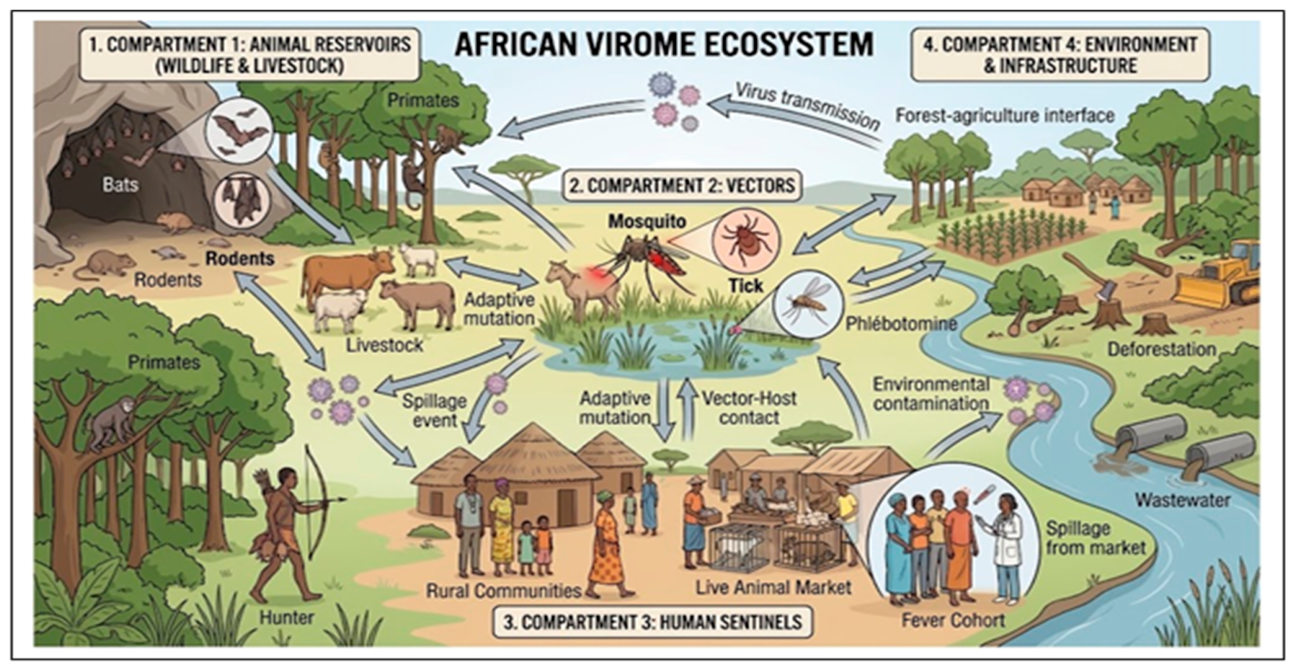
Surveillance focused exclusively on human clinical cases captures infection only after spillover has occurred. As structured in the One Health framework in Figure 5, a comprehensive ecosystem surveillance system must systematically sample four interconnected ecological compartments:
1.Human Compartment: Unexplained febrile cohorts, severe acute respiratory or neurological syndromes, occupational sentinel populations (hunters, slaughterhouse workers).
2.Animal Compartment: Domestic livestock, wildlife reservoirs (bats, rodents, non-human primates), animals in trade networks and live markets.
3.Vector Compartment: Mosquitoes, ticks, sandflies, and other hematophagous arthropods.
4.Environmental Compartment: Wastewater, surface water, agricultural runoff, and air sampling at high-contact ecological interfaces [39].
The objective is not blanket, unselective sequencing of all environments, which is neither cost-effective nor informative. Instead, sampling must be strategically targeted at ecological hotspots where land-use changes, biodiversity loss, or altered contact networks create high exposure potential.
10. The African Viral Dark Matter Atlas
We propose the African Viral Dark Matter Atlas (AVDMA) as a continent-wide infrastructure for contextualized viral intelligence. Rather than acting as a static sequence repository, the AVDMA integrates genomic data with ecological, spatial, and temporal metadata.
Every AVDMA entry follows a unified metadata structure: Sequence → Genome Quality → Taxonomy → Host → Location → Environment → Time → Abundance → Recurrence → Ecological Association → Biological Evidence → Risk Indicators. As outlined in Figure 4, the Atlas operates through three integrated layers:
Genome Layer: Assembled genomes, contigs, protein annotations, CheckV quality metrics, evolutionary trees, and AI structural models.
Ecological Layer: Host and vector distributions, land-use mapping, climate variables, seasonality, and agricultural interfaces.
Surveillance Layer: Spatial-temporal tracking, prevalence trends, serology, VRPS scores, and escalation alerts.
This architecture transforms the central inquiry from “What is this sequence?” to “Where does this viral population circulate, in which hosts, under what ecological drivers, and has its risk profile changed?” [5,20]. Addressing the four structural knowledge gaps shown in Figure 6 is crucial to achieving this transition.
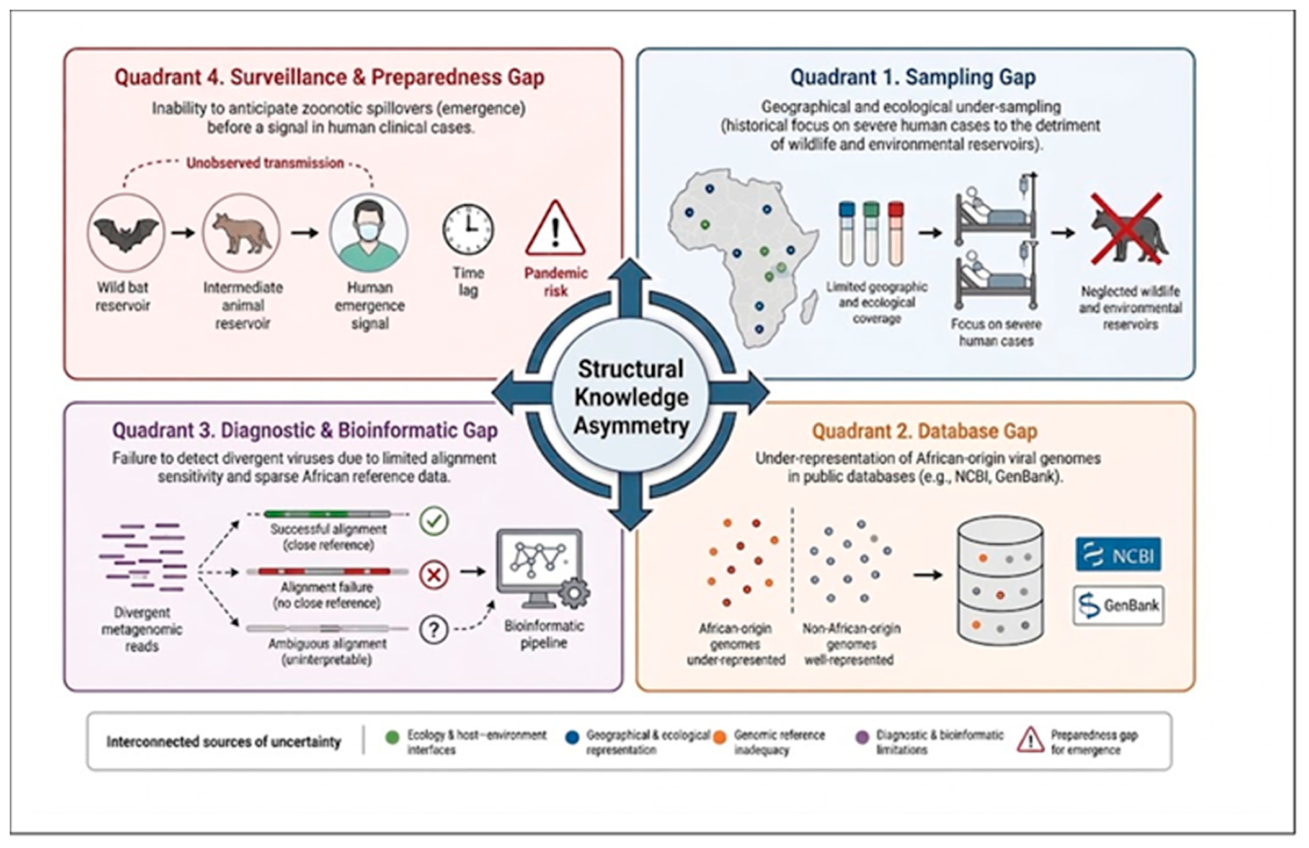
Figure 6.
The four quadrants of structural knowledge asymmetry in global viral surveillance. Unresolved viral dark matter stems from four interconnected analytical gaps: Quadrant 1 (Sampling Gap: historical focus on severe human clinical cases leading to severe under-sampling of wildlife and environmental reservoirs in Africa), Quadrant 2 (Database Gap: severe under-representation of African-origin viral genomes in public databases like NCBI/GenBank), Quadrant 3 (Diagnostic & Bioinformatic Gap: alignment failure or ambiguous classification of divergent reads due to sparse reference data), and Quadrant 4 (Surveillance & Preparedness Gap: time lag between unobserved transmission in animal reservoirs and human emergence). Addressing these asymmetries is essential to close the preparedness gap.
11. Implications for Pandemic Preparedness and African Scientific Sovereignty
The primary justification for an African viral dark-matter programme is anticipatory preparedness. Sequence-based models cannot predict exact pandemic emergence events because spillover depends on complex ecological, host, viral, and human behavioral variables. However, systematic surveillance reduces baseline uncertainty. By characterizing viral populations before spillover occurs, baseline diagnostic assays can be updated, diagnostic blind spots eliminated, and early warning signals captured.
11.1. African Scientific Sovereignty and Governance
Historical models of viral discovery in Africa have frequently suffered from extractive dynamics: biological specimens collected locally were exported for sequencing and publication abroad, leaving local infrastructure underfunded. The AVDMA framework asserts that African institutions must exercise primary leadership over sampling design, sequencing, bioinformatic analysis, data stewardship, and policy interpretation. Local contextual knowledge regarding seasonal human behavior, ecology, and clinical presentation is an indispensable component of scientific accuracy. Data-sharing protocols must balance international open-science standards with national sovereignty, ethical governance, and equitable benefit-sharing.
12. Research Agenda for the Next Decade
To operationalize the framework, we outline five strategic research priorities for the next decade:
1.Establish Representative Baseline Viromes: Conduct systematic, longitudinal virome mapping across contrasting ecosystems (tropical rainforests, savannahs, urban fringes) to define baseline viral diversity [40,41,42,43].
2.Standardize Evidence Frameworks: Enforce rigid epistemic standards distinguishing simple contig detection from proven biological activity and disease causation.
3.Transition to Longitudinal Surveillance: Shift resources from single-point discovery expeditions to sustained, multi-year monitoring of high-risk human–animal interfaces[44].
4.Integrate Multi-Omics and Environmental Intelligence: Combine viral genomic data with remote sensing, land-use cartography, vector ecology, and climate modeling.
13. Conclusion
The primary bottleneck in global pandemic preparedness is not a lack of sequencing throughput, but an over-reliance on static diagnostic targets and pre-defined pathogen lists. African Viral Dark Matter represents a structural knowledge asymmetry born from historical sampling biases, uneven reference coverage, and methodological constraints. By uniting pathogen-agnostic metagenomics, structural AI, One Health ecological integration, and the VRPS framework within an African-led governance model, surveillance can evolve from reactive outbreak response into a proactive, anticipatory intelligence system. The objective is not to find every virus on the continent, but to systematically illuminate the biological unknowns that constrain global health security.
Author Contributions
M.M.M.: conceptualisation, literature search, analysis and synthesis, writing-original draft preparation. M.M.M. and R.K.N.: writing review and editing. Both authors approved the final manuscript.
Funding
This research received no external funding.
Data availability
No new data were generated or analysed in this study. Data sharing is not applicable.
Declaration of interests
The authors declare no competing interests.
Declaration of Generative AI for Figures
Generative AI tools were used solely to assist in creating and formatting conceptual figures. The authors take full responsibility for the final figures.
References
- Rosario, K.; Breitbart, M. Exploring the viral dark matter. Trends Microbiol. 2017, 25(9), 700–710. [Google Scholar]
- Santiago-Rodriguez, T. M.; Hollister, E. B. Unraveling the viral dark matter through viral metagenomics. Front. Immunol. 2022, 13, 1005107. [Google Scholar] [CrossRef]
- Kosmopoulos, J. C.; Anantharaman, K. Viral dark matter: Illuminating protein function, ecology, and biotechnological promises. Biochemistry 2025, 64(22), 4609–4627, [Référence récente directement liée au concept de viral dark matter]. [Google Scholar] [CrossRef]
- Lu, C.; Wu, Y.; Zhang, Z.; et al. Estimated size of the total genome and protein space of viruses. mSphere 2025, 10(1), e0068324. [Google Scholar] [CrossRef]
- Fiamenghi, M. B.; Camargo, A. P.; Chasapi, I. N.; et al. Meta-virus resource (MetaVR): Expanding the frontiers of viral diversity with 24 million uncultivated virus genomes. Nucleic Acids Res. 2026, 54(D1), D801–D812. [Google Scholar] [CrossRef]
- Paez-Espino, D.; Eloe-Fadrosh, E. A.; Pavlopoulos, G. A.; Thomas, A. D.; Huntemann, M.; Mikhailova, N.; Kyrpides, N. C. Uncovering Earth’s virome. Nature 2016, 536(7617), 425–430. [Google Scholar] [CrossRef]
- Martínez Martínez, J.; Martinez-Hernandez, F.; Martinez-Garcia, M. Single-virus genomics and beyond. Nat. Rev. Microbiol. 2020, 18(12), 705–716, [Référence méthodologique sur la single-virus genomics]. [Google Scholar] [CrossRef]
- Carroll, D.; Daszak, P.; Wolfe, N. D.; Gao, G. F.; Hayman, D. T. S.; Mazet, J. A. K.; Ostfeld, R. S. The Global Virome Project. Science 2018, 359(6378), 872–874, [Référence majeure pour positionner le concept par rapport à la découverte virale mondiale]. [Google Scholar] [CrossRef]
- Ashraf, S.; Jerome, H.; Bugembe, D. L.; et al. Uncovering the viral aetiology of undiagnosed acute febrile illness in Uganda using metagenomic sequencing. Nat. Commun. 2025, 16, Article 2844. [Google Scholar] [CrossRef]
- Oguzie, J. U.; Petros, B. A.; Oluniyi, P. E.; et al. Metagenomic surveillance uncovers diverse and novel viral taxa in febrile patients from Nigeria. Nat. Commun. 2023, 14, 4693. [Google Scholar] [CrossRef]
- Auteur, A. A. Metagenomic surveillance of undiagnosed febrile illness in Nigeria does not reveal the etiological agent for most patients. Journal Name Pending 2025, Vol, Pages, [Référence utile pour discuter les limites du mNGS et le fait que la métagénomique ne résout pas tous les cas]. [Google Scholar]
- Wanjiru, T.; Bulimo, W.; Langat, S.; et al. Vertical transmission of Dengue virus type-3 and metagenomic virome profiles of Aedes aegypti mosquitoes collected in Kisumu, Kenya. PLoS ONE 2025, 20(1), e0315492. [Google Scholar] [CrossRef]
- Kaboré, D. P. A.; Exbrayat, A.; Charriat, F.; et al. A metagenomics survey of viral diversity in mosquito vectors allows the first detection of Sindbis virus in Burkina Faso. PLoS ONE 2025, 20(2), e0323767. [Google Scholar] [CrossRef]
- Kacnik, S.; MacIntyre, C.; Guarido, M.; Venter, M. Identification of insect-specific viruses in mosquitoes collected from wildlife and rural areas in north-eastern South Africa using a metagenomic RNA sequencing approach. One Health Outlook 2025, 7, 62. [Google Scholar] [CrossRef]
- Zhang, X. A.; Zhang, M. Q.; Liu, Y. W.; et al. Virome characterization of wild small mammals provides new insight into zoonotic pathogens in West Africa. Microbiome 2025, 13, 242. [Google Scholar] [CrossRef]
- Paoli, J. E.; Trovão, N. S.; Odoom, T.; et al. One Health genomic surveillance at human-animal interfaces in rural Ghana reveals underreported viruses of zoonotic and economic concern. Viruses 2026, 18(5), 644. [Google Scholar] [CrossRef]
- Torres Montaguth, O. E.; Buddle, S.; Morfopoulou, S.; Breuer, J. Clinical metagenomics for diagnosis and surveillance of viral pathogens. Nat. Rev. Microbiol. 2026, 24(1), 61–75. [Google Scholar] [CrossRef]
- Roux, S.; Paul, B. G.; Bagby, S. C.; et al. VirSorter2: A multi-classifier, expert-guided approach to detect diverse DNA and RNA viruses. Microbiome 2021, 9, 100. [Google Scholar] [CrossRef]
- Nayfach, S.; Camargo, A. P.; Schulz, F.; Eloe-Fadrosh, E.; Roux, S.; Kyrpides, N. C. CheckV assesses the quality and completeness of metagenome-assembled viral genomes. Nat. Biotechnol. 2021, 39(5), 578–585, [Référence importante pour la qualité et la complétude des génomes viraux assemblés]. [Google Scholar] [CrossRef] [PubMed]
- Nishijima, S.; Fullam, A.; Schmidt, T. S. B.; et al. VIRE: A metagenome-derived, planetary-scale virome resource with environmental context. Nucleic Acids Res. 2026, 54(D1), D902–D911. [Google Scholar] [CrossRef]
- Pan, Y. F.; Zhao, H.; Gou, Q. Y.; et al. Metagenomic analysis of individual mosquito viromes reveals the geographical patterns and drivers of viral diversity. Nat. Ecol. Evol. 2024, 8(5), 947–959. [Google Scholar] [CrossRef]
- Yan, X.; Liu, Y.; Hu, T.; et al. A compendium of 8,176 bat RNA viral metagenomes reveals ecological drivers and circulation dynamics. Nat. Microbiol. 2025, 10(3), 554–568. [Google Scholar] [CrossRef]
- Graham, E. B.; Camargo, A. P.; Wu, R.; et al. A global atlas of soil viruses reveals unexplored biodiversity and potential biogeochemical impacts. Nat. Microbiol. 2024, 9(7), 1873–1883. [Google Scholar] [CrossRef]
- Cuteri, V.; Preziuso, S.; Li, Y.; Laus, F. Fecal virome at the human-animal interface: A One Health perspective on an uncharted frontier. Anim. Microbiome 2026, 8, 12. [Google Scholar] [CrossRef]
- Ochola, R. The case for genomic surveillance in Africa. Trop. Med. Infect. Dis. 2025, 10(4), 129. [Google Scholar] [CrossRef]
- World Health Organization. Global genomic surveillance strategy for pathogens with pandemic and epidemic potential, 2022–2032; World Health Organization, 2022; [Référence institutionnelle essentielle pour la surveillance génomique]. [Google Scholar]
- World Health Organization. Considerations for developing a national genomic surveillance strategy or action plan for pathogens with pandemic and epidemic potential; World Health Organization, 2023; [Référence sur la mise en œuvre de la surveillance génomique]. [Google Scholar]
- Debat, H.; Bejerman, N. An update on RNA virus discovery: Current challenges and future perspectives. Viruses 2025, 17(1), 45. [Google Scholar] [CrossRef]
- Choi, H.; Kang, D. W.; Jo, Y.; et al. Library preparation biases plant virome detection: poly(A) mRNA enrichment vs. rRNA depletion. Int. J. Mol. Sci. 2026, 27(4), 2300. [Google Scholar] [CrossRef]
- Chang, W. S.; Harvey, E.; Mahar, J. E.; et al. Improving the reporting of metagenomic virome-scale data. Commun. Biol. 2024, 7, 1687. [Google Scholar] [CrossRef]
- Mancini, P.; Brandtner, D.; Cordeschi, G.; et al. Evaluating the effect of sampling scale on mosquito virome characterization using PacBio HiFi long-read metagenomics. Insects 2026, 17(7), 112. [Google Scholar] [CrossRef]
- Hou, X.; He, Y.; Fang, P.; et al. Using artificial intelligence to document the hidden RNA virosphere. Cell 2024, 187(23), 6929–6943. [Google Scholar] [CrossRef]
- Lytras, S.; Ghafari, M.; Grove, J. Studying the deep evolution of viruses in the era of artificial intelligence structure prediction. Annu. Rev. Virol. 2026, 13, 105–125. [Google Scholar] [CrossRef]
- Author, A. A. Benchmarking informatics approaches for virus discovery: Caution is needed when combining in silico identification methods. mSystems 2024, 9(3), e00123-24. [Google Scholar] [CrossRef]
- Verhoeven, J. T. P.; Shapiro, J. T.; Holm Jensen, R.; et al. Characterizing the parvovirome of Swazi bats: Novel species, highly divergent lineages, endogenous viral elements, and taxonomic challenges. Virus Evol. 2026, 12(1), veag042. [Google Scholar] [CrossRef]
- Paoli, J. E.; Thongthum, T.; Bassett, M.; et al. Virome and microbiome of Florida bats illuminate viral co-infections, dietary viral signals, and gut microbiome shifts. Microorganisms 2025, 13(2), 340. [Google Scholar] [CrossRef]
- Peng, J.; Liu, Y.; Zhang, C.; et al. Ecological factors and host community characteristics as potential drivers of bat RNA virus spillover. Biology 2026, 15(4), 609. [Google Scholar] [CrossRef]
- Arnold, M. J.; Bergner, L. M.; Malik, H.; et al. Drivers of viral diversity and sharing in marine mammals. Mol. Ecol. 2026, 35(2), e70294. [Google Scholar] [CrossRef]
- Worp, N.; Nieuwenhuijse, D. F.; Izquierdo-Lara, R. W.; et al. Unveiling the global urban virome through wastewater metagenomics. Nat. Commun. 2025, 16, 10707. [Google Scholar] [CrossRef]
- Russell, T.; Formiconi, E.; Murphy, A.; et al. One Health viral metagenomics for pathogen surveillance: Robust mNGS workflows for viral detection and genome recovery from swab and tissue specimens. BMC Microbiol. 2026, 26, 88. [Google Scholar] [CrossRef]
- Roux, S.; Coclet, C. Viromics approaches for the study of viral diversity and ecology in microbiomes. Nat. Rev. Genet. 2026, 27(1), 32–46. [Google Scholar] [CrossRef]
- Liu, B.; Zhu, L.; Zhou, S.; et al. ZOVER 2.0: A virome-based platform for zoonotic and vector-borne viruses. Nucleic Acids Res. 2026, 54(D1), D925–D931. [Google Scholar] [CrossRef]
- Wang, H.; Meng, Y.; Chen, X.; et al. Unveiling novel viral diversity, biogeography, and host networks in wildlife through high-throughput sequencing data mining. Adv. Sci. 2025, 12(8), e11920. [Google Scholar] [CrossRef]
- Nthuku, S.; Mordecai, J.; Babajide, A. A.; et al. The Kenyan Human Gut Virome Catalogue reveals extensive viral diversity and age-dependent community structure. Sci. Rep. 2026, 16, 4102. [Google Scholar]
- Nwokorogu, V. C.; Pillai, S.; San, J. E.; et al. A metagenomic investigation of the faecal RNA virome structure of asymptomatic chickens in South Africa. BMC Genom. 2024, 25, 629. [Google Scholar] [CrossRef]
- Mounchili-Njifon, A.; Heang, V.; Pum, L.; et al. Characterization of near-complete human Pegivirus 2 genomes in individuals co-infected with HCV in Cameroon. Microbiol. Resour. Announc. 2026, 15(2), e0006926. [Google Scholar] [CrossRef]
- Paietta, E. N.; Johnston, R. A.; Kraberger, S.; et al. Mammal-infecting DNA viruses identified in lemurs and rodents in Madagascar mirror the evolutionary history of their hosts. Microb. Genom. 2026, 12(3), 001210. [Google Scholar] [CrossRef]
Figure 1.
Paradigm shift from conventional target-specific diagnostic surveillance to metagenomic agnostic interrogation. (A) Conventional diagnostic surveillance funnels clinical specimens (e.g., blood, swabs) through targeted molecular assays (such as RT-PCR) designed for specific known pathogens (Viruses A, B, and C). Uncharacterized, divergent, or novel viral sequences fall into a diagnostic blind spot, leaving acute febrile illnesses etiology unresolved. (B) Metagenomic agnostic interrogation employs untargeted nucleic acid extraction, high-throughput next-generation sequencing (mNGS), and bioinformatic pipelines to sequence the complete nucleic acid background. This enables the parallel identification of known cellular organisms and pathogens, host background, unclassified non-viral reads, and African Viral Dark Matter (divergent reads, endogenous viral elements, and orphan families), driving the transition towards comprehensive viral intelligence and knowledge generation.
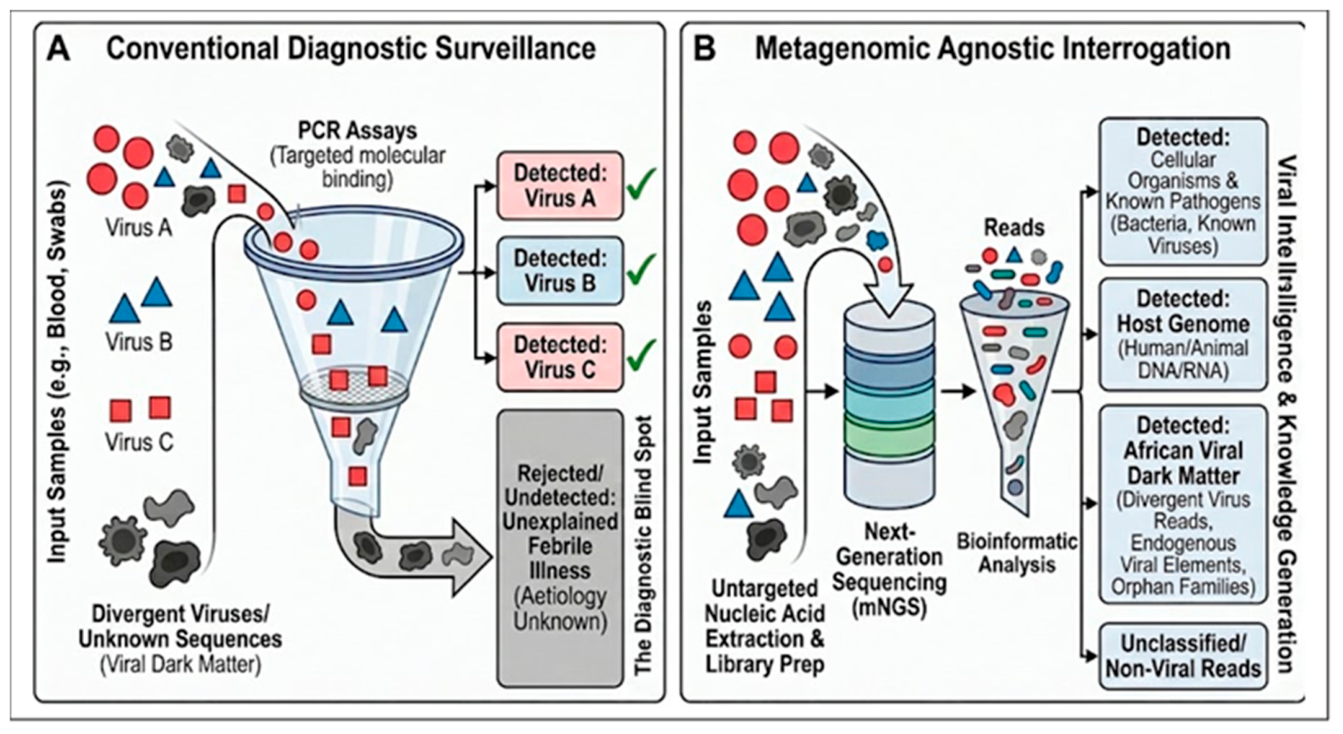
Figure 2.
Epistemic ladder for viral intelligence and risk attribution. The progression from viral dark matter to operational intelligence requires passing through nine hierarchical levels structured into three distinct analytical phases. Phase 1 (Bioinformatic & Molecular Validation) encompasses Level 1 (Detection: sequence signal), Level 2 (Authentication: read depth, assembly quality, negative controls), and Level 3 (Taxonomic Placement: phylogenetic divergence). Phase 2 (Biological & Ecological Characterization) covers Level 4 (Host Association: credible host mapping), Level 5 (Ecological Persistence: recurrent detection across space/time), and Level 6 (Biological Activity: in vitro/in vivo replication, tissue tropism, seroconversion). Phase 3 (Epidemiological & Threat Intelligence) addresses Level 7 (Transmission Dynamics: interspecies movement, vector competency), Level 8 (Phenotypic Significance: pathology, cellular damage), and Level 9 (Public-Health Threat: epidemiological prioritization for response).
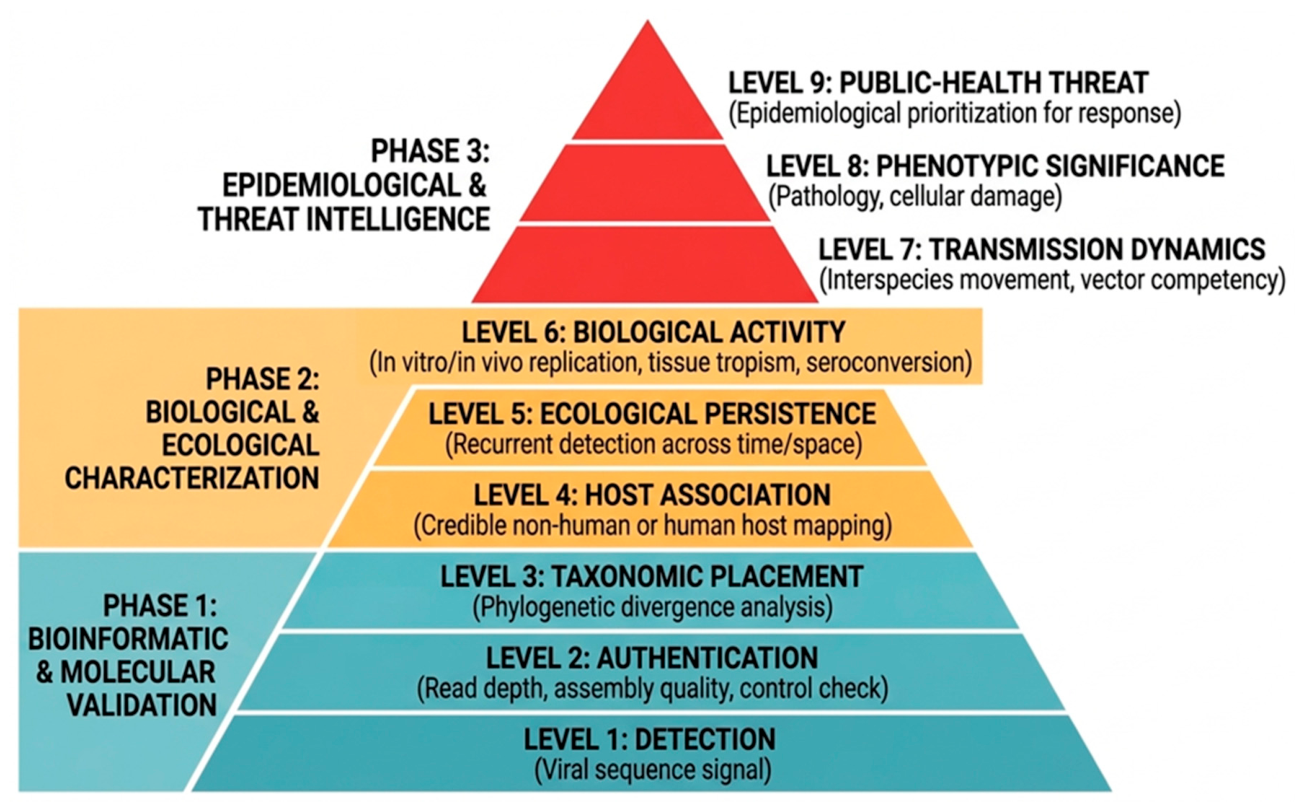
Figure 3.
Integrated bioinformatic, structural AI, and risk-classification pipeline for viral dark matter illumination. Raw shotgun metagenomic (mNGS) or long-read sequencing data (Nanopore/PacBio) undergo host genome filtering and negative control/contaminant removal. De novo assembly (using SPAdes/MEGAHIT) and contig binning are filtered by length and coverage cut-offs. Viral identification and quality checks are conducted using VirSorter2 (filtering endogenous viral elements) and CheckV (assessing genome completeness). Orphan protein sequences lacking nucleotide homology enter structural AI models (such as AlphaFold or ESMFold) to predict 3D protein structures (PDB alignment) for structural homology annotation. Validated viral populations are then channeled into the Viral Relevance and Priority Score (VRPS) engine for multi-dimensional risk classification (Low, Medium, High).
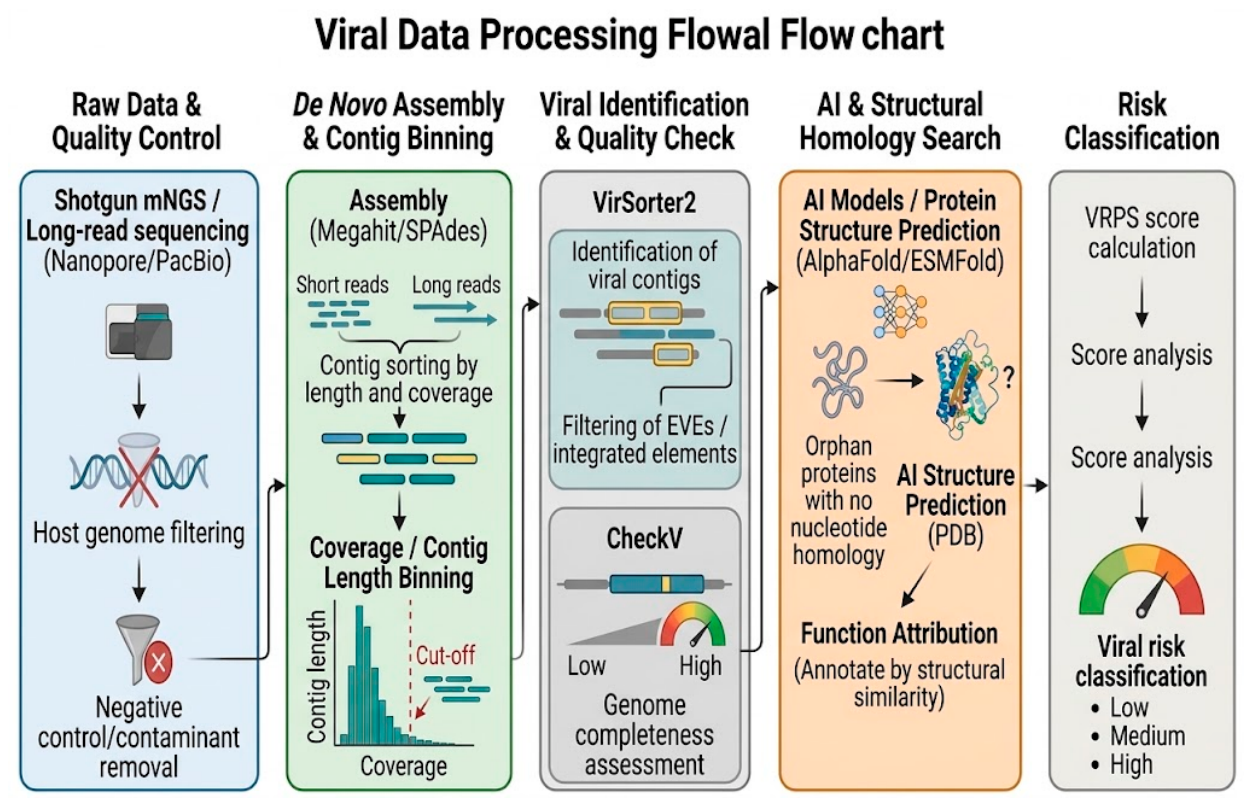
Figure 4.
Operational architecture of the African Viral Dark Matter Atlas (AVDMA) and VRPS decision-support dashboard. The framework synthesizes three interconnected data layers. Layer 1 (Genome Layer) aggregates high-definition genomic assemblies, phylogenetics, and AI-predicted protein structures. Layer 2 (Ecological Layer) integrates GIS/SIG cartography, host habitats, vector distributions, land-use changes, and climate models. Layer 3 (Surveillance & Operational Layer) feeds longitudinal tracking data, seroprevalence, and remote sensing into the VRPS Computation Engine. The embedded VRPS Dashboard classifies candidate viral populations into four actionable priority tiers: Background (0–24: maintain in catalogue), Monitor (25–49: metadata enrichment and repeat sampling), Investigate (50–74: targeted longitudinal tracking and orthogonal validation), and Intensify (75-100: multidisciplinary field and laboratory response).
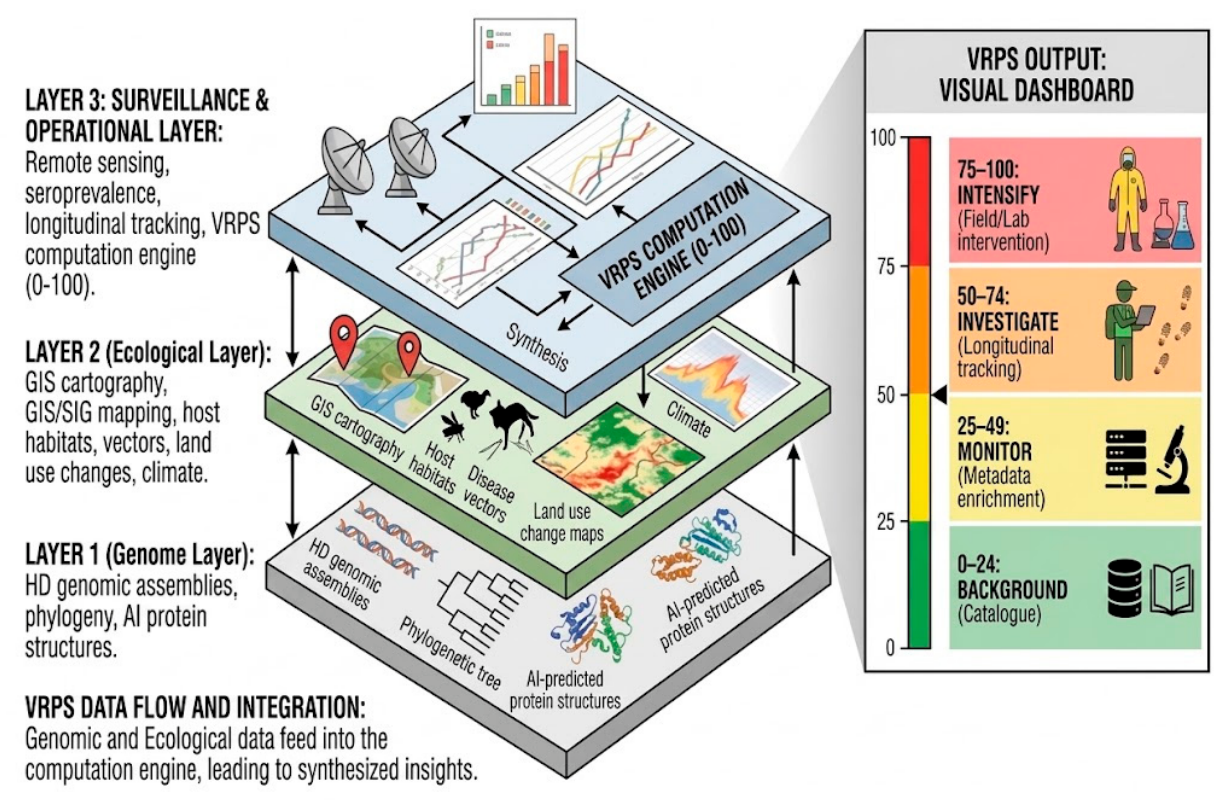
Figure 5.
Multi-compartment One Health ecosystem surveillance framework for African Viral Dark Matter. Surveillance is structured across four interacting ecological compartments: Compartment 1 (Animal Reservoirs: bats, rodents, primates, and livestock in forest-agriculture interfaces), Compartment 2 (Vectors: mosquitoes, ticks, sandflies), Compartment 3 (Human Sentinels: rural fever cohorts, hunters, live animal market workers), and Compartment 4 (Environment & Infrastructure: wastewater, surface water, market runoff). Bi-directional arrows illustrate viral transmission dynamics, spillover events, adaptive mutations, vector-host contact, and environmental contamination. Strategic sampling at these interfaces enables anticipatory detection before clinical emergence.
Disclaimer/Publisher’s Note: The statements, opinions and data contained in all publications are solely those of the individual author(s) and contributor(s) and not of MDPI and/or the editor(s). MDPI and/or the editor(s) disclaim responsibility for any injury to people or property resulting from any ideas, methods, instructions or products referred to in the content. |
© 2026 by the authors. Licensee MDPI, Basel, Switzerland. This article is an open access article distributed under the terms and conditions of the Creative Commons Attribution (CC BY) license.
Copyright: This open access article is published under a Creative Commons CC BY 4.0 license, which permit the free download, distribution, and reuse, provided that the author and preprint are cited in any reuse.