

Submitted:
20 August 2026
Posted:
21 August 2026
You are already at the latest version
Abstract
Background: The continued emergence of antimicrobial-resistant Neisseria gonorrhoeae highlights the urgent need for an effective vaccine. We evaluated the immunogenicity and vaccine potential of six new gonococcal conserved hypothetical proteins identified through our immunobioinformatics-based pipeline (Candidate Antigen Selection Strategy, CASS). Methods: NGO0588, NGO0694, NGO0757, NGO0861, NGO1438 and NGO1802 proteins were expressed in E. coli, purified and used to immunize mice, adjuvanted with Alum and MPLA. Immunological analyses included quantitative and qualitative evaluation of antigen-specific antibody responses, cytokines, serum bactericidal activity (SBA), and protective efficacy in the mouse gonococcal vaginal colonization model. Results: The six antigens elicited robust antigen-specific IgG and IgM antibody responses against N. gonorrhoeae. Antisera to NGO0588, NGO0861, NGO1430 and NGO1802 were bactericidal against different gonococcal strains. All the antigens reacted with sera obtained from women with disseminated gonococcal infection, which supports their immunogenicity in humans. Taking immunological and biochemical properties into consideration, NGO0861, NGO1438 and NGO1802 were combined in a trivalent vaccine formulation. The trivalent vaccine elicited robust antigen-specific and N. gonorrhoeae-reactive serum IgG and IgM, mucosal IgG, and higher SBA titers than each individual antigen. In the mouse gonococcal vaginal colonization model, a trend toward accelerated bacterial clearance and lower bacterial burden was observed in vaccinated mice compared to adjuvant control mice. Conclusions: NGO0861, NGO1438 and NGO1802 represent promising targets for a multicomponent gonococcal vaccine, supporting our infection-informed antigen discovery strategy. Immunological analyses in vitro and in vivo emphasize the importance of evaluating antigen and antibody quality and functional activity for vaccine target prioritization of next-generation gonococcal multicomponent vaccines.
Keywords:
Neisseria gonorrhoeae
; antigens
; bactericidal antibodies
; protection
1. Introduction
Neisseria gonorrhoeae, the etiologic agent of the sexually transmitted infection (STI) gonorrhea, is a major global public health threat. The World Health Organization estimates that more than 80 million new gonococcal infections occur annually worldwide, making gonorrhea the second most prevalent bacterial sexually transmitted infection after chlamydia. More than 540,000 cases were reported in the U.S in 2024 [1,2]. In women, infection is frequently asymptomatic and can lead to severe reproductive tract sequelae, including pelvic inflammatory disease, ectopic pregnancy, infertility, and adverse pregnancy outcomes. Gonococcal co-infections with Chlamydia and syphilis are frequent, and gonorrhea increases susceptibility to and transmission of human immunodeficiency virus (HIV) [3], further amplifying the public health impact of this STI. Despite ongoing efforts to improve prevention and treatment, gonorrhea incidence continues to increase in some geographical areas worldwide, along with emergence and global dissemination of antimicrobial-resistant strains. The gonococcus has developed resistance to every class of antibiotics previously used for treatment (i.e. sulfonamides, penicillins, tetracyclines, macrolides, fluoroquinolones) and recently, has shown reduced susceptibility or resistance to extended-spectrum cephalosporins worldwide, decreasing the effectiveness of current first-line therapies [4,5]. Antimicrobial-resistant N. gonorrhoeae is now designated a high-priority pathogen and there is a strong need for new strategies to control gonorrhea transmission, morbidity and infection management [6,7]. Development of an effective vaccine is considered the most sustainable long-term solution for gonorrhea control, but currently there is no licensed vaccine against gonorrhea, despite decades of investigation. Challenges to vaccine development include including antigenic and phase variation, molecular mimicry of host structures, complement resistance, active modulation of innate and adaptive immune responses, and the lack of naturally acquired protective immunity in humans [8,9,10,11,12].
Retrospective epidemiological studies noted reduced gonorrhea incidence among recipients of the outer membrane vesicle (OMV)-based serogroup B meningococcal vaccines, MeNZB and Bexsero® (also called 4CMenB, which contains detergent-extracted OMVs plus three recombinant antigens (fHbp, NHBA and NadA [13]) [14,15,16,17]. Sera from mice immunized with 4CMenB showed cross-reactivity with multiple gonococcal antigens and bactericidal antibody responses against N. gonorrhoeae, accelerated gonococcal clearance and lower gonococcal bacterial burdens in the mouse model of gonococcal vaginal colonization [18,19,20]. However, recent prospective human clinical trials have failed to show efficacy of 4CMenB against gonorrhea in men who have sex with men (MSM), a population at high-risk for STIs [21,22]. Gonococcal OMVs have also been evaluated in mouse studies, where bactericidal antibodies and accelerated clearance have been shown in the mouse vaginal colonization model (IL-12 microencapsulated OMV vaccine [23], GonoVac [24]). However, a Phase 2 trial evaluating gonococcal native OMVs was terminated because pre-defined efficacy criteria were not met [25,26,27]. Given the limited success of OMV-based vaccines, gonococcal subunit vaccines represent viable alternatives, and evidence of protection in the mouse model of gonococcal vaginal colonization has been shown for some antigens [28,29,30,31,32]. Proteins that are shared with N. meningitidis may also be attractive from the perspective of acceptability and marketing [33,34].
Our previous analysis of the gonococcal transcriptome during natural human mucosal infection indicated substantial differences in gonococcal gene expression profiles compared to bacteria growth in vitro [35,36,37]. This suggested that proteins important during infection may have been overlooked as vaccine targets identified by conventional discovery approaches in vitro, highlighting the importance of incorporating infection-associated gene expression data into antigen selection. We developed an infection-informed antigen discovery platform (Candidate Antigen Selection Strategy, CASS) by integrating transcriptomic and immunobioinformatic analyses and identified several uncharacterized proteins as potential vaccine targets [38]. Initial studies showed that three proteins among these targets, NGO0690, NGO0948 and NGO1701, led to accelerated bacterial clearance and reduced gonococcal burden in the mouse genital tract infection model when used as a multi-component vaccine [39,40]. NGO1701 was recently characterized as Csp, a periplasmic copper-storage protein involved in metal homeostasis, adding biological relevance to its protective potential [41]. Building on these findings, we sought to expand the repertoire of CASS targets by evaluating a second set of infection-associated antigens, NGO0588, NGO0694, NGO0757, NGO0861, NGO1438, and NGO1802. In the present study, we investigated their immunogenicity and protective efficacy in support of continued advancement of multicomponent vaccines targeting conserved gonococcal proteins expressed during natural human infection.
2. Materials and Methods
2.1. Antigens
NGO0588, a DUF4189 domain-containing protein (WP_003691328) (UniProt accession number Q5F918); NGO0694, a predicted autotransporter outer membrane β-barrel domain-containing protein (WP_229683582.1) (UniProt accession number Q5F8R8); NGO0757, a predicted periplasmic protein, Spy/CpxP family protein refolding chaperone (WP_003688677.1) (UniProt accession number Q5F8L5); NGO0861, a hypothetical lipoprotein (WP_020996828.1) (UniProt accession number Q5F8C4); NGO1438, a predicted DsbC family protein, Thiol:disulfide interchange protein (WP_003689299.1) (UniProt accession number Q5F6V7); NGO1802, a predicted OmpH family outer membrane protein (WP_157147426.1) (Uniprot accession number Q5F5W7).
2.2. Gene and Protein Sequence Analysis, and Protein Structure Predictions
Gene sequence presence and conservation in N. gonorrhoeae and N. meningitidis was evaluated using the PubMLST database [42], including evaluation of allele presence and representation, and gene polymorphisms. Protein structure predictions were obtained with AlphaFold [43,44] based on the available protein sequences in the NCBI Reference Sequence: NC_002946. Structure modeling was rendered with PyMol [45].
2.3. Cloning, Expression and Purification of Recombinant Proteins
Cloning, expression and protein purification were outsourced to GenScript (Piscataway, NJ, USA). Briefly, using primers designed based on the available protein sequences of N. gonorrhoeae FA1090 in NCBI (NC_002946.2), C-terminal 6x His-tagged truncated NGO0588, NGO0757, NGO0861, NGO1438 and NGO1802 and full-length NGO0694 were cloned in a pET30a plasmid containing a kanamycin resistance cassette using NdeI and HindIII restriction sites. Protein expression was induced in transformed E. coli BL21 Star (DE3) with 0.5 mM IPTG. Bacterial cultures were lysed with 50 mM Tris-HCl and 150 mM NaCl buffer, pH 8.0, supernatants containing soluble proteins NGO0757, NGO0861, NGO1438 and NGO1802 were directly applied onto a Ni++ agarose resin and eluted with a 20-500 mM Imidazole gradient in buffer containing 50 mM Tris-HCl, 500 mM NaCl and 1% Triton X-100, pH 8.0. Inclusion bodies containing insoluble proteins NGO0588 and NGO0694 were resuspended in 50 mM Tris-HCl and 7 M guanidine hydrochloride buffer, pH 8.0, and purified in denaturing conditions with buffer containing 8M urea. Column fractions were examined by SDS-PAGE/Coomassie staining to assess purity. Protein-containing fractions were pooled and dialyzed against PBS pH 7.4 containing 10% glycerol (NGO0757, NGO0861, NGO1438 and NGO1802) and 0.5 M L-Arginine (NGO0588 and NGO0694). The protein concentration was measured by the bicinchoninic acid assay (BCA)) assay (Thermo Fisher Scientific). Gel imaging was done using a Bio-Rad ChemiDoc Gel Imaging System.
2.4. Immunization of Mice
Female BALB/c mice (6 weeks old) (Jackson Labs, Bar Harbor, ME, USA) were housed, cared for, and immunized according to NIH, Tufts University and University of Massachusetts Chan Medical School IACUC approved protocols (#B2024-11 and #PROTO202000072, respectively). Mice were immunized subcutaneously three times at 2-weeks or 3-weeks apart with the purified proteins individually (10 µg/mouse/dose) using Alum Adjuvant (G-Biosciences #7861215) (1:1 v/v ratio with the antigen) + Monophosphoryl Lipid A (MPLA) (Avanti Lipids; 10 µg/mouse/dose) as adjuvants. For studies with the antigen combination vaccine (NGO0861, NGO1438 and NGO1802) (henceforth referred to as 3-Ag vaccine), proteins were used at 10 µg/mouse/dose as above or, for the high-dose studies, 10 µg/mouse/dose of NGO0861 and 25 µg/mouse/dose of NGO1438 and NGO1802. Control mice were immunized with Alum+MPLA alone. Pre-immune (Pr) sera were collected prior to the first immunization, immune sera two weeks after each immunization (1st, 2nd, 3rd), and vaginal lavages two weeks after the last immunization. All sera and lavages were stored at -80 °C until use.
2.5. Bacterial Strains and Growth Conditions
N. gonorrhoeae F62 (Pil+/Opa+) and FA1090 strains were grown overnight on solid medium (GC agar plates supplemented with 1% IsoVitaleX or on chocolate agar plates) at 37°C in a 5% CO2 incubator, or in liquid GCB broth supplemented with 1% IsoVitaleX. Bacterial suspensions (O.D.600nm = 1, corresponding to 1–2 × 10⁹ bacteria/mL) were diluted to the desired concentrations. For some experiments, bacteria suspensions were killed with 1% paraformaldehyde for 1h at 4⁰C, washed and resuspended in PBS.
2.6. Dot Blot analysis
Purified proteins (100 ng in 5 µl) and N. gonorrhoeae F62 or FA1090 (1.5 µg total protein content in 5 µl) were spotted on nitrocellulose filters. Membranes were blocked with 5% milk in PBS/Tween 20 (PBS-T), incubated overnight at 4 °C with pooled mouse immune sera (1:1000 dilution), followed by anti-mouse IgG secondary AP-conjugated antibody (Southern Biotech, Birmingham, AL, USA) for detection of immunoreactive dots with NBT/BCIP (5-bromo-4-chloro-3-indolyl phosphate/Nitroblue Tetrazolium) chromogenic substrate (Bio-Rad, Hercules, CA, USA) and imaging with a Bio-Rad ChemiDoc Gel Imaging System.
2.7. Antibody ELISA
ELISA plates (Immulon 4 HBX) were coated with purified proteins (2 μg/ml) or formalin-fixed N. gonorrhoeae (1–1.5 x 10⁸ bacteria/ml) as previously described [39]. Plates were blocked, incubated with serial dilutions of pooled mouse sera or vaginal lavages, and antibody production was evaluated using AP-conjugated secondary anti-mouse total IgG, IgG1, IgG2a and IgM antibodies (Southern Biotech), followed by 1-step PNPP (p-nitrophenyl phosphate) reagent (Thermo Fisher Scientific) and spectrophotometric detection at O.D.405nm. Sera and vaginal lavages were tested in triplicate or quadruplicate. Antibodies were quantified in µg/ml using antibody reference standard curves (Southern Biotech) and a linear regression function. The Th2/Th1 ratio was determined as IgG2a/IgG1 (µg/ml). For human IgG antibody evaluation, plates were incubated with banked, de-identified sera (1:100 dilution) from women with disseminated gonococcal infection (DGI) [46] (n = 7) previously provided by Dr. Peter Rice, MD, University of Massachusetts Chan Medical School [39]. Use of the deidentified human sera was approved by the University of Massachusetts Chan Medical School IRB. The collection and use of DGI sera were approved by the Institutional Review Board (IRB) of (--at that time) the Trustee of Health and Hospitals of the City of Boston; subjects provided informed consent. The use of de-identified banked human sera was determined not to constitute human subject research and therefore did not require IRB approval for use in this study at Tufts University. Individual serum specimens were tested in triplicate. IgG levels were determined as O.D.405 values and expressed as the mean O.D.405 minus the O.D.405 of the control antigen without serum (blank) ± SD. Commercially available, pooled whole normal human serum (NHS) (Pel-Freez Biologicals, #34019, Rogers, AK, USA) was used as a control.
2.8. Cytokine ELISA
IL-4, IL-10, IL-12p70, IFN-γ, IL-6 and TNF-α were measured in pooled mouse sera by ELISA using Opt-EIA kits (BD Biosciences, San Jose, CA, USA) and IL-1 β with ELISA MAX kit (BioLegend) according to the manufacturer's specifications. Sera were tested in triplicate or quadruplicate. Cytokines were expressed in pg/ml ± SD.
2.9. Serum Bactericidal Activity (SBA)
N. gonorrhoeae F62 and FA1090 (2–4 x 10⁴ CFU/ml) in HBSS containing 0.15 mM CaCl2, 1 mM MgCl2 and 2% BSA, were incubated with serial dilutions of heat-inactivated pooled mouse sera for 20 minutes at room temperature as previously described [39]. Commercially available IgG/IgM-depleted pooled normal human serum (Pel-Freez Biologicals) at a final concentration of 10% v/v (for F62) or 20% (v/v) (for FA1090) was added as source of complement. Aliquots of the reaction mixture were plated on GC agar plates in triplicate immediately (Time 0) and after 30 minutes incubation at 37°C (Time 30). Plates were incubated overnight at 37 °C in a 5% CO2 incubator, and survival was determined by counting colony-forming units (CFUs) as T30 relative to T0, expressed as percentage ± SD. Bactericidal titers represent the highest serum dilution that yielded ≤ 50% survival after 30 minutes. Controls reactions included bacteria alone and bacteria incubated with complement alone. Sera were tested in triplicates or quadruplicates.
2.10. Mouse Model of Gonococcal Vaginal Challenge
Female BALB/c mice (n = 20) were immunized as described above. Two weeks post-dose 3, mice in the diestrus phase of the estrous cycle (n = 10) were treated with 0.5 mg Premarin (Pfizer) in 200 µL water subcutaneously for 3 days (day −2, 0, and +2 days relative to the challenge (Day 0) to allow for a longer estrus phase and to increase susceptibility to N. gonorrhoeae infection [47]. Antibiotics (vancomycin, trimethoprim, and streptomycin (VTS)) were used to control the mouse vaginal microflora without affecting N. gonorrhoeae survival. Mice were challenged intravaginally with N. gonorrhoeae FA1090 (2.7 x 10⁷ – 3.1 x 10⁷ colony forming units, CFUs). Infection burden was monitored daily by obtaining vaginal swabs for enumerating gonococcal CFUs. Swabs were eluted in 100 µl of normal saline and serial dilutions of the eluted material were plated onto chocolate agar containing VTS, colistin and neomycin. Gonococcal colonies were counted after incubation of plates for 24 h at 37 °C in 5% CO2.
2.11. Statistical Analysis
GraphPad Prism 11.0.2 (GraphPad Software, Inc., San Diego, CA) was used to determine statistical significance using unpaired t test, one-way analyses of variance (ANOVA) with Tukey’s or with Dunnett’s multiple comparisons test, and 2-way ANOVA with Tukey’s multiple comparisons test. Statistically significant p values are indicated in the figure legends. For mouse challenge experiments, the median time to clearance was evaluated using Kaplan–Meier survival curves and the time to clearance between groups was compared using the Mantel-Cox log-rank test. The mean area under the curve (AUC) of the log10 CFU vs. time was computed for each mouse to estimate the bacterial burden over time (cumulative infection) and comparisons between groups were made using Mann-Whitney’s non-parametric test [29].
3. Results
3.1. Bioinformatics Analysis of the Six Hypothetical Proteins from the CASS Pool
Details about the NGO0588, NGO0694, NGO0757, NGO0861, NGO1438 and NGO1802 proteins are shown in Table 1. The criteria and the bioinformatics tools used for the CASS design were previously described in detail [38].
Gene sequence presence and conservation was examined in the gonococcal genomes and meningococcal genomes available in the PubMLST database [42] (Table 2 and Table S1, respectively). Only the alleles present in > 5% of strains are listed. The 6 genes were present in all gonococcal strains and were part of the gonococcal core genome (Ng cgMLST v2.0).
NGO0588 (NEIS1253), encoded by the ngo0588 gene (NGO_RS02970), is a hypothetical protein of 160 amino acids with a predicted signal peptide cleavage site between amino acids 20 and 21, and sequence homology to a DUF4189 domain-containing protein in the pfam13827 family proteins with six well-conserved cysteines. NGO0588 is predicted to be localized in the periplasm and/or outer membrane, and its expression may be regulated by NrrF [48]. ngo0588 is represented by 80 N. gonorrhoeae alleles (Table 2), with a total of 78 polymorphic sites; no non-synonymous mutations are seen in the most frequent allele 10, present in > 50% of strains (20050 out of the 336931 total strains). The meningococcal homologue of ngo0588, called nmb1317a, encodes for an uracil-xanthine permease family protein involved in membrane transport, which has high genetic variability in the most represented allele 4 (Table S1). The NMB1317a protein is found in the outer membrane vesicle protein content of the meningococcal vaccine [49].
NGO0694 (NEIS2653), encoded by the ngo0694 gene (NGO_RS03485), is a 914 amino acid-long protein with sequence homology to an autotransporter outer membrane β-barrel domain-containing protein, Ata-3 [50]. ngo0694 is represented by 171 alleles, has over 500 polymorphic sites, but none are in highly frequent alleles. The most frequent allele 2 has an internal stop codon mutation that may truncate the protein at residue 214, and less represented alleles contain a frameshift mutation that may lead to loss of residues 231-311 and 317-399 (Table 2). No alleles could be assigned for ~ 9% of strains due to incomplete sequence data as genes were located at the end of contigs. NGO0694 is not present in N. meningitidis.
NGO0757 (NEIS1146) is a 144 amino acid-long hypothetical periplasmic protein, with a predicted signal peptide cleavage site between amino acids 29 and 30, and sequence homology to a Spy/CpxP family protein refolding chaperone [51]. Analysis of ngo0757 (NGO_RS03805) indicated a total of 63 alleles, with 144 polymorphic sites and no non-synonymous mutations in the most represented allele 21 (Table 2). Similarly, analysis of the meningococcal homolog of ngo0757 did not show non-synonymous mutations in the most frequent alleles 1 and 8 (Table S1), supporting gene sequence conservation.
NGO0861 (NEIS2662) is encoded by the ngo0861 gene (NGO_RS04260) as a 61 amino acid-long hypothetical lipoprotein with a signal peptide cleavage site between amino acids 18 and 19 and is predicted to be localized in the periplasm or the outer membrane. ngo0861 was the most conserved gene (p-distance = 0.00007) with 50 alleles and 49 polymorphic sites, none of which localized in the most represented allele 1 (90% frequency) (Table 2). This gene was also absent in N. meningitidis.
NGO1438 (NEIS0490) is a putative DsbC family protein member, also annotated as Thiol:disulfide interchange protein, encoded by the ngo1430 gene (NGO_RS07170). Composed of 261 amino acids and containing a predicted signal peptide cleavage site between residues 19 and 20, NGO1438 is predicted to be localized in the periplasm. ngo1438 is represented by 154 alleles, with 242 polymorphic sites in alleles other than the most frequent alleles 6 and 13 (Table 2). Its meningococcal homolog is nmb0550, with 579 polymorphic sites and several non-synonymous mutations in highly represented alleles (Table S1), indicating some sequence diversity. The NMB0550 protein is also found in meningococcal outer membrane vesicles [52].
NGO1802 (NEIS0172), a putative member of the OmpH/Skp family, is a 166 amino acid-long protein with a predicted signal peptide cleavage site between residues 23 and 24, and is reported as present in gonococcal outer membrane vesicles [53]. ngo1802 (NGO_RS08995) is represented by 122 alleles, with 73 polymorphic sites and a frequent isoleucine-to-threonine non-synonymous mutation in position 2 (Table 2), being the most diverse gene (p-distance = 0.0048) among the six targets. Its meningococcal homolog is nmb0181, with over 600 alleles and 380 polymorphic sites but only one non-synonymous mutation in a less represented allele (Table S1). NMB0181 is thought to contribute to the protective effect of 4CMenB [54].
3.2. Protein Purification and Structure Prediction
His-tagged NGO0757, NGO0861, NGO1438 and NGO1802 were expressed recombinantly as soluble proteins and purified by Ni++ affinity chromatography in non-denaturing conditions; His-tagged NGO0588 and NGO0694 were expressed in inclusion bodies and purified in denaturing conditions. Column eluates were examined by Western blotting with a mouse anti-His antibody, and pooled positive fractions were dialyzed against PBS. 0.5M L-Arginine was added to facilitate refolding of NGO0588 and NGO0694. Purity was assessed by SDS-PAGE and Coomassie staining based on the predicted molecular weight of each protein (Figure 1A). The predicted structure of each antigen was modeled using Alpha Fold [43,44] and PyMol [45] (Figure 1B-G).
3.3. Analysis of Immune Responses to the Individual Antigens
The purified proteins (10 µg each) were used to immunize female BALB/c mice with Alum+MPLA as adjuvants. As a control, a separate group of mice were immunized with the adjuvants alone. Qualitative analysis of the immunized mice sera by dot blot showed presence of IgG antibodies against the corresponding purified protein (Figure 2A-F, dots 1), with NGO0861 appearing a weaker immunogen (Figure 2D). All antisera also reacted against whole N. gonorrhoeae F62 (Figure 2A-F, dots 2) and FA1090 (Figure 2A-F, dots 3). Interestingly, despite the low immunoreactivity of NGO0861, this antigen was strongly recognized by the anti-NGO0861 mouse sera in both gonococcal strains (Figure 2D). In contrast, the anti-NGO0757 sera reacted strongly against the purified protein, but only weakly against N. gonorrhoeae organisms (Figure 2C). The anti-NGO1802 mouse sera reacted strongly with both purified protein and gonococci (Figure 2F). Sera from mice immunized with Alum+MPLA showed low cross-reactivity with both bacterial strains (Figure 2G).
Next, antigen-specific serum antibody levels were quantified by ELISA. Overall, all antigens induced a strong IgG antibody response (Figure 3A-F), with NGO0861 remaining the weakest immunogen (Figure 3D). All antisera also recognized N. gonorrhoeae organisms in a whole-cell ELISA (Figure 3G-H), with anti-NGO0757 remaining the weaker responder serum (Figure 3G-H, dashed bars), as also seen by dot blot. The adjuvant-control group did not mount a significant antibody response to the antigens (Figure 3A–F, open circles) or to the bacteria (Figure 3G-H, gray bars). The potential differences in the immunogenicity and immunoreactivity of the antigens may be due to intrinsic properties of the purified proteins, or, in the context of whole bacteria, expression levels and/or accessibility to antibodies.
Analysis of the IgG antibody subclasses showed significantly higher IgG2a levels than IgG1 for NGO0588 (Figure S1A), significantly higher IgG1 than IgG2a levels for NGO0694, NGO0757, NGO0861 and NGO1802 (Figure S1B, S1C, S1D and S1F, respectively), and relatively similar IgG subclass levels for NGO1438 (Figure S1E); NGO0588 induced the highest IgM levels (Figure S1G). Serum cytokine profiles also varied across antigens: NGO0588 induced high levels of IL-12p70 (Figure S2A), NGO0861 and NGO1802 elicited higher IFN-γ production (Figure S2B), while IL-4 and IL-10 levels were comparable across all antigens (Figure S2C-D). Differences in inflammatory cytokines were also observed, with NGO0694 inducing significantly higher levels of IL-6 (Figure S2E), NGO1438 inducing higher TNF-α (Figure S2F), and NGO0588 high IL-1β (Figure S2G). These results also supported different immunological properties of the individual antigens.
Function of elicited antibodies were evaluated by the serum bactericidal assay, where the serum bactericidal activity (SBA) of each mouse antisera was compared to that of the adjuvant control sera. As shown in Table 3, the highest killing titers were reported for anti-NGO0588 against both N. gonorrhoeae F62 and FA1090. Anti-NGO0694 killed F62 (a serum-sensitive strain) but failed to kill FA1090 at the highest serum concentration tested (1/10); anti-NGO0757 did not kill F62 at the highest concentration used (1/10) and was not tested against FA1090. The latter two antigens were therefore considered low priority. Anti-NGO0861, anti-NGO1438 and anti-NGO1802 showed SBA titers between 1/20 and 1/40 against F62, and of 1/10 against FA1090 (Table 3). Despite NGO0588 inducing the highest SBA titers, the insoluble nature of this protein would be a significant hurdle for purification in a properly folded form at scale. Ultimately, NGO0861, NGO1430 and NGO1802 were considered the most attractive candidates.
We previously observed that combining antisera against individual antigens synergistically increased SBA titers [39]. Similarly, mixing anti-NGO0861, anti-NGO1438 and anti-NGO1802 sera in equal amounts by volume led to higher SBA compared to each individual antisera (Figure 4), supporting an additive effect.
Immunorecognition of the six targets by human sera from women with disseminated gonococcal infection (DGI) (n = 7) was also examined by ELISA. While uncomplicated mucosal gonococcal infections only induce modest gonococcal-specific antibodies [55], these tend to be higher in subjects with invasive forms of the disease, such as DGI [56]. IgG antibodies against each antigen were present in the DGI sera, particularly against NGO1802 (Figure S3A). Commercially available normal human serum (NHS) was used as a negative control and showed low reactivity versus all the antigens (Figure S3B). However, some reactivity against N. gonorrhoeae F62 was noted, likely due to the presence of preexisting cross-reactive antibodies elicited by prior colonization with commensal Neisseriae or N. meningitidis [57]. As expected, the DGI sera reacted strongly against whole gonococci. Based on these collective observations, a three-antigen combination vaccine composed of NGO0861, NGO1438 and NGO1802 was explored in vivo.
3.4. Analysis of Immune Responses to a Three-Antigen Combination Vaccine
A trivalent vaccine formulation, composed of NGO0861, NGO1438 and NGO1802 (10 µg/dose each at a 1:1:1 ratio) and Alum+MPLA (referred to as 3-Ag vaccine), was used to evaluate immune responses and protection against gonococcal vaginal challenge. A robust IgG antibody response against each antigen and against N. gonorrhoeae (Figure 5A-C) was confirmed by ELISA which was Th2-biased (IgG2a/IgG1 ratio < 1, not shown). Anti-gonococcal IgG antibody levels in vaginal lavages from the 3-Ag vaccine immunized mice were also measured (Table S2A), which mirrored those induced by immunization with the individual antigens (Table S2B). IgM antibody levels against N. gonorrhoeae induced by the 3-Ag vaccine were overall slightly elevated compared to those induced by immunization with the individual antigens (Table S2A and Table S2B, respectively), but neither were statistically significantly different from the respective adjuvant controls. The serum cytokine profile was also similar to that elicited by the three individual antigens (see Figure S2), with comparable levels of IL-12p70 (1550 pg/ml ± 200), IL-4 (400 pg/ml ± 236), IL-10 (890 pg/ml ± 350), IL-6 and TNF-α (250 pg/ml ± 74 and 180 pg/ml ± 60, respectively), except for a decrease in IFN-γ production in response to the 3-Ag vaccine (1550 pg/ml ± 347). Antibody functional analysis showed an increase in SBA titers to up to 1/160 against N. gonorrhoeae F62 (Figure 5D) in agreement with the additive effect of the individual sera combination (see Figure 4), and 1/40 against FA1090 E).
Two weeks after the last immunization, mice in the diestrus stage of the estrous cycle were infected vaginally with N. gonorrhoeae FA1090. Analysis of the number of mice infected, the length of infection and the bacterial burden showed that mice immunized with the 3-Ag combination vaccine cleared the infection faster than the adjuvants control mice group (Figure 6A) and had a lower bacterial load (Figure 6B-C) although statistical significance was not reached.
3.5. Immune Responses to a High-Dose Three-Antigen Combination Vaccine
To examine if increasing the antigen dose enhanced immune responses and, potentially, improved protection, mice were immunized with a 3-Ag combination vaccine formulation containing 10 µg of NGO0861 and 25 µg of NG01438 and NGO1802. IgG antibody levels against the individual antigens showed an increased magnitude compared to the 10 µg-dose 3-Ag vaccine (Figure 7A and Figure 5A, respectively). No shift in the IgG subclasses profile was observed (Figure 7B-D), which remained Th-2-skewed; a small, apparent increase in IgG antibodies that reacted with N. gonorrhoeae was observed (Figure 7E-F), and IgM antibody responses to N. gonorrhoeae (Alum+MPLA, ~ 2.5 - 3 µg/ml; 3-Ag vaccine, ~ 4.5 µg/ml) remained similar to those elicited by the 10 µg-dose 3-Ag vaccine (see Table S2). These results suggested that antibody responses induced by the 10 µg-dose 3-Ag vaccine were already near maximal levels in the current immunization conditions and were consistent with the observation that SBA titers remained similar – ~1/160 against N. gonorrhoeae F62 (Figure 7G) and between 1/20 - 1/40 for N. gonorrhoeae FA1090 (not shown).
4. Discussion
The development of an effective vaccine against Neisseria gonorrhoeae remains a global public health priority as antimicrobial resistance continues to compromise treatment options. Identification of broadly protective vaccine antigens is one of the major challenges. We have previously established the predictive value of CASS, an infection-informed discovery platform designed to prioritize proteins expressed during natural human infection with characteristics favorable for vaccine development [38,39,40]. In this study, we evaluated six new CASS targets.
Their biological characteristics illustrate the complexity of antigen selection: NGO0588 and NGO0861 have no known function, but presence of the NGO0588 meningococcal homolog, NMB1317a, within the OMV proteins pool [49] makes this protein an interesting potentially cross-protective target. NGO0694 is predicted to be an autotransporter protein [50] and may contribute to bacterial interactions with the host. NGO0757, homolog to a Spy/CpxP family protein refolding chaperone [51], has been hypothesized to participate in P pilus formation, a process important for gonococcal infection [58]. As a putative periplasmic-associated lipoprotein implicated in protein folding and oxidative stress resistance, NGO1438 may also contribute to necessary metabolic control pathways important for bacterial survival [59]. NGO1802, a predicted outer membrane protein part of the OmpH/Skp family (major periplasmic chaperone of the “holdases” family [60]) may not only play a key role in membrane integrity but is also homologous to the meningococcal protein NMB0181 [61], present in serogroup B meningococcal outer membrane vaccines [54]. The six antigens were all well conserved among gonococcal isolates, a desirable characteristic for vaccine development. Conservation is particularly important for N. gonorrhoeae, and genetic and antigenic variability have historically complicated vaccine design [8].
Each individual antigen induced a robust antigen-specific IgG antibody response directed against both the individual proteins and N. gonorrhoeae organisms. Both qualitative and quantitative differences were observed in the mouse antisera immunoreactivity with the targets, which could be explained by potential differences in their intrinsic immunogenicity, their expression levels, localization within the bacteria (periplasm vs outer membrane), and antibody accessibility to immunogenic epitopes. It is also possible that structural, biochemical or biophysical constraints may influence the ability of the antigens to be efficiently substrate-immobilized, as in the case of NGO0861, which appeared less immunoreactive in vitro as a purified protein than in the context of whole bacteria. Other differences in the immunogenic properties of the six candidates also emerged regarding the Th-bias induced. For example, despite all proteins being adjuvanted with Alum+MPLA, some (i.e. NGO0757, NGO1802) induced stronger Th2-skewed antibody response than others (i.e., NGO1438), and NGO0588 induced a more Th1-biased response, along with differences in the cytokine profile elicited. Parsing whether these properties could contribute to protective efficacy will require further investigation. Although production of serum antibodies alone may not necessarily define the value of a vaccine candidate antigen, recognition by human sera from DGI subjects further supported their biological relevance because it suggests that the antigen is expressed in vivo and capable of eliciting a response in humans. Interestingly, analysis of serum bactericidal activity of the immunized mice sera indicated that four out of the six antigens induced measurable SBA titers against both N. gonorrhoeae strains tested. However, the criteria for antigen selection in vaccine development require considerations beyond antigen immunogenicity and functional immune responses: ease of antigen production and proper refolding, and ability to scale up and manufacturing are important factors. Thus, despite inducing the highest SBA, NGO0588 was considered a less attractive candidate because it was insoluble. The remaining three soluble antigens, NGO0861, NGO1438, and NGO1802, were examined as a multi-antigen combination vaccine, a choice supported by the observation that combining mouse antisera against the individual antigens increased antibody functional activity. Serum IgG antibody responses to the trivalent vaccine formulation remained robust, mucosal IgG antibodies were also present (although it is not known if these contribute to protection against gonococcal colonization), and enhanced bacterial killing was observed. The trivalent vaccine also promoted more rapid bacterial clearance and lower cumulative bacterial burden following gonococcal vaginal challenge compared to the control mice group. Despite protection did not reach statistical significance, the concordance between enhanced serum bactericidal activity, mucosal antibody responses, and improved infection outcomes supports further future evaluation of these antigens. For example, other mechanisms besides SBA (the most widely used functional assays for gonococcal vaccines evaluation) should be evaluated, i.e., opsonophagocytosis, inhibition of epithelial colonization. Indeed, no validated immune correlate of protection currently exists for gonorrhea [62]; however, although no strong correlation between SBA titers and protection has been shown for OMV vaccines (Bexsero, Ng OMV) [63], this paradigm is true for some subunit vaccines [64,65,66,67].
It is possible that the 3-Ag vaccine formulation can be adjusted for reaching more significant protection in vivo. Our preliminary antigen dosing studies indicated that more antibodies may be produced in response to immunization with more antigen, but SBA titers remained the same. Whether immunization with a high-dose 3-Ag combination vaccine can lead to better protection in vivo remains to be determined. Indeed, increasing antibody quantity alone may not necessarily enhance the efficacy of a vaccine; the quality of the antibody responses, including affinity maturation, antibody subclass type and complement-fixing ability, is likely a more important determinant of protection. This is a general theme in vaccine research, and particularly true for gonococcal vaccines. Not all antibody responses are equally protective, and high antibody titers do not necessarily correlate with bactericidal activity or protection in vivo [20,63,68,69,70]. Adjuvant type studies and/or vaccine composition studies are needed, which may have a greater impact than the antigen dose alone and provide a better understanding of multifactorial immune responses beyond bactericidal antibodies. Nevertheless, the observed trend of reduced infection duration and bacterial burden by the 3-Ag vaccine provides a basis for such further studies.
5. Conclusions
Our work expands the portfolio of vaccine targets identified through CASS and strengthens the evidence in support of infection-informed antigen discovery for gonococcal vaccine development. Future studies focused on vaccine optimization, mechanistic correlates of protection, and evaluation of expanded antigen combinations will be important for advancing CASS candidates development.
Supplementary Materials
The following supporting information can be downloaded at the website of this paper posted on Preprints.org. Table S1: Allele analysis in 47424 N. meningitidis in PubMLST. Figure S1: Serum IgG antibody subclasses and IgM antibodies ELISA against the purified antigens. Figure S2. Serum cytokine ELISA. Figure S3. Human sera ELISA. Table S2: Vaginal lavages IgG and serum IgM antibodies against N. gonorrhoeae F62 (µg/ml ± s.d.).
Author Contributions
Conceptualization, P.M.; methodology, P.M. S.K.R., S.R., S.G., B.Z.; validation, P.M., S.K.R., S.R., S.G., B.Z.; formal analysis, P.M., S.K.R., S.R.; investigation, P.M., S.K.R., S.R., S.G., B.Z.; resources, P.M., S.R.; writing—original draft preparation, P.M.; writing—review and editing, P.M., S.K.R., S.R., B.Z.; visualization, P.M., S.K.R., S.R.; supervision, P.M., S.R.; project administration, P.M., S.R.; funding acquisition, P.M. All authors have read and agreed to the published version of the manuscript.
Funding
Please add: This research was funded by NIH/NIAID grant number 5R01AI66573 and by Tufts Launchpad │Accelerator Program.
Institutional Review Board Statement
All human sera used were determined to not involve human subjects research and did not require IRB approval for use in this study. The animal study protocols were approved by the Institutional Review Board (or Ethics Committee) of Tufts University School of Medicine (protocol code #B2024-11, date of approval 03/28/2024) and University of Massachusetts Chan Medical School (protocol code PROTO202000072 , date of approval 07/16/2026).
Informed Consent Statement
Written informed consent was obtained from subjects with disseminated gonococcal infections.
Data Availability Statement
The data presented in this paper are available on request from the corresponding author.
Acknowledgments
The authors thank Drs. Caroline Genco, PhD, and Ryan McClure, PhD, for assistance in the original CASS design, and Dr. Peter Rice, MD, for providing the DGI serum samples.
Conflicts of Interest
S.R. is a cofounder of STIRx, Inc., and holds equity in the company. All other authors declare no conflict of interest.
Abbreviations
The following abbreviations are used in this manuscript:
| CASS | Candidate Antigen Selection Strategy |
| SBA | Serum bactericidal activity |
| STI | Sexually-transmitted infection |
| MPLA | Monophosphoryl Lipid A |
References
- World Health Organization. Global and regional STI estimates. Available online: https://www.who.int/data/gho/data/themes/topics/global-and-regional-sti-estimates (accessed on 8 August 2026).
- Centers for Disease Control and Prevention. Sexually Transmitted Infections Surveillance 2024 (Provisional). Available online: https://www.cdc.gov/sti-statistics/annual/index.html#cdc_research_or_data_summary_about_the_data_research-technical-notes (accessed on 26 July 2026).
- Centers for Disease Control and Prevention. Sexually Transmitted Disease Surveillance 2023. Available online: https://www.cdc.gov/sti-statistics/annual/index.html (accessed on 8 August 2026).
- Unemo, M.; Del Rio, C.; Shafer, W.M. Antimicrobial Resistance Expressed by Neisseria gonorrhoeae: A Major Global Public Health Problem in the 21st Century. Microbiol. Spectr. 2016, 4. [Google Scholar] [CrossRef]
- Unemo, M.; Lahra, M.M.; Cole, M.J.; Marcano Zamora, D.; Jacobsson, S.; Galarza, P.; Martin, I.; Kreisel, K.M.; Galas, M.; Bertagnolio, S.; et al. WHO global gonococcal antimicrobial surveillance programmes, 2019-22: a retrospective observational study. Lancet Microbe 2025, 6, 101181. [Google Scholar] [CrossRef]
- World Health Organization. Implementing the global health sector strategies on HIV, viral hepatitis and sexually transmitted infections, 2022–2030: report on progress and gaps 2024, second edition. Available online: https://www.who.int/publications/i/item/9789240097872 (accessed on 26 July 2026).
- Gottlieb, S.L.; Spielman, E.; Abu-Raddad, L.; Aderoba, A.K.; Bachmann, L.H.; Blondeel, K.; Chen, X.S.; Crucitti, T.; Camacho, G.G.; Godbole, S.; et al. WHO global research priorities for sexually transmitted infections. Lancet Glob. Health 2024, 12, e1544–e1551. [Google Scholar] [CrossRef]
- Rice, P.A.; Shafer, W.M.; Ram, S.; Jerse, A.E. Neisseria gonorrhoeae: Drug Resistance, Mouse Models, and Vaccine Development. Annu Rev. Microbiol. 2017, 71, 665–686. [Google Scholar] [CrossRef]
- Russell, M.W.; Jerse, A.E.; Gray-Owen, S.D. Progress Toward a Gonococcal Vaccine: The Way Forward. Front Immunol. 2019, 10, 2417. [Google Scholar] [CrossRef]
- Ruiz Garcia, Y.; Marrazzo, J.; Martinon-Torres, F.; Workowski, K.; Giordano, G.; Pizza, M.; Sohn, W.Y. Urgent Need to Understand and Prevent Gonococcal Infection: From the Laboratory to Real-World Context. J. Infect. Dis. 2024, 230, e758–e767. [Google Scholar] [CrossRef]
- Gill, D.S.; Ram, S.; Rice, P.A. Biologic drug development for treatment and prevention of sexually transmitted infections. Clin. Microbiol. Rev. 2025, e0010724. [Google Scholar] [CrossRef]
- Padeniya, T.N.; Hui, B.B.; Wood, J.G.; Regan, D.G.; Seib, K.L. Review of mathematical models of Neisseria gonorrhoeae vaccine impact: Implications for vaccine development. Vaccine 2024, 42, S70–S81. [Google Scholar] [CrossRef]
- Abitbol, V.; Martinon-Torres, F.; Taha, M.K.; Nolan, T.; Muzzi, A.; Bambini, S.; Borrow, R.; Toneatto, D.; Serino, L.; Rappuoli, R.; et al. 4CMenB journey to the 10-year anniversary and beyond. Hum. Vaccin Immunother. 2024, 20, 2357924. [Google Scholar] [CrossRef]
- Petousis-Harris, H.; Paynter, J.; Morgan, J.; Saxton, P.; McArdle, B.; Goodyear-Smith, F.; Black, S. Effectiveness of a group B outer membrane vesicle meningococcal vaccine against gonorrhoea in New Zealand: a retrospective case-control study. Lancet 2017, 390, 1603–1610. [Google Scholar] [CrossRef]
- Paynter, J.; Goodyear-Smith, F.; Morgan, J.; Saxton, P.; Black, S.; Petousis-Harris, H. Effectiveness of a Group B Outer Membrane Vesicle Meningococcal Vaccine in Preventing Hospitalization from Gonorrhea in New Zealand: A Retrospective Cohort Study. Vaccines 2019, 7. [Google Scholar] [CrossRef]
- Abara, W.E.; Modaressi, S.; Fireman, B.; Klein, N.P.; Layefsky, E.; Goddard, K.; Bernstein, K.T.; Kirkcaldy, R.D.; Zerbo, O. Effectiveness of a serogroup B meningococcal vaccine against gonorrhea: A retrospective study. Vaccine 2024, 42, 126312. [Google Scholar] [CrossRef]
- Bruxvoort, K.J.; Lewnard, J.A.; Chen, L.H.; Tseng, H.F.; Chang, J.; Veltman, J.; Marrazzo, J.; Qian, L. Prevention of Neisseria gonorrhoeae With Meningococcal B Vaccine: A Matched Cohort Study in Southern California. Clin. Infect. Dis. 2023, 76, e1341–e1349. [Google Scholar] [CrossRef]
- Semchenko, E.A.; Tan, A.; Borrow, R.; Seib, K.L. The serogroup B meningococcal vaccine Bexsero elicits antibodies to Neisseria gonorrhoeae. Clin. Infect. Dis. 2018. [Google Scholar] [CrossRef]
- Leduc, I.; Connolly, K.L.; Begum, A.; Underwood, K.; Darnell, S.; Shafer, W.M.; Balthazar, J.T.; Macintyre, A.N.; Sempowski, G.D.; Duncan, J.A.; et al. The serogroup B meningococcal outer membrane vesicle-based vaccine 4CMenB induces cross-species protection against Neisseria gonorrhoeae. PLoS Pathog. 2020, 16, e1008602. [Google Scholar] [CrossRef]
- Zhu, W.; Waltmann, A.; Little, M.B.; Connolly, K.L.; Matthias, K.A.; Thomas, K.S.; Gray, M.C.; Sikora, A.E.; Criss, A.K.; Bash, M.C.; et al. Protection against N. gonorrhoeae induced by OMV-based meningococcal vaccines are associated with cross-species directed humoral and cellular immune responses. Front Immunol. 2025, 16, 1539795. [Google Scholar] [CrossRef]
- Molina, J.M.; Bercot, B.; Assoumou, L.; Rubenstein, E.; Algarte-Genin, M.; Pialoux, G.; Katlama, C.; Surgers, L.; Bebear, C.; Dupin, N.; et al. Doxycycline prophylaxis and meningococcal group B vaccine to prevent bacterial sexually transmitted infections in France (ANRS 174 DOXYVAC): a multicentre, open-label, randomised trial with a 2 x 2 factorial design. Lancet Infect. Dis. 2024, 24, 1093–1104. [Google Scholar] [CrossRef]
- Seib, K.L.; Donovan, B.; Jin, F.; Thng, C.; Yeung, B.; Comninos, N.; Bopage, R.I.; Ray, A.; Mahony, A.; Chow, E.P.F.; et al. Meningococcal B Vaccine to Prevent Neisseria gonorrhoeae Infection. N Engl. J. Med. 2026. [Google Scholar] [CrossRef]
- Liu, Y.; Hammer, L.A.; Daamen, J.; Stork, M.; Egilmez, N.K.; Russell, M.W. Microencapsulated IL-12 Drives Genital Tract Immune Responses to Intranasal Gonococcal Outer Membrane Vesicle Vaccine and Induces Resistance to Vaginal Infection with Diverse Strains of Neisseria gonorrhoeae. mSphere 2023, 8, e0038822. [Google Scholar] [CrossRef]
- Freixeiro, P.; Lewis, L.A.; Sanchez-Buso, L.; Unemo, M.; Gulati, S.; Linder, A.; Corander, J.; Harrison, O.B.; Dold, C.; Harris, S.; et al. Pre-clinical efficacy of a candidate outer membrane vesicle gonococcal vaccine in comparison with 4CMenB. npj Vaccines 2026. [Google Scholar] [CrossRef]
- Safety and Efficacy of GSK Neisseria Gonorrhoeae GMMA (NgG) Investigational Vaccine When Administered to Healthy Adults 18 to 50 Years of Age. Available online: https://clinicaltrials.gov/study/NCT05630859?tab=results#results-overview (accessed on 27 July 2026).
- Taylor, N.P. GSK axes vaccine from $2.1B deal, switching to preclinical successor over 'increased competition'. Available online: https://ftp.bdl-summit.com/biotech/gsk-axes-vaccine-21b-deal-switching-preclinical-successor-over-increased-competition (accessed on 25 June 2026).
- Taylor, L. Gonorrhoea vaccine: Australian study suggests England's "world first" rollout may not work. BMJ 2026, 394, e100281. [Google Scholar] [CrossRef]
- Williams, E.; Seib, K.L.; Fairley, C.K.; Pollock, G.L.; Hocking, J.S.; McCarthy, J.S.; Williamson, D.A. Neisseria gonorrhoeae vaccines: a contemporary overview. Clin. Microbiol. Rev. 2024, 37, e0009423. [Google Scholar] [CrossRef]
- Gulati, S.; Shaughnessy, J.; Ram, S.; Rice, P.A. Targeting Lipooligosaccharide (LOS) for a Gonococcal Vaccine. Front Immunol. 2019, 10, 321. [Google Scholar] [CrossRef]
- Gulati, S.; Mattsson, A.H.; Schussek, S.; Zheng, B.; DeOliveira, R.B.; Shaughnessy, J.; Lewis, L.A.; Rice, P.A.; Comstedt, P.; Ram, S. Preclinical efficacy of a cell division protein candidate gonococcal vaccine identified by artificial intelligence. mBio 2023, 14, e0250023. [Google Scholar] [CrossRef]
- Fegan, J.E.; Calmettes, C.; Islam, E.A.; Ahn, S.K.; Chaudhuri, S.; Yu, R.H.; Gray-Owen, S.D.; Moraes, T.F.; Schryvers, A.B. Utility of Hybrid Transferrin Binding Protein Antigens for Protection Against Pathogenic Neisseria Species. Front Immunol. 2019, 10, 247. [Google Scholar] [CrossRef]
- Taha; Eskandari, S.; Slesarenko, V.A.; Haselhorst, T.; Semchenko, E.A.; Seib, K.L. Refinement and optimisation of Neisseria gonorrhoeae NHBA and MetQ vaccine candidates. Vaccine 2024, 42, 126416. [Google Scholar] [CrossRef]
- Pizza, M.; Scarlato, V.; Masignani, V.; Giuliani, M.M.; Arico, B.; Comanducci, M.; Jennings, G.T.; Baldi, L.; Bartolini, E.; Capecchi, B.; et al. Identification of vaccine candidates against serogroup B meningococcus by whole-genome sequencing [see comments]. Science 2000, 287, 1816–1820. [Google Scholar] [CrossRef]
- Williams, J.N.; Weynants, V.; Poolman, J.T.; Heckels, J.E.; Christodoulides, M. Immuno-proteomic analysis of human immune responses to experimental Neisseria meningitidis outer membrane vesicle vaccines identifies potential cross-reactive antigens. Vaccine 2014, 32, 1280–1286. [Google Scholar] [CrossRef]
- McClure, R.; Nudel, K.; Massari, P.; Tjaden, B.; Su, X.; Rice, P.A.; Genco, C.A. The Gonococcal Transcriptome during Infection of the Lower Genital Tract in Women. PLoS ONE 2015, 10, e0133982. [Google Scholar] [CrossRef]
- Nudel, K.; McClure, R.; Moreau, M.; Briars, E.; Abrams, A.J.; Tjaden, B.; Su, X.H.; Trees, D.; Rice, P.A.; Massari, P.; et al. Transcriptome Analysis of Neisseria gonorrhoeae during Natural Infection Reveals Differential Expression of Antibiotic Resistance Determinants between Men and Women. mSphere 2018, 3. [Google Scholar] [CrossRef]
- McClure, R.; Sunkavalli, A.; Balzano, P.M.; Massari, P.; Cho, C.; Nauseef, W.M.; Apicella, M.A.; Genco, C.A. Global Network Analysis of Neisseria gonorrhoeae Identifies Coordination between Pathways, Processes, and Regulators Expressed during Human Infection. mSystems 2020, 5. [Google Scholar] [CrossRef]
- Zhu, T.; McClure, R.; Harrison, O.B.; Genco, C.; Massari, P. Integrated Bioinformatic Analyses and Immune Characterization of New Neisseria gonorrhoeae Vaccine Antigens Expressed during Natural Mucosal Infection. Vaccines 2019, 7. [Google Scholar] [CrossRef]
- Roe, S.K.; Felter, B.; Zheng, B.; Ram, S.; Wetzler, L.M.; Garges, E.; Zhu, T.; Genco, C.A.; Massari, P. In Vitro Pre-Clinical Evaluation of a Gonococcal Trivalent Candidate Vaccine Identified by Transcriptomics. Vaccines 2023, 11. [Google Scholar] [CrossRef]
- Roe, S.K.; Zheng, B.; Gulati, S.; Genco, C.; Ram, S.; Massari, P. Preclinical in vivo evaluation of a gonococcal multivalent vaccine containing antigens identified by CASS. Front. Immunol. 2025, Volume 16 - 2025. [Google Scholar] [CrossRef]
- Roe, S.K.; Mazgaj, R.; Zhu, T.; Esmaeeli, M.; Lewis, L.A.; Genco, C.; Waldron, K.J.; Massari, P. The gonococcal vaccine candidate antigen NGO1701 is a N. gonorrhoeae periplasmic copper storage protein. PLoS Pathog. 2025, 21, e1013559. [Google Scholar] [CrossRef]
- Jolley, K.A.; Bray, J.E.; Maiden, M.C.J. Open-access bacterial population genomics: BIGSdb software, the PubMLST.org website and their applications. Wellcome Open Res. 2018, 3, 124. [Google Scholar] [CrossRef] [PubMed]
- Jumper, J.; Evans, R.; Pritzel, A.; Green, T.; Figurnov, M.; Ronneberger, O.; Tunyasuvunakool, K.; Bates, R.; Zidek, A.; Potapenko, A.; et al. Highly accurate protein structure prediction with AlphaFold. Nature 2021, 596, 583–589. [Google Scholar] [CrossRef] [PubMed]
- Varadi, M.; Bertoni, D.; Magana, P.; Paramval, U.; Pidruchna, I.; Radhakrishnan, M.; Tsenkov, M.; Nair, S.; Mirdita, M.; Yeo, J.; et al. AlphaFold Protein Structure Database in 2024: providing structure coverage for over 214 million protein sequences. Nucleic Acids Res. 2024, 52, D368–D375. [Google Scholar] [CrossRef]
- The PyMOL Molecular Graphics System, V.S., LLC. Available online: http://www.pymol.org/pymol (accessed on 7 May 2026).
- O'Brien, J.P.; Goldenberg, D.L.; Rice, P.A. Disseminated Gonococcal Infection: A Prospective Analysis of 49 Patients and a Review of the Pathophysiology and Immune Mechanisms. Medicine 1983, 62, 395–406. [Google Scholar]
- Jerse, A.E. Experimental gonococcal genital tract infection and opacity protein expression in estradiol-treated mice. Infect. Immun. 1999, 67, 5699–5708. [Google Scholar] [CrossRef]
- Jackson, L.A.; Pan, J.C.; Day, M.W.; Dyer, D.W. Control of RNA stability by NrrF, an iron-regulated small RNA in Neisseria gonorrhoeae. J. Bacteriol. 2013, 195, 5166–5173. [Google Scholar] [CrossRef]
- Marjuki, H.; Topaz, N.; Joseph, S.J.; Gernert, K.M.; Kersh, E.N. Antimicrobial-Resistant Neisseria gonorrhoeae Genetic Similarity of Gonococcal Homologs to Meningococcal Outer Membrane Proteins of Serogroup B Vaccine. In mBio; Working, G., Wang, X., Eds.; 2019; p. 10. [Google Scholar] [CrossRef]
- van Ulsen, P.; Tommassen, J. Protein secretion and secreted proteins in pathogenic Neisseriaceae. FEMS Microbiol. Rev. 2006, 30, 292–319. [Google Scholar] [CrossRef]
- Isabella, V.M.; Clark, V.L. Deep sequencing-based analysis of the anaerobic stimulon in Neisseria gonorrhoeae. BMC. Genom. 2011, 12, 51. [Google Scholar] [CrossRef]
- Masforrol, Y.; Gil, J.; Garcia, D.; Noda, J.; Ramos, Y.; Betancourt, L.; Guirola, O.; Gonzalez, S.; Acevedo, B.; Besada, V.; et al. A deeper mining on the protein composition of VA-MENGOC-BC(R): An OMV-based vaccine against N. meningitidis serogroup B and C. Hum. Vaccin Immunother. 2017, 13, 2548–2560. [Google Scholar] [CrossRef]
- Zielke, R.A.; Wierzbicki, I.H.; Weber, J.V.; Gafken, P.R.; Sikora, A.E. Quantitative proteomics of the Neisseria gonorrhoeae cell envelope and membrane vesicles for the discovery of potential therapeutic targets. Mol. Cell Proteom. 2014, 13, 1299–1317. [Google Scholar] [CrossRef]
- Viviani, V.; Fantoni, A.; Tomei, S.; Marchi, S.; Luzzi, E.; Bodini, M.; Muzzi, A.; Giuliani, M.M.; Maione, D.; Derrick, J.P.; et al. OpcA and PorB are novel bactericidal antigens of the 4CMenB vaccine in mice and humans. npj Vaccines 2023, 8, 54. [Google Scholar] [CrossRef]
- Hedges, S.R.; Mayo, M.S.; Mestecky, J.; Hook, E.W., 3rd; Russell, M.W. Limited local and systemic antibody responses to Neisseria gonorrhoeae during uncomplicated genital infections. Infect. Immun. 1999, 67, 3937–3946. [Google Scholar] [CrossRef]
- Hook, E.W.; Olsen, D.A.; Buchanan, T.M. Analysis of the Antigen Specificity of the Human Serum Immunoglobulin GG Immune Response to Complicated Gonococcal Infection. Infect. Immun. 1984, 43, 706–709. [Google Scholar] [CrossRef]
- Hicks, C.B.; Boslego, J.W.; Brandt, B. Evidence of serum antibodies to Neisseria gonorrhoeae before gonococcal infection. J. Infect. Dis. 1987, 155, 1276–1281. [Google Scholar] [CrossRef]
- Dijokaite-Guraliuc, A.; Humbert, M.V.; Skipp, P.; Cleary, D.W.; Heckels, J.E.; Christodoulides, M. An immunoproteomics study of antisera from patients with gonorrhea identifies novel Neisseria gonorrhoeae proteins. Front. Bacteriol. 2023, Volume 2 - 2023. [Google Scholar] [CrossRef]
- Achard, M.E.; Hamilton, A.J.; Dankowski, T.; Heras, B.; Schembri, M.S.; Edwards, J.L.; Jennings, M.P.; McEwan, A.G. A periplasmic thioredoxin-like protein plays a role in defense against oxidative stress in Neisseria gonorrhoeae. Infect. Immun. 2009, 77, 4934–4939. [Google Scholar] [CrossRef]
- Bodoev, I.; Malakhova, M.; Bespyatykh, J.; Bespiatykh, D.; Arapidi, G.; Pobeguts, O.; Zgoda, V.; Shitikov, E.; Ilina, E. Substitutions in SurA and BamA Lead to Reduced Susceptibility to Broad Range Antibiotics in Gonococci. Genes 2021, 12. [Google Scholar] [CrossRef]
- Volokhina, E.B.; Grijpstra, J.; Stork, M.; Schilders, I.; Tommassen, J.; Bos, M.P. Role of the periplasmic chaperones Skp, SurA, and DegQ in outer membrane protein biogenesis in Neisseria meningitidis. J. Bacteriol. 2011, 193, 1612–1621. [Google Scholar] [CrossRef]
- MacLennan, C.A.; Davis, P.; Gottlieb, S.L.; Seib, K.L.; Harrison, O.B.; Duncan, J.A.; Gorringe, A.; Criss, A.K.; Jerse, A.; Russell, M.W.; et al. Consultation report - gonococcal immunoassays and standards for vaccine development. Vaccine 2026, 86, 128694. [Google Scholar] [CrossRef]
- McKeand, S.A.; Bencomo, F.R.; Soc, A.; Jones, R.A.; Thistlethwaite, A.; Gu, Z.; Nduati, E.; Sanders, E.J.; Jerse, A.E.; Derrick, J.P.; et al. Investigation of Correlates of Protection Against Gonococcal Infection by Comparative Immunoprofiling of Responses in Experimental and Clinical Studies. J. Infect. Dis. 2026, 233, e1443–e1453. [Google Scholar] [CrossRef]
- Gulati, S.; Beurskens, F.J.; de Kreuk, B.J.; Roza, M.; Zheng, B.; DeOliveira, R.B.; Shaughnessy, J.; Nowak, N.A.; Taylor, R.P.; Botto, M.; et al. Complement alone drives efficacy of a chimeric antigonococcal monoclonal antibody. PLoS Biol. 2019, 17, e3000323. [Google Scholar] [CrossRef]
- Song, S.; Ge, H.; Yuan, D.; Gu, X.; Lu, W.; Ding, C.; Qin, Y.; Gao, S.; Lin, X.; Cheng, H.; et al. MtrE Loop2-specific multiple antigenic peptide vaccine and monoclonal antibody confer complement-dependent protection against Neisseria gonorrhoeae. npj Vaccines 2026, 11. [Google Scholar] [CrossRef]
- Lu, Q.; Peng, Y.; Dong, Z.; Luo, S.; Chen, C.; Liu, J.; Wang, G.; Min, X.; Huang, J.; Huang, M. MlaA, a conserved outer membrane protein of Neisseria gonorrhoeae, elicits potent functional immunity and protects against vaginal infection as a mucosal vaccine candidate. Vaccine 2026, 82, 128625. [Google Scholar] [CrossRef]
- Fegan, J.E.; Islam, E.A.; Curran, D.M.; Ng, D.; Au, N.Y.T.; Currie, E.G.; Zeppa, J.J.; Lam, J.; Schryvers, A.B.; Moraes, T.F.; et al. Rational selection of TbpB variants yields a bivalent vaccine with broad coverage against Neisseria gonorrhoeae. npj Vaccines 2025, 10, 10. [Google Scholar] [CrossRef]
- Zeppa, J.J.; Fegan, J.E.; Maiello, P.; Islam, E.A.; Lee, I.S.; Pham, C.; Caruso, L.L.; Gray-Owen, S.D. Meningococcal vaccine 4CMenB elicits a robust cellular immune response that targets but is not consistently protective against Neisseria gonorrhoeae during murine vaginal infection. mSphere 2025, 10, e0094024. [Google Scholar] [CrossRef]
- Islam, E.A.; Fegan, J.E.; Zeppa, J.J.; Ahn, S.K.; Ng, D.; Currie, E.G.; Lam, J.; Moraes, T.F.; Gray-Owen, S.D. Adjuvant-dependent impacts on vaccine-induced humoral responses and protection in preclinical models of nasal and genital colonization by pathogenic Neisseria. Vaccine 2025, 48, 126709. [Google Scholar] [CrossRef]
- Gulati, S.; Mu, X.; Zheng, B.; Reed, G.W.; Ram, S.; Rice, P.A. Antibody to reduction modifiable protein increases the bacterial burden and the duration of gonococcal infection in a mouse model. J. Infect. Dis. 2015, 212, 311–315. [Google Scholar] [CrossRef]
Figure 1.
Structure analysis of the CASS antigens. A) SDS-PAGE and Coomassie staining of the purified recombinant proteins. Lane 1, Molecular weight marker (Mw); Lane 2, NGO0694; Lane 3, Low-range molecular weight marker (LMw); Lane 4, NGO0588; Lane 5, NGO0757; Lane 6, NGO0861; Lane 7, NGO1438; Lane 8, NGO1802. B) Cartoon model (side view) of the predicted structure of NGO0588, C) NGO0694, D) NGO757, E) NGO0861, F) NGO1438 and G) NGO1802 modeled with Alpha Fold and PyMol [43,44,45] and colored by confidence (dark blue, highest; orange/yellow, lowest).
Figure 1.
Structure analysis of the CASS antigens. A) SDS-PAGE and Coomassie staining of the purified recombinant proteins. Lane 1, Molecular weight marker (Mw); Lane 2, NGO0694; Lane 3, Low-range molecular weight marker (LMw); Lane 4, NGO0588; Lane 5, NGO0757; Lane 6, NGO0861; Lane 7, NGO1438; Lane 8, NGO1802. B) Cartoon model (side view) of the predicted structure of NGO0588, C) NGO0694, D) NGO757, E) NGO0861, F) NGO1438 and G) NGO1802 modeled with Alpha Fold and PyMol [43,44,45] and colored by confidence (dark blue, highest; orange/yellow, lowest).
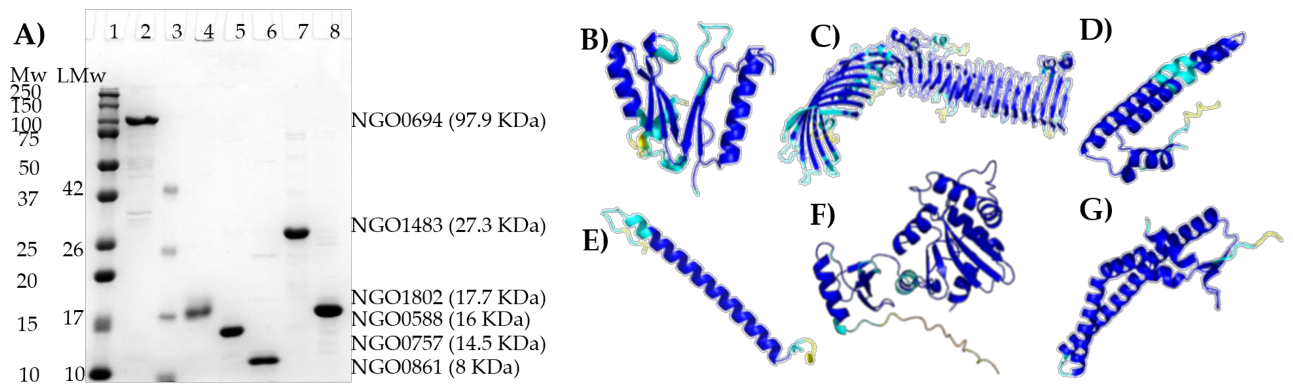
Figure 2.
Dot blot. A-F) Dots 1: Purified proteins (100 ng in 5 µl); A-G) Dots 2 and 3: N. gonorrhoeae F62 or FA1090, respectively (~ 1.5 µg total protein content in 5 µl). Each dot blot was incubated with pooled sera from mice immunized with the corresponding antigen and Alum+MPLA, or Alum+MPLA alone (G) (1:1000 dilution).
Figure 2.
Dot blot. A-F) Dots 1: Purified proteins (100 ng in 5 µl); A-G) Dots 2 and 3: N. gonorrhoeae F62 or FA1090, respectively (~ 1.5 µg total protein content in 5 µl). Each dot blot was incubated with pooled sera from mice immunized with the corresponding antigen and Alum+MPLA, or Alum+MPLA alone (G) (1:1000 dilution).
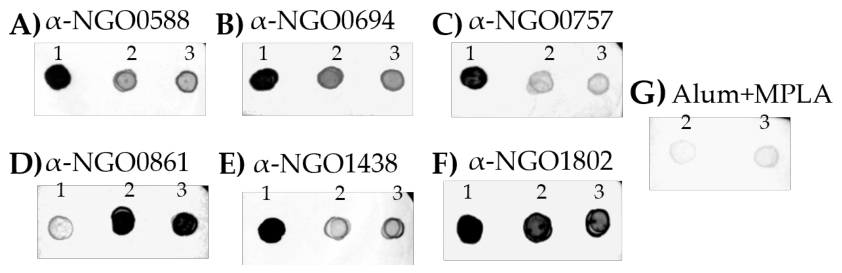
Figure 3.
Total mouse serum IgG antibody ELISA. A-F) IgG antibodies against the purified antigens in pooled sera from mice immunized with Alum+MPLA alone (open circles) or with the individual antigens and Alum+MPLA (closed circles). Pr: preimmune sera. 1st, 2nd and 3rd: sera collected 2 weeks after each immunization. Antibodies were quantified in µg/ml ± SD using a mouse IgG standard curve. G-H) IgG antibodies in pooled sera (3rd) as above against N. gonorrhoeae F62 and FA1090. * p = 0.02; ** p = 0.002; *** p < 0.0005 and **** p < 0.0001 by one way ANOVA with Tukey’s multiple comparison’s test.
Figure 3.
Total mouse serum IgG antibody ELISA. A-F) IgG antibodies against the purified antigens in pooled sera from mice immunized with Alum+MPLA alone (open circles) or with the individual antigens and Alum+MPLA (closed circles). Pr: preimmune sera. 1st, 2nd and 3rd: sera collected 2 weeks after each immunization. Antibodies were quantified in µg/ml ± SD using a mouse IgG standard curve. G-H) IgG antibodies in pooled sera (3rd) as above against N. gonorrhoeae F62 and FA1090. * p = 0.02; ** p = 0.002; *** p < 0.0005 and **** p < 0.0001 by one way ANOVA with Tukey’s multiple comparison’s test.
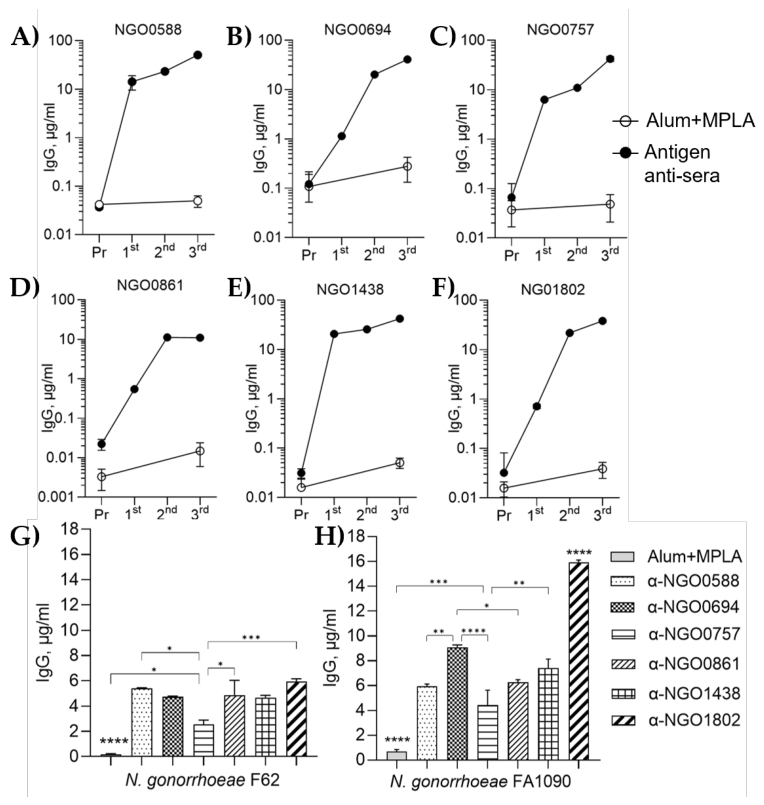
Figure 4.
Serum bactericidal activity (SBA).N. gonorrhoeae F62 killing by pooled anti-NGO0861 + anti-NGO1438 + anti-NGO1802 mouse sera (1:1:1 v/v) (white bars) or Alum+MPLA alone sera (gray bars). Bacteria alone, black bars. Bacterial survival was expressed as % CFU at T30/T0 ± SD. Sera dilutions are indicated on the X-axis. **, p < 0.005 and ****, p < 0.0001 by one-way ANOVA with Dunnett’s multiple comparisons test vs Alum+MPLA.
Figure 4.
Serum bactericidal activity (SBA).N. gonorrhoeae F62 killing by pooled anti-NGO0861 + anti-NGO1438 + anti-NGO1802 mouse sera (1:1:1 v/v) (white bars) or Alum+MPLA alone sera (gray bars). Bacteria alone, black bars. Bacterial survival was expressed as % CFU at T30/T0 ± SD. Sera dilutions are indicated on the X-axis. **, p < 0.005 and ****, p < 0.0001 by one-way ANOVA with Dunnett’s multiple comparisons test vs Alum+MPLA.
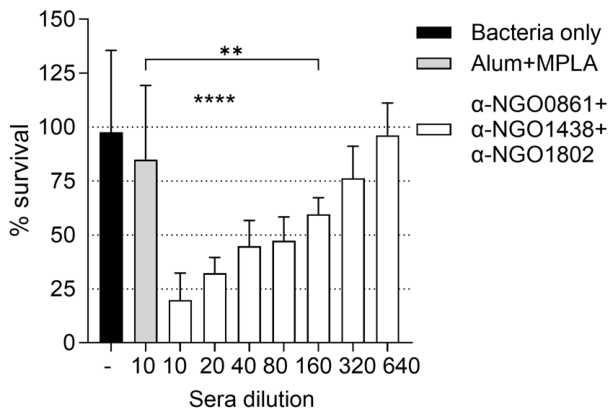
Figure 5.
Total mouse serum IgG antibody ELISA and SBA titers. A) IgG antibodies against the purified antigens in pooled sera (3rd) from mice immunized with Alum+MPLA alone (gray bars) or with the 3-Ag vaccine and Alum+MPLA (white bars). IgG antibodies were quantified in µg/ml ± SD using a mouse IgG standard curve. *, p = 0.03; **, p = 0.008, ***, p = 0.0002 by one-way ANOVA with Tukey’s multiple comparison’s test. ****, p < 0.0001 by unpaired t test. B-C) IgG antibodies in pooled sera as above against N. gonorrhoeae F62 and N. gonorrhoeae FA109. Alum+MPLA, open circles; 3-Ag vaccine, black circles. Pr: preimmune sera; 1st, 2nd and 3rd: sera collected 2 weeks after each immunization. D) SBA of pooled sera from mice immunized with the 3-Ag vaccine (white bars) or with Alum+MPLA alone (gray bars) against N. gonorrhoeae F62 and E) N. gonorrhoeae FA1090. Bacteria alone, black bars. Bacterial survival was expressed as % CFU at T30/T0 ± SD. Sera dilutions are indicated on the X-axis. **, p = 0.002, ***, p = 0.0002 and ****, p < 0.0001 by one-way ANOVA with Dunnett’s multiple comparisons test vs Alum+MPLA.
Figure 5.
Total mouse serum IgG antibody ELISA and SBA titers. A) IgG antibodies against the purified antigens in pooled sera (3rd) from mice immunized with Alum+MPLA alone (gray bars) or with the 3-Ag vaccine and Alum+MPLA (white bars). IgG antibodies were quantified in µg/ml ± SD using a mouse IgG standard curve. *, p = 0.03; **, p = 0.008, ***, p = 0.0002 by one-way ANOVA with Tukey’s multiple comparison’s test. ****, p < 0.0001 by unpaired t test. B-C) IgG antibodies in pooled sera as above against N. gonorrhoeae F62 and N. gonorrhoeae FA109. Alum+MPLA, open circles; 3-Ag vaccine, black circles. Pr: preimmune sera; 1st, 2nd and 3rd: sera collected 2 weeks after each immunization. D) SBA of pooled sera from mice immunized with the 3-Ag vaccine (white bars) or with Alum+MPLA alone (gray bars) against N. gonorrhoeae F62 and E) N. gonorrhoeae FA1090. Bacteria alone, black bars. Bacterial survival was expressed as % CFU at T30/T0 ± SD. Sera dilutions are indicated on the X-axis. **, p = 0.002, ***, p = 0.0002 and ****, p < 0.0001 by one-way ANOVA with Dunnett’s multiple comparisons test vs Alum+MPLA.
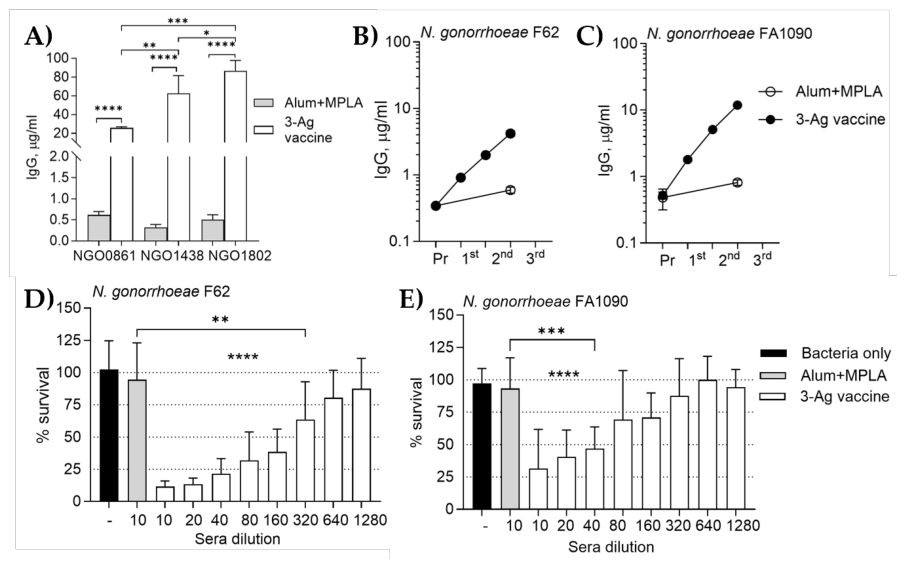
Figure 6.
Mouse model of gonococcal vaginal colonization. Female BALB/c mice (n = 20 per group) were immunized with the 3-Ag vaccine (10 µg each antigen) and Alum+MPLA (closed circles) or with Alum+MPLA alone (open circles). Mice in the diestrus phase of the estrous cycle (n = 10 per group) were challenged intravaginally with N. gonorrhoeae FA1090 (2.6 × 10⁷ CFU). Vaginal swabs were collected daily and plated to enumerate gonococcal CFUs. A) Time-to-clearance Kaplan–Meier curves (p determined by Mantel-Cox analysis); B) Bacterial burden (log10 CFU ± SEM); C) Area under the curve (AUC) (means ± 95% confidence intervals compared across groups (p determined by Mann Whitney’s non-parametric test).
Figure 6.
Mouse model of gonococcal vaginal colonization. Female BALB/c mice (n = 20 per group) were immunized with the 3-Ag vaccine (10 µg each antigen) and Alum+MPLA (closed circles) or with Alum+MPLA alone (open circles). Mice in the diestrus phase of the estrous cycle (n = 10 per group) were challenged intravaginally with N. gonorrhoeae FA1090 (2.6 × 10⁷ CFU). Vaginal swabs were collected daily and plated to enumerate gonococcal CFUs. A) Time-to-clearance Kaplan–Meier curves (p determined by Mantel-Cox analysis); B) Bacterial burden (log10 CFU ± SEM); C) Area under the curve (AUC) (means ± 95% confidence intervals compared across groups (p determined by Mann Whitney’s non-parametric test).
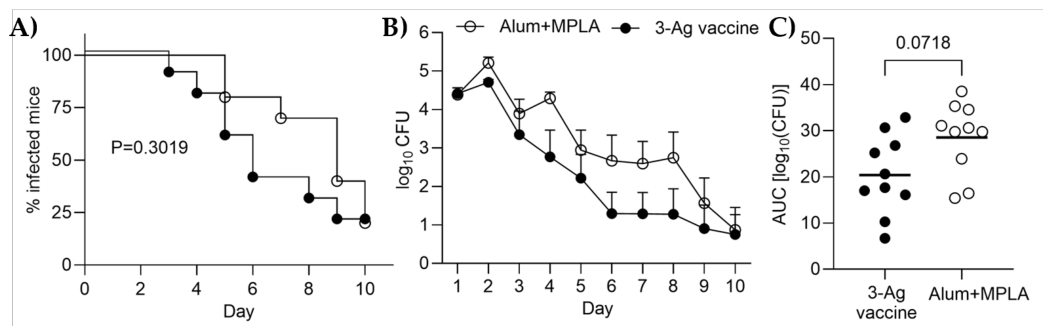
Figure 7.
Total IgG antibody ELISA and SBA titers. A) Total IgG antibodies and B-D) IgG antibody subclasses against purified NGO0861, NGO1438 and NGO1802 in pooled sera (3rd) from mice immunized with Alum+MPLA alone (gray bars) or with the high-dose 3-Ag vaccine and Alum+MPLA (white bars). IgG antibodies were quantified in µg/ml ± SD using a mouse IgG standard curve. ***, p = 0.0003 and ****, p < 0.0001 by one-way ANOVA with Tukey’s multiple comparisons test. E-F) Total IgG antibodies against N. gonorrhoeae F62 and N. gonorrhoeae FA1090 as above. High-dose 3-Ag vaccine, black circles; Alum+MPLA alone sera, open circles. Pr, preimmune sera; 1st, 2nd and 3rd, sera collected 2 weeks after each immunization. G) SBA against N. gonorrhoeae F62. High-dose 3-Ag vaccine, white bars; Alum+MPLA alone, gray bars. Bacteria alone, black bars. Bacterial survival was expressed as % CFU at T30/T0 ± SD. Sera dilutions are indicated on the X-axis. *, p < 0.05 and ****, p < 0.0001 by one-way ANOVA with Dunnett’s multiple comparisons test vs Alum+MPLA.
Figure 7.
Total IgG antibody ELISA and SBA titers. A) Total IgG antibodies and B-D) IgG antibody subclasses against purified NGO0861, NGO1438 and NGO1802 in pooled sera (3rd) from mice immunized with Alum+MPLA alone (gray bars) or with the high-dose 3-Ag vaccine and Alum+MPLA (white bars). IgG antibodies were quantified in µg/ml ± SD using a mouse IgG standard curve. ***, p = 0.0003 and ****, p < 0.0001 by one-way ANOVA with Tukey’s multiple comparisons test. E-F) Total IgG antibodies against N. gonorrhoeae F62 and N. gonorrhoeae FA1090 as above. High-dose 3-Ag vaccine, black circles; Alum+MPLA alone sera, open circles. Pr, preimmune sera; 1st, 2nd and 3rd, sera collected 2 weeks after each immunization. G) SBA against N. gonorrhoeae F62. High-dose 3-Ag vaccine, white bars; Alum+MPLA alone, gray bars. Bacteria alone, black bars. Bacterial survival was expressed as % CFU at T30/T0 ± SD. Sera dilutions are indicated on the X-axis. *, p < 0.05 and ****, p < 0.0001 by one-way ANOVA with Dunnett’s multiple comparisons test vs Alum+MPLA.
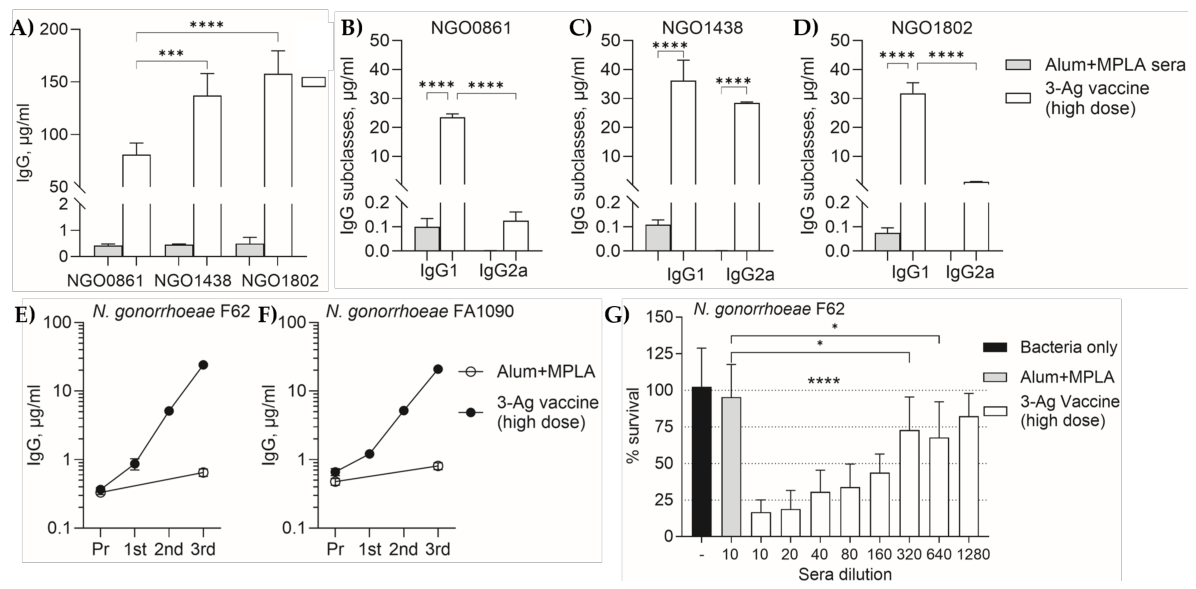

Table 1.
Summary of the properties of the six CASS antigens [38].
Table 1.
Summary of the properties of the six CASS antigens [38].
| Antigen | mRNA Expression in vivo (RPKM) (M) (F) |
PREDICTED | Core genome | ||||||
|---|---|---|---|---|---|---|---|---|---|
| Antigen Score | Cell Loc |
Structure | Function Homology / Annotation |
||||||
| TM Domain | Signal Sequence | Size (kDa) | |||||||
| NGO0588 (NEIS1253) |
91 | 141 | 0.5 | P/OM | 0 | SP | 16 | DUF4189 domain-containing protein | Yes |
| NGO0694 (NEIS2653) |
56 | 106 | 0.56 | OM | 0 | - | 97.9 | Autotransporter, outer membrane beta-barrel domain-containing protein | Yes |
| NGO0757 (NEIS1146) |
60 | 107 | 0.52 | P | 0 | SP | 16.6 | Spy/CpxP family protein refolding chaperone | Yes |
| NGO0861 (NEIS2662) |
510 | 868 | 0.58 | P/OM | 0 | SP | 9.25 | Hypothetical lipoprotein | Yes |
| NGO1438 (NEIS0490) |
95 | 159 | 0.42 | P | 0 | SP | 28.7 | DsbC family protein | Yes |
| NGO1802 (NEIS0172) |
53 | 104 | 0.43 | P/OM | 0 | SP | 19 | OmpH family outer membrane protein | Yes |
Table 2.
Alleles analysis in 36931 N. gonorrhoeae strains in PubMLST [42].
Table 2.
Alleles analysis in 36931 N. gonorrhoeae strains in PubMLST [42].
| Locus | Total alleles |
Frequency | Distribution (% of total) |
p-Dist. | Polymorphic Sites |
Non-Synonymous Mutations |
|
|---|---|---|---|---|---|---|---|
| Allele | Strains | ||||||
| ngo0588 | 80 | 10 | 20050 | 52.3 | 0.0024 | 78 | - |
| 14 | 3877 | 10.5 | Q19R | ||||
| 11 | 3018 | 8.2 | A100V | ||||
| 90 | 2947 | 8 | - | ||||
| 92 | 2852 | 7.7 | Q19R | ||||
| ngo0694 | 171 | 2 7 Nd |
16830 4775 3384 |
45.6 13 9.16 |
0.00067 | 506 | ** - - |
| 7 | 4775 | 13 | - | ||||
| NV | 3384 | 9.16 | |||||
| ngo0757 | 63 | 21 | 35076 | 95 | 0.00017 | 144 | - |
| ngo0861 | 50 | 1 | 36446 | 99 | 0.00007 | 49 | - |
| ngo1438 | 154 | 6 | 20386 | 55.2 | 0.0016 | 242 | - |
| 13 | 6908 | 18.7 | - | ||||
| 121 | 4085 | 11 | K233Q | ||||
| ngo1802 | 122 | 21 | 17700 | 48 | 0.0048 | 73 | I2T |
| 23 | 5162 | 14 | - | ||||
| 13 | 2815 | 7.6 | I2T, T11A, T19A, N46K | ||||
| 159 | 2780 | 7.5 | T19A, T21A | ||||
| 122 | 2459 | 6.6 | - | ||||
| 124 | 2202 | 6 | I2T, T11A, T19A, N46K | ||||
| ** Internal stop codon mutation at residue 214; NV: no values assigned | |||||||
Table 3.
Serum bactericidal activity (SBA).
| N. gonorrhoeae F62 | N. gonorrhoeae FA1090 | |||
|---|---|---|---|---|
| Mouse antisera | SBA titer | % Survival | SBA titer | % Survival |
| Anti-NGO0588 | 1/160 | 46 ± 20a | 1/320 | 44 ± 7b |
| Anti-NGO0694 | 1/40 | 46 ± 26b | 1/10 | 91 ± 10 |
| Anti-NGO0757 | 1/10 | 58 ± 18 | ND | ND |
| Anti-NGO0861 | 1/40 | 45 ± 25c | 1/10 | 38 ± 26b |
| Anti-NGO1438 | 1/40 | 38 ±17c | 1/10 | 24 ± 10a |
| Anti-NGO1802 | 1/20 | 32 ± 14c | 1/10 | 42 ± 26b |
| Alum+MPLA | 1/10 | 89 ± 23 | 1/10 | 96 ± 25 |
| a, p < 0.01; b, p < 0.0005; c, p < 0.0001 vs Adjuvants sera by one way ANOVA with Dunnet’s multiple comparisons test. ND, not determined. | ||||
Disclaimer/Publisher’s Note: The statements, opinions and data contained in all publications are solely those of the individual author(s) and contributor(s) and not of MDPI and/or the editor(s). MDPI and/or the editor(s) disclaim responsibility for any injury to people or property resulting from any ideas, methods, instructions or products referred to in the content. |
© 2026 by the authors. Licensee MDPI, Basel, Switzerland. This article is an open access article distributed under the terms and conditions of the Creative Commons Attribution (CC BY) license (http://creativecommons.org/licenses/by/4.0/).
Copyright: This open access article is published under a Creative Commons CC BY 4.0 license, which permit the free download, distribution, and reuse, provided that the author and preprint are cited in any reuse.