

Submitted:
20 August 2026
Posted:
21 August 2026
You are already at the latest version
Abstract
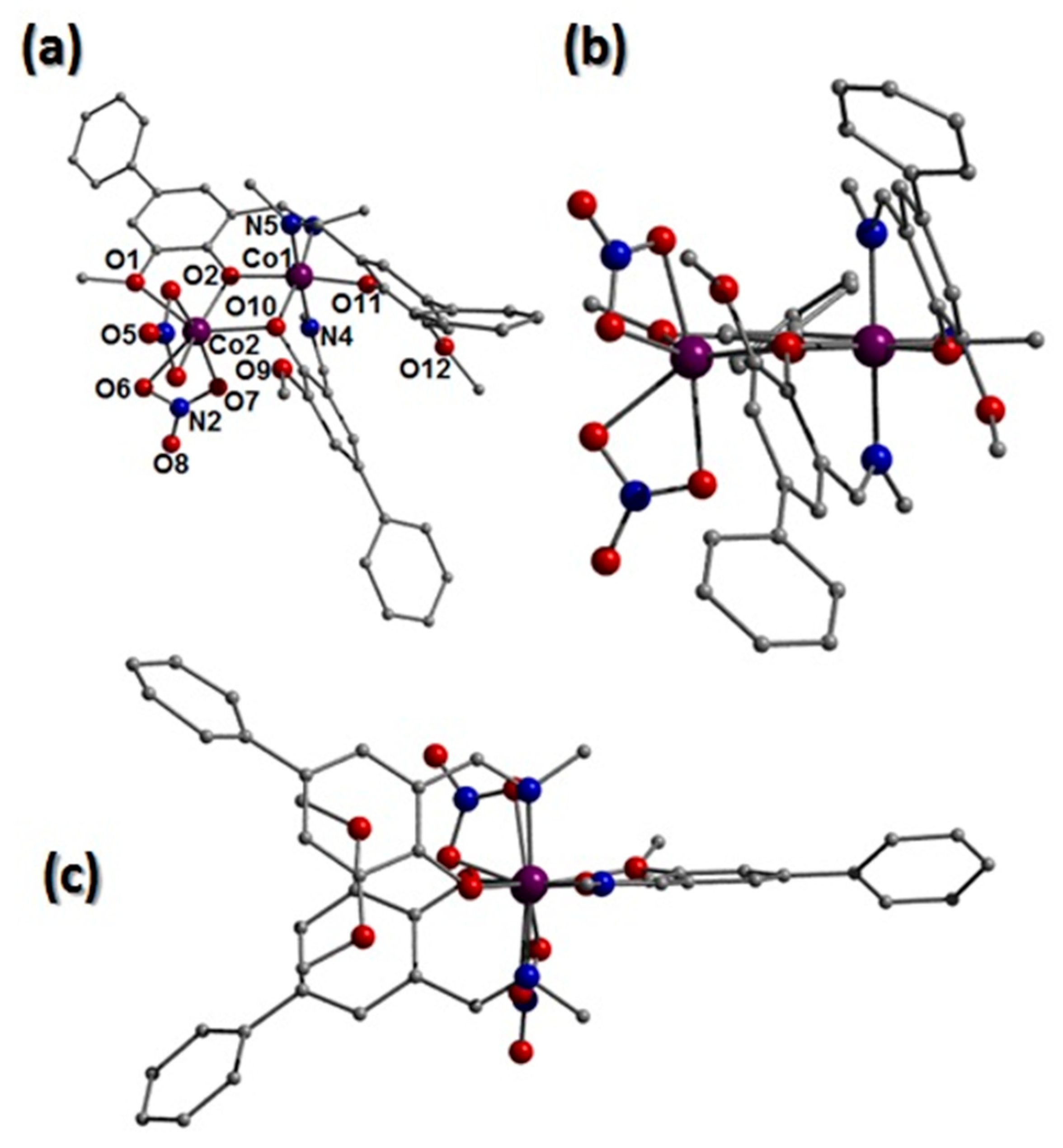
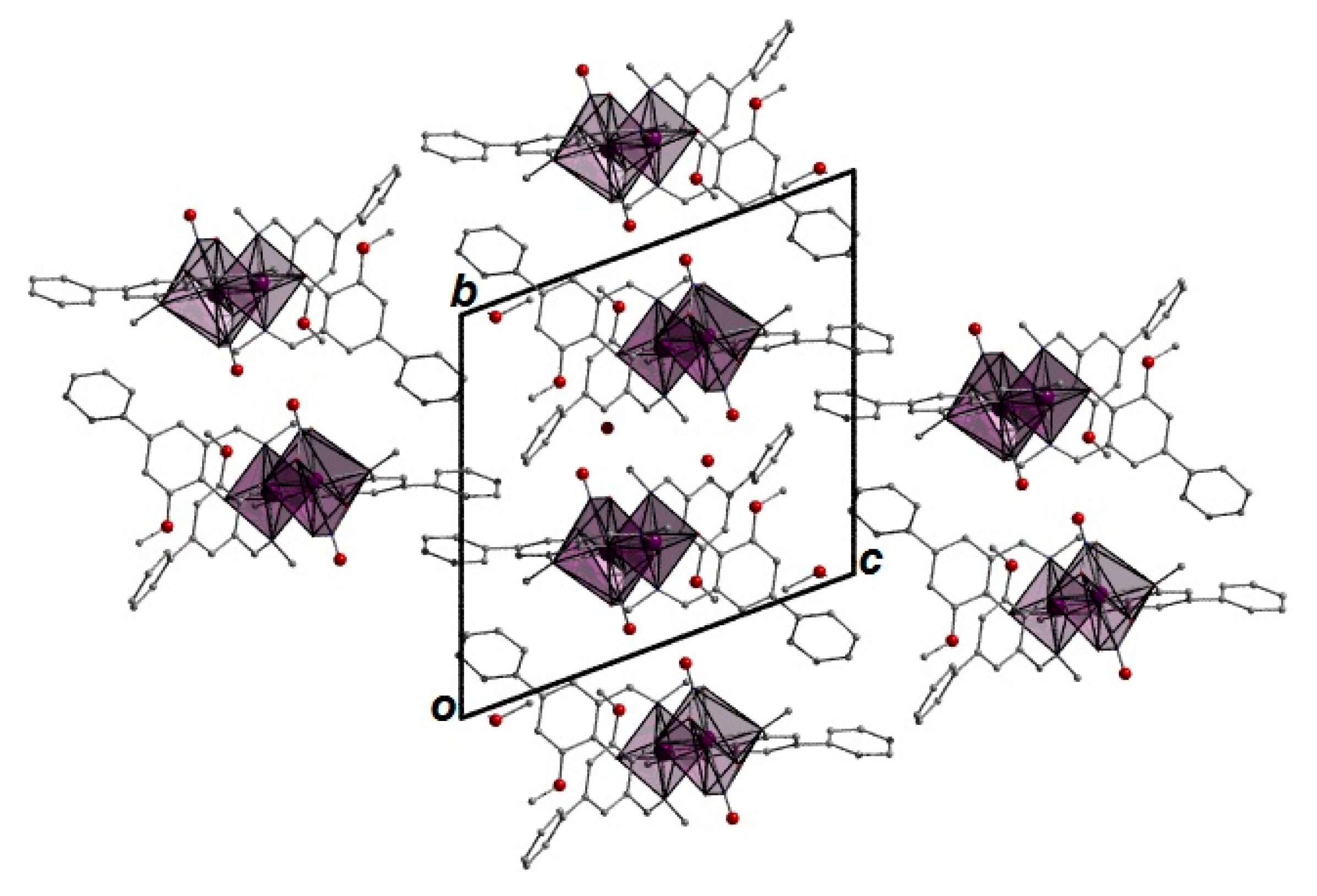
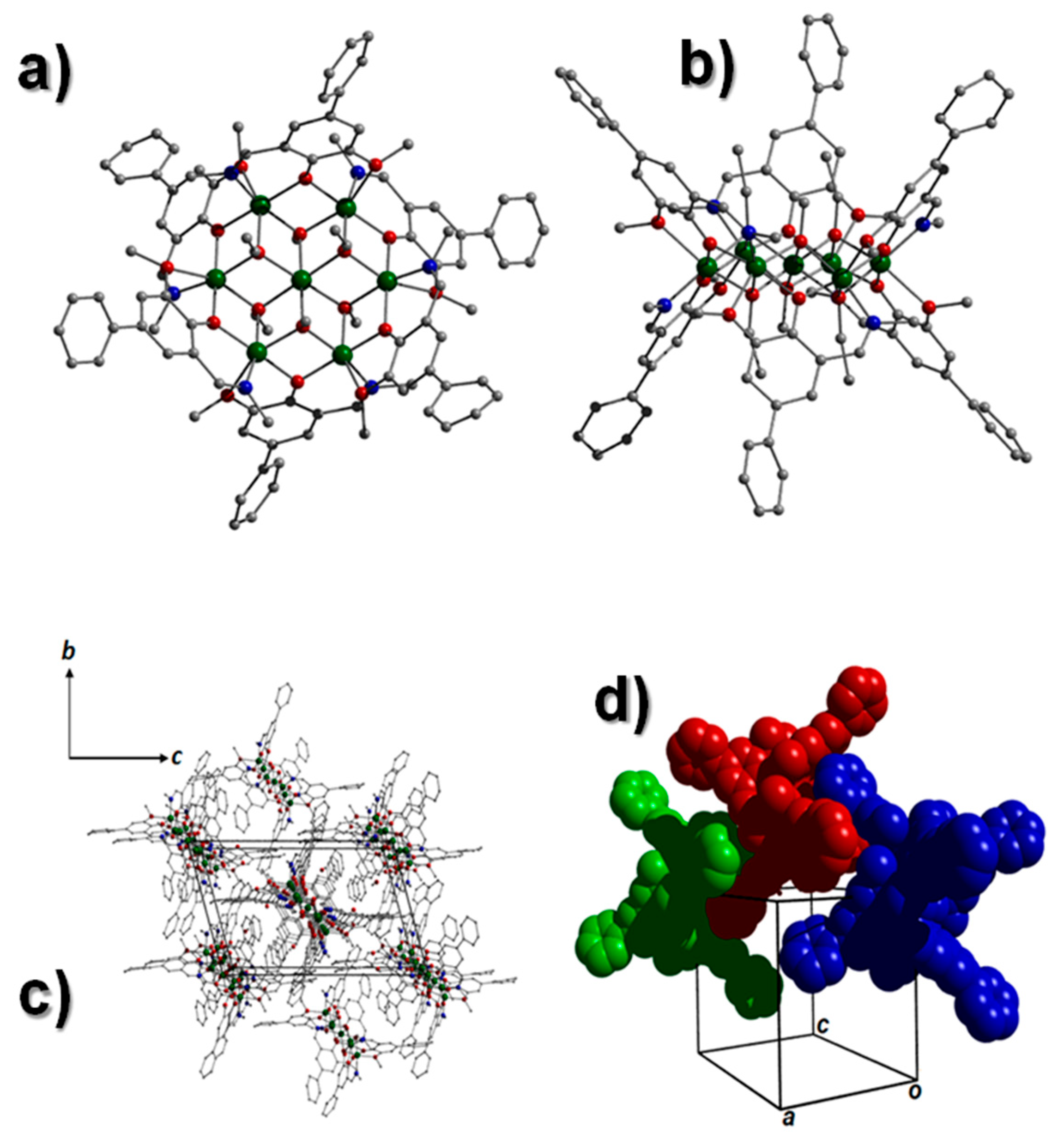
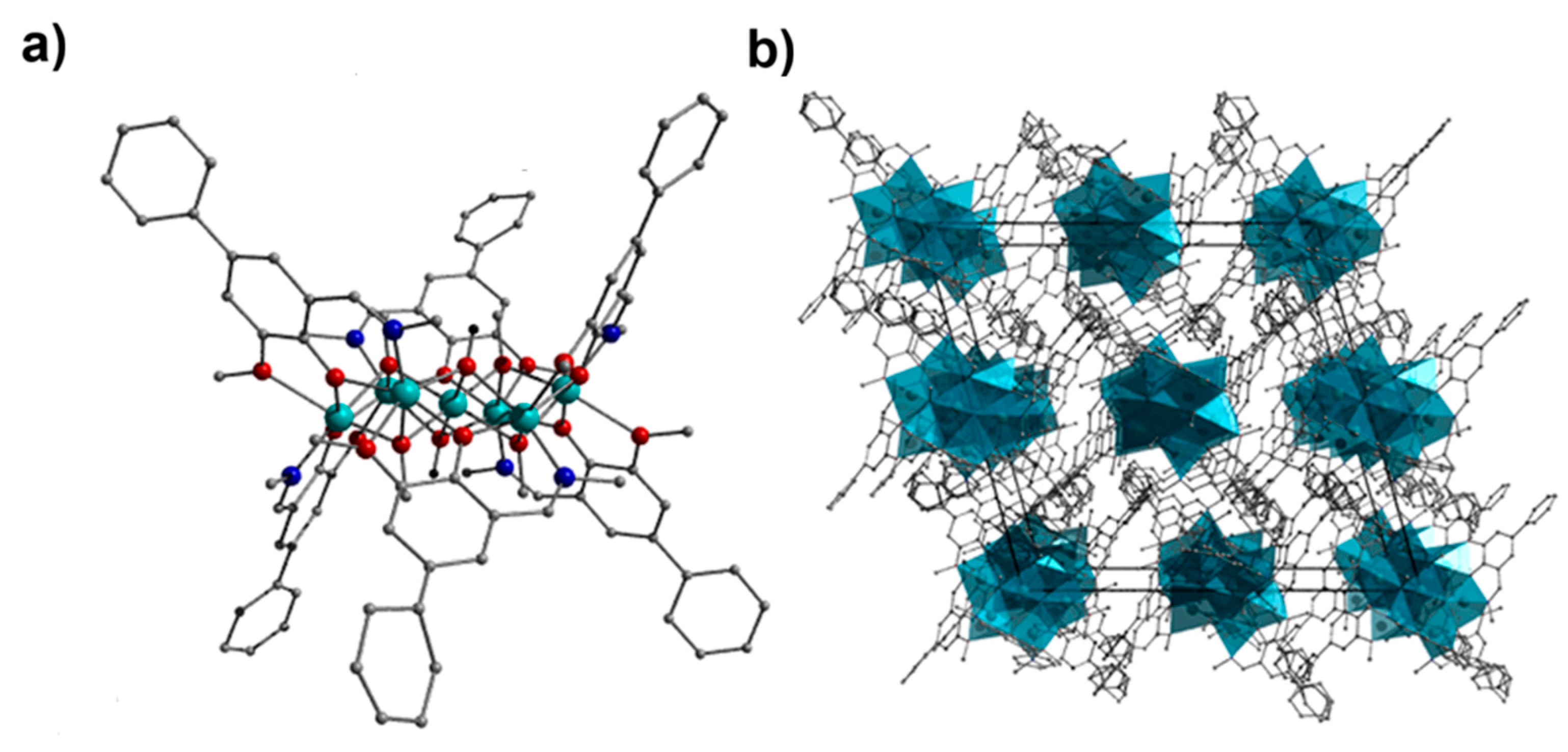
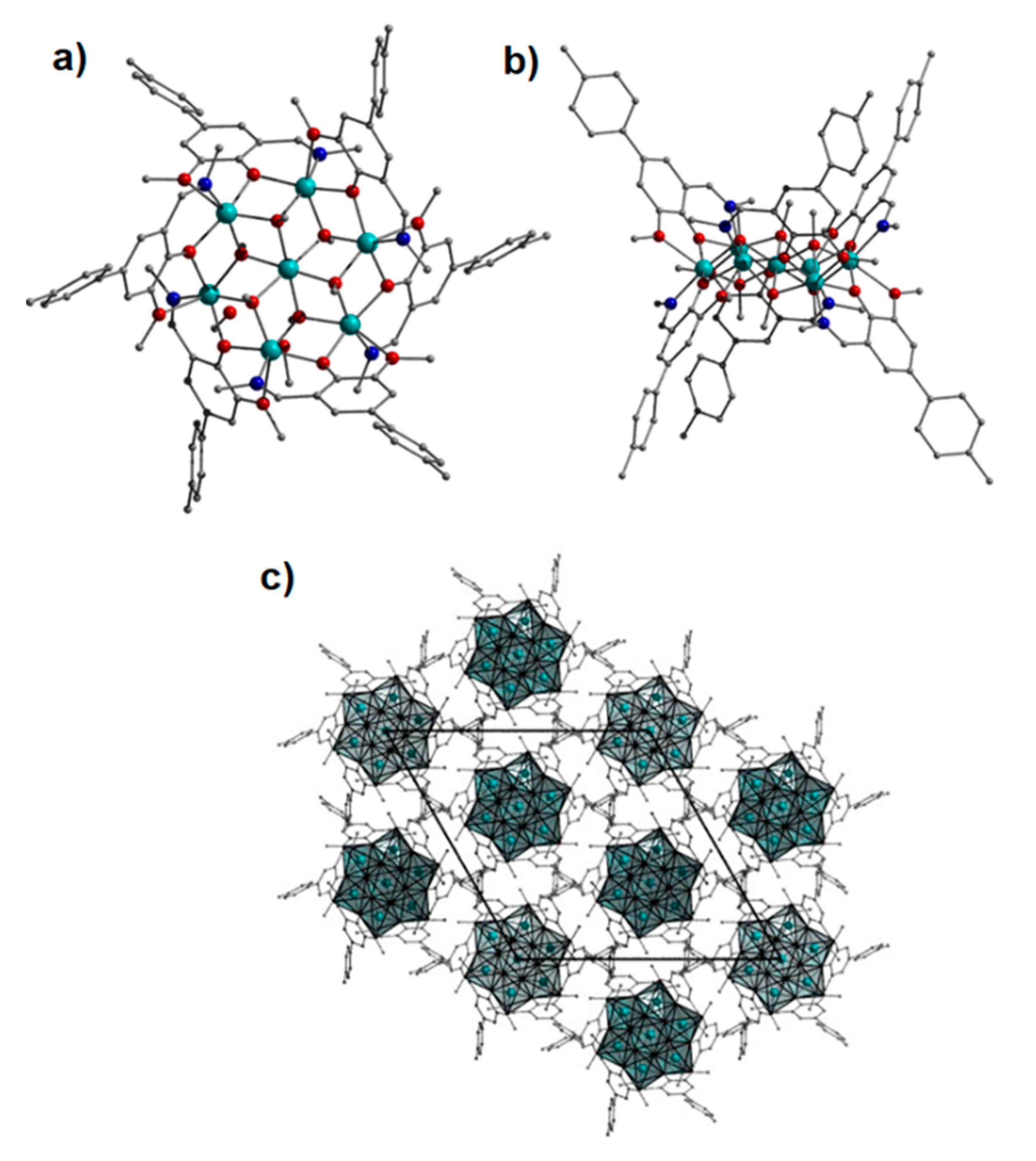
Upon metal coordination, the upper rim modification of the Schiff base ligand 2-methoxy-6-((methylimino)methyl)phenol gives rise to a new family of [M(II)7] (M = Co, Ni, Zn) pseudo metallocalix[6]arenes in the form of [Co(II)7(OMe)6(L3)6](NO3)2.H2O.3MeOH (1), [Ni(II)7(OMe)6(L3)6](NO3)2.2H2O (4), [Zn(II)7(OH)2(OMe)4(L3)6](NO3)2.4MeOH.10H2O (5) and [Zn(II)7(OMe)6(L4)6](NO3)2.10MeOH.13H2O (6), where L3H = 2-methoxy-4-phenyl-6-[(methylimino)methyl]phenol and L4H = 2-methoxy-4-tolyl-6-[(methylimino)methyl]phenol). The upper rim functionalisation provides this family with extensions to their molecular cavity walls when compared to their previously reported siblings. Attempts at encapsulating guest moieties (e.g. C60) unexpectedly give rise to the monometallic complex [Co(II)Co(III)(L3)3(NO3)2].H2O (3).
Keywords:
1. Introduction
2. Results and Discussion
Attempts at Guest Encapsulation Within Pseudo Metallocalixarenes
3. Conclusions
4. Materials and Methods
X-Ray Crystallography
Preparation of Complexes 1-6
[Co(II)7(OMe)6(L3)6](NO3)2⋅H2O⋅3MeOH (1)
[[Co(III)(L3)3] (2)
[[Co(III)Co(II)(L3)3(NO3)2].H2O (3)
[[Ni(II)7(OMe)6(L3)6](NO3)2⋅2H2O (4)
[[Zn(II)7(OH)2(OMe)4(L3)6](NO3)2.4MeOH.10H2O (5)
[Synthesis of [Zn(II)7(OMe)6(L4)6](NO3)2.10MeOH.13H2O (6)
Author Contributions
Funding
Acknowledgments
Conflicts of Interest
References
- (a) Wernsdorfer, W. N. Aliaga-Alcalde, N. Hendrickson, D. N, Christou, G. Exchange-biased quantum tunnelling in a supramolecular dimer of Single-Molecule Magnets Nature, 2002, 416, 406-409. (b) Pedersen, K. S, Bendix, J.; Clérac. R. Single-molecule magnet engineering: building-block approaches. Chem. Commun., 2014, 50(34), 4396-4415. (c) Coronado, E. Molecular magnetism: from chemical design to spin control in molecules, materials and devices. Nat. Review Materials. 2020, 5, 87-104.
- (a) Burrows, A. D.; Frost, C. G.; Mahon, M. F; Richardson. C. Post-Synthetic Modification of Tagged Metal–Organic Frameworks. Angew. Chem., Int. Ed., 2008, 47(44), 8482-8486. (b) Evans, J. D.; Sumby, C. J.; Doonan, C. Post-synthetic metalation of Metal-Organic Frameworks. Chem. Rev., 2014, 43(16), 5933–5951. (c) He, W.; Lv, D.; Guan, Y.; Yu, S. Post-synthetic modification of Metal-Organic Frameworks: synthesis, characterization and application. J. Mat. Chem. A. 2023, 11(45), 24519–24550.
- (a) Segura, J. L.; Royuela, S.; Mar Ramos, M. Post-synthetic modification of covalent organic frameworks. Chem. Soc. Rev., 2019, 48, 3903-3945. (b) Liu, M.; Yang, S.; Yang, X.; Cui, C.-X.; Liu, G.; Li, X.; He, J.; Chen, G. Z.; Xu, Q.; Zeng, G. Post-synthetic modification of covalent organic frameworks for CO2 electroreduction. Nature Commun.; 2023, 14, 3800. Rejali, N. A.; Dinari, M.; Wang, Y. Post-synthetic modifications of covalent organic frameworks (COFs) for diverse applications. Chem. Commun. 2023, 59(78), 11631–11647.
- Wang, H.; Jin, Y.; Sun, N.; Wei, Z.; Jiang, J. Post-synthetic modifications of porous organic cages. Chem. Soc. Rev. 2021, 50(16), 8874–8886.
- Liu, J.; Wang, Z.; Cheng, P.; Zawrotko, M. J.; Chen, Y.; Zhang, Z. Post-synthetic modifications of metal–organic cages. Nature Review Chemistry. 2022, 6, 339-356.
- Jones, L. F.; Prescimone, A.; M. Evangelisti, M.; Brechin, E. K. 1-D chains of Single-Molecule Magnets. Chem. Commun., 2009, 2023-2025.
- Lecren, L.; O. Roubeau, O.; Coulon, C.; Li, Y.-G. Le Goff, X. F.; Wernsdorfer, W.; Miyasaka, H.; Clérac. R. One-dimensional coordination polymers of antiferromagnetically-coupled [Mn4] single-molecule magnets. J. Am. Chem. Soc., 2005, 127(49), 17353–17363.
- Plenk, C.; Krause, J.; Beck, M.; Rentschler, E. Rational linkage of magnetic molecules using click chemistry. Chem. Commun., 2015, 51, 6524-6527.
- (a) Timco, G. A.; Faust, T. B.; Tuna, F.; Winpenny, R. E. P. Linking heterometallic rings for quantum information processing and amusement. Chem. Soc. Rev., 2011, 40, 3067–3075 and references herein. (b) Jones. L. F.; Chapter 6: Beyond the Metallacrown: Controlling First- and Second-Order Coordination Spheres Towards Discrete and Extended Architectures in Advances in Metallacrown Chemistry. 1st Ed. C. M. Zeleski. Publisher: Springer. 2022, p221 and references herein.
- (a) Dai, F.-R.; Qiao, Y.; Wang, Z. Designing structurally tunable and functionally versatile synthetic supercontainers. Inorg. Chem. Front., 2016, 3, 243-249. For reviews on molecular containers see: (b) Yoshizawa, M. Klosterman, J. K.; Fujita, M. Functional Molecular Flasks: New Properties and Reactions within Discrete, Self-Assembled Hosts. Angew. Chem. Int. Ed., 2009, 48, 3418-3438. (c) Ballester, P.; Fujita, M.; J. Rebek Jr, J. Molecular Containers, Chem. Soc. Rev., 2015, 44, 392-393.
- (a) Meally, S. T.; Karotsis, G.; Brechin, E. K.; Papaefstathiou, G. S.; Dunne, P. W.; McArdle P.; Jones, L. F. Planar [Ni7] discs as double-bowl, pseudo metallacalix[6]arene host cavities. CrystEngComm., 2010, 12, 59-63. (b) Meally, S. T.; McDonald, C.; Karotsis, G.; Papaefstathiou, G. S.; Brechin, E. K.; Dunne, P. W.; McArdle, P.; Power, N. P.; Jones. L. F. A family of pseudo [M(II)7] metallocalix[6]arene discs. Dalton Trans., 2010, 39, 4809-4816.
- Slater-Parry, M.; Meally, S. T.; Ratanasakprakan, C.; Townrow, D. E.; Ellaby, R. J.; Page S. J.; Jones, L F. Pseudo [M(ii)7] (M = Co, Ni and Zn) metallocalix[6]arene hosts encapsulate a range of organic guest molecules in the solid state. CrystEngComm., 2025, 27(22), 3823-3832.
- Meally, S. T.; McDonald, C.; Kealy, P.; Taylor, S. M.; Brechin, E. K.; Jones, L. F. Investigating the solid-state hosting abilities of homo- and hetero-valent [Co7] metallocalix[6]arenes. Dalton Trans., 2012, 41(18), 5610-5616.
- Ullman A. M.; Nocera. D. G. Mechanism of Cobalt Self-Exchange Electron Transfer. J. Am. Chem. Soc., 2013, 135, 15053-15061.
- Slater-Parry, M. E.; Durrant, J. P.; Howells, J. M.; Pitak, M. B.; Horton, P. N.; Klooster, W. T.; Coles, S. J.; O`Connor, H. M.; Brechin, E. K.; Barra A.-L.; Jones. L. F. Crowding out: ligand modifications and their structure directing effects on brucite-like {Mx(μ3-OH)y} (M = Co(II), Ni(II)) core growth within polymetallic cages. Dalton Trans., 2019, 48, 1477-1488.
- Lhoták. P. Upper rim bridged calixarenes. RSC Advances, 2024, 14, 23303-23321 and references herein.
- (a) Leong, W. L.; Vittal, J. J. Alkali metal ion directed self-assembled Ni(II) molecular clusters. New J. Chem., 2010, 34, 2145–2152. (b) Wei, L.-Q.; Zhang, K.; Feng, Y-C.; Wang, Y.-H.; Zeng, M-H.; Kurmoo, M. Microwave versus Traditional Solvothermal Synthesis of Ni(II)7 Discs: Effect of Ligand on Exchange Reaction in Solution Studied by Electrospray Ionization-Mass Spectroscopy and Magnetic Properties. Inorg. Chem. 2011, 50, 7274–7283. (c) Ding, C.; Gao, C.; Ng, S.; Wang, B.; Xie, Y. Polynuclear Complexes with Alkoxo and Phenoxo Bridges from In Situ Generated Hydroxy-Rich Schiff Base Ligands: Syntheses, Structures, and Magnetic Properties. Chem. Eur. J. 2013, 19, 9961–9972. (d) Zhang, S-H.; Zhao, R.-X.; Li, G.; Zhang, H.-Y.; Zhang, C.-L.; Muller, G. Structural variation from heterometallic heptanuclear or heptanuclear to cubane clusters based on 2-hydroxy-3-ethoxy-benzaldehyde: effects of pH and temperature. RSC Advances. 2014, 4 (97), 54837–54846. (e) Kobayashi, F.; Ohtani, R.; Teraoka, S.; Kosaka, W.; Miyasaka, H.; Zhang, Y.; Lindoy, L. F.; Hayami, S.; Masaaki Nakamura, M. Syntheses, structures and magnetic properties of tetranuclear cubane-type and heptanuclear wheel-type nickel(II) complexes with 3-methoxysalicylic acid derivatives. Dalton Trans. 2017, 46, 8555–8561. (f) Gheorghe, R.; Ionita, G. A.; Maxim, C.; Caneschi, A.; Sorace, L.; Andruh, M. Aggregation of heptanuclear [MII7] (M = Co, Ni, Zn) clusters by a Schiff-base ligand derived from o-vanillin: Synthesis, crystal structures and magnetic properties. Polyhedron. 2019, 171, 269-278.
- Spek. A. L. PLATON SQUEEZE: a tool for the calculation of the disordered solvent contribution to the calculated structure factors. Acta Crystallogr., Sect. C: Struct. Chem., 2015, 71, 1–9.
- Rigaku OD, CrysAlis PRO, Rigaku Oxford Diffraction Ltd, Yarnton, England, 2015.
- Sheldrick. G. M. Crystal structure refinement with SHELXL. Acta Crystallogr., Sect. C: Struct. Chem., 2015, 71, 3-8.

| 1.2H2O.3MeOH | 2 | 3 | |
| Formulaa | C96H114N8O27Co7 | C45H42N3O6Co1 | C45H44N5O13Co2 |
| MW | 2165.33 | 779.75 | 978.70 |
| Crystal System | Monoclinic | Triclinic | Triclinic |
| Space group | C2/c | P-1 | P-1 |
| a/Å | 26.7878(12) | 10.6963(8) | 9.5986(3) |
| b/Å | 15.1243(7) | 13.3685(10) | 16.3443(6) |
| c/Å | 28.0186(10) | 13.6686(10) | 17.1687(6) |
| α/o | 90 | 98.863(6) | 67.715(3) |
| β/o | 105.301(4) | 94.853(6) | 75.169(3) |
| γ/o | 90 | 99.156(6) | 78.311(3) |
| V/Å3 | 10949.3(8) | 1894.6(2) | 2392.43(14) |
| Z | 4 | 2 | 2 |
| T/K | 150(2) | 150(2) | 150(2) |
| λb/Å | 0.71073 | 0.71073 | 0.71073 |
| Dc/g cm-3 | 1.314 | 1.367 | 1.359 |
| μ(Mo-Ka)/ mm-1 | 1.103 | 0.507 | 0.759 |
| Meas./indep.(Rint) refl. | 10025 / 6252 (0.0535) | 14288 / 4295 (0.0615) | 19060 / 5317 (0.0386) |
| Restraints, parameters | 10, 568 | 0, 502 | 0, 584 |
| wR2 (all data)c | 0.2267 | 0.1605 | 0.2615 |
| R1d,e | 0.0710 | 0.0694 | 0.0806 |
| Goodness of fit on F2 | 1.039 | 1.043 | 1.071 |
|
4.2H2O |
5.4MeOH.10H2O | 6.10MeOH.13H2O | |
| Formulaa | C93H97N8O26Ni7 | C104H146N8O38Zn7 | C102H114N8O24Zn7 |
| MW | 2015.62 | 2573.95 | 2822.10 |
| Crystal System | Monoclinic | Monoclinic | Trigonal |
| Space group | P21/n | C2/c | R-3 |
| a/Å | 14.6830(7) | 26.9617(12) | 23.6952(4) |
| b/Å | 14.3260(5) | 15.1167(7) | 23.6952(4) |
| c/Å | 24.1964(11) | 28.0457(10) | 21.8157(3) |
| α/o | 90 | 90 | 90 |
| β/o | 106.598(5) | 105.778(4) | 90 |
| γ/o | 90 | 90 | 120 |
| V/Å3 | 4877.6(4) | 11000.0(8) | 10607.7(3) |
| Z | 2 | 4 | 3 |
| T/K | 100(2) | 150(2) | 100(2) |
| λb/Å | 0.71073 | 0.71073 | 0.71073 |
| Dc/g cm-3 | 1.372 | 1.225 | 1.019 |
| μ(Mo-Ka)/ mm-1 | 1.389 | 1.558 | 1.215 |
| Meas./indep.(Rint) refl. | 8924 / 5819 (0.0532) | 25142 / 12696 (0.0737) | 13254 / 4319 (0.0167) |
| Restraints, parameters | 15, 562 | 20, 562 | 0, 205 |
| wR2 (all data)c | 0.2435 | 0.2082 | 0.1690 |
| R1d,e | 0.0756 | 0.1729 | 0.0442 |
| Goodness of fit on F2 | 1.097 | 0.992 | 1.171 |
|
Pseudo [M(II)7] metallocalix[6]arene |
Cavity size (base × depth × rim) (Å) |
% increase in Cavity depth increase (%) (cf. corresponding [M7]* |
Cavity rim increase (%) (cf. corresponding [M7])* |
Ref. |
| [(MeOH)2⊂Co(II)7] | 6.25 × 4.08 × 12.12 | - | - | 11 |
| [(MeOH)2⊂Ni(II)7] | 6.20 x 4.16 x 11.81 | - | - | 9a |
| [(MeOH)2(H2O)⊂Zn(II)7] | 6.26 x 4.07 x 12.22 | - | - | 9b |
| [Co(II)7] (1) | 6.25 x 7.11 x 17.94 | 74 | 48 | this work |
| [Ni(II)7] (4) | 6.19 x 7.55 x 17.03 | 81 | 44 | this work |
| [Zn(II)7] (5) | 6.23 x 7.25 x 17.62 | 78 | 44 | this work |
| [Zn(II)7] (6) | 6.22 x 8.54 x 19.35 | 110 | 58 | this work |
Disclaimer/Publisher’s Note: The statements, opinions and data contained in all publications are solely those of the individual author(s) and contributor(s) and not of MDPI and/or the editor(s). MDPI and/or the editor(s) disclaim responsibility for any injury to people or property resulting from any ideas, methods, instructions or products referred to in the content. |
© 2026 by the authors. Licensee MDPI, Basel, Switzerland. This article is an open access article distributed under the terms and conditions of the Creative Commons Attribution (CC BY) license (http://creativecommons.org/licenses/by/4.0/).