Preprint
Article

This version is not peer-reviewed.

Giving Molecular Cavity Wall Extensions to Pseudo [M(II)7] (M = Co, Ni, Zn) metallocalix[6]arenes

A peer-reviewed version of this preprint was published in:
Inorganics 2026, 14(9), 242. https://doi.org/10.3390/inorganics14090242

Submitted:

20 August 2026

Posted:

21 August 2026

You are already at the latest version

Abstract

Upon metal coordination, the upper rim modification of the Schiff base ligand 2-methoxy-6-((methylimino)methyl)phenol gives rise to a new family of [M(II)7] (M = Co, Ni, Zn) pseudo metallocalix[6]arenes in the form of [Co(II)7(OMe)6(L3)6](NO3)2.H2O.3MeOH (1), [Ni(II)7(OMe)6(L3)6](NO3)2.2H2O (4), [Zn(II)7(OH)2(OMe)4(L3)6](NO3)2.4MeOH.10H2O (5) and [Zn(II)7(OMe)6(L4)6](NO3)2.10MeOH.13H2O (6), where L3H = 2-methoxy-4-phenyl-6-[(methylimino)methyl]phenol and L4H = 2-methoxy-4-tolyl-6-[(methylimino)methyl]phenol). The upper rim functionalisation provides this family with extensions to their molecular cavity walls when compared to their previously reported siblings. Attempts at encapsulating guest moieties (e.g. C60) unexpectedly give rise to the monometallic complex [Co(II)Co(III)(L3)3(NO3)2].H2O (3).

Keywords: 
;  ;  

1. Introduction

The pursuit of new discrete and extended structures equipped with premeditated application driven properties has never been more intense. During their development such materials often require slight structural and / or electronic modification in order to optimise their operational potential. To this end, synthetic tools at our disposal include post-synthetic ligand modification, a technique often employed to fine tune structural properties while maintaining the integrity of the core molecule. Indeed, such endeavours lend themselves to the structural adjustment / re-organisation of both discrete molecules (e.g. the linking of magnetic complexes) [1] as well as extended architectures such as Metal-Organic Frameworks (MOFs) [2] and Covalent Organic Frameworks (COFs) [3], as well as discrete systems such as Metal-Organic Cages (MOCs) [4] and Porous Organic Cages (POCs) [5]. Moreover specifically, replacing monotopic ligands with di- / multitopic analogues has been shown to be an effective way to template / organise discrete molecules into extended network assemblies. For instance, the facile substitution of benzoate (¯O2CPh) ligands within the Single-Molecule Magnet [Mn(III)6(µ3-O)2(Et-sao)6(O2CPh)2] (Et-saoH2 = 2-hydroxypropiophenone oxime) with succinates (or isophthalate) direct 1-D chain formation [6]. In a similar vein, Lecren et al successfully employed azides to produce a 1-D chain comprising {Mn4(hmp)6(N3)2](ClO4)2} (hmp = 2-hydroxymethylpyridine) repeating units [7]. Moreover, the Rentschler group have successfully connected four azide functionalised Co(II) monomeric SMMs to a central (TMA)2[Cu(II)(12-MC-Cu(II)N(eshi)-4)] (TMA = tetramethylammonium, N(eshi)-4 = 4-ethynyl salicylhydroxamic acid) metallacrown using CuAAC click chemistry [8]. Within the same timeframe, Winpenny and co-workers elegantly demonstrated the controlled covalent attachment of {Cu(II)} and {Cu(II)2} qubit monomers strategically placed in-between two {Cr(III)7Ni(II)} ring structures to produce viable materials for Quantum Information Processing applications [9].
Another benefit to this methodology is that the synthetic chemist is often able to control / modify the second coordination sphere associated with their prototype materials. Indeed, there are many examples where careful ligand selection has allowed the assembly of molecular cavities that are able to entice guest ingression within their host architectures / containers [10]. Our own work in this area is centred around a family of pseudo [M(II)7(OH)6(L1-2)6](NO3)2 metallocalix[6]arenes (L1H= 2-methoxy-6-((methylimino)methyl)phenol; L2H = 2-methoxy-4-Bromo-6-((methylimino)methyl)phenol). To date, we have successfully used these complexes to encapsulate a variety of guest organic moieties within their molecular cavities. Exemplar guests include solvent molecules of crystallisation (MeOH, MeNO2, MeCN [11]) and more recently, several small organics of similar shape and functionality (e.g. 2- and 3-furaldehyde, benzaldehyde, 2-acetylfuran, acetophenone, 1-indanone and coumarin, [12]). Moreover, we have also shown extensively that ligand modification at the lower rim of the pseudo metallocalix[6]arene producing ligands (e.g. L1H) has allowed solid-state encapsulation of counter NO3¯ anions as shown in the complex [(NO3)2⊂Co(II)6Co(III)(OH)6(L)6](NO3).3MeCN (LH = 2-methoxy-6-[(E)-(methylimino)methyl]phenol) [13]. Interestingly, in 2013, Ullman and Nocera employed the triflate analogue to the pseudo metallocalix[6]arenes [(MeOH)2⊂Co(II)7(OH)6(L1)6](NO3)2 and [(NO3)2⊂Co(II)6Co(III)(OH)6(L)6](NO3).3MeCN as soluble models of their cobalt phosphate/borate (Co-OEC) water splitting catalyst. From these studies, they were able to gain valuable insights into the self-exchange electron transfer mechanism associated with this effective catalyst [14]. In a similar vein, such synthetic endeavours have produced a family of analogous pseudo [M(II)4] (M = Co, Ni) metallocalix[4]arene compounds (e.g. [(NO3)⊂Co(II)4(OH)2(L)4(H2O)2](NO3).H2O and [(NO3)⊂Ni(II)4(OH)2(L)4(H2O)2](NO3).MeCN; LH = 2-[(benzylamino)methyl]-6-methoxyphenol) [15].

2. Results and Discussion

With these thoughts in mind and given our enduring desire to encapsulate more diverse and interesting guests within our [M(II/III)7] (M = Co, Ni, Zn) host units, it was postulated that by further functionalising L1H at the 4-position of the phenol ring (i.e. the upper rim of the pseudo metallocalix[6]arene; Figure 1), we were effectively carrying out a molecular cavity wall extension. This ligand adaptation would provide adequate space and additional π-character for the attraction and therefore accommodation of larger and more elaborate guest species. Indeed, such endeavours have been carried out to (for instance) bridge calixarene units towards novel host capsules and other intricate architectures [16].
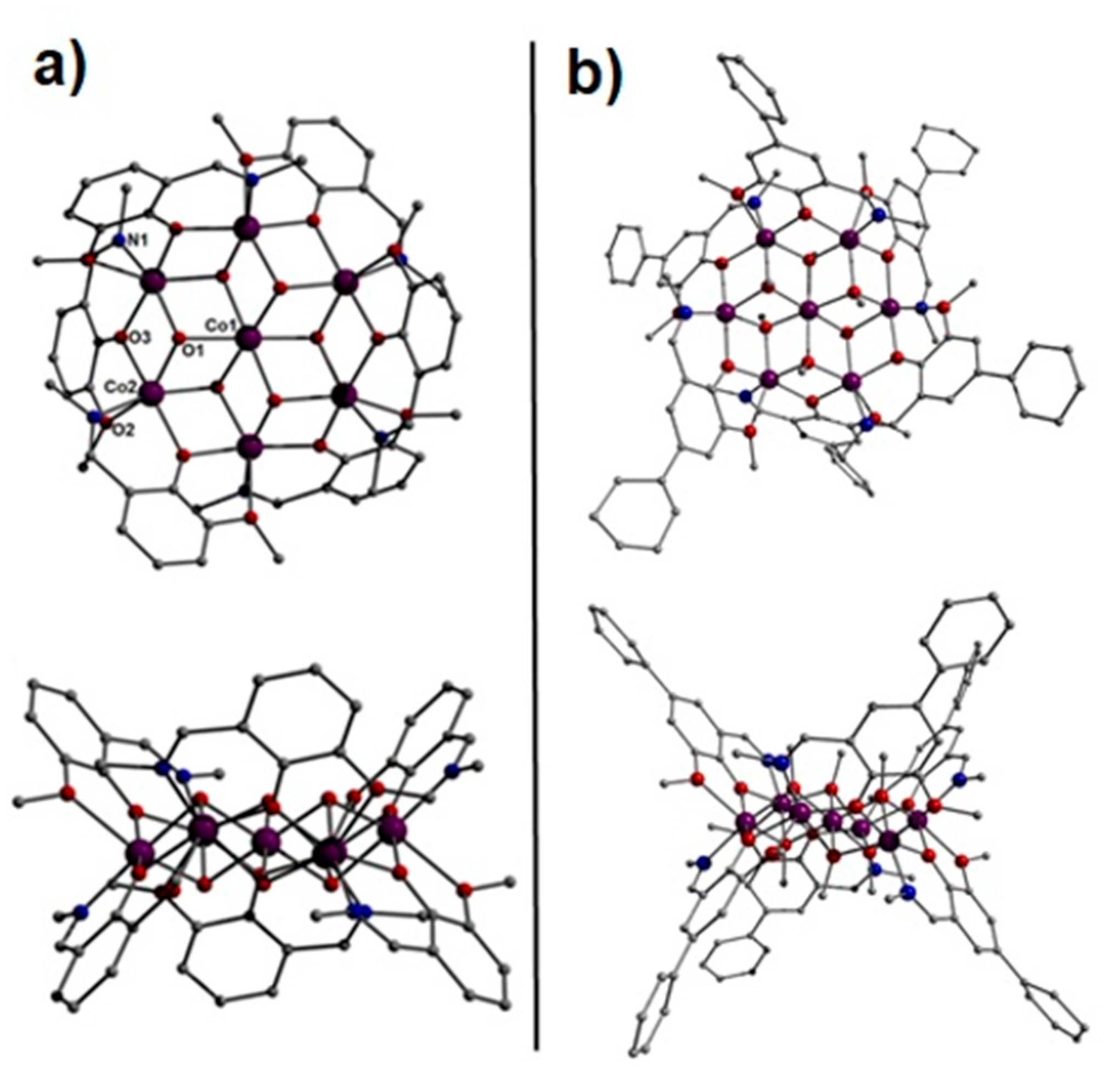
In pursuit of this goal the Schiff base ligand 4-phenyl-2-iminomethyl-6-methoxyphenol (L3H) was synthesised via a Pd catalysed cross-coupling Suzuki reaction (see experimental section for details). L3H possesses a phenyl group at the 4-position of the phenolic ring and therefore we believed that potential guests possessing aromatic (π) character would be readily encapsulated, through edge-to-face π···π stacking and / or C-H···π interactions within the host framework. To this end the heptanuclear complex [Co(II)7(OMe)6(L3)6](NO3)2.3MeOH.H2O (1; Figure 2) was isolated via the reaction of Co(NO3)2.6H2O with L3H and NaOH in methanol. Complex 1 crystallises as purple-brown plates in the monoclinic C2/c space group and complete X-ray structural details are given in Table 1. Akin to previously described pseudo [M(II)7] (M = Co, Ni and Zn) metallocalix[6]arenes (and other heptanuclear disc-like complexes; [17]), the asymmetric unit of 1 comprises four crystallographically unique Co(II) ions (Co1-Co4), whose oxidation states were confirmed via BVS (Table S1), bond length and charge-balancing analyses. The seven Co(II) ions in 1 are held in a planar body centred hexagonal array by a combination of µ3-bridging ¯OMe and ¯OH ions (50:50 occupancy; see crystallography section for details). The six outer cobalt ions (Co2-Co4 and s.e.) are linked by six η1:η2:η1-μ bridging L3¯ ligands sitting above and below the planar heptanuclear core in 1 in an alternating fashion. The result is a double-bowl pseudo metallocalix[6]arene structure in 1. The construction of 1 using our pre-designed L3H ligands dictates double bowl topology formation with dimensions exceeding those of its previously reported siblings (e.g. [(MeOH)2⊂Co(II)7(OH)6(L1)6](NO3)2: (base x depth x rim diameter (Å): 6.25 x 4.08 x 12.12 cf. 6.25 x 7.11 x 17.94 (1)). This feature highlights the influence that ligand modification has on the topology of our [M(II)7] framework. Two charge balancing NO3¯ counter anions lie at the periphery of the structure in 1. Upon further scrutiny of the bridging L3¯ ligands within the crystal structure of 1, we observed considerable out-of-plane twisting of the phenyl groups with respect to their counterpart phenolic rings. These structural distortions can be quantified by measuring the torsion angles generated between the upper rim phenyl groups and their associated phenolic rings of each L3¯ ligand, which in complex 1 range from 24.45 to 46.45°.
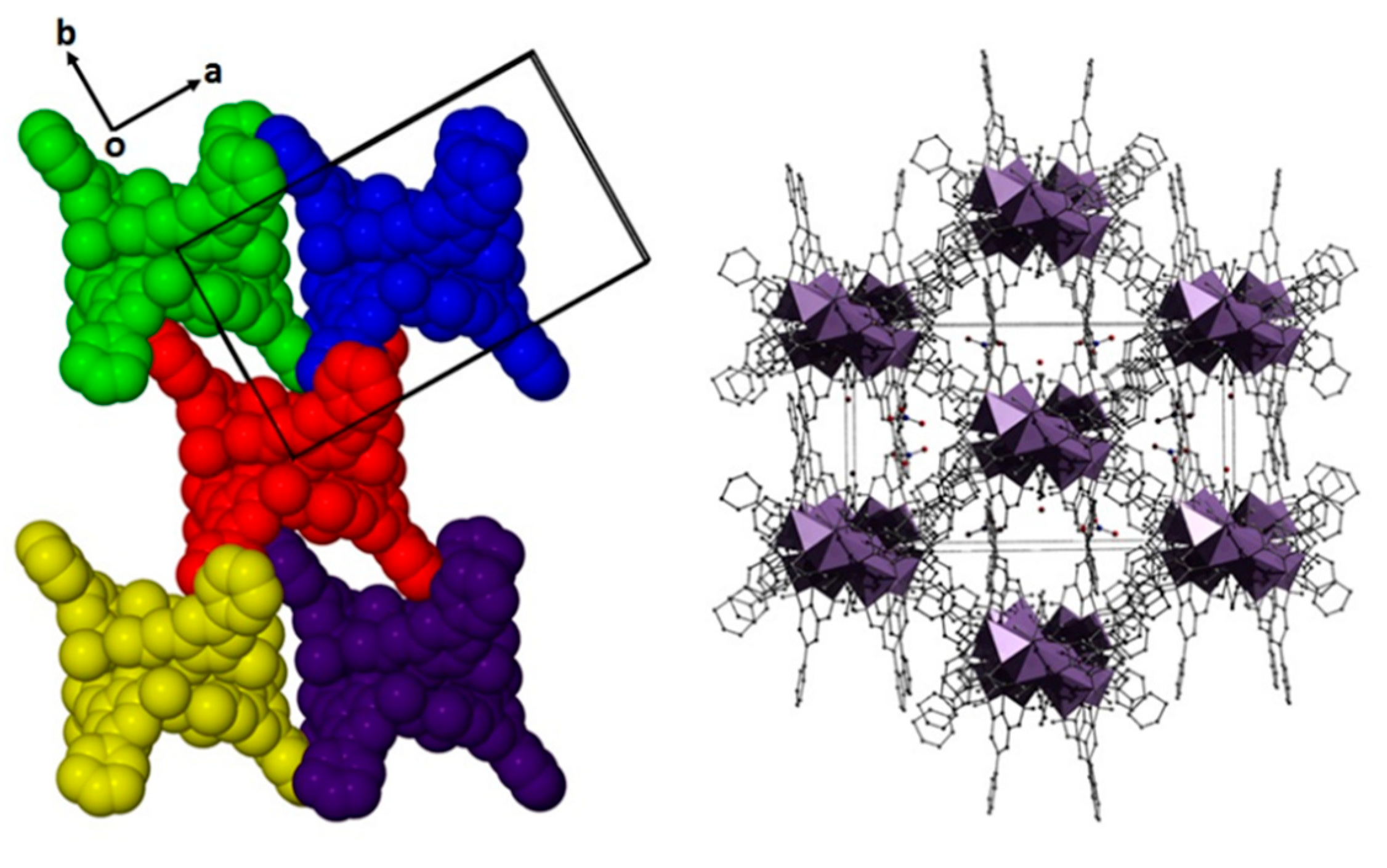
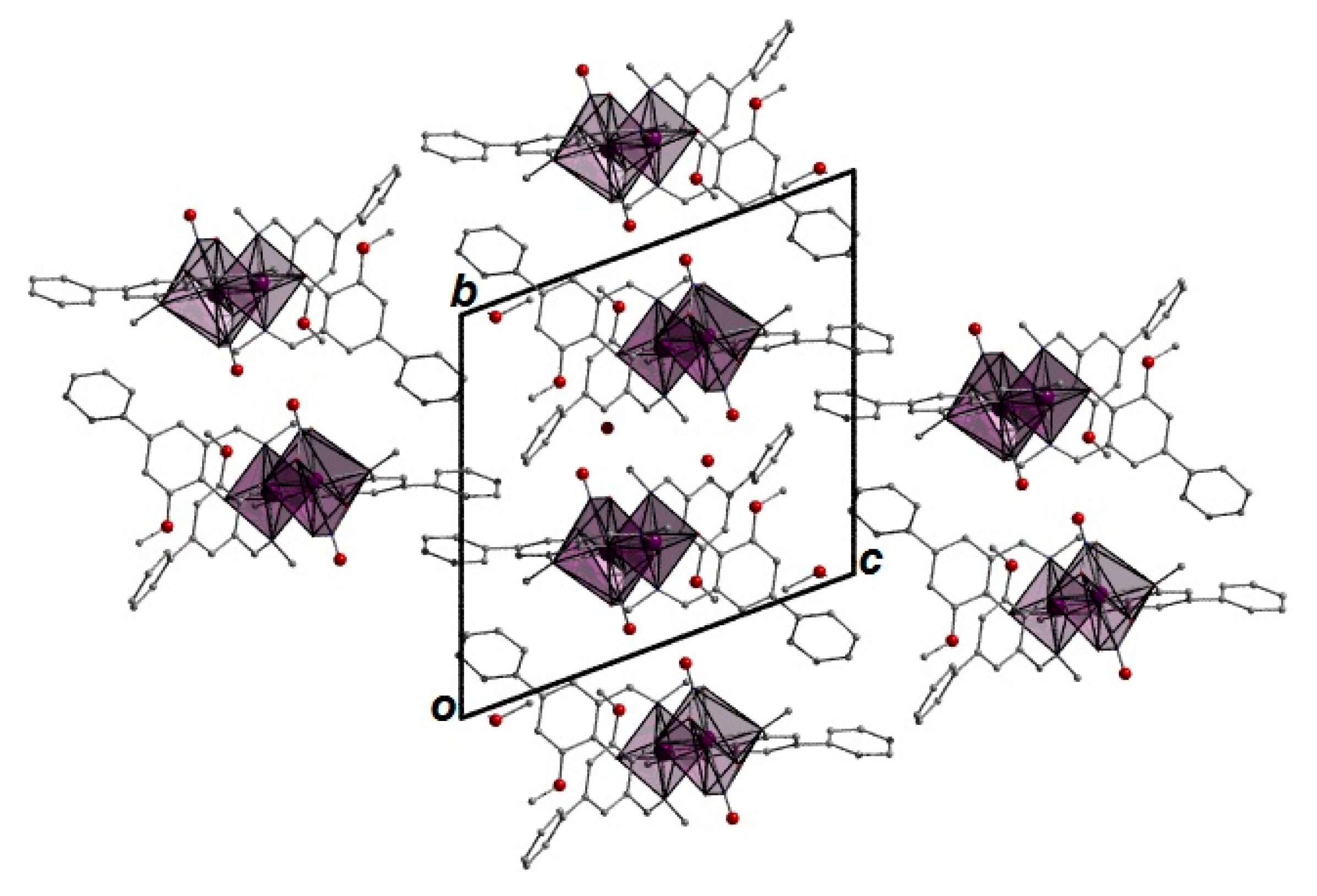
The crystal packing arrangement observed in 1 is different to those of our previously reported [M(II)7] (M = Co, Ni, Zn) analogues in that the individual [Co(II)7] units in 1 do not arrange into superimposable 1D columns and therefore no appreciable molecular cavities are observed. Instead, the packing in 1 is much more space efficient and is facilitated by interdigitation of the [Co(II)7] units, with ligand moieties from two independent heptanuclear units penetrating into a third [Co(II)7] assembly via edge-to-face (T-shaped) C-H···π interaction between the aromatic C-H protons of the L3− upper rim phenyl groups of the guest [Co(II)7] units and the lower rim phenolic rings of the host pseudo metallocalix[6]arene (e.g. [C17-C28]centroid…(H38ˊ)C38ˊ = 2.74 Å and [C32-C43]centroid…H8ˊ(C8ˊ) = 2.69 Å) (Figure 3). The interdigitating ligand phenyl groups also partake in C-H…π interactions with the bridging methoxide ions of the interpenetrated [Co(II)7] unit (e.g. C47′(H47A′)…[C5-C10]centroid = 3.75 Å). As a result of these interactions, the individual [Co(II)7] units in 1 arrange themselves into the space efficient brickwork patterns along the ab plane of the unit cell and these planes pack as superimposable sheets along the c unit cell direction (Figure 3-right).
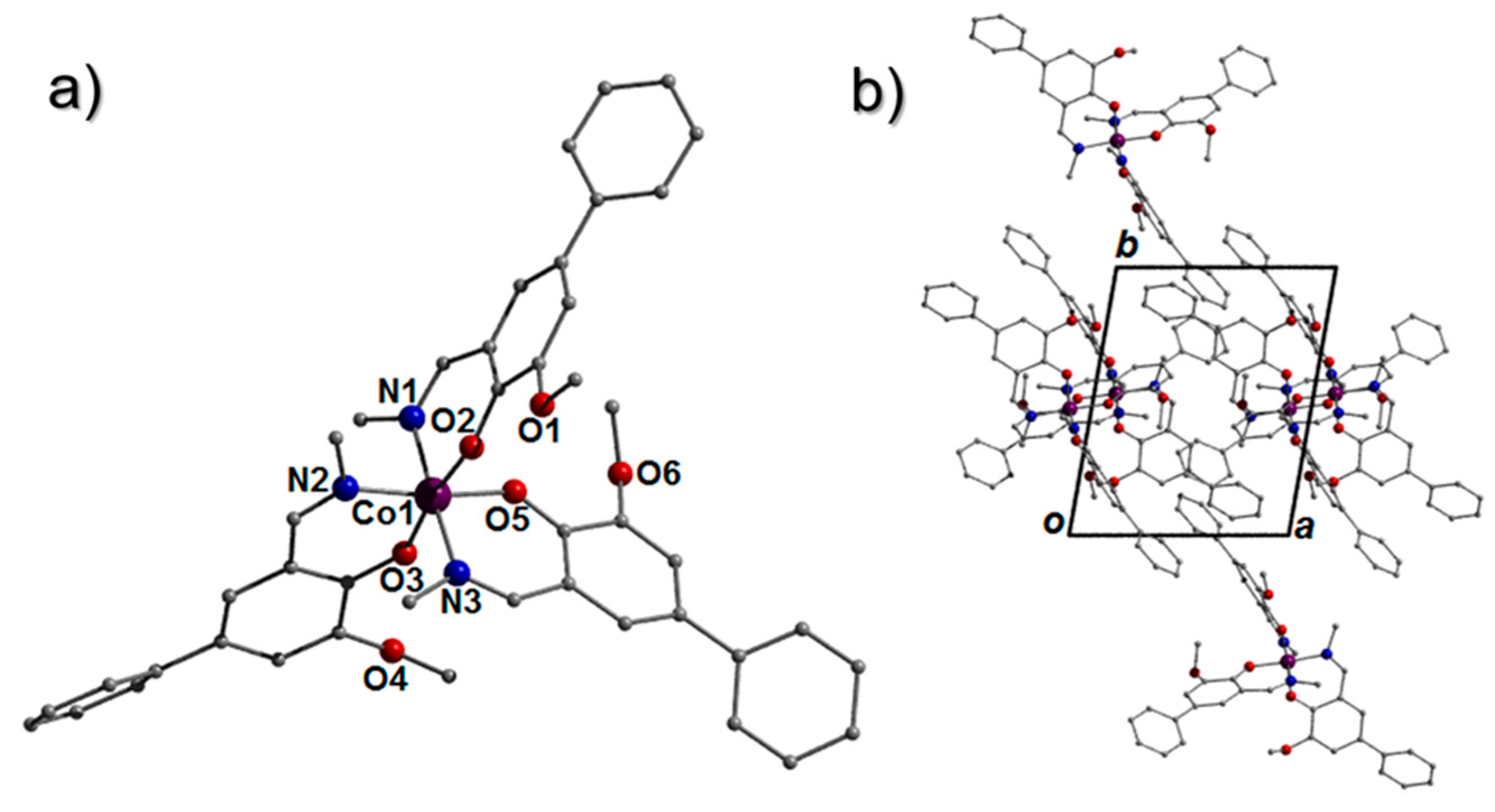
The fact that [Co(II)7(OMe)6(L3)6](NO3)2.3MeOH.H2O (1) exhibited a combination of μ3-bridging −OH and −OMe ions despite the use of NaOH base in its preparation piqued our interest. We decided to attempt to remake 1, this time comprising only bridging methoxide ions. This was attempted through the deliberate introduction of NaOMe as our base of choice (replacing NaOH) while all other synthetic parameters and reaction conditions remained unchanged. Rather surprisingly the result was the crystallisation of the monomeric complex [Co(III)(L3)3] (2). Complex 2 was isolated as purple-brown blocks, which crystallised in the triclinic P-1 space group. Complete X-ray structural details for 2 are given in Table 1. The complex comprises a single distorted octahedral Co(III) ion (BVS for Co1 = 3.32) to which three singly deprotonated L3− ligands coordinate in a chelating manner via Ophen (O2, O3 and O5) and imine nitrogen (N1-N3) atom sites respectively (bond distance ranges: Co1-Ophen = 1.89-1.90 Å and Co1-Nimine = 1.92-1.94 Å). As observed in 1, dihedral angles forged due to the out-of-plane twisting of the L3¯ phenyl groups range between 35.73° and 39.21° in 2 (Figure 4).
The methoxide functional groups belonging to two of the L3− ligands in 2 partake in intra-ligand (and intra-molecular) C-H…O interactions with juxtaposed Ophen oxygen donor atoms (O3 and O5) at distances of 2.34 Å (C45A(H45A)…O3) and 2.24 Å (C44(H44A)…O5). Similarly, multiple inter-molecular C-H…O interactions are observed between imine C-H protons and the aforementioned methoxide O donor atoms (O1ˊ, O4ˊ and O6ˊ) of neighbouring L3− ligands at distances of 2.72 Å (C14(H14)…O1ˊ), 2.44 Å (C26(H26)…O4ˊ) and 2.64 Å (C3(H3)…O6ˊ) Likewise, a number of aromatic ligand protons (H14, H28 and H21) interact with the very same methoxide oxygen atoms (C16(H16)…O1ˊ = 2.47 Å, C28(H28)…O4ˊ = 2.61 Å and C21(H21)…O6ˊ = 2.77 Å). Moreover, C-H…π inter-molecular interactions between ligand methyl groups and nearby aromatic rings are also observed (e.g. [C2-C17]centroid…H29Cˊ(C29ˊ) = 3.01 Å) (Figure 2).

Attempts at Guest Encapsulation Within Pseudo Metallocalixarenes

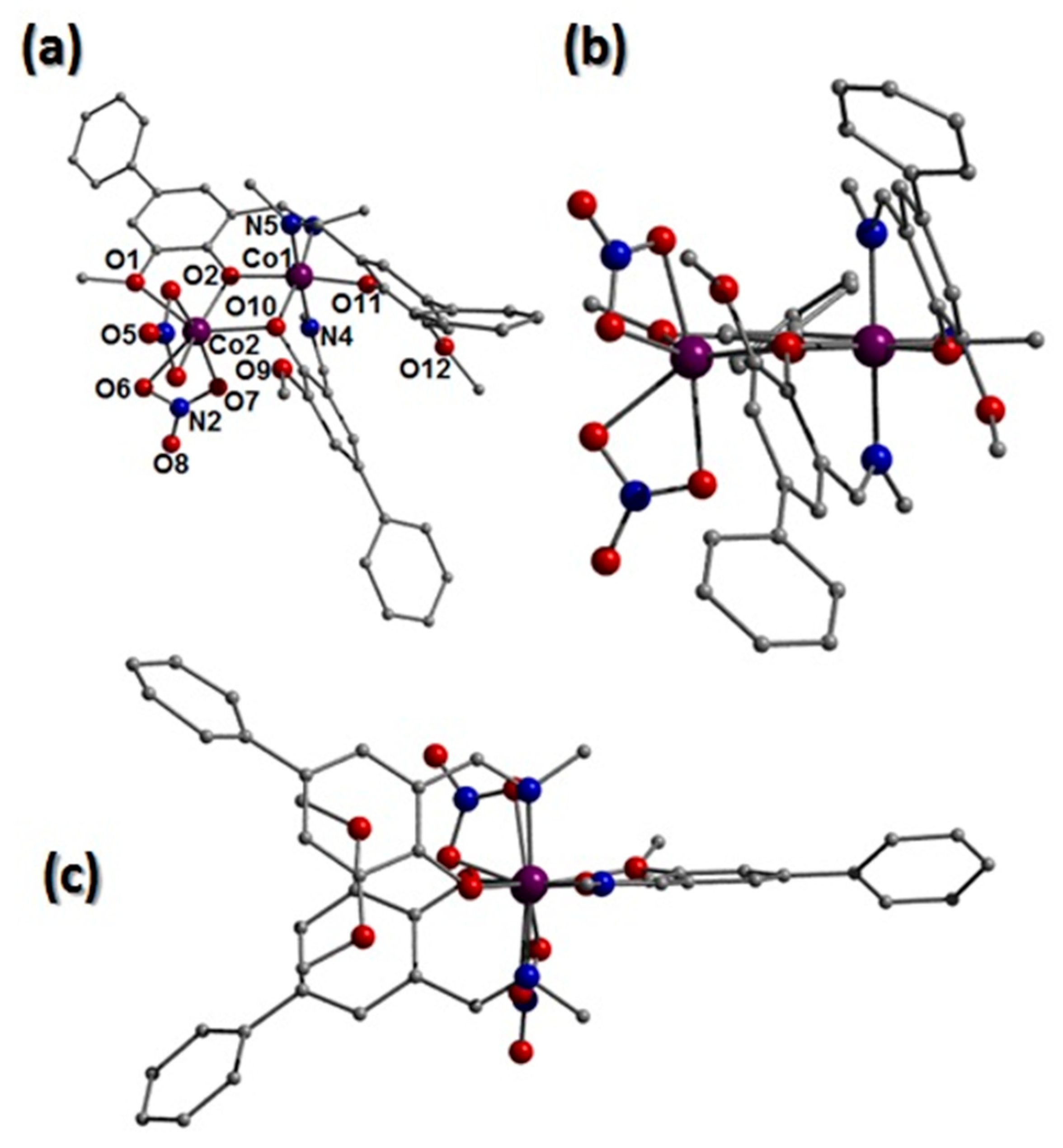
Numerous efforts at encapsulating buckminsterfullerene (C60) within our pseudo metallocalix[6]arene host units were fruitless. It was proposed that the spherical nature and complementary diameter (~ 10 Å) of C60 with respect to the double-bowl dimensions exhibited by (for example) 1 (rim diameter ~ 17.5 Å) would allow encapsulation whereby the C60 units template pairs of [Co(II)7] units and together enclose the organic guest in the solid state. These attempts invariably required the use of hot toluene (to dissolve C60), which instead led to the production of the dimeric complex [Co(II)Co(III)(L3)3(NO3)2].H2O (3). Bond valence Sum (BVS; Co1 = 3.23, Co2 = 1.80) calculations and bond length and charge balance considerations confirmed the +3 and +2 oxidation states for the Co1 and Co2 metal centres, respectively (Table S2). Co1 shows a distorted octahedral geometry (Co-O/N bond length range: 1.87-1.96) while Co2 is in possession of a seven-coordinate distorted pentagonal bipyramidal geometry when we consider the long Co2-O1 contact at a distance of 2.39 Å (all others lie in the 2.10 – 2.21 Å bond length range). The two cobalt centres are connected through two bridging L3− ligands through the Ophen atoms O2 and O10, respectively (Co1-O2-Co2 = 105.91ο; Co1-O10-Co2 = 101.20ο) and exhibit η1:η2:η1 μ- and η1:η2 μ-bridging modes, respectively. The third L3− moiety chelates at Co1 through its imine nitrogen (N5) and Ophen (O11) donor atoms (Co1-N5 = 1.95 Å and Co1-O11 = 1.87 Å). The coordination sphere at Co2 is completed by two chelating NO3− charge balancing counter anions. The phenyl groups of the L3¯ ligands produce out-of-plane dihedral angles ranging from 37.65 to 44.79° (Figure 5). In terms of inter-molecular connectivity, long C-H···O contacts exist between imine C-H protons of one molecule and the coordinated NO3¯ groups of a neighbouring dimeric unit (e.g. (C44)H44···O3′ = 2.53 Å, C11(H11)…O6′ = 2.62 Å and C14(H14)…O6′ = 2.62 Å). The packing arrangement observed in 3 is predominately facilitated by displaced C-H…π stacking interactions between the aromatic rings at the upper rim positions of juxtaposed L3− ligands belonging to neighbouring [Co(III)1Co(II)1] units (e.g. [C5-C10]centroid…H38′ (C31′) = 3.24 Å and [C5-C10]centroid…H31B′(C31) = 3.62 Å) (Figure 6). Attempts at incorporating fluorescent guests such as naphthalene, anthracene and fluorescein within the extended molecular cavities in 1 (and 4-6; vide infra) were also unsuccessful.
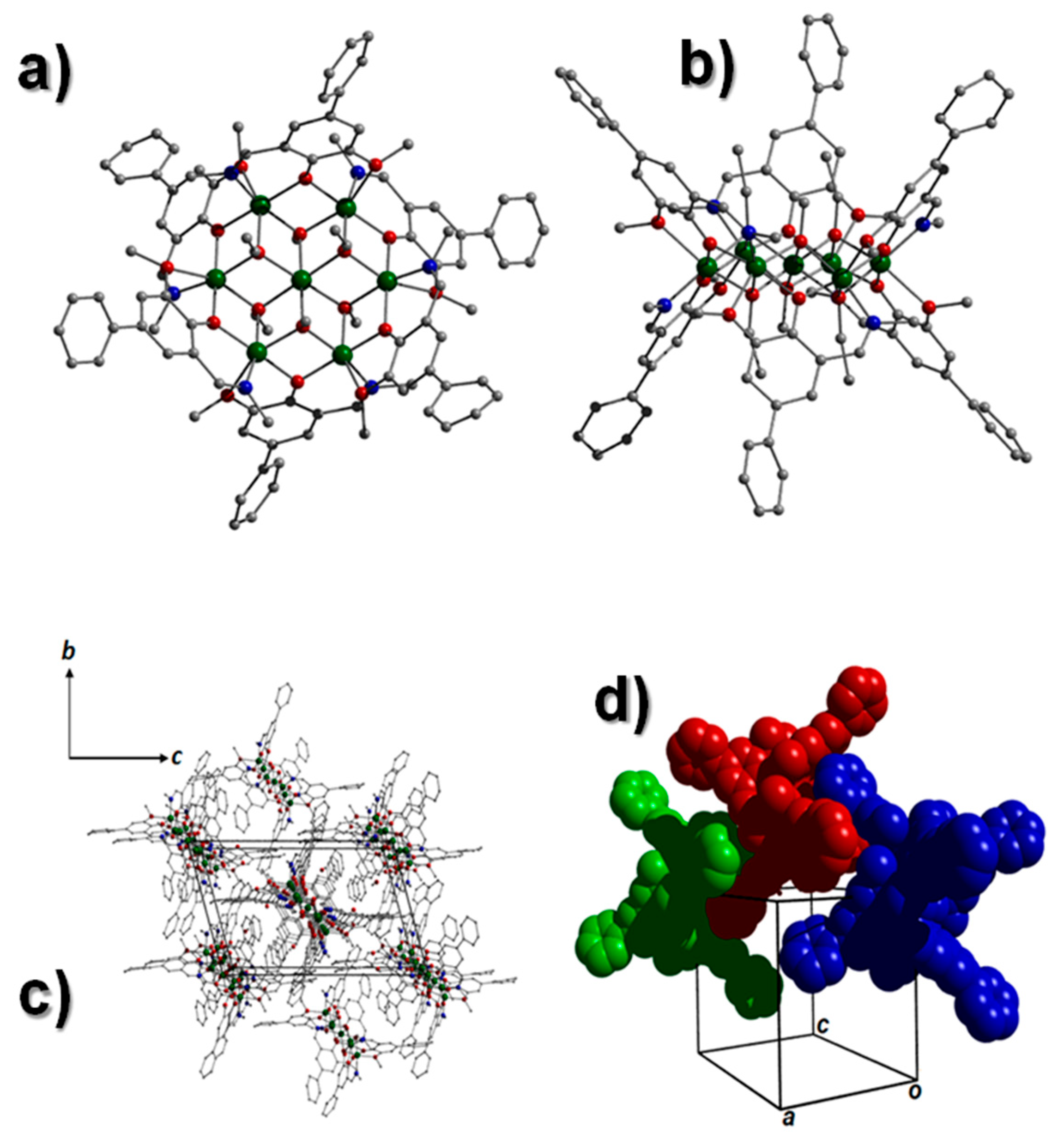
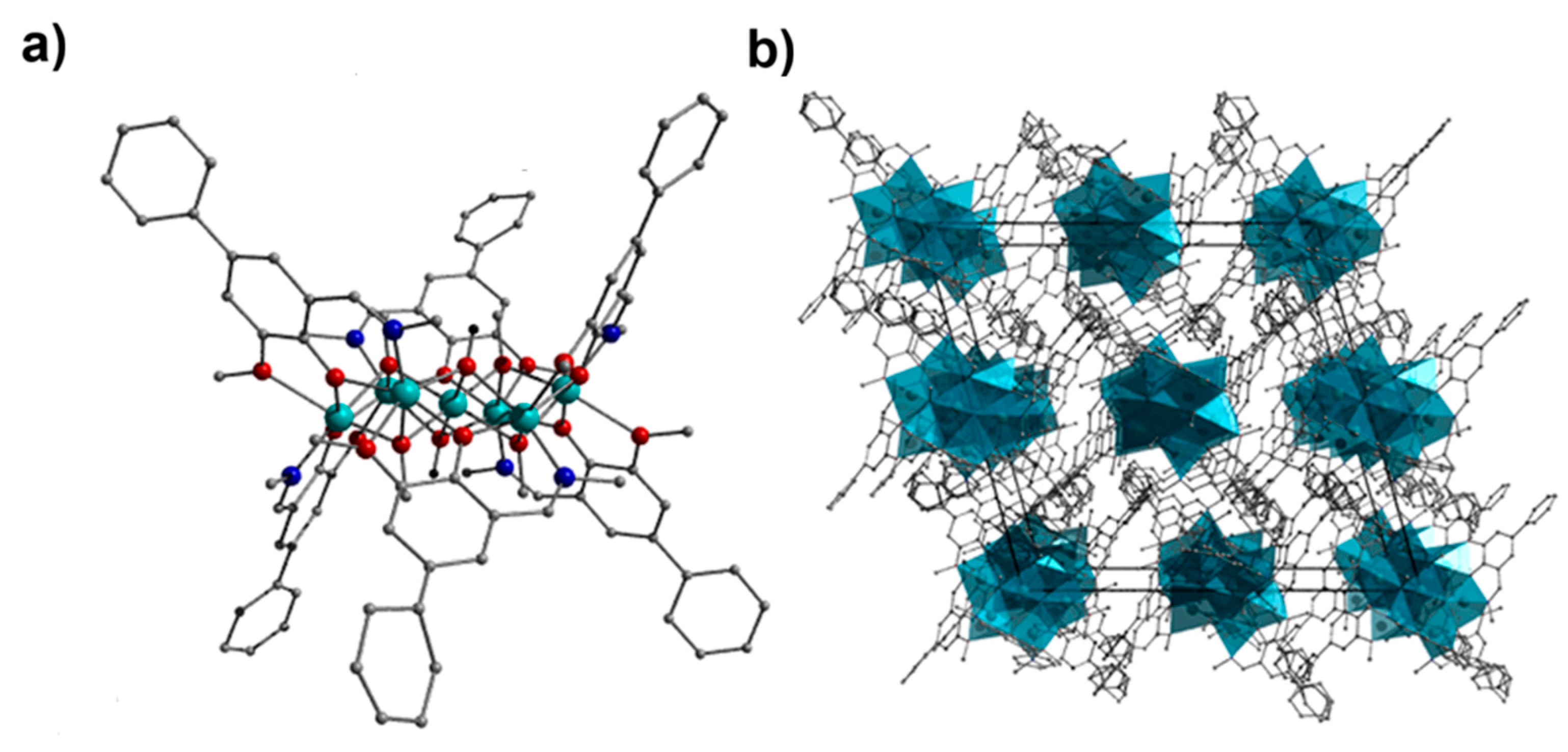
As previously experiences during the synthesis of our analogous family of [M(II)7] (M = Co, Ni and Zn) pseudo metallocalix[6]arenes, Ni and Zn analogues to [Co(II)7(OMe)6(L3)6](NO3)2.3MeOH.H2O (1) were successfully obtained in the form of [Ni(II)7(OMe)6(L3)6](NO3)2.2H2O (4) and [Zn(II)7(OH)2(OMe)4(L3)6](NO3)2.4MeOH.10H2O (5). Complexes 4 and 5 are isolated via a similar synthetic route to that of 1 (see experimental section for details) and crystallise in the monoclinic P21/n and C2/c space groups as green and pale-yellow blocks, respectively. Both 4 and 5 comprise body centred hexagonal cores connected through μ3-OR¯ (R = H, Me) bridging ions (R = Me in 4 and a combination of both in 5) along with six L3¯ ligand units (Figure 7a/b and 8a). As observed in 1, complexes 4 and 5 do not show guest encapsulation and instead the individual [M(II)7] units pack efficiently through interdigitation via their peripheral ligand phenyl groups, interacting through C-H…π interactions with one another (e.g. C25(H25)…[C39B-C44B]centroid = 3.460 Å in 4 and C14(H14)…[C40B-C45B]centroid = 3.76 Å in 5) and with nearby bridging μ3-OMe¯ units (e.g. C48(H48C)…[C24’-C29’]centroid = 3.52 Å in 4 and C46(H46C)…[C10-C15]centroid = 3.76 Å in 5) (Figure 7c/d and 8b). For crystallographic data for complexes 4-6 see Table 2.
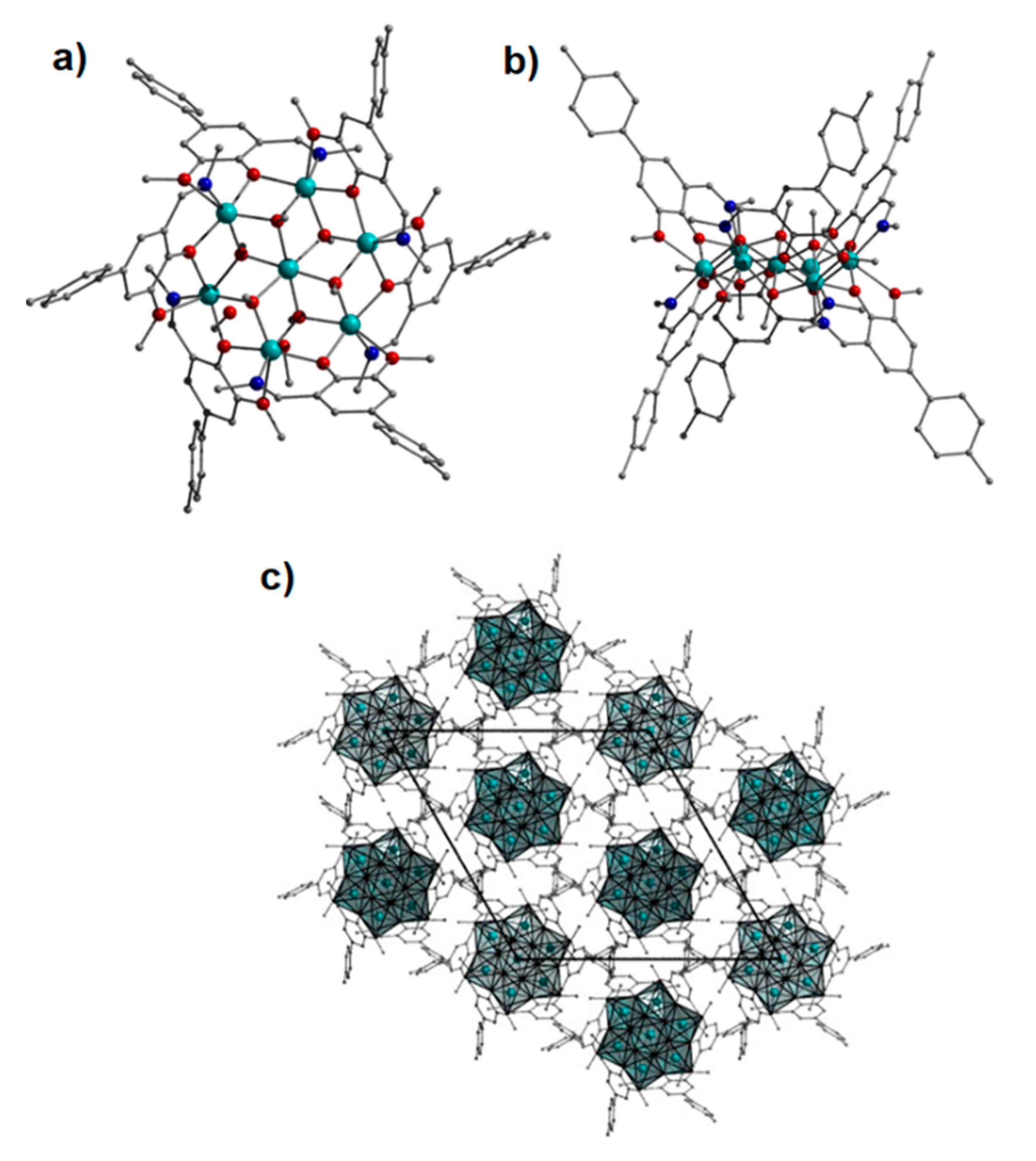
Using the Pd catalysed cross-coupling Suzuki reaction as described in the ESI, it was decided to introduce a tolyl group at the upper rim position of our metallocalix[6]arene directing ligand to produce the novel ligand 2-methoxy-4-tolyl-6-[(methylimino)methyl]phenol (L4H; Figure 1). Its subsequent reaction (in methanol) with Zn(II)(NO3)2.6H2O and NaOH gave rise to the heptanuclear complex [Zn(II)7(OMe)6(L4)6](NO3)2.10MeOH.13H2O (6; Figure 8) - a direct analogue to complexes 1, 4 and 5 and highlights functional group tolerance of this ever growing family of pseudo [M(II)7] metallocalix[6]arenes. The resultant double-bowl topology in 6 provides the dimensions (Å): 6.22 (base) × 8.54 (depth) × 19.42 (rim) as given in Table 3, while an out-of-plane dihedral angle of 39.8° is generated within the six symmetry equivalent L4− units in 6 (Figure 8). Complex 6 differs to its analogues by way of its crystallisation in the trigonal R-3 space group (monoclinic C2/c in 1 and 5 and P21/n in 4). Akin to 1, 4 and 5, no enclosed / confined molecular cavities are formed by the packing arrangement in 6 although an extremely large channel of void space (~ 4467 Å3) is observed. As a result, the diffuse solvent required modelling using the SQUEEZE program (see crystallography section for details) [18].
Although the efficient packing arrangements in 1 and 4-6 thwart the targeted formation of larger / extended molecular cavities, the introduction of the extended ligands 2-methoxy-4-phenyl-6-[(methylimino)methyl]phenol (L3H) and 2-methoxy-4-tolyl-6-[(methylimino)methyl]phenol (L4H) have successfully extended both the depth and rim molecular cavity dimensions within their resultant complexes. More specifically and as given in Table 3, when comparing the cavity dimensions to their previously reported analogues, the cavity depths increase by between 74% (in 1) to 110% (in 6) while rim distance percentage increases ranged from 44% (in 4 and 5) to 58% (in 6). As expected, the base distances (diameter of the inorganic {M(II)7(OR)6}2+ cores) showed no discernible change. It should be noted here that magnetic cores in 1 and 4-6 closely resemble those observed in analogues [(MeOH)2⊂M(II)7(OH)6(L1)6](NO3)2 (M = Co, Ni and Zn) and therefore magnetic susceptibility measurements were not pursued here.

3. Conclusions

The introduction of phenyl and tolyl functional groups at the upper rim (4-position) of the pseudo metallocalix[6]arene directing ligand 2-methoxy-6-[(methylimino)methyl]phenol allows the deliberate introduction of molecular cavity wall extensions exampled by the heptanuclear complexes 1 and 4-6. Although these complexes do indeed exhibit double bowl dimensions which exceeded those of their previously reported analogues, they do not replicate their molecular cavities or general extended topologies upon crystallisation. Instead, the individual {M(II)7} (M = Co, Ni, Zn) units in 1 and 4-6 pack through multiple interdigitated C-H…π intermolecular interactions between their aromatic ring Lx¯ (x = 3, 4) units located at the periphery of their metallocalix[6]arene structures. The result is a more space efficient packing arrangement at the expense of molecular cavity formation or guest encapsulation. Work is now focusing on covalently connecting these individual {M(II)7} units towards the deliberate design of enclosed cage-like cavities and the production of 3D permanently porous materials towards potential gas storage and / or heterogeneous catalytic materials.

4. Materials and Methods

Unless otherwise stated all materials (solvents and reagents) were purchased commercially and used as supplied without further purification. Caution: Although no difficulties were encountered in this work, great care must be taken when working with the potentially explosive nitrate salts. The infra-red spectra of 1-4 were recorded on a Perkin Elmer FT-IR Spectrum One spectrometer equipped with a Universal ATR Sampling accessory (NUI Galway). All other complexes in this work were measured at Bangor University on a Bruker Alpha FT-IR Platinum ATR. Elemental analysis on complexes 1-4 were carried using the School of Chemistry microanalysis service at the University of Galway. The elemental compositions of 5 and 6 were analysed at OEA Laboratories Ltd (Kelly Bray, Cornwall).

X-Ray Crystallography

Data obtained from structures of 1-4 were collected on an Xcalibur S single crystal diffractometer (Oxford Diffraction) using an enhanced Mo source (located at the University of Galway, Ireland). Complexes 5 and 6 were collected on an Rigaku AFC12 goniometer equipped with an enhanced sensitivity (HG) Saturn724+ detector mounted at the window of an FR-E+ Super Bright molybdenum rotating anode generator with HF Varimax optics (100 m focus) (National Crystallography Service, School of Chemistry, University of Southampton). The cell determination and data collection of each complex was carried out using the CrystalClear-SM Expert package (Rigaku, 2012). Data reduction, cell refinement and absorption corrections on all complexes were carried out using CrysAlisPro software (Rigaku OD, 2015) [19], while all structures were solved and refined using SHELXT and SHELXL-2018 [20]. CCDC deposition numbers: 2581845-2581850.
The μ3-bridging −OMe ions in [Co(II)7(OMe)6(L3)6](NO3)2.3MeOH.H2O (1) were best modelled as sharing 50:50 occupancy with bridging –OH moieties. At two of these positions, half occupancy waters of crystallisation (labelled O13 and s.e.) lie above these bridging –OMe / –OH ions and are presumed to partake in H-bonding with the –OH moieties at distance of 2.908 Å (O3…O13 and s.e.). DFIX restraints were employed on the O-C distances of all bridging –OMe functional groups in 1. Due to this disorder the aforementioned carbon atoms (C46-C48 and s.e.) of the bridging μ3-OMe ions were also kept isotropic. All other non-hydrogen atoms were modelled as anisotropic. All hydrogen atoms were modelled in calculated positions. The NO3¯ anion (and s.e.) in 1 was restrained using the DFIX, DANG and FLAT commands and required isotropic modelling. The aromatic ring labelled C35-C40 also required the use of a FLAT restraint. Due to the presence of large solvent accessible voids the SQUEEZE program was employed. Two voids (each with a volume of ~1054 Å3) were located with each housing approx. 163 electrons. From these calculations we arrived at the formula 1.H2O.3MeOH.
With the exception of the water of crystallisation (O46) lying at the periphery of the structure in [Co(III)(L3)3] (2), all non-hydrogen atoms in both complexes 2 and [Co(III)Co(II)(L3)3(NO3)2].H2O (3) were modelled as anisotropic. All hydrogen atoms were assigned to calculated positions. Akin to the modelling required in [Co(II)7(OMe)6(L3)6](NO3)2.3MeOH.H2O (1), the μ3-bridging −OMe ions in [Ni(II)7(OMe)6(L3)6](NO3)2.2H2O (4) were best modelled at half occupancy in conjunction with bridging –OH moieties (again the C atoms were modelled as isotropic). At four of these positions, half occupancy waters of crystallisation (labelled O50 and O5) lie above these bridging –OMe / -OH ions and partake in H-bonding with the –OH moieties at distances of 2.908 Å (O1…O51) and 3.302 Å (O3…O50). DFIX restraints were required on the O-C distances of all bridging –OMe functional groups in 4. Two of the six symmetry equivalent upper-rim Ph rings in 4 (labelled C39-C44 and s.e.) exhibited disorder which was successfully modelled over two sites (parts were labelled a and b respectively) in a 70:30 ratio. A FLAT restraint was also employed here. All hydrogen atoms were placed in calculated positions. All non-hydrogen atoms apart from the C atoms of the bridging –OMe ions were modelled as anisotropic. Attempts at modelling the NO3– counter anions were unsuccessful and so the SQUEEZE program was employed. A total of four voids (~104 Å3 and 28 electrons each) were located, equating to two voids per [Ni7] unit (Z = 2). These data is consistent with the formula 4.2H2O. With cell volumes of over approximately 10,000 Å3, when analysing the data from complexes [Zn(II)7(OH)2(OMe)4(L3)6](NO3)2.4MeOH.10H2O (5) and [Zn(II)7(OMe)6(L4)6](NO3)2.10MeOH.13H2O (6), we were unable to successfully model the NO3− counter anions nor the diffuse solvent (MeOH and H2O) in either data set and so we implemented the SQUEEZE program. From this we discovered that the two solvent accessible channels in 5 occupied a void volume of 1606 Å3 each and contained approximately 465 electrons per void and therefore 232.5 electrons per [Zn(II)7] unit (Z = 4). From this, the formula in 5 was produced. Similarly, the large single solvent accessible void in 6 (void volume = 4467 Å3) equates to 381 electrons per [Zn(II)7] unit (Z = 3) and from this we determined the given formula. The disordered phenyl groups at the periphery of the structure in 5 was modelled over two sites (50:50 occupancy). The DFIX and FLAT restraints were subsequently required. All other non-hydrogen atoms in 5 were modelled as anisotropic. All hydrogen atoms were placed in calculated positions. Likewise, all non-hydrogen atoms in 6 were given as anisotropic and all protons were placed in calculated positions.

Preparation of Complexes 1-6

[Co(II)7(OMe)6(L3)6](NO3)2⋅H2O⋅3MeOH (1)

A solution of Co(NO3)2.6H2O (0.10 g, 0.34 mmol) in MeOH (25 cm3) was mixed with L3H (0.083 g, 0.34 mmol) affording a dark purple-brown solution. NaOH (0.014 g, 0.34 mmol) was then added affording a much darker-coloured solution. The mixture was then stirred for a further 6 hours and subsequently filtered, to afford a transparent purple-brown mother liquor, which was allowed to slowly concentrate via slow solvent evaporation. Purple-brown plate-like crystals of 1 were harvested directly from the mother liquor after 7 days in 16%. Elemental analysis (%) calculated (found) for 1 (C96H114N8O24Co7): C 52.17 (52.48), H 4.83 (4.83), N 5.07 (5.27). FT-IR (cm-1): 3417(b), 2922(w), 2815(w), 1627(s), 1560(w), 1476(s), 1460(s), 1393(s), 1311(s), 1267(s), 1202(s), 1095(m), 1072(w), 1032(s), 966(s), 865(m), 804(s), 765(s), 757(s), 724(m), 697(m).

[[Co(III)(L3)3] (2)

To a stirring solution of Co(NO3)2.6H2O (0.10 g, 0.34 mmol) in MeOH (15 cm3) was added L3H (0.083 g, 0.34 mmol) and NaOMe (0.02 g, 0.34 mmol). The solution was stirred for 15 minutes after which time it had adopted a dark red-brown transparent appearance. The solution was stirred for a further 3 hours and then filtered to yield a red-brown mother liquor. Dark purple-brown blocks of 2 were isolated directly from the mother liquor after one week of slow solvent evaporation in low yield (10%). Elemental Analysis (%) calculated (found) for C45H42N3O6Co1: C 69.29 (68.90), H 5.43 (5.29), N 5.39 (4.90). FT-IR (cm-1): 3027(w), 2930(w), 1626(s), 1598(m), 1537(w), 1450(s), 1410(w), 1393(m), 1357(w), 1318(s), 1271(s), 1236(w), 1205(s), 1177(w), 1139(w), 1103(m), 1082(m), 1058(m), 1024(m), 982(m), 973(w), 894(m), 879(m), 854(w), 795(m), 757(s), 718(m), 694(s).

[[Co(III)Co(II)(L3)3(NO3)2].H2O (3)

To a solution of Co(NO3)2.6H2O (0.10 g, 0.34 mmol) in MeOH (20 cm3) was added L3H (0.083 g, 0.34 mmol) and solid NaOH (0.014 g, 0.34 mmol) and the mixture stirred to afford complete dissolution of the solid reactants. The solution was stirred for a further 4 hours and then filtered to afford a red-brown mother liquor. The mother liquor was allowed to concentrate via slow solvent evaporation in attempts to induce crystallisation. However following lack of crystallisation from the MeOH mother liquor, the fully-evaporated crystallisation residue was re-dissolved in Toluene (in attempts to afford C60 inclusion); facilitated by heating the mixture at ~90-100 °C. Filtration of this solution, after cooling, afforded a very dark red-brown mother liquor from which samples were Et2O diffused to afford rhombic-like blocks of 3 in moderate yield (15%). Elemental analysis (%) calculated (found) for C45H42N5O13Co2: C 55.20 (54.85), H (4.32 (4.01), N (7.15 (7.04). FT-IR (cm-1): 2931(w), 1627(m), 1559(m), 1536(w), 1495(w), 1469(m), 1450(s), 1410(w), 1321(m), 1271(s), 1231(w), 1205(s), 1176(m), 1140(w), 1098(w), 1080(m), 1057(m), 1019(m), 977(m), 895(w), 882(w), 868(w), 795(w), 761(s), 736(m), 718(m), 695(s). Note: Complex 3 can also be produced without the addition of C60.

[[Ni(II)7(OMe)6(L3)6](NO3)2⋅2H2O (4)

To a solution of Ni(NO3)2.6H2O (0.10 g, 0.34 mmol) in MeOH (20 cm3) were added L3H (0.083 g, 0.34 mmol) and solid NaOH (0.014 g, 0.34 mmol) and the mixture stirred to afford an opaque bright green solution. The solution was stirred for a further 3 hours, following which it was filtered to afford a bright green mother liquor. The mother liquor was diffused with Et2O, which afforded green needles of 4 in 15% yield. Elemental analysis (%) calculated (found) for 4 (C96H106N8O26Ni7): C 52.44 (52.20), H 4.86 (4.38), N 5.10 (5.49). FT-IR (cm-1): 3395(b), 1639(s), 1548(w), 1472(s), 1393(s), 1312(s), 1258(s), 1207(s), 1095(s), 848(m), 837(w), 825(w), 760(s), 720(s).

[[Zn(II)7(OH)2(OMe)4(L3)6](NO3)2.4MeOH.10H2O (5)

A solution of Zn(NO3)2.6H2O (0.10 g, 0.33 mmol) in MeOH (20 cm3) was mixed with L3H (0.081 g, 0.33 mmol) and solid NaOH (0.013 g, 0.33 mmol) and the mixture stirred to afford complete dissolution of the solids. The resultant yellow solution was stirred for a further 3 hours, after which time it was filtered to afford a bright yellow mother liquor. The mother liquor was allowed to slowly concentrate via slow evaporation of the solvent to yield 5 as pale-yellow blocks in 15% yield. Elemental analysis (%) calculated (found) for 5.3H2O (C100H116N8O27Zn7): C 51.78 (51.90), H 5.04 (4.72), N 4.83 (4.55). FT-IR (cm-1): 3390(b), 2932(b), 1631(s), 1599(m), 1558(w), 1476(s), 1458(s), 1398(m), 1313(s), 1268(s), 1203(s), 1100(m), 1073(w), 1038(w), 1015(w), 970(m), 862(m), 803(m), 759(s), 724(m), 697(m).

[Synthesis of [Zn(II)7(OMe)6(L4)6](NO3)2.10MeOH.13H2O (6)

To a methanolic (30 cm3) solution Zn(NO3)2.6H2O (0.25 g, 0.84 mmol), L4H (0.215 g, 0.84 mmol) and NaOH (0.034 g, 0.84 mmol) were added. The resultant pale-yellow solution was stirred for 4 h and allowed to settle for 30 minutes before being gravity filtered. X-ray quality crystals of 6 were obtained in 20% yield upon slow evaporation of the mother liquor over a period of 2-3 weeks. Elemental analysis (%) calculated (found) for 6.4MeOH.5H2O (C106H114N8O33Zn7): C 51.22 (51.60), H 4.62 (4.52), N 4.51 (4.35). FT-IR (cm-1): 3429(b), 2932(b), 2831(b), 1635(s), 1577(w), 1558(w), 1517(m), 1479(s), 1460(s), 1398(m), 1384(m), 1352(w), 1313(m), 1269(s), 1245(s), 1203(s), 1179(m), 1097(s), 1074(m), 1030(s), 969(s), 893(w), 870(w), 829(s), 811(s), 778(w), 759(w), 710(w), 636(w), 579(w), 564(w).

Author Contributions

Conceptualization, L. F. J; investigation, M.S-P and S.T.M.; writing—original draft preparation, L.F.J.; writing—review and editing, L.F.J.; visualization, L.F.J.; supervision, L.F.J.; project administration, L.F.J.; funding acquisition, S.T.M, M.S-P and L.F.J. All authors have read and agreed to the published version of the manuscript.

Funding

This research was partly funded by an Irish Research Council IRCSET grant (S.T.M) and by Bangor University (M.S-P).

Acknowledgments

The authors would like to thank the Irish Research Council (IRCSET), Bangor University and the National Crystallography Service (NCS) for their support.

Conflicts of Interest

The authors declare no conflicts of interest.

References

  1. (a) Wernsdorfer, W. N. Aliaga-Alcalde, N. Hendrickson, D. N, Christou, G. Exchange-biased quantum tunnelling in a supramolecular dimer of Single-Molecule Magnets Nature, 2002, 416, 406-409. (b) Pedersen, K. S, Bendix, J.; Clérac. R. Single-molecule magnet engineering: building-block approaches. Chem. Commun., 2014, 50(34), 4396-4415. (c) Coronado, E. Molecular magnetism: from chemical design to spin control in molecules, materials and devices. Nat. Review Materials. 2020, 5, 87-104.
  2. (a) Burrows, A. D.; Frost, C. G.; Mahon, M. F; Richardson. C. Post-Synthetic Modification of Tagged Metal–Organic Frameworks. Angew. Chem., Int. Ed., 2008, 47(44), 8482-8486. (b) Evans, J. D.; Sumby, C. J.; Doonan, C. Post-synthetic metalation of Metal-Organic Frameworks. Chem. Rev., 2014, 43(16), 5933–5951. (c) He, W.; Lv, D.; Guan, Y.; Yu, S. Post-synthetic modification of Metal-Organic Frameworks: synthesis, characterization and application. J. Mat. Chem. A. 2023, 11(45), 24519–24550.
  3. (a) Segura, J. L.; Royuela, S.; Mar Ramos, M. Post-synthetic modification of covalent organic frameworks. Chem. Soc. Rev., 2019, 48, 3903-3945. (b) Liu, M.; Yang, S.; Yang, X.; Cui, C.-X.; Liu, G.; Li, X.; He, J.; Chen, G. Z.; Xu, Q.; Zeng, G. Post-synthetic modification of covalent organic frameworks for CO2 electroreduction. Nature Commun.; 2023, 14, 3800. Rejali, N. A.; Dinari, M.; Wang, Y. Post-synthetic modifications of covalent organic frameworks (COFs) for diverse applications. Chem. Commun. 2023, 59(78), 11631–11647.
  4. Wang, H.; Jin, Y.; Sun, N.; Wei, Z.; Jiang, J. Post-synthetic modifications of porous organic cages. Chem. Soc. Rev. 2021, 50(16), 8874–8886.
  5. Liu, J.; Wang, Z.; Cheng, P.; Zawrotko, M. J.; Chen, Y.; Zhang, Z. Post-synthetic modifications of metal–organic cages. Nature Review Chemistry. 2022, 6, 339-356.
  6. Jones, L. F.; Prescimone, A.; M. Evangelisti, M.; Brechin, E. K. 1-D chains of Single-Molecule Magnets. Chem. Commun., 2009, 2023-2025.
  7. Lecren, L.; O. Roubeau, O.; Coulon, C.; Li, Y.-G. Le Goff, X. F.; Wernsdorfer, W.; Miyasaka, H.; Clérac. R. One-dimensional coordination polymers of antiferromagnetically-coupled [Mn4] single-molecule magnets. J. Am. Chem. Soc., 2005, 127(49), 17353–17363.
  8. Plenk, C.; Krause, J.; Beck, M.; Rentschler, E. Rational linkage of magnetic molecules using click chemistry. Chem. Commun., 2015, 51, 6524-6527.
  9. (a) Timco, G. A.; Faust, T. B.; Tuna, F.; Winpenny, R. E. P. Linking heterometallic rings for quantum information processing and amusement. Chem. Soc. Rev., 2011, 40, 3067–3075 and references herein. (b) Jones. L. F.; Chapter 6: Beyond the Metallacrown: Controlling First- and Second-Order Coordination Spheres Towards Discrete and Extended Architectures in Advances in Metallacrown Chemistry. 1st Ed. C. M. Zeleski. Publisher: Springer. 2022, p221 and references herein.
  10. (a) Dai, F.-R.; Qiao, Y.; Wang, Z. Designing structurally tunable and functionally versatile synthetic supercontainers. Inorg. Chem. Front., 2016, 3, 243-249. For reviews on molecular containers see: (b) Yoshizawa, M. Klosterman, J. K.; Fujita, M. Functional Molecular Flasks: New Properties and Reactions within Discrete, Self-Assembled Hosts. Angew. Chem. Int. Ed., 2009, 48, 3418-3438. (c) Ballester, P.; Fujita, M.; J. Rebek Jr, J. Molecular Containers, Chem. Soc. Rev., 2015, 44, 392-393.
  11. (a) Meally, S. T.; Karotsis, G.; Brechin, E. K.; Papaefstathiou, G. S.; Dunne, P. W.; McArdle P.; Jones, L. F. Planar [Ni7] discs as double-bowl, pseudo metallacalix[6]arene host cavities. CrystEngComm., 2010, 12, 59-63. (b) Meally, S. T.; McDonald, C.; Karotsis, G.; Papaefstathiou, G. S.; Brechin, E. K.; Dunne, P. W.; McArdle, P.; Power, N. P.; Jones. L. F. A family of pseudo [M(II)7] metallocalix[6]arene discs. Dalton Trans., 2010, 39, 4809-4816.
  12. Slater-Parry, M.; Meally, S. T.; Ratanasakprakan, C.; Townrow, D. E.; Ellaby, R. J.; Page S. J.; Jones, L F. Pseudo [M(ii)7] (M = Co, Ni and Zn) metallocalix[6]arene hosts encapsulate a range of organic guest molecules in the solid state. CrystEngComm., 2025, 27(22), 3823-3832.
  13. Meally, S. T.; McDonald, C.; Kealy, P.; Taylor, S. M.; Brechin, E. K.; Jones, L. F. Investigating the solid-state hosting abilities of homo- and hetero-valent [Co7] metallocalix[6]arenes. Dalton Trans., 2012, 41(18), 5610-5616.
  14. Ullman A. M.; Nocera. D. G. Mechanism of Cobalt Self-Exchange Electron Transfer. J. Am. Chem. Soc., 2013, 135, 15053-15061.
  15. Slater-Parry, M. E.; Durrant, J. P.; Howells, J. M.; Pitak, M. B.; Horton, P. N.; Klooster, W. T.; Coles, S. J.; O`Connor, H. M.; Brechin, E. K.; Barra A.-L.; Jones. L. F. Crowding out: ligand modifications and their structure directing effects on brucite-like {Mx(μ3-OH)y} (M = Co(II), Ni(II)) core growth within polymetallic cages. Dalton Trans., 2019, 48, 1477-1488.
  16. Lhoták. P. Upper rim bridged calixarenes. RSC Advances, 2024, 14, 23303-23321 and references herein.
  17. (a) Leong, W. L.; Vittal, J. J. Alkali metal ion directed self-assembled Ni(II) molecular clusters. New J. Chem., 2010, 34, 2145–2152. (b) Wei, L.-Q.; Zhang, K.; Feng, Y-C.; Wang, Y.-H.; Zeng, M-H.; Kurmoo, M. Microwave versus Traditional Solvothermal Synthesis of Ni(II)7 Discs: Effect of Ligand on Exchange Reaction in Solution Studied by Electrospray Ionization-Mass Spectroscopy and Magnetic Properties. Inorg. Chem. 2011, 50, 7274–7283. (c) Ding, C.; Gao, C.; Ng, S.; Wang, B.; Xie, Y. Polynuclear Complexes with Alkoxo and Phenoxo Bridges from In Situ Generated Hydroxy-Rich Schiff Base Ligands: Syntheses, Structures, and Magnetic Properties. Chem. Eur. J. 2013, 19, 9961–9972. (d) Zhang, S-H.; Zhao, R.-X.; Li, G.; Zhang, H.-Y.; Zhang, C.-L.; Muller, G. Structural variation from heterometallic heptanuclear or heptanuclear to cubane clusters based on 2-hydroxy-3-ethoxy-benzaldehyde: effects of pH and temperature. RSC Advances. 2014, 4 (97), 54837–54846. (e) Kobayashi, F.; Ohtani, R.; Teraoka, S.; Kosaka, W.; Miyasaka, H.; Zhang, Y.; Lindoy, L. F.; Hayami, S.; Masaaki Nakamura, M. Syntheses, structures and magnetic properties of tetranuclear cubane-type and heptanuclear wheel-type nickel(II) complexes with 3-methoxysalicylic acid derivatives. Dalton Trans. 2017, 46, 8555–8561. (f) Gheorghe, R.; Ionita, G. A.; Maxim, C.; Caneschi, A.; Sorace, L.; Andruh, M. Aggregation of heptanuclear [MII7] (M = Co, Ni, Zn) clusters by a Schiff-base ligand derived from o-vanillin: Synthesis, crystal structures and magnetic properties. Polyhedron. 2019, 171, 269-278.
  18. Spek. A. L. PLATON SQUEEZE: a tool for the calculation of the disordered solvent contribution to the calculated structure factors. Acta Crystallogr., Sect. C: Struct. Chem., 2015, 71, 1–9.
  19. Rigaku OD, CrysAlis PRO, Rigaku Oxford Diffraction Ltd, Yarnton, England, 2015.
  20. Sheldrick. G. M. Crystal structure refinement with SHELXL. Acta Crystallogr., Sect. C: Struct. Chem., 2015, 71, 3-8.
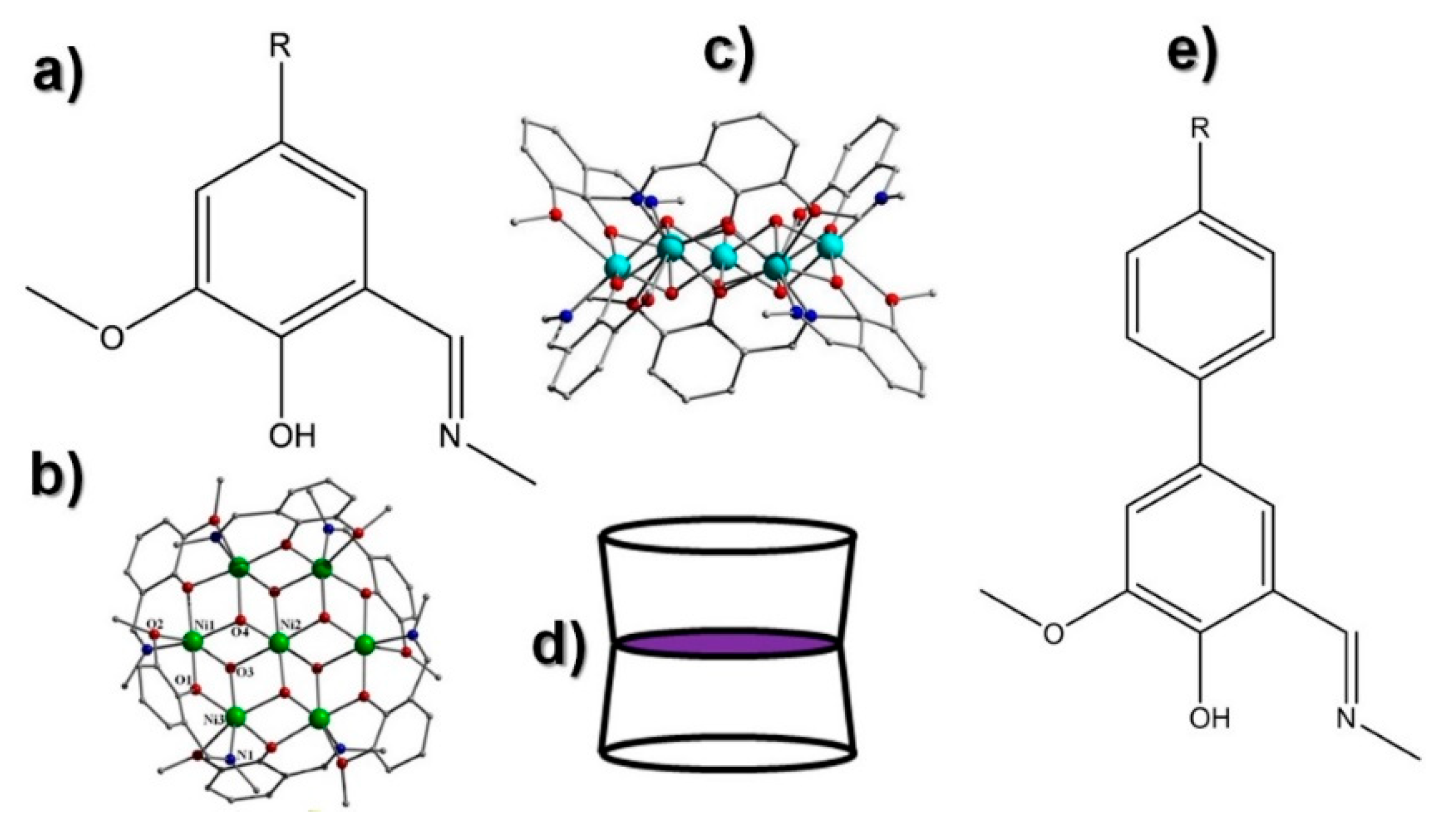
Figure 1. (a) The ligand 2-methoxy-6-((methylimino)methyl)phenol (R = H; L1H) and 2-methoxy-4-bromo-6-[(methylimino)methyl]phenol (R = Br; L2H) used in the construction of our heptanuclear double bowl pseudo [M(II)7] (M = Co, Ni, Zn) metallocalix[6]arenes. Perpendicular (b) and side-on (c) views of a [Ni(II)7] and [Zn(II)7] metallocalix[6]arene, respectively. (d) Schematic highlighting the double bowl topology observed within the pseudo metallocalix[6]arenes. (e) The new ligands 2-methoxy-4-phenyl-6-[(methylimino)methyl]phenol (R = H, L3H) and 2-methoxy-4-tolyl-6-[(methylimino)methyl]phenol (R = CH3, L4H).
Preprints 229293 g001
Figure 2. Crystal structure of the siblings (a) [(MeOH)2⊂Co(II)7(OH)6(L1)6](NO3)2 (L1H = 2-methoxy-6-((methylimino)methyl)phenol) (MeOH guests have been omitted for clarity) and (b) [Co(II)7(OMe)6(L3)6](NO3)2.H2O.3MeOH (1) (L3H = 2-methoxy-4-phenyl-6-[(E)-(methylimino)methyl]phenol). Both analogues are viewed perpendicular (bottom) and parallel (top) to their planar [Co(II)7] cores. Colour code: Co = purple, O = red, N = blue, C = grey (used throughout this work). Hydrogen atoms and NO3¯ counter anions have been omitted for clarity.
Preprints 229293 g002
Figure 3. (left) Interdigitation of the individual [Co(II)7] units in 1 (i.e. red unit) facilitated via T-shaped π···π stacking interactions between ligand moieties on pairs of [Co(II)7] complexes (i.e. yellow + purple and green + blue units). (Right) Polyhedral representation of the packing in 1 as viewed along the c-axis. Hydrogen atoms and NO3− counter anions have been omitted for clarity.
Preprints 229293 g003
Figure 4. (a) Crystal structure of the mononuclear complex [Co(III)(L3)3] (2). Hydrogen atoms have been omitted for clarity. (b) Packing diagram observed in [Co(III)(L3)3] (2) as viewed along the c unit cell direction. Hydrogen atoms omitted for clarity.
Preprints 229293 g004
Figure 5. Crystal structure of the dinuclear complex [Co(III)Co(II)(L3)3(NO3)2].H2O (3) as viewed off-set (a), perpendicular (b) and parallel to the Co(III)…Co(II) plane (c). Hydrogen atoms have been omitted for clarity.
Preprints 229293 g005
Figure 6. Crystal packing illustration of 3 as viewed along the a-axis of the unit cell. Hydrogen atoms have been omitted for clarity.
Preprints 229293 g006
Figure 7. Crystal structure of 4 as viewed perpendicular (a) and parallel (b) to the planar [Ni(II)7] core. Colour code: Ni = green, O = red, N = blue, C = grey. Hydrogen atoms and NO3¯ counter anions have been omitted for clarity. (c) Packing arrangement in 4 as viewed along the a unit cell direction. (d) Space-fill and colour coded representation of the interdigitation observed between the individual [Ni(II)7] units in 4. All solvent molecules of crystallisation have been omitted for clarity. .
Preprints 229293 g007
Figure 8. Crystal structure of 5 as viewed perpendicular to the planar [Zn(II)7] core. (b) Polyhedral representation of the packing arrangement in 5 as viewed along the b unit cell direction. Colour code: Zn = light blue, O = red, N = blue, C = grey.Hydrogen atoms have been omitted for clarity.
Preprints 229293 g008
Figure 8. Crystal structure of 6 as viewed perpendicular (a) and parallel (b) to the {Zn(II)7} plane. (c) Packing arrangement in 6 as viewed along the c direction of the unit cell. Hydrogen atoms have been omitted for clarity.
Preprints 229293 g009
Table 1. Crystal data obtained from complex 1-3.
1.2H2O.3MeOH 2 3
Formulaa C96H114N8O27Co7 C45H42N3O6Co1 C45H44N5O13Co2
MW 2165.33 779.75 978.70
Crystal System Monoclinic Triclinic Triclinic
Space group C2/c P-1 P-1
a/Å 26.7878(12) 10.6963(8) 9.5986(3)
b/Å 15.1243(7) 13.3685(10) 16.3443(6)
c/Å 28.0186(10) 13.6686(10) 17.1687(6)
α/o 90 98.863(6) 67.715(3)
β/o 105.301(4) 94.853(6) 75.169(3)
γ/o 90 99.156(6) 78.311(3)
V/Å3 10949.3(8) 1894.6(2) 2392.43(14)
Z 4 2 2
T/K 150(2) 150(2) 150(2)
λb/Å 0.71073 0.71073 0.71073
Dc/g cm-3 1.314 1.367 1.359
μ(Mo-Ka)/ mm-1 1.103 0.507 0.759
Meas./indep.(Rint) refl. 10025 / 6252 (0.0535) 14288 / 4295 (0.0615) 19060 / 5317 (0.0386)
Restraints, parameters 10, 568 0, 502 0, 584
wR2 (all data)c 0.2267 0.1605 0.2615
R1d,e 0.0710 0.0694 0.0806
Goodness of fit on F2 1.039 1.043 1.071
a Includes guest molecules.b Mo-Kα radiation, graphite monochromator. c wR2= [Σw(IFo2I- IFc2I)2/ ΣwIFo2I2]1/2. dFor observed data. e R1= ΣIIFoI- IFcII/ ΣIFoI.
Table 2. Crystal data obtained from complex 4-6.

4.2H2O
5.4MeOH.10H2O 6.10MeOH.13H2O
Formulaa C93H97N8O26Ni7 C104H146N8O38Zn7 C102H114N8O24Zn7
MW 2015.62 2573.95 2822.10
Crystal System Monoclinic Monoclinic Trigonal
Space group P21/n C2/c R-3
a/Å 14.6830(7) 26.9617(12) 23.6952(4)
b/Å 14.3260(5) 15.1167(7) 23.6952(4)
c/Å 24.1964(11) 28.0457(10) 21.8157(3)
α/o 90 90 90
β/o 106.598(5) 105.778(4) 90
γ/o 90 90 120
V/Å3 4877.6(4) 11000.0(8) 10607.7(3)
Z 2 4 3
T/K 100(2) 150(2) 100(2)
λb/Å 0.71073 0.71073 0.71073
Dc/g cm-3 1.372 1.225 1.019
μ(Mo-Ka)/ mm-1 1.389 1.558 1.215
Meas./indep.(Rint) refl. 8924 / 5819 (0.0532) 25142 / 12696 (0.0737) 13254 / 4319 (0.0167)
Restraints, parameters 15, 562 20, 562 0, 205
wR2 (all data)c 0.2435 0.2082 0.1690
R1d,e 0.0756 0.1729 0.0442
Goodness of fit on F2 1.097 0.992 1.171
a Includes guest molecules.b Mo-Kα radiation, graphite monochromator. c wR2= [Σw(IFo2I- IFc2I)2/ ΣwIFo2I2]1/2. dFor observed data. e R1= ΣIIFoI- IFcII/ ΣIFoI.
Table 3. Molecular cavity dimensions observed in the crystals of 1, 4, 5 and 6 and a comparison with their corresponding original pseudo [M7] (M = Co(II), Ni(II), Zn(II)) metallocalix[6]arenes.
Pseudo [M(II)7]
metallocalix[6]arene
Cavity size
(base × depth × rim) (Å)
% increase in Cavity depth increase (%)
(cf. corresponding [M7]*
Cavity rim increase (%)
(cf. corresponding [M7])*
Ref.
[(MeOH)2⊂Co(II)7] 6.25 × 4.08 × 12.12 - - 11
[(MeOH)2⊂Ni(II)7] 6.20 x 4.16 x 11.81 - - 9a
[(MeOH)2(H2O)⊂Zn(II)7] 6.26 x 4.07 x 12.22 - - 9b
[Co(II)7] (1) 6.25 x 7.11 x 17.94 74 48 this work
[Ni(II)7] (4) 6.19 x 7.55 x 17.03 81 44 this work
[Zn(II)7] (5) 6.23 x 7.25 x 17.62 78 44 this work
[Zn(II)7] (6) 6.22 x 8.54 x 19.35 110 58 this work
* Hypothetical situation where tessellation of the individual [M(II)7] units does not occur upon crystallisation.
Disclaimer/Publisher’s Note: The statements, opinions and data contained in all publications are solely those of the individual author(s) and contributor(s) and not of MDPI and/or the editor(s). MDPI and/or the editor(s) disclaim responsibility for any injury to people or property resulting from any ideas, methods, instructions or products referred to in the content.
Copyright: This open access article is published under a Creative Commons CC BY 4.0 license, which permit the free download, distribution, and reuse, provided that the author and preprint are cited in any reuse.