
Submitted:
20 August 2026
Posted:
21 August 2026
You are already at the latest version
Abstract
Gamified e-learning platforms and Artificial Intelligence (AI)-driven adaptive learning systems have each demonstrated potential for improving learner engagement, yet existing solutions rarely integrate both, and few provide learner-facing explanations for their adaptive decisions. This article addresses this gap by proposing LearnSpace, a hybrid AI–gamification framework incorporating Explainable Artificial Intelligence (XAI) for adaptive e-learning that extends a deterministic reward architecture with an Explanation Layer. The framework combines classical gamification mechanics with an AI personalization module governed by explicit weighted formulas for experience-point calculation, reward modulation, and dynamic difficulty adjustment. Positioned downstream of the Decision Layer, the Explanation Layer identifies the dominant contributing factor behind each adaptive decision and expresses it as a short, learner-facing justification. The framework was informed by a comparative analysis of 14 existing e-learning platforms and was instantiated in a working mobile prototype, LearnSpace, built with Expo/React Native and Supabase. An illustrative decision case demonstrates how the proposed explanation mechanism can expose the reasoning underlying adaptive outputs without modifying the original reward computation. The proposed architecture provides a transparent and interpretable basis for future empirical evaluation of adaptive gamified learning systems.
Keywords:
explainable artificial intelligence
; adaptive e-learning
; gamification
; hybrid AI systems
; dynamic difficulty adjustment
1. Introduction
The multitude of online resources, the easy access to them, as well as the raise of emergent technologies (generative artificial intelligence, intelligent applications, self-supervised learning, multimodal user interface, metaverse, knowledge graphs, neuromorphic computing and so on [1]) reshaped the learning processes, stimulating new paradigms of learning, e.g., lifelong learning, ubiquitous learning, learning at work, collaborative learning or learning at home [2]. Following a period of pandemic and social isolation, the first thing that had to evolve for life to function as close to normal was education and for this many solutions were proposed [3].
E-learning systems are not a new tool anymore. On the one hand there are well-known universities (e.g., Harvard, Princeton, MIT etc.) that have implemented free online e-learning platforms [4]. A great effort was made, but these platforms rely only on the quality of the content rather than on the innovative technologies which can be used to present information. On the other hand, there are the traditional online learning platforms that encourage smart entrepreneurs to sell online courses [4]: here we can observe the need of business transactions and an unknown value of the educational content. Thirdly we have platforms that rely on a considerably inclined approach to gamified practical learning [5] where there is little to no theoretical learning done and all the platform ecosystems rely on making the user think that the whole experience is just a very elaborate game.
Student learning is as important as their engagement with educational activities and study plans [6]. Traditional teacher-centered instruction sometimes leads to disengagement, passive learning, and inconsistent academic performance on the student side [7]. With a growing emphasis on personalized learning and student-centered education, the need for innovation in engagement strategies is greater than ever [8].
Gamification has demonstrated strong potential in improving student engagement in education by using classical elements of motivation such as experience points, badges, leaderboards [9]. While a great motivator these elements lack the personalisation modern education needs in order to improve the process and the result of the educational journey [10]. Different students have unique learning needs, preferences and motivational triggers and traditional learning systems fail to adapt to each individual. This lack of personalization often leads to disengagement over time and lack of persistence in learning activities outside of structured classroom environments [11].
This paper addresses the gap between classical gamification solutions and AI powered adaptation by proposing a hybrid model that combines the two concepts and lays the foundation for any system that aims to increase user interest, applied for smart education, but applicable to any domain [12]. This study is also aligned with the goals set by Bloom’s 2 Sigma Problem [13], which identifies one-on-one tutoring as the gold standard for learning. The proposed system aims to approximate this level of personalization at scale through artificial intelligence-enhanced gamification.
Whilst fundamental gamification elements drive engagement, they also have notable disadvantages. Experience Points (XP) and Levels may lose their motivational value over time with diminishing returns because users become accustomed to the reward system. Challenges that are too challenging can anger users, whereas those that are too easy may lead to boredom, and it is hard to achieve an ideal level of challenge for a diverse group of users. Leaderboards also foster unhealthy competition, which dissuades lower-placed users who feel that they cannot close the gap. Furthermore, traditional gamification has a one-size-fits-all mentality, neglecting people’s individual learning styles, play patterns, or intrinsic motivations. Legacy gamification is struggling with static reward systems that fail to address individual user action. For this reason, AI-powered personalization techniques such as reinforcement learning, dynamic difficulty adaptation, and predictive analysis provide more responsive and adaptive experiences.
Both classical gamification and AI-driven personalization, even combined in a hybrid architecture, share a common blind spot: neither communicates its reasoning to the learner. A dynamically adjusted difficulty level, a modulated reward, or a personalized recommendation is delivered as a fait accompli, indistinguishable from an arbitrary change unless the learner is explicitly told why it happened. In adult, high-stakes domains such as healthcare, finance, and hiring, this opacity has already been identified as a barrier to trust and adoption of AI systems, motivating an entire subfield of Explainable AI research aimed at making model decisions interpretable to the humans affected by them.
Education presents an especially acute case for this problem, for two reasons specific to the K-12 population. First, the learners affected by adaptive decisions are, by definition, still developing the metacognitive capacity to interpret system behavior on their own — an unexplained difficulty reduction can be misread by a child as evidence of failure rather than as a supportive adjustment, precisely inverting its intended pedagogical effect. This limitation is particularly relevant in educational settings, where learners must be able to understand the adaptive behavior of the system rather than simply experience its consequences. For example, an unexplained difficulty reduction may be interpreted by a learner as evidence of poor performance rather than as a supportive adaptation intended to maintain an appropriate level of challenge. Providing concise learner-facing explanations can therefore support transparency and help preserve the sense of autonomy and competence emphasized by Self - Determination Theory (SDT). From this perspective, explainability is not treated merely as a technical property of the AI model, but as a human-centered component of the learning experience.
This paper makes four main contributions: (1) a hybrid AI - gamification architecture that integrates classical gamification mechanisms with adaptive AI-driven personalization within a unified e-learning framework; (2) an Explanation Layer that provides learner-facing justifications for adaptive decisions by identifying the dominant contributing factor in the underlying decision process; (3) a formal decision model combining experience-point calculation, AI-based reward modulation, and dynamic difficulty adjustment through explicit and interpretable mathematical formulations; and (4) a working mobile prototype, LearnSpace, implemented using Expo/React Native and Supabase, demonstrating the practical feasibility of the proposed architecture and its integration within an operational e-learning environment.
The remainder of this paper is organized as follows. Section 2 reviews related work in gamified e-learning, adaptive AI systems, and explainable AI in education, identifying the specific research gap addressed by this work. Section 3 presents the proposed hybrid framework, including the gamification and AI personalization layers, their governing mathematical formulations, and the proposed Explanation Layer. Section 4 describes the architecture and implementation of the LearnSpace prototype and illustrates the practical integration of the proposed framework. Section 5 discusses the contributions, implications, and limitations of the proposed approach, while Section 6 concludes the paper and outlines directions for future research.
2. Related Work
There are two largely separate approaches that educational technology has increasingly taken to improve learner engagement: gamification, which borrows motivational mechanics from games; and AI-driven personalisation, which adapts content and difficulty to individual learners. Traditional eLearning platforms have focused more on content delivery and course administration rather than engagement mechanics, whereas the next generation platforms have embraced gamified practical learning.
Current research in educational gamification and adaptive learning systems reveals a significant gap in scalable models that integrate flexible individualization with classical motivational mechanics, as was established in the previous systematic literature review using PRISMA methodology (2023–2024). More than 40 peer-reviewed studies from a variety of fields, including engagement psychology, AI-driven tutoring, and e-learning, were compiled in the review, which showed how disjointed the current solutions are, with the majority using either static gamification frameworks or limited AI adaptivity.
2.1. Gamification in E-Learning
The platforms reviewed below are drawn from comparative rankings by Forbes [14] [15], TechRadar [16] and CareerFoundry [17], the description of their main features and a general overview of practices and standards.
2.1.1. Traditional eLearning Systems
Udemy [18], an online training platform, uses content from online creators to sell for profit. This platform allows anyone to learn from its pool of over 20,000 instructors. The eLearning platform also enables teachers to interact with users via online discussion forums, direct messages and support tickets. Udemy can be used for free by instructors, allowing them to create online courses on topics such as marketing, design, business, entrepreneurship, health, language, music, art, etc. [14].
Teachable [19] is a platform for creating and selling online courses, both paid and free. This platform allows you to create monthly and annual subscriptions. Free use is promoted [16]. Teachable is also a linear platform where students have access to the entire course; the teacher can enforce course completion or lecture completion, or in premium versions it can drip content to enforce content separation and completion in a specific appointed way timewise.
WizIQ [20] is another major platform in the eLearning industry. It is a cloud-based education platform for accessing teaching and training modules using mobile devices as well as personal computers, providing an app for iPad and Android devices via the Apple App Store and Google Play, as well as a desktop application for Windows [16].
Thinkific [21] is a powerful tool for online learning aimed at helping teachers, businessmen and companies create courses and earn money. The interface is easy to use — instructors can just drag and drop videos, quizzes or Portable Document Format (PDFs) into the course without any technical complications, making it user-friendly even for non-tech savvy individuals 17].
edX [22], this online learning initiative established by Harvard and MIT, presents itself as a place where learners can take courses on computer science, business, humanities, and many more. An innovation of edX is its utilization of artificial intelligence and machine learning for the individualization of the learning experience, the platform customizes itself to each student’s needs which allows them to give tailored recommendations and feedback in real time [14].
Skillshare [23] stands as an online learning community tailored to those inclined towards producing educational videos. The majority of courses emphasize interactivity over traditional lecture-based learning, with the primary aim being skill acquisition through project completion [14].
Coursera [24] is objectively an old learning platform founded in 2012 by Stanford University professors. It offers a variety of courses, specializations and degrees in a plethora of subjects. The platform includes innovative technologies like AI and gamification thus providing ease of use and interactive content [25].
2.2.2. Fully Interactive (Gamified) eLearning Systems
ClassCraft [26] empowers interaction inside the classroom, it is not a classical use of an eLearning system. Hybrid systems are used to evaluate the understanding level of the students and to facilitate teacher-student communication. ClassCraft is using the students’ natural affinity for games to connect with the teacher and the class and improve the learning outcome.
Brainscape [27] is a virtual learning environment that emphasizes the use of spaced repetition to improve recall with the use of virtual flashcards. The frequency of flashcard reviews is modified in accordance with each user’s performance in remembering the information, making use of cognitive science principles to optimize study sessions and long-term retention [28].
Quizlet [29] is a hybrid educational learning system that enhances memorization through different pedagogical methods such as flashcards, enhanced note-taking, and a trustworthy textbook collection available on the platform.
Kahoot [30] is a game-based hybrid learning platform that enables creators (teachers and students) to play and generate quizzes on different subjects. It provides an interactive way to make a powerful, yet gamified, evaluation of the transmitted lessons during the learning stage of the teaching process. It is appreciated for the ease of use and intuitive interface paired with the real time feedback that encourages collaboration and active learning [31,32].
CodeCombat [33] promotes communication, exploration, and making mistakes, a good game forces the player to gradually acquire new skills, a process similar to that of students learning. With the help of the platform, students can study computer science while taking part in an actual game designed so that teachers with little to no programming knowledge can succeed in the classroom.
HourofCode takes the e-learning concept further by using stellar elements such as Star Wars, Minecraft, or Flappy Bird and adapting them so that the use of information combined with pedagogical logic and programming games places users in a comfort zone, familiarity, and availability for learning [34].
Duolingo [35] is a popular language-learning platform (having extended to Duolingo Math and Duolingo ABC) with its main functionality being ease of use and adaptive lessons and learning experiences. Funneling specific exercises for specific users tailored on their mistakes, Duolingo enhances engagement and retention also through gamification such as points, leagues and streaks, and friendly-aggressive notifications and reminders of study [36,37].
Table 1 summarizes this comparison across the ten gamification features assessed for each of the 14 platforms: (1) Quizzes, (2) Badges, (3) Leaderboards, (4) Points, (5) Certificates, (6) Interactive Assignments, (7) Progress Tracking, (8) Streaks, (9) Completion Rewards, and (10) Interactive Games, together with each platform’s total gamification score. As results, Udemy, Coursera, and Duolingo each scored 5/10 (the highest); WizIQ and Skillshare scored 0/10.
Gamification appears in mediums that are generally fun oriented, designed to capture the attention of a user in the purpose of having that user come back and develop a sense of community, loyalty and progress [38]. Some very important means of doing this are badges, leaderboards, points that promote a great social recognition [39] and increasing the likelihood that the user will come back, and this is true for many games. In terms of education the goal is the same: to transform the educational medium in an important environment for the student so it creates dependency [40], a sense of social recognition and increased motivation [40], transforming the educational process in a game.
2.2. Adaptive Learning Systems
Artificial Intelligence features are crucial in improving quality [41] and engagement in eLearning Systems. The AI integration facilitates adaptive and personalized experiences to both the user (student) through course recommendation, tailored course recommendations, adaptive flashcards, adaptive quizzes etc. and the admin (teacher) through AI driven analytics, behavior tracking, personalized interventions and adaptive course creation.
Similarly, a parallel comparison was conducted for AI-related features with 14 categories per platform including course recommendations, AI-driven analytics, real-time feedback, adaptive learning and customised learning paths as seen in Table 2 below. The AI features compared between the platforms are: (1) Course Recommendations, (2) AI-driven Analytics, (3) Real-time Feedback, (4) Adaptive Learning, (5) Tailored Course Recommendations, (6) Interactive Coding Challenges, (7) Behavior Tracking, (8) Personalized Interventions, (9) Adaptive Quiz Generation, (10) Adaptive Content Delivery, (11) Customizable Learning Experiences, (12) AI Course Data Analytics, (13) Adaptive Flashcards, and (14) Personalized Learning Paths. Udemy and Duolingo scored the highest (3/14 features each); Hour of Code scored 0.
With immersive and interactive learning environments, artificial intelligence technologies promote more engagement. Learning is made more interesting and fun by features like gamified learning environments, sophisticated tutoring systems [41], real-time feedback, and virtual simulations. These AI-powered engagement techniques raise academic achievement and retention rates while also improving the learning process.
Complementing this with the algorithmic perspective: legacy gamification is struggling with static reward systems that fail to address individual user action. For this reason, Artificial Intelligence-powered personalization techniques such as reinforcement learning, dynamic difficulty adaptation, and predictive analysis provide more responsive and adaptive experiences.
Reinforcement learning allows Artificial Intelligence to learn and adjust reward schedules continuously from user behavior. It looks to the past to determine what incentives are best matched with each user in a way that rewards remain meaningful and motivational in the long term [42]. Dynamic difficulty adjustment (DDA) also promotes participation by dynamically modifying task difficulty relative to users’ degree of participation and performance [43]. Under strain for a user, the difficulty diminishes to prevent annoying the user, but increased participation provokes more challenging tasks to elicit users’ engagement and sense of achievement [12].
Predictive analysis is one step further than personalization because it foresees engagement patterns before they happen. Based on the analysis of past interactions, biometric signals (such as heart rate, sleep, and exercise), and social determinants, Artificial Intelligence can proactively adjust game elements [38,44].
The marriage of AI-based dynamics with traditional gamification leads to a more intelligent and responsive system that evolves together with user activity. Unlike static-based gamification, in which mechanics like XP, levels, badges, and leaderboards are employed [45], AI makes these mechanisms responsive to actual user feedback in real-time [42].
2.3. Explainable AI in Education
Explainable Artificial Intelligence (XAI) is a set of methods and techniques that explain the AI system’s decisions and actions to a human user [46]. The field emerged in response to the growing opacity of machine learning models, particularly as accuracy gains increasingly came from complex ensemble and deep-learning architectures that even domain experts struggle to interpret. Understanding why a model produced a given output is as important as the output’s accuracy itself, both for building user trust and for detecting failure modes before they cause harm [47].
Two of the most influential technical approaches to XAI are Local Interpretable Model-agnostic Explanations (LIME), which approximates a complex model’s local behavior around a specific prediction with an interpretable surrogate model [48], and SHapley Additive exPlanations (SHAP), which assigns each input feature a Shapley-value-based contribution score to a given prediction, unifying several earlier feature-attribution methods under a single theoretical framework. Both methods were developed to explain black-box classifiers and predictive models; they attribute a prediction back to input features whose combined effect on the model is not otherwise known in closed form.
In education, a six-dimension framework for studying and designing XAI tools has been proposed, spanning stakeholders, benefits, modes of presenting explanations, classes of underlying AI models, human-centred interface design, and potential risks; explanations must be tailored to distinct stakeholders: students, teachers, and parents alike, each of whom needs functional understanding of how a given input relates to a given output in order to trust and act on an AI-driven recommendation [49]. Intelligent tutoring systems (ITS) offer a particularly instructive precedent for XAI research, since decades of ITS work already grapple with making adaptive system’s internal reasoning legible to a learner, well before “explainability” became a distinct machine learning subfield. Explanations of AI-driven course recommendations have been shown to increase teachers’ trust and willingness to act on system suggestions and XAI techniques have been integrated into deployed ITS platforms. This is a narrower and, in principle, more tractable interpretability problem than the one LIME and SHAP were designed to solve, but it has not been addressed in the gamified adaptive-learning literature.
2.4. Research Gap
Despite significant advances in gamified e-learning, adaptive learning, and explainable artificial intelligence, three limitations remain insufficiently addressed in an integrated manner. First, gamification and AI-driven adaptation are frequently treated as separate mechanisms: gamification primarily supports engagement and motivation, whereas adaptive AI focuses on personalization based on learner characteristics and behavior. Their integration within a unified and computationally explicit decision framework remains comparatively limited.
Second, adaptive educational systems may modify rewards, content, or task difficulty without explicitly communicating the reasoning behind these decisions to the learner. Although explainable AI has received increasing attention in educational research, much of the existing work focuses on explaining predictive models to teachers, administrators, or system designers rather than providing concise learner-facing explanations of adaptive system behavior.
Third, post-hoc XAI techniques are not always necessary when the underlying adaptive decision model is itself interpretable. When adaptive decisions are derived from explicit weighted contributions and threshold conditions, the internal decision structure can be exploited directly to generate faithful explanations without introducing an additional approximation model. This opportunity remains underexplored in gamified adaptive e-learning systems.
To situate the proposed framework (in the next section) in relation to existing solutions, Table 3 compares a subset of the platforms analyzed above, selected for their representativeness across the spectrum of gamification and artificial intelligence, including the extent to which learner-facing explainability is explicitly supported.
3. Proposed Explainable Hybrid Framework
The proposed framework integrates traditional gamification mechanisms with AI-driven personalization to support adaptive rewards and task difficulty based on learner characteristics, behavioral signals, and engagement patterns [53]. Its objective is to sustain motivation, personalize the learning experience, and provide transparent adaptive decisions [42]. The framework follows a hybrid and intrinsically interpretable approach: gamification mechanisms provide explicit motivational rules, while the personalization component uses weighted learner-related inputs to determine adaptive outputs. The inputs are organized into two main categories:
-
Classical gamification mechanics inputs:
-
Artificial intelligence inputs:
3.1. Gamification Layer
The gamification formula takes into consideration all the classical gamification mechanics inputs and multiplies the scores taking in consideration these variables either as tasks completed or milestones to return experience points [54]. The hybrid model’s gamification system uses a reward function based on task-related inputs to measure user involvement. In order to relate task performance, difficulty, and social context to motivational outputs like experience points (XP), levels, and badges, this module was developed. The formula (1) which determines the reward is:
experiencePoints = (tasksCompleted × baseXP) + (taskDifficulty × difficultyMultiplier) + (socialScore × socialMultiplier)
The experience points are calculated by the system based on tasks completed [54] (tasksCompleted), base XP per task (baseXP) [45], and task difficulty (taskDifficulty), which adjusts XP using a difficulty multiplier (difficultyMultiplier) [43]. Social engagement in the form of leaderboard ranking and peer review (socialScore) also affects rewards using a social multiplier (socialMultiplier) [55].
The variables are: tasksCompleted, the number of tasks finished in a given session, used as the base unit for reward scaling; baseXP, the fixed XP reward per completed task, adjustable by task type; taskDifficulty, a numerical rating of task complexity (e.g., 1-5); and difficultyMultiplier, which scales the reward up for harder tasks to encourage risk-taking rather than avoidance.
taskDifficulty × difficultyMultiplier reflects Flow Theory [44]. socialScore × socialMultiplier draws on Social Comparison Theory, reinforcing engagement through visibility and peer accountability [60].
baseXP, difficultyMultiplier, and socialMultiplier may be set up using three different methods: Manual Tuning, based on domain requirements or pedagogical priorities; Empirical Calibration, updated via A/B testing or prior engagement information; and Dynamic Adaptation, adjustable in real time, for example, baseXP may go up after streaks to strengthen the development of habits.
To illustrate how formula (1) behaves with realistic inputs, Table 4 (reproduced from the original hybrid model) walks through a worked configuration in an education context.
Therefore, the calculation of experience points is exemplified in formula (2):
aiReward = (α × userProfile) + (β × biometricData) + (γ × engagementChange)
3.2. AI Personalization Layer
The Artificial Intelligence model dynamically adjusts rewards by analyzing real-time user behavior and biometric feedback, optimizing personalization [53,61]. The reward computation is defined as in formula (3):
aiReward = (α × userProfile) + (β × biometricData) + (γ × engagementChange)
Here, the corresponding parts of each signal to the composite reward score are determined by the scalar coefficients α, β, and γ.
- α (User Profile) focuses on learner traits that are steady or gradually developing. This contains elements including age-related interaction preferences, cognitive approach, previous performance history, and preferred teaching method (visual or audible);
- β (Biometric or Behavioral Feedback) controls how susceptible the system is to real-time signals, such as behavioral variables (e.g., posture, visual tracking, typing speed and response time) or physiological data (if available);
- γ (Engagement Change) records changes in user activity over a medium time period. The difference between recent user activity and a longer-term baseline is commonly utilized for determining engagement change.
To maintain engagement, Artificial Intelligence dynamically adjusts difficulty based on real-time user feedback [53]. The difficulty adjustment formula (4) is:
where baseDifficulty is the predefined default level of difficulty, and engagementChange is the user engagement trend; as engagement falls, the system adjusts difficulty dynamically to mitigate frustration and ensure user engagement with the learning process [59,62].
adjustedDifficulty = baseDifficulty × (1 + engagementChange)
Weight coefficients can be determined through Static Heuristic Assignment (fixed weights based on lesson goals), Empirical Optimization (Grid Search, Gradient-Based Learning, or Bayesian Optimization over prior interaction records), or Personalized Dynamic.
3.3. From Decision Layer to Explanation Layer
The gamification module calculates experience points by the level of task completion, multipliers of difficulty, and social engagement scores and the AI module reacts dynamically to these factors by dynamically adjusting the reward and the level of challenge with weighted parameters that may be optimized by reinforcement learning. This system is at the core of the current implementation because this separation of architecture enables the gamification engine to operate without the AI layer being integrated at an earlier stage [63].
In the original hybrid model, this architecture (see Figure 1) terminates at a Decision Layer: experiencePoints, aiReward, and adjustedDifficulty are computed and applied to the learner’s session, a new task difficulty is set, a reward is granted, without any accompanying account of why that specific decision was made. This is consistent with how the prototype implementation currently operates: the α, β, γ weights and the difficulty multiplier are applied server-side as deterministic calculations, and the client receives only the result, not the reasoning.
We therefore intend to extend the architecture with an Explanation Layer, positioned immediately downstream of the Decision Layer (see Figure 2). For every adaptive decision produced by the Decision Layer, the Explanation Layer generates a corresponding human-readable justification by tracing the decision back to its dominant contributing variable(s). Given the AI reward computation in formula (3), the Explanation Layer identifies which term: α, β, or γ, contributed most to the resulting aiReward, and expresses this as a natural-language statement addressed to the learner.
Therefore, the existing Decision Layer computes experiencePoints, aiReward, and adjustedDifficulty, but stops there, nothing communicates why a given value was reached. Since these outputs are already weighted sums of interpretable variables, the information needed to justify a decision exists within the calculation itself; it is simply discarded. The proposed Explanation Layer reads the same intermediate values in parallel, identifies the dominant contributing term, and generates a short learner-facing explanation alongside the numeric result.
3.4. Pseudocode Implementation
In order to represent the functional logic of the suggested hybrid model, the algorithm has been formalised and expressed in pseudocode at this point in its development. The pseudocode describes the sequential steps that control dynamic difficulty adjustment, AI-driven personalisation, gamification-based reward computation, and user input acquisition.
| Pseudocode |
| # Input Acquisition tasksCompleted = get_tasks_completed(user_id) # e.g., 3 taskDifficulty = get_task_difficulty(user_id) # e.g., 2 socialScore = get_social_score(user_id) # e.g., 1.5 userProfile = get_user_profile(user_id) # structured object biometricData = get_biometric_data(user_id) # normalized values engagementChange = calculate_engagement_trend(user_id) # e.g., -0.2 # Constants baseXP = 10 difficultyMultiplier = 1.5 socialMultiplier = 2.0 alpha = 0.4 beta = 0.4 gamma = 0.2 # Step 1: Compute Gamification Score experiencePoints = (tasksCompleted * baseXP) + (taskDifficulty * difficultyMultiplier) + (socialScore * socialMultiplier) # Step 2: Compute AI Personalization Reward aiReward = (alpha * normalize(userProfile)) + (beta * normalize(biometricData)) + (gamma * engagementChange) # Step 3: Compute Adjusted Difficulty baseDifficulty = get_base_difficulty(user_id) adjustedDifficulty = baseDifficulty * (1 + engagementChange) # Step 4: Update System update_user_xp(user_id, experiencePoints) apply_ai_reward(user_id, aiReward) set_next_task_difficulty(user_id, adjustedDifficulty) trigger_ui_adaptation(user_id, userProfile) # Step 5: Generate Explanation dominantFactor = argmax(abs(alpha * userProfile), abs(beta * biometricData), abs(gamma * engagementChange)) explanationText = generate_explanation(dominantFactor, engagementChange, adjustedDifficulty) trigger_ui_explanation(user_id, explanationText) |
Step 5 represents the explanatory extension introduced in this work. The dominantFactor variable identifies the input contribution with the greatest absolute weighted influence on the adaptive decision, while generate_explanation translates this factor into a concise learner-facing justification. The absolute value is used because a strongly negative engagement change, such as a sharp decline in engagement, should be identified as a dominant influence just as readily as a strongly positive change. The model is consistent with Self-Determination Theory [10,43] and Bloom’s 2 Sigma Problem [13]. The combination of gamification and an explicit explanatory mechanism makes the system more similar to the transparency of human one-on-one tutoring based on insights from Intelligent Tutoring Systems research [64].
3.5. Illustrative Example
To illustrate the operation of the proposed Explanation Layer, consider an adaptive learning decision in which three normalized inputs contribute to the AI personalization reward: learner profile, behavioral feedback, and engagement change. Assuming weighted contributions of 0.35, 0.09, and −0.05, respectively, the learner profile represents the dominant contribution because it has the highest absolute weighted value. The Explanation Layer therefore associates the adaptive decision with the learner-profile component rather than with the recent engagement change. For example, if the learner profile indicates a preference for visual learning materials, the system may provide the following learner-facing explanation: “Today’s content has been adapted to include more visual material based on your learning preferences.” This example illustrates how the proposed mechanism derives the explanation directly from the same interpretable contributions used by the adaptive decision process, rather than generating an independent post-hoc explanation.
4. Prototype Implementation
The proposed hybrid framework is instantiated through the LearnSpace prototype, which integrates classical gamification mechanisms, including experience points, badges, levels, and social interactions, with an AI-based personalization layer incorporating user profiling, behavioral data, engagement trend analysis, and dynamic difficulty adjustment. The prototype provides a practical implementation context for the architectural components described in Section 3.
4.1. LearnSpace
LearnSpace is a mobile-first gamified e-learning prototype designed to support motivation, engagement, and learner autonomy in K–12 education. The prototype translates the theoretical foundations identified in the literature review and the proposed hybrid gamification–AI framework into a working application developed using Expo/React Native [67] and Supabase [68]. Its implementation demonstrates how the principal components of the proposed architecture can be integrated within a functional e-learning environment.
Figure 3 illustrates how several components of the proposed framework can be represented within the LearnSpace user interface, including learner progression, avatar-based personalization, achievement mechanisms, social comparison, and adaptive difficulty feedback.
As an Expo/React Native front-end application with Supabase as its authentication, database management, and server-side logic implementation based on Edge Functions, the LearnSpace implementation consists of 20 specific features in three interface modules, namely Home, Quests, and Shop, which operationalize key components of the proposed theoretical and architectural framework. The gamification engine is the Supabase Edge Functions that actualises the classical mechanics module of the hybrid model: calculating the XP with difficulty-weighted multipliers, a streak system with ever-increasing multiplier variable ratio, session-controlled energy to regulate cognitive load, identifying milestone badges, and a token economy with two kinds of currencies.
The implementation follows a theory-informed design approach in which the principal gamification and personalization mechanisms are linked to the theoretical foundations discussed in the preceding sections. Progress indicators, experience points, levels, adaptive difficulty, personalization mechanisms, and social features operationalize concepts associated with Self-Determination Theory, Flow Theory, Social Comparison Theory, and adaptive learning. In this context, the prototype serves as a practical instantiation of the proposed framework rather than as an empirically validated educational intervention.
4.2. React Native/Expo
The two main technology pillars that LearnSpace is based on are Expo/React Native as a mobile client and Supabase as a backend infrastructure. The front-end is based on Expo SDK 54 and React Native 0.81, which gives a cross-platform mobile app that can run both on iOS and Android based on a unified TypeScript codebase. Expo was chosen because of three reasons: first, its workflow management has eliminated the configuration of native build tools, leaving development to focus on the research-relevant interaction design instead of platform-specific concerns; second, the expo-router library provides file-based routing with a tab pattern of navigation that is directly to the three-module architecture adopted in the prototype, originally named Learn, Quests, and Profile, and implemented as Home, Quests, and Shop.
The main libraries used in the application are: supabase-js (v2.100.1) for client-server communication, react-native-reanimated (v4.1.1) for declarative animations with spring physics, expo-haptics for haptic feedback with three levels of intensity, and expo-linear-gradient for gradient-based visual identity depending on quest tier.
4.3. Supabase
Supabase (an open-source Firebase substitute that is based on PostgreSQL) is used as the backend. Supabase offers four services that the application depends on, namely, authentication (email/password with session persistence via AsyncStorage), a PostgreSQL database (where the profiles, tasks, quests, questions, badges and their relational join tables are stored), Edge Functions (serverless Deno functions used to execute gamification logic server-side), and object storage (where a user-uploaded avatar image will be stored).
The PostgreSQL db schema is structured around six main tables and four join tables keeping track of progress for a user. The profiles table holds the aggregate state of each user: xp, level, points, coins, energy, streak_days, last_active_date, avatar_url, username and energy_regen_at. This one row per user design makes it easy for the gamification engine to read and write the full state of the learner in a single query on answer submission.
The submit-answer Edge Function is the most important calculation node of the gamification engine. Each time it is invoked, it does the following: authenticate the user with the JWT in the request header, get the xp_reward of the question, save the answer given by the user in user_answers, get the current profile state, compute the new streak (same day: no change, consecutive day: increment, gap: reset to 1), compute the new XP, level, points, coins (including streak bonus that is limited to 10), and energy (decremented by 10 per submission).
| // supabase/functions/submit-answer/index.ts |
| const XP_PER_LEVEL = 1000; function calcLevel(xp: number): number { return Math.floor(xp / XP_PER_LEVEL) + 1; } |
The parameters that the hybrid model determines as the candidates of AI-driven personalisation — the difficulty multiplier, the social score weighting, weight of reward functions (α, β and γ) and the engagement trend analysis — are either fixed to constant values or still not implemented. This architectural separation is not by accident: an AI personalisation layer, when implemented, will be a layer that operates in conjunction with these functions, not to replace them [56].
4.4. Implemented Modules
The application follows file-based routing pattern of expo-router where the file hierarchy is creatively used to give the navigation hierarchy. The routing layer (app/) has three route groups: an authentication screen, a tab navigator containing the three main modules, and a task detail screen to respond to quest-based questions.
4.4.1. Home Module
The Home module serves as the learner’s primary dashboard, surfacing progress, rewards, and immediate feedback.
XP and Leveling is a progression mechanism where each completed task awards XP XP points toward the individual learner’s total, and the progress towards the next level is visualized as a gradient-filled bar on the Home screen. When a learner has passed some level threshold, the system breaks the common course of the interaction with a given modal of celebration, a full screen overlay with a sequenced animation. The full-screen celebration is intended to make progression milestones salient and to reinforce the learner’s sense of competence when a level threshold is reached [66].
Avatar Customisation supports the autonomy dimension of the framework by allowing learners to exercise agency over how they are represented within the learning environment [69]. The avatar system offers three separate channels to construct the identity: photo upload via expo-image-picker; selection of emoji among 30 options stored as a string prefix (emoji:{char}); and generative monster avatars using the DiceBear API with randomised seeds.
| // components/avatar-picker.tsx |
| const result = await ImagePicker.launchImageLibraryAsync({ mediaTypes: [“images”], allowsEditing: true, aspect: [1, 1], quality: 0.8, }); onUpdated(`emoji:${emoji}`); const url = `https://api.dicebear.com/7.x/bottts/svg?seed=${seed}`; |
Theme Variants are four unique visual themes: Dark, Sunrise, Cyber and Minimal, that let the learner manage the total visual environment in the application. The theme is persisted to AsyncStorage and spread by React Context. Providing multiple visual themes allows learners to personalize the appearance of the environment without altering the underlying learning content or interaction structure. Instead of enforcing one aesthetic, the system creates a relevant variety that is not intrusive upon learning material, a pure autonomy aspect.
| // lib/theme.tsx |
| const THEME_SWATCHES = [ { key: “dark”, label: “Dark”, bg: “#0D1526”, accent: “#3DB4F2” }, { key: “light”, label: “Sunrise”, bg: “#FFF4EA”, accent: “#FF6B35” }, { key: “cyber”, label: “Cyber”, bg: “#020408”, accent: “#00FF88” }, { key: “minimal”, label: “Minimal”, bg: “#F4F4F5”, accent: “#2563EB” }, ]; |
Micro-feedback is transient feedback text (“Nice work!”) which pops up for 1.8 seconds when each task is completed, providing immediate feedback that the action registered. This lightweight signal provides session-level progress awareness without requiring the learner to do the counting manually, taking extraneous cognitive load away from the task while reinforcing the feeling of momentum.
4.4.2. Quests Module
The Quests module structures longer-form challenges and hosts the leaderboard.
Quest Tiers as the quest system has four named levels of difficulty (Bronze, Silver, Gold, and Diamond), each with a different colour identity, icon, and gradient. This visual differentiation has a Flow Theory function: it allows the learner an opportunity to self-select an appropriate challenge-level before a commitment to do so [39].
| // app/(tabs)/quests.tsx |
| const TIER: Record<string, { colors: [string,string]; label: string; icon: string }> = { |
| bronze: { colors: [“#CD7F32”,”#A0522D”], label: “Bronze”, icon: “medal-outline” }, |
| silver: { colors: [“#9E9E9E”,”#757575”], label: “Silver”, icon: “diamond-outline” } |
| gold: { colors: [“#F5A623”,”#FF6B35”], label: “Gold”, icon: “star-four-points” }, |
| diamond: { colors: [“#3DB4F2”,”#7B61FF”], label: “Diamond”, icon: “diamond” }, |
| }; |
Badge unlocking is evaluated server-side after learner activity updates. The corresponding logic checks predefined milestone conditions against the updated learner profile, including accumulated experience points and streak duration. Once a condition threshold is reached, the associated badge is marked as earned and reflected accordingly in the client interface.
Badges are named points of competence in a variety of dimensions. The visual hierarchy of the earned and locked badges is taken into consideration by the client: earned badges are rendered at 80×80 pixels with a gold gradient border and checkmark on top, while locked badges are rendered at 52×52, with a muted colour and lock icon on top.
Leaderboard is a feature where a leaderboard view aggregates profile data for the top 10 users by points, which is the source of data for the social comparison feature. The leaderboard presents a Global/My Rank segmented control that enables the learner to select the extent to which they want to be socially exposed. To provide greater control over social comparison, the interface allows learners to switch between global and personal ranking views and to hide the leaderboard when desired. In addition to the scope toggle, the whole leaderboard can be obscured using a chevron button, entirely removing it from the visible interface.
4.4.3. Shop Module
The Shop module operationalizes the coin economy, converting earned currency into cosmetic customization.
Avatar Frame Shop is the feature where earned coins are used to purchase cosmetic avatar frames, a secondary token economy which requires delayed gratification to be used.
| // lib/api.ts |
| export const AVATAR_FRAMES: Record<FrameId, { label: string; colors: [string, string]; cost: number }> = { space: { label: “Space”, colors: [“#3DB4F2”,”#7B61FF”], cost: 100 }, cyber: { label: “Cyber”, colors: [“#00FFCC”,”#BD00FF”], cost: 150 }, fire: { label: “Fire”, colors: [“#FF6B35”,”#FF3D71”], cost: 200 }, gold: { label: “Gold”, colors: [“#F5A623”,”#FFD700”], cost: 300 }, }; |
The purchase transaction deducts coins server-side and the active frame is persisted locally, changing the gradient ring surrounding the avatar on the Home screen. This mechanism creates a deferred-reward loop in which accumulated virtual currency can be exchanged for customization elements, providing an additional incentive for continued participation.
However, five major constraints have been recognized and articulated: the binary feedback loop which does not allow formative explanation to be a viable attribute [65], the over justification risk of a heavily extrinsic reward architecture, the lack of adaptive challenge in the presence of distinct tiers of self-selection [39], the fact that engagement is being measured and not learning outcomes, and the poor implementation of the relatedness pillar. All constraints are positioned as a planned postponement with a scheduled resolution strategy, mostly by the LLM API integration and the collaborative functionality.
5. Discussions
A central contribution of the framework is the integration of explainability directly into the adaptive decision process. Unlike post-hoc XAI approaches such as LIME or SHAP, which are commonly applied to explain the outputs of complex predictive models, the proposed Explanation Layer exploits the intrinsic interpretability of the underlying weighted decision model. Because the contribution of each input is explicitly available during computation, the system can identify the dominant factor associated with an adaptive output and translate it into a concise learner-facing explanation. Consequently, the explanation is derived from the same variables and computations that determine the adaptive decision rather than from a separate approximation model.
This approach is particularly relevant in educational environments, where transparency concerns not only teachers and system administrators but also learners themselves. An adaptive system may change task difficulty, rewards, or content presentation in response to learner characteristics or recent interaction patterns. Without an explanation, such changes may be difficult for learners to interpret. The proposed framework therefore treats explainability as part of the learner experience rather than solely as a mechanism for technical model inspection. This perspective is consistent with the human-centered orientation of the framework and with its emphasis on learner autonomy and competence.
The LearnSpace prototype demonstrates the technical feasibility of integrating the principal components of the proposed architecture within a mobile e-learning environment. Its implementation combines a React Native front end with Supabase-based authentication, persistent data storage, and server-side gamification logic. Features such as experience points, levels, streaks, badges, avatar customization, leaderboards, quests, and virtual rewards provide a practical context in which the proposed adaptive and explanatory mechanisms can be incorporated. The prototype should therefore be interpreted as a practical instantiation of the framework rather than as evidence of its educational effectiveness
Several limitations should nevertheless be acknowledged. First, the present study focuses on the conceptual, algorithmic, and architectural development of the proposed framework and its prototype implementation rather than on empirical evaluation with end users. Consequently, the effects of the proposed approach on learner engagement, motivation, trust, perceived transparency, and learning outcomes remain to be established through future user studies. Second, the current Explanation Layer relies on identifying the dominant contribution within an explicitly weighted decision model. Although this approach provides a direct and computationally traceable explanation, it may not capture interactions among multiple factors when several contributions have comparable influence on a decision. Future extensions could therefore consider multi-factor explanations while preserving interpretability. Third, the current framework is primarily designed around interpretable weighted and rule-based adaptive mechanisms; its application to more complex machine-learning or deep-learning models would require additional explanation strategies. Finally, the current implementation should be evaluated across different learner populations, educational domains, and learning contexts to assess its generalizability.
Despite these limitations, the proposed approach illustrates how explainability can be incorporated by design into hybrid adaptive e-learning architectures. By preserving the intermediate contributions underlying adaptive decisions and transforming them into learner-facing explanations, the framework provides a transparent foundation for subsequent empirical investigation and for the development of more advanced human-centered adaptive learning systems.
6. Conclusions
This study proposed an explainable hybrid AI–gamification framework for adaptive e-learning systems that integrates classical gamification mechanisms, AI-driven personalization, and learner-facing explainability within a unified architecture. The framework combines experience points, levels, badges, and social interaction with an adaptive decision model that considers learner-related information and engagement patterns to modulate rewards and task difficulty.
The main contribution of the proposed approach is the integration of an Explanation Layer directly into the adaptive decision process. Rather than applying a separate post-hoc explanation model, the framework preserves the interpretable contributions underlying each adaptive decision, identifies the dominant contributing factor, and translates it into a concise learner-facing explanation. In this way, the adaptive decision and its explanation originate from the same computational process, supporting transparency and computational traceability.
The framework was instantiated through the LearnSpace mobile prototype, demonstrating how the proposed architectural components can be integrated within a functional e-learning environment. The implementation incorporates gamification mechanisms including experience points, levels, streaks, badges, quests, social comparison, avatar customization, and virtual rewards, together with the server-side logic required to manage learner progression and adaptive interactions.
The present work focuses on the conceptual, algorithmic, and architectural development of the framework and its prototype implementation, following the broader perspective that hybrid approaches can combine complementary algorithmic mechanisms to improve adaptive and personalized system behavior [70]. Future research will therefore focus on empirical evaluation with learners to investigate the usability and perceived usefulness of the proposed explanations, as well as their potential effects on transparency, trust, engagement, motivation, and learning outcomes. Further work will also investigate multi-factor explanations and the extension of the proposed approach to more complex adaptive models while preserving learner-facing interpretability.
Overall, the proposed framework provides a foundation for integrating explainability by design into adaptive gamified learning systems, shifting the role of XAI from an external mechanism for interpreting opaque predictions toward an integral component of the learner–system interaction.
Supplementary Materials
Video S1: LearnSpace Application Demo: https://www.youtube.com/shorts/G8zLMTu9sqQ.
Author Contributions
For research articles with several authors, a short paragraph specifying their individual contributions must be provided. The following statements should be used “Conceptualization, R.E.B. and M.I.D.; methodology, M.I.D.; software, R.E.B.; validation, B.I.U.; formal analysis, R.E.B.; investigation, B.I.U.; resources, B.G.D.; data curation, B.G.D.; writing—original draft preparation, R.E.B. and B.I.U.; writing—B.G.D. and M.I.D., X.X.; visualization, B.I.U.; supervision, M.I.D.; project administration, R.E.B.; funding acquisition, M.I.D. All authors have read and agreed to the published version of the manuscript.” Please turn to the CRediT taxonomy for the term explanation. Authorship must be limited to those who have contributed substantially to the work reported.
Funding
This research received no external funding. This research will have funding through PubArt—Program to support the publication of scientific articles and communications indexed in the Web of Science. In order to increase the visibility of the performance of the research activity, the National University of Science and Technology POLITEHNICA Bucharest contributes to ensuring the necessary resources for financing the publication and dissemination of scientific results.
Data Availability Statement
The original contributions presented in the study are included in the article. Further inquiries can be directed to the corresponding author.
Acknowledgments
The authors have reviewed and edited the output and take full responsibility for the content of this publication.
Conflicts of Interest
The authors declare no conflicts of interest.
Abbreviations
The following abbreviations are used in this manuscript:
| AI | Artificial Intelligence |
| XAI | Explainable Artificial Intelligence |
| XP | Experience Points |
| SDT | Self-Determination Theory |
| Portable Document Format | |
| DDA | Dynamic Difficulty Adjustment |
| LIME | Local Interpretable Model-agnostic Explanations |
| SHAP | SHapley Additive exPlanations |
| ITS | Intelligent Tutoring Systems |
References
- Emerging Technologies and Trends for Tech Product Leaders. Available online: https://www.gartner.com/en/articles/emerging-tech-trends-for-product-leaders (accessed on 5 August 2026).
- Galanis, N.; Mayol, E.; Alier, M.; García-Peñalvo, F.J. Supporting, Evaluating and Validating Informal Learning. A Social Approach. Comput. Hum. Behav. 2016, 55, 596–603. [Google Scholar] [CrossRef]
- Lockee, B.B. Online Education in the Post-COVID Era. Nat. Electron 2021, 4, 5–6. [Google Scholar] [CrossRef]
- How The Pandemic Has Changed eLearning online. Available online: https://elearningindustry.com/how-covid-pandemic-changed-elearning (accessed on 5 August 2026).
- Sayaf, A.M. Adoption of E-Learning Systems: An Integration of ISSM and Constructivism Theories in Higher Education. Helicon 2023, 9, e13014. [Google Scholar] [CrossRef] [PubMed]
- Ali, M. A.-A.; M. Shamsur, R.-K. E-Learning in Saudi Arabia: Past, Present, Future. Available online: https://studylib.net/doc/8326083/e-learning-in-saudi-arabia--past--present-and-future (accessed on 5 August 2026).
- Aljaber, A. E-Learning Policy in Saudi Arabia: Challenges and Successes. Res. Comp. Int. Educ. 2018, 13, 176–194. [Google Scholar] [CrossRef]
- Aldemir, T.; Celik, B.; Kaplan, G. A Qualitative Investigation of Student Perceptions of Game Elements in a Gamified Course. Comput. Hum. Behav. 2018, 78, 235–254. [Google Scholar] [CrossRef]
- Alsadoon, E.; Alkhawajah, A.; Suhaim, A.B. Effects of a Gamified Learning Environment on Students’ Achievement, Motivations, and Satisfaction. Heliyon 2022, 8, e10249. [Google Scholar] [CrossRef] [PubMed]
- Ali, M. A.-A. E-Learning in Saudi Arabia: ′To E or Not to E, That Is the Question′. J. Fam. Community Med. 2010, 17, 147. [Google Scholar] [CrossRef] [PubMed]
- Alshehri, Y.A.; Mordhah, N.; Alsibiani, S.; Alsobhi, S.; Alnazzawi, N. How the Regular Teaching Converted to Fully Online Teaching in Saudi Arabia during the Coronavirus COVID-19. Creat. Educ. 2020, 11, 985–996. [Google Scholar] [CrossRef]
- Aşıksoy, G. The Effects of the Gamified Flipped Classroom Environment (GFCE) on Students’ Motivation, Learning Achievements and Perception in a Physics Course. Qual. Quant. 2017, 52. [Google Scholar] [CrossRef]
- Bloom, B.S. The 2 Sigma Problem: The Search for Methods of Group Instruction as Effective as One-to-One Tutoring. Educ. Res. 1984, 13, 4–16. [Google Scholar] [CrossRef]
- 8 Online Learning Platforms That Allow You To Move At Your Own Pace. Available online: https://www.forbes.com/sites/forbes-personal-shopper/2022/02/28/best-online-learning-platforms/ (accessed on 5 August 2026).
- Best Online Learning Platforms In 2023 - Forbes Vetted. Available online: https://www.forbes.com/sites/forbes-personal-shopper/2022/02/28/best-online-learning-platforms/ (accessed on 5 August 2026).
- Best Online Learning Platform of 2026. Available online: https://www.techradar.com/best/best-online-learning-platforms (accessed on 5 August 2026).
- The 13 Best Online Learning Platforms in 2025. Available online: https://careerfoundry.com/en/blog/career-change/best-online-learning-platforms/ (accessed on 5 August 2026).
- Udemy. Available online: https://www.udemy.com/ (accessed on 5 August 2026).
- Teachable. Available online: https://www.teachable.com/ (accessed on 5 August 2026).
- Bringing the World’s Best Mobile and PC Browser Games to Japan! Available online: https://www.wizq.com/en (accessed on 5 August 2026).
- Thinkific. Available online: https://www.thinkific.com/ (accessed on 5 August 2026).
- edX | Online Courses, Certificates & Degrees from Leading Institutions. Available online: https://www.edx.org/ (accessed on 5 August 2026).
- Skillshare. Available online: https://www.skillshare.com/ (accessed on 5 August 2026).
- Online Course Catalog and Directory. Available online: https://www.coursera.org/browse (accessed on 5 August 2026).
- Alraimi, K.-M.; Zo, H.; Ciganek, A. Understanding the MOOCs Continuance: The Role of Openness and Reputation. Comput. Educ. 2015, 80, 28–38. [Google Scholar] [CrossRef]
- HMH Classcraft. Available online: https://www.hmhco.com/programs/classcraft (accessed on 5 August 2026).
- Brainscape. Available online: https://www.brainscape.com/ (accessed on 5 August 2026).
- Effective Micro-Learning with Brainscape. Available online: https://www.slideshare.net/slideshow/effective-microlearning-with-brainscape/106199796 (accessed on 5 August 2026).
- Your Sets. Available online: https://quizlet.com/l (accessed on 5 August 2026).
- Kahoot. Available online: https://kahoot.it/ (accessed on 5 August 2026).
- Wang, A.I.; Tahir, R. The Effect of Using Kahoot! For Learning – A Literature Review. Comput. Educ. 2020, 149, 103818. [Google Scholar] [CrossRef]
- Plump, C. Using Kahoot! In the Classroom to Create Engagement and Active Learning: A Game-Based Technology Solution for eLearning Novices. Manag. Teach. Rev. 2017, 2, 151–158. [Google Scholar] [CrossRef]
- CodeCombat. Available online: https://codecombat.com (accessed on 5 August 2026).
- Resnick, M.; Silverman, B. Some Reflections on Designing Construction Kits for Kids; 2005; pp. 117–122. [Google Scholar] [CrossRef]
- Duolingo. Available online: https://www.duolingo.com/ (accessed on 5 August 2026).
- Raahayu, N.; Kesumayathi, I.; Supartini, N. The Role of Mobile Language Learning Applications Duolingo in Enhancing English Language Proficiency: A Study on Hospitality Students. EDUKATIF J. ILMU Pendidik. 2024, 6, 2789–2797. [Google Scholar] [CrossRef]
- Youlanda, W. The Effectiveness Of Using Duolingo Application For Students` Grammar Ability In English. J. Pus. Studi Pendidik. Rakyat 2023, 43–50. [Google Scholar] [CrossRef]
- Hamari, J.; Koivisto, J.; Sarsa, H. Does Gamification Work? — A Literature Review of Empirical Studies on Gamification. 2014. [Google Scholar] [CrossRef]
- Deterding, S.; Dixon, D.; Khaled, R.; Nacke, L. From Game Des. Elem. To Gamefulness Defin. Gamification 2011, Vol. 11, 9–15.
- Domínguez, A.; Saenz-de-Navarrete, J.; de-Marcos, L.; Fernández-Sanz, L.; Pagés, C.; Martínez-Herráiz, J.-J. Gamifying Learning Experiences: Practical Implications and Outcomes. Comput. Educ. 2013, 63, 380–392. [Google Scholar] [CrossRef]
- Roll, I.; Wylie, R. Evolution and Revolution in Artificial Intelligence in Education. Int. J. Artif. Intell. Educ. 2016, 26, 582–599. [Google Scholar] [CrossRef]
- Hussain, T.; Yu, L.; Asim, M.; Ahmed, A.; Wani, M.A. Enhancing E-Learning Adaptability with Automated Learning Style Identification and Sentiment Analysis: A Hybrid Deep Learning Approach for Smart Education. Information 2024, 15, 277. [Google Scholar] [CrossRef]
- Ratinho, E.; Martins, C. The Role of Gamified Learning Strategies in Student’s Motivation in High School and Higher Education: A Systematic Review. Heliyon 2023, 9, e19033. [Google Scholar] [CrossRef] [PubMed]
- Richard, N.-L. Developing a Theory of Gamified Learning: Linking Serious Games and Gamification of Learning. Simul. Gaming 2014, 45, 752–768. [Google Scholar] [CrossRef]
- İbrahim, Yıldırım; Sedat, Şen. The Effects of Gamification on Students’ Academic Achievement: A Meta-Analysis Study. Interact. Learn. Environ. 2019, 29, 1301–1318. [Google Scholar] [CrossRef]
- What Is Explainable AI (XAI)? IBM. Available online: https://www.ibm.com/think/topics/explainable-ai (accessed on 6 August 2026).
- Adadi, A.; Berrada, M. Peeking Inside the Black-Box: A Survey on Explainable Artificial Intelligence (XAI). IEEE Access 2018, 6, 52138–52160. [Google Scholar] [CrossRef]
- Ribeiro, M.T.; Singh, S.; Guestrin, C. “Why Should I Trust You?”: Explaining the Predictions of Any Classifier. In Proceedings of the Proceedings of the 22nd ACM SIGKDD International Conference on Knowledge Discovery and Data Mining, August 13 2016; Association for Computing Machinery: New York, NY, USA; pp. 1135–1144. [Google Scholar]
- Khosravi, H.; Shum, S.B.; Chen, G.; Conati, C.; Tsai, Y.-S.; Kay, J.; Knight, S.; Martinez-Maldonado, R.; Sadiq, S.; Gašević, D. Explainable Artificial Intelligence in Education. Comput. Educ. Artif. Intell. 2022, 3, 100074. [Google Scholar] [CrossRef]
- Bodea, C.-N.; Mogos, R.; Dascalu, M.-I. How E-Learning Experience Enhances the Social Presence in Community of Practice:An Empirical Analysis. In Virtual Community Building and the Information Society: Current and Future Directions; IGI Global, 2012; pp. 75–120. ISBN 978-1-60960-869-9. [Google Scholar]
- Hung, D.; Chen, D.-T. V. Situated Cognition, Vygotskian Thought and Learning from the Communities of Practice Perspective: Implications for the Design of Web-Based E-Learning. Educ. Media Int. 2001, 38, 3–12. [Google Scholar] [CrossRef]
- Bingxue, Z.; Chuantao, Y.; Bertrand, D.; Zhang, X. Facilitating Professionals’ Work-Based Learning with Context-Aware Mobile System. Sci. Comput. Program. 2016. [Google Scholar] [CrossRef]
- Tyler, K. Integrating Artificial Intelligence and Machine Learning with Materials Education. JOM 2023, 75, 2080–2082. [Google Scholar] [CrossRef]
- Bouchrika, I.; Harrati, N.; Wanick, V.; Wills, G. Exploring the Impact of Gamification on Student Engagement and Involvement with E-Learning Systems. Interact. Learn. Environ. 2021, 29, 1244–1257. [Google Scholar] [CrossRef]
- Christy, K.R.; Fox, J. Leaderboards in a Virtual Classroom: A Test of Stereotype Threat and Social Comparison Explanations for Women’s Math Performance. Comput. Educ. 2014, 78, 66–77. [Google Scholar] [CrossRef]
- Humble, N.; Mozelius, P. The Threat, Hype, and Promise of Artificial Intelligence in Education. Discov. Artif. Intell. 2022, 2, 22. [Google Scholar] [CrossRef]
- Damaševičius, R.; Maskeliūnas, R.; Blažauskas, T. Serious Games and Gamification in Healthcare: A Meta-Review. Information 2023, 14, 105. [Google Scholar] [CrossRef]
- Alhejaily, A.-M.G. Artificial Intelligence in Healthcare (Review). Biomed. Rep. 2025, 22, 1–8. [Google Scholar] [CrossRef] [PubMed]
- Dimulescu, C. E-Learning Platform Usage and Acceptance of Technology after the COVID-19 Pandemic: The Case of Transilvania University. Sustainability 2023, 15, 16120. [Google Scholar] [CrossRef]
- Juan, B. Using Game Theory and Competition-Based Learning to Stimulate Student Motivation and Performance. Comput. Educ. 2010, 55, 566–575. [Google Scholar] [CrossRef]
- Lestari, A.; Lawi, A.; Thamrin, S.A.; Hidayat, N. Automated Detection of Learning Styles Using Online Activities and Model Indicators. Int. J. Adv. Comput. Sci. Appl. 2024, 15, 594–604. [Google Scholar] [CrossRef]
- Huang, W.D.; Loidl, V.; Sung, J.S. Correction: Reflecting on Gamified Learning in Medical Education: A Systematic Literature Review Grounded in the Structure of Observed Learning Outcomes (SOLO) Taxonomy 2012—2022. BMC Med. Educ. 2024, 24, 104. [Google Scholar] [CrossRef] [PubMed]
- Chassignol, M.; Khoroshavin, A.; Klimova, A.; Bilyatdinova, A. Artificial Intelligence Trends in Education: A Narrative Overview. Procedia Comput. Sci. 2018, 136, 16–24. [Google Scholar] [CrossRef]
- Graesser, A.; VanLehn, K.; Rosé, C.; Jordan, P.; Harter, D. Intelligent Tutoring Systems with Conversational Dialogue. AI Mag. 2001, 22, 39–51. [Google Scholar] [CrossRef]
- Schunk, Dale H.; Zimmerman, Barry J. (Eds.) Motivation and Self-Regulated Learning: Theory, Research, and Applications; Routledge: New York, 2012; ISBN 978-0-203-83107-6. [Google Scholar]
- Ryan, R.M.; Deci, E.L. Self-Determination Theory and the Facilitation of Intrinsic Motivation, Social Development, and Well-Being. 2000, 55, 68–78. [Google Scholar] [CrossRef] [PubMed]
- Expo — Build Native Apps with React. Available online: https://expo.dev/ (accessed on 5 August 2026).
- Supabase | The Postgres Development Platform. Available online: https://supabase.com/ (accessed on 5 August 2026).
- Reeve, J. Why Teachers Adopt a Controlling Motivating Style Toward Students and How They Can Become More Autonomy Supportive. Educ. Psychol. 2009, 44, 159–175. [Google Scholar] [CrossRef]
- Li, B.; Ma, N.; Li, N.; Guo, Y. A recommendation algorithm based on the hybrid model. U.P.B. Sci. Bull. Ser. C 2019, 81, 189–204. [Google Scholar]
Figure 1.
Algorithm design for Hybrid Gamification-Artificial Intelligence System.
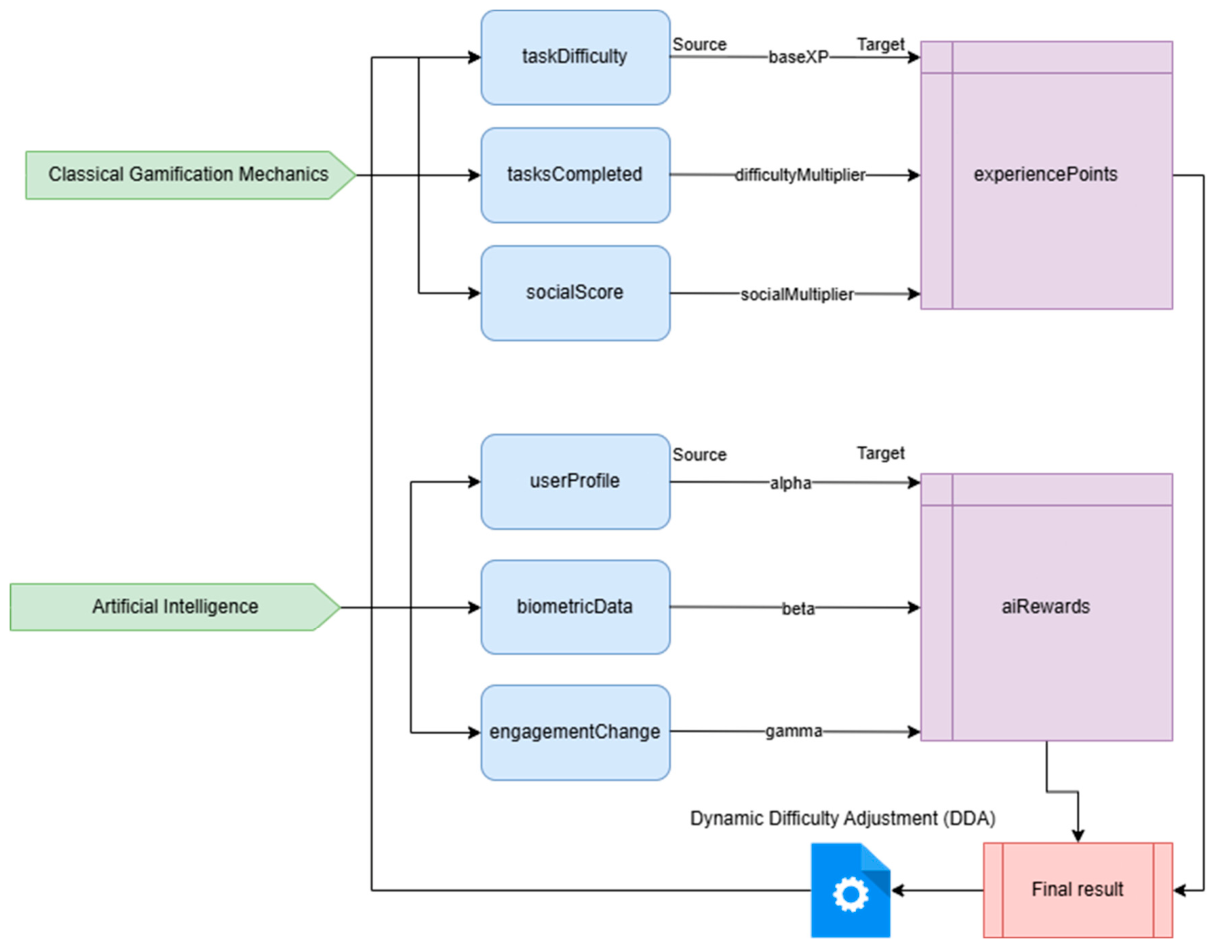
Figure 2.
Extension with the Explanation Layer.
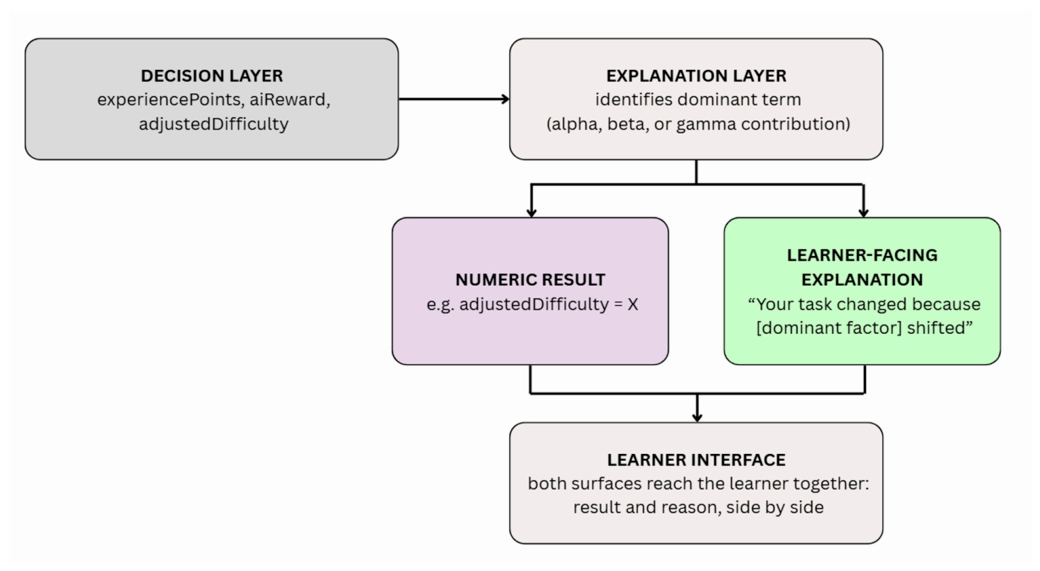
Figure 3.
Illustrative interface design for the proposed framework.
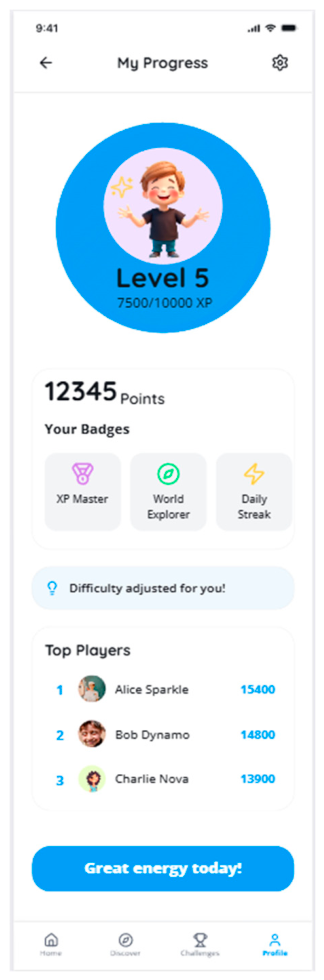

Table 1.
Gamification score of eLearning Leading Platforms.
| Platform | 1 | 2 | 3 | 4 | 5 | 6 | 7 | 8 | 9 | 10 |
Score (/10) |
| Udemy | X | X | X | X | X | 5 | |||||
| Teachable | X | 1 | |||||||||
| WizIQ | 0 | ||||||||||
| Thinkific | X | X | 2 | ||||||||
| edX | X | X | X | 3 | |||||||
| Skillshare | 0 | ||||||||||
| Coursera | X | X | X | X | X | 5 | |||||
| ClassCraft | X | X | X | X | 4 | ||||||
| Brainscape | X | 1 | |||||||||
| Quizlet | X | X | 2 | ||||||||
| Kahoot | X | X | X | X | 4 | ||||||
| CodeCombat | X | X | 2 | ||||||||
| Hour of Code | X | 1 | |||||||||
| Duolingo | X | X | X | X | X | 5 |
Table 2.
AI features comparison of eLearning Leading Platforms.
| Platform | 1 | 2 | 3 | 4 | 5 | 6 | 7 | 8 | 9 | 10 | 11 | 12 | 13 | 14 |
AI Score (/10) |
| Udemy | X | X | X | 3 | |||||||||||
| Teachable | X | 1 | |||||||||||||
| WizIQ | X | 1 | |||||||||||||
| Thinkific | X | X | 2 | ||||||||||||
| edX | X | X | 2 | ||||||||||||
| Skillshare | X | X | 2 | ||||||||||||
| Coursera | X | X | 2 | ||||||||||||
| ClassCraft | X | X | 2 | ||||||||||||
| Brainscape | X | 1 | |||||||||||||
| Quizlet | X | 1 | |||||||||||||
| Kahoot | X | 1 | |||||||||||||
| CodeCombat | X | 1 | |||||||||||||
| HourofCode | 0 | ||||||||||||||
| Duolingo | X | X | X | 3 |
Table 3.
Comparative table of gamification, AI, and explainability across representative systems.
| System | Gamification | AI | Explainability |
| Duolingo | ✓ (5/10) | Partial (3/14) | X |
| Coursera | ✓ (5/10) | Partial (2/14) | X |
| Kahoot | ✓ (4/10) | Partial (1/14) | X |
| EdX | Partial (3/10) | Partial (2/14) | X |
| LearnSpace-XAI (proposed) | ✓ | ✓ | ✓ |
Table 4.
Example Configuration of Gamification Values.
| Variable | Value | Rationale |
| tasksCompleted | 4 | Four quizzes submitted |
| baseXP | 10 | Fixed reward per task |
| taskDifficulty | 3 | Moderate challenge |
| difficultyMultiplier | 2.0 | Encourages complex problem-solving |
| socialScore | 0.75 | Ranked in upper 25% of the leaderboard |
| socialMultiplier | 5.0 | Strong emphasis on collaborative learning |
Disclaimer/Publisher’s Note: The statements, opinions and data contained in all publications are solely those of the individual author(s) and contributor(s) and not of MDPI and/or the editor(s). MDPI and/or the editor(s) disclaim responsibility for any injury to people or property resulting from any ideas, methods, instructions or products referred to in the content. |
© 2026 by the authors. Licensee MDPI, Basel, Switzerland. This article is an open access article distributed under the terms and conditions of the Creative Commons Attribution (CC BY) license.
Copyright: This open access article is published under a Creative Commons CC BY 4.0 license, which permit the free download, distribution, and reuse, provided that the author and preprint are cited in any reuse.