

Submitted:
20 August 2026
Posted:
21 August 2026
You are already at the latest version
Abstract
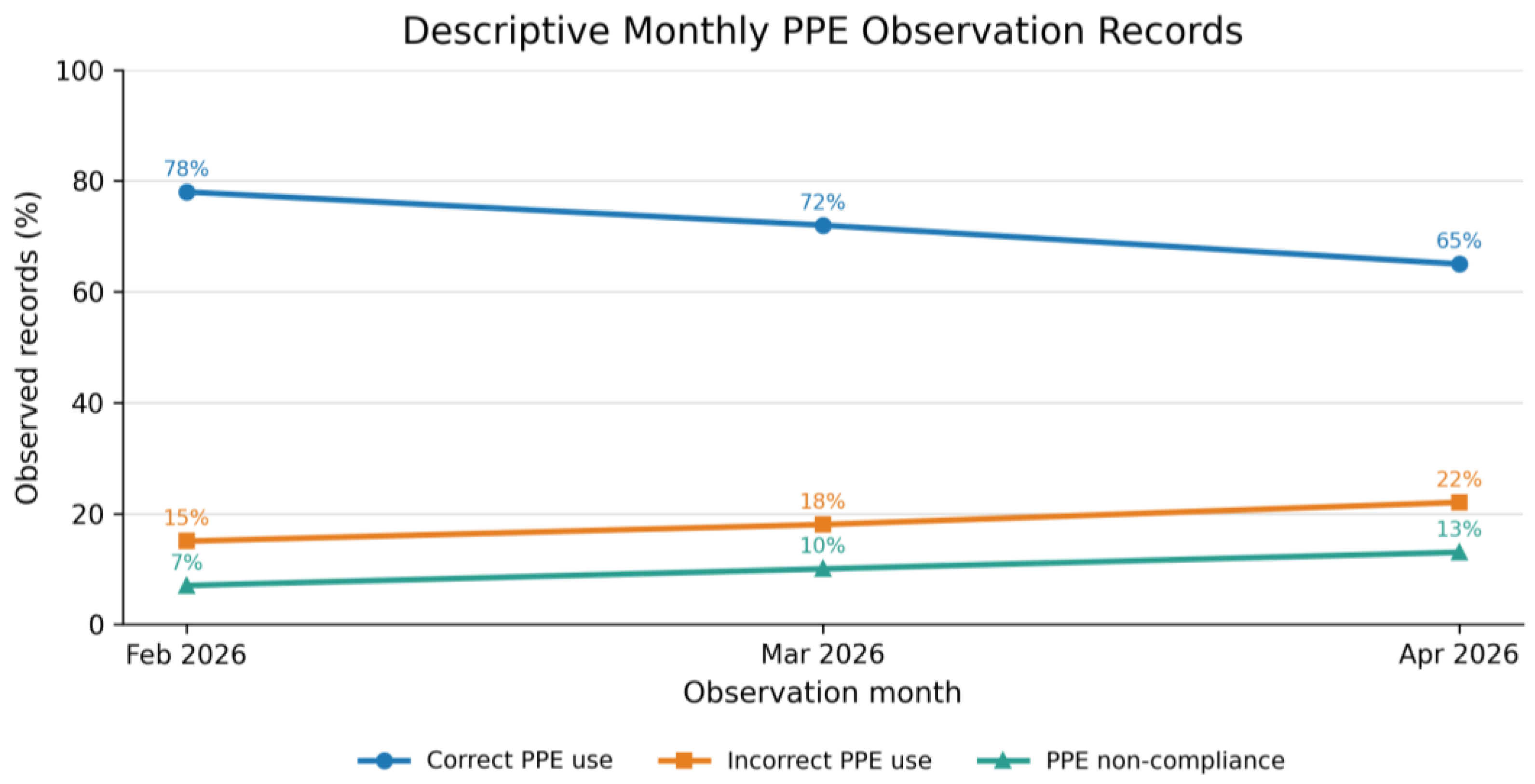
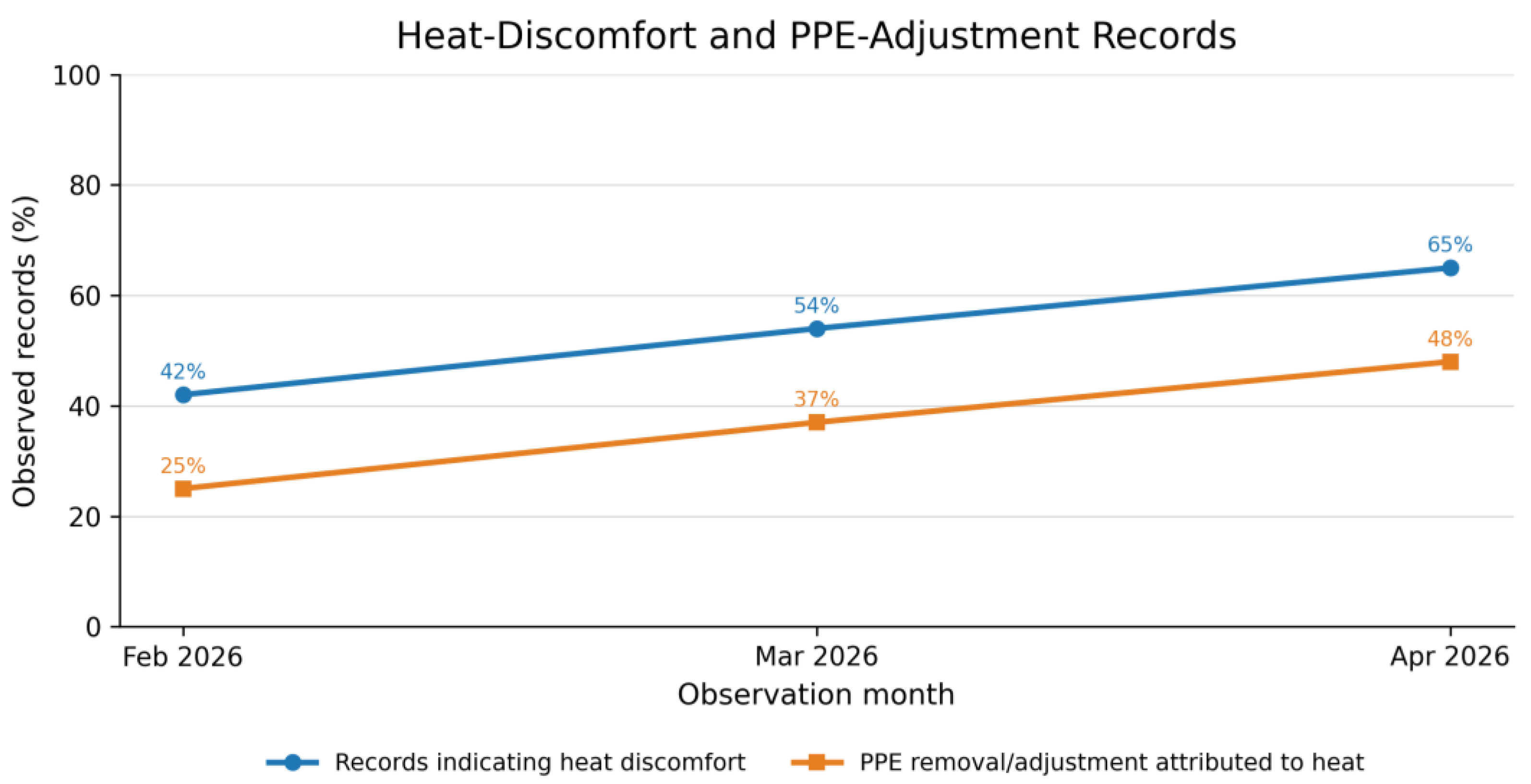
Construction workers in Riyadh often wear personal protective equipment (PPE) in hot conditions. This exploratory study examined whether heat-related discomfort, supervisor or leadership influence, and language accessibility were associated with self-reported routine PPE use. Anonymous survey responses from 85 workers at seven construction sites were analysed alongside unlinked site-observation summaries from February to April 2026. Routine use was coded from whether PPE was part of daily work or worn when reminded. Four associations were assessed using Pearson chi-square tests, Cramer’s V, odds ratios, 95% confidence intervals and Holm-adjusted p-values. Heat-related discomfort was associated with routine use, χ2(1, N = 84) = 5.05, adjusted p = 0.025, V = 0.245; the positive direction may indicate that routine users experienced more discomfort rather than that heat improved compliance. Supervisor or leadership influence showed the strongest association, χ2(1, N = 82) = 39.03, adjusted p < 0.001, V = 0.690. Training-language and safety-instruction language accessibility were also associated with routine use (adjusted p = 0.002 and 0.004). Observation summaries recorded lower correct PPE use and more heat-attributed adjustment, but counts, measured heat exposure and worker linkage were unavailable. The findings support prospective studies using validated compliance measures, measured exposure and linked observations.
Keywords:
1. Introduction
2. Literature Review and Theoretical Framework
2.1. PPE Compliance in Construction Environments
2.2. Heat Stress and Construction Safety
2.3. PPE Discomfort, Usability and Behavioural Adaptation
2.4. Supervision, Safety Climate and Heat-Stress Controls
2.5. Communication and Multinational Workforce Challenges
2.6. COM-B Model as the Theoretical Framework
2.7. Research Gap and Study Contribution
3. Materials and Methods
3.1. Research Design and Setting
3.2. Population, Sampling and Response Rate
3.3. Data Collection Instruments
3.4. Operational Definitions and Data Analysis
3.5. Ethical Considerations
3.6. Use of Generative AI-Assisted Tools
4. Results
4.1. Respondent Profile

| Variable | Category | Frequency |
|---|---|---|
| Age | Under 25 | 17 |
| Age | 25-34 | 36 |
| Age | 35-44 | 24 |
| Age | 45+ | 8 |
| Construction experience | Less than 1 year | 10 |
| Construction experience | 1-3 years | 23 |
| Construction experience | 3-5 years | 25 |
| Construction experience | More than 5 years | 26 |
| Construction experience | Not specified / not reported | 1 |
| Role | General labourer | 75 |
| Role | Skilled labourer | 8 |
| Role | Not specified / not reported | 2 |
| Language understanding | Arabic | 21 |
| Language understanding | English | 22 |
| Language understanding | Other languages | 40 |
| Language understanding | Not specified / not reported | 2 |
4.2. Descriptive Findings on Heat, PPE Comfort and Training
| Statement | Agree/Strongly Agree, n/N (%) |
|---|---|
| Understand when PPE is required | 65/85 (76.5%) |
| Know how to wear and adjust PPE correctly | 52/85 (61.2%) |
| PPE training helps correct PPE use | 84/85 (98.8%) |
| Hands-on demonstrations improve PPE understanding | 84/84 (100%) |
| Practical demonstrations are more effective than classroom-based training | 84/85 (98.8%) |
| PPE training delivered in an understandable language | 34/85 (40.0%) |
| Understand the process for reporting PPE defects | 21/85 (24.7%) |
| PPE helps protect against serious injury | 85/85 (100%) |
| Motivated to wear PPE even without supervisor presence | 53/85 (62.4%) |
| PPE becomes uncomfortable during hot weather | 84/85 (98.8%) |
| Confident speaking up about uncomfortable PPE | 20/85 (23.5%) |
| Factor | Frequency | Percentage |
|---|---|---|
| Heat / hot weather | 85 | 100% |
| Time pressure | 25 | 29.4% |
| Long working hours | 24 | 28.2% |
| Physically demanding tasks | 24 | 28.2% |
| Heavy workload | 16 | 18.8% |
| Other | 10 | 11.8% |
| Coded discomfort theme | Frequency | Percentage of 84 valid responses |
|---|---|---|
| Weight or rigidity | 29 | 34.5% |
| Heat and sweating | 26 | 31.0% |
| Fit or pressure | 12 | 14.3% |
| General discomfort or fatigue | 8 | 9.5% |
| Pain or physical discomfort | 6 | 7.1% |
| Breathing restriction | 5 | 6.0% |
| Fogging or visibility | 2 | 2.4% |
| Slipperiness | 1 | 1.2% |
4.3. Exploratory Association Analyses
| Heat-related discomfort | Routine PPE use | Reminder-dependent use | Row total |
|---|---|---|---|
| Heat-related discomfort mentioned | 21 | 5 | 26 |
| Other discomfort | 32 | 26 | 58 |
| Column total | 53 | 31 | 84 |
| Reported influence | Routine PPE use | Reminder-dependent use | Row total |
|---|---|---|---|
| Supervisor/leadership influence | 45 | 5 | 50 |
| Co-worker/other influence | 7 | 25 | 32 |
| Column total | 52 | 30 | 82 |
| Training-language accessibility | Routine PPE use | Reminder-dependent use | Row total |
|---|---|---|---|
| Accessible (Likert 4-5) | 29 | 5 | 34 |
| Lower/neutral (Likert 1-3) | 25 | 26 | 51 |
| Column total | 54 | 31 | 85 |
| Safety-instruction language accessibility | Routine PPE use | Reminder-dependent use | Row total |
|---|---|---|---|
| Accessible (Likert 4-5) | 29 | 6 | 35 |
| Lower/neutral (Likert 1-3) | 25 | 25 | 50 |
| Column total | 54 | 31 | 85 |
| Relationship | N | χ2(1) | p | Holm p | Cramer’s V | Interpretation |
|---|---|---|---|---|---|---|
| Heat discomfort vs routine use | 84 | 5.05 | 0.025 | 0.025 | 0.245 | Significant |
| Supervisor/leadership influence vs routine use | 82 | 39.03 | <0.001 | <0.001 | 0.690 | Significant |
| Training language vs routine use | 85 | 11.59 | 0.001 | 0.002 | 0.369 | Significant |
| Safety-instruction language vs routine use | 85 | 9.59 | 0.002 | 0.004 | 0.336 | Significant |
4.4. PPE Observation Findings
5. Discussion
5.1. Heat-Related Discomfort and Routine PPE Use
5.2. PPE Discomfort and Worker Behaviour
5.3. Supervisor Influence and Compliance Reinforcement
5.4. Training and Communication
5.5. COM-B Interpretation
5.6. Contribution to Knowledge
6. Practical Implications
7. Limitations and Future Research
8. Conclusions
Supplementary Materials
Author Contributions
Funding
Institutional Review Board Statement
Informed Consent Statement
Data Availability Statement
Acknowledgments
Conflicts of Interest
Abbreviations
| Abbreviation | Meaning |
| ATU | Atlantic Technological University |
| CI | Confidence interval |
| COM-B | Capability, Opportunity, Motivation-Behaviour |
| HSE | Health, safety and environment |
| OR | Odds ratio |
| PPE | Personal protective equipment |
| WBGT | Wet Bulb Globe Temperature |
References
- International Labour Organization. Ensuring Safety and Health at Work in a Changing Climate; ILO: Geneva, Switzerland, 2024; Available online: https://www.ilo.org/publications/ensuring-safety-and-health-work-changing-climate (accessed on 4 August 2026).
- International Organization for Standardization. ISO 45001:2018 Occupational Health and Safety Management Systems-Requirements with Guidance for Use; ISO. Geneva, Switzerland, 2018.
- Jacklitsch, B.; Williams, W.J.; Musolin, K.; Coca, A.; Kim, J.-H.; Turner, N. 2016. NIOSH Criteria for a Recommended Standard: Occupational Exposure to Heat and Hot Environments; DHHS (NIOSH) Publication No. 2016-106. CDC/NIOSH: Cincinnati, OH, USA. [Google Scholar]
- Al-Bayati, A.J.; Rener, A.T.; Listello, M.P.; Mohamed, M. PPE non-compliance among construction workers: An assessment of contributing factors utilizing fuzzy theory. J. Saf. Res. 2023, 85, 242–253. [Google Scholar] [CrossRef]
- Atasoy, M.; Temel, B.A.; Basaga, H.B. A Study on the Use of Personal Protective Equipment among Construction Workers in Turkiye. Buildings 2024, 14, 2430. [Google Scholar] [CrossRef]
- Dasandara, S.P.M.; Dissanayake, P. Limiting reasons for use of personal protective equipment among construction workers: Case studies in Sri Lanka. Saf. Sci. 2021, 143, 105440. [Google Scholar] [CrossRef]
- Sehsah, R.; El-Gilany, A.-H.; Ibrahim, A.M. Personal protective equipment (PPE) use and its relation to accidents among construction workers. Med. Lav. 2020, 111, 285–295. [Google Scholar] [CrossRef]
- Wong, T.K.M.; Man, S.S.; Chan, A.H.S. Critical factors for the use or non-use of personal protective equipment amongst construction workers. Saf. Sci. 2020, 126, 104663. [Google Scholar] [CrossRef]
- Wong, T.K.M.; Man, S.S.; Chan, A.H.S. Exploring the acceptance of PPE by construction workers: An extension of the technology acceptance model with safety management practices and safety consciousness. Saf. Sci. 2021, 139, 105239. [Google Scholar] [CrossRef]
- Rafindadi, A.D.U.; Napiah, M.; Othman, I.; Alarifi, H.; Musa, U.; Muhammad, M. Significant factors that influence the use and non-use of personal protective equipment (PPE) on construction sites-Supervisors’ perspective. Ain Shams Eng. J. 2022, 13, 101619. [Google Scholar] [CrossRef]
- Seah, Y.Z.; Yap, W.Y.; Tan, Y.W.; Zhao, Q.; Ong, L.S. Factors influencing personal protective equipment (PPE) use among blue-collar workers: An accessible survey. BMC Public Health 2025, 25, 3187. [Google Scholar] [CrossRef]
- International Labour Organization. Heat at Work: Implications for Safety and Health-A Global Review of the Science, Policy and Practice; ILO: Geneva, Switzerland, 2024; Available online: https://www.ilo.org/publications/heat-work-implications-safety-and-health (accessed on 4 August 2026).
- World Health Organization; World Meteorological Organization. Climate Change and Workplace Heat Stress: Technical Report and Guidance; WHO: Geneva, Switzerland, 2025; Available online: https://www.who.int/publications/i/item/9789240099814 (accessed on 4 August 2026)ISBN 978-92-4-009981-4.
- Al-Bouwarthan, M.; Quinn, M.M.; Kriebel, D.; Wegman, D.H. Assessment of heat stress exposure among construction workers in the hot desert climate of Saudi Arabia. Ann. Work Expo. Health 2019, 63, 505–520. [Google Scholar] [CrossRef]
- Varghese, B.M.; Hansen, A.; Bi, P.; Pisaniello, D. Are workers at risk of occupational injuries due to heat exposure? A comprehensive literature review. Saf. Sci. 2018, 110, 380–392. [Google Scholar] [CrossRef]
- Flouris, A.D.; Dinas, P.C.; Ioannou, L.G.; Nybo, L.; Havenith, G.; Kenny, G.P.; Kjellstrom, T. Workers’ health and productivity under occupational heat strain: A systematic review and meta-analysis. Lancet Planet. Health 2018, 2, e521–e531. [Google Scholar] [CrossRef]
- Spector, J.T.; Masuda, Y.J.; Wolff, N.H.; Calkins, M.; Seixas, N. Heat exposure and occupational injuries: Review of the literature and implications. Curr. Environ. Health Rep. 2019, 6, 286–296. [Google Scholar] [CrossRef]
- International Organization for Standardization. ISO 7243:2017 Ergonomics of the Thermal Environment-Assessment of Heat Stress Using the WBGT (Wet Bulb Globe Temperature) Index; ISO. Geneva, Switzerland, 2017.
- Kjellstrom, T.; Holmer, I.; Lemke, B. Workplace heat stress, health and productivity-an increasing challenge for low- and middle-income countries during climate change. Glob. Health Action 2009, 2, 2047. [Google Scholar] [CrossRef] [PubMed]
- Fatima, S.H.; Rothmore, P.; Giles, L.C.; Varghese, B.M.; Bi, P. Extreme heat and occupational injuries in different climate zones: A systematic review and meta-analysis of epidemiological evidence. Environ. Int. 2021, 148, 106384. [Google Scholar] [CrossRef] [PubMed]
- Ioannou, L.G.; Mantzios, K.; Tsoutsoubi, L.; Nintou, E.; Vliora, M.; Gkiata, P.; Dallas, C.N.; Gkikas, G.; Agaliotis, G.; Sfakianakis, K.; et al. Occupational Heat Stress: Multi-Country Observations and Interventions. Int. J. Environ. Res. Public Health 2021, 18, 6303. [Google Scholar] [CrossRef]
- Ioannou, L.G.; Foster, J.; Morris, N.B.; Piil, J.F.; Havenith, G.; Mekjavic, I.B.; Kenny, G.P.; Nybo, L.; Flouris, A.D. Occupational Heat Strain in Outdoor Workers: A Comprehensive Review and Meta-Analysis. Temperature 2022, 9, 67–102. [Google Scholar] [CrossRef]
- Alruwaili, M.; Carrillo, P.; Soetanto, R.; Munir, F. Occupational Accidents, Injuries, and Associated Factors among Migrant and Domestic Construction Workers in Saudi Arabia. Buildings 2024, 14, 2714. [Google Scholar] [CrossRef]
- Alshammari, T.M.; Rabi, M.; Al-Kheetan, M.J.; Alkherret, A.J. The Influence of Managers’ Safety Perceptions and Practices on Construction Workers’ Safety Behaviors in Saudi Arabian Projects: The Mediating Roles of Workers’ Safety Awareness, Competency, and Safety Actions. Safety 2025, 11, 77. [Google Scholar] [CrossRef]
- Pandit, B.; Albert, A.; Patil, Y.; Al-Bayati, A.J. Fostering Safety Communication among Construction Workers: Role of Safety Climate and Crew-Level Cohesion. Int. J. Environ. Res. Public Health 2019, 16, 71. [Google Scholar] [CrossRef]
- Ministry of Human Resources and Social Development. Implementation of the Decision Banning Work under Direct Sunlight Begins on 15 June. 2026. Available online: https://www.hrsd.gov.sa/en/media-center/news/%D8%AA%D8%B7%D8%A8%D9%8A%D9%82-%D9%82%D8%B1%D8%A7%D8%B1-%D8%AD%D8%B8%D8%B1-%D8%A7%D9%84%D8%B9%D9%85%D9%84-%D8%AA%D8%AD%D8%AA-%D8%A3%D8%B4%D8%B9%D8%A9-%D8%A7%D9%84%D8%B4%D9%85%D8%B3 (accessed on 4 August 2026).
- Lingard, H.; Pirzadeh, P.; Oswald, D. Talking Safety: Health and Safety Communication and Safety Climate in Subcontracted Construction Workgroups. J. Constr. Eng. Manag. 2019, 145, 04019029. [Google Scholar] [CrossRef]
- Oswald, D.; Wade, F.; Sherratt, F.; Smith, S.D. Communicating Health and Safety on a Multinational Construction Project: Challenges and Strategies. J. Constr. Eng. Manag. 2019, 145, 04019017. [Google Scholar] [CrossRef]
- Abdulla, S.A. Evaluation of Personal Protective Equipment Usage Among Construction Workers in Erbil City, Iraq. Cureus 2024, 16, e68937. [Google Scholar] [CrossRef]
- Abegaz, T.; Deressa, W.; Moen, B.E. Association between safety climate, safety participation, safety compliance, and occupational injuries among workers in large-scale building construction projects in Ethiopia. Int. Arch. Occup. Environ. Health 2025, 98, 685–694. [Google Scholar] [CrossRef]
- Khoshakhlagh, A.H.; Malakoutikhah, M.; Park, J.; Dehghani Kodnoueieh, M.; Rafieian Boroujeni, Z.; Bahrami, M.; Ramezani, F. Assessing personal protective equipment usage and its correlation with knowledge, attitudes, performance, and safety culture among workers in small and medium-sized enterprises. BMC Public Health 2024, 24. [Google Scholar] [CrossRef]
- Vinodkumar, M.N.; Bhasi, M. Safety management practices and safety behaviour: Assessing the mediating role of safety knowledge and motivation. Accid. Anal. Prev. 2010, 42, 2082–2093. [Google Scholar] [CrossRef]
- Al-Bouwarthan, M.; Quinn, M.M.; Kriebel, D.; Wegman, D.H. Risk of kidney injury among construction workers exposed to heat stress: A longitudinal study from Saudi Arabia. Int. J. Environ. Res. Public Health 2020, 17, 3775. [Google Scholar] [CrossRef]
- National Institute for Occupational Safety and Health. Personal Protective Equipment Fit in the Construction Sector. 2023. Available online: https://www.cdc.gov/niosh/bulletin/2023/ppe-fit-construction.html (accessed on 4 August 2026).
- International Organization for Standardization. ISO 8025:2024 Ergonomics of the Thermal Environment-Management of Working Conditions in Hot Environments; ISO. Geneva, Switzerland, 2024. Available online: https://www.iso.org/standard/82986.html (accessed on 4 August 2026).
- Michie, S.; van Stralen, M.M.; West, R. The behaviour change wheel: A new method for characterising and designing behaviour change interventions. Implement. Sci. 2011, 6, 42. [Google Scholar] [CrossRef] [PubMed]
- von Elm, E.; Altman, D.G.; Egger, M.; Pocock, S.J.; Gotzsche, P.C.; Vandenbroucke, J.P.; STROBE Initiative. The Strengthening the Reporting of Observational Studies in Epidemiology (STROBE) Statement: Guidelines for Reporting Observational Studies. PLoS Med. 2007, 4, e296. [Google Scholar] [CrossRef] [PubMed]
- The jamovi project. jamovi, Version 2.6 [Computer Software]. 2025. Available online: https://www.jamovi.org.
| Observation period | Active supervisor presence observed | Observed correct PPE use during active supervision |
|---|---|---|
| February 2026 | 58% | 72% |
| March 2026 | 64% | 79% |
| April 2026 | 71% | 84% |
Disclaimer/Publisher’s Note: The statements, opinions and data contained in all publications are solely those of the individual author(s) and contributor(s) and not of MDPI and/or the editor(s). MDPI and/or the editor(s) disclaim responsibility for any injury to people or property resulting from any ideas, methods, instructions or products referred to in the content. |
© 2026 by the authors. Licensee MDPI, Basel, Switzerland. This article is an open access article distributed under the terms and conditions of the Creative Commons Attribution (CC BY) license (http://creativecommons.org/licenses/by/4.0/).