
Submitted:
20 August 2026
Posted:
21 August 2026
You are already at the latest version
Abstract
Traditional remote veterinary drug delivery systems relying on tranquilizer darts frequently caused unintended injury or mortality to target animals, and required minutes to produce systemic pharmacological effects, creating critical safety gaps for both handlers and agitated specimens in field and agricultural environments. To address this unmet need, this study developed and validated the Guitar-Augmented Utility Capture Holding Object (GAUCHO), a novel integrated prototype that merged the traditional South American gaucho bolas kinetic entanglement mechanism with low-current iontophoretic transdermal drug delivery functionality. Nickel-plated steel electric guitar strings were selected as the flexible conductive tethers, after outperforming conductive composite threads and laser-induced graphene in tensile resilience testing to retain full electrical continuity under high dynamic loading. A modified commercial toy blaster delivered consistent, repeatable deployment of the two-string, 3V coin cell-powered prototype across all trials. Launch performance testing against a 1.2-meter distant static target showed no statistically significant difference between weighted and unweighted electrode pad configurations (two-sample t-test, p=0.664 and t=-0.447), confirming the inherent springiness of the guitar strings alone was sufficient to support stable aerodynamic spin and reliable target coiling. The work demonstrated the first successful proof of concept for a combined rapid remote physical restraint and non-invasive iontophoretic drug delivery system, closing a longstanding gap at the intersection of kinetic capture, transdermal therapeutics, and high-stress flexible materials engineering for veterinary field applications.
Keywords:
remote drug delivery
; iontophoresis
; tensile devices
; transdermal drug delivery
; veterinary medicine
1. Introduction
1.1. Overview
Remote drug delivery has historically served as an integral component of field biology, veterinary medicine, and livestock management [1,2,3,4]. Because of inherent variations in range and kinetic energy, the conventional delivery method, using tranquilizer darts, frequently posed risks of injury or mortality to targeted animals. Although alternative architectures, modified designs, and improved operational protocols helped mitigate these hazards, chemical agents still required minutes to take systemic effect [3,4]. In agricultural and field settings, however, immediate physical restraint remained critical to preventing harm to both handlers and animals, such as halting an agitated specimen or preventing flight. Consequently, the integration of rapid physical restraint with remote drug delivery was identified as a necessary advancement to enhance safety across these disciplines [1]. A relevant method was the bolas, a hurled snare using cords with weighted ends to immobilize targets [5,6,7]. To achieve this, the project drew inspiration from the traditional bolas utilized by South American gauchos, adapting its momentum-based, cord-connected weight system alongside iontophoresis, a technique employing electric currents for non-invasive transdermal drug delivery [8,9,10]. By leveraging flexible, highly conductive nickel-coated steel electric guitar strings [11] in conjunction with custom onboard electronics, a prototype was successfully engineered. Ultimately, the Guitar-Augmented Utility Capture Holding Object (GAUCHO) was designed, optimized, and tested to demonstrate the feasibility of a combined launched restraint and ionophoretic drug delivery system.
1.2. Background
1.2.1. Prior Work
Integrating remote drug delivery and physical restraint required a review of prior research. First, the use of bolas as a method of capture was explored. Relevant research on ionophoresis was examined next. Suitable materials for the device, including flexible and conductive components, were then investigated. Finally, the gaps in the existing literature were summarized.
1.2.2. Bolas as a Restraining Device
The bola emerged as an indigenous hunting technology designed to capture mobile prey through kinetic entanglement. Archaeological investigations identified shaped stone implements, frequently classified as polyhedrons, spheroids, and bolas (PSBs), within lithic assemblages dating from the Lower Paleolithic onward across Africa, Eurasia, and the Levant [5,6,7]. Scholars debated whether these early spherical items functioned primarily as percussive crushing tools, hand-thrown missiles, or weighted components of multi-cord entanglement devices (Assaf et al., 2023). Experimental and traceological analyses demonstrated that while many spherical stones served domestic processing functions, specific morphologies suited ballistic projection and prey capture [5,6,7].
In later prehistory and historical eras, indigenous populations across the Americas—most notably in Patagonia and the Pampas—refined the technology into interconnected cord systems featuring two or more weighted spheres [7]. Hunters utilized these weapons to pursue fleet-footed fauna such as guanacos and rheas in open landscapes [7]. Regional groups and post-contact gauchos integrated the weighted cords into their equestrian subsistence strategies, swinging and releasing the devices to entangle the running limbs of large game and livestock [7]. While bolas have been explored in modern law enforcement and security for use on humans, they have not been explored as a method of drug delivery.
1.2.3. Ionophoresis
Iontophoresis functioned as a non-invasive transdermal and topical drug delivery technique that utilized a low-intensity electrical current to enhance the transport of charged, polar, and ionic molecules across the skin [8,9,10]. Investigators demonstrated that the application of an electrical field promoted drug penetration through electro-repulsion, electro-osmosis, and transient alterations in skin permeability [8]. Researchers examined various clinical applications, ranging from local anesthetic delivery and targeted treatments for inflammatory dermatoses to the management of hyperhidrosis and superficial infections [8,9,10]. Studies indicated that iontophoretic systems significantly improved local drug bioavailability while minimizing systemic exposure and avoiding the degradation associated with oral administration [8,9]. Across multiple trials, investigators observed that therapeutic efficacy depended heavily on protocol parameters, current density, duration, and the physicochemical properties of the administered agents [8]. Although adverse events remained generally mild and localized—frequently restricted to transient erythema or tingling sensations—some trials reported variable clinical outcomes and occasional local skin irritation [8]. Ultimately, historical studies established iontophoresis as a versatile physical enhancement method in modern pharmacology and targeted therapeutics [8,9,10]. However, integrating iontophoresis with bolas required flexible, sturdy, and conductive materials.
1.2.4. Suitable Materials
Prior research investigated materials that balanced high mechanical strength, electrical conductivity, and flexibility for specialized dynamic systems such as electric bolas. Investigators analyzed laser-induced graphene (LIG), which was formed by photothermally converting carbon precursors like polyimide into porous, highly conductive three-dimensional carbon networks under direct laser irradiation (Lin et al., 2022). While pristine LIG exhibited exceptional flexibility and conductive pathways suitable for wearable electronics, researchers noted that standalone LIG structures possessed limited tensile strength under severe impact or high-strain dynamic loading (Liu & Chen, 2022). To overcome these mechanical constraints, studies evaluated hybrid configurations, such as incorporating metallic layers or integrating LIG onto robust flexible substrates (Stanford et al., 2020).
Concurrently, scientists examined conductive threads composed of polymer cores coated with metals or carbon-based agents (Krahmer & Ullrich, 2021). These textile materials provided extreme flexibility and permitted integration into textile-based circuits, yet they frequently suffered from an inherent trade-off between electrical resistance and mechanical yield strain during repeated stretching and bending cycles (Lin et al., 2022). Alternative approaches utilizing twisted copper filaments coated with conductive carbon pastes achieved minimal electrical resistance while maintaining textile-level flexibility (Khan, 2026).
For applications requiring superior tensile strength alongside robust electrical properties, researchers evaluated steel electric guitar strings. Composed of ferromagnetic high-tensile steel cores—often nickel-plated or reinforced with maraging superalloys—these strings were engineered to withstand immense mechanical tension and cyclic fatigue while maintaining consistent electrical conductivity for signal transmission and electromagnetic interactions (Kemp, 2017). Although traditional steel strings offered exceptional tensile strength and durability compared to flexible polymers or threads, their lower inherent elasticity presented challenges for impact-absorption during deployment. Ultimately, the literature demonstrated that combining the high tensile resilience of steel elements with the compliant, conductive architectures of laser-induced graphene and specialized threads offered a viable material pathway for high-stress electrical tether applications.
1.2.5. Current Gaps
A comprehensive review of the existing literature reveals a distinct structural void at the intersection of kinetic capture mechanisms, transdermal drug delivery systems, and specialized high-stress materials engineering. Historically, research concerning bolas focused primarily on archaeological interpretations of lithic implements [5,6,7] or contemporary law enforcement applications geared toward human apprehension, omitting any utilization of the technology as a dynamic vehicle for chemical or pharmaceutical intervention. Simultaneously, investigations into iontophoresis remained strictly confined to controlled clinical, laboratory, and dermatological settings [8,9,10], relying on stationary power sources and localized adhesive patches that precluded deployment over extended range environments. Furthermore, while material science literature extensively evaluated flexible conductors, laser-induced graphene, and textile threads for wearable electronics [12,13,14,15,16,17], alongside the mechanical resilience of steel guitar strings [11], researchers failed to examine how these high-tensile components could be co-optimized to function simultaneously as physical entanglement tethers and active electrical circuits for remote administration [18]. Consequently, no prior studies addressed the synthesis of a momentum-based capture architecture equipped with integrated transdermal ionophoretic capabilities for rapid animal restraint and treatment.
2. Materials and Methods
2.1. Summary
Project GAUCHO design requirements were finalized prior to testing. Subsequently, candidate materials for the bolas cord were evaluated, and upon selecting the optimal material, the assembled bolas underwent performance testing. To ensure testing consistency, a mechanical launch system was validated. Finally, statistical analyses of the performance metrics were outlined to support the experimental hypotheses.
2.2. Design Requirements
The GAUCHO device integration required a multidisciplinary approach, combining mechanical resilience with electrical functionality. The system had to withstand deployment forces while maintaining mechanical flexibility, tensile strength, and electrical conductivity. Upon deployment via manual throw or a mechanical launch system, the bolas were designed to wrap securely around a target animal's limbs [5,6,7]. The conductive cords completed a closed electrical circuit upon contact, featuring terminal contact pads saturated with a pharmaceutical-laden hydrogel connected to a power source that drove iontophoresis [8,9,10].
Given that the device was deployed on large animals, stringent structural strength and reliability parameters were established. The tethers required sufficient flexibility to facilitate stable aerodynamic spin and effective target coiling, alongside high tensile strength to resist displacement by a rapidly moving animal. Mass optimization was critical to prevent premature ballistic descent, and the center of mass was carefully positioned to ensure consistent balance across deployments while minimizing unnecessary aerodynamic drag. Furthermore, the cords maintained continuous electrical integrity with the power source and iontophoresis pads under high-stress mechanical deformation [5,6,7,8,9,10].
Safety was a key constraint, informed by prior literature [8,9,10]. Because iontophoresis relies on an active electrical circuit, the integrated power source required adequate voltage parameters to achieve effective transdermal drug delivery. To mitigate the risks of localized Joule heating, thermal skin damage, and adverse cutaneous reactions associated with high current densities in small electrodes, larger electrode pads were implemented to safely reduce charge density and thermal accumulation. Consequently, the size, material composition, and construction of the electrode pads were informed by established iontophoresis literature, ensuring reliable mechanical attachment to the durable, flexible, and conductive tethers [8,9,10].
2.3. Tensile Strength Test
Because the cord served as an integral component of the bolas, four candidate materials were evaluated based on their precedent in flexible electronics. These materials included standard conductive thread interwoven with fine steel strands, composite thread wound with nylon fishing line (KastKing, NY, USA) to enhance tensile strength, laser-induced graphene (LIG) made with a Ray5 laser engraver (Shenzhen Longer Technology, Shenzhen, Guangzhou, CN) chosen for its straightforward fabrication and versatility, and reclaimed 0.36-gage Slinky nickel-plated steel electric guitar strings (Ernie Ball, San Luis Obispo, CA, USA) selected for local availability. As established in prior literature, all evaluated candidates exhibited inherent conductivity and flexibility [11,12,13,14,15,16,17]. For testing, the materials were sectioned to a uniform length of 20 +/- 0.5 cm, weighed, and mounted onto a custom test fixture consisting of a metal scaffold positioned 0.91 m (72.5 cm) above the ground.
Figure 1.
Failure of the conductive thread and nylon on metal scaffold.
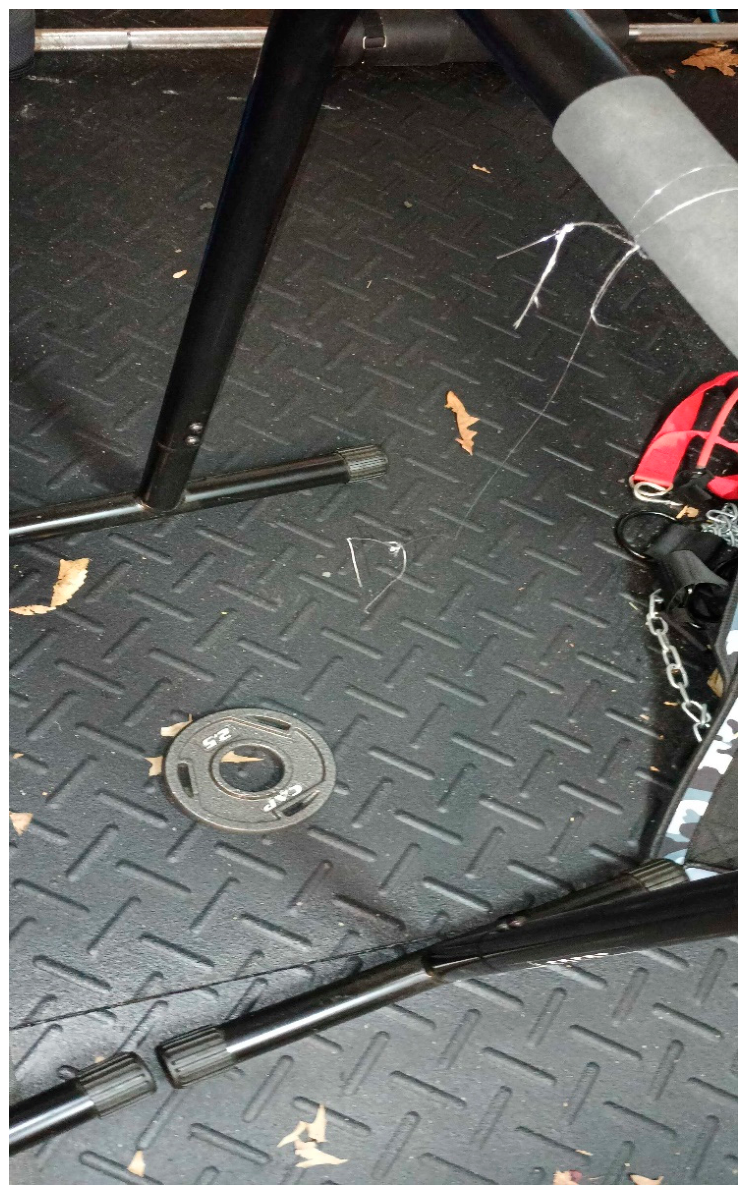
As shown in Fig. 1, initial electrical resistivity was measured while each sample was secured to the scaffold. Subsequently, mechanical loading was initiated by suspending a 1 kg mass from the sample. If the material sustained the load for 30 s, the mass was incremented by 1 kg until structural failure occurred. Failure modes were strictly defined as material tearing or slippage of the weight from the fixture. The specific nature of each failure, alongside any indicators of excessive material fragility that could warrant disqualification, was documented, and several replicates (n = 5) were tested for each material group.
The mechanical energy at failure (U) was quantified using the gravitational potential energy formulation in Eq. (1) [1]:
U = m*g*h
In Eq. (1), m represented the total suspended mass at failure, g was the acceleration due to gravity, and h denoted the suspension height. Due to constant values, the most important variable was the mass at failure (m). Empirical results from these electromechanical tests were then utilized to finalize the selection of the cord material for the bolas.
2.4. Bolas Design
The bolas was constructed using electric guitar strings. The strings were measured to a length of 61 +/- 1 cm and cut. A CR2025 (Duracell, Bethel CT, USA,) 3 V coin cell watch battery, weighing approximately 2 g with a diameter of 2 cm and a thickness of 3 mm, was positioned at the center of the bolas. A single string was attached to each battery terminal such that each string maintained only one point of electrical and physical isolation from the other. The battery contained sufficient electricity for prior literature of iontrophoresis [8,9,10].
The battery was housed within a custom 3D-printed, disk-shaped enclosure made of polylactic acid (PLA), with the strings protruding in opposite directions from the top and bottom (PLA, 20% infill; Bambu Labs A1 Mini, Shenzhen, Guangdong, China). The inherent springiness of the steel strings maintained the structural integrity and shape of the device during movement.
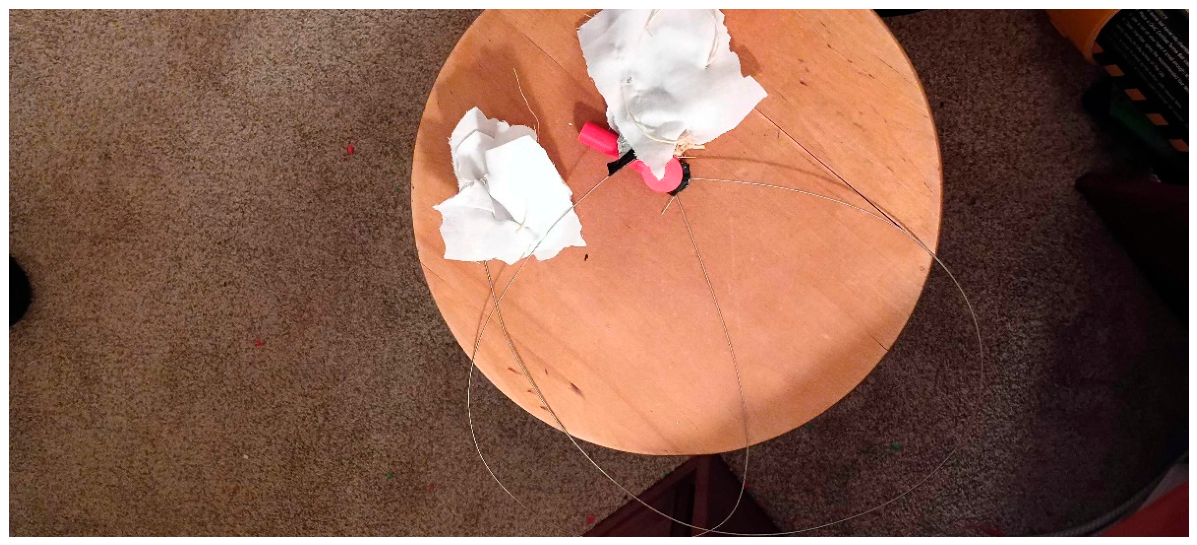
Identical square pads were affixed to the terminus of each string. Each pad measured 8.5 +/- 1.5 cm, a dimension selected to align with prior literature on iontophoresis pad sizes. The pads consisted of an aluminum foil sheet (a placeholder for metal mesh) wrapped in cloth and secured with twine. As shown in Fig. 2, the guitar strings were directly connected to the foil, and electrical continuity was confirmed using an AM33D multimeter (AstroAI, Santa Fe Springs, CA, USA).
Figure 2.
Assembled bolas with guitar strings.
Because traditional bolas rely on weighted ends, and the initial electrode pads were lightweight (<5 g), a small rock (12 +/- 1 g) was added to the interior of each electrode pad in a secondary configuration to provide mass for potential spin stabilization. These weighted versions (mean mass: 33.5 +/- 2.5 g) were subsequently compared against the standard, unweighted bolas design (mean mass: 9.4 +/- 1.3 g). The pressure exerted on the skin was designed to match prior literature [8,9,10]. While bolas are traditionally deployed via manual throwing [5,6,7], a mechanical launcher was custom-designed to ensure consistent deployment velocity and trajectory during testing.
2.5. Launcher Design
Three distinct launcher designs were explored to deploy the bolas: a handheld device, a stationary desktop mount, and an adapted commercial toy blaster. All designs were evaluated for mechanical reliability, consistency in generating launch velocities, and overall power using a ballistic chronograph.
The initial design utilized a compliant spring housed in a pistol-like chassis to propel a custom dart fitted with a bolas holder. Because this configuration struggled to consistently launch even lightweight foam darts, it was abandoned early in the development cycle. Its mean velocity with 1g foam darts ( Zuru, Shenzhen, Guangzhou, China) was 0.9 + 0.1 m/s. However, the dart-based bolas design was retained for subsequent iterations.
As shown in Figure 3, the second design was a stationary, desktop-mounted unit featuring dual 3D-printed PLA compliant springs. To impart necessary spin, the system was engineered to launch the projectile at a 45-degree trajectory. The cylindrical core of the bolas rested in a central chamber atop a spring-loaded lever that was manually retracted and released. Although mechanically reliable, the PLA compliant springs exhibited rapid material fatigue during testing. With a 2 g test projectile, its mean velocity was 6.3 +/- 0.6 m/s.
Similar to prior work, the final approach involved modifying a Zuru X-Shot Menace (Zuru, Shenzhen, Guangzhou, China) toy dart blaster to accommodate the dart design from the first iteration [18]. Powered by a metallic mainspring and a traditional trigger mechanism, this option required minimal structural modification while delivering superior performance. It proved to be the most robust and consistent of the three prototypes, generating reliable launch velocities with a mean velocity with a 1 g foam dart at 21.5 +/- 2.2 m/s, adequate for the bolas deployment. The bolas were deployed at 3.6 +/- 0.4 m/s Consequently, this configuration was selected for final testing.
2.6. Launch Test
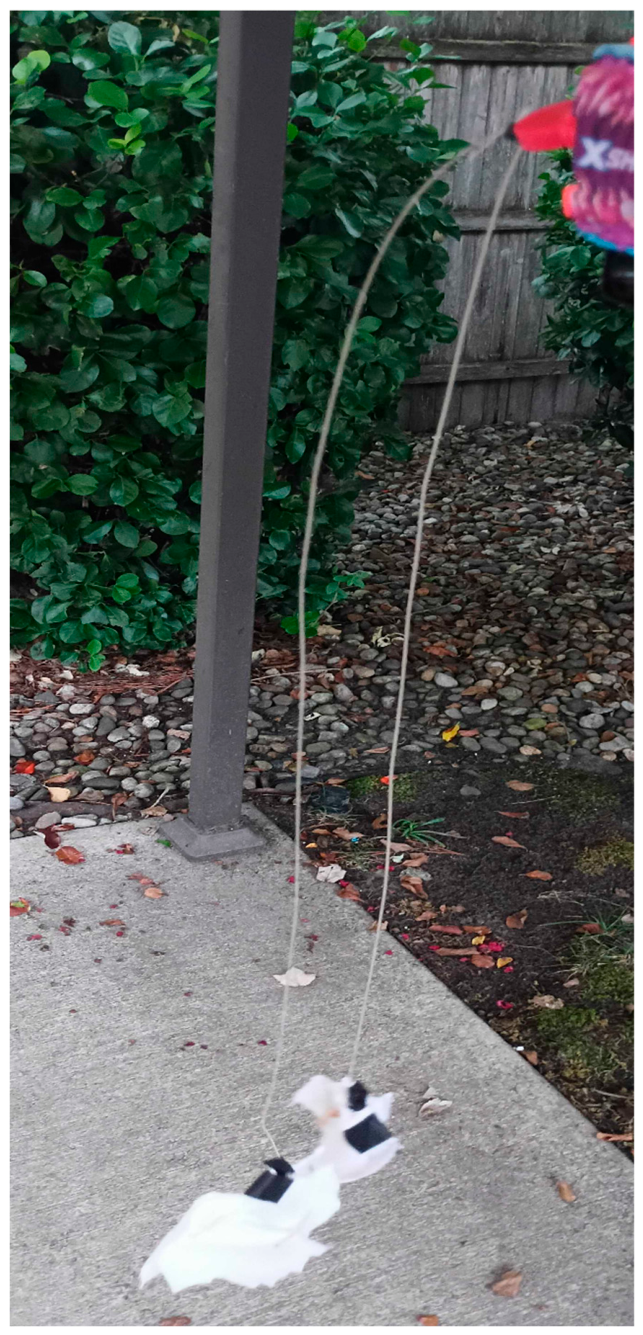
A mechanical testing rig was used to minimize human variability. As shown in Fig. 4, the launcher was secured on a table stand approximately 1 m above the floor, and the bolas-darts were muzzle-loaded. With the launcher oriented parallel to the ground, the device was aimed at a metal post positioned 1.2 m away for each trial. A third launcher was used exclusively for the final test series.
Following deployment, the output voltage from each bolas and the final positioning of the limbs were recorded. A voltage exceeding 2.5 V was evaluated using a binary scale (1 for a sufficient electrical connection, 0 for a broken connection). Limb configuration was similarly scored: curved limbs (1) indicated that the strings successfully completed a circuit, whereas straight limbs (0) indicated that the strings failed to bend toward each other. The voltage across each contact pad was measured to verify that a reliable electrical connection survived impact.
Figure 4.
Bolas within battery placed in launcher.
Based on a staistical analysis, approximately six trials were conducted for two distinct bolas configurations: weighted variants containing rocks within the electrode pads and lighter variants without rocks (controls) [19,20]. To determine the more reliable design, each trial yielded a combined score ranging from 0 (broken electrical connection and limb coiling failure) to 2 (functional electrical connection and coiled limbs).
2.7. Statistical Analysis and Experimental Hypothesis
The criteria for each test were based on specific functional requirements. For the tensile material testing, the candidate exhibiting the highest energy absorption capacity prior to failure was selected. Similarly, the launcher that generated the highest and most consistent projectile velocity was chosen. To determine the more reliable bolas design, a paired t-test (a = 0.05) was conducted on the final scores from all six trials for each bolas type [19,20]. Because historical bolas relied on weighted ends, we hypothesized that weighted configurations would exhibit greater reliability.
3. Results
3.1. Organization
The results are organized by test. The tensile strength tests are in Section 3.2. The launch test results are in Section 3.3. Failure Modes observed during the launch tests are in Section 3.4. A summary of experimental findings is presented in Section 3.5.
3.2. Tensile Strength Results
The observations from the tensile strength tests are in Table 1.
LIG specimens experienced premature structural failure during fixture mounting, as the material lacked sufficient mechanical integrity to withstand initial handling stresses prior to formal testing. Samples demonstrated an ultimate load capacity of 1 kg, both with and without nylon line reinforcement. The primary failure mode was material tearing induced by the suspended mass. Samples sustained loads up to 2 kg before failure. Notably, the failure mode was governed by interfacial slippage at the load-attachment point rather than material rupture, which was attributed to the low coefficient of friction of the string surface.
3.3. Launch Test Results
Both the weighted and control (light) bolas were evaluated during launch testing, with the quantitative performance data summarized in Table 2.
Statistical analysis using a two-sample t-test yielded p = 0.664 and t=-0.447, indicating no statistically significant difference in overall performance between the two groups at the standard significance level (a=0.05).
3.4. Failure Modes
Two primary failure modes related to electrical connectivity and cord extension were identified during the testing phase. In one trial involving the control bolas, an electrode pad detached from the projectile, though it was manually reattached prior to subsequent testing. Additionally, improper cord extension occurred in several trials, which high-speed observation revealed was caused by the dart striking the target post directly and ricocheting away before the deployment sequence could complete. Notably, both of these failure modes were observed across the weighted and control configurations alike, suggesting they occurred independently of the projectile mass variation.
3.5. Experimental Summary
Observations during material and launch testing yielded several key findings regarding structural integrity and overall performance. Among the materials evaluated, the guitar strings demonstrated the sturdiest performance. Furthermore, comparative analysis revealed no significant difference in performance between the weighted and control (light) bolas, despite a small number of observed failures.
4. Discussion
4.1. Interpretation
These empirical findings validated the core feasibility of the GAUCHO prototype system. Nickel-plated steel electric guitar strings outperformed all other tested flexible conductive materials in tensile resilience and sustained electrical conductivity under high-strain dynamic loading, confirming that this off-the-shelf component met the combined requirements for physical entanglement tethers and active iontophoretic circuits [1,2,3,4,10,11,12,13,14,15,16,17]. Contrary to our a priori hypothesis, weighted electrode pads did not produce a statistically significant improvement in deployment reliability, as the two-sample t-test returned a p-value of 0.664 at the 0.05 significance threshold. As suggested by prior work, this demonstrated that the inherent springiness of the guitar strings alone was sufficient to support stable aerodynamic spin and consistent target coiling without added ballast, closing the previously identified critical gap at the intersection of kinetic capture mechanisms and transdermal remote drug delivery [1,2,3,4,11].
4.2. Limitations
This study presented several notable technical and experimental limitations that constrained generalizability. Most critically, the 3 V coin cell power source delivered only low fixed voltage, so the study did not quantify iontophoretic drug transport efficiency through actual animal skin, nor did it evaluate long-term Joule heating risks during extended contact [8,9,10]. Tensile testing was limited to only five replicates per material group, which reduced statistical power to detect subtle differences in failure load and energy absorption [12,13,14,15,16,17,19,20]. The launch trials were conducted exclusively against a static 1.2-meter distant metal post rather than live, freely moving large animal targets at a variety of ranges, so the system’s performance under real-world field agitation conditions remained uncharacterized. Additionally, the PLA 3D-printed central battery enclosure dart had not been rigorously tested for impact resistance under high-force ballistic deployment scenarios. The launcher's velocities were also substantially slower than other launch mechanisms [1,2,3,4].
4.3. Future Work
Subsequent research was designed to address these identified gaps and iterate on the prototype design. First, we planned to expand tensile test sample sizes and integrate coatings on the guitar string tethers to further boost surface conductivity while preserving full tensile strength [12,13,14,15,16,17]. We would next upgrade the onboard power system to incorporate a programmable adjustable current module, paired with hydrogel pads loaded with model ionic veterinary drugs, to quantitatively measure transdermal drug delivery efficiency across varying current densities and contact durations [8,9,10]. We also intended to conduct controlled field deployment trials on anesthetized large animal surrogates, to validate coiling stability, electrical continuity, and skin safety under dynamic motion conditions, before proceeding to full unconstrained live animal testing [1,2,3,4]. Testing would also be conducted a variety of ranges and launch velocities, to ensure reliable deployment [1].
5. Conclusions
This work validated the full functional feasibility of the GAUCHO prototype, a novel remote deployment platform that successfully integrated immediate physical animal restraint and iontophoretic transdermal drug delivery for the first time. The nickel-plated steel electric guitar string tethers consistently withstood all high-strain deployment and impact loads while maintaining unbroken electrical conductivity to power the transdermal drug circuit, outperforming all other candidate flexible conductive materials evaluated in tensile testing. Contrary to the initial a priori hypothesis, added weighted masses in the electrode pads did not produce a statistically significant improvement in deployment reliability, proving that the native tensile spring properties of the off-the-shelf guitar strings were sufficient to deliver stable aerodynamic spin and secure limb coiling on target. While the study was limited by small sample sizes, static target testing at a single short range, and absence of in vivo skin drug transport validation, the empirical results confirmed that this low-cost, accessible design framework resolved longstanding limitations of conventional remote veterinary delivery systems that failed to combine instant physical restraint and non-invasive, controlled pharmaceutical administration. Subsequent iterative development of the system, including expanded material testing, upgraded adjustable current power modules, and live animal surrogate field trials, will support translation of this prototype into a practical safety-enhancing tool for field veterinary care, livestock management, and wildlife research.
Supplementary Materials
The data, models, and supplementary information used in this launcher are available at (accessed 18 August 2026): https://github.com/javeharron/gauchoFiles.
Author Contributions
Conceptualization, J.L.; methodology, J.L.; software, J.L.; validation, J.L.; formal analysis, J.L.; investigation, J.L.; resources, J.L.; data curation, J.L.; writing—original draft preparation, J.L.; writing—review and editing, J.L.; visualization, J.L.; supervision, J.L.; project administration, J.L.; funding acquisition, J.L. All authors have read and agreed to the published version of the manuscript.
Funding
This research received no external funding.
Institutional Review Board Statement
Not applicable.
Informed Consent Statement
Not applicable.
Data Availability Statement
The data, models, and supplementary information used in this launcher are available at (accessed 18 August 2026): https://github.com/javeharron/gauchoFiles.
Acknowledgments
The authors would like to thank the Ronin Institute for Independent Scholarship 2.0.
Conflicts of Interest
The authors declare no conflicts of interest.
References
- LaRocco, J.; Simonis, J.; Tahmina, Q. Evaluating a controlled electromagnetic launcher for safe remote drug delivery. Technologies 2024, 12, 69. [Google Scholar] [CrossRef]
- Kreeger, T.J.; Arnemo, J.M. Handbook of Wildlife Chemical Immobilization, 5th ed.; Terry J. Kreeger: Jackson, WY, USA, 2018. [Google Scholar]
- Miller, R.E.; Fowler, M.E. (Eds.) Fowler's Zoo and Wild Animal Medicine; Elsevier: St. Louis, MO, USA, 2015; Vol. 8. [Google Scholar]
- Nielsen, L. Chemical Immobilization of Wild and Exotic Animals; Iowa State University Press: Ames, IA, USA, 1999. [Google Scholar]
- Assaf, E.; Caricola, I.; Gopher, A.; Rosell, J.; Blasco, R.; Bar, O.; Zilberman, E.; Lemorini, C.; Baena, J.; Barkai, R.; et al. Shaped stone balls were used for bone marrow extraction at Lower Paleolithic Qesem Cave, Israel. PLoS ONE 2020, 15, e0230972. [Google Scholar] [CrossRef]
- Assaf, E.; Baena Preysler, J.; Bruner, E. Lower Paleolithic shaped stone balls—What is next? Some cultural–cognitive questions. Quaternary 2023, 6, 51. [Google Scholar] [CrossRef]
- Cabanes, J.; Borel, A.; Baena Preysler, J.; Lourdeau, A.; Moncel, M.-H. Palaeolithic polyhedrons, spheroids and bolas over time and space. PLoS ONE 2022, 17, e0272135. [Google Scholar] [CrossRef]
- Piscazzi, F.; D'Oria, F.; Ramirez, M.A.; Ardigò, M. Iontophoresis-based topical drug delivery for dermatologic conditions: A systematic review. Pharmaceuticals 2026, 19, 765. [Google Scholar] [CrossRef]
- Semalty, A.; Semalty, M.; Singh, R.; Saraf, S.K.; Saraf, S. Iontophoretic drug delivery system: A review. Technol. Health Care 2007, 15, 237–245. [Google Scholar] [CrossRef]
- Alon, G.; Kantor, G.; Ho, H.S. Effects of electrode size on basic excitatory responses and on selected stimulus parameters. J. Orthop. Sports Phys. Ther. 1994, 20, 29–35. [Google Scholar] [CrossRef]
- Kemp, J.A. The physics of unwound and wound strings on the electric guitar applied to the pitch intervals produced by tremolo/vibrato arm systems. PLoS ONE 2017, 12, e0184803. [Google Scholar] [CrossRef]
- Khan, A.U.A.; Nazmunnahar, N.; Roni, M.H.; Saha, A.K.; Bristy, Z.T.; Baqui, A.; Mazid, A.M. Development of low-resistance conductive threads from e-waste for smart textiles. Fibers 2026, 14, 36. [Google Scholar] [CrossRef]
- Krahmer, A.; Ullrich, J. Textile conductive thread with permanent and uniform electrical properties in the high-ohm range. J. Text. Sci. Fash. Technol. 2021, 8, 1–7. [Google Scholar] [CrossRef]
- Liu, H.; Chen, Y. Laser-induced graphene film and its applications in flexible electronics. Appl. Sci. 2022, 12, 11233. [Google Scholar] [CrossRef]
- Lin, R.; Kim, H.-J.; Achavananthadith, S.; Xiong, Z.; Lee, J.K.W.; Kong, Y.L.; Ho, J.S. Digitally-embroidered liquid metal electronic textiles for wearable wireless systems. Nat. Commun. 2022, 13, 29859. [Google Scholar] [CrossRef]
- Stanford, M.G.; Zhang, C.; Fowlkes, J.D.; Hoffmann, A.; Ivanov, I.N.; Rack, P.D.; Tour, J.M. High-resolution laser-induced graphene: Flexible electronics beyond the visible limit. ACS Appl. Mater. Interfaces 2020, 12, 10902–10907. [Google Scholar] [CrossRef]
- Chen, Z.; Si, Y.; Liao, X.; Fang, R.; Li, Z.; Tan, W.; Wang, S.; Ji, Y.; Qian, W.; Fu, H.; et al. Conformal graphene coatings on ordinary fabrics for wearable electronic devices. Nat. Commun. 2026, 17, 5112. [Google Scholar] [CrossRef]
- LaRocco, J. Tensegrity launch tubes and compliant mechanisms for mechanical versatility in small-scale industrial line launchers: A reliability-centered screening analysis. Industries 2026, 1, 7. [Google Scholar] [CrossRef]
- Fagerland, M.W. t-tests, non-parametric tests, and large studies - a paradox of statistical practice? BMC Med. Res. Methodol. 2012, 12, 78. [Google Scholar] [CrossRef]
- Mann, H.B.; Whitney, D.R. On a test of whether one of two random variables is stochastically larger than the other. Ann. Math. Stat. 1947, 18, 50–60. [Google Scholar] [CrossRef]
Figure 3.
Assembled compliant spring launcher, second design.
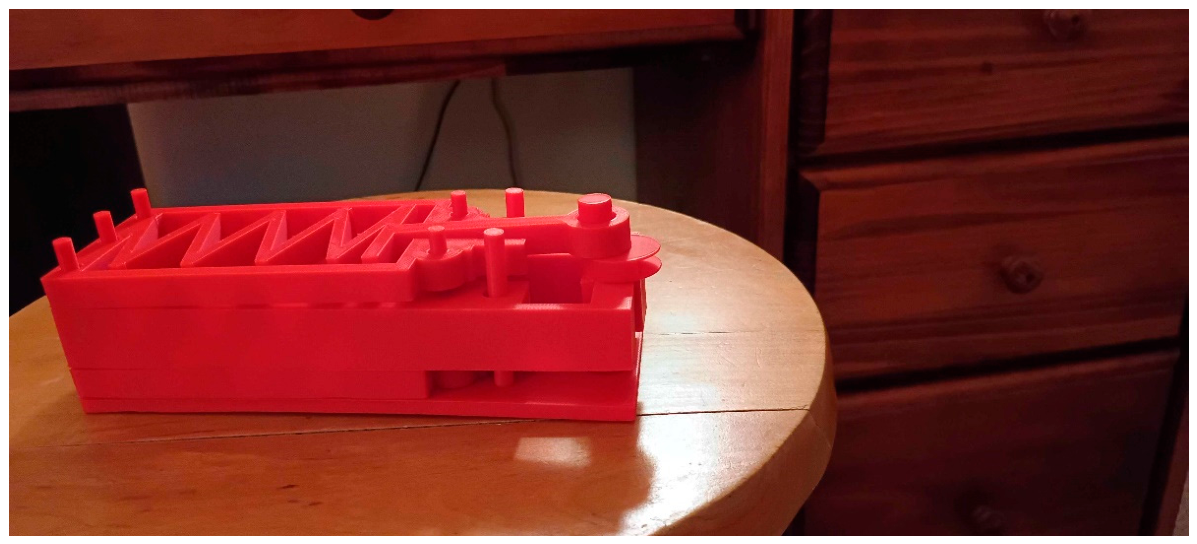

Table 1.
Tensile test results for materials investigated.
| Material | LIG | Thread | Thread+Nylon | Guitar String |
|---|---|---|---|---|
| Resistance (Ohms) | 1.4 ± 0.2 | 4.1 ± 0.2 | 4.3 ± 0.1 | 0.5 ± 0.1 |
| Fail (kg) | 0 | 1 | 1 | 2 |
| Type | Rear | Tear | Tear | Slip |
Table 2.
Summary of launch test results comparing weighted and control bolas.
| Bolas Type | Control (Light) | Weighted |
|---|---|---|
| Mean Voltage (V) | 2.8 ± 0.4 | 2.9± 0.2 |
| Correct Deployments | 4 | 5 |
| Mean Score | 1.7 ± 0.8 | 1.8 ± 0.4 |
Disclaimer/Publisher’s Note: The statements, opinions and data contained in all publications are solely those of the individual author(s) and contributor(s) and not of MDPI and/or the editor(s). MDPI and/or the editor(s) disclaim responsibility for any injury to people or property resulting from any ideas, methods, instructions or products referred to in the content. |
© 2026 by the authors. Licensee MDPI, Basel, Switzerland. This article is an open access article distributed under the terms and conditions of the Creative Commons Attribution (CC BY) license (http://creativecommons.org/licenses/by/4.0/).
Copyright: This open access article is published under a Creative Commons CC BY 4.0 license, which permit the free download, distribution, and reuse, provided that the author and preprint are cited in any reuse.