

Submitted:
19 August 2026
Posted:
21 August 2026
You are already at the latest version
Abstract
Phycocyanin-Cu2+-loaded gelatin-chitosan composite films (Gel/Cu@PC/Ch) were developed as active packaging materials to address the postharvest deterioration of fresh produce. A series of composite films with varying chitosan (Ch) concentrations (0.1%, 0.5%, 1%, 5%, w/v) were systematically fabricated and characterized. Scanning electron microscopy (SEM) revealed that the Gel/Cu@PC/Ch0.5 film (0.5% chitosan) exhibited smooth, pore-free and crack-free surface and cross-sectional morphologies, while higher chitosan dosage (5%) triggered severe structural cracking. Gel/Cu@PC/Ch0.5 achieved the maximum water contact angle of 101.13 ± 9.59°, demonstrating superior surface hydrophobicity. All composite films possessed outstanding UV-shielding capacity; meanwhile, ABTS and DPPH free radical scavenging rates rose gradually with increasing chitosan content, reaching 79.71 ± 0.72% and 84.91 ± 1.31% at 5% Ch, respectively. In antibacterial assessments, Gel/Cu@PC/Ch0.5 showed effective inhibition against both Staphylococcus aureus and Escherichia coli, with inhibition zone diameters of 13.83 ± 0.42 mm and 14.93 ± 0.83 mm, respectively, owing to the synergistic bactericidal effect of Cu²⁺ and chitosan. In grape preservation trials conducted over 12 days, Gel/Cu@PC/Ch0.5 wrapped grapes exhibited the lowest weight loss (3.60 ± 0.30%), retained the highest residual firmness (316.16 ± 13.81 g) and total soluble solids (TSS), and maintained a significantly higher TAC value of 0.71 ± 0.12 nM after 12 days of storage, with no visible microbial spoilage or severe shriveling observed throughout storage. These results demonstrate that the Gel/Cu@PC/Ch0.5 composite film achieves a desirable integration of moisture barrier performance, antioxidant activity, and broad-spectrum antibacterial efficacy, offering a scalable and biodegradable platform for active food packaging in fresh fruit preservation.
Keywords:
phycocyanin
; active composite film
; antioxidant
; antimicrobial
; grape preservation
1. Introduction
Fruits are rich in essential nutrients and bioactive compounds, such as vitamins, trace elements, and phenolic substances, which play crucial roles in maintaining human health and preventing chronic diseases [1]. As such, fruits have become an indispensable component of the daily human diet. However, postharvest storage of fruits is frequently accompanied by synergistic deterioration induced by moisture gradient migration, enhanced respiratory metabolism, and microbial colonization [2]. These factors collectively lead to the degradation of fruit tissue mechanical strength, pathogenic decay, and a subsequent decline in nutritional quality. Consequently, high postharvest loss rates of fruits are commonly observed worldwide, which not only causes substantial economic losses but also poses serious challenges to the sustainable development of the agricultural economy [3]. Therefore, extending the postharvest storage period of fruits, reducing microbial contamination, and preserving their inherent nutritional value have become urgent issues to be addressed in the field of food preservation. Traditional fruit preservation strategies primarily rely on chemical preservatives, such as sulfur dioxide and synthetic antioxidants. However, chemical agents have increasingly raised safety concerns due to potential residues and adverse effects on human health, resulting in low consumer acceptance and strict regulatory restrictions in many regions [4,5]. Against this backdrop, the development of natural, safe, and environmentally friendly novel fruit preservation technologies has emerged as an inevitable trend in the food industry, attracting extensive attention from researchers and industry professionals alike.
Food packaging films, as a physical preservation approach, exhibit remarkable advantages in terms of naturalness and safety, making them widely used in postharvest fruit preservation [6]. However, the majority of existing food packaging films are primarily fabricated from non-renewable petroleum-based synthetic polymer materials. These traditional plastic products are inherently non-biodegradable, leading to an over-reliance on end-of-life disposal methods such as incineration and landfilling [7]. Such disposal processes not only exacerbate the consumption of non-renewable energy but also contribute to a series of environmental issues, including microplastic pollution, soil acidification, and greenhouse gas emissions. Consequently, the development of environmentally friendly, bio-based, and biodegradable packaging materials to replace conventional petroleum-based plastics has become an urgent and critical challenge in the field of food packaging, driving extensive research efforts worldwide.
Bio-based biodegradable packaging materials, especially those derived from natural polysaccharides and proteins, such as gelatin, chitosan, and zein, have been recognized as the most promising alternatives to traditional petroleum-based polymers [8]. Among them, chitosan (Ch), a deacetylated derivative of chitin, exhibits excellent film-forming ability, biodegradability, biocompatibility, and broad-spectrum antimicrobial activity [9]. Ch has been widely used in the pharmaceutical and food industries and is considered an ideal substrate for bio-based food packaging [10]. Gelatin (Gel) has also been extensively studied as a material for preparing edible films owing to its good biocompatibility, degradability, and excellent film-forming properties [11]. Furthermore, the strong hydrophilicity of Gel enables efficient incorporation of water-soluble Ch, facilitating the formation of composite films with improved structural properties [12,13]. However, single-component Gel/Ch-based films still exhibit significant limitations in key functional indicators, such as antioxidant activity and antimicrobial efficacy [14,15]. These shortcomings severely restrict their practical application in food preservation, where multifunctional performance is highly demanded. Phycocyanin is a natural blue pigment with favorable antioxidant, anti-inflammatory, and immunomodulatory activities, widely reported in food and biomedical fields. And phycocyanin is commercially produced from Spirulina platensis at relatively low cost, making it feasible for large-scale application in active packaging [16]. But it suffers from poor stability and easy degradation. Our previous study indicated that the introduction of Cu²⁺ into phycocyanin (PC) to form a PC-Cu²⁺ complex (Cu@PC) could significantly enhance the stability of PC and reduce its degradability[17]. Therefore, the incorporation of the phycocyanin-Cu²⁺ (Cu@PC) complex into Gel/Ch films is expected to effectively overcome the functional drawbacks of single Gel/Ch-based materials, enhance the comprehensive performance of the composite films, and thereby improve their food preservation capability. Based on this, the present study aims to develop a Cu@PC-loaded Gel/Ch active composite film and systematically evaluate its potential application in postharvest fruit preservation.
2. Materials and Methods
2.1. Materials and Chemicals
Gelatin from fish skin was purchased from Aldrich Sigma Chemical Co., Ltd. (St Louis, MO, USA). Phycocyanin (PC) from Arthrospira (Spirulina), with a purity of A620/A280 > 2.0, was obtained from Zhejiang Binmei Biotechnology Co., Ltd. (Zhejiang, China). Chitosan (Ch, deacetylation degree ≥95%) was purchased from Sigma-Aldrich (St. Louis, MO, USA). Cu2SO4·2H2O was purchased from Shanghai MACKLIN Technology Co., Ltd. (Shanghai, China). Bertani (LB) agar and LB broth were supplied by Qingdao High-tech Industrial Park Haibo Biotechnology Co., Ltd. (Qingdao, China). 2,2-Diphenyl-1-picrylhydrazyl (DPPH, CAS: 1898-66-4, purity: 96 %) was obtained from Macklin Co., Ltd. (Shanghai, China). 2, 2`-Azinobis-(3-ethylbenzthiazoline-6-sulphonate) (ABTS, CAS: 30931-67-0, purity: ≥98%) was supplied by Shanghai Aladdin Bio Chem Technology Co., LTD. (Shanghai, China). Cu2SO4·2H2O, NaOH and HCl were purchased from Tianjin Damao Chemical Reagent Co., Ltd (Tianjin, China). All other chemicals and reagents used in this study were analytical grade. Total antioxidant capacity assay kits (T-AOC) (A015-2-1) were purchased from Nanjing Jiancheng Bioengineering Institute (Nanjing, China).
2.2. Preparation of the Gel/Cu@PC/Ch Composite
For film preparation, 15 mg of PC was dissolved in 3 mL of deionized water, followed by magnetic stirring (YUHUA, 98-2, China) for 2 h to ensure complete dissolution. As suggested by Li, copper ions (3.0 mM) were added into PC solution (20 μM) to achieve a final Cu2+/PC molar ratio of 150:1, which was named as Cu@PC nanoparticles [17]. A series of polymer solutions were prepared in 0.6 mL deionized water, each containing 90 mg gelatin, along with varying amounts of chitosan (3 mg, 15 mg, 30 mg, 150 mg) and 30 mg glycerol. Specifically, gelatin was individually blended with chitosan, respectively, and dissolved in 0.6 mL deionized water. Each mixture was stirred for 1 h, after which glycerol was incorporated. Subsequently, all mixtures were combined with 2.4 mL Cu@PC dispersion and magnetically stirred for an additional 2 h to achieve homogeneity.
The mixtures were poured onto plates and left to air-dry in a fume hood at 25 oC for 12 h. After complete drying, the films were carefully removed and stored at 25 oC under 50% relative humidity. Composite Gel/Cu@PC/Ch films were labeled according to the concentration of chitosan (Ch) as Gel/Cu@PC/Ch0.1, Gel/Cu@PC/Ch0.5, Gel/Cu@PC/Ch1, Gel/Cu@PC/Ch5. The film without Cu2+ was prepared by directly mixing a 5 mg/mL PC solution with the gelatin-chitosan-glycerol mixture containing 0.5% chitosan, and was designated Gel/PC/Ch. The film without PC and Cu2+was prepared by replacing the PC solution with pure water and mixing it with the same gelatin–chitosan–glycerol mixture containing 0.5% chitosan, and was designated Gel/Ch. The formulation of composite Gel/Cu@PC/Ch films were listed in Table 1.
2.3. Visual Appearance and Scanning Electron Microscopy (SEM) Analysis of Gel/Cu@PC/Ch Films
Macroscopic morphology of the films was captured using a Canon EOS R5 camera (Canon, Tokyo, Japan). The surface and cross-section microstructures of Gel/Cu@PC/Ch0.1, Gel/Cu@PC/Ch0.5, Gel/Cu@PC/Ch1, Gel/Cu@PC/Ch5 films were observed using a JSM-7800F scanning electron microscope (SEM; JEOL, Tokyo, Japan) [16,17]. Samples were moved to the SEM chamber after being sputter-coated with gold. At an acceleration voltage of 5.0 kV, the magnification was 2000 times, the observations were conducted.
2.4. Water Contact Angle Analysis of Gel/Cu@PC/Ch Films
Water contact angle (WCA) measurements were performed using a contact angle analyzer (DSA-25, Krüss, Germany), by depositing a 10 μL droplet of deionized water onto the film surface, with the corresponding contact angle value recorded immediately [16].
2.5. UV-Visible Spectroscopy Analysis of Gel/Cu@PC/Ch Films
Ultraviolet visible (UV Vis) transmittance was measured using a UV-visible spectrophotometer (LAMBDA 35, PerkinElmer, Japan) [16]. The samples were prepared scanned at the wavelength from 200 to 800 nm.
2.6. ATR-Fourier-Transform Infrared Spectroscopy Analysis of Gel/Cu@PC/Ch Films
2.7. X-ray photoelectron spectroscopy analysis of Gel/Cu@PC/Ch films
Surface chemistry of High resolution X-ray photoelectron spectroscopy (XPS) was characterized using a Thermo Scientific Escalab 250Xi system (UK) with a monochromatic Al Kα X-ray source. High-resolution scans were conducted to examine the surface chemistry of the samples, as previously described [17].
2.8. The Detection of Antioxidant Ability
The antioxidant properties of Gel/Cu@PC/Ch films were measured by DPPH and ABTS radical scavenging assays, based on previous studies [20]. Briefly, the film extract was prepared by dissolving 2.5 mg of the film in 0.5 mL of deionized water. Then, 0.5 mL of 0.1 mM DPPH ethanolic solution was mixed with 0.5 mL of film extract solution and incubated in the dark for 30 min. For the ABTS assay, ABTS stock solution and working solution were prepared as described in the literature. For the ABTS assay, the ABTS stock solution and working solution were prepared according to previous study. The working solution was reacted with Gel/Cu@PC/Ch for 3 min and the absorbance was measured at 734 nm. Finally, the DPPH and ABTS free radical scavenging rates were calculated according to the formulation:
A(Control) was defined as the absorbance of DPPH/ABTS in the absence of antioxidants, whereas A(Sample) was the absorbance after addition of Gel/Cu@PC/Ch.
2.9. The Antibacterial Activity of Gel/Cu@PC/Ch Films
The antimicrobial activities of Gel/Cu@PC/Ch0.5, Gel/PC/Ch0.5, Gel/Ch0.5 were evaluated by bacterial growth curve analysis, using Escherichia coli (E. coli) (ATCC 25922) and Staphylococcus aureus (S. aureus) (ATCC 29213) as model strains. Bacterial suspensions (105 CFU/mL, 100 μL) were mixed with equal volumes of composite film solution (5 mg/mL) in 96-well microplates [21,22]. Continuous absorbance at 600 nm (OD₆₀₀) were recorded at 37 oC for 24 h using a Bioscreen C MBR system. E. coli and S. aureus at the logarithmic growth phase were diluted to 4 × 10⁵ CFU/mL using LB liquid medium. Then, 100 μL of each bacterial suspension was spread onto LB agar plates. Three Oxford cups were placed on each plate, and 100 μL of different composite film solutions was added into each cup. After incubation at 37 oC for 24 h, the inhibition zones were photographed, and their diameters were measured using a ruler.
2.10. Grape Preservation Experiments
Fresh Liaofeng grapes at commercial maturity with uniform size and intact appearance, which with well-developed shape, glossy purple skin, fully accumulated flavor, and no mechanical damage, were purchased from Qianhe market in Dalian city, Liaoning province. The initial total soluble solids (TSS) content was 15.6 ± 0.62%, and the initial hardness was 367.23 ± 16.04 g. A total of 80 grapes were randomly divided into four groups at 20 oC, unwrapped control, Gel/Ch0.5, Gel/PC/Ch0.5, and Gel/Cu@PC/Ch0.5. Only the formulation containing 0.5% chitosan was selected for the grape study, because preliminary experiments showed that this composition exhibited the best balance of UV-blocking, antioxidant, and hydrophobicity among all tested chitosan ratios. This selection allowed us to focus on the most promising film for practical postharvest application. For the grape preservation experiment, each grape was individually placed in a plastic box. The inner side of the lid was covered with a pre-formed film, and the lid was closed so that the film came into direct contact with the grape surface, thereby achieving a wrapping effect. No additional drying step was required because the film had already been dried before use. The boxes were stored at 25 oC for 15 days. Grape weight was recorded every two days, and digital photographs were taken to record morphological changes during storage.
2.10.1. Determination of Hardness Changes
Hardness of grapes was determined according to our previous study [21,22], using a TA-XT texture analyzer (Stable Micro Systems, Godalming, England) equipped with a cylindrical stainless steel probe (P/2, 2 mm diameter) in penetration mode. Five grapes were randomly selected from each group for texture analysis, and triplicate measurements were performed on each grape. The test speed was set at 2 mm/s with a trigger force of 5 N.
2.10.2. Determination of Total Soluble Solids Content
The total soluble solids (TSS) content was determined following a reported method [23]. Three grapes were randomly selected from each group for TSS testing, and each sample was tested 3 times. Briefly, 10 g of grape tissue was homogenized with an equal mass of distilled water, and the homogenate was centrifuged at 1880 ×g for 10 min (TOMY, CAX-571). The supernatant was collected and measured using a hand-held refractometer (HUT-32) at ambient temperature (23 ± 2 oC).
2.10.3. Determination of Total Antioxidant Capacity
Three grapes were homogenized using a mechanical homogenizer. The homogenate was then centrifuged at 1880 g for 10 min, and the supernatant was collected and diluted 10-fold. All solutions were prepared strictly according to the instructions provided in the Total Antioxidant Capacity (T-AOC) assay kit, followed by the corresponding detection procedures.
2.11. Statistical Analysis
All experiments were completed in three independent experiments and technical replicates. The mean ± standard deviations (SD) of the three sets of data were assessed using one-way ANOVA and the post hoc test HSD Tukey by the SPSS software (SPSS 16.0 Inc, Chicago, USA). The level of significance was set at p < 0.05.
3. Results and Discussion
3.1. Macroscopic and Microstructure of Gel/Cu@PC/Ch Films
The microstructures of Gel/Cu@PC/Ch0.1, Gel/Cu@PC/Ch0.5, Gel/Cu@PC/Ch1, and Gel/Cu@PC/Ch5 films were first observed by scanning electron microscopy (SEM). As shown in Figure 1 i-l, the film color gradually darkened with increasing chitosan (Ch) concentration. When the Ch content reached 5%, obvious cracks appeared on the film, suggesting that the introduction of Ch affected both the color and mechanical toughness of the films. Furthermore, SEM was employed to investigate the surface and cross-sectional morphologies of the composite films, revealing the structural evolution with increasing Ch content. The surface of Gel/Cu@PC/Ch0.1 (Figure 1 a), Gel/Cu@PC/Ch0.5 (Figure 1 b) films were smooth, compact, and continuous, with no observable cracks or pores, indicating excellent film-forming ability. Uniformly dispersed aggregates were observed on the film surface, which could be attributed to the stable complexation between PC and Cu²⁺ as reported in previous studies [17]. With further increasing chitosan proportion, the surface roughness of Gel/Cu@PC/Ch1 (Figure 1 c) increased noticeably. When the Ch concentration was raised to 5%, distinct cracks emerged on both the surface (Figure 1 d) and cross-section (Figure 1 h), severely damaging the structural integrity of the film. These results further verified that excessive chitosan loading significantly alters the morphological and structural properties of the composite films.
3.2. Basic Properties of the Multifunctional of Gel/Cu@PC/Ch Films
Water contact angles (WCAs) of the Gel/Cu@PC/Ch films with different chitosan (Ch) contents were presented in Figure 2 a. WCAs were measured to evaluate the surface hydrophilicity or hydrophobicity of the films. The Gel/Cu@PC/Ch1 and Gel/Cu@PC/Ch5 films exhibited relatively low WCAs of 70.50 ± 3.26° and 47.17 ± 1.88°, respectively, indicating hydrophilic surfaces. Notably, the WCA significantly increased with decreasing Ch content, suggesting enhanced surface hydrophobicity. The film Gel/Cu@PC/Ch0.5 achieved the highest WCA of 101.13 ± 9.59°, demonstrating a typical hydrophobic surface. As shown in Figure S1 a, results of ATR-FTIR revealed that the Gel/Cu@PC/Ch0.5 film possessed high infrared transmittance. As shown in Figure 2 b, UV-Vis transmittance revealed that the Gel/Cu@PC/Ch composite films exhibited efficient ultraviolet (UV) blocking performance, suggesting great potential for UV-protective food packaging applications [24,25]. Compared with Gel/Cu@PC/Ch0.1, the Gel/Cu@PC/Ch0.5 film displayed superior UV-shielding capability, as reflected by its lower UV transmittance. In food packaging systems, UV resistance is essential for maintaining food quality and prolonging shelf life, since UV irradiation can trigger photodegradation of nutrients and deterioration of sensory properties [26]. The UV-blocking characteristics of these composite films are therefore considered beneficial for reducing such photooxidative damage and helping to protect packaged foods from UV exposure.
3.3. The anti-Oxidation Properties of Gel/Cu@PC/Ch Films
The biological and functional properties of the Gel/Cu@PC/Ch films were mainly ascribed to their favorable antioxidant activity. As presented in Figure 3 a, ABTS radical scavenging activity gradually increased with elevated Ch content. The scavenging ratios at Ch concentrations of 0.1%, 0.5%, 1%, and 5% were 51.93 ± 3.05%, 66.23 ± 2.13%, 64.26 ± 1.72%, and 79.71 ± 0.72%, respectively. A similar upward trend was observed in the DPPH radical scavenging assay, with corresponding values of 37.74 ± 1.17%, 43.89 ± 3.78%, 65.06 ± 3.20%, and 84.91 ± 1.31% (Figure 3 b). Overall, measurable free radical scavenging activity was demonstrated by all formulations, with the most pronounced effect being observed at 5% Ch content [27]. Nevertheless, in consideration of comprehensive film performance from preceding experiments, Gel/Cu@PC/Ch0.5 was determined to be the optimal formulation and thus selected for subsequent mechanism exploration and practical preservation applications.
3.4. The Antibacterial Activity of Gel/Cu@PC/Ch Films
To further evaluate the antibacterial efficacy of the composite films, bacterial growth curve analysis and inhibition zone assays were conducted on E. coli and S. aureus treated with Gel/Cu@PC/Ch0.5, Gel/PC/Ch, and Gel/Ch (Figure 4). As illustrated in the growth curve results, after co-incubation with E. coli and S. aureus, both Gel/Cu@PC/Ch0.5 and Gel/PC/Ch exhibited inhibitory effects on S. aureus growth, with Gel/Cu@PC/Ch0.5 showing a significantly stronger inhibitory capacity. In contrast, Gel/Ch displayed almost no suppressive effect on S. aureus proliferation [28]. Notably, only Gel/Cu@PC/Ch0.5 effectively inhibited E. coli growth, while Gel/PC/Ch and Gel/Ch failed to exert any significant inhibitory activity against E. coli. These results indicate that Gel/Cu@PC/Ch0.5 possesses potent antibacterial activity against both E. coli and S. aureus, and this activity is primarily attributed to the presence of Cu²⁺.
For S. aureus (Figure 5 h j), the Gel/Cu@PC/Ch0.5 film exhibited an inhibition zone diameter of 13.83 ± 0.42 mm, which was significantly larger than those of the control group, Gel/PC/Ch group, and Gel/Ch group [29]. For E. coli (Figure 5 d i), the inhibition zone of the Gel/Cu@PC/Ch0.5 film reached 14.93 ± 0.83 mm. Collectively, these results clearly demonstrate the significant antibacterial activity of the Gel/Cu@PC/Ch0.5 composite film, further confirming that the introduction of Cu²⁺ is crucial for its antibacterial efficacy [30,31].
3.5. Application of Gel/Cu@PC/Ch Films in Preserving Grapes
3.5.1. The Change of Appearance
The appearance of grapes treated with different wrappings during 12 days of storage was shown in Figure 6 a. By the 8th day of storage, obvious dehydration and softening were observed in Control group. In contrast, grapes with Gel/Cu@PC/Ch0.5 or Gel/PC/Ch films maintained relatively intact appearance with no significant changes, indicating that the composite wrappings effectively reduced moisture loss of the grapes. Microbial growth with shriveling and discoloration were detected on the surface of control grapes on the 10th day, followed by further deterioration. Notably, grapes treated with Gel/Cu@PC/Ch0.5 showed minimal shrinkage and no visible microbial spoilage throughout the storage period. The excellent preservation effect of Gel/Cu@PC/Ch0.5 is presumably attributed to its lower oxygen permeability, which can reduce internal oxygen levels and inhibit microbial proliferation, combined with its inherent antibacterial activity [32,33]. Collectively, these results demonstrate that the Gel/Cu@PC/Ch0.5 effectively mitigates moisture loss and preserves the morphological integrity of grapes during storage.
3.5.2. Weight Loss
Weight loss, a critical indicator of fruit freshness during storage that is mainly associated with water evaporation and respiratory metabolism, gradually increased over the 12-day storage period across all treatment groups (Figure 6 b) [34]. By the 12th day of storage, the weight loss rate of the control group reached at 16.07 ± 1.76%, which was significantly higher than those of all film groups. Grapes wrapped with Gel/Ch exhibited better water retention capacity compared to the control group but still failed to effectively suppress weight reduction. Notably, the Gel/Cu@PC/Ch0.5 and Gel/PC/Ch groups showed significantly lower weight loss rates relative to the control group, indicating that the incorporation of PC effectively enhanced the moisture barrier properties of the composite films and slowed down water loss. Furthermore, the Gel/Cu@PC/Ch0.5 group exhibited the lowest weight loss rate (3.60 ± 0.30%) on day 12, which was significantly lower than that of the Gel/PC/Ch group. This finding suggests that the introduction of Cu²⁺ further improved the moisture barrier performance of the composite film. The superior preservation effect of Gel/Cu@PC/Ch0.5 is presumably attributed to its lower oxygen permeability, which can reduce internal oxygen levels and inhibit microbial proliferation, coupled with its inherent antibacterial activity. Collectively, these results confirm that the Gel/Cu@PC/Ch0.5 wrapping effectively mitigates moisture loss and maintains the postharvest quality of grapes during storage.
3.5.3. Hardness
Hardness, another critical quality parameter reflecting fruit ripening and structural integrity, was monitored throughout the 12-day storage period. As shown in Figure 6 c, the control group exhibited a significant decrease in hardness, declining from an initial value of 367.23 ± 16.04 g (day 0) to 176.47 ± 21.43 g (day 12). In contrast, grapes with the Gel/Cu@PC/Ch0.5 film maintained significantly higher hardness during storage, retaining a value of 316.16 ± 13.81 g on day 12. This notable difference indicates that the Cu@PC complex within the composite film, which acts as an effective water vapor barrier, likely played a pivotal role in preserving the structural integrity of grape tissues [35]. By reducing moisture loss and inhibiting excessive softening, the Gel/Cu@PC/Ch0.5 wrapping effectively delayed the postharvest senescence of grapes, consistent with the previously observed superior moisture retention and preservation effects.
3.5.4. Total Soluble Solids
To further explore the internal quality variations of grapes during storage, changes in total soluble solids (TSS) content were monitored, as shown in Figure 6 d. TSS is a vital nutritional index for evaluating fruit quality, and its variation is closely related to respiratory metabolism and microbial growth [36]. The TSS content initially increased, which was attributed to the continued maturation of grapes at the early storage stage, followed by a gradual decline thereafter [37]. Throughout the entire storage period, the Gel/Cu@PC/Ch0.5 group maintained a consistently higher TSS level, than all other treatment groups. This result indicates that the Gel/Cu@PC/Ch0.5 wrapping could effectively inhibit fruit respiration and microbial contamination, thereby slowing the consumption of nutrients and better preserving the internal quality of grapes.
3.5.5. Total Antioxidant Capacity
Total antioxidant capacity (TAC), a key indicator reflecting the nutritional quality and oxidative stability of grapes, was determined throughout the 12-day storage period. As shown in Figure 6 e, the initial TAC of the control group was 1.20 ± 0.11 nM. After 12 days of storage, the TAC of the control group decreased significantly to 0.07 ± 0.01 nM, indicating severe oxidative degradation of antioxidant components during storage [38]. In contrast, the Gel/Ch and Gel/PC/Ch wrapping groups retained slightly higher TAC values, with 0.19 ± 0.02 nM and 0.47 ± 0.09 nM recorded on day 12, respectively. Notably, grapes wrapped with the Gel/Cu@PC/Ch0.5 film maintained a significantly higher TAC of 0.71 ± 0.12 nM at the end of storage, which was substantially higher than those of the other wrapped groups. This finding suggests that the Gel/Cu@PC/Ch0.5 film effectively alleviates the oxidative degradation of antioxidant substances in grapes, which is presumably associated with its inherent antioxidant activity and ability to inhibit microbial growth and respiratory metabolism [39]. Since phycocyanin can effectively block UV light, it can significantly mitigate weight loss, firmness changes, variations in soluble solids content, and loss of antioxidant capacity in grapes during postharvest storage [40]. Collectively, these results confirm that the film Gel/Cu@PC/Ch0.5 possesses strong UV-blocking ability combined with prominent antioxidant and antibacterial activities (Figure 7), as shown in Figure 7,which may help retain the nutritional value and oxidative stability of grapes during postharvest storage.
4. Conclusions
In this study, a multifunctional active composite film was successfully fabricated based on gelatin-chitosan (Gel/Ch) incorporated with a phycocyanin-Cu2+ complex (Cu@PC). By systematically regulating the chitosan (Ch) content, the microstructures of the composite films were optimized, and the Gel/Cu@PC/Ch0.5 formulation was identified as the optimal candidate, featuring a smooth, continuous, and defect-free surface morphology that ensures excellent structural integrity. Film Gel/Cu@PC/Ch0.5 exhibited superior comprehensive performance, including enhanced hydrophobicity, efficient ultraviolet (UV) blocking capability, and remarkable antioxidant and antibacterial activities. In practical postharvest preservation of grapes, the film Gel/Cu@PC/Ch0.5 effectively delayed fruit quality deterioration by synergizing its excellent water vapor and oxygen barrier properties with inherent antioxidant and antimicrobial functions. Specifically, compared with other treatment groups, the Gel/Cu@PC/Ch0.5 wrapping significantly reduced grape weight loss, and better maintained fruit hardness, total soluble solids (TSS) content, and total antioxidant capacity (TAC) throughout the 12-day storage period. In conclusion, this work verifies that the Gel/Cu@PC/Ch0.5 composite film possesses favorable antioxidant, antibacterial and grape preservation performance, showing promising preliminary application potential for postharvest fruit fresh-keeping. It not only provides a novel and efficient strategy for developing environmentally friendly food preservation technologies but also offers a promising approach for the high-value utilization of gelatin, chitosan, and phycocyanin in the field of active food packaging.
Supplementary Materials
The following supporting information can be downloaded at the website of this paper posted on Preprints.org., Figure S1: ATR-FTIR and High resolution XPS spectrum of the films. (a) ATR-FTIR, (b) N 1s spectrum, (c) O1s spectrum, and (d) Cu 2p spectrum.
Author Contributions
Conceptualization, D. W.; methodology, Z. W., S. D. and Y. W.; software, Z. W., S. D. and Y. W.; validation, Z. W. and W. D.; investigation, Y. D. and D. W.; writing-original draft preparation, Z. W.; writing-review and editing, W. S. and D. W.; supervision, D. W.; funding acquisition, D. W. All authors have read and agreed to the published version of the manuscript.
Funding
This research was funded by the National Key Research and Development Program of China, grant number 2024YFD2100405, the National Natural Science Foundation of China, grant number 32302004, Liaoning Young Elite Scientists Sponsorship Program, and the Special Fund of Basic Scientific Research Expenses of Undergraduate Universities in Liaoning Province, grant number LJ212510152042.
Institutional Review Board Statement
Not applicable.
Informed Consent Statement
Not applicable.
Data Availability Statement
The data presented in this study are available on request from the corresponding author. The data are not publicly available due to privacy concerns.
Acknowledgments
Not applicable.
Conflicts of Interest
The authors declare no conflicts of interest.
Abbreviations
The following abbreviations are used in this manuscript:
| PC | Phycocyanin |
| Gel | Gelatin |
| Ch | Chitosan |
| SEM | Scanning electron microscopy |
| WCA | Water contact angle |
| TSS | Total soluble solids |
| TAC | Total antioxidant capacity |
| UV | Ultraviolet visible |
| ATR-FTIR | ATR-Fourier transform infrared |
| XPS | X-ray photoelectron spectroscopy |
| LB | Bertani |
| DPPH | 2,2-Diphenyl-1-picrylhydrazyl |
| ABTS | 2, 2`-Azinobis-(3-ethylbenzthiazoline-6-sulphonate) |
| T-AOC | Total antioxidant capacity assay kits |
| CFU | Colony-forming unit |
| S. aureus | Staphylococcus aureus |
| E. coli | Escherichia coli |
References
- Souza, E. L. D.; Lundgren, G. A.; Oliveira, K. R. D.; Berger, Lúcia R. R.; Magnani, M. An analysis of the published literature on the effects of edible coatings formed by polysaccharides and essential oils on postharvest microbial control and overall quality of fruit. Compr. Rev. Food Sci. Food Saf. 2019, 18(6). [Google Scholar] [CrossRef]
- Saeed, A.; Sameen, D. E.; Rui, L.; Rui, L.; Jianwu, D.; Wen, Q.; et al. Research progress on antimicrobial materials for food packaging. Crit. Rev. Food Sci. Nutr. 2022, 9/12, 62. [Google Scholar] [CrossRef] [PubMed]
- Wassermann, B.; Abdelfattah, A.; Cernava, T.; Wicaksono, W.; Berg, G. Microbiome-based biotechnology for reducing food loss post harvest. Curr. Opin. Biotechnol. 2022, 78, 102808. [Google Scholar] [CrossRef] [PubMed]
- Yu, J.; Wang, M.; Li, Z.; Tchuenbou-Magaia, F.; Wani, A. A.; Zhu, P.; et al. Preserving freshness: innovations for fresh-eating fruit distribution and damage prevention - a review. Food Packag. Shelf Life 2024, 44, 15. [Google Scholar] [CrossRef]
- Yang, J.; Goksen, G.; Zhang, W. Rosemary essential oil: chemical and biological properties, with emphasis on its delivery systems for food preservation. Food Control 2023, 154, 14. [Google Scholar] [CrossRef]
- Ali, M.; Ali, A.; Ali, S.; Chen, H.; Wu, W.; Liu, R.; et al. Global insights and advances in edible coatings or films toward quality maintenance and reduced postharvest losses of fruit and vegetables: an updated review. Compr. Rev. Food Sci. Food Saf. 2025, 24(1). [Google Scholar] [CrossRef] [PubMed]
- Geyer, R.; Jambeck, J. R.; Law, K. L. Production, use, and fate of all plastics ever made. Sci. Adv. 2017, 3(7), e1700782. [Google Scholar] [CrossRef] [PubMed]
- Rhim, J. W. Advances and challenges in biopolymer-based films. Polymers 2022, 14. [Google Scholar] [CrossRef] [PubMed]
- Wang, J.; Yuan, Y.; Liu, Y.; Li, X.; Wu, S. Application of chitosan in fruit preservation: a review. Food Chem. X 2024, 23(c), 101589. [Google Scholar] [CrossRef] [PubMed]
- Dai, L.; Wang, X.; Zhang, J.; Li, C. Application of chitosan and its derivatives in postharvest coating preservation of fruits. Foods 2025, 14(8). [Google Scholar] [CrossRef] [PubMed]
- Nur Hanani, Z. A.; Roos, Y. H.; Kerry, J. P. Use and application of gelatin as potential biodegradable packaging materials for food products. Int. J. Biol. Macromol. 2014, 71, 94–102. [Google Scholar] [CrossRef] [PubMed]
- Chen, Y.; Duan, Q.; Yu, L.; Xie, F. Thermomechanically processed chitosan: gelatin films being transparent, mechanically robust and less hygroscopic. Carbohydr. Polym. 2021, (5), 118522. [Google Scholar] [CrossRef] [PubMed]
- Firdaus, Z.; Hardiningtyas, S. D.; Setyaningsih, I. Green extraction and purification of phycocyanin from spirulina platensis: evaluation of its bioactivity and photoprotection. Biochem. Eng. J. 2010, 223, 12. [Google Scholar]
- Haghighi, H.; De Leo, R.; Bedin, E.; Pfeifer, F.; Siesler, H. W.; Pulvirenti, A. Comparative analysis of blend and bilayer lms based on chitosan and gelatin enriched with lae (lauroyl arginate ethyl) with antimicrobial activity for food packaging applications. Food Packag. Shelf Life 2019, 19, 31–39. [Google Scholar] [CrossRef]
- Zhang, R.; Wang, L.; Meng, L.; Shang, W.; Ren, Y.; Qi, Q.; et al. A slime-inspired phycocyanin/κ-carrageenan-based hydrogel bandage with ultra-stretchability, self-healing, antioxidative, and antibacterial activity for wound healing. Int. J. Biol. Macromol. 2025, 289. [Google Scholar] [CrossRef] [PubMed]
- Li, Y.; Tian, W.; Chen, T.; Li, Y.; Zhao, R.; Li, Y.; et al. Dual-functional zn@melanin nanoparticles for enhanced antibacterial activity and prolonged fruit preservation. Food Chem. 2025, 479. [Google Scholar] [CrossRef] [PubMed]
- Li, Y. J.; Wang, Z. C.; Liu, H. X.; Chen, T.; Du, Y. N.; Hu, J. N.; Wu, D. Controlled ionic-induced self-assembly of phycocyanin: Structure, binding mechanism, and molecular dynamics simulation. Food Chem. 2025, 477(143603), 1–9. [Google Scholar] [CrossRef] [PubMed]
- Ren, G. R.; Shi, J. Y.; Huang, S. J.; Liu, C. Z.; Ni, F. F.; He, Y.; Xie, H. J. The fabrication of novel zein and resveratrol covalent conjugates: Enhanced thermal stability, emulsifying and antioxidant properties. Food Chem. 2022, 374(131612), 1–10. [Google Scholar] [CrossRef] [PubMed]
- Wu, D.; Cheng, S. Z.; Wu, C.; Wang, L. S.; Hesham, E. S.; Zhao, G. H.; Du, M.; et al. Zn2+-coordination-driven helical dodecapeptide assembly hydrogel. Food Biosci. 2024, 62, 1–8. [Google Scholar] [CrossRef]
- Luo, F.; Zhu, B.; Wang, X.; Chen, T.; Chen, L.; Wu, D.; et al. Taxifolin-iron nanozymes with excellent rons scavenging ability for alleviating ethanol-induced gastric ulcer. Mater. Today Nano 2024, 28, 17. [Google Scholar] [CrossRef]
- Luo, F.; Zhu, B.; Wu, D. Construction of phlorotannin-based nanoparticles for alleviating acute liver injury. ACS Appl. Mater. Interfaces 2023, 15(40), 47338–47349. [Google Scholar] [CrossRef] [PubMed]
- Luo, F.; Wang, X.; Tang, X.; Du, D. W. Y.; Hu, J. Self-assembled epigallocatechin gallate-cinnamaldehyde-arginine nanoparticles in chitosan coating prolong strawberry shelf life via antioxidant and antimicrobial activities. Food Chem. 2026, 502(c), 147630. [Google Scholar] [CrossRef] [PubMed]
- Chen, Y.; Zhang, H.; Wei, G.; Liu, F.; Zhang, Y.; Chen, Y. Active starch-based film using polyvinyl alcohol and chlorogenic acid for strawberry preservation: a comparative analysis of mechanical, barrier, and antibacterial properties. Food Chem. 2025, 473. [Google Scholar] [CrossRef] [PubMed]
- Guo, Y.; Yan, X.; Pang, J.; Liu, B.; Bai, Y.; Wu, D.; et al. Konjac glucomannan-based emulsion films with lysozyme-amyloid fibrils-chitosan complexes as dual-function antimicrobial emulsifiers for salmon preservation. Food Chem. 2026, 503(c), 147823. [Google Scholar] [CrossRef] [PubMed]
- Gunaki, M. N.; Masti, S. P.; Kurabetta, L. K.; Madihalli, S.; Hunashyal, A. A.; Chougale, R. B.; et al. Chitosan-encapsulated cuo nanoparticles reinforced multifunctional chitosan/gelatine nanocomposite films: a promising extension of cherry and grape shelf life. J. Environ. Chem. Eng. 2020, 13(5), 20. [Google Scholar]
- Sani, M. A.; Khezerlou, A.; Tavassoli, M.; Abedini, A. H.; Mcclements, D. J. Development of sustainable uv-screening food packaging materials: a review of recent advances. Trends Food Sci. Technol. 2024, 145, 20. [Google Scholar] [CrossRef]
- Li, W.; Li, W.; Wan, Y.; Wang, L.; Zhou, T. Preparation, characterization and releasing property of antibacterial nano-capsules composed of ε-pl-egcg and sodium alginate-chitosan. Int. J. Biol. Macromol. 2022, 204, 652–660. [Google Scholar] [CrossRef] [PubMed]
- Perez-Cordoba, L. J.; Norton, I. T.; Batchelor, H. K.; Gkatzionis, K.; Spyropoulos, F.; Sobral, P. J. A. Physico-chemical, antimicrobial and antioxidant properties of gelatin-chitosan based films loaded with nanoemulsions encapsulating active compounds. Food Hydrocoll. 2018, 79, 544–559. [Google Scholar] [CrossRef]
- Christopher, D.; Anbalagan, A.; Govindarajan, V. U.; Muthuraman, M. S. Biofabrication of copper oxide nanoparticles incorporated chitosan/gelatin films for food packaging applications. Biomass Convers. Biorefinery 2024. [Google Scholar] [CrossRef]
- Charfi, A.; López, Alberto José Moya; Villasclaras, & Sebastián Sánchez. Food safety in the production of olive oils. presence of heavy metals and phthalic acid esters using different types of packaging. J. Food Sci. Technol. 2026, 63(4), 766–777. [Google Scholar] [CrossRef] [PubMed]
- Roy, S.; Rhim, J. W. Gelatin-Based Film Integrated with Copper Sulfide Nanoparticles for Active Packaging Applications. Appl. Sci. 2021, 11(14), 6307. [Google Scholar] [CrossRef]
- Wei, G.; Tingqi, Y.; Wanying, H.; Yuxinn, L.; Jiangning, H. On-demand removable hydrogel film derived from gallic acid-phycocyanin and polyvinyl alcohol for fruit preservation. Food Chem. 2025, 463(141404), 1–10. [Google Scholar] [CrossRef] [PubMed]
- Sun, H.; Zhao, M.; Zhang, L.; et al. Active food packaging based on chitosan-gelatin nanocomposites functionalized with bioactive nanoparticles: fabrication, properties, and application in seafood preservation. Food Res. Int. 2026, 227118147–118147. [Google Scholar] [CrossRef] [PubMed]
- Khalid, S.; Malik, U. A.; Khan, S. A.; et al. Tree age and fruit size in relation to postharvest respiration and quality changes in ‘Kinnow’ mandarin fruit under ambient storage. Sci. Hortic. 2017, 220, 183–192. [Google Scholar] [CrossRef]
- Cárdenas, G.; Díaz, V.; Meléndrez, M. F.; Cruzat, C.; García Cancino, A. Colloidal Cu nanoparticles/chitosan composite film obtained by microwave heating for food package applications. Polym. Bull. 2009, 62, 511–524. [Google Scholar] [CrossRef]
- Liu, H.; et al. The microbial diversity in relation to postharvest quality and decay: Organic vs. conventional pear fruit. Foods 2023, 12(17), 3289. [Google Scholar] [CrossRef] [PubMed]
- Wu, X.; Wang, H.; Zhou, Y.; Xi, W.; Zhang, Y.; Li, S.; Tang, J.; Li, S.; Zhang, Q.; Liu, Y.; Li, J.; Chen, M.; Qin, W. Preservation of Anthocyanins in Postharvest Grapes Through Carboxymethyl Chitosan Films Containing Citrus Essential Oil Emulsion via Enzymatic Regulation. Foods 2015, 13(12). [Google Scholar]
- Zheng, R.; Xiong, X.; Li, X.; Wang, D.; Xu, Z.; Li, X.; Yang, M.; Ren, X.; Kong, Q. Changes in Polyphenolic Compounds of Hutai No. 8 Grapes during Low-Temperature Storage and Their Shelf-Life Prediction by Identifying Biomarkers. J. Agric. Food Chem. 2022, 70(50), 15818–15829. [Google Scholar] [CrossRef] [PubMed]
- Romanazzi, G.; Moumni, M. Chitosan and other edible coatings to extend shelf life, manage postharvest decay, and reduce loss and waste of fresh fruits and vegetables. Curr. Opin. Biotechnol. 2022, 78, 102834. [Google Scholar] [CrossRef] [PubMed]
- Na, X.; Zou, B.; Zheng, X. Synergistic Antimicrobial Hybrid Bio-Surface Formed by Self-Assembled BSA Nanoarchitectures with Chitosan Oligosaccharide. Biomacromolecules 2023. [Google Scholar] [CrossRef] [PubMed]
Figure 1.
Characterization and performance of films. Surface microstructures of Gel/Cu@PC/Ch0.1 (a), Gel/Cu@PC/Ch0.5 (b), Gel/Cu@PC/Ch1 (c), Gel/Cu@PC/Ch5 (d) films. Cross-section morphologies microstructures of Gel/Cu@PC/Ch0.1 (e), Gel/Cu@PC/Ch0.5 (f), Gel/Cu@PC/Ch1 (g), Gel/Cu@PC/Ch5 (h) films (scale bar = 10 μm). Digital images showing the appearance of Gel/Cu@PC/Ch films (i-l).
Figure 1.
Characterization and performance of films. Surface microstructures of Gel/Cu@PC/Ch0.1 (a), Gel/Cu@PC/Ch0.5 (b), Gel/Cu@PC/Ch1 (c), Gel/Cu@PC/Ch5 (d) films. Cross-section morphologies microstructures of Gel/Cu@PC/Ch0.1 (e), Gel/Cu@PC/Ch0.5 (f), Gel/Cu@PC/Ch1 (g), Gel/Cu@PC/Ch5 (h) films (scale bar = 10 μm). Digital images showing the appearance of Gel/Cu@PC/Ch films (i-l).
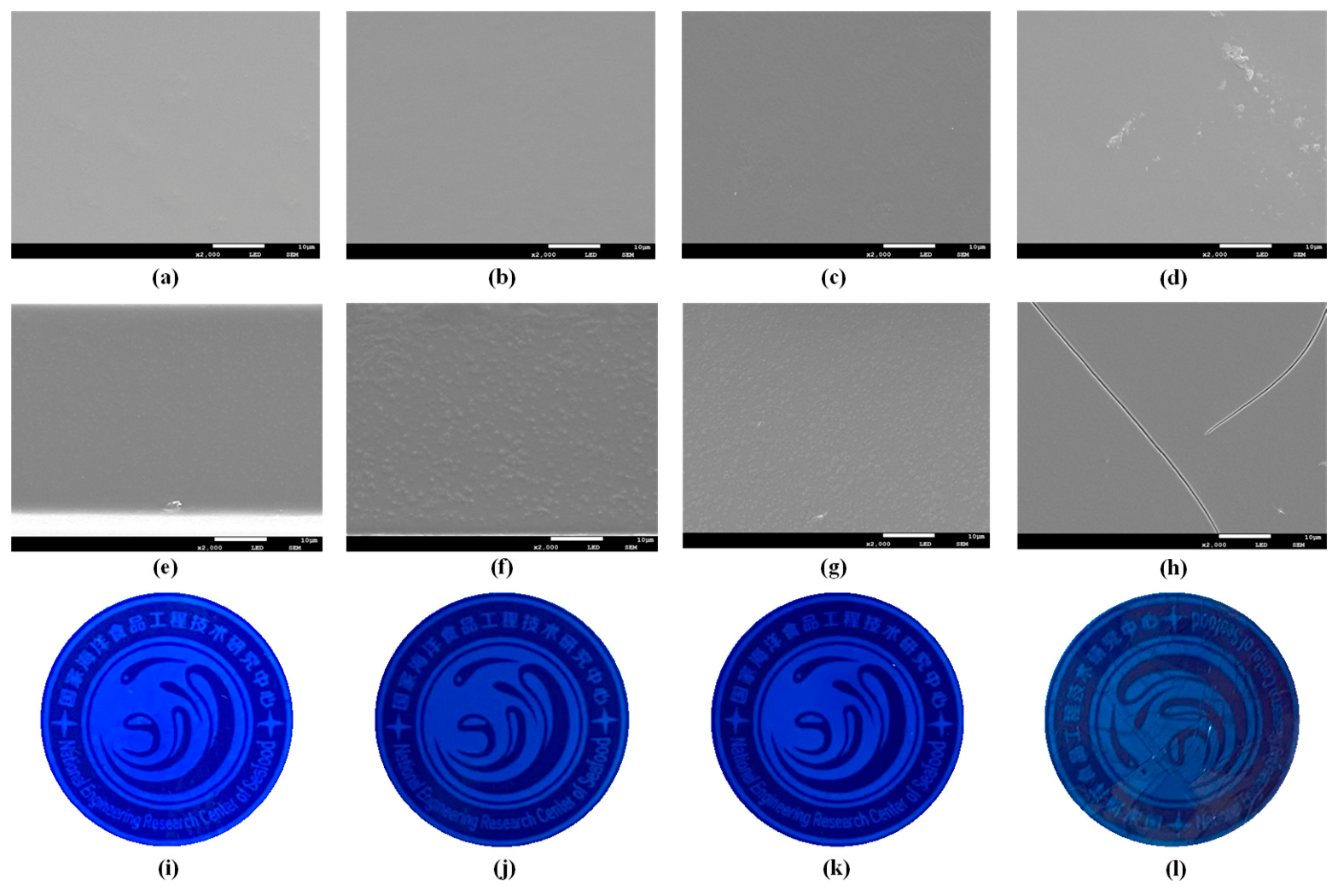
Figure 2.
Basic properties of the multifunctional of Gel/Cu@PC/Ch films. (a) Water contact angle (WCA) measurements, and (b) UV-Vis transmittance spectra of the films.
Figure 2.
Basic properties of the multifunctional of Gel/Cu@PC/Ch films. (a) Water contact angle (WCA) measurements, and (b) UV-Vis transmittance spectra of the films.
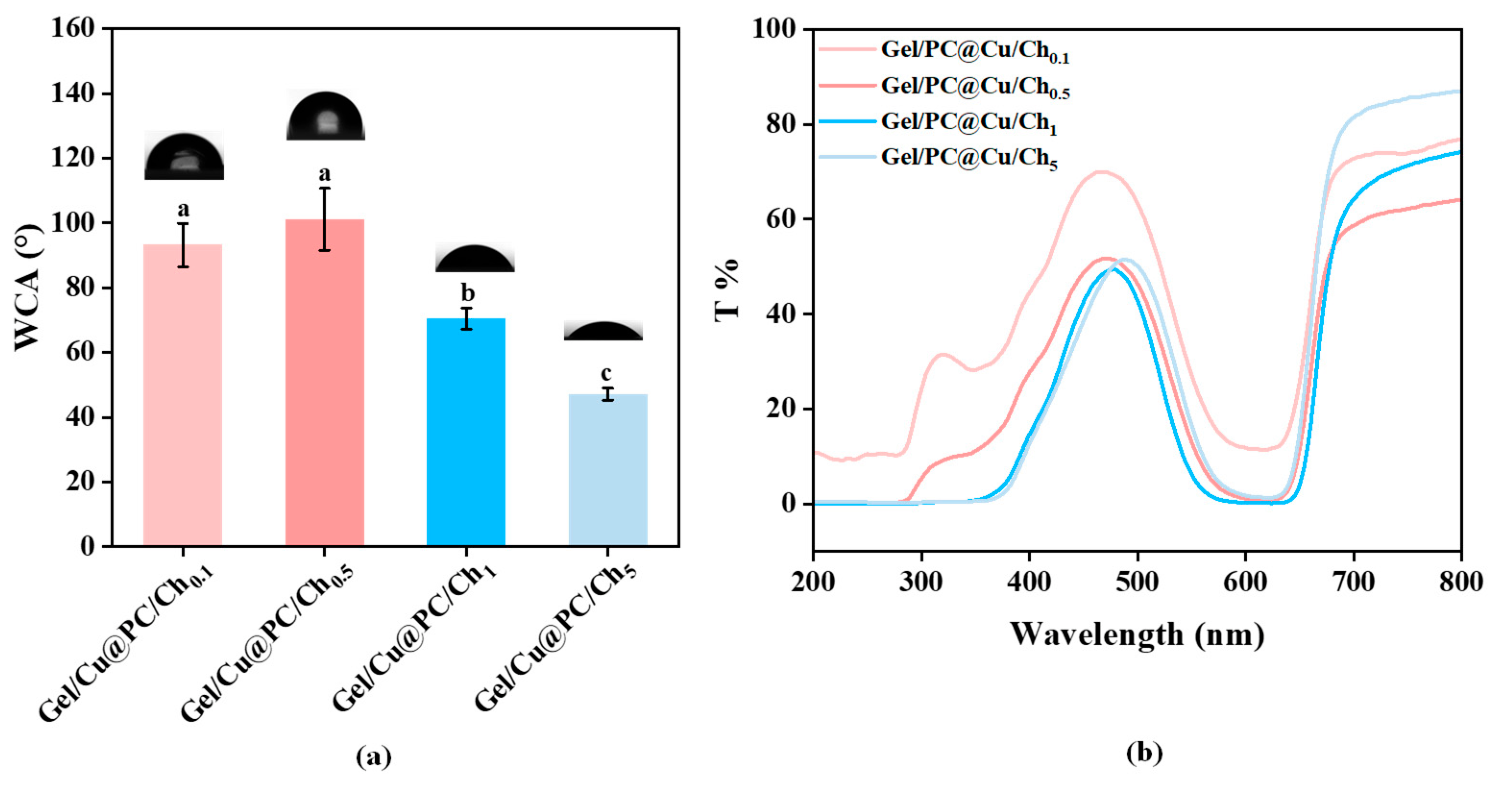
Figure 3.
Determination of antioxidative activity. (a) ABTS radical scavenging activity and DPPH radical scavenging activity of the films.
Figure 3.
Determination of antioxidative activity. (a) ABTS radical scavenging activity and DPPH radical scavenging activity of the films.
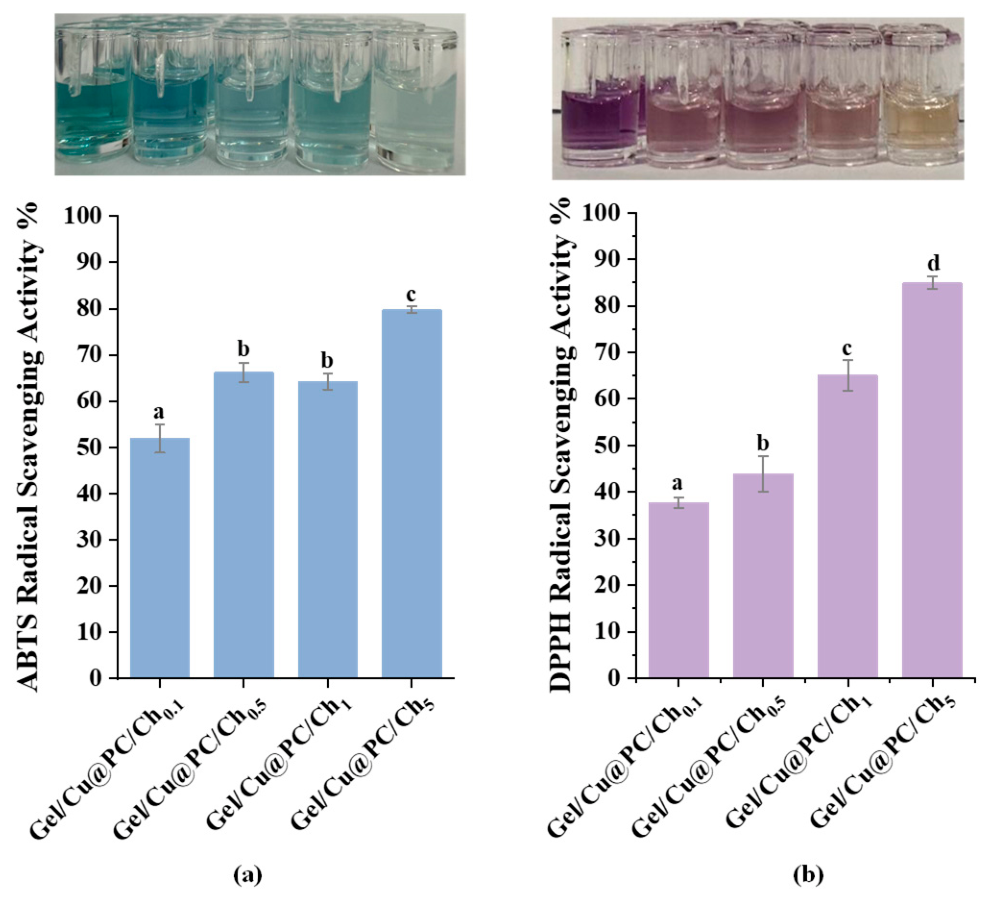
Figure 4.
Growth curves of E. coli and S. aureus following Gel/Cu@PC/Ch films treatment, respectively. (a) Growth curves of E. coli following Gel/Cu@PC/Ch films treatment. (b) Growth curves of S. aureus following Gel/Cu@PC/Ch films treatment.
Figure 4.
Growth curves of E. coli and S. aureus following Gel/Cu@PC/Ch films treatment, respectively. (a) Growth curves of E. coli following Gel/Cu@PC/Ch films treatment. (b) Growth curves of S. aureus following Gel/Cu@PC/Ch films treatment.
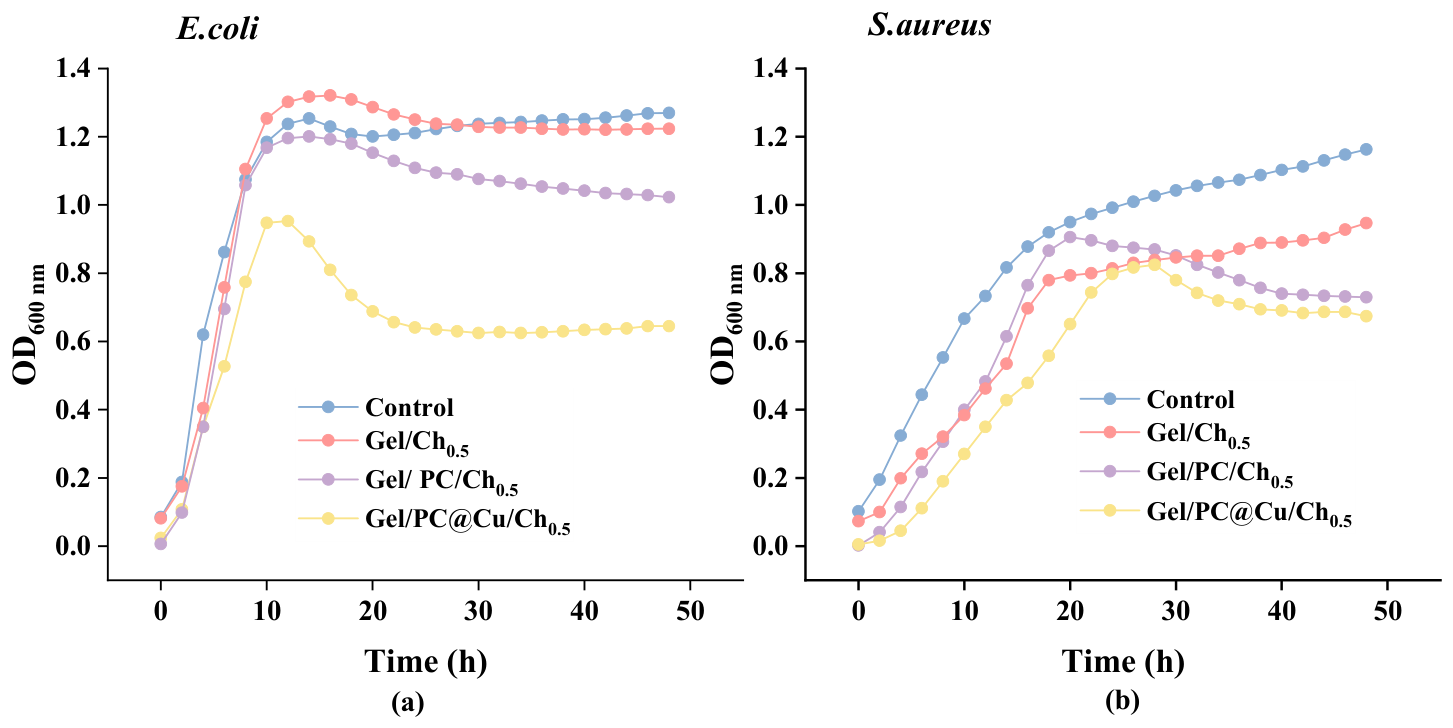
Figure 5.
Inhibition zones of E. coli and S. aureus under different treatment. Inhibition zones of E. coli under different treatment. (a) Control, (b) Gel/Ch0.5, (c) Gel/PC/Ch0.5, (d) Gel/PC@Cu/Ch0.5. Inhibition zones of S. aureus under different treatment. (e) Control, (f) Gel/Ch0.5, (g) Gel/PC/Ch0.5, (h) Gel/PC@Cu/Ch0.5, Growth inhibition zone diameter of different films (i-j).
Figure 5.
Inhibition zones of E. coli and S. aureus under different treatment. Inhibition zones of E. coli under different treatment. (a) Control, (b) Gel/Ch0.5, (c) Gel/PC/Ch0.5, (d) Gel/PC@Cu/Ch0.5. Inhibition zones of S. aureus under different treatment. (e) Control, (f) Gel/Ch0.5, (g) Gel/PC/Ch0.5, (h) Gel/PC@Cu/Ch0.5, Growth inhibition zone diameter of different films (i-j).
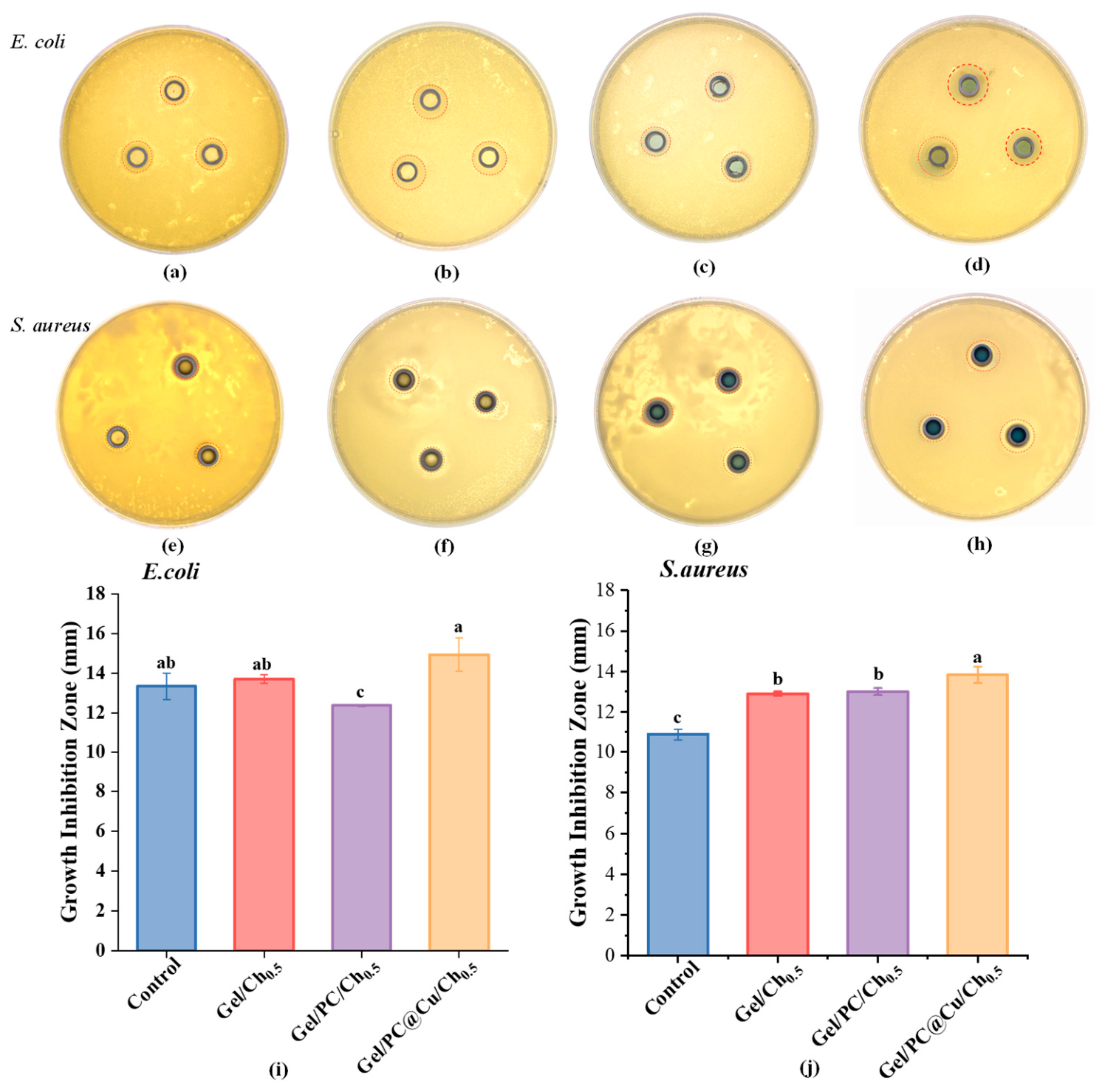
Figure 6.
Sustained preservation of grapes treated with different films for 0, 2, 4, 6, 8, 10 and 12 d. (a) Appearance, (b) Weight loss, (c) Hardness, (d) Total soluble solids and (e) Total antioxidant capacity of grapes.
Figure 6.
Sustained preservation of grapes treated with different films for 0, 2, 4, 6, 8, 10 and 12 d. (a) Appearance, (b) Weight loss, (c) Hardness, (d) Total soluble solids and (e) Total antioxidant capacity of grapes.
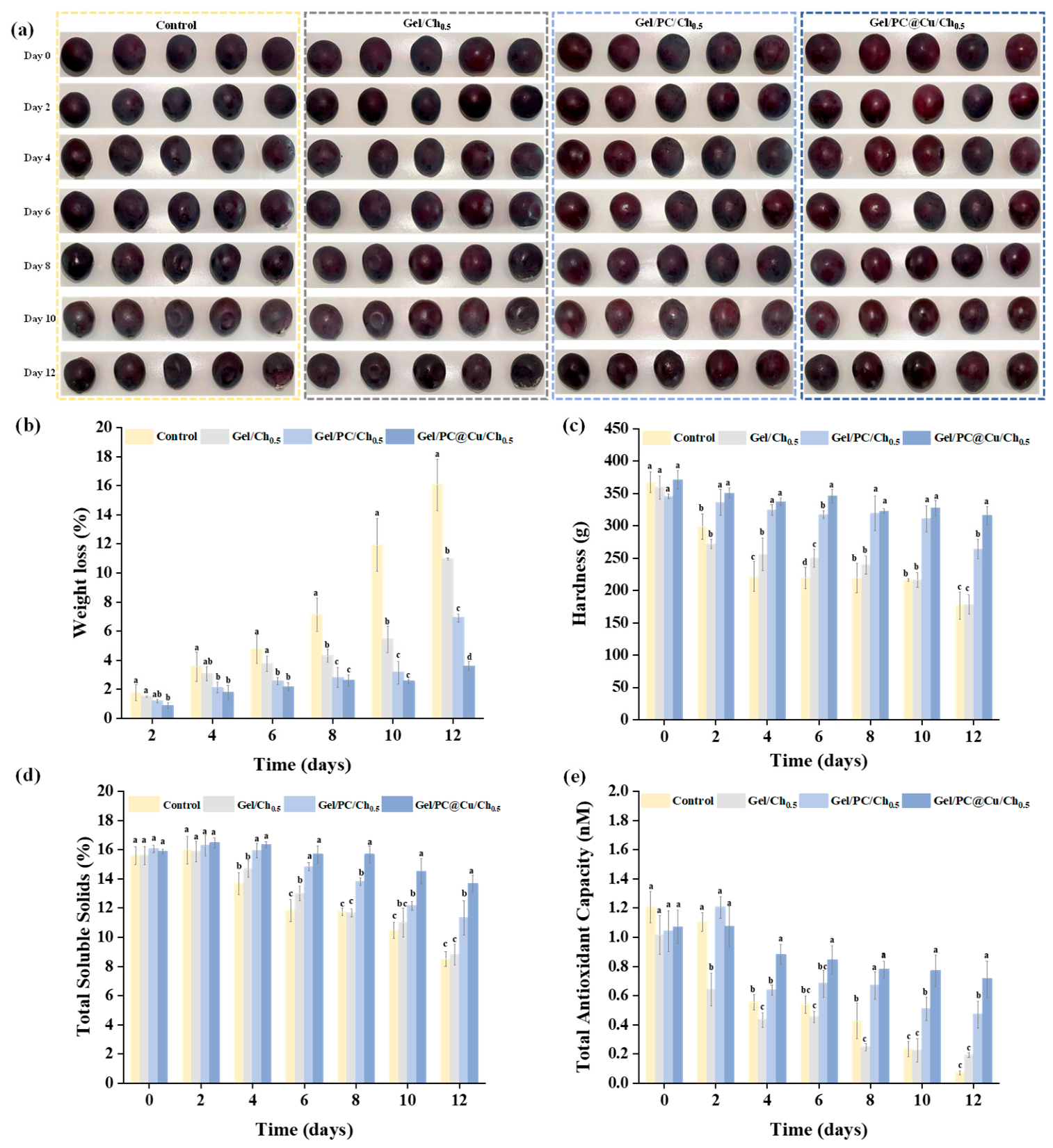
Figure 7.
Preparation and multifunctional mechanisms of the film.
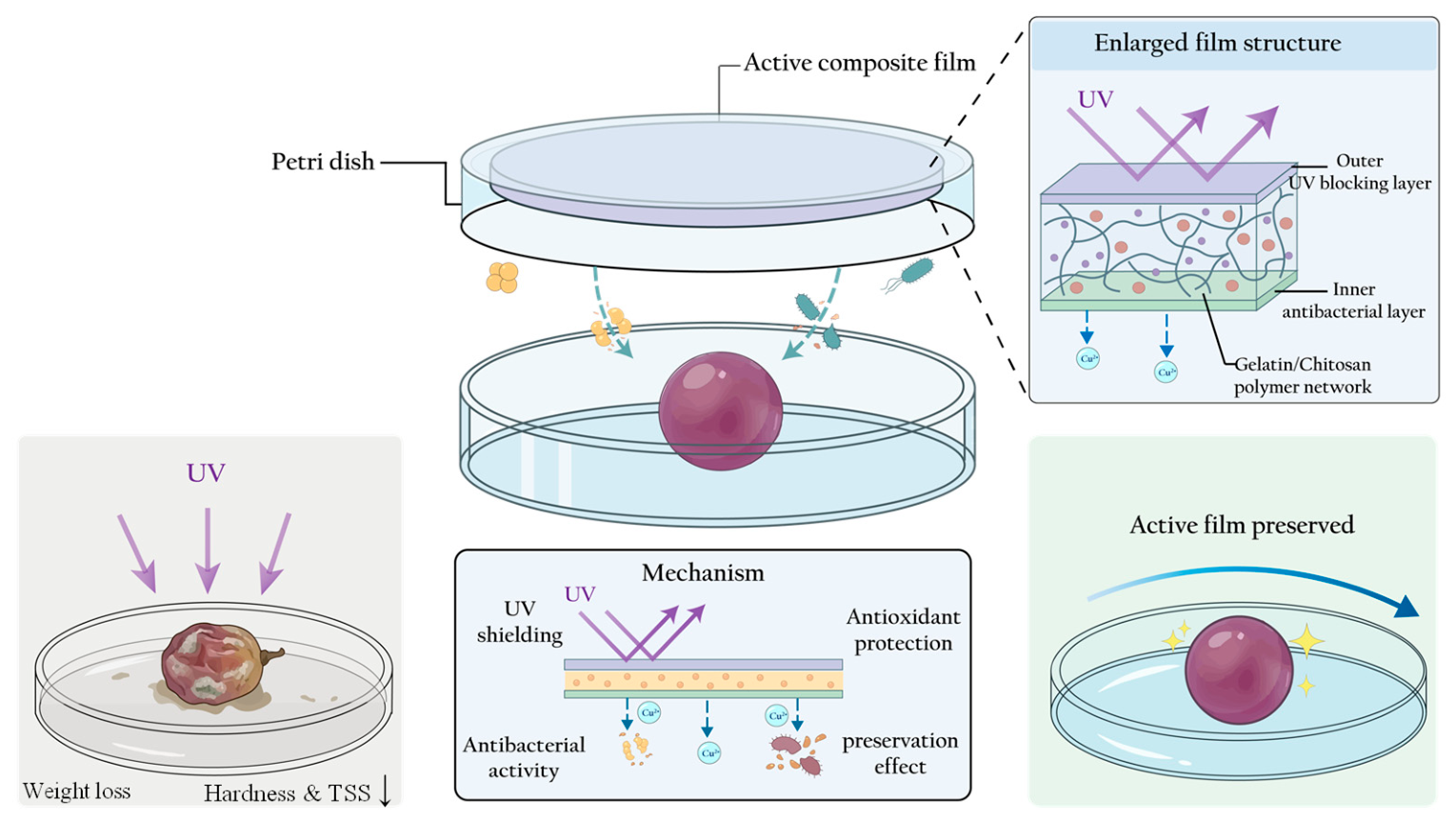

Table 1.
the formulation of composite Gel/Cu@PC/Ch films.
| Film label | Gelatin (%) | Chitosan (%) | Glycerol (%) | Phycocyanin (%) | Cu (%) |
|---|---|---|---|---|---|
| Gel/Ch0.5 | 3 | 0.5 | 1 | 0 | 0 |
| Gel/PC/Ch0.5 | 3 | 0.5 | 1 | 0.5 | 0 |
| Gel/Cu@PC/Ch0.1 | 3 | 0.1 | 1 | 0.5 | 0.003 |
| Gel/Cu@PC/Ch0.5 | 3 | 0.5 | 1 | 0.5 | 0.003 |
| Gel/Cu@PC/Ch1 | 3 | 1 | 1 | 0.5 | 0.003 |
| Gel/Cu@PC/Ch5 | 3 | 5 | 1 | 0.5 | 0.003 |
Disclaimer/Publisher’s Note: The statements, opinions and data contained in all publications are solely those of the individual author(s) and contributor(s) and not of MDPI and/or the editor(s). MDPI and/or the editor(s) disclaim responsibility for any injury to people or property resulting from any ideas, methods, instructions or products referred to in the content. |
© 2026 by the authors. Licensee MDPI, Basel, Switzerland. This article is an open access article distributed under the terms and conditions of the Creative Commons Attribution (CC BY) license (http://creativecommons.org/licenses/by/4.0/).
Copyright: This open access article is published under a Creative Commons CC BY 4.0 license, which permit the free download, distribution, and reuse, provided that the author and preprint are cited in any reuse.