

Submitted:
19 August 2026
Posted:
21 August 2026
You are already at the latest version
Abstract
Professional internships constitute a privileged space for articulation between universities and educational establishments; however, their evaluation has traditionally focused on the learning of the future teacher, paying less attention to the learning and transformation processes that interaction can generate in collaborating teachers, universities and schools. The purpose of this study was to analyze how the literature has conceptualized and evaluated bidirectionality in professional practices of initial teacher training, identifying its conceptual evolution, the mechanisms by which it is produced, and the evidence used to recognize its contributions and impacts. A systematic review of 71 studies published between 1990 and 2026 was conducted. The analysis shows an evolution from models focused on supervision and knowledge transfer to perspectives based on functional reciprocity, mutual learning, knowledge co-construction and institutional transformation. Based on these results, a taxonomy of six levels of maturity is proposed—presence, coordination, functional reciprocity, mutual learning, epistemic co-construction, and institutional transformation—and mechanisms that favor bidirectionality are identified, including structured professional dialogue, joint action, hybrid spaces, shared objects of work, and the agency of the future teacher as a mediator of knowledge. Likewise, eight guiding dimensions are proposed for its evaluation: enabling conditions, relational symmetry, reciprocity of the flow of knowledge, mutual learning, co-construction, contributions, institutionalization and impact. The results show that the available evidence focuses on learning and contributions, while the demonstration of sustained and institutional impacts remains limited. The review thus provides a conceptual framework to understand bidirectionality as a process that can be classified and evaluated empirically, rather than as an inherent property of any university-school relationship.
Keywords:
bidirectionality
; school–university partnerships
; initial teacher education
; professional practicum
; mutual learning
; reciprocal professional learning
; educational evaluation
1. Introduction
Practical training is one of the central components of initial teacher training, as it is the main meeting place between university training and the professional practice developed in educational establishments. Through professional practices, future teachers articulate disciplinary, pedagogical and didactic knowledge with the situated conditions of teaching, developing professional competencies, building their teaching identity and generating processes of reflection on practice. However, the relevance of these experiences progressively transcends their function from the individual training one: the internships also constitute spaces for systematic interaction between universities, educational establishments, collaborating teachers, university trainers and future teachers (Daza, Gudmundsdottir & Lund, 2021).
This understanding represents an important change with respect to the traditional conceptions of practical training; During a good part of their development, the internships were conceived fundamentally as instances of application of knowledge previously acquired at the university, placing the school as a stage to learn to teach and the collaborating teacher mainly as a supervisor or mentor. During the last decades, this perspective has been questioned by approaches that seek to overcome the separation between theory and practice and recognize that university and school have different but complementary knowledge, experiences and skills for professional training. Concepts such as Professional Development Schools, School–University Partnerships, Third Space, Hybrid Spaces and Reciprocal Professional Learning express this shift towards more collaborative ways of understanding the relationship between both training spaces (Burroughs et al., 2020).
This change has made it possible to recognize that professional internships can generate learning not only for pre-service teachers, but also for collaborating teachers, university academics and participating organizations. Joint planning, co-teaching, shared reflection and other forms of professional interaction can foster processes by which participants teach and learn from each other, confront different forms of knowledge and build new understandings about teaching. From this perspective, practice ceases to constitute only a curricular device for initial training and begins to take shape as a potential space for shared learning between university and school.
However, the literature uses a wide diversity of concepts to describe the reciprocal relationships between university and school and, although there is growing recognition of their potential benefits, comparatively less has been the development of frameworks that explain how interaction produces learning for the different participants, how this learning translates into contributions for the institutions involved and under what conditions they can produce transformations of greater scope. This fragmentation is reproduced in evaluation: while there is abundant research on competencies, self-efficacy, identity or performance of teachers in training, studies that simultaneously examine the learning of other actors, the co-construction of knowledge or the transformations produced in educational establishments and in the universities themselves are less frequent (Sarmiento-Márquez et al., 2023).
This problem acquires particular relevance in the Chilean context; The consolidation of Linkage with the Environment within the quality assurance system has reinforced the requirement that higher education institutions not only develop systematic relationships with their environment, but also be able to demonstrate their bidirectional nature and the contributions and impacts they produce. In this framework, professional internships represent a particularly relevant space to examine this relationship, since they permanently articulate a university function – training – with actors and organizations of the school system (Green, Tindall-Ford, & Eady, 2020).
From this perspective, bidirectionality offers an analytical category that allows the integration of conceptual developments that have been studied so far in a relatively fragmented way. More than the mere existence of collaboration or exchange between university and school, it is interesting to determine when this interaction allows different actors to contribute knowledge, learn from others, modify their understandings or practices and jointly generate new skills, decisions or products. This means shifting the traditional question – what does the future teacher learn during his or her practice? – to a relational question: what do the different actors learn and what do they transform as a result of their interaction?
Consequently, the purpose of this systematic review is to analyze how the literature has conceptualized and evaluated bidirectionality in professional practices of initial teacher training, identifying its conceptual evolution, the mechanisms by which it is produced, and the evidence used to recognize its contributions and impacts. From this synthesis, it seeks to establish conceptual foundations and analytical dimensions that allow to guide the evaluation of bidirectionality in the relations between university and educational establishments.
2. General Background
The contemporary understanding of professional practices is closely linked to the questioning of the traditional separation between academic knowledge and professional knowledge. Under conventional training models, the university occupied a privileged position as a space for the production of pedagogical knowledge, while educational establishments provided the contexts where this knowledge should be applied. This structure configured a fundamentally unidirectional relationship: the university trained, the school provided the setting for practice, and the future teacher constituted the main subject of learning (Zeichner, 1992).
The questioning of this conception made it possible to recognize that teaching is a situated practice and that professional knowledge is not produced exclusively in university institutions. The work of Cochran-Smith and Lytle (1999), Darling-Hammond (2006) and, subsequently, Zeichner (2010) contributed to shifting the relationship between university and school from a logic of application to a logic of integration between different sources of knowledge. Particularly relevant has been Zeichner’s (2010) Third Space proposal, which questions the epistemological hierarchy that historically placed academic knowledge above the knowledge constructed by teachers and school communities.
School-University Partnerships and Professional Experience Partnerships deepened this shift by situating the quality of practical training in the nature of the relationships built between actors. From these perspectives, the existence of institutional arrangements is an important but insufficient condition: partnerships require trust, mutual recognition, shared responsibilities, and opportunities for effective participation of school and university teachers (Martin et al., 2011; Grudnoff et al., 2017; Forgasz et al., 2018). In this way, the school progressively ceases to be conceived only as a context of practice and begins to be recognized as a space of professional knowledge.
Thus, a university and an institution can coordinate activities, share responsibilities or maintain a stable partnership without their participants changing their knowledge or practices as a result of that relationship.
Developments on Reciprocal Professional Learning move precisely in this direction by showing that practice relationships can generate learning opportunities for both future teachers and collaborating teachers. Kerin and Murphy (2015), for example, situate co-teaching as an opportunity for shared professional development, while Lemlech and Hertzog (1999) show that co-teachers and students can learn from each other during the co-teaching experience. In both cases, reciprocity is no longer defined solely by the distribution of roles and begins to be expressed through modifications in the knowledge and actions of the participants.
Similarly, the concept of Dialogic Space addresses how shared reflection on teaching can generate spaces where knowledge from the university and from the school experience is collectively confronted and reconstructed (Youens, Smethem, & Sullivan, 2014). Co-teaching, peer coaching, research on practice and professional communities represent, from this perspective, different mechanisms through which this exchange can take place (Harlin, 2000; Meyer & Sawyer, 2006; Steele, 2017).
2.1. The Problem of Assessing Bidirectionality
The conceptual evolution of professional practices must be accompanied by an equivalent development of their evaluation strategies, however, the instruments used continue to focus predominantly on the future teacher and on results such as performance, competencies, self-efficacy, professional reflection or integration between theory and practice. Even when studies recognize benefits for collaborating teachers or educational establishments, these are often analyzed separately, making it difficult to reconstruct the process by which interaction produces changes for the different actors (Laferrière, 2018).
This limitation reveals a fundamental difference between evaluating professional practice and evaluating its bidirectionality. The first can establish what the future teacher learned; the second requires determining who contributes knowledge, who learns as a result of this exchange, what changes from learning and whether this change manages to be incorporated into the practices of the participants or the institutions. In analytical terms, this means shifting the focus from individual performance to the relationship and the transformations produced by it.
This distinction also allows us to conceptually differentiate learning, contribution and impact; learning corresponds to modifications in knowledge, understandings or skills produced through interaction; the contributions express the materialization of such learning in practices, decisions, products or capacities; while impact implies transformations of greater depth, relevance and permanence. The documentation of this last stage represents one of the main weaknesses of the literature reviewed, due to the scarcity of longitudinal designs and assessments capable of following changes beyond individual participants. The paper itself identifies precisely this absence of a framework connecting collaboration, learning, and observable transformations as one of the central gaps in the literature.
On this basis, bidirectionality can be provisionally understood as a relational process through which actors belonging to the university and educational establishments contribute different knowledge and skills, generate reciprocal learning through their interaction and transform this learning into contributions capable of modifying the practices and capacities of the people and organizations involved. This conceptualization does not presuppose that all professional practice is bidirectional or that all interaction generates impact. On the contrary, it converts these relationships into empirical phenomena that must be demonstrated.
Thus, the central problem for research is no longer only to establish whether there is collaboration between university and school. The challenge is to explain and evaluate the process by which such collaboration can evolve from interaction to mutual learning, from mutual learning to co-construction and contributions, and eventually to sustained institutional transformations. It is precisely this problem that justifies the systematic review developed in this study and the subsequent construction of a taxonomy and guiding dimensions for its evaluation.
3. Materials and Methods
The research strategy was structured based on three conceptual components derived from the research question: (a) the context of professional practices in initial teacher training; (b) approaches that describe processes of reciprocal interaction between university and school; and (c) studies aimed at evaluating their results, contributions or impacts. ((“student teaching” OR practicum OR “professional experience” OR “field experience”) AND (“reciprocal professional learning” OR “reciprocal learning” OR “mutual learning” OR “school-university partnership*” OR “third space” OR “dialogic space”) AND (evaluation OR assessment OR impact* OR outcome*))
Empirical studies and descriptive or conceptual articles that present models, experiences or evaluations of university-school alliances in the context of professional practices of initial teacher training were included, provided that they provided elements to understand the conceptualization, implementation or evaluation of bidirectionality, its contributions or its impacts.
Study selection and exclusion criteria: Studies were excluded when they did not address professional practice or field-based experiences in initial teacher education, when the university–school relationship was merely contextual and provided no evidence relevant to its conceptualization, implementation, or evaluation, or when they focused exclusively on pre-service teacher outcomes without examining relational or collaborative processes between the participating actors. Records that did not correspond to empirical, descriptive, or conceptual studies relevant to the review question were also excluded. The identification, screening, eligibility assessment, and final inclusion of studies were conducted following the PRISMA framework. Figure 1 summarizes the study selection process, from the 159 records initially identified across Web of Science, Scopus, and ERIC to the final corpus of 71 studies (See Figure 1).
3.1. Bibliometric Analysis of Co-Occurrence
As a complement to the systematic review, a bibliometric analysis was carried out using VOSviewer to examine the conceptual structure and thematic evolution of the field. The bibliographic records corresponding to the included studies were analyzed through a network of co-occurrence of terms, with the purpose of identifying the main conceptual nuclei associated with professional practices, initial teacher training, and university-school relations.
The analysis allowed us to examine both the structure of relationships between the terms and their temporal evolution. In the visualization, the size of the nodes represents the frequency of occurrence of each term, while the links express their co-occurrence relationships. In addition, an overlay visualization based on the average year of publication was used, which allowed observing the temporal shift from concepts mainly associated with the organization of professional practices and the training of the future teacher to terms related to professional collaboration, partnerships, practicum, professional experience and initial teacher education. The bibliometric structure allowed contextualizing the configuration and evolution of the field, but it was not used to determine the analytical categories of the review, which were constructed through the qualitative analysis of the content of the studies.
3.2. Qualitative Content Analysis
Subsequently, the 71 included studies were subjected to a qualitative content analysis aimed at reconstructing how the literature has conceptualized, operationalized and evaluated bidirectionality in professional practices of initial teacher training. The analytical process combined inductive coding and constant comparison between the studies, paying special attention to the concepts used to describe university-school relations, the mechanisms by which interaction occurs, the learning generated for the different actors and the evidence used to recognize contributions and impacts.
To guarantee the systematicity and traceability of the analysis, three complementary matrices were constructed. The first characterized each study according to year, context, design, conceptual framework and emerging categories, allowing the conceptual evolution of the field to be reconstructed. The second systematized the evidence provided by each research, considering its objectives, units of analysis, main findings, mutual learning, contributions, impacts, evaluation strategies and instruments used. The third specifically examined the operationalization of bidirectionality, identifying the mechanisms by which it is produced and the available evidence regarding contributions and impacts.
Through an iterative process of comparison between studies, patterns of increasing complexity in university-school relationships were identified. These patterns made it possible to reconstruct the conceptual evolution of bidirectionality and, subsequently, to elaborate a taxonomy of maturity: presence, coordination, functional reciprocity, mutual learning, epistemic co-construction and institutional transformation. In a complementary way, the cross-sectional analysis allowed the identification of the mechanisms by which bidirectionality occurs and the dimensions used by the literature to evaluate it.
Finally, the temporal distribution of the studies was used to examine the historical evolution of these conceptions. To ensure analytical transparency, each article maintained a unique identifier (RIS_ID) throughout the coding process, allowing the categories, subcategories and maturity levels to be linked to the studies that support each interpretation. The complete coding matrix is presented in Appendix A.1 and Appendix A.2.
4. Results
4.1. General Characteristics of the Included Studies
The review included 71 studies published between 1990 and 2026, which made it possible to observe more than three decades of research development on professional practices, university-school alliances and learning processes among the actors involved in initial teacher training. Production has shown a clear concentration of time in the last two decades. Only four studies correspond to the period 1990–1999 (5.6%), while 11 were published between 2000 and 2009 (15.5%), 30 between 2010 and 2019 (42.3%) and 26 between 2020 and 2026 (36.6%). Overall, 56 of the 71 studies (78.9%) were published since 2010, evidencing a recent intensification of interest in the relationships between university, schools and practical training.
The geographical distribution shows a considerable concentration. The United States has 35 studies (49.3%), followed by Australia with eight (11.3%). Israel, Ireland, Chile and Spain contribute three studies each, while the rest of the works are distributed among Hong Kong, England, Sweden, Norway, Canada, the Netherlands, the United Kingdom, New Zealand, Brazil, Finland, Colombia and Nigeria. A 2026 study also adopts a comparative perspective between Brazil, India and South Africa. Thus, although the literature has diversified geographically in recent years, the available knowledge continues to be strongly influenced by Anglo-Saxon teacher training systems.
Methodologically, the corpus is predominantly empirical and qualitative. Forty-nine records are directly classified as empirical studies, to which are added various empirical variants —evaluative, diagnostic, documentary, longitudinal or design-based—. Among the designs identified, qualitative studies, case studies and their different variants predominate, followed by mixed-methods research. Comparative, quasi-experimental, or longitudinal quantitative designs are considerably less frequent. This methodological configuration is consistent with a field mainly interested in understanding relationships, interaction processes, mentoring experiences, knowledge construction and partnership configurations, rather than in estimating effects through causal designs.
4.2. Analysis of Co-Occurrence and Conceptual Evolution of the Field
The bibliometric analysis of keyword co-occurrence shows that research on professional practices is structured around a relatively stable conceptual core made up of preservice teachers, college school cooperation, field experience programs, and student teaching (Figure 2). The high centrality of these terms indicates that, throughout the period analyzed, the main object of research has remained associated with initial teacher training and cooperative relations between universities and schools.
The map also shows a progressive evolution in the conceptual configuration of the field. The earliest appearance terms focus mainly on concepts related to the organization of professional internships and the training of future teachers, such as college school cooperation, student teaching, field experience programs and internship programs. These descriptors reflect an understanding of professional practice fundamentally oriented towards the insertion of the student in school contexts and the operational articulation between university and school.
As scientific production evolves, terms related to professional collaboration and the development of shared capacities begin to acquire greater presence, including teacher collaboration, cooperating teachers, professional development and teacher education. This transition suggests a shift from a vision focused on the organization of practice to an understanding that incorporates the professional relationships established between the different actors involved.
Finally, the most recent terms on the map—such as partnerships, practicum, initial teacher education, and professional experience—appear closely linked to the traditional concepts of the field, configuring a conceptual extension rather than a break with previous perspectives. Overall, this bibliometric structure shows that the research does not abandon the paradigm of university-school cooperation, but progressively expands its meaning, incorporating dimensions related to professional collaboration, shared learning and the joint development of the training experience.
5. Conceptual Evolution of Bidirectionality in Professional Practices
The analysis allowed us to identify that the meaning of the concept of bidirectionality has evolved progressively over the last three decades, moving from a conception focused on the transfer of knowledge to the future teacher to approaches that understand the relationship between university and school as a process of mutual learning, shared production of knowledge and institutional transformation. This evolution not only incorporates new concepts, but also modifies the very object of analysis: from the individual learning of the practitioner to the relational and epistemic dynamics that emerge among the participating institutions (Table 1).
The first stage of literature, developed during the 1990s, conceives professional practice fundamentally as a space for the learning of the future teacher. The relationship between university and school is structured through processes of mentoring, supervision, and insertion in the school context, where experienced teachers and university supervisors assume the role of main transmitters of professional knowledge. In this period, concepts such as mentoring, field-based education, internship and school-university partnership predominate, but collaboration between institutions is mainly an organizational condition to facilitate initial training. Consequently, bidirectionality does not yet appear as an explicit object of research, since the flow of knowledge is essentially understood as a unidirectional process oriented towards the student in practice.
During the 2000s, a first conceptual shift began to be observed. The focus is no longer exclusively on the supervision of the future teacher and is progressively oriented towards the relationship between university and school as a collaborative alliance. The incorporation of concepts such as Professional Development Schools, communities of practice, mutual benefits and co-teaching reflects the recognition that both institutions can derive benefits from professional practice. However, this reciprocity has a predominantly functional character. The school is beginning to be recognized as a beneficiary of university collaboration, but most of the evidence continues to focus on the development of competencies of the future teacher. The dominant question ceases to be only how the student learns, to become how university and school collaborate.
From the 2010s onwards, a more profound conceptual change took place. The literature begins to shift its attention from organizational structures to the processes of interaction that occur between the different participating actors. Concepts such as professional learning, collaborative inquiry, reciprocal professional learning, clinical practice and later third space express a different understanding of the university-school relationship. Professional practice is no longer understood only as a space for student training and begins to be conceived as a scenario of shared professional learning, where future teachers, mentor professors and university academics can jointly modify their knowledge, skills and ways of understanding teaching. Consequently, the research question evolves from institutional collaboration to how the different participants in the training experience learn from each other.
Studies published since 2019 further deepen this conceptual transformation. The incorporation of frameworks such as boundary crossing, boundary objects, boundary spanners, knowledge brokers, hybrid roles, co-construction, and active mentee influence represents a shift from a relational understanding to an increasingly epistemic understanding of bidirectionality. At this stage, the interest ceases to focus only on who learns and begins to consider how knowledge circulates, is translated, recontextualized and is produced jointly between university and school. Bidirectionality is no longer defined as a simple exchange of benefits and begins to be understood as a process through which different actors contribute complementary knowledge, generate new objects, practices or shared criteria and, potentially, transform the institutions of which they are part.
In this way, the review allows us to identify a conceptual evolution characterized by four successive displacements. Firstly, the focus shifts from the individual learning of the future teacher to the collaborative relationship between university and school. Subsequently, this relationship is no longer evaluated solely in terms of the benefits it generates for each institution and begins to be analyzed as a process of mutual professional learning. Finally, the most recent works place the interest in the shared production of knowledge and in the transformative capacity of interaction, incorporating concepts from the theory of situated learning, hybrid spaces and boundary crossing. This trajectory shows that bidirectionality has ceased to be understood as an organizational characteristic of professional practices and has progressively become a concept that describes processes of construction, circulation and transformation of knowledge between university and school.
5.1. Taxonomy of Bidirectionality Maturity
The evolution described allows us to identify that the literature does not present a single definition of bidirectionality. On the contrary, the studies represent different degrees of development of this phenomenon. Some describe only the presence of the university in the schools; others document coordination between actors; some show benefits for both institutions; while a smaller group demonstrates mutual learning, joint production of knowledge or institutional transformations.
Based on these emerging patterns, a taxonomy of bidirectional maturity was developed, which organizes the studies according to the depth reached by the university-school relations (see Table 2).
Level 0 (Presence) corresponds to studies in which the school is mainly the setting where professional practice is developed, without evidence of substantive interaction between the institutions. The focus is on the organization of the practicum, the assignment of functions or the existence of agreements, while the flow of knowledge remains essentially unidirectional from the university or experienced teachers to the future teacher. The works classified at this level mainly evaluate organizational aspects and do not incorporate indicators of mutual learning, contributions or changes derived from the relationship.
Level 1 (Coordination) represents the first step towards more structured forms of interaction. In these studies, bidirectionality is expressed through mechanisms of communication and shared organization, such as coordination meetings, joint planning, shared supervision or consensual definition of responsibilities. However, collaboration continues to be mainly oriented to manage the development of the practicum and not necessarily to produce learning for both institutions. The evidence focuses on the quality of coordination, the frequency of interactions or the satisfaction of the participants, rather than on the transformations derived from these relationships.
Level 2 (Functional Reciprocity) The literature is beginning to recognize that collaboration can generate benefits for university and school simultaneously; research shows improvements in the training of teachers in training, support to schools, strengthening of institutional programs or development of shared services. However, these benefits continue to be analysed mainly as parallel results of collaboration and not as a consequence of shared learning processes; Reciprocity, therefore, is expressed in the existence of differentiated benefits for both parties, without yet demonstrating reciprocal modifications in the knowledge or practices of the actors involved.
Level 3 (Mutual Learning). The university-school relationship is no longer evaluated solely by its organization or by the benefits obtained, and begins to be analyzed as a process of reciprocal professional learning. Studies show that trainees, co-teachers and university academics jointly modify their knowledge, skills, beliefs or practices as a result of sustained interaction. The evidence comes mainly from interviews, observations, reflective diaries, and other qualitative designs capable of documenting professional changes attributable to shared experience. The high concentration of studies at this level suggests that mutual learning has become the main contemporary reference for understanding bidirectionality.
Level 4 (Epistemic Co-construction) represents a shift from shared learning to the joint production of knowledge. In these works, interaction is no longer limited to the exchange of experiences and leads to the collaborative development of curricula, assessment devices, pedagogical materials, research, didactic innovations or boundary objects that can only be understood as jointly developed products. As a result, bidirectionality acquires an increasingly epistemic character: university and school not only learn from each other, but also generate new knowledge, practices and professional criteria through sustained processes of collaboration.
Finally, Level 5 (Institutional Transformation) corresponds to the highest degree of maturity identified in the review. The learning and products developed jointly transcend the individual participants and are incorporated into the organizational structures of the institutions involved. The studies describe relatively stable modifications in curricula, supervisory models, institutional policies or permanent forms of collaboration. However, this is the least represented level of the corpus. Studies classified in this category show that the literature still has limited evidence regarding the institutionalization and sustainability of the transformations generated by bidirectionality.
Finally, the progression identified should not be interpreted as an obligatory sequence, but as different levels of depth observed in the corpus. Each level incorporates an emergent property with respect to the previous one: coordination adds shared organization; functional reciprocity incorporates benefits for both institutions; mutual learning implies reciprocal professional transformation; co-construction implies joint production of knowledge; and institutional transformation represents the relatively stable incorporation of these learnings in the participating organizations.
5.2. Guiding Dimensions for the Assessment of Bidirectionality
Although the above taxonomy allows us to classify the different levels of maturity identified in the literature, the analysis showed that the studies use very different criteria to assess these relationships. Some emphasize organizational conditions; others privilege coordination, while more recent work focuses on mutual learning, co-construction or institutional changes.
From the cross-sectional analysis of the corpus, it was possible to identify eight recurrent dimensions that organize the main evidence used to recognize bidirectionality. These dimensions are not an assessment instrument or a measurement scale, but an analytical framework that can guide the design of future instruments to assess the contributions generated by professional practices (See Table 3).
This framework synthesizes the conceptual evolution observed in the literature and translates this evolution into dimensions that can be observed empirically. Together, both tables show that bidirectionality can be understood not only as a characteristic of professional practices, but also as a phenomenon whose maturity can be classified and whose evidence can be evaluated by explicit criteria. From this perspective, the review not only reconstructs the conceptual development of the field, but also offers an analytical basis to guide future research and the design of instruments aimed at assessing the quality of the bidirectional relationships between university and school.
5.3. Between Contributions and Impact
The identified contributions are distributed over several levels. The most documented level corresponds to the future teacher. Studies report the development of pedagogical competencies, better integration between theory and practice, greater reflective capacity, understanding of the school context, professional confidence, self-efficacy, teacher identity and ability to respond to specific needs of students.
A second group of contributions is observed in teachers, mentors and school collaborators. Among them are opportunities for professional development, reflection on one’s own teaching, knowledge of new pedagogical strategies, strengthening mentoring and leadership capacities, participation in inquiry processes and expansion of professional relationships. In some studies, these contributions are translated into concrete modifications of teaching practices.
A third level corresponds to educational establishments. Contributions are identified in the form of greater availability of human resources, individualized support for schoolchildren, implementation of innovations, shared professional development, strengthening of professional communities and greater capacity to participate in the training of future teachers. However, these contributions are less frequently evaluated by systematic indicators than those corresponding to the student in practice.
University is the least directly studied level. Some studies show modifications in practice tasks, curricula, evaluation processes, forms of supervision and understanding of school conditions. However, relatively few studies explicitly ask what the university learns from experience or what institutional modifications can be attributed to that interaction. This asymmetry constitutes one of the most consistent gaps in the corpus.
Finally, a small number of studies incorporate effects on school students and the community. Greater individual attention, academic and socio-educational support, engagement, learning opportunities and, in some more robust designs, improvements in specific outcomes for schoolchildren are described. This level acquires relevance because it shifts the evaluation of practice from the traditional question of what the future teacher learns to the question of what value the practice simultaneously produces for the context that receives it.
Although the literature frequently uses terms such as impact, transformation or mutual benefit, methodological analysis shows that most of the evidence actually corresponds to contributions or changes observed during the experience, and not to impacts demonstrated in a strong sense.
Studies often document perceptions of learning, changes in knowledge or practices, improved self-efficacy, competency development, or incipient organizational modifications. However, designs that make it possible to determine whether these changes persist over time, extend beyond the direct participants or are institutionalized in schools or universities are much less frequent. Longitudinal research is scarce and comparative or quasi-experimental designs constitute a minority of the corpus.
Even among studies that report quantitative outcomes, evaluation tends to focus on the future teacher. Some research compares the performance, knowledge, or practices of candidates exposed to different clinical models; others incorporate indicators of retention or professional insertion. There are also cases that report results in school students. However, designs that simultaneously evaluate results for future teacher, mentor, establishment and university are exceptional.
This difference allows us to establish an important analytical distinction between activity, contribution and impact. Meetings, co-teaching or joint planning constitute activity. The incorporation of a new practice, the development of a competency or the modification of a curricular task represents an observable contribution. To talk about impact, however, it would be necessary to demonstrate that these contributions produce relevant, sustained transformations that are sufficiently linked to the experience developed.
6. Discussion
The purpose of this systematic review was to analyze how the literature has conceptualized bidirectionality in professional practices and, based on this, to identify the conceptual foundations that allow guiding its evaluation. The results show that bidirectionality is not a homogeneous concept or an inherent characteristic of the relations between university and educational establishment. On the contrary, the analysis of the corpus shows a conceptual evolution sustained over the last three decades, in which the understanding of professional practices moves from models focused on the supervision of the future teacher to perspectives that recognize mutual learning, the shared production of knowledge and, in the most recent works, the possibility of generating institutional transformations. This shift coincides with the progressive incorporation of approaches that seek to overcome the traditional dichotomy between theory and practice, such as the proposals of Third Space (Zeichner, 2010), Boundary Crossing (Akkerman & Bakker, 2011) and the recent reviews on hybrid spaces in teacher training.
A first finding of the review is to show that the literature has progressively expanded the meaning of university-school cooperation. Early studies conceived of collaboration primarily as an organizational condition that facilitated initial teacher training through supervision and mentoring mechanisms. Subsequently, research began to recognize benefits for both institutions, shifting interest from administrative coordination to professional collaboration. Finally, the most recent studies incorporate an increasingly epistemic understanding of these relationships, where interaction becomes a space to negotiate knowledge, build knowledge and redefine the professional identities of the participants. This trajectory coincides with what Daza, Gudmundsdottir, and Lund (2021) point out, who conclude that the development of the Third Space implies a transformation in the way of understanding what knowledge is legitimate and who is recognized as a bearer of expertise within teacher training.
However, the review also shows that concepts frequently used as equivalents describe distinct phenomena. In the corpus analyzed, partnership corresponds mainly to the institutional structure that makes possible the interaction between university and school; Third Space describes a relational configuration where different forms of knowledge can meet in less hierarchical conditions; while bidirectionality constitutes a specific property of the interaction process, characterized by the reciprocal circulation of knowledge, skills or learning among the participating actors. From this perspective, mutual learning represents the first empirical evidence that bidirectionality does indeed occur, the contributions correspond to the materialization of these learnings in new practices, capacities or products, and the impact constitutes the most complex expression of the process, when these contributions manage to be incorporated in a relatively stable way to the organizations involved. This differentiation allows for a more precise interpretation of studies that, although developed in partnership or Third Space contexts, do not necessarily demonstrate bidirectional learning processes. At the same time, it responds to the observations made by recent reviews that warn of the need to operationalize the concept of Third Space more precisely in professional practice.
A second contribution of this review is to show that the conceptual evolution observed not only modifies the definition of bidirectionality, but also what the literature considers evidence of its existence. Earlier studies tend to document the presence of agreements, coordination mechanisms or shared supervision structures. Subsequently, the evidence shifts to the benefits obtained by university and school, to finally incorporate changes in the knowledge, practices and capacities of the different participants, as well as processes of co-construction of knowledge and organizational transformations. Consequently, bidirectionality is no longer understood as a structural characteristic of partnerships and is conceived as an emergent property of the relationships that are established between the actors. This finding explains why apparently similar studies reach different conclusions regarding the quality of university-school relations: they differ not only in their conceptual frameworks, but also in what they choose to observe and evaluate.
From this perspective, the proposed taxonomy represents an integrative synthesis of the available evidence. Rather than classifying professional practice programs as “more” or “less” bidirectional, it organizes the different levels of complexity with which the literature has described this phenomenon. The progression identified shows that coordination is a requirement for collaboration, but does not guarantee mutual learning; that functional reciprocity incorporates benefits for both institutions, although these can occur without necessarily modifying the practices of the participants; whereas mutual learning involves reciprocal professional transformations; that co-construction involves the joint production of new knowledge, devices, or practices; and that institutional transformation represents the level of greatest maturity, as it incorporates these learnings into relatively stable structures. This interpretation is consistent with approaches to organizational learning (Argyris & Schön, 1978), knowledge creation (Nonaka & Takeuchi, 1995), and expansive learning (Engeström, 2001), which argue that institutional transformations require mechanisms of collective reflection and organizational appropriation that transcend individual learning.
In this sense, the review allowed us to reconstruct an explanatory sequence that articulates the different levels identified in the literature. The evidence analyzed suggests that bidirectional relationships are developed through a chain of processes that begins with the existence of enabling conditions —such as protected time, mutual recognition, distribution of responsibilities and institutional support—, continues with the two-way interaction between the actors, favors mutual learning and teaching, enables processes of co-construction of knowledge, materializes in contributions to university and school, and, finally, it can lead to institutionalization processes capable of generating relatively sustainable impacts. This sequence allows us to understand that impact is not an immediate result of collaboration, but the consequence of a progressive accumulation of learning and organizational transformations.
Finally, the main gap identified by this review does not seem to be conceptual, but methodological. Although the literature has made considerable progress in understanding the nature of university-school relations, assessment instruments continue to focus predominantly on the performance of pre-service teachers. There are comparatively few studies that systematically document the learning of collaborating teachers, the transformations produced in the university or the institutionalization of the changes derived from interaction. Consequently, the evaluation of bidirectionality requires overcoming approaches focused exclusively on the quality of the practicum and incorporating dimensions capable of identifying the circulation of knowledge, reciprocal learning, the co-construction of practices, institutional contributions and sustainable impacts. From this perspective, the proposed analytical framework constitutes a conceptual basis for the development of future assessment instruments aimed at valuing bidirectionality as a process of generating shared value between university and educational establishment.
Appendix A
Appendix A.1
Allen, J. (2011). Stakeholders’ perspectives of the nature and role of assessment during practicum. TEACHING AND TEACHER EDUCATION, 27(4), 742-750. https://doi.org/10.1016/j.tate.2010.12.004
Allen, J., & Wright, S. (2014). Integrating theory and practice in the pre-service teacher education practicum. TEACHERS AND TEACHING, 20(2), 136-151. https://doi.org/10.1080/13540602.2013.848568
Ardley, J. (2009). Unanticipated Findings: Gains by Cooperating Teachers via Video-Mediated Conferencing. Journal of Computing in Teacher Education, 25(3), 81-86.
Broadley, T., Martin, R., & Curtis, E. (2019). Rethinking Professional Experience Through a Learning Community Model: Toward a Culture Change. Frontiers in Education, 4. https://doi.org/10.3389/feduc.2019.00022
Carmi, T., & Tamir, E. (2026). Reflective or transmissive, is there a superior learning approach? Lessons from mentoring relationships. TEACHING AND TEACHER EDUCATION, 175. https://doi.org/10.1016/j.tate.2026.105460
Case, A. F., & Traynor, J. (2016). Early Field Experience Innovations to Increase Positive Impact on K-12 Students. AILACTE Journal, 13(1), 1-21.
Castle, S., Fox, R. K., & Fuhrman, C. (2009). Does Professional Development School Preparation Make a Difference? A Comparison of Three Teacher Candidate Studies. School-University Partnerships, 3(2), 58-68.
Chambers, F., & Armour, K. (2012). School-University Partnerships and Physical Education Teacher Education Student Learning: A Fruitful Division of Labour? European Physical Education Review, 18(2), 159-181.
Chan, C. (2020). I know how it feels: How online mentors help pre-service teachers negotiate practicum tensions in the third space. Mentoring and Tutoring: Partnership in Learning, 28(2), 189-210. https://doi.org/10.1080/13611267.2020.1749348
Chandler-Olcott, K., Dotger, S., Waymouth, H., Crosby, M., Lahr, M., Hinchman, K., Newvine, K., & Nieroda, J. (2018). Teacher Candidates Learn to Enact Curriculum in a Partnership-Sponsored Literacy Enrichment Program for Youth. New Educator, 14(3), 192-211.
Clarke, D., & Winslade, M. (2019). A School-University Teacher Education Partnership: Reconceptualising Reciprocity of Learning. Journal of Teaching and Learning for Graduate Employability, 10(1), 138-156.
Cooper, S. (2016). A collaborative assessment of students’ placement learning. ASSESSMENT & EVALUATION IN HIGHER EDUCATION, 42(1), 61-76. https://doi.org/10.1080/02602938.2015.1083093
Coulter, G. (2003). Primetime: A University and Local School Partnership for the Recruitment and Training of Preservice Teachers. Teacher Education and Special Education, 26(4), 356-359.
Cunningham, R. C., & Shillington, N. M. (1989). Mentoring Preservice Teachers through Interdisciplinary Teams: A School-University Partnership. Action in Teacher Education, 11(4), 6-12.
Douglas, A. S., & Ellis, V. (2011). Connecting Does Not Necessarily Mean Learning: Course Handbooks as Mediating Tools in School-University Partnerships. Journal of Teacher Education, 62(5), 465-476.
Duran, M., Brunvand, S., & Fossum, P. (2009). PREPARING SCIENCE TEACHERS TO TEACH WITH TECHNOLOGY: EXPLORING A K-16 NETWORKED LEARNING COMMUNITY APPROACH. TURKISH ONLINE JOURNAL OF EDUCATIONAL TECHNOLOGY, 8(4), 21-42 WE-Social Science Citation Index (SSCI).
Feinberg, J. R., & Bey, Y. (2024). Leveraging PDS Teacher Preparation Grants: A Majority-Minority Research University’s Approach to Increasing the Diverse Teacher Pipeline. School-University Partnerships, 17(1), 20-28.
Ferraz, O., Vidoni, C., & Boas, M. (2021). Bridging the gap between theory and practice: The impact of school-university partnership in a PETE program. SPORT EDUCATION AND SOCIETY, 26(7), 788-799. https://doi.org/10.1080/13573322.2020.1851182
Fielder, S., Morrison, C., Ledger, S., & Whipp, P. (2024). A Framework for Supporting Teacher Development and Progression: Identifying Conditions to Support Teaching Interns and Early Career Teachers. AUSTRALIAN JOURNAL OF TEACHER EDUCATION, 49(6). https://doi.org/10.14221/1835-517X.6551
Flores-Lueg, C. (2024). REFLECTIVE PROCESSES PROMOTED IN FUTURE TEACHERS FROM THE PERSPECTIVE OF MENTORING TEACHERS DURING THE PROFESSIONAL PRACTICUM. PERSPECTIVA EDUCACIONAL, 63(3), 164-187. https://doi.org/10.4151/07189729-Vol.63-Iss.3-Art.1485
Gibson, R. A. (2024). The Effects of Delivering Short-Cycle Literacy Interventions to Beginning Readers on Pre-Service Teachers’ Self-Efficacy in Literacy Instruction. School-University Partnerships, 17(4), 459-477.
Gimbert, B. (2008). Classroom Management Instruction in the Context of a School-University Partnership: A Case Study of Team-Based Curriculum Deliberation, Design, and Delivery. Teacher Education and Practice, 21(3), 300-328.
Grudnoff, L., Haigh, M., & Mackisack, V. (2017). Re-envisaging and reinvigorating school-university practicum partnerships. ASIA-PACIFIC JOURNAL OF TEACHER EDUCATION, 45(2), 180-193. https://doi.org/10.1080/1359866X.2016.1201043
Hamilton, E. R., & Margot, K. C. (2023). Using Practice-Based Learning to Extend Undergraduate Teaching and Learning. International Journal for the Scholarship of Teaching and Learning, 17(1).
Harms, S. E. (2026). Bridging Theory and Practice: Creation of a Reflection and Engagement Guide to Support School-Based Teacher Educators. PDS Partners: Bridging Research to Practice, 21(1), 69-78.
Helfeldt, J. P., Capraro, R. M., Capraro, M. M., Foster, E., & Carter, N. (2009). An urban schools–university partnership that prepares and retains quality teachers for “high need” schools. Teacher Educator, 44(1), 1-20. https://doi.org/10.1080/08878730802520050
Hicks, F., & Lyons, M. (2024). Creating Personalized Partnerships across Diverse Districts. School-University Partnerships, 17(1), 52-57.
Hoz, R., & Peretz, A. (1996). The residence teaching practicum internship at Ben-Gurion University of the Negev. JOURNAL OF EDUCATION FOR TEACHING, 22(2), 149-169. https://doi.org/10.1080/02607479620322
Jiménez-Narváez, M., & Quiceno-Serna, Y. (2025). Co-teaching in initial teacher training: An experience in pedagogical practice courses. EDUCAR EM REVISTA, 41. https://doi.org/10.1590/1984-0411.97950
Kagan, D. M., & Others, A. (1993). Benefits of Crisis: The Genesis of a School-University Partnership. Action in Teacher Education, 15(4), 68-73.
Kerin, M., & Murphy, C. (2015). Exploring the Impact of Coteaching on Pre-Service Music Teachers. Asia-Pacific Journal of Teacher Education, 43(4), 309-323.
Kershner, R., Pedder, D., & Doddington, C. (2013). Professional learning during a schools-university partnership Master of Education course: Teachers’ perspectives of their learning experiences. TEACHERS AND TEACHING, 19(1), 33-49. https://doi.org/10.1080/13540602.2013.744197
Leránoz-Iglesias, M., Fernández-Morante, C., Cebreiro-López, B., & Abeal-Pereira, C. (2023). Study on the Collaboration between University and Educational Centers Mentors in the Development of the In-School Education Placements in Official University Degrees Qualifying for the Teaching Profession: The Case of the University of Santiago de Compostela. EDUCATION SCIENCES, 13(2). https://doi.org/10.3390/educsci13020104
Manton, C., Heffernan, T., Kostogriz, A., & Seddon, T. (2021). Australian school-university partnerships: The (dis)integrated work of teacher educators. ASIA-PACIFIC JOURNAL OF TEACHER EDUCATION, 49(3), 334-346. https://doi.org/10.1080/1359866X.2020.1780563
Marcum-Dietrich, N. I., & Mahoney, T. (2015). Millersville University Secondary Education PDS. School-University Partnerships, 8(1), 3-6.
Maskit, D., & Orland-Barak, L. (2015). University-School Partnerships: Student Teachers’ Evaluations across Nine Partnerships in Israel. Journal of Education for Teaching: International Research and Pedagogy, 41(3), 285-306.
Mauri, T., Onrubia, J., Colomina, R., & Clarà, M. (2019). Sharing initial teacher education between school and university: Participants’ perceptions of their roles and learning. TEACHERS AND TEACHING, 25(4), 469-485. https://doi.org/10.1080/13540602.2019.1601076
Mononen, M., Havu-Nuutinen, S., & Haring, M. (2023). Student teachers? Experiences in teaching practice using team teaching in flexible learning space*. TEACHING AND TEACHER EDUCATION, 125. https://doi.org/10.1016/j.tate.2023.104069
Montecinos, C. (2024). Contrasting the expectations of supervisors and classroom teachers regarding their roles in the practicum experiences of preservice teachers. Pensamiento Educativo, 61(2). https://doi.org/10.7764/PEL.61.2.2024.7
Morarua, M., & Santanab, L. R. (2018). The transition from student to teacher: Students’ negotiations in the third space of an early community practicum. Estudios Pedagogicos, 44(3), 317-335. https://doi.org/10.4067/s0718-07052018000300317
Morrison, C., Dempsey, H., Dehle, K., & Fielder, S. (2025). School-based teacher educators use of a teaching performance assessment as a boundary object. AUSTRALIAN EDUCATIONAL RESEARCHER, 52(3), 2583-2606. https://doi.org/10.1007/s13384-025-00825-5
Morton, B. M., & Birky, G. D. (2015). Innovative University-School Partnerships Co-Teaching in Secondary Settings. Issues in Teacher Education, 24(2), 119-132.
Muñoz Martínez, Y., Domínguez Santos, S., Madarova, S., de la Sen Pumares, S., & García Laborda, J. (2021). Inclusive Practicum: Creating Networks of Learning and Collaboration between Students, Teachers, and the Faculty of Education. REVISTA INTERUNIVERSITARIA DE FORMACION DEL PROFESORADO-RIFOP, (96), 205-224. https://doi.org/10.47553/rifop.v96i35.3.89093
Ossai, O. V., & Ramsaroop, S. (2025). Mentoring Experiences Of Student Teachers During Teaching Practice In Nigeria. Australian Journal of Teacher Education, 50(1), 58-74. https://doi.org/10.14221/1835-517X.6398
Österling, L. (2022). inVisible Theory in Pre-Service Mathematics Teachers’ Practicum Tasks. SCANDINAVIAN JOURNAL OF EDUCATIONAL RESEARCH, 66(3), 519-532. https://doi.org/10.1080/00313831.2021.1897874
Pohan, C. A., Ward, M., Kouzekanani, K., & Boatright, C. (2009). The Impact of Field Placement Sites on Preservice Teachers’ Beliefs about Teaching Diverse Students. School-University Partnerships, 3(1), 43-53.
Polizzi, J. A. (2009). Best Practices for Transformational Teacher Education: The Full-Immersion Professional Development Schools Alternative. School-University Partnerships, 3(2), 98-111.
Prater, M. A., Carter, N., & Munk, J. (2013). Preparing special educators to teach reading: A pre-student teaching practicum. Literacy Research, Practice and Evaluation, 2, 181-196. https://doi.org/10.1108/S2048-0458(2013)0000002012
Putman, S. M., Cash, A. H., & Polly, D. (2022). Examining the Impact of Structured Clinical Experiences within a School-University Partnership on Student-Teacher Candidate Instructional Interactions. Teacher Educator, 57(3), 325-342. https://doi.org/10.1080/08878730.2021.2014006
Quesenberry, A. C., Hamann, K., Sanden, S., Bates, A., & Hartle, L. (2018). Examining the Impact of a Year-Long University-School Partnership. Action in Teacher Education, 40(3), 288-304.
Ruben, B., Rigelman, N., & McParker, M. (2016). Analysis of Stakeholder Perceptions of a Clinical Model Involving Co-Teaching and Extended-Field Experiences in an Inclusive Middle-Grades Setting. RMLE Online, 39(6), 1-18. https://doi.org/10.1080/19404476.2016.1171571
Savick, S. L., Thrift, G., & Fenster, M. (2018). Is a “Critical Mass” of Teacher Candidates Needed in a Professional Development School to Achieve a Quality Student Teaching Experience? School-University Partnerships, 11(2), 47-61.
Sayed, Y., Ramchand, M., Mosito, C., Milani, R., & Bertini, L. (2026). School-university partnership for effective teaching practicum experiences: A study of an initial teacher education programme from Brazil, India and South Africa. INTERNATIONAL JOURNAL OF EDUCATIONAL RESEARCH, 137. https://doi.org/10.1016/j.ijer.2026.102956
Shanks, J. (2016). Implementing Action Research and Professional Learning Communities in a Professional Development School Setting to Support Teacher Candidate Learning. School-University Partnerships, 9(1), 45-53.
Sivakumaran, T., Holland, G., Clark, L., Heyning, K., Wishart, W., & Flowers-Gibson, B. (2011). University-School Partnerships for Clinical Experiences: Design, Implementation, Assessment, and Data Collection. Journal of Case Studies in Education, 1.
Sivan, A., & Chan, D. W. K. (2009). The Roles of Supervised Teaching Practice and Peer Observation in Teacher Education in Hong Kong: Implications for Partnership. Teacher Development, 13(3), 251-266.
Smith, K. (2007). Empowering school- and university-based teacher educators as assessors: A school—University cooperation. Educational Research and Evaluation, 13(3), 279-293. https://doi.org/10.1080/13803610701632109
Stairs, A. J. (2010). Becoming a Professional Educator in an Urban School-University Partnership: A Case Study Analysis of Preservice Teacher Learning. Teacher Education Quarterly, 37(3), 45-62.
Stairs, A. J., Corrieri, C., Fryer, L., Genovese, E., Panaro, R., & Sohn, C. (2009). Inquiry into Partnered Student Teaching in an Urban School-University Partnership. School-University Partnerships, 3(1), 75-89.
Strieker, T. S., Lim, W., Hubbard, D., Crovitz, D., Gray, K. C., Holbien, M., & Steffen, C. (2017). The Pursuit of a Collegial Model of Clinical Practice: The Story of One University. Action in Teacher Education, 39(2), 118-137. https://doi.org/10.1080/01626620.2016.1245637
Suh, J. M., & Fulginiti, K. (2012). «Situating the Learning» of Teaching: Implementing Lesson Study at a Professional Development School. School-University Partnerships, 5(2), 24-37.
Swanson, J. A., & Duncan, R. (2025). University-School District Collaborative Continuum for Teacher Preparation. School-University Partnerships, 18(1), 4-27.
Tolgfors, B. (2026). Sara’s story: A narrative inquiry into the third space of physical education teacher education and school PE. Sport, Education and Society, 31(6), 958-972. https://doi.org/10.1080/13573322.2024.2440888
Trepper, K., Levine, S., Lomelí, K., & Garcia, A. (2023). One text, two worlds, third space: Design principles for bridging the two-worlds divide in teacher education. Teaching and Teacher Education, 129. https://doi.org/10.1016/j.tate.2023.104144
van Velzen, C., Volman, M., Brekelmans, M., & White, S. (2012). Guided work-based learning: Sharing practical teaching knowledge with student teachers. TEACHING AND TEACHER EDUCATION, 28(2), 229-239. https://doi.org/10.1016/j.tate.2011.09.011
Waters, S., Pellegrino, A., Hensley, M., & Kenna, J. (2021). Forming School and University Partnerships to Learn and Teach with Primary Sources. Journal of Social Studies Education Research, 12(3), 47-78.
Weinberg, A. E., Ruiz, E. A., & Stevenson, C. A. (2025). Third Space through Collaboration, Coteaching, and Pedagogies of Practice: Exploring Outcomes and Opportunities. New Educator, 21(1), 21-46.
White, M. (2017). A Study of Guided Urban Field Experiences for Pre-Service Teachers. Penn GSE Perspectives on Urban Education, 14(1).
Wiseman, D. L., & Nason, P. L. (1995). The Nature of Interactions in a Field-Based Teacher Education Experience. Action in Teacher Education, 17(3), 1-12.
Young, A., Cavanagh, M., & Moloney, R. (2018). Building a whole school approach to professional experience: Collaboration and community. ASIA-PACIFIC JOURNAL OF TEACHER EDUCATION, 46(3), 279-291. https://doi.org/10.1080/1359866X.2018.1436689
Young, A., O’Neill, A., & Simmie, G. (2015). Partnership in learning between university and school: Evidence from a researcher-in-residence. IRISH EDUCATIONAL STUDIES, 34(1), 25-42. https://doi.org/10.1080/03323315.2014.1001203
Appendix A.2
| RIS_ID | Año | Autor | Revista | País | Contexto | Marco conceptual | (CA) |
| 1 | 1990 | Cunningham | Action in Teacher Education | EE.UU. | Partnership | Mentoring | CA1 |
| 2 | 1994 | Kagan | Action in Teacher Education | EE.UU. | Partnership | Collaboration | CA1 |
| 3 | 1995 | Wiseman | Action in Teacher Education | EE.UU. | Field-based | Interaction | CA1 |
| 4 | 1996 | Hoz | JET | Israel | Internship | Mentoring | CA2 |
| 5 | 2003 | Coulter | TESE | EE.UU. | Reading program | Mutual benefits | CA6 |
| 6 | 2007 | Smith | Educational Research & Evaluation | Noruega | Assessment | Assessment | CA7 |
| 7 | 2008 | Gimbert | Teacher Education and Practice | EE.UU. | Curriculum | Co-teaching | CA6 |
| 8 | 2009 | Ardley | JCTE | Canadá | Technology | Teacher learning | CA4 |
| 9 | 2009 | Castle | School-University Partnerships | EE.UU. | PDS | PDS | CA3 |
| 10 | 2009 | Duran | TOJET | EE.UU. | Learning community | Community of Practice | CA6 |
| 11 | 2009 | Helfeldt | The Teacher Educator | EE.UU. | Urban Partnership Internship | Urban School–University Partnership | CA3 |
| 12 | 2009 | Pohan | School-University Partnerships | EE.UU. | Field Placement | Culturally Responsive Partnerships | CA3 |
| 13 | 2009 | Polizzi | School-University Partnerships | EE.UU. | Professional Development School | Transformational PDS | CA3 |
| 14 | 2009 | Sivan & Chan | Teacher Development | Hong Kong | Supervised Teaching Practice | Partnership Models | CA2 |
| 15 | 2009 | Stairs et al. | School-University Partnerships | EE.UU. | Partnered Student Teaching | Collaborative Inquiry | CA4 |
| 16 | 2010 | Stairs | Teacher Education Quarterly | EE.UU. | Urban Partnership | Professional Learning | CA4 |
| 17 | 2011 | Allen | Teaching and Teacher Education | Australia | Practicum Assessment | Theory–Practice Partnership | CA7 |
| 18 | 2011 | Douglas & Ellis | Journal of Teacher Education | Inglaterra | School-based Teacher Education | CHAT / Mediation | CA5 |
| 19 | 2011 | Sivakumaran et al. | Journal of Case Studies in Education | EE.UU. | Clinical Experiences | Clinical Partnerships | CA7 |
| 20 | 2012 | Chambers & Armour | European Physical Education Review | Irlanda | Teaching Practice | Communities of Practice | CA5 |
| 21 | 2012 | Suh | School-University Partnerships | EE.UU. | PDS / Lesson Study | Situated Learning / Reflective Practice | CA4 |
| 22 | 2012 | Van Velzen | Teaching and Teacher Education | Países Bajos | School-based Teacher Education | Guided Work-Based Learning | CA2 |
| 23 | 2013 | Kershner | Teachers and Teaching | Inglaterra | School-University Partnership M.Ed. | Professional Learning | CA4 |
| 24 | 2013 | Prater | Literacy Research, Practice and Evaluation | EE.UU. | Pre-student Teaching Practicum | School-University Partnership | CA6 |
| 25 | 2014 | Allen & Wright | Teachers and Teaching | Australia | Practicum | Theory-Practice Integration | CA7 |
| 26 | 2015 | Kerin & Murphy | Asia-Pacific Journal of Teacher Education | Irlanda | Co-teaching Placement | Reciprocal Professional Learning / Obuchenie | CA4 |
| 27 | 2015 | Marcum-Dietrich & Mahoney | School-University Partnerships | EE.UU. | PDS | Professional Development School | CA3 |
| 28 | 2015 | Maskit & Orland-Barak | Journal of Education for Teaching | Israel | University-School Partnerships | Praxis / Pedagogical Relationships | CA7 |
| 29 | 2015 | Morton & Birky | Issues in Teacher Education | EE.UU. | Co-teaching Partnership | Co-teaching | CA6 |
| 30 | 2015 | Young et al. | Irish Educational Studies | Irlanda | School Placement Partnership | Democratic Partnership / Co-inquiry | CA5 |
| 31 | 2017 | Cooper | Assessment & Evaluation in Higher Education | Reino Unido | Placement Assessment | Collaborative Assessment / Community of Practice | CA7 |
| 32 | 2016 | Ruben et al. | RMLE Online | EE.UU. | Extended Clinical Experience / Co-teaching | School–University Partnership / Co-teaching | CA8 |
| 33 | 2016 | Shanks | School-University Partnerships | EE.UU. | PDS / Field Experience | Action Research / Professional Learning Communities | CA4 |
| 34 | 2017 | Grudnoff et al. | Asia-Pacific Journal of Teacher Education | Nueva Zelanda | Practicum Partnership | Third Space / Boundary Crossing | CA5 |
| 35 | 2017 | Strieker et al. | Action in Teacher Education | EE.UU. | Yearlong Clinical Experience | Co-teaching / Collegial Supervision / Professional Learning Community | CA8 |
| 36 | 2017 | White | PennGSE Perspectives on Urban Education | EE.UU. | Guided Urban Field Experience | Sociocultural Learning / Cognitive Dissonance / CRT | CA6 |
| 37 | 2018 | Chandler-Olcott et al. | The New Educator | EE.UU. | Partnership-Sponsored Clinical Experience | Community of Practice / Co-construction | CA6 |
| 38 | 2018 | Moraru & Santana | Estudios Pedagógicos | Chile | Early Community Practicum | Third Space / Hybridity | CA5 |
| 39 | 2018 | Quesenberry et al. | Action in Teacher Education | EE.UU. | Year-long University–School Partnership | Social Constructivism / Situated Learning / Third Space | CA8 |
| 40 | 2018 | Savick et al. | School-University Partnerships | EE.UU. | PDS / Cohort Placement | Professional Development School | CA7 |
| 41 | 2018 | Young et al. | Asia-Pacific Journal of Teacher Education | Australia | Professional Experience / Whole-school partnership | Professional Experience Learning Community / Instructional Rounds / Lesson Study | CA6 |
| 42 | 2019 | Broadley et al. | Frontiers in Education | Australia | Professional Experience | Third Space / Learning Community / 3PEx | CA5 |
| 43 | 2019 | Clarke & Winslade | Journal of Teaching and Learning for Graduate Employability | Australia | School–University Hub / Team Teaching | Communities of Practice / Boundary Crossing / Reciprocity | CA8 |
| 44 | 2019 | Mauri et al. | Teachers and Teaching | España | Practicum / Joint Reflection Settings | Expansive Communities of Practice / Joint Reflection / Third Space | CA5 |
| 45 | 2020 | Chan | Mentoring & Tutoring: Partnership in Learning | Hong Kong | Virtual Mentoring during Practicum | Third Space / Online Mentoring | CA5 |
| 46 | 2021 | Ferraz et al. | Sport, Education and Society | Brasil | PETE / Early Childhood Practicum | Professional Practice / Knowledge Base / Reflective Practice | CA6 |
| 47 | 2020 | Manton et al. | Asia-Pacific Journal of Teacher Education | Australia | School–University Partnerships | Practice Architectures / Third Space / Boundary Spanning | CA5 |
| 48 | 2021 | Muñoz Martínez et al. | Revista Interuniversitaria de Formación del Profesorado | España | Inclusive Practicum / School Networks | Collaborative Learning Networks / Inclusive Education | CA8 |
| 49 | 2021 | Waters et al. | Journal of Social Studies Education Research | EE.UU. | Year-long Clinical Experience | Cognitive Apprenticeship / Historical Thinking | CA8 |
| 50 | 2022 | Österling | Scandinavian Journal of Educational Research | Suecia | Practicum Tasks | Third Space / Conceptual Objects / Bernstein | CA5 |
| 51 | 2022 | Putman, Cash & Polly | The Teacher Educator | EE.UU. | Year-long clinical internship / School–University Partnership | Clinical Practice / Program Coherence / Communities of Practice | CA6 |
| 52 | 2023 | Hamilton & Margot | International Journal for the Scholarship of Teaching and Learning | EE.UU. | Museum-based practice learning | Experiential Learning / Practice-Based Learning / Third Space | CA5 |
| 53 | 2023 | Leránoz-Iglesias et al. | Education Sciences | España | Practicum universitario-escolar | Collaboration / Hybrid Training Scenario / Knowledge Transfer | CA5 |
| 54 | 2023 | Mononen et al. | Teaching and Teacher Education | Finlandia | Teaching Practice / Team Teaching / Flexible Learning Spaces | Peer Learning / Team Teaching / Professional Development | CA6 |
| 55 | 2023 | Trepper et al. | Teaching and Teacher Education | EE.UU. | ELA Methods Course + partner middle school | Third Space / Horizontal Expertise / Boundary Objects | CA8 |
| 56 | 2024 | Feinberg & Bey | School-University Partnerships | EE.UU. | Teacher Residency / PDS | PDS / Teacher Residency / Continuous Professional Learning | CA8* |
| 57 | 2024 | Fielder et al. | Australian Journal of Teacher Education | Australia | Extended Teaching Internship | Communities of Practice / Early Career Teacher Resilience | CA6 |
| 58 | 2024 | Flores-Lueg | Perspectiva Educacional | Chile | Tutoría universitaria del prácticum | Reflective Practice / Pedagogical Knowledge | CA6 |
| 59 | 2024 | Gibson | School-University Partnerships | EE.UU. | PDS / Literacy Intervention | Self-Efficacy / Clinically-Rich Practice / Reflection | CA6 |
| 60 | 2024 | Hicks & Lyons | School-University Partnerships | EE.UU. | Multiple district partnerships | NAPDS Essentials / Reciprocal Partnership | CA8* |
| 61 | 2024 | Montecinos | Pensamiento Educativo | Chile | Practicum / Supervisión universidad–escuela | School–University Partnership / Bidirectionality / Role Expectations | CA8 |
| 62 | 2025 | Jiménez-Narváez & Quiceno-Serna | Educar em Revista | Colombia | Cursos de práctica pedagógica | Co-teaching / Collaborative Learning | CA6 |
| 63 | 2025 | Morrison et al. | The Australian Educational Researcher | Australia | Teaching Performance Assessment | Boundary Object / Boundary Crossing | CA8 |
| 64 | 2025 | Ossai & Ramsaroop | Australian Journal of Teacher Education | Nigeria | Teaching Practice / Mentoring | Communities of Practice / Mentoring | CA2 |
| 65 | 2025 | Swanson & Duncan | School-University Partnerships | EE.UU. | Embedded Coursework / Multi-year Field Experience | Third Space / Place-Based Learning / Self-Efficacy | CA8 |
| 66 | 2025 | Weinberg et al. | The New Educator | EE.UU. | Clinical Literacy Internship | Third Space / Pedagogies of Practice / Peer Co-teaching | CA5 |
| 67 | 2026 | Carmi & Tamir | Teaching and Teacher Education | Israel | Fieldwork / Co-teaching / Mentoring | Reflective vs. Transmissive Learning / Reciprocity | CA4 |
| 68 | 2016 | Case & Traynor | AILACTE Journal | EE.UU. | Early Field Experience | Mutual Transformation / Hybrid Roles / PDS | CA8 |
| 69 | 2026 | Harms | PDS Partners: Bridging Research to Practice | EE.UU. | Student Teaching / Weekly Conferences | Third Space / Cognitive Apprenticeship | CA5 |
| 70 | 2026 | Sayed et al. | International Journal of Educational Research | Brasil / India / Sudáfrica | Teaching Practicum | SUP Governance / Relationships / Resources | CA1 |
| 71 | 2026 | Tolgfors | Sport, Education and Society | Suecia | PETE / School PE | Third Space / Vertical and Horizontal Discourses | CA5 |
References
- Akkerman, S. F.; Bakker, A. Boundary crossing and boundary objects. Review of Educational Research 2011, 81(2), 132–169. [Google Scholar] [CrossRef]
- Burroughs, G.; Lewis, A.; Battey, D.; Curran, M.; Hyland, N. E.; Ryan, S. From mediated fieldwork to co-constructed partnerships: A framework for guiding and reflecting on P–12 school–university partnerships. Journal of Teacher Education 2020, 71(1), 122–134. [Google Scholar] [CrossRef]
- Chan, C. Crossing institutional borders: Exploring pre-service teacher education partnerships through the lens of border theory. Teaching and Teacher Education 2019, 86, 102893. [Google Scholar] [CrossRef]
- Cochran-Smith, M.; Lytle, S. L. Relationships of knowledge and practice: Teacher learning in communities. Review of Research in Education 1999, 24, 249–305. [Google Scholar] [CrossRef] [PubMed]
- Curtin, R.; Morrison, C.; Hay, I. Evaluating quality in professional experience partnerships for graduate teacher employability. Journal of Teaching and Learning for Graduate Employability 2019, 10(1). [Google Scholar] [CrossRef]
- Clarke, D. K.; Winslade, M. A school university teacher education partnership: Reconceptualising reciprocity of learning. Journal of Teaching and Learning for Graduate Employability 2019, 10(1). [Google Scholar] [CrossRef]
- Daza, V.; Gudmundsdottir, G. B.; Lund, A. Partnerships as third spaces for professional practice in initial teacher education: A scoping review. Teaching and Teacher Education 2021, 102, 103338. [Google Scholar] [CrossRef]
- Darling-Hammond, L. Powerful teacher education: Lessons from exemplary programs; Jossey-Bass, 2006. [Google Scholar]
- Edwards, A. Being an Expert Professional Practitioner: The Relational Turn in Expertise; Springer, 2010. [Google Scholar]
- Forgasz, R.; Heck, D.; Williams, J.; Ambrosetti, A.; Willis, L.-D. Theorising the third space of professional experience partnerships. In Educating Future Teachers: Innovative Perspectives in Professional Experience; Kriewaldt, J., Ambrosetti, A., Rorrison, D., Capeness, R., Eds.; Springer, 2018; pp. 33–47. [Google Scholar] [CrossRef]
- Forgasz, R.; Heck, D.; Williams, J.; Ambrosetti, A.; Willis, L.-D. Theorising the third space of professional experience partnerships. In Educating Future Teachers: Innovative Perspectives in Professional Experience; Kriewaldt, J., Ambrosetti, A., Rorrison, D., Capeness, R., Eds.; Springer, 2018; pp. 33–47. [Google Scholar] [CrossRef]
- Green, C. A.; Tindall-Ford, S. K.; Eady, M. J. School-university partnerships in Australia: A systematic literature review. Asia-Pacific Journal of Teacher Education 2020, 48(4). [Google Scholar] [CrossRef]
- Grudnoff, L.; Haigh, M.; Hill, M. F.; Cochran-Smith, M.; Ludlow, L.; Ell, F. Re-envisaging and reinvigorating school–university practicum partnerships. Asia-Pacific Journal of Teacher Education 2017, 45(2), 95–110. [Google Scholar] [CrossRef]
- Hamilton, E. R.; Margot, K. C. Centering reciprocity: Lessons learned from a university-school partnership. School-University Partnerships 2024, 17(4), 403–420. [Google Scholar] [CrossRef]
- Kriewaldt, J.; Ambrosetti, A.; Rorrison, D.; Capeness, R. (Eds.) Educating Future Teachers: Innovative Perspectives in Professional Experience; Springer, 2018. [Google Scholar]
- Laferrière, T. Boundary crossings resulting in active learning in preservice teacher education: A CHAT analysis revealing the tensions and springboards between partners. Frontiers in ICT 2018, 5, 22. [Google Scholar] [CrossRef]
- Martin, S. D.; Snow, J. L.; Franklin Torrez, C. A. Navigating the terrain of third space: Tensions with/in relationships in school–university partnerships. Journal of Teacher Education 2011, 62(3), 299–311. [Google Scholar] [CrossRef]
- Morrison, C.; Dempsey, H.; Dehle, K.; Fielder, S. School-based teacher educators’ use of a teaching performance assessment as a boundary object; The Australian Educational Researcher, 2025. [Google Scholar] [CrossRef]
- Sarmiento-Márquez, E. M.; Pishtari, G.; Prieto, L. P.; Poom-Valickis, K. The evaluation of school-university partnerships that improve teaching and learning practices: A systematic review. Educational Research Review 2023, 39, 100509. [Google Scholar] [CrossRef]
- White, S.; Bloomfield, D.; Le Cornu, R. Professional experience in new times: Issues and responses to a changing education landscape. Asia-Pacific Journal of Teacher Education 2010, 38(3), 181–193. [Google Scholar] [CrossRef]
- Zeichner, K. Beyond traditional structures of student teaching. Teacher Education Quarterly 2002, 29(2), 59–64. [Google Scholar]
- Zeichner, K. Rethinking the connections between campus courses and field experiences in college- and university-based teacher education. Journal of Teacher Education 2010, 61(1–2), 89–99. [Google Scholar] [CrossRef]
- Zeichner, K. M. Rethinking the practicum in the professional development school partnership. Journal of Teacher Education 1992, 43(4), 296–307. [Google Scholar] [CrossRef]
- Zhou, J.; Wong, J. L. N. Student teacher learning in school-university partnerships: A systematic review. International Journal of Educational Research 2025, 133, 102692. [Google Scholar] [CrossRef]
Figure 1.
PRISMA flowchart of the process of identification, selection and inclusion of studies.
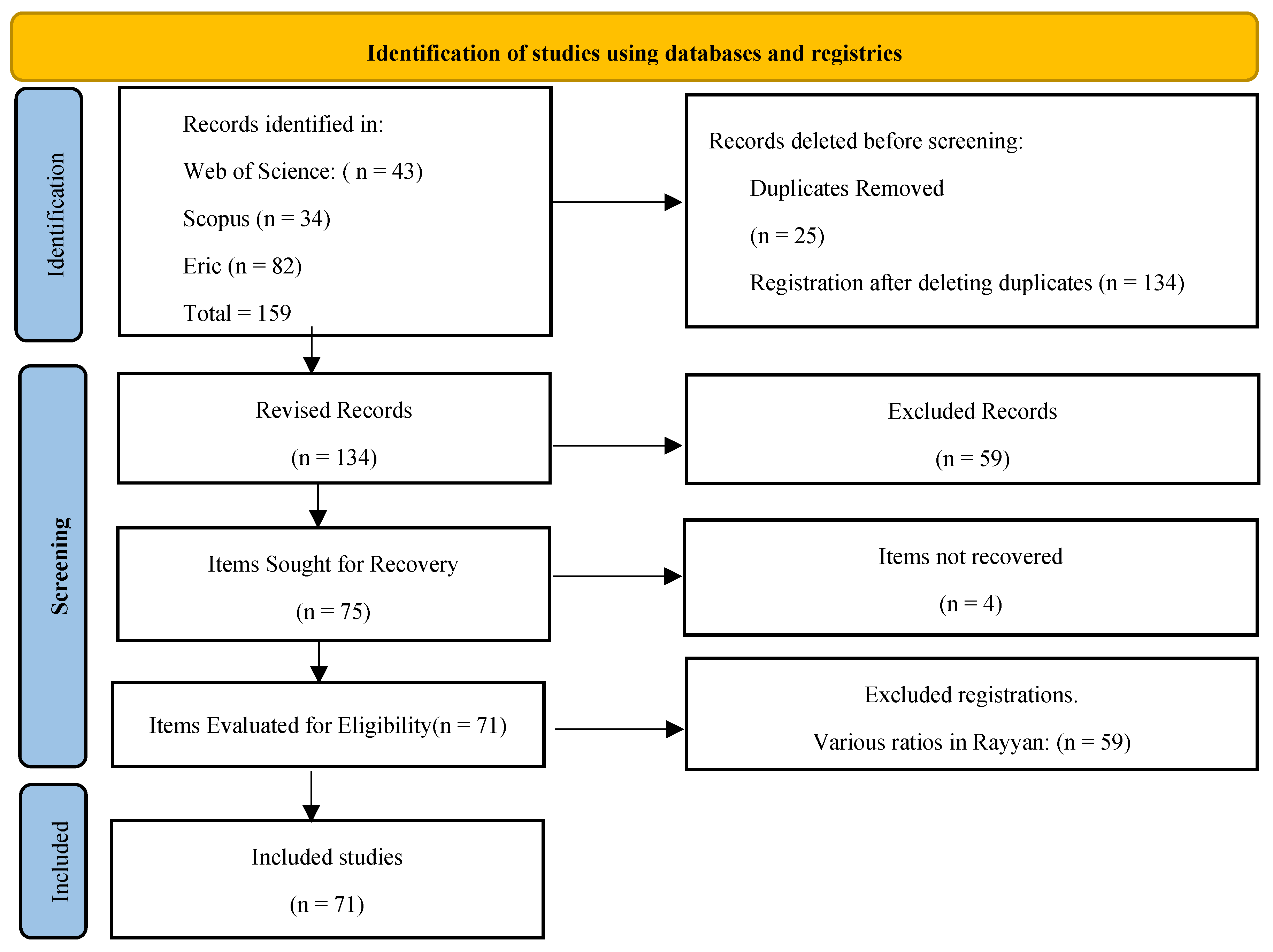
Figure 2.
Map of co-occurrence and temporal evolution of the main keywords on bidirectionality in professional practices (2010–2025). Note. The size of the nodes represents the frequency of occurrence of each term; the lines indicate co-occurrence relationships; The color scale represents the average year of appearance of keywords, from the earliest (blue) to the most recent (yellow) terms.
Figure 2.
Map of co-occurrence and temporal evolution of the main keywords on bidirectionality in professional practices (2010–2025). Note. The size of the nodes represents the frequency of occurrence of each term; the lines indicate co-occurrence relationships; The color scale represents the average year of appearance of keywords, from the earliest (blue) to the most recent (yellow) terms.
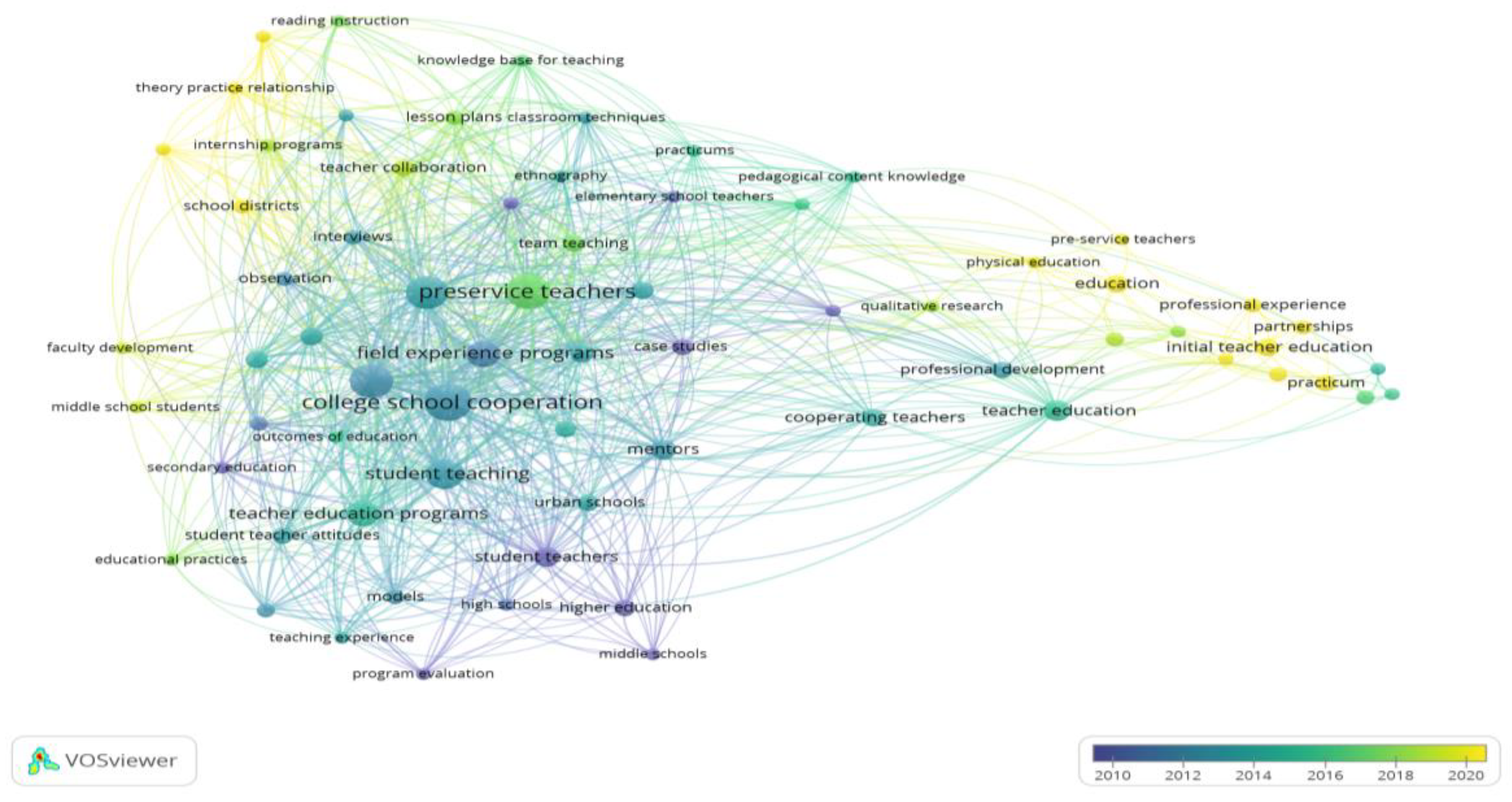

Table 1.
Conceptual evolution of bidirectionality in professional practices.
| Stage | Conception of the university-school relationship | Underlying concept of bidirectionality | Predominant concepts | Period characteristics | RIS_ID of period items* |
|---|---|---|---|---|---|
| 1990–1999 | The university organises the training and the school provides the context to learn how to teach. | Transfer of knowledge to the future teacher. Bidirectionality practically does not appear as an object of study. | Mentoring, Field-based Education, Internship, Partnership, Collaboration. | The supervision and accompaniment of the practitioner predominates. Knowledge circulates mainly from the university and experienced teachers to the student. | ID-001, ID-002, ID-003, ID-004 |
| 2000–2009 | University and school begin to recognize each other as partners in the same formative experience. | Functional reciprocity. Both institutions can benefit from collaboration, although learning continues to be predominantly focused on the future teacher. | Professional Development School, Community of Practice, Mutual Benefits, Co-teaching, Shared Assessment. | Institutional alliances are strengthened and evidence of benefits for more than one actor appears. The evaluation, however, continues to privilege the results of the practitioner and the functioning of the collaboration devices. | ID-005, ID-006, ID-007, ID-008, ID-009, ID-010, ID-011, ID-012, ID-013, ID-014, ID-015 |
| 2010–2018 | Professional practice begins to be understood as a shared space for professional learning. | Mutual learning. Interaction can generate professional development in future teachers as well as in mentors and academics, and experiences of co-construction begin to appear. | Professional Learning, Collaborative Inquiry, Reciprocal Professional Learning, Clinical Practice, Third Space, Co-teaching, Action Research. | Interest shifts from the organization of practice to the processes of interaction, reflection and learning between the actors. Learning from mentors, redistribution of roles, hybrid spaces and feedback towards university programs are beginning to be documented. | ID-016, ID-017, ID-018, ID-019, ID-020, ID-021, ID-022, ID-023, ID-024, ID-025, ID-026, ID-027, ID-028, ID-029, ID-030, ID-031, ID-032, ID-033, ID-034, ID-035, ID-036, ID-037, ID-038, ID-039, ID-040, ID-041, ID-068 |
| 2019–2026 | University and school constitute complementary spaces for the production, circulation and recontextualization of knowledge. | Co-construction and shared transformation. Bidirectionality is progressively understood as the circulation of knowledge in multiple directions, joint production and the potential capacity to modify practices and institutions. | Third Space, Boundary Crossing, Boundary Objects, Boundary Spanners, Knowledge Brokers, Hybrid Roles, Co-construction, Active Mentee Influence, Reciprocal Professional Learning. | The interest shifts towards the circulation and translation of knowledge, the legitimacy of complementary knowledge, the co-construction of practices and the transformations that interaction can produce in school and university. There is also an increased focus on institutional conditions, sustainability, and the evaluation of contributions and impacts. | ID-042, ID-043, ID-044, ID-045, ID-046, ID-047, ID-048, ID-049, ID-050, ID-051, ID-052, ID-053, ID-054, ID-055, ID-056, ID-057, ID-058, ID-059, ID-060, ID-061, ID-062, ID-063, ID-064, ID-065, ID-066, ID-067, ID-069, ID-070, ID-071 |
Source: Own elaboration; *The RIS_ID identify the studies included in each period, but this does not mean that all of them express with equal intensity the predominant conception attributed to that stage. The table reconstructs the dominant conceptual trend of the period; Within each stage, more traditional studies coexist with others that anticipate the next stage.
Table 2.
Bidirectionality maturity taxonomy.
| Level | Feature | Level Description | How is it evaluated in manuscripts? | Corpus Articles (RIS_ID) |
| 0. Presence | The university acts in the school, but without substantive interaction. | The school functions primarily as a practice setting. The roles remain separate and the flow of knowledge is predominantly one-way from the university or mentor to the future teacher. | Description of placements, organization of internships, assigned functions or institutional agreements. There are no indicators of interaction, mutual learning or changes derived from the relationship. | ID-001, ID-011, ID-012, ID-013, ID-036, ID-046, ID-057 |
| 1. Coordination | The actors exchange information and jointly organize the experience. | Mechanisms for coordination, communication and shared supervision between university and school are established, but interaction is still mainly oriented to the management of the practicum. | Coordination meetings, shared planning, frequency of contact, joint supervision, definition of roles, exchange of information and satisfaction with collaboration. | ID-002, ID-003, ID-006, ID-014, ID-017, ID-018, ID-024, ID-025, ID-031, ID-39, ID-51, ID-53, ID-58, ID-59, ID-60, ID-69, ID-70 |
| 2. Functional reciprocity | Both parties participate and receive differentiated benefits. | The partnership produces identifiable benefits for university and school, although these do not necessarily imply mutual learning. Each institution obtains resources, support or improvements associated with the collaboration. | Program results, benefits perceived by each institution, satisfaction, retention, support for schools, job placement, development of services or organizational strengthening. | ID-004, ID-005, ID-009, ID-010, ID-016, ID-019, ID-020, ID-023, ID-27, ID-28, ID-56 |
| 3. Mutual learning | It is shown that actors in both spaces modify knowledge, skills or practices. | Interaction produces professional learning in both directions. Participants incorporate new knowledge, revise beliefs or modify their actions as a result of the exchange. | Interviews, observations, or qualitative analyses documenting changes in knowledge, reflection, capacities, or practices of mentors, scholars, and future teachers attributable to the interaction. | ID-008, ID-015, ID-021, ID-022, ID-026, ID-029, ID-032, ID-33, ID-35, ID-40, ID-41, ID-42, ID-44, ID-47, ID-48, ID-49, ID-54, ID-61, ID-62, ID-64, ID-67, ID-68 |
| 4. Epistemic co-construction | University and school knowledge jointly produce new objects, criteria or practices. | Knowledge ceases to be transferred and begins to be constructed collectively. Curricula, assessment devices, materials, practices or pedagogical solutions developed jointly through sustained interaction emerge. | Evidence of co-design, co-teaching, joint research, shared texts, boundary objects, development of common products, shared pedagogical innovation or joint production of knowledge. | ID-007, ID-030, ID-034, ID-037, ID-038, ID-043, ID-045, ID-050, ID-052, ID-055, ID-063, ID-065, ID-066, ID-071 |
| 5. Institutional transformation | Learning returns and modifies practices, curricula or structures of both institutions in a sustained manner. | Bidirectionality transcends individual participants and is incorporated into institutional processes. Learning translates into relatively stable organizational changes with the ability to be sustained over time. | Longitudinal studies, curricular changes, modification of institutional policies, new models of supervision, continuity of partnerships, monitoring of impacts or evidence of institutionalization. In the corpus this evidence is still limited. | ID-056, ID-061, ID-063, ID-065, ID-070, ID-071 |
Source: Own elaboration.
Table 3.
Guiding dimensions for the assessment of bidirectionality in professional practices.
| Evaluation dimension | Guiding question | Expected evidence | Possible instruments | Contribution to the classification |
|---|---|---|---|---|
| Enabling conditions | Are there institutional conditions to develop a two-way relationship? | Protected time, clearly defined roles, available resources, coordination mechanisms, institutional support and stability of collaboration. | Documentary analysis, interviews with coordinators, review of agreements, interviews with managers. | It allows us to determine if the minimum conditions exist for the development of bidirectional processes. |
| Relational symmetry | Do the different actors participate under conditions of mutual recognition? | Participation in decision-making, recognition of professional and academic knowledge, balanced distribution of responsibilities and existence of spaces for dialogue. | Interviews, focus groups, meeting observation, governance analysis. | It allows us to distinguish hierarchical relationships from collaborative relationships based on reciprocal recognition. |
| Reciprocity of the flow of knowledge | How does knowledge circulate between university and school? | Evidence of exchange of knowledge, experiences or practices in both directions between the different participating actors. | Interviews, reflective diaries, observations, portfolios, documentary analysis. | It allows differentiating bidirectional processes from relationships where knowledge circulates only in one direction. |
| Mutual learning | What did each actor learn as a result of the interaction? | Evidence of knowledge acquisition, capacity building, modification of beliefs or changes in the professional practice of the different actors. | Interviews, stopovers, reflective diaries, focus groups, analysis of critical incidents. | It allows establishing whether the interaction produced reciprocal professional learning. |
| Co-construction | Were decisions, products or innovations developed together? | Shared design of activities, curricula, research, materials, protocols, evaluation criteria or pedagogical innovations. | Documentary review, observation, product analysis, interviews. | It allows identifying processes of joint production of knowledge and differentiating operational collaboration from epistemic co-construction. |
| Contributions | What changes did the experience produce for each actor involved? | Evidence of improvements in teaching practices, mentoring, curriculum, professional capacities, institutional capacities, collaboration networks or other contributions derived from the interaction. | Case studies, interviews, questionnaires, documentary analysis. | It allows the identification of the contributions generated by bidirectionality in each of the participating actors. |
| Institutionalization | Were the contributions incorporated by the organization? | Changes in regulations, curricula, practice models, protocols, organizational structures or permanent mechanisms derived from experience. | Institutional documents, interviews with managers, longitudinal monitoring, analysis of institutional policies. | It allows differentiating individual contributions from transformations incorporated by the organization. |
| Impact | Are the transformations achieved relevant and sustained over time? | Evidence of lasting changes in the university, school or educational system reasonably attributable to the experience developed. | Longitudinal evaluations, monitoring studies, analysis of institutional indicators, contribution analysis. | It allows the identification of the highest level of development of bidirectionality through sustained and relevant transformations. |
Source: Own elaboration.
Disclaimer/Publisher’s Note: The statements, opinions and data contained in all publications are solely those of the individual author(s) and contributor(s) and not of MDPI and/or the editor(s). MDPI and/or the editor(s) disclaim responsibility for any injury to people or property resulting from any ideas, methods, instructions or products referred to in the content. |
© 2026 by the authors. Licensee MDPI, Basel, Switzerland. This article is an open access article distributed under the terms and conditions of the Creative Commons Attribution (CC BY) license.
Copyright: This open access article is published under a Creative Commons CC BY 4.0 license, which permit the free download, distribution, and reuse, provided that the author and preprint are cited in any reuse.