
Submitted:
20 August 2026
Posted:
20 August 2026
You are already at the latest version
Abstract
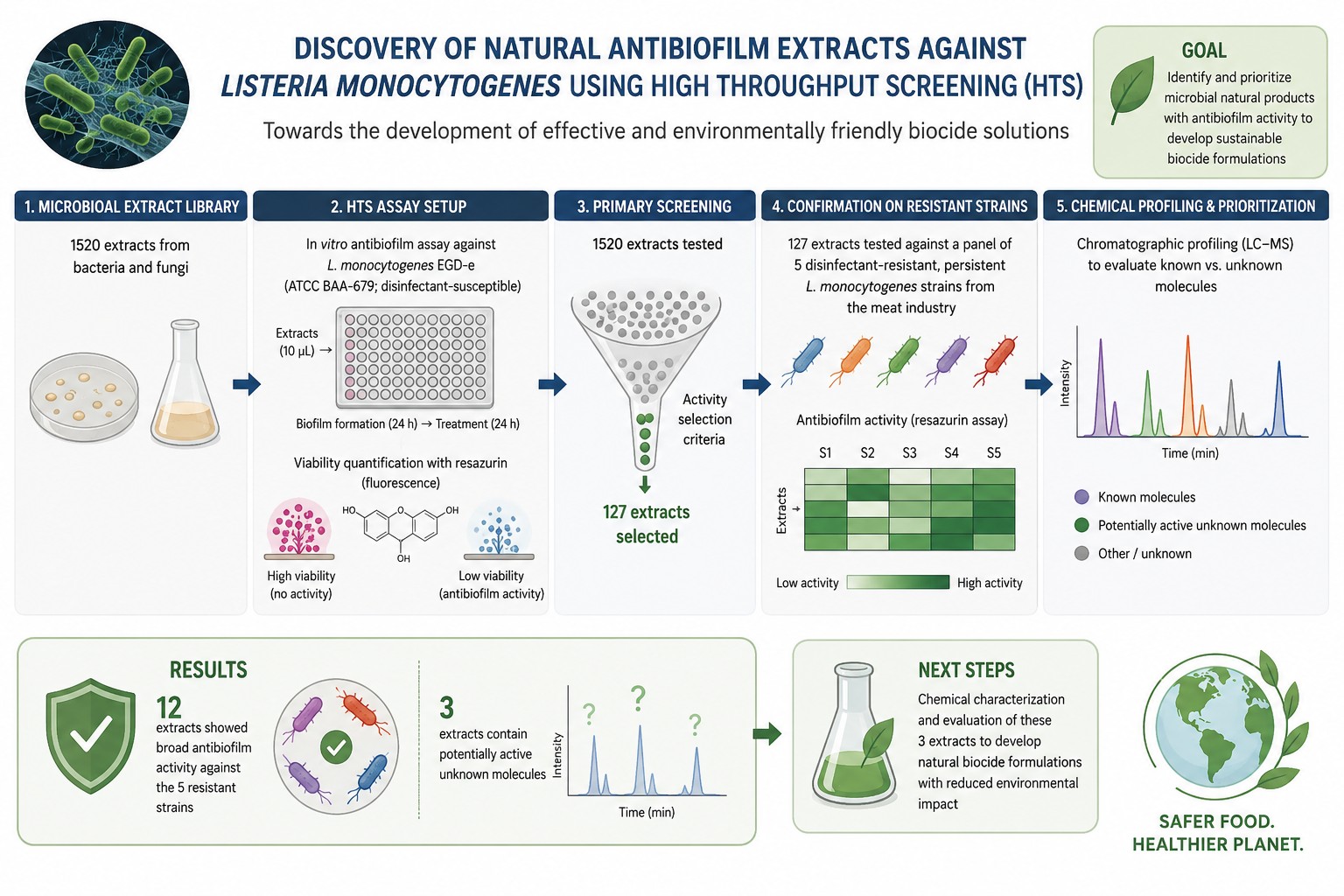
Listeria monocytogenes is one of the main foodborne pathogens in terms of mortality. To reduce its presence in food production environments and increase the microbiological safety of food by identifying and developing new biocides, this work joins the methodology of HTS (High Throughput Screening) with the search for innovative applications of microbial natural products. Experimental conditions of an in vitro HTS assay have been set up to detect microbial extracts with antibiofilm activity against a reference strain of L. monocytogenes (EGD-e, ATCC BAA-679) susceptible to disinfectants. Activity has been assessed by measuring fluorescence using resazurin (a redox indicator that allows quantifying the viability of the cells present in the biofilms). So far, 1520 microbial extracts have been tested, 127 of which have been selected based on their activity profile against the EGD-e strain. Subsequently, these extracts have been tested against a panel of five strains of L. monocytogenes resistant to disinfectants and persistently isolated from the meat industry, and their chromatographic profiles have been examined to prioritize their further study according to their activity and the presence of already known molecules. A total of 12 extracts has shown broad antibiofilm activity against the five resistant strains and three of them contain potentially active unknown molecules. Further work is underway to characterize the chemical composition and explore potential applications of these three extracts with the aim of developing natural biocide formulations with reduced environmental impact.
Keywords:
natural biocides
; microbial metabolite
; high throughput screening
; Listeria monocytogenes
; biofilms
Copyright: This open access article is published under a Creative Commons CC BY 4.0 license, which permit the free download, distribution, and reuse, provided that the author and preprint are cited in any reuse.