
Submitted:
20 August 2026
Posted:
20 August 2026
You are already at the latest version
Abstract
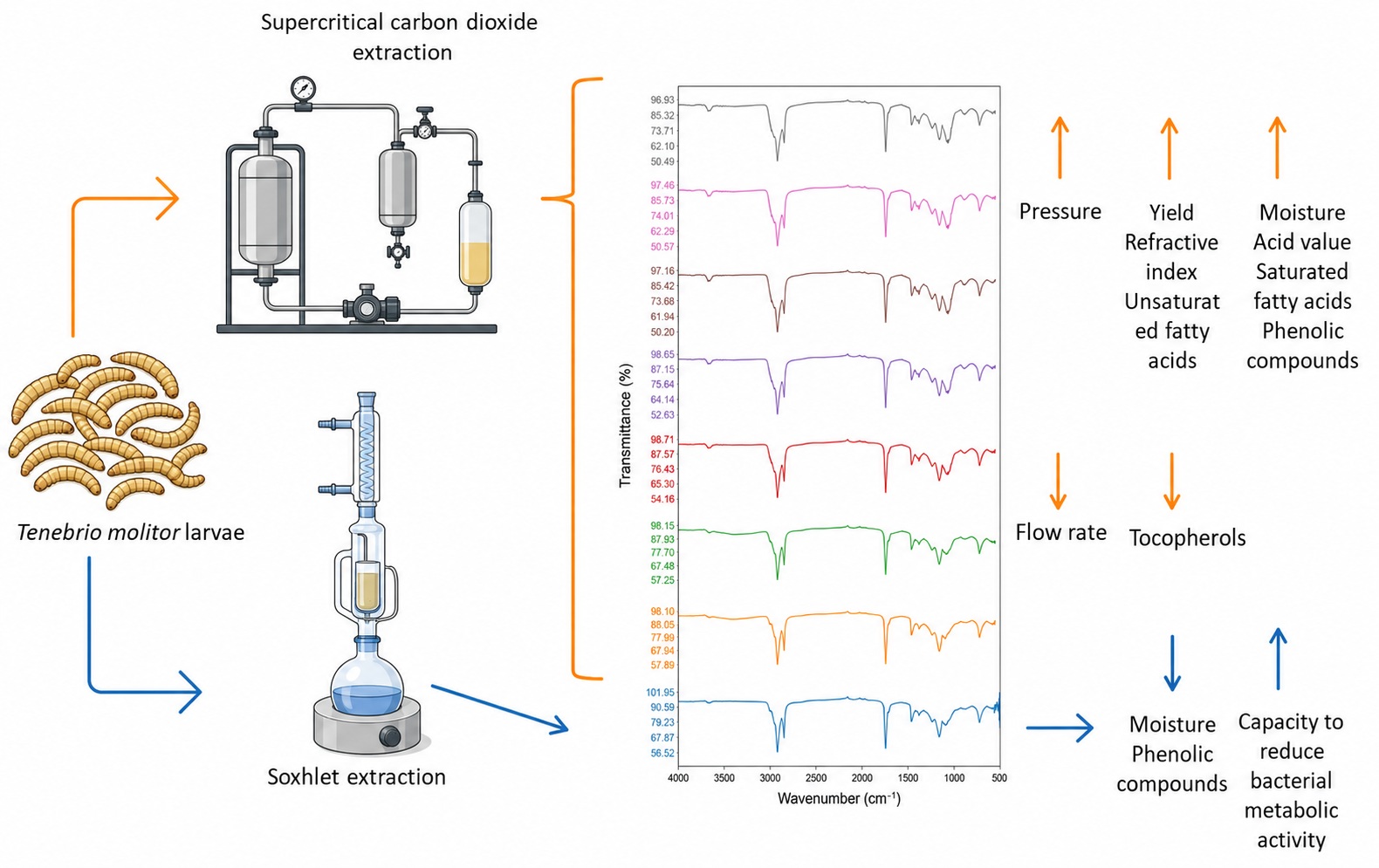
This study investigated supercritical carbon dioxide (SC-CO₂) extraction of omega-3 (ω-3) enriched oil from Tenebrio molitor larvae reared on a flaxseed-supplemented diet, using Soxhlet extraction as a benchmark. Pressure was the principal factor governing oil recovery, with higher pressures increasing yield. Low-pressure extraction resulted in higher residual moisture and acid values and a lower refractive index, indicating greater hydrolytic deterioration. Oleic (47.70–50.20%) and linoleic (20.39–21.18%) acids predominated, while α-linolenic acid reached 3.01–4.23%, providing a more favourable ω-6/ω-3 ratio than generally reported for T. molitor oil. Extraction conditions caused only minor changes in fatty acid composition and did not alter the characteristic triacylglycerol structure confirmed by ATR-FTIR. All SC-CO₂ extracts contained substantially more phenolic compounds than the Soxhlet extracted oil, although their recovery depended strongly on extraction conditions. High phenolic content and DPPH activity in samples with relatively low tocopherol concentrations indicated an important contribution of non-tocopherol antioxidants. The predicted shelf life was 105.8 days. Neither extraction method produced oil capable of completely inhibiting Staphylococcus epidermidis or Escherichia coli. Overall, dietary enrichment combined with optimized SC-CO₂ extraction represents a promising strategy for producing solvent-free, omega-3-enriched T. molitor oil, although further stabilization may be required.
Keywords:
Tenebrio molitor
; supercritical CO₂ extraction
; omega-3-enriched oil
; oxidative stability
; bioactive compounds
Copyright: This open access article is published under a Creative Commons CC BY 4.0 license, which permit the free download, distribution, and reuse, provided that the author and preprint are cited in any reuse.