

Submitted:
20 August 2026
Posted:
20 August 2026
You are already at the latest version
Abstract
Amenity migration and associated land-use changes are transforming working rangelands as new landowners with diverse stewardship objectives increasingly manage smaller, fragmented properties. Explanations of stewardship outcomes often emphasize individual knowledge and capacity while giving less attention to the broader social–ecological conditions affecting private-land sustainability. This study examines whether landowners’ perceptions of wildlife stewardship align with size-adjusted native mammal richness and identifies processes associated with alignment and misalignment. We combined camera-trap observations and semi-structured interviews from 12 wildlife-oriented properties with findings from broader focus groups conducted with Land Steward Amenity Migrants in Texas rangelands. Perceptions and the ecological indicator were misaligned in 75% of cases, with overestimation occurring most frequently. Qualitative analysis associated these patterns with self-referential evaluation processes, limited ecological feedback, institutional guidance mismatched with property scale, and limited relational networks for learning and comparison. These findings indicate that variation in perceived and observed stewardship outcomes cannot be understood through individual capacity alone but reflects interacting individual, ecological, institutional, and relational processes operating across scales. Supporting the long-term sustainability and resilience of fragmented rangelands therefore requires guidance suited to smaller properties, cross-boundary ecological strategies, and stronger opportunities for relational learning and coordination.
Keywords:
rangelands
; sustainable private land stewardship
; landscape fragmentation
; social–ecological systems
; wildlife management
; land stewardship
1. Introduction
Land use, management, and stewardship across working landscapes of the Global North are being reshaped as a result of amenity migration, raising broader questions about how environmental outcomes should be understood in increasingly fragmented social-ecological systems. These transformations raise questions about how changing ownership patterns reshape stewardship and whether variation in environmental outcomes can continue to be explained primarily through differences in individual landowner capacity. Addressing these questions requires a social-ecological perspective that considers how individual, ecological, institutional, and relational processes interact within increasingly heterogeneous working landscapes.
While rangeland ecosystems depend on management choices related to grazing, wildfire, and wildlife habitat to sustain biodiversity, ecosystem productivity, and long-term resilience [1,2], their stewardship is increasingly unfolding within landscapes experiencing rapid demographic change and shifting land uses [3]. Across predominantly privately owned regions of the eastern United States, amenity-driven exurbanization has expanded the number of small-acreage properties managed by new landowners with diverse backgrounds, experiences, and land-use goals [4,5,6,7].
Amenity migrants often prioritize biodiversity conservation, wildlife habitat, landscape restoration, and long-term ecosystem health, aligning in many cases with contemporary conservation priorities and growing societal expectations for multifunctional landscapes [8,9]. At the same time, they frequently manage smaller and increasingly fragmented properties while operating outside the ranching traditions, social networks, and experiential knowledge systems that historically shaped rangeland stewardship [10,11]. As amenity-oriented landowners assume stewardship over a growing proportion of working rangelands, understanding the factors that shape their management outcomes has become increasingly important.
Much of the literature explains variation in stewardship outcomes through differences in individual landowners' knowledge, experience, technical skills, and management capacity [12,13,14]. While these factors undoubtedly influence management decisions, an exclusively individual-level explanation assumes that stewardship outcomes are primarily the product of individual characteristics. From a social-ecological systems perspective, however, stewardship outcomes emerge through interactions among individual, community, institutional, and ecological domains rather than from individual decisions alone [15,16]. As rural landscapes become increasingly fragmented and socially heterogeneous, ecological feedbacks, institutional arrangements, cross-boundary processes, and social relationships may all shape environmental outcomes alongside individual management decisions.
Amenity migrants illustrate this challenge particularly well. Individuals' understandings of stewardship are shaped by their backgrounds, experiences, and values, giving rise to different mental models that influence how landscapes are interpreted, management priorities are established, and stewardship success is evaluated [17]. Recent work further demonstrates that management goals, ecological indicators, and management responses are themselves interpreted through mental models, resulting in different understandings of ecological conditions and appropriate management actions among different groups of land managers [18]. Consequently, amenity migrants may evaluate their stewardship differently from more traditional land managers, even when managing similar ecological systems [7].
Importantly, this does not imply that ecological assessment itself is inappropriate. Rather, it raises questions about how ecological outcomes are interpreted and explained. To examine this question, we compare landowners' perceptions of their wildlife stewardship with independently measured ecological outcomes. We use native mammal richness derived from camera-trap surveys as an ecological indicator of wildlife outcomes because biodiversity conservation is a stewardship objective shared across both production-oriented and post-productivist rangeland systems. This provides a common ecological benchmark for evaluating alignment between perceived and measured outcomes while allowing the analysis to focus on the processes that explain convergence and divergence rather than on differences in evaluation criteria.
Accordingly, this study addresses the following research questions:
Q1. Are amenity migrants’ perceptions of their wildlife stewardship aligned with the ecological indicator?
Q2. What factors are associated with patterns of alignment and misalignment between landowners' perceptions of stewardship and ecological outcomes?
To address these questions, we combine semi-structured interviews and focus groups with amenity migrant landowners alongside camera-trap surveys conducted on twelve wildlife-oriented private properties in Texas rangelands. Interviews document how landowners evaluate their wildlife stewardship, while independently measured native mammal richness provides an ecological assessment of wildlife outcomes. Comparing these complementary data sources provides an opportunity to move beyond capacity-centered explanations and better understand how stewardship outcomes emerge through interacting individual, institutional, ecological, and relational processes across fragmented landscapes.
Sustainability depends on the capacity to align property-level management with landscape-scale ecological processes, institutionally feasible practices, and relational mechanisms for learning and coordination. Understanding whether amenity-oriented landowners succeed as rangeland stewards is increasingly important in post-productivist rangeland economies, where sustainable ecological outcomes depend on actors whose goals extend beyond commodity production [4,5,6]. As amenity migrants come to manage a growing share of working rangelands, their stewardship decisions influence not only individual properties but also broader landscape dynamics and the long-term sustainability of rangeland ecosystems [2]. More broadly, by conceptualizing stewardship performance as a multiscalar social-ecological process rather than solely an individual attribute, this study contributes to scholarship on private land stewardship while offering practical insights for agencies and extension professionals seeking to strengthen conservation across fragmented private landscapes.
1.1. Amenity Migration and Private-Land Stewardship
This study focuses on private lands undergoing substantial changes in ownership, use, and stewardship through amenity migration, defined as movement from urban to rural areas motivated by proximity to nature and rural lifestyle benefits [4,19]. Amenity migrants vary in how they engage with rural landscapes. Landscape Consumer Amenity Migrants (LCAMs) primarily value landscapes for recreation, scenery, and lifestyle, whereas Land Steward Amenity Migrants (LSAMs) actively manage their properties for ecological restoration, wildlife conservation, or small-scale agriculture [20]. This study focuses on LSAMs because their management activities directly influence ecological processes and stewardship outcomes.
Research on LSAMs has largely focused on relatively affluent landowners acquiring large ranches in highly scenic regions such as the Greater Yellowstone Ecosystem [8,10]. In these contexts, landowners often rely on professional managers or consultants, and stewardship challenges center less on technical capacity than on identity formation, integration into rural communities, and reconciling conservation values with traditional rangeland practices. More recently, however, a different form of amenity migration has emerged following the COVID-19 pandemic. This wave consists largely of middle-class households purchasing smaller rural parcels in more affordable, nontraditional amenity regions, contributing to increasingly fragmented ownership patterns across many rangelands [9,21,22]. Research indicates that these newer LSAMs often possess limited experience, knowledge, and resources for rangeland management while pursuing diverse stewardship goals [9]. In fragmented landscapes, ecological processes such as grazing, fire, and wildlife habitat extend across multiple ownerships, making stewardship more complex than management decisions on individual parcels alone. Consequently, LSAMs frequently struggle to translate stewardship intentions into effective ecological outcomes [9,12,13] and are often portrayed as well-intentioned but capacity-limited stewards whose success depends largely on acquiring knowledge, skills, and technical assistance [6,9].
While these perspectives have contributed important insights, their emphasis on individual capacity has tended to frame stewardship challenges among LSAMs primarily as an individual capacity deficit problem. In this view, improving ecological outcomes depends largely on increasing landowners’ technical expertise through education, outreach programs, and improved access to institutional support [4,13,14]. Such explanations implicitly assume that when new landowners possess sufficient ecological knowledge, management experience, and access to technical assistance, stewardship outcomes should improve accordingly [5,12,24]. If this assumption is correct, landowners' perceptions of stewardship success should generally correspond with independently measured ecological outcomes.
Yet the extent to which these assumptions hold remains uncertain in fragmented landscapes where ecological processes, governance arrangements, and landownership patterns operate across multiple scales. Examining the relationship between landowners’ stewardship perceptions and ecological outcomes therefore provides an opportunity to move beyond capacity-centered explanations and better understand how stewardship outcomes emerge through interactions across multiple levels of the social–ecological system. When discrepancies occur between perceived stewardship success and ecological outcomes, these patterns may reflect not only individual knowledge limitations but also broader ecological constraints, institutional mismatches, and gaps in relational learning and feedback mechanisms among landowners, agencies, and ecological systems [3,23,24]. By situating landowners’ perceptions within this broader social–ecological context, this study contributes to a more comprehensive understanding of how stewardship outcomes are produced in changing rangeland landscapes.
1.2. Framework for Analysis
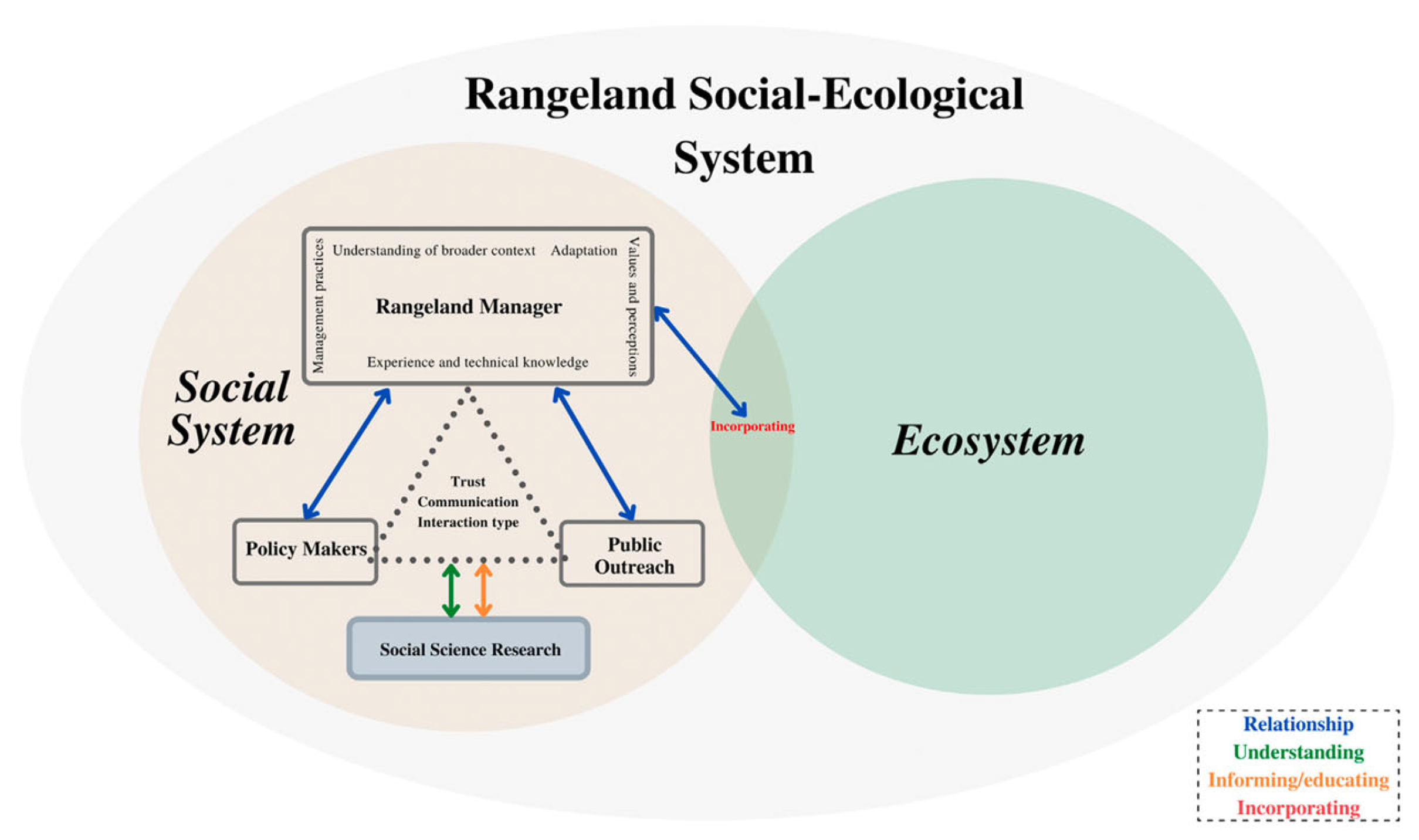
This study employs the Rangeland Social-Ecological Framework (RSEF) [3] to examine the relationship between Land Steward Amenity Migrants' (LSAMs) perceptions of their stewardship and independently measured ecological outcomes. The RSEF provides a conceptual lens for situating social-ecological processes at the center of rangeland inquiry by tracing multi-actor and multiscalar interactions among land managers, institutional actors, and ecological systems operating across parcels, landscapes, and governance levels. Originally developed to examine the effects of demographic change on rangeland stewardship, the framework is particularly well suited for analyzing LSAMs, whose management decisions are shaped by diverse motivations, varying levels of technical experience, and reliance on informal and cross-scale knowledge networks [6].
By linking landowners’ self-evaluations with independently measured ecological indicators, this study operationalizes the RSEF to examine whether stewardship perceptions align with observed ecological outcomes and to identify the conditions under which alignment or misalignment occurs. From this perspective, stewardship outcomes are understood as emergent properties of interactions among individual, ecological, and institutional processes, rather than as the direct result of individual decision-making alone.
Within the framework, several interrelated factors mediate the relationship between rangeland managers and ecosystems. These include landowners’ values and perceptions, their understanding of broader socio-economic and environmental conditions (e.g., markets, climate variability, and policy change), adaptive capacity, and technical knowledge. These factors influence both the selection of management practices and the interpretation of ecological feedback. For example, while long-time ranchers may rely on generational and institutional knowledge embedded in local networks, LSAMs often depend on emergent learning processes and cross-boundary interactions to guide stewardship decisions.
The framework also highlights the role of institutions, outreach systems, and technical assistance in shaping stewardship outcomes indirectly through multi-actor interactions. The quality of relationships with extension agents and agencies, including trust, communication, and perceived credibility, influences how information is interpreted, whether practices are adopted, and how ecological feedback is incorporated into decision-making. These relational dynamics are particularly important in contexts where landowners lack prior management experience and must rely on external knowledge sources.
By applying the RSEF to the analysis of perception–outcome alignment, this study advances understanding of how stewardship outcomes are produced in changing rangeland systems characterized by fragmented ownership and diverse landowner motivations. In doing so, it shifts attention from individual capacity alone toward the multiscalar social, ecological, and institutional processes that shape rangeland management outcomes, and provides a framework for identifying how misalignments among these domains shape stewardship outcomes.
Figure 1.
Factors mediating the interaction between rangeland managers and the ecosystem in a social-ecological system.
Figure 1.
Factors mediating the interaction between rangeland managers and the ecosystem in a social-ecological system.
2. Materials and Methods
2.1. Study Context and Population
This study integrates data from two complementary components of a broader research program on Land Steward Amenity Migrants (LSAMs) in Texas rangelands. The first consisted of focus groups conducted through a Natural Resources Conservation Service-supported initiative to characterize LSAMs. The second involved follow-up property visits, funded by Texas A&M AgriLife Research, that combined semi-structured interviews with camera-trap monitoring to examine relationships between landowners’ stewardship perceptions and ecological conditions. Findings from the focus groups have previously been used to examine participants’ motivations, stewardship goals, management experience, and assistance needs (reference removed to protect author anonymity). Property-level interviews with participating focus-group members have also been analyzed elsewhere to identify broader drivers of LSAM management decisions (reference removed to protect author anonymity).
Combining individual interviews and focus groups drawn from the same study population can provide complementary individual and contextual understandings of a phenomenon while allowing convergence across data sources to strengthen the trustworthiness of the findings [39,40]. The property interviews provided case-specific evidence used to classify the 12 properties, whereas the focus groups provided broader contextual evidence concerning processes occurring within the same study population. Because focus-group participants were not linked to the classified properties, however, these data support the broader relevance of the identified processes rather than their attribution to particular properties.
The present study conducts a distinct secondary analysis linking interview-based assessments of wildlife stewardship with independently collected camera-trap data. Its novel contribution is to examine alignment between landowners’ perceived stewardship effectiveness and size-adjusted native mammal richness at the property level and to identify the processes associated with alignment and misalignment. Qualitative data were therefore reanalyzed in relation to the perception–outcome classifications developed for this study, focusing on evaluation processes, ecological feedback, institutional fit, and relational learning. This analysis differs from the broader descriptive and management-decision analyses previously conducted with these datasets.
The 12 properties included in the final alignment analysis were distributed across five EPA Level III ecoregions in Texas, including the Cross Timbers, High Plains, Western Gulf Coastal Plain, Southern Texas Plains, and East Central Texas Plains. Ecoregion assignments were determined by spatially intersecting camera deployment locations with EPA Level III ecoregion polygons based on the Omernik ecoregion framework [25,26]. Exact property coordinates are withheld to protect landowner confidentiality. This distribution captures substantial variation in regional species pools, vegetation structure, precipitation regimes, and surrounding land-use contexts, all of which may influence camera-trap detections independently of property-level stewardship. Properties ranged from 12 to 1,900 acres and included small exurban parcels, medium-sized mixed-use properties, and one larger ranching–wildlife property. Dominant land uses included wildlife management, mixed ranching–wildlife management, habitat restoration, small-scale livestock use, and recreational land stewardship. Wildlife-relevant habitat features varied among properties and included grasslands, savannas, wooded edges, riparian areas, water sources, and mixed rangeland vegetation.
2.2. Research Design and Analytical Approach
Two complementary data streams were used for each property: (1) landowner self-assessments of wildlife stewardship collected through semi-structured interviews and (2) size-adjusted native mammal richness derived from camera-trap detections. Focus-group and interview data were subsequently used to interpret the social, institutional, and relational conditions associated with the resulting alignment classifications.
Perceived stewardship was operationalized as landowners’ self-evaluations of wildlife management, while ecological outcomes were operationalized as size-adjusted native mammal species richness derived from camera-trap detections. We use this measure as a relative indicator of observed native mammal richness during the sampling period, rather than as a comprehensive assessment of wildlife community condition or overall stewardship success. Because native mammal richness is relevant across both production-oriented and post-productivist rangeland systems, it provides a common ecological benchmark for examining patterns of alignment and misalignment independent of differing stewardship objectives.
The analysis proceeded in two sequential steps. First, landowners’ self-evaluations were compared with size-adjusted ecological indicators to classify each case as aligned or misaligned. Second, qualitative data from property-level interviews and focus groups were used to interpret the conditions associated with observed patterns of alignment and misalignment.
2.3. Social Data Sources and Analysis
Social data were generated through the two complementary sources that served distinct analytical purposes: focus groups and property-level interviews. The 12 properties provided the basis for identifying patterns of alignment and misalignment, while the broader focus-group data helped explain the social, institutional, ecological, and relational processes associated with those patterns. Although these processes cannot be attributed uniformly to every individual property, their recurrence across the broader LSAM population provides evidence of the wider conditions shaping stewardship perceptions and outcomes.
Focus groups were conducted with 64 LSAMs across five regions of Texas (i.e., Lubbock, Corpus Christi, San Angelo, Bryan, and Stephenville) during January and May of 2024. Focus group participants, who included individuals who self-identified as having migrated from urban to rural areas to acquire and manage land, were recruited through a combination of outreach strategies, including extension networks, print media, social media campaigns, and local advertising. Focus group questions examined landownership motivations, stewardship goals and plans, stewardship obstacles, previous experience and knowledge managing land, learning processes shaping land management decisions, and needed assistance. Altogether, the focus group questions provided insights into the broader social and institutional context within which LSAM stewardship occurs.
A subset of the focus group participants volunteered to participate in follow-up property visits that took place in June and July of 2024, which included semi-structured interviews and ecological monitoring conducted directly on their land. Sixteen landowners participated in this second phase of the study. The semi-structured instrument examined exurban landowners' stewardship goals, management practices, knowledge sources, barriers to implementation, and perceptions of stewardship effectiveness, which were subsequently compared with independent ecological assessments of their properties. Additionally, camera traps were placed on each property during the property visits. Each on-site visit lasted approximately one and a half to two hours.
As part of the semi-structured interview process, landowners were asked to evaluate their wildlife management practices using a five-point scale (Poor, Average, Good, Very Good, Excellent). For analytical consistency, this scale was collapsed into three categories by grouping all positive evaluations (Good, Very Good, Excellent) into a single “Good” category, resulting in a final three-level scale: Poor, Average, and Good.
Because the analysis for this paper focuses specifically on wildlife stewardship, cases were retained only when landowners identified wildlife management as a central stewardship objective during the interview. Based on this criterion, twelve landowners were included in the final analytical sample, while four were excluded because wildlife management was not identified as a primary management goal. These twelve cases form the basis for the alignment and misalignment analysis presented in this study. The property-level data enable comparison between landowners’ self-assessments of stewardship and the relative ecological indicator derived from camera-trap detections. Interviews and ecological monitoring were conducted within the same field season to ensure temporal alignment between social and ecological data.
When landowners expressed uncertainty about how to evaluate wildlife management, interviewers clarified that the assessment referred to practices intended to support native wildlife presence, including habitat maintenance, water provisioning, vegetation management, and grazing decisions. This clarification helped ensure that responses were grounded in comparable stewardship objectives while still allowing landowners to evaluate their practices relative to their own management goals.
The original qualitative analysis followed an inductive thematic approach. For the present study, the qualitative data were subsequently reanalyzed to identify evidence associated with the observed alignment patterns. Audio recordings from focus groups and semi-structured interviews were transcribed and reviewed multiple times to facilitate familiarization with the data. Initial coding focused on identifying recurring themes related to the main questions asked (e.g., stewardship motivations, management decision-making, learning processes, perceived challenges). Codes were iteratively refined and grouped into broader thematic categories through constant comparison across participants and data sources. Focus-group and interview data were analyzed separately during the initial coding process and subsequently compared to identify convergent and divergent themes. To enhance trustworthiness, findings were triangulated across focus-group and interview data, and themes were reviewed collaboratively by members of the research team to ensure consistency and analytical rigor. Following thematic analysis, findings from both qualitative datasets were used to interpret patterns observed in the alignment and misalignment analysis by identifying social, institutional, and contextual factors associated with landowners’ perceptions of wildlife stewardship.
2.4. Ecological Data Sources and Analysis
Wildlife occurrence data were collected using motion-activated infrared camera traps (Bushnell Trophy Cam HD E3, Bushnell Corporation, Overland Park, KS, USA) deployed on the participating properties described above. Across the 12 wildlife-oriented properties, the final dataset included 23 camera deployments: 11 properties had two camera deployments, and one property had one camera deployment. Based on deployment start and end dates, total sampling effort averaged 185 camera-days per property and ranged from 116 to 257 camera-days. Sampling effort varied among properties because deployment windows differed and one property contributed one usable camera deployment rather than two. To evaluate whether this unequal effort affected the ecological classification, we conducted a sensitivity check to determine whether total camera-days influenced native mammal richness or changed the size-adjusted wildlife classifications. Camera placement was determined through a participatory process involving the landowner, incorporating local ecological knowledge and site-specific indicators such as wildlife trails, water sources, and habitat features. Because cameras were intentionally placed at features expected to increase mammal detections, the survey design is best interpreted as a targeted detection survey rather than a randomized property-wide occupancy or abundance survey [27,28].
Camera-trap detections were exported from Wildlife Insights and summarized in R version 4.2.1 [29] using property-level deployment identifiers to link detections with site attributes. Detections were reviewed and classified to the finest reliable taxonomic level. For this analysis, repeated detections of the same species within a property were collapsed to a single property-level detection, and native mammal richness was calculated as the number of unique native terrestrial mammal species detected on each property. We retained only terrestrial mammal detections identified to species or interpretable native mammal categories and excluded domestic species, vehicles, birds, unidentified animals, and higher-level taxonomic placeholders from the native mammal richness metric. Species were classified as native using regional mammal references for Texas, primarily Schmidly and Bradley [30]. The complete list of native mammal species and interpretable native mammal categories detected across the 12 wildlife-oriented properties is provided in Supplementary Table S1.
Property sizes among the twelve wildlife-oriented properties ranged from 12 to 1,900 acres, reflecting substantial variation in parcel scale within the analytical sample. The median property size was 38 acres. For interpretive and comparative purposes, properties were grouped into three descriptive size classes: small (10–50 acres; LS), medium (50–200 acres; LM), and large (>200 acres; LL). These categories were used to describe patterns in the sample and to anonymize properties in figures and tables; they were not used as statistical predictors in the species–area model.
To account for the influence of property size on observed species richness, native mammal richness was modeled as a function of log-transformed property area using a species–area relationship for the twelve wildlife-oriented properties [31,32,33]. Figure 2 shows the fitted relationship between property size and observed native mammal richness. The fitted model was: native mammal richness = 0.177 + 0.718 × ln (property acres). The estimated coefficient for log-transformed acreage was positive but uncertain (β = 0.718, SE = 0.670, t = 1.072, p = 0.309; R² = 0.103, adjusted R² = 0.013). Residuals were calculated as the difference between observed native mammal richness and model-predicted richness, representing whether each property supported more or fewer native mammal species than expected given its size.
Native mammal richness was not rarefied because detections were analyzed as property-level incidence from targeted camera placements rather than as standardized abundance or count data. To evaluate whether unequal sampling effort affected the ecological classification, we conducted a sensitivity analysis that included total camera-days as an additional predictor and compared the resulting effort-adjusted residual classifications with the original size-adjusted wildlife ratings.
Residuals were standardized as z-scores to enable comparison across properties, and the resulting predicted values, standardized residuals, and size-adjusted Wildlife Ratings are reported in Table 1. Because no established thresholds exist for classifying size-adjusted native mammal richness in this application, standardized residual cutoffs of ±0.50 were used as a heuristic classification tool: Good (> 0.50), Average (−0.50 to 0.50), and Poor (< −0.50). These categories were used to support within-sample comparison and should be interpreted as relative ratings rather than absolute measures of wildlife community condition.
2.5. Linking Social and Ecological Data
To address Research Question 1, perception scores and size-adjusted wildlife ratings were paired at the property level to evaluate the relationship between landowners’ assessments of wildlife stewardship and the relative ecological indicator derived from camera-trap detections.
Within misaligned cases, directionality was used to further distinguish patterns. Overestimators are cases in which landowners rated their stewardship more positively than indicated by ecological outcomes, whereas underestimators are cases in which ecological outcomes exceeded landowners’ self-assessments. In addition, aligned cases were distinguished as accurate high performers (Good–Good) and accurate low performers (Poor–Poor). These classifications were used to organize cases into perception–outcome categories representing distinct relationships between perceived and measured stewardship outcomes, which form the basis for subsequent analysis.
To address Research Question 2, which seeks to explain patterns of alignment and misalignment, qualitative data from the focus groups and the semi-structured interviews were used to interpret the conditions associated with the observed perception–outcome relationships.
Given that the results for Research Question 1 indicate that misalignment constitutes the majority of observed perception–outcome relationships, the qualitative analysis places particular emphasis on these cases. Misalignment is treated as an analytically revealing condition, allowing for identification of recurring mechanisms that help explain divergence between perceived and ecological outcomes, including limited ecological feedback, uncertainty about appropriate management practices, and reliance on informal and cross-boundary learning networks.
3. Results
3.1. Q1: Are Amenity Migrants’ Management Perceptions Aligned with Ecological Indicators?
The comparison between landowners’ self-evaluations of wildlife management and size-adjusted wildlife ratings derived from camera-trap detections revealed both alignment and misalignment, with misalignment occurring in 75% of cases (9 of 12 properties; Figure 3). Overestimation was the dominant pattern, occurring in 67% of cases (8 of 12), while underestimation occurred in 8% (1 of 12). Perceptions and ecological outcomes were aligned in 25% of cases (3 of 12), including two accurate high performers (17% of the full sample) and one accurate average performer (8%). No cases exhibited alignment between poor perceived and poor measured outcomes.
The overestimators include all small-property landowners (LS1, LS2, LS3, LS4, LS5, LS6, LS7), as well as one large-property case (LL1). These landowners generally rated their wildlife management as good or average, yet the size-adjusted native mammal richness indicator placed them in average or poor wildlife rating categories. The clustering of small properties within this quadrant suggests that property scale may contribute to patterns of overestimation.
Accurate high performers, defined by alignment between good self-evaluations and good size-adjusted wildlife ratings, constituted a small subset of the sample and were represented by medium-sized properties (LM1 and LM4). These cases reflect landowners whose perceptions of wildlife management effectiveness are well calibrated with observed ecological outcomes.
Underestimation is relatively uncommon and is represented by a single medium-property landowner (LM3), whose wildlife rating exceeds their self-evaluation. A neutral reference case (LM2) occupies the midpoint of the distribution, showing alignment between average self-evaluation and average wildlife rating.
Notably, no landowners fall within the accurate low-performer quadrant, indicating that none of the wildlife-oriented participants simultaneously reported low self-evaluations and exhibited poor wildlife outcomes.
Overall, these patterns show that perceptions of wildlife stewardship were frequently misaligned with the size-adjusted native mammal richness indicator, even among landowners who explicitly prioritized wildlife management. The strong concentration of small properties within the overestimation quadrant suggests a potential role of scale in shaping both wildlife outcomes and landowners’ assessments of stewardship effectiveness.
As a sensitivity check, we evaluated whether unequal sampling effort influenced the ecological classification. Total camera-days did not explain additional variation in native mammal richness after accounting for property size (β = -2.778, SE = 3.881, p = 0.492), and camera effort did not explain the size-adjusted standardized residuals (R² = 0.048, p = 0.496). Wildlife-rating classifications were unchanged after accounting for camera effort.
3.2. Q2: What Factors Are Associated with Observed Patterns of Alignment and Misalignment?
The distribution of cases indicates that misalignment between perceived and ecological wildlife outcomes is widespread among wildlife-oriented landowners. To explain these patterns, we draw on property-level interviews and broader focus-group discussions. While interviews provide case-specific insight into how landowners evaluate their own management outcomes, focus groups reveal shared patterns in how stewardship is conceptualized, how ecological feedback is interpreted, and how structural factors shape management decisions.
Across these accounts, four recurring explanatory dimensions emerged: individual evaluation processes, ecological feedback constraints, institutional scale mismatches, and relational learning gaps. Together, these findings indicate that misalignment arises not solely due to capacity limitations or isolated errors in individual judgment, but from interacting processes operating across multiple scales of the rangeland social–ecological system.
3.2.1. Individual-Level Evaluation and Learning
The qualitative data indicate that LSAMs evaluate stewardship success through individualized learning trajectories rather than externally calibrated ecological benchmarks. Landowners frequently described management as an ongoing process of experimentation, adaptation, and incremental improvement, grounded in the specific conditions of their properties. As one participant explained:
“I just started reseeding some native plants and trying different things to see what works. It’s kind of trial and error, but we’re trying to improve things as we go.”
Another landowner emphasized the contextual nature of their management decisions:
“Understanding the information in the context of your operation is different for everyone. The principles may be the same, but how you apply them depends on your place.”
These accounts illustrate that stewardship is commonly interpreted through a learning-oriented and context-dependent lens. Under this perspective, success is evaluated relative to perceived improvement over time since property acquisition rather than against standardized ecological indicators. As a result, positive self-assessments often reflect effort, commitment, and a sense of ongoing improvement, rather than measurable wildlife outcomes. Thus, one landowner described evaluating success in terms of perceived change over time: “So, while it's a long-term plan, in three years, we've really seen quite a bit of change.”
This individualized and self-referential evaluation framework creates conditions under which landowners may interpret their management as effective despite modest ecological performance. This is illustrated by one landowner who confidently assessed her wildlife management as effective, stating, “For wildlife management, I’d say we’re good,” and later adding that “we probably do a lot more than other people.” In this way, learning-based evaluations represent one process associated with the predominance of overestimation within the sample.
While these individualized evaluation processes shape how landowners interpret stewardship success, they do not operate in isolation. The extent to which self-referential assessments persist depends in part on the availability and clarity of ecological feedback linking management actions to observable outcomes. When such feedback is limited or ambiguous, learning-based evaluations are less likely to be corrected or recalibrated, allowing positive self-assessments to endure even in the absence of measurable ecological gains. In this sense, individual evaluation processes are closely intertwined with ecological conditions that shape what can be observed and learned from management actions.
3.2.2. Ecological Feedback Constraints
Ecological factors constitute a second key mechanism shaping how landowners estimate stewardship effectiveness. Property size and landscape fragmentation influence the extent to which landowners can observe ecological responses to their management actions. On small, parcelized properties, where most misalignment cases are observed, ecological responses tend to be incremental, spatially diffuse, and slow to become detectable. Moreover, wildlife populations move across property boundaries and depend on habitat conditions extending beyond individual parcels.
Many participants expressed uncertainty about whether observed wildlife presence reflected their own management or broader landscape dynamics. As one landowner noted:
“You can do things in your place, but wildlife doesn’t stop at the fence. What happens next door matters just as much.”
Similarly, another landowner highlighted the difficulty of attributing wildlife presence to specific management actions:
“Well, I mean, we have wildlife, but I’m not doing anything specific. They just come.”
These conditions create a scale mismatch between management actions and ecological processes, limiting the visibility of cause–effect relationships. As a result, ecological feedback linking management actions to observable outcomes is often weak or delayed. This constrains landowners’ ability to accurately evaluate stewardship effectiveness and may contribute to observed patterns of misalignment between perceived and measured wildlife outcomes.
These ecological constraints not only limit the observability of management outcomes but also shape how individual learning processes unfold. When feedback is weak, delayed, or spatially diffuse, landowners are more likely to rely on subjective indicators of progress, reinforcing self-referential evaluation patterns. At the same time, the ability to respond to these ecological conditions is further mediated by the institutional context within which landowners operate. The extent to which management practices can be adjusted, scaled, or supported depends on how well institutional guidance aligns with the realities of small, fragmented properties whose landowners have little to no knowledge and experience stewarding the land.
3.2.3. Institutional Scale Mismatches
Institutional guidance and programmatic recommendations constitute a third mechanism shaping stewardship outcomes, often in ways that do not align with the realities of small, non-commercial parcels. Across cases, landowners described how recommended management practices implicitly assume larger properties, greater financial resources, and access to specialized equipment, conditions that are often absent among LSAMs. As one landowner noted, “I need 30 acres for conservation easement…,” highlighting how minimum acreage requirements can limit access to certain conservation programs.”
Consistent with prior research, LSAMs frequently operate under conditions of limited acreage, constrained labor, and partial reliance on off-farm income, while simultaneously navigating institutional systems designed for production-oriented landowners. As a result, recommended practices are often difficult to implement in practice. Participants commonly noted that practices such as prescribed burning or large-scale habitat management were constrained by parcel size, proximity to neighboring properties, liability concerns, and regulatory requirements. As one landowner explained:
“Everything we hear is designed for big ranches. On a place like ours, you can’t just go out and burn or move things around like they say.”
Similarly, study participants emphasized how small property sizes constrain the feasibility of recommended management practices. One landowner noted, “I don’t know that I have the perfect situation for [fire] here…,” pointing to the challenges of applying prescribed burning in fragmented landscapes with nearby neighbors. Another stated more directly, “It’s just too small of a place to do that with,” highlighting how scale alone can limit the implementation of certain interventions. In addition to spatial constraints, concerns about risk and the need for technical support further restricted adoption, as reflected in the comment, “I would never attempt a burn on my own… it’s so scary….” Together, these accounts illustrate how institutional recommendations, while technically appropriate at larger scales, become impractical or inaccessible at the parcel level, reinforcing a mismatch between prescribed management practices and the conditions under which LSAMs operate.
Beyond technical constraints, participants also described challenges navigating agricultural exemptions, conservation programs, and land-use regulations. Many indicated that they lacked familiarity with these systems and struggled to access or interpret available support, a pattern consistent with findings that LSAMs often depend on institutional guidance that is poorly aligned with their needs and capacities. As another participant noted:
“There’s a lot out there, but it’s hard to know what applies to you or how to actually get started with it.”
These conditions reflect a broader institutional mismatch in which stewardship capacity is contingent on systems that were not designed for this emerging landowner population. While LSAMs often express strong commitments to ecological stewardship and conservation-oriented goals, their ability to translate these intentions into measurable ecological outcomes is constrained by limited institutional fit, accessibility, and flexibility. In this context, stewardship outcomes are not solely a function of individual motivation or knowledge, but of the degree to which institutional structures align with the scale, resources, and goals of landowners.
As a result, even highly motivated landowners may be unable to implement practices at scales capable of producing detectable ecological responses. This structural constraint may contribute to persistent misalignment between perceived and measured outcomes, reinforcing the broader pattern observed across cases.
These institutional constraints not only limit the implementation of management practices but also shape the conditions under which learning and feedback occur. When recommended practices are difficult to apply or adapt to small-scale contexts, landowners are left with fewer opportunities to generate meaningful ecological responses that could inform evaluation. In addition, institutional misalignment often coincides with limited access to locally relevant support networks, further constraining opportunities for shared learning and comparison. As a result, understanding how landowners interpret stewardship outcomes requires attention not only to institutional fit, but also to the relational contexts through which knowledge, experience, and expectations are exchanged.
3.2.4. Relational Learning and Calibration Gaps
Relational networks play a critical role in shaping how landowners interpret and evaluate stewardship outcomes. Across cases, participants described limited interaction with neighboring landowners or experienced ranchers, particularly in recently subdivided landscapes where newcomers often lack shared histories, place-based knowledge, and established ties to local community networks. This pattern is consistent with prior work showing that LSAMs frequently enter working landscapes with limited integration into local social fields and rely on fragmented peer networks for information and support.
Several landowners described relying on external sources of information in the absence of established local knowledge networks. For instance, one participant noted that she “researched wildlife management plans online,” suggesting a reliance on self-directed and non-local sources of knowledge. Another indicated that their understanding of management practices came primarily from “the workshop,” referring to a training provided within the context of this study rather than to pre-existing community-based knowledge exchange. While some interactions with neighbors were mentioned, these tended to be limited and instrumental in nature; for example, one landowner described how a neighbor helped with tractor work, reflecting occasional assistance rather than an ongoing exchange of knowledge or collaborative learning. In other cases, neighbors were perceived as potential constraints rather than sources of support. As one landowner explained when discussing the use of prescribed fire, “I don’t know that my neighbors would like it,” revealing a degree of uncertainty and lack of confidence regarding how management decisions might be received within the local context. Together, these accounts illustrate how limited integration into local knowledge networks shifts learning toward dispersed, externally mediated, and non-comparative sources of information.
Importantly, relational dependence is not unique to new landowners. Even experienced ranchers rely extensively on local networks for knowledge exchange, labor sharing, informal advice, and reciprocal support. These interactional processes provide ongoing opportunities for comparison, feedback, and adjustment that help align management practices with ecological conditions. In contrast, LSAMs often operate with reduced access to these networks, limiting their ability to engage in the kinds of relational learning that underpin effective land stewardship.
Under these conditions, opportunities for social learning and peer-based calibration are constrained. Without access to trusted and ecologically comparable peers, landowners have limited ability to benchmark their management practices or outcomes against others operating under similar environmental and institutional conditions. As one participant explained:
“We don’t really know what others are doing around here, and everyone’s place is so different. You kind of just figure it out on your own.”
Another landowner highlighted the absence of locally grounded guidance:
“I wish there was someone nearby doing something similar so we could compare notes. Most of what we get is general advice, not really tied to places like ours.”
In the absence of these relational feedback mechanisms, landowners rely primarily on individualized learning strategies, including trial-and-error experimentation, online information sources, or occasional workshops. While these approaches provide valuable knowledge, they do not consistently offer the comparative feedback necessary to calibrate expectations against observable ecological outcomes. Prior research similarly finds that LSAMs depend heavily on outreach systems and informal learning channels that are often disconnected from locally specific conditions or peer-based exchange.
As a result, evaluation processes become increasingly self-referential. Without regular opportunities for comparison, reflection, and adjustment through interaction with knowledgeable peers, perceptions of stewardship success may persist even when ecological indicators suggest weaker outcomes. In this way, limited relational embeddedness constrains feedback loops that would otherwise refine expectations and align perceptions with ecological realities.
Taken together, these findings demonstrate that misalignment between perceived and ecological stewardship outcomes cannot be explained solely by individual knowledge deficits. Rather, alignment emerges from the interaction of multiple processes operating across scales, including individual learning dynamics, ecological feedback constraints, institutional structures, and relational networks. From this perspective, the widespread overestimation misalignment observed among wildlife-oriented landowners reflects the combined influence of limited ecological feedback, institutional mismatch, and constrained opportunities for social calibration in increasingly fragmented and socially reconfigured rural landscapes.
4. Discussion
While focused empirically on the sociodemographic shifts and related land ownership and use changes resulting from amenity migration, this study addresses the broader question of how fragmentation in working landscapes reshapes the processes through which stewardship emerges. The findings challenge the common assumption that differences in stewardship outcomes among amenity landowners can be explained primarily by variation in individual capacity. Existing scholarship on amenity migration, particularly studies of Land Steward Amenity Migrants (LSAMs), has often emphasized landowners' knowledge, experience, and technical competence as key determinants of stewardship [9,12,13,34]. Guided by the RSEF, our multiscalar analysis indicates that divergence between perceived stewardship and ecological performance arises from interacting individual, ecological, institutional, and relational processes operating across multiple scales of the rangeland social–ecological system. More fundamentally, the study distinguishes between measuring ecological outcomes and possible explanations. Independently measured ecological indicators remain indispensable for evaluating environmental performance. However, understanding why those outcomes are different than those reported by landowners requires attention to the multiscalar processes through which stewardship is enacted.
We interpret these findings cautiously because native mammal richness from a short-term camera-trap survey provides only a limited indicator of wildlife response. Richness may be influenced by seasonal activity patterns, regional species pools, detection probability, camera placement, adjacent land management, and landscape context. Accordingly, the ecological metric is best understood as a relative within-sample indicator used to compare wildlife-oriented properties, not as a comprehensive measure of stewardship success. Additionally, we are cautious in interpreting these findings given the small sample utilized here. Nonetheless, we believe the findings signal the importance of incorporating multiscalar analysis of changing social-ecological systems and outcomes.
As learned in our study, at the individual level, LSAMs evaluate stewardship success through learning-oriented and context-dependent processes rather than externally calibrated ecological benchmarks. Many LSAMs interpret success in terms of effort, improvement, and commitment to land care, rather than measurable outcomes such as wildlife diversity or habitat condition. These evaluations are not necessarily inaccurate but reflect alternative definitions of stewardship grounded in experiential learning. However, they may diverge from ecological conditions when not anchored in observable ecological feedback or comparative benchmarks. These divergences are shaped not only by knowledge, but also by how landowners conceptualize nature and stewardship. Amenity migrants often approach landscapes through aesthetic and lifestyle-oriented lenses often shaped by the way they socially construct views of nature and how those inform their stewardship goals. These can differ from functionally oriented management approaches [4,5]. In fire-prone systems, for example, such perspectives may conflict with disturbance-based management practices and influence how risks and interventions are perceived [34,35,36]. As a result, differences between perceived and observed outcomes reflect not only knowledge gaps, but differences in how stewardship success is defined.
At the ecological level, relationships between management actions and observed outcomes are complicated by property size and landscape fragmentation. Fragmentation can constrain wildlife movement and access to spatially distributed resources while disrupting ecological processes that operate across large, heterogeneous rangeland landscapes [38]. In small-parcel landscapes, wildlife populations and habitat dynamics may therefore operate at spatial scales exceeding individual property boundaries. Consequently, ecological conditions observed on a property may reflect broader landscape dynamics as well as site-level management, making it difficult for landowners to discern clear ecological responses to their own actions. These dynamics highlight a fundamental scale mismatch: ecological processes operate across landscapes, while management and evaluation occur at the parcel level. This limits the visibility of cause–effect relationships and complicates the interpretation of stewardship effectiveness. At the same time, proximity to neighboring landowners introduces additional constraints. Concerns about conflict, liability, and differing land-use values can discourage the adoption of certain practices, even when ecologically beneficial [6,9]. Thus, fragmentation shapes both ecological processes and the social conditions under which management decisions are made.
At the institutional level, stewardship guidance and evaluation frameworks remain largely oriented toward larger, production-focused systems. Many LSAMs manage properties that fall below the operational scales assumed in traditional rangeland management recommendations [7,13]. When guidance is mismatched with these conditions, landowners face constraints in implementing practices capable of producing detectable ecological outcomes. This limits not only adoption and effectiveness of recommended practices, but also how success is defined and evaluated. Prior research similarly identifies misalignments between amenity landowners’ needs and institutional design [4,9,13]. These institutional constraints are compounded by limited alignment between program design and the spatial realities of fragmented landscapes. Technical guidance often does not account for the configuration of small, adjacent properties or for the cross-boundary dynamics and social complexities through which these conditions shape ecological outcomes. As a result, LSAMs may be constrained in their ability to implement practices at scales sufficient to generate measurable ecological responses.
At the relational level, limited access to peer networks constrains both the calibration of stewardship expectations and access to knowledge, resources, and support [7]. In recently subdivided and socially heterogeneous landscapes, opportunities for shared learning and comparison are often limited. Without these relational feedback processes, LSAMs rely more heavily on their own definitions of success and individual experimentation, allowing perceptions of stewardship attainment to persist even when ecological indicators suggest weaker outcomes. At the same time, weak networks restrict access to practical resources such as labor, equipment, and locally grounded ecological knowledge.
These relational constraints complete the multiscalar set of processes shaping stewardship evaluation. Where ecological feedback is limited and institutional support is misaligned, relational networks become especially important contributing dynamics for interpreting outcomes and calibrating expectations. However, in fragmented and socially reconfigured landscapes, these networks are often weak or underdeveloped, reducing opportunities for comparison and collective learning. In this context, individual, ecological, and institutional dynamics converge through relational processes, shaping how stewardship effectiveness is understood and sustained over time.
These findings underscore the importance of relational integration in shaping stewardship outcomes. Such integration is common among traditional producers who exchange of knowledge, pool equipment and labor, and gain access to resources that would be difficult to secure independently [41,42]. Interactions with experienced land stewards and locally embedded networks provide opportunities for comparison, feedback, and adjustment that are often absent among LSAMs [9,13]. In their absence, evaluation processes become more self-referential, reducing opportunities for calibration between perceived and ecological outcomes. Further, relational processes are key to the reduction of misalignments, as they allow communication and interaction between individual, institutional, and community domains, helping actors engage, negotiate, and learn about and with others, allowing the development of new capacities that better reflect the needs and realities of the reconfigured social-ecological system.
These findings have implications for the sustainability of privately managed working landscapes. Sustainability in these systems depends not only on whether individual landowners adopt recommended practices, but also on whether ecological feedback, institutional support, and relational networks allow management efforts to function across properties and over time. Persistent misalignment among these processes can undermine biodiversity conservation and landscape resilience even when landowners possess strong stewardship intentions. Conversely, improving alignment can strengthen the capacity of fragmented rangeland systems to sustain ecological functions while accommodating changing ownership patterns and diverse land-use objectives.
Taken together, these findings indicate that stewardship outcomes in contemporary fragmented and heterogeneous working landscapes cannot be adequately understood through individual-level explanations alone. Further, stewardship outcomes cannot be adequately understood or explained without accounting for the ways fragmentation reshapes the social-ecological conditions under which management occurs. Across regions of the Global North where land is predominantly privately owned, amenity migration, land subdivision, and changing land uses are transforming working landscapes into increasingly heterogeneous social-ecological systems [7]. Our findings extend social-ecological systems scholarship by demonstrating how fragmentation can generate misalignments among individual, ecological, institutional, and relational processes that shape stewardship outcomes. Understanding these changing conditions is essential for advancing conceptual frameworks of fragmented landscapes while informing extension, conservation, and governance approaches better suited to increasingly heterogeneous working landscapes. Ultimately, fragmentation is not simply a change in landscape pattern; it is a transformation in the conditions under which stewardship and governance take place.
5. Conclusions
This study demonstrates that stewardship outcomes in amenity-driven rangeland systems cannot be understood through individual capacity alone. Instead, alignment between perceived and ecological outcomes emerges from interactions across ecological processes, spatial scales, institutional arrangements, and relational networks. By adopting a multiscalar social–ecological perspective, we show that misalignment is not simply the result of knowledge deficits, but can emerge when social–ecological systems do not effectively translate management efforts into meaningful feedback, support, and coordination.
These findings highlight the need to rethink how stewardship is evaluated and supported in increasingly fragmented working landscapes. Effective approaches must move beyond information delivery and instead align ecological indicators, management guidance, and outreach strategies with the realities of small, heterogeneous properties. This includes developing feedback mechanisms that reflect how landowners learn and assess success, designing programs that function under conditions of fragmentation, and strengthening peer-based networks that facilitate both learning and access to resources.
Ultimately, improving stewardship outcomes will require institutional adaptation that recognizes cross-boundary ecological processes and supports coordinated action among diverse landowners. As demographic, economic, and land use changes continue to reshape rural landscapes, reimagining how actors, institutions, and ecosystems interact across scales will be essential for the long-term sustainability of working lands, including their capacity to conserve biodiversity, sustain rural livelihoods, and remain resilient under changing social and ecological conditions.
Supplementary Materials
The following supporting information can be downloaded at the website of this paper posted on Preprints.org.
Author Contributions
Conceptualization, D.M.-C.; methodology, D.M.-C. and T.J.W.; formal analysis, D.M.-C. and T.J.W.; investigation C.V.-M. and M.T.; data curation, D.M.-C. and T.J.W.; writing—original draft preparation, D.M.-C, T.J.W., and C.V.-M.; writing—review and editing, D.M.-C., T.J.W., C.V.-M. and M.T.; visualization, C.V.-M and T.J.W.; project administration, D.M.-C.; funding acquisition, D.M.-C T.J.W. and M.T. All authors have read and agreed to the published version of the manuscript.
Funding
This research was funded by the U.S. Department of Agriculture Natural Resources Conservation Service, grant number NR237442XXXXC017, and by the Texas A&M University College of Agriculture and Life Sciences through Rangeland Ecology and Management Research Funding.
Institutional Review Board Statement
The study was conducted in accordance with applicable institutional ethical standards and approved by the Texas A&M University Institutional Review Board (STUDY2024-0013; approved 12 January 2024).
Informed Consent Statement
Informed consent was obtained from all participants involved in the study.
Data Availability Statement
The data presented in this study are not publicly available because they contain information that could compromise the privacy and confidentiality of participating landowners and properties. Deidentified data may be available from the corresponding author upon reasonable request and subject to institutional and ethical restrictions.
Acknowledgments
The authors thank the participating landowners for sharing their time, experiences, and knowledge and for providing access to their properties. The authors also acknowledge the assistance of the Natural Resources Conservation Service and Texas A&M AgriLife Research in supporting the broader research program from which this study was developed.
Conflicts of Interest
The authors declare no conflicts of interest. The funders had no role in the design of the study; the collection, analysis, or interpretation of the data; the writing of the manuscript; or the decision to publish the results.
References
- Briske, D.D. (Ed.) Conservation Benefits of Rangeland Practices: Assessment, Recommendations, and Knowledge Gaps; USDA Natural Resources Conservation Service: Washington, DC, USA, 2011. [Google Scholar]
- Sayre, N.F.; DeBuys, W.; Bestelmeyer, B.T.; Havstad, K.M. The range problem after a century of rangeland science: New research themes for altered landscapes. Rangel. Ecol. Manag. 2012, 65, 545–552. [Google Scholar] [CrossRef]
- Matarrita-Cascante, D.; Lucero, J.; Veintimilla, C.; Treadwell, M.; Fox, W.; Tolleson, D. Leveraging social science research to advance contemporary rangeland management: Understanding the ‘new faces’ of range managers. Rangelands 2023, 45, 1–11. [Google Scholar] [CrossRef]
- Gosnell, H.; Abrams, J. Amenity migration: Diverse conceptualizations of drivers, socioeconomic dimensions, and emerging challenges. GeoJournal 2011, 76, 303–322. [Google Scholar] [CrossRef]
- Abrams, J.; Gosnell, H.; Gill, N.; Klepeis, P. Re-creating the rural, reconstructing nature: An international literature review of the environmental implications of amenity migration. Conserv. Soc. 2012, 10, 270–284. [Google Scholar] [CrossRef]
- Matarrita-Cascante, D.; McCord, S.; Landaverde, R.; Veintimilla, C.; Treadwell, M.; Werdel, T.J.; et al. Beyond the productivist ideal: Understanding the drivers of land stewardship among amenity migrants transforming agrifood systems in rangelands. Agric. Hum. Values 2026, 43, 20. [Google Scholar] [CrossRef]
- Matarrita-Cascante, D.; Werdel, T.J.; Veintimilla, C. The social-ecological transformation of private lands and the future of wildlife management under amenity migration: A call for action. Sustainability 2026, 18, 3238. [Google Scholar] [CrossRef]
- Gosnell, H.; Haggerty, J.H.; Travis, W.R. Ranchland ownership change in the Greater Yellowstone Ecosystem, 1990–2001: Implications for conservation. Soc. Nat. Resour. 2006, 19, 743–758. [Google Scholar] [CrossRef]
- Matarrita-Cascante, D.; Veintimilla, C.; Brooke, C.; Treadwell, M.; Castro, C. Amenity migration for land stewardship: Getting to know the new faces in ranching. Rangelands 2025, 47, 151–160. [Google Scholar] [CrossRef]
- Haggerty, J.H.; Travis, W.R. Out of administrative control: Absentee owners, resident elk and the shifting nature of wildlife management in southwestern Montana. Geoforum 2006, 37, 816–830. [Google Scholar] [CrossRef]
- Huntsinger, L.; Johnson, M.; Stafford, M.; Fried, J. Hardwood rangeland landowners in California from 1985 to 2004: Production, ecosystem services, and permanence. Rangel. Ecol. Manag. 2010, 63, 324–334. [Google Scholar] [CrossRef]
- Meadows, J.; Emtage, N.; Herbohn, J. Engaging Australian small-scale lifestyle landowners in natural resource management programmes—Perceptions, past experiences and policy implications. Land Use Policy 2014, 36, 618–627. [Google Scholar] [CrossRef]
- Ikutegbe, V.; Gill, N.; Klepeis, P. Same but different: Sources of natural resource management advice for lifestyle-oriented rural landholders. J. Environ. Plan. Manag. 2015, 58, 1530–1543. [Google Scholar] [CrossRef]
- Sorice, M.G.; Kreuter, U.P.; Wilcox, B.P.; Fox, W.E., III. Changing landowners, changing ecosystem? Land-ownership motivations as drivers of land management practices. J. Environ. Manag. 2014, 133, 144–152. [Google Scholar] [CrossRef] [PubMed]
- Ostrom, E. Governing the Commons: The Evolution of Institutions for Collective Action; Cambridge University Press: Cambridge, UK, 1990. [Google Scholar]
- Ostrom, E. A general framework for analyzing sustainability of social-ecological systems. Science 2009, 325, 419–422. [Google Scholar] [CrossRef] [PubMed]
- Raymond, C.M.; Bieling, C.; Fagerholm, N.; Martín-López, B.; Plieninger, T. The farmer as a landscape steward: Comparing local understandings of landscape stewardship, landscape values, and land management actions. Ambio 2016, 45, 173–184. [Google Scholar] [CrossRef] [PubMed]
- Puntenney, C.P.; Hulet, A.; Hopping, K.A. Ranchers’ and federal land managers’ mental models of rangeland management across an environmental gradient. Rangel. Ecol. Manag. 2025, 98, 94–109. [Google Scholar] [CrossRef]
- Moss, L.A.G.; Glorioso, R.S. (Eds.) Global Amenity Migration: Transforming Rural Culture, Economy and Landscape; New Ecology Press: Kaslo, BC, Canada, 2014. [Google Scholar]
- Veintimilla-Marino, C.; Matarrita-Cascante, D.; Treadwell, M.; Brooke, C. From consumers to stewards: Understanding the spectrum of amenity migrants. Soc. Nat. Resour. 2026, 39, 685–694. [Google Scholar] [CrossRef]
- Haslag, P.H.; Weagley, D. From L.A. to Boise: How migration has changed during the COVID-19 pandemic. J. Financ. Quant. Anal. 2024, 59, 2068–2098. [Google Scholar] [CrossRef]
- Martin, F. Pandemic Drives Rural Land Sales in Texas. Houston Public Media, 2021. Available online: https://www.houstonpublicmedia.org/articles/news/business/2021/04/01/394764/pandemic-pushes-rural-land-sales-in-texas/ (accessed on 2 November 2024).
- Brunson, M.W.; Huntsinger, L. Ranching as a conservation strategy: Can old ranchers save the new West? Rangel. Ecol. Manag. 2008, 61, 137–147. [Google Scholar] [CrossRef]
- Gosnell, H.; Gill, N.; Voyer, M. Transformational adaptation on the farm: Processes of change and persistence in transitions to ‘climate-smart’ regenerative agriculture. Glob. Environ. Chang. 2019, 59, 101965. [Google Scholar] [CrossRef]
- Omernik, J.M. Ecoregions of the conterminous United States. Ann. Assoc. Am. Geogr. 1987, 77, 118–125. [Google Scholar] [CrossRef]
- Omernik, J.M.; Griffith, G.E. Ecoregions of the conterminous United States: Evolution of a hierarchical spatial framework. Environ. Manag. 2014, 54, 1249–1266. [Google Scholar] [CrossRef] [PubMed]
- Burton, A.C.; Neilson, E.; Moreira, D.; Ladle, A.; Steenweg, R.; Fisher, J.T.; Bayne, E.; Boutin, S. Wildlife camera trapping: A review and recommendations for linking surveys to ecological processes. J. Appl. Ecol. 2015, 52, 675–685. [Google Scholar] [CrossRef]
- Kolowski, J.M.; Forrester, T.D. Camera trap placement and the potential for bias due to trails and other features. PLoS ONE 2017, 12, e0186679. [Google Scholar] [CrossRef] [PubMed]
- R Core Team. R: A Language and Environment for Statistical Computing; R Foundation for Statistical Computing: Vienna, Austria, 2022. [Google Scholar]
- Schmidly, D.J.; Bradley, R.D. The Mammals of Texas, 7th ed.; University of Texas Press: Austin, TX, USA, 2016. [Google Scholar]
- Arrhenius, O. Species and area. J. Ecol. 1921, 9, 95–99. [Google Scholar] [CrossRef]
- Connor, E.F.; McCoy, E.D. The statistics and biology of the species-area relationship. Am. Nat. 1979, 113, 791–833. [Google Scholar] [CrossRef] [PubMed]
- Scheiner, S.M. Six types of species-area curves. Glob. Ecol. Biogeogr. 2003, 12, 441–447. [Google Scholar] [CrossRef]
- Abrams, J.; Bliss, J.C. Amenity landownership, land use change, and the re-creation of ‘working landscapes. Soc. Nat. Resour. 2013, 26, 845–859. [Google Scholar] [CrossRef]
- Eriksen, C.; Prior, T. The art of learning: Wildfire, amenity migration and local environmental knowledge. Int. J. Wildland Fire 2011, 20, 612–624. [Google Scholar] [CrossRef]
- Gordon, J.S.; Matarrita-Cascante, D.; Stedman, R.C.; Luloff, A.E. Wildfire perception and community change. Rural Sociol. 2010, 75, 455–477. [Google Scholar] [CrossRef]
- Gill, N.; Klepeis, P.; Chisholm, L. Stewardship among lifestyle-oriented rural landowners. J. Environ. Plan. Manag. 2010, 53, 317–334. [Google Scholar] [CrossRef]
- Hobbs, N.T.; Galvin, K.A.; Stokes, C.J.; Lackett, J.M.; Ash, A.J.; Boone, R.B.; Reid, R.S.; Thornton, P.K. Fragmentation of rangelands: Implications for humans, animals, and landscapes. Glob. Environ. Chang. 2008, 18, 776–785. [Google Scholar] [CrossRef]
- Lambert, S. D.; Loiselle, C. G. Combining Individual Interviews and Focus Groups to Enhance Data Richness. J. Adv. Nurs. 2008, 62(2), 228–237. [Google Scholar] [CrossRef] [PubMed]
- Guest, G.; Namey, E.; Taylor, J.; Eley, N.; McKenna, K. Comparing Focus Groups and Individual Interviews: Findings from a Randomized Study. Int. J. Soc. Res. Methodol. 2017, 20(6), 693–708. [Google Scholar] [CrossRef]
- Carlisle, L.; Montenegro de Wit, M.; DeLonge, M. S.; et al. Securing the Future of US Agriculture: The Case for Investing in New Entry Sustainable Farmers. Elem. Sci. Anthr. 2019, 7, 17. [Google Scholar] [CrossRef]
- Roche, L. M.; Schohr, T. K.; Derner, J. D.; et al. Sustaining Working Rangelands: Insights from Rancher Decision Making. Rangel. Ecol. Manag. 2015, 68(5), 383–389. [Google Scholar] [CrossRef]
Figure 2.
Relationship between native mammal species richness and property size across wildlife-focused private lands (n = 12). Points represent individual properties, with property size expressed as log-transformed acreage. The dashed line represents the fitted linear species–area relationship used to estimate expected native mammal richness as a function of property size. Deviations from this relationship were used to derive size-adjusted wildlife ratings.
Figure 2.
Relationship between native mammal species richness and property size across wildlife-focused private lands (n = 12). Points represent individual properties, with property size expressed as log-transformed acreage. The dashed line represents the fitted linear species–area relationship used to estimate expected native mammal richness as a function of property size. Deviations from this relationship were used to derive size-adjusted wildlife ratings.
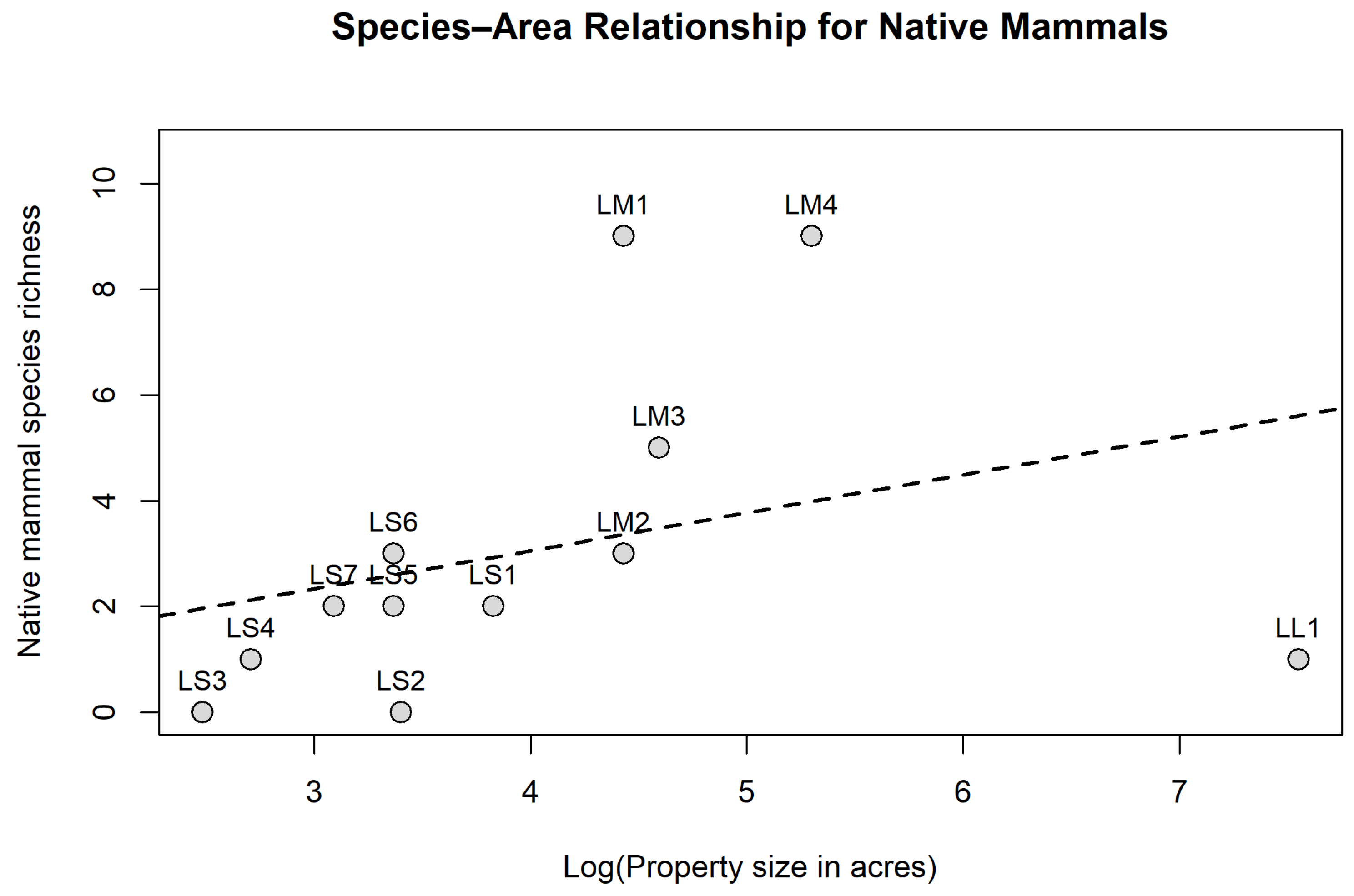
Figure 3.
Alignment and misalignment between social and ecological data by property.
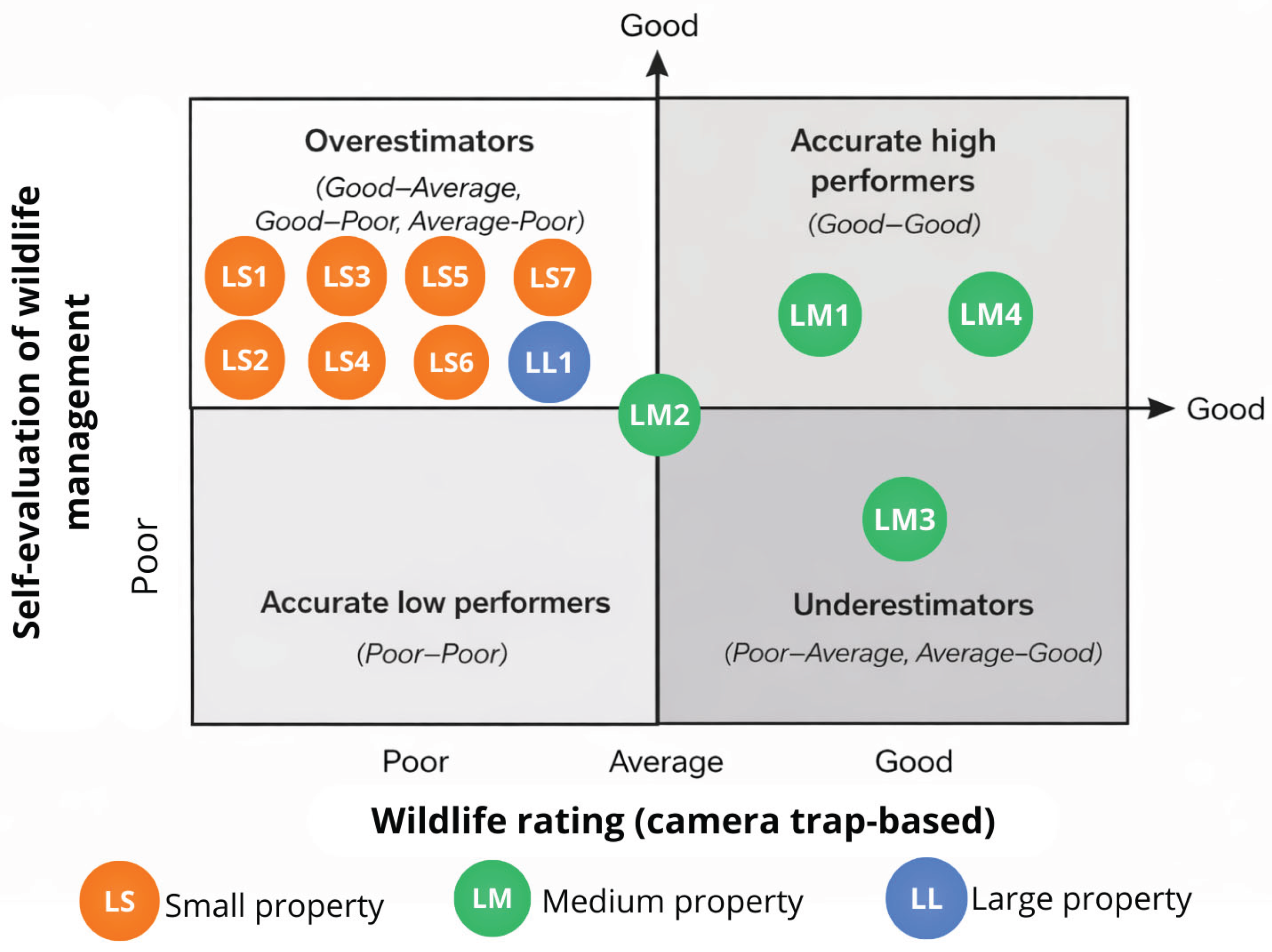

Table 1.
Observed native mammal richness, predicted richness based on the species–area relationship, standardized residuals, and resulting size-adjusted Wildlife Ratings for wildlife-focused properties (n = 12). Predicted richness values were derived from a linear model relating native mammal richness to log-transformed property size. Standardized residuals were calculated from raw residuals to enable comparison across properties. Positive standardized residuals indicate properties supporting more native mammal taxa than expected for their size, whereas negative standardized residuals indicate fewer taxa than expected. Wildlife Ratings classify properties as Good, Average, or Poor relative to size-based expectations.
Table 1.
Observed native mammal richness, predicted richness based on the species–area relationship, standardized residuals, and resulting size-adjusted Wildlife Ratings for wildlife-focused properties (n = 12). Predicted richness values were derived from a linear model relating native mammal richness to log-transformed property size. Standardized residuals were calculated from raw residuals to enable comparison across properties. Positive standardized residuals indicate properties supporting more native mammal taxa than expected for their size, whereas negative standardized residuals indicate fewer taxa than expected. Wildlife Ratings classify properties as Good, Average, or Poor relative to size-based expectations.
| Wildlife Rating | Standardized Residual | Predicted Richness | Native Mammal Richness | Property Acres | Site ID |
| Good | 1.928 | 3.360 | 9 | 84 | LM1 |
| Good | 1.715 | 3.983 | 9 | 200 | LM4 |
| Good | 0.520 | 3.478 | 5 | 99 | LM3 |
| Average | 0.138 | 2.596 | 3 | 29 | LS6 |
| Average | -0.123 | 3.360 | 3 | 84 | LM2 |
| Average | -0.136 | 2.397 | 2 | 22 | LS7 |
| Average | -0.204 | 2.596 | 2 | 29 | LS5 |
| Average | -0.317 | 2.927 | 2 | 46 | LS1 |
| Average | -0.384 | 2.122 | 1 | 15 | LS4 |
| Poor | -0.671 | 1.962 | 0 | 12 | LS3 |
| Poor | -0.896 | 2.620 | 0 | 30 | LS2 |
| Poor | -1.573 | 5.600 | 1 | 1900 | LL1 |
Disclaimer/Publisher’s Note: The statements, opinions and data contained in all publications are solely those of the individual author(s) and contributor(s) and not of MDPI and/or the editor(s). MDPI and/or the editor(s) disclaim responsibility for any injury to people or property resulting from any ideas, methods, instructions or products referred to in the content. |
© 2026 by the authors. Licensee MDPI, Basel, Switzerland. This article is an open access article distributed under the terms and conditions of the Creative Commons Attribution (CC BY) license (http://creativecommons.org/licenses/by/4.0/).
Copyright: This open access article is published under a Creative Commons CC BY 4.0 license, which permit the free download, distribution, and reuse, provided that the author and preprint are cited in any reuse.