

Submitted:
20 August 2026
Posted:
20 August 2026
You are already at the latest version
Abstract
The concession system for construction aggregate extraction plays a key role in ensuring the sus-tainable use of mineral resources while balancing economic development, environmental protection, and public revenue generation. This study presents an integrated framework for evaluating the ef-ficiency of construction aggregate concession systems, using the Prijedor Region (Republic of Srpska, Bosnia and Herzegovina) as a case study. The proposed framework integrates fiscal, administrative, and environmental performance indicators within a mixed-method approach combining legal and institutional analysis, quantitative economic modelling, comparative analysis, and an exploratory statistical assessment based on ordinary least squares (OLS) regression. Empirical data were col-lected from official government registers, concession records, inspection reports, and production statistics covering the period 2023-2025. The results suggest a positive relationship between public infrastructure investment and construction aggregate extraction, indicating that infrastructure development is associated with extraction dynamics during the observed period. At the same time, the analysis identifies structural weaknesses of the existing concession system, including limited inspection capacity, insufficient technical verification of reported extraction volumes, delayed land reclamation, and a fiscal imbalance associated with fixed concession fees. Comparative analysis with contemporary European regulatory practices highlights the importance of digital monitoring technologies, automated production verification, and strengthened institutional capacity for im-proving concession system governance. The proposed integrated evaluation framework provides a practical analytical tool for assessing construction aggregate concession systems and supports ev-idence-based policy development aimed at enhancing the sustainability, transparency, and gov-ernance of mineral resource management in transition economies facing comparable institutional and regulatory challenges.
Keywords:
construction aggregate
; concession system
; concession efficiency
; mineral resource governance
; concession fees
; sustainable mining
; integrated evaluation framework
; spatial analysis
; digital monitoring
; institutional capacity
1. Introduction
The extraction of mineral resources, particularly construction aggregates, plays an important role in supporting infrastructure development, construction activity, and regional economic growth. Owing to their high-volume and comparatively low-unit-value characteristics, construction aggregates are closely linked to spatial availability, transport distance, infrastructure investment, and local market demand. Contemporary research therefore increasingly addresses not only the optimization of aggregate production processes but also the broader economic, environmental, institutional, and spatial dimensions of mineral-resource management [1,2,3,4]. The increasing use of structured decision-support approaches in the construction sector also reflects a broader shift toward multidimensional evaluation frameworks capable of integrating technical, economic, and sustainability-related criteria [5].
The sustainable governance of mineral resources is increasingly understood as a multidimensional challenge in which economic performance, institutional capacity, environmental protection, transparency, and local development cannot be considered independently. Pedro et al. [6] argue that the effectiveness of extractive-sector governance depends not only on the existence of legal and regulatory instruments but also on their implementation, institutional coordination, transparency, and the capacity of public authorities to manage competing economic, environmental, and social objectives. Similar conclusions were reached by Vijge et al. [7], who showed that transparency mechanisms alone do not automatically improve institutional quality unless they are accompanied by effective participation and accountability. More recent comparative research by Liao and Zhang [8] further demonstrates that differences in regulatory implementation and institutional governance can produce substantially different development trajectories in mineral-rich economies even where geological and macroeconomic conditions are broadly comparable. These findings reinforce the view that mineral-resource governance should be evaluated through the performance of the overall institutional system rather than exclusively through formal regulatory provisions.
A second major strand of the literature concerns the design of fiscal instruments used to capture public value from non-renewable mineral resources. Mining royalties and concession fees are intended to compensate the resource owner for depletion while simultaneously maintaining conditions for economically viable extraction. Cawood [9] demonstrates that royalty design involves a fundamental trade-off between public revenue generation, administrative simplicity, investment incentives, and the capacity of governments to accurately determine the taxable or chargeable production base. This issue becomes particularly important where reported production quantities or revenues cannot be independently verified. Drew et al. [10] additionally show that extractive activities can impose substantial external costs on local governments, particularly through intensive infrastructure use, while the corresponding fiscal revenues may be collected or distributed at a different administrative level. Their analysis highlights the importance of evaluating mining-related public revenues together with the local expenditure burden generated by extractive activities. Recent research on royalty design also indicates that the choice between fixed, revenue-based, and profit-sensitive systems influences both fiscal stability and administrative requirements [11]. Consequently, the efficiency of a concession system cannot be assessed solely on the basis of the nominal concession rate; the reliability of production measurement, revenue allocation, institutional capacity, and locally generated externalities must also be considered.
Construction aggregates have additional governance characteristics because their economic value is strongly influenced by spatial availability, transport costs, and infrastructure demand. Escavy et al. [2] demonstrated that aggregate consumption is closely associated with broader economic and construction-sector dynamics, while Blachowski [12] showed that regional aggregate management requires the simultaneous consideration of mineral reserves, extraction intensity, transport flows, infrastructure capacity, and spatial planning. Related research from Lower Silesia further demonstrates that spatial and quantitative analysis of rock-mineral extraction and associated waste streams can provide an important basis for regional resource planning and the assessment of environmental pressures generated by quarrying activities [13]. Because aggregates are transported in large volumes, transport represents an important component of both their economic feasibility and their environmental and infrastructural impact. Regional planning therefore becomes an essential component of sustainable aggregate management. The Polish experience further demonstrates that safeguarding mineral deposits requires their systematic incorporation into spatial-planning instruments in order to prevent land-use conflicts and preserve the long-term accessibility of mineral resources [14]. The recent analysis of quarry regulation in the Piedmont Region by Narcisi et al. [15] further illustrates the value of integrating geological, technical, environmental, hydrological, and spatial information within regional mining plans. Such approaches move beyond site-specific permitting and treat quarrying as part of a broader resource-management system in which extraction must be coordinated with land use, environmental protection, and regional development objectives.
Environmental performance represents another central dimension of aggregate-resource governance. The Sustainable Aggregates Resource Management project demonstrated the need to integrate resource extraction, production, recycling, and environmental impacts within a common life-cycle perspective [16]. Subsequent research has shown that the environmental impacts of quarrying vary considerably depending on extraction technology, energy consumption, blasting requirements, machinery use, material characteristics, and transport. Bascompta et al. [17], for example, compared mechanical extraction and drill-and-blast quarrying through life-cycle assessment and demonstrated that extraction technology materially influences the environmental performance of quarry operations. Operational configuration and material-haulage systems also affect the economic and environmental performance of open-pit operations, as demonstrated by recent comparative modelling of conventional truck haulage and in-pit crushing and conveying systems [18]. In a comprehensive review and primary life-cycle assessment of virgin aggregates, de Bortoli [19] identified substantial methodological variation among previous aggregate LCA studies and emphasized the importance of including blasting, machinery, energy sources, rock characteristics, and transport when evaluating environmental performance. These findings complement research on quarry reclamation [20] and groundwater impacts [21], indicating that environmental efficiency should encompass not only emissions and resource consumption during active extraction but also land restoration, water protection, and post-extraction landscape functionality.
A further development in the literature concerns the digitalization of mineral-resource monitoring. Conventional regulatory systems frequently depend on operator reporting, periodic inspections, and documentary verification. Advances in remote sensing, geospatial analysis, computer vision, satellite observation, and automated measurement technologies, however, create opportunities for more continuous and independent supervision. López-Acevedo et al. [22] demonstrated that computer-vision analysis of satellite imagery can be used to identify aggregate quarries, determine their activity status, and support land-use planning and the early detection of potentially unauthorized extraction. Such technologies are particularly relevant where inspection capacity is limited or extraction sites are geographically dispersed. Digital monitoring therefore has implications beyond technological modernization: it can reduce information asymmetry between operators and regulators, improve the reliability of extraction records, strengthen fiscal control, and support more targeted inspection and environmental-management activities.
The relevance of these governance challenges is particularly pronounced in transition economies, where relatively comprehensive legislation may coexist with limited administrative resources, incomplete monitoring infrastructure, and uneven regulatory enforcement. Recent evidence from Serbia shows that mineral-resource management continues to face challenges related to institutional capacity, transparency, environmental performance, resource productivity, and the effective implementation of regulatory standards [23]. Evidence from quarry-dependent local communities similarly shows that mineral extraction can generate employment and income opportunities while simultaneously producing environmental degradation and social costs, emphasizing the need to evaluate local benefits and externalities within the same governance framework [24]. Comparable constraints are relevant to other Western Balkan jurisdictions, where mineral extraction contributes to regional economic development while public authorities simultaneously face the challenge of reconciling fiscal benefits with environmental protection, infrastructure costs, spatial planning, and transparent resource governance.
Taken together, previous studies provide important insights into individual components of mineral-resource governance, including royalty design, institutional quality, aggregate demand, spatial planning, environmental performance, reclamation, and digital monitoring. However, these dimensions have predominantly been examined separately. Relatively limited attention has been devoted to integrated evaluation frameworks that simultaneously assess the fiscal, administrative, environmental, and spatial performance of construction aggregate concession systems, particularly at the regional level in transition economies. This fragmentation of the existing literature represents the principal research gap addressed in the present study.
Within the Republic of Srpska, construction aggregate extraction is primarily regulated by the Law on Concessions and the Law on Mining [25,26]. These legislative acts establish the legal basis for the controlled, rational, and economically justified utilization of mineral resources, which are recognized as assets of public interest. The concession system is intended to protect public resources, generate fiscal revenues, provide investors with long-term legal certainty, and establish obligations related to environmental protection and post-extraction land rehabilitation. At the same time, concession revenues represent an important source of income for both the Republic of Srpska and the local governments in whose territories extraction takes place.
The Prijedor Region represents one of the most active areas of construction aggregate extraction in the Republic of Srpska owing to its geological characteristics, established mining tradition, and proximity to important transport and infrastructure corridors. Growing demand for construction aggregates associated with infrastructure development has increased the importance of evaluating whether the existing concession system provides an adequate balance between resource utilization, fiscal returns, institutional oversight, environmental protection, and local infrastructure costs [2,27,28,29]. More broadly, recent evidence indicates that road infrastructure investment can generate uneven regional economic effects, reinforcing the importance of examining infrastructure development together with the spatial distribution of resource-based activities [27].
Despite a formally established regulatory framework, several operational and structural challenges remain. One of the most important concerns relates to the recording and verification of extracted quantities, because certain quarry sites lack standardized technical monitoring infrastructure capable of providing continuous and independent production measurement. Such limitations may increase information asymmetry between concession holders and regulatory authorities and affect the reliability of the production base used for calculating concession fees. Additional challenges arise from limited inspection capacity, as the number of mining inspectors is low relative to the number and spatial distribution of active quarry sites. Under such conditions, inspection oversight may become predominantly reactive rather than preventive. Environmental challenges are also relevant, particularly with regard to landscape alteration, dust and noise emissions, groundwater protection, and the implementation of technical and biological reclamation measures [20,21,30,31].
The existing concession fee model adds a further fiscal dimension to these institutional challenges. Where fixed unit rates are applied over long concession periods without automatic adjustment to market conditions, and where reported extraction quantities cannot always be continuously verified, public revenues may not fully reflect changes in the economic value or intensity of resource extraction. At the local level, this issue becomes particularly relevant because quarry transport contributes to the deterioration of road infrastructure and may generate maintenance costs that are not necessarily proportional to the concession revenues received by local governments [9,10,11].
Against this background, the subject of the present study is the evaluation of the performance of the concession system governing construction aggregate extraction in the Prijedor Region. The system is assessed through four interrelated dimensions: fiscal performance, reflecting the relationship between extraction, concession revenues, and the estimated market value of production; administrative performance, referring to inspection capacity and the reliability of extraction monitoring; environmental performance, reflecting compliance with reclamation and environmental-management obligations; and spatial performance, reflecting the geographical concentration of extraction activities and their relationship with infrastructure demand and local externalities.
The primary objective of this study is to develop and demonstrate an integrated framework for evaluating the fiscal, administrative, environmental, and spatial performance of construction aggregate concession systems, using empirical data collected in the Prijedor Region during the period 2023-2025 as a case study. Specifically, the study examines whether the existing system of production recording and concession-fee calculation provides a sufficiently reliable basis for fiscal management, how institutional and technical monitoring capacity affects regulatory effectiveness, how environmental and reclamation obligations are implemented in practice, and how the spatial concentration of quarrying interacts with infrastructure demand and local economic costs.
Accordingly, the study addresses three principal research questions. First, to what extent does the existing system for recording extracted construction aggregate quantities and calculating concession fees provide a reliable basis for fiscal capture and transparent resource governance? Second, how do limitations in monitoring infrastructure, inspection capacity, illegal extraction risks, and reclamation practices affect the administrative and environmental performance of the concession system? Third, how are extraction dynamics, infrastructure investment, spatial concentration, and local fiscal effects interconnected within the regional concession system?
The study is based on the principal research assumption that the effectiveness of construction aggregate concession governance is closely associated with the quality of monitoring infrastructure, institutional capacity, transparency of production records, and the structure of fiscal mechanisms. It is further assumed that limited inspection and technical-monitoring capacity contributes to a predominantly reactive oversight model, while information asymmetry in production reporting may weaken the relationship between the economic value of extracted resources and the fiscal revenues received by public authorities and local governments.
The principal scientific contribution of this study is the development of an integrated methodological framework that combines fiscal, administrative, environmental, and spatial indicators within a unified analytical structure for evaluating construction aggregate concession systems. Unlike approaches focusing primarily on individual legal, fiscal, environmental, or technological aspects, the proposed framework integrates officially reported extraction data, concession-fee mechanisms, institutional oversight indicators, environmental compliance, spatial characteristics, and exploratory analysis of infrastructure-related extraction dynamics. Its practical value lies in providing an evidence-based basis for identifying weaknesses in concession governance and supporting policy measures related to production monitoring, concession-fee design, institutional capacity, environmental compliance, and the digitalization of regulatory oversight.
Methodologically, the research applies a mixed-method approach combining quantitative and qualitative analyses of primary and secondary data. The units of analysis include mining and concession legislation, official concession and production registers, inspection records, and annual construction aggregate extraction data for the Prijedor Region during 2023-2025. The quantitative component includes economic modelling of the estimated market value of extracted aggregates, analysis of the spatial contribution of local governments to regional production, and exploratory correlation and regression analyses examining the observed relationship between extraction volumes and public infrastructure investment. The qualitative component includes legal and institutional analysis, document content analysis, and comparative evaluation of the Prijedor findings against selected international regulatory and technological practices.
2. Regulatory Framework for Construction Aggregate Extraction in the Republic of Srpska
Since mineral resources and other natural resources are legally defined as assets of public interest owned by the Republic of Srpska, their exploitation is subject to strict administrative control. The regulatory framework is primarily based on the Law on Mining [25], the Law on Geological Surveys [32], and the Law on Concessions of the Republic of Srpska [26], supplemented by implementing regulations and the responsibilities of the competent governmental authorities.
The Law on Mining and the Law on Geological Surveys constitute the technical and regulatory foundation of the mining sector. These legislative acts comprehensively regulate the conditions and procedures governing geological exploration, the approval of mining areas, the preparation of mining projects, the implementation of occupational health and safety measures, and environmental protection throughout mining operations. With regard to construction aggregate extraction, the legislation classifies this material as a non-metallic mineral resource intended for construction purposes. Extraction activities may only be authorized at deposits where commercially recoverable reserves have been previously verified and certified, thereby ensuring the technical feasibility of mining operations. The legislation further requires that mining activities be managed by licensed mining engineers who have successfully passed the professional licensing examination and possess the required practical experience. Particular emphasis is placed on the statutory obligation to implement progressive reclamation during mining operations and final technical and biological land reclamation upon completion of extraction. However, the empirical findings of this study indicate that the implementation of these obligations remains below the legally prescribed level, which may be attributed to the logistical and human resource constraints faced by the competent inspection authorities responsible for supervising the final stages of mining activities.
The legal and economic framework governing the exploitation of mineral resources is established by the Law on Concessions of the Republic of Srpska, which regulates the conditions, procedures, and methods for granting concessions for the utilization of mineral resources, including construction aggregates. A concession is defined as the right to conduct commercial activities involving the exploitation of mineral resources, granted for a predetermined period by the Commission for Concessions and the Government of the Republic of Srpska to domestic or foreign legal entities in return for the payment of concession fees.
The Law on Concessions establishes a fiscal decentralization mechanism intended to mitigate the impacts of mineral extraction on local communities. Revenues generated from regular concession fees are distributed so that 70% is allocated to the municipality in whose territory extraction takes place, while the remaining 30% is transferred to the budget of the Republic of Srpska to support broader institutional functions and public policy implementation. The portion allocated to local governments is earmarked for infrastructure development and the rehabilitation of areas affected by mining activities. The empirical models presented in this study indicate that the effectiveness of this fiscal mechanism largely depends on the quality of information management and technical monitoring systems. Under the current system of fixed concession fees ranging from EUR 0.18 to EUR 0.23 per cubic metre, information asymmetry between operators and regulatory authorities may reduce the accuracy of reported extraction volumes, thereby directly affecting the revenues generated for local budgets.
In addition to mining and concession legislation, environmental protection and spatial planning regulations constitute an essential component of the regulatory framework. Since construction aggregate extraction involves drilling, blasting, crushing, grinding, and transportation processes that directly affect both the environment and spatial development, the Law on Environmental Protection [31] and the Law on Spatial Planning and Construction of the Republic of Srpska [33] prescribe strict administrative requirements that must be fulfilled before mining operations may commence. Concession holders are required to obtain an environmental permit based on an environmental impact assessment, which establishes permissible noise and dust emission limits, specifies allowable concentrations of other pollutants, and defines mandatory monitoring measures for air quality and groundwater. In addition, operators must obtain location conditions and a construction permit defining the spatial requirements for production facilities and supporting mining infrastructure, while ensuring compliance with minimum setback distances from residential areas. Although the administrative procedures for issuing these permits are clearly prescribed by legislation, the findings of this study indicate certain weaknesses in the operational enforcement of these requirements. The absence of permanent monitoring systems at some extraction sites increases reliance on operators' compliance while simultaneously highlighting the need to strengthen independent institutional oversight.
Implementation of the regulatory framework and supervision of the legality of construction aggregate extraction are entrusted to the competent authorities of the Republic of Srpska, whose responsibilities are clearly defined. The Ministry of Energy and Mining of the Republic of Srpska serves as the central regulatory authority responsible for maintaining concession registers, calculating concession fees on the basis of production reports submitted by operators, and approving mining projects and extraction plans. Operational supervision of quarrying activities is carried out by the Republic Administration for Inspection Affairs, through the Mining Inspectorate, whose inspectors are authorized to conduct technical inspections of mining sites, verify the professional qualifications of personnel, supervise compliance with occupational safety and land reclamation requirements, and temporarily suspend mining operations in cases of identified irregularities or illegal extraction. Local self-government units do not possess direct authority over mining inspections; however, through municipal and environmental inspection services, they participate in monitoring the impacts of mineral transport on local road infrastructure, as well as noise and dust levels in residential areas.
The analysis of institutional capacity conducted in this study reveals a pronounced imbalance between legally prescribed responsibilities and the actual operational resources available for their implementation. The ratio of seventeen active legal quarries to a single territorially responsible mining inspector in the Prijedor Region, together with the fact that only two mining inspectors are responsible for the entire territory of the Republic of Srpska, indicates that the regulatory system operates under continuous logistical constraints. Such a shortage of institutional capacity contributes to a predominantly reactive inspection system, thereby increasing the risk of economic, spatial, and environmental challenges associated with mineral resource extraction.
3. Study Area and Data Sources
The geographical and economic focus of this study is the Prijedor Region, located in the northwestern part of the Republic of Srpska (Figure 1). Administratively, the study area comprises the City of Prijedor and the municipalities of Novi Grad, Kozarska Dubica, Kostajnica, Oštra Luka, and Krupa na Uni. The Prijedor Region is one of the country's most important mining and geological areas, with a long tradition of mineral resource extraction. Historically, mining activities have been dominated by the exploitation of metallic mineral resources, particularly iron ore from the Ljubija, Tomašica, and Omarska deposits. In addition, the region possesses significant deposits of non-metallic mineral resources, among which construction aggregates play an important role in supporting contemporary economic development.
Production capacity is primarily concentrated in the City of Prijedor and the municipalities of Novi Grad and Kozarska Dubica, whereas Kostajnica currently contains temporarily inactive concession sites. The municipalities of Oštra Luka and Krupa na Uni have latent resource potential but currently do not contain active registered open-pit quarries.
The geological structure of the Prijedor Region is complex and heterogeneous, reflecting the area's intensive tectonic evolution, particularly within the Kozara Mountain zone and the Prijedor fault basin. The region is predominantly characterized by deposits of limestone, dolomitic limestone, and dolomite, whose physical, mechanical, and chemical properties satisfy the technical requirements for the production of construction aggregates. Rock masses in the wider Prijedor area, particularly within the transition zones toward Ljubija and along the margins of Kozara Mountain, are characterized by high compressive strength, low abrasion resistance values, and excellent frost resistance. According to applicable technical specifications, these rock types are suitable for the production of aggregates used in concrete, asphalt mixtures, and road base and sub-base layers. Most construction aggregate deposits in the Prijedor Region are classified as hillside deposits, providing favorable topographic conditions for economically efficient surface mining. Extraction is carried out using controlled blasting techniques, after which the material is transported to primary and secondary crushing and screening facilities for processing and grading.
Most active quarries are located in close proximity to the Prijedor-Banja Luka and Prijedor-Novi Grad regional transport corridors. Although this spatial distribution reduces transportation costs for concession holders, the analysis suggests that it also places considerable pressure on the local road network. Continuous operation of heavy transport vehicles accelerates road deterioration, representing one of the principal operational and financial challenges faced by local communities within the study area.
To ensure a high level of objectivity, accuracy, and scientific rigor, this study combines complementary primary and secondary data sources. The empirical analysis of concession system efficiency covers the three-year period from 2023 to 2025, enabling the identification of both stable economic trends and short-term market fluctuations. Data were collected from multiple complementary sources and classified into two categories: official institutional records and author-developed economic models and simulations.
The official records comprise empirically verified data obtained directly from government databases and served as the primary source of information for this research. Data provided by the Commission for Concessions of the Republic of Srpska were obtained from the official Concession Register and include the number of active concession agreements for construction aggregate extraction within the Prijedor Region, comprising 17 active quarry sites in 2025, together with concession durations, ownership structures of concession holders, and their contractual obligations.
Records obtained from the Ministry of Energy and Mining of the Republic of Srpska include the administrative boundaries of approved mining areas, decisions on the certification and classification of proven mineral reserves, and officially reported annual extraction volumes for the three-year study period. In 2025, officially reported production amounted to 480,000 m³ in the City of Prijedor, 105,000 m³ in Novi Grad, and 10,000 m³ in Kozarska Dubica, together with the corresponding historical production data for 2023 and 2024. Information obtained from the Republic Administration for Inspection Affairs included official records on the organizational structure and the number of active mining inspectors both at the level of the Republic of Srpska and within the territorially competent inspection office in Prijedor. These data were subsequently used to calculate a measurable indicator of inspection workload.
Because of technical limitations in the field, most notably the absence of weighbridges at certain quarry sites, some components of the financial analysis are based on economic simulations rather than empirically documented public revenue. Since no official database exists on the retail market value of extracted construction aggregates, a market value simulation model was developed. The model estimates the total market value by multiplying the officially reported extraction volume (Q), expressed in cubic metres, by a market price range of EUR 5.13-12.82 per m³, using an average price of EUR 8.97 per m³.
These simulations were designed to test the research assumptions regarding the economic efficiency of the current concession fee model. They should not be interpreted as empirically verified estimates of actual market values but rather as theoretical projections of potential economic activity associated with the informal sector.
Data verification was performed through triangulation by comparing officially reported annual extraction reports with the semi-annual geodetic surveys of quarry sites that concession holders are required to submit to the Ministry of Energy and Mining of the Republic of Srpska. This procedure reduced the risk of overinterpreting the results and ensured methodological consistency between the theoretical scenarios and the official statistical data.
4. Methodology
To evaluate the performance of the concession system governing construction aggregate extraction in the Prijedor Region, this study adopted a multi-method research approach integrating legal and institutional analysis, economic modelling, spatial assessment, comparative evaluation, and exploratory statistical analysis. The methodological framework was designed around four interrelated dimensions of concession-system performance: fiscal, administrative, environmental, and spatial. The analysis was based on official extraction and institutional data for the period 2023-2025 and was intended to provide an integrated assessment of how concession revenues, monitoring capacity, environmental obligations, and the spatial distribution of extraction interact within the regional governance system.
The first component of the methodology consisted of an analysis of the regulatory and contractual framework governing construction aggregate extraction. Concession agreements recorded in the Concession Register of the Commission for Concessions of the Republic of Srpska were examined with regard to concession duration, fee structure, methods of fee calculation, revenue-allocation mechanisms, and contractual provisions relevant to fiscal and regulatory performance. Particular attention was given to provisions governing the adjustment of concession fees over time and to the relationship between fixed unit charges and changes in the market value and intensity of aggregate extraction.
Concession agreements for construction aggregate extraction in the study area are generally granted for periods ranging from 20 to 30 years. The concession-fee structure includes an upfront concession fee payable upon conclusion of the concession agreement and a recurring fee applied throughout the concession period. Although the regulatory framework permits concession fees to be calculated as a percentage of revenue, most active quarry sites in the Prijedor Region operate under fixed unit rates ranging from EUR 0.18 to EUR 0.23 per cubic metre of extracted material. The contractual analysis therefore also examined whether these fixed rates contain mechanisms for adjustment or indexation in response to inflation or changes in market prices.
The quantitative component of the study examined officially reported annual extraction volumes, the estimated market value of production, the corresponding concession-fee flows, and their legally prescribed distribution between local governments and the budget of the Republic of Srpska. Under the applicable fiscal-allocation mechanism, 70% of concession-fee revenues is allocated to the local government in whose territory extraction takes place, while 30% is allocated to the budget of the Republic of Srpska. These proportions were applied consistently within the economic simulation model.
Fiscal performance was assessed by comparing officially reported extraction volumes, modelled market values of production, and simulated concession-fee revenues. Because no comprehensive official database of retail aggregate prices was available, the market-value component was treated as a model-based estimate rather than as an empirically verified measure of realized revenue. The purpose of this simulation was to evaluate the sensitivity of potential fiscal outcomes to changes in extraction intensity and to illustrate how deficiencies in production measurement could influence concession-fee calculations.
A separate sensitivity scenario was used to illustrate the potential consequences of discrepancies between actual and officially reported extraction volumes. In this scenario, the parameter Q represents the officially reported extraction volume, while hypothetical deviations from Q were used exclusively to examine how information asymmetry or incomplete production verification could affect fiscal outcomes. These scenarios should not be interpreted as estimates of actual underreporting or illegal extraction, but as analytical simulations of the potential fiscal effects of measurement uncertainty.
Administrative performance was evaluated primarily through an inspection-capacity indicator defined as the ratio between the number of active legal quarry sites and the number of territorially responsible mining inspectors. This indicator was used as a proxy for the operational capacity of the regulatory system to conduct regular and preventive supervision. The analysis also considered the extent to which limited staffing and incomplete technical monitoring infrastructure may constrain the detection of reporting irregularities or potentially unauthorized extraction activities. The indicator therefore measures institutional exposure to monitoring risk rather than the actual extent of illegal extraction.
Environmental performance was assessed qualitatively through the analysis of reclamation practices, inspection records, environmental obligations prescribed by concession agreements and environmental permits, and available evidence concerning compliance with technical and biological land-rehabilitation requirements. Because the available administrative records did not support the construction of a standardized numerical reclamation index for all quarry sites, environmental performance was interpreted qualitatively rather than expressed as a composite quantitative score.
Spatial performance was assessed through the geographical distribution of active quarry sites and extraction volumes among the local governments comprising the Prijedor Region. The analysis considered the concentration of extraction activities, differences in production intensity among municipalities, proximity to major transport corridors, and the relationship between quarrying activity and infrastructure demand. This spatial component was included to capture territorial differences in both the fiscal benefits and locally borne infrastructure and environmental pressures associated with aggregate extraction.
The comparative component of the methodology examined the consistency between legally prescribed objectives and observed operational practice in the Prijedor Region. Legislative and administrative requirements were compared with measurable institutional and operational findings in order to identify implementation gaps. The comparison focused particularly on inspection capacity, production verification, reclamation obligations, and the allocation and use of concession revenues. The principal comparison criteria are summarized in Table 1.
To examine whether annual changes in public infrastructure investment were accompanied by corresponding changes in construction aggregate extraction, an exploratory ordinary least squares (OLS) regression analysis was performed. The dependent variable (Y) was defined as the annual volume of construction aggregate extraction in the Prijedor Region, expressed in thousands of cubic metres, while the independent variable (X) represented annual public investment in regional transport infrastructure, expressed in millions of EUR. The analysis was based on annual observations for the period 2023–2025.
The linear regression model is expressed as:
where (Y) denotes annual construction aggregate extraction volume, (X) denotes public infrastructure investment, (β₀) is the intercept, (β₁) is the regression coefficient representing the estimated change in extraction associated with a one-unit change in infrastructure investment, and ε represents the error term.
The relationship between the variables was additionally summarized using the Pearson correlation coefficient (r) and the coefficient of determination (R²). Given the very limited number of annual observations (N = 3), the regression analysis was not used for hypothesis testing, causal inference, forecasting, or formal statistical generalization. Instead, it was treated as an exploratory descriptive component intended to illustrate the direction and magnitude of the observed co-variation between infrastructure investment and aggregate extraction during the study period.
Taken together, the four analytical dimensions and the exploratory statistical component form the integrated evaluation framework applied in this study. The framework combines fiscal flows, institutional monitoring capacity, environmental compliance, spatial concentration, and infrastructure-related extraction dynamics within a single analytical structure, while maintaining a clear distinction between officially reported empirical data and author-developed model simulations.
5. Results
Empirical data for this study were collected through the integration of primary and secondary data sources covering the three-year period from 2023 to 2025. Secondary data on the number of active concession agreements, the location of mining sites, and officially reported mineral extraction volumes were obtained from the records of the Ministry of Energy and Mining of the Republic of Srpska and the annual reports submitted by concession holders. The reliability of these data was verified through data triangulation, by comparing the reported extraction volumes with the semi-annual geodetic surveys of mining sites that operators are legally required to submit to the competent authorities. The study included only companies holding valid permits for construction aggregate extraction within the Prijedor Region, encompassing the City of Prijedor and the municipalities of Novi Grad, Kozarska Dubica, Kostajnica, Krupa na Uni, and Oštra Luka.
Several methodological limitations were identified during the research, primarily arising from differences in the technical equipment available at individual quarry sites. During the study period, some operators did not have functional weighbridges installed at quarry exits, resulting in official production records that were partially based on internal estimates derived from loader bucket capacities or the number of dispatched trucks. Consequently, a clear distinction is made throughout this study between officially reported data and author-developed model estimates. While the official records constitute the basis of the empirical analysis, the model estimates are used exclusively to simulate alternative economic scenarios and test the proposed research assumptions, without implying that they represent empirically verified measures of actual production or spatial conditions.
The analysis of the collected data indicates that the total volume of legally extracted construction aggregates in the Prijedor Region amounted to 815,000 m³ in 2023, 517,200 m³ in 2024, and 595,000 m³ in 2025. The spatial distribution of quarry sites and production volumes reveals a pronounced geographical concentration of extraction activities, with the majority of production capacity located within the City of Prijedor. A detailed overview of the spatial and temporal characteristics of extraction activities is presented in Table 2 and Figure 2.
The data presented in Table 2 and Figure 2 confirm the dominant role of the City of Prijedor in regional construction aggregate extraction. Throughout the study period, the City of Prijedor consistently recorded both the highest number of active quarries and the largest production volumes. In 2025, nine of the region's seventeen active quarry sites were located within its territory, accounting for more than 80% of total regional extraction. This concentration of production reflects more developed production capacity, better transport connectivity, and a higher level of technical and technological development than in the surrounding municipalities.
In contrast, Novi Grad maintained relatively stable production throughout the study period, with annual extraction remaining close to 105,000 m³. Although the number of active quarries increased over time, total production remained virtually unchanged, suggesting that extraction activities were primarily driven by local demand rather than by major infrastructure investment cycles. Kozarska Dubica accounted for a considerably smaller share of regional production and exhibited a gradual decline in extraction volumes, whereas the municipalities of Kostajnica, Krupa na Uni, and Oštra Luka recorded no active extraction during the study period. These findings indicate the presence of either dormant or temporarily inactive concession areas and reveal a pronounced spatial concentration of quarrying activities within the three municipalities that constitute the region's principal mining centres.
The temporal analysis further demonstrates differences in the dynamics of concession-based extraction among the municipalities included in the study. In Novi Grad, extraction volumes remained highly stable throughout the observation period. Production reached 107,000 m³ in 2023, while both 2024 and 2025 recorded nearly identical production levels of approximately 105,000 m³. This stability, despite a modest increase in the number of registered quarry sites, suggests the absence of major capital infrastructure projects within the municipality. Production was therefore primarily intended to satisfy local market demand and support routine maintenance of the existing road network.
By contrast, the City of Prijedor exhibited considerable fluctuations in construction aggregate extraction. Following a peak production of 688,000 m³ in 2023, extraction declined to 396,000 m³ in 2024 before increasing to 480,000 m³ in 2025. During the same period, the number of active quarries increased from six to nine. The observed pattern suggests that production dynamics were not determined solely by the number of operating quarry sites but also varied alongside changes in construction and infrastructure activity.
To further explore the observed relationship between public infrastructure investment and construction aggregate extraction, an exploratory OLS regression analysis was performed using the annual observations available for 2023–2025 (N = 3). The dependent variable (Y) was total annual construction aggregate extraction in the Prijedor Region (thousand m³), while the independent variable (X) was public investment in regional transport infrastructure (million EUR). Given the limited three-year observation period, the analysis is intended to illustrate the direction and magnitude of the observed association rather than to provide predictive or inferential statistical evidence.
The exploratory analysis indicates a positive association between the two variables. The Pearson correlation coefficient (r = 0.891) and coefficient of determination (R² = 0.792) show substantial co-variation within the three annual observations. These values should not be interpreted as evidence of statistical significance or causality because of the very limited sample size. The estimated regression equation is:
where: Y - annual construction aggregate extraction in the Prijedor Region (thousand m³); X - public investment in transport infrastructure (million EUR).
Y = 311.73 + 44.97X
The descriptive regression parameters and association measures are reported in Table 3. Their purpose is to summarize the observed three-year pattern and to complement the broader fiscal, spatial, and institutional assessment rather than to serve as a stand-alone statistical test of the relationship.
During the study period, concession fees for mineral resource extraction were established at a minimum rate of 5.5% of the total revenue generated from the sale of extracted construction aggregates. In accordance with the applicable legislation, 70% of the collected revenues is allocated to the budgets of the local governments where extraction takes place, while the remaining 30% is transferred to the budget of the Republic of Srpska.
Using an estimated average market price of EUR 8.97 per m³ for construction aggregate - representing the midpoint of the market price range from EUR 5.13 to EUR 12.82 per m³, depending on the degree of aggregate processing and classification - a three-year model was developed to estimate both the market value of production and the fiscal revenues generated through concession fees.
The model results presented in Table 4 and Figure 3 show that changes in estimated market value and simulated concession-fee revenues follow the variation in officially reported extraction volumes. The highest simulated fiscal return occurs in 2023, followed by a decline in 2024 and a partial recovery in 2025. Because these fiscal values are model-derived, they should be interpreted as an illustration of how production changes may be transmitted into concession revenues under the assumed price and fee parameters, rather than as independently verified public-revenue records.
With a cumulative extraction volume exceeding 1.9 million m³ of construction aggregates during the three-year study period, the Prijedor Region represents one of the most important sources of construction materials for both civil engineering and building construction in the Republic of Srpska. The utilization of domestic mineral resources reduces dependence on aggregates imported from other regions or foreign markets, thereby lowering transportation costs, enhancing the competitiveness of the construction sector, and retaining a significant share of the value created within the domestic economy. Consequently, construction aggregate extraction generates multiple benefits that extend well beyond the mining sector and represents an important driver of regional economic development.
The findings further indicate that the effectiveness of inspection oversight in the mineral extraction sector is directly dependent on the institutional and human resources available to the competent authorities. During the study period, only two mining inspectors were employed across the Republic of Srpska, of whom only one was responsible for the Prijedor Region. Over the same period, the number of active quarry sites increased from 12 in 2023 to 17 in 2025, placing additional pressure on the existing inspection system.
The data presented in Table 5 reveal a pronounced imbalance between the number of active quarry sites and the available inspection capacity. A ratio of 17 active quarries per mining inspector represents a substantial operational burden that limits the ability to conduct regular and preventive inspections across all extraction sites. Under such conditions, inspection oversight tends to become predominantly reactive, with enforcement activities initiated primarily in response to reports submitted by citizens, local authorities, or environmental organizations rather than through planned and systematic field inspections.
Limited institutional capacity also creates opportunities for activities conducted outside the legal framework, including the illegal extraction of mineral resources at unregistered or insufficiently monitored sites. Such activities may result in multiple adverse consequences, including the loss of concession fee revenues, distortions of market competition between licensed and illegal operators, and additional costs associated with the reclamation of degraded land following extraction. The findings indicate that improving the effectiveness of the inspection system is one of the fundamental prerequisites for the sustainable management of mineral resources and the consistent enforcement of the applicable legal framework.
The interpretation of the results should also consider several methodological and spatial limitations of the study. The analysis was conducted exclusively within the Prijedor Region; therefore, the findings primarily reflect the specific geological, economic, and infrastructure characteristics of this area. Consequently, the results cannot be directly generalized to other regions of the Republic of Srpska, Bosnia and Herzegovina, or countries operating under different concession management systems, possessing different geological resource endowments, or exhibiting different patterns of development in the construction sector.
An additional limitation arises from the fact that part of the economic assessment is based on model-based estimates derived from average market prices and administratively reported extraction volumes. Although official data sources were used and cross-validated through a triangulation approach, differences in the technical equipment and monitoring systems across individual quarry sites may affect the accuracy of recorded production volumes and, consequently, the estimated fiscal effects of mineral resource extraction.
6. Discussion and Comparative Evaluation
The empirical findings should be interpreted within the broader literature on mineral-resource governance, which increasingly treats regulatory performance as the combined outcome of institutional capacity, fiscal design, environmental management, transparency, and monitoring quality. This perspective is consistent with Pedro et al. [6], Vijge et al. [7], and Liao and Zhang [8], who emphasize that formal rules alone do not determine governance outcomes; implementation capacity, accountability, and institutional coordination are equally important. In the Prijedor Region, the coexistence of a developed legal framework with limited inspection and technical-monitoring capacity illustrates this implementation gap.
Institutional capacity is therefore one of the central findings of the case study. In 2025, one territorially responsible mining inspector covered 17 active legal quarries in the Prijedor Region, while only two mining inspectors served the Republic of Srpska as a whole. Rather than treating this ratio as an isolated staffing statistic, the proposed framework uses it as an operational indicator of the authority's capacity to move from reactive toward preventive oversight. This interpretation is consistent with the wider governance literature, which links regulatory effectiveness to the ability of public institutions to implement and verify formally established rules [6,7,8].
To provide a more objective assessment of institutional differences, a comparative analysis was conducted of regulatory capacity, inspection models, and concession fee systems in selected countries of the region and several European Union member states. The results of this comparison are presented in Table 6.
The comparison in Table 6 places the Prijedor findings within a broader institutional context. The principal analytical distinction is not the nominal level of the concession fee alone, but the combination of inspection capacity and the method used to verify production. The Prijedor system remains strongly dependent on operator documentation and periodic field control, whereas the comparator models illustrate a broader movement toward digital, geospatial, and automated forms of verification. This distinction is consistent with recent research showing that digital quarry identification and remote observation can strengthen land-use planning and support the detection of potentially unauthorized extraction [22].
A comparison with Serbia and the Federation of Bosnia and Herzegovina reveals a high degree of similarity in terms of institutional challenges. A chronic shortage of mining inspectors is evident, with a single inspector typically responsible for supervising between 12 and 20 active extraction sites. The observed ratio of 17 active quarries per mining inspector in the Prijedor Region falls within this regional range but also highlights the considerable operational burden placed on the inspection system. In the literature, this situation has been described as regulatory tension resulting from institutional capacity erosion, whereby the legal framework establishes high standards of environmental protection and regulatory oversight while the administrative capacity required for their effective implementation remains insufficient.
A markedly different picture emerges from the regulatory models adopted in several European Union member states. Austria and Croatia have implemented decentralized oversight systems in which conventional inspections are complemented or partially replaced by advanced digital technologies. In Austria, under the Bergbehörde model [34], quarry monitoring includes the involvement of licensed surveying and environmental organizations that periodically perform three-dimensional laser scanning using LiDAR technology. This approach enables continuous monitoring of spatial changes, while the role of the mining inspector shifts from routine field inspections toward the analysis and verification of digitally acquired data.
In Croatia, the Concession Register functions as a centralized electronic platform for recording concession data, monitoring concession-fee obligations, and supporting administrative supervision, thereby strengthening the transparency and traceability of concession management [35].
The comparative analysis demonstrates a substantial methodological and technological gap between the regulatory system currently applied in the Prijedor Region and the models implemented in European Union member states. While the domestic system relies primarily on administrative document verification supported by a limited number of field inspections, European regulatory models are increasingly based on continuous digital monitoring, automated data collection, and independent technical verification. This approach enhances the transparency of extraction activities, improves compliance monitoring, and provides a more reliable basis for the sustainable management of mineral resources.
The fiscal findings should likewise be interpreted in relation to the design and verifiability of the concession base. Cawood [9] emphasizes that royalty performance depends not only on the nominal rate but also on administrative simplicity and the government's ability to determine the chargeable production base. This is directly relevant to the Prijedor case, where the absence of standardized source-level measurement at some sites increases dependence on reported quantities. The issue is therefore not simply whether the fee rate is high or low, but whether the underlying production data are sufficiently reliable to support transparent and consistent fiscal calculation. These findings can also be interpreted in light of experiences from developing countries and theoretical models addressing information asymmetry between governments and private operators.
Under the model-based scenario for 2025, the estimated concession-fee revenue allocated to local governments amounts to EUR 204,967.33, consistent with Table 4. To examine the sensitivity of fiscal outcomes to possible reporting discrepancies, an illustrative simulation was also considered using a hypothetical 30% reporting deviation coefficient. This scenario is not an estimate of actual underreporting and should not be interpreted as evidence that such a deviation occurred. Its sole purpose is to demonstrate how information deficits could affect fiscal outcomes if reported quantities differed from actual extraction.
The relationship between concession revenues and local infrastructure costs adds a spatial dimension to fiscal performance. Drew et al. [10] show that extractive activity can impose infrastructure and service costs on local governments even when the associated revenues are collected or distributed through different fiscal channels. The Prijedor findings point to a comparable governance issue: intensive haulage may accelerate local-road deterioration, while the fiscal return received by the affected local government does not automatically vary with the intensity of road use. The relevant policy question is therefore not only how much revenue extraction generates, but whether the revenue-allocation and charging mechanisms adequately reflect locally borne external costs.
The spatial differences observed within the Prijedor Region further support treating aggregate governance as a regional planning problem. Production in Novi Grad remained comparatively stable, whereas the City of Prijedor displayed much larger annual fluctuations and a substantially greater concentration of extraction. This pattern is compatible with the literature showing that aggregate demand is linked to construction and wider economic dynamics [2] and that sustainable aggregate management requires the joint consideration of reserves, extraction intensity, transport flows, infrastructure, and spatial planning [12]. The exploratory OLS results are consistent with this interpretation, but the three annual observations are insufficient for causal or inferential claims.
The comparative evidence also supports the role of digital monitoring as an institutional rather than merely technological reform. Automated measurement, geospatial monitoring, and independent verification can reduce information asymmetry, improve the auditability of production records, and allow limited inspection resources to be targeted more effectively. López-Acevedo et al. [22] demonstrate the potential of satellite imagery and computer-vision methods for identifying quarry activity and supporting land-use control. For the Prijedor Region, the practical implication is that digitalization should complement, rather than substitute for, institutional capacity and clearly defined regulatory responsibilities.
The comparative analysis indicates that the principal difference between the regulatory model of the Republic of Srpska and those implemented in European Union member states does not primarily lie in the level of concession fees but rather in the degree of digitalization of monitoring processes and the transparency of extraction records. The application of modern information technologies enables more reliable production reporting, more accurate concession fee calculations, and stronger protection of public fiscal interests.
Potential illegal extraction should therefore be interpreted cautiously as a governance risk associated with limited detection capacity rather than as a quantified empirical outcome of this study. The available records do not permit a reliable estimate of the number or volume of illegal extraction sites. However, the combination of dispersed quarry locations, limited inspection staffing, and incomplete source-level production verification creates conditions in which unauthorized activity may be more difficult to detect. This distinction is important because the proposed framework evaluates institutional exposure to such risks without presenting unobserved illegal production as measured fact.
These findings can also be interpreted through Ostrom's theory [36] of institutional choice. According to this theoretical framework, compliance with regulations depends directly on the effectiveness of institutional oversight and on the perceived probability of detecting and sanctioning violations. Where inspection capacity is constrained by limited human and technical resources, economically motivated actors may conclude that the expected benefits of illegal extraction outweigh the risks of enforcement. In this respect, the results of the present study are consistent with theoretical perspectives emphasizing the critical importance of institutional effectiveness in natural resource governance.
The analysis of the inspection system in the Prijedor Region further indicates that the existing model is primarily focused on the administrative supervision of licensed concession holders through the verification of documentation and reports submitted by registered operators. At the same time, limited human and technical resources reduce the capacity for systematic field inspections and the identification of potentially illegal extraction sites, particularly in remote rural areas. As a result, preventive enforcement is constrained, and inspection activities rely heavily on reports submitted by citizens, local communities, or other public institutions.
Comparative evidence from several European Union member states demonstrates that illegal extraction can be substantially reduced through the application of advanced monitoring technologies. In Romania, which has previously faced similar challenges in the mineral extraction sector, improvements in regulatory oversight have been achieved through the integration of Copernicus satellite imagery, the use of unmanned aerial vehicles (UAVs), and coordinated action among mining, environmental, and law enforcement authorities. The implementation of these technologies has enabled the timely detection of land-use changes, the identification of newly established extraction sites, and more effective targeting of inspection activities [37].
Overall, the discussion indicates that the principal governance gap identified in the Prijedor case lies in implementation capacity: the legal and concession framework is comparatively well defined, but production verification, preventive inspection, environmental follow-up, and data integration remain less developed. This interpretation aligns with the literature on transition and mineral-rich economies, where institutional effectiveness, transparency, and implementation capacity influence whether formal regulatory provisions translate into sustainable outcomes [6,7,8,23].
Figure 4 synthesizes the principal findings into an integrated methodological framework for evaluating construction aggregate concession systems. The framework links four dimensions identified throughout the study: spatial concentration of extraction, infrastructure-related demand dynamics, institutional oversight capacity, and fiscal/environmental performance. It distinguishes registered extraction flows, for which fiscal reliability depends on the quality of production verification, from potential unregistered flows, which represent a monitoring risk rather than a quantified production category in the present dataset. The framework is intended to show how weaknesses in measurement and inspection can propagate through concession-fee calculation, infrastructure impacts, and environmental compliance. Its practical contribution is therefore not the claim of a statistically proven causal chain, but the provision of a structured set of indicators that public authorities can use to identify governance bottlenecks and prioritize improvements such as digital measurement, geospatial monitoring, and stronger inspection capacity.
Taken as a whole, the findings of this study demonstrate that the sustainable management of mineral resources does not depend solely on the level of concession fees or the comprehensiveness of the legal framework. Equally important are strong institutional capacity, the application of modern monitoring technologies, transparent recording of extracted quantities, and effective coordination among the competent authorities. Comparison with international practice indicates that the digitalization of regulatory oversight, the automation of extraction reporting, and the strengthening of inspection capacity constitute the key prerequisites for improving mineral resource governance and achieving long-term sustainable economic, fiscal, and environmental outcomes. The findings should be interpreted within the scope of the present case study and the available empirical data for the 2023-2025 period. Nevertheless, the proposed methodological framework offers a consistent analytical basis for evaluating concession system performance and may support future research and evidence-based policy development in mineral resource management. A further advantage of the framework is that it relies primarily on indicators available from official administrative datasets, including concession registers, production reports, inspection records, and publicly available institutional statistics. Consequently, its application does not require sophisticated monitoring infrastructure or complex analytical systems, making it suitable for practical implementation by public authorities responsible for concession management and regulatory oversight.
7. Conclusions
The present study evaluated the performance of the concession system governing construction aggregate extraction in the Prijedor Region through an integrated assessment of its fiscal, administrative, environmental, and spatial dimensions. By combining data on extraction volumes, concession-fee mechanisms, institutional oversight capacity, environmental compliance, spatial concentration, and empirical analyses for the period 2023–2025, the study addressed the proposed research questions and provided a multidimensional assessment of concession-system performance.
The findings indicate that construction aggregate extraction is spatially concentrated primarily within the City of Prijedor and the Municipality of Novi Grad, where its economic contribution is accompanied by increased pressure on local infrastructure and the environment. The analysis further indicates that the existing concession-fee model does not always reflect changes in market conditions or variations in extraction intensity. Under conditions of limited independent verification of reported extraction volumes, this may contribute to a mismatch between public revenues and the infrastructure-related costs borne by local governments.
The exploratory descriptive analysis suggests a positive association between public infrastructure investment and construction aggregate extraction during the observed period. However, given the limited number of annual observations, this relationship should be interpreted as descriptive rather than inferential evidence. The observed spatial and temporal variation in extraction nevertheless highlights the importance of considering infrastructure demand and regional development dynamics when evaluating construction aggregate concession systems.
From an administrative perspective, the findings show that limited institutional and human-resource capacity constrains the ability of the competent authorities to conduct continuous and preventive oversight. The ratio of active quarries to available mining inspectors, together with the absence of standardized source-level production measurement at some sites, increases dependence on operator reporting and reduces the capacity for systematic verification. These conditions should be interpreted as governance risks that may increase the likelihood of reporting inaccuracies and make unauthorized extraction more difficult to detect, rather than as evidence of a quantified level of illegal extraction.
The environmental assessment further indicates the need to strengthen monitoring of reclamation and post-extraction rehabilitation obligations. Sustainable mineral-resource governance therefore requires environmental performance to be considered alongside fiscal, administrative, and spatial objectives, particularly where quarrying activities generate localized impacts on land, water resources, transport infrastructure, and surrounding communities.
The comparative analysis suggests that improvements in concession-system performance depend not only on the nominal level of concession fees but also on the reliability of production verification, the transparency of reporting systems, institutional implementation capacity, and the degree of digitalization of regulatory oversight. Digital measurement, geospatial monitoring, and automated data verification may therefore complement conventional inspection activities by reducing information asymmetry and improving the auditability of extraction records.
Taken together, the results indicate that the performance of construction aggregate concession systems cannot be evaluated solely through public-revenue generation. A comprehensive assessment should also consider the reliability of extraction reporting, institutional oversight capacity, environmental compliance, spatial concentration of extraction, infrastructure-related externalities, and the capacity of the regulatory framework to ensure sustainable resource use.
The principal scientific contribution of this research is the development of an integrated methodological framework that combines fiscal, administrative, environmental, and spatial indicators within a unified analytical structure. Whereas previous studies have predominantly addressed individual aspects of mineral-resource governance separately, the proposed framework integrates extraction intensity, infrastructure investment, concession-related fiscal outcomes, institutional oversight capacity, environmental compliance, and spatial characteristics within a single evaluation approach. This provides a more comprehensive basis for assessing construction aggregate concession systems in transition-economy settings.
From a policy perspective, the findings support several practical priorities for improving mineral-resource governance. These include strengthening institutional inspection capacity, improving the reliability of production measurement, introducing digital and automated verification systems, enhancing the monitoring of reclamation obligations, and considering more adaptive concession-fee mechanisms capable of better reflecting changes in market conditions and extraction intensity
Future research may further refine the proposed framework by extending the observation period, incorporating additional quantitative indicators, and applying more advanced statistical and econometric approaches. Such developments would enable a more detailed examination of the relationships among infrastructure investment, extraction dynamics, fiscal outcomes, institutional capacity, and environmental performance while preserving the integrated structure developed in the present study.
Overall, the findings demonstrate that effective mineral-resource governance requires an integrated approach combining an appropriate legislative framework, adequate institutional capacity, reliable fiscal mechanisms, environmental safeguards, spatial planning, and modern monitoring technologies. Within this context, the proposed framework offers a practical analytical tool for supporting evidence-based concession management and for identifying governance weaknesses in mineral-resource systems facing comparable institutional and regulatory challenges.
Author Contributions
conceptualization, S.U. & D.B.; methodology, S.U. and S.B.; investigation, S.U.; resources, S.U.; data curation, S.U.; writing - original draft preparation, S.U. & D.B.; writing - review and editing, S.U. and S.B.; supervision, D.B. All authors have read and agreed to the published version of the manuscript.
Funding
The authors would like to thank the Ministry of Science, Technological Development and Innovation of the Republic of Serbia (Contract on realization and financing of the scientific research work of the Faculty of Mining and Geology in 2026, 451-03-34/2026-03/200126).
Institutional Review Board Statement
Not applicable.
Informed Consent Statement
Not applicable.
Data Availability Statement
The data supporting the findings of this study are available from publicly accessible sources cited in the article. Additional data generated and analysed during the current study are available from the first author upon reasonable request.
Acknowledgments
The authors express their gratitude to the Ministry of Science, Technological Development and Innovation of the Republic of Serbia for supporting scientific research, which is essential for the advancement of a knowledge-based society. Also, the authors would like to thank the editor and the anonymous referee for their suggestions, which have helped improve the quality and clarity of the paper.
Conflicts of Interest
The authors declare no conflict of interest. The funders had no role in the design of the study; in the collection, analyses, or interpretation of data; in the writing of the manuscript, or in the decision to publish the results.
Ethical approval
Permission to run the research was granted by the community authorities, the University of Belgrade - Faculty of Mining and Geology, University of Banja Luka - Faculty of Mining and Government of the Republic of Srpska - Ministry of Energy and Mining.
References
- Vijerathne, D.; Wahala, S.; Illankoon, C. Impact of Crushed Natural Aggregate on Environmental Footprint of the Construction Industry: Enhancing Sustainability in Aggregate Production. Buildings 2024, 14, 2770. [CrossRef]
- Escavy, J.I.; Herrero, M.J.; Trigos, L.; Sanz-Pérez, E. Demographic vs. Economic Variables in the Modelling and Forecasting of the Demand of Aggregates: The Case of the Spanish Market (1995–2016). Resources Policy 2020, 65, 101537. [CrossRef]
- Yang, H.; Yang, Z. Construction and Optimisation of Economic Performance Evaluation Systems in Project Management: A Mixed-Method Approach from the Perspective of Construction Enterprises. Buildings 2025, 15, 99. [CrossRef]
- Gawenda, T.; Saramak, D. Optimization of Aggregate Production Circuit through Modeling of Crusher Operation. Minerals 2022, 12, 78. [CrossRef]
- Marcher, C.; Giusti, A.; Matt, D.T. Decision Support in Building Construction: A Systematic Review of Methods and Application Areas. Buildings 2020, 10, 170. [CrossRef]
- Pedro, A.; Ayuk, E.T.; Bodouroglou, C.; Milligan, B.; Ekins, P.; Oberle, B. Towards a Sustainable Development Licence to Operate for the Extractive Sector. Miner. Econ. 2017, 30, 153–165. [CrossRef]
- Vijge, M.J.; Metcalfe, R.; Wallbott, L.; Oberlack, C. Transforming Institutional Quality in Resource Curse Contexts: The Extractive Industries Transparency Initiative in Myanmar. Resour. Policy 2019, 61, 200–209. [CrossRef]
- Liao, J.X.; Zhang, W. The Governance Models vs. the Development Courses of the Mining Sector: Cases of Indonesia and the Philippines. Miner. Econ. 2024, 37, 279–295. [CrossRef]
- Cawood, F.T. The South African Mineral and Petroleum Resources Royalty Act—Background and Fundamental Principles. Resour. Policy 2010, 35, 199–209. [CrossRef]
- Drew, J.; Dollery, B.E.; Blackwell, B.D. A Square Deal? Mining Costs, Mining Royalties and Local Government in New South Wales, Australia. Resour. Policy 2018, 55, 113–122. [CrossRef]
- Reyes-Tagle, G.; Estupiñan, C.K. Sales vs. Profit-Based Royalties: Evidence from Lithium in Latin American and Caribbean Countries. Resources Policy 2025, 111, 105779. [CrossRef]
- Blachowski, J. Spatial Analysis of the Mining and Transport of Rock Minerals (Aggregates) in the Context of Regional Development. Environ. Earth Sci. 2014, 71, 1327–1338. [CrossRef]
- Blachowski, J.; Kaźmierczak, U.; Górniak-Zimroz, J. Spatial and Quantitative Analysis of Waste from Rock Raw Minerals Mining: A Case Study of Lower Silesia Region in Poland. Sustainability 2018, 10, 4493. [CrossRef]
- Nieć, M.; Radwanek-Bąk, B.; Koźma, J.; Kozłowska, O. Polish Approach to the Mineral Deposits Safeguarding: Experience and Problems. Resources Policy 2022, 75, 102460. [CrossRef]
- Narcisi, R.; Taddia, G.; Gizzi, M. Distribution of Quarries in the Piedmont Region: The Regional Plan of Mining Activities (PRAE) as a Tool for Mining Activities Regulation and Characterisation. Environ. Earth Sci. 2025, 84, 101. [CrossRef]
- Blengini, G.A.; Garbarino, E.; Šolar, S.; Shields, D.J.; Hámor, T.; Vinai, R.; Agioutantis, Z. Life Cycle Assessment Guidelines for the Sustainable Production and Recycling of Aggregates: The Sustainable Aggregates Resource Management Project (SARMa). J. Clean. Prod. 2012, 27, 177–181. [CrossRef]
- Bascompta, M.; Sanmiquel, L.; Gangolells, M.; Sidki, N. LCA Analysis and Comparison in Quarrying: Drill and Blast vs. Mechanical Extraction. J. Clean. Prod. 2022, 369, 133042. [CrossRef]
- Nasirinezhad, A.; Stevanovic, D.; Krzanovic, D.; Rahmanpour, M. Model for Optimizing Waste-Haulage Systems in Open-Pit Mines (Trucks vs. IPCC System). Applied Sciences 2025, 15, 13148. [CrossRef]
- de Bortoli, A. Understanding the Environmental Impacts of Virgin Aggregates: Critical Literature Review and Primary Comprehensive Life Cycle Assessments. J. Clean. Prod. 2023, 415, 137629. [CrossRef]
- Végsöová, O.G.; Glova, J. Methodological Framework for Evaluating Quarry Reclamation Based on the Reclamation Quality Index. Land 2025, 14, 1557. [CrossRef]
- Paoletti, M. Groundwater Impacts and Sustainability in Italian Quarrying: Evaluating the Effectiveness of Existing Technical Standards. Water 2025, 17, 2044. [CrossRef]
- López-Acevedo, F.J.; Herrero, M.J.; Escavy, J.I.; Peláez Fernández, M.A. Identification of Aggregates Quarries via Computer Vision Analysis as a Tool for Sustainable Aggregates Management and Land Planning. Sustainability 2024, 16, 3099. [CrossRef]
- Vujović, N.; Alivojvodić, V.; Radovanović, D.; Jovanović, G.; Jovanović, A.; Samec, N.; Kokalj, F. From Mining Waste to Circular Wealth: Serbia’s Environmental Challenge in a European Developing Economy. Miner. Econ. 2026. [CrossRef]
- Mokoka, L.; Malaza, N. Socio-Economic Impact of Sandstone Quarrying on Local Communities in Lekokoaneng, Lesotho. Regional Science and Environmental Economics 2025, 2, 33. [CrossRef]
- Republic of Srpska. Law on Mining. Official Gazette of the Republic of Srpska, 2018, No. 62/18.
- Republic of Srpska. Law on Concessions. Official Gazette of the Republic of Srpska, Nos. 59/13, 16/18, 70/20 and 111/21.
- Medeiros, V.; Toledo, V.A.; Pereira, H.I. The Nexus between Road Infrastructure and Economic Diversification: Exploring Its Uneven Impacts in Brazil. Transportation Research Part A: Policy and Practice 2026, 208, 104995. [CrossRef]
- Pagouni, C.; Pavloudakis, F.; Kapageridis, I.; Yiannakou, A. Transitional and Post-Mining Land Uses: A Global Review of Regulatory Frameworks, Decision-Making Criteria, and Methods. Land 2024, 13, 1051. [CrossRef]
- Frederiksen, T. Corporate Social Responsibility, Risk and Development in the Mining Industry. Resources Policy 2018, 59, 495–505. [CrossRef]
- Roemer, J.; Mungyeko Bisulandu, B.-J.R.; Rousse, D.R.; Pellerin, M.; Bozorg, M.; Ilinca, A. Energy Consumption, Decarbonization Pathways, and Renewable Energy Integration in the Mining Industry: A System-Level Review. Energies 2026, 19, 1890. [CrossRef]
- Republic of Srpska. Law on Environmental Protection. Official Gazette of the Republic of Srpska, Nos. 71/12, 79/15 and 70/20.
- Republic of Srpska. Law on Geological Surveys. Official Gazette of the Republic of Srpska, Nos. 64/22 and 63/24.
- Republic of Srpska. Law on Spatial Planning and Construction. Official Gazette of the Republic of Srpska, Nos. 40/13, 106/15, 3/16, 104/18 and 84/19.
- Republic of Austria. Federal Act on Mineral Resources (Mineralrohstoffgesetz-MinroG). BGBl. I No. 38/1999, as amended. Federal Legal Information System of the Republic of Austria.
- Republic of Croatia. Law on Concessions. Official Gazette (Narodne novine), Nos. 69/17 and 107/20. Ministry of Finance of the Republic of Croatia, Concessions Register.
- Ostrom, E. Governing the Commons: The Evolution of Institutions for Collective Action; Cambridge University Press: Cambridge, UK, 1990. [CrossRef]
- Copernicus. OBSERVER: Tracking Environmental Crime with Copernicus Land Data. European Union Space Programme, 2024.
Figure 1.
Location of the study area.
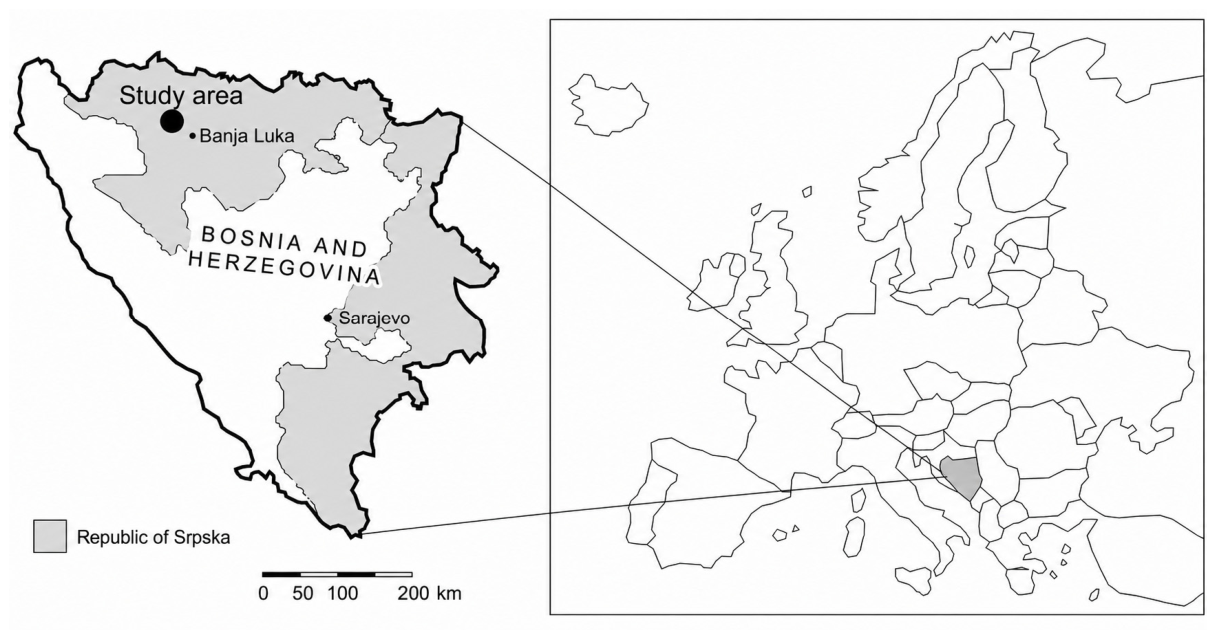
Figure 2.
Spatial and temporal distribution of construction aggregate extraction in the Prijedor Region (2023-2025).
Figure 2.
Spatial and temporal distribution of construction aggregate extraction in the Prijedor Region (2023-2025).
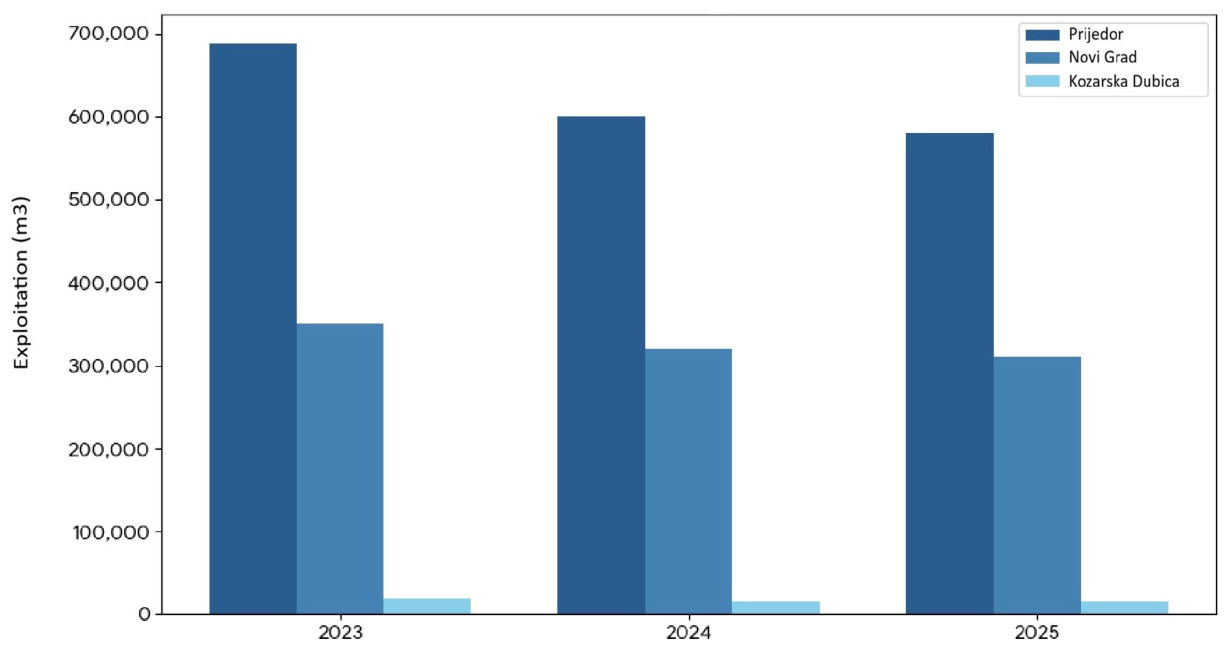
Figure 3.
Annual comparison of estimated market value and concession fee revenues (EUR).
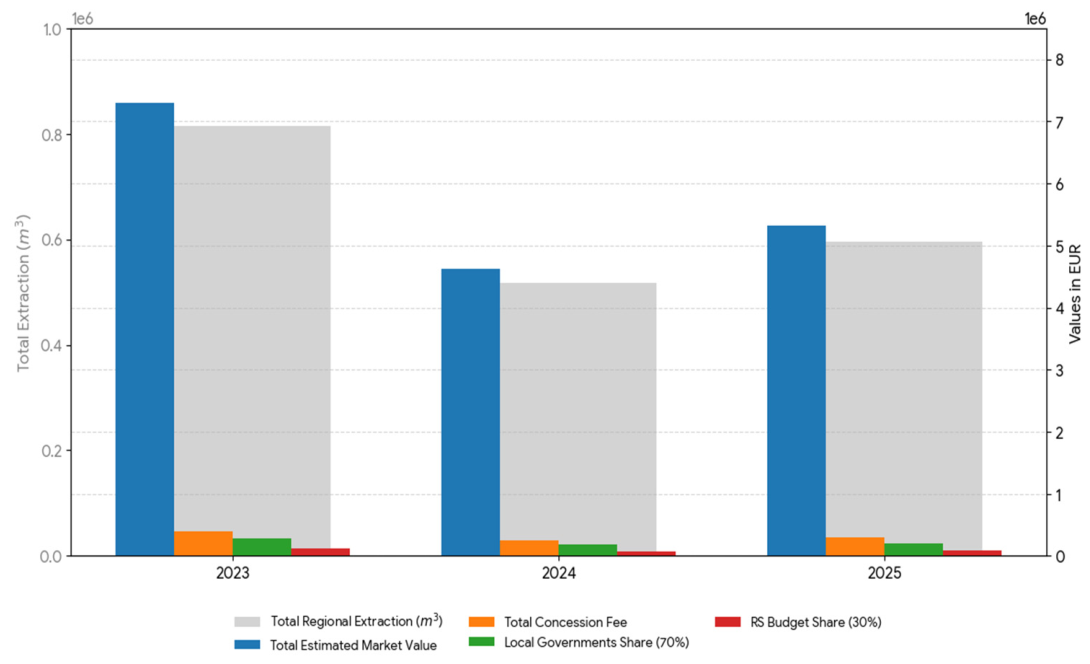
Figure 4.
Integrated methodological framework for evaluating construction aggregate concession systems.
Figure 4.
Integrated methodological framework for evaluating construction aggregate concession systems.
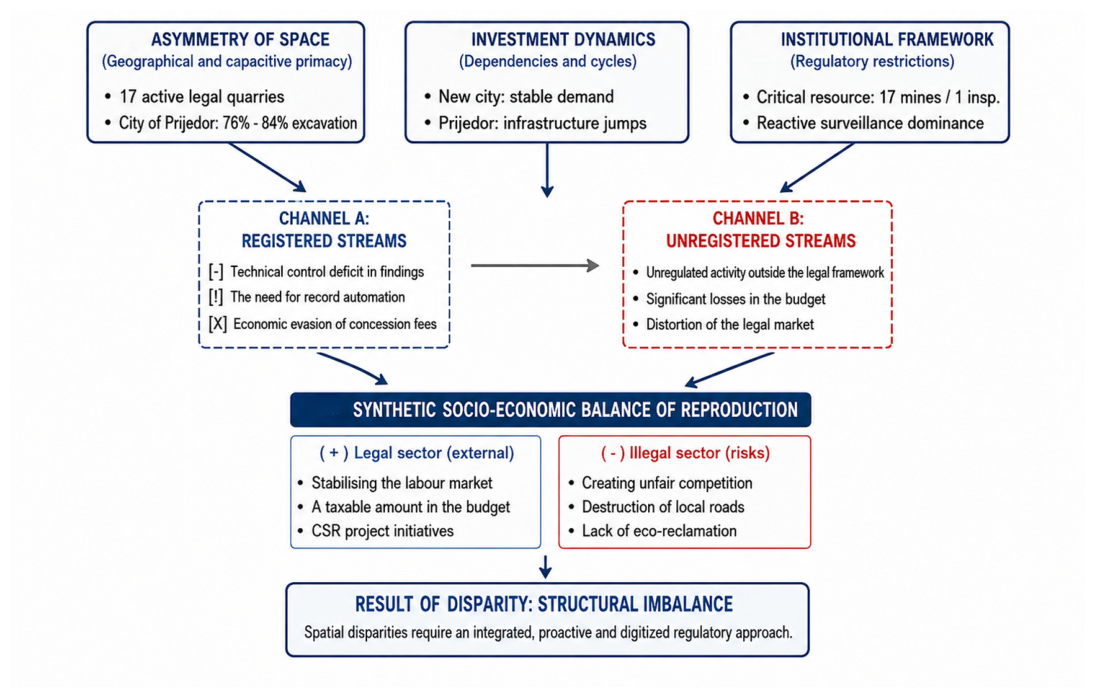

Table 1.
Comparison between legislative requirements and operational practice in the Prijedor Region.
Table 1.
Comparison between legislative requirements and operational practice in the Prijedor Region.
| Legislative Requirement | Observed Practice (2023–2025) | Methodological Indicator or Finding |
| Comprehensive inspection oversight requires regular field inspections of extraction boundaries, measurement of excavation activities, and independent verification of extracted quantities. | A pronounced shortage of personnel, with only one mining inspector responsible for the region, limits the feasibility of continuous preventive supervision. | Inspection workload ratio: 17:1. |
| Mandatory and continuous land reclamation requires disturbed land to be progressively rehabilitated through technical and biological measures during and after extraction. | Available records and field-based administrative evidence indicate delayed reclamation at a number of sites approaching the later stages of operation. | Qualitative evidence of delayed reclamation at selected sites. |
| The legally designated share of concession-fee revenues allocated to local governments is intended to support infrastructure and rehabilitation needs associated with extraction activities. | Concession revenues are not necessarily directly proportional to the intensity of infrastructure use generated by quarry transport, while part of local expenditure is absorbed through broader municipal budgets. | Potential mismatch between concession revenues and locally borne infrastructure costs. |
Table 2.
Spatial distribution of quarries and construction aggregate extraction in the Prijedor Region, 2023-2025.
Table 2.
Spatial distribution of quarries and construction aggregate extraction in the Prijedor Region, 2023-2025.
| Local Government | Indicator | 2023 | 2024 | 2025 | Trend / Key Characteristics |
| City of Prijedor | Number of quarries Extraction (m³) Regional share (%) |
6 688,000 84.42 |
7 396,000 76.57 |
9 480,000 80.67 |
Pronounced fluctuations Correlation with motorway construction Increase in the number of quarry sites |
| Novi Grad Municipality | Number of quarries Extraction (m³) Regional share (%) |
5 107,000 13.13 |
5 105,000 20.30 |
7 105,000 17.65 |
Stable economic activity Primarily local demand No major infrastructure projects |
| Kozarska Dubica Municipality | Number of quarries Extraction (m³) Regional share (%) |
1 20,000 2.45 |
1 16,200 3.13 |
1 10,000 1.68 |
Moderate decline Marginal regional share |
| Total Region | Number of quarries Total extraction (m³) |
12 815,000 |
13 517,200 |
17 595,000 |
Overall increase in extraction capacity |
Table 3.
Results of the exploratory OLS regression analysis.
| Parameter / Indicator | Coefficient (β) |
| Intercept (β0) | 311.734 |
| Infrastructure investment (β1) | 44.967 |
| Pearson correlation coefficient (r) | 0.891 |
| Coefficient of determination (R²) | 0.792 |
Table 4.
Market value of production and distribution of concession fee revenues, 2023-2025.
| Economic Assessment Indicator (Model Simulation) | 2023 | 2024 | 2025 |
| Total regional extraction (m³) | 815,000 | 517,200 | 595,000 |
| Total estimated market value (EUR) | 7,292,300.46 | 4,627,702.82 | 5,323,826.71 |
| Total concession fee | 401,076.53 | 254,523.65 | 292,810.47 |
| Share allocated to local governments (70%) | 280,753.57 | 178,166.56 | 204,967.33 |
| Share allocated to the Republic of Srpska budget (30%) | 120,322.96 | 76,357.10 | 87,843.14 |
Table 5.
Ratio of mining inspectors to active quarries in the Prijedor Region.
| Institutional Capacity Indicator | Indicator Value (2025) |
| Total number of active legal quarries in the Prijedor region | 17 |
| Number of mining inspectors responsible for the region | 1 |
| Average number of legal quarries per mining inspector | 17:1 |
| Number of identified and potential illegal extraction sites | Grey zone (latent / unidentified) |
Table 6.
Comparative assessment of institutional oversight indicators and concession fee rates.
| Country / Region | Average Number of Quarries per Mining Inspector (Ratio) | Concession Fee (Mining Royalty) | Primary Monitoring Model / Extraction Verification |
| Republic of Srpska (Prijedor Region) | 17:1 (following an increase from 12 to 17 quarry sites) | 5.5% of revenue (or a fixed fee of EUR 0.18–0.23/m³) | Manual reporting (annual operator reports) / No weighbridges at extraction sites |
| Federation of Bosnia and Herzegovina | 15:1 to 20:1 | 5.0–6.0% of revenue (depending on the canton) | Document-based monitoring / Periodic geodetic surveys |
| Serbia | 14:1 to 18:1 | 5.0–6.0% of revenue (or the equivalent amount in RSD per tonne) | Inspection record-based monitoring with occasional use of government measurements |
| Croatia (EU) | 5:1 | 5.0% of revenue plus a fixed fee based on concession area | Centralized electronic Concession Register / administrative monitoring of concession obligations and fee payments |
| Poland (EU) | 4:1 | 10% of the base material price (determined by the ministry) | Central Mining Register: Mandatory automated weighbridges and integrated satellite monitoring |
| Austria (EU) | Regional decentralization (effectively <3:1) | Specific tariffs per tonne (including a local environmental tax) | Mining Authority (Bergbehörde) model: Mandatory LiDAR-based 3D laser scanning conducted twice annually by accredited external providers |
Disclaimer/Publisher’s Note: The statements, opinions and data contained in all publications are solely those of the individual author(s) and contributor(s) and not of MDPI and/or the editor(s). MDPI and/or the editor(s) disclaim responsibility for any injury to people or property resulting from any ideas, methods, instructions or products referred to in the content. |
© 2026 by the authors. Licensee MDPI, Basel, Switzerland. This article is an open access article distributed under the terms and conditions of the Creative Commons Attribution (CC BY) license (http://creativecommons.org/licenses/by/4.0/).
Copyright: This open access article is published under a Creative Commons CC BY 4.0 license, which permit the free download, distribution, and reuse, provided that the author and preprint are cited in any reuse.