

Submitted:
19 August 2026
Posted:
20 August 2026
You are already at the latest version
Abstract
Background/Objectives: Autonomous motivation is theorized to support healthy eating, whereas body-shape concerns may fuel controlled forms of eating regulation. Their joint relations with Mediterranean diet adherence remain unexamined, particularly outside Mediterranean regions. We tested whether body-shape concerns relate differently to eating-regulation styles than to dietary behavior, and which styles are independently associated with adherence. Methods: In this cross-sectional online study, 224 Romanian adults (87.1% women; 40.7 ± 10.0 years) completed the Body Shape Questionnaire-16B (BSQ-16B), the Regulation of Eating Behaviors Scale, and the 14-item Mediterranean Diet Adherence Screener (MEDAS). Analyses included Spearman correlations with false-discovery-rate control and hierarchical regression with HC3-robust standard errors. Results: BSQ-16B scores were associated with introjected (β = 0.65) and overall controlled regulation (β = 0.54), but with none of the autonomous styles (composite β = −0.004). BSQ-16B was unrelated to MEDAS (ρ = −0.03; ΔR² < 0.001), whereas autonomous motivation was independently associated with adherence (b = 0.63 points per SD; 95% CI 0.32–0.94); integrated regulation was the only independently associated subscale (secondary analysis). Results were robust across sensitivity analyses. Conclusions: Body-shape concerns were coupled with internal pressure but decoupled from dietary behavior; only autonomous regulation was associated with adherence, consistent with autonomy-supportive counseling approaches.
Keywords:
body image
; body shape concerns
; self-determination theory
; autonomous motivation
; controlled motivation
; eating regulation
; Mediterranean diet
; MEDAS
; adults
; Romania
1. Introduction
The Mediterranean dietary pattern (Willett et al., 1995) is among the best-documented approaches for the prevention of cardiovascular disease and other chronic conditions (Dinu et al., 2018; Estruch et al., 2018). Despite this evidence, adherence has been declining worldwide, including within Mediterranean regions (da Silva et al., 2009; Vilarnau et al., 2019), and tends to be low in Central and Eastern European countries: in a nationwide Slovenian survey, the mean score on the 14-item Mediterranean Diet Adherence Screener (MEDAS) was only 5.6 out of 14 (Poklar Vatovec et al., 2023). Research on the determinants of adherence has concentrated on sociodemographic factors such as education, income, and age (Mendonça et al., 2022; Poklar Vatovec et al., 2023), including within dietary intervention trials (Downer et al., 2016), and, to a lesser extent, on psychosocial factors (Ruggiero et al., 2019; Tsofliou et al., 2022). Understanding which psychological characteristics accompany better adherence is a prerequisite for designing counseling approaches that support durable dietary change.
Self-determination theory (SDT) offers a well-established framework for this question (Deci & Ryan, 2000; Ryan & Deci, 2000). SDT distinguishes qualitatively different regulation styles arranged along a continuum of internalization: intrinsic, integrated, and identified regulation constitute autonomous motivation, in which behavior is experienced as self-endorsed and congruent with personal values; introjected and external regulation constitute controlled motivation, in which behavior is driven by internal pressure (guilt, shame, contingent self-worth) or external contingencies; amotivation denotes the absence of intentional regulation. Applied to eating, the Regulation of Eating Behaviors Scale (REBS) operationalizes these six styles (Pelletier et al., 2004). Reviews and meta-analyses across health behaviors consistently indicate that autonomous regulation is associated with more stable behavioral engagement, whereas controlled regulation shows weak or negative associations (Ng et al., 2012; Teixeira et al., 2012; Verstuyf et al., 2012), and relative autonomy has been shown to translate into intentional dietary behavior (Hagger et al., 2006).
For overall diet quality, the largest test to date comes from the PREDISE study of 1097 Canadian adults, in which self-determined motivation measured with the REBS was the psychosocial variable most strongly associated with a national healthy-eating index (Carbonneau et al., 2021). Experimental evidence for the Mediterranean diet specifically is more nuanced: in a randomized controlled trial with 726 Italian adults, a manipulation fostering autonomous relative to controlled motivation acted on intentions toward the diet, whereas follow-up adherence was most strongly predicted by past adherence (Caso et al., 2024). However, the associations between the six REBS regulation styles and a Mediterranean-pattern adherence score such as the MEDAS have not, to our knowledge, been reported, and evidence from non-Mediterranean European populations is lacking.
Body image is a second psychological candidate. Body-shape concern, the core preoccupation captured by the Body Shape Questionnaire (BSQ) and its short forms (Cooper et al., 1987; Evans & Dolan, 1993), is often assumed to motivate dietary improvement. SDT-based research suggests a more specific picture: body dissatisfaction has been linked to controlled—particularly introjected—regulation of eating, and to dysfunctional rather than healthy eating patterns (Pelletier & Dion, 2007; Pelletier et al., 2004). Studies relating body image to Mediterranean diet adherence have largely treated body dissatisfaction as an outcome or a correlate of weight status rather than modeling it together with motivational quality (Ruggiero et al., 2019; Tsofliou et al., 2022). Whether body-shape concern is associated with actual adherence to a healthy dietary pattern once motivational quality is considered therefore remains an open question.
The present study addressed these gaps in a sample of Romanian adults, a population for which, to our knowledge, no adult data on psychological correlates of MEDAS-assessed adherence have been published; the available Romanian evidence concerns children and adolescents (Pira et al., 2021). We tested three hypotheses: (H1) autonomous motivation for eating regulation is positively associated with Mediterranean diet adherence; (H2) controlled motivation is not positively associated with adherence; and (H3) higher body-shape concern is associated with higher controlled motivation. As a secondary, exploratory aim, we examined which of the six REBS regulation styles are independently associated with adherence when modeled simultaneously. Because the design was cross-sectional, all hypotheses concerned associations rather than causal or temporal effects.
2. Materials and Methods
2.1. Study Design and Participants
This observational cross-sectional study used a structured, self-administered online questionnaire distributed in Romanian through Google Forms and is reported in accordance with the STROBE guidance for cross-sectional studies (von Elm et al., 2008). Adults were recruited through online platforms and social networks (convenience sampling) between 22 February and 30 April 2026. Eligibility criteria were age ≥18 years, knowledge of Romanian, provision of informed consent by continuing after the study-information page, and submission of the complete questionnaire; all items were mandatory, so no item-level data were missing. The exported dataset comprised 225 submissions. A response-level audit identified one exact duplicate: two submissions received 7 s apart were identical across all 54 scale items and all sociodemographic variables, and the later submission was removed as a probable double-click, leaving N = 224 unique records for the primary analyses. The platform did not record the number of people who viewed but did not submit the form, so a response rate could not be calculated. The study used the fixed sample accrued during the collection window; no effect-size-based a priori sample-size calculation was performed, and inference therefore emphasizes 95% confidence intervals and the precision of the estimates. Preliminary bivariate results based on an interim sample of the first 160 respondents were presented at the Marisiensis International Congress and published as a conference abstract (Georgescu & Ruța, 2026); the present article reports the complete dataset and the full covariate-adjusted analyses, which supersede those preliminary estimates.
2.2. Measures
Body-shape concern over the previous four weeks was assessed with the 16-item Body Shape Questionnaire, alternate form B (BSQ-16B) (Cooper et al., 1987; Evans & Dolan, 1993). Items are rated from 1 (never) to 6 (always); the total score ranges from 16 to 96, with higher scores indicating greater concern.
Motivation for the regulation of eating behaviors was assessed with the 24-item REBS (Pelletier et al., 2004), rated from 1 (does not correspond at all) to 7 (corresponds exactly). Six four-item subscale scores (intrinsic, integrated, identified, introjected, external regulation, and amotivation) were computed as item means, together with the standard composites of autonomous motivation (mean of the intrinsic, integrated, and identified items) and controlled motivation (mean of the introjected and external items).
Adherence to the Mediterranean diet was assessed with the 14-item MEDAS developed within the PREDIMED program (Martínez-González et al., 2012; Schröder et al., 2011). Each criterion met scores one point (total 0–14); items phrased as consumption limits were worded so that an affirmative answer indicated meeting the criterion. Adherence was categorized as low (0–5), moderate (6–9), and high (≥10) (Martínez-González et al., 2012). The MEDAS has been applied and evaluated across Mediterranean and non-Mediterranean European populations (García-Conesa et al., 2020). Because the MEDAS is a formative index of heterogeneous dietary behaviors rather than a reflective scale, internal consistency is not an appropriate psychometric criterion; it is nevertheless reported for completeness.
Sociodemographic and behavioral characteristics recorded were age, sex, self-reported height and weight (from which body mass index, BMI, was computed), educational level, history of past dieting, and habitual physical activity frequency (rarely or never; 1–2, 3–4, or ≥5 times/week). The adjustment covariates were age, sex, BMI, education, and physical activity; past dieting was recorded for sample characterization only. In the regression models, sex was coded 1 = female (male = reference); educational attainment was entered as a three-level ordinal variable (non-tertiary education [high school or post-secondary non-tertiary], university, and postgraduate education); physical activity was entered as a four-level ordinal frequency score; and continuous predictors were standardized. The three instruments were administered in Romanian versions produced following the World Health Organization recommendations for the translation and adaptation of instruments (forward translation, expert review, and pretesting) (World Health Organization, 2016); a formal psychometric validation in the Romanian population was beyond the scope of this study, and internal consistency was therefore examined in the present sample (Section 3.2).
2.3. Statistical Analysis
Continuous variables are summarized as mean (standard deviation, SD) and median; categorical variables as n (%). Because the principal scores departed from normality (Shapiro–Wilk p < 0.05), bivariate associations used Spearman’s ρ, with 95% confidence intervals (CIs) for key coefficients obtained by bootstrap (5000 resamples). The family of nine bivariate associations with the MEDAS (six subscales, two composites, and the BSQ-16B) was controlled for multiplicity with the Benjamini–Hochberg false-discovery-rate procedure, and both p and q values are reported (Benjamini & Hochberg, 1995). Internal consistency was quantified with Cronbach’s α and one-factor McDonald’s ω (McDonald, 1999).
The primary analysis was a hierarchical linear regression on the continuous MEDAS score: step 1 entered age, sex, BMI, education, and physical activity; step 2 added the BSQ-16B; step 3 added the autonomous, controlled, and amotivation composites. Coefficients are reported per SD of the standardized predictors with 95% CIs; inference used HC3 heteroskedasticity-robust standard errors, and R² change was tested with the incremental F test. Model diagnostics comprised residual normality (Shapiro–Wilk), the Breusch–Pagan test, and variance-inflation factors (VIFs). The mirror-image models regressed each regulation style, in turn, on the BSQ-16B with the same covariates. In a secondary analysis, the six REBS subscales were entered simultaneously in place of the composites, retaining all covariates and the BSQ-16B, with Benjamini–Hochberg correction across the six motivational coefficients. A BSQ-16B × autonomous motivation interaction was examined in a single supplementary model.
Sensitivity analyses (a) repeated the primary model in the full 225-record dataset including the duplicate; (b) restricted the sample to women; (c) used a 13-item MEDAS excluding the wine item, whose cultural relevance in Romania is uncertain; and (d) refitted the model after excluding observations exceeding the Cook’s-distance screening threshold of 4/n (Cook, 1977)—a screening rule, not a judgment that such observations are invalid, and all observations, including one participant with BMI 43.0 kg/m², were retained in the primary analysis. Exploratory indirect-effect analyses (percentile bootstrap, 10,000 resamples) and a Harman single-factor diagnostic (Podsakoff et al., 2003) are reported in the Supplementary Materials. Analyses were conducted in Python 3.12.3 (pandas 3.0.2, NumPy 2.4.4, SciPy 1.17.1); the HC3 estimator, variance-inflation factors, the Breusch–Pagan test, McDonald’s ω, and the bootstrap procedures were computed with custom NumPy/SciPy implementations provided in full in Supplementary Script S3. Scale totals were recomputed from item-level data, and two-sided p < 0.05 or q < 0.05 indicated statistical significance.
3. Results
3.1. Sample Characteristics
The sample comprised 224 adults (87.1% women) with a mean age of 40.7 (SD 10.0) years (range 20–73) and a mean BMI of 24.9 (SD 4.8) kg/m² (range 16.4–43.0). Participants were predominantly highly educated, and most reported past dieting. Characteristics are shown in Table 1. The mean MEDAS score was 7.2 (SD 2.0); adherence was low (0–5) in 21.0%, moderate (6–9) in 66.1%, and high (≥10) in 12.9% of participants.
3.2. Descriptive Statistics and Reliability
Descriptive statistics and reliability coefficients are shown in Table 2. All multi-item psychological scales showed good to excellent internal consistency (ω between 0.73 and 0.96), with the exception of the four-item amotivation subscale (α = 0.615; ω = 0.653; corrected item–total correlations 0.31–0.51), whose coefficients are therefore interpreted cautiously throughout. The motivational profile was dominated by autonomous regulations, identified regulation showing the highest mean, whereas controlled motivation and amotivation were low.
3.3. Body-Shape Concerns and Eating Regulation
In covariate-adjusted models (Table 3, Figure 1), higher BSQ-16B scores were strongly associated with introjected regulation (β = 0.650 per SD; 95% CI 0.524–0.777; p < 0.001) and with the controlled motivation composite (β = 0.539; 95% CI 0.398–0.680; p < 0.001), and more modestly with external regulation and amotivation. In contrast, the BSQ-16B was associated with none of the autonomous regulation styles—intrinsic, integrated, or identified—nor with the autonomous composite, for which the adjusted association was essentially null (β = −0.004; 95% CI −0.186 to 0.178). The bivariate association between the BSQ-16B and introjected regulation was ρ = 0.60 (95% CI 0.50–0.69), supporting hypothesis H3.
3.4. Correlates of Mediterranean Diet Adherence
Bivariately, the MEDAS score correlated positively with integrated (ρ = 0.43; 95% CI 0.32–0.54), intrinsic (ρ = 0.31), and identified regulation (ρ = 0.29), and with the autonomous composite (ρ = 0.40; 95% CI 0.28–0.50; all q < 0.001), and negatively with amotivation (ρ = −0.26; q < 0.001) and external regulation (ρ = −0.15; q = 0.035). Introjected regulation (ρ = −0.003; q = 0.96), the controlled composite (ρ = −0.08; q = 0.27), and, notably, the BSQ-16B (ρ = −0.03; q = 0.80; 95% CI −0.16 to 0.11) were not associated with adherence.
The hierarchical regression is summarized in Table 4. Covariates explained R² = 0.102, with physical activity as the only significant correlate. Adding the BSQ-16B left the model essentially unchanged (ΔR² = 0.0001; p = 0.86). Adding the motivational composites improved the model substantially (ΔR² = 0.095; F(3,214) = 8.47; p < 0.001): autonomous motivation was independently associated with adherence (b = 0.63 MEDAS points per SD; 95% CI 0.32–0.94; p < 0.001; Figure 2), supporting H1, whereas controlled motivation (b = −0.09; p = 0.60) was not, consistent with H2, and amotivation was not (b = −0.23; p = 0.14). Residuals were normally distributed (Shapiro–Wilk p = 0.38) and homoscedastic (Breusch–Pagan p = 0.33), and all variance-inflation factors were below 2 (maximum 1.82). The BSQ-16B × autonomous motivation interaction was not significant (p = 0.53).
3.5. Secondary Analysis of the Six Regulation Styles
When the six REBS subscales were entered simultaneously in place of the composites, retaining all covariates and the BSQ-16B, only integrated regulation remained independently associated with adherence (b = 1.11 MEDAS points per SD; 95% CI 0.61–1.61; Benjamini–Hochberg q = 0.0001 across the six motivational coefficients; all other q ≥ 0.23; model R² = 0.252; maximum VIF = 3.6). Given the intercorrelations among the autonomous subscales, this result is reported as secondary and interpreted as hypothesis-generating.
3.6. Sensitivity and Supplementary Analyses
The independent association of autonomous motivation with adherence was essentially unchanged in the full 225-record dataset including the duplicate (b = 0.63; p < 0.001), among women only (n = 195; b = 0.64; p < 0.001), with the 13-item MEDAS excluding the wine item (b = 0.64; p < 0.001), and after excluding the 17 observations exceeding the Cook’s-distance screening threshold (maximum D = 0.052; b = 0.72; p < 0.001); the BSQ-16B remained unassociated with adherence in all models (p ≥ 0.25). Exploratory indirect-effect analyses did not support an indirect pathway from body-shape concerns to adherence through any regulation style (all bootstrap CIs included zero; Supplementary Materials, Table S1), and the Harman single-factor diagnostic is reported in Section S2.
4. Discussion
4.1. Main Findings
In this cross-sectional sample of Romanian adults, body-shape concerns and Mediterranean diet adherence occupied largely separate motivational spaces. Higher body-shape concern was strongly associated with introjected and overall controlled regulation of eating, yet showed a precise null association with the autonomous regulations and with adherence itself, adding virtually nothing to the prediction of the MEDAS score. Adherence, in turn, was independently associated only with autonomous motivation—about 0.63 MEDAS points per SD—with integrated regulation emerging, in a secondary analysis, as the single independently associated style. This pattern of coupling and decoupling was stable across all sensitivity analyses.
4.2. Comparison with Previous Research
The motivational findings extend the PREDISE results, in which self-determined motivation was the strongest psychosocial correlate of overall diet quality in Canadian adults (Carbonneau et al., 2021), to a different outcome (Mediterranean-pattern adherence), a subscale-level analysis, and a non-Mediterranean Eastern European population. In the only randomized test to date, fostering autonomous relative to controlled motivation acted primarily on intentions toward the Mediterranean diet rather than on follow-up adherence itself (Caso et al., 2024), which makes observational evidence on the regulation styles that accompany actual adherence all the more pertinent; our findings are further consistent with the broader SDT literature on health behaviors (Ng et al., 2012; Teixeira et al., 2012; Verstuyf et al., 2012) and with prospective evidence that autonomous motivation predicts long-term weight-related outcomes (Silva et al., 2011). The strong link between body-shape concern and introjected regulation replicates, in an adult community sample, the association between body dissatisfaction and pressured, self-worth-contingent eating regulation described by Pelletier and Dion (2007). The mean MEDAS score of 7.2 was higher than the 5.6 reported in the nationwide Slovenian survey (Poklar Vatovec et al., 2023), although our convenience sample of predominantly educated women precludes population-level comparison; both values remain far from the high-adherence range, consistent with the generally modest adherence documented outside, and increasingly inside, the Mediterranean basin (Obeid et al., 2022; Vilarnau et al., 2019). Two 2026 studies sharpen this picture: prospectively, autonomous motivation related to Mediterranean-diet behavior primarily through intention within a combined self-determination/planned-behavior model (Canova et al., 2026), and, among 939 exercisers, body-image-satisfied profiles reported the highest autonomous and lowest controlled motivation for eating (Salvador et al., 2026), converging with the coupling of body-shape concern and controlled regulation observed here.
4.3. Interpretation: Internal Pressure Without Behavioral Correlates
Within SDT, introjection is a partial internalization: the person pressures herself with guilt, shame, and contingent self-worth, but the behavior is not integrated with abiding values and therefore tends to be enacted inconsistently (Deci & Ryan, 2000; Ryan & Deci, 2000; Verstuyf et al., 2012). Our data are compatible with this account at the level of associations: the internal pressure that accompanies body-shape concern was abundant, but it had no counterpart in dietary behavior, whereas the value-congruent, identity-level regulation captured by the integrated subscale did; this subscale-level pattern also converges with recent person-centered analyses in which profiles marked by self-determined eating regulation showed the most adaptive eating outcomes (Martin et al., 2024). The exploratory indirect-effect analyses reinforce this reading negatively—body-shape concern was not indirectly associated with adherence through any regulation style—so the appropriate description of these data is a dissociation, not a mediated pathway. Because the design is cross-sectional, the reverse reading also deserves note: adults whose healthy eating is already integrated may simply experience less shape-related pressure. Longitudinal and experimental designs are needed to arbitrate between these directions.
4.4. Strengths and Limitations
Strengths include theory-driven hypotheses, three established instruments spanning body image, motivational quality, and dietary pattern, multiplicity control, robust-variance estimation with full model diagnostics, and convergent sensitivity analyses; the key null associations were estimated with reasonably narrow confidence intervals. Several limitations must temper interpretation. First, the cross-sectional design precludes causal or directional inference. Second, the convenience sample—predominantly female, highly educated, and self-selected into a nutrition-themed survey—limits generalizability; the women-only sensitivity analysis supports internal robustness but not representativeness. Third, all measures were self-reported and collected in a single session from the same source, so common-method bias cannot be excluded; the Harman diagnostic is at best a weak screen, although the different response formats across instruments and the central null association argue against a purely method-driven pattern. Fourth, the Romanian versions of the instruments, though translated according to WHO recommendations and internally consistent in this sample, have not undergone formal psychometric validation, and the study was not designed as one; a single-sample confirmatory factor analysis of a six-factor, 24-item ordinal instrument without an independent validation sample would provide limited and potentially unstable evidence. Fifth, the amotivation subscale showed modest reliability, and its coefficients are interpreted cautiously. Finally, MEDAS adherence and anthropometrics were self-reported, and the wine item may have uncertain cultural relevance in Romania, although its exclusion left the results unchanged.
4.5. Practical Implications
For nutrition counseling, these associations align with autonomy-supportive approaches: helping clients connect eating with personally endorsed values and identity, rather than leveraging body dissatisfaction, guilt, or external pressure, is the motivational profile that accompanied better adherence in these data (Caso et al., 2024; Teixeira et al., 2012; Verstuyf et al., 2012). The findings caution against assuming that intensifying body-focused concern will translate into healthier eating: in this sample, such concern traveled with internal pressure, not with dietary behavior.
5. Conclusions
In Romanian adults, body-shape concerns were strongly associated with controlled—especially introjected—regulation of eating but not with Mediterranean diet adherence, whereas autonomous motivation, and specifically its integrated form, was the only motivational quality independently associated with adherence. These cross-sectional findings are consistent with autonomy-focused, value-based approaches to dietary counseling and identify the internalization of eating regulation, rather than body dissatisfaction, as the psychologically relevant correlate of a healthier dietary pattern in this population.
Author Contributions
Conceptualization, C.G. and F.D.R.; methodology, C.G.; formal analysis, C.G.; investigation, C.G. and A.M.; data curation, C.G.; writing—original draft preparation, C.G.; writing—review and editing, C.F., A.M. and F.D.R.; supervision, C.F. and F.D.R. All authors have read and agreed to the published version of the manuscript.
Funding
This research received no external funding.
Institutional Review Board Statement
The study was conducted in accordance with the Declaration of Helsinki and approved by the Research Ethics Committee of the George Emil Palade University of Medicine, Pharmacy, Science and Technology of Târgu Mureș (decision no. 3949 of 5 February 2026).
Informed Consent Statement
Informed consent was obtained from all subjects involved in the study; consent was expressed by continuing with the anonymous questionnaire after reading the study information page.
Data Availability Statement
The original contributions presented in this study are included in the article/supplementary material. Further inquiries can be directed to the corresponding author.
Conflicts of Interest
The authors declare no conflicts of interest.
References
- Benjamini, Y., & Hochberg, Y. (1995). Controlling the false discovery rate: A practical and powerful approach to multiple testing. Journal of the Royal Statistical Society: Series B (Methodological), 57, 289–300. [CrossRef]
- Canova, L., Capasso, M., Bianchi, M., & Caso, D. (2026). From motivation to Mediterranean diet intention and behavior: A combined self-determination theory and theory of planned behavior approach. Psychology & Health, 41(7), 971–997. [CrossRef] [PubMed]
- Carbonneau, E., Pelletier, L., Bégin, C., Lamarche, B., Bélanger, M., Provencher, V., Desroches, S., Robitaille, J., Vohl, M.-C., Couillard, C., Bouchard, L., Houle, J., Langlois, M.-F., Rabasa-Lhoret, R., Corneau, L., & Lemieux, S. (2021). Individuals with self-determined motivation for eating have better overall diet quality: Results from the PREDISE study. Appetite, 165, 105426. [CrossRef] [PubMed]
- Caso, D., Canova, L., Capasso, M., & Bianchi, M. (2024). Integrating the theory of planned behavior and the self-determination theory to promote Mediterranean diet adherence: A randomized controlled trial. Applied Psychology: Health and Well-Being, 16(1), 80–101. [CrossRef] [PubMed]
- Cook, R. D. (1977). Detection of influential observation in linear regression. Technometrics, 19, 15–18. [CrossRef]
- Cooper, P. J., Taylor, M. J., Cooper, Z., & Fairburn, C. G. (1987). The development and validation of the Body Shape Questionnaire. International Journal of Eating Disorders, 6, 485–494. [CrossRef]
- da Silva, R., Bach-Faig, A., Raidó Quintana, B., Buckland, G., Vaz de Almeida, M. D., & Serra-Majem, L. (2009). Worldwide variation of adherence to the Mediterranean diet, in 1961–1965 and 2000–2003. Public Health Nutrition, 12, 1676–1684. [CrossRef] [PubMed]
- Deci, E. L., & Ryan, R. M. (2000). The “what” and “why” of goal pursuits: Human needs and the self-determination of behavior. Psychological Inquiry, 11, 227–268. [CrossRef]
- Dinu, M., Pagliai, G., Casini, A., & Sofi, F. (2018). Mediterranean diet and multiple health outcomes: An umbrella review of meta-analyses of observational studies and randomised trials. European Journal of Clinical Nutrition, 72, 30–43. [CrossRef] [PubMed]
- Downer, M. K., Gea, A., Stampfer, M., Sánchez-Tainta, A., Corella, D., Salas-Salvadó, J., Ros, E., Estruch, R., Fitó, M., Gómez-Gracia, E., et al. (2016). Predictors of short- and long-term adherence with a Mediterranean-type diet intervention: The PREDIMED randomized trial. International Journal of Behavioral Nutrition and Physical Activity, 13, 67. [CrossRef] [PubMed]
- Estruch, R., Ros, E., Salas-Salvadó, J., Covas, M.-I., Corella, D., Arós, F., Gómez-Gracia, E., Ruiz-Gutiérrez, V., Fiol, M., Lapetra, J., et al. (2018). Primary prevention of cardiovascular disease with a Mediterranean diet supplemented with extra-virgin olive oil or nuts. New England Journal of Medicine, 378, e34. [CrossRef] [PubMed]
- Evans, C., & Dolan, B. (1993). Body Shape Questionnaire: Derivation of shortened “alternate forms”. International Journal of Eating Disorders, 13, 315–321. [CrossRef] [PubMed]
- García-Conesa, M.-T., Philippou, E., Pafilas, C., Massaro, M., Quarta, S., Andrade, V., Jorge, R., Chervenkov, M., Ivanova, T., Dimitrova, D., et al. (2020). Exploring the validity of the 14-item Mediterranean Diet Adherence Screener (MEDAS): A cross-national study in seven European countries around the Mediterranean region. Nutrients, 12(10), 2960. [CrossRef] [PubMed]
- Georgescu, C., & Ruța, F. D. (2026). The impact of body image and motivation types on adherence to a healthy dietary pattern [Conference abstract]. Acta Marisiensis – Seria Medica, 72(Suppl. 3), 420.
- Hagger, M. S., Chatzisarantis, N. L., & Harris, J. (2006). The process by which relative autonomous motivation affects intentional behavior: Comparing effects across diet and exercise behaviors. Motivation and Emotion, 30, 307–321. [CrossRef]
- Martin, H., Stenling, A., & Hargreaves, E. A. (2024). Motivational profiles for eating behavior and their associations with intuitive eating. Appetite, 201, 107603. [CrossRef] [PubMed]
- Martínez-González, M. A., García-Arellano, A., Toledo, E., Salas-Salvadó, J., Buil-Cosiales, P., Corella, D., Covas, M. I., Schröder, H., Arós, F., Gómez-Gracia, E., et al. (2012). A 14-item Mediterranean diet assessment tool and obesity indexes among high-risk subjects: The PREDIMED trial. PLoS ONE, 7, e43134. [CrossRef] [PubMed]
- McDonald, R. P. (1999). Test theory: A unified treatment. Lawrence Erlbaum Associates.
- Mendonça, N., Gregório, M. J., Salvador, C., Henriques, A. R., Canhão, H., & Rodrigues, A. M. (2022). Low adherence to the Mediterranean diet is associated with poor socioeconomic status and younger age: A cross-sectional analysis of the EpiDoC cohort. Nutrients, 14(6), 1239. [CrossRef] [PubMed]
- Ng, J. Y. Y., Ntoumanis, N., Thøgersen-Ntoumani, C., Deci, E. L., Ryan, R. M., Duda, J. L., & Williams, G. C. (2012). Self-determination theory applied to health contexts: A meta-analysis. Perspectives on Psychological Science, 7, 325–340. [CrossRef] [PubMed]
- Obeid, C. A., Gubbels, J. S., Jaalouk, D., Kremers, S. P. J., & Oenema, A. (2022). Adherence to the Mediterranean diet among adults in Mediterranean countries: A systematic literature review. European Journal of Nutrition, 61, 3327–3344. [CrossRef] [PubMed]
- Pelletier, L. G., & Dion, S. C. (2007). An examination of general and specific motivational mechanisms for the relations between body dissatisfaction and eating behaviors. Journal of Social and Clinical Psychology, 26, 303–333. [CrossRef]
- Pelletier, L. G., Dion, S. C., Slovinec-D’Angelo, M., & Reid, R. (2004). Why do you regulate what you eat? Relationships between forms of regulation, eating behaviors, sustained dietary behavior change, and psychological adjustment. Motivation and Emotion, 28(3), 245–277. [CrossRef]
- Pira, C., Trapani, G., Fadda, M., Finocchiaro, C., Bertino, E., Coscia, A., Ciocan, C., Cuciureanu, M., Hegheş, S.-C., Vranceanu, M., et al. (2021). Comparative study regarding the adherence to the Mediterranean diet and the eating habits of two groups—The Romanian children and adolescents living in Nord-West of Romania and their Romanian counterparts living in Italy. Foods, 10(9), 2045. [CrossRef] [PubMed]
- Podsakoff, P. M., MacKenzie, S. B., Lee, J.-Y., & Podsakoff, N. P. (2003). Common method biases in behavioral research: A critical review of the literature and recommended remedies. Journal of Applied Psychology, 88, 879–903. [CrossRef] [PubMed]
- Poklar Vatovec, T., Jenko Pražnikar, Z., & Petelin, A. (2023). Adherence and sociodemographic determinants of adherence to the Mediterranean diet among Slovenian adults and the elderly. Nutrients, 15(14), 3219. [CrossRef] [PubMed]
- Ruggiero, E., Di Castelnuovo, A., Costanzo, S., Persichillo, M., Bracone, F., Cerletti, C., Donati, M. B., de Gaetano, G., Iacoviello, L., & Bonaccio, M. (2019). Socioeconomic and psychosocial determinants of adherence to the Mediterranean diet in a general adult Italian population. European Journal of Public Health, 29, 328–335. [CrossRef] [PubMed]
- Ryan, R. M., & Deci, E. L. (2000). Self-determination theory and the facilitation of intrinsic motivation, social development, and well-being. American Psychologist, 55, 68–78. [CrossRef] [PubMed]
- Salvador, R., Cordeiro, F., Castuera, R. J., Rebelo-Gonçalves, R., & Monteiro, D. (2026). The role of body image discrepancy in exercise and eating motivation: A self-determination theory perspective. Healthcare, 14(11), 1445. [CrossRef] [PubMed]
- Schröder, H., Fitó, M., Estruch, R., Martínez-González, M. A., Corella, D., Salas-Salvadó, J., Lamuela-Raventós, R., Ros, E., Salaverría, I., Fiol, M., et al. (2011). A short screener is valid for assessing Mediterranean diet adherence among older Spanish men and women. Journal of Nutrition, 141, 1140–1145. [CrossRef] [PubMed]
- Silva, M. N., Markland, D., Carraça, E. V., Vieira, P. N., Coutinho, S. R., Minderico, C. S., Matos, M. G., Sardinha, L. B., & Teixeira, P. J. (2011). Exercise autonomous motivation predicts 3-yr weight loss in women. Medicine & Science in Sports & Exercise, 43, 728–737. [CrossRef] [PubMed]
- Teixeira, P. J., Silva, M. N., Mata, J., Palmeira, A. L., & Markland, D. (2012). Motivation, self-determination, and long-term weight control. International Journal of Behavioral Nutrition and Physical Activity, 9, 22. [CrossRef] [PubMed]
- Tsofliou, F., Vlachos, D., Hughes, C., & Appleton, K. M. (2022). Barriers and facilitators associated with the adoption of and adherence to a Mediterranean style diet in adults: A systematic review of published observational and qualitative studies. Nutrients, 14(20), 4314. [CrossRef] [PubMed]
- Verstuyf, J., Patrick, H., Vansteenkiste, M., & Teixeira, P. J. (2012). Motivational dynamics of eating regulation: A self-determination theory perspective. International Journal of Behavioral Nutrition and Physical Activity, 9, 21. [CrossRef] [PubMed]
- Vilarnau, C., Stracker, D. M., Funtikov, A., da Silva, R., Estruch, R., & Bach-Faig, A. (2019). Worldwide adherence to Mediterranean diet between 1960 and 2011. European Journal of Clinical Nutrition, 72, 83–91. [CrossRef] [PubMed]
- von Elm, E., Altman, D. G., Egger, M., Pocock, S. J., Gøtzsche, P. C., & Vandenbroucke, J. P. (2008). The Strengthening the Reporting of Observational Studies in Epidemiology (STROBE) statement: Guidelines for reporting observational studies. Journal of Clinical Epidemiology, 61, 344–349. [CrossRef] [PubMed]
- Willett, W. C., Sacks, F., Trichopoulou, A., Drescher, G., Ferro-Luzzi, A., Helsing, E., & Trichopoulos, D. (1995). Mediterranean diet pyramid: A cultural model for healthy eating. American Journal of Clinical Nutrition, 61, 1402S–1406S. [CrossRef] [PubMed]
- World Health Organization. (2016). Process of translation and adaptation of instruments. Archived at https://web.archive.org/web/2020/https://www.who.int/substanceabuse/researchtools/translation/en/ (accessed on 17 August 2026).
Figure 1.
Adjusted standardized associations (β with 95% confidence intervals) between body-shape concerns (BSQ-16B) and the six eating-regulation styles and two composites of the Regulation of Eating Behaviors Scale. Models are adjusted for age, sex, body mass index, education, and physical activity (HC3-robust standard errors). Blue markers indicate intervals excluding zero.
Figure 1.
Adjusted standardized associations (β with 95% confidence intervals) between body-shape concerns (BSQ-16B) and the six eating-regulation styles and two composites of the Regulation of Eating Behaviors Scale. Models are adjusted for age, sex, body mass index, education, and physical activity (HC3-robust standard errors). Blue markers indicate intervals excluding zero.
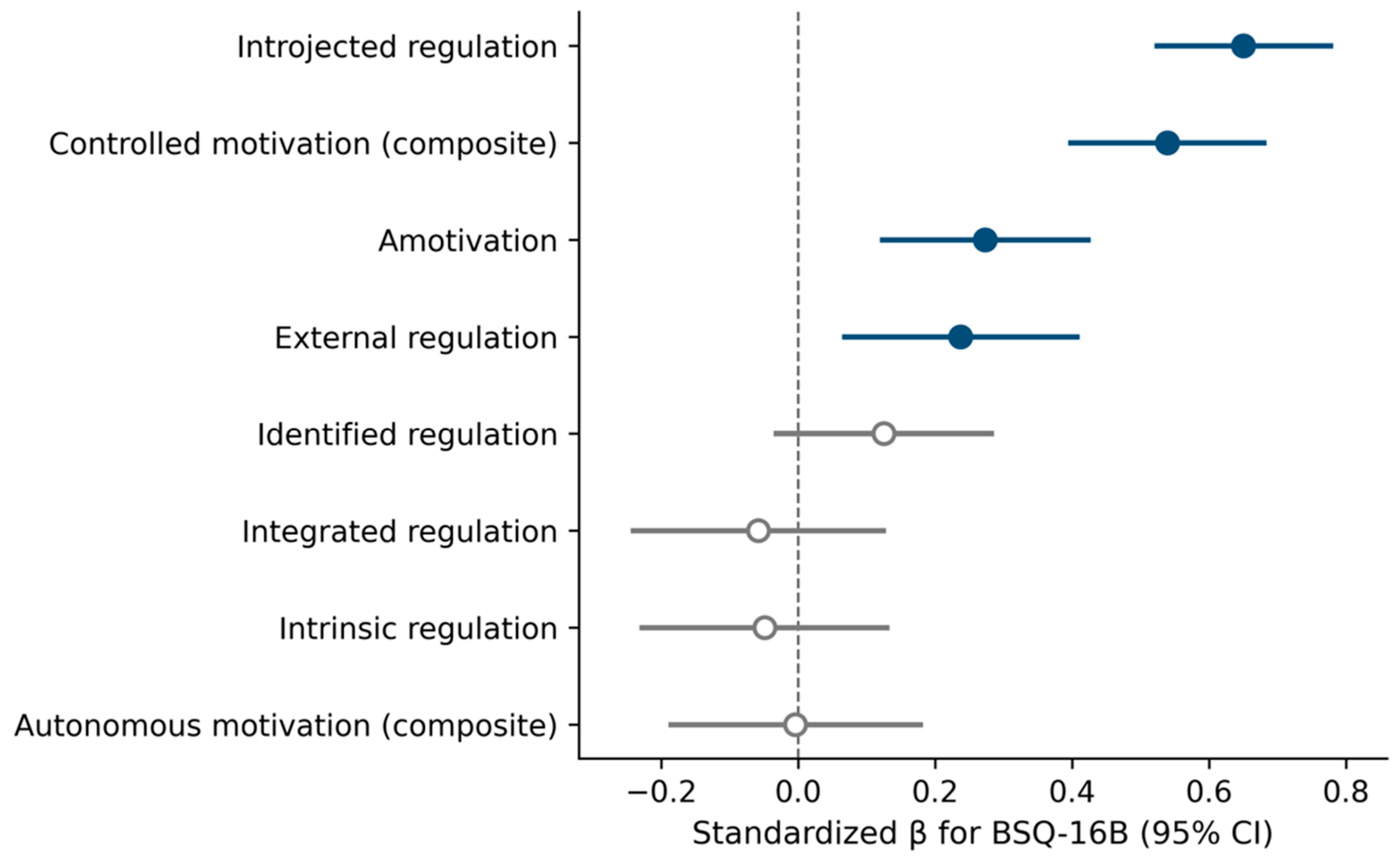
Figure 2.
Association between autonomous motivation for eating regulation (Regulation of Eating Behaviors Scale composite) and Mediterranean diet adherence (MEDAS). Points are jittered for visibility; the line is the unadjusted linear fit with its 95% confidence band.
Figure 2.
Association between autonomous motivation for eating regulation (Regulation of Eating Behaviors Scale composite) and Mediterranean diet adherence (MEDAS). Points are jittered for visibility; the line is the unadjusted linear fit with its 95% confidence band.
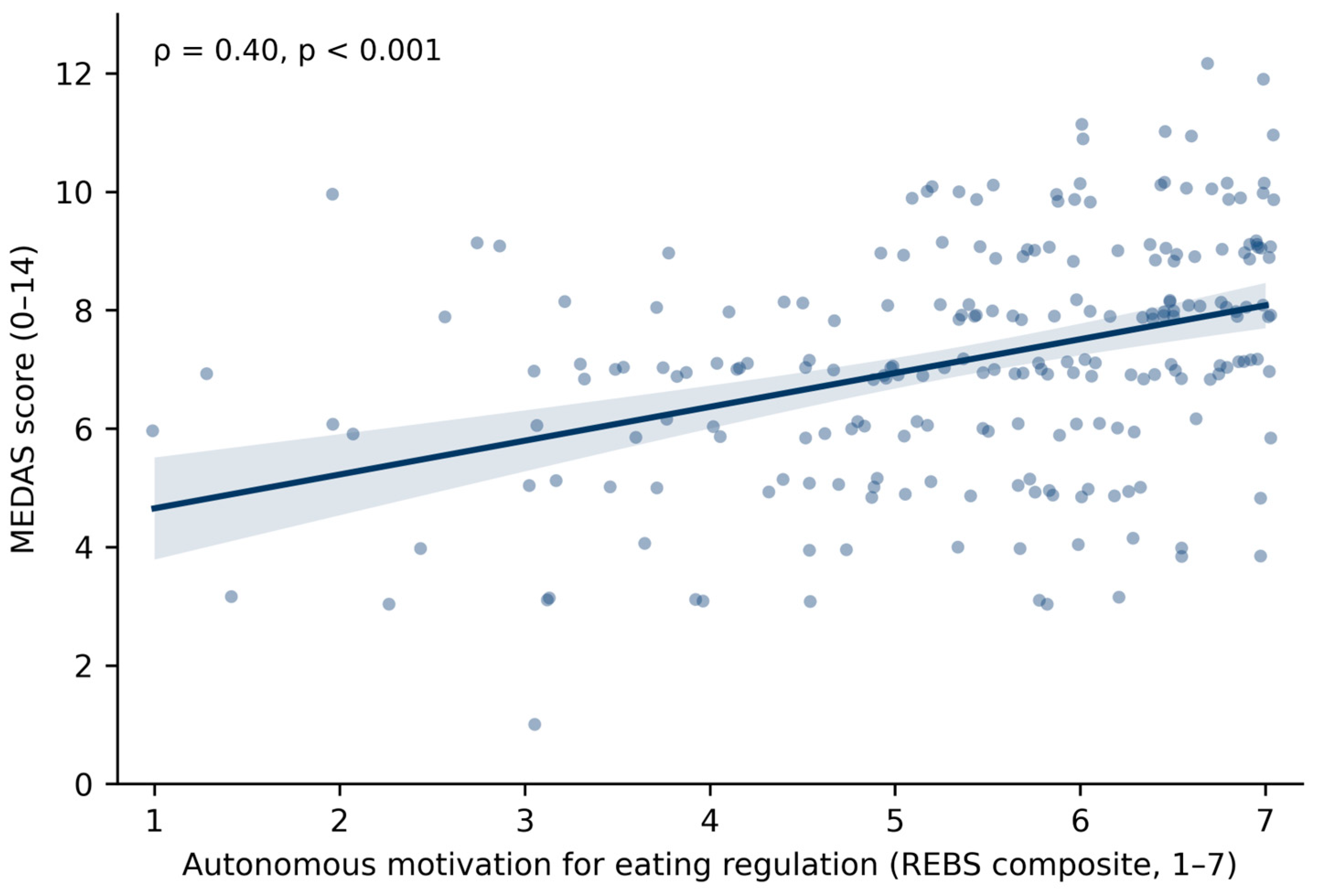

Table 1.
Sociodemographic and behavioral characteristics of the sample (N = 224).
| Characteristic | Category | n | % |
| Sex | Women | 195 | 87.1 |
| Men | 29 | 12.9 | |
| Educational level | High school | 30 | 13.4 |
| Post-secondary (non-tertiary) | 7 | 3.1 | |
| University | 122 | 54.5 | |
| Postgraduate | 65 | 29.0 | |
| BMI category | Underweight (<18.5) | 10 | 4.5 |
| Normal weight (18.5–24.9) | 125 | 55.8 | |
| Overweight (25.0–29.9) | 51 | 22.8 | |
| Obesity (≥30.0) | 38 | 17.0 | |
| Past dieting | Yes | 163 | 72.8 |
| No | 61 | 27.2 | |
| Physical activity | Rarely or never | 88 | 39.3 |
| 1–2 times/week | 66 | 29.5 | |
| 3–4 times/week | 58 | 25.9 | |
| ≥5 times/week | 12 | 5.4 |
BMI, body mass index.
Table 2.
Descriptive statistics and reliability of the study scales (N = 224).
| Scale (Range) | M (SD) | Median | α | ω |
| BSQ-16B (16–96) | 43.9 (16.7) | 41.0 | 0.955 | 0.956 |
| MEDAS (0–14) | 7.2 (2.0) | 7.0 | 0.33 ¹ | – |
| Autonomous motivation (1–7) | 5.43 (1.32) | 5.75 | 0.94 | 0.939 |
| Intrinsic regulation | 5.02 (1.61) | 5.25 | 0.869 | 0.871 |
| Integrated regulation | 5.16 (1.56) | 5.50 | 0.890 | 0.892 |
| Identified regulation | 6.11 (1.25) | 6.50 | 0.891 | 0.898 |
| Controlled motivation (1–7) | 2.87 (1.19) | 2.75 | 0.80 | 0.816 |
| Introjected regulation | 3.65 (1.52) | 3.50 | 0.724 | 0.725 |
| External regulation | 2.09 (1.24) | 1.75 | 0.781 | 0.825 |
| Amotivation (1–7) | 2.26 (1.22) | 2.00 | 0.615 | 0.653 |
M, mean; SD, standard deviation; α, Cronbach’s alpha; ω, one-factor McDonald’s omega. ¹ Kuder–Richardson 20; the MEDAS is a formative index of heterogeneous behaviors, for which internal consistency is not an appropriate criterion and is shown for completeness only.
Table 3.
Adjusted associations between body-shape concerns (BSQ-16B) and eating-regulation styles (N = 224).
Table 3.
Adjusted associations between body-shape concerns (BSQ-16B) and eating-regulation styles (N = 224).
| Motivational Outcome | β per SD | 95% CI | p |
| Introjected regulation | 0.650 | 0.524, 0.777 | <0.001 |
| Controlled motivation (composite) | 0.539 | 0.398, 0.680 | <0.001 |
| Amotivation | 0.273 | 0.123, 0.423 | <0.001 |
| External regulation | 0.237 | 0.068, 0.407 | 0.006 |
| Identified regulation | 0.125 | −0.032, 0.282 | 0.118 |
| Integrated regulation | −0.058 | −0.241, 0.124 | 0.53 |
| Intrinsic regulation | −0.049 | −0.228, 0.129 | 0.59 |
| Autonomous motivation (composite) | −0.004 | −0.186, 0.178 | 0.97 |
Each row is a separate linear regression of the standardized motivational outcome on the standardized BSQ-16B score, adjusted for age, sex, body mass index, education, and physical activity, with HC3-robust standard errors. β, standardized coefficient; CI, confidence interval.
Table 4.
Hierarchical linear regression of Mediterranean diet adherence (MEDAS, 0–14) on covariates, body-shape concerns, and motivational quality (N = 224).
Table 4.
Hierarchical linear regression of Mediterranean diet adherence (MEDAS, 0–14) on covariates, body-shape concerns, and motivational quality (N = 224).
| Predictor (Step 3) | b | 95% CI | p |
| Age | −0.11 | −0.37, 0.16 | 0.43 |
| Sex (female) | −0.27 ¹ | −1.11, 0.57 | 0.52 |
| Body mass index | 0.03 | −0.29, 0.35 | 0.85 |
| Education | 0.06 ² | −0.39, 0.51 | 0.79 |
| Physical activity | 0.38 ² | 0.10, 0.67 | 0.009 |
| BSQ-16B | 0.14 | −0.21, 0.49 | 0.43 |
| Autonomous motivation | 0.63 | 0.32, 0.94 | <0.001 |
| Controlled motivation | −0.09 | −0.42, 0.24 | 0.60 |
| Amotivation | −0.23 | −0.54, 0.08 | 0.14 |
Step 1 (covariates): R² = 0.102. Step 2 (+BSQ-16B): ΔR² = 0.0001, p = 0.86. Step 3 (+motivational composites): ΔR² = 0.095, F(3,214) = 8.47, p < 0.001; final model R² = 0.197. Coefficients b are unstandardized MEDAS-point effects with HC3-robust 95% confidence intervals and p values; continuous predictors are standardized, so their coefficients are per SD. ¹ Per category (male = reference). ² Per level of the ordinal variable.
Disclaimer/Publisher’s Note: The statements, opinions and data contained in all publications are solely those of the individual author(s) and contributor(s) and not of MDPI and/or the editor(s). MDPI and/or the editor(s) disclaim responsibility for any injury to people or property resulting from any ideas, methods, instructions or products referred to in the content. |
© 2026 by the authors. Licensee MDPI, Basel, Switzerland. This article is an open access article distributed under the terms and conditions of the Creative Commons Attribution (CC BY) license (http://creativecommons.org/licenses/by/4.0/).
Copyright: This open access article is published under a Creative Commons CC BY 4.0 license, which permit the free download, distribution, and reuse, provided that the author and preprint are cited in any reuse.