

Submitted:
20 August 2026
Posted:
20 August 2026
You are already at the latest version
Abstract
Although numerous studies have been reported on high-performance Ru-based electrocatalysts for overall water splitting, designing Ru-based material with high activity and stability remains a challenge. Herein, we demonstrate that Cu-doped hollow urchin-like RuO2 nanospheres (Cu-RuO2 HUNSs) can serve as an efficient and stable catalyst for hydrogen evolution reaction (HER), oxygen evolution reaction (OER), and overall water splitting in alkaline media. Benefiting from the doping effect and the unique hollow urchin-like structure, the optimized Cu-RuO2 HUNSs exhibit excellent HER and OER activity and stability. When employed as bifunctional catalyst for overall water splitting, the Cu-RuO2 HUNSs required only a cell voltage of 1.48 V to reach the current density of 10 mA cm-2 in 1 M KOH, outperforming Cu-RuO2 nanoparticles (Cu-RuO2 NPs, 1.56 V) and commercial Pt/C||RuO2 (1.60 V). Corresponding density functional theory (DFT) reveal that the Cu doping effect can weaken the adsorption strength of RuO2 catalysts for the reaction intermediates, which can largely improve the OER performance of RuO2. This work also provides an effective method for synthesizing Ru-based electrocatalysts with high electrochemical activity and stability.
Keywords:
Cu doped
; hollow structure
; RuO2
; oxygen evolution reaction
; water splitting
1. Introduction
Hydrogen energy exhibits significant potential to replace fossil fuels due to its eco-friendliness and high energy density [1,2]. Among the various methods for hydrogen production, water splitting is regarded as the ideal approach for generating the high purity hydrogen. Water splitting involves two half reactions: the hydrogen evolution reaction (HER) and the oxygen evolution reaction (OER). Therefore, excellent electrocatalysts are required to overcome the sluggish kinetics associated with both the OER and HER processes [3]. Although Pt-based and Ir-based electrocatalysts demonstrate superior performance for HER and OER [4,5], their cost and rarity pose significant challenges to commercial applications [6,7]. Tremendous research has been focused on earth-abundant metals, such as metal chalcogenides [8,9], metal oxides [10,11], metal phosphides [12], however, their poor activity and stability hinder large-scale application. Consequently, the search for a relatively inexpensive material to replace Pt-based metals is a viable option. Recently, Ru has been emerged as a promising electrocatalyst for HER and OER due to its relatively low cost and excellent electrochemical activity and stability [13]. Nevertheless, there remains potential for further modification of Ru based materials to meet the demands of commercial application.
Ruthenium oxides (RuO2) are regarded as the most promising catalysts for water splitting; however, their activity and stability still fall short of practical industrial requirements. Doping Ru with transition metal (such as Fe, Co, Ni, etc.) can significantly boost the electrochemical performance by modifying charge distribution, the adsorption energy of intermediate species, and surface properties [14,15]. For instance, Wang et al. doped Ni into RuO2 nanowires, which exhibited enhanced water splitting performance compared to RuO2 nanowires [16]. Sun et al. also reported that introducing Mn and Nb elements into RuO2 can largely improve its water splitting performance [17]. In addition to the alloying effect, morphological tuning is also an effective method to enhance the performance of electrocatalysts [18,19]. Yao and co-workers prepared channel-rich RuCu nanosheets, which demonstrated the remarkable water splitting performance and excellent long-term stability;20 they argued that the channel-rich structure improves electron transfer and optimizes the electronic structure. Furthermore, hollow structure have been employed in the posed active sites, short mass transfer path, and high surface-to-volume ratios [21,22,23]. For instance, wang et al. successfully synthesized RuO2 with a hollow structure, which exhibited remarkable water splitting activity and stability [24]. Therefore, designing a transition metal-doped RuO2 catalyst with a hollow structure could significantly enhance performance.
Taking above into consideration, we report a two-step method for synthesizing Cu-doped hollow urchin-like RuO2 (Cu-RuO2 HUNSs) for highly efficient overall water splitting. The incorporation of Cu and the hollow structure enhance the electronic structure of RuO2, thereby leading to enhanced electrochemical performance. Specifically, when utilizing Cu-RuO2 HUNSs as both cathodic and anodic catalysts, a cell voltage of only 1.46 V is required to achieve a current density of 10 mA cm-2. This value is significantly lower than that of Cu-RuO2 nanoparticles (Cu-RuO2 HUNSs) and RuO2 NPs, and it even surpasses the performance of most reported Ru-based electrocatalysts for overall water splitting.
2. Materials and Methods
Preparation of RuCu HUNSs
Synthesis of face-centered-cubic (fcc) phase RuCu with hollow urchin-like nanosperes (RuCu HUNSs). 10 mg Ru3(CO)12, 2.5 mg Cu(acac)2, 100 mg CA and 5 mL oleylamine were transferred into a glass vial and then ultrasonicated for 30 minutes to acquire a homogeneous and stable solution. Subsequently, the solution was transferred to an oil bath, then heated from room temperature to 240 ℃ and held at this temperature for 5 hours. After cooling to the room temperature, the resultant product was washed with a solvent mixture of cyclohexane and ethanol.
Preparation of Cu-RuO2 HUNSs
As-synthesized RuCu HUNSs were loaded onto the carbon power and subsequent anneal at 300 ℃ in air for 1 h.
Synthesis of Cu-RuO2 NPs
As-synthesized RuCu HUNSs were loaded onto the carbon power and subsequent anneal at 400 ℃ in air for 1 h.
Synthesis of RuO2 NPs
The 10 mg Ru3(CO)12, 72 mg Li2SO4, 100 mg CA and 5 mL oleylamine were transferred into a glass vial. Then, the resulting mixture was ultrasonicated for 30 minutes to acquire a homogeneous and stable solution. Subsequently, the solution was transferred to an oil bath, then heated from room temperature to 240 ℃ and held at this temperature for 5 hours. After cooling to the room temperature, the resultant product was washed with a solvent mixture of cyclohexane and ethanol. The as-synthesized Ru NPs were loaded onto carbon power and then anneal at 300 ℃ in air for 1 h.
Characterizations
Transmission electron microscopy (TEM) was carried out on JEOL 2100 low-resolution TEM with acceleration voltage of 200 kV and JEOL JEM-F200 high-resolution TEM with acceleration voltage of 200 kV. High-angle annular dark-field scanning TEM (HAADF-STEM) was determined on FEI Tecnai F30 TEM at an accelerating voltage of 300 kV. Power X-ray diffraction was conducted on Bruker with a Cu Kα X-ray source (λ = 1.540598 Å). Scanning electron microscope-energy Dispersive Spectrometer (SEM-EDS) was performed on JEOL JSM-7610F Plus at an accelerating voltage of 20 kV. X-ray photoelectron spectroscopy (XPS) was conducted on an AXIS SUPRA+XPS spectrometer. The Raman spectrum was obtained on Renishaw in Via. Inductively coupled plasma-mass spectrometry (ICP-MS) was obtained from Agilent ICP-OES 725 ES.
Electrochemical Measurement
All electrochemical characterizations were tested on the CHI760 electrochemical work station at Chenhua (Shanghai) by using a three-electrode system. A glassy carbon electrode with a diameter of 5 mm was used as the working electrode (WE), a graphitic carbon rod was used as the counter electrode (CE), and a saturated calomel electrode (SCE) was used as the reference electrode (RE). The Cu-RuO2 HUNSs were loaded onto the carbon black (XC-72) for 1 h and washed with ethanol. 2 mg Cu-RuO2 HUNSs, 990 μL isopropyl alcohol, 10 μL Nafion solution (5 wt%) were added to a glass bottle, followed by ultrasound for 0.5 h to form a uniform stable ink. Linear sweep voltammetry (LSV) and chronopotentiometry were performed after 20 cycles of cyclic voltametric (CV) test. LSV were performed at a scan rate of 5 mV s-1. Electrochemical impedance spectroscopy (EIS) spectra were tested at an overpotential of 100 mV.
Density functional theory (DFT)
The OER mechanism of Cu-RuO2 and RuO2 catalysts were studied by DFT calculation performed with Vienna ab initio simulation package (VASP) [25]. The projector augmented wave (PAW) method and the Perdew-Burke-Ernzerhof (PBE) functional with generalized gradient approximation (GGA) are applied to describe the ion-electron interactions and the electron-electron interactions respectively [26]. The Van der Waals (vdW) interaction was described with DFT-D3. Spin polarization is considered in the calculation [27]. The cutoff energy is set to 500 eV, and the force and energy convergence criteria are set to 0.02 eV/Å and 10-5 eV, respectively. The vacuum space was set to 30 Å to avoid interaction of adjacent structures. For geometric optimization, the bottom two atomic layers of all slab structural models is fixed, and the upper two atomic layers remain relaxed.
Gibbs free energy (G) is obtained by the following equation:
G=E+ZPE-TS
Where E, ZPE and TS are total energy, zero point energy and entropic contributions, respectively. ZPE and TS are obtained by vaspkit at 298.15 K.
3. Results and Discussion
The Cu-RuO2 HUNSs were fabricated by using a two-step method. Initially, RuCu HUNSs were initially synthesized according to the previously reported procedures [28], utilizing triruthenium dodecacarbonyl (Ru3(CO)12) and copper acetylacetonate (Cu(acac)2) as the metal sources, citric acid monohydrate as both the reducing agent and structure-directing agent, and oleyamine as the solvent and surfactant. TEM image reveals that the RuCu HUNSs exhibit a hollow, urchin-like structure (Figure 1a). The corresponding XRD pattern confirms the fcc structure of the RuCu HUNSs (Figure S1). The Ru/Cu ratio was determined to be 85/15 by uding scanning transmission electron microscopy energy dispersive X-ray spectroscopy (STEM-EDX) (Figure S2).
Subsequently, RuCu HUNSs were loaded onto XC-72 carbon and then transformed into Cu-RuO2 HUNSs through a post-annealing treatment. As shown in Figure 1b, the hollow urchin structure is remained after annealing at 300 ℃ in air for 1 h. The SEM-EDX analysis reveal that the Ru/Cu ratio in Cu-RuO2 HUNSs is 86/14, which is consistent with that of RuCu HUNSs (Figure 1c), indicating that the annealing process does not alter the elemental composition. Meanwhile, the XPS survey spectrum displays strong signals corresponding to the Ru and Cu elements in Cu-RuO2 HUNSs (Figure 1d). However, the crystal phase has completely transformed from the metallic phase to an oxidized state following the annealing process. As shown in Figure 1e, Cu-RuO2 HUNSs exhibit diffraction peaks similar to those of RuO2 (PDF#88-0233). Furthermore, the lattice spacing of Cu-RuO2 HUNSs is 0.31 nm, which can be attributed to the (111) facet of RuO2 (Figure 1f). Meanwhile, the STEM-EDX elemental mapping reveals that Ru and Cu are uniformly distributed throughout the whole Cu-RuO2 HUNSs (Figure 1g). To investigate the significant role of structure in electrochemical performance, we conducted HER and OER measurements of Cu-RuO2 HUNSs in 1 M KOH using a typical three-electrode system, with Cu-RuO2 NPs, RuO2 and commercial Pt/C as references (Figures S3-4). The overpotential at 10 mA cm-2 was used to evaluate electrochemical activity. Figure 2a shows the HER polarization curves of these catalysts, where Cu-RuO2 HUNSs exhibit the highest HER performance. In detail, Cu-RuO2 HUNSs require only an overpotential of 22 mV to reach the current density of 10 mA cm-2, significantly lower than that of Cu-RuO2 NPs (126 mV) and commercial Pt/C (72 mV). The enhanced HER performance indicates that the hollow urchin structure is conducive to the electrocatalytic activity of Cu-RuO2-based catalysts. To elucdate the kinetics of HER, the Tafel slope was further investigated. As shown in Figure 2b and Figure c, the Tafel slope value for Cu-RuO2 HUNSs/C is 34 mV dec-1 which is much lower than that of Cu-RuO2 NPs (62 mV dec-1) and commercial Pt/C (47 mV dec-1), further confirming the excellent kinetics of Cu-RuO2 HUNSs in the HER process.
Incredibly, Cu-RuO2 HUNSs also exhibits exceptional OER performance in alkaline conditions. Specifically, to achieve a current density of 10 mA cm-2, Cu-RuO2 HUNSs require an overpotential of only 202 mV, whereas Cu-RuO2 NPs and RuO2 necessitate higher overpotential of 250 mV and 420 mV, respectively (Figure 2d). This indicates that the incorporation of dopants and the hollow structure significantly enhance OER performance. Furthermore, Cu-RuO2 HUNSs exhibit the lowest Tafel slope compared to both Cu-RuO2 NPs and RuO2 (Figures 2e-f). Electrochemical impedance spectroscopy (EIS) measurements reveal that Cu-RuO2 HUNSs have a charge-transfer resistance (Rct) of 13 Ω at an overpotential of 100 mV (Figure S5), lower than that of Cu-RuO2 NPs (27 Ω) and RuO2 (>100 Ω), suggesting that Cu-RuO2 HUNSs possess reduced resistance at the electrode-electrolyte interface. Noting that Cu-RuO2 HUNSs exhibited remarkable OER durability in 1 M KOH. As shown in Figure 2g, Cu-RuO2 HUNSs maintained a stable overpotential during a continuous OER test at 5 mA cm-2 over a 40 h chronopotentiometry period, which is much better than that of Cu-RuO2 NPs, RuO2, and many previous reported Ru-based electrocatalysts. The TEM image of Cu-RuO2 HUNSs after the 40 h chronopotentiometry test revealed that the HUs structure was largely preserved (Figure S6). Furthermore, after 2000 cyclic sweeps between 1.2 V and 1.6 V (vs. RHE) at a scan rate of 100 mV s-1, the linear sweep curve almost coincides with the initial curve which is better than that of Cu-RuO2 NPs and RuO2 (Figure S7). However, the ratio of Ru to Cu was changed from 85/15 to 91/9 (Figure S8), indicating the Cu was largely dissolved in the long-time test.
Considering their superior bifunctional properties, we further investigated the overall water splitting performance under alkaline condition. Figure 3a displays the polarization curves of Cu-RuO2 HUNSs and Cu-RuO2 NPs for HER and OER in 1 M KOH. Cu-RuO2 HUNSs show a the voltage difference (∆V) of 1.46 V at a current density of 10 mA cm-2, which is much lower than that of Cu-RuO2 NPs (1.64 V), indicating the superior potential for water splitting of Cu-RuO2 HUNSs. Additionally, overall water splitting was performed by using Cu-RuO2 HUNSs as both the cathode and anode in a two-electrode device, with Cu-RuO2 NPs and commercial Pt/C||RuO2 serving as references. As shown in Figure 3b, Cu-RuO2 HUNSs exhibit the highest performance among these catalysts. In detail, Cu-RuO2 HUNSs only need a cell voltage of 1.49 V to reach a current density of 10 mA cm-2, which is much lower than that of Cu-RuO2 NPs (1.54 V) and Pt/C||RuO2 (1.57 V), indicating the exceptional water splitting performance of Cu-RuO2 HUNSs. The durability of Cu-RuO2 HUNSs in water splitting was also investigated, revealing negligible changes in potential after a 12 h chronopotentiometry test at 5 mV s-1 in 1 M KOH (Figure 3c).
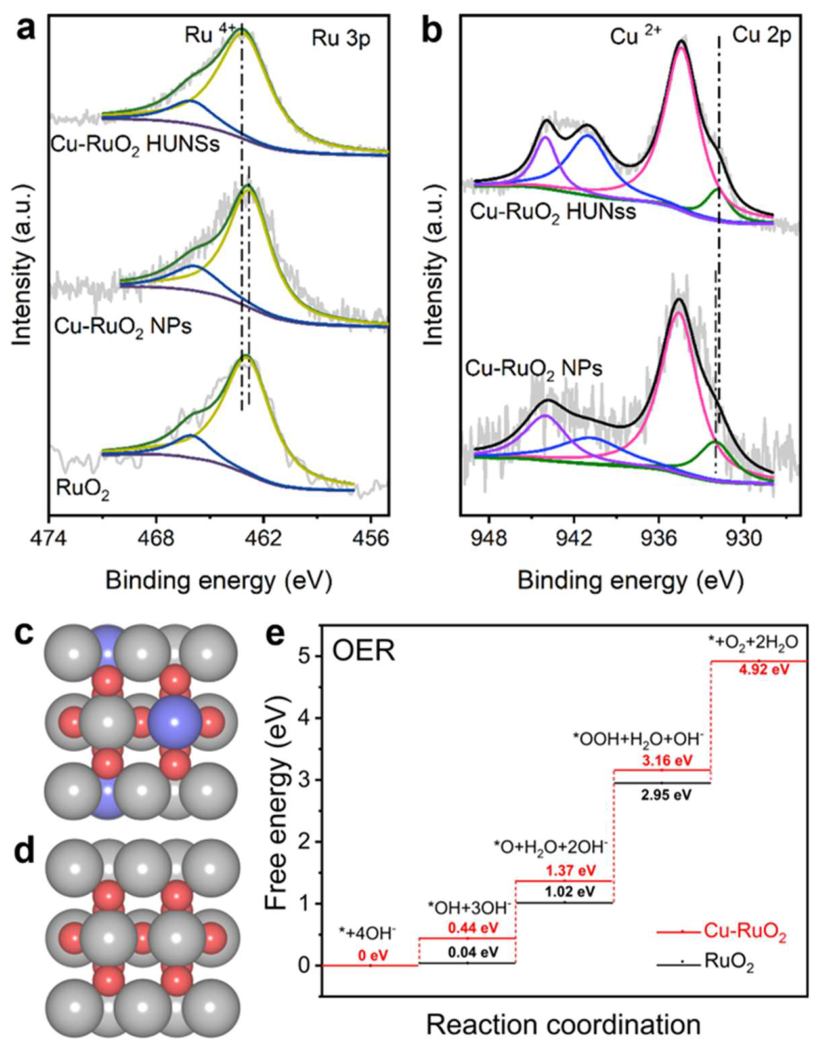
To further elucidate the reasons for the enhanced activity, XPS was employed to evaluate the surface composition and elemental states of Cu-RuO2 HUNSs, Cu-RuO2 NPs, and RuO2. In the high-resolution of Ru 3p3/2 spectrum (Figure 4a), two peaks at binding energy of 463.2, and 466.2 eV can be attributed to Ru4+, and Run+ (n>4) [29,30], respectively. The binding energy of oxidized Ru in these catalysts follows the order: Cu-RuO2 HUNSs > Cu-RuO2 NPs > RuO2 NPs. Additionally, a significant portion of Cu was oxidized in both Cu-RuO2 HUNSs and Cu-RuO2 NPs. As shown in Figure 4b, the binding energy of metallic Cu in Cu-RuO2 HUNSs is 931.7 eV, which is lower than that of Cu-RuO2 NPs, indicating the charge transfer from Ru to Cu across the interfaces. Consequently, the enhanced OER performance is attributed to the alteration of Ru’s electronic structure due to the Cu doping and hollow structure. Density functional theory (DFT) calculations are conducted to further eludidate the origins of the exceptional alkaline OER performance of the Cu-RuO2 HUNSs catalyst. Based on the results obtained from XRD, TEM and SEM, the structural model of Cu-RuO2 with a (110) facet is constructed by uniformly doping Cu atoms into RuO2 (Figures 4c-d). Figure 4e shows the calculated reaction pathways and corresponding reaction free energies for the OER on the Cu-RuO2 and RuO2 catalysts. Figure S9 depicts the structural models of the reaction intermediates on the surfaces of Cu-RuO2 and RuO2 catalysts during the OER process. As shown in Figure 4e, the reaction free energy for the step where *O reacts with OH- to form *OOH on the Cu-RuO2 surface exhibits the largest positive value, indicating that this step constitutes a thermodynamically rate-determining step (RDS) for alkaline OER. In contrast, for the RuO2 catalyst, the reaction free energy associated with the *OOH desorption process to form O2 also shows the largest positive value, indicating that this step is a thermodynamically RDS. The reaction free energies of the RDS on the Cu-RuO2 and RuO2 surfaces are measured at 1.79 eV and 1.97 eV respectively, indicating that the OER process on the Cu-RuO2 surface is thermodynamically more favorable. Obviously, the doping of Cu atoms diminishes the adsorption strength of RuO2 catalysts for the reaction intermediates, which accounts for the enhanced catalytic activity of the Cu-RuO2 catalyst in facilitating the OER.
4. Conclusions
In conclusion, we have successfully synthesized Cu-RuO2 HUNSs via a combination of a simple wet-chemical method and a post-annealing process. Due to the doping effect of Cu and the hollow structure, the synthesized Cu-RuO2 HUNSs exhibit enhanced HER, OER, and overall water splitting performance compared to Cu-RuO2 NPs and RuO2 NPs in alkaline condition. Specifically, the Cu-RuO2 HUNSs require only 22 mV and 202 mV of overpotential to achieve a current density of 10 mA cm-2 towards the HER and OER, respectively, which is significantly lower than that of Cu-RuO2 NPs and RuO2 NPs. Furthermore, when applied to overall water splitting, the Cu-RuO2 HUNSs necessitate a cell voltage of 1.49 V to reach 10 mA cm-2, demonstrating superior long-term stability over 10 h. This work highlights the substantial application potential of the doping effect and hollow structure in electrochemistry.
Supplementary Materials
The following supporting information can be downloaded at the website of this paper posted on Preprints.org.
Author Contributions
J.Z. and F.B. conceived and designed this research. J.L., J.B. performed the experiments and data analysis. J.L. and J. Z. performed data analysis. J. Z. and F.B. wrote the paper. All authors have read and agreed to the published version of the manuscript.
Data Availability Statement
Experimental details and supporting data are available in the online version of the paper.
Acknowledgments
The authors thank the financial supports by the National Natural Science Foundation of China (U21A2085) and start-up support from Henan University.
Conflicts of Interest
The authors declare no conflicts of interest.
References
- Z. Jiang, L. Shao, Y. Sun, Y. Dong, X. Zheng, T. Wang, J. Li, H. Shao, L. Jiao and Y. Deng, Mitigating Irreversible Ru Dissolution in Acidic OER via Controlled Co-Induced Reconstruction of RuCo Alloy Electrocatalysts. Adv. Funct. Mater., 2025, 35, e09656.
- Y. Yuan, H. Fang, K. Chen, J. Huang, J. Chen, Z. Lu, H. Wang, Z. Zhao, W. Chen and Z. Wen, Engineering High-Density Grain Boundaries in Ru0.8Ir0.2Ox Solid-Solution Nanosheets for Efficient and Durable OER Electrocatalysis. Adv. Mater., 2025, 37, 2501607.
- M. Long, S. Lai, K. Miao, W. Jiang, W. Fan and X. Kang, IrPdCuFeNiCoMo Based Core-Shell Icosahedron Nanocrystals and Nanocages for Efficient and Robust Acidic Oxygen Evolution. Angew. Chem. Int. Ed., 2025, 64, e202419956.
- T. Kuang, J. Huang, J. Li, P. Yang, L. Zhang, D. Ye, X. Zhu and Q. Liao, Enhancing proton exchange membrane water electrolysis performance: Impact of iridium oxide catalyst ink dispersing methodology. J. Power Sources, 2024, 606, 234543.
- Z. Huang, Y. Peng, L. Xing, M. Xu, M. Fang, H. Xie, J. Li, Y. Zhou, P. Wu, N. Wang, C. Tang, M. Wu, L. Wang, S. Ye and L. Du, Microenvironment regulation to synthesize sub-3 nm Pt-based high-entropy alloy nanoparticles enabling compressed lattice to boost electrocatalysis. Appl. Catal. B: Environ. Energy, 2025, 363, 124775.
- Y. Jin, X. Han, J. Su, R. Li, Z. Gao, H. Guo, J. Zheng, X. Zhang, S. Cheng, Y. Li, L. Xue, X. Luo, J. Wang, W. Ma and Y. Han, Selenium induced multicomponent platinum-based ultrathin nanowires with abundant grain boundaries and partial amorphous phase enable remarkable multifunctional electrocatalysis. J. Colloid Interface Sci., 2025, 696, 137900.
- G. Chen, R. Lu, C. Ma, X. Zhang, Z. Wang, Y. Xiong and Y. Han, Long-Range Disordered RuO2 Catalyst for Highly Efficient Acidic Oxygen Evolution Electrocatalysis. Angew. Chem. Int. Ed., 2024, 63, e202411603.
- L. Wu, X. Shen, Z. Ji, J. Yuan, S. Yang, G. Zhu, L. Chen, L. Kong and H. Zhou, Facile Synthesis of Medium-Entropy Metal Sulfides as High-Efficiency Electrocatalysts toward Oxygen Evolution Reaction. Adv. Funct. Mater., 2023, 33, 2208170.
- J. Guo, H. Zhao, Z. Yang, L. Wang, A. Wang, J. Zhang, L. Ding, L. Wang, H. Liu and X. Yu, Bimetallic Sulfides with Vacancy Modulation Exhibit Enhanced Electrochemical Performance. Adv. Funct. Mater., 2024, 34, 2315714.
- M. P. Browne, Z. Sofer and M. Pumera, Layered and two dimensional metal oxides for electrochemical energy conversion. Energy Environ. Sci., 2019, 12, 41-58.
- J. Huang, A. H. Clark, N. Hales, K. Crossley, J. Guehl, R. Skoupy, T. J. Schmidt and E. Fabbri, Oxidation of interfacial cobalt controls the pH dependence of the oxygen evolution reaction. Nat. Chem., 2025, 17, 856-864.
- Z. P. Wu, S. Zuo, Z. Pei, J. Zhang, L. Zheng, D. Luan, H. Zhang and X. W. Lou, Operando unveiling the activity origin via preferential structural evolution in Ni-Fe(oxy)phosphides for efficient oxygen evolution. Sci. Adv., 2025, 11, eadu5370.
- W. Yu, P. Yang, F. Liu, H. Li, W. Xiao, T. Ma, G. Xu, X. Guo, D. Zhang, L. Wang, B. Li and Z. Wu, Boron Vacancy Enhanced Ru-Mo Electron Bridge as an Efficient Electrocatalyst for Anion Exchange Membrane Electrolysis. Adv. Mater., 2026, 38, e23202.
- X. Kang, F. Yang, Z. Zhang, H. Liu, S. Ge, S. Hu, S. Li, Y. Luo, Q. Yu, Z. Liu, Q. Wang, W. Ren, C. Sun, H. M. Cheng and B. Liu, A corrosion-resistant RuMoNi catalyst for efficient and long-lasting seawater oxidation and anion exchange membrane electrolyzer. Nat. Commun., 2023, 14, 3607.
- V. Jose, V. H. Do, P. Prabhu, C. K. Peng, S. Y. Chen, Y. Zhou, Y. G. Lin and J. M. Lee, Activating Amorphous Ru Metallenes Through Co Integration for Enhanced Water Electrolysis. Adv. Energy Mater., 2023, 13, 2301119.
- J. Wang, Y. J. Ji, R. G. Yin, Y. Y. Li, Q. Shao and X. Q. Huang, Transition metal-doped ultrathin RuO2 networked nanowires for efficient overall water splitting across a broad pH range. J. Mater. Chem. A, 2019, 7, 6411-6416.
- B. C. Yuan, Q. Dang, H. Liu, M. G. Sendeku, J. Peng, Y. M. Fan, L. Cai, A. Q. Cao, S. Y. Chen, H. Li, Y. Kuang, F. M. Wang and X. M. Sun, Synergistic niobium and manganese co-doping into RuO2 nanocrystal enables PEM water splitting under high current. Nat. Commun., 2025, 16, 4583.
- J. T. Zhang, M. Li, X. Liang and Z. B. Zhuang, Multishelled FeCo@FeCoP@C hollow spheres as highly efficient hydrogen evolution catalysts. ACS Appl. Mater. Interfaces., 2019, 11, 1267-1273.
- W. Zhu, Z. Chen, Y. Pan, R. Y. Dai, Y. Wu, Z. B. Zhuang, D. S. Wang, Q. Peng, C. Chen and Y. D. Li, Functionalization of Hollow Nanomaterials for Catalytic Applications: Nanoreactor Construction. Adv. Mater., 2019, 31, 30.
- Q. Yao, B. L. Huang, N. Zhang, M. Z. Sun, Q. Shao and X. Q. Huang, Channel-Rich RuCu Nanosheets for pH-Universal Overall Water Splitting Electrocatalysis. Angew. Chem. Int. Ed., 2019, 58, 13983-13988.
- Y. Z. Wang, M. Yang, Y. M. Ding, N. W. Li and L. Yu, Recent Advances in Complex Hollow Electrocatalysts for Water Splitting. Adv. Funct. Mater., 2022, 32, 2108681.
- G. Yu, R. Li, Y. Hu, X. Lin, Z. Lin, D. Wu, G. Wang and X. Hong, Supporting IrOx nanosheets on hollow TiO2 for highly efficient acidic water splitting. Nano Res., 2024, 17, 6903-6909.
- B. Shen, L. Huang, J. Shen, X. Hu, P. Zhong, C. Y. Zheng, C. Wolverton and C. A. Mirkin, Morphology Engineering in Multicomponent Hollow Metal Chalcogenide Nanoparticles. ACS Nano, 2023, 17, 4642-4649.
- Y. X. Gao, D. B. Zheng, Q. C. Li, W. P. Xiao, T. Y. Ma, Y. L. Fu, Z. X. Wu and L. Wang, 3D Co3O4-RuO2 hollow spheres with abundant interfaces as advanced trifunctional electrocatalyst for water-splitting and flexible Zn-air battery. Adv. Funct. Mater., 2022, 32, 6411-6416.
- G. Kresse and J. Furthmuller, Efficient iterative schemes for ab initio total-energy calculations using a plane-wave basis set, Phys. Rev. B, 1996, 54, 11169-11186.
- J. P. Perdew, K. Burke and M. Ernzerhof, Generalized Gradient Approximation Made Simple, Phys. Rev. Lett., 1996, 77, 3865-3868.
- S. Grimme, Semiempirical GGA-type density functional constructed with a long-range dispersion correction, J. Comp. Chem., 2006, 27, 1787-1799.
- J. T. Zhang, J. B. Le, Y. T. Dong, L. Z. Bu, Y. Zhang, J. Cheng, L. G. Li and X. Q. Huang, Face-centered cubic structured RuCu hollow urchin-like nanospheres enable remarkable hydrogen evolution catalysis. Sci. China: Chem., 2022, 65, 87-95.
- J. Gu, L. Chen, J. Zhang, C. Zhang, J. Li, S. Chen, X. Liu, S. Chen, H. Geng, Z. Hu and F. Bai, Metastable phase engineering of core@shell RuFe@Ru for boosting hydrogen evolution. Nano Lett., 2025, 25, 9872-9879.
- J. Zhang, G. Ren, D. Li, Q. Kong, Z. Hu, Y. Xu, S. Wang, L. Wang, M. Cao and X. Huang, Interface engineering of snow-like Ru/RuO2 nanosheets for boosting hydrogen electrocatalysis. Sci. Bull., 2022, 67, 2103-2111.
Figure 1.
TEM image of (a) RuCu HUNSs and (b) Cu-RuO2 HUNSs/C. (c) SEM-EDX, (d) XPS survey spectrum, (e) XRD pattern, (f) HRTEM image, and (g) STEM-EDS image and element mappings of Cu-Ru HUNSs.
Figure 1.
TEM image of (a) RuCu HUNSs and (b) Cu-RuO2 HUNSs/C. (c) SEM-EDX, (d) XPS survey spectrum, (e) XRD pattern, (f) HRTEM image, and (g) STEM-EDS image and element mappings of Cu-Ru HUNSs.
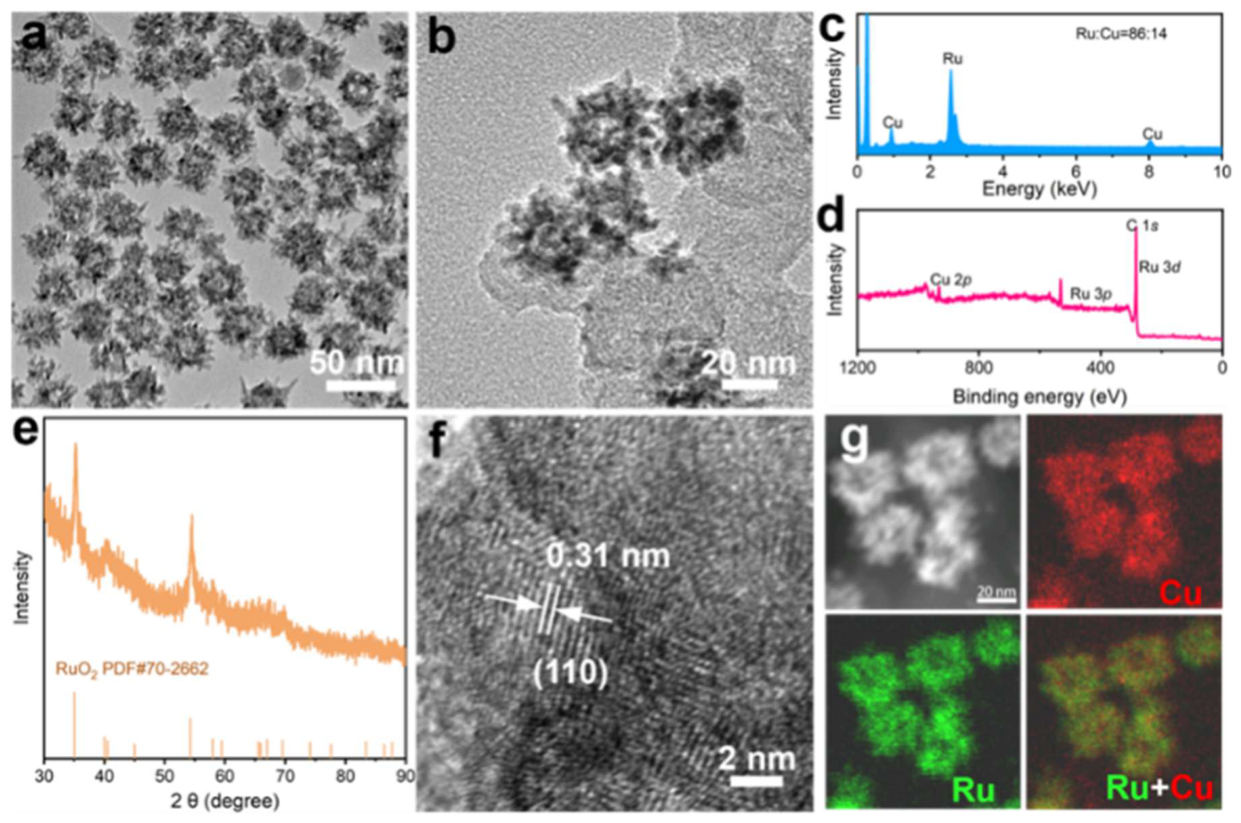
Figure 2.
(a) HER polarization curves, (b) Tafel plots, (c) overpotentials at 10 mA cm-2 and Tafel slope values of Cu-RuO2 HUNSs, Cu-RuO2 NPs and Pt/C in 1 M KOH. (d) OER polarization curves, (e) Tafel plots, (f) overpotentials at 10 mA cm-2 and Tafel slope values of Cu-RuO2 HUNSs, Cu-RuO2 NPs and Pt/C in 1 M KOH. (g) Chronopotentiometry tests of Cu-RuO2 HUNSs, Cu-RuO2 NPs and commercial RuO2 at the current density of 10 mA cm-2.
Figure 2.
(a) HER polarization curves, (b) Tafel plots, (c) overpotentials at 10 mA cm-2 and Tafel slope values of Cu-RuO2 HUNSs, Cu-RuO2 NPs and Pt/C in 1 M KOH. (d) OER polarization curves, (e) Tafel plots, (f) overpotentials at 10 mA cm-2 and Tafel slope values of Cu-RuO2 HUNSs, Cu-RuO2 NPs and Pt/C in 1 M KOH. (g) Chronopotentiometry tests of Cu-RuO2 HUNSs, Cu-RuO2 NPs and commercial RuO2 at the current density of 10 mA cm-2.
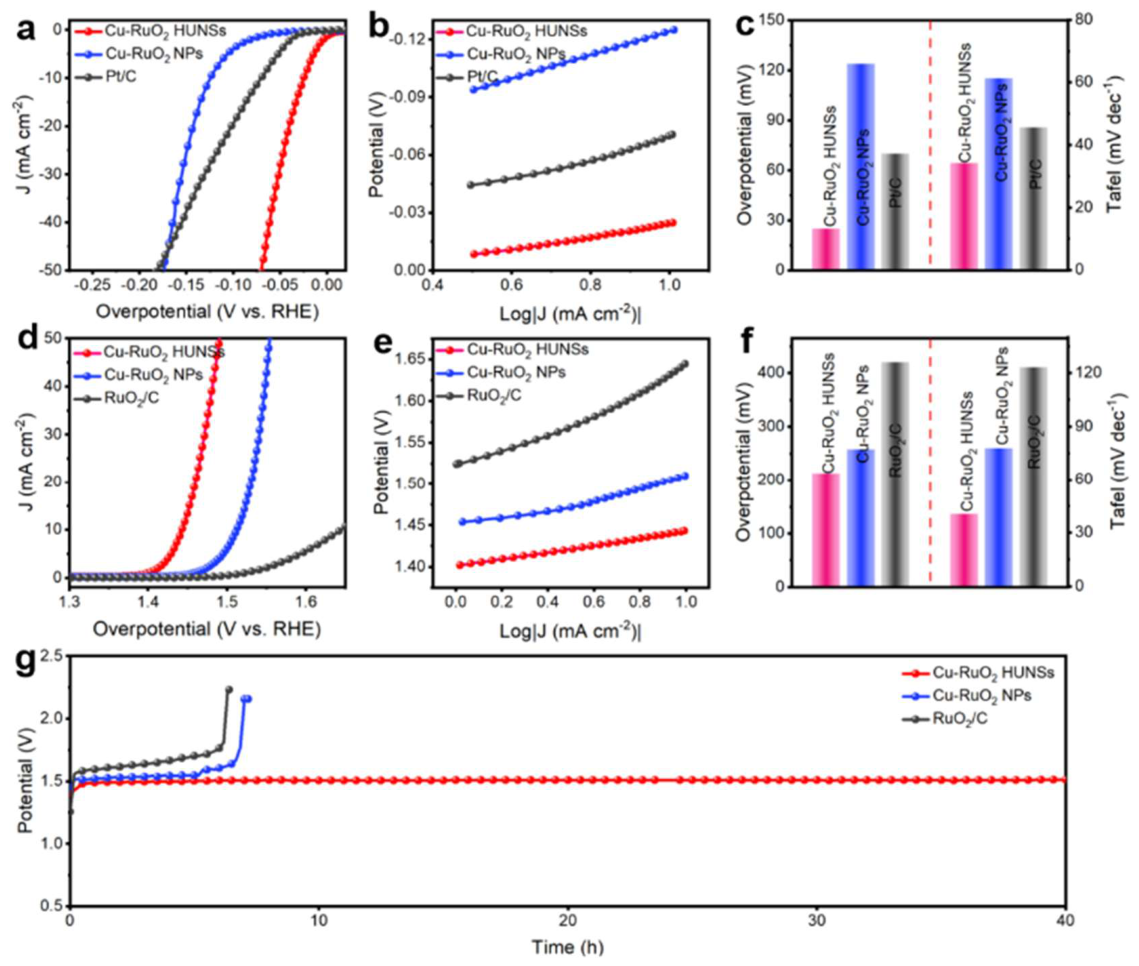
Figure 3.
(a) Polarization curves of Cu-RuO2 HUNSs and Cu-RuO2 NPs for HER and OER in 1 M KOH. (b) Polarization curves of Cu-RuO2 HUNSs/C||Cu-RuO2 HUNSs, Cu-RuO2 NPs||Cu-RuO2 NPs, and Pt/C||RuO2 fpr water splitting in 1 M KOH. (c) Chronopotentiometry tests of Cu-RuO2 HUNSs||Cu-RuO2 HUNSs, Cu-RuO2 NPs||Cu-RuO2 NPs and commercial Pt/C||RuO2 at the current density of 10 mA cm-2.
Figure 3.
(a) Polarization curves of Cu-RuO2 HUNSs and Cu-RuO2 NPs for HER and OER in 1 M KOH. (b) Polarization curves of Cu-RuO2 HUNSs/C||Cu-RuO2 HUNSs, Cu-RuO2 NPs||Cu-RuO2 NPs, and Pt/C||RuO2 fpr water splitting in 1 M KOH. (c) Chronopotentiometry tests of Cu-RuO2 HUNSs||Cu-RuO2 HUNSs, Cu-RuO2 NPs||Cu-RuO2 NPs and commercial Pt/C||RuO2 at the current density of 10 mA cm-2.
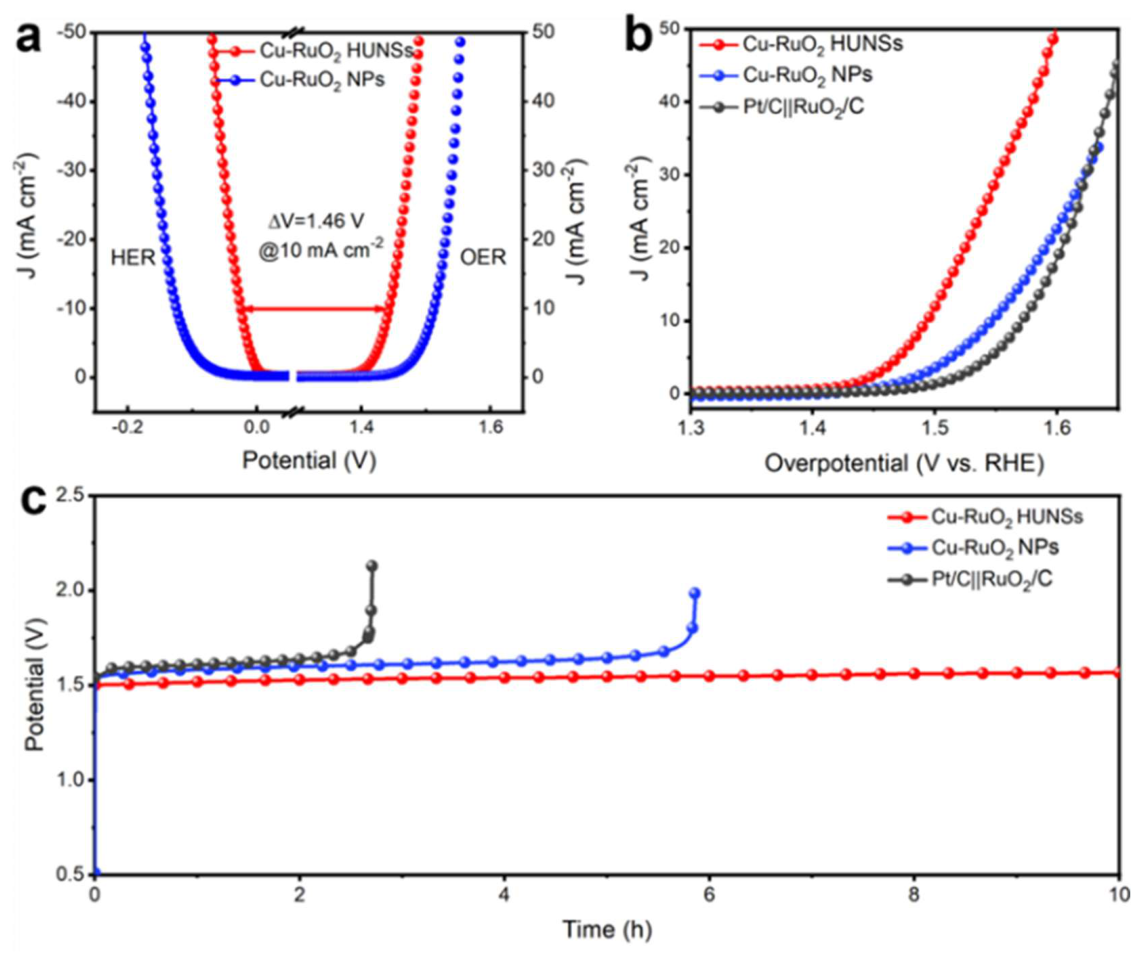
Figure 4.
XPS and DFT results of Cu-RuO2 HUNSs, Cu-RuO2 NPs, and RuO2. High resolution XPS spectra of (a) Ru 3p and (b) Cu 2p. Atomic model of (c) Cu-RuO2 and (d) RuO2. (e) The reaction free energy pathways of OER.
Figure 4.
XPS and DFT results of Cu-RuO2 HUNSs, Cu-RuO2 NPs, and RuO2. High resolution XPS spectra of (a) Ru 3p and (b) Cu 2p. Atomic model of (c) Cu-RuO2 and (d) RuO2. (e) The reaction free energy pathways of OER.
Disclaimer/Publisher’s Note: The statements, opinions and data contained in all publications are solely those of the individual author(s) and contributor(s) and not of MDPI and/or the editor(s). MDPI and/or the editor(s) disclaim responsibility for any injury to people or property resulting from any ideas, methods, instructions or products referred to in the content. |
© 2026 by the authors. Licensee MDPI, Basel, Switzerland. This article is an open access article distributed under the terms and conditions of the Creative Commons Attribution (CC BY) license (http://creativecommons.org/licenses/by/4.0/).
Copyright: This open access article is published under a Creative Commons CC BY 4.0 license, which permit the free download, distribution, and reuse, provided that the author and preprint are cited in any reuse.