
Submitted:
18 August 2026
Posted:
20 August 2026
You are already at the latest version
Abstract
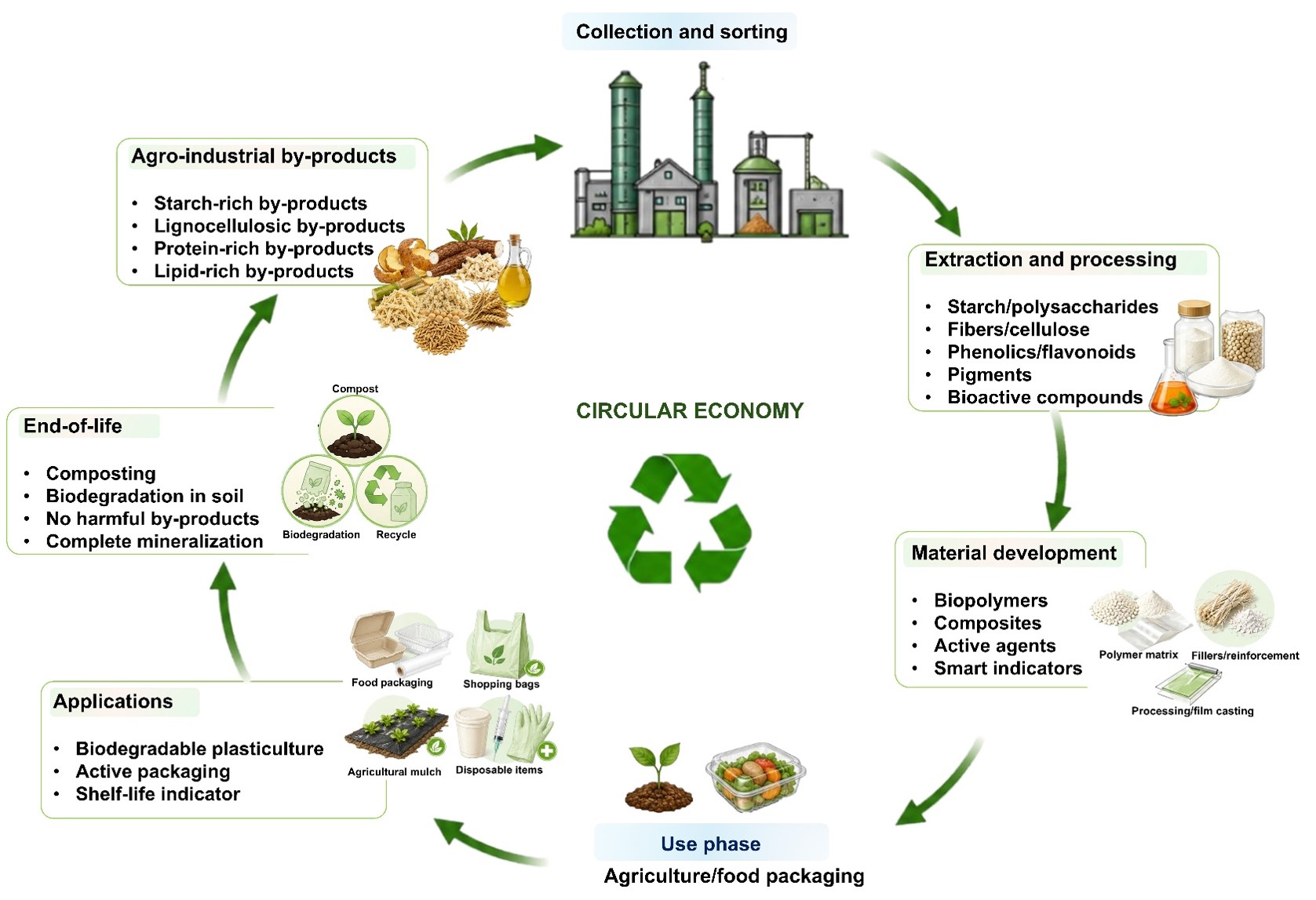
The increasing environmental impact of petroleum-based plastics has intensified the need for renewable, biodegradable, active, and intelligent materials for food packaging and agricultural plasticulture. This review critically analyzes the potential to valorize agro-industrial by-products and underutilized biomass to produce functional, biodegradable materials through the production of bio-polymers, reinforcing fillers, bioactive compounds, and natural pigments. Particular emphasis is placed on starch-rich and fructan-rich crops (cassava, potato, sweet potato, and Jerusalem artichoke, or topinambur (Helianthus tuberosus), which are potential raw materials for the manufacture of biodegradable films, coatings, and agricultural mulches. Further, the multifunctional application of the residues from yerba mate (Ilex paraguariensis) as reinforcement fillers, antioxidant additives, and pH-responsive components in biopolymer composites is discussed. Rosehip (Rosa rubiginosa), Aloe vera (Aloe barbadensis), and Jerusalem artichoke are also described as sources of polysaccharides, dietary fibers, phenolic compounds, and natural colorants that can enhance the mechanical, barrier, antioxidant, and functional properties of the biodegradable materials. Recent developments are discussed, including the use of a freshness-monitoring system for packaging that contains pH-sensitive anthocyanins extracted from red cabbage and the promising application of pigments from Jerusalem artichoke flowers. In addition, the review identifies the main challenges for industrial application, such as mechanical and barrier performance, moisture sensitivity, instability of natural pigments and bioactive compounds, and control of biodegradability. It also highlights challenges related to food safety control, regulatory compliance, raw materials availability, and scalability. In general, agro-industrial biomass valorization and its combination with biodegradable polymer processing, active capabilities, and intelligent sensing technologies provide a promising solution for eventual partial substitution of conventional plastics and enhancement of resource efficiency in sustainable food-packaging and plasticulture systems integrated in a circular bioeconomy.
Keywords:
agro-industrial by-products
; biopolymers
; biodegradable plasticulture
; yerba mate
; topinambur
; red cabbage anthocyanins
; intelligent packaging
; circular economy
Copyright: This open access article is published under a Creative Commons CC BY 4.0 license, which permit the free download, distribution, and reuse, provided that the author and preprint are cited in any reuse.