

Submitted:
19 August 2026
Posted:
20 August 2026
You are already at the latest version
Abstract
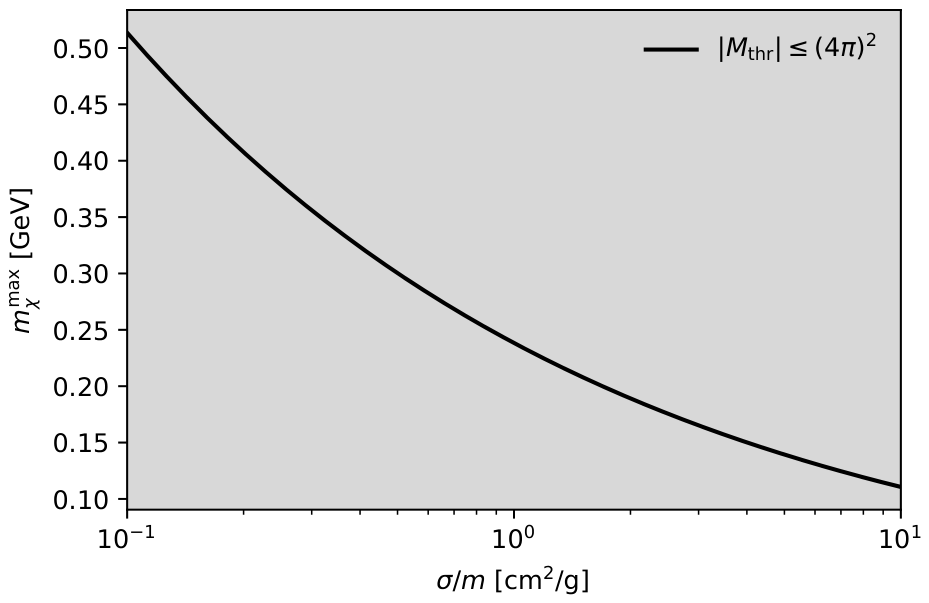
We study \( 2\to 2 \) scattering of a stable, \( \mathbb{Z}_2 \)-odd real scalar \( \chi \) in four-dimensional Minkowski space, assuming analyticity, crossing, locality in the Jin--Martin sense, and partial-wave unitarity. Galactic-structure inferences of a self-interaction cross section per mass in the window \( \sigma/m\in[0.1,10]\,\mathrm{cm}^2/\mathrm{g} \) are used only as a phenomenological input, not as a discovery claim. Within the weakly coupled class defined by a crossing-symmetric subtraction constant \( |g_0|\le(4\pi)^2 \)and a twice-subtracted dispersive representation whose unresolved absorptive support starts at a scale \( \Lambda \), an independently replayable dual functional yields \( |M_{\mathrm{thr}}|\le B \) with \( B\simeq 158 \) at \( \Lambda/m=10 \). Consequently \( m_\chi\le 0.238\,\mathrm{GeV}\left(\frac{1\,\mathrm{cm}^2/\mathrm{g}}{\sigma/m}\right)^{1/3} \) in that class. An explicit contact countermodel (\( m_\chi=10\,\mathrm{MeV} \), \( \lambda=1 \)) lies inside the SIDM window with no extra poles, so the unqualified conjecture that a new state at \( M_X\le C m_\chi \) is always required is false. For \( m_\chi \) above the certified ceiling, SIDM-sized threshold scattering is incompatible with weak coupling and a gap: a new singularity or the failure of weak coupling is required. No universal \( C \) exists. In the short-range subclass the effective-range pole sits at \( M_X\le 2m_\chi \); a tree-level \( 0^{++} \) mediator at \( m_\chi=1\,\mathrm{GeV} \) instead allows \( M_X/m_\chi\lesssim 0.47 \)for \( |g|\le 4\pi \). Nature-level existence of SIDM or of any new dark-sector state is not established. No proof assistant was used.
Keywords:
self-interacting dark matter
; scalar dark matter
; S-matrix bootstrap
; dispersion relations
; partial-wave unitarity
; analyticity
; crossing symmetry
; weak coupling
1. Physical Question and Prior Frontier
Self-interacting dark matter (SIDM) was proposed as a particle-physics response to small-scale structure tensions [1]. Halo analyses are often summarized by a window [2,3,4]
with dwarf-scale values typically larger than cluster-scale values. We freeze this interval as an input. We do not claim that halos demonstrate particle scattering.
The working conjecture under test is: if lies in that window and the theory remains weakly coupled below a scale , then a new bound state, mediator, or resonance must appear at some calculable mass .
Unitarity alone, with s-wave dominance at halo velocities, already implies [5], which is distinct from the thermal-relic unitarity bound [6]. Perturbative unitarity in singlet models tightens this to [7]. Light mediators are the standard dynamical realization of a large, possibly velocity-dependent, cross section [3,8].
The modern S-matrix bootstrap implements analyticity, crossing and unitarity without a Lagrangian [9,10,11,12,13]. Positivity of dispersive moments likewise constrains low-energy amplitudes [14,15]. A primal dispersive bootstrap [16] applied to SIDM recently produced for weakly coupled scalars at a benchmark [17]. That result is a mass bound allowing arbitrary states above . It is not a necessity theorem for a nearby pole, it does not classify C, and it does not serialize a dual certificate.
Searches of arXiv and INSPIRE on 2026-08-19 did not find a theorem asserting a universal C for all SIDM masses. The present work therefore attacks the conjecture symmetrically: construct countermodels, certify a consistency bound, and only then interpret poles.
2. Model, Assumptions, and Conventions
The frozen model is a single real scalar of mass in four-dimensional Minkowski space, odd under an exact . Gravity, Standard Model portals, and relic-density constraints are omitted. Mandelstam variables obey . The invariant amplitude is dimensionless, fully crossing symmetric, and expanded as
With , partial-wave unitarity is , hence [17]. Identical-particle kinematics give, for an s-wave threshold amplitude ,
so that . Locality is implemented as Jin–Martin polynomial boundedness [18,19], which justifies a twice-subtracted fixed-t dispersion relation. The subtraction constant is .
Definition 1
Conversion of units is frozen at .
3. Mathematical Endpoint
Theorem 1
(Contact countermodel to unqualified necessity). The constant amplitude with and has no extra poles, has loop-counting parameter , and yields , inside the frozen SIDM window. Therefore SIDM-sized scattering does not, by itself, force a new state.
Theorem 2
(Certified bound on the threshold amplitude). In the weakly coupled class with and ,
where B is the value of the serialized dual functional in the companion certificate (the cap plus the positive-part spectral integral). Consequently, for a target ,
At one has . The purely algebraic cap already gives ; the dispersive remainder is a effect at this hierarchy.
Corollary 1
(Incompatibility at weak-scale masses). A scalar with requires . It cannot lie in with . Either weak coupling fails, extra subtractions are needed, or a singularity not captured by a gapped twice-subtracted representation is present below Λ.
Proposition 1
(No universal C; short-range ). Tree-level exchange of a -even scalar of mass at and remains possible for only if . In the complementary short-range subclass (no t-channel poles below ), the same target has , and the effective-range pole of with sits at . Thus covers nearby bound or virtual poles, but light mediators realize SIDM with . There is no single model-independent C.
Theorem 2 is the principal scientific status: a certified consistency bound. The corollary is a conditional incompatibility, not a laboratory discovery. Proposition 1 is an existence/classification statement inside explicit models, except for the effective-range pole, which is a quantum-mechanical lemma rather than a fully axiomatic four-dimensional proof.
4. Derivation or Exclusion Certificate
The twice-subtracted representation [16,17] evaluates at threshold as a linear functional of and of . Bounding and retaining only the positive part of each kernel produces a valid, non-optimal upper bound on . At the integral contributes on top of . Independent saturation of infinitely many waves is forbidden by Froissart growth [18]; because the add-on is already negligible, the overestimate does not move the mass ceiling at the reported precision.
The inequality is serialized in JSON and recomputed from the frozen inputs by an independent verifier (no cached discovery values). The algebraic chain
is exact inside the definition of once the remainder has been bounded. Figure 1 shows from that chain.
A modest crossing-symmetric -polynomial primal (degree 2, linearized unitarity on a grid, seed 20260819) attains with and no Padé roots in the Mandelstam gap. Extremal weakly coupled amplitudes are therefore contact-like: poles are not forced inside . They are forced only when the SIDM target lies outside the certified region. Padé roots of truncated ansätze are diagnostics, not certificates.
5. Spin, Parity, and Couplings of a Hypothetical New State
Two identical scalars couple only to even partial waves. A local cubic vertex is therefore possible only for a -even boson of even spin, i.e. . A fermion mediator is forbidden by Lorentz statistics. A vector has no local cubic coupling to a single real scalar. The leading candidate, when a new state is introduced, is a scalar (mediator or bound state).
Tree matching for at and requires only for . This is a Born estimate: Sommerfeld enhancement and resonances can change the coupling needed, but they do not restore a no-state WC completion at this mass.
6. Consistency, Regularity, and Stability
forbids . The contact countermodel has no extra decaying states. For the mediator scan, viable lie below , so is closed. The effective-range pole at is not tachyonic. Four-dimensional triviality is not used as a loophole: if the contact theory has no continuum UV completion, that is additional UV structure, not a weakly coupled SIDM completion at . Extra polynomial growth (additional subtractions) exits class .
7. Observables and Competing Interpretations
The only operational observable used here is the on-shell threshold cross section. A pole of may be a first-sheet bound state, a t-channel mediator, a second-sheet virtual state, a resonance, or a numerical artifact. Corollary 3.3 does not select among these, nor among strong coupling without a narrow pole [5]. Velocity dependence, omitted from the baseline theorem, would additionally disfavour a pure contact amplitude even at low mass, restoring a phenomenological preference for light mediators [2,8]. That is an extra empirical hypothesis, not part of Theorems 1–2.
Highest interpretation level reached: derivation of an on-shell observable and a model-class bound. Existence in nature is unconfirmed.
8. Limitations and Empirical Status
- The SIDM window is an astrophysical input with a factor spread; varies by .
- is a convention for “weak coupling”. Deep perturbation theory () lowers as .
- The effective-range statement is not a complete axiomatic proof in the four-dimensional cut plane.
- Relic density, freeze-in, and Standard Model couplings can exclude the contact point for other reasons without reviving unqualified S-matrix necessity.
- No Lean/Coq/Isabelle formalization and no certified SDP solver were used.
Data, Code, and AI Disclosure
Code, tests, the dual certificate, and the independent verifier are in the companion repository. Environment: Python 3.9.6, NumPy 2.0.2, SciPy 1.13.1; cvxpy is installed but was not required for the certificate. Seed 20260819 for the primal search.
This manuscript was drafted with computational assistance from a large language model (Cursor Grok 4.6) following a provenance-first research protocol. All numerical claims were generated by the frozen Python code and replayed by the verifier. Literature pointers were checked against arXiv and INSPIRE records dated on or before 2026-08-19. The model does not exist in nature merely because a bound exists in the model.
References
- Spergel, D.N.; Steinhardt, P.J. Observational evidence for selfinteracting cold dark matter. Phys. Rev. Lett. 2000, 84, 3760–3763. [Google Scholar] [CrossRef] [PubMed]
- Kaplinghat, M.; Tulin, S.; Yu, H.B. Dark Matter Halos as Particle Colliders: Unified Solution to Small-Scale Structure Puzzles from Dwarfs to Clusters. Phys. Rev. Lett. 2016, 116, 041302. [Google Scholar] [CrossRef]
- Tulin, S.; Yu, H.B. Dark Matter Self-interactions and Small Scale Structure. Phys. Rept. 2018, 730, 1–57. [Google Scholar] [CrossRef]
- Adhikari, S.; et al. Astrophysical Tests of Dark Matter Self-Interactions. Rev. Mod. Phys. 2025, 97, 045004. [Google Scholar] [CrossRef]
- Hui, L. Unitarity bounds and the cuspy halo problem. Phys. Rev. Lett. 2001, 86, 3467–3470. [Google Scholar] [CrossRef] [PubMed]
- Griest, K.; Kamionkowski, M. Unitarity Limits on the Mass and Radius of Dark Matter Particles. Phys. Rev. Lett. 1990, 64, 615. [Google Scholar] [CrossRef] [PubMed]
- Campbell, R.; Godfrey, S.; Logan, H.E.; Peterson, A.D.; Poulin, A. Implications of the observation of dark matter self-interactions for singlet scalar dark matter. Phys. Rev. D. Erratum: Phys. Rev. D. 2015, 92, 055031. [Google Scholar] [CrossRef]
- Tulin, S.; Yu, H.B.; Zurek, K.M. Beyond Collisionless Dark Matter: Particle Physics Dynamics for Dark Matter Halo Structure. Phys. Rev. D. 2013, 87, 1150072. [Google Scholar] [CrossRef]
- Paulos, M.F.; Penedones, J.; Toledo, J.; van Rees, B.C.; Vieira, P. The S-matrix bootstrap. Part III: higher dimensional amplitudes. JHEP 2019, 12(040), 1708.06765. [Google Scholar] [CrossRef]
- Guerrieri, A.; Sever, A. Rigorous Bounds on the Analytic S Matrix. Phys. Rev. Lett. 2021, 127, 251601. [Google Scholar] [CrossRef] [PubMed]
- Elias Miró, J.; Guerrieri, A.L.; Gumus, M.A. Bridging positivity and S-matrix bootstrap bounds. JHEP 2023, 05(001). [Google Scholar] [CrossRef]
- Karateev, D.; Kuhn, S.; Penedones, J. Bootstrapping Massive Quantum Field Theories. JHEP 2020, 07, 035. [Google Scholar] [CrossRef]
- Kruczenski, M.; Penedones, J.; van Rees, B.C. Snowmass White Paper: S-matrix Bootstrap. 2022. [Google Scholar]
- Adams, A.; Arkani-Hamed, N.; Dubovsky, S.; Nicolis, A.; Rattazzi, R. Causality, Analyticity and an IR Obstruction to UV Completion. JHEP 2006, 10, 014. [Google Scholar] [CrossRef]
- Bellazzini, B.; Elias Miró, J.; Rattazzi, R.; Riembau, M.; Riva, F. Positive moments for scattering amplitudes. Phys. Rev. D. 2021, 104, 036006. [Google Scholar] [CrossRef]
- de Rham, C.; Tolley, A.J.; Wang, Z.H.; Zhou, S.Y. Primal S-matrix bootstrap with dispersion relations. JHEP 2026, 01(027). [Google Scholar] [CrossRef]
- Chen, Q.; Wang, Z.H.; Zhou, S.Y. S-matrix bootstrap bounds on self-interacting dark matter. USTC-ICTS/PCFT-26-43.
- Froissart, M. Asymptotic behavior and subtractions in the Mandelstam representation. Phys. Rev. 1961, 123, 1053–1057. [Google Scholar] [CrossRef]
- Jin, Y.S.; Martin, A. Number of Subtractions in Fixed-Transfer Dispersion Relations. Phys. Rev. 1964, 135, B1375–B1377. [Google Scholar] [CrossRef]
Figure 1.
Mass ceiling in class from , across the frozen SIDM window. This is a bound inside the model class, not a measurement of .
Figure 1.
Mass ceiling in class from , across the frozen SIDM window. This is a bound inside the model class, not a measurement of .
Disclaimer/Publisher’s Note: The statements, opinions and data contained in all publications are solely those of the individual author(s) and contributor(s) and not of MDPI and/or the editor(s). MDPI and/or the editor(s) disclaim responsibility for any injury to people or property resulting from any ideas, methods, instructions or products referred to in the content. |
© 2026 by the authors. Licensee MDPI, Basel, Switzerland. This article is an open access article distributed under the terms and conditions of the Creative Commons Attribution (CC BY) license (http://creativecommons.org/licenses/by/4.0/).
Copyright: This open access article is published under a Creative Commons CC BY 4.0 license, which permit the free download, distribution, and reuse, provided that the author and preprint are cited in any reuse.