

Submitted:
19 August 2026
Posted:
20 August 2026
You are already at the latest version
Abstract
The increasing density and mobility of IoT-enabled Vehicular Ad Hoc Networks (VANETs) create major challenges for energy-efficient wireless communication. Conventional orthogonal access mechanisms may lead to inefficient spectrum use, while centralized learning-based control may introduce excessive communication overhead and privacy concerns. This paper proposes a mobility-aware cross-layer framework for energy-efficient NOMA user pairing in IoT-enabled VANETs. The framework combines NOMA at the communication layer, DBSCAN-based clustering at the mobility-organization layer, and Federated Learning (FL) at the control layer. DBSCAN groups vehicles according to local mobility and spatial density, while FL enables distributed learning of energy-aware pairing decisions without centralizing raw vehicular data. The proposed pairing policy jointly considers channel-gain disparity, mobility stability, and battery awareness to select suitable intra-cluster NOMA pairs. The framework is implemented through an ns-3/Python co-simulation environment, where ns-3 models vehicular communication and mobility, while Python performs clustering and FL-based pairing decisions using Flower. Simulation results show that the proposed approach can substantially reduce transmission energy and improve energy efficiency compared with OMA and heuristic NOMA baselines under the adopted simulation assumptions. Limitations related to ideal SIC, channel estimation, and simplified mobility are discussed, and future extensions toward more realistic validation and joint pairing-power optimization are identified.
Keywords:
Artificial Intelligence (AI)
; Density-Based Spatial Clustering of Applications with Noise (DBSCAN)
; energy efficiency
; federated learning (FL)
; internet of things (IoT)
; non-orthogonal multiple access (NOMA)
; user pairing
; Vehicular Ad Hoc Networks (VANETs)
1. Introduction
Intelligent Transportation Systems (ITS) play an important role in improving urban mobility and transportation services. As an integral application domain of the Internet of Things (IoT), ITS are designed to enhance road safety, reduce traffic congestion, optimize energy consumption, and improve the overall efficiency of transportation networks [1,2,3]. Central to this transformation are Vehicular Ad Hoc Networks (VANETs), a class of mobile wireless networks that allow vehicles to communicate dynamically with one another and with Roadside Units (RSUs), thereby supporting self-organizing vehicular networking [4,5]. More broadly, the rapid growth of IoT devices highlights the need for distributed and energy-aware communication architectures that can reduce overhead and improve network efficiency [6]. In vehicular settings, these requirements are reflected in connected transportation environments, where vehicles, sensors, and roadside infrastructure cooperate to support intelligent services such as traffic estimation, autonomous driving, vehicular object detection, route planning, and mobility forecasting [2,7].
Despite their significant potential, VANETs face several persistent technical challenges that limit their scalability and effectiveness in real-world conditions. First, the high mobility of vehicles leads to rapid and frequent changes in network topology, making routing and resource allocation highly volatile. Second, the limited battery and computational resources of onboard devices constrain the feasibility of traditional, centralized processing approaches. Third, latency and bandwidth limitations can degrade the quality of service in safety-critical scenarios where real-time responses are crucial. Lastly, privacy concerns related to the transmission and storage of vehicular and user data remain a significant barrier to large-scale deployment [7,8,9,10]. Additionally, centralized AI models face practical limitations in vehicular environments due to concerns around data privacy, high communication overhead, and limited scalability [9]. These constraints prevent the real-time applicability and sustainability of AI-driven energy management strategies. Although existing research has explored communication protocols and AI-driven approaches in vehicular environments, comprehensive frameworks that jointly leverage advanced access mechanisms and distributed learning for integrated energy-efficient operation remain limited [11,12,13,14,15].
The proposed framework is based on the premise that energy-efficient communication in IoT-enabled VANETs depends on the combined effect of communication efficiency, mobility-aware link stability, resource awareness, and decentralized adaptation. From the NOMA perspective, pairing users with sufficiently distinct channel conditions improves power-domain multiplexing and supports effective Successive Interference Cancellation (SIC), making channel-gain disparity a key indicator of pairing suitability [2,4], [6,7,8,9]. In vehicular environments, however, instantaneous channel conditions alone are insufficient, since link quality is also affected by mobility and rapidly varying network conditions [9]. Federated learning provides a practical mechanism for approximating adaptive pairing decisions from local observations while reducing raw-data exchange and centralized communication overhead [6,10,11]. Based on these principles, the proposed framework models energy-efficient NOMA user pairing as a cross-layer decision problem jointly influenced by channel disparity, mobility stability, and resource awareness.
Figure 1 illustrates the proposed framework. It highlights the interaction between NOMA, DBSCAN clustering, and FL for energy-efficient and privacy-preserving operation in IoT-enabled VANETs.
1.1. Contributions
The main contributions of this paper are summarized as follows:
- A mobility-aware cross-layer framework is proposed for energy-efficient IoT-enabled VANET communication by integrating NOMA-based transmission, DBSCAN-based vehicular clustering, and FL-based distributed decision-making within a unified processing loop.
- An FL-assisted NOMA user-pairing mechanism is developed for intra-cluster vehicle pairing. The framework combines FL-based energy-suitability ranking with channel-gain disparity and mobility-stability constraints to identify suitable NOMA pairs under changing vehicular conditions.
- A cluster-based federated learning architecture is designed in which each DBSCAN cluster acts as an FL client. Local models are trained using vehicle-level features including position, speed, direction, cluster-head-based channel-gain information, distance to the cluster head, battery indicator, and data demand, while model updates are aggregated using FedAvg.
- An ns-3/Python co-simulation framework is implemented to connect vehicular mobility and communication modeling with FL-based decision-making. This enables closed-loop evaluation of NOMA pairing decisions under changing network conditions.
- A comparative simulation study is conducted against OMA and NOMA-based baselines to evaluate total energy consumption, energy efficiency, convergence behavior, and communication overhead. The results show the potential of the proposed distributed pairing approach while also identifying the limits of the current assumptions.
The article is organized as follows: Section 2 presents related work. Section 3 presents the architecture and methodology of the proposed cross-layer framework. Section 4 describes the implementation and simulation setup. Section 5 reports and discusses the performance results. Section 6 concludes the paper and outlines future research directions.
2. Related Work
Due to the high importance of optimizing energy consumption in VANETs, several studies have been conducted to achieve energy efficiency. Various approaches have been proposed by leveraging emerging technologies in this field. Studies related to NOMA, clustering, and FL methodologies applied in VANETs will be reviewed.
2.1. Clustering Approaches in VANETs
Prior studies have shown that clustering can improve stability, routing efficiency, and communication performance in dynamic vehicular networks. KMRP in [1] and ECRDP in [2] enhance cluster formation and cluster-head selection using reliability-aware and optimization-based mechanisms, leading to more stable clusters, higher throughput, and lower delay. Hierarchical and intelligent clustering approaches in [3] and [4] further reduce communication cost and energy consumption by combining local processing, efficient CH selection, and adaptive routing.
Learning-based schemes such as Q-LBR [5] and WCRL [6] show that adaptive clustering and routing can improve throughput, reduce overhead and latency, and extend network lifetime. However, these studies do not integrate clustering with FL-based NOMA user pairing, leaving a gap for unified energy-aware vehicular communication frameworks.
2.2. FL/AI for Energy-Aware Vehicular Networks
Recent studies confirm the potential of FL and AI to improve energy efficiency, reduce communication overhead, and support adaptive decision-making in vehicular networks. OptiE2ERL in [7] applies reinforcement learning for energy-aware IoV routing. FL-based studies in [8,9,10] show that decentralized learning can improve learning efficiency, lower latency and communication cost, and preserve privacy in vehicular and wireless systems. Works in [11,12,13] further demonstrate that FL can improve model quality, reduce delay, and support adaptive resource and task management in dynamic vehicular and edge environments.
Similarly, [14,15,16,17,18] extend FL toward secure, asynchronous, clustered, and energy-aware vehicular networking. However, most existing studies address routing, resource scheduling, or learning efficiency separately, without jointly integrating NOMA-based access, mobility-aware clustering, and energy-efficient user pairing within a unified framework.
2.3. NOMA and User Pairing
Studies show that NOMA performance depends strongly on user pairing and power allocation. CFL-NOMA in [19] improves FL accuracy and convergence, while [20] highlights the importance of user grouping and power allocation for NOMA throughput. Optimized sub-channel assignment, user grouping, and power control in [21] and [22] further improve spectral and energy efficiency. Learning-based methods in [23] and [24] show that adaptive resource-block selection and low-complexity pairing can reduce transmit power and improve decoding performance.
The study in [25] confirms that optimal user pairing can substantially reduce total transmit power. Similarly, [26] and [27] demonstrate that adaptive user pairing and power allocation can improve spectral efficiency, energy efficiency, and fairness. Distributed and learning-based resource-allocation approaches in [28] and [29] further enhance energy efficiency while reducing signalling overhead. Intelligent pairing strategies in [30] and [31] also show clear gains in efficiency and learning performance. However, most existing NOMA studies rely on centralized optimization, static assumptions, or focus mainly on power allocation, without integrating privacy-preserving federated learning and mobility-aware clustering for energy-efficient user pairing in IoT-enabled VANETs.
To place the proposed framework within prior research, Table 1 presents a comparative overview of the most relevant studies based on the main features addressed in this work, including FL, NOMA, clustering, mobility awareness, energy efficiency, privacy preservation, and cross-layer design. The comparison shows that existing studies typically address only a subset of these aspects, some focus on FL without NOMA support [3,15,18], while others investigate NOMA pairing or energy efficiency without distributed privacy-preserving learning [17,22,25,31]. A smaller set of works combines FL and NOMA [19], but without explicitly targeting mobility-aware energy efficiency in IoT-enabled VANETs.
Despite the progress achieved in VANET clustering, NOMA resource allocation, and FL-based vehicular intelligence, existing studies still leave an important gap. Most VANET clustering schemes focus on routing stability or cluster-head selection without considering NOMA-specific user-pairing requirements. Similarly, many NOMA studies optimize user grouping and power allocation under centralized or static assumptions, with limited attention to distributed privacy-preserving learning in highly mobile vehicular environments. FL-based vehicular studies, on the other hand, mainly address model aggregation, task offloading, or resource scheduling, but rarely connect the learning process to physical-layer NOMA pairing decisions. Therefore, the joint problem of mobility-aware clustering, energy-aware NOMA user pairing, and privacy-preserving distributed learning remains insufficiently addressed. This paper targets this gap by proposing a cross-layer framework in which DBSCAN forms local vehicular clusters, FL learns energy-aware pairing decisions from distributed observations, and NOMA enables spectrum-efficient concurrent transmission.
The novelty of this work does not lie in using NOMA, DBSCAN, or FL independently, since each of these techniques has already been studied in wireless and vehicular networks. The novelty lies in the cross-layer coupling of these components for the specific problem of energy-aware NOMA user pairing in IoT-enabled VANETs. DBSCAN provides a mobility-aware local structure, FL enables distributed adaptation without raw-data centralization, and NOMA exploits channel-gain disparity to improve spectrum and energy efficiency. By combining these mechanisms, the proposed framework addresses a decision problem that is simultaneously affected by wireless-channel conditions, vehicular mobility, resource constraints, and privacy requirements.
3. Mobility-Aware FL-Based NOMA User-Pairing Framework
3.1. Conceptual and Theoretical Basis
Framing energy-efficient NOMA user pairing as a cross-layer decision problem has a specific theoretical motivation: the performance of NOMA in vehicular environments cannot be fully captured at the communication layer alone. Channel-gain disparity determines whether SIC can reliably separate superimposed signals, but in high-mobility settings this condition is transient. A pair that satisfies the disparity requirement at one instant may not do so after a period of time as vehicles reposition. This temporal fragility means that pairing decisions made purely on instantaneous channel state information risk frequent link degradation, which justifies the inclusion of mobility stability as a structural constraint rather than a secondary consideration. Similarly, treating resource awareness as a third dimension reflects the asymmetry typical of IoT-enabled VANETs, where heterogeneous devices operate under significantly different energy budgets, and a pairing that is spectrally efficient may nonetheless accelerate energy depletion in a constrained node.
FL enters this framework not simply as a privacy-preserving alternative to centralized learning, but as the appropriate approximation mechanism for a decision rule that is integrally distributed and non-stationary. Because the joint channel-mobility-resource state is observable only locally and evolves continuously, no static pairing policy generalizes across the network topology. FL allows each vehicle to contribute local gradient updates that reflect its own channel, position, and battery observations, so the global pairing model adapts to aggregate vehicular behavior without requiring raw-data centralization. This positions FL as the control-layer mechanism that makes the cross-layer decision problem tractable under the privacy and communication constraints of large-scale VANETs.
The proposed framework combines NOMA, DBSCAN-based clustering, and FL. NOMA improves spectral efficiency and reduces transmission power by enabling concurrent access in the power domain, while DBSCAN forms mobility-aware clusters that reduce communication burden and support local coordination [32]. Clustering and user grouping can reduce system complexity and improve communication efficiency [33], while unsupervised learning methods can capture user correlations in both fixed and dynamic environments [34]. Within this architecture, clustering serves as the structural basis for decentralized decision-making.
FL is then employed to approximate the underlying energy-aware pairing policy without requiring centralized raw-data collection. Since NOMA performance depends strongly on user pairing and power separation, adaptive learning is needed to account jointly for channel disparity, mobility stability, and resource awareness. Adaptive user pairing can improve energy efficiency [26], whereas fixed pairing rules often ignore the channel-gain disparity required for reliable SIC and most existing NOMA studies focus on limited pairing structures despite the growing demand for large-scale IoT connectivity [35,36,37].
Accurate and timely Channel State Information (CSI) is important for identifying suitable NOMA users and applying appropriate power-allocation rules. Deep-learning-based CSI estimation has been reported to improve channel-estimation accuracy by approximately 15–25% compared with conventional methods, thereby supporting more reliable pairing and resource-allocation decisions [38]. Nevertheless, regardless of the CSI-estimation method, NOMA performance remains highly dependent on the selected user pairs. Pairing vehicles with sufficiently distinct channel gains facilitates reliable SIC and can improve throughput, system capacity, and fairness [39,40]. In contrast, assigning too many users to the same resource block increases the number of SIC decoding stages, resulting in greater processing delay, implementation complexity, and potential error propagation [41]. These limitations motivate the use of two-user NOMA together with low-complexity pairing procedures that can identify effective pairs under rapidly changing channel and mobility conditions [42]. In the proposed framework, DBSCAN limits the pairing search to local mobility-aware clusters, while FL learns energy-aware suitability scores from distributed vehicular observations. This combination supports the selection of vehicles with complementary channel conditions while controlling computational complexity and avoiding the centralization of raw vehicular data.
Federated Learning is used as a distributed approximation mechanism for the NOMA user-pairing problem. Instead of collecting raw vehicular data at a central server, each cluster trains a lightweight local model using its own observations. These observations include channel gain, position, speed, direction, distance to the cluster head, and battery level. The local model estimates the energy suitability of candidate vehicles or pairs, and the resulting model updates are transmitted to the RSU or edge aggregator. The aggregator applies FedAvg to obtain a global model, which is then redistributed to the clusters. This process allows the system to improve pairing decisions over time while reducing raw-data exchange and preserving data locality.
The system is structured into three layers:
- At the communication layer, NOMA enables concurrent transmission and improves spectrum utilization.
- At the clustering layer, DBSCAN forms mobility-aware groups for local coordination.
- At the control layer, FL enables adaptive NOMA user pairing from distributed local observations, while preserving privacy and reducing communication overhead compared with centralized approaches.
Figure 2 illustrates the workflow of the proposed mobility-aware FL-NOMA framework. Through this integration, the proposed framework provides a theoretically grounded approach for addressing mobility, energy efficiency, spectrum allocation, and privacy within a unified vehicular communication architecture.
3.2. System Model and Mathematical Formulation
The proposed framework separates the responsibilities of the three main components. NOMA is responsible for enabling simultaneous transmission by allowing two vehicles to share the same resource block using power-domain multiplexing. DBSCAN is responsible for grouping vehicles into local clusters based on spatial and mobility-related features, thereby reducing the search space for pairing and limiting unnecessary communication. FL is responsible for learning an energy-aware pairing policy from distributed cluster-level observations. In the current implementation, FL ranks or selects suitable NOMA pairs, while the NOMA power split follows a predefined rule. Therefore, the proposed method should be understood as FL-based user-pairing optimization with rule-based NOMA power allocation, rather than full joint pairing-and-power optimization.
This section formalizes the system model and derives the mathematical formulation that the proposed framework is built upon. The notation is unified throughout: all variables and parameters introduced here are used consistently in the algorithm description and the simulation evaluation.
3.2.1. Network and Vehicle State Model
Consider a VANET operating over a bounded urban area of dimensions 500 × 300 meters, containing a fixed set of IoT-enabled vehicles and a fixed RSU positioned at the origin (0, 0). Time is discretized into decision epochs of duration seconds, indexed by . The set of simulated vehicles remains fixed during each simulation run, while their positions, velocities, directions, and channel conditions evolve over successive decision epochs. Each vehicle is described by the state vector:
where:
- is the 2D position of vehicle at time ,
- is its instantaneous speed in ,
- is its direction of motion in radians,
- is the physical-layer channel gain toward the RSU,
- is the distance from vehicle to its cluster head,
- is the instantaneous data demand in bits.
The state vector constitutes the complete per-vehicle snapshot exchanged between ns-3 and the Python control layer at each decision epoch. Specifically, is computed by ns-3 using the Friis and shadowing model and transmitted in the snapshot, while is derived by Python after DBSCAN clustering and appended to the state vector before FL training.
The selected input features are directly derived from the theoretical foundation of the framework. Channel gain is included because NOMA efficiency depends on adequate separation between weak and strong users. Position, speed, and direction are included because vehicular mobility affects link stability and therefore influences the persistence and reliability of a candidate pair. Battery level is incorporated as an indicator of resource sustainability, since energy-aware communication decisions should avoid overburdening vulnerable nodes. When combined within the FL model, these variables provide an operational representation of the multi-criteria pairing problem addressed in this work. Table 2 summarizes the inputs and outputs of each stage.
3.2.2. DBSCAN Clustering Model
Vehicles are grouped into local mobility-aware clusters using DBSCAN applied to the four mobility features , which are standardized before clustering. DBSCAN is parameterized by a neighborhood radius and a minimum cluster population MinPoints = 3. Vehicles assigned the DBSCAN noise label (−1) are excluded from the NOMA pairing process at that epoch but remain active in the simulation and are subsequently treated as unpaired solo transmitters.
Let denote the set of vehicles assigned to cluster at time , and let be the number of clusters formed. The cluster head is selected as the vehicle geometrically closest to the cluster centroid:
The cluster-head selection rule (2) favors vehicles that are centrally located within their cluster, which tends to minimize the average intra-cluster communication distance and provides a stable reference point for local coordination.
After cluster-head assignment, the distance from vehicle to its cluster head is:
A cluster-head-based gain feature is computed as:
where is a regularization constant. The quantity serves as an FL input feature and as the basis for power-allocation role assignment. It is distinct from the physical-layer gain , which governs SINR and energy computation.
3.2.3. Physical-Layer Channel Model
The physical layer is modeled at the link-abstraction level. Achievable rates are computed using Shannon-capacity expressions rather than explicit discrete modulation and coding schemes.
Free-space and shadowing gain. The vehicle-to-RSU channel gain for vehicle is modeled as Friis free-space propagation combined with log-normal shadowing. Let denote the Euclidean distance between vehicle and the RSU. The free-space gain component is:
where m/s and GHz is the carrier frequency (DSRC band). In the simulation, the RSU is positioned at the origin (0, 0), so . The composite channel gain including log-normal shadowing is:
where is the shadowing component in dB, with dB.
Simplified mobility and channel model. In vehicular environments, vehicle motion introduces Doppler frequency shifts that cause the channel to vary over time. The Doppler shift for vehicle moving at speed relative to the RSU is:
where is the angle between the vehicle's direction of motion and the direction toward the RSU. The maximum Doppler shift across all vehicles is The resulting channel coherence time, within which the channel gain can be treated as approximately constant, is:
In the current simulation, the Doppler shift and coherence time are not explicitly simulated, instead, vehicle mobility changes the vehicle-to-RSU distance over time, while the physical-layer channel gain is updated at each decision epoch using distance-dependent Friis attenuation and an independently generated log-normal shadowing realization. The resulting channel state therefore represents a per-epoch snapshot rather than continuous fast-fading channel evolution. Since pairing decisions are updated every s, channel variations occurring within an epoch are not explicitly tracked. Consequently, the present physical-layer model should be interpreted as a simplified link-level abstraction, and the reported performance reflects the adopted channel assumptions.
Receiver noise. The thermal noise power at the receiver is:
where W/Hz is the noise power spectral density and is the system bandwidth in Hz.
3.2.4. OMA Baseline Model
In the OMA baseline, the total system bandwidth is divided equally among all active vehicles ( in the reported simulation):
Each vehicle transmits at power . The received SINR for vehicle under OMA is:
The achievable rate under OMA is:
The transmission energy required by vehicle under OMA to deliver its data demand within epoch is:
where is the power amplifier efficiency, set to in the simulation. The total OMA energy at epoch is:
3.2.5. Two-User NOMA Transmission Model
Within each cluster , NOMA transmission is restricted to two-user pairs. This restriction reduces receiver complexity because multiplexing three or more users requires additional SIC stages, which may increase decoding delay, implementation complexity, and error propagation. Once a pair is selected, the two vehicles simultaneously transmit over the same resource block toward the RSU. In the current link-level abstraction, each NOMA pair is evaluated over the full system bandwidth B, and inter-pair interference among simultaneously active pairs is not modelled.
Power allocation. For the rule-based power-allocation stage, the two selected vehicles are initially indexed as User 1 and User 2 according to their cluster-head-based channel-gain proxy, such that:
Thus, User 1 corresponds to the lower-gain pairing role, whereas User 2 corresponds to the higher-gain pairing role. Both users share a total pair power budget of W. A power fraction is assigned to User 1, while the remaining fraction is assigned to User 2:
The power fraction is determined using the predefined channel-dependent rule
where d . The clipping interval constrains the rule so that the lower-gain pairing role receives a larger fraction of the available pair power while retaining a nonzero power share for the other user. These bounds are predefined implementation parameters and are not optimized by the FL model.
The power-allocation ordering above is based on the cluster-head-related channel-gain proxy , which is used by the Python pairing module. The actual SIC decoding order at the RSU is subsequently determined independently using the instantaneous received signal powers calculated from the physical-layer gains , as described next.
SIC and SINR
For a selected NOMA pair, let the received signal powers at the RSU be
The RSU determines the SIC decoding order by comparing these received powers. For the SINR derivation, the two received signals are reordered, such that User 1 denotes the first-decoded signal and User 2 denotes the second-decoded signal:
Accordingly, the first-decoded signal is detected while the second signal is treated as interference. Its SINR is therefore
After the first signal is successfully decoded and removed through SIC, the second signal is decoded. Under the ideal-SIC assumption adopted in the current simulation, its SINR is
Thus, the first-decoded signal experiences interference from the second signal, whereas the second-decoded signal is evaluated after cancellation of the first. This received-power-based ordering is consistent with the SIC procedure implemented in the ns-3 simulation.
The current model assumes perfect CSI and ideal SIC. Consequently, the first-decoded signal is assumed to be successfully removed before decoding the second signal, and residual interference is neglected. Under imperfect SIC, a residual interference component would remain in the denominator of .
Achievable rates
Based on the corresponding SINRs, the achievable Shannon rates of the first- and second-decoded signals are respectively
and
where (B) denotes the bandwidth shared by the two paired vehicles.
Transmission energy
For each user , the transmission time required to deliver bits is
Accordingly, the transmission energies of the two paired vehicles are
and
where denotes the power-amplifier efficiency. In the reported simulation, all vehicles have the same data demand, with bits per decision epoch.
The total transmission energy consumed by pair at time is therefore
These calculations follow the simulation implementation, where transmission time is determined as and transmission energy is calculated as .
Finally, the FL model does not directly determine the NOMA power split or the SIC decoding order. It predicts node-level energy-suitability scores that are used to identify suitable pairing candidates. The subsequent intra-cluster pairing procedure forms pairs based on channel-gain disparity and mobility constraints, while the pair power is assigned through the predefined rule in (16)-(17). The RSU then determines the SIC decoding order according to the instantaneous received-power relationship in (18)-(19).
3.2.6. Energy Minimization Problem
The design objective is to minimize the total transmission energy over the simulation horizon T by selecting suitable NOMA pairs at each epoch, while transmit powers are assigned through the predefined rule:
where is the set of NOMA pairs formed at epoch , and denotes the set of vehicles included in at least one pair. Vehicles not selected for NOMA pairing transmit individually using W over the full system bandwidth :
The following conditions define the operational and design requirements of the proposed framework.
1. Rate (QoS) requirement. To characterize the minimum service quality expected from an active NOMA transmission, the achievable rate of each paired user is required to satisfy
This condition provides the QoS criterion used in the mathematical formulation of the pairing problem.
2. Power budget condition. The total transmit power per pair must not exceed the pair budget . The bounds on individual powers are implicitly determined by the clipping in (17).
3. Pairing feasibility (exclusive assignment). Each vehicle participates in at most one NOMA pair per epoch:
4. Intra-cluster pairing. NOMA pairing is restricted to vehicles within the same DBSCAN cluster:
5. Mobility stability. A candidate pair (i,j) is admitted only if both of the following hard-threshold conditions hold simultaneously:
6. Battery awareness. The battery-level indicator
is included in the FL feature vector and in the pairing-role assignment mechanism, allowing the framework to incorporate vehicle energy status when heterogeneous battery information is available. In the current simulation setup, a common normalized battery indicator is used for all vehicles.
7. Bandwidth condition. The total system bandwidth is fixed:
Under OMA, each vehicle occupies a dedicated sub-band . Under NOMA, paired vehicles share the full bandwidth within their resource block, which is the key mechanism enabling higher spectral utilization per resource unit.
Problem structure. The pairing problem is fundamentally combinatorial: the number of possible intra-cluster pair combinations grows with cluster size, while pair suitability changes with mobility and channel conditions at every epoch. An exhaustive search over all feasible configurations would become increasingly expensive as network density grows. The proposed framework reduces this search space by using FL-based energy-suitability ranking followed by a deterministic mobility-constrained pairing procedure. NOMA power allocation is subsequently determined by the predefined rule in (16)-(17) rather than through continuous power optimization.
3.2.7 FL-Based Approximation of the Pairing Problem
Instead of exhaustively evaluating all candidate pairs at each epoch, the proposed framework uses a federated learning model to rank vehicles by predicted energy suitability. The FL model does not replace the constraint structure; rather, it produces a ranking that reduces the candidate search space, and the deterministic pairing procedure then forms intra-cluster pairs subject to exclusive assignment and the speed- and direction-based mobility constraints.
FL objective. Each FL client (cluster) trains a local regression model parameterized by weights , where is the dimension of the local feature vector constructed from :
The local training objective at cluster is to minimize the mean squared error between predicted and actual energy cost over the local dataset :
where is a heuristic energy-suitability cost label computed from local observations:
With bits as a demand normalization constant. The logarithmic form of (40) compresses the dynamic range of the cost signal across heterogeneous vehicles, improving FL training stability.
FedAvg aggregation. After global rounds of FedAvg, the global model weights are obtained by aggregating local updates weighted by cluster size:
where are the locally updated weights of cluster . The global model is then used to score all candidate vehicles within each cluster, and the lowest-cost fraction of vehicles in each cluster is retained as the candidate set, with a minimum candidate count of two. The deterministic pairing procedure then forms pairs subject to the enforced constraints.
Scope of FL. It is important to note that the FL model approximates only the user-selection (pairing) component of the optimization. Once a pair is selected, the power allocation (16)-(17) follows a deterministic rule.
3.3. FL-Based NOMA User Pairing Algorithm
Algorithm 1 formalizes the complete pairing procedure executed at each decision epoch t.
| Algorithm 1: FL-Based Mobility-Aware NOMA User Pairing |
|
Input: from DBSCAN; vehicle states for all ; global FL model φ* from FedAvg. Output: Feasible NOMA pair set satisfying constraints. 1. Initialize ; mark all vehicles as unpaired. 2. for each cluster do: 3. Score each vehicle using the global model: [eq. (39)] 4. Retain the lowest-cost fraction as candidate set , with . 5. Sort in ascending order of [lower proxy gain first]. 6. for each unpaired vehicle in sorted order do: 7. for each subsequent unpaired candidate after in the sorted list do: 8. if then skip [eq. (34)] 9. if then skip [eqs. (35)–(36)] 10. Compute proxy gain disparity: 11. end for 12. Select best partner: [largest proxy-gain disparity] 13. if no valid found then continue to the next . 14. Index the pair: User 1 ← lower , User 2 ← higher . 15. Compute α(t) using (17); assign , using (16). 16. Add (User 1, User 2, , ) to ; mark and as paired. 17. end for 18. end for 19. return |
Steps 8–9 enforce the mobility stability conditions, preventing fragile pairs. Step 12 selects the partner demonstrating the largest disparity in the cluster-head-based channel proxy, providing a channel-aware heuristic for pair formation. The actual SIC decoding conditions are subsequently determined at the RSU using the physical-layer received powers. Step 14 assigns User 1 and User 2 labels based on . After pairing, the RSU independently determines the SIC decoding order using the actual received powers (equations (18)-(19)), which may differ from the Python-side label assignment. The algorithm runs in time per cluster , which is tractable for the cluster sizes produced by the DBSCAN parameters used in this simulation.
4. Implementation
The system is composed of two synchronized parts. ns-3 simulates the vehicular communication environment and Python performs the clustering and FL-based user pairing. The two modules exchange data synchronously during co-simulation through a TCP socket. At each simulation step, ns-3 sends vehicle positions and channel states to the Python side, and the Python module clusters vehicles (using DBSCAN), trains local FL clients per cluster, predicts energy costs and forms NOMA pairs.
At each simulation second, ns-3 sends vehicle information to Python. Python processes this data using clustering and FL, then returns optimized pairs back to ns-3 to compute energy under simulated physical-layer channel conditions.
The framework is organized as a periodic decision loop in which vehicular states are collected, clusters are updated, FL-based pairing decisions are generated, and NOMA transmissions are evaluated. However, the FL training time must be interpreted carefully. When the FL runtime exceeds the physical decision interval, the system should be considered a delayed or asynchronous control mechanism rather than a strictly real-time one-second controller. In such cases, pairing decisions can be applied over a longer scheduling interval, or the FL process can be executed periodically while lightweight inference is used at every communication step. This distinction is important to ensure that the proposed implementation remains consistent with practical timing constraints. Figure 3 illustrates the processing sequence executed at each one-second simulated decision epoch.
50 vehicles moving inside a 500×300 m area are generated. Vehicles follow a Random Walk 2D pattern, so their positions and speeds change every second. The ns-3 model generates a new network snapshot at a simulation interval of . However, the complete Python-side clustering and FL training process requires more than one second of wall-clock execution in the current implementation. Therefore, represents the simulated decision interval rather than real-time processing capability.
The current implementation should consequently be interpreted as a synchronized offline co-simulation. A real-time deployment would require a multi-rate implementation in which FL training is performed less frequently, while lightweight global-model inference is executed at each communication interval.
Each DBSCAN cluster acts as an FL client, and a lightweight three-layer MLP with hidden sizes 64 and 32 and a single output neuron is trained. The global server aggregates local updates using FedAvg, with 3 global rounds per ns-3 timestep and 1 local epoch per round. A learning rate of 0.001, mini batches of size 16, and the Adam optimizer are employed, to balance convergence and runtime. It adapts step sizes per parameter, helping the model converge stably even though each FL client trains on a different slice of data. It also tends to converge to suitable minimum in short training period. This keeps the per-step FL runtime manageable which is important in a simulation operating with one-second decision epochs.
The federated model was designed as a lightweight regression network because its role is to estimate a single energy-suitability score for each vehicle from eight locally available features. The two hidden layers with 64 and 32 neurons allow the model to represent nonlinear relationships among channel conditions, vehicle mobility, distance to the cluster head, battery status, and data demand. At the same time, the model remains sufficiently small for repeated local training and model exchange among DBSCAN clusters. The 8 − 64 − 32 − 1 architecture was therefore adopted as a practical compromise between prediction capability, training time, and federated communication overhead. ReLU activation is used in the hidden layers, while the single linear output neuron produces the predicted energy-suitability cost used to rank vehicles for NOMA pairing.
This configuration was retained as a lightweight practical setting that balances model capacity, execution time, and federated communication overhead in the current implementation. Table 3 shows the mobility and communication parameters used in the simulation.
Figure 4 illustrates the temporal evolution of the vehicle clusters and the resulting NOMA user pairs at four different simulation epochs. Each colored circular marker represents a vehicle, while the marker color indicates its DBSCAN cluster membership. The star-shaped markers identify the cluster heads, which are selected as the vehicles closest to the corresponding cluster centroids. The dashed lines connect vehicles that are selected as two-user NOMA pairs.
At every decision epoch, the clustering and pairing processes are recalculated according to the updated vehicle positions and mobility states. DBSCAN groups vehicles using their standardized position, speed, and direction features. Therefore, as vehicles move, the spatial and mobility relationships among them change, which can modify the number of detected clusters, their membership, and the location of their cluster heads. This dynamic behavior can be observed across the four snapshots. At s and s, four clusters are identified, whereas at s, the changed vehicle distribution results in three clusters. At s, four clusters are again formed as the vehicle topology continues to evolve.
Within each cluster, the federated learning model evaluates the vehicles and predicts their energy-suitability scores. The lowest-cost fraction of vehicles is retained as the candidate set for NOMA pairing. Pair formation is then performed only among vehicles belonging to the same cluster. Candidate pairs must satisfy the predefined mobility-stability conditions on speed and direction, after which the partner with the largest cluster-head-based channel-gain disparity is selected. Consequently, the dashed pairing links change from one simulation epoch to another because the candidate set, mobility compatibility, and channel-gain relationships are recomputed as the network state evolves.
The snapshots also show that not every vehicle is necessarily included in a NOMA pair. A vehicle may remain unpaired because it is not retained by the FL-based candidate-selection stage, does not satisfy the speed or direction constraints with another available candidate, or remains unmatched after the exclusive one-pair-per-vehicle assignment. Such vehicles are treated as individual transmitters in the subsequent ns-3 energy evaluation.
To assess the statistical robustness of the results, each network-density configuration was repeated over five independent simulation runs using run identifiers 1–5. The independent runs generated different initial vehicle positions, mobility realizations, channel-shadowing values, and learning-model initializations, while all communication, clustering, learning, and power-allocation parameters were kept unchanged. Three network densities comprising 50, 100, and 150 vehicles were evaluated. Each run covered a 10 s simulation horizon with a 1 s decision interval, resulting in 11 evaluated decision epochs, . The results are reported as the mean and sample standard deviation across the five independent runs.
The longer run is retained to illustrate temporal clustering and pairing behaviour, whereas the repeated 10 s experiments are used to quantify statistical robustness under multiple random realizations.
Overall, the results demonstrate that the proposed framework dynamically reconfigures both the clustering structure and the NOMA pairing decisions in response to changes in vehicle mobility and network topology. Rather than maintaining fixed user pairs throughout the simulation, the framework repeatedly updates the clusters, candidate vehicles, and feasible pair assignments at each decision epoch.
4.1. Communication Overhead Model
The system exchanges two kinds of traffic each second: telemetry snapshots from vehicles to the RSU/controller (ns-3 to Python) and FL model updates between clusters (clients) and the server (RSU/Python). Uplink (client to server) and downlink (server to client) overhead per global round is modelled as:
4.2. Computational Cost and FL Convergence
In each 1 Hz decision epoch, the Python control loop performs three steps: DBSCAN clustering, FL training across clusters, and intra-cluster NOMA pairing. DBSCAN runs on a 4-dimensional feature space and its complexity is approximately linear in the number of vehicles. The per-round computational cost scales as , where is the number of vehicles in cluster and the number of model parameters, i.e., linearly with the total number of vehicles. Communication overhead grows linearly with the number of clusters , since each client exchanges one model vector per round. The pairing step has quadratic complexity in the number of selected vehicles per cluster, but with observed cluster sizes of 4-10 vehicles its runtime remains negligible. Analytically, the loss of the FL energy-cost predictor and the resulting energy per step stabilize within 2-3 global rounds, and the increasing cluster size (more samples per client) does not degrade convergence, but only modestly increases per-round runtime.
For each ns-3 decision step, the FL engine runs global rounds. 50, 100, and 150 vehicles are tested in one cluster, the flower logs report run finished 3 rounds in 1.96 s, 1.85 s, and 1.96 s, respectively), which corresponds to roughly 1.8-1.9 s per global round. When vehicles are split into multiple smaller clusters, the number of FL clients increases, but each client holds fewer samples. For example, with 50 vehicles and about 4-5 clusters (average cluster size approx. 5 vehicles), the FL runtime per step is 5.4-6.3 s (run finished 3 rounds in 5.44 s/6.26 s), i.e., 1.8-2.1 s per round. With 100 and 150 vehicles and 6-8 clusters (average cluster size between 12 and 18 vehicles), the total FL time per step is 4.9-6.9 s (run finished 3 rounds in 4.90-6.88 s), or about 1.6-2.3 s per round. Overall, across all tested settings (cluster sizes from 5 to about 30 vehicles), the per-round wall-clock time remains in the 1.6-2.5 s range, which indicates that the proposed clustered FL pairing scheme scales well with the number of vehicles.
The observed timings are consistent with the expected complexity of FedAvg, where the per-round cost scales approximately as , with the number of clusters (clients), the number of local epochs, the batch size, and the model dimension. Increasing the cluster size increases (more local data), but also reduces (fewer clients), so the two effects partially cancel, which matches the nearly flat per-round runtimes that were measured.
5. Results and Discussion
The reported energy gains should be interpreted in relation to the assumptions adopted in the simulation setup. The proposed method benefits from mobility-aware clustering, strong–weak NOMA pairing, and distributed learning-based adaptation. These mechanisms reduce inefficient pair selection and improve the use of shared resource blocks. However, part of the observed gain is also influenced by the adopted channel model, SIC assumption, CSI availability, bandwidth-sharing model, and selected OMA/NOMA fairness conditions. Therefore, the results should be presented as evidence of the potential of the proposed framework under the considered simulation conditions, rather than as a universal performance guarantee for all real-world VANET deployments.
5.1. Energy Consumption
The proposed NOMA + FL framework demonstrates a substantial improvement in energy efficiency compared with the baseline OMA scheme. Over a 20-second simulation period and total of 50 vehicles, nodes operating under OMA consumed a total of 83.98 J, whereas the NOMA + FL configuration required only 3.96 J, a reduction of approximately 95 %.
In OMA, each user occupies a distinct channel, leading to redundant power usage. In contrast, NOMA enables concurrent transmissions within the same RB by assigning transmission power according to users’ channel gains. Federated learning further enhances this mechanism by continuously learning energy-aware pairing strategies that minimize energy consumption while maintaining communication reliability.
When the idealized configuration is changed to a more realistic fading and imperfect CSI scenario, the absolute energy consumption of both schemes increases. For OMA, the total energy rises from 44.3 J to 529.7 J, approximately × increase, whereas NOMA increases from 2.10 J to 7.01 J, approximately × increase. Accordingly, the energy efficiency of OMA drops from to bits/J, while NOMA maintains a much higher efficiency, only decreasing from to bits/J. This means that NOMA is about more energy-efficient than OMA under perfect CSI. These results indicate that, although realistic channel impairments penalize both schemes, OMA is much more sensitive to CSI errors, whereas NOMA remains energy-efficient, especially when combined with the proposed FL-based pairing. Figure 5 compares total energy between OMA and NOMA with FL-based pairing.
The introduction of Rayleigh fading increases the heterogeneity of the instantaneous channel gains, which leads the FL-based controller to form more NOMA pairs per time step, almost 22-29 pairs instead of 3-9 under perfect CSI. This higher degree of pairing, combined with superposition coding, further contributes to the strong energy gains of NOMA in the realistic scenario.
5.2. Per-Time Step Energy Behavior
Throughout the simulation, NOMA consistently maintained a lower energy curve than OMA. As illustrated in Figure 6, the per-step energy for NOMA remained between 0.17 J and 0.22 J, while OMA stayed near 4 J per step. Despite these low per-timestep values, NOMA successfully supported 3-10 concurrent transmission pairs, confirming its ability to handle multiple simultaneous links. These findings highlight the capacity of the proposed system to conserve energy while preserving network connectivity.
The observed reduction in total transmission energy over the simulated horizon (OMA: 83.98 J/NOMA+FL: 3.968 J) can be interpreted through three combined effects:Pairing (FL-driven): The FL controller learns strong-weak pairs that are favorable for SIC and provide better effective SINR, which shortens airtime and reduces the energy needed to deliver the same payload. Power allocation (rule-based NOMA): Once a pair is selected, a fixed NOMA power split assigns more power to the weaker user and less to the stronger one, which is already more energy-efficient than equal-power OMA for the same QoS.
Overall, the main gain introduced by FL comes from smarter pairing, while power allocation follows a conventional NOMA rule. A quantitative ablation of these contributions is left as future work.
5.3. Energy Efficiency
Energy efficiency, expressed as the ratio of transmitted bits to consumed energy (bits per joule), also improved significantly. The baseline OMA scheme achieved approximately 4.76 × 105 bits/J, whereas NOMA + FL reached 9.70 × 106 bits/J, about a 20x enhancement.
This gain arises from NOMA’s superposition coding and SIC, which allow multiple users to share the same frequency-time resources efficiently. FL improves candidate ranking for the subsequent mobility- and channel-aware pairing procedure, while the NOMA power split remains rule-based. Consequently, vehicles transmit more data using less energy; an advantage particularly relevant for sustainable vehicular communications and long on-board unit lifetimes.
5.4. Federated Learning
The federated learning process showed stable convergence. Each global model update included three training rounds per simulation step, during which the average loss declined, confirming that local cluster models consistently contributed to an improving global model. This convergence enhanced the FL-based candidate-ranking and pairing decisions over time, demonstrating the framework’s ability to adapt dynamically to network conditions.
Figure 7 illustrates the federated learning process executed over three rounds across multiple cluster clients. Each round comprises a model training phase (configure_fit) followed by a model evaluation phase (configure_evaluate). The loss decreases steadily (from 16.82 to 16.44), indicating that the model is learning and converging. The system successfully aggregates results from all participating clusters (clients) with no failures, confirming stable communication and training.
The FL module’s stability indicates effective knowledge sharing among clusters with minimal communication overhead. The model used all clusters for training and evaluated approximately 80% of the clients, maintaining strong performance across varying cluster sizes. While the predictive FL model ranked nodes according to energy cost, the actual energy values were computed in ns-3 based on SINR and power-amplifier efficiency, ensuring physical accuracy.
Figure 8 presents a representative example of the federated training convergence over the three global rounds. The distributed validation loss decreases from 55.575 in the first round to 53.719 in the second round and 51.719 in the third round. This downward trend indicates that the aggregated model progressively improves during the selected training interval.
The dominant overhead in this design is the FL model exchange (client updates and server broadcasts), which grows roughly linearly with , the telemetry snapshots and pairing commands are negligible by comparison. In vehicular networks with moderate cluster counts, this overhead remains small relative to the available vehicular uplink and does not affect the equal bandwidth/power fairness used for energy comparisons.
In all cases, the FL training loss decreases monotonically over the 3 rounds, regardless of the cluster size. For instance, with a single large cluster of 50 vehicles, the loss goes from 134.87 to 132.78 to 130.58, while with 5 clusters (average 5 vehicles per cluster) it decreases from 19.36 to 19.11 to 18.87. Similarly, with 150 vehicles and 7-8 clusters (average 16-18 vehicles per cluster), the loss reduces from 114.36 to 112.44 to 110.50 and from 74.52 to 73.82 to 73.17, respectively. This shows that larger clusters do not break convergence: each 3-round FL session achieves a consistent loss reduction, and the number of rounds to reach a given loss threshold is dominated by the choice of model and learning rate, rather than by cluster size in the studied range.
5.5. Component-Wise Evaluation of NOMA, DBSCAN, and Learning Contributions
Table 4 provides a component-wise comparison of the evaluated configurations by explicitly identifying the use of NOMA, DBSCAN clustering, centralized learning, and federated learning. It presents a separate benchmark experiment under the same fairness-balanced setting. Therefore, the absolute energy values in Table 4 differ from the earlier OMA-versus-NOMA+FL experiment, which was presented only to illustrate the primary gain of the proposed framework.
OMA represents the conventional orthogonal-access baseline. NOMA-H applies a global heuristic strong–weak pairing strategy without clustering or learning. NOMA-DBSCAN-H introduces DBSCAN-based clustering and performs heuristic pairing only among vehicles belonging to the same cluster, without using a learning model. NOMA-C uses centralized learning for candidate selection within the DBSCAN clusters, whereas NOMA-FL applies the proposed federated learning architecture for distributed candidate selection.
The OMA baseline consumes 90.47 J, whereas the global heuristic NOMA configuration reduces the total energy to 4.81 J. Introducing DBSCAN-based intra-cluster heuristic pairing further reduces the energy to 3.00 J and increases the energy efficiency to bits/J. The centralized-learning configuration achieves 2.98 J, while the proposed federated-learning configuration obtains the lowest energy consumption of 2.95 J and the highest energy efficiency of bits/J. These results indicate that NOMA provides the dominant improvement over OMA, while DBSCAN-based local organization and learning-assisted candidate selection provide additional refinements. The federated configuration achieves performance comparable to centralized learning while avoiding the centralization of raw cluster data. Figure 9 visually compares the total energy consumption of the five evaluated configurations.
Compared with the global heuristic NOMA baseline, the DBSCAN-based heuristic configuration achieves a further 37.6% reduction through localized mobility-aware pairing and the associated intra-cluster allocation procedure.
5.6. Statistical Robustness and Scalability Across Vehicle Densities
Table 5 reports the mean performance and sample standard deviation obtained from five independent simulation runs for each evaluated vehicle density. For the 50-vehicle configuration, the average total energy consumption was J under OMA and J under the proposed NOMA-FL framework. This corresponds to an average energy reduction of . When the network density increased to 100 vehicles, the average energy consumption increased to J for OMA and J for NOMA-FL, while the average energy reduction remained high at . For 150 vehicles, OMA consumed J, compared with J for the proposed framework, corresponding to a reduction of .
As expected, the absolute energy consumption increased with the number of vehicles because more nodes transmitted data at every decision epoch. At the same time, the average number of formed NOMA pairs increased from pairs per epoch for 50 vehicles to and pairs for 100 and 150 vehicles, respectively. This indicates that denser configurations provide more opportunities for intra-cluster pairing, although the exact number of pairs varies according to the changing clustering structure, FL-based candidate selection, and mobility-compatibility conditions.
The relatively limited standard deviations of the total energy and percentage-reduction results indicate that the observed energy advantage is not restricted to a single favorable mobility or channel realization. In particular, the standard deviation of the reduction remains below 0.34 percentage points across all three densities. The repeated-run results therefore support the robustness of the main performance trend under the evaluated random realizations. Nevertheless, the magnitude of the OMA-to-NOMA difference should be interpreted within the adopted bandwidth-sharing, channel, interference, and ideal successive-interference-cancellation assumptions.
5.7. Contextual Comparison with Recent Works
Relative to recent NOMA-learning methods, this framework shows greater improvements in energy efficiency and energy consumption under the fairness-balanced setup (equal total bandwidth and power) (Table 6). Specifically, [19] (clustered FL integrated with NOMA) improves test accuracy and convergence by grouping devices via spectral clustering and optimizing sub-channel assignment and power allocation (KKT), but does not report system-level energy reduction under vehicular mobility; NOMA + FL achieves ≈95 % total energy reduction and ≈20× energy-spectral efficiency over OMA across the same simulation window.
Unlike [19], which focuses on CFL accuracy/convergence under non-IID data, these results quantify system-level energy reduction in a mobile VANET scenario. In [28], meta-federated RL for distributed resource allocation decentralizes user decisions and demonstrates energy efficiency improvements and faster convergence versus decentralized RL baselines, yet remains BS-initialized and cellular-oriented, whereas this design retains all learning processes within vehicular clusters, avoids the exchange of raw data, and sustains convergence (loss decreases each round) under mobility. Optimal pairing methods report ≈63 % power reduction at ≈15.7 dB SNR and ≈4.5× EE over OMA [25].
These gains are consistent with, and in some cases exceed, those reported in recent fog-NOMA and blockchain-assisted FL studies. For instance, the FL-E2WS framework in [15] reports up to ≈70 % energy reduction compared with FL without channel knowledge, while blockchain-assisted FD-NOMA schemes in smart transportation infrastructure [14] primarily target privacy and integrity with more limited energy improvements.
Overall, the proposed cross-layer FL-based adaptive pairing approach achieves greater energy efficiency improvements while preserving data locality and limiting control overhead. Table 6 provides a summary of the most relevant related work. It includes comparative results, the core limitation in each work and the gap that this framework targets.
5.8. Reasons Behind the Large Gains and Current Limitations
The large energy efficiency gains reported in the proposed work should be interpreted in light of the assumptions adopted in the current simulation framework. In particular, the formulation assumes ideal SIC at the strong NOMA user and perfect CSI in the main analytical model, which together favour efficient decoding and accurate pairing decisions. In addition, the baseline experiments are conducted in a controlled simulation environment with simplified vehicular mobility, idealized channel modelling in the reference case, and no explicit packet-loss process beyond the modelled transmission-energy behaviour. These assumptions reduce uncertainty and allow the proposed framework to more clearly exploit the benefits of intelligent pairing, spatial clustering, and NOMA-based concurrent transmission. As a result, the reported gains represent an upper-end performance trend rather than a claim of identical improvement under all real deployment conditions.
At the same time, the paper already shows that the gains decrease under more realistic fading and imperfect CSI conditions, even though the overall advantage of the proposed framework remains significant. Future work will therefore extend the present framework toward more realistic evaluation settings, including imperfect channel estimation, richer fading and interference models, Veins/SUMO-based mobility traces, packet-loss effects, and more complex urban traffic scenarios. Such extensions will help quantify the robustness of the proposed method under less idealized vehicular communication environments and provide a more conservative estimate of real-world performance.
The obtained results are consistent with the theoretical expectations of the proposed framework. The strong reduction in transmission energy can be interpreted as the combined effect of three mechanisms: NOMA pairing based on channel disparity improves spectral utilization and reduces inefficient sharing patterns; mobility-aware grouping stabilizes the communication structure and limits energy waste associated with fragile links; and FL enables these pairing decisions to adapt continuously from distributed local observations without experiencing the overhead of centralized data aggregation. In this sense, the observed performance gains do not arise from the simple combination of three techniques, but from their theoretically complementary roles within a unified cross-layer decision process.
A substantial portion of the observed OMA-to-NOMA difference is attributable to the adopted bandwidth-sharing abstraction: OMA divides the total bandwidth among all active vehicles, whereas each NOMA pair is evaluated over the full bandwidth without explicit inter-pair interference. This setup shortens the calculated NOMA transmission time and therefore lowers the corresponding (P·D/R) energy.
5. Conclusions
This paper presented a mobility-aware federated NOMA user-pairing framework for energy-efficient IoT-enabled VANETs. The proposed architecture integrates NOMA transmission, DBSCAN-based clustering, and FL-based distributed decision-making to address the joint challenges of spectrum efficiency, mobility dynamics, energy constraints, and data locality. By learning pairing decisions from distributed cluster-level observations, the framework reduces the need for raw-data centralization while enabling adaptive selection of energy-aware NOMA pairs.
Simulation results obtained through ns-3/Python co-simulation show that the proposed approach can significantly reduce transmission energy and improve energy efficiency compared with baseline access schemes under the adopted assumptions. Across five independent runs for each evaluated density, the proposed framework achieved average energy reductions of approximately 95.0–97.4% relative to OMA under the adopted simulation assumptions. The findings confirm that energy-efficient vehicular communication depends not only on physical-layer access, but also on mobility-aware organization and distributed learning-based control.
Future work will extend the framework toward more realistic vehicular and communication environments using SUMO/Veins mobility traces, imperfect channel state information, residual SIC errors, richer inter-pair interference and packet-level models. Another important direction is to replace the current rule-based power allocation with a joint optimization mechanism for NOMA user pairing and power allocation.
Author Contributions
Conceptualization, A.K., B.Z. and H.H.O.; Methodology, Z.E., A.K. and H.H.O.; Validation, Z.E., A.K. and H.H.O.; Formal analysis, Z.E. and A.K.; Investigation, Z.E. and A.K.; Resources, Z.E., B.Z. and H.H.O.; Data curation, Z.E.; Writing—original draft, Z.E.; Writing—review & editing, Z.E. and A.K.; Supervision, A.K., B.Z. and H.H.O. All authors have read and agreed to the published version of the manuscript.
Funding
This research received no external funding.
Data Availability Statement
The raw data supporting the conclusions of this article will be made available by the authors on request.
Conflicts of Interest
The authors declare no conflicts of interest.
Abbreviations
The following abbreviations are used in this manuscript:
| AI | Artificial Intelligence |
| DBSCAN | Density-Based Spatial Clustering of Applications with Noise |
| DSRC | Dedicated Short-Range Communications |
| EE | Energy Efficiency |
| FL | Federated Learning |
| IoT | Internet of Things |
| ITS | Intelligent Transportation Systems |
| MLP | Multilayer Perceptron |
| NOMA | Non-Orthogonal Multiple Access |
| OMA | Orthogonal Multiple Access |
| RB | Resource Block |
| RSU | Roadside Unit |
| SIC | Successive Interference Cancellation |
| SINR | Signal-to-Interference-Noise Ratio |
| VANET | Vehicular Ad Hoc Network |
References
- K. Kandali, L. Bennis, and H. Bennis, “A new hybrid routing protocol using a modified K-means clustering algorithm and continuous Hopfield network for VANET,” IEEE Access, vol. 9, pp. 63446–63461, 2021. [CrossRef]
- K. Kandali, L. Bennis, O. Elbannay, and H. Bennis, “An intelligent machine learning based routing scheme for VANET,” IEEE Access, Jul. 2022. [CrossRef]
- M. Baqer, “Energy-efficient federated learning for Internet of Things: Leveraging in-network processing and hierarchical clustering,” Future Internet, vol. 17, no. 1, p. 4, Dec. 2024. [CrossRef]
- K. Giridhar, C. Anbuananth, and N. Krishnaraj, “Energy-efficient clustering with heuristic optimization-based routing protocol for VANETs,” Measurement: Sensors, vol. 27, p. 100745, Mar. 2023. [CrossRef]
- B.-S. Roh, M.-H. Han, J.-H. Ham, and K.-I. Kim, “Q-LBR: Q-learning based load balancing routing for UAV-assisted VANET,” Scientific Reports, Oct. 2020.
- G. S. Fagbohunmi and C. E. Uchegbu, “Design of an energy-efficient clustering algorithm for wireless sensor networks IoT devices using reinforcement learning,” Int. J. Inf. Eng. Technol., vol. 12, no. 1, pp. 1–24, Feb. 2023.
- Q. Hussain et al., “Reinforcement learning based route optimization model to enhance energy efficiency in Internet of Vehicles,” Scientific Reports, vol. 15, no. 3113, 2025. [CrossRef]
- X.-T. Dang, B.-M. Vu, Q.-S. Nguyen, T.-T.-M. Tran, J.-S. Eom, and O.-S. Shin, “A survey on energy-efficient design for federated learning over wireless networks,” Energies, vol. 17, no. 24, p. 6485, Dec. 2024. [CrossRef]
- R. Valente, C. Senna, P. Rito, and S. Sargento, “Embedded federated learning for VANET environments,” Appl. Sci., vol. 13, no. 4, p. 2329, Feb. 2023. [CrossRef]
- M. Elbir, B. Soner, S. Çöleri, D. Gündüz, and M. Bennis, “Federated learning in vehicular networks,” arXiv:2006.01412v3, Jul. 2022.
- D. Ye et al., “Federated learning in vehicular edge computing: A selective model aggregation approach,” IEEE Access, vol. 8, pp. 23920–23935, 2020.
- S. Samarakoon et al., “Distributed federated learning for ultra-reliable low-latency vehicular communications,” IEEE Trans. Commun., vol. 68, no. 2, pp. 1146–1159, Feb. 2020.
- Shin and Y. Lim, “Federated-learning-based energy-efficient load balancing for UAV-enabled MEC system in vehicular networks,” Energies, vol. 16, no. 5, p. 2486, Mar. 2023. [CrossRef]
- R. Javed et al., “Integration of blockchain technology and federated learning in vehicular (IoT) networks: A comprehensive survey,” Sensors, vol. 22, no. 12, p. 4394, Jun. 2022. [CrossRef]
- R. R. de Oliveira, K. V. Cardoso, and A. Oliveira-Jr., “Improving energy efficiency in federated learning through the optimization of communication resources scheduling of wireless IoT networks,” arXiv:2408.01286v1, Aug. 2024.
- Y. Lu, X. Huang, Y. Dai, S. Maharjan, and Y. Zhang, “Differentially private asynchronous federated learning for mobile edge computing in urban informatics,” IEEE Trans. Ind. Informat., vol. 16, no. 3, pp. 2134–2143, Mar. 2020.
- H. Davoudi, B. Shahgholi Ghahfarokhi, N. Moghim, and S. Shetty, “DBSCAN-based vehicle clustering and UAV placement for NOMA-based resource management in cellular V2X communications,” arXiv:2504.21656, Apr. 2025.
- M. S. Haghighi Fard and S. Coleri, “Hierarchical federated learning in multi-hop cluster-based VANETs,” arXiv:2401.10361, Jan. 2024.
- Y. Lin, K. Wang, and Z. Ding, “Rethinking clustered federated learning in NOMA enhanced wireless networks,” arXiv:2403.03157, Mar. 2024.
- L. Xu, Y. Yao, J. Cai, H. Fang, and X. Li, “A joint optimization scheme of resource allocation in downlink NOMA with statistical channel state information,” in Proc. 2020 IEEE 20th Int. Conf. Commun. Technol. (ICCT), Nanning, China, 2020, pp. 1326–1330. [CrossRef]
- H. Rajab, B. Ren, and T. Cinkler, "A novel approach to enhance the energy efficiency of a NOMA network," Telecom, vol. 4, no. 3, pp. 611-628, Sep. 2023. [CrossRef]
- Balaraman, S. Shioda, Y. Kim, Y. Kim, and T. Kim, "Efficient user pairing and resource optimization for NOMA-OMA switching enabled dynamic urban vehicular networks," Electronics, vol. 13, no. 23, p. 4834, Dec. 2024. [CrossRef]
- D. Han and J. So, “Energy-efficient resource allocation based on deep Q-network in V2V communications,” Sensors, vol. 23, no. 3, p. 1295, Jan. 2023. [CrossRef]
- Y. Yin, T. Ohtsuki, G. Gui, C. Yuen, H.-C. Wu, and H. Sari, "Joint optimization of user pairing, power allocation and content server deployment in NOMA-assisted wireless caching networks," IEEE Trans. Veh. Technol., vol. 72, no. 12, pp. 16866–16870, Dec. 2023.
- H. Nooh, S. Won, S. X. Ng, M. F. Sohail, M. Kim, and M. El-Hajjar, "Optimal user pairing strategy for minimum power utilization in downlink non-orthogonal multiple access systems," IEEE Open J. Commun. Soc., Jun. 2024.
- K. Priya, P. Reddy, and A. Kumar, “Spectral and energy-efficient user pairing for RIS-assisted uplink NOMA systems with imperfect phase compensation,” arXiv:2201.02129v1 [cs.IT], Jan. 2022.
- X. He, Y. Song, and H. Li, "Research on user pairing and power allocation in multiuser CRN-NOMA networks based on reinforcement learning," Journal of Sensors, vol. 2024, Article ID 6642221, pp. 1-15, May 2024. [CrossRef]
- Z. Ji, Z. Qin, and X. Tao, "Meta federated reinforcement learning for distributed resource allocation," IEEE Trans. Wireless Commun., vol. 23, no. 7, Jul. 2024.
- Z. J. Ali, N. K. Noordin, A. Sali, and F. Hashim, "Fair energy-efficient resource allocation for downlink NOMA heterogeneous networks," IEEE Access, vol. 8, pp. 200129–200145, 2020.
- S. H. Mostafavi-amjad, V. Solouk, and H. Kalbakhani, "Energy-efficient User Pairing and Power Allocation for Granted Uplink-NOMA in UAV Communication Systems," J. Inf. Syst. Telecommun., vol. 10, no. 4, pp. 312–323, Oct.–Dec. 2022.
- F. Jiang, Z. Gu, C. Sun, and R. Ma, "Dynamic user pairing and power allocation for NOMA with deep reinforcement learning," in Proc. IEEE Wireless Commun. Netw. Conf. (WCNC), Nanjing, China, Mar. 29–Apr. 1, 2021, pp. 1–6.
- Boucetta, F. Lassabe, and O. Baala, “Enhancing data collection in vehicular network through clustering optimization,” in Proc. 2023 Int. Wireless Commun. Mobile Comput. Conf. (IWCMC), Marrakech, Morocco, 2023.
- Q. Abdulkareem, Z. Q. Al-Abbasi, M. N. Ghazal, and K. A. Humood, "The impact of user-pairing on the performance of non-orthogonal multiple access (NOMA) system," Diyala J. Eng. Sci., vol. 15, no. 1, pp. 81-88, Feb. 2022.
- Z. Elsaraf, F. A. Khan, and Q. Z. Ahmed, “Deep learning-based power allocation schemes in NOMA systems: A review,” in Proc. 26th Int. Conf. Autom. Comput. (ICAC), Portsmouth, U.K., Sep. 2–4, 2021, pp. 1–6.
- S. A. H. Mohsan, Y. Li, A. V. Shvetsov, J. Varela-Aldás, S. M. Mostafa, and A. Elfikky, "A survey of deep learning based NOMA: State of the art, key aspects, open challenges and future trends," Sensors, vol. 23, no. 6, p. 2946, Mar. 2023. [CrossRef]
- R. K. Senapati and P. J. Tanna, "Deep learning-based NOMA system for enhancement of 5G networks: A review," IEEE Trans. Neural Netw. Learn. Syst., early access, 2022.
- Azam, M. B. Shahab, and S. Y. Shin, "Energy-efficient pairing and power optimization for NOMA UAV network under QoS constraints," arXiv preprint arXiv:2011.01449, Nov. 2020.
- J. Joo, M. C. Park, D. Han, and V. Kopejovic, "Deep learning-based channel prediction in realistic vehicular communications," IEEE Access, 2017.
- Budhiraja, N. Kumar, S. Tyagi, S. Tanwar, Z. Han, M. J. Piran, and D. Y. Suh, "A systematic review on NOMA variants for 5G and beyond," IEEE Access, vol. 9, pp. 85573–85644, 2021.
- Azam, M. B. Shahab, and S. Y. Shin, “User pairing and power allocation for capacity maximization in uplink NOMA,” in Proc. 42nd Int. Conf. Telecommun. Signal Process. (TSP), Budapest, Hungary, Jul. 1–3, 2019, pp. 690–694.
- L. Dai, B. Wang, Z. Ding, Z. Wang, S. Chen, and L. Hanzo, "A survey of non-orthogonal multiple access for 5G," IEEE Commun. Surv. Tutorials, vol. 20, no. 4, pp. 2294–2323, 2018.
- Makki, K. Chitti, A. Behravan, and M.-S. Alouini, "A survey of NOMA: Current status and open research challenges," IEEE Open J. Commun. Soc., vol. 1, pp. 179–189, 2020.
Figure 1.
System Overview: NOMA improves spectrum efficiency and reduces transmitted power, DBSCAN forms stable clusters, and FL enables privacy-preserving intra-cluster user pairing.
Figure 1.
System Overview: NOMA improves spectrum efficiency and reduces transmitted power, DBSCAN forms stable clusters, and FL enables privacy-preserving intra-cluster user pairing.
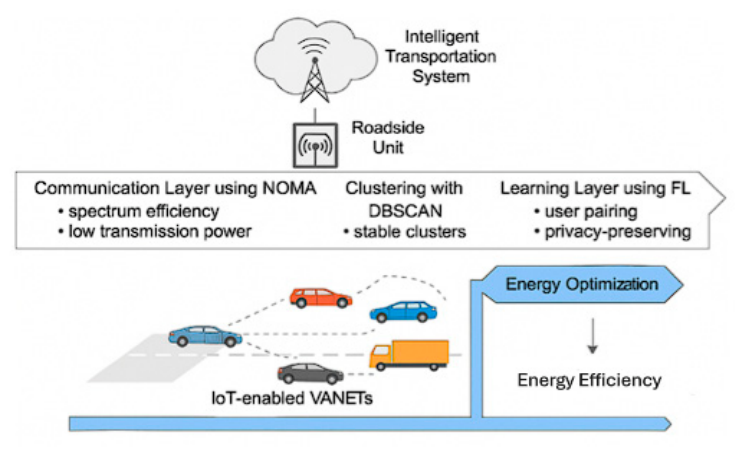
Figure 2.
Overview of the Proposed Mobility-Aware FL-NOMA Framework.
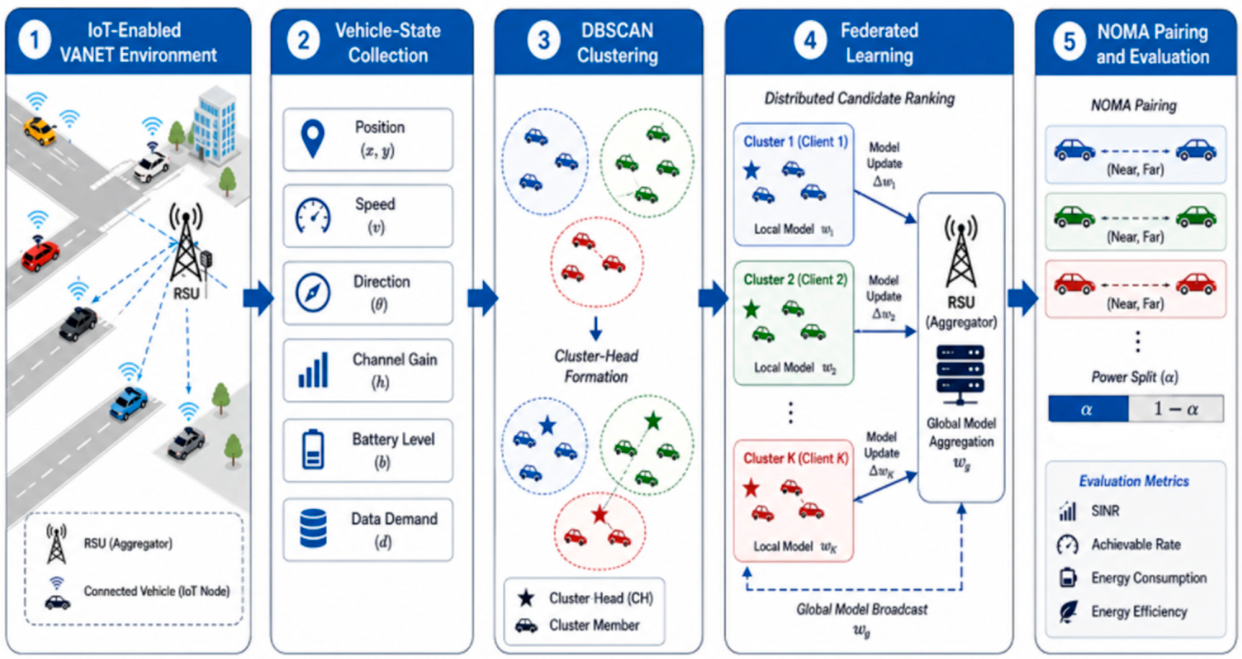
Figure 3.
ns-3/Python Co-Simulation and Timing Sequence.
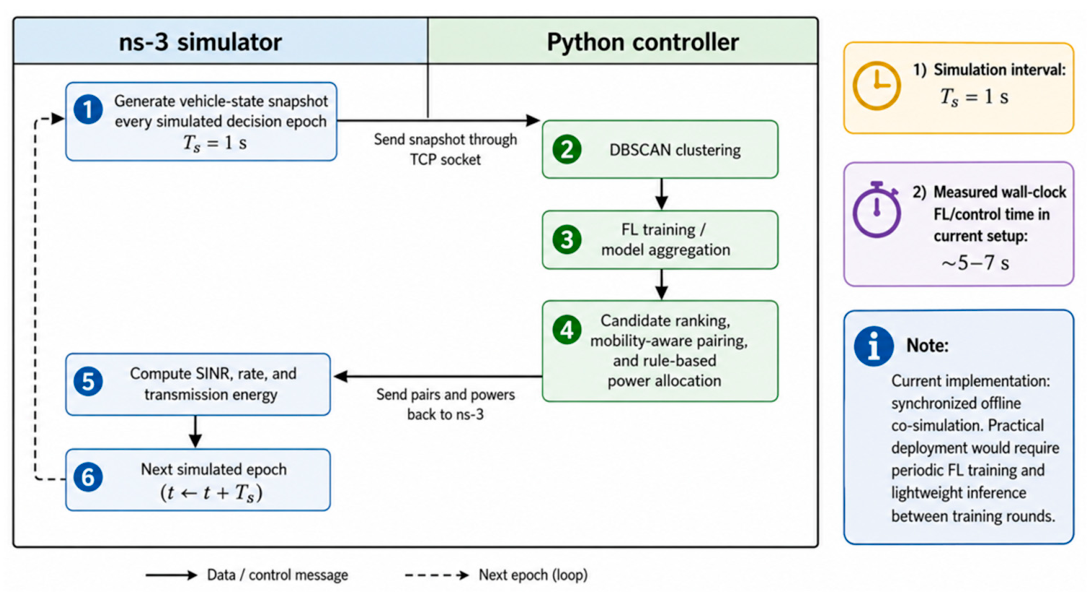
Figure 4.
Dynamic DBSCAN Clusters and NOMA Pairs at Representative Decision Epochs.
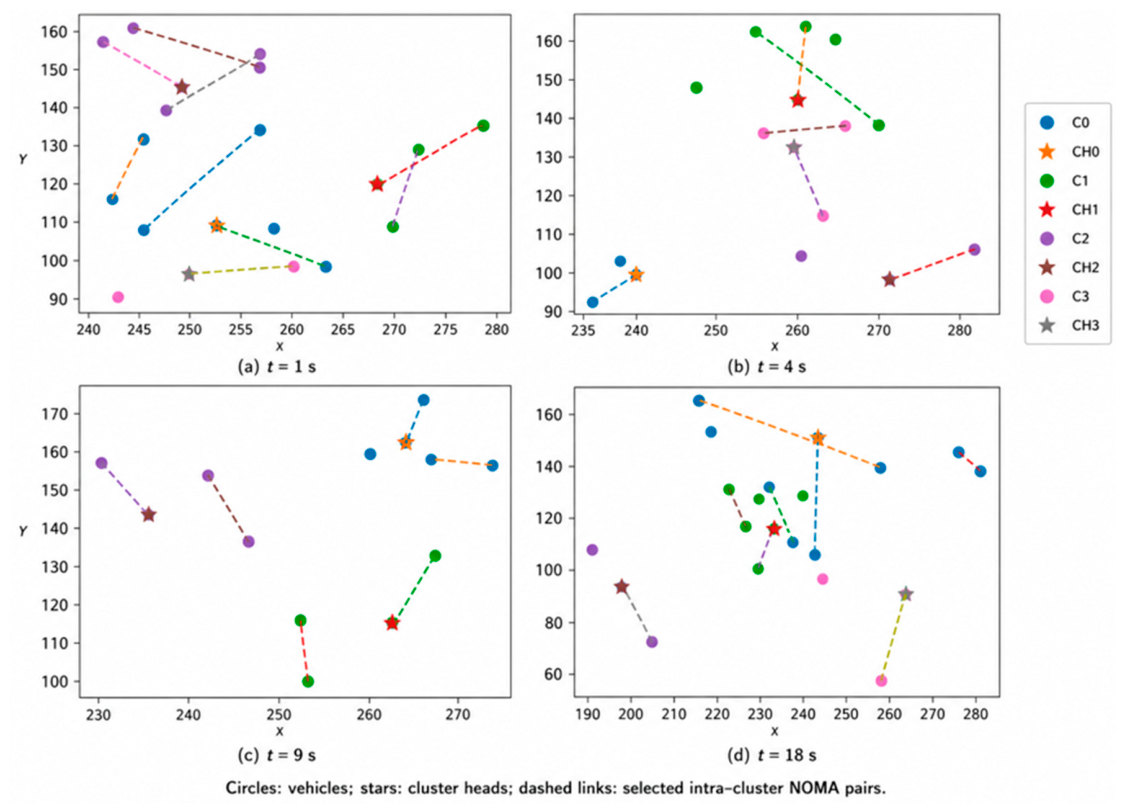
Figure 5.
Final Energy Comparison.
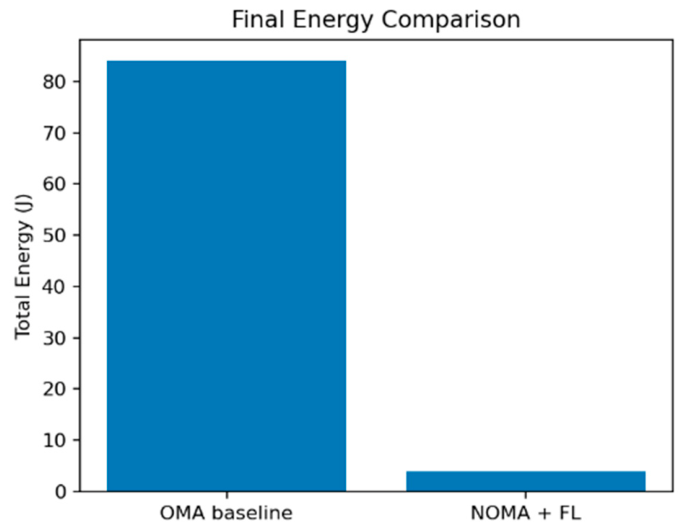
Figure 6.
OMA/NOMA energy over time.
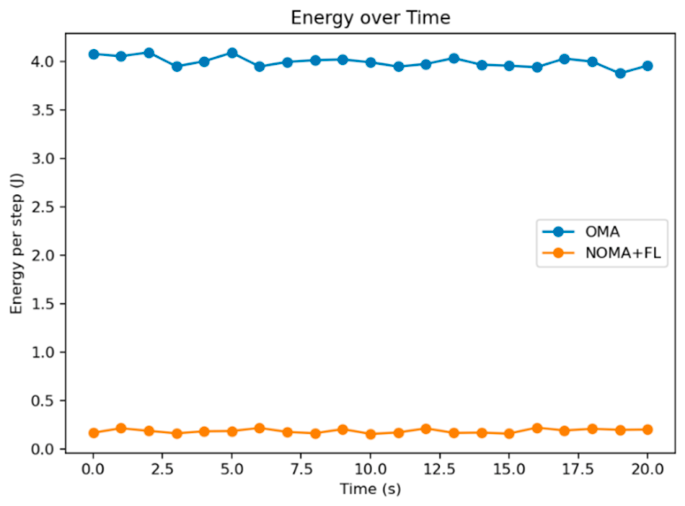
Figure 7.
Federated learning process running for 3 rounds across multiple cluster clients.
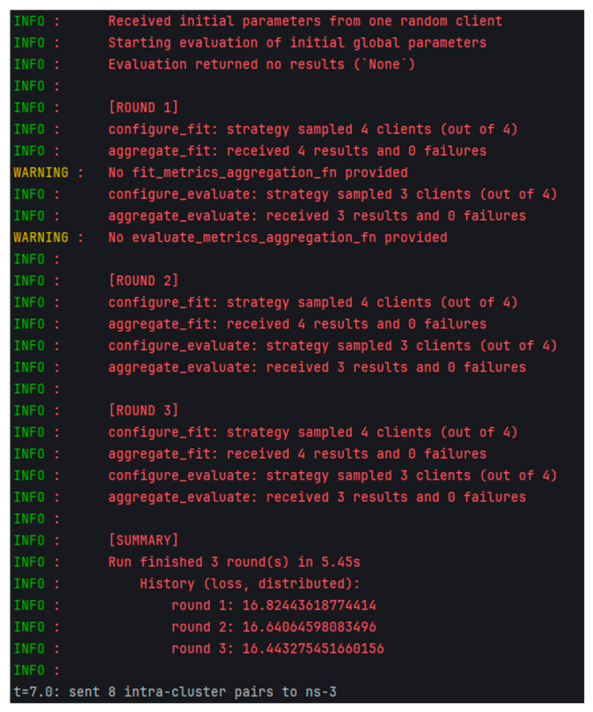
Figure 8.
Representative Federated Training Convergence.
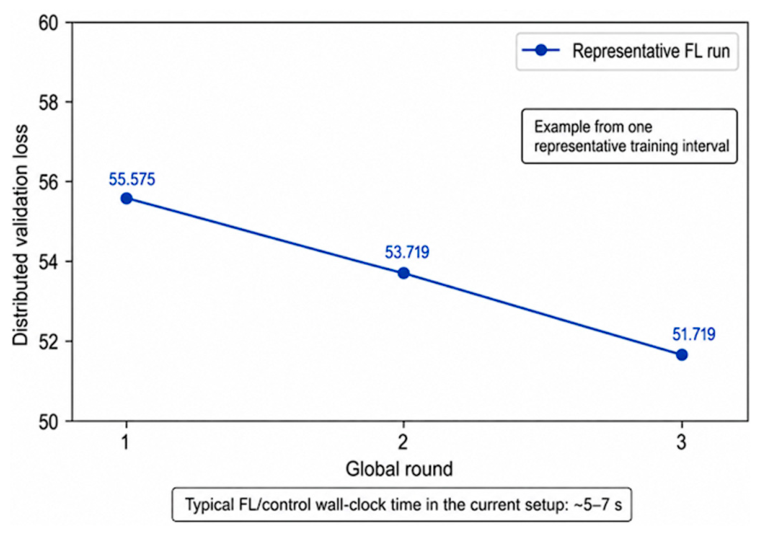
Figure 9.
Component-Wise Energy Comparison of the Evaluated Schemes.
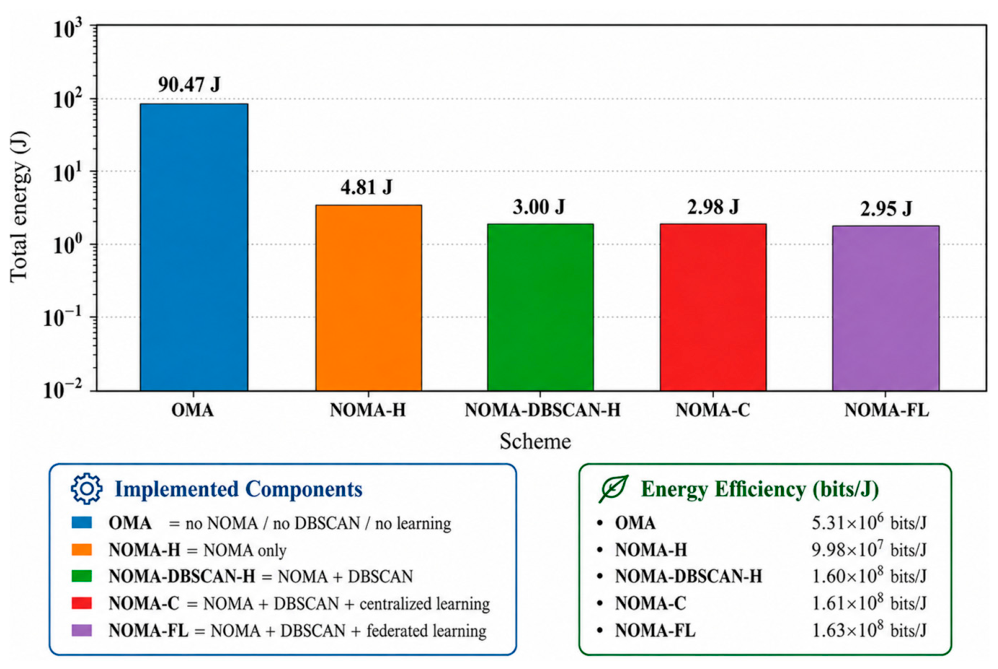

Table 1.
Comparative literature summary of key features relevant to energy-efficient IoT-enabled VANETs.
Table 1.
Comparative literature summary of key features relevant to energy-efficient IoT-enabled VANETs.
| Ref. | Focus | FL | NOMA | Cl. | Mob. | EE | Priv. | Cross-layer | Limitation |
| [3] | Hier. FL energy | ✓ | × | ✓ | × | ✓ | ✓ | × | No VANET/NOMA |
| [8] | FL wireless EE | ✓ | P | × | × | ✓ | ✓ | P | Survey only |
| [15] | FL sched. | ✓ | × | × | × | ✓ | ✓ | × | No veh. NOMA pairing |
| [17] | DBSCAN+NOMA V2X | × | ✓ | ✓ | P | P | × | P | No FL/privacy |
| [18] | HFL VANET | ✓ | × | ✓ | ✓ | P | ✓ | P | No NOMA/PHY-EE |
| [19] | CFL+NOMA | ✓ | ✓ | ✓ | × | P | ✓ | P | No mob.-aware EE |
| [22] | NOMA-OMA switch | × | ✓ | ✓ | ✓ | ✓ | × | P | No dist. learning |
| [25] | EE NOMA pairing | × | ✓ | × | × | ✓ | × | × | Static; no FL |
| [28] | Meta-FRL alloc. | ✓ | × | × | P | ✓ | ✓ | P | No DBSCAN/NOMA VANET |
| [31] | DQN NOMA pairing | × | ✓ | × | × | ✓ | × | × | Central. no FL |
| Prop. | FL+NOMA+DBSCAN | ✓ | ✓ | ✓ | ✓ | ✓ | ✓ | ✓ | All integrated |
P = Partial; EE = energy efficiency; Cl. = Clustering; Mob. = Mobility; Priv. = Privacy.
Table 2.
Input/Output Map.
| Stage | Inputs | Outputs |
| State Collection | Position, speed, direction, channel gain, battery level, data demand | Vehicle state information |
| Clustering (DBSCAN) | Position, speed, direction | Vehicle clusters, cluster head, distance to cluster head, channel-gain proxy |
| Federated Learning (FL) | Clustered vehicle features | Energy-suitability scores and selected candidate vehicles |
| Pairing and Power Allocation | Selected candidates, channel-gain proxy, speed, direction, battery level | NOMA pairs and allocated transmit powers |
| NOMA/OMA Evaluation | Selected pairs, powers, physical channel gains | SINR, data rate, and transmission energy |
Table 3.
Mobility and Communication Parameters.
| Item | Setting |
| Area/Scenario | 500 × 300 m, urban microcell |
| Mobility model | ns-3 RandomWalk2d, v ∈ [5,15] m/s, 1 Hz updates |
| Cluster size (observed) | 4–10 vehicles per cluster; median ≈ 6 |
| Bandwidth | 10 MHz total system bandwidth (OMA equal-share; NOMA shared RB) |
| Tx power (fairness) | 0.10 W per OMA user; 0.20 W per NOMA pair (≈0.10 W/user) |
| Channel/SNR | Free-space + shadowing; SNR 10–25 dB; per-second SINR and rate logs |
Table 4.
Component-Wise Comparison of OMA and NOMA Pairing Configurations.
| Scheme | NOMA | DBSCAN | Centr. Learn. | FL | Pairing Strategy | Total E [J] | Energy Eff. [bits/J] | Gain vs OMA |
| OMA | ✗ | ✗ | ✗ | ✗ | Orthogonal transmission; no NOMA pairing | 90.47 | 5.31×10⁶ | 1× |
| NOMA-H | ✓ | ✗ | ✗ | ✗ | Global heuristic strong–weak pairing | 4.81 | 9.98×10⁷ | ≈18.8× |
| NOMA-DBSCAN-H | ✓ | ✓ | ✗ | ✗ | Heuristic intra-cluster pairing | 3.00 | 1.60×10⁸ | ≈30.1× |
| NOMA-C | ✓ | ✓ | ✓ | ✗ | Centralized-learning-assisted intra-cluster pairing | 2.98 | 1.61×10⁸ | ≈30.3× |
| NOMA-FL | ✓ | ✓ | ✗ | ✓ | FL-assisted intra-cluster pairing | 2.95 | 1.63×10⁸ | ≈30.6× |
Table 5.
Statistical Performance Across Five Independent Runs.
| Vehicles | OMA Energy [J] | NOMA-FL Energy [J] | OMA Efficiency [bits/J] | NOMA-FL Efficiency [bits/J] | NOMA Pairs/Epoch | Energy Reduction [%] |
| 50 | 45.17 ± 1.70 | 2.26 ± 0.11 | (9.75 ± 0.37) × 106 | (1.95 ± 0.10) × 108 | 7.27 ± 1.13 | 94.99 ± 0.33 |
| 100 | 162.83 ± 6.36 | 5.75 ± 0.47 | (5.41 ± 0.21) × 106 | (1.54 ± 0.13) × 108 | 29.33 ± 5.03 | 96.47 ± 0.20 |
| 150 | 357.23 ± 15.80 | 9.40 ± 0.58 | (3.70 ± 0.17) × 106 | (1.41 ± 0.09) × 108 | 51.64 ± 4.22 | 97.37 ± 0.13 |
Values are reported as mean ± sample standard deviation over five independent runs.
Table 6.
Literature synthesis: techniques, reported gains/findings, limitations, and the gap addressed by this work.
Table 6.
Literature synthesis: techniques, reported gains/findings, limitations, and the gap addressed by this work.
| Ref. | Domain/Scenario | Technique/Framework | Reported Results/Findings | Limitation | Gap Addressed |
| [1] | VANET (routing/clustering) | KMRP: Modified K-Means + CHN + MSSP | Higher stability/throughput; lower delay in highway settings | Static clustering; no learning; no energy-aware control | Add FL-driven adaptive pairing with mobility & energy criteria |
| [2] | VANET (clustering) | ECRDP: Density Peaks + PSO | ↑ Stability (−74% change rate), ↑ intra/inter-cluster throughput, ↓ delay | Computationally heavy; not energy-optimized; no learning loop | Cross-layer DBSCAN + FL for energy-aware decisions |
| [3] | IoT (hierarchical) | TFNN: single-round FL + LEACH | Fewer rounds/communication; lower energy vs multi-round | Not mobility-aware; not vehicular; single-shot learning | Continuous cluster-local FL under mobility (VANET) |
| [8] | FL-enabled wireless networks | Energy-efficient FL (CFL/DFL) with resource allocation; discusses SWIPT, IRS, NOMA | Identifies how SWIPT, IRS, and NOMA can improve energy and spectral efficiency in FL systems | High-level, no vehicular/NOMA VANET implementation or cross-layer ns-3 evaluation | Vehicular NOMA cross-layer framework with concrete ns-3 + Python implementation |
| [16] | Vehicular IoT | Asynchronous FL with local differential privacy for peer-to-peer updates | Enables decentralized model updates among vehicles while preserving update privacy | Focus on privacy and asynchrony; no NOMA, no energy-aware pairing, no cross-layer ns-3 evaluation | Incorporate FL into a NOMA-based cross-layer framework with explicit energy optimization and clustering (DBSCAN) |
| [17] | V2X (Sub-6 GHz, DBS-assisted) | Improved DBSCAN clustering + NOMA-based radio resource management | Maximized spectral efficiency; dynamic clustering and DBS placement; higher total SE vs baseline | Centralized coordination; focuses on spectral efficiency, not energy or distributed learning | Energy-aware, FL-driven, cross-layer optimization under vehicular mobility |
| [19] | NOMA + clustered FL | Clustered FL + spectral clustering + KKT | Better accuracy/convergence under non-IID | Lacks system-level energy results in VANET | Quantify ≈95% energy↓ & ≈20× bits/J in mobile VANET |
| [20] | NOMA (downlink) | Statistical-CSI resource optimization | Resource allocation with imperfect CSI | No clustering/learning; limited mobility realism | Plug into DBSCAN + FL pairing loop with energy objective |
| [22] | Vehicular | NOMA-OMA switching | Dynamic switching for fairness in urban settings | No learning/distributed control | Distributed FL decides pairing/splits; keeps data local |
| [24] | NOMA (vehicular use cases) | Deep Q-learning pairing + power allocation; low-complexity successive pairing | Improve pairing decisions and decoding success with manageable complexity | Single-BS assumption; no energy-aware, cross-layer design | FL-based adaptive NOMA pairing with explicit energy optimization in multi-cluster VANETs |
| [25] | NOMA (analysis) | Energyefficiency enhancement (analytical) | EE gains for NOMA vs OMA | Static allocation; no mobility/clustering | Dynamic FL-based pairing + power split in motion |
| [28] | Cellular (resource alloc.) | Meta-Federated RL (user RL + BS meta-init) | ↑ EE and faster convergence vs decentralized RL | BS-initialized; cellular-centric | Fully cluster-distributed FL; vehicular mobility; no raw data |
| [30] | UAV-assisted NOMA | Hungarian-based pairing of “granted” (strong) and “grant-free” (weak) users | Improves spectral efficiency, energy efficiency, and connection reliability via intelligent user pairing | Centralized UAV setting; no FL, no VANET cross-layer integration | Extend smart pairing ideas into a FL-driven, cross-layer vehicular NOMA framework with mobility and clustering |
| [31] | User pairing | DRL for pairing & power | Learns pairing policy; improves allocation | Centralized training; overhead | Federated (cluster-local) learning cuts raw-data exchange |
| This work |
Mobility-aware FL-based NOMA user-pairing in VANETs | FL-based adaptive NOMA pairing: NOMA (PHY) + DBSCAN (cluster) + FL (control) | 83.98 J → 3.968 J total energy; ≈20× bits/J vs OMA; convergent FL | - | Distributed intelligence with energy-aware federated NOMA pairing |
Disclaimer/Publisher’s Note: The statements, opinions and data contained in all publications are solely those of the individual author(s) and contributor(s) and not of MDPI and/or the editor(s). MDPI and/or the editor(s) disclaim responsibility for any injury to people or property resulting from any ideas, methods, instructions or products referred to in the content. |
© 2026 by the authors. Licensee MDPI, Basel, Switzerland. This article is an open access article distributed under the terms and conditions of the Creative Commons Attribution (CC BY) license (http://creativecommons.org/licenses/by/4.0/).
Copyright: This open access article is published under a Creative Commons CC BY 4.0 license, which permit the free download, distribution, and reuse, provided that the author and preprint are cited in any reuse.