
Submitted:
19 August 2026
Posted:
20 August 2026
You are already at the latest version
Abstract
This article introduces Innovation-Based Coaching (IBC) as a strategic framework to bridge the growing divide between AI-driven work and the predominantly content-focused nature of education. Drawing on insights from AI in education, coaching, innovation management, and employability studies, IBC uses a 3C mindset, a 3D process, and a 3M toolkit to cultivate an innovative mindset, build innovative skills, and produce innovative outputs. The 3C mindset emphasizes being Curious, Critical, and Creative; the 3D process involves Detecting, Dissecting, and Discovering to translate complex problems into targeted coaching actions; and the 3M toolkit incorporates Mapping, Measuring, and Monitoring for ongoing assessment and scaling. This approach positions AI as a collaborative partner that supports feedback, simulation, and experimentation while preserving human-centric skills such as ethical judgment, trust, and critical reflection. The article illustrates IBC in action through a case in a course, where students use AI to explore real-world issues and create tangible innovation artifacts. It also addresses major challenges, including conceptual ambiguity, cultural resistance, workload and incentive misalignments, equity concerns, and assessment difficulties, and offers practical recommendations for institutions, educators, and policymakers. The conclusion proposes a research agenda focused on IBC’s long-term impact on innovation, employability, and AI literacy, emphasizing coaching as a systemic tool to transform education in the AI era.
Keywords:
AI
; coaching
; education
; innovation
1. Introduction
AI is driving a fundamental shift in how work is done across sectors. Generative AI now matches or surpasses human performance in content creation, routine analysis, and certain problem-solving tasks. Projections suggest that up to 60% of jobs in developed economies could be affected by AI, with about half seeing higher productivity and the rest facing reduced demand, wage pressures, or job displacement (International Monetary Fund, 2024). The World Economic Forum (2023) forecasts a net reduction of 14 million jobs by 2027, despite the creation of 69 million new roles and the loss of 83 million, driven by automation, digitalization, and environmental efforts. According to McKinsey (Chui et al., 2023), 60–70% of current tasks could eventually be automated, potentially leading to half of today’s work being automated around 2045.
In this context, employers increasingly value capabilities that are not easily codified or automated: creative problem-solving, ethical judgment, collaboration, systems thinking, and adaptability (World Economic Forum, 2023). However, many educational institutions remain wedded to industrial-age teaching models that emphasize content delivery, summative assessment, and individual performance on well-structured tasks. A parallel risk is that other institutions overcorrect by embracing AI tools primarily as productivity enhancers, using them to generate content or automate assessment without adequately safeguarding deeper learning, critical reflection, and student agency.
This dual risk—content-driven inertia on one side and uncritical AI adoption on the other—widens the gap between graduates’ capabilities and the demands of AI-transformed labor markets. As systems such as ChatGPT approach human-level performance in essays, code, and routine analysis (Brynjolfsson & McAfee, 2023), a pivotal question for education arises:
What Uniquely Human Value Can Education Offer in an Ai-Augmented World?
Addressing this question requires moving beyond incremental curriculum adjustments or isolated technology pilots. It calls for a paradigm shift from didactic knowledge transfer to coaching-based approaches that cultivate innovative, resilient thinkers capable of collaborating effectively with intelligent machines.
This article proposes Innovation-Based Coaching (IBC) as a coherent, theory-driven framework for this shift. Drawing on a narrative review of recent scholarship at the intersection of AI, coaching, innovation, and employability, this article argues that although robust conceptual work exists on innovation and AI-supported learning, a conspicuous gap remains: no existing model explicitly integrates AI, coaching, and innovation as a primary, operationalized learning outcome in education.
IBC addresses this gap by offering a 3C–3D–3M approach that links mindset, skill set, and output set: The 3C mindset focuses on staying Curious, Critical, and Creative. The 3D method consists of Detecting, Dissecting, and Discovering, translating complex challenges into targeted coaching interventions. The 3M tool embeds Mapping, Measuring, and Monitoring within continuous evaluation and scaling.
Through this architecture, IBC reframes AI as a collaborative partner that enhances feedback, simulation, and experimentation while preserving human-centric capacities such as ethical reasoning, relational trust, and reflective judgment. In practice, IBC provides design principles and an implementation roadmap. Conceptually and theoretically, it offers a unifying lens that connects innovation mindsets (how participants think), skill sets (what they can do), and output sets (what they create).
2. Innovation as A Learning Outcome in Education
This section draws on an AI-assisted, thematically selected narrative review of recent scholarship on innovation in education. The review is intentionally selective and conceptual, not systematic, aiming to synthesize emerging patterns, tensions, and gaps in the field rather than to exhaustively catalog all available studies.
2.1. Theoretical Foundations: Innovation as Learnable Practice
Innovation as an educational objective is rooted in broader traditions of creativity, entrepreneurship, and organizational learning. Early economic theorists argued that innovation is not random but a systematic, purposeful activity.
Drucker (1985) extended this line of thought, arguing that innovation is a discipline—a practice that can be taught and managed. He identified recurring sources of innovation (e.g., unexpected successes or failures, process needs, shifts in industry structure). He argued that innovators who systematically scan for and interpret these signals can learn to innovate more effectively. In education, Drucker’s framing supports integrating innovation into curricula as a teachable, structured competency.
The organizational learning literature reinforced these ideas at the collective level. Senge (1990), in The Fifth Discipline, introduced the concept of the learning organization, defined as one capable of sustained innovation through systems thinking, shared vision, mental model revision, personal mastery, and team learning. He argued that these disciplines can be actively developed. Nonaka and Takeuchi (1995) further advanced a theory of the knowledge-creating company, emphasizing that innovation emerges from processes that convert tacit knowledge into explicit knowledge and recombine both in novel ways
Together, these traditions converge on a core proposition: innovation is a learnable, socially situated capacity, driven by systematic opportunity recognition, knowledge creation, and reflective practice. This proposition underpins efforts to make innovation an explicit learning outcome in education.
2.2. Entrepreneurship Education and Innovation Competence
Entrepreneurship education has been a leading arena for operationalizing innovation as a learning outcome. Broadly construed, entrepreneurship involves identifying opportunities, mobilizing resources, and creating value under uncertainty, closely aligning with the competence of innovation.
Gibb (1993) argued that entrepreneurship education should extend beyond technical business skills to cultivate an entrepreneurial mindset that encompasses creativity, initiative, risk-taking, resilience, and problem-solving—capacities closely intertwined with innovation. Harkema (2003), drawing on Kolb’s (1984) experiential learning theory and the work of Nonaka and Takeuchi (1995) and of Senge (1990), proposed a constructivist model of entrepreneurial learning. In this model, innovation emerges through iterative cycles of experience, reflection, conceptualization, and experimentation, often in team-based, real-world contexts.
Recent frameworks further refine the concept of innovation competence as multidimensional, encompassing creativity, critical and systems thinking, collaboration, initiative, networking, and implementation skills (Marín-García et al., 2023). For example, studies of learning environments in universities of applied sciences identify behavioral indicators such as proposing multiple original solutions to ill-structured problems, critically evaluating evidence, coordinating teamwork, and engaging external stakeholders (Butter & van Beest, 2019).
2.3. Persistent Gaps: Operationalization, Assessment, and Longitudinal Evidence
Despite strong theoretical and conceptual foundations, a significant gap remains in translating abstract innovation models into empirically grounded, student-level educational designs. Three limitations are particularly salient.
- A.
- Limited operationalization of innovation outcomes. Many frameworks describe innovation competence in broad terms but stop short of specifying observable behaviors and performance standards that can be reliably assessed. Behaviorally anchored scales and competence profiles are emerging (Butter & van Beest, 2019; Marín-García et al., 2023), yet these tools remain underused and have been validated unevenly across disciplines.
- B.
- Short-term and cross-sectional studies. Much of the empirical literature evaluates one-off courses, pilots, or cross-sectional snapshots of self-reported innovation skills, limiting the ability to draw robust conclusions about causal relationships between pedagogical approaches and the development of innovation competence over time (Marín-García et al., 2023). Longitudinal, mixed-methods studies that track competence growth across programs are scarce.
- C.
- Weak integration of AI and coaching. While there is rapidly growing work on AI in education—covering adaptive learning, personalized feedback, and AI literacy (Chen et al., 2020; Ng et al., 2024; Xu et al., 2025)—and a parallel body of research on coaching in education (Burtson et al., 2025; Villa et al., 2024), these literatures remain only weakly integrated, and innovation competence is neither an explicit nor an assessed outcome.
Addressing these gaps requires frameworks that link organizational and theoretical models of innovation (Nonaka & Takeuchi, 1995; Senge, 1990) to clear course- and program-level outcomes, behaviorally defined assessment tools, and longitudinal evaluation designs (Schaap et al., 2025; Toding & Venkatraman, 2020). IBC is proposed as such a framework, explicitly connecting innovation theory, coaching practice, and AI-supported learning.
3. Innovation as the Central Goal of Education
Innovation in education is not just about adopting new techniques. It is about systematically developing participants' thinking, capabilities, and the work they produce. Innovation-Based Coaching (IBC) offers a meta-framework that integrates familiar coaching models, such as GROW or the Goal, Reality, Options, and Way Forward (Whitmore, 1988), and aligns them with the central goal of innovation.
3.1. the Three Dimensions of Innovation
IBC conceptualizes innovation as encompassing three interrelated dimensions: mindset, skill set, and outputs.
- A.
- Innovation mindset (how participants think): It is grounded in curiosity, exploration, and continuous growth. Participants question assumptions, seek better ways to do things, and tolerate ambiguity. They are willing to take informed risks, view setbacks as feedback, and maintain a forward-looking, opportunity-focused outlook. Rather than accepting the status quo, they look for unmet needs and imagine what could be.
- B.
- Innovation skill set (what participants can do): Participants learn to (1) frame and reframe complex, ambiguous problems to make them clear and actionable, (2) experiment and iterate through rapid prototyping, testing assumptions, and refining ideas based on feedback, (3) apply design thinking, using empathy, ideation, and user-centered design to create feasible and desirable solutions, and (4) recognize opportunities by scanning the environment for patterns, gaps, and signals of change, then turning them into innovation projects or ventures.
- C.
- Innovation outputs (what participants create): Participants produce tangible, testable results, such as startups, prototypes, digital tools, and redesigned services. They also develop social innovations—community initiatives, policy proposals, and inclusion projects—and implement new processes and practices across teams and institutions. These outputs demonstrate their ability to translate ideas into action and improve systems in meaningful, measurable ways.
Conceptually, these three dimensions intersect with the coaching process—goal setting, exploration, experimentation, reflection, and consolidation. IBC operates at these intersections: each coaching phase is deliberately used to strengthen innovation mindsets, build innovation skills, and produce tangible outputs.
3.2. How Ibc Differs From Standard Coaching and Innovative Teaching
Traditional coaching in education focuses on personal, academic, or career development. While it may incidentally foster innovation, it rarely treats innovation as the explicit outcome. Likewise, “innovative teaching” often prioritizes new techniques—such as flipped classrooms, digital tools, and gamification—without intentionally developing participants’ capacity for innovation.
Reversing this logic, IBC (1) makes innovation the primary objective rather than a byproduct, (2) unifies existing coaching models under a single framework, ensuring that methods such as GROW and peer coaching explicitly support an innovation mindset, skills, and outputs, (3) names innovation skills—problem framing, experimentation, and opportunity recognition—as core learning goals, clarifying what progress looks like and how to assess it, and (4) anchors coaching in concrete outputs (e.g., prototypes, social ventures, process redesigns), so participants practice turning ideas into implementation rather than discussing innovation in the abstract.
Consequently, IBC connects coaching conversations to tangible, innovation-focused accomplishments that are important to participants, institutions, and employers.
3.3. Ai as A Collaborative Partner in Ibc
Collaborative intelligence reframes AI as a partner that augments, rather than replaces, human coaching. At IBC, AI provides real-time feedback on essays, pitches, and presentations, enabling participants to rapidly refine their ideas and communication. This supports both an innovation mindset (openness to critique and willingness to iterate) and innovation skills (argumentation and hypothesis testing). AI-powered simulations—such as crisis-communication drills or innovation sprints in complex stakeholder environments—immerse participants in high-uncertainty, high-pressure scenarios. In these safe yet realistic settings, learners practice decision-making, problem-solving, and applied creativity.
Crucially, participants must also learn to evaluate AI outputs critically. IBC treats this as a core coaching task: participants are guided to question, analyze, and interpret AI-generated suggestions by assessing their quality, bias, and trustworthiness. This reframes AI from a black-box tool into a genuine thinking partner and strengthens participants’ critical and ethical reasoning.
3.4. Futureproofing Graduates Through Ibc
As AI reshapes work and education, certain human capabilities—creativity, leadership, systems thinking, and ethical judgment—become more valuable because they are less easily automated. These skills flourish through exploration, reflection, and coached practice rather than memorization.
IBC is designed for this new reality. It treats participants as lifelong learners and innovators, cultivating (1) a growth-oriented innovation mindset that embraces complexity and uncertainty, (2) a versatile innovation skill set for problem framing, experimentation, and opportunity recognition, and (3) tangible innovation outputs that demonstrate real-world readiness to employers.
When adopted systematically, IBC does more than develop individuals; it drives institutional transformation. It aligns educational outcomes with the demands of modern workplaces and embeds innovation in the culture of education. Graduates trained within this framework are not only more employable—they are prepared to act as innovators and effective collaborators with AI in an ever-evolving career landscape.
4. Implementing Ibc Through 3c, 3d, and 3m
Innovation-Based Coaching is a systemic framework that equips learners and coaches to drive meaningful, sustainable innovation. It integrates three core processes: (1) the 3C mindset (Curious, Critical, and Creative); (2) the 3D method (Detect, Dissect, and Discover); and (3) the 3M tool (Map, Measure, and Monitor). Together, these form a dynamic 4I cycle (Ignite, Investigate, Illuminate, and Innovate) that identifies needs, designs solutions, and continuously improves coaching practice.
4.1. the 3c Mindset: Curious, Critical, Creative
The 3C mindset captures three complementary modes of thinking that, together, support deep, AI-enhanced learning and innovation.
Curious
To stay curious is the engine of learning. It begins with asking “why,” “what if,” and “how” about brands, markets, cultures, and consumer behavior. It drives us to explore unfamiliar markets, emerging trends, and unexpected brand phenomena rather than staying within the obvious or familiar.
Today, AI can significantly amplify this curiosity by expanding the search space. It helps uncover weak signals, niche cases, and non-obvious comparisons that humans might overlook. For instance, you can prompt AI to surface unusual brand campaigns across cultures, then ask why a campaign worked in one context but failed in another. You can also explore how a global brand is perceived across social platforms.
When practiced this way, curiosity yields a rich pool of questions, angles, and phenomena that can later be analyzed and distilled into sharp, actionable insights.
Critical
To stay critical is to make disciplined, well-judged decisions. It involves evaluating the reliability of information, recognizing potential bias (including in AI-generated outputs), comparing competing explanations or strategies, and identifying assumptions, logical gaps, and missing perspectives.
In practice, this means asking whether an AI-generated analysis is genuinely supported by real data, examining the evidence behind it, and probing for what might be missing. It also includes comparing, for example, two brands’ globalization strategies and identifying the specific elements that drive their success. The outcome is a reasoned, evidence-based understanding of brand phenomena rather than simply accepting surface-level narratives or uncritically following AI suggestions.
Creative
To stay creative is to turn understanding into original value. It is about using insight as raw material to generate new ideas, models, and strategies—rather than simply repeating what is already known. Strong creativity shows up in the ability to make unexpected connections across brands, markets, and disciplines, revealing possibilities others overlook.
In practice, this means designing global campaign architectures that adapt intelligently to local culture or inventing new metrics and dashboards that capture what traditional measures miss—such as brand authenticity across markets. It also means using AI as a true creative collaborator: remixing ideas, generating scenarios, and rapidly prototyping concepts. The result is original, practical outputs—new frameworks, tools, and strategic options—that move work beyond imitation and build real competitive advantage.
4.2. the 3d Method: Detect, Dissect, Discover
The 3D method operationalizes how participants use AI to move from raw phenomena to actionable insights.
Detect
To detect is about deciding what is truly worth studying. It begins by scanning global markets for patterns, anomalies, and emerging trends that signal meaningful change. Rather than looking at data in isolation, Detect focuses on the stories the data suggests — where things are shifting, breaking down, or breaking through.
Using AI, we can aggregate and summarize vast volumes of information, from social media and news to reviews and industry reports. This enables us to quickly surface signals that would otherwise go unnoticed: sudden spikes in attention, shifts in sentiment, and recurring complaints and desires. From there, we identify the problems, tensions, and opportunities that matter most to branding practice.
In practical terms, Detect might mean using AI to analyze sentiment about a brand across countries to uncover unexpected negativity or enthusiasm. It could also involve asking AI to compile recent controversial brand moves in a specific region to identify where others have misstepped or broken through. The outcome is a sharply focused set of phenomena, issues, or cases that clearly warrant deeper analysis.
Dissect
To dissect is to break down what has been detected into clear, actionable parts. It involves decomposing brand cases into core components—positioning, messaging, channels, partnerships, cultural fit, timing, and more—so you can see what is truly driving performance. From there, you analyze the causal factors: what specifically led to success or failure and how each element contributed.
AI plays a key role in this step by structuring complex information into clear dimensions and comparisons. For example, you might break a global campaign into audience segments, cultural references, and channel strategies, then test the role each element played. You can also have AI map out cause–effect chains: if the brand changed this element, what would likely follow? The outcome is a clear, structured understanding of how and why certain patterns emerge—turning vague intuition into precise, evidence-backed insight.
Discover
To discover involves synthesizing information to generate new, actionable insights. It means connecting patterns across multiple cases or markets and using those connections to formulate fresh principles, hypotheses, or playbooks for global branding. AI plays a key role in this stage by enabling teams to explore “what-if” scenarios and stress-test ideas before committing to them.
In practice, Discover might involve deriving a new principle for how brands should localize humor or symbolism across cultures or producing a clear conceptual model that explains when a brand should standardize versus localize. The outcome is a set of new, portable insights that can guide future brand decisions and lay the groundwork for meaningful innovation.
4.3. the 3m Tool: Map, Measure, Monitor
The 3M tool focuses on managing innovation over time in complex, dynamic environments.
Map
Mapping is about seeing the landscape clearly. It means visualizing where a brand sits across markets, cultures, and its competitive set. This involves building conceptual and data-driven maps — such as positioning maps, stakeholder maps, cultural value maps, and ecosystem diagrams — to make complex dynamics easier to understand. AI can support this work by generating, refining, and annotating these maps at speed and scale.
In practice, this might include creating perceptual maps comparing competing brands across key attributes (for example, premium vs. accessible or global vs. local). It can also involve mapping cultural narratives around a brand across regions, using text analysis to surface patterns, tensions, and opportunities. The outcome is a set of shared mental models and visual tools that cut through complexity, align stakeholders, and reveal clear strategic options.
Measure
Measuring means clearly defining what matters and rigorously tracking it over time. This means designing meaningful KPIs that go beyond basic sales or follower counts and blend quantitative metrics with human insight. Quantitative metrics like NPS, share of voice, and conversion rates should sit alongside qualitative indicators such as narrative tone and perceived authenticity. AI can play a key role here — helping design smarter metrics, clean and structure messy data, and run deeper, faster analyses.
In practice, this might look like building a “cultural resonance index” that measures how well campaigns align with local values or using AI to code and score customer reviews and social posts at scale. The result is a measurement system that rigorously tests strategies, shows what is working, and provides an ongoing read on brand health.
Monitor
Monitoring is about continuous vigilance and adaptation. It means setting up ongoing tracking, dashboards, and alert systems so you always know what is changing and where. Using AI as an early-warning system to flag shifts in sentiment, competitor moves, or emerging trends gives you the time and context to respond intelligently rather than react. Regularly revisiting your maps and metrics ensures your strategies stay aligned with reality rather than drifting on outdated assumptions.
In practice, this could look like an AI-assisted dashboard that highlights notable changes in customer sentiment by region each week, helping teams quickly identify where to lean in or course-correct. You can also set clear rules: when certain metrics cross a threshold, the team automatically reviews and adjusts campaigns. The result is a living, adaptive management process that keeps global brand strategy responsive, informed, and consistently ahead of the curve.
4.4. the Role of Ai as A Partner in 3c, 3d, and 3m Processes
When combined, the 3C mindset, the 3D method, and the 3M tool form a powerful architecture for Innovation-Based Coaching. Within Innovation-Based Coaching, the 3C–3D–3M framework serves as a continuous, semester-long innovation cycle. Each component reinforces the others, collectively developing participants’ innovation mindset, skill set, and tangible outputs.
In this way, Monitor activities within 3M trigger new Detect cycles in 3D, which then reshape subsequent 3C exploration. As a result, mindset, skill set, and outputs co-evolve intentionally, and each innovation is deliberately mapped, measured, and monitored rather than left to chance.
Across the 3C, 3D, and 3M processes, human and AI are partners. To strengthen AI’s treatment as a partner, it helps to clearly differentiate the roles it plays and map them to the 3C–3D–3M processes. In this context, AI functions as a tutor (providing feedback on writing and explanations), a tool (supporting data processing and dashboard development), and a teammate (for co-ideation, role-play, and simulation). Mapping these roles to the phases of curiosity, creativity, and collaboration—and to discovery, design, and delivery, as well as to metrics, methods, and mindsets—clarifies when and how AI should be engaged and what learners are expected to gain from each interaction.
At the same time, the limitations and risks of AI should be addressed in more concrete, actionable ways. Beyond noting bias and the need for critical reflection, you could include sample coaching prompts that explicitly interrogate AI outputs (for example, “Identify three groups that might be disadvantaged by this AI-generated strategy” or “What blind spots might this recommendation contain in our context?”). These prompts can be reinforced by basic usage guidelines in IBC, such as mandatory human verification for high-stakes tasks and explicit checkpoints that require participants to cross-validate AI suggestions against independent sources or stakeholder feedback.
Finally, AI literacy should be more directly tied to innovation outcomes. Critical AI literacy is not only an ethical safeguard; it is a driver of innovation across mindset, skill set, and outputs. At the mindset level, it cultivates healthy skepticism and ethical sensitivity; at the skill set level, it builds the capacity to design effective prompts, evaluate models, and creatively repurpose tools for novel problems; and at the output level, it supports the development of more robust, inclusive, and explainable solutions. Making these links explicit will help participants see AI not as a shortcut but as a disciplined partner in responsible innovation.
This integrated system enables coaches and learners to navigate complexity with rigor and imagination. It replaces ad hoc efforts and superficial “innovation theater” with a disciplined yet flexible approach that continuously surfaces needs, designs better solutions, and scales what works. As a result, educational environments—and any context that adopts IBC—are better positioned not only to support innovation but also to reliably deliver transformative outcomes (see Figure 1).
5. Brand Globalization: the Case of Implementing Ibc
This section illustrates how IBC was implemented in a course titled Brand Globalization, which the author offered as an undergraduate course.
In this course, IBC was implemented as a systematic, practice-oriented engine for continuous innovation. Rather than transmitting fixed knowledge about global brands, the coach designs each unit as a live innovation laboratory where participants learn to think with AI and create beyond it.
Across 16 units, IBC uses the 3C, 3D, and 3M processes in a recurring four-session cycle—Ignite, Investigate, Illuminate, and Innovate. In the Ignite session, participants use AI to map curiosity, surface anomalies in global markets, and frame high-impact questions about brands, cultures, and consumers. In the Investigate session, they critically interrogate AI outputs and real-world data, dissecting brand strategies, failures, and successes to uncover underlying mechanisms and strategic trade-offs. In the Illuminate session, participants transform this analysis into discoveries: fresh insights, emerging patterns, and original hypotheses about global branding dynamics. Finally, in the Innovate session, participants convert these discoveries into actionable innovations by mapping brand landscapes, designing measurement systems, and building AI-informed monitoring plans for real or hypothetical global brands (see Figure 2).
The coach’s role is deliberately catalytic rather than didactic: instead of giving answers, the coach pushes participants to refine their questions, tighten their logic, and elevate the originality of their work. Each unit culminates in at least one concrete innovation artifact—such as a new brand architecture model for multi-market expansion, a culturally adaptive positioning framework, an AI-augmented market-sensing tool, or a dynamic dashboard for early detection of global brand risk. These outputs are compiled into each team’s Brand Globalization Innovation Portfolio, which serves as both the central assessment and proof of their capability to design, test, and communicate innovations.
Through this IBC implementation, participants do not merely learn about brand globalization; they become innovation practitioners—using AI strategically, asking sharper questions, and producing original, evidence-based solutions that are immediately relevant to the realities of global markets (see Figure 3).
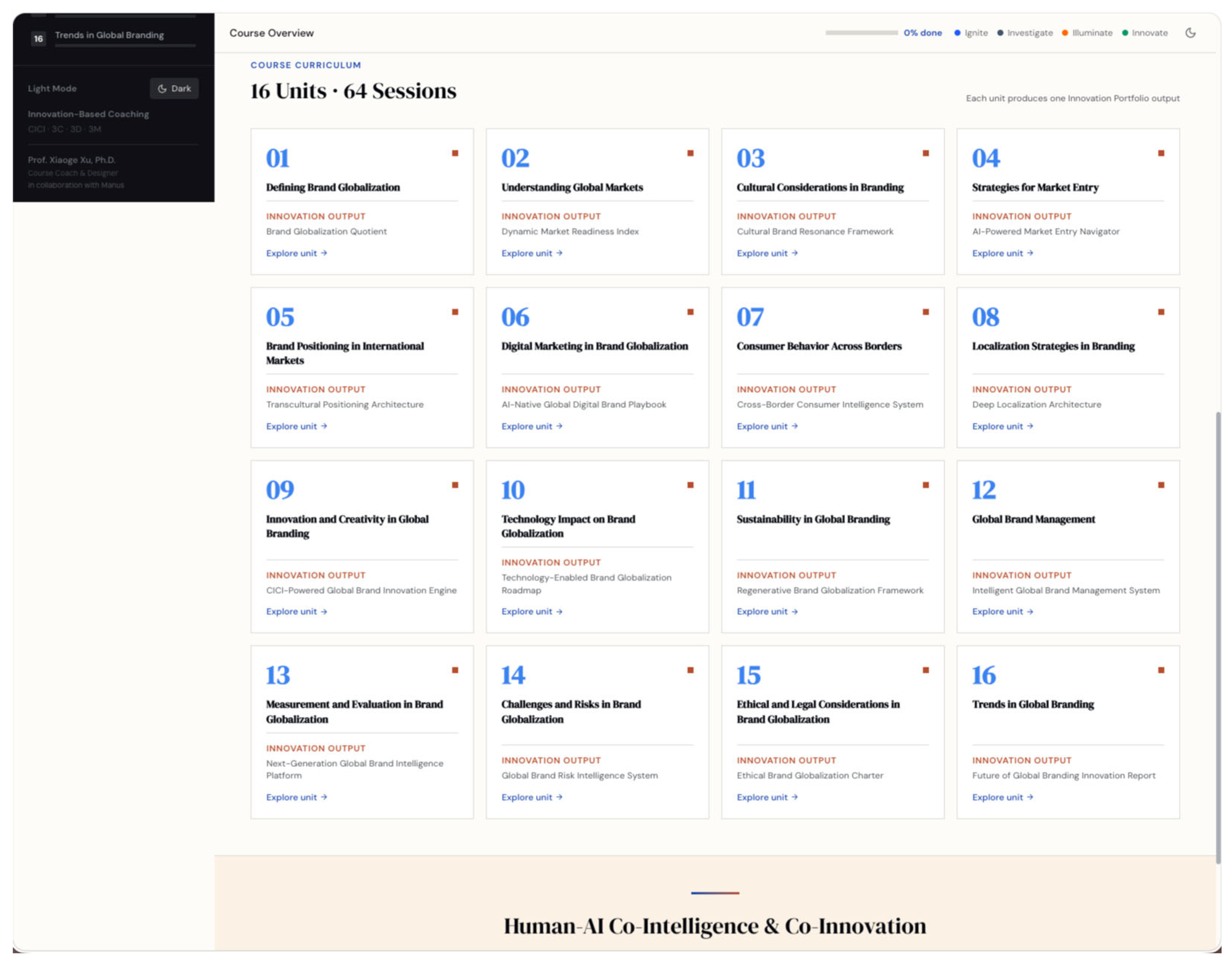
This 16-unit, four-session IBC cycle is intentionally discipline-agnostic and applicable well beyond Brand Globalization. In engineering capstones, the same Ignite–Investigate–Illuminate–Innovate rhythm can guide teams from framing complex technical challenges with AI to stress-testing designs against simulated constraints to generating data-driven improvements in performance, safety, or sustainability. In coach education, it can scaffold future educators as they use AI to surface learning needs, interrogate curricular approaches, generate insights into pedagogy across diverse contexts, and prototype adaptive lesson designs. In the health professions, learners can employ the cycle to explore emerging clinical questions, critically evaluate AI-supported evidence, distill practice-changing insights, and design or refine protocols and patient-care pathways. In this way, Brand Globalization serves as an exemplar implementation of IBC rather than a niche exception—demonstrating a portable innovation engine that any practice-based discipline can localize to its own problems, data, and professional standards (see Figure 4).
6. Challenges of Implementing Ibc
Implementing IBC in education is challenging across conceptual, cultural, pedagogical, institutional, and equity dimensions.
Conceptually, ambiguity about what “coaching” means—and how it differs from mentoring, advising, or supervision—leads to inconsistent practices and expectations. Without clear definitions and a shared language, stakeholders interpret IBC differently, undermining coherent implementation.
Culturally, IBC clashes with traditions that prioritize content delivery and instructor authority. Faculty accustomed to directive teaching may view coaching as a threat to disciplinary rigor or to their professional identity, leading to resistance, tokenistic adoption, or uneven quality across programs and disciplines.
Pedagogically, IBC requires advanced skills—dialogic facilitation, reflective inquiry, design thinking, and iterative learning—that many educators have not been trained to apply. Without sustained professional development and supervision, coaching devolves into routine instruction. Participants, often unaccustomed to ambiguity and self-directed inquiry, may experience anxiety or disengagement, especially when assessment systems do not explicitly reward innovation.
Institutionally, IBC is time- and labor-intensive, requiring space for feedback, prototyping, and deep dialogue. However, workload models, promotion criteria, and curriculum structures often undervalue these efforts and favor standardized, summative assessment. This misalignment discourages faculty investment and diminishes the impact of coaching on learning.
Equity concerns further complicate implementation. Innovation-oriented learning can privilege participants with higher cultural capital—those who are more confident, independent, and familiar with creative problem-solving—while disadvantaging international, first-generation, and disabled participants, as well as those with limited access to collaborative spaces and digital tools.
Finally, evaluating IBC is methodologically challenging. Conventional metrics such as grades, retention, and satisfaction rarely capture creativity, risk-taking, or iterative reasoning. Inadequate evaluation frameworks make it difficult to demonstrate IBC’s unique value and to justify sustained institutional support.
Taken together, these challenges show that IBC cannot be implemented through isolated teaching innovations alone; it requires systemic shifts across definitions, culture, pedagogy, evaluation, and institutional structures.
7. Solutions and Recommendations
To embed IBC in education, institutions must address the conceptual, cultural, pedagogical, structural, assessment, equity, and evaluation challenges outlined in Section 6. The following recommendations align with these challenges, pairing each major barrier with targeted solutions that clarify concepts, build support, develop capabilities, realign structures and assessment, promote equity, strengthen evaluation, and enable strategic scaling.
7.1. Clarify Concepts and Create Shared Frameworks
To address the conceptual ambiguity outlined in Section 6, institutions should build a shared, precise understanding of what IBC is and is not. They should (1) establish clear definitions that distinguish coaching from mentoring, advising, and supervision, and explicitly articulate IBC’s distinctive features; (2) develop user-friendly frameworks and visuals (e.g., 3C–3D–3M) that map IBC’s goals, processes, and outcomes; and (3) conduct regular orientations for faculty, professional staff, and participants to align expectations and demonstrate IBC in real-world teaching and learning contexts.
By directly addressing conceptual confusion, shared frameworks reduce inconsistent practice, support coherent implementation across disciplines, and make IBC’s impact easier to evaluate and to scale.
7.2. Build Academic Buy-in and Address Cultural Resistance
To counter the cultural resistance and attachment to traditional, authority-centered teaching described in Section 6, institutions must actively build academic buy-in for IBC. They should (1) share evidence from pilots and case studies showing improved learning, stronger innovation outcomes, and better graduate employability; (2) embed IBC principles in departmental strategies, coaching and learning plans, graduate attributes, and institutional innovation agendas; and (3) recognize and reward coaching leadership through promotion criteria, coaching awards, and other forms of institutional recognition.
Framing IBC as a means to deepen disciplinary rigor and real-world relevance—rather than as a threat to expertise—helps address identity concerns, reduces tokenistic adoption, and shifts coaching from a fringe experiment to a respected part of academic culture.
7.3. Develop Coaching Capabilities Systematically
To address the pedagogical skill gaps and the risk of coaching devolving into ordinary instruction identified in Section 6, institutions should treat coaching as a core professional capability. They should (1) provide structured development in coaching skills, dialogic facilitation, reflective inquiry, and design thinking, using discipline-specific examples and authentic case material; (2) use the 3C–3D–3M approach to guide planning, delivery, and reflection on coaching practice; (3) establish “coach-the-coach” mentoring, peer observation, and structured feedback processes to accelerate staff learning; and (4) maintain ongoing supervision and peer review to ensure coaching remains developmental rather than reverting to directive, content-heavy teaching.
By systematically developing coaching capabilities, institutions build a critical mass of confident coaches, thereby reducing variability in practice and improving the quality and consistency of IBC.
7.4. Align Workloads, Incentives, and Institutional Structures
To address the institutional misalignment and invisible labor highlighted in Section 6, institutions must align workloads, incentives, and structures with the demands of IBC. They should (1) allocate explicit workload credits for time-intensive coaching activities, such as innovation studios, capstones, and clinics; (2) embed coaching hours and formal innovation-coach roles in program and curriculum designs, rather than relying on informal or voluntary effort; and (3) value coaching, innovation-related coaching, and external partnerships in performance reviews, promotion criteria, and resource allocation.
When institutional structures and incentives align with the time, energy, and relational work that IBC requires, coaching becomes a legitimate, supported core activity rather than an unsustainable add-on.
7.5. Redesign Assessment to Match Innovation Processes and Outcomes
To address the assessment misalignment that discourages risk-taking and iterative learning, as discussed in Section 6, institutions should redesign assessment to reflect how innovation actually unfolds. Assessment should (1) emphasize portfolios, reflective journals, prototypes, design reviews, and peer assessments that capture experimentation and iterative learning; (2) use clear rubrics that value problem framing, experimentation, stakeholder engagement, collaboration, and iteration, and that align with IBC’s mindset–skillset–output dimensions; and (3) incorporate frequent formative feedback, supported where appropriate by AI tools, so participants can iterate more often and see how feedback improves their work.
When assessment rewards thoughtful risk-taking, reflection, and learning from failure, participants receive a clear message that innovation is genuinely valued, not merely rhetorical.
7.6. Prepare and Support Participants for Coaching-Centered Learning
To address the student anxiety, disengagement, and difficulty with ambiguity described in Section 6, institutions should explicitly prepare participants for coaching-centered learning. They should (1) integrate structured coaching experiences early (e.g., in first-year courses) to build creative confidence and equip participants with strategies for navigating uncertainty; (2) gradually increase autonomy and task complexity over time, shifting responsibility for framing problems, managing time, and making decisions to participants; and (3) make expectations explicit by linking innovation-focused outcomes and assessments to participants’ career, community, and life goals.
Intentional socialization into coaching helps participants transition from dependence on tightly structured instruction to the confidence and self-direction needed for innovation-focused work.
7.7. Promote Equity and Access by Design
To directly address the equity concerns and risks of privileging already advantaged participants, as noted in Section 6, institutions should embed equity and access into the design of IBC. They should (1) use inclusive instructional design with clear task descriptions, transparent criteria, and multiple ways to demonstrate learning; (2) offer coaching in flexible formats (online and in person) and ensure broad access to tools, software, collaborative spaces, and reliable internet; (3) provide loaner devices and flexible access to makerspaces and studios for participants who work, commute, or have caregiving responsibilities; and (4) create dedicated feedback channels for underrepresented groups and act visibly on what is learned.
By embedding equity in structures, resources, and feedback loops, institutions reduce the risk that innovation-oriented learning reinforces existing inequalities and instead enable diverse participants to engage in and shape innovation agendas.
7.8. Strengthen Evaluation Using Mixed Methods
To address the methodological challenges of evaluating IBC outlined in Section 6, institutions need evaluation approaches that capture both breadth and depth. They should (1) combine quantitative indicators (participation, completions, project outputs, partnerships, employability) with qualitative evidence (student narratives, staff and partner interviews, focus groups) to build a multidimensional picture of impact; (2) develop tools that directly measure key innovation capabilities, including creative confidence, tolerance for ambiguity, opportunity recognition, collaborative competence, and ethical reasoning; and (3) regularly review and refine evaluation frameworks as IBC practices and institutional priorities evolve, using findings to inform continuous improvement.
A robust mixed-methods evaluation framework makes IBC’s distinctive value more visible, supports evidence-based refinement, and strengthens the case for sustained institutional investment.
7.9. Manage Resources Strategically and Incrementally
To address the perception that IBC is prohibitively resource-intensive, which can compound the institutional resistance described in Section 6, institutions should manage resources strategically and incrementally. They can (1) start with small pilots (e.g., a single program or capstone) using existing spaces and low-cost digital tools; (2) partner with libraries, learning centers, makerspaces, career services, and IT units to share infrastructure, expertise, and facilitation; and (3) use pilot evidence to guide targeted, staged investments in innovation labs, flexible learning spaces, and AI-enabled platforms.
An incremental, evidence-based approach reduces risk, delivers early wins, and builds the internal capacity needed for long-term scaling.
7.10. Leverage Peer Networks, Ai Tools, and Communities of Practice
To mitigate capacity constraints and the dependence on a small group of experts evident across several challenges in Section 6, institutions should expand coaching capacity through peer networks, AI tools, and communities of practice. They should (1) implement peer- and near-peer coaching systems so trained participants can support one another with light faculty oversight; (2) use AI tools for drafting, feedback, presentation practice, and idea generation to provide rapid, low-stakes formative input that complements human coaching; and (3) establish interdisciplinary communities of practice where staff share IBC designs, tools, and assessment strategies and collectively troubleshoot implementation challenges.
Collectively, these mirrored recommendations address the challenges outlined in Section 6, extending IBC’s reach and quality while keeping human judgment and relationships central. When introduced gradually and tailored to local contexts, they position IBC not as isolated experiments but as a coordinated, institution-wide shift across definitions, culture, pedagogy, assessment, evaluation, and resourcing—better preparing universities to navigate AI-driven change and to graduate professionals who can innovate responsibly and collaboratively in complex real-world settings.
From an implementation standpoint, the recommendations can be phased across short-, medium-, and long-term horizons, providing a practical roadmap rather than a single disruptive overhaul. In the short term, universities can clarify concepts, secure academic buy-in, and launch targeted pilots that leverage existing resources. Over the medium term, they can expand capability-building, enhance student preparation, realign assessments and workloads, and embed equity-focused design. In the longer term, institutions can consolidate these changes through robust mixed-methods evaluation and by scaling peer networks, AI-enabled support, and communities of practice, progressively reconfiguring core systems around innovation-based coaching rather than treating it as a peripheral initiative.
8. Conclusion and Future Directions
Innovation-Based Coaching addresses a pressing challenge: education remains deeply rooted in knowledge-transfer models even as AI reshapes work, learning, and employability. IBC offers a structured, innovation-focused approach that cultivates participants’ curiosity, critical judgment, creativity, and capacity for human–AI collaboration through the 3C–3D–3M architecture.
For IBC’s promise to be realized, however, it must be embedded within aligned systems of incentives, curricula, assessment, staff development, equity, and evaluation. This entails responsibilities and opportunities for multiple stakeholder groups.
8.1. Implications for Policymakers and Institutional Leaders
For policymakers and senior leaders, IBC has strategic implications.
- A.
- Align funding, promotion, and quality-assurance mechanisms with innovation-focused outcomes, not solely with traditional academic metrics.
- B.
- Invest in physical, digital, and AI-enabled infrastructure to support experiential, coached learning.
- C.
- Embed IBC principles into institutional strategies, graduate attributes, and external partnership agendas.
When leadership visibly values coaching, interdisciplinary collaboration, and inclusive innovation, IBC can move from isolated experiments to a system-level driver of transformation.
8.2. Implications for Program Leaders and Educators
For Program Leaders and Educators, Ibc Offers A Design Blueprint:
- A.
- Redesign curricula and assessments around 3C–3D–3M so that curiosity, criticality, creativity, experimentation, and continuous improvement are explicit learning outcomes.
- B.
- Integrate AI tools as collaborative partners for feedback, simulation, and reflection, while keeping human judgment and ethics central.
- C.
- Build coaching capability through ongoing professional development, peer observation, and communities of practice.
Doing so shifts teaching from content delivery to coached, innovation-oriented learning that yields outputs valued by participants, employers, and communities.
8.3. Implications for Researchers
For researchers, IBC sets an agenda at the intersection of AI, coaching, and innovation. Priority areas include:
- A.
- Empirically testing individual components of the 3C–3D–3M model across disciplines and institutional contexts.
- B.
- Examining the long-term effects of IBC on students’ identity, employability, critical AI literacy, and lifelong learning.
- C.
- Investigating equity impacts, including differential experiences and outcomes across student groups.
- D.
- Developing and validating metrics and instruments to measure creativity, risk-taking, ethical reasoning, and collaborative competence.
Such work is needed to move beyond proof-of-concept studies toward a cumulative, evidence-based understanding of IBC’s effectiveness and limitations.
Funding
The author received no funding to write this article.
Conflicts of Interest
AI Use Statement: The author states that generative AI assisted with gathering and processing information. All outputs were checked against primary sources and revised for conceptual accuracy before inclusion. The author is solely responsible for the content of this article.
Abbreviations
The following abbreviations are used in this manuscript:
| IBC | Innovation-Based Coaching |
| 3C | Curious, Critical, Creative |
| 3D | Detect, Dissect, Discover |
| 3M | Map, Measure, Monitor |
References
- Brynjolfsson, E.; McAfee, A. The Turing Trap: The promise and peril of human-like AI. Daedalus 2023, 152(2), 43–56. Available online: https://www.gsb.stanford.edu/faculty-research/publications/turing-trap-promise-peril-human-artificial-intelligence. [CrossRef]
- Burtson, K.; Wilson, K.; Kiger, M.; Jung, E.; Hartzell, J.; Meyer, H. Academic Coaching to Promote Self-Directed Learning in Graduate Medical Education. J. General. Intern. Med. 2025, 40, 3311–3319. [Google Scholar] [CrossRef] [PubMed]
- Butter, R.; van Beest, W. Researching learning environments and participants’ innovation competences. Educ. Train. 2019, 61(1), 17–30. [Google Scholar] [CrossRef]
- Chen, L. Unlocking the Beat: How AI Tools Drive Music Participants' Motivation, Engagement, Creativity and Learning Success. Eur. J. Educ. 2024, 60(1), e12823. [Google Scholar] [CrossRef]
- Chen, L.; Chen, P.; Lin, Z. Artificial Intelligence in Education: A Review. IEEE Access 8 2020, 75264–75278. [Google Scholar] [CrossRef]
- Chui, M.; Hazan, E.; Roberts, R.; Singla, A.; Smaje, K.; Sukharevsky, A.; Yee, L.; Zemmel, R. The economic potential of generative AI: The next productivity frontier; McKinsey & Company, 14 June 2023; Available online: https://www.mckinsey.com/capabilities/mckinsey-digital/our-insights/the-economic-potential-of-generative-ai-the-next-productivity-frontier.
- Drucker, P. F. Innovation and entrepreneurship: Practice and principles; Harper & Row, 1985. [Google Scholar]
- Gibb, A. A. The enterprise culture and education: Understanding enterprise education and its links with small business, entrepreneurship and wider educational goals. Int. Small Bus. J. 1993, 11(3), 11–34. [Google Scholar] [CrossRef]
- Harkema, S. J. M. A complex adaptive perspective on learning within innovation projects. Learn. Organ. 2003, 10(6), 340–346. [Google Scholar] [CrossRef]
- International Monetary Fund. Gen-AI: Artificial Intelligence and the Future of Work. IMF Staff Discussion Note. 14 January 2024. Available online: https://www.imf.org/en/Publications/Staff-Discussion-Notes/Issues/2024/01/14/Gen-AI-Artificial-Intelligence-and-the-Future-of-Work-542379.
- Kolb, D. A. Experiential learning: Experience as the source of learning and development; Prentice-Hall, 1984. [Google Scholar]
- Marín-García, J. A.; Martín-Rubio, I.; Escribá-Carda, N. Modeling innovation competence profiles: The empowering roles of self-monitoring and resilience. BMC Psychol. 11 2023, 293. [Google Scholar] [CrossRef] [PubMed]
- Ng, D.; Xinyu, C.; Leung, J.; Chu, S. Fostering participants' AI literacy development through educational games: AI knowledge, affective and cognitive engagement. J. Comput. Assist. Learn. 40 2024, 2049–2064. [Google Scholar] [CrossRef]
- Nonaka, I.; Takeuchi, H. The knowledge-creating company: How Japanese companies create the dynamics of innovation; Oxford University Press, 1995. [Google Scholar]
- Senge, P. M. The fifth discipline: The art and practice of the learning organization; Doubleday, 1990. [Google Scholar]
- Schaap, L.; Nijland, F.; Cents-Boonstra, M.; Vanlommel, K. A Framework Supporting the Innovative Capacity of Higher Education Institutions: An Integrative Literature Review. Sustainability 2025, 17(14), 6517. [Google Scholar] [CrossRef]
- Kleimola, R.; Leppisaari, I. Learning analytics to develop future competences in education: A case study. Int. J. Educ. Technol. Educ. 2022, 19(17). Available online: https://link.springer.com/article/10.1186/s41239-022-00318-w. [CrossRef]
- Villa, G.; Montero, J.; Solé-Beteta, X.; Navarro, J. A Literature Review on Coaching Methods for Tutoring Participants in Undergraduate Education. Educ. Sci. 2024, 14(8), 909. [Google Scholar] [CrossRef]
- Whitmore, J. Coaching for performance; Nicholas Brealey Publishing, 1988. [Google Scholar]
- World Economic Forum. Future of Jobs Report 2023. 30 April 2023. Available online: https://www.weforum.org/reports/the-future-of-jobs-report-2023/.
- Xu, X.; Qiao, L.; Cheng, N.; Liu, H.; Zhao, W. Enhancing self-regulated learning and learning experience in generative AI environments: The critical role of metacognitive support. Br. J. Educ. Technol. 2025, 56(5), 1842–1863. [Google Scholar] [CrossRef]
Figure 1.
Innovation-Based Coaching (Ibc) Framework. Source: the Author.
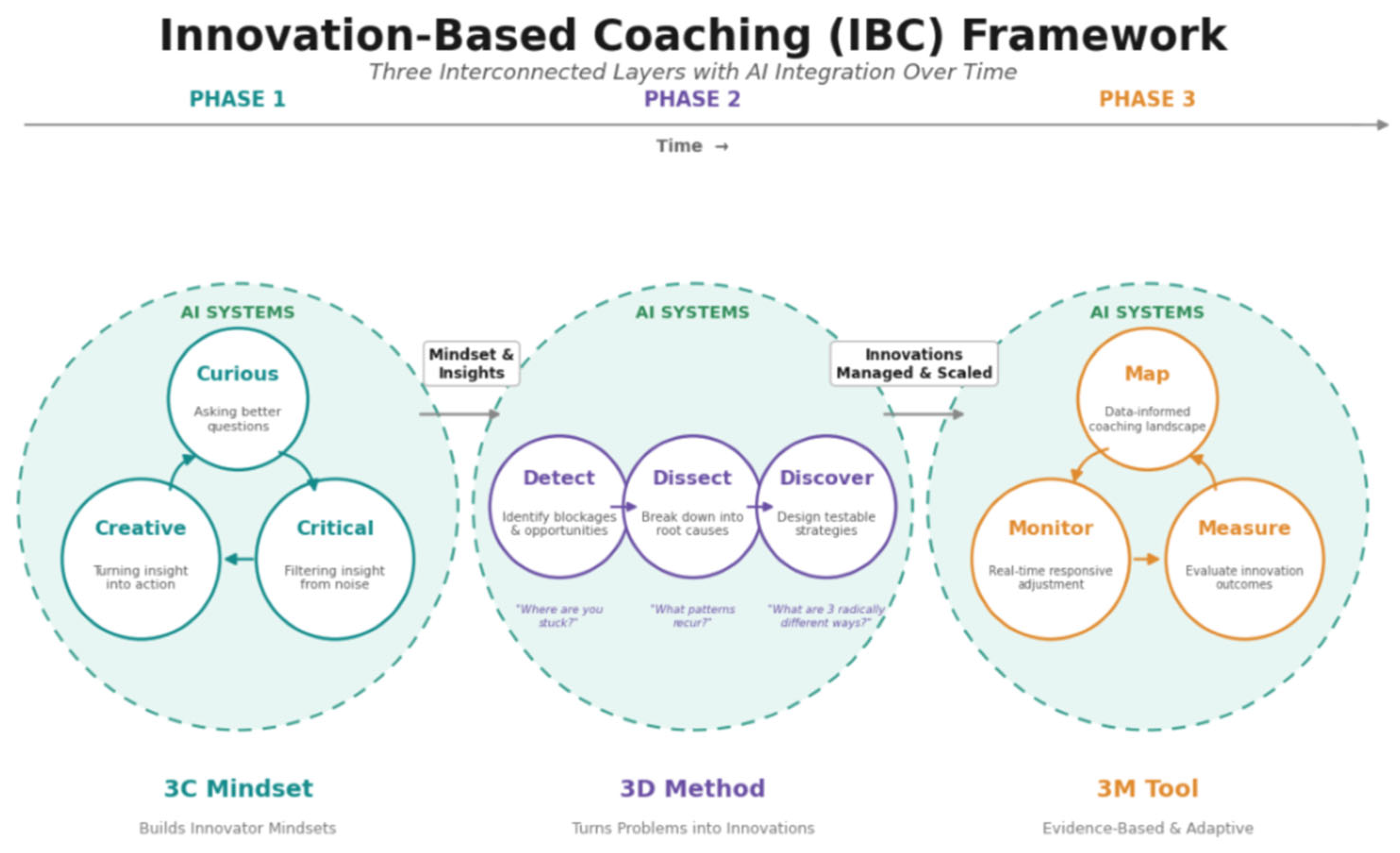
Figure 2.
Recurring Four-Session Cycle.
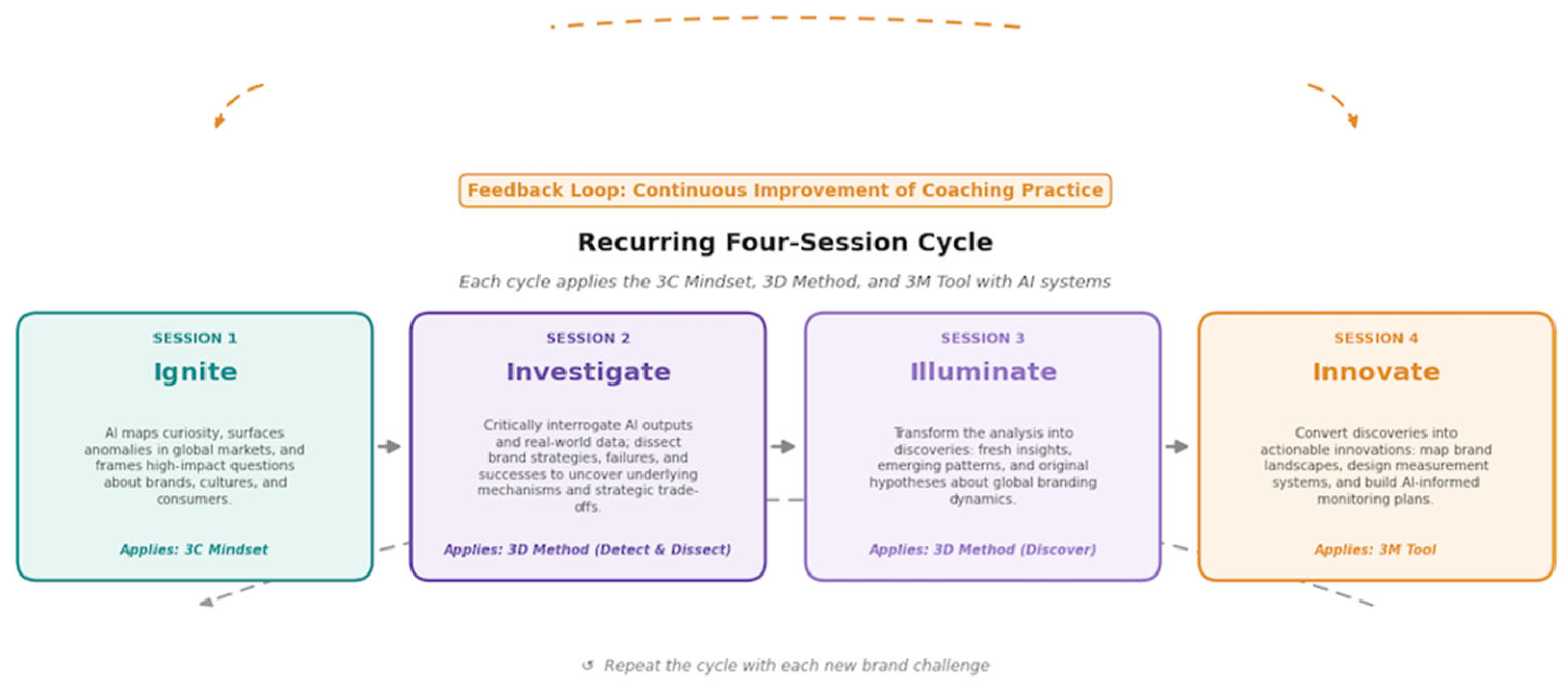
Figure 3.
Brand Globalization Coaching Platform. Source: the Author.
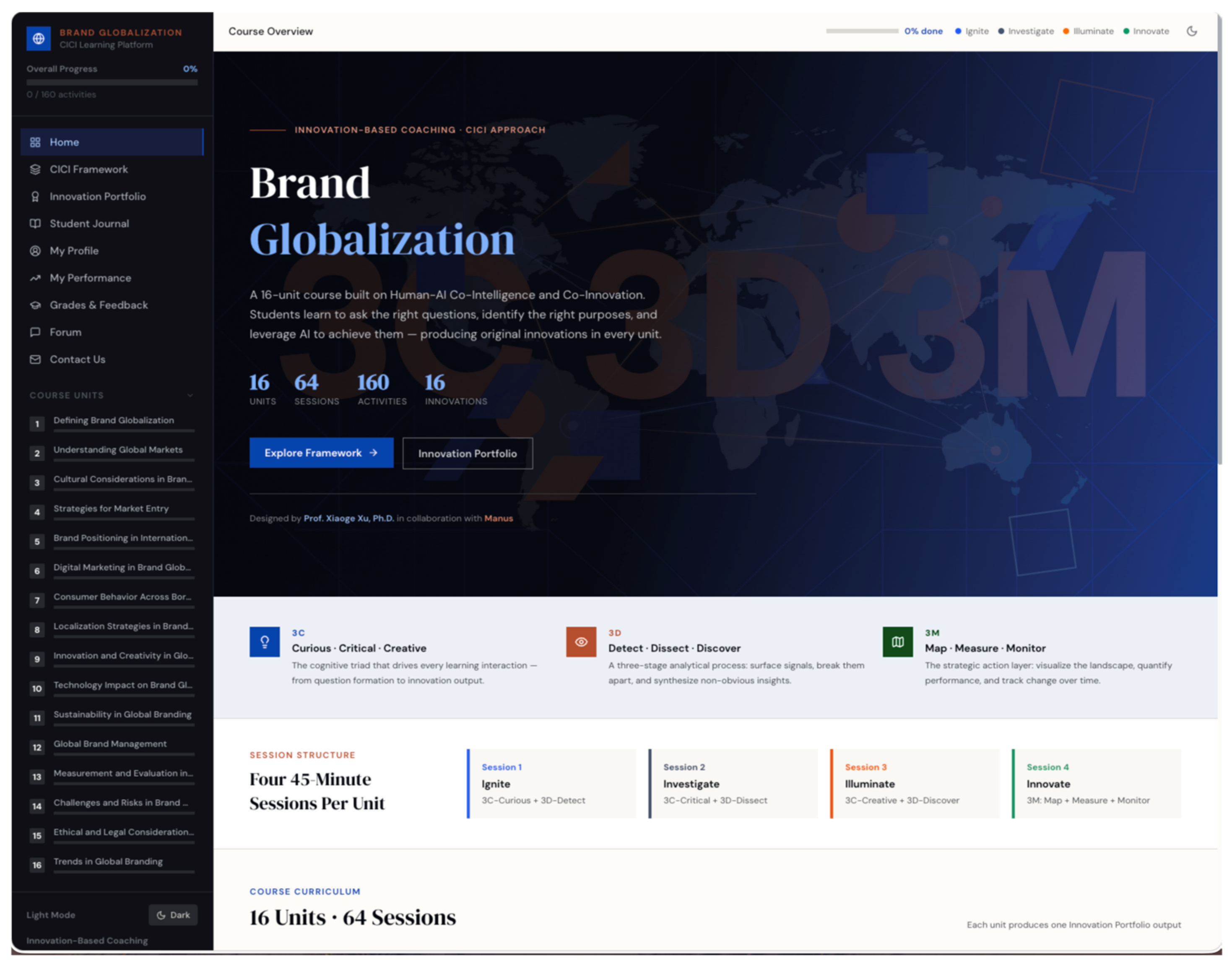
Figure 4.
Brand Globalization: 16 Units and 64 Sessions. Source: the Author.
Disclaimer/Publisher’s Note: The statements, opinions and data contained in all publications are solely those of the individual author(s) and contributor(s) and not of MDPI and/or the editor(s). MDPI and/or the editor(s) disclaim responsibility for any injury to people or property resulting from any ideas, methods, instructions or products referred to in the content. |
© 2026 by the authors. Licensee MDPI, Basel, Switzerland. This article is an open access article distributed under the terms and conditions of the Creative Commons Attribution (CC BY) license (http://creativecommons.org/licenses/by/4.0/).
Copyright: This open access article is published under a Creative Commons CC BY 4.0 license, which permit the free download, distribution, and reuse, provided that the author and preprint are cited in any reuse.