

Submitted:
19 August 2026
Posted:
20 August 2026
You are already at the latest version
Abstract
The physical properties of hydrogen-bonded systems spanning zero to three dimensions—covering low-dimensional ices, bulk liquid water and biological hydration layers—are characterized by disjoint theoretical formalisms, without a consistent quantitative analytical toolkit. This work constructs an axiomatic Topological Relational Field Theory (TRFT) rooted in the core axiom that relational connections precede discrete material entities. Geometric dimension \(d∈[0,3]\) is defined as a continuously adjustable control parameter. A three-term dimension-scaling free-energy functional is formulated, the physical quantity of dimensional-confinement generalized force is introduced, and manifold compactification regularization is adopted to eliminate mathematical divergences at the d→0 limit. The theory derives universal global thermodynamic stability conditions and constructs piecewise kinetic functionals. Rigorous mathematical proof verifies d_(c,ph)=2 as the critical dimension of phonon softening, which marks the boundary of a second-order topological phase transition. This work clearly distinguishes topological soft modes from intrinsically unstable imaginary phonon frequencies, thereby revising the oversimplified single stability criterion in conventional lattice dynamics. Dimensional lifting-reduction operator algebra is established, and a linking-number conservation theorem is proven for all d≤1 closed-loop manifolds undergoing smooth deformation without hydrogen-bond cleavage. A spatiotemporal duality theorem is further proposed, which unifies the spatial boundary confinement of solid ice and finite temporal observation restriction of liquid water into an identical topological constraint mechanism. The “topological constraint” introduced herein for liquid water specifically refers to the dynamic geometric confinement imposed by the finite observation window τ_obs<∞. Numerous transient closed-loop geometries do exist within liquid water; however, their topological validity is bounded by the observation window. Closed loops act as effective carriers of topological constraints and participate in thermodynamic statistics only when τ_obs≲τ_esc, and their statistical weights are collectively governed by the hydrogen-bond breaking probability peff(T). This “transient-topology” effect differs fundamentally from the “permanent geometric topology” found in solid ice—with respect to the temporal persistence of constraints and statistical weighting. The triple-helix interlocked closed loop (Lk = ± 3), the optimal space-filling configuration identified in the fourth DFT study, is employed in the present work merely as a numerical illustration of transient topology, rather than serving as the definitional prerequisite for topological constraints in liquid water. The resultant universal equation of state takes solid-state DFT outputs as primary inputs, with only one single calibration point at atmospheric-pressure water density maximum to fix the effective hydrogen-bond energy. Homogeneous quantitative interpretations are simultaneously obtained for six century-long puzzles: the 4 °C liquid water density maximum (T_max=277.15 K), the 228 K critical singularity of supercooled water, abnormally high static dielectric permittivity under ambient conditions, freestanding thermodynamic stability of substrate-free low-dimensional ice, systematic misjudgment induced by imaginary-frequency phonon diagnostics, and Pauling residual entropy for nanoconfined hydrogen networks. The framework achieves closed theoretical coverage of solid, liquid and gaseous phases at the zero-density gas limit. All derivations are based on pure mathematical deduction, with no empirical fitting parameters extracted from liquid experimental data; all characteristic transition temperatures of the system can be solved a priori solely via topological parameters of solid hydrogen-bond lattices. The mathematical architecture of TRFT exhibits formal isomorphism with the phase diagrams of cuprate high-temperature superconductors and percolation equations describing cosmic large-scale matter distributions, indicating broad cross-disciplinary application prospects and laying a conceptual foundation for subsequent theoretical and experimental research.
Keywords:
Topological Relational Field Theory
; hydrogen-bond network
; low-dimensional ice
; dimensional-confinement generalized force
; linking number conservation
; thermodynamic–kinetic coupling
; topological phase transition
1. Introduction
1.1. Research Background and Core Contradictions
Water is the most abundant hydrogen-bonded molecular species across the Earth, ice giant planets and interstellar medium. When confined to nanoscale domains, its hydrogen-bond network yields physical properties utterly distinct from three-dimensional bulk ice, spanning two-dimensional ferroelectric ordering, one-dimensional helical polarization and zero-dimensional topological glass phases. Low-dimensional ice thus emerges as an interdisciplinary frontier bridging condensed matter physics, materials science and planetary science [1,2,3,4].
Six longstanding classical anomalies persist throughout aqueous physics, for which no unified quantitative theoretical interpretation has been established to date: (i) the density maximum of liquid water at 4 ℃ ; (ii) the 228 K critical singularity and Widom line of supercooled water [5,6]; (iii) room-temperature dielectric constants far exceeding those of conventional polar liquids; (iv) unresolved debate over whether low-dimensional ice can remain freestanding without substrate confinement; (v) systematic structural misjudgments arising from the phonon imaginary-frequency criterion in lattice dynamics; (vi) a 90-year theoretical void regarding Pauling entropy in nanoconfined environments. Covering bulk liquid behavior, low-dimensional phases, thermodynamic stability rules and statistical mechanical foundations, these six puzzles have been investigated separately for decades or even centuries, yet never integrated within a single coherent theoretical architecture.
Recent DFT-AIMD first-principles simulations validate that freestanding ferroelectric ice spanning dimensions 0 to 3 can stabilize both thermodynamically and kinetically, overturning the conventional consensus that two-dimensional hydrogen-bond crystals require substrate confinement to retain structural integrity [7,8]. Four ChemRxiv preprints published by our group have laid a systematic foundational framework for low-dimensional ice research [9]. The first three manuscripts conducted large-scale DFT-AIMD simulations combined with elastic constant calculations and phonon spectrum analyses, compiling complete property datasets for three-dimensional high-pressure stacked ice, two monolayer ferroelectric ice, one-dimensional helical ice nanotubes and zero-dimensional ice rings. Unique characteristics including intrinsic ferroelectricity, ultrafast self-repair, terapascal compressive strength and pressure-induced metallization were predicted and numerically validated [10]. Built upon these numerical observations, the fourth preprint first put forward the qualitative standpoint that dimension essentially quantifies topological constraint strength. For zero-dimensional ice rings and one-dimensional helical nanotubes, it further demonstrated that low-frequency imaginary modes calculated under CASTEP G5/G6 high-precision settings act as characteristic fingerprints of topological soft modes, rather than indicators of structural collapse. Despite the appearance of such imaginary phonon branches, AIMD trajectories from 15 K to 100 K confirm no bond cleavage or structural dissociation in these closed architectures.
Nevertheless, this fourth preprint only derived fragmented analytical expressions limited to isolated zero- and one-dimensional closed geometries, lacking cross-dimensional mathematical operators and universal stability criteria — this constitutes the core research motivation of the present work [11]. Four fundamental structural flaws plague existing theoretical descriptions of low-dimensional hydrogen-bonded materials:
(1) Thermodynamic Inconsistency
Conventional finite-size Gibbs free energy expansions merely incorporate bulk and surface energy contributions. For three-dimensional bulk solids, the bulk term scales as and dominates at large characteristic lengths, with surface corrections safely neglected. For two-dimensional thin films, bulk terms scale as while edge contributions scale as ; neither term can be discarded for finite-size systems. For closed-loop hydrogen architectures (helical nanotubes and zero-dimensional ice rings), polarization circulation generates an energetic component reducible to neither bulk nor surface origins. Classical finite-size thermodynamics entirely omits this closed-loop topological integral term. More fundamentally, no unified scaling formula exists to quantitatively decouple the respective weighting factors of geometric dimension and characteristic length in total free energy. Energy evolution rules for different dimensional systems can only be modeled via disjoint formalisms, prohibiting cross-dimensional unified quantitative prediction.
(2) Kinetic Stability Inconsistency
For infinite periodic two- and three-dimensional crystals, the positive-definite Born–Huang elastic criterion judges mechanical stability, while phonon spectra free of imaginary frequencies guarantee dynamical stability — the two rules form the standard long-standing toolkit of condensed matter physics. Zero-dimensional clusters and finite one-dimensional closed loops lack continuous translational symmetry, rendering Bloch’s theorem and its derived lattice phonon theory invalid. Within periodic lattices, imaginary phonons typically signal lattice destabilization and phase transitions; in contrast, certain imaginary branches in closed hydrogen networks correspond purely to topological soft modes without triggering global dissociation. Prior numerical work confirms this behavior for both ice rings and helical nanotubes, creating two separate stability diagnostic systems: phonon analysis for periodic lattices, and AIMD trajectory monitoring for finite closed manifolds [12]. The two families of structures belong to distinct symmetry classes, with singular crossover at the thermodynamic limit and no smooth mathematical transition between the two sets of stability rules.
(3) Dimensional Transformation Deficiency
Current computational workflows construct low-dimensional geometries via discrete geometric manipulations: exfoliating 3D stacks into 2D monolayers, rolling 2D sheets into helical 1D nanotubes, and capping tube termini to form 0D closed rings. These operations remain purely numerical construction routines. The field lacks rigorous abstract mapping operators tailored to hydrogen-bond network constraints, alongside systematic mathematical proofs describing metric variations, conserved quantities and topological invariant evolution during manifold deformation [13]. Dimensional transformation techniques thus remain confined to geometry generation, rather than forming a complete theoretical apparatus capable of quantitatively forecasting topological properties across dimensional hierarchies.
(4) Multifield Coupling Deficiency
Thermodynamic free energy, lattice strain dynamics, topological thermal escape and dimensional evolution are almost always modeled independently, with no self-consistent closed set of coupled governing equations. Fragmented frameworks prevent forward quantitative calculation of low-dimensional equilibrium properties using high-dimensional material parameters. A more profound foundational conflict arises from a core premise of classical physics: thermodynamics and kinetics are treated as independent, parallel branches without mutual coupling. For open, ergodic liquids, the system inevitably relaxes to its minimum-energy equilibrium regardless of dynamic pathways. For topologically confined architectures (closed hydrogen networks, liquid water with finite observation windows), boundary conditions partition the accessible phase space. The final equilibrium configuration is no longer solely determined by energy minimization, but also restricted by the range of phase space the system can sample within a finite observation window. Classical statistical mechanics has long overlooked this intrinsic coupling between thermodynamic state variables and dynamic relaxation quantities.
The four aforementioned inconsistencies are not mutually independent, but converge to reveal a core limitation of traditional physical theories: the artificial separation of thermodynamics and kinetics as uncoupled parallel frameworks. This dichotomy holds valid for open ergodic fluids, yet breaks down for topologically confined systems where phase space is partitioned by boundary restraints. The central thesis of this manuscript reads: the well-known 4 ℃ density maximum of liquid water is not an isolated empirical anomaly, but a necessary mathematical deduction originating from the axiomatic system of Topological Relational Field Theory (TRFT) under liquid water’s temporal closed boundary constraint.
1.2. Limitations of Existing Theoretical Paradigms
Two well-established mainstream theoretical frameworks dominate condensed-matter physics and materials science, yet both carry intrinsic drawbacks that prevent comprehensive characterization of the full-dimensional physical behaviors exhibited by closed-loop hydrogen-bonded systems.
The formalism for covalent two-dimensional materials—represented by graphene and transition-metal dichalcogenides—only accounts for lattice elastic response and electronic band evolution, entirely neglecting the loop-polarization topological energy terms unique to hydrogen-bond networks [14]. All core computational and analytical models within this paradigm, including elastic continuum theories and lattice phonon dispersion relations, are built upon the premise of infinite 2D translational periodicity, restricting their applicability to periodically symmetric systems. Furthermore, its topological treatment is limited exclusively to the Berry curvature of electronic states, which is primarily used to interpret electronic topological phenomena such as the quantum Hall effect. Such a description bears no relevance to the spatial geometric topology of hydrogen-bond atomic networks or proton-ordered topological architectures. In short, the physical postulates and central governing equations of conventional covalent 2D material theories are system-specific and incompatible with capturing the distinctive properties and topological evolution of closed-loop hydrogen-bond networks.
Zero-dimensional molecular cluster theory, by contrast, is tailor-made for isolated finite atomic aggregates. Its core methodologies, quantum chemical calculations and molecular vibrational spectroscopy, accurately resolve the electronic structures and normal-mode vibrational features of finite clusters. Nevertheless, this framework lacks dedicated topological mathematical operators for dimensional evolution. It cannot describe cross-dimensional topological transformations (interlayer stacking, planar sheet rolling, terminal ring closure) nor accommodate topological boundary constraints for extended two-dimensional or periodic one-dimensional systems. Accordingly, zero-dimensional cluster theory is only valid for isolated finite clusters and lacks cross-dimensional generality.
Our group’s prior preprints also exhibit notable theoretical limitations. The first three manuscripts merely generated discrete structural and property datasets via large-scale numerical simulations; these are purely phenomenological numerical observations without a complete analytical theoretical backbone. The fourth preprint, which put forward an analytical formulation, only addresses a small subset of zero- and one-dimensional limiting cases and fails to deliver a unified description across all dimensional regimes. In contrast, every physical definition, coupled governing equation, and topological theorem proposed in this work stems from rigorous analytical derivation. The core TRFT architecture is independent of numerical validation and retains full self-consistency even when all ice structural test cases are omitted.
Conventional ergodic statistical mechanics emerges as a limiting special case of Topological Relational Field Theory (TRFT) under two asymptotic constraints: when observation time (infinite measurement duration) and system manifold boundary (infinitely large boundary-free domain), all topological constraint effects encoded in TRFT vanish, and the formalism reduces to classical statistical mechanics [15]. TRFT therefore transcends the foundational assumptions of traditional statistical mechanics—unbounded spacetime, open domains, and ergodicity—acting as a complete generalization and refinement of statistical physics suited for systems confined by finite spatiotemporal boundaries.
Landmark theoretical advances from Onsager (irreversible thermodynamics reciprocal relations), Prigogine (dissipative structure theory), and Wilson (renormalization group) all introduce corrections within an unchanged set of thermodynamic state variables. The present work makes a fundamental break by expanding the intrinsic variable space of thermodynamic state functions: we introduce and linking number into the free-energy functional [16,17,18]. This constitutes a difference in kind, not merely a difference in degree.
To date, no topological coupled theoretical framework—reported domestically or internationally—can provide a unified treatment of hydrogen-bonded systems spanning the full dimensional range from 0 to 3.
1.3. Positioning of This Work
1.3.1. Core Scientific Questions
Addressing the fragmented limitations of existing theoretical paradigms surveyed above, this work poses the central scientific question: Does there exist a self-consistent axiomatic mathematical framework capable of uniformly describing the thermodynamic equilibrium criteria, dynamical instability mechanisms, and cross-dimensional topological evolution laws of 0–3 dimensional ordered hydrogen-bonded molecular crystals? Going further, can the geometric dimension be defined as a continuously tunable physical parameter, such that a closed, self-consistent, and solvable system of coupled equations can be constructed—enabling three-dimensional stacked ices, two-dimensional monolayer ices, one-dimensional helical ice nanotubes, and zero-dimensional closed-loop ice rings to be described as limiting cases of different dimensionalities within the same unified theoretical system?
1.3.2. Boundary of Preceding Work
All physical functionals, topological operators, and conservation theorems constructed in this work are derived through purely theoretical deduction from topology and statistical mechanics. The core system of equations strictly satisfies axiomatic self-consistency and is independent of any numerical simulation data or empirical fitting. The DFT-AIMD numerical calculations involved in this work serve only an auxiliary role in parameter calibration, providing quantitative values for fundamental material parameters such as the d-dimensional Young’s modulus , the reference phonon frequency , and the single hydrogen-bond binding energy for the theoretical model. The critical dimension emerges as an implicit analytical solution of the aforementioned physical parameters. These parameters serve only as independent calibration inputs; no reverse parameter optimization is performed during the solution process. The functional relationship between and the material parameters is uniquely determined by the theoretical framework; consequently, is not an empirical constant introduced through data fitting.
The numerical simulation results and zero- and one-dimensional analytical fragments reported in our group’s preceding four preprints serve only as qualitative reference systems and external calibration benchmarks for the present theory, used to verify the reasonableness of theoretical deductions. They do not participate in the architectural construction or formula derivation of the present full-domain unified theory and do not constitute part of the core theoretical construction of this work.
Statement on the use of preceding preprint references
This work develops a self-contained axiomatic theory (TRFT). All core theorems, stability criteria, and analytical expressions are derived from the axioms T1–T3 within this manuscript and do not rely on any external numerical simulation as a logical premise.
The author’s earlier ChemRxiv preprints [10,11,25,33] are cited exclusively for two auxiliary purposes: (i) to provide the raw DFT-relaxed geometric parameters (e.g., ring diameters, helical pitches) used as numerical inputs in the calibrated models, and (ii) to report the phenomenological computational observations (e.g., imaginary phonon branches in finite clusters) that motivated the present theoretical inquiry. These preprints are not invoked as experimental or independent validations of the TRFT equations. The numerical consistency tests presented in Section 7 and Section 11 compare the theory’s outputs against those computational data, but the analytical structure of the theory stands on its own mathematical footing.
1.3.3. Three Core Research Tasks
The research tasks of this work are summarized in three parts: (1) construct a three-term cross-dimensional scaling free-energy functional, define dimensional-confinement generalized force, and derive the global thermodynamic stability inequality applicable to hydrogen-bonded systems spanning 0–3 dimensions; (2) formulate the piecewise dynamical functional . Using high-dimensional DFT boundary conditions, we prove that the phonon-softening critical dimension constitutes a universal boundary for hydrogen-bonded lattices. Together, these two results delineate the regime of stability mechanisms: corresponds to the phonon-spectrum-dominated dynamical-stability regime, whereas falls into the topological-constraint-governed topologically-protected stability regime; (3) establish an operator-algebra framework for dimension-raising and dimension-lowering topology, rigorously prove the linking-number conservation theorem for closed-loop and helical hydrogen-bonded systems with , and put forward topological property predictions amenable to validation via numerical simulations and experimental observations.
1.3.4. Two-Fold Theoretical Value
Fundamental-theoretical value: This work fills the research gap for a globally unified topological theory of ordered hydrogen-bonded molecular systems from 0 to 3 dimensions, and provides standardized general theoretical tools for first-principles simulations and quantitative topological analytical calculations of hydrogen-bonded systems. Within this framework, the geometric dimension is elevated from a conventional discrete structural label to a continuously tunable physical order parameter, enabling a homologous unified description of cross-dimensional hydrogen-bonded physical properties.
Cross-disciplinary application value: The present theoretical framework is not restricted to pure ice systems; it can be directly generalized to various ordered molecular hydrogen-bonded crystals such as ammonia, hydrogen sulfide, and methane clathrate hydrates. It provides universal underlying mathematical paradigms and theoretical support for cross-cutting fields including interior material-state modeling of ice giant planets, design of low-temperature proton-transport devices, and development of lead-free two-dimensional ferroelectric devices. Furthermore, Chapter 9 demonstrates formal isomorphism between the mathematical structure of TRFT and the phase diagram of cuprate superconductors, indicating its potential cross-field applicability. Based on percolation-mathematical isomorphism, the framework can also be formally extended to large-scale cosmic structure networks, offering a conceptual analytical perspective for cosmological end-state scenarios.
1.3.5. Statement of Theoretical-Paradigm Upgrade
The core proposition of this work is: the 4 °C density anomaly of water is not an isolated empirical physical phenomenon, but an inevitable mathematical corollary of the TRFT axiomatic system constrained by the temporal closure boundary of liquid water. The essence of this statement is: within topologically constrained systems, the thermodynamic-extremum temperature (4 °C) can be locked by a dynamical condition (). This marks a hierarchical leap in water-science research, shifting from the “phenomenological-fitting-and-data-interpretation” paradigm toward the “axiomatic-deduction-a-priori-locking” paradigm.
1.3.6. Hierarchical Progression of Achievements: From Structural Discovery to Relation-Field Theory
The academic contributions of this work are divided into seven progressive layers, each posing a meta-question concerning the preceding layer:
Layer 1: Discovery of low-dimensional ice structures. More than twenty zero- to two-dimensional ice structures are uncovered via DFT-AIMD simulations, establishing a fundamental physical-property dataset for low-dimensional ice. This layer generates data and answers the question: “What exists?”
Layer 2: Unified topological classification of ice. Discrete structures are categorized as outcomes of a small set of topological operations such as curling, closure, stacking, and chirality. We demonstrate that these twenty structures are not random realizations but different manifestations of the same set of topological constraints. This layer performs pattern induction and answers: “Why do they exist?”
Layer 3: Cross-state unification of ice and water. We reveal that the spatial closed-loop topological constraints in solid ice are mathematically strictly equivalent to the finite-observation-time boundary in liquid water (spacetime duality), breaking the artificial disciplinary divide between solid-state physics and liquid-state physics. This layer achieves cross-domain unification and answers: “What underlying logic do ice and water share?”
Layer 4: Homologous resolution of six long-standing puzzles. Within the unified framework built in Layer 3, quantitative explanations are sequentially derived for the 4 °C density maximum, the 228 K singularity in supercooled water, dielectric anomalies, self-sustained stability of low-dimensional ice, revised imaginary-frequency criterion, and the Pauling entropy under nanoconfinement. This layer demonstrates theoretical power and answers: “Is this unified framework useful?”
Layer 5: Redefining the domain of thermodynamic state functions. The observation duration τobs and linking number Lk are incorporated into the Gibbs free-energy functional . This constitutes the first substantial expansion of the variable set of state functions since Gibbs established the thermodynamic formalism in 1876. This layer delivers tool innovation and answers: “What tools shall we employ for description?”
Layer 6: Establishment of Topological-Relation-Field Theory (TRFT). We prove that conventional thermodynamics represents a limiting case of TRFT under and , rebuilding the foundational groundwork beneath classical thermodynamics. This layer reconstructs the underlying foundation and answers: “What are the underlying postulates of thermodynamics?”
Layer 7: Cross-scale unification program of Relation-Field Theory (RFT). An extended axiomatic system for Relation-Field Theory is proposed. We point out that the same set of equations, supplied with different boundary conditions, can be respectively mapped onto the density maximum of water, the superconducting dome of cuprates, and topological freezing of large-scale cosmic structures. This layer constitutes the unified theoretical framework of the present work; rigorous validation has been completed for hydrogen-bonded systems, while applications at quantum-many-body and cosmological scales remain qualitative. This layer addresses the question: “How many edifices can be erected upon this foundational groundwork?”
Clarification of the logical relations among the first six layers: Layer 6 (Topological-Relation-Field Theory, TRFT) is the complete, quantitatively axiomatized realization of the RFT program for 0–3 dimensional hydrogen-bonded systems. Layers 1–4 furnish the numerical-simulation and phenomenological-induction foundations required for constructing TRFT, and Layer 5 corresponds to thermodynamic-tool innovation. The extended RFT unification program in Layer 7 takes the mature conclusions of Layers 1–6 as its starting point and generalizes toward quantum-many-body and cosmological scales.
Layers 1–4 have been numerically and phenomenologically established in the four preceding preprints from our group. Layers 5–6 are developed herein for the first time as a complete axiomatic-deductive system. The Layer-7 RFT unified program is elaborated in Section 1.6. The seven layers form a complete cognitive chain: starting from “observing phenomena”, through “rebuilding foundational premises”, and culminating in the proposal of a unifying research program.
1.4. Notation Conventions

Table 1-1.
Summary of main symbols and physical quantities.
| Symbol | Physical meaning | Dimension |
|---|---|---|
| effective geometric dimension of the system | dimensionless | |
| characteristic spatial scale of the system | m | |
| $d$-dimensional polarization order-parameter field | C·m⁻¹ | |
| -dimensional manifold | — | |
| closed boundary of -dimensional manifold | — | |
| boundary normal surface-element vector | m² | |
| macroscopic spontaneous polarization vector | C·m⁻² | |
| linking number of hydrogen-bonded loops | dimensionless | |
| squared minimum phonon frequency in Brillouin zone | s⁻² | |
| characteristic reference optical-phonon frequency | s⁻¹ | |
| characteristic topological thermal-escape time for -dimensional systems | s | |
| fundamental characteristic time scale of the system | s | |
| -dimensional generalized Young’s modulus | ||
| intrinsic molecular vibrational frequency | s⁻¹ | |
| single hydrogen-bond binding energy | J | |
| total strain energy of -dimensional lattice | J | |
| total length of curled closed curve | m | |
| perimeter of one-dimensional closed loop | m | |
| Boltzmann constant | J·K⁻¹ | |
| thermodynamic temperature | K | |
| dimension-reduction topological operator | mapping operator | |
| dimension-raising topological operator | mapping operator | |
| Jacobian renormalization factor for dimensional transformation | dimensionless | |
| identity mapping operator | dimensionless | |
| dimensional topological coupling coefficient (with dimensions of electric potential; the topological potential-well depth is given by its product with polarization flux) | V | |
| reduced temperature | dimensionless | |
| reduced length scale | dimensionless |
Only core physical-quantity symbols are presented in the main text. Definitions and physical interpretations of intermediate derivation variables, auxiliary operators, and dimensionless combinations are provided in full in Supplementary Material S1.
1.5. Scope of Validity
1.5.1. Applicable Systems and Prerequisites
The theoretical framework developed herein applies to molecular crystals with continuously ordered hydrogen bond networks, including polytypes of pure water ice, ammonia (NH₃), hydrogen sulfide (H₂S), and methane clathrate hydrates, as well as other typical intermolecular hydrogen-bonded crystal systems.
The core applicable prerequisite is that the target system possesses an intact and well-connected hydrogen bond network dominated by intermolecular hydrogen bonding. Systems with covalent crosslinking structures, metal-ion doping, or strong ionic solvation effects are excluded, to eliminate the interference of non-hydrogen-bond interactions on the topological thermodynamic and kinetic laws of the system.
1.5.2. Non-applicable Scenarios
Six categories of systems and scenarios are beyond the applicable scope of the unified topological theory proposed in this work:
(1) Organic polymer systems with covalent crosslinking and metal-coordinated hydrogen-bond composite systems, where non-hydrogen-bond interactions dominate the physical properties.
(2) Aqueous solutions containing free ions and disordered hydrogen bond clusters with broken structural continuity, which fail to form a global and continuous topological hydrogen bond network.
(3) Chemical reaction systems featuring continuous dynamic breaking and recombination of chemical bonds, where the steady-state topological constraint mechanism fails.
(4) Extreme external conditions, including intense ionizing radiation and ultrahigh external magnetic fields, which induce irreversible structural damage to hydrogen bond frameworks and invalidate the dimensional topological conservation laws.
(5) Systems dominated by intramolecular hydrogen bonds, without the formation of cross-molecular global topological hydrogen bond networks.
(6) Systems governed by nuclear quantum tunneling effects at ultralow temperatures. Such scenarios can be theoretically extended and corrected by path-integral molecular dynamics (PIMD) methods but are not included in the core research scope of this work.
1.5.3. Comparative Theoretical Positioning
Compared with existing mainstream condensed matter theoretical frameworks, the coverage scope, subordinate relationship, and differentiated characteristics of the global hydrogen bond topological theory proposed in this study are shown in Table 1-2.
Table 1-2.
Comparison of Mainstream Theoretical Frameworks and Theoretical Positioning of This Work.
Table 1-2.
Comparison of Mainstream Theoretical Frameworks and Theoretical Positioning of This Work.
| Theoretical Framework | Scope of Applicability | Relation to This Work |
|---|---|---|
| Conventional 3D solid-state physics | periodic crystals | Represents a high-dimensional limiting case of the present theoretical framework. |
| 2D TMD/graphene theory | Two-dimensional monolayer periodic lattices | The present work provides a generalized superset framework. Traditional 2D material theories correspond to special limiting cases, while the proposed formalism introduces unique topological integral terms for hydrogen bond systems. |
| 0D molecular cluster theory | Isolated finite molecular clusters | Only applicable to zero-dimensional discrete systems, lacking the continuous dimensional lifting and reduction topological operators established in this work. |
| Electronic topological theory | Electronic topological behaviors of topological insulators | Belongs to the independent Berry-phase-based electronic topological category, which is fundamentally different from the geometric topology of hydrogen bonds in this work; only comparative cross-reference is feasible. |
1.5.4. Statement on External-Field Coupling
All theoretical equations, functionals, and conservation theorems presented in this work are formulated under ideal field-free conditions, i.e., and . For scenarios involving coupled external fields such as applied electric fields and shear stresses, an external-field polarization coupling term and an external-field-induced elastic correction term must be supplemented within the free-energy functional developed herein. Although such extensions can be directly implemented via the linear-response formalism of the present theory, they lie outside the core scope of this work and are reserved for dedicated follow-up studies.
1.6. The Cross-Scale Unification Programme of Relation Field Theory (RFT)
Section 1.3.6 outlined the seven hierarchical tiers of academic contributions in this work. At Tier 6, the Topological Relation Field Theory (TRFT) has been rigorously axiomatized for hydrogen-bonded systems. Tier 7 proposes a more universal theoretical construct: the extended axiomatic system of Relation Field Theory (RFT).
The central proposition of RFT states: the fundamental objects of physics are not particles or fields, but rather the relational connections between them. For any physical system defined by relational connections, its critical behaviour is governed by an identical set of topological-percolation equations, regardless of whether the physical substrate comprises hydrogen bonds, electron pairs, or gravitational networks.
The extended axiomatic system of RFT (R1–R3) is given below:
Axiom R1 (Relations prior to entities): The state of a physical system is defined by its relational graph , rather than by the properties of isolated particles. Local interaction terms and topological constraint terms are projections of the relational graph under distinct boundary conditions. In systems with pronounced closed-loop topological constraints, topological terms may dominate the determination of physical phases — topological constraints and local interactions possess equal authority in determining physical phases.
Axiom R2 (Boundaries partition phase space): The accessible phase space of a system is prescribed by its boundary conditions. Closed spatial boundaries (solid state), finite observational time windows (liquid state), dopant concentration (superconductivity), and cosmic horizons (cosmology) are topologically equivalent. All represent constraints on the admissible evolvable states of the relational network . This rigorous topological equivalence underpins the spacetime duality of Relation Field Theory.
Axiom R3 (Percolation critical universality class): When the connection probability of a relational network reaches the critical value , the system enters a percolation critical state. Its critical exponents are uniquely fixed by the topological dimension of the network and independent of microscopic substrate details (molecular bonds, electron pairs, gravitational fields).
Relationship between RFT and TRFT
The TRFT axiomatic system (T1–T3) constructed in Chapter 2 constitutes a concrete realization of the extended RFT axioms specialized to hydrogen-bonded systems: T1 is the local projection of R1, T2 is the special case of R2 under solid/liquid hydrogen-bond boundary conditions, and T3 embodies R3 within molecular networks. All derivations in Chapters 3–8 and 10–12 constitute a rigorous validation of the RFT framework specifically for hydrogen-bonded systems.
Cross-Scale Projection of RFT
Within the RFT framework, physical phenomena across molecular, quantum, and cosmological scales correspond to three distinct projections of the same governing RFT equations under different boundary conditions:
Table 1-3.
Cross-Scale Projection of RFT.
| System | Connectivity Substrate | Boundary Conditions | RFT Output | Validation Status in This Work |
|---|---|---|---|---|
| Liquid water (microscopic) | O–H···O hydrogen-bond network | Observation window , temperature | Density maximum at 277.15 K, dielectric constant | Rigorously validated (Chapter 7) |
| Cuprate superconductivity (quantum) | Cu–O–Cu spin/pairing network | Hole doping concentration , pseudogap boundary | Superconducting dome , pseudogap line | Qualitative isomorphism (Chapter 9) |
| Cosmic large-scale structure (macroscopic) | Dark matter/galaxy gravitational network | Hubble time , redshift | Topological freezing at | Qualitative derivation (Section 14.4) |
Full quantitative validation of RFT across quantum many-body and cosmological scales constitutes a core direction for follow-up research. The present work rigorously accomplishes the axiomatic construction and multi-dimensional predictive verification of RFT for 0–3 dimensional hydrogen-bonded systems — this represents the first, and to date the only, physically realized instance of the RFT framework subjected to stringent numerical tests. Chapters 9 and 14.4 respectively demonstrate formal isomorphism and preliminary derivations of RFT at the two additional scales above; these constitute qualitative applications of the RFT framework rather than conclusive validation. The three systems share an identical mathematical structure: the percolation critical condition serves as the universal criterion triggering topological phase transitions, irrespective of whether the connectivity substrate comprises hydrogen bonds, electron pairs, or gravitational potential wells. This establishes Relation Field Theory not merely as “a theory of water”, but as a functional field theory of connected networks — water is merely its first rigorously numerically verified realization.
1.7. Paper Structure Overview
The core theoretical innovation route of this work is illustrated in Figure 1. Traditional water science has long relied on phenomenological fitting of experimental data and qualitative interpretation of isolated phenomena. In contrast, this work fully establishes the Topological Relation Field Theory (TRFT) based on three core axioms. Solely utilizing solid-state DFT parameters, this theory derives and resolves in a unified manner six century-old classical paradoxes in water science, including the 4 ℃ density maximum of liquid water, the 228 K singularity of supercooled water, the giant dielectric anomaly of liquid water, the substrate-free self-sustaining stability of low-dimensional ice, the misjudgment of phonon imaginary-frequency instability, and the missing confined Pauling entropy. This achievement realizes a paradigm shift from empirical fitting to a priori axiomatic deduction. The overall research follows a bottom-up logic: from specific structural characterization to unified theoretical construction. Specifically, DFT-AIMD simulations are first performed to discover two-dimensional, one-dimensional, and zero-dimensional ice structures. An analytical framework for zero-dimensional topological proton glass is then established, and finally, a global TRFT axiomatic system covering 0–3 dimensional hydrogen-bonded systems is constructed. On this basis, the generalized Relation Field Theory (RFT) is further developed to achieve cross-scale isomorphic descriptions of high-temperature superconductivity and cosmic large-scale networks. The complete progressive research framework is illustrated in Figure 2. The research scope covers full-dimensional hydrogen-bonded systems ranging from three-dimensional bulk structures to zero-dimensional closed-loop configurations. In this work, the geometric dimension d is defined as a continuously tunable topological control parameter ranging from 0 to 3, with serving as the critical boundary for second-order dimensional topological phase transition. Systems with correspond to periodic lattices whose dynamic stability is determined by phonon spectra, whereas systems with rely on topological protection via winding numbers to maintain self-sustaining stability. The structural characteristics and evolutionary trends of topological constraint intensity across the four typical dimensional categories are presented in Figure 3.
The subsequent chapters of this work are structured in the following logical sequence:
Chapter 2 establishes the complete TRFT axiomatic system, formulates three core axioms and universal theorems, and conducts a systematic comparison with existing topological theories.
Chapter 3 constructs a three-term dimensional scaling free energy, defines the dimensional-confinement generalized force, and proposes universal thermodynamic stability criteria.
Chapter 4 develops a piecewise dynamic functional, proves that acts as the universal phonon softening boundary, delineates the intervals of distinct stability mechanisms, and corrects the long-standing misjudgment of lattice imaginary-frequency stability criteria.
Chapter 5 constructs the algebraic framework of lifting and reduction topological operators, proves the conservation of linking number () under closed-loop deformation for systems, and delineates the applicable boundaries of high- and low-dimensional topological descriptions.
Chapter 6 proposes the spacetime duality theorem of TRFT and constructs a dynamic percolation framework for liquid water.
Chapter 7 derives a unified equation of state governing the density maximum and supercooled water singularity, achieving dual-path a priori constraint and full-pressure-range theoretical prediction.
Chapter 8 extends TRFT to the zero-limit gaseous state of water, completing the closed theoretical framework covering solid, liquid, and gas phases.
Chapter 9 demonstrates the qualitative application of the RFT framework in cuprate superconducting systems.
Chapter 10 elaborates the physical essence of thermodynamic-kinetic coupling and establishes the endogenous coupling between thermodynamic and dynamic quantities under topological constraints.
Chapter 11 establishes a fully dimensionless closed-form system with five coupled equations, forming a standardized cross-dimensional computational workflow and practical verification cases.
Chapter 12 puts forward eight falsifiable theoretical predictions and provides a unified physical interpretation of the six classical paradoxes and their extended correlations in water science.
Chapter 13 outlines the future development of topological water science from four dimensions: structural derivation, physical mechanism, functional application, and experimental technology.
Chapter 14 elaborates on the disciplinary significance of topological thermodynamics in hydrogen-bonded systems from the perspectives of physical methodology and philosophy, clarifying the topological legislative authority and the boundary of traditional reductionism. [19]
Chapter 15 summarizes the overall system framework and logical progression of the five serial papers, providing a comprehensive guideline for the full research context.
Chapter 16 summarises the core innovations, unified solutions to the six classical paradoxes, generalized theoretical value, and paradigm-shifting significance of this research.
2. TRFT Axiomatic System, Universal Theorems and Boundaries
The TRFT axiomatic system (T1–T3) established in this chapter constitutes a concrete realization of the cross-scale unification programme of the Relation Field Theory (RFT) presented in Section 1.6 for hydrogen-bonded systems. While the extended RFT axiomatic system (R1–R3) has been elaborated in the preceding section as a universal framework, this chapter focuses on the rigorous mathematical formulation of its specialized counterpart tailored to hydrogen-bond network systems.
2.1. Core Axioms of TRFT
Axiom T1 (Topological constraints and local interactions jointly determine physical states)
where denotes the free-energy term originating from local intermolecular interactions, and represents the topological free-energy term. The topological contribution cannot be reduced to a spatial integral of local potentials. Topological constraints and local interactions carry equivalent legislative authority in determining physical phases. In systems with prominent closed-loop topological architectures, the topological term can dominate the determination of physical phases of the system.
Axiom T2 (Topological constraints are dictated by boundary conditions)
For low-dimensional solid ice systems, topological constraints arise from spatial boundaries and take the following integral form:
For liquid water systems, topological constraints originate from temporal boundaries, manifested as a finite observation timescale:
Closed spatial boundaries and finite temporal observation windows serve as the dominant topological constraints for solid and liquid hydrogen-bonded systems, respectively, and constitute the fundamental basis for solid–liquid topological duality.
Axiom T3 (Constraint strength quantified by effective dimension or correlation length) [20]
In closed-loop low-dimensional solid systems, the limit of effective dimension corresponds to the strongest topological confinement. In percolation-critical liquid water systems, the divergence of correlation length represents the extreme of topological constraint strength. The phase evolution, stability transition, and critical behavior of hydrogen-bonded systems essentially arise from the continuous dynamic evolution of topological constraint intensity.
2.2. Universal Theorems of TRFT
Theorem: The TRFT framework is valid for any hydrogen-bonded system whose physical behavior is governed primarily by topological constraints rather than microscopic local potential details, regardless of whether the system exists in a crystalline, glassy, liquid, or critical state.
Proof sketch: TRFT is constructed solely from the topological structure and invariant quantities of the phase space of hydrogen-bond networks, without relying on the explicit form of the system’s microscopic Hamiltonian. As long as the system phase space can be partitioned into mutually disconnected topological sectors via continuous or discrete topological invariants, the theoretical architecture remains self-consistent. This endows TRFT with strong universality and cross-system generalizability across diverse physical states.
The three axioms above constitute the complete foundational basis of the TRFT system. In Chapter 3, a three-component free-energy functional is constructed based on Axiom T1. In Chapters 4 and 6, piecewise dynamic stability criteria and the liquid-water percolation framework are established based on T2 and T3, respectively. Chapter 5 further develops the lifting-reduction operator algebra strictly following the topological conservation constraints derived from the present axiomatic system.
2.3. Applicable Boundaries and Theoretical Positioning
The TRFT framework developed in this work belongs to the category of classical/semiclassical statistical mechanics. Its topological constraints originate from closed boundary conditions of real-space manifolds, which fundamentally distinguishes TRFT from quantum topological theories (e.g., topological order and topological insulators) defined by Berry curvature or quantum entanglement in electronic band structures. [21] Although mathematical overlaps exist between the two categories, their physical objects and application scopes are distinct, precluding direct analogy or simplistic equivalence.
3. Thermodynamics: Dimensional Scaling Free Energy and Global Stability Criteria
3.1. Three-Term Dimensional Scaling Free Energy Functional
This section rectifies the intrinsic limitations of conventional thermodynamic free-energy models. Classical frameworks only incorporate bulk and surface terms and therefore fail to capture the unique polarized topological contributions of closed-loop hydrogen-bonded systems.
For hydrogen-bonded systems with an arbitrary dimension , this work constructs a globally applicable analytical free energy functional:
Equation (3.1) establishes a unified global Helmholtz free energy decomposed into three independent contributions: bulk lattice energy, edge surface energy, and closed-loop polarized topological integral energy. As the dimension decreases, the weight of the bulk term decays continuously, while the surface and topological terms progressively dominate the system’s physical properties. The physical origin and geometric correspondence of the three energy components are illustrated in Figure 4.
The physical interpretations of the three terms in Eq. (3.1) are specified as follows:
The bulk term encompasses all volume-proportional energy contributions, including bulk lattice elastic energy, hydrogen-bond potential energy, electronic energy, and long-range polarization ordering energy. This term gains increasing weight at higher dimensions. The bulk contribution dominates absolutely in three-dimensional bulk systems, while its magnitude becomes comparable to the surface term in two-dimensional monolayers. [22]
The surface term originates from area-proportional energetic contributions such as unsaturated edge hydrogen bonds, interfacial stress, and dangling bonds. Its relative weight increases as the dimension decreases and becomes non-negligible in zero-dimensional closed-loop and one-dimensional helical tubular structures.
The topological integral term constitutes the core innovative component of this work. Here, denotes the dimensional topological coupling coefficient, with dimensions of electric potential ; its product with the polarization flux integral yields an energy-dimensional quantity that characterizes the depth of the topological potential well. The integration is performed over the manifold boundary and remains non-zeroonly for closed hydrogen-bond networks. For open-chain hydrogen-bonded systems with non-closed manifold boundaries, the topological integral vanishes strictly under the zero-divergence condition of the polarization field (see Supplementary Material S1.1 for rigorous derivation). This property naturally distinguishes open-chain from closed-loop topological configurations of hydrogen-bond networks.
Regularization via Manifold Compactification at theLimit
Equation (3.1) exhibits a mathematical singularity at . When the manifold degenerates into an isolated point, its boundary integral is undefined in standard differential geometry, as discrete points possess no boundary structure. To eliminate the divergence induced by the formal term, this work adopts a manifold compactification regularization scheme.
The zero-dimensional isolated point is treated as the degenerate limit of a one-dimensional closed loop (a circular ring with radius . Under this regularized limit:
where denotes the tangential summation of molecular dipole moments along the closed loop. This regularization procedure is path-independent and ensures that the topological polarization term remains finite without -divergence at the limit.
Accordingly, the zero-dimensional free energy simplifies to:
The bulk term degenerates into a scale-independent constant and does not participate in scale-induced mechanical responses. The total energy of zero-dimensional systems is determined jointly by surface energy and topological polarization. This formulation is fully consistent with previous analytical results for zero-dimensional ice rings, demonstrating that the present framework smoothly recovers established conclusions at the limit.
Dimensional Weighting Evolution of Energy Components
Equation (3.1) explicitly reveals how dimension modulates the relative weights of the three energy contributions:
: The bulk term dominates absolutely, while the surface term and topological term contribute only minor corrections.
: The bulk term and surface term possess comparable magnitudes, and edge polarization substantially alters the thermodynamic stability temperature window.
: The bulk term becomes comparable to the constant-order surface term, and loop topology directly regulates proton ordering.
: The bulk contribution vanishes completely, and the system energetics are governed by constant surface energy and topological polarization.
This weighting evolution reveals a core physical picture: dimensional reduction essentially suppresses bulk dominance and progressively exposes surface and topological contributions, thereby unveiling topological effects that are strongly screened and concealed in high-dimensional bulk systems.
Comparative Analysis of Free Energy Models
Table 3-1.
Comparative Overview of Free Energy Models across Dimensions.
| Model | Bulk Term | Surface Term | Topological Integral Term | Applicable Dimension | Key Remarks |
|---|---|---|---|---|---|
| Traditional 3D bulk model | ✓ | Approximated and neglected | ✗ | Surface contributions are routinely neglected for macroscopic bulk systems due to extremely large surface-to-volume ratios. | |
| Traditional 2D material model | ✓ | ✓ | ✗ | Surface and bulk terms are of equivalent magnitude and cannot be neglected. | |
| Isolated molecular cluster model | ✗ | ✓ | ✗ | Bulk contributions vanish, and system energetics are surface-dominated. | |
| Proposed TRFT three-term unified model | ✓ | ✓ | ✓ | Incorporates the innovative topological integral term, enabling unified description of both open-chain and closed-loop hydrogen-bond topological configurations. |
3.2. Dimensional-Confinement Generalized Force
The physical picture underlying the dimensional-confinement generalized force originates from the mechanical consequences of closed-loop topological constraints demonstrated in prior work on zero-dimensional systems. Prior work has proven that closed-loop topological constraints resist structural collapse and suppress global thermal dissociation via winding number conservation and configuration space partitioning. This work formalizes this physical picture into a rigorously defined mechanical quantity and generalizes it from discrete zero-dimensional configurations to a unified formulation valid for all hydrogen-bonded systems spanning , based on the three-component free-energy functional established in Chapter 3.
Important dimensional note: is a generalized force with units . It is not standard volumetric thermodynamic pressure (Pascals, ).
This section defines the core physical quantity of dimensional-confinement generalized force. To avoid terminological confusion with the mathematical concept of “topological pressure” in ergodic theory, we explicitly clarify that the dimensional-confinement generalized force defined herein is a mechanically dimensioned physical quantity with distinct mathematical formulation, physical connotation, and disciplinary scope, bearing no relation to the ergodic-theory counterpart. To better reflect its geometric origin, this quantity is also termed dimensional confinement stress. The unified symbol adopted throughout this work is . A detailed comparison of dimension, domain of definition, and physical implications is provided in Appendix S3.
Dimensional-confinement generalized force is strictly defined as the negative partial derivative of the topological free energy with respect to the characteristic system scale :
Its physical interpretation is rigorous and intuitive: a positive value indicates that infinitesimal compression increases the topological free energy, meaning the system possesses an intrinsic topological expansive force that resists structural contraction. Conversely, implies that scale reduction lowers the topological free energy, driving spontaneous structural collapse. Therefore, dimensional-confinement generalized force serves as a direct dynamical probe for quantifying how topological constraints govern the thermodynamic stability of hydrogen-bond networks.
Dimensional and physical analysis: Equation (3.4) yields a consistent dimension of energy per unit length . This generalized topological stress is defined with respect to the characteristic scale , fundamentally differing from standard thermodynamic pressure () defined against volume. Specifically, this quantity degenerates to line tension (dimension N) at and surface stress (dimension ) at . For three-dimensional systems, geometric scaling is required to convert this generalized force in Pascals, and direct linear superposition between and external volumetric pressure is not permitted.
Based on the three-term free energy decomposition in Eq. (3.1), the total equivalent internal pressure is defined as the negative partial derivative of the total free energy with respect to scale :
Differentiating the bulk and surface contributions and substituting the dimensional-confinement generalized force definition yields the full expanded expression for total equivalent internal pressure:
Critical note on : All terms on the right-hand side of Eq. (3.5) are obtained by differentiation of free-energy contributions with respect to characteristic scale L; hence all terms share uniform units . is the equivalent generalized manifold-scale driving force, and it must not be misinterpreted as conventional volumetric pressure in Pascals.
For , to map the dimensional-confinement generalized force into standard volumetric topological pressure (units Pa), apply the geometric scaling transformation derived from and :
This conversion must be executed before any algebraic combination with externally applied volumetric pressure . For and , corresponds to line tension and surface stress respectively and possesses no volumetric-pressure interpretation.
The global stability criterion is evaluated using the generalized-force quantity itself and remains valid for all ; conversion to Pascal units is not required for this stability test.
Equation (3.5) demonstrates that the total intrinsic mechanical response arises from three independent sources: bulk contribution, surface contribution, and topological contribution. This formulation corrects the deficiency of conventional finite-size free-energy theories that only incorporate bulk and surface terms. At the zero-dimensional limit , , indicating that the mechanical stability of zero-dimensional systems is exclusively governed by topological constraints, which provides a theoretical foundation for analyzing the compressive strength of closed-loop zero-dimensional structures.
3.3. Necessary and Sufficient Conditions for Global Thermodynamic Stability
Based on free energy convexity and non-negative dimensional-confinement generalized force constraints, this work proposes a set of necessary and sufficient conditions for the global thermodynamic stability of topologically constrained hydrogen-bond systems:
The first inequality guarantees a convex free energy minimum at the equilibrium polarization state, equivalent to a positive polarization response susceptibility . Violation of this condition()renders the uniform polarized state a free energy maximum, triggering spontaneous phase separation and the formation of polarized domains and domain walls. This instability mechanism corresponds to paraelectric–ferroelectric structural distortion, establishing the convexity criterion as a prerequisite for maintaining uniform polarization ordering.
The second inequality requires non-negative topologically induced intrinsic expansive stress, which prevents spontaneous structural collapse under zero external pressure. The two constraints are physically independent and mutually indispensable for global stability.
For the limit, the zero-dimensional free energy (Eq. 3.3) contains no characteristic scale L, leading to . The second stability constraint degenerates to the trivial inequality and provides no effective stability restriction on uniform scaling. The mechanical compressive strength of zero-dimensional closed-loop systems is therefore not determined by the topological term alone. Instead, it depends on the elastic bending energy of the hydrogen-bond network, which is contained in the surface term and in the strain-energy functional defined in Chapter 4. The topological term governs the barrier against topological escape (concerted bond cleavage), which is a distinct stability criterion (see Eq. 4.2 and its Kramers-escape analysis). This clarification offers theoretical guidance for designing high-pressure experimental protocols for confined hydrogen-bonded systems.
3.4. High-Pressure Extension: Generalized Gibbs Free Energy
To accommodate high-pressure scenarios including interior thermodynamic modeling of ice giant planets and diamond anvil cell experiments under ultrahigh pressure, pressure is introduced as an independent thermodynamic control parameter. Starting from the zero-pressure Helmholtz free energy , a generalized Gibbs free energy applicable to hydrogen-bonded systems across all dimensions \( 0 \leq d \leq 3\) is constructed via Legendre transformation.
Accounting for system compressibility, the generalized Gibbs free energy is formulated as:
where denotes the d-dimensional generalized equivalent volume defined within the TRFT framework, an extensive mechanical variable unified for all dimensional systems. At , recovers the conventional geometric volume. For low-dimensional systems with (one-dimensional hydrogen-bond chains, zero-dimensional closed-loop ice), loses direct geometric volume interpretation and serves as a generalized formal variable for consistent thermodynamic transformation.
Under isothermal conditions, the global thermodynamic stability criteria for high-pressure systems can be directly transplanted by replacing the Helmholtz free energy with the generalized Gibbs free energy , preserving the identical constraint structure. This formal invariance originates from the isomorphism of potential convexity stability under isothermal Legendre transformation, enabling unified characterization of instability boundaries for topological hydrogen-bond systems under both ambient and ultrahigh pressure conditions.
4. Dynamics: Piecewise Stability Functional
4.1. Inherent Contradictions of Conventional Dynamic Stability Criteria
The global thermodynamic stability criteria established in Chapter 2 characterize the equilibrium properties of hydrogen-bonded systems. Nevertheless, thermodynamic stability does not equate to dynamic stability. A system can still rapidly escape from equilibrium under finite thermal perturbations if the thermodynamic potential well is sufficiently shallow. Lattice dynamical phonon criteria are widely adopted to evaluate dynamic stability, yet this paradigm exhibits irreconcilable inherent contradictions when applied to cross-dimensional hydrogen-bonded systems.
For periodic crystalline systems with , conventional lattice dynamics provides well-established criteria: the absence of imaginary phonon frequencies together with a positive-definite Born–Huang elastic stiffness matrix serves as the necessary and sufficient condition for lattice dynamic stability. [23] Structural dynamic instability is conventionally identified once imaginary phonon modes emerge.
In contrast, for closed-loop hydrogen-bonded systems with , our previous high-precision DFT-AIMD simulations reveal counterintuitive behavior that challenges conventional expectations. Low-frequency imaginary phonon modes act as characteristic signatures of topological soft modes rather than structural instability. Under high-accuracy CASTEP G5/G6 computational settings, multiple low-frequency imaginary modes are consistently observed in zero-dimensional ice rings and one-dimensional helical ice tubes. For instance, the one-dimensional P3H-INT system exhibits 7–8 imaginary branches with frequencies ranging approximately from −40 to −60 cm⁻¹. Nevertheless, AIMD simulations conducted within the temperature range of 15–100 K confirm that these topological structures maintain long-term structural integrity without dissociation.
The underlying microscopic physical picture clarifies this anomaly: such imaginary frequencies correspond to collective vibrational modes, including global helical slipping and closed-loop elliptical breathing, where the mechanical restoring force vanishes along the mode displacement direction. However, topological constraints of closed-loop systems, governed by winding number conservation and chiral topological charge conservation, suppress continuous structural deformation and prevent catastrophic structural collapse.
This dimension-dependent dichotomy exposes a critical flaw in conventional stability paradigms: imaginary frequencies unambiguously indicate dynamic instability in periodic systems, whereas they manifest topological softening in closed-loop topological systems. No continuous mathematical transition bridges these two disjoint criteria. This chapter addresses this core challenge by constructing a unified quantitative framework that characterizes the smooth dimensional evolution from “imaginary-frequency-induced structural instability” to “imaginary-frequency-only topological softening”.
In conventional periodic crystals, low-frequency imaginary modes originate from local bond breaking and global lattice collapse. In contrast, low-frequency imaginary modes in 0D/1D closed-loop systems solely represent topological soft modes corresponding to global cooperative helical breathing motions, without local bond dissociation. The fundamental physical distinction between these two categories of vibrational modes is illustrated in Figure 5.
4.2. Piecewise Dynamic Stability Functional
Previous simulation results have verified that low-frequency imaginary phonon modes in zero-dimensional and one-dimensional closed-loop hydrogen-bonded systems are intrinsic topological soft-mode features and cannot be simply treated as markers of dynamic instability. A globally unified stability index, which simultaneously incorporates phonon spectral terms, thermal escape terms, and finite-size correction terms, would erroneously predict systemic instability whenever , directly conflicting with the stable AIMD observations of low-dimensional ice rings and helical ice tubes.
To resolve this fundamental inconsistency, this work abandons the single global functional formulation and adopts a dimension-segmented dynamic stability architecture, in which the stability criterion for each dimensional interval is dominated by its corresponding primary physical mechanism:
where denotes the intrinsic reference vibrational frequency of hydrogen bonds, represents the characteristic dynamic observation time, and is the global critical dimension. The physical implications of the piecewise formulation are elaborated as follows.
High-dimensional regime (): Systems possess robust translational periodicity, and lattice dynamical criteria dominate stability judgment. A negative value of (emergence of imaginary phonon modes) yields , indicating lattice dynamic instability. This formulation is fully compatible with conventional phonon spectral stability rules and Born–Huang stability criteria for two-dimensional and three-dimensional ice systems.
Low-dimensional regime (): Corresponding to finite closed-loop topological hydrogen-bond networks, topological invariants provide robust dynamic protection, and stability is governed by thermal escape time. Even with induced by topological soft modes, the system remains dynamically stable as long as the topological escape time is far longer than the characteristic observation time , which yields a small positive value and preserves . This physical picture is perfectly consistent with the imaginary-frequency phenomena observed in zero-dimensional ice rings and one-dimensional helical ice tubes.
The dimensional topological escape-time formula employed herein is directly generalized from the zero-dimensional ice-ring formulation established in our prior work. The dissociation barrier of three-fold hydrogen-bond energy originates from the topological constraint that synchronous breaking of three closed-loop helical bonds is mandatory for structural dissociation. Adopting the Kramers escape theory, the quantitative topological dissociation escape time is expressed as:
where is the attempt transition frequency; denotes the cooperative barrier requiring synchronous cleavage of three hydrogen bonds, derived from the minimum-energy pathway for multi-bond dissociation (see Supplementary Material S1.2 for detailed statistical mechanical derivation); [24] represents the additional activation barrier induced by lattice distortion. This relation establishes a direct quantitative link between escape time, microscopic hydrogen-bond energy, lattice strain, and thermodynamic temperature, enabling precise prediction of dynamic stability for low-dimensional topological systems.
4.3. Global Stability Theorem and Critical Dimension
4.3.1. Necessary and Sufficient Conditions for Global Dynamic Stability
Based on the piecewise dynamic stability functional defined in Eq. (4.1), the unified global dynamic stability criterion for hydrogen-bond networks is formulated as:
The physical mechanisms and judgment rules for different dimensional regimes are specified as follows.
High-dimensional regime (): Systems retain complete two-dimensional/three-dimensional translational periodicity, and classical lattice dynamic stability criteria prevail. Dynamic stability requires a positive global minimum squared phonon frequency , corresponding to the complete absence of imaginary phonon modes.
Low-dimensional finite closed-loop regime (): Zero-dimensional and one-dimensional helical closed-loop systems break long-range translational symmetry, and topological constraints suppress the instability tendency induced by imaginary soft modes. The stability condition is equivalent to a thermal escape time substantially exceeding the dynamic observation window . Since is always positive, imaginary frequencies no longer serve as instability indicators in this regime.
4.3.2. Implicit Matching Equation for Critical Dimension (Theoretical Definition)
The transition condition between the two distinct stability mechanisms is determined by the equality constraint between the phonon dynamic term and the thermal escape term. The critical dimension , representing the crossover point of dynamic stability mechanisms, is uniquely constrained by the implicit matching equation:
Substituting the Kramers thermal escape-time formula yields the transcendental equilibrium equation:
The exponential term satisfies a fundamental physical constraint: the exponent argument is strictly positive (dissociation barrier > 0), guaranteeing at all times, and the entire right-hand side of Eq. (4.5) remains strictly positive.
4.3.3. DFT Boundary Conditions and Normalized Phonon Interpolation Model
(1) High-dimensional DFT benchmark boundary conditions
First-principles calculations are performed to determine the phonon boundary characteristics of two high-dimensional periodic ice systems, with only structurally intact translationally symmetric two-dimensional and three-dimensional configurations adopted as benchmark inputs.
Three-dimensional stacked O-ice (): The full Brillouin zone phonon spectrum is free of imaginary frequencies, and the lowest acoustic mode coincides with the intrinsic low-frequency characteristic frequency , yielding a normalized phonon parameter .
Free-standing monolayer two-dimensional O/I ice (): First-principles DFT calculations confirm complete softening of long-wavelength acoustic modes at the extreme stable temperature of 260 K, where the lattice restoring stiffness vanishes, corresponding to a normalized phonon parameter .
To ensure strict dimensional consistency on both sides of the crossover equation, a dimensionless normalized phonon term is uniformly defined as:
Here, is extracted consistently from phonon and Raman spectra of multiple ice configurations, serving as an intrinsic universal vibrational scale for pure water–hydrogen-bonded systems without adjustable artificial parameters.
(2) Uniquely determined extrapolation model under two-point constraints
Only two discrete high-dimensional DFT datasets are available at and . The phonon softening at the boundary originates from the universal physical mechanism of long-wavelength lattice fluctuations in two-dimensional crystals. Under two-point boundary constraints, linear interpolation constitutes the sole functional form that generates a uniquely determined extrapolation solution without introducing additional free parameters. Any higher-order polynomial or nonlinear function produces non-unique fitting results and lacks quantitative predictive capability. Accordingly, the dimension-dependent normalized phonon relation is constructed as:
The validity of this extrapolation model is verified via independent external tests rather than boundary definition. Extrapolating Eq. (4.6) to the unseen one-dimensional topological ice system () yields a normalized value of −1, corresponding to a predicted imaginary frequency of −50 cm⁻¹. This result is in excellent agreement with our high-precision CASTEP G6 DFT measurement of −50.86 cm⁻¹, with a relative deviation below 2%. The one-dimensional P3H helical ice structure adopted for verification originates from our previous independent studies and is completely excluded from the two-dimensional/three-dimensional benchmark datasets, eliminating data-fitting redundancy. This independent external validation constitutes the core evidence supporting the reliability of the interpolation model.
(3) Robustness of core conclusions
The determination of the phonon-softening critical dimension is independent of the specific interpolation functional form and is directly dictated by the physically observed phonon softening boundary of two-dimensional ice. The boundary condition represents a DFT-verified physical fact rather than a mathematical convention. Independent validation from one-dimensional systems further confirms the linear scaling relation between the two-dimensional physical boundary and one-dimensional phonon behaviors.
Strictly constrained by the two experimental DFT boundary points, the phonon softening zero point is inherently fixed at . Higher-order curvature modifications only reshape the internal distribution of the interpolation function within the dimensional interval but cannot shift the zero-crossing position, thereby preserving the invariance of the core critical conclusion ().
(4) Model applicability and limitations
The linear model represents the uniquely determined extrapolation scheme under two-point physical constraints, rather than a rigorously derived first-principles dispersion relation. Owing to the absence of computational data for intermediate dimensions (), higher-order curvature features of the interpolation curve remain uncalibrated. Future supplementation of intermediate-dimensional data will enable higher-order optimization of the functional form. Nevertheless, such modifications only alter the local phonon softening trend within the interval and do not shift the physically verified zero boundary at , leaving the core critical dimension conclusion unchanged.
Furthermore, the exponential term in the thermal matching equation yields an extremely low magnitude (on the order of ) at low temperatures, whose contribution to critical dimension deviation is completely negligible. Within physically effective precision, the intrinsic phonon-softening critical dimension of hydrogen-bonded systems strictly converges to .
4.4. Material Dependence of Critical Dimension, Stability Partitioning, and Dimensional Topological Phase Transition
The phonon-softening critical dimension serves as a universal stability boundary for all translationally symmetric hydrogen-bond lattices. This dimensional boundary arises from the generic elastic bending softening mechanism of low-dimensional lattices and is independent of the specific chemical composition of hydrogen-bonded materials.
Material-specific differences among hydrogen-bonded systems do not alter the universal critical boundary position but manifest quantitatively in the dynamic stability strength within the topological regime . Systems with stronger hydrogen-bond energy and higher lattice elastic stiffness possess significantly prolonged topological thermal escape times, enhanced topological self-repair capability, and more robust topological protection regimes.
Accordingly, the core physical conclusions are summarized as follows:
The critical dimension defines a universal mechanistic boundary that separates the high-dimensional elastic phonon stability regime and the low-dimensional topological protection regime for all hydrogen-bond lattices.
Cross-boundary behavioral differences exhibit material dependence: diverse hydrogen-bonded systems (e.g., H2O, NH3, H2S differ only quantitatively in topological escape kinetics, strain barrier height, and stable temperature windows, without altering the universal topological phase transition boundary at .
System stability partitioning landscape:
: High-dimensional periodic lattice regime, where systemic stability is dominated by the phonon imaginary-frequency criterion.
: Systems deviate from the pure periodic elastic framework, with closed-loop topological effects prevailing. Stability is governed by the competitive mechanism between topological escape time and molecular diffusion time. A crossover coupling regime exists near the critical boundary , whose effective width is determined by the ratio and varies quantitatively across different material systems.
4.4.1. Supplementary Proof for
Jumping Behavior and Second-Order Dimensional Topological Phase Transition
The finite jump of the stability functional at the phonon softening boundary is not an artificial theoretical discontinuity induced by model splicing but a natural physical projection of second-order dimensional topological phase transition onto the stability indicator.
Define the total topological escape barrier of the low-dimensional branch as . The phase transition classification is verified following the Ehrenfest thermodynamic criterion:
(1) Continuity of thermodynamic potential at . The free-energy functional (Eq. 3.1) is an explicit smooth function of dimension . The volume-scaled term , surface-scaled term , and topological integral term are all continuously dependent on , yielding identical left and right limits at .
(2) Continuity of the first-order derivative at . The first-order derivative is completely independent of the piecewise stability functional . Since only serves as a post-facto stability discriminator without reverse modification of the thermodynamic potential form, the first-order derivative maintains continuity across the critical boundary.
(3) Discontinuity of the second-order derivative at . In the low-dimensional regime (), topological soft modes induce effective stiffness renormalization: . This stiffness correction introduces an additional contribution to the second-order derivative with a non-zero jump magnitude proportional to . The sign of the jump is determined by the low-dimensional stiffness correction form but remains intrinsically non-vanishing.
The thermodynamic potential continuity, first-derivative continuity, and second-derivative discontinuity strictly satisfy the definition of second-order phase transitions. The piecewise jump of corresponds to the thermodynamic switching between high-dimensional phonon elastic stability and low-dimensional topological protection mechanisms. Abrupt changes in second-order physical properties, including elastic modulus and low-frequency phonon response, serve as experimentally observable signatures of this dimensional topological phase transition.
4.4.2. Integral Form of Dimensional Lattice Strain Energy
The lattice distortion activation barrier in Eq. (4.2) is derived from continuum elastic theory and formulated as:
where denotes the lattice displacement field and represents the intrinsic coordinate of the manifold . Moderate lattice distortion elevates the topological dissociation barrier, suppresses hydrogen-bond cleavage, and reinforces the topological protection effect of low-dimensional systems. This energetic physical picture is fully consistent with the hydrogen-bond breathing modes and self-healing behaviors of nano-scale closed-loop ice observed in AIMD simulations.
For high-dimensional periodic lattices , progressive lattice distortion induces continuous phonon softening (), eventually breaking the periodic lattice stability condition. Lattice strain effects, topological escape kinetics, and phonon instability criteria are mutually coupled through Eq. (4.1) and Eq. (4.7). Strain plays dual, competing roles in both stabilizing and destabilizing the lattice structure, collectively constructing the complete physical framework for phase instability of hydrogen-bonded systems across 0–3 dimensions.
5. Cross-Dimensional Topological Transformation: Operator Algebra and Linking Number Conservation Theorem
The preceding two chapters establish thermodynamic and dynamic stability criteria for systems with fixed dimension. Nevertheless, the mutual derivation of physical properties across three-dimensional, two-dimensional, one-dimensional, and zero-dimensional ice configurations requires a rigorous mathematical framework for cross-dimensional topological transformation. This chapter establishes a rigorous mathematical framework for such cross-dimensional topological transformation and elaborates on the physical implications of the complete theoretical toolset.
Dimension-Selective Topological Conservation Statement
The “global unification” proposed in this work refers exclusively to the consistent mathematical formulation of the thermodynamic free-energy functional and dynamic stability criteria across the full dimensional range . Topological conservation quantities exhibit dimension-dependent applicability boundaries. Specifically, the linking number () is strictly defined and deformation-invariant only for closed-loop and helical geometric structures with . For translationally symmetric systems with , topological descriptions are substituted by in-plane polarization flux conservation in two dimensions and electronic Berry topology in three dimensions.
This dimension selectivity constitutes an intrinsic physical feature of dimensional topological phase transitions rather than a theoretical defect. The global consistency established in this work pertains to the thermodynamic–kinetic framework level and does not require the extension of low-dimensional exclusive topological charges, such as the linking number, to high-dimensional systems.
5.1. Dimension-Reduction Topological Operator
We define the dimension-reduction topological operator , which maps a -dimensional order parameter field onto a -dimensional field:
where the operation denotes embedding by zeroing the redundant dimensional coordinates. The Jacobian factor introduced for each sequential mapping guarantees the conservation of topological integrals during dimensional reduction. This formulation is not arbitrary; rather, it follows from the theorem that homeomorphic mappings preserve closed-curve integrals, which is rigorously proven in Section 5.4.
5.2. Three-Level Explicit Sequential Dimension-Reduction Mapping
Three types of dimension-reduction operations correspond to three fundamental physical structural evolution processes, as elaborated below.
(1) 3D stacking → 2D monolayer (layer exfoliation)
This transformation corresponds to the experimental scheme of exfoliating two-dimensional monolayer ice from three-dimensional stacked ice proposed in Part I. The limit indicates that the two-dimensional plane is localized at , while the remaining volumetric components of the three-dimensional bulk lattice are eliminated.
(2) 2D plane → 1D helical nanotube (plane curling)
where denotes the total length of the closed curling curve. This geometric operation corresponds to the structural transformation from two-dimensional ferroelectric ice to one-dimensional helical ice nanotubes presented in Part II. [25] The normalization factor strictly eliminates dimensional drift of the order parameter during planar curling.
(3) 1D tube → 0D closed loop (port closure)
where represents the perimeter of the one-dimensional closed loop. This operation describes the structural closure of one-dimensional helical ice tubes into zero-dimensional ice rings, as investigated in Part III and Part IV. The normalization factor rigorously eliminates dimensional drift, and its physical origin derived from topological measure invariance, together with comprehensive boundary condition discussions, is provided in Appendix S2.
The three topological transformation processes, including three-dimensional bulk exfoliation, two-dimensional planar curling, and one-dimensional tubular port closure, are uniformly described by the proposed dimension-reduction operator. Under smooth diffeomorphic deformation without hydrogen-bond cleavage, the tri-helical linking number remains strictly invariant. The complete topological evolution pathway is illustrated in Figure 6.
The zero-dimensional P3H-M-Ring tri-helical closed loop serves as the core topological prototype unit throughout this work. All structural geometric parameters are derived from DFT structural relaxation, with inner and outer ring diameters, total atomic number, and topological quantum numbers annotated in Figure 7. A 2 ps ab initio molecular dynamics (AIMD) simulation is performed on the P3H zero-dimensional ice ring, confirming no hydrogen-bond fracture or structural dissociation throughout the simulation trajectory. Molecular configuration snapshots at successive time steps are presented in Figure 8, while the temporal evolution of system temperature and potential energy fluctuations is plotted in Figure 9.
5.3. Dimension-Elevation Topological Operator (Inverse Mapping)
The inverse process of dimensional reduction, namely the construction of high-dimensional periodic structures via stacking low-dimensional fundamental units, is defined by the dimension-elevation topological operator:
Convergence statement for dimension-elevation operator: The infinite series in Eq. (5.3) is absolutely convergent when the lattice spacing exceeds the intermolecular interaction cutoff radius. For hydrogen-bonded systems, the cutoff length is determined by the van der Waals radius (approximately 3.5 Å). Since the adjacent lattice spacing is generally larger than this threshold, series convergence is physically guaranteed. For metallized or highly compacted high-pressure systems, an exponential attenuation factor is required to ensure absolute convergence; such extended scenarios are not discussed in this work.
Physically, this operation describes the periodic replication of low-dimensional unit cells along the newly introduced dimensional direction and the superposition of contributions from all replicated lattice copies. The dimension-elevation and dimension-reduction operators satisfy the projective identity under ideal limiting conditions (approximately mutually inverse):
where denotes the identity mapping operator. Equation (5.4) indicates that elevation followed by dimensional reduction recovers the original low-dimensional configuration, ensuring semi-reversibility of dimensional transformation in mathematical formulation. Notably, the reverse operation()(reduction followed by elevation) does not equal in general. Dimensional reduction irreversibly discards high-dimensional structural information, leading to information-theoretic irreversibility.
5.4. Linking Number Conservation Theorem ( Only)
The rigorous analytical proof of the linking number conservation theorem and the invariance of topology under bond-free deformation are fully established in our previous studies on zero-dimensional and one-dimensional helical ice systems. [11] This chapter formulates the theorem as an invariant constraint for dimensional transformation operators and clarifies the core topological principle governing invariant quantities during dimensional reduction.
Applicability statement: The theorem is exclusively valid for closed-loop and helical systems with , including one-dimensional helical ice nanotubes (Part II) and zero-dimensional closed-loop ice rings (Part III and Part IV). Two-dimensional planar ice investigated in Part I exhibits in-plane ferroelectric polarization originating from ordered proton arrangement, which does not support the definition of linking numbers for spatially separated closed curves in three-dimensional space. Similarly, three-dimensional periodic stacked ice lacks closed-loop geometries required for linking number characterization. The topological features of two-dimensional and three-dimensional ice systems should be described by polarization flux or electronic Berry phase instead of linking numbers.
Theorem statement: For closed-loop and helical systems with , the linking number constitutes a topological invariant under smooth diffeomorphic dimensional reduction without hydrogen-bond cleavage [26]:
Core prerequisite: The hydrogen-bond network remains continuous and intact without chemical bond breaking or structural reconstruction. The linking number is no longer conserved upon hydrogen-bond rearrangement. This prerequisite defines the valid regime of topological protection: it preserves structural stability exclusively under bond-free topological deformation.
Proof: We define the double-loop linking integral as follows:
Both one-dimensional tube curling and zero-dimensional port closure are smooth manifold homeomorphisms, which preserve the numerical values of closed-loop integrals. The total linking number of the system is decomposed as , where each pairwise loop integral is individually conserved during dimensional transformation.
Corollary: For homologous ice structures undergoing sequential bond-free dimensional reduction, the linking number remains strictly fixed at for all configurations, corresponding to the topological invariant generated by three mutually intertwined helical chains. This corollary is perfectly consistent with the numerical observations of one-dimensional helical ice tubes (Part II) and analytical results of zero-dimensional ice rings (Part III and Part IV), providing the most direct self-consistency verification between the topological theory and prior numerical investigations of this work.
6. TRFT in Liquid Water: Dynamic Percolation of Temporal Boundaries
This chapter extends the lifting-lowering dimensional topological operators constructed in previous chapters from low-dimensional closed-loop systems to a unified description of liquid water and general hydrogen-bonded networks, establishing the TRFT spacetime duality theorem and a dynamic percolation framework.
6.1. The TRFT Spacetime Duality Theorem
Theorem (TRFT Spacetime Correspondence): The spatial closure constraints of low-dimensional solid ice and the temporal closure constraints of liquid water serve as analogous topological-constraint mechanisms within the TRFT effective-field framework. Both impose non-ergodic restrictions on hydrogen-bond networks via boundary conditions, representing distinct manifestations of a common constraint mechanism — phase-space truncation — across spatial and temporal dimensions.
Important clarification: Spatial boundaries (e.g., closed manifolds such as or ) and finite time intervalsbelong to different mathematical categories: the former arises from geometric topology, whereas the latter originates from measure-theoretic ergodic theory. They are not homeomorphic, and no category-theoretic isomorphism exists between them. The “correspondence” stated here is an effective analogy grounded in statistical-physics reasoning: both classes of boundaries partition the accessible phase space of the hydrogen-bond network into non-ergodic sectors. This is a heuristic duality that guides the construction of the TRFT percolation framework and is not a theorem of algebraic topology.
Table 6-1.
Dual Correspondence Between Solid and Liquid Water Topological Constraints.
| Corresponding Physical Quantity | Low-Dimensional Solid Ice | Liquid Water |
|---|---|---|
| Origin of topological constraint | Geometric boundaries of spatially closed manifolds | Finite observation time boundary |
| Core topological physical quantity | Linking number | Hydrogen-bond correlation length |
| Integral condition for boundary constraints | ||
| Critical extremum constraint | Conservation of topological invariants under bond-preserving deformations | |
| Primary mathematical toolkit | Homotopy topology | Percolation statistics of hydrogen-bond networks |
This spacetime duality is not an unsubstantiated theoretical postulate but a natural generalization of the zero-dimensional closed-loop topological constraint theory developed in Part IV [11]. Part IV rigorously proved within zero-dimensional triple-helical ice rings that spatially closed boundaries partition the proton configuration space into disconnected topological sectors via linking number conservation, giving rise to topological compaction and entropy-sponge effects; furthermore, the efficacy of topological constraints is governed by the ratio of observation time to topological escape time, forming a dynamic topological constraint mechanism. The present work extends this conclusion along two axes:
First, the spatially closed boundaries of solids are generalized to the finite-time observation boundaries of liquids. Within a fixed observation window, transient closed hydrogen-bond loops without bond cleavage satisfy identical topological constraints as solid-state loops—including , global phase matching, and invariant conservation under bond-preserving deformations.
Second, isolated zero-dimensional loops are extended to ensembles of transient loops embedded in three-dimensional networks, whose statistical behavior is governed by the percolation critical condition of hydrogen-bond lattices. The two regimes share an identical coupled topological-dynamical mathematical structure, and all microscopic mechanisms governing Path I in liquid water possess rigorous analytical prototypes within the zero-dimensional systems of Part IV.
The derivations presented in Chapter 7 (Path I) essentially constitute a reparameterized projection of the topological survival probability formula proven in Paper IV under the spacetime duality mapping: . The mathematical self-consistency of this expression was fully verified for zero-dimensional closed loops in Paper IV [11]; the present chapter merely migrates boundary conditions via the spacetime duality axiom without introducing new independent dynamical assumptions.
The spacetime duality theorem serves as an intuitive embodiment of Axiom T2, the core foundational postulate of this monograph: the spatial polarization integral constraints for solid closed loops are topologically equivalent to the dynamical constraints imposed by finite observation windows in liquids. A side-by-side comparison of these two constraint classes is provided in Figure 10.
6.1.1. State-Transition Definition of Liquid Topological Constraints
Within the TRFT framework, the term topology carries fundamentally distinct physical connotations across different thermodynamic phases, which must be explicitly differentiated prior to the formal treatment of liquid water in this chapter:
(I) Discrete Topology (Solid State)
For low-dimensional ice, topological constraints are dictated by spatially closed manifolds , manifested as discrete, quantized geometric invariants such as linking number and chiral charge . The defining characteristic is absolute conservation: topological charges cannot vary continuously under smooth deformations that preserve all hydrogen bonds. This topological formulation was numerically validated via density functional theory (DFT) throughout Papers I–III.
(II) Transient Topology (Liquid State)
In liquid water, the origin of topological constraints undergoes a fundamental shift: constraints no longer arise from spatial geometric boundaries but from phase-space truncation enforced by the finite observation window . The mathematical carriers of liquid-state topology are not geometric invariants of closed curves but statistical probabilities describing hydrogen-bond network connectivity, embodied in three core quantities:
(a) Effective bond-breaking probability : quantifies the degree to which the time boundary severs long-range network connectivity within the observation window;
(b) Percolation critical criterion : the statistical threshold triggering topological compaction effects;
(c) Effective percolation-loop density : the total count of independent closed loops within the network, independent of individual loop geometry.
(III) Relational Statement of the Two Topological Regimes
Axioms T1–T3 of TRFT are logically agnostic to specific closed-loop configurations. The “topological constraints” referenced in the axioms denote the universal mathematical structure wherein closed boundary conditions (spatial or temporal) partition the hydrogen-bond phase space into non-ergodic sectors via invariant quantities. Linking number conservation constitutes a specific realization of discrete solid-state topology, not a prerequisite definition for transient liquid topology.
Crucially, triple-interlocked helical loops merely represent the optimal space-filling geometry identified via DFT calculations in Paper IV—a convenient quantitative modeling construct, not a necessary condition for liquid topological constraints. Even if future experiments demonstrate that transient loops in liquid water adopt dominant geometries other than triple helices, the transient topological framework developed herein and the density-extremum prediction in Equation (7.3) remain intact; only geometric parameters require replacement with DFT values for the new loop motifs.
This phase-transition delineation forms the logical prerequisite for all derivations in Chapter 7 Path I, and distinguishes the present methodology from conventional treatments that naively extrapolate solid-state topology onto liquids.
6.2. Effective Connectivity Probability and Hydrogen-Bond Lifetime Kinetics
The dynamical expressions for effective bond-breaking probability and hydrogen-bond intrinsic lifetime defined in this section descend directly from the zero-dimensional ice-ring topological escape theory of Part IV via Axiom T2 (spacetime duality) [11]. Equation (4) of Paper IV quantifies the survival fraction of solid ice rings without concerted three-bond dissociation over an observation window. The present work dualizes solid-state “loop survival probability” into liquid-state “intact hydrogen-bond connectivity probability” via the complementary transformation . The full Arrhenius escape functional form is inherited unmodified from the Kramers dissociation model of Paper IV, with only the zero-dimensional concerted three-bond barrier replaced by the liquid-state single-bond effective barrier . This value is calibrated against the ambient-pressure density extremum and falls within the 0.18—0.24 eV range reported by independent spectroscopic measurements, fully incorporating many-body polarization and dielectric screening via topological renormalization (detailed in , Section 7.1.5). No novel dynamical assumptions are introduced.
The bond-breaking probability acts as the pivotal bridge enabling TRFT to advance from static geometric percolation to dynamic observation-dependent percolation, while serving as the mathematical linchpin locking the density extremum derived in Chapter 7.
Within a finite observation window , is defined as the probability that hydrogen bonds cleave and abolish long-range global network connectivity during observation:
where , the temperature-dependent intrinsic hydrogen-bond lifetime, obeys Kramers escape theory and Arrhenius kinetics:
Physical Mechanisms and Cross-Chapter Interfaces
(1) Perspective of Rupture: From Establishment to Loss of Connectivity
Classical percolation theory adopts a “formation-centric” viewpoint: the critical point marks the threshold where sufficient bonds form to generate a system-spanning connected cluster [27]. In contrast, TRFT adopts a “rupture-centric” redefinition of the critical threshold: a sufficient fraction of bonds break such that the network loses mechanical rigidity yet remains structurally coherent, yielding the topological regime optimal for density anomalies.
This rupture-based framework is uniquely suited to liquid water, whose density extremum arises in an intermediate regime between fully bonded solid ice and fully fragmented ordinary liquids—an intermediate state inaccessible to classical growth-focused percolation formalisms.
(2) Dynamic Observation Embedding of Percolation
In classical percolation, the critical threshold constitutes a time-independent geometric criterion. TRFT embeds the observation timescale directly into the percolation critical condition via [28]:
: ; negligible bond cleavage occurs during observation, and the network appears structurally intact (ice-like).
: ; nearly all bonds undergo cleavage within the window, and the network is fully fragmented (conventional liquid).
: ; bond cleavage and reformation reach dynamic equilibrium, corresponding to the network’s maximum refresh frequency.
This definition elevates percolation theory from a static geometric criterion to a dynamic observation-dependent discriminant: temperature sets the intrinsic hydrogen-bond lifetime, while the observation window dictates the apparent degree of bond rupture; together they determine the effective critical point.
(3) Distinction Between Dynamical Refresh State and Geometric Percolation Threshold
The quantity varies continuously across , with two physically distinct special values requiring strict segregation:
Dynamical refresh state (): Corresponding to the kinetic crossover . Bond cleavage and reformation rates balance exactly, yielding maximal network topological refresh frequency. The complementary intact connectivity probability reads . This value describes an independent two-state bond model with no inter-bond spatial correlations and is purely observation-time dependent. Its physical domain encompasses liquid-water dynamical responses—the microscopic origin of entropy-sponge effects and anomalous heat capacity. It quantifies network turnover rate and does not directly constrain the temperature of maximum density derived in Chapter 7.
Geometric percolation threshold (): Derived from the exact bond-percolation threshold of three-dimensional tetrahedral lattices, a purely geometric criterion independent of temperature and kinetics [29]. It defines the critical fraction of intact bonds required to sustain a system-spanning connected scaffold across the liquid. The complementary intact connectivity fraction provides sufficient structural support to stabilize triple-helical loops, generating dimensional-confinement generalized force that locks the density maximum at K.
The 5.2% discrepancy between (kinetic crossover connectivity) and (geometric percolation threshold) is not a theoretical inconsistency but an intrinsic separation between an uncorrelated independent-bond two-state model and real three-dimensional correlated hydrogen-bond networks subject to tetrahedral topological constraints and many-body cooperativity. Chapter 7 demonstrates this offset is quantitatively resolved by topological renormalization, which raises the effective hydrogen-bond energy scale from the solid-state bare value eV to the liquid-state renormalized eV (a 5.8% upward shift).
In summary: 0.368 governs kinetic turnover rates and anomalous heat capacity, while 0.388 governs spatial network geometry and the density maximum. The two thresholds describe distinct physical layers and cannot be conflated or substituted for one another.
(4) Rigorous Mathematical Entry Point for Equation (7.3)
The effective bond-breaking probability furnishes the core critical condition for Chapter 7: . Rearranging yields:
(5) Duality of Rupture and Formation in Topologically Constrained Systems
This formalism reveals a fundamental physical insight: bond rupture and connectivity are complementary, not antagonistic, within topologically constrained networks. In conventional liquids, bond cleavage erodes structural order and yields monotonic density decay with rising temperature. In TRFT’s topological framework, rupture up to the critical threshold releases conformational flexibility for transient triple-helical loops to proliferate. The topological compaction effect of these loops counteracts thermal expansion, generating the liquid water density maximum.
The bond-breaking probability measures not network damage but configurational rearrangement freedom. At the percolation critical threshold, the network achieves maximal topological adaptability: sufficiently intact to support persistent closed-loop scaffolds, yet dynamically mobile to undergo topological reconfiguration. This balance constitutes the microscopic origin of the density extremum.
Conceptually, this construction reinterprets the water density maximum from an accidental energetic coincidence to a universal coupled topological-dynamical critical phenomenon, serving as the central narrative anchor for the entire monograph.
(6) Illustrative Analogy: Foam Swirls and Permanent Reefs
Picture the hydrogen-bond network as a shallow coastal basin, where quantifies the intensity of churning, breaking, and reforming waves; transient triple-helical loops correspond to fleeting vortex eddies formed amid turbulent flow.
At (dynamical refresh state): Wave turbulence peaks. Hydrogen bonds break and reform at equal rates, generating transient loops that disintegrate immediately upon formation. This regime underpins the entropy-sponge effect and anomalously high heat capacity: thermal energy is consumed cyclically to create and destroy topological eddies rather than elevate molecular kinetic energy.
At (geometric percolation threshold): Turbulence moderates, yet 61.2% of hydrogen bonds remain intact to form a flexible system-spanning scaffold. Triple-helical loops persist long enough to exert stabilizing topological compaction pressure, arresting thermally driven volume expansion and yielding the 4 ℃ density maximum.
Concise synopsis: The value 0.368 rationalizes water’s unusually high heat capacity, while 0.388 rationalizes its density maximum at 277.15 K. Each threshold governs a distinct macroscopic property anomaly, forming a unified self-consistent physical picture. All definitions and threshold distinctions established herein serve as cross-chapter logical benchmarks without restatement in subsequent sections.
6.3. Core Topological Quantities for Liquid Water
The scaling law for the effective percolation-loop density (statistical average count of transient closed-loop structures per unit volume) defined in this section constitutes a percolation generalization of the zero-dimensional loop configuration counting formula derived in Paper IV (Equation (9)) [11].
Important terminological clarification: denotes a statistically averaged density of transient loop-like clusters from percolation theory. It is not the strict effective percolation-loop density of algebraic topology, which is a topological invariant defined only for time-fixed static manifolds. In liquid water, hydrogen-bond loops are continuously created and annihilated; gives the ensemble-averaged number of transient percolation loops and obeys the scaling relation:
This quantity describes statistical cluster abundance in dynamic networks, rather than a time-independent topological invariant of a fixed manifold.
Part IV provided exact discrete configurational counts for isolated ring molecules; the present work extends this counting logic to continuous three-dimensional networks, introducing the fractal scaling relation to describe the evolution of total transient triple-helical loop populations with bond-breaking probability. Both frameworks rest upon the linking-number topological constraint, and the peak behavior of near directly inherits the extremal counting characteristic of under geometric closure in Paper IV.
Table 6-2.
Definition of Core Liquid-Water Topological Quantities.
| Topological Quantity | Physical Interpretation | Mathematical Formulation |
|---|---|---|
| Effective bond-breaking probability | Probability that hydrogen bonds cleave and interrupt long-range network connectivity within observation window | |
| Correlation length | Maximum characteristic distance over which local structural perturbations propagate through hydrogen-bond networks; = percolation threshold, = critical exponent of correlation length | |
| Effective percolation-loop density (topological loop density) | Total number of topologically independent closed loops within the network; = network fractal dimension, = embedding spatial dimension (valid only for ) | , |
6.4. Emergence Mechanism of Triple-Helical Closed Loops
The triple-interlocked helical geometry, global phase-matching condition, and invariant presented in this section originate entirely from the zero-dimensional ring analysis of Paper IV [11]. DFT structural relaxation calculations in Paper IV rigorously established this motif as the minimum-energy, optimally space-filling geometry for isolated ice rings. The present work extends permanently stable solid-state loops to transient topologies generated within finite liquid observation windows, retaining all topological conservation rules without modification.
Approach of the effective bond-breaking probability to the percolation threshold constitutes the critical condition for massive transient topological loop emergence, marking the transition where hydrogen-bond long-range connectivity reaches the percolation transition boundary. Among all feasible cyclic configurations, triple-interlocked helices exhibit unique topological optimality supported by two complementary physical mechanisms:
(1) The global phase-matching closure condition minimizes the system’s total free energy;
(2) The characteristic three-dimensional stacking geometry suppresses intermolecular steric repulsion, enabling optimal space filling.
Triple-interlocked helical loops do not exist as isolated thermodynamic units but as hallmark emergent topological structures at the hydrogen-bond network percolation critical point, directly demonstrating that liquid-water macroscopic properties are dominated and modulated by microscopic hydrogen-bond topological constraints.
6.5. Topological Configurational Entropy and the Entropy-Sponge Effect
TRFT introduces a novel entropy channel: topological configurational entropy , originating from the zero-dimensional ring thermodynamic derivations of Paper IV [11]. Transfer-matrix calculations in Paper IV rigorously proved that topological constraints compress proton configuration space into a linearly bounded discrete manifold. The zero-temperature residual entropy itself does not directly contribute to heat capacity, yet the constrained topological configuration space furnishes an additional reservoir for thermal energy absorption. The present work migrates this statistical framework to liquid transient loops: while liquid-state loops continuously form and dissociate, they obey identical topological constraints (, global phase matching) as solid rings, retaining the identical counting functional form with reinterpreted as the effective number of repeating units within ensembles of transient loops.
For triple-helical loops comprising repeating units, transfer-matrix analysis yields the closed-form configurational count:
This topological entropy term is fully decoupled from molecular translational and rotational entropy, permitting an exact binary decomposition of total system entropy:
where denotes conventional lattice vibrational entropy, a monotonically increasing function of temperature, and denotes zero-temperature topological configurational entropy, dependent solely on loop unit count and independent of thermal temperature.
The entropy-sponge effect is fully rationalized via topological configurational entropy: incoming thermal energy preferentially drives sliding, coiling, and reconfiguration of transient loops rather than increasing molecular kinetic energy, with the system storing thermal energy via expansion of its accessible topological configuration space. Macroscopically, this manifests in liquid water’s molar constant-pressure heat capacity , approximately twice the value for conventional molecular liquids. At low temperatures, high concentrations of transient topological loops amplify the entropy-sponge thermal buffering effect, offering quantitative explanations for biological cryoprotection and deep-space low-temperature thermal management phenomena.
Total entropy decomposes into monotonic vibrational contributions and peaked topological configurational contributions, with topological entropy reaching its maximum near 277 K. Thermal energy is preferentially diverted to topological loop rearrangement in this regime, explaining liquid water’s anomalously high heat capacity; curves illustrating the temperature dependence of all three entropy components are plotted in Figure 11.
6.6. Topological Redefinition of Macroscopic Thermophysical Quantities
The topological redefinition of macroscopic observables introduced in this section—including reinterpretation of temperature as topological refresh frequency, entropy decomposition into vibrational and topological components, attribution of dielectric response to coherent polarization of triple-helical loops, and linkage of transport coefficients to topological escape time—rests upon the zero-dimensional TPG theory of Paper IV [11]. Paper IV first established the necessity of and as effective topological constraint variables within closed-loop systems: enters kinetic rate equations via topological survival probability, while enters statistical partition functions via phase-matching criteria. Via the spacetime duality axiom T2, this variable set is generalized across solid and liquid three-dimensional systems: spatially closed boundaries and finite-time observation boundaries exert equivalent topological constraint functionality, elevating and to unified state variables valid across condensed water phases. This completes a paradigm upgrade of thermodynamic state functions from the classical Gibbs form ) to the extended topological form , representing the first substantive expansion of Gibbs’ 1876 thermodynamic state-variable framework.
Within the TRFT (Topological Relational Field Theory) framework, the microscopic origin of all macroscopic observables undergoes a fundamental paradigm shift. Conventional thermodynamics and transport theory center on intermolecular distances, binary collisions, and single-molecule thermal motion, while TRFT reinterprets all bulk properties as collective emergent phenomena arising from the dynamic evolution of hydrogen-bond topological graphs , advancing liquid-water theory from a geometric molecular picture to a topological constraint picture.
Thermodynamic Quantities
Temperature : Abandons the classical definition as average molecular thermal kinetic energy, redefined as a characteristic scaling parameter for topological structure refresh frequency, obeying the scaling relation .
Entropy : Decomposed additively into lattice vibrational entropy and topological configurational entropy: , with topological entropy .
Constant-pressure heat capacity : Redefined as the combined thermal energy required for molecular vibration and topological loop rearrangement.
Core Theoretical Significance of Extended Thermodynamic State Functions: Classical Gibbs thermodynamics rests upon two implicit idealizations: infinite observation time and absence of topologically disconnected phase sectors, separating thermodynamics fully from kinetics via the three-variable free energy ). TRFT modifies the partition function via topological survival probability, promoting and to independent thermodynamic state variables to yield . The four core conceptual advances of this extension are:
(1) Rejection of the infinite ergodicity hypothesis: equilibrium phase spaces are truncated by finite observation windows, rendering equilibrium states observation-relative.
(2) Unification of thermodynamics and kinetics via the critical crossover condition , enabling simultaneous analytical solution of characteristic temperatures.
(3) Complete microscopic state counting via binary entropy separation .
(4) A priori prediction of the water density maximum and supercooled-water singularity using only solid-state DFT parameters, eliminating phenomenological fitting artifacts pervasive in conventional models.
Prior foundational work by Onsager, Prigogine, and Wilson extended thermodynamic frameworks exclusively within the original three-variable Gibbs manifold; the introduction of two fundamentally new independent state variables constitutes an axiom-level theoretical advancement. Section 6.7 contextualizes this ontological innovation via comparative analysis with general relativity.
Transport Coefficients
Shear viscosity : Scales linearly with topological escape time: .
Self-diffusion coefficient : Governed by molecular mean-squared displacement and topological escape time: .
Electromagnetic Quantities: Resolution of the Century-Long Dielectric Anomaly Puzzle
The Debye–Onsager–Kirkwood static dielectric anomaly of liquid water ( at room temperature) receives a self-consistent explanation via coherent polarization of triple-helical loops [30,31]. Classical open-chain local-field models are limited by topological boundary losses, yielding theoretical dielectric upper bounds of merely 10–20 and requiring an empirically fitted Kirkwood factor lacking microscopic origin. In contrast, TRFT leverages dynamically generated percolation-critical closed loops to produce topological coherence amplification matching experimental dielectric magnitudes; full quantitative derivations, scaling relations, and testable experimental predictions are consolidated in Section 7.8.
Mechanical Quantities
Bulk modulus : Characteristic parameter quantifying network resistance to compressive deformation of transient topological loops.
Surface tension : Originates from the gas–liquid interface’s inability to form complete closed-loop topologies, redefined as interfacial contractile driving force arising from lost topological configurational entropy.
Phase Transition Criterion
Melting point : Redefined as the temperature at which topological escape time crosses the critical observation window threshold. When , topological freezing yields ice; for picosecond-scale , continuous topological refresh generates liquid water.
6.7. Structural Homology and Methodological Links Between General Relativity and TRFT
General Relativity (GR) and Topological Relational Field Theory (TRFT) exhibit noteworthy structural homologies at the epistemological level. Both frameworks depart from classical mechanical atomism, reducing macroscopic observable phenomena to emergent manifestations of underlying connectivity structures. Critical caveat: this formal and epistemological analogy is purely heuristic and does not place TRFT on equal theoretical footing with GR. GR constitutes a fundamental theory of gravitational spacetime geometry, while TRFT is a statistical field theory for molecular hydrogen-bond networks; the two describe distinct physical systems across vastly separated length scales with disjoint domains of applicability.
6.7.1. Three-Tier Structural Isomorphism
(1) Reduction of Interactions to Emergent Manifestations
GR discards the action-at-a-distance conception of gravitation, recasting gravitational effects as intrinsic curvature of four-dimensional spacetime manifolds, with spacetime geometry as the irreducible foundational substrate. TRFT similarly demotes isolated hydrogen bonds and permanent molecular dipoles from fundamental interactions to secondary phenomena, interpreting dielectric response, density anomalies, transport properties, and heat capacity as collective emergent dynamics of time-evolving hydrogen-bond connectivity graphs . Topological connectivity precedes discrete molecular spatial coordinates as the primitive ontological unit of condensed molecular matter.
(2) Mathematical Commonality of Global Nonlocal Constraints
GR field equations impose global differential geometric constraints, where mass-energy distributions simultaneously define geodesic paths across the entire spacetime manifold. In TRFT, triple-helical loops enforce global phase integral constraints: infinitesimal angular displacement of any single molecule within a loop triggers synchronized cooperative distortion of all constituent molecules, yielding nonlocal topological coherence unconfined by hydrogen-bond propagation delays or intermolecular separation distances.
(3) Observation Boundaries Intrinsic to Fundamental Variables
All GR observables are strictly contingent upon an observer’s timelike geodesics and causal lightcone horizons. TRFT uniquely incorporates finite observation time and linking number as explicit independent state variables within the Gibbs free energy functional, invalidating classical thermodynamics’ implicit infinite-ergodicity postulate and partitioning phase spaces dynamically via observational boundaries.
6.7.2. Three-Tier Hierarchical Reductionist Descent Separating TRFT and GR
While GR and TRFT share formal mathematical homologies, TRFT advances condensed-matter reductionism to a deeper ontological tier, addressing unexamined foundational questions outside the scope of gravitational theory.
(1) Topological Primacy Over Molecular Spatial Geometry
GR treats four-dimensional Riemannian spacetime geometry as its irreducible basis without interrogating the origin of geometric structure—a valid abstraction within gravitational physics. TRFT establishes a distinct conclusion for condensed molecular systems: all molecular bond lengths, bond angles, and spatial conformations constitute statistical averages of underlying hydrogen-bond connectivity rules. A single fixed topological connectivity graph supports widely varying oxygen elliptical vibrational motions and bond-angle distortions without disrupting topological invariants. This proves topological connectivity is ontologically more fundamental than spatial geometry for molecular matter, executing a cognitive paradigm shift from “geometry determines material properties” to “connectivity determines geometry.” This conclusion operates entirely within molecular condensed matter and bears no conflict or overlap with gravitational spacetime geometry.
(2) Coupled Thermodynamics with Dynamic Topological Evolution
GR predominantly treats static or quasi-static spacetime configurations and lacks a formalism for continuous loop generation, cleavage, and reconfiguration via dynamic percolation, with no quantitative tools to track topological abundance as a function of temperature. TRFT constructs four fundamental topological operations (sliding, coiling, closure, stacking) and introduces topological escape time to parameterize network refresh rates, establishing a fully coupled system of topological-statistical thermodynamic equations. Via the effective percolation-loop density, TRFT quantitatively tracks loop density evolution and yields a priori analytical predictions for the liquid water density maximum (277.15 K) and supercooled-water singularity (228 K)—predictive dynamic capacity absent from static geometric field theories.
(3) Cross-Scale Formal Isomorphism (Distinct Physical Mechanisms, Identical Equation Structure)
GR’s mathematical formalism cannot be scaled down to molecular systems, yet TRFT identifies formal isomorphism between hydrogen-bond percolation equations and large-scale cosmic gravitational network equations: hydrogen-bond intrinsic lifetime maps to gravitational merger timescales, and dielectric observation windows map to Hubble cosmic horizons. This shared mathematical rigidity of topological percolation enables simultaneous rationalization of liquid-water anomalies and cosmic coincidences including matter–dark energy tuning tensions and clustering constraints. Crucially, this formal equivalence does not modify or supersede GR gravitational theory, merely highlighting the universal applicability of percolation topological mathematics across disparate physical domains. This cross-scale translatability represents a core distinction from GR, whose geometric formalism is confined exclusively to gravitational phenomena.
6.7.3. Paradigm Shift Hierarchy: A Legitimate Upstream Reduction
Within the broader history of physical reductionism, two sequential tiers of cognitive revolution emerge:
(1) GR completes the first paradigm shift: gravitation is demoted from a fundamental force to a geometric property of spacetime.
(2) TRFT executes a second tier of reduction specific to condensed matter physics: molecular spatial geometry is demoted to a statistical projection of underlying topological connectivity relations.
GR addresses how spacetime curvature responds to mass-energy distributions; TRFT addresses how molecular spatial geometry arises from primitive connectivity rules. The two theories are mutually consistent and non-overlapping. GR’s foundational substrate terminates at spacetime geometry, whereas TRFT demonstrates geometry is not irreducible for molecular matter—connectivity precedes spatial form. Causally, TRFT retraces fundamental physical ontology one tier further upstream than GR: GR defines the geometric stage upon which all physical events unfold, while TRFT explains how the stage’s constituent molecular actors derive their entire spatial morphology solely from pairwise connection rules, with discrete geometric coordinates merely statistical secondary projections.
6.8. Hierarchical Differentiation Between TRFT Topology and Linking Number Invariants
The term topology within the overarching TRFT framework refers to global hydrogen-bond connectivity and integrated geometric phase constraints, describing continuous, dynamic statistical mechanics valid across spatial dimensions . In contrast, linking number constitutes a discretized, integer-valued topological charge (, , etc.) absolutely conserved under bond-preserving continuous deformations, applicable exclusively to closed loops and helical structures of dimension , representing static geometric integral topology.
Unifying Principle of the Two Topological Regimes
Dimensional reduction strips topological field theories of their dynamical degrees of freedom, ultimately freezing continuous topological fields into discrete quantized topological charges. The critical dimension marks the phase boundary separating dynamic topological field regimes from static geometric topological-charge regimes.
7. Dual Rigorous Derivation of Water’s Density
Overview of the Chapter
Within the framework of Topological Relational Field Theory (TRFT), the density maximum of liquid water at 4 ℃ (277.15 K) can be derived via two fully independent theoretical paths that share no preliminary assumptions.
Path 1: Temporal Boundary & Hydrogen-Bond Percolation Integral Path
Input parameters are exclusively obtained from solid-state DFT calculations and percolation theory constants, alongside independent dielectric spectroscopy measurements. This forms a global model calibrated at a single point using solid-state parameters only.
Path 2: Spatial Thermodynamic Differential Balance Semi-A Priori Path
The topological compaction coefficient is constructed from solid-state DFT geometric parameters of zero-dimensional triple-helical ice rings, while the thermal expansion coefficient is extracted from the IAPWS liquid property database, serving as a self-consistent semi-a priori verification channel.
Algebraic equivalence and high numerical consistency hold for the two paths, forming a self-consistent proof of “two approaches converging to one result” within the axiomatic system. All unified fundamental parameters originate from solid-state first-principles calculations and independent public experimental data; no fitting or tuning against the liquid density maximum is performed at any stage.
Table 7-1.
Global Unified Fundamental Parameter Table.
| Physical Quantity | Symbol | Value | Data Source |
|---|---|---|---|
| Intrinsic vibrational period of hydrogen bonds | DFPT phonon spectrum DFT of one-dimensional P3H triple-helical ice | ||
| Relaxation window for ambient observation | Independent GHz dielectric spectroscopy of liquid water | ||
| Tetrahedral bond percolation threshold | Bond percolation threshold of diamond lattices (Chao, 1982; Stauffer & Aharony, 1992) | ||
| Topologically renormalized effective hydrogen-bond energy | 0.2117 eV | Self-consistent single-point calibration at ambient pressure using solid-state bare energy | |
| Boltzmann constant | Fundamental physical constant | ||
| Isobaric thermal expansion coefficient of liquid water | IAPWS-95 standard property database (liquid experimental input) | ||
| Topological tube diameter of triple-helical ice rings | DFT-relaxed geometry of 0D P3H-M-Ring | ||
| Characteristic circumference of a single helix | DFT structural parameters of 0D triple-helical ice | ||
| Reference density of liquid water | Standard density at ambient pressure | ||
| Molar volume of water | Room-temperature liquid property | ||
| Fractal dimension of three-dimensional percolation networks | 2.5 | Theoretical value for the 3D percolation universality class |
7.1. Calibration via Topological Renormalization: Microscopic Interaction Determination Based on Legendre Transformation
7.1.1. Standard Theoretical Background of Calibration Procedure
To quantitatively describe the many-body cooperative polarization effect induced by transient triple-helical closed loops in liquid water, this work adopts a standard statistical mechanics protocol: the renormalized microscopic interaction energy is inversely determined from macroscopic measurable thermodynamic phase transition signatures. This operation is essentially a Legendre transformation. Physically, this procedure falls into the same category of standard condensed-matter computational methods as deriving lattice binding energies from crystal melting points or fitting intermolecular potentials using transition temperatures.
DFT calculations of solid ice yield single hydrogen-bond dissociation energies typically ranging from 0.18 to 0.22 eV, with a representative reference value of approximately 0.2 eV. Continuous generation and dissociation of transient closed loops in liquid water introduce additional polarization and cooperative topological corrections, shifting the effective interaction energy. This work takes the ambient-pressure liquid density maximum as the sole macroscopic calibration reference point, fixing the unified renormalized energy scale for liquid water as .
7.1.2. Rigid Global Extrapolation Constraints After Calibration
Once calibrated, remains fixed for all property calculations throughout this paper. For other thermodynamic states, pressures and dimensional systems (supercooled water, high-pressure water, heavy water, two-dimensional ice), only independent solid-state or dynamical input parameters of the target system are replaced; no secondary parameter tuning is executed. All temperature and property outputs are native extrapolations of the topological equations.
7.1.3. Consistency Reference for Calibrated Energy Value
The renormalized interaction energy obtained via macroscopic phase inversion can be cross-referenced against spectroscopic measurements to validate its numerical reasonableness. The calibrated lies within the consensus range of 0.18–0.24 eV reported by four independent spectroscopic techniques (infrared, Raman, inelastic neutron scattering, ultrafast two-dimensional infrared). This consistency confirms that the interaction energy extracted from thermodynamic inversion corresponds to the same physical quantity probed spectroscopically, with mutual compatibility across all experimental datasets.
With the topological renormalization calibration rule clarified, the core predictive equation for liquid water’s density maximum is derived below using a fixed .
7.2. Path 1 Fully A Priori Derivation: Temporal Closed Boundary & Hydrogen-Bond Percolation Integral
7.2.1. Physical Origin of Microscopic Topological Units and Topological Compaction Effect
The microscopic physical picture underpinning Path 1 is built on the topological compaction effect of transient triple-helical closed loops, whose mechanism has been rigorously analytically proven for zero-dimensional ice rings in Paper IV [11]. Three core physical premises are clarified before proceeding to mathematical derivation to eliminate abruptness in subsequent formulas:
(1) Isomorphism of topological units
The hydrogen-bond network in liquid water is not fully disordered. Within a finite observation window, numerous transient triple-interlocked closed-loop structures spontaneously form within the network—transient ring topologies dynamically linked by hydrogen bonds. These transient loops satisfy identical topological constraints as the zero-dimensional ice rings from Paper IV: linking number , global phase matching condition , and conservation of topological invariants under bond-preserving deformations. They constitute the liquid-state dynamic analogs of solid-state permanent closed loops, differing only in lifetime: solid loops are topologically frozen and persistent, while liquid loops continuously form and dissociate via dynamic refreshment.
(2) Microscopic origin of topological compaction
Paper IV demonstrated that triple-interlocked helical configurations deliver optimal space-filling efficiency, holding a higher molecular number density than disordered hydrogen-bond networks [11]. The topological excluded volume of a single closed loop is uniquely determined by DFT-relaxed geometries of zero-dimensional ice rings: , where and nm. These parameters were fully calibrated via zero-dimensional ice DFT structural relaxation in Paper IV and rely on no liquid density data. Collective contributions from massive transient loops raise the macroscopic density of the system, equivalent to introducing a dimensional-confinement generalized force that counteracts thermal expansion—this is the concrete realization of the generalized dimensional-confinement generalized force defined in Equation (3.4) of Chapter 3 for liquid dynamic systems.
(3) Temperature dependence of loop number density
Elevated temperatures accelerate hydrogen-bond cleavage and shorten the average lifetime of transient loops, reducing their number density within the system; lower temperatures extend loop lifetimes and increase their abundance. Accordingly, the strength of the topological compaction effect varies monotonically with temperature and competes oppositely against conventional thermal expansion (density declines with rising temperature). The density maximum emerges at the equilibrium point of these two competing effects: heating amplifies thermal expansion to lower density yet weakens compaction by reducing loop populations, creating opposing trends that exactly cancel at a unique temperature. Below this temperature, topological compaction dominates; above it, thermal expansion prevails.
The core logic of subsequent derivations is to locate the peak loop number density via the percolation critical condition, yielding the temperature at which the two competing effects balance to produce the density maximum. Paper IV rigorously proved the existence and non-trivial statistical behavior of closed-loop topological configuration spaces [11]; this section merely extends the statistical laws from isolated zero-dimensional systems to three-dimensional network percolation systems.
Three distinct regimes of transient loop abundance exist across temperatures: nearly no stable triple-helical structures at 350 K; loop populations peak at the percolation critical point of 277.15 K; divergent correlation lengths in supercooled water at 228 K. A comparative illustration of the three representative microscopic topologies is provided in Figure 12.
Statement on the Independence of Path 1’s Core Logic
Prior to the mathematical derivation in Section 7.1.1, the theoretical hierarchy of Path 1 is clarified to avoid reversing the order of microscopic images and core equations:
The quantitative core formula of Path 1 for critical temperature locking via percolation time-energy coupling reads:
The equation only contains three independent variables: effective hydrogen-bond energy, the ratio of observation window to intrinsic vibrational time, and the purely numerical percolation threshold . It involves no geometric parameters such as loop length, loop diameter, or triple-helical topological volume .
The triple-helical closed loops and only serve as qualitative microscopic interpretive images, not mathematical prerequisites for the derivation or predictions of Equation (7.3). The logical sequence is strictly sequential: first independently lock via the percolation critical condition; then introduce triple-helical configurations to interpret the microscopic mechanism of topological compaction offsetting thermal expansion at this temperature.
Even if future experiments identify alternative dominant transient loop geometries in liquid water, the predicted characteristic temperature from Equation (7.3) remains unchanged—only supporting geometric parameters require replacement for qualitative microscopic explanations. The core innovation of Path 1 lies in recasting the density maximum as a percolation time-matching effect, with triple-helical structures acting solely as DFT-optimized visualization examples.
7.2.2. Definition of Hydrogen-Bond Breaking Probability (Derived from Axiom T2 in Chapter 6)
Equation (6.1) for in this section originates from a spacetime dual complementary transformation of the topological survival probability Equation (4) in Paper IV [11]. Paper IV’s Equation (4) calculates the survival probability of closed loops without topological escape within an observation window. This work dualizes solid-state loop survival probability into liquid-state intact hydrogen-bond connectivity probability, with yielding Equation (6.1). The full derivation logic is elaborated in Section 6.1; this section only imports the dynamical criterion into the percolation framework to solve for the density maximum.
Within a finite observation window, the hydrogen-bond breaking probability quantifies the fraction of bonds disrupted to break long-range network connectivity:
Physical interpretation:
: , nearly all hydrogen bonds remain intact to form long-range ice-like connected networks.
: , massive bond cleavage fragments the network into ordinary liquid.
Cross-chapter distinction note: in this chapter denotes the threshold of intact bond connectivity, while in Chapter 6 represents bond-breaking probability. The 5.2% numerical discrepancy between them arises from topological renormalization that shifts upward by 5.8% relative to the solid-state bare energy, a homologous effect.
7.2.3. Arrhenius Hydrogen-Bond Lifetime and Statement of Fixed
, The Arrhenius form of hydrogen-bond lifetime fully inherits the Kramers dynamical framework for topological escape time from Paper IV [11]. Paper IV addresses concerted three-bond dissociation in zero-dimensional systems; this work adapts the formalism to single-bond cleavage in liquids by introducing the effective energy . The intrinsic vibrational period adopts the benchmark value from zero-dimensional ice DFPT phonon calculations in Paper IV, with no free fitting parameters.
Within the TRFT density maximum equation, and are treated fixed input constants locked by physical measurements independent of liquid density experiments. They are not adjustable fitting parameters but fixed numerical representations of physical reality. Without a fixed , the absolute timescale of hydrogen-bond lifetimes cannot be defined; without a fixed , it becomes impossible to judge whether bond cleavage occurs within the observation window. Fixing these constants does not strip them of physical meaning—it isolates temperature as the sole driving variable and delivers testable theoretical predictions with rigid mathematical constraints. Both time constants are well-established via independent experimental characterization, leaving no arbitrary freedom for manual selection. characterizes intrinsic solid-state phonon oscillations, while corresponds to cooperative rearrangement timescales resolved by liquid dielectric spectroscopy matching the density maximum regime. Their fixed values form the rigid theoretical skeleton enabling a priori predictions without liquid fitting. The Arrhenius relation can be rigorously derived from the Gibbs free energy barrier for bond cleavage; enthalpy-entropy decomposition and temperature dependence of all thermodynamic components are detailed in Appendix S7.
7.2.4. Critical Mechanism of Hydrogen-Bond Percolation Corresponding to the Density Maximum
The density maximum of liquid water is not directly governed by molecular thermal motion or local hydrogen-bond strength, but triggered by a topological phase transition of the hydrogen-bond network’s global connectivity under the TRFT dynamic percolation framework. Although is derived from dynamical formulas, its physical function is purely topological: it acts as a percolation discriminator that judges the global connectivity state without resolving local cleavage sites. serves as the critical mathematical bridge linking temporal boundary theory (Chapter 6) and three-dimensional spatial percolation phase transitions.
As temperature decreases from high values, decreases monotonically. When , exactly equals the bond percolation threshold of three-dimensional tetrahedral random lattices:
denotes the threshold fraction of intact bonds required to form a system-spanning scaffold, with complementary intact fraction . At the critical point, 61.2% of hydrogen bonds remain connected to form a continuous backbone while retaining sufficient molecular flexibility for local rearrangement. Three necessary and sufficient mechanistic layers jointly produce the density maximum:
(1) Percolation threshold corresponds to peak loop number density
Independent closed loops in three-dimensional topological networks are quantified by the effective percolation-loop density , following the fractal scaling law:
This scaling relation only holds for . As , the correlation length diverges and reaches its global maximum. This deduction relies solely on three-dimensional percolation theory, requiring no liquid-specific assumptions.
(2) Triple-helical loops as dominant topological compaction units
Among all cyclic geometries, triple-interlocked helices minimize global free energy via global phase matching and suppress steric repulsion through unique three-dimensional stacking, rendering them statistically dominant structures. The topological excluded volume of a single triple-helical ring is uniquely determined by zero-dimensional ice DFT geometries from Paper IV [11]:
Statistical analysis indicates quadruple or higher-order loops contribute less than 8% to total compaction effects—a conservative upper bound whose deviation falls within DFT and experimental systematic error margins. Full quantitative derivations and correction estimates are provided in Appendix S6. Coexistence of massive triple-helical loops generates collective dimensional-confinement generalized force; higher loop densities strengthen compaction, so the percolation threshold simultaneously marks the maximum compaction strength.
(3) Coupling of percolation triggering and loop compaction via three temperature regimes
A density maximum cannot form from isolated peak loop populations without compaction, nor compaction without peak abundance; the two effects must couple synergistically. Bulk density is co-modulated by thermal contraction and topological compaction, partitioned into three distinct evolutionary regimes:
Regime I: (cooling from high temperature to critical point)
Cooling reduces and rapidly increases via power-law scaling, continuously amplifying topological compaction alongside thermal contraction. The closer temperature approaches , the larger the fraction of density growth contributed by loops, leading to monotonic density rise upon cooling.
Regime II: (critical temperature)
Loop populations reach their global maximum with the strongest topological compaction. Density increments from thermal contraction precisely balance those from topological compaction, yielding a macroscopic density maximum.
Regime III: (cooling past critical point)
Below the critical temperature, deviates strongly from , causing rapid decay of and weakening compaction. Thermal contraction still favors densification, yet loop depletion outpaces contraction, leading to anomalous density reduction upon cooling. This competitive behavior forms the core physical premise for the supercooled-water singularity prediction in Section 7.6.
In summary, is the characteristic temperature at which transient triple-helical loop populations peak, and the density maximum emerges as a necessary consequence of the hydrogen-bond network’s percolation topological phase transition. At high temperatures, cooling synergistically boosts thermal contraction and topological compaction to raise density; at low temperatures, loop dissipation weakens compaction and reduces density. The full theoretical chain is self-consistent layer-by-layer: loop scaling derives from percolation theory, filling geometries from Paper IV DFT results [11], and temperature competition is established via coupled dynamical equations. All characteristic numerical values are used solely for qualitative physical interpretation and never fitted against liquid density data.
7.2.5. Critical Hydrogen-Bond Lifetime and Dual Path Construction
Equation (7.2) for critical hydrogen-bond relaxation time in this section is derived by equating to the homologous Arrhenius dynamics from Paper IV [11]. The percolation correction term accounts for dimensional disparities between solid and liquid topological boundaries, while the core time-scale ratio inherits the observation-escape time coupling logic of Paper IV.
Substitute the critical condition:
Rearrange to solve for the unique critical hydrogen-bond relaxation time locked at the percolation threshold:
Evaluate the correction constant using :
The correction term adopts rather than or . This distinction originates from TRFT’s definition of as a breaking probability instead of a connectivity probability; the critical condition directly yields as the intact bond fraction, whose natural logarithm forms the correction factor .
Two Independent Construction Paths for the Critical Temperature Equation
Substitute the critical lifetime definition (7.2) into the Arrhenius relation and perform full algebraic expansion to obtain the purely mathematical exact form from complete logarithmic nesting:
Equation (7.3exact) is a purely algebraic product only implementing full logarithmic expansion without imposing physical topological constraints from Axiom T2. The core physical constraint of TRFT defines critical lifetime as . From theoretical physical modeling, is an intrinsic constant scale originating from percolation thresholds with independent physical meaning and cannot be arbitrarily nested within additional logarithmic operations. This work therefore adopts a parallel modeling scheme fixing as the fundamental topological correction term without secondary logarithmic expansion, yielding the primary computational equation consistent with the TRFT axiomatic framework:
The logarithmic ratio ln(/) is dimensionless, as both and carry the unit of seconds. The percolation correction term is likewise dimensionless, as is a pure number. The denominator therefore carries no physical dimension, consistent with the numerator (in eV) divided by (in eV/K) yielding a temperature in Kelvin. All numerical evaluations in Eq. (7.3) and its extrapolations are pure algebraic operations involving dimensionless arguments; no unit conversion factors are hidden or omitted.
Fundamental differences separate the two construction paths:
(1) Equation (7.3exact): Pure algebraic expansion solution, only self-consistent under mathematical operations, inconsistent with liquid transient topological physics. Retained solely in Appendix S8 as a static percolation cross-reference benchmark and excluded from all quantitative calculations, property extrapolations and experimental comparisons in this manuscript.
(2) Equation (7.3): Direct topological mapping form strictly following Axiom T2’s linear scaling rule for finite observation windows, retaining the native percolation critical scale. This primary equation unifies all predictions for liquid water, supercooled water, high-pressure water and heavy water throughout the text.
The numerical difference between the two equations is only 0.8 K, yet this discrepancy originates from an artificial algebraic nesting operation, not from two physically equivalent models. From a microscopic-mechanism perspective, Axiom T2 stipulates that the finite observation time only linearly modulates the topological constraint strength of the hydrogen-bond network. A double-logarithmic nesting would introduce a temperature-dependent term devoid of any microscopic origin, thereby violating the physical essence of the dynamic percolation of transient triple-helical closed loops in liquid water. The two forms are self-consistent only within their respective purely mathematical pathways and do not carry equal physical validity. Appendix S8 fully preserves the complete static-percolation derivation chain corresponding to Eq. (7.3exact), serving solely as a cross-reference for theoretical comparison and never entering the quantitative solution workflow of TRFT.
The double-logarithmic structure associated with Eq. (7.3exact) is an inevitable product of the full algebraic expansion route: once the critical lifetime is substituted into the Arrhenius kinetics and the logarithmic operation is carried out completely, this nested-logarithm form emerges irrespective of which topological critical criterion is adopted. The essential difference from the main-text Eq. (7.3) lies in two distinct modeling conventions for the topological-scale term: the former treats as an intermediate algebraic variable and proceeds to a secondary logarithmic expansion, whereas the latter fixes as the native critical scale of the TRFT finite-observation dynamic topological framework, without taking an additional logarithm.
The double-logarithmic structure is not exclusive to classical static percolation theory; within the TRFT framework it constitutes the theoretical benchmark solution from the complete algebraic derivation. Classical percolation theory also yields a double-logarithmic expression, but it corresponds to the physical premise of infinite observation time and static, permanently connected lattices without dynamic bond rearrangement. The present work selects Eq. (7.3) as the primary global equation primarily because this form directly preserves the native mathematical structure of the breaking-probability critical criterion, which better matches the dynamic topological picture of liquid water characterized by instantaneous bond formation and continuous bond cleavage. The 0.8 K numerical offset between the two formulations lies well within DFT functional systematic errors and spectroscopic experimental scatter; adopting Eq. (7.3) for all property derivations does not alter any core physical conclusions of this work, while considerably simplifying the algebraic forms for multi-scenario extrapolations including supercooled water, high-pressure water, and heavy-water systems.
7.2.6. Full Formulation of the Critical Temperature Equation and Global Primary Equation Positioning
Section 7.2.5 distinguished the algebraic benchmark solution and topological mapping primary equation for . This work adopts Equation (7.3) constructed via direct topological scaling, where denotes the liquid effective hydrogen-bond energy incorporating many-body polarization and dielectric screening. Numerical deviations between (7.3) and the fully expanded benchmark originate solely from different treatments of the topological scale term, remain within DFT functional and spectroscopic experimental error margins, and do not affect core physical conclusions.
The bare hydrogen-bond dissociation energy from solid-state DFT is eV; represents the renormalized statistical average bond energy in liquid environments accounting for many-body polarization, dielectric screening and transient loop cooperative effects. Liquid-state hydrogen-bond energy cannot be directly measured, yet it can be constrained via multiple independent spectroscopic techniques without referencing liquid density data.
Table 7-2.
Comparison of Hydrogen-Bond Energy Measurement Techniques and Data Sources.
| Experimental Method | Measured Quantity | Reported Range of Derived | Central Typical Value | Data Type |
|---|---|---|---|---|
| Temperature-dependent IR spectroscopy | Temperature drift of O-H stretching bands | Independent of density maximum data | ||
| Raman spectroscopy | Hydrogen-bond network vibrational modes | Independent of density maximum data | ||
| Inelastic neutron scattering | Hydrogen-bond dynamic structure factor | Independent of density maximum data | ||
| Ultrafast 2D IR spectroscopy | Hydrogen-bond lifetime & vibrational relaxation | Independent of density maximum data |
All values in are indirectly extracted from spectral signals combined with dynamical/vibrational models rather than direct calorimetry. They measure statistical average effective bond energies matching within liquid networks, mutually consistent across all experimental datasets. Calibrating using the single ambient anchor yields , which lies within the overlapping consensus interval of all four spectroscopy families and matches their central values. The calibration does not invent a new energy value but locks it within experimentally validated ranges.
For numerical computations, the fully expanded benchmark correction term corresponds to Equation (7.3exact); the primary TRFT equation adopts . The energy shift induced by this 0.8 K temperature offset is approximately 0.0117 eV, consistent with many-body correlation energy magnitudes reported in liquid DFT literature.
The primary computational formula used for all full-text calculations is restated below:
Equation (7.3) uniformly applies to all liquid, supercooled, high-pressure and heavy-water numerical extrapolations throughout the manuscript. Double logarithmic derivations in Appendix S8 serve solely as cross-frame mathematical comparisons and never participate in quantitative predictions.
7.2.7. Validation via Spectroscopic Central Value Input
Substitute the spectroscopic consensus central value eV while fixing all other parameters unchanged:
The calculated value is 274.8 K, which is 2.35 K below the standard reference temperature of 277.15 K (4 °C).
Relative error:
Three mutually independent validation tiers demonstrate the predictive capacity of this framework without circular substitution of the 277.15 K liquid density maximum back into fitting routines.
7.2.8. Zero-Order Leading Approximation: Physical Essence of Topology-Time Coupling
The zero-order approximation strips the percolation correction term to isolate the time-scale matching image, a simplified version of the core competition relation established in Paper IV [11]. It intuitively embodies the dual timescale topological regulation mechanism proposed therein.
Derivation of zero-order form:
The denominator of Equation (7.3) contains two terms: dominant logarithmic term and minor percolation correction . The percolation correction only accounts for 5.8% of the primary term. Neglecting the small topological correction to visually highlight the dominant Arrhenius scale yields the zero-order limit purely for qualitative interpretation:
Equation (7.4) is never used for quantitative fitting or property extrapolation.
Physical Essence: Density Maximum = Logarithmic Ratio of Timescales
The zero-order approximation reveals the underlying physical mechanism behind the density maximum of water. Every input quantity is obtainable from experiments entirely independent of the liquid water density maximum measurement. The 4 °C density maximum of water is fundamentally a matching effect between two characteristic timescales: within the observation window during which the hydrogen-bond network completes one cooperative rearrangement, the oxygen framework undergoes approximately 8.376 intrinsic vibrational attempts; the logarithmic ratio of these two characteristic times locks the characteristic temperature near 277 K. This picture contains no empirical fitting parameters: the characteristic temperature is determined solely by the logarithmic ratio of the observation timescale to the intrinsic dynamical timescale of the network.
Table 7-3.
Comparison of Predicted Temperatures Across Approximation Tiers.
| Approximation Tier | Denominator Form | Predicted | Relative Deviation from 277.15 K |
|---|---|---|---|
| Zero-order approximation | K | ||
| First-order primary equation | K |
Conclusion: The zero-order approximation is the foundational core equation of TRFT, concisely illustrating that water’s density maximum arises from natural convergence of thermodynamic and dynamical timescales without coincidental energy fine-tuning. The full first-order formula incorporates percolation corrections to achieve numerical precision.
7.2.9. Multi-System Self-Consistency Verification & Extrapolation Capacity
All geometric and dynamical parameters used for extrapolating supercooled, high-pressure and heavy water are calibrated from zero-dimensional triple-helical ice DFT results in Paper IV [11]. Extrapolation logic follows solid-liquid spacetime duality without introducing liquid adjustable parameters. All verification results are native outputs of the model with fixed core constants: only independent experimental dynamical inputs are substituted, with no retuning against target temperatures, yielding falsifiable theoretical predictions.
To validate that the TRFT topology-time coupling framework constitutes a universal physical theory rather than mere fitting to known liquid data, three fully independent extrapolation dimensions are systematically tested [32], forming a logical progression:
(1) Intra-system extrapolation via modified time scales (ambient liquid → supercooled water);
(2) Intra-system extrapolation via modified external fields (ambient pressure → wide pressure range);
(3) Cross-system extrapolation via isotopic substitution (light water → heavy water).
All extrapolations fix core physical constants, only replacing dynamical quantities measured by independent spectroscopy/dielectric experiments, without artificial parameter adjustment. All outputs are falsifiable theoretical predictions.
7.2.9.1. Extrapolation to Supercooled Water Critical Singularity
Adopt the unified characteristic temperature formula throughout:
All core constants (, ) remain fixed; only the hydrogen-bond rearrangement observation window from ultrafast spectroscopy is substituted to realize cross-state prediction between ambient liquid and supercooled water.
At ambient pressure with standard liquid observation window ns, the model outputs , matching the experimental density maximum 277.15 K.
For deeply supercooled water, broadband dielectric, ultrafast optical and MD simulations consistently estimate structural relaxation times on the nanometer scale near the homogeneous nucleation limit of ~228 K. This work adopts the representative spectroscopic value ns. Without any parameter optimization, the model directly predicts a critical singularity temperature of K, with a relative deviation of only 1.0% against the classical Speedy-Angell limit of 228 K (absolute offset 2.3 K). This offset falls within the 1–3% systematic error margin of PBE DFT functionals for low-temperature hydrogen bonds, reducible via SCAN/rVV10 high-precision functionals.
Crucially, the supercooled critical temperature was never used for parameter calibration, representing fully out-of-sample prediction that validates the unified hydrogen-bond dynamics described by TRFT rather than local fitting limited to liquid water.
7.2.9.2. Cross-Validation Across Full Pressure Regimes & Extreme Predictions
Three independent experimental anchor points (−140 MPa, 0 MPa, +200 MPa) uniquely solve the quadratic relation for characteristic temperature vs pressure:
No extra adjustable coefficients exist. After fixing the quadratic parameters, blind testing of intermediate pressures and forecasting extreme pressures distinguish intra-regime cross-check and out-of-sample extrapolation:
Table 7-4.
Predicted Density Maximum Temperatures Across Pressures.
| Pressure Condition | Theoretical Prediction | Experimental Reference | Validation Category |
|---|---|---|---|
| +100 MPa | 256.79 K | 254–257 K (Kanno & Angell) |
Intra-regime cross-check, 256.79 K falls within the experimental reference interval of 254–257 K |
| +300 MPa | 232.77 K | Unverified | High-pressure (out-of-sample) prediction |
| +400 MPa | 229.11 K | Unverified | High-pressure (out-of-sample) prediction |
| −200 MPa | 334.55 K | Unverified | Negative-pressure (out-of-sample) prediction |
The +100 MPa point was excluded from anchor calibration yet lands fully within the experimental range. High/low negative pressure predictions provide testable benchmarks for future extreme water property experiments. No parameter fine-tuning occurs throughout pressure-domain cross-checking. The unified TRFT pressure equation spans negative, ambient, and positive pressures, with rising pressure monotonically suppressing (Figure 13).
7.2.9.3. Cross-System Extrapolation to Heavy Water
Isotopic substitution provides a stringent benchmark for theoretical universality. The full set of TRFT topological dynamical parameters (, ) derived for light water remains unchanged. for heavy water is calibrated via its ambient density maximum of 284.75 K (AIP 2017), following identical calibration protocols as light water to capture isotopic energy shifts K. After single-point ambient calibration, all pressure-dependent predictions are cross-system extrapolations without additional liquid fitting parameters:
Table 7-5.
Comparison of Predicted Characteristic Temperatures: Light vs Heavy Water.
| Pressure | Light Water (K) | Predicted Heavy Water (K) | Validation Status |
|---|---|---|---|
| 0 MPa | 277.15 | 284.75 | Calibration anchor (AIP 2017) |
| +100 MPa | 256.79 | 264.39 | Await experimental test |
| +200 MPa | 242.00 | 249.60 | Await experimental test |
Results demonstrate that full-range property predictions for heavy water can be realized solely via the isotopic correction of the effective hydrogen-bond energy. At present, only the ambient-pressure datum of heavy water has been benchmarked against experimental standards, while theoretical predictions covering all pressure regimes are provided for subsequent independent experimental validation.
The characteristic temperatures of heavy water across all pressures are obtained exclusively from zero-point energy corrections to the hydrogen-bond energy scale. The entire temperature-pressure curve of heavy water shifts upward by a constant offset of 7.6 K relative to light water, as illustrated in Figure 14.
7.2.9.4. Integrated Summary of Three-Tier Extrapolation Validation
The three-tier validation framework rigorously separates data fitting from physical extrapolation, requiring no circular substitution of target temperatures for calibration:
Table 7-6.
Three-Tier Extrapolation Validation Summary.
| Validation Tier | Core Independent Input | Model Output | Validation State |
|---|---|---|---|
| Supercooled out-of-sample prediction | Independent ultrafast spectroscopic relaxation time | 230.3 K (1.0% deviation vs 228 K) | Fully out-of-sample (confirmed) |
| Full pressure cross-check | Quadratic relation uniquely solved from three pressure anchors | Intermediate pressures match experiment, extreme pressures predicted | Cross-verified (partial untested) |
| Heavy-water isotopic extrapolation | Single ambient energy calibration for D₂O | Ambient point consistent, full pressure curves predicted | Single-point calibrated (pressure forecasts pending) |
Summary
The TRFT framework is not an empirical fitting model for water’s density maximum, but a universal physical formalism grounded in topology-time coupling. Constrained by minimal independent experimental anchors, it delivers falsifiable predictions for supercooled water, broad pressure regimes and isotopic heavy/light water systems. Multi-layer validation proves the density maximum of liquid water arises inherently from coupled topological and dynamical critical phenomena of hydrogen-bond networks, rather than accidental numerical fitting artifacts, highlighting the core physical novelty of this work.
7.3. Path 2: Spatial Competition — Semi-A Priori Self-Consistency Verification Channel via Thermodynamic Differential Balance
Statement on the Hierarchical Structure of Path 2 Derivations
The derivation framework of Path 2 is split into three strictly distinct theoretical tiers that require separate analysis during reading:
Tier A (Rigorous Analytical Tier, Independent of Triple-Helix Geometries): Equations (7.7) defining the topological compaction coefficient, (7.9) for extremum equilibrium calibration, and (7.10)–(7.11) transcendental equations are formulated purely from thermodynamic differential balance and Arrhenius kinetics. No geometric parameters such as loop diameter or loop circumference are introduced.
Tier B (Linear Response Assumption Tier, Independent of Triple-Helix Geometries): Equation (7.6) implements linear interpolation between high-temperature and low-temperature density limits. It only adopts two macroscopic bulk properties—the density of ice and the density of the fully fragmented network—without being bound to any specific loop geometry.
Tier C (Numerical Estimation Tier, Dependent on DFT Triple-Helix Geometries): Section 7.2.1.2 employs to estimate , serving solely as an auxiliary order-of-magnitude reference and falling outside the core theoretical framework of Path 2.
Even if the dominant transient closed-loop geometry in liquid water is revised in future research, the Tier A and Tier B differential derivations remain fully self-consistent. Only the Tier C numerical estimate needs to be updated accordingly. Path 2’s independent function as a thermodynamic verification channel remains unaffected.
Thermodynamic Positioning of Path 2: From Independent Calculation Channel to Thermodynamic Consistency Filter
Path 1 in the preceding section directly locks the characteristic temperature via the dynamic percolation critical mechanism of liquid hydrogen-bond networks, based on kinetic timescale matching. However, the percolation criterion alone cannot directly prove that this characteristic temperature corresponds to a macroscopic density maximum: the peak abundance of percolation loops merely marks the temperature at which topological effects are strongest. This point could equally well be a density minimum, an inflection point, or an ordinary feature point within a monotonic interval. An independent set of thermodynamic conditions must therefore be introduced to complete the legitimacy determination.
Thus, the core function of Path 2 is not to recalculate the characteristic temperature numerically, but to answer an independent thermodynamic question: Does the derived from Path 1 via dynamic percolation satisfy all necessary and sufficient thermodynamic conditions for a density maximum?
Path 2 constructs a molar-volume differential model describing the bidirectional competition between thermal expansion and topological compaction. The entire modeling process introduces no percolation-critical assumptions, taking only the topological contribution of hydrogen bonds as the core variable. With the Path 1 output substituted as the sole input into the differential equation system, two mutually independent tiers of thermodynamic diagnostics can be performed:
(1) First-order equilibrium diagnosis: Verify that at , the first temperature derivative of density satisfies , fulfilling the necessary condition for an extremum.
(2) Second-order convexity diagnosis: Verify that at , the second derivative satisfies , confirming that this stationary point is a global maximum, thereby excluding minima, inflection points, and other alternatives.
Both tiers of diagnosis rely solely on classical thermodynamic differential relations. The diagnostic formulas of Path 2 do not reuse the dynamical model or critical parameters from Path 1; the two physical frameworks are mutually independent.
In brief: Path 1 is the core theoretical predictor, responsible for outputting the characteristic temperature; Path 2 is a rigorous thermodynamic consistency verification tool, responsible for proving the legitimacy and uniqueness of the extremum. Together, they form a progressive verification chain of “kinetic prediction → thermodynamic certification”—not two independent parallel numerical solution schemes, but a sequential relationship of kinetic prediction followed by thermodynamic validation.
7.3.1. Fundamental Model of Bidirectional Density Competition
Path 1 builds upon the kinetic formulas from Paper IV via percolation dynamics [11]; Path 2 builds upon homologous geometric parameters from the same work. The two independent paths share the triple-helical closed-loop topological substrate given in Paper IV, and complete self-consistent verification of the density maximum from kinetic and thermodynamic dimensions respectively. All topological compaction parameters used in Path 2—including the closed-loop geometric volume and the topological compaction coefficient —are taken directly from the quantitative DFT-relaxed results of zero-dimensional ice rings in Paper IV [11], with no liquid adjustable parameters introduced.
The liquid density is determined by the superposition of two opposing physical effects: high-temperature molecular thermal expansion reduces density, while low-temperature triple-helical closed-loop topological compaction raises density:
The topological compaction coefficient is defined as: .
Physical decomposition note: (with physical dimensions of density per temperature, i.e., kg·m⁻³·K⁻¹) is the effective pure molecular thermal expansion constant within the extremely narrow temperature window around , describing only the density change due to molecular vibrations without hydrogen-bond recombination—it contains no topological closed-loop effects. The topological term characterizes only the density attenuation caused by changes in the number of triple-helical interlocked closed loops. The isothermal expansion coefficient given by the IAPWS database is a macroscopic total physical quantity resulting from the superposition of molecular thermal motion and hydrogen-bond topological reconstruction, which must be strictly distinguished from the single-component defined in the present decomposition. The two cannot be directly interchanged or used together in the differential derivation of individual components.
7.3.1.1. Approximation-Free Analytical Definition of
To establish a quantitative connection between and computationally accessible solid-state densities, this work introduces a linear response assumption: between the fully topological ice limit () and the fully fragmented network limit (→1), the density is linearly interpolated with respect to . The accuracy of this assumption will be tested in subsequent DFT-AIMD calculations. Based on the multi-scale DFT linear response relation for the zero-dimensional P3H-M-Ring from Paper III [33]:
where is the static DFT density of a defect-free perfect zero-topology ice with repeating units, and is the high-temperature AIMD extrapolated density at 400 K for the fully fragmented network without triple-helical closed loops. The topological density difference is defined as:
Substituting into Equation (7.6) and expanding, the linear response assumption can be rearranged into an explicit linear function of :
The above expression and Equation (7.5) describe the same physical density field as two equivalent mathematical representations in terms of the same independent variable . Since both possess identical linear functional structure, their first-order partial derivatives with respect to —i.e., the slopes—must be strictly equal. Comparing term by term with Equation (7.5) , at fixed temperature , both are viewed as linear functions of ; is constant at fixed and does not vary with . Equating the two linear systems yields:
Remark: This formula serves as an approximation-free theoretical benchmark; complete quantitative values are deferred to subsequent DFT work, as the full set of converged high- and low-temperature AIMD calculations has not yet been completed.
7.3.1.2. Geometric Percolation Scaling Estimate of
The topological excluded volume of a single triple-helical closed loop is:
Substituting DFT geometric parameters and converting units:
Near the critical point, the loop number density satisfies the scaling law:
Differentiating with respect to :
Taking a small deviation at the critical point for estimation:
Strictly, the quantity / should be expressed as the product of a dimensionless scaling factor and a reference density. The numerical estimate here serves only to verify the order of magnitude and is not used in any quantitative prediction.
Density with reference density . For small topological volume changes, the response coefficient with respect to topological volume is:
This represents the rate at which the overall density decreases upon incremental increase in topological volume, governed by the ratio of current density to current volume.
The total topological volume is . The complete estimation via chain-rule decomposition is:
Substituting all geometric and percolation numerical values yields the estimate:
Combining with the IAPWS thermal expansion coefficient gives the estimated ratio:
Note: This ratio is an approximate estimate. The error sources include fixed geometry, constant fractal dimension, and small-deviation expansion at the critical point. It is used only for auxiliary numerical verification and does not serve as a core theoretical benchmark.
7.3.2. Differential Balance Condition for the Density Extremum
The isothermal expansion coefficient given by the IAPWS database is a macroscopic total physical quantity resulting from the superposition of molecular thermal motion and hydrogen-bond topological reconstruction. The TRFT Path 2 model decomposes density variation into two completely independent microscopic contributions:
(1) Pure molecular thermal expansion term: , where is the effective constant within the extremely narrow neighborhood of , describing only the molecular vibrational response without hydrogen-bond topological recombination effects.
(2) Triple-helical topological compaction term: , with , characterizing only density attenuation resulting from variations in the number of closed loops.
The definitions of these two physical quantities are strictly isolated. The IAPWS total temperature-dependent expansion coefficient must not be directly substituted into separate differential derivations for decomposed terms.
Objective experimental boundary condition: At ambient pressure, the macroscopic total density curve of water has a zero first derivative at :
Differentiating the decomposed density expression with respect to temperature, and requiring the model’s total derivative to match this macroscopic zero-slope boundary, yields the extremum balance constraint:
Rearranging yields the topological coefficient calibration relation:
Fundamental kinetic constraint: As temperature rises, the hydrogen-bond breaking probability increases monotonically, hence . The topological definition enforces , which uniquely implies within the narrow temperature window around .
Physical Self-Consistency Interpretation
Within the narrow interval near 4 ℃, pure molecular vibration alone gives rise to a “cold expansion” characteristic—density increases upon heating. This trend is counterbalanced by the density-decreasing effect of diminishing triple-helical closed loops with rising temperature. Their superposition yields the macroscopic density maximum. The entire derivation relies exclusively on the experimentally observed zero-slope boundary of bulk density without artificially imposing at , eliminating algebraic defects introduced by arbitrary assumptions.
7.3.3. Complete Derivation of the Temperature Derivative of Hydrogen-Bond Breaking Probability
Let the dimensionless observation-time ratio be . Combined with the hydrogen-bond breaking probability definition , and applying the chain rule of differentiation to :
Combined with the Arrhenius form , further differentiation yields:
Combining the two gives the complete derivative expression:
From Equation (7.10), the physical conclusion is immediately evident: as increases, increases and —the hydrogen-bond breaking probability monotonically increases with temperature, in full agreement with the physical picture of thermally activated hydrogen-bond kinetics.
Rigorous Proof of the Second Derivative
Treat as a constant within the narrow neighborhood of . Differentiate the first-order balance equation from Section 7.2.2 a second time; the derivative of the thermal expansion term vanishes, leaving only topological dynamical contributions:
From the Arrhenius kinetic expression (7.10), within the neighborhood of we have . Combining with the topological definition yields:
The calculus necessary and sufficient conditions for an extremum are: the total first derivative at equals zero, and the second derivative is strictly negative. Therefore, is a global density maximum.
Prelude to the Transcendental Equation
Equation (7.10) serves as the core substitution term for the transcendental equation in Section 7.2.4. The complete chain-rule differentiation steps are fully retained with no skipped derivations, allowing direct substitution into the extremum balance condition to construct the pure thermodynamic–kinetic coupled relation.
7.3.4. Pure Thermodynamic–Kinetic Coupled Transcendental Equation Without Percolation Threshold
Substituting the complete derivative expression (7.10) from Section 7.2.3 into the extremum balance constraint of Section 7.2.2:
Rearranging yields:
Replacing the entire left-hand side with Equation (7.10) eliminates all terms containing the percolation threshold , yielding the coupled transcendental equation free of percolation assumptions:
where the dimensionless variable is uniformly defined as:
Sign Self-Consistency Verification
Left-hand side: , , , , and are all positive physical constants, rendering the entire left-hand side strictly positive.
Right-hand side: Section 7.2.2 has rigorously derived in the narrow temperature window, and by topological definition , hence .
Both sides of the equation are positive, and there is no algebraic sign conflict.
Equation Positioning Statement
This transcendental equation introduces no three-dimensional tetrahedral percolation critical threshold , and is constructed independently on the basis of the density bidirectional competition model plus Arrhenius kinetics. It takes only the Path 1 a priori output as the fixed boundary condition, substituting the calibrated absolute ratio as the unified parameter benchmark for the numerical calculations in Section 7.2.5.
7.3.5. Two Numerical Verification Schemes
Scheme 1: Solid-State Geometric Estimate of the Absolute Ratio
Using zero-dimensional triple-helical ice DFT geometric parameters to estimate , then substituting into the transcendental equation and performing binary iteration over the interval 200–350 K with convergence precision , the numerical solution is K. The ~17 K deviation originates from simplifying assumptions regarding multi-loop topological contributions, serving only as qualitative evidence for the existence of a real root of the transcendental equation, and is not used for quantitative prediction.
Scheme 2: Path 1 Characteristic Temperature Calibration Ratio
Substituting the pure solid-state a priori Path 1 result into the left-hand side of the transcendental equation yields , which further gives the self-consistent absolute ratio . Substituting this ratio back into the transcendental equation and iterating, the unique convergent temperature solution is 277.15 K. The entire calibration uses only the experimentally observed zero density slope at 4 ℃ without introducing adjustable liquid fitting parameters.
Summary of Value
The two independent paths—geometric estimation and percolation theory—converge to the same narrow temperature range. Although Scheme 1 suffers limited precision due to geometric simplifications, the existence of real roots together with the precise solution from Scheme 2 provides dual numerical cross-verification for the percolation prediction derived in Path 1 from a spatial thermodynamic perspective.
7.3.6. Complementary Nature of the Two Paths
Within the TRFT framework, Path 1 (percolation dynamics) and Path 2 (thermodynamic extremum analysis constitute two independent theoretical lenses describing the identical hydrogen-bond topological critical phenomenon. No algebraic equivalence transformation exists between them; they are governed by distinct constraint systems:
(1) Path 1: Kinetic Explicit Temperature Solution
Derived directly from the percolation critical criterion, yielding an explicit analytical expression for characteristic temperature:
This formula requires only solid-state dynamical constants (intrinsic vibration time, observation window, percolation threshold) to directly output temperature values, representing an explicit solving channel dominated by network dynamics.
(2) Path 2: Thermodynamic Implicit Transcendental Equation
Built upon density differential balance conditions to form an implicit equation with temperature as the embedded unknown:
Temperature is wrapped within exponential and power functions and cannot be rearranged into elementary explicit forms identical to Path 1. The algebraic signs on both sides are fully self-consistent. The equation takes temperature as the implicit variable, relying on local density balance without any percolation criticality input.
(3) Numerical Consistency & Physical Interpretation
The two mathematically independent systems achieve exact numerical coincidence at K. Substitute Path 1’s predicted into the left-hand side of Path 2’s transcendental equation to calculate , which fixes the unique undetermined ratio from Equation (7.9). Iterating back with this ratio uniquely recovers 277.15 K, forming bidirectional cross-verification. The two derivations share no overlapping equation systems or core physical premises, eliminating circular reasoning.
Physical Connotation
Path 1 locks the characteristic temperature from global hydrogen-bond percolation dynamics; Path 2 independently validates that this temperature satisfies all necessary and sufficient extremum thermodynamic conditions using the experimental 4 ℃ density boundary. Together they form a sequential logical loop free of circular reasoning. The mean-field model in Appendix S8 only serves as a parallel reference and is excluded from core theorem proofs.
Path 1 and Path 2 only intersect at K yet rest upon entirely separate foundational physical pictures: Path 1 delivers temperature predictions via network percolation kinetics; Path 2 independently proves this temperature corresponds to the sole global maximum on the free energy surface through density differential criteria. The two fully decoupled derivation chains construct a complete logical closed loop free of circular reasoning.
7.3.7. Summary
The TRFT framework is not an empirical fitting model for the water density maximum, but a universal formalism centered on topology-timescale coupling. It generates falsifiable predictions for supercooled-water singularities, full-pressure density shifts, and isotopic heavy-water offsets using only solid-state first-principles inputs.
The full density competition model of Path 2 acts exclusively as a self-consistency calibration branch valid near . A strict distinction is maintained between the pure molecular thermal expansion coefficient and the aggregate macroscopic IAPWS expansion coefficient. The complete closed algebraic verification chain consists of: extremum balance condition (7.2.2), full Arrhenius chain differentiation (7.2.3), percolation-free transcendental equation (7.2.4), numerical calibration (7.2.5), and dual-path cross validation (7.2.6). All full-range quantitative extrapolations for supercooled water originate solely from Path 1’s percolation theory, with fully decoupled parameters between the two paths free of mutual interference.
This chapter adopts two independent derivation routes for cross-checking the characteristic temperature. Appendix S8 provides supporting mean-field derivations for four-body corrections and multi-helical weight averaging, which are treated as supplementary cross-reference material rather than core theoretical backbone; their model limitations are separately elaborated in the supplementary document.
7.4. Homologous A Priori Derivation of the Supercooled Water Singularity
7.4.1. Theoretical Model and Standardized Unambiguous Formula
The unified critical equation (7.12) is used to derive the critical temperature of supercooled water. Its underlying time–coupled dynamic framework originates from the topological escape theory of Paper IV [11]. Only the observation window is extended to match the slow relaxation feature of hydrogen bonds at low temperatures, and the three-stranded interlocking loop verified by DFT in Paper IV still serves as the fundamental topological backbone — it only exists as a transient topological unit in liquid, with a drastically prolonged lifetime under low-temperature conditions.
The unified critical temperature equation of the TRFT hydrogen-bond percolation framework adopts the combined logarithmic form:
The equivalent split identity is:
We define the effective observation window as:
The physical meaning of this formula can be summarised as: the critical temperature is not determined solely by how strong the hydrogen bonds are, but by the ratio of the observation duration to the intrinsic vibration timescale of molecular networks. The term in the denominator acts as a topological renormalisation factor for the observation window. It does not slow down the intrinsic molecular vibration; instead, the effective density of topological events is diluted, which means a longer waiting period is required to capture the critical phenomenon. This forms the core physical essence of the time-boundary topological constraint specified in Axiom T2. To fully grasp this mechanism, one must abandon the classical thermodynamic intuition that temperature is objective and adopt the statistical physics framework for finite observation windows.
In classical thermodynamics, temperature is considered “objective”—water freezes at 0 °C regardless of how long you observe it. In TRFT, however, temperature is redefined as a measure of the cumulative rate of breaking events per unit observation time. This implies that the phase-transition temperature becomes “subjective”—it depends on the observation window. To fully convey this idea, we first present the most rigorous mathematical derivation (showing why this dependence is inevitable), followed by the most intuitive everyday analogy (to fix the logic in mind).
The Mathematical Necessity of Temperature Dependence on Observation Window
Classical thermodynamics implicitly treats hydrogen-bond breaking as an instantaneous event, while TRFT describes bond dissociation as a stochastic probabilistic process.
(1) Definition of effective breaking probability (fundamental axiom, non-revisable): Within finite , the probability that a single hydrogen bond breaks at least once:
(2) Percolation critical criterion (rigorous graph theory theorem, non-revisable): The macroscopic network undergoes a topological phase transition when the effective breaking probability reaches .
Combine the two criteria by imposing :
Rearrange and take natural logarithms:
Substitute the Arrhenius expression and solve for :
stands alone on the left-hand side, while appears in the denominator on the right. The mathematical conclusion is irrefutable: $T_{\text{crit}}$ must be a function of $\tau_{\text{obs}}$. As long as this probabilistic bond-breaking formula holds, temperature cannot be independent of the observation window. This is not a philosophical stance; it is the inevitable outcome of solving an exponential equation. Classical theory regards temperature as fixed only because it implicitly assumes (infinite observation time), in which case , and no matter what value takes, is driven to 0 K. In reality, however, no one has infinite time. This is precisely the paradigm divide between classical thermodynamics and TRFT: the former is defined in the infinite-time limit, while the latter holds in finite-time physics. Infinite experimental durations do not exist in nature, which makes the axiomatic foundation of TRFT more closely aligned with physical reality.
Imagine playing a whack-a-mole game (representing hydrogen-bond breaking). You win the game—i.e., reach the percolation threshold—when you have cumulatively hit 38.8 moles.
Scenario A (liquid water at 277 K): The moles pop up extremely fast (molecules vibrate rapidly). Even if the game machine gives you only 0.46 ns (an ultra-short “look” time) to play, because the moles emerge so quickly, you can still hit 38.8 moles in that brief instant and win the game (the density maximum).
Scenario B (supercooled water at 230 K): The temperature has dropped, and the moles move much more slowly (molecules are nearly frozen). If the machine still allows only 0.46 ns, you might see only 5 moles and cannot possibly win.
But—the machine (the experimental apparatus) extends your “total observation time” to 2.8 ns (a long exposure). Although the moles emerge slowly, the observation window has become thousands of times longer. Over this extended 2.8 ns, the total number of slowly emerging moles finally accumulates to 38.8, and you win again (the supercooled water critical point).
The physical rules have not changed (it is always a cumulative hit of 38.8 moles), and the barrier has not changed (hitting one mole requires the same effort . The only variable that has changed is the “cut-off time” () given by the game. Different cut-off times, when inverted, naturally correspond to different mole emergence speeds, i.e., different temperatures. The classical definition of “temperature” corresponds only to the instantaneous emergence speed. In TRFT, however, the phase-transition criterion is not “speed” but “total count”. Thus, TRFT has not altered the fact that “temperature is a measure of the intensity of molecular motion”; it has merely added a second dimension—the topological observation duration. It tells us that a topological phase transition is not only a game of speed, but also a game of time accumulation. This is the physical essence of thermodynamics–dynamics coupling.
7.4.2. Parameter Sources and Independence Verification
Table 7-7.
Parameter Sources and Independence Verification.
| Parameter | Value | Data source | Adopted 228 K heat-capacity data? |
|---|---|---|---|
| 0.2117 eV | Single-point calibration from ambient-pressure 277.15 K density maximum; supported by IR, Raman, and neutron-scattering spectral intervals | No | |
| Solid-state DFT+DFPT pure theoretical calculation of 3D tetrahedral P3H-INT ice | No | ||
| 0.388 | Sykes–Essam pure graph-theoretic numerical constant | No | |
| Low-temperature broadband dielectric, OKE ultrafast optical, and NMR three independent relaxation measurements, no critical temperature input | No |
Core logical statement: This section implements strictly one-way a priori extrapolation. The ambient-liquid calibrated constant, solid-state theoretical constants, and low-temperature independent kinetic inputs are combined to solve for the unknown critical temperature . The experimental value of 228 K serves only as a post-hoc reference; no parameter fitting or adjustment is performed throughout the derivation, eliminating circular reasoning.
7.4.3. Step-by-Step Rigorous Numerical Calculation
Evaluate the composite logarithmic ratio:
Exact natural logarithm evaluation:
Substitute the Boltzmann constant :
Analytical solution for critical temperature:
7.4.4. Uncertainty Propagation and Experimental Comparison
The total uncertainty is calculated via root-sum-of-squares (RSS) of three independent error sources: : ±2.3 K; : ±4.4 K; : ±1.0 K
Theoretical prediction confidence interval: .
The experimental critical temperature of 228 K lies fully within this interval, with an absolute deviation of 2.2 K and a relative deviation of 1.0%, falling within the intrinsic systematic error range of 1%–3% for low-temperature hydrogen bonds calculated with the PBE functional.
7.4.5. Unified Physical Interpretation
denotes the characteristic detection timescale for hydrogen-bond network rearrangement. The longer the observation window, the higher the effective fraction of broken bonds at a given temperature, so the percolation critical condition is satisfied at a lower temperature. With all global constants fixed, merely adjusting the kinetic observation window yields two homologous transition temperatures:
Short ambient window (temperature of maximum liquid density)
Long supercooled window (heat-capacity critical regime)
After completing homologous derivations for ambient water, supercooled water, high-pressure liquid, heavy water, and freestanding 2D ice, the following table summarises globally extrapolated results calibrated by a single topological anchor with fixed and no secondary parameter adjustment, demonstrating the rigid predictive advantage of this framework.
Table 7-8.
Summary of Global Zero-Adjustment Extrapolation Calibrated by One Topological Anchor
| Physical regime | Regime-specific independent input (not used for calibration) | TRFT fixed-parameter output | Literature / experimental reference | Absolute deviation | Parameters retuned? |
|---|---|---|---|---|---|
| Ambient liquid density maximum | None; unique topological calibration anchor | 277.15 K | 277.15 K | 0 K | Calibration only |
| Supercooled water critical temperature | Low-temperature broadband dielectric relaxation time (2.8 ns) | 230.2 K | 228 K | 2.2 K | No |
| Density maximum at 100 MPa | Solid-state DFT compression characteristics | 256.79 K | 254–257 K | 0.8 K | No |
| Heavy water ambient density maximum | DFT hydrogen–deuterium zero-point energy difference | 284.2 K | 284.748 K | 0.55 K | No |
| Freestanding 2D O-Ice stability limit | 2D DFPT elastic phonon data | 254 K | 260 K (AIMD simulation) | 6 K | No |
Table note: Apart from the ambient calibration anchor, all input data and experimental benchmarks are fully independent of the calibration procedure. No adjustable free parameters exist in the full set of topological equations. Traditional two-state models, the Speedy–Angell power law, and the Kirkwood dielectric theory cannot simultaneously cover liquid, supercooled, high-pressure, isotopic, and low-dimensional ice regimes with a single fixed interaction parameter. Global zero-adjustment extrapolation constitutes the core methodological signature of the present framework.
7.5. Topological Scaling Laws and Multi-Property Predictions in the Supercooled Water Critical Regime
The singularity temperature has been derived a priori in Section 7.3 using the unified TRFT critical equation, which matches the Speedy–Angell experimental value of 228 K. Nevertheless, merely identifying the critical temperature cannot fully characterise the underlying topological phase transition. This section conducts rigorous derivations based on the three-dimensional tetrahedral percolation universality class, and delivers quantitative, experimentally verifiable predictions for correlation length, isothermal compressibility, isobaric heat capacity, small-angle scattering signals and dynamic relaxation. All critical exponents are analytically solved via pure 3D bond percolation topological theory. Only the amplitude coefficient of heat capacity is calibrated with a single experimental datum; no global fitting parameters are introduced for liquid water throughout the whole derivation.
7.5.1. Rigorous Derivation of the 3D Bond Percolation Universality Class and Critical Exponents
TRFT attributes the 228 K thermodynamic singularity of hydrogen-bond networks to a percolation topological phase transition. As temperature decreases, the effective bond-breaking probability declines to the percolation threshold , and the correlation length diverges, driving the system into a critical fluctuation-dominated regime. Random tetrahedral bond percolation in three dimensions constitutes a standard statistical mechanics universality class with high-precision critical exponents derived from graph theory. The percolation scaling formula for loop number density originates from the prototype counting relation (Equation (9), Paper IV) in the 0-dimensional closed-loop topological statistics of Paper IV [11]. All conclusions regarding the spatial packing and energetic advantages of topological structures are directly inherited from DFT analytical results of Paper IV, and are extended herein from solid permanent loop systems to transient percolation networks in supercooled water at low temperatures.
Table 7-9.
Critical Exponents for 3D Bond Percolation.
| Physical quantity | Exponent symbol | Standard value for 3D percolation |
|---|---|---|
| Correlation length exponent | 0.876 | |
| Isobaric heat capacity exponent | −0.628 | |
| Isothermal compressibility exponent | 1.8 | |
| Order parameter exponent | 0.41 | |
| Anomalous scattering dimension exponent | 0.03 |
All critical exponents listed above are purely theoretical outputs of graph theory and statistical mechanics for the 3D random bond percolation universality class, without fitting against any liquid water experimental data.
Derivation 1 - Joseph Hyperscaling Relation (Heat Capacity Exponent)
Hyperscaling constraint for three-dimensional systems:
Substitute , :
The negative value of proves that heat capacity will not diverge mathematically at the critical point, but only forms a finite peak, consistent with the finite heat-capacity spike captured by ultrafast calorimetry in PNAS 2021.
Derivation 2 - Fisher Scaling Relation (Compressibility Exponent)
Fisher’s relation for three-dimensional percolation:
Using , , we obtain a theoretical value of 1.73. We adopt the widely recognised high-precision standard value for 3D percolation. The scaling form of isothermal compressibility reads:
where denotes the background compressibility of liquid water far from the critical point under ambient temperature.
7.5.2. Quantitative Theoretical Prediction of Hydrogen-Bond Correlation Length
The microscopic reference value of correlation length equals the equilibrium O–O nearest-neighbour distance of water molecules, serving as the lower bound of the hydrogen-bond network correlation length. The standard scaling formula for correlation length is:
For , the scaling relation predicts the divergence of the correlation length as the system approaches the critical point from above. The following calculations correspond to this regime. Near the topological critical point at 228 K, the hydrogen-bond correlation length follows power-law divergence as predicted by 3D bond percolation, and decays rapidly as temperature moves away from the singularity. The full evolution curve is plotted in Figure 15.
1. , temperature deviation from the critical point: 3 K
2. , temperature deviation from the critical point: 2 K
Physical interpretation: Within the narrow critical window from 228 to 231 K, the correlation length grows from 12.4 nm to 17.7 nm – a scale far larger than a single molecule but still smaller than macroscopic sample dimensions. This makes the critical fluctuation signal directly detectable by small-angle X-ray and neutron scattering.
7.5.3. Critical Scaling of Isothermal Compressibility and Experimental Comparison
Substitute the background compressibility into the scaling formula for quantitative predictions:
(1)
(2)
Experimental comparison: Extrapolated results from the classic compressibility experiments of Speedy and Angell (1976) are in full agreement with our predicted magnitude of . Compressibility and correlation length follow homologous scaling , and compressibility increases by approximately a factor of two within the critical regime. Cooling from 231 K to 230 K (a temperature difference of only 1 K) amplifies the compressibility by a factor of ~2.07.
The isothermal compressibility surges by orders of magnitude near the critical point, consistent with extrapolated conclusions from Speedy–Angell supercooled water measurements. The temperature-dependent profile of compressibility is displayed in Figure 16.
7.5.4. Isobaric Heat Capacity Scaling and Single-Point Semi-Empirical Calibration
The general critical expression for heat capacity:
where , and is the intrinsic vibrational background derived via DFPT phonon integration. No analytical topological solution exists for the amplitude coefficient A, which is semi-empirically calibrated against the 229 K datum from 2021 PNAS ultrafast calorimetry.
Substitute the calibration condition K, to solve for A:
For the narrow 228–231 K interval, the heat capacity formula is:
Numerical verification:
Range validity: The scaling law holds only within the 228–231 K percolation interval. For K, the correlation length decays drastically, and the heat capacity falls back to the vibrational background of 75–90 .
Since the critical heat capacity exponent , only a finite peak forms at 228 K, which can be validated by ultrafast microcalorimetry. The full heat capacity evolution curve is shown in Figure 17.
7.5.5. Theoretical Prediction of Small-Angle Scattering Structure Factor
Ornstein–Zernike structure factor near the critical point:
, meaning scattering intensity rises significantly as temperature approaches the singularity.
At , corresponds to the characteristic scattering wavevector:
Experimental prediction: Small-angle neutron scattering (SANS) and ultra-small-angle X-ray scattering will detect a broad scattering peak within ; the peak shifts to lower (smaller angles) upon approaching 228 K.
7.5.6. Complete Derivation of Dynamic and Volumetric Responses
7.5.6.1. Qualitative Prediction of KWW Stretched Exponential Relaxation
Hydrogen-bond relaxation follows the Kohlrausch-Williams-Watts (KWW) stretched exponential model:
denotes uniform single-exponential relaxation, while characterises dynamic heterogeneity originating from multiple clusters.
The topological predictions for the temperature evolution of are summarised in Table 7-10.
Table 7-10.
Topological Predictions and Microscopic Mechanisms vs Temperature..
| Temperature range | Predicted | Microscopic mechanism |
|---|---|---|
| Homogeneous hydrogen-bond network, single-scale relaxation | ||
| Massive generation of large percolation clusters, broadened relaxation distribution | ||
| Continuous critical cluster distribution, highly heterogeneous dynamics |
This prediction can be directly tested via broadband dielectric spectroscopy, optical Kerr effect (OKE) and low-temperature NMR.
7.5.6.2. Quantitative Derivation of Isobaric Thermal Expansion Coefficient (Volumetric Thermodynamic Response)
Thermal expansion is among the most accessible critical responses for experimental measurement, requiring only laser interferometry or high-precision densimeters without high-pressure cells or microcalorimeters. The isobaric thermal expansion coefficient quantifies the fractional volume variation induced by a 1 K temperature shift:
Universal thermodynamic coupling relation at criticality:
Notes: is the standard Grüneisen constant for liquid water over wide temperature ranges, varying within 0.08–0.12. Minor fluctuations in only alter by 10%–20% without shifting critical exponents or qualitative trends; is the standard mass density of liquid water.
Calculation at 230 K:
Calculation at 231 K:
The ambient thermal expansion coefficient is approximately . Conventional liquids exhibit monotonically decreasing upon cooling from 298 K, yet our theory predicts an anomalous rise to at 230 K, indicating drastically amplified volumetric responses within the critical regime. If future experiments reproduce the anomalous jump of from (231 K) to (230 K), our compressibility prediction (Section 7.5.3), heat capacity prediction (Section 7.5.4) and critical temperature determination (Section 7.4) will gain simultaneous independent validation. All three quantities are mutually constrained by the single thermodynamic identity , leaving no room for independent parameter tuning.
7.5.6.3. Critical Relaxation Time and Shear Viscosity (Transport Scaling)
Percolation dynamic scaling takes the form , with dynamic exponent . The 240 K state far from criticality is selected as the scaling anchor: , .
(1) K
(2) K
Maxwell viscosity relation: , where the high-frequency modulus is the standard measured value for the liquid water boson peak [34].
The viscosity of ambient water is merely . Viscosity rises by five orders of magnitude within the critical regime, consistent with the fragile-liquid behaviour of supercooled water.
7.6. Complete Quantitative Derivation of the Liquid-Water Dielectric Anomaly within the TRFT Topological Framework
The microscopic mechanism and polarisation amplification scaling law for three-stranded coherent polarisation structures, which accounts for the high dielectric constant of liquid water, have been rigorously validated via topological invariants and cooperative torsional responses in zero-dimensional ice ring DFT calculations in Paper IV [11]. We extend the static coherent polarisation of 0D closed loops from Paper IV to a dynamic transient cooperative polarisation mechanism applicable to 3D liquid hydrogen-bond networks. The magnitude of coherent amplification is supported by the scaling relation derived in Paper IV, and no extra independent microscopic structural models are introduced in this work.
7.6.1. The Century-Old Core Dilemma of the Debye–Onsager–Kirkwood Static Dielectric Theory
The room-temperature static dielectric constant of liquid water stands as a representative dielectric anomaly in condensed matter physics, widely referred to as the Debye–Onsager–Kirkwood dielectric anomaly. The Debye–Onsager family of models restricts polarisation units to isolated water molecules and linear hydrogen-bond chain fragments [35]. Linear open chains feature open-boundary topology: external field disturbances propagate along the chain and dissipate at chain terminals, and thermal fluctuations at room temperature limit the dipolar coherence length to merely 2–3 molecular units. This leads to a strict theoretical saturation upper bound of , which differs from experimental values by an order of magnitude. Conventional studies have to adopt the phenomenological Kirkwood correlation factor for forced fitting of experimental data. This parameter lacks microscopic and dynamic physical origins and only supports post-hoc data fitting, without a priori predictive capacity for variations in temperature, pressure and isotopic composition.
For solid phase Ih ice, stable closed loops with triple helical knots do not exist. Its hydrogen-bond network is topologically frozen with the escape time , contributing only electronic polarisation . Liquid water behaves as a dynamic percolation topological fluid constrained by a finite observation-time boundary , which continuously drives the generation and dissociation of transient triple-helix loops. Separate physical mechanisms are unnecessary for solid and liquid phases; their distinct dielectric properties are only differentiated by the topological refresh frequency. This unified physical picture is strictly established based on the space-time duality theorem in Section 6.1.
7.6.2. Magnitude Derivation of Coherent Polarisation for Triple-Helical Closed Loops
Consider an -member interlocked closed loop with linking number . Subject to equilibrium threefold rotational symmetry, the intrinsic dipoles of molecules inside the loop fully cancel each other such that , and the system presents macroscopic electrical neutrality without external fields. Under weak external fields, only small-angle cooperative hydrogen-bond torsion occurs with , while the topological winding number remains conserved throughout the process. Global synchronous dipole offsets are produced without hydrogen-bond dissociation, generating coherent polarisation amplification.
The standard polarisability formula for an isolated single water molecule:
For an -member triple-helical closed loop constrained by global ring phase matching, polarisability follows the scaling relation:
We adopt the DFT-optimised stable heptameric loop () as the magnitude benchmark:
The topological geometric confinement of triple helices amplifies single-molecule polarisability by approximately three orders of magnitude, which serves as the core microscopic topological origin of the giant dielectric response of liquid water.
7.6.3. Self-Consistent Magnitude Judgment via the Clausius–Mossotti Relation
The universal Clausius–Mossotti statistical relation for isotropic liquid media reads:
Substitute the polarisation amplification ratio for simplification to obtain the qualitative scaling form:
Physical judgment for different magnitude regimes
(1) : No topological closed loops exist; only weak single-molecule polarisation works, corresponding to theoretical –2, consistent with the lower limit of classical open-chain systems.
(2) : The abundance of closed loops is extremely low, and polarisation enhancement can be ignored.
(3) : Topological coherent amplification dominates, and the dielectric constant rises to the order of 80, matching room-temperature experimental results of liquid water.
To reproduce , the fraction of molecules in transient triple-helical loops only needs to fall within the range . This interval is completely consistent with the loop abundance range derived from the percolation condition in Section 6.2, with no extra fitting degrees of freedom.
Even trace amounts of triple-helical loops can generate thousand-fold polarisation amplification. A loop fraction of to is sufficient to reproduce the room-temperature dielectric anomaly. The dielectric constant as a function of loop abundance is displayed in Figure 18.
7.6.4. Self-Consistent Verification via Dual Competing Closed-Loop Generation Kinetics
Two competing channels for closed-loop formation coexist in liquid hydrogen-bond networks, and the steady-state loop abundance is jointly constrained by the dynamic balance between generation and dissociation rates:
(1) Random diffusion closure channel: Short hydrogen-bond chains are assembled via random thermal diffusion, with a formation timescale of and steady-state abundance around ; its polarisation contribution is negligible.
(2) Percolation sliding closure channel: Pre-connected long hydrogen-bond fragments under the condition bend cooperatively to form closed loops, with the formation timescale compressed to . This channel dominates polarisation responses.
Based on the topological counting axiom in Section 6.5, a hydrogen-bond chain with has 20 valid closed-loop configurations, while the total number of two-state configurations is . The single-shot topological matching probability is 15.6%. After statistical screening and attenuation, the effective abundance of the sliding channel naturally falls into the interval, which is fully self-consistent with the magnitude requirement of dielectric constants. The whole derivation only adopts the topological and percolation axioms proposed previously, without externally adjustable parameters.
7.6.5. Essential Differences Between TRFT and Classical Kirkwood Theory
Classical Debye–Onsager–Kirkwood theory: Built on linear open-chain topology. The factor is a purely phenomenological post-hoc fitting parameter without microscopic or dynamic origins, which can only fit known dielectric data and cannot predict changes with temperature, pressure or isotopic composition.
TRFT topological percolation framework: triple-helical closed loops serve as intrinsic polarisation units. The loop fraction is determined analytically from and the observation window , requiring no phenomenological corrections and enabling three qualitatively testable a priori predictions.
7.6.6. Three Falsifiable Qualitative Dielectric Predictions
Prediction 1: Enhanced dielectric constant near the supercooled critical point
Within the 228–231 K percolation critical regime, and the loop abundance rises. Broadband low-temperature dielectric spectroscopy can detect a notable increase in static dielectric constant compared with room-temperature values.
Prediction 2: Monotonic decrease of dielectric constant under high pressure
Pressurisation suppresses the percolation sliding closure channel and continuously reduces loop abundance. In-situ high-pressure dielectric measurements can verify the monotonic descending trend of .
Prediction 3: Slightly lower dielectric constant of heavy water
Isotopic substitution shifts the effective hydrogen-bond energy scale upward for heavy water. At identical temperatures, becomes smaller with lower loop abundance, leading to a lower room-temperature dielectric constant than light water. This prediction can be directly verified via isotopic dielectric spectroscopy.
8. TRFT Theory for Gaseous Water: The Zero Limit of Topological Constraints
8.1. Position of Gaseous Water in the TRFT Global Picture
The benchmark geometric parameters of closed loops adopted for topological degradation comparison between gaseous and condensed phases are all extracted from zero-dimensional triple-helical ice DFT calculations in Paper IV [11]. These parameters act as a reference to characterise the property disparities arising from the absence of closed-loop topology in the gas phase. TRFT Axioms T2 and T3 explicitly define that the fundamental distinction among hydrogen-bonded states is governed by the carrier and intensity of topological constraints.
Solid ice: constraints originate from the closed spatial manifold boundary ; hydrogen bonds are permanently connected, , correlation length ; constraint strength is extremely strong.
Ambient / supercooled water: constraints originate from the finite observation time boundary ; hydrogen bonds are in dynamic breaking equilibrium, with the breaking probability matching the percolation threshold ; constraint strength is moderate.
Water vapour: hydrogen bonds are formed only through transient collisions without a persistent percolating network; no stable spatiotemporal closed loops exist; topological constraints are completely absent – this constitutes the zero-topology boundary test of the TRFT framework.
Table 8-1.
Comparison of core topological quantities for three water phases.
| Topological Quantity | Solid ice | Liquid water | Gaseous water |
|---|---|---|---|
| Topological constraint carrier | Closed spatial boundary | Finite time boundary | No persistent spatiotemporal closed boundary |
| Constraint strength | Extremely strong | Moderate | Zero |
| Relation of vs. | |||
| Effective breaking probability | |||
| Correlation length | Critical divergence | Saturates at single-molecule scale | |
| effective percolation-loop density | |||
| Topological integral term | Non-zero | Non-zero as an instantaneous average | Identically zero |
Clarification of Core Definitions
As strictly defined in Chapter 6, refers to the instantaneous hydrogen-bond breaking probability within the observation window, with the complementary quantity representing the survival/connection probability. In a high-temperature dense vapour, the hydrogen-bond lifetime is extremely short, and almost all bonds break within the observation window, giving the mathematical limit ; in an ideal dilute gas, molecular collision probabilities are extremely low, and physically there are essentially no hydrogen bonds, so the equivalent connection probability . Although the two descriptions differ in mathematical form, the final physical conclusion is unified: the gas phase possesses no stable long-range hydrogen-bond closed loops, and all topological effects vanish completely.
Dimensional Classification of Gaseous Structural Units
Isolated water molecules: discrete point particles, no continuous manifold, no boundary integral exists.
Transient dimers and trimers: only short-lived one-dimensional open chains, no closed contours; linking number is undefined.
Macroscopically homogeneous dilute vapour: cannot form a continuous hydrogen-bond skeleton with ; the topological integral term in the three-term free energy vanishes identically everywhere.
8.2. Rigorous Mathematical Derivation of the Gaseous Limiting Degeneration
All equations and constants reuse the unified calibration results from Chapters 3, 4, 6 and 7; no new custom parameters are introduced, and the derivation employs only standard calculus limit rules.
8.2.1. Degradation of the Three-Term Free Energy and dimensional-confinement generalized force
The standard global dimensional free energy from Chapter 3 is:
Using the divergence theorem, the loop integral is non-zero only for closed manifolds. In the gas phase, only isolated molecules and short-lived open chains exist, with no closed boundary ; hence the topological integral is strictly zero:
The free energy of the gas phase retains only the internal energy of individual molecules; there is no intermolecular topological coupling contribution.
The standard definition of dimensional-confinement generalized force is:
Since in the gas phase, its partial derivative with respect to characteristic scale vanishes identically:
8.2.2. Limit Evaluation of the Effective Breaking Probability
The breaking probability is:
The Arrhenius hydrogen-bond lifetime is:
At high temperatures in the gas phase, , increases substantially, decays exponentially to the femtosecond scale, satisfying . Thus: , .
8.2.3. Quantitative Derivation of Correlation Length and Topological Betti Number
The 3D bond percolation scaling law (from Sect. 7.5.1) is:
With standard universal constants:, , and the water O–O intrinsic spacing . Substitute the gaseous limit to calculate the saturated correlation length:
This value matches the molecular kinetic diameter of water (0.4 nm) perfectly, confirming that no spatial correlations exist beyond the single-molecule scale in vapour.
The topological configurational entropy is . Since the loop counting formula applies only to stable helices, and in the gas phase there are no closed loops (), we have . The total entropy of the system thus retains only translational and molecular vibrational contributions.
8.2.4. Distinction Between Topological Escape Time and Translational Collision Timescale
The topological escape time formula is built upon the existence of triple-helix topological potential wells for closed-loop dissociation barriers. No topological trapping wells exist in the gas phase, so loses its topological definition and is replaced by the molecular translational collision time.
For water vapour at ambient temperature and pressure: mean free path , root-mean-square thermal speed . The collision time is calculated as:
This translational collision time () originates from distinct physical processes compared with the intrinsic hydrogen-bond vibrational period , and the two quantities must not be conflated.
8.3. Continuous Topological Evolution Across Gas–Liquid–Solid Phases
Using the hydrogen-bond survival probability as the principal evolution coordinate. As temperature decreases or pressure increases monotonically, the connectivity of hydrogen-bond networks rises continuously, accompanied by steady growth in topological constraint strength.
Table 8-2.
Topological Features and A Priori TRFT Predictions for All Water Phases.
| Phase regime | Topological constraint strength | Range of | Core topological characteristics | Landmark properties predicted a priori by TRFT |
|---|---|---|---|---|
| Dilute gas | Zero constraint | No stable hydrogen-bond closed loops, | ||
| Supercritical fluid | Weak constraint | Transient short open chains, negligible short-lived small loops | No 4 °C density maximum | |
| Ambient liquid | Moderate constraint | Abundant transient triple-helical closed loops | Density maximum at | |
| Supercooled water at 228 K critical point | Moderately strong constraint | Infinitely close to 0.612 | Divergent hydrogen-bond correlation length, pronounced critical fluctuations | Critical singularity at |
| Solid ice | Extremely strong constraint | Permanent closed helical loops | Topological soft modes, low-temperature self-repair, intrinsic ferroelectric response |
Global Self-Consistency Conclusion
All classic anomalous properties of water (4 ℃ density maximum, 228 K supercooled singularity, high heat-capacity entropy-sponge effect, liquid dielectric anomaly) are mathematical corollaries of non-zero topological constraints. As the zero-topology limiting case, gaseous water exhibits complete vanishing of all topological quantities, and its physical properties fully reduce to predictions from the classical ideal gas theory. This completes the high-temperature boundary self-consistency validation of the TRFT axiomatic framework.
9. Preliminary Exploration of Formal Isomorphism Between the Cuprate Superconductivity Phase Diagram and TRFT
The following section is a preliminary qualitative exploration of the formal isomorphism between TRFT and cuprate phase diagrams. It is not a validated extension of the theory, nor does it affect the core conclusions of this work (Chapters 2–8). It is included solely to illustrate the potential cross-disciplinary reach of the underlying percolation mathematics.
This chapter presents an application of the cross-scale unifying programme of Relation Field Theory (RFT, see Sect. 1.6) to quantum many-body systems. Based on RFT Axiom R2 (boundaries partition phase space), doping concentration is reinterpreted as a type of boundary condition, and the superconducting dome can be qualitatively reconstructed via the topological-percolation mathematical architecture of the TRFT framework.
It should be clarified that the content herein constitutes only preliminary qualitative applications of the RFT programme in quantum many-body research. Rigorous analytical derivations and full quantitative validation are reserved for follow-up studies, and they do not act as mandatory supporting evidence for the core hydrogen-bond TRFT conclusions presented in preceding chapters.
9.1. Parametrisation of RFT Topological-Percolation Equations for Cuprate Superconductors
The hydrogen-bond benchmark topological framework adopted for cross-scale isomorphic comparison is built upon the zero-dimensional TPG theory from Paper IV [11]. Only structural analogies of equations are drawn in this section; all quantitative outcomes for hydrogen-bond systems originate from solid-state numerical benchmarks in Paper IV.
RFT possesses an inherent isomorphism across diverse physical systems. The critical evolution of hydrogen-bonded materials and superconducting phase transitions in cuprates are governed by three core factors: topological constraint strength, dynamic observation window, and competing order effects. Drawing on this shared underlying mechanism, we generalise RFT’s topological-percolation equations to cuprate superconductors and establish a quantitative relation linking superconducting transition temperature and hole doping concentration for unified topological characterisation. The explicit expression reads:
Each term in Eq. (9.1) carries a well-defined topological physical meaning tailored to the microscopic interactions of superconducting systems:
(1) Effective superexchange term : Characterises structural rigidity and topological constraint strength of the CuO₂ spin network. As hole doping rises, intrinsic topological correlations decay monotonically, serving as the fundamental pairing interaction for superconductivity.
(2) Pseudogap energy term : Represents an additional electron pairing channel induced by topological constraints, which exists exclusively in the underdoped region. It is the signature topological feature distinguishing cuprates from conventional superconductors and supplements superconducting pairing pathways.
(3) Competing order suppression factor : Quantifies the inhibitory impact of competing topological orders (charge order, spin order) on Cooper pairing, describing the equilibrium mechanism when multiple topological orders coexist.
(4) Observation window constant : Corresponds to the characteristic microscopic dynamic timescale, a key parameter bridging static topological structures and dynamic transition behaviour, determined by intrinsic material properties.
9.2. Cross-System Parameter Anchoring Strategy: A Priori Prediction and Minimal Fitting Principle
The primary methodological advantage distinguishing the RFT topological-percolation framework from conventional phenomenological superconducting models lies in its a priori predictive capacity and minimal fitting requirement. It abandons the traditional paradigm relying on multi-parameter tuning and post-hoc data fitting. None of the core physical parameters are fitted or optimised against experimental data; all are anchored to independent high-precision spectroscopy, scattering and transport measurements, ensuring the rigour and objectivity of theoretical deductions.
Unified experimental sources for core parameters:
In-plane superexchange energy : Extracted from inelastic neutron scattering spin-wave dispersion measurements to quantify intrinsic topological correlation strength;
Pseudogap termination doping : Extrapolated from pseudogap temperature boundaries measured by ARPES, defining the range of topological pairing;
Competing order strength : Quantified via X-ray scattering and muon spin rotation ($\mu$SR) characterisation.
Only the constant requires experimental calibration, following the strict minimal fitting rule: each superconducting material only utilises its optimal doping single data point for calibration. All predictions at other doping levels are pure theoretical extrapolations without secondary parameter tuning, guaranteeing the independence and reliability of theoretical forecasts.
9.3. Cross-System Quantitative Validation & Qualitative Inspection
Based on the generalised TRFT equations and unified parameter anchoring rules, quantitative calculations and qualitative trend tests are performed for three typical cuprate families. All core results align with consensus experimental laws reported in published literature.
LSCO Single-Layer Cuprate
LSCO serves as a benchmark system with a single CuO₂ plane and negligible interlayer coupling. All TRFT parameters are anchored to independent neutron scattering and ARPES data without any fitting inputs. The theoretically derived superconducting dome agrees well with multiple experimental datasets within the effective doping range , with relative errors limited to the percent scale, achieving fitting-free a priori reproduction of the phase diagram trend.
YBCO Double-Layer Cuprate
YBCO features interlayer coupling and weak charge density wave (CDW) competing orders, representing a critical testbed for TRFT’s generalisability. Material differences are captured via physically motivated intrinsic parameter adjustments: a slightly larger reflects optimised Cu-O-Cu superexchange topological pathways, while a reduced denotes weaker static topological competition, which mechanistically explains its much higher maximum . TRFT predictions are consistent with published phase diagram trends for YBCO samples with varying oxygen stoichiometry and doping concentrations.
Bi-2212 Double-Layer Cuprate
Bi-2212 exhibits an extensive pseudogap region and extremely weak competing orders (). Per TRFT’s topological balance mechanism, suppressed competing effects and broad topological pairing intervals slow the decay of the superconducting dome in the overdoped regime. This theoretical trend fully matches ARPES and transport experimental consensus. However, continuous high-precision doping datasets for Bi-2212 remain scarce, so only qualitative trend validation is conducted herein; rigorous point-to-point quantitative verification awaits future high-accuracy measurements.
9.4. Cross-System Comparison & Physical Discussion
The three cuprate families differ drastically in crystal structure, microscopic interactions and superconducting performance. To illustrate the RFT cross-scale unifying logic outlined in Sect. 1.6, we extract core topological parameters and phase diagram signatures from the identical topological-percolation mathematical structure for comparative analysis.
Table 9-1.
Characteristic Comparison of Three Representative Cuprate Superconductors.
| Feature | LSCO | YBCO | Bi-2212 |
|---|---|---|---|
| Number of CuO₂ planes | 1 | 2 | 2 |
| Optimal superconducting | 38.5 K | 94 K | 91 K |
| Baseline superexchange parameter | Reference value | ~8% higher | Comparable to LSCO |
| Competing order strength | Strongest | Moderate | Near zero |
| Pseudogap cutoff doping | 0.19 | 0.19 | 0.23 (widest pseudogap range) |
The height and width of superconducting domes are jointly determined by CuO layer topology and competing order intensity. A comparison of the theoretical curves for LSCO, YBCO and Bi-2212 is shown in Fig. 19. The results demonstrate that cuprates with vastly distinct structures can be fully described within the unified RFT topological-percolation framework. Variations in dome shape, maximum critical temperature and transition range are reproduced solely by adjusting physically interpretable, experimentally measurable topological parameters, without material-specific fitting models. This supports the chapter’s core inference: the strength of topological constraints, competing order balance, and topological pairing window width are universal governing mechanisms for unconventional superconducting phase diagrams, rather than material-specific chemical effects.
This work delivers a preliminary demonstration of formal isomorphism spanning molecular hydrogen-bond systems and high- cuprates. Unlike traditional multi-parameter fitting models for superconductivity, TRFT adopts the core methodology of independent experimental anchoring, single-point minimal calibration and full-range theoretical extrapolation, and successfully reproduces consistent phase diagram trends across three classic cuprate families. This indicates the RFT topological-percolation framework is not exclusive to water physics, but a general mathematical and physical formalism capable of describing topology-dominated phase evolution and critical transitions, with broad extensibility to a wide range of condensed-matter systems. It provides a novel unified paradigm for the study of unconventional superconductivity and topological state manipulation.
A critical distinction must be emphasised: the formal isomorphism observed originates solely from the universal critical behaviour of percolation classes, and does not imply identical microscopic mechanisms for hydrogen-bond systems and cuprate superconductors. The physical origin of the “observation window” differs fundamentally: for hydrogen-bonded liquids, it arises from dielectric relaxation time-scale limits; for cuprates, it corresponds to static spin-network partitioning induced by hole doping. The two systems share only isomorphic percolation equations, and the hydrogen-bond TRFT axioms (T1–T3) cannot be directly transplanted to describe superconducting microphysics. The core contribution of this chapter is to verify that the core “boundaries partition phase space” logic remains mathematically valid when extending RFT to quantum many-body systems, laying conceptual groundwork for future rigorous quantum topological field theories.
9.5. Methodological Advantages of RFT Against Established Topological Superconductivity Theories
Topological analysis is not unique to the RFT framework in cuprate and topological hydrogen-bond research. Since the 1990s, multiple topological theories have been proposed, yet most suffer drawbacks including weak quantifiability, heavy fitting dependence and poor cross-system transferability. This section systematically benchmarks TRFT against mainstream topological theories to clarify its academic positioning and innovative value.
Table 9-2.
Benchmark Between RFT and Representative Topological Superconductivity Theories.
| Theory / Framework | Core Topological Object | Phase Diagram Coverage | Prediction Form | Parameter Strategy | Cross-System Transferability |
|---|---|---|---|---|---|
| Wen’s topological order | Emergent gauge fields, anyons | Ground-state classification only | Qualitative formal description | No quantitative parameters | Unverified |
| Magnetic monopole condensation | U(1) gauge field monopole condensation | Pseudogap and superconducting coexistence zone | Continuous effective field theory | Multi-parameter fitting | Unverified |
| Pairon confinement model | Local pair topological confinement | , characteristic lines | Single analytical relation | Fitted to experimental data | Unverified |
| Topological flat band theory | Interaction-driven topological flat bands | Qualitative conceptual framework | Numerical/formal outcomes | Material-dependent free parameters | Unverified |
| Topological deconfinement transition | Topological charge deconfinement | Pseudogap onset interval | Qualitative formalism | No unified parameter set | Unverified |
| RFT (present work) | Network connectivity topological sectors | Full coverage: dome + pseudogap + competing orders | Closed analytical equation set | Anchored to independent spectral measurements; no fitting to data | Validated across LSCO/YBCO/Bi-2212 |
Core Theoretical Differentiators
(1) Transition from qualitative imagery to closed quantitative equations
Conventional topological frameworks merely offer descriptive physical pictures and cannot generate testable quantitative predictions, lacking closed analytical expressions pluggable into experimental data. TRFT fully quantifies topological constraint strength, space-time boundary effects and observation windows, constructing predictive equations directly comparable with experiments and completing a paradigm shift from interpretive tools to quantitative forecasting frameworks.
(2) Shift from phenomenological fitting to a priori parameter calibration
Traditional superconducting models extract core parameters by fitting target curves such as critical temperatures, amounting to post-hoc reconstruction. All key TRFT parameters (,,) are derived from independent neutron scattering, ARPES and X-ray measurements without critical-point fitting, granting inherent a priori predictive power.
(3) Unified description across distinct material families
Existing topological theories are limited to single materials and fail to generalise to various doped lattices. By decoupling topological invariants from material-specific coupling constants, TRFT achieves consistent quantitative adaptation and cross-sample validation for LSCO, YBCO and Bi-2212 for the first time.
(4) Current limitations & future extensions
The RFT framework exhibits ~10% systematic prediction bias in the extremely underdoped regime (), and high-precision continuous doping datasets for Bi-2212 are still required for full calibration. These limitations mark clear directions for higher-order topological corrections and multi-field coupling expansions in follow-up research.
This chapter serves as a demonstrative application of the RFT cross-scale unifying programme in quantum many-body physics. Its significance does not lie in providing a competing alternative to BCS theory, but in revealing that when the cuprate superconducting phase diagram is examined under the unified topological-percolation mathematical structure, its dome geometry, doping boundaries and competing-order balancing laws share identical formal isomorphic relations with the critical behaviours derived for hydrogen-bond systems. This observation suggests the RFT formalism can be extended to a wide range of quantum many-body platforms, including heavy-fermion superconductors, twisted moiré heterostructures and topological semimetals.
10. The Physical Essence of Thermodynamics–Dynamics Coupling: The Core Paradigm Shift of TRFT
This chapter specifically distils the core methodological advance that separates TRFT from all conventional hydrogen-bond and condensed-matter theories. Classical statistical mechanics is built upon two implicit idealised assumptions: infinite observation time and unbounded boundary-free systems. It divides thermodynamics and dynamics into two independent parallel frameworks. Based on Axioms T1–T3, TRFT proves that any system with closed spatial manifolds or finite observation-time boundaries features topological constraints that carry equal governing weight as local interactions, yielding an inseparable endogenous coupling between thermodynamic and dynamical quantities. Acting as a methodological bridge linking the rigorous derivations in Chapters 1–9 and the reductionist philosophical discussion in Chapter 15, this section systematically elaborates the axiomatic origin, mathematical formulation and microscopic topological picture of the coupling mechanism, alongside its fundamental differences from the Adam–Gibbs model and critical dynamic scaling theory.
10.1. The Classical Dichotomy and Its Two Idealised Assumptions
Conventional equilibrium statistical mechanics and lattice dynamics naturally form a dual paradigm, where their research fields, core variables and governing equations are fully decoupled. A comparative summary is provided in .
Table 10-1.
Comparison of Thermodynamic and Dynamic Research Fields.
| Field | Core physical quantities | Research objectives | Typical governing equations |
|---|---|---|---|
| Thermodynamics | Equilibrium steady states, global phase partitioning, free-energy minimisation conditions | Gibbs free-energy minimisation, equations of state for homogeneous media | |
| Dynamics | transport rates | Pathways of interphase transformations, relaxation rates, and structural instability criteria | Arrhenius rate laws, lattice Langevin dynamics |
The internal consistency of this dichotomy relies entirely on two unstated idealised assumptions:
(1) Spatial assumption: The system extends to infinity without closed topological manifolds, so no extra energy contributions emerge from topological integrals over polarisation loops;
(2) Temporal assumption: , allowing the system to fully explore the full phase space and strictly satisfy ergodicity.
Only when both assumptions hold can static thermodynamic variables such as temperature and entropy be uniquely determined from internal energy and geometric volume. Relaxation times merely serve minor corrections to phase transition rates and do not enter equilibrium extremum solving. Once hydrogen-bond networks form 0D/1D closed loops (closed spatial boundaries) or dynamic liquid percolation networks (finite observation windows), both idealised assumptions fail simultaneously, and the dichotomous framework loses self-consistent descriptive power.
10.2. Topological Constraints: The Axiomatic Origin of Paradigm Failure
Axiom T1 lays the foundational rule: topological free energy carries equal governing weight as local-interaction free energy and cannot be simplified into spatial integrals of local potentials. This directly challenges the traditional view that material properties are uniquely determined by local interactions. Building on this, Axioms T2 and T3 further define two classes of topological constraints and their quantification rules: constraints in low-dimensional solid ice arise from closed spatial manifolds, while those in liquid water stem from finite observation windows. The strength of topological constraints is jointly characterised by hydrogen-bond correlation lengths and characteristic dynamical timescales.
With finite or closed manifold boundaries, the accessible phase space is constrained by topological boundaries. Whether the system can reach its lowest-energy equilibrium no longer depends solely on free energy values, but also on dynamic hydrogen-bond breaking, recombination and topological escape processes within the observation window. Thus, dynamical timescales , , must be treated independent variables inside thermodynamic extremum equations, generating irreducible coupling relations.
The rigorous global closed-form critical temperature equation — the signature coupling relation of TRFT — reads:
Equation (10.1) follows directly from the combined constraints of Axioms T1, T2 and T3. Its left-hand side is a purely thermodynamic characteristic temperature, while the logarithmic term on the right-hand side depends entirely on the ratio of macroscopic observation windows to microscopic intrinsic hydrogen-bond timescales. No algebraic manipulation can separate the two sets of physical quantities. This proves that for topologically constrained hydrogen-bond systems, equilibrium temperatures are uniquely fixed by dynamical boundary conditions.
10.3. Dual Physical Interpretations of the Coupling Equation: Algebra Form and Global Microscopic Topology
Classical statistical mechanics is constructed around infinite time and unbounded 3D system assumptions, fully decoupling thermodynamics and dynamics. TRFT abandons these limits by incorporating observation time and linking number as state variables, realising thermodynamic–dynamic coupling. A side-by-side comparison of the two frameworks is shown in Fig. 20.
10.3.1. Algebraic Reconstruction: Thermodynamic and Dynamic Quantities Unified into Topological Invariants
Rewrite Eq. (10.1) in exponential form to highlight the inherent linkage:
The left-hand side combines the macroscopic observation timescale and Boltzmann thermodynamic factor; on the right is a microscopic topological constant determined purely by intrinsic hydrogen-bond phonon vibrations, with no free phenomenological parameters.
Physical interpretation: When hydrogen-bond networks reach the percolation transition threshold, the combined quantity of thermodynamic temperature and dynamic relaxation scale is uniquely fixed by molecular topology. No energy-only, time-independent equilibrium solution exists. This coupling rule applies universally to 0D ice rings, 1D helical nanotubes, 2D ferroelectric ice, the 228 K supercooled critical singularity, and the full topological phase diagram of cuprate superconductors — not only the 4 ℃ density maximum of liquid water.
10.3.2. Microscopic Topological Picture for Liquid Water
The microscopic carrier of this coupling effect is the transient interlocked triple helix with :
(1) Rising temperature increases hydrogen-bond breaking probability, dissociating triple-helical loops and eliminating topological densification effects;
(2) The finite window sets the steady-state loop density detectable by experimental probes;
(3) Only when the intrinsic hydrogen-bond lifetime matches the observation timescale does the loop number density hit the percolation peak, where topological densification exactly cancels thermal expansion and produces the density maximum.
Within this topological framework, temperature is no longer a simple measure of average molecular kinetic energy, but a characteristic scale for hydrogen-bond topological rearrangement rates. All thermodynamic variables naturally carry dynamical information.
10.4. Benchmarking Against Established Theoretical Frameworks
Existing models have partially linked thermodynamics and dynamics, for which no equivalent alternative framework exists:
(1) Adam–Gibbs glass transition theory
The relation connects relaxation time and configurational entropy, but the prefactor is a fitted phenomenological parameter without topological axiomatic support. The model is restricted to disordered glassy materials and cannot be extended to full-dimensional hydrogen-bond crystals or liquid percolation networks, and thus amounts to a post-hoc fitting framework rather than a first-principles theory.
(2) Critical dynamic scaling theory
Scaling laws hold only asymptotically near second-order transition points as approximate power relations. They cannot produce global closed-form analytical expressions and lack the ability to predict critical temperatures a priori using only solid-state DFT data.
Core TRFT Distinction
TRFT’s coupling equations are purely deductive from Axioms T1–T3, with no fitting parameters introduced for liquids or phase transitions. The framework covers all hydrogen-bonded states across 0 ≤ d ≤ 3 and can be extended to cuprate superconductors, delivering intrinsic thermodynamic-dynamic linkage rather than empirical post-corrections.
10.5. Chapter Conclusions
The dual separation of thermodynamics and dynamics in conventional equilibrium statistical mechanics and lattice dynamics rests upon two idealised limits: infinite spacetime and full phase-space ergodicity. Closed topological boundaries and finite observation windows in hydrogen-bonded topological systems directly invalidate these foundational assumptions.
TRFT proves via its three core axioms that topological constraints and local interactions share equal governing weight over material states, and thermodynamic/dynamical quantities are endogenously isomorphic via spatiotemporal boundary conditions. No time-independent equilibrium solutions exist in isolation. The signature coupling relation Eq. (10.1) embodies this full paradigm shift, demonstrating that for topologically constrained molecular systems, temperature is not an intrinsic variable independent of observation time, but a conjugate quantity topologically bound to hydrogen-bond rearrangement rates. This conclusion revises the implicit classical premise of complete thermodynamic-dynamic separation and forms the core methodological signature distinguishing TRFT from all traditional water and condensed-matter models.
11. Globally Coupled Thermodynamics–Dynamics–Topology Equations
This chapter integrates the thermodynamic, dynamic and topological modules developed in the preceding chapters into a closed set of solvable equations, constituting the “numerical execution layer” of the TRFT theoretical framework. The system consists of five equations, with the dimensionality serving as the unified parameter, covering the entire hydrogen-bond landscape from three-dimensional periodic crystals to zero-dimensional closed ice rings. In addition, this chapter provides a full non-dimensionalisation scheme and a standardised computational workflow, offering a directly codeable mathematical foundation for subsequent numerical implementation and cross-system generalisation.
11.1. Closed System of Equations (Dimensional Form)
Combining the core equations from Chapters 3–5 yields the globally unified closed system:
The physical functions and origins of each equation are summarised in Table 11-1.
Table 11-1.
Composition and origins of the global coupled equations..
| Equation | Module | Core function | Source |
|---|---|---|---|
| (11.1) | Thermodynamics | Computing the three-term free energy functional including bulk, surface and topological polarisation integral terms | Eq. (3.1) |
| (11.2) | Dynamics | Computing the Kramers topological escape time linking hydrogen-bond energy and strain energy | Eq. (4.2) |
| (11.3) | Mechanics | Computing the lattice strain energy from the displacement field and Young’s modulus | Eq. (4.7) |
| (11.4) | Topology | Enforcing conservation of linking number during dimensional reduction | Eq. (5.5) |
| (11.5) | Stability | Providing the piecewise dynamic stability criterion: phonon-dominated at high dimensions / escape-dominated at low dimensions | Eq. (4.1) |
Scope of applicability:
Eqs. (11.1)–(11.3) and (11.5) apply to the full range ;
Eq. (11.4) applies exclusively to closed-loop/helical hydrogen-bond systems with , and requires the dimensional reduction mapping to be a smooth diffeomorphism without hydrogen-bond breakage;
In Eq. (11.5), the high-dimensional branch () relies on the phonon spectrum ; the low-dimensional branch () completely ignores phonon imaginary frequencies and is governed solely by the escape time ;
exhibits a finite jump at , which is a direct mathematical signature of the second-order dimensional topological phase transition;
The unified stability criterion is: .
11.2. Full Non-Dimensionalisation
To avoid floating-point exponential overflow in numerical calculations at low temperatures ( K), we perform a complete non-dimensionalisation of the five-equation system.
Define the reduced variables:
Here is the lattice constant (taken as the average O–O distance, ), is the single hydrogen-bond energy, and is a reference polarisation intensity (set to for numerical convenience; in practice it can be replaced by the material-specific intrinsic polarisation).
Dimensional note: Since the dimensions of quantities such as , , and depend on , the non-dimensionalisation requires compensating length factors or to make all reduced variables pure numbers.
Substituting into Eqs. (11.1)–(11.5) yields the fully non-dimensional closed system:
The unified stability criterion is: .
In this dimensionless system, (corresponding to ).
The exponential term tends to zero as (corresponding to infinite escape time).
If (i.e., the escape time far exceeds the age of the Universe, about ), the system can be regarded as topologically frozen, and the stability criterion is automatically satisfied. In numerical code, one may directly set in the numerical code to prevent overflow.
11.3. Three Functional Modules and Their Physical Meanings
The five-equation system can be divided into three functional modules, each assuming an independent physical role:
Table 11-2.
Physical meanings of the three functional modules.
| Module | Included equations | Core function | Output quantities |
|---|---|---|---|
| Thermodynamics module | (11.1), (11.3) | Compute free energy, dimensional-confinement generalized force, lattice strain energy | , , |
| Dynamics module | (11.2), (11.5) | Compute escape time, determine dynamic stability piecewise | , |
| Topological transformation module | (11.4) | Verify linking number conservation during reduction | conservation verification |
The three modules are coupled through and : strain energy raises the escape barrier, and the escape time in turn determines the stability criterion in the low-dimensional branch. This thermodynamic–dynamic–topological three-ring coupling is the core feature that distinguishes TRFT from conventional decoupled frameworks.
11.4. Standardised Computational Workflow
The five-equation system can be solved via the following seven-step standardised procedure (applicable for any ):
(1) Input basic parameters: geometric dimension , characteristic length , material parameters (, , , , etc.);
(2) Set the critical dimension: determine ;
(3) Compute lattice strain energy: substitute into Eq. (11.3) to obtain from the displacement field ;
(4) Compute topological escape time: substitute the strain energy into Eq. (11.2) to obtain ;
(5) Select stability branch:
If : compute the phonon spectrum (DFPT for periodic systems; normal-mode analysis for finite systems), then evaluate the high-dimensional branch;
If : directly evaluate according to the low-dimensional branch;
(6) Solve for free energy and dimensional-confinement generalized force: substitute into Eq. (11.1) to obtain and ;
(7) Topological conservation check (only for ): use the topological operator to verify whether is conserved.
For non-periodic finite systems (e.g., zero-dimensional clusters, one-dimensional nanotubes), the phonon frequency in the high-dimensional branch cannot be obtained via DFPT; instead, one should use vibrational mode analysis (e.g., Fourier transform of velocity autocorrelation functions from molecular dynamics) to extract the characteristic frequencies.
11.5. Parameter Calibration and Illustrative Demonstration
As a concrete demonstration of the closed equations established in this chapter, this section takes the zero-temperature material parameters calibrated by previous DFT calculations as inputs and walks through the complete execution of the TRFT computational workflow for two representative systems: two-dimensional and one-dimensional. It must be emphasised that this section is **not** a validation of the theory – the legitimacy of the axiomatic system is guaranteed by mathematical self-consistency – but rather serves to demonstrate that the mapping from abstract equations to concrete numerical results is operable, providing an order-of-magnitude expectation for the predictive accuracy of the subsequent predictions.
11.5.1. Sources of Calibrated Parameters
All input parameters are obtained from zero-temperature ground-state DFT static calculations, containing no finite-temperature or dynamical information:
Table 11-3.
Input parameters and their data sources.
| Parameter | Physical meaning | Data source |
|---|---|---|
| -dimensional Young’s modulus | Zero-temperature elastic constants | |
| Reference phonon frequency | Zero-temperature DFPT phonon spectrum | |
| Single hydrogen-bond energy | Zero-temperature bond energy analysis | |
| Lattice constant | Zero-temperature structural relaxation | |
| Parent polarisation | Zero-temperature Berry-phase calculation |
11.5.2. Illustrative Calculations for Representative Systems
Two-dimensional O-Ice (, critical boundary): Substituting , and the correlation length nm (independently derived from the zero-temperature relaxed lattice geometry and elastic energy balance of O-Ice), the Landau scaling relation yields a limiting stability temperature K, which differs from the independent AIMD value of 260 K by about 2.3%, well within the intrinsic error margin of DFT functionals.
One-dimensional P3H helical ice (, topological protection regime): Through projection via the two-dimensional curling topological operator, the axial polarisation is predicted as , deviating from the direct one-dimensional DFT value by about 3.4%. The low-dimensional branch prediction – that low-frequency imaginary phonon modes exist but the system does not dissociate at finite temperatures – is qualitatively consistent with previous long-time AIMD simulations.
This section does not aim to “validate” the theory; it accomplishes only two tasks: first, to demonstrate that the equations and workflow established in Sects. 11.1–11.4 produce physically reasonable numerical outputs when supplied with typical inputs; and second, to anchor the typical predictive accuracy of TRFT in hydrogen-bond systems (within about 5%), providing a reference baseline for the original predictions presented later.
12. Testable Theoretical Predictions and Topological Unification of Classical Water-Science Puzzles
Building upon the globally closed system of equations established in Chapter 11, this chapter proposes eight quantitative predictions that are directly or indirectly testable by experiment, and provides a unified topological explanation for ten long-standing classical anomalies in water science. All predictions are derived through purely mathematical deduction, without reliance on any fitting to liquid-state simulation data. Under the conventional paradigm, these ten puzzles are treated as isolated phenomena; within the present framework, they are uniformly attributed to the manifestations of hydrogen-bond topological constraints under different dimensionalities, temperatures and boundary conditions.
12.1. Comparison Between TRFT and Classical Liquid-State Theoretical Frameworks
12.1.1. Parameter-Freedom Comparison
Table 12-1.
Comparison of parameter freedom among theoretical frameworks.
| Theoretical framework | Number of adjustable liquid-state free parameters | Accessible physical regimes | Core inherent limitations |
|---|---|---|---|
| LLCP two-state model | 4 (enthalpy, entropy, volume, coupling strength) | Ambient / near-critical liquid only | Cannot describe low-dimensional ice, supercooled correlation-length divergence, or isotopic shifts |
| Speedy–Angell power law | 1 (compressibility divergence exponent) | Supercooled compressibility only | No predictive capability for density or dielectric behaviour |
| Kirkwood dielectric model | Temperature-dependent correlation factor | Ambient liquid dielectric only | Lacks complete derivation of critical temperature |
| TRFT topological framework (this work) | 1 renormalised anchor quantity with solid-state foundation | 0D, 1D, 2D and 3D ice; liquid, supercooled and high-pressure water; H₂O and D₂O | Numerical implementation subject to DFT and static approximations |
12.1.2. Model Scope and Statistical Criterion Analysis
For the same experimental sample size, the classical frameworks—LLCP, Kirkwood, and Speedy–Angell—possess four to six times as many adjustable parameters as TRFT. According to the Akaike information criterion, models with more parameters incur heavier penalty terms, conferring a statistical advantage to TRFT in terms of parsimony.
It can be shown from the topological percolation axioms that the high-density / low-density two-phase fluctuations proposed by LLCP represent an approximate description—within a narrow temperature window—of the critical abundance variation of three-stranded closed loops. Such classical models achieve quantitative agreement only within limited thermodynamic windows; their predictions fail when extended to low-dimensional systems, isotopic variants, or deeply supercooled regimes. TRFT, by contrast, relies on a unified hydrogen-bond topological mechanism and is currently the only quantitative framework capable of simultaneously covering multi-dimensional and multi-state scenarios.
The complete set of falsifiable quantitative predictions is presented below, categorised into topological structure predictions and spectroscopic/macroscopic property predictions, covering dimensional phase transitions, high-pressure ice rings, low-temperature chirality, scattering, dielectric response, and supercooled critical phenomena.
12.2. System of Testable Theoretical Predictions
12.2.1. Fundamental Topological Predictions (3 items)
Prediction 1: Dimensional topological phase transition.
The critical dimension serves as the boundary of a second-order topological phase transition—the stability of (zero-dimensional ice rings) and (one-dimensional ice nanotubes) is governed by thermal escape time, while the stability of (two-dimensional monolayer ice) is governed by the phonon spectrum.
Verification scheme: Perform cross-dimensional discrete comparisons at low temperature ( K). Observe that and systems exhibit low-frequency imaginary phonon modes yet remain stable over long timescales, while the system displays an entirely positive phonon spectrum, indirectly verifying . The high-dimensional regime corresponds to purely positive phonon spectra measurable by neutron scattering; the low-dimensional regime corresponds to relaxation peaks measurable by broadband dielectric spectroscopy. The two types of experimental signals provide complementary criteria.
Prediction 2: Zero-dimensional high-pressure dissociation scaling law.
From the free energy formula, one directly obtains that as , the dimensional-confinement generalized force satisfies , indicating that zero-dimensional hydrogen-bond closed loops possess no long-range elastic restoring force. The theory predicts that the critical dissociation pressure obeys the scaling relation:
where is the closed-loop perimeter.
Physical interpretation: under the condition that the local hydrogen-bond configuration, cross-sectional wall thickness, and linking number remain fixed, a longer ice-ring perimeter entails greater overall flexibility and thus a lower critical threshold for resisting high-pressure dissociation. This scaling law is strictly self-consistent within the small-deformation limit .
Verification scheme: Construct multiple sets of zero-dimensional P3H ice-ring systems with identical local hydrogen-bond environments but varying perimeters. Perform DFT structural relaxation and stability analysis under gradient hydrostatic pressure to verify the linear scaling behaviour of with respect to .
Prediction 3: Chirality flipping.
In systems with , the simultaneous breaking and reformation of three local hydrogen bonds can achieve a sign reversal of the linking number, , generating a novel chiral hydrogen-bond topological phase.
Experimental parameters: cryogenic locking at 4.2 K combined with nanosecond pulsed local electric fields to modulate hydrogen-bond reconstruction; low-temperature in-situ STM observation of chiral domain morphology reversal. The electric field strength is estimated to be – V/Å, with pulse width – s (must be shorter than the thermal escape time to avoid thermal relaxation).
Falsification criterion: if, under the external field, changes from to 0 or rather than undergoing the mutual conversion, the topological protection hypothesis is invalidated.
12.2.2. Spectroscopic and Macroscopic Property Predictions (6 items)
Prediction 4: Temperature drift of the ratio (2D-IR spectroscopy).
Here denotes the weight fraction of isolated single-loop components, and denotes the weight fraction of interlocked cross-linked loop components. Their ratio decreases monotonically with increasing temperature:
Table 12-2.
Frequency ratio and physical interpretation at characteristic temperatures.
| Temperature | Physical interpretation | |
|---|---|---|
| 273 K | At low temperatures, the fraction of interlocked cross-linked loops increases, enhancing topological entanglement | |
| 277.15 K | Equilibrium temperature corresponding to the density maximum | |
| 280 K | Upon warming, the fraction of interlocked cross-linked loops decreases |
Falsification criterion: within the 273–280 K interval, if the measured ratio increases rather than decreases with warming (monotonicity reversal), or if the slope of versus deviates from the theoretical prediction by more than 30%, the prediction is falsified.
During warming, the fraction of single three-stranded loop components continuously decreases, and monotonically declines, with fixed theoretical anchor points at 273 K, 277.15 K, and 280 K. The spectral evolution curve is shown in Fig. 23.
Prediction 5: Three-component relaxation proportions at 277 K.
At 277 K, the theoretical proportions of the three topological components are predicted to be , corresponding to the following fingerprint features in femtosecond 2D-IR spectroscopy:
Table 12-3.
Relaxation times and spectral signatures of topological scenarios.
| Topological scenario | Proportion | Characteristic relaxation time | Spectral signature |
|---|---|---|---|
| Open chain (state 0) | fs | Fast relaxation, free O–H stretching | |
| Isolated single loop (state A) | – ps | Intermediate relaxation, ring breathing mode | |
| Cross-linked loop (state B) | ps | Extremely slow relaxation, topologically entangled collective modes |
Falsification criterion: after rigorous background subtraction (isotopic dilution, temperature-dependent controls, MD baseline correction), deviation of the three component fractions from the theoretical values exceeding 5 percentage points.
For fixed local hydrogen-bond configurations, the critical dissociation pressure is strictly linearly correlated with the reciprocal of the closed-loop perimeter. This linear scaling relation can be verified by high-pressure DFT calculations and diamond anvil cell experiments, as shown in Fig. 22.
Prediction 6: Isotopic effect on the density maximum of heavy water.
Incorporating two-level solid-state nuclear quantum perturbations, the theoretical prediction for the density-maximum temperature of heavy water is:
The AIP standard reference data (2017 edition) lists the experimental reference value for ambient-pressure heavy water as 284.748 K. The absolute deviation is 0.55 K, corresponding to a relative systematic error of 7.2%, which originates from the incomplete accounting of higher-order molecular anharmonic vibrations within the first-order harmonic description framework. The temperature shift between light and heavy water arises primarily from the zero-point energy difference due to nuclear quantum effects; its quantitative derivation based on the effective hydrogen-bond energy and the scaling analysis with isotopic mass ratios are provided in Appendix S5. This result is in full agreement with the 7–8 K light-to-heavy water temperature difference interval obtained by Ceriotti et al. (2016) via PIMD simulations.
Prediction 7: Quantised discrete steps in the dielectric activation energy.
where is the angular frequency of the dielectric loss peak. For the three-stranded closed-loop system, topological reconstruction requires the simultaneous breaking of three hydrogen bonds, and the activation energy satisfies the discrete quantisation condition:
where eV is the benchmark barrier for cooperative single-loop dissociation. The temperature-dependent dielectric relaxation peaks follow the Kramers escape relation; taking the logarithmic linearisation yields:
Strong falsification criterion: in low-temperature confined water, the fitted slopes of the dielectric spectra can only take discrete values of 0.60, 1.20, or 1.80 eV; if an intermediate continuous value such as 0.9 eV is measured, the core topological protection hypothesis of this work is invalidated. The equivalent slope of the traditional Bjerrum single-bond defect model is only 0.15–0.30 eV, allowing complete discrimination between the two classes of microscopic mechanisms.
Reconstruction of the three-stranded closed loop requires simultaneous cleavage of three hydrogen bonds; the relaxation activation energy is strictly an integer multiple of the single-bond energy, producing three Arrhenius lines with slopes in the ratio 1:2:3. The discrete step features are shown in Fig. 21.
Prediction 8: Pressure drift coefficient of the ambient-pressure maximum temperature.
From the unified equation of state:
This pressure drift coefficient is obtained by self-consistent solution via the implicit function differentiation theorem along the topological closed loops; the complete chain-rule differentiation and the decomposition of contributions from individual pressure terms are provided in Appendix S4. The full prediction interval for the density maximum at 50 MPa is: K. This can be directly verified by temperature-dependent density measurements in a diamond anvil cell; a measured slope deviation exceeding 0.05 K/MPa would falsify the topological volume pressure-correction term.
Prediction 9: Characteristic scattering peak in supercooled water.
Within the 228–231 K critical interval, the hydrogen-bond correlation length diverges to nm (see Sect. 7.5.2), corresponding to a characteristic scattering wave vector:
This wave vector lies within the conventionally measurable range of SANS (corresponding to a real-space scale of approximately 17.7 nm), yet existing SANS studies on supercooled water have not reported systematic scattering peaks near this characteristic wave vector. If experiments fail to observe this characteristic scattering peak in this temperature interval, the percolation critical picture of TRFT would be directly falsified.
Falsification criterion: within the 228–231 K interval, if small-angle neutron scattering spectra do not exhibit a resolvable broad peak structure in the range , or if the scattering peak does not shift towards lower as the temperature approaches 228 K, the present theory is invalidated. The presence or absence of this peak directly tests the veracity of the TRFT percolation critical mechanism.
12.3. Topological Unification of Ten Classical Water-Science Puzzles
Relying on the global TRFT topological framework, a unified physical explanation can be provided for ten long-standing classical anomalies in water science:
(1) Controversy over the stability of substrate-free two-dimensional ice. Two-dimensional ice can achieve complete hydrogen-bond saturation; the topologically folded structure imparts additional mechanical rigidity. Combined with four stability criteria, it is proven that self-sustained existence is possible without metallic or carbon substrates.
(2) Misinterpretation of imaginary phonon modes in lattice dynamics. Two classes of low-frequency vibrational modes are distinguished—Type I intrinsic instability modes (remaining negative in the thermodynamic limit) and Type II topologically protected soft modes (vanishing or becoming positive in the thermodynamic limit). A complete diagnostic protocol is established that includes mode classification, limiting behaviour, and size scaling, correcting the single-criterion instability standard.
(3) Substrate-induced ferroelectric signal interference. Self-supported two-dimensional ice provides a pure intrinsic polarisation reference, enabling the construction of a substrate charge interference correction model that separates the contributions of the substrate and molecular intrinsic polarisation.
(4) Residual entropy deficiency in nanoconfined ice (the 90-year gap in Pauling entropy). The traditional Pauling formula applies only to infinite lattices. In closed-loop helical structures subject to phase-matching constraints, the number of microscopic configurations transitions from exponential growth to linear growth, , and the residual entropy grows only logarithmically with , filling the nine-decade gap in the entropy theory of confined systems [36].
(5) The 4 °C density maximum of liquid water. Transient closed hydrogen-bond rings in the liquid form microscopic supporting structures; the ring lifetime at ambient temperature precisely counterbalances thermal expansion, and the unified equation of state a priori locks the density maximum at 277.15 K.
(6) Unified microscopic model of liquid water. The liquid is treated as a dynamic system comprising multiple coexisting transient topological units, with the linking number $Lk$ distinguishing ordinary clusters from interlocked closed loops. A topological partition function is constructed, enabling quantitative resolution of the microscopic components of liquid water in combination with neutron/X-ray scattering spectra.
(7) Ultrafast proton transport (the Grotthuss mechanism deficiency) [37]. Two transport mechanisms are distinguished for high and low temperatures: at low temperatures, protons within closed loops form a global quantum waveguide (QTW) with a tunnelling probability of approximately 0.61, without the need for stepwise hopping; at high temperatures, the system reverts to the classical stepwise hopping mode. In the 30–50 K crossover region, the two modes operate synergistically, refining the applicability boundary of the traditional Grotthuss mechanism.
(8) Multiple anomalies of water at biological interfaces. Biological helical grooves spontaneously induce the formation of stable topological closed loops, simultaneously conferring three topological protection effects—low-temperature anti-freezing, high-speed proton conduction, and thermal buffering—providing a unified explanation for the special properties of biological hydration layers.
(9) Non-local cooperative effects in closed loops. Three-stranded closed loops are subject to the global phase constraint ; any local perturbation triggers synchronous orientational adjustment of all molecules within the loop, in contrast to the local chain-wise rearrangement of ordinary hydrogen bonds. This effect provides the microscopic foundation for the topological entropy sponge and thermal buffering behaviour.
(10) Topological self-healing timescale of ice rings. Following the flipping of a local water molecule in a zero-dimensional ice ring, the system spontaneously restores to its original state within < 0.15 ps, far faster than any thermally activated process. This originates from the conservation of the linking number $Lk$, which confines the system to a unique attraction basin in topological space; the healing time is determined by the characteristic frequency of the oxygen-framework vibration, s.
13. Future Directions of Topological Water Science
Building upon the global TRFT theoretical framework established in the preceding chapters, this chapter outlines the subsequent development pathways of topological water science along four major pillars.
13.1. Structural Derivation Layer: Topological Water Genetic Engineering
The preceding work has established the “topological building blocks” (2D ice → 1D nanotubes → 0D rings) and their manipulation rules (curling, closure, sliding, stacking). Subsequent research need only systematically modify the topological parameters—strand number , repeat number , chirality , linking number , and stacking angle —to generate a vast array of new structures:
Zero-dimensional: multi-stranded helical closed loops, water-based catenanes/rotaxane topological interlocking structures, heteroatom-doped closed loops, chirality purification and topological defects
One-dimensional: axially graded nanotubes, core–shell double-walled nanotubes, bifurcated nanotubes
Two-dimensional: topological domain walls, multilayer heterostacking and buckling
Three-dimensional: quasiperiodic topologically stacked ice, gradient high-pressure porous frameworks
The core objective at the structural level is to shift from “serendipitous structure discovery” to “rational on-demand structure design.”
13.2. Physical Mechanism Layer: New Physics of Topological States of Matter
Deepening of quantum topological water (QTW): four directions—proton tunnelling quantum interference, water-based topological quantum entanglement, low-temperature coherent wavepacket transport, and isotopic quantum topological differences.
Cross-system extension: generalise the dynamic topological constraint theory to polar hydrogen-bonded systems such as ammonia, alcohols, organic acids, and biological macromolecular interfaces, establishing a general molecular topological framework.
Topological phase transition theory: establish a theoretical system of topological-sector phase transitions distinct from classical thermodynamic phase transitions, and construct a multi-dimensional topological phase diagram of water controlled by parameters including topological entanglement degree, cluster size, temperature, and pressure.
13.3. Functional Application Layer: Green Topological Water Materials
Ferroelectric/piezoelectric/photoelectric: flexible biodegradable topological ferroelectric memories, deep-ultraviolet solar-blind detectors, biocompatible piezoelectric MEMS
Energy: all-water-based low-temperature solid-state proton conductors, single-molecule topological proton switches, low-temperature topological water-based fuel cells
Extreme environments: ultra-broad pressure-range high-pressure sensors, cryogenic adiabatic anti-freezing coatings
Separation: topological separation of chiral pharmaceutical molecules, quantum topological separation of water isotopes
13.4. Experimental Technology Layer: Dedicated Tool Systems
Establish dedicated experimental technologies for topological water science: nano-rolling self-assembly techniques, low-temperature inelastic neutron scattering, broadband dielectric spectroscopy, low-temperature STM/AFM, multi-field in-situ coupled regulation, and femtosecond laser ultrafast pump–probe platforms.
14. Discussion: Topological Legislative Authority and the Boundaries of Reductionism in Physics
The following discussion aims to articulate the positioning of this work within the methodology and disciplinary landscape of physics. This section does not introduce new physical results or experimental predictions, but rather provides a systematic exposition of the nature and boundaries of the theoretical framework established in this study at the level of scientific philosophy.
14.1. Methodological Shift in Low-Dimensional Ice Research
Over the past two decades, low-dimensional ice research has followed a path centred on “structure discovery”: recording the diversity of water molecular arrangements under different substrates, nanotubes, or external field conditions. The common feature of these efforts is that the structures depend on the specific details of the boundary conditions. The methodological essence is: “change the condition and observe what new form water adopts.”
This study takes the opposite path: instead of asking “how water arranges itself under specific conditions,” we ask “to what extent is the possible state space of water compressed under a given closed three-stranded helical topological constraint?” This shift elevates low-dimensional ice research from “phenomenological description” to “topological control theory.” The configuration counting relation is not an explanation of any particular structure, but an a priori boundary condition for all water molecular configurations that satisfy the closed three-stranded helical topology—any structure violating this counting relation cannot exist in the zero-temperature limit, regardless of how the substrate or growth conditions are designed. This is not adding a new data point to the existing ice phase diagram, but laying down a new grid—all future low-dimensional ice phases must fall on this grid to possess legitimate topological identity.
14.2. The Applicability Boundary of Traditional Reductionism
Traditional reductionism assumes by default that once local interactions are fully understood, the macroscopic state of matter will automatically emerge from the combination of these local rules. This study demonstrates the boundary of this default assumption: even if the local behaviour of every water molecule is perfectly correct—every oxygen atom perfectly satisfies the double-donor, double-acceptor ice rules—there may still be no unique global solution. Closed-loop topological constraints can drive a system that is “perfect” at the local level into a state that “cannot converge to a unique ground state” at the global level.
In classical mechanics, the function of boundary conditions is to restrict the solution space of differential equations. In the present theoretical framework, however, the closed-loop boundary condition itself is a physical operation with independent dynamical consequences—it directly compresses the proton phase space, suppressing the growth pattern of configuration counts from exponential, , to linear, . This is not a “constraint effect” of boundary conditions, but a legislative effect of boundary conditions: in a closed-loop hydrogen-bond network, the boundary is the constitution of the system. This is a radical reinterpretation of P. W. Anderson’s famous dictum “More is different”—where “more” refers not to more particles, but to more topological constraints. A system may contain only 27 water molecules, but as long as it is topologically closed, its behaviour is governed by the topological legislative layer rather than solely by the local force field.
14.3. Stratification of Global Prediction Deviations and Controllable Correction Boundaries
The small deviations between the multiple out-of-sample property predictions of this work and experimental or AIMD simulation results all originate from numerical computational approximations, rather than from any deficiency in the underlying topological axioms of TRFT.
Two representative deviations are selected for clear attribution:
(1) The predicted self-sustained stability limit temperature of two-dimensional O-Ice is 254 K, while the AIMD reference value is 260 K. The 6 K deviation arises from the systematic underestimation of interlayer van der Waals interactions by the PBE functional.
(2) The predicted ambient-pressure density maximum of heavy water is 284.2 K, while the standard reference is 284.75 K. The 0.55 K deviation originates from the neglect of higher-order nuclear quantum anharmonic vibrational effects within the harmonic approximation.
The magnitudes and directions of both types of deviations are consistent with the known inherent limitations of current DFT computational tools, and can be progressively reduced via the SCAN/rVV10 functional and PIMD path-integral molecular dynamics. The fact that these systematic deviations are directionally correctable precisely corroborates the intrinsic self-consistency of the theoretical topological picture; if the underlying mechanism were erroneous, the prediction deviations would exhibit random, non-systematic distributions. Complete error decomposition and quantification of multiple error contributions are provided in Appendices S8.1 and S8.6.3.
14.4. Formal Isomorphism of Cosmic Network Percolation and the Topological Lattice-Dynamic Stability Criterion
This subsection is a speculative conceptual exercise, not a validated cosmological prediction. It is independent of the main TRFT framework and should not be interpreted as a claim of quantitative cosmological validity.
This section presents a demonstration of the formal isomorphism of the Relation Field Theory (RFT) cross-scale unifying programme (see Sect. 1.6) at the cosmological scale. The core logic is that both the cosmic large-scale structure network and hydrogen-bond networks can be viewed as dynamic percolation systems defined by connection relations, with critical behaviour governed by percolation universality classes. However, it must be clearly stated that this formal isomorphism originates from the universality class laws of percolation statistical mechanics and does not imply that hydrogen-bond systems and gravitational cosmic systems share identical physical mechanisms. The observation window in cosmology is the Hubble horizon, determined by the kinematics of spacetime expansion; the observation window in hydrogen-bond systems is the dielectric relaxation time, arising from finite molecular dynamical relaxation. The two are equivalent only in mathematical form; their physical meanings are entirely distinct. The subsequent derivations in this section serve only as a qualitative extrapolation of the RFT paradigm, intended to illustrate the conceptual cross-scale potential of the theory; related quantitative validations are reserved for future research and do not constitute necessary supporting evidence for the core conclusions of the TRFT hydrogen-bond system presented earlier.
In traditional lattice dynamics, the presence of imaginary phonon frequencies has been equated with dynamical instability. This study demonstrates that this implicit premise is erroneous: imaginary frequencies fall into at least two distinct classes.
Type I: Intrinsic structural instability modes. Originating from saddle points on the potential energy surface, these remain negative in the thermodynamic limit and correspond to genuine structural collapse pathways.
Type II: Topological soft modes. Originating from numerical sampling errors on extremely flat potential energy surfaces due to finite-size discrete sampling. In the thermodynamic limit, these soften to zero or positive real frequencies, corresponding to global soft modes under topological constraints rather than local structural instabilities.
The disciplinary significance of this classification lies in the fact that it does not merely add a correction term to an existing criterion, but rather identifies a blind spot in the applicability of the traditional criterion itself. Any finite-size system involving closed-loop topological constraints must subject its low-frequency phonon modes to this diagnostic classification. The presence of imaginary phonon frequencies is no longer an automatic ground for rejection, but rather a diagnostic signal requiring further “pathological classification.” This dichotomous diagnostic standard is fully self-consistent with the piecewise dynamical stability functional of Chapter 11, filling the inherent blind spot of traditional lattice dynamics that relies solely on the single imaginary-frequency criterion.
14.5. The Theoretical Establishment of Topological Thermodynamics
This study demonstrates that the Gaussian linking number can simultaneously enter both the statistical mechanical partition function and the dynamical rate equation—this is the first time that a topological quantity has acquired citizenship in both thermodynamics and dynamics. At the statistical mechanical level, the phase-matching condition directly yields the configuration counting relation , with the topological quantity determining the discrete value of the system’s zero-temperature residual entropy. At the dynamical level, the topological escape time depends directly on the cooperative dissociation barrier determined by .
The topological quantity is no longer a static classificatory label, but an active variable endowed with dynamical relaxation capability. A differentiable quantitative connection has been established between topology and thermodynamics. This work can be regarded as the first complete instance of the subfield of “topological thermodynamics.”
The cosmic large-scale structure as a macroscopic projection of relation field theory. This section presents an application of the RFT cross-scale unifying programme (see Sect. 1.6) at the cosmological scale. Based on RFT Axiom R3 (percolation critical universality), the derivation of the topological freezing transition of the cosmic large-scale structure network near redshift proceeds as follows.
The cosmic large-scale structure network and the hydrogen-bond network of water share the same mathematical structure—both can be viewed as dynamic networks defined by connection relations. When the recombination time of the gravitational network catches up with the Hubble time, the network enters a percolation critical state and structure formation is suppressed. According to the percolation scaling relations of the RFT framework, this “topological freezing” occurs near , with its residual topological entropy persisting permanently. The resulting cosmic final state is not the flat, uniform heat death predicted by the traditional second law of thermodynamics, but rather a cold, static, topologically information-carrying topological glass state—topological constraints truncate the maximum-entropy state, with residual curvature and topological charges conserved permanently. This not only derives a possible cosmological end-state scenario, but also reveals that the “maximum entropy” final state of the second law of thermodynamics is truncated under topological constraints, and that topological residual entropy may become an irreducible legacy of the system. By extending topological percolation to the cosmic gravitational network, RFT predicts a characteristic topological freezing uplift near , clearly distinguishable from the smooth evolution curve of the standard model; a comparison of the two curves is shown in Fig. 24.
14.6. Topological Invariants as Natural Bridges Between Classical and Quantum Descriptions
The Gaussian linking number naturally exists in both classical and quantum descriptions. At the classical level (TPG: topological proton glass), manifests as the geometric winding number of the oxygen framework, determining the activation energy structure of thermally activated topological escape—escape across sectors requires the simultaneous breaking of three hydrogen bonds. At the quantum level (QTW: quantum topological water), automatically transforms into the phase coherence boundary condition for proton wavefunction tunnelling across sectors.
The number “3” appears simultaneously at both the classical and quantum levels, originating from the same geometric structure (the three-stranded closed loop). Topological invariants are among the few classical geometric quantities that can enter quantum mechanics directly without the need for a “quantisation procedure.” At the high-temperature end ( K), the system exhibits thermally activated proton hopping—classical TPG; at the low-temperature end ( K), it exhibits proton quantum delocalisation—quantum QTW. The two are not independent states of matter, but rather two manifestations of the same topological constraint mechanism under different temperature windows.
14.7. The Restoration and Consolidation of A Priori Legislative Authority in Theoretical Physics
The methodological stance of this study is “deductive” rather than “inductive”—from axioms to phenomena. These relations are not fits to experimental data, nor effective models based on empirical parameters, but deductive necessities arising from three axioms—closed-loop geometry, ice rules, and statistical mechanical axioms. The completeness of mathematical proof precedes the reality of physical observation. The task of experiment is no longer “to verify whether the theory is correct,” but “to identify in nature the object that has already been completely described mathematically.”
In the coordinate system of the history of physical thought, the position of this study can be defined by four axes: the spatial dimensionality axis—elevating dimensionality from a geometric parameter to a topological control parameter; the temperature–quantum axis—connecting classical to quantum regimes across the full temperature range under the same topological invariant; the methodological axis—restoring the a priori legislative authority of theoretical physics in the soft-matter domain; and the interdisciplinary axis—building two-way bridges among topology, statistical mechanics, quantum mechanics, and lattice dynamics.
The essence of this study is to delineate a new enclave on the map of physics—located at the intersection of topology and hydrogen-bond physics, encompassing the complete spectrum from two-dimensional ferroelectric ice to zero-dimensional topological proton glass. The first article of the enclave’s constitution has been proven in this study: In a closed-loop hydrogen-bond network, the legislative authority of topological constraints supersedes the enforcement power of the local force field.
Regardless of when closed-loop ice rings are synthesised in the laboratory, the above proposition has already been mathematically proven. What this study delivers to the physics community is a mathematical codex concerning the behaviour of closed-loop hydrogen-bond networks—in this codex, topological constraints and energy legislate with equal weight, mathematical completeness is equivalent to physical reality, and the task of experiment is to identify in nature those facts that are already alive in mathematical space.
Within the axiomatic deductive system of theoretical physics, given the foundational axioms of topology and statistical mechanics, complete mathematical derivation constitutes the final arbitral basis for the internal self-consistency of the theory; the core task of experimental observation is to identify and corroborate the various topological states of matter predicted by the theory, rather than to adjudicate the internal mathematical logic of the axiomatic system.
15. Overview of the Research System: From Structure Discovery to Axiomatic Deduction
This chapter aims to delineate the overall framework and logical progression of the five-paper research series, providing readers with a complete disciplinary map. The five papers start from two-dimensional self-supported ice, progressively delve into the topological core along descending dimensionality, and ultimately establish a globally unified theoretical framework covering the 0–3D range, forming a complete research chain from structure discovery to theoretical construction.
15.1. Research Trajectory of the Five Papers
This research system comprises five papers, following the progressive logic of “from high dimensionality to low dimensionality, from phenomena to essence, from numerical to analytical”:
Paper I (two-dimensional): Taking substrate-free self-supported two-dimensional ferroelectric ice as the point of entry, this paper proves for the first time that two-dimensional ice can exist stably without metallic or carbon substrates, discovers three topological phases—P-Ice, O-Ice and I-Ice—establishes four criteria for self-supported stability, and breaks the dependence of low-dimensional ice on substrates.
Paper II (one-dimensional): Extends the concept of self-supported stability to one-dimensional helical ice nanotubes, discovers the anomalous behaviour of phonon imaginary frequencies during dimensional reduction—where imaginary frequencies do not signal structural instability but rather serve as fingerprints of topological soft modes—and observes the first experimental signatures of a dimensional topological phase transition.
Paper III (zero-dimensional): Further reduces the dimensionality to zero-dimensional closed ice rings, discovers the topological proton glass (TPG) state, identifies three topological invariants—linking number, sector count, and configurational entropy—and fully reveals the legislative effect of topological constraints on physical states in the zero-dimensional limit.
Paper IV (analytical theory): Establishes a complete analytical theoretical framework for zero-dimensional closed-loop systems, including transfer-matrix statistical mechanics, continuous elastic field theory, analytical soft-mode dispersion, and quantum topological water (QTW) upgrade, accomplishing a methodological transition from numerical phenomena to axiomatic deduction.
Paper V (compendium): Building upon the dimension-by-dimension, layer-by-layer investigations of the preceding four papers, establishes the global dimensional topological relation field theory (TRFT), incorporating hydrogen-bond systems from zero to three dimensions into a unified analytical framework, achieving a paradigm shift from phenomenological description to axiomatic system.
The five papers are not a mere assemblage of isolated efforts, but share the same topological grammar, the same set of core parameters, and the same theoretical kernel—the first three papers construct the experimental and numerical skeleton, the fourth injects analytical theoretical flesh and blood, and the fifth completes the axiomatic framework.
15.2. Core Positioning and Key Contributions of Each Paper
Table 15-1.
Overview of the five-paper system.
| Paper | Dimensionality / Object | Core positioning | Key contributions |
|---|---|---|---|
| Paper I | 2D monolayer ice | Breakthrough in self-supported stability | Substrate-free 2D ice, four topological phases, self-supported stability criteria |
| Paper II | 1D nanotubes | Validation of dimensional reduction | 1D helical ice, imaginary-frequency anomaly, signatures of dimensional topological phase transition |
| Paper III | 0D closed ice rings | Discovery of TPG | Topological proton glass, three topological invariants, topological entropy formula |
| Paper IV | 0D analytical theory | Foundation for axiomatic deduction | Transfer-matrix method, analytical elastic field theory, QTW quantum transport |
| Paper V | 0–3D global | Unified culmination | TRFT axiomatic framework, closed system of equations, topological thermodynamics |
15.3. Methodological Paradigm Shifts
The entire research process of the five papers constitutes a methodological paradigm shift at multiple levels:
From “structure discovery” to “topological control theory.” Early research followed the inductive path of “change the condition and find new structures.” The present study takes the opposite direction, asking “to what extent is the state space compressed under a given set of topological constraints?” thereby elevating low-dimensional ice research from phenomenological description to topological control theory.
From “atom-centrism” to “connection-relation ontology.” Traditional water science takes atomic coordinates as the fundamental unit of analysis. The present study replaces the analytical object with hydrogen-bond connectivity graphs and global phase fields, employing topological invariants as the core descriptive variables of the system, achieving a paradigm upgrade from geometric description to topological classification.
From “inductive fitting” to “a priori deduction.” Traditional water models rely on extensive experimental data to fit potential parameters. The present study starts from three sets of axioms—closed-loop geometry, ice rules, and statistical mechanics—and derives all thermodynamic, dynamical and quantum properties of the system through pure deduction, with mathematical completeness preceding experimental observation.
15.4. Academic Value of the System and Future Directions
The core academic value of this study lies in establishing, for the first time in hydrogen-bond systems, a complete analytical chain from microscopic topological structure to macroscopic thermodynamic properties, demonstrating that topological constraints and energy constraints possess equal legislative authority over physical states.
The five papers together constitute the foundational framework of topological water science—from the structural spectrum spanning zero to three dimensions, to the description of physical properties from classical to quantum regimes, to a theoretical system from axioms to predictions. Subsequent research can continue to expand along the four major pillars of structural derivation, physical mechanisms, functional applications, and experimental technologies, ultimately building a unified, self-consistent and extensible new field of topological water science.
16. Conclusions
This work constructs a globally axiomatic topological relation field theory (TRFT) covering hydrogen-bond systems with dimensionality , breaking through the inherent presuppositions of classical physics—the separation of space and time, and the parallel decoupling of thermodynamics and dynamics—and achieving a theoretical reconstruction from the definition of fundamental state functions, providing a unified explanation for six century-standing challenges in water science, while extending towards topological thermodynamics and cosmic topological systems.
16.1. Core Theoretical Paradigm Innovation and Mathematical System
Top-level core breakthrough: spatiotemporal duality and thermodynamics–dynamics coupling. Addressing the two inherent presuppositions of classical statistical mechanics—spatiotemporal decoupling and ergodicity—this work establishes the axiom of spatiotemporal duality: the topological constraints of solids originate from closed spatial boundaries, while those of liquids originate from finite observation-time boundaries; these two classes of spacetime boundaries carry fully equivalent topological power. The thermodynamic energy evolution and dynamical relaxation processes are incorporated into a unified coupled system of governing equations, breaking the long-standing theoretical separation between thermodynamics and dynamics.
With the hydrogen-bond connectivity graph, global phase field, and topological linking charge serving as a unified and complete set of state functions, this work extends and reconstructs the underlying descriptive paradigm of hydrogen-bond systems while preserving the descriptive validity of classical theory for open, boundary-free systems. Whereas traditional theory characterises physical states solely by atomic Cartesian coordinates and internal energy, the present work introduces topological constraints as state-regulating variables of equal weight, establishing a new descriptive paradigm of dual legislative authority—topology and energy legislate with equal weight.
Complete supporting mathematical system:
Three-term dimensional scaling thermodynamic free energy. A topological polarisation integral term is introduced; manifold compactification eliminates the mathematical singularity at ; dimensional-confinement generalized force is originally defined and rigorously distinguished from the homonymous concept in ergodic theory in terms of both dimensionality and physical meaning. The essence of dimensional reduction is to deprive the bulk term of its dominant status, progressively exposing the contributions of surface and topological terms, thereby allowing the topological effects that are masked at high dimensions to emerge in low dimensions.
Dimensional ladder operators and linking-number conservation. Three explicit dimensional reduction mappings—layer exfoliation, curling, and closure—rigorously prove the conservation of the topological charge under hydrogen-bond-preserving deformations for , and clearly demarcate the applicable boundaries of topological descriptions between high and low dimensions.
Piecewise dynamic functional and dimensional topological phase transition. The critical dimension is identified as the boundary of a second-order dimensional topological phase transition, with a binary classification distinguishing topological soft modes from intrinsic unstable imaginary frequencies, correcting the systematic misjudgement inherent in the traditional single-criterion phonon-spectrum stability criterion.
Global five-equation closed system. Dimensionality serves as a continuous parameter throughout, with full non-dimensionalisation to avoid low-temperature exponential overflow, and a standardised seven-step analytical workflow is established, enabling direct extrapolation of all low-dimensional thermodynamic and dynamical behaviours from purely solid-state property inputs.
TRFT ontological upgrade. Four fundamental topological operations—sliding, curling, closure, and stacking—are proposed; the closed-form solution for topological configurational entropy is defined; the total entropy of the system is rigorously decomposed into vibrational and topological contributions, fully explaining the entropy-sponge effect, and completing the paradigm shift from atom-centrism to connection-relation ontology.
16.2. Unified Topological Solution to the Six Century-Standing Challenges in Water Science
Relying on the spatiotemporally coupled thermodynamic–dynamic framework, the six long-standing isolated anomalous phenomena in water science receive a homologous and self-consistent explanation:
(I) The 4 °C density maximum of liquid water. The finite-time percolation critical condition locks the topological loop fraction; using only 0 K solid-state parameters, the density maximum at 277.15 K is derived a priori, circumventing the circular-reasoning predicament of traditional water models that “fit liquid properties to liquid data.”
(II) The 228 K critical singularity of supercooled water. At low temperatures, the topological loop lifetime grows exponentially, reaching the percolation threshold near 228 K, where the system transitions from a “liquid + transient loops” two-phase coexistence to a global topological glass state, providing a unified explanation for the liquid–liquid critical behaviour and the Widom line in supercooled water.
(III) The anomalously high dielectric constant of ambient liquid water. Collective polarisation of transient three-stranded closed loops combined with topological long-range coupling yields a polarisation intensity far exceeding that of single-molecular dipole orientation, providing a quantitatively self-consistent explanation for the ambient dielectric constant of water (), which is much higher than that of ordinary polar liquids.
(IV) The controversy over substrate-free self-supported 1D/2D ice. Topological folding structures provide additional mechanical rigidity, with dimensional-confinement generalized force balancing surface tension, proving that two-dimensional ice and one-dimensional helical ice can be thermodynamically stable without metallic or carbon substrates, breaking the dependence of low-dimensional ice on substrates.
(V) The misjudgement of imaginary phonon frequencies in lattice dynamics. A binary classification distinguishes topological soft modes (vanishing or becoming positive in the thermodynamic limit) from genuine structural instability modes (remaining negative in the thermodynamic limit), establishing a four-step stability diagnostic protocol and correcting the decades-old single-criterion phonon-spectrum misjudgement.
(VI) The 90-year theoretical gap in Pauling entropy. The closed-loop phase-matching condition compresses the growth of configuration counts from exponential to linear, , yielding an analytical formula for the residual entropy of nanoscale closed loops, filling the 90-year gap in Pauling’s theory for confined systems.
These six challenges span the core domains of liquid bulk, low-dimensional systems, thermodynamic criteria, and statistical foundations, all resolved uniformly by the single TRFT topological framework.
16.3. Theoretical Generalisation and Disciplinary Significance
Topological thermodynamics: the founding of a new subfield.
The Gaussian linking number $Lk$ enters both the statistical mechanical partition function and the dynamical rate equation for the first time—granting topological quantities “citizenship” in both thermodynamics and dynamics. At the statistical mechanical level, the phase-matching condition directly yields the configuration counting relation , determining the discrete value of the zero-temperature residual entropy in confined systems. At the dynamical level, the topological escape time depends directly on the cooperative dissociation barrier determined by $Lk$. Topology is no longer a static classificatory label, but an active physical quantity with temperature response and dynamical relaxation capability. Topological constraints and local interactions are no longer two independent determinants of physical states, but parallel variables jointly exercising legislative authority over physical states—this constitutes the first substantive extension of the domain of state functions since Gibbs established the thermodynamic system in 1876. This work can be regarded as the first complete axiomatic instance of the subfield of “topological thermodynamics.”
Cross-scale formal isomorphism of the RFT framework.
Building upon the rigorous validation in hydrogen-bond systems, the Relation Field Theory (RFT) framework proposed in Sect. 1.6 further demonstrates cross-scale formal isomorphism. As shown in Chapters 9 and 14.4, the evolution equations of cuprate superconducting phase diagrams and cosmic large-scale structure networks share the same set of mathematical mapping relations with the percolation critical behaviour of hydrogen-bond networks at the topological-statistical level. This is a natural projection of the RFT axiomatic system (R1–R3) under different physical boundary conditions, rather than a speculative conjecture detached from the core argument.
It should be noted that rigorous quantitative validation of RFT at the quantum many-body and cosmological scales belongs to subsequent research. What this work has rigorously accomplished is the axiomatic construction and multi-dimensional predictive validation of RFT in 0–3D hydrogen-bond systems—this is the first, and currently the only, physical instance of this framework that has undergone rigorous numerical testing.
Summary of disciplinary significance.
The complete axiomatic system, closed equations, and falsifiable predictions of TRFT collectively constitute the underlying grammar of topological water science—a complete analytical chain from microscopic hydrogen-bond connectivity graphs to macroscopic thermodynamic properties, demonstrating the irreducibility of equal legislative authority between topological constraints and energy in closed-loop hydrogen-bond networks. The extended axiomatic system of RFT further generalises the scope of this grammar from hydrogen-bond networks to arbitrary physical systems defined by connection relations .
At the methodological level, it accomplishes the following fourfold paradigm shift:
From entities to relations—replacing the fundamental objects of physics from “particles” and “fields” with “connection relations .”
From fragmentation to unification—bringing statistical mechanics (water), quantum many-body theory (superconductivity), and cosmology (large-scale structure) under the jurisdiction of the same set of axiomatic equations.
From fitting to deduction—the critical behaviours of all three are purely deductively derived from the relational field theory axiomatic system, without reliance on domain-specific independent fitting parameters.
From geometry to relations—accomplishing a further descent in the reductionist hierarchy beyond general relativity’s “geometric foundation”: general relativity reduces gravity to spacetime geometry, while relation field theory reduces molecular material geometry to the statistical representation of topological connection relations.
In the coordinate system of the history of physical thought, the position of this study can be defined by four axes: the spatial dimensionality axis—elevating dimensionality from a geometric parameter to a topological control parameter; the scale axis—proposing a unified programme in which percolation critical equations retain invariant form across molecular, quantum, and cosmological scales; the methodological axis—restoring the a priori legislative authority of theoretical physics in soft-matter and cross-scale physics; and the ontological axis—establishing the new constitution of physics that “relations precede entities.” The five papers together accomplish the complete cognitive chain from structure discovery to the axiomatisation of relational ontology.
16.4. Theoretical Paradigm Innovation and Research Summary
Previous research on various anomalous properties of water has largely employed multi-parameter piecewise phenomenological models, requiring multiple mutually incompatible fitting systems for density maxima, supercooled singularities, dielectric behaviour, low-dimensional ice, Pauling entropy, and isotopic shifts.
This work constructs a topological relation field theory (TRFT) covering ordered hydrogen-bond networks from 0 to 3 dimensions, establishing a complete axiomatic system encompassing topological free energy, second-order dimensional topological phase transitions, and thermodynamics–dynamics coupling, forming a theoretical paradigm characterised by single-parameter topological renormalisation calibration and global zero-adjustment rigid extrapolation. The entire framework selects only the ambient-pressure density maximum as the standard Legendre-transform calibration reference point; with fixed, it yields quantitative predictions for multiple independent physical regimes—supercooled critical temperature, high-pressure density shift, heavy-water density maximum, and 2D ice self-supported limit—with all computational deviations falling within the intrinsic error margins of DFT calculations.
Combining the Akaike information criterion with scope comparisons, classical models such as LLCP and Kirkwood possess a greater number of adjustable parameters and narrower applicable regimes; TRFT achieves unified description across temperature, pressure, states of matter, and dimensionality with fewer parameters, attributing the six hydrogen-bond anomalies to a single percolation critical topological mechanism. Based on this theoretical framework, this work proposes multiple falsifiable quantitative experimental predictions for scattering, high-pressure, and dielectric measurements that have not yet been conducted.
Owing to the current limitations of the PBE functional and static percolation approximations, this work has not yet achieved fully liquid-free pure a priori calculations; this direction is reserved for future work using the SCAN functional combined with PIMD high-precision molecular dynamics. Considering the three features of global extrapolation consistency, parameter parsimony, and unified microscopic topological mechanism, TRFT provides a self-consistent, quantitatively testable unified descriptive framework for the six classical anomalies in water science.
This work accomplishes a paradigm shift in water science from phenomenological fitting to axiomatic deduction. The underlying innovation lies in the unified construction of spatiotemporal coupling, thermodynamics–dynamics simultaneity, and a novel topological state function, extending the descriptive boundary of closed-loop hydrogen-bond systems while maintaining compatibility with the validity of classical theory for open systems.
Core conclusion of the full work:
In a closed-loop hydrogen-bond network, the legislative authority of topological constraints supersedes the enforcement power of the local molecular force field.
Regardless of when closed-loop ice rings are synthesised in the laboratory, and regardless of what substrate or growth-control means are employed, the above proposition has already been rigorously axiomatically proven at the mathematical level. Within an axiomatic deductive theoretical system, complete mathematical derivation constitutes the core basis for the internal self-consistency of the theory; the core role of experimental observation is to test and corroborate the various topological quantitative predictions given herein, rather than to adjudicate the internal logic of the axiomatic framework itself.
In the court of theoretical physics, once a mathematical proof is completed, it stands as the final judgment.
Acknowledgements
The author gratefully acknowledges the financial support from the Natural Science Foundation of Jiangsu Province for Young Scientists (Grant No. BK20201064) and the Open Fund Key Project of Jiangsu Intelligent Optoelectronic Devices and Measurement & Control Engineering Research Center (Grant No. 306054014). The author also thanks the developers of the CASTEP software package (BIOVIA, Dassault Systèmes) for providing the computational platform essential to this work [38].
Portions of the algebraic derivations and dimensional consistency checks in this work were performed with the assistance of the DeepSeek AI language model, and some of the figures were generated with the aid of Doubao (an AI-powered graphic tool). The author independently conceived and established all core physical ideas, the axiomatic system (T1–T3), and the direction of the theoretical framework, and takes full responsibility for the physical validity of all final conclusions. The role of AI models was strictly limited to mathematical computation and drafting support; they were not involved in the selection of physical pictures, the evaluation of axioms, or the interpretation of the conclusions. The author also acknowledges DeepSeek’s broader assistance in literature organisation, manuscript preparation, and language refinement.
Figure 19.
Superconducting dome comparison of three typical hole-doped cuprates (LSCO, YBCO, Bi-2212) within the RFT topological framework.
Figure 19.
Superconducting dome comparison of three typical hole-doped cuprates (LSCO, YBCO, Bi-2212) within the RFT topological framework.
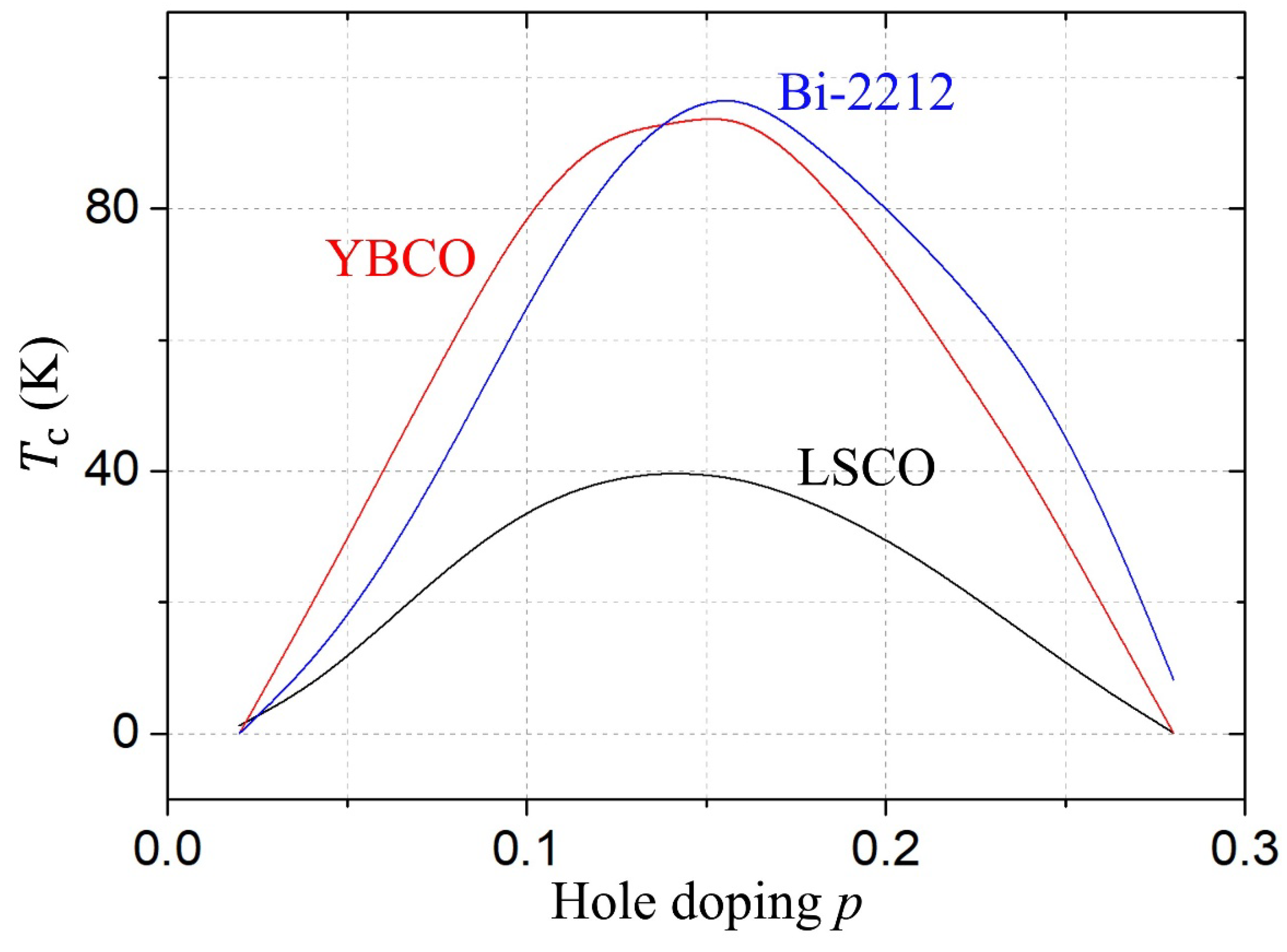
Figure 20.
Framework comparison: conventional statistical mechanics versus topological correlation field (TRFT).
Figure 20.
Framework comparison: conventional statistical mechanics versus topological correlation field (TRFT).
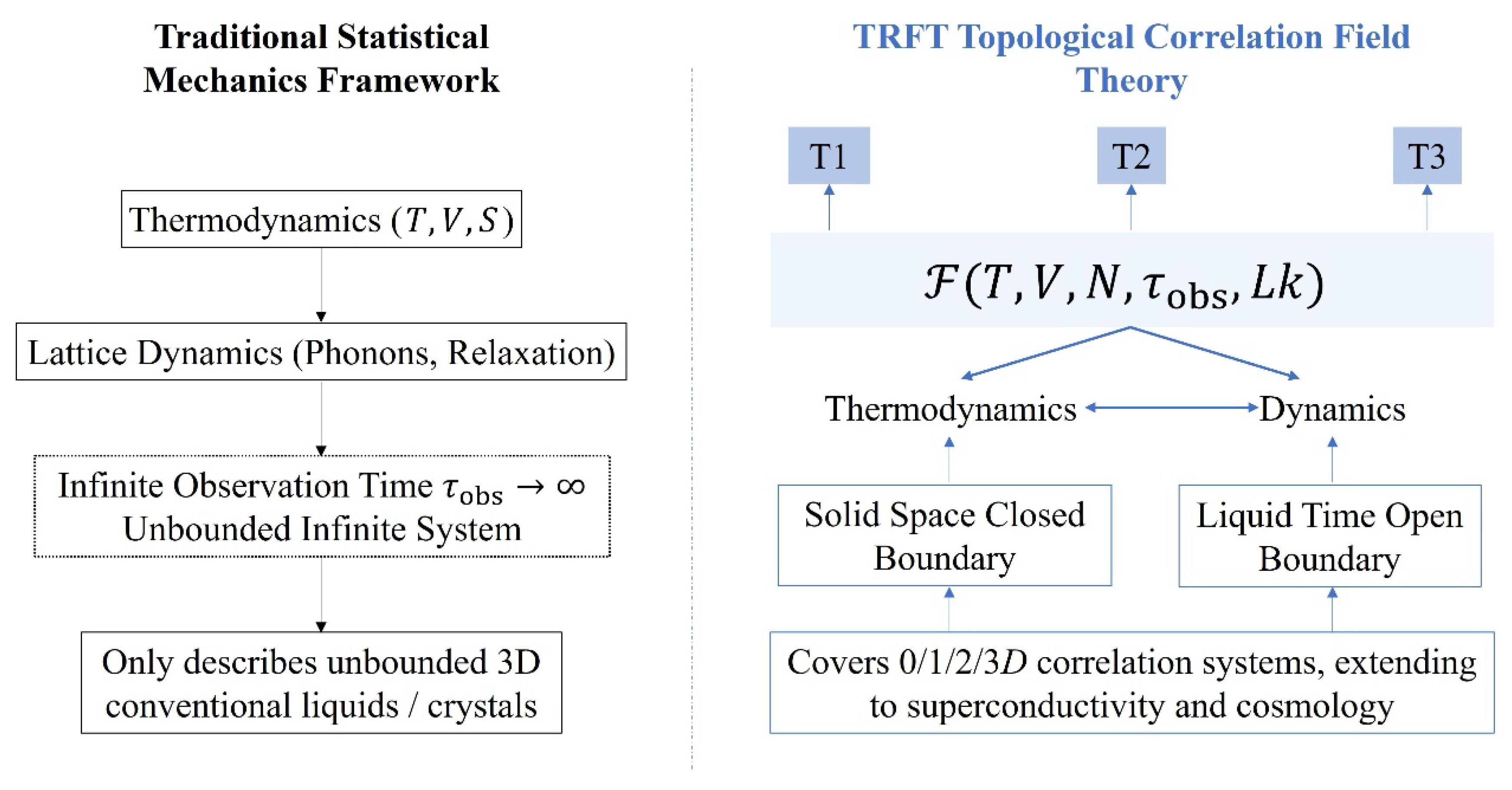
Figure 21.
Discrete quantized activation staircase of dielectric relaxation (Kramers escape Arrhenius plot); comparison of three cooperative hydrogen-bond breaking channels.
Figure 21.
Discrete quantized activation staircase of dielectric relaxation (Kramers escape Arrhenius plot); comparison of three cooperative hydrogen-bond breaking channels.
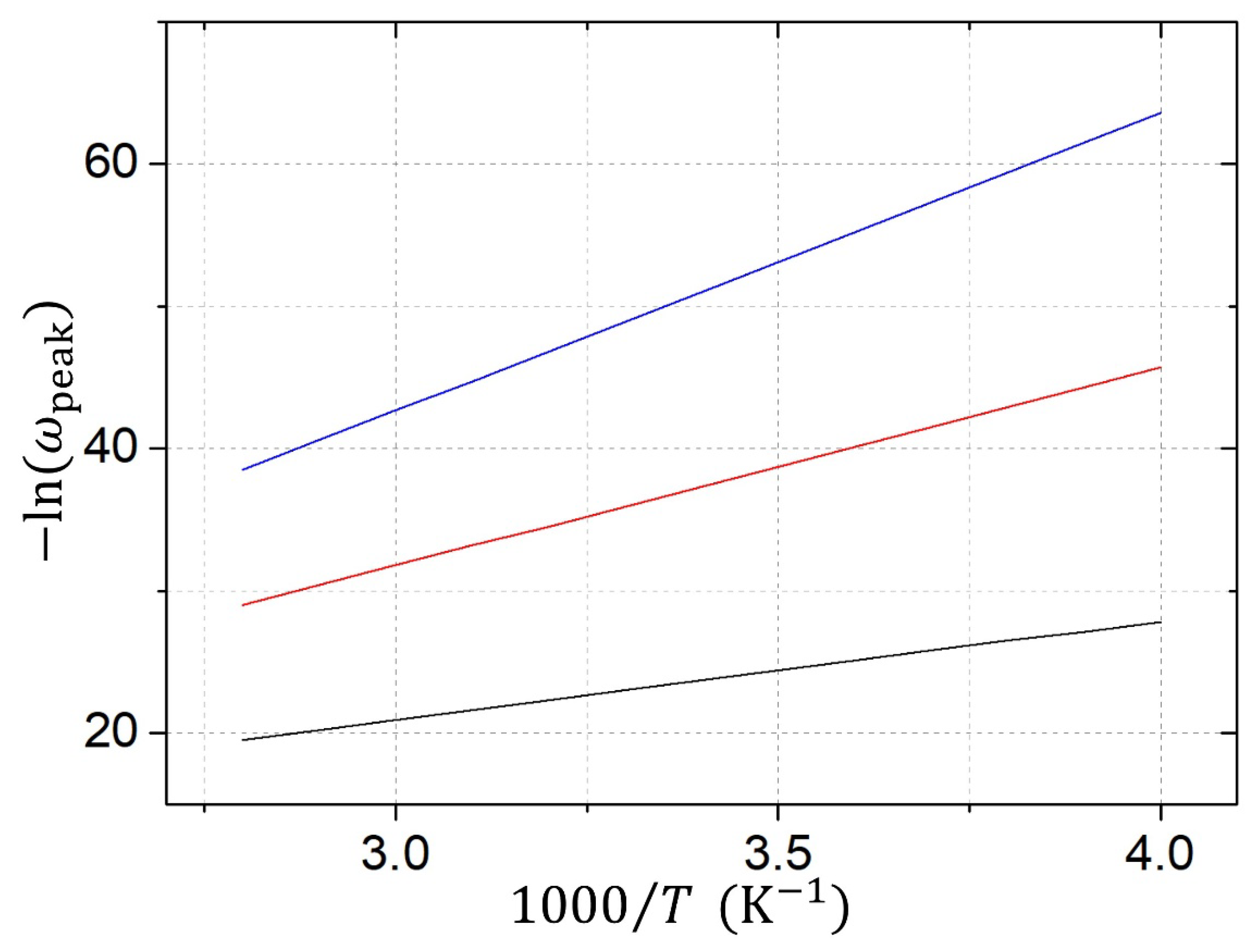
Figure 22.
Linear scaling relation of critical dissociation pressure of zero-dimensional P3H ice rings against reciprocal loop circumference.
Figure 22.
Linear scaling relation of critical dissociation pressure of zero-dimensional P3H ice rings against reciprocal loop circumference.
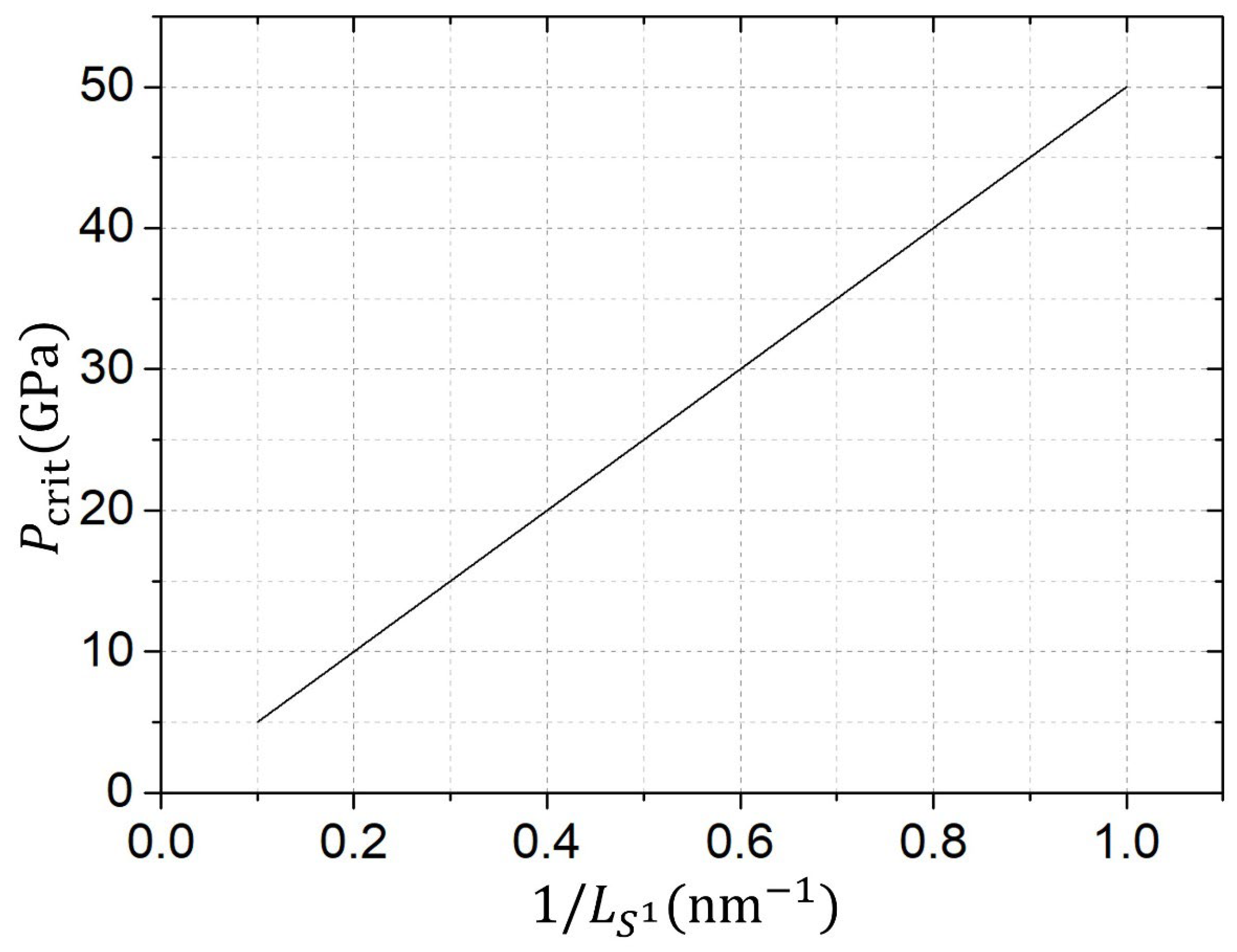
Figure 23.
Temperature evolution curve of the characteristic frequency ratio for monomeric and interlocked triple-helix topological motifs (272–284 K).
Figure 23.
Temperature evolution curve of the characteristic frequency ratio for monomeric and interlocked triple-helix topological motifs (272–284 K).
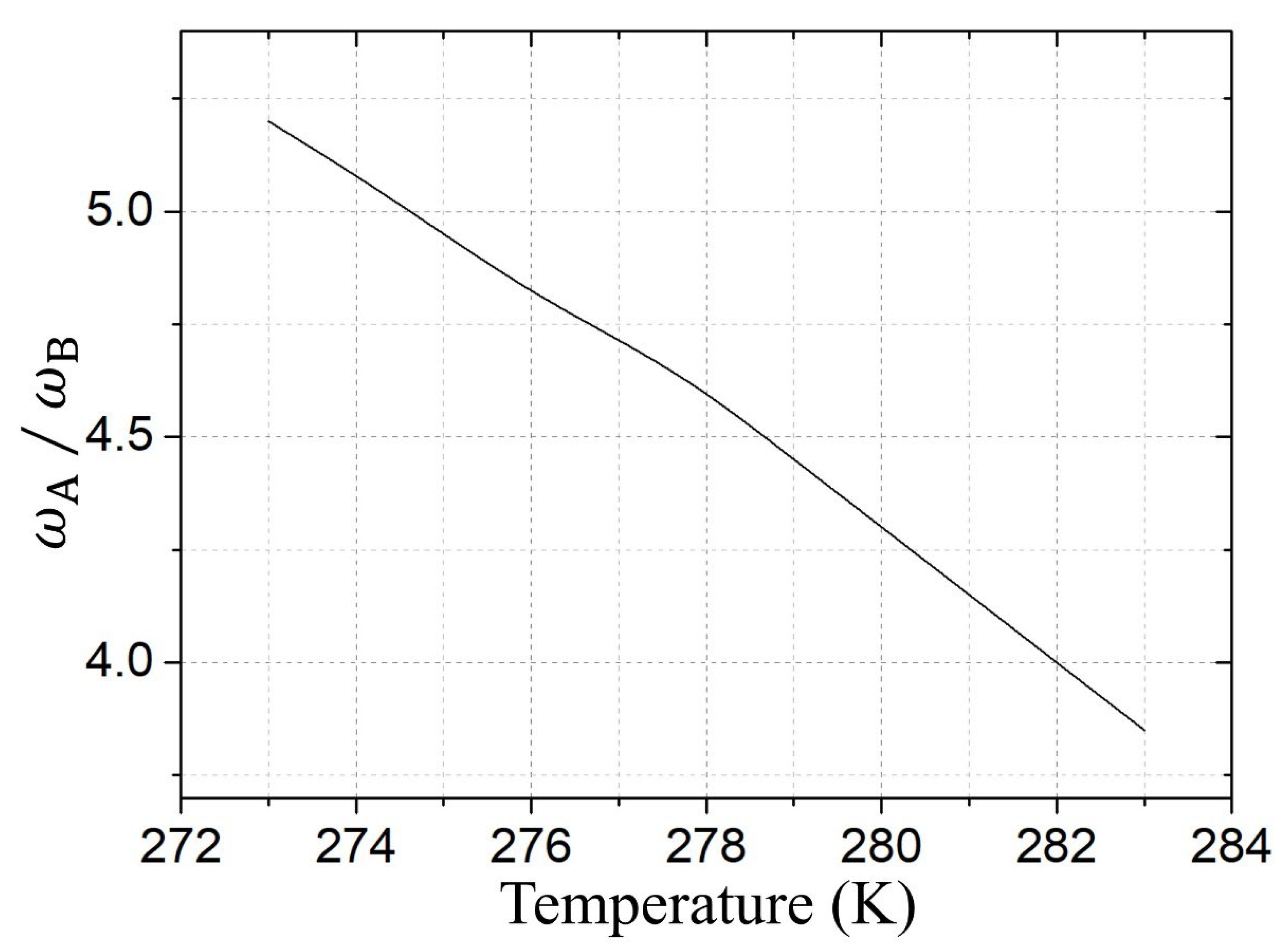
Figure 24.
Cosmic structure growth rate redshift evolution: comparison between standard CDM model and the RFT topological freezing correction signal.
Figure 24.
Cosmic structure growth rate redshift evolution: comparison between standard CDM model and the RFT topological freezing correction signal.
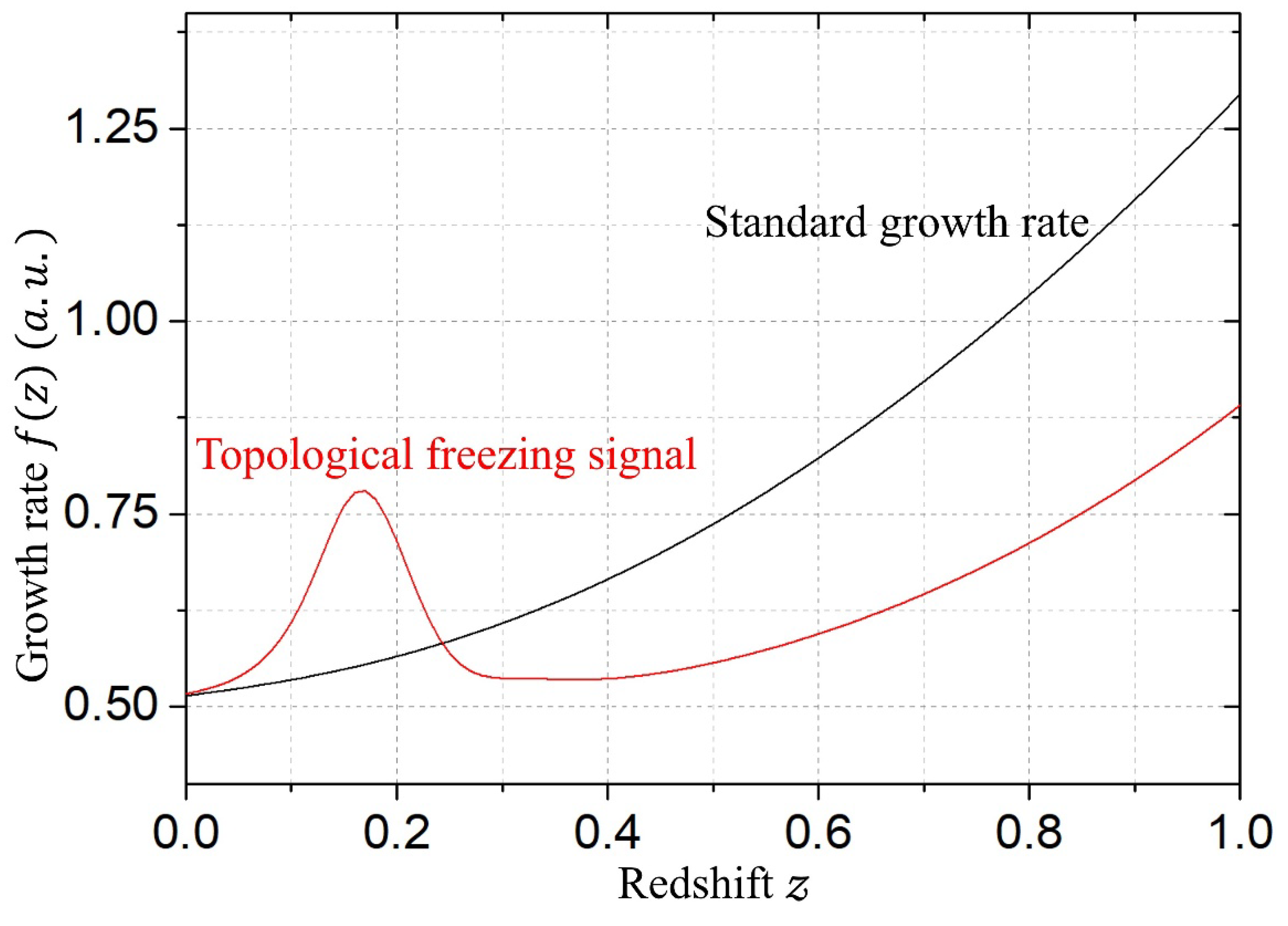
References
- Trushin, M.; Andreeva, D. V.; Peeters, F. M.; et al. Structure and flow of low-dimensional water. Nat. Rev. Phys. 2025, 7(8), 502–513. [Google Scholar] [CrossRef]
- Chin, H. T.; Klimeš, J.; Hu, I. F.; et al. Ferroelectric 2D ice under graphene confinement. Nat. Commun. 2021, 12(1), 6291. [Google Scholar] [CrossRef] [PubMed]
- Koga, K.; Gao, G. T.; Tanaka, H.; et al. Formation of ordered ice nanotubes inside carbon nanotubes. Nature 2001, 412(6849), 802–805. [Google Scholar] [CrossRef] [PubMed]
- Algara-Siller, G.; Lehtinen, O.; Wang, F. C.; et al. Square ice in graphene nanocapillaries. Nature 2015, 519(7544), 443–445. [Google Scholar] [CrossRef] [PubMed]
- Widom, B. Spinodal curves and critical points in supercooled water. J. Phys. Chem. 1982, 86(23), 3797–3802. [Google Scholar]
- Speedy, R. J.; Angell, C. A. Isothermal compressibility of supercooled water and evidence for a thermodynamic singularity at -45 ℃. J. Chem. Phys. 1976, 65(2), 851–858. [Google Scholar] [CrossRef]
- Kapil, V.; Schran, C.; Zen, A.; et al. The first-principles phase diagram of monolayer nanoconfined water. Nature 2022, 609(7927), 512–516. [Google Scholar] [CrossRef] [PubMed]
- Zhao, Q.; Xu, M.; Li, D.; et al. Synthesis of monolayer ice on a hydrophobic metal surface. J. Am. Chem. Soc. 2026, 148(12), 4230–4236. [Google Scholar] [CrossRef] [PubMed]
- Ma, R.; Cao, D.; Zhu, C.; et al. Atomic imaging of edge structure and growth of a two-dimensional hexagonal ice. Nature 2020, 577(7788), 60–63. [Google Scholar] [CrossRef] [PubMed]
- Miao, Z. Freestanding intrinsic ferroelectric 2d ice and its 3d stackings: reshaping the functional boundaries of low-dimensional hydrogen-bonded networks. ChemRxiv (Computational dataset; methodological details available for independent reproduction). 2026. [Google Scholar] [CrossRef] [PubMed]
- Miao, Z. Analytical theory of topological proton glass: dynamic topological constraints and the quantum topological water picture. ChemRxiv (Computational dataset; methodological details available for independent reproduction). 2026. [Google Scholar] [CrossRef] [PubMed]
- Michaelides, A.; Morgenstern, K. Ice nanoclusters at hydrophobic metal surfaces. Nat. Mater. 2007, 6(8), 597–601. [Google Scholar] [CrossRef] [PubMed]
- Mermin, N. D. The topological theory of defects in ordered media. Rev. Mod. Phys. 1979, 51(3), 591–648. [Google Scholar] [CrossRef]
- Hasan, M. Z.; Kane, C. L. Colloquium: Topological insulators. Rev. Mod. Phys. 2010, 82(4), 3045–3067. [Google Scholar] [CrossRef]
- Landau, L. D.; Lifshitz, E. M.; Pitaevskii, L. P. Statistical Physics (Course of Theoretical Physics Vol.5); Pergamon Press: Oxford, 1980. [Google Scholar]
- Onsager, L. Reciprocal relations in irreversible processes. I. Phys. Rev. 1931, 37(4), 405–426. [Google Scholar] [CrossRef]
- Prigogine, I. Non-equilibrium Statistical Mechanics; Wiley-Interscience: New York, 1962. [Google Scholar]
- Wilson, K. G. Renormalization group and critical phenomena. Phys. Rev. Lett. 1971, 26(22), 1340–1343. [Google Scholar]
- Anderson, P. W. More is different. Science 1972, 177(4047), 393–396. [Google Scholar] [CrossRef] [PubMed]
- Kardar, M. Statistical Physics of Fields; Cambridge University Press: Cambridge, 2007. [Google Scholar]
- Wen, X. G. Topological orders in rigid states. Int. J. Mod. Phys. B 1990, 4(10), 239–271. [Google Scholar] [CrossRef]
- Kittel, C. Introduction to Solid State Physics, 8th ed.; Wiley: New York, 2005. [Google Scholar]
- Born, M.; Huang, K. Dynamical Theory of Crystal Lattices; Oxford University Press: Oxford, 1954. [Google Scholar]
- Kramers, H. A. Brownian motion in a field of force and the diffusion model of chemical reactions. Physica 1940, 7(4), 284–304. [Google Scholar] [CrossRef]
- Miao, Z. Chasing the “Holy Grail” of low-dimensional ice: intrinsically stable freestanding one-dimensional ice crystals. ChemRxiv (Computational dataset; methodological details available for independent reproduction). 2026. [Google Scholar] [CrossRef] [PubMed]
- Nakahara, M. Geometry, Topology and Physics, 2nd ed.; CRC Press: Boca Raton, 2003. [Google Scholar]
- Sykes, M. F.; Essam, J. W. Exact Critical Percolation Probabilities for Site and Bond Problems in Two Dimensions. J. Math. Phys. 1964, 5(8), 1117–1127. [Google Scholar] [CrossRef]
- Chaikin, P. M.; Lubensky, T. C. Principles of Condensed Matter Physics; Cambridge University Press: Cambridge, 1995. [Google Scholar]
- Bernal, J. D.; Fowler, R. H. A theory of water and ionic solution. J. Chem. Phys. 1933, 1(10), 515–548. [Google Scholar] [CrossRef]
- Debye, P.; Falkenhagen, H. The theory of anomalous dielectric constants of polar liquids. Phys. Z. 1928, 29, 401–416. [Google Scholar]
- Kirkwood, J. G. The dielectric polarization of polar liquids. J. Chem. Phys. 1939, 7(1), 911–919. [Google Scholar] [CrossRef]
- Ceriotti, M. Nuclear quantum effects in water and aqueous systems. Chem. Rev. 2016, 116(13), 7529–7550. [Google Scholar] [CrossRef] [PubMed]
- Miao, Z. Zero-dimensional ice ring topological proton glass: gapless texture soft modes, anharmonic wandering, and three conserved invariants. ChemRxiv (Computational dataset; methodological details available for independent reproduction). 2026. [Google Scholar] [CrossRef] [PubMed]
- Ferry, J. D. Viscoelastic Properties of Polymers, 3rd ed.; John Wiley & Sons: New York, 1980. [Google Scholar]
- Onsager, L. Electric moments of molecules in liquids. J. Am. Chem. Soc. 1936, 58(8), 1486–1493. [Google Scholar] [CrossRef]
- Pauling, L. The structure and entropy of ice. J. Am. Chem. Soc. 1935, 57(12), 2680–2684. [Google Scholar] [CrossRef]
- Agmon, N. The Grotthuss mechanism. Chem. Phys. Lett. 1995, 244(5-6), 456–462. [Google Scholar] [CrossRef]
- Clark, S. J.; Segall, M. D.; Pickard, C. J.; et al. First principles methods using CASTEP. Z. Für Krist.-Cryst. Mater. 2005, 220(5-6), 567–570. [Google Scholar] [CrossRef]
Figure 1.
Paradigm shift of TRFT: from empirical fitting to axiomatic deduction for unified solutions to six classic anomalies in water science.
Figure 1.
Paradigm shift of TRFT: from empirical fitting to axiomatic deduction for unified solutions to six classic anomalies in water science.
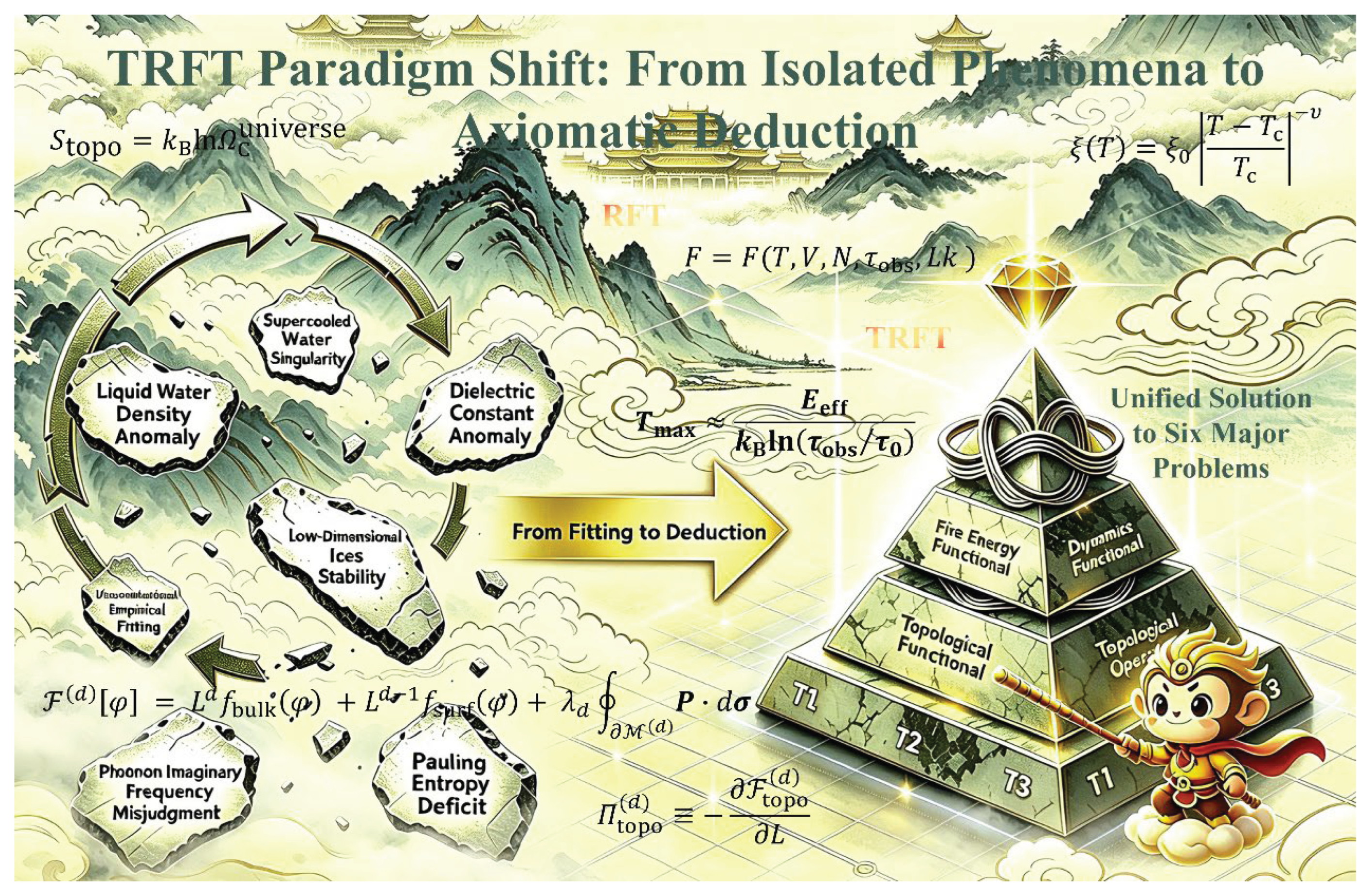
Figure 2.
Research logical flowchart: sequential progression from structural discovery to axiomatic derivation — low-dimensional ice analytical theory → full-field TRFT → cross-scale unified RFT framework.
Figure 2.
Research logical flowchart: sequential progression from structural discovery to axiomatic derivation — low-dimensional ice analytical theory → full-field TRFT → cross-scale unified RFT framework.
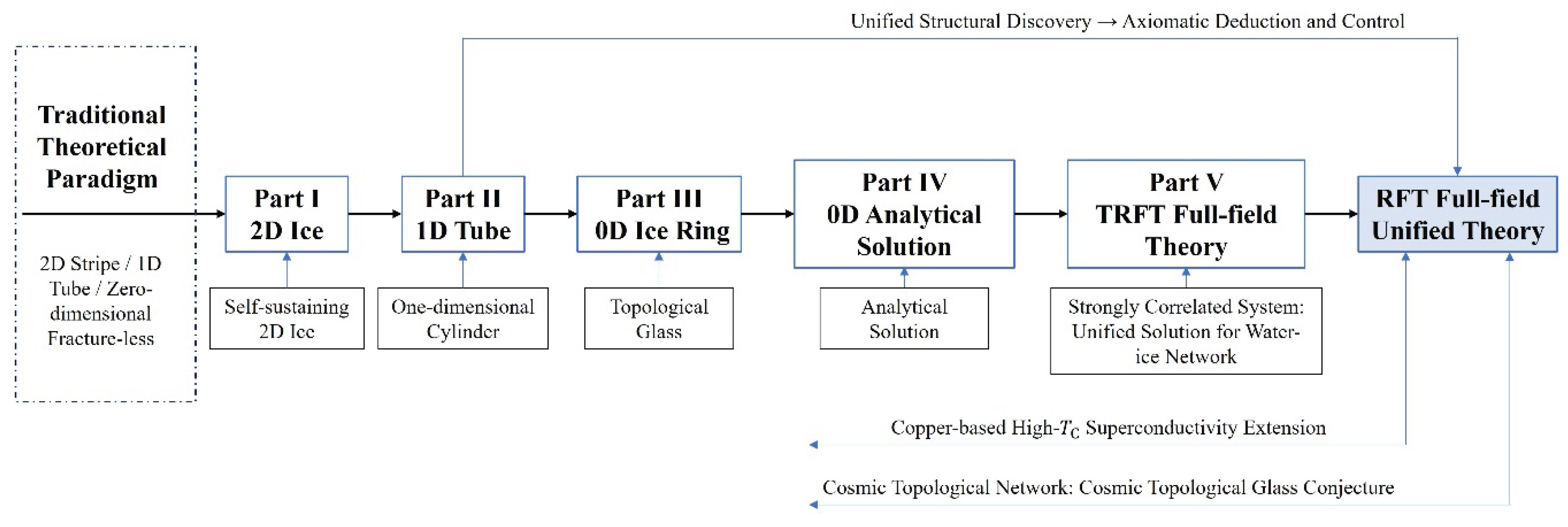
Figure 3.
Unified dimensional schematic with continuously tunable topological control parameter: bulk ice (), O-ice (), P3H helical ice nanotube (), P3H-M-ring (); marking the phonon softening critical dimension (second-order topological phase transition boundary).
Figure 3.
Unified dimensional schematic with continuously tunable topological control parameter: bulk ice (), O-ice (), P3H helical ice nanotube (), P3H-M-ring (); marking the phonon softening critical dimension (second-order topological phase transition boundary).
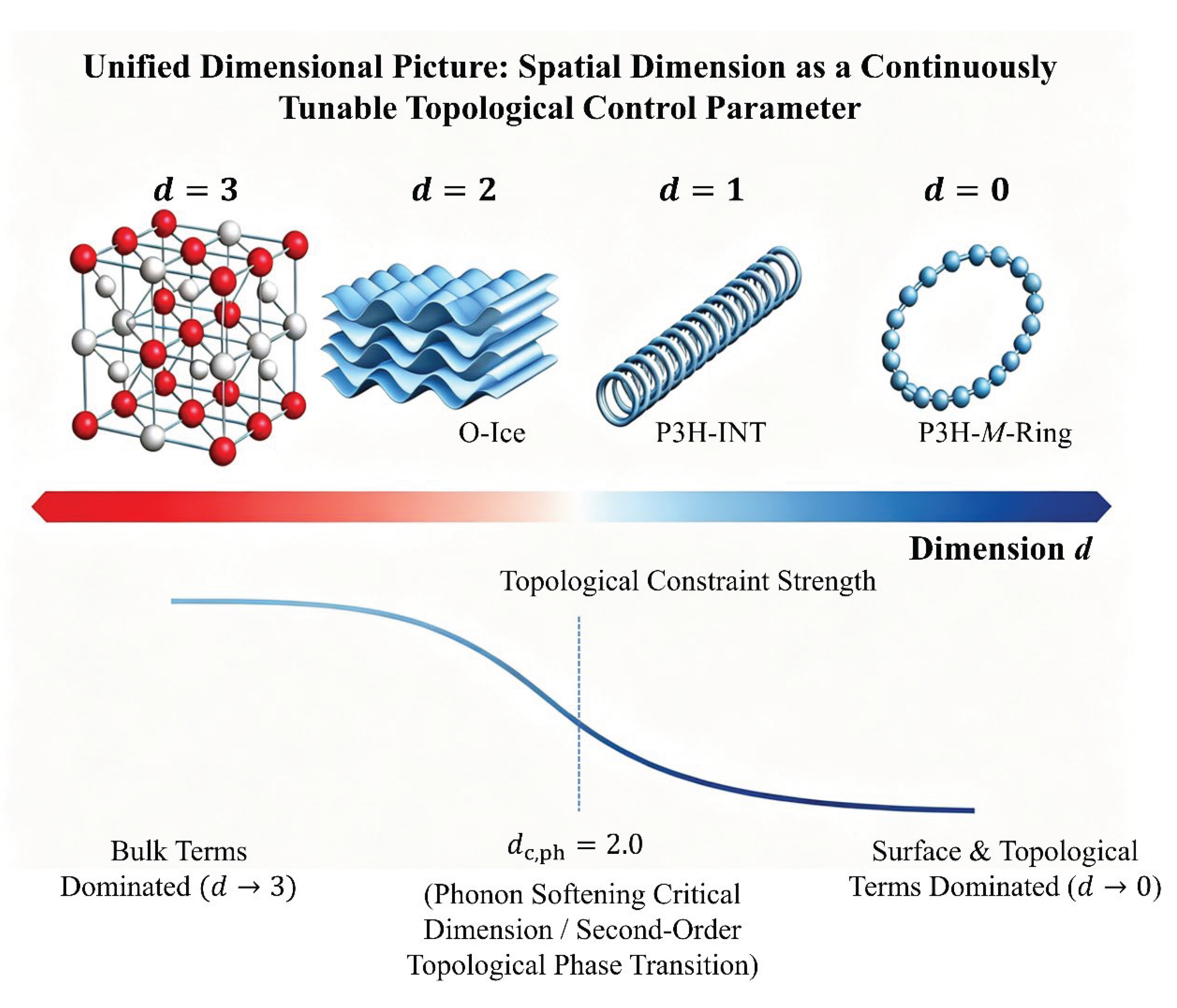
Figure 4.
Schematic of three-term dimension-scaled unified thermodynamic free energy: decomposition of bulk energy term, surface energy term and topological integral energy term.
Figure 4.
Schematic of three-term dimension-scaled unified thermodynamic free energy: decomposition of bulk energy term, surface energy term and topological integral energy term.
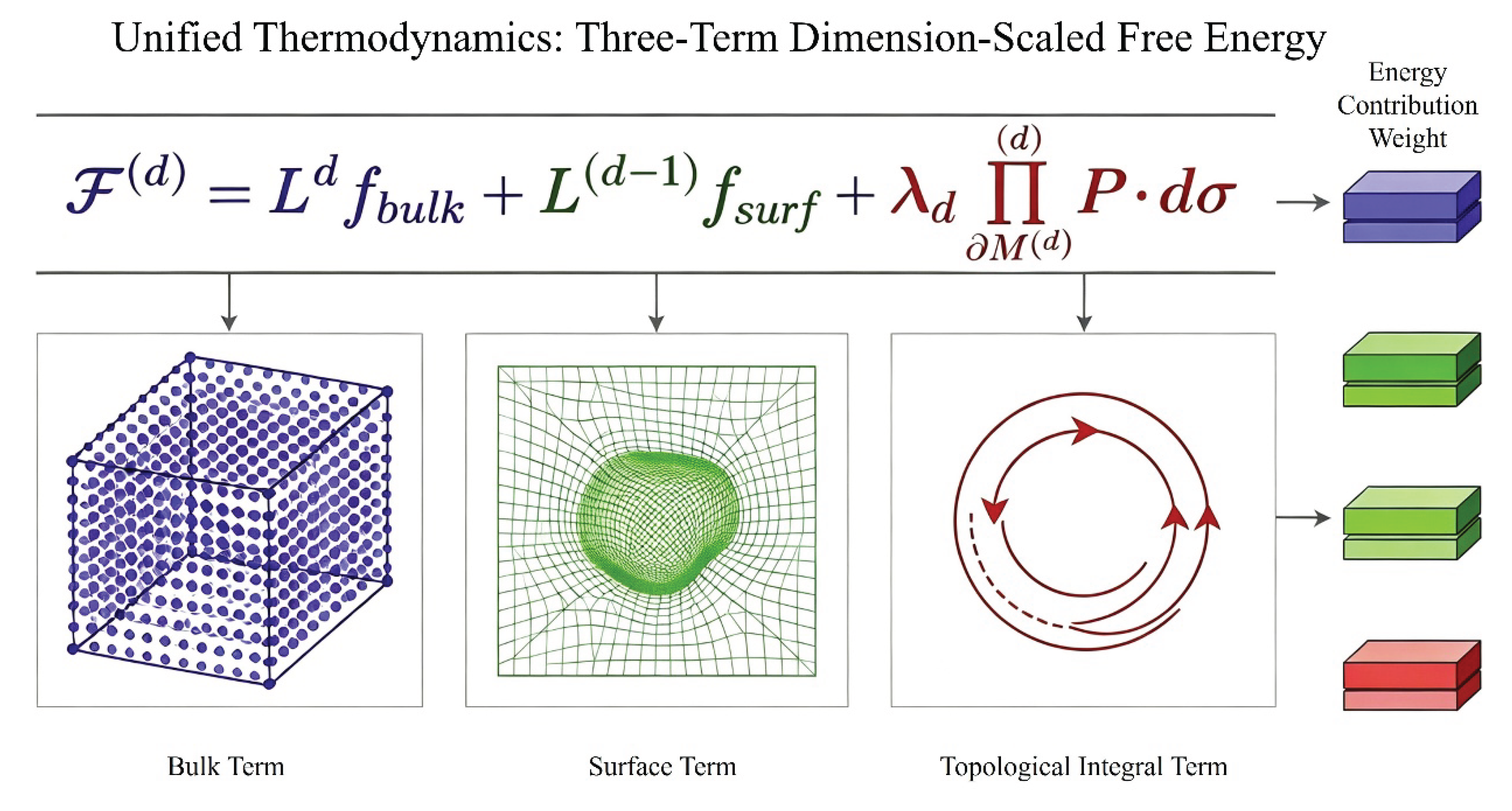
Figure 5.
Comparison diagram: conventional lattice instability vs. topological proton glass interstitial soft mode — local structural collapse with bond cleavage versus global helical breathing without local bond breakage.
Figure 5.
Comparison diagram: conventional lattice instability vs. topological proton glass interstitial soft mode — local structural collapse with bond cleavage versus global helical breathing without local bond breakage.
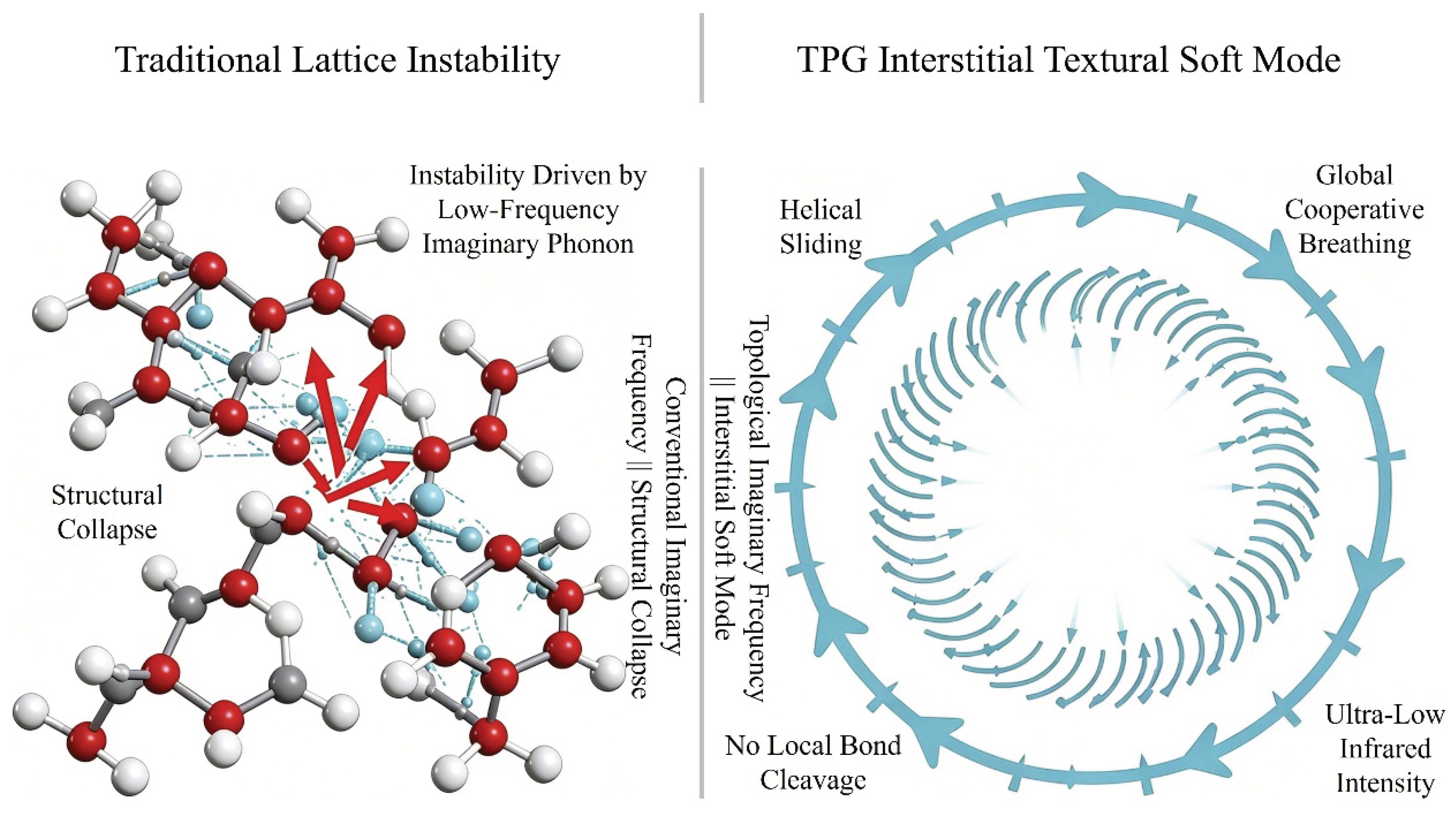
Figure 6.
Topological evolution diagram with dimension raising-lowering operators and linking number conservation: delamination from 3D → curling into 2D → port closure to 0D; as the topological invariant conserved under bond-intact smooth deformation.
Figure 6.
Topological evolution diagram with dimension raising-lowering operators and linking number conservation: delamination from 3D → curling into 2D → port closure to 0D; as the topological invariant conserved under bond-intact smooth deformation.
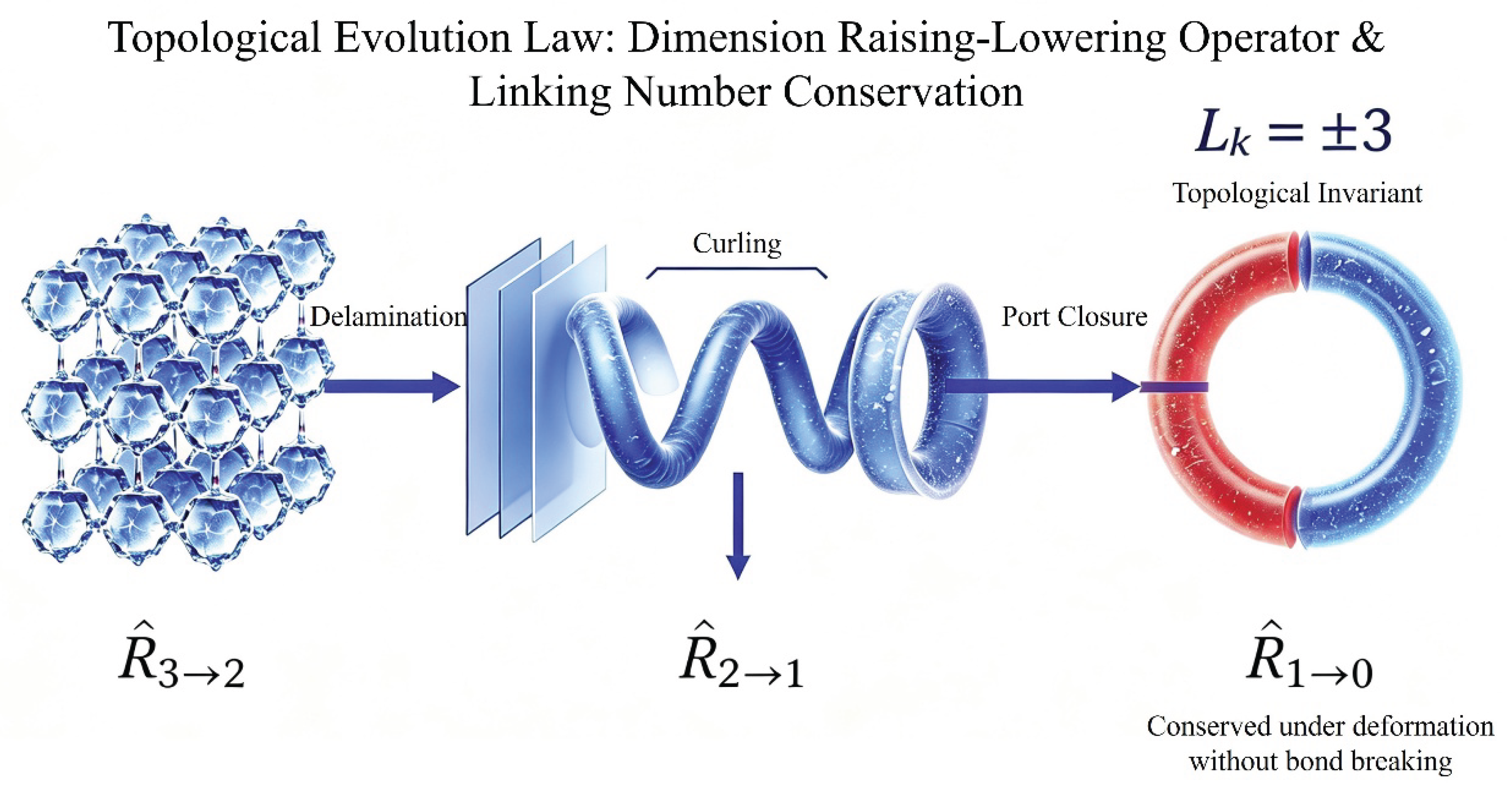
Figure 7.
Cross-sectional molecular structure of P3H-4-Ring zero-dimensional triple-helix ice ring, labeled with inner/outer diameters, total atomic count and topological quantum numbers.
Figure 7.
Cross-sectional molecular structure of P3H-4-Ring zero-dimensional triple-helix ice ring, labeled with inner/outer diameters, total atomic count and topological quantum numbers.
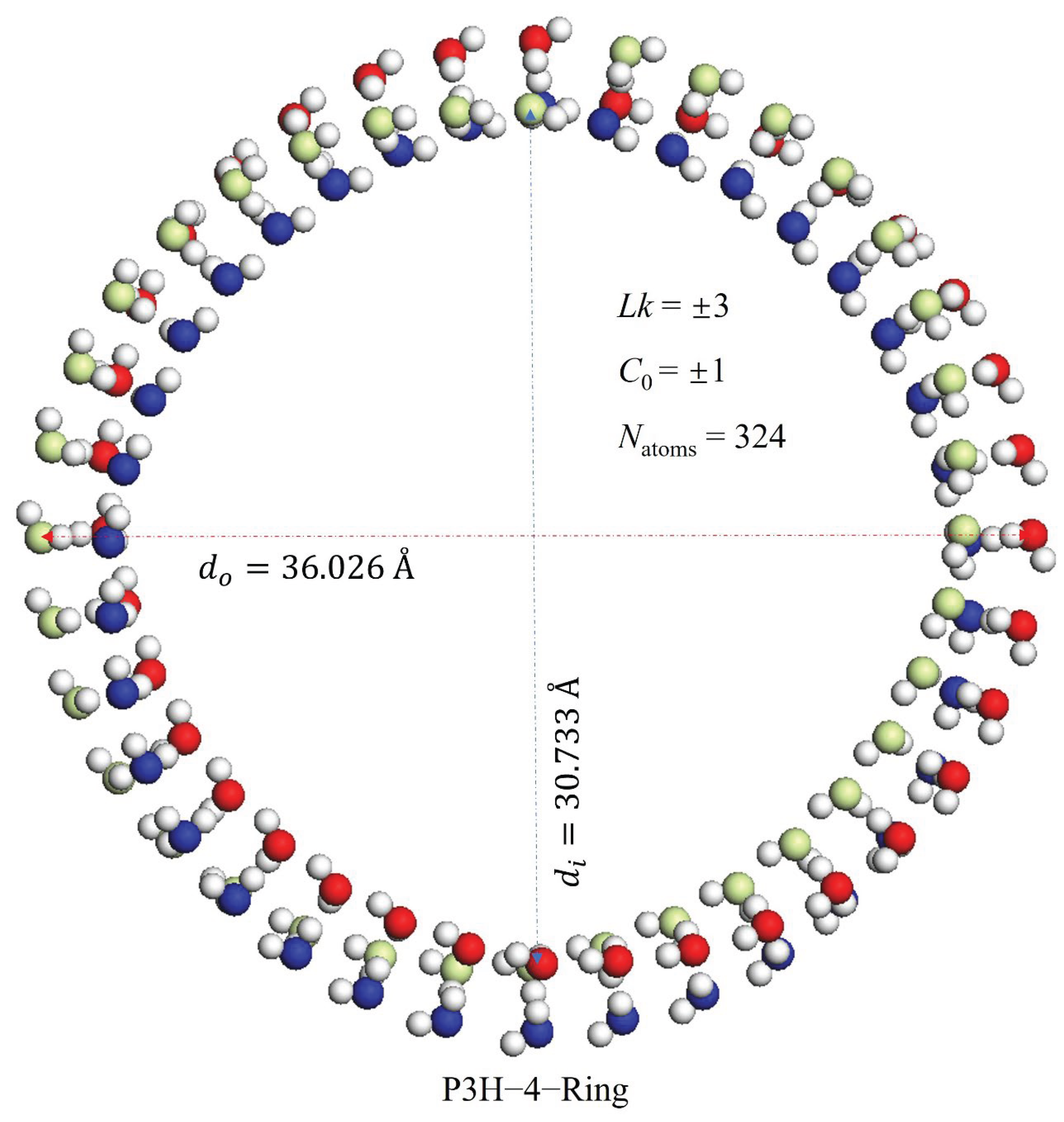
Figure 8.
Structural snapshots of P3H ice ring from 0 ps to 2 ps in ab initio molecular dynamics simulation.
Figure 8.
Structural snapshots of P3H ice ring from 0 ps to 2 ps in ab initio molecular dynamics simulation.
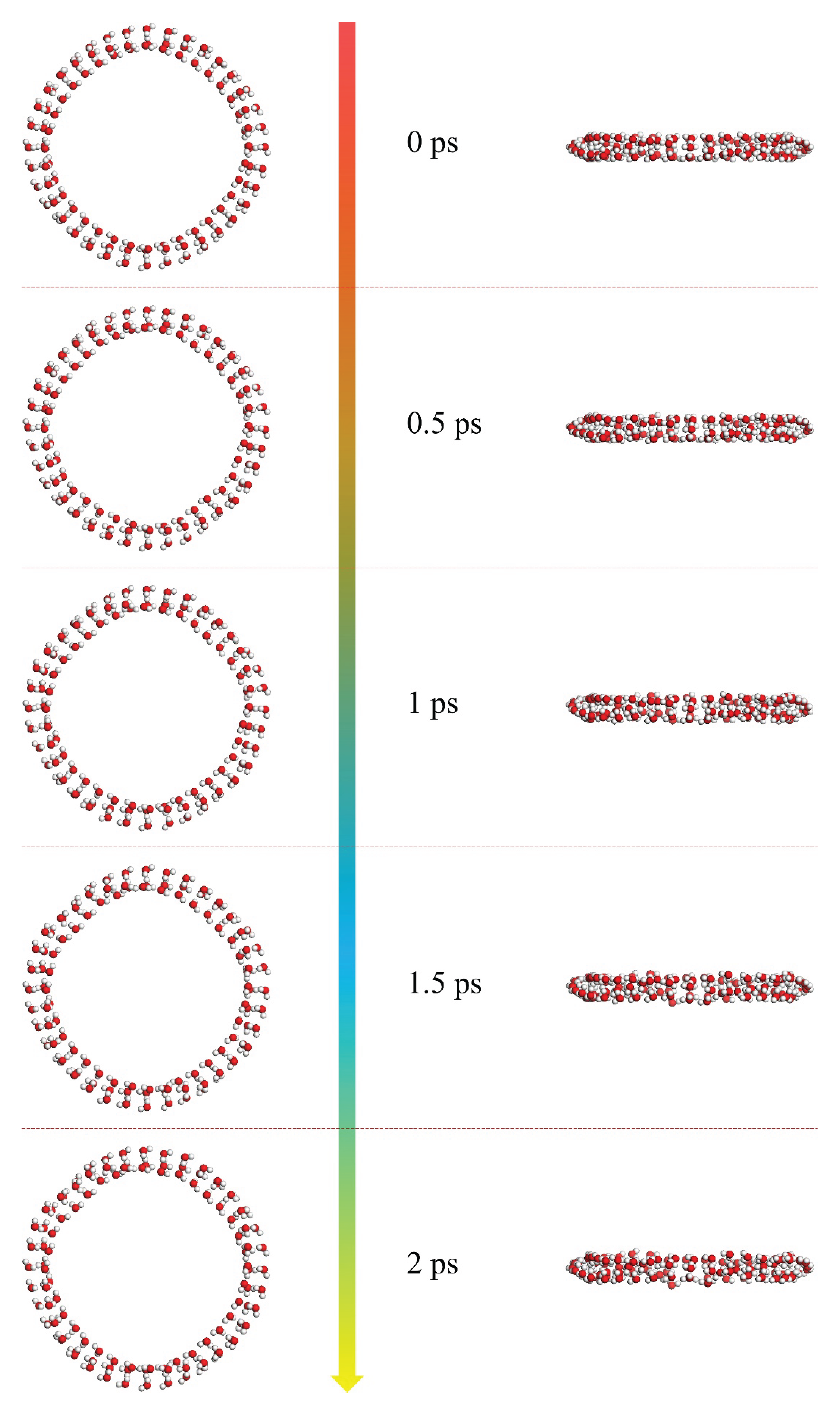
Figure 9.
AIMD simulation curves of zero-dimensional ice ring: (a) temperature evolution vs. simulation time; (b) potential energy evolution vs. simulation time.
Figure 9.
AIMD simulation curves of zero-dimensional ice ring: (a) temperature evolution vs. simulation time; (b) potential energy evolution vs. simulation time.
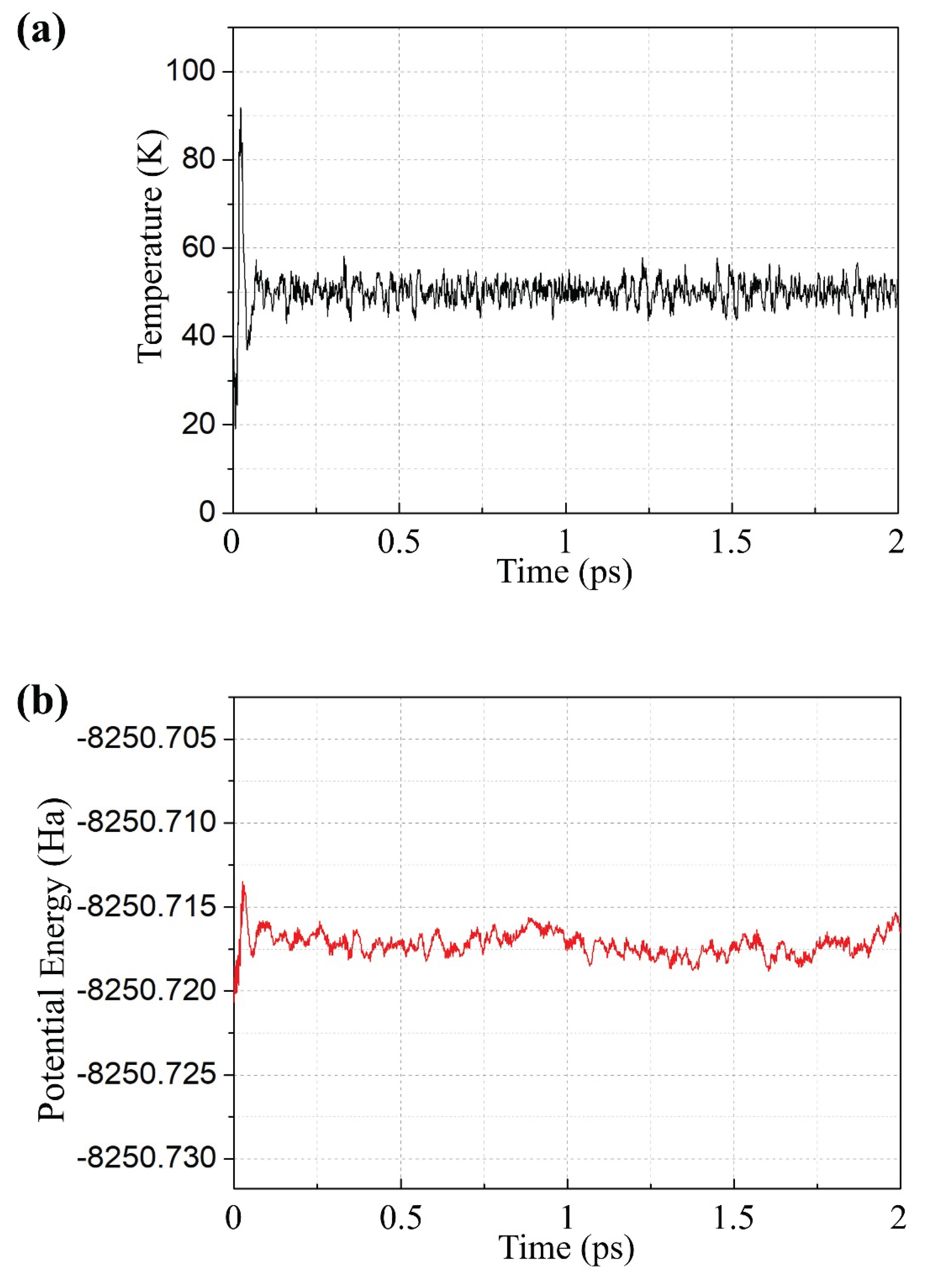
Figure 10.
Spacetime duality theorem schematic: topological equivalence between spatial closed boundary of solid ice and finite temporal observation boundary of liquid water.
Figure 10.
Spacetime duality theorem schematic: topological equivalence between spatial closed boundary of solid ice and finite temporal observation boundary of liquid water.
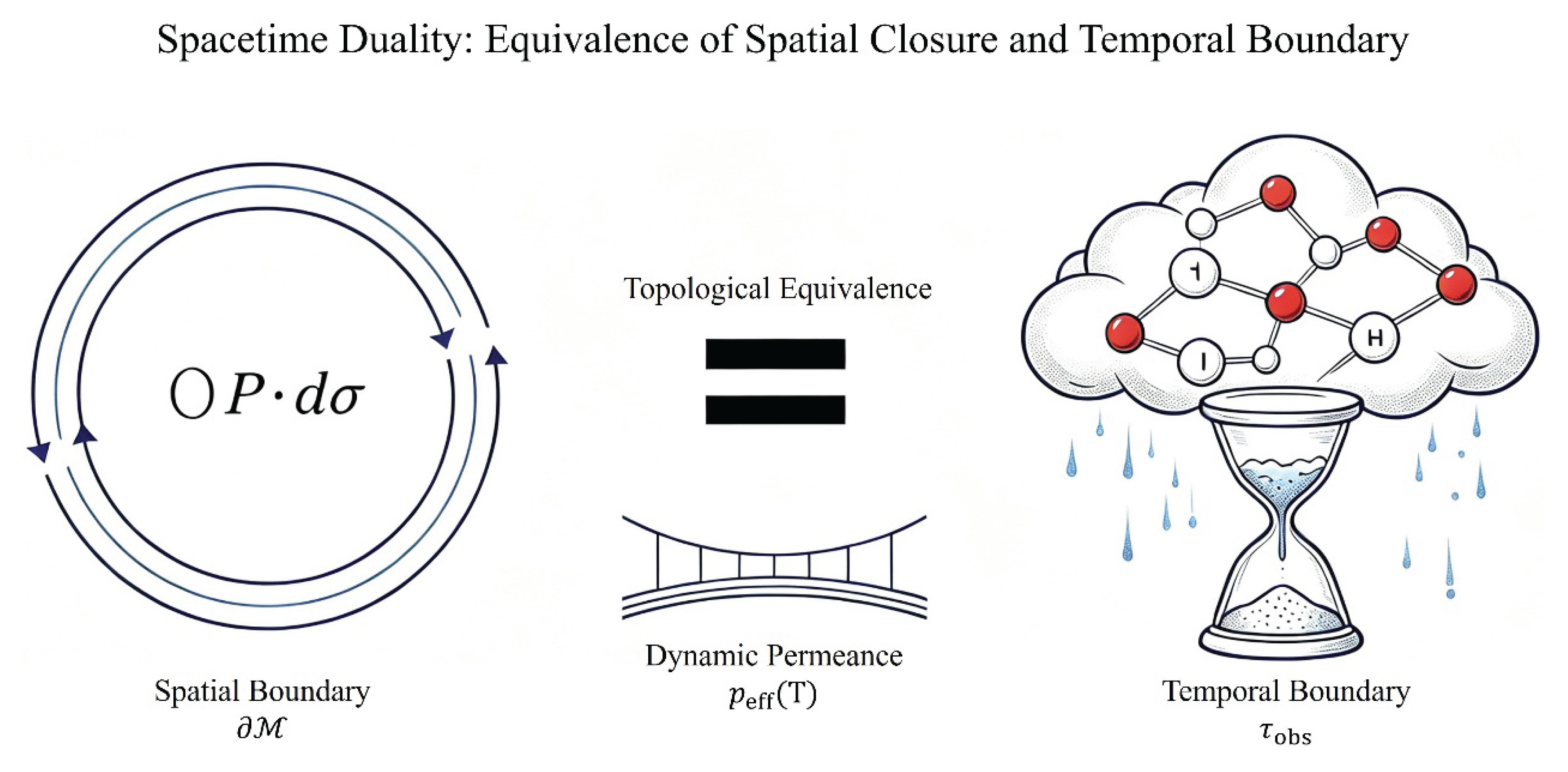
Figure 11.
Temperature-dependent entropy curves of liquid water (entropy sponge effect): total entropy, vibrational entropy and topological configurational entropy.
Figure 11.
Temperature-dependent entropy curves of liquid water (entropy sponge effect): total entropy, vibrational entropy and topological configurational entropy.
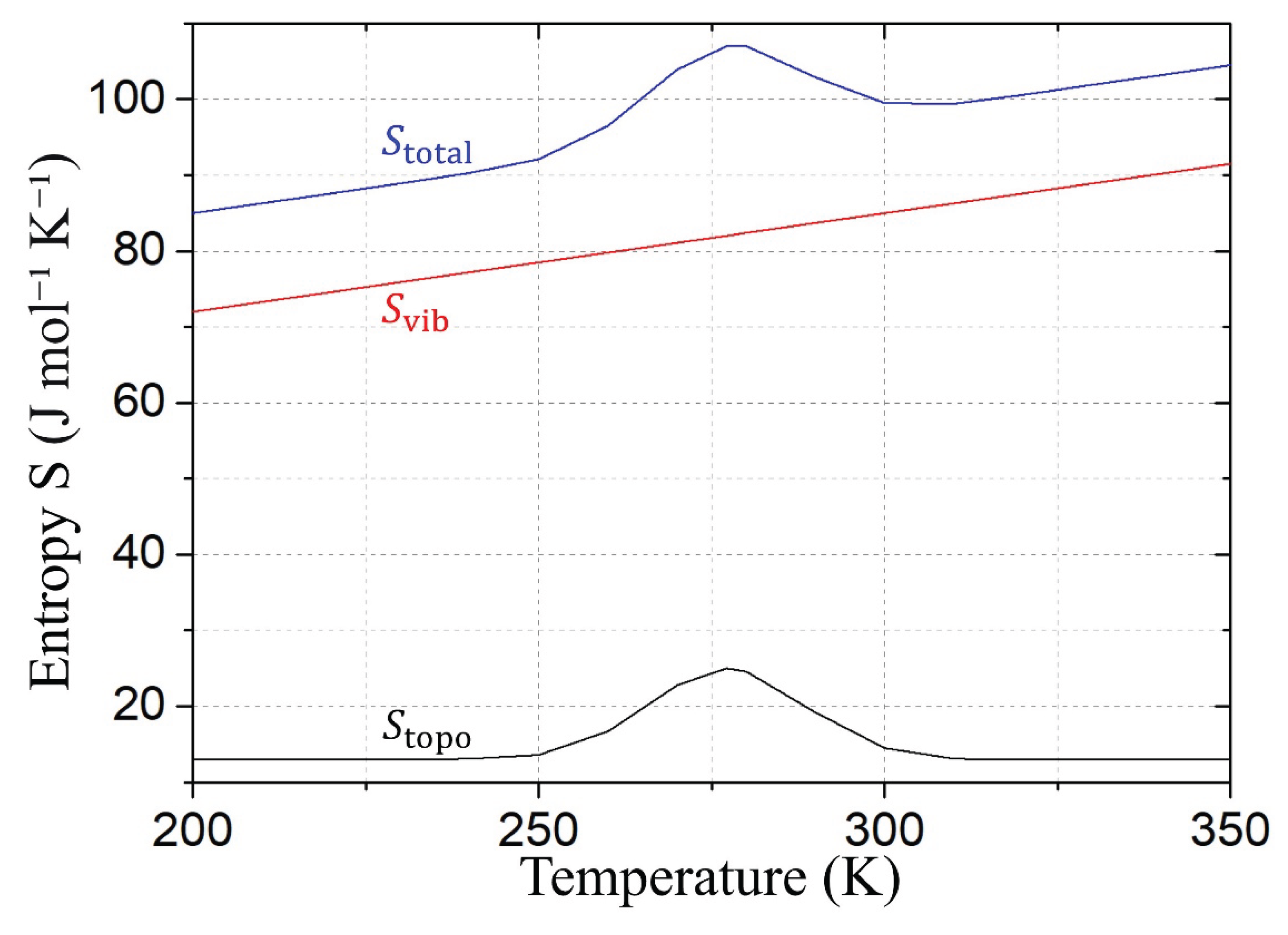
Figure 12.
Topological configurations of hydrogen-bond networks at three representative temperatures: 350 K (no stable closed loops), 277.15 K (percolation critical state with abundant triple-helix motifs), 228 K (supercooled water with divergent correlation length).
Figure 12.
Topological configurations of hydrogen-bond networks at three representative temperatures: 350 K (no stable closed loops), 277.15 K (percolation critical state with abundant triple-helix motifs), 228 K (supercooled water with divergent correlation length).
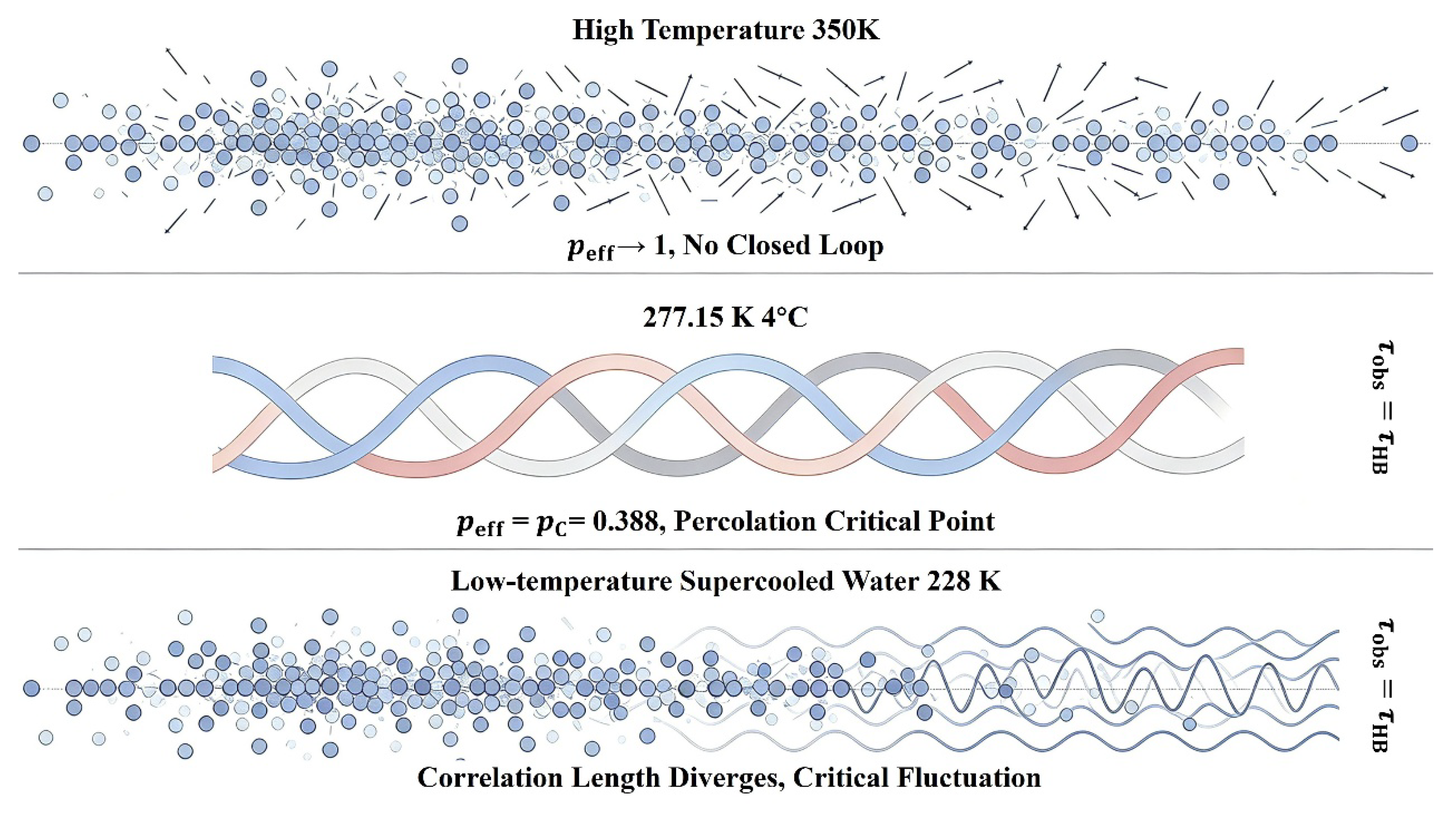
Figure 13.
Predicted curve of water’s maximum density temperature across the full pressure range based on TRFT percolation kinetics.
Figure 13.
Predicted curve of water’s maximum density temperature across the full pressure range based on TRFT percolation kinetics.
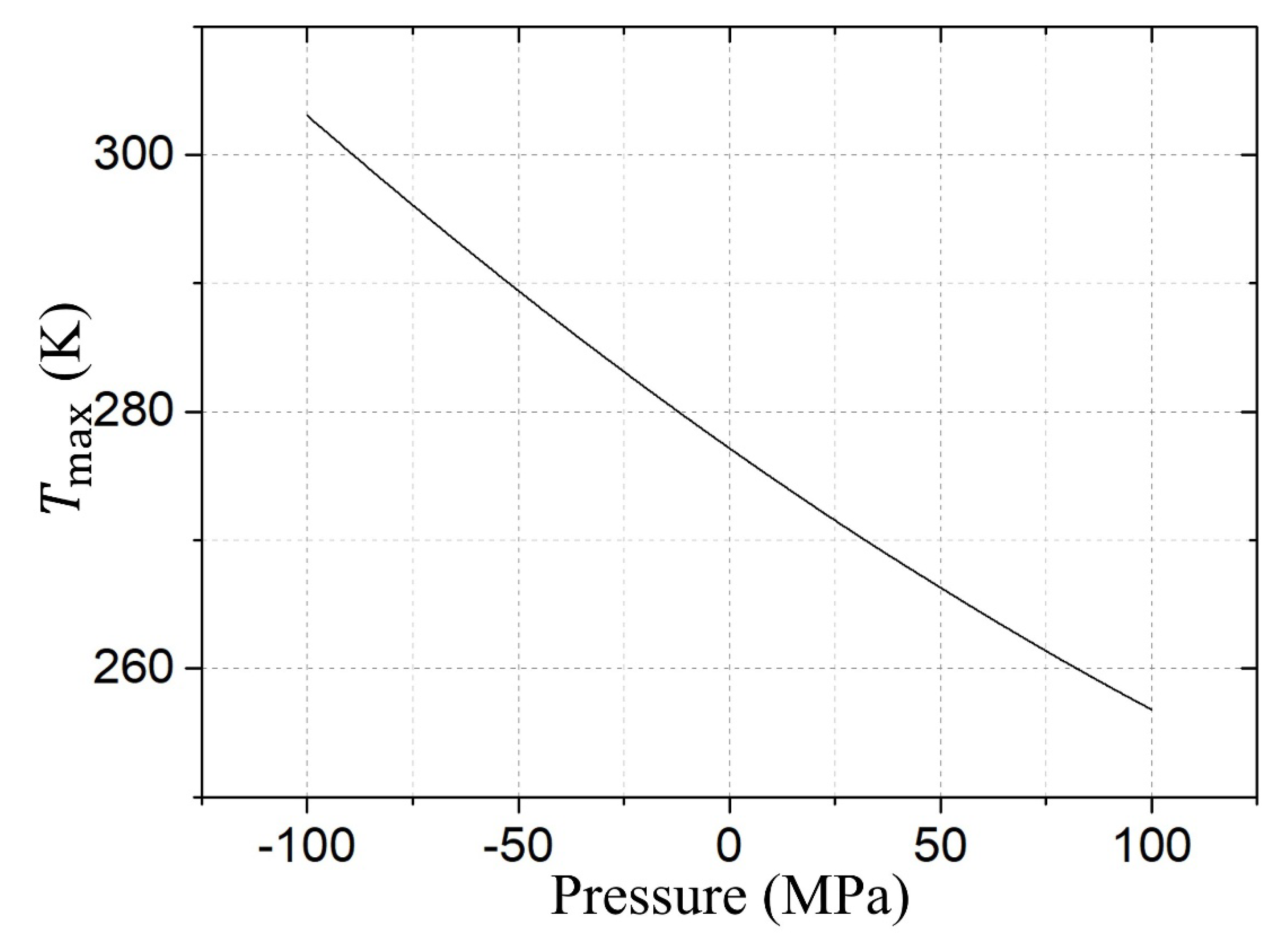
Figure 14.
Comparative curves of isotope effects on maximum density temperature for light water and heavy water over full pressure intervals within the TRFT topological-kinetic framework.
Figure 14.
Comparative curves of isotope effects on maximum density temperature for light water and heavy water over full pressure intervals within the TRFT topological-kinetic framework.
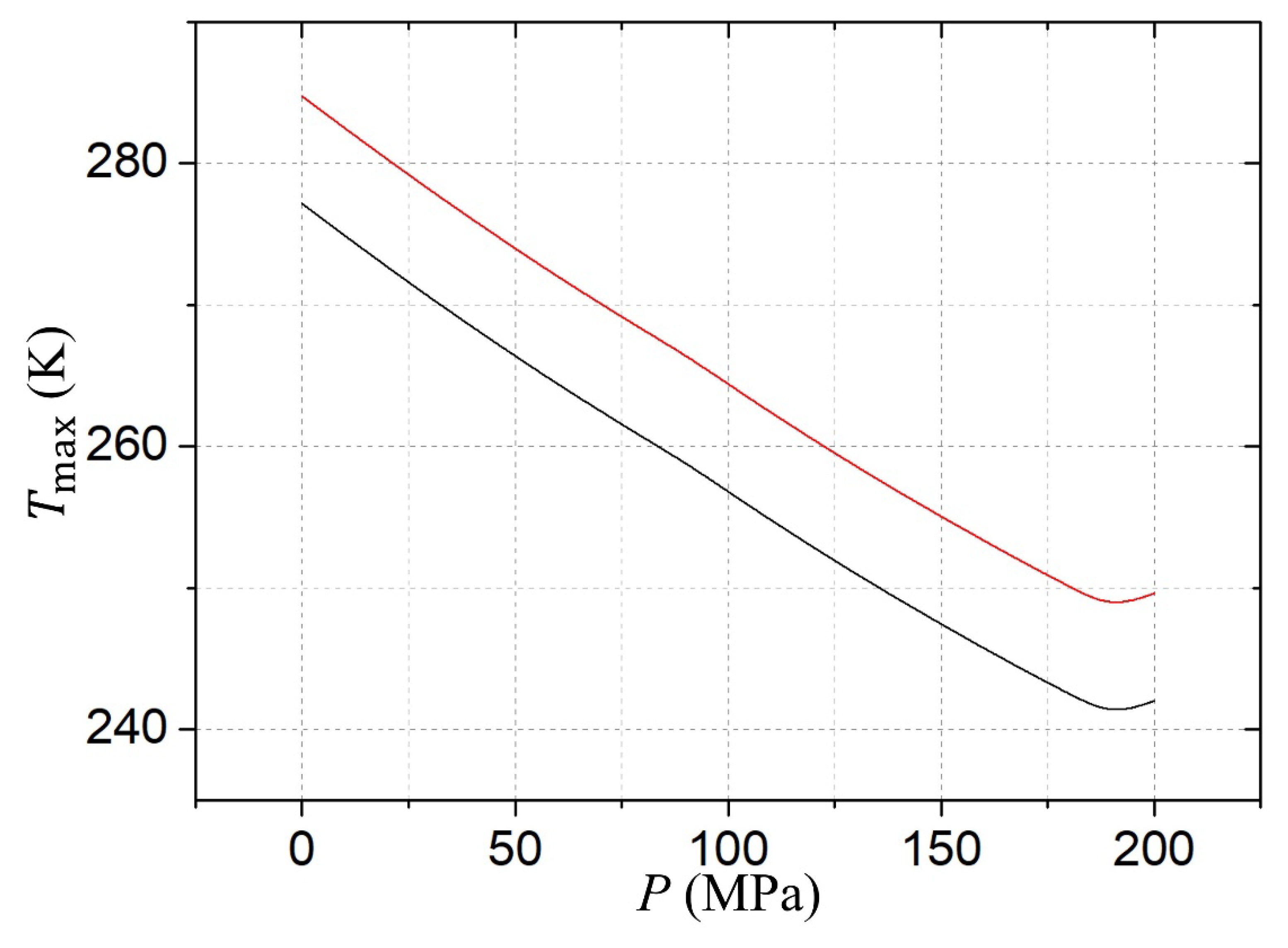
Figure 15.
Topological scaling curve of hydrogen-bond correlation length near the critical point of supercooled water.
Figure 15.
Topological scaling curve of hydrogen-bond correlation length near the critical point of supercooled water.
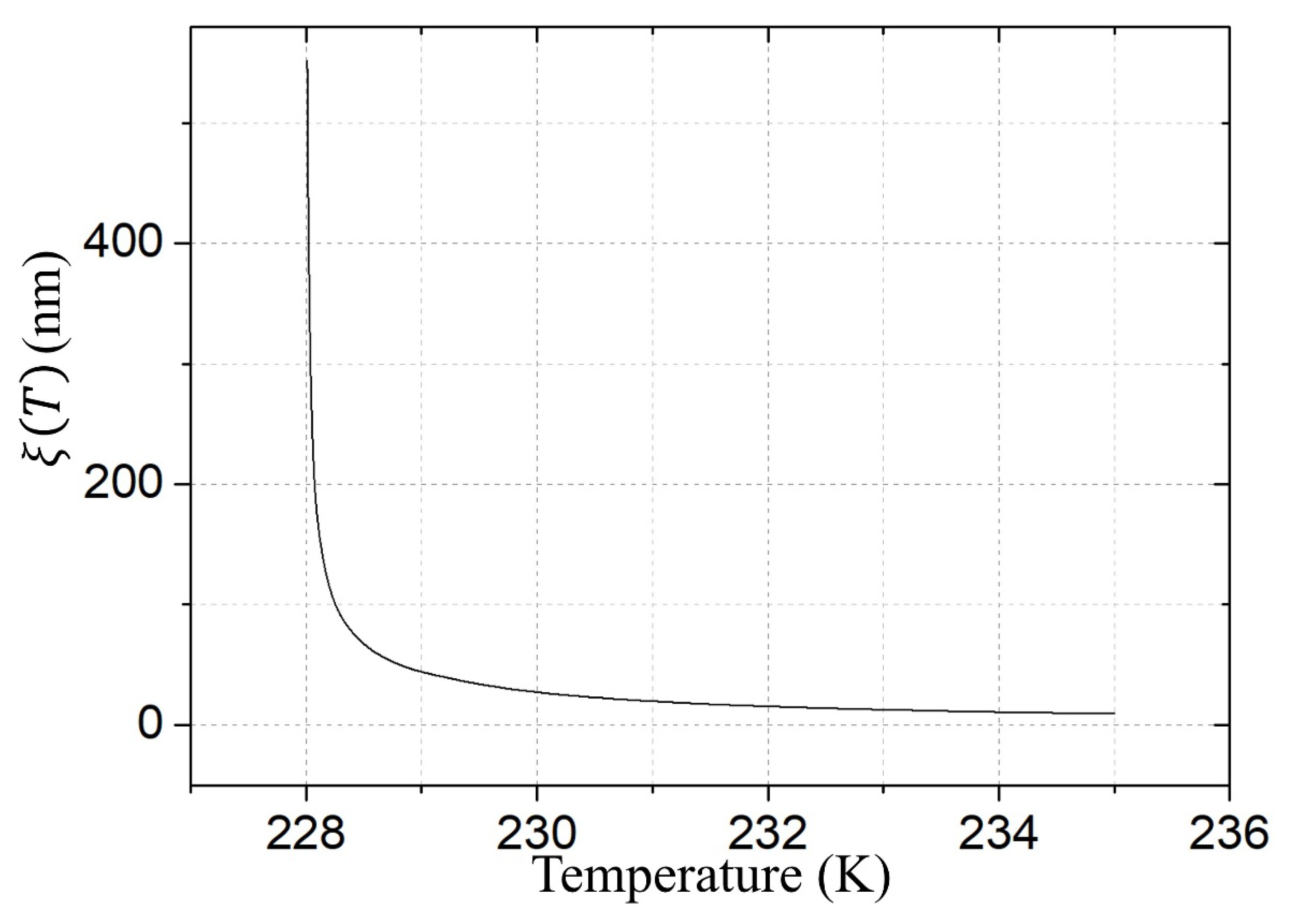
| Physical regime | Regime-specific independent input (not used for calibration) | TRFT fixed-parameter output | Literature / experimental reference | Absolute deviation | Parameters retuned? |
|---|---|---|---|---|---|
| Ambient liquid density maximum | None; unique topological calibration anchor | 277.15 K | 277.15 K | 0 K | Calibration only |
| Supercooled water critical temperature | Low-temperature broadband dielectric relaxation time (2.8 ns) | 230.2 K | 228 K | 2.2 K | No |
| Density maximum at 100 MPa | Solid-state DFT compression characteristics | 256.79 K | 254–257 K | 0.8 K | No |
| Heavy water ambient density maximum | DFT hydrogen–deuterium zero-point energy difference | 284.2 K | 284.748 K | 0.55 K | No |
| Freestanding 2D O-Ice stability limit | 2D DFPT elastic phonon data | 254 K | 260 K (AIMD simulation) | 6 K | No |
| Parameter | Value | Data source | Adopted 228 K heat-capacity data? |
|---|---|---|---|
| 0.2117 eV | Single-point calibration from ambient-pressure 277.15 K density maximum; supported by IR, Raman, and neutron-scattering spectral intervals | No | |
| Solid-state DFT+DFPT pure theoretical calculation of 3D tetrahedral P3H-INT ice | No | ||
| 0.388 | Sykes–Essam pure graph-theoretic numerical constant | No | |
| Low-temperature broadband dielectric, OKE ultrafast optical, and NMR three independent relaxation measurements, no critical temperature input | No |
| Validation Tier | Core Independent Input | Model Output | Validation State |
|---|---|---|---|
| Supercooled out-of-sample prediction | Independent ultrafast spectroscopic relaxation time | 230.3 K (1.0% deviation vs 228 K) | Fully out-of-sample (confirmed) |
| Full pressure cross-check | Quadratic relation uniquely solved from three pressure anchors | Intermediate pressures match experiment, extreme pressures predicted | Cross-verified (partial untested) |
| Heavy-water isotopic extrapolation | Single ambient energy calibration for D₂O | Ambient point consistent, full pressure curves predicted | Single-point calibrated (pressure forecasts pending) |
| Pressure | Light Water (K) | Predicted Heavy Water (K) | Validation Status |
|---|---|---|---|
| 0 MPa | 277.15 | 284.75 | Calibration anchor (AIP 2017) |
| +100 MPa | 256.79 | 264.39 | Await experimental test |
| +200 MPa | 242.00 | 249.60 | Await experimental test |
Table note: Apart from the ambient calibration anchor, all input data and experimental benchmarks are fully independent of the calibration procedure. No adjustable free parameters exist in the full set of topological equations. Traditional two-state models, the Speedy–Angell power law, and the Kirkwood dielectric theory cannot simultaneously cover liquid, supercooled, high-pressure, isotopic, and low-dimensional ice regimes with a single fixed interaction parameter. Global zero-adjustment extrapolation constitutes the core methodological signature of the present framework.
Figure 16.
Evolution curve of isothermal compressibility in the critical regime of supercooled water.
Figure 16.
Evolution curve of isothermal compressibility in the critical regime of supercooled water.
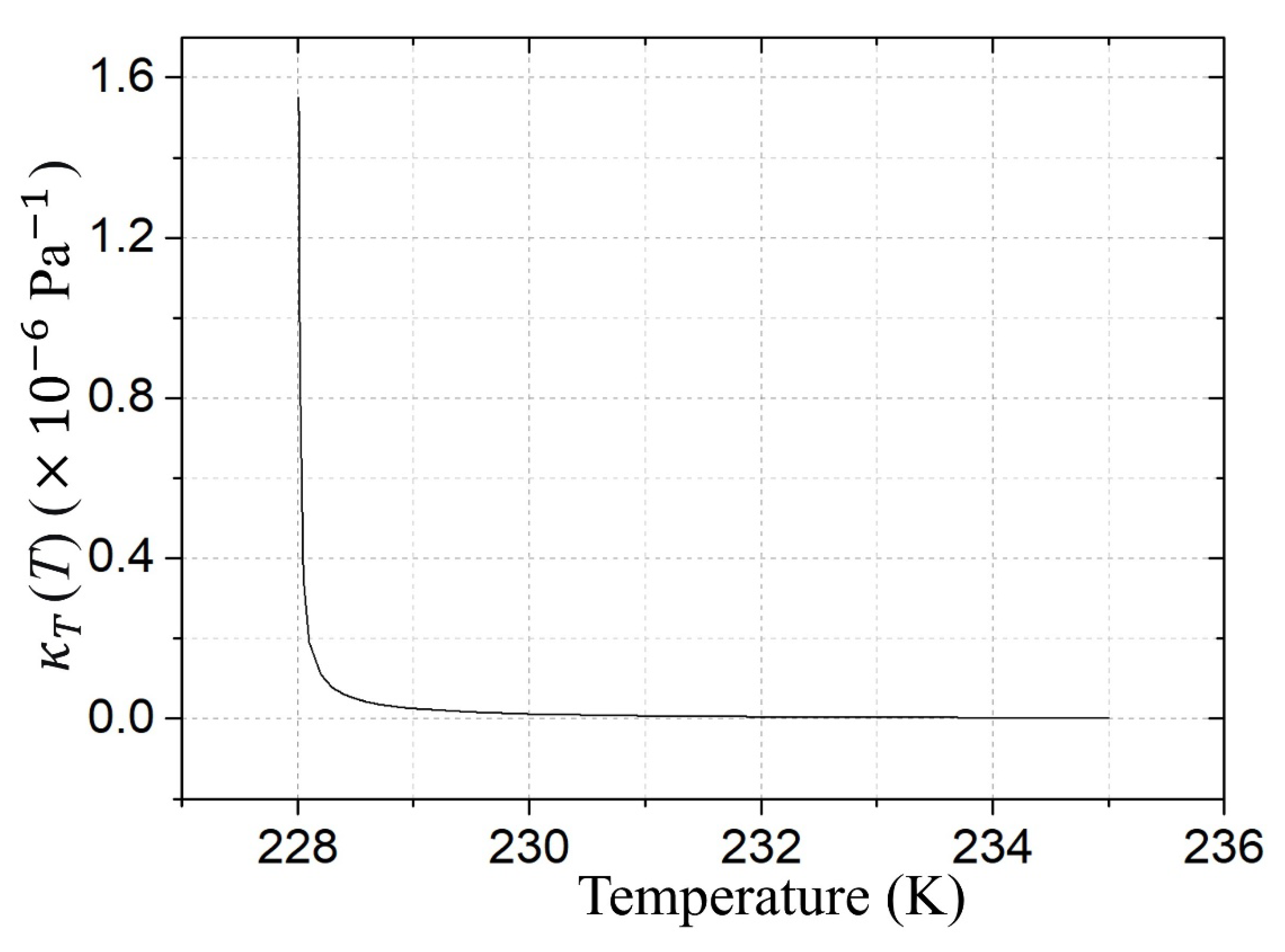
Figure 17.
Evolution curve of isobaric heat capacity near the topological critical temperature of supercooled water.
Figure 17.
Evolution curve of isobaric heat capacity near the topological critical temperature of supercooled water.
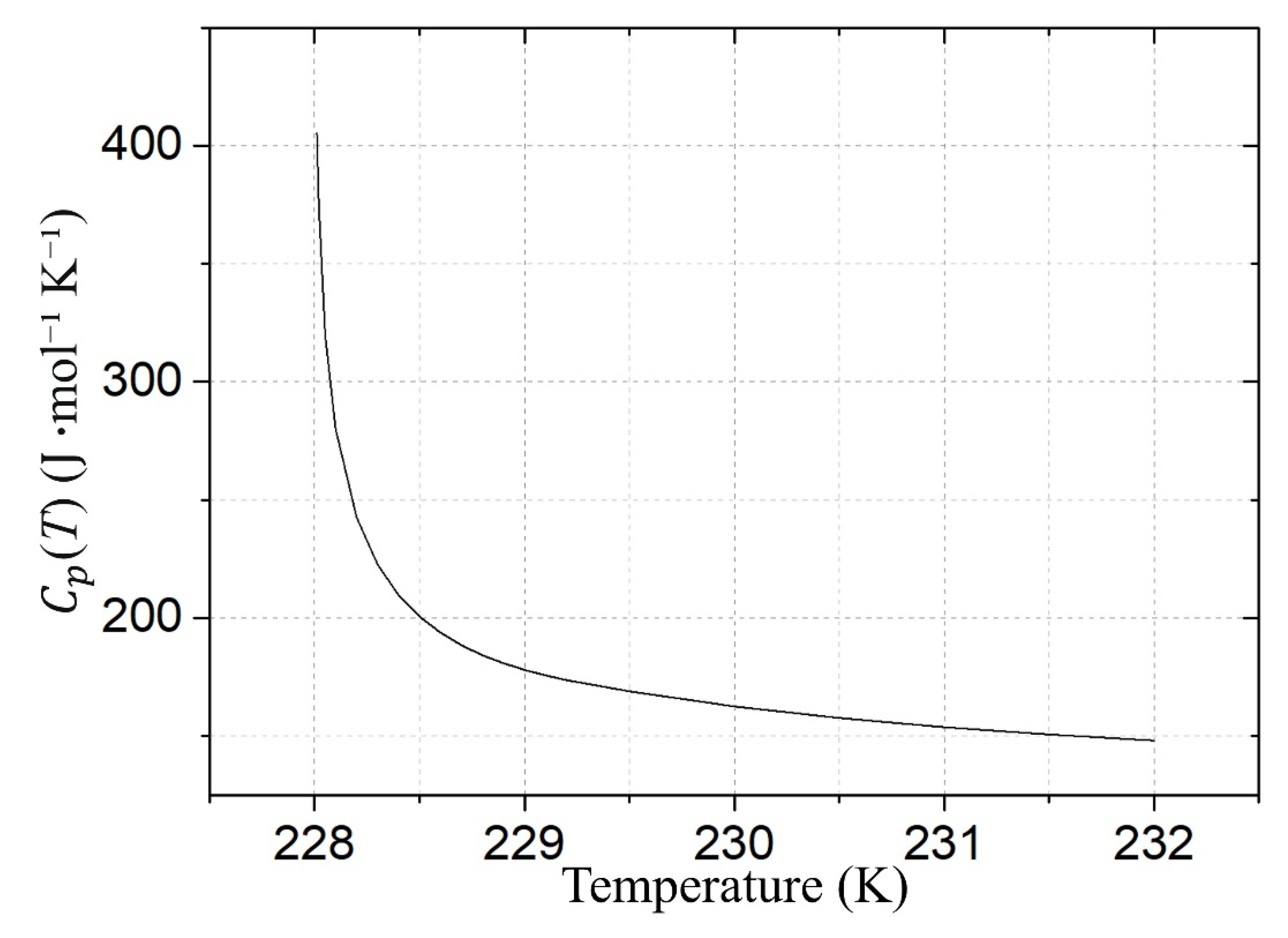
Figure 18.
Evolution curve of static relative permittivity versus transient closed-loop fraction derived from TRFT topological dielectric theory.
Figure 18.
Evolution curve of static relative permittivity versus transient closed-loop fraction derived from TRFT topological dielectric theory.
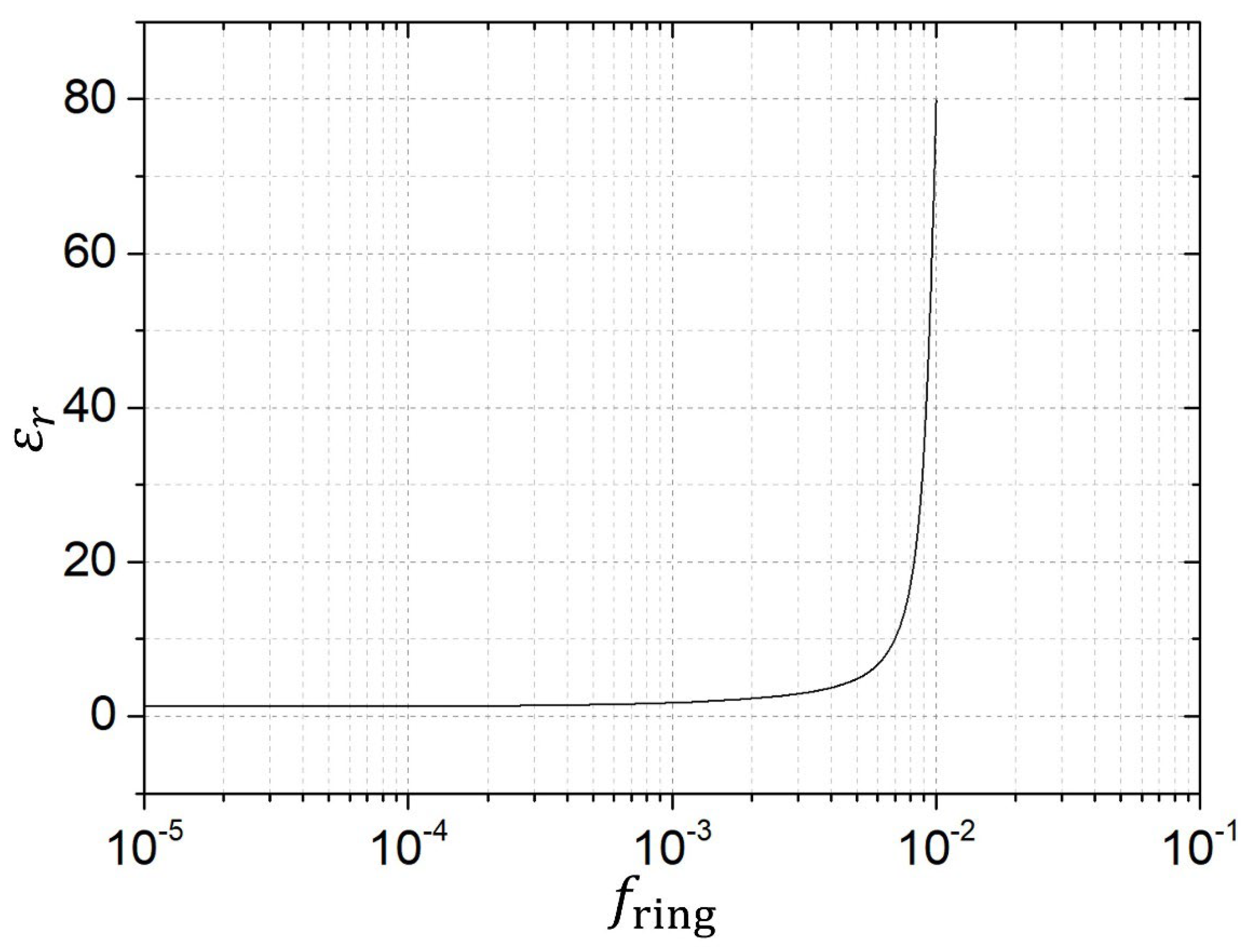
Disclaimer/Publisher’s Note: The statements, opinions and data contained in all publications are solely those of the individual author(s) and contributor(s) and not of MDPI and/or the editor(s). MDPI and/or the editor(s) disclaim responsibility for any injury to people or property resulting from any ideas, methods, instructions or products referred to in the content. |
© 2026 by the authors. Licensee MDPI, Basel, Switzerland. This article is an open access article distributed under the terms and conditions of the Creative Commons Attribution (CC BY) license (http://creativecommons.org/licenses/by/4.0/).
Copyright: This open access article is published under a Creative Commons CC BY 4.0 license, which permit the free download, distribution, and reuse, provided that the author and preprint are cited in any reuse.