
Submitted:
19 August 2026
Posted:
20 August 2026
You are already at the latest version
Abstract
White oak (Quercus alba L.) is among the most ecologically and economically important tree species of the eastern United States, yet its populations are increasingly threatened by climate change. This study predicts the white oak mortality (WOM) rate under alternative future climate projections across the eastern United States. WOM rate was derived from declining basal area in multicycle U.S. Forest Inventory and Analysis data (1998–2019) and related to seasonal precipitation and temperature. Future climate was represented by five statistically downscaled CMIP6 general circulation models (EC-Earth3, GFDL-ESM4, GISS-E2-1-G, MIROC-ES2L, and MPI-ESM-1-2-HR) under the SSP2-4.5 (middle-of-the-road) scenario for three 25-year intervals: early (2025–2049), mid (2050–2074), and late (2075–2099). Predicted WOM rates were mapped and compared with current conditions to identify areas of increase, decrease, and no change. Across all models and intervals, WOM rate is projected to increase most strongly in the southern part of the study area (notably Alabama and Arkansas) and in parts of the central region, while decreases are more prevalent in the north. Differences among models underscore the uncertainty inherent in climate projections. These results identify where white oak mortality risk is likely to concentrate under a changing climate and can inform adaptive silviculture, habitat restoration, and climate-informed forest conservation.
Keywords:
white oak mortality
; climate change
; CMIP6
; SSP2-4.5
; general circulation models
; forest inventory and analysis
; eastern United States
; forest management
1. Introduction
White oak (Quercus alba) is one of the most ecologically and economically significant tree species in the eastern United States. It is because white oak plays a significant role in conserving biodiversity, providing wildlife habitat, and nutrient cycling [1]. However, the sustainability of white oak populations is under threat due to climate change-induced stresses such as changed precipitation patterns, temperature changes, and extreme weather events [2,3]. In addition to climate change, white oaks have been further facing critical challenges such as alterations in flowering and breeding, introduction of new stressors, modification of habitat suitability, and change in forest dynamics [5,6]. Understanding the possible effects of climate change on white oak mortality at regional scale is crucial for mitigating the impacts of climate change on forest ecosystems, and our earlier analyses established the spatial pattern and the biotic, abiotic, and edaphic correlates of white oak mortality across this region [4,11,18].
Climate change is one of the significant challenges that the world is facing today where there have been implications in the oak forest ecosystem processes. Today, the global climate has become warmer, and it will continue to change at unprecedented rate [7]. Studies have shown that climate warming has a direct and apparent impact on white oak forest by altering phenological events such as budburst, flowering, and leaf senescence [8]. Reports found that the timing of these occurrences has shifted, with many locations experiencing earlier spring start and longer growing seasons. These changes can have a cascading effect on ecosystem dynamics, influencing nutrient cycle [53], species interactions, and ecosystem processes [9,10]. In addition, climate warming is also exacerbating the frequency and severity of environmental stressors like droughts, heatwaves, and insect outbreaks in white oak forests [12]. These factors have significant damage on white oaks, increasing their susceptibility to disease, insect infestations, and mortality. For instance, in Europe under warming climate, white oaks already weakened by girdling allured agrilus bilineatus (Weber), demonstrating that these insects can assess host quality from a distance [13].
In recent years, climate projections have emerged as invaluable tools for predicting future climatic conditions and their implications for ecosystems [14]. These estimates provide useful information about how climate variables may change over time, allowing researchers to anticipate and minimize potential dangers to forest health and resilience [15,16]. By merging climate projections with predictive modeling tools, it is feasible to foresee the response of white oak populations to varying climatic conditions across different regions of the United States. Scientists have studied the impacts of climate change on several tree species [17,19], however, more challenges with new research ideas are emerging on white oak mortality under climate change.
Climate change-induced stressors such as extreme precipitation and temperature events pose significant risks to the vitality of white oak forests. These environmental disturbances disrupt critical ecological processes, worsen physiological stress in white oaks, and promote the spread of pests and diseases [20,21]. As a result, white oak death rates are increasing, with noticeable effects on forest structure, composition, and ecosystem functioning [22,23]. Understanding the complex relationships between climate variability and white oak mortality is critical for minimizing the effects of climate change and ensuring the survival of white oak ecosystems [24,26]. Researchers can develop a framework to improve white oak’s resilience by understanding the fundamental mechanisms driving white oak mortality and anticipating its trajectory under different climate scenarios.
This study aims (1) to investigate the dynamics (predictions) of the white oak mortality rate in the context of a changing climate by combining climate models and (2) spatial mapping of relative change i.e., increase or decrease WOM rate at five selected climate models across the eastern United States. We hypothesized that rising summer temperatures and altered precipitation patterns will create unfavorable conditions for white oaks under warming climates. Additionally, we predict that the interaction between this temperature and precipitation at broad scales (e.g., seasonal) will exacerbate the impacts of climate change on the white oak mortality rate.
2. Materials and Methods
2.1. Study Area
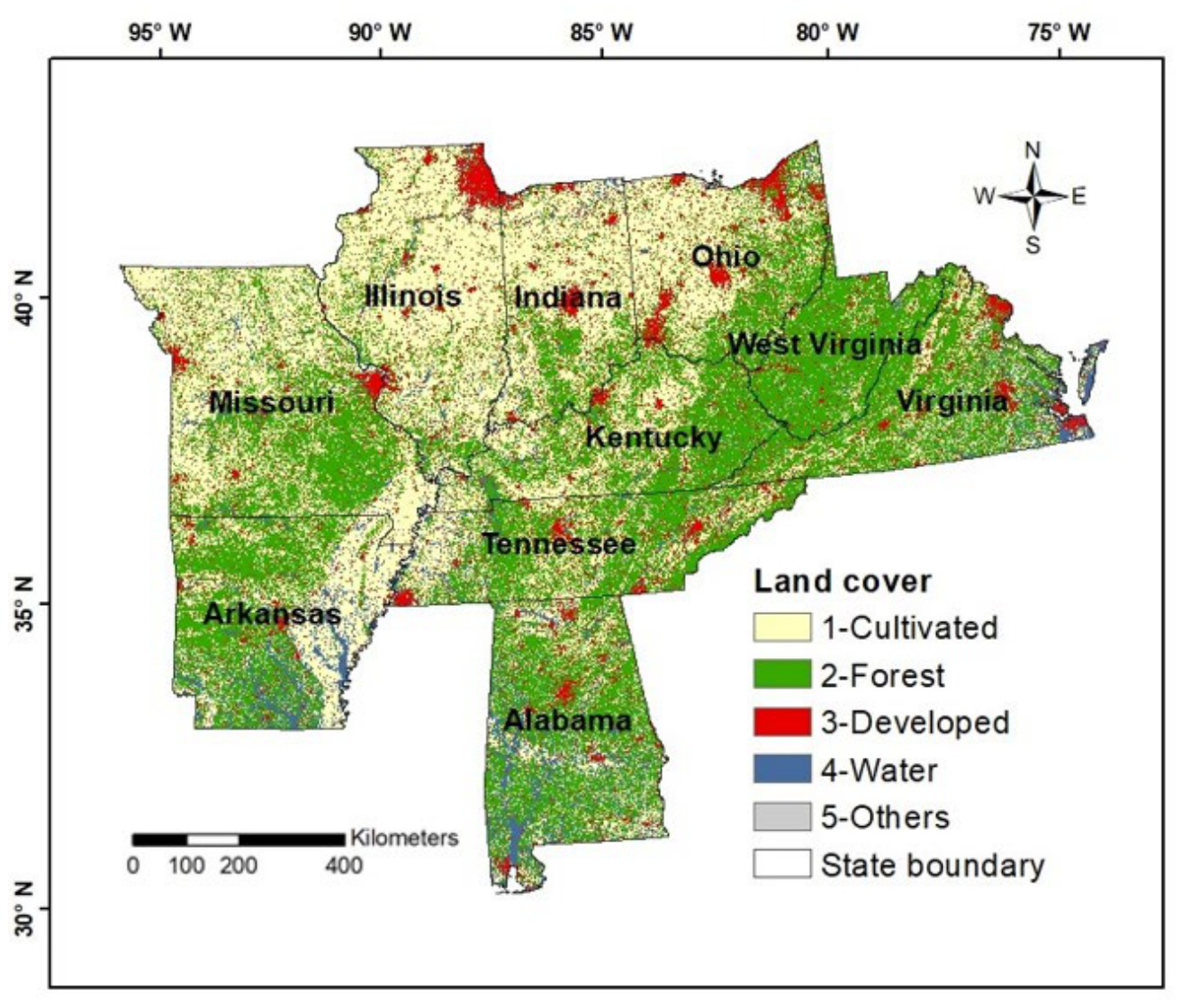
We chose the eastern United States as our study area since it is primarily covered with oak forests [27]. Our study region includes a diverse range of tree species as well as climate, soil, and terrain types [28,29]. The geographical configuration in the eastern region of the research area is predominantly covered with Appalachian plateaus, low mountains, and small valleys and ridges. The western section ranges from highly flat central till plains to inner low plateaus as well as Ozark Highlands. The area includes a range of natural zones, including the Ouachita Mountains in Arkansas and the Northern Cumberland Mountains in West Virginia. In the south, from Illinois central till plains Oak-Hickory to Alabama’s interior low plateau Highland Riff.
These locations get lengthy, scorching summers and chilly winters. The mean annual temperature varies from 4-18 °C throughout the east-west gradient, with milder temperatures in the south. Precipitation varies from 500mm in the northwest to 1,650 mm in the southeast. During the spring and fall, precipitation in the Appalachian Mountains can exceed 2,000mm. The soil types are varied with some locations having a xeric gradient with thin, rocky soils on exposed south, southwest, and wet slopes [25]. Besides, our study area was historically dominated by oaks, hickories, and pines. Nowadays, agriculture and rapid urbanization displaced most forest regions [28,30,32]. The deciduous types of trees species found in our research sites are oaks (Quercus spp.), hickory (Carya spp.), american beech (Fagus grandifolia), ash (Fraxinus spp.), and maple (Acer spp.).
Figure 1.
Location of the study area showing land covers including forest areas.
2.2. Data Acquisition and Processing
2.2.1. White Oak Mortality Rate
The white oak mortality rate was computed using basal areas from measured cycles spanning 1998 to 2019, which were mostly grouped into five consecutive years [31]. To ensure reliable findings, we eliminated the repeated plots. However, to get the correct basal area, we added up the basal areas of all the remeasured plots. We picked all the basal areas from declining white oak plots across the surveyed years. The declining plots were chosen according to basal area change. Basal area change is the difference between basal areas of two consecutive cycles, denoting decline. For instance, we calculated basal area change as:
We repeated this process for the other cycles, selecting negative basal areas that were directly related to the white oak decline. We computed the death rate by dividing the change in the basal area of white oaks by the number of inventory years between the two cycles. All those plots indicating death rates were combined and used as the final output or results. The decrease in the white oak basal area is referred to as WOM [18,33,34]. We calculated the mortality rate as:
2.2.2. Historic Climate Data
The climate variables such as mean precipitation and temperature were acquired from NASA Earth data (https://www.earthdata.nasa.gov/) based on data availability. The resolution provided is 1km, which is appropriate to our analysis since our observation of climate is based on a regional basis. We obtained historical climate data from 1998-2019 since all the annual inventories were reasonably compiled by the FIA in this period [35]. These historic climate data were modeled from daily observation and averaged on a monthly basis. Later, we averaged seasonal data such as spring and summer precipitation as well as averaging the time (years) from 1998 to 2019. We utilized summer and winter temperatures, and spring and summer precipitation since these are the most extreme season for mortality response in white oaks.
2.2.3. Statistically Downscaled General Circulation Models (GCMs) Projections and Time Intervals
We acquired a statistically downscaled dataset of GCMs (phase 6) of the Coupled Model Intercomparison Project (CMIP6) from the Intergovernmental Panel on Climate Change (https://www.ipcc-data.org/). We grouped 25-year average time intervals for the projected climate from 2025 to 2099. It is expected to match reality better if climatic variables are used in multidecadal intervals in the form of averaged datasets [36]. Therefore, the averaged time intervals were early (2025-2049), mid (2050-2074), and late (2075-2099). Projections were performed in an ensemble of all available downscaled GCMs to get future seasonal climates. Projections under this scenario provide sufficient information to study the effects of climate change on the WOM rate.
2.2.4. Climate Scenario and Model Selection
We obtained a tier 2 climate scenario from CMIP6 based on shared socio-economic pathways. The reason behind using the middle of the road, i.e., SSP2-4.5 under multiple models for the future, is that neither of the SSP2.6 and 8.5 scenarios are very realistic, and the biggest variances are between models. Based on the scenario, we selected downscaled climate models for future projections. We applied the selected scenario for five climate models to study future projections of the WOM rate. The time interval breaks for climate such as early, mid, and late under selected scenarios in each climate model were used for projections. The climate models were selected from different countries so that we would be able to compare and validate our results with other studies where the same models were used.

Table 1.
Climate models selected under the SSP2-4.5 scenario for both seasonal mean precipitation and temperature.
Table 1.
Climate models selected under the SSP2-4.5 scenario for both seasonal mean precipitation and temperature.
| Model selection strategy | Climate variable | Scenario (SSP2-4.5)/ Institution or Country |
| Realistic and low variances between models | Mean spring precipitation, | EC-Earth-3; Europe |
| Mean summer precipitation, | GFDL-ESM4; NOAA, USA | |
| Mean winter temperature, and | GISS-E2-1-G; NASA, USA | |
| Mean summer temperature; | MIROC-ES2L; Japan | |
| MPI-ESM-1-2-HR; Germany |
2.2.5. Data Analysis for Predicting WOM Rate Under Projected Climatic Variables
All the quantitative data of projected climatic variables was acquired after projections from each model under the selected scenario: SSP2-4.5 (middle of the road). At first, we compiled five climate models with mean daily precipitation and temperature from 2025 to 2099 under the middle of the road scenario from different countries. We merge time under each climate variable to aggregate the daily precipitation and temperature data into long-term climate trends and variability. Later, we obtained our seasonal data for spring, summer, and winter from average monthly data. For this, we used a Climate Data Operator (CDO) to process our seasonal climate variables. By doing this, we were able to separate spring and summer precipitation; and summer and winter temperature with their own set of projected climatic variables at three 25-year averaged time intervals ready to use for further analysis.
We used data from historic climate variables as independent variables, and white oak mortality rate as the dependent variable. Both independent and dependent variables were used to build relationships among them using multivariate regression analysis [19]. For model selection, we considered alternative statistical and machine learning approaches, including random forest regression and support vector machines, to evaluate their predictive performance. After comparing performance metrics such as mean squared error (MSE) and model interpretability, we selected the multivariate regression model, which performed best for our dataset when trained with 80% of the data and validated on 20%. The MSE for the regression model was 2.09. In addition to MSE, we assessed predictive accuracy by examining R-squared values, residual plots for homoscedasticity and normality, and by conducting k-fold cross-validation to evaluate robustness and guard against overfitting. Regression models provided not only good predictive power but also more direct ecological interpretability regarding the influence of individual climate variables on mortality rates, which is valuable for applied forest management. We used multivariate regression analysis because it is an effective and widely used tool for predicting tree mortality under climate change [37,38,39]. After establishing the model relationship, historic climate data were replaced by future climate projections within the established model to predict the white oak mortality rate for each climate model using respective seasonal precipitation and temperature data. Regression analysis was performed using RStudio (R Core Team, 2021). This approach allowed us to obtain predicted WOM rates for each climate model. The multivariate regression equation can be expressed as:
Where, y = White oak mortality rate, = Intercept, = Coefficient of respective independent variables x1 = Average spring precipitation of (2025-2049), (2050-2074), and (2075-2099), respectively for each model, x2 = Average summer precipitation of (2025-2049), (2050-2074), and (2075-2099), respectively for each model, x3 = Average summer temperature of (2025-2049), (2050-2074), and (2075-2099), respectively for each model, x4 = Average winter temperature of (2025-2049), (2050-2074), and (2075-2099), respectively for each model e = error
After calculating the predicted WOM rate under each model, we compared these predictions with historical climate data. For this, we calculated WOM rate change using both historical and future WOM rates under each climate model. The change in WOM rate was necessary to calculate in order to find which specific locations had high and low values of aggregations under projected climate relative to current climatic conditions. We performed predicted WOM rate change (predicted) in the following ways:
The increase, decrease, and neutral aggregations of WOM rates were analyzed by Raster calculator in the ArcMap version 10.8.1 and classified the patterns using Inverse Distance Weighted. It is because our WOM rates were locational data, and the climate data were also lined up in a similar way. The best way to represent locational data was visual mapping and interpretations such as spatial aggregations or concentrations.
3. Results
3.1. White Oak Mortality Rate During Current Climatic Conditions and Predictions During Early, Mid, and Late Time-Intervals
Under current climatic conditions (Figure 2), WOM rate showed high aggregations mainly in the northern part (e.g., northern Illinois) and slightly fewer in the eastern (e.g., portion of Virginia, west Virginia, and Ohio), few in the central (e.g., parts of Kentucky and Tennessee), and western region (e.g., portion of Missouri). Likewise medium aggregation of WOM rate was found almost across all states except there was few areas in Alabama. Similarly, low aggregation of WOM rate was greatly distributed across all states [4].
Compared to the five models e.g., EC-Earth-3, GFDL-ESM4, GISS-E2-1-G, MIROC-ES2l, and MPI-ESM-1-2-HR under the ensemble of SSP2-4.5, the model EC-Earth-3 predicted relatively higher aggregations of WOM rate during mid-time interval (2050-2074) followed by second and third higher aggregations during late (2075-2099) and early (2025-2049) time-intervals (Figure 3). Similarly, the fourth higher WOM rates were predicted during the late time-interval by GISS-E2-1-G model. These higher aggregations were found mostly in the northern part of our study area covering portions of Missouri, Illinois, Indiana, and Ohio. There was also a higher WOM rate in the eastern portion of Virginia, that was mainly predicted by EC-Earth-3 model.
Our results also predicted medium WOM rate during early time-interval by MIROC-ES2L as compared with other models. This medium aggregation pattern was followed by mid time-interval of MPI-1-2-HR model. The third and fourth medium WOM rate were predicted during early and mid-time-intervals, respectively by GFDL-ESM4 model. These medium WOM rate prediction were found mostly across the central part distributed from east to west region of our study area (e.g., portion of Arkansas, Missouri, Kentucky, Illinois, Indiana, Ohio, west Virgini, and Virginia).
Among the five different climate models, the lowest aggregation of WOM rate was predicted during mid-time-interval, and second lowest during late time-interval by MIROC-ES2L model. Similar patterns of third and fourth lowest aggregations were found during the early time-interval of MPI-1-2-HR model and late time-interval of GFDL-ESM4 model, respectively. These low aggregations were mostly distributed across the southern part of our study area extending from east to west (e.g., mostly in Alabama and Arkansas and some portions of West Virginia, Tennessee, and Kentucky).
3.2. WOM Rates Relative Change to Current Climate and Projected Climate Models
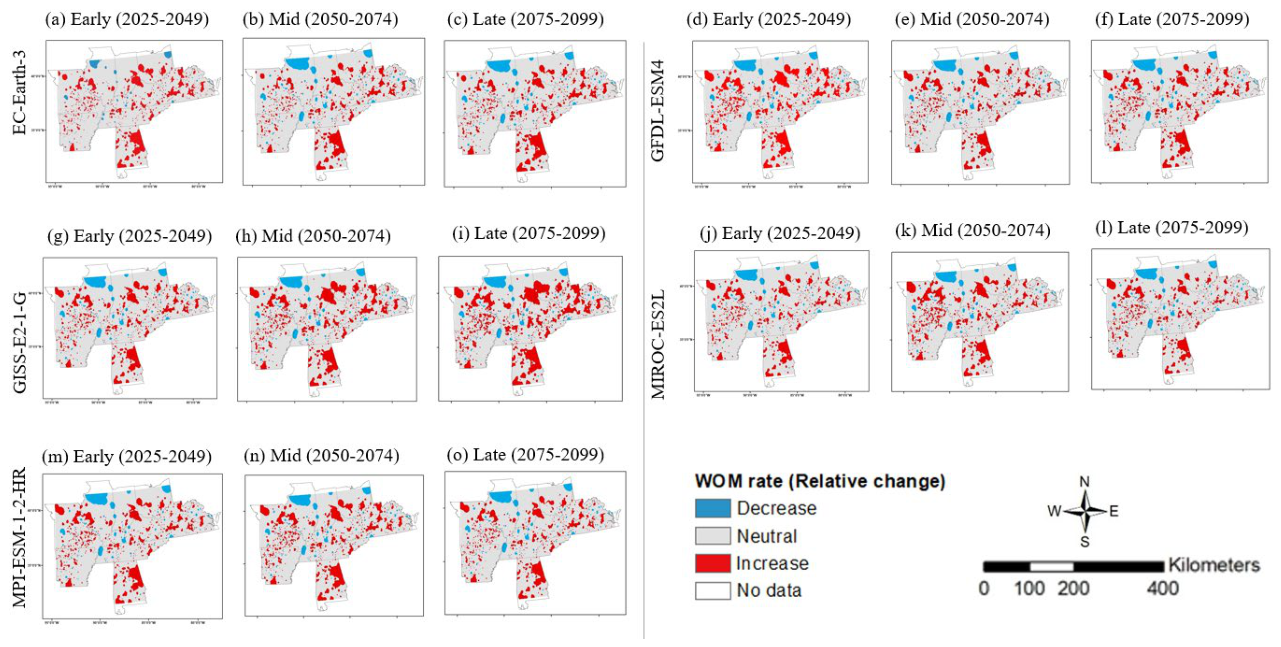
Our results showed that there will be a greater increase in WOM rate across all models and three average time-intervals in the southern part of the eastern US (e.g., major portion of Alabama and few portions of Arkansas; Figure 4). The visual interpretation of five climate models also indicated WOM rate will likely increase in some parts of central region of eastern US. The increment of WOM rate in the central region of our study area showed almost similar distribution across all models and time-intervals (e.g., parts of Missouri, Kentucky, Tennessee, west Virginia, and Virginia). However, there was also increment in the WOM rate in the northern portion of our study area during mid and early time-intervals (e.g., southern portion of Indiana and Ohio) but lesser than southern and central region projected by GISS-E2-1-G climate model. Likewise, MPI-ESM-1-2-HR climate model showed increase pattern of WOM rate during early and mid-time intervals in the northern region but depicted much less than GISS-E2-1-G climate model.
Among the five climate models, almost all models and time intervals depicted a decrease in WOM rate in the near future (Figure 4). However, the early time-interval of EC-Earth-3 climate model showed very few areas of WOM rate decrease mainly towards the northern part of our study area (e.g., parts of Illinois and Ohio). This decreasing pattern of WOM rate was greater towards northern region than central. Our results also found that there will be no decrease in WOM rate across southern part of our study area (e.g., parts of Alabama and Arkansas) rather increase or remain neutral almost across all models and time-intervals.
4. Discussion
Our findings indicate a concerning pattern of increasing WOM rates across eastern US, especially in the southern states. Projections based on five different climate models consistently suggest that the southern regions of the study area encompassing significant portions of Alabama and Arkansas will see a significant spike in WOM rates. This finding is consistent with other research emphasizing how vulnerable forests are in warmer climates, where factors such as rising temperature and altered precipitation patterns can intensify pressures on oak tree health [40,41]. Moreover, [42,43] demonstrated a strong correlation between increasing temperatures and greater stress levels in white oak stands using a combination of both tree-ring analyses and climate modeling, which resulted in higher evapotranspiration in warm and xeric climatic conditions such as Alabama and Arkansas. Though our study did not analyze other environmental factors, [44] documented that oaks in the eastern US are likely to be affected by insect/pests’ attack under climate change. Our findings revealed a significant increase in WOM rates anticipated for specific places in the central states of our study area. Even while the spatial pattern of this increase seems consistent across all models and time-intervals examined, it may be due to several potential factors. Potential factors contributing to elevated WOM rates in the central states may include shifts in precipitation regimes, changes in soil moisture levels [46], and interaction with biotic and abiotic stressors [6,11,26,45]. [47] reported based on dendroecological study on oaks under climate variables in midwestern region of US that there will be an increased risk of oak mortality under climate change especially due to increase in mean seasonal temperature.
Interestingly, the northern states of our study area present somewhat different trajectory of changes in WOM rate across all time-intervals. The relative change suggests that WOM rates will rise moderately in the late time-interval, although early time-interval indicated somewhat smaller increase in WOM rate demonstrated by GISS-E2-1-G climate model. The finding highlights the intricate effects of climate change on white oak forests. According to [48,49] subtle variations in tree mortality rates might result from both localized factors and interaction between climate variables. In particular, the northernmost portion of the study area, which includes parts of Illinois and Ohio, is where these declines are concentrated. This might be due to the effectiveness of climate mitigation measures in lowering WOM rates, which may vary across different geographic regions [50].
According to our analysis of five climate models under middle of the road scenario, portions of central and northern region of our study area are expected to have decrease rates of WOM in near future. These findings are largely consistent with all models and time-intervals, indicating a possible reduction in WOM stressors such as drought in numerous locations [51]. It is noteworthy, although, that the EC-Earth-3 climate models from early time-interval diverge from this pattern, with only limited areas showing decrease in WOM rates. It is interesting to note that the northern region appears to be experiencing more significant WOM rate declines than the central region of our study area. This observation emphasizes how intricately climate variables, forest dynamics, and spatial factors interact to shape white oak mortality patterns in the future [52,54]. Because of potentially advantageous climatic circumstances or management strategies that lessen pressures on white oak populations, the northern region of our study area may benefit more from climate mitigation efforts [55]. It is also evident that northern region of our study area consists of few white oak mortalities as compared with central and southern due to less availability of white oak impacted by weather stress [56]
Conversely, our findings revealed a persistent lack of WOM rate decrease across the southern part of the study area (e.g., Alabama and Arkansas), WOM rates are expected to rise as well as stay mostly unchanged for all models and time-intervals. This condition highlights the increase might be due to rising temperature and shifting precipitation patterns [21,57].
As we face the reality of a changing climate, it is critical to emphasize collaborative research, policy interventions, and community involvement efforts targeted at preserving the integrity and biodiversity of white oak forests. Forest managers can operationalize these findings by prioritizing adaptive management strategies such as promoting species and structural diversity, implementing site-specific silvicultural practices to enhance resilience, and monitoring vulnerable stands for early signs of decline. In regions projected to experience the highest increases in mortality (e.g., southern and central areas), managers should consider proactive measures such as assisted regeneration, selective thinning, or shifting species composition towards more climate-resilient taxa. In northern regions where mortality risk may decrease or remain stable, maintaining current management while enhancing monitoring can help sustain ecosystem services. Tailoring management actions to regional projections and maintaining flexibility in response to new information will be essential for successful adaptation. By encouraging interdisciplinary cooperation and utilizing advanced modeling approaches, we can build viable solutions to minimize the impacts of climate change on white oak mortality and ensure the sustainability of these invaluable ecosystems for future generations.
5. Conclusions
Our study of WOM rate under the influence of climate change highlights the crucial connection between climate stressors and white oak mortality across the eastern US. Our study highlights a significant rise in white oak mortality mostly across the southern region because of rising temperatures, changing precipitation patterns, and extreme weather events. These climate stressors affect key ecological processes, increasing resource constraints, eventually resulting in elevated mortality rates in white oak populations. The use of IPCC climate data in our analysis has improved our understanding of the long-term effects of climate change on white oak ecosystems. By extrapolating future warming estimates, we anticipate that WOM rates will increase further, providing considerable problems for white oak forest management and conservation. To address these problems, proactive actions aimed at increasing white oak population resilience will be required, such as habitat restoration, adaptive silvicultural methods, and climate-science-informed conservation strategies.
Our findings also indicated that decrease in WOM rate was more prevalent in the northern part than the central part emphasizing possible climate mitigation efforts and forest management. However, the central region depicted both increase and decrease in WOM rates in the near future except the increasing pattern is slightly greater. Similarly, the majority of the areas across the eastern US also remain unchanged for WOM rates in near future that are not affected by climate change.
Notably, our analysis indicated differences in WOM rate estimates among climate models. The inherent uncertainty surrounding climate projections is highlighted by the variability in model outputs, underscoring the need to consider a range of possible future climatic conditions in forest management planning. Differences among climate models affect confidence in the spatial patterns of projected mortality, as some regions show consistent trends across models while others exhibit greater divergence. By using an ensemble of five GCMs, we aimed to capture this range of uncertainty. For forest managers and researchers, it is important to interpret spatial patterns of projected mortality with caution, recognizing that areas of model agreement offer higher confidence for action, while areas of disagreement highlight the need for adaptive and flexible management strategies. Developing strong adaptation strategies that can successfully reduce the effects of climate change on white oak health and ecosystem services requires incorporating these uncertainties into decision-making processes (Millar et al., 2019).
While these findings provide valuable insights into white oak mortality under projected climate scenarios, certain limitations should be acknowledged. First, our analysis relies on climate data at a spatial resolution of 1 km, which may not fully capture fine-scale microclimatic or site-specific variations relevant to tree mortality. Second, the modeling approach primarily incorporates key climatic variables such as temperature and precipitation, meaning that other potential drivers of mortality, including soil characteristics, pest and pathogen outbreaks, management history, land use, and species interactions, are not explicitly represented in the projections. Third, the assumptions inherent to both the downscaled global climate models and the multivariate regression framework may influence the accuracy of predicted outcomes. Finally, long-term uncertainties in social, economic, and land-use changes, as well as unforeseen ecological processes, could impact actual future mortality rates. These limitations highlight the importance of interpreting our results within the context of modeling constraints and promote ongoing research that integrates additional drivers, unmodeled biotic and abiotic factors, and finer-scale data to improve reliability.
Future research could improve predictions of white oak mortality by integrating additional variables and approaches. Incorporating factors such as soil characteristics, pest and pathogen dynamics, land-use history, and disturbance regimes would enhance model realism. Employing higher-resolution climate data and remote sensing products could help account for local site variability. Exploring advanced modeling frameworks, including process-based or machine learning models such as random forests and neural networks, may capture nonlinear relationships and interactions among variables. Long-term field monitoring and experimental studies would also provide critical data for model calibration and validation. Integrating these elements will support more accurate and actionable forecasts of white oak mortality under climate change
Author Contributions
Conceptualization, S.K.; methodology, S.K.; formal analysis, S.K.; data curation, S.K.; writing—original draft preparation, S.K.; writing—review and editing, H.S.H. and S.B.; supervision, H.S.H. and S.B. All authors have read and agreed to the published version of the manuscript.
Funding
This research was funded by the USDA/NIFA 1890 Capacity Building Grant, Award number 2021-38821-34704.
Data Availability Statement
Forest Inventory and Analysis data are available from the USDA Forest Service (https://research.fs.usda.gov/programs/fia); CMIP6 downscaled projections are available from the IPCC Data Distribution Centre (https://www.ipcc-data.org/).
Acknowledgments
The authors gratefully acknowledge University of Missouri-Columbia School of Natural Resources for its facilities and support.
Conflicts of Interest
The authors declare no conflicts of interest.
References
- Nowacki, G.J.; Abrams, M.D. The demise of fire and “mesophication” of forests in the eastern United States. BioScience 2008, 58, 123–138. [Google Scholar] [CrossRef]
- Duan, S.; He, H.S.; Spetich, M.A.; Wang, W.J.; Fraser, J.S.; Xu, W. Long-term effects of succession, climate change and insect disturbance on oak-pine forest composition in the U.S. Central Hardwood Region. Eur. J. For. Res. 2022, 141, 153–164. [Google Scholar] [CrossRef]
- Sturrock, R.N.; Frankel, S.J.; Brown, A.; Hennon, P.E.; Kliejunas, J.T.; Lewis, K.J.; Worrall, J.J.; Woods, A.J. Climate change and forest diseases. Plant Pathol. 2011, 60, 133–149. [Google Scholar] [CrossRef]
- Khadka, S.; He, H.S.; Bardhan, S. Investigating the spatial pattern of white oak (Quercus alba L.) mortality using Ripley’s K function across the ten states of the Eastern US. Forests 2024, 15, 1809. [Google Scholar] [CrossRef]
- Chmura, D.J.; Anderson, P.D.; Howe, G.T.; Harrington, C.A.; Halofsky, J.E.; Peterson, D.L.; Shaw, D.C.; St. Clair, J.B. Forest responses to climate change in the northwestern United States: Ecophysiological foundations for adaptive management. For. Ecol. Manag. 2011, 261, 1121–1142. [Google Scholar] [CrossRef]
- Dale, V.H.; Joyce, L.A.; McNulty, S.; Neilson, R.P.; Ayres, M.P.; Flannigan, M.D.; Hanson, P.J.; Irland, L.C.; Lugo, A.E.; Peterson, C.J.; et al. Climate change and forest disturbances. BioScience 2001, 51, 723–734. [Google Scholar] [CrossRef]
- Pachauri, R.K.; Reisinger, A. Climate Change 2007: Synthesis Report. Contribution of Working Groups I, II and III to the Fourth Assessment Report of the Intergovernmental Panel on Climate Change; IPCC: Geneva, Switzerland, 2007. [Google Scholar]
- Calinger, K.; Curtis, P. A century of climate warming results in growing season extension: Delayed autumn leaf phenology in north central North America. PLoS ONE 2023, 18, e0282635. [Google Scholar] [CrossRef] [PubMed]
- Bardgett, R.D.; Manning, P.; Morriën, E.; De Vries, F.T. Hierarchical responses of plant–soil interactions to climate change: Consequences for the global carbon cycle. J. Ecol. 2013, 101, 334–343. [Google Scholar] [CrossRef]
- Wookey, P.A.; Aerts, R.; Bardgett, R.D.; Baptist, F.; Bråthen, K.A.; Cornelissen, J.H.C.; Gough, L.; Hartley, I.P.; Hopkins, D.W.; Lavorel, S.; et al. Ecosystem feedbacks and cascade processes: Understanding their role in the responses of Arctic and alpine ecosystems to environmental change. Glob. Change Biol. 2009, 15, 1153–1172. [Google Scholar] [CrossRef]
- Khadka, S.; He, H.S.; Bardhan, S. Exploring biotic and abiotic factors of white oak (Quercus alba L.) mortality across the Eastern United States. Preprints 2025, 2025020115. [Google Scholar] [CrossRef]
- Faluyi, M.O.; Irmak, S. Northeastern American forests: Natural disturbances, climate change impact, and the utilization of increasingly damaged forest trees for biofuel production. Forests 2023, 14, 2409. [Google Scholar] [CrossRef]
- Sallé, A.; Nageleisen, L.M.; Lieutier, F. Bark and wood boring insects involved in oak declines in Europe: Current knowledge and future prospects in a context of climate change. For. Ecol. Manag. 2014, 328, 79–93. [Google Scholar] [CrossRef]
- McCarthy, B.C.; Small, C.J.; Rubino, D.L. Composition, structure and dynamics of Dysart Woods, an old-growth mixed mesophytic forest of southeastern Ohio. For. Ecol. Manag. 2001, 140, 193–213. [Google Scholar] [CrossRef]
- Keenan, R.J. Climate change impacts and adaptation in forest management: A review. Ann. For. Sci. 2015, 72, 145–167. [Google Scholar] [CrossRef]
- Yousefpour, R.; Jacobsen, J.B.; Thorsen, B.J.; Meilby, H.; Hanewinkel, M.; Oehler, K. A review of decision-making approaches to handle uncertainty and risk in adaptive forest management under climate change. Ann. For. Sci. 2012, 69, 1–15. [Google Scholar] [CrossRef]
- Davis, M.B.; Shaw, R.G.; Etterson, J.R. Evolutionary responses to changing climate. Ecology 2005, 86, 1704–1714. [Google Scholar] [CrossRef]
- Khadka, S.; Bardhan, S. Examining the relationship between stand density of declining white oaks (Quercus alba L.) and soil properties across the broader scale of the Eastern United States. Preprints 2024, 2024110224. [Google Scholar] [CrossRef]
- Hamann, A.; Wang, T. Potential effects of climate change on ecosystem and tree species distribution in British Columbia. Ecology 2006, 87, 2773–2786. [Google Scholar] [CrossRef]
- Duerr, D.A.; Mistretta, P.A. Invasive pests: Insects and diseases. In The Southern Forest Futures Project: Technical Report; Gen. Tech. Rep. SRS-178; Wear, D.N., Greis, J.G., Eds.; U.S. Department of Agriculture, Forest Service, Southern Research Station: Asheville, NC, USA, 2013; pp. 159–192. [Google Scholar]
- Weed, A.S.; Ayres, M.P.; Hicke, J.A. Consequences of climate change for biotic disturbances in North American forests. Ecol. Monogr. 2013, 83, 441–470. [Google Scholar] [CrossRef]
- McConnell, M.E.; Balci, Y. Phytophthora cinnamomi as a contributor to white oak decline in mid-Atlantic United States forests. Plant Dis. 2014, 98, 319–327. [Google Scholar] [CrossRef]
- Abrams, M.D. Where has all the white oak gone? BioScience 2003, 53, 927–939. [Google Scholar] [CrossRef]
- Rogers, B.M.; Jantz, P.; Goetz, S.J. Vulnerability of eastern US tree species to climate change. Glob. Change Biol. 2017, 23, 3302–3320. [Google Scholar] [CrossRef] [PubMed]
- Khadka, S.; He, H.S.; Bardhan, S. Investigating the spatial pattern of white oak (Quercus alba L.) mortality across the Eastern United States. Preprints 2024, 2024082034. [Google Scholar] [CrossRef]
- Vacek, Z.; Vacek, S.; Cukor, J. European forests under global climate change: Review of tree growth processes, crises and management strategies. J. Environ. Manag. 2023, 332, 117353. [Google Scholar] [CrossRef] [PubMed]
- Clark, F.B.; Hutchinson, J.G. Central Hardwood Notes; U.S. Department of Agriculture, Forest Service, North Central Forest Experiment Station: St. Paul, MN, USA, 1989. [Google Scholar]
- Fralish, J.S. The Central Hardwood Forest: Its boundaries and physiographic provinces. In Proceedings of the 13th Central Hardwood Forest Conference;Gen. Tech. Rep. NC-234; Van Sambeek, J.W., Dawson, J.O., Ponder, F., Jr., Loewenstein, E.F., Fralish, J.S., Eds.; U.S. Department of Agriculture, Forest Service, North Central Research Station: St. Paul, MN, USA, 2003; pp. 1–20. [Google Scholar]
- Wang, W.J.; He, H.S.; Thompson, F.R., III; Fraser, J.S.; Hanberry, B.B.; Dijak, W.D. Importance of succession, harvest, and climate change in determining future composition in U.S. Central Hardwood Forests. Ecosphere 2015, 6, 1–18. [Google Scholar] [CrossRef]
- Stambaugh, M.C.; Knapp, B.O.; Dey, D.C. Fire ecology and management of forest ecosystems in the western Central Hardwoods and prairie-forest border. In Fire Ecology and Management of Past-Adapted Ecosystems of Eastern North America; Greenberg, C.H., Collins, B., Eds.; Springer: Cham, Switzerland, 2021; pp. 129–153. [Google Scholar] [CrossRef]
- Smith, W.B. Forest inventory and analysis: A national inventory and monitoring program. Environ. Pollut. 2002, 116, S233–S242. [Google Scholar] [CrossRef] [PubMed]
- Khadka, S.; Gyawali, B.R.; Shrestha, T.B.; Cristan, R.; Banerjee, S.B.; Antonious, G.; Poudel, H.P. Exploring relationships among landownership, landscape diversity, and ecological productivity in Kentucky. Land Use Policy 2021, 111, 105723. [Google Scholar] [CrossRef]
- Garnas, J.R.; Ayres, M.P.; Liebhold, A.M.; Evans, C. Subcontinental impacts of an invasive tree disease on forest structure and dynamics. J. Ecol. 2011, 99, 532–541. [Google Scholar] [CrossRef]
- Yang, S.I.; Brandeis, T.J. Estimating maximum stand density for mixed-hardwood forests among various physiographic zones in the eastern US. For. Ecol. Manag. 2022, 521, 120420. [Google Scholar] [CrossRef]
- Bechtold, W.A.; Patterson, P.L. The Enhanced Forest Inventory and Analysis Program—National Sampling Design and Estimation Procedures; Gen. Tech. Rep. SRS-80; U.S. Department of Agriculture, Forest Service, Southern Research Station: Asheville, NC, USA, 2005; p. 80p. [Google Scholar]
- Brown, L.R.; Bennett, W.A.; Wagner, R.W.; Morgan-King, T.; Knowles, N.; Feyrer, F.; Schoellhamer, D.H.; Stacey, M.T.; Dettinger, M. Implications for future survival of delta smelt from four climate change scenarios for the Sacramento–San Joaquin Delta, California. Estuaries Coasts 2013, 36, 754–774. [Google Scholar] [CrossRef]
- Araújo, M.B.; Pearson, R.G.; Thuiller, W.; Erhard, M. Validation of species–climate impact models under climate change. Glob. Change Biol. 2005, 11, 1504–1513. [Google Scholar] [CrossRef]
- De’Ath, G. Multivariate regression trees: A new technique for modeling species–environment relationships. Ecology 2002, 83, 1105–1117. [Google Scholar] [CrossRef]
- Chakraborty, S.; Bardhan, S.; Gullapalli, S.; Khadka, S. Forecasting oak diameter using an LSTM neural network in the Missouri state of USA. Preprints 2025, 202501160. [Google Scholar] [CrossRef]
- Vose, J.M.; Elliott, K.J. Oak, fire, and global change in the eastern USA: What might the future hold? Fire Ecol. 2016, 12, 160–179. [Google Scholar] [CrossRef]
- Pascual, L.S.; Segarra-Medina, C.; Gómez-Cadenas, A.; López-Climent, M.F.; Vives-Peris, V.; Zandalinas, S.I. Climate change-associated multifactorial stress combination: A present challenge for our ecosystems. J. Plant Physiol. 2022, 276, 153764. [Google Scholar] [CrossRef] [PubMed]
- White, P.B.; van de Gevel, S.L.; Grissino-Mayer, H.D.; LaForest, L.B.; DeWeese, G.G. Climatic response of oak species across an environmental gradient in the southern Appalachian Mountains, USA. Tree-Ring Res. 2011, 67, 27–37. [Google Scholar] [CrossRef]
- LeBlanc, D.C.; Terrell, M.A. Comparison of growth-climate relationships between northern red oak and white oak across eastern North America. Can. J. For. Res. 2011, 41, 1936–1947. [Google Scholar] [CrossRef]
- Conrad, A.O.; Crocker, E.; Li, X.; Thomas, W.R.; Ochuodho, T.O.; Holmes, T.P.; Nelson, C.D. Threats to oaks in the eastern United States: Perceptions and expectations of experts. J. For. 2020, 118, 14–27. [Google Scholar] [CrossRef]
- Ayres, M.P.; Hicke, J.A.; Kerns, B.K.; McKenzie, D.; Littell, J.S.; Band, L.E.; Luce, C.H.; Weed, A.S.; Raymond, C.L. Disturbance regimes and stressors. In Climate Change and United States Forests; Vose, J.M., Peterson, D.L., Patel-Weynand, T., Eds.; Springer: Dordrecht, Netherlands, 2014; pp. 55–92. [Google Scholar]
- Khadka, S.; He, H.S.; Bardhan, S.; Khalyani, A.H. Identifying spatial pattern of white oak (Quercus alba) mortality and its relationship with soil properties across the Eastern United States. Preprints 2023, 2023091873. [Google Scholar] [CrossRef]
- LeBlanc, D.C.; Berland, A.M. Spatial variation in oak (Quercus spp.) radial growth responses to drought stress in eastern North America. Can. J. For. Res. 2018, 48, 986–993. [Google Scholar] [CrossRef]
- Anderegg, W.R.L.; Hicke, J.A.; Fisher, R.A.; Allen, C.D.; Aukema, J.; Bentz, B.; Hood, S.; Lichstein, J.W.; Macalady, A.K.; McDowell, N.; et al. Tree mortality from drought, insects, and their interactions in a changing climate. New Phytol. 2015, 208, 674–683. [Google Scholar] [CrossRef] [PubMed]
- Lines, E.R.; Coomes, D.A.; Purves, D.W. Influences of forest structure, climate and species composition on tree mortality across the eastern US. PLoS ONE 2010, 5, e13212. [Google Scholar] [CrossRef] [PubMed]
- Hubbart, J.A.; Guyette, R.; Muzika, R.M. More than drought: Precipitation variance, excessive wetness, pathogens and the future of the western edge of the eastern deciduous forest. Sci. Total Environ. 2016, 566–567, 463–467. [Google Scholar] [CrossRef] [PubMed]
- Speer, J.H.; Grissino-Mayer, H.D.; Orvis, K.H.; Greenberg, C.H. Climate response of five oak species in the eastern deciduous forest of the southern Appalachian Mountains, USA. Can. J. For. Res. 2009, 39, 507–518. [Google Scholar] [CrossRef]
- Bragg, D.C.; Roberts, D.W.; Crow, T.R. A hierarchical approach for simulating northern forest dynamics. Ecol. Model. 2004, 173, 31–94. [Google Scholar] [CrossRef]
- Khadka, S.; Khanal, A.; Gairhe, B.; Thapa, V.R. Effect of seed priming by ascorbic acid on seed germination and seedling growth of cowpea (Vigna unguiculata L. Walp). Glob. J. Agric. Allied Sci. 2025, 6, 18–21. [Google Scholar] [CrossRef]
- Hanberry, B.B.; Abrams, M.D.; Nowacki, G.J. Potential interactions between climate change and land use for forest issues in the Eastern United States. Land 2024, 13, 398. [Google Scholar] [CrossRef]
- Wang, W.J.; He, H.S.; Thompson, F.R., III; Spetich, M.A.; Fraser, J.S. Effects of species biological traits and environmental heterogeneity on simulated tree species distribution shifts under climate change. Sci. Total Environ. 2018, 634, 1214–1221. [Google Scholar] [CrossRef] [PubMed]
- Fischer, A.P. Adapting and coping with climate change in temperate forests. Glob. Environ. Change 2019, 54, 160–171. [Google Scholar] [CrossRef]
- Mitchell, R.J.; Liu, Y.; O’Brien, J.J.; Elliott, K.J.; Starr, G.; Miniat, C.F.; Hiers, J.K. Future climate and fire interactions in the southeastern region of the United States. For. Ecol. Manag. 2014, 327, 316–326. [Google Scholar] [CrossRef]
Figure 2.
Observed spatial patterns of high, medium, and low WOM rates during current climatic conditions from 1998 to 2019.
Figure 2.
Observed spatial patterns of high, medium, and low WOM rates during current climatic conditions from 1998 to 2019.
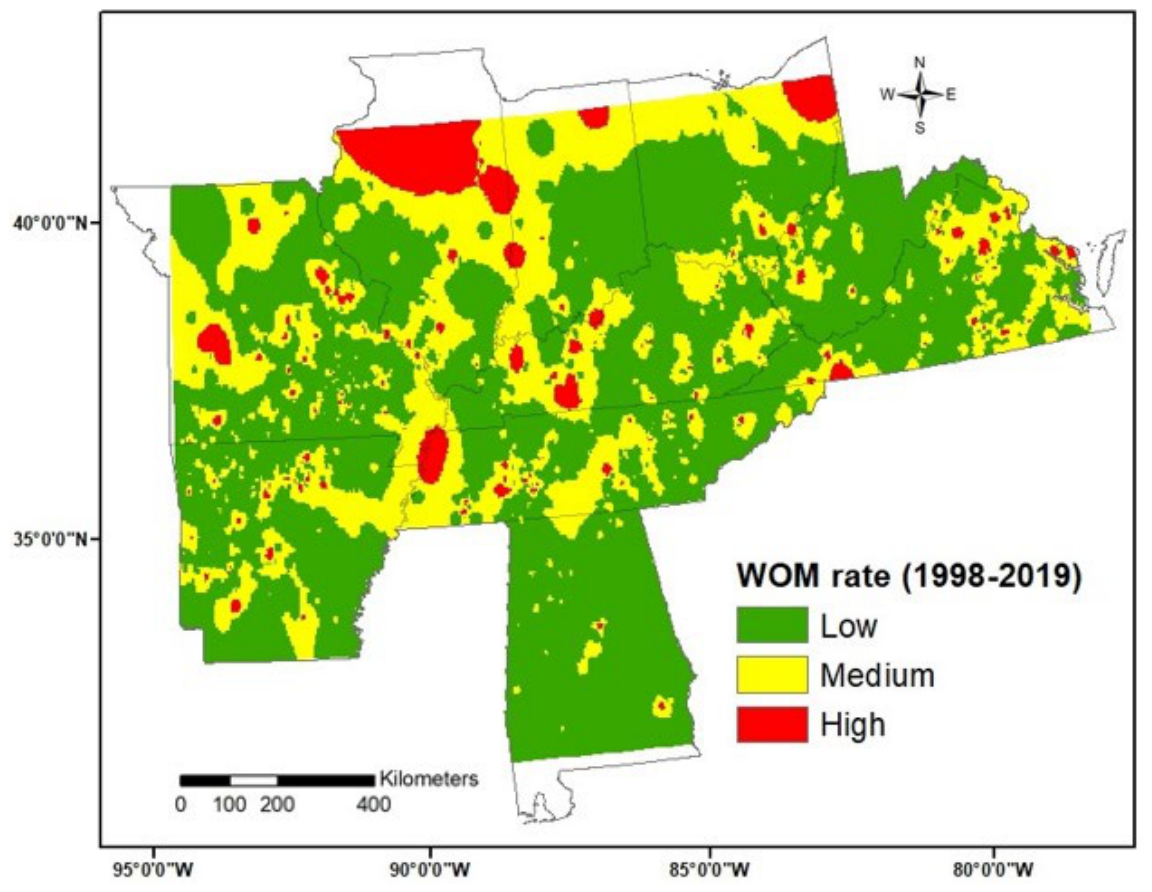
Figure 3.
Spatial distributions of predicted WOM rates under projected five climate models in the eastern US. Red represents prediction of high aggregation and intensity, and yellow represents prediction of medium aggregation, and green represents prediction of low aggregation of WOM rate.
Figure 3.
Spatial distributions of predicted WOM rates under projected five climate models in the eastern US. Red represents prediction of high aggregation and intensity, and yellow represents prediction of medium aggregation, and green represents prediction of low aggregation of WOM rate.
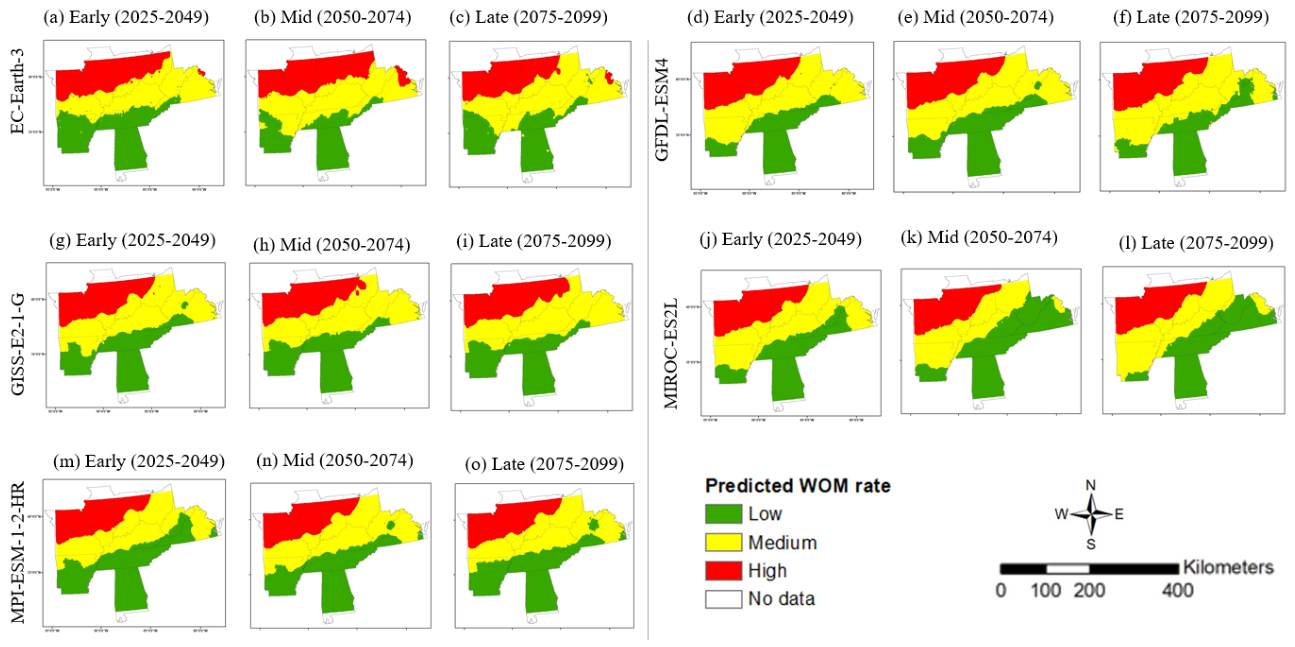
Figure 4.
Spatial distributions of WOM rates with relative changes to current climate across five projected climate models. Red indicates increase (relative change), gray indicates no changes, and blue indicates relative decrease to historic climatic conditions.
Figure 4.
Spatial distributions of WOM rates with relative changes to current climate across five projected climate models. Red indicates increase (relative change), gray indicates no changes, and blue indicates relative decrease to historic climatic conditions.
Disclaimer/Publisher’s Note: The statements, opinions and data contained in all publications are solely those of the individual author(s) and contributor(s) and not of MDPI and/or the editor(s). MDPI and/or the editor(s) disclaim responsibility for any injury to people or property resulting from any ideas, methods, instructions or products referred to in the content. |
© 2026 by the authors. Licensee MDPI, Basel, Switzerland. This article is an open access article distributed under the terms and conditions of the Creative Commons Attribution (CC BY) license.
Copyright: This open access article is published under a Creative Commons CC BY 4.0 license, which permit the free download, distribution, and reuse, provided that the author and preprint are cited in any reuse.