

Submitted:
17 August 2026
Posted:
19 August 2026
You are already at the latest version
Abstract
Background: Regional chemotherapy (RCT) is increasingly used as salvage treatment in patients with advanced chemotherapy-refractory solid malignancies. However, prognostic factors associated with survival following RCT remain poorly defined. This study aims to identify independent prognostic determinants of overall survival in patients treated with RCT. Methods: In this retrospective observational cohort study, 73 consecutive patients with advanced chemotherapy-refractory solid malignancies who underwent RCT at a single tertiary referral center were included. Overall survival (OS) was estimated using the Kaplan–Meier method. Univariable and multivariable Cox proportional hazards regression analyses were performed to evaluate the association between predefined clinicopathological variables and OS. Results: Median OS differed substantially according to tumor type, ranging from 27.1 months for breast cancer to 8.0 months for pancreatic cancer. In multivariable analysis, tumor type was the only independent predictor of OS. Compared with breast cancer, pancreatic cancer was associated with significantly worse survival (hazard ratio [HR] 4.63, 95% confidence interval [CI] 1.55–13.86; p = 0.006), while patients with other solid tumors also had inferior survival (HR 3.68, 95% CI 1.15–11.77; p = 0.028). Age, Karnofsky Performance Status, liver metastases, metastatic burden and previous systemic treatment lines were not independently associated with OS. Conclusions: Tumor type was the principal determinant of survival following regional chemotherapy in this cohort of patients with advanced chemotherapy-refractory solid malignancies. These findings support tumor-specific interpretation of outcomes after RCT and warrant validation in larger prospective cohorts.
Keywords:
regional chemotherapy
; salvage therapy
; advanced solid tumors
; pancreatic cancer
; real-world study
1. Introduction
Despite major advances in systemic anticancer therapy, most patients with advanced solid tumors ultimately develop progressive disease after sequential lines of chemotherapy, targeted therapy and, where applicable, immunotherapy [1,2,3]. Although these treatments have substantially improved survival across many tumor entities, durable disease control remains elusive for most patients with metastatic cancer. Consequently, an increasing number of patients reach a stage at which all evidence-based systemic treatment options have been exhausted while maintaining performance status that still permits active anticancer treatment. This growing population represents a major unmet clinical challenge in contemporary oncology [4,5].
In this therapeutic setting, several salvage strategies have been explored, including regional chemotherapy (RCT). By temporarily isolating the regional circulation and administering cytotoxic agents intra-arterially, RCT aims to achieve markedly higher local concentrations while limiting systemic exposure. The technique has been used for several decades in specialized centers and has shown encouraging clinical activity in selected tumor types. Nevertheless, the available evidence is derived predominantly from retrospective single-center studies, and the precise role of RCT within the multidisciplinary management of advanced treatment-refractory malignancies remains incompletely defined [6,7,8].
Most published studies have primarily focused on describing survival outcomes following regional chemotherapy or comparing these outcomes with historical cohorts treated with systemic therapy [7,8]. However, much less attention has been paid to identifying the clinical factors associated with survival after RCT. Patients referred to regional chemotherapy constitute a highly selected population characterized by marked heterogeneity in tumor biology, metastatic burden, previous treatment exposure and functional status. A better understanding of the determinants of outcome in this setting could improve patient counselling, optimize patient selection and facilitate the design of future prospective studies [9].
Tumor biology is likely to remain the dominant determinant of prognosis even after exhaustion of standard systemic therapy. Whether clinical characteristics such as age, performance status, tumor type, metastatic burden, liver involvement or the extent of previous systemic treatment independently influence survival following regional chemotherapy has not been systematically investigated in contemporary real-world cohorts.
The present study therefore aimed to identify prognostic factors associated with overall survival in consecutive patients with advanced treatment-refractory solid tumors undergoing regional chemotherapy in routine clinical practice. Overall survival was analyzed using Kaplan–Meier methods, while independent prognostic factors were evaluated using multivariable Cox proportional hazards regression. We hypothesized that tumor-related characteristics rather than previous treatment exposure would be the principal determinants of survival following regional chemotherapy.
2. Materials and Methods
2.1. Study Design
This retrospective observational cohort study included consecutive patients with advanced solid malignancies who underwent regional chemotherapy (RCT) at the Medias Klinikum, Burghausen, Germany. All patients were treated according to institutional protocols after multidisciplinary evaluation and were entered into a prospectively maintained clinical database. The present study represents a retrospective analysis of these prospectively collected data. The present analysis included all eligible consecutive patients with complete follow-up data.
2.2. Patient Population
Between 1 January 2024 and 31 December 2024, a total of 92 consecutive patients with advanced solid malignancies underwent regional chemotherapy (RCT) at Medias Klinikum Burghausen. Survival follow-up data could not be obtained for 19 patients despite reasonable efforts to contact them, and these patients were therefore excluded from the present analysis. No statistically significant differences in baseline characteristics were identified between included and excluded patients. The study is reported according to the ESMO Guidance for Reporting Oncology Real-World Evidence (GROW) where applicable. The final study cohort comprised 73 consecutive patients with complete survival follow-up. Patient identification, exclusions and the final study cohort are summarized in Figure 1.
The study population therefore represents a heavily pretreated salvage cohort. As summarized in Table 1, patients were heavily pretreated before referral for RCT. Approximately 89% had previously received at least two systemic treatment lines and more than half had received three or more. The majority had been exposed to fluoropyrimidine-based (89%) and platinum-based (75%) chemotherapy, while nearly half had previously received irinotecan-based (48%) and/or gemcitabine-based (48%) treatment. Previous surgery had been performed in approximately 71% of patients and radiotherapy in approximately 30%, reflecting the advanced stage and multidisciplinary management of this population.
For subgroup analyses, patients were classified according to primary tumor type into breast cancer, gastrointestinal malignancies, pancreatic cancer and other solid tumors. Gastrointestinal malignancies comprised colorectal, gastric, cholangiocarcinoma and anal cancers, whereas the group of other solid tumors included urogenital, gynecological, head and neck and other less common malignancies.
2.3. Regional Chemotherapy
Regional chemotherapy was administered according to established institutional protocols. Depending on tumor localization and vascular anatomy, treatment was delivered using selective arterial infusion and vascular isolation techniques designed to maximize regional drug exposure while limiting systemic toxicity. Treatment regimens, chemotherapeutic agents and the number of treatment sessions were individualized according to tumor type, previous systemic treatment, treatment response and patient tolerance, according to predefined institutional treatment protocols. Repeated RCT sessions were performed in patients demonstrating clinical benefit or disease stabilization and were discontinued in the event of disease progression, unacceptable toxicity or deterioration in clinical condition.
2.4. Study Variables and Outcomes
Clinical and demographic characteristics, tumour type, previous oncological treatments, RCT procedures and follow-up data were retrieved from institutional medical records.
The primary study endpoint was overall survival (OS), defined as the interval between initiation of regional chemotherapy (first RCT session) and death from any cause. Death status was obtained from hospital records, referring physicians and, whenever necessary, direct contact with patients or relatives. The data cut-off for survival analysis was 1 June 2026. Patients alive at the data cut-off were censored at the date of last follow-up. Overall survival was analysed according to the intention-to-treat principle from the first RCT treatment, irrespective of the number of subsequent regional chemotherapy sessions received.
The following candidate prognostic variables were selected a priori based on clinical relevance and previous literature: age, Karnofsky performance status, primary tumor type, presence of liver metastases, number of metastatic organs and number of previous systemic treatment lines
2.5. Statistical Analysis
Continuous variables are presented as mean ± standard deviation (SD) or median with interquartile range (IQR), as appropriate according to their distribution. Categorical variables are summarized as frequencies and percentages.
Overall survival (OS) was estimated using the Kaplan–Meier method and is presented as median survival with corresponding 95% confidence intervals (95% CI). Overall survival was defined as the interval between the first regional chemotherapy session and death from any cause. Patients alive at the time of data cut-off were censored at the date of last follow-up. Differences between survival curves were assessed using the log-rank test.
The association between predefined clinicopathological variables and overall survival was evaluated using Cox proportional hazards regression analysis. Candidate prognostic variables were selected a priori based on their clinical relevance and previous literature and included age, Karnofsky Performance Status (KPS), primary tumor type, presence of liver metastases, number of metastatic organs and number of previous systemic treatment lines. Univariable Cox regression analyses were initially performed for each candidate variable. Subsequently, all predefined candidate variables were entered simultaneously into the multivariable Cox proportional hazards model, irrespective of their statistical significance in the univariable analyses. Hazard ratios (HRs) with corresponding 95% confidence intervals (95% CI) were calculated. Breast cancer was used as the reference category for tumor type. A two-sided p-value < 0.05 was considered statistically significant.
The proportional hazards assumption was assessed using scaled Schoenfeld residuals. Because KPS demonstrated evidence of violation of the proportional hazards’ assumption, a predefined sensitivity analysis excluding KPS was performed to assess the robustness of the multivariable model. Model discrimination was evaluated using Harrell's concordance index (C-index).
Missing data were handled by complete-case analysis. Two patients with missing values for one or more covariates included in the multivariable model were excluded from the corresponding Cox regression analyses, resulting in a complete-case dataset of 71 patients.
All statistical analyses were performed using R statistical software (R Foundation for Statistical Computing, Vienna, Austria; version 4.5.0). Survival analyses were conducted using the survival, survminer, broom, ggplot2, and patchwork packages.
3. Results
3.1. Patient Characteristics
Between 1 January and 31 December 2024, 92 consecutive patients with advanced solid malignancies resistant to systemic chemotherapy underwent regional chemotherapy (RCT) at Medias Klinikum Burghausen. Patient inclusion is summarized in the study flow diagram (Figure 1).
Of the 92 consecutive patients who underwent regional chemotherapy during the study period, 73 fulfilled the eligibility criteria and were included in the primary analyses. The remaining 19 patients were excluded because survival status could not be reliably ascertained.
Baseline characteristics are summarized in Table 1. The median age at initiation of RCT was 65 years (range 39–82), and 42 patients (58 %) were male. Pancreatic cancer was the largest tumor subgroup (n = 36, 49%), followed by gastrointestinal malignancies (n = 16, 22%), other solid tumors (n = 11, 15%) and breast cancer (n = 10, 14%).
The study population represented a heavily pretreated cohort with advanced treatment-refractory disease. Nearly 90% of patients had received at least two previous systemic treatment lines, while approximately two-thirds had undergone three or more lines of systemic therapy before referral for regional chemotherapy. Liver metastases were present in approximately half of the cohort, reflecting the advanced stage of disease at treatment initiation.
3.2. Overall survival
The median follow-up, calculated using the reverse Kaplan-Meier method, was 28,6 months. Sixty-one of the 73 patients (83.6%) had died, whereas 12 patients were alive at the time of censoring.
The Kaplan–Meier survival curve demonstrated a steep decline during the first 12 months, followed by a more gradual decrease thereafter (Figure 2).
Median overall survival from the first regional chemotherapy treatment was 9.0 months (95% CI 7.0–13.0 months). Kaplan–Meier estimated overall survival was 68.9% (95% CI 59.1–80.3%) at 6 months, 40.5% (95% CI 30.8–53.4%) at 12 months, 22.1% (95% CI 14.3–34.2%) at 24 months and 13.5% (95% CI 6.5–28.2%) at 36 months (Figure 2).
3.5. Survival According to Tumor Type
Overall survival differed according to tumor type (Figure 3, log-rank p = 0.050). Patients with breast cancer demonstrated the most favorable survival, with a median overall survival of 26.5 months, followed by patients with gastrointestinal malignancies (14.6 months). In contrast, patients with pancreatic cancer and other solid tumors had substantially shorter median overall survival of 8.0 and 8.3 months, respectively. Unadjusted Kaplan–Meier estimated survival rates at 6, 12, 24 and 36 months for each tumor subgroup are presented in Table 2.
Although Kaplan–Meier curves demonstrated clear separation between tumour entities, the overall difference narrowly missed conventional statistical significance (log-rank χ² = 7.8, p = 0.050).
3.6. Univariable Prognostic Analyses
Univariable Cox proportional hazards regression was performed to evaluate potential prognostic factors associated with overall survival (Table 3).
Tumor type emerged as the strongest prognostic variable. Compared with breast cancer, patients with pancreatic cancer had a threefold increased risk of death (HR 3.01, 95% CI 1.16–7.82; p = 0.024), while patients with other solid tumors also demonstrated significantly worse survival (HR 3.34, 95% CI 1.13–9.92; p = 0.030). Gastrointestinal malignancies showed an intermediate risk that did not reach statistical significance.
Age, sex, performance status, liver metastases, number of previous treatment lines and number of metastatic organs were not significantly associated with overall survival in univariable analysis.
3.6. Multivariable Prognostic Analyses
Variables with potential prognostic relevance were entered into a multivariable Cox proportional hazards model. Complete case analysis included 68 patients with 56 observed deaths.
After adjustment for age, Karnofsky Performance Status, liver metastases, previous treatment lines and metastatic burden, tumor type remained independently associated with survival (Table 4). The adjusted hazard ratios and corresponding 95% confidence intervals are illustrated in the forest plot (Figure 4).
Compared with breast cancer, pancreatic cancer remained associated with a significantly increased mortality risk (adjusted HR 4.63, 95% CI 1.55–13.86; p = 0.006), as did other solid tumors (adjusted HR 3.68, 95% CI 1.15–11.77; p = 0.028). Gastrointestinal malignancies showed a non-significant trend toward worse survival.
The forest plot demonstrates that tumor type was the dominant determinant of prognosis, whereas none of the remaining clinicopathological variables retained independent prognostic significance after adjustment.
Neither age, performance status, liver metastases, number of previous treatment lines nor metastatic burden independently predicted overall survival.
3.7. Model Diagnostics
The model demonstrated moderate discriminative performance (concordance index 0.65).
Assessment of the proportional hazards assumption demonstrated no statistically significant violations for individual covariates except Karnofsky Performance Status (KPS). Because the global proportional hazards test indicated a potential violation of the proportional hazards’ assumption, a prespecified sensitivity analysis excluding KPS from the multivariable model was performed. The sensitivity analysis yielded comparable hazard ratios and preserved tumor type as an independent prognostic factor. In addition, the proportional hazards assumption was no longer violated (global Schoenfeld test, p = 0.55), supporting the robustness of the primary multivariable model (Supplementary Table S1). Visual inspection of the scaled Schoenfeld residual plots supported these findings (Supplementary Figure S1)
4. Discussion
This study complements previous reports from our group and other specialized centers demonstrating the feasibility and clinical activity of regional chemotherapy in patients with advanced malignancies. Whereas earlier studies mainly reported treatment response, toxicity and survival, the present analysis addressed prognostic determinants across a heterogeneous cohort using multivariable modelling.
The principal finding of the present study is that tumor type was the strongest independent predictor of overall survival following regional chemotherapy in patients with advanced chemotherapy-refractory solid malignancies. After adjustment for age, performance status, metastatic burden and previous systemic treatment lines, patients with pancreatic cancer continued to experience substantially poorer survival than those with breast cancer, whereas gastrointestinal malignancies showed an intermediate outcome.
This observation is biologically plausible, as advanced solid tumors differ fundamentally in their natural history, metastatic potential and responsiveness to systemic therapy. Our findings therefore indicate that regional chemotherapy does not eliminate the prognostic impact of tumor biology but rather operates within the biological constraints imposed by the underlying malignancy.
Although our study was not designed to compare RCT with standard systemic therapy, the observed survival outcomes appear encouraging when interpreted within the context of published data for comparable late-line populations. Median OS in our breast cancer cohort compares favourably with outcomes reported in heavily pretreated patients receiving currently available late-line systemic therapy. While the EMBRACE study reported a median OS of 13 months in active late line systemic therapy, the ESMO guidelines indicate that patients who received all evidence-based therapies have very limited therapeutic options [1,10]. However, cross-study comparisons should be interpreted cautiously because of differences in patient section, tumour biology and previous treatment exposure.
Patients with gastrointestinal malignancies constituted the second largest subgroup and achieved a median OS of 14.6 months, representing the second most favourable outcome after breast cancer. Although this subgroup comprised a biologically heterogeneous population—including colorectal, gastric, cholangiocarcinoma and anal cancers—the observed survival compares favourably with published outcomes for patients treated in comparable late-line settings.
In metastatic colorectal cancer, third line and later systemic therapies such as trifluridine/tipiracil (RECOURSE) [11] and regorafenib (CORRECT) [12] have demonstrated median OSs of approximately 7–9 months despite statistically significant improvements over placebo. Similarly, second-line treatment of advanced biliary tract cancer with FOLFOX (ABC-06) [13] and ramucirumab plus paclitaxel for previously treated gastric cancer (RAINBOW) [14] have resulted in median OSs generally ranging between 6 and 10 months in selected patients eligible for further systemic treatment. These studies represent the current standard of care in patients who remain fit enough to receive additional therapy after progression on first-line treatment.
Several biological mechanisms may explain why gastrointestinal tumours could be particularly suitable for regional chemotherapy. Liver-dominant metastatic disease is common in colorectal and several other gastrointestinal cancers, creating a clinical setting in which locoregional drug delivery may achieve substantially higher intratumoral concentrations than systemic administration while limiting systemic toxicity. Whether this pharmacological advantage translates into improved survival cannot be determined from the present retrospective study. Nevertheless, the encouraging survival observed in this subgroup supports further prospective evaluation of regional chemotherapy in selected patients with gastrointestinal malignancies after exhaustion of evidence-based systemic treatment options.
Among all tumour entities included in the present study, patients with pancreatic cancer experienced the shortest OS, with a median OS of 8.0 months despite treatment with regional chemotherapy. This observation is not unexpected and reflects the uniquely aggressive biology of pancreatic ductal adenocarcinoma (PDAC), which remains one of the most lethal solid malignancies despite substantial advances in systemic treatment over the past decade [15,16]
Several biological characteristics of PDAC may explain why survival remains poor despite locoregional treatment approaches. Pancreatic cancer is characterised by early systemic dissemination, marked intratumoral heterogeneity and a dense desmoplastic stromal microenvironment that impedes drug delivery and contributes to intrinsic treatment resistance. These biological features distinguish PDAC from several other gastrointestinal malignancies and may substantially limit the effectiveness of both systemic and regional cytotoxic therapies. Consequently, survival after exhaustion of standard systemic treatment remains disappointingly short in most published series.
Current ESMO Clinical Practice Guidelines recommend FOLFIRINOX, gemcitabine plus nab-paclitaxel or, more recently, NALIRIFOX as standard first-line treatment for fit patients with metastatic pancreatic ductal adenocarcinoma [17,18]. Following disease progression, treatment generally consists of switching to a non-cross-resistant chemotherapy backbone in carefully selected patients with preserved performance status. However, therapeutic options become increasingly limited after failure of these evidence-based regimens, and many patients ultimately transition to best supportive care. These observations support further prospective evaluation of regional chemotherapy in patients who have exhausted evidence-based systemic treatment options.
Nevertheless, the survival observed in our cohort compares favourably with outcomes reported for patients receiving currently available second-line therapies after progression on FOLFIRINOX or gemcitabine-based chemotherapy [2,19]. While cross-study comparisons should be interpreted with caution because of differences in patient selection and treatment history, these findings suggest that regional chemotherapy may represent a feasible salvage option in carefully selected patients who remain candidates for active treatment. Importantly, our data should not be interpreted as evidence that regional chemotherapy overcomes systemic chemoresistance. Rather, they indicate that treatment remains feasible in this clinical setting and justify further prospective evaluation in a disease for which therapeutic innovation remains urgently needed.
Taken together, these observations provide a clinical context for the multivariate analyses presented in the current study
An additional finding was that performance status, metastatic burden, liver metastases and previous systemic treatment lines did not retain independent prognostic significance. Although these variables are well-recognized prognostic factors in advanced cancer, their effect may have been attenuated by the highly selected nature of the present cohort. All patients had chemotherapy-refractory disease and had already undergone multiple systemic treatment lines before referral for regional chemotherapy, thereby reducing the variability of conventional clinical prognostic factors
The present study has several strengths. First, it represents a consecutive real-world cohort of patients with advanced chemotherapy-refractory solid malignancies treated according to a standardized institutional regional chemotherapy programme at a specialized referral center. Second, clinical follow-up was complete for all patients, allowing robust overall survival analyses without loss to follow-up. Third, unlike most previous reports, the present study did not merely describe treatment outcomes but systematically evaluated independent prognostic determinants using multivariable Cox regression analysis. Finally, the validity of the multivariable model was strengthened by formal assessment of the proportional hazards’ assumption and sensitivity analyses, increasing confidence in the robustness of the observed associations.
Several limitations should also be acknowledged. The retrospective single-center design inevitably introduces the possibility of selection bias and residual confounding despite multivariable adjustment. In addition, the relatively limited sample size reduces statistical power and may have prevented the identification of weaker prognostic associations. Although the cohort included several tumor entities with distinct biological characteristics, this heterogeneity also represents a methodological strength, as it enabled evaluation of tumor type as an independent prognostic determinant within a uniform regional chemotherapy treatment strategy. Nevertheless, the relatively small number of patients within individual tumor subgroups precludes definitive conclusions regarding tumor-specific outcomes. Furthermore, detailed molecular tumor characteristics were not consistently available and could therefore not be incorporated into the prognostic analysis. Finally, external validation in independent cohorts will be required to confirm the generalizability of the present findings.
5. Conclusions
In conclusion, tumor type was the only independent predictor of overall survival in this cohort of patients with advanced chemotherapy-refractory solid malignancies treated with regional chemotherapy. Conventional clinical characteristics, including age, performance status, metastatic burden and previous systemic treatment lines, did not provide additional independent prognostic information after multivariable adjustment. These findings suggest that the underlying tumor entity remains the principal determinant of survival following regional chemotherapy and should therefore be routinely considered when interpreting treatment outcomes. Larger prospective studies are warranted to validate these observations and to determine whether tumor-specific prognostic models may further optimize patient selection for regional chemotherapy. The absence of an observable survival difference according to previous FOLFOX/FOLFIRINOX exposure further supports our central finding that tumor biology, rather than treatment history, is the dominant determinant of outcome following regional chemotherapy.
Supplementary Materials
The following supporting information can be downloaded at the website of this paper posted on Preprints.org.
Author Contributions
MH: Conceptualization, Methodology, Investigation, Formal analysis, Data curation, Writing – original draft, Writing – review & editing, Supervision. A.B, Formal analysis, Data curation, Writing – review & editing. KA: Investigation, Resources, Patient recruitment, Writing – review & editing. All authors critically revised the manuscript, approved the final version, and agreed to be accountable for all aspects of the work.
Funding
This research did not receive any specific grant from funding agencies in the public, commercial, or not-for-profit sectors.
Institutional Review Board Statement
The study was reviewed and approved by the Institutional Review Board (IRB) of Medias Klinikum Burghausen (IRB approval No. 2025-017). This study was conducted in accordance with the ethical principles of the Declaration of Helsinki and applicable national regulations. The analysis was based exclusively on retrospectively collected clinical data derived from routine patient care at the Medias Klinikum, Burghausen, Germany. The requirement for obtaining written informed consent was waived by the Institutional Review Board owing to the retrospective observational nature of the study and the use of anonymised clinical data. All data were anonymised before analysis, and no patient-identifying information was included in the study database. As this was a retrospective observational study with no intervention beyond routine clinical practice, no study-specific procedures were performed for research purposes. Regional chemotherapy was administered as part of routine clinical care following multidisciplinary evaluation and written informed consent for treatment. The present analysis did not influence patient management or therapeutic decision-making.
Data Availability Statement
The data supporting the findings of this study are available from the corresponding author upon reasonable request. The underlying patient-level data are not publicly available because they are derived from the hospital’s clinical database and contain potentially identifiable clinical information. Access to data is therefore restricted in accordance with applicable data protection regulations and the conditions of the institutional ethics approval. Aggregated data supporting the findings of this study are available within the article and its Supplementary Materials.
Acknowledgments
During the preparation of this manuscript, the authors used ChatGPT (GPT-5.6, OpenAI) for assistance with language refinement, manuscript wording, and preparation of the Simple Summary. The authors have reviewed and edited the output and take full responsibility for the content of this publication.
Conflicts of Interest
The authors declare no conflicts of interest.
Abbreviations
| C-index | Concordance index |
| CI | Confidence interval |
| ESMO | European Society for Medical Oncology |
| FOLFIRINOX | 5-Fluorouracil, leucovorin, irinotecan and oxaliplatin |
| FOLFOX | 5-Fluorouracil, leucovorin and oxaliplatin |
| HR | Hazard ratio |
| IQR | Interquartile range |
| KPS | Karnofsky Performance Status |
| NR | Not reached |
| OS | Overall survival |
| PDAC | Pancreatic ductal adenocarcinoma |
| RCT | Regional chemotherapy |
| SD | Standard deviation |
References
- Gennari, A. ; André, F. ; Barrios, CH. et al. ESMO Clinical Practice Guideline for the diagnosis, staging and treatment of patients with metastatic breast cancer. Ann Oncol. 2021 Dec ;32(12), 1475-1495. [CrossRef]
- Conroy, T. ; Desseigne, F. ; Ychou, M. et al. PRODIGE Intergroup. FOLFIRINOX versus gemcitabine for metastatic pancreatic cancer. N Engl J Med 2011;364(19):1817–1825. [CrossRef]
- Van Cutsem, E.; Cervantes, A., Adam, R. et al. ESMO consensus guidelines for the management of patients with metastatic colorectal cancer. Ann Oncol. 2016; 27:1386-1422. [CrossRef]
- Sherman, RE.; Anderson, SA.; Dal Pan, GJ. et al. Real-World Evidence—What Is It and What Can It Tell Us? N Engl J Med. 2016;375(23):2293-2297. [CrossRef]
- Booth, CM.; Karim, S.; Mackillop, WJ. Real-world data: towards achieving the achievable in cancer care. Nat Rev Clin Oncol. 2019;16(5):312-325. [CrossRef]
- Aigner, KR.; Gailhofer, S.; Ben-Ari, G. Systemic and regional chemotherapy for advanced and metastasized pancreatic cancer. In: Aigner KR, Stephens FO, editors. Induction Chemotherapy. Springer; 2011. 243–251.
- Aigner, KR.; Gailhofer, S.; Selak, E.; Aigner, K. Intra-arterial infusion chemotherapy versus isolated upper abdominal perfusion for advanced pancreatic cancer: a retrospective cohort study on 454 patients. J Cancer Res Clin Oncol 2019;145(11):2855–2862. [CrossRef]
- Cao, Y.; Yu, D.; Wu, Y.; Zhu, W. Regional intra-arterial vs systemic chemotherapy for the treatment of advanced pancreatic cancer: a systematic review and meta-analysis. Front Oncol. 2024; 14:1197424. [CrossRef]
- Riley, RD.; Snell, KIE.; Ensor, J. et al. Minimum sample size for developing a multivariable prediction model: Part I - Continuous outcomes. Stat Med 2019 Mar 30;38(7): 1262-1275. [CrossRef]
- Cortés, J.; O'Shaughnessy, J.; Loesch, D. et al. Eribulin monotherapy versus treatment of physician's choice in patients with metastatic breast cancer (EMBRACE): a phase 3 open-label randomised study. Lancet. 2011;377(9769):914–923. [CrossRef]
- Mayer, RJ.; Van Cutsem, E.; Falcone, A. et al. Randomized Trial of TAS-102 for Refractory Metastatic Colorectal Cancer. N Engl J Med. 2015;372(20):1909–1919. [CrossRef]
- Grothey, A.; Van Cutsem, E.; Sobrero, A. et al. Regorafenib monotherapy for previously treated metastatic colorectal cancer (CORRECT): an international, multicentre, randomised, placebo-controlled, phase 3 trial. The Lancet. 2013;381(9863):303–312. [CrossRef]
- Lamarca, A. ; Palmer, DH. ; Wasan, HS. et al. Second-line FOLFOX chemotherapy versus active symptom control for advanced biliary tract cancer (ABC-06): a phase 3, open-label, randomised, controlled trial. Lancet Oncol 2021;22(5):690–701. [CrossRef]
- Wilke, H.; Muro, K.; Van Cutsem, E.; Oh, SC. et al. Ramucirumab plus paclitaxel versus placebo plus paclitaxel in patients with previously treated advanced gastric or gastro-oesophageal junction adenocarcinoma (RAINBOW): a double-blind, randomised phase 3 trial. The Lancet Oncology. 2014;15(11):1224–1235. [CrossRef]
- Rahma, OE.; Duffy, A.; Liewehr, DJ.; Steinberg, SM.; Greten, TF. Second-line treatment in advanced pancreatic cancer: a comprehensive analysis of published clinical trials. Ann Oncol 2013;24(8):1972–1979. [CrossRef]
- Jung, HY.; Lee. EM.; Kim, M. et al. The clinical outcomes of second-line chemotherapy in patients with advanced pancreatic cancer: a retrospective study. Journal of Yeungnam Medical Science. 2022;39(2):124–132. [CrossRef]
- Conroy, T. ; Pfeiffer, P. ; Vilgrain V, et al. Pancreatic cancer: ESMO clinical Practice Guidelines for Diagnosis, Treatment and Follow-up. Ann Oncol 2023; 34:987-1002.
- Conroy, T. ; Pfeiffer, P. ; Vilgrain, V. et al. ESMO Clinical Practice Guideline express update on the management of metastatic pancreatic cancer. ESMO-Open. 2025;10: e105289.
- Huh, G.; Lee, HS. ; Choi, JH. et al. Gemcitabine plus nab-paclitaxel as a second-line treatment following FOLFIRINOX failure in advanced pancreatic cancer: a multicenter, single-arm, open-label, phase 2 trial. Therapeutic Advances in Medical Oncology. 2021; 13:17588359211056116. [CrossRef]
Figure 1.
Study Flow Diagram. Study flow diagram illustrating patient selection and inclusion in the present retrospective cohort study. Between 1 January and 31 December 2024, 92 consecutive patients with advanced treatment-refractory solid tumours underwent regional chemotherapy (RCT) at Medias Klinikum Burghausen (Burghausen, Germany). Nineteen patients were excluded because complete survival follow-up was missing, leaving 73 patients for the primary analyses. All 73 patients were included in the descriptive analyses, Kaplan–Meier survival analysis, and univariable Cox proportional hazards regression. Multivariable Cox regression was performed as a complete-case analysis including 68 patients because five patients had missing data for one or more covariates. A predefined sensitivity analysis excluding Karnofsky Performance Status (KPS) from the multivariable model was subsequently performed in 69 patients.
Figure 1.
Study Flow Diagram. Study flow diagram illustrating patient selection and inclusion in the present retrospective cohort study. Between 1 January and 31 December 2024, 92 consecutive patients with advanced treatment-refractory solid tumours underwent regional chemotherapy (RCT) at Medias Klinikum Burghausen (Burghausen, Germany). Nineteen patients were excluded because complete survival follow-up was missing, leaving 73 patients for the primary analyses. All 73 patients were included in the descriptive analyses, Kaplan–Meier survival analysis, and univariable Cox proportional hazards regression. Multivariable Cox regression was performed as a complete-case analysis including 68 patients because five patients had missing data for one or more covariates. A predefined sensitivity analysis excluding Karnofsky Performance Status (KPS) from the multivariable model was subsequently performed in 69 patients.
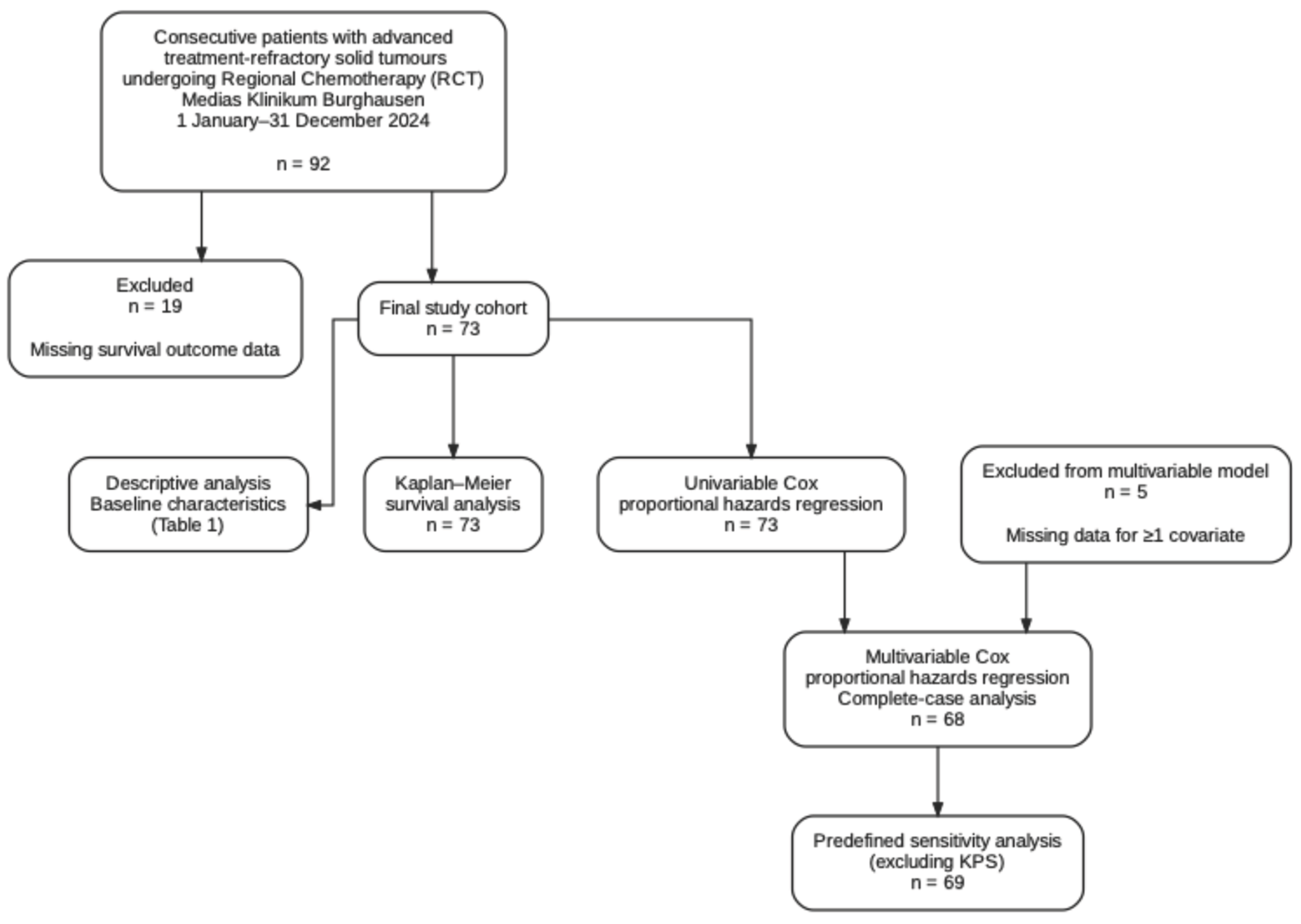
Figure 2.
Overall survival following regional chemotherapy. Figure legend. Kaplan–Meier curve showing OS in the entire study cohort of patients with advanced chemotherapy-refractory solid tumours treated with regional chemotherapy (RCT). OS was calculated from the date of the first RCT treatment to death from any cause. Patients who were alive at the clinical cut-off date were censored at the date of last follow-up. Shaded areas represent the 95% confidence interval, and numbers at risk are displayed below the x-axis. Median OS and estimated 6-, 12-, 24- and 36-month survival rates are reported in the Results section.
Figure 2.
Overall survival following regional chemotherapy. Figure legend. Kaplan–Meier curve showing OS in the entire study cohort of patients with advanced chemotherapy-refractory solid tumours treated with regional chemotherapy (RCT). OS was calculated from the date of the first RCT treatment to death from any cause. Patients who were alive at the clinical cut-off date were censored at the date of last follow-up. Shaded areas represent the 95% confidence interval, and numbers at risk are displayed below the x-axis. Median OS and estimated 6-, 12-, 24- and 36-month survival rates are reported in the Results section.
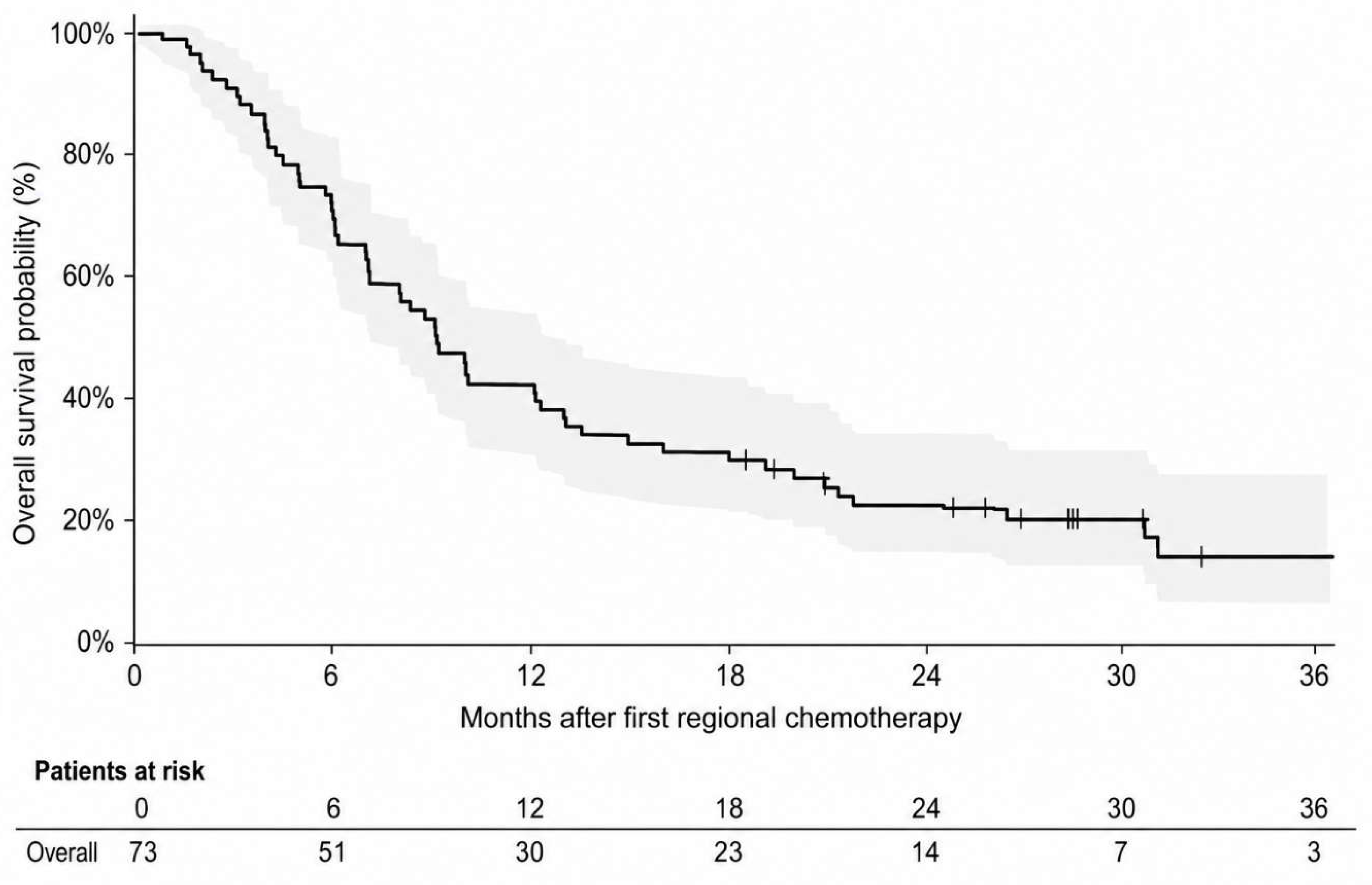
Figure 3.
Overall survival following regional chemotherapy according to tumour type. Kaplan–Meier curves showing overall survival (OS) after initiation of regional chemotherapy (RCT), stratified by tumour type. Panel A: breast cancer (n = 10); Panel B: gastrointestinal malignancies (n = 16); Panel C: pancreatic cancer (n = 36); and Panel D: other solid tumours (n = 11). OS was defined as the interval between the first RCT treatment and death from any cause. Patients alive at the clinical cut-off date were censored at the date of last follow-up. Shaded areas represent 95% confidence intervals, and numbers at risk are displayed below the x-axis. Tumour-specific median OS and estimated survival rates at 6, 12, 24 and 36 months are summarised in Table 2.
Figure 3.
Overall survival following regional chemotherapy according to tumour type. Kaplan–Meier curves showing overall survival (OS) after initiation of regional chemotherapy (RCT), stratified by tumour type. Panel A: breast cancer (n = 10); Panel B: gastrointestinal malignancies (n = 16); Panel C: pancreatic cancer (n = 36); and Panel D: other solid tumours (n = 11). OS was defined as the interval between the first RCT treatment and death from any cause. Patients alive at the clinical cut-off date were censored at the date of last follow-up. Shaded areas represent 95% confidence intervals, and numbers at risk are displayed below the x-axis. Tumour-specific median OS and estimated survival rates at 6, 12, 24 and 36 months are summarised in Table 2.
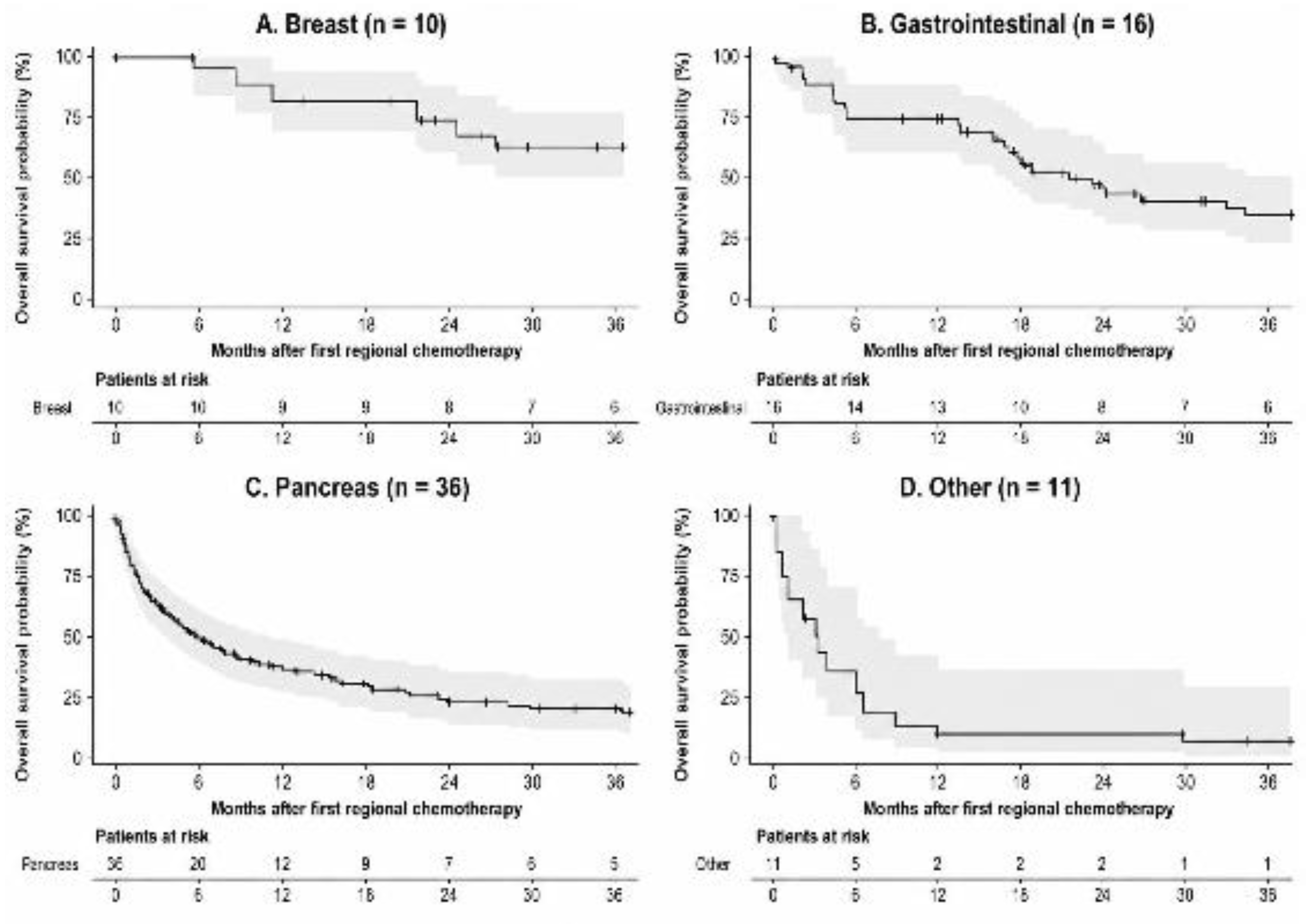
Figure 4.
Forest plot. Because previous exposure to FOLFOX/FOLFIRINOX may influence prognosis in pancreatic cancer, an exploratory subgroup analysis was performed. No significant difference in overall survival was observed between patients with and without previous FOLFOX/FOLFIRINOX treatment (Supplementary Figure S2).
Figure 4.
Forest plot. Because previous exposure to FOLFOX/FOLFIRINOX may influence prognosis in pancreatic cancer, an exploratory subgroup analysis was performed. No significant difference in overall survival was observed between patients with and without previous FOLFOX/FOLFIRINOX treatment (Supplementary Figure S2).
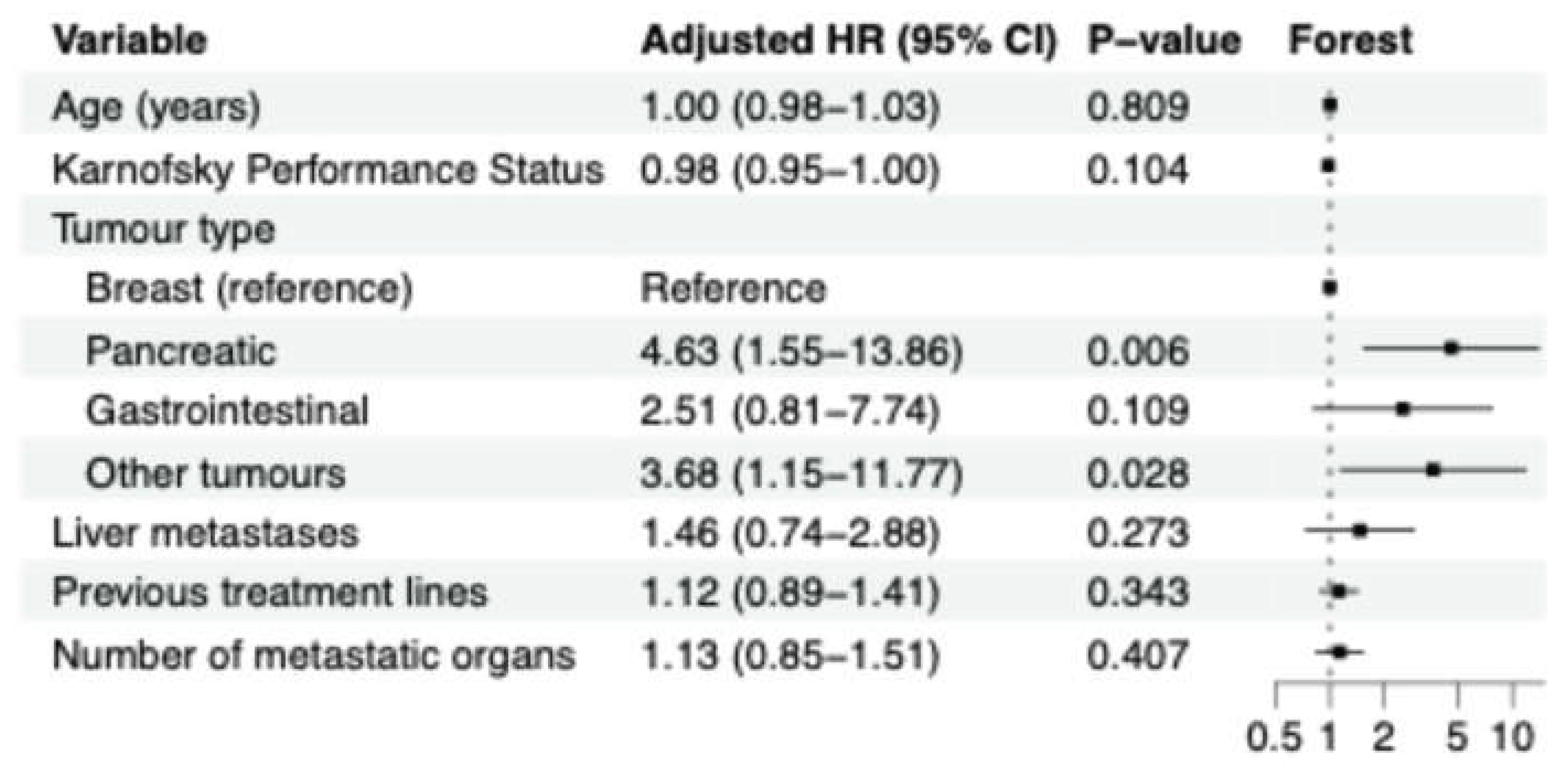

Table 1.
Patient characteristics. Systemic therapies were categorised according to drug class. Patients may have received multiple treatment classes and are therefore represented in more than one category.
Table 1.
Patient characteristics. Systemic therapies were categorised according to drug class. Patients may have received multiple treatment classes and are therefore represented in more than one category.
| Characteristic | Overall cohort (n = 73) |
| Age, median (range), years | 65 (39–82) |
| Male sex, n (%) | 42 (58%) |
| Female sex, n (%) | 31 (42%) |
| Primary tumor, n (%) | |
| • Breast cancer | 10 (14%) |
| • Gastrointestinal malignancies | 16 (22%) |
| • Pancreatic cancer | 36 (49%) |
| • Other solid tumors | 11 (15%) |
| Previous surgery, n (%) | 52 (71%) |
| Previous radiotherapy, n (%) | 22 (30%) |
| Prior fluoropyrimidine-based therapy, n (%) | 65 (89%) |
| Prior platinum-based therapy, n (%) | 55 (75%) |
| Prior irinotecan-based therapy, n (%) | 35 (48%) |
| Prior gemcitabine-based therapy, n (%) | 35 (48%) |
| Prior targeted therapy, n (%) | 25 (34%) |
| Prior immunotherapy, n (%) | 12 (16%) |
| ≥2 prior systemic therapy lines, n (%) | 65 (89%) |
| ≥3 prior systemic therapy lines, n (%) | 45 (62%) |
| Number of RCT sessions, median (range) | 3 (1–8) |
Table 2.
Kaplan–Meier Estimates of Overall Survival According to Tumor Group. Kaplan–Meier estimates of overall survival according to tumor group. Median overall survival (OS) is presented together with the 95% confidence interval (CI). Survival probabilities at 6, 12, 24 and 36 months were estimated using the Kaplan–Meier method. Upper confidence limits were not reached (NR) in tumor groups with insufficient events beyond the median survival time.
Table 2.
Kaplan–Meier Estimates of Overall Survival According to Tumor Group. Kaplan–Meier estimates of overall survival according to tumor group. Median overall survival (OS) is presented together with the 95% confidence interval (CI). Survival probabilities at 6, 12, 24 and 36 months were estimated using the Kaplan–Meier method. Upper confidence limits were not reached (NR) in tumor groups with insufficient events beyond the median survival time.
| Tumor group | Patients (n) | Median OS, months (95% CI) | 6-month OS (%) | 12-month OS (%) | 24-month OS (%) | 36-month OS (%) |
| Breast | 10 | 27.1 (5.8–NR) | 70 | 70 | 60 | 45 |
| Gastrointestinal | 16 | 14.6 (4.1–NR) | 68.8 | 50 | 33.3 | 16.7 |
| Pancreas | 36 | 8.0 (7.0–10.0) | 72.2 | 27.8 | 8.3 | 5.6 |
| Other | 11 | 8.3 (4.5–NR) | 54.5 | 36.4 | 9.1 | 9.1 |
Abbreviations: CI, confidence interval; NR, not reached; OS, overall survival.
Table 3.
Univariate Cox proportional hazards analysis.
| Variable | N | Events | HR (95% CI) | P value |
| Age (years) | 72 | 60 | 0.99 (0.97–1.02) | 0.485 |
| Male sex | 73 | 61 | 1.37 (0.82–2.27) | 0.224 |
| Pancreatic vs Breast | 73 | 61 | 3.01 (1.16–7.82) | 0.024 |
| Gastrointestinal vs Breast | 73 | 61 | 1.72 (0.60–4.98) | 0.314 |
| Other solid tumors vs Breast | 73 | 61 | 3.34 (1.13–9.92) | 0.03 |
| Previous treatment lines | 71 | 59 | 1.04 (0.86–1.26) | 0.702 |
| Liver metastases | 70 | 58 | 1.41 (0.84–2.36) | 0.194 |
| Karnofsky performance score | 70 | 58 | 0.99 (0.96–1.01) | 0.176 |
| Number of metastatic organs | 71 | 59 | 1.15 (0.92–1.42) | 0.214 |
Table 4.
Unadjusted Multivariable Cox proportional hazards analysis of factors associated with overall survival. Multivariable Cox proportional hazards regression analysis of factors associated with overall survival. Hazard ratios (HRs) with 95% confidence intervals (CIs) are reported. Breast cancer was used as the reference category for tumor type. Variables entered into the model were age, Karnofsky Performance Status, tumor type, presence of liver metastases, number of previous treatment lines, and number of metastatic organs.
Table 4.
Unadjusted Multivariable Cox proportional hazards analysis of factors associated with overall survival. Multivariable Cox proportional hazards regression analysis of factors associated with overall survival. Hazard ratios (HRs) with 95% confidence intervals (CIs) are reported. Breast cancer was used as the reference category for tumor type. Variables entered into the model were age, Karnofsky Performance Status, tumor type, presence of liver metastases, number of previous treatment lines, and number of metastatic organs.
| Variable | Hazard Ratio (95% CI) | pvalue |
| Age | 1.00 (0.98–1.03) | 0.809 |
| Karnofsky Performance Status | 0.98 (0.95–1.00) | 0.104 |
| Tumor type | ||
| Breast | Reference | — |
| Pancreas | 4.63 (1.55–13.86) | 0.006 |
| Gastrointestinal | 2.51 (0.81–7.74) | 0.109 |
| Other solid tumors | 3.68 (1.15–11.77) | 0.028 |
| 1.46 (0.74–2.88) | 0.273 | |
| Liver metastases | ||
| Treatment lines | 1.12 (0.89–1.41) | 0.343 |
| Number of metastatic organs | 1.13 (0.85–1.51) | 0.407 |
Abbreviations: CI, confidence interval; HR, hazard ratio; KPS, Karnofsky Performance Status.
Disclaimer/Publisher’s Note: The statements, opinions and data contained in all publications are solely those of the individual author(s) and contributor(s) and not of MDPI and/or the editor(s). MDPI and/or the editor(s) disclaim responsibility for any injury to people or property resulting from any ideas, methods, instructions or products referred to in the content. |
© 2026 by the authors. Licensee MDPI, Basel, Switzerland. This article is an open access article distributed under the terms and conditions of the Creative Commons Attribution (CC BY) license (http://creativecommons.org/licenses/by/4.0/).
Copyright: This open access article is published under a Creative Commons CC BY 4.0 license, which permit the free download, distribution, and reuse, provided that the author and preprint are cited in any reuse.