
Submitted:
18 August 2026
Posted:
19 August 2026
You are already at the latest version
Abstract
Anticancer peptides (ACPs) are frequently discussed as a single therapeutic class, yet the term encompasses molecules that perform markedly different jobs: direct tumor-cell killing, intracellular target inhibition, tumor homing and penetration, immune modu-lation, or selective delivery of a separate payload. This functional diversity creates op-portunity, but it also obscures why many potent peptides fail during translation. In this review, we organize ACPs according to their intended pharmacologic role and examine the molecular and product-development principles that determine whether an active sequence can become a useful medicine. Charge, amphipathicity, conformation, target affinity, cellular entry, protease resistance, tissue exposure, and manufacturability must be optimized as an integrated profile rather than as independent attributes. Repre-sentative clinical programs—including the oncolytic peptide LTX-315, the cell-penetrating peptide p28, the stapled peptide ALRN-6924, the tumor-penetrating peptide CEND-1, and the cyclic integrin inhibitor cilengitide—illustrate both the reach of peptide pharmacology and recurrent causes of attrition. We propose a developabil-ity-centered workflow that links mechanism, route of administration, pharmacokinetics, pharmacodynamics, biomarker strategy, formulation, and chemistry, manufacturing, and controls from the beginning of discovery. For the next generation ACP development, the most credible opportunities lie in route-matched local or regional therapy, mecha-nism-based combinations, experimentally constrained artificial intelligence, and pep-tide-enabled delivery systems supported by fit-for-purpose translational models.
Keywords:
anticancer peptides
; host-defense peptides
; peptide therapeutics
; peptide engineering
; tumor targeting
; peptide-drug conjugates
; translational development
; oncology
1. Introduction
Cancer therapy has become increasingly precise, but treatment failure remains common because malignant populations evolve, tumors contain spatially distinct cell states, and effective exposures are often limited by toxicity [1]. Peptides occupy a useful middle ground between small molecules and larger biologics. Their surfaces can engage protein-protein interfaces, their sequences can be modified residue by residue, and their size can permit tissue access that is difficult for antibodies. At the same time, peptides can be rapidly degraded, cleared by the kidney, trapped in endosomes, or neutralized by plasma and extracellular components. The same structural flexibility that makes peptides attractive therefore creates a demanding optimization problem [2,3].
The literature often defines an anticancer peptide by length, source, or in vitro cytotoxicity. These definitions are convenient but insufficient. A nine-residue membranolytic peptide injected into a tumor, a stabilized alpha helix that blocks an intracellular protein-protein interaction, and a cyclic peptide that carries a cytotoxin to a receptor-positive cancer are not interchangeable products. They require different assays, exposure profiles, formulations, safety margins, and clinical endpoints. Treating them as one homogeneous class can lead to inappropriate comparisons and to development programs in which potency is optimized before the intended therapeutic use is defined [4,5].
This review adopts a developability-centered perspective. We first distinguish the major pharmacologic roles that peptides can play in oncology. We then examine the physicochemical principles underlying activity and selectivity, followed by the decisions that convert a bioactive sequence into a drug product. Representative clinical experiences are used not as a catalogue of candidates, but as case studies in route selection, patient selection, target validation, and product design. Personalized peptide vaccines are outside the present scope because they function primarily as antigens that must be processed and presented by major histocompatibility complex molecules to prime adaptive T-cell immunity, rather than acting directly as tumoricidal, intracellular, targeting, penetrating, or cargo-bearing peptide products. Likewise, peptide hormones and peptide receptor radionuclide therapies are discussed only when they provide transferable lessons for ACP development.
2. Defining ACPs by Their Pharmacologic Job
2.1. Direct Tumoricidal and Oncolytic Peptides
Many ACPs originated from antimicrobial or host-defense peptides and retain cationic, amphipathic architectures [6,7]. They can bind cancer-cell membranes, insert into lipid bilayers, destabilize organelles, or initiate regulated and non-regulated cell death. Their principal advantage is kinetic: membrane injury can occur within minutes and does not require a proliferating cell or an intact apoptotic pathway. This offers a plausible route around some mechanisms of multidrug resistance. Their principal liability is also mechanistic. A peptide that kills by interacting with lipid bilayers must discriminate among tumor cells, erythrocytes, activated leukocytes, vascular endothelium, and other exposed host membranes under realistic concentrations and exposure times.
The rationale for this selectivity is supported by evidence of altered phospholipid exposure on malignant cells and tumor vasculature, together with the preferential interactions of some cationic amphiphiles with those surfaces [8,9,10]. These features remain heterogeneous, however, and cannot substitute for direct safety-margin measurements.
Directly oncolytic peptides may be most tractable when local exposure is intended. LTX-315, a nine-residue peptide developed from lactoferricin-related chemistry, illustrates this product concept. Intratumoral administration produces local membrane disruption and can release tumor antigens and danger signals. In a phase I study, LTX-315 increased intratumoral CD8-positive T-cell infiltration and produced substantial shrinkage in a subset of injected lesions, while systemic and hypersensitivity reactions emphasized that local administration does not eliminate safety considerations [11,12]. The program shows how route, mechanism, and immune pharmacodynamics can be integrated into a single therapeutic strategy.
Figure 1.
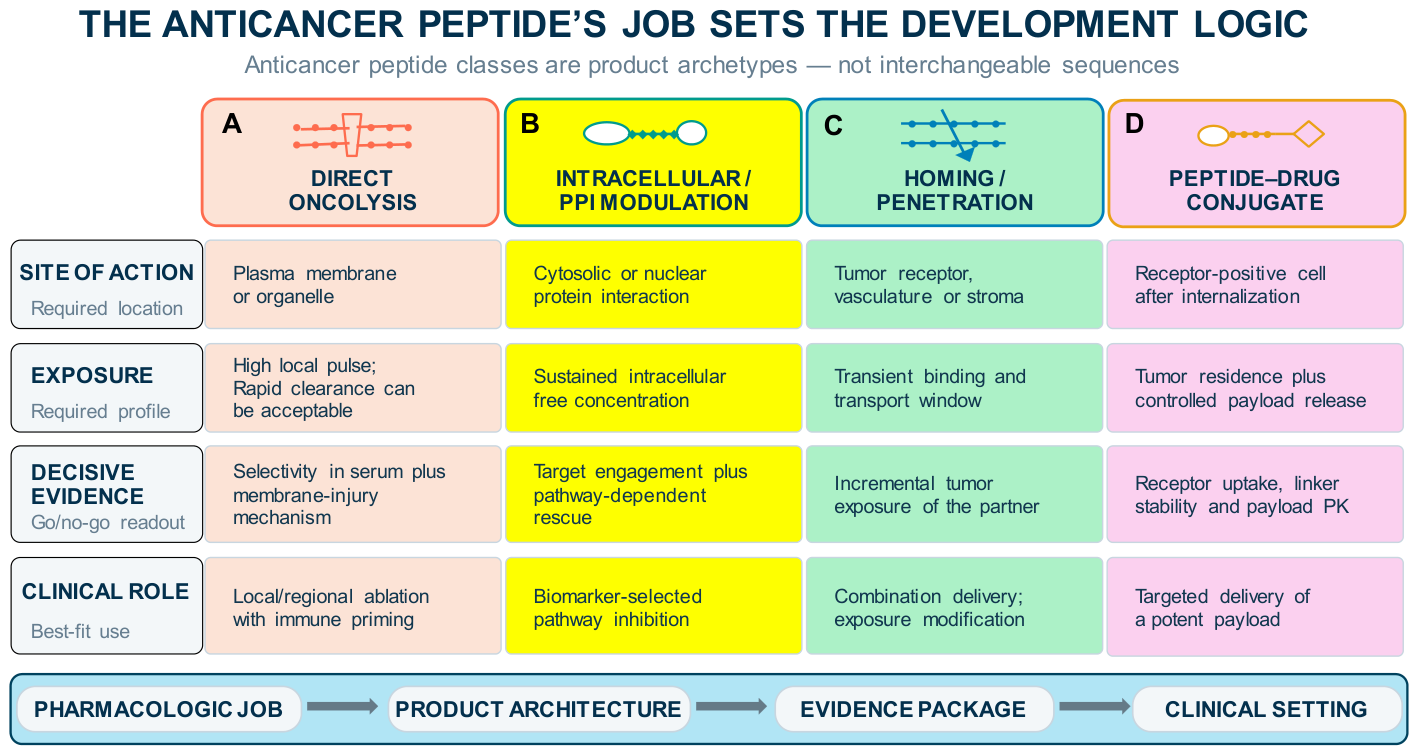
Function-first map of anticancer peptide product archetypes. Anticancer peptides are organized according to their intended pharmacological function: (A) direct oncolysis through disruption of cancer-cell or organelle membranes; (B) modulation of intracellular targets or protein–protein interactions (PPIs); (C) tumor homing or tissue penetration to enhance delivery and exposure; and (D) peptide–drug conjugation for receptor-mediated delivery of a therapeutic payload. For each archetype, the map links the required site of action and exposure profile to the decisive experimental evidence and most appropriate clinical role. These categories are product-development archetypes rather than interchangeable sequence classes; therefore, each requires a distinct molecular architecture, pharmacokinetic profile, validation strategy, and clinical setting. The bottom workflow emphasizes a function-first development principle in which the pharmacological job defines the product architecture, evidence package, and intended clinical application. PK, pharmacokinetics; PPI, protein–protein interaction.
Figure 1.
Function-first map of anticancer peptide product archetypes. Anticancer peptides are organized according to their intended pharmacological function: (A) direct oncolysis through disruption of cancer-cell or organelle membranes; (B) modulation of intracellular targets or protein–protein interactions (PPIs); (C) tumor homing or tissue penetration to enhance delivery and exposure; and (D) peptide–drug conjugation for receptor-mediated delivery of a therapeutic payload. For each archetype, the map links the required site of action and exposure profile to the decisive experimental evidence and most appropriate clinical role. These categories are product-development archetypes rather than interchangeable sequence classes; therefore, each requires a distinct molecular architecture, pharmacokinetic profile, validation strategy, and clinical setting. The bottom workflow emphasizes a function-first development principle in which the pharmacological job defines the product architecture, evidence package, and intended clinical application. PK, pharmacokinetics; PPI, protein–protein interaction.
2.2. Intracellular and Protein-Interaction Modulators
Peptides can reproduce short recognition motifs that mediate protein-protein interactions, including interfaces that are comparatively flat and difficult for conventional small molecules. However, high affinity in a biochemical assay is only the first requirement. Intracellular peptides must cross the plasma membrane, escape endosomes when uptake is vesicular, reach the correct subcellular compartment, resist proteolysis, and remain sufficiently soluble to avoid non-specific binding.
Structural constraint is especially valuable for this class. Hydrocarbon stapling can stabilize an alpha helix, enhance protease resistance, and sometimes improve cellular uptake. The seminal demonstration that a stapled BH3 helix could reactivate apoptosis in vivo established the approach, while subsequent work showed that constraint geometry and staple placement can either preserve or impair function [13,14].
The azurin-derived peptide p28 provides one clinical model. p28 is a cell-penetrating peptide that interacts with the p53 regulatory network through a mechanism distinct from direct membrane lysis. A first-in-human phase I study in advanced solid tumors reported acceptable tolerability and evidence of biologic activity [15]. Such findings are encouraging, but they also underscore a general problem in early peptide trials: broad eligibility can establish safety while providing limited information about which tumors are most dependent on the targeted pathway.
ALRN-6924 (sulanemadlin), a stabilized alpha-helical peptide that inhibits MDM2 and MDMX, provides another model and advanced into phase I testing in TP53-wild-type tumors and lymphomas. Its clinical development demonstrates that a peptide can achieve systemic intracellular pharmacology, but also that genotype, exposure, target engagement, and schedule must remain tightly aligned [16].
2.3. Tumor-Homing and Tissue-Penetrating Peptides
Some peptides are not intended to kill cancer cells. Their pharmacologic job is navigation. Tumor-homing peptides bind receptors on malignant cells, stroma, or tumor vasculature; tissue-penetrating peptides can activate transport pathways that increase access beyond the vascular compartment. The C-end rule (CendR) pathway, in which peptides bearing an exposed C-terminal (R/K)XX(R/K) motif engage neuropilin-1, is a well-characterized example [17]. iRGD couples integrin binding, proteolytic activation, and neuropilin-1-dependent penetration, and preclinical work showed that it can enhance intratumoral delivery of co-administered agents [18].
This enabling role changes the development question. The relevant endpoint is not necessarily the peptide's plasma half-life or cytotoxicity, but whether it reproducibly improves tumor exposure to the partner therapy without increasing normal-tissue exposure. CEND-1 (certepetide), a cyclic tumor-penetrating peptide, was evaluated with gemcitabine and nab-paclitaxel in metastatic pancreatic ductal adenocarcinoma. The phase I study reported no dose-limiting toxicities attributed to the combination and encouraging activity, supporting further randomized evaluation [19]. Because the peptide is an exposure modifier, its clinical value must ultimately be measured against the same backbone regimen without the peptide.
2.4. Cargo-Bearing Peptides and Peptide-Drug Conjugates
Peptide-drug conjugates (PDCs) combine a targeting or uptake sequence, a linker, and a cytotoxic or imaging payload. Their performance depends on the complete molecular assembly. Receptor affinity that is too high may restrict tissue distribution; a linker that is too stable can prevent intracellular release, whereas premature cleavage can recreate the systemic toxicity of the free payload. Payload hydrophobicity may alter peptide solubility, aggregation, plasma protein binding, and clearance. For PDCs, the conjugate—not the unconjugated targeting peptide—is the drug [20].
Adjacent peptide-targeting modalities provide important proof of principle. In somatostatin receptor (SSTR)-positive neuroendocrine tumors, lutetium-177-DOTATATE couples the somatostatin analogue octreotate—which targets SSTRs, particularly SSTR2—to a beta-emitting radionuclide and improved progression-free survival in the NETTER-1 trial [21]. This therapy is not a direct ACP, but it demonstrates the clinical power of pairing receptor-defined patient selection, companion imaging, dosimetry, and a peptide-guided payload. ACP developers should treat this integrated diagnostic-therapeutic architecture as a model rather than assuming that peptide targeting alone guarantees selectivity.

Table 1.
Functional classes of anticancer peptides and their development implications.
| Functional class | Primary therapeutic job | Decisive early measurements | Recurrent failure mode | Product-development implication | Common/optimal route(s) |
| Direct tumoricidal/oncolytic | Kill tumor cells through membrane or organelle injury | Kinetics of killing; normal-cell and erythrocyte selectivity; serum effects; local immune consequences | In vitro potency does not survive plasma binding or cannot be separated from host-membrane toxicity | Define local versus systemic use before sequence optimization | Intratumoral or other local/regional delivery; systemic only with a strong safety margin |
| Intracellular/PPI modulator | Block or restore a disease-driving protein interaction | Target affinity in native context; cell entry; endosomal escape; subcellular exposure; target engagement | Strong biochemical binding but inadequate free intracellular concentration | Optimize affinity, permeability, and metabolic stability together | Intravenous/systemic; local or regional delivery when anatomy permits |
| Homing/penetrating peptide | Direct or increase delivery to tumor tissue | Receptor density; binding/internalization; spatial tumor distribution; effect on partner-drug exposure | Target heterogeneity or increased delivery to normal tissues | Co-develop peptide with biomarker and intended partner therapy | Intravenous, usually co-administered or conjugated with the partner therapy |
| Peptide-drug conjugate | Carry a cytotoxic, imaging, or radionuclide payload | Intact-conjugate PK; linker stability; payload release; tissue distribution; bystander effect | Premature release, poor penetration, or conjugate aggregation | Treat peptide, linker, and payload as one new molecular entity | Intravenous/systemic; local delivery may suit selected payloads or indications |
3. Molecular Principles Governing Activity and Selectivity
3.1. Charge and Amphipathicity are Context Dependent
Cancer cells can display increased anionic character through phosphatidylserine exposure, altered glycosylation and sialylation, and changes in membrane composition [6]. Anionic phospholipids can also be exposed on tumor endothelium [8,9]. These features provide a rationale for cationic ACPs, but they are neither uniform across tumors nor absent from normal physiology. Activated and apoptotic cells, extracellular vesicles, and injured tissues may present similar surfaces. Moreover, albumin, lipoproteins, glycosaminoglycans, salts, and cell density can substantially change peptide activity between a simple culture assay and a tumor.
Net charge, hydrophobicity, hydrophobic moment, and secondary-structure propensity jointly influence binding and insertion [6,10]. Increasing cationicity can improve initial attraction but can also increase non-specific uptake and tissue binding. Increasing hydrophobicity can strengthen membrane disruption while worsening hemolysis, aggregation, and formulation. Consequently, the appropriate objective is not maximal cytotoxicity. It is a reproducible therapeutic window under conditions that approximate the intended route and exposure.
3.2. Cell death Mechanism Shapes Combination and Biomarker Strategy
Membrane lysis, mitochondrial permeabilization, apoptosis, necrosis, autophagy-related death, and other stress responses are often reported as interchangeable evidence of ACP activity. They are not equivalent clinically. Rapid lysis may be desirable for intratumoral immune priming but unacceptable after systemic administration. A mitochondrial peptide may synergize with a BCL-2-family inhibitor, whereas a peptide that disrupts DNA-repair complexes may be better paired with radiation or a DNA-damaging agent. The amount and location of cell death also influence antigen release, dendritic-cell activation, vascular injury, and local inflammation [12,22].
Mechanism should therefore be demonstrated with orthogonal assays and linked to a falsifiable combination hypothesis. Claims of “immunogenic cell death” should include evidence for relevant danger signals, antigen-presenting-cell activation, and adaptive immune contribution, rather than relying on one biomarker. Likewise, resistance claims should be tested in models with defined resistance mechanisms and compared at clinically plausible exposures.
Systemic activity of a host-defense-like lytic peptide in prostate and breast xenografts provided an important proof of concept, but such models also emphasize the need to distinguish antitumor exposure from tolerability margins that may differ in humans [23].
3.3. Conformation Controls Both Pharmacology and Developability
Linear peptides are conformationally flexible and may pay a large entropic penalty on binding. Cyclization, stapling, N-methylation, disulfide engineering, incorporation of non-canonical or D-amino acids, and half-life-extension chemistries can preorganize a binding surface or resist degradation [24,25,26,27]. Yet each modification can change more than one property. Cyclization may reduce degradation but also reduce solubility; D-amino-acid substitution may preserve membrane activity but disrupt stereospecific receptor binding; lipidation may extend exposure while increasing plasma-protein binding.
This multidimensional behavior argues for matched analog panels rather than serial one-property optimization. Potency, selectivity, solubility, aggregation, protease stability, permeability, and exposure should be measured in parallel as early as material permits. A modification should advance only when the resulting profile supports the intended product—not simply because one assay improves. Because those conformational choices determine not only pharmacology but also route, exposure, formulation, and safety, they must now be translated into an explicit target product profile.
4. Developability by Design: Converting a Sequence into a Product
4.1. Start with a Target Product Profile
Peptide discovery often begins with an active sequence and postpones the clinical-use question. Reversing that order improves decision quality. A minimal target product profile should specify the cancer setting, intended route, dosing frequency, monotherapy or combination role, required duration of exposure, acceptable local and systemic toxicity, patient-selection strategy, and a plausible comparator. These choices determine whether rapid clearance is a defect or an advantage. For an intratumoral oncolytic peptide, brief local exposure may be sufficient; for a systemic PPI inhibitor, sustained free plasma and intracellular concentrations may be essential.
The target product profile also prevents delivery technology from becoming an automatic response to weak pharmacology. Nanoparticles, polymers, exosomes, and depot formulations can protect peptides, but they create new distribution, clearance, manufacturing, and regulatory questions. A carrier should solve a demonstrated exposure problem and be compared with simpler alternatives, including sequence stabilization, albumin binding, conjugation, infusion, or local delivery.
4.2. Build a Stage-Gated Assay Cascade
Discovery assays should distinguish true activity from artifacts caused by aggregation, detergent-like behavior, plate binding, or unusually permissive media. Direct cytotoxic ACPs should be evaluated across tumor cells, matched non-malignant cells, primary human cells, erythrocytes, and immune populations. Time-kill kinetics, washout experiments, serum shifts, and cell-density effects are often more informative than a single 24- or 72-hour half-maximal inhibitory concentration. Intracellular inhibitors require quantitative uptake, endosomal escape, target engagement, and rescue or resistance experiments that connect phenotype to the intended target.
Library technologies should be chosen to match the intended chemical space. Phage-encoded bicyclic libraries, for example, can combine the throughput of biological display with chemical constraint and have expanded access to high-affinity cyclic binders [28]. Whatever the discovery platform, activity measurements should be accompanied by explicit counter-screens and sequence-diversity controls.
Early developability measurements should include aqueous solubility across relevant pH, aggregation, chemical stability, plasma and tissue protease stability, microsomal or lysosomal liability where relevant, plasma-protein binding, and whole-blood compatibility. The sequence should then face an explicit advancement rule. For example, a systemic membranolytic ACP should not advance on potency alone if its hemolytic or primary-cell selectivity collapses in the concentration range needed for in vivo exposure.
Figure 2.
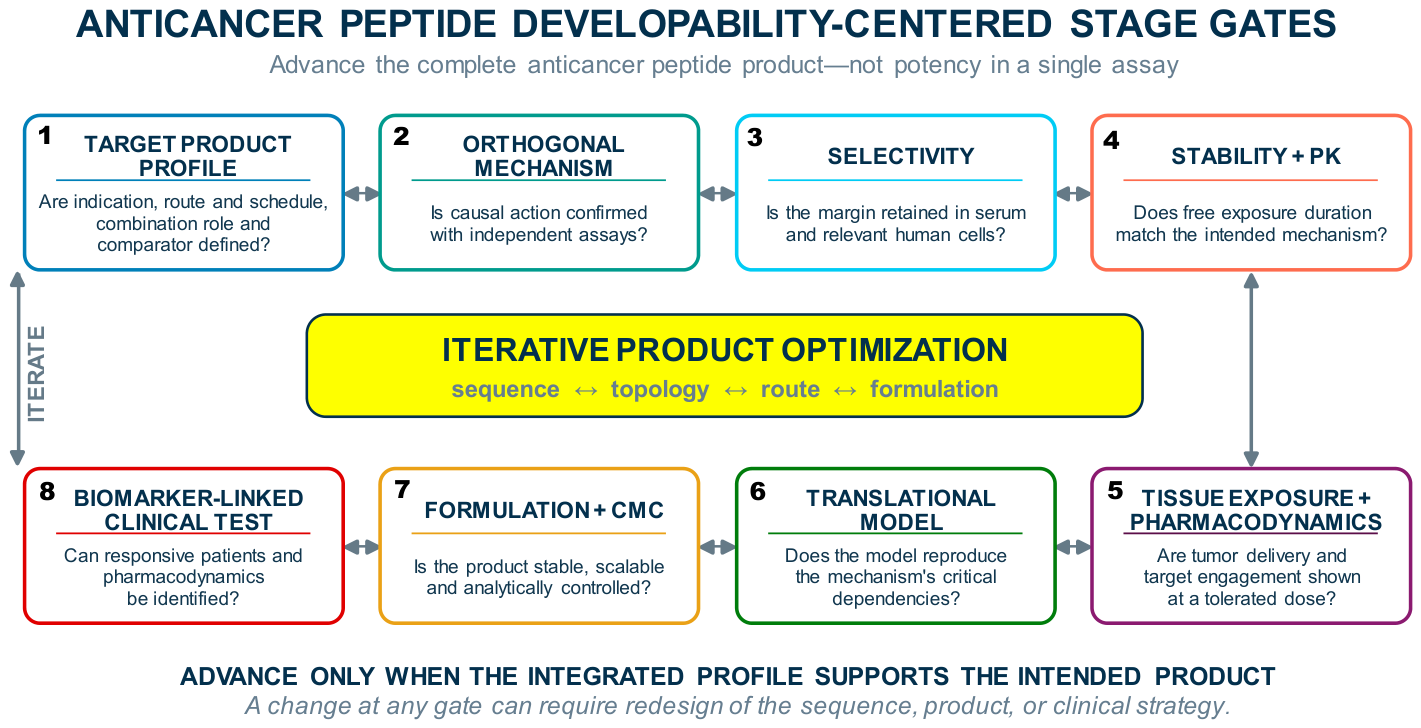
Developability-centered stage-gate framework for anticancer peptide advancement. Candidate products progress through eight interconnected decision gates: (1) definition of the target product profile; (2) confirmation of the proposed mechanism using orthogonal assays; (3) demonstration of selectivity in serum and relevant human cells; (4) alignment of stability and pharmacokinetics with the intended mechanism; (5) confirmation of tissue exposure, target engagement, and pharmacodynamic activity at a tolerated dose; (6) validation in translational models that reproduce critical mechanistic dependencies; (7) establishment of a stable, scalable, and analytically controlled formulation and manufacturing process; and (8) development of a biomarker-linked clinical testing strategy. The bidirectional arrows indicate that development is iterative rather than strictly linear. Findings at any gate may require redesign of the peptide sequence, molecular topology, administration route, formulation, or clinical strategy. Advancement should therefore be based on the integrated product profile rather than potency in a single assay. CMC, chemistry, manufacturing, and controls; PK, pharmacokinetics.
Figure 2.
Developability-centered stage-gate framework for anticancer peptide advancement. Candidate products progress through eight interconnected decision gates: (1) definition of the target product profile; (2) confirmation of the proposed mechanism using orthogonal assays; (3) demonstration of selectivity in serum and relevant human cells; (4) alignment of stability and pharmacokinetics with the intended mechanism; (5) confirmation of tissue exposure, target engagement, and pharmacodynamic activity at a tolerated dose; (6) validation in translational models that reproduce critical mechanistic dependencies; (7) establishment of a stable, scalable, and analytically controlled formulation and manufacturing process; and (8) development of a biomarker-linked clinical testing strategy. The bidirectional arrows indicate that development is iterative rather than strictly linear. Findings at any gate may require redesign of the peptide sequence, molecular topology, administration route, formulation, or clinical strategy. Advancement should therefore be based on the integrated product profile rather than potency in a single assay. CMC, chemistry, manufacturing, and controls; PK, pharmacokinetics.
4.3. Match Stability Engineering to the Required Exposure
Common peptide half-life extension strategies include terminal protection, D-amino-acid substitution, cyclization, N-methylation, stapling, PEGylation, lipidation, fusion to larger carriers, and reversible albumin binding [24,25,26,27]. The optimal strategy depends on where the pharmacologic target resides. Protection from exopeptidases may be sufficient for a locally administered peptide, whereas a systemically delivered intracellular inhibitor may require resistance to endopeptidases, prolonged circulation, and efficient tissue and cellular entry.
Albumin-binding approaches can extend exposure without permanently enlarging the peptide; one biomimetic strategy used a transthyretin-binding moiety to recruit serum protein and prolong peptide half-life [26]. Such approaches can be valuable, but total plasma concentration should not be confused with free pharmacologically available concentration. Distribution and target engagement must be measured directly.
4.4. Treat Route and Formulation as Part of Mechanism
Systemic intravenous dosing is not the default endpoint for every ACP. Intratumoral, intra-arterial, intraperitoneal, inhaled, topical, and implantable-depot routes can generate high regional concentrations for targeted tumors and reduce systemic exposure. Route selection should reflect disease anatomy and clinical workflow. Accessible lesions may permit repeated injection; lung or pleural malignancies may be candidates for regional delivery; postoperative cavities may support local depots. These strategies can convert a narrow systemic therapeutic window into a useful local product, provided local tissue injury and procedural feasibility are rigorously assessed.
For systemic delivery, carriers should be selected by function: protection from proteases, control of release, receptor-mediated targeting, or tissue penetration. Reliance on the enhanced permeability and retention effect alone is risky because nanoparticle entry and distribution in human tumors are heterogeneous, and non-vascular transport mechanisms can dominate [29]. The relevant comparison is not carrier versus free peptide at an arbitrary dose; it is whether the carrier improves exposure at the site of action and therapeutic index at matched systemic toxicity.
4.5. Design for Manufacturing and Control
Chemical complexity accumulates quickly. A peptide containing multiple non-canonical residues, two staples, a cleavable linker, a targeting ligand, and a nanoparticle formulation may be scientifically elegant but difficult to characterize and reproduce. Sequence-related impurities, epimers, deletion products, oxidation, deamidation, aggregation, and linker or payload variants require analytical methods and justified specifications. Longer sequences and extensive modification can reduce synthesis yield and increase solvent use, purification burden, and cost [30,31].
Manufacturability should therefore be assessed during lead optimization. The minimum effective length, number of stereocenters and modifications, feasible solid-phase or recombinant route, purification recovery, formulation stability, container compatibility, and scale-dependent impurity profile should be known before late preclinical development. Quality by design is especially important for PDCs, for which heterogeneity can arise from the peptide, linker, payload, and conjugation process [32].
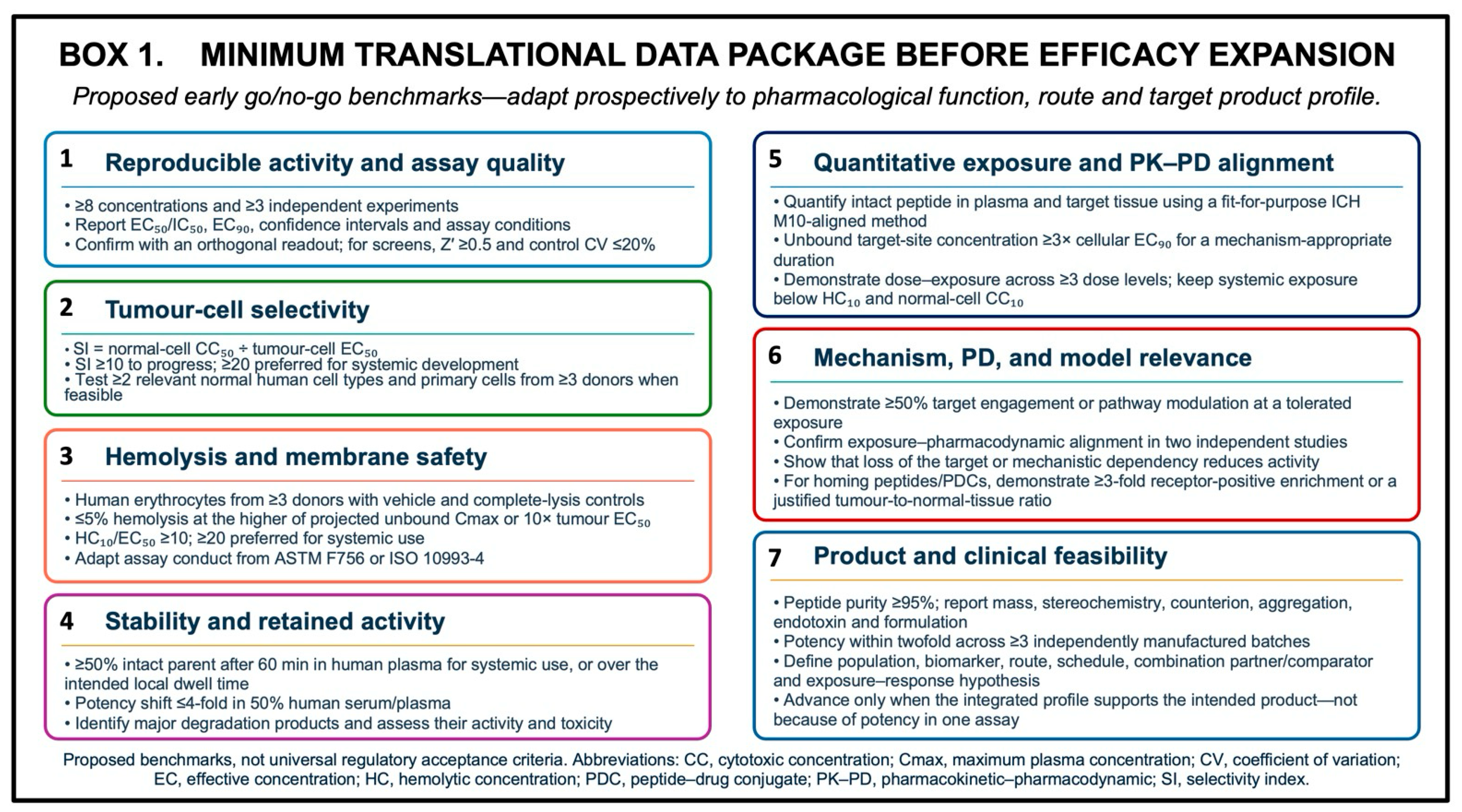 |
- Box 1. Proposed minimum translational data package for anticancer peptide development before efficacy expansion.
5. Translational Lessons from Representative Programs
Clinical history supports neither blanket optimism nor pessimism. Peptides have reached tumors, engaged intracellular targets, altered immune infiltrates, and delivered potent payloads. They have also failed in randomized trials despite strong biologic rationale. The most useful question is what each program teaches about the fit among mechanism, product design, and clinical setting.
LTX-315 demonstrates the value of a route-matched product. Intratumoral delivery concentrates a membranolytic peptide where acute lysis and inflammation are desired. Its phase I data support biological activity but also show that lesion-level and immune effects do not automatically translate into conventional objective responses [12]. Future trials of local ACPs should prospectively define injected-lesion response, non-injected-lesion response, immune pharmacodynamics, and the contribution of combination immunotherapy.
p28 and ALRN-6924 demonstrate that cell-penetrating and structurally stabilized peptides can be administered systemically and interrogate intracellular cancer biology [15,16]. Their development also highlights the importance of molecular selection. A p53-pathway therapy needs a biomarker strategy that goes beyond a nominal TP53 label and addresses pathway competence, negative regulators, target dependence, and intratumoral exposure.
CEND-1 shows that a peptide can be developed as an enhancer of a standard regimen rather than as an independent cytotoxin [19]. The decisive test is randomized evidence that the peptide adds benefit to the backbone therapy. Cilengitide, a cyclic RGD peptide targeting alpha-v beta-3 and alpha-v beta-5 integrins, provides the complementary caution. Despite encouraging early studies, adding cilengitide to standard chemoradiotherapy did not improve outcomes in the phase III CENTRIC trial [33]. The result does not invalidate cyclic peptides; it shows that target expression, schedule, tumor biology, and disease selection must support the proposed mechanism.
Table 2.
Representative clinical experiences and transferable lessons.
| Peptide/program | Product role and route | Clinical evidence summarized here | Transferable development lesson |
| LTX-315 | Direct oncolytic 9-mer; intratumoral | Phase I: local tumor injury, increased CD8-positive infiltration, and lesion-level activity with injection-related and systemic reactions | Local delivery can align exposure with mechanism; immune and lesion-specific endpoints must be prespecified |
| p28 | Cell-penetrating p53-pathway modulator; intravenous | First-in-human phase I reported tolerability and signals of biologic activity | Early safety is feasible; pathway dependence and pharmacodynamic selection are needed for efficacy testing |
| ALRN-6924 | Stapled MDM2/MDMX inhibitor; intravenous | Phase I in TP53-wild-type cancers demonstrated systemic exposure, target pharmacology, and antitumor activity in a subset | Structural stabilization can enable intracellular peptide therapy, but genotype, pathway competence, and schedule must align |
| CEND-1 | Cyclic tumor-penetrating peptide; intravenous with chemotherapy | Phase I in metastatic pancreatic cancer supported combination feasibility and further testing | An enabling peptide should be judged by incremental partner-drug delivery and randomized benefit |
| Cilengitide | Cyclic RGD integrin inhibitor; intravenous | Phase III addition to standard therapy in selected glioblastoma did not improve outcome | Target-binding rationale and early activity cannot substitute for validated disease biology and exposure-response relationships |
| 177Lu-DOTATATE | Peptide receptor-targeted radionuclide; intravenous (adjacent modality) | Randomized phase III efficacy in receptor-positive neuroendocrine tumors | Peptide targeting is strongest when paired with receptor imaging, patient selection, and payload-specific dosimetry |
6. Challenges That Should Reset Field Standards
6.1. Selectivity must be Demonstrated at Achievable Exposure
Cancer-selective activity is often reported as a ratio of half-maximal effects in one cancer line and one immortalized normal line. This is inadequate for membrane-active peptides and misleading for targeted peptides if the comparator lacks the target. Selectivity should be established across a panel representing the tissues most exposed by the intended route and at concentrations supported by pharmacokinetics. Whole-blood compatibility, complement activation, cytokine release, vascular effects, and repeat-dose immune responses should be incorporated when the peptide's charge, aggregation, or origin makes those risks plausible.
6.2. Tumor Heterogeneity is a Distribution Problem as well as a Target Problem
Receptor abundance varies among patients, lesions, and regions within a lesion. Dense matrix, high interstitial pressure, necrosis, abnormal vasculature, and binding-site barriers can create steep concentration gradients. Bulk tumor concentration may therefore conceal inadequate exposure of viable target cells. Spatial pharmacology—using imaging, microdissection, autoradiography, or spatial omics—should become routine for targeted and conjugated peptides. A successful product needs sufficient exposure in the cells that drive progression, not merely detectable accumulation in the tumor mass.
6.3. Preclinical Models must Reproduce the Mechanism's Dependencies
Subcutaneous xenografts can overestimate exposure and cannot model an intact immune response. Syngeneic models preserve immunity but may not reproduce the human target or peptide metabolism. Genetically engineered models offer native tissue architecture but are slower and can be less suitable for screening. Patient-derived organoids and ex vivo tumor cultures can preserve clinically relevant genotypes and, in some formats, immune and stromal components [34,35]. No single model is sufficient. Model selection should be based on the mechanism's dependencies: membrane composition for a lytic peptide, receptor distribution for a homing peptide, immune competence for an immunogenic therapy, and human protease stability for a systemic product.
6.4. Dose Finding Should Optimize Benefit-Risk, not Merely Identify Tolerance
Peptide pharmacology may be transient, saturable, locally concentrated, or schedule dependent. The highest tolerated dose can be biologically unnecessary and may worsen non-specific effects. Early trials should integrate exposure, target engagement, lesion pharmacodynamics, and repeated sampling to identify an optimized dose and schedule. This approach is consistent with current oncology guidance emphasizing dose optimization rather than automatic selection of the maximum tolerated dose [36]. For local peptides and PDCs, route-specific or payload-specific dose metrics may be required.
7. Future Opportunities
7.1. Route-First Development can Rescue Valuable Mechanisms
The most immediate opportunity is not a new chemistry but better matching of peptide pharmacology to anatomy. Local and regional administration can exploit rapid action while limiting systemic exposure. Intratumoral peptides can combine tumor debulking with immune priming; inhaled or airway-directed formulations could provide high regional exposure for selected pulmonary malignancies; postoperative depots could target residual disease at a defined site. These approaches require dedicated toxicology and formulation, but they may offer a shorter path than forcing every active sequence into chronic systemic dosing.
7.2. Combinations Should be Mechanism Led
Peptides are well suited to combinations when they alter access or cell state. Tumor-penetrating peptides can increase delivery of a partner drug; membranolytic peptides can release antigens and inflammatory signals; mitochondrial or signaling peptides can lower the threshold for chemotherapy or radiation. The field should move from descriptive synergy matrices to designs that identify the order, timing, and pharmacodynamic consequence of each agent. The peptide's contribution must remain measurable, particularly when the partner regimen is already active.
7.3. Artificial Intelligence Should Optimize Constrained, Testable Profiles
Machine learning can prioritize sequences, predict activity or toxicity, and generate candidate binders. Recent studies have combined generative models with docking and molecular dynamics to produce experimentally improved peptide inhibitors of beta-catenin and NEMO, while protein-language-model approaches have generated target-conditioned peptide binders [37,38]. Structure-aware methods are also expanding cyclic-peptide design [39]. These are meaningful advances, but they do not remove the need for pharmacology. Models trained on heterogeneous cytotoxicity labels can reproduce assay bias, and random data splitting can exaggerate performance when homologous sequences appear in training and test sets.
Training-set quality is therefore a central constraint. Many ACP datasets combine positives measured in different cell lines, media, serum conditions, exposure times, and endpoint assays, whereas ‘negative’ sequences may simply lack an ACP annotation or may have been drawn from unrelated proteins rather than shown experimentally to be inactive. A model can then learn length, charge, hydrophobicity, sequence source, or laboratory-specific assay signatures instead of transferable anticancer biology. The field needs standardized negative datasets: peptides tested alongside positives under the same protocols and confirmed inactive at prespecified concentrations, plus hard negatives matched for length, net charge, hydrophobicity, and structural class that fail on efficacy or selectivity. Each negative should carry assay metadata, peptide purity, aggregation and solubility information, serum conditions, normal-cell toxicity, and detection limits. Sequence-similarity-aware family splits should keep close analogues out of both training and test sets, and models should undergo blinded external validation on balanced panels. Existing ACP predictors illustrate the dependence on curated positive and non-ACP sets [40], A concrete example is the widely reused alternate AntiCP 2.0 benchmark, which paired 970 experimentally validated ACPs with 970 peptides randomly sampled from Swiss-Prot [41]. Because these negative sequences were not experimentally confirmed to lack anticancer activity and may differ systematically in source or composition, a model can learn dataset construction rather than ACP biology. Systematic peptide benchmarking further shows that negative-sampling strategy alone can substantially bias reported performance [42].
The productive near-term role of AI is multi-parameter prioritization within a closed experimental loop. Models should be trained and prospectively challenged on standardized measurements of potency, normal-cell selectivity, hemolysis, solubility, aggregation, protease stability, permeability, and manufacturability. Designed peptides should be evaluated against withheld sequence families and then subjected to the same target-engagement and exposure standards as conventionally discovered leads.
7.4. Peptide-Enabled Delivery may Mature Faster than Standalone Systemic Cytotoxicity
Homing peptides, penetration peptides, PDCs, and radioligands can exploit high-affinity recognition while assigning cell killing to a payload with established potency. This division of labor may be more developable than requiring one short sequence to provide targeting, penetration, stability, and cytotoxicity simultaneously. The opportunity is strongest when the target can be measured clinically and when imaging or a circulating biomarker can confirm engagement. Modular platforms should nevertheless avoid assuming that a targeting sequence is portable across payloads; every new linker-payload combination changes the molecule's distribution and safety.
7.5. Translation-Ready Evidence Packages can Reduce Avoidable Attrition
The field would benefit from common reporting standards that connect sequence, purity, counterion, formulation, assay conditions, exposure, and outcome. Negative results—loss of activity in serum, hemolysis, poor tumor penetration, or failure of a stabilizing modification—are particularly valuable for computational design and should be captured in interoperable datasets. Academic programs can improve their translational readiness by producing a concise data package aligned with Box 1 before expanding efficacy claims. This would make partnership decisions more evidence based and allow promising ACPs to be compared on developability rather than on in vitro potency alone.
8. Conclusions
Anticancer peptides are not one modality. They are a family of molecular formats that can kill, inhibit, navigate, penetrate, or carry cargo. Their future depends less on discovering ever more cytotoxic sequences than on defining the peptide's therapeutic job and designing the entire product around it. Mechanism, route, exposure, biomarker, formulation, manufacturing, and clinical endpoint must be connected from the start.
Clinical experience already provides a practical roadmap. Local oncolytic peptides show how route can create a therapeutic window; stabilized helices show that intracellular peptide pharmacology is achievable; tumor-penetrating peptides show how a peptide can enable another medicine; and negative randomized trials show the cost of weak biological selection. In the future, the strongest ACP programs will be those that combine chemical ingenuity with disciplined development: fit-for-purpose models, quantitative pharmacology, scalable chemistry, and trials capable of testing the mechanism. With that shift, selected peptides can progress from compelling sequences to useful anticancer medicines.
Author Contributions
Conceptualization, Y.P.D.; writing—original draft preparation, M.E.D. and Y.P.D.; writing—review and editing, M.E.D. and Y.P.D.; supervision, Y.P. Di.; Funding acquisition, Y.P. Di. All authors have read and agreed to the published version of the manuscript.
Funding
This work was supported by the National Institutes of Health [grant numbers R01AI176537, R01HL180677, and R21AI191628]. The content is solely the responsibility of the authors and does not necessarily represent the official views of the National Institutes of Health.
Institutional Review Board Statement
Not applicable.
Informed Consent Statement
Not applicable.
Data Availability Statement
No new data were created or analyzed in this review.
Acknowledgments
During the preparation of this manuscript/study, the authors used ChatGPT-4 for the purposes of clarity and grammar. The authors have reviewed and edited the output and take full responsibility for the content of this publication.
Conflicts of Interest
The authors declare no conflicts of interest. The funders had no role in the design of the study; in the collection, analyses, or interpretation of data; in the writing of the manuscript; or in the decision to publish the results.
References
- Bray, F.; Laversanne, M.; Sung, H.; Ferlay, J.; Siegel, R.L.; Soerjomataram, I.; Jemal, A. Global cancer statistics 2022: GLOBOCAN estimates of incidence and mortality worldwide for 36 cancers in 185 countries. CA Cancer J. Clin. 2024, 74, 229–263. [Google Scholar] [CrossRef] [PubMed]
- Muttenthaler, M.; King, G.F.; Adams, D.J.; Alewood, P.F. Trends in peptide drug discovery. Nat. Rev. Drug Discov. 2021, 20, 309–325. [Google Scholar] [CrossRef] [PubMed]
- Lau, J.L.; Dunn, M.K. Therapeutic peptides: Historical perspectives, current development trends, and future directions. Bioorg. Med. Chem. 2018, 26, 2700–2707. [Google Scholar] [CrossRef] [PubMed]
- Xie, M.; Liu, D.; Yang, Y. Anti-cancer peptides: Classification, mechanism of action, reconstruction and modification. Open Biol. 2020, 10, 200004. [Google Scholar] [CrossRef] [PubMed]
- Chiangjong, W.; Chutipongtanate, S.; Hongeng, S. Anticancer peptide: Physicochemical property, functional aspect and trend in clinical application. Int. J. Oncol. 2020, 57, 678–696. [Google Scholar] [CrossRef] [PubMed]
- Deslouches, B.; Di, Y.P. Antimicrobial peptides with selective antitumor mechanisms: prospect for anticancer applications. Oncotarget 2017. [Google Scholar] [CrossRef] [PubMed]
- Luan, X.; Wu, Y.; Shen, Y.W.; Zhang, H.; Zhou, Y.D.; Chen, H.Z.; Nagle, D.G.; Zhang, W.D. Cytotoxic and antitumor peptides as novel chemotherapeutics. Nat. Prod. Rep. 2021, 38, 7–17. [Google Scholar] [CrossRef] [PubMed]
- Utsugi, T.; Schroit, A.J.; Connor, J.; Bucana, C.D.; Fidler, I.J. Elevated expression of phosphatidylserine in the outer membrane leaflet of human tumor cells and recognition by activated human blood monocytes. Cancer Res. 1991, 51, 3062–3066. [Google Scholar] [PubMed]
- Ran, S.; Downes, A.; Thorpe, P.E. Increased exposure of anionic phospholipids on the surface of tumor blood vessels. Cancer Res. 2002, 62, 6132–6140. [Google Scholar] [PubMed]
- Schweizer, F. Cationic amphiphilic peptides with cancer-selective toxicity. Eur. J. Pharmacol. 2009, 625, 190–194. [Google Scholar] [CrossRef] [PubMed]
- Haug, B.E.; Camilio, K.A.; Eliassen, L.T.; Stensen, W.; Svendsen, J.S.; Berg, K.; Mortensen, B.; Serin, G.; Mirjolet, J.F.; Bichat, F.; Rekdal, O. Discovery of a 9-mer cationic peptide (LTX-315) as a potential first in class oncolytic peptide. J. Med. Chem. 2016, 59, 2918–2927. [Google Scholar] [CrossRef] [PubMed]
- Spicer, J.; Marabelle, A.; Baurain, J.F.; Jebsen, N.L.; Jøssang, D.E.; Awada, A.; et al. Safety, antitumor activity, and T-cell responses in a dose-ranging phase I trial of the oncolytic peptide LTX-315 in patients with solid tumors. Clin. Cancer Res. 2021, 27, 2755–2763. [Google Scholar] [CrossRef] [PubMed]
- Walensky, L.D.; Kung, A.L.; Escher, I.; Malia, T.J.; Barbuto, S.; Wright, R.D.; Wagner, G.; Verdine, G.L.; Korsmeyer, S.J. Activation of apoptosis in vivo by a hydrocarbon-stapled BH3 helix. Science 2004, 305, 1466–1470. [Google Scholar] [CrossRef] [PubMed]
- Bird, G.H.; Madani, N.; Perry, A.F.; Princiotto, A.M.; Supko, J.G.; He, X.; et al. Hydrocarbon double-stapling remedies the proteolytic instability of a lengthy peptide therapeutic. Proc. Natl. Acad. Sci. USA 2010, 107, 14093–14098. [Google Scholar] [CrossRef] [PubMed]
- Warso, M.A.; Richards, J.M.; Mehta, D.; Christov, K.; Schaeffer, C.; Rae Bressler, L.; et al. A first-in-class, first-in-human, phase I trial of p28, a non-HDM2-mediated peptide inhibitor of p53 ubiquitination in patients with advanced solid tumours. Br. J. Cancer 2013, 108, 1061–1070. [Google Scholar] [CrossRef] [PubMed]
- Saleh, M.N.; Patel, M.R.; Bauer, T.M.; Goel, S.; Falchook, G.S.; Shapiro, G.I.; et al. Phase 1 trial of ALRN-6924, a dual inhibitor of MDMX and MDM2, in patients with solid tumors and lymphomas bearing wild-type TP53. Clin. Cancer Res. 2021, 27, 5236–5247. [Google Scholar] [CrossRef] [PubMed]
- Teesalu, T.; Sugahara, K.N.; Kotamraju, V.R.; Ruoslahti, E. C-end rule peptides mediate neuropilin-1-dependent cell, vascular, and tissue penetration. Proc. Natl. Acad. Sci. USA 2009, 106, 16157–16162. [Google Scholar] [CrossRef] [PubMed]
- Sugahara, K.N.; Teesalu, T.; Karmali, P.P.; Kotamraju, V.R.; Agemy, L.; Greenwald, D.R.; Ruoslahti, E. Coadministration of a tumor-penetrating peptide enhances the efficacy of cancer drugs. Science 2010, 328, 1031–1035. [Google Scholar] [CrossRef] [PubMed]
- Dean, A.; Gill, S.; McGregor, M.; Broadbridge, V.; Järveläinen, H.A.; Price, T. Dual αV-integrin and neuropilin-1 targeting peptide CEND-1 plus nab-paclitaxel and gemcitabine for the treatment of metastatic pancreatic ductal adenocarcinoma: A first-in-human, open-label, multicentre, phase 1 study. Lancet Gastroenterol. Hepatol. 2022, 7, 943–951. [Google Scholar] [CrossRef] [PubMed]
- Vrettos, E.I.; Mező, G.; Tzakos, A.G. On the design principles of peptide-drug conjugates for targeted drug delivery to the malignant tumor site. Beilstein J. Org. Chem. 2018, 14, 930–954. [Google Scholar] [CrossRef] [PubMed]
- Strosberg, J.; El-Haddad, G.; Wolin, E.; Hendifar, A.; Yao, J.; Chasen, B.; et al. Phase 3 trial of 177Lu-Dotatate for midgut neuroendocrine tumors. N. Engl. J. Med. 2017, 376, 125–135. [Google Scholar] [CrossRef] [PubMed]
- Mader, J.S.; Hoskin, D.W. Cationic antimicrobial peptides as novel cytotoxic agents for cancer treatment. Expert Opin. Investig. Drugs 2006, 15, 933–946. [Google Scholar] [CrossRef] [PubMed]
- Papo, N.; Seger, D.; Makovitzki, A.; Kalchenko, V.; Eshhar, Z.; Degani, H.; Shai, Y. Inhibition of tumor growth and elimination of multiple metastases in human prostate and breast xenografts by systemic inoculation of a host defense-like lytic peptide. Cancer Res. 2006, 66, 5371–5378. [Google Scholar] [CrossRef] [PubMed]
- Craik, D.J.; Fairlie, D.P.; Liras, S.; Price, D. The future of peptide-based drugs. Chem. Biol. Drug Des. 2013, 81, 136–147. [Google Scholar] [CrossRef] [PubMed]
- Werle, M.; Bernkop-Schnürch, A. Strategies to improve plasma half life time of peptide and protein drugs. Amino Acids 2006, 30, 351–367. [Google Scholar] [CrossRef] [PubMed]
- Penchala, S.C.; Miller, M.R.; Pal, A.; Dong, J.; Madadi, N.R.; Xie, J.; et al. A biomimetic approach for enhancing the in vivo half-life of peptides. Nat. Chem. Biol. 2015, 11, 793–798. [Google Scholar] [CrossRef] [PubMed]
- Zorzi, A.; Deyle, K.; Heinis, C. Cyclic peptide therapeutics: Past, present and future. Curr. Opin. Chem. Biol. 2017, 38, 24–29. [Google Scholar] [CrossRef] [PubMed]
- Heinis, C.; Rutherford, T.; Freund, S.; Winter, G. Phage-encoded combinatorial chemical libraries based on bicyclic peptides. Nat. Chem. Biol. 2009, 5, 502–507. [Google Scholar] [CrossRef] [PubMed]
- Sindhwani, S.; Syed, A.M.; Ngai, J.; Kingston, B.R.; Maiorino, L.; Rothschild, J.; et al. The entry of nanoparticles into solid tumours. Nat. Mater. 2020, 19, 566–575. [Google Scholar] [CrossRef] [PubMed]
- Hartrampf, N.; Saebi, A.; Poskus, M.; Gates, Z.P.; Callahan, A.J.; Cowfer, A.E.; et al. Synthesis of proteins by automated flow chemistry. Science 2020, 368, 980–987. [Google Scholar] [CrossRef] [PubMed]
- Isidro-Llobet, A.; Kenworthy, M.N.; Mukherjee, S.; Kopach, M.E.; Wegner, K.; Gallou, F.; et al. Sustainability challenges in peptide synthesis and purification: From R&D to production. J. Org. Chem. 2019, 84, 4615–4628. [Google Scholar] [CrossRef] [PubMed]
- International Council for Harmonisation of Technical Requirements for Pharmaceuticals for Human Use. In ICH Q8(R2): Pharmaceutical Development; ICH: Geneva, Switzerland, 2009.
- Stupp, R.; Hegi, M.E.; Gorlia, T.; Erridge, S.C.; Perry, J.; Hong, Y.K.; et al. Cilengitide combined with standard treatment for patients with newly diagnosed glioblastoma with methylated MGMT promoter (CENTRIC EORTC 26071-22072): A multicentre, randomised, open-label, phase 3 trial. Lancet Oncol. 2014, 15, 1100–1108. [Google Scholar] [CrossRef] [PubMed]
- Vlachogiannis, G.; Hedayat, S.; Vatsiou, A.; Jamin, Y.; Fernández-Mateos, J.; Khan, K.; et al. Patient-derived organoids model treatment response of metastatic gastrointestinal cancers. Science 2018, 359, 920–926. [Google Scholar] [CrossRef] [PubMed]
- Neal, J.T.; Li, X.; Zhu, J.; Giangarra, V.; Grzeskowiak, C.L.; Ju, J.; et al. Organoid modeling of the tumor immune microenvironment. Cell 2018, 175, 1972–1988.e16. [Google Scholar] [CrossRef] [PubMed]
- U.S. Food and Drug Administration. Optimizing the Dosage of Human Prescription Drugs and Biological Products for the Treatment of Oncologic Diseases: Guidance for Industry; FDA: Silver Spring, MD, USA, 2024. [Google Scholar]
- Chen, S.; Lin, T.; Basu, R.; Ritchey, J.; Wang, S.; Luo, Y.; et al. Design of target specific peptide inhibitors using generative deep learning and molecular dynamics simulations. Nat. Commun. 2024, 15, 1611. [Google Scholar] [CrossRef] [PubMed]
- Chen, L.T.; Quinn, Z.; Dumas, M.; Peng, C.; Hong, L.; Lopez-Gonzalez, M.; et al. Target sequence-conditioned design of peptide binders using masked language modeling. Nat. Biotechnol. 2026, 44, 1002–1010. [Google Scholar] [CrossRef] [PubMed]
- Rettie, S.A.; Campbell, K.V.; Bera, A.K.; Kang, A.; Kozlov, S.; Flores Bueso, Y.; et al. Cyclic peptide structure prediction and design using AlphaFold2. Nat. Commun. 2025, 16, 4730. [Google Scholar] [CrossRef] [PubMed]
- Wei, L.; Zhou, C.; Chen, H.; Song, J.; Su, R. ACPred-FL: A sequence-based predictor using effective feature representation to improve the prediction of anti-cancer peptides. Bioinformatics 2018, 34, 4007–4016. [Google Scholar] [CrossRef] [PubMed]
- Agrawal, P.; Bhagat, D.; Mahalwal, M.; Sharma, N.; Raghava, G.P.S. AntiCP 2.0: An updated model for predicting anticancer peptides. Brief. Bioinform. 2021, 22, bbaa153. [Google Scholar] [CrossRef] [PubMed]
- Sidorczuk, K.; Gagat, P.; Pietluch, F.; Kała, J.; Rafacz, D.; Bąkała, L.; et al. Benchmarks in antimicrobial peptide prediction are biased due to the selection of negative data. Brief. Bioinform. 2022, 23, bbac343. [Google Scholar] [CrossRef] [PubMed]
Disclaimer/Publisher’s Note: The statements, opinions and data contained in all publications are solely those of the individual author(s) and contributor(s) and not of MDPI and/or the editor(s). MDPI and/or the editor(s) disclaim responsibility for any injury to people or property resulting from any ideas, methods, instructions or products referred to in the content. |
© 2026 by the authors. Licensee MDPI, Basel, Switzerland. This article is an open access article distributed under the terms and conditions of the Creative Commons Attribution (CC BY) license (http://creativecommons.org/licenses/by/4.0/).
Copyright: This open access article is published under a Creative Commons CC BY 4.0 license, which permit the free download, distribution, and reuse, provided that the author and preprint are cited in any reuse.