

Submitted:
18 August 2026
Posted:
19 August 2026
You are already at the latest version
Abstract
The 1970 Bhola Cyclone is usually narrated through catastrophic mortality, political rupture, and the subsequent expansion of cyclone preparedness in Bangladesh. Its long-term psychosocial, disability, caregiving, and intergenerational consequences remain far less visible. This critical narrative review distinguishes direct Bhola-specific evidence from contextual evidence derived from later cyclones and related disasters in Bangladesh. Direct evidence is strongest for mortality, political and institutional change, and life-course losses in adult health, education, and consumption among people exposed early in life. Bhola-specific evidence is limited or absent for prolonged grief, post-traumatic stress, depression, anxiety, disability trajectories, functional decline, gendered caregiving, migration histories, and intergenerational memory. Contextual studies nevertheless show that cyclone resilience is shaped by psychological distress, livelihood and food insecurity, inaccessible shelters and sanitation, age-related evacuation barriers, warning credibility, institutional trust, and community volunteerism. The review reframes resilience as more than survival: sustainable disaster risk reduction requires dignity, functioning, equitable access, social participation, trusted institutions, and long-term well-being. It concludes with measurable policy indicators and a research agenda linking mental health, disability inclusion, age-sensitive preparedness, social protection, accessible infrastructure, and community governance to the Sendai Framework and the Sustainable Development Goals.
Keywords:
Bhola Cyclone
; Bangladesh
; disaster risk reduction
; social sustainability
; psychosocial well-being
; disability inclusion
; community resilience
; cyclone preparedness
1. Introduction
1.1. The Bhola Cyclone as a Sustainability Challenge
The Bhola Cyclone struck the low-lying coastal and island areas of what was then East Pakistan on 12–13 November 1970. It is widely regarded as the deadliest known tropical cyclone in recorded history, with commonly cited mortality estimates ranging from more than 300,000 to approximately 500,000 people [1]. Its storm surge swept across densely populated deltaic islands and coastal settlements, destroying homes, crops, fisheries, livestock, water supplies, transport links, and family networks. An early epidemiological assessment documented catastrophic mortality and extensive disruption while also observing that severe epidemic disease did not dominate the immediate post-cyclone public-health picture [2]. The distinction is important: the human burden of Bhola cannot be understood only through acute disease or mortality. It also included mass bereavement, displacement, livelihood collapse, interrupted education, family separation, and the long social consequences of sudden loss.
The cyclone was also a political and institutional rupture. Historical scholarship connects the disaster and the response to it with a crisis of state legitimacy, the 1970 election, and the political events preceding the independence of Bangladesh [3]. Bhola therefore lies at the intersection of physical exposure, public administration, collective memory, institutional trust, and social change. In contemporary sustainability terms, it illustrates how an environmental shock can disrupt health, human development, social cohesion, livelihoods, and governance simultaneously.
The strongest direct evidence about Bhola's long-term consequences comes from development economics rather than disaster mental health, rehabilitation, disability studies, or community health. Eskander and Barbier [4] found that in utero and early-childhood exposure to the cyclone was associated with poorer adult health, schooling, and consumption outcomes. Evidence from the 1991 Bangladesh cyclone similarly indicates persistent educational losses following early-life exposure [5]. These studies demonstrate that cyclones can create life-course effects that remain measurable decades after emergency operations end. However, they do not directly measure prolonged grief, post-traumatic stress disorder (PTSD), depression, anxiety, disability, chronic pain, functional decline, caregiving burden, social isolation, or institutional trust.
This absence matters because the wider disaster literature in Bangladesh identifies mental health and social functioning as central elements of recovery. A systematic review found recurrent post-disaster outcomes including depression, anxiety, stress, PTSD, suicidal ideation, sleep disturbance, and major depressive symptoms [6]. Qualitative research in cyclone-affected coastal communities has documented acute stress, generalized anxiety, survivor guilt, suicidal thoughts, depression, stigma, and unmet mental-health service needs [7]. Following Cyclone Amphan, psychological distress was associated with food insecurity and income loss [8]. These findings suggest that long-term recovery depends on both psychological well-being and the restoration of material security.
Evidence on disability and aging specific to Bhola is even more limited. Disaster records from 1970 did not systematically document injuries that produced impairment, pre-existing disability, functional limitations, rehabilitation needs, assistive-device loss, accessible sheltering, or caregiver strain. More recent Bangladesh research demonstrates the consequences of such omissions. People with disabilities experience disproportionate barriers involving sanitation, privacy, dignity, safety, and hygiene during floods and cyclones [9]. Geographic access to cyclone shelters is unequal, with older adults, women, people with physical disabilities, and some minority groups more likely to live beyond recommended walking-time thresholds [10]. Research with older adults in coastal Bangladesh describes inadequate mobility assistance, inaccessible shelters, neglect, and psychological distress during evacuation and sheltering [11].
At the same time, Bangladesh has become an international reference point for cyclone preparedness and mortality reduction. Bhola is closely associated with the institutional development of the Cyclone Preparedness Programme (CPP), which became a volunteer-led system supporting warning dissemination, evacuation, first aid, rescue, relief, rehabilitation, and community preparedness [12]. Recent research emphasizes that resilience depends not only on forecasts and shelters, but also on adaptive governance, social learning, institutional collaboration, local knowledge, household resources, and trust in messengers and public institutions [13,14,15,16,17]. The resulting paradox motivates this review: Bhola's mortality and political significance are well known, and its institutional legacy is celebrated, yet its psychosocial and disability legacies remain largely invisible.
1.2. Purpose and Review Questions
This review reframes the Bhola Cyclone as a sentinel case for inclusive and sustainable disaster risk reduction (DRR). Sustainability is defined here as the capacity of people, communities, and institutions to protect life while maintaining well-being, functioning, dignity, equity, social participation, and adaptive capacity over time. This definition joins the social, health, and governance dimensions of sustainability rather than treating resilience as a synonym for infrastructure or mortality reduction. It is consistent with the Sendai Framework’s priorities of understanding risk, strengthening governance, investing in resilience, and enhancing preparedness [24], and with Sustainable Development Goals (SDGs) concerning health, gender equality, reduced inequalities, sustainable communities, climate action, and accountable institutions [25].
The review addresses three questions:
- What is known directly about the long-term human and institutional consequences of the 1970 Bhola Cyclone?
- What evidence from later disasters in Bangladesh clarifies plausible psychosocial, disability, caregiving, and community-resilience pathways?
- How can these findings inform inclusive, sustainable cyclone-risk reduction and a focused research agenda?
2. Review Design and Methods
2.1. Design and Analytical Boundary
This article is a critical narrative review. Such reviews are appropriate when a problem spans heterogeneous disciplines, evidence types, time periods, and conceptual traditions and when the purpose is interpretation, critique, and agenda setting rather than estimation of a pooled effect [18,19]. The review does not claim to be a systematic or scoping review, and it does not claim exhaustive retrieval. It instead uses a transparent analytical boundary to distinguish what is directly documented about Bhola from what can be inferred cautiously from later Bangladesh disaster research.
The review includes peer-reviewed empirical studies, systematic reviews, historical and epidemiological research, government policy documents, and reports from authoritative institutions. Direct evidence refers to sources that analyze the 1970 Bhola Cyclone, its affected populations, or its identifiable institutional consequences. Contextual evidence refers to studies of later cyclones or related disasters in Bangladesh that examine mechanisms or outcomes relevant to interpreting Bhola's possible long-term legacy. Contextual evidence is used for conceptual and policy interpretation; it is not treated as proof of unmeasured Bhola-specific outcomes.
2.2. Population–Concept–Context Framework
The review was organized using the population–concept–context framework in Table 1. Populations of interest include directly affected people, survivor families and descendants, older adults, people with disabilities, widows, caregivers, coastal communities, CPP volunteers, local disaster-management actors, and policy stakeholders. The concepts span psychosocial well-being, bereavement, disability and functioning, caregiving, institutional trust, warning systems, social learning, migration, place attachment, and community resilience. The principal context is the 1970 Bhola Cyclone, supplemented by later Bangladesh disaster evidence when it clarifies a relevant pathway.
2.3. Source Identification and Synthesis
The source set was developed through iterative combinations of event, population, outcome, and governance terms and was updated through 4 August 2026. Event and context terms included Bhola Cyclone, 1970 cyclone, East Pakistan cyclone, Bangladesh cyclone, coastal Bangladesh, storm surge, and cyclone preparedness. Outcome and mechanism terms included mental health, psychosocial, trauma, grief, PTSD, disability, functional limitation, older adults, caregiving, shelter access, institutional trust, early warning, migration, place attachment, and community resilience. Searches emphasized peer-reviewed articles discoverable through PubMed and publisher platforms, supplemented by citation chaining and targeted retrieval of governmental and international institutional materials. Sources were retained when they contributed direct evidence about Bhola or mechanism-relevant evidence from later Bangladesh disasters.
Evidence was synthesized across seven domains: (1) mortality and political rupture; (2) life-course and socioeconomic effects; (3) psychosocial well-being; (4) disability, functioning, and aging; (5) gendered bereavement and caregiving; (6) institutional learning and community resilience; and (7) migration, immobility, and place attachment. The status labels in Table 2 are descriptive rather than quality scores. “Well documented” denotes multiple or foundational Bhola-specific sources; “limited” denotes a small direct evidence base; and “not directly documented” indicates that the reviewed literature did not provide a Bhola-specific empirical assessment. Contextual evidence was used to clarify mechanisms and policy relevance, never as proof that an unmeasured Bhola-specific outcome occurred.
2.4. Critical Appraisal and Interpretive Safeguards
The review assessed each source for event specificity, population relevance, temporal proximity, outcome measurement, and the strength of the link between evidence and claim. Historical and institutional sources were used for mortality, political, and governance questions; cohort and household studies were used for long-term socioeconomic outcomes; and qualitative, survey, and mixed-methods studies were used to interpret psychosocial, disability, aging, warning, shelter, and trust pathways. Because the evidence is heterogeneous, no pooled effect estimates were attempted.
Three safeguards governed interpretation. First, absence of Bhola-specific measurement was treated as an evidence gap, not as evidence of absence. Second, findings from later cyclones were labeled contextual and were not projected backward. Third, present-day outcomes were understood as potentially shaped by repeated cyclone exposure, climate change, institutional development, migration, and survivor selection. These safeguards preserve the historical specificity of Bhola while allowing contemporary evidence to inform policy and future research.
3. Findings
3.1. Mortality, Public Health, and Political Rupture
Bhola is well documented as an extreme mass-casualty disaster. The World Meteorological Organization identifies it as the world's deadliest known tropical cyclone [1], and Sommer and Mosley's epidemiological assessment remains foundational for understanding mortality and immediate conditions [2]. That assessment also illustrates an enduring limitation of rapid disaster surveillance: it can identify deaths and acute morbidity but is not designed to follow long-term grief, trauma, disability, caregiving, or trust.
Political history adds a second layer. Islam et al. [3] connect the cyclone response with electoral dynamics and the legitimacy crisis of the Pakistani state. This is significant for DRR because disasters unfold through administrative capacity, media systems, power relations, and public expectations. Bhola demonstrates that response failures can influence not only immediate survival but also state–society relations. Nevertheless, political accounts rarely center the emotional experiences of bereaved families or the disability and caregiving responsibilities created or intensified by the catastrophe.
3.2. Life-Course Health, Education, and Economic Security
The strongest direct evidence about Bhola's long-term human effects comes from a cohort analysis by Eskander and Barbier [4]. Early-life exposure was associated with poorer adult health, lower educational attainment, and lower consumption, with especially consequential effects among rural and less-educated households. These results move the literature beyond event history by demonstrating that disaster exposure can become embedded in life-course development and socioeconomic inequality.
Evidence from the 1991 Bangladesh cyclone supports this interpretation. Abdullah-Al-Baki and Ahmed [5] found persistent educational consequences following early-life exposure. Although the study does not concern Bhola, it strengthens the general conclusion that severe cyclones in Bangladesh can shape later educational trajectories. Potential pathways include parental death, household asset loss, malnutrition, school interruption, displacement, child labor, migration, and reduced household investment in education.
Life-course studies, however, cannot determine whether psychological distress, untreated injury, disability, chronic pain, caregiving, stigma, or diminished institutional trust contributed to later disadvantage unless these factors are measured. Future Bhola research should therefore connect archival exposure and cohort outcomes with measures of mental health, functioning, social support, and access to services.
3.3. Psychosocial Well-Being and Intergenerational Memory
Direct psychological evidence on Bhola is scarce. The reviewed literature offers no robust Bhola-specific assessment of depression, anxiety, PTSD, prolonged grief, suicidal ideation, survivor guilt, storm-related fear, or intergenerational trauma among direct survivors or descendants. This should be treated as an evidence gap rather than evidence that such outcomes were absent. Bhola occurred before mental health and psychosocial support became established elements of disaster assessment and response.
The wider Bangladesh literature provides relevant contextual evidence. Karim et al. [6] identified depression, anxiety, stress, PTSD, suicidal thoughts, sleep disturbance, and major depressive symptoms across post-disaster studies. Hasan et al. [7] documented acute stress, generalized anxiety, survivor guilt, suicidal thoughts, depression, stigma, and mental-health service gaps in cyclone-affected coastal communities. Hossain et al. [8] linked post-Amphan psychological distress with severe food insecurity and income loss. Together, these studies indicate that disaster mental health is shaped by the interaction of exposure, bereavement, displacement, livelihood insecurity, and access to support.
It is plausible that Bhola's mass mortality, missing family members, livelihood destruction, delayed assistance, and perceived institutional neglect persisted in family and community narratives. However, plausibility is not proof. Trauma-informed oral history, life-history calendars, family genealogies, and standardized psychosocial measures are needed to determine how exposure and remembered loss relate to current preparedness, trust, and well-being across generations.
3.4. Disability, Functioning, and Aging
Disability is among the largest gaps in Bhola scholarship. Historical accounts rarely record mobility, vision or hearing impairment, cognitive change, chronic pain, rehabilitation access, assistive-device loss, or caregiver burden following injury. The gap has become increasingly important because surviving members of Bhola-exposed cohorts are now older adults, and age-related changes may interact with earlier disaster exposure and cumulative socioeconomic disadvantage.
Contemporary evidence shows why disability and functioning are essential to sustainable DRR. Nawaz et al. [9] found that floods and cyclones affected sanitation, privacy, dignity, safety, and hygiene among people with disabilities and their caregivers. Ahmed et al. [10] demonstrated unequal geographic access to cyclone shelters, with older adults, women, people with physical disabilities, and religious minorities more likely to live beyond acceptable walking times. Malak et al. [11] documented limited mobility assistance, inaccessible shelter environments, neglect, psychological distress, and insufficient age-sensitive infrastructure. Earlier qualitative work similarly identified dependency, limited assets, mobility constraints, inadequate health access, and weak social protection as drivers of older adults’ cyclone vulnerability [27].
These studies raise two Bhola-related questions. First, what unmeasured impairment, disability, or caregiving dependency followed the 1970 disaster? Second, do communities shaped by Bhola’s legacy now provide equitable warning, evacuation, sheltering, and recovery for older adults and people with disabilities? The continuing global exclusion of people with disabilities from DRR planning reinforces the importance of these questions [30]. Answering them requires functional measures, such as the Washington Group questions and the World Health Organization Disability Assessment Schedule, combined with shelter audits, geographic information system analysis, and participatory research with organizations of people with disabilities.
3.5. Gendered Bereavement, Caregiving, and Social Protection
The gendered consequences of Bhola are also poorly documented. Mass mortality likely produced widowhood, orphanhood, altered household composition, and female-headed households. These changes may have affected poverty, schooling, caregiving, access to social protection, and long-term grief. Yet Bhola research rarely treats widows, daughters, caregivers, or female-headed survivor lineages as primary units of analysis.
Later Bangladesh disaster research shows that women can face mobility restrictions, childcare demands, food insecurity, shelter-privacy concerns, and unequal access to relief [6,8]. At the same time, women are not solely vulnerable subjects. Women's growing participation in the CPP represents an important form of institutional and community leadership [12]. Warning communication, evacuation decisions, privacy, reproductive health, childcare, and shelter safety are gendered aspects of sustainable preparedness. A Bhola-centered research agenda should therefore connect gendered loss with agency by examining mourning, caregiving, household leadership, social protection, and women's disaster volunteerism.
3.6. Institutional Learning and Community Resilience
Bhola's clearest institutional legacy is the CPP. Developed after the 1970 cyclone through collaboration between the Government of Bangladesh and the Bangladesh Red Crescent Society, the CPP became a community-based volunteer system for early warning, evacuation, first aid, rescue, relief, rehabilitation, and preparedness [12]. Its local volunteer structure and increased participation of women demonstrate how institutional learning can be translated into sustained community capacity.
Resilience, however, cannot be reduced to warning technologies or shelter numbers. Research in coastal Bangladesh shows that resilience is influenced by adaptive governance, social learning, institutional collaboration, local knowledge, household resources, warning credibility, shelter quality, and post-disaster support [13,14,15,16,17]. Studies of Cyclone Sidr further show that evacuation decisions are shaped by trust in warnings, perceived severity, household resources, and the ability to act on an order [28,29]. People are more likely to evacuate when they trust the messenger, believe the shelter is safe, can reach it, and expect dignified and equitable treatment. These are institutional and social conditions, not merely technical ones.
Bhola's institutional memory therefore warrants direct study. The cyclone may persist in volunteer identities, warning practices, shelter planning, school-based preparedness, religious and community institutions, and expectations of government responsibility. Process tracing, organizational histories, and interviews with successive generations of CPP volunteers could clarify how traumatic memory was—or was not—translated into current practice.
3.7. Migration, Constrained Immobility, and Cumulative Risk
The long-term mobility consequences of Bhola remain underdeveloped. Severe cyclone exposure can trigger migration through housing destruction, erosion, livelihood loss, death, indebtedness, and fear of recurrence. Yet some households cannot or do not wish to move. Older adults, people with disabilities, widows, land-poor households, and families with strong place attachment may experience constrained immobility. Ancestral ties, livelihoods, land claims, religious identity, social networks, and emotional belonging can all influence decisions to stay, leave, or return.
Cumulative exposure further complicates interpretation. Since 1970, coastal Bangladesh has experienced multiple severe cyclones, including the 1991 cyclone, Sidr, Aila, Amphan, Yaas, Sitrang, Mocha, and Remal. Later hazards may reactivate memories, intensify economic insecurity, or strengthen preparedness. Contemporary climate change compounds coastal risk through sea-level rise and related changes in coastal flooding and storm-surge exposure [26]. Research must distinguish original Bhola exposure from subsequent hazards and present institutional conditions; otherwise, current resilience or vulnerability may be attributed incorrectly to a single historical event.
4. Discussion: From Survival to Inclusive and Sustainable Resilience
4.1. Why Mortality Reduction Is Not Sufficient
Bangladesh's reduction in cyclone mortality is a major public-policy achievement. Nevertheless, mortality is only one dimension of disaster impact. A system can save more lives while still leaving substantial unmet needs involving grief, depression, disability, chronic illness, livelihood security, privacy, personal assistance, caregiving, and fair recovery. If these outcomes remain unmeasured, policy assessments may overstate recovery and underestimate inequality.
Bhola makes this problem especially visible. The event is remembered through extraordinary mortality and institutional reform, while the lived recovery of survivors and families remains weakly documented. The absence of psychosocial and disability evidence is itself an important result: it reveals how historical disaster assessment privileged deaths, infrastructure, and institutional response over functioning, dignity, and social participation.
4.2. A Multidimensional Model of Cyclone Sustainability
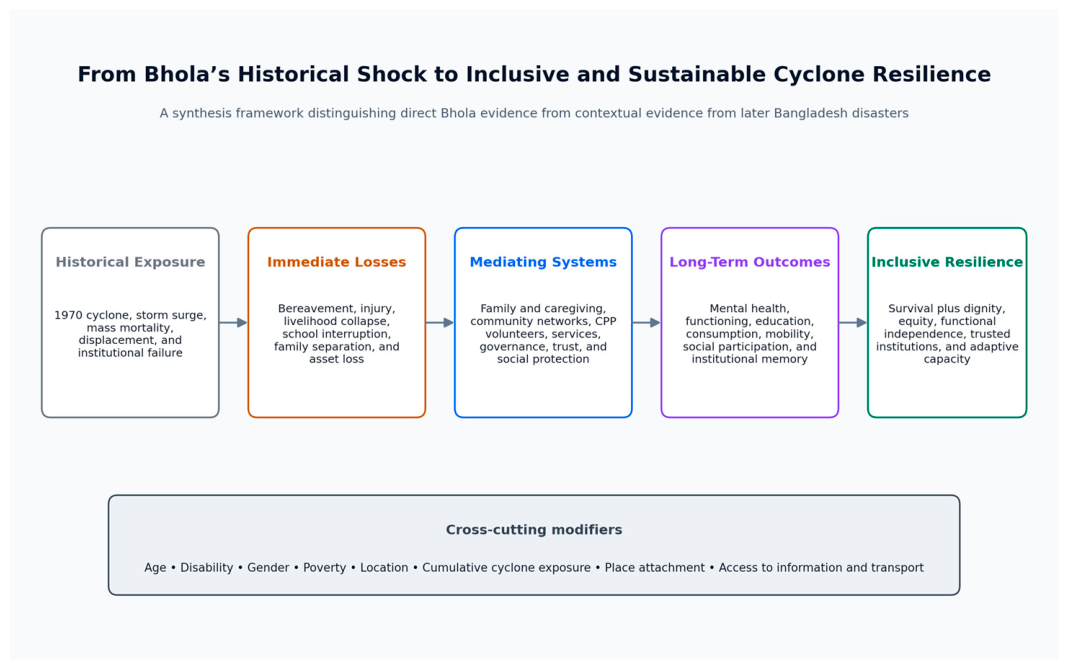
The evidence supports a multidimensional understanding of cyclone resilience. First, human sustainability requires physical and mental health, functional independence, education, livelihood security, and continuity of care. Second, social sustainability requires equitable protection, gender and disability inclusion, social support, participation, dignity, and attention to bereavement and caregiving. Third, institutional sustainability requires credible warnings, accessible shelters, accountable relief, trusted local organizations, learning across events, and meaningful community participation. Fourth, intergenerational sustainability requires preventing disaster exposure from becoming long-term disadvantage in health, education, income, mobility, or social participation.
These dimensions are mutually dependent. A warning is ineffective for a person who cannot hear it, cannot physically evacuate, fears an inaccessible shelter, or cannot leave a dependent family member. A shelter is not sustainable if it protects life but compromises sanitation, privacy, medication access, or dignity. A recovery program is incomplete if it rebuilds infrastructure but overlooks psychological distress, disability-related costs, lost education, and caregiving. Inclusive resilience therefore requires linked technical, social, health, and governance interventions.
Figure 1.
From historical cyclone exposure to inclusive and sustainable resilience. Direct Bhola-specific evidence is strongest at the left side of the pathway, whereas later Bangladesh disaster studies primarily clarify mediating systems, barriers, and contemporary outcomes. The framework is interpretive and does not imply that contextual evidence proves unmeasured Bhola-specific effects.
Figure 1.
From historical cyclone exposure to inclusive and sustainable resilience. Direct Bhola-specific evidence is strongest at the left side of the pathway, whereas later Bangladesh disaster studies primarily clarify mediating systems, barriers, and contemporary outcomes. The framework is interpretive and does not imply that contextual evidence proves unmeasured Bhola-specific effects.
4.3. Contribution to International Sustainability Frameworks
This synthesis connects directly with the Sendai Framework priorities of risk understanding, risk governance, resilience investment, and preparedness [24]. It also shows how cyclone policy can advance several SDGs simultaneously [25]: SDG 3 through mental-health and continuity-of-care systems; SDG 5 through gender-responsive sheltering and recognition of women's leadership; SDG 10 through disability and age inclusion; SDG 11 through accessible, safe, and resilient communities; and SDG 13 through equitable adaptation to coastal climate risk.
The central policy shift is from counting protective assets to evaluating inclusive outcomes. Shelter coverage should be paired with measures of travel time, physical accessibility, communication accessibility, privacy, sanitation, safety, and user trust. Warning reach should be disaggregated by disability, age, gender, language, location, and technology access. Recovery monitoring should include mental health, functioning, educational continuity, income restoration, caregiver burden, and fair access to assistance.

Table 3.
Translating the review findings into sustainability-oriented policy indicators.
| Policy domain | Suggested indicators | Sustainability connection |
| Mental health and psychosocial support | Referral availability, trained responders, continuity of care, distress screening, culturally appropriate support | SDG 3; Sendai preparedness and recovery |
| Accessible warnings and evacuation | Multi-format warnings, household evacuation assistance, accessible transport, travel time to shelter | SDGs 10 and 11; inclusive risk governance |
| Safe and dignified sheltering | Ramps, handrails, accessible toilets, privacy, medication storage, protection of assistive devices | SDGs 5, 10, and 11 |
| Equitable recovery and social protection | Aid access by disability, age, gender, livelihood, and location; caregiver support; education continuity | SDGs 1, 4, 5, and 10 |
| Institutional trust and participation | Warning credibility, perceived fairness, community representation, grievance mechanisms | SDG 16; Sendai risk governance |
4.4. Theoretical Contribution and Transferability
The review contributes a distinction between protective capacity and inclusive resilience. Protective capacity concerns whether systems reduce exposure and mortality; inclusive resilience concerns who can use those systems, under what conditions, and with what long-term consequences for health, functioning, dignity, participation, and opportunity. The distinction helps explain why a country may achieve remarkable mortality reduction while retaining substantial inequalities in evacuation, shelter use, psychosocial recovery, disability support, and livelihood restoration.
Although Bhola is historically specific, the analytical lesson is transferable to other climate-vulnerable settings: disaster success should be judged not only by lives saved and assets restored, but also by whether recovery prevents durable disadvantage. This requires longitudinal and disaggregated indicators capable of detecting unequal trajectories across age, disability, gender, livelihood, location, and caregiving status.
5. Policy and Practice Priorities
First, mental health and psychosocial support should be embedded in cyclone preparedness, response, and long-term recovery. Bangladesh's recent efforts to strengthen mental-health and psychosocial preparedness are important [22]. Bhola's unmeasured legacy demonstrates why this support should be treated as a core DRR function rather than an optional post-disaster service. Community health workers, CPP volunteers, schools, and primary-care services require clear referral pathways and training appropriate to their roles.
Second, disability inclusion must be operationalized through measurable standards. Accessible evacuation transport, ramps, handrails, toilets, privacy, communication, caregiver assistance, and protection of assistive devices should be evaluated through functional audits and user experience—not only through the existence of policy language. The Standing Orders on Disaster and the National Plan for Disaster Management provide a national architecture for this work [20,21], while the country's expanding disability-data infrastructure offers opportunities for monitoring [23].
Third, preparedness must be age inclusive. Older adults may require accessible warnings, evacuation assistance, medication continuity, appropriate nutrition, mobility support, seating and sleeping arrangements, and protection from social isolation or neglect [11]. These measures are especially relevant for direct Bhola survivors and other older residents with cumulative cyclone exposure.
Fourth, gender-responsive DRR should connect protection, caregiving, and leadership. Shelter privacy, reproductive health, childcare, safety, relief access, and support for female-headed households should be addressed alongside the continued development of women's leadership in the CPP and local disaster governance.
Fifth, institutional trust should be monitored as a resilience asset. Warning response and shelter use depend partly on trust in messengers, confidence in shelter conditions, and expectations of fair assistance [13,14,15,16,17]. Transparent allocation, feedback mechanisms, community representation, and locally trusted communication channels should therefore be treated as essential infrastructure.
Sixth, loss-and-damage assessments should extend beyond mortality and physical assets. Long-term health, functioning, mental health, educational disruption, caregiving, displacement, and livelihood recovery should be included in post-disaster monitoring. Disaggregated measures are necessary to determine whether mortality reduction is accompanied by equitable and sustainable recovery.
6. Research Agenda
Future Bhola research should prioritize multigenerational psychosocial outcomes, disability and aging, gendered bereavement and caregiving, institutional memory, and migration. Direct survivors, descendants, widows, people with disabilities, caregivers, CPP volunteers, and residents of historically high-exposure areas should be included deliberately rather than treated as incidental subgroups.
Methodologically, this agenda requires mixed methods. Archival records and historical exposure maps can reconstruct hazard intensity and mortality geography. Oral histories and family timelines can document memory, grief, mobility, and trust. Surveys can measure mental health, disability, functioning, preparedness, and social support. Geographic accessibility analysis and participatory shelter audits can assess whether people can reach and use protective infrastructure. Organizational histories and process tracing can examine how Bhola shaped the CPP and local governance.
Research involving older survivors and trauma histories requires careful ethics. Procedures should include phased and ongoing consent, accessible materials, communication accommodations, trauma-informed interviewing, referral plans, and safeguards for participants who disclose violence, neglect, severe distress, or urgent unmet needs. Researchers should also address recall limitations, survivorship bias, cumulative exposure, and the difficulty of separating individual memory from family and community narratives.
Table 4.
Priority agenda for Bhola-centered sustainability research.
| Priority | Recommended design and measures | Expected contribution |
| Multigenerational psychosocial memory | Trauma-informed oral histories, family timelines, and surveys of grief, distress, well-being, social support, and trust | Connects historical loss with present preparedness and well-being |
| Disability and aging | Functional measures, activities of daily living, rehabilitation access, assistive-device history, and shelter mapping | Supports disability- and age-inclusive DRR |
| Gendered loss, caregiving, and leadership | Life histories with widows, caregivers, female-headed households, and women CPP volunteers | Links loss and care with social protection and institutional agency |
| Bhola–CPP institutional memory | Organizational history, process tracing, and interviews across volunteer generations | Explains how disaster memory becomes—or fails to become—preparedness practice |
| Migration and place attachment | Multi-sited study of people who stayed, left, returned, or were unable to move | Clarifies adaptation, constrained immobility, and social cohesion |
| Long-term inclusive recovery | Linked historical exposure, household, health, education, and livelihood data | Tests whether survival gains are accompanied by equitable life-course outcomes |
7. Limitations
This review has five principal limitations. First, direct psychosocial and disability evidence specific to Bhola is scarce. Second, contextual studies from later Bangladesh disasters clarify mechanisms and current policy problems but cannot establish that the same outcomes occurred among Bhola survivors. Third, the review is critical and narrative rather than systematic; it does not provide exhaustive retrieval, formal risk-of-bias assessment, or pooled estimates. Fourth, historical records are incomplete and rarely disaggregated by disability, gender, age, or caregiving status. Fifth, future primary research will face recall limitations, survivor selection, cumulative exposure, and ethical challenges when working with older adults and family histories of mass loss.
These limitations define the boundary of the conclusions. The review does not estimate the prevalence of Bhola-related mental-health or disability outcomes and does not attribute contemporary outcomes to the cyclone. Its contribution is to identify a documented imbalance in the evidence, synthesize relevant mechanisms, and specify testable research and policy priorities.
8. Conclusions
The 1970 Bhola Cyclone is central to the history of Bangladesh and global DRR. Existing research documents catastrophic mortality, political consequences, institutional development, and long-term losses in health, education, and consumption among early-life exposed cohorts. Yet Bhola's psychosocial, disability, caregiving, and intergenerational consequences remain largely unmeasured.
Contextual evidence from later Bangladesh disasters shows that sustainable cyclone resilience depends on more than warning coverage and survival. It also depends on mental health, livelihood security, functioning, accessible evacuation and sheltering, dignified sanitation, social support, gender-responsive protection, trusted institutions, and equitable recovery. These findings should not be projected backward as proof of Bhola-specific outcomes; they should guide direct investigation and strengthen present policy.
Bhola should therefore be understood as both a historical catastrophe and a continuing test of whether disaster systems can convert mortality reduction into inclusive, sustained well-being. The next generation of research and policy should protect not only life, but also dignity, functioning, participation, trust, and opportunity across generations. For Sustainability, the central implication is clear: cyclone resilience is sustainable only when protective institutions are accessible, trusted, equitable, and capable of preventing disaster exposure from becoming lifelong or intergenerational disadvantage.
Author Contributions
Conceptualization, M.M.H.; methodology, M.M.H.; investigation, M.M.H.; formal analysis, M.M.H.; visualization, M.M.H.; writing—original draft preparation, M.M.H.; writing—review and editing, M.M.H. The author has read and agreed to the published version of the manuscript.
Funding
This research received no external funding.
Institutional Review Board Statement
Not applicable. This article reviews previously published literature and does not report research involving human participants or animals.
Informed Consent Statement
Not applicable.
Data Availability Statement
No new primary data were created or analyzed in this study. All materials supporting the synthesis are publicly available through the cited sources.
Acknowledgments
During the preparation of this manuscript, the author used OpenAI ChatGPT (OpenAI, San Francisco, CA, USA) for language editing, structural refinement, and document formatting. The author reviewed and edited the output and takes full responsibility for the content of this publication.
Conflicts of Interest
The author declares no conflicts of interest.
References
- World Meteorological Organization. World's Deadliest Tropical Cyclone Was 50 Years Ago. 2020. Available online: https://wmo.int/media/news/worlds-deadliest-tropical-cyclone-was-50-years-ago (accessed on 4 August 2026).
- Sommer, A.; Mosley, W.H. East Bengal cyclone of November, 1970: Epidemiological approach to disaster assessment. Lancet 1972, 299, 1030–1036. [Google Scholar] [CrossRef]
- Islam, M.M.; Chatterjee, N.; Basar, M.A. The final straw? Bhola cyclone, 1970 election, disaster politics, and the making of Bangladesh. Contemp. South Asia 2023, 31, 236–250. [Google Scholar] [CrossRef]
- Eskander, S.M.S.U.; Barbier, E.B. Long-term impacts of the 1970 cyclone in Bangladesh. World Dev. 2022, 152, 105793. [Google Scholar] [CrossRef]
- Abdullah-Al-Baki, C.; Ahmed, A. The long shadow of natural disasters: Educational impacts of the 1991 cyclone in Bangladesh. World Dev. 2026, 200, 107286. [Google Scholar] [CrossRef]
- Karim, M.Z.; Al-Mamun, M.; Eva, M.A.; Ali, M.H.; Kalam, A.; Uzzal, N.I.; Das, P.K. Understanding mental health challenges and associated risk factors of post-natural disasters in Bangladesh: A systematic review. Front. Psychol. 2024, 15, 1466722. [Google Scholar] [CrossRef] [PubMed]
- Hasan, M.T.; Adhikary, G.; Mahmood, S.; Papri, N.; Shihab, H.M.; Kasujja, R.; Ahmed, H.U.; Azad, A.K.; Nasreen, M. Exploring mental health needs and services among affected population in a cyclone affected area in coastal Bangladesh: A qualitative case study. Int. J. Ment. Health Syst. 2020, 14, 12. [Google Scholar] [CrossRef] [PubMed]
- Hossain, A.; Ahmed, B.; Rahman, T.; Sammonds, P.; Zaman, S.; Benzadid, S.; Jakariya, M. Household food insecurity, income loss, and symptoms of psychological distress among adults following Cyclone Amphan in coastal Bangladesh. PLoS ONE 2021, 16, e0259098. [Google Scholar] [CrossRef] [PubMed]
- Nawaz, S.; Wilbur, J.; Upoma, T.A.; Tabassum, K.F.; Goshami, A.; Podder, B.; Akter, J.; Hasan, M.; D'Mello-Guyett, L.; Shoaib, D.M.; et al. Extreme weather and sanitation in Bangladesh: A mixed-methods study of lived experiences of people with disabilities. Lancet Reg. Health Southeast Asia 2026, 47, 100744. [Google Scholar] [CrossRef] [PubMed]
- Ahmed, N.; Jui, J.; Liu, D.; Kim, K.; Kim, J.; Lee, J. Understanding inequalities in geographic accessibility to emergency cyclone shelters in Bangladesh under climate change. J. Transp. Geogr. 2025, 123, 104134. [Google Scholar] [CrossRef]
- Malak, M.A.; Tamanna, H.A.; Quader, M.A.; Ferdous, S. “There was no advantage to being old in the shelter”: Experiences of older adults to tropical cyclone in coastal Bangladesh. J. Disaster Sci. Manag. 2025, 1, 14. [Google Scholar] [CrossRef]
- Haque, A.; Haider, D.; Rahman, M.S.; Kabir, L.; Lejano, R.P. Building resilience from the grassroots: The Cyclone Preparedness Programme at 50. Int. J. Environ. Res. Public Health 2022, 19, 14503. [Google Scholar] [CrossRef] [PubMed]
- Choudhury, M.U.I.; Haque, C.E.; Doberstein, B. Adaptive governance and community resilience to cyclones in coastal Bangladesh: Addressing the problem of fit, social learning, and institutional collaboration. Environ. Sci. Policy 2021, 124, 580–592. [Google Scholar] [CrossRef]
- Uddin, M.S.; Haque, C.E.; Walker, D.; Choudhury, M.U.I. Community resilience to cyclone and storm surge disasters: Evidence from coastal communities of Bangladesh. J. Environ. Manag. 2020, 264, 110457. [Google Scholar] [CrossRef] [PubMed]
- Hossain, M.L. Beyond warnings and shelters: Local institutions and trust build cyclone resilience in Bangladesh. npj Nat. Hazards 2026, 3, 17. [Google Scholar] [CrossRef]
- Al-Maruf, A.; Jenkins, J.C.; Bernzen, A.; Braun, B. Household resilience to cyclone disasters in coastal Bangladesh. Climate 2021, 9, 97. [Google Scholar] [CrossRef]
- Choudhury, M.U.I.; Haque, C.E.; Nishat, A.; Byrne, S. Social learning for strengthening community resilience to cyclones: Role of indigenous and local knowledge, power, and institutions in coastal Bangladesh. Ecol. Soc. 2021, 26, 5. [Google Scholar] [CrossRef]
- Grant, M.J.; Booth, A. A typology of reviews: An analysis of 14 review types and associated methodologies. Health Inf. Libr. J. 2009, 26, 91–108. [Google Scholar] [CrossRef] [PubMed]
- Snyder, H. Literature review as a research methodology: An overview and guidelines. J. Bus. Res. 2019, 104, 333–339. [Google Scholar] [CrossRef]
- Ministry of Disaster Management and Relief. Standing Orders on Disaster 2019; Government of the People's Republic of Bangladesh: Dhaka, Bangladesh, 2019. [Google Scholar]
- Ministry of Disaster Management and Relief. National Plan for Disaster Management 2021–2025; Government of the People's Republic of Bangladesh: Dhaka, Bangladesh, 2020. [Google Scholar]
- World Health Organization. Building Resilience through Preparedness: Scaling Up Mental Health and Psychosocial Support in Bangladesh. 2025. Available online: https://www.who.int/news-room/feature-stories/detail/building-resilience-through-preparedness--scaling-up-mental-health-and-psychosocial-support-in-bangladesh (accessed on 4 August 2026).
- Bangladesh Bureau of Statistics. Disability Insights from Labour Force Survey 2022: Final Report; Government of the People's Republic of Bangladesh: Dhaka, Bangladesh, 2025. [Google Scholar]
- United Nations Office for Disaster Risk Reduction. Sendai Framework for Disaster Risk Reduction 2015–2030; UNDRR: Geneva, Switzerland, 2015. [Google Scholar]
- United Nations General Assembly. Transforming Our World: The 2030 Agenda for Sustainable Development; Resolution A/RES/70/1; United Nations: New York, NY, USA, 2015. [Google Scholar]
- Intergovernmental Panel on Climate Change. Climate Change 2022: Impacts, Adaptation and Vulnerability; Pörtner, H.-O., Roberts, D.C., Tignor, M., Poloczanska, E.S., Mintenbeck, K., Alegría, A., Craig, M., Langsdorf, S., Löschke, S., Möller, V., et al., Eds.; Cambridge University Press: Cambridge, UK, 2022. [Google Scholar] [CrossRef]
- Malak, M.A.; Sajib, A.M.; Quader, M.A.; Anjum, H. “We are feeling older than our age”: Vulnerability and adaptive strategies of aging people to cyclones in coastal Bangladesh. Int. J. Disaster Risk Reduct. 2020, 48, 101595. [Google Scholar] [CrossRef]
- Paul, B.K.; Dutt, S. Hazard warnings and responses to evacuation orders: The case of Bangladesh’s Cyclone Sidr. Geogr. Rev. 2010, 100, 336–355. [Google Scholar] [CrossRef] [PubMed]
- Uddin, M.S.S.J. Dynamics of cyclone evacuation behavior among southwestern coastal residents in Bangladesh: A case study of Cyclone Sidr. J. Emerg. Manag. 2010, 8, 63–71. [Google Scholar] [CrossRef]
- United Nations Office for Disaster Risk Reduction. 2023 Global Survey Report on Persons with Disabilities and Disasters; UNDRR: Geneva, Switzerland, 2023; Available online: https://www.undrr.org/report/2023-gobal-survey-report-on-persons-with-disabilities-and-disasters (accessed on 4 August 2026).
Table 1.
Population–concept–context framework.
| Element | Inclusion focus | Analytical purpose |
| Population | Bhola-affected people, survivors and descendants, older adults, people with disabilities, widows, caregivers, coastal communities, CPP volunteers, and governance actors | Connects affected populations with present-day preparedness and recovery systems |
| Concept | Psychosocial distress, grief, disability, functioning, caregiving, trust, warnings, resilience, migration, and social participation | Captures human and institutional consequences usually omitted from mortality-centered accounts |
| Context | The 1970 Bhola Cyclone, with later Bangladesh cyclone and disaster research used contextually | Separates direct historical evidence from mechanism-relevant contemporary evidence |
Table 2.
Status of Bhola-specific evidence and the role of contextual Bangladesh research.
| Domain | Bhola-specific evidence status | Contribution of contextual evidence | Principal caution or gap |
| Mortality and immediate conditions | Well documented | Supports comparison with later response systems | Limited long-term follow-up |
| Political and institutional change | Well documented | Connects governance, trust, and local institutions | Survivor-level trust remains insufficiently studied |
| Life-course health and socioeconomic effects | Limited but consequential | The 1991 cyclone supports life-course mechanisms | Psychosocial and disability pathways are unmeasured |
| Psychosocial well-being | Not directly documented | Later studies identify recurrent distress and service gaps | Contextual evidence cannot establish Bhola-specific effects |
| Disability, functioning, and aging | Not directly documented | Recent work identifies sanitation, shelter, and mobility barriers | Historical impairment and caregiver trajectories are unknown |
| Gendered caregiving and social protection | Not directly documented | Later studies identify gendered constraints and women's leadership | Widowhood and survivor-lineage evidence is absent |
| Community resilience and CPP | Limited to well documented institutionally | Governance studies explain trust, learning, and warning response | Memory pathways from Bhola to present practice are unclear |
| Migration and place attachment | Limited | Contemporary research clarifies mobility and immobility mechanisms | Multigenerational mobility histories are needed |
Disclaimer/Publisher’s Note: The statements, opinions and data contained in all publications are solely those of the individual author(s) and contributor(s) and not of MDPI and/or the editor(s). MDPI and/or the editor(s) disclaim responsibility for any injury to people or property resulting from any ideas, methods, instructions or products referred to in the content. |
© 2026 by the authors. Licensee MDPI, Basel, Switzerland. This article is an open access article distributed under the terms and conditions of the Creative Commons Attribution (CC BY) license (http://creativecommons.org/licenses/by/4.0/).
Copyright: This open access article is published under a Creative Commons CC BY 4.0 license, which permit the free download, distribution, and reuse, provided that the author and preprint are cited in any reuse.