

Submitted:
18 August 2026
Posted:
19 August 2026
You are already at the latest version
Abstract
For nearly a century, flotation kinetics has relied on deterministic first-order rate equations treating the cell as a homogeneous reactor, a paradigm that inherently fails for heterogeneous ores, especially coal, whose organic macerals, porosity, and oxidation susceptibility defy a single rate constant. Breaking from chronological cataloguing, this review proposes a three-dimensional taxonomy based on physical scale, inherent material heterogeneity, and epistemic certainty. We demonstrate that critical industrial prediction failures arise from structural mismatches between model physics and particle surface chemistry, notably time-dependent oxidation deactivation and selective maceral recovery. Six fundamental failure modes are identified, from neglected time-dependence of rate constants to the absence of a thermodynamic deactivation term, corroborated by experimental evidence from coal and base-metal flotation. Advanced microfluidic, automated mineralogical, surface-sensitive spectromicroscopic, CFD-DEM, and physics-informed machine learning tools are dismantling the black box of the flotation rate constant “k”. We introduce the Distributed Reactive Surface Kinetics (DRSK) framework, which embeds particle-scale heterogeneity into a population balance via an adaptive surface-sensitive selection function and treats kinetic uncertainty through stochastic differential equations. A comprehensive comparison table facilitates the transition from conventional models to the DRSK paradigm. We conclude with a roadmap for flotation kinetics 4.0, where digital twins, real-time froth analytics, and self-calibrating hybrid models transform this empirical discipline into a truly predictive engineering science. The framework is elaborated for coal and conventional minerals, underscoring why coal demands its own dedicated kinetic theory and how these lessons can revolutionize the processing of increasingly complex, low-grade ores and secondary resources.
Keywords:
flotation kinetics
; coal flotation
; population balance
; surface heterogeneity
; machine learning
; digital twin
; stochastic modelling
; surface oxidation
; DRSK framework
1. Introduction
Flotation is the single most important separation process for the world’s primary mineral resources and the beneficiation of coal. Its economic optimization hinges on the ability to predict recovery as a function of time, chemistry, and hydrodynamics—the core mandate of a kinetic model. Since the pioneering work of Kelsall [1] and Klimpel [2], the modelling community has constructed an impressive edifice of algebraic and differential rate equations: first-order, second-order, rectangular distributions, mixed-order, gamma-distributed rate constants, and matrix-based multistage descriptions. Hundreds of articles report the fitting of these equations to batch and plant data, and it is now trivial to fit a laboratory curve with an [3,4].
Yet beneath this apparent maturity lies a profound stagnation. Industrial flotation models remain unreliable when extrapolated to new feeds, varying particle sizes, or changing surface chemistry [5]. A 2023 benchmarking study by the International Mineral Processing Council revealed that over 60% of flotation plants using classical kinetic models experienced recovery deviations exceeding 5% absolute when ore mineralogy shifted by more than 15%, an unacceptable margin for modern operations. For coal, the situation is more severe: a single piece of run-of-mine coal contains vitrinite, inertinite, liptinite, mineral matter, and oxidized rims, each with its own induction time, bubble attachment probability, and froth detachment propensity. Treating such a material with a lumped first-order constant is not a simplification, it is a category error. As Ofori et al. [6] showed, the apparent rate constant of a coal flotation bank can vary by over 300% within a single shift, primarily driven by the subtle oxidation of maceral surfaces that no classical model captures. Furthermore, recent advances in automated mineralogy and surface characterization have generated detailed “kinetic fingerprints” of individual particles, revealing that the distribution of floatabilities is not a smooth, time-invariant function but a dynamic landscape shaped by competing surface reactions. This wealth of new data remains largely unutilized because existing models lack the structural flexibility to ingest it [7].
This review argues that the stagnation stems from a collective adherence to a homogeneous reactor metaphor. The chemical reaction analogy assumes well-mixed reactants with time-invariant reactivity. Flotation is the antithesis: it is a collection of discrete, surface-mediated, probabilistic events occurring in a turbulent multiphase flow, where the “reactants” continuously change their surface state during the process. In coal flotation, the reactant (a carbonaceous particle) oxidizes in the very aqueous medium that is supposed to separate it, meaning the kinetic constant of the separation process is simultaneously a function of a competing chemical reaction. Such coupling has no analogue in traditional chemical reaction engineering and demands a dedicated theoretical treatment. The research community has amassed the nanoscale surface science, the mesoscale particle–bubble capture theory, and the macroscale computational fluid dynamics—but these pieces have not been assembled into a coherent kinetic theory. Instead, the kinetic model is treated as a downstream curve-fitting tool, disconnected from the physics.
We propose a new intellectual structure for flotation kinetics. Rather than listing equations by their mathematical form, we classify models along three axes: the physical scale at which the rate-controlling step is resolved, the origin and type of material heterogeneity, and the degree of epistemic certainty embedded in the model. This taxonomy is not merely an academic exercise; it is a design tool that immediately reveals which model components must be upgraded to handle a specific ore type or operational challenge. For example, a copper porphyry plant with consistent mineralogy may be adequately described by a size-liberation population balance (meso-scale, size-liberation heterogeneity, white-box), while a coal plant experiencing variable oxidation requires a surface-chemical population balance with a learned, stochastic selection function (meso-to-micro scale, surface-chemical heterogeneity, grey-box). The objectives of this review are thus:
- To critically deconstruct why classical kinetic models are structurally incapable of describing coal flotation and increasingly complex mineral ores. We provide a formalized list of six failure modes, each mapped to specific industrial symptoms and backed by quantitative case studies.
- To map the emerging characterization and simulation methods that can directly inform kinetic parameters without empirical fitting. A detailed technique-to-parameter matrix is presented to guide experimentalists.
- To propose the Distributed Reactive Surface Kinetics (DRSK) framework as an integration of population balances, surface-sensitive machine learning, and stochastic calculus. We derive the full mathematical structure and discuss its calibration protocol.
- To outline a vision for a fully predictive, self-learning flotation kinetic model in the context of Industry 4.0 and circular economy raw materials. A practical implementation timeline is suggested, from current sensor infrastructure to full digital twin deployment.
2. A New Taxonomy: Scale, Heterogeneity, and Epistemic Certainty
Traditional reviews classify flotation kinetic models into empirical, semi-empirical, and phenomenological, or by the order of the rate law [8,9]. We argue that such a classification obscures the underlying physics and fails to guide the model user. Instead, we propose a three-dimensional taxonomy (Figure 1) that positions every existing model, and every conceivable future model, within a space defined by Scale, Material Heterogeneity, and Certainty Framework.
Axis I – Physical Scale of the Rate-Determining Phenomenon
- Micro-scale (collision–attachment–detachment): Models that resolve the elementary sub-processes of a single bubble–particle encounter. The rate constant emerges from the induction time, contact angle, bubble size, and local energy dissipation. This scale directly utilizes the Derjaguin–Landau–Verwey–Overbeek (DLVO) and extended-DLVO theories for thin liquid film rupture, as well as molecular dynamics simulations of collector adsorption. Key works include Yoon–Luttrell model, Nguyen–Schulze attachment theory, AFM-based force spectroscopy, and recent microfluidic induction time measurements [10,11,12].
- Meso-scale (population distribution): Models that consider a distribution of particle properties—size, liberation class, floatability. The batch rate equation becomes an integral over a probability density function of . At this scale, the key mathematical tool is the population balance equation (PBE) with internal coordinates that may include particle composition, shape, and surface energy. Key works are Klimpel’s rectangular distribution, Imaizumi and Inoue’s gamma model, King’s generic population balance, and modern multichannel distributed- models [9,13,14].
- Macro-scale (reactor engineering): Models that incorporate the residence time distribution (RTD) of the cell or bank, mixing regime, and froth transport. The overall recovery is the convolution of a flotation rate distribution with an RTD. Large eddy simulations (LES) coupled with scalar transport now allow a first-principles prediction of RTD in full-scale cells without tracer tests. Key works include reactor-separator models, multi-stage axial dispersion models, integrated CFD-RTD approaches, and compartment models based on local turbulent dissipation [15,16].
Axis II – Origin of Material Heterogeneity
This axis explicitly distinguishes the nature of the distributed floatability.
- Size-liberation heterogeneity (hard rock minerals): The primary source of variation is mineral liberation and particle size [17]. Sub-class includes sulphides, oxides, industrial minerals. Models on this axis typically assume that liberation is a geometric property well captured by MLA/QEMSCAN data and that surface chemistry is uniform within a mineral phase [18].
- Surface-chemical heterogeneity (coal, oxidized ores, secondary resources): The floatability varies dramatically due to surface functional groups, oxidation state, and maceral type even for the same size and liberation class. For coal, the hydrophobicity of a particle is not a single value but a distribution of contact angles across its surface, driven by the spatial arrangement of aliphatic and aromatic carbon domains, oxygen functional groups, and mineral inclusions [19,20,21]. This axis captures the difference between a chalcopyrite particle (floatability dominated by collector coverage and grain exposure) and a coal particle (floatability dominated by the surface proportion of hydrophobic aliphatic vs. oxygenated aromatic carbon). The rise of battery black mass and e-waste recycling introduces an even more extreme form of surface-chemical heterogeneity, where multiple engineered materials coexist with complex organic coatings [22,23].
Axis III – Epistemic Certainty and Model Form
- White-box deterministic: Physical models where all parameters have a clear physical meaning and are assumed to be fixed and known. An example is a first-order model with calculated a priori from surface chemistry. Although physically transparent, these models provide a single point estimate, ignoring measurement and process noise [24].
- Grey-box/stochastic: Models that incorporate parameter uncertainty or intrinsic stochasticity. A case example is treated as a random variable with a known distribution; recovery modelled by stochastic differential equations (SDEs) rather than ordinary differential equations (ODEs) [25]. This category also encompasses hybrid models where a neural network learns the functional form of from physical features, and the entire system respects conservation laws. Bayesian inference frameworks fall here, providing posterior distributions of model parameters [26].
-
Black-box data-driven: Pure machine learning models (neural networks, gradient boosting) that map process variables directly to recovery without an explicit rate equation. Includes physics-informed neural networks that embed the ODE structure but learn the function. While powerful interpolators, black-box models lack extrapolation guarantees and can violate mass conservation if not carefully regularized [27].The proposed three-dimensional taxonomy is operationalized in Table 1, which classifies representative flotation kinetic models, from Kelsall’s first-order equation to the DRSK framework, according to their dominant scale, heterogeneity type, and certainty framework, along with their typical application domain.
3. The Failure of the Classical Paradigm: A Critical Deconstruction
The root of the classical model’s inadequacy is not imprecise parameter estimation; it is structural. We dissect six specific failure modes, illustrated by coal and complex mineral examples. These six structural failures are graphically summarized in Figure 2, clearly linking the industrial symptom, the underlying physicochemical mechanism, and the proposed DRSK resolution for each.
3.1. The Myth of a Constant Floatability Spectrum
Batch flotation data are routinely fitted to first-order models by assuming a time-invariant distribution of floatabilities. In reality, as flotation proceeds, the particle population undergoes surface modification. Residual particles become progressively more hydrophilic (the “low-hanging fruit” are removed first) [32,33,34,35]. In coal, this effect is dramatic: the fast-floating vitrinite is recovered in the first minute, leaving an increasingly inertinite-rich and oxidized tailings slurry whose average contact angle can drop by 30–40°. This is not merely a shift in the mean of the distribution but a truncation and skewing, as the slow-floating modes become dominant. Fitting a fixed gamma distribution to such data yields residuals that exhibit a distinct time-dependent pattern, violating the identically distributed assumption of least-squares regression. As a result, predicted ultimate recovery can be overestimated by up to 10 percentage points for oxidized feeds. A fixed distribution cannot describe a system where the surface reactivity of the remaining material monotonically decays. Phenomenological models with a “decay term” (e.g., ) are patchwork fixes, not physics [19,36].
3.2. The Neglect of the Froth Phase as an Active Kinetic Element
Most kinetic models treat the froth solely as a transport delay or a recovery factor. Yet the froth is a highly selective reactor where bubble coalescence, particle detachment, and re-attachment occur. For coarse coal particles, the froth zone can be the dominant kinetic resistance. Experimental measurements using a modified Denver cell with a partitioned froth zone have shown that up to 60% of the overall flotation rate resistance for +500 µm coal particles is attributable to the froth, varying nonlinearly with froth depth and air rate [37]. The classical “two-phase” model (pulp , froth ) still assumes a first-order froth recovery, but the real froth kinetics are highly non-linear: froth mobility is a function of bubble size, which itself depends on the froth depth and the rate of coalescence, which is influenced by the hydrophobic particle load. The presence of hydrophobic particles stabilizes bubbles, reducing coalescence and increasing froth residence time, creating positive feedback that violates the linear superposition principle. This creates a feedback loop that no linear superposition captures [38,39].
3.3. The Absence of a Thermodynamic Deactivation Term (Oxidation Kinetics)
Coal flotation is notoriously sensitive to weathering and oxidation. Surface oxidation is a time-dependent chemical reaction that converts hydrophobic hydrocarbon sites into hydrophilic oxygenated groups [40]. Kinetic studies using in-situ FTIR have demonstrated that the concentration of surface carbonyl and carboxyl groups increases exponentially with conditioning time in aerated water, with a half-life as short as 15 minutes for low-rank coals. The kinetics of flotation therefore become tightly coupled to the competing kinetics of surface oxidation. If the flotation residence time is long relative to the oxidation half-life in the aerated pulp, the apparent decreases during the process [41]. A correct model must embed the surface state as a dynamic variable, transforming the ODE into a coupled system:
where is recovery, is the fraction of oxidised surface, DO is dissolved oxygen, and is temperature. This is conceptually identical to poisoning kinetics in heterogeneous catalysis, a field completely isolated from flotation literature. For minerals, similar deactivation can occur due to oxidation of sulphide surfaces or desorption of collector, but the effect is typically slower and less dramatic than for coal [42].
3.4. The Illusion of “Liberation” for Coal
Liberation, in a mineral context, is a spatial concept: the grain is either free or locked [43,44,45]. For coal, “liberation” is a chemical concept. Macerals are chemically bound within the organic matrix, and even a “fully liberated” coal particle of a single maceral group has an intrinsic surface heterogeneity at the nanometer scale [19]. High-resolution AFM mapping of vitrinite surfaces reveals domains of contrasting adhesion force, corresponding to hydrophobic patches of 50–200 nm interspersed with hydrophilic oxygenated areas. Therefore, a single particle does not possess a single floatability; it possesses a distribution of local hydrophobicity [46]. A population balance that uses liberation class as an internal coordinate cannot resolve this. The relevant coordinate is the surface fugacity of hydrophobic sites, measurable by Time-of-Flight Secondary Ion Mass Spectrometry (ToF-SIMS) or X-ray photoelectron spectroscopy (XPS). This chemical heterogeneity introduces a scale gap: the floatability of a coal particle cannot be inferred solely from its bulk maceral composition; the spatial arrangement and connectivity of hydrophobic domains also matter, as they determine the dynamics of three-phase contact line expansion during attachment. This is a non-trivial shift from geometric to chemical population balances [47].
3.5. The Fallacy of the Well-Mixed Cell
Industrial-scale flotation cells are not perfect mixers; they exhibit high recirculation, dead zones, and short-circuiting. The standard approach of convoluting a batch flotation rate distribution with a tracer-measured RTD is mathematically valid only for linear kinetic processes. Once the kinetics are non-linear (e.g., a second-order or deactivation model), superposition breaks down. Numerical experiments with coupled CFD-deactivation kinetics have shown that the recovery predicted by the convolution method can deviate by up to 15% relative from the fully coupled solution, particularly when the rate constant depends on local particle concentration or surface state. The result is that plant-scale predictions based on batch linear models consistently overestimate recovery [28,48]. The correct solution demands a full CFD-DEM-population balance coupling, which is computationally extreme but increasingly feasible. Reduced-order compartment models that preserve the local mixing structure while drastically reducing computational cost are emerging as a practical bridge [49,50,51].
3.6. The Epistemic Blindness to Uncertainty
All kinetic parameters are estimated from noisy, limited data, yet the models are almost always treated as deterministic. The resulting recovery prediction is a crisp number, not a probability distribution. A Monte Carlo simulation of a typical rougher-scavenger circuit using a first-order model with parameter uncertainty (10% coefficient of variation on ) shows that the 95% credible interval for overall recovery can span 8–12 absolute percentage points—a range that decisively impacts project economics. For plant design, this creates false confidence. A model that outputs “recovery = 85%” with a standard deviation of 8% and a skewed tail is far more valuable than a point estimate of 85.2%. The mineral processing community has largely ignored the stochastic modelling toolkit, despite its maturity in chemical engineering and finance. Bayesian hierarchical models, Gaussian process emulators, and approximate Bayesian computation (ABC) are particularly well-suited to flotation because they can incorporate multiple sources of uncertainty (feed variability, measurement error, model structure) in a principled manner [52,53].
The six structural deficiencies identified above are systematically compiled in Table 2, which cross-references each failure mode with its observable industrial symptom, the physicochemical mechanism responsible, and the specific resolution offered by the DRSK framework.
4. Emerging Frontiers in Kinetic Physiochemistry
A genuinely predictive kinetic model must be parameterized not by fitting to recovery curves, but by direct measurement of the underlying collision, attachment, and detachment physics. The past decade has seen explosive growth in experimental and computational techniques that make this possible. We map these techniques to the specific kinetic parameters they can inform. Figure 3 provides a holistic overview of these tools alongside the specific kinetic parameter each can inform, guiding experimentalists toward the most suitable pathway for parameterizing the model without empirical recovery-curve fitting [54,55,56].
4.1. Direct Observation of Particle–Bubble Interactions
Microfluidic devices and high-speed imaging now enable the recording of single particle–bubble encounters at frame rates exceeding 10,000 fps. The induction time, sliding time, and attachment probability are measured as a function of precisely controlled particle size, shape, and surface chemistry. Recent developments include the use of optical tweezers to position single coal particles at a controlled distance from a bubble surface, allowing the direct measurement of the hydrophobic force–distance profile, which can be integrated into an attachment rate kernel [33,57]. Wang et al. [58] used a microflotation cell coupled with a long-distance microscope to track the trajectories of individual coal particles around a captive bubble, extracting an empirical induction time distribution that directly feeds into a mesoscopic attachment rate kernel. Such data can populate a physics-based without a single batch flotation test. The extension of these techniques to irregular, real ore particles (rather than spherical glass beads) is a critical milestone, now being realized with 3D-printed particles of controlled shape and surface chemistry [55,59,60].
4.2. Surface-Sensitive Spectromicroscopy and the “Kinetic Fingerprint”
ToF-SIMS and XPS mapping provide chemical images of particle surfaces at sub-micron resolution. When applied to cross-sections of coal flotation feeds, they reveal the heterogeneous distribution of hydrophobic and hydrophilic domains on individual particles. XPS C 1s peak deconvolution can quantify the relative proportions of C–C/C–H (hydrophobic), C–O (ether/hydroxyl), C=O (carbonyl), and O–C=O (carboxyl) groups, each with a known influence on water contact angle [61,62]. By combining this chemical mapping with automated image analysis, one can construct a pixel-wise hydrophobicity map of a particle surface. This allows the construction of a “surface heterogeneity spectrum” , where is the local water contact angle. Combined with automated mineralogy (MLA, QEMSCAN) for mineral grains, one can predict the attachment probability of a composite particle by integrating the surface chemistry map into a micro-kinematic model. Crucially, ToF-SIMS can also detect trace collector species on mineral surfaces, enabling the quantification of reagent distribution across different minerals in a mixed ore—data that directly informs the surface-state coordinate in DRSK. This is the experimental basis of the reactive surface kinetics approach [63,64].
4.3. CFD-DEM as a Kinetic Generator
The coupling of computational fluid dynamics (CFD) with the discrete element method (DEM) now enables the tracking of millions of particles and thousands of bubbles in a turbulent flotation cell. By incorporating a mechanistic attachment/detachment criterion, such simulations directly generate the time evolution of the particle population in the pulp and froth. The attachment criterion can be implemented as a stochastic sub-model that samples from the induction time distribution measured in microfluidic experiments, thus linking the micro-scale physics to the macro-scale flow. Recent works have successfully simulated laboratory-scale coal flotation with CFD-DEM and obtained recovery curves that matched experiments without any data fitting, solely using measured induction times and contact angles [65,66,67,68]. The computational cost of full-scale industrial cell simulation remains prohibitive, but the development of coarse-grained DEM and surrogate models built from high-fidelity simulations is rapidly closing this gap. This “ab initio” flotation kinetics represents a paradigm shift: kinetic models become outputs of fundamental simulation, not inputs.
4.4. Physics-Informed Machine Learning as an Interpolator
Pure black-box models have limited extrapolability. A burgeoning approach is the “grey-box” where a neural network learns the functional form of the rate constant from physics-informed features. For example, an input vector of particle size, liberation, maceral composition, and surface oxidation index is mapped to a local via a multi-layer perceptron. This neural is then embedded in a classical population balance equation, and the entire hybrid system is trained end-to-end on plant data. Recent work has demonstrated that such physics-informed neural networks can predict recovery for an unseen coal type with a mean absolute error of less than 2%, provided the training set covers the relevant range of maceral and oxidation states. The result is a model that respects the conservation of mass while adapting to complex surface chemistry, a perfect marriage of the classical and the modern. The challenge lies in ensuring that the learned function is physically monotonic in hydrophobicity and particle size; this can be enforced by monotonic neural network architectures or by adding penalty terms to the loss function [27,31,69,70].
The mapping between state-of-the-art characterization tools and the kinetic parameters they inform is summarized in Table 3, providing experimentalists with a clear guide to which technique delivers which piece of the ab initio kinetic puzzle.
5. The Distributed Reactive Surface Kinetics (DRSK) Framework
Drawing together the critical insights and emerging tools, we propose an integrative framework designed explicitly for materials with pronounced surface-chemical heterogeneity—coal being the archetype, but applicable to any highly oxidized or surface-variable ore. The framework is named “Distributed Reactive Surface Kinetics” to emphasize three core principles: (i) the kinetics are distributed over a population of chemically distinct particles, (ii) the flotation rate is a surface reaction governed by the local chemical state, and (iii) the surface state itself reacts (oxidizes, adsorbs) during the process.
5.1. Core Structure
The DRSK model is a three-layer architecture (Figure 4):
Layer 1 – Multi-Phase Population Balance
The central equation is a population balance with an internal coordinate vector capturing not just size and liberation, but surface state. For coal, , where is particle diameter, is apparent density (proxy for ash), is the maceral hydrophobicity index (derived from vitrinite reflectance or aliphatic carbon fraction), and is the surface oxidation fraction. The hydrophobicity index can be operationally defined as the ratio of C–C/C–H peak area to total C 1s peak area in XPS, normalised to a reference vitrinite. The oxidation fraction is the fraction of surface carbon atoms that are oxidised (C–O, C=O, O–C=O). The rate of change of the number density in the pulp is [71]:
The selection function is the net removal rate of particles by true flotation. Crucially, is the surface oxidation rate, which moves particles along the -axis, reducing their floatability over time. This advection term in the PBE is what sets DRSK apart from all previous population balance models; it explicitly accounts for the fact that a particle’s position in the chemical coordinate space is not fixed during its residence in the pulp.
Layer 2 – Adaptive Selection Function via Physics-Informed Learning
is not a pre-fitted formula but a function module. Its structure is [72,73]:
where are the collision, attachment, and stabilisation probabilities from standard micro-kinetics, but their arguments are functions of the surface state vector . The functional dependence of, e.g., attachment probability on and , is learned by a Gaussian process or a small neural network trained on the combined dataset of microfluidic observations, ToF-SIMS surface maps, and MLA mineralogy. This network acts as a “surface response” module that predicts a particle’s attachment probability directly from its chemical fingerprint. The physics skeleton (collision frequency from turbulence theory, bubble rise velocity) is retained as a hard constraint, ensuring that the model extrapolates physically even when the neural component encounters unseen chemical states. The parameters of this network are the only learned parameters; the rest of the equation respects known physics. The neural attachment model can be trained on a relatively small dataset of ~500–1000 single-particle experiments, which is feasible with modern automated microfluidic platforms [69,74].
Layer 3 – Stochastic Differential Equation (SDE) Wrapper
Recognizing that and are themselves stochastic and measured with error, the population balance is cast as a stochastic PDE. In its simplest form, the deterministic is replaced with , where is a noise term representing unresolved surface heterogeneity fluctuations. More rigorously, the particle state vector can be evolved by a system of SDEs that incorporate both deterministic drift (flotation removal, oxidation) and diffusion (random fluctuations due to turbulence and surface heterogeneity). The solution provides not a single recovery curve but a probability distribution of recoveries, enabling risk-based decision-making and robust control. The Fokker–Planck equation corresponding to the SDE system can be solved numerically to obtain the full probability density of the particle population at any time, or a Monte Carlo particle-based simulation can be used for more complex geometries [75,76].
5.2. Implementation and Calibration
Calibrating DRSK involves a two-stage protocol. Stage 1 (micro-scale): a representative sample of the plant feed is size-fractionated and each fraction is analyzed by MLA and ToF-SIMS to establish the joint distribution of . A sub-sample of particles from each bin is then tested in a microfluidic cell to measure the attachment probability as a function of and . A surface response model (e.g., gradient-boosted trees or Bayesian neural network) is trained on this database. Stage 2 (meso-scale): a batch flotation test on the same feed provides the overall recovery curve. The full population balance with the integrated surface response module is run with initial conditions from the feed distribution; any residual discrepancy is absorbed by the hyper-parameters of the stochastic noise term, which are constrained to a physically reasonable prior. Bayesian inference can be used to jointly estimate the noise hyper-parameters and fine-tune the neural network, providing full posterior distributions for all parameters. Once calibrated, the model can predict the performance of a different feed (e.g., with a higher oxidation index) simply by inputting the new measured distribution—no re-fitting of a kinetic constant is required. This is impossible with a classical first-order model [63,77,78,79,80].
A side-by-side comparison of the conventional paradigm against the proposed DRSK framework is presented in Table 4, highlighting the fundamental advances in internal coordinates, rate-constant determination, time-dependence, uncertainty handling, and transferability.
6. Flotation Kinetics 4.0: The Digital Twin and Real-Time Self-Calibration
A static model, however sophisticated, is insufficient for modern plants processing variable feeds. The ultimate expression of kinetic modelling is a live digital twin that continuously updates its internal state using real-time sensor data. The concept of a “kinetic digital twin” extends the traditional steady-state digital twin to incorporate the time-dependent evolution of particle floatability, enabling predictive control on timescales from minutes to hours [81,82,83].
6.1. Deep Froth Image Analytics as a Soft Sensor for Kinetics
Industrial flotation cells are almost universally equipped with froth cameras. Traditionally, these provide heuristic features (bubble size, froth velocity, color) for operator guidance. With deep learning, froth images can be directly mapped to the instantaneous distribution of particle floatability in the pulp. A convolutional neural network (CNN) architecture, such as a ResNet-50 pre-trained on ImageNet and fine-tuned on labelled flotation images, can extract a latent vector that encodes the froth morphology. This latent vector is then decoded by a separate network into the parameters of a floatability distribution (e.g., the mean and variance of a log-normal distribution) [84,85]. Training requires a dataset of paired froth images and measured concentrate grade/recovery or offline assay-based floatability distributions. Once trained, the network acts as a soft sensor, inferring that a sudden change in froth texture (e.g., from tight, shiny bubbles to large, dull bubbles) corresponds to a shift in the dominant particle type being recovered (e.g., from fast-floating vitrinite to slow-floating oxidized middlings). This inferred floatability spectrum then feeds back into the DRSK model, updating the surface state distribution in real time. The soft sensor approach decouples the fast, image-based inference from the slower, first-principles population balance, enabling a refresh rate of seconds for the latent state and minutes for the full model update [86].
6.2. Online X-Ray Fluorescence (XRF) and Laser-Induced Breakdown Spectroscopy (LIBS)
Elemental analysis on the feed and tailings streams, combined with mineralogical reconciliation, provides the real-time bulk composition. LIBS, in particular, offers the ability to detect light elements (C, O, H) that are crucial for coal surface chemistry, making it a promising sensor for real-time oxidation monitoring. When coupled with a dynamic population balance, this allows a continuous Kalman-filter-like correction of the kinetic state. An ensemble Kalman filter (EnKF) can assimilate the online elemental data into the DRSK state vector, updating the estimated distribution and the oxidation state with each measurement. The plant model no longer just predicts recovery; it assimilates data, reducing the uncertainty of the internal state with every measurement [87,88,89].
6.3. Self-Optimizing Kinetic Control
Once the kinetic state is known with quantified uncertainty, model predictive control (MPC) can optimize cell-level air rate, froth depth, and reagent dosage to maintain a target recovery-grade Pareto front. The MPC controller solves an optimization problem at each time step, using the DRSK model as the internal predictor and the posterior state distribution from the EnKF as the starting point. The objective function can be economic (maximize net smelter return) or operational (minimize deviation from a target concentrate grade). This is a closed-loop kinetic management system, a paradigm that coal preparation plants are only beginning to explore due to the historic reliance on operator experience. The DRSK framework provides the necessary dynamic, heterogeneous, and stochastic model core. A key enabler is the development of reduced-order versions of DRSK that run in real-time on edge computing hardware, which can be achieved by pre-computing a library of response surfaces using the full model and interpolating during online operation [90,91,92].
The integration of digital enablers with the kinetic core is synthesized in Table 5, mapping each Industry 4.0 technology, from deep froth imaging to edge computing, to its specific kinetic application, the data it provides, and the operational timescale. The integration of online sensors, the Ensemble Kalman Filter (EnKF), and Model Predictive Control (MPC) with the DRSK core is illustrated in Figure 5, outlining the practical pathway toward a fully operational “kinetic digital twin”.
7. Future Pathways: Kinetics for the Circular Economy
The most stringent test of a kinetic theory is its transferability to entirely new material systems. The growing emphasis on reprocessing mine tailings, recycling lithium-ion batteries, and recovering critical raw materials from waste electronics presents radical challenges. These materials are extreme cases of heterogeneity: a black mass from Li-ion batteries contains graphite, lithium metal oxides (NMC, LFP), copper, aluminum, and binder polymers, all with wildly different surface chemistries, many of which are altered by the thermal and chemical pretreatment. A classical first-order model applied to battery black mass flotation would be meaningless. Early experiments show that graphite recovery follows a clean, fast first-order kinetic, while the cathode materials exhibit slow, reagent-dependent kinetics that are highly sensitive to the degree of binder removal. The DRSK framework, with its explicit representation of surface state and oxidation history, is perfectly suited for such a challenge. The particle state vector could be extended to include a “binder coating index” and a “thermal history” parameter, while the surface response neural network could be trained on XPS data of pyrolyzed vs. unhydrolyzed particles.
Similarly, the reprocessing of fine coal tailings, where the residual coal is highly oxidized and intergrown with clays, represents a natural extension where the oxidation kinetics becomes the dominant term. Traditional coal tailings contain 30–50% ash with a coal fraction that has been exposed to decades of weathering, resulting in an average surface oxygen content that can exceed 20 at.%. Fitting a classical model to such material typically yields an and no predictive power. The DRSK model, calibrated on fresh coal and then run with the measured tailings distribution, can provide a prediction of recovery and grade that supports economic feasibility assessment without expensive pilot trials. Furthermore, the circular economy introduces regulatory and ESG (Environmental, Social, Governance) pressures to maximize resource recovery, which in turn demands that kinetic models not only predict mean performance but also quantify the probability of meeting environmental targets, a task ideally suited to the stochastic DRSK output.
The versatility of the heterogeneity-aware approach is demonstrated in Table 6, which outlines key secondary material streams, coal tailings, battery black mass, WEEE plastics, and iron ore tailings, alongside their specific kinetic bottlenecks and the corresponding suitability of the DRSK framework. Figure 6 showcases examples of secondary material streams (coal tailings, battery black mass, WEEE plastics, etc.) alongside their specific kinetic challenges, demonstrating how DRSK’s flexibility in handling extreme heterogeneity makes it ideally suited for circular economy applications.
8. Conclusions
This review has argued for a fundamental re-foundation of flotation kinetics, moving from empirical curve-fitting to a multi-scale physics-based description that explicitly embraces material heterogeneity and uncertainty. The key conclusions are:
- The classical first-order and distributed- models are structurally incapable of describing coal and surface-sensitive ores because they neglect time-dependent surface deactivation, non-linear froth feedback, and the chemical continuum of floatability. Six specific failure modes have been identified and linked to industrial performance gaps, providing a diagnostic tool for practitioners.
- A new taxonomy based on scale, material heterogeneity, and model certainty reveals the vast unexplored space at the intersection of microscale surface chemistry, population balances, and stochastic modelling. This taxonomy serves as a roadmap for model selection and development, directing research effort to the most impactful white spaces.
- Recent tools—microfluidic observation, ToF-SIMS surface mapping, CFD-DEM, and physics-informed machine learning—now provide the data and computational power to construct kinetic models from first principles without empirical rate constants. A technique-to-parameter mapping has been presented to facilitate adoption by experimental groups.
- The Distributed Reactive Surface Kinetics (DRSK) framework integrates these advances into a rigorous, predictive engineering model. It casts coal flotation as a coupled surface reaction–separation process, where the rate constant is a dynamic function of the particle’s chemical fingerprint. The framework explicitly links micro-scale surface characterization to macro-scale recovery prediction through a physics-informed neural network and a population balance with chemical coordinates.
- Industrial digitalization, particularly deep froth image analysis and online spectroscopy, will enable real-time state estimation and closed-loop kinetic control, transforming the plant into a self-learning kinetic entity. The integration of ensemble Kalman filters and model predictive control with DRSK has been outlined as a practical pathway to the kinetic digital twin.
- The future of the field lies in confronting extreme heterogeneity, coal tailings, e-waste, and battery black mass, using these next-generation kinetic frameworks. The circular economy provides the ultimate validation test: if a kinetic model can predict the flotation of a black mass with unknown thermal history, it can predict anything.
The ambition of this review is not to provide the final model, but to catalyze a shift in perspective: from treating flotation kinetics as a descriptive algebra to engineering, it as a predictive, multi-scale, and uncertainty-quantified science. We invite the community to adopt the taxonomy as a common language, to contribute to the open-source development of DRSK-like models, and to share the micro-scale characterization data that will make ab initio flotation kinetics a standard industrial practice.
Author Contributions
Conceptualization, H.K.; methodology, H.K. and K.A.; validation, H.K., S.B. and K.A.; investigation, H.K. and K.A.; resources, S.B. and K.A.; data curation, H.K.; writing—original draft preparation, H.K. and K.A.; writing—review and editing, H.K., S.B. and K.A.; visualization, H.K. and K.A.; supervision, H.K. and K.A.; project administration, H.K. All authors have read and agreed to the published version of the manuscript.
Funding
This research received no external funding.
Conflicts of Interest
Sharrydon Bright and Kaveh Asgari are employees of ElementUSA. The paper reflects the views of the scientists and not the company. The remaining authors declare no conflicts of interest.
References
- Kelsall, D.F. Application of probability in the assessment of flotation systems. Trans. Inst. Min. Metall. 1961, 70, 191–204. [Google Scholar]
- Klimpel, R.R. Selection of Chemical Reagents for Flotation; Society for Mining, Metallurgy & Exploration, USA, 1980. [Google Scholar]
- Wills, B.A.; Finch, J.A. Chapter 12 - Froth Flotation. In Wills’ Mineral Processing Technology, 8th ed.; Butterworth-Heinemann: Boston, 2016; pp. 265–380. [Google Scholar] [CrossRef]
- Polat, M.; Chander, S. First-order flotation kinetics models and methods for estimation of the true distribution of flotation rate constants. Int. J. Miner. Process. 2000, 58, 145–166. [Google Scholar] [CrossRef]
- Alvarez-Silva, M.; Vinnett, L.; Langlois, R.; Waters, K.E. A comparison of the predictability of batch flotation kinetic models. Miner. Eng. 2016, 99, 142–150. [Google Scholar] [CrossRef]
- Ofori, P.; O’Brien, G.; Firth, B.; Jenkins, B. Flotation process diagnostics and modelling by coal grain analysis. Miner. Eng. 2006, 19, 633–640. [Google Scholar] [CrossRef]
- Pereira, L.; Frenzel, M.; Hoang, D.H.; Tolosana-Delgado, R.; Rudolph, M.; Gutzmer, J. Computing single-particle flotation kinetics using automated mineralogy data and machine learning. Miner. Eng. 2021, 170, 107054. [Google Scholar] [CrossRef]
- Gharai, M.; Venugopal, R. Modeling of Flotation Process—An Overview of Different Approaches. Miner. Process. Extr. Metall. Rev. 2016, 37, 120–133. [Google Scholar] [CrossRef]
- Bu, X.; Xie, G.; Peng, Y.; Ge, L.; Ni, C. Kinetics of flotation. order of process, rate constant distribution and ultimate recovery. Physicochem. Probl. Miner. Process. 2017, 53, 538 kB. [Google Scholar] [CrossRef]
- Yoon, R.H.; Luttrell, G.H. The Effect of Bubble Size on Fine Particle Flotation. Miner. Process. Extr. Metall. Rev. 1989, 5, 101–122. [Google Scholar] [CrossRef]
- Nguyen, A.V.; Schulze, H.J. Colloidal Science of Flotation, 1st ed.; CRC Press, 2003. [Google Scholar] [CrossRef]
- Asgari, K.; Khoshdast, H.; Nakhaei, F.; Garmsiri, M.R.; Huang, Q.; Hassanzadeh, A. A Review on Floc-Flotation of Fine Particles: Technological Aspects, Mechanisms, and Future Perspectives. Miner. Process. Extr. Metall. Rev. 2024, 45, 669–696. [Google Scholar] [CrossRef]
- King, R.P. 9 - Flotation. In Modeling and Simulation of Mineral Processing Systems; Butterworth-Heinemann: Oxford, 2001; pp. 289–350. [Google Scholar] [CrossRef]
- Khoshdast, H. Practical problems in froth flotation; Hormozgan University Press: Tehran, Iran, 2019. [Google Scholar]
- Yianatos, J.; Bergh, L.; Vinnett, L.; Contreras, F.; Díaz, F. Flotation rate distribution in the collection zone of industrial cells. Miner. Eng. 2010, 23, 1030–1035. [Google Scholar] [CrossRef]
- Gholami, A.; Asgari, K.; Khoshdast, H.; Hassanzadeh, A. A hybrid geometallurgical study using coupled Historical Data (HD) and Deep Learning (DL) techniques on a copper ore mine. Physicochem. Probl. Miner. Process. 2022, 58(3), 147841. [Google Scholar] [CrossRef]
- Jameson, G.J. The effect of surface liberation and particle size on flotation rate constants. Miner. Eng. 2012, 36–38, 132–137. [Google Scholar] [CrossRef]
- Gu, Y.; Schouwstra, R.P.; Rule, C. The value of automated mineralogy. Miner. Eng. 2014, 58, 100–103. [Google Scholar] [CrossRef]
- Ofori, P.; Firth, B.; O’Brien, G.; McNally, C.; Nguyen, A.V. Assessing the Hydrophobicity of Petrographically Heterogeneous Coal Surfaces. Energy Fuels 2010, 24, 5965–5971. [Google Scholar] [CrossRef]
- Holuszko, M.E.; Mastalerz, M.D. Coal Macerals Chemistry and Its Implications for Selectivity in Coal Floatability. Int. J. Coal Prep. Util. 2015, 35, 99–110. [Google Scholar] [CrossRef]
- Hasanizadeh, I.; Khoshdast, H.; Rahmanian, A.; Asgari, K.; Hassanzadeh, A. Effect of an acetonized pyrolysis oil recycled from spent-car tires on coal flotation performance. Physicochem. Probl. Miner. Process. 2023, 59(2), 163109. [Google Scholar] [CrossRef]
- Zhang, G.; He, Y.; Wang, H.; Feng, Y.; Xie, W.; Zhu, X. Removal of Organics by Pyrolysis for Enhancing Liberation and Flotation Behavior of Electrode Materials Derived from Spent Lithium-Ion Batteries. ACS Sustain. Chem. Eng. 2020, 8, 2205–2214. [Google Scholar] [CrossRef]
- Vanderbruggen, A.; Gugala, E.; Blannin, R.; Bachmann, K.; Serna-Guerrero, R.; Rudolph, M. Automated mineralogy as a novel approach for the compositional and textural characterization of spent lithium-ion batteries. Miner. Eng. 2021, 169, 106924. [Google Scholar] [CrossRef]
- Mao, L.; Yoon, R.-H. Predicting flotation rates using a rate equation derived from first principles. Int. J. Miner. Process. 1997, 51, 171–181. [Google Scholar] [CrossRef]
- Polat, M.; Chander, S. First-order flotation kinetics models and methods for estimation of the true distribution of flotation rate constants. Int. J. Miner. Process. 2000, 58, 145–166. [Google Scholar] [CrossRef]
- Nasiri, M.; Iqbal, S.; Särkkä, S. Physics-informed machine learning for grade prediction in froth flotation. Miner. Eng. 2025, 227, 109297. [Google Scholar] [CrossRef]
- Gomez-Flores, A.; Heyes, G.W.; Ilyas, S.; Kim, H. Prediction of grade and recovery in flotation from physicochemical and operational aspects using machine learning models. Miner. Eng. 2022, 183, 107627. [Google Scholar] [CrossRef]
- Yianatos, J.; Bergh, L.; Vinnett, L.; Contreras, F.; Díaz, F. Flotation rate distribution in the collection zone of industrial cells. Miner. Eng. 2010, 23, 1030–1035. [Google Scholar] [CrossRef]
- Karimi, M.; Akdogan, G.; Bradshaw, S.M. A computational fluid dynamics model for the flotation rate constant, Part I: Model development. Miner. Eng. 2014, 69, 214–222. [Google Scholar] [CrossRef]
- Brożek, M.; Młynarczykowska, A. Application of the stochastic model for analysis of flotation kinetics with coal as an example. Physicochem. Probl. Miner. Process. 2006, 40(1), 31–44. [Google Scholar]
- Pu, Y.; Szmigiel, A.; Chen, J.; Apel, D.B. FlotationNet: A hierarchical deep learning network for froth flotation recovery prediction. Powder Technol. 2020, 375, 317–326. [Google Scholar] [CrossRef]
- Vinnett, L.; Waters, K.E. Representation of Kinetics Models in Batch Flotation as Distributed First-Order Reactions. Minerals 2020, 10, 913. [Google Scholar] [CrossRef]
- Shojaei, V.; Khoshdast, H. Efficient chromium removal from aqueous solutions by precipitate flotation using rhamnolipid biosurfactants. Physicochem. Probl. Miner. Process. 2018, 54(3), 1014–1025. [Google Scholar] [CrossRef]
- Khoshdast, H.; Sam, A. An efficiency evaluation of iron concentrates flotation using rhamnolipid biosurfactant as a frothing reagent. Environ. Eng. Res. 2012, 17, 9–15. [Google Scholar] [CrossRef]
- Hasanizadeh, I.; Khoshdast, H.; Shojaei, V.; Yang, X.; Asgari, K. Flotation response of a bituminous coal sample in presence of a pyrolitic oil recycled from used car tires. Energy Sources Part Recovery Util. Environ. Eff. 2023, 45, 1918–1936. [Google Scholar] [CrossRef]
- Sahoo, S.K.; Suresh, N.; Varma, A.K. Kinetic Studies on Petrographic Components of Coal in Batch Flotation Operation. Int. J. Coal Prep. Util. 2019, 39, 259–280. [Google Scholar] [CrossRef]
- Vera, M.A.; Franzidis, J.P.; Manlapig, E.V. Simultaneous determination of collection zone rate constant and froth zone recovery in a mechanical flotation environment. Miner. Eng. 1999, 1*, 1163–1176. [Google Scholar] [CrossRef]
- Ata, S. Phenomena in the froth phase of flotation — A review. Int. J. Miner. Process. 2012, 102–103, 1–12. [Google Scholar] [CrossRef]
- Ata, S.; Ahmed, N.; Jameson, G.J. A study of bubble coalescence in flotation froths. Int. J. Miner. Process. 2003, 72, 255–266. [Google Scholar] [CrossRef]
- Gutierrez-Rodriguez, J.A.; Aplan, F.F. The effect of oxygen on the hydrophobicity and floatability of coal. Colloids Surf. 1984, 12, 27–51. [Google Scholar] [CrossRef]
- Fuerstenau, D.W.; Yang, G.C.C.; Laskowski, J.S. Oxidation Phenomena in Coal Flotation Part I. Correlation Between Oxygen Functional Group Concentration, Immersion Wettability and Salt Flotation Response. Coal Prep. 1987, 4, 161–182. [Google Scholar] [CrossRef]
- Gethner, J.S. The mechanism of the low-temperature oxidation of coal by O2: Observation and separation of simultaneous reactions using in situ FT-IR difference spectroscopy. Appl. Spectrosc. 1987, 41, 50–63. [Google Scholar] [CrossRef]
- Asgari, K.; Huang, Q.; Honaker, R. Assessment of angular grinding media on chalcopyrite ore grinding and flotation. Miner. Eng. 2026, 245, 110371. [Google Scholar] [CrossRef]
- Asgari, K.; Huang, Q. Investigating the Effect of Thermal Pretreatment on Chalcopyrite Grinding for Comminution Energy Reduction. Energies 2025, 18, 2989. [Google Scholar] [CrossRef]
- Asgari, K.; Huang, Q.; Honaker, R.; Sabolsky, E. Investigating the effect of microwave pretreatment on bastnasite grinding for comminution energy reduction and rare earth recovery. Processes 2024, 12, 2468. [Google Scholar] [CrossRef]
- Holuszko, M.E.; Mastalerz, M.D. Coal Macerals Chemistry and Its Implications for Selectivity in Coal Floatability. Int. J. Coal Prep. Util. 2015, 35, 99–110. [Google Scholar] [CrossRef]
- Buckley, A.N.; Lamb, R.N. Surface chemical analysis in coal preparation research: complementary information from XPS and ToF-SIMS. Int. J. Coal Geol. 1996, 32, 87–106. [Google Scholar] [CrossRef]
- Lelinski, D.; Allen, J.; Redden, L.; Weber, A. Analysis of the residence time distribution in large flotation machines. Miner. Eng. 2002, 15, 499–505. [Google Scholar] [CrossRef]
- Sarhan, A.R.; Naser, J.; Brooks, G. CFD Modeling of Three-phase Flotation Column Incorporating a Population Balance Model. Procedia Eng. 2017, 184, 313–317. [Google Scholar] [CrossRef]
- Jarkani, S.A.; Khoshdast, H.; Shariat, E.; Sam, A. Modeling the effects of mechanical parameters on the hydrodynamic behavior of vertical current classifiers. Int. J. Min. Sci. Technol. 2014, 24, 123–127. [Google Scholar] [CrossRef]
- Zahab Nazouri, A.; Shojaei, V.; Khoshdast, H.; Hassanzadeh, A. Hybrid CFD-experimental investigation into the effect of sparger orifice size on the metallurgical response of coal in a pilot-scale flotation column. Int. J. Coal Prep. Util. 2022, 42, 349–368. [Google Scholar] [CrossRef]
- Montenegro, M.R.; Sepúlveda, F.D.; Gálvez, E.D.; Cisternas, L.A. Methodology for process analysis and design with multiple objectives under uncertainty: Application to flotation circuits. Int. J. Miner. Process. 2013, 118, 15–27. [Google Scholar] [CrossRef]
- Jamett, N.; Cisternas, L.A.; Vielma, J.P. Solution strategies to the stochastic design of mineral flotation plants. Chem. Eng. Sci. 2015, 134, 850–860. [Google Scholar] [CrossRef]
- Ralston, J.; Fornasiero, D.; Hayes, R. Bubble--particle attachment and detachment in flotation. Int. J. Miner. Process. 1999, 56, 133–164. [Google Scholar] [CrossRef]
- Xing, Y.; et al. Recent experimental advances for understanding bubble-particle attachment in flotation. Adv. Colloid Interface Sci. 2017, 246, 105–132. [Google Scholar] [CrossRef] [PubMed]
- Koh, P.T.L.; Schwarz, M.P. CFD modelling of bubble--particle attachments in flotation cells. Miner. Eng. 2006, 19, 619–626. [Google Scholar] [CrossRef]
- Nazari, S.; et al. Bubbles to batteries: A review of froth flotation for sustainably recycling spent lithium-ion batteries. J. Energy Storage 2024, 84, 110702. [Google Scholar] [CrossRef]
- Wang, W.; Zhou, Z.; Nandakumar, K.; Xu, Z.; Masliyah, J.H. Attachment of individual particles to a stationary air bubble in model systems. Int. J. Miner. Process. 2003, 68, 47–69. [Google Scholar] [CrossRef]
- Zhuo, Q.; Liu, W.; Xu, H.; Zhang, H.; Sun, X. Experimental Investigation of the Attachment Performance between Coal Particle and Bubble. ACS Omega 2021, 6, 7979–7987. [Google Scholar] [CrossRef] [PubMed]
- Verrelli, D.I.; Bruckard, W.J.; Koh, P.T.L.; Schwarz, M.P.; Follink, B. Particle shape effects in flotation. Part 1: Microscale experimental observations. Miner. Eng. 2014, 58, 80–89. [Google Scholar] [CrossRef]
- Buckley, A.N.; Lamb, R.N. Surface chemical analysis in coal preparation research: complementary information from XPS and ToF-SIMS. Int. J. Coal Geol. 1996, 32, 87–106. [Google Scholar] [CrossRef]
- Zhou, G.; Xu, C.; Cheng, W.; Zhang, Q.; Nie, W. Effects of Oxygen Element and Oxygen-Containing Functional Groups on Surface Wettability of Coal Dust with Various Metamorphic Degrees Based on XPS Experiment. J. Anal. Methods Chem. 2015, 2015, 467242. [Google Scholar] [CrossRef] [PubMed]
- Chehreh Chelgani, S.; Hart, B. TOF-SIMS studies of surface chemistry of minerals subjected to flotation separation -- A review. Miner. Eng. 2014, 57, 1–11. [Google Scholar] [CrossRef]
- Brito e Abreu, S.; Brien, C.; Skinner, W. ToF-SIMS as a New Method to Determine the Contact Angle of Mineral Surfaces. Langmuir 2010, 26, 8122–8130. [Google Scholar] [CrossRef] [PubMed]
- Koh, P.T.L.; Manickam, M.; Schwarz, M.P. CDF simulation of bubble-particle collisions in mineral flotation cells. Miner. Eng. 2000, 13, 1455–1463. [Google Scholar] [CrossRef]
- Koh, P.T.L.; Schwarz, M.P. CFD modelling of bubble--particle attachments in flotation cells. Miner. Eng. 2006, 19, 619–626. [Google Scholar] [CrossRef]
- Karimi, M.; Akdogan, G.; Bradshaw, S.M. A computational fluid dynamics model for the flotation rate constant, Part I: Model development. Miner. Eng. 2014, 69, 214–222. [Google Scholar] [CrossRef]
- Wang, G.; Ge, L.; Mitra, S.; Evans, G.M.; Joshi, J.B.; Chen, S. A review of CFD modelling studies on the flotation process. Miner. Eng. 2018, 127, 153–177. [Google Scholar] [CrossRef]
- Nasiri, M.; Iqbal, S.; Särkkä, S. Physics-informed machine learning for grade prediction in froth flotation. Miner. Eng. 2025, 227, 109297. [Google Scholar] [CrossRef]
- Raissi, M.; Perdikaris, P.; Karniadakis, G.E. Physics-informed neural networks: A deep learning framework for solving forward and inverse problems involving nonlinear partial differential equations. J. Comput. Phys. 2019, 378, 686–707. [Google Scholar] [CrossRef]
- Ramkrishna, D. Population Balances: Theory and Applications to Particulate Systems in Engineering; Elsevier, 2000. [Google Scholar]
- Ralston, J.; Fornasiero, D.; Hayes, R. Bubble--particle attachment and detachment in flotation. Int. J. Miner. Process. 1999, 56, 133–164. [Google Scholar] [CrossRef]
- Dai, Z.; Fornasiero, D.; Ralston, J. Particle--bubble collision models --- a review. Adv. Colloid Interface Sci. 2000, 85, 231–256. [Google Scholar] [CrossRef] [PubMed]
- Rasmussen, C.E.; Williams, C.K.I. Gaussian processes for machine learning, 3rd ed.; MIT Press: Cambridge, Mass., 2008. [Google Scholar]
- Gardiner, C. Stochastic Methods: A Handbook for the Natural and Social Sciences; Springer Berlin Heidelberg, 2010. [Google Scholar]
- Risken, H. The Fokker-Planck Equation: Methods of Solution and Applications; Springer: Berlin, Heidelberg, 1996; Vol. 18. [Google Scholar] [CrossRef]
- Gu, Y.; Schouwstra, R.P.; Rule, C. The value of automated mineralogy. Miner. Eng. 2014, 58, 100–103. [Google Scholar] [CrossRef]
- Xing, Y.; et al. Recent experimental advances for understanding bubble-particle attachment in flotation. Adv. Colloid Interface Sci. 2017, 246, 105–132. [Google Scholar] [CrossRef] [PubMed]
- Pereira, L.; Frenzel, M.; Hoang, D.H.; Tolosana-Delgado, R.; Rudolph, M.; Gutzmer, J. Computing single-particle flotation kinetics using automated mineralogy data and machine learning. Miner. Eng. 2021, 170, 107054. [Google Scholar] [CrossRef]
- Kennedy, M.C.; O’Hagan, A. Bayesian Calibration of Computer Models. J. R. Stat. Soc. Ser. B Stat. Methodol. 2001, 63, 425–464. [Google Scholar] [CrossRef]
- Jones, D.; Snider, C.; Nassehi, A.; Yon, J.; Hicks, B. Characterising the Digital Twin: A systematic literature review. CIRP J. Manuf. Sci. Technol. 2020, 29, 36–52. [Google Scholar] [CrossRef]
- Aldrich, C.; Marais, C.; Shean, B.J.; Cilliers, J.J. Online monitoring and control of froth flotation systems with machine vision: A review. Int. J. Miner. Process. 2010, 96, 1–13. [Google Scholar] [CrossRef]
- Zhang, D.; Gao, X. A digital twin dosing system for iron reverse flotation. J. Manuf. Syst. 2022, 63, 238–249. [Google Scholar] [CrossRef]
- Aldrich, C.; Marais, C.; Shean, B.J.; Cilliers, J.J. Online monitoring and control of froth flotation systems with machine vision: A review. Int. J. Miner. Process. 2010, 96, 1–13. [Google Scholar] [CrossRef]
- Fu, Y.; Aldrich, C. Froth image analysis by use of transfer learning and convolutional neural networks. Miner. Eng. 2018, 115, 68–78. [Google Scholar] [CrossRef]
- Jahedsaravani, A.; Massinaei, M.; Zarie, M. Prediction of Froth Flotation Performance Using Convolutional Neural Networks. Min. Metall. Explor. 2023, 40, 923–937. [Google Scholar] [CrossRef]
- Remes, A.; Saloheimo, K.; Jämsä-Jounela, S.-L. Effect of speed and accuracy of on-line elemental analysis on flotation control performance. Miner. Eng. 2007, 20, 1055–1066. [Google Scholar] [CrossRef]
- Sheta, S.; et al. Coal analysis by laser-induced breakdown spectroscopy: a tutorial review. J. Anal. At. Spectrom. 2019, 34, 1047–1082. [Google Scholar] [CrossRef]
- Evensen, G. The Ensemble Kalman Filter: theoretical formulation and practical implementation. Ocean Dyn. 2003, 53, 343–367. [Google Scholar] [CrossRef]
- Shean, B.J.; Cilliers, J.J. A review of froth flotation control. Int. J. Miner. Process. 2011, 100, 57–71. [Google Scholar] [CrossRef]
- Quintanilla, P.; Navia, D.; Neethling, S.J.; Brito-Parada, P.R. Economic model predictive control for a rougher froth flotation cell using physics-based models. Miner. Eng. 2023, 196, 108050. [Google Scholar] [CrossRef]
- Zeb, A.; Linnosmaa, J.; Seppi, M.; Saarela, O. Developing deep learning surrogate models for digital twins in mineral processing-A case study on data-driven multivariate multistep forecasting. Miner. Eng. 2024, 216, 108867. [Google Scholar] [CrossRef]
Figure 1.
Three-dimensional taxonomy of flotation kinetic models by scale, heterogeneity, and certainty.
Figure 1.
Three-dimensional taxonomy of flotation kinetic models by scale, heterogeneity, and certainty.
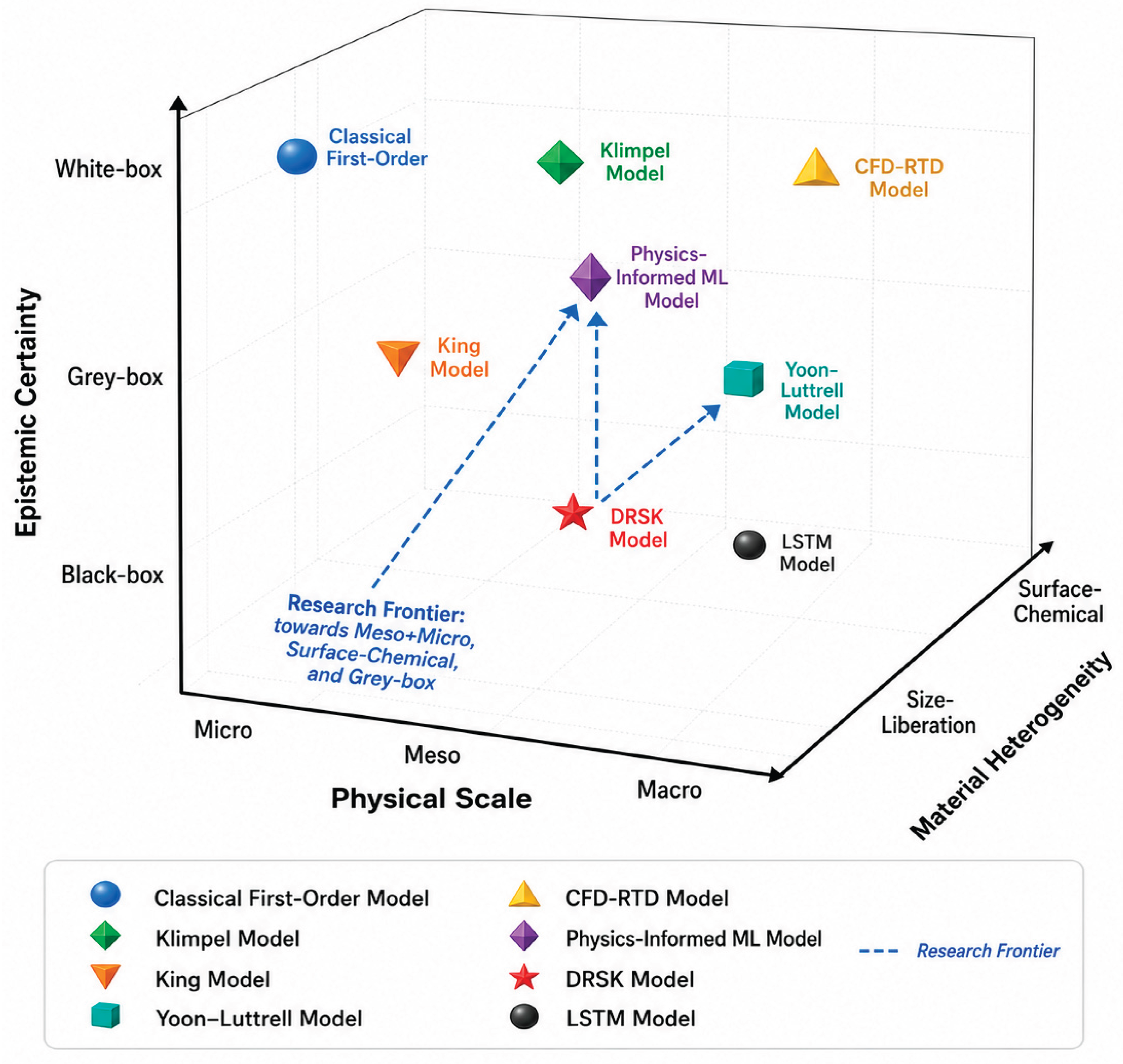
Figure 2.
Six failure modes of classical kinetics with symptoms and DRSK resolutions.
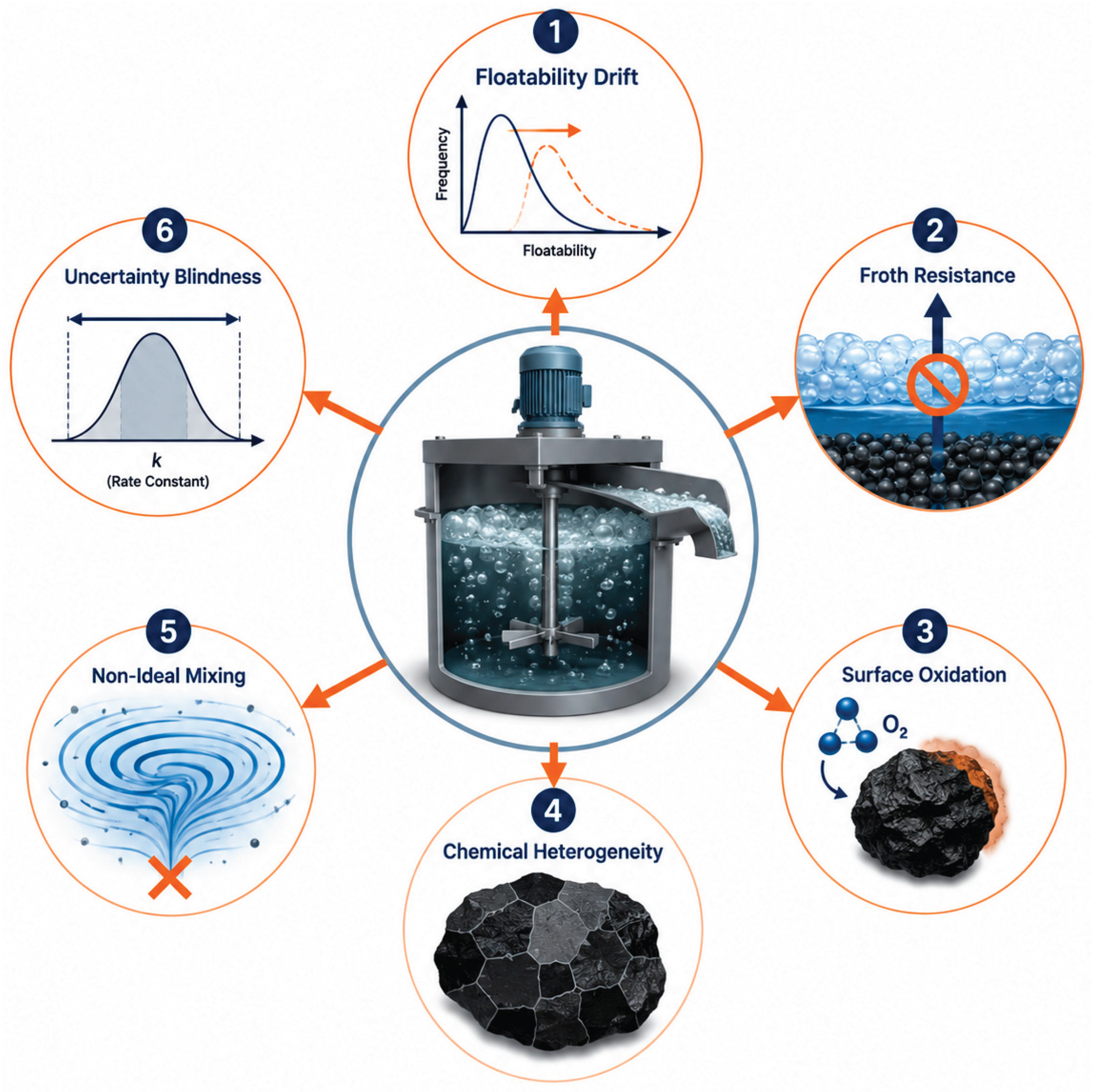
Figure 3.
Multi-scale toolkit for ab initio kinetic parameterization without empirical fitting.
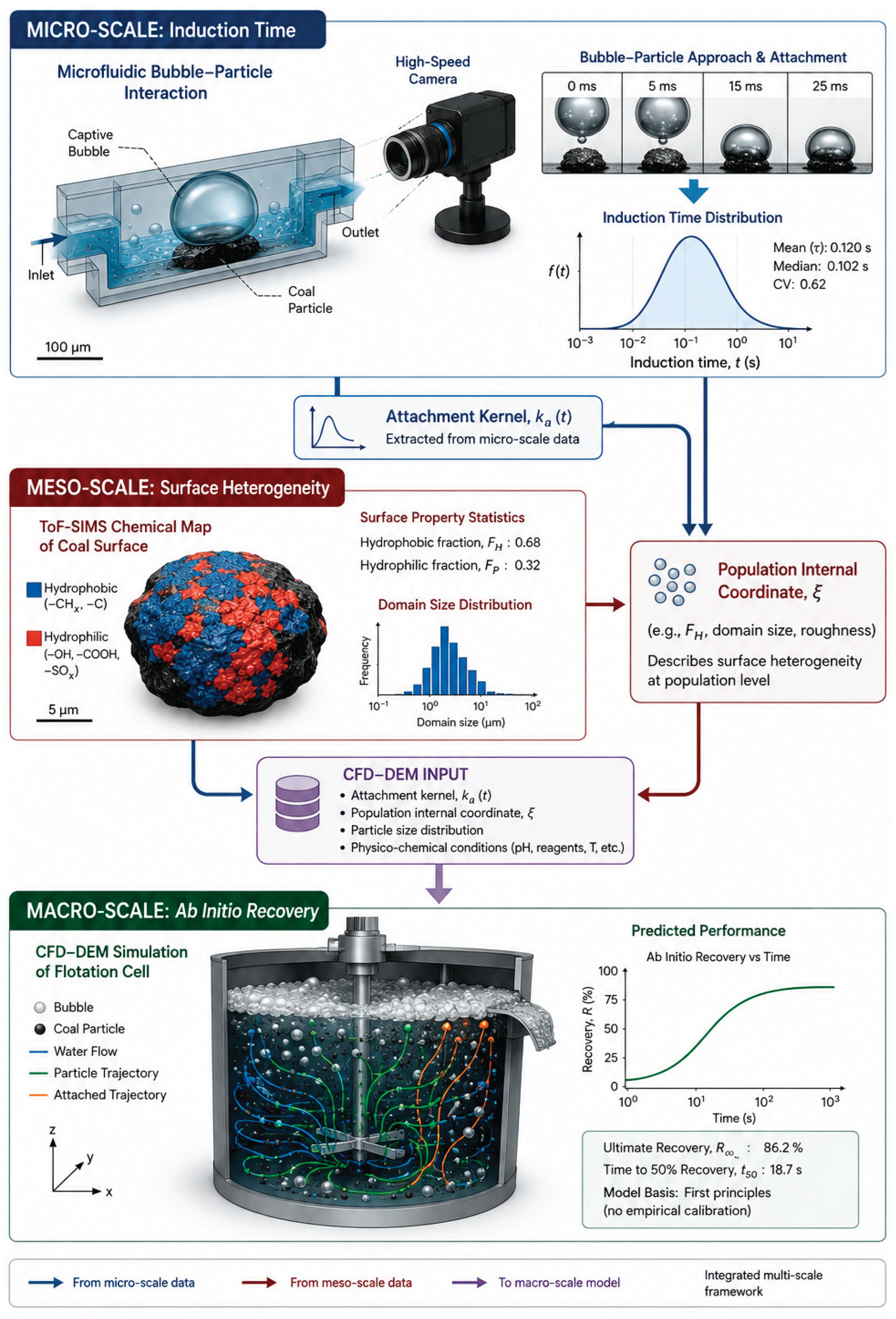
Figure 4.
Three-tier DRSK architecture: surface-state PBE, learned selection function, and SDE wrapper.
Figure 4.
Three-tier DRSK architecture: surface-state PBE, learned selection function, and SDE wrapper.
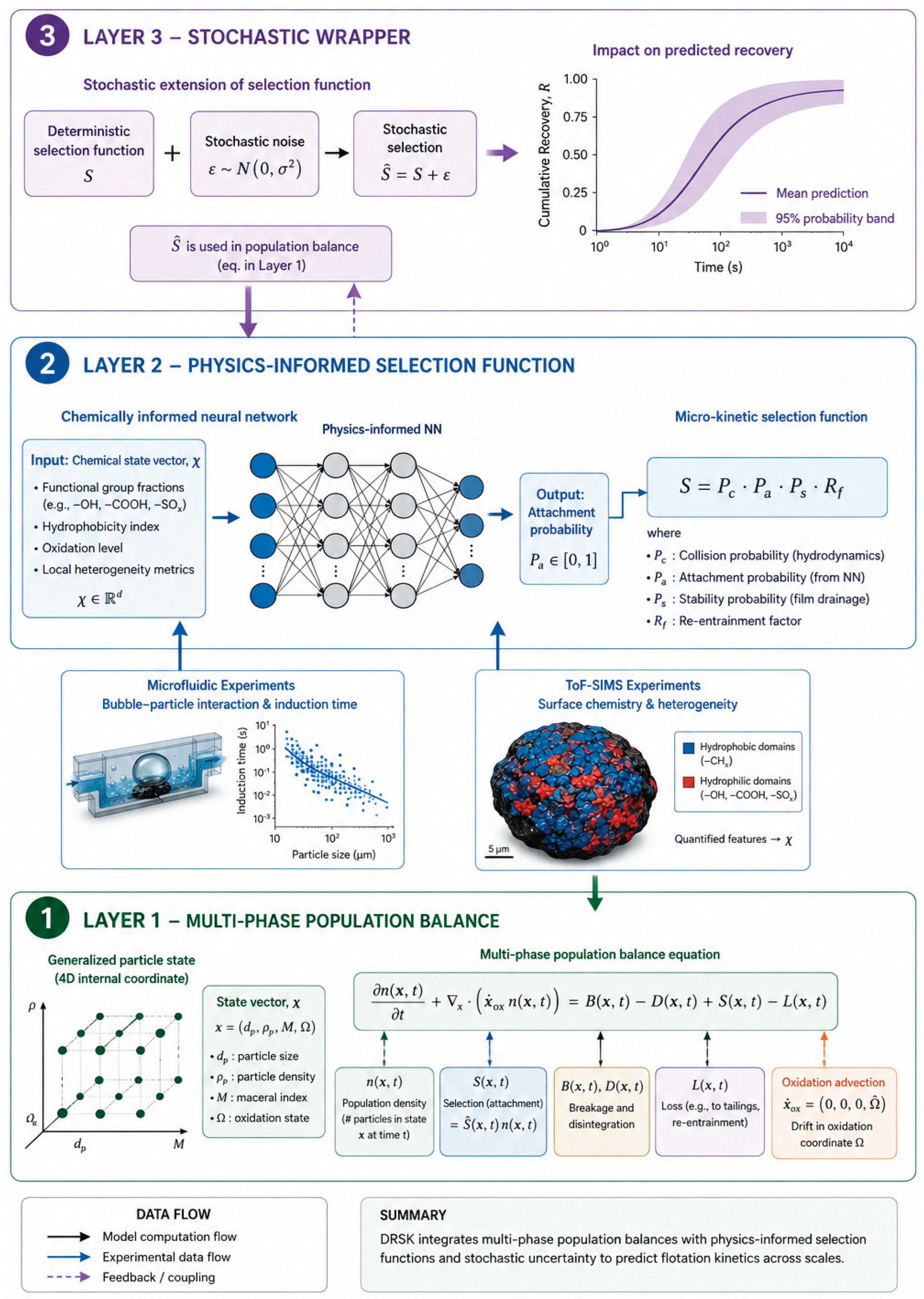
Figure 5.
Industrial digital twin integrating DRSK with real-time sensors, EnKF, and MPC.
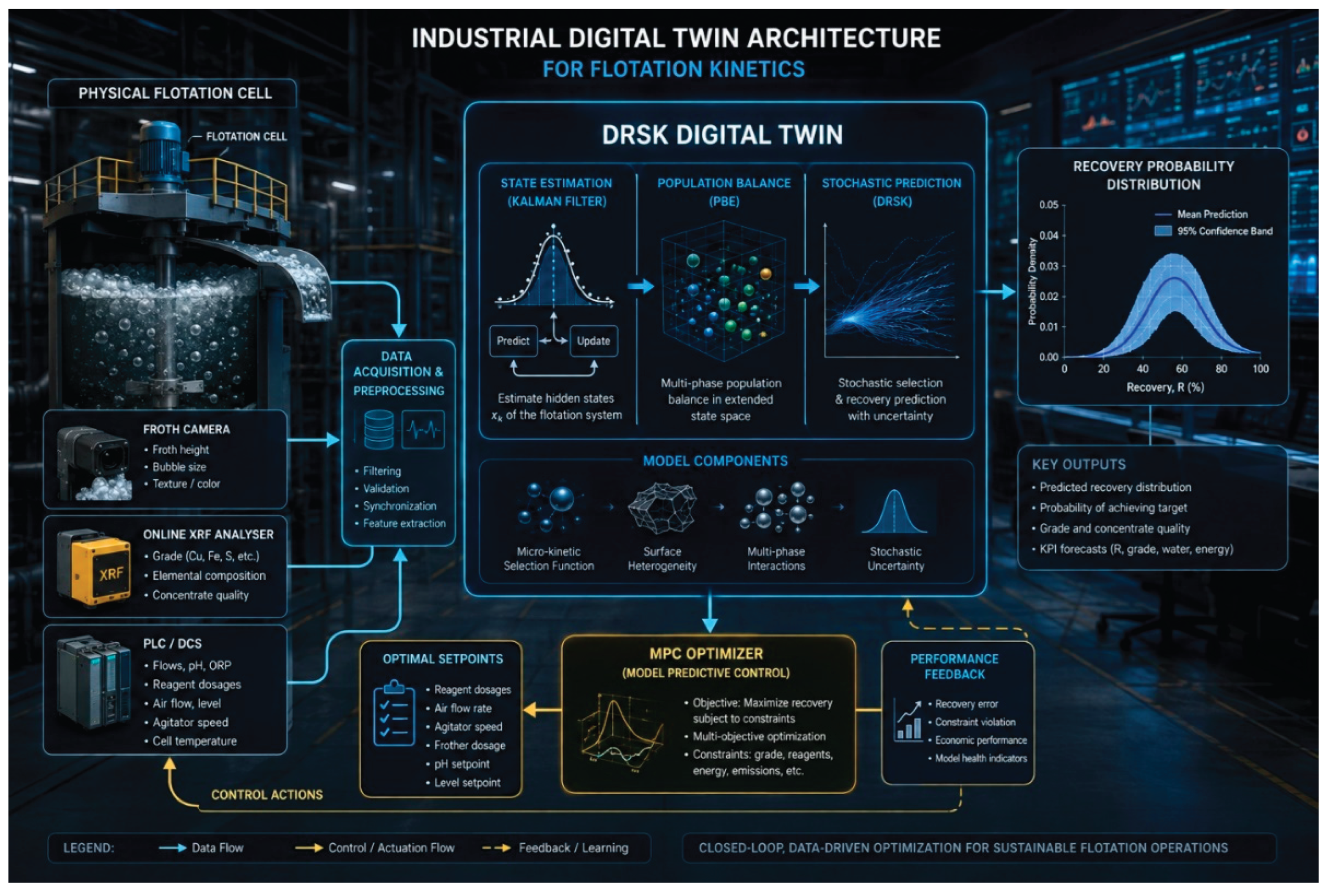
Figure 6.
DRSK application to circular economy streams: tailings, black mass, WEEE, and iron ores.
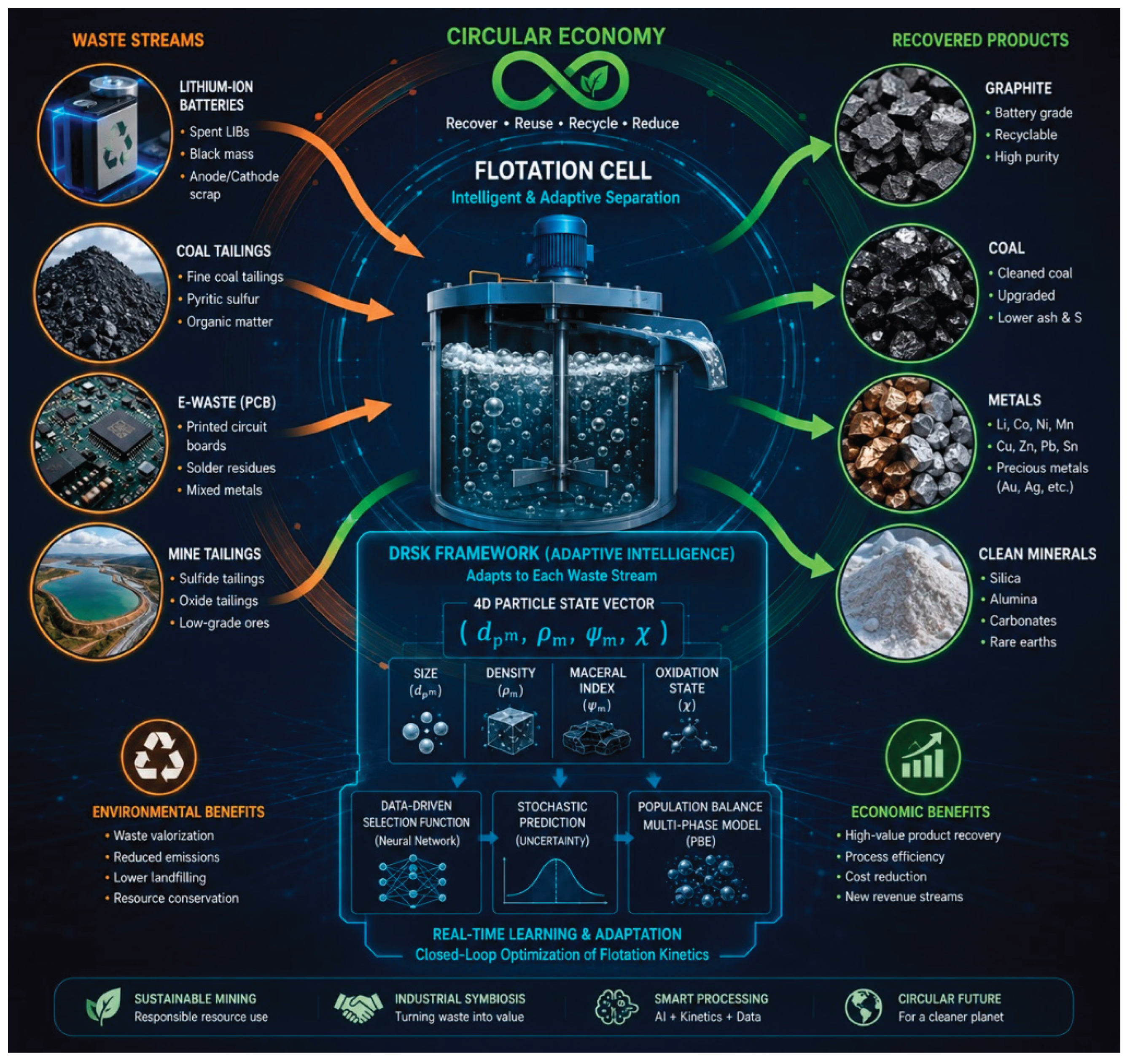

Table 1.
Classification of representative flotation kinetic models in the proposed 3D taxonomy.
| Model Class / Example | Scale | Heterogeneity Type | Certainty Framework | Typical Application |
|---|---|---|---|---|
| Kelsall first-order [1] | Macro | None (lumped) | White-box | Single-species batch fitting |
| [2] | Meso | Size-liberation | White-box | Wide-size flotation |
| King population balance [13] | Meso | Size-liberation | White-box | Sulphide circuit design |
| Yoon–Luttrell micro-kinetic [10] | Micro | Size only | White-box | Pure mineral fundamental |
| CFD-RTD convolution model [28,29] | Macro | Size-liberation | White-box | Industrial cell scale-up |
| in PBE [13,26] | Meso | Size-liberation | Grey-box | Complex sulphide ores |
| DRSK framework (this work) [19,30] | Meso + Micro | Surface-chemical + size | Grey-box (SDE) | Coal, oxidized ores, black mass |
| LSTM time-series recovery [31] | Macro | Any (implicit) | Black-box | Plant soft sensor |
Table 2.
Six failure modes of classical flotation kinetics with industrial symptoms, underlying mechanism, and DRSK resolution.
Table 2.
Six failure modes of classical flotation kinetics with industrial symptoms, underlying mechanism, and DRSK resolution.
| Failure Mode | Industrial Symptom | Physical/Chemical Mechanism | DRSK Resolution |
|---|---|---|---|
| Constant floatability spectrum | Overestimation of tailings recovery | Progressive removal of fast-floating species shifts distribution | |
| Neglected froth kinetics | Poor scale-up from lab to plant | Non-linear feedback of particle load on froth stability and drainage | Froth zone sub-model coupled via population balance |
| Missing oxidation deactivation | Unpredictable plant performance after feed stockpile | Surface carbonyl/carboxyl formation reduces hydrophobicity | in ODE system |
| False liberation concept for coal | Inability to predict maceral-by-maceral recovery | Nanoscale chemical domains dictate local attachment probability | Surface fugacity coordinate from ToF-SIMS mapping |
| Well-mixed cell assumption | Plant recovery lower than model prediction | Non-linear kinetics coupled with RTD break superposition | Compartment model or CFD-DEM coupling with non-linear kinetics |
| Deterministic point estimates | Misleading economic feasibility confidence | Parameter and model uncertainty ignored | SDE wrapper with Bayesian parameter posteriors |
Table 3.
Emerging experimental and computational techniques for parameterizing flotation kinetics without empirical fitting.
Table 3.
Emerging experimental and computational techniques for parameterizing flotation kinetics without empirical fitting.
| Technique | Information Provided | Kinetic Parameter Informed | Maturity for Coal |
|---|---|---|---|
| Microfluidic particle-bubble cell | Induction time distribution, attachment probability vs. contact angle | Laboratory demonstrated | |
| ToF-SIMS / XPS mapping | Surface chemical domain distribution, oxidation state | , local hydrophobicity | Commercially available |
| AFM force spectroscopy | Hydrophobic force–distance profile, adhesion force | Attachment energy barrier | Research stage for coal |
| MLA/QEMSCAN | Liberation class, mineral association, particle size | Internal coordinates for PBE | Routinely applied |
| CFD-DEM with attachment model | Recovery curve from first principles | Entire macro-kinetic response | Lab-scale validated |
| Physics-informed neural PBE | respecting mass conservation | Plant-scale tested |
Table 4.
Comparison of classical first-order/distributed- models and the DRSK framework.
| Feature | Classical Models | DRSK Framework |
|---|---|---|
| Internal coordinates | Size, possibly liberation | Size, density, maceral index, oxidation state |
| Rate constant determination | Fitted to recovery curve | Learned from micro-scale experiments + physics |
| Time-dependence of | None (constant) | Exported via surface oxidation kinetics |
| Treatment of froth | Empirical recovery factor | Coupled froth PBE sub-model |
| Output | Point estimate of recovery | Probability distribution of recovery |
| Handling of oxidation | Not possible | Intrinsic through coordinate |
| Extrapolation to new feed | Requires new fitting | Transferable with feed characterization |
| Computational cost | Low | Moderate (offline calibration), low (online run) |
Table 5.
Mapping of Industry 4.0 technologies to flotation kinetics components.
| Technology | Kinetic Application | Data Provided | Timescale |
|---|---|---|---|
| Deep froth image analysis | Real-time floatability spectrum | distribution | Seconds |
| Online XRF/LIBS | Elemental reconciliation, oxidation state | Bulk chemistry, C/O ratio | Minutes |
| Soft sensors (deep learning) | Virtual assay, particle size distribution | Missing process variables | Seconds |
| Ensemble Kalman filter | State estimation and data assimilation | with uncertainty | Minutes |
| Model predictive control | Closed-loop kinetic optimisation | Optimal setpoints for air, level, reagents | Minutes |
| Edge computing + DRSK ROM | Real-time model execution | Fast prediction of recovery-grade | Seconds |
Table 6.
Emerging circular economy flotation applications and their kinetic challenges.
| Application | Material System | Key Kinetic Challenge | DRSK Suitability |
|---|---|---|---|
| Coal tailings reprocessing | Highly oxidised fine coal + clays | Dominance of surface oxidation, ultrafine particle aggregation | High – explicit oxidation coordinate |
| Li-ion battery black mass | Graphite, NMC/LFP, Cu, Al, binder | Multiple engineered surfaces, variable thermal history | High – extendable state vector |
| WEEE plastics flotation | ABS, PS, PC, with flame retardants | Surface modification by weathering and additives | Medium – needs surface chemical mapping method |
| Fine phosphate from slimes | Apatite, quartz, clays, organics | Complex collector adsorption on heterogeneous surfaces | High – similar to coal surface heterogeneity |
| Iron ore tailings | Hematite, quartz, goethite | Changing mineralogy with depth of tailings dam | Medium – standard mineralogical coordinates apply |
Disclaimer/Publisher’s Note: The statements, opinions and data contained in all publications are solely those of the individual author(s) and contributor(s) and not of MDPI and/or the editor(s). MDPI and/or the editor(s) disclaim responsibility for any injury to people or property resulting from any ideas, methods, instructions or products referred to in the content. |
© 2026 by the authors. Licensee MDPI, Basel, Switzerland. This article is an open access article distributed under the terms and conditions of the Creative Commons Attribution (CC BY) license (http://creativecommons.org/licenses/by/4.0/).
Copyright: This open access article is published under a Creative Commons CC BY 4.0 license, which permit the free download, distribution, and reuse, provided that the author and preprint are cited in any reuse.