

Submitted:
17 August 2026
Posted:
19 August 2026
You are already at the latest version
Abstract
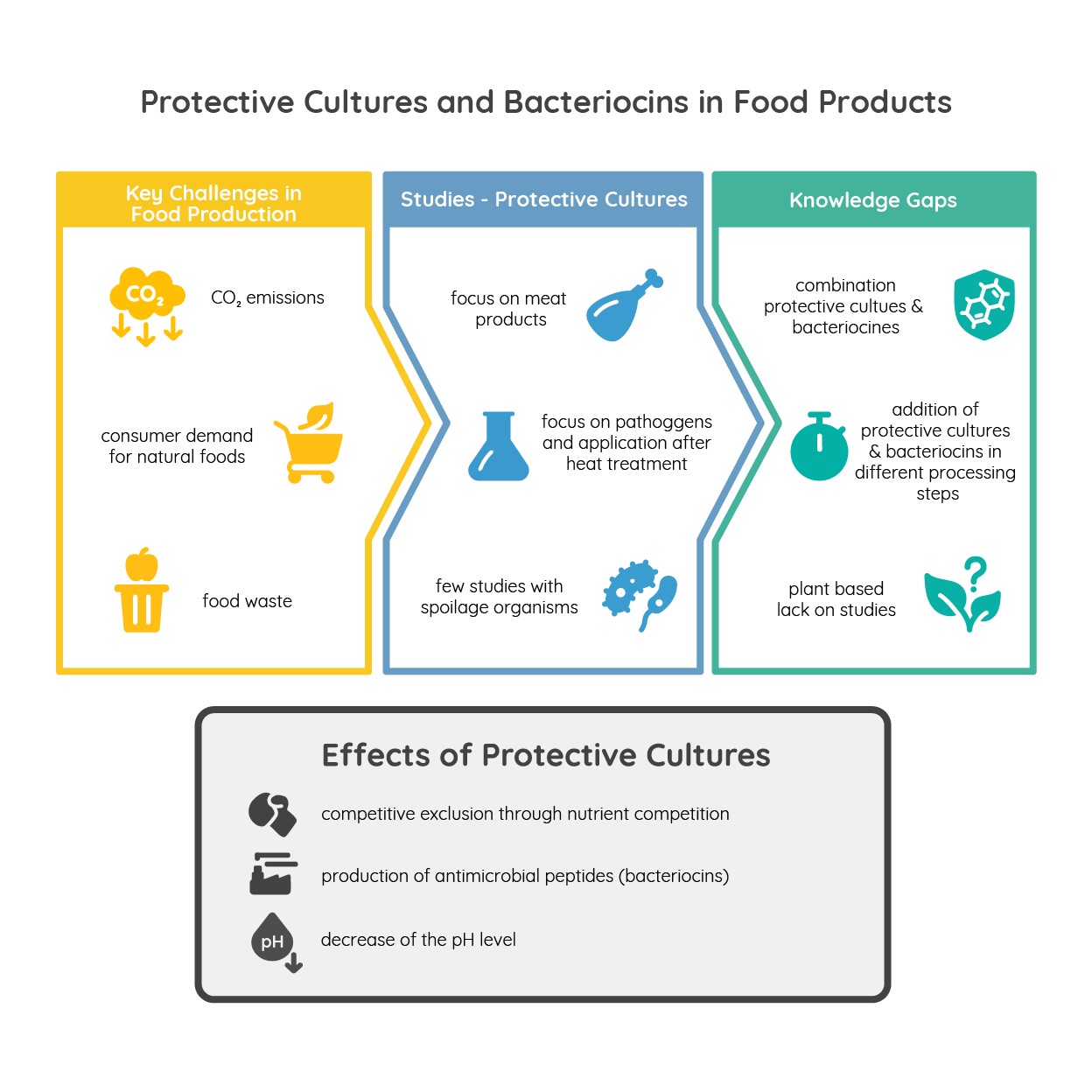
In view of the considerable levels of food loss on a global scale, the attendant greenhouse gas emissions, and the expanding demand for foods that are as natural as possible, bioconservation strategies – protective cultures in particular – are becoming increasingly important in food production. The objective of this systematic review was to present the current state of research on the use of protective cultures and bacteriocins in plant-based meat alternatives as well as in heated meat products. To this end, a systematic review and filtration for relevance of over 1,320 search results from scientific databases was conducted. Furthermore, market analyses, manufacturer information, legal frameworks and regulatory information on outbreak incidents were considered. The evaluation incorporated technological aspects and regulatory requirements in order to provide a comprehensive picture of current developments and challenges in this field.A review of the extant literature reveals an absence of studies that have examined the utilization of protective cultures in plant-based meat alternatives. However, extant research on microbial diversity suggests that potential protective cultures could include strains similar to those found in conventional meat products, although this needs to be experimentally validated. Moreover, there is a significant need for research regarding the combination of different protective cultures, particularly in conjunction with bacteriocins. Technologically, application has hitherto been carried out predominantly after heat treatment, although injection prior to heat treatment would be technologically advantageous. In this context, encapsulation is a promising approach that has yet to be thoroughly investigated. A considerable body of research has hitherto been dedicated to the inhibition of Listeria monocytogenes. In future, when selecting Listeria strains, strains associated with foodborne outbreaks should be used in preference to pure laboratory strains and unspecified wild strains.
Keywords:
protective cultures
; plant-based meat alternatives (PBMAs)
; heated meat products
; food safety
1. Introduction
The significant negative impact of food waste, particularly in terms of its contribution to the global carbon footprint and climate change, highlights its relevance to the Sustainable Development Goals (SDGs). Not only is addressing this issue a global priority, it is also the responsibility of the food industry to adopt sustainable practices (United Nations, https://sdgs.un.org/topics/chemicals-and-waste; Bhatia et al., 2023).
SDG Target 12 explicitly calls for ‘sustainable consumption and production patterns’ and commits Member States to halving per capita food waste at retail and consumer levels, and reducing food losses across production and supply chains, including post-harvest stages, by 2030 (United Nations, https://sdgs.un.org/topics/chemicals-and-waste).
Consumers and retailers value information about ingredients and additives and are interested in food production. The trend toward products with clean labeling and particularly fresh, minimally processed products is also evident in discount stores and retail chains’ private label programs, as foods that contain many ingredients that must be declared with E numbers (e.g., sorbic acid – potassium sorbate E 200 – 202) (European Commission; https://ec.europa.eu/food/food-feed-portal/screen/food-additives/search; Karbowiak et al. 2023).
At the same time, there is a strong demand for products with a long shelf life. Manufacturers should allocate more resources to this area by monitoring the production of their products (Hazard Analysis and Critical Control Points – HACCP and Good Hygienic Practices – GHP) and improving their risk analysis of products placed on the market until the end of shelf life and beyond. This enables particularly sustainable but also cost-saving production (Witkowski et al., 2022; Kaveh et al., 2023).
The rapid global movement of goods, a defining feature of globalization, has further emphasized the need for stable products. This has driven the demand for technological advancements to combat microbial spoilage and contamination by food-pathogenic microorganisms. Starter and protective cultures play a critical role in enhancing food stability and shelf life, acting as biological preservatives by outcompeting spoilage microorganisms and pathogens. It is evident that they constitute a pivotal element within the framework of hurdle technology, thereby serving as a substitute for chemical preservatives (Kruse, 1999; Fischer and Titgemeyer, 2023).
In addition to extending shelf life to reduce food waste, lowering meat consumption has emerged as a critical strategy for cutting CO₂ emissions. Animal product production is particularly carbon-intensive, driving increased efforts to develop plant-based and cultured meat alternatives. The growing market for these products is especially notable, with plant-based alternatives projected to capture 25% of the market and cultured meat 35% by 2040 (Statista, https://de.statista.com/outlook/cmo/lebensmittel/fleisch/weltweit#umsatz; Gerhardt et al., 2019).
Regulatory progress is also underway: approvals for the sale of cultured meat have already been granted in Israel, the UK, Singapore, Australia, New Zealand, and the US (Supplement Table S1). In Europe, the European Food Safety Authority (EFSA) has received its first four applications for the approval of cultured meat products, including beef, beef fat, foie gras, and hot dogs (GFI, https://gfieurope.org/wp-content/uploads/2023/05/GFI-Europe-Sustainable-Proteins-in-Germany-Summary-EN.pdf; transgen.de, https://www.transgen.de/lebensmittel/2700.fleisch-zellkultur-biotechnologie.html).
Currently, the distribution of cultured meat products is still extremely limited, while plant-based meat alternatives (PBMAs) are available in almost all supermarkets (Gerhardt et al., 2019). Given the increasing market relevance of PBMAs, the potential application of protective cultures in this area is a topic of interest.
Despite extensive research into the use of protective and starter cultures in meat and processed meat products, the knowledge and application of protective cultures in plant-based alternatives and cultured meat remain limited (Chr. Hansen, 2024; M-Food, https://www.meatcracks.de/media/m-cultures_meat_de_ex.pdf). Consequently, the use of raw materials and additives, production technologies, and the market landscape in this sector are highly dynamic. It is especially important to consider the matrix, the microbiome, and the manufacturing processes when using protective cultures in plant-based meat alternatives. (Margerin, 2018). To date, no published studies have investigated the use or effectiveness of protective cultures in PBMA.
Since cultured meat is not yet widely available and is expected to behave similarly to conventional meat, this study focuses on heated meat products and their plant-based alternatives (Habowski & Sant’Ana, 2024). This review seeks to highlight the potential of protective cultures and bacteriocins, illustrate the diversity of existing research, and identify knowledge gaps related to cooked meat products and the rapidly growing market for plant-based alternatives.
By undertaking this approach, it is possible to gain valuable insights and establish key areas that require further investigation.
2. Systematic Literature Review – Workflow
The main question aims to clarify the current scientific and economic status of protective cultures and bacteriocins for cooked meat products and their plant-based alternatives. In particular, the influence of protective cultures and bacteriocins on product safety, quality, and longer shelf life was examined. Further research also addressed microbial diversity, the safety of protective cultures, and technological information on the production of meat-based products and plant-based alternatives (Supplement Figure S1).
For primary web-based research, Scopus, PubMed and Web of Science were prioritized, to access systematic reviews or bibliometric analyses. Google Scholar research was applied to achieve broader coverage that includes grey literature, preprints, and conference papers. As secondary sources, ScienceDirect, SpringerLink, and Wiley Online Library provide full-text access to a wide range of articles and book chapters. Legal texts and guidelines and outbreaks (n=26) from the relevant authorities were also reflected. Websites and guidelines of manufacturers of protective cultures and trade fair reports (n=6) and market analyses (n=6) were ultimately considered in the review process.
When developing search strings, we applied Boolean operators AND and OR, to refine the search and capture all relevant variations of keywords. After an initial search the number of articles was 1,320. After removing duplicates, 1,108 studies remained. The aim of the studies and the conclusions of the literature references were examined, and studies that were not related to starter cultures, protective cultures, meat, and plant-based products were excluded (n = 875). After this step, 233 studies remained. In the next step, studies on raw fermented products and/or starter cultures were examined in more detail with regard to their thematic relevance for this review. In the next step, studies for starter and fermented products were excluded if the cultures tested in the latter studies had no proven protective effect (remaining studies n=133). As the study design on protective cultures and bacteriocins was very heterogeneous, a meta-analysis was not possible because the results are not statistically comparable. To contribute to the innovative character of the paper, 48 additional scholarly sources were incorporated. These sources addressed topics including general bacterial resistance, encapsulation technologies, mechanical processing and protein technologies, microbial diversity in production environments, cultivated/microbial meat, sustainable food systems, and specialized academic literature.
3. Starter Cultures and Protective Cultures-Definition
Starter and protective cultures are used as single cultures or mixed cultures with defined physiological and technological properties (Bintsis and Athanasoulas, 2015) (Figure 1). The fundamental difference between starter and protective cultures lies in their different technological applications.
Starter cultures are microorganisms intentionally introduced into food to initiate and control fermentation processes. Their application enhances not only the sensory properties of food but also its nutritional value and digestibility (Gänzle et al., 2024). Starter cultures are often used in the production of fermented meat products, including salami, air-dried sausages, and onion sausages. The main function of these enzymes is to accelerate processes such as lowering the pH, thereby influencing the color, texture, and taste of the products and developing their characteristic aroma. In addition, starter cultures have been shown to improve stability, shelf life, and safety (Leroy et al., 2006).
In contrast, protective cultures are microorganisms that suppress the growth of spoilage organisms (e.g., Brochothrix thermosphacta) and foodborne pathogens (e.g., Salmonella and Listeria monocytogenes) by the production of antimicrobial compounds (Garín-Murguialday et al., 2026; García-Díez and Saraiva, 2021).
The use of protective cultures is a practice applied with the intention of extending shelf life, increasing safety, and reducing spoilage. This phenomenon occurs through three different mechanisms: the synthesis of organic acids that lower the pH-value, the production of bacteriocins (Figure 2), and competing directly with spoilage organisms for nutrients, which can lead to the displacement (Ben Said et al., 2019; Xu et al., 2022).
Protective cultures include specific strains of lactic acid bacteria (LAB), such as Lactococcus lactis (Lc.), Lactobacillus sakei (Lb.), Lb. plantarum, Lb. paracasei, Lb. rhamnosus, and Lb. brevis, as well as Enterococcus faecium (Ec.), Carnobacterium, Bifidobacterium, and Propionibacterium. The use of protective cultures has proven to be an important clean label strategy that offers an alternative to E-number preservatives (Bintsis and Papademas, 2024; Garín-Murgialday et al., 2026; Anumudu et al., 2024; Cocolin, 2025; Karbowiak, 2023).
Protective cultures are also used in ready meals to naturally counteract microbial spoilage and preserve freshness. Spraying protective cultures onto individual sausage slices between cutting and packaging, a critical moment for microbial recontamination, offers innovative new applications (Møller and Zuliani, 2024).
Customized protective or starter cultures and their bacteriocins are used to reduce nitrite concentrations in sausage products. Some strains are also reported to have health-promoting properties, including probiotic potential (Chapter 3.2.) (Petka and Walczycka, 2026). The most commonly used starter and protective cultures in food are provided in Figure 1 (Ammor and Mayo, 2007) (Figure 1).
3.1. Research Focus on Protective Cultures for Heated Meat Products
A comprehensive review of the literature on protective cultures in meat products identified 30 potential cultures or strain combinations that were specifically selected for their antimicrobial properties. Twenty-six of these strains (87%) demonstrated a significant inhibitory effect on target organisms (Table 1). Most studies prioritized the efficacy of protective cultures against L. monocytogenes, the most critical pathogen in ready-to-eat (RTE) meat products. Several investigations employed non-pathogenic surrogate strains to model L. monocytogenes behavior.
L. innocua and L. ivanovii were used due to their physiological similarities to L. monocytogenes and because they pose no direct human health risk (Danielski et al., 2020; Jacobsen et al., 2003; Héquet et al., 2007). While extensive research has been conducted on pathogens, the available literature on spoilage microorganisms remains limited, focusing primarily on B. thermosphacta, a key spoilage organism in refrigerated meat products (Figure 3, Table 1). Other significant spoilage bacteria, such as Pseudomonas, Lactobacillus, and Enterobacteriaceae, as well as fungi, including molds and yeasts, have received comparatively little attention, despite their impact on shelf life and sensory quality.
With the exception of two studies focusing on Pseudomonas and Escherichia coli (E. coli), the target organisms were exclusively Gram-positive bacteria. One potential explanation for this trend is the displacement of Gram-negative bacteria, such as Pseudomonas, by Gram-positive bacteria, such as Latilactobacillus, during the product’s shelf life. Gram-positive bacteria are known to exhibit greater tolerance to lower water activity and/or lower pH (Barcenilla et al., 2024). Additionally, recent studies have identified yeasts as contributors to spoilage, as they were inhibited but not fully eliminated in cooked ham by protective cultures (Palacio et al., 2025).
The dosage of protective cultures is critical and must be tailored to the timing of application (pre- vs. post-heating) and the specific challenges of the meat product (e.g., pH, water activity, competing microbiota). In studies where Lc. lactis DSM 20729, Pediococcus acidilactici LMQS 154 (P.), P. pentosaceus DSM 3313, and Lb. curvatus ACU-1 failed to achieve the desired reduction, this may be attributed to the low initial concentration of the protective cultures used (Bungenstock et al., 2021). The concentration of the protective cultures used should be between 10⁵ log and 10⁷ CFU/g when administered after heating and between 108 and 10¹⁰ CFU/g when administered before heating (Jacobsen et al., 2003; Bredholt et al, 2001; Kotzekidou and Bloukas, 1996).
A review of studies on protective cultures revealed that Berry et al. (1990), Jacobsen et al. (2003), and Kotzekidou and Bloukas (1996) examined their effects prior to heating. In the remaining studies, the cultures were applied exclusively to the surface after heating (Table 1 and Figure 2).
Protective cultures can be applied to sausage meat prior to heating during the emulsification process, brine injection, or tumbling of the ham. Jacobsen et al. (2003) argue that incorporating protective cultures prior to heating is not only advantageous from a process engineering standpoint but also effective in combating Listeria. An innovative method for adding protective cultures before heat treatment is encapsulation. However, it is critical that the capsules containing these cultures do not fully survive the heating process, allowing the protective cultures to proliferate in the final product. A variety of stimuli—such as temperature, pH, mechanical stress, and osmotic pressure fluctuations—have been shown to trigger the release of encapsulated microorganisms. Nevertheless, the efficacy of this approach in heated meat products remains unproven and has, to date, only been demonstrated in high-pressure-treated products (Nedumpilly Puthenveedu Haridas and Bhat, 2026; Anal and Singh, 2007; Lemay et al., 2002; McGillin et al., 2022).
The efficacy of protective cultures can be enhanced by combining them with bacteriocins or by using multiple protective cultures together in products like cooked ham. This synergistic effect has been demonstrated in both heated meat products and vacuum-packed lamb (Gao et al., 2015; Xu et al., 2022). When protective cultures and bacteriocins are used in tandem, the bacteriocin initially inhibits the growth of undesirable bacteria, providing a window for the protective culture to reach a sufficient cell density to effectively suppress the target bacteria. (Schillinger et al., 2001).
Certain microbial communities—comprising environmental, spoilage, and pathogenic organisms—are increasingly adapting to production environments, posing a risk of contaminating food and food ingredients. This adaptation has contributed to a notable rise in the prevalence of Shiga toxin-producing E. coli (STEC), Listeria monocytogenes, Salmonella, and Campylobacter across several European countries (Omelchenko et al., 2026; ECDC: https://www.ecdc.europa.eu/en/food-and-waterborne-diseases-and-zoonoses/surveillance-and-disease-data). Therefore, epidemiological data should be considered when selecting target pathogenic strains. In particular, strains of the clonal complex (CC) of lineage II are particularly common in food. For example, CC 121 and CC9 are known to be persistent in food processing environments (EFSA, 2024). Additionally, data obtained from a single reference strain cannot be generalized to the entire species or even to a specific genetic lineage. Consequently, efficacy tests should always include multiple strains, ideally incorporating field isolates to ensure broader applicability (Gutiérrez et al., 2025).
A review of the actual research reveals several critical gaps:
- Although B. thermosphacta has been the focus of extensive research, other spoilage-causing bacteria, particularly LAB, have received comparatively less attention, despite their substantial impact on sensory deterioration and shelf-life reduction.
- The application of encapsulated protective cultures in heated meat products has been explored in a single study. Consequently, there is an imperative for further research to assess the feasibility, stability, and efficacy of this approach within industrial contexts.
- While the synergistic effects of mixed protective cultures show potential, this strategy is seldom explored. Future studies should prioritize multi-strain combinations to enhance antimicrobial spectra and functional benefits.
- The selection of target organisms for protective cultures should be guided by epidemiological data and a risk-based approach, considering both the prevalence and virulence of pathogens in specific meat products.
3.2. Biological Safety of Starter and Protective Cultures
LAB and their bacteriocins are generally recognized as safe (GRAS) and offer beneficial properties, including antimicrobial, antioxidant, antihypertensive, immunomodulatory, anti-inflammatory, and potential anticancer effects (Carneiro et al., 2024; Castellano et al., 2017). However, careful evaluation of health-related biosafety factors remains essential when selecting them as protective cultures (Carneiro et al., 2024; Castellano et al., 2017).
From a legal perspective, only microbial strains that have been rigorously tested and approved by the European Food Safety Authority (EFSA; https://www.efsa.europa.eu/en/topics/topic/qualified-presumption-safety-qps) or classified as “Generally Recognized as Safe” by the US Food and Drug Administration (FDA) (GRAS; https://www.fda.gov/food/food-ingredients-packaging), may be used as starter or protective cultures in food production.
These approvals guarantee the safety, characterization, and effectiveness of the strains for improving food quality, safety, and preservation (Supplementary Table S2). Regarding product labeling, EU legislation (Regulation (EU) No. 1169/2011) exempts ingredients from being listed if they do not perform a technological function in the final product—such as when they are reduced to natural levels during thermal processing (European Parliament, 2011). However, if the cultures remain active in the final product (as is typically the case with protective cultures), they must be declared on the label.
Additionally, Regulation (EC) No. 852/2004 mandates the verification of food safety measures (European Parliament, 2004). Consequently, every batch of protective cultures produced is tested for bacteriocin production to ensure compliance (AVO, https://www.avo.de/).
Bacteriocin-producing microorganisms, including LAB and other taxa, along with their bacteriocins, show great potential as protective cultures by providing antimicrobial, probiotic, and health-promoting effects. However, the implementation of these technologies necessitates a meticulous evaluation of biosafety concerns. LAB have been observed to harbor antibiotic resistance genes, which have the potential to transfer to pathogens. Furthermore, certain strains of LAB have been found to produce biogenic amines in fermented foods. To ensure safety, strain-specific assessments must be conducted prior to their use. These assessments include testing for minimum inhibitory concentrations (MIC) of key antibiotics and screening for biogenic amine production and virulence factors (Mathur and Singh, 2005; Plavec and Berlec, 2020; D’Silva, 2011). If these risks, costs, and technological challenges—such as maintaining the stability and activity of postbiotic compounds (consist of metabolic byproducts, cell components, or secreted factors that provide health benefits) during food processing—can be addressed, LAB have the potential to enhance food safety, extend shelf life, and improve nutritional and health-promoting properties. The establishment of clear regulatory guidelines could further facilitate their safe and effective integration into food production (Carneiro et al., 2024; Trymers et al., 2026; Anumudu et al., 2024).
3.3. Bacteriocins in Heated Meat Products
Bacteriocins are a heterogeneous group of antimicrobial peptides produced by various protective culture strains (Sugrue et al., 2024). The focus of scientific research is predominantly on bacteriocins produced by LAB, Bacillus or Staphylococcus pasteuri (S.). Bacteriocins demonstrate efficacy even at low concentrations, exhibit high heat stability, maintain stability at low pH values, and do not affect the nutritional properties of food (Amiri et al., 2021; Zendo, 2013; To et al., 2022; Hong et al., 2018).
Bacteriocins are classified into four classes and nine subcategories. A significant distinction is made between post-translationally modified peptides (class Ia) and unmodified peptides (class II) (Favaro et al., 2015; Castellano et al., 2017) (Figure 2). Table 2 provides a comprehensive overview of the bacteriocins utilized in research on meat products. The most prevalent strains were those capable of producing sakacin, followed by those capable of producing pediocin and enterocin (Table 2).
Bacteriozin AS-48, produced by Ec. faecalis subsp. liquefaciens, has been identified as an effective solution for addressing spoilage LAB, B. thermosphacta, and S. carnosus (Parada-Fabían et al., 2025; Baños et al., 2012). The application of a bacteriocin mixture produced by Lb. curvatus, Lc. lactis, P. acidilactici, and Enterococci appeared to be promising as evidenced by the reduction of L. monocytogenes on hot dog sausages (Vijayakumar and Muriana, 2017). It has been demonstrated that Micocin® (a mixture of low-molecular-weight, ribosomally synthesized, antibacterial peptides produced by E. coli) is effective against Clostridium botulinum (Cl.) and L. monocytogenes (Parada-Fabían et al., 2025).
Gao et al. (2015) demonstrated that the combination of bacteriocin and a protective culture (sakacin C and Lb. sakei C2) exhibited a greater degree of effectiveness against L. monocytogenes than either the protective culture or the bacteriocin alone in vacuum-cooked ham.
Just as with protective cultures, the concentration of bacteriocins must be carefully determined to ensure effectiveness. For example, a study found that nisin concentrations of 12.5 mg/kg failed to inhibit Listeria growth, whereas 32 mg/kg demonstrated an inhibitory effect (Laranja et al., 2024). The established correlation between bacteriocin production and optimal cell growth suggests the possibility that not all bacteriocin-producing strains present in specific food matrices actively secrete bacteriocins. The optimal conditions for the formation of bacteriocins for product preservation are contingent upon environmental factors such as temperature, salt concentration, pH, and packaging atmosphere (Yang et al., 2018). The technological processing steps or other recipe components, such as brine, have been demonstrated to exert antagonistic effects (Laranja et al., 2024). Furthermore, it has been demonstrated that bacteriocin resistance, such as nisin resistance in L. monocytogenes, increases with increasing NaCl exposure. In addition to environmental factors, genetic background also plays a decisive role (Bergholz et al., 2013; Malekmohammadi et al., 2017). The resistance mechanisms described are mediated by efflux pumps and regulatory systems (VirAB, VirSR, and the multicomponent system AnrAB). Such common mechanisms can cause co-resistance to nisin, ciprofloxacin, ethidium bromide, bacitracin, cephalosporins, and benzalkonium chloride (Jiang et al., 2019; Rakic-Martinez et al., 2011).
Resistance mechanisms in bacteria, such as those mediated by efflux pumps (e.g., VirAB) and regulatory systems (e.g., VirSR, AnrAB), can lead to cross-resistance not only to bacteriocins like nisin but also to a range of antimicrobials, including ciprofloxacin, ethidium bromide, bacitracin, cephalosporins, and benzalkonium chloride (Jiang et al., 2019; Rakic-Martinez et al., 2011). Beyond genetic co-resistance, exposure to benzalkonium chloride—a common disinfectant in food processing—may further promote co-selection. This is supported by the frequent co-localization of benzalkonium chloride resistance genes (e.g., bcrABC, emrC) with genes conferring acquired antibiotic resistance (Yu et al., 2018; Kawacka and Olejnik-Schmidt, 2024; Moura et al., 2024).
The gadD3 gene (part of the GAD system) and mutations in mpt/manR contribute to resistance against nisin and class IIa bacteriocins (Lakicevic et al., 2022; Gravesen et al., 2002; Zawiasa and Olejnik-Schmidt, 2025). Resistance also depends on clonal complex (CC), with SSI-1 (in CC3, CC5, CC7, CC9) enhancing resistance under salt stress (Malekmohammadi et al., 2017). Additional mutations (e.g., RsbU G77S, PBPB3 V240F) in CC7 and CC121 further increase resistance and may boost virulence (Wambui et al., 2020; Centorotola et al., 2021). CC2, CC3, CC6, CC7, CC14, CC199, and CC403 show particularly high resistance, emphasizing the role of genetic background (Malekmohammadi et al., 2017; Wambui et al., 2020).
However, the inherent resistance of L. monocytogenes to nisin significantly restricts its effectiveness, necessitating its application in conjunction with other additives or technological measures (Wu et al., 2023). Nevertheless, combination strategies should not be based on the simultaneous use of other bacteriocins. This recommendation is substantiated by the existence of cross-resistance mechanisms, whereby strains that are resistant to nisin are frequently also resistant to class IIa bacteriocins (e.g., pediocin), and vice versa (Gravesen et al., 2002b). The effectiveness of bacteriocins is heavily influenced by the food matrix. For instance, Danielski et al. (2020) found that C. maltaromaticum produced only minimal bacteriocin levels in cooked ham, likely due to limitations imposed by the food matrix. Similarly, the antimicrobial activity of Ec. faecium bacteriocins can vary significantly depending on the food type, processing conditions, and composition.
While the efficacy of Ec. faecium bacteriocins has been well-documented in cheeses and fermented soybeans, their performance in processed meats and other complex foods has proven less consistent (Ben Braiek & Smaoui, 2019).
The bio conservative effect of bacteriocins in meat and meat products is currently only partially exploited commercially, with nisin and pediocin PA-1 being commercially available for food preservation. The prevailing legal framework in both the US and the EU presently permits the utilization of nisin (E 243) exclusively as a pure bacteriocin (Barcenilla et al., 2022; European Parliament, 2008; Annex II of EU Regulation 1333/2008; Food & Drug Administration (FDA), https://www.law.cornell.edu/cfr/text/21/184.1538; Wu et al., 2023). In the United States, certain pediocin-based preparations have received regulatory approval (FDA, https://downloads.regulations.gov/FDA-2025-N-1927-0046/attachment_1.pdf).
In order to achieve the full potential of bacteriocins, several challenges must be overcome. These objectives include the optimization of methods for identifying bacteriocin genic strains and the validation of their activity in situ, as well as the coordination of political and regulatory processes to establish harmonized frameworks that facilitate the appropriate and efficient utilization of bacteriocin-producing strains and bacteriocins (Cocolin, 2025; Castellano, 2023). Presently, bacteriocins are required to meet specific approval criteria, encompassing proper identification, characterization of their chemical composition, safety assessment, and indication of the recommended application concentration. Despite the challenges associated with large-scale application, bacteriocins have significant potential for improving food safety and extending shelf life (Parada-Fabían et al., 2025).
3.4. Application of Protective Cultures in Pbmas
Chen et al. (2025), Lindberg et al. (2025), and Xie et al. (2024) have conducted systematic reviews examining the environmental, processing, nutritional, health, and future perspectives of plant-based meat alternatives (PBMAs), while Munialo et al. (2025) provide a comprehensive overview of meat substitutes, including protein sources, quality characteristics, analytical methods, and consumer perceptions. However, the application of protective cultures in PBMAs has yet to be explored in scientific detail. Key challenges and future directions involve selecting the right protective culture, ensuring its feasibility for industrial implementation, and combining these cultures with emerging protein sources to create safe, high-quality food products (Schreuders et al., 2021).
A promising approach in extruded PBMAs involved a combination of 1% chitosan, 2.5% tea polyphenols, and 0.04% nisin as an alternative to conventional preservatives, which had a shelf life four times longer than the untreated control samples (Dai et al., 2022).
In the field of flaxseed oil cake–based plant milk alternatives for the development of innovative probiotic beverages, the incorporation of Lb. rhamnosus in combination with sucrose-driven acidification has been shown to effectively inhibit pathogenic microorganisms such as Bacillus cereus (Bc.) (Łopusiewicz et al., 2021). Lb. rhamnosus has been demonstrated to exert a protective effect against E. coli 0157:H7 in the context of fermented raw sausages (Erkkilä et al. 2000).
Elhalis et al. (2023) provide a comprehensive overview of the pivotal factors influencing the development of protective cultures in PBMAs. Key aspects that should be considered include the ability to displace the natural microflora, the detoxification of mycotoxins and biogenic amines, cost-effectiveness, and processing and storage stability. The cultures must demonstrate resilience to rigorous processing techniques, such as extrusion, while enhancing flavor, texture, and safety attributes. The current gaps in the field include limited strain-specific data for plant-based proteins (soy, peas, mycoprotein), as well as challenges related to scalability.
Starter and protective cultures often overlap in terms of their species and functions, so factors such as adaptability, detoxification, and stability apply to both. An example is tofu, a traditional soy-based meat alternative in which nisin, in combination with protective cultures (Ec. faecium BFE 900-6a or Lc. lactis BFE 902) L. monocytogenes completely inhibit (Malav et al., 2015). Nisin initially suppresses Listeria until the protective cultures reached a sufficient density to take over long-term inhibition (Schillinger et al., 2001). This approach demonstrates how hurdle technology—the combination of bacteriocins and protective cultures—can enhance the safety of plant-based meat alternatives. The principle could be applied to extruded or moisture-rich plant-based products to extend shelf life and improve safety without relying on synthetic preservatives.
4. Process Differences Between Heated Meat Products (Hmp) and Pbmas
To select the optimal protective culture, the manufacturing process must first be described (Figure 4), as well as the process step in which the culture is to be used (Chapter 3.1). The type of packaging is important, as products are sold either in slices or whole, and either vacuum-packed or under a modified atmosphere, depending on market requirements. The added protective culture must have an advantage over competing flora in the respective packaging (Castellano et al., 2017). When using protective cultures, it is essential to check their compatibility with starter cultures used at the same time (e.g., S. xylosus, Lb. sakei) to avoid unintended inhibition. Pilot-scale trials or in vitro co-culture tests are recommended prior to large-scale application (Laranjo et al., 2019).
4.1. Emulsion Type Sausage
Cooked sausages are food products made from a mixture of meat, fat, water, salt, spices, and additives, with fat distributed within a homogenized protein matrix (Peña-Saldarriaga et al., 2020). They can be classified based on raw materials, additives, degree of mincing, size, and consumption method (Bahrami et al., 2023).
The production process typically involves grinding ingredients into a fine mixture (sausage meat or emulsion), facilitated by the breakdown of sarcomeres and activation of muscle proteins like myosin and actin, which act as emulsifiers. Salt (NaCl) enhances protein unfolding by increasing electrostatic repulsion, allowing proteins to stabilize lipid and aqueous phases (Feiner, 2006; Schilling, 2019). The mixture is then stuffed into natural or artificial casings (e.g., collagen, cellulose, plastic, or co-extruded alginate-collagen hybrids) (Suurs & Barbut, 2020).
Heat treatment (>65 °C) denatures proteins, converting the emulsion into a solid gel (Ghebremedhin et al., 2022; Dickinson & Chen, 1999). After heating, cooling stabilizes the product microbiologically (Ryland et al., 2006) (Figure 4).
4.2. Cooked Ham
In traditional cooked ham production, whole legs are used, though modern processes may employ alternative cuts or smaller meat pieces (Tomović et al., 2022). The process begins with brine injection (containing sodium chloride, nitrite, spices, phosphates, salts, ascorbate, and sugar) via a needle injector (Casiraghi et al., 2007). This is followed by tumbling, where meat is lifted and dropped in a rotating drum, converting kinetic energy into potential energy. The combination of drop height and force improves tenderness, water-holding capacity, and yield (Pietrasik & Shand, 2005; Cassidy et al., 1978). Tumbling also disrupts meat cells, releasing myofibrillar proteins that act as natural binders (Siegel et al., 1978), while LAB counts increase by up to 3 log CFU/g (Veselá et al., 2022).
The ham is then heated to a core temperature of 70 °C ± 5 °C, reducing bacterial populations by ~50%, though heat-stable species may reappear after a latency phase (Mustedanagic et al., 2023; Zagdoun et al., 2020). As with cooked sausages, rapid cooling follows heating to stabilize microorganisms and prevent regrowth (Ryland et al., 2006).
4.3. Plant-Based Sausage Processing
Plant-based proteins that share a structural similarity with myofibrillar meat proteins are crucial for creating meat-like textures in meat alternatives (Supplement Table S3). Common sources include soy, peas, chickpeas, lentils, and mushrooms, which are used in textured (e.g., TVP, extrudates) or non-textured forms (e.g., concentrates) to mimic muscle fibers (Schilling, 2019).
Vegetable oils (rapeseed, coconut, palm) replace animal fats, while thickening agents (carrageenan, xanthan gum, methylcellulose) stabilize emulsions and improve moisture content and mouthfeel (Mazumder et al., 2023; Kyriakopoulou et al., 2021; Malav et al., 2015). The addition of ingredients such as wheat gluten or pectin has been shown to result in a fibrous texture (Schreuders et al., 2019). Edible mushrooms (e.g., Pleurotus ostreatus, Lentinula edodes) offer umami flavor and fibrous texture. Genetic modifications (e.g., enhanced protein expression or reduced bitterness) could optimize their scalability and sensory profile for meat substitutes (Maini Rekdal et al., 2024; Malav et al., 2015). Research initiatives, nascent businesses and established corporations are engaged in the development of alternative protein sources as meat substitutes on a microbiological basis. These include bacteria, microalgae, fungi, and yeasts (Cardoso Alves et al. 2023).
The texture of sausage products poses a particular challenge therefore, extrusion and/or fermentation of plant-based raw materials is an important step toward improving chewability in the production of PBMAs (Maung et al., 2020). The extrusion of pea proteins at high moisture content and lactic acid fermentation reduce the pea-like odor caused by n-hexanal (Valtonen et al., 2023; Schindler et al., 2012). The key parameters for extrusion are the moisture content of the protein mass and the cylinder temperature (Sun et al., 2022). Shear cell technology can serve as an alternative with similar critical variables (temperature, shear duration, pressure, and the resting phase after heating) for achieving a meat-like structure (Manski et al., 2007; Sha and Xiong, 2020).
Fermentation of PBMAs improves their nutritional value and organoleptic properties, such as reducing the bitterness and increasing the juiciness of soy proteins (Razavizadeh et al., 2022; Boukid et al., 2023). Bc. subtilis improves the fermentation of extruded plant-based proteins, thereby enhancing the product’s texture and nutritional value (Maung et al., 2020). Off-flavors that may occur are associated with an earthy, bitter, astringent, or bean-like taste. To counteract these deviations, the fermentation of plant matrices with LABs is employed (Erem and Kilic-Akyilmaz, 2024).
Lb. delbrueckii subsp. bulgaricus, Streptococcus thermophilus, Lb. plantarum, and Lb. fermentum, play a crucial role in improving plant-based ingredients like field beans, hemp, and soybeans by addressing both anti-nutritional compounds and off-flavors. Lb. delbrueckii subsp. bulgaricus, Lb. plantarum and the animal-derived Lb. acidophilus significantly reduce hexanal and hexanoic acid, which are responsible for undesirable grassy or rancid notes, thereby enhancing the overall flavor profile of plant extracts (Monica et al., 2025). The microbial metabolism of LAB degrades antinutritional factors including phytates, which bind essential minerals such as iron and zinc and reduce their bioavailability, phenolic compounds contributing to bitterness and astringency, oxalates that impair mineral absorption, raffinose-family oligosaccharides causing digestive discomfort, and saponins with bitter taste and potential intestinal irritation Additionally, enzymatic activities such as α-galactosidase, phytase, amylases, lipases, and proteases enhance nutrient bioavailability, digestibility, and the release of bioactive compounds (Molina et al., 2025; van de Velde et al., 2026).
The subsequent filling of the PBMAs can be performed using a conventional sausage-filling machine into a casing made of cellulose, plastic, or alginate (Suurs and Barbut, 2020; Valtonen et al., 2023). The heating process leads to denaturation and changes in protein folding (Ghebremedhin et al., 2022). To prevent the germination of heat-stable spore-forming bacteria such as Bacillus spp. and Clostridium spp. after heating, an additional heating step for decontamination is often required (Wild et al., 2014; Kabisch et al., 2023). Heat treatment at 120 °C ± 2 °C for 30 minutes has been demonstrated to yield comparable microbial inactivation and structural modifications in both animal-derived and plant-based food matrices, ensuring effective pathogen reduction and product stability (Yadav et al., 2015). However, the development of thermal processing protocols for novel plant-based products necessitates product-specific optimization to address their distinct physicochemical and sensory attributes.
A critical aspect of this process is the establishment of customized thermal profiles that maintain functional properties such as protein denaturation, moisture retention, and texture, while accounting for variations in protein sources and lipid substitutes. Furthermore, post-thermal pasteurization in final packaging, particularly for high-moisture products like plant-based deli slices, is imperative to ensure extended shelf life without compromising organoleptic or nutritional quality (Kong et al. 2026).
The optimization of protective culture incorporation, before or after heating, is important to prevent thermal inactivation or sublethal injury, which could compromise their competitive efficacy. Moreover, the rapid post-thermal cooling is a critical step in minimizing microbial proliferation and preserving structural integrity, in accordance with conventional meat processing standards (Wild et al., 2014; Kabisch et al., 2023).
4.4. Plant-Based Products Available on the Market
The production of PBMA is currently confronted with numerous challenges, including the optimization of flavor, the comparison of nutritional value to minimally processed foods, concerns regarding chemical safety, and social and economic considerations (He et al., 2020). Notwithstanding these challenges, a diverse array of meat and sausage substitutes is currently available in retail establishments and restaurants, encompassing sausages, meat-like products, and ready-to-eat meals (see Supplementary Tables S1 and S3). These products are manufactured on a global scale by traditional meat producers, newly established startups, and specialized subsidiaries. By 2022, GFI Europe reported that over 1,500 companies were engaged in PBMA production (GFI Europe, 2023). For decades, soy protein was the cornerstone of plant-based meat alternatives, but the industry has since expanded to include a diverse range of protein sources, each selected for its sustainability, functional properties, and nutritional benefits. In addition to soy, pea protein has gained prominence due to its high protein content, neutral taste, and suitability for cultivation in temperate climates (Schreuders et al., 2019; EUVEPRO, 2019). Other emerging protein sources that now play a key role include: lentil and chickpea protein, valued for their high fiber content, essential amino acids, and low allergenicity (Boukid et al., 2023). Wheat gluten, which provides elasticity and binding properties that are crucial for achieving the fibrous texture characteristic of plant-based meat alternatives made from whole pieces (“chunks”) (Kyriakopoulou et al., 2021). Rice and potato protein, which is often used as a hypoallergenic alternative and offers clean flavor profiles as well as complementary amino acid profiles when blended with legume proteins (Dimina, 2022). Mycoprotein, which offers a meat-like fibrous structure and high-quality protein, although its fermentation process and potential allergenicity require careful management (Finnigan et al., 2019). Algae-based proteins (e.g., spirulina, chlorella), which offer high protein content, essential fatty acids, and pigments for natural coloring, though challenges regarding scalability and cost-efficiency remain (Bleakley and Hayes, 2017). Sunflower and rapeseed protein, which is establishing itself in Europe as a sustainable, locally sourced option, with research continuing to improve its functional properties (Schwab et al., 2020).
5. Microbiology of Plant-Based Products
Despite the multiple advances of plant-based products, critical knowledge gaps remain, particularly regarding the microbial safety and spoilage potential of these newer protein sources. The initially low bacterial count in PBMAs is primarily attributable to the extrusion process of the raw materials (Dogan et al., 2025; Liu et al., 2023). The accelerated growth can be attributed to the specific physicochemical properties that currently favor the survival and proliferation of microorganisms in plant-based products. These include, in particular, a nearly neutral pH value (which is traditionally somewhat lower in sausage products), a high-water activity (aW), and a high protein and moisture content (Martín-Miguélez et al., 2025).
The limited research on their microbial flora is partly due to their recent market introduction, leaving significant uncertainties regarding resistance to pathogens, spore-forming bacteria, and optimal inactivation methods (Kabisch et al., 2023; Geeraerts et al., 2020).
To address these challenges, targeted microbial characterization is essential, focusing not only on the total plate count but also on spore-forming bacteria and heat-resistant pathogens that can compromise product safety and shelf life (Kyrylenko et al., 2023). The development of tailored processing techniques—such as optimized heat treatments, fermentation protocols, or natural preservation systems—will be crucial to ensuring the safety, stability, and consumer acceptance of these innovative protein sources. There is an urgent need for research to address these gaps and establish scientifically sound safety standards for the next generation of plant-based foods.
5.1. Microbiological Diversity of Pbmas
The level of microbial contamination in plant-based protein raw materials—even among raw materials of the same type—can vary significantly, influenced by a complex interplay of various factors along the supply and processing chain. These factors include geographic origin, environmental conditions (e.g., temperature, humidity, and precipitation during cultivation), agricultural practices (e.g., use of pesticides and fertilizers), harvesting techniques, storage conditions, transport logistics, and subsequent processing methods (Kyrylenko et al., 2023). While plant-based protein raw materials are generally well-suited for PBMAs due to their functional and nutritional properties, their microbial profiles reveal both opportunities and challenges. Enterobacteriaceae (e.g., E. coli, Salmonella spp., Klebsiella spp., Enterobacter spp.) are frequently present in soil and irrigation water, particularly in organically fertilized fields (Kabisch et al., 2023). Wild animals, livestock, or insects can transmit Enterobacteria to plants via fecal contamination (Geeraerts et al., 2020). High humidity or improper drying can promote bacterial growth, particularly in high-moisture ingredients (e.g., pea protein concentrates, soy flour) (Wild et al., 2014). Enterobacteria can be introduced by harvesting machinery and also during processing, such as grinding, extrusion, or mixing, if the equipment or processing environment is not adequately disinfected. Poor-quality process water (e.g., for washing or rehydration) can lead to recontamination (Kyrylenko et al., 2023; ILSI, https://ilsi.eu/publication/the-enterobacteriaceae-and-their-significance-to-the-food-industry/).
Salmonella, as a foodborne pathogen, is relevant in the risk analysis of PBMAs because both contaminated raw materials play a role and the pathogen exhibits high tenacity and survivability in low-moisture foods (LMF). Recalls occurred for plant-based chicken meat alternatives, soy-based meat substitutes, cashew cheese and wild berry diet supplements (https://www.fsis.usda.gov/recalls; https://www.fda.gov/food/outbreaks-foodborne-illness/outbreak-investigation-salmonella-jules-cashew-brie-april-2021; https://www.fda.gov/safety/recalls-market-withdrawals-safety-alerts/superfoods-inc-dba-live-it-recalls-live-it-super-greens-because-possible-health-risk).
Salmonella and Cronobacter sakazakii exhibited similar growth and survival rates when compared in meat juices (from plant-based and animal-based products). Furthermore, L. monocytogenes showed a higher survival rate in plant-based meat substitutes (Bonaldo et al., 2024). L. monocytogenes, persistent in nature and food processing environments is able to grow at refrigeration temperatures, posing a risk in RTE PBMAs. Recalls occurred with vegan beverages, plant based meat alternatives, vegan organic cheese and a foie gras alternative (https://www.canada.ca/en/public-health/services/public-health-notices/2024/outbreak-listeria-infections-recalled-refrigerated-plant-based-beverages.html; https://www.sciensano.be/en/biblio/bsfm-2023-l-monocytogenes-plant-based-foods-insights-a-recent-foodborne-outbreak-linked-vegan#:~:text=Due%20to%20the%20growing%20demand,monocytogenes%20in%20plant%2Dbased%20foods; https://food.ec.europa.eu/food-safety/rasff_en). A 2022-2024 European listeriosis outbreak was linked to contaminated plant-based, fermented vegan cheeses made from cashews and coconut milk (Leclercq et al., 2024).
Gram-positive bacteria, are usually found in low concentrations (<100 CFU/g), particularly in extruded raw materials (Gräfenhahn and Beyrer, 2024). However, the microbial diversity of plant proteins is often dominated by spore-forming bacteria (e.g. Bc. subtilis, Bc. amyloliquefaciens und Bc. licheniformis or Clostridium spp.), which are known for their heat resistance and ability to survive conventional thermal processing (Kyrylenko et al., 2023). A high prevalence of Cl. botulinum was found in vegetarian sausages, suggesting inadequate heat treatment and a link to the raw materials (Pernu et al., 2020). Bc. cereus was detected in over 80% of PBMAs in the Czech Republic (Dušková et al., 2024).
LAB, which, while often beneficial for fermentation and preservation, can also contribute to unintended acidification or flavor changes if handled improperly (Molina et al., 2025). Enterococci and other facultative anaerobic bacteria, which can survive in oxygen-deprived environments and could pose potential safety risks if pathogenic strains are present (Geeraerts et al., 2020). Leuconostoc mesenteroides (Leuc.) and Lb. sakei, Ec. faecium, and C. divergens appear to be the predominant bacteria in PBMAs (Duthoo et al., 2022; Geeraerts et al., 2020; Roch et al., 2024). A study conducted in Finland showed that Leuc. gelidum, Leuc. gasicomitatum, and Leuc. mesenteroides were the predominant microorganisms in a vegetarian carrot sausage causing spoilage (Vihavainen et al., 2008).
Plant proteins can also harbor a range of other microorganisms, including yeasts and molds, which can proliferate under high humidity or improper storage conditions, leading to spoilage, off-flavors, or the formation of mycotoxins (e.g., species of the genera Aspergillus, Penicillium, and Fusarium) (Lin et al., 2023; Wild et al., 2014).
The presence of these diverse microbial populations requires a multi-faceted approach to microbial control, including optimized thermal and non-thermal processing methods (e.g., high-pressure treatment, pulsed electric fields, or cold plasma) to inactivate heat resistant microbes or spores (Ghazali et al. 2025). Fermentation or biopreservation strategies using protective cultures (e.g., L. plantarum) to suppress spoilage microorganisms and extend shelf life. The presence of molds, yeasts, and Enterobacteriaceae in the final product is largely attributable to inadequate process hygiene during the heating process and less so to the quality of the raw material. This can be used as a hygiene indicator (Tóth et al., 2021). Improved hygiene and disinfection protocols throughout the entire supply chain to minimize contamination risks. Regular microbiological monitoring to identify and contain emerging microbial threats and ensure compliance with food safety standards. Addressing these microbial challenges is critical to improving the safety, quality, and consumer acceptance of PBMAs (Grove, 2024).
Figure 5 provides an overview of the CFU/g values for total bacterial count, LAB, and yeasts/molds in various plant-based products. It is important to note that the values are derived from different studies and that the microbial counts were determined at different time points depending on the study. Consequently, the reported minimum and maximum values were systematically considered.
5.2. Risk of Cross-Contamination During Processing
RTE products, including sausages, are considered particularly susceptible to cross-contamination and recontamination throughout the production and logistics chain (Osaili et al., 2011). Unlike animal proteins, which are predominantly colonized by LAB, plant-based proteins primarily contain spore-forming bacteria (Kyrylenko et al., 2023). It is important to note that PBMAs are often produced in facilities that also process animal proteins (GFI Europe 2023). Given the differing microbiomes of the raw materials used, it is essential to exercise caution and prevent cross-contamination between animal and plant-based proteins. Since PBMAs promote the growth of microorganisms, it is essential to implement strict measures to prevent recontamination of these products after heating (Martín-Miguélez et al., 2025). Awareness of the potential for recontamination is essential, as it arises from interactions with other product types, equipment that comes into contact with products, surfaces, or personnel. In particular, contact between heat-treated and non-heat-treated products, as well as inadequate cleaning procedures, pose a risk (Salvat et al., 1995; Osaili et al., 2011). Given the extensive evidence, it is recommended that production processes for animal and plant-based meat products be strictly separated from one another. As an alternative, there are strong arguments in favor of implementing a staggered production schedule. This should be accompanied by the implementation of comprehensive cleaning and disinfection measures between the two product lines.
5.3. Legal Requirements for Pbmas
The regulatory environment for PBMA remains fragmented and in a state of flux, with only a few standardized guidelines specifically addressing their manufacturing, labeling, or microbiological safety.
Regulation (EU) 2015/2283 (Novel Food Regulation) applies to PBMA containing novel ingredients (e.g., mycoprotein, algae-based proteins, or new plant extracts) that were not consumed in the EU to a significant degree prior to May 1997. Requires pre-market authorization and safety assessments by the European Food Safety Authority (EFSA). Regulation (EC) No. 1829/2003 (GM Food and Feed) governs PBMA derived from genetically modified organisms (GMOs). Mandates traceability, labeling, and risk assessment for GMO-derived ingredients (European Commission, 2003) (Seehafer and Bartels, 2019).
There are no EU-wide microbiological criteria for PBMA. This gap is attributed to their recent market introduction and limited empirical data on microbiological risks (Geeraerts et al., 2020). General Food Law (Regulation (EC) No. 178/2002) applies and requires the safe marketing of food, but does not contain any PBMA-specific limits.
Commission Regulation (EC) No. 2073/2005 (microbiological criteria for foodstuffs) applies to ready-to-eat (RTE) foods, but does not explicitly address PBMA.
There are no EU-wide harmonized definitions for the labeling of “vegan” and “vegetarian.” In Germany, the “Guidelines for Vegan and Vegetarian Foods Resembling Foods of Animal Origin” (German Food Codex Commission, 2024) regulate designations and production characteristics and prohibit misleading claims. The Austrian Food Code (A5, Annex 11) establishes labeling requirements for vegan and vegetarian products that refer to animal-based foods (Federal Ministry of Social Affairs, Health, Care, and Consumer Protection, 2024). In France, a law (2020-699) will prohibit the use of meat-related terms (e.g., “sausage,” “steak”) for plant-based products starting in 2024 (Légifrance, https://www.legifrance.gouv.fr/jorf/id/JORFTEXT000049199307). There are currently no specific DGHM (German Society for Hygiene and Microbiology) warning values exclusively for vegan or PBMA products. The general warning values for foodstuffs (DGHM, 2021; https://www.dghm-richt-warnwerte.de/de) can serve as benchmarks for evaluating the hygienic quality and safety of vegan and plant-based products. These values are not legally binding but provide scientifically grounded thresholds for assessing contamination risks.
The FDA regulates most PBMAs as “food” under the Federal Food, Drug, and Cosmetic Act (FFDCA). The U.S. Department of Agriculture (USDA) oversees meat alternatives that contain egg or dairy ingredients or are marketed as direct meat product substitutes (Atlas, 2020). The FDA’s Bacteriological Analytical Manual (BAM) contains general testing methods for foodborne pathogens, but there are no PBMA-specific limits (https://www.fda.gov/food/laboratory-methods-food/bacteriological-analytical-manual-bam).
USDA-(Food Safety and Inspection Service) FSIS guidelines for ready-to-eat foods may apply to cooked PBMA but are not tailored to plant-based products (https://www.fsis.usda.gov/).
6. Current Availability, Market Situation and Market Development of Protective Cultures for Plant-Based and Heated Meat Products
A growing body of empirical evidence, along with prevailing market trends, underscores the increasing importance of plant-based alternatives in various sectors of the food industry, including fruits, vegetables, dairy products, grains, meat, and seafood (Garín-Murguialday et al., 2026).
In 2025, the global market for protective cultures in the food and beverage sector recorded a revenue volume of $1.5 billion. This sector is expected to exhibit a compound annual growth rate (CAGR) of between 4.3% and 23.6% by 2033 and 2035, respectively. The most significant economic market for functional foods is currently Europe (Mordor Intelligence™ – Industry Reports Source, https://www.mordorintelligence.com/industry-reports/starter-cultures-market; Market Data Forecast, https://www.marketdataforecast.com/market-reports/protective-cultures-market). According to forecasts, dairy products will hold the largest market share, estimated at approximately 55% for 2025.The growth drivers for plant-based products are diverse. The ongoing expansion of the market for protein alternatives (which has a compound annual growth rate (CAGR) of 3.68% globally) is a key factor that deserves attention. As a result, the product range is expanding, but plant-based protein alternatives are also highly perishable, necessitating research into methods to improve their shelf life. Furthermore, the adoption of protective cultures is expected to be driven by demand for improved food safety, reduced perishability, and longer shelf life (Choudhury 2025, https://www.futuremarketinsights.com/reports/food-and-beverage-protective-cultures-market). A number of protective cultures for commercial use in PBMAs have been developed in recent years (Table 3). Suppliers offer both new product lines and conventional starter cultures for the production of sausage substitutes. In the plant-based milk products sector, entire product lines of starter cultures have been available for some time (IFF 2024, https://bioscience.iff.com/solutions/food-and-beverages/plant-based-alternatives; Novonesis, https://www.novonesis.com/en/biosolutions/food-and-beverages/plant-based-foods/plant-based-meats).
The protective cultures available on the market for PBMA products are comparable to the LABs used in products of animal origin. The exact strains of the protective culture products available on the market are often not specified, and in published studies they are designated by internal isolate numbers or exclusively by species names, without providing unique identification numbers for strain classification. Examples of such organisms include S. xylosus DD-34 and Lb. sakei (B-2 Safe Pro®) (Kotzekidou and Bloukas 1995; Comi et al., 2016). While LAB are already well-established in PBMA, probiotics and bacteriocin-producing Bacillus spp. are emerging as potential candidates, although their specificity and efficacy in plant-based matrices still need to be further optimized (Novonesis, https://www.novonesis.com/en/biosolutions/food-and-beverages/plant-based-foods/plant-based-meats; M-Food 2024; To et al., 2022).
The use of protective cultures in PBMA products is intended to inhibit the growth of foodborne pathogens and extend shelf life by controlling spoilage microorganisms. In addition, a growing variety of culinary traditions are being utilized to improve the sensory properties of foods, particularly their texture and aroma. Furthermore, it has been demonstrated that LABs exert a probiotic effect, thereby improving the nutritional value of foods, regulating serum cholesterol levels, preventing intestinal infections, strengthening the immune system, and alleviating antibiotic-associated diarrhea (Gareau et al., 2010; Oelschlaeger, 2010; Muhammed et al. 2025).
It is important to recognize that the development of new food cultures depends on meeting numerous conditions and requirements, thereby transforming a purely scientific approach into a marketable product. First, it is essential to ensure comprehensive health and safety measures, such as those required by GRAS or QPS status. Furthermore, it is essential to ensure that no metabolic activity occurs at low temperatures, as this could potentially lead to undesirable sensory effects for the consumer. At the same time, a sufficient quantity of potentially metabolically active bacteria must be maintained throughout the entire duration of cold storage, even in the event of short-term interruptions in the cold chain. Protective cultures must inhibit the growth of toxic-infectious bacteria within a temperature range of at least 7–8 °C and should ideally suppress a broad spectrum of such target organisms. Furthermore, potential food cultures should be characterized with whole-genome sequencing (WGS) and tested for antibiotic resistance as well as biogenic amines (Elsser 2005; Jůzl et al., 2026).
Current developments point toward a shift away from the general use of food cultures toward tailored, matrix-specific development strategies that also reflect the type of An enhanced protective effect of LAB cultures has been observed under vacuum conditions, whereas this effect appears to be less pronounced in modified-atmosphere packaging (Jůzl et al., 2026; Xu et al., 2021).
The global market for protective cultures for heat-treated foods is currently limited, but it is expected that innovation will expand these markets. The main barriers to growth are regulatory and labeling requirements in certain countries (Choudhury, https://www.futuremarketinsights.com/reports/food-and-beverage-protective-cultures-market; Bourdichon et al., 2021).
7. Data Gaps and Conclusion
There is a notable gap in the existing literature: Currently, there are no specific studies on the use of protective cultures in plant-based cooked sausages and ham products. While products containing protective cultures are commercially available, they are primarily designed for conventional meat preparations or raw sausage products.
Starter cultures for improving texture, taste, and aroma have already established themselves on the market. Given the rapid growth of the plant-based sausage alternative sector, it is reasonable to assume that the development of tailored protective cultures will increase.
To support this, there is an urgent need for scientific research to elucidate the efficacy and mechanisms of action of these cultures in plant-based systems. Comparative studies could highlight the differences between protective cultures in traditional meat products and their plant-based counterparts. Since LABs, are also widespread in plant-based products, it is plausible that similar protective cultures could be effective against the spoilage candidates. However, this hypothesis requires empirical validation.
Further research is required in the domain of protective cultures for plant-based meat products, as well as in the conventional heated meat products sector. In such contexts, protective cultures are primarily employed following the heating process; however, from a technological efficiency standpoint, it would be preferable to inject the brine. Moreover, there is a paucity of scientific findings concerning the encapsulation of protective cultures for incorporation prior to the heating process.
Protective cultures have also been used predominantly as single species and rarely in combination with other protective organisms or bacteriocins. The studies that have carried out such combinations show that a combination of protective culture and bacteriocin in particular can be particularly successful.
Supplementary Materials
The following supporting information can be downloaded at the website of this paper posted on Preprints.org.
Funding
It was created by the Austrian Competence Centre for Feed and Food Quality, Safety and Innovation (FFoQSI). This work was created within a research project of the Austrian Competence Centre for Feed and Food Quality, Safety and Innovation (FFoQSI). The COMET-K1 competence centre FFoQSI is funded by the Austrian federal ministries BMK, BMDW and the Austrian provinces Lower Austria, Upper Austria and Vienna with the scope of COMET - Competence Centers4 for Excellent Technologies. The programme COMET is handled by the Austrian Research Promotion Agency FFG.; Declaration of generative AI and AI-assisted technologies in the manuscript preparation process:; During the preparation of this work the authors used [Deepl] for grammatical and spelling correction and [Chat GPT] in combination with [biorender.com] to create Figure 5.
Acknowledgments
This work was created within a research project of the Austrian Competence Centre for Feed and Food Quality, Safety and Innovation FFoQSI. The COMET competence centre FFoQSI is funded by the Austrian federal ministries BMWET, BMIMI and the Austrian provinces Lower Austria, Upper Austria; and Vienna within the scope of COMET - Competence Centers for Excellent Technologies.; The programme COMET is managed by the Austrian Research Promotion Agency FFG. ; The authors also thank Melina Nefischer and Matthias Upmann for their valuable support and input. Figures were created using BioRender.com, incorporating visual elements generated with ChatGPT (OpenAI), which were critically evaluated and adapted by the authors.
References
- Albano, H.; Pinho, C.; Leite, D.; Barbosa, J.; Silva, J.; Carneiro, L.; Magalhães, R.; Hogg, T.; Teixeira, P. Evaluation of a bacteriocin-producing strain of Pediococcus acidilactici as a biopreservative for “Alheira”, a fermented meat sausage. Food Control 2009, 20(8), 764–770. [Google Scholar] [CrossRef]
- Allende, A.; Alvarez-Ordóñez, A.; Bortolaia, V.; Bover-Cid, S.; Cesare de, A.; Dohmen, W.; Guillier, L.; Jacxsens, L.; Nauta, M.; Mughini-Gras, L.; Ottoson, J.; Peixe, L.; Perez-Rodriguez, F.; Skandamis, P.; Suffredini, E.; Cocconcelli, P.S.; Fernández Escámez, P.S.; Maradona, M.P.; Querol, A.; Sijtsma, L.; Suarez, J.E.; Chemaly, M.; Sundh, I.; Barizzone, F.; Dastouet, J.; Doyle, N.; Correia, S.; Herman, L. Update of the list of qualified presumption of safety (QPS) recommended microbiological agents intentionally added to food or feed as notified to EFSA 22: Suitability of taxonomic units notified to EFSA until March 2025. EFSA Journal 2025, 23(7), 9510. [Google Scholar] [CrossRef] [PubMed]
- Álvarez, M.; Rodríguez, A.; Peromingo, B.; Núñez, F.; Rodríguez, M. Enterococcus faecium: a promising protective culture to control growth of ochratoxigenic moulds and mycotoxin production in dry-fermented sausages. Mycotoxin Research 2020, 36, 137–145. [Google Scholar] [CrossRef] [PubMed]
- Amiri, S.; Motalebi Moghanjougi, Z.; Rezazadeh Bari, M.; Mousavi Khaneghah, A. Natural protective agents and their applications as bio-preservatives in the food industry. Italian Journal of Food Science 2021, 33, 55–68. [Google Scholar] [CrossRef]
- Ammor, M.S.; Mayo, B. Selection criteria for lactic acid bacteria to be used as functional starter cultures in dry sausage production: An update. Meat Science 2007, 76, 138–146. [Google Scholar] [CrossRef] [PubMed]
- Anumudu, C.K.; Miri, T.; Onyeaka, H. Multifunctional applications of lactic acid bacteria: Enhancing safety, quality, and nutritional value in foods and fermented beverages. Foods 2024, 13(23), 3714. [Google Scholar] [CrossRef] [PubMed]
- Anal, A.K.; Singh, H. Recent advances in microencapsulation of probiotics for industrial applications and targeted delivery. Trends Food Sci Technol. 2007, 18, 240–51. [Google Scholar] [CrossRef]
- Atlas, B. Defining “meat”: Plant-based meat label censorship in the United States. Lewis & Clark Law School. 2020. Available online: https://aldf.org/wp-content/uploads/2020/12/Defining-Meat-Plant-based-Meat-Label-Censorship-in-the-United-States-PDF.pdf (accessed on 12 March 2026).
- Aymerich, M.; Garriga, M.; Costa, S.; Monfort, J.; Hugas, M. Prevention of ropiness in cooked pork by bacteriocinogenic cultures. Int Dairy J. 2002, 12, 239–46. [Google Scholar] [CrossRef]
- Bahrami, P.; Kotan Yilmaz, G.; Akköse, A.; Kaya, M.; Kaban, G. Evaluating the effect of using mechanically deboned chicken meat as a partial or total replacer for emulsion-type chicken sausages. Cogent Food Agric. 2023, 9, 2238403. [Google Scholar] [CrossRef]
- Baños, A.; Ananou, S.; Martínez-Bueno, M.; Gálvez, A.; Maqueda, M.; Valdivia, E. Prevention of spoilage by enterocin AS-48 combined with chemical preservatives, under vacuum, or modified atmosphere in a cooked ham model. Food Control 2012, 24, 15–22. [Google Scholar] [CrossRef]
- Barcenilla, C.; Cobo-Díaz, J.F.; Puente, A.; Valentino, V.; de Filippis, F.; Ercolini, D.; Carlino, N.; Pinto, F.; Segata, N.; Prieto, M.; López, M.; Alvarez-Ordóñez, A. In-depth characterization of food and environmental microbiomes across different meat processing plants. Microbiome 2024, 12, 199. [Google Scholar] [CrossRef] [PubMed]
- Barcenilla, C.; Ducic, M.; López, M.; Prieto, M.; Álvarez-Ordóñez, A. Application of lactic acid bacteria for the biopreservation of meat products: A systematic review. Meat Science 2022, 183, 108661. [Google Scholar] [CrossRef] [PubMed]
- Barmettler, K.; Waser, S.; Stephan, R. Microbiological quality of plant-based meat-alternative products collected at retail level in Switzerland. J Food Prot. 2025, 88, 100402. [Google Scholar] [CrossRef] [PubMed]
- Ben Braiek, O.; Smaoui, S. Enterococci: between emerging pathogens and potential probiotics. BioMed research international 2019, 1, 5938210. [Google Scholar]
- Ben Said, L.; Gaudreau, H.; Dallaire, L.; Tessier, M.; Fliss, I. Bioprotective culture: A new generation of food additives for the preservation of food quality and safety. Ind Biotechnol. 2019, 15, 138–47. [Google Scholar] [CrossRef]
- Bergholz, T.M.; Tang, S.; Wiedmann, M.; Boor, K.J. Nisin resistance of Listeria monocytogenes is increased by exposure to salt stress and is mediated via LiaR. Appl Environ Microbiol. 2013, 79, 5682–8. [Google Scholar] [CrossRef] [PubMed]
- Berry, E.D.; Liewen, M.B.; Mandigo, R.W.; Hutkins, R.W. Inhibition of Listeria monocytogenes by bacteriocin-producing Pediococcus during the manufacture of fermented semidry sausage. Journal Food Prot. 1990, 53, 194–7. [Google Scholar] [CrossRef] [PubMed]
- Bhatia, L.; Jha, H.; Sarkar, T.; Sarangi, P.K. Food waste utilization for reducing carbon footprints towards sustainable and cleaner environment: a review. Int J Environ Res Public Health 2023, 20, 2318. [Google Scholar] [CrossRef] [PubMed]
- Bintsis, T.; Athanasoulas, A. Dairy starter cultures. In Dairy microbiology, a practical approach; Papademas, P., Ed.; CRC Press: Boca Raton, FL, 2015; pp. 114–54. [Google Scholar]
- Bintsis, T.; Papademas, P. The application of protective cultures in cheese: a review. Fermentation 2024, 10, 117. [Google Scholar] [CrossRef]
- Bonaldo, F.; Avot, B.J.P.; de Cesare, A.; Aarestrup, F.M.; Otani, S. Foodborne pathogen dynamics in meat and meat analogues analysed using traditional microbiology and metagenomic sequencing. Antibiotics 2024, 13, 16. [Google Scholar] [CrossRef] [PubMed]
- Boukid, F.; Hassoun, A.; Zouari, A.; Tülbek, M.Ç.; Mefleh, M.; Aït-Kaddour, A.; Castellari, M. Fermentation for designing innovative plant-based meat and dairy alternatives. Foods 2023, 12, 1005. [Google Scholar] [CrossRef] [PubMed]
- Bourdichon, F.; Arias, E.; Babuchowski, A.; Bückle, A.; Dal Bello, F.; Dubois, A.; Fontana, A.; Fritz, D.; Kemperman, R.; Laulund, S.; McAuliffe, O.; Miks, M.H.; Papademas, P.; Patrone, V.; Sharma, D.K.; Sliwinski, E.; Stanton, C.; Von Ah, U.; Yao, S.; Morelli, L. The forgotten role of food cultures. FEMS Microbiology Letters 2021, 368(Issue 14), fnab085. [Google Scholar] [CrossRef] [PubMed]
- Bredholt, S.; Nesbakken, T.; Holck, A. Industrial application of an antilisterial strain of Lactobacillus sakei as a protective culture and its effect on the sensory acceptability of cooked, sliced, vacuum-packaged meats. Int J Food Microbiol. 2001, 66, 191–6. [Google Scholar] [CrossRef] [PubMed]
- Budde, B.B.; Hornbaek, T.; Jacobsen, T.; Barkholt, V.; Koch, A.G. Leuconostoc carnosum 4010 has the potential for use as a protective culture for vacuum-packed meats: culture isolation, bacteriocin identification, and meat application experiments. Int J Food Microbiol. 2003, 83, 171–84. [Google Scholar] [CrossRef] [PubMed]
- Bungenstock, L.; Abdulmawjood, A.; Reich, F. Suitability of lactic acid bacteria and deriving antibacterial preparations to enhance shelf-life and consumer safety of emulsion type sausages. Food Microbiol. 2021, 94, 103673. [Google Scholar] [CrossRef] [PubMed]
- Bleakley, S.; Hayes, M. Algal proteins: Extraction, application, and challenges. Foods 2017, 6, 33. [Google Scholar] [CrossRef] [PubMed]
- Cardoso Alves, S.; Díaz-Ruiz, E.; Lisboa, B.; Sharma, M.; Mussatto, S.I.; Thakur, V.K.; Kalaskar, D.M.; Gupta, V.K.; Chandel, A.K. Microbial meat: a sustainable vegan protein source produced from agri-waste to feed the world. Food Res Int. 2023, 166, 112596. [Google Scholar] [CrossRef] [PubMed]
- Carneiro, K.O.; Campos, G.Z.; Scafuro Lima, J.M.; da Rocha, R.S.; Vaz-Velho, M.; Todorov, S.D. The role of lactic acid bacteria in meat products, not just as starter cultures. Foods 2024, 13, 3170. [Google Scholar] [CrossRef] [PubMed]
- Casiraghi, E.; Alamprese, C.; Pompei, C. Cooked ham classification on the basis of brine injection level and pork breeding country. LWT 2007, 40, 164–9. [Google Scholar] [CrossRef]
- Cassidy, R.O.; Ockerman, H.W.; Krol, B.; van Roon, P.S.; Plimpton, R.F.; Cahill, V.R. Effect of tumbling method, phosphate level and final cook temperature on histological characteristics of tumbled porcine muscle tissue. J Food Sci. 1978, 43, 1514–8. [Google Scholar] [CrossRef]
- Castellano, P.; Belfiore, C.; Fadda, S.; Vignolo, G. A review of bacteriocinogenic lactic acid bacteria used as bioprotective cultures in fresh meat produced in Argentina. Meat Science 2008, 79, 483–99. [Google Scholar] [CrossRef] [PubMed]
- Castellano, P.; González, C.; Carduza, F.; Vignolo, G. Protective action of Lactobacillus curvatus CRL705 on vacuum-packaged raw beef: effect on sensory and structural characteristics. Meat Science 2010, 85, 394–401. [Google Scholar] [CrossRef] [PubMed]
- Castellano, P.; Pérez, I.M.; Blanco, M.M.; Fontana, C.; Vignolo, G.M. Strategies for pathogen biocontrol using lactic acid bacteria and their metabolites: a focus on meat ecosystems and industrial environments. Microorganisms 2017, 5, 38. [Google Scholar] [CrossRef] [PubMed]
- Castellano, P.; Melian, C.; Burgos, C.; Vignolo, G. Bioprotective cultures and bacteriocins as food preservatives. Adv Food Nutr Res. 2023, 106, 275–315. [Google Scholar] [CrossRef] [PubMed]
- Centorotola, G.; Guidi, F.; D’Aurizio, G.; Salini, R.; di Domenico, M.; Ottaviani, D.; Petruzzelli, A.; Fisichella, S.; Duranti, A.; Tonucci, F.; Acciari, V.A.; Torresi, M.; Pomilio, F.; Blasi, G. Intensive environmental surveillance plan for Listeria monocytogenes in food producing plants and retail stores of Central Italy: prevalence and genetic diversity. Foods 2021, 10, 1944. [Google Scholar] [CrossRef] [PubMed]
- Chen, L.; Lin, X.; Xia, Y. Plant-based meat alternatives: Advancements in ingredients, processing, consumer perception, and future directions. Journal of Future Foods 2025, 2025. P, 374–388. [Google Scholar] [CrossRef]
- Cocolin, L. Microbial bioprotection: an opportunity to improve safety and quality of meat products in a sustainable way. Meat Science 2025, 219, 109576. [Google Scholar] [CrossRef] [PubMed]
- Comi, G.; Andyanto, D.; Manzano, M.; Iacumin, L. Lactococcus lactis and Lactobacillus sakei as bio-protective culture to eliminate Leuconostoc mesenteroides spoilage and improve the shelf life and sensorial characteristics of commercial cooked bacon. Food Microbiol. 2016, 58, 16–22. [Google Scholar] [CrossRef] [PubMed]
- D’Silva, I. Recombinant technology and probiotics. Int J Eng Technol. 2011, 3(4), 288–93. [Google Scholar]
- Dai, Z.; Han, L.; Li, Z.; Gu, M.; Xiao, Z.; Lu, F. Combination of chitosan, tea polyphenols, and nisin on the bacterial inhibition and quality maintenance of plant-based meat. Foods 2022, 11, 1524. [Google Scholar] [CrossRef] [PubMed]
- Danielski, G.M.; Imazaki, P.H.; de Andrade Cavalari, C.M.; Daube, G.; Clinquart, A.; de Macedo, R.E.F. Carnobacterium maltaromaticum as bioprotective culture in vitro and in cooked ham. Meat Science 2020, 162, 108035. [Google Scholar] [CrossRef] [PubMed]
- Degnan, A.J.; Yousef, A.E.; Luchansky, J.B. Use of Pediococcus acidilactici to control Listeria monocytogenes in temperature-abused vacuum-packaged wieners. J Food Prot. 1992, 55, 98–103. [Google Scholar] [CrossRef] [PubMed]
- German Food Codex Commission. Guiding Principles of the German Food Codex Commission for Vegan and Vegetarian Foods with Similarity to Foods of Animal Origin. New version of 10 September 2024. BAnz AT 09 Oct 2024 B2, GMBl 39/2024; pp. 844–848.
- Dickinson, E.; Chen, J. Heat-set whey protein emulsion gels: role of active and inactive filler particles. J Dispersion Sci Technol. 1999, 20, 197–213. [Google Scholar] [CrossRef]
- Dogan, M.; Mann, D.A.; Deng, X. Characterization of the spoilage microbial communities in plant-based meat alternatives during refrigerated storage. Microbiol Spectr. 2025, 13, e0165025. [Google Scholar] [CrossRef] [PubMed]
- Dörfel, D.; Rohn, S.; Jantzen, E. Biogenic amines and bacterial spoilage in plant-based grill sausage alternatives. Food Res Int. 2024, 197, 115265. [Google Scholar] [CrossRef] [PubMed]
- Dušková, M.; Dorotíková, K.; Bartáková, K.; Králová, M.; Šedo, O.; Kameník, J. The microbial contaminants of plant-based meat analogues from the retail market. Int J Food Microbiol 2024, 425, 110869. [Google Scholar] [CrossRef] [PubMed]
- Duthoo, E.; De Reu, K.; Leroy, F.; Weckx, S.; Heyndrickx, M.; Rasschaert, G. To culture or not to culture: careful assessment of metabarcoding data is necessary when evaluating the microbiota of a modified-atmosphere-packaged vegetarian meat alternative throughout its shelf-life period. BMC Microbiol 2022, 22, 34. [Google Scholar] [CrossRef] [PubMed]
- EFSA Panel on Biological Hazards (BIOHAZ); Koutsoumanis, K.; Allende, A.; Bolton, D.; Bover-Cid, S.; Chemaly, M.; De Cesare, A.; Herman, L.; Hilbert, F.; Lindqvist, R.; Nauta, M.; Nonno, R.; Peixe, L.; Ru, G.; Simmons, M.; Skandamis, P.; Suffredini, E.; Fox, E.; Gosling, R.; Gil, B.M.; Møretrø, T.; Stessl, B.; da Silva Felício, M.T.; Messens, W.; Simon, A.C.; Alvarez-Ordóñez, A. Persistence of microbiological hazards in food and feed production and processing environments. EFSA J. 2024, 22(1), 8521. [Google Scholar] [CrossRef] [PubMed]
- Elhalis, H.; See, X.Y.; Osen, R.; Chi, X.H.; Chow, Y. Significance of fermentation in plant-based meat analogs: a critical review of nutrition, and safety-related aspects. Foods 2023, 12, 3222. [Google Scholar] [CrossRef] [PubMed]
- Elsser, D. Protective cultures and use thereof for preserving foodstuffs. US Patent 6,916,647 B1, 12 Jul 2005. [Google Scholar]
- Erem, E.; Kilic-Akyilmaz, M. The role of fermentation with lactic acid bacteria in quality and health effects of plant-based dairy analogues. Compr Rev Food Sci Food Saf. 2024, 23, e13402. [Google Scholar] [CrossRef] [PubMed]
- Erkkilä, S.; Venäläinen, M.; Hielm, S.; Petäjä, E.; Puolanne, E.; Mattila-Sandholm, T. Survival of Escherichia coli O157:H7 in dry sausage fermented by probiotic lactic acid bacteria. J. Sci. Food Agric. 2000, 80, 2101–2104. [Google Scholar]
- European Parliament. Regulation (EC) No 852/2004 of the European Parliament and of the Council of 29 April 2004 on the hygiene of foodstuffs. 2004.
- European Parliament. Regulation (EU) No 1333/2008 of the European Parliament and of the Council on food additives. 2008.
- European Parliament. Regulation (EU) No 1169/2011 of the European Parliament and of the Council on the provision of food information to consumers. 2011.
- EUVEPRO. The use of plant-based proteins in food and beverages in the EU: a 10-year review of new product launches containing plant-based proteins across EU 28. 2019. Available online: https://euvepro.eu/_library/_files/INNOVA_2018_report_summary_-_THE_USE_OF_PLANT-BASED_PROTEINS_IN_FOOD_AND_BEVERAGES_IN_THE_EU.pdf (accessed on 12 March 2026).
- Favaro, L.; Barretto Penna, A.L.; Todorov, S.D. Bacteriocinogenic LAB from cheeses – application in biopreservation? Trends Food Sci Technol. 2015, 41, 37–48. [Google Scholar] [CrossRef]
- Federal Ministry – Social Affairs; Health; Care and Consumer Protection. Codex Alimentarius Austriacus. Chapter A5: Labelling and presentation. Annex 11: Guideline on the non-misleading presentation of plant-based, vegan and vegetarian foods with reference to foods of animal origin; Austrian Food Codex Commission: Vienna, 27 Nov 2023. [Google Scholar]
- Feiner, G. Meat products handbook: practical science and technology, 1st ed.; Woodhead Publishing Limited: Abington, Cambridge, England, 2006. [Google Scholar]
- Finnigan, T.J.A.; Ettinger, G.; van der Goot, A.J.; Boom, R.M. Mycoprotein: The future of nutritious nonmeat protein, a symposium review. Curr Dev Nutr. 2019, 3, nzz021. [Google Scholar] [CrossRef] [PubMed]
- Fischer, S.W.; Titgemeyer, F. Protective cultures in food products: from science to market. Foods 2023, 12, 1541. [Google Scholar] [CrossRef] [PubMed]
- Gänzle, M.G.; Monnin, L.; Zheng, J.; Zhang, L.; Coton, M.; Sicard, D.; Walter, J. Starter culture development and innovation for novel fermented foods. Annu Rev Food Sci Technol. 2024, 15(1), 211–39. [Google Scholar] [CrossRef] [PubMed]
- Gao, Y.; Li, D.; Liu, X. Effects of Lactobacillus sakei C2 and sakacin C2 individually or in combination on the growth of Listeria monocytogenes, chemical and odor changes of vacuum-packed sliced cooked ham. Food Control 2015, 47, 27–31. [Google Scholar] [CrossRef]
- Gareau, M.G.; Sherman, P.M.; Walker, W.A. Probiotics and the gut microbiota in intestinal health and disease. Nat Rev Gastroenterol Hepatol. 2010, 7, 503–14. [Google Scholar] [CrossRef] [PubMed]
- García-Díez, J.; Saraiva, C. Use of starter cultures in foods from animal origin to improve their safety. Int J Environ Res Public Health 2021, 18(5), 2544. [Google Scholar] [CrossRef] [PubMed]
- Garín-Murguialday, N.; Virto, R.; Pagán, R.; Espina, L. Bioprotective cultures as a clean label strategy for food preservation: from concept to market. Food Res Int. 2026, 118605. [Google Scholar] [CrossRef] [PubMed]
- Geeraerts, W.; De Vuyst, L.; Leroy, F. Ready-to-eat meat alternatives, a study of their associated bacterial communities. Food Biosci. 2020, 37, 100681. [Google Scholar] [CrossRef]
- Gerhardt, C.; Donnan, D.; Ziemßen, F.; Kühnle, H.J.; Warschun, M. How will cultured meat and meat alternatives disrupt the agricultural and food industry? A.T. Kearney, Inc., 2019. [Google Scholar]
- Ghazali, M.H.; Saleem, F.; Bashir, L. Cold plasma and high-pressure processing in sustainable meat preservation: a review. Food Nutr. Health 2025, 2, 22. [Google Scholar] [CrossRef]
- Ghebremedhin, M.; Baechle, M.; Vilgis, T.A. Meat-, vegetarian-, and vegan sausages: comparison of mechanics, friction, and structure. Phys Fluids 2022, 34, 103102. [Google Scholar] [CrossRef]
- Giello, M.; La Storia, A.; De Filippis, F.; Ercolini, D.; Villani, F. Impact of Lactobacillus curvatus 54M16 on microbiota composition and growth of Listeria monocytogenes in fermented sausages. Food Microbiol. 2018, 72, 1–15. [Google Scholar] [CrossRef] [PubMed]
- Gravesen, A.; Ramnath, M.; Rechinger, K.B.; Andersen, N.; Jänsch, L.; Héchard, Y.; Hastings, J.W.; Knøchelet, S. High-level resistance to class IIa bacteriocins is associated with one general mechanism in Listeria monocytogenes. Microbiology Soc. 2002, 148 Pt 8, 2361–9. [Google Scholar] [CrossRef] [PubMed]
- Gravesen, A.; Jydegaard Axelsen, A.M.; da Mendes Silva, J.; Hansen, T.B.; Knøchel, S. Frequency of bacteriocin resistance development and associated fitness costs in Listeria monocytogenes. Appl Environ Microbiol 2002b, 68(2), 756–64. [Google Scholar] [CrossRef] [PubMed]
- Gräfenhahn, M.; Beyrer, M. Plant-Based Meat Analogues in the Human Diet: What Are the Hazards? Foods 2024, 13(10), 1541. [Google Scholar] [CrossRef] [PubMed]
- Grove, S.F. Food Safety and Quality Considerations in the Production of Plant-Based Meat Alternatives. Food Safety Magazine. 13 Feb 2024. Available online: https://www.food-safety.com/articles/9239-food-safety-and-quality-considerations-in-the-production-of-plant-based-meat-alternatives.
- Gutiérrez, A.V.; Matthews, M.; Diaz, M.; Le Viet, T.; De Oliveira Martins, L.; Jørgensen, F.; Aird, H.; Painset, A.; Som, N.; Omelchenko, O.; Adriaenssens, E.M.; Kingsley, R.A.; Gilmour, M.W. Population structure and gene flux of Listeria monocytogenes ST121 reveal prophages as a candidate driver of adaptation and persistence in food production environments. Microb Genom. 2025, 11(4), 1397. [Google Scholar] [CrossRef] [PubMed]
- Habowski, K.; Sant’Ana, A.S. Microbiology of cultivated meat: what do we know and what we still need to know? Trends Food Sci Technol. 2024, 154, 104759. [Google Scholar] [CrossRef]
- He, J.; Evans, N.M.; Liu, H.; Shao, S. A review of research on plant-based meat alternatives: driving forces, history, manufacturing, and consumer attitudes. Compr Rev Food Sci Food Saf. 2020, 19, 2639–56. [Google Scholar] [CrossRef] [PubMed]
- Héquet, A.; Laffitte, V.; Simon, L.; De Sousa-Caetano, D.; Thomas, C.; Fremaux, C.; Berjeaud, J.M. Characterization of new bacteriocinogenic lactic acid bacteria isolated using a medium designed to simulate inhibition of Listeria by Lactobacillus sakei 2512 on meat. Int J Food Microbiol. 2007, 113, 67–74. [Google Scholar] [CrossRef] [PubMed]
- Hong, J.; Kim, J.; Quan, L.-H.; Heu, S.; Roh, E. Purification and characterization of Pasteuricin produced by Staphylococcus pasteuri RSP-1 and active against multidrug-resistant Staphylococcus aureus. J Food Prot. 2018, 81, 1768–75. [Google Scholar] [CrossRef] [PubMed]
- Iacumin, L.; Cappellari, G.; Colautti, A.; Comi, G. Listeria monocytogenes survey in cubed cooked ham packaged in modified atmosphere and bioprotective effect of selected lactic acid bacteria. Microorganisms 2020, 8(6), 898. [Google Scholar] [CrossRef] [PubMed]
- İncili, G.K.; Karatepe, P.; İlhak, O.İ. Effect of chitosan and Pediococcus acidilactici on E. coli O157:H7, Salmonella typhimurium and Listeria monocytogenes in meatballs. LWT 2020, 117, 108706. [Google Scholar] [CrossRef]
- Jacobsen, T.; Budde, B.B.; Koch, A.G. Application of Leuconostoc carnosum for biopreservation of cooked meat products. J Appl Microbiol. 2003, 95, 242–9. [Google Scholar] [CrossRef] [PubMed]
- Jiang, X.; Geng, Y.; Ren, S.; Yu, T.; Li, Y.; Liu, G.; Wang, H.; Meng, H.; Shi, L. The VirAB-VirSR-AnrAB multicomponent system is involved in resistance of Listeria monocytogenes EGD-e to cephalosporins, bacitracin, nisin, benzalkonium chloride, and ethidium bromide. Appl Environ Microbiol. 2019, 85(20), e01470-19. [Google Scholar] [CrossRef] [PubMed]
- Jůzl, M.; Kalhotka, L.; Kameník, J.; Dušková, M.; Ondruchová, S.; Slováček, J. Protective cultures applied in meat products: technological functions, safety aspects and current advances: a review. Processes 2026, 14(3), 425. [Google Scholar] [CrossRef]
- Kabisch, J.; Joswig, G.; Böhnlein, C.; Fiedler, G.; Franz, C.M.A.P. Microbiological status of vegan ground meat products from German retail. J Consum Prot Food Saf 2023, 1–8. [Google Scholar] [CrossRef]
- Karbowiak, M.; Szymański, P.; Zielińska, D. Synergistic effect of combination of various microbial hurdles in the biopreservation of meat and meat products—systematic review. Foods 2023, 12, 1430. [Google Scholar] [CrossRef] [PubMed]
- Kaveh, S.; Hashemi, S.M.B.; Abedi, E.; Amiri, M.J.; Conte, F.L. Bio-preservation of meat and fermented meat products by lactic acid bacteria strains and their antibacterial metabolites. Sustainability 2023, 15, 10154. [Google Scholar] [CrossRef]
- Kawacka, I.; Olejnik-Schmidt, A. Gene emrC associated with resistance to quaternary ammonium compounds is common among Listeria monocytogenes from meat products and meat processing plants in Poland. Antibiotics 2024, 13(8), 749. [Google Scholar] [CrossRef] [PubMed]
- Kong, D.; Chen, Q.; Zhang, C.; Liu, H.; Sun, F.; Liu, Q.; Kong, B. A comprehensive review on heating modification of plant proteins: mechanism, influencing factors, structural and functional properties, challenges, and future perspectives. Trends in Food Science & Technology 2025, 168, 105479. [Google Scholar] [CrossRef]
- Kotzekidou, P.; Bloukas, J.G. Effect of protective cultures and packaging film permeability on shelf-life of sliced vacuum-packed cooked ham. Meat Science 1996, 42, 333–45. [Google Scholar] [CrossRef] [PubMed]
- Kruse, H. Globalization of the food supply–food safety implications: special regional requirements: future concerns. Food Control 1999, 10, 315–20. [Google Scholar] [CrossRef]
- Kyriakopoulou, K.; Keppler, J.K.; Van der Goot, A.J. Functionality of ingredients and additives in plant-based meat analogues. Foods 2021, 10, 600. [Google Scholar] [CrossRef] [PubMed]
- Kyrylenko, A.; Eijlander, R.T.; Alliney, G.; De Bos, E.L.; Wells-Bennik, M.H.J. Levels and types of microbial contaminants in different plant-based ingredients used in dairy alternatives. Int J Food Microbiol. 2023, 407, 110392. [Google Scholar] [CrossRef] [PubMed]
- Lacroix, C. (Ed.) Protective cultures, antimicrobial metabolites and bacteriophages for food and beverage biopreservation; Woodhead Publishing, Elsevier: Cambridge, 2016. [Google Scholar]
- Lahti, E.; Johansson, T.; Honkanen-Buzalski, T.; Hill, P.; Nurmi, E. Survival and detection of Escherichia coli O157:H7 and Listeria monocytogenes during the manufacture of dry sausage using two different starter cultures. Food Microbiol. 2001, 18, 75–85. [Google Scholar] [CrossRef]
- Lakicevic, B.Z.; Den Besten, H.M.W.; De Biase, D. Landscape of stress response and virulence genes among Listeria monocytogenes strains. Front Microbiol. 2022, 12, 738470. [Google Scholar] [CrossRef] [PubMed]
- Laranja, D.C.; Cacciatore, F.A.; Cardoso, L.T.; Da Malheiros, P.S.; Tondo, E.C. Determination of nisin concentration to control Listeria monocytogenes in cooked ham. Indian J Microbiol. 2024, 64, 1664–71. [Google Scholar] [CrossRef] [PubMed]
- Laranjo, M.; Potes, M. E.; Elias, M. Role of starter cultures on the safety of fermented meat products. Frontiers in microbiology 2019, 10, 853. [Google Scholar] [CrossRef] [PubMed]
- Leclercq, A.; Tourdjman, M.; Mattheus, W.; Friesema, I.; van Sorge, N.M.; Halbedel, S.; et al. Outbreak of listeriosis associated with consumption of vegan cheese. N Engl J Med. 2024, 390(15), 1439–1440. [Google Scholar] [CrossRef] [PubMed]
- Lemay, M.J.; Champagne, C.P.; Gariepy, C.; Saucier, L. A comparison of the effect of meat formulation on the heat resistance of free or encapsulated cultures of Lactobacillus sakei. J Food Sci. 2002, 67, 3428–34. [Google Scholar] [CrossRef]
- Leroy, F.; Verluyten, J.; Vuyst, L.D. Functional meat starter cultures for improved sausage fermentation. Int J Food Microbiol. 2006, 106, 270–85. [Google Scholar] [CrossRef] [PubMed]
- Lin, X.; Duan, N.; Wu, J.; Lv, Z.; Wang, Z.; Wu, S. Potential food safety risk factors in plant-based foods: Source, occurrence, and detection methods. Trends Food Sci Technol. 2023, 138, 511–522. [Google Scholar] [CrossRef]
- Lindberg, L.; Woodside, J.V.; Nugent, A.P. Are plant-based meat alternatives the stepping stone to healthier and more sustainable diets? A review of the literature. Proceedings of the Nutrition Society 2026, 85(1), 93–104. [Google Scholar] [CrossRef] [PubMed]
- Liu, Z.; Shaposhnikov, M.; Zhuang, S.; Tu, T.; Wang, H.; Wang, L. Growth and survival of common spoilage and pathogenic bacteria in ground beef and plant-based meat analogues. Food Res Int. 2023, 164, 112408. [Google Scholar] [CrossRef] [PubMed]
- Łopusiewicz, L.; Drozłowska, E.; Trocer, P.; Kostek, M.; Kwiatkowski, P. The development of novel probiotic fermented plant milk alternative from flaxseed oil cake using Lactobacillus rhamnosus GG acting as a preservative agent against pathogenic bacteria during short-term refrigerated storage. Emirates J Food Agric. 2021, 33, 266–76. [Google Scholar] [CrossRef]
- Luchansky, J.B.; Glass, K.A.; Harsono, K.D.; Degnan, A.J.; Faith, N.G.; Cauvin, B.; Baccus-Taylor, G.; Arihara, K.; Bater, B.; Maurer, A.J. Genomic analysis of Pediococcus starter cultures used to control Listeria monocytogenes in turkey summer sausage. Appl Environ Microbiol. 1992, 58, 3053–9. [Google Scholar] [CrossRef] [PubMed]
- Margerin, J. Cultures in salami and raw cured muscles applications. DLG Expert Knowledge 03/2018, 1st ed.; DLG (German Agricultural Society): Frankfurt am Main, 2018. [Google Scholar]
- Maini Rekdal, V.; Van der Luijt, C.R.B.; Chen, Y.; Kakumanu, R.; Baidoo, E.E.K.; Petzold, C.J.; Cruz-Morales, P.; Keasling, J.D. Edible mycelium bioengineered for enhanced nutritional value and sensory appeal using a modular synthetic biology toolkit. Nat Commun. 2024, 15, 2099. [Google Scholar] [CrossRef] [PubMed]
- Malav, O.P.; Talukder, S.; Gokulakrishnan, P.; Chand, S. Meat analog: a review. Crit Rev Food Sci Nutr. 2015, 55, 1241–5. [Google Scholar] [CrossRef] [PubMed]
- Malekmohammadi, S.; Kodjovi, K.K.; Sherwood, J.; Bergholz, T.M. Genetic and environmental factors influence Listeria monocytogenes nisin resistance. J Appl Microbiol. 2017, 123, 262–70. [Google Scholar] [CrossRef] [PubMed]
- Manski, J.M.; Van der Goot, A.J.; Boom, R.M. Formation of fibrous materials from dense calcium caseinate dispersions. Biomacromolecules 2007, 8, 1271–9. [Google Scholar] [CrossRef] [PubMed]
- Maragkoudakis, P.A.; Mountzouris, K.C.; Psyrras, D.; Cremonese, S.; Fischer, J.; Cantor, M.D.; Tsakalidou, E. Functional properties of novel protective lactic acid bacteria and application in raw chicken meat against Listeria monocytogenes and Salmonella enteritidis. Int J Food Microbiol. 2009, 130, 219–26. [Google Scholar] [CrossRef] [PubMed]
- Martín, I.; Rodríguez, A.; Delgado, J.; Córdoba, J.J. Strategies for biocontrol of Listeria monocytogenes using lactic acid bacteria and their metabolites in ready-to-eat meat- and dairy-ripened products. Foods 2022, 11, 542. [Google Scholar] [CrossRef] [PubMed]
- Martín-Miguélez, J.M.; Martín, I.; Peromingo, B.; Delgado, J.; Córdoba, J.J. Pathogen and spoilage microorganisms in meat and dairy analogues: occurrence and control strategies. Foods 2025, 14, 1819. [Google Scholar] [CrossRef] [PubMed]
- Mathur, S.; Singh, R. Antibiotic resistance in food lactic acid bacteria—a review. Int J Food Microbiol. 2005, 105, 281–95. [Google Scholar] [CrossRef] [PubMed]
- Maung, T.T.; Gu, B.Y.; Kim, M.H.; Ryu, G.H. Fermentation of texturized vegetable proteins extruded at different moisture contents: effect on physicochemical, structural, and microbial properties. Food Sci Biotechnol. 2020, 29, 897–907. [Google Scholar] [CrossRef] [PubMed]
- Mazumder, M.A.R.; Sujintonniti, N.; Chaum, P.; Ketnawa, S.; Rawdkuen, S. Developments of plant-based emulsion-type sausage by using grey oyster mushrooms and chickpeas. Foods 2023, 12, 1564. [Google Scholar] [CrossRef] [PubMed]
- Metaxopoulos, J.; Mataragas, M.; Drosinos, E.H. Microbial interaction in cooked cured meat products under vacuum or modified atmosphere at 4 °C. J Appl Microbiol. 2002, 93, 363–73. [Google Scholar] [CrossRef] [PubMed]
- Molina, G.E.S.; Ras, G.; Da Silva, D.F.; Duedahl-Olesen, L.; Hansen, E.B.; Bang-Berthelsen, C.H. Metabolic insights of lactic acid bacteria in reducing off-flavors and antinutrients in plant-based fermented dairy alternatives. Compr Rev Food Sci Food Saf. 2025, 24, e70134. [Google Scholar] [CrossRef] [PubMed]
- Møller, J.K.S.; Zuliani, V. Spray-on application of food cultures for safety and quality improvement of cooked, cured meat products;70th International Congress of Meat Science and Technology. 2024. Available online: https://digicomst.ie/wp-content/uploads/2025/05/231.pdf (accessed on 23 February 2026).
- Monica, S.; Bancalari, E.; Siroli, L.; Tekiner, I.H.; Tainsa, M.; Ennahli, S.; Bertani, G.; Gatti, M. Lactic acid fermentation of non-conventional plant-based protein extract. Food Res Int. 2025, 208, 116174. [Google Scholar] [CrossRef] [PubMed]
- Moura, A.; Leclercq, A.; Vales, G.; Tessaud-Rita, N.; Bracq-Dieye, H.; Thouvenot, P.; Madec, Y.; Charlier, C.; Lecuit, M. Phenotypic and genotypic antimicrobial resistance of Listeria monocytogenes: an observational study in France. Lancet Reg Health Eur. 2024, 37, 100800. [Google Scholar] [CrossRef] [PubMed]
- Muhammed, Y.M.R.; Minervini, F.; Cavoski, I. From ancient fermentations to modern biotechnology: historical evolution, microbial mechanisms, and the role of natural and commercial starter cultures in shaping organic and sustainable food systems. Foods 2025, 14, 4240. [Google Scholar] [CrossRef] [PubMed]
- Munialo, C. D.; Baeghbali, V.; Acharya, P. Plant-based alternatives to meat products. Foods 2025, 14(8), 1396. [Google Scholar] [CrossRef] [PubMed]
- Mustedanagic, A.; Schrattenecker, A.; Dzieciol, M.; Tichy, A.; Thalguter, S.; Wagner, M.; Stessl, B. Characterization of Leuconostoc carnosum and Latilactobacillus sakei during Cooked Pork Ham Processing. Foods 2023, 12(13), 2475. [Google Scholar] [CrossRef] [PubMed]
- Nedumpilly Puthenveedu Haridas, R.V.; Bhat, S.G. Phage as control strategy against the foodborne pathogen, Bacillus cereus. Arch Microbiol. 2026, 208, 164. [Google Scholar] [CrossRef] [PubMed]
- Nieto-Lozano, J.C.; Reguera-Useros, J.I.; Del Peláez-Martínez, M.C.; Sacristán-Pérez-Minayo, G.; Gutiérrez-Fernández, Á.J.; de La Torre, A.H. The effect of the pediocin PA-1 produced by Pediococcus acidilactici against Listeria monocytogenes and Clostridium perfringens in Spanish dry-fermented sausages and frankfurters. Food Control. 2010, 21, 679–85. [Google Scholar] [CrossRef]
- Oelschlaeger, T.A. Mechanisms of probiotic actions – a review. Int J Med Microbiol. 2010, 300, 57–62. [Google Scholar] [CrossRef] [PubMed]
- Olaoye, O.A.; Abiodun, O.A.; Stella, U.C. Control of Brochothrix thermosphacta in pork meat using Lactococcus lactis subsp. lactis I23 isolated from beef. Appl Food Biotechnol. 2015, 2, 49–55. [Google Scholar] [CrossRef]
- Olaoye, O.A.; Dodd, C. Evaluation of bacteriocinogenic Pediococcus acidilactici as protective culture in the preservation of Tsire, a traditional Nigerian stick meat. J Food Saf. 2010, 30, 867–88. [Google Scholar] [CrossRef]
- Omelchenko, O.; Diaz, M.; Gutiérrez, A.V.; Webber, M.A.; Wilson, N.; Gilmour, M. Food safety culture and the control of microbial communities in food production environments. npj Antimicrob Resist. 2026, 4, 6. [Google Scholar] [CrossRef] [PubMed]
- Osaili, T.M.; Alaboudi, A.R.; Nesiar, E.A. Prevalence of Listeria spp. and antibiotic susceptibility of Listeria monocytogenes isolated from raw chicken and ready-to-eat chicken products in Jordan. Food Control. 2011, 22, 586–90. [Google Scholar] [CrossRef]
- Palacio, M.I.; Juliarena, M.A.; Conti, J.P.; Etcheverría, A.I.; Pena, M.Á.; Vargas, M.R.; María, J. Application of Lactiplantibacillus plantarum LP5 in vacuum-packaged cooked ham as a bioprotective culture. Open Agric. 2025, 10, 20250460. [Google Scholar] [CrossRef]
- Parada-Fabían, J.C.; Contreras, A.K.A.; Natividad-Bonifacio, I.; Hernández Roblez, M.F.; Vazquez-Quiñones, C.R.; Quiñones-Ramírez, Q. Toward safer and sustainable food preservation: a comprehensive review of bacteriocins in the food industry. Biosci Rep. 2025, 45, 277–302. [Google Scholar] [CrossRef] [PubMed]
- Pearson, A.M.; Gillett, T.A. Sausages. In Processed Meats; Springer US: Boston, MA, 1996; pp. 210–41. [Google Scholar]
- Peña-Saldarriaga, L.M.; Pérez-Alvarez, J.A.; Fernández-López, J. Quality properties of chicken emulsion-type sausages formulated with chicken fatty byproducts. Foods 2020, 9, 507. [Google Scholar] [CrossRef] [PubMed]
- Pernu, N.; Keto-Timonen, R.; Lindström, M.; Korkeala, H. High prevalence of Clostridium botulinum in vegetarian sausages. Food Microbiol. 2020, 91, 103512. [Google Scholar] [CrossRef] [PubMed]
- Petka, K.; Walczycka, M. Microbiological aspects of meat fermentation: from traditional methods to advanced microflora control techniques—a systematic review. Appl Sci. 2026, 16, 641. [Google Scholar] [CrossRef]
- Pietrasik, Z.; Shand, P.J. Effects of mechanical treatments and moisture enhancement on the processing characteristics and tenderness of beef semimembranosus roasts. Meat Science 2005, 71, 498–505. [Google Scholar] [CrossRef] [PubMed]
- Plavec, T.V.; Berlec, A. Safety aspects of genetically modified lactic acid bacteria. Microorganisms 2020, 8, 297. [Google Scholar] [CrossRef] [PubMed]
- Rakic-Martinez, M.; Drevets, D.A.; Dutta, V.; Katic, V.; Kathariou, S. Listeria monocytogenes strains selected on ciprofloxacin or the disinfectant benzalkonium chloride exhibit reduced susceptibility to ciprofloxacin, gentamicin, benzalkonium chloride, and other toxic compounds. Appl Environ Microbiol. 2011, 77, 8714–21. [Google Scholar] [CrossRef] [PubMed]
- Ravyts, F.; Barbuti, S.; Frustoli, M.A.; Parolari, G.; Saccani, G.; de Vuyst, L.; Leroy, F. Competitiveness and antibacterial potential of bacteriocin-producing starter cultures in different types of fermented sausages. J Food Prot. 2008, 71, 1817–27. [Google Scholar] [CrossRef] [PubMed]
- Razavizadeh, S.; Alencikiene, G.; Vaiciulyte-Funk, L.; Ertbjerg, P.; Salaseviciene, A. Utilization of fermented and enzymatically hydrolyzed soy press cake as ingredient for meat analogues. LWT 2022, 165, 113736. [Google Scholar] [CrossRef] [PubMed]
- Rivas, F.P.; Castro, M.P.; Vallejo, M.; Marguet, E.; Campos, C.A. Sakacin Q produced by Lactobacillus curvatus ACU-1: functionality characterization and antilisterial activity on cooked meat surface. Meat Science 2014, 97, 475–9. [Google Scholar] [CrossRef] [PubMed]
- Roch, F.F.; Dzieciol, M.; Quijada, N.M.; Alteio, L.V.; Mester, P.J.; Selberherr, E. Microbial community structure of plant-based meat alternatives. npj Sci Food 2024, 8, 27. [Google Scholar] [CrossRef] [PubMed]
- Ryland, K.; Wang, L.; Amézquita, A.; Weller, C. Estimation of heat transfer coefficients of cooked boneless ham. RURALS: Rev Undergrad Res Agric Life Sci 2006, 1(1), Article 1. Available online: https://digitalcommons.unl.edu/rurals/vol1/iss1/1/.
- Salvat, G.; Toquin, M.T.; Michel, Y.; Colin, P. Control of Listeria monocytogenes in the delicatessen industries: the lessons of a listeriosis outbreak in France. Int J Food Microbiol. 1995, 25, 75–81. [Google Scholar] [CrossRef] [PubMed]
- Schilling, M.W. Emulsifier applications in meat products. In Food Emulsifiers and Their Applications, 3rd ed.; Hasenhuettl, G.L., Hartel, R.W., Eds.; Springer International Publishing: Cham, 2019; pp. 347–77. [Google Scholar]
- Schillinger, U.; Becker, B.; Vignolo, G.; Holzapfel, W.H. Efficacy of nisin in combination with protective cultures against Listeria monocytogenes Scott A in tofu. Int J Food Microbiol. 2001, 71, 159–68. [Google Scholar] [CrossRef] [PubMed]
- Schindler, S.; Zelena, K.; Krings, U.; Bez, J.; Eisner, P.; Berger, R.G. Improvement of the aroma of pea (Pisum sativum) protein extracts by lactic acid fermentation. Food Biotechnol. 2012, 26, 58–74. [Google Scholar] [CrossRef]
- Schreuders, F.K.; Dekkers, B.L.; Bodnár, I.; Erni, P.; Boom, R.M.; van der Goot, A.J. Comparing structuring potential of pea and soy protein with gluten for meat analogue preparation. J Food Eng. 2019, 261, 32–39. [Google Scholar] [CrossRef]
- Schreuders, F. K.; Sagis, L. M.; Bodnár, I.; Erni, P.; Boom, R. M.; van der Goot, A. J. Mapping the texture of plant protein blends for meat analogues. Food Hydrocolloids 2021, 118, 106753. [Google Scholar] [CrossRef]
- Schwab, W.; Klostermann, S.; Maier, H. Sunflower and Rapeseed Protein: Potential and Challenges for Food Applications. Foods 2020, 9, 123. [Google Scholar] [CrossRef] [PubMed]
- Seehafer, A.; Bartels, M. Meat 2.0 – the regulatory environment of plant-based and cultured meat. Eur Food Feed Law Rev. 2019, 14(4), 323–31. Available online: https://www.jstor.org/stable/26775798 (accessed on 23 Feb 2026).
- Sha, L.; Xiong, Y.L. Plant protein-based alternatives of reconstructed meat: science, technology, and challenges. Trends Food Sci Technol. 2020, 102, 51–61. [Google Scholar] [CrossRef]
- Siegel, D.G.; Theno, D.M.; Schmidt, G.R. Meat massaging: the effects of salt, phosphate and massaging on the presence of specific skeletal muscle proteins in the exudate of a sectioned and formed ham. J Food Sci. 1978, 43, 327–30. [Google Scholar] [CrossRef]
- Speranza, B.; Bevilacqua, A.; Corbo, M.R.; Sinigaglia, M. Starter cultures in food production; John Wiley & Sons: Hoboken, NJ, 2017. [Google Scholar]
- Sugrue, I.; Ross, R.P.; Hill, C. Bacteriocin diversity, function, discovery and application as antimicrobials. Nat Rev Microbiol. 2024, 22, 556–71. [Google Scholar] [CrossRef] [PubMed]
- Sun, C.; Fu, J.; Chang, Y.; Li, S.; Fang, Y. Structure design for improving the characteristic attributes of extruded plant-based meat analogues. Food Biophys. 2022, 17, 137–49. [Google Scholar] [CrossRef]
- Suurs, P.; Barbut, S. Collagen use for co-extruded sausage casings – A review. Trends Food Sci Technol. 2020, 102, 91–101. [Google Scholar] [CrossRef]
- To, H.T.A.; Chhetri, V.; Settachaimongkon, S.; Prakitchaiwattana, C. Stress tolerance-Bacillus with a wide spectrum bacteriocin as an alternative approach for food bio-protective culture production. Food Control 2022, 133, 108598. [Google Scholar] [CrossRef]
- Tomović, V.; Jokanović, M.; Šojić, B.; Tomašević, I. Manufacture of whole muscle cook-in ham. In Pork. Meat quality and processed meat products; Munekata, P.E.S., Ed.; CRC Press: Boca Raton, 2022; pp. 345–362. [Google Scholar]
- Tóth, A.J.; Dunay, A.; Battay, M.; Illés, C.B.; Bittsánszky, A.; Süth, M. Microbial spoilage of plant-based meat analogues. Appl Sci. 2021, 11, 8309. [Google Scholar] [CrossRef]
- Trymers, M.; Wiśniewski, P.; Tkacz, K.; Zakrzewski, A. From production to application: postbiotics in meat, meat products, other food matrices, and bioactive packaging. Foods 2026, 15(3), 501. [Google Scholar] [CrossRef] [PubMed]
- Valtonen, A.; Aisala, H.; Nisov, A.; Nikinmaa, M.; Honkapää, K.; Sozer, N. Synergistic use of fermentation and extrusion processing to design plant protein-based sausages. LWT 2023, 184, 115067. [Google Scholar] [CrossRef]
- van de Velde, F.; Cian, R.E.; Garzón, A.G.; Albarracín, M.; Drago, S.R. Fermented Pulses for the Future: Microbial Strategies Enhancing Nutritional Quality, Functionality, and Health Potential. Fermentation 2026, 12, 18. [Google Scholar] [CrossRef]
- Vermeiren, L.; Devlieghere, F.; Debevere, J. Evaluation of meat born lactic acid bacteria as protective cultures for the biopreservation of cooked meat products. Int J Food Microbiol. 2004, 96, 149–164. [Google Scholar] [CrossRef] [PubMed]
- Veselá, H.; Dorotíková, K.; Dušková, M.; Furmančíková, P.; Šedo, O.; Kameník, J. The pork meat or the environment of the production facility? The effect of individual technological steps on the bacterial contamination in cooked hams. Microorganisms 2022, 10, 1106. [Google Scholar] [CrossRef] [PubMed]
- Vihavainen, E.J.; Murros, A.E.; Björkroth, K.J. Leuconostoc spoilage of vacuum-packaged vegetable sausages. J Food Prot. 2008, 71, 2312–2315. [Google Scholar] [CrossRef] [PubMed]
- Vijayakumar, P.P.; Muriana, P.M. Inhibition of Listeria monocytogenes on ready-to-eat meats using bacteriocin mixtures based on mode-of-action. Foods 2017, 6, 22. [Google Scholar] [CrossRef] [PubMed]
- Wambui, J.; Eshwar, A.K.; Aalto-Araneda, M.; Pöntinen, A.; Stevens, M.J.A.; Njage, P.M.K.; Tasara, T. The analysis of field strains isolated from food, animal and clinical sources uncovers natural mutations in Listeria monocytogenes nisin resistance genes. Front Microbiol 2020, 11, 549531. [Google Scholar] [CrossRef] [PubMed]
- Wild, F.; Czerny, M.; Janssen, A.M.; Kole, A.P.; Zunabovic, M.; Domig, K.J. The evolution of a plant-based alternative to meat – from niche markets to widely accepted meat alternatives. Agro FOOD Industry HiTech 2014, 45–49. Available online: https://www.teknoscienze.com/tks_article/the-evolution-of-a-plant-based-alternative-to-meatfrom-niche-markets-to-widely-accepted-meat-alternatives/ (accessed on 11 Nov 2025).
- Winkowski, K.; Crandall, A.D.; Montville, T.J. Inhibition of Listeria monocytogenes by Lactobacillus bavaricus MN in beef systems at refrigeration temperatures. Appl Environ Microbiol 1993, 59, 2552–2557. [Google Scholar] [CrossRef] [PubMed]
- Witkowski, M.; Grajeta, H.; Gomułka, K. Hypersensitivity reactions to food additives—preservatives, antioxidants, flavor enhancers. Int J Environ Res Public Health 2022, 19, 11493. [Google Scholar] [CrossRef] [PubMed]
- Wu, M.; Dong, Q.; Song, X.; Xu, L.; Xia, X.; Aslam, M.Z.; Ma, Y.; Qin, X.; Wang, X.; Liu, Y.; Xu, B.; Liu, H.; Cai, H.; Hirata, T.; Li, Z. Effective combination of nisin and sesamol against Listeria monocytogenes. LWT 2023, 176, 114546. [Google Scholar] [CrossRef]
- Xie, Y.; Cai, L.; Zhou, G.; Li, C. Global research landscape and trends of plant-based meat analogs: a bibliometric analysis. Food Materials Research 2024, 4, e020. [Google Scholar] [CrossRef]
- Xu, M.M.; Kaur, M.; Pillidge, C.J.; Torley, P.J. Evaluation of the potential of protective cultures to extend the microbial shelf-life of chilled lamb meat. Meat Science 2021, 181, 108613. [Google Scholar] [CrossRef] [PubMed]
- Xu, M.M.; Kaur, M.; Pillidge, C.J.; Torley, P.J. Effect of protective cultures on spoilage bacteria and the quality of vacuum-packaged lamb meat. Food Biosci. 2022, 50, 102148. [Google Scholar] [CrossRef]
- Yadav, P.; Ahlawat, S.S.; Jairath, G.; Rani, M.; Bishnoi, S. Studies on physico-chemical properties and shelf life of developed chicken meat analogue rolls. Haryana Veterinarian 2015, 54(1), 25–28. [Google Scholar]
- Yang, E.; Fan, L.; Yan, J.; Jiang, Y.; Doucette, C.; Fillmore, S.; Walker, B. Influence of culture media, pH and temperature on growth and bacteriocin production of bacteriocinogenic lactic acid bacteria. AMB Express 2018, 8, 10. [Google Scholar] [CrossRef] [PubMed]
- Yu, T.; Jiang, X.; Zhang, Y.; Ji, S.; Gao, W.; Shi, L. Effect of benzalkonium chloride adaptation on sensitivity to antimicrobial agents and tolerance to environmental stresses in Listeria monocytogenes. Front Microbiol. 2018, 9, 2906. [Google Scholar] [CrossRef] [PubMed]
- Zagdoun, M.; Coeuret, G.; N’Dione, M.; Champomier-Vergès, M.-C.; Chaillou, S. Large microbiota survey reveals how the microbial ecology of cooked ham is shaped by different processing steps. Food Microbiol. 2020, 91, 103547. [Google Scholar] [CrossRef] [PubMed]
- Zawiasa, A.; Olejnik-Schmidt, A. The genetic determinants of Listeria monocytogenes resistance to bacteriocins produced by lactic acid bacteria. Genes 2025, 16, 50. [Google Scholar] [CrossRef] [PubMed]
- Zendo, T. Screening and characterization of novel bacteriocins from lactic acid bacteria. Biosci Biotechnol Biochem. 2013, 77, 893–899. [Google Scholar] [CrossRef] [PubMed]
Figure 1.
Categorized overview of starter and protective cultures currently applied across different food product categories (Fischer and Titgemeyer, 2023; U.S. Food & Drug Administration, https://www.fda.gov/files/food/published/GRAS-Notice-GRN-760-Lactobacillus-curvatus-DSM-18775%20.pdf; Allende et al., 2025; Lacroix, 2016; Speranza et al., 2017; Gänzle et al., 2024; Carneiro et al., 2024; EFSA https://www.efsa.europa.eu/en/topics/topic/qualified-presumption-safety-qps). Created in BioRender. Hennes, T. (2026) https://BioRender.com/9y25s3m.
Figure 1.
Categorized overview of starter and protective cultures currently applied across different food product categories (Fischer and Titgemeyer, 2023; U.S. Food & Drug Administration, https://www.fda.gov/files/food/published/GRAS-Notice-GRN-760-Lactobacillus-curvatus-DSM-18775%20.pdf; Allende et al., 2025; Lacroix, 2016; Speranza et al., 2017; Gänzle et al., 2024; Carneiro et al., 2024; EFSA https://www.efsa.europa.eu/en/topics/topic/qualified-presumption-safety-qps). Created in BioRender. Hennes, T. (2026) https://BioRender.com/9y25s3m.
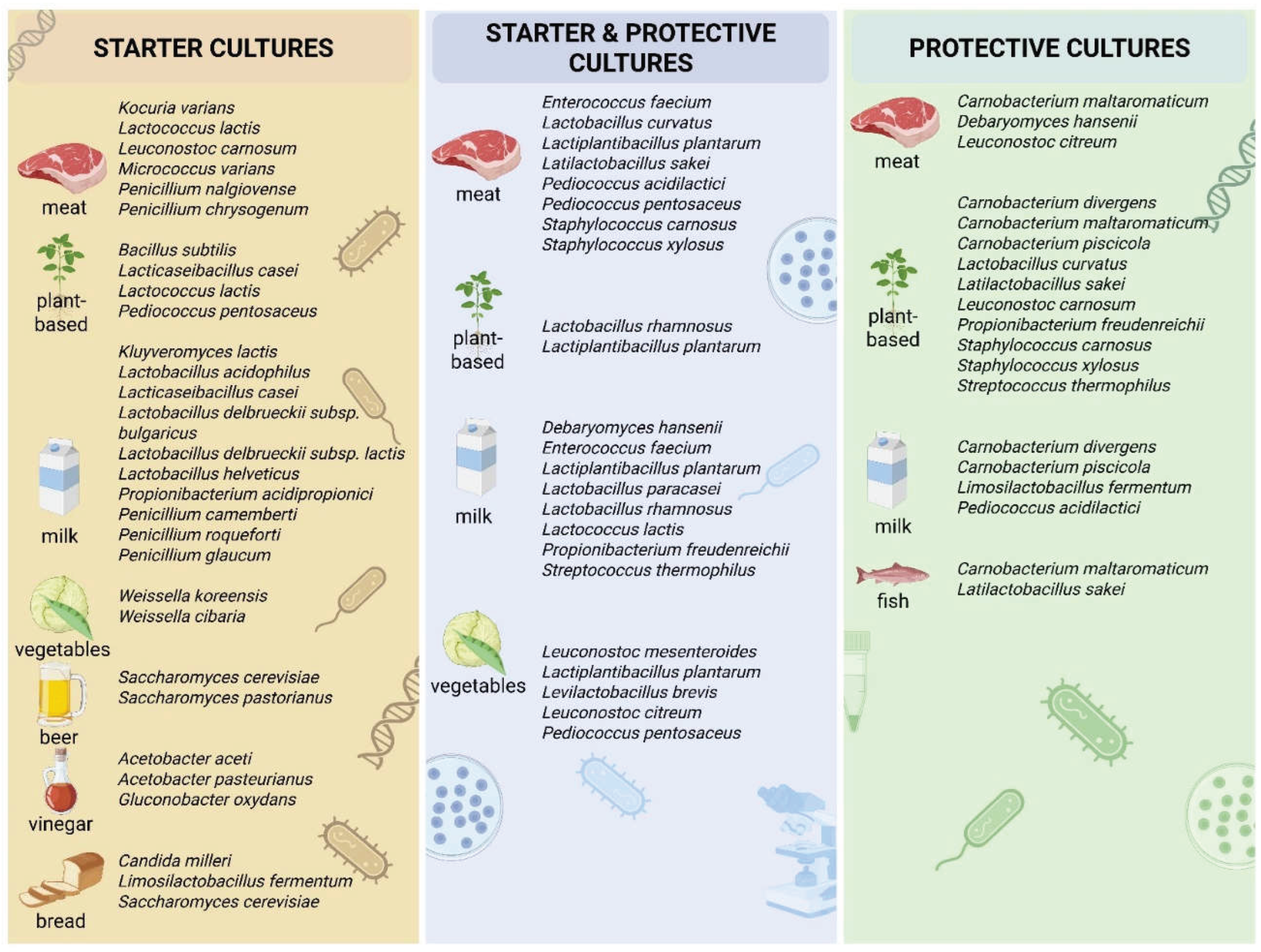
Figure 2.
A list of bacteriocin classes, their categories and types, and exemplary bacteriocins per category, modified from Heng et al., 2007 and Favaro et al., 2015. Created in BioRender. Hennes, T. (2026) https://BioRender.com/m10354z.
Figure 2.
A list of bacteriocin classes, their categories and types, and exemplary bacteriocins per category, modified from Heng et al., 2007 and Favaro et al., 2015. Created in BioRender. Hennes, T. (2026) https://BioRender.com/m10354z.
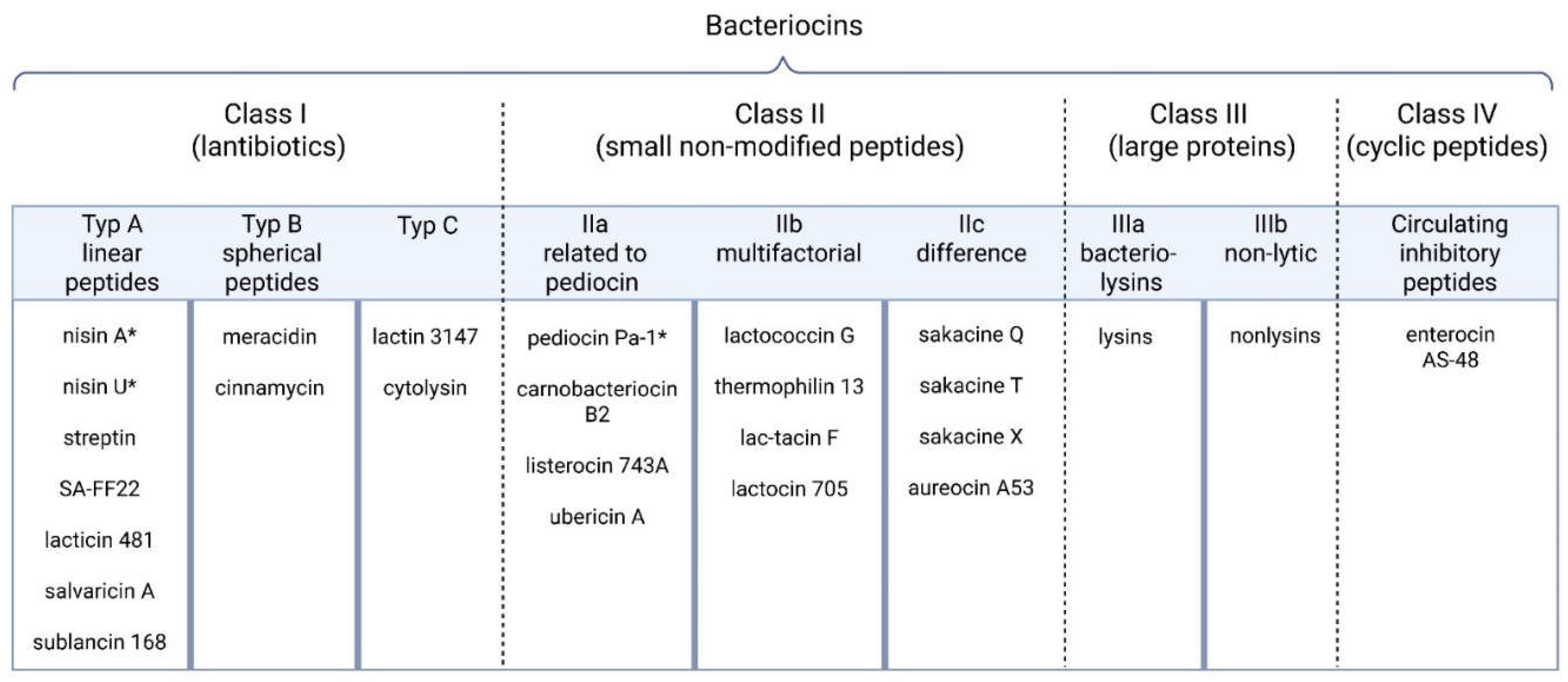
Figure 3.
The target organisms used in scientific studies to demonstrate the effectiveness of protective cultures in heated meat products.
Figure 3.
The target organisms used in scientific studies to demonstrate the effectiveness of protective cultures in heated meat products.
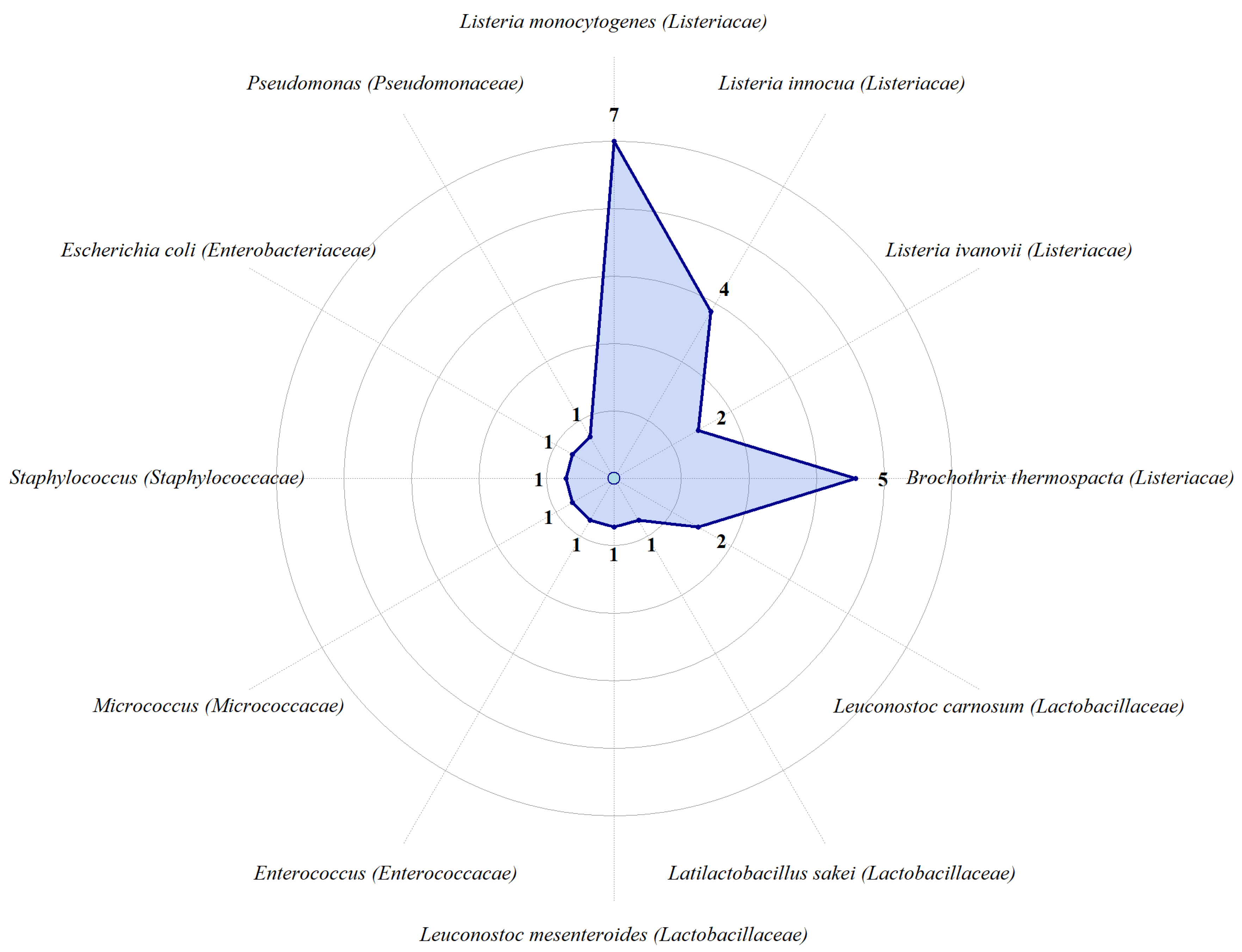
Figure 4.
Flow diagrams of the manufacturing processes for “emulsion-type sausage,” “cooked ham,” and “plant-based sausage.” Abbreviation: PC: protective cultures; W: work; Q: heat flux. Created in BioRender. Hennes, T. (2026) https://BioRender.com/757di7x.
Figure 4.
Flow diagrams of the manufacturing processes for “emulsion-type sausage,” “cooked ham,” and “plant-based sausage.” Abbreviation: PC: protective cultures; W: work; Q: heat flux. Created in BioRender. Hennes, T. (2026) https://BioRender.com/757di7x.
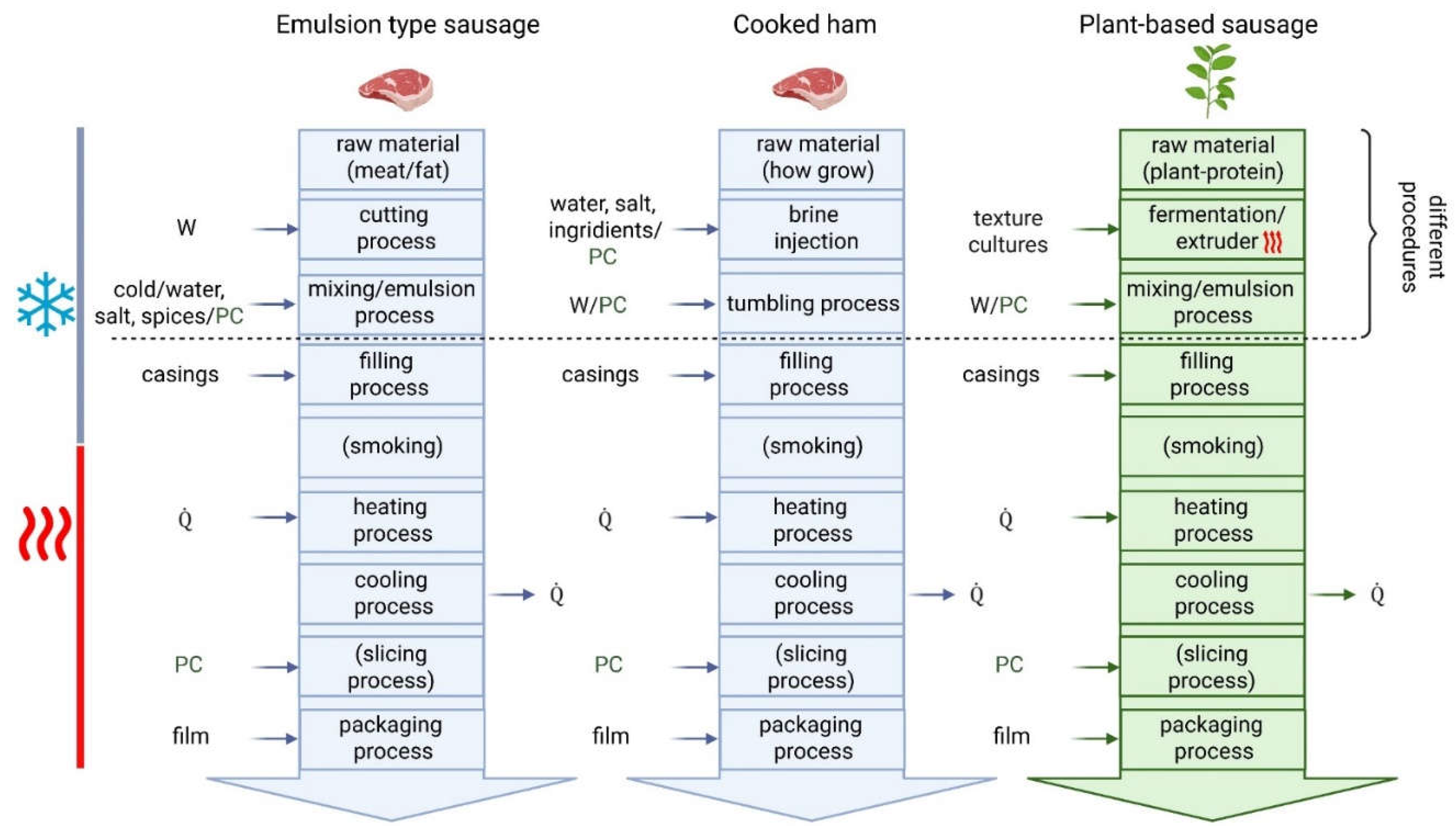
Figure 5.
illustrates the total bacterial count determined in various research studies of the most popular plant-based meat alternatives Sources: Dörfel et al., 2024; Barmettler et al., 2025; Dogan et al., 2025; Liu et al., 2023; Dušková et al., 2024). Abbreviations: CFU, colony-forming unit; g, gram; AMC, aerobe mesophile colonies; LAB, lactic acid bacteria; Y/M, yeast/mold. Created in BioRender. Hennes, T. (2026) https://BioRender.com/njg6e9b incorporating AI-generated elements produced with ChatGPT (OpenAI).
Figure 5.
illustrates the total bacterial count determined in various research studies of the most popular plant-based meat alternatives Sources: Dörfel et al., 2024; Barmettler et al., 2025; Dogan et al., 2025; Liu et al., 2023; Dušková et al., 2024). Abbreviations: CFU, colony-forming unit; g, gram; AMC, aerobe mesophile colonies; LAB, lactic acid bacteria; Y/M, yeast/mold. Created in BioRender. Hennes, T. (2026) https://BioRender.com/njg6e9b incorporating AI-generated elements produced with ChatGPT (OpenAI).
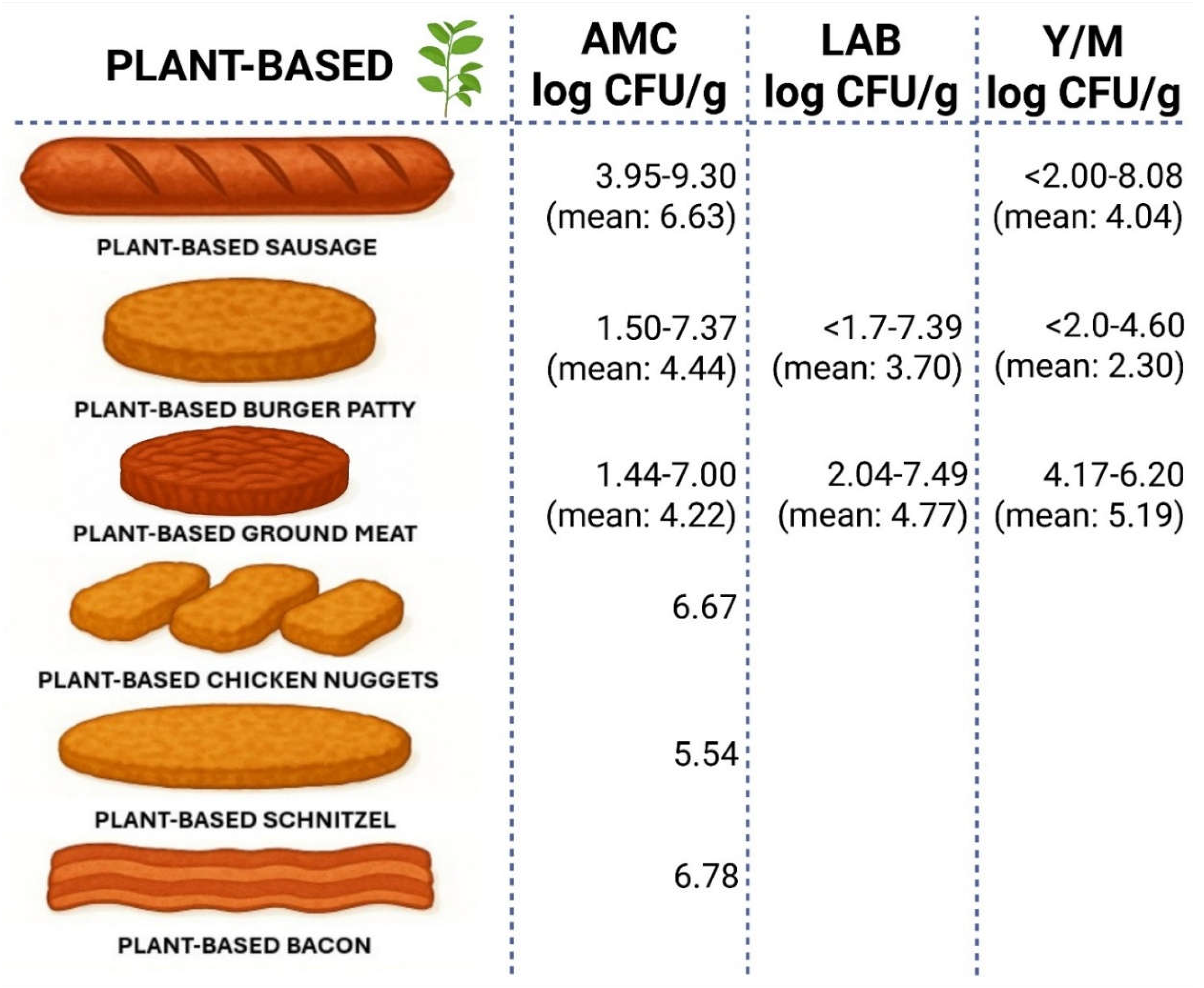

Table 1.
This diagram illustrates the variety of possible combinations of target organisms and protective cultures in studies on heat-treated meat products, taking into account packaging and protective atmospheres. The protective cultures marked in blue were tested under modified atmosphere (MAP). Sources: Palacio et al., 2025; Danielski et al., 2020; Aymerich et al., 2002; Budde et al., 2003; Jacobsen et al., 2003; Rivas et al., 2014; Metaxopoulos et al., 2002; Bungenstock et al., 2021; Vermeiren et al., 2004; Gao et al., 2015; Héquet et al., 2007; Bredholt et al., 2001; Degnan et al., 1992; Berry et al., 1990; Kotzekidou and Bloukas, 1996. Abbreviations: VAC, vacuum; MAP, modified atmosphere packaging.
Table 1.
This diagram illustrates the variety of possible combinations of target organisms and protective cultures in studies on heat-treated meat products, taking into account packaging and protective atmospheres. The protective cultures marked in blue were tested under modified atmosphere (MAP). Sources: Palacio et al., 2025; Danielski et al., 2020; Aymerich et al., 2002; Budde et al., 2003; Jacobsen et al., 2003; Rivas et al., 2014; Metaxopoulos et al., 2002; Bungenstock et al., 2021; Vermeiren et al., 2004; Gao et al., 2015; Héquet et al., 2007; Bredholt et al., 2001; Degnan et al., 1992; Berry et al., 1990; Kotzekidou and Bloukas, 1996. Abbreviations: VAC, vacuum; MAP, modified atmosphere packaging.
| Target Microorganism(s) | |||||||||||||
| Protective Cultures | L. innocua | L. ivanovii | L. monocytogenes | B. thermosphacta | Enterococcus spp. | E. coli | C. perfringens | Leuc. mesenteroides | Leuc. carnosum | Lb. sakei | Micrococcus | Pseudomonas | Staphylococcus |
| Vacuum | |||||||||||||
| C. maltaromaticum CM_B824; B827; B829 | |||||||||||||
| Ec. faecium CTC492 | |||||||||||||
| Lb. alimentarius BJ-33 | |||||||||||||
| Leuc. carnosum 4010 | |||||||||||||
| Lb. curvatus ACU-1 | |||||||||||||
| Lc. lactis BB24 | |||||||||||||
| Lc. lactis G18 | |||||||||||||
| Lc. lactis UW1 | |||||||||||||
| Lc. lactis subsp. lactis L201 | |||||||||||||
| Leuc. mesenteroides L124 | |||||||||||||
| Lb. plantarum ALC | |||||||||||||
| Lb plantarum LP5 | |||||||||||||
| Lb. sakei 148 | |||||||||||||
| Lb. sakei Lb 706 | |||||||||||||
| Lb. sakei subsp. carnosus GERT17 | |||||||||||||
| Lb. sakei C2 | |||||||||||||
| Lb. sakei CTC494 | |||||||||||||
| Lb. sakei L2512 | |||||||||||||
| Lb. sakei SAGA 777 | |||||||||||||
| Lb. sakei TH1 | |||||||||||||
| P. acidilactici H (wild typ of JBL1095) | |||||||||||||
| P. acidilactici LMQS 154.1, P. pentosaceus DSM 331.3 | |||||||||||||
| P. acidilactici PA-2 | |||||||||||||
| S. xylosus DD-34 | |||||||||||||
| Modified Atmosphere Packaging & Vacuum | |||||||||||||
| Lb. curvatus L442 | |||||||||||||
| Lc. lactis DSM 20729, P.acidilactici LMQS 154.1 | |||||||||||||
| P. acidilactici PAC JC 1-23 | |||||||||||||
| Modified Atmosphere Packaging | |||||||||||||
| Leuc. carnosum 4010 | |||||||||||||
Table 2.
Bacteriocin-Producing Microorganisms Examined as Protective or Starter Cultures in Meat Products. Sources: Bungenstock et al., 2021; Winkowski et al., 1993; Castellano et al., 2008; Castellano et al., 2010; Metaxopoulos et al., 2002; Maragkoudakis et al., 2009; Vermeiren et al., 2004; Baños et al., 2012; Álvarez et al., 2020; Jacobsen et al., 2003; Budde et al., 2003; Olaoye et al., 2015; Olaoye and Dodd, 2010; Luchansky et al., 1992; Lahti et al., 2001; İncili et al., 2020; Degnan et al., 1992; Albano et al., 2009; Nieto-Lozano et al., 2010; Gao et al., 2015; Giello et al., 2018; Héquet et al., 2007; Ravyts et al., 2008; Rivas et al., 2014; Aymerich et al., 2002.
Table 2.
Bacteriocin-Producing Microorganisms Examined as Protective or Starter Cultures in Meat Products. Sources: Bungenstock et al., 2021; Winkowski et al., 1993; Castellano et al., 2008; Castellano et al., 2010; Metaxopoulos et al., 2002; Maragkoudakis et al., 2009; Vermeiren et al., 2004; Baños et al., 2012; Álvarez et al., 2020; Jacobsen et al., 2003; Budde et al., 2003; Olaoye et al., 2015; Olaoye and Dodd, 2010; Luchansky et al., 1992; Lahti et al., 2001; İncili et al., 2020; Degnan et al., 1992; Albano et al., 2009; Nieto-Lozano et al., 2010; Gao et al., 2015; Giello et al., 2018; Héquet et al., 2007; Ravyts et al., 2008; Rivas et al., 2014; Aymerich et al., 2002.
| Bacteriocin | Bacterial strain |
|---|---|
| bacteriocin gen papA | P.acidilactici LMQS 154.1; Lc. lactis DSM 20729; P. pentosaceus DSM 331.3 |
| bavaricin MN | Lb. bavaricus MN; Lb. sakei MN |
| brevicin 27 | Lb. brevis SB27 |
| carnobacteriocin A | C. piscicola LV17A |
| carnobacteriocin B1 | C. piscicola KLV17B |
| carnobacteriocin B2 | C. piscicola KLV17B; LV17B |
| curvaticin FS-47 | Lb. curvatus FS47; LTH1174 |
| curvaticin L442 | Lb. curvatus L442 |
| divergicin 750 | C. divergens 750 |
| divergicin A | C. divergens LV13 |
| enterocin 416Kl | Ec. casseliflavus lM416K1S |
| enterocin A- and B | Ec. faecium CTC492 |
| enterocin A, pediocin L50A & L50B | Ec. faecium PCD71 |
| enterocin AS-48 | Ec. faecalis A-48-32 |
| enterocine | Ec. faecium SE920 |
| lactocin 705 and AL705 | Lb. curvatus CRL705 |
| lactocin S | Lb. sakei 148; L45; V18 |
| leucocin A | Leuc. carnosum TA11a; DMRICC 4010; Leuc. gelidum UAL187; Leuc. mesenteroides L124; TA33a |
| leucocin B | Leuc. carnosum DMRICC 4010 |
| leucocin C | Leuc. carnosum 4010 |
| nisin | P. acidilactici LMQS 154.1 Lc. lactis BB24: subsp. lactis I23; subsp. hordinae E91; DSM 20729; |
| nisin Z | Lc. lactis WNC20 |
| pediocin | P. acidilactici NCIMB 700993; P02 (JBL1097); PA-2; (B-LC-20); Lb. bavaricus MI-401; S. xylosus DD-34 |
| pediocin AcH | P. acidilactici H (JBL1095); PAC 1.0 |
| pediocin l.50 | P. acidilactici l.50 |
| pediocin PA-1 | P. acidilactici HA-6111-2; MCH14; PAC 1.0; P. pentosaceous Z102 |
| piscicolin 126 | C. piscicola JG126 |
| piscicolin v1a | C. piscicola V1 |
| plantaricin A | Lb. plantarum CTC305 |
| sakacin A | Lb. sakei LB 706 |
| sakacin C2 | Lb. sakei C2 |
| sakacin G | Lb. sakei L2512 |
| sakacin K | Lb. sakei CTC 494; LTH673; 674 |
| sakacin P | Lb. sakei 1151; LTH673; 674 |
| sakacin Q | Lb. curvatus ACU-1 |
| sakacin T | Lb. curcatus 2711 |
| sakacin X | Lb. curcatus 2711 |
| sak X, sak Tα, sak Tβ, sak P | Lb. curvatus 54M16 |
Table 3.
Commercially available protective cultures for plant-based meat alternatives and heat-treated meat products. Sources: Novonesis, https://www.novonesis.com/en/biosolutions/food-and-beverages/plant-based-foods/plant-based-meats; M-Food, https://www.meatcracks.de/media/m-cultures_meat_de_ex.pdf; Iacumin et al., 2020; U.S. Food & Drug Administration, https://www.fda.gov/files/food/published/GRAS-Notice-GRN-760-Lactobacillus-curvatus-DSM-18775%20.pdf; Netropolitan, https://netropolitan.co.nz/wp-content/uploads/2018/11/PI_B-2_501116_EN.pdf; Fischer and Titgemeyer, 2023; IFFA, https://iffa.messefrankfurt.com/frankfurt/en/exhibitor-search.detail.html/sacco-srl/mf_1_0012553884_4396982_10000012202501.html.
Table 3.
Commercially available protective cultures for plant-based meat alternatives and heat-treated meat products. Sources: Novonesis, https://www.novonesis.com/en/biosolutions/food-and-beverages/plant-based-foods/plant-based-meats; M-Food, https://www.meatcracks.de/media/m-cultures_meat_de_ex.pdf; Iacumin et al., 2020; U.S. Food & Drug Administration, https://www.fda.gov/files/food/published/GRAS-Notice-GRN-760-Lactobacillus-curvatus-DSM-18775%20.pdf; Netropolitan, https://netropolitan.co.nz/wp-content/uploads/2018/11/PI_B-2_501116_EN.pdf; Fischer and Titgemeyer, 2023; IFFA, https://iffa.messefrankfurt.com/frankfurt/en/exhibitor-search.detail.html/sacco-srl/mf_1_0012553884_4396982_10000012202501.html.
| PC | Application | Product | Effect |
|---|---|---|---|
| Lb. sakei | plant based meat alternatives | Vertera® SafePro® 01 |
|
| Leuc. carnosum | plant based meat alternatives | Vertera® SafePro® 02 |
|
| |||
| Lc. lactis | plant based meat alternatives | Vertera® SafePro® 03 |
|
| |||
| Leuc. carnosum | fresh vegan meat substitute | M-CULTURE® Safe Vegan |
|
| products based on peas | |||
| Lb. plantarum | fermented plant-based products | M-CULTURE® plant LEG MA |
|
| Propionibacterium freudenreichii subsp. shermanii, Lb. rhamnosus | vegan products in general | Holdbac YM-Vege |
|
| Lb. sakei | fermented, sliced cooked ham and cooked sausages | Bactoferm® Safepro® B-2 |
|
| Lb. curvatus DSM 18775 | cooked and sliced meat products and Wiener sausages | SafePro® B-LC-48 |
|
| Lb. sakei | cooked or cured meat products | B-2 SafePro® |
|
| Lb. sakei, S. xylosus | fresh meat, cooked and sliced products | Lyocarni BXH-69 |
|
| C. divergens, C. maltaromaticum, Lb. sakei | fresh meat, cooked and sliced products | Lyocarni BOX-74 |
|
| Carnobacterium spp., Lb.sakei | fresh meat, cooked and sliced products | Lyocarni BMX-37 |
|
| Carnobacterium spp., Lb.sakei | fresh meat, cooked and sliced products | Lyocarni BOM-13 |
|
| Carnobacterium spp., Lb.sakei | fresh meat, cooked and sliced products | Lyocarni BXH-69 |
|
| Carnobacterium spp. | fresh meat, cooked and sliced products | Lyoflora FP-18, |
|
| Carnobacterium spp. | fresh meat, cooked and sliced products | Lyoflora FP-50 |
|
Disclaimer/Publisher’s Note: The statements, opinions and data contained in all publications are solely those of the individual author(s) and contributor(s) and not of MDPI and/or the editor(s). MDPI and/or the editor(s) disclaim responsibility for any injury to people or property resulting from any ideas, methods, instructions or products referred to in the content. |
© 2026 by the authors. Licensee MDPI, Basel, Switzerland. This article is an open access article distributed under the terms and conditions of the Creative Commons Attribution (CC BY) license.
Copyright: This open access article is published under a Creative Commons CC BY 4.0 license, which permit the free download, distribution, and reuse, provided that the author and preprint are cited in any reuse.