

Submitted:
18 August 2026
Posted:
18 August 2026
You are already at the latest version
Abstract
Buddleja saligna and Euclea natalensis are widely used in traditional medicine and have ornamental and cosmeceutical value. However, propagation methods are scarce, highlighting the need for sustainable propagation techniques to support commercialization and ensure a consistent supply of high-quality material. Therefore, this study investigated the influence of temperature on seed germination and seedling emergence, as well as the effects of cutting position, growth medium, season, and the use of a plant growth regulator on the success of vegetative propagation. Seed germination of B. saligna was highest at 25 °C (96%), with optimal mean germination time (3.1 days), mean emergence time (3.9 days), germination index (145.2), shortest time to 50% germination (2.6 days), and shortest time to 50% emergence (3.98 days). However, results were not significantly different from 20 °C and 30 °C. For E. natalensis, maximum germination (98%) occurred at 20 °C, with no significant differences to 25 °C and 30 °C. For B. saligna, significant interactions between season and cutting position affected leaf and bud formation. The best rooting percentage (7%) was achieved by stem cuttings treated with DynarootTM 3 (0.8% IBA) and planted in coco peat (M2). For E. natalensis, no survival or rooting was observed in any of the treatment combinations. Overall, seed propagation was more effective, but vegetative propagation is preferable for producing uniform high-quality extracts as seed propagation may introduce variation. Therefore, further research is needed to establish reliable vegetative propagation protocols for both species.
Keywords:
callus
; germination
; plant growth regulator
; seedling emergence
; temperature
; vegetative propagation
1. Introduction
Buddleja saligna Willd. (Scrophulariaceae) is a medium-sized evergreen tree that may also grow as a large shrub, reaching heights of 4-5 meters in the South African highveld areas [1,2]. The roots of B. saligna are traditionally used as a purgative [3], while the bark and leaves are used to treat irritated eyes, colic, coughs, colds, and urinary problems [4,5]. This plant contains high concentrations of phenolic compounds and flavonoids, which contribute to its pharmacological properties [6]. Activities such as anti-mycobacterial [4,7], antiproliferative [8], antibacterial and antioxidant [9,10], anti-diabetic, and anti-plasmodial activity [3] have been documented for B. saligna.
Euclea natalensis A.DC. (Ebenaceae) is a woody perennial plant species that develops into a medium-sized tree or shrub, reaching heights of 4-10 meters [11,12]. In South Africa, E. natalensis is used by the Zulu, Tsonga, and Venda people to treat infections and symptoms associated with tuberculosis [11,13]. The bark of E. natalensis is used to treat a variety of ailments, such as headaches, toothaches, and chest problems [13,14]. Crude extracts and compounds from E. natalensis demonstrated diverse biological activities, ranging from antimicrobial and antioxidant to hepatoprotective effects, both in vitro and in vivo [14].
According to Mothibe et al. [15], the South African population still uses a dual healthcare system of traditional and orthodox medicine, depending on the ailment. Additionally, the use of commercially produced herbal treatments is increasingly popular in South Africa [15,16]. In regions such as the Northwest and Eastern Cape provinces of South Africa, B. saligna is used as a crude drug under the common name “Gancair” [10]. Phenylpropanoid glycosides are the main compounds identified in B. saligna, which is commonly used in traditional herbal teas for digestive support and in the treatment of diabetes [10]. In addition, ethanolic extracts from the leaves and stems of B. saligna, and a dentin permeability gel made from E. natalensis show positive potential for development of natural products [8,17]. This highlights the significance of commercializing B. saligna and E. natalensis to promote the development of high-quality, readily accessible plant material.
Although plant species such as B. saligna and E. natalensis are not threatened in the wild [18,19] and plant material is available in nature, different environmental conditions, such as soil pH and temperature, may cause variation in extract quality and secondary metabolite production [20,21]. Therefore, the cultivation of B. saligna and E. natalensis is necessary to support their use in the commercial plant-based industry.
Vegetative propagation techniques thus provide an opportunity to generate a sufficient and dependable supply of superior plant stock in a timely and efficient manner [22,23]. Hence, the best method for producing more uniform products in a growing industry is vegetative propagation [24,25]. Propagation by cuttings is the most important method for clonal regeneration of many horticultural crops [26], including ornamentals, fruits, nuts, and vegetables [27,28,29]. However, many factors, including cutting position, age of parent plant [22,30], rooting medium, presence or absence and concentration of plant growth regulator [29], the season in which the cuttings were made [31,32], and environmental and physical factors [33], can affect the formation of roots on stem cuttings.
One of the most effective and popular ways to propagate cultivated crops is by seed, which is also the primary means by which plants reproduce in nature [28]. However, seeds are generally heterogeneous and may not exhibit the characteristics of the parent plant, even when derived from genetically identical parents [34]. The process of germination requires favourable environmental conditions, such as temperature, water, oxygen, and light, to continue [35,36], and these factors may also influence seedling emergence in crop species [37]. Seeds of many species will germinate at constant temperatures, but many species require diurnal temperature fluctuations [38,39]. Zaferanieh et al. [40] reported that temperature and water potential have common or separate effects on germination percentages and germination rates of seeds of crop species. Therefore, understanding the cardinal temperatures of different crops is necessary to successfully predict their adaptation, maturity, and yield [41]. Although many studies have documented the pharmacological properties of B. saligna and E. natalensis, information concerning their propagation remains scarce and necessitates further investigation. Developing and optimizing propagation techniques is essential for meeting the increasing market demands while ensuring sustainable production. Hence, the aim of the study was to develop both sexual and asexual protocols for the two species.
2. Materials and Methods
Two independent tests were carried out to establish propagation protocols of B. saligna and E. natalensis. Seed germination and emergence tests were carried out in the Department of Horticulture laboratory at Tshwane University of Technology, Pretoria. The seeds of B. saligna were purchased from Silverhill Seeds Nursery (Cape Town, South Africa) in May 2018. Whilst dry, ripened seeds of E. natalensis were collected from the ground after natural release from plant inflorescence at the Mothong African Heritage site (Mamelodi, Pretoria) in July 2018. Seeds of both species were stored for a month in a refrigerator at approximately 7 °C until used in germination tests. Vegetative propagation tests were carried out in a greenhouse at the Skills Centre, Tshwane University of Technology, Pretoria. The average maximum and minimum day/night temperatures throughout the experimental period were 30 °C/12 °C in spring, 31 °C/17 °C in summer, 29 °C/11 °C in autumn, and 28 °C/8 °C in winter. Plant stock used for vegetative propagation was purchased from Random Harvest Nursery (Krugersdorp, South Africa).
2.1. The Effect of Temperature on Seed Germination and Seedling Emergence
A Latin square design with five replicates was used to investigate seed germination and seedling emergence at five constant temperature regimes (10 °C, 15 °C, 20 °C, 25 °C, 30 °C). For each replicate, the Labcon™ incubators (five) served as a row for temperature regimes and the temperatures were changed according to the 5 × 5 Latin square design for each replicate.
A seed viability test for B. saligna and E. natalensis was conducted following the method described by Makena et al. [33]. Hundred seeds for both species were sterilized with JIK® regular bleach (3.5% sodium hypochlorite) for five minutes, rinsed five times in autoclaved distilled water following the method described by Bapela et al. [42] , and then, soaked in 20 mL autoclaved distilled water at ambient temperature (22 °C) for 24 hours. Imbibed seeds were placed in 9-cm Petri™ dishes lined with two layers of moist Whatman™ 1 filter paper. E. natalensis seeds were supplemented with 5 mL of distilled water to ensure enough moisture for the bigger seeds, while B. saligna seeds were incubated on only moist filter paper. For emergence trials, imbibed seeds of B. saligna and E. natalensis were sown in clear disposable food containers filled with washed sand and supplemented with 10 mL of distilled water. All containers and petri™ dishes were incubated in the Labcon™ incubators under continuous dark conditions to facilitate germination and seedling emergence.
Germinated E. natalensis seeds were counted daily and removed when their radicles reached a length of 5 mm. Similarly, B. saligna seeds were also counted daily and removed at 1 mm radicle emergence. The seedling emergence trial of E. natalensis lasted 30 days to ensure sufficient development. At the end of the experiment, germinated seeds with elongated, dark roots were removed. Their root lengths were measured, and the seedlings were subsequently transplanted into bark medium because no emergence occurred after 30 days. For B. saligna, emergence (hypocotyl above sand) was counted daily. Although incubated under continuous darkness, seeds were inspected daily and briefly exposed to ambient lighting during data collection. Germination data were used to calculate indices, including final germination percentage (FGP), first day of germination (FDG), last day of germination (LDG), mean germination time (MGT), germination index (GI), and time to 50% germination (GT50) [43].
2.2. The Effect of Cutting Position, Media, Plant Growth Regulator, and Season on Rooting and Survival of Cuttings
Following the methodology described by Salinas Ruíz et al. [44], a randomized complete block design (RCBD) with three replicates was used to evaluate the effect of cutting position (apical and basal), growth media [(M1) river sand and pine bark (1:2), (M2) coco peat (1), (M3) coco peat and river sand (2:1), (M4) river sand and vermiculite (1:1)], and plant growth regulator [Dynaroot™1 (0.1% IBA), Dynaroot™ 2 (0.3% IBA), Dynaroot™ 3 (0.8% IBA) and a control] on the rooting of stem cuttings. The trials were conducted in summer, autumn, winter, and spring seasons, beginning in September 2018, and concluding in July 2019. Using an RCBD, a total of 32 treatment combinations were established throughout the study by randomizing across four media types, two cutting positions, and four plant growth regulators, including a non-usage of PGR as control. Each experimental unit contained five cuttings per treatment (n=5). In each season, a total of 480 cuttings were prepared across the three replicates.
Cuttings of 10-15 cm in length were made early in the morning and dipped in a fungicide solution (Odeon® 720 SC-ADAMA) (41 mL per 10 L) [45]. The various plant growth regulator treatments were applied to the bases of cuttings before the cuttings were planted in 128-cell seedling trays containing the various media. Cuttings were watered twice daily (at 07:00 and 15:00), and weekly observations were done to monitor potential signs of diseases, survival, new buds, and leaf formation. At harvest (after 60 days), cuttings were removed from the trays and evaluated for callus formation and root number.
2.3. Statistical Analysis
Data was analyzed using a one-way ANOVA (germination data) and multifactor ANOVA (vegetative data) with the GLM procedure in SAS 9.3 [46]. Normality was tested with the Shapiro-Wilk test [47], and outliers were removed. Means with significant differences were separated using the Student’s t-LSD test at 5% significant level [48]. Vegetative indices for E. natalensis were not analyzed by ANOVA but were instead summarized by averages and standard deviations, as no rooting occurred and all cuttings died within two weeks. For E. natalensis, two analyses were conducted: one analysis included all temperature regimes and showed high variability because no germination occurred at 10 °C, and only one seed germinated at 15 °C. A second analysis was restricted to 20 °C, 25 °C, and 30 °C to compare germination at optimal temperatures.
3. Results
3.1. The Effect of Temperature on Germination and Seedling Emergence of Buddleja saligna
Germination reached 96% at 25 °C, although the difference was not significant compared with other treatments. Seeds at 25 °C germinated faster, with FDG (2 days), LDG (5 days), GT50 (2.7 days), and MGT (3.16 days) values being the shortest (Table 1). These values did, however, not differ significantly from 20 °C and 30 °C, but were significantly shorter than at 10 °C and 15 °C. Seeds at 25 °C also had the highest germination index (GI=145.2), significantly greater (p<.0001) than all treatments except 20 °C (127.2). At 10 °C, FDG, LDG, MGT, and GT50 were significantly longer, and GI was significantly lower. Similar patterns were observed for emergence, but the best values were obtained at 30 °C for FDE, LDE, MET, EI, and ET50, compared with 25 °C for germination (Table 1).
3.2. The Effect of Temperature on Germination and Seedling Emergence of Euclea natalensis
No germination occurred at 10 °C, and only 10% at 15 °C, both significantly lower than at 20 °C (98%), 25 (98%), and 30 °C (94%) (Table 2). Similarly, GI values at 10 °C and 15 °C were significantly lower than those of seeds at higher temperatures. Seeds at 25 °C significantly outperformed those at 20 °C and 30 °C for GI, although germination % and MGT did not differ among the three temperatures.
Germination percentage and LDG did not differ among seeds incubated at 20 °C, 25 °C, and 30 °C. However, seeds at 20 °C took significantly longer to begin germination (13 days) than those at 25 °C (8.6 days) and 30 °C (9.6 days) (Table 2). Although not significant, 25 °C recorded the shortest LDG (14 days). MGT was significantly longer at 20 °C (13.54 days) compared to 25 °C (11.16 days), but not different from 30 °C (12.73 days). GI was significantly higher at 25 °C (184.8) than at 20 °C (159.6) and 30 °C (161.8), which did not differ from each other. GT50 was significantly faster at 25 °C (10,67 days), compared to 20 °C (14.1 days) and 30 °C (12,17 days). After 30 days of incubation, no seeds emerged from the sand, although long dark roots were visible, preventing calculation of emergence parameters. Root length varied significantly across temperatures (p<.0001). Longer roots with shorter hypocotyls were observed since no emergence occurred. The longest average root length (8.52 cm) was recorded at 30 °C, significantly greater than all other treatments, followed by 6.9 cm at 25 °C, which also differed significantly from lower temperatures, including 20 °C (Table 2).
3.3. The Effect of Cutting Position, Growth Media, Plant Growth Regulator, and Season on Buddleja saligna Stem Cuttings
Rooting of cuttings was observed at harvest on day 60 in summer, autumn, and winter. At harvest, cuttings were classified as either callused or rooted. Survival percentage was the only measured parameter that was significantly affected by cutting position, with apical cuttings showing significantly higher survival (67.3%) than basal cuttings (57.8%) (Figure 1).
Growth media significantly affected survival, callus formation, rooting, and the average number of new leaves in B. saligna cuttings (Table 3). Cuttings in M3 (Coco peat and vermiculite) produced the highest survival (76%) and more new leaves (4.21) than other media, although survival (72.08%) and leaf number (3.15) in M2 (Coco peat) were not statistically different from M3. Cuttings in M2 recorded the highest callus (20.33%) and rooting (2.20%) percentages, but these were not significantly different from M3. Regarding growth regulator application, the only significant effect was on rooting (p=0.0192). Cuttings treated with Dynaroot™ 3 (0.8% IBA) showed higher rooting (2.4%) than all other plant growth regulator (PGR) treatments (Table 3).
The season in which cuttings were made significantly affected all measured parameters (p<0.0001). Survival was significantly higher in winter (82%) and autumn (80%), compared to spring (46.3%) and summer (42.3%) (Table 4). Summer cuttings produced significantly more buds (2.3) and leaves (5) than other seasons. At harvest, callus formation peaked in summer (17.9%), differing significantly only from spring. Root numbers were highest in summer (0.8) but were not significantly different from those in winter (0.5). Fresh and dry root mass also peaked in summer, although they were not significantly different from winter values. The highest rooting percentage was recorded in winter (7.5%) but did not differ significantly from that of summer (6.1%). Overall, most parameters were highest in summer, but the much lower survival favours winter as the optimal season for B. saligna cutting propagation (Table 4).
| Season | % Survival | % Callus | % Rooting | Number of leaves | Number of buds | Number of roots | Fresh root weight (g) | Dry root weight (g) |
| Spring | 46.3b | 9.58b | - | 2.77b | 0.77b | - | - | - |
| Summer | 42.3b | 17.9a | 6.10a*** | 5.02a | 2.3a | 0.80a | 0.03a | 0.02a |
| Autumn | 80a*** | 14.58ab*** | 0.41b | 2.59b | 0.90b | 0.01b | 0.00b | 0.00b |
| Winter | 82a | 16.04a*** | 7.5a | 2.06b | 0.74b | 0.51a*** | 0.02a*** | 0.01ab*** |
| LSD | 8.109 | 6.2441 | 3.2875 | 1.1513 | 0.3934 | 0.3945 | 0.0162 | 0.0134 |
| Values in a column with the same letters are not significantly different (p < 0.05). Values with asterisks (***) are not significantly different from the highest values. | ||||||||
Significant interactions occurred between season and cutting position for leaf (p=0.0168) and bud numbers (p<0.0007) (Table 5). In summer, both apical and basal cuttings produced more buds (2.5 and 2.07, respectively) than any other season cutting position combination. In winter, apical cuttings produced the lowest number of buds (0.44) and leaves (0.95) compared to all other combinations, although the number of buds did not differ significantly from cuttings taken in spring. Basal cuttings in summer produced more leaves (5.8) than all other treatments except apical summer cuttings. Significant interactions were also found between season and PGR application for callus (p=0.0445) and rooting percentages (p=0.0429). In summer, autumn, and spring, PGR treatments (including control) did not affect callus formation. PGR application significantly improved rooting in winter compared to the control, and Dynaroot™ 3 produced limited rooting in autumn (Table 5).
| Two-ways interactions | Season | Cutting position | Number of buds | Number of leaves |
| Season and cutting position | spring | Apical | 0.66bc | 2.6c |
| spring | Basal | 0.87bc | 2.93bc | |
| summer | Apical | 2.5a | 4.44ab*** | |
| summer | Basal | 2.07a*** | 5.8a | |
| autumn | Apical | 1.16b | 3bc | |
| autumn | Basal | 0.62bc | 2.15cd | |
| winter | Apical | 0.44c | 0.95d | |
| winter | Basal | 1.04b | 3.18bc | |
| LSD | 0.5584 | 1.6325 | ||
| Season | PGR | % Callus | % Rooting | |
| Season and PGR | spring | D1 | 15.8abcde*** | - |
| spring | D2 | 7.5e | - | |
| spring | D3 | 8de | - | |
| spring | CT | 6.67e | - | |
| summer | D1 | 13bcde | 6.67ab*** | |
| summer | D2 | 24ab*** | 6.08abc*** | |
| summer | D3 | 20.8abc*** | 10.83a*** | |
| summer | CT | 12.5bcde | 0.83bc | |
| autumn | D1 | 8de | 0.00c | |
| autumn | D2 | 15abcde*** | 0.00c | |
| autumn | D3 | 20abcd*** | 1.67bc | |
| autumn | CT | 15abcde*** | 0.00c | |
| winter | D1 | 22.5abc*** | 12.5a | |
| winter | D2 | 10.8cde | 6.67ab*** | |
| winter | D3 | 25.8a | 10.83a*** | |
| winter | CT | 5e | 0.00c | |
| LSD | 12.483 | 6.5754 | ||
| Values in a column with the same letters are not significantly different (p < 0.05). Values with asterisks (***) are not significantly different from the highest values. M1 (pine bark and river sand (2:1)), M2 (coco peat), M3 (coco peat and vermiculite (2:1)), M4 (river sand and vermiculite (1:1)). D1 (DynarootTM 1 at 0.1% IBA), D2 (DynarootTM 2 at 0.3% IBA), D3 (DynarootTM 3 at 0.8% IBA), and CT (control). | ||||
3.4. The Effect of Cutting Position, Media, Plant Growth Regulator, and Season on Euclea natalensis Stem Cuttings
None of the cuttings performed well across all four seasons, regardless of the treatment applied. Leaf abscission occurred after two weeks, and all cuttings dried and died without forming roots or new leaves. Necrosis began at the base and progressed to the apex, culminating in complete desiccation. In early spring, some basal cuttings showed budding but soon died before leaf formation. M3 (coco peat and vermiculite) produced the highest survival and bud development in weeks one and two (Figure 2). Cutting position significantly affected survival in week one, with basal cuttings performing better, though differences were no longer significant in week two, and all cuttings were dead by week three (Figure 3). Bud development was observed in some basal cuttings in M3, while apical cuttings dried quickly.
4. Discussion
External factors affecting seed germination include temperature, water, gases, and light, with temperature being the most critical [28]. Temperature strongly affects germination potential, rate, and seedling establishment [49]. Also, germination success can be assessed by percentage, speed, and uniformity [28]. In this study, temperature influenced germination and emergence under continuous darkness, indicating that neither B. saligna nor E. natalensis require light. Germination of E. natalensis was epigeal, while B. saligna exhibited hypogeal germination.
Temperature significantly affected E. natalensis germination but not B. saligna, although the emergence of the latter was reduced. E. natalensis germinated best at 20 °C to 30 °C, with percentages above 90%. Germination dropped sharply to 10% at 15 °C and failed completely at 10 °C, indicating sensitivity to low temperatures. At 25 °C, seeds germinated fastest (lowest MGT and GT50) and most uniformly, confirming this as the optimal temperature. Similar temperature sensitivity has been reported for Diospyros virginiana [50], Adenium swazicum [51], and Moringa peregrina [52], all of which failed to germinate below 15 °C but showed improved germination at 20 °C to 30 °C. Such sensitivity restricts germination to warmer seasons [53,54]. This suggests that E. natalensis requires temperatures of 20 °C or higher, and sowing should be timed for warmer months to ensure rapid, uniform, and successful germination.
B. saligna achieved germination percentages above 80% across all tested temperatures. However, emergence was significantly lower emergence at 10 °C than at other temperatures tested. As noted by Bewley and Black [53], many species tolerate wide temperature ranges, and the present results confirm that B. saligna seeds germinate across diverse conditions. Germination percentage alone, therefore, did not indicate optimal germination. Mean germination time (MGT) of both B. saligna and E. natalensis was temperature dependent. For E. natalensis, seeds incubated at 25 °C showed the highest germination percentage in the shortest time compared to 20 °C. In B. saligna, MGT did not differ significantly among 20 °C, 25 °C and 30 °C, though 25 °C yielded the highest germination percentage in the shortest time. Mean emergence time (MET) and emergence index (EI) of B. saligna were also significantly affected (P<.0001), with rapid emergence at 30 °C, suggesting that warmer temperatures shorten MET. Comparable results have been reported in other species: Apium graveolens (22-25 °C) [55], Moringa peregrina (25-30 °C) [52], and Amaranthus retroflexus (25 °C) [53]. For B. saligna, time to 50% germination (TG50) was shortest at 25 °C, while emergence (ET50) was fastest at 30 °C. Although differences between 25 °C and 30 °C were not statistically significant, the results suggest that 25 °C is optimal for germination and 30 °C for emergence in both E. natalensis and B. saligna.
The germination index (GI) reflects both germination percentage and speed, with higher values indicating rapid and successful germination [43]. For B. saligna and E. natalensis, GI was significantly higher at 25 °C, while the emergence index for B. saligna showed no significant variation. These findings align with Almeida et al. [56] , who reported the highest GI for Amburana cearensis at 30 °C, with the lowest germination speed index (GSI) at 20 °C and 40 °C. Temperatures outside the optimal range may reduce germination speed and disrupt membranes, thereby lowering total germination. Environmental factors such as oxygen and moisture may influence germination success. Bewley et al. [57], reported that water availability affects both the rate and proportion of seeds germinating. Pre-soaking B. saligna and E. natalensis seeds for 24 hours, as a standard procedure prior to the tests, may have contributed to improved germination. This is consistent with findings in Sesamum indicum, where soaking improved germination at 20 °C to 30 °C [58]. Seeds must imbibe sufficient water before resuming physiological activity [38], and inadequate moisture can inhibit germination in woody species [55,59]. In this study, sand was used as a sterile substrate providing aeration and did not inhibit emergence. Moisture availability remains critical for seedling establishment, particularly in dry tropics [60]. Light is another factor influencing germination. While many species germinate in both light and darkness, some are light-dependent [38,55]. This study indicates that B. saligna and E. natalensis are negatively photoblastic, suggesting that they germinate more successfully in darkness [53]. Similar results were reported for Bulbine latifolia var. latifolia, which showed higher germination under dark conditions [61]. Thus, both B. saligna and E. natalensis are capable of germination in the absence of light.
The season in which cuttings are made influences rooting ability [32]. While some species show marked seasonal variation, others root consistently regardless of season [28,62]. In this study, season was the primary factor affecting most parameters in B. saligna cuttings. Winter yielded the highest survival (82%) and rooting (7.5%), but summer produced better values for other parameters, although differences were mostly not significant. Apical cuttings planted in M2 and M3 during autumn and summer showed significantly higher survival, while summer and winter cuttings treated with D3 in M2 achieved 7% rooting. The rooting improved from 11% to 12.5% when winter cuttings were treated with D3 and D1. No rooting occurred in spring, this is likely due to extreme greenhouse temperature fluctuations (30 °C day, 12 °C night). Softwood cuttings can decrease rooting during the summer, and hardwood cuttings can increase rooting during winter [63]. This is possible because high temperatures generally reduce rooting success, with optimal ranges reported between 21 °C and 27 °C [28].
The absence of a misting system may have further reduced humidity, thus limiting rooting success. Suggesting that cuttings might have been exposed to insufficient humidity [64,65]. Survival and callus formation were significantly higher in M2 (coco peat) and M3 (coco peat & vermiculite) compared to M1 (pine bark and river sand) and M4 (river sand and vermiculite). Both M2 and M3 performed better because they can hold more water and experience reduced transpiration losses in cooler weather. Having porosity, aeration, and moisture retention in rooting media is essential for cutting success [25,66,67]. Since media containing sand (M1 and M4) were too porous, less water was available, resulting in lower rooting and survival. Similar results were reported for Lobostemon fruiticosus cuttings in bark media [30]. Comparatively, Sawitri et al. [68] observed that rice husk and coco peat were better than sand-based media for Tectona grandis, highlighting the importance of porosity over moisture content. For B. saligna, parameters such as the number of leaves and buds, callus and rooting percentage were highest in summer. Seasonal variation in rooting efficiency is common in woody plants, but optimal timing needs to be determined per species [62]. For example, Athrixia phylicoides rooted best in autumn and spring [64], while Boswellia papyrifera showed the highest rooting in March (autumn) but the lowest shoot production in May [69]. These variations highlight that seasonal effects on rooting are species-specific.
Cutting position did not affect rooting in B. saligna, which is comparable with findings in Black wattle [70]. Other species show variable responses: Basal cuttings sometimes root better [71], while in Grindelia chiloensis, apical cuttings rooted at 64% compared to zero for basal cuttings [72]. Apical cuttings of Helichrysum odoratissimum produced more buds, roots, and longer roots than median cuttings, with DynarootTM 3 (0.8% IBA) improving rooting and survival [33]. Auxins are widely used to stimulate adventitious root formation, especially Indole-3 butyric acid (IBA) [73,74,75]. Compared with controls, IBA treatments significantly improved the rooting of B. saligna cuttings in winter, with DynarootTM 3 showing the greatest effect in summer. Similar results were reported for Cordia alliodora, where 1.6% IBA produced 70% rooting compared to 10% in controls [76]. Auxins can promote root initiation by enhancing carbohydrate transport to the cutting base [77,78]. IBA’s ability to increase root numbers is further supported by research on Dalbergia melanoxylon [79]. Plant growth regulators thus play a critical role in callus formation [80] and root differentiation [81]. Propagation via stem cuttings for B. saligna was limited, with low rooting percentages. The formation of callus, however, is an indication that cuttings might root slowly and would need additional time for rooting.
Propagation by stem cuttings proved to be unsuccessful for E. natalensis, with all cuttings dying without rooting. Similar difficulties have been reported for many tree species [82] and for Diospyros kaki (Japanese persimmon), another Ebenaceae member [83]. Both Diospyros and Euclea are characterized by slow growth [84], which may partly explain poor rooting. However, seed propagation is relatively easy for these species [85,86]. Difficult-to-root species often lose the cellular predisposition to initiate root primordia [87]. In stem cuttings, the potential for adventitious root formation often declines as trees age and mature [88]. Consequently, persimmon cultivars are commonly grafted onto seedling rootstocks [89], a practice that could be explored for E. natalensis.
Genotype also plays a role in rooting ability. For example, in Diospyros virginiana, rooting ranged from 0-100% depending on genotype [90], highlighting variability within Ebenaceae. In spring, some E. natalensis basal cuttings developed buds but failed to produce leaves or roots, similar to Vaccinium floribundum cuttings that sprouted but remained rootless [91]. The absence of callus or roots suggests that cells did not dedifferentiate, which is a process essential for adventitious root formation [28].
Leaf abscission in E. natalensis stem cuttings began two weeks after propagation, followed by necrosis progressing from base to apex. Comparable symptoms were reported in Vaccinium floribundum and Disterigma alaternoides [91]. Although mortality was high, basal cuttings survived longer than apical ones, possibly due to greater lignification and carbohydrate reserves. More lignified cuttings of V. floribundum also remained viable longer than softer cuttings [91]. Rooting lignified hardwood cuttings is generally difficult and strongly genotype-dependent [72,92].
5. Conclusions
Overall, seed propagation proved more effective than vegetative propagation, with optimal germination and emergence observed at warmer temperatures (25-30 °C) in both B. saligna and E. natalensis. Therefore, seed propagation is recommended for large-scale multiplication. However, for producing uniform, high-quality extracts in the plant based commercial industry, vegetative propagation remains preferable, as seed propagation may introduce genetic variation. Vegetative propagation is not recommended, as stem cuttings of E. natalensis failed in all seasons. In contrast, B. saligna did not perform strongly, but can be propagated from any cutting position, planted in any season using growth media with high water-holding capacity and supplemented with plant growth regulators containing 0.8% IBA. Techniques such as heel cuttings, grafting, and air layering should be explored to enhance survival and rooting success in both B. saligna and E. natalensis. Subsequently, further research on seedling establishment is required for both species.
Author Contributions
Conceptualization, N.T.M. and R.K.; methodology, N.T.M., and R.K.; software, R.K.; validation, N.T.M., R.K. and K-L.P.; formal analysis, R.K.; investigation, N.T.M.; resources, R.K. and K-L.P; data curation, N.T.M., R.K. and K-L.P; writing—original draft preparation, N.T.M.; writing—review and editing, N.T.M., R.K., K-L.P. and J.M.; visualization, N.T.M.; supervision, R.K. and K-L.P; project administration, R.K.; funding acquisition, R.K. and N.T.M. All authors have read and agreed to the published version of the manuscript.
Funding
This research was funded by the Department of Science, Technology and Innovation (DST/CON0053/2017) and the National Research Foundation (NRF) (Grant no:121179).
Data Availability Statement
The raw data supporting the conclusions of this article will be made available by the authors on request.
Acknowledgments
The authors like to thank the Department of Horticulture (Tshwane University of Technology), Department of Science and Innovation, and Mothong African Heritage Site. During the preparation of this manuscript, the authors used Microsoft 365 Copilot (OpenAI) to assist with English language editing, including grammar correction, sentence refinement, and improvement of overall readability. The authors have reviewed and edited the output and take full responsibility for the content of this publication.
Conflicts of Interest
The authors declare no conflict of interest.
Abbreviations
The following abbreviations are used in this manuscript:
| IBA | Indole-3-butyric acid |
| PGR | Plant Growth Regulator |
| FGP | Final Germination Percentage |
| FDG | First Day of Germination |
| LDG | Last Day of Germination |
| MGT | Mean Germination Time |
| GI | Germination Index |
| GT50 | Time to 50% gemination |
| FEP | First Day of Emergence |
| LDE | Last Day of Emergence |
| MET | Mean Emergence Time |
| EI | Emergence Index |
| ET50 | Time to 50% Emergence |
| NS | Not Significant |
| LSD | Least Significant Difference |
| RCBD | Randomized Complete Block Design |
| D1 | DynarootTM 1 |
| D2 | DynarootTM 2 |
| D3 | DynarootTM 3 |
| CT | Control |
| M1 | Medium 1 |
| M2 | Medium 2 |
| M3 | Medium 3 |
| M4 | Medium 4 |
| ANOVA | Analysis of Variance |
References
- Aubrey, A. Buddleja saligna. Available online: https://pza.sanbi.org/buddleja-saligna (accessed on 21 July 2026).
- Erukainure, O.L.; Chukwuma, C.I.; Matsabisa, M.G.; Salau, V.F.; Koorbanally, N.A.; Islam, M.S. Buddleja saligna Willd (Loganiaceae) inhibits angiotensin-converting enzyme activity in oxidative cardiopathy with concomitant modulation of nucleotide hydrolyzing enzymatic activities and dysregulated lipid metabolic pathways. J. Ethnopharmacol. 2020, 248, 112358. [Google Scholar] [CrossRef] [PubMed]
- Chukwujekwu, J.C.; Amoo, S.O.; de Kock, C.A.; Smith, P.J.; Van Staden, J. Antiplasmodial, acetylcholinesterase and alpha-glucosidase inhibitory and cytotoxicity properties of Buddleja saligna. S. Afr. J. Bot. 2014, 94, 6–8. [Google Scholar] [CrossRef]
- Bamuamba, K.; Gammon, D.W.; Meyers, P.; Dijoux-Franca, M.-G.; Scott, G. Anti-mycobacterial activity of five plant species used as traditional medicines in the Western Cape Province (South Africa). J. Ethnopharmacol. 2008, 117, 385–390. [Google Scholar] [CrossRef] [PubMed]
- Singh, A.; Venugopala, K.N.; Khedr, M.A.; Pillay, M.; Nwaeze, K.U.; Coovadia, Y.; Shode, F.; Odhav, B. Antimycobacterial, docking and molecular dynamic studies of pentacyclic triterpenes from Buddleja saligna leaves. J. Biomol. Struct. Dyn. 2017, 35, 2654–2664. [Google Scholar] [CrossRef] [PubMed]
- Mabusela, M.M.; Matsiliza-Mlathi, B.; Aprea, E.; Kleynhans, R.; Tenuta, M.C.; Kellil, A.; Gatto, P.; Morozova, K.; Scampicchio, M.M.; Ferrentino, G. Influence of phenological growth stages on the bioactivity and chemical profile of Buddleja saligna (Willd.) extracts. Ital. J. Food Sci. 2025, 37, 339–352. [Google Scholar] [CrossRef]
- Mothupi, R.; Matotoka, M.; Mashabela, G.; Masoko, P. Investigating the Antimycobacterial, Antibiofilm, and Antioxidant Activities of Plant Extracts Against Mycobacterium smegmatis. Microorganisms 2026, 14, 1133. [Google Scholar] [CrossRef] [PubMed]
- Twilley, D.; Thipe, V.C.; Kishore, N.; Bloebaum, P.; Roma-Rodrigues, C.; Baptista, P.V.; Fernandes, A.R.; Selepe, M.A.; Langhansova, L.; Katti, K. Antiproliferative activity of Buddleja saligna (Willd.) against melanoma and in vivo modulation of angiogenesis. Pharmaceuticals 2022, 15, 1497. [Google Scholar] [CrossRef] [PubMed]
- Adedapo, A.A.; Jimoh, F.O.; Koduru, S.; Masika, P.J.; Afolayan, A.J. Assessment of the medicinal potentials of the methanol extracts of the leaves and stems of Buddleja saligna. BMC Complement. Altern. Med. 2009, 9, 21. [Google Scholar] [CrossRef] [PubMed]
- Nina, N.; Burgos-Edwards, A.; Theoduloz, C.; Tripathy, S.; Matsabisa, M.G.; Schmeda-Hirschmann, G. Chemical Profiling, enzyme inhibitory activity and antioxidant capacity of South African herbal teas: Buddleja saligna, Lippia javanica, L. scaberrima and phyla dulcis. Antioxidants 2024, 13, 1219. [Google Scholar] [CrossRef] [PubMed]
- van der Kooy, F.; Meyer, J.J.M.; Lall, N. Antimycobacterial activity and possible mode of action of newly isolated neodiospyrin and other naphthoquinones from Euclea natalensis. S. Afr. J. Bot. 2006, 72, 349–352. [Google Scholar] [CrossRef]
- Bapela, M.J.; Lall, N.; Meyer, J.J.M. Seasonal variation of naphthoquinones in Euclea natalensis subspecies natalensis. S. Afr. J. Bot. 2008, 74, 218–224. [Google Scholar] [CrossRef]
- Lall, N.; Kumar, V.; Meyer, D.; Gasa, N.; Hamilton, C.; Matsabisa, M.; Oosthuizen, C. In vitro and In vivo antimycobacterial, hepatoprotective and immunomodulatory activity of Euclea natalensis and its mode of action. J. Ethnopharmacol. 2016, 194, 740–748. [Google Scholar] [CrossRef] [PubMed]
- Maroyi, A. Review of ethnomedicinal uses, phytochemistry and pharmacological properties of Euclea natalensis A. DC. Molecules 2017, 22, 2128. [Google Scholar] [CrossRef] [PubMed]
- Mothibe, M.E.; Kahler-Venter, C.P.; Osuch, E. Evaluation of the in vitro effects of commercial herbal preparations significant in African traditional medicine on platelets. BMC Complement Altern. Med. 2019, 19, 224. [Google Scholar] [CrossRef] [PubMed]
- Yusuf, B.O.; Sabiu, S. An appraisal of the Zulu antidiabetic medicinal plants. S. Afr. J. Bot. 2024, 173, 355–364. [Google Scholar] [CrossRef]
- Sales-Peres, S.H.d.C.; Brianezzi, L.F.d.F.; Marsicano, J.A.; Forim, M.R.; da Silva, M.F.d.G.F.; Sales-Peres, A. Evaluation of an experimental gel containing Euclea natalensis: An in vitro study. Evid Based Complement. Altern. Med. 2012, 2012, 184346. [Google Scholar]
- Foden, W.; Potter, L. Buddleja saligna Willd. Available online: https://redlist.sanbi.org/species.php?species=1972-8 (accessed on 21 July 2026).
- Foden, W.; Potter, L. Euclea natalensis A.DC. Subsp. natalensis. Available online: https://redlist.sanbi.org/species.php?species=3699-15 (accessed on 21 July 2026).
- Borges, L.L.; Alves, S.F.; Sampaio, B.L.; Conceição, E.C.; Bara, M.T.F.; Paula, J.R. Environmental factors affecting the concentration of phenolic compounds in Myrcia tomentosa leaves. Rev. Bras. Farmacogn. 2013, 23, 230–238. [Google Scholar] [CrossRef]
- Jangpangi, D.; Patni, B.; Chandola, V.; Chandra, S. Medicinal plants in a changing climate: understanding the links between environmental stress and secondary metabolite synthesis. Front. Plant Sci. 2025, 16, 1587337. [Google Scholar] [CrossRef] [PubMed]
- Abiyu, A.; Dejene, T.; Eshete, A.; Sisay, K. Vegetative propagation of Boswellia papyrifera: Time of collection and propagule size affect survival and establishment. J. Arid Environ. 2016, 133, 122–124. [Google Scholar] [CrossRef]
- Jannat, M.; Hossain, M.K.; Alam, M.S.; Hossain, M.A.; Kamruzzaman, M. Vegetative propagation of Tali (Palaquium polyanthum Engl.) for commercial harvest and landscape conservation. Rhizosphere 2017, 3, 9–12. [Google Scholar] [CrossRef]
- Severino, L.S.; Lima, R.L.S.; Lucena, A.M.A.; Freire, M.A.O.; Sampaio, L.R.; Veras, R.P.; Medeiros, K.A.A.L.; Sofiatti, V.; Arriel, N.H.C. Propagation by stem cuttings and root system structure of Jatropha curcas. Biomass Bioenergy 2011, 35, 3160–3166. [Google Scholar] [CrossRef]
- Mabizela, G.S.; Slabbert, M.M.; Bester, C. The effect of rooting media, plant growth regulators and clone on rooting potential of honeybush (Cyclopia subternata) stem cuttings at different planting dates. S. Afr. J. Bot. 2017, 110, 75–79. [Google Scholar] [CrossRef]
- Wise, K.; Gill, H.; Selby-Pham, J. Willow bark extract and the biostimulant complex Root Nectar® increase propagation efficiency in chrysanthemum and lavender cuttings. Sci. Hortic. 2020, 263, 109108. [Google Scholar] [CrossRef]
- Saifuddin, M.; Osman, N.; Rahman, M.M. Influence of different cutting positions and rooting hormones on root initiation and root-soil matrix of two tree species. Int. J. Agric. Biol. (Pakistan) 2013, 15. [Google Scholar]
- Hartmann, H.T.; Kester, D.E.; Davies, F.T., Jr.; Geneve, L.R. Hartmann and Kester’s Plant Propagation: Principles and Practices, 8 ed.; Prentice Hall: New Jersey, 2014. [Google Scholar]
- Azad, M.S.; Alam, M.J.; Mollick, A.S.; Khan, M.N.I. Rooting of cuttings of the wild Indian almond tree (Sterculia foetida) enhanced by the application of indole-3-butyric acid (IBA) under leafy and non-leafy conditions. Rhizosphere 2018, 5, 8–15. [Google Scholar] [CrossRef]
- Swarts, A.; Matsiliza-Mlathi, B.; Kleynhans, R. Rooting and survival of Lobostemon fruticosus (L) H. Buek stem cuttings as affected by season, media and cutting position. S. Afr. J. Bot. 2018, 119, 80–85. [Google Scholar] [CrossRef]
- Malele, J.; Kleynhans, R.; Prinsloo, G.; Matsiliza-Mlathi, B. Optimizing the cutting production of Greyia radlkoferi. S. Afr. J. Bot. 2021, 142, 293–298. [Google Scholar] [CrossRef]
- Martini, A.N.; Bertsouklis, K.; Vlachou, G.; Papafotiou, M. Investigating the rooting of stem cuttings of five Mediterranean Salvia spp., as a means for their wider exploitation in sustainable horticulture. Sustainability 2025, 17, 8999. [Google Scholar] [CrossRef]
- Makena, I.M.; Matsiliza-Mlathi, B.; Kleynhans, R. Seed germination and vegetative propagation of Helichrysum odoratissimum. S. Afr. J. Bot. 2023, 161, 531–541. [Google Scholar] [CrossRef]
- Underwood, C.J.; Mercier, R. Engineering apomixis: clonal seeds approaching the fields. Annu. Rev. Plant Biol. 2022, 73, 201–225. [Google Scholar] [CrossRef] [PubMed]
- Manoto, M.; Ferreira, M.; Agenbag, G. The effect of temperature on the germination of six selected weed species. S. Afr. J. Plant Soil. 2004, 21, 214–219. [Google Scholar] [CrossRef]
- Özden, E.; Ermiş, S.; Yildirim, E.; Demir, İ. Perspective Chapter: Insights into Seed Germination–Physiological and Environmental Mechanisms. In New Perspectives on Seed Germination; IntechOpen, 2025. [Google Scholar]
- Zhang, Z.; Xue, J.; Gu, T.; Wang, H.; Chauhan, B.S. Effect of environmental factors on seed germination and seedling emergence of weedy rice (Oryza sativa f. spontanea) in China. Weed Sci. 2024, 72, 754–760. [Google Scholar] [CrossRef]
- Kozlowski, T.T. Growth and development of trees; Academic Press: New York, 1971; Volume 1. [Google Scholar]
- Liu, K.; Baskin, J.M.; Baskin, C.C.; Bu, H.; Du, G.; Ma, M. Effect of diurnal fluctuating versus constant temperatures on germination of 445 species from the eastern Tibet Plateau. PLoS ONE 2013, 8, e69364. [Google Scholar] [CrossRef] [PubMed]
- Zaferanieh, M.; Mahdavi, B.; Torabi, B. Effect of temperature and water potential on Alyssum homolocarpum seed germination: Quantification of the cardinal temperatures and using hydro thermal time. S. Afr. J. Bot. 2020, 131, 259–266. [Google Scholar] [CrossRef]
- Karimzadeh Soureshjani, H.; Bahador, M.; Tadayon, M.; Ghorbani Dehkordi, A. Modelling seed germination and seedling emergence of flax and sesame as affected by temperature, soil bulk density, and sowing depth. Ind. Crop. Prod. 2019, 141, 111770. [Google Scholar] [CrossRef]
- Bapela, M.J.; Lall, N.; Isaza-Martinez, J.H.; Regnier, T.; Marion Meyer, J.J. Variation in the content of naphthoquinones in seeds and seedlings of Euclea natalensis. S. Afr. J. Bot. 2007, 73, 606–610. [Google Scholar] [CrossRef]
- Kader, M.A. A comparison of seed germination calculation formulae and the associated interpretation of resulting data. In Proceedings of the Journal and Proceedings of the Royal Society of New South Wales, 2005; pp. 65–75. [Google Scholar]
- Salinas Ruíz, J.; Montesinos López, O.A.; Crossa, J. Randomized complete block design. In Introduction to Experimental Designs with PROC GLIMMIX of SAS: Applications in Food Science and Agricultural Science; Springer, 2024; pp. 75–98. [Google Scholar]
- Evlakov, P.; Tseplyaev, A.; Popova, A.; Zapletin, V.; Ryzhkova, V.; Repnikova, L.; Zhuzhukin, K. Influence of container volume and cuttings size on the growth parameters of seedlings with a closed root system of two poplar genotypes in the Voronezh region. Int. J. Plant Biol. 2025, 16, 49. [Google Scholar] [CrossRef]
- Inc, S.I. SAS/STAT User’s Guide, 9 ed.; SAS Institute Inc: Cary, NC, 1999; Volume 2. [Google Scholar]
- Shapiro, S.S.; Wilk, M.B. An analysis of variance test for normality (complete samples). Biometrika 1965, 52, 591–611. [Google Scholar] [CrossRef]
- Snedecor, G.W.; Cochran, W.G. Statistical Methods, 7 ed.; Iowa State University Press: Ames, 1980. [Google Scholar]
- Al-Ahmadi, M.J.; Kafi, M. Cardinal temperatures for germination of Kochia scoparia (L.). J. Arid Environ. 2007, 68, 308–314. [Google Scholar] [CrossRef]
- Sirisha, S.; Male, A.; Kiran, A.; Raj, I.; Teja, N.; Surendra, G. A scientific review on three species of Diospyros. Phcog. Rev. 2018, 12, 214. [Google Scholar] [CrossRef] [PubMed]
- Van der Walt, K.; Witkowski, E.T.F. Seed viability, germination and seedling emergence of the critically endangered stem succulent, Adenium swazicum, in South Africa. S. Afr. J. Bot. 2017, 109, 237–245. [Google Scholar] [CrossRef]
- Sardooi, E.R.; Hashemi, A.; Damaneh, H.E.; Khosravi, H.; Barkhori, S. Assessment of seed germination of moringa peregrina under drought and salinity stress and its cardinal germination temperatures in laboratory environment. For. Ecol. Manag. 2019, 2, 21–30. [Google Scholar]
- Bewley, J.D.; Black, M. Seeds: Physiology of Development and Germination, 2 ed.; Plenum Press: New York, 1994. [Google Scholar]
- Dürr, C.; Dickie, J.B.; Yang, X.Y.; Pritchard, H.W. Ranges of critical temperature and water potential values for the germination of species worldwide: Contribution to a seed trait database. Agric. For. Meteorol. 2015, 200, 222–232. [Google Scholar] [CrossRef]
- Baskin, J.M.; Baskin, C.C. Seeds, Ecology, Biogeography, and Evolution of Dormancy and Germination; Academic Press: San Diego, 2001. [Google Scholar]
- Almeida, J.P.N.d.; Lessa, B.F.d.T.; Pinheiro, C.L.; Gomes, F.M.; Medeiros Filho, S.; Silva, C.C. Germination and development of Amburana cearensis seedlings as influenced by seed weight, light and temperature. Acta Sci. Agron. 2017, 39, 525–533. [Google Scholar] [CrossRef]
- Bewley, J.D.; Bradford, K.T.; Hilhorst, H.W.M.; Nonogaki, H. Seeds: Physiology of Development, Germination and Dormancy, 3 ed.; Springer: New York, 2013. [Google Scholar]
- Kyauk, H.; Hopper, N.; Brigham, R. Effects of temperature and presoaking on germination, root length and shoot length of sesame (Sesamum indicum L.). Environ. Exp. Bot. 1995, 35, 345–351. [Google Scholar] [CrossRef]
- O’connor, T. Acacia karroo invasion of grassland: environmental and biotic effects influencing seedling emergence and establishment. Oecologia 1995, 103, 214–223. [Google Scholar] [CrossRef] [PubMed]
- McLaren, K.P.; McDonald, M.A. The effects of moisture and shade on seed germination and seedling survival in a tropical dry forest in Jamaica. For. Ecol. Manag. 2003, 183, 61–75. [Google Scholar] [CrossRef]
- Malele, J.; Kleynhans, R.; Matsiliza-Mlathi, B. Improved seed propagation methods of Bulbine latifolia var. latifolia. In Proceedings of the VII International Symposium on Seed, Transplant and Stand Establishment of Horticultural Crops-SEST2016 1204, 2016; pp. 93–100. [Google Scholar]
- Klein, J.D.; Cohen, S.; Hebbe, Y. Seasonal variation in rooting ability of myrtle (Myrtus communis L.) cuttings. Sci. Hortic. 2000, 83, 71–76. [Google Scholar] [CrossRef]
- Leakey, R. The capacity for vegetative propagation in trees. In Proceedings of the IUFRO Meeting, 1985; pp. 110–133. [Google Scholar]
- Araya, H.T.; Soundy, P.; du Toit, E.S.; Mudau, F.N. Influence of cutting position, medium, hormone and season on rooting of bush tea (Athrixia phylicoides DC.) stem cuttings. Med. Aromat. Plant Sci. Biotech. 2007, 1, 243–252. [Google Scholar]
- Wang, X.; Liu, L.; Xie, J.; Wang, X.; Gu, H.; Li, J.; Liu, H.; Wang, P.; Yang, X. Research status and prospects on the construction methods of temperature and humidity environmental models in arbor tree cuttage. Agronomy 2023, 14, 58. [Google Scholar] [CrossRef]
- Dolor, D.E.; Ikie, F.O.; Nnaji, G.U. Effect of propagation media on the rooting of leafy stem cuttings of Irvingia wombolu (Vermoesen). Res. J. Agric. Biol. Sci. 2009, 5, 1146–1152. [Google Scholar]
- Kumar, V.; Singh, M.; Kumar, M.; Prakash, S.; Kumar, A.; Rao, S.; Malik, S. Effect of different doses of IBA and rooting media on rooting of stem cutting of lemon (Citrus limon Burm) cv. Pant lemon-1. J. Plant Dev. Sci. 2015, 7, 587–591. [Google Scholar]
- Sawitri; Na’iem, M.; Indrioko, S.; Widiyatno. The effects of rooting media, IBA, and clones on rooting ability of Teak’s shoot cutting. In Proceedings of the IOP Conference Series: Earth and Environmental Science, 2020; p. 012042. [Google Scholar]
- Haile, G.; Gebrehiwot, K.; Lemenih, M.; Bongers, F. Time of collection and cutting sizes affect vegetative propagation of Boswellia papyrifera (Del.) Hochst through leafless branch cuttings. J. Arid. Environ. 2011, 75, 873–877. [Google Scholar] [CrossRef]
- Engel, M.L.; Ikeda, A.; Flôres, P.C., Jr.; de ALCANTARA, G.B.; Higa, A.R. Influence of stem cutting position, leaves condition and size of minicuttings in rooting of black wattle. Agric. For. Meteorol. 2019, 65, 191–199. [Google Scholar] [CrossRef]
- Soh, N.C.; Shah, Nur Adnilaila; Mohd, Ramisah. Effect of cutting part, planting media and fertilizer on growth performance of Justicia gendarussa Burm f. Malays. Appl. Biol. 2018, 47, 161. [Google Scholar]
- Wassner, D.; Ravetta, D. Vegetative propagation of Grindelia chiloensis (Asteraceae). Ind. Crop. Prod. 2000, 11, 7–10. [Google Scholar] [CrossRef]
- Alegre, J.; Toledo, J.; Martı́nez, A.; Mora, O.; De Andres, E. Rooting ability of Dorycnium spp. under different conditions. Sci. Hortic. 1998, 76, 123–129. [Google Scholar] [CrossRef]
- Negash, L. Vegetative propagation of the threatened African wild olive [Olea europaea L. subsp. cuspidata (Wall. ex DC.) Ciffieri]. New. For. 2003, 26, 137–146. [Google Scholar] [CrossRef]
- Meng, Y.; Xing, L.; Li, K.; Wei, Y.; Wang, H.; Mao, J.; Dong, F.; Ma, D.; Zhang, Z.; Han, M. Genome-wide identification, characterization and expression analysis of novel long non-coding RNAs that mediate IBA-induced adventitious root formation in apple rootstocks. Plant Growth Regul. 2019, 87, 287–302. [Google Scholar] [CrossRef]
- Mesén, F.; Newton, A.C.; Leakey, R.R. Vegetative propagation of Cordia alliodora (Ruiz & Pavon) Oken: the effects of IBA concentration, propagation medium and cutting origin. For. Ecol. Manag. 1997, 92, 45–54. [Google Scholar] [CrossRef]
- Ofori, D.; Newton, A.; Leakey, R.; Grace, J. Vegetative propagation of Milicia excelsa by leafy stem cuttings: effects of auxin concentration, leaf area and rooting medium. For. Ecol. Manag. 1996, 84, 39–48. [Google Scholar] [CrossRef]
- Kontoh, I.H. Effect of growth regulators and soil media on the propagation of Voacanga africana stem cuttings. Agrofor. Syst. 2016, 90, 479–488. [Google Scholar] [CrossRef]
- Amri, E.; Lyaruu, H.V.M.; Nyomora, A.S.; Kanyeka, Z.L. Vegetative propagation of African Blackwood (Dalbergia melanoxylon Guill. & Perr.): effects of age of donor plant, IBA treatment and cutting position on rooting ability of stem cuttings. New For. 2010, 39, 183–194. [Google Scholar] [CrossRef]
- Lu, X.; Fei, L.; Li, Y.; Du, J.; Ma, W.; Huang, H.; Wang, J. Effect of different plant growth regulators on callus and adventitious shoots induction, polysaccharides accumulation and antioxidant activity of Rhodiola dumulosa. Chin. Herb. Med. 2023, 15, 271–277. [Google Scholar] [CrossRef] [PubMed]
- Jaenicke, H.; Beniest, J. Vegetative Tree Propagation in Agroforestry: Training Guidelines and References; International Centre for Research in Agroforestry Nairobi, Kenya, 2002. [Google Scholar]
- Evans, E.; Blazich, F. Plant propagation by stem cuttings: Instruments for the home gardener. Available online: https://digital.ncdcr.gov/Documents/Detail/plant-propagation-by-stem-cuttings-instructions-for-the-home-gardener/3692947 (accessed on 21 July 2026).
- Mehra, U.; Negi, M.; Awasthi, M. Effect of rooting media and indole-3-butyric acid on rooting of cuttings in persimmon (Diospyros kaki L.) cv. Fuyu. J. Pharmacogn. Phytochem. 2019, 8, 400–403. [Google Scholar]
- Deblauwe, V. Life history, uses, trade and management of Diospyros crassiflora Hiern, the ebony tree of the Central African forests: A state of knowledge. For. Ecol. Manag. 2021, 481, 118655. [Google Scholar] [CrossRef]
- Viljoen, C. Diospyros whyteana (Hiern). Available online: https://pza.sanbi.org/diospyros-whyteana (accessed on 21 July 2026).
- Notten, A. Euclea natalensis A.DC. Available online: https://pza.sanbi.org/euclea-natalensis (accessed on 21 July 2026).
- Haissig, B. Influences of auxins and auxin synergists on adventitious root primordium initiation and development. N. Z. J. For. Sci. 1974, 4, l–323. [Google Scholar]
- Liu, P.; Zhang, S.; Wang, X.; Du, Y.; He, Q.; Zhang, Y.; Shen, L.; Hu, H.; Zhang, G.; Li, X. Adventitious root formation in cuttings: Insights from Arabidopsis and prospects for woody plants. Biomolecules 2025, 15, 1089. [Google Scholar] [CrossRef] [PubMed]
- Tetsumura, T.; Ishimura, S.; Hidaka, T.; Hirano, E.; Uchida, H.; Kai, Y.; Kuroki, S.; Uchida, Y.; Honsho, C. Growth and production of adult Japanese persimmon (Diospyros kaki) trees grafted onto dwarfing rootstocks. Sci. Hortic. 2015, 187, 87–92. [Google Scholar] [CrossRef]
- Izhaki, A.; Yitzhak, Y.; Blau, T.; David, I.; Rotbaum, A.; Riov, J.; Zilkah, S. Rooting of cuttings of selected Diospyros virginiana clonal rootstocks and bud growth in rooted cuttings. Sci. Hortic. 2018, 232, 13–21. [Google Scholar] [CrossRef]
- Magnitskiy, S.; Ligarreto M, G.; Lancheros, H.O. Rooting of two types of cuttings of fruit crops Vaccinium floribundum Kunth and Disterigma alaternoides (Kunth) Niedenzu (Ericaceae). Agron. Colomb. 2011, 29, 390–396. [Google Scholar]
- Justamante, M.S.; Ibáñez, S.; Villanova, J.; Pérez-Pérez, J.M. Vegetative propagation of argan tree (Argania spinosa (L.) Skeels) using in vitro germinated seeds and stem cuttings. Sci. Hortic. 2017, 225, 81–87. [Google Scholar] [CrossRef]
Figure 1.
The effect of cutting position on the survival of Buddleja saligna stem cuttings in the combined seasonal data. *Means with the same letters are not significantly different at p<0.05.
Figure 1.
The effect of cutting position on the survival of Buddleja saligna stem cuttings in the combined seasonal data. *Means with the same letters are not significantly different at p<0.05.
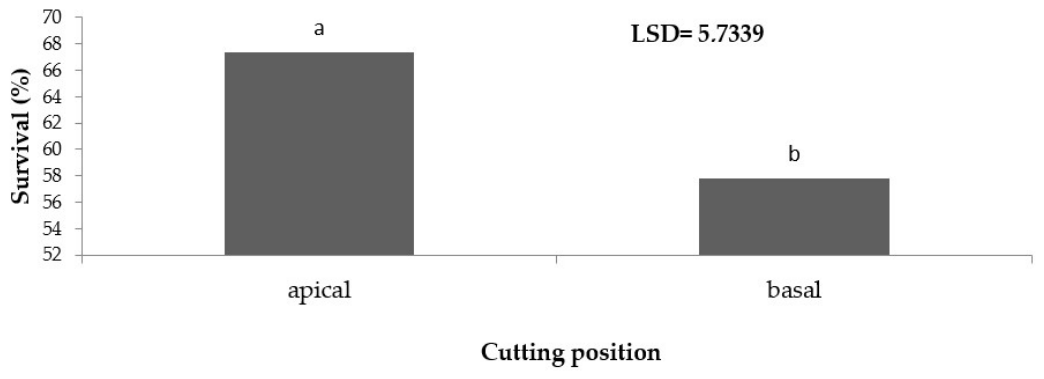
Figure 2.
Average and standard deviations of the effect of media on the survival of Euclea natalensis stem cuttings during the first two weeks after cuttings were planted. *M1 (pine bark and river sand 2:1), M2 (coco peat), M3 (coco peat and vermiculite 2:1), M4 (river sand and vermiculite 1:1).
Figure 2.
Average and standard deviations of the effect of media on the survival of Euclea natalensis stem cuttings during the first two weeks after cuttings were planted. *M1 (pine bark and river sand 2:1), M2 (coco peat), M3 (coco peat and vermiculite 2:1), M4 (river sand and vermiculite 1:1).
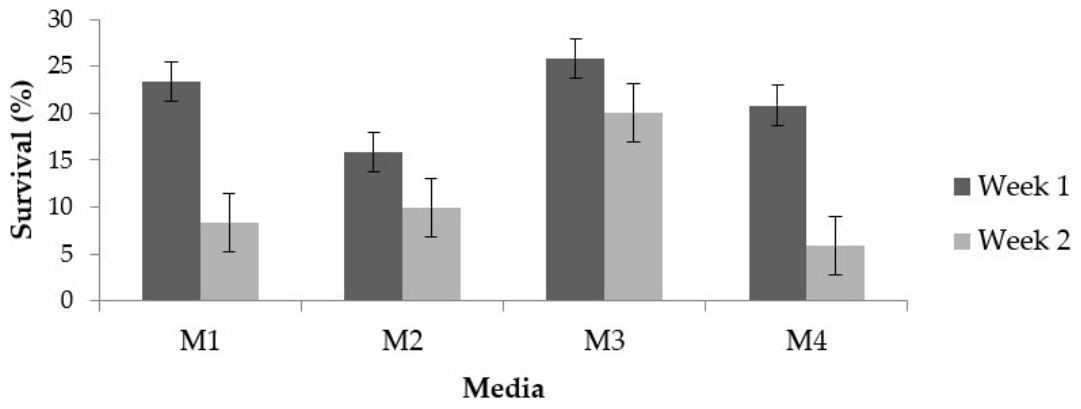
Figure 3.
Average and standard deviations of the effect of cutting type on the survival of Euclea natalensis stem cuttings during the first two weeks after cuttings were planted.
Figure 3.
Average and standard deviations of the effect of cutting type on the survival of Euclea natalensis stem cuttings during the first two weeks after cuttings were planted.
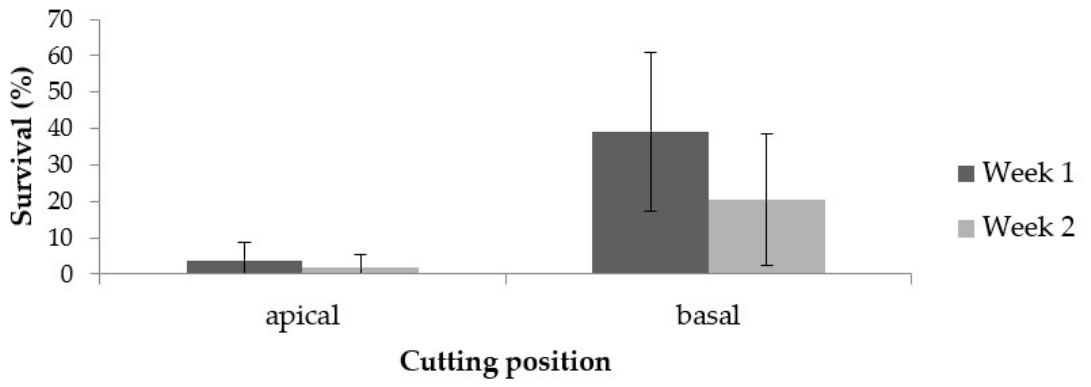

Table 1.
A summary of germination and seedling emergence parameters of Buddleja saligna at 10 °C, 15 °C, 20 °C, 25 °C, and 30 °C temperature regimes.
Table 1.
A summary of germination and seedling emergence parameters of Buddleja saligna at 10 °C, 15 °C, 20 °C, 25 °C, and 30 °C temperature regimes.
| Germination | ||||||
| Treatment | FGP (%) | FDG (days) | LDG (days) | MGT (days) | GI | GT50 (days) |
| 10. °C | 84. | 9. 6a | 14. 8a | 12. 01a | 50. 8d | 12. 0674a |
| 15. °C | 80. | 7. 2b | 11. 4b | 8. 96b | 82. 6c | 8. 0729b |
| 20. °C | 88. | 2. 6c*** | 6. 4c*** | 3. 66c*** | 127. 2ab*** | 3. 2507c*** |
| 25. °C | 96. | 2. c | 5. c | 3. 16c | 145. 2a | 2. 6709c |
| 30. °C | 90. | 3. c*** | 5. 8c*** | 3. 96c*** | 126. b | 3. 2151c*** |
| LSD | NS | 1. 1297 | 2. 1135 | 1. 2716 | 18. 558 | 1. 2241 |
| Emergence | ||||||
| Treatment | FEP (%) | FDE (days) | LDE (days) | MET (days) | EI | ET50 (days) |
| 10. °C | 60. | 13. 8a | 15. a | 14. 66a | 24. c | 13. 28a |
| 15. °C | 94. | 9. b | 12. 4b | 10. 4b | 71. 6b | 10. 11b |
| 20. °C | 90. | 3. 6c*** | 6. 4c*** | 4. 66c*** | 119. a*** | 4. 97c*** |
| 25. °C | 80. | 3. 2c | 6. 6c*** | 4. 2c*** | 121. a*** | 4. 25c*** |
| 30. °C | 90. | 3. 2c | 5. 6c | 3. 96c | 126. a | 3. 99c |
| LSD | NS | 1. 7812 | 1. 6421 | 1. 4166 | 30. 694 | 1. 7751 |
Values in a column with the same letters are not significantly different (p < 0.05). Values with asterisks (***) are not significantly different from the best values. NS indicates not significant. Final germination percentage (FGP %), First day of germination (FDG), last day of germination (LDG), Mean germination time (MGT), Germination index (GI), and time to 50% germination (GT50). Final emergence percentage (FEP), First day of emergence (FDE), Last day of emergence (LDE), Mean emergence time (MET), Emergence index (EI), and time to 50% emergence (ET50).
Table 2.
A summary of seed germination parameters of Euclea natalensis at different temperature regimes.
Table 2.
A summary of seed germination parameters of Euclea natalensis at different temperature regimes.
| Treatment | FGP (%) | FDG (days) |
LDG (days) |
MGT (days) |
GI | Average radical length for the emergence trial (cm) |
|---|---|---|---|---|---|---|
| Analysis of all 5 temperatures | ||||||
| 10 °C | 0b | 0b | 0b | 0c | 0c | 0d |
| 15 °C | 10b | 5.6ab | 5.8b | 5.68bc | 2.6c | 0d |
| 20 °C | 98a | 13a*** | 16.6a | 13.54a | 159.6b | 1.5c |
| 25 °C | 98a | 8.6a*** | 14a | 11.16ab*** | 184.8a | 6.96b |
| 30 °C | 94a*** | 9.6a*** | 17.2a | 12.73ab*** | 161.8b | 8.52a |
| LSD | 14.221 | 7.42 | 7.612 | 7.372 | 14.338 | 1.0467 |
| Analysis of the optimal 3 temperatures | ||||||
| Treatment | FGP (%) | FDG (days) |
LDG (days) |
MGT (days) | GI |
GT50 (days) |
| 20 °C | 98 | 13a | 16.6 | 13.54a | 159.6b | 14.1a |
| 25 °C | 98 | 8.6b | 14.0 | 11.16b | 184.8a | 10.67c |
| 30 °C | 94 | 9.6b*** | 17.2 | 12.73ab*** | 161.8b | 12.17b |
| LSD | NS | 1.227 | NS | 1.6368 | 17.002 | 1.1441 |
Values in a column with the same letters are not significantly different (p < 0.05). Values with asterisks (***) are not significantly different from the best values. NS indicates not significant. Final germination percentage (FGP), First day of germination (FDG), Last day of germination (LDG), Mean germination time (MGT), and Germination index (GI).
Table 3.
The effect of media and plant growth regulators on the survival, callus formation, rooting, and leaf production in Buddleja saligna (combined seasonal data).
Table 3.
The effect of media and plant growth regulators on the survival, callus formation, rooting, and leaf production in Buddleja saligna (combined seasonal data).
| Treatment | Parameters measured | Treatment | Parameter | |||
|---|---|---|---|---|---|---|
| Media | % Survival | % Callus | % Rooting | Number of leaves | PGR | % Rooting |
| M1 | 39.58c | 4.84c | 0.19b | 1.9c | D1 | 0.71b |
| M2 | 72.1a*** | 20.33a | 2.21a | 3.2ab*** | D2 | 0.5b |
| M3 | 76a | 17.73a*** | 0.74ab*** | 4.2a | D3 | 2.4a |
| M4 | 62.92b | 11.42b | 0.5b | 2.14bc | CT | 0.04b |
| LSD | 8.109 | 5.9955 | 1.5524 | 1.1688 | LSD | 1.5524 |
Values in a column with the same letters are not significantly different (p < 0.05). Values with asterisks (***) are not significantly different from the highest values. M1 (pine bark and river sand (2:1)), M2 (coco peat), M3 (coco peat and vermiculite (2:1)), M4 (river sand and vermiculite (1:1)). D1 (DynarootTM 1 at 0.1% IBA), D2 (DynarootTM 2 at 0.3% IBA), D3 (DynarootTM 3 at 0.8% IBA), and CT (control).
Disclaimer/Publisher’s Note: The statements, opinions and data contained in all publications are solely those of the individual author(s) and contributor(s) and not of MDPI and/or the editor(s). MDPI and/or the editor(s) disclaim responsibility for any injury to people or property resulting from any ideas, methods, instructions or products referred to in the content. |
© 2026 by the authors. Licensee MDPI, Basel, Switzerland. This article is an open access article distributed under the terms and conditions of the Creative Commons Attribution (CC BY) license (http://creativecommons.org/licenses/by/4.0/).
Copyright: This open access article is published under a Creative Commons CC BY 4.0 license, which permit the free download, distribution, and reuse, provided that the author and preprint are cited in any reuse.