

Submitted:
17 August 2026
Posted:
18 August 2026
You are already at the latest version
Abstract
Distance education is increasingly important for mass education because it expands access, supports disadvantaged groups, and creates more equal learning opportunities across society. It is also critical for lifelong learning and broader social transformation, especially in a period when education is closely intertwined with technological change. Yet despite the strategic importance of this education-technology nexus, transformative research in distance education has not developed at a level commensurate with its importance, and the field still lacks a comprehensive synthesis of its evolution. This systematic literature review examines 119 Scopus-indexed studies published between 1993 and 2026. Combining bibliometric analysis with thematic analysis, the review maps the field’s growth, diversity, and major lines of inquiry. The findings show that transformative research in distance education is increasingly influential, while also revealing persistent conceptual and methodological gaps. The study therefore provides a timely foundation for clarifying concepts, identifying trends, and strengthening future research in a field with major educational and societal implications.
Keywords:
transformative research
; distance education
; mass education
; equity
; systematic literature review
1. Introduction
The idea of transformation has been part of distance education discussions for more than three decades. Early work, especially Mezirow’s (1991) theory of transformative learning, linked education to deep shifts in how people interpret experience. Later studies expanded the idea and connected it to institutional change, technology, and broader social concerns. As a result, the term has become very common in distance education research. That popularity creates a basic but important question: what does “transformative” actually mean in this literature, and how consistently has it been used in theoretical and methodological terms?
Distance education itself has changed in waves. Moore and Kearsley (2012) define it as structured learning in which teachers and learners are separated by space, and often by time. Beyond this structural definition, distance education has become especially important for mass education because it can expand participation at scale and reach learners who have traditionally been excluded by geography, time constraints, disability, economic disadvantage, or limited institutional access. It is also increasingly central to lifelong learning because it enables more flexible and continuous participation in education across the life course. The spread of the internet in the 1990s reshaped where and when learning could happen (Garrison, 2011). In the 2010s, open educational resources and massive open online courses widened access and also renewed debate about the promises and limits of technology-mediated education (Zawacki-Richter et al., 2020). The COVID-19 pandemic then pushed institutions into emergency remote teaching and brought the strengths and weaknesses of distance education into sharp focus (Hodges et al., 2020). More recently, generative artificial intelligence, including tools such as ChatGPT, has added a new layer of opportunity and uncertainty to educational practice (Kasneci et al., 2023).
In this context, transformation in distance education no longer refers to a single idea. At the individual level, transformative learning theory remains useful for examining how online and distance education can reshape learners’ assumptions and perspectives (Cranton, 2006; Taylor, 2007; Holdo, 2023). At the institutional level, researchers have looked at changes in organisational structures, curriculum, leadership, and quality assurance (Keppell et al., 2010; Moore, 2005). At the social level, scholars have explored how distance education may support equity, social justice, and the empowerment of marginalised groups. In that sense, distance education is not only an alternative mode of delivery; for mass education systems it can function as a transformative force by creating more equal educational opportunity for disadvantaged groups, widening access to learning across society, and supporting lifelong learning in changing social and technological conditions. At the same time, although this area is closely tied to educational technologies and is increasingly important for social transformation, explicitly transformative research within distance education still appears less developed than the field requires. This line of work connects closely with Mertens’s (2003, 2007, 2009) transformative paradigm, which places social justice at the centre of the research process and has become especially important in mixed methods research.
Despite the richness and diversity of this body of work, no comprehensive synthesis has attempted to map the full landscape of transformative research in distance education across its multiple dimensions: pedagogical, technological, social, and methodological. Previous reviews have addressed specific facets of this terrain: systematic reviews of online learning effectiveness (Means et al., 2013), bibliometric analyses of distance education journals, reviews of transformative learning in higher education (Hoggan, 2016), and meta-analyses of blended learning outcomes (Bernard et al., 2014). However, none has undertaken a cross-cutting analysis of how the concept of transformation, in all its theoretical and practical manifestations, has been engaged with in the distance education literature over the full span of its development.
This gap matters for several reasons. The literature has grown quickly in recent years, especially after the pandemic and with the rise of artificial intelligence, but that growth has also made the field harder to read as a whole. New researchers do not yet have a clear map of the main themes, dominant theories, or common methods. The term “transformative” is also used in several different ways, from transformative learning theory to digital transformation and the transformative mixed methods paradigm. That variety can easily blur conceptual boundaries, a concern that has also been noted in the Journal of Transformative Education literature (Acheson and Dirkx, 2021). There are also unresolved questions about whose perspectives are represented, which contexts receive attention, and whether research designs actually reflect the transformative claims they make. This is especially important because distance education now occupies a critical place at the intersection of educational technology, lifelong learning, and social transformation, yet the volume of explicitly transformative research in this area still appears insufficient relative to that importance.
This study addresses these issues through a systematic literature review of Scopus-indexed publications on distance education and transformative research. Using a corpus of 119 unique studies published between 1993 and 2026, it combines bibliometric analysis and thematic content analysis to answer the following research questions.
RQ1. What are the bibliometric characteristics of the literature on transformative research in distance education, including temporal trends, geographic distribution, publication venues, authorship patterns, and keyword frequencies?
RQ2. What are the major thematic foci of transformative research in distance education, and how have these themes evolved over time?
RQ3. To what extent do studies in this domain align with the transformative mixed methods paradigm, and what methodological approaches characterise the literature?
RQ4. What emerging trends and future directions can be identified in transformative research in distance education?
By addressing these questions, this review aims to provide a comprehensive, empirically grounded, and critically informed portrait of a field that is both rapidly expanding and important for the future of education. The findings are intended to serve as a reference point for researchers seeking to locate their work within the broader landscape, for practitioners designing transformative distance education experiences, and for policymakers navigating the complex interplay of technology, equity, and quality in an era of accelerating change.
2. Method
This study used a systematic literature review (SLR) to examine transformative research in distance education. Systematic reviews offer a clear and replicable way to identify, evaluate, and synthesize research on a defined topic (Petticrew & Roberts, 2006). The review followed the PRISMA guidelines (Page et al., 2021) in order to keep the search, screening, and analysis process transparent.
2.1. Search Strategy
Scopus was selected as the sole bibliographic database for this review. Scopus is the largest abstract and citation database of peer-reviewed literature, encompassing over 27,000 journals, conference proceedings, and book series across all disciplines (Elsevier, 2024). It has been widely used in systematic reviews and bibliometric studies within the field of education and distance learning (Zawacki-Richter et al., 2020). The selection of a single comprehensive database is consistent with established practice in educational technology reviews, particularly when the aim is to capture a broad, multidisciplinary corpus rather than achieve exhaustive coverage of a narrow field.
The search was conducted on February 18, 2026, using the following Boolean query: TITLE-ABS-KEY("distance education") AND TITLE-ABS-KEY("transformative"). This query searched for the co-occurrence of the terms "distance education" and "transformative" in the title, abstract, or keywords fields of indexed publications. The search was not restricted by publication year, language, or document type in order to capture the broadest possible set of relevant studies across the full temporal span of the literature.
The term "distance education" was selected as the primary domain identifier, as it represents the most established and encompassing term in the field, subsuming related concepts such as online learning, e-learning, open learning, and blended learning (Moore & Kearsley, 2012). The term "transformative" was chosen to capture studies that engage with transformative learning theory (Mezirow, 1991, 2000), the transformative paradigm in research methodology (Mertens, 2003, 2007), and broader notions of transformation in educational contexts, including digital transformation, institutional transformation, and social transformation. The deliberate breadth of this search strategy was intended to map the full spectrum of how "transformative" is conceptualized and operationalized in distance education scholarship.
2.2. Screening and Selection Process
The initial Scopus search yielded 123 records. These records were exported in Excel format for systematic screening and analysis. All 123 records retrieved from Scopus were imported into a spreadsheet for initial review. Each record included the following metadata fields: authors, author full names, author IDs, title, publication year, source title, Scopus link, affiliations, authors with affiliations, author keywords, and index keywords.
A check for duplicate entries was performed. Three sets of duplicates were identified: "Transforming distance education curricula through distributive leadership" appeared three times, having been published simultaneously in the Journal of Asynchronous Learning Network, ALT-J: Research in Learning Technology, and Australasian Journal of Educational Technology between 2010 and 2011; "eCampusAlberta: A story of strategic partnership and collaboration success in distance education" appeared twice in 2013, and "Project management-based design for online learning" also appeared twice in 2013. These represent instances of cross-publication or re-publication rather than distinct studies. After deduplication, the final corpus comprised 119 unique studies. In the analysis, all 123 records were retained to preserve journal-level bibliometric data, with duplicates flagged accordingly in the thematic analysis.
The inclusion criteria required that: (a) the publication contains the terms "distance education" and "transformative" in the title, abstract, or keywords. No restrictions were imposed on publication year (full temporal range: 1993–2026) or language. Given that the search query was specifically designed to target the intersection of distance education and transformative approaches, no additional exclusion criteria were applied beyond the inherent Scopus indexing requirements.
2.3. Data Extraction
For each of the 123 records, data were systematically extracted from the Scopus export. The extracted fields included authors (abbreviated names), author full names with Scopus author IDs, full title of the publication, publication year, source title (journal, conference, or book), institutional affiliations, author keywords, index keywords assigned by Scopus, and the Scopus record URL.
2.4. Data Analysis
A multi-layered analytical strategy was employed to examine the corpus from complementary perspectives. First, descriptive bibliometric analysis was used to map the quantitative profile of the literature, including publication trends over time, the geographic distribution of author affiliations, the distribution of sources across journals, conferences, and book series, authorship and collaboration patterns, and keyword frequencies in order to identify dominant conceptual clusters.
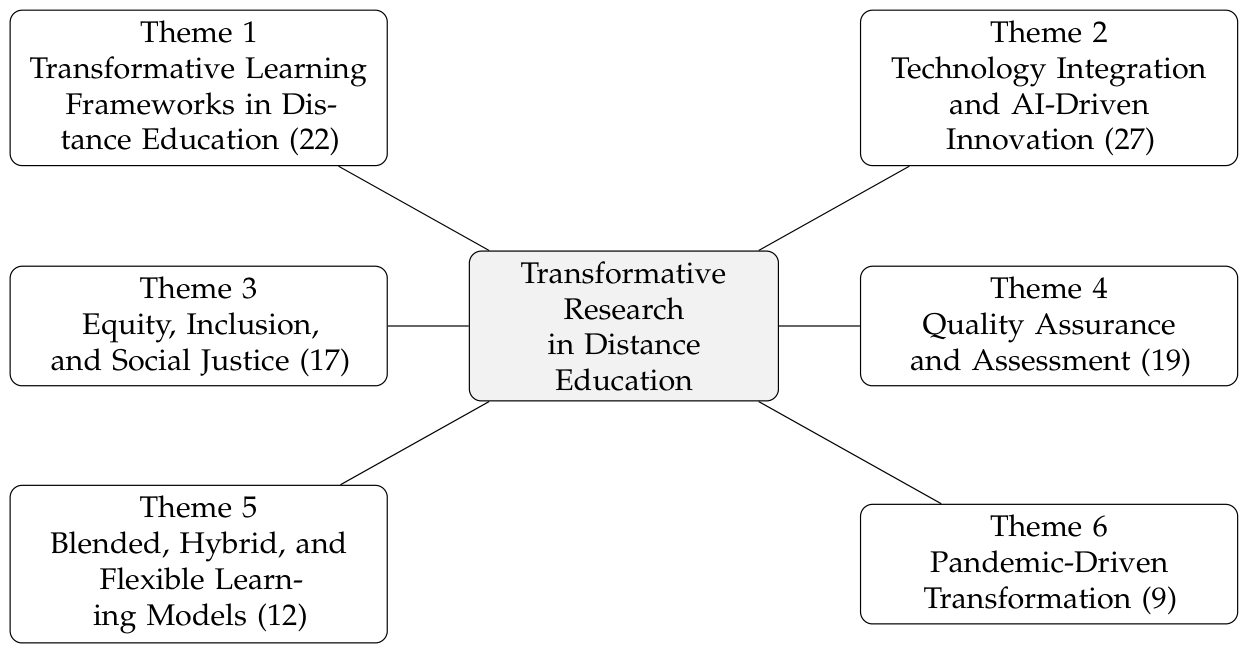
Second, thematic content analysis was conducted following Braun and Clarke’s (2006) six-phase framework: familiarization with the data, generating initial codes, searching for themes, reviewing themes, defining and naming themes, and producing the report. Article titles, author keywords, index keywords, and available abstracts were coded inductively and deductively to identify recurring thematic patterns. Deductive codes were derived from established frameworks in transformative learning (Mezirow, 1991), transformative mixed methods research (Mertens, 2003), and distance education (Moore & Kearsley, 2012). Inductive codes emerged from iterative reading of the data. Through this process, six major themes were identified: (1) Transformative Learning Frameworks in Distance Education, (2) Technology Integration and AI-Driven Innovation, (3) Equity, Inclusion, and Social Justice, (4) Quality Assurance and Assessment, (5) Blended, Hybrid, and Flexible Learning Models, and (6) Pandemic-Driven Transformation.
Third, each study was examined for indicators of methodological orientation, with particular attention to the presence of mixed methods designs that combined qualitative and quantitative approaches, alignment with the transformative paradigm as defined by Mertens (2003, 2007), and the use of specific methodological approaches such as design-based research, case study, phenomenology, survey research, and bibliometric analysis. Particular emphasis was placed on whether studies reflected key features of the transformative paradigm, including a social justice orientation, the centering of marginalized voices, and the use of research for emancipatory purposes.
2.5. Corpus Characteristics
The final corpus of 123 records (119 unique studies) exhibited several notable characteristics. The articles spanned from 1993 to 2026, were published across 105 unique venues, and involved 306 unique authors from 51 countries. Among the publications, 95 were journal articles, 17 were conference proceedings, and 11 were book chapters or contributions to edited volumes. Single-authored publications comprised 27.6% (n = 34) of the corpus, while multi-authored publications constituted 69.9% (n = 86), with an average of 2.9 authors per publication.
2.6. Limitations
Several methodological limitations should be acknowledged. The exclusive use of Scopus, while offering comprehensive multidisciplinary coverage, may have excluded relevant studies indexed only in Web of Science, ERIC, or Google Scholar. However, Scopus’s broad coverage of educational research journals and conference proceedings minimizes this limitation. The search required the exact term "distance education" rather than related terms such as "online learning," "e-learning," or "open education," which ensured precision and a manageable corpus but may have missed some relevant studies using alternative terminology. Due to the absence of full-text access for all articles in the corpus, the thematic and methodological analyses relied primarily on titles, keywords, and available abstracts; full-text analysis would have enabled deeper methodological characterization, particularly regarding mixed methods designs and transformative paradigm alignment. Finally, the search was conducted in early 2026, meaning that publications from 2026 represent only a partial year, and the high volume of recent publications may reflect recency effects in Scopus indexing.
2.7. Ethical Considerations
As this study analyzed publicly available bibliographic data from the Scopus database, no ethical approval was required. All data were accessed through legitimate institutional database subscriptions. No human participants were involved in this research.
3. Findings
A total of 123 articles published between 1993 and 2026 were included in this systematic literature review. The corpus reveals a clear trajectory of scholarly attention toward transformative research in distance education, with publication output accelerating markedly over the past decade.
3.1. Temporal Distribution of Publications
The temporal distribution of the reviewed studies demonstrates four distinct phases of scholarly activity. The emergent phase (1993–2010) comprised 20 publications (16.3%). The earliest contribution dates to 1993, with sporadic publications through the early 2000s. A noticeable uptick emerged in 2009–2010, with 12 publications in this two-year window alone, largely coinciding with growing interest in transformative learning theory applied to online and hybrid distance education formats (Mezirow, 2000; Cranton, 2006).
The growth phase (2011–2015) also comprised 20 publications (16.3%). This period saw steady output, with a peak of 12 publications in 2013 alone, driven largely by conference proceedings and edited volumes addressing massive open online courses, internationalization, and project management approaches in online learning. The consolidation phase (2016–2020) similarly produced 20 publications (16.3%). Research during this period increasingly addressed quality assurance, culturally inclusive design, blended strategies, and the integration of emerging technologies. The COVID-19 pandemic in 2020 catalyzed urgent scholarly attention to emergency remote teaching and flexible learning paradigms (Hodges et al., 2020).
The expansion phase (2021–2026) produced 63 publications (51.2%), constituting more than half of all reviewed studies. This phase included 23 articles in 2025 alone and 19 in 2024. This surge reflects the compounding effects of pandemic-driven digital transformation, the emergence of generative artificial intelligence, and renewed global commitment to inclusive and open education. The complete year-by-year distribution is shown in Figure 1.
3.2. Publication Venues
The reviewed articles were distributed across a diverse range of journals, conference proceedings, and book chapters. The most prominent venues included Open Praxis (n = 4), Communications in Computer and Information Science (n = 4), Distance Education (n = 3), British Journal of Educational Technology (n = 2), Electronic Journal of e-Learning (n = 2), Cogent Education (n = 2), Open Learning (n = 2), Turkish Online Journal of Distance Education (n = 2), and Turkish Online Journal of Educational Technology (n = 2). The spread across more than 90 unique venues signals that transformative research in distance education is not confined to a single disciplinary niche but intersects with educational technology, teacher education, health professions education, social work, library science, and engineering education.
3.3. Geographic Distribution
Analysis of institutional affiliations revealed contributions from researchers in more than 30 countries, grouped into six geographic regions. Asia (including Turkey, India, China, Taiwan, and Iran) led with 37 articles, followed closely by North America (United States and Canada) with 36, Europe (United Kingdom, Spain, Portugal, Greece, Finland, and others) with 28, Africa (South Africa, Nigeria, Ghana, and others) with 18, Oceania (Australia and New Zealand) with 7, and Latin America (Brazil, Ecuador, and Colombia) with 4. The regional distribution is presented in Figure 2.
At the country level, the United States dominated with 52 author affiliations, followed by the United Kingdom (n = 19), South Africa (n = 17), Turkey (n = 16), India (n = 10), and Canada (n = 10). The strong representation of South Africa and Turkey is noteworthy, reflecting the established traditions of open and distance learning in these countries through institutions such as the University of South Africa (UNISA) and Anadolu University (Öztürk, 2005). The relatively low contribution from Latin America (n = 4) and the underrepresentation of Southeast Asian and African nations beyond South Africa and Nigeria suggest geographic gaps in the literature that warrant future scholarly attention.
3.4. Authorship and Collaboration Patterns
Among the 123 articles, 34 (27.6%) were single-authored, while 86 (69.9%) involved multiple authors. The average number of authors per article was 2.9, with a maximum of 18 co-authors on a single study. The predominance of multi-authored studies reflects the collaborative, often interdisciplinary nature of research at the intersection of transformative pedagogy and distance education.
3.5. Keyword Analysis
Author keyword analysis identified the most frequently occurring terms in the corpus. The dominance of "distance education" (n = 33) and "transformative learning" (n = 13) confirms the thematic coherence of the corpus. The emergence of "artificial intelligence" (n = 5) and "ChatGPT" (n = 3) as recent keywords signals a new frontier in transformative distance education research. Other notable keyword clusters include "design-based research" (n = 3), "distributive leadership" (n = 3), "digital transformation" (n = 3), and "open and distance learning" (n = 3). These keyword patterns reflect the evolution of the field from foundational theoretical work on transformative learning toward applied, technology-mediated, and equity-oriented scholarship.
3.6. Thematic Analysis of Research Foci
Content analysis of titles, keywords, and abstracts revealed six major thematic categories, many of which overlap and intersect. Figure 3 presents the thematic distribution. Theme 2 (Technology Integration and AI-Driven Innovation) was further divided into three sub-themes: (2a) Immersive and Emerging Technologies, (2b) Generative AI, and (2c) Learning Analytics.
3.7. Theme 1: Transformative Learning Frameworks in Distance Education (n = 22)
The largest theoretically grounded theme centered on transformative learning theory, primarily drawing on Mezirow’s (1991, 2000) framework and its extensions. These studies investigated how distance education experiences, whether online, blended, or hybrid, can serve as catalysts for fundamental shifts in learners’ perspectives, assumptions, and meaning-making processes. Transformative learning theory posits that significant learning involves a transformation of the learner’s frame of reference through critical reflection on assumptions, particularly in response to disorienting dilemmas (Mezirow, 1991; Cranton, 2006).
Early contributions between 2006 and 2010 established the conceptual foundations. Doering (2006) introduced adventure learning as a transformative hybrid online education model, later extended by Jones and Vollmers (2008) through web-based technologies. O’Dwyer et al. (2009) examined cascading progressive practice in teaching, learning, and technology, while the 2010 edited volumes Transformative Learning and Online Education (Harasim, 2010) and Handbook of Research on Transformative Online Education and Liberation (Ramirez & Gallardo, 2010) consolidated the theoretical foundations. A significant body of work during this period examined how distributive leadership could transform distance education curricula, employing design-based research as a methodological approach (Keppell et al., 2010, 2011).
More recent studies between 2017 and 2024 extended transformative learning into new contexts. Keshav and Gurung (2017) framed the Quality Matters process as a vehicle for transformative professional development, while Ortega et al. (2020) addressed microaggressions and acts of oppression within online classrooms through the principles of transformative learning and liberatory education. Raffaghelli and Stewart (2022) explored narrative learning and transformative practices in higher distance education, and Saliba (2024) documented reversed transformative experiences of faculty members teaching in transnational higher education institutions. A notable trend across this theme is the shift from student-focused to faculty-focused transformative learning, recognizing that instructors themselves undergo significant perspective transformations when transitioning to distance education modalities.
3.8. Theme 2: Technology Integration and AI-Driven Innovation (n = 27)
The second major theme captures the rapidly evolving role of technology in distance education. This theme spans from early web-based tools through virtual reality and immersive environments to the current wave of artificial intelligence applications. Given the breadth and internal differentiation of this theme, three sub-themes were identified (see Figure 3).
Sub-theme 2a: Immersive and Emerging Technologies. Studies in this sub-theme explored collaborative virtual reality in engineering education (Dunmoye et al., 2026), augmented reality for learning car parts (2025), VR-based simulation experiments (2023), and three-dimensional immersive world collaborations for graduate cross-programme work (Howard et al., 2013). These studies consistently reported that immersive technologies enhanced learner engagement, spatial understanding, and collaborative problem-solving in distance contexts. The progression from simple web-based platforms to sophisticated VR and AR environments reflects the broader trajectory of technological development in educational settings (Dalgarno & Lee, 2010).
Sub-theme 2b: Generative AI. A rapidly growing cluster of studies, primarily published between 2023 and 2026, examined the integration of generative AI,particularly ChatGPT and large language models,into distance education. Key contributions documented AI’s capacity to facilitate global collaboration and knowledge sharing in higher education, the transformations, challenges, and impacts on academic integrity and student voice (Sevnarayan & Potter, 2024), and the impact of AI on the main distance learning modalities (Adewale et al., 2025). These studies consistently identified a tension between AI’s transformative potential for personalized learning and the risks it poses to academic integrity, critical thinking, and student autonomy (McDonald et al., 2025).
Sub-theme 2c: Learning Analytics. Several studies employed deep learning and machine learning approaches for the automatic detection of learner engagement in educational contexts (2025), head detection technology for educational monitoring using YOLOv8 (2025), and academic performance prediction in open and distance learning (Sevnarayan & Gunter, 2025). These represent a methodological shift toward computational and data-driven approaches in distance education research, raising important questions about surveillance, privacy, and the datafication of learning (Williamson, 2017).
3.9. Theme 3: Equity, Inclusion, and Social Justice (n = 17)
A substantial body of work positioned distance education as a vehicle for social transformation, equity, and empowerment. This theme is deeply aligned with the transformative paradigm in mixed methods research, which foregrounds issues of power, marginalization, and social justice (Mertens, 2003, 2007). Taken together, these studies suggest that distance education is especially significant for mass education because it can reduce longstanding barriers to participation and help create more equal opportunities for learners from disadvantaged groups. From this perspective, widening access through distance education is itself part of what makes education transformative at the societal level. Studies addressed digital access and equity, examining how digital access shapes learning outcomes and perpetuates or mitigates educational inequalities (2024), and ensuring equity and integrity in academic performance prediction (Sevnarayan & Gunter, 2025). Cultural inclusion was explored through Africanizing the curriculum at open distance learning institutions (2024), culturally inclusive instructional design frameworks for building online wisdom communities (Gunawardena, 2018), and the ethical integration of generative AI chatbots in indigenous education (2025).
Gender and empowerment featured in studies exploring the role of open and distance education in empowering women’s technological skills in Nigeria (2025). Anti-oppressive pedagogy was addressed through work on microaggressions and acts of oppression in online classrooms utilizing transformative and liberatory education (Ortega et al., 2020) and anti-hegemonic adult education practices in cyber-education environments (2009). The democratization of learning was examined through fully online learning community models (Blayone et al., 2017) and through finding liberation and social equality in transformative online education (Ramirez & Gallardo, 2010). Humanizing pedagogy for online and distance education was also explored, with studies advocating for more inclusive and engaging learning environments (2025). This theme showed a notable geographic spread, with contributions from South Africa, Nigeria, Turkey, the United States, Australia, and Canada, reflecting the global relevance of equity concerns in distance education.
3.10. Theme 4: Quality Assurance and Assessment (n = 19)
Research on quality assurance and assessment constituted a significant thematic strand, addressing how transformative approaches can improve the quality and integrity of distance education provision. Studies ranged from bibliometric analyses of quality assurance in distance higher education (2025) through the exploration of the transformative power of quality assurance agencies in Asia (Hou et al., 2026) to the design of innovative assessment frameworks for online and open education (2023). The Quality Matters process was examined as a framework for transformative professional development (Keshav & Gurung, 2017), while student engagement enhancement through gamification was documented (2024). The Patras blended strategy model for deep and meaningful learning in lifelong distance education was developed and refined across two studies (Lytras et al., 2018, 2019). Challenges of maintaining academic integrity in the era of generative AI represented a growing concern (Sevnarayan & Potter, 2024). A recurring finding across this theme was that traditional quality metrics designed for face-to-face education require fundamental reconceptualization,not mere adaptation,when applied to distance education contexts (Ossiannilsson et al., 2015).
3.11. Theme 5: Blended, Hybrid, and Flexible Learning Models (n = 12)
Studies in this theme examined the transformative potential of blended and hybrid learning approaches that combine face-to-face and distance elements. This theme was particularly prominent in the earlier period of the corpus, with foundational work on adventure learning as transformative hybrid online education (Doering, 2006), web-based technologies for transformative hybrid distance education (Jones & Vollmers, 2008), and blended learning as a transformative design approach (Garrison & Kanuka, 2004; Lyon, 2009). More recent contributions analyzed the transformative power of blended learning for specific populations, such as Business English majors in China (Li & Zhang, 2024), and the transition from paper-based to supported networked learning in South Africa (Ng’ambi & Bozalek, 2018). The COVID-19 pandemic reinvigorated interest in flexible and blended modalities, as institutions worldwide were forced to rapidly adopt and adapt distance learning approaches.
3.12. Theme 6: Pandemic-Driven Transformation (n = 9)
The COVID-19 pandemic represented a critical juncture in the reviewed literature, generating a distinct thematic cluster. Studies documented emergency remote teaching experiences in diverse contexts, including Ecuador (2023), Greece (2023), Canada (Restoule et al., 2021), and Wales (2024), and reflected on the pandemic’s lasting impact on distance education paradigms. The pandemic accelerated digital transformation in distance education but simultaneously exposed deep digital divides. Faculty and students experienced significant work-family balance disruptions (2024), while the pandemic prompted fundamental reconsideration of futures in medical education (2021) and creative arts education (2024). Northern and Indigenous Canadian postsecondary educators faced unique contextual, pedagogical, and experiential challenges that highlighted the intersection of geographic isolation, cultural responsiveness, and digital infrastructure (Restoule et al., 2021). The pandemic literature collectively suggests that the crisis served as both an accelerator and a revealer,accelerating the adoption of distance education technologies while revealing structural inequities that had been previously masked by the assumption of in-person delivery.
3.13. Methodological Approaches
3.14. Mixed Methods Designs
Analysis of the reviewed studies’ methodological orientations revealed a diverse methodological landscape. Survey-based mixed designs were the most common approach, combining quantitative survey instruments with qualitative components such as open-ended questions, interviews, or observational data. Design-based research appeared as a distinctive methodological approach, particularly in studies on transforming distance education curricula through distributive leadership (Keppell et al., 2010, 2011). Design-based research inherently integrates qualitative and quantitative strands within iterative design cycles, making it well-suited for transformative distance education research (Anderson & Shattuck, 2012). Case study approaches were employed in studies examining anti-hegemonic adult education practices and English literature curriculum at a mega distance university. Phenomenological designs were used to explore learner narratives in inclusive open and distance education (Ucar et al., 2026). Bibliometric and systematic review methodologies constituted a growing category, reflecting the maturation of the field and the need for evidence synthesis.
3.15. Alignment with the Transformative Mixed Methods Paradigm
A critical finding of this review is that while many studies in the corpus address transformative themes such as social justice, equity, empowerment, and liberation, relatively few explicitly adopted a transformative mixed methods paradigm as defined by Mertens (2003, 2007). The transformative paradigm in mixed methods research is characterized by privileging the voices and experiences of marginalized communities, using research findings to promote social justice and human rights, and employing mixed methods designs that are driven by a transformative theoretical lens rather than purely pragmatic considerations (Mertens, 2009; Sweetman et al., 2010).
Studies that most closely aligned with the transformative mixed methods paradigm included work on addressing microaggressions and oppression through transformative and liberatory education (Ortega et al., 2020), research on anti-hegemonic adult education practices in cyber-education (2009), studies on finding liberation and social equality through transformative online education (Ramirez & Gallardo, 2010), research on empowering women’s technological skills through open and distance education (2025), work on culturally inclusive instructional design and Africanizing the curriculum (Gunawardena, 2018; 2024), and the phenomenological study of learner narratives in inclusive open and distance education (Ucar et al., 2026). This gap between thematic engagement with transformative ideals and explicit adoption of the transformative paradigm as a research framework represents a significant finding with implications for future research methodology in the field.
3.16. Emerging Trends and Future Directions
Four emerging trends were identified in the reviewed literature. First, the AI-transformation nexus represents the most prominent trend. Between 2023 and 2026, 17 articles addressed AI-related topics, suggesting that generative AI is rapidly reshaping the distance education landscape. Key questions emerging from this literature include how AI tools can be ethically integrated to promote rather than undermine transformative learning, how academic integrity frameworks should evolve in AI-mediated distance education, and what role AI can play in promoting equity and inclusion for marginalized learners in distance contexts (McDonald et al., 2025).
Second, the post-COVID era has produced a reconceptualization of distance education from a supplementary or emergency modality to a primary mode of educational delivery. Studies from 2022 to 2026 increasingly position flexibility and digital transformation as normative rather than exceptional features of higher education, with implications for how transformative learning is conceptualized and facilitated. Third, while the literature remains dominated by North American and European scholarship, there is a growing body of work from the Global South, particularly South Africa (n = 17), Turkey (n = 16), Nigeria (n = 8), and India (n = 10). These contributions bring critical perspectives on decolonization, Africanization, and culturally responsive pedagogy that enrich the transformative dimension of distance education research (Ng’ambi & Bozalek, 2018). Fourth, a longitudinal shift is evident from individual-level transformative learning,focused on how distance education transforms individual learners’ perspectives,to institutional and systemic transformation concerned with how distance education transforms organizational structures, curricula, leadership practices, and quality assurance systems (Keppell et al., 2011).
3.17. Synthesis and Conceptual Framework
Drawing on the six thematic categories and the methodological analysis above, we propose a conceptual framework for understanding transformative research in distance education organized around three interconnected dimensions. The first dimension, Pedagogical Transformation, concerns how distance education design, delivery, and assessment practices can be reconceptualized through transformative learning theory to promote deep, meaningful, and perspective-altering learning experiences, as reflected in Themes 1, 4, and 5. The second dimension, Technological Transformation, addresses how emerging technologies, from web-based tools and virtual reality to generative AI, serve as both enablers and disruptors of transformative pedagogy in distance contexts, requiring continuous critical evaluation, as captured in Themes 2 and 6. The third dimension, Social Transformation, examines how distance education can serve as a vehicle for equity, inclusion, democratization, and social justice, particularly when guided by the transformative paradigm in mixed methods research that centers the voices and experiences of marginalized communities, as represented in Theme 3.
These three dimensions interact dynamically: technological innovations create new possibilities for pedagogical transformation, which in turn can either advance or hinder social transformation goals. The transformative mixed methods paradigm, as articulated by Mertens (2003, 2007, 2009), provides the methodological framework for investigating these interactions while maintaining a commitment to social justice and equity. The relative scarcity of studies that explicitly adopt this paradigm, despite the prevalence of transformative themes, represents both a limitation of the current literature and an opportunity for future research.
4. Conclusion
This systematic literature review examined 119 unique studies published between 1993 and 2026 at the intersection of transformative research and distance education. The analysis yielded a comprehensive portrait of a field that has evolved from tentative theoretical explorations in the 1990s to a robust, multidisciplinary domain of inquiry encompassing pedagogy, technology, equity, and institutional change. The findings carry important implications for researchers, practitioners, and policymakers seeking to harness the transformative potential of distance education in an era defined by rapid technological disruption and persistent social inequalities.
The thematic analysis revealed that the literature converges around six interconnected areas of scholarly concern. Transformative learning theory, rooted in Mezirow’s (1991) foundational framework, remains the dominant conceptual lens through which scholars have examined how distance education can catalyse fundamental shifts in learners’ assumptions, perspectives, and meaning-making processes. Yet the review also demonstrates that the field has moved well beyond this initial theoretical anchoring. Technology integration and AI-driven innovation emerged as the most extensively represented theme (n = 27), reflecting the accelerating pace at which emerging technologies, from immersive virtual environments to generative AI, are reshaping the pedagogical landscape of distance education. The identification of three distinct sub-themes within this category, immersive technologies, generative AI, and learning analytics, underscores the breadth and complexity of the technology–transformation nexus and signals that this trajectory will continue to intensify in the coming years.
Equally significant is the strong presence of equity, inclusion, and social justice as a thematic strand (n = 17), which aligns closely with the transformative paradigm as articulated by Mertens (2003, 2007). Studies in this domain have investigated how distance education can serve as a vehicle for democratisation, cultural inclusion, and the empowerment of marginalised populations across diverse geographic and institutional contexts. The geographic distribution of the corpus itself, spanning 51 countries with notable contributions from South Africa, Turkey, Nigeria, and India, reflects the global reach of these concerns, although the relative underrepresentation of Latin American, Southeast Asian, and Sub-Saharan African perspectives beyond a few prominent countries points to enduring disparities in whose voices are heard within the scholarly conversation. Quality assurance and assessment (n = 19) constituted another substantial thematic area, with a recurring finding that traditional quality frameworks developed for face-to-face education require fundamental reconceptualisation rather than mere adaptation when applied to distance education contexts. The blended and hybrid learning models theme (n = 12), while more prominent in the earlier literature, continues to evolve as institutions experiment with flexible modalities that integrate distance and on-site elements. Finally, the pandemic-driven transformation theme (n = 9), though comparatively small, marks a critical inflection point in the field’s trajectory, as COVID-19 compelled a worldwide reckoning with the possibilities and limitations of distance education at scale.
One important finding concerns the gap between transformative language and research practice. Many studies use terms such as empowerment, liberation, social justice, or paradigm shift in their framing. Far fewer, however, explicitly adopt the transformative mixed methods paradigm as a guiding framework. This suggests that future research would benefit from more deliberate methodological choices. It is not enough to study transformative topics; the design itself should also reflect transformative principles, especially by making space for marginalised voices and by linking findings to meaningful social change. This is particularly important in distance education, where the expansion of opportunity for disadvantaged learners can make mass education more equitable, sustain lifelong learning, and in turn contribute to wider social transformation. Yet the review also indicates that explicitly transformative research remains less developed than might be expected in such a critical education-technology domain. This observation aligns with discussions in the Journal of Transformative Education on the conceptual and assessment challenges surrounding transformative learning in higher education (Acheson & Dirkx, 2021; Searle et al., 2021).
The bibliometric profile of the corpus reveals several noteworthy patterns. The pronounced temporal concentration of publications in the most recent period, with over half of all reviewed studies (51.2%) appearing between 2021 and 2026, attests to the field’s rapid expansion, driven in part by the pandemic’s lasting impact on educational delivery and the emergence of generative AI as a disruptive force. The collaborative nature of the research, evidenced by an average of 2.9 authors per publication and a predominance of multi-authored studies (69.9%), reflects the inherently interdisciplinary character of work at this intersection. The dispersal of publications across more than 100 unique venues further confirms that transformative research in distance education is not confined to a single disciplinary niche but extends into educational technology, teacher education, health professions education, social work, and beyond.
Several directions deserve further attention. First, the integration of artificial intelligence into distance education raises both practical opportunities and serious ethical questions. Future work needs to ask how AI can support meaningful learning without weakening academic integrity, critical thinking, or learner autonomy. Second, the evidence base still needs to become more geographically and culturally diverse. North American and European perspectives remain highly visible, even if that pattern is beginning to change. Stronger participation from the Global South, especially through participatory and decolonial designs, would strengthen the field. Third, more longitudinal and design-based studies are needed to show how transformative processes develop over time. Finally, quality assurance, emerging technologies, and equity should be studied together rather than as separate issues.
Transformative research in distance education has become a substantial and important field of inquiry. It is now shaped by technological change, post-pandemic reconsiderations of teaching and learning, and stronger concern for equity and inclusion. If the field is to move forward in a meaningful way, researchers need not only more evidence but also closer alignment between transformative goals and the methods used to study them. That alignment matters most when research takes seriously the experiences of those most affected by educational inequality.
Author Contributions
The author was solely responsible for the conception of the study, data collection, analysis, interpretation, and manuscript preparation.
Funding
The author received no financial support for the research, authorship, and/or publication of this article.
Data Availability Statement
The bibliographic data used in this study were derived from the Scopus database. Because access to Scopus is subscription-based, the underlying export files are not publicly redistributed here; however, the study dataset can be made available by the author upon reasonable request, subject to database licensing restrictions.
Acknowledgments
Not applicable.
Conflicts of Interest
The author declared no potential conflicts of interest with respect to the research, authorship, and/or publication of this article.
Ethical Approval
This study analyzed publicly available bibliographic records and did not involve human participants; therefore, ethics approval was not required.
Consent to Participate
Not applicable.
Consent for Publication
Not applicable.
References
- Acheson, K.; Dirkx, J. M. Editors’ introduction to the special issue of the Journal of Transformative Education on assessing transformative learning. Journal of Transformative Education 2021, 19(4), 295–305. [Google Scholar] [CrossRef]
- Adewale, M. D.; Azeta, A.; Abayomi-Alli, A.; Sambo-Magaji, A. Artificial intelligence impact on learner outcomes in distance education: A process-based framework and research model. In Lecture Notes of the Institute for Computer Sciences, Social-Informatics and Telecommunications Engineering; LNICST, 2025. [Google Scholar]
- Anderson, T.; Shattuck, J. Design-based research: A decade of progress in education research? Educational Researcher 2012, 41(1), 16–25. [Google Scholar] [CrossRef]
- Blayone, T. J.; vanOostveen, R.; Barber, W.; DiGiuseppe, M.; Childs, E. Democratizing digital learning: theorizing the fully online learning community model. International Journal of Educational Technology in Higher Education 2017, 14(1), 13. [Google Scholar] [CrossRef]
- Braun, V.; Clarke, V. Using thematic analysis in psychology. Qualitative Research in Psychology 2006, 3(2), 77–101. [Google Scholar] [CrossRef]
- Cranton, P. Understanding and promoting transformative learning: A guide for educators of adults, 2nd ed.; Jossey-Bass, 2006. [Google Scholar]
- Dalgarno, B.; Lee, M. J. W. What are the learning affordances of 3-D virtual environments? British Journal of Educational Technology 2010, 41(1), 10–32. [Google Scholar] [CrossRef]
- Doering, A. Adventure learning: Transformative hybrid online education. Distance Education 2006, 27(2), 197–215. [Google Scholar] [CrossRef]
- Dunmoye, I. D.; Smith, L. T.; Brown, J. S.; Martin, J. P.; May, D.; Hunsu, N. A systematic review on the use of collaborative virtual reality in engineering education. Virtual Reality 2026, 30(1), 15. [Google Scholar] [CrossRef]
- Elsevier. Scopus content coverage guide. 2024. Available online: https://www.elsevier.com/products/scopus/content.
- Garrison, D. R.; Kanuka, H. Blended learning: Uncovering its transformative potential in higher education. The Internet and Higher Education 2004, 7(2), 95–105. [Google Scholar] [CrossRef]
- Gunawardena, C. N. Culturally inclusive instructional design: A framework and guide to building online wisdom communities. In Proceedings of EdMedia + Innovate Learning; Bastiaens, T., Van Braak, J., Karavida, M., Mocanu, L., Moallem, H., Siemens, G., Eds.; Association for the Advancement of Computing in Education, 2018; pp. 1032–1037. [Google Scholar]
- Harasim, L. Transformative learning and online education: Aesthetics, dimensions and concepts; Athabasca University Press, 2010. [Google Scholar]
- Hodges, C.; Moore, S.; Lockee, B.; Trust, T.; Bond, A. The difference between emergency remote teaching and online learning; EDUCAUSE Review, 2020; Available online: https://er.educause.edu/articles/2020/3/the-difference-between-emergency-remote-teaching-and-online-learning.
- Holdo, M. Critical reflection: John Dewey’s relational view of transformative learning. Journal of Transformative Education 2023, 21(1), 9–25. [Google Scholar] [CrossRef]
- Hou, A.Y.C.; Chen, K.H.-J.; Justiniano, D. Are QA agencies ready to develop new and innovative practices? Exploring the transformative power of five quality assurance agencies in Asia. High. Educ. Asia 2026, 12, 45–67. [Google Scholar]
- Howard, B. B.; Tashner, J. H.; Sanders, R. L. Breaking down Silos: Exploring the Effects of Graduate Cross-Programme Collaborations within a 3D Immersive World. In Riding the Hype Cycle: The Resurgence of Virtual Worlds; Brill, 2013; pp. 149–158. [Google Scholar]
- Jones, N.; Vollmers, G. Using web-based technologies for transformative hybrid distance education. In Web-based education and pedagogical technologies: Solutions for learning applications; IGI Global Scientific Publishing, 2008; pp. 37–55. [Google Scholar]
- Keppell, M.; O’Dwyer, C.; Lyon, B.; Childs, M. Transforming distance education curricula through distributive leadership. ALT-J: Research in Learning Technology 2010, 18(3), 165–178. [Google Scholar] [CrossRef]
- Keppell, M.; O’Dwyer, C.; Lyon, B.; Childs, M. Transforming distance education curricula through distributive leadership. Journal of Asynchronous Learning Networks 2011, 15(4), 9–21. [Google Scholar] [CrossRef]
- Keshav, A.; Gurung, B. Examination of the QM process: Making a case for transformative professional development model. International Journal on E-Learning: Corporate, Government, Healthcare, and Higher Education 2017, 16(3), 245–262. [Google Scholar]
- Li, J.; Zhang, Y. Exploring the transformative power of blended learning for Business English majors in China (2012–2022): A bibliometric voyage. Heliyon 2024, 10(1), e23456. [Google Scholar] [CrossRef] [PubMed]
- Lyon, B. Blended learning as a transformative design approach. In Encyclopedia of distance learning, 2nd ed.; Rogers, P. L., Ed.; IGI Global, 2009; pp. 218–225. [Google Scholar]
- Lytras, M. D.; Danielsen, A. S.; Visvizi, A. Towards a blended strategy for quality distance education lifelong learning courses: The Patras model. In Proceedings of the International Conference on Interactive Collaborative Learning; Springer, 2018; pp. 589–600. [Google Scholar]
- Lytras, M. D.; Danielsen, A. S.; Visvizi, A. The Patras blended strategy model for deep and meaningful learning in quality life-long distance education. Electronic Journal of e-Learning 2019, 17(2), 66–78. [Google Scholar] [CrossRef]
- McDonald, N.; Johri, A.; Ali, A.; Collier, A. H. Generative artificial intelligence in higher education: Evidence from an analysis of institutional policies and guidelines. Computers in Human Behavior: Artificial Humans 2025, 3, 100121. [Google Scholar] [CrossRef]
- Mertens, D. M. Mixed methods and the politics of human research: The transformative-emancipatory perspective. In Handbook of mixed methods in social and behavioral research; Tashakkori, A., Teddlie, C., Eds.; Sage, 2003; pp. 135–164. [Google Scholar]
- Mertens, D. M. Transformative paradigm: Mixed methods and social justice. Journal of Mixed Methods Research 2007, 1(3), 212–225. [Google Scholar] [CrossRef]
- Mertens, D. M. Transformative research and evaluation; Guilford Press, 2009. [Google Scholar]
- Mezirow, J. Transformative dimensions of adult learning; Jossey-Bass, 1991. [Google Scholar]
- Mezirow, J. Learning as transformation: Critical perspectives on a theory in progress; Jossey-Bass, 2000. [Google Scholar]
- Moore, J. Is higher education ready for transformative learning? A question explored in the study of sustainability. Journal of Transformative Education 2005, 3(1), 76–91. [Google Scholar] [CrossRef]
- Moore, M. G.; Kearsley, G. Distance education: A systems view of online learning, 3rd ed.; Wadsworth Cengage Learning, 2012. [Google Scholar]
- Ng’ambi, D.; Bozalek, V. Late departures from paper-based to supported networked learning in South Africa: Lessons learned. In Proceedings of IETC; Isman, A., Dabaj, F., Eds.; IETC Publishing, 2018; pp. 245–258. [Google Scholar]
- Ortega, A.; Andruczyk, M.; Marquart, M. Addressing microaggressions and acts of oppression within online classrooms by utilizing principles of transformative learning and liberatory education. In Microaggressions and Social Work Research, Practice and Education; Routledge, 2020; pp. 236–248. [Google Scholar]
- Ossiannilsson, E.; Williams, K.; Camilleri, A. F.; Brown, M. Quality models in online and open education around the globe: State of the art and recommendations; International Council for Open and Distance Education, 2015. [Google Scholar]
- O’Dwyer, C.; Childs, M.; Keppell, M. Transformative online education for educators: Cascading progressive practice in teaching, learning and technology. In Proceedings of the 8th European Conference on eLearning; Academic Conferences International, 2009; pp. 444–452. [Google Scholar]
- Page, M. J.; McKenzie, J. E.; Bossuyt, P. M.; Boutron, I.; Hoffmann, T. C.; Mulrow, C. D.; Shamseer, L.; Tetzlaff, J. M.; Akl, E. A.; Brennan, S. E.; Chou, R.; Glanville, J.; Grimshaw, J. M.; Hróbjartsson, A.; Lalu, M. M.; Li, T.; Loder, E. W.; Mayo-Wilson, E.; McDonald, S.; ...; Moher, D. The PRISMA 2020 statement: An updated guideline for reporting systematic reviews. BMJ 2021, 372, n71. [Google Scholar] [CrossRef] [PubMed]
- Petticrew, M.; Roberts, H. Systematic reviews in the social sciences: A practical guide; Blackwell, 2006. [Google Scholar]
- Raffaghelli, J. E.; Stewart, B. Narrative learning and transformative practices in higher distance education. Communications in Computer and Information Science 2022, 1542, 145–160. [Google Scholar]
- Ramirez, L. L.; Gallardo, M. S. Handbook of research on transformative online education and liberation: Models for social equality; IGI Global, 2010. [Google Scholar]
- Restoule, J.-P.; Hopkins, C.; Robinson, K.; Wiebe, P. Responding to COVID-19: Contextual, pedagogical, and experiential considerations from Canadian northern postsecondary educators. Journal of Teaching and Learning 2021, 15(1), 1–18. [Google Scholar]
- Saliba, R. Transformation in transformative learning: A reversed experience of faculty members teaching in transnational higher education institutions in Qatar. Social Sciences & Humanities Open 2024, 9, 100823. [Google Scholar] [CrossRef]
- Searle, M.; Ahn, C.; Fels, L.; Carbone, K. Illuminating transformative learning/assessment: Infusing creativity, reciprocity, and care into higher education. Journal of Transformative Education 2021, 19(4), 339–365. [Google Scholar] [CrossRef]
- Sevnarayan, K.; Gunter, A. Ensuring equity and integrity in academic performance prediction in open and distance learning. Open Praxis 2025, 17(1), 34–49. [Google Scholar]
- Sevnarayan, K.; Potter, M.-A. Generative Artificial Intelligence in distance education: Transformations, challenges, and impact on academic integrity and student voice. Journal of Applied Learning & Teaching 2024, 7(1), 104–114. Available online: https://search.informit.org/doi/10.3316/informit.T2025091900006190073294641. [CrossRef]
- Sweetman, D.; Badiee, M.; Creswell, J. W. Use of the transformative framework in mixed methods studies. Qualitative Inquiry 2010, 16(6), 441–454. [Google Scholar] [CrossRef]
- Ucar, H.; Koçdar, S.; Erdogdu, E.; Bozkurt, A. Transforming lives through inclusive open and distance education: A phenomenological study of learner narratives. Asian Assoc. Open Univ. J. 2026, 21(1), 1–18. [Google Scholar] [CrossRef]
- Williamson, B. Big data in education: The digital future of learning, policy and practice; Sage, 2017. [Google Scholar]
- Zawacki-Richter, O.; Marín, V. I.; Bond, M.; Gouverneur, F. Systematic review of research on artificial intelligence applications in higher education: Where are the educators? International Journal of Educational Technology in Higher Education 2020, 16(1), 39. [Google Scholar] [CrossRef]
- Öztürk, I. The role of education in economic development: A theoretical perspective. Journal of Rural Development and Administration 2005, 33(1), 107–113. [Google Scholar]
Figure 1.
Publication Frequency by Year (N = 123).
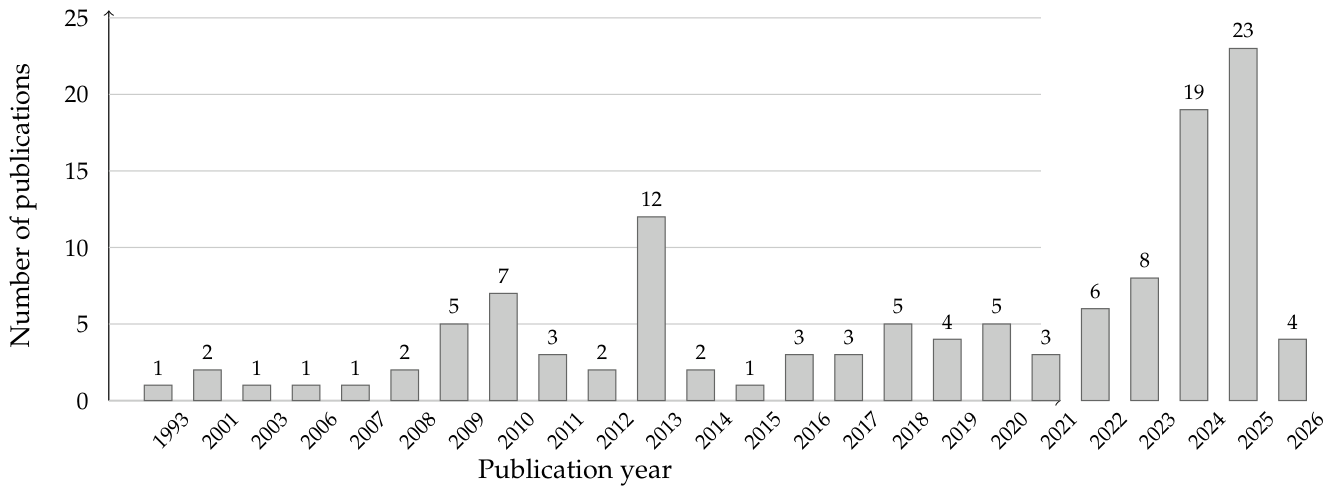
Figure 2.
Geographic Distribution by Region.
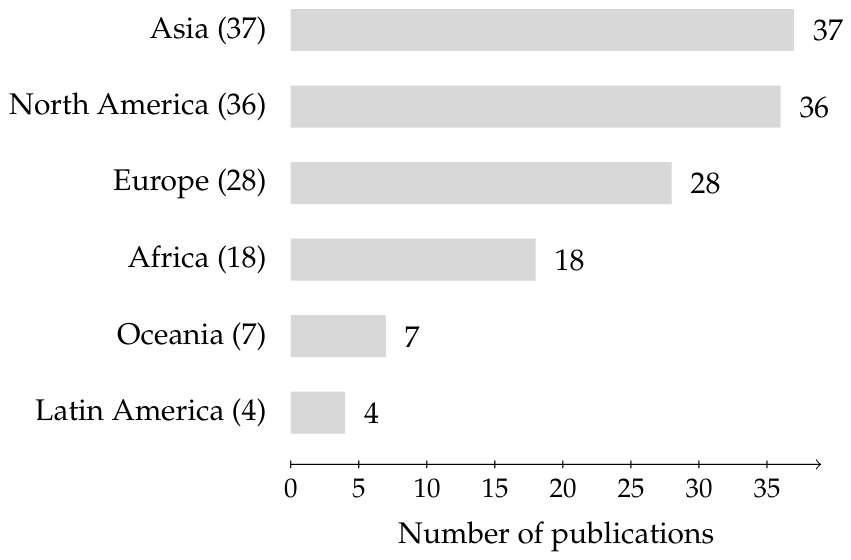
Figure 3.
Thematic Map of Transformative Research in Distance Education.
Disclaimer/Publisher’s Note: The statements, opinions and data contained in all publications are solely those of the individual author(s) and contributor(s) and not of MDPI and/or the editor(s). MDPI and/or the editor(s) disclaim responsibility for any injury to people or property resulting from any ideas, methods, instructions or products referred to in the content. |
© 2026 by the authors. Licensee MDPI, Basel, Switzerland. This article is an open access article distributed under the terms and conditions of the Creative Commons Attribution (CC BY) license (http://creativecommons.org/licenses/by/4.0/).
Copyright: This open access article is published under a Creative Commons CC BY 4.0 license, which permit the free download, distribution, and reuse, provided that the author and preprint are cited in any reuse.