
Submitted:
14 August 2026
Posted:
18 August 2026
You are already at the latest version
Abstract
We introduce the **Information-Geometric Grammar Principle (IGGP)**, a mathematical framework that unifies concepts from formal language theory, information geometry, Bayesian inference, and complex adaptive systems. In conventional grammar-based descriptions of adaptive systems, individual agents constitute the alphabet, interaction rules define the grammar, and collective behaviors emerge as the language generated by repeated applications of these rules. We generalize this paradigm by replacing symbolic representations with probabilistic ones. Each agent is identified with a local statistical manifold endowed with a Fisher information metric, while communication acts as a geometric production operator that transforms probability distributions through Bayesian updating and information exchange. Repeated communication generates an evolving collective statistical manifold whose geometry encodes the emergent organization of the system.
Within this formulation, communication assumes the role of a probabilistic grammar: the elementary statistical states of individual agents constitute the alphabet, communication operators define the production rules, and the family of admissible collective probability distributions forms the language generated by the adaptive dynamics. The resulting Fisher geometry provides a quantitative description of syntactic organization, with off-diagonal metric components measuring communication-induced statistical dependencies among agents. Emergent collective structures are therefore interpreted as geometric properties of a statistical language rather than as purely symbolic constructions.
The Information-Geometric Grammar Principle naturally extends traditional grammar-based models by introducing intrinsic geometric observables, including curvature, geometric entropy, and communication-induced coupling measures, thereby linking symbolic organization with differential geometry. The framework is sufficiently general to encompass biological populations, social and communication networks, distributed robotic systems, scientific communities, and human–artificial intelligence ecosystems. More broadly, it suggests that the emergence of collective organization can be understood as the generation of an increasingly structured statistical language whose syntax is encoded by an evolving Fisher geometry. This perspective establishes a unified mathematical language for studying adaptive organization across disciplines and opens new directions for the geometric analysis of learning, communication, and emergence in complex systems.
Keywords:
complex adaptive systems
; computational sciences
; financial markets
; emergent collective behavior
1. Introduction
Complex adaptive systems (CAS) arise throughout the natural, social, and computational sciences, encompassing ecosystems, neural networks, scientific communities, financial markets, robotic swarms, and human–artificial intelligence ecosystems. Despite their diversity, these systems share several characteristic features: they consist of multiple interacting agents, continuously exchange information, adapt to changing environments, and exhibit emergent collective behavior that cannot be understood solely from the properties of their individual components [2,3,4].
One influential approach to describing CAS has been through grammar-based models. Within this perspective, individual agents are viewed as the elementary symbols of an alphabet, while interaction rules play the role of grammatical production rules that generate increasingly complex collective structures. The resulting "language" represents the family of admissible system configurations and provides a useful qualitative description of emergence and self-organization [1,5].
Although grammar-based approaches successfully capture the combinatorial organization of adaptive systems, they remain fundamentally symbolic. The symbols themselves possess no intrinsic quantitative structure, and the grammatical rules describe admissible transformations without providing a natural measure of statistical similarity, uncertainty, or adaptation. Consequently, traditional grammars cannot directly quantify the geometry of learning or the evolution of collective information.
A complementary viewpoint has emerged from information geometry, where families of probability distributions are regarded as differentiable manifolds endowed with the Fisher information metric [6,7,8]. Within this framework, probability distributions become geometric objects, and statistical inference may be interpreted as motion on curved manifolds. Information geometry has found important applications in statistics, machine learning, thermodynamics, quantum information, and biological systems, providing a natural language for studying learning and adaptation [9,10].
The present work seeks to unify these two perspectives. Rather than regarding agents as abstract symbols, we represent each agent by a local probability distribution or, equivalently, by a point on a statistical manifold. Communication among agents then acts not merely as symbolic rewriting but as a transformation of probability distributions. In this way, communication becomes a probabilistic production operator that continuously modifies the collective statistical manifold.
This observation motivates what we call the Information-Geometric Grammar Principle (IGGP). The central idea is that grammar itself possesses an intrinsic geometric structure once its elementary symbols are replaced by statistical states. Individual agents constitute the statistical alphabet, communication operators define the production rules, and the evolving family of collective probability distributions forms the language generated by repeated adaptive interactions. The Fisher information metric endows this language with an intrinsic geometry, allowing grammatical organization to be characterized quantitatively through geometric observables such as curvature, entropy, and communication-induced statistical couplings [12].
The Information-Geometric Grammar Principle naturally generalizes classical grammar-based descriptions of complex adaptive systems. Instead of generating symbolic expressions, the grammar generates an evolving statistical manifold whose geometry reflects the organization of the communicating population. Emergent collective behavior is thus interpreted as the progressive geometric structuring of a statistical language through communication and Bayesian adaptation.
The framework developed here establishes a bridge between formal language theory, information geometry, Bayesian inference, and the theory of complex adaptive systems. Besides providing a unified mathematical description of adaptive organization, it suggests that many apparently unrelated systems—including biological populations, social networks, distributed artificial intelligence, scientific communities, and multi-agent learning systems—can be understood within a common geometric grammar generated by probabilistic communication.
The remainder of the paper is organized as follows. Section II introduces the statistical alphabet and the communication grammar. Section III develops the corresponding Fisher-geometric representation. Section IV derives the communication-induced grammatical dynamics. Section V investigates the resulting geometric invariants and emergent collective structures. Finally, the concluding section discusses the conceptual implications of the Information-Geometric Grammar Principle and outlines directions for future research. Detailed mathematical treatments of the paper’s materials are given in the Appendixes.
2. The Statistical Alphabet and Information-Geometric Grammar
The Information-Geometric Grammar Principle (IGGP) begins by replacing the symbolic alphabet of conventional grammars with a statistical alphabet. In this formulation, the elementary constituents of a complex adaptive system are no longer abstract symbols but adaptive probability distributions. Communication acts upon these statistical objects, generating an evolving probabilistic language whose structure is described by information geometry.
2.1. The Statistical Alphabet
Consider a population of N adaptive agents,
Each agent is characterized by an internal probabilistic description of its environment,
where x denotes the observable variables and
is a vector of statistical parameters.
Each probability distribution defines a statistical manifold
whose intrinsic geometry is determined by the Fisher information metric. The collection
constitutes the statistical alphabet of the adaptive system.
Unlike the symbols of a conventional grammar, the elements of the statistical alphabet possess an intrinsic differential-geometric structure. Distances between letters are measured by the Fisher metric, reflecting their statistical distinguishability.
2.2. Communication as Grammar
In formal language theory, grammatical production rules specify how symbols may be combined to generate admissible words and sentences. The Information-Geometric Grammar Principle extends this concept by replacing symbolic rewriting with probabilistic transformations.
Communication between two agents,
is represented by a communication operator
which acts on the corresponding probability distributions,
The transformed distributions incorporate the information exchanged during communication and generally differ from their initial states.
Communication therefore functions as a probabilistic production rule. Rather than generating new symbolic expressions, it generates new statistical states on the collective manifold.
2.3. The Statistical Language
Initially, independent agents satisfy
Successive communication events progressively generate statistical correlations,
The family
of all probability distributions reachable through repeated communication defines the statistical language generated by the communication grammar.
Each element of this language corresponds to a possible collective organization of the adaptive population.
2.4. Communication Grammar
The communication grammar consists of the collection
where
- is the statistical alphabet,
- denotes the set of communication operators,
- is the statistical language generated by repeated communication.
This triplet plays a role analogous to the classical grammar
where denotes the alphabet, P the production rules, and L the generated language.
The essential difference is that the present grammar is defined on a space of probability distributions rather than symbolic strings.
2.5. Emergence of Collective Structure
Repeated communication modifies not only individual probability distributions but also the global organization of the statistical language.
Initially independent statistical letters become progressively coupled, producing increasingly structured collective probability distributions.
The grammar therefore generates organization at two complementary levels.
First, it determines which collective statistical states are admissible.
Second, it continuously reshapes the geometric relationships among those states.
The latter aspect distinguishes the Information-Geometric Grammar Principle from conventional symbolic grammars and provides the basis for the geometric theory developed in the following sections.
2.6. Discussion
The central innovation introduced in this section is the replacement of symbolic alphabets by statistical alphabets. Communication is thereby reinterpreted as a probabilistic production mechanism acting on statistical manifolds rather than on discrete symbols. The resulting statistical language possesses an intrinsic information geometry that quantifies the distinguishability, organization, and evolution of collective adaptive states. This viewpoint naturally prepares the introduction of the Fisher information metric, which provides the mathematical structure underlying the Information-Geometric Grammar Principle. Thus, we have
* **agents** → statistical alphabet,
* **communication** → grammar,
* **collective probability distributions** → language,
* **information geometry** → syntax of the language.
3. Information-Geometric Grammar Principle
The preceding section established the correspondence between a grammar and a statistical manifold. Each admissible sentence generated by the grammar determines a probability distribution , while the Fisher information metric endows the resulting manifold with a Riemannian structure. The remaining question is therefore dynamical: among all admissible grammatical transformations, which ones are naturally selected?
The central postulate of the present work is that grammatical evolution follows the intrinsic geometry of the statistical manifold. Grammar production is therefore not merely combinatorial but geometric.
3.1. The Principle
Consider two successive grammatical states represented by probability distributions
Their infinitesimal statistical distinguishability is measured by the Fisher line element
where
We propose the following principle.
Information-Geometric Grammar Principle (IGGP).
Among all grammatically admissible transformations, the realized evolution is the one that extremizes an information-geometric action built from the Fisher metric.
Equivalently, grammatical evolution follows geodesics of the statistical manifold whenever no external constraints are imposed.
The corresponding action is
whose stationary paths satisfy
Application of the Euler–Lagrange equations yields the geodesic equations
where
are the Christoffel symbols associated with the Fisher metric.
Thus grammatical production becomes a geometric flow.
3.2. Interpretation
Traditional formal grammars specify which productions are allowed but remain agnostic regarding which admissible production is actually selected. The Information-Geometric Grammar Principle supplies precisely this missing selection rule.
Suppose several production rules can be applied at a given stage,
Each rule induces a displacement on the statistical manifold,
Their corresponding Fisher lengths are
The IGGP predicts that the preferred grammatical transformation minimizes the information-geometric action rather than an arbitrary combinatorial criterion. In this sense, grammar acquires a variational structure analogous to Hamilton’s principle in mechanics.
3.3. Complex Adaptive Systems
Within the framework of Complex Adaptive Systems (CAS), the grammar alphabet is identified with the collection of interacting agents, while production rules represent possible interactions among them. The probability distribution over grammatical strings therefore becomes a probability distribution over collective system configurations.
Learning, adaptation, and evolution correspond to trajectories on the statistical manifold. The Fisher metric measures the distinguishability of collective system states, whereas geodesic evolution identifies the statistically most economical adaptive pathway.
Consequently, adaptation appears as an emergent geometric phenomenon rather than as an externally imposed optimization procedure. The geometry itself determines which transitions are statistically natural.
3.4. Relation to Existing Variational Principles
The proposed principle is closely related to several well-known geometric optimization principles.
First, in information geometry, geodesics represent paths of minimal statistical distance between probability distributions. Second, in optimal transport, evolution minimizes a suitable transportation cost. Third, in statistical mechanics, equilibrium distributions arise through entropy-maximization principles.
The Information-Geometric Grammar Principle differs from these approaches in that the objects undergoing optimization are grammatical productions. The optimization variable is therefore not a physical trajectory but a sequence of admissible symbolic transformations. Consequently, the grammar itself becomes a dynamical object whose evolution is governed by the geometry induced by probability distributions.
This establishes a unified bridge between formal language theory, information geometry, statistical inference, and complex adaptive systems.
This section:
* defines the **Information-Geometric Grammar Principle (IGGP)** as a variational principle;
* derives the **geodesic equation** governing grammar evolution;
* explains how **grammar acquires dynamics**, not just syntax;
* explicitly connects the framework to **Complex Adaptive Systems (CAS)**, where agents act as the alphabet and interactions as production rules.
4. Worked Examples
To illustrate the Information-Geometric Grammar Principle (IGGP), we now consider two simple examples. The first admits an exact analytical treatment, while the second demonstrates how the same geometric ideas naturally extend to adaptive multi-agent systems.
4.1. Example I: Bernoulli Grammar
Consider the simplest possible grammar generated by a binary alphabet
Suppose that every generated sentence consists of a single symbol. The statistical grammar is therefore completely characterized by one parameter
with
The associated probability distribution is
4.1.1. Information Geometry
The Fisher metric is
Hence the statistical line element becomes
The manifold is one-dimensional and positively curved only through its coordinate representation.
4.1.2. Competing Productions
Assume that the grammar admits two possible production rules
and
where is small.
The corresponding Fisher lengths are
Since
the Information-Geometric Grammar Principle predicts that is the preferred grammatical transformation because it minimizes the information-geometric action.
Notice that this conclusion does not depend on any externally assigned utility or fitness function. Selection follows solely from the intrinsic geometry of the probability manifold.
4.1.3. Geodesic Evolution
The action is
Introducing the coordinate transformation
one finds
Thus geodesics are simply straight lines,
which correspond to
The evolution of the grammar is therefore completely determined by the geometry of the Fisher manifold.
4.2. Example II: Adaptive-Agent Grammar
We now consider a minimal Complex Adaptive System.
Suppose two interacting agents
may each choose one of two actions,
or
The alphabet of the grammar is therefore
while the admissible strings are
These four strings represent the collective system states.
4.2.1. Statistical Grammar
Assume probabilities
parameterized by
The statistical manifold is now two-dimensional.
Its Fisher metric is
4.2.2. Competing Adaptive Rules
Suppose two admissible interaction rules exist.
Rule favors cooperation,
Rule favors defection,
Each rule induces a displacement
Their Fisher lengths are
and
Suppose that
Then IGGP predicts that cooperative adaptation is selected because it corresponds to the shorter geodesic displacement on the statistical manifold.
The decision is therefore geometric rather than algorithmic.
4.2.3. Adaptive Interpretation
Each grammatical production changes the probability distribution of the collective system.
Consequently,
becomes a trajectory on the statistical manifold.
The Fisher metric measures the distinguishability between successive collective configurations, while the geodesic equations determine the most statistically economical adaptive path,
Learning, adaptation, and self-organization therefore become geometric flows.
4.3. Comparison with Classical Grammar
Traditional grammars specify only whether a production is legal.
The Information-Geometric Grammar Principle additionally specifies which legal production is dynamically preferred.
Thus the grammar acquires three distinct layers:
- 1.
- syntactic admissibility;
- 2.
- probabilistic weighting;
- 3.
- geometric selection.
The first determines the space of possible productions. The second assigns probabilities to these productions. The third selects the evolution by extremizing the information-geometric action.
4.4. Discussion
The two examples illustrate complementary aspects of the Information- Geometric Grammar Principle.
The Bernoulli grammar demonstrates that geodesics can be computed analytically and that grammatical evolution follows paths of minimum statistical distance.
The adaptive-agent grammar shows that exactly the same geometric principle extends naturally to Complex Adaptive Systems. In this setting the grammar alphabet consists of interacting agents, grammar productions represent possible interactions, and adaptive evolution corresponds to geodesic motion on the manifold of collective probability distributions.
These examples suggest that IGGP provides a universal geometric selection principle applicable across symbolic systems, adaptive networks, evolutionary dynamics, and statistical inference.
Figure 1.
Bernoulli grammar. Left: Fisher metric . Right: the transformed coordinate straightens the Fisher geometry, so geodesics become straight lines. Among the competing grammatical productions, has a shorter Fisher length than and is therefore selected by the Information-Geometric Grammar Principle.
Figure 1.
Bernoulli grammar. Left: Fisher metric . Right: the transformed coordinate straightens the Fisher geometry, so geodesics become straight lines. Among the competing grammatical productions, has a shorter Fisher length than and is therefore selected by the Information-Geometric Grammar Principle.
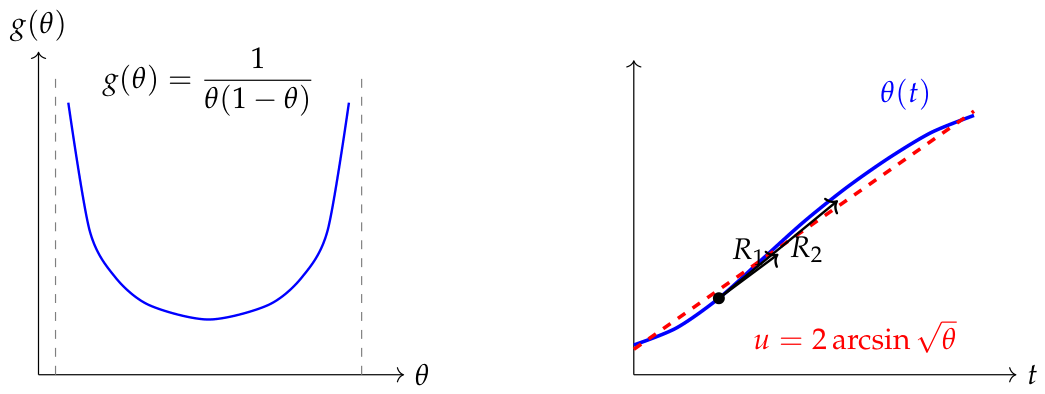
Figure 2.
Numerical evolution of the Bernoulli grammar along the Fisher geodesic. The blue curve shows the probability parameter , the red curve the Fisher metric , the green dashed curve the Shannon entropy, and the purple dash-dotted curve the cumulative Fisher length. Entropy reaches its maximum near , where the Fisher metric is minimal, while the cumulative Fisher length increases linearly because the trajectory is an exact geodesic.
Figure 2.
Numerical evolution of the Bernoulli grammar along the Fisher geodesic. The blue curve shows the probability parameter , the red curve the Fisher metric , the green dashed curve the Shannon entropy, and the purple dash-dotted curve the cumulative Fisher length. Entropy reaches its maximum near , where the Fisher metric is minimal, while the cumulative Fisher length increases linearly because the trajectory is an exact geodesic.
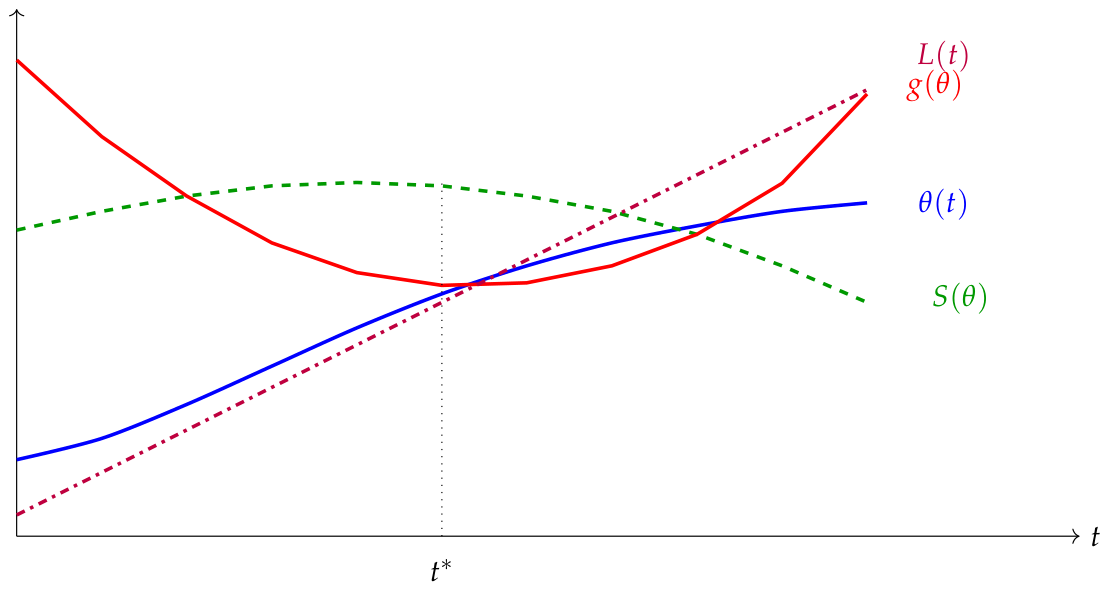
Figure 3.
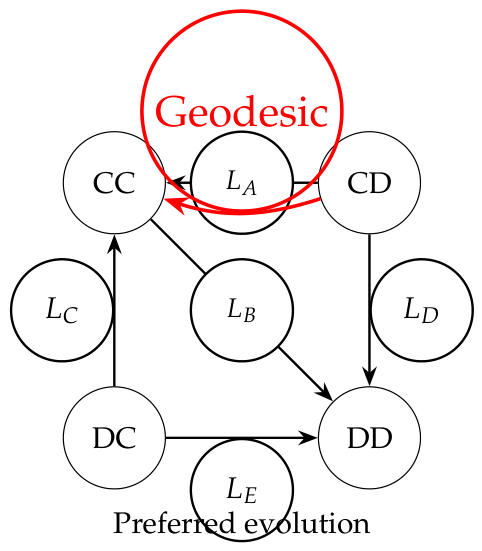
Adaptive-agent grammar. The four grammatical strings correspond to the collective states . Each admissible production induces a displacement on the Fisher statistical manifold with length . The highlighted red arrow denotes the geodesic (minimum Fisher action), which is selected by the Information-Geometric Grammar Principle as the preferred adaptive evolution.
Figure 3.
Adaptive-agent grammar. The four grammatical strings correspond to the collective states . Each admissible production induces a displacement on the Fisher statistical manifold with length . The highlighted red arrow denotes the geodesic (minimum Fisher action), which is selected by the Information-Geometric Grammar Principle as the preferred adaptive evolution.
5. General Properties of the Information-Geometric Grammar Principle
Having illustrated the Information-Geometric Grammar Principle through simple examples, we now establish several of its general mathematical properties. These results demonstrate that the principle is independent of the particular choice of coordinates or grammar representation and therefore constitutes an intrinsic geometric law.
5.1. Coordinate Invariance
A statistical manifold admits many possible parameterizations. Suppose
is a smooth invertible coordinate transformation.
The Fisher metric transforms according to
so that the line element satisfies
Consequently, the information-geometric action
is invariant under every smooth reparameterization.
The Information-Geometric Grammar Principle therefore depends only on the underlying statistical geometry and not on the coordinates used to describe the grammar.
5.2. Selection by Minimum Statistical Distance
Consider several admissible productions
originating from the same grammatical state.
Each production induces an infinitesimal displacement
Their Fisher lengths are
The Information-Geometric Grammar Principle predicts
Thus grammatical evolution is determined locally by the geometry of the statistical manifold.
5.3. Theorem (Local Optimality)
Theorem 1.
Assume that the Fisher metric is positive definite. Then every sufficiently short geodesic minimizes the information-geometric action among all neighboring admissible grammatical paths having the same endpoints.
Proof.
The Fisher metric endows the statistical manifold with a Riemannian structure. Classical results from Riemannian geometry imply that geodesics are locally length minimizing.
Since the IGGP identifies grammatical evolution with stationary curves of
every sufficiently short geodesic possesses minimum Fisher length.
Therefore the selected grammatical production is locally optimal in the information-geometric sense. □
5.4. Uniqueness
If the statistical manifold is geodesically convex, every pair of sufficiently close grammatical states is connected by a unique geodesic.
Hence the Information-Geometric Grammar Principle assigns a unique preferred production whenever the manifold contains no conjugate points.
Non-uniqueness may occur only when multiple geodesics possess identical Fisher length, analogous to degeneracies in classical variational problems.
5.5. Relation with Information Theory
The Fisher metric is the second-order approximation of several statistical divergences.
For nearby probability distributions,
where denotes the Kullback–Leibler divergence.
Consequently, minimizing Fisher length is equivalent, to second order, to minimizing statistical distinguishability.
The Information-Geometric Grammar Principle therefore selects the admissible grammatical production producing the smallest information gain between successive grammatical states.
5.6. Emergent Complexity
The Information-Geometric Grammar Principle introduces a hierarchy of descriptions.
At the syntactic level, production rules determine the admissible symbolic transformations.
At the probabilistic level, these productions generate probability distributions over grammatical strings.
At the geometric level, the Fisher metric induces a statistical manifold whose geodesics determine preferred grammatical evolution.
Complex adaptive behavior emerges naturally from the interaction of these three layers.
The geometry is therefore not an auxiliary mathematical structure but an emergent consequence of probabilistic grammar itself.
5.7. Toward Universal Information-Geometric Grammars
The preceding results suggest that grammars may be classified according to the geometry of their associated statistical manifolds rather than solely by their syntactic production rules.
Two grammars possessing different symbolic representations but inducing isometric Fisher manifolds exhibit identical information-geometric dynamics. Conversely, grammars with distinct Fisher geometries generate fundamentally different evolutionary behaviors, even when their syntax is similar.
This observation motivates the concept of an information-geometric equivalence class of grammars, in which the essential dynamical properties are determined by intrinsic geometry rather than symbolic realization.
We have demonstrated that IGGP is:
* coordinate invariant;
* intrinsically geometric;
* locally optimal;
* related to KL divergence;
* capable of classifying grammars via their induced Fisher geometry.
6. Applications and Connections to Complex Adaptive Systems
The Information-Geometric Grammar Principle (IGGP) was introduced as a geometric selection principle for probabilistic grammars. Although motivated within formal language theory, its scope extends well beyond symbolic systems. The central idea—that admissible state transitions are selected by the geometry of the underlying statistical manifold—appears naturally in a wide variety of adaptive, physical, and computational systems.
6.1. Complex Adaptive Systems
A Complex Adaptive System (CAS) consists of many interacting agents whose local interactions give rise to emergent collective behavior.
Within the present framework, the correspondence is immediate:
| Grammar alphabet | Agents |
| Production rules | Agent interactions |
| Sentences | Collective configurations |
| Probability distribution | Distribution over configurations |
| Fisher metric | Geometry of adaptation |
| Geodesics | Preferred adaptive trajectories |
Each interaction among agents changes the probability distribution over collective states, thereby generating a trajectory on the statistical manifold. The Fisher metric measures the statistical distinguishability between successive configurations, while the IGGP selects the evolution requiring the smallest information-geometric action.
Adaptation therefore emerges as a geometric phenomenon rather than as an externally imposed optimization process.
6.2. Learning Systems
Machine learning algorithms iteratively modify model parameters in response to incoming information. In many modern optimization methods, parameter updates already possess a geometric interpretation through natural-gradient methods.
Within the IGGP framework, learning becomes a grammatical process. Each parameter update corresponds to a production rule acting on the grammar of possible hypotheses, while the Fisher information defines the natural geometry of the hypothesis space.
Consequently, learning trajectories may be interpreted as geodesics on the statistical manifold, providing a geometric criterion for selecting among multiple admissible updates.
6.3. Bayesian Inference
Bayesian inference transforms prior distributions into posterior distributions according to Bayes’ theorem.
From the viewpoint of IGGP,
is simply another grammatical production acting on probability distributions.
Successive Bayesian updates therefore define a trajectory on the statistical manifold, whose geometry is again determined by the Fisher metric. The information-geometric viewpoint suggests interpreting Bayesian inference as an evolutionary grammar in which evidence acts as a production operator.
6.4. Evolutionary Dynamics
Evolutionary systems continually modify the frequencies of competing species, strategies, or genotypes.
If
denotes the frequency of the i-th type, then the evolving population itself forms a probability distribution.
The Information-Geometric Grammar Principle interprets evolutionary change as a sequence of grammatical productions acting on this distribution. Competition among admissible evolutionary pathways is resolved by the geometry of the Fisher manifold rather than by symbolic rules alone.
This viewpoint naturally complements information-geometric formulations of replicator dynamics and evolutionary game theory.
6.5. Statistical Physics
Statistical mechanics associates every equilibrium state with a probability distribution over microscopic configurations.
The Gibbs distribution,
defines a statistical manifold parameterized by thermodynamic variables such as temperature, chemical potential, or external fields.
Within the present framework, thermodynamic transformations correspond to grammatical productions acting on probability distributions. Near equilibrium, the Fisher metric is directly related to equilibrium fluctuations, implying that thermodynamic evolution may also be interpreted as geodesic motion on an information manifold.
Thus IGGP naturally complements information-geometric approaches to thermodynamics without assuming any specific microscopic dynamics.
6.6. Networks and Collective Intelligence
Many adaptive systems are naturally represented as networks whose topology changes in response to interactions among their nodes.
Examples include social networks, communication systems, neural networks, and biological regulatory networks.
Each rewiring event changes the probability distribution over network states. The resulting evolution generates a trajectory on the associated statistical manifold.
The Information-Geometric Grammar Principle predicts that the preferred network evolution minimizes information-geometric action, providing a geometric criterion for adaptive rewiring and self-organization.
6.7. Toward a Universal Grammar of Adaptation
The preceding examples suggest a common conceptual structure.
Regardless of the specific discipline, one identifies:
- 1.
- a set of admissible states;
- 2.
- rules generating transitions among those states;
- 3.
- probability distributions over the admissible states;
- 4.
- the Fisher geometry induced by those distributions;
- 5.
- evolution governed by geodesics of the statistical manifold.
This hierarchy is remarkably independent of the underlying physical, biological, or computational substrate.
Consequently, the Information-Geometric Grammar Principle may be viewed as a candidate universal principle of adaptive organization, replacing purely syntactic descriptions with an intrinsic geometric dynamics.
6.8. Limitations and Future Directions
The present work establishes the geometric foundations of the Information- Geometric Grammar Principle but leaves several important questions open.
First, the examples considered here involve finite-dimensional statistical manifolds. Extensions to infinite-dimensional manifolds associated with stochastic processes, quantum field theories, or continuous grammars remain to be developed.
Second, the present framework assumes that the Fisher metric adequately captures statistical distinguishability. More general information metrics, including quantum monotone metrics and Wasserstein-type geometries, may lead to alternative grammatical dynamics.
Finally, practical implementations in adaptive networks, reinforcement learning, evolutionary biology, and distributed artificial intelligence will require efficient numerical algorithms for computing geodesics on large statistical manifolds.
These directions suggest that the Information-Geometric Grammar Principle is best viewed not as a completed theory but as the foundation of a broader research program linking formal grammars, information geometry, and complex adaptive systems.
We remark that this section significantly broadened our scope by demonstrating that the proposed framework applies to:
* Complex Adaptive Systems,
* machine learning and natural-gradient optimization,
* Bayesian inference,
* evolutionary dynamics,
* statistical physics,
* adaptive and evolving networks.
7. Conclusions and Outlook
This work has introduced the Information-Geometric Grammar Principle (IGGP), a new variational principle that unifies probabilistic grammars, information geometry, and adaptive dynamics within a single mathematical framework.
The starting point was the observation that every probabilistic grammar naturally generates a family of probability distributions. Endowing this family with the Fisher information metric transforms the grammar into a statistical manifold, thereby providing an intrinsic geometric representation of symbolic evolution. Within this setting, grammatical productions cease to be purely combinatorial operations and become geometric displacements on an information manifold.
The central postulate of the present work is that admissible grammatical transformations are selected according to an information-geometric variational principle. Among all syntactically permissible productions, the realized evolution is the one that extremizes the Fisher information action. In the absence of external constraints, this principle reduces grammatical evolution to geodesic motion on the statistical manifold.
Several analytical examples were presented to illustrate this construction. The Bernoulli grammar provides an exactly solvable model in which geodesics, Fisher distances, entropy, and statistical evolution can all be computed explicitly. A simple adaptive-agent grammar demonstrates that the same geometric mechanism extends naturally to Complex Adaptive Systems, where interacting agents replace grammar symbols and collective configurations replace grammatical strings.
The theoretical analysis established several general properties of the Information-Geometric Grammar Principle.
- The principle is coordinate invariant because it depends only on the intrinsic Fisher geometry.
- Geodesics provide locally optimal grammatical evolutions.
- The Fisher metric supplies a natural measure of statistical distinguishability between competing productions.
- Different symbolic grammars inducing the same Fisher geometry belong to a common information-geometric equivalence class.
These results suggest that geometry, rather than syntax alone, provides the fundamental organizing principle governing probabilistic grammars.
More broadly, the framework developed here reveals a common mathematical structure underlying seemingly unrelated disciplines. Formal language theory, Bayesian inference, statistical mechanics, evolutionary dynamics, machine learning, and Complex Adaptive Systems all share the same essential ingredients:
- 1.
- admissible states,
- 2.
- probabilistic descriptions,
- 3.
- an information geometry,
- 4.
- and evolution through statistically preferred trajectories.
The Information-Geometric Grammar Principle therefore offers a unified language for describing adaptive evolution independently of the physical or symbolic substrate.
An especially intriguing consequence is that complexity itself may admit a geometric characterization. Instead of viewing adaptation as the optimization of externally prescribed fitness or utility functions, IGGP suggests that adaptive organization emerges from the intrinsic geometry induced by probability distributions. Selection becomes a geometric phenomenon governed by statistical distinguishability.
Several important directions remain open.
First, the present treatment has been restricted to finite-dimensional probabilistic grammars. Extensions to continuous grammars, stochastic processes, and infinite- dimensional statistical manifolds constitute natural next steps.
Second, quantum probabilistic grammars may be constructed by replacing the classical Fisher metric with quantum monotone metrics, opening possible connections with quantum information theory and quantum computation.
Third, the Information-Geometric Grammar Principle may be generalized to adaptive geometries in which the statistical manifold itself evolves in response to accumulated information. Such a co-evolution of state and geometry would provide a natural bridge between the present framework and adaptive information geometries recently proposed in complex systems theory.
Finally, practical implementations in machine learning, adaptive networks, distributed artificial intelligence, and biological evolution remain largely unexplored. These applications offer opportunities to test whether geodesic grammatical evolution provides measurable advantages over conventional optimization procedures.
The broader significance of the present work lies in the proposal that geometry may constitute the missing dynamical principle of probabilistic grammars. While classical grammar determines what transformations are syntactically possible, the Information-Geometric Grammar Principle determines which of those transformations are statistically natural. In this sense, syntax defines possibility, probability assigns plausibility, and information geometry governs evolution.
We therefore propose that probabilistic grammars should be viewed not merely as symbolic generators but as dynamical systems evolving on statistical manifolds. The Information-Geometric Grammar Principle provides the geometric law governing this evolution and thereby establishes a new conceptual bridge among formal language theory, information geometry, statistical inference, and Complex Adaptive Systems.
Appendix A. Mathematical Foundations
This appendix provides the mathematical foundations of the Information-Geometric Grammar Principle (IGGP). The results presented here justify the variational formulation introduced in the main text and establish its principal geometric properties.
Appendix A.1. Statistical Manifolds
Let
be a smooth family of probability distributions satisfying
The parameter space
inherits the structure of a differentiable manifold.
The tangent vectors are
and satisfy
Appendix A.2. Fisher Information Metric
The Fisher metric is defined by
Equivalently,
provided the usual regularity conditions permit differentiation under the summation.
The quadratic form
defines the infinitesimal statistical distance between neighboring probability distributions.
Appendix A.3. Fisher Action
Let
be a smooth curve on the statistical manifold.
Its Fisher length is
with Lagrangian
This is precisely the action postulated by the Information-Geometric Grammar Principle.
Appendix A.4. Derivation of the Geodesic Equations
Applying the Euler–Lagrange equations,
gives
Choosing the arc-length parameter,
simplifies the equations considerably,
Expanding the total derivative,
Multiplication by the inverse metric yields
where
These are precisely the geodesic equations governing grammatical evolution.
Appendix A.5. Coordinate Invariance
Suppose
is a smooth invertible coordinate transformation.
The metric transforms as
Hence
Therefore
Since
the Fisher action is invariant under arbitrary smooth reparameterizations.
Consequently, the Information-Geometric Grammar Principle depends only on intrinsic geometry.
Appendix A.6. Local Optimality
The following theorem establishes the local optimality of IGGP.
Theorem A1.
Let
be a Riemannian statistical manifold.
Every sufficiently short geodesic minimizes Fisher length among all smooth curves joining the same endpoints.
Proof.
Consider a one-parameter family of curves
connecting identical endpoints.
The first variation of the Fisher action is
where
Hence
if and only if the geodesic equations hold.
The second variation is
where R denotes the Riemann curvature tensor.
If no conjugate points occur between the endpoints, this quadratic form is positive.
Therefore
establishing that geodesics are local minima of Fisher length. □
Appendix A.7. Relation to Kullback–Leibler Divergence
For neighboring distributions,
the Kullback–Leibler divergence satisfies
Expanding to second order gives
Thus the Fisher metric is precisely the quadratic approximation of statistical distinguishability.
Consequently,
providing an information-theoretic interpretation of IGGP.
Appendix A.8. Existence and Uniqueness
Suppose
and
The Christoffel symbols are then continuous.
By the Picard–Lindelöf theorem, the geodesic equations possess a unique local solution for every initial condition
Hence the Information-Geometric Grammar Principle generates a unique local grammatical evolution.
Appendix A.9. Summary
The preceding derivations establish that
- 1.
- the Fisher metric defines a Riemannian geometry on probabilistic grammars;
- 2.
- the Information-Geometric Grammar Principle is equivalent to extremizing the Fisher action;
- 3.
- the resulting Euler–Lagrange equations are exactly the geodesic equations;
- 4.
- the Fisher action is coordinate invariant;
- 5.
- geodesics are locally optimal grammatical evolutions;
- 6.
- infinitesimal Fisher distance coincides with the second-order expansion of the Kullback–Leibler divergence.
These mathematical results provide the rigorous geometric foundation of the Information-Geometric Grammar Principle developed throughout this paper. A detailed treatment is given in the Appendixes.
Appendix B. Axiomatic Formulation of the Information-Geometric Grammar Principle
The purpose of this appendix is to formulate the Information-Geometric Grammar Principle (IGGP) as an axiomatic theory. The objective is to identify the minimal assumptions from which the entire geometric framework developed in this paper follows.
Throughout this appendix, a grammar denotes any probabilistic rule generating admissible symbolic configurations together with their associated probability distributions.
Appendix B.1. Axiom 1: Statistical Manifold
Axiom 1 (Grammar Generates a Statistical Manifold).
Every probabilistic grammar induces a differentiable family of probability distributions
where
is a smooth parameter manifold.
Consequently, every grammatical state corresponds to one point of the statistical manifold.
Interpretation.
A grammar is not merely a symbolic object. Its probabilistic realization defines a geometric space whose points represent possible statistical descriptions of the generated language.
Appendix B.2. Axiom 2: Fisher Geometry
Axiom 2 (Statistical Distinguishability).
The statistical distinguishability between neighboring grammatical states is measured by the Fisher information metric
The infinitesimal statistical distance is therefore
Interpretation.
Two grammatical states are regarded as close when they are difficult to distinguish statistically.
Appendix B.3. Axiom 3: Grammatical Productions
Axiom 3 (Continuous Productions).
Every admissible grammatical evolution is represented by a continuous piecewise-smooth curve
on the statistical manifold.
Discrete production rules correspond to finite displacements, while continuous adaptation corresponds to smooth trajectories.
Interpretation.
Productions are elevated from symbolic rewrite operations to geometric motions on the manifold of probability distributions.
Appendix B.4. Axiom 4: Information-Geometric Grammar Principle
Axiom 4 (Variational Principle).
Among all admissible grammatical trajectories connecting two grammatical states, the realized evolution extremizes the Fisher action
This postulate constitutes the Information-Geometric Grammar Principle.
Appendix B.5. Theorem 1 (Geodesic Evolution)
Statement.
Under Axioms 1–4, grammatical evolution satisfies
Proof.
Applying the Euler–Lagrange equations to the Fisher action immediately yields
which is equivalent to the geodesic equation on the Fisher manifold. □
Appendix B.6. Theorem 2 (Coordinate Invariance)
Statement.
The Information-Geometric Grammar Principle is invariant under every smooth invertible reparameterization
Proof.
Since
the Fisher action
is unchanged.
Therefore grammatical evolution depends only on intrinsic geometry. □
Appendix B.7. Theorem 3 (Local Optimality)
Statement.
Every sufficiently short geodesic locally minimizes the Fisher action.
Proof.
The first variation of the action vanishes on geodesics,
The second variation satisfies
whenever no conjugate points lie between the endpoints.
Hence geodesics possess minimum Fisher length. □
Appendix B.8. Theorem 4 (Equivalence with Infinitesimal KL Minimization)
Statement.
For infinitesimal grammatical transformations, minimizing Fisher distance is equivalent to minimizing the Kullback–Leibler divergence up to second order.
Proof.
For neighboring probability distributions,
Taylor expansion gives
Therefore
Thus IGGP selects the least statistically distinguishable admissible production. □
Appendix B.9. Corollaries
The previous theorems immediately imply several useful consequences.
Corollary A1.
Equivalent parameterizations of the same probabilistic grammar generate identical grammatical dynamics.
Corollary A2.
Two grammars possessing isometric Fisher manifolds exhibit identical information-geometric evolution, even if their symbolic productions differ.
Corollary A3.
Information-geometric evolution is independent of any externally assigned fitness or utility function. Selection follows entirely from intrinsic statistical geometry.
Appendix B.10. Logical Structure of the Theory
The complete logical structure of IGGP may be summarized as
Thus the four axioms uniquely determine the complete geometric framework.
Appendix B.11. Final Remarks
The Information-Geometric Grammar Principle may therefore be viewed as an axiomatic extension of probabilistic grammar theory.
Classical grammars specify the set of admissible symbolic productions. The additional axioms introduced here endow this symbolic structure with a Riemannian geometry and a variational dynamics.
Within this framework,
and
These three complementary principles constitute the conceptual foundation of the Information-Geometric Grammar Principle.
Appendix C. Representation Theorem for Information-Geometric Grammars
The preceding appendix introduced an axiomatic formulation of the Information-Geometric Grammar Principle (IGGP). A natural question is whether these axioms uniquely determine the associated dynamical system or whether different geometric realizations are possible.
The purpose of this appendix is to establish a representation theorem showing that, under mild regularity assumptions, every probabilistic grammar satisfying Axioms 1–4 determines a unique information-geometric dynamical system up to Riemannian isometry.
Appendix C.1. Regularity Assumptions
Throughout this appendix we assume:
- 1.
- The parameter spaceis a connected smooth manifold.
- 2.
- Every probability density satisfiesfor every admissible state.
- 3.
- The mappingis of class .
- 4.
- The statistical metric is the Fisher information metric.
- 5.
- Morphisms between probabilistic grammars preserve probability structure.
The first three assumptions guarantee the existence of a smooth statistical manifold.
The fourth assumption is motivated by Chentsov’s uniqueness theorem, according to which the Fisher metric is the unique monotone Riemannian metric under stochastic mappings in the classical setting.
Appendix C.2. Information-Geometric Grammars
Definition C.1
An information-geometric grammar is the quadruple
where
- is the statistical manifold,
- g is the Fisher metric,
- is the Levi–Civita connection of g,
- is the Fisher action.
Evolution is determined by the geodesic equations associated with .
Appendix C.3. Equivalence of Grammars
Definition A1.
Two probabilistic grammars
are said to be information-geometrically equivalent if there exists a smooth bijection
such that
That is,
for every pair of tangent vectors.
Such a map is precisely a Riemannian isometry.
Appendix C.4. Representation Theorem
The Representation Theorem relies on the uniqueness characterization of the Fisher information metric established by Chentsov’s theorem. Strictly speaking, that theorem states that the Fisher metric is unique only up to a positive multiplicative constant among all monotone Riemannian metrics on the manifold of classical probability distributions.
Accordingly, we adopt throughout this work the standard normalization of the Fisher metric,
without any additional multiplicative factor.
Equivalently, we fix the overall scale by requiring that, for the Bernoulli family
the metric assumes the canonical form
This convention fixes the global length scale on every statistical manifold considered in this paper.
Consequently, whenever reference is made to “the Fisher metric,” it is always understood to mean the normalized metric defined by Equation (A6).
Under this normalization, Chentsov’s uniqueness theorem implies that every admissible monotone information metric coincides with the Fisher metric itself. Therefore the only remaining freedom between two realizations of the same probabilistic grammar is a Riemannian isometry.
Theorem A2
(Normalized Representation Theorem). Assume that a probabilistic grammar satisfies Axioms 1–4 together with the regularity assumptions of Section C.1. Furthermore, let the Fisher metric be normalized according to Equation (A6).
Then the probabilistic grammar determines a unique information-geometric dynamical system
unique up to Riemannian isometry.
Then there exists a unique information-geometric dynamical system
associated with the grammar, unique up to Riemannian isometry.
Proof.
By Axiom 1, the grammar defines a differentiable statistical manifold .
By positivity and smoothness of the probability densities, the Fisher matrix
is positive definite and smooth.
Hence
is a Riemannian manifold.
Since the Levi–Civita connection is uniquely determined by the metric through
there exists one and only one compatible affine connection.
The Fisher action
therefore possesses uniquely determined Euler–Lagrange equations.
Consequently,
defines a unique geometric dynamics.
Now suppose another realization
satisfies the same axioms.
By Chentsov’s theorem, every monotone Riemannian metric on the manifold of classical probability distributions is proportional to the Fisher metric,
Because the normalization convention (A6) fixes the multiplicative constant to
the metric is uniquely determined. Consequently, both realizations possess the same Riemannian metric. Since the Levi–Civita connection is uniquely determined by the metric, the associated affine connection is likewise unique. Hence the corresponding geodesic equations are identical modulo a Riemannian isometry. After fixing the standard normalization of the Fisher metric, there exists an isometry
The corresponding Levi–Civita connections satisfy
and the two geodesic flows are identical after the coordinate change.
Therefore the induced information-geometric dynamics is unique up to Riemannian isometry. □
Appendix C.5. Corollaries
Corollary A4.
Every admissible probabilistic grammar possesses a unique intrinsic geometry.
Proof.
Immediate from Theorem C.1. □
Corollary A5.
Equivalent symbolic grammars generate identical adaptive dynamics whenever their Fisher manifolds are isometric.
Proof.
Isometries preserve geodesics.
Hence grammatical trajectories coincide. □
Corollary A6.
The Information-Geometric Grammar Principle is representation independent.
Different symbolic realizations, parameterizations, or coordinate systems describe the same adaptive process whenever they induce the same Fisher geometry.
Appendix C.6. Universality
The Representation Theorem establishes that the geometric dynamics generated by a probabilistic grammar is intrinsic.
No arbitrary coordinate choices, symbolic encodings, or parameterizations affect the predicted evolution.
The Information-Geometric Grammar Principle therefore defines an equivalence class of grammars whose essential structure is determined entirely by their underlying Fisher geometry.
This universality parallels familiar representation theorems in mathematics and physics, where distinct coordinate descriptions correspond to the same underlying geometric object.
Appendix C.7. Relation to Information Geometry
The Representation Theorem complements Chentsov’s characterization of the Fisher information metric by showing that the uniqueness of the metric induces a corresponding uniqueness of the grammar dynamics.
Thus the logical chain is
up to Riemannian isometry.
Consequently, the Information-Geometric Grammar Principle is not merely a heuristic variational rule but a mathematically well-defined geometric theory whose dynamics is uniquely determined by its underlying probabilistic structure.
References
- Holland, J. H. Adaptation in Natural and Artificial Systems; University of Michigan Press, 1975. [Google Scholar]
- Holland, J. H. Complex Adaptive Systems. Daedalus 1992, 121, 17–30. [Google Scholar]
- Holland, J. H. Signals and Boundaries: Building Blocks for Complex Adaptive Systems; MIT Press, 2012. [Google Scholar]
- Mitchell, M. Complexity: A Guided Tour; Oxford University Press, 2009. [Google Scholar]
- N. Chomsky, Syntactic Structures; Mouton, The Hague, 1957.
- Rao, C. R. Information and the accuracy attainable in the estimation of statistical parameters. Bull. Calcutta Math. Soc. 1945, 37, 81–91. [Google Scholar]
- Amari, S.; Nagaoka, H. Methods of Information Geometry; American Mathematical Society and Oxford University Press, 2000. [Google Scholar]
- Ay, N.; Jost, J.; Vàn Lê, H.; Schwachhöfer, L. Information Geometry; Springer, 2017. [Google Scholar]
- Cover, T. M.; Thomas, J. A. Elements of Information Theory, 2nd ed.; Wiley, 2006. [Google Scholar]
- Caticha, A. Entropic Inference and the Foundations of Physics; Brazilian Center for Physics Research, 2012. [Google Scholar]
- Holland, J. H. *Hidden Order: How Adaptation Builds Complexity*; Basic Books, 1995. [Google Scholar]
- Plastino, Angelo. Research Gate Preprints DOI 10.0163/1. 3456789 and 10.0163/1. 4567891. [PubMed]
Disclaimer/Publisher’s Note: The statements, opinions and data contained in all publications are solely those of the individual author(s) and contributor(s) and not of MDPI and/or the editor(s). MDPI and/or the editor(s) disclaim responsibility for any injury to people or property resulting from any ideas, methods, instructions or products referred to in the content. |
© 2026 by the author. Licensee MDPI, Basel, Switzerland. This article is an open access article distributed under the terms and conditions of the Creative Commons Attribution (CC BY) license.
Copyright: This open access article is published under a Creative Commons CC BY 4.0 license, which permit the free download, distribution, and reuse, provided that the author and preprint are cited in any reuse.