

Submitted:
17 August 2026
Posted:
18 August 2026
You are already at the latest version
Abstract
This article provides a comprehensive analysis of the fake Webometrics University Rankings (WURs) phenomenon observed in the first half of 2026. Based on an analysis of 300 publications gathered from 39 countries between January 6 and July 6, 2026, the study reveals that approximately 65% of cases involving the dissemination of inaccurate ranking data were initiated by news outlets and consulting agencies. The research confirms a pronounced geographical imbalance: 81.3% of fake publications originate from the Global South, with Indonesia serving as the primary epicenter of activity (accounting for 50.7% of publications). A retrospective analysis is conducted on the “first wave” of fake WURs (spring–summer 2025), which utilized domains such as webometrics.org, webometricsranking.com, and webometrics.online. These domains remained largely obscured from the European academic community throughout 2026 due to Geo-IP masking tactics. Furthermore, the paper analyzes the “July 2026 wave,” which confirms the further scaling of this network through domains such as webometrics.one, webometrics.top, and webometric.org. The article concludes by proposing institutional measures to enhance vigilance and safeguard the integrity and authority of academic rankings.
Keywords:
fake webometrics university rankings
; global south
; Geo-IP masking
; academic integrity
; misinformation
; webometrics.org
; webometricsranking.com
; webometrics.online
; webometrics.one
; webometrics.top
; webometric.org
; cybermetrics lab
Introduction
At the beginning of 2026, I first discovered the phenomenon of fake Webometrics University Rankings (WURs). I wrote about this phenomenon on March 25 in the LSE Impact blog (Moskovkin, 2026, March 25). Subsequently, I discovered a blog by the Vietnamese researcher Pham Khac Lieu, who in August 2025 had identified one of such rankings (webometrics.org) and expressed doubts about its authenticity (Lieu, 2025, August 30). The findings of this research will be examined in a separate section.
Later, on May 13, I published an extended report on the Preprints.org platform analyzing internet publications that promoted fake WURs: webometrics.org, webometricsranking.com, and webometrics.online (Moskovkin, 2026, May 13). This report covered publications by university press offices, news agencies, as well as educational, consultancy, and academic recruitment agencies for the period from January 6 to March 31, 2026. They were based on the January results of these fake rankings. During this period, 198 publications related to universities in 29 countries were recorded, and measures were proposed to neutralize the identified fake WURs phenomenon.
A detailed review of this study was published on May 27 in University World News (Sawahel, 2026, May 27). It discussed the topic of fake university rankings with a number of leading international experts on higher education and global university rankings, who expressed deep concern over the discovered phenomenon. The report concluded with a quote from Vladimir Moskovkin: “There is an urgent need to establish strict, independent national and international audit mechanisms for academic metrics to ensure research integrity.”
The next overview on this topic was published on June 14 in the same outlet (Sawahel, 2026, June 14). It described the measures taken by the Cybermetrics Lab, which has been publishing the official WUR since 2004, to penalize universities involved in publishing fake WURs.
The discovered precedent of the emergence of fake WURs naturally could not fail to raise concerns that academic fraud imitating official WUR might also spread to other official university rankings or lead to the creation of new ones. In this regard, a number of international experts put forward the idea of creating the Global Observatory on Systematic University Rankings (GOSUR), which was voiced by me in this review. Later, this initiative was expanded to include academic metrics, including those used in the calculation of Global University Rankings. It was named the Global Observatory on Academic Metrics and University Rankings (GOAMUR), which is currently in the process of implementation.
The experts' expressed concerns regarding the expansion of fake university rankings were later voiced with specific examples by Richard Holmes, an independent writer and consultant, and the producer of the University Ranking Watch blog and University Ranking Newsletter (Holmes, 2026, June 24). Citing publications on fake WURs (Moskovkin, 2026, May 13; Sawahel, 2026, June 14), he provided three examples of recently emerged questionable university rankings, which he termed pseudo-rankings: Barentsz Uni-ranking, UNIRANKS, and HE Higher Education Ranking, noting that their expansion will only intensify with the development of artificial intelligence.
These concerns were confirmed at the end of July 2026, when I discovered three new fake WURs: webometrics.top, webometric.org, and webometrics.one.
This report covers the analysis of publications promoting fake WURs for a full six-month period from January 6 to July 6, 2026, since starting from July 9, 2026, publications based on July's fake WURs actively appeared on the Internet, despite the fact that the official July Webometrics University Ranking was published later—on July 22, 2026 (Aguillo, 2026, July 22). This indicates that the creators of fake WURs are not deterred by the measures taken by the Cybermetrics Lab to protect its ranking (publishing only World Ranks, excluding universities that publish fake WURs from the ranking, and providing values of all individual indicators on a paid basis), as some of them use old official data, while others generate and vary their ranking values arbitrarily without paying attention to the official ranking data.
The heads of many universities in the Global South are quite satisfied with these rankings if they see their universities rising in them. I wrote several times to two dozen university leaders in Indonesia, the Philippines, Turkey, Egypt, and other countries, explaining the situation regarding these rankings, but they did not respond in any way.
Analysis of Publications Promoting Fake Webometrics University Rankings for the First Half of 2026
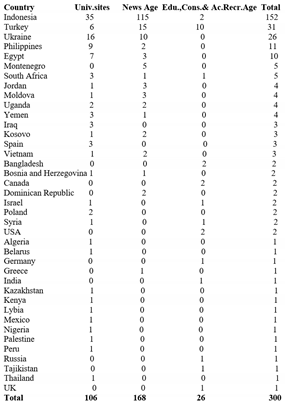
All publications discovered during the first half of 2026, along with their titles, publication dates, and web addresses, are provided in Appendix 1. They are arranged in order of the countries' publication activity, and within each country, they are listed in chronological order. Based on this Appendix, I categorized the distribution of publications by country, breaking them down into three types: publications by university press offices, publications by news agencies, and publications by educational, consultancy, and academic recruitment agencies. This distribution of publications is shown in Table 1.
Thus, for the first half of 2026, I recorded 300 publications related to 39 countries. Among them, the share of university publications was 35.3%; news agencies — 56.0%; and educational, consultancy, and academic recruitment agencies — 8.7%. The share of Indonesian publications was 50.7%; Turkish publications — 10.3%; and Ukrainian publications — 8.7%.
24 countries (61.5% of the total number of countries) from the Global South account for 244 publications (81.3% of the total number of publications).
The top 20% of countries (7.8 or 8 countries) account for 244 publications, which constitutes 81.3%. Consequently, the distribution of countries by publication activity conforms to the Pareto distribution. This indicates the representativeness of our sample in the context of manipulative behavior.
Thus, we have effectively monitored manipulative practices in the academic space, where the key entities are not so much classical scientific institutions, but rather the tools of “fake webometric promotion” that measure the intensity of scientific activity simulation.
Analytical Interpretation of Data
1. Dominance of “influence aggregators”: The fact that about 65% of publications come from various agencies indicates that the “webometric success” of universities in the Global South is driven largely by PR technologies and information injections rather than academic activities.
2. The Pareto Principle (80/20): In the context of our sample, this means that a high concentration of “fake” webometric weight is held by a small group of countries (Indonesia, Turkey, Ukraine, the Philippines, Egypt). This is a classic pattern of “competition for metrics,” where core resources are spent on maintaining the visibility of an online presence.
3. Geographical focus (Global South): The 81.3% share of publications originating from countries of the Global South demonstrates that these particular regions are most vulnerable to fake WURs, which they actively exploit to enhance their status on the international stage.
4. Actor Typology:
Indonesia (50.7%): An undisputed leader employing an aggressive presence strategy through news agencies.
Turkey (10.3%) is subject to fake manipulative influence through all three types of publications.
Ukraine (8.7%): It actively exhibits a “university web footprint” and, to a lesser extent, a “news agency web footprint.”
The Philippines and Egypt (7.0%): These countries largely exhibit a “university web footprint” and, to a lesser extent, a “news agency web footprint.”
Other countries (totaling 34 countries, 23.3% of publications): Form the “long tail” of the distribution with isolated or rare occurrences (ranging from 1 to 5 publications). In countries such as Montenegro, Jordan, Moldova, Uganda, and Yemen, the activity is mostly limited to targeted publications by university press offices and news agencies. The presence of developed nations (the USA, Spain, Israel, the UK, Germany, Canada) is sporadic and associated with local marketing errors or the activity of international consulting and recruitment agencies. Overall, this confirms the transnational and opportunistic nature of the fake WUR market, penetrating any region in search of image-driven demand.
Activities of University Press Offices
Let us now turn to the publications of university press offices, of which there were 106 in our sample (Table 1).
The management of the Cybermetrics Lab, which publishes the official WUR twice a year, decided that universities that referenced fake WURs on their official websites during the first half of 2026 will be excluded from the July 2026 WUR. In this regard, based on Appendix 1, I prepared a list of such universities and sent it to the lab in mid-July (Appendix 2). As Isidro Aguillo, the head of the lab, informed me on July 28, 2026, the black list of such universities will be published later, since some university leaders are removing publications based on fake WURs from their sites and offering apologies.
Based on Appendix 2, Table 2 has been compiled regarding the distribution of universities referencing fake WURs by country.
Single universities were observed in 16 countries: Algeria, Belarus, Bosnia & Herzegovina, Israel, Jordan, Kazakhstan, Kenya, Kosovo, Libya, Mexico, Moldova, Nigeria, Palestine, Peru, Thailand, and Vietnam.
The scale of manipulation for many of these universities, as obtained by V. Moskovkin (2026, May 13) based on monitoring publications from January 6 to March 31, 2026, showed a wide variance in data when comparing three fake WURs, the official WUR, and the data on university websites.
If we look at the publications by university press offices from April through July (up to and including July 6), we can see that excluding duplicates, there were only eight such publications. They are listed in Appendix 1 under numbers 99, 106, 144, 202, 251, 256, 259, and 297, and they pertain to universities in Indonesia (three universities), Ukraine, Uganda, Yemen, Russia, and Iraq.
News Agency Activity
As seen in Table 1, news agencies play a leading role in disseminating fake information about WURs, with Indonesian news agencies being the absolute leaders among them.
Based on Appendix 1, we identified 68 such Indonesian agencies, among which the leaders in the number of publications were: Tribunnews — 9 publications, Id. Medanaktual — 9, Medcom — 8, Detik — 7, Data Indonesia — 6, Kompas — 5, and Kampusiana — 4 publications.
A distinctive feature of publications by Indonesian news agencies is that they advertise fake WURs for specific groups of universities ranging in number from 3 to 100: Daftar 3 Kampus Terbaik…, 4 Kampus Terbaik…, 5 Kampus di Sumatera…, 7 Universitas Islam Negeri Terbaik…, 8 Universitas Swasta Terbaik…, 15 Universitas Terbaik…, Daftar 20 Universitas Terbaik…, 25 PTN Terbaik…, 30 Universitas Terbaik…, Top 50 Kampus Indonesia…, 100 Peringkat Universitas Terbaik….
These publications constantly feature the word "Terbaik," which translates into English as "Best." This Indonesian phenomenon requires serious consideration.
Based on academic analytics and the specifics of the higher education market in this country, the following reasonable assumptions can be made:
1. Colossal competition and the pursuit of prestige under “publication pressure”:
1. Indonesia is experiencing a rapid growth in the number of higher education institutions (there are thousands of them—both public and a vast number of private universities, known as Perguruan Tinggi Swasta). These institutions are fiercely competing for students and government funding.
2. A point-based performance assessment system for universities (akreditasi) is in place in Indonesia, where ranking positions and media visibility play a colossal role.
3. Unable to compete realistically in the global space based on objective metrics (Scopus, Web of Science, top global university rankings), many provincial or private Indonesian universities follow the path of simulating intense activity (“fake it till you make it”) by purchasing or reprinting materials about their “high standing” in dubious rankings.
2. Specifics of the Indonesian media market and the boom of local SEO spam
Indonesia has a vast network of small and medium-sized regional internet portals and news agencies that function on a content-farm model.
1. It is profitable for them to publish university press releases (or paid materials from consulting agencies) because this generates traffic.
2. When the latest fake university ranking appears, local news sites pick it up and copy-paste it by the hundreds to attract the attention of gullible applicants with sensational headlines (“...entered the list of the best (terbaik)”).
I should note that the only Indonesian news agency known to me that responded to my post on the LSE Impact blog and Isidro Aguillo's warnings on social media regarding fake WURs was Inspirasi Indonesia (Editor: MA, 2026, April 4).
What can be asserted based on these data? This is not merely an “information attack” on Indonesian universities from the outside—it is an internal, systemic demand for the illusion of global success. Indonesian universities (mostly private and provincial ones) and local media voluntarily and massively consume and replicate this surrogate, creating a giant information bubble.
The same holds generally true for many universities in the Global South.
Following Indonesian news agencies, Table 1 features news agencies from Turkey and Ukraine, with a total number of publications equal to 15 from 13 news agencies and 10 from 8 news agencies, respectively (Table 1, Appendix 1), which is an order of magnitude lower than the Indonesian publications.
I discovered an interesting case where on a single day, March 3, 2026, four different news agencies in Montenegro reported on a fake WUR (webometrics.org) for the University of Montenegro, presenting this ranking as a major achievement for the university (see publications numbered 232–235 in Appendix 1).
Subsequently, someone lobbied the fake webometrics.org website before the Ministry of Education, Science and Innovation of Montenegro, and it was included in the Ministry's Order of March 24, 2026, in the context of hiring academic staff at Montenegrin universities (Međunarodno priznata lista..., 2026, March 24).
The Montenegrin case has been described by me in detail previously (Moskovkin, 2026, May 13). However, thanks to the efforts of the Center for Civic Education, based on that publication, the fake webometrics.org ranking was replaced by the official WUR in the Ministry's new Order of April 6, 2026 (Međunarodno priznata lista..., 2026, April 6).
Activities of Educational, Consultancy, and Academic Recruitment Agencies
Unlike news agencies, Educational, Consultancy, and Academic Recruitment Agencies are significantly less represented in our sample (Table 1), which is logical given that there are inherently far fewer of them compared to news agencies. Their complete list for our sample is presented in Table 3.
It should be noted that four Indian agencies, along with the Australian and Canadian ones, are international companies. Meanwhile, The MBBS Abroad, headquartered in Tbilisi (Georgia) with offices in India and the UAE, was established for the purpose of directing Indian medical students to study in Bosnia & Herzegovina, Russia, Kyrgyzstan, and Tajikistan.
Of particular interest are the publications of the Canadian, German, and British agencies. Below, we will briefly describe the publications of the latter two agencies, while the Canadian case (see publication number 273 in Appendix 1) will be described in a separate section.
The University of Regensburg, through its official platform “BAYHOST Kompetenzatlas”, has dedicated an entire section to Webometrics, where it directly promotes and legitimizes the fraudulent webometrics.org clone domain, mapping it to 20 Ukrainian universities. You can find the specific web application hosting this data here: https://bayhost-kompetenzatlas.app.uni-regensburg.de/?s=webometrics+2026 (see publication number 287 in the Appendix 1).
This means a major German state academic center has unknowingly institutionalized and validated cyber-fraud, giving the scammers immense credibility in the eyes of the Ukrainian academic community.
Al-Fanar Media is a major independent educational agency headquartered in London, covering higher education issues in the Arab world in both English and Arabic. On January 25, 2026, it published a list of 38 Arab universities included in the TOP-1000 WUR, based on data from the fake ranking website webometrics.org. Following our contact with the agency, this publication, which appears under the final number 300 in Appendix 1, was removed.
Overall, the agencies and consultants in question actively pitch “ranking promotion” services to universities, later using these fake certificates and articles in advertising campaigns to attract students (and their parents, who are willing to pay for tuition).
Fake Metrics in Canada: How international recruitment portals create “ghost” rankings
In early May 2026, I discovered a publication titled “Top universities in Toronto for international students” dated April 12, 2026, on the website smapse.com (linked as number 273 in Appendix 1).
The website is owned by organizations or individuals based in New York, London, and Canada (the Canadian office address is not provided, website copyright: 2008–2026). The texts on the site are non-copyable. Most strikingly, the recruiting agency SMAPSE hastily created its own predatory aggregated ranking for TOP 15 Toronto universities and colleges, drawing upon the QS, ARWU, and Webometrics University Ranking (WUR). The website provides no methodology, and no source data for the three aforementioned rankings are disclosed.
To demonstrate the manipulative nature of this ranking, Table 4 presents the SMAPSE ranking data for three HEIs, along with the source data used for its calculation based on QS, ARWU, the fake WUR (webometrics.org), and the official WUR published on figshare.
Let us calculate this aggregated ranking for the three HEIs based on arithmetic means:
1. University of Toronto
Aggregate Rank calculated using actual data: (16+29+25)/3=23.3. Aggregate Rank calculated using fake webometrics.org data: (12+29+25)/3=22. This value is close to the SMAPSE Rank = 21.
2. York University
Aggregate Rank calculated using actual data: (252+333+650)/3=412. Aggregate Rank calculated using fake webometrics.org data:
(280+333+650)/3=421 (using the midpoint of the ARWU interval);
(280+333+700)/3=438 (using the upper bound of the ARWU interval).
There is no close match with the SMAPSE Rank = 520.
3. Humber College
For Humber College, QS and ARWU rankings are absent, so it is logical to rely solely on WUR, yet the discrepancies are even greater. We can see that SMAPSE assigns Humber College a position 2,660 spots higher than its actual rank in order to sell its services to international students.
These calculations mathematically prove that SMAPSE Ranking is a “metric chimera” that does not have a unified algorithm and was created manually for marketing purposes. Based on the analysis of this Canadian case, the following conclusions can be drawn:
1. Black Box Methodology: By mixing legitimate brands (QS, ARWU) with fabricated or outdated data, the agency creates a “halo effect” to mislead students and parents.
2. Hybrid Disinformation: This is a mutation of the “predatory metrics” virus. While fake websites copy designs, commercial portals create “hybrid lies”—mixing truths about top-tier universities with fiction for partner colleges.
This is no longer just an academic concern; it is a systematic deception of consumers at a transnational level.
It should be noted that the SMAPSE ranking data were republished unchanged on July 11, 2026, at the same link provided in Appendix 1. We will now turn to the analysis of the weekly publication dynamics based on fake WURs.
Weekly Dynamics of the Webometrics Fake Publications Campaign (January–July 2026)
In V. Moskovkin (2026, May 13), the weekly (seven-day) dynamics of fake WUR publications were examined from January 6 to March 31, 2026. However, considering that January 5, 2026, fell on a Monday, I will study these dynamics starting from that date. To do this, based on Appendix 1, let us compile Table 5.
19 publications with missing dates are included in the total count but excluded from the chronological timeline. The maximum number of publications (41) occurred in the third week, while other smaller local maxima were observed in weeks 7, 12, 17, and 21, recurring with a periodicity of 4 to 5 weeks. The primary informational impact took place during Weeks 2–9, which accounted for over 50 percent of the total traffic.
The weekly dynamics of the 300 identified publications, disaggregated by country, are presented in Table 6. In this weekly dynamics, Indonesian publications were absent only in weeks 15 and 20. This suggests that the academic community there, driven by stringent national requirements for university KPIs, is highly susceptible to ranking manipulations.
Turkey exhibited a bimodal distribution with peaks in the third week (7 publications) and the twelfth week (10 publications), while Ukraine experienced a sharp surge in publications during the fourth week (11 publications).
New July Wave of Fake Webometrics University Rankings
At the end of July 2026, three new fake July Webometrics University Rankings (WURs) appeared on the Internet: webometrics.one, webometrics.top and webometric.org, joining the older webometrics.org.
University rankings are not yet displayed on the first site, which offers free consultation: “Take your university’s global visibility to the next level. We look forward to assisting you!”, and states that webometrics.one is “an independent university ranking platform, not affiliated with any other website or organization.”
The second site provides no methodology description, offers "professional webometrics audit & strategy consultations," and states that webometrics.top is "an independent university ranking platform, not affiliated with any other website or organization."
The homepage of the third site lists the following Key Indicators: Visibility: 50% (Web contents impact); Transparency / Openness: 10% (Top cited researchers); Excellence / Scholar: 40% (Top cited papers). However, its methodology section completely contradicts this, stating: Research performance: 45% (OpenAlex); Non-academic prominence: 45% (Ahrefs); Alumni score: 10% (Wikipedia). As we can see, the declared key indicators align with the old official methodology, but the third indicator should have been Scopus/Scimago instead of Scholar. In other words, the creators of this site undermined their own fake ranking right from the start.
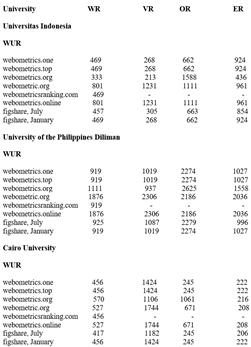
To finally expose the absurdity of these rankings, let's compare data across six fake WURs and the official WUR published on Figshare, using three leading universities in Indonesia, the Philippines and Egypt as examples (Table 7).
From this table, we can see that webometric.org publishes the exact same data as webometrics.online, while webometrics.one and webometrics.top lifts its data directly from the official January WUR.
We should ask a simple question. Over the course of a year and a half, academic fraudsters have created six fake WURs—so why has the state-run Spanish academic organization failed to restore its official website webometrics.info during this entire time? If that had been done, the number of universities from the Global South falling for fake WURs would be an order of magnitude lower.
Fake WURs Registration via WHOIS
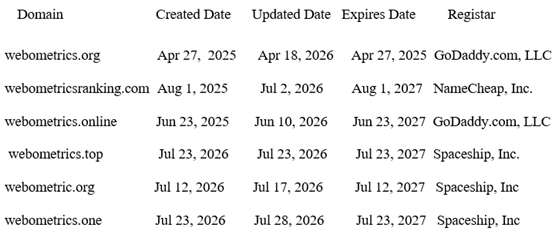
Comparative data on the registration of six fake WURs via WHOIS are presented in Table 8.
The provided data demonstrates a classic pattern of establishing a phishing or fraudulent network (ceteris paribus — mirror sites or double resources) created to imitate a well-known academic ranking (such as the Ranking Web of Universities / Webometrics).
1. Domain Age and Creation Waves (Timeline)
First Wave (2025): The domains webometrics.org, webometricsranking.com, and webometrics.online were registered in April, June, and August 2025. They have a "shelf life" of over a year, indicating long-term infrastructure preparation by malicious actors.
Second Wave (July 2026): The domains webometrics.top, webometric.org, and webometrics.one were created very recently—in July 2026 (just a couple of weeks before data collection). This points to an active expansion of the network or an attempt to replace blocked or compromised older addresses.
2. Registrars and Infrastructure Used
GoDaddy and NameCheap (for older domains): The first three domains are registered with major global registrars using Cloudflare proxy servers (which conceal the real IP address of the hosting provider). This is a standard method for protecting phishing websites from rapid abuse reports and blocking.
Spaceship, Inc. (for newer domains): All the fresh domains from July 2026 are registered through a single registrar (Spaceship, Inc. — a subsidiary of Namecheap) and use identical nameservers (launch1.spaceship.net / launch2.spaceship.net). This clearly indicates that all three new domains were created by the same person or group of people as part of a single campaign.
3. Similarities and Patterns:All domains are registered strictly for 1 year (the standard duration for short-lived or fraudulent projects). In all cases, owner details are hidden behind privacy services (Privacy Protection / Redacted for Privacy), making it impossible to directly identify the organizers through public WHOIS records.
Discovery of the First Fake WUR: The Vietnamese Case
As we can see from Table 8, the first fake WUR was created on April 27, 2025. The question arises: why did Western countries know nothing about this in 2025?
At the same time, this phenomenon was known to some researchers in Southeast Asia, but they were unable to bring it to the attention of the global academic community. In early June 2026, I managed to discover a Vietnamese blog titled pklieu.blogspot.com, which on August 30, 2025, published an article by Pham Khac Lieu (2025) titled in English translation: Webometrics university rankings: Is there a mix of genuine and fake rankings?
In this article, the author detailed the evolution of the official WUR up to the point when its publication moved to the Figshare server and the first fake WUR—webometrics.org—was created. Regarding the creation of this ranking, the author wrote:
“Since around May-June 2025, a website appeared with a domain name very similar to the website that previously published the Webometrics ranking results, differing only in the domain extension (www.webometrics.org instead of www.webometrics.info). Notably, this website also claimed to publish world university ranking results under the name Webometrics, using the exact same three criteria as webometrics.info and similarly conducting rankings twice a year, in January and July.“
The author notes the absence of a ranking calculation methodology on the webometrics.org website and presents them for 15 leading Vietnamese universities in comparison with the official ranking data. This comparison clearly shows that the positions of these universities on the webometrics.org website are 30% to 70% higher than in the official ranking.
The author drew attention to a very small-print disclaimer stating that the studied website is unrelated to webometrics.info (CSIC) and checked the creation date of this site (April 27, 2025) via the WHOIS service. He also wrote an email to Isidro Aguillo and provided a copy of his reply dated July 20, 2025, which noted that the webometrics.org website is fake. Below, I will provide a translation of the concluding part of Pham Khac Lieu's article:
“The Webometrics ranking, established in 2004 and conducted by the Cybermetrics Lab (part of CSIC, Spain) headed by Dr. Isidro Aguillo, is a well-established brand with over 20 years of history. While the reason for Cybermetrics Lab discontinuing the webometrics.info website remains unclear, the ranking results have continued to be published by Dr. Isidro Aguillo on his personal Figshare account. Meanwhile, the webometrics.org website has also been publishing ranking results using the name and methodology of Cybermetrics Lab but with differing ranks, having emerged in early 2025 with several suspicious aspects regarding its legitimacy. Higher education institutions and the press should exercise caution when reporting, and it is best not to use the ranking results from webometrics.org until the website transparently discloses specific information about the organization or individuals conducting the rankings, as well as matters concerning the copyright of the methodology and the ranking title.”
Now let us try to understand why in 2025 we knew nothing about the webometrics.org ranking and two other fake rankings created that year (Table 8). This gives rise to a hypothesis of a selective (targeted) attack on universities in Asian countries and the Global South in general, in which scammers used geo-targeting technologies (Geo-IP blocking and redirection) via the very same Cloudflare service that we discovered in WHOIS.
How they implemented it:
1. Geo-barrier: The scammers configured the server so that the fake webometrics.org content was displayed only to users from specific regions (South-East Asia, the Middle East, Africa)—areas where the demand for rankings is highest and vigilance is lower.
2. Masking in Europe: If a user from Europe (or a search engine crawler from a European IP pool) visited the site, it could return either an error, a blank page, or redirect to the original webometrics.info, which by that time had already ceased to exist. They did this intentionally to conceal the phishing from Isidro Aguillo himself and European cyber investigators for as long as possible. I can confirm that throughout 2025, I constantly monitored the term "webometrics" in Google from the Czech Republic, and no fake WURs were observed in the search results.
Conclusion
The analysis of the academic landscape in the first half of 2026 allows for the following conclusions:
1. Scale and Typology of the Threat: The study of 300 publication episodes confirms that fake rankings have become a commercially driven tool. The leading role of news outlets and consulting agencies (approximately 65%) demonstrates that their primary objective is to create the illusion of high global standing to attract prospective students.
2. Evolution of the Phishing Network: We have identified two key stages of expansion:
o First Wave (Spring–Summer 2025): The emergence of domains such as webometrics.org, webometricsranking.com, and webometrics.online. It was established that, through strategic Geo-IP blocking and traffic redirection, these activities remained virtually invisible to European researchers and the Cybermetrics Lab leadership throughout 2025.
o Second Wave (July 2026): The appearance of new resources (webometrics.one, webometrics.top, and webometric.org) confirms that the perpetrators continue to scale their infrastructure using standardized registration methods via Spaceship, Inc.
3. Geographical Vulnerability: The concentration of 81.3% of manipulations within the Global South (with Indonesia as the epicenter) indicates that scammers exploit the high reliance of universities on national KPIs and accreditation requirements.
4. Technical Coordination: Empirical evidence confirms that these sites either clone outdated official data or publish entirely fabricated metrics.
Recommendations: To combat this “academic pollution,” the following measures are necessary:
- Restoring Trust: Urgent restoration of the webometrics.info portal as the sole official source.
- Verification Protocols: Universities must verify rankings exclusively against the Figshare repository.
- Global Monitoring: It is essential to inform regulators in developing countries about the stealth geo-targeting methods used by scammers to bypass Western monitoring systems.
The phenomenon of fake WURs represents a sophisticated, high-tech attack on the credibility of higher education that requires a swift and coordinated response at the intergovernmental level.
Supplementary Materials
The following supporting information can be downloaded at the website of this paper posted on Preprints.org. Inventory of Media Publications and University Press Releases Regarding Fake Webometrics University Rankings (Jan-Jul 2026); Distribution of university publications with fake WURs by country.
References
- Aguillo, I.F. Ranking Web of Universities (webometrics.info). July 2026 edition. In figshare. Preprint.; 22 July 2026. [Google Scholar] [CrossRef]
- Editor:MA (2026, April 4). Puluhan Negara Terjebak Predatory Rankings Tiruan Webometrics [Dozens of Countries Trapped in Predatory Fake Webometrics Rankings]. Inspirasi Indonesia. Available online: https://inspirensis.id/artikel/puluhan-negara-terjebak-predatory-rankings-tiruan-webometrics.
- Holmes, R. The rise of pseudo-rankings. University Ranking Newsletter. 24 June 2026. Available online: https://thomasyeoman.substack.com/p/the-rise-of-pseudo-rankings.
- Lieu, P.K. Xếp hạng đại học Webometrics: có đang thật giả lẫn lộn? [Webometrics university rankings: Is there a mix of genuine and fake rankings?]. 30 Aug 2025. Available online: https://pklieu.blogspot.com/2025/08/xep-hang-dai-hoc-webometrics-co-dang.html.
- Međunarodno priznata lista rangiranja univerziteta koja će se primjenjivati u postupku zapošljavanja nastavnika u obrazovno-vaspitnim ustanovama. Ministarstvo prosvjete, nauke i inovacija (Crne Gore, Podgorica). 24 March 2026. Available online: https://www.gov.me/dokumenta/2aa376e9-b8c7-4e05-a521-1ee206d57d4d.
- Međunarodno priznata lista rangiranja univerziteta koja će se primjenjivati u postupku zapošljavanja nastavnika u obrazovno-vaspitnim ustanovama. Ministarstvo prosvjete, nauke i inovacija (Crne Gore, Podgorica). 6 April 2026. Available online: https://www.gov.me/dokumenta/b6df8eb5-6a3d-4660-b9c0-952222a17ddd.
- Moskovkin, V. Predatory university rankings jeopardise the value of Webometrics. LSE Impact. 25 March 2026. Available online: https://blogs.lse.ac.uk/impactofsocialsciences/2026/03/25/predatory-university-rankings-jeopardise-the-value-of-webometrics/.
- Moskovkin, V. M. The Pandemic of “Predatory” Rankings: Why Academic Integrity Fails the Stress Test. In Preprints; 13 May 2026. [Google Scholar] [CrossRef]
- Sawahel, W. Universities spread data from fake ranking sites – Study. University World News. 27 May 2026. Available online: https://www.universityworldnews.com/post.php?story=20260527101141173.
- Sawahel, W. Universities excluded from Webometrics amid fake rankings. In University World News; 14 June 2026; Available online: https://www.universityworldnews.com/post.php?story=20260613072356192.

Table 1.
Distribution of publications based on fake WURs for the first half of 2026.
 |
Note: Univ.sites - University sites, News Age – News Agencies, Edu.,Cons.& Ac.Recr.Age – Educational, Consultancy, and Academic Recruitment Agencies.
Table 2.
Distribution of universities referencing fake WURs by country.
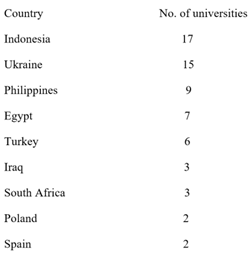 |
Table 3.
Distribution of Educational, Consultancy, and Academic Recruitment Agencies by country.
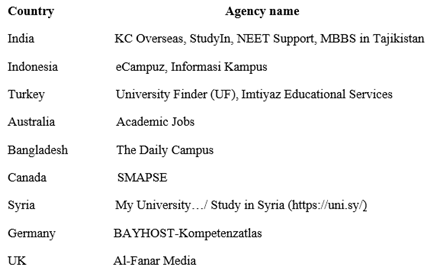 |
Table 4.
Source data for reproducing SMAPSE ranking calculations.
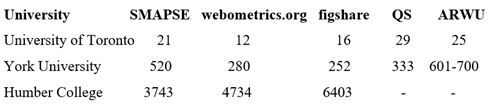 |
Table 5.
Weekly Dynamics of the Webometrics Fake Publications Campaign (January–July 2026).
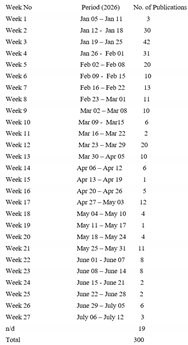 |
Table 6.
Weekly dynamics of publications on fake university rankings by country (January–March 2026).
Table 6.
Weekly dynamics of publications on fake university rankings by country (January–March 2026).
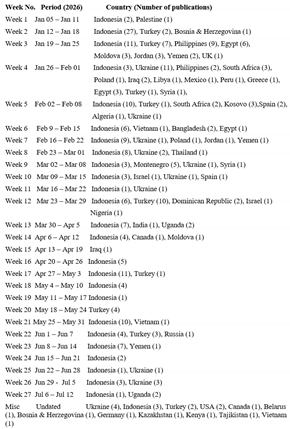 |
Table 7.
Comparison of July 2026 Fake and Official WURs.
 |
Note: WR – World Rank, VR – Visibility Rank, OR – Openness Rank, ER – Excellence Rank
Table 8.
Domain Registration Data and Registar Comparison.
 |
Disclaimer/Publisher’s Note: The statements, opinions and data contained in all publications are solely those of the individual author(s) and contributor(s) and not of MDPI and/or the editor(s). MDPI and/or the editor(s) disclaim responsibility for any injury to people or property resulting from any ideas, methods, instructions or products referred to in the content. |
© 2026 by the authors. Licensee MDPI, Basel, Switzerland. This article is an open access article distributed under the terms and conditions of the Creative Commons Attribution (CC BY) license (http://creativecommons.org/licenses/by/4.0/).
Copyright: This open access article is published under a Creative Commons CC BY 4.0 license, which permit the free download, distribution, and reuse, provided that the author and preprint are cited in any reuse.