

Submitted:
04 September 2026
Posted:
04 September 2026
You are already at the latest version
Abstract
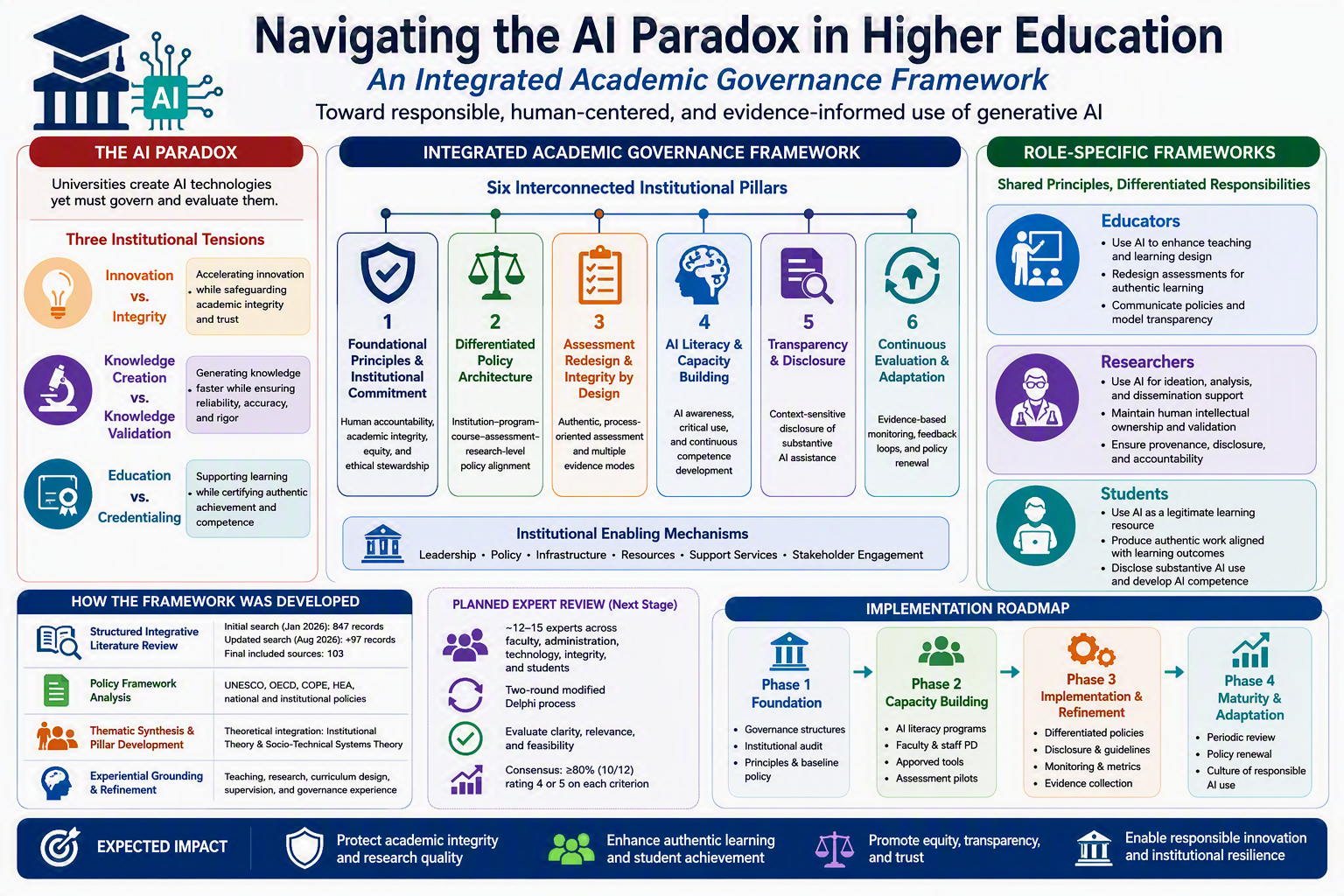
Artificial intelligence is transforming teaching, learning, research, and institutional operations, yet its adoption presents higher education with a distinctive governance challenge. Universities have contributed substantially to the development of modern AI while remaining responsible for protecting academic integrity, validating knowledge, certifying learning, and maintaining public trust. This paper conceptualises this dual responsibility as the AI paradox in higher education, expressed through three interconnected institutional tensions: innovation versus integrity, knowledge creation versus knowledge validation, and education versus credentialing. Drawing on a structured integrative review of scholarly literature, policy analysis, and experiential grounding, the paper examines the opportunities and risks associated with generative AI and proposes an integrated academic governance framework comprising six institutional pillars: foundational principles and institutional commitment, differentiated policy architecture, assessment redesign and integrity by design, AI literacy and capacity building, transparency and disclosure, and continuous evaluation and adaptation. The institutional pillars are operationalised through complementary role-specific frameworks for educators, researchers, and students, supported by institutional enabling mechanisms and a phased implementation roadmap. A multi-stakeholder expert review using a modified Delphi process is proposed as the next stage of framework validation following finalisation of the governance architecture. The framework offers higher education institutions a theoretically grounded and operational approach to balancing technological innovation with human accountability, educational quality, research integrity, equitable access, and authentic student achievement.
Keywords:
artificial intelligence
; higher education
; academic governance
; institutional tensions
; academic integrity
; generative AI
; responsible AI
; assessment design
Copyright: This open access article is published under a Creative Commons CC BY 4.0 license, which permit the free download, distribution, and reuse, provided that the author and preprint are cited in any reuse.