

Submitted:
04 September 2026
Posted:
04 September 2026
You are already at the latest version
Abstract
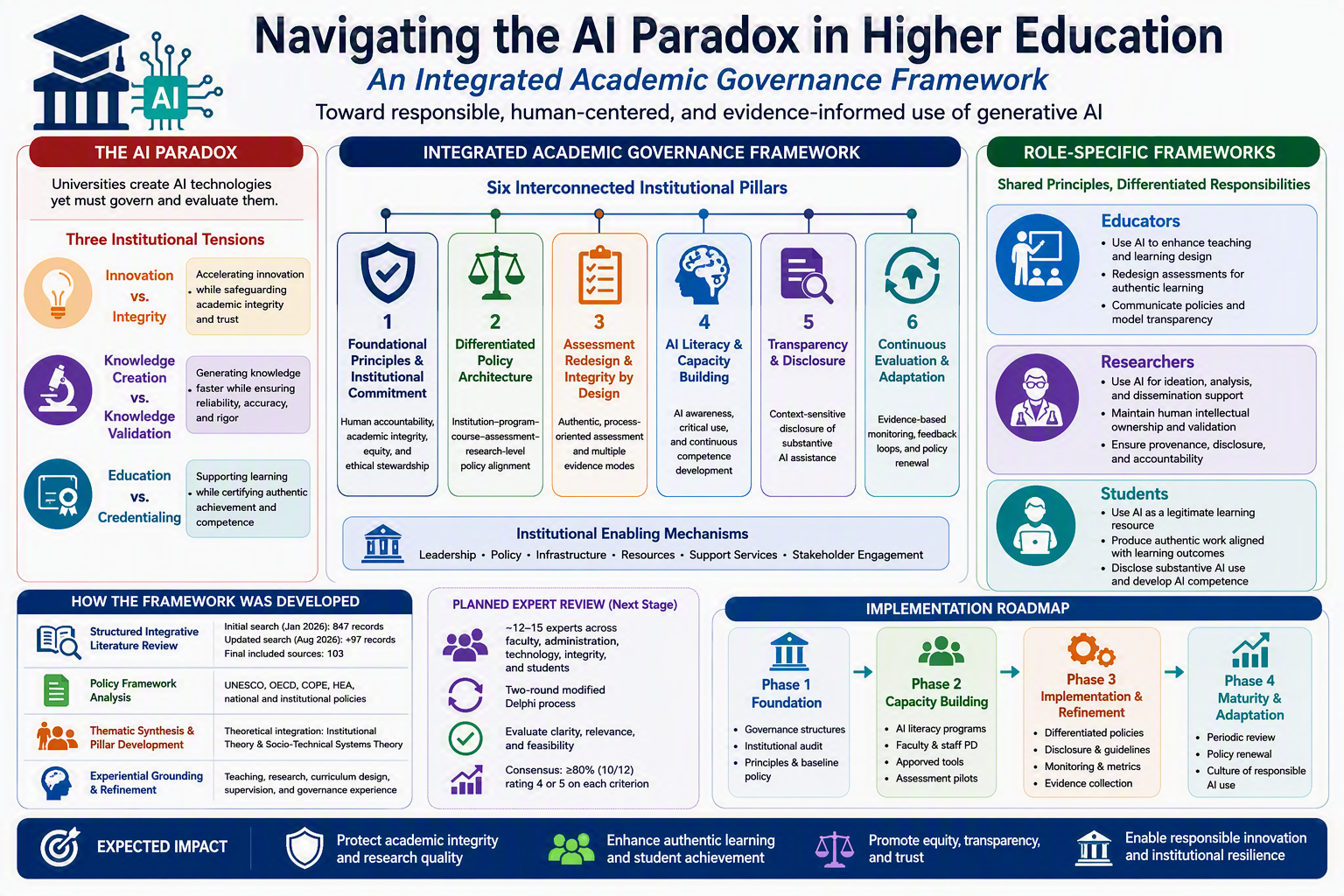
Artificial intelligence is transforming teaching, learning, research, and institutional operations, yet its adoption presents higher education with a distinctive governance challenge. Universities have contributed substantially to the development of modern AI while remaining responsible for protecting academic integrity, validating knowledge, certifying learning, and maintaining public trust. This paper conceptualises this dual responsibility as the AI paradox in higher education, expressed through three interconnected institutional tensions: innovation versus integrity, knowledge creation versus knowledge validation, and education versus credentialing. Drawing on a structured integrative review of scholarly literature, policy analysis, and experiential grounding, the paper examines the opportunities and risks associated with generative AI and proposes an integrated academic governance framework comprising six institutional pillars: foundational principles and institutional commitment, differentiated policy architecture, assessment redesign and integrity by design, AI literacy and capacity building, transparency and disclosure, and continuous evaluation and adaptation. The institutional pillars are operationalised through complementary role-specific frameworks for educators, researchers, and students, supported by institutional enabling mechanisms and a phased implementation roadmap. A multi-stakeholder expert review using a modified Delphi process is proposed as the next stage of framework validation following finalisation of the governance architecture. The framework offers higher education institutions a theoretically grounded and operational approach to balancing technological innovation with human accountability, educational quality, research integrity, equitable access, and authentic student achievement.
Keywords:
artificial intelligence
; higher education
; academic governance
; institutional tensions
; academic integrity
; generative AI
; responsible AI
; assessment design
1. Introduction
Artificial intelligence (AI) is reshaping scientific discovery, academic work, teaching, assessment, and institutional operations. In higher education, AI can accelerate hypothesis generation, experimental design, data analysis, literature synthesis, translation, and scholarly communication [5]. It is also changing how universities design curricula, deliver instruction, assess learning, support students, and prepare graduates for professional environments in which AI is increasingly embedded [18].
Higher education’s relationship with AI is nevertheless paradoxical. Universities produced much of the foundational research underlying modern AI and educated many of the scientists, engineers, and scholars responsible for its development [5]. At the same time, universities must now govern technologies that can generate inaccurate or fabricated claims, weaken independent reasoning when used uncritically, and complicate established understandings of authorship, originality, intellectual contribution, and academic misconduct.
Unlike organisations that can adopt AI primarily as a productivity-enhancing technology, universities must reconcile innovation with responsibilities extending beyond operational efficiency. Higher education institutions create knowledge, validate scholarly claims, cultivate critical thinking, assess learning, certify competence, preserve academic integrity, and maintain public confidence in academic qualifications and research. AI can strengthen each of these functions, but it can also undermine them when its use is poorly designed, insufficiently transparent, or disconnected from educational and scholarly purposes.
This dual responsibility constitutes the AI paradox in higher education. Universities are simultaneously architects of AI innovation and stewards of the academic values most affected by that innovation. The paradox is not a single contradiction but a set of persistent institutional tensions that predate generative AI and have become more visible and consequential as AI capabilities have expanded [6]. Three tensions are particularly significant.
First, innovation versus integrity reflects the responsibility of universities to promote experimentation and technological advancement while protecting academic standards, fairness, and trust. AI can support creativity, productivity, and new forms of inquiry, but it can also facilitate unacknowledged assistance, fabricated content, inappropriate automation, and the misrepresentation of human achievement.
Second, knowledge creation versus knowledge validation reflects the dual role of universities in producing new knowledge and determining whether knowledge claims are reliable. AI can identify patterns, generate hypotheses, synthesise literature, and accelerate research processes. However, AI-generated outputs may also contain factual errors, biased interpretations, fabricated references, or unverifiable claims. The growing capacity to generate scholarly-looking content therefore increases rather than reduces the importance of human validation, research provenance, methodological transparency, and reproducibility.
Third, education versus credentialing reflects the responsibility of universities both to support learning and to certify that students have achieved specified competencies. AI can provide personalised explanations, formative feedback, practice opportunities, and accessibility support. At the same time, it can make it difficult to determine whether submitted work demonstrates authentic student learning or the capabilities of an AI system. The challenge is therefore not simply to detect AI use, but to redesign learning and assessment so that permitted uses remain aligned with intended learning outcomes [7,12,13,14].
Generative AI did not create these tensions, but it has amplified them and made conventional governance responses increasingly inadequate [6]. Blanket prohibitions may be difficult to enforce, vulnerable to rapid technological change, and disconnected from the realities of academic and professional practice. Unrestricted adoption, however, may weaken assessment validity, compromise research integrity, create inequitable access, expose sensitive information, and encourage cognitive dependence. The central question is consequently not whether universities should accept or reject AI, but how they can govern its use in ways that support innovation while preserving educational quality, scholarly rigour, authentic achievement, and human accountability.
Recent evidence demonstrates the urgency of this challenge. A UNESCO global survey found widespread professional use of AI alongside low levels of perceived institutional readiness. Nearly two-thirds of surveyed higher education institutions had developed or were developing guidance, but only a minority had formal AI policies in place [8]. A global Delphi study involving experts from 22 countries and six continents identified eight areas requiring institutional attention: academic integrity, ethical and responsible use, privacy and protection, equitable access, generative AI literacy, integration strategy, human oversight and accountability, and institutional support and infrastructure [7]. These findings indicate that AI governance cannot be reduced to plagiarism rules or isolated technology policies. It must address the relationships among institutional values, educational design, research practices, human capabilities, infrastructure, stakeholder responsibilities, and continuous organisational learning.
Existing governance responses provide important principles and policy directions, but several limitations remain. Many frameworks focus on a single institutional function, such as assessment, academic integrity, or teaching practice. Others articulate high-level principles without translating them into differentiated responsibilities for educators, researchers, students, academic leaders, and institutional support units. Governance frameworks may also lack theoretical grounding, provide limited operational guidance, or emphasise risk control without adequately supporting responsible innovation [2,7,11].
This paper addresses these limitations by proposing an integrated academic governance framework that connects institution-wide governance with role-specific academic practice. The framework comprises six mutually reinforcing pillars:
- Foundational Principles and Institutional Commitment
- Differentiated Policy Architecture
- Assessment Redesign and Integrity by Design
- AI Literacy and Capacity Building
- Transparency and Disclosure
- Continuous Evaluation and Adaptation
The six pillars establish a shared institutional architecture, but they are not intended to produce identical requirements across all academic contexts. Instead, the framework adopts a differentiated approach in which institution-wide principles are translated into programme, disciplinary, research, course, and assessment practices. The framework is therefore complemented by three role-specific governance models for educators, researchers, and students. These models clarify how common principles such as accountability, integrity, transparency, literacy, and continuous evaluation apply differently according to each stakeholder group’s authority, activities, and responsibilities.
The educator framework positions AI as a potential source of educational content and a partner in learning design while preserving professional accountability for accuracy, fairness, pedagogical quality, assessment validity, and alignment with learning outcomes. The researcher framework permits responsible AI-assisted ideation, analysis, and dissemination while requiring human intellectual ownership, rigorous validation, transparent disclosure, appropriate research provenance, and accountability for all scholarly claims. The student framework recognises AI as a legitimate supplementary learning resource while maintaining that assessed work must provide credible evidence of the learning outcomes and competencies being evaluated.
The framework is grounded in two complementary theoretical perspectives. Socio-technical systems theory explains why effective AI governance must coordinate technical capabilities and infrastructure with human judgment, organisational practices, professional roles, policies, and institutional culture [32,33,34]. Institutional theory explains how regulatory requirements, professional norms, legitimacy concerns, and the practices of peer institutions influence university responses to technological change [30,31]. Together, these perspectives support a governance approach that considers AI adoption neither as a purely technical implementation problem nor solely as a matter of individual conduct.
The framework was developed through four connected phases: a structured integrative review of scholarly and policy literature, systematic policy-framework analysis, thematic synthesis and pillar development, and experiential grounding in teaching, research, curriculum development, research supervision, and academic governance. A multi-stakeholder expert review is planned as the next stage of validation after the governance architecture has been finalised. The planned review will use a modified Delphi process to assess the framework’s clarity, relevance, feasibility, and applicability across institutional and disciplinary contexts. Because the expert panel has not yet been formed and the review has not yet been conducted, this paper presents the proposed review design but does not report expert-review findings.
The paper makes five contributions. First, it conceptualises the AI paradox as a set of interconnected institutional tensions that provide a unifying lens for examining AI’s effects on higher education. Second, it integrates research and policy relating to teaching, learning, assessment, research, integrity, and institutional governance. Third, it grounds AI governance in institutional theory and socio-technical systems theory. Fourth, it introduces an integrated six-pillar framework and translates that architecture into differentiated responsibilities for educators, researchers, and students. Fifth, it provides a phased implementation roadmap and a planned multi-stakeholder process for subsequent framework validation.
The remainder of the paper is organised as follows. Section 2 reviews the relevant literature and policy frameworks. Section 3 examines AI’s opportunities for scientific discovery, research, teaching, learning, and knowledge dissemination. Section 4 analyses the risks to academic integrity, assessment validity, research quality, and institutional values. Section 5 describes the theoretical foundations, framework-development methodology, and planned expert-review process. Section 6 presents the six institutional governance pillars. Section 7 through 9 develop the role-specific frameworks for educators, researchers, and students. Section 10 provides the implementation roadmap and discusses implications for computing education. Section 11 examines the broader theoretical and institutional implications, limitations, and future research directions. Section 12 concludes.
2. Literature Review
2.1. Overview of Research Activity
The academic literature on artificial intelligence in higher education has grown exponentially in recent years. Zawacki-Richter et al. [1] conducted a systematic review of research on AI applications in higher education, analysing 146 publications from the period between 2007 and 2018 and identifying key trends, including the predominance of AI in assessment and learning analytics, the increasing use of adaptive learning systems, and the growing attention to ethical and policy dimensions. The findings indicate that research has moved from early explorations of AI's potential to empirical investigations of implementation, outcomes, and ethical implications [1].
Bibliometric analyses further confirm this trend. Dipierro, De Witte, and Toma [9] combined bibliometric and systematic literature review methods to examine nonparametric efficiency and AI techniques in higher education. Crompton and Burke [3] conducted a comprehensive review of AI in higher education, examining the state of the field from 2016 to 2022.
Thematic integrative reviews have identified several major thematic clusters [2]. These include: applications and users (personalised learning systems, intelligent tutoring platforms, automated assessment tools); pedagogical transformation (student and faculty perceptions, institutional integration strategies, ethical risks, and pedagogical innovation); research and discovery (AI's role in accelerating research workflows, literature discovery, data analysis, and hypothesis generation alongside ethical challenges of maintaining scientific rigour); ethics and governance (algorithmic bias, data privacy, academic integrity, and risks of overreliance); and institutional consequences (effects on organisational structures, faculty roles, assessment practices, and institutional culture).
2.2. Key Empirical Findings and Unresolved Debates
Several key findings emerge from the literature, alongside unresolved debates that this paper seeks to address. First, while AI tools are widely used, institutional readiness remains strikingly low [8]. Second, there is a significant gap between AI use and formal policy development [8]. Third, restriction-based policies are failing in practice: despite strict prohibitions reported by 40.8% of respondents, students continue using AI covertly, detection tools prove unreliable, and the gap between policy and practice persists [10]. Faculty who integrated AI instruction, redesigned assessments around individual learning processes, and established transparent disclosure expectations reported more educationally productive outcomes [10].
A persistent debate in the literature concerns whether governance should be principle-based or rule-based. Principle-based approaches offer flexibility and adaptability but risk inconsistency in implementation. Rule-based approaches provide clarity and enforceability but may become rapidly obsolete as AI capabilities evolve. Institutional policy research suggests that effective governance requires a hybrid approach that combines institutional principles with local flexibility [7,11,15].
Fourth, the literature reveals a gap in aligning institutional readiness, AI competencies, and learner needs [11]. Fifth, research consistently identifies the mediating role of teaching methods in AI integration as underexplored [3]. Sixth, the literature calls for more research on AI-resilient assessment design, faculty training models, and the long-term effects of AI on critical thinking and learning outcomes [2,6].
2.3. Policy Frameworks and Governance Responses
Recognising the urgency of the challenge, international organisations have moved to provide guidance. UNESCO published the AI competency framework for students and the AI competency framework for teachers in 2024, defining the knowledge, skills, and attitudes that students and teachers should possess to understand the roles of AI in education and utilise AI in their teaching and learning practices in an ethical, safe, and meaningful way [12,13]. The frameworks focus on four core competencies: a human-centred mindset, ethics of AI, AI techniques and applications, and responsible use [12,13].
The OECD Digital Education Outlook 2026 warns that the uncritical adoption of generative AI may undermine key human skills such as critical thinking and evaluative judgment in students, and calls for a shift away from off-the-shelf chatbots toward purpose-built educational AI systems [14]. The report reveals the paradox of performance: AI can improve immediate outcomes but deteriorates real learning if used as a shortcut [14].
Several nations have developed comprehensive policy frameworks. Ireland's Higher Education Authority published a national policy framework in December 2025 to guide the responsible, values-based adoption of generative AI in Irish higher education [15]. The framework is grounded in five core principles: academic integrity, transparency and accountability; equity and inclusion; critical engagement, human oversight and AI literacy; privacy and data governance; and sustainable pedagogy. The framework reflects the principle that "our sector needs to move beyond both uncritical adoption and uncritical rejection and towards a principled approach that keeps academic judgement and educational excellence at the centre" [15].
2.4. Limitations of Existing Governance Responses
Existing frameworks exhibit several limitations. Many articulate high-level principles but provide limited operational guidance for educators, researchers, and students. They often assume relatively stable conditions despite the rapid evolution of generative AI, focus primarily on risk mitigation rather than enhancing learning and research, and take defensive orientations that limit support for innovation [2,6,7,11]. Theoretical grounding is another significant gap: most frameworks are pragmatic rather than theoretically informed, drawing on institutional experience rather than established theories of governance, organisational change, or technology adoption [7,11]. The framework proposed in this paper addresses this gap by grounding its design in socio-technical systems theory and institutional theory, as elaborated in Section 5.
3. Opportunities: AI as a Transformative Force
3.1. Accelerating Scientific Discovery
AI can accelerate scientific discovery by processing large bodies of literature, identifying cross-disciplinary patterns, generating hypotheses, simulating complex systems, and prioritising experimental pathways [5]. Large language models can also support hypothesis development, experimental design, process automation, and interdisciplinary collaboration by translating concepts across disciplinary boundaries [5].
3.2. Advancing Research Capabilities
Beyond discovery, AI dramatically enhances the efficiency and depth of academic research workflows. AI tools are increasingly used for literature review automation, data analysis, natural language processing of unstructured data, and the rapid distillation of academic papers. AI-powered tools for statistical analysis, image recognition, and natural language processing are enabling new forms of inquiry across the humanities, social sciences, and natural sciences [6].
3.3. Transforming Knowledge Dissemination
AI is reshaping scholarly knowledge dissemination and access through intelligent editing tools, automated translation services, recommendation systems, and automated summarisation tools [17]. Nature has provided editorial guidance on maintaining research integrity while leveraging these dissemination tools [17].
3.4. Personalised and Adaptive Learning
AI can personalise learning at scale through adaptive learning and gamification approaches that improve motivation and retention [4]. AI systems can analyse student performance data in real time, identify learning gaps, and deliver tailored content. Tlili et al. [4] explored ChatGPT's potential for personalised tutoring and feedback, highlighting both opportunities and challenges.
3.5. Enhancing Teaching and Curriculum Design
AI is shifting educators' work from content delivery toward learning design, facilitation, and guidance. Current uses include lesson planning, grading support, writing assistance, and data analysis [18], while curriculum reform increasingly seeks to prepare students for AI-integrated professional practice [19].
4. Challenges: Threats to Academic Integrity and Institutional Values
4.1. Academic Integrity and Assessment
The proliferation of generative AI has challenged the credibility of assessment in higher education. Unregulated use may blur the boundaries between legitimate assistance and academic misconduct, heightening the potential for plagiarism. Over 75% of respondents in a major study reported ethical concerns, data privacy issues, and risks to academic integrity as significant challenges [6].
The challenges are not merely theoretical. Students with higher GPAs express deep concerns about dependency, plagiarism, and the erosion of critical thinking skills [6]. Technical countermeasures, including digital proctoring systems, have been found insufficient as standalone solutions [10]. The problem is not simply one of detection but of fundamental pedagogical design: existing curricula and assessment procedures show room for modification in light of generative AI capabilities [37].
4.2. Integrity of Scientific Discovery and Research
Beyond pedagogical concerns, AI poses profound challenges to the integrity of scientific discovery and research. The ease with which AI can generate plausible-sounding but incorrect or fabricated information introduces risks of scientific error propagating through the literature. Researchers have cautioned that while helpful in generating hypotheses, these models require careful oversight to prevent misleading or unverified information from influencing scientific processes [5]. Bjelobaba et al. [26] emphasised the importance of maintaining research integrity through transparent documentation and independent verification. A systematic review by Mabirizi et al. [27] confirmed that AI-assisted research must be subject to the same—or even more rigorous—validation standards as traditional work.
4.3. Institutional Readiness and Policy Gaps
Despite high levels of AI use, institutional readiness remains strikingly low [8]. This policy gap leaves educators, students, and researchers navigating AI use without clear institutional guidance [6]. The situation reveals significant regional variation: around 70% of institutions in Europe and North America have or are developing guidance, compared to 45% in Latin America and the Caribbean [8]. These gaps reflect how generative AI has amplified long-standing institutional tensions—between innovation and integrity, knowledge creation and validation, and education and credentialing—that predate the technology but now demand urgent governance attention [5,6,7,11,37].
5. Methodology for Framework Development
The framework was developed through four connected phases: literature synthesis, policy analysis, thematic integration, and experiential refinement. A multi-stakeholder expert review is planned as a subsequent validation stage following finalisation of the framework.
5.1. Theoretical Foundations
The framework is grounded in two complementary theoretical perspectives that provide analytical depth and explanatory power.
Socio-Technical Systems Theory, originating with the work of Trist and Bamforth [32] and extended by Bostrom and Heinen [33] and Baxter and Sommerville [34], emphasises that effective governance must address the interplay between social subsystems (humans, organisations, culture, policy) and technical subsystems (tools, infrastructure, data, algorithms). Applied to AI governance, this perspective recognises that technical solutions alone—such as detection tools—are insufficient without corresponding social and organisational changes.
Institutional Theory, as articulated by DiMaggio and Powell [30] and Scott [31], examines how organisational structures, norms, and legitimacy concerns influence technology adoption. It explains why many institutions adopt defensive, restriction-based policies in response to isomorphic pressures to appear to be managing risk, even when such policies are ineffective.
Theoretical Contribution to Framework Design: Institutional theory explains why governance frameworks must account for coercive pressures (regulatory requirements, funder mandates), mimetic pressures (peer institutional practices), and normative pressures (professional disciplinary norms). Socio-technical systems theory explains why governance must coordinate social elements (human judgment, professional values, organisational culture) with technical elements (AI capabilities, data infrastructure, tool access). The six pillars operationalise these perspectives by addressing both technical dimensions (assessment redesign, transparency mechanisms, policy architecture) and social dimensions (AI literacy, human accountability, stakeholder participation, continuous evaluation).
5.2. Framework Development Process
The four development phases are described below.
Phase 1: Literature Synthesis. A structured integrative literature review was conducted following established guidelines [35]. The search encompassed peer-reviewed journals, conference proceedings, and policy documents published between 2019 and 2026. Databases searched included Scopus, Web of Science, ERIC, and Google Scholar. The initial search was conducted in June 2026, yielding 847 records. After removing duplicates (n=203), 644 records were screened by title and abstract. Two researchers independently screened records against inclusion criteria requiring sources addressed AI governance in higher education contexts and provided empirical findings, theoretical frameworks, or policy recommendations. Full-text review was conducted for 127 records, with 89 sources meeting inclusion criteria (42 empirical studies, 28 theoretical or conceptual articles, 19 policy documents). Thirty-eight full-text records were excluded because they did not address higher education governance (n=12), lacked substantive analytical or empirical content (n=11), duplicated previously reported findings (n=8), or did not meet other eligibility criteria (n=7). Inter-coder reliability for thematic coding across the complete 103-source corpus was assessed using Cohen's kappa (κ = 0.82), indicating strong agreement.
Search Update: The initial search was updated on 15 August 2026, identifying 97 additional records. After removing duplicates (n=18), 79 records were screened. Following full-text assessment of 27 records, 14 new sources were included (8 empirical studies, 4 conceptual articles, 2 policy documents). All 103 included sources were subject to the same thematic coding and reliability procedures. Figure 1 summarises the identification, screening, eligibility assessment, and inclusion of sources across the initial and updated searches.
Thematic Coding and Pillar Development. The analysis combined deductive codes derived from theoretical and policy frameworks with inductive codes emerging from reviewed sources. The two researchers independently coded extracted findings, compared coding decisions, and resolved disagreements through discussion. Related codes were consolidated into higher-order themes, which were iteratively organised into the six governance pillars. The complete list and characteristics of the 103 included sources are provided in Supplementary Appendix A. The main text cites sources directly relevant to the framework's principal claims.
Phase 2: Policy Framework Analysis. International and national policy frameworks were systematically analysed to identify normative principles and governance models, including UNESCO competency frameworks [12,13], the OECD Digital Education Outlook [14], Ireland's HEA National Policy Framework [15], the Castlereagh Statement [21], and governance frameworks from institutional adaptation research [7,11] and assessment redesign literature [37].
Phase 3: Thematic Synthesis and Pillar Development. Recurring themes across the literature and policy frameworks were distilled into actionable principles, yielding an initial set of governance dimensions subsequently organised into six interconnected pillars through iterative refinement.
Phase 4: Experiential Grounding and Refinement. The authors' collective first-hand experience in teaching, curriculum design, research supervision, and academic governance informed the practical design of the frameworks, ensuring theoretical soundness and realistic implementability.
5.3. Planned Expert Review and Framework Validation
Following finalisation of the proposed governance framework, a multi-stakeholder expert review will be conducted as the primary validation stage. The review is intended to assess the framework's perceived clarity, relevance, feasibility, completeness, coherence, and practical applicability across diverse higher education contexts. Because the framework is already substantially developed through literature synthesis, policy analysis, thematic integration, and experiential refinement, a modified Delphi process is proposed to support systematic expert evaluation, consensus building, and iterative refinement rather than exploratory framework generation.
Planned Expert Panel
A panel of approximately 15 to 20 experts will be recruited to represent the principal stakeholder groups addressed by the framework. The panel is expected to include:
- faculty members from the humanities, social sciences, STEM, computing, and professional disciplines;
- academic administrators with responsibilities for teaching, learning, research, or academic governance;
- educational technologists and instructional-design specialists;
- research-integrity or research-ethics professionals; and
- student representatives.
Participants will be selected based on demonstrated experience in AI policy, academic integrity, assessment design, faculty development, educational technology, research governance, or the responsible use of AI in higher education. The final composition of the panel will be reported following participant recruitment.
Planned Review Procedure
The expert review will employ a three-round modified Delphi process conducted over approximately 10-12 weeks. Prior to Round 1, participants will receive the complete manuscript, an executive summary, supporting framework documentation, and the evaluation instrument.
Round 1: Initial Evaluation (Weeks 3-4). Experts will evaluate the six institutional governance pillars, the three role-specific frameworks, and the implementation roadmap using a five-point Likert scale. Each component will be assessed against the criteria of clarity, relevance, feasibility, and completeness. Participants will also provide qualitative comments, identify omissions, and recommend revisions.
Inter-Round Analysis and Revision (Weeks 5-6). Quantitative ratings and qualitative feedback will be analysed, and the framework will be revised in response to the findings. A summary of results, revisions, and rationales will be prepared for participants.
Round 2: Consensus Evaluation (Weeks 7-8). Experts will receive the revised framework together with aggregated statistical summaries and anonymized thematic feedback from Round 1. Participants will then re-evaluate the framework and assess its overall coherence and practical utility. Components not meeting the predefined consensus criteria will be revised and carried forward to a third round.
Round 3: Consensus Confirmation (Weeks 10-11). Only components that fail to achieve consensus in Round 2 will be reconsidered. Participants will review areas of disagreement, proposed revisions, and alternative perspectives before providing final evaluations.
Final analysis, reporting, and framework refinement will be completed in Week 12.
Consensus Criteria and Quantitative Analysis
Consensus will be defined a priori using two complementary criteria:
- Agreement Criterion: at least 80% of participants assign ratings of 4 or 5 on a five-point Likert scale; and
- Dispersion Criterion: an interquartile range (IQR) no greater than 1.0.
These criteria will be applied separately to each evaluation dimension and framework component. Quantitative analyses will include means, medians, standard deviations, interquartile ranges, and percentages of agreement. Components failing to satisfy the consensus criteria will be revised and re-evaluated in subsequent rounds until consensus is achieved or response stability is reached.
Qualitative Analysis
Qualitative comments will be analysed using reflexive thematic analysis. Two researchers will independently review participant responses, conduct initial coding, and develop a shared coding framework. Coding will combine both deductive categories derived from the six governance pillars and inductive themes emerging from participant feedback.
Examples of anticipated coding categories include governance and accountability, assessment design, transparency and disclosure, AI literacy, research integrity, implementation challenges, resource implications, and equity considerations. Related codes will be consolidated into higher-order themes that inform framework refinement.
Inter-coder reliability will be assessed using Cohen's kappa, with disagreements resolved through discussion and consensus. An audit trail documenting the relationship between expert comments, thematic findings, and resulting framework revisions will be maintained throughout the review process.
Controlled Anonymity
Consistent with established Delphi methodology, the review will maintain controlled anonymity to encourage independent judgment and minimise conformity pressures, authority effects, and groupthink. Participants will be assigned anonymous identifiers and will not have access to the identities, ratings, or comments of other panel members.
Between rounds, experts will receive only aggregated quantitative results and anonymized thematic summaries. Individual responses will remain confidential and will not be attributed to identifiable participants in reports or publications. Participant-identification records will be stored separately from response data and accessible only to the research team.
Research Ethics
Before recruitment or data collection begins, the authors will obtain the appropriate research ethics approval, exemption, or institutional determination. The final manuscript will report the responsible institution, approval or exemption reference number, and date of determination. All participants will receive information describing the purpose of the review, expected time commitments, confidentiality protections, and intended use of the results. Informed consent will be obtained before participation.
Planned Reporting
Following completion of the review, the study will report:
- panel composition and participant characteristics;
- recruitment, participation, and attrition rates;
- quantitative results for each Delphi round;
- criterion-specific consensus outcomes;
- major qualitative themes;
- framework revisions resulting from expert feedback; and
- any components for which consensus was not achieved.
The expert review will provide evidence regarding the framework's perceived clarity, relevance, feasibility, and applicability. It will not, by itself, establish the effectiveness of the framework in practice. Subsequent implementation and longitudinal evaluation studies will therefore be required to assess institutional outcomes and long-term impact.
5.4. Framework Mapping
Table 3 maps each governance pillar to its literature basis, policy basis, and practical implication.
6. The Integrated Academic Governance Framework: Six Pillars
The integrated framework adopts a tiered governance model that aligns policy, pedagogy, and assessment operations. It moves beyond rule-based enforcement toward prevention through thoughtful design [37]. The framework is grounded in six interconnected pillars derived from the literature, policy frameworks, and practical experience.
6.1. Pillar 1: Foundational Principles and Institutional Commitment
Every university should establish a clear, institution-wide statement of principles governing AI use. These principles should affirm that:
6.2. Pillar 2: Differentiated Policy Architecture
A one-size-fits-all approach to AI governance is neither feasible nor desirable [7,15]. Policies must be differentiated across three levels:
- Institutional-Level Policy: Establish baseline expectations across the university, including context-sensitive disclosure of substantive AI use, data privacy and security requirements, and clear consequences for violations [15].
- Program and Department-Level Guidelines: Different disciplines face different opportunities and challenges. Computer science programmes may embrace AI coding assistants with specific protocols; humanities programmes may focus on critical analysis of AI-generated text; professional programmes may have strict limits [7,11,15].
- Course-Level Policies: Individual courses should specify acceptable AI use in syllabi, recognising that some assessments may prohibit AI entirely, others may permit AI with full disclosure, and still others may require AI use as part of learning objectives [22].
6.3. Pillar 3: Assessment Redesign and Integrity by Design
Perhaps the most critical pillar, this moves the focus from policing AI use to designing assessments that are AI-resilient and pedagogically meaningful [29,37].
Building on peer-reviewed work concerning evaluative judgment [37] and practitioner-oriented AI-resilient assessment guidance [29], the following principles are recommended:
- Emphasise process over product.
- Require demonstration of learning that cannot be fully outsourced to AI.
- Incorporate authentic, contextual, and personalised elements.
- Include multiple modalities (oral, written, practical).
- Build in checkpoints and iterative feedback.
Swiss-Cheese Model for Academic Integrity: We adapt Reason's Swiss-cheese model from risk management [38] to create multiple, overlapping layers of integrity protection. No single layer is complete, but together they provide a stronger basis for academic-integrity assurance.
6.4. Pillar 4: AI Literacy and Capacity Building
Effective AI governance requires that all members of the university community understand AI's capabilities, limitations, and ethical implications [12,13,28].
A Tiered Literacy Framework: Distinguish between three forms of AI engagement: learning about AI (capabilities, limitations, implications); learning with AI (collaborative practices leveraging AI as a partner); and learning for AI (developing meta-competencies for an AI-integrated world) [28].
Required Training and Support:
- Mandatory orientation sessions for first-year students and new faculty.
- Ongoing professional development for faculty [23].
- Dedicated AI portals with localised case studies and toolkits.
- Communities of practice for collaboration and reflection.
6.5. Pillar 5: Transparency and Disclosure
Disclosure of Substantive AI Assistance: Work involving substantive generative-AI assistance should include a disclosure consistent with course, institutional, disciplinary, and publisher requirements. This includes specifying which AI tools were used, how they were used, which portions involve AI-generated content, and how the author has verified and taken responsibility [17].
Tiered Disclosure Framework: Distinguish between:
- No substantive generative AI use
- AI-assisted process support (e.g., editing, organisation)
- AI-generated components with human verification and disclosure
- AI use integral to the method or assessed competency, with full documentation
6.6. Pillar 6: Continuous Evaluation and Adaptation
The rapid evolution of AI technologies means that governance frameworks must be living documents, subject to ongoing review and refinement [7].
Regular Policy Review: Establish scheduled reviews of AI policies (e.g., annually or biannually) with flexibility to respond to emergent issues [7].
6.7. From Institutional Pillars to Role-Specific Practice
The six pillars establish the institution-wide architecture for the responsible and effective use of generative AI across teaching, research, and learning. The role-specific frameworks presented in Section 7, Section 8 and Section 9 translate this institutional architecture into operational guidance for educators, researchers, and students. Although each pillar applies to all stakeholder groups, its practical expression differs according to the authority, responsibilities, roles, and forms of accountability associated with each group.
The role-specific frameworks should therefore be understood as complementary implementations of a shared governance architecture rather than as independent sets of recommendations. Together, they ensure that institutional principles are translated into stakeholder-specific practices while maintaining coherence across the university's core academic functions.
In practice, the framework may be operationalized through a hierarchy of institutional policy instruments. At the institutional level, university-wide principles establish common expectations for the responsible use of AI. These principles may then be translated into role-specific policies governing areas such as teaching and course development, student learning and assessment, and research and scholarly activity. Supporting procedures, guidelines, training programs, disclosure requirements, and implementation resources can further translate policy into day-to-day practice. Through this layered approach, institutions can maintain consistency in governance while allowing flexibility to address disciplinary, pedagogical, and research-specific needs.
Table 4 provides a crosswalk illustrating how each institutional pillar translates into role-specific responsibilities for educators, researchers, and students, as well as the institutional mechanisms required to support implementation and continuous improvement.
7. Academic Governance Framework for Educators
The integration of AI into curriculum and course development requires a structured, principled approach that balances innovation with educational values. For educators, AI must be positioned as an enabling assistant rather than a replacement for professional pedagogical judgement [23].
7.1. AI as a Source of Educational Content
Educators should leverage AI as a dynamic and expansive source of educational content, including curating up-to-date materials, generating diverse explanations and perspectives, creating practice materials, and translating and localising content. However, AI-generated content must be treated as raw material requiring rigorous vetting for factual accuracy, disciplinary appropriateness, cultural sensitivity, and potential bias before incorporation into formal teaching resources [18].
7.2. AI as a Tool for Learning Design
AI serves as a powerful partner in the instructional design process. Educators can utilise AI to design learning pathways, develop authentic assessments, optimise session plans, and generate rubrics and feedback frameworks [20]. The University of Sydney's institutional assessment framework illustrates how secure and open assessments can balance assurance of learning with productive and responsible AI use [22]. Chu and Ashraf [20] demonstrate how AI can support innovation in higher education course development through a data-driven approach.
7.3. Educator Accountability, Transparency, and Competence
The cornerstone of this framework is that AI may support educational design, but responsibility for educational quality remains entirely human. Educators remain accountable for the final product delivered to students [23] and are expected to maintain:
- Academic accountability: responsibility for the accuracy, currency, depth, and pedagogical appropriateness of instructional materials.
- Ethical accountability: responsibility for identifying and mitigating bias, misinformation, intellectual-property concerns, and inappropriate content.
- Professional accountability: responsibility for alignment with course outcomes, programme objectives, accreditation requirements, and institutional policy.
- Transparency: where AI has played a substantive role in generating instructional materials or assessment designs, educators should disclose and explain how AI was used [15].
- Competence in effective and responsible AI use: educators should possess sufficient knowledge, skills, and judgment to evaluate outputs critically, understand system limitations, recognise hallucinations and bias, and use AI responsibly [12].
7.4. Faculty Training and Infrastructure
Institutions must invest in faculty training that focuses on critical evaluation of AI outputs, awareness of AI limitations and biases, and integration of AI into authentic assessment [23]. Crawford, Cowling, and Allen [23] provide practical models for faculty development through structured professional learning programmes. Dedicated instructional design support should be available to help educators use AI responsibly without being overwhelmed.
7.5. Educators' Role in Institutional Governance
Educators play a critical role in operationalising institutional AI governance, including course-level policy communication, assessment redesign, evidence collection, participation in policy review, reporting workload and resource implications, and modelling transparency.
7.6. Institutional Support for Educator Workload Management
To address expert-identified implementation concerns, institutions should provide concrete support measures including:
- Centrally maintained syllabus language and course policy templates.
- Standardised disclosure templates for educator use.
- Approved-tool guidance and curated resource lists.
- Shared assessment exemplars and redesign case studies.
- Dedicated instructional design support and consultancy.
- Formal workload recognition for assessment redesign activities.
- Funded professional development programmes.
- Communities of practice for peer learning and collaboration.
8. Academic Governance Framework for Researchers
The use of AI in research, scientific discovery, and scholarly publishing presents unique ethical and practical challenges. This framework emphasises the researcher's ownership of original ideas, rigorous validation of scientific findings, and the obligation to demonstrate novelty and unpublished status of results—while permitting AI's use as a legitimate aid in dissemination [16,26].
8.1. AI for Developing and Formulating Ideas
AI may be legitimately used as a cognitive partner in the early and middle stages of research to brainstorm research questions, refine hypotheses, organise literature reviews, and improve clarity and structure [5]. The Committee on Publication Ethics (COPE) provides structured guidance on AI and authorship, establishing principles for responsible use of generative AI in research and publication [16].
8.2. Evidence of Original Human Ideation, Research Provenance and Scientific Contribution
The fundamental boundary is that the core intellectual contribution of a scholarly work must originate from the researcher rather than from an AI system [16,25]. Researchers bear responsibility for demonstrating, where appropriate, the human origin of the central ideas, hypotheses, interpretations, theories, designs, or discoveries presented in their work.
Appropriate evidence may include laboratory notebooks and research journals, conceptual diagrams and design sketches, preliminary calculations and exploratory analyses, annotated literature reviews, draft manuscripts and evolving outlines, code repositories and version histories, reflective research notes, recorded research discussions, and documented histories of AI-assisted interactions [26].
Where ethically and legally appropriate, documented AI-interaction histories may supplement other evidence of research provenance and scholarly decision-making. They should not be treated as sufficient proof of intellectual originality on their own, but a sequence of prompts, critiques, revisions, and follow-up inquiries can demonstrate how the researcher framed problems, evaluated AI-generated suggestions, redirected lines of inquiry, and exercised scholarly judgment [25].
8.3. Rigorous Validation of Scientific Findings
AI-assisted discoveries must undergo the same—or even more rigorous—validation standards as traditionally derived findings [26,27]. Researchers must independently verify AI-generated outputs, address potential biases, and ensure that AI-assisted findings are reproducible using established scientific methods [5,27].
8.4. Novelty and Unpublished Results
Researchers bear the sole burden of ensuring that their findings are new and have not been previously published. AI tools do not absolve this responsibility. Researchers must conduct thorough literature searches, run final manuscripts through plagiarism and duplication-checking software, and include a clear declaration of originality [17,25].
8.5. Authorship, Accountability, and Transparency
A widespread consensus exists that AI cannot be listed as an author [17,25]. Human authors bear exclusive responsibility for all submitted work. Researchers must document AI use, verify all AI-generated data and citations before submission, and maintain human accountability for every claim, figure, and conclusion [16]. Alduais et al. [25] provide a policy analysis of responsible and ethical use of generative AI for research purposes.
8.6. Responsible Use of AI in Dissemination
AI may be used to support knowledge dissemination under human oversight: language polishing and translation, metadata and keyword generation, and peer review assistance for basic formatting and ethical compliance. Substantive peer review must remain a human intellectual activity [17].
8.7. Researcher AI Literacy and Governance Feedback
Researchers require specialised competencies for responsible AI use in scholarship, including methodological competence, data protection and confidentiality, reproducibility, monitoring new risks, and contributing evidence to institutional policy. Researchers should participate in institutional policy development through departmental research committees, research integrity reviews, and institutional governance forums.
9. Academic Governance Framework for Students
For students, AI represents a transformative educational resource, but its use must be governed by a clear distinction between AI as a learning aid and AI as an assessed outcome. This framework positions AI primarily as a tool for supporting learning, understanding, practice, feedback, exploration, and creativity [24].
9.1. AI as a Source of Learning
Students may use AI as an interactive supplementary resource, while recognising that its outputs do not carry the authority or accountability of instructors, librarians, or peer-reviewed sources. Appropriate uses for learning include explaining difficult concepts, providing worked examples, offering feedback on drafts, generating practice questions, and brainstorming angles [4,24].
9.2. The Boundary Between Learning Support and Assessment
The central principle is that assessment should accurately measure the learning outcomes it is intended to evaluate [29,37]. Accordingly:
- Where the objective is subject knowledge, critical thinking, communication, or problem solving, submitted work should primarily reflect the student's own intellectual contribution.
- Where the objective includes competencies for effective and responsible AI use, AI-generated outputs may appropriately form part of the assessment [24].
- Students should be prepared to explain how AI was used, what decisions they made independently, and how they evaluated AI-generated contributions.
- Significant AI use should be disclosed according to course and institutional requirements [15].
9.3. Critical Evaluation and Academic Integrity
Students are expected to critically evaluate any AI-generated information, verifying it against authoritative sources, as AI is prone to errors and biases [4]. They must acknowledge all AI use when it has substantively influenced their work and understand institutional policies on permissible versus impermissible AI use [15,21].
9.4. Progression in Competencies for Effective and Responsible AI Use
Institutions should scaffold competencies so that students progressively learn to use AI responsibly [24]:
- Prepare: Foundational awareness of AI capabilities, limitations, and ethical issues [12].
- Understand: Basic mechanics of AI systems, algorithmic bias, and data privacy [13].
- Apply: Use AI appropriately for learning tasks while respecting academic boundaries [24].
- Responsible Use: Critically evaluate outputs and maintain academic integrity [28].
Grove [24] provides a practical approach to designing the student learning journey, integrating these competencies across the curriculum.
9.5. Equitable Access
9.6. Student Participation in AI Governance
Students should be active participants in institutional AI governance, contributing feedback on policy clarity, representation in governance committees, reporting inequitable access, identifying barriers to learning, and participating in periodic framework evaluation.
10. Implementation Roadmap
10.1. Competencies for Effective and Responsible AI Use as a Foundational Capability
A central recommendation emerging from the literature is the need to develop competencies for effective and responsible AI use as a foundational capability for both educators and students [12,13]. This goes beyond mere technical training to encompass critical engagement with AI tools, understanding of their limitations and biases, and the ethical implications of their use [28].
UNESCO's competency frameworks provide a valuable starting point, outlining competencies across dimensions including a human-centred mindset, ethics of AI, and AI techniques and applications [12,13]. Institutions should integrate these competencies into curricula and professional development programmes.
10.2. Redesigning Assessment for the AI Era
The challenges AI poses to traditional assessment methods demand a fundamental rethinking of how universities evaluate student learning [29,37]. This includes developing AI-resilient assessment practices that emphasise process over product, critical thinking over content recall, and authentic application over standardised responses [29]. Building on peer-reviewed work concerning evaluative judgment [37] and practitioner-oriented AI-resilient assessment guidance [29], institutions should shift assessment design away from policing AI use and toward fostering ethical engagement, metacognitive reasoning, contextual judgement, and real-world performance.
10.3. Strengthening Research Integrity and Peer Review
To protect the integrity of scientific discovery and dissemination, institutions and publishers must strengthen research integrity mechanisms [16,26]. This includes developing clear guidelines for AI use in research and publishing, strengthening peer-review and editorial procedures to scrutinise the provenance, validity, and disclosure of AI-assisted work [17], requiring data and code availability to verify AI-assisted analyses, and establishing mechanisms for auditing the provenance of scientific claims.
10.4. Collaborative Governance
Effective academic governance in an AI-enabled higher education environment requires collaboration among all stakeholders. Senior institutional leadership teams, teaching staff, students, academic support units, and IT and data-protection professionals all have defined areas of responsibility [7,15]. This collaborative approach should extend to students and researchers.
10.5. Investing in Infrastructure and Training
The high implementation cost of AI technology remains a significant obstacle, particularly for resource-constrained institutions [7]. Universities must invest not only in hardware and software but in the professional development necessary for faculty and researchers to use AI effectively [23]. This includes systemic training in learning design, research integrity, critical evaluation of AI outputs, and responsible use of AI in both pedagogy and scholarship.
10.6. Phased Implementation Approach
Phase 1: Foundation (0–6 months)
- Convene an AI Governance Working Group with broad stakeholder representation.
- Conduct an institutional audit of current AI use, policies, and practices.
- Articulate institutional principles and values regarding AI.
- Develop and communicate baseline institutional policy.
Phase 2: Capacity Building (6–12 months)
- Launch AI literacy programmes for faculty and students.
- Establish professional development and support infrastructure.
- Create AI resource portals and toolkits.
- Pilot assessment redesigns in select departments or courses.
Phase 3: Implementation and Refinement (12–24 months)
- Roll out differentiated policies across departments and courses.
- Implement disclosure and transparency requirements.
- Establish monitoring and evaluation mechanisms.
- Develop continuous improvement processes.
Phase 4: Maturity and Adaptation (Ongoing)
- Regular policy review and updating.
- Expansion of AI literacy and capacity building.
- Integration of AI considerations into all academic governance processes.
- Contribution to broader sector and societal conversations about AI in education.
10.7. Implications for Computing Education
Applying Pillars 2–5 to computing education requires particular attention to code provenance, programming competence, cybersecurity, accreditation, and AI-integrated software engineering practice:
- Accreditation alignment: Aligning AI governance with programme-level expectations for demonstrable competence in core computing knowledge and professional practice.
These considerations should inform the development of programme-level guidelines within the differentiated policy architecture (Pillar 2) and assessment redesign strategies (Pillar 3).
11. Discussion and Implications
11.1. The AI Paradox as a Navigable Challenge
The AI paradox is best treated as an enduring governance challenge rather than a contradiction with a final solution [6]. The proposed framework responds by linking institutional principles to differentiated policies, integrity-by-design, stakeholder capabilities, disclosure practices, and continuous evaluation. Its contribution lies in coordinating these elements across teaching, research, and student learning rather than addressing them as separate policy problems.
11.2. The Integrated Framework as a Response
The framework provides a common institutional architecture while preserving contextual flexibility. Table 4 shows how each pillar is enacted differently by educators, researchers, and students, and how institutional enabling mechanisms support those responsibilities. This integration converts high-level principles into operational expectations without reducing governance to a uniform set of prohibitions [7,11,15].
11.3. The Role of Human Accountability
11.4. Implications for Knowledge, Learning, and Human Cognition
The AI paradox raises fundamental questions about knowledge, learning, and human cognition. Generative AI can articulate, summarise, and synthesise explicit knowledge with remarkable facility. However, it does not possess the tacit knowledge that comes from lived experience, embodied practice, and sustained engagement with a discipline. Higher education has traditionally been a site where tacit knowledge is cultivated through apprenticeship, practice, and situated learning. The challenge for higher education in the age of AI is to preserve and cultivate tacit knowledge while leveraging AI's capacity to handle explicit knowledge efficiently [5].
AI also changes how individuals relate to knowledge. Rather than remembering facts or procedures, individuals may increasingly need to know how to find, evaluate, and apply knowledge. This shifts the emphasis from knowledge acquisition to knowledge management and critical evaluation [14]. It also raises questions about what it means to understand something when AI can articulate understanding on demand.
11.5. Disciplinary Considerations
The framework assumes broad applicability across disciplines, but disciplinary differences warrant explicit consideration. In STEM disciplines, AI tools for code generation, data analysis, and simulation are integral to professional practice, and governance must focus on responsible use rather than prohibition. In humanities and social sciences, concerns centre on authorship, originality, and critical interpretation, requiring governance that preserves these values while enabling AI-assisted research. In professional disciplines such as law, medicine, and nursing, the stakes are higher: inappropriate AI use can have real-world consequences, requiring stricter governance and explicit competency assessment. In creative arts, AI raises questions about creativity, authenticity, and the nature of artistic expression, demanding governance that is sensitive to these disciplinary norms.
11.6. Limitations and Future Research
Several limitations of this study should be acknowledged. First, while the frameworks are grounded in empirical literature, policy analysis, and experiential refinement, they have not yet undergone the planned expert-review process or been tested through longitudinal implementation across diverse institutional contexts. Second, the rapid evolution of AI technologies means that governance frameworks must be continuously updated. The six-part review mechanism proposed by the global Delphi study [7] provides a model for this. Third, the frameworks focus primarily on generative AI; future work should address emerging technologies such as agentic AI and autonomous pedagogical agents.
Future research should examine: the long-term effects of AI on critical thinking and learning outcomes; the effectiveness of different assessment redesign strategies [29]; faculty development models for AI integration [23]; the equity implications of differential AI access [7]; and the governance of autonomous AI agents in educational contexts.
The proposed framework has not yet undergone the planned multi-stakeholder expert review. Its present form should therefore be understood as a theoretically and evidence-informed framework awaiting formal expert assessment and empirical implementation. The next stage of the research will recruit an appropriately diverse panel, conduct the planned modified Delphi process, and revise the framework in response to the resulting evidence
12. Conclusion
This paper has addressed the AI paradox in higher education through an integrated governance framework that connects six institutional pillars to role-specific responsibilities for educators, researchers, and students. Grounded in socio-technical systems theory [32,33,34] and institutional theory [30,31], the framework combines policy architecture, integrity-by-design, AI literacy, transparency, accountability, and continuous evaluation.
The framework contributes a unifying theoretical lens, a transparent development process, and an operational crosswalk linking institutional commitments to stakeholder practice. The planned expert review will provide a subsequent assessment of the framework’s clarity, relevance, feasibility, and applicability.
Higher education's task is neither unrestricted adoption nor blanket restriction, but responsible stewardship. By balancing innovation with accountability, efficiency with integrity, and technological capability with human judgment, institutions can use AI to strengthen rather than erode the purposes of teaching, research, and credentialing.
Supplementary Materials
The following supporting information can be downloaded at the website of this paper posted on Preprints.org.
Acknowledgments
The authors acknowledge the international policy bodies whose frameworks informed this synthesis and the insights gained from their teaching, research, curriculum development, and academic-governance experience.
References
- Zawacki-Richter; Marín, V. I.; Bond, M.; Gouverneur, F. Systematic review of research on artificial intelligence applications in higher education—where are the educators? Int. J. Educ. Technol. High. Educ. 2019, vol. 16(no. 1), 1–27. [Google Scholar] [CrossRef]
- Bearman, M.; Ryan, J.; Ajjawi, R. Discourses of Artificial Intelligence in Higher Education: A Critical Literature Review. High. Educ. 2023, vol. 86(no. 2), 369–385. [Google Scholar] [CrossRef]
- Crompton, H.; Burke, D. Artificial intelligence in higher education: the state of the field. Int. J. Educ. Technol. High. Educ. 2023, vol. 20(no. 1). [Google Scholar] [CrossRef]
- Tlili, A.; et al. What if the devil is my guardian angel: ChatGPT as a case study of using chatbots in education. Smart Learn. Environ. 2023, vol. 10(no. 1), 15. [Google Scholar] [CrossRef]
- Wang, H.; et al. Scientific discovery in the age of artificial intelligence. Nature 2023, vol. 620, 47–60. [Google Scholar] [CrossRef]
- AlBlooshi, S. Artificial intelligence in higher education, opportunities, and challenges: a review. Front. Educ. vol. 10, 1683968, 2026. [CrossRef]
- Crompton, H.; Burke, D.; Nickel, C.; et al. Governing generative AI in higher education: a global Delphi study on policy and practice. Int. J. Educ. Technol. High. Educ. 2026, vol. 23(article 21), 1–23. [Google Scholar] [CrossRef]
- UNESCO. UNESCO survey: Two-thirds of higher education institutions have or are developing guidance on AI use," UNESCO Digital Learning Week, Sep. 2025. Available online: https://www.unesco.org/en/articles/unesco-survey-two-thirds-higher-education-institutions-have-or-are-developing-guidance-ai-use (accessed on 15 August 2026).
- Dipierro, A. R.; De Witte, K.; Toma, P. Nonparametric efficiency and artificial intelligence techniques in higher education: a systematic literature review and bibliometric analysis. Int. Trans. Oper. Res. 2025, vol. 33(no. 3), 1427–1464. [Google Scholar] [CrossRef]
- Akib, i. H. B. S. M.; et al. From Restriction to Empowerment: Responsible AI Governance in Higher Education. Proc. 2026 ACM SIGCAS/SIGCHI Conf. Comput. Sustain. Soc. (COMPASS '26), Virtual Event, USA, July 2026; ACM. [Google Scholar] [CrossRef]
- Jin, Y.; Yan, L.; Echeverria, V.; Gašević, D.; Martinez-Maldonado, R. Generative AI in higher education: A global perspective of institutional adoption policies and guidelines. arXiv. 2024. Available online: https://arxiv.org/abs/2405.11800 (accessed on 15 August 2026).
- UNESCO, AI competency framework for teachers. UNESCO Publishing, 2024. Available online: https://unesdoc.unesco.org/ark:/48223/pf0000391104 (accessed on 15 August 2026).
- UNESCO, AI competency framework for students. UNESCO Publishing, 2024. Available online: https://unesdoc.unesco.org/ark:/48223/pf0000391105 (accessed on 15 August 2026).
- OECD. OECD Digital Education Outlook 2026: Exploring Effective Uses of Generative AI in Education; OECD Publishing: Paris, 2026. [Google Scholar]
- O'Sullivan, J.; Lowry, C.; Woods, R.; Conlon, T. Generative AI in Higher Education Teaching & Learning: National Policy Framework; Higher Education Authority: Ireland, Dec 2025. [Google Scholar] [CrossRef]
- Committee on Publication Ethics (COPE). COPE guidance for authors and editors on AI and authorship," COPE, 2024. Available online: https://publicationethics.org/guidance/AI (accessed on 15 August 2026).
- Nature Editorial. Tools such as ChatGPT threaten transparent science; here are our ground rules for their use. Nature 2023, vol. 613, 612. [Google Scholar] [CrossRef]
- Lang, Q.; Wang, M.; Yin, M.; Liang, S.; Song, W. Transforming Education with Generative AI (GAI): Key Insights and Future Prospects. IEEE Trans. Learn. Technol. 2025, vol. 18, 230–242. [Google Scholar] [CrossRef]
- Ma, Y.; Su, Y.; Li, M.; Zhang, Y.; Chai, W.; Huang, A. Preparing Students for an AI-Driven World: Generative AI and Curriculum Reform in Higher Education. Front. Digit. Educ. 2025, vol. 2(no. 4). [Google Scholar] [CrossRef]
- Chu, T. S.; Ashraf, M. Artificial Intelligence in Curriculum Design: A Data-Driven Approach to Higher Education Innovation. Knowledge 2025, vol. 5(no. 3), 14. [Google Scholar] [CrossRef]
- The Castlereagh Statement, The Castlereagh Statement: A Cross-Sector Call to Action on Australian Education and Training in the Age of AI. Apr. 2026. Available online: https://castlereagh.ai/statement/ (accessed on 15 August 2026).
- University of Sydney. University of Sydney's AI assessment policy: Protecting integrity and empowering students," Nov. 27, 2024. Available online: https://www.sydney.edu.au/news-opinion/news/2024/11/27/university-of-sydney-ai-assessment-policy.html (accessed on 15 August 2026).
- Crawford, J.; Cowling, M.; Allen, K. Leadership is needed for ethical ChatGPT: Character, assessment, and learning using artificial intelligence (AI). J. Univ. Teach. Learn. Pract. 2023, vol. 20(no. 3). [Google Scholar] [CrossRef]
- Grove, M. Designing the Student Learning Journey: A Practical Approach to Integrating Generative AI within Higher Education. MSOR Connect. 2025, vol. 24(no. 1), 5. [Google Scholar]
- Alduais, A.; Qadhi, S.; Chaaban, Y.; Khraisheh, M. Utilizing Generative AI Responsibly and Ethically for Research Purposes in Higher Education: A Policy Analysis. Ser. Rev. vol. 51(no. 3/4), 120, 2025. [CrossRef]
- Bjelobaba, S.; Waddington, L.; Perkins, M.; et al. Maintaining research integrity in the age of GenAI: an analysis of ethical challenges and recommendations to researchers. Int. J. Educ. Integr. 2025, vol. 21, article 18. [Google Scholar] [CrossRef]
- Mabirizi, V.; Katushabe, C.; Muhoza, G.; Rugasira, J. A systematic review of the impact of generative AI on postgraduate research: opportunities, challenges, and ethical implications. Discov. Artif. Intell. 2025, vol. 5. [Google Scholar] [CrossRef]
- Bak, H.; et al. GenAI Competencies in Higher Education: An Analysis of Existing Literacy Frameworks. Proc. Assoc. Inf. Sci. Technol. 2025, vol. 62(no. 1). [Google Scholar] [CrossRef]
- Wheeler, S. Designing AI-Resilient Assessment: Reclaiming Human Learning in an Age of Automation," University of Manchester, 2025. Available online: https://personalpages.manchester.ac.uk/staff/steve.wheeler/AI-Resilient-Assessment.pdf (accessed on 15 June 2026).
- DiMaggio, P. J.; Powell, W. W. The iron cage revisited: Institutional isomorphism and collective rationality in organizational fields. Am. Sociol. Rev. 1983, vol. 48(no. 2), 147–160. [Google Scholar] [CrossRef]
- W. R. Scott, Institutions and Organizations: Ideas, Interests, and Identities, 4th ed.; SAGE Publications: Los Angeles, CA, 2014.
- Trist, E. L.; Bamforth, K. W. Some social and psychological consequences of the longwall method of coal-getting. Hum. Relat. 1951, vol. 4(no. 1), 3–38. [Google Scholar] [CrossRef]
- Bostrom, R. P.; Heinen, J. S. MIS problems and failures: a sociotechnical perspective—Part I: The causes. MIS Q. 1977, vol. 1(no. 3), 17–32. [Google Scholar] [CrossRef]
- Baxter, G. D.; Sommerville, I. Socio-technical systems: From design methods to systems engineering. Interact. Comput. 2011, vol. 23(no. 1), 4–17. [Google Scholar] [CrossRef]
- Grant, M. J.; Booth, A. A typology of reviews: an analysis of 14 review types and associated methodologies. Health Info. Libr. J. 2009, vol. 26(no. 2), 91–108. [Google Scholar] [CrossRef]
- Linstone, H. A.; Turoff, M. The Delphi Method: Techniques and Applications; Addison-Wesley: Reading, MA, 1975. [Google Scholar]
- Bearman, M.; Tai, J.; Dawson, P.; Boud, D.; Ajjawi, R. Developing evaluative judgement for a time of generative artificial intelligence. Assess. Eval. High. Educ. 2024, vol. 49(no. 6), 893–905. [Google Scholar] [CrossRef]
- Reason, J. Human error: models and management. BMJ 2000, vol. 320(no. 7237), 768–770. [Google Scholar] [CrossRef]
Figure 1.
Flow of records through the initial and updated structured integrative literature searches.
Figure 1.
Flow of records through the initial and updated structured integrative literature searches.


Table 3.
Mapping of Governance Pillars to Literature, Policy, and Practice.
| Governance Pillar | Literature Basis | Policy Basis | Practical Implication |
| Pillar 1: Foundational Principles | Institutional theory [30,31]; Socio-technical systems theory [32,33,34] | UNESCO competency frameworks [12,13]; HEA National Policy Framework [15] | Institutions must articulate clear values and principles to guide AI use |
| Pillar 2: Differentiated Policy Architecture | Institutional governance and policy adaptation [7,11,15]; Contextual assessment design [22,37] | Castlereagh Statement [21]; University of Sydney assessment policy [22] | Policies must be tailored to disciplinary and course contexts |
| Pillar 3: Assessment Redesign | Evaluative judgment and assessment redesign [37]; AI-resilient assessment guidance [29] | OECD Digital Education Outlook [14]; HEA Framework [15] | Assessment must be redesigned to measure authentic learning |
| Pillar 4: AI Literacy | Competency frameworks [12,13,28] | UNESCO frameworks [12,13] | All stakeholders must develop critical AI competencies |
| Pillar 5: Transparency | Academic integrity literature [6,37] | COPE guidance [16]; Nature editorial [17] | Substantive AI use should be disclosed according to course, institutional, disciplinary, and publisher requirements |
| Pillar 6: Continuous Evaluation | Adaptive governance [7]; Evidence-based practice [10,11] | Delphi study recommendations [7] | Frameworks must be reviewed and updated regularly |
Table 4.
Crosswalk: Institutional Pillars to Role-Specific Responsibilities.
| Institutional Pillar | Educators | Researchers | Students | Institutional Enabling Mechanism |
| 1. Foundational Principles | Retain professional judgment and accountability for educational quality | Retain intellectual ownership and accountability for scientific claims | Retain responsibility for learning and authentic achievement | Senate-approved principles and policy framework |
| 2. Differentiated Policy Architecture | Translate institutional and programme policy into clear course rules | Follow institutional, ethical, disciplinary, funder, and publisher requirements | Interpret AI permissions in the context of each course and assessment | Course syllabus template; programme-level guidelines |
| 3. Integrity by Design | Design authentic, process-oriented, multimodal assessments | Maintain provenance, reproducibility, validation, and evidence of contribution | Produce evidence of learning, decision-making, and critical evaluation | Assessment redesign support; research integrity procedures |
| 4. AI Literacy and Capacity | Develop pedagogical, ethical, and evaluative competence | Develop methodological, integrity, data-governance, and disclosure competence | Progress from awareness to critical and responsible AI use | AI literacy programme; professional development framework |
| 5. Transparency and Disclosure | Explain substantive AI use and communicate course expectations | Disclose AI assistance and verify all claims, data, and citations | Disclose substantive use and explain how outputs were evaluated | Disclosure templates; institutional policy |
| 6. Continuous Evaluation | Evaluate teaching and assessment practices and report implementation issues | Generate evidence about AI impacts and governance effectiveness | Provide feedback on learning, policy clarity, access, and equity | Annual governance review; stakeholder feedback mechanisms |
Disclaimer/Publisher’s Note: The statements, opinions and data contained in all publications are solely those of the individual author(s) and contributor(s) and not of MDPI and/or the editor(s). MDPI and/or the editor(s) disclaim responsibility for any injury to people or property resulting from any ideas, methods, instructions or products referred to in the content. |
© 2026 by the authors. Licensee MDPI, Basel, Switzerland. This article is an open access article distributed under the terms and conditions of the Creative Commons Attribution (CC BY) license (http://creativecommons.org/licenses/by/4.0/).
Copyright: This open access article is published under a Creative Commons CC BY 4.0 license, which permit the free download, distribution, and reuse, provided that the author and preprint are cited in any reuse.