

Submitted:
16 August 2026
Posted:
18 August 2026
You are already at the latest version
Abstract
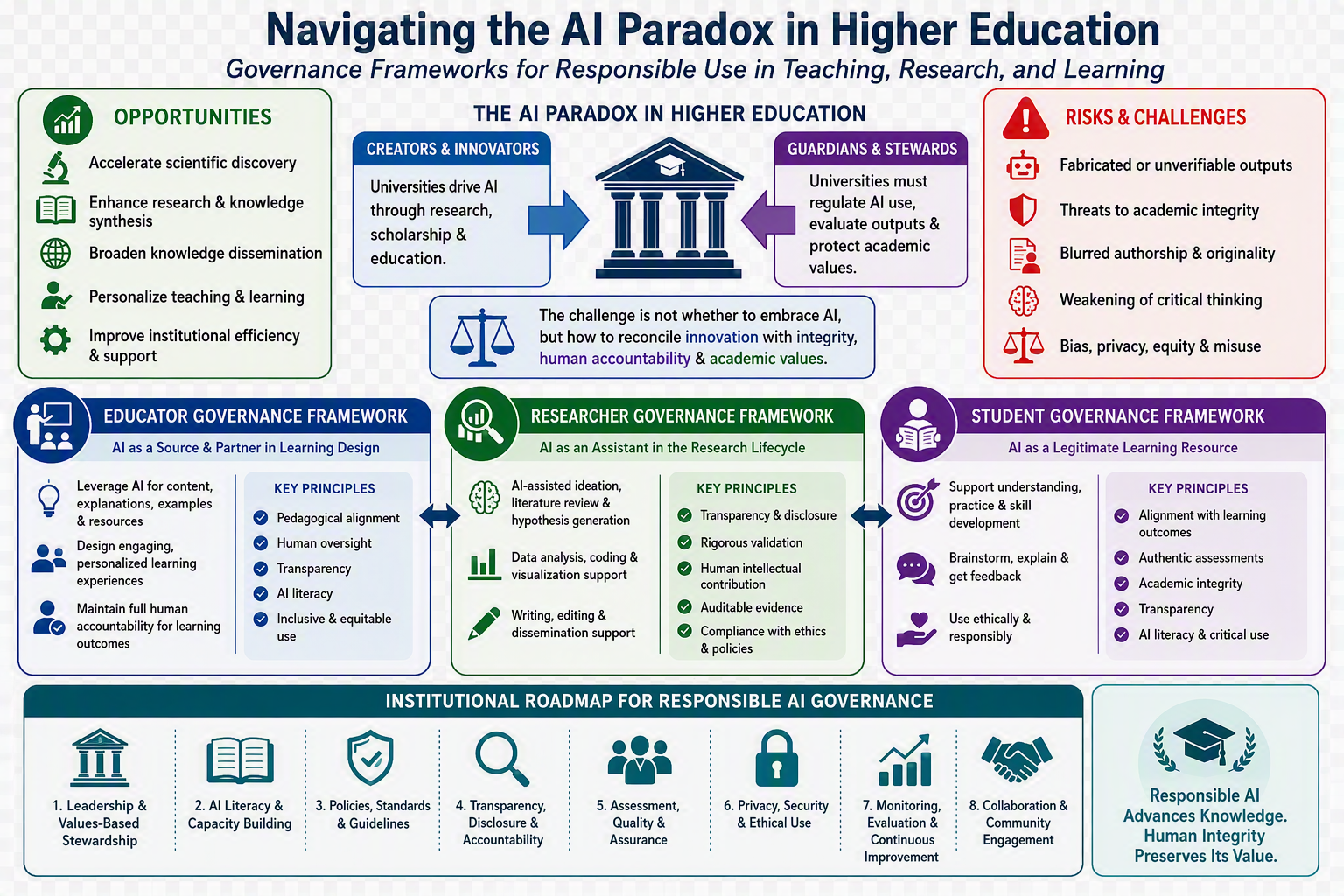
Artificial intelligence (AI) has emerged as one of the most transformative technologies of the twenty-first century, reshaping scientific discovery, academic research, knowledge dissemination, teaching, learning, and institutional operations. In higher education, however, AI presents a unique institutional challenge. Universities have played a central role in creating modern AI technologies through their research, scholarship, and educational activities, yet they are also among the institutions most responsible for regulating AI use, evaluating its outputs, and safeguarding the academic values most affected by it. This paper conceptualizes this tension as the AI paradox in higher education. Drawing on recent empirical research, systematic reviews, policy frameworks, and governance initiatives, the paper examines both the opportunities and challenges associated with AI adoption across teaching, research, and learning. It argues that the central challenge facing higher education is not whether AI should be embraced or restricted, but how universities can reconcile their dual roles as innovators and guardians of academic integrity, intellectual originality, scientific rigor, and educational quality. To address this challenge, the paper proposes three integrated governance frameworks for educators, researchers, and students. The educator framework positions AI as a source of content and a partner in learning design while maintaining full human accountability for educational outcomes. The research framework permits AI-assisted ideation and dissemination support while requiring transparent disclosure, rigorous validation, and auditable evidence of human intellectual contribution. The student framework recognizes AI as a legitimate learning resource while maintaining that assessment should remain aligned with intended learning outcomes and authentic student achievement. The paper concludes by presenting an institutional roadmap for responsible AI governance grounded in human accountability, AI literacy, transparency, and values-based stewardship. Together, these contributions provide a principled approach for navigating the AI paradox while enabling responsible innovation across higher education.
Keywords:
artificial intelligence
; higher education
; scientific discovery
; academic research
; knowledge dissemination
; academic integrity
; AI literacy
; generative AI
1. Introduction
Artificial intelligence (AI) has emerged as one of the most powerful and transformative technologies of the twenty-first century. Across sectors ranging from healthcare and finance to manufacturing and public governance, AI is reshaping how problems are understood, decisions are made, and value is created. In higher education, its impact is particularly far-reaching. AI has the potential to accelerate scientific discovery through enhanced hypothesis generation, experimental design, and data analysis; transform academic research through automated literature synthesis and knowledge extraction; and broaden the dissemination of knowledge through intelligent editing, translation, and publishing support. At the same time, AI is reshaping how universities design curricula, deliver instruction, assess learning, support students, and manage institutional operations.
Yet the relationship between higher education and AI is characterized by a striking paradox. Universities have played a central role in creating the AI revolution. They have produced much of the foundational research, educated the scientists and engineers behind modern AI systems, and contributed significantly to the theoretical and technological advances that underpin generative AI. Modern AI is, in many respects, a product of university-based scholarship.
At the same time, universities now find themselves among the institutions most challenged by the technologies they helped create. Unlike many other sectors that can adopt AI primarily as a productivity-enhancing tool, higher education must simultaneously embrace innovation and safeguard the academic values upon which its mission depends. Universities are responsible not only for generating knowledge but also for evaluating knowledge, certifying competence, cultivating critical thinking, preserving academic integrity, validating scientific discoveries, and maintaining the credibility of scholarly communication.
This creates what may be described as the AI paradox in higher education. Universities are simultaneously among the principal creators of AI technologies and the institutions most responsible for regulating their use, evaluating their outputs, and mitigating their unintended consequences. The same technologies that can accelerate scientific discovery may also generate fabricated or unverifiable claims. The same tools that can personalize learning may also weaken independent reasoning if used uncritically. The same systems that can support scholarly writing and dissemination may also blur traditional notions of authorship, originality, and intellectual contribution.
Consequently, higher education occupies a unique position as both the architect of AI innovation and the guardian of the academic values most affected by AI. The central challenge is therefore not whether AI should be embraced or rejected, but how universities can reconcile these competing responsibilities. Navigating this AI paradox requires governance approaches that simultaneously promote innovation and preserve academic integrity, human accountability, scholarly rigor, and educational quality.
This institutional AI paradox provides the conceptual foundation for the governance frameworks developed in this paper and serves as the unifying lens through which the opportunities, challenges, and governance responses associated with AI in higher education are examined.
The COVID-19 pandemic accelerated the digital transformation of higher education and highlighted the need for scalable, flexible, and personalized approaches to teaching and learning. AI technologies quickly emerged as powerful tools capable of addressing many of these needs. However, the rapid rise of generative AI has introduced challenges that extend well beyond technological adoption. Universities must now balance the potential of AI to enhance teaching, learning, research, and scientific discovery with their responsibility to preserve academic integrity, intellectual rigor, and institutional credibility.
The central question is therefore not whether AI should be adopted, but how it can be integrated responsibly, ethically, and effectively. Institutions must navigate complex issues related to authorship, originality, assessment, transparency, accountability, privacy, and equity while ensuring that AI complements rather than replaces human intellectual activity.
This paper examines this challenge in depth. Section 2 reviews the current literature on AI in higher education. Section 3 explores the opportunities AI presents for teaching, research, scientific discovery, and knowledge dissemination. Section 4 analyzes the risks and challenges associated with AI adoption. Section 5 examines emerging policy and governance frameworks. Section 6 describes the methodology used to develop the proposed frameworks. Section 7 through 9 present three practical frameworks for educators, researchers, and students. Section 10 outlines a principled pathway forward, and Section 11 concludes the paper.
1.1. Contributions of This Paper
As AI adoption accelerates across higher education, institutions are facing a rapidly evolving and often fragmented landscape of policies, practices, and expectations. Existing research provides valuable insights into AI applications, ethical concerns, and governance considerations, but clear operational guidance remains limited. Moreover, much of the literature focuses on the opportunities and risks of AI or on the technological implications of adoption without fully addressing the unique institutional tension faced by universities as both creators and regulators of AI technologies. This paper seeks to address that gap through four primary contributions.
First, the paper introduces the concept of the AI paradox in higher education as a unifying lens for understanding current institutional challenges. While previous discussions have highlighted tensions between innovation and risk, opportunity and threat, or adoption and readiness, this paper argues that the fundamental paradox is institutional in nature. Universities are simultaneously among the principal creators of AI technologies and the primary guardians of the academic values most affected by those technologies. This conceptual framing provides the foundation for the governance frameworks developed throughout the paper.
Second, the paper provides a comprehensive and current synthesis of the literature on AI in higher education. Drawing upon systematic reviews, bibliometric studies, empirical research, and international policy frameworks, it maps the evolving role of AI across teaching, learning, research, scientific discovery, and scholarly communication.
Third, the paper presents a balanced examination of AI’s opportunities and challenges. It analyzes the substantial benefits that AI can offer, including personalized learning, expanded research capacity, accelerated scientific discovery, improved accessibility, and enhanced knowledge dissemination. At the same time, it examines critical concerns relating to academic integrity, equity, governance, data privacy, institutional readiness, research originality, and the potential erosion of critical thinking and independent scholarship.
Fourth, and most importantly, the paper introduces three practical, principle-based governance frameworks for the responsible use of AI in higher education. These frameworks establish clear boundaries, responsibilities, and expectations for educators, researchers, and students. To the best of our knowledge, no existing framework integrates operational guidance for all three stakeholder groups within a single coherent model while simultaneously emphasizing human accountability, research provenance, auditable evidence of originality, and alignment between AI use and educational objectives.
Taken together, these contributions move the discussion beyond the polarized positions of uncritical adoption and outright rejection. Instead, the paper proposes a principled, human-centred approach for navigating the AI paradox in higher education, one that seeks to capture the benefits of AI while safeguarding the integrity of education, research, scientific discovery, and scholarly communication.
2. Literature Review
2.1. Overview of Research Activity
The academic literature on artificial intelligence in higher education has grown exponentially in recent years. A systematic review of 155 peer-reviewed empirical studies published between 2015 and 2025 reveals a significant increase in research activity since 2022. This surge corresponds with the public release of advanced generative AI tools, which fundamentally altered the landscape of educational technology discourse. Lang et al. [20] provide a comprehensive overview of how generative AI is transforming education, identifying key insights and future prospects across pedagogical, technological, and ethical dimensions.
Bibliometric analyses further confirm this trend. Zawacki-Richter et al. [1] conducted a systematic review of research on AI applications in higher education, analyzing 146 publications and identifying key trends, including the predominance of AI in assessment and learning analytics, the increasing use of adaptive learning systems, and the growing attention to ethical and policy dimensions. The findings indicate that research has moved from early explorations of AI’s potential to empirical investigations of implementation, outcomes, and ethical implications. Notably, a growing subset of this literature specifically addresses AI’s role in accelerating scientific discovery—from automated hypothesis generation to robotic laboratory automation—and in transforming scholarly communication through intelligent peer-review assistance and multilingual translation tools.
2.2. Thematic Clusters in AI Education Research
Thematic integrative reviews of peer-reviewed research and policy literature published between 2011 and 2025 have identified several major thematic clusters [2]. These include:
Applications and Users: Research on AI applications in higher education spans personalized learning systems, intelligent tutoring platforms, automated assessment tools, and administrative support systems. Studies consistently show that AI-driven personalization, adaptive learning, and gamification approaches can improve motivation and retention.
Pedagogical Transformation: A systematic review synthesizing empirical evidence on generative AI implementation proposes an integrated framework of best practices for pedagogical transformation. Crompton and Burke [3] conducted a comprehensive review of AI in higher education, examining the state of the field and identifying key applications, benefits, and challenges. Tlili et al. [4] provided a case study analysis of ChatGPT, exploring both opportunities and challenges for generative AI in education. This research examines student and faculty perceptions, institutional integration strategies and barriers, ethical risks, and pedagogical innovation potential.
Research and Discovery: An emerging cluster focuses on AI’s role in accelerating research workflows—literature discovery, data analysis, hypothesis generation, and manuscript preparation—alongside the ethical challenges of maintaining scientific rigour and originality in AI-assisted research. Wang et al. [5] reviewed the rapid development and integration of large language models in scientific research, highlighting their evolution from tools of convenience to pivotal aids in hypothesis generation, experimental design, and process automation.
Ethics and Governance: Emerging concerns related to ethics, including algorithmic bias, data privacy, academic integrity, and the risks of overreliance on automation, constitute a major research theme [6]. Policy gaps and governance challenges are consistently identified as critical barriers to responsible AI integration. Bearman et al. [24] examined the implications of generative AI for assessment and governance in higher education, proposing frameworks for institutional response.
Institutional Consequences: Research on institutional consequences examines how AI adoption affects organizational structures, faculty roles, assessment practices, and institutional culture.
2.3. Methodological Approaches
The literature employs diverse methodological approaches. Narrative reviews provide multidimensional perspectives on AI’s pedagogical, assessment, ethical, psychological, and institutional governance implications. Systematic reviews following PRISMA guidelines offer rigorous syntheses of empirical evidence. Empirical studies employ quantitative surveys, qualitative interviews, focus groups, and mixed-methods designs to capture stakeholder perspectives. Dipierro, De Witte, and Toma [7] provide a notable example of combining bibliometric and systematic literature review methods to examine nonparametric efficiency and AI techniques in higher education.
2.4. Key Findings and Research Gaps
Several key findings emerge from the literature. First, while AI tools are widely used—with nine in ten respondents to a UNESCO global survey reporting using AI tools in their professional work—institutional readiness remains strikingly low, with only 8–11% of respondents believing their institutions are ready for generative AI integration [8]. Second, there is a significant gap between AI use and formal policy development: while nearly two-thirds of higher education institutions either already have guidance on AI use or are developing it, only 19% have a formal AI policy in place [8].
Third, the literature reveals a gap in aligning institutional readiness, AI literacy, and learner needs. Fourth, research consistently identifies the mediating role of teaching methods in AI integration as underexplored. Fifth, the literature calls for more research on AI-resilient assessment design, faculty training models, and the long-term effects of AI on critical thinking and learning outcomes. Finally, there is a notable gap in empirical studies examining how AI affects the quality and integrity of scientific discovery and scholarly dissemination specifically, with most research focusing on pedagogical applications.
3. Opportunities: AI as a Transformative Force in Higher Education
3.1. Accelerating Scientific Discovery
Perhaps the most profound opportunity AI affords higher education lies in its capacity to accelerate scientific discovery. AI systems can process vast volumes of scientific literature, identify patterns across disparate disciplines, and generate novel hypotheses that human researchers might overlook [5]. In fields ranging from drug discovery to materials science to climate modelling, AI has demonstrated the ability to propose candidate solutions, simulate complex systems, and prioritize experimental pathways with unprecedented speed.
Wang et al. [5] reviewed how large language models have evolved from performing tasks like summarising literature and analysing datasets to emerging as pivotal aids in hypothesis generation, experimental design, and process automation. The authors note that LLMs facilitate interdisciplinary research by bridging the knowledge divide—summarising complex ideas across fields and fostering collaborations previously limited by domain-specific language and methods [5].
AI-driven hypothesis generation represents a paradigm shift in how scientific inquiry is conducted. Rather than relying solely on human intuition and incremental literature review, researchers can now leverage AI to explore vast hypothesis spaces, identify promising research directions, and design experiments that maximize information gain. This capability is particularly valuable in complex, data-rich domains where the combinatorial possibilities exceed human cognitive capacity.
3.2. Advancing Research Capabilities
Beyond discovery, AI dramatically enhances the efficiency and depth of academic research workflows. AI tools are increasingly used for literature review automation, data analysis, natural language processing of unstructured data, and the rapid distillation of academic papers. Nine in ten respondents to a UNESCO global survey reported using AI tools in their professional work, most commonly for research and writing tasks [8].
AI’s capacity to process vast amounts of information and identify patterns that might escape human researchers represents a genuine advance in knowledge production. The review of AI innovations in higher education institutions has unveiled many opportunities, including enhanced research capabilities, automation of administrative tasks, personalized learning, and improved inclusivity and accessibility of educational content. In the research domain specifically, AI-powered tools for statistical analysis, image recognition, and natural language processing are enabling new forms of inquiry across the humanities, social sciences, and natural sciences.
3.3. Transforming Knowledge Dissemination
AI is fundamentally reshaping how scholarly knowledge is disseminated and accessed. Intelligent editing tools help researchers improve clarity, grammar, and stylistic consistency in manuscripts. Automated translation services make research accessible across language barriers, democratizing access to scientific knowledge. AI-powered recommendation systems help readers discover relevant publications, while automated summarization tools enable rapid comprehension of lengthy papers.
Open-access publishing workflows are being optimized through AI-assisted peer review, plagiarism detection, and formatting automation. The FAIR framework (Fairness, Accountability, Integrity, Reproducibility) exemplifies a hybrid approach that combines AI-enabled consistency and speed with essential human expertise for novelty assessment and ethical evaluation [9]. These innovations reduce the time between discovery and dissemination, accelerating the pace of scientific progress. However, as discussed in subsequent sections, these same capabilities introduce risks to the integrity of scholarly communication that must be carefully managed. Nature [19] has provided editorial guidance on maintaining research integrity while leveraging these dissemination tools.
3.4. Personalised and Adaptive Learning
One of the most promising applications of AI in higher education lies in its capacity to personalise learning at scale. AI-driven personalization, adaptive learning, and gamification approaches have been shown to improve motivation and retention, while immersive tools such as virtual reality enhance experiential learning. AI systems can analyse student performance data in real time, identify learning gaps, and deliver tailored content that addresses individual student needs.
The integration of large language models into personalized learning environments offers particular promise. Studies have demonstrated that AI-powered tutoring systems can provide engaging educational experiences and strengthen critical thinking. For example, universities such as the University of Texas at Austin have developed generative AI teaching and learning chatbot platforms that offer both a tutorbot interface for students and an instructional design agent to coach faculty in creating custom tutors.
3.5. Enhancing Teaching and Curriculum Design
AI is fundamentally reshaping the role of educators. Rather than serving as simple vessels of knowledge or managers of classrooms, teachers are transforming into designers, facilitators, and guides of the learning process. This reorientation enables faculty to focus on higher-order pedagogical activities while AI handles routine tasks such as grading, content summarization, and administrative coordination.
AI tools are increasingly used for lesson planning, grading support, writing assistance, and data analysis. Faculty report that AI helps them create real-world examples for lectures, saving time that would otherwise be spent searching for examples from various sources. Shata and Hartley [10] found that college professors’ perceived usefulness of AI predicted their attitudes and intention to use and adopt the technology, with trust and social reinforcement strongly influencing adoption decisions. Ma et al. [21] examined how generative AI is driving curriculum reform in higher education, emphasizing the need for systematic approaches to prepare students for an AI-driven world. Chu and Ashraf [22] proposed a data-driven approach to AI in curriculum design, demonstrating how AI can support innovation in higher education course development.
3.6. Democratising Access to Education
AI-powered technologies have the potential to become a democratising force in education, enabling transformative experiences while adding value to traditional pedagogical approaches. AI can provide tutoring that supports personalized learning at scale and tailored mentoring that no overstretched faculty could otherwise deliver. For students in resource-constrained institutions or developing countries, AI tools can bridge gaps in access to quality educational materials and expert guidance.
4. Challenges: The Threat to Academic Integrity and Institutional Values
4.1. Academic Integrity and Assessment
The proliferation of generative AI has challenged the credibility of assessment in higher education. The unregulated use of generative AI may blur the boundaries between legitimate assistance and academic misconduct, heightening the potential for plagiarism. Over 75% of respondents in a major study reported ethical concerns, data privacy issues, and risks to academic integrity as significant challenges [6].
The challenges are not merely theoretical. Students with higher GPAs express deep concerns about dependency, plagiarism, and the erosion of critical thinking skills. Technical countermeasures, including digital proctoring systems, have been critically evaluated and found insufficient as standalone solutions. The problem is not simply one of detection but of fundamental pedagogical design: existing curricula and assessment procedures show room for modification in light of generative AI capabilities.
4.2. Integrity of Scientific Discovery and Research
Beyond pedagogical concerns, AI poses profound challenges to the integrity of scientific discovery and research. The ease with which AI can generate plausible-sounding but incorrect or fabricated information—sometimes termed “hallucination”—introduces risks of scientific error propagating through the literature. Wang et al. [5] caution that while helpful in generating hypotheses, these models require careful oversight to prevent misleading or unverified information from influencing scientific processes. They note that challenges of reasoning and hallucinations pose serious concerns regarding the use of LLMs in scientific discovery [5].
In research writing, the use of AI to generate text, analyse data, or suggest interpretations can obscure the human contribution and make it difficult to verify the provenance of claims. If researchers rely on AI without rigorous validation, the quality and trustworthiness of scientific outputs may decline. Furthermore, AI tools trained on existing literature may perpetuate existing biases, leading to the reinforcement of entrenched paradigms rather than genuine novelty. The Committee on Publication Ethics (COPE) [25] has provided structured guidance on AI and authorship, establishing principles for responsible use of generative AI in research and publication.
4.3. Threats to Scholarly Dissemination
AI’s role in knowledge dissemination introduces additional challenges. Automated paper mills can generate large volumes of superficially plausible but low-quality manuscripts, overwhelming peer reviewers and editors. AI-assisted plagiarism and paraphrasing tools make it easier to circumvent detection. The proliferation of AI-generated content in preprint servers and open-access platforms threatens to flood the scholarly ecosystem with noise, making it harder for genuine discoveries to be noticed and validated.
4.4. Institutional Readiness and Policy Gaps
Despite high levels of AI use, institutional readiness remains strikingly low. A UNESCO global survey found that while nearly two-thirds of higher education institutions either already have guidance on AI use or are developing it, only 19% have a formal AI policy in place [8]. This policy gap leaves educators, students, and researchers navigating AI use without clear institutional guidance.
The situation reveals significant regional variation: around 70% of institutions in Europe and North America have or are developing guidance, compared to 45% in Latin America and the Caribbean. This disparity threatens to create a new digital divide in higher education, where without deliberate policy, generative AI will widen the gaps that already separate students, institutions, and nations.
4.5. Teacher Training and Technological Fluency
The use of AI systems makes stringent demands on teachers’ technological fluency. Acquiring new technical knowledge and learning new operational skills takes considerable effort, and for educators accustomed to traditional teaching methods, this becomes a significant obstacle. Most teachers have limited experience with AI technologies and require systemic training and relevant experience to become skillful in performing learning design, learning analysis, and successful interactions with learners.
4.6. Data Privacy and Security
The collection and use of student learning data for AI systems creates serious privacy and security issues. Student learning data ranges from knowledge mastery and subject matter understanding to learning habits. A primary challenge is the need to protect this data over its entire lifecycle: when it is collected and stored, as well as during transmission and during analysis.
4.7. Equity and the Risk of Reinforcing Inequalities
While AI has the potential to democratise education, it also risks reinforcing prevailing inequities. Concerns about algorithmic bias, fair access, and the digital divide are central to ethical discussions of AI in education. Institutions and students with greater resources will have better access to AI tools and the training to use them effectively, potentially widening existing gaps.
4.8. Overreliance and the Erosion of Critical Thinking
Perhaps the most profound pedagogical concern is the risk that AI overuse may undermine students’ belief in their own competencies. Irresponsible and excessive use of AI could pose significant challenges to the development of critical thinking, creativity, and the practical application of knowledge. Concerns have been raised that these tools could encourage plagiarism, passivity, and a reduction in professional autonomy for teachers.
5. Policy Frameworks and Governance Responses
5.1. International Frameworks
Recognizing the urgency of the challenge, international organizations have moved to provide guidance. UNESCO published the AI competency framework for students and the AI competency framework for teachers in 2024 to help education systems keep pace with the rapid advances in AI [14,15]. These frameworks define the knowledge, skills, and attitudes that students and teachers should possess to understand the roles of AI in education and utilize AI in their teaching and learning practices in an ethical, safe, and meaningful way.
The OECD has also contributed to this discourse through its Digital Education Outlook 2026, which warns that the uncritical adoption of generative AI may undermine key human skills such as critical thinking and evaluative judgment in students, and calls for a shift away from off-the-shelf chatbots toward purpose-built educational AI systems [16].
5.2. National Policy Frameworks
Several nations have developed comprehensive policy frameworks for AI in higher education. Ireland’s Higher Education Authority published a national policy framework in December 2025 to guide the responsible, values-based adoption of generative AI in Irish higher education [17]. The framework is grounded in five core principles: academic integrity, transparency and accountability; equity and inclusion; critical engagement, human oversight and AI literacy; privacy and data governance; and sustainable pedagogy.
The framework acknowledges that generative AI tools are already part of how students and staff work and clarifies that higher education needs a coordinated response rather than ad-hoc local decisions. It reflects the principle that “our sector needs to move beyond both uncritical adoption and uncritical rejection and towards a principled approach that keeps academic judgement and educational excellence at the centre” [17].
5.3. Institutional Approaches
At the institutional level, contrasting approaches to AI governance have emerged. Some higher education institutions adopt a regulatory approach that focuses attention on detecting AI use and managing the consequences of use that are considered unethical. Others take an iterative emergent approach that involves systematic consultation and engagement with students and faculty, the introduction of AI literacy as a mandatory course for first-year students, and a process of redesigning the university’s assessment system. Fawns et al. [23] examined higher education’s response to generative AI, providing insights into institutional adaptation and governance strategies. Bearman et al. [24] offer a framework for institutional AI governance that synthesizes these approaches into a structured implementation model.
6. Framework Development Methodology
Before presenting the three operational frameworks, it is important to clarify their methodological derivation. The frameworks were synthesized from three interrelated sources. First, the systematic literature review findings presented in Section 2—particularly the thematic clusters of applications, pedagogical transformation, research and discovery, ethics and governance, and institutional consequences—provided the empirical foundation for identifying the core functional domains requiring governance. Second, international and national policy frameworks (UNESCO competency frameworks [14,15], the OECD Digital Education Outlook [16], Ireland’s HEA National Policy Framework [17], and the governance frameworks proposed by Fawns et al. [23] and Bearman et al. [24]) supplied normative principles and governance models that were adapted into operational guidance. Third, recurring themes identified across higher education governance initiatives—including the distinction between AI as a learning resource versus an assessment deliverable, the requirement for human accountability, and the need for transparent documentation—were distilled into actionable principles. This tripartite synthesis approach ensures that the frameworks are empirically grounded, policy-aligned, and practically implementable across diverse institutional contexts.
7. Framework for Proper Use of AI in Curriculum and Course Development (Educators)
The integration of AI into curriculum and course development requires a structured, principled approach that balances innovation with educational values. For educators, AI must be positioned as an enabling assistant rather than a replacement for professional pedagogical judgement. This framework establishes clear boundaries and responsibilities. Chu and Ashraf [22] provide a data-driven approach to AI in curriculum design, while Crawford et al. [12] describe faculty development models for integrating generative AI into higher education curricula.
7.1. AI as a Source of Educational Content
Educators should leverage AI as a dynamic and expansive source of educational content. This includes:
- Curating up-to-date materials: AI can rapidly synthesize recent developments, case studies, and real-world examples across disciplines, allowing educators to keep course content current with minimal administrative overhead.
- Generating diverse explanations and perspectives: AI can provide alternative explanations, analogies, and multimodal representations of complex concepts, enabling educators to address varied student learning styles.
- Creating practice materials: AI can generate formative quizzes, problem sets, and scenario-based exercises tailored to specific learning objectives.
- Translating and localizing content: For multilingual or international classrooms, AI can assist in making content accessible without compromising accuracy.
However, educators must treat AI-generated content as raw material requiring rigorous vetting. All outputs must be checked for factual accuracy, disciplinary appropriateness, cultural sensitivity, and potential bias before being incorporated into any formal teaching resource.
7.2. AI as a Tool for Learning Design
AI serves as a powerful partner in the instructional design process. Educators can utilize AI to:
- Design learning pathways: AI can suggest sequences of activities, readings, and assessments that scaffold student learning from foundational to advanced levels.
- Develop authentic assessments: AI can propose project-based or problem-based assessment scenarios that mirror real-world professional challenges.
- Optimize session plans: AI can assist in structuring lecture timings, interactive elements, and breakout activities to maximize student engagement.
- Generate rubrics and feedback frameworks: AI can draft criteria for evaluating student work, which educators then refine to align with specific course outcomes.
7.3. Educator Accountability, Transparency, and Competence
The cornerstone of this framework is that AI may support educational design, but responsibility for educational quality remains entirely human. Regardless of whether AI has contributed to a syllabus, lecture, assessment, rubric, case study, or learning activity, the educator remains accountable for the final product delivered to students.
Educators are expected to maintain:
- Academic accountability: responsibility for the accuracy, currency, depth, and pedagogical appropriateness of instructional materials.
- Ethical accountability: responsibility for identifying and mitigating bias, misinformation, intellectual-property concerns, and inappropriate content.
- Professional accountability: responsibility for alignment with course outcomes, program objectives, accreditation requirements, and institutional policy.
- Transparency: where AI has played a substantive role in generating instructional materials or assessment designs, educators should be prepared to disclose and explain how AI was used.
- AI competency: educators should possess sufficient AI literacy to evaluate outputs critically, understand system limitations, recognize hallucinations and bias, and use AI responsibly.
AI-generated content should therefore be treated as a draft, recommendation, or source of ideas rather than as an authoritative educational product.
7.4. Faculty Training and Infrastructure
To implement this framework, institutions must invest in faculty training that focuses not only on technical prompting skills but also on critical evaluation of AI outputs, awareness of AI limitations and biases, and integration of AI into authentic assessment. Dedicated instructional design support should be available to help educators use AI responsibly without being overwhelmed. Crawford et al. [12] provide practical models for faculty development through structured professional learning programs that build these competencies.
8. Framework for Proper Use of AI in Research, Scientific Discovery, and Publishing
The use of AI in research, scientific discovery, and scholarly publishing presents unique ethical and practical challenges. This section proposes a framework emphasizing the researcher’s ownership of original ideas, rigorous validation of scientific findings, and the obligation to demonstrate novelty and unpublished status of results—while permitting AI’s use as a legitimate aid in dissemination. Nature [19] provides editorial guidance on AI and research integrity, and the Committee on Publication Ethics (COPE) [25] offers structured principles for responsible AI use in research contexts.
8.1. AI for Developing and Formulating Ideas
AI may be legitimately used as a cognitive partner in the early and middle stages of research to:
- Brainstorm research questions: AI can help explore potential gaps in the literature and suggest novel angles of inquiry, provided these are subsequently validated by human expertise.
- Refine hypotheses: AI can assist in structuring and articulating hypotheses based on existing theoretical frameworks.
- Organize literature reviews: AI can summarize large bodies of work, identify key authors, and highlight debates, aiding the researcher in situating their contribution.
- Improve clarity and structure: AI can assist in drafting, paraphrasing, and editing manuscripts to enhance readability, provided the substantive intellectual content remains the researcher’s own.
8.2. Evidence of Original Human Ideation, Research Provenance and Scientific Contribution
The fundamental boundary is that the core intellectual contribution of a scholarly work must originate from the researcher rather than from an AI system. Researchers therefore bear responsibility for demonstrating, where appropriate, the human origin of the central ideas, hypotheses, interpretations, theories, designs, or discoveries presented in their work.
Recognizing disciplinary diversity, evidence of human ideation may take different forms depending on the nature of the research. Appropriate evidence may include:
- Laboratory notebooks and research journals.
- Conceptual diagrams and design sketches.
- Preliminary calculations and exploratory analyses.
- Annotated literature reviews.
- Draft manuscripts and evolving outlines.
- Code repositories and version histories.
- Reflective research notes.
- Recorded research discussions and meeting notes.
- Documented histories of AI-assisted interactions, including prompts and responses.
In AI-assisted research, prompt histories may themselves constitute valuable evidence of human intellectual contribution. A sequence of prompts, critiques, revisions, and follow-up inquiries can demonstrate how the researcher framed problems, evaluated AI-generated suggestions, redirected lines of inquiry, and exercised scholarly judgment. Such records may serve as evidence that AI functioned as a research aid rather than as the originator of the core contribution.
The objective is not to impose excessive documentation requirements, but to maintain reasonable and auditable evidence of research provenance appropriate to the disciplinary context and methodological approach.
8.3. Rigorous Validation of Scientific Findings
AI-assisted discoveries must undergo the same—or even more rigorous—validation standards as traditionally derived findings. Researchers must:
- Independently verify AI-generated outputs: Any experimental prediction, data analysis, or pattern identified by AI must be confirmed through independent methods.
- Address potential biases: Researchers must critically examine whether AI tools have introduced or amplified biases in data selection, analysis, or interpretation.
- Reproduce results: Where applicable, AI-assisted findings must be reproducible using established scientific methods, and the role of AI in the reproducibility chain must be transparent.
8.4. Novelty and Unpublished Results
Researchers bear the sole burden of ensuring that their findings are new and have not been previously published. AI tools do not absolve this responsibility:
- Comprehensive novelty checks: Researchers must conduct thorough literature searches (aided by AI but verified manually) to confirm that the core findings or contributions are genuinely novel.
- Plagiarism and duplication detection: Even if AI assists in writing, the researcher must run the final manuscript through plagiarism and duplication-checking software to ensure it does not inadvertently duplicate existing published work, including their own prior publications.
- Declaration of originality: The submission must include a clear statement, signed by the author(s), confirming that the results are original and unpublished, and that all AI use has been transparently disclosed.
8.5. Authorship, Accountability, and Transparency
A widespread consensus exists that AI cannot be listed as an author [18]. Human authors bear exclusive responsibility for all submitted work. Researchers must:
- Document AI use just like any other tool or method in the methodology section or acknowledgments.
- Verify all AI-generated data, citations, and analyses before submission.
- Maintain human accountability for every claim, figure, and conclusion in the paper.
Transparency should focus not only on whether AI was used, but also on how human judgment shaped, validated, and ultimately determined the final scholarly contribution.
8.6. Responsible Use of AI in Dissemination
AI may be used to support knowledge dissemination, but always under human oversight:
- Language polishing and translation: AI may be used to improve readability or translate manuscripts, provided the substantive content remains unchanged and such use is disclosed.
- Metadata and keyword generation: AI may assist in generating search-optimized abstracts or keywords, but the researcher must verify accuracy.
- Peer review assistance: AI may be used to screen manuscripts for basic formatting, ethical compliance, or plagiarism, but substantive peer review must remain a human intellectual activity.
8.7. Data Security and Privacy
Protection of sensitive research data is non-negotiable. Researchers must not input proprietary, classified, or personally identifiable information into public AI tools unless explicitly permitted. Institutions should provide secure, institutionally hosted AI solutions for research use.
9. Framework for Proper Use of AI in Learning (Students)
For students, AI represents a transformative educational resource, but its use must be governed by a clear distinction between AI as a learning aid and AI as an assessed outcome. This framework positions AI primarily as a tool for supporting learning, understanding, practice, feedback, exploration, and creativity. Assessment should ordinarily evaluate the student’s own knowledge, reasoning, judgment, and intellectual effort.
However, this principle is not intended to prohibit legitimate assessment of AI-related competencies. In courses where the effective use, evaluation, design, or application of AI systems is itself an explicit learning objective, AI-generated outputs may form part of assessed work, provided that their use is transparent, appropriately documented, and aligned with stated learning outcomes.
9.1. AI as a Source of Learning
Students should treat AI as an interactive, on-demand tutor and a supplementary learning resource, akin to a library, a teaching assistant, or a peer study group. Appropriate uses for learning include:
- Explaining difficult concepts: Asking AI to rephrase, simplify, or provide analogies for challenging theoretical material.
- Providing worked examples: Requesting step-by-step solutions to practice problems to understand the methodology, followed by the student solving a new problem independently.
- Offering feedback on drafts: Using AI to check grammar, coherence, or structure of a draft—while the student retains full ownership of the content and argument.
- Generating practice questions: Creating self-testing materials to reinforce knowledge before examinations.
- Brainstorming angles: Exploring different perspectives on an essay topic to stimulate the student’s own critical thinking.
9.2. The Boundary Between Learning Support and Assessment
The central principle is not that AI-generated content can never appear in an assessment submission. Rather, the principle is that assessment should accurately measure the learning outcomes it is intended to evaluate.
Accordingly:
- Where the objective is subject knowledge, critical thinking, communication, or problem solving, submitted work should primarily reflect the student’s own intellectual contribution.
- Where the objective includes AI literacy, prompt engineering, AI evaluation, human-AI collaboration, or responsible AI use, AI-generated outputs may appropriately form part of the assessment.
- Students should be prepared to explain how AI was used, what decisions they made independently, and how they evaluated or modified AI-generated contributions.
- Significant AI use should be disclosed according to course and institutional requirements.
The educational objective is not to prevent students from using AI, but to ensure that assessment remains a valid measure of intended learning outcomes.
9.3. Critical Evaluation and Academic Integrity
Students are expected to:
- Critically evaluate any AI-generated information, verifying it against authoritative sources, as AI is prone to errors and biases.
- Acknowledge all AI use when it has substantively influenced their work, even if the final output is their own, following institutional guidelines for disclosure.
- Understand institutional policies: Students must be aware of what constitutes permissible versus impermissible AI use in each course.
9.4. Progression in AI Literacy
Institutions should scaffold AI literacy so that students progressively learn to use AI responsibly:
- Prepare: Foundational awareness of AI capabilities, limitations, and ethical issues.
- Understand: Basic mechanics of AI systems, algorithmic bias, and data privacy.
- Apply: Use AI appropriately for learning tasks while respecting academic boundaries.
- Responsible Use: Critically evaluate outputs and maintain academic integrity [13].
9.5. Equitable Access
Institutions must ensure equitable access to AI tools so that AI does not become a source of advantage for only the most resourced students, thereby reinforcing existing inequalities.
10. Toward a Principled Path Forward
10.1. AI Literacy as a Foundational Competency
A central recommendation emerging from the literature is the need to develop AI literacy as a foundational competency for both educators and students. This goes beyond mere technical training to encompass critical engagement with AI tools, understanding of their limitations and biases, and the ethical implications of their use.
UNESCO’s competency frameworks provide a valuable starting point, outlining competencies across dimensions including a human-centred mindset, ethics of AI, and AI techniques and applications [14,15]. Institutions should integrate AI literacy into curricula and professional development programs, ensuring that all members of the academic community can engage with AI critically and responsibly—whether they are engaged in teaching, learning, scientific discovery, or scholarly dissemination.
10.2. Redesigning Assessment for the AI Era
The challenges AI poses to traditional assessment methods demand a fundamental rethinking of how universities evaluate student learning. This includes developing AI-resilient assessment practices that emphasize process over product, critical thinking over content recall, and authentic application over standardized responses. Assessment redesign should focus on what AI cannot do: demonstrate original thought, engage in genuine critical analysis, apply knowledge in novel contexts, and reflect on one’s own learning process.
10.3. Strengthening Research Integrity and Peer Review
To protect the integrity of scientific discovery and dissemination, institutions and publishers must strengthen research integrity mechanisms. This includes developing clear guidelines for AI use in research and publishing, enhancing peer review processes to detect AI-generated or AI-assisted content, requiring data and code availability to verify AI-assisted analyses, and establishing mechanisms for auditing the provenance of scientific claims. The FAIR framework offers one principled approach to hybrid peer review that combines AI-enabled consistency with essential human expertise [9]. Nature [19] provides additional editorial guidance on implementing these mechanisms, while COPE [25] offers established principles for ethical AI use in publication.
10.4. Collaborative Governance
Effective AI governance in higher education requires collaboration among all stakeholders. Senior institutional leadership teams, teaching staff, students, academic support units, and IT and data-protection professionals all have defined areas of responsibility. This collaborative approach should extend to students, who are often the most active users of AI tools, and to researchers, who are at the frontier of AI-assisted discovery.
10.5. Investing in Infrastructure and Training
The high implementation cost of AI technology remains a significant obstacle, particularly for resource-constrained institutions. Universities must invest not only in hardware and software but in the professional development necessary for faculty and researchers to use AI effectively. This includes systemic training in learning design, research integrity, critical evaluation of AI outputs, and responsible use of AI in both pedagogy and scholarship.
10.6. Ethical Governance and Human-Centred Values
Ultimately, the path forward requires a commitment to ethical governance grounded in human-centred values. The principles articulated in emerging frameworks—academic integrity, transparency, equity, human oversight, and privacy—provide a normative foundation for AI integration. This means ensuring that AI enhances rather than replaces human intelligence, dignity, and agency, and that it serves the broader goals of advancing scientific knowledge, educating informed citizens, and disseminating knowledge for the public good.
11. Conclusions
The dilemma of using AI in higher education is not a problem to be solved but a tension to be managed. Universities are caught between their role as architects of AI capabilities and their responsibility as guardians of academic integrity. This is not a contradiction to be resolved but a dynamic to be navigated with wisdom, prudence, and a clear sense of purpose.
The opportunities AI presents are genuine and substantial: accelerated scientific discovery, enhanced research capabilities, democratized knowledge dissemination, personalized learning at scale, and the transformation of teaching from content delivery to facilitation and design. The challenges are equally real: threats to academic integrity, institutional unpreparedness, inadequate teacher training, data privacy concerns, equity gaps, risks to the integrity of scientific claims, and the erosion of critical thinking that higher education exists to cultivate.
The way forward lies not in embracing or rejecting AI but in engaging with it deliberately and principledly. For educators, this means using AI as a source of content and a design partner while accepting full accountability for every outcome delivered to students. For students, it means treating AI as a resource for learning, never as a product for submission. For researchers, it means using AI to formulate and disseminate ideas while providing rigorous proof of original human thought, robust validation of scientific findings, and strict verification of novelty and unpublished results.
At its core, the challenge examined in this paper stems from the AI paradox in higher education. Universities are simultaneously the architects of AI innovation and the guardians of the academic values most affected by that innovation. This dual responsibility creates a unique institutional tension that cannot be resolved through either unrestricted adoption or blanket restriction. Instead, it requires a deliberate governance approach that balances innovation with accountability, efficiency with integrity, and technological advancement with human judgment.
The task ahead is therefore not merely one of technological adoption but of institutional stewardship. Universities must continue to lead AI innovation while ensuring that the principles of academic integrity, intellectual originality, scientific rigor, critical inquiry, and human responsibility remain central to teaching, learning, research, and scholarly communication. Successfully navigating the AI paradox will determine not only how higher education adapts to AI, but also how it helps shape the future development and responsible use of AI for the broader benefit of society.
References
- Zawacki-Richter, V. I. Marín, M. Bond, and F. Gouverneur, “Systematic review of research on artificial intelligence applications in higher education – where are the educators?,”. Int. J. Educ. Technol. High. Educ. 2019, vol. 16(no. 1), 1–27. [CrossRef]
- Bond, M.; Zawacki-Richter, K.; Nichols, M. Artificial Intelligence in Higher Education: A Thematic Integrative Review of Applications, Users, Ethics, and Institutional Consequences. Br. J. Educ. Technol. 2025. [Google Scholar] [CrossRef]
- Crompton, H.; Burke, D. Artificial intelligence in higher education: the state of the field. Int. J. Educ. Technol. High. Educ. 2023, vol. 20(no. 1). [Google Scholar] [CrossRef]
- Tlili, et al. What if the devil is my guardian angel: ChatGPT as a case study of using chatbots in education. Smart Learn. Environ. 2023, vol. 10(no. 1), 15. [Google Scholar] [CrossRef]
- Wang, H.; et al. Scientific discovery in the age of artificial intelligence. Nature 2023, vol. 620, 47–60. [Google Scholar] [CrossRef] [PubMed]
- AlBlooshi. Artificial intelligence in higher education, opportunities, and challenges: a review. Front. Educ. 2026, vol. 10. [Google Scholar] [CrossRef]
- Dipierro, R.; De Witte, K.; Toma, P. Nonparametric efficiency and artificial intelligence techniques in higher education: a systematic literature review and bibliometric analysis. Int. Trans. Oper. Res. 2025, vol. 33(no. 3), 1427–1464. [Google Scholar] [CrossRef]
- UNESCO. “UNESCO survey: Two-thirds of higher education institutions have or are developing guidance on AI use,” UNESCO Digital Learning Week. Sep 2025. Available online: https://www.unesco.org/en/articles/unesco-survey-two-thirds-higher-education-institutions-have-orare- developing-guidance-ai-use.
- Checco, C.; Bracciale, L.; Loreti, P.; Pinfield, S.; Bianchi, G. AI-assisted peer review. Humanit. Soc. Sci. Commun. 2021, vol. 8(no. 1), 1–11. [Google Scholar] [CrossRef]
- Shata; Hartley, K. Artificial intelligence and communication technologies in academia: faculty perceptions and the adoption of generative AI. Int. J. Educ. Technol. High. Educ. 2025, vol. 22(no. 1). [Google Scholar] [CrossRef]
- 11. J. Liang et al., Pre-review to Peer review: Pitfalls of Automating Reviews using Large Language Models. arXiv 2025, arXiv:2503.12345.
- Crawford, J.; Cowling, M.; Allen, K. Leadership and faculty development for generative AI in higher education. J. Univ. Teach. Learn. Pract. 2023, vol. 20(no. 4). [Google Scholar]
- Grove, M. Designing the Student Learning Journey: A Practical Approach to Integrating Generative AI within Higher Education. MSOR Connect. 2025, vol. 24(no. 1), 5. [Google Scholar]
- UNESCO, AI competency framework for teachers. UNESCO Publishing, 2024. Available online: https://unesdoc.unesco.org/ark:/48223/pf0000391104.
- UNESCO, AI competency framework for students. UNESCO Publishing, 2024. Available online: https://unesdoc.unesco.org/ark:/48223/pf0000391105.
- OECD, OECD Digital Education Outlook 2026, OECD Publishing, 2026.
- O’Sullivan, J.; Lowry, C.; Woods, R.; Conlon, T. Generative AI in Higher Education Teaching & Learning: National Policy Framework; Higher Education Authority: Ireland, Dec 2025. [Google Scholar] [CrossRef]
- Alduais, S. Qadhi, Y. Chaaban, and M. Khraisheh, “Utilizing Generative AI Responsibly and Ethically for Research Purposes in Higher Education: A Policy Analysis,”. Ser. Rev. vol. 51(no. 3/4), 120, 2025. [CrossRef]
- Nature Editorial. Tools such as ChatGPT threaten transparent science; here are our ground rules for their use. Nature 2023, vol. 613, 612. [Google Scholar] [CrossRef] [PubMed]
- Lang, Q.; Wang, M.; Yin, M.; Liang, S.; Song, W. Transforming Education with Generative AI (GAI): Key Insights and Future Prospects. IEEE Trans. Learn. Technol. 2025, vol. 18, 230–242. [Google Scholar] [CrossRef]
- Ma, Y.; Su, Y.; Li, M.; Zhang, Y.; Chai, W.; Huang, A. Preparing Students for an AI-Driven World: Generative AI and Curriculum Reform in Higher Education. Front. Digit. Educ. 2025, vol. 2(no. 4). [Google Scholar] [CrossRef]
- Chu, T. S.; Ashraf, M. Artificial Intelligence in Curriculum Design: A Data-Driven Approach to Higher Education Innovation. Knowledge 2025, vol. 5(no. 3), 14. [Google Scholar] [CrossRef]
- Fawns, 23 T.; Aitken, G.; Jones, D. Higher education in an age of generative AI: institutional adaptation and governance. In Higher Education; 2025. [Google Scholar]
- Bearman, 24 M.; Ajjawi, R.; Tai, J. Generative AI and assessment reform in higher education. Assess. Eval. High. Educ. 2025. [Google Scholar] [CrossRef] [PubMed]
- Committee on Publication Ethics (COPE). “COPE guidance for authors and editors on AI and authorship,” COPE. 2024. Available online: https://publicationethics.org/guidance/AI.
Disclaimer/Publisher’s Note: The statements, opinions and data contained in all publications are solely those of the individual author(s) and contributor(s) and not of MDPI and/or the editor(s). MDPI and/or the editor(s) disclaim responsibility for any injury to people or property resulting from any ideas, methods, instructions or products referred to in the content. |
© 2026 by the author. Licensee MDPI, Basel, Switzerland. This article is an open access article distributed under the terms and conditions of the Creative Commons Attribution (CC BY) license.
Copyright: This open access article is published under a Creative Commons CC BY 4.0 license, which permit the free download, distribution, and reuse, provided that the author and preprint are cited in any reuse.