

Submitted:
09 September 2026
Posted:
11 September 2026
You are already at the latest version
Abstract
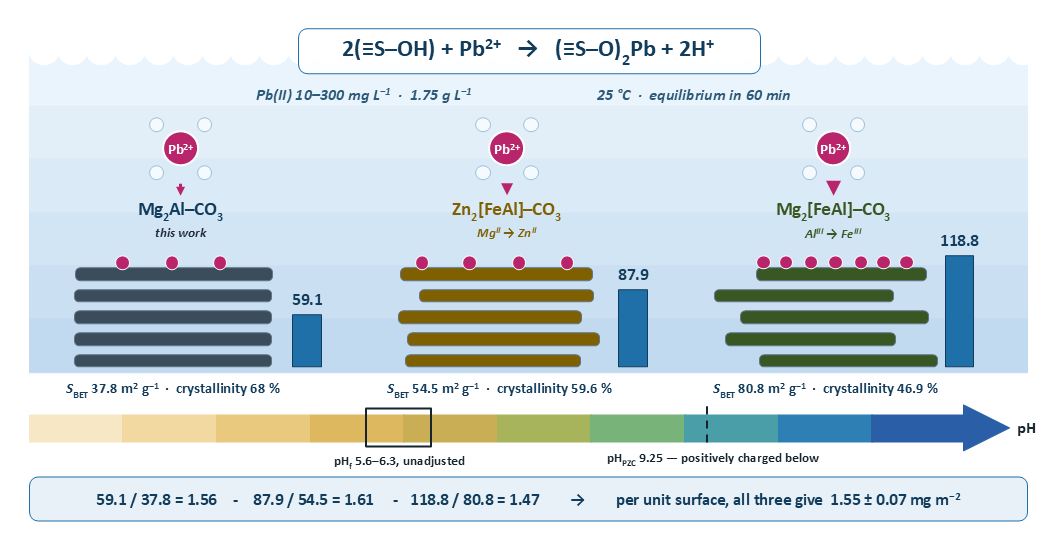
The removal of Pb(II) ions from aqueous solution by sorption onto layered double hydroxides (LDHs) is widely documented, yet the reported capacities range from 13 to over 200 mg g−1. The dispersion is usually ascribed to the layer chemistry but cannot be tested because published values come from widely different operating conditions; this work supplies the missing reference member of a single-protocol series. Carbonate-intercalated Mg2Al–CO3 was prepared by coprecipitation at constant pH, characterized by XRD, SEM–EDX, N2 sorption, DSC and pHPZC, and evaluated as a function of dose, pH, contact time, concentration and temperature. Equilibrium was reached within 60 min, the kinetics were pseudo-first-order, the Redlich–Peterson and Langmuir equations fitted the isotherm best with a monolayer capacity of 59.1 mg g−1, and the uptake was spontaneous and endothermic (ΔH° = 11.1 kJ mol−1). They are then compared with two isostructural phases previously published by our team, Mg2[FeAl]–CO3 and Zn2[FeAl]–CO3, prepared and tested under strictly identical conditions; no new experiment was performed on these solids, whose values are quoted here for comparison only. Replacing half of the Al(III) by Fe(III) doubles qm to 118.8 mg g−1 and replacing Mg(II) by Zn(II) raises it to 87.9 mg g−1. Normalized to the BET surface area, however, the three capacities converge on 1.55 ± 0.07 mg m−2: the layer composition acts on Pb(II) uptake only through the accessible surface area it generates, not through the intrinsic reactivity of the surface. Sorbent design should therefore target textural disorder rather than a particular cation pair.
Keywords:
layered double hydroxide
; Mg2Al–CO3
; lead removal
; sorption isotherms
; crystallinity
; cationic substitution
; water treatment
1. Introduction
Contamination of aquatic systems by potentially toxic metals remains one of the most persistent environmental problems associated with mining, metal finishing, battery manufacturing, pigment production and the uncontrolled reuse of urban wastewater in irrigation [1,2]. Unlike most organic pollutants, these elements are neither biodegradable nor thermally destructible; they accumulate along the trophic chain and remain biologically available for very long periods [3]. Lead is particularly problematic: it has no known physiological function, it interferes with heme biosynthesis and with neuronal development, and the World Health Organization recommends a provisional guideline value of only 10 µg L−1 in drinking water [4]. Industrial effluents, however, routinely contain lead at the tens-to-hundreds of mg L−1 level, so that an efficient polishing step is required before discharge.
Several technologies have been proposed for this purpose, including chemical precipitation, membrane filtration, electrodialysis, solvent extraction and ion exchange [5,6]. Most of them suffer from either a high operating cost, large sludge production, or poor efficiency in the low concentration range. Sorption remains the most attractive option for small and medium-sized facilities because it is simple to operate, tolerant to fluctuations in the feed and compatible with a wide range of inexpensive materials, from agricultural residues and plant biomass [7,8,9,10] to engineered inorganic solids.
Among the latter, layered double hydroxides (LDHs), also known as anionic clays or hydrotalcite-like compounds, have attracted sustained attention. Their structure derives from brucite, Mg(OH)2: part of the divalent cations of the octahedral sheet is replaced isomorphically by trivalent cations, which generates a positive layer charge balanced by hydrated interlayer anions. The resulting composition is described by the general formula [MII1−xMIIIx(OH)2]x+[An−]x/n·yH2O, with x = MIII/(MII + MIII) usually restricted to 0.20–0.40 [11,12,13]. LDHs are cheap, non-toxic, thermally robust and, above all, chemically tunable: the nature of both metal cations, their ratio and the interlayer anion can be selected almost independently, which explains their use in catalysis, drug delivery, flame retardancy and water decontamination [9,14,15,16,17,18,19].
The removal of anionic pollutants by LDHs, which proceeds essentially through anion exchange and the so-called memory effect, is now well understood [14,20,21,22,23]. The uptake of metallic cations is a more subtle question, because the sorbate carries the same sign as the layer charge. Nonetheless, LDHs remove Cu(II), Pb(II) and Cd(II) efficiently through a combination of surface complexation, surface precipitation, isomorphic substitution and, when chelating anions are intercalated, interlayer complexation [24,25,26,27,28,29,30]. Reported capacities span more than one order of magnitude, from about 13 mg g−1 for citrate-intercalated CaFe–LDH to more than 200 mg g−1 for MOF-derived phases [24,31,32,33,34,35].
This dispersion is usually attributed to the chemistry of the sorbent, yet it is very difficult to verify, because published results are obtained at different initial concentrations, solid-to-liquid ratios, contact times and pH values. Comparisons carried out under strictly identical conditions remain rare [36]; the few available examples, such as the study of Zn–Al and Mg–Al LDHs for perfluorooctanoic acid [37] or the comparison of MgAl-LDHs obtained through different synthesis routes [38,39], show that apparently minor changes in composition or crystallinity can alter the capacity by a factor of two or more. Moreover, the simplest and cheapest member of the family, the binary Mg2Al–CO3 phase, is frequently used as an implicit reference without having been characterized and evaluated under the same protocol as the substituted phases with which it is compared.
The present work addresses this gap. A carbonate-intercalated Mg2Al–CO3 phase was synthesized by coprecipitation at constant pH, fully characterized, and evaluated for Pb(II) removal from aqueous solution. The effects of sorbent dose, initial pH, contact time, initial metal concentration and temperature were quantified, and kinetic, equilibrium, thermodynamic and energetic models were applied in their non-linear forms. The results obtained are then confronted with those we have already published for two isostructural ternary phases prepared and tested in the same laboratory under strictly identical operating conditions, Mg2[FeAl]–CO3 [40] and Zn2[FeAl]–CO3 [41]. Because the three solids differ from one another by a single compositional change, this three-member comparison isolates two design variables that are normally confounded — partial substitution of AlIII by FeIII in the trivalent position, and replacement of MgII by ZnII in the divalent position — and relates them quantitatively to crystallinity, specific surface area and Pb(II) uptake.
2. Materials and Methods
2.1. Reagents
Magnesium chloride hexahydrate (MgCl2·6H2O), aluminum chloride hexahydrate (AlCl3·6H2O), sodium hydroxide, sodium carbonate and lead(II) nitrate (Pb(NO3)2) were of analytical grade (Fluka) and used without further purification. All solutions were prepared with bi-distilled water. A 1 g L−1 Pb(II) stock solution was prepared from Pb(NO3)2 and diluted as required; the pH of the working solutions was not adjusted unless explicitly stated.
2.2. Synthesis of the LDH Phases
Mg2Al–CO3 was obtained by coprecipitation at low supersaturation and constant pH [11,13]. A salt solution containing MgCl2·6H2O and AlCl3·6H2O in a MgII/AlIII molar ratio of 2 was added dropwise, together with an alkaline solution of NaOH and Na2CO3 (CO32−/AlIII = 2), to 500 mL of vigorously stirred deionized water. The pH was held at 10.0 ± 0.05 by the controlled addition of 2 M NaOH. The resulting suspension was subjected to hydrothermal ageing at 80 °C for 24 h under mechanical stirring, recovered by filtration and washed repeatedly with deionized water until the filtrate was free of chloride, then dried under vacuum at 80 °C for 10 h, ground and sieved to below 149 µm.
2.3. Characterization
Powder X-ray diffraction (XRD) patterns were collected in air on a PANalytical X’Pert Pro diffractometer (Malvern Panalytical, Almelo, The Netherlands) using monochromatized Cu Kα1 radiation (λ = 1.54060 Å) at 45 kV and 40 mA, over the 3–80° 2θ range with a step of 0.067°. Phase identification was carried out with Match! software against the ICDD PDF-2 database. The lattice parameters of the rhombohedral cell (space group R3̅m) were derived from the positions of the (003) and (110) reflections, c = 3d003 and a = 2d110. The relative crystallinity was estimated from the integrated intensity of the basal reflections using the peak-analyzer routine of OriginPro, the most intense pattern available in our LDH series being taken as the reference, so that the values reported here and in our previous studies are directly comparable [40,41].
Morphology and surface composition were examined with a TESCAN VEGA3 scanning electron microscope (Brno, Czech Republic) equipped with an energy-dispersive X-ray (EDX) detector operated at 25 kV. Nitrogen adsorption–desorption isotherms were recorded at 77 K on an ASAP 2010 instrument (Micromeritics, Norcross, GA, USA) after outgassing. Specific surface areas were computed by the BET method in the 0.05 < P/P° < 0.30 range [42], micropore areas by the t-plot method, and pore size distributions by the BJH method applied to the desorption branch [43]; isotherms were classified according to the IUPAC recommendations [44]. Thermal behavior was followed by differential scanning calorimetry (DSC, TA Instruments Q100) between 45 and 495 °C at 10 °C min−1 under a 50 mL min−1 nitrogen flow. The point of zero charge (pHPZC) was determined by the batch equilibration method [45,46], the pHPZC being read at the intersection of the pHf = f(pHi) curve with the first bisector.
2.4. Batch Sorption Experiments
Sorption was studied in a static regime. A known mass of LDH was contacted with 20 mL of Pb(II) solution in stoppered flasks immersed in a thermostated bath and stirred magnetically to avoid settling. After the required contact time the suspensions were centrifuged at 500 rpm and the final pH (pHf) was measured with a Consort SP20T pH-meter calibrated with pH 4, 7 and 10 standards. Residual Pb(II) was determined with a Consort C863 ionometer fitted with a lead-selective electrode (Consort SE30B); 50 mL of sample were mixed with 50 mL of a methanol/formaldehyde medium and 2 mL of 5 M NaClO4 as ionic-strength adjuster. All experiments were run in triplicate and mean values are reported.
The effect of the sorbent dose was studied between 0.5 and 5 g L−1 at C0 = 100 mg L−1; the effect of the initial pH between 2 and 10 (adjusted with 1 M HCl or 1 M NaOH); the kinetics between 5 and 180 min; the effect of the initial concentration between 10 and 300 mg L−1; and the effect of temperature between 15 and 60 °C. Unless otherwise specified, the operating conditions were C0 = 100 mg L−1, m/V = 1.75 g L−1, tc = 3 h, T = 25 °C and pHi = 5.45 (unadjusted).
The removal efficiency R (%) and the amount sorbed at equilibrium qe (mg g−1) were computed as
and
where C0, Ct and Ce (mg L−1) are the initial, instantaneous and equilibrium Pb(II) concentrations, V (L) the solution volume and m (g) the sorbent mass.
2.5. Modeling
Kinetic data were analyzed with the pseudo-first-order (PFO) [47], pseudo-second-order (PSO) [48], Elovich and intraparticle diffusion (IPD) [49] models, written in their non-linear forms:
where k1 (min−1), k2 (g mg−1 min−1) and kIPD (mg g−1 min−1/2) are the corresponding rate constants, α (mg g−1 min−1) is the initial sorption rate, β (g mg−1) the desorption constant and C (mg g−1) a constant proportional to the boundary-layer thickness. Equilibrium data were described by the Langmuir [50], Freundlich [51], Redlich–Peterson [52] and Temkin [53] isotherms:
qe = qmKLCe / (1 + KLCe)
RL = 1 / (1 + KLC0)
qe = KFCe*n*
qe = KR–PCe / (1 + αR–PCe*β*)
qe = (RT/bT) ln(ATCe)
The enthalpy of sorption was obtained from the temperature dependence of the distribution coefficient Kd = qe/Ce through the van ’t Hoff relationship, whose slope is not affected by the constant factor used to render the equilibrium constant dimensionless; the Gibbs energy and the entropy were referred to the IUPAC standard concentration C° = 1 mol L−1 through K° = KL(L mol−1)/C°, as recommended for solid–liquid adsorption systems [54]:
so that
ΔG° = −RT ln Kc
ln Kc = (ΔS°/R) − (ΔH°/RT)
ΔG° = ΔH° − TΔS°
The mean free energy of sorption was estimated from the Dubinin–Radushkevich (D–R) isotherm [55]:
qe = qm,D–R exp(−KD–Rε2), ε = RT ln(1 + 1/Ce)
ED–R = 1 / (2KD–R)1/2
All models were fitted by non-linear regression (orthogonal distance regression) with OriginPro 9.1. The goodness of fit was assessed jointly from the determination coefficient R2 and from the chi-square statistic
χ2 = Σ (qe,exp − qe,cal)2 / qe,cal
Non-linear fitting was preferred to the linearized forms because the latter distort the error structure and may lead to inconsistent parameter estimates [54].
2.6. Reference Materials Used for Comparison
Two ternary carbonate phases previously prepared and evaluated in our laboratory are used in Section 4 as comparison materials: Mg2[FeAl]–CO3, in which half of the trivalent position is occupied by FeIII [40], and Zn2[FeAl]–CO3, in which the divalent position is occupied by ZnII [41]. Both were obtained by the same coprecipitation protocol at constant pH followed by hydrothermal ageing at 80 °C for 24 h, characterized with the same instruments, and tested with the same batch procedure, the same lead-selective electrode method and the same reference conditions (C0 = 100 mg L−1, m/V = 1.75 g L−1, tc = 3 h, T = 25 °C, unadjusted pH). No new experiment was performed on these two solids in the present study; all values quoted for them are taken from the corresponding publications and are cited as such throughout.
3. Results
3.1. Characterization of Mg2Al–CO3
3.1.1. X-Ray Diffraction
The diffraction pattern of the synthesized solid is shown in Figure 1 together with the line positions and relative intensities of the reference card PDF-2 01-089-0460, Mg0.667Al0.333(OH)2(CO3)0.167·0.5H2O, for which a figure of merit of 0.892 was obtained; the complete list of interplanar distances is given in Table S1. The pattern displays the sharp, symmetric basal reflections and the resolved (110)/(113) doublet above 60° 2θ that are characteristic of a well-crystallized hydrotalcite-like phase, and it divides into the three domains usually distinguished for LDHs: the (00l) reflections below 30° 2θ, whose position is governed by the size of the interlayer anion, the (01l) reflections between 30 and 50°, and the (11l) reflections above 50°, which reflect the cation order within the hydroxide sheets. All the observed lines index in a trigonal system with rhombohedral symmetry (R3̅m). The strongest reflection, (003), lies at 11.61° 2θ and corresponds to a basal spacing d003 = 7.61 Å. The lattice derived parameters are c = 22.84 Å and a = 3.0434 Å, and the relative crystallinity is 68.0% (Table 1). The agreement with the reference card is close for every line except in the 34–35° region: the measured maximum at 34.88° is the (012) reflection, whereas the strongest card line in that range, at 34.19°, is the (101) reflection. The two are not resolved in the present pattern and merge into a single asymmetric envelope whose low-angle shoulder is the (101) contribution, a feature commonly observed for hydrotalcite-like phases whose sheet stacking is not perfectly ordered.
3.1.2. Morphology and Surface Composition
The morphology of the powder was examined by scanning electron microscopy at three magnifications (Figure S1). The solid consists of strongly agglomerated micrometric particles of irregular shape and heterogeneous size, no individual platelet being resolved even at 5.00 kx; this compact aspect is consistent with the modest specific surface area reported below and with the equivalent particle size of 158.6 nm derived from it. EDX analysis of the surface (Figure S2 and Table S2) detects carbon, magnesium, aluminium and oxygen as the only elements and gives 21.4 at.% Mg and 12.7 at.% Al, that is an experimental Mg/Al ratio of 1.69 against a nominal value of 2; sodium was below the detection limit, which confirms the efficiency of the washing and of the hydrothermal treatment. Combining the EDX composition with the general LDH formula yields the nominal composition Mg0.63Al0.37(OH)2(CO3)0.18·yH2O, i.e., a layer charge density x = 0.372. Because EDX is a semi-quantitative, surface-sensitive technique that does not detect hydrogen and quantifies light elements only approximately, this formula is given as indicative: establishing it independently would require ICP-OES for the cations, elemental analysis for the carbonate and thermogravimetry for y, and none of the conclusions drawn below rests on it.
3.1.3. Textural Properties
The nitrogen adsorption–desorption isotherm is of type IV with a narrow hysteresis loop. The BET surface area is 37.8 m2 g−1, of which 19.5% is contributed by micropores and 80.5% by the external surface. The mean BJH pore diameter is 6.6 nm, the total pore volume 0.0519 cm3 g−1 and the equivalent particle size 158.6 nm (Table S3).
3.1.4. Thermal Behavior
The DSC curve (Figure S3) exhibits three successive endothermic events: a broad signal extending from room temperature to about 200 °C with a minimum near 125 °C, assigned to the loss of physisorbed water; a second, narrower event between 200 and 250 °C with a minimum at 225 °C, assigned to the loss of interlayer water, which proceeds without collapse of the layered structure; and a third, beginning above 275 °C and continuing to the end of the scan, which combines the dehydroxylation of the brucite-like sheets and the decarbonation of the interlayer. The first two events are reversible and underline the rehydration behavior of carbonate LDHs, whereas the third destroys the layered structure and yields the mixed oxide.
3.1.5. Point of Zero Charge
The pHf = f(pHi) curve (Figure S4) shows a plateau between pHi 8 and 10, which defines the buffering domain of the solid, and intersects the first bisector at pH 9.25, which is the point of zero charge of the material. All the characterization results are collected in Table 1. It should be stressed at this stage that every sorption experiment reported below ended at a final pH between 5.6 and 6.3, that is well below pHPZC, so that the surface carried a net positive charge throughout; this constraint governs the discussion of the removal mechanism in Section 4.
3.2. Pb(II) Sorption on Mg2Al–CO3
3.2.1. Effect of the Sorbent Dose
Increasing the m/V ratio from 0.5 to 5 g L−1 raises the removal efficiency of Pb(II) monotonically from 13.1 to 84.3% (Figure 2a). The capacity per unit mass follows a different trend (Figure 2b): it remains almost constant between 0.5 and 1.5 g L−1 (26.2–26.6 mg g−1), passes through a maximum of 27.11 mg g−1 at 1.75 g L−1, and then decreases steadily to 16.86 mg g−1 at 5 g L−1. The final pH rose only moderately over the same interval, from 5.54 to 6.30. The complete data set is reported in Table S4. A ratio of 1.75 g L−1 was retained for all subsequent experiments.
3.2.2. Effect of the Initial pH
The uptake of Pb(II) is strongly pH-dependent. At pHi = 2 the capacity is only about 11 mg g−1. It rises slowly up to pHi = 4, then sharply between pHi 4 and 8, and reaches 57.14 mg g−1 at pHi ≈ 8, a value that corresponds to the quantitative removal of the lead initially present. Beyond pHi = 8 the capacity no longer increases. In all the experiments carried out at the unadjusted pH the final pH remained between 5.6 and 6.3.
3.2.3. Sorption Kinetics
The uptake curve rises steeply during the first 30 min, during which about 85% of the total quantity is retained, then more slowly between 30 and 60 min, and finally levels off (Figure 3). No further variation was measured between 60 and 180 min, so equilibrium is reached within one hour, with qe,exp = 27.15 mg g−1.
The parameters obtained for the four models are collected in Table 2. The PFO equation gives the highest determination coefficient (R2 = 0.99991) and the lowest chi-square (χ2 = 0.416), and its calculated capacity, 27.054 mg g−1, differs from the experimental value by less than 0.1 mg g−1. The PSO equation also reproduces the data closely (R2 = 0.99976) but overestimates qe by 2.5 mg g−1 and gives a chi-square nearly three times larger. The Elovich and IPD equations give the largest deviations, with χ2 of 5.43 and 14.66, respectively. Plotted in its linearized form, qt = f(tc1/2), the IPD model yields three successive straight segments rather than a single line, none of which passes through the origin (Figure S5 and Table S5).
3.2.4. Effect of the Initial Concentration and Equilibrium Isotherms
The equilibrium capacity increases with the initial concentration over the whole range investigated, from 4.26 mg g−1 at 10 mg L−1 to 46.31 mg g−1 at 300 mg L−1 (Figure S6 and Table S6). The increase is almost linear up to 200 mg L−1 and becomes much slower beyond, the last three points (44.14, 45.09 and 46.31 mg g−1) marking the onset of a plateau. The highest capacity measured directly is therefore 46.31 mg g−1; the monolayer capacity extracted from the Langmuir fit is given in the next section and is the value used throughout the discussion. The final pH decreased slightly and regularly as the initial concentration increased, from 6.23 to 5.76.
The four isotherm equations were fitted to the experimental points (Figure 4) and the resulting parameters are listed in Table 3. The Redlich–Peterson and Langmuir models give the highest determination coefficients (0.98928 and 0.98921) and the lowest chi-square values (3.909 and 3.373); the Redlich–Peterson exponent β is 0.963, close to unity, so that the equation tends towards the Langmuir limit. The Langmuir monolayer capacity is 59.1 mg g−1 and the separation factor RL, computed from Equation (8), decreases regularly from 0.84 at C0 = 10 mg L−1 to 0.15 at C0 = 300 mg L−1, so that 0 < RL < 1 over the whole domain, which denotes a favorable sorption. In the Freundlich equation, written here as qe = KFCe1/n, the fitted exponent is 1/n = 0.455, that is n = 2.20; a value of n larger than unity again indicates a favorable isotherm. The Temkin equation gives the lowest R2 (0.95111) and the highest χ2 (15.279).
RL computed from Equation (8) at C0 = 300 mg L−1.
3.2.5. Effect of Temperature
Raising the temperature from 15 to 60 °C increases the amount of Pb(II) retained from 25.20 to 34.06 mg g−1, that is from 44.1 to 59.6% removal (Figure 5a and Figure S7); the increase is regular over the whole range, so that the process is endothermic. The van ’t Hoff plot of ln K against 1/T is strictly linear (R2 = 0.9924, Figure 5b) and its slope gives ΔH° = 11.07 kJ mol−1. This enthalpy does not depend on the standard state adopted, since a constant multiplicative factor applied to the equilibrium constant shifts the intercept of the van ’t Hoff line but not its slope. The Gibbs energy and the entropy, in contrast, do depend on that choice and were therefore evaluated from the Langmuir constant expressed in L mol−1 and referred to the IUPAC standard concentration C° = 1 mol L−1: with KL = 0.01867 L mg−1, that is 3.87 × 10³ L mol−1, one obtains K° = 3.87 × 10³, ΔG°(298 K) = −20.5 kJ mol−1 and, through ΔS° = (ΔH° − ΔG°)/T, ΔS° = 106 J mol−1 K−1 (Table 4). The negative ΔG° confirms that the uptake is spontaneous, and the positive ΔS° reflects the increase in disorder at the solid–solution interface that accompanies the release of hydration water when the metal ion binds to the surface. Because the isotherm was recorded at a single temperature, the temperature dependence of ΔG° could not be established and only the value at 298 K is reported.
4. Discussion
4.1. Surface Charge and Lead Speciation
The pH dependence reported in Section 3.2.2 combines two effects. At low pH the surface is protonated, and the large excess of H+ competes with Pb2+ for the binding sites; partial dissolution of the hydroxide layers may also occur in strongly acidic media. As the pH increases toward the point of zero charge measured here, 9.25, the surface progressively deprotonates and the density of ≡S–O− groups grows, which makes the uptake more favorable. It must be stressed, however, that at the final pH of 5.6–6.3 of the present experiments the solid is still below its point of zero charge and therefore carries a net positive charge, so that the lead retained under these conditions cannot be held by a global electrostatic attraction and must be bound by specific reactions with individual surface sites [24,26].
Care must be taken not to attribute to sorption what is in fact precipitation. The distribution of dissolved lead species computed for a total concentration of 100 mg L−1 at 25 °C is shown in Figure 6. The free Pb2+ ion dominates up to about pH 7.5; hydrolyzed cationic species such as PbOH+ and Pb3(OH)42+ appear from pH ≈ 5.5 onwards and can also be retained by the sorbent, whereas the neutral Pb(OH)2 complex, the precursor of the solid hydroxide, becomes significant only above pH 7.5. The value of 57.14 mg g−1 measured at pHi ≈ 8 must therefore be regarded with caution, since part of the removal may proceed through hydroxide precipitation. In contrast, the final pH of all the other experiments reported here lay between 5.6 and 6.3, well inside the domain where Pb2+ is the dominant species, so that precipitation can safely be ruled out and the measured capacities can be interpreted as true sorption.
4.2. Rate-Controlling Step and Diffusion Mechanism
Equilibrium within 60 min places Mg2Al–CO3 among the faster LDH sorbents for lead: 120 min were needed for alginate-intercalated MgAl–LDH [27] and 24 to 48 h for humate-modified Mg3Al phases [24], although a CoMo–CO3 phase reached equilibrium in 30 min [55]. The half-sorption time derived from the PFO constant is 8.3 min.
The clear superiority of the PFO equation over the PSO equation is the first indication that chemisorption is not the rate-controlling step, since the PSO model is usually associated with the formation of chemical bonds between the sorbate and the surface [47,53]. It should be stressed that this conclusion is only accessible through non-linear fitting: the linearized forms of both equations return comparably high correlation coefficients and would not discriminate between them [53].
The multilinearity of the qt = f(tc1/2) plot identifies three successive transport regimes: external (film) diffusion up to about 40 min, intraparticle diffusion between 40 and 60 min, and the equilibrium plateau beyond. Because none of the segments passes through the origin, intraparticle diffusion is not the sole rate-limiting step [41,48]. The first segment is markedly broader than the second, which indicates that external surface diffusion contributes substantially to the overall rate. This is consistent with the textural data: the porosity of the solid is mainly mesoporous, with a mean pore diameter of 6.6 nm, and the external surface accounts for 80.5% of SBET, so that most of the accessible sites lie on the outer surface of the particles rather than inside a micropore network.
4.3. Nature of the Interaction
Three independent criteria show that the interaction is weak and does not involve the formation of strong covalent bonds over the whole of the retained lead, although, as shown below, it cannot be reduced to a simple electrostatic attraction either. First, the enthalpy change, ΔH° = 11.07 kJ mol−1, is of the order of 10 kJ mol−1, a magnitude typical of electrostatic interactions rather than of true chemical bonding. The comparison with the literature is instructive here: Mostafa et al. reported 6.9 kJ mol−1 for Pb(II) on CoMo–CO3 [55], whereas González et al. obtained more than 50 kJ mol−1 on humate-intercalated Mg3Al and above 95 kJ mol−1 on Mg3Al–Cl, values that unambiguously indicate chemisorption [24]. The nature of the interaction thus depends strongly on the LDH considered, and on the interlayer anion: a carbonate phase, in which the interlayer is occupied by a small, strongly held and non-chelating anion, has no reason to bind lead covalently.
Second, the mean free energy of sorption obtained from the D–R isotherm, 1.41 kJ mol−1, is far below the 16 kJ mol−1 threshold above which chemisorption is considered to prevail. Third, the activation energy derived from the Arrhenius plot, 1.96 kJ mol−1, is an order of magnitude smaller than the 40 kJ mol−1 usually required for a chemically activated process [53]. The positive entropy change, 89.14 J mol−1 K−1, reflects the increase in randomness at the solid–solution interface that accompanies the release of hydration water when the metal ion binds to the surface, the entropy gained by the released water molecules exceeding the entropy lost by the immobilized cation.
4.4. Effect of the Composition of the Hydroxide Layer
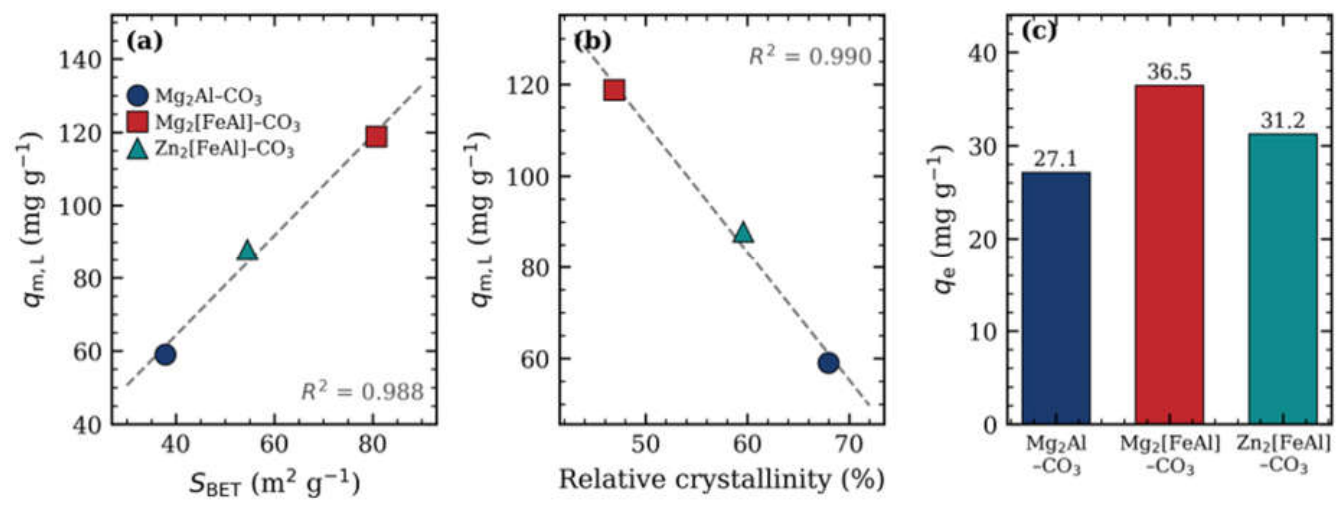
The results obtained here for Mg2Al–CO3 can be compared directly with those we published for Mg2[FeAl]–CO3 [40] and Zn2[FeAl]–CO3 [41], since the three solids were prepared, characterized and tested under strictly identical conditions (Section 2.6). Any difference in performance can therefore be attributed to the composition of the hydroxide layer rather than to the operating protocol. Table 5 gathers the corresponding properties and capacities, and Figure 7 presents the resulting relationships.
4.4.1. Partial Substitution of AlIII by FeIII
Replacing half of the aluminum by iron, at constant divalent cation and constant nominal ratio, doubles the Langmuir capacity, from 59.06 to 118.78 mg g−1 [40], and raises the capacity measured at C0 = 100 mg L−1 from 27.11 to 36.46 mg g−1. The origin of this improvement appears to be textural rather than chemical. FeIII has a larger ionic radius than AlIII (0.645 vs. 0.535 Å in octahedral coordination [56]), and its incorporation introduces local distortions in the hydroxide sheet that hinder the growth of large coherent domains. The lattice parameter a increases accordingly from 3.0434 to 3.0746 Å, the relative crystallinity falls from 68.0 to 46.9%, the equivalent particle size drops from 159 to 74 nm and the specific surface area more than doubles, from 37.8 to 80.8 m2 g−1 [40] (Figure S8). The thermal data point in the same direction, the interlayer water being released 50 °C earlier in the iron-containing phase.
Because the surface chemistry is barely modified — pHPZC moves only from 9.25 to 9.35, and the sorption enthalpy remains close to 10 kJ mol−1 in both cases — the gain in capacity is most reasonably ascribed to the increase in the number of accessible sites rather than to a change in their nature. Comparable observations have been reported for MgAl-LDHs prepared through different synthetic routes, where the least crystalline sample removed lead most efficiently [38,39], and for ternary Zn–Al–Fe phases in which iron incorporation improved the sorption of oxyanions [57,58].
4.4.2. Replacement of MgII by ZnII
Substituting zinc for magnesium also improves the capacity, but to a lesser extent: qm,L rises from 59.06 to 87.89 mg g−1 and qe at C0 = 100 mg L−1 from 27.11 to 31.23 mg g−1 [41]. Here two contributions act in opposite directions. The textural contribution is favorable, since the Zn phase is less crystalline than Mg2Al–CO3 (59.6 vs. 68.0%) and exposes a larger surface area (54.5 vs. 37.8 m2 g−1). The electrostatic contribution, on the contrary, is unfavorable: the point of zero charge drops by almost a full unit, from 9.25 to 8.35, so that at the working pH of 5.6–6.3 the zinc-based surface, although further from its deprotonation domain in absolute terms, carries a comparatively different charge distribution [26]. The change in the shape of the isotherm supports the idea that the surface itself is modified: whereas Mg2Al–CO3 and Mg2[FeAl]–CO3 are both described by a Redlich–Peterson equation tending toward the Langmuir limit, Zn2[FeAl]–CO3 has an exponent β of 0.60 and is better represented by the Freundlich model, which points to a more heterogeneous distribution of site energies [41].
Taken together, the two substitutions give the ranking Mg2[FeAl]–CO3 > Zn2[FeAl]–CO3 > Mg2Al–CO3 (Figure 7c), and the Langmuir capacity increases with the BET surface area and decreases with the relative crystallinity (Figure 7a,b). With only three materials these correlations are indicative rather than demonstrative, and they should be extended to a larger series before being used predictively; nevertheless, they are consistent with the mechanistic picture developed in Section 4.6, in which the dominant pathways are surface reactions. Modifying the trivalent cation appears to be the more effective lever of the two, since it acts on texture without perturbing the surface chemistry, whereas the divalent cation changes at once.
A further step can be taken. The capacities of the three phases differ by a factor of two, but they were obtained on solids whose specific surface areas also differ by a factor of two. Referred to the unit of accessible surface, the Langmuir capacities become 1.56, 1.47 and 1.61 mg m−2 for Mg2Al–CO3, Mg2[FeAl]–CO3 and Zn2[FeAl]–CO3 respectively, that is 1.55 ± 0.07 mg m−2, a spread of only ±5% for compositions that differ in both the trivalent and the divalent position. Expressed as a surface density this corresponds to 4.5 ± 0.2 Pb nm−2, a value of the same order as the density of hydroxyl groups exposed by a brucite-like sheet and close to one lead ion per two surface hydroxyls, that is to the stoichiometry of the bidentate complex discussed in Section 4.6. The intrinsic reactivity of the surface toward Pb(II) is therefore essentially invariant across the series: the composition of the hydroxide layer acts on the capacity through the amount of surface it generates, not through a change in the nature of the sites. The normalization is least reliable for Zn2[FeAl]–CO3, whose isotherm is better described by the Freundlich equation so that its Langmuir qm is the least well defined of the three, and three solids are of course too few to establish a law; the invariance should be tested on a broader compositional series before being used predictively.
4.5. Comparison with Other LDH Sorbents
Table 6 positions Mg2Al–CO3 among LDH sorbents reported for Pb(II), the entries being ordered by increasing maximum capacity. Because published maxima are not always obtained in the same way, the basis of each value is indicated: experimental maxima are the highest capacities measured at the stated initial concentration, whereas Langmuir values are monolayer capacities extracted from a model fit and are usually higher than any capacity measured directly. The two categories should therefore not be compared too literally.
Several trends nevertheless emerge. The lower part of the table is occupied by phases intercalated with small organic ligands and tested at low initial concentration, whose maxima remain below 40 mg g−1 [31,59,60]. The upper part is dominated by calcined or reconstructed phases and by materials intercalated with large chelating anions [24,27,32]. This is expected: calcination destroys the layered structure and generates a mixed oxide of much larger surface area that reconstructs in the presence of the sorbate, while chelating interlayer anions provide additional, strongly binding sites [60,61,62]. The price to pay is a more elaborate and more energy-intensive preparation, and often a much longer equilibration time — 24 to 48 h for the humate-modified Mg3Al phases against 60 min here.
Within the group of carbonate-intercalated LDHs used without any post-synthesis modification, Mg2Al–CO3 occupies an intermediate position, and its two substituted analogues rank among the better performers of the whole table [40,41,63,64,65,66,67,68]. It is also worth noting that these three phases were tested without any pH adjustment, which removes a costly conditioning step in practical operation, and that they settle readily and are easily separated from the treated water.
“Experimental” denotes the highest capacity measured at the stated initial concentration; “Langmuir” denotes the monolayer capacity qm obtained by fitting the Langmuir equation. For Mg2Al–CO3 the highest capacity measured directly was 46.3 mg g−1 at C0 = 300 mg L−1, and the value extrapolated from the 1/qe = f(1/C0) plot was 68.6 mg g−1.
4.6. Proposed Removal Mechanism
The removal of metallic cations by LDHs is rarely governed by a single process [26,28,29]. The evidence collected here allows the relative importance of the different pathways to be assessed for Mg2Al–CO3 (Scheme 1).
- Specific (inner-sphere) surface complexation. At the working pH of 5.6–6.3 the solid lies well below its point of zero charge (9.25) and its surface therefore carries a net positive charge, so that a simple electrostatic attraction of Pb2+ by deprotonated ≡S–O− sites cannot be the dominant pathway. Uptake nevertheless occurs and rises steeply with pH, which points to a specific reaction with individual surface hydroxyls, a reaction that does not require the particle to be negatively charged as a whole: 2(≡S–OH) + Pb2+ → (≡S–O)2Pb + 2H+. This reaction releases protons, and it accounts for the slight but perfectly regular decrease of the final pH measured as the initial concentration increases, from 6.23 at 10 mg L−1 to 5.76 at 300 mg L−1. It is further supported by the surface density of retained lead derived in Section 4.4, about 4.5 Pb nm−2, which corresponds to roughly one lead ion per two surface hydroxyls of a brucite-like sheet, that is to the stoichiometry of the bidentate complex written above.
- Outer-sphere complexation. As the pH rises toward the point of zero charge the density of deprotonated ≡S–O− groups grows and a non-specific, electrostatically driven contribution is added to the specific one. This second pathway accounts for the sharp rise of the capacity between pHi 4 and 8 and is consistent with the low sorption enthalpy (11.07 kJ mol−1) and the low mean free energy of sorption (1.41 kJ mol−1), which exclude the formation of strong covalent bonds over the whole of the retained lead. At the unadjusted pH at which the present measurements were made, however, its contribution remains marginal.
- Surface precipitation with interlayer carbonate. Carbonate released at the particle–solution interface can precipitate lead as PbCO3 (Ksp = 7.4 × 10⁻¹⁴), a pathway documented for the reaction of MgAl–CO3 with lead salts [26]. Precipitation as Pb(OH)2 is excluded here because the final pH never exceeded 6.3.
- Isomorphic substitution. Replacement of layer Mg2+ by Pb2+ is severely hindered by the size mismatch: the ionic radius of Pb2+ (1.19 Å) is 65% larger than that of Mg2+ (0.72 Å) [56]. This contrasts with Cu2+ (0.73 Å) and Cd2+ (0.95 Å), for which lattice substitution is a genuine pathway [24,69], and it explains why the capacities measured for Pb(II) on these carbonate phases are systematically lower, on a molar basis, than those measured for Cu(II) under identical conditions [41].
Since the two dominant pathways are surface reactions, the amount of accessible surface should control the capacity — which is precisely what the comparison of Section 4.4 shows. It also suggests that the relative weight of the pathways is composition-dependent: in Mg2[FeAl]–CO3 the larger external surface increases the contribution of the two complexation routes [40], whereas in Zn2[FeAl]–CO3 the more heterogeneous site distribution revealed by the Freundlich behavior suggests a greater diversity of binding environments [41]. This coupling between composition, microstructure and mechanism is, in our view, a major reason why capacities reported for nominally similar LDHs differ so widely.
5. Conclusions
A carbonate-intercalated Mg2Al–CO3 layered double hydroxide was prepared by coprecipitation at constant pH and evaluated for the removal of Pb(II) from aqueous solution. XRD confirmed a well-crystallized rhombohedral hydrotalcite-type phase with a basal spacing of 7.61 Å and a relative crystallinity of 68.0%, in close agreement with the reference card PDF-2 01-089-0460; SEM showed strongly agglomerated micrometric aggregates and EDX gave a surface Mg/Al ratio of 1.69, leading to the nominal composition Mg0.63Al0.37(OH)2(CO3)0.18·yH2O; nitrogen sorption revealed a mesoporous solid with SBET = 37.8 m2 g−1, 80.5% of which is external; DSC resolved three endothermic events at 125, 225 and above 275 °C; and the point of zero charge was 9.25.
Sorption equilibrium was reached within 60 min and was well described by the pseudo-first-order equation, while the linearized intraparticle diffusion plot showed that external surface diffusion and pore diffusion operate in series. Equilibrium data were best represented by the Redlich–Peterson and Langmuir models, with a monolayer capacity of 59.1 mg g−1 and a favorable separation factor over the whole concentration range. The process is endothermic (ΔH° = 11.07 kJ mol−1, a value independent of the standard state adopted) and spontaneous, ΔG°(298 K) being −20.5 kJ mol−1 when referred to C° = 1 mol L−1, with ΔS° = 106 J mol−1 K−1. Since every experiment was carried out at a final pH well below the point of zero charge, the removal cannot be ascribed to a simple electrostatic attraction: specific complexation on surface hydroxyls, with release of protons, and surface precipitation with the interlayer carbonate are the two pathways compatible with the whole of the data.
Comparison with two isostructural phases studied earlier under strictly identical conditions gives the practical message of this work. Partial substitution of AlIII by FeIII doubles the monolayer capacity, from 59.1 to 118.8 mg g−1 [40], and replacement of MgII by ZnII raises it to 87.9 mg g−1 [41]. In both cases the gain follows the increase in specific surface area and the decrease in crystallinity, and the trivalent substitution is the more effective of the two because it acts on the texture without altering the surface chemistry. Designing an LDH sorbent for divalent metals should therefore aim at maximizing accessible surface area rather than structural perfection.
These conclusions rest on three materials and should be verified in a broader compositional series before being generalized. Further work should also extend the comparison to real effluents containing competing cations, examine the regeneration and reuse of the iron-substituted phase, and test whether the crystallinity–capacity relationship still holds after calcination and reconstruction.
Supplementary Materials
The following supporting information can be downloaded at the website of this paper posted on Preprints.org. Figure S1: SEM micrographs of Mg2Al–CO3; Figure S2: EDX spectrum; Figure S3: DSC curve; Figure S4: determination of the point of zero charge; Figure S5: linearized intraparticle diffusion plot; Figure S6: effect of the initial concentration; Figure S7: effect of temperature on the equilibrium capacity; Figure S8: comparison of the BET surface area and of the relative crystallinity of the three isostructural phases; Table S1: XRD reflections of Mg2Al–CO3 compared with PDF-2 01-089-0460; Table S2: EDX surface composition; Table S3: detailed textural properties; Table S4: effect of the m/V ratio; Table S5: parameters of the linearized intraparticle diffusion model; Table S6: effect of the initial concentration; Table S7: kinetic parameters as a function of temperature.
Author Contributions
Conceptualization, A.A.I. and F.S.; methodology, A.A.I., R.B. and M.A.; software, A.A.I.; validation, G.C., M.C. and M.Z.; formal analysis, A.A.I. and A.D.; investigation, A.A.I., R.B. and A.D.; resources, G.C. and F.S.; data curation, A.A.I. and A.S.; writing—original draft preparation, A.A.I.; writing—review and editing, F.S., M.C., M.Z., G.C. and A.S.; visualization, A.A.I. and M.A.; supervision, F.S. and M.Z.; project administration, F.S.; funding acquisition, F.S. All authors have read and agreed to the published version of the manuscript.
Funding
This research received no external funding.
Data Availability Statement
Conflicts of Interest
The authors declare no conflicts of interest.
Abbreviations
The following abbreviations are used in this manuscript:
| LDH | Layered double hydroxide |
| XRD | X-ray diffraction |
| SEM–EDX | Scanning electron microscopy with energy-dispersive X-ray spectroscopy |
| BET | Brunauer–Emmett–Teller |
| BJH | Barrett–Joyner–Halenda |
| DSC | Differential scanning calorimetry |
| pHPZC | pH of the point of zero charge |
| PFO / PSO | Pseudo-first-order / pseudo-second-order |
| IPD | Intraparticle diffusion |
| R–P | Redlich–Peterson |
| D–R | Dubinin–Radushkevich |
References
- Chen, J.P. Decontamination of Heavy Metals: Processes, Mechanisms, and Applications; CRC Press: Boca Raton, FL, USA, 2012. [Google Scholar]
- Chaoua, S.; Boussaa, S.; El Gharmali, A.; Boumezzough, A. Impact of Irrigation with Wastewater on Accumulation of Heavy Metals in Soil and Crops in the Region of Marrakech in Morocco. J. Saudi Soc. Agric. Sci. 2019, 18, 429–436. [Google Scholar] [CrossRef]
- Hashim, M.A.; Mukhopadhyay, S.; Sahu, J.N.; Sengupta, B. Remediation Technologies for Heavy Metal Contaminated Groundwater. J. Environ. Manag. 2011, 92, 2355–2388. [Google Scholar] [CrossRef] [PubMed]
- World Health Organization Guidelines for Drinking-Water Quality, Incorporating the 1st Addendum, 4th Ed. ed; World Health Organization: Geneva, Switzerland, 2017.
- Bashir, A.; Malik, L.A.; Ahad, S.; Manzoor, T.; Bhat, M.A.; Dar, G.N.; Pandith, A.H. Removal of Heavy Metal Ions from Aqueous System by Ion-Exchange and Biosorption Methods. Environ. Chem. Lett. 2019, 17, 729–754. [Google Scholar] [CrossRef]
- Zawierucha, I.; Kozlowski, C.; Malina, G. Immobilized Materials for Removal of Toxic Metal Ions from Surface/Groundwaters and Aqueous Waste Streams. Environ. Sci. Process. Impacts 2016, 18, 429–444. [Google Scholar] [CrossRef] [PubMed]
- Chiban, M.; Soudani, A.; Sinan, F.; Persin, M. Single, Binary and Multi-Component Adsorption of Some Anions and Heavy Metals on Environmentally Friendly Carpobrotus Edulis Plant. Colloids Surf. B 2011, 82, 267–276. [Google Scholar] [CrossRef] [PubMed]
- Kovacova, Z.; Demcak, S.; Balintova, M.; Pla, C.; Zinicovscaia, I. Influence of Wooden Sawdust Treatments on Cu(II) and Zn(II) Removal from Water. Materials 2020, 13, 3575. [Google Scholar] [CrossRef] [PubMed]
- Ahmad, S.; Wazir, M.B.; Daud, M.; Cheng, C.K.; Shah, M.U.H.; Al-Harthi, M.A. Recent Advancement in Ionic Liquid Modified Layered Double Hydroxide (IL-LDH): Progress, Challenges, and Future Prospects. Inorg. Chem. Commun. 2023, 158, 111591. [Google Scholar] [CrossRef]
- Al-Amrani, W.A.; Onaizi, S.A. Adsorptive Removal of Heavy Metals from Wastewater Using Emerging Nanostructured Materials: A State-of-the-Art Review. Sep. Purif. Technol. 2024, 343, 127018. [Google Scholar] [CrossRef]
- Cavani, F.; Trifirò, F.; Vaccari, A. Hydrotalcite-Type Anionic Clays: Preparation, Properties and Applications. Catal. Today 1991, 11, 173–301. [Google Scholar] [CrossRef]
- Evans, D.G.; Slade, R.C.T. Structural Aspects of Layered Double Hydroxides. In Structure and Bonding; Springer: Berlin/Heidelberg, Germany, 2006; pp. 1–87. [Google Scholar]
- Forano, C.; Costantino, U.; Prevot, V.; Taviot-Gueho, C. Layered Double Hydroxides (LDH). In Developments in Clay Science; Elsevier: Amsterdam, The Netherlands, 2013; pp. 745–782. [Google Scholar]
- Goh, K.-H.; Lim, T.-T.; Dong, Z. Application of Layered Double Hydroxides for Removal of Oxyanions: A Review. Water Res. 2008, 42, 1343–1368. [Google Scholar] [CrossRef] [PubMed]
- Ulibarri, M.A.; Hermosin, M.C. Layered Double Hydroxides in Water Decontamination. In Layered Double Hydroxides: Present and Future; Nova Science Publishers: New York, NY, USA, 2006; pp. 285–321. [Google Scholar]
- Kameliya, J.; Verma, A.; Dutta, P.; Arora, C.; Vyas, S.; Varma, R.S. Layered Double Hydroxide Materials: A Review on Their Preparation, Characterization, and Applications. Inorganics 2023, 11, 121. [Google Scholar] [CrossRef]
- Fu, Y.; Fu, X.; Song, W.; Li, Y.; Li, X.; Yan, L. Recent Progress of Layered Double Hydroxide-Based Materials in Wastewater Treatment. Materials 2023, 16, 5723. [Google Scholar] [CrossRef] [PubMed]
- Riaz, S.; Rehman, A. ur; Akhter, Z.; Najam, T.; Hossain, I.; Karim, M.R.; Assiri, M.A.; Shah, S.S.A.; Nazir, M.A. Recent Advancement in Synthesis and Applications of Layered Double Hydroxides (LDHs) Composites. Mater. Today Sustain. 2024, 27, 100897. [Google Scholar] [CrossRef]
- Altalhi, A.A.; Mohamed, E.A.; Negm, N.A. Recent Advances in Layered Double Hydroxide (LDH)-Based Materials: Fabrication, Modification Strategies, Characterization, Promising Environmental Catalytic Applications, and Prospective Aspects. Energy Adv. 2024, 3, 2136–2151. [Google Scholar] [CrossRef]
- Johnston, A.L.; Lester, E.; Williams, O.; Gomes, R.L. Understanding Layered Double Hydroxide Properties as Sorbent Materials for Removing Organic Pollutants from Environmental Waters. J. Environ. Chem. Eng. 2021, 9, 105197. [Google Scholar] [CrossRef]
- Alagha, O.; Manzar, M.S.; Zubair, M.; Anil, I.; Mu’azu, N.D.; Qureshi, A. Magnetic Mg-Fe/LDH Intercalated Activated Carbon Composites for Nitrate and Phosphate Removal from Wastewater: Insight into Behavior and Mechanisms. Nanomaterials 2020, 10, 1361. [Google Scholar] [CrossRef] [PubMed]
- Flores, C.V.; Obeso, J.L.; Herrera-Zuñiga, L.; Peralta, R.A.; Campero-Domínguez, J.I.; Morales-Ruiz, L.; Portillo-Vélez, N.S.; Valdivia-Corona, J.C. Layered Double Hydroxides (LDH) Materials for Effective Phosphate Adsorption from Aqueous Solution. RSC Sustain. 2026, 4, 61–78. [Google Scholar] [CrossRef]
- Farhan, A.; Khalid, A.; Maqsood, N.; Iftekhar, S.; Sharif, H.M.A.; Qi, F.; Sillanpaa, M.; Asif, M.B. Progress in Layered Double Hydroxides (LDHs): Synthesis and Application in Adsorption, Catalysis and Photoreduction. Sci. Total Environ. 2024, 912, 169160. [Google Scholar] [CrossRef] [PubMed]
- González, M.A.; Pavlovic, I.; Barriga, C. Cu(II), Pb(II) and Cd(II) Sorption on Different Layered Double Hydroxides. A Kinetic and Thermodynamic Study and Competing Factors. Chem. Eng. J. 2015, 269, 221–228. [Google Scholar] [CrossRef]
- Shan, R.; Yan, L.; Yang, K.; Hao, Y.; Du, B. Adsorption of Cd(II) by Mg–Al–CO3– and Magnetic Fe3O4/Mg–Al–CO3-Layered Double Hydroxides: Kinetic, Isothermal, Thermodynamic and Mechanistic Studies. J. Hazard. Mater. 2015, 299, 42–49. [Google Scholar] [CrossRef] [PubMed]
- Liang, X.; Zang, Y.; Xu, Y.; Tan, X.; Hou, W.; Wang, L.; Sun, Y. Sorption of Metal Cations on Layered Double Hydroxides. Colloids Surf. A 2013, 433, 122–131. [Google Scholar] [CrossRef]
- Zhang, X.; Shan, R.; Li, X.; Yan, L.; Ma, Z.; Jia, R.; Sun, S. Effective Removal of Cu(II), Pb(II) and Cd(II) by Sodium Alginate Intercalated MgAl-Layered Double Hydroxide: Adsorption Properties and Mechanistic Studies. Water Sci. Technol. 2021, 83, 975–984. [Google Scholar] [CrossRef] [PubMed]
- Feng, X.; Long, R.; Wang, L.; Liu, C.; Bai, Z.; Liu, X. A Review on Heavy Metal Ions Adsorption from Water by Layered Double Hydroxide and Its Composites. Sep. Purif. Technol. 2022, 284, 120099. [Google Scholar] [CrossRef]
- Ahmed, M.A.; Mohamed, A.A. A Systematic Review of Layered Double Hydroxide-Based Materials for Environmental Remediation of Heavy Metals and Dye Pollutants. Inorg. Chem. Commun. 2023, 148, 110325. [Google Scholar] [CrossRef]
- Brahma, D.; Barman, M.P.; Basak, D.; Saikia, H. Prospects of Layered Double Hydroxide (LDH)-Based Adsorbents for the Remediation of Environmental Inorganic Pollutants from Wastewater: A Critical Review. Environ. Sci. Water Res. Technol. 2025, 11, 830–875. [Google Scholar] [CrossRef]
- Kameda, T.; Takeuchi, H.; Yoshioka, T. Uptake of Heavy Metal Ions from Aqueous Solution Using Mg–Al Layered Double Hydroxides Intercalated with Citrate, Malate, and Tartrate. Sep. Purif. Technol. 2008, 62, 330–336. [Google Scholar] [CrossRef]
- Huo, J.-B.; Yu, G. Layered Double Hydroxides Derived from MIL-88A(Fe) as an Efficient Adsorbent for Enhanced Removal of Lead(II) from Water. Int. J. Mol. Sci. 2022, 23, 14556. [Google Scholar] [CrossRef] [PubMed]
- Dai, C.; Wu, X.; Wang, Q.; Bai, Y.; Zhao, D.; Fu, J.; Fu, B.; Ding, H. Layered Double Hydroxides for Efficient Treatment of Heavy Metals and Organic Pollutants: Recent Progress and Future Perspectives. Sep. Purif. Technol. 2025, 352, 128277. [Google Scholar] [CrossRef]
- Deng, H.; Zhang, S.; Li, Q.; Li, A.; Gan, W.; Hu, L. Efficient Removal of Lead, Cadmium, and Zinc from Water and Soil by MgFe Layered Double Hydroxide: Adsorption Properties and Mechanisms. Sustainability 2024, 16, 11037. [Google Scholar] [CrossRef]
- Shafiq, M.; Alazba, A.A.; Amin, M.T. Preparation of ZnMgAl-Layered Double Hydroxide and Rice Husk Biochar Composites for Cu(II) and Pb(II) Ions Removal from Synthetic Wastewater. Water 2023, 15, 2207. [Google Scholar] [CrossRef]
- Hadnadjev-Kostic, M.; Vulic, T.; Karanovic, D.; Tomic, A.; Cvetkovic, D. Layered Double Hydroxide-Based Materials for Wastewater Treatment: Recent Progress in Multifunctional Environmental Applications. Processes 2025, 13, 3757. [Google Scholar] [CrossRef]
- Huo, J.; Min, X.; Dong, Q.; Xu, S.; Wang, Y. Comparison of Zn–Al and Mg–Al Layered Double Hydroxides for Adsorption of Perfluorooctanoic Acid. Chemosphere 2022, 287, 132297. [Google Scholar] [CrossRef] [PubMed]
- Mureseanu, M.; Eliescu, A.; Ignat, E.-C.; Carja, G.; Cioatera, N. Different Routes of MgAl–LDH Synthesis for Tailoring the Adsorption of Pb(II) Pollutant from Water. C. R. Chim. 2022, 25, 1–12. [Google Scholar] [CrossRef]
- Benhiti, R.; Ait Ichou, A.; Zaghloul, A.; Aziam, R.; Carja, G.; Zerbet, M.; Sinan, F.; Chiban, M. Synthesis, Characterization, and Comparative Study of MgAl-LDHs Prepared by Standard Coprecipitation and Urea Hydrolysis Methods for Phosphate Removal. Environ. Sci. Pollut. Res. 2020, 27, 45767–45774. [Google Scholar] [CrossRef] [PubMed]
- Ait Ichou, A.; Benhiti, R.; Abali, M.; Dabagh, A.; Chiban, M.; Zerbet, M.; Carja, G.; Sinan, F. Adsorption of Pb(II) from Aqueous Solutions onto MgFeAl-CO3 LDH: Thermodynamic and Kinetic Studies. Desalin. Water Treat. 2020, 178, 193–202. [Google Scholar] [CrossRef]
- Ait Ichou, A.; Benhiti, R.; Abali, M.; Dabagh, A.; Carja, G.; Soudani, A.; Chiban, M.; Zerbet, M.; Sinan, F. Characterization and Sorption Study of Zn2[FeAl]-CO3 Layered Double Hydroxide for Cu(II) and Pb(II) Removal. J. Solid State Chem. 2023, 320, 123869. [Google Scholar] [CrossRef]
- Brunauer, S.; Emmett, P.H.; Teller, E. Adsorption of Gases in Multimolecular Layers. J. Am. Chem. Soc. 1938, 60, 309–319. [Google Scholar] [CrossRef]
- Barrett, E.P.; Joyner, L.G.; Halenda, P.P. The Determination of Pore Volume and Area Distributions in Porous Substances. I. Computations from Nitrogen Isotherms. J. Am. Chem. Soc. 1951, 73, 373–380. [Google Scholar] [CrossRef]
- Thommes, M.; Kaneko, K.; Neimark, A.V.; Olivier, J.P.; Rodriguez-Reinoso, F.; Rouquerol, J.; Sing, K.S.W. Physisorption of Gases, with Special Reference to the Evaluation of Surface Area and Pore Size Distribution (IUPAC Technical Report). Pure Appl. Chem. 2015, 87, 1051–1069. [Google Scholar] [CrossRef]
- Crini, G.; Badot, P.-M. Traitement et Epuration Des Eaux Industrielles Polluees; Presses Universitaires de Franche-Comte: Besancon, France, 2007. [Google Scholar]
- Abidar, F.; Morghi, M.; Ait Ichou, A.; Soudani, A.; Chiban, M.; Sinan, F.; Zerbet, M. Removal of Orthophosphate Ions from Aqueous Solution Using Chitin as Natural Adsorbent. Desalin. Water Treat. 2016, 57, 14739–14749. [Google Scholar] [CrossRef]
- Lagergren, S. Zur Theorie Der Sogenannten Adsorption Gelöster Stoffe. K. Sven. Vetenskapsakad. Handl. 1898, 24, 1–39. [Google Scholar]
- Ho, Y.S.; McKay, G. Pseudo-Second Order Model for Sorption Processes. Process Biochem. 1999, 34, 451–465. [Google Scholar] [CrossRef]
- Weber, W.J.; Morris, J.C. Kinetics of Adsorption on Carbon from Solution. J. Sanit. Eng. Div. 1963, 89, 31–60. [Google Scholar] [CrossRef]
- Langmuir, I. The Adsorption of Gases on Plane Surfaces of Glass, Mica and Platinum. J. Am. Chem. Soc. 1918, 40, 1361–1403. [Google Scholar] [CrossRef]
- Freundlich, H.M.F. Over the Adsorption in Solution. J. Phys. Chem. 1906, 57, 385–470. [Google Scholar] [CrossRef]
- Redlich, O.; Peterson, D.L. A Useful Adsorption Isotherm. J. Phys. Chem. 1959, 63, 1024. [Google Scholar] [CrossRef]
- Temkin, M.I.; Pyzhev, V. Kinetics of Ammonia Synthesis on Promoted Iron Catalysts. Acta Physicochim. URSS 1940, 12, 217–222. [Google Scholar]
- Tran, H.N.; You, S.-J.; Hosseini-Bandegharaei, A.; Chao, H.-P. Mistakes and Inconsistencies Regarding Adsorption of Contaminants from Aqueous Solutions: A Critical Review. Water Res. 2017, 120, 88–116. [Google Scholar] [CrossRef] [PubMed]
- Dubinin, M.M.; Radushkevich, L.V. Equation of the Characteristic Curve of Activated Charcoal. Proc. Acad. Sci. USSR Phys. Chem. Sect. 1947, 55, 331–333. [Google Scholar]
- Lide, D.R. Ionic Radii in Crystals. In CRC Handbook of Chemistry and Physics, 90th ed.; CRC Press/Taylor and Francis: Boca Raton, FL, USA, 2009. [Google Scholar]
- Rezak, N.; Bahmani, A.; Bettahar, N. Adsorptive Removal of P(V) and Cr(VI) by Calcined Zn-Al-Fe Ternary LDHs. Water Sci. Technol. 2021, 83, 2504–2517. [Google Scholar] [CrossRef] [PubMed]
- Carja, G.; Ratoi, S.; Ciobanu, G.; Balasanian, I. Uptake of As(V) from Aqueous Solution by Anionic Clays Type FeLDHs. Desalination 2008, 223, 243–248. [Google Scholar] [CrossRef]
- Yasin, Y.; Mohamad, M.; Saad, A.; Sanusi, A.; Ahmad, F.H. Removal of Lead Ions from Aqueous Solutions Using Intercalated Tartrate-Mg–Al Layered Double Hydroxides. Desalin. Water Treat. 2014, 52, 4266–4272. [Google Scholar] [CrossRef]
- Pérez, M.R.; Pavlovic, I.; Barriga, C.; Cornejo, J.; Hermosín, M.C.; Ulibarri, M.A. Uptake of Cu2+, Cd2+ and Pb2+ on Zn–Al Layered Double Hydroxide Intercalated with EDTA. Appl. Clay Sci. 2006, 32, 245–251. [Google Scholar] [CrossRef]
- Rojas, R.; Perez, M.R.; Erro, E.M.; Ortiz, P.I.; Ulibarri, M.A.; Giacomelli, C.E. EDTA Modified LDHs as Cu2+ Scavengers: Removal Kinetics and Sorbent Stability. J. Colloid Interface Sci. 2009, 331, 425–431. [Google Scholar] [CrossRef] [PubMed]
- Kameda, T.; Saito, S.; Umetsu, Y. Mg–Al Layered Double Hydroxide Intercalated with Ethylenediaminetetraacetate Anion: Synthesis and Application to the Uptake of Heavy Metal Ions from an Aqueous Solution. Sep. Purif. Technol. 2005, 47, 20–26. [Google Scholar] [CrossRef]
- Roy, S.C.; Donley, C.L.; Islam, S.M. Efficient Sequestration of Heavy Metal Cations by [Mo2S12]2- Intercalated Cobalt Aluminum-Layered Double Hydroxide. Inorganics 2025, 13, 50. [Google Scholar] [CrossRef]
- Li, J.; Wei, Y.; Zou, L.; Luo, Y.; Liu, Y.; Li, S. Study on the Adsorption Mechanism of Heavy Metal Ions by Thiosulfate-Intercalated ZnAl-LDH. Inorg. Chem. Commun. 2025, 179, 114771. [Google Scholar] [CrossRef]
- Elamin, N.Y.; Mubarak, M.F.; Elamin, M.R.; Altalhi, A.A.; Bendary, H.I.; Mohamed, E.A. Synergistic Alginate/MgAl-LDH/Polypyrrole Interpenetrating Network Hydrogel for Selective Pb(II) and Rhodamine B Removal: Mechanistic, Kinetic and Thermodynamic Evaluation. Surf. Interfaces 2026, 87, 109021. [Google Scholar] [CrossRef]
- Akhtar, R.; Khan, A.; Gul, M.; Anjum, M.A.R.; Rafique, I.; Rehan, M.; Qureshi, R.N.; Iqbal, S.; Saifullah, M. Facile Synthesis of Cobalt-Iron Layered Double Hydroxide and Its Derived Mixed Metal Oxide for Congo Red and Pb(II) Remediation. Colloids Surf. C Environ. Asp. 2026, 4, 100095. [Google Scholar] [CrossRef]
- Huang, Y.; Liu, C.; Qin, L.; Xie, M.; Xu, Z.; Yu, Y. Efficient Adsorption Capacity of MgFe-Layered Double Hydroxide Loaded on Pomelo Peel Biochar for Cd(II) from Aqueous Solutions: Adsorption Behaviour and Mechanism. Molecules 2023, 28, 4538. [Google Scholar] [CrossRef] [PubMed]
- El Messaoudi, N.; Miyah, Y.; Georgin, J.; Franco, D.S.P.; Sewwandi, B.V.N.; Singh, N.; Knani, S. A Review of LDH-Cellulose Hybrid Adsorbents for Organic and Inorganic Pollutant Removal from Wastewater. Int. J. Biol. Macromol. 2025, 330, 147986. [Google Scholar] [CrossRef] [PubMed]
- Richardson, M.C.; Braterman, P.S. Cation Exchange by Anion-Exchanging Clays: The Effects of Particle Aging. J. Mater. Chem. 2009, 19, 7965–7975. [Google Scholar] [CrossRef]
Figure 1.
XRD pattern of Mg₂Al–CO₃ (Cu Kα₁, 3–80° 2θ) with the reference card PDF-2 01-089-0460 shown as dotted lines.
Figure 1.
XRD pattern of Mg₂Al–CO₃ (Cu Kα₁, 3–80° 2θ) with the reference card PDF-2 01-089-0460 shown as dotted lines.
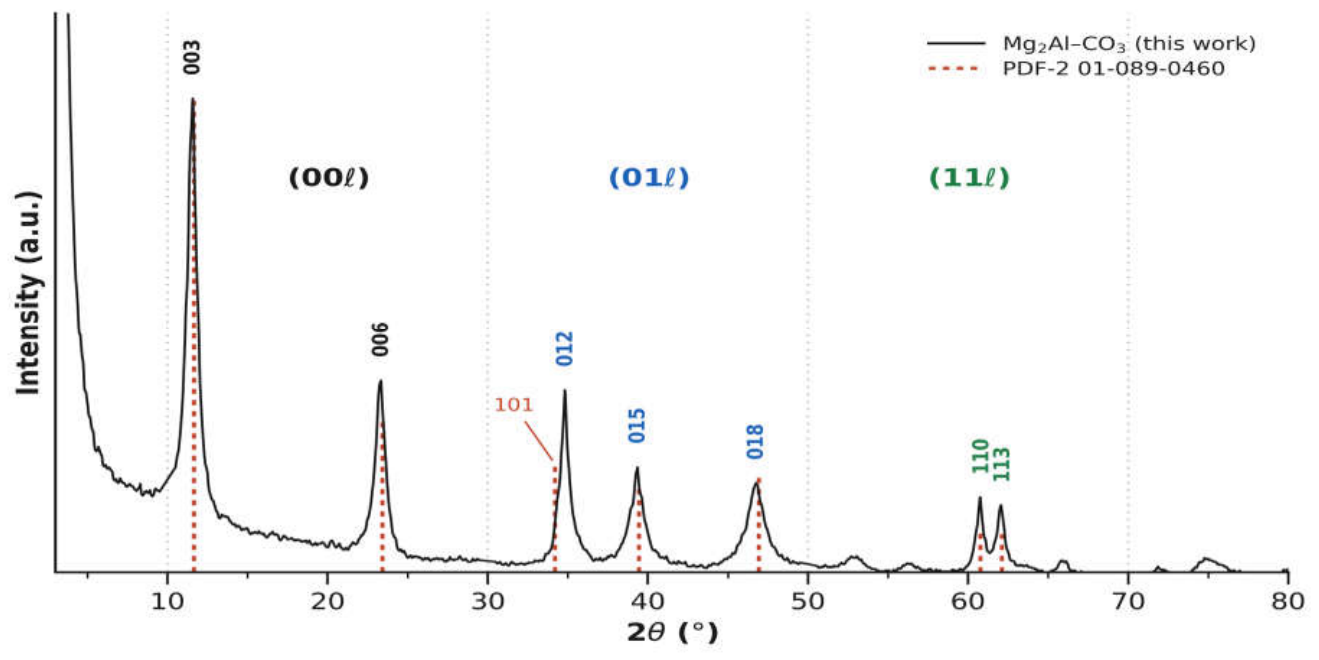
Figure 2.
Effect of the sorbent dose on Pb(II) sorption by Mg2Al–CO3: (a) removal efficiency; (b) equilibrium capacity. The dotted line marks the ratio m/V = 1.75 g L−1 retained for the rest of the study (C0 = 100 mg L−1, V = 20 mL, pHi = 5.45, tc = 3 h, T = 25 °C).
Figure 2.
Effect of the sorbent dose on Pb(II) sorption by Mg2Al–CO3: (a) removal efficiency; (b) equilibrium capacity. The dotted line marks the ratio m/V = 1.75 g L−1 retained for the rest of the study (C0 = 100 mg L−1, V = 20 mL, pHi = 5.45, tc = 3 h, T = 25 °C).
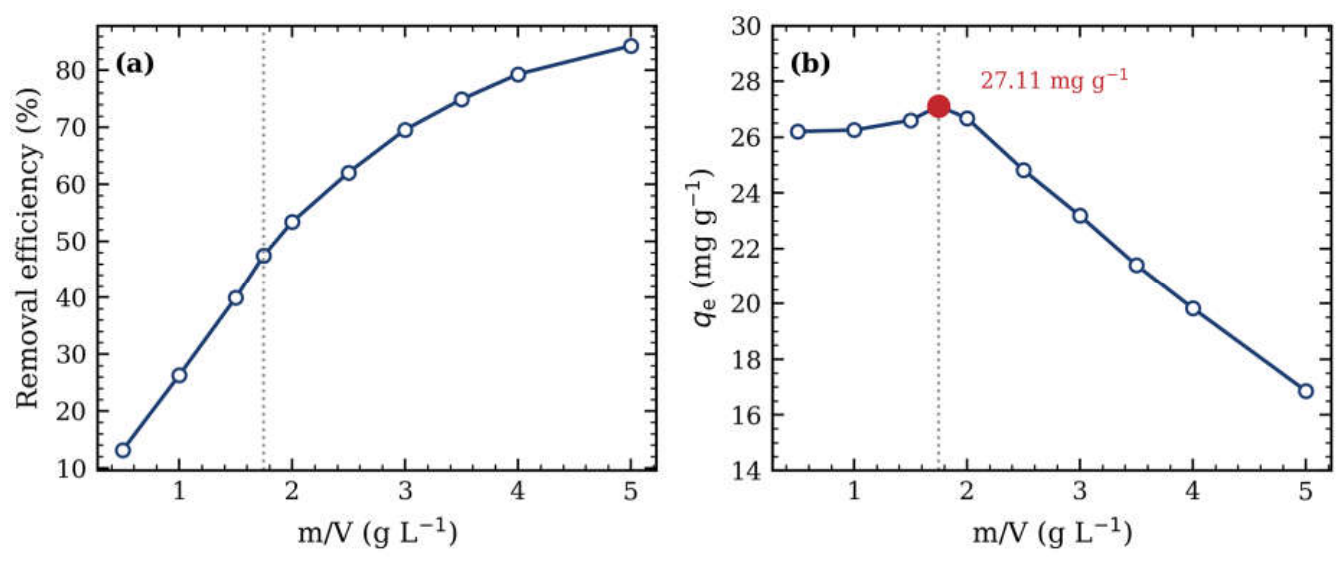
Figure 3.
Non-linear modeling of the sorption kinetics of Pb(II) on Mg2Al–CO3 with the PFO, PSO, Elovich and IPD equations (C0 = 100 mg L−1, m/V = 1.75 g L−1, pHi = 5.45, T = 25 °C). Symbols: experimental data; lines: fitted models.
Figure 3.
Non-linear modeling of the sorption kinetics of Pb(II) on Mg2Al–CO3 with the PFO, PSO, Elovich and IPD equations (C0 = 100 mg L−1, m/V = 1.75 g L−1, pHi = 5.45, T = 25 °C). Symbols: experimental data; lines: fitted models.
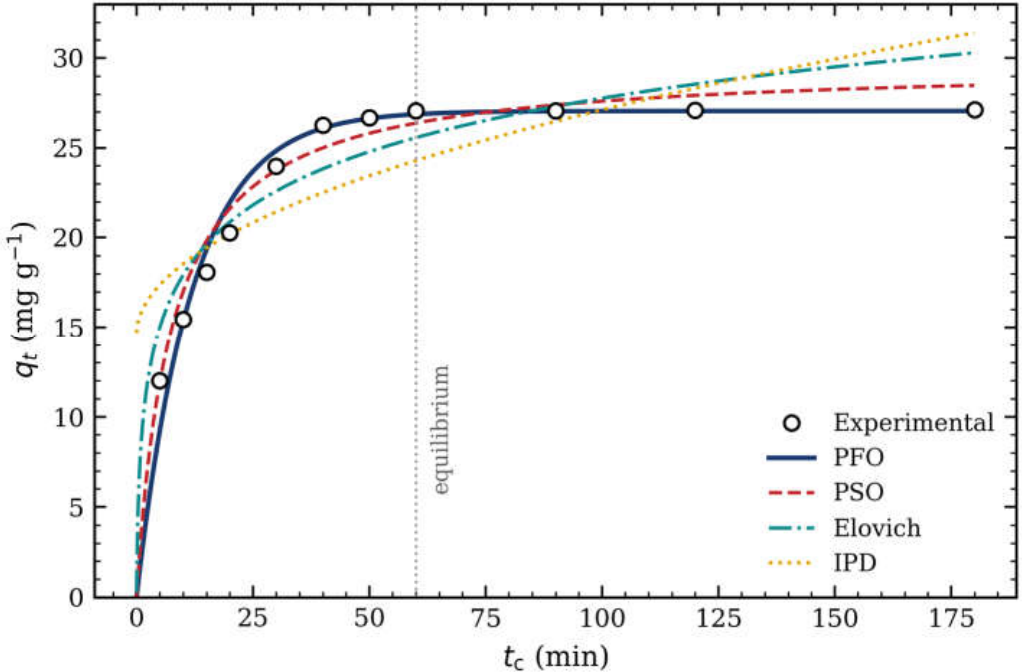
Figure 4.
Non-linear modeling of the Pb(II) sorption isotherm on Mg2Al–CO3 with the Langmuir, Freundlich, Redlich–Peterson and Temkin equations (m/V = 1.75 g L−1, tc = 3 h, T = 25 °C). Symbols: experimental data; lines: fitted models.
Figure 4.
Non-linear modeling of the Pb(II) sorption isotherm on Mg2Al–CO3 with the Langmuir, Freundlich, Redlich–Peterson and Temkin equations (m/V = 1.75 g L−1, tc = 3 h, T = 25 °C). Symbols: experimental data; lines: fitted models.
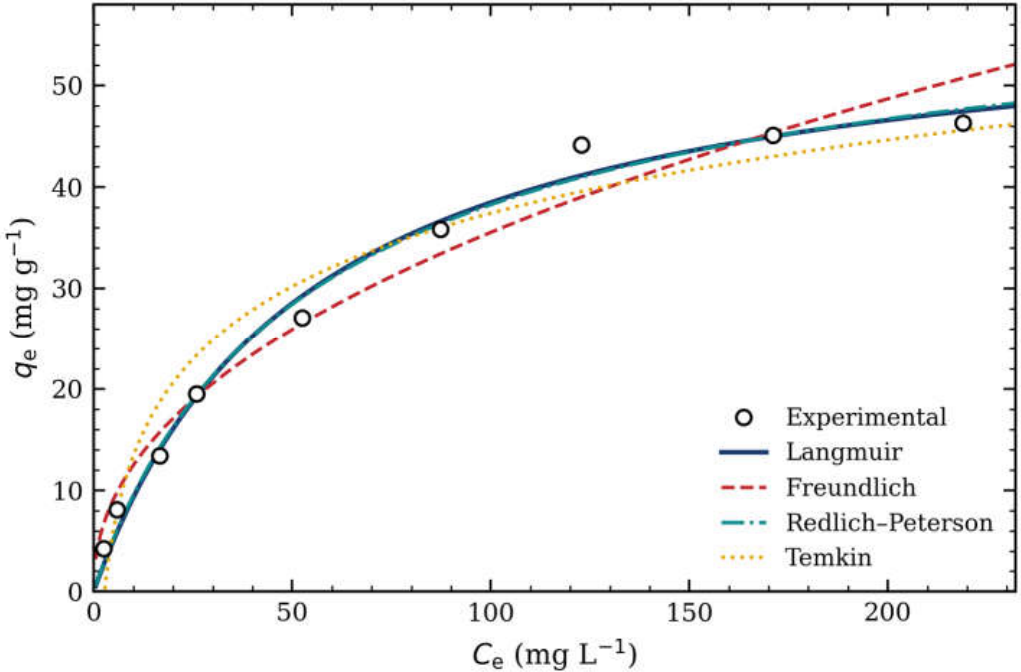
Figure 5.
(a) Effect of temperature on the equilibrium capacity of Mg2Al–CO3 toward Pb(II); (b) corresponding van ’t Hoff plot (C0 = 100 mg L−1, m/V = 1.75 g L−1, tc = 3 h, pHi = 5.45).
Figure 5.
(a) Effect of temperature on the equilibrium capacity of Mg2Al–CO3 toward Pb(II); (b) corresponding van ’t Hoff plot (C0 = 100 mg L−1, m/V = 1.75 g L−1, tc = 3 h, pHi = 5.45).
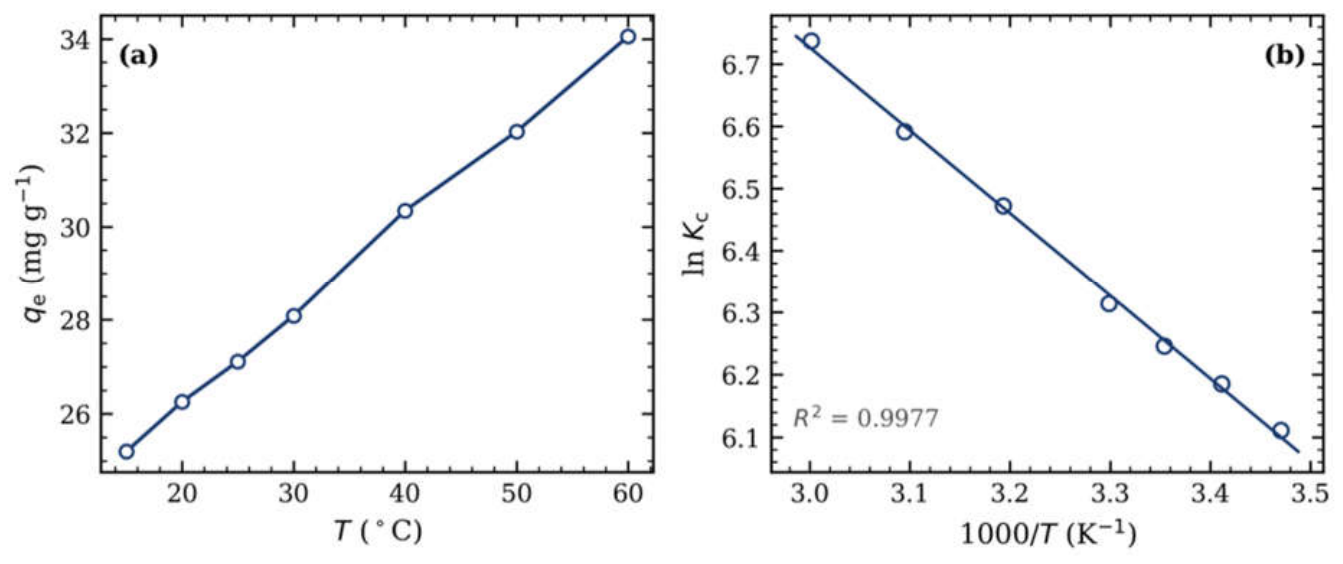
Figure 6.
Distribution of dissolved Pb(II) species as a function of pH, computed for a total lead concentration of 100 mg L−1 at 25 °C. The shaded band indicates the range of final pH values measured in this study; the dashed line marks the measured pHPZC.
Figure 6.
Distribution of dissolved Pb(II) species as a function of pH, computed for a total lead concentration of 100 mg L−1 at 25 °C. The shaded band indicates the range of final pH values measured in this study; the dashed line marks the measured pHPZC.
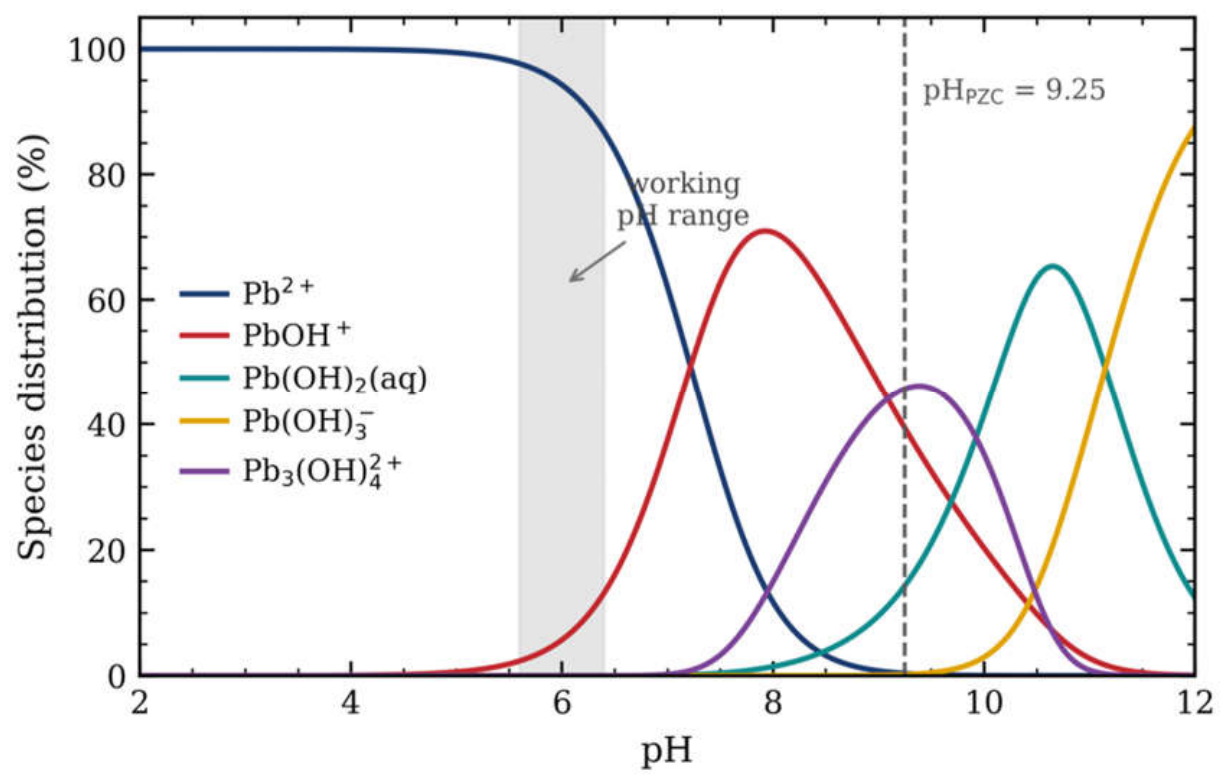
Figure 7.
Relationships between Pb(II) sorption capacity and physicochemical properties for the three isostructural phases: (a) Langmuir capacity vs. BET surface area; (b) Langmuir capacity vs. relative crystallinity; (c) equilibrium capacity at C0 = 100 mg L−1. Data for Mg2[FeAl]–CO3 and Zn2[FeAl]–CO3 from [40] and [41], respectively.
Figure 7.
Relationships between Pb(II) sorption capacity and physicochemical properties for the three isostructural phases: (a) Langmuir capacity vs. BET surface area; (b) Langmuir capacity vs. relative crystallinity; (c) equilibrium capacity at C0 = 100 mg L−1. Data for Mg2[FeAl]–CO3 and Zn2[FeAl]–CO3 from [40] and [41], respectively.
Scheme 1.
pH-dependent representation of the pathways proposed for Pb(II) removal by Mg2Al–CO3. The horizontal band follows the increase in removal efficiency with pH; cards 1–4 rank the pathways by their consistency with the measurements, and the colored spans give the pH domain over which each operates. At the working pH the surface lies below its point of zero charge and is net positively charged, so routes 1 and 2 — not the electrostatic route 3 — are the two pathways compatible with the whole of the data. The dashed boxes mark the two domains in which the measured uptake cannot be interpreted as sorption alone.
Scheme 1.
pH-dependent representation of the pathways proposed for Pb(II) removal by Mg2Al–CO3. The horizontal band follows the increase in removal efficiency with pH; cards 1–4 rank the pathways by their consistency with the measurements, and the colored spans give the pH domain over which each operates. At the working pH the surface lies below its point of zero charge and is net positively charged, so routes 1 and 2 — not the electrostatic route 3 — are the two pathways compatible with the whole of the data. The dashed boxes mark the two domains in which the measured uptake cannot be interpreted as sorption alone.
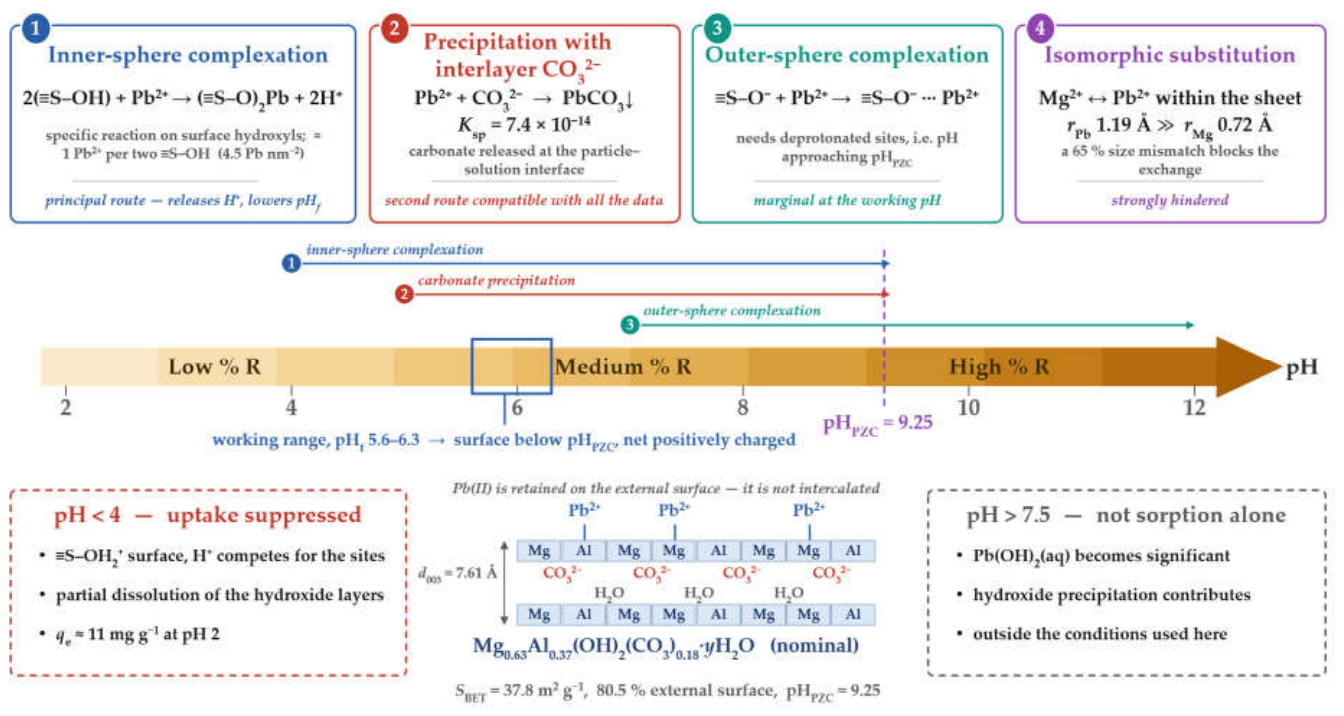

Table 1.
Structural, compositional, textural and surface properties of the Mg2Al–CO3 phase prepared in this work.
Table 1.
Structural, compositional, textural and surface properties of the Mg2Al–CO3 phase prepared in this work.
| Property | Value | Technique / remark |
| a (Å) | 3.0434 | XRD, a = 2d110 |
| c (Å) | 22.8402 | XRD, c = 3d003 |
| d003 (Å) | 7.61 | XRD, basal spacing |
| Relative crystallinity (%) | 67.96 | XRD, integrated basal intensities |
| Mg/Al ratio | 1.69 | EDX (nominal value 2) |
| x = AlIII/(MgII+AlIII) | 0.372 | EDX |
| Proposed formula | Mg0.63Al0.37(OH)2(CO3)0.18·yH2O | |
| SBET (m2 g−1) | 37.83 | N2 sorption, 77 K |
| Micropore area (%) | 19.47 | t-plot method |
| Mean pore diameter (nm) | 6.62 | BJH, desorption branch |
| Total pore volume (cm3 g−1) | 0.05188 | at P/P° = 0.8962 |
| Equivalent particle size (nm) | 158.59 | from SBET |
| DSC endotherms (°C) | 125, 225, > 275 | 10 °C min−1, N2 |
| pHPZC | 9.25 | batch equilibration |
Table 2.
Non-linear kinetic parameters for Pb(II) sorption on Mg2Al–CO3 (C0 = 100 mg L−1, m/V = 1.75 g L−1, pHi = 5.45, T = 25 °C).
Table 2.
Non-linear kinetic parameters for Pb(II) sorption on Mg2Al–CO3 (C0 = 100 mg L−1, m/V = 1.75 g L−1, pHi = 5.45, T = 25 °C).
| Model | Parameter | Value | R2 | χ2 |
| Experimental | qe,exp (mg g−1) | 27.15 | — | — |
| PFO | qe,cal (mg g−1) | 27.054 | 0.99991 | 0.416 |
| k1 (min−1) | 0.08340 | |||
| PSO | qe,cal (mg g−1) | 29.659 | 0.99976 | 1.109 |
| k2 (g mg−1 min−1) | 0.00452 | |||
| Elovich | α (mg g−1 min−1) | 27.115 | 0.99881 | 5.430 |
| β (g mg−1) | 0.2322 | |||
| IPD | kIPD (mg g−1 min−1/2) | 1.2555 | 0.99679 | 14.664 |
| C (mg g−1) | 14.561 |
Table 3.
Non-linear isotherm parameters for Pb(II) sorption on Mg2Al–CO3 (m/V = 1.75 g L−1, tc = 3 h, T = 25 °C).
Table 3.
Non-linear isotherm parameters for Pb(II) sorption on Mg2Al–CO3 (m/V = 1.75 g L−1, tc = 3 h, T = 25 °C).
| Model | Parameters | Value | R2 | χ2 |
| Langmuir | qm (mg g−1) | 59.06 | 0.98921 | 3.373 |
| KL (L mg−1) | 0.01867 | |||
| RL | 0.152 | |||
| Freundlich | KF (mg1−n Ln g−1) | 4.374 | 0.96529 | 9.494 |
| n | 0.45478 | |||
| Redlich–Peterson | KR–P (L g−1) | 1.16459 | 0.98928 | 3.909 |
| αR–P (L mg−1)−β | 0.02426 | |||
| β | 0.96290 | |||
| Temkin | B = RT/bT (J mol−1) | 10.427 | 0.95111 | 15.279 |
| AT (L g−1) | 0.36142 | |||
| Dubinin–Radushkevich | qm,D–R (mg g−1) | 56.40 | 0.97331 | 8.343 |
| KD–R (mol2 kJ−2) | 0.25250 | |||
| ED–R (kJ mol−1) | 1.407 |
Table 4.
Thermodynamic and energetic parameters for Pb(II) sorption on Mg2Al–CO3 (C0 = 100 mg L−1, m/V = 1.75 g L−1, tc = 3 h).
Table 4.
Thermodynamic and energetic parameters for Pb(II) sorption on Mg2Al–CO3 (C0 = 100 mg L−1, m/V = 1.75 g L−1, tc = 3 h).
| T(K) | Kc | ΔG° (kJ mol−1) | ΔH° | ΔS° |
| (kJ mol−1) | (J mol−1 K−1) | |||
| 288 | 450.81 | −14.640 | 11.072 | 105.8 |
| 293 | 485.79 | −15.076 | ||
| 298 | 515.97 | −15.483 | ||
| 303 | 552.32 | −15.914 | ||
| 313 | 646.97 | −16.851 | ||
| 323 | 728.75 | −17.709 | ||
| 333 | 843.00 | −18.660 | ||
| Energetic parameters | ED–R = 1.407 kJ mol−1 | ΔG°(298 K) = −20.5 kJ mol−1 | ||
Table 5.
Comparison of Mg2Al–CO3 with the two isostructural phases previously studied under identical conditions.
Table 5.
Comparison of Mg2Al–CO3 with the two isostructural phases previously studied under identical conditions.
| Property | Mg2Al–CO3 | Mg2[FeAl]–CO3 | Zn2[FeAl]–CO3 |
| Source | this work | [40] | [41] |
| Substitution vs. Mg2Al | — | AlIII → FeIII | MgII → ZnII |
| a (Å) | 3.0434 | 3.0746 | 3.0912 |
| c (Å) | 22.8402 | 22.9566 | 22.7460 |
| d003 (Å) | 7.61 | 7.65 | 7.58 |
| Relative crystallinity (%) | 67.96 | 46.92 | 59.60 |
| MII/MIII (EDX) | 1.69 | 1.60 | 1.82 |
| x = MIII/(MII+MIII) | 0.372 | 0.385 | 0.354 |
| SBET (m2 g−1) | 37.83 | 80.77 | 54.48 |
| External surface (%) | 80.53 | 85.12 | 82.67 |
| Mean pore diameter (nm) | 6.62 | 5.03 | 5.13 |
| Particle size (nm) | 158.59 | 74.29 | 110.13 |
| pHPZC | 9.25 | 9.35 | 8.35 |
| qe at C0 = 100 mg L−1 (mg g−1) | 27.11 | 36.46 | 31.23 |
| qe at C0 = 300 mg L−1 (mg g−1) | 46.31 | 78.54 | 65.06 |
| qm,L (mg g−1) | 59.06 | 118.78 | 87.89 |
| Best isotherm | R–P ≈ Langmuir | R–P ≈ Langmuir | R–P ≈ Freundlich |
| ΔH° (kJ mol−1) | 11.072 | 9.208 | 10.524 |
Table 6.
Maximum Pb(II) sorption capacities reported for LDH sorbents, ordered by increasing Qmax.
| Sorbent | C0(mg L−1) | m/V (g L−1) | tc(h) | pHi | Qmax(mg g−1) | Basis | Reference |
| CaFe–citrate | 20 | 0.4 | 1.5 | 7 | 13.0 | experimental | [31] |
| Mg2Al–glutamate | 20 | 1 | 2 | 5 | 19.3 | experimental | [31] |
| Mg2Al–tartrate | 100 | 1 | 2 | 5 | 20.5 | experimental | [59] |
| Mg2Al–Cl | 200 | 1 | 2.5 | 5.5 | 37.0 | experimental | [60] |
| Mg3Al–humate (50%) | 207.2 | 1.67 | 24 | 5 | 46.0 | experimental | [24] |
| Mg2Al–CO3 | 300 | 1.75 | 3 | unadjusted | 59.1 | Langmuir | this work |
| CoMo–CO3 | 369.9 | 5 | 2 | 5.5 | 73.4 | experimental | [55] |
| Zn2[FeAl]–CO3 | 300 | 1.75 | 3 | unadjusted | 87.9 | Langmuir | [41] |
| MgAl–alginate | 50 | 0.5 | 24 | 5.7 | 93.8 | experimental | [27] |
| Mg3Al–humate (100%) | 207.2 | 1.67 | 48 | 5 | 102.0 | experimental | [24] |
| Mg3Al–Cl | 207.2 | 1.67 | 24 | 5 | 108.0 | experimental | [24] |
| Mg2[FeAl]–CO3 | 300 | 1.75 | 3 | unadjusted | 118.8 | Langmuir | [40] |
| MIL-88A(Fe)-derived LDH | — | 0.5 | 12 | 5 | 217.0 | Langmuir | [32] |
Disclaimer/Publisher’s Note: The statements, opinions and data contained in all publications are solely those of the individual author(s) and contributor(s) and not of MDPI and/or the editor(s). MDPI and/or the editor(s) disclaim responsibility for any injury to people or property resulting from any ideas, methods, instructions or products referred to in the content. |
© 2026 by the authors. Licensee MDPI, Basel, Switzerland. This article is an open access article distributed under the terms and conditions of the Creative Commons Attribution (CC BY) license (http://creativecommons.org/licenses/by/4.0/).
Copyright: This open access article is published under a Creative Commons CC BY 4.0 license, which permit the free download, distribution, and reuse, provided that the author and preprint are cited in any reuse.