
Submitted:
16 August 2026
Posted:
18 August 2026
You are already at the latest version
Abstract
This study examined the effect of fertilizer amendment type and tillage practice on the chemical properties and the bacterial community’s assessment as biological indicators of the soil fertility, with conserving this biological system of agro-ecosystem production. The experiment compared conventional tillage (CT) with three (3) minimum tillage (MT) methods. Metagenomic analysis was executed out to determine the phyla of the bacteria. The impacts of the treatments were primarily observed in phosphorus (P) dynamics, while other mineral elements remained relatively stable due to differences in nutrient availability mechanisms. The results showed similarities between different treatments, particularly between minimum tillage (MT) with the same mineral (M) input as well as between organic (O) inputs, while CT with mineral input appeared to be the most distinctive treatment. Tillage has a small but statistically have significantly structural impact on the configuration of microbial communities (P-Value <0.05), for major bacteria’s’ phyla. In this analysis, the Shannon index varied between 5.48 and 5.23, indicating a particularly diverse bacterial community, characteristic of agricultural soils with significant biological activity. The bacteria of the phyla Planctomycetota and Verrucomicrobia are correlated positively with the Actinobacteriota phyla, and we consider beneficial bacteria and consider them all as biological indicators of agricultural soil bio-fertility. The results demonstrated that tillage seems to have a bigger impact on bacterial diversity than fertilization. Reduced tillage using a combination of two implements (cover crop incorporation and tine cultivator) is suggested as the most suitable option for this type of soil.
Keywords:
bacteria
; fertilizer
; nutrients
; soil fertility
; tillage
1. Introduction
1.1. Mineral Elements in Cultivated Soils
The mineral elements, originating from the soil, are a vital nutrition for plants because they are involved in a large number of physiological processes. A distinction is generally made between macronutrients and micronutrients, which are essential minerals for normal plant growth [1].
Among the nutriments necessary for growth, such as the essential nutrients (e.g., the nitrogen (N), phosphorus (P), and potassium (K)), often of mineral origin due to microbial activity. Conversely, microelements such as manganese (Mg) and iron (Fe) and, necessary for enzymatic activity and photosynthesis, are often limiting due to their immobilization in insoluble mineral complexes in the soil [2]. Iron (Fe), one of the most limiting trace elements, is involved in chlorophyll synthesis and the activation of enzymes, making iron-solubilizing bacteria important to compensate for these deficiencies.
Soil bacteria, fungi, actinomycetes, protozoa, nematodes, and algae make up the soil microbial community known as soil macrobiota. Soil microorganisms, which are dependent on the soil and its age, are crucial to soil fertility. These organisms are bioindicators of the biological and the chemical parameters of the soil [3] ․
The soil bacterial community is of considerable research interest in biological processes, including organic matter (OM) decomposition, and has a critical role in agricultural soil management systems [4].
1.2. Role of Bacteria in the Soil
Bacteria and their diversity also playing a function in the cycling of nutrients․ the Nitrogen fixation is a process undertaken by some N-fixing bacteria species such as Rhizobium‚ which live symbiotically with the roots of legumes‚ and assimilate atmospheric N into format that are usable by plants‚ allowing for decreased applications of mineral amendment [5]․
Other helpful soil microbes including Azotobacter and Bacillus can also fix N naturally in the soil‚ as well as solubilizing phosphorus (P), potassium (K)‚ and making them available for absorption by plant roots [6]․
The bacteria and nutrient recyclers Most of the OM decomposition is done by soil bacteria, including Actinomycetes. Some Actinomycetes can live in very alkaline conditions‚ and can eat dead and decaying matter‚ and break it down into elements that are then absorbed by the plants․ Soil bacteria make an important contribution to maintaining soil fertility by the leaching of nutrients from the soil. This is important, particularly in nutrient cycles [7].
Soil bacteria also help to remove pollutants from the environment by converting them to non-toxic compounds [8]. Soil microorganisms take an active role in regulating the plant-available nutrients in the soil as well․ Microbial mineralization of OM makes mineral nutrients available for absorption by plants. If the soil bacteria make the minerals soluble, they can be absorbed by certain plants. For instance‚, zinc-solubilizing soil bacteria secrete organic acids that are effective in liberating zinc from soil minerals so that zinc-deficient plants such as wheat can absorb it [9].
1.3. Interactions Between Minerals and Groups of Microorganisms
One of the elements of a dynamic system involved in the soil fertility and nutrient cycling is the interaction between mineral nutrients and microbial populations. This biogeochemical process of microbial mineralization of soil leads to the dissolution of minerals, which causes the soil solution to contain both macro and minor nutrients [10]. Their relationship with the soil is an integral part of their nutrient cycling and health.
Minerals are released from the parent rock through weathering. Combined with microbial inoculants, they can improve soil fertility and nutrient availability for crops. When it comes to changing the surface of mineral soil, bacteria have a crucial function and can influence soil properties and dynamics. The effectiveness of these practices depends on diverse factorship, such as the soil type, the configuration of the soil microbial compositions, and environmental conditions [11]. Additional research on how tillage affects soil fauna have shown that tillage frequently disturbs a wide variety of organisms, ranging from microscopic bacteria and fungi to large burrowing animals such as moles, as well as predators such as snakes [12].
Soil tillage is a cultivation practice that uses machines for the soil preparation for seeding. Its effects on the soil fertility and crop yields can be both significant and complex. Among these methods are conventional tillage, no-till conservation agriculture, and direct seeding, each having very different effects on the soil's physico-chemicals properties, its capacity to make various nutrients available to plants, the format and the microbial diversity of communities that inhabit it [13].
The tillage effect on mineral dynamics and bacterial community is significant. Traditional (conventional) tillage destroys soil structure, often leading to a decrease in biomass and microbial biodiversity, along with impairment of nutrients and soil fertility [14].
Soil conservation procedures such as no-till farming increase the diversity of bacteria and nutrient availability by meaning soil structure and OM. These practices are considered sustainable, soil enhancing, and reducing environmental degradation [15].
Effects of tillage on the bioavailability of mineral nutrients on the soil bacteria have also been studied. Disadvantages of tillage include soil erosion, decreased OM, and degradation of soil health in the case of ploughing. Its advantages lie in weed control and seedbed preparation [16]. However, practitioners of reduced tillage and no-till farming have argued that these practices could, in the long term, increase soil microbiome resilience and nutrient cycling through sustainable of agricultural practices that promote soil health and a balanced ecosystem [17].
According to Wang et al. (2017) [18], agricultural land management and technique practices, can affect soil microbial diversity; for example, in one of these studies, tillage increased microbial diversity in soils. This may mean that a lower level of disturbance allows for the establishment of greater bacterial species diversity and better ecosystem functioning, whereas a higher level of disturbance (such as intensive soil tillage) could cause a diminish in microbial diversity, and consequently impact on the soil health and its productivity [19].
2. Materials and Methods
The experimental protocol was implemented at a university experimental station in 2024 with the following geographical coordinates:
Latitude 36°11’19”N, Longitude 1°14’56.6”E, Altitude 100 m.
The experimental plot is situated in the Bas-Chéliff plain, which consists mainly of alluvial deposits. The agricultural soils of the Bas-Chéliff plain in Algeria are predominantly clayey and heavy, characterized by a high proportion of fine-textured material and a widespread prevalence of salinity problems [20].
The experiment aimed to analyze the influence of four (4) tillage techniques (conventional tillage and three minimum tillage techniques) with organic and/or mineral treatments on soil chemical status and microbial diversity. These treatments were used as indicators of soil fertility. A randomized complete block design (RCBD), with three (3) replications was conducted.
Each experimental plot was divided into four (4) micro-plot width-wise. The effect of four cultivation techniques (T): we selected the treatments listed in Table 1 below:
The dimensions of each micro-plot are as follows: Length: 15 m; width: 3 m. Each micro plot will be split into two since we executed on two amendment types: organic (O) and mineral (M). As a result, there are eight microplots. The soil will be analyzed on the experimental apparatus prior to seeding in order to serve as a control reference before swing (witness). The small plots are cultivated with chickpeas.
2.1. Soil Chemical Analysis
Once a site is selected for assessment‚ samples are collected using sterile tools to avoid contamination‚ then dried and ground into a fine powder. We take three (3) random samples from each micro-plot, with an overall nine (9) samples in each treatment. The samples was then ground and passed through a predetermined series of screens so that all the particle fractions in the sample to be analyzed are of the same size, which gives the most accurate results․
Laboratory analysis was performed using these following procedures:
Determination of organic carbon (OC) and total carbon (C) according to ISO-10390. Nitrogen (N) is measured according to ISO-13878, by the principle of the dry combustion method by digestion at 420°C, and then distillation and titration.
Regarding organic matter (OM), weigh 1 g of soil, add 10 mL of dichromate (K2Cr2O7 1N), and 20 mL of sulphuric acid (H₂SO₄). Let it react for 30 minutes and then distil to titrate with ferrous sulphate (FeSO₄).
Determination of assimilable phosphorus (P) by shaking 2.5 g of soil and 50 mL of 0.5 M NaHCO₃ (pH 8.5) for 30 minutes, the total nitrogen is measured using a spectrophotometer at 882 nm according to ISO 13878.
For exchangeable cations, stir for one (1) hour with 5 g of the soil with 100 mL of ammonium acetate. Then, the measurement using the Atomic Absorption Spectrometer. This test allows the measurement of potassium (K), calcium (Ca), magnesium (Mg), and sodium (Na).
2.2. Microbial Diversity Analysis
The laboratory located within the Institute for Research in Construction (IRDA), a specialized Microbial Ecology Laboratory, located in Quebec, Quebec, Canada, carried out the amplicon sequencing library preparation and the bioinformatics analysis of the DNA sequences. Illumina MiSeq 2x300 bp sequencing was conducted for the genomic data analysis workflow of the Institute for Integrative of Biology and Systems (IBS) at Laval University (Quebec, Canada).
The number of eight (8) samples submitted for LEM Metagenomic sequencing at IRDA. A FastDNA bread kit was employed for total DNA of the samples of soil (MP Biomedicals, Solon, OH, USA). Spectrophotometry was used to quantify the absorbance values at 260 and 280 nm including the A260/A280 ratio, in order to assess the amount and quality of the purified genomic DNA.
2.3. Molecular Detection by Quantitative PCR
A qPCR system was used to quantify total prokaryotes with the eub338/eub518 primers mentioned by Zhang et al., [21]. The identifications were performed in duplicate on a CFX96 device (Bio-rad, Hercules, CA) with a SYBR green qPCR mix reaction mixture at Qiagen, Toronto, Canada. A detecting system was created and developed, having a detection range of 4 LOG. (Efficiency of the total bacterial system: 89.1% r²=0.99). Measurements are presented as amplification of units per gram (AU/g) at the dry soil. Notably, multiple copies of the targeted genes during the quantification process can be detected within a single organism and in varying numbers between these organisms.
2.4. Microbial Diversity
Metagenomic evaluations examined the variety of prokaryotes (archaea and bacteria). PCR amplification of the V4 hypervariable region of the 16S ribosomal RNA (rRNA) gene from prokaryotes organism, was carried out using the region-specific primers described by Lewis et al. [22], using a dual-indexed PCR approach (two-step PCR approach) specially made to be designed using for analysis with the Illumina MiSeq high-throughput sequencing platform. The amplicon libraries were sequenced in paired-end format with a 300 base read, that is, 2 x 300 base of pairs (bp) on each side of the DNA sequencing stranded protocol on the Illumina MiSeq system at the genomic analysis platform of Laval University’s (Quebec, CA), in the Institute of Biology and Integrative Systems (IBIS).
The bacterial community’s diversity index of was indicated by the Shannon diversity index (H’) using equation 1, which was applied in the author's previous study [23].
where: Ni – Number of individuals of species
N – Total number of specimens from each species in the samples.
H' less than 2 indicates low diversity; H' between 2 and 4 indicate Moderate diversity; H' greater than 4 indicates the high diversity of bacteria.
Sequence bioinformatics analyses were conducted on the bioinformatics platform of the LEM at the IRDA and involved disparate processing strategies of Qiime2 according to Bolyen et al. [24], including procedure quality validation, reference databases, and indices for comparisons of microbial diversity after measuring microbial richness. The Greengenes 13.8 reference database was employed for the taxonomic assignment of the identified genetic variants [25].
2.5. Statistical Analyses Processing of Data
All data were processed using OriginLab 2019b Corporation software (version 9.6.5.169) and presented as mean ± standard error (SE). One-way ANOVA was utilized to evaluate statistically demonstrable differences between parameters analyzed at each soil tillage practice. Two-way ANOVA was used to determine the interactions and main effects of fertilizer and soil tillage on mineral nutriments and bacterial heterogeneity. Tukey’s post hoc test (P-Value < 0.05) was utilized for multiple comparisons. The Principal Component Analysis (PCA) of results data was performed with the same software to establish the correlation between bacteria’s phyla and to obtain the aumogenic groups between the treatments used.
3. Results
3.1. Impact of Treatment on the Soil Nutriments
Figure 1 shows the results of the interaction of fertilizer and tillage on the percentage of organic carbon (OC), nitrogen (N), and organic matter (OM) in the soil. Soil organic matter (OM) enhances the chemical analysis of the soil, allowing all plants, both cultivated and wild, to grow healthily.
The abundance of the five minerals (P, Ca, K, Mg, and Na) in the different treatments used is summarized in Figure 2. For some elements, variations can be observed between treatments, while for others, the concentrations remain constant across all treatments. Magnesium (Mg) a large proportion abundant element in the treatments, but the difference between treatments is slight, showing that the magnesium concentration is relatively constant, ranging from 1.45 to 1.60 m.eq/100g (right axis).
Effects were strongest for P‚, which is one of the most variable‚ and P absorbance is likely most affected by treatment due to its variance in availability. Concentrations of Mg‚ K‚ Ca‚ and Na were relatively similar across treatments and did not vary greatly among treatments. This may indicate that they are less affected by soil tillage or fertilizer category, or that native soil reserves are large enough to mask the effects that are present․
It can be noted that, for all the mineral elements in the graph, magnesium is always the most abundant, phosphorus is always the most affected by the treatment, and for the other elements, the variations in their availability are insignificant, which demonstrates their stability.
For phosphorus (P), the range is from 0.24 to 0.53 m.eq/100g (left axis), with levels lower than the initial value (before sowing). This is the nutrient whose levels vary the most between treatments. Potassium (K) has intermediate concentrations of approximately 0.30 to 0.42 m.eq/100 g, which vary moderately from one treatment to another, indicating the availability of the element in greater or lesser quantities. Calcium (Ca) is present in very small amounts (0.06 to 0.08 m.eq/100g), but its presence varies little from one treatment to another. Indeed, the concentrations of sodium (Na), which is the least present element, are close to zero for all treatments and therefore vary very little.
3.2. Metagenomic Analysis of the Soil Bacteria Phyla Abundance
The relative abundance is presented in Figure 3 of the main soil bacterial phyla in the tillage systems CT, MT_cc, MT_ccr, and MT_r at different fertilizer applications (M and O). All treatments have a comparatively consistent bacterial community structure, although the relative abundance of some phyla varies between soil treatments.
Actinobacteriota is the large proportion represented of the phylum; regardless of the treatment, with percentages ranging from 42% to 46%. The maximum value of 46% is observed in conventional tillage (CT_M). For the other treatments, the values vary between 42% and 44%. This stability indicates that tillage has little impact on the dominance of this phylum.
In terms of quantity, the most represented phylum is Proteobacteria, with variations between 22 and 24% depending on the treatment (MTr_O, MTcc_O), and other treatments (22 to 23%). Given these similar proportions, we can deduce that the bacterial community's makeup is steady. The phylum Crenarchaeota, third in relative abundance, represented only variations of 9 to 12% of the sequences: 9% for the CT_M tilled soil and 10 to 12% for the other treatments.
The phylum Chloroflexi has the most constant abundance (12-13%), indicating a low impact of the treatments on its members. The phyla Gemmatimonadota and Firmicutes constitute 4 to 5% of the bacterial community, respectively. The phylum Planctomycetota and the phylum Bacteroidota represent only 1 to 2% of the bacterial community, respectively, which testifies to a high degree of stability within these bacterial groups.
In conclusion, this graph shows that bacterial composition is largely dominated by the Actinobacteriota and Proteobacteria in tilled soils (CT), while the other phyla remain relatively stable. The different tillage treatments induced only slight modification to the relative abundance of the main phyla, suggesting optimal resilience of the bacterial community at this phylum taxonomic level.
3.3. Statistical Analysis of the Effect of Treatment on the Soil Fertility Indicators
In Figure 4, show the Principal Component of Analysis (PCA) shows that the first two axes explain 67.33% of the observed variation (36.69% for PC1 and 30.64% for PC2). This proportion of variance is relatively large, indicating that these two axes accurately summarize the microbial communities’ composition of the phylum bacteria in the treated soils.
The PC1 axis is correlated positively with the Proteobacteria, Chloroflexi, Bacteroidota, Chlorobi, and to a lesser extent, with Firmicutes, and negatively associated with Actinobacteriota, Planctomycetes, Verrucomicrobia, Gemmatimonadota, and Cyanobacteria. This can be explicated by the proportion of each of these bacterial groups to the overall modification in the constitution of soil bacteria.
On the PC2 axe, the contributions of the phyla Euryarchaeota, Nitrospirota, Crenarchaeota, and Firmicutes are positive, while those of Chloroflexi, Bacteroidota, Proteobacteria, Actinobacteriota, and Verrucomicrobiota are negative. Phyla near the bottom of the graph, such as the Armatimonadetes, make only a small contribution to the separation in the main components. The vectors cluster around the origin, indicating that the majority of phyla are relatively stable and that there is no dominant bacterial group in the structuring of microbial communities.
It is also observed that the MTr_M and MTcc_M treatments, which use only one tool, are very similar to each other with the same type of fertilizer, indicating a strong similarity between their bacterial communities. On the one hand, the MTr_O and MTcc_O tillage techniques form a relatively close group. On the other hand, this observation reflects a comparable microbial composition between these two treatments in these organisms.
The minimum tillage treatment (MTccr_M) with mineral (M) fertilizer occupies an intermediate position within the groups located in the upper right part, as well as with CT_M, suggesting an intermediate bacterial composition. Conversely, CT_M is relatively isolated on the negative part of PC1, which demonstrates that its microbial community is more distinct compared to the other treatments present.
Finally, it is worth noting that conventional tillage (CT_O) and reduced tillage (MTccr_O) using two implements are located in the lower quadrant. These two treatments induce intensive soil use. This analysis explicitly reveals a bacterial composition that differs from that of the treatments in the upper part of the graph. However, the distances between the various treatments remain minimal. This finding demonstrates that the composition of the bacterial populations as a whole was not strongly affected by the evaluated tillage techniques but rather by gradual modifications in their composition contingent upon the fertilizer amendment (mineral or organic).
The Variance Analysis (ANOVA) of the information data shown in Table 2 shows that both tillage and fertilization have a statistically significant influence upon all measured properties (soil bacteria, mineral N, P, and K). Both factors significantly affect the presence and amount of available nutrients within the matrix of soil as well as influence the size and type of microorganisms present. Statistically, the treatment means were revealed to fluctuate (p<0.05), making it highly improbable these observed differences were due to chance.
Figure 5 represents the Shannon diversity index of the soil bacterial population, according to the experimental factors: (A) tillage and (B) fertilization. The Shannon index of the bacterial community’s depends on the tillage method. CT treatment had a higher mean diversity (≈ 5․46 to 5․48). In contrast, MTcc treatment had lower but homogeneous diversity.
The MTccr treatment using two (2) soil cultivation tools shows greater dispersion, indicating that there is greater variability between experimental replicates. MTr had the lowest values of the Shannon index (≈ 5․23-5․28) ‚ indicating lower bacterial disparity (Figure 5.A) ․
Figure 5.B shows that the fertilization methods O and M have relatively similar distributions. Organic fertilization shows a slightly higher median than mineral (M), while the interquartile ranges overlap widely, suggesting that the fertilization’s impact on bacterial variety remains limited compared to that of tillage.
4. Discussion
It is clear that applying fertilizers has a big influence on the amount of OM that builds up in the soil and that the application of organic (O) fertilizers has a beneficial effect on OM accumulation. In actuality, the utilization of organic fertilizers gives soil microorganisms a substrate on which to grow and produce soil organic matter [26].
Additionally using mineral fertilizer can also lead to increase in soil OM following mineral fertilizer’s application, due to the increase in plant biomass, although mineral fertilizers containing mainly nitrogen in large quantities have the effect of reducing the OM available for decomposition in the soil [27]. Thus, one could comprehend why the increase in soil OM is greater under organic fertilizers (O) than under mineral fertilizers (M).
Other studies show that conservation tillage techniques have more recently been highlighted to conserve soil quality and improve its fertility [28]; indeed, low-disturbance tillage techniques aim to maintain the OC in the topsoil due to the environmental Micro-biota impoverishment and all the resulting oxidation processes [29].
The chickpeas are an excellent legume for enriching the soil with nitrogen. They fit perfectly into sustainable farming systems, particularly in the Mediterranean region. As a result, nitrogen levels increase with the various treatments.
The results show that the concentration of each mineral element depends on tillage and fertilizer, but that this concentration varies in proportions that differ depending on the element considered: magnesium (Mg) is the majority abundant and least variable mineral element, while phosphorus (P) exhibits the greatest variation. Potassium (K) varies to an intermediate degree, while calcium (Ca) and sodium (Na) are more stable.
The variability of phosphorus (P) correlates with the now-accepted idea that, being relatively immobile, P is strongly influenced by OM mineralisation, microbial activity, and the soil chemical characteristics. Conservation tillage or reduced tillage systems generally promote the accumulation of P in the surface layer because they disturb the soil less and plant OM is left on the soil surface. Recent analyses show that these systems increase the total quantity of phosphorus and plant-available phosphorus levels in the surface layers, compared to CT according to Lv et al. (2023) [30].
Potassium (K) does not exhibit as high variability as phosphorus (P), probable due to the high potassium content of soil minerals. However, several studies show that no-till or reduced tillage techniques promote accumulation in the topsoil by better retaining residues and avoiding losses that tillage otherwise causes [31].
The concentrations of Ca and Mg were unaffected and were thus assumed unaltered. However, it has recently been found that conservationist practices increase the concentration of Ca and Mg s in the upper layers of the soils, resulting in the increase in OM because of lower cation exchange capacity and less structural disturbance. In general‚ the effects of this agricultural conservation tend to be greater several years later [30].
The least prevalent element is the Sodium (Na), which remains in all treatments. This observation is in accordance with findings in the literature, which indicate that the effects of tillage on sodium are weak or inconsistent. Available meta-analyses conclude that no clear trend can be identified regarding the evolution of Na under tillage management systems of soil, in contrast with phosphorus, potassium, calcium, or magnesium [30].
These results confirm that the impact of treatments is primarily visible on phosphorus dynamics, while other mineral elements remain relatively stable due to differences in element availability mechanisms. Elements whose cycles are strongly linked to biological processes and the decomposition of OM, such as phosphorus, are more sensitive to changes related to soil cultivation.
Cations (i.e., positive ions) such as magnesium and calcium, whose cycles are more dependent on soil mineral reserves, are therefore more stable. These results obtained are in accord with the analyses of most emerging literature highlighting that reduced-tillage techniques slowly improve soil chemistry, nutrient accumulation, and soil biological activity [32].
Variability in the configuration of bacterial community are consistent with the impacts of tillage techniques on microbial diversity, for example, impacts on bacterial communities due to aggregate fragmentation, accelerated OM mineralization, and changes in air and water circulation conditions in the soil. Conversely, reduced tillage or conservation tillage systems, which leave soil structure relatively intact, increase OM accumulation and microorganism stability, thus promoting microbial community development.
Despite this, most tillage systems do not appear to affect the relative ratio between major phyla, suggesting that the taxonomic structure of bacterial communities is relatively stable. Our results prove that the bacterial composition is largely frequency-graded by Actinobacteriota and Proteobacteria in tilled soils (CT), which is in technical precision with the performed carried out by Wang et al. (2017) [18].
Analysis of the results obtained reveals that Actinobacteriota are dominant, which is consistent with several recent studies indicating that this phylum represents one of the most numerous bacterial groups in agricultural soils. This phylum plays an indispensable role in degrading OM, mineralizing nutrients, and retaining soil fertility. Typically, high abundance of organisms in the microbiome correlates with optimal functional capacity. This contributes significantly to ensuring the proper functioning of biogeochemical cycles, not only of carbon but also of nitrogen [33].
Proteobacteria, the second largely abundant phylum (22-24%), are classified as copiotrophic bacteria that respond promptly to the availability of nutrients and easily degradable organic compounds. The abundance that remains relatively constant among the different treatments indicates that the soil tillage practices examined have not profoundly changed the nutrient resources accessible to this bacterial group. Recent research also shows, significantly, that Proteobacteria actively participate in all nutrient transformation processes and the overall functioning of agricultural soils.
The phyla Chloroflexi (12-13%) and Crenarchaeota (9-12%) are also present in relatively constant proportions in both types of biomes. Chloroflexi are often inversely related with the decomposition of more recalcitrant OM and are therefore often favored in soils where OM is relatively stable. Crenarchaeota, a phylum of Archaea, seem particularly adapted to the oxidation of ammonia, a step in nitrification within the nitrogen cycle. The low level of variation in their abundance between treatments indicates that the microbial functions associated with them are generally preserved under all conditions.
The minor phyla Firmicutes, Gemmatimonadota, Planctomycetota, and Bacteroidota, each indicating less than 5% of the bacterial community, are functionally important for OM recycling, phosphorus and nitrogen cycling, and the opposition of microbial communities to environmental perturbation. The minimal rate of variation among treatments indicates that there is no significant influence on microbial communities by tillage.
The differences observed between the various treatments remain limited. For example, Actinobacteriota reaches 46% under treatment CT_M. In contrast, this is compared to 42% in several other treatments, while Proteobacteria varies only between 22 and 24%. These relatively small differences confirm that the tillage method evaluated exerts a moderate influence on the overarching taxonomic composition of each bacterial community in this examination. Recent studies also indicate that changes brought about by tillage often affect the fine structure of communities, microbial diversity, and interactions between microorganisms more than the abundance of the main phyla [34].
Moreover, several studies published between 2023 and 2024 show that soil conservation systems, particularly direct seeding or reduced tillage, promote microbial diversity, bacterial structure stability, and soil functioning with highly robust variation established in the proportional representation of dominant phyla. Thus, the small variations noted in this articles agree with the results of recent literature, which emphasizes that the effects of tillage are expressed mainly at finer taxonomic levels (genus or species) as well as at the functional level of microbial communities [35,36]).
In PCA analysis, it has been shown that more than two-thirds of the variation in the bacterial community can be attributed by the two ecological gradients (tillage practice and fertiliser)‚ observations similar to other studies with 16S ribosomal RNA gene profiling data to assess tillage effects the bacterial community structure [37]․
For example, PC1 axis separated the Proteobacteria phyla‚ Bacteroidota and Chloroflexi from the Actinobacteriota‚ Planctomycetes and Verrucomicrobiota‚ indicating their differential response to soil structure differences. Copiotrophic bacteria expected Proteobacteria thrive with higher carbon and nutrient availability․ in contrast‚ oligotrophic bacteria of soil like Actinobacteriota destroy high molecular weight organic material‚ which they use as nutrients [38].
The strong positive correlation of Chloroflexi with PC1 axis is consistent with their role as decomposers of high molecular weight OM and presence in nutrient-poor environments. Planctomycetes and Verrucomicrobia are mostly found in persistent organic matter-rich soils and soils with complex carbon and nitrogen cycling, which is expected due to differences in ecology with Proteobacteria rather than the effect of some environmental factors [39]․
The second axis consists primarily of Crenarchaeota, Nitrospirota, and Euryarchaeota, all three of which are strongly involved in nitrogen cycling through ammonia oxidation and the various stages of nitrification. Given their strong contribution to PC2 axis, it is credible that the differences between samples are due to differences in nitrogen cycling processes rather than in the taxonomic profile of bacterial communities, according to Wang et al. (2022), [40].
The proximity of several vectors around the origin indicates that most of the phyla exhibit relatively small variations. This observation is agrees well with a multitude of studies showing that tillage modifies the microbial diversity, the relative abundance of specific functional groups, and interactions between microorganisms more than the overall composition of the dominant phyla. Changes induced by cultivation practices are often more pronounced at lower taxonomic levels (family, genus or species) than at the level of phyla [41].
Despite minor differences in the contribution of a few phyla, this PCA indicates that bacterial communities generally maintain a rather stable structure. Long-term experiments comparing various tillage systems often show this stability, with changes mostly affecting microbial roles, interaction structure, and enzyme activity rather than the dominance of key bacterial phyla. This PCA overall shows a significant similarity between several treatments, especially MTr_M, MTcc_M, MTr_O and MTcc_O and CT_M as the most differentiated treatment. The results show that tillage influences the microbial community’s composition, but this impact remains relatively moderate across major bacterial phyla. This observation is agrees well with several recent studies showing that tillage procedures modify the fine structure, interactions, and functions of these microbial communities more than their overall taxonomic composition [34,35,36,37,38,39,40,41,42].
Within simply diversity of microbial communities is widely estimated using the Shannon diversity index, as it necessarily takes into account each the relative abundance and taxonomic richness of the species by phyla. In this current study, values between 5.2 and 5.5 indicate a high bacterial index of diversity, characteristic of highly biologically active agricultural soils.
The findings show that whereas fertilization has a little impact on bacterial diversity, tillage is the main factor. This result is in accordance with the current understanding that microbial habitats are significantly altered by physical disturbance of the soil according to Navarro-Noya et al. (2013) [41]. Aggregate stability, porosity, oxygen diffusion, water availability, and the vertical distribution of OM are all impacted by tillage activities. Certain bacterial populations are progressively favored over others due to the various ecological conditions created by these changes.
CT had the highest Shannon values in our study, while MTr with the cultivator had the lowest. This trend indicates that the experimental conditions led to very different microbial environments. However, the previous studies establish that literature clarifies that the effect of tillage on bacterial divergence is not universal. Several studies show that minimum tillage systems or reduced tillage promote microbial diversity by better preserving OM and disturbing habitats less, while other studies highlight a decrease in diversity under certain soil and climate conditions. This variability underscores that the reaction of soil bacterial communities is highly reliant on soil type, climate, the duration of experiments, and associated cultivation practices.
5. Conclusions
The present study finally demonstrated that conventional agricultural methods influence not only soil microbial biodiversity but also its chemical fertility. Phosphorus dynamics and some aspects of bacterial diversification are particularly impacted. The results reveal that the chemical characteristics and biological of the soil should be integrated simultaneously in the overall evaluation of the sustainability of farming systems.
Reduced tillage, using a Cover Crop in combination with a cultivator and the application of organic fertilizer, increases biodiversity and nutrients levels, whilst eliminating ploughing, which degrades agricultural soil. It is recommended as the most appropriate farming practice for this type of soil in this region.
This research emphasizes the necessity of conservation soil techniques for the preservation of biological quality and fertility of agro-ecological systems. Long-term research, including functional assessments of the microbial community’s phylum and biological indices, will deepen our comprehension of the processes that link cropping practices, biogeochemical cycles and agricultural soil fertility. This will provide to the evolution of agricultural strategies that are sustainable and optimize productivity, while minimizing the impact on microbial biodiversity and maintaining soil health.
Author Contributions
Conceptualization, A.K., A.H. and M.L.; methodology, A.K., A.H. and M.L ; software, A.K.; validation, A.K. and A.H.; formal analysis, A.K. and A.S.; investigation, A.K.; resources, A.K., A.H. and M.L.; data curation, A.K. and A.H.; writing—original draft preparation, A.K., A.H. and M.L.; writing—review and editing, A.K., A.H., M.L. and A.S.; visualization, A.K., A.H., M.L. and A.S .; supervision, A.K., and A.S . All authors have read and agreed to the published version of the manuscript.
Funding
This research received no external funding. All analysis are performed our own average.
Institutional Review Board Statement
Not applicable.
Informed Consent Statement
Not applicable.
Data Availability Statement
The corresponding author can provide the data used in this study upon reasonable request.
Acknowledgments
I thanks M. Lahcen BOUDIA, state engineer in agronomy, for helping me to carry out the chemical analysis of the soil at the FERTIAL Company in Oran, Algeria. I would also like to thank M. Dr. Abdelhafid SEBIHI for encouraging and supporting me in the writing of my doctoral thesis.
Conflicts of Interest
The authors declare no conflicts of interest.
Abbreviations
The following abbreviations are used in this manuscript:
| ANOVA | Analyze of variance |
| CT | Conventional tillage |
| MT | Minimum tillage |
| MTcc | Minimum tillage with cover crop |
| MTr | Minimum tillage with cultivator |
| MTccr | Minimum tillage combine cover crop and cultivator |
| M | Mineral fertilizer |
| O | Organic fertilizer |
| OC | Organic carbon |
| OM | Organic matter |
| PCA | Principal Components Analysis |
| RCBD | Randomized complete block design |
References
- Pradhan, N.; Singh, S.; Saxena, G.; Pradhan, N.; Koul, M.; Kharkwal, A.C.; Sayyed, R. A Review on Microbe–Mineral Transformations and Their Impact on Plant Growth. Front. Microbiol. 2025, 16, 1549022. [Google Scholar] [CrossRef] [PubMed]
- Dai, Z.; Guo, X.; Lin, J.; Wang, X.; He, D.; Zeng, R.; Meng, J.; Luo, J.; Delgado-Baquerizo, M.; Moreno-Jiménez, E.; et al. Metallic Micronutrients Are Associated with the Structure and Function of the Soil Microbiome. Nat. Commun. 2023, 14, 8456. [Google Scholar] [CrossRef] [PubMed]
- Wilhelm, R.C.; Amsili, J.P.; Kurtz, K.S.M.; Van Es, H.M.; Buckley, D.H. Ecological Insights into Soil Health According to the Genomic Traits and Environment-Wide Associations of Bacteria in Agricultural Soils. ISME Commun. 2023, 3, 1. [Google Scholar] [CrossRef] [PubMed]
- Wongkiew, S.; Chaikaew, P.; Takrattanasaran, N.; Khamkajorn, T. Evaluation of Nutrient Characteristics and Bacterial Community in Agricultural Soil Groups for Sustainable Land Management. Sci. Rep. 2022, 12, 7368. [Google Scholar] [CrossRef] [PubMed]
- Jacoby, R.; Peukert, M.; Succurro, A.; Koprivova, A.; Kopriva, S. The Role of Soil Microorganisms in Plant Mineral Nutrition—Current Knowledge and Future Directions. Front. Plant Sci. 2017, 8, 1617. [Google Scholar] [CrossRef] [PubMed]
- Lowenfels, J.; Lewis, W. Teaming with microbes: A gardener's guide to the soil food web; Timber Press: Portland, OR, 2006. [Google Scholar]
- Hayat, R.; Ali, S.; Amara, U.; Khalid, R.; Ahmed, I. Soil Beneficial Bacteria and Their Role in Plant Growth Promotion: A Review. Ann. Microbiol. 2010, 60, 579–598. [Google Scholar] [CrossRef]
- Insam, H.; Klammsteiner, T.; Gómez-Brandòn, M. Biology of Compost. In Encyclopedia of Soils in the Environment; Elsevier, 2023; pp. 522–532. ISBN 978-0-323-95133-3. [Google Scholar]
- Wahab, A.; Bibi, H.; Batool, F.; Muhammad, M.; Ullah, S.; Zaman, W.; Abdi, G. Plant Growth-Promoting Rhizobacteria Biochemical Pathways and Their Environmental Impact: A Review of Sustainable Farming Practices. Plant Growth Regul. 2024, 104, 637–662. [Google Scholar] [CrossRef]
- Ribeiro, I.D.A.; Volpiano, C.G.; Vargas, L.K.; Granada, C.E.; Lisboa, B.B.; Passaglia, L.M.P. Use of Mineral Weathering Bacteria to Enhance Nutrient Availability in Crops: A Review. Front. Plant Sci. 2020, 11, 590774. [Google Scholar] [CrossRef] [PubMed]
- Uroz, S.; Oger, P.; Lepleux, C.; Collignon, C.; Frey-Klett, P.; Turpault, M.-P. Bacterial Weathering and Its Contribution to Nutrient Cycling in Temperate Forest Ecosystems. Res. Microbiol. 2011, 162, 820–831. [Google Scholar] [CrossRef] [PubMed]
- OKORIE, B.O.; NIRAJ, Y. EFFECTS OF DIFFERENT TILLAGE PRACTICES ON SOIL FERTILITY PROPERTIES: A REVIEW. 2022. [Google Scholar] [CrossRef]
- Hartman, M.; Six, J. Soil Structure and Microbiome Functions in Agro ecosystems. Nat. Rev. Earth Env. 2022, 4, 4–18. [Google Scholar]
- Husnjak, S.; Filipović, D.; Košutić, S. Influence of Different Tillage Systems on Soil Physical Properties and Crop Yield. Plant Soil Environ. 2002, 48, 249–254. [Google Scholar] [CrossRef]
- Bezboruah, M.; Sharma, S.K.; Laxman, T.; Ramesh, S.; Sampathkumar, T.; Gulaiya, S.; Malathi, G.; Krishnaveni, S.A. Conservation Tillage Practices and Their Role in Sustainable Farming Systems. J. Exp. Agric. Int. 2024, 46, 946–959. [Google Scholar] [CrossRef]
- Diop, M.; Beniaich, A.; Cicek, H.; Ouabbou, H.; El Gharras, O.; Tanji, A.; Bamouh, A.; Dahan, R.; Zine El Abidine, A.; El Gharous, M.; et al. Effects of Occasional Tillage on Soil Physical and Chemical Properties and Weed Infestation in a 10-Year No-till System. Front. Environ. Sci. 2024, 12, 1431822. [Google Scholar] [CrossRef]
- Yuan, C.; Ma, Z.; Liu, S.; Nie, H.; Feng, G.; Wang, S.; Luo, S. Effects of Strip Tillage on Soil Microbial Community’ Structure and Function in Black Soil. Front. Microbiol. 2025, 16, 1730920. [Google Scholar] [CrossRef] [PubMed]
- Wang, Z.; Liu, L.; Chen, Q.; Wen, X.; Liue, Y.; Han, J.; Liao, Y. Conservation Tillage Enhances the Stability of the Rhizosphere Bacterial Community Responding to Plant Growth. Agron. Sustain. Dev. 2017, 37, 44. [Google Scholar] [CrossRef]
- Gupta, A.; Singh, U.B.; Sahu, P.K.; Paul, S.; Kumar, A.; Malviya, D.; Singh, S.; Kuppusamy, P.; Singh, P.; Paul, D.; et al. Linking Soil Microbial Diversity to Modern Agriculture Practices: A Review. IJERPH 2022, 19, 3141. [Google Scholar] [CrossRef] [PubMed]
- Ziane, A.; Douaoui, A.; Yahiaoui, I.; Pulido, M.; Larid, M.; Gulakhmadov, A.; Chen, X. ‘Upgrading the Salinity Index Estimation and Mapping Quality of Soil Salinity Using Artificial Neural Networks in the Lower-Cheliff Plain of Algeria in North Africa’: Amélioration de l’estimation de l’indice de Salinité et de La Qualité de La Cartographie de La Salinité Des Sols En Utilisant Les Réseaux de Neurones Artificiels Dans La Plaine Du Bas Cheliff Au Nord de l’Algérie. Can. J. Remote Sens. 2022, 48, 182–196. [Google Scholar]
- Zhang, M.; Zhang, L.; Huang, S.; Li, W.; Zhou, W.; Philippot, L.; Ai, C. Assessment of Spike-AMP and qPCR-AMP in Soil Microbiota Quantitative Research. Soil Biol. Biochem. 2022, 166, 108570. [Google Scholar] [CrossRef]
- Lewis, W.H.; Tahon, G.; Geesink, P.; Sousa, D.Z.; Ettema, T.J.G. Innovations to Culturing the Uncultured Microbial Majority. Nat. Rev. Microbiol. 2021, 19, 225–240. [Google Scholar] [CrossRef] [PubMed]
- Hong Nhien, H.T.T.; Nguyen, G.T. Evaluation of Surface Water Quality Using Biodiversity Indices in Phu My Species-Habitat Conservation Area, Kien Giang Province, Vietnam. Ecol. Eng. Environ. Technol. 2024, 25, 102–112. [Google Scholar] [CrossRef] [PubMed]
- Bolyen, E.; Rideout, J.R.; Dillon, M.R.; Bokulich, N.A.; Abnet, C.C.; Al-Ghalith, G.A.; Alexander, H.; Alm, E.J.; Arumugam, M.; Asnicar, F.; et al. Reproducible, Interactive, Scalable and Extensible Microbiome Data Science Using QIIME 2. Nat. Biotechnol. 2019, 37, 852–857. [Google Scholar] [CrossRef] [PubMed]
- Quast, C.; Pruesse, E.; Yilmaz, P.; Gerken, J.; Schweer, T.; Yarza, P.; Peplies, J.; Glöckner, F.O. The SILVA Ribosomal RNA Gene Database Project: Improved Data Processing and Web-Based Tools. Nucleic Acids Res. 2012, 41, D590–D596. [Google Scholar] [PubMed]
- Wan, Q.; Zhu, G.; Guo, H.; Zhang, Y.; Pan, H.; Yong, L.; Ma, H. Influence of Vegetation Coverage and Climate Environment on Soil Organic Carbon in the Qilian Mountains. Sci. Rep. 2019, 9, 17623. [Google Scholar] [CrossRef] [PubMed]
- Moeskops, B.; Buchan, D.; Van Beneden, S.; Fievez, V.; Sleutel, S.; Gasper, M.S.; D’Hose, T.; De Neve, S. The Impact of Exogenous Organic Matter on SOM Contents and Microbial Soil Quality. Pedobiologia 2012, 55, 175–184. [Google Scholar] [CrossRef]
- Radicetti, E.; Osipitan, O.A.; Langeroodi, A.R.S.; Marinari, S.; Mancinelli, R. CO2 Flux and C Balance Due to the Replacement of Bare Soil with Agro-Ecological Service Crops in Mediterranean Environment. Agriculture 2019, 9, 71. [Google Scholar] [CrossRef]
- Radicetti, E.; Campiglia, E.; Langeroodi, A.S.; Zsembeli, J.; Mendler-Drienyovszki, N.; Mancinelli, R. Soil Carbon Dioxide Emissions in Eggplants Based on Cover Crop Residue Management. Nutr. Cycl. Agroecosyst 2020, 118, 39–55. [Google Scholar] [CrossRef]
- Lv, L.; Gao, Z.; Liao, K.; Zhu, Q.; Zhu, J. Impact of Conservation Tillage on the Distribution of Soil Nutrients with Depth. Soil Tillage Res. 2023, 225, 105527. [Google Scholar] [CrossRef]
- Nunes, M.R.; Karlen, D.L.; Moorman, T.B.; Cambardella, C.A. How Does Tillage Intensity Affect Chemical Soil Health Indicators? A United States Meta-analysis. Agrosystems Geosci. Env. 2020, 3, e20083. [Google Scholar] [CrossRef]
- Wen, L.; Peng, Y.; Lin, Y.; Zhou, Y.; Cai, G.; Li, B.; Chen, B. Conservation Tillage Increases Nutrient Accumulation by Promoting Soil Enzyme Activity: A Meta-Analysis. Plant Soil 2025, 508, 531–546. [Google Scholar] [CrossRef]
- Philippot, L.; Chenu, C.; Kappler, A.; Rillig, M.C.; Fierer, N. The Interplay between Microbial Communities and Soil Properties. Nat. Rev. Microbiol. 2024, 22, 226–239. [Google Scholar] [CrossRef] [PubMed]
- Khan, N.; Humm, E.A.; Jayakarunakaran, A.; Hirsch, A.M. Reviewing and Renewing the Use of Beneficial Root and Soil Bacteria for Plant Growth and Sustainability in Nutrient-Poor, Arid Soils. Front. Plant Sci. 2023, 14, 1147535. [Google Scholar] [CrossRef] [PubMed]
- Ibáñez, A.; Sombrero, A.; Santiago-Pajón, A.; Santiago-Calvo, Y.; Asensio-S.-Manzanera, M.C. Effect of Long-Term Conservation Tillage Management on Microbial Diversity under Mediterranean Rainfed Conditions. Soil Tillage Res. 2024, 236, 105923. [Google Scholar] [CrossRef]
- Zhu, Y.; Zhang, H.; Wang, Q.; Zhu, W.; Kang, Y. Soil Extracellular Enzyme Activity Linkage with Soil Organic Carbon under Conservation Tillage: A Global Meta-Analysis. Eur. J. Agron. 2024, 155, 127135. [Google Scholar] [CrossRef]
- Dong, F.; Wang, L.; Xu, T.; Yan, Q.; Yan, S.; Li, F.; Chen, L.; Zhang, R. Multi-Omics Analysis of Soil Microbiota and Metabolites in Dryland Wheat Fields under Different Tillage Methods. Sci. Rep. 2024, 14, 24066. [Google Scholar] [CrossRef] [PubMed]
- Liu, C.; Li, L.; Xie, J.; Coulter, J.A.; Zhang, R.; Luo, Z.; Cai, L.; Wang, L.; Gopalakrishnan, S. Soil Bacterial Diversity and Potential Functions Are Regulated by Long-Term Conservation Tillage and Straw Mulching. Microorganisms 2020, 8, 836. [Google Scholar] [CrossRef] [PubMed]
- Górska, E.B.; Stępień, W.; Hewelke, E.; Lata, J.-C.; Gworek, B.; Gozdowski, D.; Sas-Paszt, L.; Bazot, S.; Lisek, A.; Gradowski, M.; et al. Response of Soil Microbiota to Various Soil Management Practices in 100-Year-Old Agriculture Field and Identification of Potential Bacterial Ecological Indicator. Ecol. Indic. 2024, 158, 111545. [Google Scholar] [CrossRef]
- Wang, Y.; Chen, G.; Sun, Y.; Zhu, K.; Jin, Y.; Li, B.; Wang, G. Different Agricultural Practices Specify Bacterial Community Compositions in the Soil Rhizosphere and Root Zone. Soil Ecol. Lett. 2022, 4, 18–31. [Google Scholar] [CrossRef]
- Navarro-Noya, Y.E.; Gómez-Acata, S.; Montoya-Ciriaco, N.; Rojas-Valdez, A.; Suárez-Arriaga, M.C.; Valenzuela-Encinas, C.; Jiménez-Bueno, N.; Verhulst, N.; Govaerts, B.; Dendooven, L. Relative Impacts of Tillage, Residue Management and Crop-Rotation on Soil Bacterial Communities in a Semi-Arid Agro ecosystem. Soil Biol. Biochem. 2013, 65, 86–95. [Google Scholar] [CrossRef]
- Cao, X.; Liu, J.; Zhang, L.; Mao, W.; Li, M.; Wang, H.; Sun, W. Response of Soil Microbial Ecological Functions and Biological Characteristics to Organic Fertilizer Combined with Biochar in Dry Direct-Seeded Paddy Fields. Sci. Total Environ. 2024, 948, 174844. [Google Scholar] [CrossRef] [PubMed]
Figure 1.
Impacts of fertilizer and tillage on organic matter (OM), nitrogen (N), and organic carbon (OC) in the soil.
Figure 1.
Impacts of fertilizer and tillage on organic matter (OM), nitrogen (N), and organic carbon (OC) in the soil.
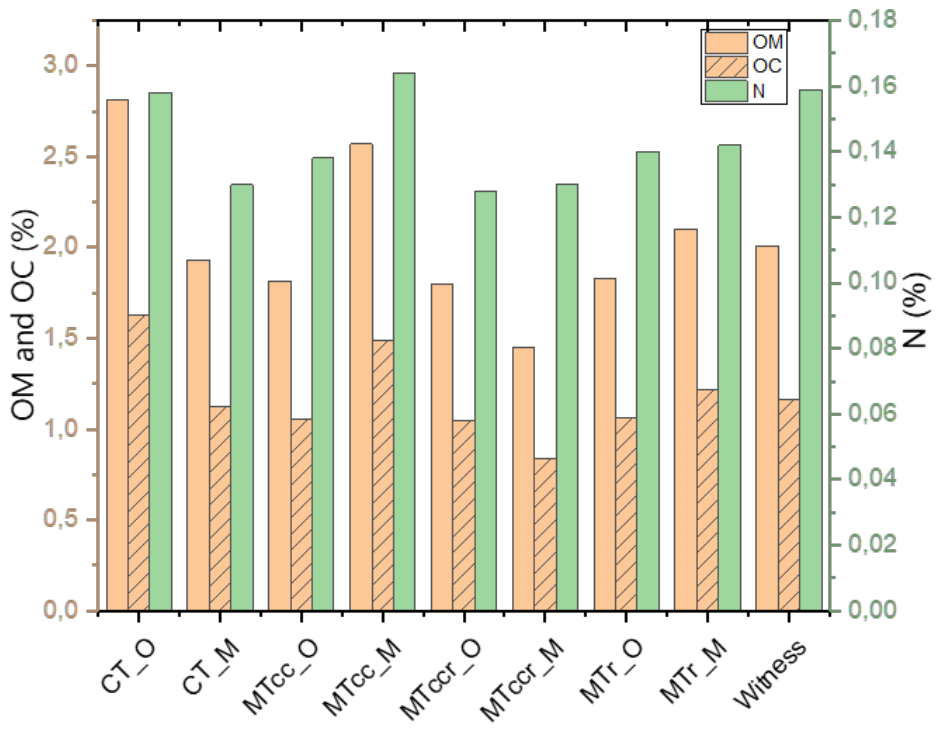
Figure 2.
Impact of treatments on the elements P, Ca, K, Na, and Mg in m.eq per 100g.
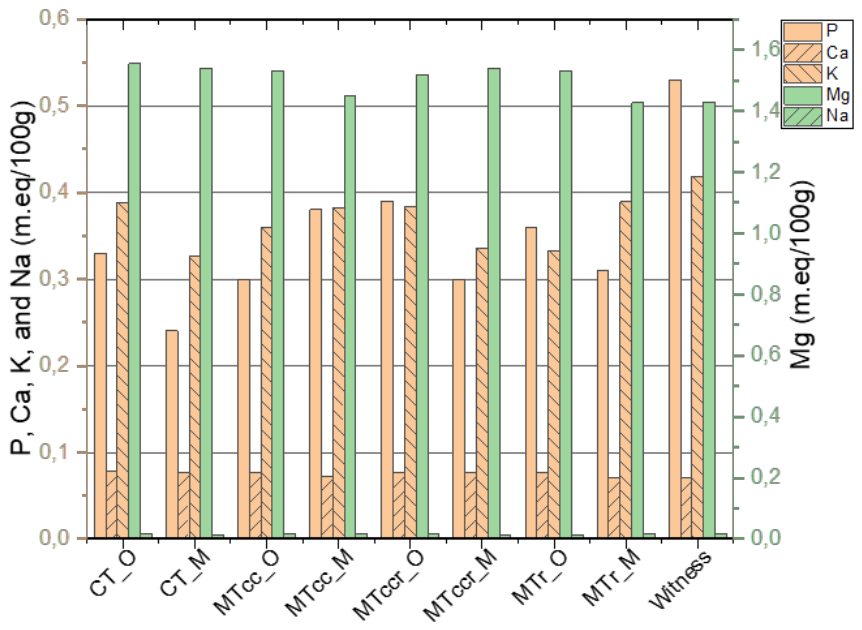
Figure 3.
Relative abundance of bacterial community in each tillage treatment.
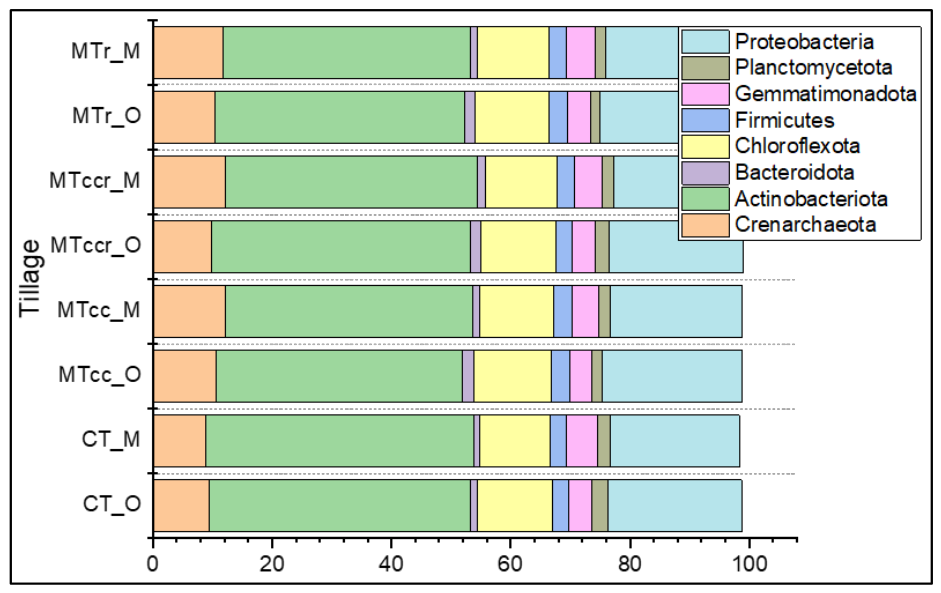
Figure 4.
PCoA ordination allowing comparison of the composition of soil diversity of each treatment.
Figure 4.
PCoA ordination allowing comparison of the composition of soil diversity of each treatment.
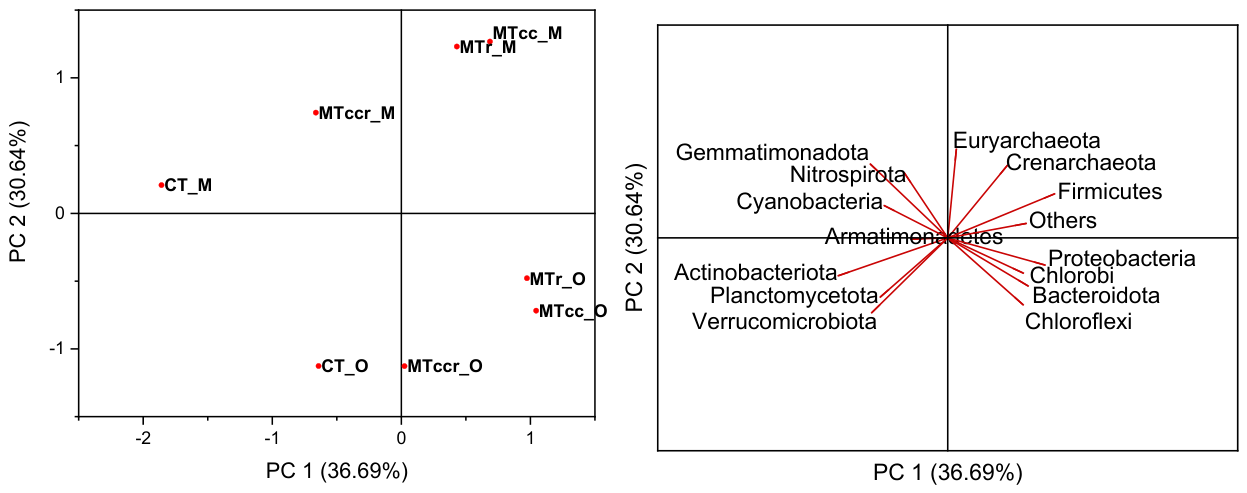
Figure 5.
Shannon diversity index of bacterial communities according to two experimental factors: (A) tillage and (B) fertilization.
Figure 5.
Shannon diversity index of bacterial communities according to two experimental factors: (A) tillage and (B) fertilization.
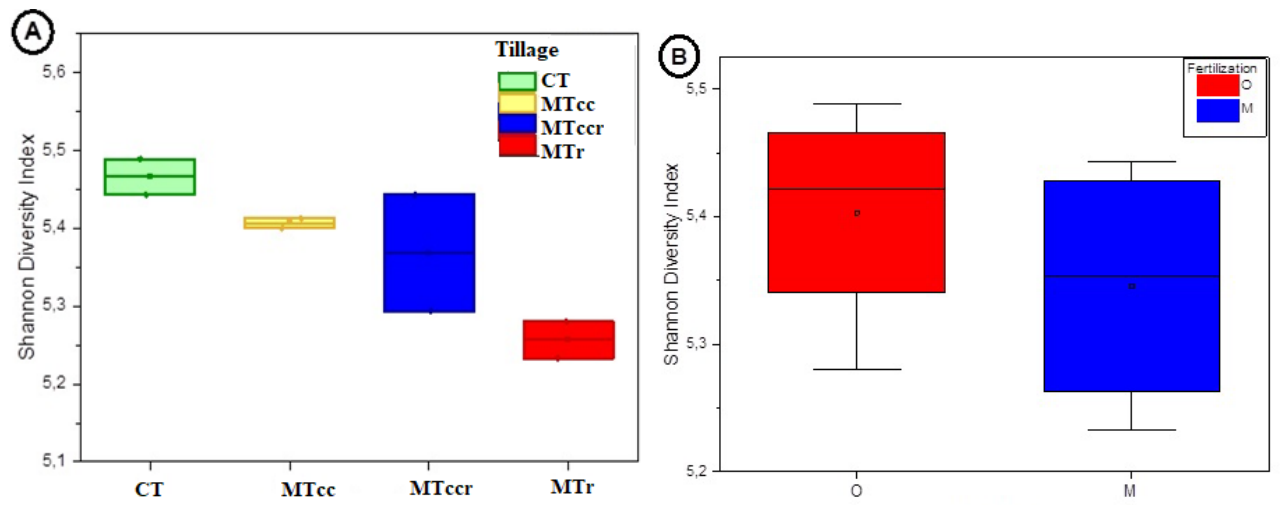

Table 1.
Different tools used in cultivation practices.
| Tillage | Tool treatment | Designation |
|---|---|---|
| Conventional Tillage | Plow + Cover Crop + Cultivator | CT |
| Minimum Tillage | Cover Crop | MTcc |
| Minimum Tillage | Cover Crop + Cultivator | MTccr |
| Minimum Tillage | Cultivator | MTr |
Table 2.
Two-way ANOVA for bioindicators of bio-fertility of soil.
| Elements | P-Value | |||
|---|---|---|---|---|
| *Tillage | **Fertilizer | ***Interaction Tillage vs fertilizer | ||
| Macronutrients | N | 0.0065 | 0.011 | 0.019 |
| P | 0.0031 | 0.0042 | 0.0011 | |
| K | 0.043 | 0.009 | 0.012 | |
| Micronutrients | Ca | 0.0234 | 0.0176 | 0.0375 |
| Mg | 0.0082 | 0.027 | 0.0018 | |
| Microbial phylum | Actinobacteriota | <0.001 | <0.001 | <0.001 |
| Proteobacteria | <0.001 | <0.004 | <0.001 | |
| Chloroflexi | <0.004 | <0.005 | <0.005 | |
| Crenarchaeota | <0.004 | <0.005 | <0.004 | |
| Gemmatimonadota | <0.004 | <0.005 | <0.004 | |
*At the 0.05 level, the population means of tillage are difference substantial. **At the 0.05 level, the population means of fertilizer are significantly difference. ***At the 0.05 level, the interaction between the fertilizers type the tillage and is significant.
Disclaimer/Publisher’s Note: The statements, opinions and data contained in all publications are solely those of the individual author(s) and contributor(s) and not of MDPI and/or the editor(s). MDPI and/or the editor(s) disclaim responsibility for any injury to people or property resulting from any ideas, methods, instructions or products referred to in the content. |
© 2026 by the authors. Licensee MDPI, Basel, Switzerland. This article is an open access article distributed under the terms and conditions of the Creative Commons Attribution (CC BY) license (http://creativecommons.org/licenses/by/4.0/).
Copyright: This open access article is published under a Creative Commons CC BY 4.0 license, which permit the free download, distribution, and reuse, provided that the author and preprint are cited in any reuse.