

Submitted:
16 August 2026
Posted:
18 August 2026
You are already at the latest version
Abstract
As the next technological step necessary for implementing the concept of UV dye-based dye-sensitized solar cells (DSSCs) in an agrovoltaic greenhouse, we proposed a simple and inexpensive technological solution to prevent the degradation and demonstrated under real conditions that the integration of an intrinsic rutile layer into the photoanode architecture has a beneficial effect on their long-term stability. Also, based on the analysis of structural and optical properties, we answered questions related to how the rutile layer manages to slow down the degradation process and what its impact on the electrolyte and the dye. Thus, the favorable premises were created for validating this solar cell/module concept for integration into the roof of a wavelength-selective greenhouse.
Keywords:
dye-sensitized solar cell
; agrovoltaic greenhouse
; TiO2 polymorphs
; rutile
1. Introduction
The United Nations Global Food and Agriculture Report [1] states that with the rapid development of human society, global food demand will increase by 70% by 2050, leading to energy and food crises that are becoming increasingly widespread worldwide [2]. To address these two significant global issues, Agriculture 4.0 and, more recently, Agriculture 5.0 [3,4] suggest using the same land area for both energy generation and production. As part of sustainable agriculture, agrivoltaic systems significantly increase land use efficiency and thus provide an integrated solution for the water-food-energy nexus [5].
For an agrivoltaic greenhouse, it is crucial to find a balance between increasing the flux of photosynthetically active radiation (PAR: 400–700 nm), minimizing the shading effect of photovoltaic panels [6], and energy production, which requires a large area [7]. Currently used in an agrovoltaic greenhouse, it has been estimated that traditional silicon photovoltaic (PV) solar cell (SSC) coverage cannot exceed 30% to ensure this balance[6,7,8].
In this context, the dye-sensitized solar cells (DSSCs) have also been recently proposed as an ideal candidate for integration in a roof of greenhouse due to their wavelength-selective ability, high transparency, and simple manufacturing process [9,10,11]. However, one of the major problems of DSSCs used in outdoor conditions is the long-term deterioration due to UV radiation which causes the surface modification of TiO2 photoanode, being the main cause of degradation of I3-/I- redox electrolyte and the dye [12,13,14]. Up to now, just only a few scientific articles discuss about long-term photovoltaic characteristics and degradation mechanisms due to the effect of UV radiations of DSSCs using ruthenium-based (N719) dyes, but under simulated conditions [15,16].
Therefore, the integration of UV filters is essential to ensure the long-term stability of DSSCs. Carnie, M et al. studied the effects of varying the UV cutoff filter on the photovoltaic performance when using visible-absorbing dyes (N719, Z907, and N749), demonstrating that dyes that extend their IPCE further into the NIR region suffer lower relative efficiency losses due to UV filtering than dyes with narrower action spectra [17]. Min-Kyu Son et al. studied the effect of UV radiation on the long-term stability of DSSCs with N719 dye exposed for 160 h using a solar simulator and five types of filters with different filter characteristics [18]. Recently, Rustem Nizamov et al. investigated the stability of cellulose-based films as sustainable ultraviolet (UV) filter films for DSSC devices with ruthenium dye Z907. The testing was performed over 1000 hours and the DSSCs coated with CNF-ROE showed minimal visual discoloration [19]. These results presented above suggest that the commonly used UV stability tests under full spectrum light using a xenon arc lamp (1.5 A.M) are insufficient in predicting the lifetime of DSSCs under real conditions, therefore, long-time stability testing should be performed under outdoor UV radiation exposure conditions. The visible absorption of dyes makes them unsuitable for integration into a complete greenhouse roof, from the perspective of limiting the PAR range and competing with plant photosynthesis [20].
In our previous work, we firstly demonstrated that an UV dye-based DSSC satisfied greenhouse requirements for transparency across the whole PAR range and had an efficiency of almost 5% at an irradiance between 50 mW/cm2 and 100 mW/cm2, which corresponds to maximum light intensity throughout the year [21]. Moreover, the photovoltaic tile concept based on our yellow DSSCs has been experimentally validated both from the energy production and greenhouse microclimate perspectives, but it also highlighted the need to find solutions that would increase their lifespan [22].
The next technological step required to implement the UV dye-based DSSC concept in an agrivoltaic greenhouse and optimize it for large-scale production is lifetime testing under real outdoor conditions. As an imperative consequence, in this work, we aim to find a simple and inexpensive technological solution to prevent the degradation of UV dye-based DSSCs and increase their lifespan, even if only at the demonstrator level. To our knowledge, this is the first time that a DSSC using UV dye (DN-F01), without and with the intrinsic integration of a UV filter, is tested for a long period of time under real outdoor conditions. The photovoltaic performance of the cells was constantly monitored during the aging process (J-V, J-t), and the changes in the charge transport of the electrolyte and the desorption of the dye from the TiO2 semiconductor were analyzed with electrochemical impedance spectroscopy (EIS), FT-IR, and UV-VIS-NIR spectroscopy. The ability of an innovative UV filter based on a thin film of TiO2 nanorods (NR), intrinsically integrated into the photoanode, to improve the long-term stability of DSSCs under outdoor conditions was demonstrated, thus creating favorable premises for validating this solar cell/module concept for integration into the roof of a wavelength-selective greenhouse.
2. Materials and Methods
2.1. Fabrication the UV Filter Based on Rutile TiO2 Nanorods
Fabrication of the rutile TiO2 nanorods on FTO substrate via a hydrothermal method was made following the procedure described in our previous work [23], where it was used as a hybrid counter electrode composed of rutile TiO₂/PEDOT thin film. In a short description, a solution prepared by mixing 12.5 mL of bi-distilled water, 15 mL of 35% HCl (Sigma Aldrich), 5 mL of 1 M NaCl solution (Sigma Aldrich, ≥99.0%), and 0.5 mL titanium isopropoxide (Sigma Aldrich, 97%), along with the cleaned FTO substrate (2.5 × 3.0 cm), was transferred into a Teflon-lined autoclave and subjected to hydrothermal treatment at 150 °C for 25 and 35 minutes, followed by very slow cooling to room temperature. The crystal structure of the hydrothermally deposited TiO₂ layers on FTO substrate (hereinafter referred to as 25_rutile layer on FTO with a thickness of approximately 200 nm, and 35_rutile layer on FTO with a thickness of approximately 300 nm, respectively) was investigated by the X-ray diffraction measurements (XRD) with a PANalytical X’Pert PRO PW 3040/60 diffractometer, employing Cu-Kα radiation (λ = 1.5418 Å) confirming the rutile polymorph of TiO2 (indexed with JCPDS No. 00-004-055, P4₂/mnm space group).
2.2. Preparation of the DSSCs
The paste for photoanode preparation was made following the procedure described in our previous works [24], and deposited on a pre-cleaned FTO substrate, 25_rutile layer on FTO, and 35_rutile layer on FTO. The single and double layers (SL with a thickness of approximately 2.2 µm, 25_DL and 35_DL, respectively) were treated with TiCl4 via aqueous immersion followed by a sintering process at 500 ˚C for 1 h with 1 ˚C/min heating rate.
The sensitization process was made by immersing the anode thin films in a 0.3 mM solution of DN-F01 (Dyenamo Yellow) in absolute ethanol (Sigma Aldrich, 99.5%) for 5 h immersion time. The DSSCs (hereinafter referred to as SL_DSSC, 25_DL_DSSC, and 35_DL_DSSC ) were assembled using a Meltonix 1170-60 thick spacer, followed by injecting a I-/I3- based liquid electrolyte, consisting of 0.05 M I2 (Merck, 99.9%), 2 M 1-butyl-3-methyl-immidazolium iodide (BMII, Sigma Aldrich, 99%), 0.5 M 4 tertbutyl pyridine (Sigma Aldrich, 98%), and 0.1 M guanidinium thiocyanate (Merck, 98%) in 3-methoxypropionitrile (MPN – Sigma Aldrich, 98%), into the aperture between the photoelectrodes and the Pt as counter electrodes. Further, for better encapsulation of the devices an ultraviolet glue (ThreeBond: 3035B) was used to seal the edges of the cells, and the contacts were made using an ultrasonic soldering iron SUN BONDER (USM-560).
2.3. Characterization of the Photoanodes and DSSCs
Optical analysis was performed using a Lambda 950 UV-Vis-NIR spectrophotometer (Perkin Elmer) with a 150 mm integrating sphere, at room temperature and within a wavelength range of 250 to 800 nm. The FTIR spectra were collected in the 4000–400 cm-1 range with a JASCO-430 Fourier transform spectrometer and by using the KBr pellet technique. The dye-sensitized TiO2 powder of the photoanodes was recovered from fresh and fully degraded DSSCs. The evolution of (1 0 1) and (2 0 0) crystal planes of anatase TiO2, without and with intrinsic rutile layer, was investigated by the X-ray diffraction measurements (XRD) with a PANalytical X’Pert PRO PW 3040/60 diffractometer, employing Cu-Kα radiation (λ = 1.5418 Å) and 1000 s/step.
The photovoltaic performance of DSSC was assessed via J–V and J-T characterization using a Keithley SourceMeter 2450 under a solar 1.5 A.M simulation. The short-circuit photocurrent was recorded under periodic light on–off cycles (~5 s each), generated by manually blocking the light beam using a mechanical shutter. The electrochemical impedance spectra of the DSSCs were acquired under AM 1.5G simulated sunlight (1000 Wm-2), with the applied potential set to the open-circuit voltage (VOC) of DSSC. Frequency-dependent responses were measured from 0.001 Hz to 10 kHz with an AC modulation of 10 mV.
2.4. The Measurement Setup for Outdoor Testing
Photovoltaic DSSCs based on DN-F01 dye were tested of 42 days (1000h) from 1st October 2025 to 11 November 2025. The tilt angle of the DSSCs was set to 30°, which is approximately the optimal angle for summer in Timisoara, Romania (45.4°N, 21.1°E) with the azimuth to the south.
Irradiance data collection took place on the Solar Platform of the West University of Timisoara, Romania (latitude 45°46′N, longitude 21°25′E and 85 m a.s.l.). Meteorological parameters were recorded using the external temperature and relative humidity sensor of an EKO Instruments ASI-16 All Sky Imager. Global horizontal irradiance (GHI) was measured with a high quality EKO Instruments MS-80 pyranometer (class A, ISO9060:2018). Ultraviolet (UV) irradiance was not directly measured but rather derived from GHI values following the estimation procedure described by Habte et al. [25].
Up to now, the existing standard protocol for outdoor testing of DSSC is ISOS, which is designed for the organic solar cells [26]. In our case, we used the ISOS-O-1 protocol where devices are kept outside and periodically measured inside under solar 1.5 A.M simulation and at 22 °C, in order to highlight the positive impact of 25_rutile layer and 35_rutile layer on the photovoltaic properties of DSSCs. The DSSCs were connected in series using the digital multimeter (Mastech M9803r Bench-type Top Lcd True Rms), which acts as a consumer.
The weather during the outdoor testing of DSSCs varied from relatively warm and sunny weather to rainy and cold periods, with temperatures down to 5 °C. The meteorological parameters (UV irradiance, humidity, irradiance and temperature respectively) were extracted only during the day between 8:00 and 18:00 and presented in Figure 1. As can be seen, in the interval of 1000 h, the average humidity value was between 67- 68%, and the average temperature was 12.7-13.8 °C. During the day, the average maximum temperature value was 20-24 °C. Thereby, the maximum average value of UV irradiance was 51 W m-2 in the first 500 h, decreasing to 42 W m-2 in the rest of the test period. The same evolution is observed in the case of the maximum average value of total irradiance, from 942 W m-2 in the first 500 h to 795 W m-2 in the last 500h. Besides this, the DSSC cells were hermetically encapsulated, and the rainy conditions had no negative effect on the DSSCs.
3. Results and Discussion
Under real operating conditions, the J-V characteristics of the DSSCs using DN-F01 dye, without and with rutile layer are presented in Figure 2. The JSC of SL_DSSC decreases drastically from 7.66 mA cm-2 to 4.66 mA cm-2 after 168 h and then at 0.62 mA cm-2 after 336 h. After 336 h, it was also observed that the SL_DSSC started to discolor due to the degradation mechanisms activated by the outdoor conditions such as UV radiation, temperature, and humidity.
A different behavior of photovoltaic performance depending on time (Figure 2) was highlighted by the JSC of 25_DL_DSSC and 35_DL_DSSC. For example, after 168 h, the rutile layer, intrinsic part of the photoanode, not only prevents degradation (approx. 40% of SL_DSSC), but also increases the value of Jsc, from 7.59 mA cm-2 to 8.84 mA cm-2 in case of 25_DL_DSSC and from 7.00 mA cm-2 to 7.91 mA cm-2 in case of 25_DL_DSSC, respectively. If after 336 h, SL_DSSC is almost degraded (92% of JSC), for 25_DL_DSSC and 35_DL_DSSC, the negative changes are not significant, only 26% and 1%, respectively. This slowing of degradation due to the rutile layer allowed the 25_DL_DSSC and 35_DL_DSSC to function even after 1000 h, without visual changes of the dye or electrolyte (bleaching phenomenon) [13,14]
Photovoltaic performance of UV dye-based DSSCs under AM 1.5G simulated sunlight (1000 Wm-2), is presented in detail in Table 1, following the similar evolution of JSC. It should be noted that the differences in power conversion efficiency (η) are more than representative of the beneficial effect of the hydrothermal rutile layer on long-term stability. After 336 h, the decrease is only 10% in case of 25_DL_DSSC and 4% in case of 35_DL_DSSC compared with 88% for SL_DSSC.
To further explain what governs the aforementioned photovoltaic performance of UV dye-based DSSCs during the outdoor aging process, the dynamic interplay between charge recombination and charge accumulation was highlighted by the transient photocurrent (TPC) and electrochemical impedance spectroscopy (EIS).
The transient photocurrent density vs. time (J–t) measured under intermittent visible light is shown in Figure 3. A specific DSSC behavior is observed, namely the light switching on generates a photocurrent spike (Isp) due to the rapid generation of electron and hole pairs at the semiconductor/dye/electrolyte interface, followed by an exponential decrease of the photocurrent over time, until a stationary value (Iss) is reached [27].
To study the charge carrier generation, transport, trapping, and recombination dynamics, the transient photocurrent overshoot factor (Isp/Iss), electron lifetime (τD), and accumulated charge Q were calculated and summarized in Table 2.
The transient decay time or electron lifetime (τD) in the photoanode was calculated from the logarithmic plot of parameter D, given by Eq. 1 [28]
where It is the current at time t, Iss is the stabilized current and Isp is the current spike. The transient decay time can be defined as the time at which lnD =.-1 [29].
The accumulated charge Q in the TiO2 photoanode under a specific illumination state can be determined by integrating the transient photocurrent decay curve according to Eq.2 [30]:
Before analyzing the effect of the intrinsic rutile layer during the outdoor aging process, the initial structural data that it brings to the architecture of the intrinsic mechanisms of the DSSC are: (i) a direct optical bandgap which intrinsically increases the recombination rate of photogenerated electrons and holes, compared with an indirect optical bandgap of TiO2 anatase, which slow down recombination [31], and (ii) a much higher native dielectric constant (~110) compared to anatase (~30) [32] having an intrinsic electrostatic capacity to stabilize and accumulate a much higher charge density Q.
As expected, in the fresh SL_DSSC, the rate of interfacial charge recombination and accumulated charge in the TiO2 photoanode are low and it is confirmed by the overshoot factor of 1.02, τD of 0.38 s, and Q of 117 µC cm-2. On the contrary, 25_DL_DSSC favors the recombination processes and the accumulated charge reflected in the overshoot factor of 1.48, τD of 0.027 s, and Q of 1655 µC cm-2. Increasing the intrinsic rutile film thickness slightly reduced the non-beneficial processes, 35_DL_DSSC being characterized by an overshoot factor of 1.46, τD of 0.075 s, and Q of 995 µC cm-2.
Under outdoor conditions, SL_DSSC degraded quickly, after 336 h, the severe surface recombination bottlenecks (overshoot factor of 5.5) are presented, together with decreasing continuously the electron lifetime to 0.05 s, usually due to the dye desorption from TiO2 surface and possible formation of recombination centers. As mentioned above, the visual changes of the dye and electrolyte (bleaching phenomenon) were observed.
In comparison, a much slower degradation of 25_DL_DSSC and 35_DL_DSSC under outdoor conditions is demonstrated by the transient photocurrent response, which has, even after 1000 hours of operation, a higher power conversion efficiency than that of SL_DSSC. This lifespan improvement is caused by the unexpected increase in electron lifetime over a period of 504 h (in the case of 25_DL_DSSC) and 336 h (in the case of 35_DL_DSSC), which allows the charge density to temporarily accumulate well beyond its steady-state equilibrium value and reach a higher overshoot factor only after 1000 hours.
From the perspective of DSSC large-scale production potential, improved DSSC stability under real-world conditions was demonstrated by implementing an intrinsic rutile layer as part of the photoanode, a simple and low-cost technological solution.
However, from the perspective of fundamental DSSC research, the question that remains to be answered is how the rutile layer manages to slow down the degradation process? For this, a detailed structural and optical characterization of the photoanode and the DSSC is proposed.
The electrochemical impedance spectroscopy (EIS) measurement was carried out for fresh and fully degraded UV dye-based DSSCs at VOC under AM 1.5G simulated sunlight (1000 Wm-2) (Figure 4) aiming to highlight the differences that are induced by the rutile layer in internal processes.
Thereby, the equivalent circuit model and Z-view software were used to determine the following parameters: Rs (intrinsic resistance of the fabricated cells), RCE (resistance to charge transfer at the CE/electrolyte interface) [33], Rct (resistance to charge transfer at the TiO2 electrolyte/dye/photoelectrode interface) and RW (Warburg-short element describing the ionic conductivity of the electrolyte) [34,35]. For fully degraded SL_DSSC, the fit includes a Gerischer impedance (RG) representing the diffusion of the electron in the mesoscopic TiO2 film and its recapture by the triiodide ions in the electrolyte [36]. All obtained values are listed in Table 3.
Since the EIS parameters are almost similar for all fresh DSSCs, detailed attention is paid to the analysis of the degradation process from the perspective of the Rct evolution, which monitors the charge transfer at the TiO2 electrolyte/dye/photoanode interface, but also the changes suffered by the electrolyte through RCE and RW.
Rct evolution under outdoor conditions is correlated with J-V and J-t results. Thus, the accelerated degradation of SL_DSSC after 336 h is also highlighted by an approximately 77% increase in resistance to the charge transfer at the TiO2 electrolyte/dye/photoanode interface and the conversion of a Nernst to Gerischer impedance with value of 0.02 Ω. Totally different, Rct decreases by approximately 19.8% and 16.4% for 25_DL_DSSC and 35_DL_DSSC caused by the increase in electron lifetime and accumulated charge in the TiO2 photoanode which determined a much slower degradation.
Also, RCE increases differently under outdoor conditions, with 53% in case of SL_DSSC, 46% for 25_DL_DSSC, and only 15% in case of 35_DL_DSSC, respectively. This evolution of RCE is largely due to the degradation of the I3-/I- redox pair under UV exposure and therefore, the catalytic reaction at the CE/electrolyte interface is diminished.
Moreover, RW is inversely proportional to the concentration of charge carriers in the electrolyte and its increase for totally degraded DSSC is frequently linked to the loss of charge carriers in the electrolyte.
In light of the results presented above, the rutile layer demonstrated its beneficial role and efficiency in reducing electrolyte degradation under the action of outdoor UV radiation.
The FT-IR spectra of the fresh and fully degraded photoanodes (powder) measured in the range of 4000–400 cm−1 in Figure 5. In accordance with the literature, all spectra consist of (i) two peaks at approx. 3430, and 1630 cm−1 which assigned the stretching vibrations of the hydroxyl group O-H of interlayer water molecules and the bending mode of water molecules (H2O), respectively [37], (ii) the broad and intense band between 800 cm-1 and 400 cm-1 corresponding to Ti-O and Ti-O-Ti stretching and bending vibrations anatase and rutile polymorphs of TiO2 [38,39], and (iii) specific peaks of DN-01 dye (Figure 5).
Although it was difficult to highlight the evolution of the dye under the action of external UV radiation, in the fully degraded SL_DSSC, the disappearance of the peak at 2213 cm-1 was observed, which is assigned to the stretching vibrations of the cyano C≡N group in cyanoacrylic acid, one of the anchoring groups that links the DN-01 dye to the TiO2 semiconductor surface [40]. Its preservation in both fully degraded 25_DL_DSSC and 35_DL_DSSC (inset in Figure 5) demonstrates the beneficial effect of the rutile layer on the dye, reducing the decomposition and detachment of dye molecules from the TiO2 surface under real conditions of use.
To study the effect of the intrinsic rutile polymorph layer on the crystalline structure of the 35_DL_DSSC photoanode, the evolution of the peaks of the preferential crystalline planes of the anatase polymorph (SL_DSSC photoanode) were obtained by X-ray diffraction at long acquisition times. For both crystal planes (Figure 6), the FWHM values are similar, namely 0.64 and 0.60 for (1 0 1) in the case of SL_DSSC photoanode and 35_DL_DSSC photoanode, and 0.80 and 0.80 for (2 0 0), respectively, indicating that there is no change in the crystallite size and microstrain of the photoanode structure. The peak area, however, undergoes changes, almost doubling for both crystal planes, which can be correlated with the improvement of crystallinity, the thickness of the anatase layer remaining constant for both SL_DSSC photoanode and 35_DL_DSSC photoanode.
The absorbance (A) spectra versus wavelength (λ) (Figure 7) show that the absorption edges of 25 DL_TiO2 photoanode and 35 DL_TiO2 photoanode are slightly shifted to longer wavelengths “redshift”, compared to SL_TiO2 photoanode.
To obtain an approximate value of the optical band gap Eg, the derivative method proposed in Ref. [41] was employed. According to this approach, Eq. 3 predicts that plotting d[ln(αhν)]/d[hν] as a function of photon energy hν produces a divergence at hν = Eg. Consequently, the optical band gap can be estimated from the position of the divergence in the resulting curve. In the present work, this methodology was applied to the experimental absorption data, and the d[ln(αhν)]/d[hν] versus hν plots were used to determine the approximate Eg values, namely 3.15 eV for SL_DSSC photoanode and 3.13 eV for 35_DL_DSSC photoanode, respectively.
Figure 8.
Plot of d(ln(αhν))/d(hν) vs hν for SL_DSSC and 35_DL_DSSC photoanodes.
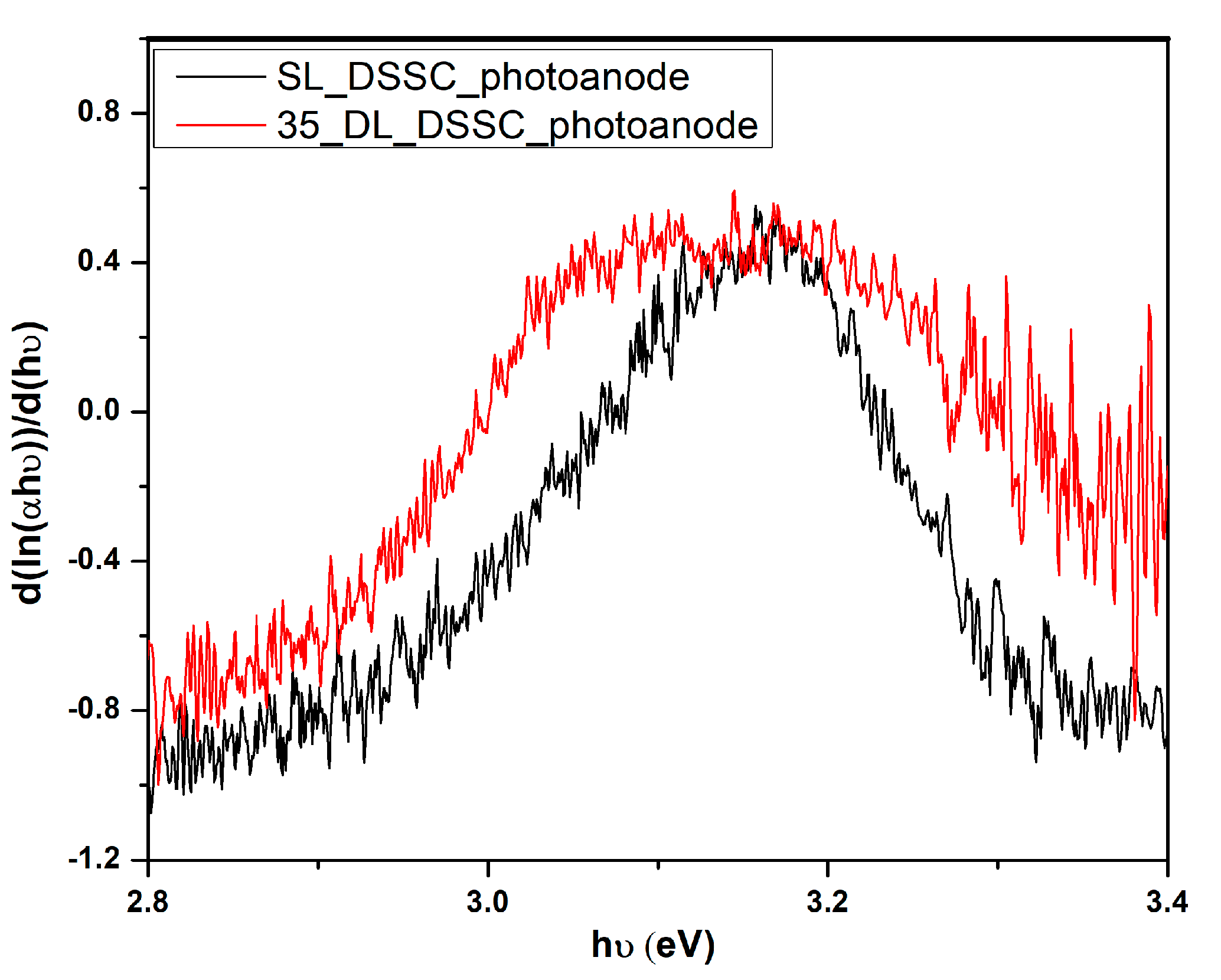
The value of n can easily be calculated from the slope of the plot of ln(αhν) vs ln(hν – Eg) in Figure 9 obtaining an atypical value of n ~ 0.23 in case of SL_DSSC photoanode and value of n ~ 0.55 in case of 35_DL_DSSC photoanode indicating direct optical transition induced by the rutile layer. An important parameter in understanding the optical behavior of a crystalline material is NEAR factor (Near-Edge Absorptivity Ratio), which quantifies the sharpness of a semiconductor’s fundamental absorption edge an d the sub-bandgap absorption caused by structural defects creating localized states inside the forbidden bandgap.
The NEAR factor for a direct allowed transition is determined using the following formula [42]:
For both photoanodes, the NEAR is close to 0.73 and 0.77, respectively, highlighting that the Urbach tail is significant. Furthermore, according to Viezbicke et al., the Tauc plot is not applicable for the SL_DSSC and 35_DL_DSSC photoanodes and should only be used if the NEAR factor < 0.5 [43].
The Urbach energy Eu was determined from the photon energy hν dependence of the absorption coefficient using the following expression [44]:
where α is the absorption coefficient and α0 is a material-dependent constant. Taking the natural logarithm of both sides of the equation results in the following linear relationship:
The linear form of this equation enables the determination of the Urbach energy from the experimental absorption spectra by plotting ln(α) as a function of photon energy hν. The value of Eu is obtained from the slope of the linear region in the low-energy tail of the absorption edge, located below the optical band gap. The determined Eu values for 25_DL_DSSC photoanode and 35_DL_DSSC photoanode were 606 meV and 591 meV, respectively, typically high values for TiO2 polymorphs [45].
Another important optical parameter, the penetration depth δ represents the distance that incident light can propagate into a material before its intensity is significantly attenuated. It is inversely related to the absorption coefficient and can be calculated using Eq. 7 [46]:
The approximately 5-fold decrease in the penetration depth at the wavelength of 288 nm (Figure 10), the wavelength at which I3−ions undergo photodegradation, the main responsible for the degradation of DSSC, explains the behavior presented above and demonstrates how the intrinsic rutile layer improves the operational lifetime of the UV dye-based DSSC [14].
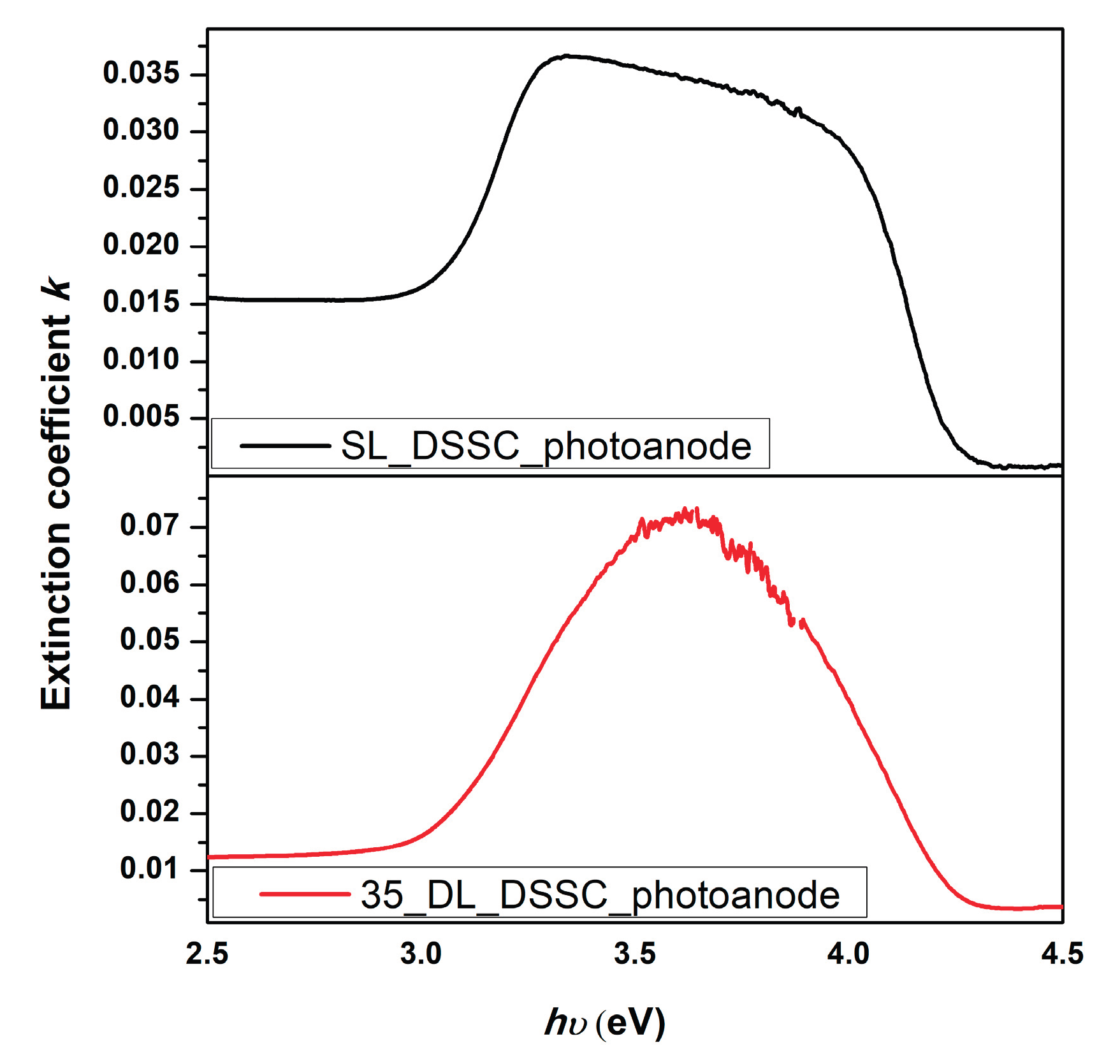
The extinction coefficient k describes how light is absorbed and scattered within a material, reflecting its ability to attenuate the intensity of incident radiation. According to Eq.8 extinction coefficient can be calculated as follows [47]:
Furthermore, the doubling of the extinction coefficient (Figure 11) highlighted the beneficial effect of attenuating external UV radiation caused by an intrinsic rutile layer with nanorod morphology and an approximate thickness of only 300 nm. From the perspective of the DN-01 dye, which is characterized by a broad absorption at around 370–480 nm (3.35 eV−2.6 eV) with a maximum absorption band at a wavelength of 421 nm (2.945 eV) [48], the extinction coefficients have also similar values in this range and, therefore, the rutile layer does not affect the photovoltaic performance from the perspective of light harvesting , a fact also evident from the JSC values.
4. Conclusions
The large-scale implementation of the UV dye-based DSSC concept in an agrivoltaic greenhouse is conditional on increasing the outdoor lifetime. We propose a simple and inexpensive technological solution to prevent the degradation of UV dye-based DSSCs and have demonstrated under real conditions that the integration of an intrinsic rutile layer into the photoanode architecture has a beneficial effect on their long-term stability. Furthermore, from the perspective of the fundamental mechanisms of DSSCs, we concluded that the rutile TiO2 nanorods layer manages to slow down the degradation process of the electrolyte and the FN-01 dye under the action of external UV radiation. Based on optical and structural analysis, our work revealed that (i) the photodegradation of I3− ions is reduced by a fivefold decrease in the penetration depth at the wavelength of 288 nm and by the attenuation of external UV radiation achieved by doubling the extinction coefficient and (ii) the decomposition and detachment of dye molecules from the TiO2 surface is reduced by stabilizing the cyano group C≡N in cyanoacrylic acid, one of the anchoring groups. Moreover, in terms of light management, the rutile layer does not compete with the FN-01 dye, and the extinction coefficient also has a value similar to that of UV dye-based DSSCs without this additional layer in the dye absorption range. Thus, the favorable premises were created for validating this solar cell/module concept for integration into the roof of a wavelength-selective greenhouse.
Figure 12.
Extinction coefficient (k) versus hν for SL_DSSC and 35_DL_DSSC photoanodes.
Author Contributions
Daniel Ursu: Conceptualization, Investigation, Validation, Writing - original draft. - review & editing. Melinda Vajda: Investigation: Investigation, Formal analysis, Writing - original draft. Cristina Mosoarca: Investigation. Marius Paulescu: Investigation. Sergiu Hategan: Investigation. Cristian Casut: Investigation: Investigation, Formal analysis, Writing - original draft, Writing - review & editing. Marinela Miclau: Supervision, Validation, Writing - original draft. - review & editing.
Funding
This work was supported by a grant of the Ministry of Education and Research, CCCDI - UEFISCDI, project number PN-IV-P6-6.1-CoEx-2024-0154, within PNCDI IV.
Data Availability Statement
The original contributions presented in this study are included in the article. Further inquiries can be directed at the corresponding author.:.
Acknowledgments
Authors acknowledge the Ministry of Education and Research, CCCDI - UEFISCDI, for funding project number PN-IV-P6-6.1-CoEx-2024-0154, within PNCDI IV.
Conflicts of Interest
The authors declare no conflicts of interest.
References
- Mekouar, M. A. 15. Food and agriculture organization of the united nations (fao). Yearb. Int. Environ. Law. 2018, 29, 448–68. [Google Scholar] [CrossRef]
- Rudrakar, S.; Rughani, P. Iot based agriculture (ag-iot): A detailed study on architecture, security and forensics. Inf. Process. Agric. 2024, 11, 524–41. [Google Scholar] [CrossRef]
- Barrile, V.; Simonetti, S.; Citroni, R.; Fotia, A.; Bilotta, G. Experimenting agriculture 4.0 with sensors: A data fusion approach between remote sensing, uavs and self-driving tractors. Sensors 2022, 22, 7910. [Google Scholar] [CrossRef] [PubMed]
- Bissadu, K.; Sonko, S.; Hossain, G. Society 5.0 enabled agriculture: Drivers, enabling technologies, architectures, opportunities, and challenges . In Information processing in agriculture; 2024. [Google Scholar]
- Dupraz, C.; Marrou, H.; Talbot, G.; Dufour, L.; Nogier, A.; Ferard, Y. Combining solar photovoltaic panels and food crops for optimising land use: Towards new agrivoltaic schemes. Renew. Energy 2011, 36, 2725–32. [Google Scholar] [CrossRef]
- Marrou, H.; Wéry, J.; Dufour, L.; Dupraz, C. Productivity and radiation use efficiency of lettuces grown in the partial shade of photovoltaic panels. Eur. J. Agron. 2013, 44, 54–66. [Google Scholar] [CrossRef]
- Vox, G.; Schettini, E.; Lisi Cervone, A.; Anifantis, A. Solar thermal collectors for greenhouse heating. Presented at International Symposium on High Technology for Greenhouse System Management: Greensys2007 801, 2007; pp. 787–94. [Google Scholar]
- Kadowaki, M.; Yano, A.; Ishizu, F.; Tanaka, T.; Noda, S. Effects of greenhouse photovoltaic array shading on welsh onion growth. Biosyst. Eng. 2012, 111, 290–97. [Google Scholar] [CrossRef]
- Barichello, J.; Vesce, L.; Mariani, P.; Leonardi, E.; Braglia, R.; Di Carlo, A.; Canini, A.; Reale, A. Stable semi-transparent dye-sensitized solar modules and panels for greenhouse application. Energies 2021, 14, 6393. [Google Scholar] [CrossRef]
- Roslan, N.; Ya’acob, M.; Jamaludin, D.; Hashimoto, Y.; Othman, M.; Iskandar, A. N.; Ariffin, M.; Ibrahim, M.; Mailan, J.; Jamaluddin, A. Dye-sensitized solar cell (dssc): Effects on light quality, microclimate, and growth of orthosiphon stamineus in tropical climatic condition. Agronomy 2021, 11, 631. [Google Scholar] [CrossRef]
- Lu, L.; Ya’acob, M.; Anuar, M.; Chen, G.; Othman, M.; Iskandar, A. N.; Roslan, N. Thermal analysis of a portable dssc mini greenhouse for botanical drugs cultivation. Energy Rep. 2020, 6, 238–53. [Google Scholar] [CrossRef]
- Weidmann, J.; Dittrich, T.; Konstantinova, E.; Lauermann, I.; Uhlendorf, I.; Koch, F. Influence of oxygen and water related surface defects on the dye sensitized TiO2 solar cell. Sol. Energy Mater. Sol. Cells 1999, 56, 153–65. [Google Scholar] [CrossRef]
- Kawano, R.; Watanabe, M. Anomaly of charge transport of an iodide/tri-iodide redox couple in an ionic liquid and its importance in dye-sensitized solar cells. Chem. Commun. 2005, 41, 2107–09. [Google Scholar] [CrossRef] [PubMed]
- Nakajima, S.; Katoh, R. Mechanism of degradation of electrolyte solutions for dye-sensitized solar cells under ultraviolet light irradiation. Chem. Phys. Lett. 2015, 619, 36–38. [Google Scholar] [CrossRef]
- Agrell, H. G.; Lindgren, J.; Hagfeldt, A. Degradation mechanisms in a dye-sensitized solar cell studied by uv–vis and ir spectroscopy. Sol. Energy 2003, 75, 169–80. [Google Scholar] [CrossRef]
- Bari, D.; Wrachien, N.; Meneghesso, G.; Andrea, C.; Tagliaferro, R.; Brown, T. M.; Reale, A.; Di Carlo, A. Study of the effects of UV-exposure on dye-sensitized solar cells. In Presented at 2013 IEEE International Reliability Physics Symposium (IRPS); IEEE, 2013; pp. 4B. 3.1–4B. 3.7. [Google Scholar]
- Carnie, M.; Watson, T.; Worsley, D. Uv filtering of dye-sensitized solar cells: The effects of varying the UV cut-off upon cell performance and incident photon-to-electron conversion efficiency. Int. J. Photoenergy 2012, 2012, 506132. [Google Scholar] [CrossRef]
- Son, M.-K.; Seo, H. Effect of ultraviolet radiation on the long-term stability of dye-sensitized solar cells. Electron. Mater. Lett. 2020, 16, 556–63. [Google Scholar] [CrossRef]
- Nizamov, R.; Poskela, A.; Kaschuk, J.; Henn, K. A.; Grande, R.; Granroth, S.; Nyberg, M.; Esmaeilzadeh, M.; Vapaavuori, J.; Österberg, M. Sustainable nanocellulose uv filters for photovoltaic applications: Comparison of red onion (allium cepa) extract, iron ions, and colloidal lignin. ACS Appl. Opt. Mater. 2025, 3, 664–75. [Google Scholar] [CrossRef]
- Gross, J. Pigments in vegetables: Chlorophylls and carotenoids; Springer Science & Business Media, 2012. [Google Scholar]
- Ursu, D.; Vajda, M.; Ilieş, E.; Ricman, R.; Marinca, M.; Bularka, S.; Miclau, M.; Gontean, A. Towards the thermal stability of dye-sensitized solar cells for wavelength-selective greenhouses using the polymorphism of light-scattering layers. Sustain. Energy Fuels 2023, 8, 54–63. [Google Scholar] [CrossRef]
- Bularka, S.; Vajda, M.; Ilies, E.; Ricman, R.; Marinca, M.; Miclau, M.; Gontean, A.; Ursu, D. Photovoltaic tiles for the wavelength-selective greenhouse: Exploring yellow and green dye-sensitized solar cells in outdoor conditions. Appl. Sci. 2024, 14, 1957. [Google Scholar] [CrossRef]
- Ursu, D.; Miclau, M.; Casut, C.; Svera, P.; Taranu, B.; Birtok-Baneasa, C.; Dabici, A.; Vajda, M. Facile preparation of hybrid counter electrodes based on TiO2-rutile poly (3, 4-ethylenedioxythiophene) (pedot) thin films for indoor dye-sensitized solar cells. Solar Energy (under review).
- Vajda, M.; Ursu, D.; Duteanu, N.; Miclau, M. Low lying valence band edge materials based on copper oxide for tandem dye-sensitized solar cells. Mater. Lett. 2020, 275, 128151. [Google Scholar] [CrossRef]
- Habte, A.; Sengupta, M.; Gueymard, C. A.; Narasappa, R.; Rosseler, O.; Burns, D. M. Estimating ultraviolet radiation from global horizontal irradiance. IEEE J. Photovolt. 2018, 9, 139–46. [Google Scholar] [CrossRef]
- Reese, M. O.; Gevorgyan, S. A.; Jørgensen, M.; Bundgaard, E.; Kurtz, S. R.; Ginley, D. S.; Olson, D. C.; Lloyd, M. T.; Morvillo, P.; Katz, E. A. Consensus stability testing protocols for organic photovoltaic materials and devices. Sol. Energy Mater. Sol. Cells 2011, 95, 1253–67. [Google Scholar] [CrossRef]
- Wang, X.-L.; Huang, J.-F.; Liu, J.-M.; Tsiakaras, P. Recent advances in metal-free photosensitizers for dye-sensitized photoelectrochemical cells. Coord. Chem. Rev. 2025, 522, 216143. [Google Scholar] [CrossRef]
- Hagfeldt, A.; Lindström, H.; Södergren, S.; Lindquist, S.-E. Photoelectrochemical studies of colloidal tio2 films: The effect of oxygen studied by photocurrent transients. J. Electroanal. Chem. 1995, 381, 39–46. [Google Scholar] [CrossRef]
- Bell, N. J.; Ng, Y. H.; Du, A.; Coster, H.; Smith, S. C.; Amal, R. Understanding the enhancement in photoelectrochemical properties of photocatalytically prepared tio2-reduced graphene oxide composite. J. Phys. Chem. C 2011, 115, 6004–09. [Google Scholar] [CrossRef]
- Barnes, P. R.; Miettunen, K.; Li, X.; Anderson, A. Y.; Bessho, T.; Gratzel, M.; O’Regan, B. C. Interpretation of optoelectronic transient and charge extraction measurements in dye-sensitized solar cells. Adv. Mater. 2013, 25, 1881–922. [Google Scholar] [CrossRef] [PubMed]
- Yamada, Y.; Kanemitsu, Y. Determination of electron and hole lifetimes of rutile and anatase TiO2 single crystals. Appl. Phys. Lett. 2012, 101. [Google Scholar] [CrossRef]
- Eun, S. M.; Hwang, J. H.; Choi, B. J. Reduction of leakage current and enhancement of dielectric properties of rutile- TiO2 film deposited by plasma-enhanced atomic layer deposition. Korean J. Mater. Res. 2024, 34, 283–90. [Google Scholar] [CrossRef]
- Jung, S.-M.; Choi, I. T.; Lim, K.; Ko, J.; Kim, J. C.; Lee, J.-J.; Ju, M. J.; Kim, H. K.; Baek, J.-B. B-doped graphene as an electrochemically superior metal-free cathode material as compared to pt over a Co(ii)/Co(iii) electrolyte for dye-sensitized solar cell. Chem. Mater. 2014, 26, 3586–91. [Google Scholar] [CrossRef]
- Sarker, S.; Ahammad, A. J. S.; Seo, H. W.; Kim, D. M. Electrochemical impedance spectra of dye-sensitized solar cells: Fundamentals and spreadsheet calculation. Int. J. Photoenergy 2014, 2014, 851705, https://onlinelibrary.wiley.com/doi/abs/10.1155/2014/851705. [Google Scholar] [CrossRef]
- Xi, J.; Al-Dahoudi, N.; Zhang, Q.; Sun, Y.; Garcia, B. Effect of annealing temperature on the performances and electrochemical properties of tio2 dye-sensitized solar cells. Sci. Adv. Mater. 2012, 4. [Google Scholar] [CrossRef]
- Wang, Q.; Moser, J.-E.; Grätzel, M. Electrochemical impedance spectroscopic analysis of dye-sensitized solar cells. J. Phys. Chem. B 2005, 109, 14945–53. [Google Scholar] [CrossRef] [PubMed]
- Praveen, P.; Viruthagiri, G.; Mugundan, S.; Shanmugam, N. Structural, optical and morphological analyses of pristine titanium di-oxide nanoparticles–synthesized via sol–gel route. Spectrochim. Acta Part A Mol. Biomol. Spectrosc. 2014, 117, 622–29. [Google Scholar] [CrossRef] [PubMed]
- El-Sherbiny, S.; Morsy, F.; Samir, M.; Fouad, O. A. Synthesis, characterization and application of tio2 nanopowders as special paper coating pigment. Appl. Nanosci. 2014, 4, 305–13. [Google Scholar] [CrossRef]
- Kadam, A.; Dhabbe, R.; Kokate, M.; Gaikwad, Y.; Garadkar, K. Preparation of n doped TiO2 via microwave-assisted method and its photocatalytic activity for degradation of malathion. Spectrochim. Acta Part A Mol. Biomol. Spectrosc. 2014, 133, 669–76. [Google Scholar] [CrossRef] [PubMed]
- Al-Eid, M.; Lim, S.; Park, K.-W.; Fitzpatrick, B.; Han, C.-H.; Kwak, K.; Hong, J.; Cooke, G. Facile synthesis of metal-free organic dyes featuring a thienylethynyl spacer for dye sensitized solar cells. Dye. Pigment. 2014, 104, 197–203. [Google Scholar] [CrossRef]
- Bhattacharyya, S.; Pal, A. Electrical and optical properties of silicon-doped gallium nitride polycrystalline films. Bull. Mater. Sci. 2008, 31, 73–82. [Google Scholar] [CrossRef]
- Coulter, J. B.; Birnie, D. P., III. Assessing tauc plot slope quantification: ZnO thin films as a model system. Phys. Status Solidi (b) 2018, 255, 1700393. [Google Scholar] [CrossRef]
- Viezbicke, B. D.; Patel, S.; Davis, B. E.; Birnie, D. P., III. Evaluation of the Tauc method for optical absorption edge determination: ZnO thin films as a model system. Phys. Status Solidi (b) 2015, 252, 1700–10. [Google Scholar] [CrossRef]
- Mansour, A.; Nasr, M.; Saleh, H.; Mahmoud, G. Physical characterization of 5′, 5 ″-dibromo-o-cresolsulfophthalein (bcp) spin-coated thin films and bcp/p-si based diode. Appl. Phys. A 2019, 125, 625. [Google Scholar]
- Choudhury, B.; Choudhury, A. Oxygen defect dependent variation of band gap, Urbach energy and luminescence property of anatase, anatase–rutile mixed phase and of rutile phases of TiO2 nanoparticles. Phys. E Low.-Dimens. Syst. Nanostructures 2014, 56, 364–71. [Google Scholar] [CrossRef]
- El Nahrawy, A. M.; Hemdan, B. A.; Mansour, A.; Elzwawy, A.; AbouHammad, A. B. Structural and opto-magnetic properties of nickel magnesium copper zircon silicate nano-composite for suppress the spread of foodborne pathogenic bacteria. Silicon 2022, 14, 6645–60. [Google Scholar] [CrossRef]
- Hemdan, B. A.; El Nahrawy, A. M.; Mansour, A.-F. M.; Hammad, A. B. A. Green sol–gel synthesis of novel nanoporous copper aluminosilicate for the eradication of pathogenic microbes in drinking water and wastewater treatment. Environ. Sci. Pollut. Res. 2019, 26, 9508–23. [Google Scholar] [CrossRef] [PubMed]
- Albulescu, D.; Ursu, D.; Rusnac, L.-M.; Nitu, S.; Miclau, M.; Vajda, M. Investigation of UV dye-sensitized solar cells based on water electrolyte: A new insight for wavelength-selective greenhouse. Crystals 2022, 12, 98. [Google Scholar] [CrossRef]
Figure 1.
The UV irradiance, humidity, total irradiance and temperature during the outdoor testing of DSSCs.
Figure 1.
The UV irradiance, humidity, total irradiance and temperature during the outdoor testing of DSSCs.
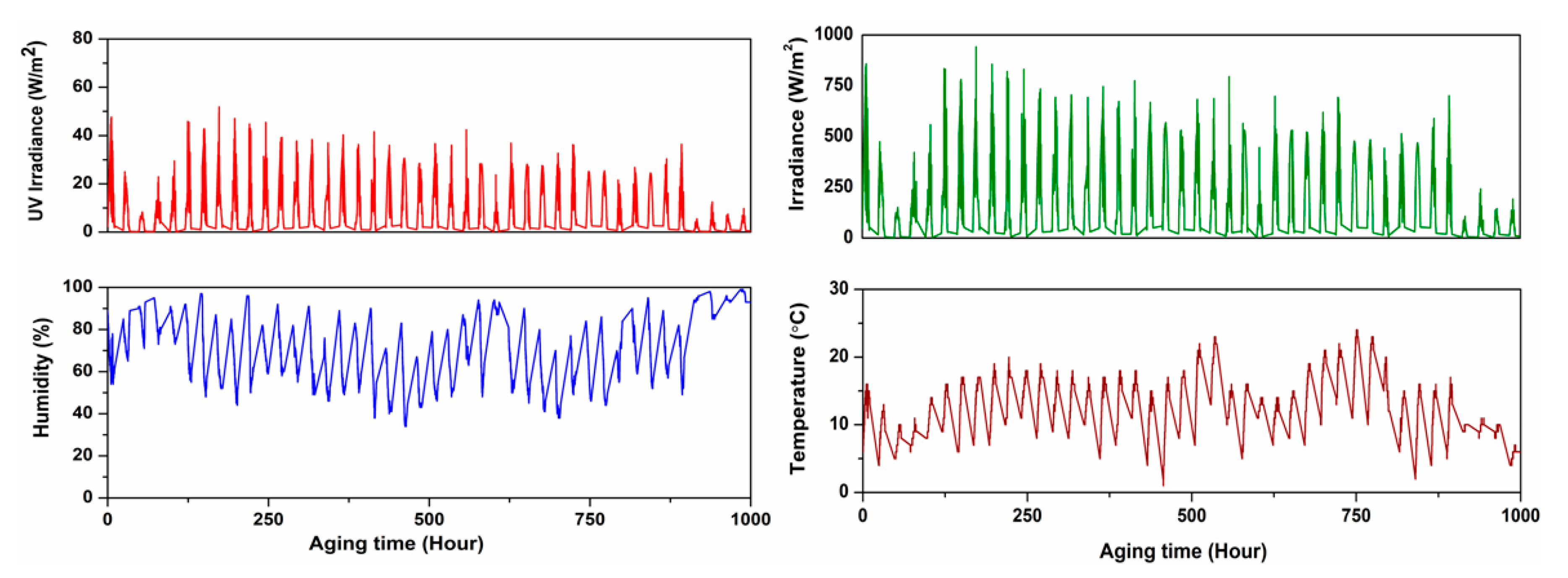
Figure 2.
J-V curves of UV dye-based DSSCs, without and with rutile layer.
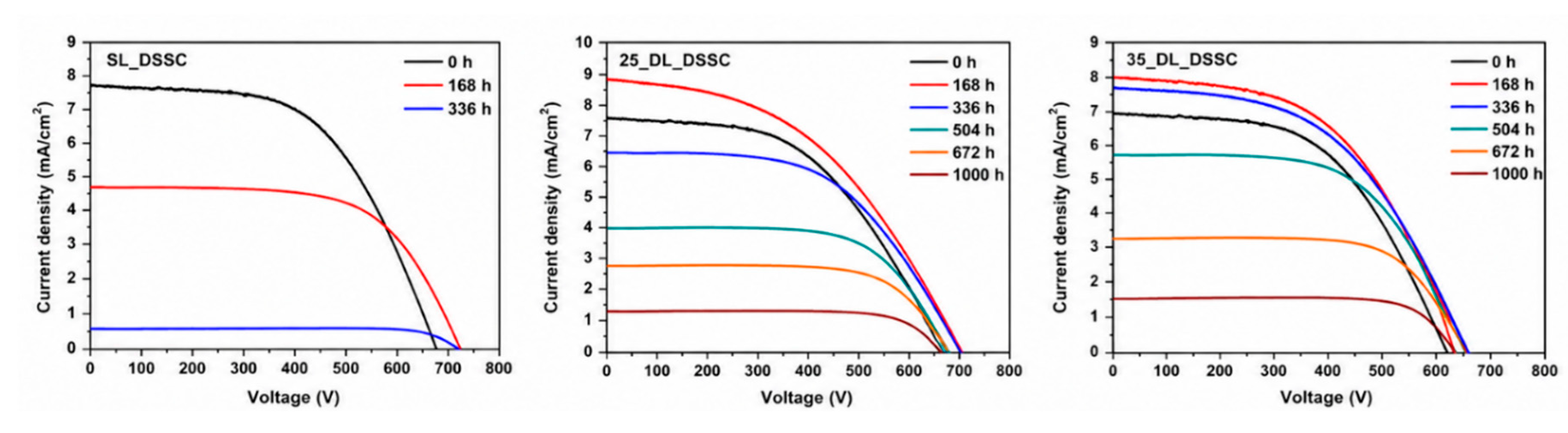
Figure 3.
Transient photocurrent (J–t) response of UV dye-based DSSCs measured over different aging times under chopped illumination (5s ON / 5s OFF).
Figure 3.
Transient photocurrent (J–t) response of UV dye-based DSSCs measured over different aging times under chopped illumination (5s ON / 5s OFF).
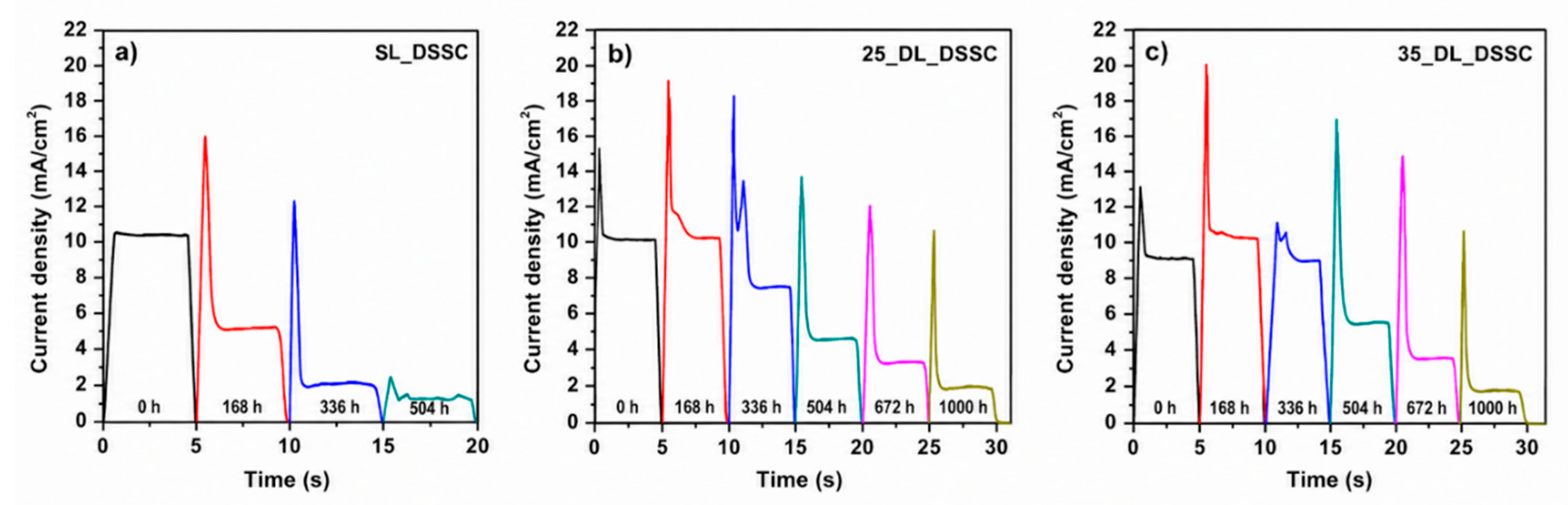
Figure 4.
EIS spectra of fresh and fully degraded UV dye-based DSSCs.
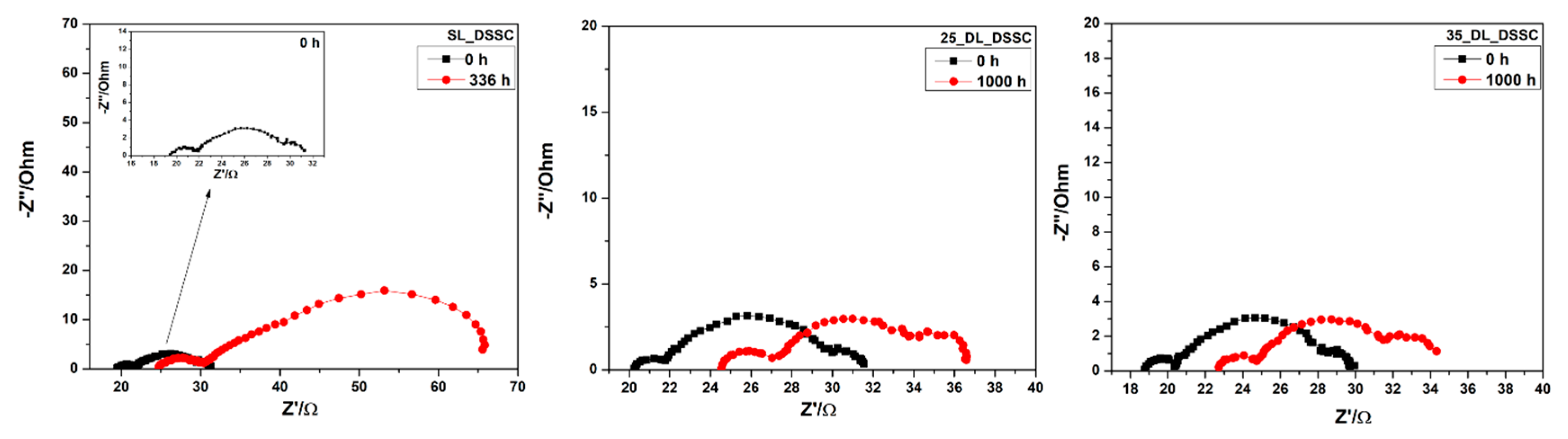
Figure 5.
FTIR spectra of the (a) fresh and (b) fully degraded photoanodes (powder) and DN-01 dye. Enlargements of the FTIR spectra of the (c) fresh and (d) fully degraded photoanodes in the region around 2213 cm⁻¹.
Figure 5.
FTIR spectra of the (a) fresh and (b) fully degraded photoanodes (powder) and DN-01 dye. Enlargements of the FTIR spectra of the (c) fresh and (d) fully degraded photoanodes in the region around 2213 cm⁻¹.
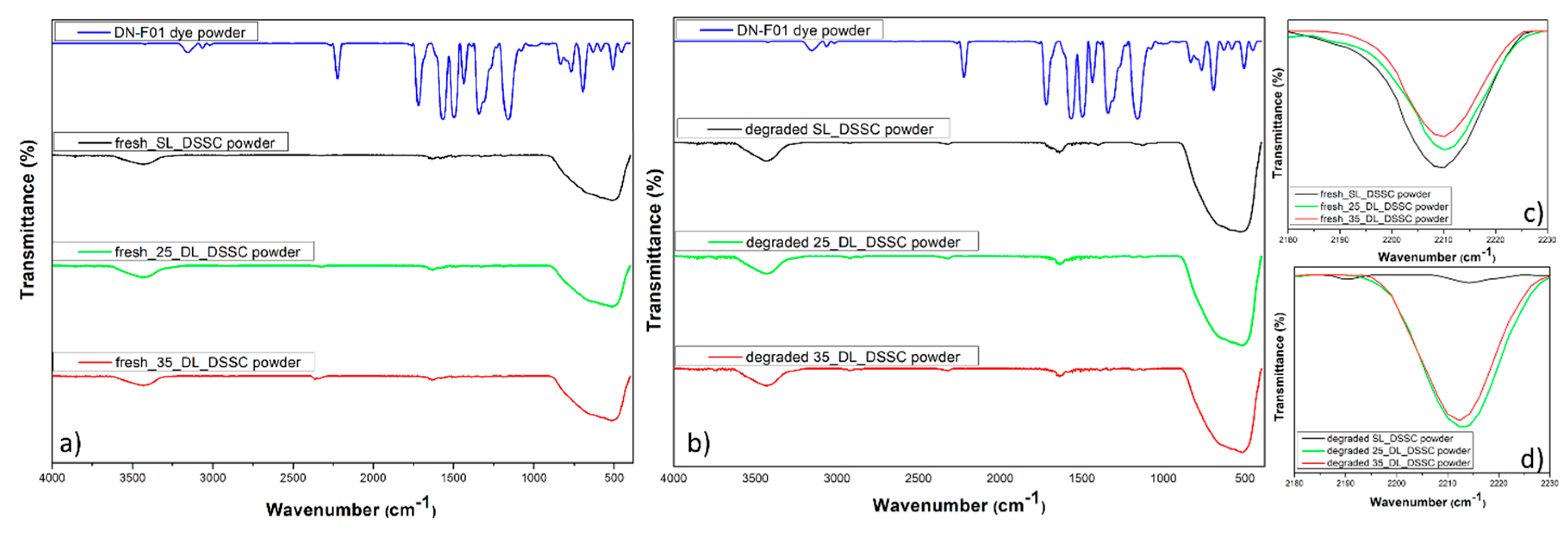
Figure 6.
XRD patterns of SL_TiO₂ and 35_DL_TiO₂ photoanodes, highlighting (1 0 1) crystal plane of anatase TiO2 in the 2θ = 24–26° region (a) and (2 0 0) crystal plane of anatase TiO2 in the 46–50° region (b).
Figure 6.
XRD patterns of SL_TiO₂ and 35_DL_TiO₂ photoanodes, highlighting (1 0 1) crystal plane of anatase TiO2 in the 2θ = 24–26° region (a) and (2 0 0) crystal plane of anatase TiO2 in the 46–50° region (b).
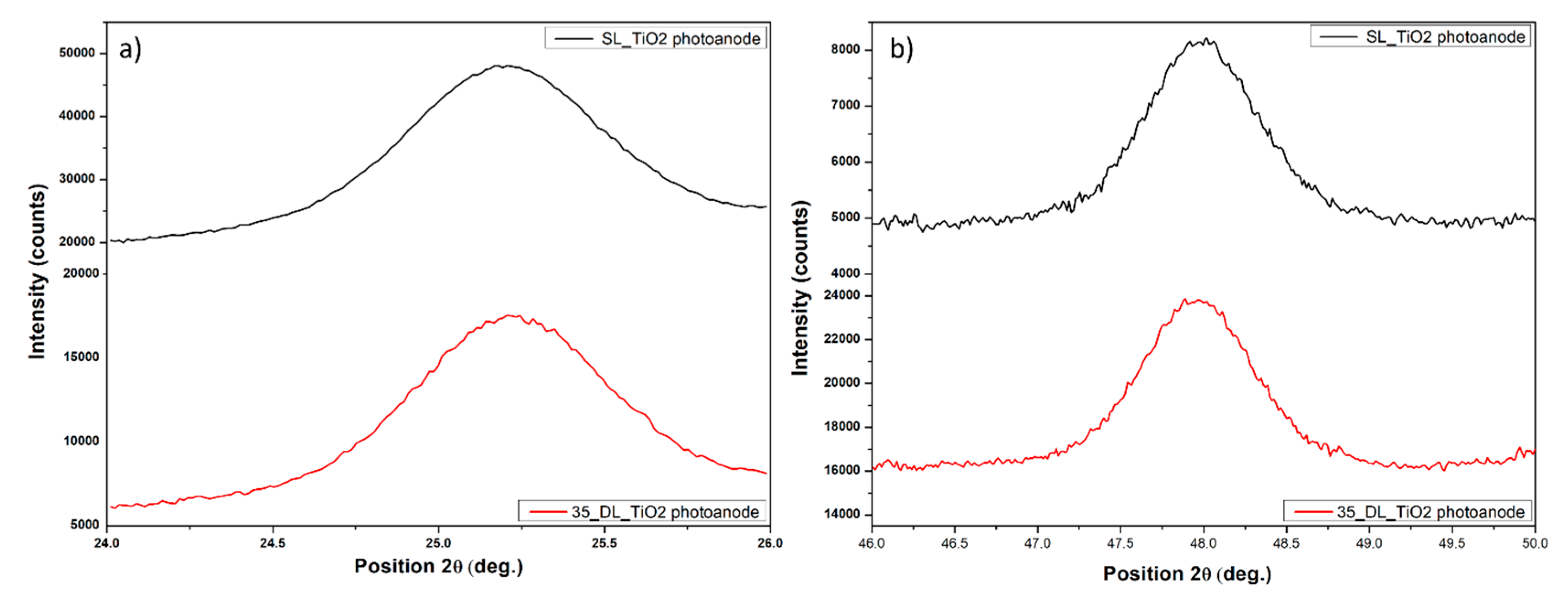
Figure 7.
Absorbance spectra of SL_TiO2 photoanode, 25 DL_TiO2 photoanode, and 35 DL_TiO2 photoanode.
Figure 7.
Absorbance spectra of SL_TiO2 photoanode, 25 DL_TiO2 photoanode, and 35 DL_TiO2 photoanode.
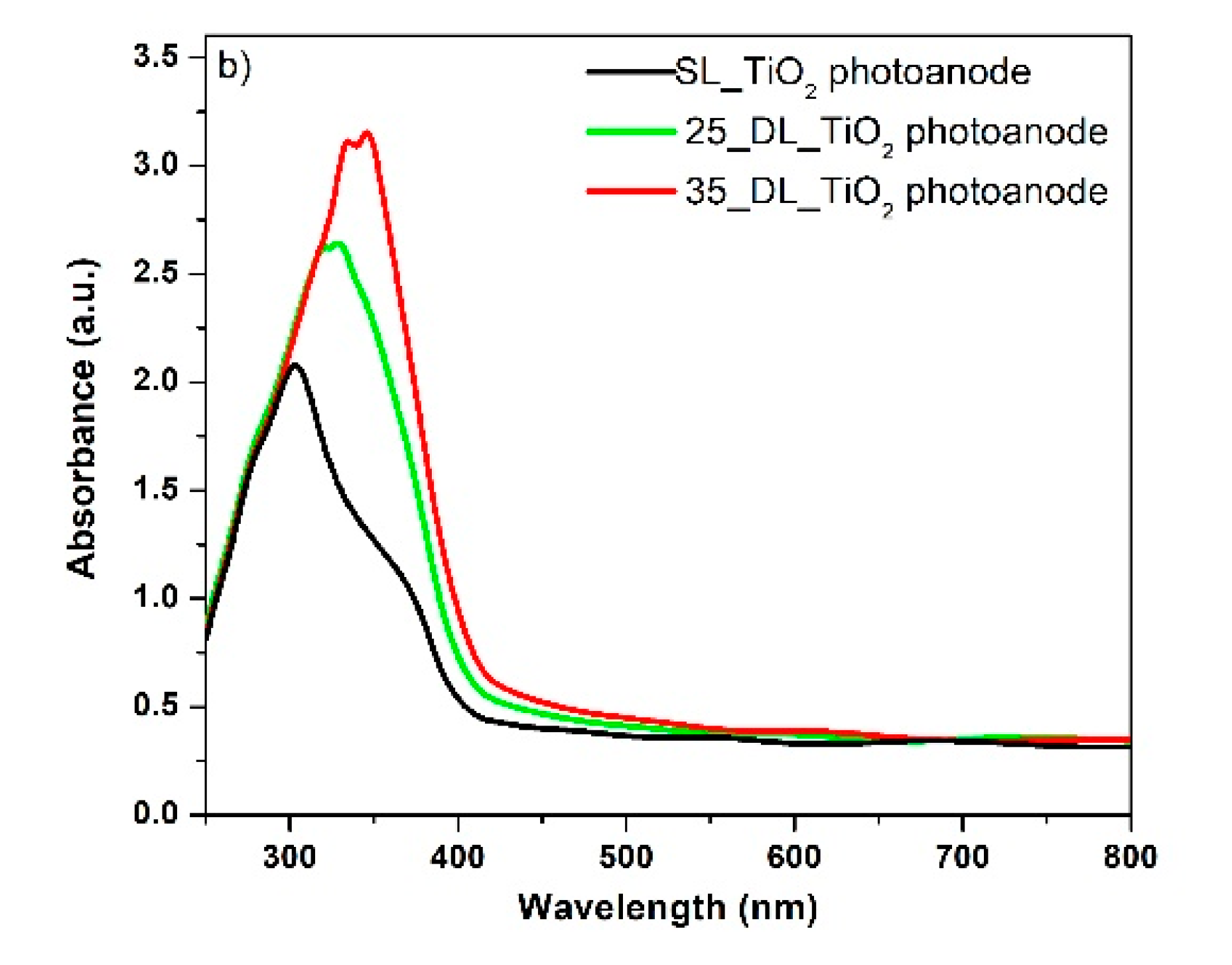
Figure 9.
ln(αhν) vs ln(hν – Eg) plot for SL_DSSC and 35_DL_DSSC photoanodes.
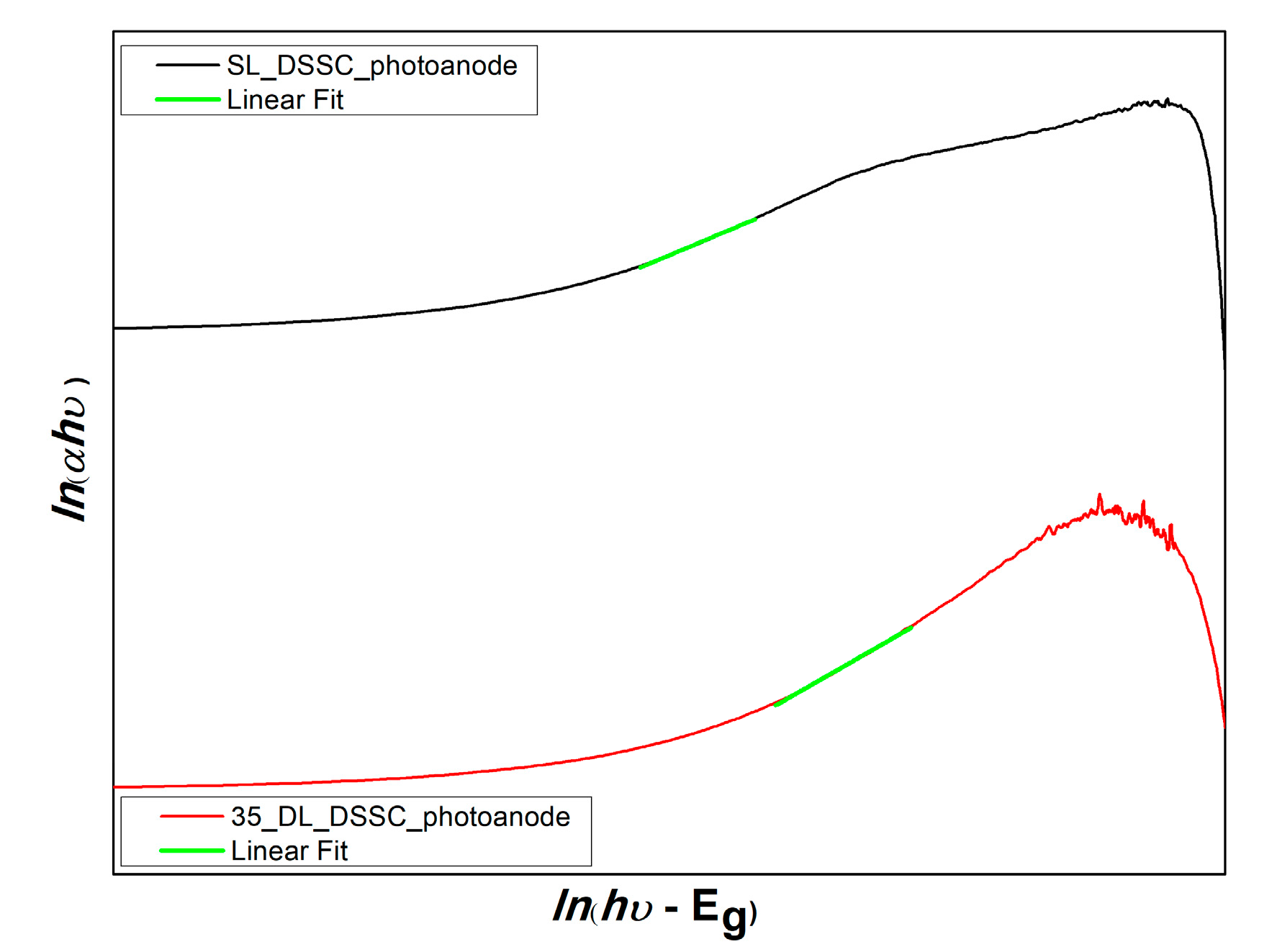
Figure 10.
Plot of ln(α) versus (hν) for SL_DSSC and 35_DL_DSSC photoanodes.
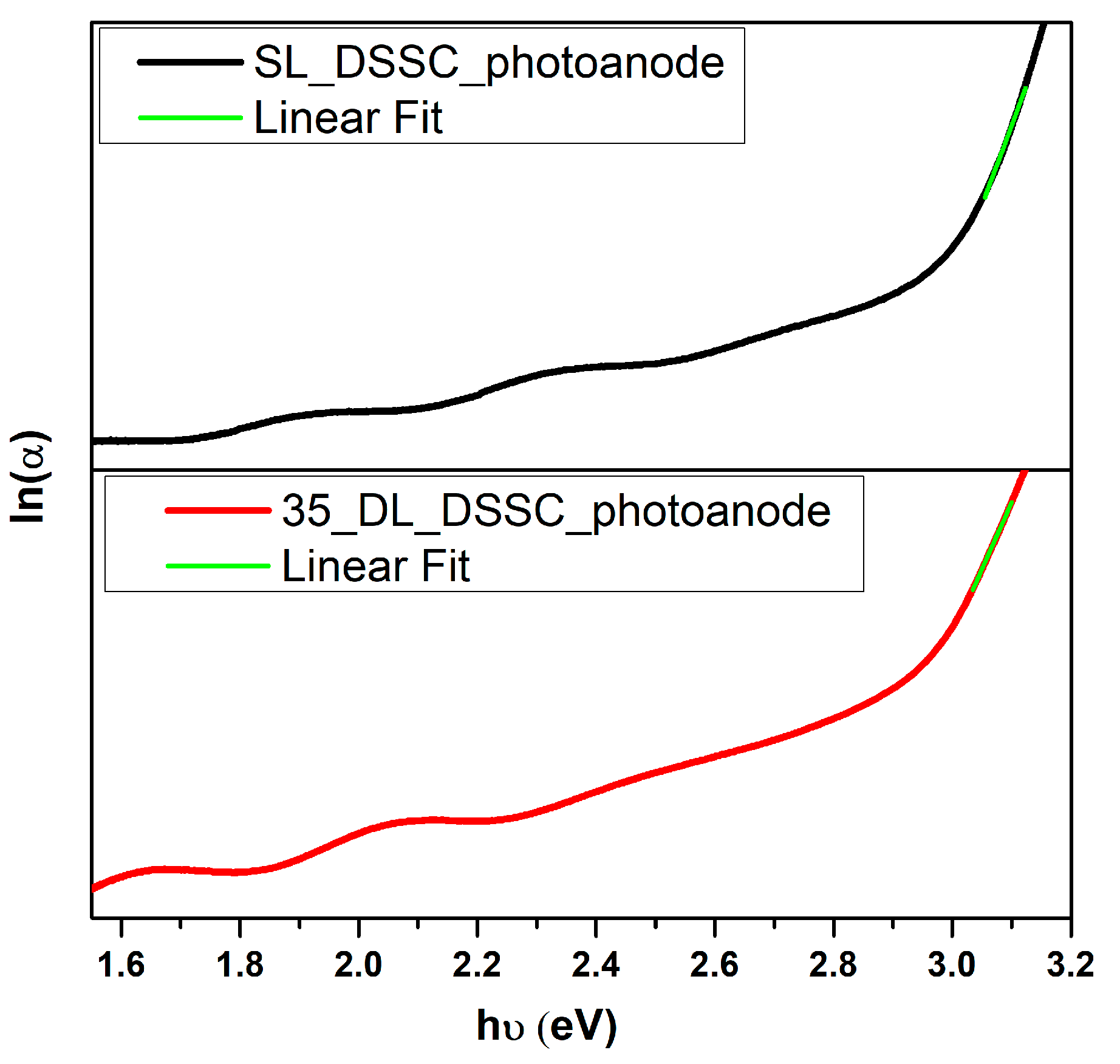
Figure 11.
Penetration depth (δ) versus λ for SL_DSSC and 35_DL_DSSC photoanodes.
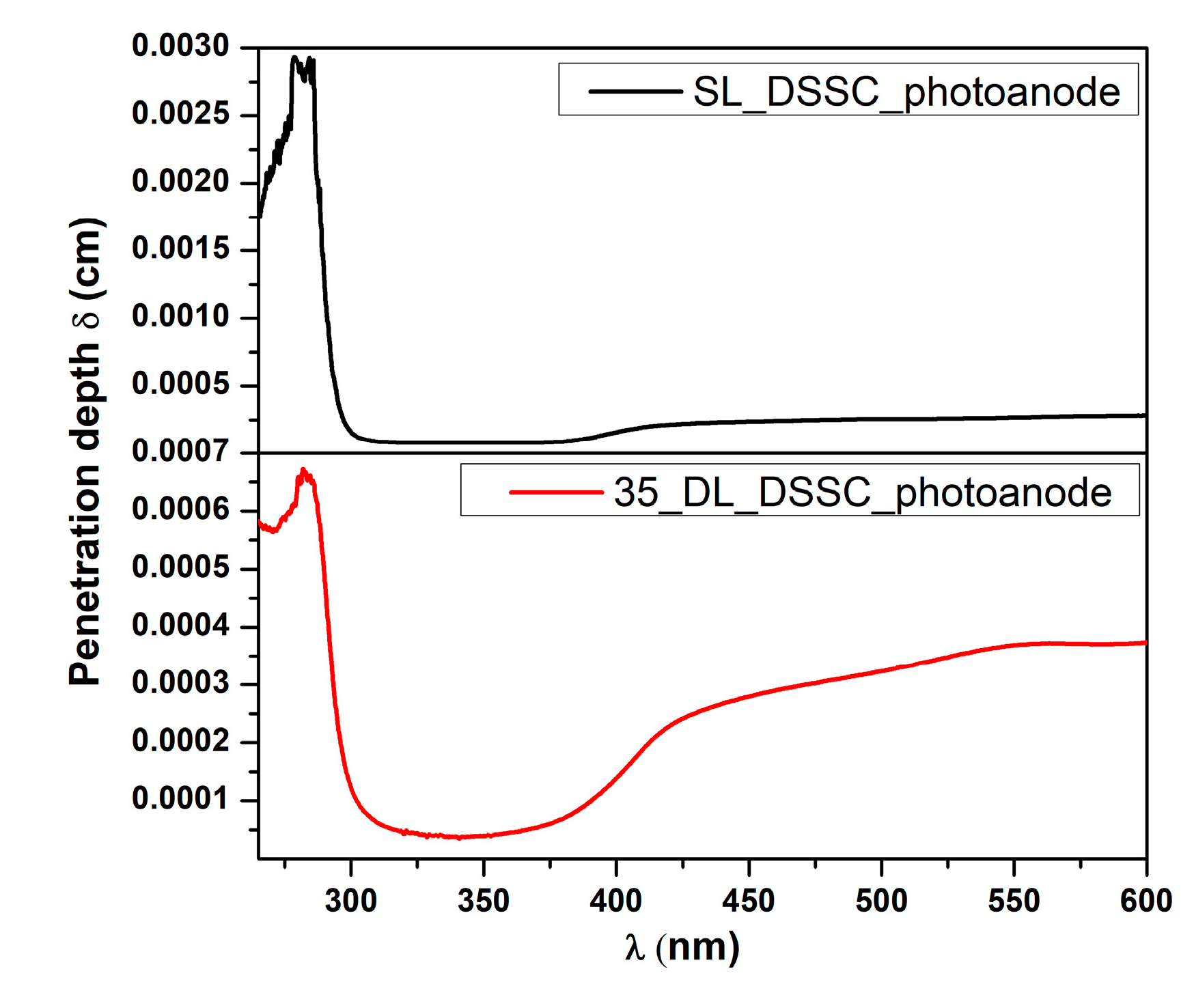

Table 1.
PV performances of UV dye-based DSSCs measured under AM 1.5G simulated sunlight (100 mW/cm2).
Table 1.
PV performances of UV dye-based DSSCs measured under AM 1.5G simulated sunlight (100 mW/cm2).
| DSSC type | Aging time (Hours) |
JSC (mA cm-2) |
VOC (mV) |
FF (%) |
η (%) |
|---|---|---|---|---|---|
| SL_DSSC | 0 | 7.66 | 670 | 50.4 | 2.5 |
| 168 | 4.66 | 718 | 60.6 | 2.0 | |
| 336 | 0.62 | 710 | 71.0 | 0.31 | |
| 25_DL_ DSSC | 0 | 7.59 | 686 | 48.9 | 2.54 |
| 168 | 8.84 | 716 | 44.1 | 2.78 | |
| 336 | 6.49 | 714 | 54.1 | 2.50 | |
| 504 | 4.19 | 692 | 64.6 | 1.87 | |
| 672 | 3.04 | 686 | 68.5 | 1.42 | |
| 1000 | 1.53 | 670 | 73.9 | 0.75 | |
| 35 _DL_ DSSC | 0 | 7.00 | 682 | 51.9 | 2.48 |
| 168 | 7.91 | 714 | 49.6 | 2.80 | |
| 336 | 7.86 | 724 | 47.8 | 2.71 | |
| 504 | 5.90 | 714 | 58.1 | 2.44 | |
| 672 | 3.48 | 702 | 69.9 | 1.70 | |
| 1000 | 1.67 | 688 | 76.0 | 0.87 |
Table 2.
Transient photocurrent density vs. time performances of UV dye-based DSSCs measured over different aging times under chopped illumination (5s ON / 5s OFF).
Table 2.
Transient photocurrent density vs. time performances of UV dye-based DSSCs measured over different aging times under chopped illumination (5s ON / 5s OFF).
| DSSC type | Aging time (hours) |
Isp (mA cm-2) |
Iss (mA cm-2) |
Overshoot Isp/ Iss |
τD (s) |
Q (µC cm-2) |
|---|---|---|---|---|---|---|
| SL_DSSC | 0 | 10.50 | 10.24 | 1.02 | 0.38 | 117 |
| 168 | 16.00 | 4.80 | 3.3 | 0.26 | 2700 | |
| 336 | 10.55 | 1.90 | 5.55 | 0.05 | 800 | |
| 25_DL_DSSC | 0 | 14.94 | 10.03 | 1.48 | 0.027 | 1655 |
| 168 | 19.3 | 10.8 | 1.78 | 0.040 | 1460 | |
| 336 | 18.4 | 7.3 | 2.52 | 0.14 | 3780 | |
| 504 | 13.4 | 4.3 | 3.11 | 0.20 | 2170 | |
| 672 | 11.6 | 3.22 | 3.74 | 0.019 | 815 | |
| 1000 | 10.5 | 1.76 | 5.96 | 0.016 | 895 | |
| 35_DL_DSSC | 0 | 13.3 | 9.12 | 1.46 | 0.075 | 995 |
| 168 | 20.1 | 10.21 | 1.96 | 0.30 | 3470 | |
| 336 | 11.2 | 9.69 | 1.15 | 0.57 | 1610 | |
| 504 | 16.7 | 5.4 | 3.09 | 0.13 | 5970 | |
| 672 | 14.8 | 3.5 | 4.22 | 0.11 | 5700 | |
| 1000 | 10.5 | 1.8 | 5.83 | 0.08 | 1990 |
Table 3.
The EIS parameters of fresh and fully degraded UV dye-based DSSCs measured under AM 1.5G simulated sunlight (100 mW/cm2).
Table 3.
The EIS parameters of fresh and fully degraded UV dye-based DSSCs measured under AM 1.5G simulated sunlight (100 mW/cm2).
| DSSC type |
Aging time (hours) |
Rs (Ω) |
RCE (Ω) |
Rct (Ω) |
RW (Ω) |
RG (Ω) |
|---|---|---|---|---|---|---|
| SL_DSSC |
0 fresh |
19.45 | 2.25 | 8.0 | 2.0 | - |
|
336 fully degraded |
24.7 | 4.77 | 35 | - | 0.02 | |
| 25_DL_DSSC |
0 fresh |
20.24 | 1.34 | 8.47 | 1.53 | - |
|
1000 fully degraded |
24.5 | 2.45 | 6.79 | 3.32 | - | |
| 35_DL_DSSC |
0 fresh |
18.79 | 1.54 | 8.34 | 1.24 | - |
|
1000 fully degraded |
22.7 | 1.83 | 6.97 | 3.26 | - |
Disclaimer/Publisher’s Note: The statements, opinions and data contained in all publications are solely those of the individual author(s) and contributor(s) and not of MDPI and/or the editor(s). MDPI and/or the editor(s) disclaim responsibility for any injury to people or property resulting from any ideas, methods, instructions or products referred to in the content. |
© 2026 by the authors. Licensee MDPI, Basel, Switzerland. This article is an open access article distributed under the terms and conditions of the Creative Commons Attribution (CC BY) license (http://creativecommons.org/licenses/by/4.0/).
Copyright: This open access article is published under a Creative Commons CC BY 4.0 license, which permit the free download, distribution, and reuse, provided that the author and preprint are cited in any reuse.