
Submitted:
14 August 2026
Posted:
18 August 2026
You are already at the latest version
Abstract
A SAPT (Symmetry Adapted Perturbation Theory) decomposition analysis was performed for various types of noncovalent interactions (stacking, hydrogen bonds, antiparallel) for various distances of interacting fragments. Although total interaction energy does not significantly change within the small range around the optimal distance, the energy contributions can significantly change in some systems. This is particularly pronounced for stacking interactions, while for hydrogen bonds and antiparallel interaction the energy contributions do not significantly change around the optimal distance. Thus, it is very important to precisely determine the optimal distance between the interacting fragments when performing SAPT analysis of noncovalent interactions, especially for stacking interactions, since the general conclusions about the nature of interactions can differ in the small range of distances between the interacting fragments.
Keywords:
SAPT energy decomposition analysis
; stacking interactions
; OH/O interactions
; CH/O interactions
; OH/π interactions
; antiparallel OH/OH interactions
Article Highlights
Interaction energy contributions can significantly change around the optimal intermolecular distance.
The energy decomposition changes are more pronounced for stacking than hydrogen bonds or antiparallel interactions.
1. Introduction
Hence, it is very important to precisely determine the optimal intermolecular distance.
The energy decomposition analysis provides an insight to the interaction further than just the total interaction energy itself, since it quantitatively reflects the nature of interactions. The information about the particular energy contributions can be useful for fundamental or practical purposes.1–16 Stacked benzene/benzene and cyclohexane/cyclohexane dimers have similar interaction energies (-2.73 kcal/mol17 and -2.62 kcal/mol18, respectively). Using Symmetry-Adapted Perturbation Theory (SAPT) decomposition showed that both benzene/benzene and cyclohexane/cyclohexane dimers have dominant dispersion contribution19. Electrostatic term plays a significant role in both homodimer interactions, but to a slightly larger extent in the cyclohexane dimer. Induction term is quite small in both systems19. Heterodimer cyclohexane/benzene system is slightly more stable (-3.27 kcal/mol20) due to the more pronounced electrostatic term as a consequence of CH/π interactions, while dispersion is also a dominant energy contribution as in homodimer interactions19. Benzene/benzene interaction retains a lot of its maximum strength upon shifting to a large horizontal displacement (around 70% of the maximum strength, when shifted to 5.0 Å; 1 Å equals 10-10 m), while cyclohexane/benzene interaction preserves around 40% of its maximum strength at the same offset value. Since dispersion and exchange-repulsion are both short-ranged interactions and they decrease simultaneously with increasing distance of the interacting monomers while having opposite signs, it is sometimes convenient to express their sum (net dispersion), for example when comparing energy decompositions to the one in benzene/benzene stacking.21,22 Electrostatic term is more dominant than net dispersion in case of the benzene/benzene stacked dimer, in the most stable geometry, as well as at large offsets. On the other hand, electrostatic term is also more dominant than net dispersion term at the most stable geometry of the cyclohexane/benzene dimer, but net dispersion slightly dominates at large offsets23. If the electrostatic term is further separated into multipole expansion term and the electrostatic penetration term it can be shown that the latter one is dominant24.
Heterocyclic aromatic molecules form stronger stacking interactions than benzene molecules due to the enhanced electrostatic contribution, as a result of the molecule polarization occurring in the presence of electronegative heteroatoms25. For example, comparing benzene/benzene, benzene/pyridine and pyridine/pyridine dimers it can be seen that pyridine/pyridine dimer is the most stable (-3.99 kcal/mol26), since apriparallel interactions are present, followed by benzene/pyridine (-3.44 kcal/mol25) and benzene/benzene dimer (-2.73 kcal/mol17). Dispersion term is the major contribution to the total interaction energy in pyridine/pyridine and benzene/pyridine systems, like in benzene/benzene dimer, as mentioned above. Induction, dispersion and exchange-repulsion terms are reduced in both pyridine/pyridine and benzene/pyridine dimers, compared to the benzene dimer, since electronegative heteroatom contracts the electron density. As a result of such contraction, the polarizability decreases, as well as the repulsion between two interacting molecules.21,22 Net dispersion term (the sum of dispersion and exchange-repulsion22) is attractive in all systems. It is the smallest in benzene/benzene and the largest in pyridine/pyridine system, which means that exchange-repulsion contribution is becoming more reduced than dispersion term22. Pyridine/pyridine and benzene/pyridine stacking interactions preserve significant portion of their maximum strength when shifted to the large offset value (4.5 Å), 53% and 59%, respectively27.
SAPT energy decomposition analysis of OH/O interactions performed on optimized water dimer28 showed that the electrostatic term is dominant (about twice as large as the total interaction energy). Regarding the sum of attractive terms in total interaction energy electrostatic contribution forms more than 60%, while dispersion and induction terms are also important (around 20% and 10% of the attractive part of interaction energy, respectively). The contribution of electrostatic term in the attractive part of interaction energy increases with increasing O∙∙∙H distance, while induction term decreases at the same time. Exchange-repulsion term is comparable to the electrostatic term, but of opposite sign.
A SAPT energy decomposition of CH/O interactions studied on methane/water dimer reveals that dispersion is the most dominant attractive contribution to the total interaction energy, followed by electrostatic and induction component. The exchange-repulsion term exceeds all the attractive terms29. The most stable geometry of both OH/O and CH/O interactions is linear, but CH/O interaction is less sensitive to bending. Although CH/O interaction is weaker than OH/O (comparing the most stable geometries), the interaction energy decreases more gradually with increasing monomer distance in case of CH/O interaction, so the strengths OH/O and CH/O interactions can be comparable at particular positions30. CH/O interactions are often considered weak, but they can be much stronger when CH group is a part of a coordinated species.31,32
Dispersion is the major contribution to attraction in OH/π interactions. Electrostatic interaction is not dominant, but determines the preferable geometries. The most stable geometry of a benzene/water dimer is a monodentate one, with a hydrogen atom located above the ring centre.33,34 Exchange-repulsion energy is also quite important in describing conformations and interaction energies of OH/π interactions35. On the other hand, a recent study on OH/π and NH/π interactions in the second coordination sphere of the metal complexes36 emphasizes the importance of the electrostatic contribution in these interaction types, followed by induction and dispersion as the lowest attractive contribution. The energy contributions36 and total interaction energies36–38 are similar for OH/π and NH/π interactions of the coordinated water and ammonia molecules.
There is a group of attractive interactions between OH-containing species that does not meet the geometric criteria for hydrogen bonds. Thus, analysing the attractive water/water interactions in the CSD it is observed that most of them are classical hydrogen bonds, but beside them there are others, most of which have antiparallelly oriented OH bonds. The geometric criteria defined for these interactions reveal 1282 attractive antiparallel OH/OH contacts of totally 6729 attractive water/water contacts39. The potential energy surface is systematically calculated40. The most stable antiparallel OH/OH contacts on the potential energy surface has the interaction energy of -4.2 kcal/mol, while a significant portion of the surface corresponds to the interaction energies more negative than -2.0 kcal/mol, meaning that these interactions can be stronger than weak hydrogen bonds. These antiparallel water/water interactions are shown to be a low-barrier transition state between two classical hydrogen bonds with reversed donor-acceptor roles40. These interactions can be described as an attraction between two antiparallelly oriented OH dipoles. The antiparallel OH/OH contacts also exist for alcohol/alcohol and alcohol/water interactions and it was shown by the CSD search and quantum chemical calculations41. The OH-group also forms parallel-alignment interactions with aromatic rings.42,43 The SAPT energy decomposition analysis shows that the most dominant attractive component is electrostatic (ca. 66% of all attractive contributions), dispersion is less dominant (ca. 23% of attractive contributions), while induction is the least dominant attractive contribution (ca. 12%). Electrostatic and dispersion contributions are slightly more pronounced in antiparallel OH/OH interactions than in classical hydrogen bonds (ca. 62% and 20%, respectively), while induction is slightly less pronounced than in classical hydrogen bonds (ca.18%)40.
In this work we performed SAPT analysis of various stacking interactions, various conventional and nonconventional hydrogen bonds (OH/O, CH/O, OH/π), and antiparallel OH/OH interaction with the aim to show dependence of the SAPT energy components on small changes in distance between interacting monomers. To the best of our knowledge these are the first results indicating change in the dominant energy component with small change in the distance.
2. Methodology
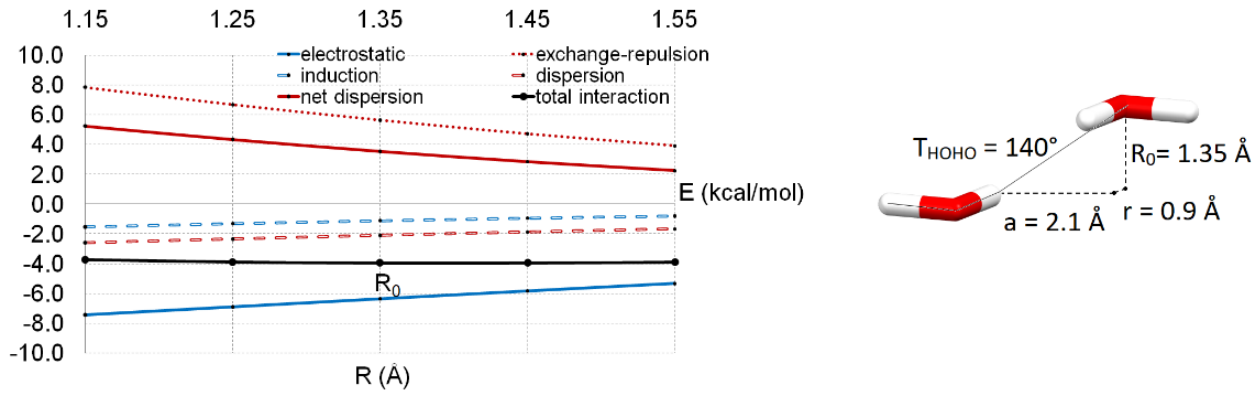
The symmetry-adapted perturbation theory (SAPT2+3)44–46, interaction energies were calculated with def2-tzvppd basis set47 by using PSI4 program package48 on model systems representing different interaction types. Model systems for stacking interactions were parallel molecules, with various horizontal and vertical displacements. CH/O, OH/O and OH/π interactions are studied on model systems of methane/water, water/water and water/benzene dimers by varying vertical displacements between the interacting molecules. Model system for antiparallel OH/OH interactions is the most stable calculated water/water dimer formed by antiparallel OH/OH interactions49, which is a geometry defined by parallel molecule planes, a torsion angle T of 140°and a and r displacements of 2.1 and 0.9 Å, respectively (Figure 8). Consequently, the optimal vertical displacement (R0, as defined in this paper) is 1.35 Å. The horizontal displacements (a and r) are held constant and only vertical displacement of the parallel molecule planes (R) is varied (torsion angle T consequently varies). Monomer geometries in all systems are optimized using Møller-Plesett perturbation theory of the second order (MP250) with cc-pVTZ basis set51. Geometries of the interacting monomers were rigid and only their mutual orientations were varied.
3. Results and Discussion
Energy decomposition analysis of various stacking interactions (benzene/benzene, benzene/pyridine, pyridine/pyridine and benzene/cyclohexane), various hydrogen bonds (CH/O (methane/water), OH/O (water/water), OH/π (water/benzene), and antiparallel OH/OH (water/water) using Symmetry-Adapted Perturbation Theory (SAPT)44 approach was performed. Interaction energies and their components were calculated at optimal intermolecular distances and at somewhat shorter and larger distances.
3.1. Stacking Interactions
Interaction energies and their components are calculated at optimal vertical displacements and at slightly shorter and larger vertical displacements. The results were shown as potential energy curves representing total SAPT interaction energies and its components depending on vertical displacement (R, Fig 1-4). Optimal vertical displacement (R0) corresponds to the energy minimum at a given horizontal displacement value (r, Figure 1, Figure 2, Figure 3 and Figure 4).
Total interaction energies practically do not change within the examined range of vertical displacements (Figure 1, Figure 2, Figure 3 and Figure 4), but interaction energy components and, consequently, the nature of the interactions, significantly change. All components that consist the total SAPT energy (electrostatic, exchange-repulsion, induction and dispersion) weaken with increasing vertical displacements in all stacked systems, except net dispersion component, which is not a “pure” component but is composed by dispersion and exchange-repulsion. Dispersion that becomes less favourable and the exchange-repulsion term that becomes more favourable (due to its positive sign) lead to a more favourable net dispersion, since dispersion drops off to a smaller extent. Changes of the electrostatic term are more significant than changes of the induction term, which are relatively small in all systems.
Dispersion components are dominant in all stacking model systems (Figure 1, Figure 2, Figure 3 and Figure 4). On the other hand, comparing net dispersion to electrostatic component we can see differences between aromatic/aromatic (benzene/benzene, benzene/pyridine and pyridine/pyridine and aromatic/aliphatic (benzene/cyclohexane) interactions. In all aromatic/aromatic interactions net dispersion interaction is more dominant than electrostatic in sandwich geometries, while the electrostatic is more dominant in displaced geometries (both smaller and larger displacements). The only exception is pyridine/pyridine sandwich geometry, where both components are similar, since electrostatic is enhanced due to the antiparallel dipole arrangement22. In aromatic/aliphatic interactions, however, we observe the opposite situation. Electrostatic component dominates in the sandwich geometry23 and since it originates from CH/π interactions, it significantly decreases in displaced geometries, so that net dispersion even exceeds electrostatic term at large displacement.
Benzene/benzene In benzene/benzene sandwich geometry the only intersection of the curves occurs between electrostatic and induction components, but that does not significantly change the nature of interaction since both components are weak (-0.6 kcal/mol and -0.3 kcal/mol at vertical displacement of 3.7 Å). The intersection occurs because electrostatic term decreases more rapidly than induction in this system and even becomes slightly repulsive (0.4 kcal/mol at 4.1 Å) (Figure 1a).
In the parallel-displaced benzene/benzene system the intersection occurs very closely to the calculated optimal vertical displacement (Figure 1b), which significantly changes the nature of the interaction in the proximity of R0. Namely, electrostatic term is more dominant than net dispersion at slightly smaller R (-2.3 kcal/mol vs. 0.5 kcal/mol at R 3.4 Å), but net dispersion becomes significantly dominant at slightly larger R (-0.5 kcal/mol vs. 1.7 kcal/mol at 3.7 Å). Electrostatic component decreases far more rapidly than induction component. This effect is even more pronounced than in the sandwich geometry (Figure 1b), since for parallel-displaced geometry electrostatic component is three times stronger than induction at 3.3 Å (-3.4 kcal/mol vs. -1.2 kcal/mol), while these components are almost equal at R 3.7 Å.
At large horizontal displacement (5.0 Å, Figure 1c) the net dispersion curve intersects the induction curve near R0 but does not intersect the electrostatic curve. Electrostatic component is significantly more dominant than net dispersion and induction in this system. Namely, net dispersion value is in the range between 0.6 and -0.7 kcal/mol, induction is even less pronounced (between -0.5 and -0.2 kcal/mol), while the electrostatic term reaches -1.9 kcal/mol at R value of 2.4 Å and decreases to -1.0 kcal/mol at 2.8 Å. Electrostatic contribution decreases more slowly than in parallel-displaced system, since the nature of electrostatic attraction is not the same. Interaction in case of parallel-displaced geometry is a quadrupole/quadrupole interaction, while in case of large horizontal displacement it is the interaction of local dipoles near the aromatic ring edges. Although the curves do not intersect, the electrostatic/net dispersion ratio significantly changes around the R0 value. Namely, at R slightly smaller than optimal (2.4 Å) electrostatic term is far more dominant than net dispersion, which is even repulsive (-1.9 vs. 0.6 kcal/mol), but they are almost comparable at R slightly larger than optimal (2.8 Å, -1.0 vs. -0.7 kcal/mol).
Benzene/pyridine In the sandwich orientation of benzene/pyridine dimer the interaction energy has a dominant net dispersion component at optimal vertical displacement, but component ratio dramatically changes in the proximity of R0 (Figure 2a). Namely, electrostatic and net dispersion curve intersect at R value around 3.7 Å (0.1 Å shorter than R0). Net dispersion component is around three times more dominant than electrostatic component at R0 (3.8 Å, -1.6 vs. -0.5 kcal/mol), but they are nearly equal at 3.7 Å (-1.0 vs. -0.9 kcal/mol). At 3.6 Å electrostatic component significantly exceeds the net dispersion (-1.5 vs. 0.2 kcal/mol). Due to such significant changes in the component ratio while vertical displacement value changes a little, it is very important to carefully determine the exact value of vertical displacement when performing energy decomposition analysis.
In case of parallel-displaced benzene/pyridine stacking, some effects are similar as in sandwich geometry. The intersection of net dispersion and electrostatic curves occurs at slightly larger vertical displacement than optimal (Figure 2b). At calculated optimal displacement (3.5 Å) electrostatic component exceeds net dispersion (-1.7 vs. -1.0 kcal/mol), but at a slightly larger value (3.6 Å) the net dispersion exceeds the electrostatic component (-1.6 vs. -1.2 kcal/mol). At a slightly smaller R value (3.4 Å) electrostatic component is very dominant (-2.5 kcal/mol), while net dispersion drops to zero. Net dispersion curve also intersects the induction curve at a R value slightly smaller than optimal. At R0 value (3.5 Å) net dispersion is slightly more favorable than induction (-1.0 vs. -0.6 kcal/mol), but at a slightly shorter R value (3.4 Å) induction is more favorable (-0.8 kcal/mol), while net dispersion is neglectable. At a slightly larger R value (3.6 Å) net dispersion significantly exceeds the induction component (-1.6 vs. -0.5 kcal/mol). Since component ratio or even the order of components according to their contribution significantly changes in a small range of vertical displacements (3.5 ± 0.1 Å) it is crucial to precisely determine the vertical displacement value.
At a large horizontal displacement in case of benzene/pyridine stacking (Figure 2c) net dispersion and induction curves intersect near the optimal vertical displacement value, but their contribution is quite small, since it does not exceed -0.6 kcal/mol in the range ± 0.1 Å around R0. Similar to benzene/benzene stacking in benzene/pyridine stacking electrostatic component drops off more rapidly in case of sandwich or parallel-displaced geometries than in case of large offset geometries. Thus, the intersection of electrostatic and net dispersion curves does not occur. Namely, the electrostatic component in benzene/pyridine sandwich geometry (Figure 2a) drops off from -1.5 kcal/mol to 0.0 kcal/mol within the R value range ± 0.2 Å around the optimal value. The electrostatic component is even more favourable for parallel-displaced geometry of the benzene/pyridine stacking (-1.7 kcal/mol at R0, Figure 2b) and drops off from -3.5 kcal/mol to -0.8 kcal/mol within the R value range ± 0.2 Å around the optimal value, which is more than four times lower. Large offset geometry is governed by local C-H dipoles at the ring edges and has the weakest total energy of -2.0 kcal/mol among the three observed geometries. The electrostatic component R0 is -1.3 kcal/mol and drops off from -1.8 to -1.0 kcal/mol, which is a more gradual change. Similarly to benzene/benzene system, the ratio of the components changes although the intersection does not occur.
Pyridine/pyridine In case of antiparallel sandwich geometry net dispersion curve intersects electrostatic curve at optimal vertical displacement (3.7 Å, Figure 3a), thus similarly to benzene/pyridine sandwich geometry interaction energy contributions substantially change within the small range of vertical displacements around the optimal value. Electrostatic component (-1.9 kcal/mol) is more favourable than net dispersion (-0.8 kcal/mol) at slightly smaller R (3.6 Å), but net dispersion is more dominant than electrostatic component at slightly larger R (3.8 Å, -1.8 vs. -1.0 kcal/mol). Net dispersion curve also intersects induction curve at slightly shorter vertical displacement than optimal, but this is of less importance due to small induction value (-0.4 kcal/mol or less).
In case of parallel-displaced anti pyridine/pyridine system, unlike parallel-displaced benzene/benzene and
benzene/pyridine systems where net dispersion curve intersects electrostatic curves at vertical displacement values very close to optimal, net dispersion curve intersects electrostatic curve at slightly larger R (Figure 3b), so electrostatic/net dispersion ratio significantly changes in the range of vertical displacements between the optimal (3.4 Å) and slightly larger (3.6 Å) values. At optimal vertical displacement (3.4 Å) electrostatic component (-2.8 kcal/mol) is much more dominant than net dispersion (-0.6 kcal/mol), while net dispersion dominates at 3.6 Å (-1.8 kcal/mol vs. -1.6 kcal/mol). Net dispersion curve also intersects the induction curve around R0, but that is less important due to small induction contribution (less than -1.2 kcal/mol in the whole range of vertical displacements, Figure 3b).
At large horizontal displacements of antiparallel pyridine/pyridine stacking net dispersion curve intersects the induction curve at a vertical displacement of 2.5 Å, which is slightly shorter than optimal (2.6 Å, Figure 3c), but as in previous systems, this is less important, since induction contribution is nearly constant and quite small (less than -0.4 kcal/mol). Similar to benzene/benzene and benzene/pyridine systems in large offset pyridine/pyridine antiparallel system electrostatic contribution drops off more slowly than in sandwich and parallel-displaced systems, so none of the component curves intersect the electrostatic curve. However, electrostatic/net dispersion ratio significantly changes around the optimal vertical displacement (Figure 3c). Electrostatic component is significant at 2.4 Å (-1.8 kcal/mol), while net dispersion is repulsive (0.1 kcal/mol), but they are comparable at 2.8 Å (-1.0 vs. -0.8 kcal/mol).
Benzene/cyclohexane In sandwich geometry (Figure 4a) net dispersion curve intersects the induction curve nearly at optimal vertical displacement value (4.2 Å) and the electrostatic curve at a slightly larger value (4.3 Å), which makes a precise determination of optimal vertical displacement very important in SAPT analysis. Thus, at R0 the electrostatic term (-1.9 kcal/mol) is far more dominant than net dispersion (-0.7 kcal/mol) and induction term (-0.6 kcal/mol). At a slightly larger R value (4.3 Å) electrostatic and net dispersion terms are similar (-1.4 kcal/mol vs. -1.2 kcal/mol), while induction is much less favourable (-0.5 kcal/mol). At a bit larger R (4.4 Å) net dispersion significantly surpasses the electrostatic term (-1.5 vs. -1.1 kcal/mol), while induction term is even less favourable (-0.4 kcal/mol).
Similar preferences are present in parallel-displaced system (Figure 4b), since net dispersion curve intersects the induction curve at vertical displacement value very close to optimal (4.1 Å) and the electrostatic curve at a slightly larger value (close to 4.2 Å). Thus, energy contributions significantly change around R0. Net dispersion and induction terms are similar at R0 (-0.8 and -0.5 kcal/mol, respectively), while electrostatic term is much more favourable (-1.6 kcal/mol). At slightly larger R value (4.2 Å) electrostatic and net dispersion terms are similar (-1.2 and -1.3 kcal/mol, respectively), while induction contribution is much smaller (-0.4 kcal/mol). At the other hand, at 4.3 Å net dispersion term (-1.5 kcal/mol) surpasses the electrostatic (-0.9 kcal/mol) and induction term (-0.3 kcal/mol).
At large offset benzene/cyclohexane system (Figure 4c) net dispersion term is attractive in the whole range of vertical displacement values. The net dispersion curve intersects induction and electrostatic curves at R values smaller than optimal, but the values of these energy terms are quite small in this system (smaller than -1.0 kcal/mol the whole range of R values).
3.2. Hydrogen Bonds and Antiparallel Interactions: CH/O, OH/O, OH/π and Antiparallel OH/OH Interactions
OH/O, CH/O, OH/π and antiparallel OH/OH interactions have significantly different nature than stacking interactions, which is reflected in different interaction energy composition. Similar to stacking interactions, total interaction energies remain constant in the observed range of vertical displacements (Figure 5, Figure 6, Figure 7 and Figure 8). With increasing vertical displacements electrostatic and net dispersion components have opposite tendencies, as in case of stacking interactions, since electrostatic component becomes less favourable, while net dispersion component becomes more favourable. Induction component is small, except for OH/O interactions, where is becoming significantly less attractive with increasing distance between the interacting species. Dispersion becomes less favourable and exchange-repulsion more favourable, as in case of stacking interactions.
Unlike the stacked systems, the nature of OH/O, CH/O, OH/π and antiparallel OH/OH interactions does not significantly change with changes in vertical displacement. Intersection practically does not occur (Figure 5, Figure 6, Figure 7 and Figure 8), except in OH/O and CH/O systems (Figure 5 and Figure 6), where dispersion and induction curves (OH/O system) and electrostatic and dispersion curves (CH/O system) almost overlap, but that does not lead to significant changes in the nature of interactions.
OH/O interactions In case of OH/O interactions electrostatic component significantly dominates in the whole range of observed vertical displacements. Induction and dispersion curves practically overlap. Net dispersion is always repulsive, since exchange-repulsion is dominant over dispersion component (Figure 5).
CH/O interactions In case of CH/O interactions electrostatic and dispersion components drop off a bit more rapidly than induction component. Net dispersion is repulsive in this region and drops to zero with increasing vertical displacement, since dispersion and exchange-repulsion components nearly equalize. (Figure 6).
OH/π OH/π interaction is mainly dispersive in nature, with a significant electrostatic contribution, which is nearly as important as dispersion. Net dispersion is mostly repulsive, but becomes attractive at larger vertical displacements, since exchange-repulsion weakens more than dispersion (Figure 7).
Antiparallel OH/OH In case of antiparallel OH/OH interactions electrostatic component is quite dominant in the whole range of vertical displacements and the electrostatic curve is practically parallel to the dispersion and the induction curves, which means that the contributions of attractive terms do not significantly change. Dispersion component is more dominant than induction in the whole range of vertical displacements. Net dispersion is always repulsive, since dispersion is smaller than exchange-repulsion contribution (Figure 8).
4. Conclusions
SAPT energy decomposition analysis was performed for several representative types of noncovalent interactions, including stacking interactions (benzene/benzene, benzene/pyridine, pyridine/pyridine, and benzene/cyclohexane), hydrogen bonds (OH/O in water/water, CH/O in methane/water, and OH/π in benzene/water), and antiparallel (OH/OH in water/water) interactions. For each system, the total interaction energy and its individual components (electrostatic, exchange-repulsion, induction, and dispersion) were calculated at several intermolecular distances around the optimal distance.
As expected, the total interaction energy changes are very small within the relatively narrow distance range around the optimal distance. In contrast, the individual SAPT components can exhibit substantially larger variations. Consequently, even when the total interaction energy remains relatively stable, the relative contributions of the different components change appreciably. This effect is particularly pronounced for some interaction types and can be visualized by examining the intersections of the component curves.
For this analysis, particular attention was given to the electrostatic and net dispersion contributions, where the latter is defined as the sum of the attractive dispersion and repulsive exchange terms. Both dispersion and exchange-repulsion are short-range contributions, and their combination provides a useful measure of the net dispersive stabilization. An intersection of the electrostatic and net dispersion curves is observed for all investigated stacking systems. This behavior indicates that relatively small changes in intermolecular distance around the optimal geometry can substantially alter the balance between electrostatic and dispersion contributions. Thus, although the total interaction energy may vary only modestly, the contributions responsible for stabilization change considerably within this short distance range.
The hydrogen-bonded and antiparallel OH/OH–water/water systems exhibit markedly different behavior. No significant intersections of the SAPT component curves are observed within the investigated distance range. The only exceptions are two cases in which the curves nearly overlap: the electrostatic and dispersion contributions in the CH/O system and the dispersion and induction contributions in the OH/O system.
Overall, these results indicate that the balance between the different interaction components is considerably less sensitive to small changes in intermolecular distance for hydrogen bonds and antiparallel OH/OH–water/water interactions than for stacking interactions. These findings highlight the importance of accurately determining the optimal intermolecular distance, particularly for stacked systems.
Supplementary Materials
The following supporting information can be downloaded at the website of this paper posted on Preprints.org. Cartesian coordinates of the systems used for SAPT calculations.
Data availability: The data that support the findings of this study are available within the article and its supplementary material or from the corresponding author upon reasonable request.
Acknowledgments
This work was supported by the Ministry of Education, Science and Technological Development of Republic of Serbia (Contract numbers: 451-03-33/2026-03/ 200168 and 451-03-33/2026-03/ 200288).
Conflicts of interest
The authors declare no conflicts of interest.
References
- Pastorczak, E.; Corminboeuf, C. Found in translation: Quantum chemical tools for grasping non-covalent interactions. J. Chem. Phys. 2017, 146, 120901. [Google Scholar] [CrossRef] [PubMed]
- Das, A. K.; Liu, M.; Head-Gordon, T. Development of a many-body force field for aqueous alkali metal and halogen ions: An energy decomposition analysis guided approach. J. Chem. Theory Comput. 2022, 18(2), 953–967. [Google Scholar] [CrossRef] [PubMed]
- Lu, Z.; Zhou, N.; Wu, Q.; et al. Directional dependence of hydrogen bonds: A density-based energy decomposition analysis and its implications on force field development. J. Chem. Theory Comput. 2011, 7(12), 4038–4049. [Google Scholar] [CrossRef] [PubMed]
- McDaniel, J. G.; Schmidt, J. R. Next-generation force fields from symmetry-adapted perturbation theory. Annu Rev. Phys. Chem. 2016, 67, 467–488. [Google Scholar] [CrossRef] [PubMed]
- Deng, S.; Wang, Q.; Ren, P. Estimating and modeling charge transfer from the SAPT induction energy. J. Comput. Chem. 2017, 38(26), 2222–2231. [Google Scholar] [CrossRef] [PubMed]
- Mao, Y.; Loipersberger, M.; Horn, P. R.; et al. From intermolecular interaction energies and observable shifts to component contributions and back again: A tale of variational energy decomposition analysis. Annu Rev. Phys. Chem. 2021, 72, 641–666. [Google Scholar] [CrossRef] [PubMed]
- Yang, Z.; Feng, X.; Song, S.; et al. Binding energy in clusters (BEC): an effective bridge connecting the microscopic structure and macroscopic properties of molecular crystal materials. J. Mater. Chem. A. 2026, 14(22), 13308–13317. [Google Scholar] [CrossRef]
- Tian, J.; Li, J.; Chen, H.; et al. Synergistic pore affinity engineering in tobacco stem-derived carbon via magnesium citrate dual activation for high hydrogen storage. Carbon 2026, 256, 121633. [Google Scholar] [CrossRef]
- Ibrahim, M. A. A.; Rady, A.-S. S. M.; Sidhom, P. A.; et al. A comparative DFT investigation of the adsorption of temozolomide anticancer drug over beryllium oxide and boron nitride nanocarriers. ACS Omega 2024, 9(23), 25203–25214. [Google Scholar] [CrossRef] [PubMed]
- Tsuzuki, S.; Ono, R.; Inoue, S.; et al. Origin of the intermolecular forces that produce donor–acceptor stacks in π-conjugated charge-transfer complexes. Commun. Chem. 2024, 7, 253. [Google Scholar] [CrossRef] [PubMed]
- Ibrahim, M. A. A.; Rady, A. S. M.; Moussa, N. A.M.; et al. Investigation of aluminum nitride nanocarrier for drug delivery process of favipiravir: A DFT study. J. Mol. Liq. 2023, 372, 121209. [Google Scholar] [CrossRef]
- Kumawat, R. L.; Sherrill, C. D. High-order quantum-mechanical analysis of hydrogen bonding in Hachimoji and natural DNA base pairs. J. Chem. Inf. Model. 2023, 63(10), 3150–3157. [Google Scholar] [CrossRef] [PubMed]
- Hapka, M.; Krzemińska, A.; Modrzejewski, M.; et al. Efficient calculation of the dispersion energy for multireference systems with Cholesky decomposition: Application to excited-state interactions. J. Phys. Chem. Lett. 2023, 14(30), 6895–6903. [Google Scholar] [CrossRef] [PubMed]
- Hoffman, M. P.; Xantheas, S. S. Competition between Hydrogen and Chalcogen Bonding in Homodimers of Chalcogen Hydrides (H2X)2, X = O, S, Se, Te. J. Am. Chem. Soc. 2025, 147(13), 11152–11171. [Google Scholar] [CrossRef] [PubMed]
- Gao, Y.-J.; Chen, W.-K.; Fang, W.-H. A green host–guest protocol to improve water solubility of fluorescent dyes. J. Phys. Chem. Lett. 2024, 15(37), 9380–9387. [Google Scholar] [CrossRef] [PubMed]
- Kříž, K.; Van der Spoel, D. Quantification of anisotropy in exchange and dispersion interactions: A simple model for physics-based force fields. J. Phys. Chem. Lett. 2024, 15(39), 9974–9978. [Google Scholar] [CrossRef] [PubMed]
- Lee, E. C.; Kim, D.; Jurecka, P.; et al. Understanding of assembly phenomena by aromatic-aromatic interactions: Benzene dimer and the substituted systems. J. Phys. Chem. A 2007, 111(18), 3446–3457. [Google Scholar] [CrossRef] [PubMed]
- Kim, K. S.; Karthikeyan, S.; Jiten Singh, N. How different are aromatic π interactions from aliphatic π interactions and non-π stacking interactions? J. Chem. Theory Comput. 2011, 7(11), 3471–3477. [Google Scholar] [CrossRef] [PubMed]
- Cabaleiro-Lago, E. M.; Rodriguez-Otero, J. σ-σ, σ-π, and π-π stacking interactions between six-membered cyclic systems. dispersion dominates and electrostatics commands. ChemistrySelect 2017, 2(18), 5157–5166. [Google Scholar] [CrossRef]
- Ninković, D. B.; Vojislavljević-Vasilev, D. Z.; Medaković, V. B.; et al. Aliphatic-aromatic stacking interactions in cyclohexane–benzene are stronger than aromatic-aromatic interaction in benzene dimer. Phys. Chem. Chem. Phys. 2016, 18(37), 25791–25795. [Google Scholar] [CrossRef] [PubMed]
- Hohenstein, E. G.; Sherrill, C. D. Effects of heteroatoms on aromatic π-π interactions: Benzene-pyridine and pyridine dimer. J. Phys. Chem. A 2009, 113(5), 878–886. [Google Scholar] [CrossRef] [PubMed]
- Sherrill, C. D. Energy component analysis of π interactions. Acc. Chem. Res. 2013, 46(4), 1020–1028. [Google Scholar] [CrossRef] [PubMed]
- Ninković, D. B.; Blagojević Filipović, J. P.; Hall, M. B.; et al. What is special about aromatic—aromatic interactions? significant attraction at large horizontal displacement. ACS Cent. Sci. 2020, 6(3), 420–425. [Google Scholar] [CrossRef] [PubMed]
- Cabaleiro-Lago, E. M.; Rodríguez-Otero, J.; Vázquez, S. A. Electrostatic penetration effects stand at the heart of aromatic π interactions. Phys. Chem. Chem. Phys. 2022, 24(15), 8979–8991. [Google Scholar] [CrossRef] [PubMed]
- Řezáč, J.; Riley, K. E.; Hobza, P. S66: A well-balanced database of benchmark interaction energies Relevant to biomolecular structures. J. Chem. Theory Comput. 2011, 7(8), 2427–2438. [Google Scholar] [CrossRef] [PubMed]
- Ninković, D. B.; Janjić, G. V.; Zarić, S. D. Crystallographic and ab initio study of pyridine stacking interactions. Local Nature of hydrogen bond effect in stacking interactions. Cryst. Growth Des. 2012, 12(3), 1060–1063. [Google Scholar] [CrossRef]
- Ninković, D. B.; Andrić, J. M.; Zarić, S. D. Parallel interactions at large horizontal displacement in pyridine-pyridine and benzene-pyridine dimers. ChemPhysChem 2013, 14(1), 237–243. [Google Scholar] [CrossRef] [PubMed]
- Wang, B.; Jiang, W.; Dai, X.; et al. Molecular orbital analysis of the hydrogen bonded water dimer. Sci. Rep. 2016, 6, 22099. [Google Scholar] [CrossRef] [PubMed]
- Akin-Ojo, O.; Szalewicz, K. Potential energy surface and second virial coefficient of methane-water from ab initio calculations. J. Chem. Phys. 2005, 123, 134311. [Google Scholar] [CrossRef] [PubMed]
- Gu, Y.; Kar, T.; Scheiner, S. Fundamental properties of the CH‧‧‧O interaction: Is it a true hydrogen bond? J. Am. Chem. Soc. 1999, 121(40), 9411–9422. [Google Scholar] [CrossRef]
- Zrilić, S. S.; Živković, J. M.; Ninković, D. B.; et al. Strong CH…O interactions in the second coordination sphere of 1,10-phenanthroline complexes with water. Int. J. Mol. Sci. 2025, 26, 12100. [Google Scholar] [CrossRef] [PubMed]
- Ninković, D. B.; Živković, J. M.; Zarić, S. D. CH/O hydrogen bonds in the second coordination sphere of bipyridine complexes with water: Stronger than classical water-water hydrogen bonds. Inorg. Chem. Commun. 2025, 181, 115164. [Google Scholar] [CrossRef]
- Tarakeshwar, P.; Choi, H. S.; Kim, K. S. Olefinic vs aromatic π−h interaction: A theoretical investigation of the nature of interaction of first-row hydrides with ethene and benzene. J. Am. Chem. Soc. 2001, 123(14), 3323–3331. [Google Scholar] [CrossRef] [PubMed]
- Tsuzuki, S.; Uchimaru, T. Magnitude and physical origin of intermolecular interactions of aromatic molecules: Recent progress of computational studies. Curr. Org. Chem. 2006, 10(7), 745–762. [Google Scholar] [CrossRef]
- Tarakeshwar, P.; Choi, H. S.; Lee, S. J.; et al. A theoretical investigation of the nature of the π-H interaction in ethene-H2O, benzene-H2O, and benzene-(H2O)2. J. Chem. Phys. 1999, 111, 5838. [Google Scholar] [CrossRef]
- Malenov, D. P.; Živković, J. M.; Zarić, S. D. Hydrogen bonds in the second coordination sphere of metal complexes in the gas phase – playing by the rules? Dalton Trans. 2025, 54(34), 12754–12759. [Google Scholar] [CrossRef] [PubMed]
- Vojislavljević, D. Z.; Janjić, G. V.; Ninković, D. B.; et al. The influence of water molecule coordination onto the water-aromatic interaction. Strong interactions of water coordinating to a metal ion. CrystEngComm 2013, 15(11), 2099–2105. [Google Scholar] [CrossRef]
- . [CrossRef]
- Blagojević Filipović, J. P.; Vojislavljević-Vasilev, D. Z.; Zarić, S. D. Crystallographic and quantum chemical study of NH/π interactions of metal ammine complexes with aromatic rings in the second coordination sphere. Cryst. Growth Des. 2024, 24(4), 1705–1714. [Google Scholar] [CrossRef]
- Milovanović, M. R.; Stanković, I. M.; Živković, J. M.; et al. Water: new aspect of hydrogen bonding in the solid state. [CrossRef] [PubMed]
- IUCrJ 2022, 9(5), 639–647. [CrossRef] [PubMed]
- Milovanović, M. R.; Živković, J. M.; Ninković, D. B.; et al. Potential energy surfaces of antiparallel water-water interactions. J. Mol. Liq. 2023, 389, 122758. [Google Scholar] [CrossRef]
- Milovanović, M. R.; Zarić, S. D. New aspects of alcohol–alcohol and alcohol–water interactions: crystallographic and quantum chemical studies of antiparallel O–H/O–H interactions. J. Phys. Chem. Lett. 2024, 15(5), 1294−1304. [Google Scholar] [CrossRef] [PubMed]
- Janjić, G. V.; Veljković, D. Ž.; Zarić, S. D. Water/aromatic parallel alignment interactions. significant interactions at large horizontal displacements. Cryst. Growth Des. 2011, 11(7), 2680–2683. [Google Scholar] [CrossRef]
- Vojislavljević-Vasilev, D. Z.; Janjić, G. V.; Medaković, V. B.; et al. Parallel water/aromatic interactions of non-coordinated and coordinated water. ChemPhysChem 2014, 15(11), 2386–2396. [Google Scholar] [CrossRef] [PubMed]
- Jeziorski, B.; Moszynski, R.; Szalewicz, K. Perturbation theory approach to intermolecular potential energy surfaces of van der Waals complexes. Chem. Rev. 1994, 94(7), 1887–1930. [Google Scholar] [CrossRef]
- Hohenstein, E. G.; Sherrill, C. D. Density fitting of intramonomer correlation effects in symmetry-adapted perturbation theory. J. Chem. Phys. 2010, 133, 014101. [Google Scholar] [CrossRef] [PubMed]
- Szalewicz, K.; Jeziorski, B. Physical mechanisms of intermolecular interactions from symmetry-adapted perturbation theory. J. Mol. Model 2022, 28, 273. [Google Scholar] [CrossRef] [PubMed]
- Rappoport, D.; Furche, F. Property-optimized Gaussian basis sets for molecular response calculations. J. Chem. Phys. 2010, 133, 134105. [Google Scholar] [CrossRef] [PubMed]
- Parrish, R. M.; Burns, L. A.; Smith, D. G. A.; et al. Psi4 1.1: An open-source electronic structure program emphasizing automation, advanced libraries, and interoperability. J. Chem. Theory Comput. 2017, 13(7), 3185–3197. [Google Scholar] [CrossRef] [PubMed]
- Milovanović, M. R.; Živković, J. M.; Ninković, D. B.; et al. Potential energy surfaces of antiparallel water-water interactions. J. Mol. Liq. 2023, 389, 122758. [Google Scholar] [CrossRef]
- Møller, C.; Plesset, M. S. Note on an approximation treatment for many–electron systems. Phys. Rev. 1934, 46(7), 618–622. [Google Scholar] [CrossRef]
- Kendall, R. A.; Dunning, T. H., Jr.; Harrison, R. J. Electron affinities of the first–row atoms revisited. Systematic basis sets and wave functions. J. Chem. Phys. 1992, 96(9), 6796–6806. [Google Scholar] [CrossRef]
Figure 1.
Dependences of the total interaction energies and its components on vertical displacements (R) with the corresponding geometries, for benzene/benzene stacking interactions at offset values a) 0.0 Å; b) 1.5 Å; c) 5.0 Å; r is a chosen horizontal displacement; R0 denotes optimal vertical displacement.
Figure 1.
Dependences of the total interaction energies and its components on vertical displacements (R) with the corresponding geometries, for benzene/benzene stacking interactions at offset values a) 0.0 Å; b) 1.5 Å; c) 5.0 Å; r is a chosen horizontal displacement; R0 denotes optimal vertical displacement.
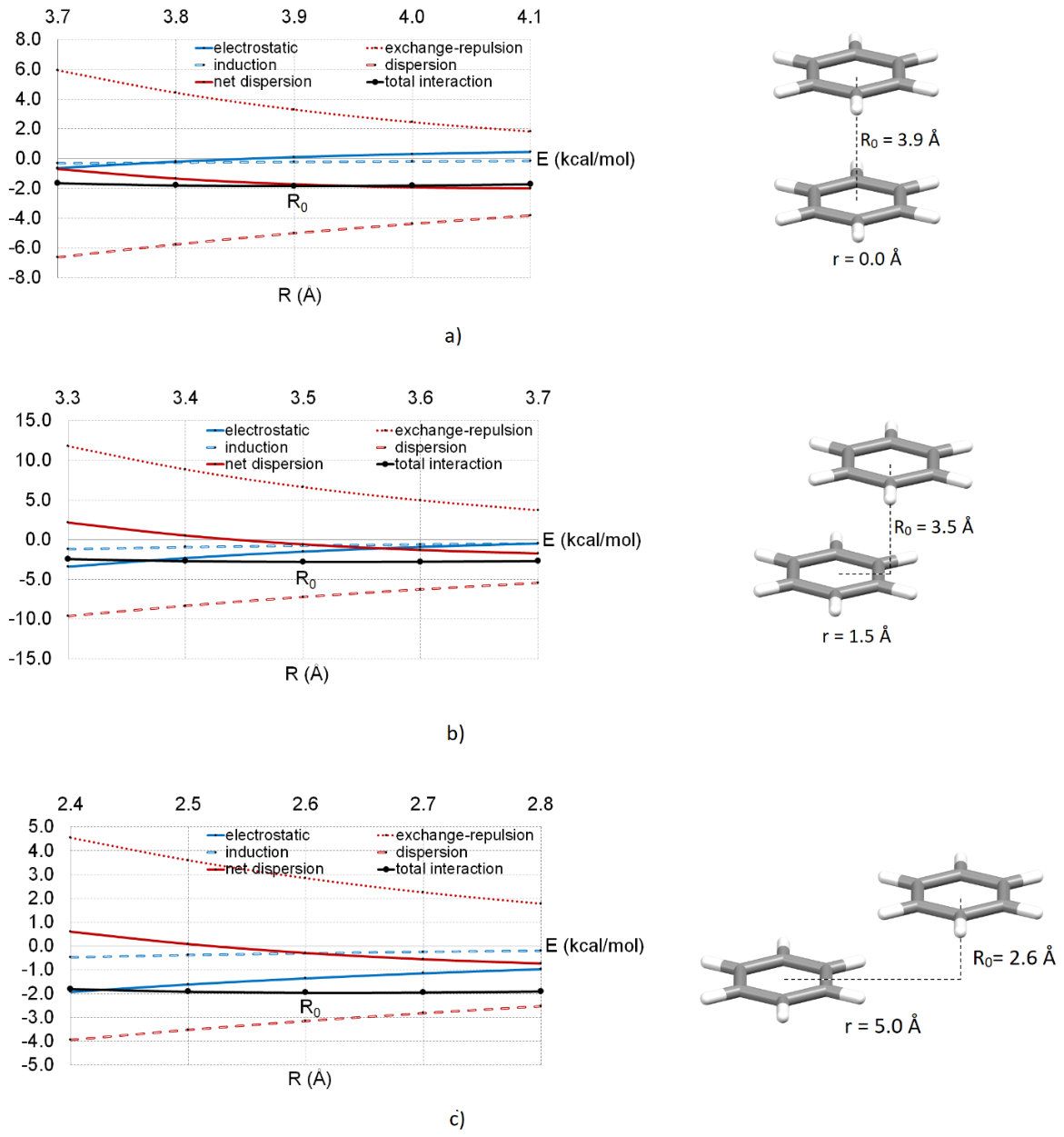
Figure 2.
Dependences of the total interaction energies and its components on vertical displacements (R) with the corresponding geometries, for benzene/pyridine stacking interactions at offset values a) 0.0 Å; b) 1.5 Å; c) 5.0 Å; r is a chosen horizontal displacement; R0 denotes optimal vertical displacement.
Figure 2.
Dependences of the total interaction energies and its components on vertical displacements (R) with the corresponding geometries, for benzene/pyridine stacking interactions at offset values a) 0.0 Å; b) 1.5 Å; c) 5.0 Å; r is a chosen horizontal displacement; R0 denotes optimal vertical displacement.
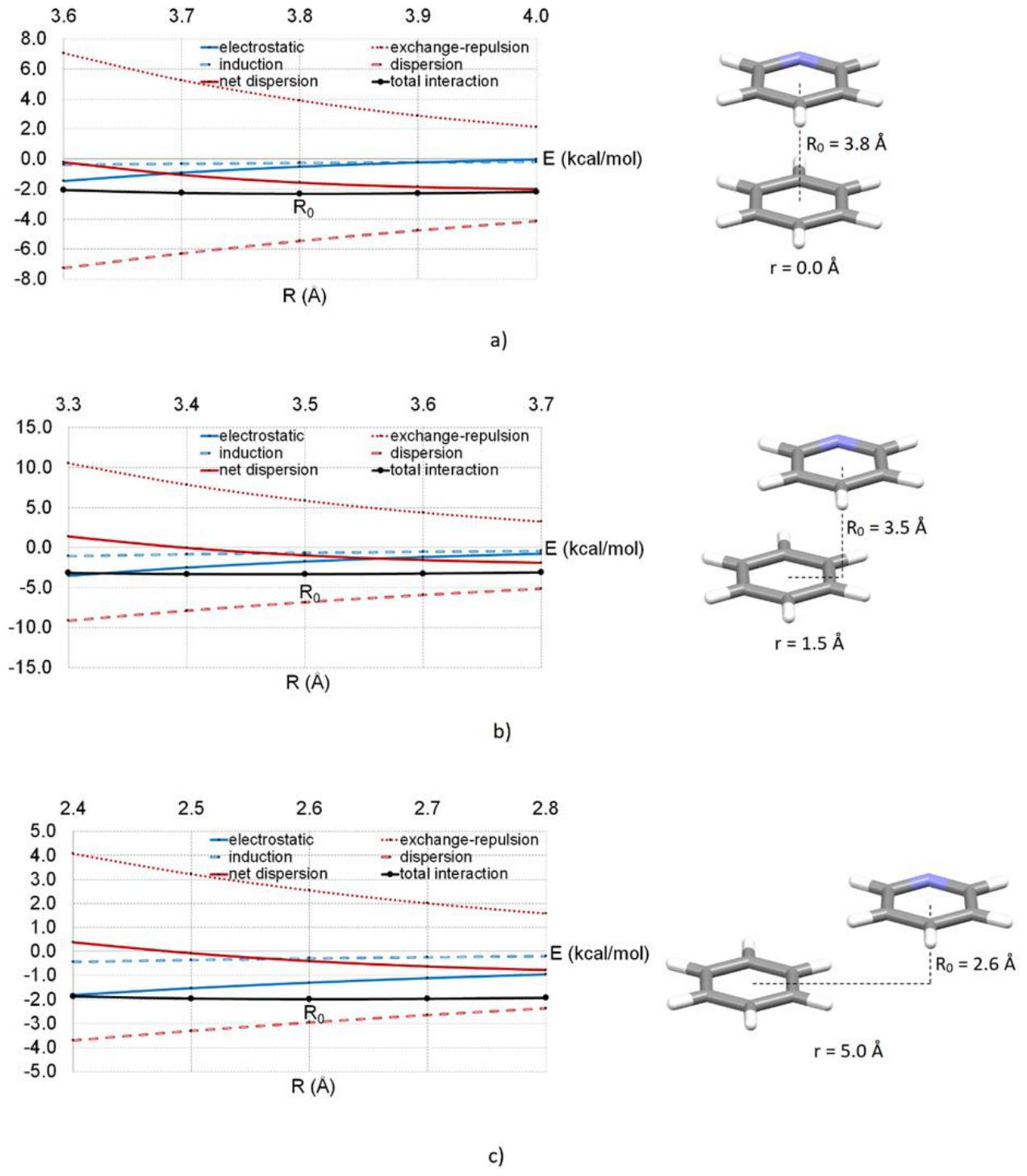
Figure 3.
Dependences of the total interaction energies and its components on vertical displacements (R) with the corresponding geometries, for antiparallel pyridine/pyridine stacking interactions at offset values a) 0.0 Å; b) 1.5 Å; c) 5.0 Å; r is a chosen horizontal displacement; R0 denotes optimal vertical displacement.
Figure 3.
Dependences of the total interaction energies and its components on vertical displacements (R) with the corresponding geometries, for antiparallel pyridine/pyridine stacking interactions at offset values a) 0.0 Å; b) 1.5 Å; c) 5.0 Å; r is a chosen horizontal displacement; R0 denotes optimal vertical displacement.
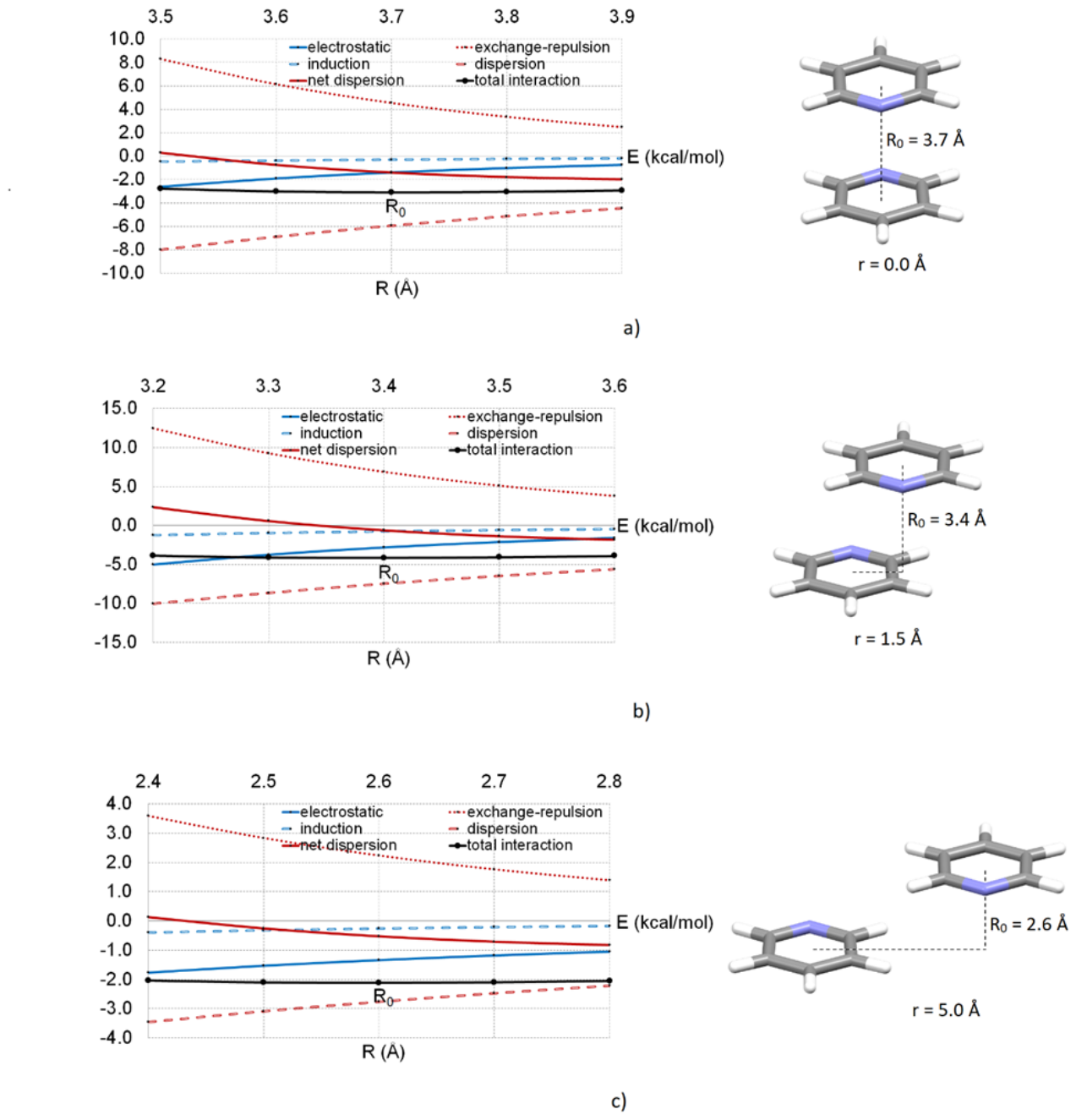
Figure 4.
Dependences of the total interaction energies and its components on vertical displacements (R) with the corresponding geometries, for benzene/cyclohexane stacking interactions at offset values a) 0.0 Å; b) 1.5 Å; c) 5.0 Å; r is a chosen horizontal displacement; R0 denotes optimal vertical displacement.
Figure 4.
Dependences of the total interaction energies and its components on vertical displacements (R) with the corresponding geometries, for benzene/cyclohexane stacking interactions at offset values a) 0.0 Å; b) 1.5 Å; c) 5.0 Å; r is a chosen horizontal displacement; R0 denotes optimal vertical displacement.
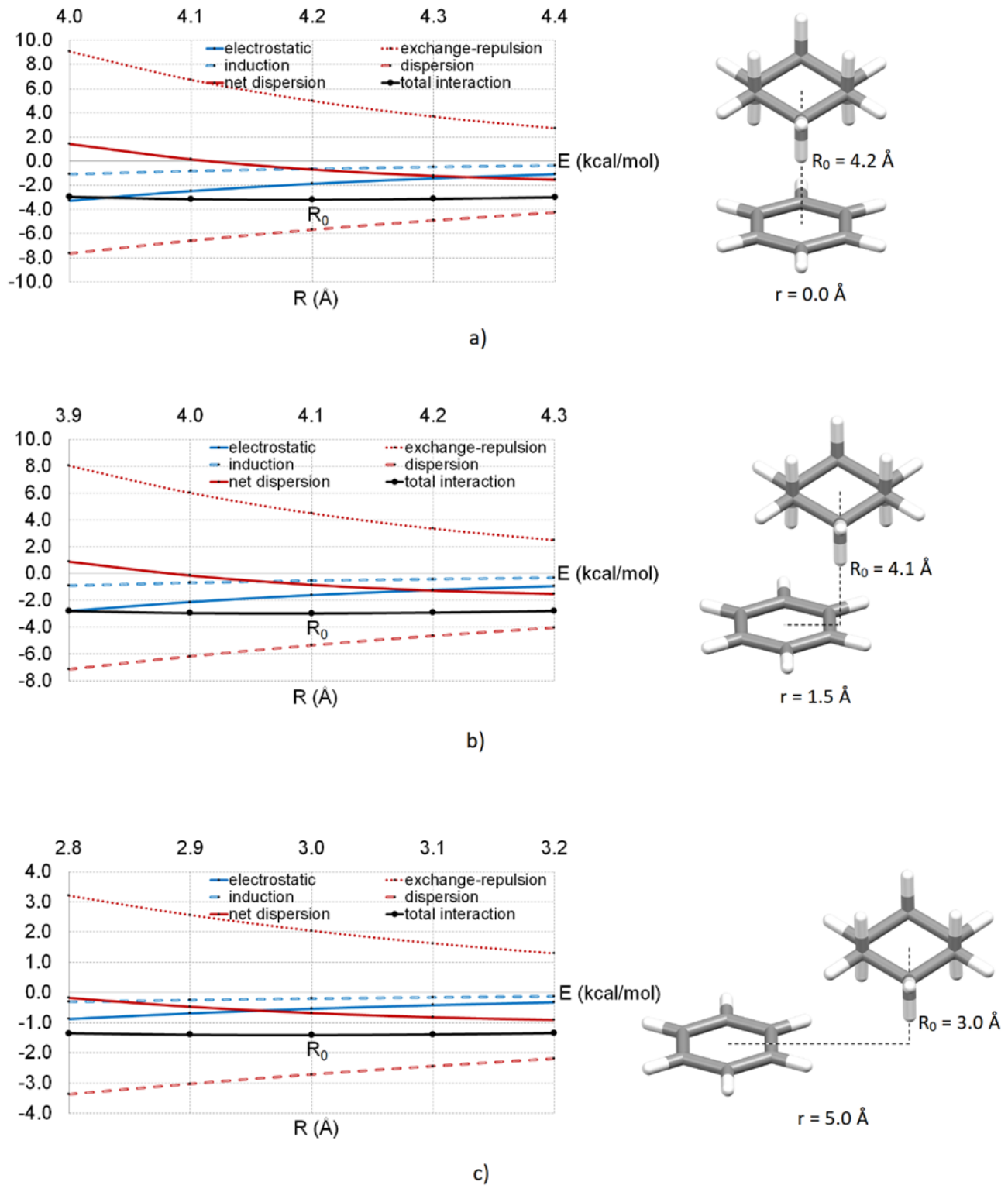
Figure 5.
Dependences of the total interaction energies and its components on vertical displacements (R) with the corresponding geometries, for water/water OH/O interaction; R0 denotes optimal vertical displacement.
Figure 5.
Dependences of the total interaction energies and its components on vertical displacements (R) with the corresponding geometries, for water/water OH/O interaction; R0 denotes optimal vertical displacement.
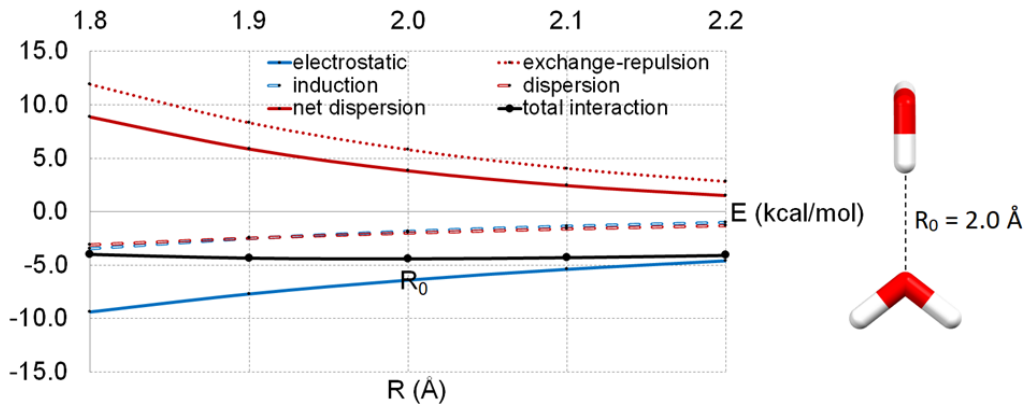
Figure 6.
Dependences of the total interaction energies and its components on vertical displacements (R) with the corresponding geometries, for methane/water CH/O interaction; R0 denotes optimal vertical displacement.
Figure 6.
Dependences of the total interaction energies and its components on vertical displacements (R) with the corresponding geometries, for methane/water CH/O interaction; R0 denotes optimal vertical displacement.
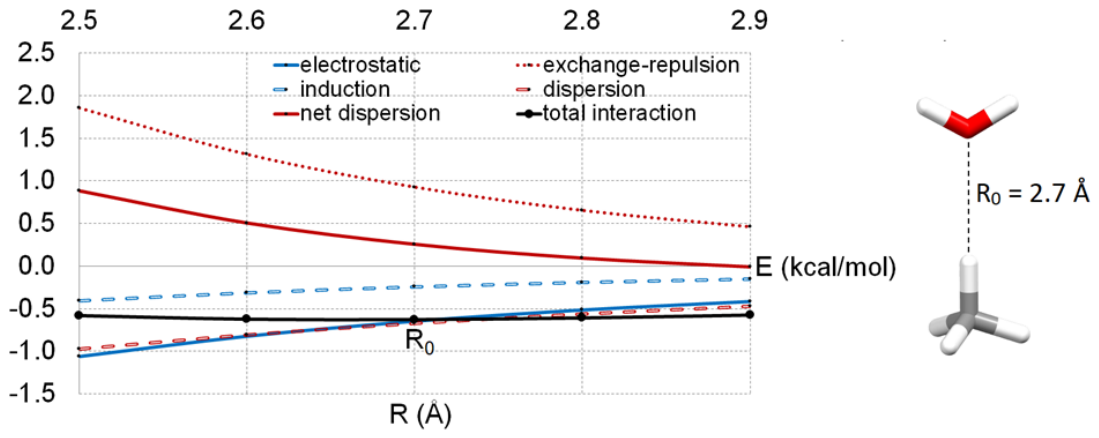
Figure 7.
Dependences of the total interaction energies and its components on vertical displacements (R) with the corresponding geometries, for water/benzene OH/π interaction; R0 denotes optimal vertical displacement.
Figure 7.
Dependences of the total interaction energies and its components on vertical displacements (R) with the corresponding geometries, for water/benzene OH/π interaction; R0 denotes optimal vertical displacement.
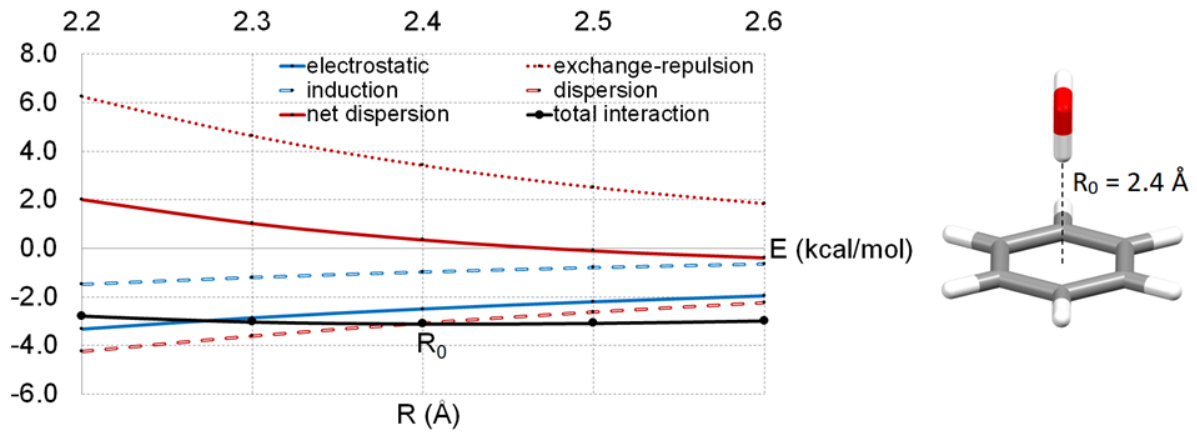
Figure 8.
Dependences of the total interaction energies and its components on vertical displacements for the water/water antiparallel OH/OH interaction with the corresponding geometry; the geometry is completely defined by horizontal displacements a and r and the torsion angle THOHO; R0 denotes optimal vertical displacement.
Figure 8.
Dependences of the total interaction energies and its components on vertical displacements for the water/water antiparallel OH/OH interaction with the corresponding geometry; the geometry is completely defined by horizontal displacements a and r and the torsion angle THOHO; R0 denotes optimal vertical displacement.
Disclaimer/Publisher’s Note: The statements, opinions and data contained in all publications are solely those of the individual author(s) and contributor(s) and not of MDPI and/or the editor(s). MDPI and/or the editor(s) disclaim responsibility for any injury to people or property resulting from any ideas, methods, instructions or products referred to in the content. |
© 2026 by the authors. Licensee MDPI, Basel, Switzerland. This article is an open access article distributed under the terms and conditions of the Creative Commons Attribution (CC BY) license (http://creativecommons.org/licenses/by/4.0/).
Copyright: This open access article is published under a Creative Commons CC BY 4.0 license, which permit the free download, distribution, and reuse, provided that the author and preprint are cited in any reuse.