
Submitted:
16 August 2026
Posted:
17 August 2026
You are already at the latest version
Abstract
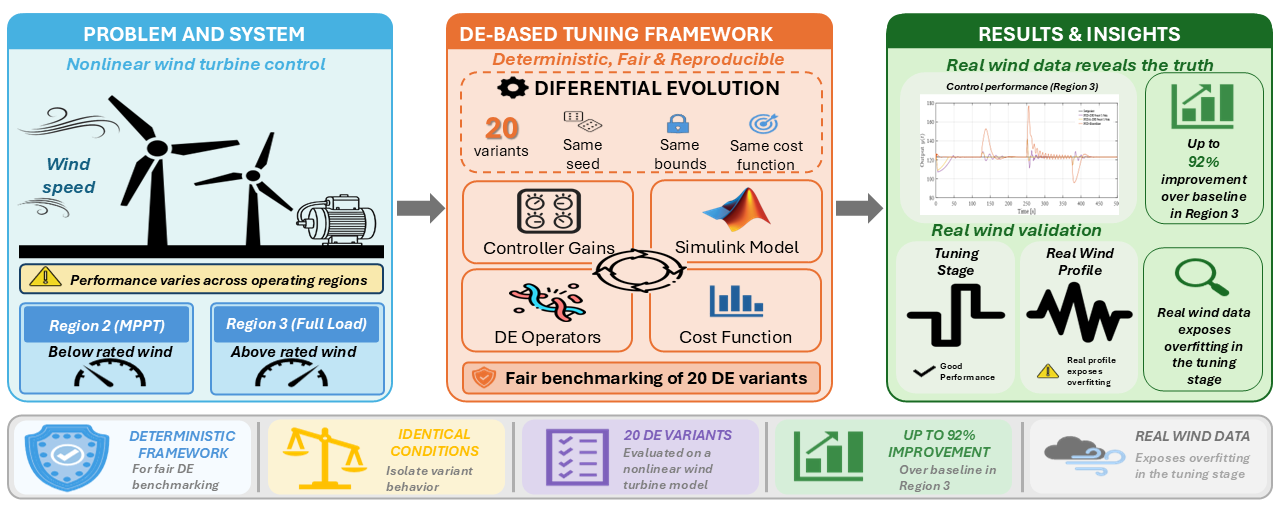
Modern wind turbines require effective control strategies to maximize energy capture under partial-load conditions while maintaining generator-speed and power regulation above the rated wind speed. This study proposes and applies a controlled and reproducible benchmarking framework for evaluating classical Differential Evolution (DE) variants in the tuning of Proportional–Integral–Derivative (PID) and Proportional–Integral–Derivative–Accelerative (PIDA) controllers for a nonlinear model of the National Renewable Energy Laboratory 5-MW reference wind turbine. Twenty classical DE variants were assessed using a fixed-seed initialization strategy, unified simulation procedures, consistent objective-function definitions, and region-specific optimization settings applied uniformly to all variants within each operating region. The controllers were evaluated in Region 2, where maximum power point tracking is required, and Region 3, where generator speed and electrical power must be regulated under above-rated wind conditions. Their generalization performance was subsequently evaluated in simulation using a measured wind-speed profile obtained from a Supervisory Control and Data Acquisition system. In Region 2, under the considered fixed-seed configuration, the DE-tuned controller achieving the lowest objective-function value reduced the objective function by approximately 2.93% compared with the baseline PID controller, indicating a moderate improvement. In Region 3, the PIDA controller tuned with the DE variant yielding the lowest objective-function value achieved a reduction of up to 92% relative to the baseline controller, demonstrating a substantially greater benefit under above-rated operation. However, validation using the measured wind profile indicated that some controllers with favorable tuning-stage results showed signs of overfitting and reduced generalization performance. Overall, the results indicate that the suitability of the controller structure and DE configuration depends on the wind turbine operating region and highlight the importance of controlled, reproducible optimization procedures and validation beyond the tuning scenario in wind turbine controller design.
Keywords:
wind turbine control
; differential evolution
; PID controller
; PIDA controller
; evolutionary optimization
; controller tuning
; NREL 5-MW reference turbine
; SCADA wind data
Copyright: This open access article is published under a Creative Commons CC BY 4.0 license, which permit the free download, distribution, and reuse, provided that the author and preprint are cited in any reuse.