
Submitted:
14 August 2026
Posted:
17 August 2026
You are already at the latest version
Abstract
Periodontitis is a chronic inflammatory disease in which dysregulated host responses to the oral microbial biofilm drive destruction of periodontal connective tissue and alveolar bone. Increasing evidence indicates that chronic periodontal inflammation may reflect not only excessive inflammatory activation but also a failure of active inflammation resolution. Aging may further increase susceptibility to periodontal tissue damage by promoting inflammaging, altering immune cell function, and impairing tissue repair. Among the immune cells involved in periodontal inflammation, macrophages are particularly important because they coordinate inflammatory responses, efferocytosis, tissue remodeling, and restoration of tissue homeostasis. However, how aging alters the resolution-associated functions of periodontal macrophages remains incompletely understood. In this review, we integrate emerging evidence from periodontal disease, aging biology, macrophage immunology, and specialized pro-resolving mediator (SPM) research to propose a framework linking aging-associated macrophage dysfunction to impaired periodontal inflammation resolution and tissue repair. We discuss evidence that aged periodontal tissues exhibit altered inflammatory responses and macrophage-dependent recovery, while SPMs—including resolvins, maresins, protectins, and lipoxins—can promote resolution, regulate macrophage functions, and protect periodontal tissues in experimental models. We further consider how impaired efferocytosis, persistent inflammatory signaling, and altered tissue-remodeling programs may contribute to an age-associated failure of periodontal repair. Importantly, the available literature supports the individual components of this model but has not yet established a complete causal pathway connecting aging, periodontal macrophage resolution dysfunction, and impaired regeneration. We therefore identify macrophage resolution capacity as a potential mechanistic and therapeutic interface between aging and periodontal disease and discuss how SPM-based approaches may provide a strategy to restore inflammatory resolution and promote periodontal tissue repair.
Keywords:
aging
; periodontitis
; inflammation resolution
; macrophages
; specialized pro-resolving mediators
; SPMs
; inflammaging
; periodontal regeneration
; tissue repair
; immunology
1. Introduction
Periodontitis is a biofilm-associated chronic inflammatory disease characterized by a dysregulated host response that can lead to destruction of periodontal connective tissues and alveolar bone. The disease is not simply a consequence of bacterial burden; rather, the interaction between a dysbiotic microbial community and a susceptible host inflammatory response determines whether inflammation remains controlled or progresses toward tissue destruction [1,2]. This distinction has important therapeutic implications because mechanical disruption of the biofilm can reduce the initiating stimulus but does not necessarily restore the biological processes required for complete tissue healing.
Figure 1.
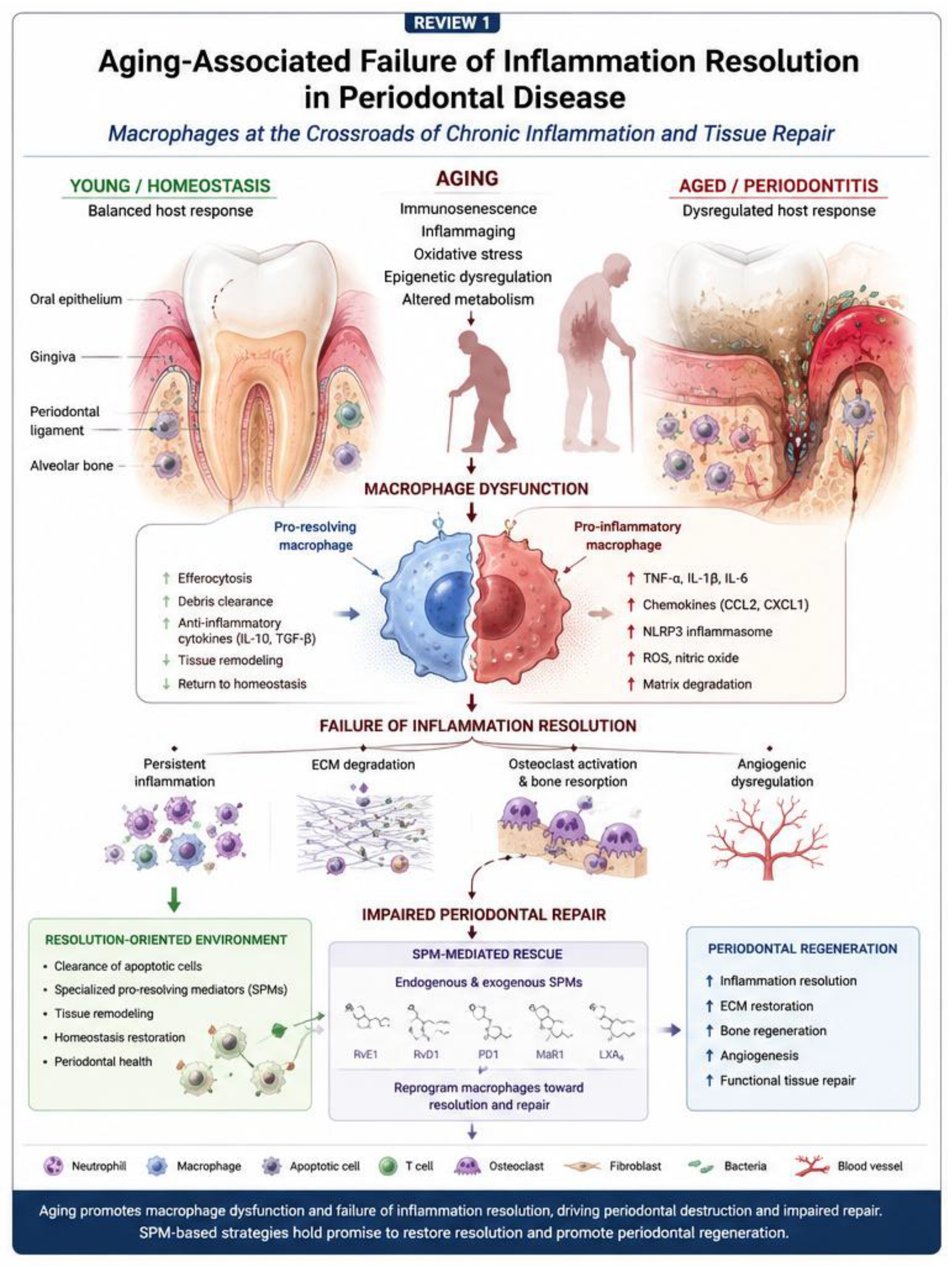
Conceptual framework linking aging-associated macrophage dysfunction and failure of inflammation resolution to periodontal tissue destruction, and the potential for SPM-mediated rescue.
Figure 1.
Conceptual framework linking aging-associated macrophage dysfunction and failure of inflammation resolution to periodontal tissue destruction, and the potential for SPM-mediated rescue.
A major conceptual advance in periodontal immunology has been the recognition that resolution of inflammation is an active biological program rather than a passive disappearance of inflammatory signals. Resolution involves coordinated changes in leukocyte recruitment, mediator production, efferocytosis, clearance of cellular debris, and restoration of tissue homeostasis [1,3]. Van Dyke and Sima proposed that chronic periodontitis may, in part, represent a failure to resolve inflammation appropriately, providing a framework in which persistent inflammation is viewed as a defect in host resolution rather than simply an excess of inflammatory activation [1].
Aging adds an important layer to this framework. Periodontal disease becomes more prevalent and severe with age, while aging is accompanied by immunosenescence and inflammaging—quantitative and qualitative changes in immune function together with a persistent pro-inflammatory milieu [6,7]. These changes can alter the behavior of innate immune cells, including macrophages, and may reduce the capacity of periodontal tissues to return to homeostasis after inflammatory injury [7,8,9,10]. We therefore propose that aging-associated changes in macrophage function may represent an important cellular interface between inflammaging, failed periodontal inflammation resolution, and impaired tissue repair.
2. Periodontal Inflammation and the Biology of Resolution
The transition from acute inflammation to resolution is a highly regulated process. Early inflammation requires recruitment and activation of neutrophils and monocytes, whereas successful resolution requires termination of excessive leukocyte recruitment, removal of apoptotic cells, restoration of vascular and tissue homeostasis, and remodeling of the extracellular environment. Importantly, resolution is not equivalent to immunosuppression. Instead, it represents an active change in the inflammatory program that permits host defense to conclude while limiting collateral tissue injury [1,3].
Specialized pro-resolving mediators (SPMs) are central components of this process. The SPM family includes lipoxins, resolvins, protectins, and maresins. These lipid mediators act through receptor-dependent pathways to regulate leukocyte trafficking, efferocytosis, inflammatory mediator production, and tissue repair [3,4,5]. In periodontal disease, this biology is particularly relevant because persistent inflammation can continue after the initiating microbial stimulus has become established, resulting in a self-reinforcing tissue-damaging environment.
Experimental evidence supports a functional role for SPMs in periodontal inflammation. A systematic review of experimental periodontitis identified studies in which topical SPM treatment, particularly Resolvin E1 (RvE1) and lipoxins, reduced inflammatory outcomes and prevented or promoted recovery from alveolar bone loss [4]. A later review further summarized evidence that SPMs can promote resolution and tissue regeneration while potentially influencing the oral microbiome and local inflammatory environment [5]. These findings support resolution biology as a complementary therapeutic concept to conventional antimicrobial and mechanical treatment.
3. Aging, Inflammaging, and the Periodontium
The relationship between aging and periodontal disease extends beyond cumulative exposure to the oral microbiota. Aging is accompanied by immunosenescence, altered innate and adaptive immune responses, and inflammaging, a persistent low-grade inflammatory state that can modify tissue responses to subsequent challenges [6,7]. Ebersole and colleagues emphasized that both quantitative and qualitative immune changes occur with aging and that the innate immune compartment is an important component of age-associated periodontal dysregulation [6]. More recent reviews have similarly highlighted age-dependent changes in neutrophils, macrophages, T cells, fibroblasts, and other cellular regulators of periodontal homeostasis [7,8,9].
The periodontal tissue itself also changes with age. Aging can impair fibroblast proliferation, collagen production, migration, and wound closure, while senescent cells may release inflammatory cytokines, chemokines, growth factors, and proteases that alter the surrounding microenvironment [9,10]. Such changes can create a tissue context in which inflammatory responses persist and repair becomes less efficient.
Importantly, experimental evidence directly connects aging, macrophages, and periodontal disease. Clark and colleagues compared young and old mice using a ligature-induced periodontal disease model and reported an aged periodontal phenotype characterized by greater alveolar bone loss and increased local inflammatory cytokine expression. Their experiments also examined macrophage contributions during disease induction and recovery, supporting a role for macrophages in the age-dependent periodontal response [11]. These findings are particularly relevant to the present framework because they suggest that the aging phenotype is not explained solely by greater inflammatory burden; rather, the function of macrophages during periodontal disease and recovery may differ with age.
A recent review of the aging periodontium further proposed that age-related alterations in macrophage functional states can impair both inflammatory and resolution-associated processes [10]. Together, these studies support the hypothesis that aging modifies the ability of periodontal tissues to transition from inflammation toward repair, although the precise molecular defect in aged periodontal macrophages remains incompletely defined.
4. Macrophages as a Cellular Switch Between Inflammation and Resolution
Macrophages occupy a central position within the periodontal inflammatory network because they can both amplify inflammation and participate in its resolution. Their functions include recognition and uptake of microbial and cellular material, cytokine production, efferocytosis, regulation of leukocyte recruitment, extracellular-matrix remodeling, and communication with fibroblasts, endothelial cells, and bone-resorbing and bone-forming cells. This functional plasticity makes macrophages better understood as a continuum of context-dependent states rather than as a fixed M1/M2 binary.
The resolution phase is particularly dependent on macrophage functions that are distinct from simple suppression of inflammatory gene expression. Efferocytosis—the recognition and removal of apoptotic cells—helps prevent secondary necrosis and provides signals that support the transition toward tissue repair. Macrophages also participate in clearance of debris and remodeling of damaged extracellular matrix. If these processes are delayed or incomplete, inflammatory signals can persist even after the initial trigger has diminished.
Human periodontal evidence provides a direct connection between macrophage dysfunction and pro-resolving therapy. Fredman and colleagues reported impaired phagocytosis in macrophages from patients with localized aggressive periodontitis and demonstrated that RvE1 restored phagocytic activity in these cells [12]. The authors interpreted the impaired phagocytosis as evidence of compromised resolution pathways that could contribute to persistent inflammation and periodontal disease progression. This study is especially important for the framework proposed here because it provides a human cellular example in which a resolution-associated macrophage function is defective and can be pharmacologically improved by an SPM.
More recent experimental work has also examined macrophage dynamics during the resolution phase of periodontal disease. Uttamani and colleagues reported dynamic changes in macrophage polarization during periodontal disease resolution, emphasizing that macrophage states change over the course of disease and recovery rather than remaining static [13]. Together, these observations support the concept that the key biological question is not simply whether macrophages are present, but whether they acquire the appropriate functional state required for inflammatory resolution and tissue repair.
5. The Emerging Aging–Macrophage–Resolution Framework
The literature can therefore be integrated into a testable conceptual model: aging → inflammaging and altered tissue homeostasis → altered periodontal macrophage function → impaired resolution → persistent inflammatory signaling → extracellular-matrix and bone damage → impaired periodontal repair.
Several components of this model are already supported by independent evidence. Aging is associated with inflammatory and immune dysregulation [6,7,8,9,10]. Periodontitis involves dysregulated host inflammation and can be conceptualized as a disease in which resolution is insufficient or delayed [1]. Macrophages participate in periodontal inflammation and recovery [11,13]. SPMs promote resolution and have shown protective or regenerative effects in experimental periodontitis [4,5]. Finally, human periodontal macrophages with impaired phagocytic function can respond to RvE1 [12].
The critical knowledge gap lies in the connection between these components. The existing literature does not yet establish that aging causes a specific, cell-intrinsic resolution defect in periodontal macrophages. Nor has it definitively shown that SPM administration rescues such a defect in an aged periodontitis model. The proposed framework should therefore be considered a hypothesis-generating synthesis rather than an established causal pathway.
This distinction is important for future experimental design. Rather than relying solely on conventional inflammatory markers, studies should evaluate macrophage function across multiple dimensions, including efferocytosis, phagocytosis, inflammatory mediator production, metabolic state, spatial localization, and tissue-remodeling programs. Such multidimensional characterization may reveal whether an aged macrophage population is simply more inflammatory or, more importantly, has lost the ability to transition into an effective pro-resolving and repair-associated state.
6. SPMs as a Potential Therapeutic Rescue Strategy
SPMs provide a particularly attractive therapeutic entry point because they are endogenous mediators that actively promote resolution while preserving host-defense functions. RvE1, resolvins of the D series, maresins, protectins, and lipoxins have been investigated across inflammatory disease models, with effects that can include modulation of neutrophil recruitment, enhancement of efferocytosis, regulation of macrophage function, and restoration of tissue homeostasis [3,4,5].
In experimental periodontitis, the evidence is already substantial enough to justify further translational investigation. The systematic review by Osorio Parra et al. identified six animal studies of SPM treatment and reported that RvE1 and lipoxins could prevent or regenerate alveolar bone loss, while some studies also observed favorable changes in microbial composition and inflammatory status [4]. A later mini-review highlighted the broader host-modulatory effects of SPMs and emphasized the relationship among inflammation resolution, tissue regeneration, and the oral microbiome [5].
SPMs may also be relevant to age-associated periodontal repair through effects on non-macrophage stromal cells. In a 2025 study, Unlu and colleagues found that RvE1 and Maresin 1 reduced senescence-associated changes in primary human periodontal ligament fibroblasts, improved viability and proliferation, and accelerated wound closure [14]. These findings do not demonstrate an effect on aged periodontal macrophages, but they provide an additional mechanistic link between SPM signaling, cellular senescence, and periodontal tissue repair.
The therapeutic hypothesis emerging from these observations is therefore not simply that SPMs suppress inflammation. Rather, SPMs may restore the cellular programs required for resolution and subsequently create a regenerative tissue environment. This distinction may be particularly important in aged periodontium, where inflammation and repair defects coexist.
7. From Resolution to Periodontal Regeneration
Inflammation resolution and tissue regeneration should be viewed as interconnected biological processes. Persistent inflammatory signaling can impair fibroblast function, extracellular-matrix organization, vascular responses, and bone remodeling, thereby preventing restoration of periodontal architecture. Conversely, an appropriately resolving inflammatory environment can support clearance of damaged material and transition toward tissue rebuilding.
Macrophages are positioned to coordinate this transition because they communicate with multiple structural and immune cell populations. During resolution, macrophage efferocytosis and debris clearance can reduce inflammatory stimuli, while macrophage-derived mediators can influence fibroblast activity, angiogenesis, and matrix remodeling. In the periodontium, these processes ultimately intersect with periodontal ligament repair and the balance between osteoclast-mediated bone resorption and osteoblast-mediated bone formation.
SPMs may therefore have a dual role: they can reduce persistent inflammatory injury while simultaneously promoting a tissue environment permissive for regeneration. This concept is consistent with experimental evidence showing preservation or recovery of alveolar bone following SPM treatment [4,5]. It also provides a rationale for combining resolution-directed host modulation with regenerative strategies rather than treating inflammation and regeneration as completely separate therapeutic objectives.
8. Translational Opportunities and Remaining Questions
Several questions now emerge directly from the proposed framework. First, which macrophage states and spatial niches are altered by aging in periodontal tissues? Spatial transcriptomic and single-cell approaches may help distinguish inflammatory macrophages from macrophages engaged in efferocytosis, matrix remodeling, or other resolution-associated functions. Second, which functional feature best defines an age-associated resolution defect—impaired efferocytosis, defective phagocytosis, persistent cytokine production, altered lipid mediator signaling, or a combination of these processes?
Third, does aging alter the responsiveness of periodontal macrophages to specific SPMs or their receptors? Aged cells may have altered receptor abundance, intracellular signaling, metabolic capacity, or lipid mediator biosynthesis, potentially creating a state in which endogenous resolution signals are insufficient. Fourth, can local SPM delivery improve periodontal outcomes while minimizing systemic exposure? Local delivery is particularly attractive in periodontitis because the target tissue is anatomically accessible and treatment could potentially be combined with conventional mechanical debridement or regenerative procedures.
Finally, translational studies will need biomarkers that reflect resolution rather than inflammation alone. A useful biomarker framework could integrate inflammatory mediators, macrophage state, SPM profiles, and tissue-repair markers. Such an approach could eventually help identify patients in whom persistent inflammation reflects defective resolution and who may therefore benefit from resolution-directed host modulation.
9. Conclusions
Current evidence supports a compelling intersection among aging, periodontal inflammation, macrophage function, and resolution biology. Aging is associated with immunosenescence, inflammaging, altered periodontal tissue homeostasis, and impaired repair. Macrophages are central regulators of periodontal inflammation and recovery, while experimental and human evidence indicates that resolution-associated macrophage functions can be modulated by SPMs [4,11,12,13,14].
The central unresolved question is whether aging produces a specific periodontal macrophage resolution defect that contributes causally to impaired periodontal repair. Addressing this question could move the field beyond the traditional framework of simply suppressing inflammation toward a model in which restoration of resolution is itself a therapeutic objective.
We propose that SPM-mediated restoration of macrophage resolution capacity represents a plausible mechanistic and translational strategy for age-associated periodontal disease. Establishing the cellular, molecular, and spatial basis of this response may ultimately provide a foundation for precision host-modulation approaches that combine inflammatory resolution with periodontal tissue regeneration.
References
- Van Dyke, T.E.; Sima, C. Understanding resolution of inflammation in periodontal diseases: Is chronic inflammatory periodontitis a failure to resolve? Periodontol. 2000 2020, 82, 205–213. [Google Scholar] [CrossRef] [PubMed]
- Lee, C.-T.; Tribble, G.D. Roles of specialized pro-resolving mediators and omega-3 polyunsaturated fatty acids in periodontal inflammation and impact on oral microbiota. Front Oral Health 2023, 4, 1217088. [Google Scholar] [CrossRef] [PubMed]
- Serhan, C.N. Pro-resolving lipid mediators are leads for resolution physiology. Nature 2014, 510, 92–101. [Google Scholar] [CrossRef] [PubMed]
- Osorio Parra, M.M.; Elangovan, S.; Lee, C.-T. Specialized pro-resolving lipid mediators in experimental periodontitis: A systematic review. Oral Dis. 2019, 25, 1265–1276. [Google Scholar] [CrossRef] [PubMed]
- Lee, C.-T.; Tribble, G.D. Roles of specialized pro-resolving mediators and omega-3 polyunsaturated fatty acids in periodontal inflammation and impact on oral microbiota. Front Oral Health 2023, 4, 1217088. [Google Scholar] [CrossRef] [PubMed]
- Ebersole, J.L.; Graves, C.L.; Gonzalez, O.A.; et al. Aging, inflammation, immunity and periodontal disease. Periodontol. 2000 2016, 72, 54–75. [Google Scholar] [CrossRef] [PubMed]
- Clark, D.; Radaic, A.; Kapila, Y. Cellular Mechanisms of Inflammaging and Periodontal Disease. Front Dent. Med. 2022, 3, 844865. [Google Scholar] [CrossRef] [PubMed]
- Clark, D.; Kotronia, E.; Ramsay, S.E. Frailty, Aging, and Periodontal Disease: Basic Biological Considerations. Gerodontology 2022. [Google Scholar] [CrossRef] [PubMed]
- Villalobos, V.; Garrido, M.; Reyes, A.; et al. Aging envisage imbalance of the periodontium: A keystone in oral disease and systemic health. Front Immunol. 2022, 13, 1044334. [Google Scholar] [CrossRef] [PubMed]
- Clark, D.; Radaic, A.; Kapila, Y. Cellular Mechanisms of Inflammaging and Periodontal Disease. Front Dent. Med. 2022, 3, 844865. [Google Scholar] [CrossRef] [PubMed]
- Clark, D.; Halpern, B.; Miclau, T.; Nakamura, M.; Kapila, Y.; Marcucio, R. The Contribution of Macrophages in Old Mice to Periodontal Disease. J. Dent. Res. 2021, 100, 1397–1404. [Google Scholar] [CrossRef] [PubMed]
- Fredman, G.; Oh, S.F.; Ayilavarapu, S.; Hasturk, H.; Serhan, C.N.; Van Dyke, T.E. Impaired Phagocytosis in Localized Aggressive Periodontitis: Rescue by Resolvin E1. PLoS ONE 2011, 6, e24422. [Google Scholar] [CrossRef] [PubMed]
- Uttamani, J.R.; Kulkarni, V.; Valverde, A.; et al. Dynamic changes in macrophage polarization during the resolution phase of periodontal disease. Immun. Inflamm. Dis. 2024, 12, e70044. [Google Scholar] [CrossRef] [PubMed]
- Unlu, O.; Guney, Z.; Kantarci, A. Resolvin E1 and maresin 1 restore senescence-induced disruption of human periodontal ligament fibroblast function. J. Periodontol. 2025, 96, 1168–1178. [Google Scholar] [CrossRef] [PubMed]
Disclaimer/Publisher’s Note: The statements, opinions and data contained in all publications are solely those of the individual author(s) and contributor(s) and not of MDPI and/or the editor(s). MDPI and/or the editor(s) disclaim responsibility for any injury to people or property resulting from any ideas, methods, instructions or products referred to in the content. |
© 2026 by the authors. Licensee MDPI, Basel, Switzerland. This article is an open access article distributed under the terms and conditions of the Creative Commons Attribution (CC BY) license (http://creativecommons.org/licenses/by/4.0/).
Copyright: This open access article is published under a Creative Commons CC BY 4.0 license, which permit the free download, distribution, and reuse, provided that the author and preprint are cited in any reuse.