

Submitted:
17 September 2026
Posted:
18 September 2026
You are already at the latest version
Abstract
A lattice of locally coupled quantum oscillators is proposed as a candidate microscopic substrate for emergent spacetime. Each oscillator is treated as an elementary substrate unit (ESU): a minimal quantum degree of freedom whose local dynamics, correlations, and collective organization may underlie higher-level physical structure. For the minimal fixed cubic-lattice realization, the exact collective-mode dispersion relation is derived and shown to approach relativistic propagation at long wavelength, with limiting speed c_eff = a√(K/M). The leading lattice correction is anisotropic and quadratic in momentum, providing both a direct Lorentz-violation signature and an intrinsic ultraviolet cutoff. For a Planck-scale lattice spacing, the corresponding Lorentz-violation scale is E_LV ≈ ħc/ℓ_P ≈ 1.22×10^19 GeV, roughly eight orders of magnitude above the conservative quadratic-order lower bound inferred from GRB 090510 for the bosonic collective sector constructed here. Comparison with strings and matrix models, spin networks, causal sets, causal dynamical triangulations, and quantum graphity shows that the oscillator substrate trades background independence at this stage for calculability, explicit microscopic dynamics, and quantitative falsifiability. The framework further treats possible chains, loops, defects, networks, fields, and particles as structures to be generated—or excluded—by the substrate dynamics rather than inserted independently. Thus the model supplies a concrete first-stage substrate hypothesis and a dynamical selection principle. The calculation establishes kinematic continuum-like emergence on a fixed lattice; dynamical connectivity, a universal causal structure, a massless spin-2 gravitational sector with the required gauge structure, and viable chiral matter remain decisive tests of the broader hypothesis.
Keywords:
emergent spacetime
; quantum gravity phenomenology
; Lorentz invariance violation
; coupled oscillator lattice
; analogue gravity
; pre-geometric substrate
; falsifiability
1. Introduction
The smooth spacetime of general relativity need not be fundamental. If continuum geometry emerges only at sufficiently large scales, a deeper physical description must contain microscopic degrees of freedom whose collective dynamics give rise to distance, causal structure, fields, and ultimately the effective spacetime described by general relativity. The foundational question is therefore not only how spacetime should be quantized, but what the smallest dynamical units are from which spacetime itself can emerge.
This paper advances a definite hypothesis: the microscopic substrate consists of locally coupled quantum oscillators. The elementary coupled oscillator is taken to be an elementary substrate unit (ESU)—a minimal dynamical and information-bearing quantum degree of freedom from which more complex physical structures can be built. The hypothesis is stronger than treating an oscillator lattice as a mathematical convenience or analogue model. It proposes that ESUs belong to the underlying physical substrate itself. Whether that proposal is viable depends on whether the known structures of low-energy physics can ultimately be recovered from their collective dynamics.
An ESU should be distinguished from an elementary or fundamental particle. In particle physics, electrons, quarks, photons, and other elementary excitations are characterized by properties such as mass, spin, charge, momentum, and field content within a spacetime framework. They may be fundamental with respect to the effective theory in which they occur without being fundamental with respect to the substrate from which that theory emerges. The ESU is proposed to occupy this deeper explanatory level. It is not another particle to be added to the Standard Model, but a microscopic degree of freedom from which spacetime, fields, and particle-like excitations are ultimately expected to arise.
The ESU also possesses a minimal information-bearing capacity. A quantum oscillator can occupy distinguishable states characterized by amplitudes, phases, occupation numbers, and correlations with other units. Coupling allows changes in these states to propagate through the substrate, while entanglement permits information to reside in correlations among multiple units rather than in any unit separately. Information is used here in this strictly physical sense. No semantic or cognitive property is implied. The point is simply that the substrate possesses, at its most elementary level, distinguishable quantum states capable of encoding, correlating, and transmitting physical information. Familiar information carriers such as photons, electron spins, atomic states, and macroscopic devices would occur at higher emergent levels rather than supply this capacity for the first time.
The distinction between substrate units and particles suggests an intermediate level of organization that is often absent from discussions of microscopic ontology. Collections of ESUs may form composite substrate structures (CSSs) before anything recognizable as an ordinary particle appears. Possible structures include one-dimensional chains and closed loops, two-dimensional sheets, localized defects or solitonic configurations, and more complicated networks. Their existence is not assumed in the present work; it must ultimately follow from the microscopic dynamics.
This intermediate level changes the status of strings in the proposed hierarchy. In conventional string theory, the string is taken as a fundamental extended object whose vibrational states give rise to the particle spectrum. In the present framework, a string-like object would instead be a possible one-dimensional composite substrate structure assembled from ESUs. Strings would therefore not constitute the deepest level of description. Nor is there reason to assume in advance that strings are the only admissible composite structures. The microscopic Hamiltonian should determine which chains, loops, sheets, defects, networks, or other configurations can exist, which are dynamically stable, and which survive coarse-graining into the low-energy regime.
The resulting hierarchy may be summarized schematically as
elementary substrate units → composite substrate structures → effective fields and particles → macroscopic spacetime and matter.
This hierarchy is a research hypothesis rather than a derived result. In particular, the present paper does not demonstrate the formation of strings, particles, or Standard-Model fields. It establishes the elementary substrate and its simplest collective dynamics; determining the admissible composite structures is a subsequent problem. The distinction is important because composite structures should be outputs of the substrate dynamics rather than additional microscopic assumptions. If only a restricted class of string-like, membrane-like, or localized configurations proves dynamically admissible, the substrate could provide a microscopic selection principle for the effective theories that emerge from it. (Figure 1).
The distinction just drawn is summarized visually in Figure 2, which contrasts the ESU with a fundamental particle directly: the ESU is defined entirely by its quantum degrees of freedom, coupling, state space, and Hamiltonian dynamics, prior to any assignment of the spacetime-dependent properties — mass, spin, charge — that characterize a particle.
The term pre-geometric also requires clarification. It is used here to mean prior to the emergence of a continuum Lorentzian metric, not the complete absence of microscopic relational structure. The fixed cubic lattice considered in the first stage already supplies adjacency, dimensionality, regularity, and a microscopic distance scale. What is proposed to emerge is the continuum metric, together eventually with the gravitational dynamics governing it. Promoting connectivity and dimensionality themselves to dynamical degrees of freedom is a later and essential stage of the program.
The idea that spatial structure may emerge from oscillator-like quantum degrees of freedom is not without precedent. Tegmark [1] has discussed constructions in which a suitably structured quantum Hamiltonian yields an effective three-dimensional nearest-neighbor oscillator system and phonon-like quasiparticles. Related examples occur throughout analogue-gravity [2,3,4] and quantum many-body physics. The present proposal differs in its intended ontological interpretation and scope. The oscillator system is hypothesized to be the microscopic substrate itself, and the task is to determine systematically what continuum geometry, composite structures, fields, and particles its dynamics permit. The contribution of the present paper is therefore not the invention of coupled oscillators as a mathematical system, but their formulation as elementary substrate units within a testable hierarchy of emergence, together with explicit selection criteria, comparison with competing microscopic architectures, a calculable collective-mode dispersion relation, and clearly stated failure conditions.
The distinction from the nineteenth-century luminiferous ether is equally important. The classical ether was conceived as a continuous mechanical medium occupying a pre-existing absolute space and providing a carrier for electromagnetic waves. The proposed oscillator substrate instead precedes continuum spacetime in the explanatory hierarchy. It is discrete and quantum rather than continuous and classical, and its long-wavelength propagation speed is determined by microscopic coupling parameters. A fixed lattice nevertheless introduces a preferred microscopic frame, so approximate Lorentz invariance cannot simply be assumed. The disappearance or sufficient suppression of this preferred-frame structure at accessible energies is therefore a central empirical requirement of the hypothesis.
The purpose of this paper is consequently fourfold. First, it defines the elementary substrate unit and distinguishes it from both fundamental particles and possible composite substrate structures. Second, it formulates practical criteria for a viable microscopic substrate and compares the oscillator architecture with leading alternatives. Third, it develops the simplest fixed-lattice realization sufficiently far to derive its collective-mode dispersion relation, identify its continuum limit and leading Lorentz-violating corrections, and state explicit conditions under which the hypothesis should be rejected. Fourth, and most distinctively, it advances the substrate not merely as a generator of higher-level structure but as a dynamical selection principle: the paper’s strongest claim is that a genuinely microscopic substrate earns its explanatory value chiefly from what its dynamics forbid — which composite structures, fields, or effective worlds cannot arise from it — rather than merely from the list of things it can be shown to produce. This reframes the entire hierarchy of §1–§3: the question is not whether ESUs can generate spacetime, strings, and particles, but whether their dynamics constrain which versions of spacetime, strings, and particles are admissible at all.
The oscillator substrate is therefore proposed neither as a completed theory of quantum gravity nor merely as an analogy for one. It is a concrete microscopic hypothesis whose value depends on what can actually be derived from it. The immediate question is whether ESUs provide a sufficiently simple and constrained starting point to generate continuum-like collective behavior. The longer-term question is considerably more demanding: whether the same substrate can account for dynamical spacetime, admissible composite structures, universal causal propagation, gravity, and the matter content observed at low energies. This is the hypothesis under test: only the kinematic first step is demonstrated in what follows; the remaining levels of the hierarchy are stated as open research problems, not as established results.
2. Criteria for a Viable Microscopic Substrate
A viable microscopic substrate must do more than supply small constituents: its collective dynamics must provide a controlled route to the structures observed at low energy. We group the evaluation into four themes. First, intrinsic dynamical content requires elementary degrees of freedom with nontrivial quantum dynamics, distinguishable states, correlations, and entanglement. Second, collective and structural output requires long-wavelength modes, phase organization, and the capacity—once interactions are included—for stable or metastable composite structures. Third, consistency with low-energy physics requires an intrinsic ultraviolet scale, controlled locality, suppression of preferred-frame effects, and ultimately a universal causal cone. Fourth, methodological usefulness requires calculational tractability and enough parameter economy that the microscopic theory constrains rather than merely accommodates possible effective worlds.
These criteria define three successive levels of success. Kinematic emergence means that collective modes reproduce continuum-like propagation. Structural emergence additionally requires stable composite structures, dimensionality, locality, and universal causal behavior to arise from the microscopic dynamics. Dynamical emergence requires the effective metric itself to acquire gravitational dynamics and couple consistently to emergent matter. The present model establishes only the first level. The full twelve-item formulation, together with the rationale for each criterion, is provided in Supplementary Information S1.
3. Candidate Microscopic Architectures
The substrate criteria can be used to compare several major microscopic architectures, although these approaches do not begin with objects of the same ontological type. String theory replaces point particles with extended objects and contains a massless spin-2 excitation [5,6], while matrix models such as BFSS and IKKT make matrices fundamental and allow geometric structure to emerge from their collective dynamics [7,8]. Loop quantum gravity and spin-foam approaches encode quantum geometry in labeled graphs and histories [9,10,11,12]. Causal-set theory instead takes locally finite causal order as fundamental [13,14], whereas causal dynamical triangulations construct continuum semiclassical geometry from sums over causal simplicial histories [15,16]. Quantum graphity and related dynamical-graph models make connectivity itself dynamical and seek an ordered low-dimensional local phase [17,18].
The oscillator proposal makes a different trade. Its elementary degrees of freedom have simple internal quantum dynamics and exact collective modes, but the first-stage cubic lattice assumes adjacency, dimensionality, regularity, and a preferred microscopic frame. This loss of background independence buys analytical control: the quadratic theory is exactly solvable, deviations from continuum propagation are calculable, and failure can be stated quantitatively. The longer-term proposal is not that fixed cubic connectivity is fundamental, but that oscillator-like degrees of freedom may eventually be placed on a dynamical graph whose ordered phase reproduces the controlled lattice regime studied here.
The central selection principle is therefore dynamical rather than taxonomic. Strings, loops, sheets, defects, networks, fields, and particles should not be inserted independently into the microscopic ontology if they can instead be generated—or forbidden—by the substrate Hamiltonian. The detailed candidate-by-candidate comparison and the full architecture discussion are moved to Supplementary Information S2; the main text retains only the distinctions needed to motivate the explicit oscillator calculation.
4. The Coupled Quantum Oscillator Lattice as Substrate
Consider a cubic lattice of spacing a whose sites carry quantum oscillators. The Hamiltonian of the system is
H = Σₙ [ πₙ²/(2M) + (1/2) M ω₀² φₙ² ] + (K/2) Σ⟨n,m⟩ (φₙ − φₘ)² + Σₙ V(φₙ)
Here φₙ and πₙ are the displacement and momentum operators at site n, M is the oscillator mass, ω₀ is the bare on-site frequency, K is the nearest-neighbor coupling strength, and V contains possible anharmonic terms that can drive ordered phases. The sum ⟨n,m⟩ runs over nearest-neighbor pairs.
The free (quadratic) theory is exactly solvable. Seeking plane-wave solutions yields the exact dispersion relation for the collective modes:
ω²(k) = ω₀² + (4K/M) Σᵢ sin²(kᵢ a / 2)
At long wavelengths (ka ≪ 1) this expands to
where c_eff² = K a² / M. The leading term is the standard relativistic dispersion of a wave traveling at speed c_eff. The next term is an anisotropic correction of order a² k² that breaks exact Lorentz invariance in a way characteristic of a cubic lattice. The same formula that produces continuum-like behavior at low momentum also saturates at the Brillouin-zone boundary k ~ π/a, supplying a hard ultraviolet cutoff. No additional regulator needs to be imposed by hand.
ω²(k) ≈ ω₀² + c_eff² k² − (K a⁴ / 12 M) Σᵢ kᵢ⁴ + ...
This single calculation underwrites two of the central claims. First, the lattice supports long-wavelength collective modes that can be matched to continuum fields propagating on an effective metric. Second, the microscopic structure itself regulates short-distance physics.
4.1. Evaluation Against the Criteria
Emergent collective modes. The quadratic theory yields a phonon spectrum whose long-wavelength sector matches a continuum scalar field on an effective metric. When the microscopic couplings are allowed to vary slowly and homogeneously in time, the same construction yields an effective Friedmann–Lemaître–Robertson–Walker line element (see Appendix A). Matching the wave equation to a kinematic metric is a well-controlled step; recovering dynamical gravitational field equations for that metric remains the central open problem.
Natural ultraviolet cutoff. The lattice spacing a bounds every momentum component. Continuum curvature invariants lose meaning at distances shorter than a, because no smooth metric exists at that scale to differentiate.
Phase transition or condensation. With suitable anharmonic potentials the system admits ordered phases of Landau type. Near criticality the effective potential for the order parameter can become shallow, offering a structural mechanism for slow-roll-like behavior. A controlled transition specifically to a geometric phase has not yet been demonstrated for this Hamiltonian and is listed among the open problems.
Quasi-locality. Interactions are strictly nearest-neighbor, so a local effective field theory can emerge.
Quantum compatibility. The model is a standard quantum many-body system. Entanglement, correlation functions, and real-time dynamics are well-defined. The entanglement structure of coupled-oscillator ground states is itself a well-studied subject [19,20] with direct relevance to emergent gravitational thermodynamics [21,22,23].
Tractability. The free theory is exactly solvable. Interacting cases remain accessible to quantum Monte Carlo, tensor-network, and semiclassical methods.
Economy of parameters. After nondimensionalization the quadratic sector is controlled by a single dimensionless ratio. Each independent anharmonic coupling adds one further ratio.
4.2. The Fixed-Topology Limitation and the Ether Contrast Revisited
The most serious limitation of the present formulation is the fixed lattice topology. Beginning with a cubic lattice of spacing a already supplies three spatial dimensions, adjacency, regularity, and a distance scale. The substrate is therefore not literally geometry-free. “Pre-geometric” is used operationally: the continuum Lorentzian metric is not fundamental.
This limitation must be distinguished from the classical ether’s preferred-frame problem. The ether was a continuous medium immersed in absolute space; its rest frame was absolute at every scale. The oscillator lattice is discrete and quantum. Its preferred frame is a microscopic feature that is conjectured to become invisible—or at least observationally harmless—in the continuum limit. Whether that conjecture holds is precisely the central empirical test formulated in Section 6.
The fixed lattice is treated as a controlled first stage, analogous to understanding phonons on a crystal before studying defects or melting [24]. A crystal itself is an emergent, symmetry-broken configuration of a more fundamental translation-invariant many-body theory. The analogous move here is to promote the nearest-neighbor couplings from fixed constants to dynamical variables on a more highly connected graph, with a potential that energetically favors the cubic pattern. The fixed lattice of the present paper would then appear as the classical saddle point of that larger theory. Developing this construction is a concrete near-term item on the research roadmap.
In this light the model, as presently formulated, is closer to an analogue-gravity system than to a completed quantum-gravity theory: the metric is fitted to the collective-mode wave equation rather than dynamically sourced by an action principle. The stronger claim is that this is a staged step toward the latter—a calculable base theory whose saddle-point status is itself falsifiable—not a finished description of quantum spacetime. The resulting dispersion is plotted in Figure 3.
5. Comparative Evaluation
Table 1 summarizes the principal architectural trade-offs relevant to the present comparison; the expanded comparison is given in Supplementary Information S2.
No candidate dominates on every criterion. Strings and spin networks are conceptually rich and ultraviolet-finite, yet extracting controlled continuum physics remains a substantial technical program. Causal sets capture causal order elegantly, while local dynamics and a full quantum theory are less developed. CDT has produced numerical evidence for a four-dimensional de Sitter-like geometry. Quantum graphity is the sharpest counterpoint to the oscillator lattice: dynamical links make the model background-independent by construction and supply a genuine phase-transition mechanism, at the cost of the locality and analytic control that a fixed lattice provides for free. These architectures also differ in their Lorentz-violation profile. Strings, spin networks, and causal sets are constructed to preserve, or statistically recover, Lorentz invariance outright, so none carries an analogue of the present lattice’s calculable correction; published CDT simulations have not separately isolated residual Lorentz violation from their simplicial cutoff; and quantum graphity’s status depends on the still-unquantified details of its ordering transition. The oscillator lattice is unusual in this comparison precisely because its leading Lorentz-violating correction is explicit and calculable (§6.2), which is what allows it to be confronted directly with observational bounds rather than assumed away.
The two phase transitions are of different character. The oscillator lattice’s transition is a conventional Landau-type condensation of a local order parameter. Quantum graphity’s transition is a permutation-symmetry-breaking transition on the space of graphs themselves. The two mechanisms are not obviously in the same universality class. Whether either can be adapted to the other’s setting remains an open technical question.
Framed this way, the underlying question is not which microscopic constituent is most likely to be fundamental in an absolute sense, but which architecture is expressive enough to permit spacetime-like collective behavior while remaining constrained enough to support genuine calculation and falsifiable prediction. The oscillator lattice is selected on that basis as the starting point of the research program.
6. Open Problems and Research Roadmap
The oscillator-lattice framework is incomplete. The principal open problems, ordered roughly from near-term to longer-term, are:
- Controlled continuum matching of the collective-mode action to curvature invariants, with the aim of recovering an effective Einstein–Hilbert term or closely related gravitational dynamics.
- Introduction of anharmonic and multi-species interactions sufficient to generate phase transitions that select a geometric vacuum.
- Promotion of lattice topology from a fixed background to a dynamical quantum degree of freedom (link variables or graph-changing moves).
- Emergence of Lorentzian signature and a stable causal structure from the microscopic dynamics. This is the model’s central make-or-break issue.
- Coupling to fermionic and gauge degrees of freedom capable of producing Standard-Model-like matter content.
- Exploration of laboratory analogues (trapped ions, superconducting circuits, optical lattices) that could test mechanisms of emergent geometry.
Progress on the first two items can be made within the fixed-topology setting and would already strengthen the case. Items 3–5 define the longer-term program of rendering the framework fully background-independent and matter-compatible.
6.1. Falsifiability and No-Go Conditions
The oscillator-lattice hypothesis would be disfavored as a candidate pre-geometric substrate if:
- No choice of microscopic parameters consistent with a well-defined continuum limit keeps the fractional correction to the propagation speed below the strongest applicable observational bounds on quadratic-order Lorentz violation.
- Lorentz-violating lattice corrections of the form derived in Section 4 cannot naturally be suppressed below observational limits.
- No choice of anharmonic couplings and coarse-graining yields, at minimum, a linearized massless spin-2 kinetic term with the correct Fierz–Pauli structure and gauge redundancy.
- Dynamical connectivity, once introduced, destroys the continuum phase rather than generalizing it.
- Standard-Model-like chiral fermionic and gauge sectors cannot be accommodated on the lattice.
Fermion doubling is a genuine structural obstruction rather than a matter of adding more coupling terms. Whether staggered, domain-wall, or overlap-type constructions can be adapted remains an open and nontrivial question.
None of these failure modes is resolved by the present paper. That is precisely the point of stating them before the rest of the research program is built on the hypothesis. The first two are the most immediately dangerous and the most directly checkable against existing bounds.
The spin-2 condition can already be sharpened beyond the qualitative statement above. A minimal route toward testing this requirement is to promote the fixed directional couplings to dynamical variables, schematically Kᵢⱼ = Kδᵢⱼ + κhᵢⱼ, with hᵢⱼ = hⱼᵢ. In the long-wavelength limit, the lattice gradient term then generates an interaction of the form hⁱʲ ∂ᵢφ ∂ⱼφ. Thus fluctuations of the coupling matrix enter as perturbations of the effective spatial metric and couple to the spatial stress of the collective field. A symmetric hᵢⱼ also contains a transverse-traceless sector with the two helicity-2 combinations expected of a candidate gravitational wave mode. This observation is only a feasibility test, not a derivation of a graviton. A generic dynamical hᵢⱼ contains six spatial components and therefore also scalar and vector modes. Recovering linearized gravity requires the microscopic link dynamics to generate the Fierz–Pauli kinetic structure and its associated gauge redundancy, so that the unwanted modes are constrained or removed. In addition, the tensor mode and the matter collective modes must approach the same limiting speed, and the resulting metric perturbation must couple universally to the emergent stress-energy tensor. The present Hamiltonian has not yet been shown to satisfy these conditions. The test therefore sharpens the spin-2 no-go condition above: the next dynamical-link model must derive, rather than assume, the required kinetic coefficient relations, gauge structure, mode counting, and common causal cone.
6.2. Quantifying the Lorentz-Violation Constraint
From the dispersion relation of §4, the fractional correction to the propagation speed at momentum k in direction n̂ = k/|k| is δ(c²)/c_eff² = −(a²k²/12)Σᵢnᵢ⁴, which is the standard quadratic-order parametrization used in the Lorentz-violation literature. Because a cubic lattice breaks rotational symmetry already at this order, the correction is not strictly isotropic: for a unit vector, Σᵢnᵢ⁴ ranges from 1/3 (propagation along a space diagonal) to 1 (propagation along a lattice axis), so the effective coefficient ranges over roughly 0.03–0.08 depending on direction rather than being a single number. We use the axis-aligned value, ξ ≡ 1/12 ≈ 0.083, as the benchmark below, since it is the more conservative (larger) of the two extremes.
This makes possible the explicit numerical benchmark this section is built around. Writing the correction in the standard form E² ≈ p²c²[1 − ξ(E/E_LV)²] identifies the model’s Lorentz-violation scale as
E_LV ~ ħc/a
Taking the lattice spacing at the Planck length, a = ℓ_P, gives the explicit number
E_LV(a = ℓ_P) = ħc/ℓ_P ≈ M_Pl c² ≈ 1.22×10¹⁹ GeV
This is the concrete, falsifiable prediction of the hypothesis at its most natural parameter choice, and it can be compared directly against observation. Two distinct kinds of gamma-ray-burst constraint appear in the current literature and should not be conflated. Conservative analyses that report a lower bound from the absence of a statistically significant time delay give, for quadratic-order dispersion — the order directly relevant to the correction derived here — E_QG,2 > 1.3×10¹¹ GeV from the dedicated Fermi-LAT analysis of GRB 090510 [27]. Against this bound, the Planck-scale prediction above,
is safely compatible — by roughly eight orders of magnitude — for the bosonic collective mode actually constructed in this paper. A separate and more model-dependent line of analysis instead fits an intrinsic spectral-lag model to burst data and reports a specific linear-order (not quadratic-order) scale near E_LV ≈ 3×10¹⁷ GeV, interpreted by its authors as a possible signal rather than a lower bound [28]; because it is linear-order and rests on a source-intrinsic model that remains debated, we do not treat it as a bound on the quadratic correction derived here, but note it as an indication that this general order of magnitude is under continued, active empirical scrutiny.
E_LV(ℓ_P) / E_QG,2^bound ≈ (1.22×10¹⁹ GeV) / (1.3×10¹¹ GeV) ≈ 9×10⁷
Considerably tighter bounds are sometimes quoted for quadratic-order coefficients from photon-stability and vacuum-Cherenkov-type arguments applied to ultra-high-energy cosmic rays, and the Standard-Model Extension catalogs coefficients with bounds spanning many further orders of magnitude depending on tensor structure and channel [25,26,29]. These bounds apply to specific Standard-Model particles — photons and electrons — not to a generic bosonic collective mode. The present paper has not yet coupled matter or gauge fields to the lattice; until it does, it is not yet possible to identify which SME coefficient the correction populates, so the tighter, particle-specific bounds cannot yet be applied with confidence. The eight-order-of-magnitude estimate above is therefore the paper’s honest headline number: safely compatible for the sector actually constructed, with the harder question — whether matter fields eventually coupled to the lattice inherit the same unsuppressed correction — deferred to the roadmap rather than resolved.
Two live options remain for that eventual matter sector. First, a suppression mechanism may operate: near a geometric-phase critical point the Lorentz-violating operators may become renormalization-group irrelevant, suppressed by powers of a diverging correlation length, in analogy with the emergent Lorentz invariance of graphene’s Dirac cone. Second, the lattice spacing may lie below the Planck length; this satisfies the bounds by construction but reopens the question of what sets the scale. Neither option is demonstrated here. Stating the tension quantitatively — including the specific numbers above rather than only their order of magnitude — is the substance of the falsifiability conditions above.
7. Conclusions
This paper has formulated explicit criteria for microscopic units of a pre-geometric substrate, compared the leading candidates against them, and made the case for a lattice of coupled quantum oscillators as a hypothesis for the microscopic degrees of freedom from which continuum Lorentzian spacetime may ultimately emerge. What has actually been demonstrated is more limited and should be stated in its own terms: continuum-like relativistic propagation, with a calculable and falsifiable Lorentz-violating correction, arising from a discrete quantum substrate. Spacetime emergence itself remains the long-term hypothesis that this result motivates, not a claim already established. The oscillators are discrete, quantum, equipped with a built-in ultraviolet regulator, local, and simple enough for controlled analysis of collective modes and phase structure.
The proposal is sharply distinguished from the classical luminiferous ether. The ether was a continuous mechanical medium filling absolute space and defining a preferred rest frame at every scale. The oscillator lattice is ontologically prior: continuum spacetime, an effective limiting speed, and (if the program succeeds) gravitational dynamics arise from its collective behavior. Approximate Lorentz invariance is conjectured to emerge at long wavelengths, with residual violations that are in principle observable and that constitute the central empirical test of the hypothesis.
Every candidate architecture carries significant trade-offs. The oscillator lattice is selected not because it is free of difficulties, but because it offers an unusually favorable combination of calculability, locality, and falsifiability for a first stage of investigation. Its chief limitation—the fixed lattice topology—is acknowledged openly and treated as the starting point of a staged program rather than a fatal flaw.
The framework is offered as a concrete hypothesis and a working tool, not as a finished theory of quantum gravity. The open problems are substantial, and the falsifiability conditions of §6.1 state plainly what would count against the hypothesis. Nevertheless, the oscillator substrate provides a well-defined arena in which questions of emergent geometry, the origin of the limiting speed of light, parameter reduction, and the ultimate dynamical origin of spacetime can be posed with unusual clarity. Its distinctive claim, restated here, is that a genuine microscopic substrate should be judged as much by what it forbids as by what it produces; the failure criteria of §6.1 and the explicit numerical benchmark of §6.2 are offered as first instances of that principle in action, not as its final form. Critical scrutiny and comparative work are invited.
Supplementary Materials
The following supporting information can be downloaded at: Preprints.org.
Acknowledgments
The author thanks Dr. Z Wu of NASA Ames Research Center as well as his wife Linda Jin for stimulating discussions.
Statement of Usage of Artificial Intelligence
During preparation of this manuscript, the author used OpenAI ChatGPT for language editing, organization, and drafting assistance. The AI tool was not used to generate or analyze research data or to make autonomous scientific conclusions. The author reviewed and verified the equations, calculations, references, scientific claims, and interpretations and takes full responsibility for the content of the manuscript.
Appendix A: Kinematic Analogue of an Expanding Effective Metric
This appendix sketches why a homogeneous time-dependent generalization of the Hamiltonian yields a wave equation of the same algebraic form as a scalar field on an expanding background. We flag at the outset what this is not: it is a kinematic analogy, not a derivation of cosmological dynamics. Nothing here derives a Friedmann equation, an equation of state, or any dynamical relation governing how the effective scale factor evolves — the time dependence of the microscopic couplings K(t) and M(t) is an input assumption throughout, not an output of the calculation. What is shown is only that, if the couplings do evolve slowly and homogeneously, the resulting wave equation takes a familiar kinematic form; why they would evolve that way is left entirely to the roadmap.
Suppose the microscopic couplings vary slowly and homogeneously in time, K → K(t) and M → M(t), while the comoving lattice spacing a remains fixed. Provided the variation is adiabatic on the timescale set by the frequencies of interest, the derivation of Section 4 goes through at each instant with a time-dependent effective speed c_eff(t)² = K(t) a² / M(t). The long-wavelength collective-mode equation then takes the form
where Γ(t) is a friction-like term generated by the time dependence of M(t). This is the standard form of a wave equation on a spatially flat expanding background once the field is appropriately normalized. The effective scale factor is determined by the evolution of the microscopic parameters.
∂ₜ² φ + Γ(t) ∂ₜ φ − c_eff(t)²∇²φ = 0
The argument shows that the FRW-matching claim rests on an ordinary adiabatic wave-equation analysis rather than an unstated assumption. It does not by itself explain why the couplings should evolve in this way; that dynamical question is tied to the phase-transition physics of the broader program.
References
- M. Tegmark, Chaos Solitons Fractals 76, 238 (2015); arXiv:1401.1219.
- W. G. Unruh, Phys. Rev. Lett. 46, 1351 (1981).
- C. Barceló, S. Liberati and M. Visser, Living Rev. Relativ. 14, 3 (2011).
- G. E. Volovik, The Universe in a Helium Droplet (Oxford University Press, 2003).
- J. Polchinski, String Theory, Vol. 1 (Cambridge University Press, 1998).
- M. B. Green, J. H. Schwarz and E. Witten, Superstring Theory, Vol. 1 (Cambridge University Press, 1987).
- T. Banks, W. Fischler, S. H. Shenker and L. Susskind, Phys. Rev. D 55, 5112 (1997).
- N. Ishibashi, H. Kawai, Y. Kitazawa and A. Tsuchiya, Nucl. Phys. B 498, 467 (1997).
- C. Rovelli and L. Smolin, Nucl. Phys. B 442, 593 (1995).
- Ashtekar and J. Lewandowski, Class. Quantum Grav. 14, A55 (1997).
- Rovelli, Quantum Gravity (Cambridge University Press, 2004).
- Perez, Living Rev. Relativ. 16, 3 (2013).
- L. Bombelli, J. Lee, D. Meyer and R. D. Sorkin, Phys. Rev. Lett. 59, 521 (1987).
- R. D. Sorkin, in Lectures on Quantum Gravity, eds. A. Gomberoff and D. Marolf (Springer, 2005).
- J. Ambjørn, J. Jurkiewicz and R. Loll, Phys. Rev. Lett. 93, 131301 (2004).
- R. Loll, Class. Quantum Grav. 37, 013002 (2020).
- T. Konopka, F. Markopoulou and L. Smolin, arXiv:hep-th/0611197 (2006).
- T. Konopka, F. Markopoulou and S. Severini, Phys. Rev. D 77, 104029 (2008).
- M. Srednicki, Phys. Rev. Lett. 71, 666 (1993).
- J. Eisert, M. Cramer and M. B. Plenio, Rev. Mod. Phys. 82, 277 (2010).
- T. Jacobson, Phys. Rev. Lett. 75, 1260 (1995).
- T. Jacobson, Phys. Rev. Lett. 116, 201101 (2016).
- D. Sakharov, Sov. Phys. Dokl. 12, 1040 (1968).
- N. W. Ashcroft and N. D. Mermin, Solid State Physics (Holt, Rinehart and Winston, 1976).
- D. Mattingly, Living Rev. Relativ. 8, 5 (2005).
- V. A. Kostelecký and N. Russell, Rev. Mod. Phys. 83, 11 (2011).
- V. Vasileiou et al. (Fermi-LAT Collaboration), Phys. Rev. D 87, 122001 (2013).
- H. Song and B.-Q. Ma, Astrophys. J. 983, 9 (2025); arXiv:2504.00918.
- V. A. Kostelecký and M. Mewes, Phys. Rev. D 80, 015020 (2009); arXiv:0905.0031.
Figure 1.
Proposed hierarchy of emergence in the oscillator-substrate framework. Elementary substrate units (ESUs) constitute the microscopic level. Their collective dynamics may generate multiple classes of composite substrate structures (CSSs), of which string-like structures represent only one possibility. Effective fields and particles, followed ultimately by dynamical continuum spacetime and macroscopic matter, occupy successively higher descriptive levels. Only the first step—collective-mode formation—is demonstrated in the minimal model developed here (§4); the remaining arrows define research problems rather than established results.
Figure 1.
Proposed hierarchy of emergence in the oscillator-substrate framework. Elementary substrate units (ESUs) constitute the microscopic level. Their collective dynamics may generate multiple classes of composite substrate structures (CSSs), of which string-like structures represent only one possibility. Effective fields and particles, followed ultimately by dynamical continuum spacetime and macroscopic matter, occupy successively higher descriptive levels. Only the first step—collective-mode formation—is demonstrated in the minimal model developed here (§4); the remaining arrows define research problems rather than established results.
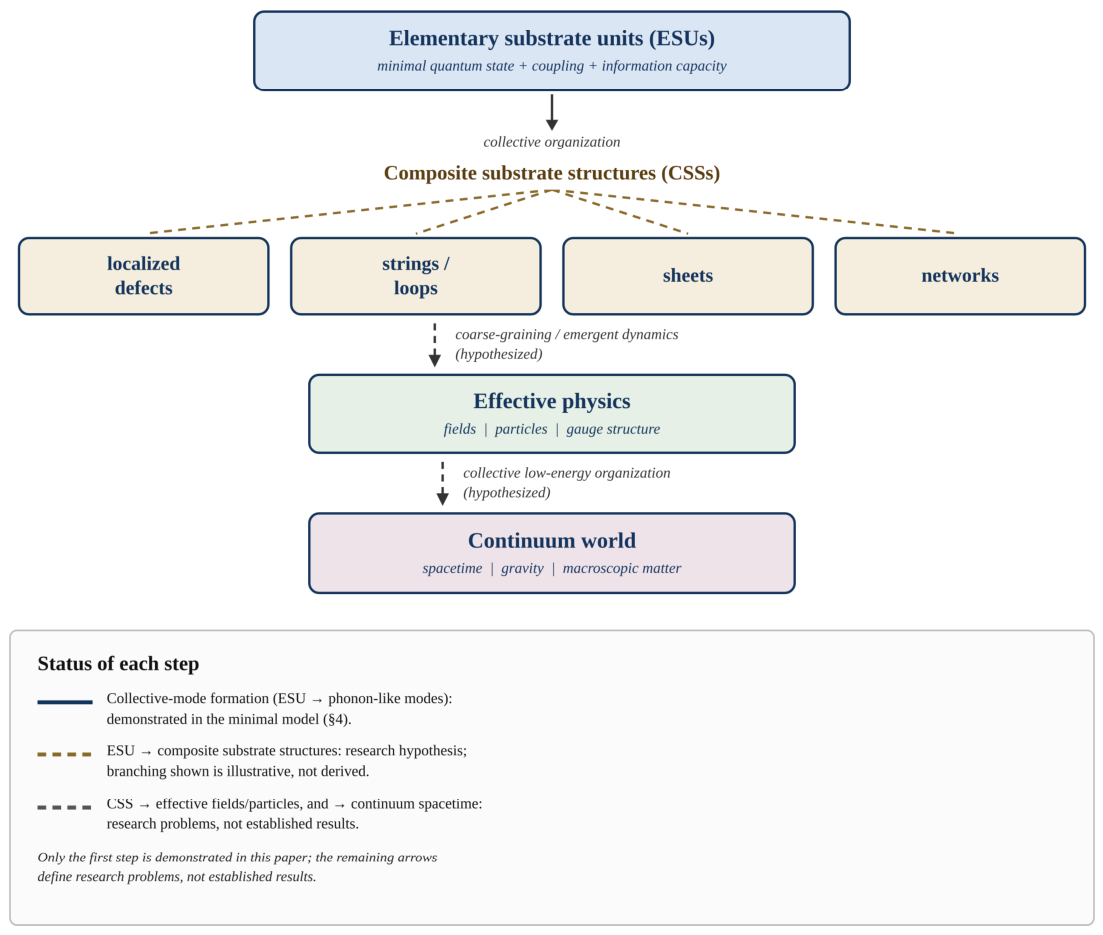
Figure 2.
The elementary substrate unit contrasted with a fundamental particle. The ESU is defined by internal quantum state, coupling, and correlational structure prior to any assignment of spacetime-dependent properties such as mass, spin, or charge; familiar particle properties are emergent, higher-level attributes rather than part of the ESU’s own definition.
Figure 2.
The elementary substrate unit contrasted with a fundamental particle. The ESU is defined by internal quantum state, coupling, and correlational structure prior to any assignment of spacetime-dependent properties such as mass, spin, or charge; familiar particle properties are emergent, higher-level attributes rather than part of the ESU’s own definition.
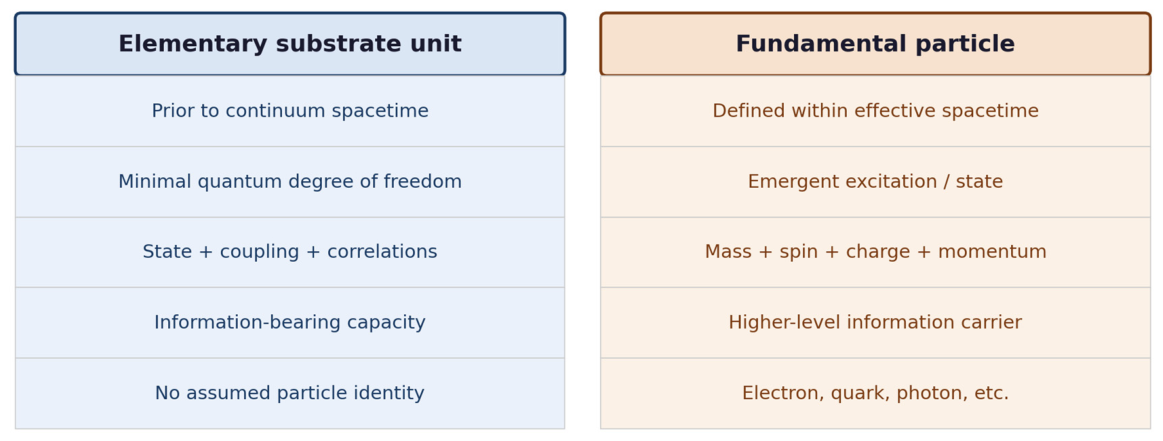
Figure 3.
Exact collective-mode dispersion on the cubic lattice compared with the continuum approximation, for propagation along a lattice axis with ω₀ = 0. The exact relation ω(k) = 2√(K/M) |sin(ka/2)| (solid) and the continuum limit ω(k) = c_eff|k| (dashed, c_eff = a√(K/M)) agree closely at long wavelength (ka ≪ 1) but separate sharply as k approaches the Brillouin-zone boundary ka = π, where the lattice dispersion saturates instead of diverging. This single plot illustrates the three central claims of §4 at once: microscopic discreteness, continuum emergence at low k, and calculable high-energy deviation, the last of which underlies the Lorentz-violation discussion of §6.2 [25,26,27].
Figure 3.
Exact collective-mode dispersion on the cubic lattice compared with the continuum approximation, for propagation along a lattice axis with ω₀ = 0. The exact relation ω(k) = 2√(K/M) |sin(ka/2)| (solid) and the continuum limit ω(k) = c_eff|k| (dashed, c_eff = a√(K/M)) agree closely at long wavelength (ka ≪ 1) but separate sharply as k approaches the Brillouin-zone boundary ka = π, where the lattice dispersion saturates instead of diverging. This single plot illustrates the three central claims of §4 at once: microscopic discreteness, continuum emergence at low k, and calculable high-energy deviation, the last of which underlies the Lorentz-violation discussion of §6.2 [25,26,27].
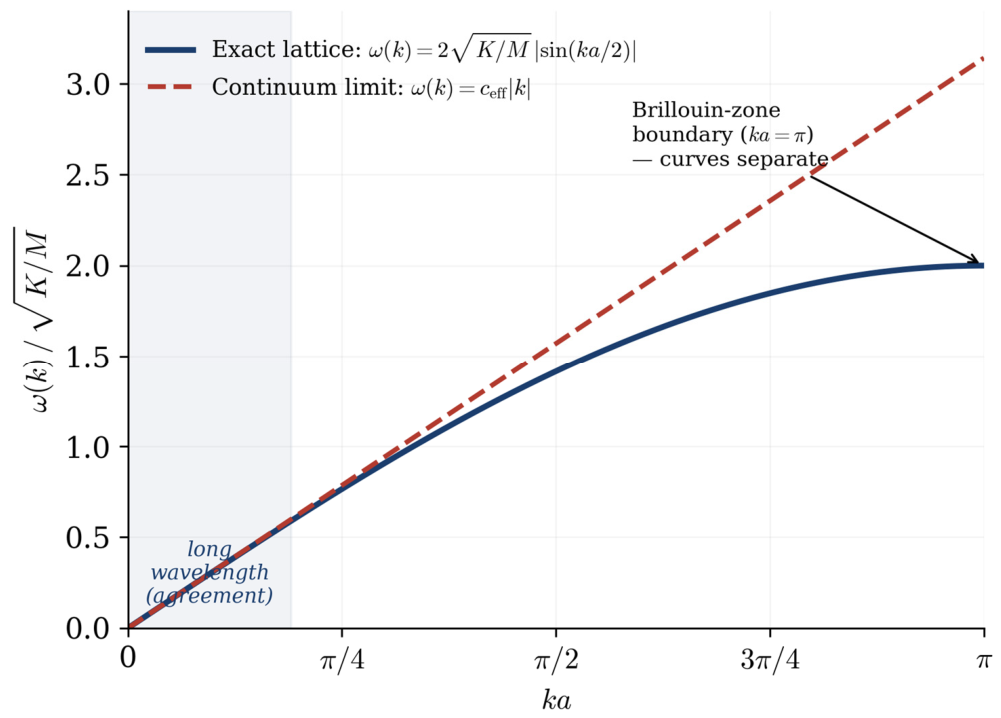

Table 1.
Comparative architecture table for candidate microscopic substrates.
| Architecture | Microscopic basis | Principal advantage | Principal challenge |
| Strings / matrix models | Extended objects / matrices | Particles and gravity; emergent geometry | Vacuum or solution selection |
| Spin networks / foams | Labeled quantum graphs | Background-independent quantum geometry | Observed semiclassical dynamics |
| Causal sets | Causal elements + order | Fundamental causal structure | Dynamics and empirical tests |
| CDT | Causal simplices | Numerical semiclassical geometry | Matter and unification |
| Quantum graphity | Graph + dynamical links | Emergent connectivity and locality | Controlled realistic continuum |
| ESU substrate (this work) | Coupled quantum degrees of freedom | Exact modes; explicit UV/Lorentz corrections | Gravity, chirality, dynamical connectivity |
Disclaimer/Publisher’s Note: The statements, opinions and data contained in all publications are solely those of the individual author(s) and contributor(s) and not of MDPI and/or the editor(s). MDPI and/or the editor(s) disclaim responsibility for any injury to people or property resulting from any ideas, methods, instructions or products referred to in the content. |
© 2026 by the authors. Licensee MDPI, Basel, Switzerland. This article is an open access article distributed under the terms and conditions of the Creative Commons Attribution (CC BY) license (http://creativecommons.org/licenses/by/4.0/).
Copyright: This open access article is published under a Creative Commons CC BY 4.0 license, which permit the free download, distribution, and reuse, provided that the author and preprint are cited in any reuse.