

Submitted:
14 August 2026
Posted:
17 August 2026
You are already at the latest version
Abstract
Migration is an inevitable aspect of human existence, but youth attitudes toward irregular migration have recently become a growing concern among policymakers, researchers, and government officials in developing countries like Nigeria, where challenging living conditions and lack of opportunities to achieve an individual’s potential often influence migration-related attitudes. While previous studies have largely focused on economic and structural factors, limited research attention has been given to the influence of psychological parameters on attitudes toward irregular migration. Thus, this study examined the impact of life satisfaction and hopelessness on attitudes toward irregular migration among Nigerian young adults, with risk-taking propensity as a moderator. A cross-sectional survey was conducted among 564 undergraduates from federal, state, and private universities in Nigeria, and four standardized psychological instruments, which include: Satisfaction With Life Scale, Attitudes Toward Unauthorized Migration Scale, General Risk-Taking Propensity Scale (GRiPS), and Hopelessness Scale, were used for data collection. The collected data were analysed using Partial Least Squares Structural Equation Modelling (PLS-SEM, version 3.0). The results showed that life satisfaction had a significant negative influence on attitudes toward irregular migration. The result further indicates that hopelessness had a significant positive effect on attitudes toward irregular migration. Again, risk-taking propensity also had a positive effect on migration attitudes and equally served as a positive moderator in the relationship between hopelessness and attitudes toward irregular migration among young adults. Hence, the findings highlight the role of these psychological parameters as important promoters of youths’ attitudes toward irregular migration in a developing country like Nigeria.
Keywords:
irregular migration
; life satisfaction
; risk-taking propensity
; hopelessness
; youth migration attitudes
1. Introduction
Migration is a complex phenomenon that involves the movement of individuals from one geographical location to another, usually with the intention of settling in a new place (Tsegay, 2023). This movement may occur within national boundaries, which is commonly referred to as internal migration, or across international borders, known as international migration (Bernard & Vidal, 2023). Migration is an ancient activity that is regarded as an inevitable component of human history and civilization, but over time, this movement has assumed different forms, one of which is irregular or undocumented migration. International migration is certainly increasing on a global scale. The most important causes are related to the considerable economic, social, and political imbalances that characterize the gap between relatively rich, democratic, and stable but aging societies in Europe/America and the much poorer, less stable, but youthful and demographically growing societies in developing countries of the world (Liman et al., 2025). The recent “Japa phenomenon” - a situation where young Nigerians are migrating en masse to industrialized countries is attributed to socio-economic factors, including unemployment, insecurity, and lack of opportunities (Ayanwale, 2024). The phenomenon of irregular migration has increased significantly in recent times, while the factors driving its growth continue to receive research attention from different perspectives. The World Migration Report (2018) attributed the increase in the number of migrants reaching the southern borders of Europe to several structural factors, such as unemployment, political instability, limited access to basic amenities, insecurity, and recurrent geopolitical crises happening in Africa and the Middle East for the past few decades. However, Castelli (2018) identified personal attitudes to emigration, education, religion, and marital status as part of micro-factors that play key roles in individual psychological evaluation regarding migration. Other researchers (Sabti & Ramalu, 2024) claim that the movement of individuals from one geographical location to another is influenced by a myriad of economic, political, and social factors. Several studies also linked irregular migration to factors such as unemployment, poverty, and political instability in countries of origin (Department for International Development, 2007; Hennebry et al., 2024; Ameh & Anande, 2025).
Throughout history, people have migrated across regions and national borders for reasons ranging from employment and political stability to environmental sustainability. While migration itself is neither inherently problematic nor abnormal, the increasing prevalence of irregular migration, particularly among young people in developing countries, has become a growing concern for governments, policymakers, and researchers due to its associated humanitarian, social, economic, and security implications. In recent years, Nigeria has witnessed an unprecedented increase in the number of young people expressing strong intentions to migrate abroad, often through irregular and highly dangerous routes. This growing phenomenon, popularly reflected in the "Japa" movement, has drawn considerable public attention and generated extensive debate regarding the underlying factors motivating young Nigerians to seek opportunities outside the country. Although legal migration remains a legitimate route for many individuals, a substantial proportion of prospective migrants have demonstrated a willingness to engage in irregular migration despite the considerable risks involved, including exploitation by human traffickers and smugglers, hazardous journeys across deserts and seas, detention, deportation, physical violence, and even death (Okunade, 2018). Such willingness suggests that migration decisions are not solely based on objective assessments of opportunities abroad but are also influenced by individuals' subjective evaluations of their present circumstances and future prospects. Existing literature has largely explained irregular migration from economic, political, and structural perspectives, emphasizing factors such as unemployment, poverty, economic instability, poor governance, insecurity, corruption, educational limitations, and inadequate social welfare systems as major drivers of migration intentions (Okunade, 2018; Sabti & Ramalu, 2024). While these macro-level explanations have significantly advanced understanding of migration dynamics, they do not fully explain why individuals exposed to similar socioeconomic conditions often differ significantly in their attitudes toward irregular migration. Some young adults remain optimistic and pursue alternative routes for personal advancement within their home country, whereas others develop favorable attitudes toward irregular migration despite being fully aware of its inherent dangers. This variation highlights the importance of examining the psychological processes that influence migration-related attitudes and decision-making.
A psychological perspective offers an additional framework for understanding irregular migration by focusing on the internal experiences, beliefs, emotions, and personality characteristics that influence individuals' perceptions of migration as a viable life option. Psychological constructs such as life satisfaction, hopelessness, and risk-taking propensity may provide important insights into why some emerging adults perceive irregular migration as an acceptable or desirable strategy for improving their circumstances. Against this background, the present study moves beyond traditional economic and political explanations by adopting a psychological approach to the study of irregular migration. Specifically, it investigates the direct and indirect influences of life satisfaction, hopelessness, and risk-taking on attitudes toward irregular migration among emerging adults in Nigeria. By integrating both risk-enhancing and protective psychological factors within a single conceptual framework, the study seeks to contribute to the growing body of migration literature while providing evidence that can inform the development of psychologically grounded intervention programmes, preventive strategies, and public policies aimed at reducing favourable attitudes toward irregular migration and promoting adaptive strategies to personal and socioeconomic advancement.
2.1. Theoretical Review
The Theory of Planned Behaviour (TPB), proposed by Ajzen in 1985, is a widely used psychological framework for understanding how individuals form the evaluative orientations that guide their behaviour. The theory posits that human behaviour is not random but planned, and that the most immediate predictor of behaviour is an individual’s evaluative orientation. According to TPB, intentions are determined by three core factors: attitudes toward the behaviour, subjective norms, and perceived behavioural control. These components jointly explain why individuals may develop favourable or unfavourable evaluative orientations toward a particular action, be it risky or illegal (Conner & Armitage, 1998; Conner, 2020). Attitudes toward the behaviour refer to an individual’s overall evaluation of performing a behaviour based on beliefs about its likely outcomes and the value placed on those outcomes. Regarding the issue of irregular migration, young adults who perceive migration as an avenue to improved living conditions may develop positive attitudes toward the act or process of embarking on it, especially when their current life circumstances are perceived as unsatisfactory. Subjective norms involve perceived social pressure from significant others, such as family members, peers, or community figures, regarding whether a behaviour should be performed. When irregular migration is socially endorsed or normalized within peer or social networks, individuals may feel encouraged to view irregular migration more positively and thereby hold favourable attitudes toward it or towards individuals embarking on it. Perceived behavioural control reflects individuals’ beliefs about their ability to perform the behaviour, including access to resources, opportunities, and personal capability. Therefore, this theory suggests that when youths believe that migration is achievable despite its associated risks and challenges, their attitudinal response to irregular migration may increase.
The theory further emphasizes that behavioural intention serves as the closest antecedent of actual behaviour, suggesting that individuals who hold favourable attitudes, perceive social approval, and believe that they have control, are more likely to form strong orientations to act. Perceived behavioural control can also influence behaviour, particularly in situations where individuals believe they can overcome the associated barriers. This is relevant to the situation of irregular migration, which regularly involves a high level of uncertainty and limited actual control. Psychological factors such as risk-taking propensity and hopelessness may affect how young adults evaluate migration risks and opportunities, thereby influencing attitudes and perceived control. Individuals experiencing a lower level of life satisfaction may underestimate potential dangers and overestimate the perceived benefits of migration, thereby strengthening their migration-related orientations. Based on the application of the theory of planned behaviour (TPB), the current study offers a theoretically grounded explanation of how psychological and social factors interact to shape youths’ attitudes toward irregular migration, thereby enhancing the understanding of migration-related decision-making within the Nigerian context.
2.2. Empirical Review of Related Studies and Development of Hypotheses
Life satisfaction, hopelessness, and attitudes toward irregular migration: An increase in the awareness of international migration has led to a crucial integration of immigration and life satisfaction research in recent studies (Angelini et al., 2015; Kogan et al., 2018; Monteiro & Haan, 2022). Life satisfaction is gaining significant attention in academic and policy debates because of its widely accepted ability to measure both individual and societal well-being (Bonikowska et al., 2014; Helliwell et al., 2018). Several studies have investigated life satisfaction as an important psychological factor in the lives and experiences of immigrant populations. Chiang et al. (2021) demonstrate that the feeling of dissatisfaction, whether caused by unemployment or absence of educational choices or insufficient social support, can be a powerful force behind attitudes or the final decision on migration. The existing literature on migration studies suggests that life satisfaction influences attitudes toward irregular migration through multiple mechanisms: by shaping migration aspirations, by guiding emotional and cognitive evaluations of risk, by altering tolerance and social trust, and by mediating the impact of structural constraints. Specifically, low life satisfaction tends to increase the attractiveness and acceptability of irregular migration, making it a critical factor in understanding contemporary migration realities. According to Kobayashi and Tanaka (2024), attitudes toward immigration are influenced by perceptions of risk, economic opportunity, and social narratives, which interact with individual well-being. This implies that individuals who experience dissatisfaction may be more likely to view migration positively, even when it involves legal or physical risks.
A growing body of migration and social psychology literature highlights life satisfaction as a key subjective factor guiding attitudes toward irregular migration, both directly and indirectly (Anczyk & Grzymała-Moszczyńska, 2021; Aslany, 2021; Ciorbagiu, Stoica, & Mihaila, 2020). Recent research confirms that subjective well-being has become central to migration analysis, supporting traditional economic explanations by capturing how individuals feel about their life circumstances (Răileanu, 2025). In situations where legal migration opportunities are limited, and individuals are confronted with feelings of dissatisfaction, this dissatisfaction can result in more favourable attitudes toward irregular migration as an alternative route. Another study (Korol & Bevelander, 2023) shows that individuals with higher life satisfaction experience more positive emotions, gratitude, and social trust, which in turn foster more tolerant and less risk-seeking attitudes toward migration-related issues. Whereas individuals with low life satisfaction are more likely to experience frustration, pessimism, and perceived lack of control, conditions which are closely associated with risk acceptance and openness to unconventional or illegal strategies, including irregular migration.
Furthermore, life satisfaction has been identified as a key psychological factor that shapes risk perception and decision-making. Individuals who are satisfied with their lives tend to adopt a loss-averse orientation, meaning they are less willing to jeopardize their current stability through dangerous migration journeys. In contrast, dissatisfied individuals often perceive that they have little to lose, which lowers the perceived cost of engaging in high-risk migration. This aligns with broader findings that life satisfaction is linked to behavioural outcomes such as agency, mental health, and risk behaviour, especially among young people (Baumert et al. 2025). Thus, low life satisfaction can indirectly normalize irregular migration by reducing sensitivity to its dangers. This suggests that individuals with low life satisfaction may be more likely to develop negative or instrumental attitudes by viewing migration, either legal or irregular, as a competitive or necessary survival strategy rather than a regulated process. These influences are especially dangerous to young Nigerians, where levels of unemployment are alarming, and social unrest is widespread.
A previous study of relative deprivation and international migration conducted by Stark and Taylor (1989), using relative deprivation theory, found that migration is an effective mechanism for achieving income gains in households that send migrants abroad. This finding suggests that households' expectation of improved life satisfaction is a key driver of international migration. Individuals may examine and report their life satisfaction differently based on their specific expectations, values, aspirations, and even previous experiences, rather than their material conditions (Diener et al., 1999; Monteiro & Haan, 2022). Because life satisfaction is the cognitive component of well-being of how an individual perceives their overall life circumstances or feelings about their life, the concept therefore emerged as a core psychological factor influencing youths' judgment and perception. Low life satisfaction may trigger feelings of frustration, insecurity, and disillusionment, making irregular migration seem like an attractive escape route from unfavourable living conditions. Individuals with lower levels of life satisfaction tend to perceive greater gains from migration and are therefore more likely to express favourable attitudes towards moving. Carling (2002) noted that individuals facing low levels of subjective well-being may express a desire to migrate but may lack the necessary resources or agency to realize that goal. Whereas an individual with a high level of satisfaction tends to promote stability, positive engagement, and resilience, restructuring the evaluative response to irregular or unsafe migration. This implies that a person's quality of life is positively associated with the life satisfaction of the individual migrant and can influence their attitudes toward migration.
Hopelessness, defined as a negative outlook toward the future and a perceived lack of control over life outcomes, has emerged as a critical psychological determinant of migration behavior. Unlike life satisfaction, which reflects present conditions, hopelessness is future-oriented and captures expectations about what lies ahead (Lo-oh, 2021). Life satisfaction and hopelessness are closely related. Low life satisfaction often leads to increased feelings of hopelessness, as individuals perceive limited opportunities for improvement. This relationship is supported by recent findings linking poor living conditions and limited prospects to both dissatisfaction and migration intentions (Laari et al., 2024). Moreover, both life satisfaction and hopelessness influence attitudes toward migration. Individuals with low satisfaction and high hopelessness are more likely to develop favorable attitudes toward irregular migration, as they seek alternatives to improve their circumstances. A recent empirical study on nursing students found that hopelessness significantly predicts migration intentions, with many participants expressing a desire to leave their country due to perceived lack of future opportunities (Berşe et al., 2025), a condition closely related to what many young adults are currently confronting in Nigeria. Similarly, some researchers had earlier reported that individuals with higher levels of hopelessness are more likely to consider migration as a means of escaping adverse conditions. In a recent qualitative study, Kiriscioglu (2025) emphasizes the emotional complexity of migration decisions, in which migrants usually experience a dynamic interaction between hope and despair that shapes their willingness to embark on or continue migration journeys. The researcher maintains that hopelessness does not operate in isolation but interacts with aspirations, resilience, and perceived opportunities. Again, some researchers found that hopelessness is closely linked to broader psychological distress, including depression and anxiety, which are themselves associated with migration intentions (Sivis, 2024). These findings suggest that migration decisions are embedded in a broader psychological framework, in which emotional states influence both attitudes and behaviors. These findings are consistent with psychological theories linking hopelessness to risk-taking behavior. Furthermore, a previous study (Capri, 2013) on relations between life satisfaction, burnout, work engagement, and hopelessness of high school students reported a negative relationship between life satisfaction and hopelessness. This means students with high levels of life satisfaction are less likely to experience hopelessness, unlike those with low levels of life satisfaction. Similarly, a longitudinal study by Shek and Li (2016) among adolescents in Hong Kong equally found a negative relationship between life satisfaction and hopelessness, suggesting that individuals who perceive their future as bleak may be more willing to engage in uncertain or dangerous actions, including irregular migration. Hopelessness reduces the perceived value of remaining in one’s current environment, thereby increasing the attractiveness of alternative routes - even those associated with significant risks.
H1:
Life satisfaction directly and negatively predicts attitudes toward irregular migration among Nigerian young adults.
H2:
Life satisfaction negatively predicts hopelessness among Nigerian young adults.
H3:
Hopelessness positively predicts attitudes toward irregular migration among Nigerian young adults.
Risk-taking as moderator: The concept of risk-taking has important implications for understanding risky behavior, such as human trafficking, dangerous travel conditions, and a lack of access to basic services and legal protections, which are constantly associated with irregular migration. Previous research on migration aspirations had largely outlined political and economic considerations as major drivers of attitudes toward migration (de Haas, 2003; Van Heelsum, 2017), categorizing them as meso- and macro-level factors. However, researchers have recently become interested in understanding the role of psychological characteristics such as individual traits and preferences towards the development of migration attitudes (Feyissa Dori et al., 2024; Hagen-Zanker et al., 2023). An individual's risk-taking propensity has been identified as a key psychological trait that influences attitudes toward irregular migration (Belloni, 2016; Brigden, 2018; Kiriscioglu, 2025). Risk-taking was described by Williams and Baláž (2012) as both an objective trait and a subjective orientation. The terms attitudes and aspirations are commonly used interchangeably in migration studies, though conceptually different, but psychologically connected as a viable mechanism that shapes the individual migration decision. Recently, Kiriscioglu (2025) reported that aspirations are shaped not only by personal motivations but also by structural conditions that enable or constrain actual migration. The researcher claimed that aspirations toward migration are not merely pre-stages of action but reflections of how migrants understand their present circumstances and anticipate their prospects. The study later found that risk-taking attitudes are important determinants of aspirations to move forward, even after considering the structural and demographic variables, especially in the context of irregular migration, which inherently involves legal, financial, and physical risks. Cross-national research also indicates that individual risk tolerance significantly influences both migration decisions and life satisfaction, which means that individuals with higher risk-taking traits are better able to manage uncertainty and are more likely to pursue migration opportunities, which can, in turn, enhance their life satisfaction through a sense of agency and control (Baláž & Valuš, 2020). Similarly, Huber and Nowotny (2020) reveal that risk-tolerant individuals exhibit a higher willingness to relocate, while risk-averse individuals are less likely to migrate. Another study by Akgüç et al. (2016) further maintains that migrants tend to be less risk-averse than non-migrants, suggesting a self-selection mechanism where individuals predisposed to risk-taking are more likely to engage in migration.
The literature consistently maintains that individuals with higher risk tolerance are more likely to consider migration, particularly under uncertain conditions. A study by Răileanu (2025) found that low levels of life satisfaction influence only emigration intentions, as internal migration intentions are primarily driven by specific financial and personal characteristics. This suggests that dissatisfaction with life increases migration aspirations, while risk tolerance enables individuals to consider irregular options despite potential consequences. This aligns with the aspiration - capability framework, which suggests that individuals may aspire to migrate but lack the legal or financial means to do so, thereby turning to irregular migration as an alternative. However, Thunström et al. (2025) claimed that the stock of information available before risk-taking is also a determining factor. The researchers maintained that preference for positive over negative information can also influence the decision to take a risk. Similarly, Qaisi (2025) noted that when individuals make decisions, they systematically use mental shortcuts by taking into consideration partial data, which can be the case with irregular migrants. According to Atkinson (1957), the motivation to take risks is commonly influenced by two factors: the desire to succeed and the fear of failure. He then proposed that motivation to succeed and fear of failure influence risk-taking; that is, the feeling of uncertainty allows some individuals to see risky situations as opportunities to achieve their goals, rather than as potential threats. Another previous study by Jaeger et al. (2007) found that an individual's attitude towards risk perception has a direct impact on their tendency to embark on illegal cross-border migration. To underscore the crucial role of risk-taking, Townsend and Oomen (2015) emphasize that understanding how migrants perceive risk and what attitude motivates them to undertake unsafe journeys is incomplete without paying detailed attention to both their pre- and post-departure decision-making processes. Despite growing interest in psychological determinants of migration, there remains limited research explicitly integrating life satisfaction, hopelessness, risk-taking propensity, psychological resilience and attitudes toward irregular migration within a single framework. Most studies examine these variables in isolation or focus on regular migration contexts. Hence, we proposed the following research hypotheses:
H4:
Risk-taking directly predicts attitudes toward irregular migration among Nigerian young adults.
H5:
Risk-taking significantly moderates the influence of hopelessness on attitudes toward irregular migration among Nigerian young adults.
Research Model: The proposed research model for this study is presented in Figure 1, which provides a visual representation of the hypothesised relationships among the four latent constructs examined in the study. The model illustrates both the direct and indirect relationships between the study variables. Specifically, it proposes that hopelessness and life satisfaction are directly associated with attitudes toward irregular migration, indicating that individuals’ psychological well-being and perceptions of their future may influence their attitudes toward engaging in or supporting irregular migration. In addition to these direct relationships, the model integrates risk-taking as a potential mediating mechanism. Accordingly, risk-taking is proposed to explain, at least in part, how hopelessness and life satisfaction can influence attitudes toward irregular migration. The inclusion of this indirect relationship allows the study to examine not only whether the psychological factors are associated with attitudes toward irregular migration, but also how and through what mechanism these relationships may occur.
3. Method and Measures
3.1. Research Design
This study is quantitative in nature and therefore employed a descriptive and cross-sectional research approach for data collection to investigate the direct impact of life satisfaction and hopelessness, alongside the indirect influence of risk-taking and psychological resilience on attitudes toward irregular migration among Nigerian young adults. The dependent variable is attitudes toward irregular migration, and the independent variables are life satisfaction and hopelessness, with risk-taking and psychological resilience as moderators. The study population comprises all undergraduate students in Nigeria.
3.2. Study Area and Participants
This study focused on undergraduate students enrolled in selected Nigerian universities. Nigeria is an example of a developing nation characterized by a teeming youth population, economic instability, rising unemployment, and growing youth interest in international migration. Given these structural and socioeconomic factors, Nigerian undergraduates form a suitable population for studying the psychological determinants of attitudes toward irregular migration among youths. The study centered on emerging youths in the university setting because their future migration plans depend on the present evaluative orientation to migration-related issues. Full-time undergraduate students from Nigerian universities made up the study population. However, for ease of data collection, participants were drawn from only six universities, which include two federal, two state, and two private universities. Using purposive, proportionate, and convenient sampling techniques, relevant data were obtained from undergraduate students across the six selected Nigerian universities. A purposive sampling method was used to choose the southwest geopolitical zone out of the six geopolitical zones in Nigeria, due to its unique nature in terms of the highest number of universities, coupled with the highest population of undergraduate students, and its long history of access to relevant information about international migration. While a proportionate sampling method was used to distribute the 755 research questionnaires among the six selected universities based on their student population, in which 425 questionnaires were allocated to the two selected federal universities, 227 questionnaires to the two state universities, and 103 questionnaires were shared among the two selected private universities. However, a convenience sampling method was used to administer the research questionnaire to only the available and interested participants, as researchers lack the authority to enforce or compel any undergraduate student to participate in the study. Thus, a total of 755 questionnaires were administered with the help of a trained research assistant. Only 642 of these questionnaires were returned, which accounted for 85% response rate, while 564 were fully completed and considered suitable for coding and data analysis. Respondents were briefed about the objectives of the study before the questionnaires were distributed, and participation was completely voluntary. The study was approved by the ethical committee of the Faculty of Humanities (Number: 2024-25/-HUM037D) with the approval date of 14/03/2025, and was carried out in accordance with necessary ethical standards, such as informed consent, confidentiality, and anonymity of participants.
3.3. Sample Size
Researchers have noted that G*Power does not directly evaluate the sample size for structural equation modelling (SEM). Therefore, this study determined the required sample size based on the existing recommendation by Nevitt and Hancock (2001) that an optimal SEM sample size should be determined using an N:q ratio of at least 10:1, where N represents the number of cases and q stands for the parameters to be estimated. Based on this position, this study with 48 model parameters demands a minimum of 480 participants as an acceptable sample size. Therefore, the 564 participants selected for the study are considered adequate and appropriate for the model.
3.4. Measures
A structured questionnaire modified from reliable and validated tools was used for data gathering. While keeping their original conceptual meanings, some items were slightly altered to fit the Nigerian undergraduate context. Likert-type rating scales were used to collect responses for all latent variables. The Satisfaction With Life Scale (SWLS), developed by Diener, Emmons, Larsen, and Griffin (1985), was used to evaluate life satisfaction. Five items made up the scale, which measures respondents' overall cognitive assessment of their life situation. A seven-point Likert scale, with 1 representing "strongly disagree" and 7 representing "strongly agree," was used to rate each item. Attitudes toward irregular migration were measured using Van der Veer et al. (2008) Attitudes Toward Unauthorized Migration Scale. The scale has nineteen items that assessed moral, social, and personal aspects of irregular migration. The General Risk-Taking Propensity Scale (GRiPS) developed by Zhang, Highhouse, and Nye (2019), was used to assess risk-taking propensity. The scale consists of eight items designed to assess people's overall inclination to engage in risky behaviours. The items were rated on a five-point Likert scale, from 1 (strongly disagree) to 5 (strongly agree). The 3-item pessimism dimension of the Life Orientation Scale, created by Scheier, Carver, and Bridges (1994), was used to measure hopelessness. Negative expectations about the future were measured using the three items of the pessimism dimension of the Life Orientation Scale. A five-point Likert scale, with 1 representing "strongly disagree" and 5 representing "strongly agree," was used to record responses. The pessimism dimension of the life orientation scale (revised text) was considered appropriate for measuring hopelessness due to its non-clinical nature, and short question items that offers fast administration and promotes quick participant response, unlike Beck's 20-item hopelessness scale, which has been criticized for being too clinical-oriented, and lengthy question items that can cause participant fatigue as well as its rigid “Yes or No” response format that may compel participants to either of the two extremes (Pretorius & Padmanabhanunni, 2024). Again, the choice of the pessimism dimension of the Life Orientation Scale is further justified by the previous work of Beck et al. (1974) titled “The measurement of pessimism: The Hopelessness Scale,” where hopelessness is described as pessimism, which clearly lends empirical support for the relevance of pessimism in measuring hopelessness. Thus, the adoption of the pessimism dimension of the Life Orientation Scale to measure hopelessness in this study is adjudged to be empirically sound and appropriate
3.5. Data Analysis
Descriptive statistics were used to summarize the sample in terms of frequency and percentage, while Pearson’s correlation examined relationships between variables. The proposed moderation model was tested using Partial Least Squares Structural Equation Modeling (PLS-SEM) with Smart-PLS 3.0 software, due to its predictive orientation, minimal distributional assumptions, and suitability for complex models involving moderation. Bootstrapping was applied to assess the significance of path coefficients. The measurement model was evaluated for validity and reliability using standard criteria, including outer loadings, Cronbach’s alpha, composite reliability (CR), rho_A, and average variance extracted (AVE), ensuring the constructs were psychometrically sound before testing structural relationships.
4.1. Findings
Table 1 presents the sociodemographic characteristics of the study participants. A total of five hundred and sixty-four (564) respondents were included in the analysis. With respect to the type of university attended, the majority of participants (58.8%) were drawn from federal universities, followed by those from state universities (27.5%), while a smaller proportion (13.7%) were from private universities. This distribution suggests that students from federal institutions were more represented in the study. In terms of gender composition, the sample was fairly balanced, although males slightly outnumbered females. Specifically, 52.5% of the respondents were males, while 47.5% were females. Regarding age, most of the participants were within the 20 - 30 years age bracket (60.5%), indicating that the sample largely comprised young adults. Participants below 20 years accounted for 21.6%, while those above 30 years formed the least proportion (17.9%).
The marital status of respondents revealed that a large majority were single (84%), with married participants constituting only 9.8%. The respondents who are divorced made up 3.7%, while those classified under other categories accounted for 2.5%. This pattern reflects the predominance of unmarried individuals within the university environment. Concerning religious affiliation, Christians constituted slightly more than half of the sample (50.53%), followed by Muslims (40.43%), while traditional worshippers represented the smallest group (9.04%). This indicates a diverse religious background among the participants, with Christianity being the most dominant. The distribution of respondents across fields of study shows that students from the social sciences formed the largest group (26.4%), followed by Arts and humanities (23.4%) and health sciences (17.6%). Science (12.5%) and engineering (9.6%) had moderate representation, while education (7.8%) and agriculture (2.7%) recorded the lowest proportions. Overall, the sample reflects a wide spread of academic disciplines, with a stronger representation from the social sciences and arts-related fields.
4.2. Structural Model Assessment and Hypotheses Testing
A total of five hypotheses were formulated and empirically tested in the present study using the Partial Least Squares Structural Equation Modeling (PLS-SEM) approach. The hypotheses comprised four direct-effect hypotheses and one moderating hypothesis. The four direct-effect hypotheses examined the relationships between the exogenous constructs - life satisfaction, hopelessness, risk-taking - and attitudes toward irregular migration. The only moderating hypothesis examined whether risk-taking significantly influenced the strength and/or direction of the relationships between the relevant predictor variable and attitudes toward irregular migration. The structural model was assessed using SmartPLS to determine the hypothesized relationships among the latent constructs. Evaluation of the structural model was based on the magnitude and significance of the standardized path coefficients (β) and the coefficient of determination (R²). The path coefficients provided an indication of the direction and strength of the relationships between the constructs, while the R² values indicated the proportion of variance in the endogenous construct, attitudes toward irregular migration, explained by the predictor variables in the structural model.
Hypothesis testing was conducted using the bootstrapping procedure in SmartPLS. A non-parametric bootstrapping procedure with 5,000 bootstrap subsamples was employed to generate standard errors and confidence intervals for the estimated path coefficients. The significance of the hypothesized relationships was determined using the corresponding bootstrapped t-statistics and p-values. A hypothesis was considered statistically significant where the obtained p-value was below the predetermined significance level of 0.05, and the associated confidence interval did not include zero. The use of bootstrapping is appropriate within the PLS-SEM framework because it enables the assessment of the sampling distribution of parameter estimates without requiring the assumption of multivariate normality. For the moderating hypotheses, interaction terms between risk-taking and the respective predictor variables were created and incorporated into the structural model. The significance of the interaction effects was assessed using the bootstrapped path coefficients, t-statistics, p-values, and confidence intervals. A statistically significant interaction effect was interpreted as evidence that psychological resilience and risk-taking significantly moderate the relationship between the corresponding predictor variables and attitudes toward irregular migration. Where significant moderation was established, the nature of the interaction was further examined to determine whether risk-taking strengthened or weakened the relationship. In addition, the effect size (f²) of the interaction terms was considered to determine the substantive contribution of the moderating effects to the endogenous construct. This approach further enabled the study to establish not only whether risk-taking moderated the hypothesized relationships, but also the direction and practical magnitude of the moderating influences. The decision to accept or reject each hypothesis was therefore based primarily on the sign and magnitude of the standardized path coefficient (β), bootstrapped t-statistic, p-value, and corresponding confidence interval. The results obtained from the structural model provided empirical evidence for evaluating the proposed direct and moderating relationships and determining the extent to which the hypothesized model was supported by the data. Table 2 presents the details of the psychometric properties of the four latent constructs obtained in this study, such as Cronbach’s Alpha, rho-A, Composite reliability, Average Variance Extracted (AVE), R2, and f2. The illustration of path analysis with t-statistics is presented in Figure 2, while the moderating role of risk-taking is illustrated in Figure 3 below.
5. Discussion of Findings
This study investigated how psychological factors affect attitudes toward irregular migration among Nigerian young adults, focusing on life satisfaction, hopelessness, and risk-taking propensity. Five hypotheses were formulated in this study, which comprised four direct hypotheses with one moderating hypothesis. Results of these five hypotheses are presented in Table 3.
5.1. Direct Hypotheses
Hypothesis one states that life satisfaction directly and negatively predicts attitudes toward irregular migration among Nigerian young adults. The result shows that life satisfaction had a significant negative influence on attitudes toward irregular migration among Nigerian undergraduates (H1: β = -0.039, t = 3.189, p = 0.001). This result implies that Nigerian young adults with higher levels of life satisfaction are less likely to develop favourable attitudes toward irregular migration compared to their counterparts with lower levels of life satisfaction. This result supports hypothesis one; therefore, we accept hypothesis one. The result of this hypothesis aligns with a growing body of migration and social psychology literature that highlights life satisfaction as a key subjective factor guiding attitudes toward irregular migration (Anczyk & Grzymała-Moszczyńska, 2021; Aslany, 2021; Ciorbagiu et al., 2020). A recent study by Korol and Bevelander (2023) also maintains that individuals with higher life satisfaction experience more positive emotions, gratitude, and social trust, which in turn foster more tolerant and less risk-seeking attitudes, while, individuals with low life satisfaction are more likely to experience frustration, pessimism, and perceived lack of control, conditions which are closely associated with risk acceptance and openness to unconventional or illegal strategies, including favourable attitudes toward irregular migration. This suggests that where legal migration opportunities are limited, and individuals are confronted with feelings of dissatisfaction, such dissatisfaction can result in more favourable attitudes toward irregular migration as an alternative route. Life satisfaction has emerged as an important factor influencing youths’ judgments, aspirations, and perceptions of their future. Low levels of life satisfaction may generate feelings of frustration, insecurity, and disillusionment, thereby making irregular migration appear as an attractive escape from unfavourable living conditions. This means that the perceived quality of life of individuals is closely associated with their life satisfaction and, in turn, influences their attitudes toward migration-related behaviour (Răileanu Szeles, 2025). Most importantly, individuals with higher levels of life satisfaction are more likely to demonstrate stability, positive engagement with their environment, and resilience, which may reduce their inclination toward illegal or unsafe migration. This finding offers additional insight into the psychological understanding of how life satisfaction can influence attitudes towards irregular migration among young adults, particularly from a developing country like Nigeria.
Hypothesis two states that life satisfaction negatively predicts hopelessness among Nigerian young adults. The result reveals that life satisfaction has a significant negative influence on hopelessness among Nigerian young adults (H2: β = -0.44, t = 12.144, p = 0.001). This means that life satisfaction reduces the feeling of hopelessness among Nigerian young adults. This result supports hypothesis two. The results align with the findings of previous studies. For instance, a study conducted by Capri (2013) on relations between life satisfaction, burnout, work engagement, and hopelessness of high school students reported a negative relationship between life satisfaction and hopelessness. The study maintains that students with high levels of life satisfaction are not likely to experience feelings of hopelessness, unlike their counterparts with low levels of life satisfaction. Another longitudinal study by Shek and Li (2016) among adolescents in Hong Kong also found a negative relationship between life satisfaction and hopelessness. Individuals who perceive their future as bleak may be more willing to engage in uncertain or dangerous actions, including irregular migration. These findings suggest that young adults who perceive their lives as unsatisfactory may develop heightened risk-taking tendencies, leading them to underrate the dangers associated with irregular migration while overestimating its potential benefits. In the same vein, low life satisfaction may foster feelings of hopelessness, which can weaken future-oriented thinking and increase openness to hazardous and harmful decisions, including the risks associated with the illegal migration option as a perceived alternative to stagnation in the home country.
Hypothesis three states that hopelessness positively predicts attitudes toward irregular migration among Nigerian young adults. The result confirms that hopelessness has a significant positive influence on attitudes toward irregular migration among Nigerian young adults (H3: β = 0.168, t = 5.592, p = 0.001). This finding means that hopelessness is a strong risk factor for the development of attitudes toward irregular migration among Nigerian young adults. The result supports hypothesis three. The result of this hypothesis aligns with the findings of other studies. For example, Laari et al. (2024) reported a link between poor living conditions and limited prospects to both dissatisfaction and migration intentions. This suggests that individuals with low satisfaction and high hopelessness are more likely to develop favorable attitudes toward irregular migration, as they seek alternatives to improve their circumstances. Another recent study conducted by Berşe et al. (2025) among nursing students and found that hopelessness significantly predicted migration intentions, with many participants expressing a desire to leave their country due to perceived lack of future opportunities. Even though young people are usually aware of the dangers of irregular migration, such as violence, exploitation, or death, hopelessness reduces the weight of these risks in decision-making, and despite knowledge of severe dangers along migration routes, many still undertake these journeys, indicating that desperation can override rational risk assessment. Thereby, making them hold the wrong orientation that hopelessness produces a “nothing to lose” mentality. This means that youths’ perception of their lives as unsatisfactory may prompt them to develop heightened risk-taking tendencies, which may encourage them to underrate the dangers associated with irregular migration while overestimating its perceived potential benefits, thereby suggesting that youths who are preoccupied with fear of the future are most vulnerable to embark on irregular migration.
Hypothesis four states that risk-taking propensity positively predicts attitudes toward irregular migration among Nigerian young adults. The result shows that risk-taking propensity has a significant positive impact on attitudes toward irregular migration among Nigerian young adults (H4: β = 0.711, t = 20.865, p = 0.001). This means that risk-taking propensity promotes the development of attitudes toward illegal migration among Nigerian young adultss, thereby serving as a facilitator of attitudes toward irregular migration among Nigerian youths. This result supports hypothesis four. This finding aligns with existing findings other researchers. For instance, Kiriscioglu (2025) reported that subjective risk-taking attitudes strongly predict willingness to pursue onward migration, even under uncertain and constrained conditions. This implies that young people who see themselves as “risk-takers” are more likely to hold favourable attitudes and view irregular migration as a viable option. Again, risk-taking serves as a mechanism that bridges the gap between desire and action, in which young people who are more willing to take risks may likely consider or perceive irregular migration routes (e.g., crossing deserts or seas) as acceptable strategies for achieving their goals, unlike those with low risk tolerance who may choose to remain in place, even if dissatisfied, because staying is perceived as a “safer” option. Again, Jaeger et al. (2007) found that an individual's attitude towards risk perception has a direct impact on their tendency to embark on illegal cross-border migration. Furthermore, to underscore the crucial role of risk-taking, Townsend and Oomen (2015) claim that understanding how migrants perceive risk and what attitude motivates them to undertake unsafe journeys is incomplete without paying detailed attention to both their pre- and post-departure decision-making processes. Therefore, the result of this hypothesis highlights risk-taking as an important psychological parameter capable of influencing youth orientation towards irregular migration.
Moderating Role of Risk-Taking
Hypothesis five states that risk-taking moderates the influence of hopelessness on attitudes toward irregular migration among Nigerian young adults. This result shows that risk-taking significantly moderated the influence of hopelessness on migration attitudes by strengthening the influence (H5: β = 0.004, t = 2.157, p = 0.001). This result supports hypothesis five. The positive and statistically significant interaction coefficient suggests that higher levels of risk-taking strengthen the relationship between hopelessness and favorable attitudes toward irregular migration. This finding further implies that hopelessness alone may not be sufficient to explain why some Nigerian young adults develop favorable attitudes toward irregular migration. Rather, the effect of hopelessness appears to depend on the individual's propensity to engage in or tolerate risk. Young adults experiencing high levels of hopelessness who also possess a high tendency toward risk-taking may be more likely to perceive irregular migration as an acceptable or attractive option despite its potential legal, financial, physical, and psychological consequences. In contrast, individuals with similar levels of hopelessness but lower risk-taking tendencies may be less inclined to develop favorable attitudes toward irregular migration because they may attach greater importance to the potential dangers and uncertainties associated with irregular migration. The significant moderating effect can therefore be interpreted to mean that risk-taking acts as an amplifying factor in the relationship between hopelessness and attitudes toward irregular migration. When risk-taking is high, the positive association between hopelessness and favorable attitudes toward irregular migration becomes stronger. This may be explained by the fact that hopeless individuals often perceive limited opportunities for achieving desired outcomes through conventional means. When such individuals also have a greater willingness to accept uncertainty and potential negative consequences, irregular migration may become more psychologically acceptable as an alternative strategy to improving their perceived life circumstances.
6. Conclusions and Recommendations
This study examined the direct impact of life satisfaction and hopelessness with moderating effects of risk-taking on attitudes toward irregular migration among Nigerian young adults. Findings of this study pointed out that emerging youths who perceive their lives as unsatisfactory are most likely to develop heightened risk-taking tendencies, which can lead them to underrate the dangers associated with irregular migration while overestimating its potential benefits. Again, low life satisfaction may foster feelings of hopelessness, which can weaken future-oriented thinking and increase openness to hazardous and harmful decisions, including the risks associated with the irregular migration option as a perceived alternative to stagnation in the home country. Similarly, heightened hopelessness may increase the perceived acceptability of irregular migration as a coping strategy by young adults in developing countries. The results further show that risk-taking serves as a strong moderator that strengthened the influence of hopelessness on attitudes toward irregular migration. By investigating the influence of hopelessness and risk-taking on the relationship between life satisfaction and attitudes toward irregular migration among Nigerian young adults, the study offers a rare quantitative understanding of how psychological parameters can influence youths' perception of irregular migration and therefore contributes to the recent calls for incorporating a psychological perspective into migration studies. Overall, the findings support a multidimensional framework in which migration decisions are determined by the interaction of psychological, social, and structural factors. Understanding these dynamics is essential for developing effective policies and interventions aimed at addressing the root causes of irregular migration.
Practical Implication
Considering the findings of this study, which confirmed that life satisfaction, risk-taking tendencies, and hopelessness jointly influence the attitudes of Nigerian youths toward irregular migration, we therefore recommend that enhanced life satisfaction and improved future hope be considered as prominent psychological strategies to reduce youths’ repeated inclination toward risky migration plans. Hence, governments, policymakers, educators, and youth-focused initiatives are encouraged to design intervention programmes that are capable of promoting positive life experiences, strengthening individual coping skills, and encouraging youth sensitization awareness campaigns about the hidden dangers and foreign frustrations associated with living conditions of irregular and undocumented migrants abroad. Specifically, the Nigerian government, through the Federal Ministry of Education, is encouraged to design an enlightenment symposium and workshops that will uncover the hidden dangers and terrible challenges associated with irregular migration. This type of youth enlightenment seminar and workshops about irregular migration should be incorporated as part of mandatory activities during the compulsory one-year National Youth Service Corps (NYSC), as young graduates remain the most vulnerable targets of irregular migration in Nigeria, due to repeated high rates of unemployment and unrestricted access to misleading information about migration. The NYSC is a compulsory one-year national programme in Nigeria, designed for young graduates to participate immediately after graduation with the aim of promoting national unity and strengthened cross-cultural interactions.
7. Limitations and Directions for Future Research
Despite the contributions of the present study to the growing body of research on migration studies, certain limitations should be acknowledged. First, the sample was drawn only from Nigerian university students, which may limit the generalizability of the findings to other youth populations, such as out-of-school youths or young adults already engaged in migration processes. Future studies may extend this research to other groups or settings to improve the external validity of the findings. In addition, the study relied on self-reported measures, which may be affected by social desirability or response bias, especially given the sensitive nature of irregular migration. Future research could combine survey data with qualitative methods such as interviews or focus group discussions to gain deeper insights into youths’ migration attitudes and motivations. Furthermore, the study examined risk-taking propensity and hopelessness only as mediating variables. Future studies could explore these variables as moderators or examine other psychological factors, such as perceived economic opportunities, family pressure, or peer influence, resilience, and emotional intelligence, to broaden the psychological understanding of the migration decision-making process among youths. Lastly, the cross-sectional design of the study limits causal interpretation of the relationships among variables. Future research may adopt a longitudinal design to observe how changes in life satisfaction, psychological states, and migration attitudes evolve, thereby providing stronger evidence for policy and intervention strategies.
Funding
No funding was received to assist with the preparation of this manuscript.
Author Contributions
KO - Conceptualization, data collection, writing original draft and review. GE - Supervision, methodology, validation, moderation, and editing. All authors read and approved the final manuscript.
Institutional Review Board Statement
The study was conducted in accordance with the Declaration of Helsinki, and approved by the Ethics Committee of the Faculty of Humanities (Number: 2024-25/-HUM037D; 14 March 2025).
Informed Consent Statement
Informed consent was obtained from all individual participants included in the study.
Data Availability Statement
The authors declared that data for this study are readily available upon reasonable request.
Conflicts of Interest
The authors have no competing interests to declare that are relevant to the content of this article.
References
- Ajzen, I. From Intentions to Actions: A Theory of Planned Behavior. In Action Control: From Cognition to Behavior; Springer Berlin Heidelberg, 1985; pp. 11–39. [Google Scholar]
- Ajzen, I. ‘Nature and Operation of Attitudes’. Annual Review of Psychology 2001, 52, 27–58. [Google Scholar] [CrossRef] [PubMed]
- Akgüç, M.; Liu, X.; Tani, M.; Zimmermann, K. F. Risk Attitudes and Migration. China Economic Review 2016, 37, 166–176. [Google Scholar] [CrossRef]
- Ameh, S. O.; Anande, T. J. Exploring the Causes, Prevalence and Socioeconomic Implications of Illegal Immigration in Northern Nigeria. Kwaghe International Journal of Arts Humanities and Religious Studies 2025, 2(2), 1–18. [Google Scholar] [CrossRef]
- Anczyk, A.; Grzymała-Moszczyńska, H. The Psychology of Migration. Facing Cultural and Religious Diversity. Brill 2021. [Google Scholar]
- Angelini, V.; Casi, L.; Corazzini, L. Life Satisfaction of Immigrants: Does Cultural Assimilation Matter? Journal of Population Economics 2015, 28(3), 817–844. [Google Scholar] [CrossRef]
- Arpino, B.; De Valk, H. Comparing Life Satisfaction of Immigrants and Natives Across Europe: The Role of Social Contacts. Social Indicators Research 2018, 137(3), 1163–1184. [Google Scholar] [CrossRef] [PubMed]
- Aslany, M.; Carling, J.; Mjelva, M. B.; Sommerfelt, T. Systematic Review of Determinants of Migration Aspirations. Changes 2021, 1(18), 3911–3927. [Google Scholar]
- Atkinson, J. W. Motivational Determinants of Risk-taking Behavior. Psychological Review 1957, 64(6p1), 359. [Google Scholar] [CrossRef] [PubMed]
- Ayanwale, O. Socio-Economic Issues as Determinants of Migration (JAPA) Among Nigerian Citizens. Journal of African Social Studies (JASS) 2024, 5(1), 77–89. [Google Scholar]
- Baláž, V.; Valuš, L. Migration, Risk Tolerance and Life Satisfaction: Evidence from a Large-scale Survey. Journal of Risk Research 2020, 23(12), 1603–1619. [Google Scholar] [CrossRef]
- Baumert, J.; Becker, M.; Jansen, M.; Nagy, G.; Köller, O. Development of Life Satisfaction in Immigrant Youth: The Role of Transition Decisions and Cultural Identification. Journal of Personality and Social Psychology, 2025.
- Beck, A. T.; Weissman, A.; Lester, D.; Trexler, L. The Measurement of Pessimism: The Hopelessness Scale. Journal of Consulting and Clinical Psychology 1974, 42(6), 861–865. [Google Scholar] [CrossRef] [PubMed]
- Belloni, M. Refugees as Gamblers: Eritreans Seeking to Migrate Through Italy. Journal of Immigrant & Refugee Studies 2016, 14(1), 104–119. [Google Scholar] [CrossRef]
- Bernard, A.; Vidal, S. Linking Internal and International Migration Over the Life Course: Sequence Analysis of Individual Migration Trajectories in Europe. A Journal of Demography 2023, 77(3), 515–537. [Google Scholar] [CrossRef] [PubMed]
- Berşe, S.; Karacan, E.; Zivdir Yeşılyurt, P.; Güngörmüş, Z. Impact of Hopelessness on Migration Intentions of Nursing Students: A Path Analysis. BMC Nursing 2025, 24(1), 29. [Google Scholar] [CrossRef] [PubMed]
- Bonikowska, A.; Helliwell, J. F.; Hou, F.; Schellenberg, G. An Assessment of Life Satisfaction Responses on Recent Statistics Canada Surveys. Social Indicators Research 2014, 118(2), 617–643. [Google Scholar] [CrossRef]
- Brigden, N. K. Gender Mobility: Survival Plays and Performing Central American Migration in Passage. Mobilities 2018, 13(1), 111–125. [Google Scholar] [CrossRef]
- Çapri, B.; Gündüz, B.; Akbay, S. E. The Study of Relations Between Life Satisfaction, Burnout, Work Engagement and Hopelessness of High School Students. International Education Studies 2013, 6(11), 35–46. [Google Scholar] [CrossRef]
- Carling, J. R. Migration in the Age of Involuntary Immobility: Theoretical Reflections and Cape Verdean Experiences. Journal of Ethnic and Migration Studies 2002, 28(1), 5–42. [Google Scholar] [CrossRef]
- Castelli, F. Drivers of Migration: Why Do People Move? Journal of Travel Medicine 2018, 25(1), tay040. [Google Scholar] [CrossRef] [PubMed]
- Chiang, Y. C., Chu, M., Zhao, Y., Li, X., Li, A., Lee, C. Y., ... & Zhang, S. Influence of Subjective/objective Status and Possible Pathways of Young Migrants’ Life Satisfaction and Psychological Distress in China. Frontiers in psychology 2021, 12, 612317. [CrossRef] [PubMed]
- Ciorbagiu, I.; Stoica, A.; Mihaila, M. Life Satisfaction and Migration - What Relationship? Journal of Social and Economic Statistics 2020, 9(1), 105–127. [Google Scholar] [CrossRef]
- Conner, M. Theory of Planned Behavior. Handbook of Sport Psychology 2020, 1–18. [Google Scholar] [CrossRef]
- Conner, M.; Armitage, C. J. Extending the Theory of Planned Behavior: A Review and Avenues for Further Research. Journal of Applied Social Psychology 1998, 28(15), 1429–1464. [Google Scholar] [CrossRef]
- de Haas, H. G. Migration and Development in Southern Morocco. The Disparate Socio-economic Impacts of Out-migration on the Todgha Oasis Valley. sl: sn. sn, 2003.
- Department for International Development Großbritannien. Moving Out of Poverty: Making Migration Work Better for Poor People; DfID, 2007. [Google Scholar]
- Diener, E.; Emmons, R. A.; Larsen, R. J.; Griffin, S. The Satisfaction With Life Scale. Journal of Personality Assessment 1985, 49(1), 71–75. [Google Scholar] [CrossRef] [PubMed]
- Diener, E.; Suh, E. M.; Lucas, R. E.; Smith, H. L. Subjective Well-being: Three Decades of Progress. Psychological Bulletin 1999, 125(2), 276. [Google Scholar] [CrossRef]
- Feyissa Dori, D.; Hagen-Zanker, J.; Mazzilli, C. The Entanglement Between Tangible and Intangible Factors in Shaping Hadiya Migration Aspirations to South Africa. International Migration Review 2024, 59(4), 1824–1848. [Google Scholar] [CrossRef] [PubMed]
- Hagen-Zanker, J.; Hennessey, G.; Mazzilli, C. Subjective and Intangible Factors in Migration Decision- Making: A Review of Side-lined Literature. Migration Studies 2023, 11(2), 349–359. [Google Scholar] [CrossRef]
- Helliwell, J. F.; Huang, H.; Shiplett, H. International Migration and World Happiness; 2018. [Google Scholar]
- Hennebry, J.; KC, H.; Kimani-Dupius, M. Linkages Between Trafficking, Smuggling, Labour and Migration Policy Regimes: Socioeconomic Implications for Women Migrant Workers; International Organization for Migration, 2024. [Google Scholar]
- Huber, P.; Nowotny, K. Risk Aversion and the Willingness to Migrate in 30 Transition Countries. Journal of Population Economics 2020, 33(4), 1463–1498. [Google Scholar] [CrossRef]
- Hussain, Z.; Mumtaz, S.; Shah, T. H. Drivers and Dynamics of Illegal Migration from Pakistan to Europe Post-2020. FWU Journal of Social Sciences 2025, 19(2). [Google Scholar]
- International Organization for Migration. World Migration Report 2024; IOM, 2024. Available online: https://publications.iom.int/books/world-migration-report-2024.
- Jaeger, D.A.; Bonin, H.; Falk, A.; Huffman, D.; Dohmen, T.; Sunde, U. Direct Evidence on Risk Attitudes and Migration. Institute for the Study of Labour, Discussion Paper No. 265. Berlin; 2007. [Google Scholar]
- Kiriscioglu, E. Moving, Staying, or Returning: Risk-taking Attitudes and Secondary Migration Aspirations. Journal of International Migration and Integration 2025, 1–29. [Google Scholar]
- Kobayashi, Y.; Tanaka, S. How Gender Shapes Attitudes and Concerns about Immigration. Politics, Groups, and Identities 2025, 13(3), 576–595. [Google Scholar] [CrossRef]
- Kogan, I.; Shen, J.; Siegert, M. What Makes a Satisfied Immigrant? Host-country Characteristics and Immigrants’ Life Satisfaction in Eighteen European Countries. Journal of Happiness Studies 2018, 19(6), 1783–1809. [Google Scholar] [CrossRef]
- Korol, L.; Bevelander, P. Does Young Adults’ Life Satisfaction Promote Tolerance Towards Immigrants? The Role of Political Satisfaction and Social Trust. Current Psychology 2023, 42(7), 5599–5610. [Google Scholar] [CrossRef]
- Laari, C. K.; Sapak, J.; Wumbei, D.; Salifu, I. Migration Intentions among Nursing Students in a Low- middle-income Country. BMC Nursing 2024, 23(1), 492. [Google Scholar] [CrossRef] [PubMed]
- Liman, M.; Nuhu, Z.; Liman, H. Exploring the Drivers and Consequences of Migration in Northern Nigeria: Evidence from Selected Areas. African Journal of Earth and Environmental Science 2025, 7(2), 187–197. [Google Scholar]
- Lo-oh, J. L. Hopes and Fears in the Future Orientation of Emerging Adults: Implications for Dependable and Productive Adult Futures in Cameroon, 2021.
- Monteiro, L.; Haan, M. The Life Satisfaction of Immigrants in Canada: Does Time Since Arrival Matter More than Income? Journal of International Migration and Integration 2022, 23(3), 1397–1420. [Google Scholar] [CrossRef] [PubMed]
- Sabti, Y. M.; Ramalu, S. S. Home Country Economic, Political, Social Push Factors and Intention to Migrate in Iraq: Psychological Distress as Mediator. Cogent Business & Management 2024, 11(1), 2299507. [Google Scholar] [CrossRef]
- Nevitt, J.; Hancock, G. R. Performance of Bootstrapping Approaches to Model Test Statistics and Parameter Standard Error Estimation in Structural Equation Modeling. Structural Equation Modeling 2001, 8(3), 353–377. [Google Scholar] [CrossRef] [PubMed]
- Novara, C.; Moscato, G.; Gómez-Jacinto, L.; Hombrados-Mendieta, I.; Varveri, L.; Rochira, A.; Garro, M. Life Satisfaction and Psychological Distress of African Immigrants in Italy and Spain: The Protective Role of Social Support and Sense of Community. Journal of Immigrant & Refugee Studies 2023, 21(3), 518–535. [Google Scholar] [CrossRef]
- Okunade, S. Gargantuan Out-migration: An Emerging Culture among Youths in Nigeria. In International Public Policy Association (IPPA); 2018. [Google Scholar]
- Pretorius, T. B.; Padmanabhanunni, A. A Unidimensional Short Form of the Beck Hopelessness Scale (BHS- 7) Derived Using Item Response Theory. Scientific Reports 2024, 14(1), 6021. [Google Scholar] [CrossRef] [PubMed]
- Qaisi, M.; Makhlouf, F. Risks Perception by Illegal Migrants - A Qualitative Investigation. 2025. [Google Scholar] [CrossRef]
- Răileanu Szeles, M. Life Satisfaction and Migration Intentions in Urban Romania: The Local-Global Divide. Journal of Happiness Studies 2025, 26(8), 151. [Google Scholar] [CrossRef]
- Scheier, M. F.; Carver, C. S.; Bridges, M. W. Distinguishing Optimism from Neuroticism (and Trait Anxiety, Self-mastery, and Self-esteem): a Reevaluation of the Life Orientation Test. Journal of Personality and Social Psychology 1994, 67(6), 1063. [Google Scholar] [CrossRef] [PubMed]
- Shek, D. T.; Li, X. Perceived School Performance, Life Satisfaction, and Hopelessness: A 4-year Longitudinal Study of Adolescents in Hong Kong. Social Indicators Research 2016, 126(2), 921–934. [Google Scholar] [CrossRef] [PubMed]
- Siviş, S.; Brändle, V. K.; Eberl, J. M.; Wyatt, S.; Braun, K.; Metwally, I.; Boomgaarden, H. G. Oscillating Between Hope and Despair: Understanding Migrants’ Reflections on Ambivalence in ‘Transit’. Journal of Immigrant & Refugee Studies 2024, 1–17. [Google Scholar] [CrossRef]
- Stark, O.; Taylor, J. E. Relative Deprivation and International Migration Oded Stark. Demography 1989, 26(1), 1–14. [Google Scholar] [CrossRef]
- Thunström, L.; Mannberg, A.; Gilbert, B.; Loewenstein, G. (Dis)satisfaction with Risk Preferences. Journal of Risk and Uncertainty 70 2025, 29–64. [Google Scholar] [CrossRef]
- Toselli, S.; Gualdi-Russo, E.; Marzouk, D.; Sundquist, J.; Sundquist, K. Psychosocial Health among Immigrants in Central and Southern Europe; 2014. [Google Scholar]
- Townsend, J.; Oomen, C. Before the Boat: Understanding the Migrant Journey; Migration Policy Institute (MPI) Europe, 2015. [Google Scholar]
- Tsegay, S. M. International Migration: Definition, Causes, and Effects. Genealogy 2023, 7(3), 61. [Google Scholar] [CrossRef]
- UNICEF. Humanitarian Situation in Libya: Migrant Children and Adolescents at Risk. UNICEF. 2017. Available online: https://www.unicef.org/media/43436/file/UNICEF-Libya-Humanitarian-SitRep-Nov-2017.pdf.
- Van der Veer, K.; Ommundsen, R.; Krumov, K.; Van Le, H.; Larsen, K. S. Scale Development to Measure Attitudes Toward Unauthorized Migration into a Foreign Country. Scandinavian Journal of Psychology 2008, 49(4), 357–363. [Google Scholar] [CrossRef] [PubMed]
- Van Heelsum, A. Aspirations and Frustrations: Experiences of Recent Refugees in the Netherlands. Ethnic and Racial Studies 2017, 40(13), 2137–2150. [Google Scholar] [CrossRef]
- Williams, A. M.; Baláž, V. Migration, Risk and Uncertainty; Routledge, 2014. [Google Scholar]
- World Migration Report - IOM (2018). 2018. Available online: https://publications.iom.int/books/world-migration-report-.
- Zhang, D.; Highhouse, S.; Nye, C. Development and Validation of the General Risk Propensity Scale (GRiPS). Journal of Behavioral Decision Making 2019, 32(2). [Google Scholar] [CrossRef]
Figure 1.
Research model showing the relationships among intervening constructs.
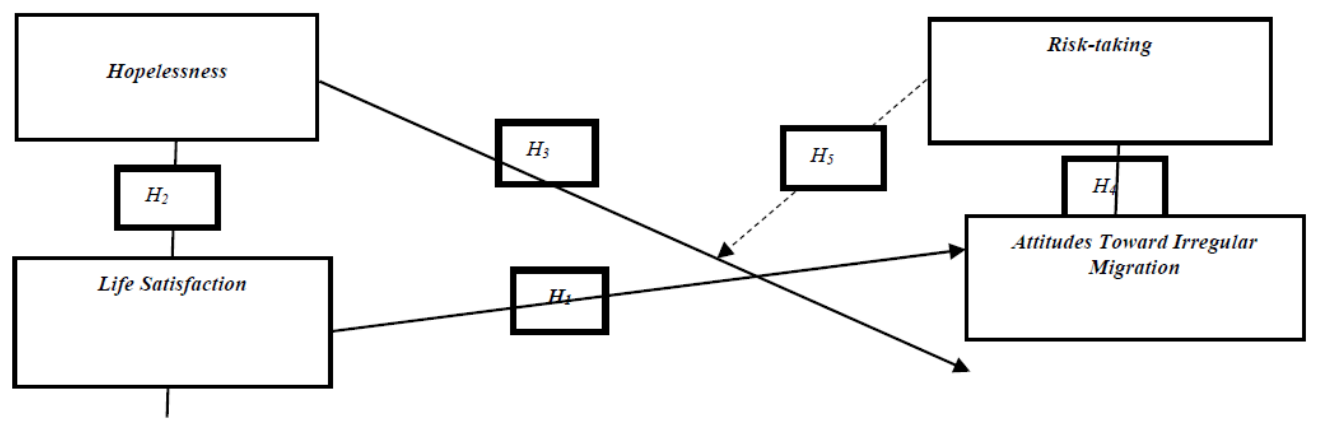
Figure 2.
Structural Model with t-statistics.
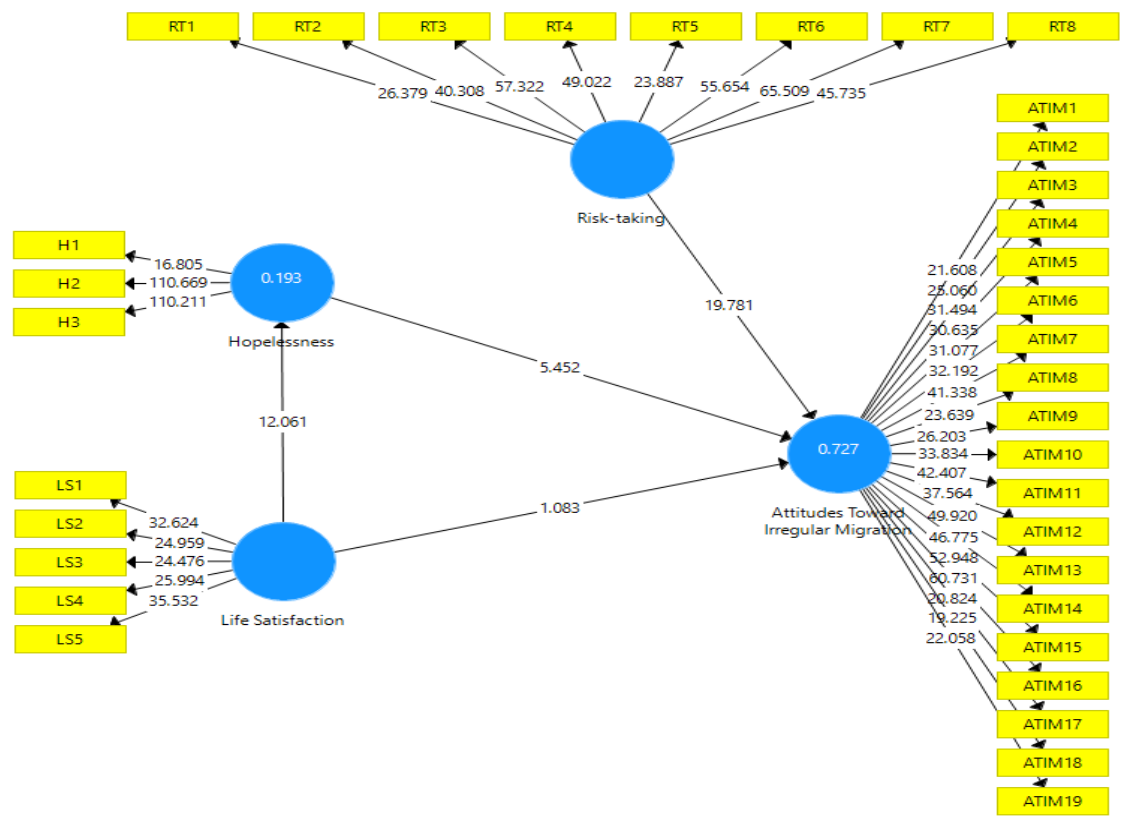
Figure 3.
Structural model with risk-taking as a moderator.
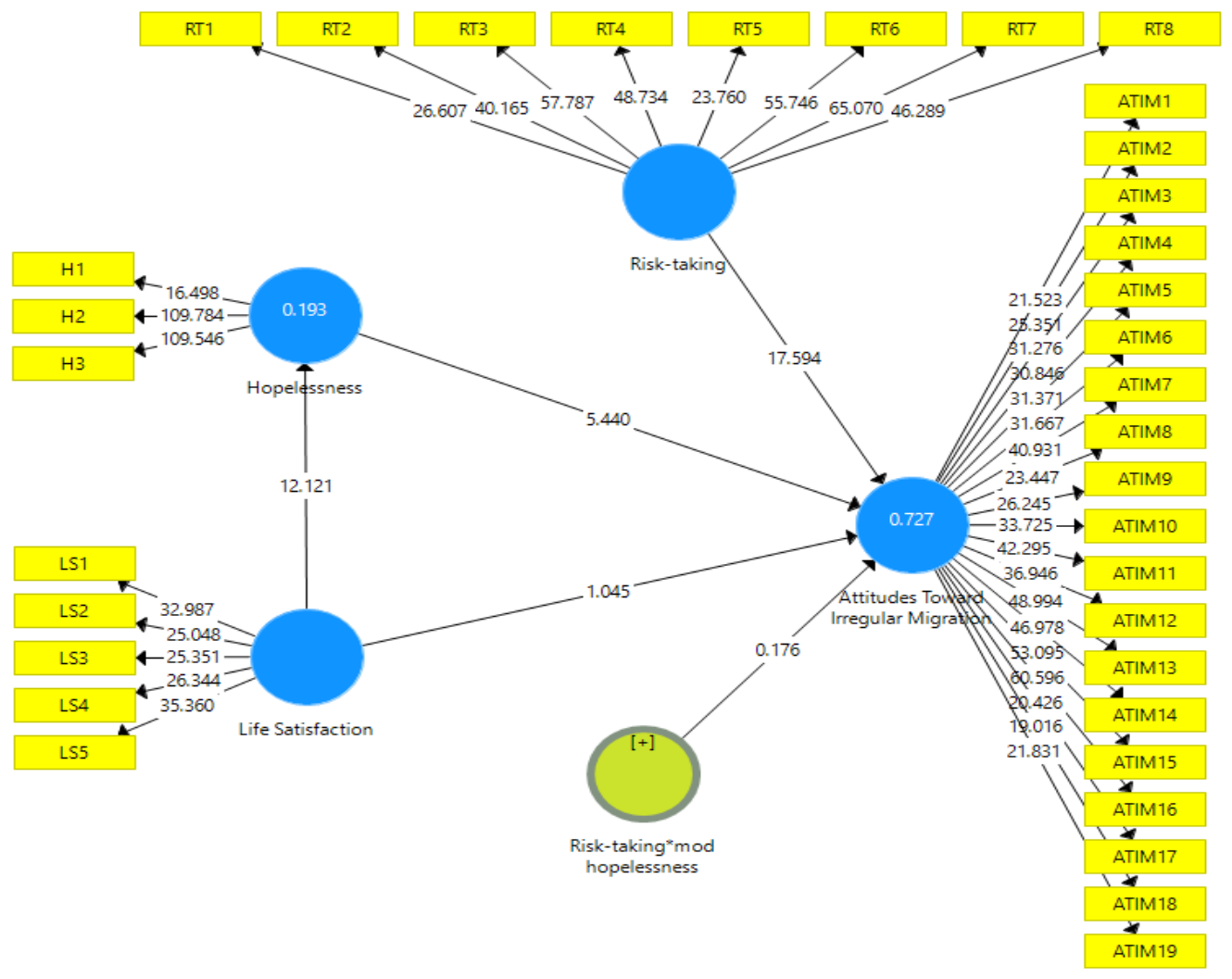

Table 1.
Sociodemographic characteristics of participants (n = 564).
| Variables | N | % | |
|---|---|---|---|
| Type of University | Federal University | 332 | 58.8 |
| State University | 155 | 27.5 | |
| Private University | 77 | 13.7 | |
| Gender | Males | 296 | 52.5 |
| Females | 268 | 47.5 | |
| Age Group | Below 20 years | 122 | 21.6 |
| 20 – 30 years | 341 | 60.5 | |
| Above 30 years | 101 | 17.9 | |
| Marital Status | Single | 474 | 84 |
| Married | 55 | 9.8 | |
| Divorced | 21 | 3.7 | |
| Others | 14 | 2.5 | |
| Religion | Muslims | 228 | 40.43 |
| Christians | 285 | 50.53 | |
| Traditional Worshippers | 51 | 9.04 | |
| Field of Study | Science | 71 | 12.5 |
| Engineering | 54 | 9.6 | |
| Health Sciences | 99 | 17.6 | |
| Arts and Humanity | 132 | 23.4 | |
| Social Sciences | 149 | 26.4 | |
| Agriculture | 15 | 2.7 | |
| Education | 44 | 7.8 | |
Source: Authors’ computation (2026).
Table 2.
Constructs Reliability and Validity Values.
| Construct | Cronbach's Alpha | rho_A | Composite Reliability | AVE Values | Effect Size | |
|---|---|---|---|---|---|---|
| R2 | f2 | |||||
| Attitudes Toward Irregular Migration | 0.883 | 0.85 | 0.814 | 0.515 | 0.727 | - |
| Hopelessness | 0.788 | 0.881 | 0.873 | 0.701 | 0.193 | 0.066 |
| Life Satisfaction | 0.712 | 0.821 | 0.687 | 0.537 | - | 0.24 |
| Risk-taking | 0.903 | 0.918 | 0.92 | 0.593 | - | 0.666 |
Source: Authors’ computation (2026).
Table 3.
Hypotheses testing with statistical values (t-test and β values).
| Hypotheses | Original Sample (O) (Beta value) |
Sample Mean (M) | Standard Deviation (STDEV) | T Statistics (|O/STDEV|) | P Values | Remark |
|---|---|---|---|---|---|---|
| Paths Analyses - Direct Effects | ||||||
| Life Satisfaction → Attitudes Toward Irregular Migration | -0.039 | -0.04 | 0.036 | 3.189 | 0.001 | Supported |
| Life Satisfaction → Hopelessness | -0.44 | -0.447 | 0.064 | 12.144 | 0.001 | Supported |
| Hopelessness → Attitudes Toward Irregular Migration | 0.168 | 0.169 | 0.03 | 5.592 | 0.001 | Supported |
| Risk-Taking → Attitudes Toward Irregular Migration | 0.711 | 0.711 | 0.034 | 20.865 | 0.001 | Supported |
| Moderating Roles - Indirect Effect | ||||||
| Risk-Taking*mod Hopelessness → Attitudes Toward Irregular Migration | 0.004 | 0.01 | 0.025 | 2.157 | 0.001 | Supported |
Source: Authors’ statistical computation (2026). Note: P-value < 0.05* significant.
Disclaimer/Publisher’s Note: The statements, opinions and data contained in all publications are solely those of the individual author(s) and contributor(s) and not of MDPI and/or the editor(s). MDPI and/or the editor(s) disclaim responsibility for any injury to people or property resulting from any ideas, methods, instructions or products referred to in the content. |
© 2026 by the authors. Licensee MDPI, Basel, Switzerland. This article is an open access article distributed under the terms and conditions of the Creative Commons Attribution (CC BY) license.
Copyright: This open access article is published under a Creative Commons CC BY 4.0 license, which permit the free download, distribution, and reuse, provided that the author and preprint are cited in any reuse.