

Submitted:
16 August 2026
Posted:
17 August 2026
You are already at the latest version
Abstract
The expansion of remote work has raised new questions about how residents evaluate housing locations, particularly as daily workplace proximity may become less central for some workers and space, amenities, and lifestyle considerations may become more salient. This study examines residential location priorities and scenario-based area-type preferences across preferred future work arrangements in the Roanoke Metropolitan Statistical Area, Virginia, a mid-sized U.S. metropolitan region. Data were drawn from a 2023 cross-sectional online survey of verified adult residents, producing an eligible analytical base of 636 respondents. Thirteen residential-priority items were analyzed using complete cases (n = 620). Exploratory factor analysis, supported by parallel analysis and interpreted using polychoric correlations with oblique rotation, identified two related exploratory priority orientations: a broad space/stability/community-related orientation and an accessibility/amenity-related orientation. Kruskal–Wallis tests with Benjamini–Hochberg correction showed statistically significant but generally modest differences across preferred work-arrangement groups, with the largest differences observed for proximity to the central business district and rural/suburban lifestyle preference. Scenario-based area rankings were analyzed among respondents with valid paired rankings under both in-person and remote-work conditions (n = 579). Under the remote-work scenario, suburban areas were ranked significantly more favorably, while city center/CBD locations were ranked significantly less favorably; changes in urban and rural rankings were not statistically significant after correction. These findings indicate that preferred future work arrangements and hypothetical remote-work scenarios are associated with differentiated stated residential preferences in this mid-sized metropolitan sample. The results should be interpreted as stated preference paĴerns and scenario-based ranking differences, not as evidence of actual relocation behavior, realized housing-market demand, verified access to remote-capable employment, or causal effects of remote work on urban spatial change.
Keywords:
remote work
; preferred work arrangement
; residential location priorities
; area-type preference
; suburban preference
; exploratory factor analysis
; mid-sized metropolitan area
; Roanoke MSA
; housing preference
; urban planning
1. Introduction
The expansion of remote work following the COVID-19 pandemic has introduced new questions about the relationship between employment arrangements and residential location preferences [1]. Post-pandemic urban research has also emphasized that future city planning should account for resilience, health, psychological well-being, and changing patterns of daily urban life [2]. In conventional residential location theory, households evaluate trade-offs among workplace accessibility, housing cost, dwelling space, neighborhood characteristics, and access to services and amenities [3,4]. Daily commuting requirements traditionally strengthen the value of proximity to employment centers, particularly for workers whose jobs require regular physical attendance. As remote and flexible work arrangements become more feasible for some occupations, the frequency and importance of commuting may decline, potentially changing how individuals evaluate different residential attributes and area types [5,6].
Recent research suggests that remote work is associated with shifts in housing demand and residential preference, although the scale and direction of these shifts vary by context. Studies have reported increased housing demand outside central urban locations, greater interest in larger dwellings and lower-density environments, and changing valuations of accessibility, dwelling space, and neighborhood amenities following the pandemic [6,7]. Other research indicates that teleworking may enable longer residential distances from workplaces or greater willingness to consider suburban and peripheral locations. However, evidence of a general urban exodus remains mixed [8]. Residential responses to remote work appear to depend on housing affordability, remaining commuting requirements, household circumstances, access to amenities, and the characteristics of specific metropolitan regions [6,7].
A central issue in this emerging literature is that residential location preference involves more than a simple choice between urban and suburban living. Individuals may value safety, affordability, housing space, neighborhood community, access to amenities, proximity to workplaces, and proximity to central business districts in different combinations [9]. Remote-work flexibility may alter the relative salience of these priorities: reduced commuting requirements may decrease the importance of workplace proximity, while increasing the perceived value of residential space or lower-density living environments [10]. At the same time, remote-work preference does not necessarily imply rejection of urban amenities or city lifestyles. Individuals may value urban access, social infrastructure, and metropolitan services while also preferring flexible work arrangements or considering suburban residential options [6,11].
Despite growing evidence on remote work and housing-market change, three gaps remain relevant. First, much of the existing research focuses on large metropolitan regions, national datasets, or aggregate market outcomes, leaving mid-sized metropolitan contexts comparatively less examined [11,12]. Mid-sized regions may offer different combinations of housing affordability, accessibility, urban amenities, suburban space, and commuting conditions than either large metropolitan cores or rural areas. Second, existing studies frequently analyze relocation, housing prices, or broad urban–suburban shifts without examining the underlying residential location priorities associated with preferred work arrangements [10]. Third, relatively limited attention has been given to within-respondent comparisons of area-type preferences under explicitly different work scenarios. Examining how the same respondents rank city-center, urban, suburban, and rural locations under in-person and remote-work conditions provides a direct way to identify scenario-based preference changes without claiming that actual relocation has occurred.
This study addresses these gaps using survey data from the Roanoke Metropolitan Statistical Area (MSA), Virginia, a mid-sized metropolitan region comprising Roanoke City, Salem City, Botetourt County, Craig County, Franklin County, and Roanoke County [13]. The region provides an appropriate setting for examining residential priorities in relation to flexible work because it contains urban, suburban, and lower-density environments within one metropolitan context. Rather than examining observed migration or realized housing-market outcomes, this study focuses on stated residential priorities and scenario-based area-type preferences.
The study draws on a cross-sectional online survey administered between April and August 2023. After excluding incomplete responses, duplicate responses, respondents younger than 18 years, cases without verifiable adult eligibility, and cases without verified residence in the Roanoke MSA, the final eligible analytical base comprised 636 adult respondents. Two connected but conceptually distinct forms of residential preference are examined. First, respondents rated the importance of thirteen residential location factors, including workplace proximity, central business district proximity, amenities, schools, road access, public transportation, community, safety, affordability, city lifestyle, rural/suburban lifestyle, spacious living, and career-growth opportunity. Second, respondents ranked four residential area types—city center/CBD, urban area, suburban area, and rural area—under two hypothetical conditions: working in-person and working remotely.
The analysis is organized around three research questions:
RQ1. What underlying dimensions characterize respondents’ stated residential location priorities in the Roanoke MSA?
RQ2. Do residential location priorities differ across respondents’ preferred future work arrangements?
RQ3. Do respondents rank residential area types differently under in-person and remote-work scenarios?
To address these questions, the study first examines the structure of the thirteen residential location-priority items using exploratory factor analysis with parallel analysis to guide factor retention [14,15]. It then evaluates differences in residential priority ratings across preferred future work-arrangement groups using non-parametric comparisons with adjustment for multiple testing [16]. Finally, it assesses within-respondent differences in area-type rankings between in-person and remote-work scenarios using paired non-parametric tests.
Throughout the manuscript, preferred future work arrangement is treated as a stated preference rather than as respondents’ actual current work arrangement or verified occupational access to remote work. Similarly, the scenario-based ranking questions are interpreted as hypothetical stated evaluations of area types under contrasting work-location assumptions. The study therefore does not claim to measure actual relocation, realized housing-market demand, or causal spatial effects of remote work.
This study contributes to research on remote work and residential preference in three ways. First, it provides evidence from a mid-sized U.S. metropolitan region, extending a literature that has frequently emphasized larger metropolitan contexts or aggregate housing-market outcomes. Second, it examines the residential priorities associated with preferred future work arrangements rather than assuming that remote-work preference automatically translates into relocation behavior. Third, it uses paired scenario-based rankings to identify whether residential area preferences change when work-location conditions change, while avoiding causal claims about actual residential movement.
The findings are relevant to planning and housing-policy discussions because they help identify which residential attributes and area types may become more salient under flexible-work conditions. However, the study does not measure actual relocation, realized housing-market demand, land-use change, or long-term migration. Its contribution is therefore to document stated residential preference patterns and scenario-based differences that may inform future longitudinal and spatial research on work arrangements and metropolitan development.
The contribution of the study is not that remote-work assumptions may increase suburban preference, which is a plausible expectation in the U.S. context. Rather, the study contributes by examining the structure, magnitude, and limits of that expectation in a mid-sized metropolitan sample. Specifically, it tests whether remote-work assumptions produce a generalized shift toward lower-density residential environments or a more focused reordering among city-center, urban, suburban, and rural area-type preferences. The results distinguish suburban preference from rural preference, city center/CBD preference from broader urban preference, and raw residential-priority ratings from within-respondent relative-priority emphasis.
2. Literature Review
2.1. Residential Location Choice and the Changing Role of Workplace Accessibility
Residential location choice has traditionally been understood as a balance among accessibility, housing cost, dwelling space, neighborhood attributes, and household needs. Classical urban economic models, particularly the Alonso–Mills–Muth framework, describe households as trading off the cost and inconvenience of commuting against the benefits of obtaining more affordable or spacious housing farther from employment centers [8,17]. In this framework, proximity to employment remains a central determinant of residential location because regular commuting creates a meaningful cost of distance. The Rosen–Roback spatial equilibrium model further emphasizes that residential choices reflect broader trade-offs among wages, housing costs, local amenities, and overall quality of life across locations [18,19].
Remote and flexible work arrangements modify, but do not eliminate, these traditional relationships. When workers are required to travel to a workplace less frequently, proximity to employment centers may become less important relative to housing space, affordability, neighborhood quality, environmental amenities, or access to local services. Theoretical models of telework and urban form suggest that reduced commuting frequency can flatten traditional distance-based residential trade-offs and potentially expand the geographic range of feasible residential locations [8,17]. However, the implications of remote work depend on several conditions, including the number of days worked remotely, the suitability of a dwelling for home-based work, local housing costs, urban amenities, and the continuing need for periodic physical access to employment locations [20,21].
Accordingly, remote work should not be treated as producing an automatic shift away from urban locations. Individuals may value proximity to employment less under remote conditions while continuing to value cultural amenities, social networks, services, transportation options, and urban lifestyles [6,21]. Residential location preference under flexible work arrangements is therefore better understood as a possible reordering of location priorities rather than a simple substitution of suburban or rural living for urban living.
2.2. Remote Work, Housing Demand, and Area-Type Preferences
A growing body of empirical research has examined whether the expansion of remote work has been associated with changes in housing demand and residential location preferences. Evidence from multiple countries indicates that the pandemic period was associated with increased interest in larger dwellings, lower-density environments, and residential locations outside the most central urban areas [20]. Remote work expanded substantially after the COVID-19 pandemic in the United States. According to U.S. Census Bureau American Community Survey evidence, the share of U.S. workers usually working from home increased from 5.7% in 2019 to 17.9% in 2021 [22] and remained at 13.8% in 2023, more than twice the pre-pandemic level [23]. This shift has raised new questions about how residents evaluate housing locations, particularly as daily workplace proximity may become less central for some workers and space, amenities, and lifestyle considerations may become more salient.
Studies in individual metropolitan and national contexts reveal similar but not identical patterns. Research in Germany found that workers in occupations compatible with remote work increasingly matched to jobs located farther from their residences, particularly when taking new jobs. In Stockholm, workers in remote-compatible occupations became more likely to make counter-urban residential moves while retaining city-center employment, although the absolute magnitude of these changes remained limited [24]. Research in Poland reported substantial willingness among office workers with remote-work options to consider suburban relocation, with proximity to nature, improved living conditions, and lower living expenses identified as important considerations. In the Lisbon Metropolitan Area, greater willingness to telework was associated with suburban residential preference and longer commuting distances [25].
Other studies, however, caution against interpreting remote work as generating a uniform movement from urban cores to suburban or rural locations. Research in the Greater Toronto Area identified short-term residential dissatisfaction and increased interest in lower-density environments during the pandemic, but the long-term persistence of these preferences was uncertain [26]. Evidence from France suggested increasing residential search activity outside existing catchment areas as the pandemic progressed [27], while findings from Melbourne emphasized residential choices balancing affordability with accessibility and livability rather than a simple movement toward low-density peripheral areas [28]. Research in Germany similarly found limited evidence of a generalized new preference for rural living, although respondents dissatisfied with small dwellings demonstrated greater willingness to move [29,30].
Taken together, this literature suggests that remote work may be associated with changing area-type preferences, particularly when commuting requirements are reduced. Nevertheless, the direction of preference change remains context-dependent. City centers, established urban neighborhoods, suburban areas, and rural locations each offer different combinations of accessibility, housing space, affordability, amenities, and lifestyle characteristics. Therefore, analyzing how respondents evaluate these area types under explicitly different work scenarios can provide more focused evidence than broad assumptions about suburbanization or urban decline.
2.3. Residential Location Priorities Under Flexible Work Conditions
Residential location decisions are influenced by multiple attributes rather than by area type alone. Traditional residential preference research identifies factors such as workplace accessibility, transportation connections, affordability, schools, neighborhood safety, proximity to amenities, social connections, and dwelling characteristics as important components of household location decisions [4]. Research in Sweden, for example, found that residential proximity preferences reflect both practical daily needs—such as access to workplaces, schools, and grocery stores—and social relationships, including proximity to relatives and close friends [31].
Remote work may alter the importance assigned to these residential attributes. When commuting becomes less frequent, workplace accessibility may decline in relative importance, while dwelling space and the quality of the immediate residential environment may become more salient. Related evidence on home-work environments highlights that the quality of the residential setting becomes particularly important during crises and remote-work conditions, reinforcing the need to consider dwelling space, comfort, and environmental quality as part of residential-location preference [32].
Evidence from Tokyo indicates that teleworking was associated with reduced valuation of urban proximity and increased valuation of larger homes, producing flatter gradients in relation to both distance and dwelling size [33]. Research in Cracow reported increased interest in dedicated workspaces and expanded dwelling floor area following pandemic-era experiences of working from home [34]. Related studies have found associations between frequent work-from-home preferences and larger dwellings or specific housing characteristics, although such patterns vary across contexts [10].
At the neighborhood scale, flexible work may increase the relevance of amenities and environmental quality because individuals spend more time near their residences. Research has linked remote-work conditions with greater interest in green environments, spacious living conditions, neighborhood quality, and convenient access to everyday services [27]. However, remote-work preference need not reduce demand for urban amenities. Workers may prefer flexible employment arrangements while continuing to value restaurants, retail, cultural facilities, social interaction, professional networks, and transportation accessibility [35]. This distinction is important because it implies that residential priorities under flexible work conditions may include both lower-density housing preferences and continued demand for selected urban advantages.
For this reason, examining multiple residential location priorities together is analytically valuable. Rather than assuming that individuals choose locations solely according to commuting cost or dwelling size, a multidimensional approach can identify broader patterns in how respondents value residential space, community, safety, affordability, accessibility, amenities, and lifestyle attributes. Such analysis is particularly relevant in mid-sized metropolitan regions, where urban, suburban, and lower-density residential environments may be accessible within relatively short distances.
2.4. Preferred Work Arrangements Versus Actual Work Arrangements
An important conceptual distinction in this field concerns the difference between actual work arrangements and preferred future work arrangements. Actual work arrangements reflect current employer policies, occupational constraints, workplace requirements, and labor-market opportunities. Preferred work arrangements instead capture respondents’ desired level of flexibility, which may not be feasible in their present employment circumstances.
Much prior research has examined actual telework participation, occupational teleworkability, or residential moves among workers whose jobs permit remote work [36,37,38]. These approaches are valuable for documenting realized behavior and market outcomes. However, analyses based only on actual work arrangement may underestimate unmet demand for flexibility among individuals whose current jobs require in-person attendance but who would prefer remote or hybrid arrangements [28]. Conversely, stated preference does not establish that respondents can access remote-compatible employment or will relocate if remote work becomes available [39,40].
For studies concerned with future residential preferences, preferred work arrangement can therefore serve as a meaningful attitudinal condition, provided it is interpreted cautiously [40]. Differences in residential location priorities across preferred work-arrangement groups may indicate how individuals imagine suitable living environments under desired employment flexibility [41]. They should not be treated as evidence that respondents are currently working remotely, that relocation will occur, or that observed housing-market changes are caused by these preferences.
The present study adopts this distinction explicitly. It examines whether residential location priorities differ across respondents’ preferred future work arrangements, while separately using hypothetical in-person and remote-work scenarios to evaluate changes in area-type rankings within the same respondents. This design allows the study to analyze preferences associated with flexible work without conflating desired arrangements with current employment behavior.
2.5. Scenario-Based Area-Type Preference Analysis
Scenario-based preference questions offer a useful method for examining how work-location conditions may affect residential evaluations. Instead of asking only where respondents currently live or whether they intend to relocate, a paired scenario design can ask the same individual to evaluate residential alternatives under contrasting assumptions. In the present context, comparing area-type rankings under an in-person work scenario and a remote-work scenario helps isolate whether respondents’ evaluations of city-center, urban, suburban, and rural locations vary when commuting requirements change.
Prior research has employed stated-preference methods, discrete-choice approaches, and latent preference models to examine residential location decisions and heterogeneity in accessibility preferences [42,43]. Such approaches demonstrate the value of evaluating residential attributes or location alternatives under specified conditions rather than relying only on observed residential outcomes. Scenario-based analysis is particularly useful when studying remote work because the long-term relationship between work flexibility and residential movement remains unsettled and may take years to observe through actual relocation data [44].
Nevertheless, scenario-based results must be interpreted within their limits. A respondent who ranks suburban living more favorably under a remote-work scenario has expressed a preference under a hypothetical condition; this does not establish an intention to relocate, the financial ability to move, the availability of suitable housing, or the likelihood of future remote-work access. Scenario-based rankings therefore provide evidence of how work-location assumptions shape stated area preferences, rather than evidence of realized spatial change [45].
2.6. Mid-Sized Metropolitan Contexts and the Research Gap
Most prominent research on remote work, housing demand, and residential change has focused on national samples, large metropolitan regions, or housing-market outcomes [45]. Mid-sized metropolitan areas remain important contexts for investigation because they may combine urban amenities, suburban housing opportunities, lower-density surroundings, and shorter travel distances in ways that differ from very large metropolitan regions [46]. Such settings may permit residents to consider multiple area types without the same cost and commuting conditions present in larger metropolitan cores.
The Roanoke Metropolitan Statistical Area provides a relevant setting for this analysis because it includes two independent cities together with surrounding counties containing suburban and lower-density environments. This spatial configuration makes it possible to examine whether respondents evaluate residential location factors and area types differently under changing assumptions about work location. However, evidence from this context should be interpreted as specific to the analytical sample and should not automatically be generalized to all residents of the region or to other metropolitan areas.
Three specific gaps guide the present study. First, limited evidence addresses the residential location priorities associated with preferred future work arrangements in mid-sized metropolitan contexts [45]. Second, existing discussions of remote work and residential change often emphasize aggregate migration or market outcomes without examining how individuals prioritize residential attributes such as workplace accessibility, central business district proximity, safety, affordability, amenities, lifestyle, and dwelling space [42,46]. Third, few studies compare within-respondent rankings of area types under clearly specified in-person and remote-work scenarios in order to identify how work-location assumptions relate to stated residential preference [43].
This study addresses these gaps by analyzing thirteen residential location-priority items and paired scenario-based rankings of four residential area types among verified adult residents of the Roanoke MSA. The analysis investigates the exploratory structure of residential priorities, differences across preferred future work arrangements, and within-respondent changes in area-type rankings under in-person and remote-work scenarios. By focusing on stated priorities and scenario-based preferences rather than observed relocation, the study provides a cautious and empirically grounded contribution to discussions of flexible work and metropolitan residential choice.
The theoretical framing of this study is primarily situated in the U.S. metropolitan context. Although the literature review draws on international studies where relevant, the empirical interpretation is not intended to imply universal applicability across national urban systems. U.S. metropolitan regions differ from many Western European and other international contexts in terms of land-use regulation, automobile dependence, suburbanization history, downtown employment structure, housing-market dynamics, and transit provision. Accordingly, the findings are interpreted as evidence from a mid-sized U.S. metropolitan sample rather than as a general model of remote-work residential preferences across all urban systems.
3. Materials and Methods
3.1. Study Design and Setting
This study employed a cross-sectional online survey design to examine residential location priorities and scenario-based residential area preferences in relation to preferred future work arrangements among adult respondents residing in the Roanoke Metropolitan Statistical Area (MSA), Virginia. The survey was administered through the QuestionPro platform between April and August 2023. The survey was distributed online and relied on a nonprobability recruitment strategy rather than probability-based household sampling. Eligibility was restricted to adult respondents with verifiable residence in one of the six jurisdictions of the Roanoke MSA. Because recruitment occurred online, the analytical sample may overrepresent individuals who were reachable through digital survey channels and who had interest in work-from-home, housing-location, or residential-preference topics. No post-stratification weights were applied; therefore, the sample is interpreted as an exploratory analytical sample rather than as a population-representative sample of all Roanoke MSA residents.
The Roanoke MSA is located in southwestern Virginia and comprises the independent cities of Roanoke and Salem and the counties of Botetourt, Craig, Franklin, and Roanoke, according to the official metropolitan statistical area delineation issued by the U.S. Office of Management and Budget [47]. The region had a population of approximately 315,000 residents according to official U.S. Census Bureau data [13]. The Roanoke MSA provides a relevant mid-sized metropolitan setting for examining residential preferences because it contains city-center, urban, suburban, and lower-density residential environments within the same metropolitan context.
Roanoke was selected as an analytically useful mid-sized metropolitan case rather than as a statistically representative U.S. metropolitan region. The region combines a central urban core with suburban and lower-density surroundings within a relatively compact metropolitan setting, making it suitable for examining whether residents differentiate among city-center, urban, suburban, and rural residential area types under alternative work-location assumptions. Roanoke is also relevant to flexible-work residential research because it combines a compact metropolitan structure, a central urban core, and surrounding suburban and lower-density environments within a mid-sized regional context [48]. These characteristics make it a useful exploratory case for examining how flexible-work preferences may relate to residential evaluations in a mid-sized U.S. metropolitan context.
Tract-level ACS five-year estimates for 2015–2019 provide a pre-pandemic baseline for work-from-home prevalence in the Roanoke region. Based on the “worked from home” category, pre-pandemic work-from-home prevalence was spatially uneven and relatively limited at the tract level [49]. The present study therefore does not assume that remote work has already reshaped the Roanoke MSA. Instead, it examines how respondents evaluated residential priorities and area types under preferred and hypothetical work-location conditions.
The study focuses on stated residential priorities and hypothetical scenario-based area preferences. It does not measure actual relocation, realized housing-market demand, land-use change, or observed migration attributable to remote work. The location and constituent jurisdictions of the Roanoke Metropolitan Statistical Area are shown in Figure 1.
The spatial structure of the Roanoke MSA also affects interpretation. The region contains a small urbanized core embedded within extensive lower-density and rural surroundings. This configuration makes it useful for distinguishing perceived suburban preference from rural preference, but it also means that the findings should not be generalized automatically to larger, denser, more transit-oriented, or more economically specialized metropolitan regions. In Roanoke, urban, suburban, and rural environments may be more proximate and more gradually differentiated than in larger metropolitan areas.
3.2. Survey Instrument
The survey instrument collected information on respondents’ sociodemographic characteristics, residential location, current and preferred future work arrangements, scenario-based residential area rankings, residential location-priority ratings, and selected occupational and work-from-home experience variables.
The present manuscript analyzes three principal components of the survey: preferred future work arrangement, residential location priorities, and scenario-based residential area rankings.
3.2.1. Preferred Future Work Arrangement
Preferred future work arrangement was measured by asking respondents, regardless of their current working style, which future work style they preferred. Four response categories were provided:
- Fully in-person, working at a physical office or location;
- Hybrid, dominated by in-person work, with the majority of work time spent at a physical office or location and some remote work;
- Hybrid, dominated by remote work, with the majority of work time spent working from home or another location and some in-person work; and
- Fully remote, working from home or another location.
This variable was used to examine whether residential location-priority ratings differed across respondents who preferred different future work arrangements. It represents stated preference rather than respondents’ actual employment arrangement or verified access to remote work.
3.2.2. Residential Location Priorities
Respondents rated the importance of thirteen factors when deciding their residential location. Each factor was evaluated on a five-point Likert scale ranging from 1 (not at all important) to 5 (extremely important). The thirteen residential location-priority items are summarized in Table 1. These items were used for descriptive analysis, exploratory factor analysis, and comparison of residential priorities across preferred future work-arrangement groups.
The survey item “proximity to amenities” was presented as a general residential-priority item and was not disaggregated into specific amenity types. Respondents may therefore have interpreted amenities differently, including everyday services, retail and dining, cultural facilities, recreational opportunities, or natural amenities. The item is retained as a broad perceived-amenity measure, but the analysis does not distinguish among natural, cultural, commercial, recreational, or service-related amenities.
3.2.3. Scenario-Based Residential Area Rankings
Respondents completed two scenario-based residential area-ranking questions. The first question asked: “If you work in-person (commute to work), how would you rank your preferred living area within Roanoke Metropolitan Area, considering your income and affordability? (1 is the most preferred)?” The second question asked: “If you work remotely, how would you rank your preferred areas to live within Roanoke Metropolitan Area, considering your income and affordability? (1 is the most preferred)?”
In both questions, respondents ranked the same four area-type labels: City Center (Central Business District), Urban area, Suburban area, and Rural Area. A rank of 1 represented the most preferred area type. The reference to income and affordability in both questions was intended to encourage respondents to consider residential preferences under plausible personal constraints rather than as unconstrained ideal choices.
The scenario-ranking questions requested a rank order from 1 to 4 and did not include an explicit equal-preference or tied-ranking option. For analysis, only strict rankings in which each rank from 1 to 4 was used exactly once were treated as valid; responses with missing or repeated ranks were excluded from the paired scenario-ranking subset.
The survey did not provide formal GIS-based definitions, administrative boundary maps, or written descriptions of the four area-type categories. Therefore, the categories are interpreted as respondent-understood area-type labels rather than precisely bounded spatial zones. This distinction is important in a mid-sized metropolitan region such as the Roanoke MSA, where perceived boundaries between city-center, urban, suburban, and rural environments may be blurred.
The term “City Center (Central Business District)” was used as a respondent-facing area-type label rather than as a claim that employment, services, or community facilities in the Roanoke MSA are concentrated exclusively in the CBD. Given the decentralization of employment and services in many U.S. metropolitan areas, the CBD category is interpreted as a perceived central-city residential area type rather than as a direct measure of regional employment accessibility.
The CBD label should also be interpreted cautiously. The survey did not measure the spatial distribution of jobs, services, or community facilities in the Roanoke MSA. Therefore, lower or higher preference for City Center/CBD locations should not be interpreted as direct evidence of preference for employment accessibility alone. Respondents may have associated CBD locations with centrality, density, housing type, parking conditions, cultural activity, perceived cost, or urban lifestyle.
The scenario-ranking results are therefore interpreted as hypothetical stated area-type preferences under income and affordability considerations, not as observed relocation decisions, future migration intentions, or preferences for formally delineated geographic zones.
3.3. Sample Construction and Data Preparation
The original QuestionPro export contained 1,122 survey records. A sequential screening procedure was used to construct the eligible analytical base. First, incomplete survey responses were removed, leaving 908 completed records. Second, duplicate records identified in the QuestionPro export were excluded, leaving 732 completed, nonduplicate responses. Third, responses from individuals younger than 18 years and responses without verifiable adult eligibility were excluded, leaving 653 verified adult respondents. Finally, respondents without verified residence in one of the six Roanoke MSA jurisdictions were excluded. The final eligible analytical base comprised 636 completed, nonduplicate responses from verified adult residents of the Roanoke MSA. The sequential construction of the eligible analytical base is summarized in Table 2.
The thirteen residential location-priority items were extracted for respondents in the final eligible analytical base. Complete responses across all thirteen location-priority items were available for 620 respondents. All 620 of these respondents also provided valid preferred future work-arrangement responses and were retained for analyses comparing residential priorities across preferred work-arrangement groups.
The scenario-based area-ranking fields were reconstructed directly from the original raw QuestionPro export and matched to the eligible analytical base using response identifiers. This procedure was used to ensure that each of the four area-type rankings in each scenario was preserved as a separate field. A ranking response was considered valid only when the respondent assigned each rank from 1 to 4 exactly once across the four area types within the relevant scenario. Under this rule, valid strict rankings were available for 591 respondents in the in-person work scenario and 593 respondents in the remote-work scenario. Valid rankings under both scenarios were available for 579 respondents, forming the analytical subset for paired scenario comparisons. Analysis-specific valid sample sizes are summarized in Table 3.
Item-level missing data were not imputed. Analyses were conducted using valid cases for the variables required in each analysis. Because the sample was obtained through an online nonprobability survey, findings are interpreted as patterns within the analytical sample rather than as population estimates for all residents or workers in the Roanoke MSA [50].
3.4. Variables and Analytical Coding
3.4.1. Preferred Future Work Arrangement
Preferred future work arrangement was treated as a four-category grouping variable in the residential-priority comparison analyses: fully in-person, hybrid dominated by in-person work, hybrid dominated by remote work, and fully remote. The variable was not interpreted as respondents’ actual current work arrangement.
3.4.2. Residential Location-Priority Items
Each of the thirteen residential location-priority items was coded from 1 to 5, with higher scores indicating greater perceived importance in residential location decisions. Because these items are ordinal Likert-scale responses, descriptive analyses report means, standard deviations, and medians, while inferential group comparisons were conducted using non-parametric tests.
3.4.3. Scenario-Based Area-Type Rankings
For each scenario, residential area types were coded according to their assigned ranks, with 1 indicating the most preferred area and 4 indicating the least preferred area. Lower numerical ranks therefore indicate greater preference.
For paired scenario analysis, the rank assigned to each area type under the remote-work scenario was compared with the rank assigned to the same area type under the in-person work scenario. A lower rank under the remote-work scenario indicates that the area type became more preferred when respondents considered remote work; a higher rank indicates that the area type became less preferred.
3.5. Statistical Analysis
All analyses were conducted using Python statistical libraries. Statistical tests were two-sided, and statistical significance was evaluated at an alpha level of 0.05. Because the study is cross-sectional and based on a nonprobability survey, statistical results are interpreted as associations and scenario-based preference differences rather than as causal effects.
3.5.1. Descriptive Analysis
Frequency distributions were calculated for the preferred future work-arrangement groups. For the thirteen residential location-priority items, means, standard deviations, and medians were calculated using the complete-case residential-priority subset (n = 620). For the scenario-based area rankings, descriptive mean and median ranks were calculated separately under the in-person and remote-work scenarios. Because rank 1 indicates greatest preference, lower mean ranks indicate more favorable area-type evaluations. In addition, a respondent-level overall residential-priority rating was calculated as the mean of the thirteen location-priority items for each complete-case respondent. Group-specific means for this summary measure were examined descriptively to assess whether differences in individual priority-item ratings could partly reflect variation in respondents’ overall tendency to assign higher importance ratings across the residential-priority scale.
3.5.2. Exploratory Factor Analysis of Residential Location Priorities
Exploratory factor analysis was used to investigate the underlying structure of the thirteen residential location-priority items. The analysis was conducted using respondents with valid responses to all thirteen items (n = 620).
An initial exploratory factor-retention assessment was conducted using a Spearman correlation matrix, given the ordinal nature of the five-point residential-priority items. Suitability for factor analysis was evaluated using the Kaiser–Meyer–Olkin (KMO) measure of sampling adequacy and Bartlett’s test of sphericity [51]. Factors were extracted using principal axis factoring, and the number of factors retained was determined through parallel analysis using 1,000 randomly generated comparison datasets [52]. A factor was retained when its observed eigenvalue exceeded the corresponding 95th-percentile eigenvalue generated from the random datasets [15].
Because the residential-priority items were ordinal and the retained dimensions could plausibly be correlated, the retained factor structure was principally interpreted using a polychoric correlation matrix and oblique quartimin rotation [53]. Absolute pattern loadings of approximately 0.40 or greater were emphasized when identifying the items most strongly associated with each factor, and the correlation between retained factors was examined to inform interpretation.
As a robustness check, the Spearman-correlation-based principal axis factoring solution with varimax rotation was also retained for comparison in the Supplementary Materials. Because the analysis was exploratory, the resulting factors were interpreted as organizing dimensions of stated residential priorities rather than as validated measurement scales.
3.5.3. Residential Location Priorities Across Preferred Work Arrangements
Differences in residential location-priority ratings across the four preferred future work-arrangement groups were assessed using Kruskal–Wallis H tests [54]. Separate tests were conducted for each of the thirteen priority items. The Kruskal–Wallis test was selected because the dependent variables were ordinal Likert-scale ratings and the work-arrangement grouping variable contained four independent categories.
For each residential-priority item, epsilon-squared was calculated as an effect-size estimate for the Kruskal–Wallis comparison [55]. Group-specific descriptive means were reported to assist interpretation of the observed direction of differences; however, statistically significant omnibus tests were not interpreted as establishing differences between every possible pair of preferred work-arrangement groups.
Because thirteen related residential-priority omnibus tests were conducted, Benjamini–Hochberg false discovery rate correction was applied across this thirteen-test primary family at q = 0.05 [16]. For items remaining statistically significant after correction in the primary omnibus analysis, Dunn pairwise post-hoc comparisons were conducted across the six possible preferred work-arrangement group contrasts per item [56]. Benjamini–Hochberg false discovery rate correction was applied across the complete family of pairwise follow-up comparisons generated by the omnibus-significant items.
Inspection of the item-rating patterns further indicated that respondents preferring fully remote work tended to assign higher importance ratings across the thirteen residential-priority items overall. To distinguish absolute item-rating differences from differences in relative priority emphasis, an additional sensitivity analysis was conducted. Each respondent’s thirteen priority-item ratings were mean-centered around that respondent’s own average rating across all thirteen items [57]. The resulting centered values indicate whether an item received relatively greater or lower emphasis within that respondent’s overall residential-priority profile.
Kruskal–Wallis tests were repeated for the thirteen centered priority values, with Benjamini–Hochberg false discovery rate correction applied across this thirteen-test sensitivity family. For centered items remaining significant after correction, Dunn pairwise post-hoc comparisons were conducted across the six possible preferred work-arrangement group contrasts per item, with Benjamini–Hochberg correction applied across the complete family of centered follow-up comparisons. The centered analysis was treated as a robustness check intended to qualify interpretation of the primary raw-rating results rather than as a replacement for the primary analysis.
3.5.4. Paired Scenario-Based Area-Type Ranking Comparisons
To examine whether respondents evaluated residential area types differently under in-person and remote-work conditions, paired comparisons were conducted among respondents providing valid strict rankings in both scenarios (n = 579).
For each of the four area types—city center/CBD, urban area, suburban area, and rural area—the rank assigned under the remote-work scenario was compared with the rank assigned under the in-person scenario using the Wilcoxon signed-rank test [58]. This non-parametric paired test was selected because the rankings are ordinal and the two scenario responses were provided by the same respondents.
For interpretation, the analysis reports mean and median ranks in each scenario as well as the number of respondents whose ranking of each area type improved, worsened, or remained unchanged under the remote-work scenario. Because lower ranks represent greater preference, a statistically significant decrease in rank indicates that an area type was evaluated more favorably under remote-work conditions.
Four paired scenario tests were conducted, one for each area type. Benjamini–Hochberg false discovery rate correction was applied across this four-test family at q = 0.05 [16]. Adjusted p-values are reported in the main-text results table, while complete unadjusted and adjusted test outputs are retained in the supplementary analytical materials. The paired scenario-ranking analysis was interpreted as the study’s principal test of whether stated area-type evaluations changed under alternative work-location assumptions, independent of respondents’ actual residential relocation behavior.
3.6. Analytical Scope and Reporting Strategy
The analytical strategy was structured around three components corresponding to the study research questions. First, exploratory factor analysis was used to examine the underlying structure of the thirteen residential location-priority items, with factor retention guided by parallel analysis and the retained solution principally interpreted using polychoric correlations and oblique rotation; an alternative Spearman/varimax solution was retained as a supplementary robustness comparison. Second, differences in residential priority ratings across preferred future work-arrangement groups were assessed using primary omnibus comparisons followed by post-hoc tests and a centered sensitivity analysis of relative priorities. Third, paired scenario-based area-ranking analyses were used to evaluate whether stated preferences for city-center/CBD, urban, suburban, and rural residential locations differed under in-person and remote-work assumptions.
The manuscript interprets preferred future work arrangement as a stated preference rather than as an indicator of actual remote-work participation or verified access to remote-capable employment. Similarly, changes in scenario-based area rankings are interpreted as stated preference differences under hypothetical work-location conditions rather than as evidence of actual suburban migration, residential relocation, housing-market change, or causal spatial effects of remote work.
3.7. Ethical Considerations
This study used de-identified survey data collected as part of the first author’s doctoral research at Virginia Tech. The study protocol was reviewed by the Virginia Tech Institutional Review Board and was determined to be exempt under IRB protocol #22-120. Participation in the survey was voluntary, and respondents were informed that they could withdraw from the survey at any time. Survey responses were treated confidentially and reported only in aggregate form. No personally identifiable information was included in the analysis. Responses from individuals younger than 18 years, cases without verifiable adult eligibility, and cases without verified residence in the Roanoke Metropolitan Statistical Area were excluded from the final analytical sample.
4. Results
4.1. Analytical Samples and Residential Location-Priority Ratings
The final eligible analytical base comprised 636 verified adult residents of the Roanoke Metropolitan Statistical Area. Complete responses across all thirteen residential location-priority items were available for 620 respondents. These 620 respondents also provided valid preferred future work-arrangement responses and were included in analyses comparing residential priorities across preferred work-arrangement groups.
Within the residential-priority analytical subset, 402 respondents preferred fully remote work, 78 preferred hybrid work dominated by in-person attendance, 73 preferred hybrid work dominated by remote work, and 67 preferred fully in-person work. This distribution indicates substantial imbalance across preferred work-arrangement groups. Respondents preferring fully remote work represented 64.8% of the complete-case residential-priority subset, whereas the fully in-person, hybrid in-person-dominated, and hybrid remote-dominated groups represented 10.8%, 12.6%, and 11.8%, respectively. Accordingly, between-group comparisons were interpreted cautiously, with attention to effect sizes and robustness checks rather than statistical significance alone.
Across the full set of residential location-priority items, safety received the highest mean importance rating (M = 4.105, SD = 0.941), followed by career-growth opportunity (M = 3.892, SD = 0.937), affordability (M = 3.845, SD = 0.916), city lifestyle (M = 3.835, SD = 0.957), and spacious living (M = 3.829, SD = 0.920). Proximity to the central business district received the lowest mean importance rating among the thirteen items (M = 3.534, SD = 1.160), although its median remained 4.0. Descriptive ratings for the thirteen residential location-priority items are presented in Table 4.
4.2. Exploratory Structure of Residential Location Priorities
Exploratory factor analysis was conducted using complete responses to all thirteen residential location-priority items (n = 620). The item set demonstrated adequate suitability for exploratory factor analysis. In the initial factor-retention analysis, the Kaiser–Meyer–Olkin measure of sampling adequacy was 0.825, and Bartlett’s test of sphericity was statistically significant, χ2(78) = 1063.734, p < 0.001, indicating sufficient shared association among the residential-priority items.
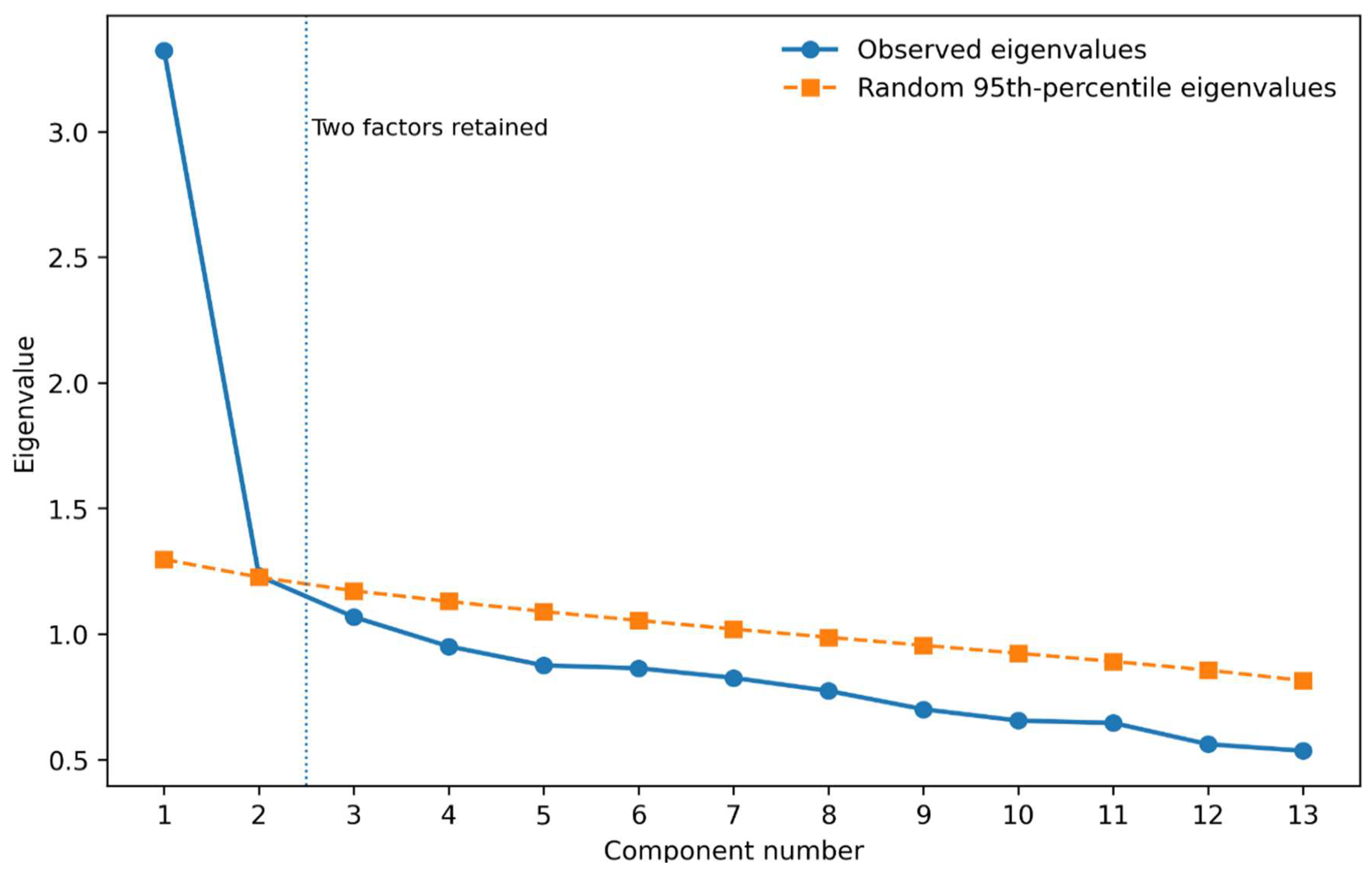
Parallel analysis using 1,000 randomly generated comparison datasets supported retention of two factors. The first observed eigenvalue was 3.3218, exceeding the corresponding 95th-percentile random eigenvalue of 1.3033. The second observed eigenvalue was 1.2300, slightly exceeding the corresponding 95th-percentile random eigenvalue of 1.2244. The third and fourth observed eigenvalues did not exceed their corresponding random thresholds. Accordingly, a two-factor exploratory solution was retained. Although the parallel analysis supported retention of two factors, the second observed eigenvalue only slightly exceeded the corresponding random 95th-percentile eigenvalue. Therefore, the two-factor solution was interpreted cautiously as an exploratory structure rather than as strong evidence of stable latent constructs.

Table 5.
Parallel-Analysis Decision for Residential Location-Priority Items.
| Component | Observed Eigenvalue | Random 95th-Percentile Eigenvalue | Retained |
| 1 | 3.3218 | 1.3033 | Yes |
| 2 | 1.2300 | 1.2244 | Yes |
| 3 | 1.0670 | 1.1726 | No |
| 4 | 0.9501 | 1.1272 | No |
Note: Factor retention was based on parallel analysis of the initial Spearman-correlation-based exploratory solution. Because the residential-priority items were ordinal and the retained factors were expected to be related, the retained two-factor structure was subsequently interpreted using polychoric correlations and oblique rotation.
Figure 2.
Parallel-analysis comparison of observed eigenvalues and 95th-percentile random eigenvalues for the thirteen residential location-priority items (complete-case n = 620). Two factors were retained because only the first two observed eigenvalues exceeded the corresponding random 95th-percentile eigenvalues.
Figure 2.
Parallel-analysis comparison of observed eigenvalues and 95th-percentile random eigenvalues for the thirteen residential location-priority items (complete-case n = 620). Two factors were retained because only the first two observed eigenvalues exceeded the corresponding random 95th-percentile eigenvalues.
The retained two-factor structure was estimated using a polychoric correlation matrix and oblique quartimin rotation. Factor 1 was most strongly associated with spacious living, community, rural/suburban lifestyle, career-growth opportunity, safety, affordability, public transportation, and road access. Because this factor combined several heterogeneous residential considerations, it was interpreted cautiously as a Broad Space/Stability/Community-Related Orientation rather than as a narrowly defined validated scale. Factor 2 was most strongly associated with amenities, proximity to the workplace, and proximity to the CBD, and was interpreted as an Accessibility/Amenity-Related Orientation.
The two factors were moderately correlated (Φ = 0.510), indicating that respondents who placed greater importance on broad space, stability, and community-related considerations also tended, to some extent, to value accessibility and amenity-related considerations. The factors should therefore be understood as related exploratory residential-priority orientations rather than as independent or validated measurement dimensions.
Table 6.
Polychoric/Oblique Two-Factor Exploratory Solution for Residential Location Priorities.
| Residential Location-Priority Item |
Factor 1: Broad Space/Stability/ Community-Related Orientation |
Factor 2: Accessibility/Amenity- Related Orientation |
Communality |
| Spacious Living | 0.669 | -0.132 | 0.375 |
| Community | 0.572 | -0.003 | 0.325 |
| Rural/Suburban Lifestyle | 0.550 | 0.001 | 0.303 |
| Career-Growth Opportunity | 0.513 | 0.109 | 0.333 |
| Safety | 0.498 | 0.007 | 0.251 |
| Affordability | 0.453 | 0.094 | 0.257 |
| Road Access | 0.449 | 0.130 | 0.278 |
| Public Transportation | 0.449 | 0.101 | 0.258 |
| City Lifestyle | 0.350 | 0.124 | 0.183 |
| Schools | 0.238 | 0.253 | 0.182 |
| Amenities | -0.040 | 0.720 | 0.491 |
| Proximity to Workplace | 0.069 | 0.571 | 0.372 |
| Proximity to CBD | 0.114 | 0.463 | 0.281 |
Note: Factor extraction was conducted using principal axis factoring based on a polychoric correlation matrix, followed by oblique quartimin rotation. Values shown are pattern loadings. Bold values indicate absolute pattern loadings of approximately 0.40 or greater. The factor solution is exploratory, includes some modest communalities, and is not interpreted as a validated measurement scale.
The modest communalities for some items further indicate that the thirteen-item set should not be understood as exhaustively capturing all relevant aspects of residential location preference.
As a robustness check, the retained two-factor interpretation was compared with the Spearman-correlation-based solution using varimax rotation. The Spearman/varimax solution produced a substantively similar distinction between residential space/stability/community considerations and accessibility/amenity considerations; the complete robustness loading table is provided in Supplementary Table S1. Internal-consistency reliability coefficients were not used to validate these factors because the factors were retained for exploratory interpretation only and were not used as composite measurement scales in the subsequent analyses.
4.3. Residential Location Priorities Across Preferred Future Work Arrangements
Kruskal–Wallis tests examined whether each of the thirteen residential location-priority ratings differed across respondents preferring fully in-person, hybrid dominated by in-person work, hybrid dominated by remote work, or fully remote future arrangements. Benjamini–Hochberg false discovery rate correction was applied across the thirteen-item test family.
Following adjustment, eleven of the thirteen residential-priority items differed significantly across preferred work-arrangement groups. The largest differences were observed for proximity to the CBD, H = 59.408, ε2 = 0.092, BH-adjusted p < 0.001, and rural/suburban lifestyle, H = 54.075, ε2 = 0.083, BH-adjusted p < 0.001. These effects were larger than those observed for the remaining residential-priority items, although they remained modest in magnitude. Across the eleven statistically significant raw-rating comparisons, epsilon-squared values ranged from 0.009 to 0.092, indicating that the detected group differences were generally small to modest in magnitude despite statistical significance.
Respondents preferring fully remote work reported higher raw mean ratings for several residential-priority items, including proximity to the CBD (M = 3.786) and rural/suburban lifestyle (M = 3.891). Post-hoc Dunn comparisons with Benjamini–Hochberg correction across 66 follow-up comparisons confirmed that the fully remote preference group rated proximity to the CBD significantly higher than both hybrid-preference groups and rated rural/suburban lifestyle significantly higher than both hybrid-preference groups. However, the fully remote preference group also reported a higher overall mean rating across all thirteen residential-priority items (M = 3.916) than the fully in-person (M = 3.602), hybrid in-person-dominated (M = 3.503), and hybrid remote-dominated groups (M = 3.466). Therefore, raw item differences were interpreted alongside an additional sensitivity analysis examining respondents’ relative priority profiles after accounting for general rating elevation. Complete pairwise post-hoc results for the primary raw-rating analyses are provided in Supplementary Table S2.
Other statistically significant differences were identified for schools, proximity to the workplace, amenities, public transportation, city lifestyle, spacious living, road access, community, and affordability. Safety and career-growth opportunity did not differ significantly across preferred work-arrangement groups after correction for multiple comparisons.
Table 7.
Residential Location-Priority Ratings Across Preferred Future Work Arrangements.
| Residential Priority Item | FIP Mean | HIP Mean | HR Mean | FR Mean | H | ε2 | BH p | Significant? |
| Proximity to CBD | 3.433 | 2.962 | 2.849 | 3.786 | 59.408 | 0.092 | < 0.001 | Yes |
|
Rural/Suburban Lifestyle |
3.552 | 3.231 | 3.014 | 3.891 | 54.075 | 0.083 | < 0.001 | Yes |
| Schools | 3.776 | 3.269 | 3.219 | 3.861 | 29.641 | 0.043 | < 0.001 | Yes |
| Public Transportation | 3.537 | 3.500 | 3.260 | 3.925 | 27.346 | 0.040 | < 0.001 | Yes |
| Spacious Living | 3.642 | 3.590 | 3.438 | 3.978 | 26.917 | 0.039 | < 0.001 | Yes |
| Amenities | 3.254 | 3.538 | 3.616 | 3.848 | 26.787 | 0.039 | < 0.001 | Yes |
| City Lifestyle | 3.597 | 3.397 | 3.699 | 3.985 | 26.606 | 0.038 | < 0.001 | Yes |
| Proximity to Workplace | 3.149 | 3.564 | 3.548 | 3.851 | 26.416 | 0.038 | < 0.001 | Yes |
| Road Access | 3.731 | 3.423 | 3.370 | 3.866 | 21.291 | 0.030 | < 0.001 | Yes |
| Community | 3.657 | 3.603 | 3.479 | 3.888 | 11.225 | 0.013 | 0.014 | Yes |
| Affordability | 3.597 | 3.833 | 3.603 | 3.933 | 8.357 | 0.009 | 0.046 | Yes |
| Safety | 4.119 | 3.846 | 4.123 | 4.149 | 5.429 | 0.004 | 0.155 | No |
| Career-Growth Opportunity | 3.776 | 3.782 | 3.836 | 3.943 | 1.437 | 0.000 | 0.697 | No |
Note: FIP = fully in-person; HIP = hybrid dominated by in-person work; HR = hybrid dominated by remote work; FR = fully remote. Valid n = 620 for all comparisons. Preferred future work-arrangement group sizes were: FIP, n = 67; HIP, n = 78; HR, n = 73; FR, n = 402. P-values were adjusted across the thirteen residential-priority comparisons using the Benjamini–Hochberg false discovery rate procedure. Significant omnibus tests indicate that at least one preferred work-arrangement group differs from another; they do not establish significant differences between every group pair. The “Significant?” column indicates whether the omnibus Kruskal–Wallis comparison remained significant after Benjamini–Hochberg correction.
4.4. Sensitivity Analysis of Relative Residential Priorities
Because respondents preferring fully remote work reported higher mean importance ratings across the complete set of thirteen residential-priority items, an additional sensitivity analysis was conducted to examine relative priority emphasis after accounting for each respondent’s overall rating level. Each residential-priority rating was mean-centered around the respondent’s own average rating across the thirteen items, and the group comparisons were repeated using the centered values.
Following Benjamini–Hochberg correction across the thirteen centered comparisons, seven residential-priority items remained significantly different across preferred future work-arrangement groups: proximity to the CBD, H = 20.878, ε2 = 0.029, BH-adjusted p = 0.001; safety, H = 19.936, ε2 = 0.027, BH-adjusted p = 0.001; amenities, H = 15.952, ε2 = 0.021, BH-adjusted p = 0.004; career-growth opportunity, H = 15.777, ε2 = 0.021, BH-adjusted p = 0.004; proximity to the workplace, H = 14.896, ε2 = 0.019, BH-adjusted p = 0.005; rural/suburban lifestyle, H = 14.006, ε2 = 0.018, BH-adjusted p = 0.006; and affordability, H = 11.652, ε2 = 0.014, BH-adjusted p = 0.016. Complete centered omnibus results are reported in Supplementary Table S3.
Dunn post-hoc comparisons with Benjamini–Hochberg correction across the centered follow-up family indicated that respondents preferring fully remote work placed relatively greater emphasis on proximity to the CBD than respondents in both hybrid-preference groups. They also placed relatively greater emphasis on rural/suburban lifestyle than respondents preferring hybrid work dominated by remote attendance. In contrast, raw differences observed for spacious living and city lifestyle did not remain statistically significant after within-respondent centering. The centered sensitivity effect sizes were also modest, with epsilon-squared values ranging from 0.014 to 0.029. Therefore, the centered results were interpreted as evidence of relative-priority patterning rather than as large between-group separation.
These sensitivity findings indicate that the two strongest primary differences—proximity to the CBD and rural/suburban lifestyle—were not attributable solely to a general tendency among fully remote-preferring respondents to assign higher ratings across all residential-priority items. Nevertheless, the reduction from eleven significant raw-rating comparisons to seven significant centered comparisons indicates that interpretation should focus on the most robust relative-priority patterns rather than on every difference observed in the primary raw-rating analysis. Detailed centered post-hoc results are provided in Supplementary Table S4.
4.5. Scenario-Based Residential Area Rankings Under In-Person and Remote-Work Conditions
Scenario-based residential area rankings were analyzed among the 579 respondents who provided valid strict rankings of all four area types under both the in-person and remote-work scenarios. In both scenarios, lower ranks indicate greater residential preference.
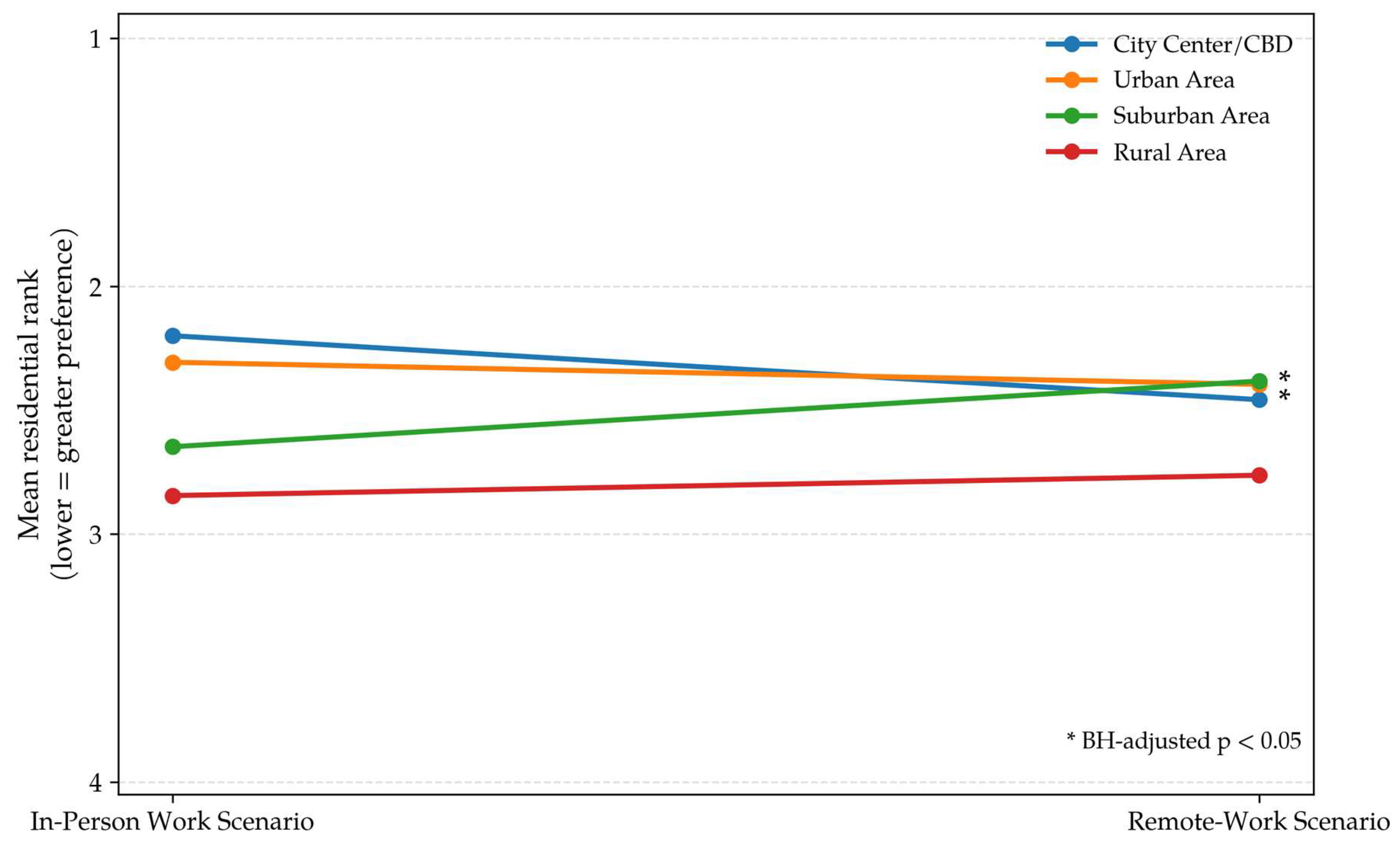
Under the in-person work scenario, city center/CBD locations received the most favorable average ranking (M = 2.200), followed by urban areas (M = 2.307), suburban areas (M = 2.648), and rural areas (M = 2.845). Under the remote-work scenario, suburban areas received the most favorable average ranking (M = 2.383), followed closely by urban areas (M = 2.396), city center/CBD locations (M = 2.458), and rural areas (M = 2.763).
Wilcoxon signed-rank tests with Benjamini–Hochberg correction across the four area-type comparisons indicated statistically significant scenario-based changes for city center/CBD and suburban area rankings. Complete unadjusted and adjusted paired-test results are provided in Supplementary Table S5. City center/CBD locations were ranked significantly less favorably under the remote-work scenario than under the in-person scenario, with mean rank increasing from 2.200 to 2.458, BH-adjusted p < 0.001. In contrast, suburban areas were ranked significantly more favorably under the remote-work scenario, with mean rank decreasing from 2.648 to 2.383, BH-adjusted p < 0.001.
Urban areas showed a small decline in favorability under the remote-work scenario, while rural areas showed a small improvement; however, neither change remained statistically significant after correction for multiple comparisons.
Table 8.
Paired Scenario-Based Residential Area Rankings Under In-Person and Remote-Work Conditions.
Table 8.
Paired Scenario-Based Residential Area Rankings Under In-Person and Remote-Work Conditions.
| Area Type | IP Mean | RW Mean | Improved n | Worsened n | Unchanged n | W | BH p | Result |
|
City Center/ CBD |
2.200 | 2.458 | 167 | 239 | 173 | 31,601 | < 0.001 | Less |
| Urban Area | 2.307 | 2.396 | 190 | 214 | 175 | 37,594.5 | 0.198 | NS |
| Suburban Area | 2.648 | 2.383 | 250 | 156 | 173 | 31,441.5 | < 0.001 | More |
| Rural Area | 2.845 | 2.763 | 203 | 170 | 206 | 32,334.5 | 0.214 | NS |
Note: Paired valid n = 579. IP = in-person work scenario; RW = remote-work scenario; W = Wilcoxon signed-rank statistic; NS = not significant after Benjamini–Hochberg correction. Lower numerical ranks indicate greater residential preference. “Improved n” indicates that an area type received a lower, more favorable rank under the remote-work scenario than under the in-person scenario. “Worsened n” indicates that an area type received a higher, less favorable rank under the remote-work scenario. P-values were adjusted across the four paired area-type comparisons using the Benjamini–Hochberg false discovery rate procedure. Less = less favorable under the remote-work scenario; More = more favorable under the remote-work scenario; NS = not significant.
Figure 3.
Mean residential area-type rankings under in-person and remote-work scenarios among respondents with valid paired rankings (n = 579). Lower rank values indicate greater preference. City center/CBD locations were ranked less favorably under the remote-work scenario, whereas suburban areas were ranked more favorably.
Figure 3.
Mean residential area-type rankings under in-person and remote-work scenarios among respondents with valid paired rankings (n = 579). Lower rank values indicate greater preference. City center/CBD locations were ranked less favorably under the remote-work scenario, whereas suburban areas were ranked more favorably.
Because the area-type categories were presented as survey labels rather than as formally defined geographic zones, the scenario-ranking differences should be interpreted as changes in respondents’ stated evaluations of perceived area types under income and affordability considerations, not as preferences for administratively or GIS-defined locations.
The scenario-based ranking results identify a focused difference in respondents’ stated residential evaluations under alternative work-location assumptions: city center/CBD locations were ranked less favorably, while suburban areas were ranked more favorably, under the remote-work scenario than under the in-person scenario. These results do not demonstrate actual relocation, future migration behavior, or realized housing-market demand; rather, they indicate how stated area-type preferences differed under the hypothetical work-location scenarios presented in the survey.
4.6. Summary of Findings
The analyses produced five principal findings. First, safety, career-growth opportunity, affordability, city lifestyle, and spacious living were among the most highly rated residential location priorities in the analytical sample. Second, exploratory factor analysis provisionally supported a two-factor residential-priority structure, interpreted as related broad space/stability/community-related and accessibility/amenity-related orientations. Third, primary raw-rating analyses indicated statistically significant differences across preferred future work-arrangement groups for eleven of the thirteen residential-priority items, with the largest differences concerning proximity to the CBD and rural/suburban lifestyle. Fourth, respondents preferring fully remote work rated residential priorities more highly overall; however, a within-respondent centered sensitivity analysis confirmed that seven relative-priority differences remained statistically significant, including proximity to the CBD and rural/suburban lifestyle. Fifth, paired scenario analysis showed that suburban areas were ranked more favorably and city center/CBD locations less favorably under the remote-work scenario, while changes in urban and rural area rankings were not statistically significant after multiple-comparison correction.
Together, these findings indicate that preferred future work arrangements and hypothetical remote-work conditions are associated with differentiated residential evaluations in this mid-sized metropolitan sample. Most notably, the paired scenario analysis identified a focused difference in stated preference under alternative work-location assumptions: suburban areas were ranked more favorably and city center/CBD locations less favorably under the remote-work scenario. The priority-item analyses indicated that flexible-work preferences cannot be reduced to a simple urban-versus-suburban contrast. The findings describe stated priorities and scenario-based preferences and should not be interpreted as evidence of realized residential relocation or causal effects of remote work on metropolitan spatial change.
5. Discussion
The findings should be interpreted within the stated-preference design of the study. The preferred work-arrangement variable captures respondents’ desired future work arrangement, not their actual current work arrangement or verified access to remote-capable employment. Likewise, the paired scenario-based rankings identify how respondents evaluated area types under hypothetical in-person and remote-work assumptions. They do not demonstrate actual relocation decisions, observed migration, or realized housing-market behavior.
This study examined residential location priorities and scenario-based area-type preferences in relation to preferred future work arrangements among verified adult respondents in the Roanoke Metropolitan Statistical Area, Virginia. The analysis produced three central insights. First, respondents’ residential location priorities were organized around two related exploratory orientations: a broad space/stability/community-related orientation and an accessibility/amenity-related orientation. Second, residential priority ratings differed across preferred future work-arrangement groups, but these differences required careful interpretation because respondents preferring fully remote work tended to rate residential priorities more highly overall. After accounting for this general rating elevation, several relative-priority differences remained, including proximity to the CBD and rural/suburban lifestyle. Third, in the paired scenario analysis, respondents ranked suburban areas more favorably and city center/CBD locations less favorably under the remote-work scenario than under the in-person scenario. Taken together, these findings suggest that flexible-work preferences are associated with differentiated residential evaluations, but not with a simple or uniform rejection of urban access in favor of lower-density living.
5.1. Residential Priorities Reflect Related Space/Community and Accessibility/Amenities Orientations
The exploratory factor analysis identified two related residential-priority orientations. The first, interpreted cautiously as a Broad Space/Stability/Community-Related Orientation, was most strongly associated with spacious living, community, rural/suburban lifestyle, career-growth opportunity, safety, affordability, road access, and public transportation. This factor should be understood as a broad organizing dimension rather than as a narrow or validated construct because it combines several heterogeneous residential considerations. The second, interpreted as an Accessibility/Amenity-Related Orientation, was most strongly associated with amenities, proximity to the workplace, and proximity to the CBD. The evidence for the second factor was interpretable but more modest, as the second observed eigenvalue only slightly exceeded the parallel-analysis retention threshold.
This finding is consistent with the broader residential location literature, which frames household location decisions as multidimensional evaluations involving accessibility, affordability, dwelling space, neighborhood quality, services, and lifestyle considerations [4]. Under flexible-work conditions, the relative importance of daily workplace proximity may change, but this does not eliminate the continuing relevance of amenities, transportation access, central locations, or social and professional opportunities. Prior studies have similarly indicated that remote-work conditions may increase the value attached to residential space and local environmental quality while preserving interest in selected urban services and consumption amenities [5,59].
The results therefore suggest that residential preference under flexible work should not be interpreted through a simple central-city-versus-suburban opposition. A respondent may value spacious living or a rural/suburban lifestyle while also valuing access to a CBD, amenities, transportation, or career opportunities. This interpretation is particularly relevant in a mid-sized metropolitan context such as Roanoke, where different area types may be geographically closer and more practically accessible than in larger metropolitan regions. In such settings, lower-density residential preference and metropolitan accessibility may function as complementary rather than mutually exclusive considerations.
The exploratory nature of the factor analysis remains important. Although the two-factor interpretation was substantively stable under the polychoric/oblique analytical specification, the analysis does not establish validated residential-preference scales. Instead, it provides an empirically grounded organizational framework for interpreting the priority-item findings and for guiding future studies with broader and more targeted residential-preference instruments.
5.2. Preferred Future Work Arrangements Are Associated with Residential Priorities, but Not in a Uniform Direction
The primary raw-rating analyses found statistically significant differences across preferred future work-arrangement groups for eleven of the thirteen residential-priority items. The largest differences concerned proximity to the CBD and rural/suburban lifestyle. At first glance, this combination may appear contradictory: respondents preferring fully remote work reported relatively high importance ratings for both a lower-density lifestyle attribute and CBD proximity.
The additional sensitivity analysis clarifies this pattern. Respondents preferring fully remote work assigned higher importance ratings across the residential-priority scale overall. Thus, part of the raw difference across items reflects a more general tendency among this group to place greater importance on residential-location considerations rather than a uniquely strong preference for every individual attribute. After centering each respondent’s ratings around their own overall residential-priority mean, seven items remained significantly different across preferred work-arrangement groups, including proximity to the CBD and rural/suburban lifestyle. These two patterns therefore remained evident even after accounting for general rating elevation [60].
The persistence of both CBD proximity and rural/suburban lifestyle in the centered analysis is substantively important. It indicates that fully remote-preferring respondents in this sample cannot be characterized simply as rejecting centrality or seeking only peripheral living. Instead, their preference profiles may reflect an interest in residential flexibility: the value of lower-density living or additional space can coexist with the value of access to central services, amenities, professional opportunities, or social destinations. This finding reinforces the argument in the literature that remote work does not necessarily produce a uniform movement away from urban environments, and that residential responses depend on the combination of housing, accessibility, amenity, and lifestyle conditions available within a particular metropolitan area [6,8,59].
The result also highlights why preferred future work arrangement should not be treated as equivalent to current work modality. The fully remote preference group represents respondents who would like to work remotely in the future, not necessarily respondents currently able to work remotely or currently able to relocate in response to that preference. Their residential ratings may therefore capture desired flexibility, expectations about future work, or broader lifestyle orientation rather than immediate housing-market behavior [1]. Consequently, the identified differences should be interpreted as associations between stated work preferences and stated residential priorities, not as evidence that remote workers have already reorganized their residential locations. The magnitude of these associations should also be interpreted cautiously. Although several omnibus comparisons were statistically significant after correction for multiple comparisons, the effect sizes were small to modest. The centered sensitivity analysis further narrowed the interpretation by showing that not all raw-rating differences reflected robust relative-priority differences. Therefore, the results are best understood as modest but patterned associations between preferred future work arrangements and stated residential priorities, rather than as evidence of strong segmentation among work-preference groups.
5.3. Remote-Work Scenarios Increase the Relative Attractiveness of Suburban Areas, but Not Rural Areas
The paired scenario-based ranking analysis provides the clearest applied finding of the study. Under the in-person work scenario, city center/CBD locations received the most favorable mean ranking, followed by urban, suburban, and rural areas. Under the remote-work scenario, suburban areas received the most favorable mean ranking, while city center/CBD locations became significantly less favored. Specifically, suburban mean rank improved from 2.648 under the in-person scenario to 2.383 under the remote-work scenario, while city center/CBD mean rank worsened from 2.200 to 2.458. Urban and rural area rankings did not change significantly after correction for multiple comparisons. Although these scenario-based differences were statistically significant for city center/CBD and suburban rankings, the absolute changes in mean rank were modest. The results are therefore interpreted as focused changes in stated area-type evaluation rather than as evidence of a large-scale residential preference reversal.
This pattern is consistent with research suggesting that reduced commuting requirements can increase the appeal of locations offering greater residential space, lower density, or potentially more favorable housing conditions without requiring a complete withdrawal from metropolitan accessibility [6]. Importantly, however, the present results do not support a broader conclusion that remote work generates a generalized preference for rural living. Rural areas showed only a small, statistically non-significant improvement under the remote-work scenario. The principal scenario-based difference was therefore not a movement from urban locations to the most peripheral residential form; it was a focused improvement in suburban preference accompanied by declining preference for city center/CBD locations.
This distinction matters for planning interpretation. Suburban areas may offer a combination of attributes that becomes particularly attractive when regular commuting is no longer assumed: greater residential space, quieter environments, potential affordability advantages, and continued access to metropolitan services. Rural locations may offer some of these qualities but may also involve reduced service access, weaker transportation connectivity, fewer amenities, or longer distances to urban destinations [59]. The stability of rural rankings in this study suggests that the removal of daily commuting assumptions alone is insufficient to make rural living substantially more attractive for most respondents in the analytical sample.
Likewise, the absence of a statistically significant adjusted change for general urban-area rankings suggests that city center/CBD locations and broader urban neighborhoods should not be treated as equivalent. The remote-work scenario reduced preference for the most central location category, but it did not produce a statistically significant reduction in preference for urban areas more generally. Established urban neighborhoods may continue to offer attractive combinations of amenities, access, housing types, and residential character even when daily workplace proximity becomes less important [5].
The scenario-based findings are therefore more nuanced than a narrative of urban decline or widespread suburban migration. They indicate that alternative work-location assumptions can alter stated area-type evaluations, particularly by strengthening suburban preference relative to the CBD, while leaving urban and rural preferences comparatively stable.
5.4. Implications for Residential Location Theory and Flexible-Work Research
The findings contribute to residential location research by showing that flexible-work preferences may change the salience of residential considerations without eliminating the importance of accessibility. Classical residential location frameworks emphasize the balance between employment accessibility, commuting costs, housing affordability, dwelling space, and amenities [3,60]. Remote work may reduce the frequency with which employment accessibility is required, potentially expanding the range of acceptable residential locations. The paired scenario results are compatible with this reasoning because suburban areas became more favorable when respondents considered remote rather than in-person work conditions.
However, the priority-item findings suggest that this mechanism should not be interpreted as a straightforward decline in the value of metropolitan access. Proximity to the CBD remained a differentiated relative priority across preferred work-arrangement groups, and respondents preferring fully remote work did not uniformly deprioritize central-accessibility considerations. This pattern indicates that the meaning of accessibility may broaden under flexible work: access to a CBD may matter not only for commuting, but also for amenities, professional networks, services, cultural opportunities, or occasional work-related travel [21].
The study therefore contributes to an emerging view of remote-work residential preference as multidimensional and context-dependent. In a mid-sized metropolitan region, flexible-work preferences may support interest in suburban living without eliminating the value of urban access. This is consistent with research emphasizing that remote-work-related residential responses depend on metropolitan size, housing-market conditions, transportation systems, amenity distribution, household constraints, and the continuing frequency of workplace attendance [17,59].
A further contribution is methodological. By combining residential-priority ratings with paired scenario-based area rankings, the study distinguishes between two different forms of stated residential preference. Priority ratings reveal which residential considerations respondents regard as important, while paired scenario rankings reveal how the relative attractiveness of area types changes when the assumed work condition changes. The distinction is important because a respondent may value multiple residential qualities simultaneously while still ranking one area type more favorably under a particular employment scenario.
5.5. Planning and Housing Implications
The findings have several implications for planning and housing discussions in mid-sized metropolitan regions. First, the increase in suburban preference under the remote-work scenario suggests that suburban residential environments may become increasingly relevant in planning for flexible-work futures. This does not imply that widespread suburban relocation will occur; rather, it indicates that households considering remote-work opportunities may value suburban housing options more strongly when daily commuting constraints are reduced.
For local planners and housing providers, this finding raises questions about the quality and sustainability of suburban development. If suburban locations become more attractive under flexible-work assumptions, attention may be needed to housing diversity, broadband access, local services, access to open space, transportation choices, and the ability of suburban areas to accommodate daily activities without increasing automobile dependence or infrastructure burdens [61]. Planning responses should therefore avoid interpreting remote-work preference solely as demand for dispersed low-density expansion.
Second, the continuing relevance of accessibility and amenities suggests that central and urban areas retain important roles even under flexible-work conditions. Rather than assuming that remote work reduces the importance of downtowns, planners may consider how CBDs and urban neighborhoods can remain attractive as destinations for services, culture, professional interaction, social activity, and occasional employment-related visits [59]. The finding that city center/CBD areas became less preferred as residential locations under the remote-work scenario does not imply that central areas lose their functional or experiential value within the metropolitan region.
Third, the coexistence of suburban preference shifts and differentiated CBD-related priorities suggests that flexible-work planning should be metropolitan rather than narrowly place-specific. Residents may seek combinations of space, affordability, accessibility, amenities, and community rather than a single residential form. Mid-sized metropolitan planning strategies may therefore benefit from coordinating housing, mobility, digital infrastructure, and amenity access across central, urban, and suburban settings [5].
These implications must remain appropriately bounded. The study identifies stated preferences under survey conditions and does not measure housing supply, affordability constraints, actual moves, long-term commuting behavior, or employment-policy change. Planning responses should therefore treat the findings as evidence of potential residential demand patterns requiring further monitoring rather than as forecasts of realized metropolitan redistribution.
5.6. Limitations and Directions for Future Research
Several limitations should be considered when interpreting the findings. First, the study is based on a cross-sectional online nonprobability survey. Although respondents were screened to retain verified adult residents of the Roanoke MSA, the analytical sample should not be treated as representative of all residents or workers in the region. The sample was not designed to match the Roanoke MSA population by age, gender, income, education, employment sector, county of residence, or current work arrangement. Respondents with stronger interest in remote work, housing-location decisions, residential preferences, or online survey participation may be overrepresented. Because population weighting and additional balance checks were not feasible with the available data, the findings are interpreted as exploratory patterns within the analytical sample rather than as population estimates.
Second, the preferred work-arrangement groups were unbalanced, with a large majority of the complete-case residential-priority subset preferring fully remote work. This imbalance may increase the stability of descriptive estimates for the fully remote group while reducing precision for comparisons involving the smaller fully in-person and hybrid groups. Although non-parametric tests, multiple-comparison correction, effect-size reporting, and within-respondent centered sensitivity analysis were used to reduce interpretive risks, the unequal group structure remains a limitation. Replication with larger and more balanced samples would be needed to determine whether the observed priority patterns persist across work-preference groups.
Relatedly, the large share of respondents preferring fully remote work may partly reflect self-selection associated with the online survey distribution strategy and the survey topic. Individuals with stronger interest in work-from-home arrangements, residential flexibility, housing-location decisions, or future relocation possibilities may have been more likely to participate. This self-selection may have contributed to the imbalance across preferred work-arrangement groups and limits the ability to generalize subtle differences among the smaller fully in-person and hybrid-preference groups. Therefore, comparisons involving these minority groups should be interpreted as exploratory within-sample patterns rather than as stable estimates of differences among all Roanoke MSA residents or workers.
Third, the scenario-based residential rankings are hypothetical. A respondent may rank suburban living more favorably under a remote-work scenario without intending to move or possessing the financial, occupational, or household flexibility required to do so. Actual residential decisions depend on housing prices, tenure, family circumstances, credit access, school needs, available housing supply, transportation access, and social networks [4]. Longitudinal research linking stated preferences to subsequent residential moves would be needed to assess whether the observed scenario-based differences translate into behavior [62].
Fourth, a related limitation concerns interpretation of the area-type categories used in the scenario-ranking questions. The labels “City Center (Central Business District),” “Urban area,” “Suburban area,” and “Rural Area” were presented to respondents as residential area-type categories, but the survey did not provide formal GIS-based boundaries or detailed written definitions for these categories. Respondents may therefore have interpreted the labels differently, especially in a mid-sized metropolitan region where urban, suburban, and lower-density environments can overlap or transition gradually. Although both ranking questions asked respondents to consider income and affordability, the survey did not measure whether each respondent interpreted affordability constraints in the same way. For this reason, the scenario-ranking results should be interpreted as stated preferences for perceived area types under income and affordability considerations rather than as preferences for precisely defined geographic zones.
Fifth, although the exploratory factor analysis produced two interpretable related orientations and the principal interpretation was supported through an ordinal analytical specification, the factor structure remains exploratory. Several communalities were modest, indicating that the thirteen-item instrument does not capture all relevant aspects of residential location preference. Future instruments should consider additional items related to green space, digital connectivity, healthcare access, proximity to family or social networks, dwelling type, neighborhood design, and environmental quality. Subsequent research could then evaluate the stability of the two-factor interpretation through confirmatory analysis in independent samples.
Finally, the study examines one mid-sized metropolitan region. Roanoke provides a valuable context because it includes city-center, urban, suburban, and lower-density environments within one metropolitan area, but its findings should not automatically be generalized to larger metropolitan regions, rural communities, or regions with different housing costs, transportation systems, employment structures, or amenity distributions. Comparative studies across multiple mid-sized metropolitan areas would help identify whether similar suburban scenario preferences and multidimensional residential priorities occur elsewhere.
A further limitation concerns the “proximity to amenities” item. The survey did not define amenities or distinguish among natural amenities, cultural amenities, commercial services, recreational opportunities, or everyday neighborhood services. Respondents may therefore have interpreted the term differently. This is important because the item loaded strongly on the accessibility/amenity-related exploratory orientation. The factor should therefore be interpreted as a broad perceived-accessibility/amenity orientation rather than as evidence of preference for a specific type of amenity.
Overall, future research should move beyond stated preferences to integrate longitudinal residential mobility data, employer work-arrangement policies, occupational teleworkability, housing-market conditions, transportation access, and spatial analysis of actual residential change. Such work would help determine when and how flexible-work preferences become realized metropolitan development patterns.
6. Conclusions
This study examined residential location priorities and scenario-based area-type preferences in relation to preferred future work arrangements among verified adult respondents in the Roanoke Metropolitan Statistical Area, Virginia. Using an eligible analytical base of 636 respondents, the study contributes evidence from a mid-sized U.S. metropolitan context to ongoing discussions of how flexible-work preferences may relate to residential evaluations.
The analysis produced three principal conclusions. First, respondents’ stated residential priorities were provisionally organized around two related exploratory orientations: a broad space/stability/community-related orientation and an accessibility/amenity-related orientation. This structure suggests that residential preferences under flexible-work conditions are not defined by a simple opposition between space-oriented or lower-density living and metropolitan accessibility. However, because the factor solution was exploratory, included heterogeneous items, and showed some modest communalities, these orientations should be interpreted as provisional analytical summaries rather than validated residential-preference scales.
Second, residential location-priority ratings differed across preferred future work-arrangement groups. The largest primary differences concerned proximity to the central business district and rural/suburban lifestyle. Because respondents preferring fully remote work generally rated residential priorities more highly overall, a within-respondent centered sensitivity analysis was used to examine relative priority emphasis. Seven residential-priority differences remained statistically significant after this adjustment, including proximity to the CBD and rural/suburban lifestyle. These findings suggest that preferred future work arrangements are associated with statistically detectable but generally modest differences in how respondents evaluate residential characteristics, while also demonstrating that fully remote preference should not be equated with a uniform rejection of urban accessibility.
Third, the paired scenario-based ranking analysis identified the clearest applied result of the study. Among respondents with valid rankings under both work-location scenarios, suburban areas were ranked significantly more favorably under the remote-work scenario, while city center/CBD locations were ranked significantly less favorably. Urban and rural area rankings did not change significantly after correction for multiple comparisons. This pattern indicates a focused scenario-based increase in suburban attractiveness under remote-work assumptions rather than a generalized preference shift toward all lower-density or peripheral locations.
These findings have relevance for planning and housing discussions in mid-sized metropolitan regions. Flexible-work futures may increase the importance of suburban housing options and residential environments that combine space, community, affordability, services, and digital connectivity. At the same time, the continuing relevance of accessibility and amenities suggests that central and urban areas remain important components of metropolitan livability, even when daily commuting requirements are reduced. Planning responses should therefore avoid assuming either an inevitable urban decline or an unrestricted shift toward dispersed residential development. Instead, metropolitan strategies should consider how central, urban, and suburban environments can collectively respond to changing work-location preferences.
The study is subject to important limitations. It is based on a cross-sectional online nonprobability survey and therefore does not provide population estimates for the Roanoke MSA. Preferred future work arrangement represents stated preference rather than verified access to remote employment, and scenario-based area rankings do not demonstrate actual relocation decisions or realized housing-market demand. In addition, the residential-priority factor structure remains exploratory and requires validation in independent samples.
Future research should examine whether stated residential preferences under flexible-work conditions translate into actual residential mobility over time. Longitudinal and comparative studies could integrate residential moves, work-arrangement policies, occupational teleworkability, housing-market conditions, transportation accessibility, broadband infrastructure, and spatial patterns of metropolitan development. Such research would help clarify whether the preference patterns identified in this study become realized changes in residential geography.
In conclusion, the findings show that preferred future work arrangements and hypothetical work-location scenarios are associated with differentiated stated residential evaluations in the Roanoke MSA sample. The scenario-based ranking analysis suggests that suburban areas became more attractive, and city center/CBD locations less attractive, when respondents considered a remote-work scenario rather than an in-person work scenario. However, these results should be interpreted as stated preference and scenario-ranking patterns, not as evidence of actual relocation behavior, verified access to remote work, realized housing-market demand, or causal effects of remote work on metropolitan spatial change. The study provides a cautious empirical basis for future planning and housing research on how flexible-work preferences may relate to residential priorities in mid-sized metropolitan areas.
Supplementary Materials
The following supporting information can be downloaded at the website of this paper posted on Preprints.org, Table S1: Spearman/varimax robustness solution for residential location-priority exploratory factor analysis; Table S2: Complete Dunn post-hoc comparisons for primary raw residential-priority ratings across preferred future work arrangements; Table S3: Centered residential-priority omnibus comparisons across preferred future work arrangements; Table S4: Complete Dunn post-hoc comparisons for centered residential-priority ratings; Table S5: Complete paired Wilcoxon signed-rank test results for scenario-based residential area rankings.
Author Contributions
Conceptualization, H.Z.N.; methodology, H.Z.N.; software, H.Z.N.; validation, H.Z.N.; formal analysis, H.Z.N.; investigation, H.Z.N.; resources, H.Z.N.; data curation, H.Z.N.; writing—original draft preparation, H.Z.N.; writing—review and editing, H.Z.N.; visualization, H.Z.N.; project administration, H.Z.N. The author has read and agreed to the published version of the manuscript.
Funding
This research received no external funding.
Institutional Review Board Statement
The study was reviewed by the Institutional Review Board of Virginia Tech and was determined to be exempt under IRB protocol #22-120.
Informed Consent Statement
Informed consent was obtained from all subjects involved in the study.
Data Availability Statement
The data presented in this study are available on request from the corresponding author.
Acknowledgments
During the preparation of this manuscript, the author used ChatGPT (OpenAI; GPT-5.5 Thinking) for assistance with language revision and analytical workflow checking. The author reviewed, verified, and edited the generated outputs and takes full responsibility for the content of this publication.
Conflicts of Interest
The author declares no conflicts of interest.
Abbreviations
The following abbreviations are used in this manuscript:
| BH-FDR | Benjamini–Hochberg false discovery rate |
| CBD | Central business district |
| CI | Confidence interval |
| COVID-19 | Coronavirus disease 2019 |
| EFA | Exploratory factor analysis |
| KMO | Kaiser–Meyer–Olkin |
| MSA | Metropolitan Statistical Area |
| WFH | Work from home |
| χ2 | Chi-square statistic |
| ε2 | Epsilon-squared effect size |
| Φ | Factor correlation |
References
- Barrero, J.M.; Bloom, N.; Davis, S.J. Why working from home will stick; National Bureau of Economic Research, 2021. [Google Scholar]
- Alnusairat, S.; Abu Qadourah, J.; Khattab, R. Assessing the Future City post COVID-19: Linking the SDGs, health, resilience, and psychological impact. Sustainability 2023, 15(1), 811. [Google Scholar] [CrossRef]
- Alonso, W. Location and land use. Publications of the Joint Center for Urban Studies of the Massachusetts Institute of Technology and Harvard University. 1964, London, England: Harvard University Press. 204.
- Schirmer, P.M.; Van Eggermond, M.A.B.; Axhausen, K.W. The role of location in residential location choice models: a review of literature. J. Transp. Land Use 2014, 7(2), 3–21. [Google Scholar] [CrossRef]
- Mouratidis, K. How COVID-19 reshaped quality of life in cities: A synthesis and implications for urban planning. Land Use Policy 2021, 111, 105772. [Google Scholar] [CrossRef] [PubMed]
- Ramani, A.; Bloom, N. The donut effect of covid-19 on cities; National Bureau of Economic Research: Cambridge, MA, 2021. [Google Scholar]
- Gupta, A.; et al. Flattening the curve: Pandemic-Induced revaluation of urban real estate. J. Financ. Econ. 2022, 146(2), 594–636. [Google Scholar] [CrossRef]
- Brueckner, J.; Kahn, M.; Lin, G. A new spatial hedonic equilibrium in the emerging work-from-home economy? National Bureau of Economic Research: Cambridge, MA, 2021. [Google Scholar]
- Fatmi, M.R.; Chowdhury, S.; Habib, M.A. Life history-oriented residential location choice model: A stress-based two-tier panel modeling approach. Transp. Res. Part A Policy Pract. 2017, 104, 293–307. [Google Scholar] [CrossRef]
- Stanton, C.; Tiwari, P. Housing consumption and the cost of remote work; National Bureau of Economic Research: Cambridge, MA, 2021. [Google Scholar]
- Azhdari, A.; Sigler, T.; Pojani, D. The impact of work-from-home on population and job distribution in the United States. Reg. Stud. Reg. Sci. 2026, 13(1). [Google Scholar] [CrossRef]
- Brueckner, J.K.; Kahn, M.E.; Lin, G.C. A new spatial hedonic equilibrium in the emerging work-from-home economy? Am. Econ. J. Appl. Econ. 2023, 15(2), 285–319. [Google Scholar] [CrossRef]
- Bureau, U.S.C. Metrop. Micropolitan Stat. Areas Princ. Cities 2023. [CrossRef]
- Horn, J.L. A rationale and test for the number of factors in factor analysis. Psychometrika 1965, 30(2), 179–185. [Google Scholar] [CrossRef] [PubMed]
- Hayton, J.C.; Allen, D.G.; Scarpello, V. Factor retention decisions in exploratory factor analysis: A tutorial on parallel analysis. Organ. Res. Methods 2004, 7(2), 191–205. [Google Scholar] [CrossRef]
- Benjamini, Y.; Hochberg, Y. Controlling the false discovery rate: A practical and powerful approach to multiple testing. J. R. Stat. Soc. Ser. B Stat. Methodol. 1995, 57(1), 289–300. [Google Scholar] [CrossRef]
- Delventhal, M.J.; Kwon, E.; Parkhomenko, A. JUE Insight: How do cities change when we work from home? J. Urban Econ. 2022, 127(103331), 103331. [Google Scholar] [CrossRef]
- Roback, J. Wages, rents, and the quality of life. J. Polit. Econ. 1982, 90(6), 1257–1278. [Google Scholar] [CrossRef]
- Albouy, D.; Stuart, B. Urban population and amenities: The neoclassical model of location; National Bureau of Economic Research: Cambridge, MA, 2014. [Google Scholar]
- Aksoy, C.G.; et al. Working from home around the world. Brook. Pap. Econ. Act. 2022, 2022(2), 293–361. [Google Scholar] [CrossRef]
- de Palma, A.; Vosough, S.; Liao, F. An overview of effects of COVID-19 on mobility and lifestyle: 18 months since the outbreak. Transp. Res. Part A Policy Pract. 2022, 159, 372–397. [Google Scholar] [CrossRef] [PubMed]
- Burrows, M. C. Burd, and B. McKenzie, Home-Based Workers and the COVID-19 Pandemic; U.S. Census Bureau: Washington, DC, USA, 2023. [Google Scholar]
- Burrows, M.; Burd, C.; Ismail, M.S. New U.S. Census Bureau Data Show Detailed Characteristics of Home-Based Workers. 2025. [CrossRef]
- Vogiazides, L.; Kawalerowicz, J. Internal migration in the time of Covid: Who moves out of the inner city of Stockholm and where do they go? Popul. Space Place, 2022.
- De Abreu e Silva, J.; Colaço, R. Residential dissonance of teleworkers: Implications on relocation and impacts on urban sprawl in a post-COVID world. J. Transp. Land Use 2025, 18(1), 425–445. [Google Scholar] [CrossRef]
- Shakib, S.; Hawkins, J.; Habib, K.N. Perturbation of residential preferences by COVID-19 shocks in the Greater Toronto Area. Transp. Res. Rec. 2024, 2678(12), 702–719. [Google Scholar] [CrossRef]
- Ahrend, R.; et al. Changes in the geography of housing demand after the onset of COVID-19. OECD Fisc. Fed. Stud., 2023.
- Delbosc, A.; Kent, J. Employee intentions and employer expectations: A mixed-methods systematic review of “post-COVID” intentions to work from home. Transp. Rev. 2023, 43(6), 1101–1125. [Google Scholar] [CrossRef]
- Steinführer, A.; et al. Urban–rural migration in Germany: A decision in favour of ‘the rural’ or against ‘the urban’? J. Rural Stud. 2024, 111, 103431. [Google Scholar] [CrossRef]
- Duan, Q.; et al. COVID-19 and urban exodus: diverging population redistribution patterns across countries from 2020 to 2022. npj Urban Sustain. 2026. 6, 1. [Google Scholar] [CrossRef]
- Haugen, K. The advantage of ‘near’: Which accessibilities matter to whom? Eur. J. Transp. Infrastruct. Res. 2011. [Google Scholar] [CrossRef]
- Alnusairat, S.; Abed, A.R.; Alsous, J.I. Quality of home-work environment and crises: a case study of call center employees. Archit. Sci. Rev. 2025, 68(4), 278–293. [Google Scholar] [CrossRef]
- Mikawa, N.; Naoi, M.; Yasuda, S. COVID-19, teleworking, and the real estate market. Research Square 2025. [Google Scholar] [CrossRef]
- Stachura, E.J.; Jagiełło-Kowalczyk, M. Housing and the pandemic: How has Covid-19 influenced residents’ needs and aspirations? Real. Estate Manag. Valuat. 2023, 31(2), 18–28. [Google Scholar] [CrossRef]
- Wang, S. and S. Milcheva, <italic>The impossible Trinity of human space usage between home, workplace and amenity.</italic> arXiv [econ.GN], 2024.
- Dingel, J.I.; Neiman, B. How many jobs can be done at home? J. Public Econ. 2020, 189(104235), 104235. [Google Scholar] [CrossRef] [PubMed]
- Sostero, M.; et al. Teleworkability and the COVID-19 crisis: a new digital divide; European Commission, 2020. [Google Scholar]
- Fatmi, M.R.; Orvin, M.M.; Thirkell, C.E. The future of telecommuting post COVID-19 pandemic. Transp. Res. Interdiscip. Perspect. 2022, 16, 100685. [Google Scholar] [CrossRef] [PubMed]
- Mokhtarian, P.L.; Salomon, I. Modeling the choice of telecommuting: Setting the context. Environ. Plan. A 1994, 26(5), 749–766. [Google Scholar] [CrossRef]
- Abreu e Silva, J.d. Residential preferences, telework perceptions, and the intention to telework: insights from the Lisbon Metropolitan Area during the COVID-19 pandemic. Reg. Sci. Policy Pract. 2022, 14, 142–162. [Google Scholar] [CrossRef] [PubMed]
- Jansen, T.; et al. Remote work and location preferences: a study of post-pandemic trends in Italy. Ann. Reg. Sci. 2024. [Google Scholar] [CrossRef]
- Balbontin, C.; Ortúzar, J.d.D.; Swait, J.D. A joint best–worst scaling and stated choice model considering observed and unobserved heterogeneity: An application to residential location choice. J. Choice Model. 2015, 16, 1–14. [Google Scholar] [CrossRef]
- Mondal, A.; Bhat, C.R. A spatial rank-ordered probit model with an application to travel mode choice. Trans. Res. Part B Methodol. 2022, 155, 374–393. [Google Scholar] [CrossRef]
- Ory, D.T.; Mokhtarian, P.L. Which came first, the telecommuting or the residential relocation? An empirical analysis of causality. Urban Geogr. 2006, 27(7), 590–609. [Google Scholar] [CrossRef]
- Vij, A.; et al. COVID-19, shifting urban growth dynamics and preferences for regional living in Australia. Urban Policy Res. 2024, 42(1), 35–58. [Google Scholar] [CrossRef]
- Rajabi, H.; et al. Residential location choice: an investigation of transportation, public facilities, and social factors. Comput. Urban Sci. 2024, 4(1). [Google Scholar] [CrossRef]
- Office of, M. and Budget, OMB Bulletin No. 20-01: Revised Delineations of Metropolitan Statistical Areas, Micropolitan Statistical Areas, and Combined Statistical Areas, and Guidance on Uses of the Delineations of These Areas. 2020, Executive Office of the President.
- Weldon Cooper Center for Public, S., Virginia Population Estimates; University of Virginia: Charlottesville, VA, USA, 2021.
- Bureau, U.S.C., American Community Survey 5-Year Estimates, 2015–2019, Table B08301: Means of Transportation to Work. 2020, U.S. Census Bureau: Washington, DC, USA.
- Cornesse, C.; et al. A review of conceptual approaches and empirical evidence on probability and nonprobability sample survey research. J. Surv. Stat. Methodol. 2020, 8(1), 4–36. [Google Scholar] [CrossRef]
- Baglin, J. Improving your exploratory factor analysis for ordinal data: A demonstration using FACTOR; 2014. [Google Scholar]
- Kaçak, T.; Kılıç, A.F. Factor extraction in exploratory factor analysis for ordinal indicators: Is principal component analysis the best option? Int. J. Assess. Tools Educ. 2025, 12(1), 113–130. [Google Scholar] [CrossRef]
- Barendse, M.T.; Oort, F.J.; Timmerman, M.E. Using exploratory factor analysis to determine the dimensionality of discrete responses. Struct. Equ. Model. 2015, 22(1), 87–101. [Google Scholar] [CrossRef]
- <italic>Kruskal–Wallis Test</italic>, in The SAGE Encyclopedia of Communication Research Methods. 2017, SAGE Publications, Inc: 2455 Teller Road, Thousand Oaks California 91320.
- Fiel Peres, F. Effect sizes for nonparametric tests. Biochem. Med. 2026, 36(1), 010101. [Google Scholar] [CrossRef] [PubMed]
- Dinno, A. Nonparametric pairwise multiple comparisons in independent groups using Dunn’s test. Stata J. 2015, 15(1), 292–300. [Google Scholar] [CrossRef]
- Sharkness, J.; DeAngelo, L. Measuring student involvement: A comparison of classical test theory and item response theory in the construction of scales from student surveys. Res. High. Educ. 2011, 52(5), 480–507. [Google Scholar] [CrossRef]
- MacFarland, T.W.; Yates, J.M. Wilcoxon matched-pairs signed-ranks test, in Introduction to Nonparametric Statistics for the Biological Sciences Using R; Springer International Publishing: Cham, 2016; pp. 133–175. [Google Scholar]
- Florida, R.A. Rodríguez-Pose, and M. Storper, Critical commentary: Cities in a post-COVID world. Urban Stud. 2023, 60(8), 1509–1531. [Google Scholar] [PubMed]
- Monte, F.; Porcher, C.; Rossi-Hansberg, E. Remote work and city structure. SSRN Electron. J. 2023. [Google Scholar] [CrossRef]
- Moreno, C.; et al. Introducing the “15-minute city”: Sustainability, resilience and place identity in future post-pandemic cities. Smart Cities 2021, 4(1), 93–111. [Google Scholar] [CrossRef]
- de Groot, C.; C.H. Mulder, D. Manting, Intentions to move and actual moving behaviour in the Netherlands. Hous. Stud. 2011, 26(3), 307–328. [Google Scholar] [CrossRef]
Figure 1.
Location and constituent jurisdictions of the Roanoke Metropolitan Statistical Area, Virginia. The study area comprises Roanoke City, Salem City, Botetourt County, Craig County, Franklin County, and Roanoke County.
Figure 1.
Location and constituent jurisdictions of the Roanoke Metropolitan Statistical Area, Virginia. The study area comprises Roanoke City, Salem City, Botetourt County, Craig County, Franklin County, and Roanoke County.
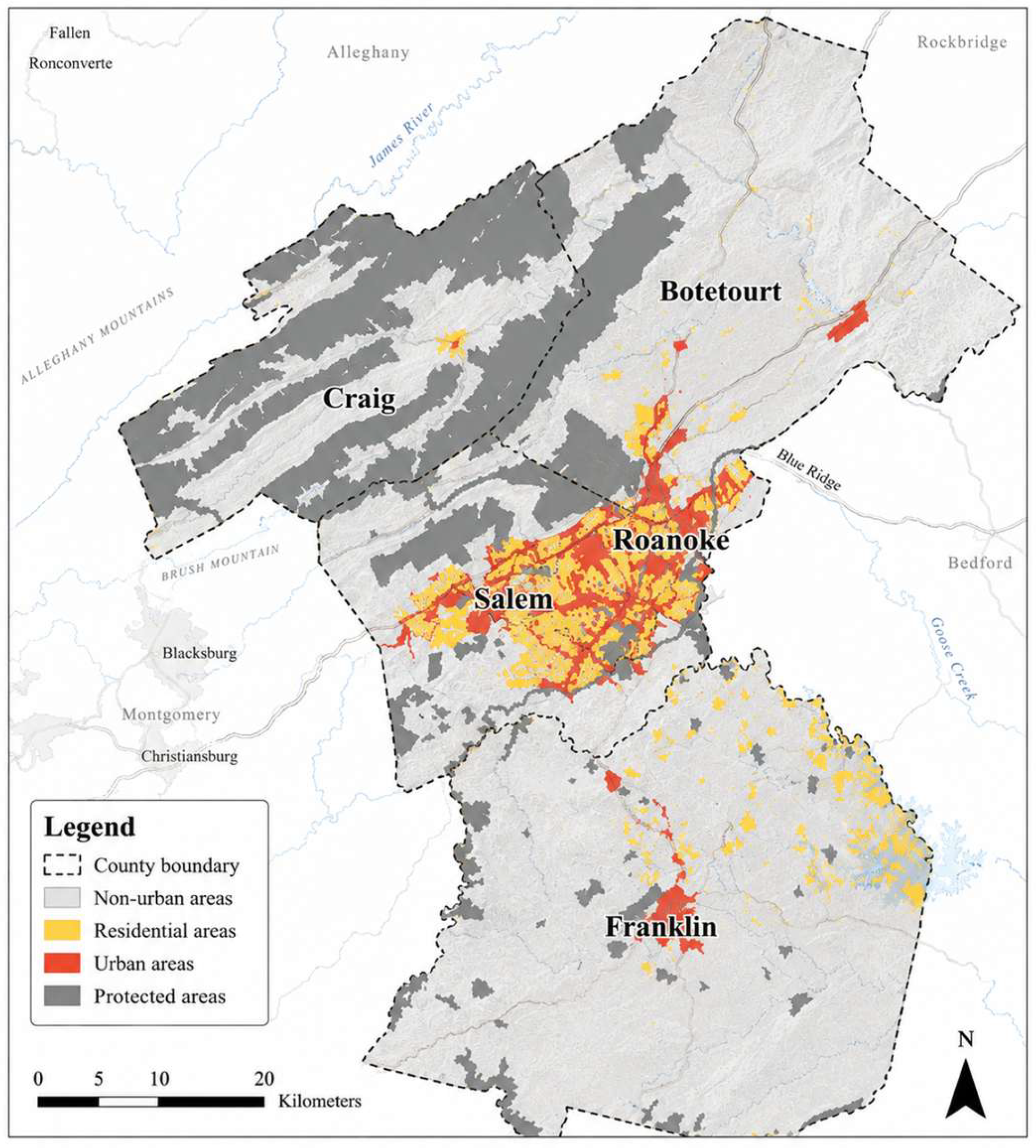
Table 1.
Survey Measures Used in the Analysis.
| Survey Component | Measure / Item Wording | Response Format |
| Preferred future work arrangement |
Preferred future work style regardless of current working style | Four categories: fully in-person; hybrid dominated by in-person work; hybrid dominated by remote work; fully remote |
| Residential location priorities |
Proximity to workplace; proximity to CBD; proximity to amenities; proximity to schools; road access; public transportation; community/belongingness; safety; affordability; city lifestyle; rural/suburban lifestyle; spacious living space and large lot size; career-growth opportunity | Five-point importance scale: 1 = not at all important; 5 = extremely important |
| In-person residential area ranking |
Preferred living area within the Roanoke Metropolitan Area under an in-person commuting scenario, considering income and affordability | Forced ranking of four area-type labels from 1 to 4; 1 = most preferred |
| Remote-work residential area ranking | Preferred living area within the Roanoke Metropolitan Area under a remote-work scenario, considering income and affordability | Forced ranking of the same four area-type labels from 1 to 4; 1 = most preferred |
| Area-type labels | City Center (Central Business District), Urban area, Suburban area, Rural Area | Respondent-ranked area-type labels; no GIS-based boundary definitions were provided |
Table 2.
Construction of the Eligible Analytical Base.
| Sample Construction Step | Records Retained | Records Excluded at Step |
| Original QuestionPro export | 1,122 | — |
| Completed survey responses only | 908 | 214 |
| Completed, nonduplicate responses | 732 | 176 |
| Verified adult respondents aged 18 years or older | 653 | 79 |
| Verified adult residents of the Roanoke MSA | 636 | 17 |
Table 3.
Analysis-Specific Valid Samples.
| Analysis Component | Valid Sample Size | Inclusion Requirement |
| Eligible analytical base | 636 | Completed, nonduplicate, verified adult Roanoke MSA residents |
| Residential location-priority descriptives | 620 | Valid responses for all thirteen location-priority items |
| Residential priority comparisons across preferred work arrangements | 620 | Valid responses for all thirteen priority items and valid preferred work arrangement |
| In-person scenario area rankings | 591 | Strict unique ranks 1–4 across four area types |
| Remote-work scenario area rankings | 593 | Strict unique ranks 1–4 across four area types |
| Paired in-person versus remote scenario rankings | 579 | Valid strict rankings under both scenarios |
Table 4.
Residential Location-Priority Ratings Among Complete Cases.
| Residential Location-Priority Item | Valid n | Mean | SD | Median |
| Safety | 620 | 4.105 | 0.941 | 4.0 |
| Career-Growth Opportunity | 620 | 3.892 | 0.937 | 4.0 |
| Affordability | 620 | 3.845 | 0.916 | 4.0 |
| City Lifestyle | 620 | 3.835 | 0.957 | 4.0 |
| Spacious Living | 620 | 3.829 | 0.920 | 4.0 |
| Community | 620 | 3.779 | 0.933 | 4.0 |
| Public Transportation | 620 | 3.752 | 1.015 | 4.0 |
| Road Access | 620 | 3.737 | 0.929 | 4.0 |
| Amenities | 620 | 3.718 | 0.971 | 4.0 |
| Proximity to Workplace | 620 | 3.703 | 1.020 | 4.0 |
| Schools | 620 | 3.702 | 1.026 | 4.0 |
| Rural/Suburban Lifestyle | 620 | 3.668 | 1.029 | 4.0 |
| Proximity to CBD | 620 | 3.534 | 1.160 | 4.0 |
Note: Items were measured on a five-point importance scale ranging from 1 (not at all important) to 5 (extremely important).
Disclaimer/Publisher’s Note: The statements, opinions and data contained in all publications are solely those of the individual author(s) and contributor(s) and not of MDPI and/or the editor(s). MDPI and/or the editor(s) disclaim responsibility for any injury to people or property resulting from any ideas, methods, instructions or products referred to in the content. |
© 2026 by the authors. Licensee MDPI, Basel, Switzerland. This article is an open access article distributed under the terms and conditions of the Creative Commons Attribution (CC BY) license (http://creativecommons.org/licenses/by/4.0/).
Copyright: This open access article is published under a Creative Commons CC BY 4.0 license, which permit the free download, distribution, and reuse, provided that the author and preprint are cited in any reuse.