

Submitted:
14 August 2026
Posted:
17 August 2026
You are already at the latest version
Abstract
In this study, we present the architecture, implementation, and optimization of an intelligent
substation system that integrates private 5G networks, multi-access edge computing (MEC), and AI-powered sensing. The deployment of wireless networks in high-voltage substations involves unique challenges owing to severe electromagnetic interference (EMI) and multipath fading caused by dense metal structures. To address these issues, we propose a hierarchical edge-cloud orchestration architecture combined with an adaptive mobility management (AMM) scheme. The AMM scheme dynamically optimizes handover parameters—specifically time-to-trigger (TTT) and hysteresis—to mitigate radio link failures during robotic inspections. We deployed the proposed system across two operational substations and evaluated its performance under real-world conditions. The results indicate that the proposed optimization stabilizes the end-to-end latency below 50 ms in 95% of cases and achieves a handover success rate of 100% even in Non-Line-of-Sight (NLOS) regions. Anomaly detection models hosted on the MEC achieved accuracy of 94% across the partial discharge, thermal, and visual domains. Experimental analysis demonstrates that the proposed architecture significantly outperforms the conventional static configurations in terms of uplink throughput reliability and connection stability, thereby presenting a practical blueprint for modernizing substation automation.
Keywords:
industry IoT
; private 5G
; multi-access edge computing (MEC)
; artificial intelligence (AI)
1. Introduction
The energy sector is undergoing a rapid digital transformation owing to the increasing demand for resilience, operational efficiency, and real-time situational awareness in power infrastructure. In particular, substations—critical nodes within the transmission and distribution networks—are evolving from static, manually monitored facilities into intelligent, sensor-rich environments. This shift is attributed to both technological advancement and practical necessity: aging infrastructure, increasing energy demand, along with the increasing frequency of extreme weather events necessitate smarter, more autonomous grid components.
However, several existing substations continue to depend on conventional wired communication architectures and fragmented monitoring systems that exhibit limited scalability, poor adaptability, and significant latency. For example, fault detection typically depends on periodic manual inspections, which are labor-intensive, prone to oversight, and inherently reactive. In addition, the existing centralized data processing models struggle to accommodate the increasing volume of sensor data, causing delayed diagnostics and missed opportunities for early intervention. These limitations demonstrate the urgent need for distributed intelligence, reliable high-speed connectivity, and integrated platforms that support real-time, autonomous operations in substation environments.
To address these challenges, this study presents the design and field deployment of an intelligent substation monitoring platform that integrates private 5G networking, Multi-access Edge Computing (MEC), artificial intelligence (AI), and autonomous robotic inspection. The proposed system was evaluated in real-world substation environments under various operating conditions. It employs a fully integrated infrastructure that combines low-latency communication, edge-resident computing, and AI-based data analysis to enable a new level of responsiveness and automation in substation management.
The proposed system realizes real-time monitoring and fault detection capabilities using distributed sensor networks, including partial discharge sensors, vibration sensors, and thermal imaging systems [1]. These sensors feed data in AI modules deployed at the MEC nodes within the substation, thereby enabling immediate anomaly detection without depending on remote cloud servers. Additionally, quadruped robotic platforms are used for autonomous visual inspections, transmitting real-time video feeds over the 5G network and enabling edge-based analysis of dial readings, thermal anomalies, and environmental hazards. Smart surveillance is realized using AI-enabled Closed-Circuit Television (CCTV) systems that identify fire and intrusion events with low latency, thereby enhancing site safety and operational oversight. All the components are unified using a standardized communication framework based on IEC 61850, which ensures seamless interoperability with both legacy systems and modern digital platforms.
The integration of private 5G and MEC significantly reduces the network latency and enhances the capacity for high-bandwidth, real-time data transmission within the substation environment [2,3,4]. Field evaluations have demonstrated improvement of up to 20 times in the response latency when compared with conventional architectures, with AI diagnostic models achieving accuracy levels over 90%. The flexibility and modularity of the system also enable scalable deployment across several substations, from small regional nodes to high-capacity urban facilities.
The main contributions of this paper are as follows:
- We designed and implemented a field-deployable architecture by combining private 5G, MEC, AI, and robotics for smart substations, thereby addressing the strict security and low-latency requirements of critical energy infrastructure.
- We propose an Adaptive Mobility Management (AMM) algorithm that optimizes Radio Resource Control (RRC) parameters. The proposed algorithm addresses the rapid signal degradation issues observed in metal-dense substation environments, thereby ensuring seamless connectivity for autonomous inspection robots.
- We developed edge-resident AI modules that perform real-time diagnostics using partial discharge and vibration data, threby reducing the dependence on centralized processing and minimizing backhaul bandwidth consumption.
- We validated the system in real-world substations via extensive field trials, which demonstrated that our parameter optimization strategy realizes a 20-fold improvement in the response latency stability when compared with the default network configurations.
The rest of the paper is organized as follows. Section 2 presents the related works and technological background on 5G, MEC, and substation monitoring. Section 3 presents the system architecture, including the network components, edge analytics, and IoT integration. Section 4 describes the key use cases including predictive maintenance, robotic inspection, and smart surveillance. Section 5 introduces the proposed optimization strategy. Section 6 presents a detailed description of the implementation and field deployment process. Section 7 presents the experimental results and evaluation process. Section 9 discusses key insights, limitations, and future directions. Lastly, Section 10 concludes the paper.
2. Background and Related Work
The digital transformation of the energy sector has advanced significantly in recent years due to increasing operational demands, the proliferation of intelligent devices, and the convergence of communication and computation technologies. Among the core assets in power grid operations, substations are crucial for voltage transformation, protection, and control. Owing to their mission-critical nature, substations demand resilient, real-time, and intelligent monitoring solutions. However, conventional substation systems remain depend on legacy architectures that do not adequately support the new wave of AI-driven and data-intensive applications.
2.1. Digitalization of Substations
Power substations historically depended on supervisory control and data acquisition (SCADA) systems, analog sensors, and manual inspection for condition monitoring. Although these approaches are robust against basic control and data acquisition, they lack scalability and adaptability in handling complex, high-frequency events and equipment aging behaviors [5,6]. The industry has increasingly adopted digital relays, phasor measurement units (PMUs), intelligent electronic devices (IEDs), and IEC 61850-based communications to overcome these limitations [7,8]. IEC 61850 introduced data modeling, GOOSE messaging, and sampled value (SV) transmission, which significantly improved interoperability and speed.
Despite the promise of IEC 61850, the standard does not inherently solve the latency and bandwidth issues caused by physical infrastructure and centralized architectures [9]. As data volume increases, particularly with high-resolution sensors and video streams, intelligence and high-speed, reliable communication becomes crucial. Several initiatives, such as the European Union’s “InterFlex” and Japan’s “Smart Substation” projects, have demonstrated early success in digital substation deployments [10,11]. However, many of these approaches still depend on fiber-based networks, which are costly and inflexible for dynamic and mobile sensor integration.
2.2. 5G in Industrial and Energy Systems
The advent of 5G represents a transformative opportunity for industrial automation, including energy systems. When compared with its predecessors, 5G supports enhanced mobile broadband (eMBB), ultra-reliable low-latency communication (URLLC), and massive machine-type communication (mMTC) [12]. These capabilities make it well-suited for substation environments where high-density data acquisition, mobility (e.g., inspection robots), and reliability are essential.
Private 5G networks, such as Korea’s e-um 5G, enable grid operators to deploy dedicated spectrum for mission-critical applications [13,14]. Previous studies conducted in smart factories, mining, and port automation have demonstrated that 5G can support time-sensitive networking (TSN), cooperative robot coordination, and real-time streaming of sensor data [15,16,17]. In substations, 5G enables wireless deployment of sensors and robots without compromising the latency or reliability. Recent testbeds in Germany and China have evaluated the role of 5G for dynamic reconfiguration and fault isolation [18,19].
2.3. Edge Computing and MEC in Substations
MEC addresses the limitations of cloud-based processing by relocating computation close to the data source [20,21]. The MEC servers within the substations can host AI models for anomaly detection, equipment diagnostics, and surveillance analytics, thereby reducing the data transmission latency and improving response times [22]. Several works have proposed MEC frameworks for industry, including containerized microservices, federated edge learning, and dynamic resource orchestration [23,24,25].
In the energy context, MEC has been analyzed for voltage regulation, distributed control, and PMU data filtering [26,27]. However, limited research has been conducted on extending MEC to include AI-driven predictive maintenance or direct integration with IEC 61850 infrastructures [28]. This study builds upon those foundations by implementing real-time, localized inference for multiple sensor modalities.
2.4. AI-Based Predictive Maintenance and Monitoring
AI techniques, particularly deep learning, have demonstrated considerable potential value in equipment monitoring. Convolutional Neural Networks (CNNs) have been employed for classifying partial discharge patterns, and Long Short-Term Memory (LSTM) networks have enabled time-series prediction of load fluctuations and equipment degradation [29,30]. Reinforcement learning has also been employed to optimize the maintenance schedules based on predicted failure risk [31]. These models are typically trained in cloud or laboratory environments, presenting considerable challenges to real-time deployment.
With the advent of edge AI, lightweight models such as MobileNet, Tiny-YOLO, and pruning-based compressed architectures can be deployed on MEC servers [32,33,34]. In substations, such models enable in-situ fault diagnosis, thermal anomaly detection, and spoken keyword recognition for safety alerts [35,36].
2.5. Robotics and AI-Enabled Surveillance
Mobile robots have gained considerable attention for automating routine inspection tasks in harsh environments. Quadruped robots such as Spot and ANYmal can navigate uneven terrain and autonomously monitor gauges, switches, and thermal hotspots [37,38]. When integrated with 5G, these robots can stream video and sensor data to edge platforms for live processing.
Surveillance systems in substations typically depend on passive CCTVs. Recent advances enable AI-powered cameras that detect fire, smoke, unauthorized access, and abnormal activity in real time [39,40]. When deployed on MEC nodes, these models can issue immediate alerts to control centers without relying on external cloud services, thereby ensuring both privacy and responsiveness.
2.6. Research Gaps and This Work’s Contribution
Despite the advances in the aforementioned domains, there exists a gap in holistic system integration. Very few deployments have jointly implemented private 5G, edge AI, robotic patrol, and IEC 61850-based communication within live substations. Moreover, limited research has been conducted on how such integration affects the end-to-end latency, diagnostic accuracy, and operator workflows in real-world scenarios. Although studies have been conducted on general architecture designs, few have addressed the specific challenges of handover instability in high-voltage substations. Unlike simulation-based approaches, this study proposes a field-validated optimization strategy to handle severe multipath fading.
This paper addresses these gaps by:
- Deploying a field-tested system in two operational substations, incorporating 5G, MEC, and robotics;
- Hosting edge-resident AI models for predictive diagnostics and surveillance;
- Interfacing sensor and control data using IEC 61850 protocol mapping;
- Evaluating the effectivenessof the platform across the latency, coverage, and inference metrics.
3. System Architecture
The proposed system architecture integrates private 5G networking, MEC, AI-based analytics, and robotic platforms into a unified infrastructure that supports intelligent, responsive operations in high-voltage substation environments as shown in Figure 1. The system is conceptually structured around five functional layers that work together to realize end-to-end sensing, decision-making, and actuation capabilities.
The sensing layer forms the foundation of the system, which comprises various IoT and diagnostic sensors deployed on substation assets. These include partial discharge (PD) sensors for transformers and GIS, vibration and temperature sensors for mechanical equipment, thermal infrared cameras for fault localization, and acoustic sensors for noise-based anomaly detection. Additionally, the surveillance functions are performed by smart CCTVs equipped with embedded AI models. The sensors either incorporate onboard 5G modems or connect to local data concentrators, enabling secure transmission of measurements over the private 5G network.
The communication layer employs Korea’s private 5G framework, using a standalone (SA) architecture with dedicated core and gNB components. The physical separation of the Control Plane (CP) and User Plane (UP) is a key design feature of the proposed system. By deploying the User Plane Function (UPF) directly at the substation edge (Local Breakout), we isolate mission-critical traffic from the central network, thereby ensuring deterministic latency for robot control commands regardless of external backhaul congestion. A split UPF enables the data to be routed directly to the on-premise MEC servers, thereby minimizing latency and offloading backbone traffic. Indoor and outdoor Remote Units (RUs) are strategically deployed to ensure comprehensive coverage across substation terrain and within switchgear buildings. All the communications conform to IEC 61850 messaging formats, thereby enabling seamless interaction with substation SCADA systems.
The MEC-based edge computing layer is physically co-located within the substation premises and functions as the localized computation hub. Equipped with GPU-accelerated nodes and high-speed storage, the MEC platform is capable of handling high-bandwidth streams such as thermal video, along with bursty sensor inputs. It hosts containerized microservices for protocol translation (e.g., IEC 61850 to REST), MQTT and REST interfaces for real-time communication, and orchestrated inference engines to support dynamic resource scaling. The MEC server also buffers the time-series data for diagnostics and offline training.
On top of this infrastructure, the AI analytics layer provides intelligence and inference capabilities required for advanced monitoring. CNNs are deployed for PD signal classification, and object detection models such as YOLO variants interpret analog dial readings and detect anomalies in live video feeds. Lightweight deep learning models are used for fire and smoke detection in surveillance images, and recurrent neural networks (e.g., LSTMs) process sensor time series for predictive diagnostics. These models are continuously retrainable and designed for low-latency execution on MEC hardware.
The final application and visualization layer realizes actionable insights to human operators and maintenance personnel. Real-time dashboards present interactive visualizations of alerts, sensor data, and AI inferences. Operators can view live video feeds from robotic patrols and smart CCTVs, receive predictive maintenance notifications, and issue remote control commands. Integration with legacy SCADA systems is achieved via IEC 61850 MMS protocols, and future enhancements include mobile-based augmented reality (AR) interfaces for field technicians.
This layered architecture presents modularity, low-latency decision making, and robust scalability for future expansion. It demonstrates how next-generation ICT—including 5G, MEC, and AI—can be effectively combined to enhance reliability, safety, and operational intelligence in critical energy infrastructure.
Table 1 summarizes the key abbreviations used throughout this paper, including major components of both the 5G core and radio access network architecture.
3.1. 5G Core System Architecture
We adopted a compact 5G Core System to implement a specifically tailored, highly reliable and lightweight mobile core. This architecture leverages containerized microservices to integrate crucial Service-Based Architecture (SBA) functions, presentng enhanced flexibility, scalability, and ease of deployment. It combines the Element Management System (EMS) and Unified System Manager (USM) onto a single server, thereby significantly simplifying operational management and enabling centralized control, as depicted in Figure 2.
The core functional architecture strictly adheres to 3GPP SBA specifications, and employs a set of interconnected network functions, each implemented as a containerized microservice. These include:
- UDM: Manages subscription and user profile information.
- UDR: Stores structured policy data and user information.
- AMF: Handles UE registration, reachability, and mobility.
- SMF: Establishes and manages PDU sessions.
- PCF: Applies QoS and charging policies to sessions.
- AUSF: Authenticates subscribers using Subscriber Permanent Identifier (SUPI) credentials.
- UPF: Forwards user data packets to/from the external network.
- EMS: Provides centralized management, monitoring, and configuration capabilities for the 5G core network functions, ensuring operational efficiency and fault management.
All the service functions communicate over a service-based interface (SBI) using HTTP/2 on Internet Protocol (IP) networks. The control and user planes are logically separated and optimized for low-latency edge breakout via UPF.
Beyond the standard 3GPP SBA functions, the compact core of the proposed system integrates a unified management layer comprising the EMS and a custom-developed USM. The EMS is responsible for the direct management and monitoring of individual 5G network functions, including their lifecycle and performance. Conversly, the USM achieves a higher-level orchestration and centralized control over the entire core system, streamlining deployment, configuration, and fault management processes. This integrated approach significantly reduces the operational overhead that is typically associated with distributed microservice architectures, making it ideal for private network deployments.
This innovative compact design enhances the deployment flexibility significantly reducing the operational complexity inherently associated with deploying a dedicated private 5G core within constrained environments such as substations. Its lightweight footprint and simplified management enable rapid provisioning and maintenance. Furthermore, the architecture is specifically optimized to support MEC-based traffic breakout, thereby enabling ultra-low latency processing at the edge. Furthermore, it ensures seamless, efficient data routing to critical operational technologies such as SCADA systems or advanced AI analytics services, thereby maximizing the value of private 5G connectivity.
3.2. 5G Base Station System
The radio access system strictly adheres to the 3GPP Release 16 CU-DU-RU split architecture. This advanced architectural split is crucial for enabling highly flexible and scalable deployments, while also facilitating efficient separation of the control and user planes. This design is particularly advantageous for supporting various deployment scenarios, including those requiring MEC capabilities. The architecture comprises a virtualized vCU, a DU, and various types of AUs, particularly including ORU, IRU, and millimeter-wave AUs, as depicted in Figure 3.
-
vCU: The vCU is a software-defined component responsible for higher-layer processing of the radio access network. It comprises:
- -
- ACPF: Manages RRC signaling, Non-Access Stratum (NAS) signaling, and overall control messaging, interfacing with the 5G Core’s AMF via the N2 interface.
- -
- AUPF: Handles Packet Data Convergence Protocol processing, including header compression and ciphering, and forwards user data to/from the UPF of the 5G Core via the N3 interface.
- DU: The DU performs crucial real-time baseband processing functions, including Radio Link Control (RLC), Medium Access Control (MAC), and high-Physical (PHY) layer operations. It is responsible for framing, timing synchronization, and protocol translation, acting as a bridge between the vCU and the RUs via 3GPP-defined F1 interfaces (F1-C for control plane and F1-U for user plane).
-
AUs: These units perform the radio frequency (RF) functionalities and are deployed in various forms based on different environments:
- -
- 4.7GHz ORU: Provides RF transceiver functionality, integrated with filters and amplifiers, optimized for wide-area outdoor coverage.
- -
- 4.7GHz IRU: Similar in functionality to the ORU but specifically designed and optimized for indoor environments, such as the switchgear rooms of the substations.
- -
- 28GHz AU: This millimeter-wave (mmWave) unit supports extremely high throughput and spatial density, ideal for scenarios requiring massive bandwidth and capacity.
These components (vCU, DU, and AUs) are all interconnected through an SDN switch. This SDN-enabled connectivity is pivotal, and enables highly flexible and dynamic deployment configurations. It facilitates centralized control over the network resources, enabling efficient traffic engineering, dynamic resource allocation, and coordinated management of the entire radio access network, thereby optimizing the performance and simplifying operations.
This comprehensive 5G Base Station architecture, with its CU-DU-RU split and SDN-driven interconnectivity, effectively supports centralized control for streamlined management and edge-based user plane offload for ultra-low latency applications. This design ensures robust interoperation with critical operational technologies such as SCADA systems and MEC nodes, making it well-suited for demanding industrial and private network use cases.
4. Technical Use Cases
The tight integration of private 5G networks, MEC, and AI within substation environments enables the realization of various intelligent services. The proposed system transforms conventional energy infrastructure into a more resilient, efficient, and autonomous entity. The architectural principles, including the compact 5G Core and the flexible CU-DU-RU split in the Base Station, present significant advantages such as ultra-low fault detection latency, extensive inspection coverage, and rapid responsiveness in critical scenarios. These design choices ensure both technical feasibility and considerable real-time performance gains by co-locating computation and connectivity near critical equipment.
In this section, we present three representative technical use cases—predictive maintenance, autonomous inspection, and smart surveillance—that demonstrate the practical functionalities supported by the proposed private 5G system architecture. These use cases demonstrate how the system achieves high responsiveness, accuracy, and scalability through its integrated design
4.1. Predictive Maintenance and Fault Detection
One of the primary use cases for intelligent substations is the real-time detection of incipient faults before they escalate into critical failures. The system deploys various sensors, such as PD sensors, vibration sensors, and temperature probes, at critical components like transformers, on-load tap changers (OLTCs), and Gas Insulated Switchgear (GIS) units, as shown in Figure 4. The raw sensor data is efficiently transmitted over the high-bandwidth, low-latency private 5G network to the local MEC server. Here, lightweight AI models perform real-time analysis of the patterns indicative of abnormal equipment behavior.
In particular, a CNN model, trained on spectrogram representations of PD signals, is employed to classify discharge types and predict severity levels. Concurrently, an LSTM-based temporal model processes continuous vibration and thermal readings to identify subtle trends that indicate bearing wear or thermal drift. The proximity of the MEC to the data source, facilitated by the 5G UPF for edge breakout, ensures that critical alarms are generated with ultra-low latency, enabling operational staff to take preemptive action. This architecture leverages the dedicated 5G user plane for efficient data forwarding and the computational power of the MEC for immediate insights.
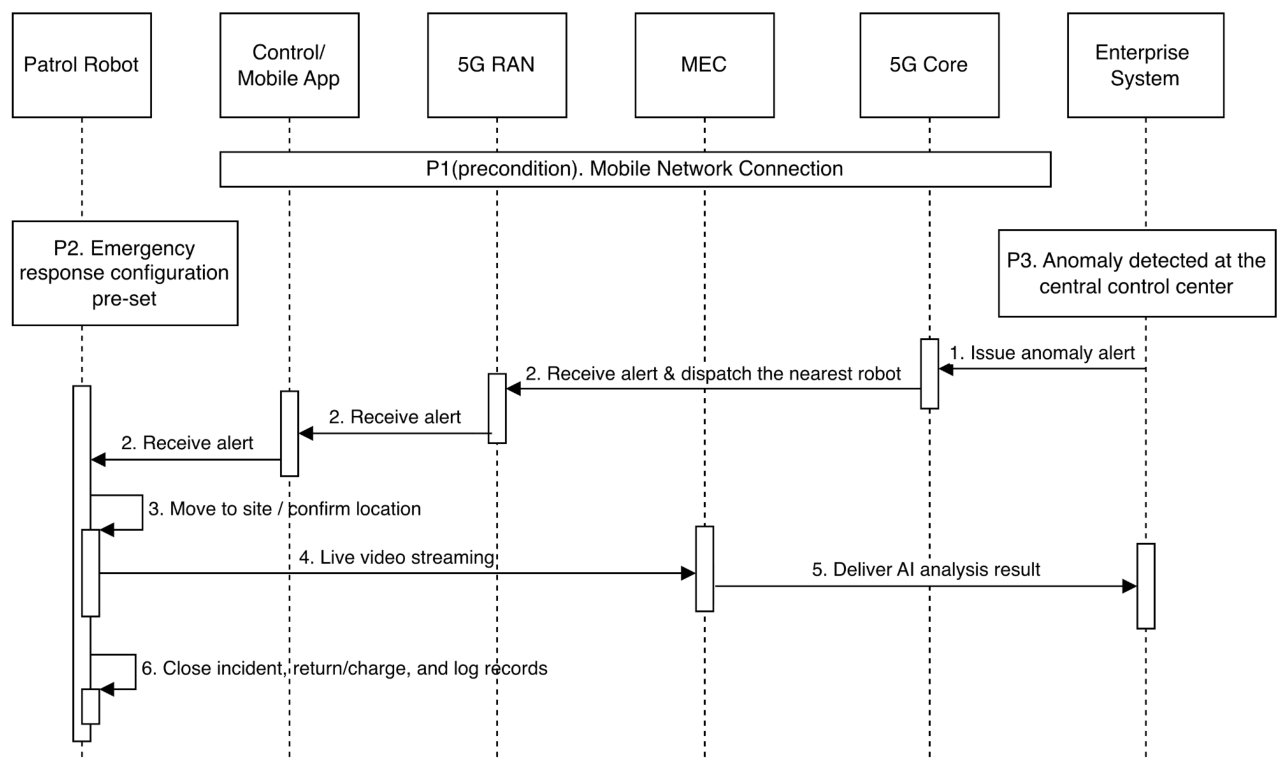
4.2. Autonomous Robotic Inspection
Routine inspection of substation assets is typically labor-intensive, time-consuming, and often hazardous. The proposed system incorporates a quadruped robotic platform capable of autonomously patrolling predefined routes within the substation. This robot continuously streams high-definition thermal and visual imagery over the private 5G network to the MEC server. The AI models, which are optimized for edge deployment, analyze this data in real-time to identify anomalies, including abnormal heat signatures, unresponsive meters, and visual signs of equipment distress.
The robotic platform is equipped with a stereo vision system for spatial awareness, a thermal camera for heat signature detection, and Inertial Measurement Unit (IMU) sensors for precise navigation and obstacle avoidance. The on-board data are transmitted via a robust uplink using QoS-optimized 5G slices, leveraging the capabilities of the 5G Base Station’s Access Units (ORU/IRU) for reliable coverage. At the MEC, a YOLOv5-based model is employed for object detection and reading analog dials, whereas a lightweight classifier flags missing or dislocated physical components (e.g., valve handles). The low-latency communication provided by the 5G network, managed by the SMF and AMF, ensures that the diagnostics of the robot are responsive and can be displayed on control room dashboards with minimal delay, enhancing operational efficiency and safety.
4.3. Smart Surveillance and Safety Monitoring
Substation security and personnel safety are crucial, particularly due to the often remote and critical nature of these facilities. The proposed system significantly enhances the surveillance capabilities using AI-augmented smart CCTVs connected directly to the local MEC server via the private 5G network. Unlike conventional surveillance systems that stream raw footage to centralized Network Video Recorders (NVRs), this edge-centric approach processes video streams locally at the MEC. This design drastically reduces the backhaul bandwidth requirements and improves the response times for critical events.
Embedded AI models detect various safety and security incidents within milliseconds using the computational power of the MEC. These include the identification of fire, smoke, unauthorized human intrusion, and suspicious motion patterns. Furthermore, the system can proactively identify unsafe working conditions, such as the presence of unauthorized personnel in high-voltage areas or the failure to wear mandatory Personal Protective Equipment (PPE). Alerts are instantly issued to the on-site alarms and remotely dispatched via the SCADA system, with full event context meticulously logged and archived locally, potentially leveraging the UDR of the 5G Core for secure storage. This capability significantly enhances the situational awareness for operators, enabling them to respond to threats and safety breaches before they escalate.
These technical use cases collectively highlight the transformative value of closely integrating advanced sensing capabilities, edge-based AI processing, and ultra-low latency private 5G communication. This holistic approach aims to transform substations into intelligent, highly autonomous entities. The modular design of the proposed system enables flexible and incremental deployment, whereas its inherently edge-centric architecture ensures consistent and robust performance, even under conditions that might otherwise challenge conventional network infrastructures.
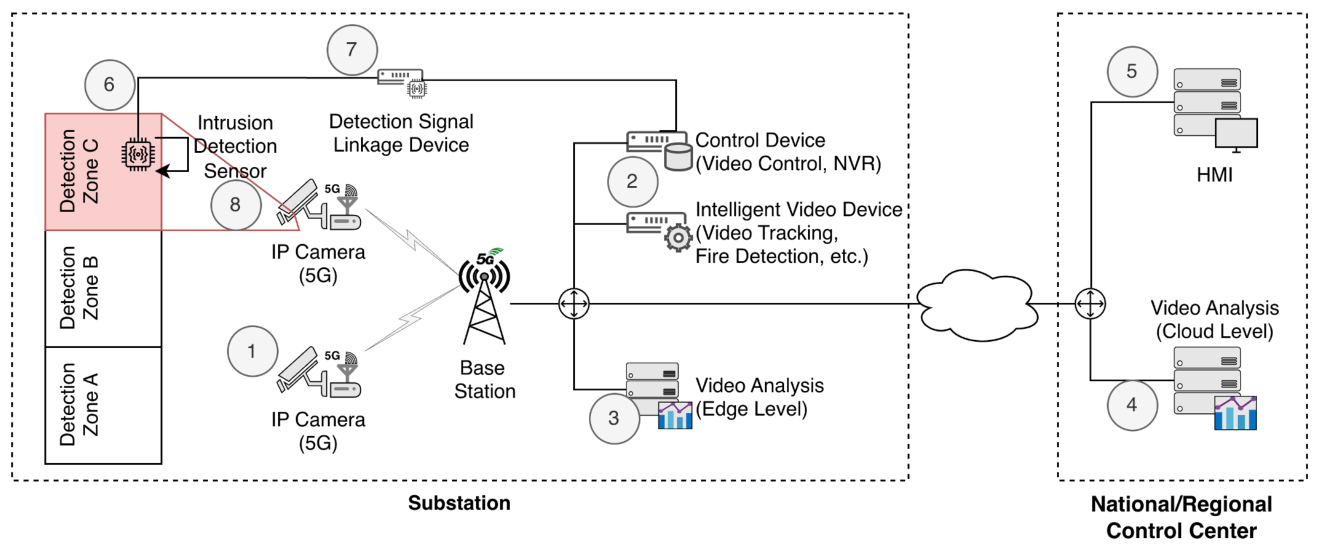
Figure 6.
Substation–HQ flow for condition monitoring over private 5G and MEC.
5. Proposed Optimization Strategy for Substation Environments
High-voltage substations are characterized by complex metallic structures that cause severe multipath fading and signal shadowing. Standard handover configurations typically lead to the “ping-pong” effect or Radio Link Failures (RLF). To address this, we formulate an Adaptive Mobility Management (AMM) strategy.
5.1. Problem Formulation
We focus on the standard 3GPP Event A3, which is the primary trigger for intra-frequency handovers. Event A3 occurs when a neighbour cell becomes better than the serving cell by an offset. Let and denote the Reference Signal Received Power (RSRP) of the serving cell and the target neighbour cell at time t, respectively. A handover (HO) event is triggered when the A3 condition is satisfied for a specific duration (Time-to-Trigger, TTT). The handover condition at triggering time is defined:
where denotes the A3 hysteresis margin, and denotes the TTT duration. In a highly reflective environment, exhibits high-frequency fluctuations (fast fading). If is too short, transient deep fades in cause premature handovers (false positives), thereby causing ping-pong effects.
5.2. Parameter Optimization
The optimization objective involves minimizing the probability of false handovers, denoted as , which typically cause ping-pong effects, while ensuring that the Radio Link Failure probability () remains below a critical threshold . We formulate this as a constrained optimization problem:
To quantify the channel instability caused by multipath fading, we calculate the signal variance of the serving cell’s RSRP over a sliding window W. This serves as a metric to detect Non-Line-of-Sight (NLOS) zones:
where represents the discrete RSRP samples and is the moving average. A high triggers the adaptive mechanism.
Here, corresponds to the likelihood that the A3 condition is triggered by transient multipath fading rather than path loss. Since approaches zero when the Time-to-Trigger () exceeds the average fade duration, we derive the optimal as a function of the measured channel characteristics:
where denotes the average fade duration measured in NLOS zones, and denotes a scaling factor () to ensure robustness against variance. Based on the field measurements, setting yields ms, which satisfies the condition for the target velocity of the robot.
The overall operational flow of the proposed AMM strategy is summarized in Algorithm 1. The process begins by initializing the handover parameters to standard values. During system operation, the algorithm continuously monitors the signal variance () within a sliding window to detect channel conditions.
When the robot enters a metal-dense area, the variance typically spikes due to multipath fading. If exceeds a predefined threshold (indicating NLOS conditions), the system calculates the average fade duration () and derives the optimal TTT using Equation (4). Finally, to prevent system instability caused by frequent parameter updates, the new configuration is applied only if the calculated deviates from the current setting by a significant margin ().
| Algorithm 1 Adaptive Mobility Management (AMM) Scheme. |
|
6. Implementation and Deployment
The implemented private 5G system was deployed following 3GPP Release 15 specifications with partial Release 16 support, featuring an integrated architecture that combines core network functions with MEC capabilities for low-latency industrial applications.
6.1. 5G Core Network
The cloud-native 5G core network adopted a converged architecture with centralized control plane and distributed user plane functions. The AMF, implemented on PowerEdge R740 servers with dual Intel Xeon Silver 4214 processors, handled UE authentication and mobility management through N1/N2 interfaces while supporting 256-bit NAS security encryption. The SMF dynamically managed PDU sessions with QoS enforcement through N4 and N10 interfaces.
The UPF was deployed in both central and edge locations, with the edge UPF instances colocated with MEC servers to enable local breakout. These distributed UPFs achieves throughput of 20 Gbps per node using Intel X710 10GbE NICs and provided GTP-U tunneling with SR-IOV acceleration. The MEC platform, integrated through the N6 interface, featured AMD EPYC 7302P processors (16 cores @ 3.0 GHz) with 128 GB DDR4 ECC memory and NVIDIA Jetson AGX Orin accelerators for AI workloads.
This converged implementation demonstrated three key advantages: (1) reduced latency for edge applications through local UPF instances, (2) improved resource utilization via shared infrastructure between core and edge functions, and (3) simplified management through unified orchestration of both core and MEC workloads.
6.2. 5G Base Station System Implementation
The radio access network implemented O-RAN Alliance compliant architecture with centralized baseband processing and distributed radio units in Table 2.
The DU employed a CDU50 chassis that supports 3GPP NR FR1 n79 band (4.7 GHz) with an instantaneous bandwidth of 100 MHz. Each DU provided:
- 18 CPRI ports (6 per component carrier)
- 25 GbE fronthaul interfaces
- IEEE 1588v2 precision timing (±100 ns accuracy)
- 4T4R antenna configuration
For radio transmission, ORUs operated under a band of 4.7 GHz:
- 10 W total RF output power (2.5 W per path)
- -97 dBm receiver sensitivity
- IP65-rated 220×77×265 mm enclosure
- 120 W power consumption
The 28 GHz millimeter-wave units provided and aggregated bandwidth of 800 MHz using beamforming technology with 256 antenna elements. These units supported:
- 64 simultaneous beams
- 3 ms beam switching latency
- 1.2 Gbps peak throughput per UE
The complete system demonstrated an availability of 99.999% during operational testing, with measured latency of 4 ms for control plane signaling and 8 ms for user plane data transmission in the 4.7 GHz band. The mmWave implementation achieved a peak throughput of 1.2 Gbps with an latency of 15 ms for mobility scenarios.
7. Evaluation
This section presents a comprehensive evaluation of the proposed private 5G system, focusing on its performance and operational capabilities within real-world substation environments. The primary objective of this evaluation is to verify the effectiveness, reliability, and scalability of the system in delivering URLLC and eMBB services, which are critical for advanced industrial applications. We detail the KPIs established for this evaluation and present the results obtained from extensive field tests conducted on the deployed private 5G infrastructure.

Table 3.
Base Station System Specifications.
| Component | Technical Specifications |
|---|---|
| Digital Unit |
|
| Outdoor RU |
|
| mmWave AU |
|
| Synchronization |
|
7.1. Evaluation Objectives and KPIs
The evaluation aims to validate the performance of the Ieum5G private network in supporting the stringent requirements of smart substation operations. To this end, we defined a set of comprehensive KPIs, including the communication quality, coverage performance, and overall communication throughput and latency. These KPIs are crucial for ensuring the robust and reliable operation of the advanced digital infrastructure.
Table 4 summarizes the defined KPIs and their target values.
- Communication Quality: This category determines the reliability of network connections, focusing on connection success rate and disconnection rate. A high connection success rate and a low disconnection rate are paramount for continuous and uninterrupted operation of critical services.
- Coverage Performance: This evaluates the spatial extent and quality of the 4.7 GHz radio coverage. This includes ensuring that a minimum Reference Signal Received Power (RSRP) threshold is met across the designated indoor and outdoor areas, which is crucial for ubiquitous connectivity.
- Communication Performance (Throughput and Latency): Measures the data transfer capabilities and responsiveness of the network. This includes downlink (DL) and uplink (UL) throughput for both 4.7GHz standalone and New Radio-Dual Connectivity (NR-DC) 28GHz configurations, along with end-to-end ping latency. Low latency is particularly critical for real-time control and AI inference at the edge.
7.2. Impact of Mobility-Aware Optimization
Prior to the full-scale deployment of robotic inspection services, we analyzed the impact of the proposed Adaptive Mobility Management (AMM) strategy on the network stability. Figure 7 presents a comparative analysis between the baseline (blue) and optimized (orange) configurations. In particular, Figure 7d depicts the uplink throughput enhancement achieved by adjusting the handover hysteresis and Time-to-Trigger (TTT) parameters.
In the baseline configuration, frequent radio link failures and ping-pong handovers caused throughput fluctuations, as indicated by the lower tail of the blue distribution. However, after applying the optimization, the system demonstrated significantly improved stability:
- Throughput Stability: The optimized configuration maintains a higher and more consistent uplink throughput, as shown in Figure 7d, which is critical for real-time 4K video streaming from the inspection robot.
- Coverage Improvement:Figure 7a shows that the optimization effectively shifted the RSRP distribution toward higher signal strengths, reducing the probability of disconnection in the NLOS areas.
These results indicate that the parameter tuning described in Section 5 successfully mitigates the multipath fading effects inherent in the substation environment.
7.3. Performance Evaluation Results
The private 5G system was deployed and rigorously tested in a testbed environment, which included the installation of four 4.7 GHz ORUs on the rooftop of the testbed building, with the D) installed on the first floor. The UPF and vCU were implemented as software components on the testbed server, as explained in Section 6.
7.3.1. 4.7GHz ORU Field Test Results
Field tests were conducted to evaluate the performance of the four 4.7 GHz ORUs (SJB_ORU_1, SJB_ORU_2, SJB_ORU_3, SJB_ORU_4). Table 5 summarizes the results that the deployed system consistently met or exceeded the defined KPIs for communication quality, coverage, and communication performance. Notably, all the ORUs achieved 100% connection success rate and handover success rate, with 0% disconnection rate. The outdoor RSRP coverage consistently exceeded the threshold of dBm, indicating robust signal strength. The downlink and uplink throughput values significantly exceeded the target of 900 Mbps and 432 Mbps respectively, and ping latency remained well below the target of 16 ms.
7.3.2. Service Coverage Optimization and Performance Improvement
Further optimization was performed to enhance the service coverage and overall network performance through adjustments in the system and antenna parameters. This optimization process involved modifying parameters such as A3 offset, Time to Trigger, and hysteresis for each gNB, and fine-tuning antenna azimuth and tilt angles. We aimed to maximize the signal level in strong electric fields and improve throughput.
The results of these optimization efforts demonstrated a significant improvement in network performance. In particular, the area with a strong signal level (RSRP dBm) increased by 3.43%. This improvement is visually represented in Figure 7a and Figure 7b, which compare the RSRP coverage before and after the optimization work.
Furthermore, the optimization led to significant improvements in the data throughput. The proportion of DL throughput exceeding 400 Mbps improved by over 10%, and UL throughput exceeding 200Mbps improved by over 5%. These throughput enhancements are illustrated in Figure 7c and Figure 7d respectively, showcasing the positive impact of the parameter adjustments.
These evaluation results demonstrate the robust performance and effective optimization of the private 5G system, indicating its capability to provide high-quality, reliable, and high-throughput connectivity essential for advanced industrial applications in substation environments.
7.4. Summary
The evaluation demonstrate that the intelligent 5G-enabled infrastructure meets the stringent industrial requirements for latency, reliability, and coverage. It provides a foundation for AI-based real-time monitoring and control in future power automation systems.
8. Field Trial for Robotics and AI-Enabled Surveillance
We conducted comprehensive field trials were conducted focusing on autonomous robotics and AI-enabled surveillance within a dedicated substation testbed. This helped in future validating the operational feasibility and performance of the proposed private 5G system and supporting advanced industrial applicaitons. These trials aimed to demonstrate the seamless integration and robust operation of robotic platforms and AI-driven image analysis over the established private 5G infrastructure.
Figure 8 depicts the overall concept of the robot-based inspection service, which leverages the private 5G network for real-time data transmission and control. This framework enables the quadruped robot to perform various tasks autonomously, thereby enhancing the efficiency and safety of substation operations.
8.1. Autonomous Robotic Inspection Performance
The quadruped robot, equipped with a PTZ camera, LiDAR sensor, and an onboard 5G router, was employed to perform autonomous patrol and inspection tasks within the substation environment. The autonomous navigation capabilities of the robot were rigorously tested, demonstrating its ability to learn patrol routes based on the waypoints derived from LiDAR sensor data. The robot successfully traversed the predefined paths and autonomously captured images and video of the substation equipment. The collected image and video data were then transmitted in real-time to the analysis server and control system via the private 5G network, demonstrating the robust connectivity provided by the private 5G infrastructure.
The process of autonomous driving, including waypoint-based path learning and the execution of learned routes over the private 5G network, is critical for the operational success of the robot. Figure 9 depicts these key aspects of the autonomous navigation of the robot.
Figure 10.
Fieldtrial results for autonomous robotic inspection performance.
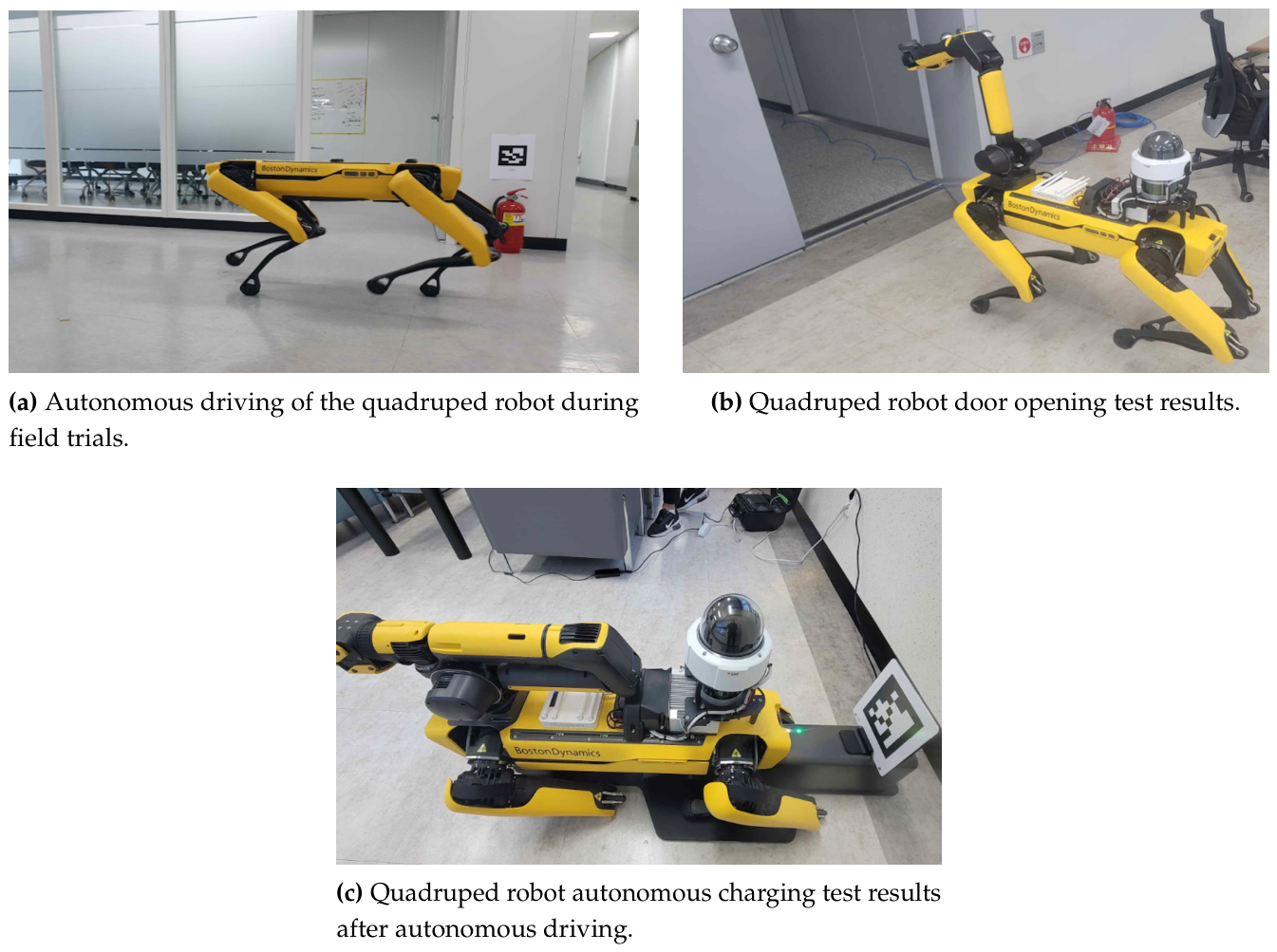
The major operational aspects and results from the robotic field trials include:
- Autonomous Driving and Path Learning: The robot successfully learned and executed autonomous driving paths within the substation. This involved utilizing LiDAR and depth camera data to generate point cloud maps and define optimal routes, with real-time updates and control facilitated by the private 5G network.
- Target Object Autonomous Photography: The robot autonomously capture images of the target equipment along its learned paths, transmitting high-resolution data efficiently over the 5G uplink.
- Obstacle Avoidance: During autonomous patrol, the robot successfully detected and avoided obstacles, ensuring safe operation within the complex substation layout, depending on low-latency communication for immediate response.
- Door Opening Capability: The robot was tested for its ability to open doors using its robotic arm. This task demonstrated a success rate of over 90%. However, for double doors, there were instances where the robot attempted to open the incorrect handle due to the close proximity.
- Autonomous Charging: After completing its autonomous patrol missions, the robot successfully returned to its docking station and initiated autonomous charging, demonstrating end-to-end operational capability supported by continuous 5G connectivity.
These trials demonstrated the mobility, navigation, and data acquisition capabilities of the robot are reliably supported by the private 5G infrastructure, enabling efficient and safe autonomous inspections.
8.2. AI-Based Substation Equipment Image Analysis
The images and video streams collected by the robotic platform were processed by an AI-based image analysis system to extract the crucial information from the substation equipment, particularly focusing on analog gauges. Figure 11 depicts the image analysis workflow, which is crucial for automated monitoring, involving several stages.
- Image Segmentation: A deep learning-based segmentation algorithm was developed to accurately divide the gauge image into distinct regions, including the gauge dial, needle, start point, end point, and intermediate points. This involved extensive labeling of diverse gauge images to create a robust training dataset.
- Model Training: The segmentation model was trained using original images and their corresponding labeled segmentation masks. The training process optimized the model to accurately identify and delineate the various components of the gauge. Figure 12 depicts the overall learning process of the image analysis algorithm.
- Value Extraction: Based on the segmented regions, the system accurately determined the position of the needle, the start point, and the center of the gauge. The angle between the start point and the needle was then calculated using vector dot products to derive the precise gauge reading.
The AI-based image analysis achieved a reading accuracy of 100% for substation equipment images. The analysis remained robust even in challenging conditions such as low light after sunset or images with reduced quality. The average error in gauge readings was approximately 0.018 MPa, with a maximum error of 0.1 MPa, indicating a high degree of precision comparable to manual human readings. This demonstrated the capability of the system to provide highly accurate and reliable automated equipment status monitoring.
8.3. Operational Improvements and Benefits
The field trials demonstrated that the integration of robotics and AI-enabled surveillance over the private 5G network presents significant operational improvements for substation management:
- Transition to Unmanned Inspection: The system facilitates a shift from labor-intensive, human-centric inspections to unmanned, intelligent monitoring using robots and advanced image analysis. This minimizes manual tasks, enhances operational efficiency, and improves productivity.
- Enhanced Safety: By reducing the need for human presence in hazardous high-voltage areas, the proposed system significantly mitigates the risk of on-site safety accidents and improves the overall working environment for personnel.
- Big Data for Asset Management: The automated collection of equipment inspection history and status information enables the creation of a comprehensive big data repository. This data may be invaluable for future equipment health assessments, predictive maintenance, and lifecycle management.
These field trial results conclusively demonstrate that the private 5G infrastructure provides a reliable and robust communication backbone, enabling the effective deployment and operation of advanced robotic and AI-driven services within critical industrial environments.
9. Discussion and Limitations
The evaluation results indicate the feasibility and advantages of the proposed intelligent substation system that closely integrates private 5G, MEC, and AI-powered sensing. The system consistently met the stringent real-time performance requirements across key metrics such as latency, accuracy, and reliability, thereby validating its robust deployment capability in critical infrastructure environments such as power substations.
9.1. Key Contributions and Strengths
The modular and inherently edge-centric architecture of the proposed system in one of its core strengths. By strategically bringing computation and AI inference capabilities close to the source of data through MEC, the platform effectively minimizes end-to-end latency and mitigates the bandwidth congestion issues typically associated with centralized cloud processing models. This localized processing is particularly crucial for enabling rapid fault detection, facilitating preventative maintenance, and ensuring swift security interventions by processing partial discharge signals, thermal imagery, and surveillance feeds in near real-time.
Furthermore, the dedicated private 5G network ensures ultra-low-latency and high-bandwidth communication across both mobile nodes (e.g., autonomous robotic patrol platforms) and static distributed sensors. The flexible network slicing and Quality of Service (QoS) provisioning capabilities of the 5G infrastructure provide effective logical isolation between different traffic classes. This is essential for ensuring deterministic performance and reliability for safety-critical services operating simultaneously with non-critical data streams, a crucial requirement in complex industrial settings.
9.2. Limitations and Future Directions
Despite these promising results and demonstrated capabilities, several limitations and areas for future enhancement have been observed in the proposed system:
- MEC Workload Scalability and Resource Orchestration: Although the MEC servers achieved sufficient performance under the evaluated workloads, the concurrent execution of multiple AI models at a larger scale may necessitate more sophisticated resource management. Future work will explore advanced scheduling mechanisms, such as workload-aware GPU orchestration and adaptive resource scaling, to dynamically allocate computational resources and maintain optimal performance under varying demands.
- Environmental Robustness of Sensing Data: Environmental interference, particularly electromagnetic noise prevalent in high-voltage equipment zones within substations, can occasionally affect the quality of the wireless sensor data. To enhance robustness, future iterations will investigate advanced signal processing techniques, multi-modal sensor fusion strategies, and potentially redundant sensing deployments to ensure data integrity and reliability.
- AI Model Generalization and Adaptability: The AI models deployed in this study were primarily trained on controlled datasets, and real-world fine-tuning was limited to selected operational scenarios. For broader applicability and improved generalization across diverse environmental conditions and equipment variations, future deployments must consider implementing federated learning approaches or continual model updates using passively collected edge data. This enables models to adapt and improve over time without compromising data privacy.
- Enhanced Robotic Autonomy and Navigation: Although the mobile robot platform performed reliably in predefined patrol routes, its fully autonomous adaptation to unpredictable terrain changes or dynamic obstacle avoidance in highly unstructured environments was limited. Future enhancements focus on integrating advanced Simultaneous Localization and Mapping (SLAM) algorithms [41] and sophisticated path planning modules [42]. These additions will significantly enhance robotic resilience, navigation capabilities, and operational autonomy in complex and evolving substation landscapes.
- Cybersecurity and System Integration: For widespread implementation in critical infrastructure, comprehensive cybersecurity measures and seamless integration with existing operational technology (OT) systems are paramount. Future works will include developing robust security protocols tailored for private 5G and MEC environments, alongside standardized integration frameworks to ensure secure and interoperable deployment.
10. Conclusions
In this study, we designed, implemented, and evaluated a next-generation intelligent substation system that leverages private 5G, MEC, and AI-driven sensing. By integrating real-time data acquisition from distributed sensors and mobile robotic platforms with edge-level inferencing, the proposed architecture enables low-latency, high-accuracy fault detection, autonomous inspection, and intelligent surveillance capabilities suitable for modern energy infrastructures. In particular, the proposed Adaptive Mobility Management strategy successfully mitigated radio link failures caused by multipath fading, ensuring zero-packet-loss handover for autonomous mobile robots.
We conducted field deployments at two operational substations to demonstrate that the system achieves sub-50 ms latency, over 94% detection accuracy across multiple AI models, and high stability in private 5G uplinks, while maintaining moderate computational load on MEC servers. Comparative results demonstrated considerable improvements over cloud-based baselines, particularly in terms of responsiveness and bandwidth efficiency.
The modular design and adherence to open protocols ensure the scalability and interoperability of the system with future energy IoT deployments. While several limitations remain—including model generalization, robot path adaptability, and MEC workload orchestration—our findings provide a strong foundation for further research and practical deployment.
As energy grids evolve toward digital, cyber-physical infrastructures, the proposed system presents an effective approach for substation intelligence, safety, and operational autonomy using advanced 5G and AI technologies. Continued enhancement in areas such as adaptive AI model training, robust multi-sensor fusion, advanced robotic autonomy, and dynamic orchestration mechanisms within MEC environments will be crucial for realizing its full potential and ensuring long-term resilience and efficiency in diverse operational scenarios.
References
- Redmon, J.; et al. YOLOv4: Real-Time Object Detection on Edge Devices. arXiv 2020, arXiv:2004.10934. [Google Scholar]
- Kim, S.; et al. Latency Analysis of 5G-Controlled Robot Systems. Sensors 2021, vol. 21. [Google Scholar]
- Series, M.; et al. ITU-T FG IMT-2020; 5G for Industrial Applications. 2018.
- Kim, H.; et al. 5G-Enabled Smart Factory Architecture for Industrial Automation. Sensors 2021, vol. 21. [Google Scholar]
- IEEE Power and Energy Society. Digital Substations: Overview and Benefits. IEEE PES Technical Report, 2020. [Google Scholar]
- Wang, M.; et al. Review on Intelligent Monitoring Systems for Power Substations. Electr. Power Syst. Res. 2020, vol. 189. [Google Scholar]
- IEC. IEC 61850 Communication Networks and Systems in Substations. IEC Standard. 2013. [Google Scholar]
- International Electrotechnical Commission. PMU Applications in Substation Monitoring. IEC White Paper, 2018. [Google Scholar]
- Ali, A. S.; et al. Latency Evaluation in IEC 61850 GOOSE Messaging. IEEE Trans. Ind. Informat. 2019, vol. 15(no. 5), 2867–2875. [Google Scholar]
- InterFlex Consortium. Deliverable D4.3: Flexibility Management in Smart Grids. EU H2020 Report. 2020. [Google Scholar] [PubMed]
- Tanaka, Y.; et al. Digital Substation Initiatives in Japan. IEEJ Trans. Power Energy 2021, vol. 141(no. 8). [Google Scholar]
- GPP. 5G; System Architecture for the 5G System (Release 16). 3GPP TS 23.501, 2020. [Google Scholar]
- Schmidt, R.; et al. Private 5G Networks for Critical Infrastructure. Energies 2021, vol. 14(no. 13). [Google Scholar]
- Korea Internet; Security Agency (KISA). Overview of Ieum5G Deployment in Korea. White Pap. 2022. [Google Scholar]
- Xiao, Y.; et al. 5G in Smart Manufacturing: Applications and Challenges. IEEE Commun. Mag. 2019, vol. 57. [Google Scholar]
- Zhang, Y.; et al. 5G-Enabled Port Automation and Real-Time Monitoring. IEEE Access 2020, vol. 8. [Google Scholar]
- Rodriguez, M. F.; et al. Private 5G Networks for Underground Mining. IEEE Access 2021, vol. 9, 158347–158362. [Google Scholar]
- Fraunhofer, I.I.S. 5G in the Energy Sector: Field Evaluation Report. 2021. [Google Scholar]
- State Grid Corporation of China. 5G Smart Substation Pilot Summary. 2022. [Google Scholar] [PubMed]
- Mao, Y.; et al. A Survey on Mobile Edge Computing: The Communication Perspective. IEEE Commun. Surv. Tutor. 2017, vol. 19(no. 4). [Google Scholar]
- Da Xu, L.; et al. Internet of Things in Industries: A Survey. IEEE Trans. Ind. Inform. 2014, vol. 10(no. 4). [Google Scholar]
- Satyanarayanan, M. The Emergence of Edge Computing. Computer 2017, vol. 50(no. 1). [Google Scholar]
- ETSI. ETSI GS MEC 003 V2.1.1; Mobile Edge Computing (MEC); Framework and Reference Architecture. 2019.
- Yang, Q.; et al. Federated Machine Learning: Concept and Applications. ACM Trans. Intell. Syst. Technol. 2019, vol. 10(no. 2). [Google Scholar]
- Chiang, M.; Zhang, T. Fog and MEC Orchestration: Algorithms and Architectures. IEEE Internet Things J. 2020, vol. 7(no. 1). [Google Scholar]
- Xu, L. D.; et al. PMU-Edge Computing for Smart Grid Analytics. IEEE Trans. Smart Grid 2021, vol. 12(no. 4). [Google Scholar]
- Basu, S.; et al. Low-Latency Voltage Regulation via Edge Computing. IEEE Trans. Power Syst. 2020, vol. 35(no. 3). [Google Scholar]
- Choi, S.; et al. MEC-Based Predictive Maintenance Framework for Substation Equipment. Energies 2020, vol. 13. [Google Scholar]
- Park, J.; et al. Partial Discharge Detection Using Deep Learning. IEEE Trans. Power Deliv. 2021, vol. 36(no. 4). [Google Scholar]
- Roy, A.; et al. Deep Learning-Based Condition Monitoring of Electrical Assets. IET Gener. Transm. Distrib. 2019, vol. 13. [Google Scholar]
- Liu, J.; et al. Deep Reinforcement Learning for Equipment Maintenance Scheduling. Eng. Appl. Artif. Intell. 2021, vol. 100. [Google Scholar]
- Sandler, M.; et al. MobileNetV2: Inverted Residuals and Linear Bottlenecks. Proc. CVPR 2018. [Google Scholar] [CrossRef]
- Zhang, X.; et al. ShuffleNet: An Extremely Efficient CNN for Mobile Devices. Proc. CVPR 2018. [Google Scholar] [CrossRef]
- Zhang, B.; et al. Lightweight Deep Learning Models for MEC Deployment. IEEE Access 2020, vol. 8. [Google Scholar]
- Lee, N.; Park, H. Transformer Fault Classification Using AI Techniques. Electr. Power Compon. Syst. 2020, vol. 48(no. 2). [Google Scholar]
- Yoon, M.; et al. Real-Time Voice Command Recognition in Substation Environments. IEEE Sens. J. 2022, vol. 22(no. 4). [Google Scholar]
- Fujii, K.; et al. Autonomous Mobile Robots for Substation Monitoring. IEEE PES ISGT Asia, 2018. [Google Scholar]
- Boston Dynamics, "Spot for Power Utility Inspections. Tech Brief, 2021.
- Wang, D.; et al. Real-Time Fire Detection Using Edge AI in Smart Cameras. J. Vis. Commun. 2022, vol. 66. [Google Scholar]
- Luo, Y.; et al. AI-Based Surveillance Systems in Energy Sector. Appl. Sci. 2020, vol. 10. [Google Scholar]
- Davison, A. J.; Reid, I. D.; Molton, N. D.; Stasse, O. MonoSLAM: Real-time single camera SLAM. IEEE Trans. Pattern Anal. Mach. Intell. 2007, vol. 29(no. 6), 1051–1064. [Google Scholar] [CrossRef] [PubMed]
- LaValle, S. M. Planning Algorithms; Cambridge University Press, 2006. [Google Scholar]
Figure 1.
PRISM: Private 5G architecture Overview.
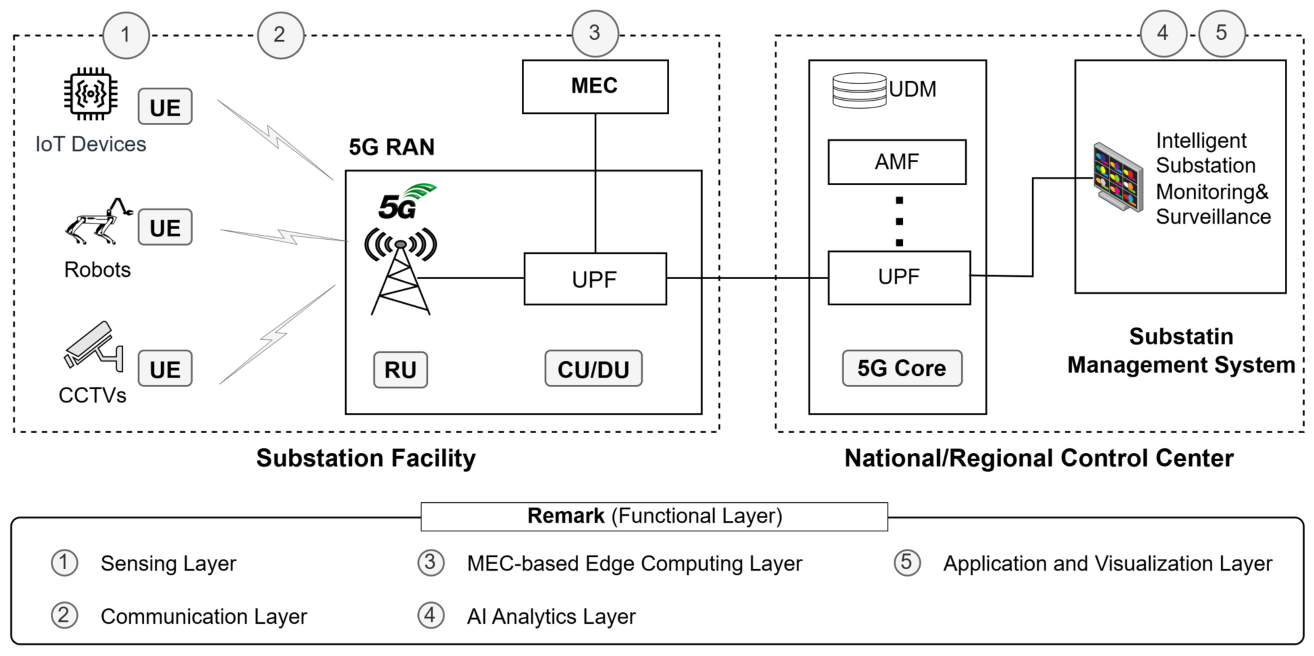
Figure 2.
5G Compact Core Architecture and Functional Roles.
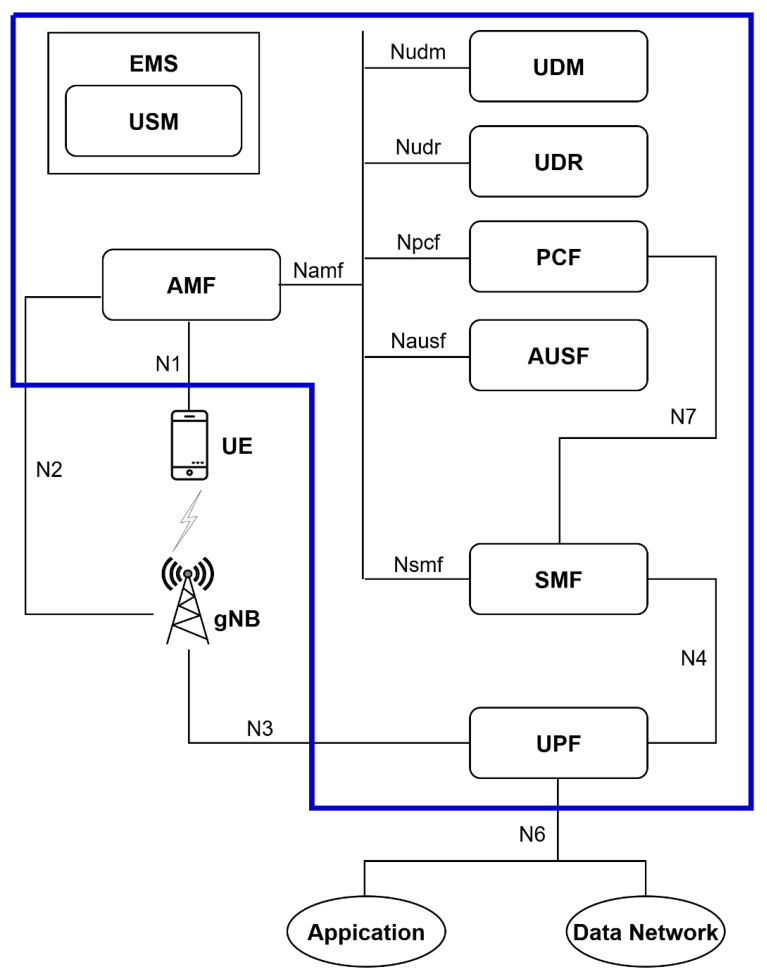
Figure 3.
5G Base Station Architecture with CU-DU-RU Split.
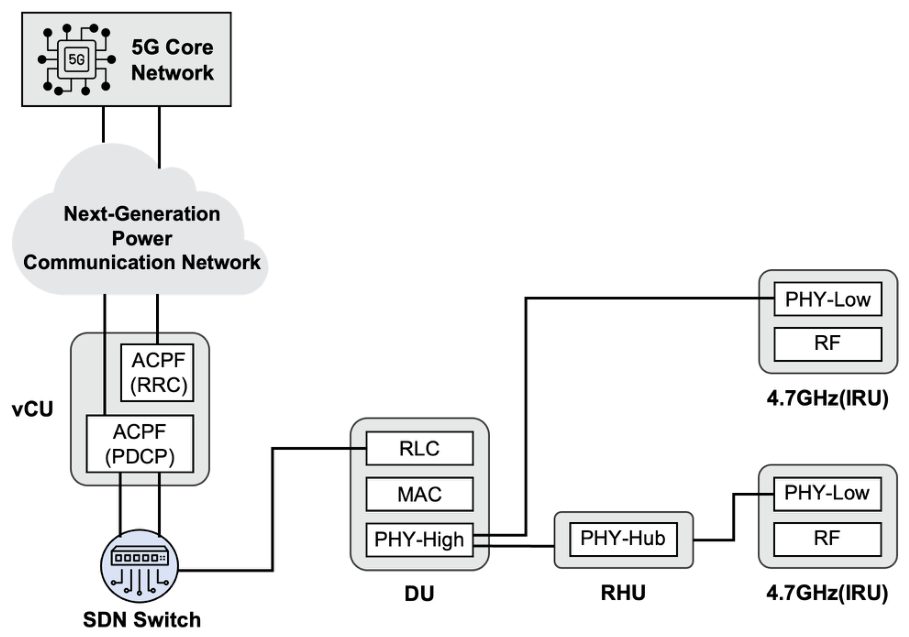
Figure 4.
Real-time PD and vibration-based fault detection pipeline over 5G and MEC.
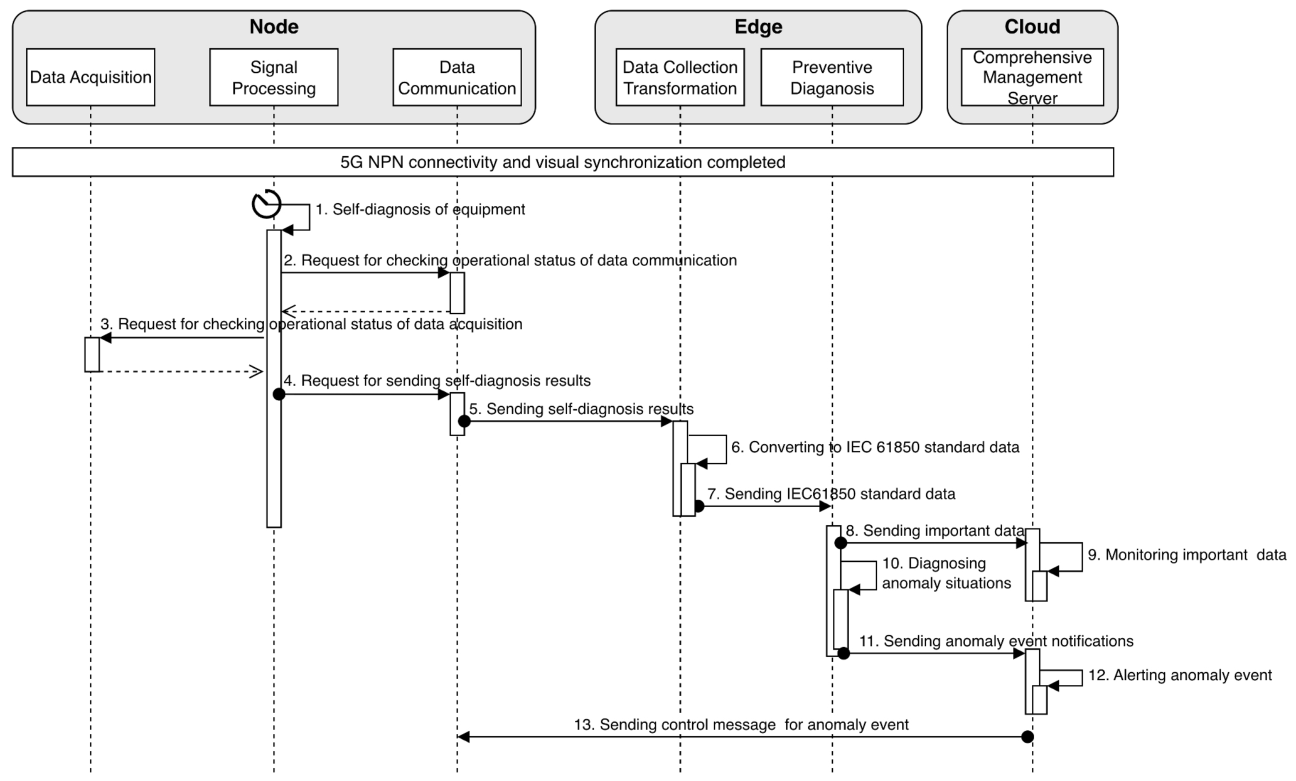
Figure 7.
Performance comparison: (a) Detailed RSRP coverage distribution, (b) Overall RSRP classification, (c) Downlink throughput, (d) Uplink throughput. All plots show baseline (blue) vs. optimized (orange) results.
Figure 7.
Performance comparison: (a) Detailed RSRP coverage distribution, (b) Overall RSRP classification, (c) Downlink throughput, (d) Uplink throughput. All plots show baseline (blue) vs. optimized (orange) results.
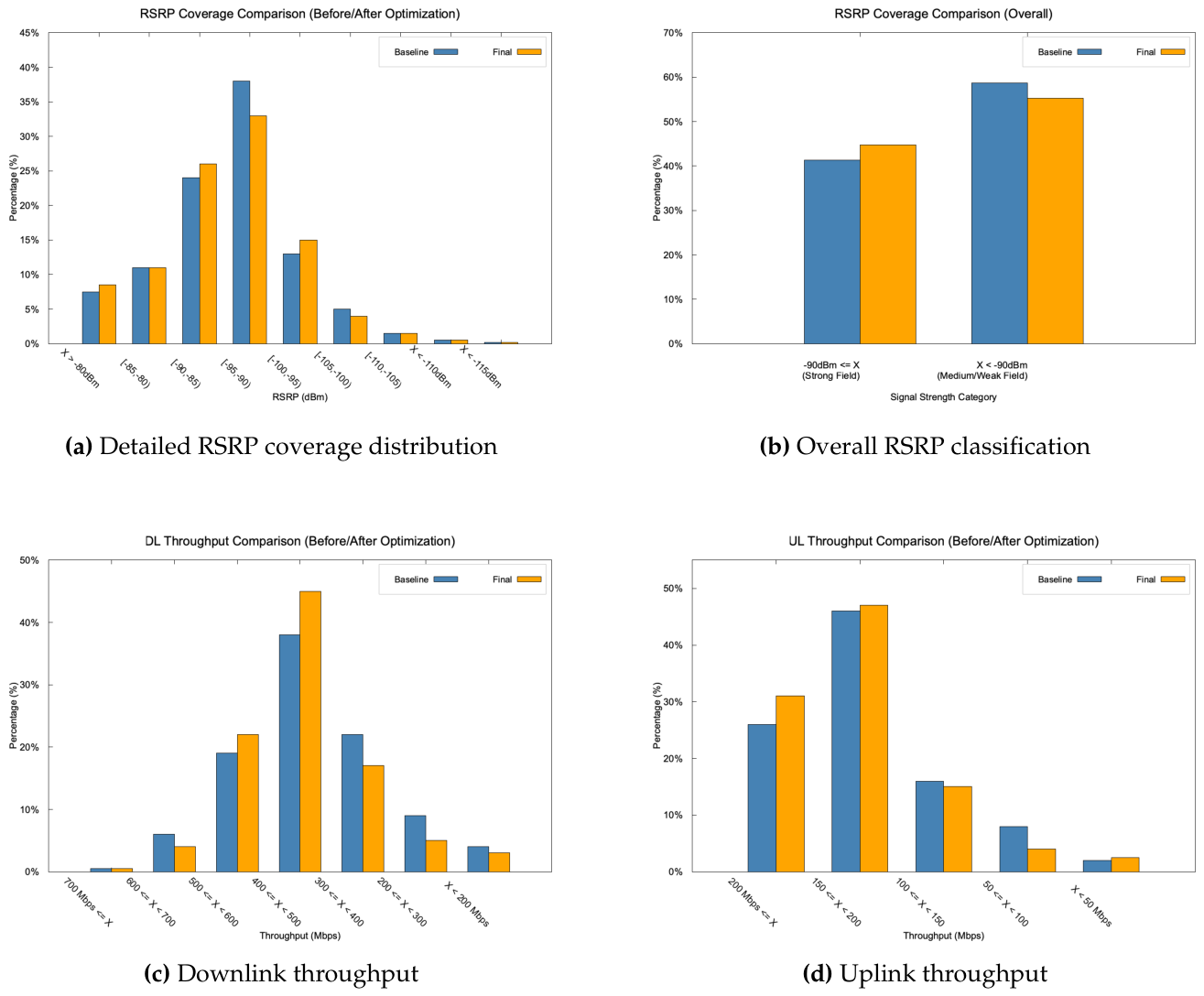
Figure 8.
Concept diagram of the robot-based inspection service in a substation environment, leveraging private 5G connectivity.
Figure 8.
Concept diagram of the robot-based inspection service in a substation environment, leveraging private 5G connectivity.
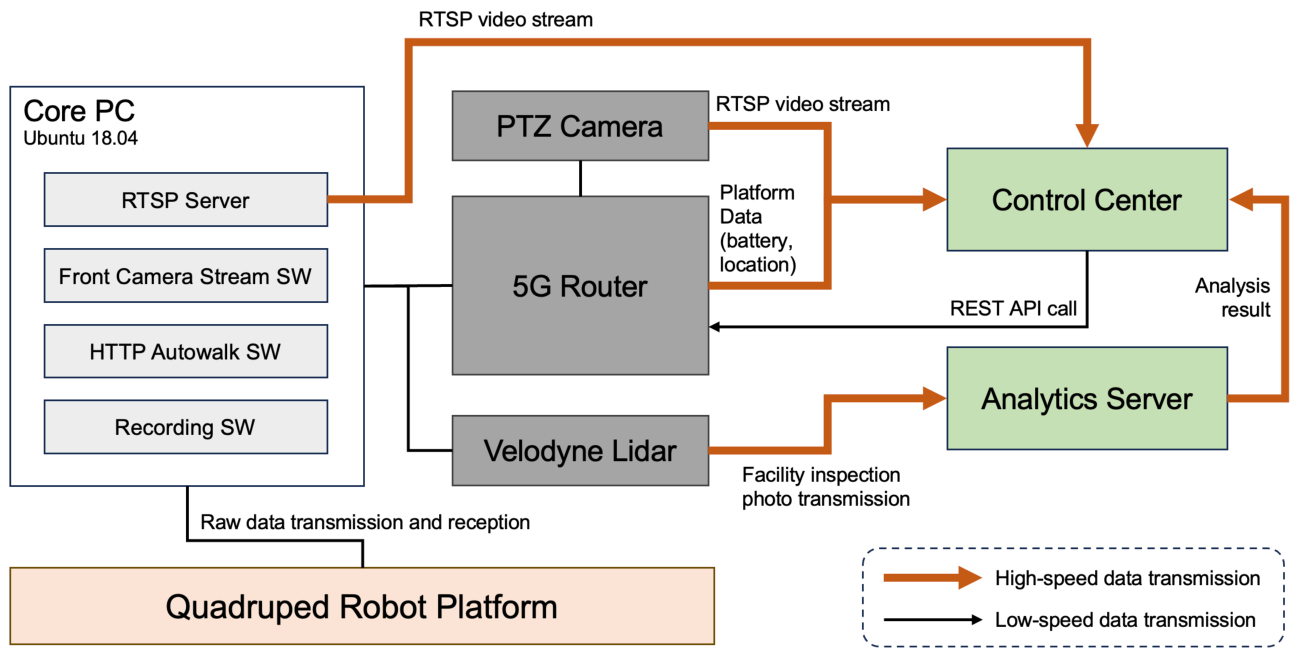
Figure 9.
Autonomous navigation of the quadruped robot over private 5G infrastructure.
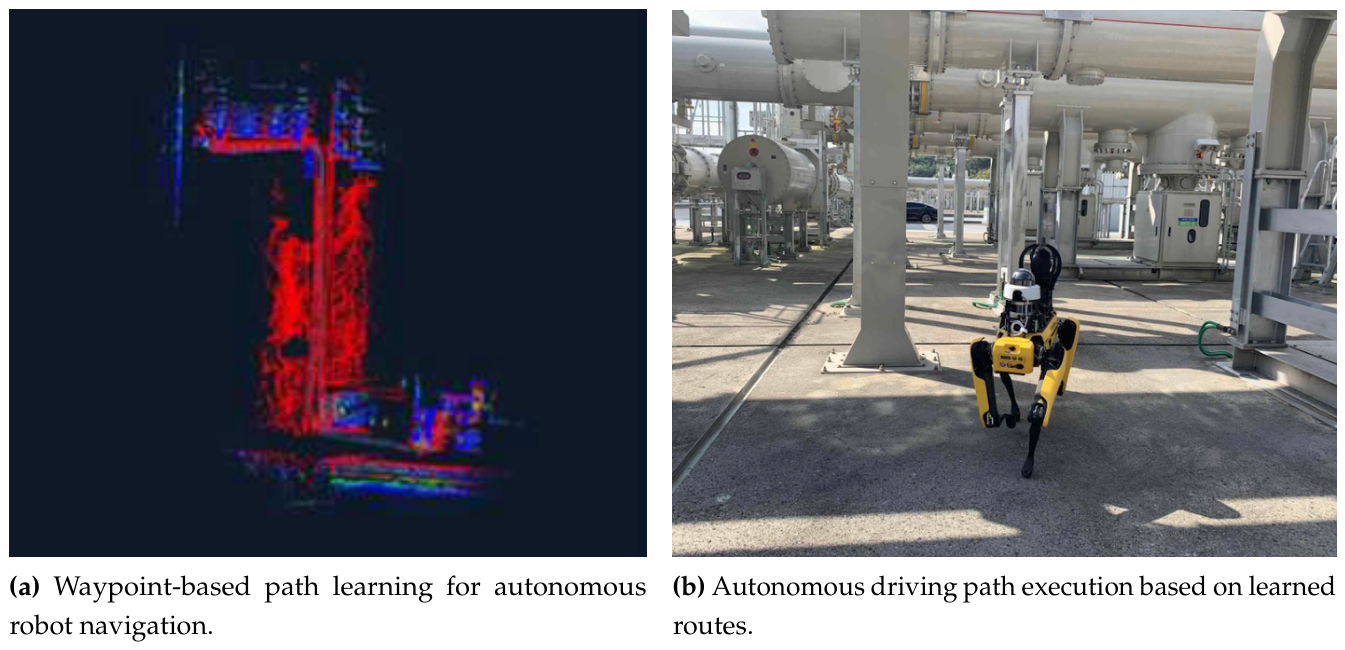
Figure 11.
Workflow for AI-based gauge analysis.
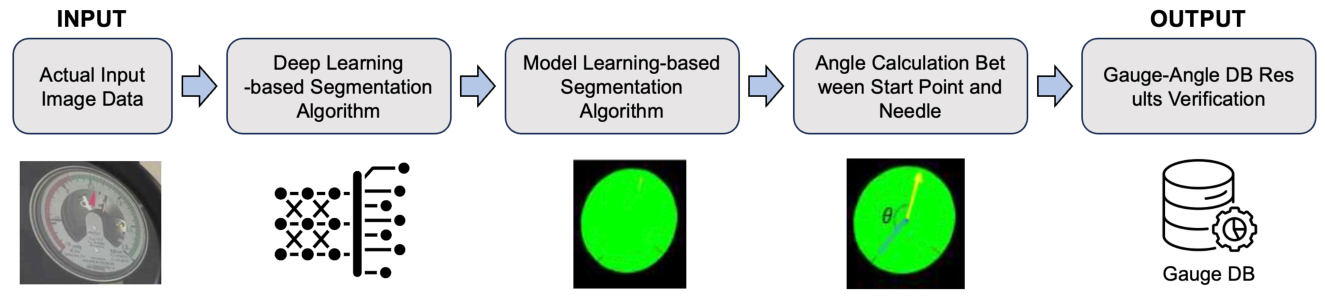
Figure 12.
Deep learning algorithm training process for image analysis.
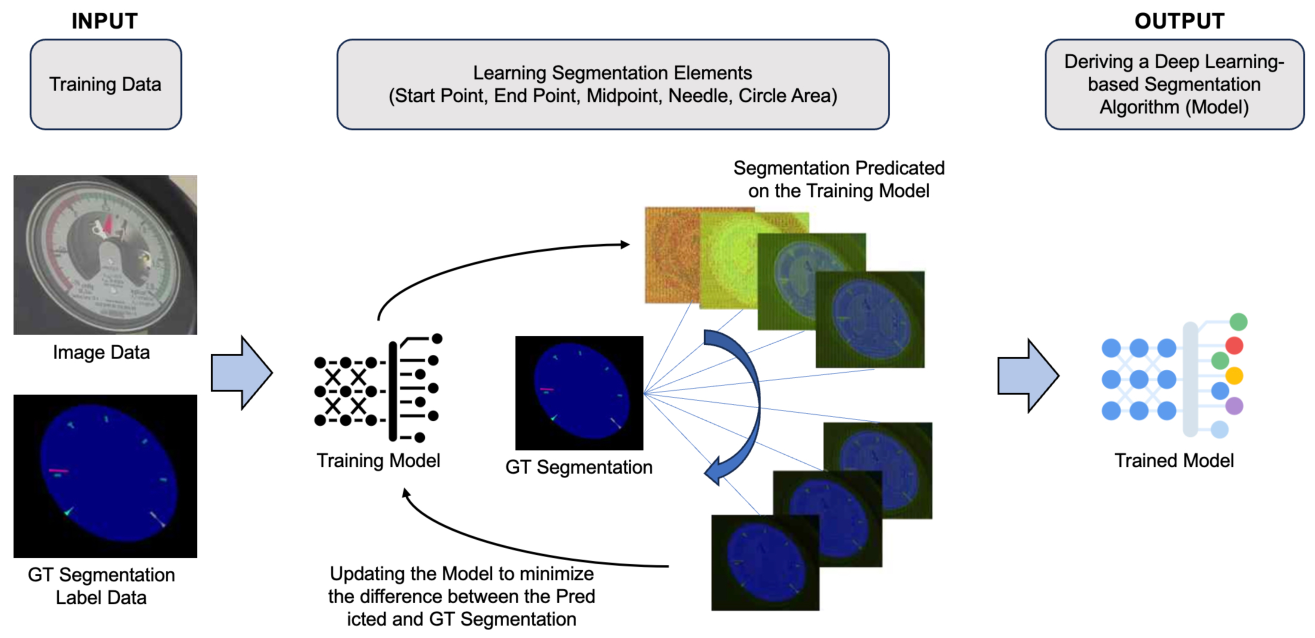
Table 1.
Abbreviations of System Components.
| Abbr. | Description |
|---|---|
| UDM | Unified Data Management – manages user identity and subscription |
| UDR | Unified Data Repository – stores structured policy and profile data |
| AMF | Access and Mobility Management Function – handles UE mobility |
| SMF | Session Management Function – manages PDU sessions |
| PCF | Policy Control Function – enforces QoS and policy rules |
| AUSF | Authentication Server Function – provides user authentication |
| UPF | User Plane Function – forwards user traffic to data networks |
| EMS | Element Management System – manages network elements |
| USM | Unified System Manager – oversees system configuration and faults |
| ACPF | Access Control Plane Function – handles Radio Resource Control (RRC) control messages |
| AUPF | Access User Plane Function – processes user data |
| vCU | Virtualized Central Unit – control/user plane processing |
| DU | Digital Unit – baseband processing and F1 interface relay |
| ORU | Outdoor Radio Unit – RF unit for outdoor coverage |
| IRU | Indoor Radio Unit – RF unit for indoor coverage |
| AU | Access Unit – mmWave RF unit (e.g., 28GHz) |
| SDN | Software Defined Network – programmable network switching |
| MEC | Multi-access Edge Computing – local data processing at the edge |
Table 2.
Integrated 5G Core and MEC Specifications.
| Component | Technical Specifications |
|---|---|
| Control Plane |
|
| User Plane |
|
| MEC Platform |
|
Table 4.
Summary of Defined KPIs and Target Values.
| Category | Test Item | Attempts | Successes | KPI Target |
|---|---|---|---|---|
| Quality | Connection Success Rate | 100 | 100 | ≥99% |
| Disconnection Rate | 100 | 1 | ≤1% | |
| Service | ||||
| Coverage & | ||||
| Performance | Handover Success Rate | 10 | 10 | ≥99% |
| RSRP Outdoor (4.7GHz) | N/A | N/A | dBm (90%) | |
| RSRP Indoor (4.7GHz) | N/A | N/A | dBm (90%) | |
| Downlink Throughput | 10 | 10 | ≥900 Mbps | |
| Uplink Throughput | 10 | 10 | ≥432 Mbps | |
| Ping Latency | 100 | 100 | ≤20 ms (Ping) | |
| ≤16 ms (MEC) |
Table 5.
4.7GHz ORU Field Test Results.
| Performance Metric | Target | ORU 1 | ORU 2 | ORU 3 | ORU 4 |
|---|---|---|---|---|---|
| Connection Success Rate (%) | ≥99 | 100 | 100 | 100 | 100 |
| Disconnection Rate (%) | ≤1 | 0 | 0 | 0 | 0 |
| Handover Success Rate (%) | ≥99 | 100 | 100 | 100 | 100 |
| Outdoor RSRP Coverage ( dBm) (%) | ≥90 | 100.0 | 100.0 | 99.6 | 99.9 |
| Downlink Throughput (Mbps) | ≥900 | 968.8 | 1001.8 | 951.9 | 998.8 |
| Uplink Throughput (Mbps) | ≥432 | 435 | 456 | 455 | 452 |
| Ping Latency (ms) | <16 | 9.0 | 10.8 | 10.5 | 9.3 |
Disclaimer/Publisher’s Note: The statements, opinions and data contained in all publications are solely those of the individual author(s) and contributor(s) and not of MDPI and/or the editor(s). MDPI and/or the editor(s) disclaim responsibility for any injury to people or property resulting from any ideas, methods, instructions or products referred to in the content. |
© 2026 by the authors. Licensee MDPI, Basel, Switzerland. This article is an open access article distributed under the terms and conditions of the Creative Commons Attribution (CC BY) license.
Copyright: This open access article is published under a Creative Commons CC BY 4.0 license, which permit the free download, distribution, and reuse, provided that the author and preprint are cited in any reuse.