

Submitted:
11 August 2026
Posted:
17 August 2026
You are already at the latest version
Abstract
Reconnecting people with the rest of nature is increasingly identified as a deep leverage point for sustainability, because nature connectedness (NC) predicts pro-environmental behaviour and human well-being simultaneously. Yet the mechanisms through which NC actually changes remain poorly specified, which limits the design of effective interventions, and dominant measures overlook the embodied, perceptual and relational dimensions of everyday connectedness. NC research also rarely makes its own epistemological standpoint explicit, and so risks reproducing the subject–object separation that sustainability transformations seek to unsettle. We address both problems through chiasm—Merleau-Ponty’s conceptualisation of perception as simultaneously active and passive—used as theory and as methodology. We conducted a 30-day quasi-experimental intervention with 55 university students in Shiraz, Iran (27 intervention, 28 control), a non-WEIRD, place-rich context in which culturally transmitted practices of perception such as tamāšā (‘watching while walking’) already carry chiastic qualities. Participants shared daily nature experiences in small mobile messaging groups across five thematic modules (senses, beauty, emotion, meaning, compassion). Nature relatedness, pro-environmental behaviour, psychological well-being and mindfulness were measured on days 0, 15 and 30 as the ‘outside view’; participants’ shared experiences were coded for chiastic structure as the ‘inside view’. Chiastic experiences increased significantly across the intervention, as did nature relatedness, pro-environmental behaviour, well-being and mindfulness relative to controls. Chiasm offers a plausible relational mechanism for NC change and a low-cost, culturally grounded and scalable intervention format that advances human well-being and sustainable behaviour together, contributing to SDGs 3, 12, 13 and 15.
Keywords:
nature connectedness
; sustainability
; well-being
; pro-environmental behaviour
; embodiment
; chiasm
; self-transcendence
; biophilia
; ecocultural identity
; relational values
1. Introduction
1.1. Nature Connectedness as a Deep Leverage Point for Sustainability
Sustainability policy has overwhelmingly targeted what systems thinkers call shallow leverage points—parameters, incentives, efficiencies and technologies—while leaving intact the paradigms and values from which unsustainable behaviour flows (Abson et al., 2017). Deep leverage points, by contrast, concern the intent and design of systems: what people care about, how they understand themselves, and how they relate to the rest of the living world (Riechers et al., 2021; Woiwode et al., 2021). The quality of the human–nature relationship has been proposed as precisely such a deep leverage point, because it operates at the level of self-concept and worldview rather than at the level of behaviourally specific attitudes (Ives et al., 2018; Klaniecki et al., 2018).
The empirical case is now substantial. Nature connectedness (NC) — an umbrella term for the family of constructs measuring people’s psychological relationship with the rest of nature (Capaldi et al., 2014) — predicts pro-environmental behaviour across successive meta-analyses (Mackay & Schmitt, 2019; Whitburn et al., 2020; Barragan-Jason et al., 2022) and is robustly associated with eudaimonic well-being (Pritchard et al., 2020; Nisbet et al., 2011; Bratman et al., 2019). At population scale, NC has been proposed as a candidate metric for tracking whether societies are moving towards, or away from, sustainable human–nature relations (Richardson, Hamlin, Elliott, et al., 2022). Because NC supports human health and planetary health at once, interventions that raise it can contribute simultaneously to several Sustainable Development Goals — notably SDG 3 (good health and well-being), SDG 12 (responsible consumption and production), SDG 13 (climate action) and SDG 15 (life on land) (Fonseca et al., 2020; Zylstra et al., 2014).
This double dividend is only actionable if we know how connectedness changes—and here the evidence thins. Time in nature is at best a weak predictor; what appears to matter is the quality of attention brought to an encounter (Richardson et al., 2021; Richardson, Hamlin, Butler, et al., 2022). Yet what that quality consists in, and how it might be cultivated, remains largely unspecified (Lengieza & Swim, 2021; Sheffield et al., 2022). Until it is, NC will remain a promising correlate rather than an operable lever for policy and practice. Two obstacles stand in the way: the absence of a theory of mechanism, and the objectivist and subjectivist epistemologies whose divergence has hindered cumulative progress in the field (Ives et al., 2017). An emerging body of work responds by urging relational thinking (Riechers et al., 2021; Helne, 2022) and the elucidation of relational ontologies and epistemologies (West et al., 2020).
1.2. The Missing Inner Lived Dimension
A parallel argument has been developing in sustainability science itself. Transformations towards sustainability are increasingly understood to require attention to inner dimensions—values, beliefs, worldviews, capacities for attention and relationship—that external policy instruments cannot reach directly (Ives et al., 2020; Wamsler et al., 2021; Woiwode et al., 2021). We adopt this framing while pressing it in a particular direction. The inner dimension as currently theorised remains largely propositional: it concerns what people hold to be true, valuable or important. Our concern is with the inner lived dimension — not only what a person believes about the living world, but how the encounter with it is undergone bodily, moment by moment, before it is formulated as a belief. Self-transcendent value orientations are among the most consistent psychological predictors of pro-environmental action (de Groot & Steg, 2008; Steg & Vlek, 2009), and contemplative capacities such as mindfulness have been linked both to well-being and to more sustainable ways of living (Wamsler et al., 2018; Schutte & Malouff, 2018). What remains under-described is the perceptual ground from which such values and capacities grow.
The predominance of scale-based measurement in NC research is neither an oversight nor an ontological commitment, and it would be unhelpful to read it as either. Standardised instruments are what make NC usable at the scale sustainability requires. They permit comparison across populations, tracking over time, and the meta-analytic accumulation on which the field’s strongest claims—including those we relied on in Section 1.1—depend (Capaldi et al., 2014; Whitburn et al., 2020; Pritchard et al., 2020; Barragan-Jason et al., 2022). The proposal that NC serve as a national or international sustainability metric (Richardson, Hamlin, Elliott, et al., 2022) is credible only because brief, psychometrically robust measures exist.
Our argument is therefore not that NC should be studied qualitatively rather than quantitatively, nor that existing scales misrepresent connectedness. It concerns a specific inferential gap that instruments, used alone, cannot close. That gap has three strands.
Measurement without mechanism. A pre/post design establishes that a score has moved; it cannot, by itself, say what moved it. This is a division of labour rather than a defect, since instruments are built to detect difference, not to narrate it. The difficulty arises when score movement is treated as self-interpreting — when an intervention is declared effective without an account of which encounters, in which moments, did the work. Reviews of NC antecedents arrive repeatedly at this limit, observing that the field knows a great deal about correlates and comparatively little about processes (Lengieza & Swim, 2021; Sheffield et al., 2022). For a construct proposed as a leverage point, this is consequential: leverage requires knowing where to push.
The stance an item asks of its respondent. To answer “I am not separate from nature, but a part of nature”, a respondent must momentarily step back from the relationship and render a verdict upon it, occupying for the duration of the response the very spectator position that the item’s content denies. We do not regard this as invalidating; reflective self-report remains informative, and no measure escapes some version of this circularity. It does mean, however, that such items sample a reflective register of connectedness, and that the field’s measures may converge in part because they share that register.
Response shift. The third strand comes from within quantitative methodology rather than against it. An intervention that trains attention may alter not only a participant’s connectedness but the internal standard against which they rate it, or their conception of what connection is. Measurement theory distinguishes alpha change (movement on a stable metric) from beta change (the respondent’s recalibration of that metric) and gamma change (reconceptualisation of the construct itself) (Golembiewski et al., 1976), and response-shift bias is well documented wherever self-report follows an experience that alters the respondent’s frame of reference (Howard & Dailey, 1979; Sprangers & Schwartz, 1999). Perceptual-training interventions are close to a paradigm case. A participant who becomes markedly more engaged may return a lower post-test score, having become a more exacting judge of their own connectedness — a pattern we observed and discuss in Section 4.4. Read as alpha change, this is a null or adverse finding; read as gamma change, it is evidence that the intervention did precisely what it set out to do. The scores alone cannot adjudicate between the two readings. What can adjudicate is an account of what participants were doing and undergoing while those scores were being produced.
This is what an inside view is for. It does not replace the instrument or correct it; it supplies the interpretive material without which the instrument’s movement is ambiguous. Established NC definitions (e.g., Zylstra et al., 2014; Lumber et al., 2017; Whitburn et al., 2020) rarely elaborate the lived, bodily continuity between physical contact with the living world and the psychological sense of connection, nor the pragmatic consequences of that continuity for research design. There is also a reflexive dimension worth stating plainly: if sustainability requires loosening the paradigm of human separateness from the rest of nature, then research designs that quietly reproduce a separated observer work, in a small way, against the transformation they document. We offer this as an argument for methodological pluralism, not as a charge against colleagues whose instruments we ourselves rely upon.
Bringing embodiment into NC from a relational view (Overton, 2007), we argue that chiasm—as a theory refined in ecophilosophy and biosemiotics (Bannon, 2011; Weber, 2016b), and as a methodology matured in dialogic theory (Wegerif, 2020a; Wegerif et al., 2020)—speaks to both: it supplies a candidate mechanism for NC change, and a reflexive research design consistent with that possible mechanism, capable of running alongside standard instruments rather than in place of them. We explore its practical application in a real-world quasi-experiment.
1.3. The Embodied Nature of ‘Connectedness’: Chiasm’s Entry into NC
Cognitive science (Varela et al., 2017; Glenberg, 2010) and philosophy (Merleau-Ponty, 1968; Overton et al., 2007; Johnson, 2013) provide compelling support for the embodied dimension of psychological processes. Within NC literature, the premise that psychological connection is a continuation of embodied connection also underpins the biophilia hypothesis, which emphasises human neurophysiological—that is, embodied—evolutionary affiliation with the living world (Kellert & Wilson, 1993; Gullone, 2000; Barbiero & Berto, 2021; Lumber et al., 2017). Biophilia, however, accounts for the disposition rather than its enactment: it explains why humans might be predisposed to affiliate with the living world, not what happens perceptually when they do. Chiasm addresses that second question, and in doing so treats affiliation as something cultivated in each encounter rather than simply inherited. Chiasm, as a theoretical bridge, helps us understand how embodied connection fluidly becomes psychological connection and, in turn, how connectedness is perceptually experienced.
Chiasm is a conceptualisation of perception referring to activity and passivity in every perceptual event (Merleau-Ponty, 1968). In classical rhetoric, 'chiasm' indicates that the subject and object of a sentence can be reversed. The sentence “I perceive the natural world: the natural world perceives me” is an example of a chiasm (Toadvine, 2013). Understanding chiasm in NC, however, requires delving into Merleau-Ponty's relational ontology.
Nature as an already interconnected mesh of relations individuates every human organism (Bannon, 2011; Merleau-Ponty, 1968), which is "fundamentally a process of constitution of an [bodily] identity" (Varela, 1997). The creation of a distinguished yet dependent organic identity emerges through the definition of 'inside' and 'outside' of the body by setting a particular dynamic of passages, which we call the sensory and immune systems. The body seeks to sustain its discernible identity as a baseline and, if possible, to flourish. Thus, for the body, every perceptual event relating inside and outside — breathing, sensing, digestion, organ function — matters. The continuation of embodied identity relies on two intertwined processes: first, the ongoing exchange between inside and outside, since the body never maintains material identity between any two given moments; and second, established bodily pathways that facilitate the flow of matter, transforming it as necessary to maintain a cohesive identity and mitigate fluctuations (Weber, 2016a).
The contradictory state of inflexibility and malleability of the body with/in its environment — an indication of the indefinability of the exact demarcation between inside and outside — is the foundation of chiasm (Bannon, 2011; Merleau-Ponty, 1968). Persian holds a similar doubleness in a single form. Tan (تن) is at once a noun meaning ‘body’—in a more lived register than جسم (jesm), the term used for body as material object—and the present stem and imperative form of the verb tanidan (تنیدن), ‘to weave’ or ‘to spin’. The single form names both the bounded body and the ongoing interweaving by which a body is a body at all. Merleau-Ponty reached for a similar figure in naming the chapter in which chiasm appears, L’entrelacs—le chiasme: the intertwining, the chiasm.
Chiasm’s primary assertion is that embodied organisms are at the same time subject and object in every perceptual event (Merleau-Ponty, 1968). Regarding NC, the same dynamic of passages that constitutes bodily identity gives every encounter with the natural world two aspects: a symbolic outside, which the body actively renders, and a feeling inside, which it undergoes — the latter imbued with existential connotations (Weber, 2016b). This duality entails the body both symbolising the external world as a subject, and being manipulated by it as an object, resulting in certain existential feelings (Weber, 2016b).
Humans perceive the 'outside' of nature through the mediation of their body, which transforms the outside into recognisable symbols for themselves (Kull, 1998). The symbolic meaning is interpreted by the experiencing body as ‘feeling’, which is the inside perspective (Weber, 2016b). Because symbolising and feeling are not two successive events but one event described from either side, the relation can be read in both directions: the outside is the symbol of the inside, and the inside is the meaning (feeling) of the outside (Weber, 2016b, p. 84). The relationship is cyclical and complex, so feeling shapes how the body symbolises, and vice versa.
This account converges with, and offers a possible mechanism for, several constructs central to the sustainability literature. What chiasm names, in phenomenological terms, has overlap with self-transcendence: a state in which the boundary between self and world becomes porous and the sense of a bounded, separate self is temporarily diminished (Yaden et al., 2017). In NC research this appears as the inclusion of nature in the self (Schultz, 2002) and as environmental identity (Clayton, 2003; Clayton et al., 2021)—constructs that locate connectedness within self-concept rather than within attitude. Because self-transcendent values are among the strongest predictors of pro-environmental commitment (de Groot & Steg, 2008; Steg & Vlek, 2009), an account of how self-transcendence is generated has direct sustainability relevance. Chiasm's contribution is to relocate self-transcendence from rare peak experience to an ordinary, trainable feature of everyday embodied perception.
Since our embodied identity is ecocultural (Milstein & Castro-Sotomayor, 2020), the interpretation of symbols into different feelings can help us connect more deeply or, conversely, hasten a sense of disconnection from nature (cf. Maran, 2020). Here, nature disconnectedness becomes imperative, because we can construe a symbol in ways that undermine our relationship with the rest of nature and, by extension, our own well-being and the sustainability of our practices. Concepts such as biophobia (Soga et al., 2023) and disembodiment (Gao & Zelazo, 2007) underscore these types of interpretation. In disembodiment, we narrowly interpret the symbols of our own body, reducing the meaning of the 'lived body' experience of our identity as a relational being — whose existence originates in its connectedness — to a mere pre-existing ‘physical body’ interacting with other entities (cf. Overton et al., 2007; Weber, 2016b).
We may therefore more fluidly conceive nature connectedness as “awareness of the interrelating process from which feelings (inside) and symbols (outside) arise and change — an awareness that deepens appreciation of non-human nature for the lived body and shapes how we perceive and act within the natural world”. A question follows: when experiencing nature, can a real-time awareness that one is simultaneously affecting (subject) and affected (object) — a dynamic interplay of subtle inner and outer change — help one become more nature connected, and act more sustainably as a result? We address this question by studying the effect of the chiastic structure of perception on NC, well-being and pro-environmental behaviour, through a chiastic methodology. The intervention (section 2.3) trains this awareness indirectly, through concrete perceptual activities—attending to the senses, to beauty, to emotion, to meaning, to compassionate action—while nature connectedness is assessed separately, with the Nature Relatedness Scale and encoding chiastic experiences.
1.4. Place, Ecocultural Identity and the Iranian Context
Connectedness is never generic. It is always connection to somewhere, mediated by the cultural repertoires through which a place is perceived—what conservation science calls sense of place and place attachment (Scannell & Gifford, 2010; Masterson et al., 2017), and what environmental communication calls ecocultural identity (Milstein & Castro-Sotomayor, 2020). Place attachment is among the more reliable predictors of place-protective and community-based conservation behaviour, which makes the cultural texture of nature experience a sustainability variable rather than a decorative one.
Iran faces the challenge of being objectified and exploited for its natural ‘resources’ (Faazeli & Namdar, 2023; Ebadi et al., 2020). We refrain from symbolising Iran’s nature as resources to be extracted, or even merely enjoyed. Guided by our felt relational kinship, we heed the call of our land to awaken to mutual thriving and flourishing. We aim to breathe new life into ecocultural symbols with many potential occasions for communing with the landscape (Amanat, 2016; Khademi et al., 2013), such as the renowned Nowruz (new day) celebration of the first day of spring.
As the conceptual and operational definitions of the NC construct were found valid and reliable in the Persian context (Faazeli & Namdar, 2023), we sought to participate actively in the global discourse on NC (Baxter & Pelletier, 2019; Hurly & Walker, 2019). Yet we could not help noticing that nature encounters have distinctive characters from an ecocultural lens. There is, for instance, the word تماشا—tamāšā, ‘watching while walking’—traditionally used in Persian for perceiving things such as gardens and carpets. The Persian Garden is designed such that one cannot obtain a clear perspective of it (Mahmoudi Farahani et al., 2016) unless one engages in tamāšā. One must join in lively participation in the garden to fulfil the purpose of entering it (Behpoor & Emami Pari, 2019; Behpoor, 2018)—much like ‘perception as participation’ in practice, as Merleau-Ponty elaborates through the activity and passivity of perceptual events (Abram, 2012).
Such ecocultural elements, unconsciously present in perceptual experience, led us to resonate with discourses on chiasm as a relational perspective. They also matter for the generalisability of sustainability interventions. The evidence base for NC as a basic psychological need comes overwhelmingly from Western, educated, industrialised, rich and democratic (WEIRD) societies (Henrich et al., 2010a, 2010b), while comparable evidence from African, South American and Middle Eastern countries remains sparse (Hurly & Walker, 2019; Baxter & Pelletier, 2019; Ives et al., 2017). If NC is to serve as a global sustainability metric and lever (Richardson, Hamlin, Elliott, et al., 2022), interventions must be shown to work through locally meaningful cultural forms — not only through the imported vocabularies of Anglophone environmental psychology.
1.5. Aims and Research Questions
This study pursued three linked questions:
RQ1. Can a short, low-cost, group-based intervention increase the frequency of chiastic nature experiences — those expressed in the first person, with an explicit felt or reflective dimension?
RQ2. Does such an intervention concurrently increase nature connectedness and its sustainability-relevant outcomes — psychological well-being, pro-environmental behaviour, and mindfulness?
RQ3. Can chiasm function as a methodology, relating the ‘inside’ of an intervention (participants’ lived experience) to its ‘outside’ (standardised measures), so that a possible mechanism and outcome can be examined together?
2. Materials and Methods
2.1. Design: Chiasm Methodology for Sustainability-Relevant NC Research
When approaching an intervention as a whole in a conventional NC experiment (e.g., Richardson & McEwan, 2018; McEwan et al., 2019), researchers implicitly treat pre- and post-tests as the measures (outside/symbol) providing insight into what happens during the intervention period. A more ‘nature-connected’ research design, aligned with our embodied account of perception, would additionally:
Condition 1: provide an account of the inside of the intervention;
Condition 2: examine the interrelatedness of the inside (meaning, lived experience) and outside (symbols, measures), in order to obtain a fuller understanding of the reasons for—and trends in—change (Wegerif, 2020b).
Interventions cannot be responsibly scaled if we know only that scores moved, and not what moved them. Chiasm methodology can serve as a catalyst in the transition towards a robust relational epistemology (Wegerif, 2020b; Wegerif et al., 2020). Here, researchers view nature experiences as ‘inside’ with meaning and equally as ‘outside’ with symbols. Researchers objectify nature experiences by observing outside patterns of signs, thoughts or behaviour, and subjectify them by endeavouring to understand empathically the psycho-somatic experience—that is, what it feels like to have those experiences (Kershner et al., 2020).
We conducted an NC educational intervention and sought to perceive it through chiasm methodology. Assessments occurred on days 0, 15 and 30, with an additional questionnaire (dialogic learning) at the end of the intervention. The questionnaires served as ‘outside’ measures, while participants’ daily nature experiences, shared online over 30 days, offered an ‘inside’ perspective (Figure 1). We used quantitative and qualitative analysis (encoding dialogues) to obtain results and interpret trends and their implications for NC, well-being and pro-environmental behaviour. The interrelatedness of the nature experiences (inside) and the NC questionnaire (outside)—the second condition for chiasm methodology—is examined in Section 2.4.2.
2.2. Participants and Procedures
Fifty-five students from Shiraz University participated: 27 in the intervention group and 28 in the control group (29 and 30 respectively before dropouts). After the pre-test, the intervention group was divided into eight WhatsApp subgroups that maintained existing classmate connections. This arrangement aimed to create a secure environment for sharing experiences while managing message traffic and fostering mutual understanding among participants. The School of Agriculture’s Higher Education Committee and Shiraz University’s General Board approved this research from ethical and scientific perspectives, both before and after its completion.
The small-group messaging format required no funded infrastructure, travel or specialist facilitation, and embedded individual experience within a peer community (Farrow et al., 2017; Jugert et al., 2016). We assigned two tasks to each participant: first, to submit a nature experience daily, in written or spoken form, through text, audio, photograph or short video; and second, to submit at least two reactions or comments on others’ nature experiences per week. Mid- and post-tests used the same questionnaires on days 15 and 30. The dialogic learning questionnaire, administered to the intervention group on day 30, measured their dialogic relationship with their subgroup members. The control group completed questionnaires at the start, midpoint and end of the study (days 0, 15 and 30), mirroring the intervention group.
We briefly trained the intervention group in embodied nature experience in order to help them reclaim their inherent connectedness. Specifically, we prompted participants to recall their childhood exploratory perspective, so as to rekindle novelty and sensitivity to moment-by-moment perception of the world—echoed as ‘dialogic orientation’ by Wegerif (2020a). Adults, on this view, need to replace an entrenched objectifying ‘I–It’ stance towards more-than-human nature with an ‘I–Thou’ stance, in order to become aware of the simultaneous dialogic cycle of touching and being touched (Buber, 1958).
2.3. Intervention Content
Five pathways have been shown to correlate most strongly with increased NC (Lumber et al., 2017; Richardson et al., 2020). We therefore designed five modules of six days each, as set out in Table 1.
2.4. Analysis
2.4.1. Interpreting Nature Experiences: The Inside View
We apply the account of NC introduced above (Section 1.3) in order to illuminate a possible mechanism underlying NC change. A theory of this kind, however, holds limited value without practical linkage through empirical research; a framework that is never brought into contact with data can be neither developed nor refined (Wegerif, 2020a). We therefore applied it in two ways: (i) as facilitation for participants in a chiastic experience of nature; and (ii) as the basis of our coding scheme for interpreting qualitative data. Working a theory through data qualitatively alone, however, limits generalisability and comparability (Hammersley, 2018; Wegerif, 2020b), so we paired the coding with quantitative analysis, using a transparent scheme (Hennessy et al., 2020) that distinguished ‘chiastic’ from ‘detached’ experiences. Encoding the raw nature-experience data is itself a symbolisation (outside) of meaning (inside), reflecting the chiastic structure present in perceptual events (Merleau-Ponty, 1968). Both the overall research methodology and the particular nature-experience analysis in this study are therefore chiastic (Figure 2).
Pre-test (outside, symbol) Mid-test (outside, symbol) Post-test (outside, symbol)
Participants are experiencing the intervention (inside, meaning)
To understand the intervention from the inside, we coded each recorded experience for the presence or absence of a lived, first-person perspective — whether the participant conveyed how the encounter felt from within it, or described it from the outside as a detached observer. This distinction between an immersed, experiential stance and a distanced, observational one is well established in psychology (Kross & Ayduk, 2017; cf. Buber's I–Thou / I–It, 1958), and resonates with first-person and phenomenological approaches to experience (Petitmengin, 2006; Varela et al., 2017). We retain the terms chiastic and detached to mark that, within our framework, the immersed pole is not merely one option among two but the mode in which the reciprocity of perception (Section 1.3) becomes explicit.
- Chiastic: the account conveys a felt, first-person involvement—the participant’s feelings or view are present in the experience.
- Detached: the account describes nature from an observer’s position, without a felt perspective—including grammatically first-person reports (“I saw this tree today”) that carry no feeling or view.
By submitting an experience at all, a participant is already symbolising their surrounding nature (the outside). What distinguishes a chiastic account is that the felt, inner side of that same moment (the inside) is present too — the participant registers not only what they perceived but how it felt to perceive it, and the subtle movement of that feeling as the encounter unfolded.
These are pragmatic classifications, and they carry an inevitable limitation: a more introverted or less expressive participant may render a genuinely first-person, felt experience in flat, observational terms, and so be coded as detached. We could not eliminate this, but sought to reduce it by keeping each messaging subgroup small and composed of existing classmates (Section 2.2), so that participants were sharing in a familiar and comfortable setting.
Because participants could submit at most one experience per day, each six-day module yielded a maximum of six submissions per participant, of which we recorded how many were coded chiastic. This fixed ceiling means the proportion of chiastic accounts, rather than a raw count inflated by submission volume, indexes the shift we are interested in: any change reflects a move between categories rather than a change in how much participants submitted. The five modules—themed in turn senses, beauty, emotion, meaning, and compassion—were each independently coded by the first two authors, and inter-coder reliability was assessed with Cohen's kappa (McHugh, 2012).
2.4.2. Measures: The Outside View
Nature Relatedness Scale (NRS). We measured NC with the 14-item NRS (Nisbet et al., 2009), one of several established scales (Tam, 2013; Mayer & Frantz, 2004), validated in the Persian context and comprising three factors: self, perspective and experience (Faazeli & Namdar, 2023).
The NRS also lets us examine the second condition of chiasm methodology (Section 2.1): that the 'outside' measure and the 'inside' experience are interrelated rather than independent. If the two views are genuinely two sides of one perceptual event, the items of a valid NC scale should themselves imply a chiastic experience—the felt, first-person involvement defined in Section 2.4.1. We therefore assessed each NRS item against that criterion (Table 2).
Several of the fourteen items are consistent with a chiastic experience by the criterion of Section 2.4.1, so the NRS is broadly in touch with the chiastic structure of perception—though unevenly, and the unevenness is instructive. The items sort, roughly, into the scale’s three factors: the Experience items (“I enjoy being outdoors, even in unpleasant weather”; “I take notice of wildlife wherever I am”) render felt, first-person encounters; the Self items (“I am not separate from nature, but a part of nature”) voice the same kinship as reflective self-concept rather than lived situated connection (cf. Schultz, 2002; Clayton, 2003); and the Perspective items sit further off, as attitudes toward use and conservation. Only the first register is chiastic in the strong, participatory sense our framework asks for. This spread across registers is not peculiar to the NRS: NC has been mapped as a family of distinct types—experiential, emotional, cognitive, philosophical—that a single instrument can only partly span (Ives et al., 2017). We read the result not as a failure of the second condition (Section 2.1) but as its lesson, one Section 1.2 leads us to expect: for a measure to travel—to let many hands do cumulative work together—it must lift connectedness away from the place-thick texture of any encounter, and that lifting is precisely what quietens the chiastic register, since felt participation is the part of experience that does not abstract cleanly. The trade is not a defect the NRS could design away; standardised scales, however expansive, remain pitched at the individual and stable, and cannot themselves hold the fluid, participatory phenomena they abstract from (Ives et al., 2018).
What our situation adds is that we feel this price more sharply than a study need do elsewhere. Our ways of meeting the living world—tamāšā, the garden that must be walked to be seen, the turning of Nowruz—are so saturated with place that the distance between a lived encounter and a scale item becomes hard to overlook. The abstraction was always in the measure, for everyone; our ecocultural bind simply brings it into view. Seen this way, the standardised scale and the inside view (Section 2.4.1) are not rivals but two registers a full account of connectedness needs at once: the scale indexes connectedness as reflective self-concept, efficiently and comparably, while the daily-experience method reaches the felt encounters the scale symbolises abstractly. Their limited interrelation is the seam between these registers—and it was our attempt to speak from one ecoculture into a shared global NC conversation that let us notice the seam was there.
Three further five-point Likert questionnaires were administered on days 0, 15 and 30:
Brief Inventory of Thriving (BIT). We used the 10-item BIT, confirmed as a valid and reliable measure of psychological well-being for Iranian university students (Shafiee & Fatehizade, 2018; Su et al., 2014).
Pro-Environmental Behaviour (PEB). We used a 10-item scale (cf. Dono et al., 2010) modified for the local Persian context (cf. Salehi & Imam Gholi, 2012; Cronbach’s alpha = 0.86), measuring consumer behaviour, willingness to pay, and environmental citizenship.
Mind–Body Scale (MBS). We used an eight-item mindfulness scale based on the Langer Mindfulness Scale with a socio-cognitive focus (five items covering novelty seeking, novelty producing and engagement) (Pirson et al., 2012; Moafian et al., 2017; Wang et al., 2016), together with three items on body and mind awareness from Brown and Ryan (2003). Internal consistency for the mind–body scale improved across the intervention (α = .51, .65 and .71 at days 0, 15 and 30). The baseline estimate is imprecise given the sample size (95% CI [.29, .69]) and is consistent with the α = .69 obtained for the same items in a larger sample (Faazeli & Namdar, 2023). The rise is suggestive—responses cohered as participants’ attention to their perceptual states became more articulated—but the baseline value falls below conventional thresholds, and the mindfulness findings warrant caution.
These variables are commonly linked with NC in the literature, but they do not form part of our chiasm method, as we did not design a corresponding inside perspective and measurement for them; participants were not, for example, asked to share experiences of their psychological well-being. Finally, after the quasi-experiment, a dialogic learning questionnaire—created specifically for this study by an expert panel in educational psychology and human ecology—was administered to the intervention group to gauge how students participated and whether the desired learning had occurred. Its items covered reflection, sharing, inspiration, comparison and enjoyment (Wegerif, 2013, 2020a).
3. Results
3.1. Participants
Participant demographics for the intervention and control groups did not differ significantly (Table 3), although the small sample size and consequent statistical limitations should be noted.
3.2. Inside View: Chiastic Experiences
We first examined whether the intervention elicited chiastic experience across its five modules. Following the encoding guidelines, we recorded for each participant the number of chiastic experiences in every six-day module (senses, beauty, emotion, meaning, compassion), out of a possible six. The first two authors coded all submissions independently; Cohen's kappa was 0.945, indicating almost perfect agreement (McHugh, 2012), and of 771 coded submissions (from a possible 810, with 39 missing), the 11 disagreements were resolved through discussion and consensus.
A repeated-measures ANOVA confirmed that the number of chiastic experiences changed significantly across the five modules. Because Mauchly’s test indicated that sphericity could not be assumed (W = 0.35, p = .002), we report Greenhouse-Geisser–corrected degrees of freedom: F(2.55, 66.30) = 11.40, p < .001, partial η² = .305. Results are shown in Figure 3.
Since participants could submit at most one experience per day, each module was capped at six submissions, so this rise reflects a shift in the kind of experience shared rather than a change in how much participants shared.
The trajectory (Figure 3) is not a steady climb but a rapid activation followed by a plateau. Chiastic expression rose sharply from the opening Senses module (mean 3.74 of 6) to Emotion (5.37), then levelled through Meaning and Compassion (both 5.15). The pattern is consistent with a ceiling effect: once participants began attending to their encounters in a felt, first-person way, that mode became the norm and largely sustained itself. The comparatively low figure for Senses—the opening module, and the only one in which participants were not asked to convey a felt perspective—likely reflects both that instruction and the time participants needed to grow comfortable sharing expressively within their groups.
These results suggest that chiastic experience was successfully elicited and sustained across the intervention. We now turn to the outside view, to examine whether this shift is accompanied by increased nature connectedness and by the sustainability-relevant outcomes of well-being and pro-environmental behaviour.
3.3. Outside View: Nature Connectedness, Pro-Environmental Behaviour, Well-Being and Mindfulness
We analysed each outcome with a 2 (group: intervention, control) × 3 (time: days 0, 15, 30) mixed ANOVA, treating time as a within-subjects factor and group as a between-subjects factor. The effect of primary interest is the group × time interaction, which tests whether the two groups changed differently over the intervention; the between-subjects main effect, reported alongside, tests whether they differed in overall level. Table 4 gives all three effects for each variable, and Figure 4, Figure 5, Figure 6 and Figure 7 show the group means at each time point.
The interaction was significant for all four outcomes. Nature relatedness rose in the intervention group relative to control, F(2, 106) = 25.89, p < .001, partial η² = .328, the largest interaction observed. Self-reported pro-environmental behaviour also diverged between the groups, F(2, 106) = 3.45, p = .035, partial η² = .061, with the intervention group gaining more than the control across the 30 days (mean change 4.48 versus 1.79). Mindfulness showed a comparable pattern, F(2, 106) = 9.22, p < .001, partial η² = .148 (mean change 2.56 versus −0.61), as did psychological well-being, F(2, 106) = 3.58, p = .031, partial η² = .063.
The between-subjects main effects tell a different and useful story. The groups differed in overall level on nature relatedness, F(1, 53) = 4.50, p = .039, and psychological well-being, F(1, 53) = 6.67, p = .013, but not on self-reported pro-environmental behaviour, F(1, 53) = 0.01, p = .908, or mindfulness, F(1, 53) = 0.34, p = .560. For these two outcomes the groups were comparable in overall level; what distinguished them was the trajectory over time—which is what the interaction tests, and what an intervention study is designed to detect.
Mauchly's test indicated departures from sphericity for nature relatedness (W = .68) and mindfulness (W = .88); Greenhouse-Geisser correction did not alter any conclusion, so uncorrected values are reported. Sphericity held for pro-environmental behaviour (W = .92) and well-being (W = .99).
To compare day-30 outcomes while adjusting for baseline differences, we also ran an ANCOVA for each variable with the day-0 score as covariate (Table 5). The group difference was significant across all four outcomes, with the same ordering of effect sizes: nature relatedness showed the largest effect, followed by mindfulness and well-being, with self-reported pro-environmental behaviour the smallest.
A note on statistical power is warranted. With 27 and 28 participants per group, this design could reliably detect only moderate-to-large effects. The nature relatedness, mindfulness and well-being effects are comfortably within that range; the smaller effect on self-reported pro-environmental behaviour sits near the limit of what the study could detect, and is best read as suggestive rather than firmly established. We return to this in Section 4.7.
A dialogic learning questionnaire was introduced during the intervention and completed by 20 of the 27 intervention participants. Because it was added after the study had begun and drew a partial response, we report it descriptively rather than as a systematic measure. Across the 14 items, individual mean scores averaged 3.75 (SD = 0.56, range 2.79–4.64), above the scale midpoint for most participants, indicating that the intended dialogic engagement generally occurred within the subgroups (Table 6).
3.4. Examples of Experiences
To illustrate the inside view, we present experiences from each module, drawn from across the eight messaging subgroups and chosen to show the reflection, sharing, inspiration and comparison that the dialogic learning measure indexes. Regarding translation, Persian او (oo) does not mark gender, and participants used it for the animals they encountered. We render it as “they” throughout: “it” would impose an objectifying distinction the original does not make, and a gendered pronoun would assign a gender the participant did not.
Module 1: Senses. Chiastic:
“I was looking out of the window at the sparrow sitting on the wall. They were chirping, and I asked myself why their chirping is so different. Maybe they are talking to another sparrow from a distance. There was no reason for all these different sounds except that they were meaningful. It was interesting to me even to imagine them talking.”
Detached: many submissions were matter-of-fact statements without personal interpretation or affect—“I looked at the shape of clouds”—or photographs submitted without written context.
Module 2: Beauty. Chiastic: some recollections deployed linguistic skill for artistic expression:
“The night in the depths of its being has a strange, mysterious secret that ripples in the face of the moon that occasionally crawls behind the dark clouds … While I was transfixed by the mysterious sky of midnight, I thought to myself, how many others with me right now are looking at the sky?”
Others met nature with humour and metaphor (Figure 8):
“The fly sunbathing on the leaf of a tree!”
Detached: sometimes participants submitted a photograph without accompanying written context (Figure 9).
Module 3: Emotion. Chiastic: one participant’s experience sometimes prompted another’s by piquing curiosity about how the same thing would feel (Figure 10 and Figure 11):
A: “I feel very good when the sun shines in the house. I quickly pick up the pillow and sheets and lie down [in it].”
B: “Yeah! I enjoy lying in the sun in my room too.”
In both images the sun falls across an Iranian carpet—a form long celebrated for weaving a garden into its motifs. The light thus reaches the participants through a domestic surface that is itself an artful replication of nature, quietly doubling the scene’s connection to the more-than-human world.
Others, unable to set aside special time, experienced an ordinary event more deeply:
“I drank a glass of water at work, and with every sip of my drink, every time the water went down, I felt this was the flow of life that I was drinking from; I felt it all when it went down.”
Some tried to empathise with what nature might feel (Figure 12):
“Sense of peaceful co-existence and symbiosis of trees: bitter orange, orange, tangerine, pomegranate and palm.”
Module 4: Meaning. Chiastic: Some found spiritual meaning:
“There is a weeping willow in front of my room’s window. I was watching how they dance with the wind’s movement. They are a symbol of surrender to God. I wanted to surrender like a tree.”
Elsewhere, curious observation became questioning and comparison:
“I was at my aunt’s house today. They have a neighbour who has a cat who always comes to my aunt’s yard. It was fascinating for me to pay attention to their movements. I felt that they were needless of the world and were enjoying themselves only. It seems that they do not care about anything but themselves and what they like to do. I do not know if it is good for us to be like this or not.”
Module 5: Compassion. Chiastic accounts here took two forms. Some stayed with direct encounter—plants, animals, food grown at home:
“Today, I helped my mum to plant pumpkin seeds in her garden. I think it is very good to grow many of the vegetables we need [if we have the space] ourselves.”
One participant turned the relation back on themselves:
“I am cleaning our house; this is a help for nature and our living space too. We also are a part of nature.”
Others reasoned about indirect or abstract relations—consumption, waste, political ecology—a register that appeared for the first time in this module (cf. Wegerif, 2020a, on creative and reasoning talk):
“I want to stop using plastic for my garbage as much as possible. I have a big cardboard bag; I throw all the dry rubbish in it; I go down to the main bin every night and empty it. For now, I am going to see if it is possible. Of course, the bag may smell, but I try to just put the dry garbage in it. For non-dry waste, I have no idea how not to use plastic.”
The five modules fostered focused self-expression rather than imposing strict boundaries (cf. Richardson et al., 2020). Notably, the compassion module produced consumption commitments that map directly onto SDG 12 targets, arrived at through participants' own reasoning rather than through instruction.
4. Discussion
4.1. Chiasm as a Relational Account of Nature Connectedness
Sustainability science has long insisted that humans and nature are inextricable, yet the coupled social–ecological systems perspectives through which it does so retain substantialist assumptions, treating ‘social’ and ‘ecological’ as distinct classes of entity that subsequently interact. West et al. (2020) name the difficulty sharply: such approaches affirm that humans and nature are inseparable while obliging researchers to separate them in order to conduct the analysis, and so reinstate the very division they set out to heal. The relational turn responds by inverting the order of priority: relations come first, and what we take for entities are their temporary stabilisations. NC could be a leading concept in this transition—but only if its own theory and measures do not quietly re-enact the separation, which is the concern we raised in Section 1.2. Of the four themes West et al. identify in relational scholarship, embodied experience is where our contribution sits, and chiasm is what makes it practical. To become more nature connected is to take up a first-person perspective in which connectedness precedes the categorisation of organisms as separate entities (Overton, 2007; Eyster et al., 2023)—a shift chiasm describes by distinguishing the lived body from the physical body (Merleau-Ponty, 1968; Gallagher, 1986). With the lived body, the interrelatedness and fluidity of inside and outside becomes apparent through experience.
What the lived body makes available is relation as it is undergone, and this bears directly on how sustainability values are understood. Global assessments now recognise that nature is valued in multiple, irreducible ways, not reducible to a single instrumental or monetary metric, and that relational values—arising from the relationships people hold with the living world rather than from nature’s usefulness or its abstract intrinsic worth—are central to sustainable decision-making (Chan et al., 2016; Himes & Muraca, 2018; IPBES, 2022; Pascual et al., 2023). Yet how such values form is rarely explained. Chiasm offers an account: if perception is always already reciprocal, then relational value is not a preference layered onto a neutral encounter but the felt residue of the encounter itself.
From an epistemological standpoint, NC research often leans towards an objectivist perspective, emphasising a disembodied cognitive approach (Ives et al., 2017; Klaniecki et al., 2018). This predisposition, coupled with the looming extinction of nature experience (Soga & Gaston, 2016), poses a risk to researchers relying on abstracted data, perpetuating a disembodied and disconnected culture in academia (Thanem & Knights, 2019). Chiasm methodology offers a structured path towards relational epistemology, capturing more embodied data (Figure 13). Aligning with researchers’ lived experience, the methodology connected intervention events (inside) to pre-, mid- and post-intervention questionnaires (outside), providing additional insight into the mechanisms and pathways of connectedness (Wegerif, 2020b).
The chiastic relationship between researchers and participants extends beyond epistemology to ontology. Coding participants’ accounts required us to dwell at length in their described experience, and we found our own sense of the encounters shifting in the process—an intersubjective effect of the analysis itself, not only of contact in the field. Participants, in turn, were shaped by our facilitation and instructions, which requires explicit acknowledgement even where the precise nature of that influence is indeterminate. Inspired by relational thinking in sustainability science, researchers can identify as ‘careful partial participants’ rather than ‘judging observers’ (West et al., 2020).
4.2. From Embodied Connection to Sustainable Action
The NC literature holds that viewing nature as integral to one’s identity fosters responsible behaviour towards non-human nature through pro-environmental behaviours (Martin et al., 2020) and pro-nature conservation behaviours that directly promote the preservation of habitats and biodiversity (Barrows et al., 2022). By focusing on latent interconnectedness rather than assumed disconnection, NC avoids the backfire effects of deficit-based, adversarial, or aggressive environmental communication (Milstein et al., 2021; Kronrod et al., 2012).
This study found a significant increase in self-reported pro-environmental behaviour following the intervention, F(1, 52) = 4.43, p = .040, partial η² = .079 (Table 5). The effect is small and sits near the limit of what a sample this size could reliably detect, so we treat it as suggestive rather than established, and the account that follows as a plausible reading of how such an effect might arise rather than a demonstrated pathway. Three features of the design are relevant.
First, the compassion module made the translation explicit. It concerned shared daily practices —reducing waste, growing food (where sustainable), refusing single-use plastic—that contribute to the conservation of non-human nature and to responsible consumption. Participants were not instructed to adopt these behaviours; they reasoned their way to them from their own accumulated experience, which is the pattern one would expect if connectedness were operating as a deep leverage point rather than as an information deficit being filled.
Second, the daily encounters cultivated a nuanced, particularised understanding of participants’ own environments, countering the oversimplification that can induce disconnection (Riechers et al., 2022). Following the intervention, some participants described a refreshed perspective on nature, embracing both its wholeness and its particularities—a duality of attention that McGilchrist (2019) argues is central to how understanding forms. Attending to specifics—this sparrow, this willow, this glass of water—is precisely what recent work identifies as the active ingredient of connectedness, over and above time spent outdoors (Richardson, Hamlin, Butler, et al., 2022).
Third, the peer group functioned as a small conservation community. Sharing experiences in a mobile messaging group is a novel aspect that has received scant attention in the NC literature. The practice can foster deeper engagement with the subject matter, establish social norms, and build social connection among participants (Park et al., 2014; Seufert et al., 2016), each of which independently supports pro-environmental behaviour (Farrow et al., 2017; Jugert et al., 2016). Participants’ commitments were made visible to peers, and visible commitments tend to be more durable than private ones. Thus, the design draws on the same logic as community-based conservation, at a fraction of the cost.
As anticipated, the effect on self-reported pro-environmental behaviour (partial η² = .079) was considerably smaller than that on nature relatedness (.470). Thirty days is a short window in which to observe behavioural consolidation, and self-report is a conservative proxy that can diverge substantially from observed behaviour. We read this ordering as encouraging rather than disappointing: the deeper the leverage point, the longer the lag before it surfaces in behaviour.
4.3. Well-Being and the Double Dividend for Sustainability
Because NC connects planetary and human health (Barragan-Jason et al., 2022; Bratman et al., 2019), understanding how to enhance it has become a priority. Exposure alone is a weak and inconsistent predictor (Lengieza & Swim, 2021; Richardson et al., 2021); what appears to matter is the quality of attention. Our results show significant improvements in psychological well-being, F(1, 52) = 9.74, p = .003, partial η² = .158, and mindfulness, F(1, 52) = 11.39, p = .001, partial η² = .180, alongside the gains in nature relatedness. This matters for sustainability in two ways.
First, it addresses the motivational sustainability of sustainability itself. Environmental engagement framed around loss, threat and sacrifice is difficult to maintain and can generate avoidance. Interventions that deliver felt well-being alongside pro-environmental change are more likely to persist without external enforcement—a point developed within relational conceptions of well-being, where flourishing is constitutively relational rather than individually possessed (Helne, 2021, 2022).
Second, it suggests a possible contemplative pathway. Mindfulness and nonattachment have been repeatedly associated with connectedness (Schutte & Malouff, 2018; Hanley et al., 2017), and mindfulness has been proposed as relevant to sustainability practice and teaching (Wamsler et al., 2018). Chiasm offers an account of why these constructs travel together: chiastic awareness—noticing oneself as simultaneously perceiving and perceived—is a form of attentional training whose object is the boundary of the self, producing in a single act the attentional stability measured as mindfulness, the boundary-porosity described as self-transcendence (Yaden et al., 2017), and the identity expansion measured as nature connectedness. We advance this as a theoretical proposal rather than a finding: our mindfulness measure showed weak internal consistency (Section 4.7), and the argument requires testing with a better-validated instrument.
4.4. Place, Culture and the Need for Non-WEIRD Evidence
The intervention took place during Nowruz, in an Iranian ecocultural setting where seasonal renewal is associated with tradition. We take this to be a feature rather than a confound. Sense of place and place attachment are established antecedents of place-protective behaviour (Scannell & Gifford, 2010; Masterson et al., 2017), and ecocultural identity theory holds that identities and the ecologies they inhabit are mutually constituting (Milstein & Castro-Sotomayor, 2020). An intervention that recruits existing cultural forms of attention is, on this reading, working with a place’s own perceptual repertoire rather than importing one.
This has practical implications. Evidence supporting NC as a basic psychological need comes largely from WEIRD societies (Henrich et al., 2010a; Baxter & Pelletier, 2019; Hurly & Walker, 2019), while comparable evidence from African, South American and Middle Eastern countries is generally sparse or absent (Ives et al., 2017). Since NC is being advanced as a global metric for sustainable futures (Richardson, Hamlin, Elliott, et al., 2022), this gap is consequential: a metric validated only in high-income Anglophone contexts cannot bear that weight. The present study contributes cross-cultural evidence that a short, culturally embedded intervention produces the same pattern of NC, well-being and pro-environmental gains reported in Western samples (McEwan et al., 2019; Pritchard et al., 2020; Mackay & Schmitt, 2019; Schutte & Malouff, 2018).
Some participants were influenced by specific spiritual and religious beliefs, potentially oversimplifying the human–nature relationship. Notably, two of the 27 intervention participants recorded a decrease in nature relatedness while providing appreciative feedback in their subgroup and expressing gratitude for the programme. This decline may be attributable to the programme fostering critical reflection on a relationship with nature that had previously gone unexamined.
This is the pattern anticipated in Section 1.2. What presents as alpha change—a fall in connectedness—is more plausibly gamma change, a reconceptualisation of what connectedness means to the respondent, legible as such only because an inside view sits alongside the scores. Had we run the questionnaires alone, these two participants would have been recorded as intervention failures. We suggest that NC intervention studies incorporate a retrospective pretest, in which participants rate their pre-intervention state at the time of post-testing: since the ‘then’ rating and the post-test rating are made from the same revised frame of reference, their difference from the original pretest score reveals how far the respondent’s internal standard has moved (Howard & Dailey, 1979). This is inexpensive, adds a single administration, and would allow perceptual-training interventions to distinguish a genuine null result from a successful one the metric cannot see. Future research could also explore the interaction between unreflective spirituality or religiosity—the sense of being already one with nature—and the more nuanced, sometimes unsettling awareness that a chiastic intervention cultivates.
4.5. Implications for Sustainability Practice, Education and Policy
Three practical implications follow.
Design for quality of attention, not quantity of exposure alone. Sustainability programmes frequently assume that provision of green space or time outdoors will generate care—and access to green space remains a vital goal, particularly in contexts where it is inequitably distributed (Soga & Gaston, 2016). Our results, consistent with recent work (Richardson et al., 2021; Richardson, Hamlin, Butler, et al., 2022), suggest that what is additionally trainable—and what moves connectedness—is the structure of attention brought to encounters that are already occurring. A participant drinking a glass of water at work generated a chiastic experience without leaving the office. This substantially lowers the threshold for intervention in dense urban, low-income or mobility-constrained settings where green space is scarce, complementing rather than substituting for efforts to provide green space.
Use existing communal infrastructure. The intervention required no funding, venue, equipment or specialist facilitation beyond brief initial training, and ran on a messaging application participants already used. Crucially, the infrastructure was not merely logistical: the small peer groups generated the social norms, mutual accountability and shared vocabulary through which individual chiastic experiences became a collective practice. This makes the format plausible for scaling through schools, universities, workplaces, community conservation groups and place-based initiatives, and for adaptation in contexts where formal environmental education is under-resourced. Digitally mediated nature connection is sometimes treated with suspicion; our findings suggest that when digital tools mediate sharing rather than substitute for encounter, they may extend rather than dilute the experience.
Attend to the inner dimension in sustainability education. Curricula built on information transfer address a shallow leverage point. Chiastic training addresses the paradigm level—how the learner conceives the boundary between self and world—and does so through practice rather than propositional content (Ives et al., 2020; Woiwode et al., 2021; Wamsler et al., 2021). The five-module structure used here offers a transferable template, and the cultural anchoring of module content (through practices such as tamāšā, Nowruz observances, or locally resonant poetry and proverb) offers a means of adaptation across settings.
Collectively, these implications bear on SDG 3 (well-being outcomes), SDG 12 (responsible consumption, evidenced in the compassion module), SDG 13 (pro-environmental behaviour and environmental citizenship) and SDG 15 (pro-nature conservation orientation), consistent with analyses of how nature-related interventions generate interlinked SDG contributions (Fonseca et al., 2020).
4.6. Chiasm as Methodology: Contribution and Cautions
Merleau-Ponty holds that all perception is chiastic, so our question was not whether chiasm occurred but whether participants noticed and articulated it. Our coding answers this. The proportion of accounts in which participants rendered both the encounter and their felt involvement in it rose significantly across the five modules (Section 3.2), with the sharpest change in the opening third of the intervention. Whether that rise stems from our facilitation, from the five pathways, or from participants growing comfortable with their peers, we cannot separate—a limitation of the design rather than a question our data can settle.
Turning to the outside view, nature relatedness rose significantly in the intervention group relative to controls. Can that rise be attributed to the increase in chiastic experience? Not on this evidence. Control participants submitted no daily accounts, so the inside-view trend has no counterfactual; the design confounds chiastic training with peer sharing, pathway content and the seasonal timing of Nowruz.
The gap between what we facilitated and what we measured is one of visibility, not presence. Every perceptual event is chiastic, and so is every act of answering a questionnaire: the respondent symbolises an overall felt relation whether or not they notice doing so. Our intervention brought that structure into the foreground—participants attended to themselves as simultaneously touching and touched, and their accounts show them increasingly doing so. The NRS leaves it in the background: its Self items affirm a relationship without calling the respondent back to the encounter from which the affirmation grew (section 2.4.2). An instrument matched to a chiasm design would invert this, with the Experience register dominant and the reciprocity legible in every item. Between our intervention and our measure, then, lies a jump—from chiasm made explicit to chiasm left tacit—which is why the inside view was not a supplement to this design but the only place where what we trained could be seen.
Affordances theory is the closest alternative at the same level as chiasm: perception as organism–environment participation, arrived at without phenomenology (Overton, 2007; Sharma-Brymer et al., 2018; Araújo et al., 2019). Relational values work at a different level — how values form, not how perception is structured — so chiasm complements rather than competes with them (Chan et al., 2016; Riechers et al., 2022). Enactive and process-relational traditions offer further resources we have not pursued here.
This study is best understood as a first demonstration: it shows that chiasm can be operationalised, that it organises qualitative data coherently, and that it can be brought into contact with standard measures. Demonstrating that a theory works in this sense is distinct from testing whether it is true, which would require designs that put it at risk rather than illustrate it — a task we see as the natural next step rather than a shortfall of the present one.
The module-level pattern is suggestive for the five pathways (Lumber et al., 2017; Richardson et al., 2020). Chiastic accounts were least frequent in the opening Senses module—the only module in which participants were not asked to convey a felt/first person perspective, and the one in which they had least experience of sharing with their subgroup. From Beauty onward the proportion rose steeply and then held, with Emotion, Meaning and Compassion sustaining the highest levels. Rather than a steady accumulation, the trajectory suggests rapid activation followed by a plateau: once participants began attending to encounters in a felt, first-person way, that mode became the norm. If replicable, this would have practical significance—it suggests such interventions may need to be intensive rather than long.
4.7. Limitations and Future Research
Several limitations qualify these findings. The sample was small (n = 55), drawn from a single university, and self-selected, so participants may have held a pre-existing disposition towards nature. Groups of this size can reliably detect only relatively large effects, which bears on how the results should be read: the nature relatedness, mindfulness and well-being effects were substantial, but the considerably smaller effect on self-reported pro-environmental behaviour should be treated as provisional and in need of replication. The study is best read as exploratory: it demonstrates that the approach is workable and generates hypotheses, rather than establishing effects definitively.
The mind–body scale combined items from two instruments, returning a baseline α of .51 — below conventional thresholds, though consistent with α = .69 in a larger administration of the same items (Faazeli & Namdar, 2023), and rising to .71 by day 30 as participants' attentional awareness cohered. The baseline value limits confidence in the mindfulness findings; a validated instrument should be used in replication. All outcomes were self-reported, and pro-environmental behaviour in particular would benefit from objective or observational corroboration, as self-report and observed environmental behaviour are known to diverge. Self-report is additionally exposed to the response shift discussed in Section 1.2 and Section 4.4; we did not include a retrospective pretest, and so cannot separate genuine score change from recalibration of the respondents’ internal standard.
The intervention coincided with Nowruz, whose seasonal salience and leisure availability may have amplified the effects observed, and no follow-up was conducted, so the durability of the gains—the critical question for sustainability applications—remains unknown. The design also confounds thematic content with temporal sequence, since the five modules ran in a fixed order; module effects and time effects cannot be separated.
Future research might, first, incorporate longitudinal follow-up with behavioural rather than solely self-report outcomes. Second, it might test the design across contrasting cultural settings, incorporating locally resonant art and cultural elements that translate readily into embodied experience. Third, the coding scheme invites development. Its criterion is derived directly from the theory—the submitted account supplies the symbolised outside, and coding identifies whether the felt inside is articulated alongside it—and it proved highly reliable between coders. What a binary distinction cannot register is degree: accounts differ in how fully the reciprocity of an encounter is rendered, and a graded scheme would capture this. Convergent validation must wait on the development of other indicators of chiastic experience, which do not yet exist. Fourth, dismantling designs and counterbalanced module orders could isolate the relative contributions of chiastic training, peer sharing and pathway content. Finally, whether the Experience-register items that both convey felt participation and survive cross-cultural abstraction — the small overlap visible in Table 2 — could be deliberately developed into a scale that holds immediacy and comparability together is a question our findings raise but cannot answer; it would require the kind of cross-context validation a single Persian-context study is not positioned to provide.
5. Conclusions
Nature connectedness is widely proposed as a deep leverage point for sustainability, yet the field has lacked both an account of how connectedness changes and a research posture consistent with the relational ontology it advocates. This study offered chiasm as a candidate for both. In a 30-day quasi-experiment with 55 university students in Shiraz, Iran, a low-cost, group-based intervention training participants to notice themselves as simultaneously touching and touched produced significant gains in nature relatedness, psychological well-being, mindfulness and self-reported pro-environmental behaviour relative to controls, alongside a marked rise in the proportion of participants’ accounts that rendered their encounters chiastically.
Two conclusions follow. Theoretically, chiasm supplies a plausible embodied mechanism: everyday perceptual practice, trained as reciprocity, produces the self-transcendent quality of experience that registers as identity change on NC measures, and thereby bears on sustainable action. Methodologically, treating an intervention as having both an inside and an outside gives access to the process being trained alongside the outcome being measured—and, as the two participants whose scores fell while their feedback remained warm suggest, it can surface readings a scale alone would miss.
Practically, the finding of most consequence is the ordinariness of the intervention. It required no funding, no travel and no wilderness—only a shift in the quality of attention brought to encounters already taking place, shared within a small peer community through a messaging application. That such a design generated simultaneous gains in human well-being and pro-environmental behaviour, in a non-WEIRD context and through locally meaningful cultural forms, suggests that embodied nature connection is a realistic and scalable contributor to sustainability transformation rather than a luxury of well-resourced settings. These are exploratory findings from a small sample, and warrant replication before that promise can be relied upon—but they indicate a direction worth pursuing.
Author Contributions
Conceptualisation, M.F.; methodology, M.F., R.N. and M.Fo.; investigation, M.F. and R.N.; formal analysis, M.F. and R.N.; writing—original draft preparation, M.F., R.N. and M.Z.; writing—review and editing, M.F., R.N., M.Fo. and M.Z.; supervision, R.N. and M.Fo. All authors have read and agreed to the published version of the manuscript.
Funding
This research received no external funding.
Institutional Review Board Statement
The study was conducted in accordance with the Declaration of Helsinki and approved by the Higher Education Committee of the School of Agriculture and the General Board of Shiraz University (protocol code 2661226 on March 2020).
Informed Consent Statement
Informed consent was obtained from all participants involved in the study.
Data Availability Statement
The URL of data underlying the results presented in the manuscript will be publicly available after the acceptance of the manuscript (qualitative data is sensitive according to informed consent).
Acknowledgments
We are grateful to Dr. Andreas Weber, philosopher and biologist, for his valuable comments on the final draft of this paper. Additionally, we express our gratitude to Prof. Rupert Wegerif from Cambridge University for his review of the chiasm methodology.
Conflicts of Interest
The authors declare no conflict of interest.
AI Use Disclosure
During preparation of this manuscript the authors used a large language model (Claude, Anthropic) for language editing, structural revision and verification of statistical reporting. The authors reviewed and take full responsibility for the content.
References
- Abram, D. The spell of the sensuous: Perception and language in a more-than-human world; Vintage, 2012. [Google Scholar]
- Abson, D. J.; Fischer, J.; Leventon, J.; Newig, J.; Schomerus, T.; Vilsmaier, U.; von Wehrden, H.; Abernethy, P.; Ives, C. D.; Jager, N. W.; Lang, D. J. Leverage points for sustainability transformation. Ambio 2017, 46(1), 30–39. [Google Scholar] [CrossRef] [PubMed]
- Amanat, A. Environment and culture: An introduction. Iran. Stud. 2016, 49(6), 925–941. [Google Scholar] [CrossRef]
- Araújo, D.; Brymer, E.; Brito, H.; Withagen, R.; Davids, K. The empowering variability of affordances of nature: Why do exercisers feel better after performing the same exercise in natural environments than in indoor environments? Psychol. Sport Exerc. 42 2019, 138–145. [Google Scholar] [CrossRef]
- Bannon, B. E. Flesh and nature: Understanding Merleau-Ponty’s relational ontology. Res. Phenomenol. 2011, 41(3), 327–357. [Google Scholar] [CrossRef]
- Barbiero, G.; Berto, R. Biophilia as evolutionary adaptation: An onto- and phylogenetic framework for biophilic design. Front. Psychol. 12 2021, 700709. [Google Scholar] [CrossRef] [PubMed]
- Barragan-Jason, G.; de Mazancourt, C.; Parmesan, C.; Singer, M. C.; Loreau, M. Human–nature connectedness as a pathway to sustainability: A global meta-analysis. Conserv. Lett. 2022, 15(1), e12852. [Google Scholar] [CrossRef] [PubMed]
- Barrows, P. D.; Richardson, M.; Hamlin, I.; Van Gordon, W. Nature connectedness, nonattachment, and engagement with nature’s beauty predict pro-nature conservation behavior. Ecopsychology 2022, 14(2), 83–91. [Google Scholar] [CrossRef]
- Baxter, D. E.; Pelletier, L. G. Is nature relatedness a basic human psychological need? A critical examination of the extant literature. Can. Psychol. 2019, 60(1), 21–34. [Google Scholar] [CrossRef]
- Behpoor, B. Atmosphere in Persian architecture. Memar Mag. (in Persian). 2018, 108, 30–37. [Google Scholar]
- Behpoor, B.; Emami Pari, A. The Persian carpet is not an image; Honarmand: Herfeh, 2019; Volume 73, pp. 151–160. [Google Scholar]
- Bratman, G. N.; Anderson, C. B.; Berman, M. G.; Cochran, B.; de Vries, S.; Flanders, J.; Folke, C.; Frumkin, H.; Gross, J. J.; Hartig, T.; Kahn, P. H.; Kuo, M.; Lawler, J. J.; Levin, P. S.; Lindahl, T.; Meyer-Lindenberg, A.; Mitchell, R.; Ouyang, Z.; Roe, J.; …; Daily, G. C. Nature and mental health: An ecosystem service perspective. Sci. Adv. 2019, 5(7), eaax0903. [Google Scholar] [CrossRef] [PubMed]
- Brown, K. W.; Ryan, R. M. The benefits of being present: Mindfulness and its role in psychological well-being. J. Personal. Soc. Psychol. 2003, 84(4), 822–848. [Google Scholar] [CrossRef] [PubMed]
- Buber, M. I and Thou; Smith, R. G., Translator; Scribner, 1958. [Google Scholar]
- Capaldi, C. A.; Dopko, R. L.; Zelenski, J. M. The relationship between nature connectedness and happiness: A meta-analysis. Front. Psychol. 5 2014, 976. [Google Scholar] [CrossRef] [PubMed]
- Chan, K. M. A.; Balvanera, P.; Benessaiah, K.; Chapman, M.; Díaz, S.; Gómez-Baggethun, E.; Gould, R.; Hannahs, N.; Jax, K.; Klain, S.; Luck, G. W.; Martín-López, B.; Muraca, B.; Norton, B.; Ott, K.; Pascual, U.; Satterfield, T.; Tadaki, M.; Taggart, J.; Turner, N. Why protect nature? Rethinking values and the environment. Proc. Natl. Acad. Sci. 2016, 113(6), 1462–1465. [Google Scholar] [CrossRef] [PubMed]
- Clayton, S. Environmental identity: A conceptual and an operational definition. In Identity and the natural environment: The psychological significance of nature; Clayton, S., Opotow, S., Eds.; MIT Press, 2003; pp. 45–65. [Google Scholar]
- Clayton, S.; Czellar, S.; Nartova-Bochaver, S.; Skibins, J. C.; Salazar, G.; Tseng, Y.-C.; Irkhin, B.; Monge-Rodriguez, F. S. Cross-cultural validation of a revised environmental identity scale. Sustainability 2021, 13(4), 2387. [Google Scholar] [CrossRef]
- de Groot, J. I. M.; Steg, L. Value orientations to explain beliefs related to environmental significant behavior: How to measure egoistic, altruistic, and biospheric value orientations. Environ. Behav. 2008, 40(3), 330–354. [Google Scholar]
- Dono, J.; Webb, J.; Richardson, B. The relationship between environmental activism, pro-environmental behaviour and social identity. J. Environ. Psychol. 2010, 30(2), 178–186. [Google Scholar] [CrossRef]
- Ebadi, A. G.; Toughani, M.; Najafi, A.; Babaee, M. A brief overview on current environmental issues in Iran. Cent. Asian J. Environ. Sci. Technol. Innov. 2020, 1(1), 1–11. [Google Scholar] [CrossRef]
- Eyster, H. N.; Satterfield, T.; Chan, K. M. A. Empirical examples demonstrate how relational thinking might enrich science and practice. People Nat. 2023, 5(2), 455–469. [Google Scholar] [CrossRef]
- Faazeli, M.; Namdar, R. Nature relatedness scale: Validity and reliability in the Persian context, factors constructing and influencing it. PLoS ONE 2023, 18(4), e0274885. [Google Scholar] [CrossRef] [PubMed]
- Farrow, K.; Grolleau, G.; Ibanez, L. Social norms and pro-environmental behavior: A review of the evidence. Ecol. Econ. 140 2017, 1–13. [Google Scholar] [CrossRef]
- Fonseca, L. M.; Domingues, J. P.; Dima, A. M. Mapping the Sustainable Development Goals relationships. Sustainability 2020, 12(8), 3359. [Google Scholar] [CrossRef]
- Gallagher, S. Lived body and environment. Res. Phenomenol. 16 1986, 139–170. [Google Scholar] [CrossRef]
- Gao, H. H.; Zelazo, P. D. Language and the development of consciousness: Degrees of disembodiment. In Developmental perspectives on embodiment and consciousness; Psychology Press, 2007; pp. 241–262. [Google Scholar]
- Glenberg, A. M. Embodiment as a unifying perspective for psychology; Wiley Interdisciplinary Reviews: Cognitive Science, 2010; Volume 1, 4, pp. 586–596. [Google Scholar]
- Gullone, E. The biophilia hypothesis and life in the 21st century: Increasing mental health or increasing pathology? J. Happiness Stud. 2000, 1(3), 293–322. [Google Scholar] [CrossRef]
- Golembiewski, R. T.; Billingsley, K.; Yeager, S. Measuring change and persistence in human affairs: Types of change generated by OD designs. J. Appl. Behav. Sci. 1976, 12(2), 133–157. [Google Scholar] [CrossRef]
- Hammersley, M. What’s wrong with ethnography?: Methodological explorations; Routledge, 2018. [Google Scholar]
- Hanley, A. W.; Derringer, S. A.; Hanley, R. T. Dispositional mindfulness may be associated with deeper connections with nature. Ecopsychology 2017, 9(4), 225–231. [Google Scholar] [CrossRef]
- Howard, G. S.; Dailey, P. R. Response-shift bias: A source of contamination of self-report measures. J. Appl. Psychol. 1979, 64(2), 144–150. [Google Scholar] [CrossRef]
- Helne, T. Well-being for a better world: The contribution of a radically relational and nature-inclusive conception of well-being to the sustainability transformation. Sustain. Sci. Pract. Policy 2021, 17(1), 221–231. [Google Scholar] [CrossRef]
- Helne, T. Voicing relationality: The nature connectedness of young finnish adults in the promotion of sustainability. Sustain. Sci. Pract. Policy 2022, 18(1), 531–543. [Google Scholar] [CrossRef]
- Hennessy, S.; Howe, C.; Mercer, N.; Vrikki, M. Coding classroom dialogue: Methodological considerations for researchers. Learn. Cult. Soc. Interact. 25 2020, 100404. [Google Scholar]
- Henrich, J.; Heine, S. J.; Norenzayan, A. The weirdest people in the world? Behav. Brain Sci. 2010a, 33(2–3), 61–83. [Google Scholar] [CrossRef] [PubMed]
- Henrich, J.; Heine, S. J.; Norenzayan, A. Most people are not WEIRD. Nature 2010b, 466(7302), 29. [Google Scholar] [CrossRef] [PubMed]
- Himes, A.; Muraca, B. Relational values: The key to pluralistic valuation of ecosystem services. Curr. Opin. Environ. Sustain. 35 2018, 1–7. [Google Scholar] [CrossRef]
- Hurly, J.; Walker, G. J. Nature in our lives: Examining the human need for nature relatedness as a basic psychological need. J. Leis. Res. 2019, 50(4), 290–310. [Google Scholar] [CrossRef]
- IPBES. Summary for policymakers of the methodological assessment of the diverse values and valuation of nature. In IPBES Secretariat; 2022. [Google Scholar]
- Ives, C. D.; Abson, D. J.; von Wehrden, H.; Dorninger, C.; Klaniecki, K.; Fischer, J. Reconnecting with nature for sustainability. Sustain. Sci. 2018, 13(5), 1389–1397. [Google Scholar] [CrossRef] [PubMed]
- Ives, C. D.; Freeth, R.; Fischer, J. Inside-out sustainability: The neglect of inner worlds. Ambio 2020, 49(1), 208–217. [Google Scholar] [CrossRef] [PubMed]
- Ives, C. D.; Giusti, M.; Fischer, J.; Abson, D. J.; Klaniecki, K.; Dorninger, C.; Laudan, J.; Barthel, S.; Abernethy, P.; Martín-López, B.; Raymond, C. M.; Kendal, D.; von Wehrden, H. Human–nature connection: A multidisciplinary review. Curr. Opin. Environ. Sustain. 26–27 2017, 106–113. [Google Scholar] [CrossRef]
- Johnson, M. The body in the mind: The bodily basis of meaning, imagination, and reason; University of Chicago Press, 2013. [Google Scholar]
- Jugert, P.; Greenaway, K. H.; Barth, M.; Büchner, R.; Eisentraut, S.; Fritsche, I. Collective efficacy increases pro-environmental intentions through increasing self-efficacy. J. Environ. Psychol. 48 2016, 12–23. [Google Scholar] [CrossRef]
- Kellert, S. R.; Wilson, E. O. (Eds.) The biophilia hypothesis; Island Press, 1993. [Google Scholar]
- Kershner, R.; Hennessy, S.; Wegerif, R.; Ahmed, A. Research methods for educational dialogue; Bloomsbury, 2020. [Google Scholar]
- Khademi, E.; Kabiri, F.; Khan, T. H. Iranian garden, the manifestation of sustainable green space. Int. J. Humanit. Manag. Sci. 2013, 1(1), 63–68. [Google Scholar]
- Klaniecki, K.; Leventon, J.; Abson, D. J. Human–nature connectedness as a ‘treatment’ for pro-environmental behavior: Making the case for spatial considerations. Sustain. Sci. 2018, 13(5), 1375–1388. [Google Scholar] [CrossRef]
- Kronrod, A.; Grinstein, A.; Wathieu, L. Go green! Should environmental messages be so assertive? J. Mark. 2012, 76(1), 95–102. [Google Scholar] [CrossRef]
- Kross, E.; Ayduk, O. Self-distancing: Theory, research, and current directions. In Advances in experimental social psychology; Olson, J. M., Ed.; Academic Press, 2017; Vol. 55, pp. 81–136. [Google Scholar]
- Kull, K. On semiosis, Umwelt, and semiosphere. Semiotica 1998, 120(3–4), 299–310. [Google Scholar]
- Lengieza, M. L.; Swim, J. K. The paths to connectedness: A review of the antecedents of connectedness to nature. Front. Psychol. 12 2021, 763231. [Google Scholar] [CrossRef] [PubMed]
- Lumber, R.; Richardson, M.; Sheffield, D. Beyond knowing nature: Contact, emotion, compassion, meaning, and beauty are pathways to nature connection. PLoS ONE 2017, 12(5), e0177186. [Google Scholar] [CrossRef] [PubMed]
- Mackay, C. M. L.; Schmitt, M. T. Do people who feel connected to nature do more to protect it? A meta-analysis. J. Environ. Psychol. 65 2019, 101323. [Google Scholar]
- Mahmoudi Farahani, L.; Motamed, B.; Jamei, E. Persian gardens: Meanings, symbolism, and design. Landsc. Online 46 2016, 1–19. [Google Scholar] [CrossRef]
- Maran, T. Ecosemiotics: The study of signs in changing ecologies; Cambridge University Press, 2020. [Google Scholar]
- Martin, L.; White, M. P.; Hunt, A.; Richardson, M.; Pahl, S.; Burt, J. Nature contact, nature connectedness and associations with health, wellbeing and pro-environmental behaviours. J. Environ. Psychol. 68 2020, 101389. [Google Scholar]
- Masterson, V. A.; Stedman, R. C.; Enqvist, J.; Tengö, M.; Giusti, M.; Wahl, D.; Svedin, U. The contribution of sense of place to social-ecological systems research: A review and research agenda. Ecol. Soc. 2017, 22(1), 49. [Google Scholar] [CrossRef]
- Mayer, F. S.; Frantz, C. M. The connectedness to nature scale: A measure of individuals’ feeling in community with nature. J. Environ. Psychol. 2004, 24(4), 503–515. [Google Scholar] [CrossRef]
- McEwan, K.; Richardson, M.; Sheffield, D.; Ferguson, F. J.; Brindley, P. A smartphone app for improving mental health through connecting with urban nature. Int. J. Environ. Res. Public Health 2019, 16(18), 3373. [Google Scholar] [CrossRef] [PubMed]
- McGilchrist, I. The master and his emissary: The divided brain and the making of the Western world, 2nd ed.; Yale University Press, 2019. [Google Scholar]
- McHugh, M. L. Interrater reliability: The kappa statistic. Biochem. Medica 2012, 22(3), 276–282. [Google Scholar] [CrossRef]
- Merleau-Ponty, M. The visible and the invisible; Lingis, A., Translator; Northwestern University Press, 1968. [Google Scholar]
- Milstein, T.; Castro-Sotomayor, J. (Eds.) Routledge handbook of ecocultural identity; Routledge, 2020. [Google Scholar]
- Milstein, T.; McGaurr, L.; Lester, L. Make love, not war?: Radical environmental activism’s reconfigurative potential and pitfalls. Environ. Plan. E Nat. Space 2021, 4(2), 296–316. [Google Scholar] [CrossRef]
- Moafian, F.; Pagnini, F.; Khoshsima, H. Validation of the Persian version of the Langer mindfulness scale. Front. Psychol. 2017, 8, 468. [Google Scholar] [CrossRef] [PubMed]
- Nisbet, E. K.; Zelenski, J. M.; Murphy, S. A. The Nature Relatedness Scale: Linking individuals’ connection with nature to environmental concern and behavior. Environ. Behav. 2009, 41(5), 715–740. [Google Scholar]
- Nisbet, E. K.; Zelenski, J. M.; Murphy, S. A. Happiness is in our nature: Exploring nature relatedness as a contributor to subjective well-being. J. Happiness Stud. 2011, 12(2), 303–322. [Google Scholar] [CrossRef]
- Overton, W. F. Embodiment from a relational perspective. In Developmental perspectives on embodiment and consciousness; Psychology Press, 2007; pp. 17–34. [Google Scholar]
- Overton, W.; Mueller, U.; Newman, J. (Eds.) Developmental perspectives on embodiment and consciousness; Psychology Press, 2007. [Google Scholar]
- Park, S.; Cho, K.; Lee, B. G. What makes smartphone users satisfied with the mobile instant messenger?: Social presence, flow, and self-disclosure. Int. J. Multimed. Ubiquitous Eng. 2014, 9(11), 315–324. [Google Scholar] [CrossRef]
- 74.; Pascual, U.; Balvanera, P.; Anderson, C. B.; Chaplin-Kramer, R.; Christie, M.; González-Jiménez, D.; Martin, A.; Raymond, C. M.; Termansen, M.; Vatn, A.; Athayde, S.; Baptiste, B.; Barton, D. N.; Jacobs, S.; Kelemen, E.; Kumar, R.; Lazos, E.; Mwampamba, T. H.; Nakangu, B.; …; Zent, E. Diverse values of nature for sustainability. Nat. 620 2023, 813–823. [Google Scholar] [CrossRef] [PubMed]
- Petitmengin, C. Describing one's subjective experience in the second person: An interview method for the science of consciousness. Phenomenol. Cogn. Sci. 2006, 5(3–4), 229–269. [Google Scholar] [CrossRef]
- Pirson, M.; Langer, E. J.; Bodner, T.; Zilcha-Mano, S. The development and validation of the Langer Mindfulness Scale; Fordham University Schools of Business Research Paper, 2012. [Google Scholar]
- Pritchard, A.; Richardson, M.; Sheffield, D.; McEwan, K. The relationship between nature connectedness and eudaimonic well-being: A meta-analysis. J. Happiness Stud. 2020, 21(3), 1145–1167. [Google Scholar] [CrossRef]
- Richardson, M.; Hamlin, I.; Butler, C. W.; Thomas, R.; Hunt, A. Actively noticing nature (not just time in nature) helps promote nature connectedness. Ecopsychology 2022, 14(1), 8–16. [Google Scholar] [CrossRef]
- Richardson, M.; Hamlin, I.; Elliott, L. R.; White, M. P. Country-level factors in a failing relationship with nature: Nature connectedness as a key metric for a sustainable future. Ambio 2022, 51(11), 2201–2213. [Google Scholar] [CrossRef] [PubMed]
- Richardson, M.; McEwan, K. 30 Days Wild and the relationships between engagement with nature’s beauty, nature connectedness and well-being. Front. Psychol. 9 2018, 1500. [Google Scholar] [CrossRef] [PubMed]
- Richardson, M.; Dobson, J.; Abson, D. J.; Lumber, R.; Hunt, A.; Young, R.; Moorhouse, B. Applying the pathways to nature connectedness at a societal scale: a leverage points perspective. Ecosyst. People 2020, 16(1), 387–401. [Google Scholar] [CrossRef]
- Richardson, M.; Passmore, H.-A.; Lumber, R.; Thomas, R.; Hunt, A. Moments, not minutes: The nature–wellbeing relationship. Int. J. Wellbeing 2021, 11(1), 8–33. [Google Scholar] [CrossRef]
- Riechers, M.; Loos, J.; Balázsi, Á.; García-Llorente, M.; Bieling, C.; Burgos-Ayala, A.; Chakroun, L.; Mattijssen, T. J. M.; Muhr, M. M.; Pérez-Ramírez, I.; Raatikainen, K. J.; Rana, S.; Richardson, M.; Rößler, L.; Rozak, S.; …; Fischer, J. Key advantages of the leverage points perspective to shape human–nature relations. Ecosyst. People 2021, 17(1), 205–214. [Google Scholar] [CrossRef]
- Riechers, M.; Martín-López, B.; Fischer, J. Human–nature connectedness and other relational values are negatively affected by landscape simplification: insights from Lower Saxony, Germany. Sustain. Sci. 2022, 17(3), 865–877. [Google Scholar] [CrossRef]
- Salehi, S.; Imam Gholi, L. Investigation of social capital impact on the environmental behavior (Case Study: Kurdistan province). Iran. J. Sociol. (in Persian). 2012, 13(4), 90–115. [Google Scholar]
- Scannell, L.; Gifford, R. Defining place attachment: A tripartite organizing framework. J. Environ. Psychol. 2010, 30(1), 1–10. [Google Scholar] [CrossRef]
- Schultz, P. W. Inclusion with nature: The psychology of human–nature relations. In Psychology of sustainable development; Schmuck, P., Schultz, W. P., Eds.; Springer, 2002; pp. 61–78. [Google Scholar]
- Schutte, N. S.; Malouff, J. M. Mindfulness and connectedness to nature: A meta-analytic investigation. Personal. Individ. Differ. 127 2018, 10–14. [Google Scholar] [CrossRef]
- Seufert, M.; Hoßfeld, T.; Schwind, A.; Burger, V.; Tran-Gia, P. Group-based communication in WhatsApp. IFIP Networking Conference Workshops, 2016; pp. 536–541. [Google Scholar]
- Shafiee, Z.; Fatehizade, M. The validity and reliability of thriving scale among the students of the University of Isfahan in 2017. J. Rafsanjan Univ. Med. Sci. (in Persian). 2018, 16(11), 1013–1024. [Google Scholar]
- Sharma-Brymer, V.; Brymer, E.; Gray, T.; Davids, K. Affordances guiding forest school practice: The application of the ecological dynamics approach. J. Outdoor Environ. Educ. 2018, 21(1), 103–115. [Google Scholar] [CrossRef]
- Sheffield, D.; Butler, C. W.; Richardson, M. Improving nature connectedness in adults: A meta-analysis, review and agenda. Sustainability 2022, 14(19), 12494. [Google Scholar] [CrossRef]
- Soga, M.; Gaston, K. J. Extinction of experience: The loss of human–nature interactions. Front. Ecol. Environ. 2016, 14(2), 94–101. [Google Scholar] [CrossRef]
- Soga, M.; Gaston, K. J.; Fukano, Y.; Evans, M. J. The vicious cycle of biophobia. Trends Ecol. Evol. 2023, 38(6), 512–520. [Google Scholar] [CrossRef] [PubMed]
- Sprangers, M. A. G.; Schwartz, C. E. Integrating response shift into health-related quality of life research: A theoretical model. Soc. Sci. Med. 1999, 48(11), 1507–1515. [Google Scholar] [CrossRef] [PubMed]
- Steg, L.; Vlek, C. Encouraging pro-environmental behaviour: An integrative review and research agenda. J. Environ. Psychol. 2009, 29(3), 309–317. [Google Scholar] [CrossRef]
- Su, R.; Tay, L.; Diener, E. The development and validation of the Comprehensive Inventory of Thriving (CIT) and the Brief Inventory of Thriving (BIT). Appl. Psychol. Health Well-Being 2014, 6(3), 251–279. [Google Scholar] [CrossRef] [PubMed]
- Tam, K.-P. Concepts and measures related to connection to nature: Similarities and differences. J. Environ. Psychol. 34 2013, 64–78. [Google Scholar] [CrossRef]
- Thanem, T.; Knights, D. Embodied research methods; SAGE, 2019. [Google Scholar]
- Toadvine, T. The chiasm. In The Routledge companion to phenomenology; Routledge, 2013; pp. 336–347. [Google Scholar]
- Varela, F. J. Patterns of life: Intertwining identity and cognition. Brain Cogn. 1997, 34(1), 72–87. [Google Scholar] [CrossRef] [PubMed]
- Varela, F. J.; Thompson, E.; Rosch, E. The embodied mind: Cognitive science and human experience, Rev. ed.; MIT Press, 2017. [Google Scholar]
- Wamsler, C.; Brossmann, J.; Hendersson, H.; Kristjansdottir, R.; McDonald, C.; Scarampi, P. Mindfulness in sustainability science, practice, and teaching. Sustain. Sci. 2018, 13(1), 143–162. [Google Scholar] [CrossRef] [PubMed]
- Wamsler, C.; Osberg, G.; Osika, W.; Herndersson, H.; Mundaca, L. Linking internal and external transformation for sustainability and climate action: Towards a new research and policy agenda. Glob. Environ. Change 71 2021, 102373. [Google Scholar]
- Wang, X.; Geng, L.; Zhou, K.; Ye, L.; Ma, Y.; Zhang, S. Mindful learning can promote connectedness to nature: Implicit and explicit evidence. Conscious. Cogn. 2016, 44, 1–7. [Google Scholar] [CrossRef] [PubMed]
- Weber, A. The biology of wonder: Aliveness, feeling and the metamorphosis of science; New Society Publishers, 2016a. [Google Scholar]
- Weber, A. Biopoetics: Towards an existential ecology. In Biosemiotics; Springer, 2016b; Vol. 14. [Google Scholar]
- Wegerif, R. Dialogic: Education for the internet age; Routledge, 2013. [Google Scholar]
- Wegerif, R.; Doney, J.; Richards, A.; Mansour, N.; Larkin, S.; Jamison, I. Exploring the ontological dimension of dialogic education through an evaluation of the impact of internet-mediated dialogue across cultural difference. Learn. Cult. Soc. Interact. 20 2019, 80–89. [Google Scholar] [CrossRef]
- Wegerif, R. Orientations and ground rules: A framework for researching educational dialogue. In Research methods for educational dialogue; Kershner, R., Hennessy, S., Wegerif, R., Ahmed, A., Eds.; Bloomsbury Publishing: London, 2020a; pp. 27–46. [Google Scholar]
- Wegerif, R. Researching Online Dialogues: Introducing the ‘Chiasm’ Methodology. In Research methods for educational dialogue; Kershner, R., Hennessy, S., Wegerif, R., Ahmed, A., Eds.; Bloomsbury Publishing: London, 2020b. [Google Scholar]
- Wegerif, R.; Kershner, R.; Hennessy, S.; Ahmed, A. Foundations for research on educational dialogue. In Research methods for educational dialogue; Kershner, R., Hennessy, S., Wegerif, R., Ahmed, A., Eds.; Bloomsbury Publishing: London, 2020; pp. 9–26. [Google Scholar]
- West, S.; Haider, L. J.; Stålhammar, S.; Woroniecki, S. A relational turn for sustainability science? Relational thinking, leverage points and transformations. Ecosyst. People 2020, 16(1), 304–325. [Google Scholar] [CrossRef]
- Whitburn, J.; Linklater, W.; Abrahamse, W. Meta-analysis of human connection to nature and proenvironmental behavior. Conserv. Biol. 2020, 34(1), 180–193. [Google Scholar] [CrossRef] [PubMed]
- Woiwode, C.; Schäpke, N.; Bina, O.; Veciana, S.; Kunze, I.; Parodi, O.; Schweizer-Ries, P.; Wamsler, C. Inner transformation to sustainability as a deep leverage point: Fostering new avenues for change through dialogue and reflection. Sustain. Sci. 2021, 16(3), 841–858. [Google Scholar] [CrossRef]
- Yaden, D. B.; Haidt, J.; Hood, R. W.; Vago, D. R.; Newberg, A. B. The varieties of self-transcendent experience. Rev. General. Psychol. 2017, 21(2), 143–160. [Google Scholar] [CrossRef]
- Zylstra, M. J.; Knight, A. T.; Esler, K. J.; Le Grange, L. L. L. Connectedness as a core conservation concern: An interdisciplinary review of theory and a call for practice. Springer Sci. Rev. 2014, 2(1–2), 119–143. [Google Scholar] [CrossRef]
Figure 1.
The chiastic structure of perception applied to the NC experiment. Pre-test, mid-test and post-test constitute the outside (symbol); participants’ lived experience of the intervention constitutes the inside (meaning).
Figure 1.
The chiastic structure of perception applied to the NC experiment. Pre-test, mid-test and post-test constitute the outside (symbol); participants’ lived experience of the intervention constitutes the inside (meaning).

Figure 2.
Chiasm in analysing participants’ nature experiences within the broader chiastic research design.
Figure 2.
Chiasm in analysing participants’ nature experiences within the broader chiastic research design.
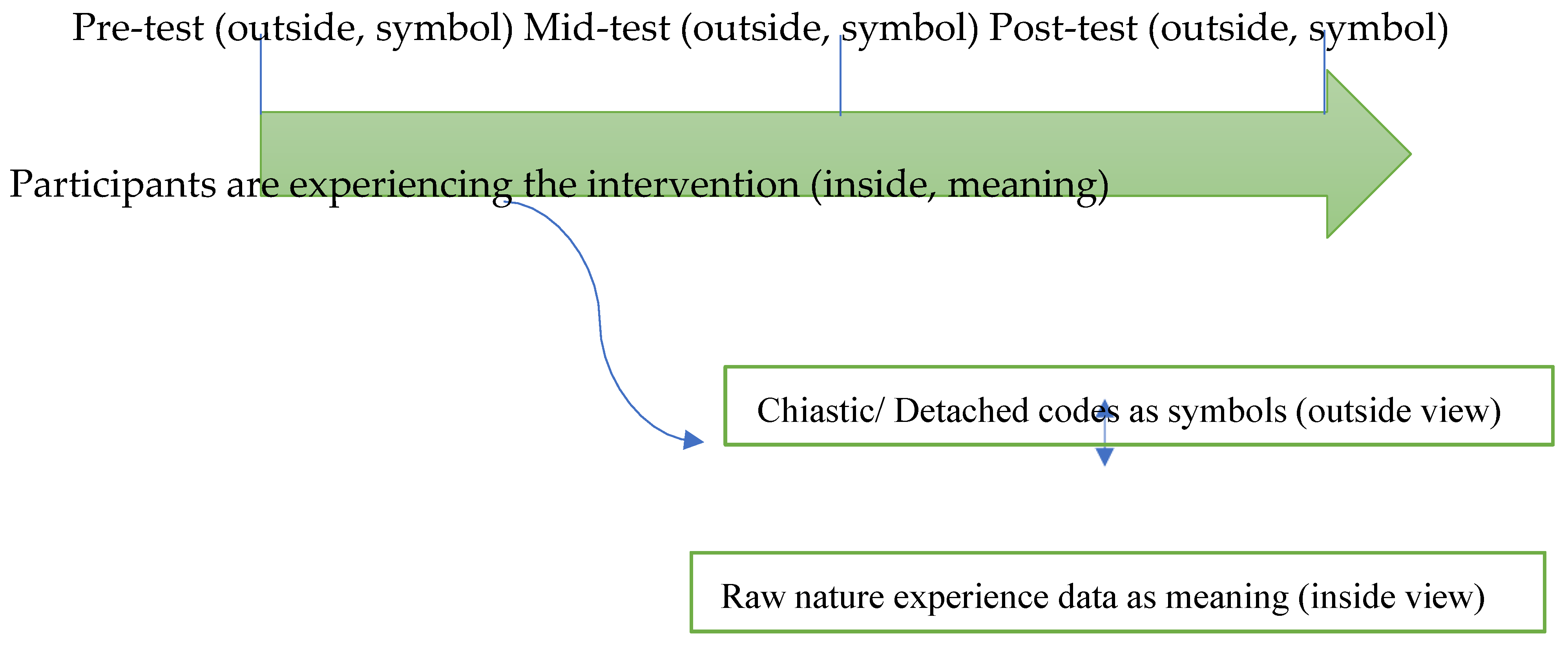
Figure 3.
Change in chiastic experiences (mean, with standard error) from day 0 to day 30 across the five six-day modules in the intervention group.
Figure 3.
Change in chiastic experiences (mean, with standard error) from day 0 to day 30 across the five six-day modules in the intervention group.
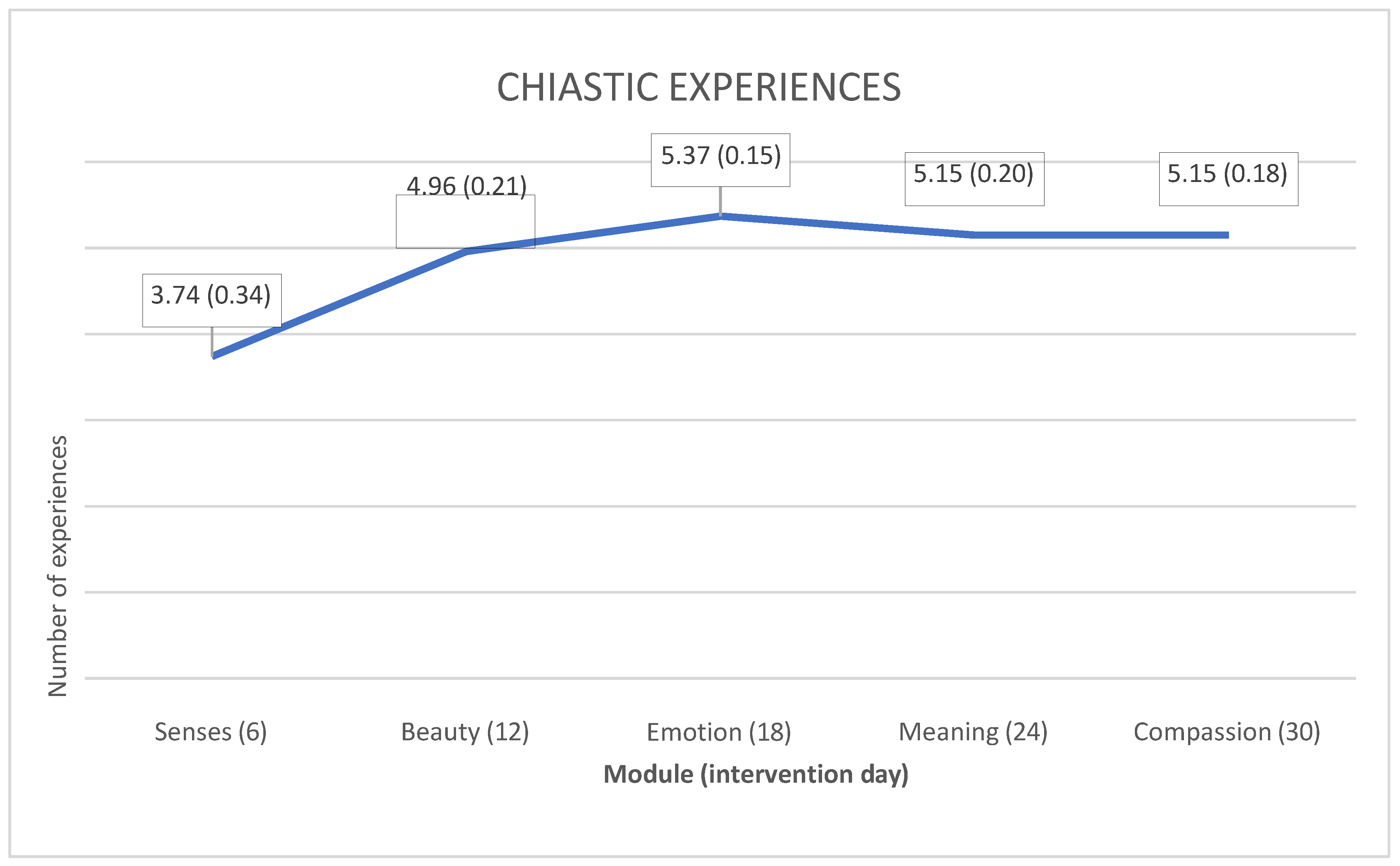
Figure 4.
Nature Relatedness change (mean (standard error)) from day 0 to day 30.
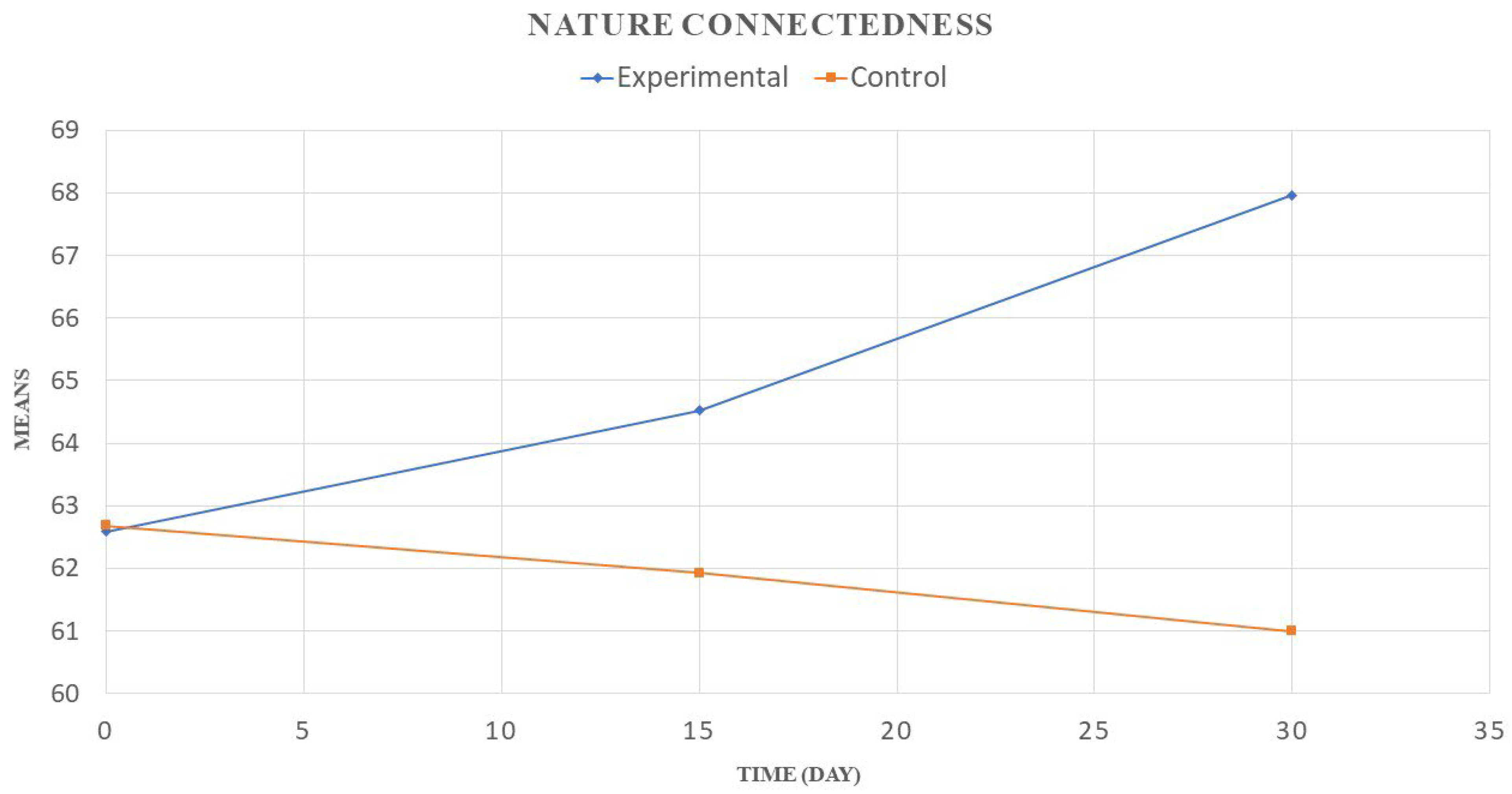
Figure 5.
Self-reported Pro-Environmental Behaviour change (mean (standard error)) from day 0 to day 30.
Figure 5.
Self-reported Pro-Environmental Behaviour change (mean (standard error)) from day 0 to day 30.
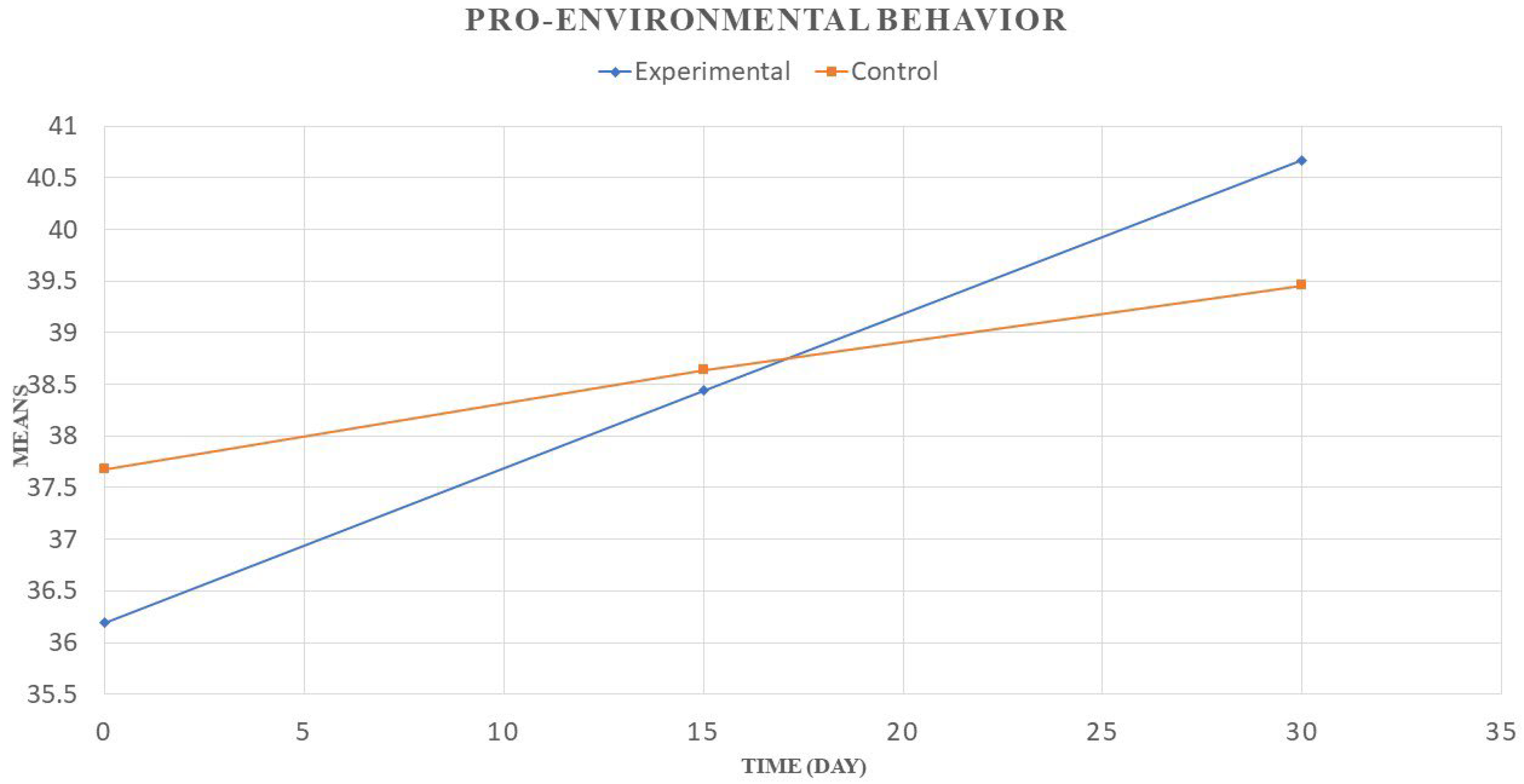
Figure 6.
Mindfulness change (mean (standard error)) from day 0 to day 30.
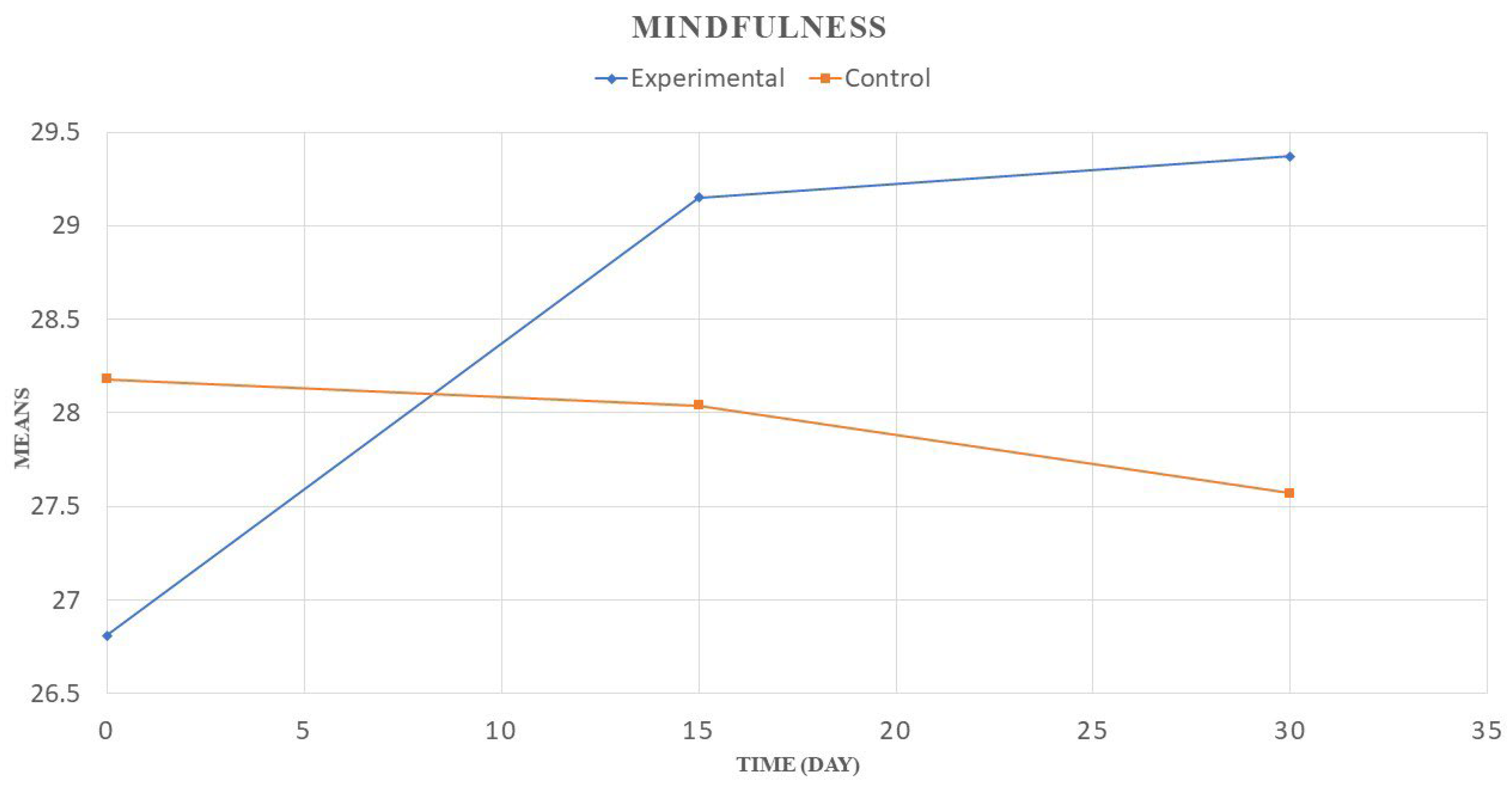
Figure 7.
Psychological Well-Being change (mean (standard error)) from day 0 to day 30.
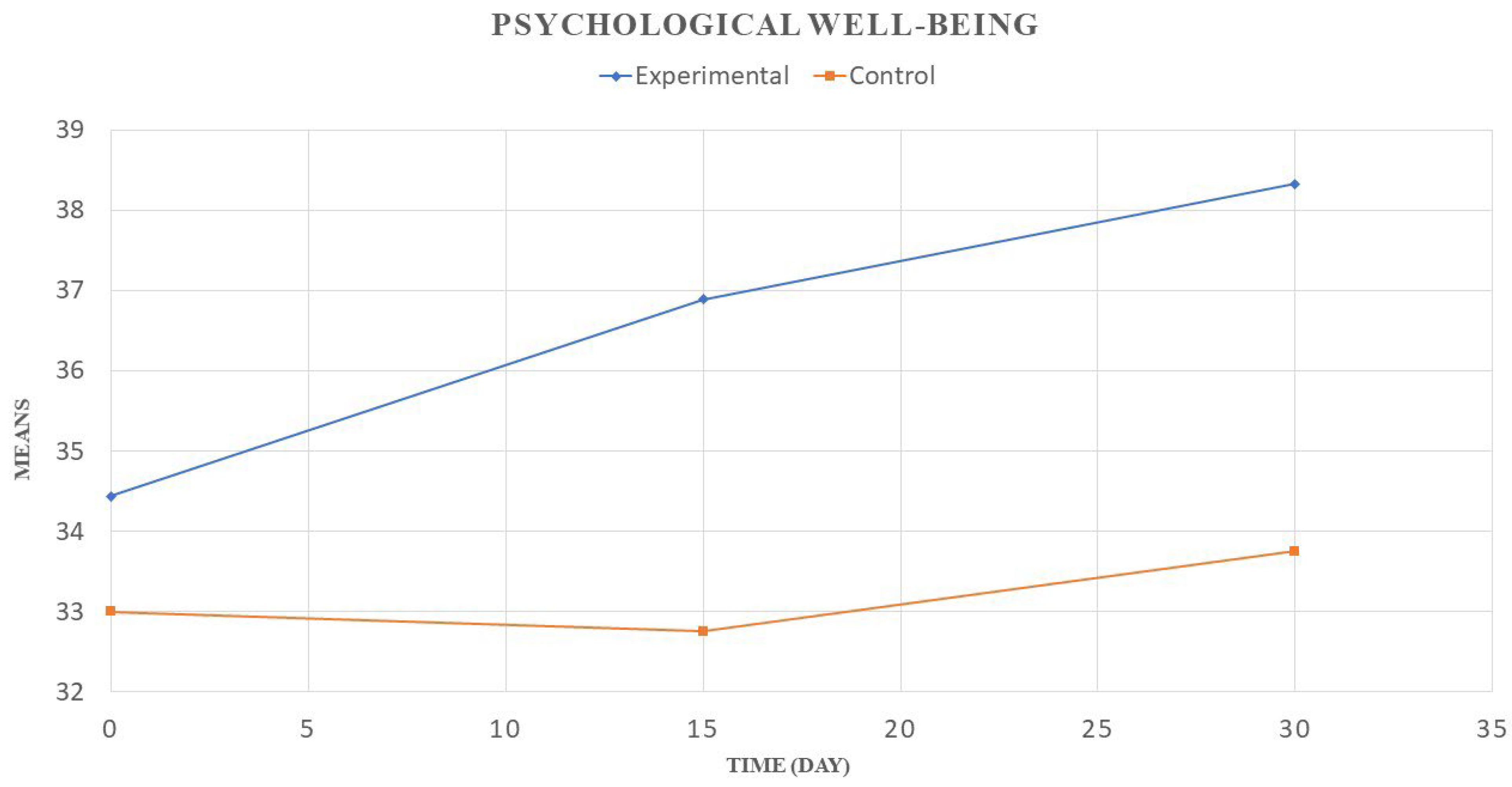
Figure 8.
A photographic submission for Beauty module with comment.
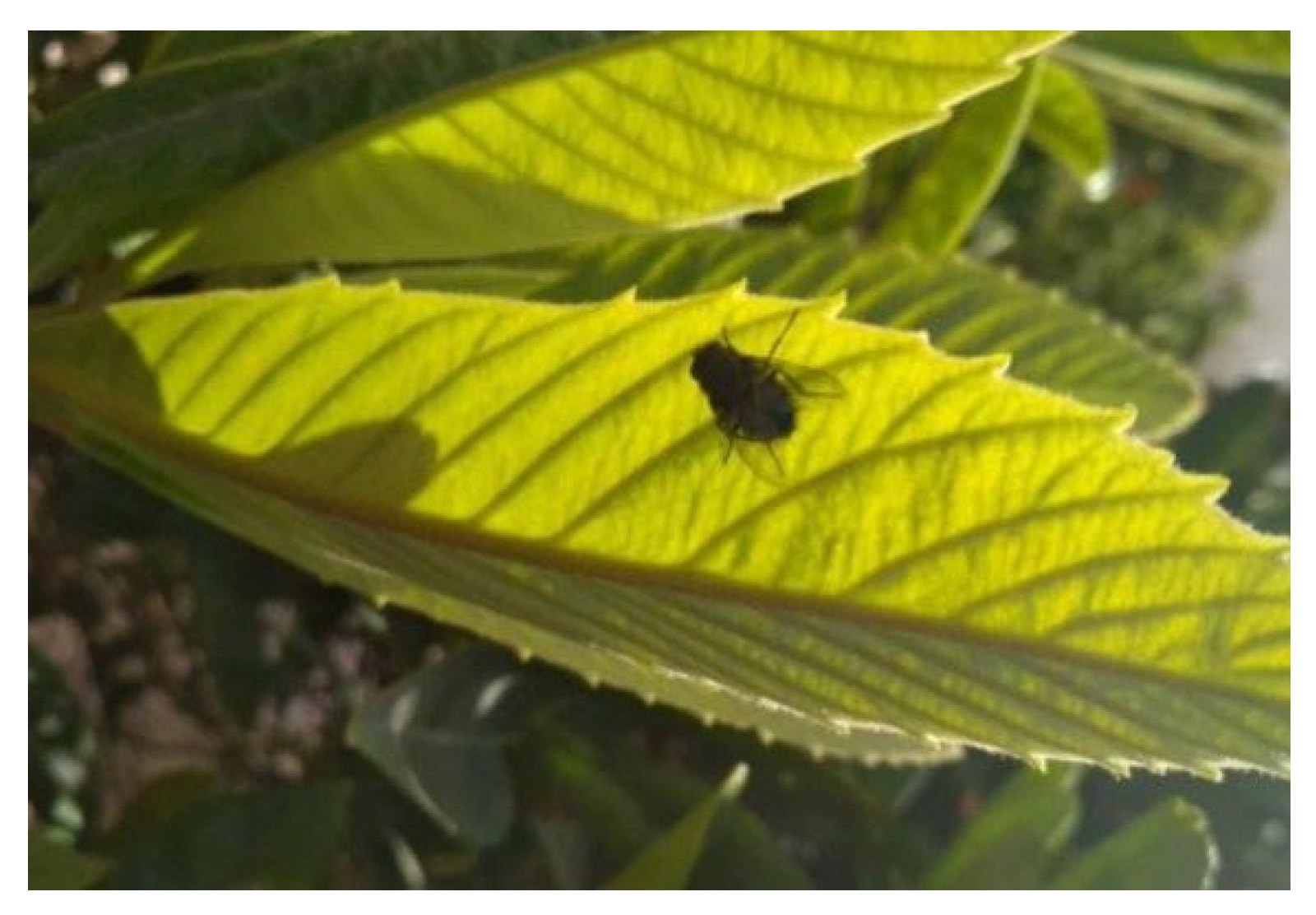
Figure 9.
A photographic submission for Beauty module without any comment.

Figure 10.
A photographic submission expressing delight at sun rays shining into the house.

Figure 11.
A photographic submission echoing the same delight in the sun. .

Figure 12.
A photographic submission regarding the coexistence of different tree species. .
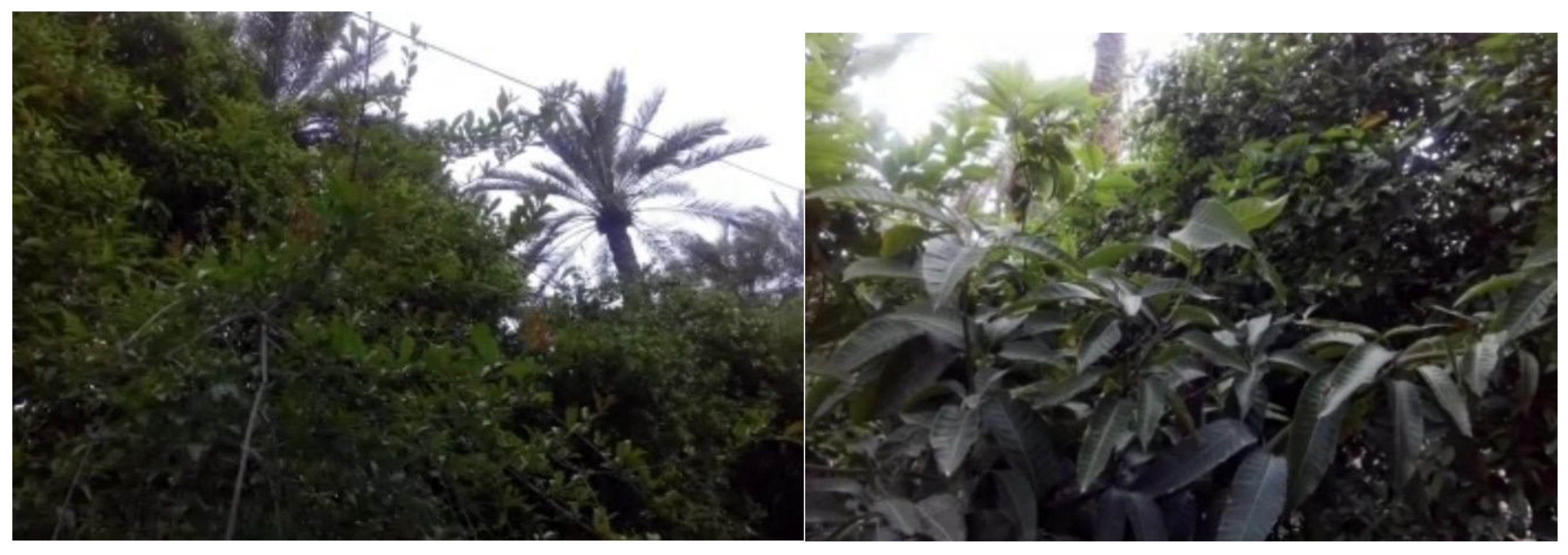
Figure 13.
The role of chiasm as theory and methodology. The chiasms acknowledged in this paper bear on researchers’ work along both ontological and epistemological dimensions.
Figure 13.
The role of chiasm as theory and methodology. The chiasms acknowledged in this paper bear on researchers’ work along both ontological and epistemological dimensions.
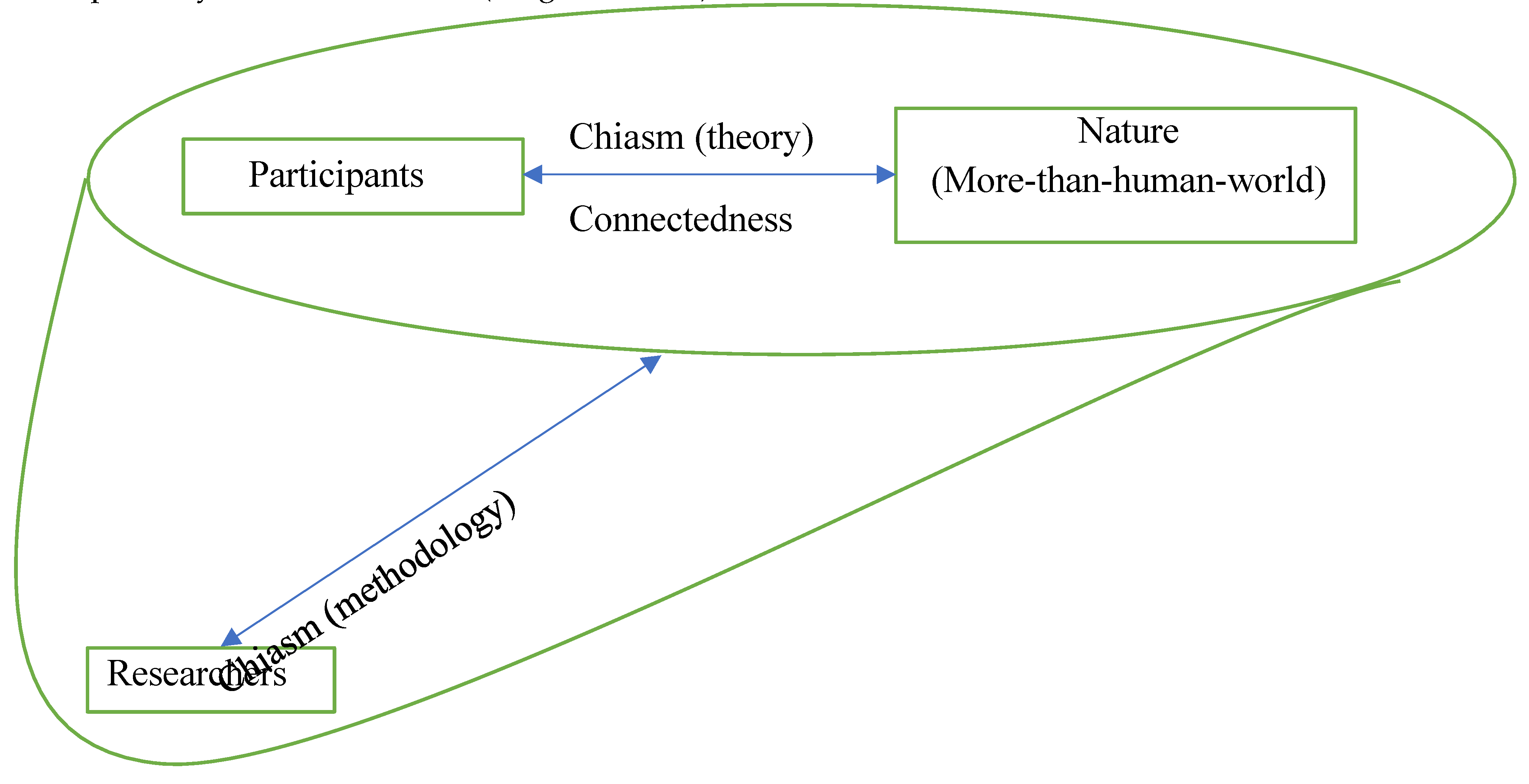

Table 1.
Thematic categories for participants’ experiences.
| Module | Theme | Explanation | Examples |
| 1 | Senses | Pay attention to the senses (see, hear, smell, touch, taste) when experiencing nature. | Observing animals and insects, listening to water or wind, smelling flowers, walking barefoot, sunbathing, eating fruit. |
| 2 | Beauty | Notice the beauty of nature. | Going to places with attractive landscapes, appreciating or creating natural visual art, photographing natural beauty. |
| 3 | Emotion | Engage emotionally with non-human nature and experience joy, wonder, peace, sadness. | Finding solace in nature when unhappy, relaxing with trees or mountains, expressing feelings about nature to others. |
| 4 | Meaning | Find meaning in nature; reflect on nature in different contexts using symbols, poems, songs and stories. | Becoming aware of personal meaning in nature through signs, natural cycles, cultural elements and proverbs. |
| 5 | Compassion | Find care and compassion for nature, and think about and undertake activities in service of nature. | Caring for plants and animals, reducing consumption and waste, picking up non-biodegradable litter, political ecology. |
Table 2.
Assessment of Nature Relatedness Scale items for chiastic perceptual experience.
| Item | Factor | Explicit chiastic structure |
| Connection to nature is part of my spirituality | Self | No |
| I am not separate from nature, but a part of nature | Self | No |
| Even in the city, I notice nature around me | Self | Yes |
| I think of the natural world as a community I belong to | Self | No |
| Humans have the right to use resources any way we want | Persp | No |
| Conservation unnecessary, nature recovers | Persp | No |
| Animals/plants have fewer rights than humans | Persp | No |
| Nothing I do will change problems elsewhere | Persp | No |
| My welfare is independent of nature's welfare | Persp | No |
| Ideal vacation is remote and pristine | Exp | Borderline/Yes |
| I enjoy being outdoors, even in unpleasant weather | Exp | Yes |
| I take notice of wildlife wherever I am | Exp | Yes |
| It excites me to watch plants change with seasons | Exp | Yes |
| I'm interested in science documentaries about nature | Exp | Borderline/Yes |
Table 3.
Participant demographics: Age is a t-test; the four categorical rows are chi-square.
| Factor | Control | Intervention | Total | p |
| Age (mean ± SD) | 25.32 ± 4.15 | 27.15 ± 5.00 | 26.22 ± 4.64 | 0.146 |
| Gender (female/male) | 13 (46.4%) / 15 (53.6%) | 17 (63.0%) / 10 (37.0%) | 30 (54.5%) / 25 (45.5%) | 0.218 |
| Farmland or garden (yes/no) | 18 (64.3%) / 10 (35.7%) | 14 (51.9%) / 13 (48.1%) | 32 (58.2%) / 23 (41.8%) | 0.350 |
| Companion animal (yes/no) | 6 (21.4%) / 22 (78.6%) | 8 (29.6%) / 19 (70.4%) | 14 (25.5%) / 41 (74.5%) | 0.485 |
| Plant care (yes/no) | 23 (82.1%) / 5 (17.9%) | 22 (81.5%) / 5 (18.5%) | 45 (81.8%) / 10 (18.2%) | 0.949 |
Table 4.
Mixed ANOVA results for each outcome across days 0, 15 and 30.
| Outcome | Effect | df | F | p | partial η² |
| Nature relatedness | Group | 1, 53 | 4.50 | .039 | .078 |
| Time | 2, 106 | 8.67 | <.001 | .141 | |
| Group × Time | 2, 106 | 25.89 | <.001 | .328 | |
| Self-reported PEB | Group | 1, 53 | 0.01 | .908 | .000 |
| Time | 2, 106 | 18.35 | <.001 | .257 | |
| Group × Time | 2, 106 | 3.45 | .035 | .061 | |
| Mindfulness | Group | 1, 53 | 0.34 | .560 | .006 |
| Time | 2, 106 | 4.58 | .012 | .079 | |
| Group × Time | 2, 106 | 9.22 | <.001 | .148 | |
| Psychological well-being | Group | 1, 53 | 6.67 | .013 | .112 |
| Time | 2, 106 | 6.27 | .003 | .106 | |
| Group × Time | 2, 106 | 3.58 | .031 | .063 |
Table 5.
ANCOVA comparing day-30 outcomes between groups, adjusting for day-0 scores.
| Outcome | df | F | p | partial η² |
| Nature relatedness | 1, 52 | 46.15 | <.001 | .470 |
| Self-reported PEB | 1, 52 | 4.43 | .040 | .079 |
| Mindfulness | 1, 52 | 11.39 | .001 | .180 |
| Psychological well-being | 1, 52 | 9.74 | .003 | .158 |
Table 6.
Dialogic learning: item-level response distribution (n = 20).
| Item. | Never | Rarely | Sometimes | Often | Always | Mean |
| I related to the different experiences of others | 0 (0) | 0 (0) | 7 (35) | 9 (45) | 4 (20) | 3.85 |
| It was difficult to relate to others’ experiences (R) | 5 (25) | 10 (50) | 5 (25) | 0 (0) | 0 (0) | 4.00 |
| I tried to compare what I was doing with the experiences of others | 1 (5) | 4 (20) | 8 (40) | 7 (35) | 0 (0) | 3.05 |
| During the day I was sometimes inspired with ideas for experiencing nature | 0 (0) | 3 (15) | 5 (25) | 9 (45) | 3 (15) | 3.60 |
| After seeing others’ experiences, I would reassess my relationship with nature in order to change it | 2 (10) | 5 (25) | 6 (30) | 7 (35) | 0 (0) | 2.90 |
| It was a pleasure to see different experiences of nature | 0 (0) | 2 (10) | 3 (15) | 8 (40) | 7 (35) | 4.00 |
| I did not like people having different ideas from mine (R) | 11 (55) | 1 (5) | 3 (15) | 5 (25) | 0 (0) | 3.90 |
| I did not consciously think about my relationship with nature (R) | 3 (15) | 9 (45) | 5 (25) | 2 (10) | 1 (5) | 3.55 |
| I preferred to express my experiences and opinions less, because others might think differently (R) | 12 (60) | 4 (20) | 0 (0) | 4 (20) | 0 (0) | 4.20 |
| I felt safe sharing my experiences and opinions | 0 (0) | 0 (0) | 4 (20) | 11 (55) | 5 (25) | 4.05 |
| The programme was enjoyable | 2 (10) | 1 (5) | 4 (20) | 7 (35) | 6 (30) | 3.70 |
| I feel I gained particular experiences of relationship with nature | 3 (15) | 2 (10) | 2 (10) | 8 (40) | 5 (25) | 3.50 |
| I read what other group members posted | 1 (5) | 2 (10) | 2 (10) | 5 (25) | 10 (50) | 4.05 |
| I followed the instructions | 0 (0) | 1 (5) | 2 (10) | 10 (50) | 7 (35) | 4.15 |
Note. Frequencies are n (%). Items marked (R) were negatively worded; frequencies show raw responses, while means are calculated after reverse-coding. Response scale: 1 = never to 5 = always.
Disclaimer/Publisher’s Note: The statements, opinions and data contained in all publications are solely those of the individual author(s) and contributor(s) and not of MDPI and/or the editor(s). MDPI and/or the editor(s) disclaim responsibility for any injury to people or property resulting from any ideas, methods, instructions or products referred to in the content. |
© 2026 by the authors. Licensee MDPI, Basel, Switzerland. This article is an open access article distributed under the terms and conditions of the Creative Commons Attribution (CC BY) license (http://creativecommons.org/licenses/by/4.0/).
Copyright: This open access article is published under a Creative Commons CC BY 4.0 license, which permit the free download, distribution, and reuse, provided that the author and preprint are cited in any reuse.