

Submitted:
14 August 2026
Posted:
14 August 2026
You are already at the latest version
Abstract
Plastic pollution has generated a novel anthropogenic habitat, the plastisphere, where microorganisms colonize and establish complex biofilms on the surfaces of synthetic polymers. Although considerable progress has been made in describing plastisphere microbial diversity, the ecological mechanisms linking community assembly, microbial communication, and polymer biodegradation remain poorly understood, particularly in saline ecosystems. Here, we review current knowledge on plastisphere formation in marine, estuarine, hypersaline, and other saline environments, emphasizing the ecological roles of quorum sensing (QS), halotolerant fungi, and microbial interactions in regulating biofilm development and microplastic degradation. We discuss how environmental factors characteristic of saline habitats, including osmotic stress, ultraviolet radiation, nutrient limitation, and high ionic strength, shape plastisphere succession and influence microbial physiology. Particular attention is given to halotolerant fungi, whose oxidative and hydrolytic enzymes—including laccases, peroxidases, cutinases, esterases, and lipases—complement bacterial metabolism during polymer transformation. We further examine recent evidence demonstrating that QS coordinates microbial attachment, extracellular polymeric substance production, biofilm maturation, extracellular enzyme secretion, and metabolic cooperation, thereby linking microbial communication with biodegradation efficiency. Based on current evidence, we propose an integrative ecological framework in which abiotic weathering, environmental filtering, quorum sensing, bacterial–fungal interactions, and extracellular enzymatic pathways constitute successive and interconnected processes governing plastisphere functioning in saline ecosystems. Finally, we identify major knowledge gaps and highlight future research priorities, including the integration of multi-omics approaches, synthetic microbial consortia, systems biology, and artificial intelligence for the discovery of novel plastic-degrading enzymes. By integrating microbial ecology, fungal biology, chemical communication, and environmental biotechnology, this review provides a systems-level perspective on the plastisphere and establishes a conceptual framework for understanding and enhancing microplastic biodegradation under saline conditions.
Keywords:
plastisphere
; microplastics
; saline ecosystems
; quorum sensing
; halotolerant fungi
; biofilms
; microbial interactions
; plastic biodegradation
; extracellular enzymes
; bacterial–fungal consortia
1. Introduction
Plastic pollution has emerged as one of the defining environmental challenges of the Anthropocene. Global plastic production has exceeded 400 million metric tons annually, and the persistence of synthetic polymers has resulted in their accumulation across virtually every ecosystem on Earth, from polar regions and abyssal plains to hypersaline lakes and coastal wetlands. Through continuous exposure to ultraviolet radiation, mechanical abrasion, chemical oxidation, and biological activity, larger plastic debris progressively fragments into microplastics (<5 mm) and nanoplastics, creating highly persistent particles that remain in aquatic environments for decades or even centuries [1,2]. Once regarded merely as inert pollutants, these particles are now recognized as biologically active substrates that profoundly influence microbial ecology, biogeochemical cycling, and contaminant transport [3].
The realization that plastic debris rapidly becomes colonized by diverse microbial assemblages has fundamentally reshaped our understanding of plastic pollution. Within hours of entering aquatic environments, polymer surfaces are coated by organic matter that promotes the attachment of bacteria, archaea, fungi, microalgae, protists, and viruses, leading to the establishment of complex biofilms collectively known as the “plastisphere” [4]. Rather than representing random microbial assemblages, plastisphere communities exhibit ecological succession, metabolic specialization, interspecific cooperation, and competitive interactions that differ markedly from those occurring in the surrounding water column [3,5]. Consequently, plastics have been increasingly recognized as novel anthropogenic ecological niches capable of supporting unique microbial networks while simultaneously acting as vectors for pathogens, antibiotic resistance genes, invasive microorganisms, and pollutant-associated metabolic processes.
Despite the rapid expansion of plastisphere research over the last decade, current knowledge remains disproportionately concentrated on marine bacterial communities rather than the total microbiological content of plastispheres in all saline environments. Most studies have focused on taxonomic diversity, biofilm succession, and bacterial metabolism associated with polyethylene (PE), polypropylene (PP), polyethylene terephthalate (PET), and polystyrene (PS), whereas microorganisms colonizing other types of plastic have received considerably less attention [6,7].This taxonomic imbalance limits our ability to understand the plastisphere as a multispecies ecosystem in which interactions among bacterial, archaeal, fungal, and protistan communities may collectively influence biofilm stability, nutrient cycling, and polymer transformation [3,5]. Consequently, ecological processes emerging from interactions among different microbial groups remain substantially less understood than bacterial community composition itself.
This limitation becomes particularly evident in saline ecosystems. Oceans, estuaries, salt marshes, mangroves, hypersaline lakes, saline lagoons, and solar salterns constitute environmentally dynamic habitats characterized by high osmotic pressure, intense ultraviolet radiation, nutrient limitation, and pronounced physicochemical fluctuations. These environmental filters select microbial communities possessing specialized adaptive strategies, including osmolyte synthesis, extracellular polymeric substance (EPS) production, oxidative stress tolerance, and efficient extracellular enzymatic systems [8,9]. Such physiological traits are likely to influence both microbial colonization of plastic surfaces and the biodegradation potential of polymer-associated biofilms. Nevertheless, saline ecosystems remain substantially underrepresented in plastisphere studies despite functioning simultaneously as major sinks, transport corridors, and transformation hotspots for plastic debris.
Among the least explored components of saline plastisphere communities are halotolerant and halophilic fungi. Traditionally regarded as secondary colonizers in aquatic biofilms, these organisms are increasingly recognized as metabolically versatile decomposers capable of producing a broad spectrum of extracellular oxidative and hydrolytic enzymes, including laccases, manganese peroxidases, lignin peroxidases, cutinases, esterases, lipases, and unspecific peroxygenases [10,11]. Many of these enzymes have demonstrated the capacity to modify synthetic polymers or oxidize plastic-derived compounds [12], suggesting that fungi may contribute directly to polymer weathering and biodegradation. Moreover, fungal hyphal networks provide physical scaffolds that facilitate bacterial dispersal, enhance spatial organization within multispecies biofilms, and promote metabolite exchange and metabolic cross-feeding between bacterial and fungal partners [13,14,15]. These interactions suggest that fungi play a far more central ecological role within the plastisphere than previously recognized. Nevertheless, compared with bacteria, fungal diversity, ecological functions, and enzymatic contributions to plastisphere functioning remain poorly characterized [3,16].
Equally overlooked is the role of microbial communication in regulating plastisphere assembly and function. Biofilm development is not simply the consequence of passive microbial attachment but is instead a highly coordinated process governed by cell-to-cell signaling mechanisms collectively known as quorum sensing (QS). Through diffusible signaling molecules—including acyl-homoserine lactones (AHLs), autoinducer-2 (AI-2), diketopiperazines, diffusible signal factors, farnesol, tyrosol, and other fungal signaling metabolites—microorganisms synchronize biofilm maturation, extracellular matrix production, nutrient acquisition, stress responses, horizontal gene transfer, and secretion of extracellular enzymes [17,18]. Emerging evidence suggests that QS also regulates microbial colonization of plastic surfaces and influences the expression of enzymes involved in polymer degradation [19,20]. However, the ecological significance of microbial signaling networks within plastisphere communities remains poorly understood, particularly regarding cross-kingdom interactions. Recent evidence demonstrates that quorum sensing can actively regulate plastisphere formation, biomass accumulation, extracellular polymeric substance production, and microbial community organization, indicating that microbial communication is an important component of plastisphere development [21]. Emerging evidence further indicates that the microplastisphere can function as a multi-kingdom microbial system comprising bacteria, fungi, protists, microalgae, and micrometazoans, with cross-kingdom connections contributing to community network complexity and stability [22]. These findings reinforce the need to move beyond bacteria-centered descriptions of the plastisphere toward an integrated understanding of interactions among its microbial components. Nevertheless, the mechanisms linking microbial signaling to cross-kingdom interactions and community-level ecological organization remain largely unresolved.
This represents an important conceptual limitation in current plastisphere research, as microbial community assembly, plastic–biofilm interactions, and polymer degradation have frequently been investigated through partially separated conceptual and methodological approaches [23,24]. Although increasing evidence links plastisphere community succession and microbial interactions to plastic transformation and degradation, the reciprocal relationships between biofilm organization and the physicochemical evolution of plastic substrates remain incompletely understood [24]. Far less attention has been devoted to understanding how microbial communication, cross-kingdom community assembly, and enzymatic activity jointly shape the ecological functioning of plastisphere biofilms, particularly under saline conditions. Consequently, the mechanistic links connecting quorum sensing, fungal ecology, biofilm organization, and microplastic degradation remain fragmented across multiple disciplines, limiting the development of an integrated framework capable of explaining plastisphere functioning in saline ecosystems [21,22,23].
In this review, we propose that quorum sensing constitutes a central regulatory mechanism linking microbial community organization to the biodegradation potential of saline plastisphere biofilms. We integrate current knowledge on plastisphere succession, halotolerant fungal ecology, bacterial and fungal quorum sensing, and polymer-degrading enzymatic pathways. From this synthesis, we develop a conceptual framework in which microbial communication mediates bacterial–fungal interactions and extracellular enzyme production, thereby influencing microplastic degradation in saline ecosystems. This framework connects microbial ecology, fungal biology, and chemical signaling to provide an integrated perspective on plastisphere functioning and identify priorities for future research.
2. Microplastics in Saline Ecosystems
2.1. Sources and Transport Pathways
Saline ecosystems constitute the ultimate environmental sink for a substantial proportion of the plastic waste generated worldwide. It is estimated that between 9 and 14 million metric tons of plastic enter aquatic environments annually through a combination of riverine discharge, wastewater effluents, urban runoff, atmospheric deposition, maritime activities, aquaculture, fisheries, and coastal tourism [25,26]. Rivers are recognized as the dominant transport pathways, carrying both primary microplastics—such as cosmetic microbeads and industrial resin pellets—and secondary microplastics produced through the fragmentation of larger plastic debris during environmental weathering.
Once introduced into saline environments, microplastics become incorporated into complex hydrodynamic transport networks. Ocean currents, tidal cycles, estuarine circulation, storm events, and seasonal river discharge redistribute particles across coastal and offshore ecosystems over spatial scales ranging from meters to thousands of kilometers. Atmospheric transport has also emerged as an important mechanism linking terrestrial and marine systems, allowing airborne microplastics to be deposited directly into remote marine environments, including polar oceans and isolated hypersaline lakes [27,28]. Saline ecosystems do not merely receive plastic pollution but actively transform its environmental behavior. Variations in salinity, ionic composition, suspended particulate matter, dissolved organic carbon, and biological activity influence particle aggregation, buoyancy, sedimentation, and biofilm development, thereby determining the residence time and ecological exposure of microplastics [29].
2.2. Environmental Fate Under Saline Conditions (Table 1)
The environmental fate of microplastics in saline ecosystems differs substantially from that observed in freshwater environments because of the unique physicochemical properties of seawater and hypersaline systems [30,31]. Elevated ionic strength compresses the electrical double layer surrounding particles, reducing electrostatic repulsion and promoting aggregation and heteroaggregation of microplastics with mineral particles, organic matter, and other suspended material [31]. Interactions with microbial extracellular polymeric substances (EPS) and biofilm development may further enhance particle aggregation and incorporation into organic aggregates [32,33]. Consequently, microplastics can become incorporated into marine snow, increasing aggregate settling velocities and facilitating their vertical transport from surface waters toward deeper waters and benthic environments [32,33,34]. Biofilm formation further modifies the physical properties and effective density of microplastic particles. Microbial colonization increases particle-associated biomass and can alter surface characteristics, including roughness, hydrophobicity, and electrostatic properties, thereby modifying particle–water and particle–particle interactions [35,36]. Biofouling can increase the effective density of originally buoyant polymers such as polyethylene (PE) and polypropylene (PP), potentially causing their descent from surface waters and contributing to their occurrence in deeper waters and sediments [3,35]. Because biofilm biomass itself changes through growth, decay, and ecological interactions, particle buoyancy may vary through time, potentially producing repeated vertical transitions rather than irreversible sinking [35]. Consequently, microplastics should be regarded as dynamic particles whose environmental trajectories are continuously reshaped by biological colonization and associated physicochemical transformations (Figure 1).
Weathering processes are also influenced by the physicochemical conditions of saline environments. Ultraviolet radiation, thermal oxidation, and mechanical abrasion progressively alter polymer surfaces, promoting chain scission, surface cracking, increased roughness, and the formation of oxygen-containing functional groups [30,37,38]. Water chemistry can further modulate the extent and characteristics of these physicochemical transformations [39]. Such weathering increases surface heterogeneity and may facilitate microbial attachment and subsequent biological transformation by modifying surface chemistry and accessibility [39,40]. Abiotic and biological aging should therefore be regarded as interconnected processes rather than independent degradation pathways, highlighting the coupling between environmental weathering and microbial colonization.
2.3. Distribution Across Saline Ecosystems
Microplastics are now considered ubiquitous contaminants of marine environments, although their abundance, polymer composition, and particle morphology vary considerably among environmental settings [41]. In open-ocean environments, low-density polymers such as polyethylene (PE) and polypropylene (PP) dominate surface microplastic assemblages because of their positive buoyancy, whereas higher-density polymers, including polyesters, polyamide (PA), and polyvinyl chloride (PVC), tend to be relatively enriched in deeper waters and sediments [42,43]. Nevertheless, polymer density alone does not determine vertical distribution, as biofouling, aggregation, particle morphology, and hydrodynamic processes can substantially modify microplastic buoyancy and transport. Estuaries represent particularly dynamic environments where freshwater and marine processes interact, producing intense particle retention through estuarine turbidity maxima and flocculation processes. Consequently, estuarine sediments frequently exhibit some of the highest microplastic concentrations reported worldwide [44,45].
Mangrove forests and salt marshes function as efficient natural traps for microplastics owing to their complex vegetation structure, reduced hydrodynamic energy, and high rates of sediment accumulation [46,47]. Mangrove root systems and salt-marsh vegetation reduce water flow and enhance particle interception and sediment retention, promoting the accumulation and potentially long residence times of microplastics within these environments [46,47]. Retained particles also provide persistent substrates for microbial colonization, with plastisphere communities developing rapidly on microplastics deposited within salt-marsh sediments [48].
Hypersaline lakes and solar salterns represent comparatively understudied environments in plastisphere research, characterized by strong physicochemical selection pressures, including elevated salinity, evaporation, and intense solar exposure [49,50]. Such environmental gradients can influence both plastic-associated microbial community assembly and particle transformation, although their combined effects on plastisphere development remain poorly resolved. Recent evidence from salt-impacted aquatic systems indicates that salinity, light availability, nutrient conditions, and temperature can exert stronger influences on plastisphere community composition than polymer identity itself [51].
These contrasting habitats demonstrate that saline ecosystems are not environmentally homogeneous. Instead, they encompass a continuum of physicochemical conditions that strongly influence particle transport, microbial colonization, and the ecological functioning of the plastisphere.
2.4. Ecological Implications for Plastisphere Formation
The physicochemical dynamics governing microplastic transport ultimately determine the ecological opportunities available for microbial colonization. As particles move between surface waters, the water column, sediments, and benthic habitats, they encounter distinct microbial source communities and environmental conditions that drive biofilm assembly and succession [5,23,40,52]. Environmental filtering imposed by salinity, nutrient availability, oxygen concentration, ultraviolet radiation, temperature, and hydrodynamic stress acts simultaneously with polymer properties to shape plastisphere assembly [51,52]. Recent studies increasingly suggest that these environmental variables explain a greater proportion of microbial community variation than polymer type alone, challenging the traditional polymer-centric perspective of plastisphere ecology [3,5].
This ecological perspective emphasizes that microplastics should not be regarded simply as inert substrates but as mobile microbial habitats whose biological properties continuously evolve during environmental transport [3,5]. Plastisphere communities undergo ecological succession and environmental filtering, while polymer characteristics and physicochemical transformation simultaneously influence microbial community assembly and functional potential [3,6]. Consequently, understanding plastisphere ecology requires integrating environmental transport, polymer chemistry, microbial succession, and environmental selection within a unified ecological perspective. Such integration is particularly relevant in saline ecosystems, where salinity and other physicochemical gradients impose strong selective pressures on microbial colonization and community organization, potentially influencing microbial interactions and plastic transformation [5,48].
3. The Plastisphere as a Specialized Microbial Habitat
Plastic debris has traditionally been regarded as an inert substrate for microbial colonization. However, increasing evidence demonstrates that microplastics rapidly develop into biologically active habitats supporting structurally and functionally distinct microbial communities [3,4,5]. This colonized interface, known as the “plastisphere”, represents a novel anthropogenic microbial habitat in which microorganisms establish complex biofilms that differ from free-living communities in the surrounding environment [3,4,5]. Rather than being randomly assembled, plastisphere communities are shaped by ecological succession, microbial interactions, environmental selection, and the physicochemical properties of the polymer surface [5,62,63,64].
3.1. Biofilm Formation on Plastic Surfaces
The establishment of the plastisphere begins rapidly after plastic particles enter aquatic environments. Within minutes to hours, dissolved organic matter and biomolecules adsorb onto polymer surfaces, forming a conditioning film that modifies their physicochemical properties and influences subsequent microbial attachment [65,66]. This conditioning layer can modify surface hydrophobicity and electrostatic interactions, thereby influencing the initial stages of microbial adhesion and biofilm development [65,66].
Primary colonizers, predominantly bacteria, initially interact with conditioned surfaces through reversible physicochemical interactions, followed by more stable attachment mediated by cellular appendages, adhesion proteins, and extracellular polymeric substances (EPS) [7,67,68]. As colonization progresses, microorganisms produce increasingly complex extracellular matrices composed primarily of polysaccharides, proteins, extracellular DNA, and lipids, which stabilize the developing biofilm and promote cell–cell and cell–surface interactions [18,69,70]. The resulting matrix contributes to nutrient retention, metabolic cooperation, and protection against environmental stresses, thereby creating a structured microenvironment in which plastisphere communities can develop [69,70]. In saline ecosystems, ionic composition and salinity may further influence microbial attachment, EPS organization, and plastisphere community assembly. Salinity has been identified as an important environmental filter shaping plastic-associated microbial communities, sometimes exerting a stronger influence than polymer identity itself [6,63]. Consequently, plastisphere development in saline environments reflects the combined influence of surface conditioning, microbial succession, biofilm matrix formation, and environmental selection.
3.2. Ecological Succession Within the Plastisphere (Figure 2)
Plastisphere development is a dynamic ecological process characterized by temporal patterns of microbial succession [23,62,64]. Early colonization is frequently dominated by rapidly recruiting microorganisms capable of efficient attachment to newly available surfaces, with members of Alphaproteobacteria and Gammaproteobacteria commonly reported among pioneer bacterial communities [23,67,68]. As biofilms mature, community composition undergoes substantial turnover and taxonomic diversity may increase, incorporating Bacteroidota and other bacterial groups together with Archaea, fungi, protists, microalgae, and viruses [3,7,22,23]. These organisms occupy different ecological and trophic niches within the biofilm and may contribute to processes including primary production, organic matter decomposition, nutrient cycling, grazing, and polymer transformation [3,22,23]. The mature plastisphere can therefore develop into a spatially structured, multispecies microbial system characterized by diverse ecological interactions rather than functioning simply as a bacterial biofilm [3,22].
Plastisphere succession is not determined, however, by colonization time alone. Environmental conditions, including salinity, nutrient availability, temperature, and other physicochemical characteristics, can strongly influence microbial recruitment, community assembly, and succession [6,63,64,71]. Indeed, environmental conditions often exert stronger effects on plastisphere community structure than polymer identity, demonstrating that plastisphere development reflects the interaction between temporal succession, substrate properties, and environmental filtering [6,64,71].
3.3. Environmental Drivers of Community Assembly
The composition of plastisphere communities emerges from the interaction between polymer characteristics and environmental filtering. Polymer type influences initial microbial attachment through differences in surface roughness, hydrophobicity, crystallinity, additive composition, and susceptibility to environmental weathering. Nevertheless, an increasing number of studies indicate that environmental variables frequently exert stronger effects on microbial community composition than polymer chemistry alone [5,72,73]. Among saline ecosystems, salinity represents a strong ecological filter shaping microbial community composition and function [8]. Osmotic stress restricts microbial colonization by favoring taxa possessing physiological adaptations such as compatible-solute accumulation, regulation of intracellular ion concentrations, oxidative-stress responses, and modifications of extracellular polymeric substances [59,74]. Within plastisphere communities, salinity can interact with other environmental variables to influence microbial recruitment and community organization [6,52,63]. Nutrient availability, dissolved oxygen, pH, suspended particulate matter, and hydrodynamic conditions may further modulate community assembly by affecting microbial growth, dispersal, and ecological interactions [3,52].
Plastisphere development, then, should be interpreted within the broader framework of microbial community ecology, in which deterministic processes such as environmental selection interact with stochastic processes including dispersal, ecological drift, and probabilistic colonization to shape community assembly [75,76]. Evidence from plastisphere studies indicates that community assembly reflects the combined influence of environmental filtering, substrate properties, colonization history, and stochastic processes rather than any single deterministic factor [3,77]. Plastisphere composition can therefore be understood as an emergent outcome of environmental selection, dispersal, succession, and biotic interactions operating simultaneously across spatial and temporal scales.
3.4. Functional Interactions Within Plastisphere Communities
The plastisphere is increasingly recognized as a highly interactive microbial system in which cooperative, competitive, and trophic interactions coexist [3,22,77]. Within multispecies biofilms, microorganisms can exchange metabolites, nutrients, signaling molecules, and extracellular products, generating interaction networks that influence resource utilization, community organization, and resilience [18,70,78]. Recent evidence from the microplastisphere further demonstrates that cross-kingdom associations contribute to network complexity and stability and support microbial food webs involving producers, decomposers, consumers, and symbionts [22]. Such ecological interactions may contribute to nutrient recycling, organic matter transformation, and functional organization within plastisphere biofilms.
Bacterial–fungal interactions provide an additional layer of ecological complexity. In multispecies microbial communities, fungal hyphae can provide three-dimensional surfaces for bacterial attachment and dispersal, while reciprocal metabolic exchanges can generate cross-feeding relationships between bacterial and fungal populations [15,79]. Although these mechanisms are well established in other microbial systems, their ecological importance within the plastisphere remains poorly resolved. Horizontal gene transfer further contributes to plastisphere adaptation; high cell densities and close physical proximity within biofilms create favorable conditions for genetic exchange [80]. Microplastic-associated biofilms have indeed been identified as potential hotspots for the transfer and dissemination of genes associated with antimicrobial resistance and other adaptive traits [80,81].
Collectively, these interactions support the consideration of the plastisphere as an ecologically integrated microbial consortium rather than simply a collection of independently colonizing species [3,22]. Such functional integration provides an ecological context in which microbial communication systems, including quorum sensing, can coordinate collective behaviors and influence biofilm development and extracellular product formation [21,82]. However, the extent to which quorum-sensing-mediated interactions regulate extracellular enzyme production and ultimately influence polymer biodegradation within natural plastisphere communities remains unresolved. Understanding these signaling processes would be an important step toward elucidating plastisphere functioning, particularly in saline ecosystems where environmental selection strongly influences microbial community assembly.
4. Quorum Sensing as a Regulatory Network in the Saline Plastisphere
Microorganisms rarely function as isolated cells but rather engage in chemical communication that coordinates collective responses to changing environmental conditions [17,78,82]. Among these mechanisms, quorum sensing (QS) is one of the most extensively characterized forms of microbial communication, allowing cells to regulate population-level gene expression through the production, release, and detection of signaling molecules [17,83]. Although QS has historically been studied extensively in pathogenic and host-associated systems, it also plays important ecological roles in natural aquatic environments and surface-associated microbial communities, regulating processes associated with biofilm development, nutrient acquisition, secondary metabolism, and biogeochemical cycling [78,84,85]. Increasing evidence now indicates that QS is also relevant to microbial communities developing on microplastic surfaces [19,21,81].
Within the plastisphere, dense microbial populations embedded within extracellular polymeric substance (EPS) matrices create physicochemical conditions favorable to the accumulation, retention, and exchange of signaling molecules [18,19,70]. Recent evidence demonstrates that AHL-mediated QS can influence plastisphere formation, biomass accumulation, EPS production, microbial community organization, and functional activity, providing direct support for microbial communication as a regulatory component of plastisphere development [21]. QS signaling on microplastics has also been linked to changes in microbial metabolism and biofilm-associated functions, further supporting the view that plastic surfaces represent distinct signaling environments [81]. Nevertheless, the ecological importance of QS within natural plastisphere communities remains incompletely resolved, particularly regarding cross-species and cross-kingdom interactions, extracellular enzyme regulation, and their potential consequences for polymer biodegradation in saline ecosystems [19,21].
4.1. Principles of Quorum Sensing
Quorum sensing is based on the synthesis, release, accumulation, and perception of small signaling molecules known as autoinducers. As microbial populations increase, the local concentration of these molecules may reach a threshold that triggers coordinated changes in gene expression and collective behavior [17,82,83,86]. Different microbial groups employ diverse signaling molecules. Gram-negative bacteria commonly use N-acyl-homoserine lactones (AHLs), whereas Gram-positive bacteria frequently rely on autoinducing peptides (AIPs) [17,83]. Autoinducer-2 (AI-2), produced through the LuxS pathway in numerous bacterial taxa, has been implicated in both intra- and interspecific communication, although its role as a universal bacterial signal is still debated because LuxS also participates in central metabolism [82,87]. Additional signaling compounds, including diffusible signal factors (DSFs), diketopiperazines (DKPs), quinolone signals, and indole derivatives, further expand the chemical diversity of microbial communication within environmental biofilms [78,88,89]. These signaling systems regulate numerous physiological processes relevant to plastisphere development, including surface attachment, motility, EPS production, biofilm maturation and dispersal, nutrient acquisition, stress responses, and extracellular enzyme production [78,82,90]. Quorum sensing may also influence horizontal gene transfer by modifying biofilm organization, cell proximity, and conjugation-related processes, thereby potentially affecting the dissemination of adaptive traits within densely colonized microbial communities [91,92]. Recent evidence that AHL-mediated signaling regulates plastisphere formation, biomass accumulation, EPS production, and microbial community organization provides direct support for the ecological relevance of these mechanisms on microplastic surfaces [21].
4.2. Bacterial Quorum Sensing in the Plastisphere
Bacterial communities represent major components of developing plastisphere biofilms, and increasing evidence indicates that quorum-sensing bacteria and their signaling molecules are widespread within plastic-associated microbial communities [19,21,93]. Several bacterial groups frequently detected in marine plastisphere communities, including members of the Rhodobacteraceae and Gammaproteobacteria, possess well-characterized quorum-sensing systems capable of regulating surface attachment, biofilm development, secondary metabolism, and extracellular product formation [78,84,93]. Indeed, multiple AHL molecules have been detected in bacterial isolates obtained from marine microplastic biofilms, supporting the concept of active QS-mediated communication within the plastisphere [93].
Recent experimental evidence provides direct support for a regulatory role of AHL-mediated signaling in plastisphere development. Exogenous AHL addition promotes microbial attachment, biofilm biomass accumulation, and EPS production on microplastic surfaces, activating genes associated with chemotaxis, flagellar motility, surface adhesion, and extracellular matrix formation [21]. QS-mediated regulation has also been associated with enhanced EPS secretion and horizontal gene transfer within microplastic biofilms, indicating that chemical signaling can influence both structural and functional properties of plastic-associated microbial communities [21,94]. More recent evidence further indicates that exogenous AHL signaling can redirect cellular energy metabolism toward EPS production and enhance biofilm-associated biogeochemical functions on microplastic surfaces [21].
However, disruption of AHL-mediated signaling through quorum-quenching approaches may substantially reduce plastisphere biofilm formation, biomass accumulation, and EPS production [21]. Experimental manipulation of QS and quorum quenching alters microbial community structure and assembly processes, indicating that chemical communication can actively contribute to plastisphere organization rather than simply emerging as a consequence of increasing biofilm density [21]. Collectively, these findings identify bacterial QS as an important regulatory mechanism in plastisphere development, although its ecological significance across different polymers, environmental conditions, and natural saline ecosystems remains incompletely understood.
4.3. Fungal Quorum Sensing and Cross-Kingdom Communication
Quorum sensing in fungi has received less attention than in bacteria, but there is increasing evidence that fungal communities employ chemical signaling to regulate population-dependent behaviors [95,96,97]. Molecules such as farnesol, tyrosol, phenylethanol, tryptophol, and other aromatic alcohols have been implicated in the regulation of fungal morphogenesis, filamentation, hyphal growth, sporulation, stress responses, and biofilm development in several fungal taxa [95,96,98]. Within multispecies microbial communities, fungal hyphae can introduce an additional level of structural and ecological complexity by providing three-dimensional networks that facilitate bacterial attachment, spatial dispersal, and access to otherwise disconnected microhabitats [15,18,79]. Such “fungal highways” can increase bacterial dispersal and spatial intermixing, potentially enhancing opportunities for metabolic exchange and interspecific interactions [15]. Although these mechanisms are well established in other microbial systems, their significance within saline plastisphere communities remains largely unexplored.
Cross-kingdom chemical communication further increases the complexity of bacterial–fungal interactions. Bacterial quorum-sensing molecules, including AHLs, can alter fungal growth, morphology, and developmental transitions, whereas fungal signaling metabolites such as farnesol can interfere with bacterial quorum-sensing pathways, motility, virulence-related traits, and biofilm formation [15,99]. These reciprocal interactions demonstrate that bacterial and fungal signaling networks can intersect. Although direct evidence for such inter-kingdom signaling interactions within saline plastisphere communities is limited, the increasing recognition of the plastisphere as a multi-kingdom microbial system, together with evidence that cross-kingdom associations contribute to microbial network complexity and stability, provides a strong ecological basis for investigating such communication in plastic-associated biofilms [22]. Cross-kingdom signaling may represent an important mechanism influencing community organization and metabolic cooperation, although its role in extracellular enzyme production and polymer biodegradation in saline plastisphere communities remains to be studied.
4.4. Quorum Sensing Under Saline Conditions
Salinity can influence microbial communication through multiple physiological and physicochemical mechanisms. Changes in ionic strength and osmotic conditions affect cellular physiology, membrane properties, extracellular matrix composition, and biofilm organization, potentially modifying the production, transport, stability, and perception of quorum-sensing signals [100,101]. Experimental evidence from saline biofilms further demonstrates that salinity stress can alter AHL abundance and diversity and shift the balance between quorum sensing and quorum quenching [101].
Halophilic and halotolerant microorganisms possess multiple adaptations that enable growth and collective organization under osmotic stress, including compatible-solute accumulation, regulation of intracellular ion concentrations, modifications of membrane composition, and production of extracellular polymeric substances [8,102]. Within biofilms, high cell density and the extracellular matrix create spatially structured microenvironments that influence the transport, retention, and local concentration of quorum-sensing molecules [78,103,104]. The extracellular matrix and local hydrodynamic conditions can thus strongly modulate signal propagation and intercellular communication independently of cell density alone [104], while environmental variables common to saline ecosystems, including temperature, pH, nutrient availability, oxidative stress, and other physicochemical conditions, can further influence quorum-sensing systems by affecting signal synthesis, stability, transport, or receptor-mediated responses [78,100,105]. AHL stability itself is environmentally dependent, with temperature and pH influencing signal persistence and different AHL structures exhibiting distinct susceptibilities to degradation [100,105]. Consequently, quorum sensing should be regarded as an environmentally responsive regulatory process whose activity emerges from the interaction among population density, spatial organization, signal transport, and physicochemical conditions, rather than from cell density alone [78].
4.5. Ecological Implications for Plastisphere Functioning (Table 2)
The ecological significance of quorum sensing extends beyond cell-to-cell communication. By coordinating gene expression within microbial populations, QS can regulate processes relevant to plastisphere functioning [Figure 3), including biofilm maturation, extracellular product formation, stress responses, nutrient acquisition, secondary metabolism, and microbial interactions [78,82,85]. Recent experimental evidence demonstrates that AHL-mediated signaling can directly influence plastisphere formation, EPS production, community structure, microbial interaction networks, and functional activity on microplastic surfaces [21]. Within multispecies plastisphere communities, chemical signaling may contribute to metabolic coordination among interacting microorganisms, although direct evidence for QS-mediated metabolic complementarity across bacteria, fungi, archaea, and microalgae remains very limited. High cell density, close physical association, and biofilm organization also create favorable conditions for horizontal gene transfer, and the plastisphere has increasingly been identified as an ecological hotspot for genetic exchange [80]. Such processes may facilitate the dissemination of adaptive traits, including genes associated with antimicrobial resistance, stress responses, and xenobiotic metabolism (Table 3), although direct links between QS-mediated horizontal gene transfer and the spread of plastic-degradation genes remain to be demonstrated.
Collectively, these observations support a conceptual model in which quorum sensing may function as an important regulatory interface linking plastisphere organization, microbial interactions, and metabolic responses. Rather than representing an isolated communication mechanism, QS can integrate information related to population density, environmental conditions, and community organization, thereby influencing collective microbial behavior [78]. We therefore propose that QS is a central regulatory mechanism connecting microbial community organization with the functional potential of plastisphere biofilms. This perspective provides the mechanistic foundation for examining how microbial communication may regulate extracellular enzyme production and, consequently, influence polymer transformation and biodegradation. Although microorganisms and extracellular enzymes associated with plastisphere communities have demonstrated substantial potential for polymer transformation, the extent to which these processes are regulated by QS within natural plastisphere communities is unresolved [19,21].
5. Halotolerant Fungi as Key Components of the Saline Plastisphere
Although bacteria have traditionally dominated plastisphere research, fungi are increasingly recognized as important components of aquatic biofilms because of their metabolic versatility, capacity for surface colonization, and ability to produce a broad range of extracellular enzymes [3,12,22]. In saline ecosystems, halotolerant and halophilic fungi are particularly relevant because they possess physiological adaptations that permit growth under elevated osmotic pressure, fluctuating salinity, nutrient limitation, and other environmental stresses characteristic of marine and hypersaline habitats [120,121,122]. These adaptations enable fungi to colonize diverse natural and anthropogenic substrates, including synthetic polymers, suggesting a potentially important role in plastisphere development and plastic transformation [12,124].
Compared with bacterial communities, however, fungal diversity and ecological functions within the plastisphere remain comparatively poorly understood [3,12,23]. Plastisphere research has historically emphasized bacterial community composition and prokaryotic metabolisms, whereas fungal colonization, interspecific interactions, and functional contributions to polymer transformation have received substantially less attention. Consequently, the ecological contribution of fungal communities to the organization and functioning of plastisphere biofilms, particularly in saline and hypersaline environments, remains incompletely resolved.
5.1. Diversity of Halotolerant Fungi in Saline Ecosystems
Halotolerant and halophilic fungi are widely distributed across marine and hypersaline habitats, including coastal environments, estuaries, mangroves, salt marshes, hypersaline lakes, deep-sea sediments, and solar salterns [11,120,124]. These communities are frequently dominated by representatives of Ascomycota and Basidiomycota, although fungi belonging to other evolutionary lineages are also present in aquatic environments [11,125,126].
Frequently reported marine and halotolerant fungal genera include Aspergillus, Penicillium, Cladosporium, Alternaria, Aureobasidium, Hortaea, Wallemia, and several yeast-forming taxa [11,120,124]. Several marine and terrestrial fungi, including species of Aspergillus, Penicillium, Cladosporium, and Zalerion, have demonstrated the capacity to colonize or transform synthetic polymers, highlighting their potential ecological relevance in plastic-associated microbial communities [12,123,127].
High-throughput sequencing has substantially expanded knowledge of fungal diversity in marine and extreme environments. Nevertheless, fungal components remain comparatively underrepresented in plastisphere studies, many of which have historically relied on bacterial 16S rRNA gene surveys rather than parallel characterization of bacterial and eukaryotic communities [3,23]. This methodological imbalance, together with limitations associated with fungal reference databases and cultivation of environmentally specialized taxa, suggests that fungal diversity and ecological functions within saline plastisphere biofilms remain incompletely characterized.
5.2. Physiological Adaptations to Saline Environments
Successful colonization of saline environments requires physiological adaptations that enable fungal cells to maintain homeostasis under osmotic and oxidative stress [120,121,122]. Halotolerant and halophilic fungi regulate intracellular osmotic balance through the accumulation of compatible solutes, particularly polyols such as glycerol, while coordinating ion transport and cellular signaling pathways that limit the physiological consequences of elevated extracellular salt concentrations [120,122,128,129].
Cell-wall and membrane remodeling represent additional components of fungal adaptation to salinity. Changes in membrane lipid composition, cell-wall structure, melanization, and extracellular material can increase resistance to osmotic stress, desiccation, oxidative damage, and radiation in extremotolerant fungi [121,122,124]. Many marine and extremotolerant fungi also exhibit considerable metabolic flexibility and produce diverse extracellular enzymes capable of utilizing structurally complex carbon sources [11,12]. Such versatility may facilitate colonization of weathered plastic surfaces containing adsorbed organic matter, additives, and low-molecular-weight products generated during abiotic polymer weathering.
5.3. Fungal Contribution to Plastisphere Formation
Within multispecies biofilms, fungi can perform ecological functions extending beyond organic-matter decomposition. Filamentous hyphae generate three-dimensional networks that provide surfaces for bacterial attachment and facilitate bacterial movement between spatially separated microhabitats [15,79]. These so-called “fungal highways” can enhance bacterial dispersal and spatial connectivity and may therefore contribute to the structural organization of multispecies microbial communities. In the plastisphere, similar mechanisms could increase surface complexity and facilitate interactions among bacterial and fungal populations, although direct experimental evidence remains limited.
Fungal extracellular matrices can further contribute to adhesion, water retention, and structural stability within fungal and polymicrobial biofilms [69,130]. Such properties may be particularly relevant under fluctuating osmotic and hydrodynamic conditions. Their interaction with bacteria may involve reciprocal metabolic exchange, cross-feeding, modification of local physicochemical conditions, and exchange of growth-promoting compounds [15,79]. These interactions can generate metabolically interconnected communities capable of exploiting resources unavailable to individual populations. Their occurrence within the plastisphere provides a plausible mechanism through which fungi could influence bacterial community organization and substrate transformation. Chemical signaling adds another potential dimension to these interactions. Fungal signaling molecules such as farnesol and tyrosol regulate fungal biofilm development, while bacterial quorum-sensing molecules can modify fungal morphology and physiology, demonstrating that bacterial–fungal interactions may involve reciprocal cross-kingdom signaling [15,95,96,99]. Whether comparable signaling networks operate within natural saline plastisphere communities remains an important unresolved question.
5.4. Enzymatic Potential for Polymer Transformation
One of the most relevant functional characteristics of fungi is their capacity to secrete extracellular oxidative and hydrolytic enzymes capable of transforming structurally recalcitrant organic substrates. Enzymatic systems originally associated with the degradation of natural polymers can exhibit broad substrate specificity and have consequently been investigated for their capacity to modify synthetic polymers and polymer-associated compounds [12,131,132]. Fungal enzymes implicated in polymer transformation include laccases, lignin and manganese peroxidases, cutinases, esterases, lipases, and other oxidative or hydrolytic enzymes [12,132]. Depending on polymer chemistry, these enzymes may contribute to surface oxidation, hydrolysis of susceptible chemical bonds, and formation of lower-molecular-weight transformation products. Evidence of fungal-mediated plastic transformation has been reported for several polymers, including polyethylene and polyurethane, although degradation rates and mechanisms vary substantially among fungal species and polymer types [12,123,133].
Fungal and bacterial activities could act sequentially or synergistically during polymer transformation. Abiotic weathering can increase surface oxidation and alter polymer physicochemical properties, facilitating microbial attachment and subsequent enzymatic activity, while fungal oxidative processes may further modify polymer surfaces and generate compounds potentially accessible to other members of the microbial community [12,132]. Such interactions provide a plausible basis for complementary fungal–bacterial contributions to polymer turnover, although their importance within natural saline plastisphere communities remains to be experimentally demonstrated.
6. Knowledge Gaps and Future Directions
Our knowledge of aquatic fungi is still very limited, in part because of the inadequacy of current genetic databases [134], despite growing recognition of the ecological importance of fungi in these environments. Several fundamental questions remain unresolved. Fungal diversity and functional roles within plastisphere communities remain considerably less characterized than those of bacteria, particularly in saline and hypersaline environments [3,12]. This knowledge gap is especially pronounced in hypersaline lakes and solar salterns, where extremophilic fungal communities are known to occur but their association with plastic substrates remains largely unexplored [120,121,122]. Likewise, little is known about fungal quorum sensing and cross-kingdom signaling within environmental plastisphere communities, despite growing evidence that fungi employ chemical communication and interact extensively with bacterial populations in multispecies biofilms [15,96,97].
Another major limitation concerns the scarcity of functional studies. Plastisphere investigations have relied extensively on taxonomic and marker-gene approaches, which provide valuable information on community composition but limited insight into active metabolic processes and ecological interactions [3,12]. Integrating metagenomics with metatranscriptomics, metaproteomics, metabolomics, and culture-based experimentation should therefore provide a more comprehensive understanding of the metabolic activity and functional interactions occurring within plastisphere communities. Such approaches are particularly important because genomic potential alone does not demonstrate expression or activity of polymer-transforming enzymes, whereas transcriptomic and proteomic analyses can provide stronger evidence of active degradation pathways [135,136].
Future research should also prioritize the isolation and functional characterization of halotolerant fungal strains and their extracellular enzymes under environmentally realistic saline conditions. Marine fungi have already demonstrated potential for the transformation of synthetic polymers (Table 4), but evidence of complete biodegradation and the underlying enzymatic mechanisms remains limited for many polymer–fungus combinations [12,123]. The discovery of salt-tolerant polymer-active microorganisms and enzymes represents a particularly promising direction for environmental biotechnology, as recently illustrated by the identification of halophilic PET-degrading enzyme candidates from saline mangrove-associated microbial communities [137].
Collectively, current evidence indicates that fungi should no longer be considered peripheral components of plastisphere ecology. Their metabolic versatility, extracellular enzymatic capabilities, structural interactions with other microorganisms, and capacity to persist under saline conditions suggest that halotolerant fungi may represent functionally important members of saline plastisphere communities [12,15,79] (Figure 4). Determining the extent to which fungi regulate biofilm architecture, cross-kingdom interactions, extracellular enzyme production, and polymer transformation therefore represents an important priority for future plastisphere research.
6.1. Mechanisms and Enzymatic Pathways of Microplastic Degradation
The biodegradation of microplastics is a complex, multistep process that integrates abiotic weathering, microbial colonization, extracellular enzymatic depolymerization, intracellular assimilation, and ultimate mineralization. Rather than being mediated by a single microorganism or enzyme, plastic degradation generally results from the coordinated activity of multispecies biofilms in which bacteria, fungi, and other microorganisms perform complementary metabolic functions [147,156,158]. Within the plastisphere, these processes are further enhanced by high microbial density, extracellular polymeric substances (EPS), and quorum sensing-regulated metabolic interactions, which collectively increase degradation efficiency and carbon utilization.
6.2. Polymer Weathering as a Prerequisite for Biodegradation
The intrinsic physicochemical properties of most synthetic polymers—including high molecular weight, hydrophobicity, crystallinity, and limited functional groups—render them highly resistant to microbial attack. Consequently, biodegradation is generally preceded by abiotic weathering, which represents the first and frequently the rate-limiting step in polymer transformation [1,146,147].
Exposure to ultraviolet (UV) radiation, thermal oxidation, mechanical abrasion, wave action, and reactive oxygen species progressively modifies polymer surfaces by introducing oxygen-containing functional groups such as hydroxyl, carbonyl, and carboxyl moieties. These reactions increase surface roughness, reduce polymer crystallinity, and enhance hydrophilicity, thereby facilitating microbial adhesion and enzymatic accessibility [37,146]. Weathering also generates cracks and pits that provide protected microhabitats for pioneer colonizers, accelerating plastisphere establishment. Saline environments introduce additional mechanisms that influence weathering. High ionic strength, repeated wetting–drying cycles, prolonged solar irradiation, and salt crystallization can intensify surface oxidation and mechanical fragmentation. Simultaneously, adsorption of dissolved organic matter forms conditioning films that promote microbial attachment, effectively coupling abiotic weathering with biological colonization [3,147].
6.3. Extracellular Enzymatic Depolymerization
Following successful colonization, microorganisms secrete extracellular enzymes that initiate depolymerization; intact polymers are too large to cross the cell membrane. Hydrolytic enzymes catalyze the cleavage of ester bonds in biodegradable polyesters such as polyethylene terephthalate (PET), polyurethane (PU), and polycaprolactone (PCL), whereas oxidative enzymes increase the susceptibility of more recalcitrant polymers such as polyethylene (PE) and polypropylene (PP) to subsequent degradation [147,148]. Among hydrolytic enzymes, PETase has become the best-characterized catalyst following its discovery in Ideonella sakaiensis. PETase hydrolyzes PET into mono(2-hydroxyethyl) terephthalate (MHET), with smaller amounts of bis(2-hydroxyethyl) terephthalate (BHET). MHET is subsequently hydrolyzed by MHETase into terephthalic acid (TPA) and ethylene glycol (EG), both of which are readily assimilated through central metabolic pathways [149,150,151]. Recent protein engineering efforts have substantially increased PETase thermostability and catalytic efficiency, highlighting its potential for industrial biorecycling applications [147,152,153].
Fungi contribute predominantly through oxidative and hydrolytic enzymes, including cutinases, esterases, lipases, laccases, manganese peroxidases, lignin peroxidases, versatile peroxidases, and unspecific peroxygenases; many of these act extracellularly [154]. These enzymes evolved primarily for lignocellulose degradation but display remarkable substrate promiscuity, enabling oxidation or hydrolysis of synthetic polymers and polymer-derived oligomers [148,155]. Cutinases are particularly effective against PET because of their ability to hydrolyze ester bonds, whereas laccases and peroxidases oxidize polymer surfaces, generating reactive intermediates that facilitate subsequent enzymatic attack. Polyolefins such as PE and PP remain among the most recalcitrant synthetic polymers because their carbon–carbon backbone lacks hydrolysable bonds. Their biodegradation therefore relies primarily on oxidative modification mediated by reactive oxygen species, alkane hydroxylases, monooxygenases, laccases, and peroxidases before smaller oxidation products become available for microbial metabolism [148,154].
6.4. Assimilation and Intracellular Metabolism
Following extracellular depolymerization, soluble intermediates are transported into microbial cells through specific membrane transport systems. Once internalized, these molecules are incorporated into central metabolic pathways that convert polymer-derived carbon into cellular biomass and metabolic energy [139,147] (Table 5). The metabolism of PET degradation products has been particularly well characterized. Terephthalic acid (TPA) is oxidized through dioxygenase-mediated reactions to protocatechuate, which subsequently enters the β-ketoadipate pathway, one of the principal aromatic compound degradation routes in bacteria. Ethylene glycol is oxidized sequentially to glycolaldehyde, glycolate, glyoxylate, and ultimately acetyl-CoA, feeding directly into the tricarboxylic acid (TCA) cycle [149,151].
Comparable intracellular pathways have been proposed for oxidation products derived from polyethylene and polypropylene degradation, although these remain considerably less understood than PET metabolism. Current evidence suggests that β-oxidation-like pathways participate in the assimilation of short-chain oxidation products generated during extracellular polymer oxidation [157, 158).
6.5. Mineralization and Carbon Cycling
Complete biodegradation culminates in mineralization, during which polymer-derived carbon is converted into carbon dioxide, water, and microbial biomass under aerobic conditions or into methane and carbon dioxide under anaerobic environments [156,159]. However, complete mineralization of conventional plastics remains relatively rare under natural environmental conditions; degradation rates are often limited by polymer crystallinity, nutrient availability, oxygen concentration, and environmental temperature. Within plastisphere communities, mineralization generally represents a cooperative process involving multiple microbial populations rather than a single degrader. Intermediate metabolites released by one organism frequently become substrates for neighboring microorganisms, creating metabolically interconnected food webs that enhance carbon utilization efficiency [3,18]. Such trophic interactions contribute to local carbon cycling while simultaneously maintaining microbial diversity within mature biofilms.
6.6. Synergistic Degradation by Bacterial–Fungal Consortia
Accumulating evidence indicates that microbial consortia outperform individual isolates during plastic biodegradation because different taxa contribute complementary metabolic capabilities [157,158]. Within the plastisphere, filamentous fungi frequently initiate polymer oxidation through extracellular laccases, peroxidases, cutinases, and esterases while simultaneously increasing surface roughness through hyphal penetration and oxidative modification [148]. These structural changes facilitate bacterial attachment and increase the accessibility of hydrolytic enzymes to the polymer surface. Bacteria subsequently metabolize soluble oligomers and monomers released by fungal activity, completing depolymerization and intracellular assimilation pathways (Figure 5). This metabolic complementarity is further reinforced by biofilm organization and quorum sensing, which synchronize extracellular enzyme secretion, nutrient acquisition, stress responses, and collective resource allocation [17,18]. Consequently, biodegradation should be regarded as an emergent property of structured microbial communities rather than the isolated activity of individual species.
Although significant advances have been achieved in understanding PET degradation, the mechanisms governing biodegradation of polyolefins under environmentally relevant saline conditions remain poorly resolved. Future research integrating metagenomics, metatranscriptomics, metaproteomics, metabolomics, stable isotope probing, and single-cell approaches will be essential to identify active degraders, characterize functional enzyme networks, and quantify the contribution of bacterial–fungal consortia to carbon cycling within saline plastisphere communities [147,158].
7. Linking Quorum Sensing to Microplastic Biodegradation: An Integrative Ecological Framework
The plastisphere has traditionally been investigated from three largely independent perspectives: microbial community composition, biofilm ecology, and polymer biodegradation. However, recent advances indicate that these processes are mechanistically interconnected through microbial communication networks [162]. Among these, quorum sensing (QS) has emerged as a fundamental regulatory system capable of coordinating microbial attachment, biofilm maturation, extracellular polymeric substance (EPS) production, enzyme secretion, stress adaptation, and metabolic cooperation, thereby influencing both plastisphere assembly and microplastic degradation [17,18,86]. Recent experimental evidence further demonstrates that acyl-homoserine lactone (AHL)-mediated QS actively promotes plastisphere formation, increases biofilm biomass, stimulates EPS production, and enhances the transcription of genes involved in biofilm formation, chemotaxis, and flagellar assembly, establishing QS as a central driver of plastisphere development rather than merely a consequence of high microbial density.
The ecological significance of QS is particularly relevant in saline ecosystems, where microorganisms experience multiple environmental constraints, including osmotic stress, nutrient limitation, intense ultraviolet radiation, and fluctuating physicochemical conditions. Under these circumstances, coordinated community responses provide important adaptive advantages by optimizing resource allocation, regulating extracellular enzyme production, and improving resistance to environmental disturbances. Consequently, plastisphere biofilms should be regarded as self-organized microbial systems whose ecological functioning emerges from the interaction between environmental selection, interspecific cooperation, and chemical communication [3,18].
Although considerable progress has been achieved in identifying microorganisms capable of degrading synthetic polymers, comparatively little attention has been devoted to understanding how microbial communication regulates these processes. Most studies have investigated polymer-degrading microorganisms as isolated cultures, whereas degradation in natural environments is primarily performed by complex multispecies biofilms in which cooperative metabolism predominates [147,157]. Recent studies now suggest that QS regulates several ecological processes directly linked to biodegradation, including extracellular enzyme secretion, EPS synthesis, horizontal gene transfer, biofilm architecture, and metabolic specialization, thereby providing a mechanistic link between microbial ecology and polymer transformation. Based on these recent advances, we propose that QS represents the central regulatory framework connecting microbial community assembly with the biodegradation potential of plastisphere biofilms in saline ecosystems. Rather than acting independently, environmental filtering, biofilm formation, bacterial–fungal interactions, and extracellular enzyme production constitute successive and interconnected processes that collectively determine the efficiency of polymer transformation.
7.1. Quorum Sensing Coordinates Biofilm Development
Biofilm formation on microplastic surfaces is a highly ordered ecological process that begins immediately after plastic particles enter aquatic environments. Adsorption of dissolved organic matter rapidly produces a conditioning film that alters surface physicochemical properties and facilitates the attachment of pioneer microorganisms [3,69]. Initial colonization is dominated by highly motile bacterial taxa capable of reversible adhesion through weak electrostatic and hydrophobic interactions. As colonization progresses, stronger attachment occurs through the production of adhesins, pili, flagella, and extracellular polymeric substances, resulting in the establishment of structured microbial biofilms [18,163].
Quorum sensing becomes increasingly important during this transition from reversible adhesion to mature biofilm formation. In Gram-negative bacteria, accumulation of N-acyl-homoserine lactones (AHLs) activates LuxI/LuxR regulatory systems, inducing coordinated expression of genes involved in EPS biosynthesis, biofilm maturation, motility, nutrient acquisition, and secretion systems [17,106]. Gram-positive bacteria employ autoinducing peptides (AIPs), whereas the LuxS/AI-2 system enables communication among phylogenetically distinct bacterial taxa, facilitating multispecies biofilm organization [86,87].
Recent investigations specifically addressing plastisphere communities have confirmed the ecological importance of these signaling pathways. Xu et al. (2023) [164] isolated multiple QS-positive bacterial strains from polypropylene and polyvinyl chloride biofilms and demonstrated that these microorganisms exhibit enhanced adhesion capacity, EPS production, and biofilm formation compared with non-QS isolates. The authors proposed that QS-regulated bacteria represent key pioneer colonizers responsible for initiating plastisphere development, thereby influencing subsequent community succession. This hypothesis has been experimentally validated by Wang et al. (2026) [21], who demonstrated that exogenous AHL supplementation significantly increased plastisphere biomass, extracellular polysaccharide production, and expression of genes involved in quorum sensing, bacterial chemotaxis, flagellar assembly, and biofilm formation. Conversely, inhibition of QS using AHL acylase markedly reduced biofilm formation and suppressed transcription of multiple pathways associated with plastisphere development, providing direct evidence that AHL-mediated communication actively regulates plastisphere assembly. Additional evidence indicates that AHLs influence not only later stages of biofilm maturation but also the earliest stages of microbial attachment [165]. Controlled laboratory experiments demonstrated that environmentally relevant concentrations of AHLs significantly enhance bacterial adhesion to multiple plastic polymers by stimulating EPS synthesis, increasing EPS hydrophobicity, and promoting bacterial chemotaxis toward plastic surfaces [21]. Importantly, this effect was observed across different polymer types and remained detectable even in natural river water and wastewater, suggesting that QS contributes to plastisphere formation under environmentally realistic conditions.
Within mature plastisphere biofilms, the EPS matrix further amplifies QS efficiency by reducing molecular diffusion and retaining signaling molecules near microbial cells. This creates a positive feedback mechanism in which increasing microbial density enhances signal accumulation, which in turn stimulates additional EPS production and biofilm development. Such feedback loops allow microbial communities to rapidly synchronize collective behaviors, increasing resilience against salinity fluctuations, ultraviolet radiation, oxidative stress, and hydrodynamic disturbance [18]. Saline ecosystems may further reinforce these processes. Elevated ionic strength alters electrostatic interactions within the EPS matrix, increasing biofilm cohesion and potentially prolonging the residence time of signaling molecules. At the same time, halotolerant microorganisms produce abundant compatible solutes and extracellular polymers that stabilize both the biofilm structure and the signaling microenvironment [166]. Although direct experimental evidence remains scarce, these observations suggest that saline conditions may enhance QS efficiency by simultaneously promoting signal retention and biofilm stability, creating favorable conditions for cooperative metabolism and extracellular enzyme production.
Collectively, these findings indicate that quorum sensing should not be interpreted merely as a density-dependent communication mechanism but rather as the principal ecological regulator of plastisphere development. Through coordinated control of microbial attachment, EPS production, biofilm maturation, and community organization, QS establishes the structural and functional framework upon which extracellular enzymatic degradation and bacterial–fungal cooperation subsequently develop.
7.2. Regulation of Extracellular Enzyme Production by Quorum Sensing
One of the most important ecological consequences of quorum sensing (QS) is the coordinated regulation of extracellular enzyme production. Because the synthesis and secretion of hydrolytic and oxidative enzymes require substantial energetic investment, microorganisms have evolved regulatory systems that ensure these enzymes are produced only when population density is sufficiently high to maximize collective benefits. This strategy minimizes metabolic costs while maximizing substrate utilization, making extracellular enzymes classical examples of “public goods” within microbial communities [17,18,106]. Within the plastisphere, extracellular enzymes constitute the primary catalytic machinery responsible for polymer transformation. Since synthetic polymers are macromolecules that cannot be transported directly across the cell membrane, degradation must begin extracellularly through enzymatic depolymerization. Consequently, regulation of enzyme secretion becomes a critical determinant of biodegradation efficiency. Recent reviews increasingly recognize that QS represents one of the principal regulatory mechanisms linking microbial community development with polymer degradation [21,167], although direct experimental evidence remains limited for many environmental systems.
In Gram-negative bacteria, the LuxI/LuxR quorum sensing system regulates numerous extracellular enzymes, including proteases, lipases, esterases, cellulases, and chitinases. Activation of these pathways occurs after autoinducer concentrations exceed threshold levels, inducing coordinated transcription of genes involved in extracellular metabolism and biofilm maturation [17,106]. Similar regulatory systems have been described in Gram-positive bacteria through autoinducing peptides (AIPs), while the LuxS/AI-2 signaling pathway enables communication among phylogenetically distinct bacterial taxa, facilitating coordinated enzyme production within multispecies biofilms [86,87,168]. The plastisphere provides exceptionally favorable conditions for QS-mediated enzyme regulation. High cell density, restricted molecular diffusion within the extracellular polymeric substance (EPS) matrix, and prolonged physical association among microorganisms facilitate the accumulation of signaling molecules and synchronize gene expression throughout the biofilm. In this microenvironment, extracellular enzymes released by individual cells become accessible to neighboring microorganisms, allowing the entire community to benefit from collective enzymatic activity. Such cooperative metabolism substantially increases degradation efficiency compared with planktonic cells or monospecific cultures.
Experimental studies have begun to demonstrate this ecological relationship. QS-positive bacterial isolates recovered from marine microplastics exhibit significantly greater biofilm formation, EPS production, and extracellular hydrolase activity than QS-deficient strains, suggesting that signaling pathways contribute directly to plastisphere establishment and metabolic specialization [169]. Likewise, inhibition of AHL-mediated communication through quorum-quenching enzymes reduces biofilm biomass, suppresses extracellular polysaccharide production, and decreases transcription of genes associated with surface colonization and extracellular metabolism. These observations indicate that quorum sensing regulates not only microbial attachment but also the metabolic functionality of mature plastisphere biofilms.
The ecological significance of QS becomes particularly evident when considering the degradation of polyethylene terephthalate (PET). PET hydrolysis requires the coordinated secretion of PETases, cutinases, esterases, and MHETases, whose products subsequently enter intracellular catabolic pathways. Although the transcriptional regulation of PET-active enzymes remains incompletely understood, recent molecular studies suggest that degradation intermediates such as bis(2-hydroxyethyl) terephthalate (BHET) and mono(2-hydroxyethyl) terephthalate (MHET) function not only as metabolic substrates but also as signaling molecules capable of modulating the expression of PET degradation genes. In Ideonella sakaiensis, regulators associated with the MHETase operon appear to coordinate PET hydrolysis with downstream terephthalate metabolism, while transcriptomic analyses of marine Vibrio species indicate that PET-derived intermediates stimulate the expression of PET-active hydrolases under environmentally relevant conditions [20].
Fungal communities introduce an additional level of complexity to this regulatory network. Filamentous fungi secrete large quantities of oxidative enzymes, including laccases, lignin peroxidases, manganese peroxidases, versatile peroxidases, and unspecific peroxygenases, which initiate oxidation of recalcitrant polymers such as polyethylene and polypropylene [148,155]. Production of these enzymes is influenced by environmental signals, nutrient availability, oxidative stress, and fungal signaling molecules such as farnesol and tyrosol. Although the regulatory relationship between fungal quorum sensing and extracellular enzyme secretion remains less understood than in bacteria, studies on fungal biofilms strongly suggest that cell-density-dependent signaling contributes to the coordination of oxidative metabolism and extracellular enzyme production [97,170].
Within mixed plastisphere communities, bacterial and fungal enzymatic systems appear to operate synergistically rather than independently [171]. Oxidative enzymes secreted by fungi increase polymer hydrophilicity, introduce oxygen-containing functional groups, and generate surface defects that improve accessibility for bacterial hydrolases. Bacteria subsequently hydrolyze oxidation products into soluble oligomers and monomers that can be assimilated through central metabolic pathways. This sequential degradation process exemplifies metabolic complementarity; whereby different microbial groups perform distinct but interconnected biochemical reactions that collectively enhance polymer degradation efficiency.
Recent metagenomic and metatranscriptomic studies further support this integrative perspective [172]. Mature plastisphere biofilms are consistently enriched in genes associated with quorum sensing, extracellular hydrolases, oxidoreductases, transport systems, aromatic compound degradation, and central carbon metabolism [21,172,173,174]. Rather than functioning as isolated metabolic pathways, these genes form highly interconnected regulatory networks that respond dynamically to environmental conditions and substrate availability. Such observations reinforce the concept that polymer degradation is an emergent property of microbial communities rather than the physiological capability of individual species.
Collectively, current evidence supports a revised ecological model in which quorum sensing acts as a master regulatory system governing extracellular enzyme production within the plastisphere. By synchronizing enzyme secretion, coordinating metabolic specialization, and promoting cooperative resource utilization, QS maximizes the efficiency of polymer depolymerization while simultaneously strengthening biofilm stability. This integrated regulatory framework provides the mechanistic basis for understanding how structured microbial communities achieve levels of biodegradation that cannot be reproduced by isolated microorganisms, highlighting quorum sensing as a promising target for future biotechnological strategies aimed at enhancing microplastic degradation in saline ecosystems.
7.3. Cross-Kingdom Communication and Environmental Regulation in the Saline Plastisphere
Natural plastisphere biofilms are rarely composed of a single microbial group. Instead, they comprise phylogenetically diverse assemblages of bacteria, fungi, archaea, microalgae, and protozoa that continuously exchange metabolites, extracellular enzymes, signaling molecules, and genetic material. Consequently, communication within the plastisphere extends beyond intraspecific bacterial quorum sensing and should be regarded as a complex cross-kingdom signaling network that contributes to community assembly, metabolic specialization, and ecological resilience [3,18].
Among eukaryotic microorganisms, fungi possess well-established quorum-sensing systems based on molecules such as farnesol, tyrosol, phenylethanol, and tryptophol. These compounds regulate morphogenesis, hyphal development, sporulation, oxidative stress responses, and biofilm formation in several fungal taxa, particularly Candida, Saccharomyces, Aspergillus, and filamentous marine fungi [96,116,117,175]. Evidence accumulated over the last decade demonstrates that fungal signaling molecules also influence bacterial physiology. Farnesol, for example, alters bacterial motility, extracellular polymer production, oxidative stress responses, and biofilm architecture in several Gram-negative bacteria, whereas bacterial AHLs modify fungal filamentation, enzyme secretion, and secondary metabolism [96,175]. These reciprocal interactions indicate that microbial communication within environmental biofilms is multidirectional rather than kingdom-specific, allowing bacteria and fungi to coordinate collective behaviors under changing environmental conditions.
Such interactions are likely to be particularly important in the plastisphere because bacterial and fungal communities perform complementary metabolic functions during polymer degradation. Filamentous fungi initiate oxidation of recalcitrant polymers through laccases, manganese peroxidases, lignin peroxidases, versatile peroxidases, and unspecific peroxygenases, thereby increasing polymer hydrophilicity and generating oxygen-containing functional groups that facilitate bacterial hydrolysis. In turn, bacteria assimilate oligomers and monomers released during fungal oxidation through PETases, cutinases, esterases, dioxygenases, and central carbon metabolic pathways [147,155,157]. The efficiency of this sequential degradation strongly suggests that communication between bacterial and fungal partners contributes to the coordination of extracellular enzyme production and substrate utilization. Environmental conditions characteristic of saline ecosystems further influences these communication networks. Salinity modifies osmotic balance, membrane permeability, extracellular polymer composition, and diffusion of signaling molecules, all of which affect quorum-sensing efficiency. High ionic strength also promotes the formation of compact extracellular polymeric matrices that retain signaling molecules within the biofilm, increasing their local concentration and prolonging signal persistence [18]. Consequently, saline environments may strengthen microbial communication by simultaneously increasing biofilm cohesion and reducing signal loss.
In addition to salinity, nutrient availability, dissolved organic matter, ultraviolet radiation, oxygen concentration, and hydrodynamic stress influence both the production and perception of quorum-sensing molecules. Nutrient limitation frequently stimulates cooperative metabolism by increasing dependence on extracellular enzymes, whereas oxidative stress induces regulatory pathways associated with antioxidant enzymes, compatible solute synthesis, and biofilm reinforcement [17,18,158]. These responses demonstrate that quorum sensing should be interpreted as an environmentally responsive regulatory system that continuously integrates physicochemical information with microbial physiology rather than functioning exclusively as a population-density sensor.
Despite these advances, knowledge concerning cross-kingdom signaling in saline plastisphere communities remains remarkably limited. Most available studies have focused either on bacterial quorum sensing or fungal communication under clinical conditions, whereas environmental interactions between halotolerant fungi and plastisphere-associated bacteria remain largely unexplored. Combining metatranscriptomics, metabolomics, stable-isotope probing, and single-cell analyses will be essential for identifying signaling molecules exchanged within natural plastisphere biofilms and determining how environmental gradients regulate these interactions.
7.4. An Integrative Ecological Framework Linking Quorum Sensing to Microplastic Biodegradation
Current evidence supports a conceptual shift in our understanding of plastisphere ecology. Rather than representing isolated biological processes, abiotic weathering, microbial colonization, quorum sensing, extracellular enzyme production, and polymer degradation constitute successive stages of a single self-organizing ecological network (Figure 6). In this framework, environmental drivers act as the initial selective forces determining microbial recruitment, while quorum sensing functions as the regulatory mechanism coordinating collective metabolic responses.
The process begins with abiotic weathering of plastic surfaces through ultraviolet radiation, oxidation, mechanical abrasion, and salinity-driven physicochemical transformations, which increase surface roughness and generate oxygen-containing functional groups [14,37]. These modifications facilitate attachment of pioneer microorganisms that subsequently establish structured biofilms through EPS production and irreversible adhesion [18,163]. As microbial density increases, signaling molecules accumulate within the extracellular matrix until threshold concentrations activate quorum-sensing regulatory circuits. This activation synchronizes transcription of genes involved in EPS biosynthesis, motility, chemotaxis, nutrient acquisition, oxidative stress tolerance, extracellular enzyme secretion, and horizontal gene transfer [17,106]. Recent global metagenomic analyses have shown that plastisphere communities are enriched in genes associated with AHL-mediated quorum sensing and biofilm formation, supporting the hypothesis that chemical communication is a defining feature of mature plastisphere communities [162,176].
Within this regulatory framework, fungi and bacteria perform complementary ecological functions. Oxidative enzymes secreted predominantly by fungi initiate polymer oxidation, whereas bacterial hydrolases catalyze depolymerization of oxidation products into soluble oligomers and monomers. Subsequent intracellular assimilation through β-oxidation, the β-ketoadipate pathway, and the tricarboxylic acid cycle converts polymer-derived carbon into microbial biomass, carbon dioxide, and dissolved organic carbon available to other members of the microbial community [147,149,151]. The framework predicts that biodegradation efficiency depends not only on enzyme diversity but also on the organization of microbial interaction networks. Disruption of quorum sensing through quorum-quenching enzymes, signal degradation, or environmental disturbances is thus expected to reduce extracellular enzyme production, impair metabolic cooperation, and decrease polymer degradation rates. Conversely, promoting stable communication networks within multispecies consortia may enhance biodegradation efficiency under environmentally relevant conditions, representing a promising strategy for future biotechnological applications. This community-centered perspective differs fundamentally from the traditional organism-centered view of plastic biodegradation. Instead of searching exclusively for “super-degrading” microorganisms, future research should prioritize understanding how microbial interactions, signaling pathways, and environmental conditions collectively regulate the functional performance of plastisphere biofilms. Such an ecological approach integrates microbiology, fungal biology, environmental chemistry, systems ecology, and biotechnology into a unified conceptual framework capable of explaining microplastic degradation in saline ecosystems.
This framework identifies several priorities for future research, including the characterization of quorum-sensing molecules in hypersaline environments, the identification of fungal signaling pathways regulating oxidative enzymes, the integration of multi-omics approaches with stable-isotope tracing, and the construction of synthetic bacterial–fungal consortia capable of reproducing the ecological functions observed in natural plastisphere communities. Addressing these questions will substantially improve our understanding of microbial communication and may ultimately enable the development of environmentally sustainable strategies for mitigating plastic pollution in saline ecosystems.
8. Future Perspectives and Research Priorities
Despite significant advances in plastisphere research over the past decade, our understanding of the ecological mechanisms governing microplastic degradation in saline ecosystems remains incomplete. Most current studies have focused on describing microbial community composition using taxonomic approaches, whereas considerably less attention has been devoted to identifying the functional interactions that regulate biofilm organization, microbial communication, and extracellular enzyme production. Consequently, future investigations should move beyond descriptive community analyses toward mechanistic studies integrating microbial ecology, molecular biology, enzymology, and environmental chemistry.
One of the highest priorities is the characterization of quorum sensing (QS) networks operating within natural plastisphere communities. Although AHL-mediated signaling has recently been shown to promote plastisphere formation and regulate biofilm development, the diversity, spatial distribution, and ecological functions of signaling molecules remain largely unknown, particularly in saline and hypersaline environments. Future studies should combine targeted metabolomics with metatranscriptomics and single-cell analyses to identify active signaling pathways and determine how environmental gradients such as salinity, nutrient availability, and ultraviolet radiation influence QS-mediated regulation of microbial metabolism. Recent findings suggest that QS may represent one of the principal regulators of plastisphere functioning, but its ecological significance has only begun to be explored.
Another important research frontier concerns halotolerant fungi. Compared with bacteria, fungal communities remain substantially underrepresented in plastisphere studies despite increasing evidence that they contribute to biofilm architecture, oxidative polymer modification, and extracellular enzyme production. The application of long-read sequencing, improved fungal reference databases, metaproteomics, and metabolomics will facilitate the identification of active fungal populations and their enzymatic contributions to polymer degradation. Isolation and physiological characterization of halotolerant fungal strains from hypersaline lakes, salt marshes, mangroves, and solar salterns should also be prioritized, as these environments likely harbor previously undescribed enzymes with high salinity tolerance and considerable biotechnological potential.
Progress in multi-omics technologies is expected to transform plastisphere research. While metagenomics has greatly expanded our understanding of microbial diversity, integrating metatranscriptomics, metaproteomics, metabolomics, and stable-isotope probing will enable the identification of metabolically active microorganisms and quantify their contribution to polymer degradation under environmentally relevant conditions. These complementary approaches will facilitate reconstruction of metabolic networks linking quorum sensing, extracellular enzyme production, carbon assimilation, and microbial interactions within plastisphere biofilms. Coupling multi-omics with spatial imaging techniques, including fluorescence in situ hybridization (FISH), Raman microspectroscopy, and nanoscale secondary ion mass spectrometry (NanoSIMS), may further reveal the spatial organization of microbial interactions and substrate exchange at micrometer resolution.
Another promising area of research is synthetic microbial ecology. Most biodegradation studies still rely on single isolates, despite mounting evidence that polymer degradation is more efficient in multispecies consortia. Future research should therefore focus on designing synthetic bacterial–fungal communities that reproduce the ecological interactions observed in natural plastisphere biofilms. Such consortia could be optimized through systems biology, metabolic modeling, and adaptive laboratory evolution to enhance extracellular enzyme production, improve substrate utilization, and increase degradation efficiency under saline conditions. Integration of quorum sensing engineering and quorum quenching strategies may provide additional opportunities to regulate biofilm formation and enzymatic activity in a controlled manner.
Artificial intelligence and machine learning are also expected to play an increasingly important role in plastisphere research. Computational approaches have already accelerated the discovery of novel PETases, cutinases, esterases, and oxidoreductases through protein structure prediction, functional annotation, and enzyme engineering. Combining genomic databases with structural modeling and machine learning may enable rapid identification of previously unrecognized plastic-degrading enzymes from extremophilic microorganisms inhabiting saline ecosystems. Furthermore, ecological network analysis supported by artificial intelligence could improve prediction of microbial interactions, signaling pathways, and functional redundancy within complex plastisphere communities.
Finally, translating laboratory findings into environmentally relevant applications remains one of the greatest challenges. Most biodegradation experiments are performed under optimized laboratory conditions that differ substantially from natural saline ecosystems, where degradation rates are constrained by low nutrient availability, fluctuating salinity, temperature variability, and complex microbial interactions. Standardized experimental protocols, long-term mesocosm studies, and field-scale validation will therefore be essential to evaluate the ecological relevance of microbial degradation pathways and to assess the feasibility of developing sustainable bioremediation strategies based on naturally occurring plastisphere communities. Collectively, these research suggestions will support a transition from descriptive plastisphere ecology toward predictive and systems-level environmental microbiology capable of informing future biotechnological solutions for plastic pollution mitigation.
9. Conclusions
Microplastic pollution has created an unprecedented anthropogenic habitat that supports highly specialized microbial communities collectively known as the plastisphere. Although substantial progress has been achieved in characterizing the taxonomic composition of these biofilms, understanding of the ecological mechanisms governing their organization and functional performance remains limited. Throughout this review, we have highlighted that plastisphere development is not determined solely by polymer properties or microbial diversity but instead emerges from the dynamic interaction between environmental selection, microbial communication, and metabolic cooperation.
Saline ecosystems provide a unique framework for investigating these processes because high salinity, osmotic stress, ultraviolet radiation, and nutrient limitation impose strong environmental filters that select microorganisms with specialized physiological adaptations. Among these, halotolerant fungi appear to play a far more significant ecological role than previously recognized by contributing to biofilm architecture, extracellular oxidative metabolism, and the initial transformation of recalcitrant polymers. Their interactions with bacterial communities expand the functional diversity of the plastisphere and create metabolically integrated consortia capable of exploiting complex synthetic substrates.
A central concept emerging from this review is that quorum sensing should be regarded as a key regulatory mechanism linking microbial community assembly with polymer biodegradation. Rather than functioning exclusively as a density-dependent signaling system, quorum sensing coordinates biofilm maturation, extracellular polymeric substance production, enzyme secretion, stress adaptation, and metabolic specialization. These coordinated responses optimize resource utilization within multispecies biofilms and enhance the efficiency of extracellular polymer transformation. Recent experimental evidence indicating that quorum sensing promotes plastisphere formation further supports this ecological perspective.
We therefore propose an integrative ecological framework in which abiotic weathering initiates polymer transformation, environmental filtering determines microbial recruitment, quorum sensing orchestrates community organization, bacterial–fungal interactions coordinate extracellular enzyme production, and complementary metabolic pathways ultimately drive polymer depolymerization, assimilation, and carbon cycling. Within this framework, microplastic degradation is interpreted not as the physiological capability of isolated microorganisms but as an emergent property of structured microbial communities. This conceptual shift has important implications for environmental microbiology and biotechnology. Future strategies should prioritize understanding microbial interaction networks, identifying signaling pathways that regulate extracellular metabolism, and developing synthetic bacterial–fungal consortia capable of reproducing the cooperative functions observed in natural plastisphere biofilms. Advances in multi-omics technologies, systems biology, protein engineering, and artificial intelligence are expected to accelerate the discovery of novel enzymes and improve our capacity to manipulate microbial communities for environmentally sustainable plastic remediation.
Ultimately, integrating microbial ecology, fungal biology, quorum sensing, and biodegradation mechanisms provides a more comprehensive understanding of plastisphere functioning in saline ecosystems. We anticipate that this systems-level perspective will not only stimulate new research into microbial communication and polymer transformation but also contribute to the development of innovative approaches for mitigating the growing environmental burden of microplastic pollution.
Author Contributions
EMdaF and CG—Conceptualization, investigation, editing, figures, first and final drafts; GG—Investigation, editing, first and final drafts; KG—Conceptualization, investigation, editing, final draft. All authors have read and agreed to the final version of the manuscript.
Funding
This research received no external funding.
Data Availability Statement
We encourage all authors of articles published in MDPI journals to share their research data. In this section, please provide details regarding where data supporting reported results can be found, including links to publicly archived datasets analyzed or generated during the study. Where no new data were created, or where data is unavailable due to privacy or ethical restrictions, a statement is still required. Suggested Data Availability Statements are available in section “MDPI Research Data Policies” at https://www.mdpi.com/ethics.
Conflicts of Interest
The authors declare no conflicts of interest.
Acknowledgments
EMdaF gratefully acknowledges Prof Juan Nogales for his academic support and for an inspiring research environment during his sabbatical period in Spain, which contributed to the development of the ideas presented in this work. EMdaF also acknowledges the Brazilian Ministry of Education (MEC) and the Department of Geology and Geophysics, Fluminense Federal University (UFF), for supporting his sabbatical leave.
References
- Andrady, A.L. Microplastics in the marine environment. Mar. Pollut. Bull. 2011, 62, 1596–1605. [Google Scholar] [CrossRef] [PubMed]
- Barnes, D.K.A.; Galgani, F.; Thompson, R.C.; Barlaz, M. Accumulation and fragmentation of plastic debris in global environments. Philos. Trans. R. Soc. B Biol. Sci. 2009, 364, 1985–1998. [Google Scholar] [CrossRef] [PubMed]
- Amaral-Zettler, L.A.; Zettler, E.R.; Mincer, T.J. Ecology of the plastisphere. Nat. Rev. Microbiol. 2020, 18, 139–151. [Google Scholar] [CrossRef] [PubMed]
- Zettler, E.R.; Mincer, T.J.; Amaral-Zettler, L.A. Life in the “Plastisphere”: Microbial communities on plastic marine debris. Environ. Sci. Technol. 2013, 47, 7137–7146. [Google Scholar] [CrossRef] [PubMed]
- Oberbeckmann, S.; Labrenz, M. Marine microbial assemblages on microplastics: Diversity, adaptation, and role in degradation. Annu. Rev. Mar. Sci. 2020, 12, 209–232. [Google Scholar] [CrossRef] [PubMed]
- Oberbeckmann, S.; Kreikemeyer, B.; Labrenz, M. Environmental factors support the formation of specific bacterial assemblages on microplastics. Front. Microbiol. 2018, 8, 2709. [Google Scholar] [CrossRef] [PubMed]
- Wright, R.J.; Erni-Cassola, G.; Zadjelovic, V.; Latva, M.; Christie-Oleza, J.A. Marine plastic debris: A new surface for microbial colonization. Environ. Sci. Technol. 2020, 54, 11657–11672. [Google Scholar] [CrossRef] [PubMed]
- Oren, A. Thermodynamic limits to microbial life at high salt concentrations. Environ. Microbiol. 2011, 13, 1908–1923. [Google Scholar] [CrossRef] [PubMed]
- Jing, M.; Zhang, X.; Li, X.; Tan, L.; Niu, Z.; Ma, Y. Direct evidence of microplastic-mediated microbial migration across the river-sea transition via a novel field-laboratory coupled approach. Environ. Res. 2026, 123973. [Google Scholar] [CrossRef] [PubMed]
- Bonugli-Santos, R.C.; Vasconcelos, M.R.S.; Passarini, M.R.Z.; Vieira, G.A.L.; Lopes, V.C.P.; Mainardi, P.H.; dos Santos, J.A.; Duarte, L.A.; Otero, I.V.R.; da Silva Yoshida, A.M.; et al. Marine-derived fungi: Diversity of enzymes and biotechnological applications. Front. Microbiol. 2015, 6, 269. [Google Scholar] [CrossRef] [PubMed]
- Raghukumar, S. Fungi in Coastal and Oceanic Marine Ecosystems: Marine Fungi; Springer: Cham, Switzerland, 2017. [Google Scholar] [CrossRef]
- Schöpfer, E.; Vaksmaa, A.; Vielfaure, H.; Boekhout, T.; Niemann, H. The potential role of marine fungi in plastic degradation—A review. Front. Mar. Sci. 2021, 8, 738877. [Google Scholar] [CrossRef]
- Pion, M.; Bshary, R.; Bindschedler, S.; Filippidou, S.; Wick, L.Y.; Job, D.; Junier, P. Gains of bacterial flagellar motility in a fungal world. Appl. Environ. Microbiol. 2013, 79, 6862–6867. [Google Scholar] [CrossRef] [PubMed]
- Zhang, Y.; Kastman, E.K.; Guasto, J.S.; Wolfe, B.E. Fungal networks shape dynamics of bacterial dispersal and community assembly in cheese rind microbiomes. Nat. Commun. 2018, 9, 336. [Google Scholar] [CrossRef] [PubMed]
- Deveau, A.; Bonito, G.; Uehling, J.; Paoletti, M.; Becker, M.; Bindschedler, S.; Hacquard, S.; Hervé, V.; Labbé, J.; Lastovetsky, O.A.; et al. Bacterial–fungal interactions: Ecology, mechanisms and challenges. FEMS Microbiol. Rev. 2018, 42, 335–352. [Google Scholar] [CrossRef] [PubMed]
- Chen, H.; Wang, X.; Yin, H.; Sun, L.; Yang, X.; Zhong, W.; Kong, L.; Liu, L. Microplastic surface biofilms: A review of structural assembly, influencing factors, and ecotoxicity. Front. Mar. Sci. 2025, 12, 1701766. [Google Scholar] [CrossRef]
- Miller, M.B.; Bassler, B.L. Quorum sensing in bacteria. Annu. Rev. Microbiol. 2001, 55, 165–199. [Google Scholar] [CrossRef] [PubMed]
- Flemming, H.-C.; van Hullebusch, E.D.; Neu, T.R.; Nielsen, P.H.; Seviour, T.; Stoodley, P.; Wingender, J.; Wuertz, S. The biofilm matrix: Multitasking in a shared space. Nat. Rev. Microbiol. 2023, 21, 70–86. [Google Scholar] [CrossRef] [PubMed]
- Zhai, X.; Zhang, X.-H.; Yu, M. Microbial colonization and degradation of marine microplastics in the plastisphere: A review. Front. Microbiol. 2023, 14, 1127308. [Google Scholar] [CrossRef] [PubMed]
- Anjali; Kumar, P.; Sharma, K.P.; Peddireddy, V. Biofilm-driven microbial colonization and plastic degradation: Insights into quorum sensing and extremophilic adaptations. Microbiol. Interv. Microplastics Remediat. 2026, 111–138. [Google Scholar] [CrossRef]
- Wang, X.; Huang, X.; Ge, Z.; Zhao, G.; Xie, B.; Zhan, M.; Zhou, S.; Su, Y. Exogenous quorum sensing signal enhances central energy metabolism to fuel biofilm formation and denitrification on microplastics. J. Hazard. Mater. 2026, 142627. [Google Scholar] [CrossRef] [PubMed]
- Wu, Q.; Xia, Y.; Tao, Y.; Ge, C.; Zhao, Y.; Feng, D.; Deng, H. Microplastisphere as a crowded and inclusive micro-ecosystem in seagrass meadow: Cross-kingdom connections and microbial food web. Mar. Pollut. Bull. 2026, 230, 119821. [Google Scholar] [CrossRef] [PubMed]
- Du, Y.; Liu, X.; Dong, X.; Yin, Z. A review on marine plastisphere: Biodiversity, formation, and role in degradation. Comput. Struct. Biotechnol. J. 2022, 20, 975–988. [Google Scholar] [CrossRef] [PubMed]
- Yu, Y.; Miao, L.; Adyel, T.M.; Waldschläger, K.; Wu, J.; Hou, J. Aquatic plastisphere: Interactions between plastics and biofilms. Environ. Pollut. 2023, 322, 121196. [Google Scholar] [CrossRef] [PubMed]
- Jambeck, J.R.; Geyer, R.; Wilcox, C.; Siegler, T.R.; Perryman, M.; Andrady, A.; Narayan, R.; Law, K.L. Plastic waste inputs from land into the ocean. Science 2015, 347, 768–771. [Google Scholar] [CrossRef] [PubMed]
- Meijer, L.J.J.; van Emmerik, T.; van der Ent, R.; Schmidt, C.; Lebreton, L. More than 1000 rivers account for 80% of global riverine plastic emissions into the ocean. Sci. Adv. 2021, 7, eaaz5803. [Google Scholar] [CrossRef] [PubMed]
- Allen, S.; Allen, D.; Phoenix, V.R.; Le Roux, G.; Durántez Jiménez, P.; Simonneau, A.; Binet, S.; Galop, D. Atmospheric transport and deposition of microplastics in a remote mountain catchment. Nat. Geosci. 2019, 12, 339–344. [Google Scholar] [CrossRef]
- Pellegrino, D.; La Russa, D.; Barberio, L. Pollution has no borders: Microplastics in Antarctica. Environments 2025, 12, 77. [Google Scholar] [CrossRef]
- Zhang, X.; Shen, Z.; Wu, J.; Su, M.; Zheng, L.; Xie, M.; Hong, H.; Huang, X.; Lu, H. High salinity restrains microplastic transport and increases the risk of pollution in coastal wetlands. Water Res. 2024, 267, 122463. [Google Scholar] [CrossRef] [PubMed]
- Liu, P.; Zhan, X.; Wu, X.; Li, J.; Wang, H.; Gao, S. Effect of weathering on environmental behavior of microplastics: Properties, sorption and potential risks. Chemosphere 2020, 242, 125193. [Google Scholar] [CrossRef] [PubMed]
- Yang, X.; An, C.; Feng, Q.; Boufadel, M.; Ji, W. Aggregation of microplastics and clay particles in the nearshore environment: Characteristics, influencing factors, and implications. Water Res. 2022, 224, 119077. [Google Scholar] [CrossRef] [PubMed]
- Long, M.; Moriceau, B.; Gallinari, M.; Lambert, C.; Huvet, A.; Raffray, J.; Soudant, P. Interactions between microplastics and phytoplankton aggregates: Impact on their respective fates. Mar. Chem. 2015, 175, 39–46. [Google Scholar] [CrossRef]
- Michels, J.; Stippkugel, A.; Lenz, M.; Wirtz, K.; Engel, A. Rapid aggregation of biofilm-covered microplastics with marine biogenic particles. Proc. R. Soc. B Biol. Sci. 2018, 285, 20181203. [Google Scholar] [CrossRef] [PubMed]
- Porter, A.; Lyons, B.P.; Galloway, T.S.; Lewis, C. Role of marine snows in microplastic fate and bioavailability. Environ. Sci. Technol. 2018, 52, 7111–7119. [Google Scholar] [CrossRef] [PubMed]
- Kaiser, D.; Kowalski, N.; Waniek, J.J. Effects of biofouling on the sinking behavior of microplastics. Environ. Res. Lett. 2017, 12, 124003. [Google Scholar] [CrossRef]
- Leiser, R.; Wu, G.M.; Neu, T.R.; Wendt-Potthoff, K. Biofouling, metal sorption and aggregation are related to sinking of microplastics in a stratified reservoir. Water Res. 2020, 176, 115748. [Google Scholar] [CrossRef] [PubMed]
- Andrady, A.L. The plastic in microplastics: A review. Mar. Pollut. Bull. 2017, 119, 12–22. [Google Scholar] [CrossRef] [PubMed]
- Liu, P.; Shi, Y.; Wu, X.; Wang, H.; Huang, H.; Guo, X.; Gao, S. Review of the artificially-accelerated aging technology and ecological risk of microplastics. Sci. Total Environ. 2021, 768, 144969. [Google Scholar] [CrossRef] [PubMed]
- Rummel, C.D.; Escher, B.I.; Sandblom, O.; Plassmann, M.M.; Arp, H.P.H.; MacLeod, M.; Jahnke, A. Effects of leachates from UV-weathered microplastic in cell-based bioassays. Environ. Sci. Technol. 2022, 56, 1014–1023. [Google Scholar]
- Yu, Y.; Miao, L.; Adyel, T.M.; Waldschläger, K.; Wu, J.; Hou, J. Aquatic plastisphere: Interactions between plastics and biofilms. Environ. Pollut. 2023, 322, 121196. [Google Scholar] [CrossRef] [PubMed]
- Auta, H.S.; Emenike, C.U.; Fauziah, S.H. Distribution and importance of microplastics in the marine environment: A review of the sources, fate, effects, and potential solutions. Environ. Int. 2017, 102, 165–176. [Google Scholar] [CrossRef] [PubMed]
- Erni-Cassola, G.; Zadjelovic, V.; Gibson, M.I.; Christie-Oleza, J.A. Distribution of plastic polymer types in the marine environment; A meta-analysis. J. Hazard. Mater. 2019, 369, 691–698. [Google Scholar] [CrossRef] [PubMed]
- Uddin, S.; Fowler, S.W.; Uddin, M.F.; Behbehani, M.; Naji, A. A review of microplastic distribution in sediment profiles. Mar. Pollut. Bull. 2021, 163, 111973. [Google Scholar] [CrossRef] [PubMed]
- Zhang, J.; Li, Z.; Liang, J.; Liu, G.; Luo, Y.; Zhang, Q. Study on the mass concentration distributions of marine microplastics in estuaries and coastal areas. Water 2025, 17, 1136. [Google Scholar] [CrossRef]
- Lv, Y.; Jiang, F.; Wang, Y.; Chen, Y.; Yang, Y.; Lin, J.; Shen, X.; Chen, Q. Estuaries as fragmentation hotspots and transport regulators of microplastics. Mar. Pollut. Bull. 2026, 229, 119695. [Google Scholar] [CrossRef] [PubMed]
- Martin, C.; Baalkhuyur, F.; Valluzzi, L.; Saderne, V.; Cusack, M.; Almahasheer, H.; Krishnakumar, P.K.; Rabaoui, L.; Qurban, M.A.; Arias-Ortiz, A.; Masqué, P.; Duarte, C.M. Exponential increase of plastic burial in mangrove sediments as a major plastic sink. Sci. Adv. 2020, 6, eaaz5593. [Google Scholar] [CrossRef] [PubMed]
- Helcoski, R.; Yonkos, L.T.; Sanchez, A.; Baldwin, A.H. Salt marsh sediments act as sinks for microplastics and reveal effects of current and historical land use changes. Environ. Adv. 2021, 4, 100060. [Google Scholar] [CrossRef]
- Bocci, V.; Galafassi, S.; Levantesi, C.; Crognale, S.; Amalfitano, S.; Congestri, R.; Matturro, B.; Rossetti, S.; Di Pippo, F. Bacterial colonization dynamics of different microplastic types in an anoxic salt marsh sediment and impact of adsorbed polychlorinated biphenyls on the plastisphere. Environ. Pollut. 2022, 315, 120411. [Google Scholar] [CrossRef] [PubMed]
- Cantrell, S.A.; Casillas-Martínez, L.; Molina, M. Characterization of fungi from hypersaline environments of solar salterns using morphological and molecular techniques. Mycol. Res. 2006, 110, 962–970. [Google Scholar] [CrossRef] [PubMed]
- Song, T.; Liang, Q.; Du, Z.; Wang, X.; Chen, G.; Du, Z.; Mu, D. Salinity gradient controls microbial community structure and assembly in coastal solar salterns. 2022. [Google Scholar] [CrossRef] [PubMed]
- Velasquez, P.; Partridge, C.G.; Hamsher, S.E.; Steinman, A.D. Plastisphere biodiversity on microplastics in a salt-impacted lake. Water 2026, 18, 1006. [Google Scholar] [CrossRef]
- Nguyen, T.H.; Choi, W.; Kim, E.J.; Cho, K. Microbial community niches on microplastics and prioritized environmental factors under various urban riverine conditions. Sci. Total Environ. 2022, 849, 157781. [Google Scholar] [CrossRef] [PubMed]
- You, H.; Qian, Q.; Liu, M.; Luo, T.; Huang, Y.; Zhou, Y.; Wang, J.; Wang, C.; Cai, M. Long-term dynamics of plastisphere succession and polymer degradation mechanisms in marine environments: A 12-month in situ study with machine learning applications. J. Clean. Prod. 2026, 565, 148555. [Google Scholar] [CrossRef]
- Yan, W.; Tang, D.; Ahmad, M.; Wang, P.; Li, J.; Peng, Z.; Li, W. Dynamic succession and biodegradation potential of microplastic prokaryotic microbial communities in the Pearl River estuary. Mar. Pollut. Bull. 2026, 223, 118992. [Google Scholar] [CrossRef] [PubMed]
- Lv, Y.; Jiang, F.; Wang, Y.; Chen, Y.; Yang, Y.; Lin, J.; Shen, X.; Chen, Q. Estuaries as fragmentation hotspots and transport regulators of microplastics. Mar. Pollut. Bull. 2026, 229, 119695. [Google Scholar] [CrossRef] [PubMed]
- Mohamed Nor, N.H.; Obbard, J.P. Microplastics in Singapore’s coastal mangrove ecosystems. Mar. Pollut. Bull. 2014, 79, 278–283. [Google Scholar] [CrossRef] [PubMed]
- Bowley, J.; Bell, A.G.; Baker-Austin, C.; Michell, S.; Lewis, C. How the environment shapes the plastisphere of microplastic in a coastal lagoon—A living lab test. Mar. Pollut. Bull. 2026, 228, 119594. [Google Scholar] [CrossRef] [PubMed]
- Vianello, A.; Boldrin, A.; Guerriero, P.; Moschino, V.; Rella, R.; Sturaro, A.; Da Ros, L. Microplastic particles in sediments of Lagoon of Venice, Italy: First observations on occurrence, spatial patterns and identification. Estuar. Coast. Shelf Sci. 2013, 130, 54–61. [Google Scholar] [CrossRef]
- Oren, A. Thermodynamic limits to microbial life at high salt concentrations. Environ. Microbiol. 2011, 13, 1908–1923. [Google Scholar] [CrossRef] [PubMed]
- Fernández, A.B.; Vera-Gargallo, B.; Sánchez-Porro, C.; Ghai, R.; Papke, R.T.; Rodriguez-Valera, F.; Ventosa, A. Comparison of prokaryotic community structure from Mediterranean and Atlantic saltern concentrator ponds by a metagenomic approach. Front. Microbiol. 2014, 5, 196. [Google Scholar] [CrossRef] [PubMed]
- Ventosa, A.; de la Haba, R.R.; Sánchez-Porro, C.; Papke, R.T. Microbial diversity of hypersaline environments: A metagenomic approach. Curr. Opin. Microbiol. 2015, 25, 80–87. [Google Scholar] [CrossRef] [PubMed]
- Pinto, M.; Langer, T.M.; Hüffer, T.; Hofmann, T.; Herndl, G.J. The composition of bacterial communities associated with plastic biofilms differs between different polymers and stages of biofilm succession. PLoS ONE 2019, 14, e0217165. [Google Scholar] [CrossRef] [PubMed]
- Kesy, K.; Oberbeckmann, S.; Kreikemeyer, B.; Labrenz, M. Spatial environmental heterogeneity determines young biofilm assemblages on microplastics in Baltic Sea mesocosms. Front. Microbiol. 2021, 12, 680186. [Google Scholar] [CrossRef]
- Xu, W.; Lam, C.; Wang, Y.; Wan, S.H.; Ho, P.H.; Myung, J.; Yung, C.C.M. Temporal succession of marine microbes drives plastisphere community convergence in subtropical coastal waters. Environ. Pollut. 2025, 367, 125572. [Google Scholar] [CrossRef] [PubMed]
- Rummel, C.D.; Lechtenfeld, O.J.; Kallies, R.; Benke, A.; Herzsprung, P.; Rynek, R.; Wagner, S.; Potthoff, A.; Jahnke, A.; Schmitt-Jansen, M. Conditioning film and early biofilm succession on plastic surfaces. Environ. Sci. Technol. 2021, 55, 11006–11018. [Google Scholar] [CrossRef] [PubMed]
- Bhagwat, G.; O’Connor, W.; Grainge, I.; Palanisami, T. Understanding the fundamental basis for biofilm formation on plastic surfaces: Role of conditioning films. Front. Microbiol. 2021, 12, 687118. [Google Scholar] [CrossRef] [PubMed]
- Dang, H.; Lovell, C.R. Microbial surface colonization and biofilm development in marine environments. Microbiol. Mol. Biol. Rev. 2016, 80, 91–138. [Google Scholar] [CrossRef] [PubMed]
- Tu, C.; Chen, T.; Zhou, Q.; Liu, Y.; Wei, J.; Waniek, J.J.; Luo, Y. Biofilm formation and its influences on the properties of microplastics as affected by exposure time and depth in the seawater. Sci. Total Environ. 2020, 734, 139237. [Google Scholar] [CrossRef] [PubMed]
- Flemming, H.-C.; Wingender, J. The biofilm matrix. Nat. Rev. Microbiol. 2010, 8, 623–633. [Google Scholar] [CrossRef] [PubMed]
- Flemming, H.-C.; Wingender, J.; Szewzyk, U.; Steinberg, P.; Rice, S.A.; Kjelleberg, S. Biofilms: An emergent form of bacterial life. Nat. Rev. Microbiol. 2016, 14, 563–575. [Google Scholar] [CrossRef] [PubMed]
- Wright, R.J.; Langille, M.G.I.; Walker, T.R. Food or just a free ride? A meta-analysis reveals the global diversity of the Plastisphere. ISME J. 2021, 15, 789–806. [Google Scholar] [CrossRef] [PubMed]
- Gökdağ, K.; Pekmez, T.; Akca, G.; Korkmaz, M.; Pacheco, J.P.; Başaran Kankılıç, G.; Dede, C.; Özkan, K.; Beklioğlu, M.; Jeppesen, E.; Akyürek, Z. Changes in microplastic-associated bacterial communities along a salinity gradient in Central Anatolian lakes of Türkiye. Hydrobiologia 2025, 852, 3977–3995. [Google Scholar] [CrossRef]
- Malla, M.A.; Malambule, N.L.; Amoah, I.D.; Featherston, J.; Ismail, A.; Bux, F.; Kumari, S. The plastisphere ecology: Assessing the impact of different pollution sources on microbial community composition, function and assembly in aquatic ecosystems. Environ. Chem. Ecotoxicol. 2025, 7, 75–83. [Google Scholar] [CrossRef]
- Empadinhas, N.; da Costa, M.S. Osmoadaptation mechanisms in prokaryotes: Distribution of compatible solutes. Int. Microbiol. 2008, 11, 151–161. [Google Scholar] [CrossRef]
- Nemergut, D.R.; Schmidt, S.K.; Fukami, T.; O’Neill, S.P.; Bilinski, T.M.; Stanish, L.F.; Knelman, J.E.; Darcy, J.L.; Lynch, R.C.; Wickey, P.; Ferrenberg, S. Patterns and processes of microbial community assembly. Microbiol. Mol. Biol. Rev. 2013, 77, 342–356. [Google Scholar] [CrossRef] [PubMed]
- Zhou, J.; Ning, D. Stochastic community assembly: Does it matter in microbial ecology? Microbiol. Mol. Biol. Rev. 2017, 81, e00002-17. [Google Scholar] [CrossRef] [PubMed]
- Li, C.; Wang, L.; Ji, S.; Chang, M.; Wang, L.; Gan, Y.; Liu, J. The ecology of the plastisphere: Microbial composition, function, assembly, and network in the freshwater and seawater ecosystems. Water Res. 2021, 202, 117428. [Google Scholar] [CrossRef] [PubMed]
- Mukherjee, S.; Bassler, B.L. Bacterial quorum sensing in complex and dynamically changing environments. Nat. Rev. Microbiol. 2019, 17, 371–382. [Google Scholar] [CrossRef] [PubMed]
- Frey-Klett, P.; Burlinson, P.; Deveau, A.; Barret, M.; Tarkka, M.; Sarniguet, A. Bacterial-fungal interactions: Hyphens between agricultural, clinical, environmental, and food microbiologists. Microbiol. Mol. Biol. Rev. 2011, 75, 583–609. [Google Scholar] [CrossRef] [PubMed]
- Arias-Andres, M.; Klümper, U.; Rojas-Jimenez, K.; Grossart, H.-P. Microplastic pollution increases gene exchange in aquatic ecosystems. Environ. Pollut. 2018, 237, 253–261. [Google Scholar] [CrossRef] [PubMed]
- Zhang, X.; Dong, Z.; Zhang, S.; Ma, J.; Liu, S. Microplastic biofilm as hotspots of antibiotic resistance genes and potential pathogens. npj Biofilms Microbiomes 2026, 12, 24. [Google Scholar] [CrossRef] [PubMed]
- Whiteley, M.; Diggle, S.P.; Greenberg, E.P. Progress in and promise of bacterial quorum sensing research. Nature 2017, 551, 313–320. [Google Scholar] [CrossRef] [PubMed]
- Papenfort, K.; Bassler, B.L. Quorum sensing signal-response systems in Gram-negative bacteria. Nat. Rev. Microbiol. 2016, 14, 576–588. [Google Scholar] [CrossRef] [PubMed]
- Hmelo, L.R. Quorum sensing in marine microbial environments. Annu. Rev. Mar. Sci. 2017, 9, 257–281. [Google Scholar] [CrossRef] [PubMed]
- Kjelleberg, S.; Molin, S. Is there a role for quorum sensing signals in bacterial biofilms? Curr. Opin. Microbiol. 2002, 5, 254–258. [Google Scholar] [CrossRef] [PubMed]
- Bassler, B.L.; Losick, R. Bacterially speaking. Cell 2006, 125, 237–246. [Google Scholar] [CrossRef] [PubMed]
- Pereira, C.S.; Thompson, J.A.; Xavier, K.B. AI-2-mediated signalling in bacteria. FEMS Microbiol. Rev. 2013, 37, 156–181. [Google Scholar] [CrossRef] [PubMed]
- Deng, Y.; Wu, J.; Tao, F.; Zhang, L.-H. Listening to a new language: DSF-based quorum sensing in Gram-negative bacteria. Chem. Rev. 2011, 111, 160–173. [Google Scholar] [CrossRef] [PubMed]
- Lee, J.; Zhang, L. The hierarchy quorum sensing network in Pseudomonas aeruginosa. Protein Cell 2015, 6, 26–41. [Google Scholar] [CrossRef] [PubMed]
- Parsek, M.R.; Greenberg, E.P. Sociomicrobiology: The connections between quorum sensing and biofilms. Trends Microbiol. 2005, 13, 27–33. [Google Scholar] [CrossRef] [PubMed]
- Molin, S.; Tolker-Nielsen, T. Gene transfer occurs with enhanced efficiency in biofilms and induces enhanced stabilisation of the biofilm structure. Curr. Opin. Biotechnol. 2003, 14, 255–261. [Google Scholar] [CrossRef] [PubMed]
- Li, Y.-H.; Tian, X. Quorum sensing and bacterial social interactions in biofilms. Sensors 2012, 12, 2519–2538. [Google Scholar] [CrossRef] [PubMed]
- Zheng, L.; et al. Quorum sensing bacteria in microplastics epiphytic biofilms and their biological characteristics which potentially impact marine ecosystem. Ecotoxicol. Environ. Saf. 2023, 263, 115269. [Google Scholar] [CrossRef] [PubMed]
- Liu, X.; Huang, C.; Yu, H.; Yang, Y.; Ma, L.; Zhao, B.; Zhong, T.; Zhang, L.; Peng, W.; Gong, W.; Ding, Y. Quorum sensing regulating the heterogeneous transformation of antibiotic resistance genes in microplastic biofilms. J. Environ. Chem. Eng. 2024, 12, 113698. [Google Scholar] [CrossRef]
- Nickerson, K.W.; Atkin, A.L.; Hornby, J.M. Quorum sensing in dimorphic fungi: Farnesol and beyond. Appl. Environ. Microbiol. 2006, 72, 3805–3813. [Google Scholar] [CrossRef] [PubMed]
- Albuquerque, P.; Casadevall, A. Quorum sensing in fungi—A review. Med. Mycol. 2012, 50, 337–345. [Google Scholar] [CrossRef] [PubMed]
- Zhou, Y.; Tang, L.; Chen, D.; Li, Y.; Wu, S.; Qiao, J. Analysis and engineering of quorum sensing-based communications between bacteria and fungi. mBio 2026, 17, e03838-25. [Google Scholar] [CrossRef] [PubMed]
- Chen, H.; Fink, G.R. Feedback control of morphogenesis in fungi by aromatic alcohols. Genes Dev. 2006, 20, 1150–1161. [Google Scholar] [CrossRef] [PubMed]
- Hogan, D.A.; Vik, Å.; Kolter, R. A Pseudomonas aeruginosa quorum-sensing molecule influences Candida albicans morphology. Mol. Microbiol. 2004, 54, 1212–1223. [Google Scholar] [CrossRef] [PubMed]
- Montgomery, K.; Charlesworth, J.C.; LeBard, R.; Visscher, P.T.; Burns, B.P. Quorum sensing in extreme environments. Life 2013, 3, 131–148. [Google Scholar] [CrossRef] [PubMed]
- Song, W.; Wu, H.; Liu, E.; Xu, B.; Zhao, P.; Wang, X.; Ng, H.Y. New insights into biofouling worsening induced by salinity stress in membrane bioreactor: Response of quorum sensing system and its regulation role. Chem. Eng. J. 2025, 503, 156877. [Google Scholar] [CrossRef]
- Edbeib, M.F.; Wahab, R.A.; Huyop, F. Halophiles: Biology, adaptation, and their role in decontamination of hypersaline environments. World J. Microbiol. Biotechnol. 2016, 32, 135. [Google Scholar] [CrossRef] [PubMed]
- Stewart, P.S. Diffusion in biofilms. J. Bacteriol. 2003, 185, 1485–1491. [Google Scholar] [CrossRef] [PubMed]
- Arjes, H.A.; Kriel, A.; Sorto, N.A.; Shaw, J.T.; Wang, J.D.; Levin, P.A. Convection and the extracellular matrix dictate inter- and intra-biofilm quorum sensing communication in environmental systems. Environ. Sci. Technol. 2020, 54, 6852–6860. [Google Scholar] [CrossRef] [PubMed]
- Decho, A.W.; Norman, R.S.; Visscher, P.T. Quorum sensing in natural environments: Emerging views from microbial mats. Trends Microbiol. 2010, 18, 73–80. [Google Scholar] [CrossRef] [PubMed]
- Waters, C.M.; Bassler, B.L. Quorum sensing: Cell-to-cell communication in bacteria. Annu. Rev. Cell Dev. Biol. 2005, 21, 319–346. [Google Scholar] [CrossRef] [PubMed]
- Wang, J.; Lu, L.; Sun, Y.; Messer, L.F.; Wu, M.; Duan, Z.; Shi, J.; Yang, Y.; Li, C.; Mao, Y.; Zhu, D.; Rillig, M.C.; Wang, X. AHL-mediated quorum sensing drives plastisphere formation and elevates pathogenic potential. ISME J. 2026, 20, wrag066. [Google Scholar] [CrossRef] [PubMed]
- Xavier, K.B.; Bassler, B.L. LuxS quorum sensing: More than just a numbers game. Curr. Opin. Microbiol. 2003, 6, 191–197. [Google Scholar] [CrossRef] [PubMed]
- Novick, R.P.; Geisinger, E. Quorum sensing in staphylococci. Annu. Rev. Genet. 2008, 42, 541–564. [Google Scholar] [CrossRef] [PubMed]
- Ryan, R.P.; Dow, J.M. Communication with a growing family: Diffusible signal factor (DSF) signaling in bacteria. Trends Microbiol. 2011, 19, 145–152. [Google Scholar] [CrossRef] [PubMed]
- Borthwick, A.D. 2,5-Diketopiperazines: Synthesis, reactions, medicinal chemistry, and bioactive natural products. Chem. Rev. 2012, 112, 3641–3716. [Google Scholar] [CrossRef] [PubMed]
- Lee, J.-H.; Lee, J. Indole as an intercellular signal in microbial communities. FEMS Microbiol. Rev. 2010, 34, 426–444. [Google Scholar] [CrossRef] [PubMed]
- Lee, J.-H.; Kim, Y.-G.; Baek, K.-H.; Cho, M.H.; Lee, J. The multifaceted roles of the interspecies signalling molecule indole in Agrobacterium tumefaciens. Environ. Microbiol. 2015, 17, 1234–1244. [Google Scholar] [CrossRef] [PubMed]
- Diggle, S.P.; Matthijs, S.; Wright, V.J.; Fletcher, M.P.; Chhabra, S.R.; Lamont, I.L.; Kong, X.; Hider, R.C.; Cornelis, P.; Cámara, M.; Williams, P. The Pseudomonas aeruginosa 4-quinolone signal molecules HHQ and PQS play multifunctional roles in quorum sensing and iron entrapment. Chem. Biol. 2007, 14, 87–96. [Google Scholar] [CrossRef] [PubMed]
- Lee, J.; Zhang, L. The hierarchy quorum sensing network in Pseudomonas aeruginosa. Protein Cell 2015, 6, 26–41. [Google Scholar] [CrossRef] [PubMed]
- Hornby, J.M.; Jensen, E.C.; Lisec, A.D.; Tasto, J.J.; Jahnke, B.; Shoemaker, R.; Dussault, P.; Nickerson, K.W. Quorum sensing in the dimorphic fungus Candida albicans is mediated by farnesol. Appl. Environ. Microbiol. 2001, 67, 2982–2992. [Google Scholar] [CrossRef] [PubMed]
- Chen, H.; Fink, G.R. Feedback control of morphogenesis in fungi by aromatic alcohols. Genes Dev. 2006, 20, 1150–1161. [Google Scholar] [CrossRef] [PubMed]
- Alem, M.A.S.; Oteef, M.D.Y.; Flowers, T.H.; Douglas, L.J. Production of tyrosol by Candida albicans biofilms and its role in quorum sensing and biofilm development. Eukaryot. Cell 2006, 5, 1770–1779. [Google Scholar] [CrossRef] [PubMed]
- Sprague, G.F., Jr.; Winans, S.C. Eukaryotes learn how to count: Quorum sensing by yeast. Genes Dev. 2006, 20, 1045–1049. [Google Scholar] [CrossRef] [PubMed]
- Gunde-Cimerman, N.; Ramos, J.; Plemenitaš, A. Halotolerant and halophilic fungi. Mycol. Res. 2009, 113, 1231–1241. [Google Scholar] [CrossRef] [PubMed]
- Gostinčar, C.; Lenassi, M.; Gunde-Cimerman, N.; Plemenitaš, A. Fungal adaptation to extremely high salt concentrations. Adv. Appl. Microbiol. 2011, 77, 71–96. [Google Scholar] [CrossRef] [PubMed]
- Plemenitaš, A.; Lenassi, M.; Konte, T.; Kejžar, A.; Zajc, J.; Gostinčar, C.; Gunde-Cimerman, N. Adaptation to high salt concentrations in halotolerant/halophilic fungi: A molecular perspective. Front. Microbiol. 2014, 5, 199. [Google Scholar] [CrossRef] [PubMed]
- Paço, A.; Duarte, K.; da Costa, J.P.; Santos, P.S.M.; Pereira, R.; Pereira, M.E.; Freitas, A.C.; Duarte, A.C.; Rocha-Santos, T.A.P. Biodegradation of polyethylene microplastics by the marine fungus Zalerion maritimum. Sci. Total Environ. 2017, 586, 10–15. [Google Scholar] [CrossRef] [PubMed]
- Gostinčar, C.; Zajc, J.; Lenassi, M.; Plemenitaš, A.; de Hoog, S.; Al-Hatmi, A.M.S.; Gunde-Cimerman, N. Fungi between extremotolerance and opportunistic pathogenicity on humans. Fungal Divers. 2018, 93, 195–213. [Google Scholar] [CrossRef]
- Richards, T.A.; Jones, M.D.M.; Leonard, G.; Bass, D. Marine fungi: Their ecology and molecular diversity. Annu. Rev. Mar. Sci. 2012, 4, 495–522. [Google Scholar] [CrossRef] [PubMed]
- Philippe, A.; Salaun, M.; Quemener, M.; Noël, C.; Tallec, K.; Lacroix, C.; Coton, E.; Burgaud, G. Colonization and biodegradation potential of fungal communities on immersed polystyrene vs. biodegradable plastics: A time series study in a marina environment. J. Fungi 2024, 10, 428. [Google Scholar] [CrossRef] [PubMed]
- Reisoglu, Ş.; Cati, C.; Yurtsever, M.; Aydin, S. Evaluation of prokaryotic and eukaryotic microbial communities on microplastic-associated biofilms in marine and freshwater environments. Eng. Life Sci. 2024, 24, 2300249. [Google Scholar] [CrossRef] [PubMed]
- Hohmann, S. Osmotic stress signaling and osmoadaptation in yeasts. Microbiol. Mol. Biol. Rev. 2002, 66, 300–372. [Google Scholar] [CrossRef] [PubMed]
- Benison, K.C.; Hallsworth, J.E.; Zalar, P.; Glavina, M.; Gunde-Cimerman, N. Extremophilic and common fungi in acid brines and their halite. Extremophiles 2025, 29, 15. [Google Scholar] [CrossRef] [PubMed]
- Harding, M.W.; Marques, L.L.R.; Howard, R.J.; Olson, M.E. Can filamentous fungi form biofilms? Trends Microbiol. 2009, 17, 475–480. [Google Scholar] [CrossRef] [PubMed]
- Sánchez, C. Lignocellulosic residues: Biodegradation and bioconversion by fungi. Biotechnol. Adv. 2009, 27, 185–194. [Google Scholar] [CrossRef] [PubMed]
- Krueger, M.C.; Harms, H.; Schlosser, D. Prospects for microbiological solutions to environmental pollution with plastics. Appl. Microbiol. Biotechnol. 2015, 99, 8857–8874. [Google Scholar] [CrossRef] [PubMed]
- Álvarez-Barragán, J.; Domínguez-Malfavón, L.; Vargas-Suárez, M.; González-Hernández, R.; Aguilar-Osorio, G.; Loza-Tavera, H. Biodegradative activities of selected environmental fungi on a polyester polyurethane varnish and polyether polyurethane foams. Appl. Environ. Microbiol. 2016, 82, 5225–5235. [Google Scholar] [CrossRef] [PubMed]
- Sanyal, A.; Kluge, M.; Redondo, M.A.; Buck, M.; Mehrshad, M.; Garcia, S.L.; Bertilsson, S.; Peura, S. Aquatic fungal diversity assessment through metagenomics is still limited to current databases. Limnol. Oceanogr. 2025, 70, 3249–3260. [Google Scholar] [CrossRef]
- Messer, L.F.; Wattiez, R.; Matallana-Surget, S. A closer look at plastic colonisation: Prokaryotic dynamics in established versus newly synthesised marine plastispheres and their planktonic state. Environ. Pollut. 2024, 358, 124479. [Google Scholar] [CrossRef] [PubMed]
- Frey, B.; Aiesi, M.; Rast, B.M.; Rüthi, J.; Julmi, J.; Stierli, B.; Qi, W.; Brunner, I. Searching for new plastic-degrading enzymes from the plastisphere of alpine soils using a metagenomic mining approach. PLoS ONE 2024, 19, e0300503. [Google Scholar] [CrossRef] [PubMed]
- Peña-Valencia, M.F.; Robaina-Estévez, S.; Custer, G.F.; Turak, O.; Sierra, F.; Mendes, L.W.; Rubiano-Labrador, C.; Gutiérrez, J.; Vaksmaa, A.; Dini-Andreote, F.; Rosado, A.S.; Reyes, A.; Jiménez, D.J. Lignocellulose-mediated selection of potential halophilic PET-degrading enzymes from mangrove soil. Nat. Commun. 2026, 17, 4930. [Google Scholar] [CrossRef] [PubMed]
- Urbanek, A.K.; Rymowicz, W.; Mirończuk, A.M. Degradation of plastics and plastic-degrading bacteria in cold marine habitats. Appl. Microbiol. Biotechnol. 2018, 102, 7669–7678. [Google Scholar] [CrossRef] [PubMed]
- Wei, R.; Zimmermann, W. Microbial enzymes for the recycling of recalcitrant petroleum-based plastics: How far are we? Microb. Biotechnol. 2017, 10, 1308–1322. [Google Scholar] [CrossRef] [PubMed]
- Kudanga, T.; Mwenje, E.; Mandivenga, F.; Read, J.S. Esterases and putative lipases from tropical isolates of Aureobasidium pullulans. J. Basic Microbiol. 2007, 47, 138–147. [Google Scholar] [CrossRef] [PubMed]
- Petrovic, U.; Gunde-Cimerman, N.; Plemenitaš, A. Cellular responses to environmental salinity in the halophilic black yeast Hortaea werneckii. Mol. Microbiol. 2002, 45, 665–672. [Google Scholar] [CrossRef] [PubMed]
- Gostinčar, C.; Turk, M.; Plemenitaš, A.; Gunde-Cimerman, N. The expressions of Δ9-, Δ12-desaturases and an elongase by the extremely halotolerant black yeast Hortaea werneckii are salt dependent. FEMS Yeast Res. 2009, 9, 247–256. [Google Scholar] [CrossRef] [PubMed]
- Zajc, J.; Kogej, T.; Galinski, E.A.; Ramos, J.; Gunde-Cimerman, N. Osmoadaptation strategy of the most halophilic fungus, Wallemia ichthyophaga, growing optimally at salinities above 15% NaCl. Appl. Environ. Microbiol. 2014, 80, 247–256. [Google Scholar] [CrossRef] [PubMed]
- Ru, J.; Huo, Y.; Yang, Y. Microbial degradation and valorization of plastic wastes. Front. Microbiol. 2020, 11, 442. [Google Scholar] [CrossRef] [PubMed]
- Zeghal, E.; Vaksmaa, A.; Vielfaure, H.; Boekhout, T.; Niemann, H. The potential role of marine fungi in plastic degradation—A review. Front. Mar. Sci. 2021, 8, 738877. [Google Scholar] [CrossRef]
- Gewert, B.; Plassmann, M.M.; MacLeod, M. Pathways for degradation of plastic polymers floating in the marine environment. Environ. Sci. Process. Impacts 2015, 17, 1513–1521. [Google Scholar] [CrossRef] [PubMed]
- Urbanek, A.K.; Kosiorowska, K.E.; Mirończuk, A.M. Current knowledge on polyethylene terephthalate degradation by genetically modified microorganisms. Front. Bioeng. Biotechnol. 2021, 9, 771133. [Google Scholar] [CrossRef] [PubMed]
- Ahmaditabatabaei, H.; Kumar, A.; Kaur, J.; et al. Fungal enzymes involved in plastics biodegradation. J. Fungi 2021, 7, 931. [Google Scholar]
- Yoshida, S.; Hiraga, K.; Takehana, T.; Taniguchi, I.; Yamaji, H.; Maeda, Y.; Toyohara, K.; Miyamoto, K.; Kimura, Y.; Oda, K. A bacterium that degrades and assimilates poly(ethylene terephthalate). Science 2016, 351, 1196–1199. [Google Scholar] [CrossRef] [PubMed]
- Austin, H.P.; Allen, M.D.; Donohoe, B.S.; Rorrer, N.A.; Kearns, F.L.; Silveira, R.L.; Pollard, B.C.; Dominick, G.; Duman, R.; El Omari, K.; et al. Characterization and engineering of a plastic-degrading aromatic polyesterase. Proc. Natl. Acad. Sci. USA 2018, 115, E4350–E4357. [Google Scholar] [CrossRef] [PubMed]
- Knott, B.C.; Erickson, E.; Allen, M.D.; Gado, J.E.; Graham, R.; Kearns, F.L.; Pardo, I.; Topuzlu, E.; Anderson, J.J.; Austin, H.P.; et al. Characterization and engineering of a two-enzyme system for plastics depolymerization. Proc. Natl. Acad. Sci. USA 2020, 117, 25476–25485. [Google Scholar] [CrossRef] [PubMed]
- Tournier, V.; Topham, C.M.; Gilles, A.; David, B.; Folgoas, C.; Moya-Leclair, E.; Kamionka, E.; Desrousseaux, M.-L.; Texier, H.; Gavalda, S.; et al. An engineered PET depolymerase to break down and recycle plastic bottles. Nature 2020, 580, 216–219. [Google Scholar] [CrossRef] [PubMed]
- Bhattacharya, S.; Castagna, R.; Estiri, H.; Upmanis, T.; Ricci, A.; Gautieri, A.; Parisini, E. Development of a highly active engineered PETase enzyme for polyester degradation. FEBS J. 2026, 293, 443–455. [Google Scholar] [CrossRef] [PubMed]
- Harrat, R.; Philippe, A.; Coton, E.; Bourzama, G.; Burgaud, G. Advances in fungal-mediated plastic biodegradation: Mechanisms, challenges, and future directions. Sci. Total Environ. 2026, 1013, 181251. [Google Scholar] [CrossRef] [PubMed]
- Janusz, G.; Pawlik, A.; Świderska-Burek, U.; Polak, J.; Sulej, J.; Jarosz-Wilkołazka, A.; Paszczyński, A. Lignin degradation: Microorganisms, enzymes involved, genomes analysis and evolution. FEMS Microbiol. Rev. 2017, 41, 941–962. [Google Scholar] [CrossRef] [PubMed]
- Shah, A.A.; Hasan, F.; Hameed, A.; Ahmed, S. Biological degradation of plastics: A comprehensive review. Biotechnol. Adv. 2008, 26, 246–265. [Google Scholar] [CrossRef] [PubMed]
- Ru, J.; Huo, Y.; Yang, Y. Microbial degradation and valorization of plastic wastes. Front. Microbiol. 2020, 11, 442. [Google Scholar] [CrossRef] [PubMed]
- Liu, X.; Jin, J.; Sun, H.; Li, S.; Zhang, F.; Yu, X.; Cao, Q.; Song, Y.; Li, N.; Lu, Z.; Wang, T.; Liu, F.; Wang, J. Perspectives on the microorganisms with the potentials of PET-degradation. Front. Microbiol. 2025, 16, 1541913. [Google Scholar] [CrossRef] [PubMed]
- Lucas, N.; Bienaime, C.; Belloy, C.; Queneudec, M.; Silvestre, F.; Nava-Saucedo, J.-E. Polymer biodegradation: Mechanisms and estimation techniques—A review. Chemosphere 2008, 73, 429–442. [Google Scholar] [CrossRef] [PubMed]
- Nelson, D.L.; Cox, M.M. Lehninger Principles of Biochemistry, 8th ed.; W.H. Freeman: New York, NY, USA, 2021. [Google Scholar]
- Madigan, M.T.; Bender, K.S.; Buckley, D.H.; Sattley, W.M.; Stahl, D.A. Brock Biology of Microorganisms, 16th ed.; Pearson: New York, NY, USA, 2021. [Google Scholar]
- Mulky, L.; Valiaparampil, J.G.; Somashekara, D. Plastisphere—A new habitat of microbial community: Composition, structure and ecological consequences. Sustain. Environ. 2025, 11, 2516898. [Google Scholar] [CrossRef]
- Costerton, J.W.; Stewart, P.S.; Greenberg, E.P. Bacterial biofilms: A common cause of persistent infections. Science 1999, 284, 1318–1322. [Google Scholar] [CrossRef] [PubMed]
- Xu, X.; Wang, S.; Li, C.; Li, J.; Gao, F.; Zheng, L. Quorum sensing bacteria in microplastics epiphytic biofilms and their biological characteristics which potentially impact marine ecosystem. Ecotoxicol. Environ. Saf. 2023, 264, 115444. [Google Scholar] [CrossRef] [PubMed]
- Wang, S.; Su, X.; Qin, J.; He, L.; Tong, M. N-acyl-homoserine lactone (AHL)-mediated initial adhesion behaviors of bacteria onto plastics. Environ. Sci. Technol. 2025, 59, 13012–13021. [Google Scholar] [CrossRef] [PubMed]
- Pan, Y.; Wang, X.T.; Li, Y.; Wang, W.; Sonne, C.; Tong, Y.W.; Ren, N.; Ok, Y.S. Microbial communication in saline environments: Quorum sensing and the future of anaerobic wastewater treatment. BMC Biol. 2026. [Google Scholar] [CrossRef] [PubMed]
- Öztürk, F.Y.; Özdemir, F. Biofilms on microplastics across ecological systems: Formation mechanisms, community composition, environmental impacts, and ecotoxicity. World J. Microbiol. Biotechnol. 2026, 42, 447. [Google Scholar] [CrossRef] [PubMed]
- Cámara, M.; Salmond, G.P.C.; Williams, P. Microbial quorum sensing signals, symbiosis, secrets and sabotage. Microbiology 2026, 172, 001752. [Google Scholar] [CrossRef] [PubMed]
- Selvam, S.; Dhinakarasamy, I.; Kumar, R.; Chandrasekar, A.; Sivakumar, M.; Clements, C.; Thirumurugan, N.K. Extracellular polymeric substance in marine biofilm: Synthesis, regulation and inhibition—A review. Biologia 2025, 80, 3117–3134. [Google Scholar] [CrossRef]
- Sima, F.; He, H.; Wang, F. Fungal biofilm formation and quorum sensing: Regulatory mechanisms and control strategies. World J. Microbiol. Biotechnol. 2026, 42, 210. [Google Scholar] [CrossRef] [PubMed]
- Yang, S.; Wang, M.; Wang, H.; Yang, Q.; Yang, Z. Microbial remediation of PAHs in aquatic environments: Advances, synergistic mechanisms, and emerging strategies. Arch. Microbiol. 2026, 208, 397. [Google Scholar] [CrossRef] [PubMed]
- Jahnavi, S.; Devendu, K.V.; Saha, S.; Dey, P.; Osborne, W.J. Marine bacteria and fungi: The hidden treasure of oceans in the biodegradation of microplastics and hydrocarbons integrated with omics technologies. Arch. Toxicol. 2026. [Google Scholar] [CrossRef] [PubMed]
- Bai, Y.; Xu, Y.; Wu, D.; Su, Y.; Zhan, M.; Xie, B. The polymer–plastisphere–function nexus links to divergent biodegradation of microplastics during composting. Environ. Microbiol. 2026, 28, e70278. [Google Scholar] [CrossRef] [PubMed]
- He, X.; Li, Z.; Ji, D.; Zhang, S.; Shen, Z.; Feng, C. Plastisphere as a unique metabolic hotspot in river water: Impact of plastic substrate biodegradability. J. Hazard. Mater. 2026, 141168. [Google Scholar] [CrossRef] [PubMed]
- Kovács, R.; Majoros, L. Fungal quorum-sensing molecules: A review of their antifungal effect against Candida biofilms. J. Fungi 2020, 6, 99. [Google Scholar] [CrossRef] [PubMed]
- Carrillo-Barragán, P.; Ballesté, E.; Sauer, M.; Christie-Oleza, J.A. The plastisphere: Not a unique biofilm but a unifying concept for the interdisciplinary plastic biofilm research community. FEMS Microbiol. Ecol. 2026, 102, fiag055. [Google Scholar] [CrossRef] [PubMed]
Figure 1.
Environmental fate of microplastics in saline ecosystems and the initial stages of plastisphere development. Anthropogenic sources introduce microplastics into saline environments, where physicochemical drivers regulate weathering, transport, aggregation, and biofilm formation, ultimately determining microbial colonization and plastisphere establishment.
Figure 1.
Environmental fate of microplastics in saline ecosystems and the initial stages of plastisphere development. Anthropogenic sources introduce microplastics into saline environments, where physicochemical drivers regulate weathering, transport, aggregation, and biofilm formation, ultimately determining microbial colonization and plastisphere establishment.
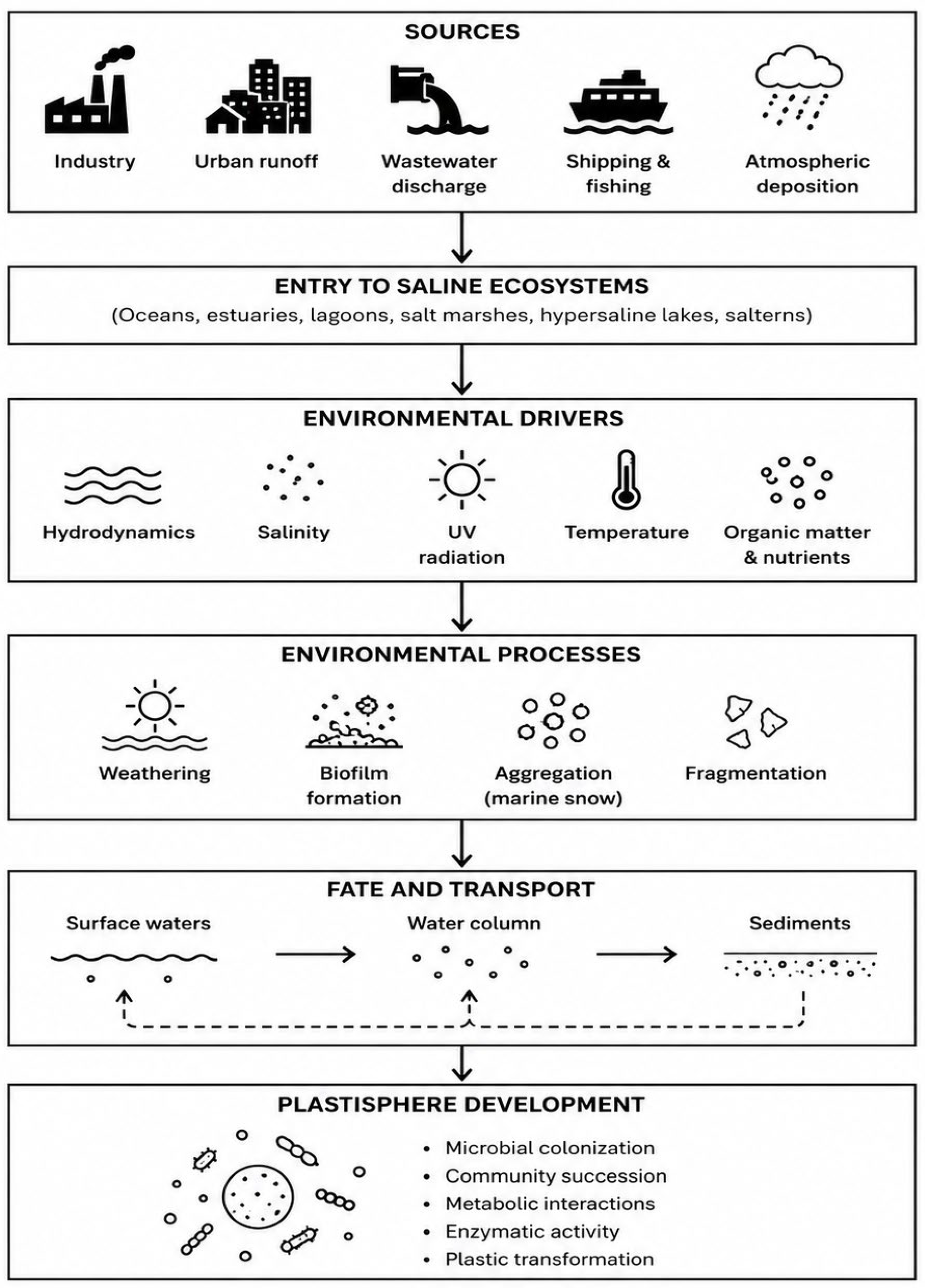
Figure 2.
Formation and ecological succession of the plastisphere on microplastic surfaces.
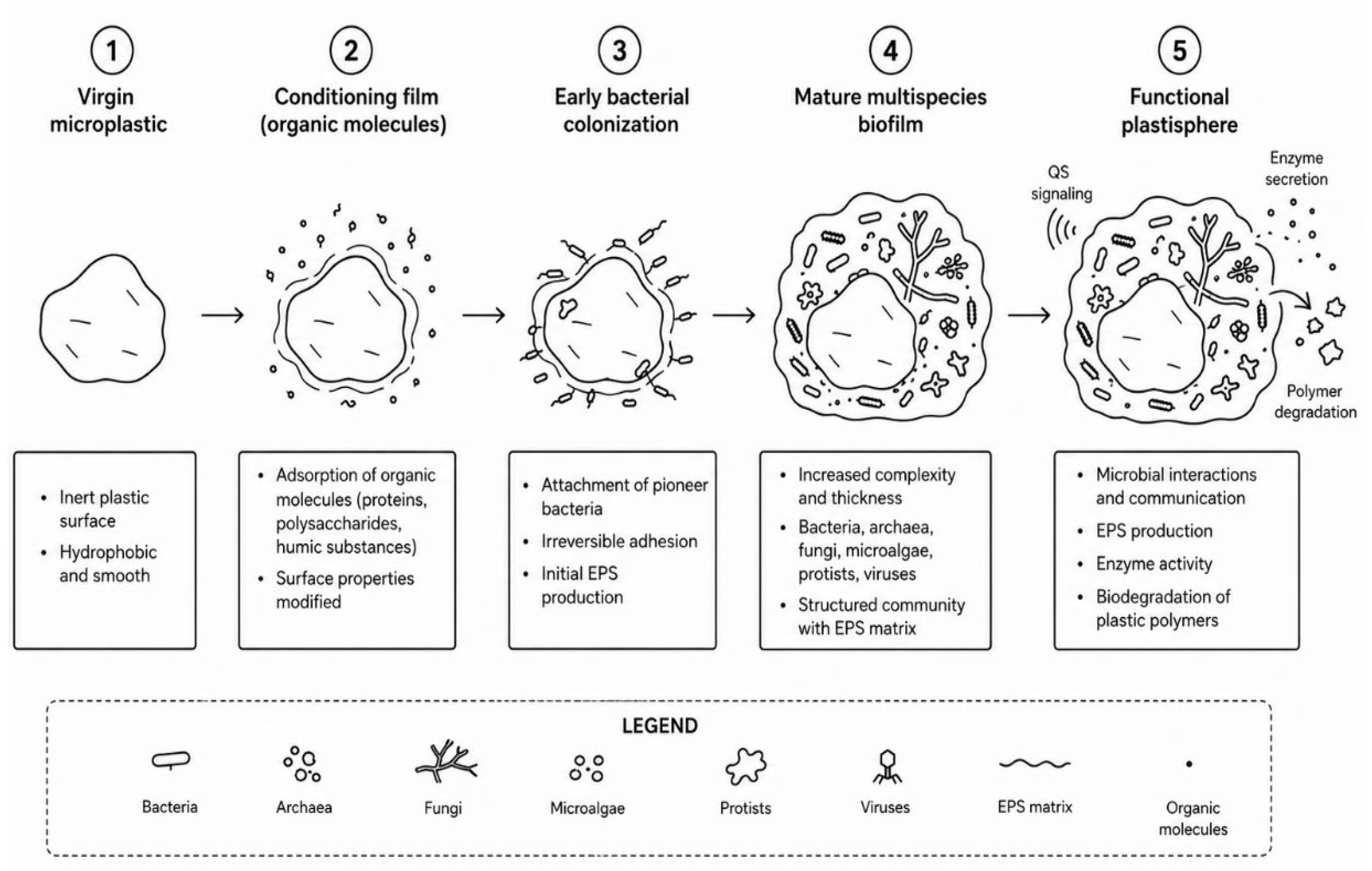
Figure 3.
Quorum sensing as a regulatory network within the saline plastisphere.
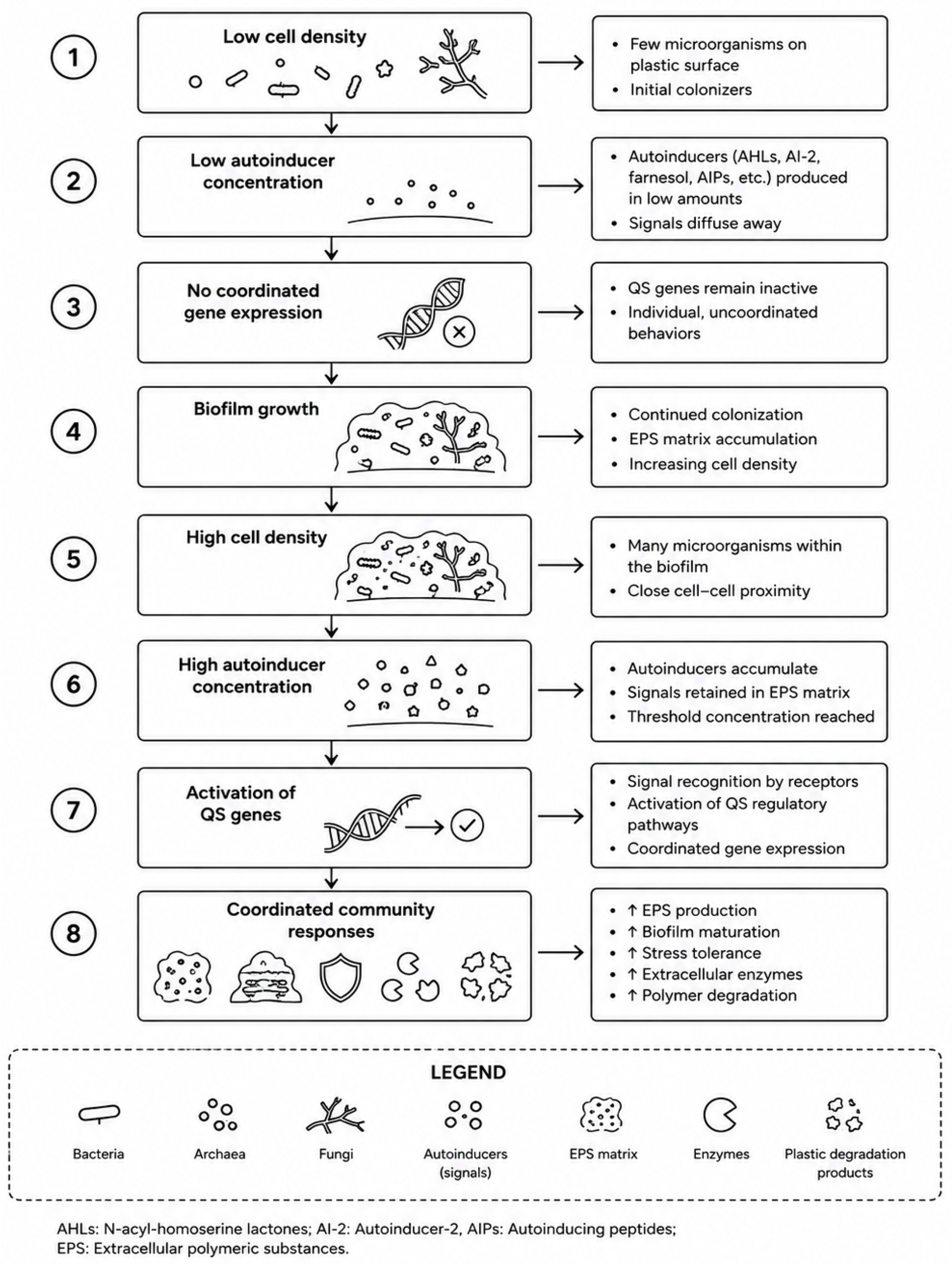
Figure 4.
Ecological roles of halotolerant fungi in the saline plastisphere.
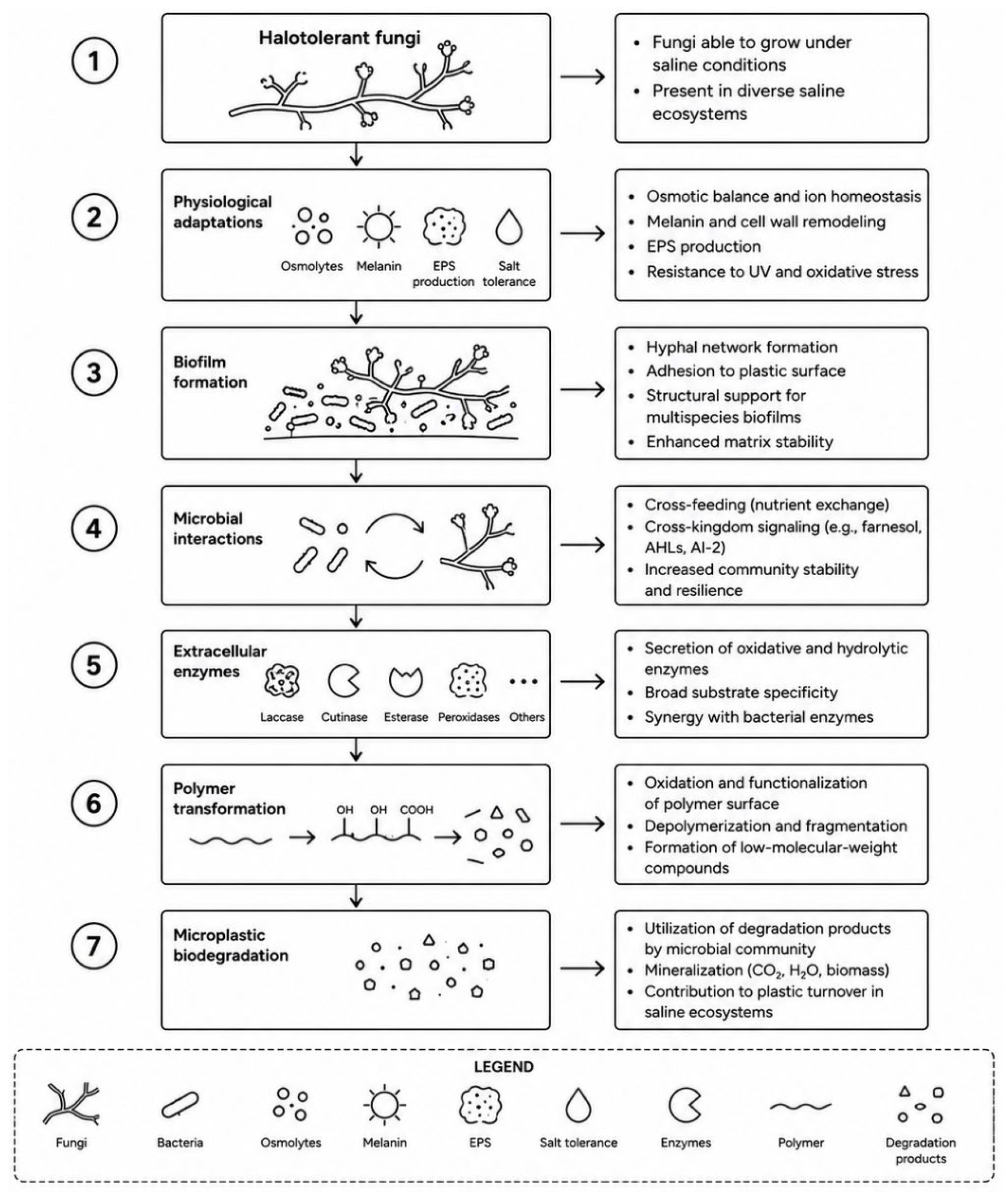
Figure 5.
Integrated pathway of microplastic biodegradation within the saline plastisphere.
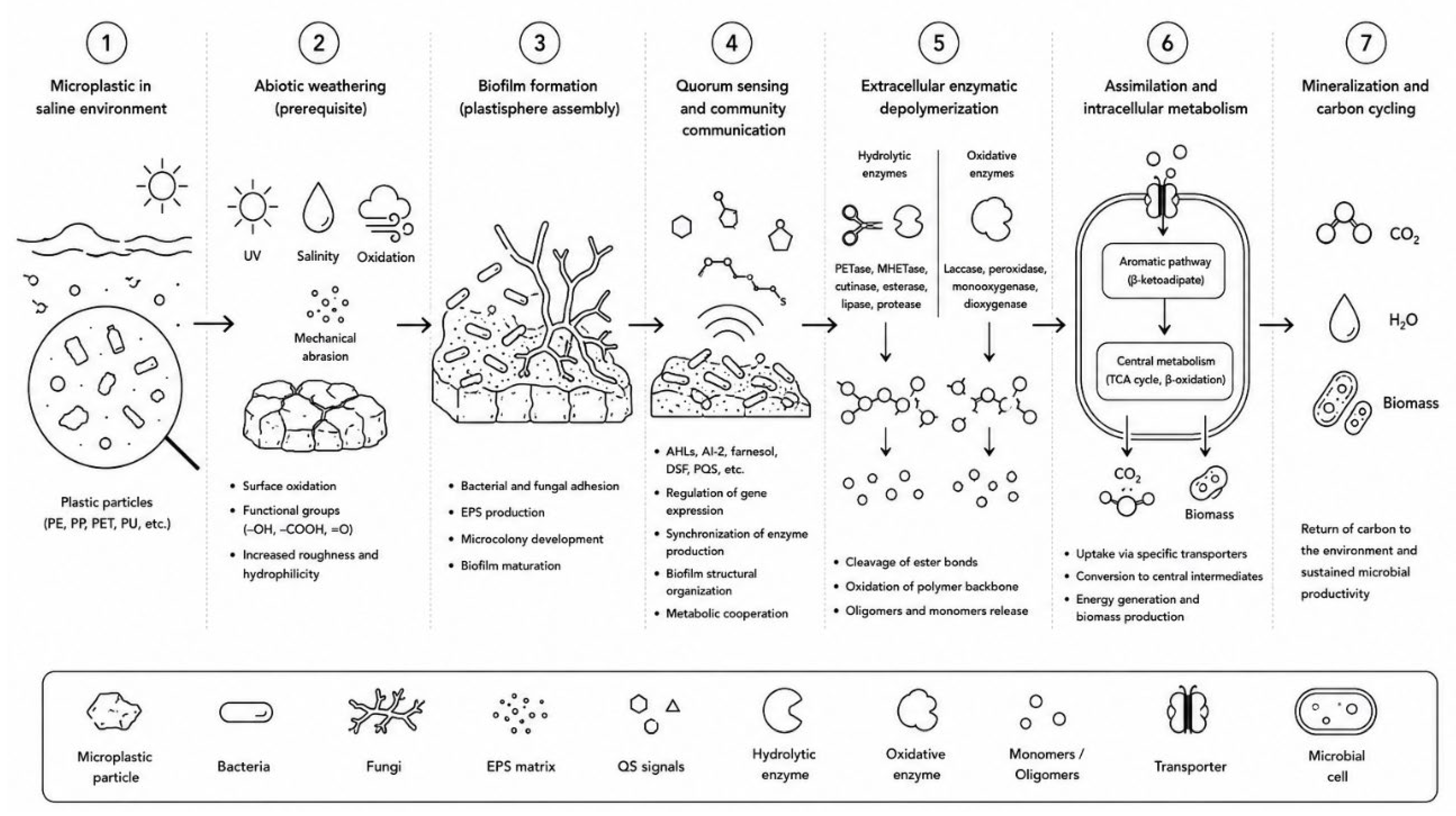
Figure 6.
Integrative Ecological Framework Linking Quorum Sensing to Microplastic Biodegradation in Saline Ecosystems.
Figure 6.
Integrative Ecological Framework Linking Quorum Sensing to Microplastic Biodegradation in Saline Ecosystems.
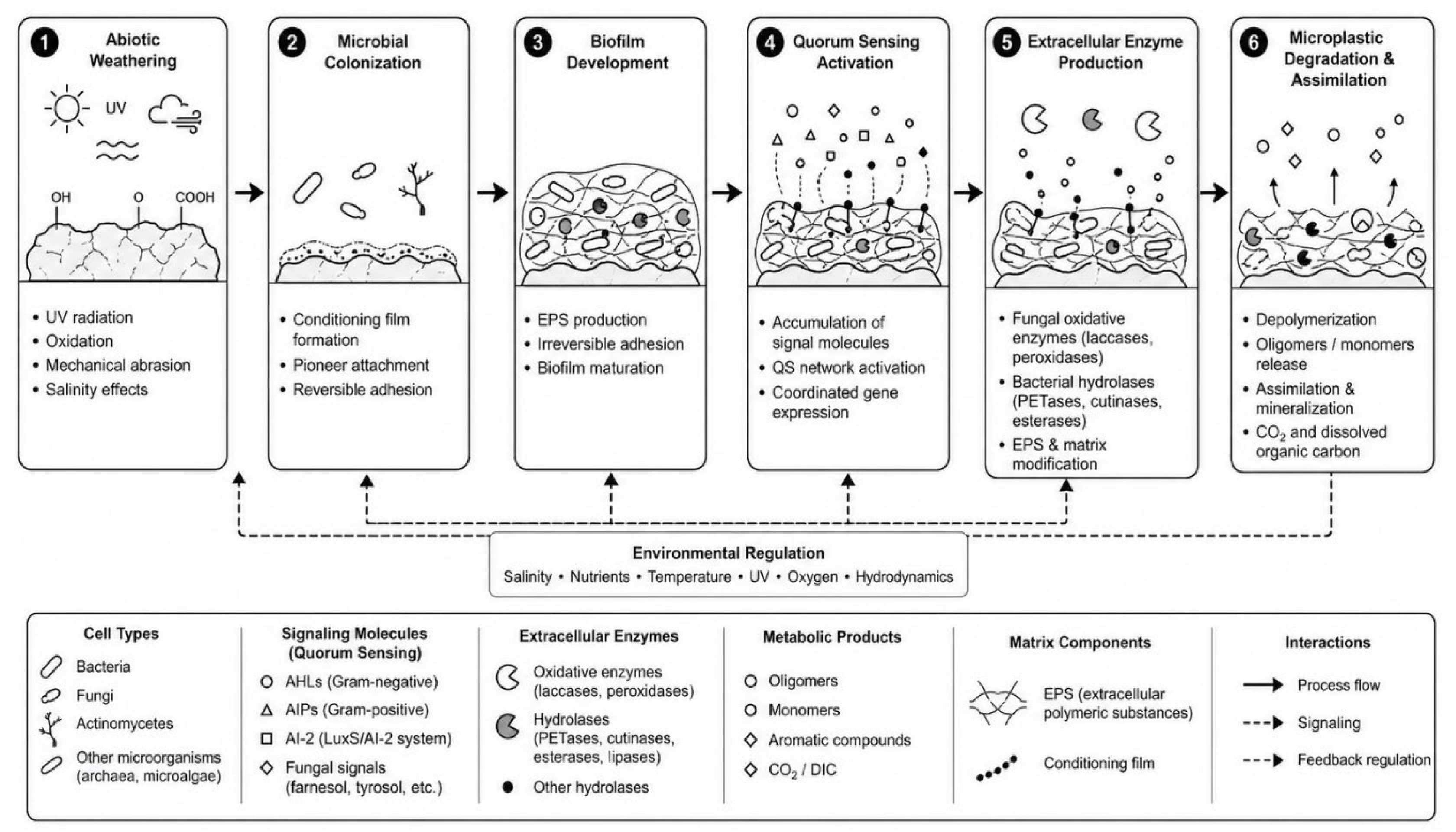

Table 1.
Main characteristics of saline ecosystems, including major sources of microplastics, predominant polymers, environmental processes, and expected plastisphere characteristics.
Table 1.
Main characteristics of saline ecosystems, including major sources of microplastics, predominant polymers, environmental processes, and expected plastisphere characteristics.
| Saline ecosystem | Major sources of microplastics | Predominant polymers | Dominant environmental processes | Expected plastisphere characteristics | Representative references |
|---|---|---|---|---|---|
| Open ocean | River discharge, shipping, fisheries, atmospheric deposition | PE, PP | Long-distance transport, UV weathering, biofouling, vertical mixing | Mature biofilms, high bacterial diversity, floating and sinking plastisphere | 4, 5, 6 |
| Estuaries | Urban runoff, wastewater effluents, rivers | PE, PP, PET, PS | Flocculation, tidal mixing, salinity gradients | Rapid microbial succession and high diversity | 6, 54, |
| Mangrove forests | Riverine inputs, aquaculture, coastal litter | PE, PP, PET | Sediment trapping, organic matter accumulation | Stable biofilms and strong bacterial–fungal interactions | 46, 56 |
| Salt marshes | River discharge, atmospheric deposition | PE, PP, PET | Fine sediment deposition, periodic flooding | Persistent plastisphere communities | 47, 48 |
|
Coastal lagoons |
Wastewater, tourism, aquaculture | PE, PP, PS | Restricted circulation, eutrophication | Dense biofilms and active microbial metabolism | 57, 58 |
| Hypersaline lakes | Local anthropogenic activities, atmospheric deposition | PE, PP, PET | Extreme salinity, intense UV radiation, evaporation | Halophilic and halotolerant biofilms | 51, 59 |
| Solar salterns | Atmospheric deposition, industrial activities | PE, PP | Salt crystallization, evaporation, hypersalinity | Expected selection for halophilic and halotolerant plastisphere taxa | 8. 60, 61 |
Table 3.
Major quorum sensing molecules and their potential ecological roles in plastisphere communities of saline ecosystems.
Table 3.
Major quorum sensing molecules and their potential ecological roles in plastisphere communities of saline ecosystems.
| Signaling molecule | Major producers | Main physiological functions | Potential role in the plastisphere | References |
|---|---|---|---|---|
| N-acyl homoserine lactones (AHLs) | Gram-negative bacteria (Vibrio, Pseudomonas, Roseobacter, Alteromonas) | Biofilm formation, EPS production, motility, extracellular enzyme secretion | Promotes microbial attachment, biofilm maturation, and coordinated expression of plastic-degrading enzymes | 17, 106, 107 |
| Autoinducer-2 (AI-2) | Gram-negative and Gram-positive bacteria | Interspecies communication, biofilm regulation, metabolic coordination | Facilitates communication among phylogenetically distinct members of the plastisphere | 87, 108 |
| Autoinducing peptides (AIPs) | Gram-positive bacteria (Bacillus, Staphylococcus, Enterococcus) | Biofilm development, competence, sporulation | Coordinates collective behavior of Gram-positive members within mature biofilms | 86, 109 |
| Diffusible signal factors (DSFs) | Xanthomonas, Stenotrophomonas, marine Proteobacteria | Biofilm dispersion, stress response, virulence regulation | Regulates biofilm architecture and microbial adaptation under environmental stress | 110 |
| Diketopiperazines (DKPs) | Diverse bacteria and fungi | Intercellular communication, biofilm regulation, modulation of AHL signaling | May enhance cross-species communication within mixed plastisphere biofilms | 111 |
| Indole | Escherichia coli, Vibrio, Pseudomonas and other Proteobacteria | Biofilm formation, oxidative stress response, persistence | Modulates bacterial physiology and interspecies interactions in nutrient-limited biofilms | 112 113 |
| Quinolone signals (PQS) | Pseudomonas spp. | Iron acquisition, oxidative stress, extracellular DNA release | Enhances mature biofilm stability and extracellular matrix organization | 114, 115 |
| Farnesol | Candida spp. and other yeasts | Hyphal inhibition, biofilm regulation, oxidative stress response | Regulates fungal development and bacterial–fungal interactions within plastisphere biofilms | 116, 117 |
| Tyrosol | Candida spp. | Cell proliferation, filamentation, biofilm formation | Accelerates fungal colonization during early biofilm development | 117, 118 |
| Phenylethanol and aromatic alcohols | Yeasts and filamentous fungi | Morphogenesis, sporulation, stress tolerance | May regulate fungal adaptation to saline biofilms and coordinate mixed microbial communities | 117, 119 |
| Putative archaeal signaling molecules | Halophilic archaea (Haloferax, Halobacterium, Haloarcula) | Biofilm formation, motility, environmental adaptation (still poorly understood) | Potential role in communication within hypersaline plastisphere communities remains largely unexplored | 8 |
Table 4.
Representative halotolerant fungi from saline ecosystems and their reported enzymatic potential for polymer.
Table 4.
Representative halotolerant fungi from saline ecosystems and their reported enzymatic potential for polymer.
| Fungal taxon | Saline habitat | Main extracellular enzymes | Polymer or substrate | Potential ecological role in the plastisphere | Evidence level* | References |
|---|---|---|---|---|---|---|
| Aspergillus sydowii | Marine sediments, seawater | Laccase, esterase, lipase | Polyurethane (PU), aromatic hydrocarbons | Oxidative transformation of polymer-derived compounds; biofilm formation | Direct | 10, 11 |
| Aspergillus terreus | Coastal sediments | Cutinase, esterase, lipase | PET oligomers, aliphatic esters | Initial hydrolysis of ester-containing polymers | Direct | 138, 139 |
| Penicillium chrysogenum | Marine sediments, estuaries | Esterase, laccase | Polyurethane (PU), polyethylene (PE) | Biofilm colonization and extracellular oxidation | Direct | 133 |
| Cladosporium cladosporioides | Mangroves, salt marshes | Laccase, peroxidase | Polyethylene (PE), lignin analogues | Polymer weathering and stabilization of multispecies biofilms | Indirect | 10, 11 |
| Trichoderma harzianum | Coastal soils, saline sediments | Cutinase, esterase, cellulase | Polyester-based polymers | Hydrolysis of ester bonds and synergistic interaction with bacteria | Direct | 138 |
| Fusarium solani | Marine sediments | Cutinase, lipase | PET model substrates | Surface oxidation and depolymerization of polyesters | Direct | 138, 139 |
| Aureobasidium pullulans | Marine biofilms, hypersaline habitats | Cutinase, esterase | PET oligomers, cutin | Early colonizer of hydrophobic surfaces; extracellular hydrolysis | Direct | 140 |
| Debaryomyces hansenii | Solar salterns, hypersaline lakes | Lipase, esterase | Hydrocarbon-derived compounds | Adaptation to hypersaline biofilms and carbon turnover | Indirect | 120 |
| Hortaea werneckii | Solar salterns | Oxidases, antioxidant enzymes | Aromatic compounds | Persistence under hypersaline conditions; candidate plastisphere colonizer | Potential | 141, 142 |
| Wallemia ichthyophaga | Hypersaline environments | Hydrolytic enzymes (poorly characterized) | Not yet demonstrated | Candidate extremophile for plastisphere colonization | Potential | 143 |
| Marine fungal consortia | Marine plastisphere | Laccases, peroxidases, esterases, lipases | PE, PET, PU, polymer additives | Cooperative biodegradation through multispecies biofilms | Potential/ Indirect |
144, 145 |
Table 5.
Major enzymes involved in microplastic degradation, their microbial sources, target polymers, and catalytic functions.
Table 5.
Major enzymes involved in microplastic degradation, their microbial sources, target polymers, and catalytic functions.
| Degradation stage | Enzyme | Predominant microbial group | Main producers | Target polymer(s) | Catalytic function | Main degradation products | Representative references |
|---|---|---|---|---|---|---|---|
| 1. Surface oxidation | Laccase | Fungi | Trametes, Pleurotus, Aspergillus, Cladosporium | PE, PP, PET (surface), additives | Oxidation of aromatic and phenolic structures; introduction of oxygen-containing functional groups | Oxidized oligomers | 155, 157 |
| Manganese peroxidase (MnP) | Fungi | Phanerochaete chrysosporium, Trametes versicolor | PE, PP, PU | Oxidative cleavage of C–C and C–H bonds | Oxidized polymer fragments | 148, 155 | |
| Lignin peroxidase (LiP) | Fungi | Phanerochaete chrysosporium | PE, PET (surface) | Oxidative depolymerization of aromatic structures | Aromatic acids, quinones | 155, 157 | |
| Versatile peroxidase (VP) | Fungi | Pleurotus eryngii, Bjerkandera adusta | PE, PP, PU | Oxidation of phenolic and non-phenolic substrates | Oxidized oligomers | 155 | |
| Unspecific peroxygenase (UPO) | Fungi | Agrocybe aegerita, Marasmius rotula | PE, PP, PET | Oxygen insertion into recalcitrant polymers | Alcohols, epoxides | 148 | |
| 2.Polymer depolymerization | PETase | Bacteria | Ideonella sakaiensis | PET | Hydrolysis of PET ester bonds | MHET, BHET | 149, 150, 151 |
| Cutinase | Bacteria and fungi | Thermobifida, Humicola, Fusarium, Aspergillus | PET, PCL, PU | Cleavage of ester bonds | PET oligomers, TPA, EG | 139, 147 | |
| Esterase/Carboxylesterase | Bacteria and fungi | Bacillus, Pseudomonas, Penicillium, Aspergillus | PET, PU, PBAT | Hydrolysis of ester linkages | Organic acids, oligomers | 147, 148 | |
| Lipase | Bacteria and fungi | Candida, Aspergillus, Bacillus, Pseudomonas | PU, PLA, PCL | Hydrolysis of aliphatic esters | Fatty acids, alcohols | 147, 148 | |
| 3. Oligomer hydrolysis | MHETase | Bacteria | Ideonella sakaiensis | MHET | Hydrolysis of MHET | TPA, EG | 149, 151 |
| 4. Assimilation of degradation products | Alkane hydroxylase (AlkB) | Bacteria | Alcanivorax, Pseudomonas, Rhodococcus | Oxidized PE and PP fragments | Oxidation of aliphatic hydrocarbons | Alcohols, aldehydes, fatty acids | 156, 157 |
| Monooxygenases | Bacteria | Pseudomonas, Rhodococcus | Hydrocarbon intermediates | Hydroxylation reactions | Alcohols, ketones | 147, 157 | |
| Alcohol/Aldehyde dehydrogenases | Bacteria and fungi | Diverse taxa | Alcohols, aldehydes | Sequential oxidation to organic acids | Fatty acids, acetyl-CoA precursors | 139, 147 | |
| 5. Central metabolism and mineralization | Dioxygenases | Bacteria | Pseudomonas, Comamonas, Rhodococcus | Aromatic intermediates (e.g., TPA) | Aromatic ring cleavage | Protocatechuate, β-ketoadipate intermediates | 151, 158 |
| β-Ketoadipate pathway enzymes | Bacteria | Diverse Proteobacteria | Protocatechuate, catechol | Conversion into TCA intermediates | Succinyl-CoA, Acetyl-CoA | 149, 151 | |
| β-Oxidation enzymes | Bacteria and fungi | Diverse taxa | Fatty acids derived from polymer oxidation | Sequential shortening of carbon chains | Acetyl-CoA | 147, 156 | |
| TCA cycle enzymes | All microorganisms | Bacteria, fungi and archaea | Acetyl-CoA | Complete oxidation and energy production | CO2, H2O and biomass | 160, 161 |
Abbreviations: PET, polyethylene terephthalate; PE, polyethylene; PP, polypropylene; PU, polyurethane; PCL, polycaprolactone; PLA, polylactic acid; PBAT, poly(butylene adipate-co-terephthalate); MHET, mono(2-hydroxyethyl) terephthalate; BHET, bis(2-hydroxyethyl) terephthalate; TPA, terephthalic acid; EG, ethylene glycol.
Disclaimer/Publisher’s Note: The statements, opinions and data contained in all publications are solely those of the individual author(s) and contributor(s) and not of MDPI and/or the editor(s). MDPI and/or the editor(s) disclaim responsibility for any injury to people or property resulting from any ideas, methods, instructions or products referred to in the content. |
© 2026 by the authors. Licensee MDPI, Basel, Switzerland. This article is an open access article distributed under the terms and conditions of the Creative Commons Attribution (CC BY) license (http://creativecommons.org/licenses/by/4.0/).
Copyright: This open access article is published under a Creative Commons CC BY 4.0 license, which permit the free download, distribution, and reuse, provided that the author and preprint are cited in any reuse.