

Submitted:
14 August 2026
Posted:
14 August 2026
You are already at the latest version
Abstract
Residual tree damage is an unavoidable consequence of thinning operations and may affect future stand quality, tree health, and timber value. Despite the increasing use of mechanized harvesting systems in broadleaved forests, limited information is available on the factors controlling damage occurrence under different stand conditions. This study aimed to quantify residual tree damage following mechanized thinning, identify the main determinants of damage occurrence, and develop a model describing damage probability in broadleaved stands. The study was carried out at six locations in five European countries representing four broadleaved tree species: European beech (Fagus sylvatica L.), oak (Quercus L.), birch (Betula L.), and European aspen (Populus tremula L.). A total of 288 sample plots were established, and 4,576 trees were inventoried. Thinning operations were performed using two harvesters: HSM 405H and UTC 150 - 6LS, both equipped with a CTL 40 HW harvesting head, designed for broadleaved tree species. Residual tree damage was assessed immediately after harvesting and analysed using logistic regression models. Overall, 271 out of 3,230 residual trees were with damage, corresponding to a damage rate of 8.4%. No significant differences in damage occurrence were found between the two experienced harvester operators. In contrast, bark thickness and distance from the strip road were identified as the only significant predictors of residual tree damage probability. Thin-barked stands (beech) exhibited significantly higher damage rates (11.8%) than thick-barked stands (oak, birch, and aspen; 5.7%). The developed logistic model provides a practical tool for estimating residual tree damage probability and may support harvesting planning and stand protection.
Keywords:
deciduous tree species
; mechanised thinning
; tree wounds
; bark thickness
; strip road
; logistic regression
; harvesting operations
1. Introduction
Mechanised forest operation has become the dominant harvesting method in many European forests due to its high productivity, operational safety, and economic efficiency. Although fully mechanized systems [1] were initially developed mainly for coniferous stands, their application in broadleaved forests has increased considerably in recent decades as harvesting technologies and machine capabilities have improved [2,3]. Previous studies have demonstrated that mechanized thinning can be successfully applied in broadleaved stands while maintaining satisfactory operational productivity and timber recovery [4,5,6,7]. However, regardless of the harvesting system used, damage to residual trees remains one of the most important environmental and silvicultural consequences of thinning operations.
Residual tree damage may reduce future stand quality, impair tree vitality, increase -susceptibility to fungal infections and stem decay, and ultimately decrease timber value [8,9,10]. The extent of such damage varies considerably among harvesting systems, stand conditions, and tree species [11,12,13], with low values when using cable yarding [14] or cut-to-length technologies [15]. Previous studies have reported damage rates ranging from approximately 5% in well-organized mechanized operations to more than 40% in certain semi-mechanized harvesting systems applied in broadleaved forests [16,17,18,19]. Consequently, understanding the factors influencing residual tree damage is important for improving thinning practices and reducing long-term economic losses. Numerous studies have investigated the effects of harvesting technology, extraction methods, operator performance, harvesting intensity, and strip-road design on residual stand damage [20]. Kühmaier [21] raised the question of whether damage to the residual stand increases with higher harvesting productivity.
Particular attention has often been paid to operational factors, including machine traffic and work organization, because harvesting activities are concentrated within the vicinity of the strip road [17,22,23]. Nevertheless, less attention has been devoted to species-specific characteristics that may influence tree susceptibility to mechanical injuries. One such characteristic is bark thickness, which serves as a natural protective layer against external mechanical impacts. Although bark properties have been recognized as an important factor affecting tree resistance to damage, quantitative assessments of their influence on residual tree damage in mechanized thinning operations remain limited, particularly for European broadleaved tree species.
The growing emphasis on sustainable forest management requires not only quantification of harvesting damage but also the development of predictive tools capable of estimating damage risk under different stand conditions. Such models may assist forest managers in harvesting planning, evaluation of stand vulnerability, and implementation of mitigation measures aimed at protecting future crop trees and preserving timber quality. However, information describing the probability of residual tree damage in broadleaved stands across different European conditions remains scarce. To our knowledge, presented research is among the first studies conducted across multiple European countries that combines empirical assessment of residual tree damage in broadleaved stands with the development of a predictive model incorporating bark thickness and tree distance from the strip road.
Therefore, the objectives of this study were to: (i) quantify residual tree damage following mechanized thinning in selected broadleaved stands across Europe, (ii) evaluate the influence of operator performance, stand and tree characteristics, bark thickness, and distance from the strip road on damage occurrence, and (iii) develop a logistic regression model describing the probability of residual tree damage. We hypothesized that bark thickness and distance from the strip road are the principal determinants of residual tree damage, and that thin-barked species are more susceptible to harvesting-related injuries than thick-barked species.
2. Materials and Methods
2.1. Study Area and Stand Characteristics
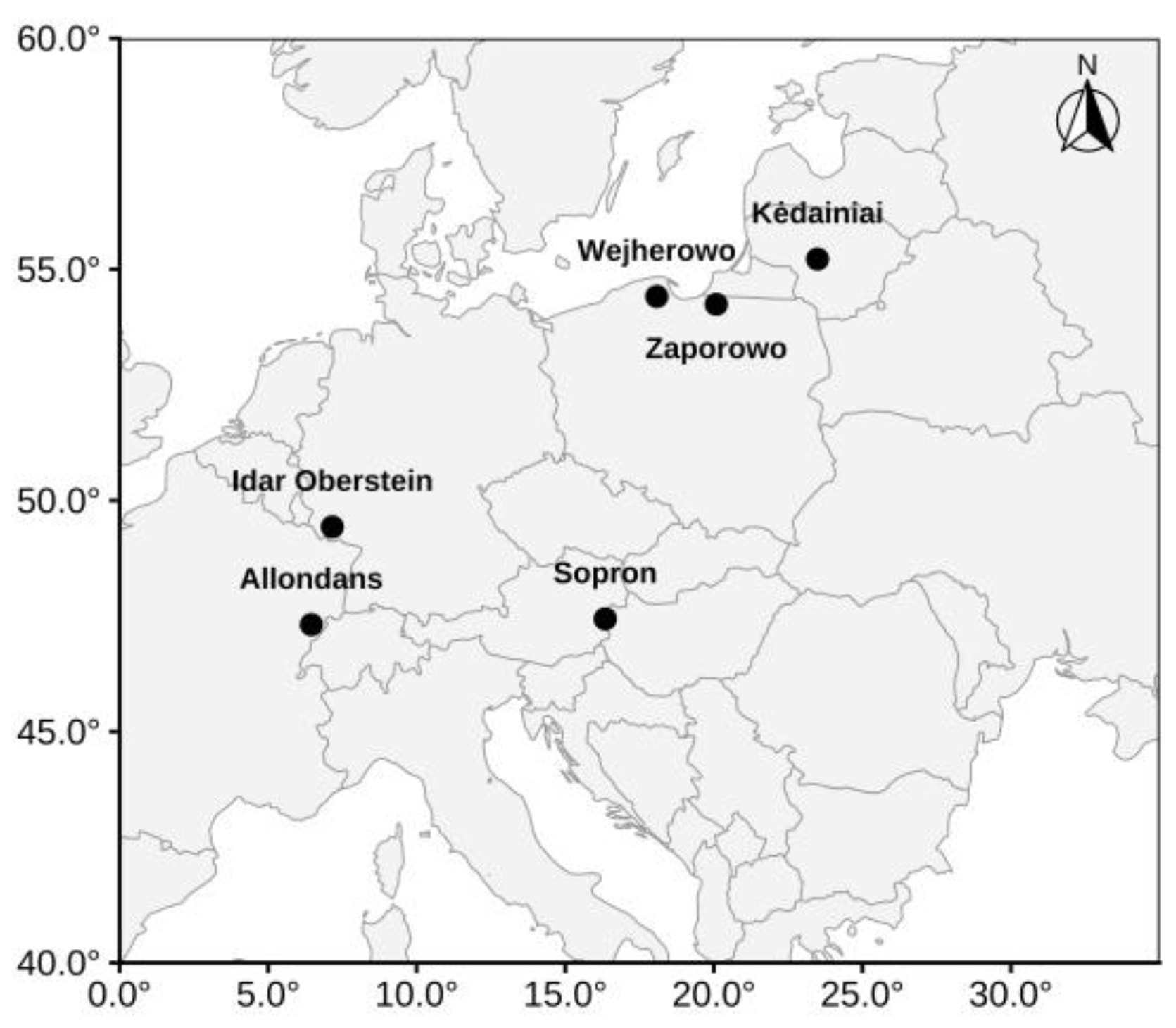
The study was conducted at six locations situated in France, Germany, Hungary, Poland, and Lithuania (2
1). A total of 288 experimental plots were established, comprising 48 plots at each location. Each plot covered an area of 125 m², resulting in a total surveyed area of 0.60 ha per study location.
Figure 1.
Research areas located in Europe.Map.
The selection of study stands was based on cluster analysis, an unsupervised classification procedure used to identify relatively homogeneous broadleaved stands representing economically important and widespread forest types in lowland regions of West and Central-East Europe. Consequently, four dominant broadleaved species were included in the study: European beech (Fagus sylvatica L.), oak (Quercus spp.), birch (Betula spp.), and European aspen (Populus tremula L.).
2.2. Data Collection
Field measurements were carried out between January and March under snow-free conditions and prior to the onset of the growing season. To minimize the influence of seasonal and climatic variation, the study progressed from west to east, beginning in Allondans, France, and ending in Kėdainiai, Lithuania. Weather conditions remained generally stable throughout the observation period, with only minor snowfall and rainfall events recorded at the French and German sites (Table 1).
All study areas were accessed by a systematically arranged network of parallel strip roads 4.0 m wide and spaced 20.0 m apart. Thinning operations were performed using two harvesters: HSM 405H (beech stands in France and Germany) and UTC 150 - 6LS (beech and birch stand in Poland, oak stand in Hungary, and aspen stand in Lithuania) equipped with a CTL 40 HW harvesting head specifically designed for broadleaved timber harvesting. The harvesting head, 610 kg, was capable of processing tree trunks with diameters of up to 450 mm. Additional technical specifications included a feeding force of 22 kN, feeding speed of 4 m s⁻¹, chain speed of 45 m s⁻¹, and a 540 mm guide bar fitted with a 0.404-inch chain [24].
Two well trained and experienced harvester operators participated in the study. Operator A had accumulated approximately 10,000 machine hours of experience, whereas Operator B had recorded approximately 3,600 machine hours. Both operators performed thinning operations in beech stands, which enabled the assessment of potential operator effects on residual stand damage. The results of this comparison were subsequently used to determine whether operator experience should be included as a factor in further analyses.
Prior to harvesting, all trees within the sample plots were measured: diameter at breast height (DBH; cm), tree height (m) and bark thickness (mm). Bark thickness was measured on processed logs using a caliper. In addition, each tree was assigned to one of two biosocial classes using Kraft’s classification system: dominant trees (Kraft classes I-III) and dominated trees (Kraft classes IV-V). Additionally, stem volume (m³) was calculated.
Residual tree damage was assessed immediately after harvesting and before forwarding operations commenced. All wounds optically estimated as larger than 10 cm² occurring on stems or root collars were inventoried, whereas smaller injuries were considered negligible [25]. The residual tree damage rate was calculated as the proportion of residual trees with damage relative to the total number of residual trees.
The area of each wound was estimated using the ellipse formula based on wound length and width measurements. Injuries up to 2.5 m above ground level were measured directly using a measuring tape, whereas wounds which occurred higher were assessed using a Vertex ultrasonic hypsometer. Wound width was estimated as a proportion of stem diameter while assuming a stem taper of 1 cm m⁻¹. Wounds were subsequently classified according to:
wound area: small wounds (10-100 cm²), large wounds (>100 cm²);
wound depth: phloem damage (after bark removal), xylem damage (after bark removal and phloem damaged).
To evaluate the effect of tree location relative to the strip road, trees with damage were further assigned to one of four distance classes from the strip-road edge:
Zone A: 0-2 m,
Zone B: 2-4 m,
Zone C: 4-6 m,
Zone D: 6-8 m.
Distances were measured using a Vertex ultrasonic rangefinder. Mean distances of damaged trees from the strip road were calculated for each study site together with their standard deviations. Differences among study sites were evaluated using one-way analysis of variance (ANOVA).
2.3. Research Data Availability
In accordance with Open Science principles and current European requirements for research data sharing, the dataset generated during this study has been made publicly available in open access.
The dataset contains measurements of 4,576 trees inventoried on 288 sample plots distributed across six study locations in five European countries and representing four broadleaved tree species: European beech (Fagus sylvatica L.), oak (Quercus L.), birch (Betula L.), and European aspen (Populus tremula L.). It includes dendrometric characteristics of individual trees, records of residual tree damage following thinning operations, biosocial classification, tree distance from the strip road, and all variables used in the statistical analyses presented in this study. Prior to publication, the dataset was subjected to quality-control procedures to identify and correct potential errors and inconsistencies.
The dataset is distributed under the Creative Commons Attribution 4.0 International (CC BY 4.0) licence and was prepared according to the FAIR (Findable, Accessible, Interoperable, and Reusable) principles. Data are provided in the open CSV (Comma-Separated Values) format to ensure machine readability, interoperability, and long-term accessibility independent of proprietary software.
The dataset has been deposited in the Zenodo research data repository and assigned the persistent Digital Object Identifier (DOI): https://doi.org/10.5281/zenodo.20989351. Metadata and file information are available through the Zenodo platform and can be accessed programmatically via the Zenodo REST API.
Public access to the dataset improves research transparency, enables independent verification of the reported findings, supports the reproducibility of analyses, and facilitates future reuse of the data in accordance with Open Science principles.
2.4. Statistical Analysis and Damage Probability Modeling
The probability of residual tree damage was determined using generalized linear models (GLMs). The response variables represented categorical outcomes, therefore conventional linear regression was not appropriate. Finally, logistic regression models with a binomial error distribution and a logit link function were applied.
η(p) – the linear predictor obtained through the link function (η) to the unknown probability of success (p),
X – known matrix of covariates,
β – vector of unknown parameters,
β0, β1, …, βn – unknown model parameters,
T – vector transpose.
The link function transformed the set [0,1] of probability values (p) onto the regression line. Since the aim was to estimate unknown probabilities based on observations, the parameters were determined using the maximum likelihood method. This resulted in a system of nonlinear equations, whose solution required the application of iterative methods such as the Newton-Raphson method or the Fisher method [27,28,29]. To test the hypothesis (2), the Wald test statistic was applied (3):
which under the null hypothesis has an asymptotic χ2v distribution and was used to evaluate the model fit, where v is the dimension of vector β, and:
– estimator of vector β,
β∗ – parameter vector under the null hypothesis,
Since the link function in the model was a logistic transformation, the model was referred to as a logistic model [30]. In the special case of a logistic model with a binomial distribution, when experimental units were classified into two predefined mutually exclusive categories (success and failure), the model with a logistic transformation in scalar form was expressed as:
where x1, x2, …, xn are predictor variables and the probability of success (p) was established as:
Before analyzing the previously mentioned predictor variables (xn) the effects of operator and stand-related factors on the frequency and type of residual damage were assessed. Since the trees were split into two categories (thin and thick-barked), and there were k-operators participating in the study, model (4) changed its form into:
where pi stands for the probability of residual tree damage done by the i-th operator, which can be established as:
where represents the effect of the i-th operator on residual damage [17].
Each residual tree was classified as with damage or without damage. The depth of wound (phloem, xylem), area (10-100 cm2, above 100 cm2), and placement (roots, trunk) of the damage were categorial values. Thus, a logistic model with a binomial distribution was used for further analysis [31]. Meanwhile, since height is a continuous variable measured in meters, after removing outlying observations using the ESD method [32], the Student’s t-test and the two-proportion test were later used to evaluate the differences between thin and thick-barked stands in relation to predictor variables (xn). The final logistic model retained only statistically significant predictors and was used to estimate the probability of residual tree damage as a function of bark thickness and tree distance from the strip road.
3. Results
3.1. Residual Tree Damage Following Thinning
A total of 4,576 trees were inventoried before thinning, of which 1,346 trees were removed during harvesting operations (Table 2). Consequently, 3,230 residual trees remained for damage assessment, among which 271 trees were recorded as with damage, corresponding to an overall residual tree damage rate of 8.4%. Damage frequency differed significantly among study sites (χ² = 41.74, df = 5, p < 0.001).
The highest damage rate was observed at Site Beech Germany, where 39 out of 323 trees were with damage (12.1%). This was followed by Site Beech France (12.0%) and Site Beech Poland (11.1%). Lower damage rates were recorded at Site Aspen Lithuania (5.9%), Site Oak Hungary (5.6%), and Site Birch Poland, which had the lowest proportion of trees with damage (5.4%). The results indicate a clear tendency for higher damage occurrence in beech stands compared with the remaining broadleaved species.
3.1.1. Characteristics of Trees with Damage
Comparisons between trees with and without damage revealed only limited differences in dendrometric characteristics (Table 3). In Site Beech France, trees with damage were significantly shorter and had lower stem volumes than undamaged trees, while DBH and bark thickness did not differ significantly. Similarly, in Site Oak Hungary and Site Aspen Lithuania trees with damage exhibited significantly lower heights. In contrast, no significant differences between damaged and undamaged trees were found in the remaining four sites.
When all observations were pooled, trees with damage were characterized by slightly lower heights and significantly thinner bark than undamaged trees, whereas differences in DBH and stem volume were not statistically significant.
3.1.2. Biosocial Position of Trees with Damage
Across all sites, dominant trees were slightly more frequently wounded than dominated trees (Table 4). Among all trees with damage, 152 individuals (54.1%) belonged to dominant social classes (Kraft I-III), whereas 119 trees (45.9%) were classified as dominated individuals (Kraft IV-V). Although dominant trees with damage slightly prevailed overall, this pattern was not consistent across all study sites. The largest proportions of dominant trees with damage occurred in birch (68.4%), aspen (61.1%), and beech stands in France (58.0%). In contrast, the Hungarian oak stand exhibited a predominance of dominated trees with damage (63.3%).
3.1.3. Spatial Distribution of Damage
The mean distance of trees with damage from the middle of the strip road was 3.1 ± 2.1 m (Table 5). The greatest mean distance was recorded at Site Beech Poland (Mean = 3.8 ± 2.4 m), followed by Site Beech Germany (3.5 ± 1.9 m), whereas the lowest mean distance was observed at Site Oak Hungary (2.4 ± 1.8 m) (Table 5). The remaining sites had intermediate values: Site Beech France (2.9 ± 1.9 m), Site Birch Poland (3.0 ± 2.4 m), and Site Aspen Lithuania (2.7 ± 2.0 m) (Table 5).
ANOVA revealed a significant site effect on the distance between trees with damage and strip road (F = 2.520, p = 0.03). However, post hoc comparisons did not identify significant pairwise differences between individual sites, even in the cases of the two largest differences (Site Beech Germany vs Site Aspen Lithuania and Site Birch Poland vs Site Aspen Lithuania). The observed pattern indicates that most damage occurred in close proximity to strip road, where harvester crane movements and tree processing operations were most intensive.
3.1.4. Wound Characteristics
Across all study sites, small wounds (10-100 cm²) predominated, accounting for 78.6% of all recorded injuries. (Table 6). The highest proportion of small wounds was observed at Site Beech Germany (84.6%), followed closely by Site Beech France (84.0%) and Site Oak Hungary (80.0%). Sites Aspen Lithuania and Beech Poland also showed a predominance of small wounds, with 77.8% and 77.1%, respectively. In contrast, Site Birch Poland differed from the other sites, as wounds larger than 100 cm² were more frequent there. At this site, 52.6% of wounds were larger than 100 cm², compared with 47.4% of small damage.
3.2. Influence of Operator Experience Based on Estimated Damage Probability Models
The operators worked on the same machine with the same harvester head. However, they did not work both on all the species studied. Both operators worked in beech stands. Operator A worked later only in oak stands while operator B worked additionally in birch and aspen stands. The two harvester operators differed in professional experience, with approximately 10,000 and 3,600 machine hours, respectively, however both were considered as experienced operators. There were only minor differences in frequency and quality of damage caused by both operators. It turned out that Operator A (12%) more frequently damaged residual trees in comparison to operator B (11%). However, the damages done by Operator A were deeper (17% of xylem damage in comparison with 10% from Operator B), but smaller (84% of small damage, while Operator B, 77%) (Figure 2 a, b, c).
Logistic regression analyses revealed finally that none of these differences were statistically significant (p > 0.05 for all assessed characteristics; Table 7). Consequently, total operator experience was not included as a predictor in the final damage probability model.
3.3. Effect of Bark Thickness
Following the exclusion of operator effects, the influence of bark thickness on residual tree damage was assessed. Statistical analyses confirmed significant differences in bark thickness among the investigated species (p < 0.001), justifying the classification of stands into thin-barked (beech) and thick-barked (oak, birch, and aspen) groups.
Thick-bark tree species differed only in wound area, p = 0.030 (Table 7). This difference occurred between the size of wounds that occurred in birch stands compared to oak and aspen stands, while no differences in wound size were observed between oak and aspen stands, p = 0.821.
The frequency of residual tree damage differed markedly between these two categories. Thin-barked stands experienced an average of 74.7 damaged trees ha⁻¹, corresponding to 11.8% of residual trees. In contrast, thick-barked stands averaged 45.8 damaged trees ha⁻¹ and only 5.7% damaged residual trees (Table 8).
Furthermore, comparisons of stand characteristics revealed significant differences between thin- and thick-barked trees in terms of stand diameter, basal area, stand height, and harvested timber volume, whereas the ratio of removed to residual trees did not differ significantly (p = 0.141) (Table 9).
3.4. Residual Tree Damage Probability Model
The final logistic regression model was developed using variables describing stand structure, harvesting intensity, bark thickness, and tree location relative to strip road. Among all tested variables, only bark thickness and distance from the strip road significantly affected the probability of residual tree damage (p < 0.001 in both cases). The remaining predictors, including removal intensity and stand structural characteristics, were not statistically significant (Table 10).
The probability of damage decreased consistently with increasing distance between tree and the nearest strip road in both stand categories (Figure 3). In thin-barked stands, the predicted probability of tree with damage declined from approximately 15% for those trees being near the strip road to less than 8% for trees being at a distance of 8 m from the strip road. In thick-barked stands, the corresponding probability decreased from approximately 9% to slightly above 2%.
Finally, the resulting model describing the probability of residual tree damage was:
Where: δ=0 thin-barked species, δ=1 thick-barked species, distance between a tree and the nearest strip road.
The model demonstrates that trees growing closer to strip road and species characterized by thinner bark exhibit significantly greater susceptibility to harvesting-related damage.
4. Discussion
The present study evaluated residual tree damage following mechanized thinning operations in broadleaved stands across a range of European conditions and considered several factors potentially influencing damage frequency, wound characteristics, and damage probability. The final outcome of the study was a logistic regression model describing the probability of residual tree damage during harvesting operations conducted with a dedicated hardwood harvesting head. The results demonstrated that bark thickness and tree distance from strip road were the primary determinants of damage occurrence, whereas operator-related effects were not statistically significant.
The comparison of two experienced harvester operators working in beech stands revealed no significant differences in residual tree damage frequency, wound depth, wound size, or wound location. Although the operators differed substantially in professional experience, with approximately 3,600 and 10,000 machine hours, both produced comparable damage rates ranging from 11% to 12%. These findings suggest that once a sufficient level of professional competence has been achieved, further increases in experience may not necessarily result in lower residual stand damage. Instead, a certain level of residual tree damage may be unavoidable during mechanized thinning operations [15], even when conducted by highly skilled operators. Similar observations were reported by Sirén [17], who found that seasonal conditions exerted a stronger influence on residual tree damage than individual operator performance. Nevertheless, as emphasized by the same author, proper training remains essential for achieving acceptable thinning quality and minimizing harvesting-related impacts. Previous studies have demonstrated that harvester productivity and work quality are strongly influenced by operator skills and working techniques, particularly during the early stages of professional development [33,34,35]. It is therefore possible that differences between operators become less pronounced after a high level of operational proficiency has been achieved.
An additional factor that may have contributed to the absence of significant operator effects was the use of a systematically designed strip-road network with a spacing of 20 m and a width of 4 m at all study sites. The standardized accessibility of the stands provided similar working conditions and may have reduced variability associated with operator behaviour. This observation is consistent with the conclusions of Gellerstedt [22], who emphasized that a clearly designed strip-road system supports harvester operators by reducing workload, facilitating machine movements, and improving both operational efficiency and stand protection, without increasing the occurrence of significant stem damage, which is consistent with observations reported by Bembenek [36].
The overall residual tree damage rate recorded in this study was 8.4% (Table 2). Although this level of damage remained relatively low compared with values frequently reported for semi-mechanized harvesting systems in broadleaved forests [18,19], it exceeded the 5% threshold commonly accepted in operational forestry practice in Poland [15] and Finland [37]. However, substantial differences emerged among species groups, indicating that species-specific bark characteristics are a major determinant of residual stand susceptibility to harvesting damage.
After excluding operator effects, the analysis focused on bark thickness as a potential source of variation in stand susceptibility. The results confirmed significantly greater residual tree damage in thin-barked stands than in thick-barked stands. The average damage rate reached 11.8% in beech stands, compared with only 5.7% in oak, birch, and aspen stands. These findings support the hypothesis formulated in the Introduction and indicate that bark thickness acts as a natural protective barrier against harvesting-related injuries. Bodaghi [38] reported that regenerating beech (Fagus orientalis Lipsky) had the highest incidence of damage. Similar relationships were reported by Han [39], who observed that Douglas-fir, characterized by thicker bark, was less susceptible to mechanical damage than western hemlock during harvesting operations. The present results extend these observations to mechanized thinning in European broadleaved forests and confirm that bark thickness is a major determinant of stand vulnerability.
Most trees with damage did not differ significantly from undamaged trees in terms of DBH, stem volume, or bark thickness. Only isolated differences in height were detected at several study sites. This finding suggests that harvesting-related damage was not concentrated on trees of a specific size class. At the same time, dominant trees were slightly more frequently damaged than dominated individuals, accounting for 54.1% and 45.9% of damaged trees, respectively. Although the difference was relatively small, injuries affecting dominant trees may have greater long-term consequences because these individuals often represent the most valuable component of the future stand. Mechanical damage to dominant trees may reduce future timber quality and potentially increase susceptibility to pathogen infection and stem decay [8,9].
The majority of recorded wounds were classified as small injuries (10-100 cm²), representing 78.6% of all observations. From a silvicultural perspective, this result is favourable because smaller wounds generally have a lower impact on tree vitality and are more likely to be successfully compartmentalized. Nevertheless, repeated injuries or damage to high-value crop trees may still result in reductions in timber quality and economic value. Previous studies have demonstrated that harvesting wounds can contribute to discoloration, defect formation, and value loss in hardwood timber [10], even when external damage appears limited.
The spatial distribution of damage confirmed that residual tree injuries were concentrated near strip road. On average, damaged trees were located 3.1 m from the centre of the strip road (approximately 1 m from the strip-road edge), and the probability model indicated a consistent decline in damage occurrence with increasing distance from the machine operating corridor. This pattern is readily explained by the greater frequency of crane movements and tree handling operations near strip road, where harvesting activities are most intensive. Similar results were reported by Hwang [23], who observed that most residual tree damage in cut-to-length thinning operations occurred in close proximity to machine traffic corridors. Consequently, particular attention should be paid to harvesting operations conducted within the first few metres adjacent to strip road. Additional protective measures may be justified in mature or high-value stands where future crop trees can be clearly identified and where maintaining timber quality is of particular importance.
The logistic regression analysis identified only two significant predictors of residual tree damage: bark thickness and distance from strip road. Stand structure variables and thinning intensity indicators did not significantly improve model performance. The resulting model demonstrated that damage probability decreased with increasing bark thickness and increasing distance from strip road, thereby confirming the study hypothesis. These findings indicate that biological tree characteristics and spatial position relative to harvesting infrastructure are more important determinants of residual tree damage than stand-level harvesting intensity. Therefore, future planning of mechanized thinning in broadleaved forests should explicitly consider bark-related species vulnerability and the spatial distribution of residual trees within strip-road influence zones. This approach may contribute to reducing harvesting-related damage and improving the long-term quality and stability of residual stands.
5. Conclusions
Mechanized thinning in broadleaved stands resulted in a relatively low overall residual tree damage rate (8.4%), although substantial differences were observed among species groups. Thin-barked beech stands exhibited approximately twice the damage frequency recorded in thick-barked oak, birch, and aspen stands.
Bark thickness and distance from strip road were identified as the only significant predictors of residual tree damage probability. Damage risk was highest for trees near strip road and decreased with increasing distance between tree and the strip road, while thick-barked species showed consistently lower susceptibility to harvesting-related injuries.
Under the standardised harvesting conditions applied in this study, neither operator experience nor stand-level thinning characteristics significantly affected damage occurrence. The developed logistic model therefore highlights the dominant role of bark thickness and tree spatial position in determining damage risk.
These findings provide practical support for planning mechanised thinning operations in broadleaved forests and may contribute to improved stand protection, preservation of future timber quality, and reduction of long-term economic losses. Recommendations can be given to harvester operators, to focus on careful tree cutting, pulling trees and processing near the strip road, especially in stands with thin bark, beech stands in particular.
Author Contributions
Conceptualization, MB, PSM, JE; methodology, MB, PSM, JE, EB, BZ.; software, EB, BZ and PAT.; validation, EB, BZ, ZK and PSM.; formal analysis, EB, BZ, PAT; investigation, MB and PSM, resources, MB, JE, PSM; data curation, EB, BZ, PAT, DK.; writing—original draft preparation, ZK, JK, MB, PAT, DK; writing—review and editing, MB, PSM, ZK, JK; visualization, EB, BZ and PAT; supervision, ZK; project administration, JE, and PSM; funding acquisition, JE. All authors have read and agreed to the published version of the manuscript.”.
Funding
This research is based on the partial results of the ForstINNO: Development of an ecologically compatible, highly productive method of timber harvesting for Central European Forestry – COOP-CT-2005-512681 project financed by the 6th European Union Framework Program.
Conflicts of Interest
The authors declare no conflict of interest.
References
- Erler, J.; Đuka, A.; Papa, I.; Bade, C.; Borz Stelian, A.; Lindroos, O.; Lundbäck, M.; Mederski, P.S.; Bembenek, M.; Mionetto, N.; et al. Technodiversity: Glossary of Forest Operations Terms. Croat. J. For. Eng. 2024, 45, 445–454. [Google Scholar] [CrossRef]
- Bembenek, M.; Mederski, P.S.; Karaszewski, Z.; Łacka, A.; Grzywiński, W.; Węgiel, A.; Giefing, D.F.; Erler, J. Length Accuracy of Logs from Birch and Aspen Harvested in Thinning Operations. Turk. J. Agric. For. 2015, 39, 845–850. [Google Scholar] [CrossRef]
- Mederski, P.S.; Bembenek, M.; Karaszewski, Z.; Pilarek, Z.; Łacka, A. Investigation of Log Length Accuracy and Harvester Efficiency in Processing of Oak Trees. Croat. J. For. Eng. 2018, 39, 173–181. [Google Scholar]
- Suchomel, C.; Spinelli, R.; Magagnotti, N. Productivity of Processing Hardwood from Coppice Forests. Croat. J. For. Eng. 2012, 33, 39–47. [Google Scholar]
- Mederski, P.S.; Schweier, J.; Duka, A.; Tsioras, P.; Bont, L.; Bembenek, M. Mechanised Harvesting of Broadleaved Tree Species in Europe. Curr. For. Rep. 2022, 8, 1–19. [Google Scholar] [CrossRef]
- Rosińska, M.; Bembenek, M.; Picchio, R.; Karaszewski, Z.; Đuka, A.; Mederski, P.S. Determining Harvester Productivity Curves of Thinning Operations in Birch Stands of Central Europe. Croat. J. For. Eng. 2022, 43, 1–12. [Google Scholar] [CrossRef]
- Rosińska, M.; Bembenek, M.; Picchio, R.; Karaszewski, Z.; Borz, S.A.; Mederski, P.S. Harvester Efficiency During Thinning Operations in Alder Planted Stands with Some of Coppice Origin. Croat. J. For. Eng. 2025, 46, 19–31. [Google Scholar] [CrossRef]
- Kiser, J. Histochemical and Geometric Alterations of Sapwood in Coastal Douglas-Fir Following Mechanical Damage during Commercial Thinning. Silva Fenn. 2011, 45. [Google Scholar] [CrossRef]
- Tavankar, F.; Bonyad, A.; Marchi, E.; Venanzi, R.; Picchio, R. Effect of Logging Wounds on Diameter Growth of Beech (Fagus Orientalis Lipsky) Trees Following Selection Cutting in Caspian Forests of Iran. N. Z. J. For. Sci. 2015, 45, 1–7. [Google Scholar] [CrossRef]
- Karaszewski, Z.; Łacka, A.; Bembenek, M.; Mederski, P.S. Wood damage and value loss of alder plywood harvested by Valmet 911.4 harvester with a 360.2 head. Sylwan 2016, 160, 1002–1009. [Google Scholar]
- Bembenek, M.; Giefing, D.F.; Karaszewski, Z.; Mederski, P.S.; Szczepańska-Alvarez, A. Tree damage in lowland spruce stands resulting from late thinning. Sylwan 2013, 157, 892–898. [Google Scholar]
- Bembenek, M.; Giefing, D.F.; Karaszewski, Z.; Mederski, P.S.; Szczepańska-Alvarez, A. Tree Damage in Lowland Spruce Stands Caused by Early Thinnings. Sylwan 2013, 157, 747–753. [Google Scholar]
- Spinelli, R.; Magagnotti, N.; Nati, C. Benchmarking the Impact of Traditional Small-Scale Logging Systems Used in Mediterranean Forestry. For. Ecol. Manag. 2010, 260, 1997–2001. [Google Scholar] [CrossRef]
- Schweier, J.; Werder, M.; Bont, L.G. Productivity and Cost Analysis of Cable Yarding Operations in Flat Terrain in the Canton of Aargau in Switzerland. Int. J. For. Eng. 2024, 35, 428–443. [Google Scholar] [CrossRef]
- Picchio, R.; Mederski, P.S.; Tavankar, F. How and How Much, Do Harvesting Activities Affect Forest Soil, Regeneration and Stands? Curr. For. Rep. 2020, 6, 115–128. [Google Scholar] [CrossRef]
- Sauter, U.H.; Busmann, C. Bestandesschäden Bei Der Durchforstung von Fichtenbeständen Mit Kranvollerntern Unter Berücksichtigung Unterschiedlicher Rückegassenabstände. Forsttech. Informationen 1994, 12, 137–141. [Google Scholar]
- Sirén, M. Tree Damage in Single-Grip Harvester Thinning Operations. Int. J. For. Eng. 2001. [Google Scholar]
- Nikooy, M.; Rashidi, R.; Kocheki, G. Residual Trees Injury Assessment after Selective Cutting in Broadleaf Forest in Shafaroud. Casp. J. Environ. Sci. 2010, 8, 173–179. [Google Scholar]
- Behjou, F.; Mollabashi, O. Selective Logging and Damage to Unharvested Trees in a Hyrcanian Forest of Iran. BioResources 2012, 7. [Google Scholar] [CrossRef]
- Bembenek, M.; Tsioras, P.; Karaszewski, Z.; Zawieja, B.; Bakinowska, E.; Mederski, P.S. Effect of Day or Night and Cumulative Shift Time on the Frequency of Tree Damage during CTL Harvesting in Various Stand Conditions. Forests 2020, 11. [Google Scholar] [CrossRef]
- Kühmaier, M.; Schweier, J.; Sibiya, Z.; Marchi, E.; Laschi, A.; Grünberg, J. The Connection between Sustainable Development Goals (SDGs) and Forest Operations Research. Int. J. For. Eng. 2025, 36, 222–236. [Google Scholar] [CrossRef]
- Gellerstedt, S. Operation of the Single-Grip Harvester: Motor-Sensory and Cognitive Work. Int. J. For. Eng. 2002. [Google Scholar] [CrossRef]
- Hwang, K.; Han, H.-S.; Marshall, S.E.; Page-Dumroese, D.S. Amount and Location of Damage to Residual Trees from Cut-to-Length Thinning Operations in a Young Redwood Forest in Northern California. Forests 2018, 9, 352. [Google Scholar] [CrossRef]
- Mederski, P.S.; Bembenek, M.; Erler, J.; Giefing, D. Effects of Innovative Thinning Operation in a Birch Stand. Acta Sci. Pol. Ser. Silvarum Colendarum Ratio Ind. Lignaria 2011, 10, 29–38. [Google Scholar]
- Meng, W. Baumverletzungen Durch Transportvorgänge Bei Der Holzernte: Ausmaß Und Verteilung, Folgeschäden Am Holz Und Versuch Ihrer Bewertung. In Schriftenreihe der Landesforstverwaltung Baden-Württemberg; Landesforstverwaltung Baden-Württemberg: Stuttgart, Germany, 1978. [Google Scholar]
- Agresti, A. Analysis of Ordinal Categorical Data; Wiley: New York: NY, USA.
- McCullagh, P.; Nelder, J.A. Generalized Linear Models, 2nd ed.; Chapman & Hall: London, UK, 1989. [Google Scholar]
- McCulloch, C.E.; Searle, S.R. Generalized, Linear, and Mixed Models; Wiley: NY, USA, 2001. [Google Scholar]
- Bakinowska, E. A Note on Solving the Likelihood Equation in Logistic Model with the Multinomial Distribution. Biom. Lett. 2011, 48. [Google Scholar]
- Rao, R.C.; Toutenburg, H. Linear Models: Least Squares and Alternatives; Springer Series in Statistics; Springer-Verlag: New York, NY, USA.
- SAS Institute. SAS/STAT Software: Changes and Enhancements through Release 6.12; SAS Institute: Cary, NC, USA, 1997. [Google Scholar]
- Zawieja, B. Statystyczne Metody Weryfikacji Założeń w Analizie Danych Doświadczalnych przy Badaniu Odrębności, Wyrównania i Trwałości (OWT) Nowych Odmian Roślin Uprawnych; Wydawnictwo Uniwersytetu Przyrodniczego w Poznaniu: Poznań, Poland, 2014. [Google Scholar]
- Ovaskainen, H.; Uusitalo, J.; Väätäinen, K. Characteristics and Significance of a Harvester Operators’ Working Technique in Thinnings | Request PDF. ResearchGate 2026, 15, 67–77. [Google Scholar] [CrossRef]
- Purfürst, T.; Erler, J. Einfluss Des Harvesterfahrers Auf Die Produktivität. Forsttech. Informationen 2007, 59. [Google Scholar]
- Purfürst, T.; Erler, J. The Human Influence on Productivity in Harvester Operations. Int. J. For. Eng. 2011, 22, 15–22. [Google Scholar] [CrossRef]
- Bembenek, M.; Giefing, D.; Karaszewski, Z.; Łacka, A. Strip Road Impact on Selected Wood Defects of Norway Spruce (Picea Abies (L.) H. Karst). Drewno 2013, 56, 63–76. [Google Scholar] [CrossRef]
- Sirén, M. Silvicultural Result of One-Grip Harvester Operation. J. For. Eng. 2000, 11, 7–14. [Google Scholar] [CrossRef]
- Bodaghi, A.; Nikooy, M.; Naghdi, R.; Tavankar, F. Logging Damage to Residual Trees during Sustainable Harvesting of Uneven-Age Stands in the Hyrcanian Forests of Iran. N. Z. J. For. Sci. 2020, 50. [Google Scholar] [CrossRef]
- Han, H.-S.; Kellogg, L.D.; Filip, G.M. Damage Characteristics in Young Douglas-Fir Stands from Commercial Thinning with Four Timber Harvesting Systems. West. J. Appl. For. 2000, 15, 27–33. [Google Scholar] [CrossRef]
Figure 2.
The Estimated Damage Probability Models: (a) tree damage frequency in the remaining stand (%), (b) the depth of damage: phloem or xylem damage, c) damage area; done by Operator A – 10 000 moto hours, Operator B – 3 600 moto hours in beech stands.
Figure 2.
The Estimated Damage Probability Models: (a) tree damage frequency in the remaining stand (%), (b) the depth of damage: phloem or xylem damage, c) damage area; done by Operator A – 10 000 moto hours, Operator B – 3 600 moto hours in beech stands.
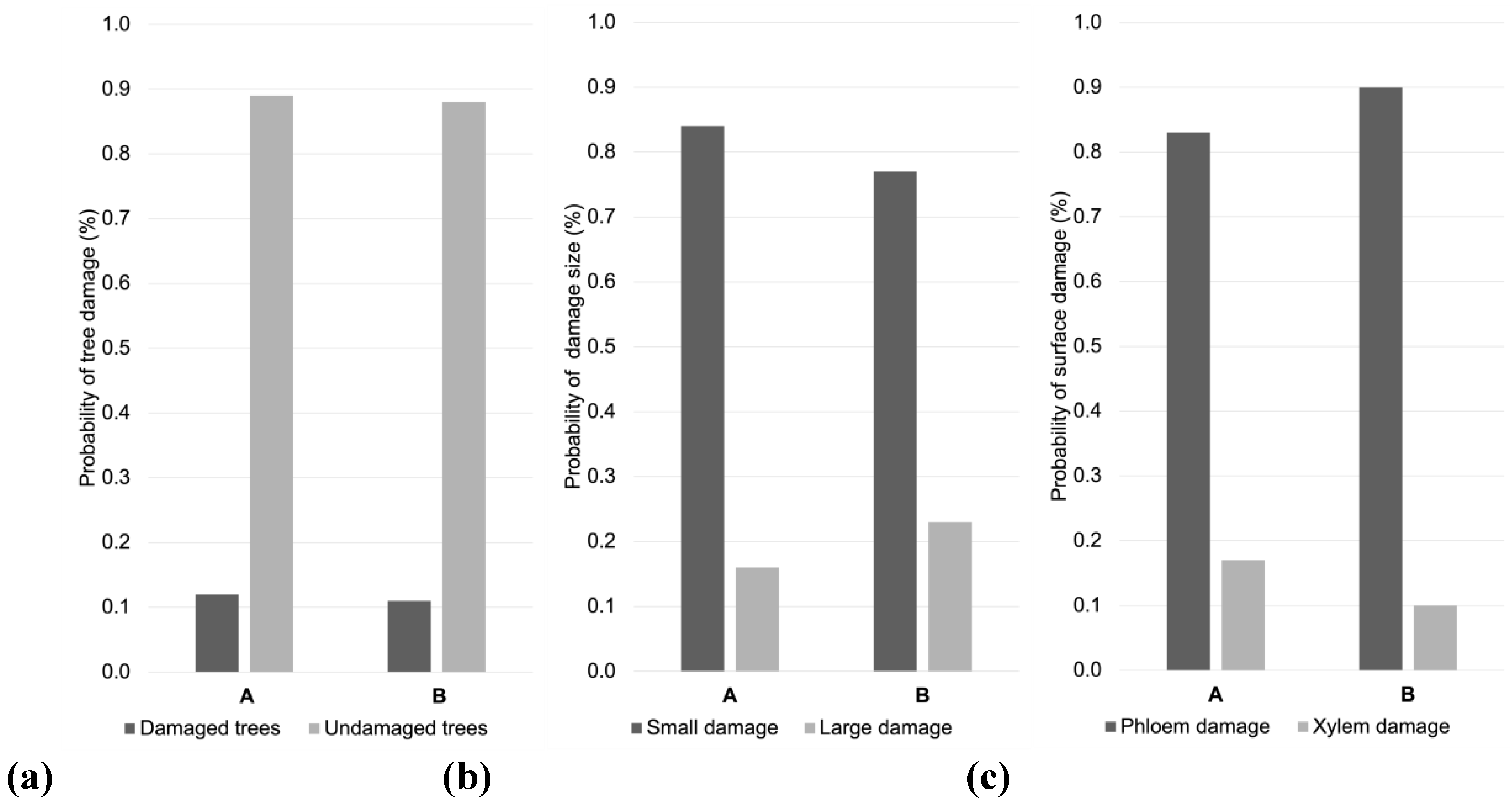
Figure 3.
Probability of tree damage depending on the distance between a tree and the nearest strip road.
Figure 3.
Probability of tree damage depending on the distance between a tree and the nearest strip road.
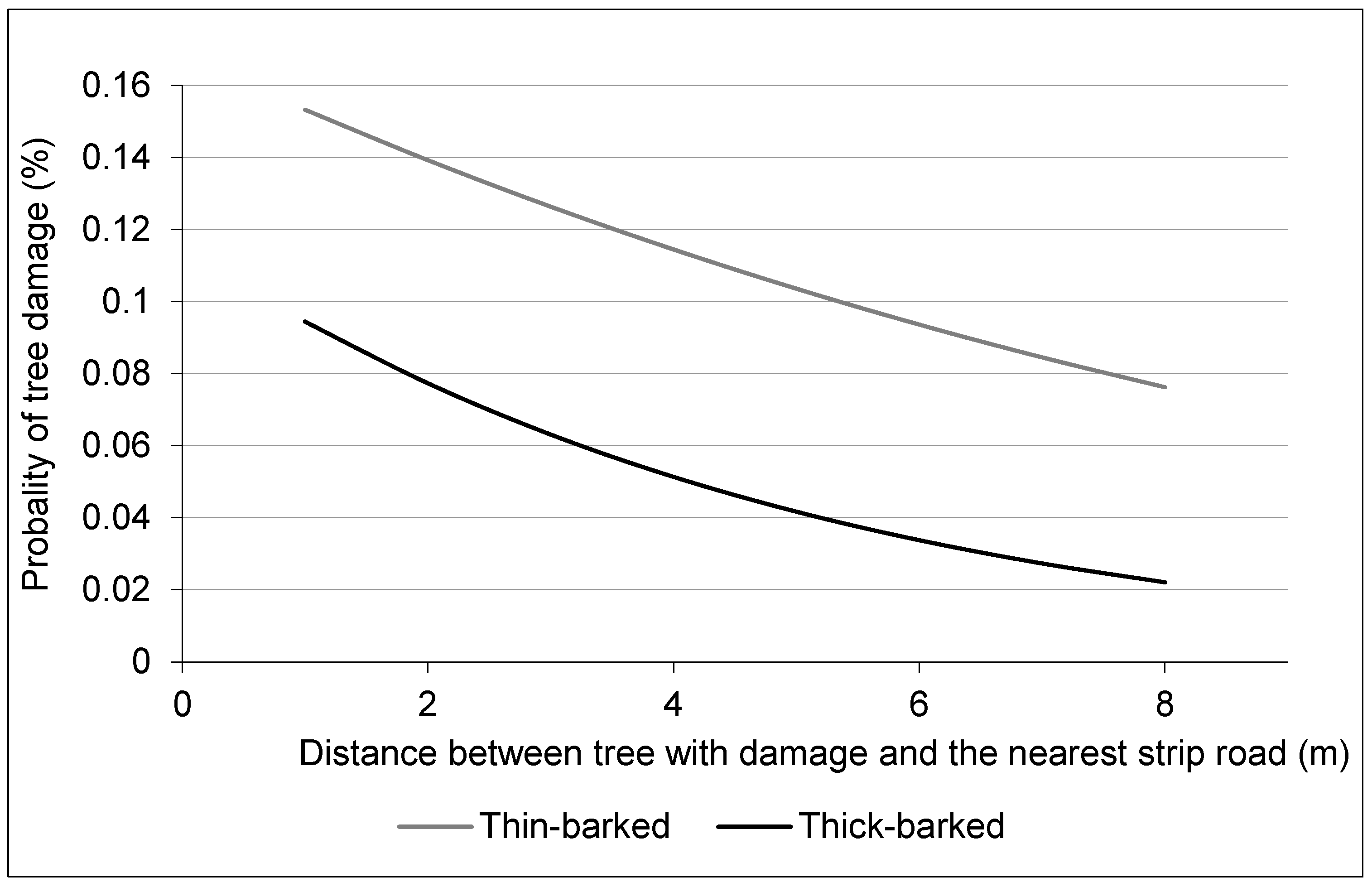

Table 1.
Fieldwork completion dates and weather conditions.
| Location City (Country) | Coordinates | Dominant tree species | Date | Temperature at 9 AM (°C) | ||||||
| -2 | -1 | 0 | 1 | 2 | 3 | 4 | ||||
| Allondans (France) |
N:47° 31' 55'' E:6° 45' 29'' |
Beech | 26-29.01 | |||||||
| Idar Oberstein (Germany) |
N:49° 43' 17" E:7° 16' 1" |
Beech | 06-10.02 | |||||||
| Sopron (Hungary) |
N:47° 44' 2" E:16° 34' 43" |
Oak | 19-21.02 | |||||||
| Wejherowo (Poland) |
N:54° 41' 48" E:18° 8' 32" |
Beech | 13-15.03 | |||||||
| Zaporowo (Poland) |
N:54° 24' 47" E:20° 8' 50" |
Birch | 20-23.03 | |||||||
| Kėdainiai (Lithuania) |
N:55° 22' 39" E:23° 49' 12" |
Aspen | 25-30.03 | |||||||
Table 2.
Residual tree damage rates across study sites following mechanized thinning.
| Study site | Total trees (n) | Removed trees (n) | Residual trees (n) | Damage density (trees ha⁻¹) | Trees with damage (n) | Trees without damage (n) | Damage rate (%) |
| Beech France | 887 | 213 | 674 | 135 | 81 | 593 | 12.0 |
| Beech Germany | 495 | 172 | 323 | 65 | 39 | 284 | 12.1 |
| Beech Poland | 614 | 180 | 434 | 80 | 48 | 386 | 11.1 |
| Oak Hungary | 847 | 312 | 535 | 50 | 30 | 505 | 5.6 |
| Birch Poland | 506 | 152 | 354 | 32 | 19 | 335 | 5.4 |
| Aspen Lithuania | 1227 | 317 | 910 | 90 | 54 | 856 | 5.9 |
| Total | 4576 | 1346 | 3230 | 452 | 271 | 2959 | 8.4 |
Table 3.
Comparison of dendrometric characteristics between undamaged trees and trees with damage across study sites and species. Values are presented as mean ± standard deviation. Differences between groups were tested using the Mann–Whitney U test; statistically significant p-values are shown where p < 0.05.
Table 3.
Comparison of dendrometric characteristics between undamaged trees and trees with damage across study sites and species. Values are presented as mean ± standard deviation. Differences between groups were tested using the Mann–Whitney U test; statistically significant p-values are shown where p < 0.05.
| Study site | Variable | Trees with damage | Undamaged trees | U statistic | p-value |
| Mean ± SD | Mean ± SD | ||||
| Beech France (n = 593/81) | DBH (cm) | 15.12 ± 6.00 | 16.53 ± 6.41 | 20,945 | 0.06 |
| Tree Height (m) | 16.60 ± 2.91 | 17.40 ± 2.87 | 20,178 | 0.02 | |
| Stem Volume (m³) | 0.19 ± 0.18 | 0.23 ± 0.21 | 20,768 | 0.05 | |
| Bark Thickness (mm) | 2.44 ± 1.19 | 2.61 ± 1.22 | 22,006 | 0.22 | |
| Beech Germany (n = 172/39) | DBH (cm) | 18.70 ± 8.54 | 18.49 ± 6.57 | 5,411 | 0.82 |
| Tree Height (m) | 17.89 ± 5.11 | 17.54 ± 4.64 | 5,488 | 0.93 | |
| Stem Volume (m³) | 0.35 ± 0.40 | 0.29 ± 0.29 | 5,424 | 0.84 | |
| Bark Thickness (mm) | 3.08 ± 1.58 | 2.84 ± 1.38 | 5,497 | 0.94 | |
| Beech Poland (n = 180/48) | DBH (cm) | 21.33 ± 8.07 | 21.80 ± 6.32 | 8,780 | 0.55 |
| Tree Height (m) | 22.12 ± 5.86 | 22.99 ± 4.57 | 9,212 | 0.95 | |
| Stem Volume (m³) | 0.50 ± 0.44 | 0.48 ± 0.31 | 8,951 | 0.70 | |
| Bark Thickness (mm) | 3.27 ± 1.57 | 3.50 ± 1.31 | 9,261 | 1.00 | |
| Oak Hungary (n = 505/30) | DBH (cm) | 18.60 ± 4.00 | 19.80 ± 5.72 | 6,924 | 0.42 |
| Tree Height (m) | 16.68 ± 2.36 | 17.78 ± 2.63 | 5,890 | 0.04 | |
| Stem Volume (m³) | 0.24 ± 0.14 | 0.30 ± 0.21 | 6,657 | 0.26 | |
| Bark Thickness (mm) | 9.13 ± 2.62 | 9.06 ± 2.88 | 7,183 | 0.63 | |
| Birch Poland (n = 335/19) | DBH (cm) | 23.61 ± 8.03 | 22.93 ± 8.77 | 2,978 | 0.64 |
| Tree Height (m) | 22.32 ± 5.98 | 21.57 ± 14.06 | 2,648 | 0.22 | |
| Stem Volume (m³) | 0.54 ± 0.39 | 0.52 ± 0.52 | 2,890 | 0.50 | |
| Bark Thickness (mm) | 11.79 ± 3.71 | 11.14 ± 4.62 | 2,861 | 0.46 | |
| Aspen Lithuania (n = 317/54) | DBH (cm) | 13.34 ± 4.04 | 12.17 ± 4.04 | 21,597 | 0.42 |
| Tree Height (m) | 16.07 ± 3.27 | 15.90 ± 2.57 | 18,907 | 0.02 | |
| Stem Volume (m³) | 0.12 ± 0.10 | 0.10 ± 0.11 | 20,664 | 0.19 | |
| Bark Thickness (mm) | 4.87 ± 1.58 | 4.52 ± 1.38 | 22,839 | 0.88 | |
| Total (n = 2959/271) | DBH (cm) | 17.36 ± 7.22 | 17.96 ± 7.91 | 386,937 | 0.34 |
| Tree Height (m) | 18.07 ± 4.80 | 18.53 ± 6.31 | 370,990 | 0.04 | |
| Stem Volume (m³) | 0.28 ± 0.32 | 0.31 ± 0.42 | 386,030 | 0.31 | |
| Bark Thickness (mm) | 4.56 ± 3.36 | 5.46 ± 3.77 | 335,374 | <0.001 |
Table 4.
Biosocial classification of trees with damage across study sites.
| Study site | Biosocial class | Trees with damage (n) | Share of trees with damage (%) |
| Beech France | Dominant | 47 | 58.0 |
| Dominated | 34 | 42.0 | |
| Beech Germany | Dominant | 22 | 56.4 |
| Dominated | 17 | 43.6 | |
| Beech Poland | Dominant | 26 | 54.2 |
| Dominated | 22 | 45.8 | |
| Oak Hungary | Dominant | 11 | 36.7 |
| Dominated | 19 | 63.3 | |
| Birch Poland | Dominant | 13 | 68.4 |
| Dominated | 6 | 31.6 | |
| Aspen Lithuania | Dominant | 33 | 61.1 |
| Dominated | 21 | 38.9 | |
| Dominant | 152 | 54.1 | |
| Total | Dominated | 119 | 45.9 |
Table 5.
Distance of trees with damage from strip road across study sites.
| Study site | N | Mean (m) | SD | SE |
| Beech France | 81 | 2.9 | 1.9 | 0.2 |
| Beech Germany | 39 | 3.5 | 1.9 | 0.3 |
| Beech Poland | 48 | 3.8 | 2.4 | 0.3 |
| Oak Hungary | 30 | 2.4 | 1.8 | 0.3 |
| Birch Poland | 19 | 3.0 | 2.4 | 0.6 |
| Aspen Lithuania | 54 | 2.7 | 2.0 | 0.3 |
| Total | 271 | 3.1 | 2.1 | 0.1 |
N – number of observations; SD – standard deviation; SE – standard error.
Table 6.
Distribution of trees with damage by wound area class across study sites. Values indicate the number (N) and percentage (%) of trees with wounds of 10–100 cm² and more than 100 cm² at each site and overall.
Table 6.
Distribution of trees with damage by wound area class across study sites. Values indicate the number (N) and percentage (%) of trees with wounds of 10–100 cm² and more than 100 cm² at each site and overall.
| Wound area | ||||
| Study site |
10-100 cm2 Small wounds |
>100 cm² Large wounds |
||
| N | % | N | % | |
| Beech France | 68 | 84.0 | 13 | 16.0 |
| Beech Germany | 33 | 84.6 | 6 | 15.4 |
| Beech Poland | 37 | 77.1 | 11 | 22.9 |
| Oak Hungary | 24 | 80.0 | 6 | 20.0 |
| Birch Poland | 9 | 47.4 | 10 | 52.6 |
| Aspen Lithuania | 42 | 77.8 | 12 | 22.2 |
| Total | 213 | 78.6 | 58 | 21.4 |
Table 7.
Logistic regression analyses evaluating the effects of operator, bark thickness, and stand type on damage characteristics based on beech stands.
Table 7.
Logistic regression analyses evaluating the effects of operator, bark thickness, and stand type on damage characteristics based on beech stands.
| Response variable | ||||
|
Damage characteristics (predictor variables) |
Beech stand |
Operators (in beech stands) |
Bark thickness effect | Thick-barked species |
| Number of trees (with damage-undamaged) |
0.980 | 0.598 | <0.001 | 0.981 |
| Wound depth (phloem-xylem) |
0.673 | 0.257 | 0.220 | 0.100 |
| Wound area (small-large) |
0.926 | 0.281 | 0.071 | 0.030 |
| Wound placement (root-trunk) |
0.602 | 0.958 | 0.622 | 0.998 |
| Height of damage | 0.071 | 0.091 | 0.203 | 0.346 |
Table 8.
Comparison of residual tree damage frequency between thin-barked and thick-barked stands. Mean, standard error (SE) and range presented within parenthesis.
Table 8.
Comparison of residual tree damage frequency between thin-barked and thick-barked stands. Mean, standard error (SE) and range presented within parenthesis.
| Species | Trees with damage (n/ha) | Trees with damage (%) | ||
| Average (SE) |
Range (min-max) |
Average (SE) |
Range (min-max) |
|
| Average thin-barked | 74.7 (30.3) | 48-144 | 11.8 (0.7) | 10.3-12.5 |
| Average thick-barked | 45.8 (21.4) | 16-76 | 5.7 (1.1) | 3.6-7.3 |
n, number of trees with damage; SE – standard error. 1) Values in parentheses indicate standard errors.
Table 9.
Empirical significance levels (p-value) of comparisons between thin and thick-barked stands (t-Student test).
Table 9.
Empirical significance levels (p-value) of comparisons between thin and thick-barked stands (t-Student test).
| Stand diameter | Stand cross-sectional areas at breast height | Stand height | Harvested wood volume | Ratio of harvested to remaining trees |
| <0.001 | <0.001 | <0.001 | <0.001 | 0.141 |
Table 10.
Significance of predictors included in the residual tree damage probability model.
| Factor |
Bark-thickness category |
Ratio of removed trees to residual trees | Ratio of the DBH of removed trees to residual trees | Ratio of the breast height cross-sectional area of removed trees to residual trees | Ratio of the volume of removed trees to residual trees | Distance between tree and the nearest strip road |
| Model | <0.001 | 0.584 | 0.725 | 0.570 | 0.415 | <0.001 |
Disclaimer/Publisher’s Note: The statements, opinions and data contained in all publications are solely those of the individual author(s) and contributor(s) and not of MDPI and/or the editor(s). MDPI and/or the editor(s) disclaim responsibility for any injury to people or property resulting from any ideas, methods, instructions or products referred to in the content. |
© 2026 by the authors. Licensee MDPI, Basel, Switzerland. This article is an open access article distributed under the terms and conditions of the Creative Commons Attribution (CC BY) license (http://creativecommons.org/licenses/by/4.0/).
Copyright: This open access article is published under a Creative Commons CC BY 4.0 license, which permit the free download, distribution, and reuse, provided that the author and preprint are cited in any reuse.